US6769356B2 - Method of operating a hydraulic pressing unit, and hydraulic pressing unit - Google Patents
Method of operating a hydraulic pressing unit, and hydraulic pressing unit Download PDFInfo
- Publication number
- US6769356B2 US6769356B2 US10/319,269 US31926902A US6769356B2 US 6769356 B2 US6769356 B2 US 6769356B2 US 31926902 A US31926902 A US 31926902A US 6769356 B2 US6769356 B2 US 6769356B2
- Authority
- US
- United States
- Prior art keywords
- return valve
- moving part
- pressing unit
- pressing
- return
- Prior art date
- Legal status (The legal status is an assumption and is not a legal conclusion. Google has not performed a legal analysis and makes no representation as to the accuracy of the status listed.)
- Expired - Lifetime, expires
Links
Images




Classifications
-
- B—PERFORMING OPERATIONS; TRANSPORTING
- B25—HAND TOOLS; PORTABLE POWER-DRIVEN TOOLS; MANIPULATORS
- B25B—TOOLS OR BENCH DEVICES NOT OTHERWISE PROVIDED FOR, FOR FASTENING, CONNECTING, DISENGAGING OR HOLDING
- B25B27/00—Hand tools, specially adapted for fitting together or separating parts or objects whether or not involving some deformation, not otherwise provided for
- B25B27/02—Hand tools, specially adapted for fitting together or separating parts or objects whether or not involving some deformation, not otherwise provided for for connecting objects by press fit or detaching same
- B25B27/10—Hand tools, specially adapted for fitting together or separating parts or objects whether or not involving some deformation, not otherwise provided for for connecting objects by press fit or detaching same inserting fittings into hoses
-
- B—PERFORMING OPERATIONS; TRANSPORTING
- B21—MECHANICAL METAL-WORKING WITHOUT ESSENTIALLY REMOVING MATERIAL; PUNCHING METAL
- B21J—FORGING; HAMMERING; PRESSING METAL; RIVETING; FORGE FURNACES
- B21J15/00—Riveting
- B21J15/10—Riveting machines
- B21J15/16—Drives for riveting machines; Transmission means therefor
- B21J15/20—Drives for riveting machines; Transmission means therefor operated by hydraulic or liquid pressure
-
- F—MECHANICAL ENGINEERING; LIGHTING; HEATING; WEAPONS; BLASTING
- F15—FLUID-PRESSURE ACTUATORS; HYDRAULICS OR PNEUMATICS IN GENERAL
- F15B—SYSTEMS ACTING BY MEANS OF FLUIDS IN GENERAL; FLUID-PRESSURE ACTUATORS, e.g. SERVOMOTORS; DETAILS OF FLUID-PRESSURE SYSTEMS, NOT OTHERWISE PROVIDED FOR
- F15B11/00—Servomotor systems without provision for follow-up action; Circuits therefor
- F15B11/02—Systems essentially incorporating special features for controlling the speed or actuating force of an output member
- F15B11/028—Systems essentially incorporating special features for controlling the speed or actuating force of an output member for controlling the actuating force
-
- F—MECHANICAL ENGINEERING; LIGHTING; HEATING; WEAPONS; BLASTING
- F15—FLUID-PRESSURE ACTUATORS; HYDRAULICS OR PNEUMATICS IN GENERAL
- F15B—SYSTEMS ACTING BY MEANS OF FLUIDS IN GENERAL; FLUID-PRESSURE ACTUATORS, e.g. SERVOMOTORS; DETAILS OF FLUID-PRESSURE SYSTEMS, NOT OTHERWISE PROVIDED FOR
- F15B15/00—Fluid-actuated devices for displacing a member from one position to another; Gearing associated therewith
- F15B15/20—Other details, e.g. assembly with regulating devices
- F15B15/204—Control means for piston speed or actuating force without external control, e.g. control valve inside the piston
-
- F—MECHANICAL ENGINEERING; LIGHTING; HEATING; WEAPONS; BLASTING
- F15—FLUID-PRESSURE ACTUATORS; HYDRAULICS OR PNEUMATICS IN GENERAL
- F15B—SYSTEMS ACTING BY MEANS OF FLUIDS IN GENERAL; FLUID-PRESSURE ACTUATORS, e.g. SERVOMOTORS; DETAILS OF FLUID-PRESSURE SYSTEMS, NOT OTHERWISE PROVIDED FOR
- F15B2211/00—Circuits for servomotor systems
- F15B2211/30—Directional control
- F15B2211/305—Directional control characterised by the type of valves
- F15B2211/30505—Non-return valves, i.e. check valves
-
- F—MECHANICAL ENGINEERING; LIGHTING; HEATING; WEAPONS; BLASTING
- F15—FLUID-PRESSURE ACTUATORS; HYDRAULICS OR PNEUMATICS IN GENERAL
- F15B—SYSTEMS ACTING BY MEANS OF FLUIDS IN GENERAL; FLUID-PRESSURE ACTUATORS, e.g. SERVOMOTORS; DETAILS OF FLUID-PRESSURE SYSTEMS, NOT OTHERWISE PROVIDED FOR
- F15B2211/00—Circuits for servomotor systems
- F15B2211/40—Flow control
- F15B2211/405—Flow control characterised by the type of flow control means or valve
- F15B2211/40515—Flow control characterised by the type of flow control means or valve with variable throttles or orifices
-
- F—MECHANICAL ENGINEERING; LIGHTING; HEATING; WEAPONS; BLASTING
- F15—FLUID-PRESSURE ACTUATORS; HYDRAULICS OR PNEUMATICS IN GENERAL
- F15B—SYSTEMS ACTING BY MEANS OF FLUIDS IN GENERAL; FLUID-PRESSURE ACTUATORS, e.g. SERVOMOTORS; DETAILS OF FLUID-PRESSURE SYSTEMS, NOT OTHERWISE PROVIDED FOR
- F15B2211/00—Circuits for servomotor systems
- F15B2211/40—Flow control
- F15B2211/41—Flow control characterised by the positions of the valve element
- F15B2211/411—Flow control characterised by the positions of the valve element the positions being discrete
-
- F—MECHANICAL ENGINEERING; LIGHTING; HEATING; WEAPONS; BLASTING
- F15—FLUID-PRESSURE ACTUATORS; HYDRAULICS OR PNEUMATICS IN GENERAL
- F15B—SYSTEMS ACTING BY MEANS OF FLUIDS IN GENERAL; FLUID-PRESSURE ACTUATORS, e.g. SERVOMOTORS; DETAILS OF FLUID-PRESSURE SYSTEMS, NOT OTHERWISE PROVIDED FOR
- F15B2211/00—Circuits for servomotor systems
- F15B2211/40—Flow control
- F15B2211/42—Flow control characterised by the type of actuation
- F15B2211/421—Flow control characterised by the type of actuation mechanically
- F15B2211/423—Flow control characterised by the type of actuation mechanically manually, e.g. by using a lever or pedal
-
- F—MECHANICAL ENGINEERING; LIGHTING; HEATING; WEAPONS; BLASTING
- F15—FLUID-PRESSURE ACTUATORS; HYDRAULICS OR PNEUMATICS IN GENERAL
- F15B—SYSTEMS ACTING BY MEANS OF FLUIDS IN GENERAL; FLUID-PRESSURE ACTUATORS, e.g. SERVOMOTORS; DETAILS OF FLUID-PRESSURE SYSTEMS, NOT OTHERWISE PROVIDED FOR
- F15B2211/00—Circuits for servomotor systems
- F15B2211/40—Flow control
- F15B2211/42—Flow control characterised by the type of actuation
- F15B2211/426—Flow control characterised by the type of actuation electrically or electronically
-
- F—MECHANICAL ENGINEERING; LIGHTING; HEATING; WEAPONS; BLASTING
- F15—FLUID-PRESSURE ACTUATORS; HYDRAULICS OR PNEUMATICS IN GENERAL
- F15B—SYSTEMS ACTING BY MEANS OF FLUIDS IN GENERAL; FLUID-PRESSURE ACTUATORS, e.g. SERVOMOTORS; DETAILS OF FLUID-PRESSURE SYSTEMS, NOT OTHERWISE PROVIDED FOR
- F15B2211/00—Circuits for servomotor systems
- F15B2211/40—Flow control
- F15B2211/47—Flow control in one direction only
- F15B2211/473—Flow control in one direction only without restriction in the reverse direction
-
- F—MECHANICAL ENGINEERING; LIGHTING; HEATING; WEAPONS; BLASTING
- F15—FLUID-PRESSURE ACTUATORS; HYDRAULICS OR PNEUMATICS IN GENERAL
- F15B—SYSTEMS ACTING BY MEANS OF FLUIDS IN GENERAL; FLUID-PRESSURE ACTUATORS, e.g. SERVOMOTORS; DETAILS OF FLUID-PRESSURE SYSTEMS, NOT OTHERWISE PROVIDED FOR
- F15B2211/00—Circuits for servomotor systems
- F15B2211/50—Pressure control
- F15B2211/505—Pressure control characterised by the type of pressure control means
- F15B2211/50509—Pressure control characterised by the type of pressure control means the pressure control means controlling a pressure upstream of the pressure control means
- F15B2211/50536—Pressure control characterised by the type of pressure control means the pressure control means controlling a pressure upstream of the pressure control means using unloading valves controlling the supply pressure by diverting fluid to the return line
-
- F—MECHANICAL ENGINEERING; LIGHTING; HEATING; WEAPONS; BLASTING
- F15—FLUID-PRESSURE ACTUATORS; HYDRAULICS OR PNEUMATICS IN GENERAL
- F15B—SYSTEMS ACTING BY MEANS OF FLUIDS IN GENERAL; FLUID-PRESSURE ACTUATORS, e.g. SERVOMOTORS; DETAILS OF FLUID-PRESSURE SYSTEMS, NOT OTHERWISE PROVIDED FOR
- F15B2211/00—Circuits for servomotor systems
- F15B2211/50—Pressure control
- F15B2211/55—Pressure control for limiting a pressure up to a maximum pressure, e.g. by using a pressure relief valve
-
- F—MECHANICAL ENGINEERING; LIGHTING; HEATING; WEAPONS; BLASTING
- F15—FLUID-PRESSURE ACTUATORS; HYDRAULICS OR PNEUMATICS IN GENERAL
- F15B—SYSTEMS ACTING BY MEANS OF FLUIDS IN GENERAL; FLUID-PRESSURE ACTUATORS, e.g. SERVOMOTORS; DETAILS OF FLUID-PRESSURE SYSTEMS, NOT OTHERWISE PROVIDED FOR
- F15B2211/00—Circuits for servomotor systems
- F15B2211/70—Output members, e.g. hydraulic motors or cylinders or control therefor
- F15B2211/705—Output members, e.g. hydraulic motors or cylinders or control therefor characterised by the type of output members or actuators
- F15B2211/7051—Linear output members
- F15B2211/7052—Single-acting output members
-
- F—MECHANICAL ENGINEERING; LIGHTING; HEATING; WEAPONS; BLASTING
- F15—FLUID-PRESSURE ACTUATORS; HYDRAULICS OR PNEUMATICS IN GENERAL
- F15B—SYSTEMS ACTING BY MEANS OF FLUIDS IN GENERAL; FLUID-PRESSURE ACTUATORS, e.g. SERVOMOTORS; DETAILS OF FLUID-PRESSURE SYSTEMS, NOT OTHERWISE PROVIDED FOR
- F15B2211/00—Circuits for servomotor systems
- F15B2211/70—Output members, e.g. hydraulic motors or cylinders or control therefor
- F15B2211/76—Control of force or torque of the output member
-
- F—MECHANICAL ENGINEERING; LIGHTING; HEATING; WEAPONS; BLASTING
- F15—FLUID-PRESSURE ACTUATORS; HYDRAULICS OR PNEUMATICS IN GENERAL
- F15B—SYSTEMS ACTING BY MEANS OF FLUIDS IN GENERAL; FLUID-PRESSURE ACTUATORS, e.g. SERVOMOTORS; DETAILS OF FLUID-PRESSURE SYSTEMS, NOT OTHERWISE PROVIDED FOR
- F15B2211/00—Circuits for servomotor systems
- F15B2211/70—Output members, e.g. hydraulic motors or cylinders or control therefor
- F15B2211/77—Control of direction of movement of the output member
- F15B2211/7716—Control of direction of movement of the output member with automatic return
Definitions
- the invention relates, in the first instance, to a method of operating a hydraulic pressing unit, in particular manual pressing unit, it being the case that the pressing unit has a hydraulic pump, a moving part, a stationary part and a non-return valve, that, furthermore, the moving part is displaced into a pressing position by the build-up of a hydraulic pressure and the non-return valve moves automatically into an open position only in the presence of a predetermined hydraulic pressure corresponding to a pressing pressure, and that, furthermore, the moving part is configured for moving back automatically from the pressing position into an end position under the action of a restoring spring and the non-return valve is configured only to close once the moving part has reached the end position.
- the invention proposes that, before the end position of the moving part is reached, the non-return valve is subject to the action of a corresponding closure force.
- the non-return valve has an actuating section extending outside the unit.
- the user can subject said actuating section to the necessary force, for example, by hand. It is thus readily possible to interrupt the return in any position of the moving part. It is also easily possible for this means of action for the user to be shifted, if appropriate via lever transmission, into the region of the unit handle, for example to where, if appropriate via a further button, the triggering button of the unit is also disposed.
- the non-return valve is arrested until a pre-selected or predetermined return position of the moving part has been reached.
- this high-force restoring spring is automatically moved into a prestressing position, by the hydraulic pressure also acting on the moving part, and immediately arrested there.
- the non-return valve is thus exposed to this force, in principle, during return of the moving part, but the arresting means absorbs this force until it is released by the user by actuation, or by the unit itself, when a predetermined return position of the moving part is reached.
- the action on the non-return valve takes place correspondingly by release of a previously stored closure force.
- the non-return valve in one configuration of the known unit mentioned in the introduction, it is also possible for the non-return valve to be formed magnetically and for the abovementioned force to be produced by an electromagnet being switched on at a given point in time. It is then possible for the electromagnet either to pull the non-return valve into its closed position or, with equal poles located opposite one another, to push the non-return valve into its closed position. Furthermore, it is also possible to carry out electromechanical arresting. In this case an electrical actuating part, for example once again an electromagnet, pushes a mechanical arresting part into the displacement path of the non-return valve, the open position of the latter. In the same way, this locking can then be withdrawn again by electrical actuation.
- the magnetic or electromagnetic action clearly does not, or in any case does not necessarily, take place by the release of a previously stored closure force. Rather, it takes place by supplying power to a corresponding electromagnetic or electromechanical arrangement.
- the actuating button for starting the electric motor, or the hydraulic pump connected thereto is also provided, at the same time, with a button for acting on the locking part of the non-return valve.
- the triggering button it is possible for the triggering button to be suspended in a lever-like manner and to be provided with a locking pin which can be moved back counter to spring force and, for its part, engages beneath a locking part, adjustable counter to spring force and acting on the non-return valve, and can also run over the same again.
- the invention proposes, as subject matter, a hydraulic pressing unit having a hydraulic piston running in a cylinder, it being possible for the hydraulic piston to be moved back counter to the force of a restoring spring.
- the invention proposes that it is possible to stop the return of the hydraulic piston before it reaches the starting position by a triggering device, acting on the non-return valve.
- the triggering device comprises a pulling or pushing part connected to the non-return valve.
- the pulling or pushing part passes through not just the valve cylinder but also a housing wall which also encloses the unit, usually outside the valve. It can be subjected, for example, to manual action. If, in the case of the configuration in accordance with WO 99/19947, the disclosure contents of this document are hereby included in full in the disclosure of the present application, also for the purpose of incorporating features of the related application in claims of the present application, the non-return valve is pulled or pushed into the closed position during the return of the moving part, the hydraulic volume is prevented from decreasing further. The moving part comes to a standstill. Upon renewed triggering actuation of the electrical motor, the moving part can then be moved, from the location at which it has been stopped, into the closed position again.
- the tip of the closure valve As far as a pulling part is concerned, it is possible, for example, for the tip of the closure valve to be formed as a rod passing through the housing, obviously with corresponding sealing.
- an extension of the non-return valve which is oriented in the opening direction and passes through the housing wall is configured as the pulling part. Via a rocker part which is connected thereto, and ultimately only passes through the outer housing covering, it can be utilized for opening the non-return valve.
- This extension is then configured as a pushing part. It has a freely accessible end region on which it is possible to act in order to close the non-return valve.
- an electromagnet acts on the non-return valve.
- a manual pressing unit is also operated by a storage battery, or else by direct connection to an electricity supply, for example in an assembly building. This may be used in order to provide an electromagnet associated with the non-return valve.
- the electromagnet can either push or pull said valve into the closed position.
- the non-return valve is subjected to the action of a prestressing force which is sufficient for displacement into the closed position at any point in time at which the moving part is moving back.
- This may be important and advantageous in the first instance, irrespective of possible displacement into the closed position at any point in time of the return of the moving part, just from the point of view that the automatic return of the moving part depends as little as possible on the pressure which is produced by the compression spring acting on the non-return valve, this being so even in the case of the non-return valve being independent of the pressure produced by the restoring spring.
- the invention proposes, in the first instance, that the open position of the non-return valve is arrested until a predetermined return position of the moving part has been reached. According to the invention it is provided that the open position of the non-return valve is arrested mechanically, specifically until the moving part has been moved into its starting position or a desired return position of the moving part has been reached.
- the non-return valve has a latching socket in which an arresting protrusion engages for the arresting operation.
- the latching socket is suitably provided to the rear of the active piston surface of the non-return valve.
- the arresting protrusion which moves into the latching socket is suitably subjected to spring prestressing.
- a separate disengaging part is provided and moves the arresting protrusion out of the latching socket, this in dependence on given mechanical conditions or pressure conditions, and as explained in more detail hereinbelow.
- the disengaging part can interact with a ramp of the arresting protrusion.
- a conical surface or some other ramp-like surface is suitably formed on the arresting protrusion.
- the disengaging part has a surface which corresponds thereto. A sliding wedge action is produced as a result.
- the moving part can act mechanically on the disengaging part.
- the moving part is usually a piston of the pressing unit.
- the disengaging part projects, for mechanical activation, in the displacement direction of the piston, so that the piston or the moving part, as it is displaced, mechanically actuates the disengaging part in a certain section of the displacement path, preferably at the end of the displacement path.
- the disengaging part may be subjected to spring prestressing.
- the spring prestressing drives the disengaging part into the disengagement position.
- the spring prestressing is exceeded by the, hydraulic pressure which prevails during pressing and return of the moving part. It is only once the moving part is at a standstill that the hydraulic pressure drops to the extent where the disengaging part, as a result of the spring prestressing to which it is subjected, moves out of a movement path of the arresting protrusion, which then, because it itself is subjected to spring prestressing, moves out of the latching socket of the non-return valve and thus releases the latter for closure.
- the disengaging part may also be used in order to make it possible for the arresting protrusion to be lifted out of the arresting position by manual actuation.
- the arresting protrusion is guided out of the housing at one end and, there, pulled out of the arresting position by hand, for example, counter to its prestressing force.
- the disengaging part is then the rearwardly projecting section of the arresting protrusion.
- the disengaging part which, at least over a certain movement region, interacts in a positively locking manner with the arresting protrusion and is, for example, in the form of a rocker.
- the arresting protrusion is then inevitably also withdrawn from its arresting position.
- the disengaging part for this purpose, to be coupled to an actuating switch of the unit, for example to the triggering or starting switch of the unit, for example such that further actuating of the starting switch results in the arresting protrusion being withdrawn from the arresting position and thus in the moving part being stopped. Subsequent actuation of the starting switch then results, once again, in the electric motor starting up and the pump operating, so that a new pressing process begins.
- FIG. 1 shows a cross-sectional view of a hydraulic pressing unit with a device for optionally closing the non-return valve
- FIG. 2 shows a cross-sectional illustration, in detail form, of the pressing unit with button-actuated triggering for displacing the non-return valve into the closed position, in a first position;
- FIG. 3 shows the illustration according to FIG. 2 when the unit is started up
- FIG. 4 shows an illustration following on from FIG. 3, the starting button having been pressed further and the pump started up;
- FIG. 5 shows an illustration following on from FIG. 4, once the triggering pressure of the non-return valve has been reached and the pump has been switched off; with release of the return movement of the starting button and locking of the non-return valve in the open position;
- FIG. 6 shows an illustration following on from FIG. 5, with the disengaging part moving back beneath an activating shoulder, with the starting button released, and the non-return valve locked in the open position;
- FIG. 7 shows a basic position of the second exemplary embodiment, in which the moving part is in its starting position and the non-return valve is closed;
- FIG. 8 shows the second exemplary embodiment once pressing pressure has been applied and the moving part moved into its pressing position; the non-return valve is closed;
- FIG. 9 shows a state of the second exemplary embodiment in which the non-return valve has opened and the moving part moves back
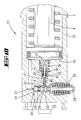
- FIG. 10 shows the starting position for a third exemplary embodiment
- FIG. 11 shows a state of the third exemplary embodiment in which pressing pressure is built up and the non-return valve is closed.
- FIG. 12 shows a further state of the third exemplary embodiment; the non-return valve is open and the moving part moves back in the direction of its starting position.
- FIG. 1 incorporates two embodiments, which are also of separate importance.
- the non-return valve 1 has a pressing shoulder 2 projecting outward beyond the unit.
- This pressing shoulder can be used for optionally bringing the non-return valve 1 from its open position into its closed position in any position of the moving part 4 , in this case a hydraulic piston, which is moved back by the spring 3 .
- the moving part 4 or the hydraulic piston is then stopped at the location at which it is found at this point in time.
- an electromagnet 5 which likewise acts on the non-return valve 1 .
- the exemplary embodiment provides coil windings 6 which, when activated electrically, interact magnetically with an associated section, for example the section 7 , of the non-return valve. This results in a pulling action, but a pushing action is just as possible. It is also possible for the through-passage section of the non-return valve to be used as an armature which is moved by the magnet.
- FIGS. 2 to 6 also relates, in principle, to a hydraulic pressing unit as is known from the abovementioned WO 99/19947.
- the non-return valve 1 is permanently prestressed into the closed position, in the case of the exemplary embodiment by means of a compression spring 20 , by such a force that, irrespective of the pressure exerted by the returning moving part 4 , the non-return valve would move into the closed position at any time. It is prevented from doing this by an arresting protrusion 8 which, as is also explained more specifically hereinbelow with reference to the embodiments of FIGS. 9 to 12 , moves into a corresponding cutout of the non-return valve.
- a disengaging part 11 engages beneath the latter and, for its part, is fastened on the unit body 9 in a rocker-like manner about a point of rotation 12 .
- the disengaging part 11 or the mount 13 of the disengaging part 11 , is rigidly connected to a triggering knob 14 of the unit. Upon actuation, the triggering knob 14 acts on an electric switch 15 .
- FIG. 2 shows the state in which the electric motor is switched off.
- the hydraulic pressing unit is at rest.
- the non-return valve 1 is located in an open position and is arrested in this position by the arresting protrusion 8 .
- the moving part 4 is located in a fully returned position.
- FIG. 3 illustrates the state in which the user wishes to carry out a pressing operation. He/she begins to act on the triggering button 14 . The latter has moved, counter to the action of the compression spring 16 which, at the other end, butts against a stationary housing part 17 , in the direction of the electric switch 15 .
- the disengaging protrusion 11 here moves along a circular path about the point of articulation 12 . It has already withdrawn the arresting protrusion 8 , in part, from its arresting position.
- the user by pressing the triggering button 14 further, has actuated the electric switch 15 , so that the electric pump starts up and the hydraulic space 18 is filled with hydraulic fluid.
- the disengaging protrusion 8 has been lifted out to the extent where the non-return valve 1 has been displaced into the closed position under the action of the compression spring 20 .
- the hydraulic piston or the moving part 4 has already moved away from its end position; it is no longer visible in FIG. 4 . Since, more specifically, the disengaging part 11 can also be moved back out of its foremost position, counter to the action of the compression spring 19 , it is possible when the triggering button 14 is disengaged, as is illustrated in FIGS. 5 and 6, for the disengaging part 11 to snap back beneath the protrusion 10 without the arresting position of the arresting part 8 being adversely affected as a result.
- the disengaging part then resumes the position of FIG. 2, although in this case the moving part is moved further in the direction of the pressing position by the pump, which continues to run.
- the pump switches off automatically, even when, as is usually the case, the triggering knob 14 is still pressed.
- the non-return valve 1 automatically moves into its open position, counter to the action of the compression spring 20 .
- FIGS. 7 to 9 deal with a second embodiment, which only relates to the operation of arresting the non-return valve forced into the open position by a positive pressure.
- Positive pressure here means that the pressure is higher than that required for closing the non-return valve for example only at the end of the return path of the moving part. Rather, the pressure is high enough for it to be suitable for closing the non-return valve in any position of the return of the moving part.
- the hydraulic pressing unit 21 has a hydraulic pump (not illustrated), by means of which hydraulic medium, usually oil, is pumped into the hydraulic space 18 , see also FIG. 8, from a hydraulic supply space 22 (which is not illustrated any more specifically either).
- a moving part 4 in this case a piston, can be displaced counter to the action of a restoring spring 3 .
- the hydraulic pressure is built up until it has reached a predetermined pressing pressure at which the non-return valve 1 , which acts as a pressure-release valve at the same time, opens.
- the non-return valve 1 has an initially active, comparatively very small valve surface area which, in the case of the exemplary embodiment, corresponds to the cross-section provided by the bore 23 .
- this cross-section requires as high a pressure as corresponds to the pressing pressure. Once the non-return valve 1 has been raised off, the larger surface area provided by the diameter of the piston section 24 takes effect. Once it has been triggered, the non-return valve 1 is thus—still—retained in the open position by a considerably lower pressure.
- the moving part 4 is displaced relative to a stationary part 25 .
- the terms moving part and stationary part may also be related to elements of the working region of the pressing unit which are not illustrated specifically.
- the moving part or the moving parts, for this purpose, are jaws which move together, or the moving part is a blade or a pressing mold which moves against a stop or a stationary countermold.
- the non-return valve 1 has a latching socket 26 which, in the case of the exemplary embodiment, is formed by an encircling groove in a piston section of the non-return valve 1 . Also provided is an arresting part 27 , which is prestressed in the direction of the non-return valve 1 under the action of a spring 28 . The arresting part 27 has an arresting protrusion 8 which, when the non-return valve 1 is displaced into its open position, moves into the latching socket 26 .
- the non-return valve 1 for its part, is prestressed into its closed position by the action of the spring 20 .
- a handle 29 is formed on the rear side of the non-return valve 1 , in extension of a shank of the non-return valve 1 , and makes it possible for the non-return valve to be displaced into its open position by hand.
- the arresting protrusion 8 is in engagement, the valve cannot be closed by hand.
- the arresting part 27 for its part, interacts with a disengaging part 11 , which is formed as a valve piston.
- the disengaging part 11 has an activating protrusion 30 which projects into the displacement path of the moving part 4 , in this case the piston.
- the disengaging part 11 also has an actuating tip 31 which interacts with an actuating formation 32 on the arresting part 27 .
- the actuating tip 31 and the actuating formation 32 are each formed conically.
- the moving part 4 moves counter to the action of the spring 3 , as is illustrated in FIG. 8 .
- the arresting part 27 moves, by the action of the spring 28 , until the arresting protrusion 8 strikes against the circumferential surface of the piston section 33 , which is formed in front of the latching socket 26 , as seen in the closing direction of the non-return valve 1 .
- the piston section 33 corresponds, in terms of diameter to the free diameter of the cylinder 34 in which the non-return valve 1 moves.
- the arresting protrusion 8 has been moved up onto the circumferential piston surface of the piston section 33 .
- the arresting protrusion 8 is prestressed onto the piston section 33 to such an extent that the pressure in the cylinder space 18 up to the pressing pressure is exceeded by the action of the spring 28 .
- the latter is not absolutely necessary. It would also be possible for the action of the spring 28 to be substantially less. In this case, the arresting means would only move the arresting protrusion into the arresting recess 26 when the moving part 4 is being displaced back, under a substantially lower pressure in the cylinder space 18 .
- the latching socket 26 coincides with the arresting protrusion 8 , so that the latter moves in by the action of the spring 28 (or, as has been indicated above, moves in at a later point in time when the pressure in the cylinder space 18 has dropped to the extent where the action of the spring 28 is sufficient but the moving part 4 has not yet been displaced back to the stop).
- the disengaging part 11 which, rather than being subjected to any spring prestressing, is only subjected to the action of the spring 28 and/or the oil pressure prevailing in the cylinder space 18 , is displaced back further. It thus projects to an even greater extent into the movement path of the moving part 4 .
- the oil from the cylinder space 18 can flow out into the supply space 22 through the indicated line 36 , which is released by the piston section 24 when the non-return valve is opened.
- the moving part 4 strikes against the end surface of the activating protrusion 30 of the disengaging part 11 , the latter is pushed in the direction of the arresting part 27 by the action of the spring 3 and thus, via the drive surfaces 31 , 32 , the arresting part 27 moves back counter to the action of the spring 28 .
- the non-return valve 1 can then be displaced into its closed position according to FIGS. 7 and 8 again by the action of the spring 20 .
- the third exemplary embodiment is illustrated in FIGS. 10 to 12 .
- arresting part is combined in functional terms, in principle, with the disengaging part.
- the non-return valve 1 corresponds to the non-return valve 1 described above and, in this respect, you are referred to the latter.
- FIG. 10 shows the basic position, with the non-return valve 1 closed and with the arresting protrusion 8 spaced apart from the associated piston section 33 of the non-return valve 1 .
- the arresting protrusion 8 in the first instance, is subjected to prestressing by the spring 36 .
- the arresting protrusion 8 is connected to a piston part 37 which is subjected directly to the hydraulic pressure acting in the cylinder space 18 .
- the arresting protrusion can be displaced within the piston part 37 .
- the piston part 37 it is subjected to the action of the spring 38 , by means of which the arresting protrusion 8 , in dependence on a pressure acting on the piston part 37 , is prestressed against the non-return valve 1 .
- the piston part 37 may be displaced until the shank 39 strikes against the end 40 of the associated cylinder bore 41 . In this state, that end surface of the arresting protrusion 8 which is assigned to the non-return valve 1 has already struck against the circumference of the piston section 33 of the non-return valve 1 . As the piston part 37 is displaced to an increasing extent, the arresting protrusion 8 is displaced back, in which case the spring 38 takes effect.
- the arresting protrusion 8 passes through a bore 42 in the piston section 39 of the piston part 37 .
- the arresting protrusion 8 is guided in a moveable manner by means of a piston section 43 , the spring 38 acting on that side of the latter which is directed away from the non-return valve 1 .
- the arresting protrusion 8 enters into the latching recess 26 , basically as has also already been described for the second exemplary embodiment.
- This state is illustrated in FIG. 12 .
- the pressure still prevailing in the cylinder space 18 brought about by the spring 3 , keeps the arresting protrusion 8 in the latching position according to FIG. 12 .
- the moving part 4 say in this case the piston
- the piston comes into abutment against the end wall 44 of the cylinder space 18 that the pressure in the cylinder space 18 drops, so that the piston part 37 moves into the position according to FIG. 10 under the action of the spring 36 .
- the arresting protrusion 8 is moved out as a result, so that, on account of the action of the spring 20 , the non-return valve can be displaced back into its closed position according to FIG. 10 .
Landscapes
- Engineering & Computer Science (AREA)
- Mechanical Engineering (AREA)
- Physics & Mathematics (AREA)
- Fluid Mechanics (AREA)
- General Engineering & Computer Science (AREA)
- Press Drives And Press Lines (AREA)
- Preventing Unauthorised Actuation Of Valves (AREA)
- Magnetically Actuated Valves (AREA)
- Portable Nailing Machines And Staplers (AREA)
- Fluid-Driven Valves (AREA)
Applications Claiming Priority (6)
| Application Number | Priority Date | Filing Date | Title |
|---|---|---|---|
| DE20120204U DE20120204U1 (de) | 2001-12-13 | 2001-12-13 | Hydraulisches Verpressgerät |
| DE20120204U | 2001-12-13 | ||
| DE20120204.2 | 2001-12-13 | ||
| DE10206801.1 | 2002-02-19 | ||
| DE10206801A DE10206801A1 (de) | 2001-12-13 | 2002-02-19 | Verfahren zum Betreiben eines hydraulischen Verpressgerätes und hydraulisches Verpressgerät |
| DE10206801 | 2002-02-19 |
Publications (2)
| Publication Number | Publication Date |
|---|---|
| US20030126905A1 US20030126905A1 (en) | 2003-07-10 |
| US6769356B2 true US6769356B2 (en) | 2004-08-03 |
Family
ID=7965129
Family Applications (1)
| Application Number | Title | Priority Date | Filing Date |
|---|---|---|---|
| US10/319,269 Expired - Lifetime US6769356B2 (en) | 2001-12-13 | 2002-12-12 | Method of operating a hydraulic pressing unit, and hydraulic pressing unit |
Country Status (6)
| Country | Link |
|---|---|
| US (1) | US6769356B2 (de) |
| EP (1) | EP1319475B1 (de) |
| AT (1) | ATE469732T1 (de) |
| DE (4) | DE20120204U1 (de) |
| DK (1) | DK1319475T3 (de) |
| ES (1) | ES2344249T3 (de) |
Cited By (13)
| Publication number | Priority date | Publication date | Assignee | Title |
|---|---|---|---|---|
| US20090133591A1 (en) * | 2006-06-08 | 2009-05-28 | Egbert Frenken | Method of operating a hydraulic pressing unit, and hydraulic pressing unit having a hydraulic pump |
| US9016317B2 (en) | 2012-07-31 | 2015-04-28 | Milwaukee Electric Tool Corporation | Multi-operational valve |
| US9199389B2 (en) | 2011-04-11 | 2015-12-01 | Milwaukee Electric Tool Corporation | Hydraulic hand-held knockout punch driver |
| US20180236649A1 (en) * | 2015-02-27 | 2018-08-23 | Gustav Klauke Gmbh | Method for operating a hydraulically operated hand-held device and hydraulically operated hand-held device |
| US10226826B2 (en) | 2013-10-22 | 2019-03-12 | Milwaukee Electric Tool Corporation | Hydraulic power tool |
| US10312653B2 (en) | 2015-05-06 | 2019-06-04 | Milwaukee Electric Tool Corporation | Hydraulic tool |
| US10421164B2 (en) | 2016-02-19 | 2019-09-24 | Viega Technology Gmbh & Co. Kg | Device and method for transmitting a mechanical force for driving a pressing device for press fittings |
| US11612990B2 (en) | 2016-06-29 | 2023-03-28 | Gustav Klauke Gmbh | Method for operating a hydraulically operated handheld device, and hydraulically operated handheld device |
| US20240068491A1 (en) * | 2022-08-23 | 2024-02-29 | Kudos Mechanical Co., Ltd. | Automatic oil return structure for piston pump |
| US11999042B2 (en) | 2019-08-29 | 2024-06-04 | Milwaukee Electric Tool Corporation | Hydraulic tool having ram piston with integrated overload assembly |
| US12202117B2 (en) | 2019-09-03 | 2025-01-21 | Milwaukee Electric Tool Corporation | Tool with hydraulic system for regenerative extension and two-speed operation |
| US12224545B2 (en) | 2021-06-21 | 2025-02-11 | Milwaukee Electric Tool Corporation | Systems and methods for evaluating crimp applications |
| US12497988B2 (en) | 2015-05-06 | 2025-12-16 | Milwaukee Electric Tool Corporation | Hydraulic power tool |
Families Citing this family (16)
| Publication number | Priority date | Publication date | Assignee | Title |
|---|---|---|---|---|
| US7811090B2 (en) | 1996-05-08 | 2010-10-12 | Gaumard Scientific Company, Inc. | Interactive education system for teaching patient care |
| DE102006003044B4 (de) | 2006-01-23 | 2015-10-08 | Gustav Klauke Gmbh | Hydraulisch angetriebenes Verpressgerät sowie Verfahren zum Verpressen eines Fittings |
| US7533556B2 (en) * | 2006-03-15 | 2009-05-19 | Fci Americas Technology, Inc. | Hydraulic tool release system |
| US7755021B2 (en) | 2008-02-15 | 2010-07-13 | Tyco Electronics Corporation | Non-toxic photo cells and photosensors including the same |
| DE202008015574U1 (de) | 2008-11-24 | 2009-12-31 | Novopress Gmbh Pressen Und Presswerkzeuge & Co. Kg | Antriebseinrichtung für ein Pressgerät sowie Pressgerät mit einer solchen Antriebseinrichtung |
| DE202011103530U1 (de) | 2011-07-21 | 2012-10-22 | Novopress Gmbh Pressen Und Presswerkzeuge & Co. Kg | Handgeführtes Presswerkzeug |
| WO2013122732A1 (en) | 2012-02-14 | 2013-08-22 | Irwin Industrial Tool Company | Hydraulic tube expander and method of use |
| CN102909878A (zh) * | 2012-11-13 | 2013-02-06 | 天津市诺恩电器设备制造有限公司 | 一种多功能液压机 |
| CN103062148B (zh) * | 2013-01-30 | 2015-09-16 | 浙江海克力液压有限公司 | 一种节能型优先卸荷阀 |
| FR3007805B1 (fr) * | 2013-06-28 | 2019-04-19 | Safran Nacelles | Procede de controle d’un verin de levage pour nacelle de moteur d’aeronef, systeme de levage a verin mettant en œuvre le procede et nacelle ainsi equipee |
| DE102016219220B4 (de) * | 2016-10-04 | 2020-10-01 | Hawe Hydraulik Se | Hydraulikantrieb |
| DE102017219258B3 (de) | 2017-10-26 | 2019-03-28 | Hawe Hydraulik Se | Hydraulikkomponente, Werkzeugkolben mit einer Hydraulikkomponente und Presswerkzeug mit einem Werkzeugkolben |
| DE102017126196A1 (de) * | 2017-11-09 | 2019-05-09 | Arianegroup Gmbh | Federunterstützter, verriegelbarer Linearantrieb und ein damit ausgestattetes Ventil |
| DE102018200951B3 (de) | 2018-01-22 | 2019-02-21 | Hawe Hydraulik Se | Hydrauliksitzventil mit definierter Leckage, hydraulischer Druckverstärker sowie Hydraulikwerkzeug |
| EP3650175A1 (de) * | 2018-11-06 | 2020-05-13 | Von Arx AG | Hydraulische pumpen-ventilvorrichtung für eine pressmaschine |
| CN110842516B (zh) * | 2019-11-20 | 2021-07-13 | 四川航天长征装备制造有限公司 | 一种加注阀门的收口工装及收口方法 |
Citations (4)
| Publication number | Priority date | Publication date | Assignee | Title |
|---|---|---|---|---|
| US3884262A (en) * | 1970-09-11 | 1975-05-20 | Koppen Lethem Trading | Pressure control device for a hydraulic circuit |
| US3973595A (en) * | 1973-12-15 | 1976-08-10 | Schloemann-Siemag Aktiengesellschaft | Arrangement for actuating mechanically independent valves in a pressure fluid system |
| US4433612A (en) * | 1980-03-04 | 1984-02-28 | Sms Schloemann-Siemag Aktiengesellschaft | Safety control device for protecting hydraulically held loads against uncontrolled pressure overloading |
| US5315744A (en) * | 1989-03-17 | 1994-05-31 | Avdel Systems Limited | Method and apparatus for pull-through blind installation of a tubular member |
Family Cites Families (3)
| Publication number | Priority date | Publication date | Assignee | Title |
|---|---|---|---|---|
| SE418662B (sv) | 1979-09-10 | 1981-06-15 | Nowikontakt Ab | Hydrauliskt drivet knipverktyg |
| JP2002510380A (ja) | 1997-10-15 | 2002-04-02 | グスタフ・クラウク・ゲーエムベーハー | 油圧加圧装置およびその動作方式 |
| IT1316351B1 (it) | 2000-02-07 | 2003-04-10 | Cbc Spa | Dispositivo strozzatubi a trasmissione idraulica automatico |
-
2001
- 2001-12-13 DE DE20120204U patent/DE20120204U1/de not_active Expired - Lifetime
-
2002
- 2002-02-19 DE DE10206801A patent/DE10206801A1/de not_active Withdrawn
- 2002-12-06 DE DE50214464T patent/DE50214464D1/de not_active Expired - Lifetime
- 2002-12-06 DK DK02027234.0T patent/DK1319475T3/da active
- 2002-12-06 EP EP02027234A patent/EP1319475B1/de not_active Expired - Lifetime
- 2002-12-06 ES ES02027234T patent/ES2344249T3/es not_active Expired - Lifetime
- 2002-12-06 DE DE20221862U patent/DE20221862U1/de not_active Expired - Lifetime
- 2002-12-06 AT AT02027234T patent/ATE469732T1/de not_active IP Right Cessation
- 2002-12-12 US US10/319,269 patent/US6769356B2/en not_active Expired - Lifetime
Patent Citations (4)
| Publication number | Priority date | Publication date | Assignee | Title |
|---|---|---|---|---|
| US3884262A (en) * | 1970-09-11 | 1975-05-20 | Koppen Lethem Trading | Pressure control device for a hydraulic circuit |
| US3973595A (en) * | 1973-12-15 | 1976-08-10 | Schloemann-Siemag Aktiengesellschaft | Arrangement for actuating mechanically independent valves in a pressure fluid system |
| US4433612A (en) * | 1980-03-04 | 1984-02-28 | Sms Schloemann-Siemag Aktiengesellschaft | Safety control device for protecting hydraulically held loads against uncontrolled pressure overloading |
| US5315744A (en) * | 1989-03-17 | 1994-05-31 | Avdel Systems Limited | Method and apparatus for pull-through blind installation of a tubular member |
Cited By (23)
| Publication number | Priority date | Publication date | Assignee | Title |
|---|---|---|---|---|
| US20090133591A1 (en) * | 2006-06-08 | 2009-05-28 | Egbert Frenken | Method of operating a hydraulic pressing unit, and hydraulic pressing unit having a hydraulic pump |
| US7908963B2 (en) | 2006-06-08 | 2011-03-22 | Gustav Klauke Gmbh | Method of operating a hydraulic pressing unit, and hydraulic pressing unit having a hydraulic pump |
| KR101469451B1 (ko) * | 2006-06-08 | 2014-12-05 | 구스타프 클라우케 지엠비에이치 | 유압 프레싱 유닛의 작동 방법, 그리고 유압 펌프를 갖춘 유압 프레싱 유닛 |
| US9199389B2 (en) | 2011-04-11 | 2015-12-01 | Milwaukee Electric Tool Corporation | Hydraulic hand-held knockout punch driver |
| US10195755B2 (en) | 2011-04-11 | 2019-02-05 | Milwaukee Electric Tool Corporation | Hydraulic hand-held knockout punch driver |
| US11148312B2 (en) | 2011-04-11 | 2021-10-19 | Milwaukee Electric Tool Corporation | Hydraulic hand-held knockout punch driver |
| US9016317B2 (en) | 2012-07-31 | 2015-04-28 | Milwaukee Electric Tool Corporation | Multi-operational valve |
| US9669533B2 (en) | 2012-07-31 | 2017-06-06 | Milwaukee Electric Tool Corporation | Multi-operational valve |
| US11833597B2 (en) | 2013-10-22 | 2023-12-05 | Milwaukee Electric Tool Corporation | Hydraulic power tool |
| US10226826B2 (en) | 2013-10-22 | 2019-03-12 | Milwaukee Electric Tool Corporation | Hydraulic power tool |
| US20180236649A1 (en) * | 2015-02-27 | 2018-08-23 | Gustav Klauke Gmbh | Method for operating a hydraulically operated hand-held device and hydraulically operated hand-held device |
| US10688646B2 (en) * | 2015-02-27 | 2020-06-23 | Gustav Klauke Gmbh | Method for operating a hydraulically operated hand-held device and hydraulically operated hand-held device |
| US10312653B2 (en) | 2015-05-06 | 2019-06-04 | Milwaukee Electric Tool Corporation | Hydraulic tool |
| US12497988B2 (en) | 2015-05-06 | 2025-12-16 | Milwaukee Electric Tool Corporation | Hydraulic power tool |
| US10421164B2 (en) | 2016-02-19 | 2019-09-24 | Viega Technology Gmbh & Co. Kg | Device and method for transmitting a mechanical force for driving a pressing device for press fittings |
| US11612990B2 (en) | 2016-06-29 | 2023-03-28 | Gustav Klauke Gmbh | Method for operating a hydraulically operated handheld device, and hydraulically operated handheld device |
| US11999042B2 (en) | 2019-08-29 | 2024-06-04 | Milwaukee Electric Tool Corporation | Hydraulic tool having ram piston with integrated overload assembly |
| US12397407B2 (en) | 2019-08-29 | 2025-08-26 | Milwaukee Electric Tool Corporation | Hydraulic tool having ram piston with integrated overload assembly |
| US12202117B2 (en) | 2019-09-03 | 2025-01-21 | Milwaukee Electric Tool Corporation | Tool with hydraulic system for regenerative extension and two-speed operation |
| US12224545B2 (en) | 2021-06-21 | 2025-02-11 | Milwaukee Electric Tool Corporation | Systems and methods for evaluating crimp applications |
| US20240068491A1 (en) * | 2022-08-23 | 2024-02-29 | Kudos Mechanical Co., Ltd. | Automatic oil return structure for piston pump |
| US11953029B2 (en) * | 2022-08-23 | 2024-04-09 | Kudos Mechanical Co., Ltd. | Automatic oil return structure for piston pump |
| DE102023122022B4 (de) | 2022-08-23 | 2025-01-16 | Kudos Mechanical Co., Ltd. | Struktur zur automatischen ölrückführung für kolbenpumpe |
Also Published As
| Publication number | Publication date |
|---|---|
| ES2344249T3 (es) | 2010-08-23 |
| DE10206801A1 (de) | 2003-06-26 |
| DK1319475T3 (da) | 2010-10-04 |
| DE50214464D1 (de) | 2010-07-15 |
| EP1319475B1 (de) | 2010-06-02 |
| US20030126905A1 (en) | 2003-07-10 |
| ATE469732T1 (de) | 2010-06-15 |
| EP1319475A2 (de) | 2003-06-18 |
| DE20120204U1 (de) | 2003-04-17 |
| EP1319475A3 (de) | 2008-09-10 |
| DE20221862U1 (de) | 2008-08-28 |
Similar Documents
| Publication | Publication Date | Title |
|---|---|---|
| US6769356B2 (en) | Method of operating a hydraulic pressing unit, and hydraulic pressing unit | |
| US6276186B1 (en) | Hydraulic pressing device and method for operating the same | |
| US4071271A (en) | Automatic release and ejection locking mechanism | |
| JP3875557B2 (ja) | リベット打ち装置 | |
| JP7139425B2 (ja) | 自動車のドアリーフの部分的開扉システム | |
| CN102918220B (zh) | 多重开启门锁机构 | |
| EP1522506A1 (de) | Aerosolbehälter mit zeitverzögertem Betätigungsknopf | |
| US6415958B1 (en) | Needle valve actuator for hot melt adhesive hand applicator and a method for operating the same | |
| KR100747422B1 (ko) | 시동 장치용 릴레이 | |
| KR100405571B1 (ko) | 자동차의 경사로 출발 보조장치 | |
| JP7108369B2 (ja) | 単発および接触トリガを有する空気釘打機 | |
| CN211565764U (zh) | 一种射钉枪的控制机构 | |
| GB2346926A (en) | A door lock with means to reduce force required to open the door | |
| US6084370A (en) | Switching device for the manual drive of an electromotive actuator | |
| US4158398A (en) | Dump valve assembly | |
| WO2002046556A3 (de) | Vorrichtung zur betätigung eines verschlusses an einer tür, klappe od. dgl., insbesondere bei einem fahrzeug | |
| JPH0376761U (de) | ||
| JPH03105060A (ja) | スタータ | |
| WO1992006244A1 (fr) | Dispositif pour encliqueter et fixer un corps anime d'un mouvement alternatif | |
| KR100591296B1 (ko) | 주차 브레이크 장치 | |
| JPS6123684Y2 (de) | ||
| JPS6021892B2 (ja) | 自動車の変速機切換装置 | |
| KR100383922B1 (ko) | 자동차의 파킹 브레이크 자동해제 장치 | |
| KR100579735B1 (ko) | 브레이크 장치의 원웨이 밸브 | |
| JPH0523654Y2 (de) |
Legal Events
| Date | Code | Title | Description |
|---|---|---|---|
| AS | Assignment |
Owner name: GUSTAV KLAUKE GMBH., GERMANY Free format text: ASSIGNMENT OF ASSIGNORS INTEREST;ASSIGNOR:FRENKEN, EGBERT;REEL/FRAME:013799/0343 Effective date: 20030206 |
|
| STCF | Information on status: patent grant |
Free format text: PATENTED CASE |
|
| FPAY | Fee payment |
Year of fee payment: 4 |
|
| REMI | Maintenance fee reminder mailed | ||
| FPAY | Fee payment |
Year of fee payment: 8 |
|
| FPAY | Fee payment |
Year of fee payment: 12 |