US7395340B2 - Information processing method and information processing device - Google Patents
Information processing method and information processing device Download PDFInfo
- Publication number
- US7395340B2 US7395340B2 US10/834,032 US83403204A US7395340B2 US 7395340 B2 US7395340 B2 US 7395340B2 US 83403204 A US83403204 A US 83403204A US 7395340 B2 US7395340 B2 US 7395340B2
- Authority
- US
- United States
- Prior art keywords
- information processing
- event
- data
- processes
- server function
- Prior art date
- Legal status (The legal status is an assumption and is not a legal conclusion. Google has not performed a legal analysis and makes no representation as to the accuracy of the status listed.)
- Expired - Fee Related, expires
Links
Images




Classifications
-
- G—PHYSICS
- G06—COMPUTING OR CALCULATING; COUNTING
- G06F—ELECTRIC DIGITAL DATA PROCESSING
- G06F9/00—Arrangements for program control, e.g. control units
- G06F9/06—Arrangements for program control, e.g. control units using stored programs, i.e. using an internal store of processing equipment to receive or retain programs
- G06F9/46—Multiprogramming arrangements
- G06F9/54—Interprogram communication
-
- H—ELECTRICITY
- H04—ELECTRIC COMMUNICATION TECHNIQUE
- H04L—TRANSMISSION OF DIGITAL INFORMATION, e.g. TELEGRAPHIC COMMUNICATION
- H04L67/00—Network arrangements or protocols for supporting network services or applications
- H04L67/14—Session management
-
- H—ELECTRICITY
- H04—ELECTRIC COMMUNICATION TECHNIQUE
- H04L—TRANSMISSION OF DIGITAL INFORMATION, e.g. TELEGRAPHIC COMMUNICATION
- H04L69/00—Network arrangements, protocols or services independent of the application payload and not provided for in the other groups of this subclass
- H04L69/24—Negotiation of communication capabilities
-
- H—ELECTRICITY
- H04—ELECTRIC COMMUNICATION TECHNIQUE
- H04L—TRANSMISSION OF DIGITAL INFORMATION, e.g. TELEGRAPHIC COMMUNICATION
- H04L9/00—Cryptographic mechanisms or cryptographic arrangements for secret or secure communications; Network security protocols
- H04L9/40—Network security protocols
-
- H—ELECTRICITY
- H04—ELECTRIC COMMUNICATION TECHNIQUE
- H04L—TRANSMISSION OF DIGITAL INFORMATION, e.g. TELEGRAPHIC COMMUNICATION
- H04L69/00—Network arrangements, protocols or services independent of the application payload and not provided for in the other groups of this subclass
- H04L69/30—Definitions, standards or architectural aspects of layered protocol stacks
- H04L69/32—Architecture of open systems interconnection [OSI] 7-layer type protocol stacks, e.g. the interfaces between the data link level and the physical level
Definitions
- the present invention relates to a technique for a plurality of processes to perform coordinated operations by exchanging data with each other, and more particularly to a technique for restricting processes associated in a shared system.
- each process holds a copy of the shared data. If there is an operation request with respect to the shared data, request information about the operation request is exchanged among the processes over a network, and the data is updated based on the received operation request.
- the present invention provides the following construction.
- the present invention provides an information processing method applicable to an information processing device which shares data with another device by communicating with the other device through a device having a server function.
- the method includes the steps of: determining whether or not an input process is a process for entering into a system which shares the data; generating an event which contains identification information of the information processing device, and sending the event to the device having the server function, in a case where the input process is the process for entering into the system which shares the data; receiving the event from the device having the server function; determining whether or not the number of the processes which have entered into the system is smaller than a predetermined number: determining whether or not the identification information contained in the received event indicates the information processing device; disconnecting a connection path to the device having the server function in a case where the number of the processes which have entered into the system is not smaller than the predetermined number and the identification information contained in the received event indicates the information processing device; ending the received event in a case where the number of the processes which have entered into the system is not smaller than the predetermined number and the identification information
- the present invention provides an information processing method applicable to an information processing device capable of communicating with another device via a device having a server function, the method including the steps of: determining whether or not a given condition is satisfied; sending, in a case where a result from the given condition determining step indicates that the given condition is satisfied, to the device having the server function, given condition set information containing at least identification information of a predetermined terminal and information indicating that the given condition to be set; sending, in a case where a result from the given condition determining step indicates that the given condition is not satisfied, to the device having the server function, given condition release information containing at least identification information of the predetermined device and information indicating the given condition is to be released; receiving information from the device having the server function; determining whether or not the device itself commits a given condition breach that is a breach of the given condition, in a case where the information received in the receiving step is the given condition set information or the given condition release information; disconnecting a communication path between the device itself and the device having the server function in a case where
- FIG. 1 is a diagram showing an outline construction of a virtual space sharing system according to a first embodiment of the present invention
- FIG. 2 is a diagram showing a basic flow of information for updating a database in the system according to the first embodiment of the present invention
- FIG. 3 is a block diagram showing a basic construction of a server device and a client terminal device
- FIG. 4 is a schematic diagram of processes performed inside the client terminal device
- FIG. 5 is a flowchart of main processes performed by the client terminal device according to the first embodiment of the present invention.
- FIG. 6 is a flowchart showing details of processing at step S 505 ;
- FIG. 7 is a flowchart showing details of processing at step S 506 ;
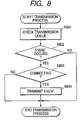
- FIG. 8 is a flowchart showing details of processing at step S 503 ;
- FIG. 9 is a flowchart showing details of processing at step S 504 ;
- FIG. 10 is a flowchart of main processes performed by the server device according to the first embodiment of the present invention.
- FIG. 11 is a flowchart showing details of processing at step S 701 ;
- FIG. 12 is a flowchart showing details of processing at step S 705 ;
- FIG. 13 is a diagram showing an example of a screen displayed on a display unit 309 of the client terminal device according to the first embodiment of the present invention.
- a system according to the present embodiment is a virtual space sharing system, in which a plurality of terminals share a scene database describing a structure and attributes of virtual space. Below, explanation is specific regarding the virtual space sharing system according to the present embodiment.
- a type of eye view for viewing the virtual space is used as a condition to limit processes associated in the system.
- Each process has an eye view for viewing the virtual space.
- the types of eye views include a subjective eye view and an objective eye view.
- the subjective eye view is based on a position and an orientation at a user's eye view. That is, the subjective eye view is an eye view where the eye view's position and direction of observation can move.
- a 3-dimensional position/orientation sensor can be worn on the head of a user of the system, and the eye view's position/direction of observation can be calculated and set based on the output from the sensor.
- the objective eye view is an eye view where the eye view's position and direction of observation are fixed.
- association of the processes is limited such that the number of processes having the subjective eye view does not exceed a predetermined number.
- an elemental condition for determining whether or not to limit process from associating in the system is called a specific condition.
- an indication that (a process) has a subjective eye view corresponds to the specific condition.
- FIG. 1 is a diagram showing an outline construction of the virtual space sharing system according to the present embodiment.
- the system is constituted by a server device 101 and a plurality of client terminal devices (in the diagram, client terminal device 1 to client terminal device N).
- the server device 101 and the client terminal devices can communicate via a communication medium 102 .
- each of the client terminal devices has therein a scene database describing the structure and attributes of the virtual space.
- the communication medium 102 is a LAN built on an Ethernet (trademark registration).
- the communication medium may also be other information transmitting media, such as USB, Firewire (trademark registration), etc.
- the configuration of the network is not limited to a LAN, but may also be a configured connected via a WAN, or by using both a LAN and a WAN.
- Database operation refers to processing for rewriting content in the database.
- the database operation is divided into 2 stages: operation instruction and operation execution.
- the operation instruction is a request to update the database, where actual rewriting is not performed.
- the actual rewriting of the database is performed at the database execution stage.
- the simple term operation refers to the database operation unless particularly specified. If the subject of the operation is anything other than the database, an explanation will be specific to indicate the subject of the operation, as in operation of a communication device by the user.
- database operation instructions and network connection status modification instructions are both called instructions.
- Network connection status modification instructions include a connection instruction for establishing a client-server connection, and a disconnect instruction for disconnecting the connection.
- the instruction is generated by the user in some cases, there are also instances where the instruction is generated by an operation of a program executed within the client terminal device.
- the instruction is generated by an operation of a program executed within the client terminal device.
- the instruction is generated.
- the instruction is generated in a system for a shooting game where a game program that is executed on the client moves/rotates enemy characters according to an algorithm.
- FIG. 2 is a diagram showing a basic flow of information for updating the database in a system according to the present embodiment.
- reference symbols A, B, C and D indicate client terminal devices
- X indicates a server device. It is assumed that the client terminal device A has just performed the operation instruction for the shared scene database. Data indicating the content of the operation instruction is sent via the network to the server device X. (In the diagram, (1) indicates the transmission of the data from the client terminal device A to the server device X.)
- the server device X receives the operation instruction and distributes the data sent from the client terminal device A to all the client terminal devices (A, B, C, D). (In the diagram, (2) indicates the transmission of the data from the server X to all the client terminal devices.)
- the content of the operation instruction may include at least information for specifying the subject of the operation, and information for specifying the type of operation. Depending on the type of operation, the operation instruction may also include parameters necessary for executing the operation.
- FIG. 3 is a block diagram showing the basic construction of the server device and the client terminal devices.
- Reference numeral 301 represents a CPU, which performs controls on the server device or the client terminal devices overall, and also executes instructions inputted from a keyboard 307 or a mouse 308 , or executes a program loaded into a memory 302 , thus performing processing and the like in accordance with the instructions that are generated.
- Reference numeral 302 represents the memory, which has an area for temporarily holding data including a program loaded from an external storage device 306 and the scene database, and also has an area for temporarily holding data, etc. used during the processing. Furthermore, the memory 302 also has an area (a transmission buffer) for temporarily holding data to be sent via a communication unit 305 to the external area, and an area (a receiving buffer) for temporarily holding received data, etc.
- a transmission buffer for temporarily holding data to be sent via a communication unit 305 to the external area
- a receiving buffer for temporarily holding received data, etc.
- the memory 302 also has area for holding specific condition data, which relates to the specific condition.
- the specific condition data is a list of identification numbers for identifying the individual processes. This list stores the identification numbers of the processes which satisfy the specific condition, which is to say the processes which have the subjective eye view.
- the length of the list serves as a maximum value for the number of processes which can have the subjective eye view. Note that, the maximum value is set in advance.
- Reference numeral 303 denotes a bus connecting each of the portions shown in the diagram.
- Reference numeral 304 denotes an interface for connecting the bus 303 to each of the portions described below.
- Reference numeral 305 denotes the communication unit, which performs data communication with external apparatuses via the communication medium 102 .
- Reference numeral 306 denotes the external storage device (e.g., a hard disk or other such storage device) for holding the program and data loaded into the memory 302 . Furthermore, in a case where the construction shown in FIG. 3 is the server device, the program corresponding to the processing performed by the server device described below is held in the external storage device 306 . In a case where the construction shown in FIG. 3 is the client terminal device, the program corresponding to the processing performed by the client terminal device described below is held in the external storage device 306 . When needed, these programs are loaded into the memory 302 and are processed by the CPU 301 .
- Reference numerals 307 and 308 represent the keyboard and the mouse, respectively, with which various types of instructions can be inputted to the CPU 301 as well as the above-mentioned instructions.
- Reference numeral 309 denotes a display unit, which can display processing results from the CPU 301 . For example, an image of the virtual space shared by the client terminal devices can be displayed here.
- Reference numeral 310 represents an input/output unit, which connects to the external device to perform input and output of data to/from the device.
- FIG. 4 is a schematic diagram of processing performed within the client terminal device. Arrows indicate the flow of data.
- Reference numeral 401 indicates the client terminal device. The processing performed by the client terminal device 401 includes an instruction process module 403 for processing instructions, and an update process module 404 for updating the database 405 based on the instructions.
- reference numeral 406 represents a transmission module for transmitting data to a LAN 402 serving as the communication medium 102 .
- Reference numeral 407 denotes a reception module for performing reception of data from the LAN 402 . Exchange of data among these modules is performed via buffers called a transmission queue 408 and a reception queue 409 (which are provided to the memory 302 inside the client terminal device).
- FIG. 5 is a flowchart of main processing performed by the client terminal device. Note that a program in accordance with the flowchart of FIG. 5 is stored in the external storage device 306 , and, when necessary, is loaded into the memory 302 and executed by the CPU 301 . As a result, the client terminal device executes the processing in accordance with the flowchart of FIG. 5 .
- the processing forks (step S 501 ) to perform transmission processing to transmit data via the communication medium 102 to the server device (step S 503 ), and reception processing to perform reception of data via the communication medium 102 from the server device (step S 504 ).
- CG image generation processing and display window processing are also performed.
- the CG image generation processing makes a reference to a scene graph database and generates a CG image in virtual space.
- the display window processing displays the CG image or other information to be provided to the user as a window on the display unit 309 , and also processes input operations made by the user on the mouse, keyboard or other communication device with respect to the window.
- the CG image generation processing and the display window processing are similar to publicly known CG image generation processing methods and display window processing methods, so detailed explanations thereof are omitted.
- step S 502 the process forks (step S 502 ) to perform an instruction process for processing instructions (step S 505 ), and an update process for updating the scene graph database (step S 506 ).
- a judgment is made to determine whether or not an instruction to end the processing has been generated at step S 509 , step S 510 , step S 507 and step S 508 , respectively. If there is no instruction to end, then the processing returns to step S 503 , step S 504 , step S 505 and step S 506 respectively, and the processing continues. On the other hand, if the instruction to end is made, then the foregoing processing ends. Note that, the transmission process, reception process, instruction process and update process are explained in detail below.
- FIG. 6 is a flowchart showing details of the process at step S 505 .
- the input of the instruction is detected (step S 601 ).
- the inputted instruction is interpreted, and it is judged whether the instruction is an instruction (a connection instruction) requesting establishment of a communication path via the communication medium 102 to the server device (i.e., a connection with the server device via the communication medium 102 ) (step S 602 ). If the instruction is the connection instruction, then the processing advances to step S 603 , and the communication unit 305 establishes the communication path to the server device, and then the instruction processing ends.
- step S 604 the instruction inputted at step S 601 is interpreted, and it is judged whether the instruction is an instruction (a disconnection instruction) requesting disconnection of the communication path via the communication medium 102 to the server device (i.e., disconnection of the connection via the communication medium 102 to the server device). If the instruction is the disconnection instruction, then the processing advances to step S 605 , and the communication unit 305 disconnects the communication path with the server device, and then the instruction processing ends.
- a disconnection instruction requesting disconnection of the communication path via the communication medium 102 to the server device
- step S 601 if the instruction inputted at step S 601 is not the disconnection instruction (i.e., neither the connection instruction nor the disconnection instruction), then the instruction is determined to be a database operation instruction, and the processing advances to step S 606 .
- step S 606 data called an event is created, which indicates the content of the operation instruction.
- step S 606 the event created at step S 606 is inputted into the transmission queue 408 provided inside the memory 302 (step S 607 ), and then the processing ends.
- the foregoing processing enables the establishment/disconnection of the communication path and the transmission of the instruction based on the type of the instruction.
- FIG. 7 is a flowchart showing details of the processing at step S 506 .
- Step S 701 a check is performed to determine whether or not the specific condition is satisfied. If the specific condition is satisfied, then the specific condition check/notification processing to notify this to all the processes (step S 701 ) is performed. Step S 701 is explained in detail below.
- step S 702 a check is performed to determine the presence/absence of the event within the reception queue 409 provided inside the memory 302 (step S 702 ). If the event is present inside the reception queue 409 , then the processing is advanced from step S 703 to step S 704 , and the event inside the reception queue 409 is obtained and interpreted, and the content of the operation instruction is extracted (step S 704 ). Then, the database operation is executed in accordance with the content of the operation instruction that was interpreted (step S 705 ). On the other hand, if it is judged at step S 703 that there is no event in the reception queue 409 , then the update processing ends. Note that step S 705 is explained in detail below.
- FIG. 11 is a flowchart showing details of the processing at step S 701 .
- step S 1101 it is determined whether or not the specific condition is satisfied with respect to the specific process.
- the eye view type is the subjective eye view.
- step S 1102 processing is advanced to step S 1102 to create a specific condition set event, which is data for notifying all the processes that the specific process satisfies the specific condition. Then the processing is advanced to step S 1104 .
- step S 1103 the specific condition release event, which is data for notifying all the processes that the specific process does not satisfy the specific condition. Then the processing is advanced to step S 1104 .
- step S 1104 the event created at either step S 1102 or at step S 1103 is then inputted into the transmission queue 408 provided inside the memory 302 , and then the specific condition check/notification processing ends.
- the specific condition instruction event may include, at least, an identification number of a transmission source process, information for differentiating between the specific condition instruction event and another event type, and information for designating setting/releasing of the specific condition.
- FIG. 12 is a flowchart showing details of the operation execution processing.
- step S 1201 it is determined whether the event interpreted at step S 704 is the specific condition instruction event. If it is the specific condition instruction event, then the processing is advanced to step S 1202 where it is determined whether or not the specific process breaches the specific condition. Namely, if the following four conditions (three rules (1)-(3) relating to the above-mentioned specific condition, and a determination of whether or not it is the specific process itself (4)) are simultaneously satisfied, then it is determined that the specific condition is breached since the specific process itself is attempting to set the subjective eye view in excess of the maximum value. In any other case, it is determined that the specific condition is not breached:
- the specific condition instruction event type is the specific condition set event.
- the transmitter of the specific condition instruction event is the specific process itself.
- step S 1202 If it is determined at step S 1202 that the specific condition is breached, then the processing is advanced to step S 1203 and the communication path via the communication medium 102 to the server device is terminated, and then the operation execution processing ends. On the other hand, if the specific condition is not breached, the processing advances to step S 1204 .
- step S 1204 a determination is made with respect to the following rules, and the specific condition data that is stored in the memory 302 is updated (i.e., added or deleted).
- the specific condition instruction event type is the specific condition set event.
- the specific condition instruction event type is the specific condition release event.
- step S 1204 when (i), (ii) and (iii) are simultaneously satisfied, or when (I) and (II) are simultaneously satisfied, the specific condition data stored in the memory 302 is updated at step S 1204 . In any other case, the specific condition data is not updated at step S 1204 .
- the operation execution processing ends.
- step S 1201 If it is determined at step S 1201 that the event is not the specific condition instruction event, then the processing advances to step S 1205 and the scene database in the memory 302 is updated in accordance with the event content, and the operation execution processing ends.
- FIG. 8 is a flowchart showing details of the processing at step S 503 .
- a check is performed to determine the presence/absence of the event inside the transmission queue 408 provided inside the memory 302 (step S 801 ). If the event is present inside the transmission queue 408 , then the processing is advanced from step S 802 to step S 803 , and a check is performed to determined whether or not the communication path between the client terminal device and the server device has been established (step S 803 ). If the communication path is established, then the event inside the transmission queue 408 is transmitted to the server device.(step S 804 ). On the other hand, if the communication path is not established, then the transmission processing ends.
- FIG. 9 is a flowchart showing details of the processing at step S 504 .
- a check is performed to determine the presence/absence of the event inside the reception buffer for temporarily storing the event data sent from the server device, which is provided inside the memory 302 (step S 901 ). If the event is present inside the reception buffer, then the processing is advanced from step S 902 to step S 903 , and the event data inside the reception buffer is moved to the reception queue 409 (step S 903 ). On the other hand, if the event is not present in the reception buffer, the reception processing ends.
- FIG. 10 is a flowchart of main processing performed by the server device. Note that a program in accordance with the flowchart shown in the diagram is stored in the external storage device 306 . When needed, the program is loaded in the memory 302 and executed by the CPU 301 . As a result, the server device executes processing in accordance with the flowchart shown in the diagram.
- the server device determines whether or not the communication path establishment request has been sent from the client terminal device (step S 1001 ). If the request has been sent, the processing is advanced to step S 1002 and the communication path is established to the client terminal device that was the request source (step S 1002 ).
- the server device determines whether or not the communication path disconnection request has been sent from the connected client terminal device (step S 1003 ). If the request has been sent the processing is advanced to step S 1004 and the communication path to the client terminal device that was the request source is disconnected (step S 1004 ).
- step S 1005 if the disconnection request has not been sent, then the processing is advanced to step S 1005 and a check is performed to determined whether or not any event was received from the client terminal device (step S 1005 ). If it is determined that there is a reception event (step S 1006 ), then the processing is advanced to step S 1007 , and after the reception event is distributed to each client terminal device the processing is advanced to step S 1008 .
- step S 1006 if there is no reception event (step S 1006 ), then the processing is advanced to step S 1008 .
- step S 1008 it is determined whether or not there is an instruction to end the program. If there is the instruction to end the program, the program is ended. On the other hand, if there is no ending instruction, the processing is returned to step S 1001 and the subsequent processing is then continued.
- FIG. 13 is a diagram showing an example of a screen displayed on the display unit 309 of the client terminal device.
- the content of the database is data in 3-dimensional virtual space. Therefore, in a 3-dimensional space display unit 1302 of the display window 1301 , there are displayed CG images of 3-dimensional virtual objects 1303 and 1304 according to data in this 3-dimensional virtual space.
- an eye view mode setting portion 1305 for setting the type of eye view (subjective eye view or objective eye view).
- the eye view mode setting portion 1305 there are displayed radio buttons 1307 and 1308 corresponding to the subjective eye view and the objective eye view.
- the user of the terminal operates the mouse 308 .
- the user presses the left button of the mouse 308 to validate the radio button.
- the data shown in the selected eye view mode is stored in the memory 302 .
- the keyboard 307 may also be used for the operations, and there are no particular restrictions as to the method of operation thereof.
- the operations for setting the above-mentioned eye view mode are processed in processing steps by mouse operations or keyboard operations relating to display window screen processing, which is not shown in the diagrams.
- the method of setting the eye view mode is not particularly limited to communicative operations. Instead, it is also possible to execute a program to make a determination based on a freely selected algorithm, whereby setting the eye view mode that was determined.
- the communication path is disconnected by the process itself which is trying to set the subjective eye view in excess of the predetermined number. This enables the restriction of the number of subjective eye view processes associated in the shared database system. Moreover, since the server device limits the number of processes, no special constructions are required.
- the specific condition is defined as having the subjective eye view
- the condition for limiting the process' association in the system is defined as the number of processes having subjective eye views exceeds the maximum value.
- the conditions are not limited to these definitions.
- the association of the process in the group of processes sharing the data can be limited by the device that has the server functions based on the specific condition, without having to perform special processing.
- the system construction according to the first embodiment was a server-client construction, but the present invention is not limited to this construction.
- each of the client terminal devices serve roles as clients while also providing the function of the server (the function of receiving the connection/disconnection requests and the function of distributing the data to the clients), it becomes possible to obtain effects similar to the embodiment described above, in a construction where each client terminal device connects to all of the other client terminal devices.
- the shared data was the scene data expressing the structure and attributes of the virtual space.
- the present invention is not limited to this construction, but may be applied with various types of data as the shared data.
- the object of the present invention can also be achieved by that in a system or device, a storage medium is provided in which a program code of software for realizing the functions of the above-mentioned embodiments is recorded and a computer (or CPU or MPU) in the system or the device reads out the program code stored in the storage medium and executes the program.
- a computer or CPU or MPU
- the program code itself which is read out from the storage medium, achieves the functions of the above-mentioned embodiments.
- the storage medium storing the program code constitutes the present invention.
- a server program which is a program having the functions of the above-mentioned server terminal
- a client program which is a program having the functions of the client terminal
- the server program and the client program can be combined freely.
- the storage medium for supplying the program code can be, for example, a flexible disk, a hard disk, an optical disk, an opto-magnetic disk, a CD-ROM, a CD-R, a magnetic tape, a nonvolatile memory card, a ROM, etc.
- the present invention includes not only the case where the program read out by the computer is executed to realize the functions of the above-mentioned embodiments, but also a case where an OS (operating system) or the like running on the computer performs a part or all of the actual processing based on instructions from the program code and this processing achieves the functions of the above-mentioned embodiments.
- the above-mentioned program may be executed as a process managed by the OS, or may be executed within a specific process thread.
- the present invention also includes a case where the program code read out from the storage medium is written into a memory provided to a function expansion board that inserted into the computer or a function expansion unit that is connected to the computer, and then a CPU or the like provided to the function expansion board or the function expansion unit performs a part or all of the actual processing and this processing realizes the function of the above-mentioned embodiments.
Landscapes
- Engineering & Computer Science (AREA)
- Computer Networks & Wireless Communication (AREA)
- Signal Processing (AREA)
- Computer Security & Cryptography (AREA)
- Software Systems (AREA)
- Theoretical Computer Science (AREA)
- Physics & Mathematics (AREA)
- General Engineering & Computer Science (AREA)
- General Physics & Mathematics (AREA)
- Information Transfer Between Computers (AREA)
- Computer And Data Communications (AREA)
Applications Claiming Priority (2)
| Application Number | Priority Date | Filing Date | Title |
|---|---|---|---|
| JP2003130195A JP2004334566A (ja) | 2003-05-08 | 2003-05-08 | 情報処理方法及び情報処理装置 |
| JP2003-130195(PAT. | 2003-05-08 |
Publications (2)
| Publication Number | Publication Date |
|---|---|
| US20040260822A1 US20040260822A1 (en) | 2004-12-23 |
| US7395340B2 true US7395340B2 (en) | 2008-07-01 |
Family
ID=32985650
Family Applications (1)
| Application Number | Title | Priority Date | Filing Date |
|---|---|---|---|
| US10/834,032 Expired - Fee Related US7395340B2 (en) | 2003-05-08 | 2004-04-29 | Information processing method and information processing device |
Country Status (3)
| Country | Link |
|---|---|
| US (1) | US7395340B2 (de) |
| EP (1) | EP1475708A3 (de) |
| JP (1) | JP2004334566A (de) |
Cited By (1)
| Publication number | Priority date | Publication date | Assignee | Title |
|---|---|---|---|---|
| US20080149724A1 (en) * | 2006-12-20 | 2008-06-26 | Canon Kabushiki Kaisha | Image processing apparatus, method for controlling the same, program, and storage medium |
Families Citing this family (3)
| Publication number | Priority date | Publication date | Assignee | Title |
|---|---|---|---|---|
| JP2004334566A (ja) * | 2003-05-08 | 2004-11-25 | Canon Inc | 情報処理方法及び情報処理装置 |
| US7849512B2 (en) * | 2005-03-21 | 2010-12-07 | Fortressware, Inc. | Method and system to create secure virtual project room |
| US7634551B2 (en) * | 2005-12-07 | 2009-12-15 | Xerox Corporation | System and method for forming a cluster of networked devices |
Citations (4)
| Publication number | Priority date | Publication date | Assignee | Title |
|---|---|---|---|---|
| US6189011B1 (en) | 1996-03-19 | 2001-02-13 | Siebel Systems, Inc. | Method of maintaining a network of partially replicated database system |
| JP2002348726A (ja) | 2001-05-25 | 2002-12-04 | Hagihara Industries Inc | 樹脂強化用繊維およびそれを用いたfrp成形品 |
| US20030107569A1 (en) | 2001-12-12 | 2003-06-12 | Canon Kabushiki Kaisha | Image information processing apparatus and method, virtual space presentation apparatus, information administration apparatus, and control methods thereof |
| EP1475708A2 (de) * | 2003-05-08 | 2004-11-10 | Canon Kabushiki Kaisha | Vorrichtung und Verfahren zur Informationsverarbeitung |
-
2003
- 2003-05-08 JP JP2003130195A patent/JP2004334566A/ja not_active Withdrawn
-
2004
- 2004-04-29 US US10/834,032 patent/US7395340B2/en not_active Expired - Fee Related
- 2004-05-07 EP EP04252667A patent/EP1475708A3/de not_active Withdrawn
Patent Citations (4)
| Publication number | Priority date | Publication date | Assignee | Title |
|---|---|---|---|---|
| US6189011B1 (en) | 1996-03-19 | 2001-02-13 | Siebel Systems, Inc. | Method of maintaining a network of partially replicated database system |
| JP2002348726A (ja) | 2001-05-25 | 2002-12-04 | Hagihara Industries Inc | 樹脂強化用繊維およびそれを用いたfrp成形品 |
| US20030107569A1 (en) | 2001-12-12 | 2003-06-12 | Canon Kabushiki Kaisha | Image information processing apparatus and method, virtual space presentation apparatus, information administration apparatus, and control methods thereof |
| EP1475708A2 (de) * | 2003-05-08 | 2004-11-10 | Canon Kabushiki Kaisha | Vorrichtung und Verfahren zur Informationsverarbeitung |
Non-Patent Citations (2)
| Title |
|---|
| European Search Report dated Aug. 2, 2007 for European Application No. 04252667.3-1243. |
| Jian Zhao et al., "Supporting Flexible Communication in Heterogeneous Multi-User Environments", Proceedings of the International Conference on Distributed Computing Systems, IEEE Comp. Soc. Press, US, vol. Conf. 14, Jun. 21, 1994, pp. 442-449, XP000489106. |
Cited By (2)
| Publication number | Priority date | Publication date | Assignee | Title |
|---|---|---|---|---|
| US20080149724A1 (en) * | 2006-12-20 | 2008-06-26 | Canon Kabushiki Kaisha | Image processing apparatus, method for controlling the same, program, and storage medium |
| US7681797B2 (en) * | 2006-12-20 | 2010-03-23 | Canon Kabushiki Kaisha | Image processing apparatus, method for controlling the same, program, and storage medium |
Also Published As
| Publication number | Publication date |
|---|---|
| US20040260822A1 (en) | 2004-12-23 |
| JP2004334566A (ja) | 2004-11-25 |
| EP1475708A3 (de) | 2007-09-05 |
| EP1475708A2 (de) | 2004-11-10 |
Similar Documents
| Publication | Publication Date | Title |
|---|---|---|
| US6298374B1 (en) | Communication management apparatus with user modifiable symbol movable among virtual spaces shared by user terminals to direct current user position in real world and recording medium used therefor | |
| US9661042B2 (en) | Data share system, data process apparatus, and computer-readable recording medium | |
| JP2012075883A (ja) | オンラインゲームシステム、および、オンラインゲームのデータリソース取り扱い方法 | |
| EP1331550A2 (de) | Gerät, -Verfahren, und Programm Produkt zur Darstellungsverwaltung | |
| US10828563B2 (en) | Information processing system, server, storage medium storing information processing program, and information processing method | |
| CN112492372B (zh) | 评论消息的显示方法、装置、电子设备、系统及存储介质 | |
| US8052528B2 (en) | Game program and game device | |
| US20040260822A1 (en) | Information processing method and information processing device | |
| CN113940043B (zh) | 控制装置、网络控制方法以及计算机可读记录介质 | |
| US6470340B1 (en) | Inter-program linking system and method thereof | |
| KR20200053879A (ko) | 이기종 카메라 동시 제어를 위한 분산촬영장치 및 그 제어방법, 이에 사용되는 카메라 제어 클라이언트 | |
| US20060167954A1 (en) | Information processing method, information processing apparatus, method of controlling server apparatus, and server apparatus | |
| US7654902B2 (en) | User-name switching method on network game | |
| US20060075058A1 (en) | Information processing method and apparatus | |
| EP1319431A2 (de) | Netzwerkspielsystem, Klientsystem, Netzwerkspielverarbeitungsverfahren und Aufzeichnungsmedium | |
| JP7007515B2 (ja) | 情報処理装置、情報処理方法、及びプログラム | |
| US7516204B2 (en) | Information processing method and apparatus | |
| CN106682945A (zh) | 免费礼物管理方法和装置 | |
| CN117938990A (zh) | 应用程序在弱网环境下的通信处理方法、设备、介质及程序产品 | |
| KR20240055624A (ko) | 수술 단계 영상 전송 방법 및 이를 이용한 시스템 | |
| CN108920122A (zh) | 一种屏幕显示的方法、装置、终端和计算机可读存储介质 | |
| CN108289226A (zh) | 数字电影视频数据的放映方法、服务器和系统 | |
| CN102932428B (zh) | 设备链接 | |
| US20260010660A1 (en) | System, method, and non-transitory computer-readable storage medium | |
| CN115119001A (zh) | 直播控制方法、装置、电子设备、介质及程序产品 |
Legal Events
| Date | Code | Title | Description |
|---|---|---|---|
| AS | Assignment |
Owner name: CANON KABUSHIKI KAISHA, JAPAN Free format text: ASSIGNMENT OF ASSIGNORS INTEREST;ASSIGNOR:FUJIKI, MASAKAZU;REEL/FRAME:015712/0170 Effective date: 20040609 |
|
| CC | Certificate of correction | ||
| FPAY | Fee payment |
Year of fee payment: 4 |
|
| REMI | Maintenance fee reminder mailed | ||
| LAPS | Lapse for failure to pay maintenance fees | ||
| STCH | Information on status: patent discontinuation |
Free format text: PATENT EXPIRED DUE TO NONPAYMENT OF MAINTENANCE FEES UNDER 37 CFR 1.362 |
|
| STCH | Information on status: patent discontinuation |
Free format text: PATENT EXPIRED DUE TO NONPAYMENT OF MAINTENANCE FEES UNDER 37 CFR 1.362 |
|
| FP | Lapsed due to failure to pay maintenance fee |
Effective date: 20160701 |