US7659090B2 - Methods for the separation of streptococcus pneumoniae type 3 polysaccharides - Google Patents
Methods for the separation of streptococcus pneumoniae type 3 polysaccharides Download PDFInfo
- Publication number
- US7659090B2 US7659090B2 US11/869,206 US86920607A US7659090B2 US 7659090 B2 US7659090 B2 US 7659090B2 US 86920607 A US86920607 A US 86920607A US 7659090 B2 US7659090 B2 US 7659090B2
- Authority
- US
- United States
- Prior art keywords
- lysate
- centrate
- protein
- minutes
- serotype
- Prior art date
- Legal status (The legal status is an assumption and is not a legal conclusion. Google has not performed a legal analysis and makes no representation as to the accuracy of the status listed.)
- Active
Links
Images




Classifications
-
- C—CHEMISTRY; METALLURGY
- C08—ORGANIC MACROMOLECULAR COMPOUNDS; THEIR PREPARATION OR CHEMICAL WORKING-UP; COMPOSITIONS BASED THEREON
- C08B—POLYSACCHARIDES; DERIVATIVES THEREOF
- C08B37/00—Preparation of polysaccharides not provided for in groups C08B1/00 - C08B35/00; Derivatives thereof
-
- C—CHEMISTRY; METALLURGY
- C12—BIOCHEMISTRY; BEER; SPIRITS; WINE; VINEGAR; MICROBIOLOGY; ENZYMOLOGY; MUTATION OR GENETIC ENGINEERING
- C12P—FERMENTATION OR ENZYME-USING PROCESSES TO SYNTHESISE A DESIRED CHEMICAL COMPOUND OR COMPOSITION OR TO SEPARATE OPTICAL ISOMERS FROM A RACEMIC MIXTURE
- C12P19/00—Preparation of compounds containing saccharide radicals
- C12P19/04—Polysaccharides, i.e. compounds containing more than five saccharide radicals attached to each other by glycosidic bonds
-
- A—HUMAN NECESSITIES
- A61—MEDICAL OR VETERINARY SCIENCE; HYGIENE
- A61K—PREPARATIONS FOR MEDICAL, DENTAL OR TOILETRY PURPOSES
- A61K31/00—Medicinal preparations containing organic active ingredients
- A61K31/70—Carbohydrates; Sugars; Derivatives thereof
- A61K31/715—Polysaccharides, i.e. having more than five saccharide radicals attached to each other by glycosidic linkages; Derivatives thereof, e.g. ethers, esters
-
- A—HUMAN NECESSITIES
- A61—MEDICAL OR VETERINARY SCIENCE; HYGIENE
- A61P—SPECIFIC THERAPEUTIC ACTIVITY OF CHEMICAL COMPOUNDS OR MEDICINAL PREPARATIONS
- A61P31/00—Antiinfectives, i.e. antibiotics, antiseptics, chemotherapeutics
- A61P31/04—Antibacterial agents
-
- Y—GENERAL TAGGING OF NEW TECHNOLOGICAL DEVELOPMENTS; GENERAL TAGGING OF CROSS-SECTIONAL TECHNOLOGIES SPANNING OVER SEVERAL SECTIONS OF THE IPC; TECHNICAL SUBJECTS COVERED BY FORMER USPC CROSS-REFERENCE ART COLLECTIONS [XRACs] AND DIGESTS
- Y10—TECHNICAL SUBJECTS COVERED BY FORMER USPC
- Y10S—TECHNICAL SUBJECTS COVERED BY FORMER USPC CROSS-REFERENCE ART COLLECTIONS [XRACs] AND DIGESTS
- Y10S424/00—Drug, bio-affecting and body treating compositions
- Y10S424/831—Drug, bio-affecting and body treating compositions involving capsular polysaccharide of bacterium, e.g. polyribosyl ribitol phosphate
Definitions
- the invention relates to improved methods for the reduction or removal of protein impurities from a complex cellular Streptococcus pneumoniae lysate or centrate comprising serotype 3 polysaccharides involving heating or pH adjustment steps.
- Streptococcus pneumoniae serotypes are grown to supply polysaccharides needed to produce the vaccine.
- the cells are grown in large fermentors with lysis induced at the end of the fermentation by addition of sodium deoxycholate (DOC) or an alternate lysing agent.
- DOC sodium deoxycholate
- the lysate broth is then harvested for downstream purification and the recovery of the capsular polysaccharide which surrounds the bacterial cells.
- the polysaccharide is included in the final vaccine product and confers immunity in the vaccine's target population to the selected Streptococcus pneumoniae serotypes.
- the cellular lysate produced in this process contains the target polysaccharide, it also contains large quantities of cellular debris including DNA, RNA, proteins, and residual media components.
- Traditional processing has involved a minimal pH reduction of the lysate to 6.6 by addition of acetic acid to help precipitate out the lysing agent and some of the impurities. This material is subjected to centrifugation followed by filtration to remove most of the solids down to a 0.45 ⁇ m nominal size.
- such traditional processing methods have shown minimal reduction in impurities with subsequent difficulty in removing soluble proteins to meet purified polysaccharide specifications.
- the high burden of contaminating soluble protein has been particularly problematic within runs for certain serotypes.
- Some serotypes in particular Streptococcus pneumoniae Type 3, produce large and viscous polysaccharide chains (e.g., for Type 3, chains of glucose/glucuronic acid of 2-3 million Daltons) that are released into the growth medium upon cellular lysis. Its viscosity has made it difficult to filter after centrifugation, and, in such cases, protein removal through the purification process has been insufficient and has led to run failures.
- a cellular Streptococcus pneumoniae lysate comprising serotype 3 polysaccharides is heated for a time and at a temperature sufficient to denature proteins present in the lysate and cause their aggregation and precipitation.
- the method comprises the steps of: 1) heating the lysate to at least 60° C.
- the separation step comprises filtering the lysate to remove precipitants using a membrane filter, particularly a 0.45 ⁇ m pore size membrane filter.
- the separation step comprises filtering the lysate to remove precipitants using a depth filter.
- the step of separating precipitants from the lysate comprises centrifuging the lysate to remove precipitants.
- a method for reducing or removing protein impurities from a cellular Streptococcus pneumoniae lysate or centrate comprising serotype 3 polysaccharides that comprises a step involving pH adjustment of the lysate or centrate.
- the pH adjustment step improves filterability.
- the pH of the lysate or centrate is increased to at least 8.0 prior to filtration, particularly to between about 8.0 to about 8.4 prior to filtration, and more particularly to about 8.2 prior to filtration.
- the filtration step comprises filtering the lysate or centrate using a membrane filter, particularly a 0.45 ⁇ m pore size membrane filter.
- the filtration step comprises filtering the lysate or centrate using a depth filter.
- a method for reducing or removing protein impurities from a cellular Streptococcus pneumoniae lysate comprising serotype 3 polysaccharides that comprises a lysate heating step combined with a step involving pH adjustment of the lysate or of a centrate produced by centrifugation of the lysate.
- the pH adjustment step improves filterability.
- the method comprises the steps of: 1) heating the lysate to at least 60° C.
- the lysate is heated to about 60° C. to about 70° C. for about 30 to about 50 minutes prior to centrifugation, more particularly to about 60° C. for about 40 minutes.
- the pH of the centrate is increased to between about 8.0 to about 8.4 prior to filtration, particularly about 8.2.
- the filtration step comprises filtering the lysate to remove precipitants using a membrane filter, more particularly a 0.45 ⁇ m pore size membrane filter. In another embodiment, the filtration step comprises filtering the lysate to remove precipitants using a depth filter.
- a method for reducing or removing protein impurities from a cellular Streptococcus pneumoniae lysate or centrate comprising serotype 3 polysaccharides that comprises a pH adjustment step to cause protein aggregation and precipitation.
- the method comprises the steps of: 1) lowering the pH of said lysate to about 3.0 to about 5.0 to cause protein aggregation and precipitation; 2) centrifuging the lysate and separating precipitated proteins from the lysate to produce a centrate; 3) increasing the pH of the centrate to at least 8.0; and 4) filtering the centrate; where a substantially purified serotype 3 polysaccharide-containing centrate is produced.
- the pH of the lysate is lowered to about 3.0 prior to centrifugation. In another particular embodiment, the pH of the centrate is increased to between about 8.0 to about 8.4 prior to filtration, more particularly about 8.2.
- the pH adjustment step to cause protein aggregation and precipitation further comprises heating the lysate to at least 60° C. for at least 30 minutes, more particularly to about 60° C. to about 70° C. for about 30 to about 50 minutes, and even more particularly to about 60° C. for about 40 minutes.
- the filtration step comprises filtering the lysate to remove precipitants using a membrane filter, more particularly a 0.45 ⁇ m pore size membrane filter.
- the filtration step comprises filtering the lysate to remove precipitants using a depth filter.
- FIG. 1 shows polysaccharide yield from laboratory studies of various heating conditions and holding times for serotype 3 lysates. Data is shown as a percentage of values from unheated process samples to show relative percent protein losses of treated samples (100% is equivalent to no loss).
- FIG. 2 shows protein yield from laboratory studies of various heating conditions and holding times for serotype 3 lysates. Data is shown as a percentage of values from unheated process samples to show relative percent protein losses of treated samples (100% is equivalent to no loss).
- FIG. 3 shows an adjusted response graph of the effects of time (left) and temperature (right) on protein (top) and polysaccharide (PS, bottom) concentrations in serotype 3 lysates.
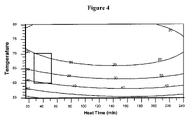
- FIG. 4 shows a contour plot of total percent protein from serotype 3 lysates plotted by temperature and time conditions. The percentage of remaining soluble protein is shown in the curved bars on the graph. The range of 60° C.-70° C. for 30-50 minutes is highlighted by a box.
- FIG. 5 shows SDS-PAGE gels showing soluble protein removal from heat treated cell lysate. Non-heat treated lanes are on the left (IPPPN3-007) and heat treated lanes are on the right (IPPPN3-011).
- FIG. 6 shows a photograph comparing heat-treated (right) and non-heat treated (left) serotype 3 lysates following identical times for precipitate settling.
- FIG. 7 shows a graph of polysaccharide (PS) concentration, protein concentration, and relative filterability of serotype 3 centrates as a function of centrate pH.
- PS polysaccharide
- mg/mL Polysaccharide concentration
- protein concentration g/10 L
- FIG. 8 shows a graph comparing the flow rate over time of serotype 3 centrate samples through depth filters as a function of centrate pH.
- Flow rate (y-axis) was measured by calculating a ratio for each minute of filtration in which the time in minutes was divided by the total weight in grams of centrate that had passed through the filter at that minute (the lower the ratio, the higher the flow rate).
- Centrate samples were adjusted to different pH levels (5.0 to 8.5) and pushed through the filters under different constant pressure conditions (5 to 20 pounds per square inch (psi)).
- the present invention provides improved methods for the reduction or removal of protein impurities from a complex cellular Streptococcus pneumoniae lysate or centrate comprising serotype 3 polysaccharides involving steps relating to post-lysis heating or pH adjustment.
- the lysate is heated for a time and at a temperature sufficient to denature proteins present in the lysate and cause their aggregation and precipitation.
- the lysate, or a centrate produced by centrifugation of the lysate is pH adjusted to improve filterability or cause the aggregation and precipitation of proteins.
- heating and pH adjustment steps are combined to cause the aggregation and precipitation of proteins as well as to improve filterability of the lysates or centrates.
- Such methods allow for the production of substantially purified serotype 3 polysaccharide-containing lysates or centrates.
- the term “substantially purified serotype 3 polysaccharide-containing lysate” or “substantially purified serotype 3 polysaccharide-containing centrate” refers to a cellular Streptococcus pneumoniae serotype 3 lysate or centrate from which protein has been removed such that the relative protein concentration of the lysate or centrate is less than about 40%, about 35%, about 30%, about 25%, about 20%, about 15%, about 10%, about 5%, or about 1% protein compared to the concentration of protein in the lysate or centrate prior to protein removal.
- the present invention provides a method comprising a heating step for the reduction or removal of protein impurities from a cellular Streptococcus pneumoniae lysate comprising serotype 3 polysaccharides. Exposure to heat disrupts the native structure of proteins and denatures them without affecting the polysaccharide. Subsequently, denatured proteins aggregate and precipitate, improving lysate separation and enabling easy removal of solids by centrifugation or filtration.
- Such a heating step would be effective for the recovery or purification of any heat-stable polysaccharide from a biological mixture containing significant levels of soluble protein impurities and therefore may be used in any liquid phase where soluble protein levels remain problematic (for example, biological mixtures comprising DNA, RNA, polysaccharides, oligosaccharides, saccharides, fatty acids, and lipids).
- the present invention provides a method for the reduction or removal of protein impurities from a cellular Streptococcus pneumoniae lysate comprising serotype 3 polysaccharides comprising the steps of: 1) heating the lysate to at least 50° C., at least 55° C., or at least 60° C. for at least 15 or at least 30 minutes to cause protein aggregation and precipitation; and 2) separating precipitants from the lysate; where a substantially purified serotype 3 polysaccharide-containing lysate is produced.
- the lysate is heated to about 50° C. to about 80° C. for about 15 to about 60 minutes.
- the lysate is heated to between about 60° C. to about 70° C. for about 30 to about 50 minutes. In another particular embodiment, the lysate is heated to about 65° C. for about 40 minutes. As described in more detail in the Experimental Section below, for heat stable serotype 3 polysaccharides, over 80% of protein has been removed by heating at 65° C. for 40 minutes with minimal losses of polysaccharide.
- the separation step comprises centrifugation or filtration to remove or reduce protein from the lysate.
- the separation step comprises filtering the lysate to remove precipitants using a membrane filter, particularly a 0.45 ⁇ m pore size membrane filter.
- the separation step comprises filtering the lysate to remove precipitants using a depth filter.
- Filters typically used for high volume filtration processes such as the purification of serotype 3 polysaccharides include membrane (or surface) filters and depth filters.
- Membrane filters function primarily by size exclusion, in which all impurities in a solution to be filtered that are larger than the set pore size of the membrane filter are trapped on the surface of the filter.
- depth filters contain a fibrous or granular matrix with a random porous structure through which a solution to be filtered is passed, and function primarily through random adsorption and mechanical entrapment of impurities throughout the depth of the matrix.
- both membrane and depth filters may be used in combination, with the depth filter collecting larger impurities and the surface filter capturing smaller impurities.
- a method for reducing or removing protein impurities from a cellular Streptococcus pneumoniae lysate comprising serotype 3 polysaccharides or of a centrate produced by centrifugation of the lysate comprising a step involving pH adjustment of the lysate or centrate.
- the pH adjustment step improves filterability.
- filterability of a cellular Streptococcus pneumoniae lysate or centrate comprising serotype 3 polysaccharides refers to the ability to pass the lysate or centrate through a filter, such as a membrane or depth filter.
- Improved filterability of a lysate or centrate is therefore associated with, for example, increased flow rate of the lysate or centrate across a filter, reduced clogging of filters by the lysate or centrate, or reduced pressure required to pass a given volume of lysate or centrate across a filter.
- the methods of the present invention relate to the discovery that the filterability of this high molecular weight polysaccharide can be altered as a direct function of pH, and that increasing the pH of a lysate or centrate improves filterability without significant loss in polysaccharide serotype 3 molecular weight size or functionality.
- a method for reducing or removing protein impurities from a cellular Streptococcus pneumoniae lysate comprising serotype 3 polysaccharides or of a centrate produced by centrifugation of the lysate that comprises the step of increasing the pH of the centrate or lysate to at least 8.0 prior to filtration.
- the pH of the centrate or lysate is increased to about 8.0 to about 8.4 prior to filtration, more particularly about 8.2.
- Filtration following pH adjustment of the lysate or centrate may involve filtering the lysate or centrate using a membrane filter, particularly a 0.45 ⁇ m pore size membrane filter.
- filtering the lysate or centrate may involve using a depth filter.
- a method for reducing or removing protein impurities from a cellular Streptococcus pneumoniae lysate comprising serotype 3 polysaccharides that comprises a lysate heating step combined with a step involving pH adjustment of the lysate.
- the method comprises the steps of: 1) heating the lysate to at least 50° C., at least 55° C., or at least 60° C.
- the lysate is heated to about 50° C. to about 80° C. for about 15 to about 60 minutes prior to centrifugation. In another particular embodiment, the lysate is heated to about 60° C. to about 70° C. for about 30 to about 50 minutes prior to centrifugation. In a further embodiment, the lysate is heated to about 65° C.
- the pH of the centrate is increased to about 8.0 to about 8.4 prior to filtration, more particularly about 8.2.
- the filtration step involves filtering the centrate using a membrane filter, particularly a 0.45 ⁇ m pore size membrane filter.
- the filtration step comprises filtering the lysate to remove precipitants using a depth filter.
- a method for reducing or removing protein impurities from a cellular Streptococcus pneumoniae lysate or centrate comprising serotype 3 polysaccharides that comprises a pH adjustment step to cause protein aggregation and precipitation.
- the method comprises the steps of: 1) lowering the pH of said lysate to less than about 5.0, 4.5, 4.0, 3.5, or 3.0, or to about 3.0 to about 5.0 to cause protein aggregation and precipitation; 2) centrifuging the lysate and separating precipitated proteins from the lysate to produce a centrate; 3) increasing the pH of the centrate to at least 8.0; and 4) filtering the centrate; where a substantially purified serotype 3 polysaccharide-containing centrate is produced.
- the pH of the lysate is lowered to about 3.0 prior to centrifugation.
- the pH of the centrate is increased to between about 8.0 to about 8.4 prior to filtration, more particularly about 8.2.
- the filtration step comprises filtering the lysate to remove precipitants using a membrane filter, more particularly a 0.45 ⁇ m pore size membrane filter.
- the filtration step comprises filtering the lysate to remove precipitants using a depth filter.
- the method for reducing or removing protein impurities from a cellular Streptococcus pneumoniae lysate or centrate comprising serotype 3 polysaccharides that comprises a pH adjustment step to cause protein aggregation and precipitation further comprises heating the lysate to at least 50° C., at least 55° C., or at least 60° C. for at least 15 or at least 30 minutes to cause protein aggregation and precipitation.
- the lysate is heated to about 50° C. to about 80° C. for about 15 to about 60 minutes prior to centrifugation.
- the lysate is heated to about 60° C. to about 70° C. for about 30 to about 50 minutes prior to centrifugation.
- the lysate is heated to about 65° C. for about 40 minutes prior to centrifugation.
- Streptococcus pneumoniae Type 3 produces a very large and viscous polysaccharide which is released into the growth medium upon cellular lysis. This lysis is currently induced with sodium deoxycholate (DOC) at the end of the fermentation. Type 3 polysaccharide appears to be very stable over a wide temperature and pH range; however, its viscosity has made it difficult to filter after centrifugation, which has led to low recovery of cell free broth (CFB).
- CFB cell free broth
- FIG. 1 shows polysaccharide yield from laboratory studies of various heating times. Data reported is a percentage of control polysaccharide levels with 100% indicating no loss. As shown in FIG. 1 , polysaccharide yields were stable with respect to heating time and temperatures.
- Pilot scale data was also collected and is shown in FIG. 1 as data points designated with an “IPP” abbreviation. Listed times reflect heat up, heat hold at designated conditions, and cool down periods. These samples were taken after heat processing in the actual fermentor as opposed to heating in the laboratory. Within the temperature and time ranges tested at pilot scale (30 to 50 minutes and 60° C. to 70° C.) polysaccharide losses ranged from 0-18% with most test losses of 10% or less. This was within an acceptable range for downstream processing of this material.
- Protein analysis was performed by using standard SDS-PAGE (Sodium Dodecyl Sulfate Polyacrylamide Gel Electrophoresis) methods well known in the art (see, e.g., Walker, J. M. “The Protein Protocols Handbook” Totowa, N.J.: Humana Press (2002)). Analysis of the gels was performed with the aid of a gel imaging system (UVP Imager with LabworksTM V.3 software, UVP Inc., Upland, Calif.) to interpret total band (lane) densities against a protein standard.
- SDS-PAGE Sodium Dodecyl Sulfate Polyacrylamide Gel Electrophoresis
- temperatures from 50° C. to 80° C. were studied at both laboratory and pilot scale (data points designated with an “IPP” abbreviation). Protein data is shown as a percentage of control values from unheated process samples to show relative percent protein losses of treated samples. Heating times of 15 minutes were adequate to remove 60% of soluble protein through heat precipitation at temperatures of 60° C. (see FIG. 2 ). While significant protein reduction occurred at 50° C. and 55° C., 60° C. was set as a minimum for pilot plant operation due to more robust levels of protein removal.
- FIG. 3 shows an Adjusted Response Graph of protein and polysaccharide concentration plotted by time and temperature.
- hold temperature had a significant impact on soluble protein removal while duration was unimportant beyond a 15 minute hold.
- PS polysaccharide
- FIG. 4 shows a contour plot of total percent protein from serotype 3 lysates plotted by temperature and time conditions. The percentage of remaining soluble protein is shown in the curved bars on the graph. The range of 60° C.-70° C. for 30-50 minutes is highlighted by a box and represents a preferred range selected for implementation of the heating step described herein. However, as described above, wider ranges were also analyzed and shown to be effective.
- FIG. 5 shows SDS-PAGE gels of soluble protein following testing of the heating step at pilot scale.
- the gel on the left shows results from a pilot scale fermentation batch (IPPPN3-007) without a heating step and shows intact protein levels throughout the recovery process (pre-pH, Post-pH, Post-Centrifugation, and Tank Post-pH adjustment).
- Target Post-pH adjustment refers to samples taken from a hold tank for the centrate following adjustment to a given pH level prior to filtration.
- a 100 kilodalton (KD) tangential flow purification ultrafiltration (UF) process was used to remove solutes smaller than 100 KD by gradually replacing the original suspension medium with a buffered solution using continuous circulation and filtration followed by concentration of the solution.
- KD kilodalton
- UF tangential flow purification ultrafiltration
- the protein content of batch IPPPN3-007 was reported at 31% Protein/Polysaccharide on a w/w basis.
- Final protein level after the complete purification process was 9.9% (w/w against polysaccharide) resulting in failure of the batch to meet a Final Batch Concentrate (FBC) specification of ⁇ 5% protein.
- FBC Final Batch Concentrate
- a heating step with a hold of 60° C. for 30 minutes was included after the lysate hold and prior to downstream processing.
- the protein level after 100 K UF filtration was 6.7%, and the FBC protein level was 2.5%, which passed the FBC drug intermediate specification.
- the heating step resulted in a significant reduction of protein levels during recovery operations.
- the implementation of the heating step also improved separation efficiency by increasing the aggregation of protein which allows for more efficient centrifugation.
- the effect of this step is illustrated in FIG. 6 , in which a photograph provides a comparison of non-heated (left) and heated (right) cellular lysate after an overnight non-agitated hold at ambient conditions. The media was noticeably clearer following heat treatment, reflecting greater aggregation and precipitation of protein.
- Streptococcus pneumoniae Type 3 is a large polysaccharide that is viscous in solution and fails to filter well under traditional processing conditions. Because of these failures, work was conducted to modify the filtration characteristics of this polysaccharide. Studies were therefore conducted to identify means for improving the filterability of serotype 3 polysaccharide solutions.
- Lysates were centrifuged and aliquoted into FalconTM tubes (BD Biosciences, Bedford, Mass.) in one of four conditions in which pH was adjusted using 3N NaOH (sodium hydroxide solution) as follows: 1) control (no pH-adjustment); 2) pH-adjustment to 7.0; 3) pH-adjustment to 8.0; and 4) pH-adjustment to 9.0. Centrates were then pushed through the 0.45 ⁇ m syringe filters with relative force required to filter about 3 mL of material.
- 3N NaOH sodium hydroxide solution
- FIG. 7 shows a graph of polysaccharide (PS) concentration, protein concentration, and relative filterability of serotype 3 centrates as a function of centrate pH.
- Polysaccharide concentration (mg/mL) and protein concentration (g/10 L) values are provided on the left y-axis.
- FIG. 7 higher pH levels in all but one of the experimental runs were associated with improved centrate filterability.
- the results shown in FIG. 7 also demonstrated that very low pH of 3.0 could successfully remove protein but was associated with increased difficulty in filtration.
- Post-centrate material was obtained from a pilot plant run and re-centrifuged in the laboratory.
- the lysate was divided and pH-adjusted from a range of 5.0 to 8.5.
- the lysate was placed in a pressure vessel to which a constant pressure was applied.
- the lysate was passed through tubing over a CUNO 60SP depth filter (CUNO Inc., Meriden, Conn.) and the capacity of the filter analyzed. This was performed for each pH tested (5.0 to 8.5) and under different constant pressure conditions (5 to 20 pounds per square inch (psi)). Results are shown in FIG.
- Pilot scale runs incorporating the pH adjustment step described above were then conducted (pilot scale runs listed below in Table 2). Seed bottles containing the Streptococcus pneumoniae Type 3 inoculum were grown in fermentors. The cells were chemically lysed and the lysate either centrifuged or heat treated prior to centrifugation. Following centrifugation, the pH was adjusted (except for run IPPPN3-015) and the lysate filtered through depth and 0.45 ⁇ m membrane filters prior to being sent downstream for purification. The number of filters required to process lysates from various runs was used as a measure of filterability (the lower the filterability, the more frequent the clogging of filters and the higher the number of filters required to process the lysates).
- Table 2 shows that only one depth and one membrane filter were required to process lysates from various runs adjusted to a different pH of 7.5 or higher, with or without heat treatment.
- run -015 the impact of a pH of 6.6 on filterability was assessed.
- three filter sets were required for processing of only 37 L. This result was obtained even in the presence of a heating step for protein removal within run -015.
- one set of filters processed the remaining 68 L.
Landscapes
- Health & Medical Sciences (AREA)
- Chemical & Material Sciences (AREA)
- Life Sciences & Earth Sciences (AREA)
- Organic Chemistry (AREA)
- General Health & Medical Sciences (AREA)
- Engineering & Computer Science (AREA)
- Wood Science & Technology (AREA)
- Zoology (AREA)
- Chemical Kinetics & Catalysis (AREA)
- Medicinal Chemistry (AREA)
- Animal Behavior & Ethology (AREA)
- Biochemistry (AREA)
- Public Health (AREA)
- Veterinary Medicine (AREA)
- Pharmacology & Pharmacy (AREA)
- General Chemical & Material Sciences (AREA)
- Molecular Biology (AREA)
- Biotechnology (AREA)
- Bioinformatics & Cheminformatics (AREA)
- Microbiology (AREA)
- Genetics & Genomics (AREA)
- General Engineering & Computer Science (AREA)
- Epidemiology (AREA)
- Materials Engineering (AREA)
- Oncology (AREA)
- Nuclear Medicine, Radiotherapy & Molecular Imaging (AREA)
- Polymers & Plastics (AREA)
- Communicable Diseases (AREA)
- Peptides Or Proteins (AREA)
- Preparation Of Compounds By Using Micro-Organisms (AREA)
- Polysaccharides And Polysaccharide Derivatives (AREA)
- Medicines Containing Antibodies Or Antigens For Use As Internal Diagnostic Agents (AREA)
- Micro-Organisms Or Cultivation Processes Thereof (AREA)
- Separation Using Semi-Permeable Membranes (AREA)
- Medicines Containing Material From Animals Or Micro-Organisms (AREA)
- Compounds Of Unknown Constitution (AREA)
- Measuring Or Testing Involving Enzymes Or Micro-Organisms (AREA)
Priority Applications (1)
| Application Number | Priority Date | Filing Date | Title |
|---|---|---|---|
| US11/869,206 US7659090B2 (en) | 2006-10-10 | 2007-10-09 | Methods for the separation of streptococcus pneumoniae type 3 polysaccharides |
Applications Claiming Priority (2)
| Application Number | Priority Date | Filing Date | Title |
|---|---|---|---|
| US85066506P | 2006-10-10 | 2006-10-10 | |
| US11/869,206 US7659090B2 (en) | 2006-10-10 | 2007-10-09 | Methods for the separation of streptococcus pneumoniae type 3 polysaccharides |
Publications (2)
| Publication Number | Publication Date |
|---|---|
| US20080102498A1 US20080102498A1 (en) | 2008-05-01 |
| US7659090B2 true US7659090B2 (en) | 2010-02-09 |
Family
ID=39156240
Family Applications (1)
| Application Number | Title | Priority Date | Filing Date |
|---|---|---|---|
| US11/869,206 Active US7659090B2 (en) | 2006-10-10 | 2007-10-09 | Methods for the separation of streptococcus pneumoniae type 3 polysaccharides |
Country Status (18)
| Country | Link |
|---|---|
| US (1) | US7659090B2 (da) |
| JP (1) | JP5260531B2 (da) |
| KR (1) | KR101467002B1 (da) |
| CN (2) | CN102648979B (da) |
| AT (1) | ATE473289T1 (da) |
| AU (1) | AU2007307800C1 (da) |
| BR (2) | BRPI0717834B8 (da) |
| CA (1) | CA2665169C (da) |
| CL (1) | CL2007002909A1 (da) |
| DE (1) | DE602007007642D1 (da) |
| DK (1) | DK2074221T3 (da) |
| ES (1) | ES2346929T3 (da) |
| IL (2) | IL197782A (da) |
| MX (1) | MX2009003730A (da) |
| PT (1) | PT2074221E (da) |
| RU (1) | RU2460539C2 (da) |
| WO (1) | WO2008045852A2 (da) |
| ZA (1) | ZA200902502B (da) |
Cited By (2)
| Publication number | Priority date | Publication date | Assignee | Title |
|---|---|---|---|---|
| US20220340942A1 (en) * | 2019-10-01 | 2022-10-27 | Glycom A/S | Separation of neutral oligosaccharides from fermentation broth |
| US20230085173A1 (en) * | 2020-02-21 | 2023-03-16 | Pfizer Inc. | Purification of saccharides |
Families Citing this family (73)
| Publication number | Priority date | Publication date | Assignee | Title |
|---|---|---|---|---|
| GB0822634D0 (en) | 2008-12-11 | 2009-01-21 | Novartis Ag | Meningitis vaccines |
| BRPI0922981A8 (pt) | 2008-12-18 | 2019-11-26 | Wyeth Llc | método para o controle do peso molecular polissacarídeo para o sorotipo 19a de streptococcus pneumoniae |
| ES2749952T3 (es) | 2008-12-18 | 2020-03-24 | Wyeth Llc | Procedimiento de control del peso molecular de polisacáridos de Streptococcus pneumoniae usando carbono |
| EP2411048B1 (en) | 2009-03-24 | 2020-05-06 | GlaxoSmithKline Biologicals SA | Adjuvanting meningococcal factor h binding protein |
| EP3017826A1 (en) | 2009-03-24 | 2016-05-11 | Novartis AG | Combinations of meningococcal factor h binding protein and pneumococcal saccharide conjugates |
| US20120052088A1 (en) | 2009-04-30 | 2012-03-01 | Coley Pharmaceutical Group, Inc. | Pneumococcal vaccine and uses thereof |
| AU2011268507B2 (en) | 2010-06-25 | 2014-08-14 | Novartis Ag | Combinations of meningococcal factor H binding proteins |
| CN102094053B (zh) * | 2010-11-26 | 2013-01-16 | 兰州生物制品研究所有限责任公司 | 肺炎链球菌c多糖的纯化方法 |
| WO2012117377A1 (en) | 2011-03-02 | 2012-09-07 | Novartis Ag | Combination vaccines with lower doses of antigen and/or adjuvant |
| JP2015505309A (ja) | 2011-12-29 | 2015-02-19 | ノバルティス アーゲー | 髄膜炎菌h因子結合タンパク質のアジュバントされた組み合わせ |
| JP2015510872A (ja) | 2012-03-07 | 2015-04-13 | ノバルティス アーゲー | Streptococcuspneumoniae抗原の増強された製剤 |
| EP2822584A1 (en) | 2012-03-08 | 2015-01-14 | Novartis AG | Combination vaccines with tlr4 agonists |
| JP6324961B2 (ja) | 2012-09-06 | 2018-05-16 | ノバルティス アーゲー | 血清群b髄膜炎菌とd/t/pとの組み合わせワクチン |
| RU2606022C2 (ru) | 2012-09-07 | 2017-01-10 | Ск Кемикалс Ко., Лтд. | Способ получения капсульного полисахарида с пневмококковым серотипом |
| US20150320852A1 (en) | 2012-12-18 | 2015-11-12 | Glaxosmithkline Biologicals Sa | Conjugates for protecting against diphtheria and/or tetanus |
| PL3096786T3 (pl) | 2014-01-21 | 2021-11-08 | Pfizer Inc. | Polisacharydy otoczkowe streptococcus pneumoniae i ich koniugaty |
| BR112016015835B1 (pt) | 2014-01-21 | 2023-12-26 | Pfizer Inc | Processo de preparação de conjugados compreendendo polissacarídeos capsulares de streptococcus pneumoniae |
| CN110859957B (zh) | 2014-01-21 | 2024-04-12 | 辉瑞公司 | 包含缀合荚膜糖抗原的免疫原性组合物及其用途 |
| US11160855B2 (en) | 2014-01-21 | 2021-11-02 | Pfizer Inc. | Immunogenic compositions comprising conjugated capsular saccharide antigens and uses thereof |
| HUE062499T2 (hu) | 2015-01-15 | 2023-11-28 | Pfizer | Pneumococcus-vakcinákban történõ alkalmazásra szolgáló immunogén készítmények |
| WO2016174683A1 (en) | 2015-04-28 | 2016-11-03 | Biological E Limited | Method for separation of protein and other impurities from microbial capsular polysaccharides |
| MY182282A (en) | 2015-05-04 | 2021-01-18 | Pfizer | Group b streptococcus polysaccharide-protein conjugates, methods for producing conjugates, immunogenic compositions comprising conjugates, and uses thereof |
| KR102225282B1 (ko) | 2015-07-21 | 2021-03-10 | 화이자 인코포레이티드 | 접합된 캡슐형 사카라이드 항원을 포함하는 면역원성 조성물, 그를 포함하는 키트 및 그의 용도 |
| JP6884145B2 (ja) | 2015-11-20 | 2021-06-09 | ファイザー・インク | 肺炎連鎖球菌ワクチンにおいて用いるための免疫原性組成物 |
| CA3031797A1 (en) | 2016-08-05 | 2018-02-08 | Sanofi Pasteur, Inc. | Multivalent pneumococcal polysaccharide-protein conjugate composition |
| CA3031799A1 (en) | 2016-08-05 | 2018-02-08 | Sanofi Pasteur, Inc. | Multivalent pneumococcal polysaccharide-protein conjugate composition |
| US10751402B2 (en) | 2016-11-09 | 2020-08-25 | Pfizer Inc. | Immunogenic compositions and uses thereof |
| US11951165B2 (en) | 2016-12-30 | 2024-04-09 | Vaxcyte, Inc. | Conjugated vaccine carrier proteins |
| CN110366428B (zh) | 2016-12-30 | 2024-05-17 | Vaxcyte公司 | 具有非天然氨基酸的多肽-抗原缀合物 |
| BR112019014833A2 (pt) | 2017-01-20 | 2020-04-14 | Pfizer | composições imunogênicas para uso em vacinas pneumococais |
| EP4656208A3 (en) | 2017-01-31 | 2026-03-04 | Merck Sharp & Dohme LLC | Methods for making polysaccharide-protein conjugates |
| JP7680185B2 (ja) | 2017-02-24 | 2025-05-20 | メルク・シャープ・アンド・ドーム・エルエルシー | 肺炎連鎖球菌多糖-タンパク質コンジュゲートの免疫原性の増強 |
| JP7111799B2 (ja) | 2017-07-05 | 2022-08-02 | インベントプライズ リミテッド ライアビリティ カンパニー | 溶菌酵素、接線流濾過、及びマルチモードクロマトグラフィを用いたワクチン生産のための多糖精製 |
| US10702596B2 (en) | 2017-07-05 | 2020-07-07 | Inventprise, Llc | Polysaccharide purification for vaccine production using lytic enzymes, tangential flow filtration, and multimode chromatography |
| MX394767B (es) | 2017-09-07 | 2025-03-24 | Merck Sharp & Dohme Llc | Polisacaridos neumococicos y su uso en conjugados de polisacarido inmunogenico con proteina transportadora. |
| MX394768B (es) | 2017-09-07 | 2025-03-21 | Merck Sharp & Dohme Llc | Polisacaridos neumococicos y su uso en conjugados de polisacarido inmunogenico con proteina. |
| ES3058336T3 (es) | 2017-12-06 | 2026-03-10 | Merck Sharp & Dohme Llc | Composiciones que comprenden conjugados polisacárido-proteína de Streptococcus pneumoniae y métodos de uso de los mismos |
| BR112020014978A2 (pt) | 2018-02-05 | 2020-12-22 | Sanofi Pasteur, Inc. | Composição de conjugado polissacarídeo-proteína pneumocócico multivalente |
| EP3749357A4 (en) | 2018-02-05 | 2022-04-20 | Sanofi Pasteur, Inc. | POLYVALENT PNEUMOCOCCAL POLYSACCHARIDE PROTEIN CONJUGATE COMPOSITION |
| US12144855B2 (en) | 2018-04-30 | 2024-11-19 | Merck Sharp & Dohme Llc | Methods for producing streptococcus pneumoniae capsular polysaccharide carrier protein conjugates from lyospheres |
| EP3788143B1 (en) | 2018-04-30 | 2023-06-28 | Merck Sharp & Dohme LLC | Methods for providing a homogenous solution of lyophilized mutant diptheria toxin in dimethylsulfoxide |
| EP3787673A4 (en) | 2018-04-30 | 2022-04-27 | Merck Sharp & Dohme Corp. | Methods for producing streptococcus pneumoniae capsular polysaccharide carrier protein conjugates |
| WO2020010016A1 (en) | 2018-07-04 | 2020-01-09 | Sutrovax, Inc. | Self-adjuvanted immunogenic conjugates |
| DK3817775T3 (da) | 2018-07-04 | 2024-09-16 | Vaxcyte Inc | Forbedringer i immunogene konjugater |
| CA3120922A1 (en) | 2018-12-12 | 2020-06-18 | Pfizer Inc. | Immunogenic multiple hetero-antigen polysaccharide-protein conjugates and uses thereof |
| CR20210333A (es) | 2018-12-19 | 2021-08-18 | Merck Sharp & Dohme | Composiciones que comprenden conjugados de polisacárido de streptococcus pneumoniae con proteína y sus métodos de uso |
| WO2020208502A1 (en) | 2019-04-10 | 2020-10-15 | Pfizer Inc. | Immunogenic compositions comprising conjugated capsular saccharide antigens, kits comprising the same and uses thereof |
| PH12022550110A1 (en) | 2019-07-31 | 2022-12-12 | Sk Bioscience Co Ltd | Multivalent pneumococcal polysaccharide-protein conjugate compositions and methods of using the same |
| US12473379B2 (en) * | 2019-09-06 | 2025-11-18 | Serum Institute Of India Private Limited | Method for obtaining purified bacterial polysaccharides |
| US12497640B2 (en) * | 2020-05-14 | 2025-12-16 | Serum Institute Of India Private Limited | Methods for simultaneous fragmentation and purification of bacterial polysaccharides |
| KR20230056727A (ko) | 2020-08-26 | 2023-04-27 | 화이자 인코포레이티드 | B군 스트렙토코쿠스 폴리사카라이드-단백질 접합체, 접합체를 생산하는 방법, 접합체를 포함하는 면역원성 조성물, 및 그의 용도 |
| WO2022084852A1 (en) * | 2020-10-22 | 2022-04-28 | Pfizer Inc. | Methods for purifying bacterial polysaccharides |
| CA3200602A1 (en) | 2020-11-04 | 2022-05-12 | Pfizer Inc. | Immunogenic compositions for use in pneumococcal vaccines |
| JP7804673B2 (ja) | 2020-11-10 | 2026-01-22 | ファイザー・インク | コンジュゲートさせた莢膜糖抗原を含む免疫原性組成物およびその使用 |
| JP2024517780A (ja) | 2021-05-03 | 2024-04-23 | ファイザー・インク | 細菌およびベータコロナウイルス感染症に対するワクチン接種 |
| WO2022234416A1 (en) | 2021-05-03 | 2022-11-10 | Pfizer Inc. | Vaccination against pneumoccocal and covid-19 infections |
| JP2024521847A (ja) | 2021-05-28 | 2024-06-04 | ファイザー・インク | コンジュゲート化莢膜糖抗原を含む免疫原性組成物およびその使用 |
| MX2023013434A (es) | 2021-05-28 | 2023-12-12 | Pfizer | Composiciones inmunogenas que comprenden antigenos de sacarido capsular conjugados y sus usos. |
| CA3247998A1 (en) | 2022-01-13 | 2023-07-20 | Pfizer Inc. | Immunogenic compositions based on conjugated capsular saccharidic antigens and their uses |
| WO2024084397A1 (en) | 2022-10-19 | 2024-04-25 | Pfizer Inc. | Vaccination against pneumoccocal and covid-19 infections |
| WO2024110827A1 (en) | 2022-11-21 | 2024-05-30 | Pfizer Inc. | Methods for preparing conjugated capsular saccharide antigens and uses thereof |
| EP4622665A2 (en) | 2022-11-22 | 2025-10-01 | Pfizer Inc. | Immunogenic compositions comprising conjugated capsular saccharide antigens and uses thereof |
| AU2023403045A1 (en) | 2022-12-01 | 2025-06-12 | Pfizer Inc. | Pneumococcal conjugate vaccine formulations |
| WO2024166008A1 (en) | 2023-02-10 | 2024-08-15 | Pfizer Inc. | Immunogenic compositions comprising conjugated capsular saccharide antigens and uses thereof |
| PE20252774A1 (es) | 2023-03-30 | 2025-12-22 | Pfizer | Composiciones inmunogenas que comprenden antigenos de sacarido capsular conjugados y usos de estos |
| AU2024255922A1 (en) | 2023-04-14 | 2025-10-30 | Pfizer Inc. | Immunogenic compositions comprising conjugated capsular saccharide antigens and uses thereof |
| WO2024224266A1 (en) | 2023-04-24 | 2024-10-31 | Pfizer Inc. | Immunogenic compositions comprising conjugated capsular saccharide antigens and uses thereof |
| KR20260015203A (ko) | 2023-05-19 | 2026-02-02 | 글락소스미스클라인 바이오로지칼즈 에스.에이. | 호흡기 세포융합 바이러스 및 스트렙토코쿠스 뉴모니아에 감염에 대한 면역 반응을 유발하는 방법 |
| TW202527906A (zh) | 2023-09-14 | 2025-07-16 | 美商輝瑞股份有限公司 | 包含經結合之肺炎鏈球菌莢膜醣抗原之佐劑化致免疫性組成物及其用途 |
| WO2025133971A1 (en) | 2023-12-23 | 2025-06-26 | Pfizer Inc. | Improved methods for producing bacterial capsular saccharide glycoconjugates |
| WO2025186705A2 (en) | 2024-03-06 | 2025-09-12 | Pfizer Inc. | Immunogenic compositions comprising conjugated capsular saccharide antigens and uses thereof |
| WO2025219904A1 (en) | 2024-04-19 | 2025-10-23 | Pfizer Inc. | Improved methods for producing glycoconjugates by reductive amination in aprotic solvent |
| WO2025219908A2 (en) | 2024-04-19 | 2025-10-23 | Pfizer Inc. | Media and fermentation methods for polysaccharide production in bacterial cell culture |
Citations (1)
| Publication number | Priority date | Publication date | Assignee | Title |
|---|---|---|---|---|
| US20060228381A1 (en) | 2005-04-08 | 2006-10-12 | Wyeth | Separation of contaminants from Streptococcus pneumoniae polysaccharide by pH manipulation |
Family Cites Families (7)
| Publication number | Priority date | Publication date | Assignee | Title |
|---|---|---|---|---|
| US4413057A (en) * | 1980-04-14 | 1983-11-01 | Merck & Co., Inc. | Group B streptococcal capsular polysaccharides |
| CA2059692C (en) * | 1991-01-28 | 2004-11-16 | Peter J. Kniskern | Pneumoccoccal polysaccharide conjugate vaccine |
| ATE459373T1 (de) * | 1999-03-19 | 2010-03-15 | Glaxosmithkline Biolog Sa | Impfstoff gegen kapsulare polysaccharide von streptococcus pneumoniae |
| AU2001245795B2 (en) * | 2000-03-16 | 2005-07-28 | The Children's Hospital Of Philadelphia | Modulating production of pneumococcal capsular polysaccharide |
| GB0115176D0 (en) * | 2001-06-20 | 2001-08-15 | Chiron Spa | Capular polysaccharide solubilisation and combination vaccines |
| US20050220777A1 (en) * | 2003-11-21 | 2005-10-06 | Stefan Roos | Selection of lactic acid bacteria enhancing the immune response against Streptococcus pneumoniae |
| EP1976857A4 (en) * | 2006-01-13 | 2011-08-03 | Baxter Int | PROCESS FOR CLEANING POLYSACCHARIDES |
-
2007
- 2007-10-09 DK DK07843999.9T patent/DK2074221T3/da active
- 2007-10-09 AU AU2007307800A patent/AU2007307800C1/en active Active
- 2007-10-09 JP JP2009532526A patent/JP5260531B2/ja active Active
- 2007-10-09 AT AT07843999T patent/ATE473289T1/de active
- 2007-10-09 CL CL200702909A patent/CL2007002909A1/es unknown
- 2007-10-09 PT PT07843999T patent/PT2074221E/pt unknown
- 2007-10-09 RU RU2009112453/10A patent/RU2460539C2/ru active
- 2007-10-09 KR KR1020097009585A patent/KR101467002B1/ko active Active
- 2007-10-09 BR BRPI0717834A patent/BRPI0717834B8/pt active IP Right Grant
- 2007-10-09 DE DE602007007642T patent/DE602007007642D1/de active Active
- 2007-10-09 BR BR122019021950A patent/BR122019021950B8/pt active IP Right Grant
- 2007-10-09 CN CN201210083999.1A patent/CN102648979B/zh active Active
- 2007-10-09 WO PCT/US2007/080768 patent/WO2008045852A2/en not_active Ceased
- 2007-10-09 ES ES07843999T patent/ES2346929T3/es active Active
- 2007-10-09 US US11/869,206 patent/US7659090B2/en active Active
- 2007-10-09 MX MX2009003730A patent/MX2009003730A/es active IP Right Grant
- 2007-10-09 CA CA2665169A patent/CA2665169C/en active Active
- 2007-10-09 CN CN2007800378009A patent/CN101522906B/zh active Active
-
2009
- 2009-03-24 IL IL197782A patent/IL197782A/en active IP Right Grant
- 2009-04-09 ZA ZA200902502A patent/ZA200902502B/xx unknown
-
2014
- 2014-07-31 IL IL233893A patent/IL233893A/en active IP Right Grant
Patent Citations (1)
| Publication number | Priority date | Publication date | Assignee | Title |
|---|---|---|---|---|
| US20060228381A1 (en) | 2005-04-08 | 2006-10-12 | Wyeth | Separation of contaminants from Streptococcus pneumoniae polysaccharide by pH manipulation |
Non-Patent Citations (1)
| Title |
|---|
| International Search Report dated Apr. 9, 2008 for Intl. App. No. PCT/US207/080768. |
Cited By (2)
| Publication number | Priority date | Publication date | Assignee | Title |
|---|---|---|---|---|
| US20220340942A1 (en) * | 2019-10-01 | 2022-10-27 | Glycom A/S | Separation of neutral oligosaccharides from fermentation broth |
| US20230085173A1 (en) * | 2020-02-21 | 2023-03-16 | Pfizer Inc. | Purification of saccharides |
Also Published As
Similar Documents
| Publication | Publication Date | Title |
|---|---|---|
| US7659090B2 (en) | Methods for the separation of streptococcus pneumoniae type 3 polysaccharides | |
| DE69737364T2 (de) | Methoden zur virus-reinigung | |
| KR102611970B1 (ko) | 히알루론산의 정제 공정 | |
| CA1146862A (en) | Multivalent pneumococcal vaccine and preparation thereof | |
| AU2019201315B2 (en) | Method for producing botulinum toxin | |
| CN101663327A (zh) | 产生肺炎链球菌(streptococcus pneumoniae)荚膜多糖的缩短的纯化方法 | |
| EP3901163B1 (en) | Botulinum toxin producing method | |
| EP2074221B1 (en) | Improved methods for the separation of streptococcus pneumoniae type 3 polysaccharides | |
| AU2013201631B2 (en) | Purification of Streptococcus pneumoniae type 3 polysaccharides | |
| CN102911285A (zh) | C/y/w135群脑膜炎球菌多糖精制工艺 | |
| HK1174836B (en) | Purification of streptococcus pneumoniae type 3 polysaccharides | |
| EP4590724A1 (en) | Method for the purification of capsular polysaccharides | |
| CN108017688B (zh) | 一种目的蛋白的纯化方法 | |
| An et al. | Applications of ultrafiltration-nanofiltration membrane continuous combination technology for refining of milk-derived oligosaccharides | |
| RU2135208C1 (ru) | Способ получения ви-антигена | |
| Shaligram et al. | Membrane-Based Clarification of Polysaccharide Vaccines | |
| HK1141815B (en) | Shortened purification process for the production of capsular streptococcus pneumoniae polysaccharides |
Legal Events
| Date | Code | Title | Description |
|---|---|---|---|
| AS | Assignment |
Owner name: WYETH, NEW JERSEY Free format text: ASSIGNMENT OF ASSIGNORS INTEREST;ASSIGNORS:BAHLER, BRIAN DOUGLAS;HUGHES, ERIK HELLER;LEE, TSU-SHUN;REEL/FRAME:023050/0055;SIGNING DATES FROM 20070808 TO 20070920 Owner name: WYETH,NEW JERSEY Free format text: ASSIGNMENT OF ASSIGNORS INTEREST;ASSIGNORS:BAHLER, BRIAN DOUGLAS;HUGHES, ERIK HELLER;LEE, TSU-SHUN;SIGNING DATES FROM 20070808 TO 20070920;REEL/FRAME:023050/0055 |
|
| AS | Assignment |
Owner name: WYETH, NEW JERSEY Free format text: ASSIGNMENT OF ASSIGNORS INTEREST;ASSIGNORS:BAHLER, BRIAN DOUGLAS;HUGHES, ERIK HELLER;LEE, TSU-SHUN;REEL/FRAME:023259/0353;SIGNING DATES FROM 20090729 TO 20090902 Owner name: WYETH,NEW JERSEY Free format text: ASSIGNMENT OF ASSIGNORS INTEREST;ASSIGNORS:BAHLER, BRIAN DOUGLAS;HUGHES, ERIK HELLER;LEE, TSU-SHUN;SIGNING DATES FROM 20090729 TO 20090902;REEL/FRAME:023259/0353 |
|
| STCF | Information on status: patent grant |
Free format text: PATENTED CASE |
|
| FPAY | Fee payment |
Year of fee payment: 4 |
|
| AS | Assignment |
Owner name: WYETH LLC, NEW YORK Free format text: CHANGE OF ADDRESS;ASSIGNOR:WYETH LLC;REEL/FRAME:034143/0211 Effective date: 20131219 Owner name: WYETH LLC, NEW JERSEY Free format text: CHANGE OF NAME;ASSIGNOR:WYETH;REEL/FRAME:034143/0164 Effective date: 20091109 |
|
| FPAY | Fee payment |
Year of fee payment: 8 |
|
| MAFP | Maintenance fee payment |
Free format text: PAYMENT OF MAINTENANCE FEE, 12TH YEAR, LARGE ENTITY (ORIGINAL EVENT CODE: M1553); ENTITY STATUS OF PATENT OWNER: LARGE ENTITY Year of fee payment: 12 |
|
| AS | Assignment |
Owner name: WYETH LLC, NEW YORK Free format text: ASSIGNEE ADDRESS CORRECTION;ASSIGNOR:WYETH LLC;REEL/FRAME:063165/0455 Effective date: 20230307 |