US7718317B2 - Electrode active material and method of making the same - Google Patents
Electrode active material and method of making the same Download PDFInfo
- Publication number
- US7718317B2 US7718317B2 US10/741,257 US74125703A US7718317B2 US 7718317 B2 US7718317 B2 US 7718317B2 US 74125703 A US74125703 A US 74125703A US 7718317 B2 US7718317 B2 US 7718317B2
- Authority
- US
- United States
- Prior art keywords
- mol
- active material
- reaction
- moiety
- group
- Prior art date
- Legal status (The legal status is an assumption and is not a legal conclusion. Google has not performed a legal analysis and makes no representation as to the accuracy of the status listed.)
- Expired - Fee Related, expires
Links
Images




Classifications
-
- H—ELECTRICITY
- H01—ELECTRIC ELEMENTS
- H01M—PROCESSES OR MEANS, e.g. BATTERIES, FOR THE DIRECT CONVERSION OF CHEMICAL ENERGY INTO ELECTRICAL ENERGY
- H01M4/00—Electrodes
- H01M4/02—Electrodes composed of, or comprising, active material
- H01M4/36—Selection of substances as active materials, active masses, active liquids
- H01M4/58—Selection of substances as active materials, active masses, active liquids of inorganic compounds other than oxides or hydroxides, e.g. sulfides, selenides, tellurides, halogenides or LiCoFy; of polyanionic structures, e.g. phosphates, silicates or borates
-
- C—CHEMISTRY; METALLURGY
- C04—CEMENTS; CONCRETE; ARTIFICIAL STONE; CERAMICS; REFRACTORIES
- C04B—LIME, MAGNESIA; SLAG; CEMENTS; COMPOSITIONS THEREOF, e.g. MORTARS, CONCRETE OR LIKE BUILDING MATERIALS; ARTIFICIAL STONE; CERAMICS; REFRACTORIES; TREATMENT OF NATURAL STONE
- C04B35/00—Shaped ceramic products characterised by their composition; Ceramics compositions; Processing powders of inorganic compounds preparatory to the manufacturing of ceramic products
- C04B35/01—Shaped ceramic products characterised by their composition; Ceramics compositions; Processing powders of inorganic compounds preparatory to the manufacturing of ceramic products based on oxide ceramics
- C04B35/447—Shaped ceramic products characterised by their composition; Ceramics compositions; Processing powders of inorganic compounds preparatory to the manufacturing of ceramic products based on oxide ceramics based on phosphates, e.g. hydroxyapatite
-
- H—ELECTRICITY
- H01—ELECTRIC ELEMENTS
- H01M—PROCESSES OR MEANS, e.g. BATTERIES, FOR THE DIRECT CONVERSION OF CHEMICAL ENERGY INTO ELECTRICAL ENERGY
- H01M10/00—Secondary cells; Manufacture thereof
- H01M10/05—Accumulators with non-aqueous electrolyte
- H01M10/052—Li-accumulators
-
- H—ELECTRICITY
- H01—ELECTRIC ELEMENTS
- H01M—PROCESSES OR MEANS, e.g. BATTERIES, FOR THE DIRECT CONVERSION OF CHEMICAL ENERGY INTO ELECTRICAL ENERGY
- H01M4/00—Electrodes
- H01M4/02—Electrodes composed of, or comprising, active material
- H01M4/36—Selection of substances as active materials, active masses, active liquids
- H01M4/38—Selection of substances as active materials, active masses, active liquids of elements or alloys
- H01M4/381—Alkaline or alkaline earth metals elements
- H01M4/382—Lithium
-
- H—ELECTRICITY
- H01—ELECTRIC ELEMENTS
- H01M—PROCESSES OR MEANS, e.g. BATTERIES, FOR THE DIRECT CONVERSION OF CHEMICAL ENERGY INTO ELECTRICAL ENERGY
- H01M4/00—Electrodes
- H01M4/02—Electrodes composed of, or comprising, active material
- H01M4/36—Selection of substances as active materials, active masses, active liquids
- H01M4/58—Selection of substances as active materials, active masses, active liquids of inorganic compounds other than oxides or hydroxides, e.g. sulfides, selenides, tellurides, halogenides or LiCoFy; of polyanionic structures, e.g. phosphates, silicates or borates
- H01M4/582—Halogenides
-
- H—ELECTRICITY
- H01—ELECTRIC ELEMENTS
- H01M—PROCESSES OR MEANS, e.g. BATTERIES, FOR THE DIRECT CONVERSION OF CHEMICAL ENERGY INTO ELECTRICAL ENERGY
- H01M4/00—Electrodes
- H01M4/02—Electrodes composed of, or comprising, active material
- H01M4/36—Selection of substances as active materials, active masses, active liquids
- H01M4/58—Selection of substances as active materials, active masses, active liquids of inorganic compounds other than oxides or hydroxides, e.g. sulfides, selenides, tellurides, halogenides or LiCoFy; of polyanionic structures, e.g. phosphates, silicates or borates
- H01M4/5825—Oxygenated metallic salts or polyanionic structures, e.g. borates, phosphates, silicates, olivines
-
- C—CHEMISTRY; METALLURGY
- C01—INORGANIC CHEMISTRY
- C01P—INDEXING SCHEME RELATING TO STRUCTURAL AND PHYSICAL ASPECTS OF SOLID INORGANIC COMPOUNDS
- C01P2002/00—Crystal-structural characteristics
- C01P2002/70—Crystal-structural characteristics defined by measured X-ray, neutron or electron diffraction data
- C01P2002/72—Crystal-structural characteristics defined by measured X-ray, neutron or electron diffraction data by d-values or two theta-values, e.g. as X-ray diagram
-
- C—CHEMISTRY; METALLURGY
- C04—CEMENTS; CONCRETE; ARTIFICIAL STONE; CERAMICS; REFRACTORIES
- C04B—LIME, MAGNESIA; SLAG; CEMENTS; COMPOSITIONS THEREOF, e.g. MORTARS, CONCRETE OR LIKE BUILDING MATERIALS; ARTIFICIAL STONE; CERAMICS; REFRACTORIES; TREATMENT OF NATURAL STONE
- C04B2235/00—Aspects relating to ceramic starting mixtures or sintered ceramic products
- C04B2235/02—Composition of constituents of the starting material or of secondary phases of the final product
- C04B2235/30—Constituents and secondary phases not being of a fibrous nature
- C04B2235/32—Metal oxides, mixed metal oxides, or oxide-forming salts thereof, e.g. carbonates, nitrates, (oxy)hydroxides, chlorides
- C04B2235/3201—Alkali metal oxides or oxide-forming salts thereof
- C04B2235/3203—Lithium oxide or oxide-forming salts thereof
-
- C—CHEMISTRY; METALLURGY
- C04—CEMENTS; CONCRETE; ARTIFICIAL STONE; CERAMICS; REFRACTORIES
- C04B—LIME, MAGNESIA; SLAG; CEMENTS; COMPOSITIONS THEREOF, e.g. MORTARS, CONCRETE OR LIKE BUILDING MATERIALS; ARTIFICIAL STONE; CERAMICS; REFRACTORIES; TREATMENT OF NATURAL STONE
- C04B2235/00—Aspects relating to ceramic starting mixtures or sintered ceramic products
- C04B2235/02—Composition of constituents of the starting material or of secondary phases of the final product
- C04B2235/30—Constituents and secondary phases not being of a fibrous nature
- C04B2235/32—Metal oxides, mixed metal oxides, or oxide-forming salts thereof, e.g. carbonates, nitrates, (oxy)hydroxides, chlorides
- C04B2235/3205—Alkaline earth oxides or oxide forming salts thereof, e.g. beryllium oxide
- C04B2235/3206—Magnesium oxides or oxide-forming salts thereof
-
- C—CHEMISTRY; METALLURGY
- C04—CEMENTS; CONCRETE; ARTIFICIAL STONE; CERAMICS; REFRACTORIES
- C04B—LIME, MAGNESIA; SLAG; CEMENTS; COMPOSITIONS THEREOF, e.g. MORTARS, CONCRETE OR LIKE BUILDING MATERIALS; ARTIFICIAL STONE; CERAMICS; REFRACTORIES; TREATMENT OF NATURAL STONE
- C04B2235/00—Aspects relating to ceramic starting mixtures or sintered ceramic products
- C04B2235/02—Composition of constituents of the starting material or of secondary phases of the final product
- C04B2235/30—Constituents and secondary phases not being of a fibrous nature
- C04B2235/32—Metal oxides, mixed metal oxides, or oxide-forming salts thereof, e.g. carbonates, nitrates, (oxy)hydroxides, chlorides
- C04B2235/3231—Refractory metal oxides, their mixed metal oxides, or oxide-forming salts thereof
- C04B2235/3239—Vanadium oxides, vanadates or oxide forming salts thereof, e.g. magnesium vanadate
-
- C—CHEMISTRY; METALLURGY
- C04—CEMENTS; CONCRETE; ARTIFICIAL STONE; CERAMICS; REFRACTORIES
- C04B—LIME, MAGNESIA; SLAG; CEMENTS; COMPOSITIONS THEREOF, e.g. MORTARS, CONCRETE OR LIKE BUILDING MATERIALS; ARTIFICIAL STONE; CERAMICS; REFRACTORIES; TREATMENT OF NATURAL STONE
- C04B2235/00—Aspects relating to ceramic starting mixtures or sintered ceramic products
- C04B2235/02—Composition of constituents of the starting material or of secondary phases of the final product
- C04B2235/30—Constituents and secondary phases not being of a fibrous nature
- C04B2235/32—Metal oxides, mixed metal oxides, or oxide-forming salts thereof, e.g. carbonates, nitrates, (oxy)hydroxides, chlorides
- C04B2235/3231—Refractory metal oxides, their mixed metal oxides, or oxide-forming salts thereof
- C04B2235/3244—Zirconium oxides, zirconates, hafnium oxides, hafnates, or oxide-forming salts thereof
-
- C—CHEMISTRY; METALLURGY
- C04—CEMENTS; CONCRETE; ARTIFICIAL STONE; CERAMICS; REFRACTORIES
- C04B—LIME, MAGNESIA; SLAG; CEMENTS; COMPOSITIONS THEREOF, e.g. MORTARS, CONCRETE OR LIKE BUILDING MATERIALS; ARTIFICIAL STONE; CERAMICS; REFRACTORIES; TREATMENT OF NATURAL STONE
- C04B2235/00—Aspects relating to ceramic starting mixtures or sintered ceramic products
- C04B2235/02—Composition of constituents of the starting material or of secondary phases of the final product
- C04B2235/30—Constituents and secondary phases not being of a fibrous nature
- C04B2235/32—Metal oxides, mixed metal oxides, or oxide-forming salts thereof, e.g. carbonates, nitrates, (oxy)hydroxides, chlorides
- C04B2235/3231—Refractory metal oxides, their mixed metal oxides, or oxide-forming salts thereof
- C04B2235/3251—Niobium oxides, niobates, tantalum oxides, tantalates, or oxide-forming salts thereof
-
- C—CHEMISTRY; METALLURGY
- C04—CEMENTS; CONCRETE; ARTIFICIAL STONE; CERAMICS; REFRACTORIES
- C04B—LIME, MAGNESIA; SLAG; CEMENTS; COMPOSITIONS THEREOF, e.g. MORTARS, CONCRETE OR LIKE BUILDING MATERIALS; ARTIFICIAL STONE; CERAMICS; REFRACTORIES; TREATMENT OF NATURAL STONE
- C04B2235/00—Aspects relating to ceramic starting mixtures or sintered ceramic products
- C04B2235/02—Composition of constituents of the starting material or of secondary phases of the final product
- C04B2235/30—Constituents and secondary phases not being of a fibrous nature
- C04B2235/32—Metal oxides, mixed metal oxides, or oxide-forming salts thereof, e.g. carbonates, nitrates, (oxy)hydroxides, chlorides
- C04B2235/3262—Manganese oxides, manganates, rhenium oxides or oxide-forming salts thereof, e.g. MnO
-
- C—CHEMISTRY; METALLURGY
- C04—CEMENTS; CONCRETE; ARTIFICIAL STONE; CERAMICS; REFRACTORIES
- C04B—LIME, MAGNESIA; SLAG; CEMENTS; COMPOSITIONS THEREOF, e.g. MORTARS, CONCRETE OR LIKE BUILDING MATERIALS; ARTIFICIAL STONE; CERAMICS; REFRACTORIES; TREATMENT OF NATURAL STONE
- C04B2235/00—Aspects relating to ceramic starting mixtures or sintered ceramic products
- C04B2235/02—Composition of constituents of the starting material or of secondary phases of the final product
- C04B2235/30—Constituents and secondary phases not being of a fibrous nature
- C04B2235/32—Metal oxides, mixed metal oxides, or oxide-forming salts thereof, e.g. carbonates, nitrates, (oxy)hydroxides, chlorides
- C04B2235/327—Iron group oxides, their mixed metal oxides, or oxide-forming salts thereof
- C04B2235/3272—Iron oxides or oxide forming salts thereof, e.g. hematite, magnetite
-
- C—CHEMISTRY; METALLURGY
- C04—CEMENTS; CONCRETE; ARTIFICIAL STONE; CERAMICS; REFRACTORIES
- C04B—LIME, MAGNESIA; SLAG; CEMENTS; COMPOSITIONS THEREOF, e.g. MORTARS, CONCRETE OR LIKE BUILDING MATERIALS; ARTIFICIAL STONE; CERAMICS; REFRACTORIES; TREATMENT OF NATURAL STONE
- C04B2235/00—Aspects relating to ceramic starting mixtures or sintered ceramic products
- C04B2235/02—Composition of constituents of the starting material or of secondary phases of the final product
- C04B2235/30—Constituents and secondary phases not being of a fibrous nature
- C04B2235/32—Metal oxides, mixed metal oxides, or oxide-forming salts thereof, e.g. carbonates, nitrates, (oxy)hydroxides, chlorides
- C04B2235/327—Iron group oxides, their mixed metal oxides, or oxide-forming salts thereof
- C04B2235/3275—Cobalt oxides, cobaltates or cobaltites or oxide forming salts thereof, e.g. bismuth cobaltate, zinc cobaltite
- C04B2235/3277—Co3O4
-
- C—CHEMISTRY; METALLURGY
- C04—CEMENTS; CONCRETE; ARTIFICIAL STONE; CERAMICS; REFRACTORIES
- C04B—LIME, MAGNESIA; SLAG; CEMENTS; COMPOSITIONS THEREOF, e.g. MORTARS, CONCRETE OR LIKE BUILDING MATERIALS; ARTIFICIAL STONE; CERAMICS; REFRACTORIES; TREATMENT OF NATURAL STONE
- C04B2235/00—Aspects relating to ceramic starting mixtures or sintered ceramic products
- C04B2235/02—Composition of constituents of the starting material or of secondary phases of the final product
- C04B2235/30—Constituents and secondary phases not being of a fibrous nature
- C04B2235/44—Metal salt constituents or additives chosen for the nature of the anions, e.g. hydrides or acetylacetonate
- C04B2235/441—Alkoxides, e.g. methoxide, tert-butoxide
-
- C—CHEMISTRY; METALLURGY
- C04—CEMENTS; CONCRETE; ARTIFICIAL STONE; CERAMICS; REFRACTORIES
- C04B—LIME, MAGNESIA; SLAG; CEMENTS; COMPOSITIONS THEREOF, e.g. MORTARS, CONCRETE OR LIKE BUILDING MATERIALS; ARTIFICIAL STONE; CERAMICS; REFRACTORIES; TREATMENT OF NATURAL STONE
- C04B2235/00—Aspects relating to ceramic starting mixtures or sintered ceramic products
- C04B2235/02—Composition of constituents of the starting material or of secondary phases of the final product
- C04B2235/30—Constituents and secondary phases not being of a fibrous nature
- C04B2235/44—Metal salt constituents or additives chosen for the nature of the anions, e.g. hydrides or acetylacetonate
- C04B2235/449—Organic acids, e.g. EDTA, citrate, acetate, oxalate
-
- H—ELECTRICITY
- H01—ELECTRIC ELEMENTS
- H01M—PROCESSES OR MEANS, e.g. BATTERIES, FOR THE DIRECT CONVERSION OF CHEMICAL ENERGY INTO ELECTRICAL ENERGY
- H01M2300/00—Electrolytes
- H01M2300/0017—Non-aqueous electrolytes
- H01M2300/0025—Organic electrolyte
- H01M2300/0028—Organic electrolyte characterised by the solvent
- H01M2300/0037—Mixture of solvents
-
- H—ELECTRICITY
- H01—ELECTRIC ELEMENTS
- H01M—PROCESSES OR MEANS, e.g. BATTERIES, FOR THE DIRECT CONVERSION OF CHEMICAL ENERGY INTO ELECTRICAL ENERGY
- H01M4/00—Electrodes
- H01M4/02—Electrodes composed of, or comprising, active material
- H01M4/13—Electrodes for accumulators with non-aqueous electrolyte, e.g. for lithium-accumulators; Processes of manufacture thereof
- H01M4/136—Electrodes based on inorganic compounds other than oxides or hydroxides, e.g. sulfides, selenides, tellurides, halogenides or LiCoFy
-
- Y—GENERAL TAGGING OF NEW TECHNOLOGICAL DEVELOPMENTS; GENERAL TAGGING OF CROSS-SECTIONAL TECHNOLOGIES SPANNING OVER SEVERAL SECTIONS OF THE IPC; TECHNICAL SUBJECTS COVERED BY FORMER USPC CROSS-REFERENCE ART COLLECTIONS [XRACs] AND DIGESTS
- Y02—TECHNOLOGIES OR APPLICATIONS FOR MITIGATION OR ADAPTATION AGAINST CLIMATE CHANGE
- Y02E—REDUCTION OF GREENHOUSE GAS [GHG] EMISSIONS, RELATED TO ENERGY GENERATION, TRANSMISSION OR DISTRIBUTION
- Y02E60/00—Enabling technologies; Technologies with a potential or indirect contribution to GHG emissions mitigation
- Y02E60/10—Energy storage using batteries
Definitions
- This invention relates to improved electrode active materials, methods for making such improved active materials, and electrochemical cells employing such improved active materials.
- a battery consists of one or more electrochemical cells, wherein each cell typically includes a positive electrode, a negative electrode, and an electrolyte or other material for facilitating movement of ionic charge carriers between the negative electrode and positive electrode.
- each cell typically includes a positive electrode, a negative electrode, and an electrolyte or other material for facilitating movement of ionic charge carriers between the negative electrode and positive electrode.
- cations migrate from the positive electrode to the electrolyte and, concurrently, from the electrolyte to the negative electrode.
- cations migrate from the negative electrode to the electrolyte and, concurrently, from the electrolyte to the positive electrode.
- Such batteries generally include an electrochemically active material having a crystal lattice structure or framework from which ions can be extracted and subsequently reinserted, and/or permit ions to be inserted or intercalated and subsequently extracted.
- the present invention provides novel electrode materials represented by the general formula: [A a ,D d ]M m (XY 4 ) p Z e ,
- This invention also provides electrodes which utilize an electrode active material of this invention.
- batteries having a first electrode that includes the electrode active material of this invention; a second counter-electrode having a compatible active material; and an electrolyte interposed there between.
- the novel electrode active material of this invention is used as a positive electrode (cathode) active material, reversibly cycling alkali metal ions with a compatible negative electrode (anode) active material.
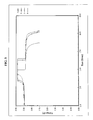
- FIG. 2 is a voltage profile of the first, third and fifth discharge cycles for a LiCoPO 4 -containing cathode (100% LiCoPO 4 , 0% binder, 0% carbon) cycled with a lithium metal anode using constant current cycling at ⁇ 0.2 milliamps per square centimeter (mA/cm 2 ) in a range of 3.0 to 5 volts (V) at a temperature of about 23° C.
- the electrolyte includes ethylene carbonate (EC) and ethyl methyl carbonate (EMC) in a weight ratio of 2:1, and a 1 molar concentration of LiPF 6 salt.
- EC ethylene carbonate
- EMC ethyl methyl carbonate
- a glass fiber separator interpenetrated by the solvent and the salt is interposed between the cathode and the anode.
- FIG. 3 is a voltage profile of the first, third and fifth discharge cycles for a Li 0.98 Mg 0.05 Co 0.96 PO 4 -containing cathode (100% Li 0.98 Mg 0.05 Co 0.96 PO 4 , 0% binder, 0% carbon) cycled in a cell using the test conditions described with respect to FIG. 2 .
- FIG. 4 is a voltage profile of the first, third and fifth discharge cycles for a LiFePO 4 -containing cathode (100% LiFePO 4 , 0% binder, 0% carbon) cycled in a cell using the test conditions described with respect to FIG. 2 .
- FIG. 5 is a voltage profile of the first, third and fifth discharge cycles for a Li 0.98 Mg 0.01 FePO 4 -containing cathode (100% Li 0.98 Mg 0.01 FePO 4 , 0% binder, 0% carbon) cycled in a cell using the test conditions described with respect to FIG. 2 .
- FIG. 6 is a voltage profile of the first, third and fifth discharge cycles for a Li 0.98 Mg 0.05 Fe 0.96 PO 4 -containing cathode (100% Li 0.98 Mg 0.65 Fe 0.96 PO 4 , 0% binder, 0% carbon) cycled in a cell using the test conditions described with respect to FIG. 2 .
- FIG. 7 is a voltage profile of the first, third and fifth discharge cycles for a Li 0.99 Nb 0.002 FePO 4 -containing cathode (100% Li 0.99 Nb 0.002 FePO 4 , 0% binder, 0% carbon) cycled in a cell using the test conditions described with respect to FIG. 2 .
- FIG. 8 is a voltage profile of the first, third and fifth discharge cycles for a LiFePO 4 /2.18% carbon-containing cathode (0% binder) cycled in a cell using the test conditions described with respect to FIG. 2 .
- FIG. 9 is a voltage profile of the first, third and fifth discharge cycles for a Li 0.98 Mg 0.01 FePO 4 /1.88% carbon-containing cathode (0% binder) cycled in a cell using the test conditions described with respect to FIG. 2 .
- FIG. 10 is a voltage profile of the first, third and fifth discharge cycles for a LiMg 0.04 Fe 0.96 PO 4 /2.24% carbon-containing cathode (0% binder) cycled in a cell using the test conditions described with respect to FIG. 2 .
- FIG. 11 is a voltage profile of the first, third and fifth discharge cycles for a Li 0.98 Mg 0.05 Fe 0.96 PO 4 /1.98% carbon-containing cathode (0% binder) cycled in a cell using the test conditions described with respect to FIG. 2 .
- the present invention provides electrode active materials for use in an electricity-producing electrochemical cell.
- Each electrochemical cell includes a positive electrode, a negative electrode, and an electrolyte in ion-transfer relationship with each electrode.
- the word “include,” and its variants is intended to be non-limiting, such that recitation of items in a list is not to the exclusion of other like items that may also be useful in the materials, compositions, devices, and methods of this invention.
- a “battery” refers to a device having one or more electricity-producing electrochemical cells. Two or more electrochemical cells may be combined in parallel or series, or “stacked,” so as to create a multi-cell battery.
- the electrode active materials of this invention may be used in the negative electrode, the positive electrode, or both.
- the active materials of this invention are used in the positive electrode (As used herein, the terms “negative electrode” and “positive electrode” refer to the electrodes at which oxidation and reduction occur, respectively, during battery discharge; during charging of the battery, the sites of oxidation and reduction are reversed).
- the terms “preferred” and “preferably” as used herein refer to embodiments of the invention that afford certain benefits, under certain circumstances. However, other embodiments may also be preferred, under the same or other circumstances. Furthermore, the recitation of one or more preferred embodiments does not imply that other embodiments are not useful and is not intended to exclude other embodiments from the scope of the invention.
- Electrode Active Materials of the Present Invention are Electrode Active Materials of the Present Invention:
- the present invention is directed to a novel alkali metal-containing electrode active material.
- the novel active material of the present invention is represented by the nominal general formula (I): [A a ,D d ]M m (XY 4 ) p Z e (I)
- nominal general formula refers to the fact that the relative proportion of atomic species may vary slightly on the order of 2 percent to 5 percent, or more typically, 1 percent to 3 percent.
- the composition of A, D, M, XY 4 and Z of general formulas (I) through (V) herein, as well as the stoichiometric values of the elements of the active material, are selected so as to maintain electroneutrality of the electrode active material.
- the stoichiometric values of one or more elements of the composition may take on non-integer values.
- Group refers to the Group numbers (i.e., columns) of the Periodic Table as defined in the current IUPAC Periodic Table. (See, e.g., U.S. Pat. No. 6,136,472, Barker et al., issued Oct.
- A is selected from the group consisting of Li (Lithium), Na (Sodium), K (Potassium), and mixtures thereof.
- A may be mixture of Li with Na, a mixture of Li with K, or a mixture of Li, Na and K.
- A is Na, or a mixture of Na with K.
- A is Li.
- a sufficient quantity (a) of moiety A should be present so as to allow all of the “redox active” elements of the moiety M (as defined herein below) to undergo oxidation/reduction.
- Removal of an amount of A from the electrode active material is accompanied by a change in oxidation state of at least one of the “redox active” elements in the active material, as defined herein below.
- the amount of redox active material available for oxidation/reduction in the active material determines the amount (a) of the moiety A that may be removed.
- the amount (a) of moiety A in the active material varies during charge/discharge.
- the active materials of the present invention are synthesized for use in preparing an alkali metal-ion battery in a discharged state, such active materials are characterized by a relatively high value of “a”, with a correspondingly low oxidation state of the redox active components of the active material.
- an amount (b) of moiety A is removed from the active material as described above.
- the resulting structure containing less amount of the moiety A (i.e., a-b) than in the as-prepared state, and at least one of the redox active components having a higher oxidation state than in the as-prepared state, while essentially maintaining the original values of the remaining components (e.g. D, M, X, Y and Z).
- the active materials of this invention include such materials in their nascent state (i.e., as manufactured prior to inclusion in an electrode) and materials formed during operation of the battery (i.e., by insertion or removal of A).
- D is at least one element having an atomic radius substantially comparable to that of the moiety being substituted (e.g. moiety M and/or moiety A).
- D is at least one transition metal.
- transition metals useful herein with respect to moiety D include, without limitation, Nb (Niobium), Zr (Zirconium), Ti (Titanium), Ta (Tantalum), Mo (Molybdenum), W (Tungsten), and mixtures thereof.
- moiety D is at least one element characterized as having a valence state of ⁇ 2+ and an atomic radius that is substantially comparable to that of the moiety being substituted (e.g. M and/or A).
- examples of such elements include, without limitation, Nb (Niobium), Mg (Magnesium) and Zr (Zirconium).
- V D the valence or oxidation state of D
- the valence or oxidation state of the moiety or sum of oxidation states of the elements consisting of the moiety) being substituted for by moiety D (e.g. moiety M and/or moiety A).
- Moiety A may be partially substituted by moiety D by aliovalent or isocharge substitution, in equal or unequal stoichiometric amounts.
- “Isocharge substitution” refers to a substitution of one element on a given crystallographic site with an element having the same oxidation state (e.g. substitution of Ca 2+ with Mg 2+ ).
- “Aliovalent substitution” refers to a substitution of one element on a given crystallographic site with an element of a different oxidation state (e.g. substitution of Li + with Mg 2+ ).
- moiety A of general formula (II) is partially substituted by moiety D by isocharge substitution and d ⁇ f, then the stoichiometric amount of one or more of the other components (e.g. A, M, XY 4 and Z) in the active material must be adjusted in order to maintain electroneutrality.
- the other components e.g. A, M, XY 4 and Z
- moiety A may be substituted by an “oxidatively” equivalent amount of moiety D, whereby the active material of the present invention is represented by the nominal general formula (III):
- moiety A of general formula (III) is partially substituted by moiety D by aliovalent substitution and d ⁇ f, then the stoichiometric amount of one or more of the other components (e.g. A, M, XY 4 and Z) in the active material must be adjusted in order to maintain electroneutrality.
- the other components e.g. A, M, XY 4 and Z
- moiety M is partially substituted by moiety D by aliovalent or isocharge substitution, in equal or unequal stoichiometric amounts.
- d 0
- moiety A may be substituted by moiety D by aliovalent or isocharge substitution, in equal or unequal stoichiometric amounts.
- moieties M and A are both partially substituted by moiety D, the elements selected for substitution for each moiety may be the same or different from one another.
- M is partially substituted by moiety D by isocharge substitution and u ⁇ v
- the stoichiometric amount of one or more of the other components (e.g. A, M, XY 4 and Z) in the active material must be adjusted in order to maintain electroneutrality.
- moiety M may be substituted by an “oxidatively” equivalent amount of moiety D, whereby
- V M is the oxidation state of moiety M (or sum of oxidation states of the elements consisting of the moiety M)
- V D is the oxidation state of moiety D.
- moiety M is partially substituted by moiety D by aliovalent substitution and u ⁇ v
- the stoichiometric amount of one or more of the other components (e.g. A, M, XY 4 and Z) in the active material must be adjusted in order to maintain electroneutrality.
- moiety M and (optionally) moiety A are each partially substituted by aliovalent or isocharge substitution. While not wishing to be held to any one theory, it is thought that by incorporating a dopant (D) into the crystal structure of the active material of the present invention in this manner, wherein the stoichiometric values M and (optionally) A are dependent on (reduced by) the amount of dopant provided for each crystallographic site, that the dopant will occupy sites in the active material normally occupied by moiety M and (optionally) moiety A.
- V D >V A
- doping sites normally occupied by A increases the number of available or unoccupied sites for A, thus substantially increasing the ionic and electrical conductivity of the active material.
- doping the M sites reduces the concentration of available redox active elements, thus ensuring some amount of A remains in the active material upon charge, thereby increasing the structural stability of the active material.
- Such materials additionally exhibit enhanced electrical conductivity, thus reducing or eliminating the need for electrically conductive material in the electrode.
- moiety M is at least one redox active element.
- redox active element includes those elements characterized as being capable of undergoing oxidation/reduction to another oxidation state when the electrochemical cell is operating under normal operating conditions.
- normal operating conditions refers to the intended voltage at which the cell is charged, which, in turn, depends on the materials used to construct the cell.
- Redox active elements useful herein with respect to moiety M include, without limitation, elements from Groups 4 through 11 of the Periodic Table, as well as select non-transition metals, including, without limitation, Ti (Titanium), V (Vanadium), Cr (Chromium), Mn (Manganese), Fe (Iron), Co (Cobalt), Ni (Nickel), Cu (Copper), Nb (Niobium), Mo (Molybdenum), Ru (Ruthenium), Rh (Rhodium), Pd (Palladium), Os (Osmium), Ir (Iridium), Pt (Platinum), Au (Gold), Si (Silicon), Sn (Tin), Pb (Lead), and mixtures thereof.
- “include,” and its variants, is intended to be non-limiting, such that recitation of items in a list is not to the exclusion of other like items that may also be useful in the materials, compositions, devices, and methods of this invention.
- moiety M is a redox active element.
- M is a redox active element selected from the group consisting of Ti 2+ , V 2+ , Cr 2+ , Mn 2+ , Fe 2+ , Co 2+ , Ni 2+ , Cu 2+ , Mo 2+ , Si 2+ , Sn 2+ , and Pb 2+ .
- M is a redox active element selected from the group consisting of Ti 3+ , V 3+ , Cr 3+ , Mn 3+ , Fe 3+ , Co 3+ , Ni 3+ , Mo 3+ , and Nb 3+ .
- moiety M is a mixture of redox active elements or a mixture of at least one redox active element and at least one non-redox active element.
- non-redox active elements include elements that are capable of forming stable active materials, and do not undergo oxidation/reduction when the electrode active material is operating under normal operating conditions.
- non-redox active elements useful herein include, without limitation, those selected from Group 2 elements, particularly Be (Beryllium), Mg (Magnesium), Ca (Calcium), Sr (Strontium), Ba (Barium); Group 3 elements, particularly Sc (Scandium), Y (Yttrium), and the lanthanides, particularly La (Lanthanum), Ce (Cerium), Pr (Praseodymium), Nd (Neodymium), Sm (Samarium); Group 12 elements, particularly Zn (Zinc) and Cd (Cadmium); Group 13 elements, particularly B (Boron), Al (Aluminum), Ga (Gallium), In (Indium), Tl (Thallium); Group 14 elements, particularly C (Carbon) and Ge (Germanium), Group 15 elements, particularly As (Arsenic), Sb (Antimony), and Bi (Bismuth); Group 16 elements, particularly Te (Tellurium); and mixtures thereof.
- Group 2 elements particularly Be (Beryllium), Mg (Magnesium
- M MI n MII o , wherein 0 ⁇ o+n ⁇ 3 and each of o and n is greater than zero (0 ⁇ o, n), wherein MI and MII are each independently selected from the group consisting of redox active elements and non-redox active elements, wherein at least one of MI and MII is redox active.
- MI may be partially substituted with MII by isocharge or aliovalent substitution, in equal or unequal stoichiometric amounts.
- M MI n-o MII p and o ⁇ p
- MI may be partially substituted by MII by aliovalent substitution by substituting an “oxidatively” equivalent amount of MII for MI, whereby
- M MI n - o V MI ⁇ MII o V MII , wherein V MI is the oxidation state of MI, and V MII is the oxidation state of MII.
- MI is selected from the group consisting of Ti, V, Cr, Mn, Fe, Co, Ni, Cu, Mo, Si, Pb, Mo, Nb, and mixtures thereof
- MII is selected from the group consisting of Be, Mg, Ca, Sr, Ba, Sc, Y, Zn, Cd, B, Al, Ga, In, C, Ge, and mixtures thereof.
- MI may be substituted by MII by isocharge substitution or aliovalent substitution.
- MI is partially substituted by MII by isocharge substitution.
- MI is selected from the group consisting of Ti 2+ , V 2+ , Cr 2+ , Mn 2+ , Fe 2+ , Co 2+ , Ni 2+ , Cu 2+ , Mo 2+ , Si 2+ , Sn 2+ , Pb 2+ , and mixtures thereof
- MII is selected from the group consisting of Be 2+ , Mg 2+ , Ca 2+ , Sr 2+ , Ba 2+ , Zn 2+ , Cd 2+ , Ge 2+ , and mixtures thereof.
- MI is selected from the group specified immediately above, and MII is selected from the group consisting of Be 2+ , Mg 2+ , Ca 2+ , Sr 2+ , Ba 2+ , and mixtures thereof.
- MI is selected from the group specified above, and MII is selected from the group consisting of Zn 2+ , Cd 2+ , and mixtures thereof.
- MI is selected from the group consisting of Ti 3+ , V 3+ , Cr 3+ , Mn 3+ , Fe 3+ , Co 3+ , Ni 3+ , Mo 3+ , Nb 3+ , and mixtures thereof
- MII is selected from the group consisting of Sc 3+ , Y 3+ , B 3+ , Al 3+ , Ga 3+ , In 3+ , and mixtures thereof.
- MI is partially substituted by MII by aliovalent substitution.
- MI is selected from the group consisting of Ti 2+ , V 2+ , Cr 2+ , Mn 2+ , Fe 2+ , Co 2+ , Ni 2+ , Cu 2+ , Mo 2+ , Si 2+ , Sn 2+ , Pb 2+ , and mixtures thereof
- MII is selected from the group consisting of Sc 3+ , Y 3+ , B 3+ , Al 3+ , Ga 3+ , In 3+ , and mixtures thereof.
- MI is a 2+ oxidation state redox active element selected from the group specified immediately above, and MII is selected from the group consisting of alkali metals, Cu 1+ , Ag 1+ and mixtures thereof.
- MI is selected from the group consisting of Ti 3+ , V 3+ , Cr 3+ , Mn 3+ , Fe 3+ , Co 3+ , Ni 3+ , Mo 3+ , Nb 3+ , and mixtures thereof
- MII is selected from the group consisting of Be 2+ , Mg 2+ , Ca 2+ , Sr 2+ , Ba 2+ , Zn 2+ , Cd 2+ , Ge 2+ , and mixtures thereof.
- MI is a 3+ oxidation state redox active element selected from the group specified immediately above, and MII is selected from the group consisting of alkali metals, Cu 1+ , Ag 1+ and mixtures thereof.
- M M1 q M2 r M3 s , wherein:
- M1 is a redox active element with a 2+ oxidation state
- M2 is selected from the group consisting of redox and non-redox active elements with a 1+ oxidation state
- M3 is selected from the group consisting of redox and non-redox active elements with a 3+ oxidation state
- At least one of p, q and r is greater than 0, and at least one of M1, M2, and M3 is redox active.
- the stoichiometric amount of one or more of the other components (e.g. A, XY 4 , Z) in the active material must be adjusted in order to maintain electroneutrality.
- M 1 is substituted by an “oxidatively” equivalent amount of M 2 and/or M 3 , whereby
- V M M ⁇ 1 q - ⁇ r V M ⁇ 1 - s V M ⁇ 1 ⁇ M ⁇ 2 r V M ⁇ 2 ⁇ M ⁇ 3 s V M ⁇ 3 , wherein V M1 is the oxidation state of M1, V M2 is the oxidation state of M2, and V M3 is the oxidation state of M3.
- M1 is selected from the group consisting of Ti 2+ , V 2+ , Cr 2+ , Mn 2+ , Fe 2+ , Co 2+ , Ni 2+ , Cu 2+ , Mo 2+ , Si 2+ , Sn 2+ , Pb 2+ , and mixtures thereof;
- M2 is selected from the group consisting of Cu 1+ , Ag 1+ and mixtures thereof;
- M3 is selected from the group consisting of Ti 3+ , V 3+ , Cr 3+ , Mn 3+ , Fe 3+ , Co 3+ , Ni 3+ , Mo 3+ , Nb 3+ , and mixtures thereof.
- M1 and M3 are selected from their respective preceding groups, and M2 is selected from the group consisting of Li 1+ , K 1+ , Na 1+ , R 1+ , Cs 1+ , and mixtures thereof.
- M1 is selected from the group consisting of Be 2+ , Mg 2+ , Ca 2+ , Sr 2+ , Ba 2+ , Zn 2+ , Cd 2+ , Ge 2+ , and mixtures thereof;
- M2 is selected from the group consisting of Cu 1+ , Ag 1+ and mixtures thereof;
- M3 is selected from the group consisting of Ti 3+ , V 3+ , Cr 3+ , Mn 3+ , Fe 3+ , Co 3+ , Ni 3+ , Mo 3+ , Nb 3+ , and mixtures thereof.
- M1 and M3 are selected from their respective preceding groups, and M2 is selected from the group consisting of Li 1+ , K 1+ , Na 1+ , R 1+ , Cs 1+ , and mixtures thereof.
- M1 is selected from the group consisting of Ti 2+ , V 2+ , Cr 2+ , Mn 2+ , Fe 2+ , Co 2+ , Ni 2+ , Cu 2+ , Mo 2+ , Si 2+ , Sn 2+ , Pb 2+ , and mixtures thereof;
- M2 is selected from the group consisting of Cu 1+ , Ag 1+ , and mixtures thereof;
- M3 is selected from the group consisting of Sc 3+ , Y 3+ , B 3+ , Al 3+ , Ga 3+ , In 3+ , and mixtures thereof.
- M1 and M3 are selected from their respective preceding groups, and M2 is selected from the group consisting of Li 1+ , K 1+ , Na 1+ , R 1+ , Cs 1+ , and mixtures thereof.
- moiety XY 4 is a polyanion selected from the group consisting of X′[O 4-x ,Y′ x ], X′[O 4-y ,Y′ 2y ], X′′S 4 , [X′′′,X′ 1-z ]O 4 , and mixtures thereof, wherein:
- XY 4 is selected from the group consisting of X′O 4-x Y′ x , X′O 4-y Y′ 2y , and mixtures thereof, and x and y are both 0, Stated otherwise, XY 4 is a polyanion selected from the group consisting of PO 4 , SiO 4 , GeO 4 , VO 4 , AsO 4 , SbO 4 , SO 4 , and mixtures thereof.
- XY 4 is PO 4 (a phosphate group) or a mixture of PO 4 with another anion of the above-noted group (i.e., where X′ is not P, Y′ is not 0, or both, as defined above).
- XY 4 includes about 80% or more phosphate and up to about 20% of one or more of the above-noted anions.
- XY 4 is selected from the group consisting of X′[O 4-x ,Y′ x ], X′[O 4-y ,Y′ 2y ], and mixtures thereof, and 0 ⁇ x ⁇ 3 and 0 ⁇ y ⁇ 2, wherein a portion of the oxygen (O) in the XY 4 moiety is substituted with a halogen, S, N, or a mixture thereof.
- moiety Z is selected from the group consisting of OH (Hydroxyl), a halogen, or mixtures thereof.
- Z is selected from the group consisting of OH, F (Fluorine), Cl (Chlorine), Br (Bromine), and mixtures thereof.
- Z is OH.
- Z is F, or a mixture of F with OH, Cl, or Br.
- the composition of the electrode active material, as well as the stoichiometric values of the elements of the composition, are selected so as to maintain electroneutrality of the electrode active material.
- the stoichiometric values of one or more elements of the composition may take on non-integer values.
- the XY 4 moiety is, as a unit moiety, an anion having a charge of ⁇ 2, ⁇ 3, or ⁇ 4, depending on the selection of X′, X′′, X′′′Y′, and x and y.
- XY 4 is a mixture of polyanions such as the preferred phosphate/phosphate substitutes discussed above, the net charge on the XY 4 anion may take on non-integer values, depending on the charge and composition of the individual groups XY 4 in the mixture.
- the electrode active material has an orthorhombic-dipyramidal crystal structure and belongs to the space group Pbnm (e.g. an olivine or triphylite material), and is represented by the nominal general formula (IV): [A a ,D d ]M m XY 4 Z e , (IV)
- the electrode active material has a rhombohedral (space group R-3) or monoclinic (space group Pbcn) NASICON structure, and is represented by the nominal general formula (V): [A a ,D d ]M m (XY 4 ) 3 Z e , (V)
- a of general formula (V) is Li
- M is selected from the group consisting of Ti 3+ , V 3+ , Cr 3+ , Mn 3+ , Fe 3+ , Co 3+ , Ni 3+ , Mo 3+ , Nb 3+ , and mixtures thereof (preferably V 3+ ),
- XY 4 PO 4
- e 0.
- the particular starting materials employed will depend on the particular active material to be synthesized, reaction method employed, and desired by-products.
- the compound of the present invention is synthesized by reacting at least one A-containing compound, at least one D-containing compound, one or more M-containing compounds, at least one XY 4 -supplying or containing compound, and (optionally) one or more Z-containing compounds, at a temperature and for a time sufficient to form the desired reaction product.
- the term “supplying” includes compounds which contain the particular component, or reacts to form the particular component so specified.
- Sources of the moiety A include any of a number of Group I metal-containing salts or ionic compounds. Lithium, sodium, and potassium compounds are preferred, with lithium being particularly preferred. Examples include, without limitation, alkali metal-containing fluorides, chlorides, bromides, iodides, nitrates, nitrites, sulfates, hydrogen sulfates, sulfites, bisulfites, carbonates, bicarbonates, borates, phosphates, silicates, antimonates, arsenates, germinates, oxides, acetates, oxalates, and the like. Hydrates of the above compounds may also be used, as well as mixtures thereof. The mixtures may contain more than one alkali metal so that a mixed alkali metal active material will be produced in the reaction.
- Sources of the moieties M and D include, without limitation, M/D-containing fluorides, chlorides, bromides, iodides, nitrates, nitrites, sulfates, hydrogen sulfates, sulfites, bisulfites, carbonates, bicarbonates, borates, phosphates, hydrogen ammonium phosphates, dihydrogen ammonium phosphates, silicates, antimonates, arsenates, germanates, oxides, hydroxides, acetates, and oxalates of the same. Hydrates may also be used.
- the moiety M in the starting material may have any oxidation state, depending on the oxidation state required in the desired product and the oxidizing or reducing conditions contemplated, if any. It should be noted that many of the above-noted compounds may also function as a source of the XY 4 moiety.
- the active materials described herein can contain one or more XY 4 moieties, or can contain a phosphate group that is completely or partially substituted by a number of other XY 4 moieties, which will also be referred to as “phosphate replacements” or “modified phosphates.”
- active materials are provided according to the invention wherein the XY 4 moiety is a phosphate group that is completely or partially replaced by such moieties as sulfate (SO 4 ) 2 ⁇ , monofluoromonophosphate, (PO 3 F) 2 ⁇ , difluoromonophosphate (PO 2 F) 2 ⁇ , silicate (SiO 4 ) 4 ⁇ , arsenate, antimonate, vanadate, titanate, and germanate.
- SO 4 sulfate
- PO 3 F monofluoromonophosphate
- PO 2 F difluoromonophosphate
- SiO 4 silicate
- Analogues of the above oxygenate anions where some or all of the oxygen is replaced by sulfur are also useful in the active materials of the invention, with the exception that the sulfate group may not be completely substituted with sulfur.
- thiomonophosphates may also be used as a complete or partial replacement for phosphate in the active materials of the invention.
- Such thiomonophosphates include the anions (PO 3 S) 3 ⁇ , (PO 2 S 2 ) 3 ⁇ , (POS 3 ) 3 ⁇ , and (PS 4 ) 3 ⁇ , and are most conveniently available as the sodium, lithium, or potassium derivative.
- Non-limiting examples of sources of monofluoromonophosphates include, without limitation, Na 2 PO 3 F, K 2 PO 3 F, (NH 4 ) 2 PO 3 F.H 2 O, LiNaPO 3 F.H 2 O, LiKPO 3 F, LiNH 4 PO 3 F, NaNH 4 PO 3 F, NaK 3 (PO 3 F) 2 and CaPO 3 F.2H 2 O.
- Representative examples of sources of difluoromonophosphate compounds include, without limitation, NH 4 PO 2 F 2 , NaPO 2 F 2 , KPO 2 F 2 , Al(PO 2 F 2 ) 3 , and Fe(PO 2 F 2 ) 3 .
- Sources for the XY 4 moiety are common and readily available. For example,
- X is Si
- useful sources of silicon include orthosilicates, pyrosilicates, cyclic silicate anions such as (Si 3 O 9 ) 6 ⁇ , (Si 6 O 18 ) 12 ⁇ and the like, and pyrocenes represented by the formula [(SiO 3 ) 2 ⁇ ] n , for example LiAl(SiO 3 ) 2 .
- Silica or SiO 2 may also be used.
- antimonate can be provided by antimony-containing materials such as Sb 2 O 5 , M I SbO 3 where M I is a metal having oxidation state 1+, M III SbO 4 where M III is a metal having an oxidation state of 3+, and M II Sb 2 O 7 where M II is a metal having an oxidation state of 2+.
- Additional sources of antimonate include compounds such as Li 3 SbO 4 , NH 4 H 2 SbO 4 , and other alkali metal and/or ammonium mixed salts of the [SbO 4 ] 3 ⁇ anion.
- sulfate compounds that can be used to synthesize the active material include alkali metal and transition metal sulfates and bisulfates as well as mixed metal sulfates such as (NH 4 ) 2 Fe(SO 4 ) 2 , NH 4 Fe(SO 4 ) 2 and the like.
- X is S
- sulfate compounds that can be used to synthesize the active material include alkali metal and transition metal sulfates and bisulfates as well as mixed metal sulfates such as (NH 4 ) 2 Fe(SO 4 ) 2 , NH 4 Fe(SO 4 ) 2 and the like.
- Ge a germanium containing compound such as GeO 2 may be used to synthesize the active material.
- sources of F include ionic compounds containing fluoride ion (F ⁇ ) or hydrogen difluoride ion (HF 2 ⁇ ).
- the cation may be any cation that forms a stable compound with the fluoride or hydrogen difluoride anion. Examples include 1+, 2+ and 3+ metal cations, as well as ammonium and other nitrogen-containing cations. Ammonium is a preferred cation because it tends to form volatile by-products that are readily removed from the reaction mixture.
- starting materials that contain “x” moles of a source of nitride ion.
- Sources of nitride are among those known in the art including nitride salts such as Li 3 N and (NH 4 ) 3 N.
- the active materials of the present invention contain a mixture of A, D, M, XY 4 , and (optionally) Z.
- a starting material may provide more than one these components, as is evident in the list above.
- starting materials are provided that combine, for example, M and PO 4 , thus requiring only the alkali metal and D to be added.
- a starting material is provided that contains A, M and PO 4 .
- any counterion may be combined with A, D, M, XY 4 , and Z. It is preferred, however, to select starting materials with counterions that give rise to the formation of volatile by-products during the reaction. Thus, it is desirable to choose ammonium salts, carbonates, bicarbonates, oxides, hydroxides, and the like, where possible. Starting materials with these counterions tend to form volatile by-products such as water, ammonia, and carbon dioxide, which can be readily removed from the reaction mixture. Similarly, sulfur-containing anions such as sulfate, bisulfate, sulfite, bisulfite and the like tend to result in volatile sulfur oxide by-products. Nitrogen-containing anions such as nitrate and nitrite also tend to give volatile NO x by-products. This concept is well illustrated in the examples below.
- the performance of the active material may be dependent upon the amount of each reactant present in the reaction mixture. This is because the presence of certain unreacted starting materials in the active material may have a detrimental effect on the electrochemical performance of the active material.
- the active material Li a Mg b Fe c PO 4 synthesized via a solid state reaction of LiH 2 PO 4 and Fe 2 O 3 in the presence of a reducing agent (as defined herein below)
- a reducing agent as defined herein below
- the P to M ration (P:M) be approximately 1:0.95 to about 1:0.99.
- the Li:P ratio of LiH 2 PO 4 may not be exactly 1:1 due to the presence of unreacted reactants used to synthesize LiH 2 PO 4 (e.g. H 3 PO 4 ).
- the Li:P ration in the reaction mixture is 0.98:1.
- the overall Li:P:M ratio is from about 0.95:1:95 to about 0.99:1:0.99, and most preferably 0.98:1:0.96.
- One method for preparing the active materials of the present invention is via the hydrothermal treatment of the requisite starting materials.
- the starting materials are mixed with a small amount of a liquid (e.g. water), and heated in a pressurized vessel or bomb at a temperature that is relatively lower as compared to the temperature necessary to produce the active material in an oven at ambient pressure.
- the reaction is carried out at a temperature of about 150° C. to about 450° C., under pressure, for a period of about 4 to about 48 hours, or until a reaction product forms.
- a “sol-gel” preparation method may also be employed. Using this method, solute precursors with the required component are mixed in solution and then transformed into a solid via precipitation or gelation. The result wet powder or gel are dried at temperature in the range of about 100° C. to about 400° C. for short time and then, optionally, heated up to about 450° C. to about 700° C. in controlled atmosphere for about 1 hour to about 4 hours.
- Another method for synthesizing the active materials of the present invention is via a thermite reaction, wherein M is reduced by a granular or powdered metal present in the reaction mixture.
- the active materials of the present invention can also be synthesized via a solid state reaction, with or without simultaneous oxidation or reduction of those elements in the compound that are redox active, by heating the requisite starting materials at an elevated temperature for a given period of time, until the desired reaction product forms.
- the starting materials are provided in powder or particulate form, and are mixed together by any of a variety of procedures, such as by ball milling, blending in a mortar and pestle, and the like. Thereafter, the mixture of powdered starting materials may be compressed into a pellet and/or held together with a binder (which may also serve as a source of reducing agent) material to form a closely cohering reaction mixture.
- the reaction mixture is heated in an oven, generally at a temperature of about 400° C. or greater, until a reaction product forms.
- the reaction may be carried out under reducing or oxidizing conditions, to reduce the oxidation state of M or to maintain the oxidation state of the M moiety.
- Reducing conditions may be provided by performing the reaction in a “reducing atmosphere” such as hydrogen, ammonia, carbon monoxide, methane, mixtures of thereof, or other suitable reducing gas.
- Reduction conditions may also be provided by conducting the reaction under low oxygen partial pressures.
- the reduction may be carried out in situ by including in the reaction mixture a reductant that will participate in the reaction to reduce M, but that will produce by-products that will not interfere with the active material when used later in an electrode or an electrochemical cell.
- the reductant is elemental carbon, wherein the reducing power is provided by simultaneous oxidation of carbon to carbon monoxide and/or carbon dioxide.
- An excess of carbon, remaining after the reaction, is intimately mixed with the product active material and functions as a conductive constituent in the ultimate electrode formulation. Accordingly, excess carbon, on the order of 100% or greater, may be used.
- the presence of carbon particles in the starting materials also provides nucleation sites for the production of the product crystals.
- the source of reducing carbon may also be provided by an organic material that forms a carbon-rich decomposition product, referred to herein as a “carbonaceous material,” and other by-products upon heating under the conditions of the reaction. At least a portion of the organic precursor, carbonaceous material and/or by-products formed functions as a reductant during the synthesis reaction for the active material, before, during and/or after the organic precursor undergoes thermal decomposition.
- Such precursors include any liquid or solid organic material (e.g. sugars and other carbohydrates, including derivatives and polymers thereof, acetates and acrylates).
- reaction may be carried out in the presence of oxygen, the reaction is preferably conducted under an essentially non-oxidizing atmosphere so as not to interfere with the reduction reactions taking place.
- An essentially non-oxidizing atmosphere can be achieved through the use of vacuum, or through the use of inert gases such as argon and the like.
- the particulate starting materials are heated to a temperature below the melting point of the starting materials.
- the temperature should be about 400° C. or greater, and desirably about 450° C. or greater.
- CO and/or CO 2 evolve during the reaction. Higher temperatures favor CO formation.
- Some of the reactions are more desirably conducted at temperatures greater than about 600° C.; most desirably greater than about 650° C. Suitable ranges for many reactions are from about 500° C. to about 1200° C.
- the starting materials may be heated at ramp rates from a fraction of a degree up to about 10° C. per minute. Once the desired reaction temperature is attained, the reactants (starting materials) are held at the reaction temperature for a time sufficient for the reaction to occur. Typically, the reaction is carried out for several hours at the final reaction temperature.
- the products are preferably cooled from the elevated temperature to ambient (room) temperature (i.e., about 10° C. to about 40° C.). It is also possible to quench the products to achieve a higher cooling rate, for example on the order of about 100° C./minute.
- room temperature i.e., about 10° C. to about 40° C.
- the thermodynamic considerations such as ease of reduction of the selected starting materials, the reaction kinetics, and the melting point of the salts will cause adjustment in the general procedure, such as the amount of reducing agent, the temperature of the reaction, and the dwell time.
- the active material of the present invention may be combined with a polymeric binder in order to form a cohesive mixture.
- the mixture this then placed in electrical communication with a current collector which, in turn, provides electrical communication between the electrode and an external load.
- the mixture may be formed or laminated onto the current collector, or an electrode film may be formed from the mixture wherein the current collector is embedded in the film.
- Suitable current collectors include reticulated or foiled metals (e.g. aluminum, copper and the like).
- An electrically conductive agent e.g. carbon and the like
- the electrode material is pressed onto or about the current collector, thus eliminating the need for the polymeric binder.
- a solid electrolyte or an electrolyte-permeable separator is interposed between the electrode and a counter-electrode.
- the counter-electrode contains an intercalation active material selected from the group consisting of a transition metal oxide, a metal chalcogenide, carbon (e.g. graphite), and mixtures thereof.
- an intercalation active material selected from the group consisting of a transition metal oxide, a metal chalcogenide, carbon (e.g. graphite), and mixtures thereof.
- Counter electrodes, electrolyte compositions, and methods for making the same, among those useful herein, are described in U.S. Ser. No. 10/323,457, filed Dec. 18, 2002; U.S. Pat. No. 5,700,298, Shi et al., issued Dec. 23, 1997; U.S. Pat. No.
- Electrochemical cells composed of electrodes, electrolytes and other materials, among those useful herein, are described in the following documents, all of which are incorporated by reference herein: U.S. Pat. No. 4,668,595, Yoshino et al., issued May 26, 1987; U.S. Pat. No. 4,792,504, Schwab et al., issued Dec. 20, 1988; U.S. Pat. No. 4,830,939, Lee et al., issued May 16, 1989; U.S. Pat. No. 4,935,317, Fauteaux et al., issued Jun. 19, 1980; U.S. Pat. No. 4,990,413, Lee et al., issued Feb. 5, 1991; U.S. Pat. No.
- Li a Nb b MnPO 4 active material synthesized per reaction A is accomplished by first combining the reactants, and then ball milling the same to mix the particles. Thereafter, the particle mixture is pelletized. The pelletized mixture is heated for about 4 hours at about 700° C. in an oven in a flowing inert atmosphere (e.g. argon). Thereafter, the sample is cooled and then removed from the oven.
- a high flow-rate inert atmosphere or partially oxidizing atmosphere is employed.
- Li a Mg b CO c PO 4 active material synthesized as per Reaction I was black in color, and the measured electrical conductivity ranged from about 10 ⁇ 4 S/cm to about 10 ⁇ 3 S/cm.
- LiCoPO 4 active material was bright purple in color, and the electrical conductivity ranged from about 10 ⁇ 9 S/cm to about 10 ⁇ 10 S/cm.
- the weight percent wt % of residual carbon formed upon the decomposition of the Fe reactant complex was determined to be about 1 to 2 weight percent wt % for all the samples 1, 2, 3 and 4.
- the electrical conductivity for a sample of Li 0.95 Nb 0.01 FePO 4 and Li 0.99 Nb 0.002 FePO 4 synthesized as per reaction J was determined to be approximately 10 ⁇ 3 S/cm. The measurements were repeated for LiFePO 4 prepared per the teachings of Example 11 herein below, which yielded an electrical conductivity of approximately 10 ⁇ 10 S/cm.
- LiFePO 4 active material synthesized as per Reaction L was green or light gray in color.
- Li a Mg b Fe c PO 4 active materials synthesized as per Reaction L were black in color.
- the patterns shown in FIG. 1 for Li 0.98 Mg 0.01 FePO 4 and Li 0.98 Mg 0.05 Fe 0.96 PO 4 show that these materials are single phase materials, as is LiFePO 4 .
- Table 13 below shows the unit cell dimensions and volumes obtained for the three active materials.
- electrochemical cells were prepared as follows. To test the electrochemical performance of pure active material and eliminate the effect of carbon and binder, the as-synthesized powder (first passed through 53 micron screen) is wetted with a suitable volatile solvent (e.g. acetone), sprayed on Al disk and then pressed under 50,000 pounds per square inch (psi) pressure for 10 minutes. The active powder adheres to the Al current collector to form a stable disk cathode electrode. There are no carbon additives or polymeric binder in the disk cathode electrode.
- a suitable volatile solvent e.g. acetone
- the as-synthesized powder (first passed through 53 micron screen) is mixed with conductive carbon black (4 wt %) and poly(vinylidene difluoride) (PVdF) (10 wt %) solution in acetone, and cast onto an Al current collector to form stable film cathode electrode.
- conductive carbon black (4 wt %)
- PVdF poly(vinylidene difluoride)
- Lithium metal foil is employed as the anode.
- the electrolyte includes ethylene carbonate (EC) and ethyl methyl carbonate (EMC) in a weight ratio of 2:1, and a 1 molar concentration of LiPF 6 salt.
- EC ethylene carbonate
- EMC ethyl methyl carbonate
- a glass fiber separator interpenetrated by the solvent and the salt is interposed between the cathode and the anode.
- the electrochemical cell is cycled using constant current cycling at ⁇ 0.2 milliamps per square centimeter (mA/cm 2 ) in a range of 3 to 5 volts (V) at a temperature of about 23° C., at varying rates.
- FIG. 2 is a voltage profile (voltage as a function of time) for the cell. As the profile in FIG. 2 indicates, the cell exhibited almost no capacity, which is attributed to the high electrical resistivity of the active material.
- An electrochemical cell constructed using a disk cathode containing Li 0.98 Mg 0.05 Co 0.96 PO 4 (0% binder, 0% carbon) was cycled per the conditions stated above.
- FIG. 3 is a voltage profile for the cell. As the profile in FIG.
- LiCoPO 4 doped with Mg exhibited a significantly greater amount of capacity than undoped LiCoPO 4 , even in the absence of carbon.
- Table 14 below shows the charge capacity (Q c ) and discharge capacity (Q d ) for the active material contained in each electrochemical cell, as well as the corresponding capacity loss for each cycle.
- FIG. 4 is a voltage profile (voltage as a function of time) for the cell. As the profile in FIG. 4 indicates, the cell exhibited almost no capacity, which is attributed to the high electrical resistivity of the active material.
- FIGS. 5 , 6 and 7 are voltage profiles for the cells. As the profiles in FIGS. 5 , 6 and 7 indicate, LiFePO 4 doped with Mg or Nb exhibited a significantly greater amount of capacity than undoped LiFePO 4 , even in the absence of carbon. Table 14 below shows the charge capacity (Q c ) and discharge capacity (Q d ) for the active material contained in each electrochemical cell, as well as the corresponding capacity loss for each cycle. As Table 15 indicates, Li 0.98 Mg 0.05 Fe 0.96 PO 4 active material (wherein the amount of Fe and Li are each dependent (reduced by) the amount of Mg dopant) exhibited superior performance, and high capacity.
- FIGS. 9 , 10 and 11 are voltage profiles for the cells. As the profiles in FIGS. 9 , 10 and 11 indicate, residual carbon-containing LiFePO 4 doped with Mg exhibited a significantly enhanced capacity and reduced fade as compared to the carbon-deficient counterparts.
- Table 16 shows the charge capacity (Q c ) and discharge capacity (Q d ) for the active material contained in each electrochemical cell, as well as the corresponding capacity loss for each cycle.
- Q c charge capacity
- Q d discharge capacity
Landscapes
- Chemical & Material Sciences (AREA)
- Chemical Kinetics & Catalysis (AREA)
- Electrochemistry (AREA)
- General Chemical & Material Sciences (AREA)
- Engineering & Computer Science (AREA)
- Inorganic Chemistry (AREA)
- Manufacturing & Machinery (AREA)
- Ceramic Engineering (AREA)
- Materials Engineering (AREA)
- Structural Engineering (AREA)
- Organic Chemistry (AREA)
- Crystallography & Structural Chemistry (AREA)
- Battery Electrode And Active Subsutance (AREA)
- Secondary Cells (AREA)
- Silicates, Zeolites, And Molecular Sieves (AREA)
Priority Applications (3)
| Application Number | Priority Date | Filing Date | Title |
|---|---|---|---|
| US10/741,257 US7718317B2 (en) | 2002-12-19 | 2003-12-19 | Electrode active material and method of making the same |
| US11/291,298 US20060083990A1 (en) | 2002-12-19 | 2005-12-01 | Electrode active material and method of making the same |
| US12/872,904 US20100330426A1 (en) | 2002-12-19 | 2010-08-31 | Electrode Active Material and Method of Making The Same |
Applications Claiming Priority (2)
| Application Number | Priority Date | Filing Date | Title |
|---|---|---|---|
| US43514402P | 2002-12-19 | 2002-12-19 | |
| US10/741,257 US7718317B2 (en) | 2002-12-19 | 2003-12-19 | Electrode active material and method of making the same |
Related Child Applications (1)
| Application Number | Title | Priority Date | Filing Date |
|---|---|---|---|
| US11/291,298 Division US20060083990A1 (en) | 2002-12-19 | 2005-12-01 | Electrode active material and method of making the same |
Publications (2)
| Publication Number | Publication Date |
|---|---|
| US20040131939A1 US20040131939A1 (en) | 2004-07-08 |
| US7718317B2 true US7718317B2 (en) | 2010-05-18 |
Family
ID=32595316
Family Applications (3)
| Application Number | Title | Priority Date | Filing Date |
|---|---|---|---|
| US10/741,257 Expired - Fee Related US7718317B2 (en) | 2002-12-19 | 2003-12-19 | Electrode active material and method of making the same |
| US11/291,298 Abandoned US20060083990A1 (en) | 2002-12-19 | 2005-12-01 | Electrode active material and method of making the same |
| US12/872,904 Abandoned US20100330426A1 (en) | 2002-12-19 | 2010-08-31 | Electrode Active Material and Method of Making The Same |
Family Applications After (2)
| Application Number | Title | Priority Date | Filing Date |
|---|---|---|---|
| US11/291,298 Abandoned US20060083990A1 (en) | 2002-12-19 | 2005-12-01 | Electrode active material and method of making the same |
| US12/872,904 Abandoned US20100330426A1 (en) | 2002-12-19 | 2010-08-31 | Electrode Active Material and Method of Making The Same |
Country Status (9)
| Country | Link |
|---|---|
| US (3) | US7718317B2 (fr) |
| EP (3) | EP1500154B1 (fr) |
| JP (1) | JP2006511038A (fr) |
| CN (1) | CN100334755C (fr) |
| AT (2) | ATE529906T1 (fr) |
| AU (1) | AU2003297466A1 (fr) |
| CA (3) | CA2455540C (fr) |
| DE (1) | DE60327850D1 (fr) |
| WO (1) | WO2004057691A1 (fr) |
Cited By (4)
| Publication number | Priority date | Publication date | Assignee | Title |
|---|---|---|---|---|
| US20090311597A1 (en) * | 2001-12-21 | 2009-12-17 | Massachusetts Institute Of Technology | Conductive lithium storage electrode |
| US20100015489A1 (en) * | 2008-04-14 | 2010-01-21 | Commissariat A L'energie Atomique | Titanates of Perovskite or Derived Structure and Applications Thereof |
| US20110070499A1 (en) * | 2009-04-16 | 2011-03-24 | Haitao Huang | Electrode Active Material For Secondary Electrochemical Cell |
| US8435678B2 (en) | 2005-02-03 | 2013-05-07 | A123 Systems, LLC | Electrode material with enhanced ionic transport properties |
Families Citing this family (42)
| Publication number | Priority date | Publication date | Assignee | Title |
|---|---|---|---|---|
| JP5043290B2 (ja) * | 2004-06-08 | 2012-10-10 | パナソニック株式会社 | 非水電解質二次電池用正極活物質、その製造方法、およびそれを用いた非水電解質二次電池 |
| JP5384935B2 (ja) * | 2005-03-28 | 2014-01-08 | ヴァレンス テクノロジー インコーポレーテッド | 二次電気化学電池 |
| US7824581B2 (en) | 2007-06-18 | 2010-11-02 | Advanced Lithium Electrochemistry Co., Ltd. | Cocrystalline metallic compounds and electrochemical redox active material employing the same |
| JP4525474B2 (ja) * | 2005-06-06 | 2010-08-18 | 株式会社豊田中央研究所 | リチウム二次電池用活物質及びその製造方法、リチウム二次電池 |
| US8133616B2 (en) * | 2006-02-14 | 2012-03-13 | Dow Global Technologies Llc | Lithium manganese phosphate positive material for lithium secondary battery |
| US20070298317A1 (en) * | 2006-05-09 | 2007-12-27 | Ralph Brodd | Secondary electrochemical cell with increased current collecting efficiency |
| US20100012498A1 (en) * | 2006-07-25 | 2010-01-21 | Koninklijke Philips Electronics N.V. | Method for the manufacture of a thin-layer battery stack on a three-dimensional substrate |
| JP5268042B2 (ja) * | 2006-11-24 | 2013-08-21 | 国立大学法人九州大学 | 正極活物質の製造方法およびそれを用いた非水電解質電池 |
| JP2008311224A (ja) * | 2007-06-18 | 2008-12-25 | Advanced Lithium Eletrochemistry Co Ltd | 電気化学的酸化還元反応で用いる組成、電極、電気化学電池、および電気化学的酸化還元反応で用いる組成を準備する過程 |
| US8288997B2 (en) * | 2007-08-24 | 2012-10-16 | Alexander Choi | Providing power based on state of charge |
| CN101399343B (zh) * | 2007-09-25 | 2011-06-15 | 比亚迪股份有限公司 | 锂离子二次电池正极活性物质磷酸铁锂的制备方法 |
| CN101494305B (zh) | 2008-01-25 | 2011-05-18 | 比亚迪股份有限公司 | 锂离子电池电解液和含有该电解液的电池及电池组 |
| JP5370937B2 (ja) * | 2008-01-28 | 2013-12-18 | シャープ株式会社 | 正極活物質、正極及び非水二次電池 |
| US8088305B2 (en) | 2008-02-22 | 2012-01-03 | Byd Company Limited | Lithium iron phosphate cathode material |
| US8052897B2 (en) | 2008-02-29 | 2011-11-08 | Byd Company Limited | Composite compound with mixed crystalline structure |
| US8062559B2 (en) | 2008-02-29 | 2011-11-22 | Byd Company Limited | Composite compound with mixed crystalline structure |
| US8062560B2 (en) | 2008-02-29 | 2011-11-22 | Byd Company Limited | Composite compound with mixed crystalline structure |
| US8148015B2 (en) * | 2008-03-21 | 2012-04-03 | Byd Company Limited | Cathode materials for lithium batteries |
| CN101597089A (zh) | 2008-06-06 | 2009-12-09 | 比亚迪股份有限公司 | 一种过渡金属氢氧化物及其氧化物和正极材料的制备方法 |
| CN101640288B (zh) | 2008-07-30 | 2012-03-07 | 比亚迪股份有限公司 | 一种锂离子电池电解液及含有该电解液的锂离子电池 |
| JP5107213B2 (ja) * | 2008-11-18 | 2012-12-26 | シャープ株式会社 | 正極活物質、正極及び非水二次電池 |
| TWI474970B (zh) | 2008-12-29 | 2015-03-01 | Basf Se | 於水熱條件下合成鋰-金屬-磷酸鹽 |
| US8999576B2 (en) | 2009-05-22 | 2015-04-07 | Sharp Kabushiki Kaisha | Cathode active material, cathode and nonaqueous secondary battery |
| JP5551019B2 (ja) * | 2009-09-02 | 2014-07-16 | シャープ株式会社 | 正極活物質、正極及び非水二次電池 |
| CN102246333A (zh) * | 2009-09-18 | 2011-11-16 | 松下电器产业株式会社 | 非水电解质二次电池用电极及其制造方法以及非水电解质二次电池 |
| CN103155235A (zh) * | 2010-05-25 | 2013-06-12 | 佩里昂技术公司 | 用于镁电池的电极材料 |
| US9373844B2 (en) | 2010-07-01 | 2016-06-21 | Sharp Kabushiki Kaisha | Positive electrode active substance containing lithium-containing metal oxide |
| JP5132727B2 (ja) | 2010-07-12 | 2013-01-30 | シャープ株式会社 | 正極活物質、正極及び非水電解質二次電池 |
| KR101219395B1 (ko) * | 2010-07-15 | 2013-01-11 | 전자부품연구원 | 리튬이차전지용 양극재료 및 그의 제조방법 |
| CN102013483A (zh) * | 2010-10-15 | 2011-04-13 | 福建师范大学 | 一种同时掺氟和掺锆的硅酸亚铁锂正极材料的制备方法 |
| JP5839227B2 (ja) * | 2011-11-10 | 2016-01-06 | トヨタ自動車株式会社 | リチウム二次電池とその製造方法 |
| JP6194719B2 (ja) * | 2013-09-25 | 2017-09-13 | 株式会社村田製作所 | 全固体電池 |
| US9512526B2 (en) * | 2013-12-19 | 2016-12-06 | Toyota Motor Engineering & Manufacturing North America, Inc. | Water oxidation catalyst including lithium cobalt germanate |
| US10763491B2 (en) | 2014-04-01 | 2020-09-01 | The Research Foundation For The State University Of New York | Low-temperature synthesis process of making MgzMxOy, where M is Mn, V or Fe, for manufacture of electrode materials for group II cation-based batteries |
| KR102228749B1 (ko) * | 2014-08-11 | 2021-03-16 | 삼성에스디아이 주식회사 | 리튬 이차 전지용 양극 활물질, 이의 제조 방법 및 이를 포함하는 리튬 이차 전지 |
| KR20170003306A (ko) * | 2015-06-30 | 2017-01-09 | 주식회사 엘지화학 | 마그네슘 전지용 전극 활물질, 이의 제조 방법, 이를 포함하는 전극, 및 상기 전극을 포함하는 마그네슘 전지 |
| US10727487B2 (en) | 2017-10-04 | 2020-07-28 | Honda Motor Co., Ltd. | Anode for fluoride ion battery |
| EP3486146B1 (fr) | 2017-11-15 | 2021-04-14 | Sika Technology Ag | Dispositif de renforcement et d'étanchéité d'un élément structurel |
| CN108511704A (zh) * | 2018-03-06 | 2018-09-07 | 上海应用技术大学 | 一种钠离子电池用的镁取代磷酸钒钠/碳复合正极材料及其制备方法 |
| CN108447698B (zh) * | 2018-03-12 | 2021-04-06 | 中国科学院长春应用化学研究所 | 一种电极及其制备方法、高能可再生储电器件 |
| CA3109525A1 (fr) * | 2018-08-30 | 2020-03-05 | Hydro-Quebec | Materiaux actifs de batterie rechargeable au lithium-ion revetus |
| CN109638274B (zh) * | 2018-12-14 | 2022-03-11 | 廊坊绿色工业技术服务中心 | 一种钼镱共掺硅酸铁钠复合电极材料及其制备方法 |
Citations (43)
| Publication number | Priority date | Publication date | Assignee | Title |
|---|---|---|---|---|
| US5538814A (en) | 1992-05-18 | 1996-07-23 | Mitsubishi Cable Industries, Ltd. | Lithium secondary battery |
| US5576121A (en) | 1994-10-27 | 1996-11-19 | Sharp Kabushiki Kaisha | Llithium secondary battery and process for preparing negative-electrode active material for use in the same |
| US5614334A (en) | 1993-11-02 | 1997-03-25 | Mitsubishi Cable Industries, Ltd. | Material for lithium battery positive electrode and production thereof |
| JPH09134724A (ja) | 1995-11-07 | 1997-05-20 | Nippon Telegr & Teleph Corp <Ntt> | 非水電解質二次電池 |
| WO1997040541A1 (fr) | 1996-04-23 | 1997-10-30 | Board Of Regents, The University Of Texas System | Materiaux cathodiques pour batterie d'accumulateurs au lithium (rechargeable) |
| CA2200998A1 (fr) | 1997-03-25 | 1998-09-25 | Hydro-Quebec | Nouveaux materiaux pour electrodes de type a insertion de lithium, a base de derives de tetraoxyanions, avec structure d'olivine |
| JPH1125983A (ja) | 1997-07-04 | 1999-01-29 | Japan Storage Battery Co Ltd | リチウム電池用活物質 |
| US5871866A (en) | 1996-09-23 | 1999-02-16 | Valence Technology, Inc. | Lithium-containing phosphates, method of preparation, and use thereof |
| US6085015A (en) | 1997-03-25 | 2000-07-04 | Hydro-Quebec | Lithium insertion electrode materials based on orthosilicate derivatives |
| US6136472A (en) | 1998-06-26 | 2000-10-24 | Valence Technology, Inc. | Lithium-containing silicon/phosphates, method of preparation, and uses thereof including as electrodes for a battery |
| CA2307119A1 (fr) | 1999-04-30 | 2000-10-30 | Hydro-Quebec | Nouveaux materiaux d'electrode presentant une conductivite de surface elevee |
| CA2270771A1 (fr) | 1999-04-30 | 2000-10-30 | Hydro-Quebec | Nouveaux materiaux d'electrode presentant une conductivite de surface elevee |
| US6153333A (en) | 1999-03-23 | 2000-11-28 | Valence Technology, Inc. | Lithium-containing phosphate active materials |
| JP2001085010A (ja) | 1999-09-16 | 2001-03-30 | Nippon Telegr & Teleph Corp <Ntt> | リチウム二次電池 |
| WO2001053198A1 (fr) | 2000-01-18 | 2001-07-26 | Valence Technology, Inc. | Production de materiaux contenant du lithium |
| WO2001054212A1 (fr) | 2000-01-18 | 2001-07-26 | Valence Technology, Inc. | Materiaux electrochimiquement actifs a base de lithium et preparation de ceux-ci |
| WO2001077501A2 (fr) | 2000-04-11 | 2001-10-18 | Massachusetts Institute Of Technology | Actionneur electromecanique |
| JP2001307726A (ja) | 2000-04-24 | 2001-11-02 | Yuasa Corp | 電極材料及びそれを用いた電池 |
| WO2001084655A1 (fr) | 2000-04-27 | 2001-11-08 | Valence Technology, Inc. | Materiaux a base de fluorophosphate de lithium et mode de preparation correspondant |
| WO2002027823A1 (fr) | 2000-09-26 | 2002-04-04 | HYDRO-QUéBEC | Procede de synthese de materiaux redox enrobes de carbone a taille controlee |
| EP1195838A2 (fr) | 2000-10-06 | 2002-04-10 | Sony Corporation | Cellule à électrolyte non-aqueux |
| EP1195827A2 (fr) | 2000-10-06 | 2002-04-10 | Sony Corporation | Méthode pour la fabrication de matière active cathodique et méthode de fabrication d'une celle à électrolyte non-aqueux |
| EP1195837A2 (fr) | 2000-10-06 | 2002-04-10 | Sony Corporation | Batterie secondaire à électrolyte non aqueux |
| JP2002216755A (ja) | 2001-01-22 | 2002-08-02 | Denso Corp | 非水電解質二次電池 |
| US20020122984A1 (en) | 2000-10-23 | 2002-09-05 | Hideki Sakai | Method for producing cathode active material and method for manufacturing nonaqueous electrolyte battery |
| US20020192553A1 (en) | 2001-04-06 | 2002-12-19 | Jeremy Barker | Sodium ion batteries |
| US20030013019A1 (en) | 2000-04-27 | 2003-01-16 | Jeremy Barker | Alkali/transition metal halo - and hydroxy-phosphates and related electrode active materials |
| US6514640B1 (en) | 1996-04-23 | 2003-02-04 | Board Of Regents, The University Of Texas System | Cathode materials for secondary (rechargeable) lithium batteries |
| US20030027049A1 (en) | 2000-04-27 | 2003-02-06 | Jeremy Barker | Alkali/transition metal halo - and hydroxy-phosphates and related electrode active materials |
| US20030082446A1 (en) | 2000-10-20 | 2003-05-01 | Yet-Ming Chiang | Reticulated and controlled porosity battery structures |
| US20030099884A1 (en) | 2001-07-27 | 2003-05-29 | A123Systems, Inc. | Battery structures, self-organizing structures and related methods |
| WO2003056646A1 (fr) | 2001-12-21 | 2003-07-10 | Massachusetts Institute Of Technology | Electrode conductrice de stockage de lithium |
| US20030170542A1 (en) * | 2002-03-06 | 2003-09-11 | Jeremy Barker | Alkali transition metal phosphates and related electrode active materials |
| US20030190527A1 (en) * | 2002-04-03 | 2003-10-09 | James Pugh | Batteries comprising alkali-transition metal phosphates and preferred electrolytes |
| US20030190528A1 (en) * | 2002-04-03 | 2003-10-09 | Saidi Mohammed Y. | Alkali-iron-cobalt phosphates and related electrode active materials |
| WO2003088383A1 (fr) | 2002-04-03 | 2003-10-23 | Valence Technology, Inc. | Phosphates de metaux de transition ou alcalins comprenant un element de non transition a valence +3 et materiaux actifs d'electrode associes |
| US6656635B2 (en) * | 2000-10-06 | 2003-12-02 | Sony Corporation | Non-aqueous electrolyte secondary cell |
| WO2003099715A1 (fr) | 2002-05-17 | 2003-12-04 | Valence Technology, Inc. | Synthese de composes metalliques utilises comme materiaux actifs cathodiques |
| US20040018430A1 (en) | 2002-07-26 | 2004-01-29 | A123 Systems, Inc. | Electrodes and related devices |
| US6720113B2 (en) * | 2000-10-05 | 2004-04-13 | Sony Corporation | Solid electrolyte cell |
| US20050034993A1 (en) | 2003-06-23 | 2005-02-17 | A123 Systems, Inc. | Polymer composition for encapsulation of electrode particles |
| US20050233219A1 (en) | 2004-02-06 | 2005-10-20 | Gozdz Antoni S | Lithium secondary cell with high charge and discharge rate capability |
| US7255957B2 (en) * | 2000-10-05 | 2007-08-14 | Sony Corporation | Non-aqueous electrolyte cell and solid electrolyte cell |
Family Cites Families (31)
| Publication number | Priority date | Publication date | Assignee | Title |
|---|---|---|---|---|
| US4477541A (en) | 1982-12-22 | 1984-10-16 | The United States Of America As Represented By The United States Department Of Energy | Solid electrolyte structure |
| DE3680249D1 (de) | 1985-05-10 | 1991-08-22 | Asahi Chemical Ind | Sekundaerbatterie. |
| US4792504A (en) | 1987-09-18 | 1988-12-20 | Mhb Joint Venture | Liquid containing polymer networks as solid electrolytes |
| US4830939B1 (en) | 1987-10-30 | 1996-10-08 | Mhb Joint Venture | Radiation cured solid electrolytes and electrochemical devices employing the same |
| US5037712A (en) | 1987-10-30 | 1991-08-06 | Ultracell, Inc. | Preparation of radiation cured solid electrolytes and electrochemical devices employing the same |
| US4990413A (en) | 1989-01-18 | 1991-02-05 | Mhb Joint Venture | Composite solid electrolytes and electrochemical devices employing the same |
| US4935317A (en) | 1989-06-21 | 1990-06-19 | Mhb Joint Venture | Method for producing solid state electrochemical laminar cell utilizing cathode rolling step |
| US5262253A (en) | 1992-07-22 | 1993-11-16 | Valence Technology, Inc. | Solid electrolytes derived by polymerization of vinyl sulfonate polyalkylene oxides |
| US5508130A (en) | 1992-07-22 | 1996-04-16 | Golovin; Milton N. | Solid electrolytes containing LiN(SO2 CF3)2 and a triglyme-carbonate solvent, and electrochemical cells produced therefrom |
| US5620810A (en) | 1992-07-22 | 1997-04-15 | Valence Technology, Inc. | Solid, solvent-containing electrolytes and electrolytic cells produced therefrom |
| US5300373A (en) | 1992-09-11 | 1994-04-05 | Valence Technology, Inc. | Electrochemical cell stack and method of making an electrochemical cell stack |
| US5418091A (en) | 1993-03-05 | 1995-05-23 | Bell Communications Research, Inc. | Polymeric electrolytic cell separator membrane |
| US5411820A (en) | 1993-06-08 | 1995-05-02 | Valence Technology, Inc. | Solid, glyme-containing electrolytes including ion salt derivatives and electrolytic cells produced therefrom |
| US5541020A (en) | 1993-07-22 | 1996-07-30 | Golovin; Milton N. | Compositions and methods for improving the cumulative capacity of solid, secondary electrolytic cells |
| US5435054A (en) | 1993-11-15 | 1995-07-25 | Valence Technology, Inc. | Method for producing electrochemical cell |
| US5399447A (en) | 1993-12-06 | 1995-03-21 | Valence Technology, Inc. | Acidity reduction of adhesion promoter layer and electrolytic cells produced therefrom |
| US5463179A (en) | 1993-12-06 | 1995-10-31 | Chaloner-Gill; Benjamin | Solid electrolyte obtained by the polymerization of diacrylate monomer having a rigid alkane segment |
| US5482795A (en) | 1994-05-25 | 1996-01-09 | Chaloner-Gill; Benjamin | Solid electrolyte utilizing a polymeric matrix obtained by the polymerization of a substituted allylic chloroformate |
| EP0959514A3 (fr) * | 1994-12-09 | 2001-06-06 | Japan Storage Battery Company Limited | Cellule secondaire à électrolyte organique |
| US5643695A (en) | 1995-09-26 | 1997-07-01 | Valence Technology, Inc. | Carbonaceous electrode and compatible electrolyte |
| US5712059A (en) | 1995-09-26 | 1998-01-27 | Valence Technology, Inc. | Carbonaceous electrode and compatible electrolyte solvent |
| US5660948A (en) | 1995-09-26 | 1997-08-26 | Valence Technology, Inc. | Lithium ion electrochemical cell |
| US5700298A (en) | 1996-03-15 | 1997-12-23 | Valence Technology, Inc. | Carbon anode for lithium ion electrochemical cell |
| US6103419A (en) | 1996-09-06 | 2000-08-15 | Valence Technology, Inc. | Solid secondary lithium cell based on lithiated zirconium, titanium or hafnium oxide cathode material |
| US5851504A (en) | 1996-09-23 | 1998-12-22 | Valence Technology, Inc. | Carbon based electrodes |
| US6447951B1 (en) * | 1996-09-23 | 2002-09-10 | Valence Technology, Inc. | Lithium based phosphates, method of preparation, and uses thereof |
| US5830602A (en) | 1997-02-20 | 1998-11-03 | Valence Technology, Inc. | Carbonaceous active material and method of making same |
| US6020087A (en) | 1998-01-30 | 2000-02-01 | Valence Technology, Inc. | Polymer electrolytes containing lithiated fillers |
| US6306215B1 (en) | 1998-03-10 | 2001-10-23 | Valence Technology, Inc. | Apparatus for coating current collectors |
| JP4432203B2 (ja) * | 2000-04-25 | 2010-03-17 | ソニー株式会社 | 正極活物質及び非水電解質電池 |
| JP3615196B2 (ja) * | 2001-03-26 | 2005-01-26 | 株式会社東芝 | 正極活物質及び非水電解質二次電池 |
-
2003
- 2003-12-19 AT AT10174306T patent/ATE529906T1/de not_active IP Right Cessation
- 2003-12-19 CN CNB2003801001923A patent/CN100334755C/zh not_active Expired - Fee Related
- 2003-12-19 US US10/741,257 patent/US7718317B2/en not_active Expired - Fee Related
- 2003-12-19 CA CA2455540A patent/CA2455540C/fr not_active Expired - Fee Related
- 2003-12-19 CA CA2776449A patent/CA2776449A1/fr not_active Abandoned
- 2003-12-19 EP EP03793455A patent/EP1500154B1/fr not_active Expired - Lifetime
- 2003-12-19 CA CA2776362A patent/CA2776362A1/fr not_active Abandoned
- 2003-12-19 JP JP2004544174A patent/JP2006511038A/ja active Pending
- 2003-12-19 DE DE60327850T patent/DE60327850D1/de not_active Expired - Lifetime
- 2003-12-19 AU AU2003297466A patent/AU2003297466A1/en not_active Abandoned
- 2003-12-19 EP EP10174306A patent/EP2249419B1/fr not_active Expired - Lifetime
- 2003-12-19 AT AT03793455T patent/ATE433202T1/de not_active IP Right Cessation
- 2003-12-19 WO PCT/US2003/040930 patent/WO2004057691A1/fr not_active Ceased
- 2003-12-19 EP EP09007162A patent/EP2099088A3/fr not_active Withdrawn
-
2005
- 2005-12-01 US US11/291,298 patent/US20060083990A1/en not_active Abandoned
-
2010
- 2010-08-31 US US12/872,904 patent/US20100330426A1/en not_active Abandoned
Patent Citations (66)
| Publication number | Priority date | Publication date | Assignee | Title |
|---|---|---|---|---|
| US5538814A (en) | 1992-05-18 | 1996-07-23 | Mitsubishi Cable Industries, Ltd. | Lithium secondary battery |
| US5614334A (en) | 1993-11-02 | 1997-03-25 | Mitsubishi Cable Industries, Ltd. | Material for lithium battery positive electrode and production thereof |
| US5576121A (en) | 1994-10-27 | 1996-11-19 | Sharp Kabushiki Kaisha | Llithium secondary battery and process for preparing negative-electrode active material for use in the same |
| JPH09134724A (ja) | 1995-11-07 | 1997-05-20 | Nippon Telegr & Teleph Corp <Ntt> | 非水電解質二次電池 |
| US6391493B1 (en) | 1996-04-23 | 2002-05-21 | The University Of Texas Systems | Cathode materials for secondary (rechargeable) lithium batteries |
| WO1997040541A1 (fr) | 1996-04-23 | 1997-10-30 | Board Of Regents, The University Of Texas System | Materiaux cathodiques pour batterie d'accumulateurs au lithium (rechargeable) |
| US6514640B1 (en) | 1996-04-23 | 2003-02-04 | Board Of Regents, The University Of Texas System | Cathode materials for secondary (rechargeable) lithium batteries |
| US5910382A (en) | 1996-04-23 | 1999-06-08 | Board Of Regents, University Of Texas Systems | Cathode materials for secondary (rechargeable) lithium batteries |
| US20030082454A1 (en) | 1996-04-23 | 2003-05-01 | Michel Armand | Cathode materials for secondary (rechargeable) lithium batteries |
| US5871866A (en) | 1996-09-23 | 1999-02-16 | Valence Technology, Inc. | Lithium-containing phosphates, method of preparation, and use thereof |
| US6085015A (en) | 1997-03-25 | 2000-07-04 | Hydro-Quebec | Lithium insertion electrode materials based on orthosilicate derivatives |
| CA2200998A1 (fr) | 1997-03-25 | 1998-09-25 | Hydro-Quebec | Nouveaux materiaux pour electrodes de type a insertion de lithium, a base de derives de tetraoxyanions, avec structure d'olivine |
| JPH1125983A (ja) | 1997-07-04 | 1999-01-29 | Japan Storage Battery Co Ltd | リチウム電池用活物質 |
| US6136472A (en) | 1998-06-26 | 2000-10-24 | Valence Technology, Inc. | Lithium-containing silicon/phosphates, method of preparation, and uses thereof including as electrodes for a battery |
| US6153333A (en) | 1999-03-23 | 2000-11-28 | Valence Technology, Inc. | Lithium-containing phosphate active materials |
| CA2307119A1 (fr) | 1999-04-30 | 2000-10-30 | Hydro-Quebec | Nouveaux materiaux d'electrode presentant une conductivite de surface elevee |
| CA2270771A1 (fr) | 1999-04-30 | 2000-10-30 | Hydro-Quebec | Nouveaux materiaux d'electrode presentant une conductivite de surface elevee |
| US20020195591A1 (en) | 1999-04-30 | 2002-12-26 | Nathalie Ravet | Electrode materials with high surface conductivity |
| EP1049182A2 (fr) | 1999-04-30 | 2000-11-02 | Hydro-Quebec | Matériaux d'électrode présentant une conductivité de surface élevée |
| JP2001085010A (ja) | 1999-09-16 | 2001-03-30 | Nippon Telegr & Teleph Corp <Ntt> | リチウム二次電池 |
| US20030129492A1 (en) | 2000-01-18 | 2003-07-10 | Jeremy Barker | Lithium-based active materials and preparation thereof |
| US20030215714A1 (en) | 2000-01-18 | 2003-11-20 | Jeremy Barker | Preparation of lithium-containing materials |
| US20020086214A1 (en) | 2000-01-18 | 2002-07-04 | Jeremy Barker | Lithium-containing materials |
| US20030077514A1 (en) | 2000-01-18 | 2003-04-24 | Jeremy Barker | Lithium-based active materials and preparation thereof |
| WO2001054212A1 (fr) | 2000-01-18 | 2001-07-26 | Valence Technology, Inc. | Materiaux electrochimiquement actifs a base de lithium et preparation de ceux-ci |
| WO2001053198A1 (fr) | 2000-01-18 | 2001-07-26 | Valence Technology, Inc. | Production de materiaux contenant du lithium |
| WO2001077501A2 (fr) | 2000-04-11 | 2001-10-18 | Massachusetts Institute Of Technology | Actionneur electromecanique |
| JP2001307726A (ja) | 2000-04-24 | 2001-11-02 | Yuasa Corp | 電極材料及びそれを用いた電池 |
| US20020168573A1 (en) | 2000-04-27 | 2002-11-14 | Jeremy Baker | Lithium metal fluorophosphate materials and preparation thereof |
| US6387568B1 (en) | 2000-04-27 | 2002-05-14 | Valence Technology, Inc. | Lithium metal fluorophosphate materials and preparation thereof |
| US20030013019A1 (en) | 2000-04-27 | 2003-01-16 | Jeremy Barker | Alkali/transition metal halo - and hydroxy-phosphates and related electrode active materials |
| US20030027049A1 (en) | 2000-04-27 | 2003-02-06 | Jeremy Barker | Alkali/transition metal halo - and hydroxy-phosphates and related electrode active materials |
| WO2001084655A1 (fr) | 2000-04-27 | 2001-11-08 | Valence Technology, Inc. | Materiaux a base de fluorophosphate de lithium et mode de preparation correspondant |
| US20040086445A1 (en) | 2000-09-26 | 2004-05-06 | Michel Armand | Synthesis method for carbon material based on lixm1-ym'(xo4)n |
| US20070134554A1 (en) * | 2000-09-26 | 2007-06-14 | Hydro-Quebec | Synthesis method for carbon material based on LiMPO4 |
| US20040033360A1 (en) | 2000-09-26 | 2004-02-19 | Michel Armand | Method for synthesis of carbon-coated redox materials with controlled size |
| WO2002027823A1 (fr) | 2000-09-26 | 2002-04-04 | HYDRO-QUéBEC | Procede de synthese de materiaux redox enrobes de carbone a taille controlee |
| WO2002027824A1 (fr) | 2000-09-26 | 2002-04-04 | HYDRO-QUéBEC | Procédé de synthèse de matériau à base de lixm1-ym'y(xo4)n |
| US7255957B2 (en) * | 2000-10-05 | 2007-08-14 | Sony Corporation | Non-aqueous electrolyte cell and solid electrolyte cell |
| US6720113B2 (en) * | 2000-10-05 | 2004-04-13 | Sony Corporation | Solid electrolyte cell |
| EP1195838A2 (fr) | 2000-10-06 | 2002-04-10 | Sony Corporation | Cellule à électrolyte non-aqueux |
| US6814764B2 (en) * | 2000-10-06 | 2004-11-09 | Sony Corporation | Method for producing cathode active material and method for producing non-aqueous electrolyte cell |
| US6991873B2 (en) * | 2000-10-06 | 2006-01-31 | Sony Corporation | Non-aqueous electrolyte cell |
| US7122272B2 (en) * | 2000-10-06 | 2006-10-17 | Sony Corporation | Non-aqueous electrolyte secondary cell with a lithium metal phosphate cathode |
| EP1195827A2 (fr) | 2000-10-06 | 2002-04-10 | Sony Corporation | Méthode pour la fabrication de matière active cathodique et méthode de fabrication d'une celle à électrolyte non-aqueux |
| EP1195837A2 (fr) | 2000-10-06 | 2002-04-10 | Sony Corporation | Batterie secondaire à électrolyte non aqueux |
| US6656635B2 (en) * | 2000-10-06 | 2003-12-02 | Sony Corporation | Non-aqueous electrolyte secondary cell |
| US20030082446A1 (en) | 2000-10-20 | 2003-05-01 | Yet-Ming Chiang | Reticulated and controlled porosity battery structures |
| US20020122984A1 (en) | 2000-10-23 | 2002-09-05 | Hideki Sakai | Method for producing cathode active material and method for manufacturing nonaqueous electrolyte battery |
| JP2002216755A (ja) | 2001-01-22 | 2002-08-02 | Denso Corp | 非水電解質二次電池 |
| US20020192553A1 (en) | 2001-04-06 | 2002-12-19 | Jeremy Barker | Sodium ion batteries |
| US20030099884A1 (en) | 2001-07-27 | 2003-05-29 | A123Systems, Inc. | Battery structures, self-organizing structures and related methods |
| WO2003038930A2 (fr) | 2001-10-26 | 2003-05-08 | Valence Technology, Inc. | Halo- et hydroxy-phosphates de metal alcalin/metal de transition et materiaux actifs connexes d'electrode |
| US20040005265A1 (en) | 2001-12-21 | 2004-01-08 | Massachusetts Institute Of Technology | Conductive lithium storage electrode |
| WO2003056646A1 (fr) | 2001-12-21 | 2003-07-10 | Massachusetts Institute Of Technology | Electrode conductrice de stockage de lithium |
| US20030170542A1 (en) * | 2002-03-06 | 2003-09-11 | Jeremy Barker | Alkali transition metal phosphates and related electrode active materials |
| WO2003077335A1 (fr) | 2002-03-06 | 2003-09-18 | Valence Technology, Inc. | Metaux alcalins et de transition, phosphates, et materiaux actifs pour electrodes associes |
| US20030190527A1 (en) * | 2002-04-03 | 2003-10-09 | James Pugh | Batteries comprising alkali-transition metal phosphates and preferred electrolytes |
| WO2003085757A1 (fr) | 2002-04-03 | 2003-10-16 | Valence Technology, Inc. | Batteries comprenant des phosphate alcalins de metal de transition et electrolytes preferes |
| US20030190528A1 (en) * | 2002-04-03 | 2003-10-09 | Saidi Mohammed Y. | Alkali-iron-cobalt phosphates and related electrode active materials |
| WO2003088383A1 (fr) | 2002-04-03 | 2003-10-23 | Valence Technology, Inc. | Phosphates de metaux de transition ou alcalins comprenant un element de non transition a valence +3 et materiaux actifs d'electrode associes |
| WO2003085771A1 (fr) | 2002-04-03 | 2003-10-16 | Valence Technology, Inc. | Phosphates alcalin, de fer et de cobalt, et matieres actives d'electrode associees |
| WO2003099715A1 (fr) | 2002-05-17 | 2003-12-04 | Valence Technology, Inc. | Synthese de composes metalliques utilises comme materiaux actifs cathodiques |
| US20040018430A1 (en) | 2002-07-26 | 2004-01-29 | A123 Systems, Inc. | Electrodes and related devices |
| US20050034993A1 (en) | 2003-06-23 | 2005-02-17 | A123 Systems, Inc. | Polymer composition for encapsulation of electrode particles |
| US20050233219A1 (en) | 2004-02-06 | 2005-10-20 | Gozdz Antoni S | Lithium secondary cell with high charge and discharge rate capability |
Non-Patent Citations (15)
| Title |
|---|
| Aatiq, A., et al., "Structural and Electrochemical Study of Li(2-x)Mn(1-x)TiCr(PO4)3 (0≦×≦0.50) with NASICON-like Structure" Ann. Chim. Sci. Mat, vol. 23, pp. 121-124 (1998). |
| Aatiq, A., et al., "Structural and Electrochemical Study of Li(2-x)Mn(1-x)TiCr(PO4)3 (0≰×≰0.50) with NASICON-like Structure" Ann. Chim. Sci. Mat, vol. 23, pp. 121-124 (1998). |
| Aatiq, A., et al., "Structural and Electrochemical Study of Li0.5Mn0.5Ti1.5Cr0.5(PO4)3" J. Solid State Chem., vol. 158, pp. 169-174 (2001). |
| Aatiq, A., et al., "Structural and Lithium Intercalation Studies of Li(0.5-x)CaxTi2(PO4)3 Phases (0≦×≦0.50)" Solid State Ionics, vol. 150, pp. 391-405 (2002). |
| Aatiq, A., et al., "Structural and Lithium Intercalation Studies of Li(0.5-x)CaxTi2(PO4)3 Phases (0≰×≰0.50)" Solid State Ionics, vol. 150, pp. 391-405 (2002). |
| Butt et al., "Lithium Metal Phosphate Cathodes for Li Secondary Batteries" J. Australas. Ceram. Soc., 34(1), pp. 60-65 (1998). |
| Chung et al. "Electronically conductive phospho-olivines as lithium storage electrodes", Nature Materials, Sep. 22, 2002, 1(2), pp. 123-128. * |
| Chung et al., "Electronically Conductive Phospo-Olivines as Lithium Storage Electrodes," Nature Materials, vol. 1(2), pp. 123-128 (Oct. 2002) (abstract only). |
| Goni, A., et al., "7Li and 31P Nuclear Magnetic Resonance Studies of Li1-3xMgFexPO4" J. Applied Phys., vol. 84(1), pp. 416-421 (1998). |
| Okada et al., "Characteristics of 3-D Framework Cathodes with (XO4)n- Polyanions" Prog. Batteries Battery Mater., vol. 16, pp. 302-308 (1997). |
| Padhi et al., "Phospho-Olivines as Positive Electrode Materials for Rechargeable Lithium Batteries," J. Electrochemical Society, vol. 144(4), pp. 1188-1194 (Apr. 1997). |
| Supplemental Partial European Search Report for EP 03 79 3455, dated Aug. 19, 2005. |
| Vaknin et al., "Weakly (X=0) and Randomly (x=0.033) Coupled Ising Antiferromagnetic Planes in (Li1-3xFeR)NiPO4 compounds" Phys. Rev. B: Condens. Matter Mater. Phys., vol. 60(2), pp. 1100-1110 (1999). |
| Yamada et al., "Crystal Chemistry of the Olivine-type Li(MnyFe1-y)PO4 and MnyFe1-y)PO4 as Possible 4V Cathode Materials for Lithium Batteries," J. Electrochemical Society, vol. 148(8), pp. A960-967 (2001). |
| Yamada et al., "Olivine Type Cathodes-Achievements and Problems" J. Power Sources, vol. 119-121, pp. 232-238 (Jun. 1, 2003). |
Cited By (8)
| Publication number | Priority date | Publication date | Assignee | Title |
|---|---|---|---|---|
| US20090311597A1 (en) * | 2001-12-21 | 2009-12-17 | Massachusetts Institute Of Technology | Conductive lithium storage electrode |
| US8148013B2 (en) | 2001-12-21 | 2012-04-03 | Massachusetts Institute Of Technology | Conductive lithium storage electrode |
| US8852807B2 (en) | 2001-12-21 | 2014-10-07 | Massachusetts Institute Of Technology | Conductive lithium storage electrode |
| US8435678B2 (en) | 2005-02-03 | 2013-05-07 | A123 Systems, LLC | Electrode material with enhanced ionic transport properties |
| US20100015489A1 (en) * | 2008-04-14 | 2010-01-21 | Commissariat A L'energie Atomique | Titanates of Perovskite or Derived Structure and Applications Thereof |
| US8247113B2 (en) * | 2008-04-14 | 2012-08-21 | Commissariat A L'energie Atomique | Titanates of perovskite or derived structure and applications thereof |
| US20110070499A1 (en) * | 2009-04-16 | 2011-03-24 | Haitao Huang | Electrode Active Material For Secondary Electrochemical Cell |
| US8372540B2 (en) | 2009-04-16 | 2013-02-12 | Valence Technology, Inc. | Electrode active material for secondary electrochemical cell |
Also Published As
| Publication number | Publication date |
|---|---|
| US20100330426A1 (en) | 2010-12-30 |
| DE60327850D1 (de) | 2009-07-16 |
| EP1500154A4 (fr) | 2006-01-04 |
| CA2776362A1 (fr) | 2004-06-19 |
| EP1500154B1 (fr) | 2009-06-03 |
| CA2455540C (fr) | 2012-08-28 |
| ATE433202T1 (de) | 2009-06-15 |
| CN1692510A (zh) | 2005-11-02 |
| EP2249419A1 (fr) | 2010-11-10 |
| EP1500154A1 (fr) | 2005-01-26 |
| EP2099088A3 (fr) | 2009-10-07 |
| EP2249419B1 (fr) | 2011-10-19 |
| AU2003297466A1 (en) | 2004-07-14 |
| US20040131939A1 (en) | 2004-07-08 |
| EP2099088A2 (fr) | 2009-09-09 |
| CA2776449A1 (fr) | 2004-06-19 |
| CN100334755C (zh) | 2007-08-29 |
| ATE529906T1 (de) | 2011-11-15 |
| US20060083990A1 (en) | 2006-04-20 |
| WO2004057691A1 (fr) | 2004-07-08 |
| JP2006511038A (ja) | 2006-03-30 |
| CA2455540A1 (fr) | 2004-06-19 |
Similar Documents
| Publication | Publication Date | Title |
|---|---|---|
| US7718317B2 (en) | Electrode active material and method of making the same | |
| US7008726B2 (en) | Secondary battery electrode active materials and methods for making the same | |
| US7008566B2 (en) | Oligo phosphate-based electrode active materials and methods of making same | |
| US7276218B2 (en) | Methods of making transition metal compounds useful as cathode active materials | |
| KR101121472B1 (ko) | 알칼리/전이금속 할로- 및 히드록시-인산염 및 관련 전극 활물질 | |
| JP5149879B2 (ja) | カソード活物質として有用な金属化合物の合成方法 | |
| US20040202935A1 (en) | Cathode active material with increased alkali/metal content and method of making same | |
| US20050163699A1 (en) | Fluorosulfate-based electrode active materials and method of making the same |
Legal Events
| Date | Code | Title | Description |
|---|---|---|---|
| AS | Assignment |
Owner name: VALENCE TECHNOLOGY, INC., NEVADA Free format text: ASSIGNMENT OF ASSIGNORS INTEREST;ASSIGNORS:ADAMSON, GEORGE;BARKER, JEREMY;MORGAN, DANE;AND OTHERS;REEL/FRAME:014470/0365;SIGNING DATES FROM 20031121 TO 20040327 Owner name: VALENCE TECHNOLOGY, INC.,NEVADA Free format text: ASSIGNMENT OF ASSIGNORS INTEREST;ASSIGNORS:ADAMSON, GEORGE;BARKER, JEREMY;MORGAN, DANE;AND OTHERS;SIGNING DATES FROM 20031121 TO 20040327;REEL/FRAME:014470/0365 |
|
| CC | Certificate of correction | ||
| FPAY | Fee payment |
Year of fee payment: 4 |
|
| FEPP | Fee payment procedure |
Free format text: MAINTENANCE FEE REMINDER MAILED (ORIGINAL EVENT CODE: REM.) |
|
| LAPS | Lapse for failure to pay maintenance fees |
Free format text: PATENT EXPIRED FOR FAILURE TO PAY MAINTENANCE FEES (ORIGINAL EVENT CODE: EXP.) |
|
| STCH | Information on status: patent discontinuation |
Free format text: PATENT EXPIRED DUE TO NONPAYMENT OF MAINTENANCE FEES UNDER 37 CFR 1.362 |
|
| FP | Lapsed due to failure to pay maintenance fee |
Effective date: 20180518 |