US8050502B2 - Two-Dimensional code generation method, two-dimensional code, two-dimensional code recognition method, and image recognition device - Google Patents
Two-Dimensional code generation method, two-dimensional code, two-dimensional code recognition method, and image recognition device Download PDFInfo
- Publication number
- US8050502B2 US8050502B2 US11/812,067 US81206707A US8050502B2 US 8050502 B2 US8050502 B2 US 8050502B2 US 81206707 A US81206707 A US 81206707A US 8050502 B2 US8050502 B2 US 8050502B2
- Authority
- US
- United States
- Prior art keywords
- point
- target image
- section
- recognition target
- image
- Prior art date
- Legal status (The legal status is an assumption and is not a legal conclusion. Google has not performed a legal analysis and makes no representation as to the accuracy of the status listed.)
- Active, expires
Links
Images



Classifications
-
- G—PHYSICS
- G06—COMPUTING OR CALCULATING; COUNTING
- G06K—GRAPHICAL DATA READING; PRESENTATION OF DATA; RECORD CARRIERS; HANDLING RECORD CARRIERS
- G06K19/00—Record carriers for use with machines and with at least a part designed to carry digital markings
- G06K19/06—Record carriers for use with machines and with at least a part designed to carry digital markings characterised by the kind of the digital marking, e.g. shape, nature, code
- G06K19/06009—Record carriers for use with machines and with at least a part designed to carry digital markings characterised by the kind of the digital marking, e.g. shape, nature, code with optically detectable marking
- G06K19/06037—Record carriers for use with machines and with at least a part designed to carry digital markings characterised by the kind of the digital marking, e.g. shape, nature, code with optically detectable marking multi-dimensional coding
-
- G—PHYSICS
- G06—COMPUTING OR CALCULATING; COUNTING
- G06Q—INFORMATION AND COMMUNICATION TECHNOLOGY [ICT] SPECIALLY ADAPTED FOR ADMINISTRATIVE, COMMERCIAL, FINANCIAL, MANAGERIAL OR SUPERVISORY PURPOSES; SYSTEMS OR METHODS SPECIALLY ADAPTED FOR ADMINISTRATIVE, COMMERCIAL, FINANCIAL, MANAGERIAL OR SUPERVISORY PURPOSES, NOT OTHERWISE PROVIDED FOR
- G06Q20/00—Payment architectures, schemes or protocols
- G06Q20/30—Payment architectures, schemes or protocols characterised by the use of specific devices or networks
- G06Q20/34—Payment architectures, schemes or protocols characterised by the use of specific devices or networks using cards, e.g. integrated circuit [IC] cards or magnetic cards
- G06Q20/347—Passive cards
-
- G—PHYSICS
- G07—CHECKING-DEVICES
- G07F—COIN-FREED OR LIKE APPARATUS
- G07F7/00—Mechanisms actuated by objects other than coins to free or to actuate vending, hiring, coin or paper currency dispensing or refunding apparatus
- G07F7/08—Mechanisms actuated by objects other than coins to free or to actuate vending, hiring, coin or paper currency dispensing or refunding apparatus by coded identity card or credit card or other personal identification means
-
- G—PHYSICS
- G07—CHECKING-DEVICES
- G07F—COIN-FREED OR LIKE APPARATUS
- G07F7/00—Mechanisms actuated by objects other than coins to free or to actuate vending, hiring, coin or paper currency dispensing or refunding apparatus
- G07F7/08—Mechanisms actuated by objects other than coins to free or to actuate vending, hiring, coin or paper currency dispensing or refunding apparatus by coded identity card or credit card or other personal identification means
- G07F7/12—Card verification
- G07F7/125—Offline card verification
Definitions
- a two-dimensional code has been known in which modules representing data are placed two-dimensionally based on predetermined format information.
- the two-dimensional code allows a large amount of data to be read using a narrow region in comparison with a one-dimensional code.
- Japanese Patent No. 2938338 discloses a related-art technology, for example.
- the two-dimensional code is printed on the front surface or the back surface of the card using a visible ink or an invisible ink which absorbs infrared rays and the like.
- a rare card can be relatively easily forged by a patch.
- a point placement step of setting point placement reserved positions at each of which a point may be placed in a two-dimensional region, and placing a point at each of the point placement reserved positions in the two-dimensional region based on the binary data string;
- the point placement step including setting a main layer in the two-dimensional region, placing a point at part of the point placement reserved positions belonging to the main layer based on the binary data string, and placing a dummy point at another part of the point placement reserved positions belonging to a layer in the two-dimensional region other than the main layer.
- a focused point pixel information detecting section which detects a reference point correspondence position of a recognition target image, calculates a focused point correspondence position on a recognition target image corresponding to a focused point set while being associated with a reference point based on the reference point correspondence position, and detects pixel information of the recognition target image based on the calculated focused point correspondence position;
- FIG. 29 is still another view illustrative of a bridging rule.
- FIG. 44 is a flowchart illustrative of the flow of a recognition process of a recognition target image and an error correction process.
- the invention may provide a two-dimensional code which can be generated and read at low cost, rarely allows forgery, and allows high-speed code generation and recognition.
- the point placement step may include setting the main layer so that part of the point placement reserved positions located within a predetermined range around the given one of the point placement reserved positions does not belong to the main layer.
- the point placement step may include setting a sublayer in the two-dimensional region other than the main layer, and placing a dummy point at part of the point placement reserved positions belonging to the sublayer according to a preset dummy point placement condition.
- the binary data string generation step may include converting a given data into standard Fibonacci representation to generate the binary data string uniquely associated with the given data.
- Each of the above-described two-dimensional code generation method, program, information storage medium, two-dimensional code generation system, and method of manufacturing a card on which a two-dimensional code is printed may further comprise:
- a focused point pixel information detection step of detecting a reference point correspondence position of a recognition target image, calculating a focused point correspondence position on a recognition target image corresponding to a focused point set while being associated with a reference point based on the reference point correspondence position, and detecting pixel information of the recognition target image based on the calculated focused point correspondence position;
- the outline extraction step includes extracting the outline from the image data subjected to the binarization process in the binarization step.
- Each of the above-described two-dimensional code recognition method, program, information storage medium, and image recognition device may further comprise:
- a line width detection step of detecting a width of a line forming the recognition target image extracted in the recognition target image extraction step
- FIGS. 17A and 17B show examples of a simplified two-dimensional code according to this embodiment.
- the two-dimensional code according to this embodiment may have a configuration in which the two-dimensional code includes a point placed at the point placement reserved position belonging to a main layer set in the two-dimensional region based on the binary data string according to preset binary data string placement conditions.
- the details of the preset binary data string placement conditions and the main layer set in the two-dimensional region are described in “2-3. Two-dimensional region” and “2-4. Placement of data in main layer”.
- the data converted into standard Fibonacci representation is placed (spread in a two-dimensional plane) in the main layers at predetermined positions (step S 60 ).
- a reference numeral 200 indicates the two-dimensional region according to this embodiment.
- a two-dimensional code image is generated in the two-dimensional region.
- the predetermined range around the given point placement reserved position may be set so that the point placement reserved positions and the like longitudinally, laterally, and diagonally adjacent to the given point placement reserved position are included within the predetermined range.
- the predetermined range is set so that cells S( 1 , 1 ), S( 1 , 2 ), S( 1 , 3 ), S( 2 , 1 ), S( 2 , 3 ), S( 3 , 1 ), S( 3 , 2 ), and S( 3 , 3 ) longitudinally, laterally, and diagonally adjacent to a cell ( 2 , 2 ) belonging to the main layer ML do not belong to the main layer ML.
- a stone group is also placed in the parity layers according to a rule taking into consideration the placement of the stone group placed in the main layers.
- the two-dimensional region may be divided into a plurality of areas, the parity information may be set for the parity layers in a given area based on the points (may or may not include dummy point) placed in the area other than the given area, and the points may be placed in the parity layers in the given area based on the parity information.
- the stones are placed in the parity layers according to the following rule.
- parity stones in the lateral column are placed when the total number of stones in the longitudinal direction (the row at the same X coordinate as the cells and the row at the X coordinate of point symmetry) is an even number.
- the cells (hereinafter called “surrounding cells”) sharing the side or the vertex with the cell S( 1 , 0 ) are five cells S( 0 , 0 ), S( 2 , 0 ), S( 0 , 1 ), S( 1 , 1 ), and S( 2 , 1 ).
- the stone is placed in the cell S( 1 , 0 ) when the stone is not placed in the main layer and the parity layer in the five cells, and the stone is not placed in the cell S( 1 , 0 ) when the stone is placed in at least one of the five cells.
- the cells sharing the side or the vertex with the cell S( 2 , 5 ) are eight cells S( 1 , 4 ), S( 2 , 4 ), S( 3 , 4 ), S( 1 , 5 ), S( 3 , 5 ), S( 1 , 6 ), S( 2 , 6 ), and S( 3 , 6 ).
- the stone is placed in the cell S( 2 , 5 ) when the stone is not placed in the main layer and the parity layer in the eight cells, and the stone is not placed in the cell S( 2 , 5 ) when the stone is placed in at least one of the eight cells.
- the stone is not placed in the cell S( 2 , 5 ), as indicated by 320 in FIG. 26 .
- a connection process of connecting a given point and another point through a line is performed when necessary conditions are satisfied whereby a straight line connecting a given point and another point placed in the two-dimensional region does not cross the point placement reserved area.
- the line connecting a given point and another point may be a straight line.
- connection conditions or connection rule may be set as the preset connection conditions, for example.
- the two-dimensional code according to this embodiment has a feature in which a portion in which the density of the lines is significantly high or low does not exist.
- the stones and the bridges are placed so that at least necessary information is obtained even when imaging the two-dimensional code using a camera with a low image quality (i.e. even if out of focus or distortion occurs).
- a portable information storage device 694 stores player's personal data, game save data, and the like.
- a memory card, a portable game system, and the like can be given.
- the processing section 600 (processor) performs a game calculation process, an image generation process, a sound generation process, and the like based on operation data from the operation section 660 , a program, and the like.
- the processing section 600 performs various processes using the storage section 670 as a work area.
- the function of the processing section 600 may be implemented by hardware such as a processor (e.g. CPU or DSP) or ASIC (e.g. gate array) and a program.
- the two-dimensional code generation section 610 includes a binary data string generation section 620 , a point placement section 622 , a connection section 624 , a reference position setting section 626 , and an orientation information setting section 628 .
- the reference position setting section 626 sets information indicating the reference position of the two-dimensional region.
- the image data obtained by imaging is filtered (step S 220 ).
- the line with a line width of 2 or more is peeled.
- the image data after the blur process is subjected to the binarization process to obtain the image data after the binarization process as shown in FIG. 39 .
- the horizontal lines of the window shade behind the person with a low contrast are clearly extracted.
- a process in a step S 190 is performed (step S 182 ).
- Determination conditions for determining that the recognition target image is the two-dimensional code according to this embodiment may be set in advance, and the recognition target image may be determined to be the two-dimensional code according to this embodiment when the conditions are satisfied.
- a reference point correspondence position of the recognition target image is detected, a focused point correspondence position on the recognition target image corresponding to a focused point (e.g. point placement reserved position) set while being associated with a reference point based on the reference point correspondence position is calculated, the pixel information of the recognition target image is detected based on the calculated focused point correspondence position, and correspondence data associated with the two-dimensional code is calculated based on the extracted pixel information.
- a focused point correspondence position on the recognition target image corresponding to a focused point e.g. point placement reserved position
- a simulation process may be performed in which the dummy point is placed at the point placement reserved position belonging to the sublayer set in the two-dimensional region at a position other than the main layer according to preset dummy point placement conditions, and at least one of the error detection process and the error correction process may be performed by comparing the position of the sampled dummy point detected from the recognition target image and the position of the dummy point obtained by the dummy point simulation process.
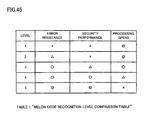
- Level 1 Only the information of the stone of the main layer is used.
- the method may be roughly classified as a method of comparing the edges of the bridges (only the boundary is examined) and a method of comparing the presence or absence of pixels forming the bridges (the entire card is examined). Since the continuity of the line of the bridge is completely examined using these methods, patch forgery is substantially impossible.
- a condition (e.g. range) for the normal-direction ID and a condition for the reverse-direction ID may be stored as the orientation determination information, and the orientation of the recognition target image may be determined by the condition satisfied by the recognized data.
- An information storage medium 180 stores a program, data, and the like.
- the function of the information storage medium 180 may be implemented by an optical disk (CD or DVD), a memory card, a hard disk, a memory (ROM), or the like.
- the processing section 100 performs various processes according to this embodiment based on a program (data) stored in the information storage medium 180 .
- a program for causing a computer to function as each section according to this embodiment is stored in the information storage medium 180 .
- a sound output section 192 outputs sound generated according to this embodiment.
- the function of the sound output section 192 may be implemented by a speaker, a headphone, or the like.
- the processing section 100 performs a game calculation process, an image generation process, a sound generation process, and the like based on operation data from the operation section 160 , a program, and the like.
- the processing section 100 performs various processes using the storage section 170 as a work area.
- the function of the processing section 100 may be implemented by hardware such as a processor (e.g. CPU or DSP) or an ASIC (e.g. gate array) and a program.
- the image recognition section 120 includes a differentiation section 121 , a blur section 122 , a binarization section 123 , an outline extraction section 125 , an outline determination section 126 , a pixel information change section 127 , a recognition target image extraction section 128 , a focused point pixel information detection section 130 , a correspondence data calculation section 132 , a simulation section 134 , an error detection/correction section 136 , and an orientation determination section 138 .
- the differentiation section 121 subjects the image data output from the imaging section 150 to the quadratic differential process using the grayscale data (pixel information) of the focused pixel and the peripheral pixels.
- the blur section 122 subjects the quadratic differential data subjected to the quadratic differential process by the differentiation section 121 to the blur process using the quadratic differential data of the focused pixel and the peripheral pixels.
- the binarization section 123 converts the quadratic differential data output from the blur section 122 into binary data by comparison with a predetermined threshold value S-TH.
- the binary data is set at “1”.
- the quadratic differential data is equal to or less than the threshold value S-TH, the binary data is set at “0”.
- the outline extraction section 125 extracts the outline of a pixel group formed of adjacent white pixels by scanning each pixel forming the binary image in a predetermined order to detect a first white pixel reached, and sequentially tracing other white pixels adjacent to the first white pixel until the first white pixel is again reached.
- the recognition target image extraction section 128 extracts the binary data corresponding to each pixel positioned inside the outline as the recognition target image when the outline determination section 126 has determined that the shape of the trace of the outline is rectangular.
- the simulation section 134 may perform the connection simulation process which places the points at the point placement reserved positions in the two-dimensional region based on the binary data string calculated by the correspondence data calculation section 132 according to the preset binary data string placement conditions, and connects each point and the connection target point according to the preset connection conditions.
- the orientation determination section 138 determines the orientation of the recognition target image based on the binary data string calculated by the correspondence data calculation section 132 and the orientation determination information.
- the scope of the invention includes a two-dimensional code in which given data is encoded as a two-dimensional image, the two-dimensional code including a point placed in a point placement reserved position belonging to a main layer set in a two-dimensional region based on a binary data string uniquely associated with the given data, and a dummy point placed in a point placement reserved position belonging to a layer in the two-dimensional region other than the main layer, wherein a given pattern is formed by the points to form a two-dimensional image, and also includes methods of generating and recognizing the two-dimensional code.
Landscapes
- Physics & Mathematics (AREA)
- General Physics & Mathematics (AREA)
- Engineering & Computer Science (AREA)
- Business, Economics & Management (AREA)
- Theoretical Computer Science (AREA)
- Microelectronics & Electronic Packaging (AREA)
- Computer Networks & Wireless Communication (AREA)
- Accounting & Taxation (AREA)
- Strategic Management (AREA)
- General Business, Economics & Management (AREA)
- Image Processing (AREA)
- Image Analysis (AREA)
Priority Applications (1)
| Application Number | Priority Date | Filing Date | Title |
|---|---|---|---|
| US13/221,478 US8406526B2 (en) | 2006-06-21 | 2011-08-30 | Two-dimensional code generation method, two-dimensional code, two-dimensional code recognition method, and image recognition device |
Applications Claiming Priority (4)
| Application Number | Priority Date | Filing Date | Title |
|---|---|---|---|
| JP2006171681A JP4916230B2 (ja) | 2006-06-21 | 2006-06-21 | 2次元コード、プログラム、情報記憶媒体及び画像認識装置 |
| JP2006171680A JP4916229B2 (ja) | 2006-06-21 | 2006-06-21 | プログラム、情報記憶媒体、2次元コード生成システム及び2次元コードが印刷された印刷物の製造方法 |
| JP2006-171681 | 2006-06-21 | ||
| JP2006-171680 | 2006-06-21 |
Related Child Applications (1)
| Application Number | Title | Priority Date | Filing Date |
|---|---|---|---|
| US13/221,478 Division US8406526B2 (en) | 2006-06-21 | 2011-08-30 | Two-dimensional code generation method, two-dimensional code, two-dimensional code recognition method, and image recognition device |
Publications (2)
| Publication Number | Publication Date |
|---|---|
| US20070297679A1 US20070297679A1 (en) | 2007-12-27 |
| US8050502B2 true US8050502B2 (en) | 2011-11-01 |
Family
ID=38515431
Family Applications (2)
| Application Number | Title | Priority Date | Filing Date |
|---|---|---|---|
| US11/812,067 Active 2030-07-30 US8050502B2 (en) | 2006-06-21 | 2007-06-14 | Two-Dimensional code generation method, two-dimensional code, two-dimensional code recognition method, and image recognition device |
| US13/221,478 Active US8406526B2 (en) | 2006-06-21 | 2011-08-30 | Two-dimensional code generation method, two-dimensional code, two-dimensional code recognition method, and image recognition device |
Family Applications After (1)
| Application Number | Title | Priority Date | Filing Date |
|---|---|---|---|
| US13/221,478 Active US8406526B2 (en) | 2006-06-21 | 2011-08-30 | Two-dimensional code generation method, two-dimensional code, two-dimensional code recognition method, and image recognition device |
Country Status (2)
| Country | Link |
|---|---|
| US (2) | US8050502B2 (fr) |
| EP (2) | EP2246805A3 (fr) |
Cited By (2)
| Publication number | Priority date | Publication date | Assignee | Title |
|---|---|---|---|---|
| US20150036890A1 (en) * | 2012-02-15 | 2015-02-05 | Glenisys Kft. | Security Element and Method to Inspect Authenticity of a Print |
| US10140081B2 (en) | 2014-08-29 | 2018-11-27 | Alibaba Group Holding Limited | Method and system for presenting information |
Families Citing this family (21)
| Publication number | Priority date | Publication date | Assignee | Title |
|---|---|---|---|---|
| JP5482963B2 (ja) * | 2011-03-17 | 2014-05-07 | 富士通株式会社 | 画像処理装置、画像処理方法及び画像処理プログラム |
| FR2979160B1 (fr) * | 2011-08-16 | 2013-09-06 | Mobilead | Dispositif de preparation de code a lecture optique |
| US9275467B2 (en) * | 2012-03-29 | 2016-03-01 | Analog Devices, Inc. | Incremental contour-extraction scheme for binary image segments |
| CN107579954B (zh) * | 2012-09-25 | 2021-06-04 | 创新先进技术有限公司 | 识别信息的生成方法和系统 |
| CN103902950A (zh) * | 2014-04-03 | 2014-07-02 | 北京金水永利科技有限公司 | 一种基于加密二维码的野外设施信息识别系统 |
| US9483718B1 (en) | 2015-12-14 | 2016-11-01 | International Business Machines Corporation | Encoding and decoding data in two-dimensional symbology |
| CN108154211B (zh) * | 2017-11-22 | 2020-08-28 | 阿里巴巴集团控股有限公司 | 二维码生成、业务处理方法、装置和设备以及二维码 |
| MX2021003174A (es) * | 2018-09-18 | 2021-05-27 | Vitro Sab De Cv | Metodo y sistema para determinar la fabricacion de un envase de vidrio con su numero de molde. |
| KR102200161B1 (ko) * | 2018-11-05 | 2021-01-07 | 상명대학교산학협력단 | 피듀셜 마커 영상 생성 장치 및 방법 |
| CN110378165B (zh) * | 2019-05-31 | 2022-06-24 | 创新先进技术有限公司 | 二维码识别方法、二维码定位识别模型建立方法及其装置 |
| US10956696B2 (en) | 2019-05-31 | 2021-03-23 | Advanced New Technologies Co., Ltd. | Two-dimensional code identification and positioning |
| CN110348263B (zh) * | 2019-06-24 | 2022-09-30 | 西安理工大学 | 一种基于图像识别的二维随机码图像识别与提取方法 |
| TWI726525B (zh) * | 2019-12-09 | 2021-05-01 | 新唐科技股份有限公司 | 影像二值化方法與電子裝置 |
| CN112036205A (zh) * | 2020-08-03 | 2020-12-04 | 浙江大华技术股份有限公司 | 二维码识别方法、电子设备及存储介质 |
| CN112070195A (zh) * | 2020-09-22 | 2020-12-11 | 澳新银行营运服务(成都)有限公司 | 二维码识别、生成方法、装置、电子设备及存储介质 |
| CN112651259B (zh) * | 2020-12-29 | 2024-08-06 | 芜湖哈特机器人产业技术研究院有限公司 | 二维码的定位方法、基于二维码的移动机器人定位方法 |
| CN113269002B (zh) * | 2021-04-12 | 2023-03-21 | 广东奥普特科技股份有限公司 | 一种手机玻璃油墨丝印二维码的检测方法及检测系统 |
| CN113643274B (zh) * | 2021-08-24 | 2024-06-21 | 凌云光技术股份有限公司 | 一种二维码候选区筛选的方法及装置 |
| CN113436196B (zh) * | 2021-08-27 | 2021-12-10 | 广州市雄星塑料制品有限公司 | 基于图像识别技术的二维码膜生产管理系统 |
| CN118037884B (zh) * | 2024-04-08 | 2024-06-18 | 北京睛采智能科技有限公司 | 包含商标信息的二进制定位码生成方法、系统及设备 |
| CN120493967B (zh) * | 2025-07-16 | 2025-11-28 | 北京麦哲科技有限公司 | 条形码识别方法、装置、电子设备及可读存储介质 |
Citations (10)
| Publication number | Priority date | Publication date | Assignee | Title |
|---|---|---|---|---|
| US5053609A (en) | 1988-05-05 | 1991-10-01 | International Data Matrix, Inc. | Dynamically variable machine readable binary code and method for reading and producing thereof |
| US5189292A (en) * | 1990-10-30 | 1993-02-23 | Omniplanar, Inc. | Finder pattern for optically encoded machine readable symbols |
| US5449895A (en) | 1993-12-22 | 1995-09-12 | Xerox Corporation | Explicit synchronization for self-clocking glyph codes |
| US5706099A (en) | 1995-06-05 | 1998-01-06 | Xerox Corporation | Method and apparatus for generating serpentine halftone images |
| JP2938338B2 (ja) | 1994-03-14 | 1999-08-23 | 株式会社デンソー | 二次元コード |
| US20010033688A1 (en) * | 2000-03-13 | 2001-10-25 | Taylor Garland S. | Method of optical mark recognition |
| US6321986B1 (en) | 1993-11-05 | 2001-11-27 | Intermec Ip Corporation | Robust machine-readable symbology and method and apparatus for printing and reading same |
| US6752316B2 (en) * | 2001-08-09 | 2004-06-22 | Satoshi Mizoguchi | Two-dimensional code |
| US20050121520A1 (en) * | 2003-12-05 | 2005-06-09 | Fujitsu Limited | Code type determining method and code boundary detecting method |
| US20060269136A1 (en) * | 2005-05-23 | 2006-11-30 | Nextcode Corporation | Efficient finder patterns and methods for application to 2D machine vision problems |
Family Cites Families (6)
| Publication number | Priority date | Publication date | Assignee | Title |
|---|---|---|---|---|
| JPH05334481A (ja) | 1992-03-31 | 1993-12-17 | Fuji Electric Co Ltd | ピクセルコードの認識方法 |
| GB9408626D0 (en) * | 1994-04-29 | 1994-06-22 | Electronic Automation Ltd | Machine readable binary code |
| JPH0887578A (ja) | 1994-09-17 | 1996-04-02 | Hiroichi Yoshida | 二次元コード情報記録カードおよび二次元コード情報記録カードの情報記録方法 |
| US6267296B1 (en) * | 1998-05-12 | 2001-07-31 | Denso Corporation | Two-dimensional code and method of optically reading the same |
| US7481707B1 (en) * | 2003-03-03 | 2009-01-27 | Bally Gaming, Inc. | Bingo bonusing system and method |
| JP3811686B2 (ja) | 2003-06-02 | 2006-08-23 | 株式会社日立インフォメーションテクノロジー | 二次元コード読取装置 |
-
2007
- 2007-06-14 US US11/812,067 patent/US8050502B2/en active Active
- 2007-06-20 EP EP10172307.0A patent/EP2246805A3/fr not_active Withdrawn
- 2007-06-20 EP EP07110678.5A patent/EP1870835B8/fr active Active
-
2011
- 2011-08-30 US US13/221,478 patent/US8406526B2/en active Active
Patent Citations (11)
| Publication number | Priority date | Publication date | Assignee | Title |
|---|---|---|---|---|
| US5053609A (en) | 1988-05-05 | 1991-10-01 | International Data Matrix, Inc. | Dynamically variable machine readable binary code and method for reading and producing thereof |
| US5189292A (en) * | 1990-10-30 | 1993-02-23 | Omniplanar, Inc. | Finder pattern for optically encoded machine readable symbols |
| US6321986B1 (en) | 1993-11-05 | 2001-11-27 | Intermec Ip Corporation | Robust machine-readable symbology and method and apparatus for printing and reading same |
| US5449895A (en) | 1993-12-22 | 1995-09-12 | Xerox Corporation | Explicit synchronization for self-clocking glyph codes |
| JP2938338B2 (ja) | 1994-03-14 | 1999-08-23 | 株式会社デンソー | 二次元コード |
| US5706099A (en) | 1995-06-05 | 1998-01-06 | Xerox Corporation | Method and apparatus for generating serpentine halftone images |
| US20010033688A1 (en) * | 2000-03-13 | 2001-10-25 | Taylor Garland S. | Method of optical mark recognition |
| US6752316B2 (en) * | 2001-08-09 | 2004-06-22 | Satoshi Mizoguchi | Two-dimensional code |
| US20050121520A1 (en) * | 2003-12-05 | 2005-06-09 | Fujitsu Limited | Code type determining method and code boundary detecting method |
| US20060269136A1 (en) * | 2005-05-23 | 2006-11-30 | Nextcode Corporation | Efficient finder patterns and methods for application to 2D machine vision problems |
| US7412089B2 (en) * | 2005-05-23 | 2008-08-12 | Nextcode Corporation | Efficient finder patterns and methods for application to 2D machine vision problems |
Cited By (4)
| Publication number | Priority date | Publication date | Assignee | Title |
|---|---|---|---|---|
| US20150036890A1 (en) * | 2012-02-15 | 2015-02-05 | Glenisys Kft. | Security Element and Method to Inspect Authenticity of a Print |
| US9594994B2 (en) * | 2012-02-15 | 2017-03-14 | Glenisys Kft. | Security element and method to inspect authenticity of a print |
| US10140081B2 (en) | 2014-08-29 | 2018-11-27 | Alibaba Group Holding Limited | Method and system for presenting information |
| US10599379B2 (en) | 2014-08-29 | 2020-03-24 | Alibaba Group Holding Limited | Method and system for presenting information |
Also Published As
| Publication number | Publication date |
|---|---|
| EP1870835A3 (fr) | 2009-02-11 |
| EP2246805A8 (fr) | 2013-09-11 |
| EP1870835B1 (fr) | 2013-08-07 |
| EP2246805A2 (fr) | 2010-11-03 |
| US20120048950A1 (en) | 2012-03-01 |
| US20070297679A1 (en) | 2007-12-27 |
| EP1870835A2 (fr) | 2007-12-26 |
| EP1870835B8 (fr) | 2013-09-11 |
| US8406526B2 (en) | 2013-03-26 |
| EP2246805A3 (fr) | 2014-12-03 |
Similar Documents
| Publication | Publication Date | Title |
|---|---|---|
| US8050502B2 (en) | Two-Dimensional code generation method, two-dimensional code, two-dimensional code recognition method, and image recognition device | |
| JP5591578B2 (ja) | 文字列認識装置および文字列認識方法 | |
| FI123982B (fi) | Kasvojen tunnistaminen digitaalisissa kuvissa | |
| CN112883918B (zh) | 人脸检测方法、装置、终端设备及计算机可读存储介质 | |
| CA3071048A1 (fr) | Procede pour l'authentification d'une illustration. | |
| CN101493891A (zh) | 基于sift的具有镜面翻转不变性的特征提取和描述方法 | |
| CN109740572A (zh) | 一种基于局部彩色纹理特征的人脸活体检测方法 | |
| Hou et al. | Detection of hue modification using photo response nonuniformity | |
| US8534565B2 (en) | Two-dimensional optical identification device with same gray level for quick decoding and decoding method therefor | |
| Shan et al. | RIFD-Net: A robust image forgery detection network | |
| CN101630365B (zh) | 基于daisy的具有镜面翻转不变性的特征提取和描述方法 | |
| CN113610071A (zh) | 人脸活体检测方法、装置、电子设备及存储介质 | |
| CN116311391B (zh) | 一种高低精度混合的多维度特征融合指纹检索方法 | |
| CN115410191B (zh) | 文本图像识别方法、装置、设备和存储介质 | |
| CN119540124A (zh) | 用于检测计算机生成图像的系统和方法 | |
| JP4916230B2 (ja) | 2次元コード、プログラム、情報記憶媒体及び画像認識装置 | |
| CN120760675A (zh) | 基于图像重构的构造物沉降监测方法及系统 | |
| CN118070343A (zh) | 一种大模型数据脱敏方法及系统 | |
| JP4916229B2 (ja) | プログラム、情報記憶媒体、2次元コード生成システム及び2次元コードが印刷された印刷物の製造方法 | |
| JP2981382B2 (ja) | パターンマッチング方法 | |
| Mehta | Augmented reality chess analyzer (archessanalyzer): In-device inference of physical chess game positions through board segmentation and piece recognition using convolutional neural network | |
| CN120997537B (zh) | 用于防伪验证的二维码防伪图像处理方法及系统 | |
| CN120032233B (zh) | 基于彩票假说和掩码自编码器的图像伪造检测定位方法 | |
| CN119067927B (zh) | 一种列车缺陷检测方法及系统 | |
| CN120935311B (zh) | 一种矢量图像隐写方法、鉴真方法、装置及设备 |
Legal Events
| Date | Code | Title | Description |
|---|---|---|---|
| AS | Assignment |
Owner name: NAMCO BANDAI GAMES INC., JAPAN Free format text: ASSIGNMENT OF ASSIGNORS INTEREST;ASSIGNOR:SATO, KOTARO;REEL/FRAME:019572/0978 Effective date: 20070622 |
|
| STCF | Information on status: patent grant |
Free format text: PATENTED CASE |
|
| FEPP | Fee payment procedure |
Free format text: PAYOR NUMBER ASSIGNED (ORIGINAL EVENT CODE: ASPN); ENTITY STATUS OF PATENT OWNER: LARGE ENTITY |
|
| AS | Assignment |
Owner name: VIBE INC., JAPAN Free format text: ASSIGNMENT OF ASSIGNORS INTEREST;ASSIGNOR:NAMCO BANDAI GAMES INC.;REEL/FRAME:032564/0958 Effective date: 20130325 |
|
| AS | Assignment |
Owner name: BANDAI NAMCO GAMES INC., JAPAN Free format text: CHANGE OF NAME;ASSIGNOR:NAMCO BANDAI GAMES INC.;REEL/FRAME:033061/0930 Effective date: 20140401 |
|
| FPAY | Fee payment |
Year of fee payment: 4 |
|
| MAFP | Maintenance fee payment |
Free format text: PAYMENT OF MAINTENANCE FEE, 8TH YEAR, LARGE ENTITY (ORIGINAL EVENT CODE: M1552); ENTITY STATUS OF PATENT OWNER: LARGE ENTITY Year of fee payment: 8 |
|
| AS | Assignment |
Owner name: BANDAI NAMCO ENTERTAINMENT INC., JAPAN Free format text: ASSIGNMENT OF ASSIGNORS INTEREST;ASSIGNOR:VIBE, INC.,;REEL/FRAME:056023/0489 Effective date: 20210331 |
|
| AS | Assignment |
Owner name: BANDAI CO., LTD., JAPAN Free format text: ASSIGNMENT OF ASSIGNORS INTEREST;ASSIGNOR:BANDAI NAMCO ENTERTAINMENT, INC.;REEL/FRAME:061917/0872 Effective date: 20221130 |
|
| AS | Assignment |
Owner name: BANDAI CO., LTD., JAPAN Free format text: CORRECTIVE ASSIGNMENT TO CORRECT THE ASSIGNOR NAME PREVIOUSLY RECORDED ON REEL 061917 FRAME 0872. ASSIGNOR(S) HEREBY CONFIRMS THE ASSIGNMENT;ASSIGNOR:BANDAI NAMCO ENTERTAINMENT INC.;REEL/FRAME:062043/0744 Effective date: 20221130 |
|
| MAFP | Maintenance fee payment |
Free format text: PAYMENT OF MAINTENANCE FEE, 12TH YEAR, LARGE ENTITY (ORIGINAL EVENT CODE: M1553); ENTITY STATUS OF PATENT OWNER: LARGE ENTITY Year of fee payment: 12 |