US8057682B2 - Green synthesis of nanometals using plant extracts and use thereof - Google Patents
Green synthesis of nanometals using plant extracts and use thereof Download PDFInfo
- Publication number
- US8057682B2 US8057682B2 US12/667,384 US66738409A US8057682B2 US 8057682 B2 US8057682 B2 US 8057682B2 US 66738409 A US66738409 A US 66738409A US 8057682 B2 US8057682 B2 US 8057682B2
- Authority
- US
- United States
- Prior art keywords
- oil
- extract
- nanoparticles
- ethoxylated
- polyethylene glycol
- Prior art date
- Legal status (The legal status is an assumption and is not a legal conclusion. Google has not performed a legal analysis and makes no representation as to the accuracy of the status listed.)
- Expired - Fee Related
Links
- NUHCTOLBWMJMLX-UHFFFAOYSA-N CC1=C(Br)C(O)=C(C(C)C)C=C1C1(C2=C(C)C(Br)=C(O)C(C(C)C)=C2)OS(=O)(=O)C2=CC=CC=C21 Chemical compound CC1=C(Br)C(O)=C(C(C)C)C=C1C1(C2=C(C)C(Br)=C(O)C(C(C)C)=C2)OS(=O)(=O)C2=CC=CC=C21 NUHCTOLBWMJMLX-UHFFFAOYSA-N 0.000 description 1
Images






Classifications
-
- B—PERFORMING OPERATIONS; TRANSPORTING
- B22—CASTING; POWDER METALLURGY
- B22F—WORKING METALLIC POWDER; MANUFACTURE OF ARTICLES FROM METALLIC POWDER; MAKING METALLIC POWDER; APPARATUS OR DEVICES SPECIALLY ADAPTED FOR METALLIC POWDER
- B22F9/00—Making metallic powder or suspensions thereof
- B22F9/16—Making metallic powder or suspensions thereof using chemical processes
- B22F9/18—Making metallic powder or suspensions thereof using chemical processes with reduction of metal compounds
- B22F9/24—Making metallic powder or suspensions thereof using chemical processes with reduction of metal compounds starting from liquid metal compounds, e.g. solutions
-
- B—PERFORMING OPERATIONS; TRANSPORTING
- B22—CASTING; POWDER METALLURGY
- B22F—WORKING METALLIC POWDER; MANUFACTURE OF ARTICLES FROM METALLIC POWDER; MAKING METALLIC POWDER; APPARATUS OR DEVICES SPECIALLY ADAPTED FOR METALLIC POWDER
- B22F1/00—Metallic powder; Treatment of metallic powder, e.g. to facilitate working or to improve properties
- B22F1/05—Metallic powder characterised by the size or surface area of the particles
- B22F1/054—Nanosized particles
- B22F1/056—Submicron particles having a size above 100 nm up to 300 nm
-
- B—PERFORMING OPERATIONS; TRANSPORTING
- B82—NANOTECHNOLOGY
- B82Y—SPECIFIC USES OR APPLICATIONS OF NANOSTRUCTURES; MEASUREMENT OR ANALYSIS OF NANOSTRUCTURES; MANUFACTURE OR TREATMENT OF NANOSTRUCTURES
- B82Y30/00—Nanotechnology for materials or surface science, e.g. nanocomposites
Definitions
- the present invention relates to methods of making and using and compositions of metal nanoparticles formed by green chemistry synthetic techniques.
- the present invention relates to metal nanoparticles formed with solutions of plant extracts and use of these metal nanoparticles in removing contaminants from soil and groundwater.
- Nanoparticles are particles ranging in size from 1 nm to 1 micron in diameter. “Nano” is a prefix which means one billionth (10 ⁇ 9 ) part of something (Meridian Webster Dictionary). In recent years, the field of nanoparticles has grown due to their unique properties. Many industries utilize nanoparticles, for example the electronics industry, medical science, material science, and environmental science. Noble metal nanoparticles have found widespread use in several technological applications and various wet chemical methods have been reported. See, X. Wang and Y. Li, Chem. Commun., 2007, 2901; Y. Sun and Y. Xia, Science, 2002, 298, 2176; J. Chen, J. M. McLellan, A. Siekkinen, Y.
- nanoparticles are synthesized in three ways: physically by crushing larger particles, chemically by precipitation, and through gas condensation. Chemical generation is highly varied and can incorporate laser pyrolysis, flame synthesis, combustion, and sol gel approaches. See, U.S. Pat. No. 6,881,490 (Apr. 19, 2005) N. Kambe, Y. D. Blum, B. Chaloner-Gill, S. Chiruvolu, S. Kumar, D. B. MacQueen. Polymer-inorganic particle composites; J. Du, B.
- nanoparticles examples include mechanical attrition (e.g., ball milling), crushing of sponge iron powder, and thermal quenching.
- mechanical processes for producing nanoparticles include mechanical attrition (e.g., ball milling), crushing of sponge iron powder, and thermal quenching.
- chemical processes for producing nanoparticles include precipitation techniques, sol-gel processes, and inverse-micelle methods.
- Other chemical or chemically-related processes include gas condensation methods, evaporation techniques, gas anti-solvent recrystallization techniques, precipitation with a compressed fluid anti-solvent, and generation of particles from gas saturated solutions.
- the commercial significance of nanoparticles is limited by the nanoparticle synthesis process, which is generally energy intensive or requires toxic chemical solvents and is costly.
- the present invention relates to methods of making and using compositions of metal nanoparticles formed by green chemistry synthetic techniques, as well as the compositions themselves.
- the present invention relates to metal nanoparticles formed with solutions of plant extracts and use of these metal nanoparticles in removing contaminants from soil and groundwater.
- trademark terms represent their respective formulation.
- Citrus Burst is a registered trademark term representing Citrus Burst formulation
- EZ-Mulse is a trademark term representing EZ-Mulse formulation
- VeruSOL is a registered trademark representing VeruSOL formulations.
- ALFOTERRA is a registered trademark representing ALFOTERRA formulations.
- ETHOX is a trademark representing ETHOX formulations.
- ETHAL is a trademark representing ETHAL formulations.
- ETHSORBOX is a trademark representing ETHSORBOX formulations.
- TERGITOL is a registered trademark representing TERGITOL formulations.
- DOWFAX is a registered trademark representing DOWFAX formulations.
- the invention provides methods for making metal nanoparticles.
- the methods comprise providing a dissolved metal ion, for example a metal ion in solution; providing a plant extract that comprises a reducing agent, a polyphenol, caffeine, and/or a natural solvent or surfactant; and combining the dissolved metal ion and the plant extract to produce one or more metal nanoparticles.
- the dissolved metal ion can be provided by dissolving a metal salt in water.
- the dissolved metal ion can be provided by dissolving a metal chelate in water.
- the providing of the dissolved metal ion, the providing of a plant extract, and/or the combining of the dissolved metal ion and the plant extract to produce one or more metal nanoparticles can be conducted at about room temperature and/or at about room pressure.
- room temperature can be a temperature that is in a range that can be tolerated by humans.
- a temperature greater than or equal to about that of the freezing point of water and less than or equal to about the maximum temperature that naturally occurs on the earth's surface can be considered to be room temperature.
- room pressure can be pressure that is greater than or equal to about the minimum that occurs on the earth's surface (including mountaintops) and less that or equal to about the maximum that occurs on the earth's surface (including below sea level depressions and the bottom of mines).
- the metal nanoparticles can be present in a concentration effective for use in an application including, for example, soil and groundwater remediation, water and wastewater treatment, air pollution treatment, medical diagnostic testing, medical materials, targeted drug delivery, catalysis of chemical synthesis reactions, pollution control or monitoring devices, fuel cells, or electronics.
- the dissolved metal ion can be present in an amount of, for example, at least about 0.01 mM, 0.1 mM, 300 mM or more.
- the metal nanoparticles can be formed at a rate of, for example, at least about 0.002 mol/L/min, at least about 0.01 mol/L/min, at least about 0.1 mol/L/min, at least about 0.5 mol/L/min or more, where “mol” refers to the moles of metal atoms that form the metal nanoparticles.
- the metal nanoparticles can have a mean diameter of between about 5 and about 500 nm. A mass fraction of the metal nanoparticles that have a diameter between about 50 nm and about 100 nm can be about 90 percent.
- the metal nanoparticles can have a mean diameter between about 20 and about 250 nm, or between about 50 and about 100 nm.
- Mean diameter can refer to, for example, the weight averaged mean diameter. That is, the mean diameter for a group of particles can be determined as the sum of the diameter of each individual particle weighted by its mass divided by the total mass of the particles.
- the reducing agent, polyphenol, caffeine, and/or natural solvent or surfactant can be one or more of, for example, tea extract, green tea extract, coffee extract, lemon balm extract, polyphenolic flavonoid, flavonoid, flavonol, flavone, flavanone, isoflavone, flavans, flavanol, anthocyanins, proanthocyanins, carotenoids, catechins, quercetin, and rutin.
- the natural solvent or surfactant can be, for example, one or more of VeruSOLTM-3, Citrus Burst 1 (CB-1), Citrus Burst 2 (CB-2), Citrus Burst 3 (CB-3), and EZ-Mulse.
- the metal nanoparticles can comprise two or more metals.
- Methods of making such metal nanoparticles can comprise, for example, providing a dissolved metal ion; providing a plant extract that comprises a reducing agent, a polyphenol, caffeine, and/or a natural solvent or surfactant; providing a second dissolved metal ion, and combining the dissolved metal ion, the second dissolved metal ion and the plant extract to produce one or more metal nanoparticles each comprising a first and a second metal.
- the first and second dissolved metal ions can be added to the vessel more or less simultaneously, leading to nanoparticles in which the first and second metals are interspersed throughout the metal nanoparticles.
- the first dissolved metal ion can be added to a vessel first and adding the second dissolved metal ion after a period of time, for example, of at least about 15 or 30 seconds, for example, a period of time in the range of from about 30 seconds to about 60 seconds, which generally leads to nanoparticles in which the first metal is present primarily in the core of the metal nanoparticle and the second metal is present primarily in an outer layer around the core of the metal nanoparticle.
- the first metal can be, for example, iron and the second metal can be, for example, palladium. Alternatively, palladium can be the first metal and iron can be the second metal.
- the dissolved metal ion can be, for example, a dissolved iron ion or a dissolved manganese ion.
- the dissolved metal ion can be provided by a species including, for example, a metal salt, an iron salt, ferric chloride (FeCl 3 ), ferrous sulfate (FeSO 4 ), ferric nitrate (Fe(NO 3 ) 3 ), a manganese salt, manganese chloride (MnCl 2 ), manganese sulfate (MnSO 4 ), a silver salt, silver nitrate (AgNO 3 ), a palladium salt, palladium chloride (PdCl 2 ), a metal chelate, Fe(III)-EDTA, Fe(III)-citric acid, Fe(III)-EDDS, Fe(II)-EDTA, Fe(II)-citric acid, Fe(II)-EDDS, and combinations thereof.
- the plant extract can be provided by a source including, for example, tea, coffee, parsley, sorghum, marjoram, lemon balm, and combinations thereof.
- a source of plant extract is to be understood as referring to the product or material mentioned as well as sources, plant components associated with sources, and processing intermediaries from which the product or material is derived, byproducts and waste resulting from manufacture of the product or material, and waste following use or consumption of the product or material.
- coffee as a source of plant extract can be construed to include a brewed coffee beverage as well as coffee fruit, coffee berries, coffee drupes, coffee seeds, coffee beans, parts of the coffee plant, fermented coffee beans, coffee bean processing wastewater, roasted coffee beans, coffee bean chaff from roasting, ground coffee beans prior to brewing, coffee powder, dehydrated instant coffee powder, coffee grounds following brewing, and coffee concentrate.
- tea as a source of plant extract can be construed to include a brewed tea beverage as well as tea plant buds, leaves, flushes, and other parts of a tea plant, fermented tea leaves, oxidized tea leaves, wilted tea leaves, post-fermented tea leaves, composted tea leaves, tea bricks, tea powder, instant tea powder, and tea leaf waste following brewing.
- providing a plant extract involves combining a plant or plant portion with the dissolved metal ion in a vessel, causing, e.g., a reducing agent, polyphenol, or caffeine to be released into the vessel to produce one or more metal nanoparticles.
- the methods also comprise providing an aqueous solution of carboxy methyl cellulose, and combining the aqueous solution of carboxy methyl cellulose with the dissolved metal ion and the plant extract to form metal nanoparticles coated with carboxy methyl cellulose.
- the mixture of carboxy methyl cellulose, dissolved metal ion, and plant extract can be heated, for example to a temperature of about 100° C., using a method such as exposing the mixture to microwaves.
- the dissolved metal ion is provided in situ, for example by adding a chelating agent to a soil and/or water to be treated.
- the methods comprise providing a dissolved metal ion; providing a plant derivative that comprises a reducing agent, a polyphenol, caffeine, and/or a natural solvent or surfactant; and combining the dissolved metal ion and the plant derivative to produce one or more metal nanoparticles.
- the plant derivative can be, for example, a plant extract or carboxy methyl cellulose.
- the invention provides compositions.
- the compositions can comprise, for example, a metal nanoparticle prepared according to any of the methods disclosed herein.
- the metal nanoparticle can be, for example, coated with a substance derived from the plant extract used in the preparation of the metal nanoparticle—i.e., the plant extract serves as a capping agent or dispersing agent for the nanoparticles.
- the composition can also comprise a natural solvent or surfactant, such as, for example, VeruSOLTM-3, Citrus Burst 1 (CB-1), Citrus Burst 2 (CB-2), Citrus Burst 3 (CB-3), EZ-Mulse, or combinations thereof.
- the composition can also comprise a chelating agent, such as, for example, EDTA, EDDS, citric acid, or combinations thereof.
- the compositions can also comprise an oxidant, such as, for example, peroxide, calcium peroxide, hydrogen peroxide, air, oxygen, ozone, persulfate, sodium persulfate, percarbonate, permanganate, or combinations thereof.
- the compositions can also comprise a carboxymethylcellulose coating or a hydrophobic coating on the surface of the metal nanoparticle.
- the metal nanoparticle can be, for example, a zero valent metal nanoparticle, a zero valent iron nanoparticle, a zero valent manganese nanoparticle, a silver nanoparticle, a palladium nanoparticle, a gold nanoparticle, a platinum nanoparticle, an iron nanoparticle, a manganese nanoparticle, a copper nanoparticle, an indium nanoparticle, or combinations thereof, and thus can also comprise at least two different metals, for example iron and palladium.
- the invention provides methods for reducing the concentration of one or more contaminants in a medium.
- the methods can comprise, for example, causing a metal nanoparticle prepared according to the methods described herein to be present in the medium; and allowing the metal nanoparticle to reduce or stimulate biological reduction of the contaminant to reduce its concentration.
- a contaminant can be a chemical of concern (COC), such as a non-aqueous phase liquid (NAPL), dense non-aqueous phase liquid (DNAPL), and/or light non-aqueous phase liquid (LNAPL).
- COC chemical of concern
- NAPL non-aqueous phase liquid
- DNAPL dense non-aqueous phase liquid
- LNAPL light non-aqueous phase liquid
- the metal nanoparticle can be previously prepared and thereafter introduced into the medium, or it can be formed in situ, for example by introducing a reducing agent, a polyphenol, caffeine, and/or a natural solvent or surfactant into the medium; and allowing the reducing agent, polyphenol, caffeine, and/or a natural solvent or surfactant to react with the dissolved metal ions in the medium to form metal nanoparticles.
- the methods can also comprise administering a chelating agent, such as, for example, EDTA, citric acid, EDDS, or combinations thereof, to the medium.
- the contaminant can be, for example, a perchlorate, nitrate, heavy metals or heavy metal compounds, Hg 2+ , Ni 2+ , Ag + , Cd 2+ , Cr 2 O 7 2 ⁇ , AsO 4 3 ⁇ , compounds comprising any of these, and combinations.
- the methods can also comprise introducing a natural solvent or surfactant, such as, for example, VeruSOLTM-3, Citrus Burst 1 (CB-1), Citrus Burst 2 (CB-2), Citrus Burst 3 (CB-3), EZ-Mulse or combinations thereof, into the medium.
- the metal nanoparticle and the natural solvent and/or surfactant can be introduced into the medium by injection into a subsurface.
- the methods can also comprise introducing an oxidant into the medium.
- the medium can be, for example, a biologically contaminated material, soil, groundwater, water, wastewater, air, or combinations thereof.
- the invention provides methods for determining an optimal amount of dissolved metal ion to add to a plant extract solution in synthesizing metal nanoparticles.
- the method can comprise providing several aqueous solutions of a first set having different concentrations of a plant extract; adding DPPH to each aqueous solution of the first set; determining DPPH absorbance of each aqueous solution of the first set; adding a dissolved metal ion to several aqueous solutions of a second set having different concentrations of the plant extract to form metal nanoparticles; adding DPPH to each aqueous solution of the second set comprising metal nanoparticles and remaining plant extract; determining DPPH absorbance of each aqueous solution of the second set; comparing the DPPH absorbance of the aqueous solutions of the first set and of the aqueous solutions of the second set to determine the net consumption of DPPH; and determining the optimal ratio of dissolved metal ions to plant extract.
- the invention provides devices comprising a metal nanoparticle prepared according to any of the methods disclosed herein.
- the device can be, for example, a medical diagnostic test, a medical material such as a bandage, a targeted drug delivery vehicle, a chemical synthesis system, a pollution control or monitoring device, a fuel cell, and an electronic device.
- FIG. 1 presents a graph of specific conductivity as a function of cumulative effluent volume in Column 1—Lemon Balm Extract with Fe(NO 3 ) 3 .
- FIG. 2 presents a graph of specific conductivity as a function of cumulative effluent volume in Column 2—green tea extract with Fe(NO 3 ) 3 .
- FIG. 3 presents transmission electron micrographs of silver and palladium nanoparticles in aqueous solutions of coffee and tea extract cast on a carbon coated copper grid.
- FIG. 4 presents TEM images of silver nanoparticles synthesized with coffee and tea extracts.
- FIG. 5 presents TEM images of palladium nanoparticles synthesized with coffee and tea extracts.
- FIG. 6 presents TEM images of Ag and Pd nanoparticles prepared in aqueous solutions using catechin.
- FIG. 7 presents a graph of the spectra of absorbance as a function of wavelength for a solution of tea extract with silver nitrate at various times.
- FIG. 8 presents a graph of UV-Visible spectra of Ag and Pd nanoparticles in aqueous solutions of coffee and tea leaves extract.
- the inset shows UV-Visible spectra of (a) coffee and (b) tea extract.
- FIG. 9 presents a graph of voltage as a function of time for coffee extract in 1M sodium chloride solution.
- FIG. 10 presents a graph of intensity as a function of 2 theta angle for silver and palladium nanoparticles in coffee and tea extract.
- FIG. 11 presents TEM images of gold nanoparticles reduced with solutions of catechin.
- 2 mL 0.01N solutions of gold ions reduced with: (a) 2 mL; (b) 4 mL; (c) 6 mL; and (d) 8 mL of catechin in (0.1N) aqueous solution
- FIG. 12 presents TEM images of gold nanowires reduced with solutions of caffeine. 2 mL 0.01N solutions of gold ions reduced with (a) with 25 mg (b) 100 mg (c) 200 mg and (d) 300 mg of caffeine.
- FIG. 13 presents a graph illustrating plant extract DPPH stable radical consumption from nanoscale zero valent iron particle formation from reaction of green tea extract with ferric chloride.
- FIG. 14 presents a micrograph of green tea synthesized zero valent iron nanoparticles made by combining 0.1 M ferric chloride with 0 g/L VeruSOLTM-3.
- FIG. 15 presents a micrograph of green tea synthesized zero valent iron nanoparticles made by combining 0.1 M ferric chloride with 2 g/L VeruSOLTM-3.
- FIG. 16 presents a micrograph of green tea synthesized zero valent iron nanoparticles made by combining 0.1 M ferric chloride with 5 g/L VeruSOLTM-3.
- FIG. 17 presents a micrograph of green tea synthesized zero valent iron nanoparticles made by combining 0.1 M ferric chloride with 10 g/L VeruSOLTM-3.
- FIG. 18 presents a micrograph of green tea synthesized zero valent iron nanoparticles made by combining 0.1 M Fe(III)-EDTA with 0 g/L VeruSOLTM-3.
- FIG. 19 presents a micrograph of green tea synthesized zero valent iron nanoparticles made by combining 0.1 M Fe(III)-EDTA with 5 g/L VeruSOLTM-3.
- FIG. 20 presents a micrograph of green tea synthesized zero valent iron nanoparticles made by combining 0.1 M Fe(III)-citric acid with 0 g/L VeruSOLTM-3.
- FIG. 21 presents a micrograph of green tea synthesized zero valent iron nanoparticles made by combining 0.1 M Fe(III)-citric acid with 5 g/L VeruSOLTM-3.
- FIG. 22 presents a graph depicting UV spectra of (a) Fe, (b) tea extract and (c) reaction product of Fe(NO 3 ) 3 and tea extract. Inset shows the photographic image of the reaction.
- FIG. 23 presents a representative XRD pattern of iron nanoparticles synthesized using tea extract.
- FIG. 24 presents a graph depicting concentration-dependent bromothymol blue dye absorbance.
- FIG. 25 presents a graph depicting UV-Vis Spectra (Absorbance versus Wavelength) of bromothymol blue over time for an initial solution containing 500 ppm bromothymol blue (pH 6), 2% H 2 O 2 , and 0.06 mM GT-nZVI.
- FIG. 26 presents a graph depicting UV-Vis Spectra of bromothymol blue over time for an initial solution containing 500 ppm bromothymol blue (pH 6), 2% H 2 O 2 , and 0.33 mM GT-nZVI.
- FIG. 27 presents a graph of concentration versus time depicting degradation of bromothymol blue with GT-nZVI catalyzed H 2 O 2 , (a) bromothymol blue with 2% peroxide solution—control, (b) bromothymol blue treated with 0.03 mM (as Fe) GT-nZVI catalyzed hydrogen peroxide (HP) (2%), (c) bromothymol blue treated with 0.06 mM (as Fe) GT-nZVI catalyzed HP (2%), (d) bromothymol blue treated with 0.12 mM (as Fe) GT-nZVI catalyzed HP (2%), (e) bromothymol blue treated with 0.33 mM (as Fe) GT-nZVI catalyzed HP (2%).
- FIG. 28 presents initial rates, in ln [BTB] vs. time, of decomposition of bromothymol blue with GT-nZVI catalyzed H 2 O 2 .
- FIG. 30 presents the degradation of bromothymol blue concentration over time with Fe-EDTA and Fe-EDDS catalyzed H 2 O 2 .
- FIG. 31 presents the initial rates, expressed in terms of ln [BTB] versus time, of decomposition of bromothymol blue with Fe-EDTA and Fe-EDDS catalyzed H 2 O 2 .
- FIG. 32 presents the initial rate constants for the decomposition of bromothymol blue as a function of Fe concentration, with Fe-EDTA and Fe-EDDS: Rate (min ⁇ 1 ) vs Fe-EDTA or Fe-EDDS (mM) as Fe.
- FIG. 33 presents a graph depicting the concentration dependent absorption of bromothymol blue (pH ⁇ 6) (Standard curve).
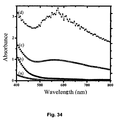
- FIG. 34 presents a series of graphs depicting a time-dependent Au-10 reaction after (a) 0 minutes (control); (b) 1 minute; (c) 2 minutes; and (d) 3 minutes.
- FIG. 35 presents UV spectra of (a) Au-8 (b) Au-3 and (c) Au-13 samples.
- FIG. 36 presents UV spectra of (a) Au-15, (b) Au-5 and (c) Au-10 samples.
- FIG. 37 presents UV spectra of (a) Au-7 and (b) Au-12 samples.
- FIG. 38 presents UV spectra of (a) Au-11, (b) Au-1 and (c) Au-6 samples.
- FIG. 39 presents XRD patterns for (a) Au-4, (b) Au-9, (c) Au-14, (d) Au-1, (e) Au-11, (f) Au-5, (g) Au-10 and (h) Au-8.
- FIG. 40 presents SEM images of (a) Au-1, (b) Au-2 and (c-d) Au-4 samples.
- FIG. 41 presents SEM image of (a) Au-11 (b) Au-12 and (c-d) Au-14 samples.
- FIG. 42 presents SEM images of (a) Au-6 (b) Au-8 (c) Au-9 and (c) Au-10 samples.
- FIG. 43 presents representative EDX spectra of Aux nanostructures obtained using an Au-6 sample.
- FIG. 44 presents TEM images of (a-b) Au-1, (c) Au-2 and (d) Au-5 samples.
- FIG. 45 presents TEM image of (a-b) Au-3 and (c-d) Au-4 samples.
- FIG. 46 presents XRD patterns for butyl ammonium bromide-reduced Au nanostructures.
- “Introduce” means to cause to be present in a location.
- a material or item can be introduced into a location even if the material or item is released somewhere else and must travel some distance in order to reach the location. For example, if a substance is released at location A, and the substance will migrate over time to location B, the substance has been “introduced” into location B when it is released at location A.
- An item can be introduced in any manner appropriate under the circumstances for the substance to be introduced into the location.
- Effective means sufficient to accomplish a purpose
- effective amount or “effective concentration” means an amount or concentration sufficient to accomplish a purpose.
- the purpose can be accomplished by effecting a change, for example by decreasing the concentration of a contaminant in a location to be remediated.
- a purpose can also be accomplished where no change takes place, for example if a change would have taken place otherwise.
- Plant derivative encompasses any portion of a plant that can be used according to the purposes of the present invention, for example to bring about the formation of metal nanoparticles from dissolved metal ions.
- Plant derivative encompasses, for example, “plant extract.”
- a “plant extract” encompasses, for example, any chemical or combination of chemicals found in a plant or that can be prepared using a chemical or chemicals found in a plant, whether by preparing derivatives of the compounds found in the plant via chemical reaction.
- plant derivative also encompasses carboxy methyl cellulose.
- nano-sized and “nano-scale” mean particles less than about 1 micron in diameter, though a different meaning may be apparent from the context.
- micro-sized and “micro-scale” mean particles from about 1 to about 1000 microns in diameter.
- macro-sized and “macro-scale” mean particles greater than about 1000 microns in diameter.
- a “nanoparticle” is a particle whose diameter falls within the nano-scale range. A nanoparticle can be zero-valent, or it can carry a charge.
- “medium” encompasses any location or item in which contaminants can be found.
- “medium” includes, without limitation, a biologically contaminated material, soil, groundwater, water, wastewater, air, and combinations thereof.
- Constants encompasses any substance present in a location that, by its presence, diminishes the usefulness of the location for productive activity or natural resources, or would diminish such usefulness if present in greater amounts or if left in the location for a length of time.
- the location may be subsurface, on land, in or under the sea or in the air.
- contaminated soil encompasses any soil that contains at least one contaminant according to the present invention.
- Constant thus can encompass trace amounts or quantities of such a substance.
- productive activities include, without limitation, recreation; residential use; industrial use; habitation by animal, plant or other life form, including humans; and similar such activities.
- natural resources are aquifers, wetlands, sediments, soils, plant life, animal life, ambient air quality.
- a “vessel” is any container or location that is capable of supporting the reactions and preparative methods disclosed herein.
- a vessel can be a beaker, column, pot, mixing apparatus, vat, or any other laboratory or manufacturing apparatus that can hold gases, liquids and/or solids.
- a “vessel” can also be a location in need of remediation.
- plant portion means any part of a plant that can be used as a source of reactants in the nanoparticle preparation methods disclosed herein.
- sorghum is very rich in phenolics, such that it is generally not necessary to perform an extraction before using sorghum phenolics in the preparation of metal nanoparticles. Instead, it is possible to prepare nanoparticles simply by placing a sorghum plant, or portion thereof, into the reaction vessel.
- plant portions include, for example, the husk, stem, root, leaves, flower, fruit, seed, or any other part of the plant.
- nZVI or nZVMn Conventional methods for manufacturing metal nanoparticles, such as nZVI or nZVMn, include milling and solution methods. Many conventional methods, for example the high energy milling method, involve the use of toxic solvents and industrial surfactants to prevent oxidation of iron, for example during the crushing operation. Solution methods use toxic inorganic chemicals, including strong chemical reducing agents such as sodium borohydride, dispersing agents, and stabilization agents. Sodium borohydride, a commonly used reducing agent use to make zero valent iron nanoparticles, is a highly hazardous material. After making zero valent iron nanoparticles using sodium borohydride, the sodium borohydride must be washed from the zero valent iron nanoparticles, resulting in the generation of liquid hazardous wastes.
- the invention encompasses green methods of making metal nanoparticles, such as zero valent metal nanoparticles, including green chemistry methods.
- Green chemistry is the design, development, and implementation of chemical products and processes for the purpose of reducing or eliminating the use and generation of substances hazardous to human health and the environment. See, P. T. Anastas and J. C. Warner, Green Chemistry: Theory and Practice; Oxford University Press, Inc.: New York, 1998.
- green chemistry methods involve the use of environmentally benign solvents, biodegradable polymers, and non-toxic chemicals.
- metal nanoparticles are synthesized by reducing the corresponding metal ion salt solutions.
- Green chemistry can be employed, for example, in the (i) choice of solvent, (ii) the choice of reducing agent, and (iii) the choice of capping agent (or dispersing agent) used.
- Multifunctional environmentally-friendly materials can be used in synthesizing metal nanoparticles.
- tea and/or coffee extract which can contain polyphenols, can function both as a reducing agent and a capping agent in producing, e.g., silver (Ag), palladium (Pd), gold (Au) and iron (Fe) nanoparticles.
- Caffeine and/or polyphenols can form complexes with metal ions in solution and reduce them to the corresponding metals.
- Nanoparticles e.g. of noble metals, transition metals, manganese (Mn), copper (Cu), gold (Au), platinum (Pt), and indium (In) can be produced with this method.
- the nanoparticles can be of zero valent metal.
- Tea and coffee extracts have high water solubility and low toxicity and are biodegradable.
- bulk quantities of nanoparticles, or nanocrystals, of metals such as transition metals, noble metals, silver (Ag), gold (Au), platinum (Pt), palladium (Pd), and iron (Fe), manganese (Mn), copper (Cu), and indium (In) are produced in a single pot method using coffee and/or tea extract, e.g., green tea extract, at room temperature.
- the nanoparticles can be of zero valent metal.
- the nanoparticles can be produced without a separate surfactant, capping agent, or template.
- the nanoparticles obtained can have a size range of from about 5 to about 500 nm, for example about 20 to about 60 nm and can be crystallized in face centered cubic symmetry. Size can be understood as diameter of a nanoparticle. For example, diameter can be the volume diameter, that is (6V/ ⁇ ) 1/3 , where V is the volume of the nanoparticle. Plant extracts containing high concentration of reducing agents, including polyphenolic compounds can be used to synthesize nanometal particles in addition to those from tea and coffee can be used.
- extracts of parsley, sorghum, marjoram, aronia, crowberry, spinach, potato, beets, spruce needles, willowherb, rosemary, meadowsweet and lemon balm can be used to produce nanometals at room temperatures and pressures, without the use of toxic or hazardous chemicals or the production of wastes containing toxic or hazardous chemicals.
- Sources of compounds useful for producing metal nanoparticles can include, for example, berries, fruits, vegetables, herbs, medical plants, cereals, and tree materials. Waste products, process streams, or by-products from plant processing containing high concentrations of plant polyphenols can be used.
- the materials can include fruit juice pulp, fruit juice manufacturing wastewater, fruit juice manufacturing waste, food processing waste or byproduct materials, wine and beer manufacture and forest product processing waste streams.
- Compounds useful for producing metal nanoparticles can include polyphenols, antioxidants, radical scavengers, polyphenolic flavonoids, flavinoid phenolic compounds, flavinoids, flavonoids, flavonols, flavones, flavanones, isoflavones, flavans, flavanols, anthocyanins, proanthocyanins, carotenoids, catechins, quercetins, rutins, catechins, epicatechins and their esters from ferulic and gallic acids, e.g. epigallocatechin.
- Antioxidant compounds that can be useful for metal nanoparticle synthesis include natural antioxidants such as flavonoids, e.g., quercetin, glabridin, red clover, and Isoflavin Beta (a mixture of isoflavones available from Campinas of Sao Paulo, Brazil).
- natural antioxidants such as flavonoids, e.g., quercetin, glabridin, red clover, and Isoflavin Beta (a mixture of isoflavones available from Campinas of Sao Paulo, Brazil).
- natural antioxidants that can be used as antioxidants for synthesizing metal nanoparticles include beta carotene, ascorbic acid (vitamin C), vitamin B1, vitamin B2, tocopherol (vitamin E) and their isomers and derivatives.
- Non-naturally occurring antioxidants such as beta hydroxy toluene (BHT) and beta hydroxy anisole (BHA), can also be used to synthesize metal nanoparticles.
- Plant oil based surfactants can be used to synthesize metal nanoparticles, such as polyethylene glycol (PEG) modified plant oils.
- Plant oils such as castor oil, corn oil, palm oil, coconut oil, canola oil, cottonseed oil, almond oil, olive oil, rapeseed oil, peanut oil, safflower oil, sesame oil, sunflower oil, acai oil, flax seed oil, hemp oil and algae-derived oil.
- Plant extracts that are U.S. FDA Generally Recognized as Safe can be used.
- the synthesis of metal nanoparticles, such as zero valent iron nanoparticles, with natural resources, can avoid generating hazardous waste and thus can reduce environmental risk.
- Methods for making metal nanoparticles with plant-based extracts can be easier and safer than conventional methods of making metal nanoparticles.
- the green synthesized nanoparticles and compositions including these nanoparticles according to embodiments of the invention can be used, for example, to remediate contaminated sites by inducing chemical reduction mechanisms, by stimulating biological reduction mechanisms, or by a combination of chemical and biological reduction mechanisms.
- the green synthesized nanoparticles including zero valent nanometal particles and bimetallic particles, can serve as reducing agents in processes to detoxify inorganic species, such as metals, heavy metals, arsenical compounds, and chromium compounds, e.g., Hg 2+ , Ni 2+ , Ag + , Cd 2+ , Cr 2 O 7 2 ⁇ , and AsO 4 3 ⁇ , by in-place manufacture and treatment.
- the green synthesized nanoparticles e.g., zero valent nanometal particles
- oxidizing agent compounds such as perchlorates (ClO 4 ⁇ ) and nitrates (NO 3 ⁇ ).
- the metal nanoparticles can be administered with, for example, plant derived reducing agents, in order to increase the reducing effect of the nanoparticles on the species to be remediated.
- the nanoparticles and compositions including them can be used for catalysis, for example, to activate free radical oxidation chemistries for remediation, water treatment, and wastewater treatment.
- Green synthesized nanoparticles, such as nZVI or nZVMn particles, and compositions including them can be applied to remediate sites contaminated with, for example, non-aqueous phase liquids (NAPLs), dense non-aqueous phase liquids (DNAPLs), and/or light non-aqueous phase liquids (LNAPLs).
- NAPLs non-aqueous phase liquids
- DNAPLs dense non-aqueous phase liquids
- LNAPLs light non-aqueous phase liquids
- the green synthesized nanoparticles can be applied together with VeruTEK's VeruSOLTM green co-solvents and surfactants and/or oxidants.
- the metal nanoparticles can be applied with oxidants such as peroxide (e.g., calcium peroxide, hydrogen peroxide), air, oxygen, ozone, persulfate (e.g., sodium persulfate), percarbonate, and permanganate.
- oxidants such as peroxide (e.g., calcium peroxide, hydrogen peroxide), air, oxygen, ozone, persulfate (e.g., sodium persulfate), percarbonate, and permanganate.
- the green synthesized nanoparticles can be used, for example, to remediate contaminated water, wastewater, building materials and equipment, and subsurfaces.
- nZVI can be produced with green tea and ferric chloride in the presence or absence of VeruSOLTM-3.
- nZVI can be produced with green tea and chelated iron in the presence or absence of VeruSOLTM-3.
- nanoparticles according to the invention and compositions including them can be applied in conjunction with, for example, catalyzed oxidant systems or reduction technologies to destroy DNAPL or LNAPL compounds.
- nanoparticles according to the invention and compositions including them can be used, for example, to treat CERCLA Sites, NPDES permitted discharges, and RCRA Sites.
- systems regulated under the Safe Drinking Water Act, Clean Water Act, FIFRA, and TSCA can be treated using nanoparticles according to the invention and compositions including them.
- agencies of the U.S. Government, such as the Department of Defense are responsible for sites that can benefit from treatment with materials according to the invention, such as nanoparticles and compositions including them.
- Use of the materials according to the invention to treat water, wastewater, and contaminated soils can reduce risks to the public and environment.
- green synthesized silver or composite silver nanometals according to the invention can be used to disinfect materials and disinfect biological agents.
- Such silver or composite silver nanometals can be, for example, incorporated into medical materials to provide disinfecting properties.
- Metal nanoparticles can have additional medical applications.
- Nano-scale zero valent iron (nZVI) is of increasing interest for use in a variety of environmental remediation, water and waste water treatment applications.
- Initial ZVI research used microscale ( ⁇ 150 ⁇ m) particles for environmental applications in reactive subsurface permeable barriers (PRBs) for chemical reduction of chlorinated solvents.
- PRBs reactive subsurface permeable barriers
- nZVI has a greater reactivity due to a greater surface area to volume ratio.
- Recent environmental applications include removal of nitrite by ultrasound dispersed nZVI, dechlorination of dibenzo-P-dioxins, reduction of chlorinated ethanes, adsorption of humic acid and its effect on arsenic removal and hexavalent chromium removal.
- nZVI particles must be small enough to be mobile in the targeted zones, and the transport behaviors (or size) of the nanoparticles in various soils must be controllable.
- nZVI particles of controlled size and transport properties were previously unavailable, and a method is lacking to extend the reactive lifetime of these relatively short-lived nanoparticles. Their extreme reactivity is addressed in this investigation, as the relative stability of such nZVI particles has been enhanced using tea polyphenols which cap the ensuing nanoparticles.
- Table 1 presents examples of green tea manufacture of nanoscale zero valent iron particles, for example with cosolvent-surfactant mixtures, ferric chloride and chelated iron.
- Gold nanostructures have been the focus of intense research owing to their spectacular optical, electronic, and chemical properties and promising applications in nanoelectronics, biomedicine, sensing, and catalysis.
- a variety of methods have been developed to fabricate gold nanoparticles using NaBH 4 , microwave, simple galvanic replacement reaction (transmetalation reaction), polymeric strands of oleylamine-AuCl complexes, poly(vinyl pyrrolidone) (PVP) in aqueous solutions, reducing agent (ascorbic acid), seed-mediated synthesis and ionic polymers.
- metal nanoparticles prepared according to embodiments of the invention can be useful in a wide variety of fields.
- gold nanoparticle applications include the following: due to the low oxidation metal potential associated with gold nanoparticles, gold nanoparticles can be used in medical diagnostic tests, such as, labeling, immunostain, x-ray contrasting, and phagokinetic tracking studies; targeted drug delivery techniques, for example conjugated with ligands or proteins, and also those involving gene guns, uptake by cells, and as a heat source to kill selected cells such as cancer using targeting cell hypothermia, optically triggered opening of DNA bonds.
- Gold nanoparticles with phytochemical coatings have shown significant affinity toward prostate (PC-3) and breast (MCF-7) cancer cells.
- Gold nanoparticles are valuable catalysts in chemical synthesis reactions and for pollution control devices, such as those involving (1) colorimetric detection methods for cysteine based oligonucleotide-functionalized gold nanoparticle probes that contain strategically placed thymidine-thymidine (T-T) mismatches to complex Hg 2+ ions; and (2) colorimetric metal sensors based on DNAzyme-directed assembly of gold nanoparticles and their use for sensitive and selective detection and quantification of metal ions, particularly lead in leaded paint.
- Fuel cell applications include use of gold nanoparticles on carbon supports. Electronic devices also use gold nanoparticles for superior conductance. Other uses for metal nanoparticles include cancer cell and DNA hypothermic inactivation, biological agent inactivation, full cells, and toxicity reduction.
- the reducing agent used in preparing the metal nanoparticles can be, without limitation, a phenolic compound, a phenolic plant extract, a plant extract-based surfactant, a natural solvent or surfactant, a plant oil based surfactant, a flavonoid, or combinations thereof.
- the reducing agent is extracted using a plant-based solvent, such as d-limonene and citrus terpenes.
- the plant extract and/or reducing agent is further concentrated for example prior to use in the preparation of metal nanoparticles.
- the concentration process can produce a higher concentration of plant polyphenols, enabling a high concentration of dissolved metal to be used to make higher concentrations of nanometal particles.
- the plant extract and/or reducing agent can be concentrated using any method known in the art, for example using reverse osmosis and/or filter presses or using extraction with supercritical carbon dioxide.
- the green synthesized nanometal particles can be further concentrated, for example after they are prepared, to produce higher concentrations of nanometal particles. Concentration methods include, but are not limited to, centrifugation, filtrations, magnetic separation, electroosmosis, and electrokinetic migration.
- Bromothymol blue has an advantage over methylene blue as a probe compound as it is not directly oxidized (in the absence of free radicals) by sodium persulfate. Methylene blue is directly oxidized by sodium persulfate, therefore it cannot be used to experimentally determine free radical generation and subsequent destruction by sodium persulfate.
- the advantage of bromothymol blue is that it is not directly oxidized by either hydrogen peroxide or sodium persulfate.
- bromothymol blue is superior to many other probe compounds in that various catalysts and activators can be rapidly evaluated.
- Fe-chelated metal catalysts such as Fe-TAML, Fe-EDTA, Fe-EDDS, Fe-EDDHA, Fe-EDDHMA, Fe-EDDCHA, Fe-EDDHSA, Fe-NTA, and Fe-DTPA can be used as catalysts for peroxide and persulfate.
- Other transition metal catalysts can also be used, such as Mn, Co, Ni, Cu, and Zn.
- nanoparticle catalysts such as nanoiron, bimetallic nanoiron species such as Fe/Ni, Fe/Pd, Fe-oxides, Mn-oxides, silicates, alumina, and mixed transition metal oxides, can be used.
- the catalysis of peroxide and persulfate in subsurface remediation applications is best conducted at a controlled rate and in many cases as slow as possible, while still maintaining effective catalysis.
- Slowing the catalysis rates using plant extract and plant extract-based surfactants is effectively achieved and the desired rate obtained using bromothymol blue as a probe compound.
- Inclusion of plant extracts can reduce the rate of catalysis to, for example, 90%, 75%, 50%, 25%, 10%, 5%, 1% or less, compared to the rate without plant extract-containing catalysts.
- the plant extract-controlled catalysts may decrease the initial rate constant to 0.2/min, 0.1/min, 0.05/min, 0.01/min, 0.005/min or otherwise as described for a particular application.
- the invention provides methods of using bromothymol blue as a probe compound.
- Bromothymol blue can be used, for example, to optimize the rate of peroxide or persulfate catalysis, for example using: a) bromothymol blue; b) a catalyst or mixture of catalysts, and optionally one or more of c) an oxidant stabilizer; d) a catalyst stabilizer; e) a soil sample; and/or f) a contaminant.
- oxidant stabilizers include, without limitation, plant extracts, surfactants including, for example, plant-extract based surfactants, and/or plant extract solvents and cosolvents.
- catalyst stabilizers include, without limitation, plant extracts, surfactants including, for example, plant-extract based surfactants, chelates, poly(ethylene terephthalate), poly(amidoamine)-dendrime, polyethylene glycol and nanometal capping agents.
- the nanometal particle morphology can be optimized for the formation of free radicals in peroxide and/or persulfate catalysis.
- a DPPH test can be used to measure the gross antioxidant capacity of plant extracts.
- DPPH 2,2-diphenyl-1-picrylhydrazyl
- DPPH is a stable free radical in an aqueous solution.
- the amount of DPPH decreases according to the antioxidant capacity of the plant extract.
- concentration of plant extract components e.g., polyphenols.
- a DPPH test can be used to determine which plant extracts, and under what extraction conditions, yield the highest concentration of plant extract components, e.g., polyphenols for use in making nanometal particles.
- the metal ions in solution can be within a range of, for example, from about 0.001 M to 1.0 M, or about 0.01 to 0.1 M, for example, up to or at least about 0.001 M, 0.005 M, 0.01 M, 0.05 M, 0.1 M, 0.2 M, 0.3 M, 0.4 M, 0.5 M, 0.6 M, 0.7 M, 0.8 M, 0.9 M, 1.0 M or more.
- the plant extract can have a concentration of, for example, from about 5 g/L to about 200 g/L, or about 10 g/L to about 100 g/L, or about 15 g/L to about 50 g/L, or about 40 g/L to about 100 g/L, or up to or at least about 0.1, 0.5, 1, 5, 10, 15, 20, 30, 40, 50, 60, 70, 80, 90, 100, 110, 120, 130, 140, 150, 160, 170, 180, 190, 200 g/L or more.
- the metal nanoparticles can be present in a concentration of from about 0.0006 to about 0.6 M, about 0.005 to about 0.1 M, or up to or at least about 0.0001, 0.0005, 0.001, 0.005, 0.01, 0.05, 0.1, 0.2, 0.3, 0.4, 0.5, 0.6 M, 1 M or more.
- the nanoparticles can have a diameter of, for example, from about 1 nm to about 1000 nm, from about 5 nm to about 100 nm, about 20 nm to about 85 nm, about 10 to about 50 nm, about 40 to about 100 nm, or up to or at least about 1 nm, 5 nm, 10 nm, 20 nm, 30 nm, 40 nm, 50 nm, 60 nm, 70 nm, 80 nm, 90 nm, 100 nm, 120 nm, 140 nm, 160 nm, 180 nm, 200 nm, 250 nm, 300 nm, 400 nm, 500 nm, 600 nm, 700 nm, 800 nm, 900 nm, 1000 nm or more.
- the nanoparticles can have various shapes, including spheres, rods, prisms, hexagonal and mixed prisms, faceted shapes, wires, and other shapes.
- the amount of the plant extract used in the methods disclosed herein is sufficient to convert substantially all of the dissolved metal ion into nanoparticles.
- substantially all encompasses, e.g., greater than 50%, or at least about 60%, 70%, 80%, 85%, 90%, 95% or more. Different meanings of “substantially all” may be apparent from the context.
- compositions comprising metal nanoparticles can comprise, for example, metal nanoparticles and plant extract or components of plant extracts in solution; metal nanoparticles having a component of a plant extract, including, without limitation, one or more phenolic compounds, on its surface; with a component of a plant extract, including, without limitation, one or more phenolic compounds, interspersed within the metal nanoparticle.
- compositions comprising metal nanoparticles can also be compositions from which liquid components have been removed, for example through filtration or another method, such that the particles are suitable for, e.g., packaging and shipping; a concentrated form of a composition comprising nanoparticles in a liquid; as well as other forms, as would be appreciated by a person of ordinary skill in the art.
- the metal nanoparticles according to the invention can be characterized by having a high degree of dispersibility.
- the metal nanoparticles can be much easier to handle because they are less susceptible to aggregation than are metal nanoparticles prepared using other methods.
- the metal nanoparticles prepared according to embodiments of the invention are isolated, e.g., through filtration, and then later redispersed in, for example, water, the particles will be less susceptible to aggregation upon redispersion than are nanoparticles prepared using other methods.
- Nanoparticles prepared according to other methods often require the application of a capping agent.
- Metal nanoparticles prepared according to embodiments of the invention generally do not require such an additional step.
- a “natural solvent or surfactant” is a substance or composition that can perform, e.g., one or both of two functions.
- a natural solvent or surfactant can be a substance or composition that can be used to reduce metal ions in solution in the preparation of metal nanoparticles, such as zero-valent metal nanoparticles.
- a natural solvent or surfactant can serve to reduce the surface tension between two phases, for example between an aqueous phase and a non-aqueous phase that contains, e.g., a contaminant or other substance to be remediated.
- Nanoparticles for example isolated nanoparticles, may be incorporated into any device in which nanoparticles as disclosed herein may be used.
- a method according to the invention uses plant extracts containing reducing agents that are capable of forming nanoparticles in the presence of dissolved iron species.
- the reactions are nearly instantaneous when plant extracts containing reducing agents are mixed with dissolved iron or manganese species.
- the plant reducing agents consist primarily of phenolic compounds and flavonoids.
- dissolved iron are ferric chloride (FeCl 3 ), ferrous sulfate (FeSO 4 ), and ferric nitrate (Fe(NO 3 ) 3 ).
- Examples of dissolved manganese species are manganese chloride (MnCl 2 ) and manganous sulfate (MnSO 4 ).
- This green synthesis pathway using plant reducing agents can replace milled or solution-based manufacturing of these materials with a green synthesized process.
- This process eliminates toxic materials used in traditional production of zero valent metal nanoparticles (i.e., nZV metals). This process also eliminates toxic materials in waste streams that result from the traditional production of NZV metals.
- nZVI nZVI using plant extracts.
- Ferrous sulfate, ferric chloride, and ferric nitrate can all be used to form nZVI using this green synthesis process.
- solutions of each of these salts is a clear liquid, and the plant extracts, e.g., tea extracts, are often light colored liquids, upon combining the plant extracts with these dissolved iron sources produces a black solution, evidencing the formation of iron nanoparticles.
- a methods according to the invention includes the green synthesis of metal nanoparticles in the presence of plant-based cosolvents and surfactants.
- the plant-based cosolvents and surfactants can serve to stabilize the metal nanoparticles and to minimize their agglomeration, and they can also serve as the reducing agent in the formation of metal nanoparticles.
- These plant-based cosolvents and surfactants are naturally derived and can be biodegradable.
- plant-based cosolvents and surfactants examples include U.S. FDA Generally Recognized as Safe (GRAS) cosolvents and surfactants used by VeruTEK for increasing the solubility of LNAPLs and DNAPLs during oxidation and reduction reactions.
- GRAS Generally Recognized as Safe
- plant-based cosolvents and surfactants examples include VeruSOLTM, Citrus Burst 1 (CB-1), Citrus Burst 2 (CB-2), Citrus Burst 3 (CB-3), and EZ-Mulse, manufactured by Florida Chemical. Any of these can be considered a “natural solvent or surfactant” as used herein.
- Citrus Burst 3 includes a surfactant blend of ethoxylated monoethanolamides of coconut oil fatty acids and polyoxyethylene castor oil and d-limonene.
- plant-based cosolvents and surfactants that can be used include Alfoterra 53, biodegradable citrus-based solvents, degradable surfactants derived from natural oils and products, citrus terpene, CAS No. 94266-47-4, citrus peels extract ( citrus spp.), citrus extract, Curacao peel extract ( Citrus aurantium L.), EINECS No. 304-454-3, FEMA No. 2318, or FEMA No.
- terpenes citrus-derived terpenes, limonene, d-limonene, castor oil, coca oil, coconut oil, soy oil, tallow oil, cotton seed oil, and a naturally occurring plant oil.
- plant-based cosolvents and surfactants examples include ALFOTERRA 123-8S, ALFOTERRA 145-8S, ALFOTERRA L167-7S, ETHOX HCO-5, ETHOX HCO-25, ETHOX CO-5, ETHOX CO-40, ETHOX ML-5, ETHAL LA-4, AG-6202, AG-6206, ETHOX CO-36, ETHOX CO-81, ETHOX CO-25, ETHOX TO-16, ETHSORBOX L-20, ETHOX MO-14, S-MAZ 80K, T-MAZ 60 K 60, TERGITOL L-64, DOWFAX 8390, ALFOTERRA L167-4S, ALFOTERRA L123-4S, and ALFOTERRA L145-4S.
- a composition of surfactant and cosolvent can include at least one citrus terpene and at least one surfactant.
- plant-based cosolvents and surfactants that can be used include nonionic surfactants ethoxylated corn oil, ethoxylated palm oil, ethoxylated soybean oil, ethoxylated castor oil, ethyoxylated coconut oil, ethoxylated coconut fatty acid, ethoxylated coca oil, or amidified, ethoxylated coconut fatty acid.
- plant-based cosolvents and surfactants include nonionic surfactants ethoxylated corn oil, ethoxylated palm oil, ethoxylated soybean oil, ethoxylated castor oil, ethyoxylated coconut oil, ethoxylated coconut fatty acid, ethoxylated coca oil, or amidified, ethoxylated coconut fatty acid.
- nonionic surfactants ethoxylated corn
- plant-based cosolvents and surfactants examples include ethoxylated castor oil, a polyoxyethylene (20) castor oil, CAS No. 61791-12-6, PEG (polyethylene glycol)-10 castor oil, PEG-20 castor oil, PEG-3 castor oil, PEG-40 castor oil, PEG-50 castor oil, PEG-60 castor oil, POE (polyoxyethylene) (10) castor oil, POE (20) castor oil; POE (20) castor oil (ether, ester); POE (3) castor oil, POE (40) castor oil, POE (50) castor oil, POE (60) castor oil, or polyoxyethylene (20) castor oil (ether, ester). Any of these can be considered a “natural solvent or surfactant” as used herein.
- plant-based cosolvents and surfactants examples include ethoxylated coconut fatty acid, CAS No. 39287-84-8, CAS No. 61791-29-5, CAS No. 68921-12-0, CAS No. 8051-46-5, CAS No.
- ethoxylated coconut fatty acid polyethylene glycol ester of coconut fatty acid, ethoxylated coconut oil acid, polyethylene glycol monoester of coconut oil fatty acid, ethoxylated coco fatty acid, PEG-15 cocoate, PEG-5 cocoate, PEG-8 cocoate, polyethylene glycol (15) monococoate, polyethylene glycol (5) monococoate, polyethylene glycol 400 monococoate, polyethylene glycol monococonut ester, monococonate polyethylene glycol, monococonut oil fatty acid ester of polyethylene glycol, polyoxyethylene (15) monococoate, polyoxyethylene (5) monococoate, or polyoxyethylene (8) monococoate.
- An amidified, ethoxylated coconut fatty acid can include, for example, CAS No. 61791-08-0, ethoxylated reaction products of coco fatty acids with ethanolamine, PEG-11 cocamide, PEG-20 cocamide, PEG-3 cocamide, PEG-5 cocamide, PEG-6 cocamide, PEG-7 cocamide, polyethylene glycol (11) coconut amide, polyethylene glycol (3) coconut amide, polyethylene glycol (5) coconut amide, polyethylene glycol (7) coconut amide, polyethylene glycol 1000 coconut amide, polyethylene glycol 300 coconut amide, polyoxyethylene (11) coconut amide, polyoxyethylene (20) coconut amide, polyoxyethylene (3) coconut amide, polyoxyethylene (5) coconut amide, polyoxyethylene (6) coconut amide, or polyoxyethylene (7) coconut amide. Any of these can be considered a “natural solvent or surfactant” as used herein.
- plant-based cosolvents and surfactants that can be used include yucca extract, soapwood extract, and other natural plants that produce saponins, such as horse chestnuts ( Aesculus ), climbing ivy ( Hedera ), peas ( Pisum ), cowslip, ( Primula ), soapbark ( Quillaja ), soapwort ( Saponaria ), sugar beet ( Beta ) and balanites ( Balanites aegyptiaca ). Any of these can be considered a “natural solvent or surfactant” as used herein. Many surfactants derived from natural plant oils are known to exhibit excellent surfactant power, and are biodegradable and do not degrade into more toxic intermediary compounds.
- the plant-based cosolvents and surfactants can promote solubilization of chemicals of concern such as NAPLs, LNAPLs, and DNAPLs.
- soil and/or water contaminated with NAPLs, LNAPLs, and/or DNAPLs can be treated with a remediation composition that include metal nanoparticles, e.g., zero valent metal nanoparticles, and a plant-based natural solvent or surfactant, in order to remediate the contaminated soil and/or water by destroying NAPLs, LNAPLs, and/or DNAPLs and decreasing their concentration.
- a remediation composition that include metal nanoparticles, e.g., zero valent metal nanoparticles, and a plant-based natural solvent or surfactant, in order to remediate the contaminated soil and/or water by destroying NAPLs, LNAPLs, and/or DNAPLs and decreasing their concentration.
- nZVI particles were produced using ferric chloride and green tea extract with VeruSOLTM-3 concentrations at 2 g/L, 5 g/L, and 10 g/L.
- a control was prepared using a mixture of ferric chloride and green tea extract alone.
- the presence of VeruSOLTM-3 did not impact the formation of nZVI particles.
- the presence of VeruSOLTM-3 in the ingredients of the nZVI particles enables the solubilization and desorption of hydrophobic organic compounds, such as halogenated solvents, PCBs, and pesticides, and subsequent reduction of these compounds with nZVI.
- a further advantage of this new green synthetic process for preparing nZVI particles is that it can be carried out using chelated iron.
- nZVI particles were made using Fe chelated with ethylene diamine tetraacetic acid (EDTA) and citric acid. Additionally, VeruSOLTM-3 was also used in two of the experiments, demonstrating that the nZVI particles can be made in the presence of VeruSOLTM-3 and chelated iron. Prior work by Feng and Hoag (2004) demonstrated that chelates can be used to strip iron from hydroxides of iron. Chelates can be used according to the invention to complex with iron naturally present in soils and groundwater, which can then be used to form nZVI particles.
- Nanoscale zero valent iron particles were manufactured in the presence of a cosolvent-surfactant mixture, ferric chloride, and chelated iron species, including Fe(III)-EDTA and Fe(III)-citric acid.
- Transmission Electron Microscopy (TEM) images were made of nZVI particles made with various concentrations of a cosolvent-surfactant mixture (VeruSOLTM-3) ranging in concentration from 0.0 g/L to 10 g/L ( FIGS. 14 through 17 ). These figures demonstrate that as the cosolvent-surfactant concentration increased, the agglomeration of particles decreased, with the smallest amount of particle agglomeration occurring at the 10 g/L concentration.
- Fe(III)-EDTA and Fe(III)-citric acid as the dissolved iron source led to a significant difference in the size of particles versus those made when VeruSOLTM-3 cosolvent-surfactant was present in solution during nanoparticle preparation ( FIGS. 18-21 ).
- One major advantage of some compounds, compositions and methods of the invention is that a chelate may be added to soil to extract iron from the soil and/or groundwater, so that this indigenous source of iron may be used instead of an added iron source.
- Chelating compounds other than ethylene diamine tetraacetic acid (EDTA) and citric acid can be used.
- ethylenediaminedissuccinate (EDDS) can be used.
- Some examples of chelated iron species that can be used are Fe(III)-EDTA, Fe(III)-citric acid, Fe(III)-EDDS, Fe(II)-EDTA, Fe(II)-citric acid, and Fe(II)-EDDS.
- nanoparticle zero valent iron (nZVI) and nanoparticle zero valent manganese (nZVMn) can be limited in environmental applications because they may exhibit a tendency to aggregate into micron-sized particles, thus losing some of their surface area to mass benefit. Additionally, nZVI and nZVMn particles can be highly reactive, and their surfaces can become quickly passivated and oxidized. In many applications including those for remediation, there is a need for these particles to exist and retain reactivity for months or even years. Coating the nZVI and nZVMn particles can reduce the rapid agglomeration, oxidation, and passivation of the nanoscale particles.
- nanocomposites containing, for example, transition metals such as Cu, Ag, In, and Fe can be produced at room temperature using a biodegradable polymer such as carboxymethyl cellulose (CMC) by reacting respective metal salts with the sodium salt of CMC in aqueous media.
- CMC carboxymethyl cellulose
- Noble metals such as Au, Pt, and Pd do not react at room temperature with aqueous solutions of CMC, but do so rapidly under microwave irradiation (MW) conditions at 100° C.
- the nanocomposites obtained at room temperature and microwave conditions were characterized using scanning electron microscopy, transmission electron microscopy, infrared spectroscopy, UV-visible spectroscopy, X-ray mapping, energy-dispersive analysis, and thermogravimetric analysis.
- This environmentally benign approach permits the relatively easy preparation of noble nanostructures of several shapes, without using any toxic reducing agents, such as sodium borohydride (NaBH 4 ), hydroxylamine hydrochloride, and others.
- the approach uses the benign biodegradable polymer CMC and does not require a separate capping/surfactant agent.
- the approach can produce nanoparticles for use in a wide and varied field of technological application, for example medicinal and land remediation applications.
- the green synthesis of zero valent metals and bimetallic species using plant reducing agents along with biopolymers, with or without VeruTEK's VeruSOLTM green cosolvents and surfactants, can be used to make hydrophobic organic coated nZVI and nZVMn to enhance solvophobicity (with and without bimetallic metals).
- the coatings may also exhibit amphiphillic properties because of the presence of surfactant molecules present in the composite matrix.
- the coatings and composite structures of these nanometal species can also exhibit anionic, cationic, or zwitterionic surface charge properties.
- the first and second dissolved metal ions can be added to the vessel more or less simultaneously, leading to nanoparticles in which the first and second metals are interspersed throughout the metal nanoparticles.
- the first dissolved metal ion can be added to a vessel first and adding the second dissolved metal ion after a period of time, for example, of at least about 1 second, 10 seconds, 15 seconds, 30 seconds, or 60 seconds, which generally leads to nanoparticles in which the first metal is present primarily in the core of the metal nanoparticle and the second metal is present primarily in an outer layer around the core of the metal nanoparticle.
- “simultaneously” encompasses events that happen at precisely the same time as well as events that happen somewhat asynchronously, provided they are close enough in time to substantially accomplish the ends of the procedures requiring more or less simultaneous events.
- introduction of the two metal ions will be considered “simultaneous” if, for example, the procedure produces, or is capable of producing, bimetallic nanoparticles with the metals substantially interspersed throughout the particles.
- Bimetallic Fe/Pd nanoparticles can be prepared as follows: prepare 20 g/L green tea extract by adding 20 grams of green tea to 1 liter of deionized water and bring to 80° C. Let tea cool to room temperature and vacuum filter through 90 mm glass fiber filter. Prepare 0.1 M FeCl 3 by dissolving 16.2 g of solid FeCl 3 in 1 L of deionized water. Prepare palladium chloride solution in deionized water at appropriate concentration, 0.2 M in this study.
- Green tea synthesized nano-scale zero valent iron is then prepared by adding 0.1 M of FeCl 3 to the 20 g/L filtered green tea in a 2:1 volume ratio, resulting in a 66 mM Fe concentration in the final GT-nZVI solution.
- This and/or similar methods can also be used to prepare nanoparticles comprising other metals, as well as particles comprising more than two metals.
- Test Vials I-1 and I-2 the compatibility of carboxy methyl cellulose with VeruSOLTM-3 was evaluated at two CMC concentrations. In both cases there were no separate phases detected when CMC and VeruSOLTM-3 were mixed together.
- Test Vials I-2 and I-3 the ability of carboxy methyl cellulose to chelate the iron in ferric chloride was evaluated. When 4 mL of a saturated CMC solution was added to 0.1 N ferric chloride, precipitation of iron was observed for Test Vial I-4. However, when 20 mL of a saturated CMC solution was added to 0.1 N ferric chloride, there was no precipitation and the ferric chloride was fully chelated.
- Test Vials I-5 and I-6 the compatibility of CMC and green tea extract were evaluated to determine if there would be separate phase reaction products. Both of these solutions indicated no separate phase.
- Test Vial I-7 the compatibility of CMC with pure phase trichloroethylene was evaluated. Visual observation revealed no apparent reactivity of TCE with CMC.
- Test Vials I-8 and I-9 the synthesis of nZVI using ferric chloride and green tea extract was evaluated in the presence of CMC (I-9) and in the presence of CMC and pure phase TCE (I-8). There was no apparent impact on the ability to form nZVI particles when CMC and CMC plus TCE were present. Test vials clearly exhibited a layer of TCE under the settled nZVI.
- Test Vial 10 the synthesis of nZVI using ferric chloride and green tea was evaluated in the presence of CMC, TCE, and VeruSOLTM-3. The appearance of this test was similar to Test Vial I-8 (similar conditions to Test Vial I-10 but without TCE); however, the TCE appeared to attach to the glass walls of the Test Vial.
- Test Vials I-11 and I-12 the effects were determined on the addition of VeruSOLTM-3 on the synthesis of nZVI using ferric chloride and green tea extract in the presence of CMC (Vial I-11) and absence of CMC (Vial I-12).
- VeruSOLTM-3 stabilized the nZVI and inhibited much of the agglomeration and settling observed when VeruSOLTM-3 was not added during the synthesis of nZVI using ferric chloride and green tea extract.
- nZVI can be synthesized using ferric chloride and green tea extract in the presence of TCE without any impact on particle formation. Therefore, nZVI can be made using this green synthesis process in the presence of VeruTEK's VeruSOLTM-3 to enable controlled dissolution of Non Aqueous Phase Liquids (NAPL). Additionally, since nZVI can be made in situ, as demonstrated in the soil column test results, nZVI can also be manufactured in situ in the presence of pure phase TCE.
- a method according to the invention was used to produce nanoscale zero valent iron particles (nZVI) in soil columns, as a simulation of in situ formation of nanoscale iron particles in soil.
- Two column experiments were conducted to evaluate the potential for in situ generation of nZVI using Fe(NO 3 ) 3 and either green tea extract or lemon balm extract.
- Two stock solutions were each injected in an upflow mode into soil columns packed with ASTM 20/30 sand with the dimension of 300 cm long by 30 cm diameter.
- green tea extract and 0.1 M Fe(NO 3 ) 3 were each simultaneously injected at flowrates each at 0.15 mL/min for a total injected flowrate of 0.30 mL/min.
- the green tea extract was made as follows: 200 mL of deionized water were heated in a beaker to a temperature of 82° C. and 4.01 grams of Chunmee green tea was added. The beaker was covered with aluminum foil and the tea was heated in the water for 5 minutes. After 5 minutes, the beaker was removed from the heat and the tea was allowed to settle for 1 hour and return to 25° C. The tea extract supernatant was then removed from the beaker and either immediately used or stored at 4° C. for later use. The Lemon Balm Extract was made using a similar procedure.
- nZVI in the bottom (inlet) of the soil column was observed in the bottom of Column 2, as black in an otherwise light-colored liquid.
- Effluent from Column 2 was collected and sampled for electrolytic conductivity and was visually observed.
- Sample number 4 was collected between effluent volumes of from 117 mL to 150 mL in a 40 mL sample vial and represented approximately 0.56 pore volumes of flow through the column.
- Sample number 5 was collected between effluent volume from 150 mL to 200 mL in a 60 mL sample vial and represented approximately 0.74 pore volumes of flow through the column.
- Sample number 6 was collected between effluent volumes of from 200 mL to 259 mL in a 60 mL sample vial and represented approximately 0.96 pore volumes of flow through the column.
- the electrolytic conductivity values for Samples 4, 5, and 6 were 0.86 mS/cm, 2.27 mS/cm, and 17.4 mS/cm, respectively.
- An examination of the effluent samples demonstrated that the nZVI began eluting from the column between Samples 4 and 5.
- a 2,2-diphenyl-1-picrylhydrazyl (DPPH) stable radical method for analysis of radical scavenging properties related to antioxidant activity was used to screen plant extract for potential use in the manufacture of zero valent nanoparticles. This method was used to determine and optimize the amount of ferric iron added to a given plant extract for the formation of zero valent nanoparticles.
- One optimization goal in the manufacture of nanometal particles using plant extracts is to determine how much ferric iron (or other metal) can be added to a given plant extract to ensure complete conversion of ferric iron to zero valent iron.
- This DPPH screening method also can be used with metals other than iron and with plant extracts other than green tea for the manufacture of nanometals using plant extracts.
- the radical stock solution was prepared fresh daily. 2) The DPPH solution (1 mL)was added to 1 mL of sample extract with 3 mL of ethanol. 3) The mixture was shaken vigorously for 10 min and allowed to stand at room temperature in the dark for another 20 min. 4) A decrease in absorbance of the resulting solution (the result of consumption of the radical scavenger) was measured at 517 nm.
- Tests 1 though 5 in Table 2 were used to determine the effects of increasing concentrations of dry green tea used to make tea extract in heated water on the spectroscopic absorbance of the DPPH radical.
- the results of tests 1 through 5 are represented by the lower line of best fit in FIG. 13 , demonstrating a linear relationship between dry green tea concentration (used to make the tea extract) and DPPH absorbance at 517 nm.
- the green tea extract was diluted by a factor of 200 to obtain usable absorbance measurements in a linear range.
- the same green tea extracts used in tests 1 through 5 were then added to ferric chloride to make zero valent iron nanoparticles.
- a ratio of 2:1 (v/v) of 0.1M FeCl 3 to tea extract was used to make the zero valent iron nanoparticles used in tests 7 through 11.
- the DPPH absorbance of the solution following the formation of nZVI particles was considerably higher than with the original green tea extracts alone, reflecting that some of the compounds in the tea extract responsible for consumption of the DPPH free radical were consumed in the formation of the nZVI particles. This is evident by examination of the upper line of best fit in FIG. 13 .
- the difference between the two lines represents the net consumption of DPPH free radical absorbance when nanometal particles are manufactured. Polyphenolic compounds and other compounds in the tea extract are consumed during the production of metal nanoparticles, as evidenced by the difference between the two lines.
- the net consumption can be used to run successive dosing tests for the concentration ratio of the metal salt solutions and the plant extract, thereby enabling a relationship to be derived between DDPH absorption and metal salt added. This relationship can be used to establish the optimum dose of plant extract and metal salt solution to use the plant extract to the maximum extent in the formation of metal nanoparticles.
- a method according to some embodiments of the invention represents a green approach that generates bulk quantities of nanocrystals of noble metal, such as silver (Ag) and palladium (Pd), using a plant extract, such as coffee and tea extract, at room temperature.
- This single-pot method uses no surfactant, capping agent, and/or template.
- the obtained nanoparticles have a diameter size of from about 20 nm to about 60 nm and are crystallized in face centered cubic symmetry.
- the method may be used to produce nanoparticles of other metals, such as other noble metals, e.g., gold (Au) and platinum (Pt).
- tea extract 1 gm of tea powder (Red label from Tata, India Ltd. 99%) was boiled in 50 ml of water and filtered through a 25 ⁇ M Teflon filter. 2 ml of 0.1 N AgNO 3 (AgNO 3 , Aldrich, 99%) was mixed with 10 ml of the tea extract and shaken to ensure thorough mixing. The reaction mixture was allowed to settle at room temperature.
- PdCl 2 0.1 N PdCl 2 (PdCl 2 , Aldrich, 99%) was mixed with 10 ml of the tea extract and shaken to ensure thorough mixing. The reaction mixture was allowed to settle at room temperature.
- TEM transmission electron microscopy
- SEM scanning electron microscopy
- X-ray diffraction (XRD) patterns were obtained from a Scintag X-ray diffractometer at a 2 theta range of 2-600 using CuK ⁇ radiation.
- Open-circuit voltage potentials were obtained using 1 M NaCl with reference to saturated calomel electrode (SCE).
- FIG. 3 a - d Drop-coated films of Ag and Pd nanoparticles were prepared by room temperature aqueous solution evaporation on carbon-coated copper grids and analyzed by TEM ( FIG. 3 a - d ). At low magnification, a number of highly polydisperse Ag nanoparticles possessing a variety of shapes were observed ( FIG. 3 a ). The TEM image shows that Ag nanoparticles were well-separated from each other with an apparently uniform inter-particle separation. This indicates that the Ag nanoparticles were capped by organic molecules, such as caffeine, and at higher magnifications it can be seen clearly ( FIG. 3 b ). In the case of Pd nanoparticles, the sizes seemed to be smaller than Ag nanoparticles and the inter-particle distance was uniformly separated and well aligned ( FIG. 3 c - d ).
- the particles sizes ranged from about 20 nm to about 60 nm, and the particles were well-separated from each other.
- the polyphenols acted as a reducing agent as well as a capping agent.
- the control experiments carried out with pure catechin yielded tennis-ball-like structures for Au and Ag ( FIG. 3 and FIG. 11 ).
- pure caffeine yielded wire-like structures for Au ( FIG. 12 ) and reaction with AgNO 3 is very slow with less yield.
- This approach was carried out for nanoparticles produced with coffee and tea from various sources (Table 4), and corresponding TEM images are shown in FIGS. 4 and 5 .
- the Ag and Pd nanoparticles were mostly spherical and had sizes ranging from as low as about 5 nm to about 100 nm, depending upon the source of coffee or tea extract used (see FIG. 4 and FIG. 5 ).
- the UV spectra of Ag and Pd nanoparticles prepared from coffee and tea extracts are shown in FIG. 8 .
- the generation of strong but broad-surface plasmon peaks has been observed in the case of various metal nanoparticles over a wide range of particle sizes, e.g., from about 200 to about 1200 nm.
- the reduction potential of caffeine is ⁇ 0.3 V vs. SCE (see FIG. 9 ) which is sufficient to reduce metals viz. Pd (reduction potential 0.915 V vs. SCE), Ag (reduction potential 0.80 V vs. SCE), and also for reducing Au +3 to Au 0 (reduction potential is 1.50 V vs. SCE) and Pt (reduction potential 1.20 V vs. SCE).
- Pd reduction potential 0.915 V vs. SCE
- Ag reduction potential 0.80 V vs. SCE
- Au +3 to Au 0 reduction potential is 1.50 V vs. SCE
- Pt reduction potential 1.20 V vs. SCE
- FIG. 10 a - d shows the XRD patterns of Ag and Pd nanoparticles obtained from coffee and tea extract, respectively, from an aqueous solution drop coated film on glass plate. From the XRD patterns, prominent Bragg reflections at 2 ⁇ values of 38.3 and 42.6 were observed which correspond to the (111) and (200) Bragg reflections of face centered cubic (fcc) Ag nanoparticles ( FIG. 10 a - b ). See, e.g., Y. Sun and Y. Xia, Science, 2002, 298, 2176.
- bimetallic metal nZV materials can be made by adding additional metal salts to the base metal salt used.
- additional metal salts in the case of nZV iron, palladium, nickel, silver, and other metals can be used to develop bimetallic nanoparticles.
- the uses of these materials can be substantially similar to those described above.
- the methods described herein can also be used to prepare nZV particles comprising three or more metals, as would be appreciated by a person of ordinary skill in the art.
- the preparation of bimetallic nanoparticles from metal salts is generally carried out using one of two methods: 1) co-reduction and 2) successive reduction of two metal salts. Successive reduction can be carried out to prepare core-shell structured bimetallic nanoparticles.
- Co-reduction is the simpler preparative method for bimetallic nanoparticles. In this process, first the metal ions coordinate with green tea/coffee extract, and then reduction occurs. Addition of a second metal salt and subsequent reduction with excess stabilizing green tea/coffee extract results in the formation of core-shell structure. The formation of core-shell structure will depend upon the metal salts used and the reducing/stabilizing agent used in the preparation.
- the plant extracts according to the invention may be aqueous plant extracts from a wide variety of plant materials, obtained in water from cold to boiling temperatures, with or without mild surfactants and with or without cosolvents, e.g., ethanol or d-limonene, to facilitate extraction.
- the extracts may be crude, or may be further purified, as with catechins.
- the extracts generally exhibit high anti-oxidant and/or polyphenol concentrations sufficient to form nanoparticles of metal according to the invention.
- the focus of this study is to compare the degradation of bromothymol blue, a model contaminant, by green tea synthesized nano-scale zero valent iron (GT-nZVI), Fe-EDTA (Fe-ethylenediamine tetraacetate), and Fe-EDDS (Fe—(S,S)-ethylene diamine-N,N′-disuccinic Acid) catalyzed hydrogen peroxide.
- GT-nZVI green tea synthesized nano-scale zero valent iron
- Fe-EDTA Fe-ethylenediamine tetraacetate
- Fe-EDDS Fe—(S,S)-ethylene diamine-N,N′-disuccinic Acid
- the tea extract (polyphenols) used in this study functions both as a reducing and capping agent for Fe. It has additional advantages due to its high water solubility, low toxicity, and biodegradability.
- the reaction between polyphenols and ferric nitrate occurs within a few minutes at room temperature, as indicated by color changes from pale yellow to dark greenish/black in the formation of iron nanoparticles.
- Bromothymol blue a commonly deployed pH indicator, is used here as a model contaminant for free radical reactions, due to its stability in the presence of H 2 O 2 and its absorbance in the visible range at pH 6.
- the concentration of bromothymol blue is conveniently monitored using ultraviolet-visible (UV-Vis) spectroscopy during treatment with iron-catalyzed H 2 O 2 .
- UV-Vis ultraviolet-visible
- This new synthetic method is an extremely simple green approach that generates bulk quantities of relatively stable nanocrystals of iron (Fe) using tea extract at room temperature.
- Green tea extract was prepared by heating 20 g/L green tea to 80° C. followed by vacuum filtration.
- a solution of 0.1M FeCl 3 was prepared by dissolving 16.2 g of solid FeCl 3 (Acros Organics) in 1 L of deionized water.
- Green tea synthesized nano-scale zero valent iron (GT-nZVI) was then prepared by adding 0.1M FeCl 3 to 20 g/L green tea in a 2:1 volume ratio, resulting in a 66 mM Fe concentration in the final GT-nZVI solution.
- Fe-EDTA was prepared by dissolving 0.2378 g of ethylenediamine tetraacetate (EDTA) (Fisher) in deionized water followed by 0.1737 g of FeSO 4 (Fisher). H 2 SO 4 was then added to the solution, drop-wise, until it turned a pale green color. The solution was then brought to a total volume of 100 mL with deionized water.
- Fe-EDDS was prepared in the same manner using 0.2239 g of (S,S)-ethylene diamine-N,N′-disuccinic Acid (EDDS) and 0.1737 g of FeSO 4 .
- An unstabilized 30% H 2 O 2 solution was obtained from Fisher.
- a 500 ppm bromothymol blue solution was prepared by dissolving 50 mg bromothymol blue (Aldrich) in 100 mL of deionized water.
- the reaction vessel used for all experiments was a quartz cuvette. Ultraviolet-visible absorbance measurements were made throughout the experiment with a photodiode array scanning spectrophotometer (Beckman). Three iron sources were tested at various concentrations as a catalyst for the formation of H 2 O 2 free radicals: GT-nZVI, Fe-EDTA, and Fe-EDDS. Before each trial, a blank was read which included 3 mL deionized water with the appropriate iron source and concentration. A clean cuvette was then loaded with 3 mL of 500 ppm bromothymol blue and H 2 O 2 was added. With the cuvette in the spectrophotometer, the iron source was added to the solution and quickly mixed with the pipette. Scans were started immediately after the injection of the iron source and the solution was left untouched until completion.
- the first series of experiments examined the degradation of bromothymol blue with GT-nZVI catalyzed H 2 O 2 at various nano-scale iron concentrations.
- the second and third series of experiments examined the degradation of bromothymol blue with Fe-EDTA catalyzed H 2 O 2 and Fe-EDDS catalyzed H 2 O 2 , respectively.
- a 2% H 2 O 2 concentration was used for all experiments.
- Experiments were conducted using GT-nZVI concentrations at 0.03 mM, 0.06 mM, 0.12 mM, and 0.33 mM as Fe.
- experiments using Fe-EDTA and Fe-EDDS had concentrations at 0.12 mM, 0.33 mM, and 0.5 mM; an additional concentration of 0.66 mM as Fe was also used for Fe-EDDS.
- the reduction potential of caffeine is 0.3 V vs. SCE which is sufficient to reduce metals viz. Fe (reduction potential ⁇ 0.44 V vs. SCE).
- the formation of Fe nanoparticles with caffeine/polyphenols is understood to occur via the following steps: (1) complexation with Fe salts, (2) simultaneous reduction of Fe (+III) capping with oxidized polyphenols/caffeine.
- the reduction of Fe was confirmed using UV spectra and is shown in FIG. 22 .
- the blank extract has an absorption beginning at 500 nm which is similar to the control Fe(NO 3 ) 3 solutions.
- the reaction between Fe(NO 3 ) 3 and tea extract was instantaneous and the color of the reaction mixture changed from yellow to dark brown as shown in the inset of FIG. 22 .
- bromothymol blue concentration was 500 mg/L and with 2% hydrogen peroxide, bromothymol blue did not undergo any degradation/catalysis, confirming the lack of a direct oxidation pathway by peroxide.
- a similar bromothymol blue concentration was tested using different iron concentrations for peroxide catalysis and is shown in FIGS. 25 and 26 .
- the maximum absorbance, at 431 nm, is at time zero and decreases with every scan over time, demonstrating the free radical oxidation of bromothymol blue. Higher iron concentrations accelerated the degradation of bromothymol blue.
- FIG. 27 The changes in the concentration of the bromothymol blue (pH 6) at different time intervals is illustrated in FIG. 27 .
- Graphs (a) through (e) represent GT-nZVI concentrations in 2% hydrogen peroxide, as set forth in Table 5.
- the time series graphs demonstrate how bromothymol blue degrades over time in the presence of 2% H 2 O 2 and 0.03, 0.06, 0.12 and 0.33 mM GT-nZVI respectively.
- Experimental rate constants of bromothymol blue oxidation are obtained by monitoring the change in absorbance at 431.
- FIG. 29 illustrates the linear relationship between the initial rate constants and GT-nZVI concentrations.
- FIG. 30 presents the degradation of bromothymol blue concentration over time with Fe-EDTA (graph (a)) and Fe-EDDS (graph (b)) catalyzed H 2 O 2 .
- FIG. 32 shows the relationship between initial rate constants and the concentration (as Fe) of Fe-EDTA and Fe-EDDS.
- Initial rate constants for the Fe-EDTA catalyzed peroxide varied from 0.0035 to 0.0041 min ⁇ 1
- Fe-EDDS initial rate constants varied from 0.0097 to 0.0148 min ⁇ 1 . It is apparent that the initial rate constants for the oxidation of the bromothymol blue were much greater with the GT-nZVI catalyst than with Fe-EDTA or Fe-EDDS.
- the initial rate constants for bromothymol blue oxidation were 0.1447, 0.0038 and 0.0148 for the catalysts GT-nZVI, FeEDTA and FeEDDS, respectively.
- the comparative rate constants for bromothymol blue oxidation using a GT-nZVI catalyst were more than an order of magnitude greater than with Fe-EDTA and Fe-EDDS.
- the following describes a convenient one-step room-temperature green synthesis of gold (Au) nanostructures with different morphologies and sizes (i.e., spheres, prisms, and hexagonal structures), which are readily prepared from inexpensive starting materials including plant-based naturally-occurring biodegradable surfactants and cosolvents in water without using any additional capping or reducing reagent.
- Au gold
- the sizes vary from nanometer to micron scale level depending on the plant extract used for the preparation. This synthesis concept can enable the fine-tuning of material responses to magnetic, electrical, optical, and mechanical stimuli.
- Chloroauric acid tetrahydrate (HAuCl 4 .4H2O) and methyl ammonium bromide was obtained from Aldrich chemical company. Plant extract were obtained from VeruTEKTM Technologies, Inc. of Bloomfield, Conn. VeruSOL-3TM is a mixture of d-limonene and plant-based surfactants. VeruSOL-10TM, VeruSOL-11TM and VeruSOL-12TM are individual plant-based surfactants derived from coconut and castor oils. All of the chemicals were analytical grade and used without further purification. Doubly distilled water was used throughout the experiments.
- HAuCl 4 solutions were added to the solution of plant extracts at room temperature. This mixture was gently mixed, followed by rapid inversion mixing for 2 minutes. The composition of the reaction mixtures are shown in Table 8. Samples for UV spectroscopy measurements were reaction mixtures dispersed in distilled water. To obtain better SEM images, the product was drop-casted on carbon tape and allowed to dry. Transmission electron microscopy (TEM) was performed with a JEOL-1200 EX II microscope operated at 120 kV. Scanning electron microscopy (SEM) was carried out with a field-emission microscope (JEOL 8400 LV) operated at an accelerating voltage of 20 kV.
- TEM Transmission electron microscopy
- SEM scanning electron microscopy
- Panalytical X-pert diffractometer with a copper K ⁇ source was used to identify crystalline phases of the lead precipitates.
- the tube was operated at 45 kV and 40 mA for the analyses. Scans were performed over a 2-theta ranging from 5 to 70° with a step of 0.02° and a one-second count time at each step.
- Pattern analysis was performed by following ASTM procedures using the computer software Jade (Versions 8, Materials Data, Inc.), with reference to the 1995-2002 ICDD PDF-2 data files (International Center for Diffraction Data, Newtown Square, Pa.). UV spectra were recorded using Varian UV-visible spectrometer (Model Cary 50 Conc).
- FIG. 34 shows the time-dependent spectral response obtained during the growth of Au nanostructures.
- the graphs depict a time-dependent Au-10 reaction after (a) 0 minutes (control); (b) 1 minute; (c) 2 minutes; and (d) 3 minutes.
- the spectra recorded in the early stage show a broad peak at 550 nm, which can be assigned to the transverse component of SPR absorption.
- the intensity of the peak increases monotonically with time indicating the increase in the amount of the gold products. It can be observed from FIG. 34 that the intensity of the UV-vis absorption peak increases up to 2 min, and then increases exponentially because of the formation of the product. The reaction completes within a few minutes.
- FIG. 35 shows a typical UV-vis spectrum of gold nanostructures obtained by reducing chloroauric ions with a natural muscle-6013 (Au-10) extract. The broad SPR bands centering at 550 nm are clearly visible, which can be attributed to the in-plane dipole resonance.
- FIGS. 36-38 the UV-vis spectra for other compositions identified in Table 8 are shown in FIGS. 36-38 .
- curves (a) through (c) represent UV spectra of (a) Au-15, (b) Au-5 and (c) Au-10 samples.
- curves (a) and (b) represent UV spectra of (a) Au-7 and (b) Au-12 samples.
- Samples Au-5, Au-10 and Au-15 reveal a similar spectra to Au-3, Au-8, and Au-13 samples. However, samples such as Au-1, Au-6, Au-7, Au-11 and Au-12 did not show the absorption at 550 nm.
- Au-11, and Au14 samples yielded mainly prisms and hexagonal Au nanostructures along with small amount of spherical particles.
- the samples of Au-10 and Au-12 consist of spherical particles with sizes ranging from 100-200 nm.
- FIGS. 43 and 44 Typical TEM images revealing the size and morphology of the gold nanostructures are given in FIGS. 43 and 44 .
- the nanostructures range in size from about 20 nm to more than a micron in diameter, depending upon the extract used for the preparation. Different shapes such as spherical and hexagonal geometries with very smooth edges were observed. The single-crystalline structure of these nanostructures was further confirmed by their corresponding electron diffraction patterns.
- FIG. 45 show the TEM image of isolated nanostructures obtained using Au-1, Au-2 and Au-5 samples, respectively.
- the Au-1 sample yielded interesting plate stacks whereas Au-2 sample yielded mixed prisms, rods and spherical particles.
- the Au-5 sample was observed to form only spherical nanoparticles with sizes ranging from 20-50 nm.
- TEM images of Au-3 and Au-4 at lower and higher magnification is shown in FIG. 45 .
- the Au-3 sample yielded only spherical particles, in contrast to the Au-4 sample, which mainly formed prisms and hexagonal structures.
- Au nanostructures were also made using commercially available surfactants such as butyl ammonium bromide.
- the reaction between butyl ammonium bromide and HAuCl 4 is spontaneous and color changes from pale yellow to orange (see FIG. 46 for XRD pattern).
- the XRD pattern after immediate reaction did not show any peaks corresponding to Au nanostructures (see FIG. 46( a - b ). However, the overnight reacted sample had peaks which can be indexed to cubic Au pattern. The pattern was compared with JCPDF card no 00-004-0784.
Landscapes
- Chemical & Material Sciences (AREA)
- Engineering & Computer Science (AREA)
- Nanotechnology (AREA)
- Inorganic Chemistry (AREA)
- Physics & Mathematics (AREA)
- General Chemical & Material Sciences (AREA)
- Chemical Kinetics & Catalysis (AREA)
- Composite Materials (AREA)
- Condensed Matter Physics & Semiconductors (AREA)
- General Physics & Mathematics (AREA)
- Materials Engineering (AREA)
- Crystallography & Structural Chemistry (AREA)
- Processing Of Solid Wastes (AREA)
- Manufacture Of Metal Powder And Suspensions Thereof (AREA)
Priority Applications (1)
| Application Number | Priority Date | Filing Date | Title |
|---|---|---|---|
| US12/667,384 US8057682B2 (en) | 2008-05-16 | 2009-05-18 | Green synthesis of nanometals using plant extracts and use thereof |
Applications Claiming Priority (3)
| Application Number | Priority Date | Filing Date | Title |
|---|---|---|---|
| US7178508P | 2008-05-16 | 2008-05-16 | |
| US12/667,384 US8057682B2 (en) | 2008-05-16 | 2009-05-18 | Green synthesis of nanometals using plant extracts and use thereof |
| PCT/US2009/044402 WO2009140694A2 (en) | 2008-05-16 | 2009-05-18 | Green synthesis of nanometals using plant extracts and use thereof |
Related Parent Applications (1)
| Application Number | Title | Priority Date | Filing Date |
|---|---|---|---|
| PCT/US2009/044402 A-371-Of-International WO2009140694A2 (en) | 2008-05-16 | 2009-05-18 | Green synthesis of nanometals using plant extracts and use thereof |
Related Child Applications (1)
| Application Number | Title | Priority Date | Filing Date |
|---|---|---|---|
| US13/291,448 Continuation US20120055873A1 (en) | 2008-05-16 | 2011-11-08 | Green synthesis of nanometals using plant extracts and use thereof |
Publications (2)
| Publication Number | Publication Date |
|---|---|
| US20100200501A1 US20100200501A1 (en) | 2010-08-12 |
| US8057682B2 true US8057682B2 (en) | 2011-11-15 |
Family
ID=40943783
Family Applications (2)
| Application Number | Title | Priority Date | Filing Date |
|---|---|---|---|
| US12/667,384 Expired - Fee Related US8057682B2 (en) | 2008-05-16 | 2009-05-18 | Green synthesis of nanometals using plant extracts and use thereof |
| US13/291,448 Abandoned US20120055873A1 (en) | 2008-05-16 | 2011-11-08 | Green synthesis of nanometals using plant extracts and use thereof |
Family Applications After (1)
| Application Number | Title | Priority Date | Filing Date |
|---|---|---|---|
| US13/291,448 Abandoned US20120055873A1 (en) | 2008-05-16 | 2011-11-08 | Green synthesis of nanometals using plant extracts and use thereof |
Country Status (8)
| Country | Link |
|---|---|
| US (2) | US8057682B2 (pt) |
| EP (1) | EP2315639A2 (pt) |
| CN (1) | CN102202815A (pt) |
| AU (1) | AU2009246081B2 (pt) |
| BR (1) | BRPI0912691A2 (pt) |
| CA (1) | CA2728987C (pt) |
| CR (1) | CR11845A (pt) |
| WO (1) | WO2009140694A2 (pt) |
Cited By (47)
| Publication number | Priority date | Publication date | Assignee | Title |
|---|---|---|---|---|
| US20110174743A1 (en) * | 2009-09-18 | 2011-07-21 | The Texas A & M University System | Hybrid composites for contaminated fluid treatment |
| US20120055873A1 (en) * | 2008-05-16 | 2012-03-08 | The U.S.A as represented by the Administrator of the U.S. Environmental Protection Agency | Green synthesis of nanometals using plant extracts and use thereof |
| US20140272144A1 (en) * | 2013-03-15 | 2014-09-18 | Rohm And Haas Electronic Materials Llc | Stable catalysts for electroless metallization |
| US9068108B2 (en) | 2013-03-14 | 2015-06-30 | Cesi Chemical, Inc. | Methods and compositions for stimulating the production of hydrocarbons from subterranean formations |
| US9144544B1 (en) | 2015-02-10 | 2015-09-29 | King Saud University | Synthesis of silver nanoparticles from Pimpinella anisum seeds |
| US9200192B2 (en) | 2012-05-08 | 2015-12-01 | Cesi Chemical, Inc. | Compositions and methods for enhancement of production of liquid and gaseous hydrocarbons |
| US9222013B1 (en) | 2008-11-13 | 2015-12-29 | Cesi Chemical, Inc. | Water-in-oil microemulsions for oilfield applications |
| US9321955B2 (en) | 2013-06-14 | 2016-04-26 | Flotek Chemistry, Llc | Methods and compositions for stimulating the production of hydrocarbons from subterranean formations |
| US9371489B2 (en) | 2013-03-15 | 2016-06-21 | GreenStract, LLC | Plant-based compositions and uses thereof |
| US9375684B2 (en) | 2011-09-09 | 2016-06-28 | The University Of Kentucky Research Foundation | Green synthesis nanocomposite membranes |
| US9428683B2 (en) | 2013-03-14 | 2016-08-30 | Flotek Chemistry, Llc | Methods and compositions for stimulating the production of hydrocarbons from subterranean formations |
| US9428399B1 (en) | 2015-09-28 | 2016-08-30 | Kng Saud University | Synthesis of nanoparticles of metals and metal oxides using plant seed extract |
| US9464223B2 (en) | 2013-03-14 | 2016-10-11 | Flotek Chemistry, Llc | Methods and compositions for use in oil and/or gas wells |
| US9505970B2 (en) | 2014-05-14 | 2016-11-29 | Flotek Chemistry, Llc | Methods and compositions for use in oil and/or gas wells |
| US9526692B2 (en) | 2013-03-15 | 2016-12-27 | GreenStract, LLC | Plant-based compositions and uses thereof |
| US9637807B1 (en) | 2016-05-05 | 2017-05-02 | King Saud University | Synthesis of metal nanoparticles using an extract of terfeziaceae |
| WO2017095251A1 (pt) | 2015-11-30 | 2017-06-08 | Cofac - Cooperativa De Formação E Animação Cultural | Nanossistema de ouro com revestimento biopolimérico e gama de absorção no infravermelho próximo e método para a sua preparação |
| US9868893B2 (en) | 2013-03-14 | 2018-01-16 | Flotek Chemistry, Llc | Methods and compositions for use in oil and/or gas wells |
| US9884988B2 (en) | 2013-03-14 | 2018-02-06 | Flotek Chemistry, Llc | Methods and compositions for use in oil and/or gas wells |
| US9889170B1 (en) * | 2016-10-06 | 2018-02-13 | King Saud University | Synthesis of nanoparticles using Balanites aegyptiaca |
| US9890624B2 (en) | 2014-02-28 | 2018-02-13 | Eclipse Ior Services, Llc | Systems and methods for the treatment of oil and/or gas wells with a polymeric material |
| US9890625B2 (en) | 2014-02-28 | 2018-02-13 | Eclipse Ior Services, Llc | Systems and methods for the treatment of oil and/or gas wells with an obstruction material |
| US9901903B1 (en) | 2017-09-14 | 2018-02-27 | King Saud University | Biosynthesized magnetic metal nanoparticles for oil spill remediation |
| US9907817B1 (en) * | 2017-09-14 | 2018-03-06 | King Saud University | Biomimetic synthesis of antihyperglycemic silver nanoparticles |
| US9951264B2 (en) | 2012-04-15 | 2018-04-24 | Flotek Chemistry, Llc | Surfactant formulations for foam flooding |
| US9957779B2 (en) | 2014-07-28 | 2018-05-01 | Flotek Chemistry, Llc | Methods and compositions related to gelled layers in oil and/or gas wells |
| US9963367B1 (en) | 2015-08-25 | 2018-05-08 | Anuj K. Saha | Filter containing cleaned burdock root for purifying drinking water |
| US10000693B2 (en) | 2013-03-14 | 2018-06-19 | Flotek Chemistry, Llc | Methods and compositions for use in oil and/or gas wells |
| US10053619B2 (en) | 2013-03-14 | 2018-08-21 | Flotek Chemistry, Llc | Siloxane surfactant additives for oil and gas applications |
| US10059601B1 (en) | 2017-10-11 | 2018-08-28 | King Saud University | Synthesis of silver nanoparticles from abelmoschus esculentus extract |
| US10287483B2 (en) | 2013-03-14 | 2019-05-14 | Flotek Chemistry, Llc | Methods and compositions for use in oil and/or gas wells comprising a terpene alcohol |
| US10377648B2 (en) | 2009-09-18 | 2019-08-13 | The Texas A&M University System | Selenium removal using aluminum salt at conditioning and reaction stages to activate zero-valent iron (ZVI) in pironox process |
| US10421707B2 (en) | 2013-03-14 | 2019-09-24 | Flotek Chemistry, Llc | Methods and compositions incorporating alkyl polyglycoside surfactant for use in oil and/or gas wells |
| US10577531B2 (en) | 2013-03-14 | 2020-03-03 | Flotek Chemistry, Llc | Polymers and emulsions for use in oil and/or gas wells |
| US10590332B2 (en) | 2013-03-14 | 2020-03-17 | Flotek Chemistry, Llc | Siloxane surfactant additives for oil and gas applications |
| US10717919B2 (en) | 2013-03-14 | 2020-07-21 | Flotek Chemistry, Llc | Methods and compositions for use in oil and/or gas wells |
| US10934472B2 (en) | 2017-08-18 | 2021-03-02 | Flotek Chemistry, Llc | Compositions comprising non-halogenated solvents for use in oil and/or gas wells and related methods |
| US10941106B2 (en) | 2013-03-14 | 2021-03-09 | Flotek Chemistry, Llc | Methods and compositions incorporating alkyl polyglycoside surfactant for use in oil and/or gas wells |
| US11053433B2 (en) | 2017-12-01 | 2021-07-06 | Flotek Chemistry, Llc | Methods and compositions for stimulating the production of hydrocarbons from subterranean formations |
| US11084742B2 (en) | 2014-12-19 | 2021-08-10 | The Texas A&M University System | Activated hybrid zero-valent iron treatment system and methods for generation and use thereof |
| US11104843B2 (en) | 2019-10-10 | 2021-08-31 | Flotek Chemistry, Llc | Well treatment compositions and methods comprising certain microemulsions and certain clay control additives exhibiting synergistic effect of enhancing clay swelling protection and persistency |
| US11180690B2 (en) | 2013-03-14 | 2021-11-23 | Flotek Chemistry, Llc | Diluted microemulsions with low surface tensions |
| US11254856B2 (en) | 2013-03-14 | 2022-02-22 | Flotek Chemistry, Llc | Methods and compositions for use in oil and/or gas wells |
| US11376570B1 (en) | 2021-07-21 | 2022-07-05 | King Abdulaziz University | Method of forming copper oxide-on-copper nanomaterial catalyst mesh |
| US11407930B2 (en) | 2012-05-08 | 2022-08-09 | Flotek Chemistry, Llc | Compositions and methods for enhancement of production of liquid and gaseous hydrocarbons |
| US11512243B2 (en) | 2020-10-23 | 2022-11-29 | Flotek Chemistry, Llc | Microemulsions comprising an alkyl propoxylated sulfate surfactant, and related methods |
| US12447465B2 (en) | 2019-01-30 | 2025-10-21 | Lummus Technology Llc | Catalysts for oxidative coupling of methane |
Families Citing this family (200)
| Publication number | Priority date | Publication date | Assignee | Title |
|---|---|---|---|---|
| US9358310B2 (en) * | 2007-09-17 | 2016-06-07 | The Curators Of The University Of Missouri | EGCG stabilized gold nanoparticles and method for making same |
| EP2209533B1 (en) | 2007-09-26 | 2012-11-07 | Verutek Technologies, Inc. | Method for decreasing the amount of a contaminant at a side in a subsurface |
| US8647512B2 (en) * | 2008-06-18 | 2014-02-11 | Board Of Trustees Of The University Of Arkansas | Use of magnetic carbon composites from renewable resource materials for oil spill clean up and recovery |
| US8753603B2 (en) * | 2008-06-18 | 2014-06-17 | Board Of Trustees Of The University Of Arkansas | Microwave-assisted synthesis of carbon nanotubes from tannin, lignin, and derivatives |
| US9643165B2 (en) | 2008-06-18 | 2017-05-09 | Board Of Trustees Of The University Of Arkansas | Doped-carbon composites, synthesizing methods and applications of the same |
| US8790615B2 (en) * | 2008-06-18 | 2014-07-29 | Board Of Trustees Of The University Of Arkansas | Methods of synthesizing carbon-magnetite nanocomposites from renewable resource materials and application of same |
| US9095837B2 (en) | 2008-06-18 | 2015-08-04 | Broad of Trustees of the University of Arkansas | Renewable resource-based metal oxide-containing materials and applications of the same |
| US20110171108A1 (en) * | 2008-06-18 | 2011-07-14 | Board Of Trustees Of The University Of Arkansas | Microwave-assisted synthesis of nanodiamonds from tannin, lignin, asphalt, and derivatives |
| CN102239112A (zh) * | 2008-06-18 | 2011-11-09 | 阿肯色大学理事会 | 碳-金属纳米复合物和其应用 |
| US8574337B2 (en) | 2008-06-18 | 2013-11-05 | Board Of Trustees Of The University Of Arkansas | Renewable resource-based metal-containing materials and applications of the same |
| US8920688B2 (en) * | 2008-06-18 | 2014-12-30 | Board Of Trustees Of The University Of Arkansas | Microwave-assisted synthesis of transition metal phosphide |
| JP5733781B2 (ja) * | 2010-03-31 | 2015-06-10 | 国立研究開発法人農業・食品産業技術総合研究機構 | コーヒー粕あるいは茶殻を原料とするフェントン反応触媒 |
| JP5804454B2 (ja) * | 2010-03-31 | 2015-11-04 | 国立研究開発法人農業・食品産業技術総合研究機構 | コーヒー粕あるいは茶殻を原料とした還元力を備えた水溶性鉄供給剤 |
| US8584757B2 (en) * | 2010-04-21 | 2013-11-19 | Halliburton Energy Services, Inc. | Method and composition for treating fluids before injection into subterranean zones |
| CN103118777B (zh) | 2010-05-24 | 2016-06-29 | 希路瑞亚技术公司 | 纳米线催化剂 |
| CZ2010612A3 (cs) * | 2010-08-11 | 2012-02-22 | Univerzita Palackého v Olomouci | Použití ultramalých cástic železa pro likvidaci, prevenci a omezení masového rozvoje vodních kvetu sinic |
| CN101905331B (zh) * | 2010-08-24 | 2012-02-22 | 厦门大学 | 一种利用离子液体萃取水相中纳米银的方法 |
| US20110088511A1 (en) * | 2010-08-28 | 2011-04-21 | Ghanavi Jalaledin | Method for producing rod-shaped and branched metallic nano-structures by polyol compounds |
| US20120103789A1 (en) * | 2010-10-28 | 2012-05-03 | Syracuse University | Greener Synthesis of Nanoparticles Using Fine Tuned Hydrothermal Routes |
| CN102205419A (zh) * | 2011-03-28 | 2011-10-05 | 北京师范大学 | 一种新型负载型纳米零价铁的制备方法 |
| US8569063B1 (en) | 2011-04-08 | 2013-10-29 | Western Kentucky University Research Foundation | Planta gold nanoparticle manufacture |
| JP2012239952A (ja) | 2011-05-17 | 2012-12-10 | National Agriculture & Food Research Organization | 還元性有機物を原料とするフェントン反応触媒 |
| US8921256B2 (en) | 2011-05-24 | 2014-12-30 | Siluria Technologies, Inc. | Catalysts for petrochemical catalysis |
| CN102240815A (zh) * | 2011-06-16 | 2011-11-16 | 广东工业大学 | 一种植物提取液还原制备纳米银颗粒的方法及其应用 |
| CN102225470A (zh) * | 2011-06-20 | 2011-10-26 | 江西农业大学 | 一种绿色化学法制备金纳米粒子的方法 |
| KR20140057548A (ko) * | 2011-07-12 | 2014-05-13 | 요게시 나라얀 벤데일 | 신규한 나노 금 및 그의 제조 방법 |
| CN102380505B (zh) * | 2011-08-08 | 2012-12-05 | 同济大学 | 纳米零价铁修复重金属污染土壤或污泥的方法 |
| US10245558B2 (en) * | 2011-09-09 | 2019-04-02 | The University Of Kentucky Research Foundation | Green synthesis nanocomposite membranes |
| WO2013082318A2 (en) | 2011-11-29 | 2013-06-06 | Siluria Technologies, Inc. | Nanowire catalysts and methods for their use and preparation |
| CN102423807A (zh) * | 2011-12-01 | 2012-04-25 | 厦门大学 | 一种连续合成铂纳米颗粒的方法 |
| WO2013104976A1 (en) * | 2012-01-09 | 2013-07-18 | Amanchi Bala Sudhakara Sastry | A novel process of preparing nano metal and the products thereof |
| US9446397B2 (en) * | 2012-02-03 | 2016-09-20 | Siluria Technologies, Inc. | Method for isolation of nanomaterials |
| KR101466701B1 (ko) | 2012-03-20 | 2014-11-28 | 고려대학교 산학협력단 | 다양한 나노 구조를 갖는 헤마타이트 산화철의 제조방법 |
| WO2013177461A2 (en) | 2012-05-24 | 2013-11-28 | Siluria Technologies, Inc. | Catalytic forms and formulations |
| WO2014071190A1 (en) * | 2012-11-05 | 2014-05-08 | The Curators Of The University Of Missouri | Egcg stabilized gold nanoparticles and method for making same |
| CN102941348B (zh) * | 2012-12-05 | 2015-02-11 | 苏州大学 | 一种用植物提取液制备纳米银水溶胶的方法 |
| US20140274671A1 (en) | 2013-03-15 | 2014-09-18 | Siluria Technologies, Inc. | Catalysts for petrochemical catalysis |
| CN103273079B (zh) * | 2013-05-10 | 2015-07-22 | 安徽医科大学 | 一种金纳米花的制备方法及其应用 |
| US20150001155A1 (en) * | 2013-06-26 | 2015-01-01 | Corning Incorporated | Methods and apparatus for synthesis of stabilized zero valent nanoparticles |
| CN103357655B (zh) * | 2013-07-15 | 2016-01-20 | 南京农业大学 | 一种用于修复重金属污染土壤的复合化学淋洗方法 |
| CN103341642B (zh) * | 2013-07-26 | 2015-12-02 | 莆田学院 | 一种纳米银粒子的纤维素绿色合成法 |
| CN103464782A (zh) * | 2013-09-16 | 2013-12-25 | 江苏大学 | 一种西柚皮提取液微波合成银纳米粒子的方法 |
| CN103706803A (zh) * | 2013-10-21 | 2014-04-09 | 黄山学院 | 一种利用葡萄柚汁液还原出硝酸银溶液中的银离子的方法 |
| CN103820492A (zh) * | 2013-10-29 | 2014-05-28 | 王深明 | 功能化纳米儿茶素的基因导入材料及其制备方法 |
| EP2878401B1 (en) * | 2013-11-27 | 2018-07-11 | King Saud University | Method for preparing noble metal nanoparticles |
| GB201403731D0 (en) * | 2014-03-03 | 2014-04-16 | P V Nano Cell Ltd | Nanometric copper formulations |
| CN103862061B (zh) * | 2014-03-14 | 2016-07-27 | 南开大学 | 一种紫外光催化的绿色合成金纳米粒子的方法 |
| CN103922435B (zh) * | 2014-04-22 | 2016-05-25 | 安徽省应用技术研究院 | 茶叶水提物或柚皮水提物在吸附重金属离子中的应用及吸附方法 |
| WO2015168601A2 (en) | 2014-05-02 | 2015-11-05 | Siluria Technologies, Inc. | Heterogeneous catalysts |
| CN103949658B (zh) * | 2014-05-09 | 2016-08-17 | 武汉纺织大学 | 一种利用杜仲水提取物绿色合成纳米银的方法 |
| CN103978223B (zh) * | 2014-05-12 | 2016-07-06 | 武汉纺织大学 | 一种利用杜仲水提取物绿色合成纳米金的方法 |
| CN103978222B (zh) * | 2014-05-12 | 2016-07-06 | 武汉纺织大学 | 一种利用杜仲水提取物绿色合成纳米钯的方法 |
| CN104098087B (zh) * | 2014-06-17 | 2016-06-22 | 华南理工大学 | 一种金属/茶多酚作为还原剂还原氧化石墨烯的方法 |
| CN104174870B (zh) * | 2014-08-29 | 2016-08-24 | 北京工业大学 | 一种利用葡萄籽绿色合成纳米零价铁的方法及其应用 |
| CA2960555A1 (en) | 2014-09-17 | 2016-03-24 | Siluria Technologies, Inc. | Catalysts for oxidative coupling of methane and oxidative dehydrogenation of ethane |
| WO2016043349A1 (en) * | 2014-09-18 | 2016-03-24 | RI, Kyong Min | Solution of bio gold nanoparticles produced by extracts of plants |
| FR3030482B1 (fr) * | 2014-12-23 | 2019-08-16 | Epf Innovation | Dispositif avec agent antitartre biodegradable |
| WO2016106466A1 (es) * | 2014-12-31 | 2016-07-07 | Universidad De Santiago De Chile | Método para la obtención de nanopartículas de oro en plantas y nanopartículas de oro obtenidas |
| CN104690265B (zh) * | 2015-03-17 | 2017-05-10 | 福州大学 | 一种金纳米星及其制备方法和应用 |
| CN104785793B (zh) * | 2015-03-25 | 2017-06-13 | 昆明理工大学 | 纤维素修饰改性纳米铁颗粒的制备方法 |
| CN104889418B (zh) * | 2015-05-18 | 2016-12-28 | 王洁 | 一种立方体形纳米银粒子的生物合成方法 |
| CN104909443B (zh) * | 2015-06-26 | 2017-09-05 | 湖南大学 | 去除水体中重金属铬的方法 |
| JP6179957B2 (ja) * | 2015-06-29 | 2017-08-16 | 国立研究開発法人農業・食品産業技術総合研究機構 | 還元性有機物を原料とするフェントン反応触媒 |
| CN104923804B (zh) * | 2015-07-02 | 2017-07-25 | 吉林大学 | 一种镍纳米粒子的制备方法 |
| CN106310904A (zh) * | 2015-07-06 | 2017-01-11 | 中国石油化工股份有限公司 | 一种烟气湿式联合脱硫脱硝方法 |
| US20170009366A1 (en) * | 2015-07-09 | 2017-01-12 | The Curators Of The University Of Missouri | Egcg stabilized pd nanoparticles, method for making, and electrochemical cell |
| JP6562251B2 (ja) * | 2015-07-23 | 2019-08-21 | 国立大学法人 鹿児島大学 | 金属ナノ粒子組成物の製造方法 |
| CN105057692A (zh) * | 2015-08-06 | 2015-11-18 | 东北林业大学 | 金纳米粒子的绿色合成方法 |
| CN105019229A (zh) * | 2015-08-22 | 2015-11-04 | 钱景 | 一种载银抗菌混纺织物的制备方法 |
| CN105133300A (zh) * | 2015-08-22 | 2015-12-09 | 钱景 | 一种纳米银的制备及织物的整理方法 |
| CN105088752A (zh) * | 2015-08-22 | 2015-11-25 | 钱景 | 一种速溶咖啡制备载银抗菌混纺织物的方法 |
| CN105133299A (zh) * | 2015-08-22 | 2015-12-09 | 赵兵 | 一种蜂蜜制备纳米银及其整理棉亚麻竹纤维织物的方法 |
| CN105088753A (zh) * | 2015-08-22 | 2015-11-25 | 赵兵 | 一种药片制备纳米银及其抗菌棉/亚麻/竹纤维混纺织物的方法 |
| CN104999091A (zh) * | 2015-08-22 | 2015-10-28 | 钱景 | 一种纳米银颗粒及其制备 |
| CN105127447B (zh) * | 2015-09-18 | 2017-11-03 | 东北大学 | 植物还原法联合磁场制备纳米材料及反应废物利用方法 |
| CN105253983A (zh) * | 2015-09-30 | 2016-01-20 | 中山大学 | 一种零价铁-铜双金属活化过硫酸盐的水处理方法 |
| CN105424688B (zh) * | 2015-11-13 | 2018-07-06 | 哈尔滨商业大学 | 一种金纳米粒子探针比色法检测久效磷残留的方法 |
| CN105382270A (zh) * | 2015-11-24 | 2016-03-09 | 太原理工大学 | 一种绿色合成纳米零价铁镍双金属材料的方法及用途 |
| CN105458283B (zh) * | 2015-11-24 | 2018-02-16 | 太原理工大学 | 一种绿色合成纳米零价铁铜双金属材料的方法及用途 |
| CN105458290A (zh) * | 2015-12-03 | 2016-04-06 | 中建中环工程有限公司 | 一种分散剂和表面活性剂分散的纳米钯/铁的快速制备方法 |
| CN105478796B (zh) * | 2015-12-23 | 2018-01-05 | 广东省微生物研究所 | 一种利用茶树精油制备纳米银的方法及其制备的纳米银溶液 |
| US9428819B1 (en) * | 2016-01-21 | 2016-08-30 | King Saud University | Method for synthesizing noble metal nanoparticles using dead cancer cells |
| CN105665737A (zh) * | 2016-01-27 | 2016-06-15 | 陕西科技大学 | 一种纳米Ag的生物合成方法 |
| CN105664168A (zh) * | 2016-03-02 | 2016-06-15 | 中国科学院武汉植物园 | 一种载药纳米银粒子的制备方法及应用 |
| US9683980B1 (en) | 2016-03-03 | 2017-06-20 | King Fahd University Of Petroleum And Minerals | Method for detecting Hg2+ in an aqueous solution |
| CN105750562A (zh) * | 2016-04-21 | 2016-07-13 | 太原理工大学 | 一种用果皮或果籽仁绿色合成纳米零价铁悬浮液的方法 |
| RU2638716C2 (ru) * | 2016-04-28 | 2017-12-15 | Общество с ограниченной ответственностью "М9" | Способ получения гидрозоля серебра |
| CN105945299A (zh) * | 2016-04-28 | 2016-09-21 | 杭州电子科技大学 | 一种利用茶树叶合成的纳米铁在去除p,p’-DDT上的应用 |
| CN105817643B (zh) * | 2016-05-06 | 2019-02-19 | 东北师范大学 | 一种利用人参提取皂甙后废弃物制备纳米粒子的方法 |
| RU2618270C1 (ru) * | 2016-06-01 | 2017-05-03 | Елена Михайловна Егорова | Способ получения водных растворов наночастиц серебра с природным восстановителем |
| CN105965031B (zh) * | 2016-07-21 | 2017-11-14 | 上海理工大学 | 一种利用枸杞浸提液制备纳米金颗粒的方法 |
| CN106312088A (zh) * | 2016-08-19 | 2017-01-11 | 广州润方环保科技有限公司 | 一种利用柚子皮提取液绿色合成纳米零价铁的方法及应用 |
| US20180056279A1 (en) | 2016-09-01 | 2018-03-01 | University Of New Hampshire | Iron nanoparticles and methods of production |
| CN106392098A (zh) * | 2016-10-10 | 2017-02-15 | 苏州经贸职业技术学院 | 纳米银水溶胶的制备方法及染料废水的处理方法 |
| CN106513701B (zh) * | 2016-11-10 | 2018-07-10 | 江苏省农业科学院 | 一种制备收集纳米银的生态方法 |
| CN106607594B (zh) * | 2016-11-30 | 2018-07-10 | 重庆文理学院 | 一种快速、低成本的金纳米粒子制备方法 |
| CN106735297B (zh) * | 2016-12-13 | 2018-09-25 | 哈尔滨商业大学 | 利用玉米胚芽油制备金纳米粒子的方法 |
| EP3596545B1 (en) * | 2017-03-13 | 2022-03-23 | Eastman Kodak Company | Silver-containing compositions containing cellulosic polymers and uses |
| US20180258305A1 (en) * | 2017-03-13 | 2018-09-13 | Eastman Kodak Company | Method of forming silver nanoparticles using cellulosic polymers |
| CN106957100B (zh) * | 2017-04-07 | 2020-05-22 | 北京工业大学 | 一种碱性染料碱性棕g废水快速还原降解的方法 |
| CN106966480B (zh) * | 2017-04-07 | 2020-05-08 | 北京工业大学 | 一种提高绿色合成纳米零价铁降解结晶紫染料废水能力的方法其应用 |
| CN106966479B (zh) * | 2017-04-07 | 2020-05-08 | 北京工业大学 | 一种提高绿色合成纳米零价铁降解活性艳蓝染料废水效率的方法及其应用 |
| KR101958625B1 (ko) * | 2017-04-13 | 2019-03-15 | 한국원자력연구원 | 목재 열수 추출물을 이용한 전이금속 나노 입자의 제조방법 및 이를 이용하여 제조된 전이금속 나노 입자 |
| CN107033386B (zh) * | 2017-04-14 | 2019-06-14 | 长安大学 | 纳米铁粉提高沥青抗老化或还原路面重金属离子的应用 |
| CN107088661A (zh) * | 2017-05-11 | 2017-08-25 | 扬州大学 | 一种纳米银的合成方法 |
| CN107010706B (zh) * | 2017-05-16 | 2021-04-16 | 昌邑市银江生物科技有限公司 | 一种利用花生壳提取物分离水中铜盐的方法 |
| CN107685152A (zh) * | 2017-07-03 | 2018-02-13 | 上海理工大学 | 一种利用红藤提取液制备银纳米颗粒的方法 |
| CN107226534A (zh) * | 2017-08-08 | 2017-10-03 | 王婧宁 | 一种高效处理生活污水的净化剂 |
| CN107363269B (zh) * | 2017-09-23 | 2019-05-21 | 信阳师范学院 | 一种基于茶粉的纳米银溶液的制备方法 |
| CN107569514A (zh) * | 2017-09-30 | 2018-01-12 | 深圳靶向基因技术有限公司 | 一种靶向提高p53抑癌基因表达的活性复合物 |
| CN107961765A (zh) * | 2017-11-27 | 2018-04-27 | 清华大学 | 一种吸附剂及其绿色经济制备方法与应用 |
| US11370022B2 (en) | 2017-11-28 | 2022-06-28 | Politecnico Di Torino | Method for the synthesis of a zero-valent metal micro- and nanoparticles in the presence of a noble metal |
| CN107876798A (zh) * | 2017-12-12 | 2018-04-06 | 上海理工大学 | 一种利用红藤提取液制备金纳米颗粒的方法 |
| CN108176400A (zh) * | 2017-12-20 | 2018-06-19 | 湖南大学 | 一种纳米零价铁/石墨烯复合物活化过硫酸盐去除水体中阿特拉津的方法 |
| CN109957144B (zh) * | 2017-12-25 | 2020-05-19 | 北京化工大学 | 一种表面镀银导电填料的制备方法 |
| CN108326321A (zh) * | 2018-03-12 | 2018-07-27 | 莆田学院 | 一种利用植物多糖合成水溶性双金属合金纳米颗粒的方法 |
| CN108267412B (zh) * | 2018-03-20 | 2020-09-29 | 东北大学 | 快速可重复利用的六价铬离子检测系统及方法 |
| CN108372311B (zh) * | 2018-03-21 | 2019-07-16 | 北京科技大学 | 一种利用改性多糖制备铜纳米粒子的方法 |
| IT201800004256A1 (it) * | 2018-04-05 | 2019-10-05 | Processo di produzione di particelle metalliche ossidabili protette e relativi prodotti | |
| CN108862538B (zh) * | 2018-05-30 | 2021-05-14 | 中国地质大学(武汉) | 纳米零价铁活化过碳酸钠降解双酚a的方法 |
| CN109023928A (zh) * | 2018-06-21 | 2018-12-18 | 盐城工学院 | 一种抗菌抗紫外织物的制备方法 |
| CN109290566A (zh) * | 2018-07-06 | 2019-02-01 | 浙江田成环境科技有限公司 | 绿色合成铜-多酚复合纳米颗粒 |
| CN108580925A (zh) * | 2018-08-07 | 2018-09-28 | 太原理工大学 | 银杏叶提取液合成纳米零价铁铜双金属材料的方法及应用 |
| CN108746663B (zh) * | 2018-08-28 | 2021-03-09 | 渭南职业技术学院 | 一种香芹酚微乳体系制备纳米银的方法 |
| CN109128214A (zh) * | 2018-09-03 | 2019-01-04 | 黄冈师范学院 | 一种板蓝根残渣制备纳米铜粉的方法 |
| CN109292951B (zh) * | 2018-09-19 | 2021-04-02 | 合肥学院 | 一种利用MnOX/Fe0纳米复合材料活化过硫酸盐处理有机废水的方法 |
| CN109202100B (zh) * | 2018-09-30 | 2022-04-19 | 扬州工业职业技术学院 | 一种纳米零价铁及其制备方法及应用 |
| CN109290587A (zh) * | 2018-10-18 | 2019-02-01 | 浙江田成环境科技有限公司 | 绿色合成纳米铁-多酚螯合颗粒及其在环境修复中的应用 |
| CN112912156A (zh) | 2018-10-26 | 2021-06-04 | 都灵理工大学 | 过滤介质中的零价金属的生产方法 |
| US10500645B1 (en) | 2019-01-07 | 2019-12-10 | King Saud University | Method of synthesizing silver nanoparticles using mint extract |
| WO2020150354A1 (en) * | 2019-01-17 | 2020-07-23 | Shell Oil Company | A bimetallic nanoparticle-based catalyst, its use in selective hydrogenation, and a method of making the catalyst |
| CN109732098B (zh) * | 2019-02-20 | 2022-01-28 | 北京工业大学 | 一种利用松树皮绿色改性纳米铁锡双金属颗粒的方法 |
| CN110014166A (zh) * | 2019-02-28 | 2019-07-16 | 东华大学 | 一种利用黑米色素绿色合成纳米银的方法 |
| CN111659898A (zh) * | 2019-03-08 | 2020-09-15 | 深圳先进技术研究院 | 一种微纳铜片的制备方法 |
| JP7312586B2 (ja) * | 2019-03-27 | 2023-07-21 | 保土谷化学工業株式会社 | 鉄-ポリフェノール複合材の製造方法 |
| CN109967024B (zh) * | 2019-04-10 | 2022-03-18 | 苏州科技大学 | 一种利用维生素c和绿茶合成纳米零价铁的方法及原位修复方法 |
| KR102058087B1 (ko) * | 2019-04-24 | 2019-12-20 | 주식회사 이앤코리아 | 관중 추출물을 이용한 나노입자의 제조방법 및 이로부터 제조된 나노입자 |
| CN110028531B (zh) * | 2019-04-30 | 2021-04-30 | 中国农业科学院农业环境与可持续发展研究所 | 一种从土壤中提取分离黄酮类物质的方法 |
| CN110076349B (zh) * | 2019-06-13 | 2022-02-18 | 江苏汇诚医疗科技有限公司 | 一种花瓣状银纳米片的绿色制备方法 |
| CN110102293A (zh) * | 2019-06-14 | 2019-08-09 | 北方民族大学 | 金/氧化物催化剂及在催化氧化甘油制备dha中的应用 |
| CN110227816B (zh) * | 2019-07-15 | 2021-11-02 | 福州大学 | 一种具有核壳结构的金银纳米花颗粒及其制备方法和应用 |
| CN110695369A (zh) * | 2019-08-14 | 2020-01-17 | 昆山菲骐环保科技有限公司 | 植物合成纳米材料及其生产工艺与应用 |
| CN110576032B (zh) * | 2019-08-29 | 2022-03-04 | 陕西地建土地工程技术研究院有限责任公司 | 一种采用机械化学法降解土壤中多环芳烃的方法 |
| CN114207056B (zh) * | 2019-08-29 | 2023-08-11 | 法国比克公司 | 用于制备包含银或金纳米颗粒的具有固定颜色的水性凝胶墨水的方法 |
| US11186493B2 (en) * | 2019-09-05 | 2021-11-30 | Imam Abdulrahman Bin Faisal University | Green synthesis of noble metal/transition metal oxide nanocomposite |
| CN110526311B (zh) * | 2019-09-07 | 2022-06-10 | 中国地质科学院水文地质环境地质研究所 | 利用绿茶纳米铁活化过硫酸盐体系修复有机污染水体的药剂 |
| CN110526310A (zh) * | 2019-09-07 | 2019-12-03 | 中国地质科学院水文地质环境地质研究所 | 利用绿茶纳米铁活化过硫酸盐体系修复有机污染水体的方法 |
| US11235983B2 (en) | 2019-09-25 | 2022-02-01 | Imam Abdulrahman Bin Faisal University | Alpha-FE2O3 nanoparticles and method of making and use thereof in photodegradation of organic pollutants, as a photocatalyst and as an antibacterial composition |
| CN110695370B (zh) * | 2019-10-16 | 2022-12-13 | 泉州师范学院 | 一种铜基纳米复合材料及其制备方法和应用 |
| CN110698038A (zh) * | 2019-11-21 | 2020-01-17 | 北京工业大学 | 一种污泥脱水及去除细菌16S rRNA基因和抗生素抗性基因的方法 |
| CN110980858B (zh) * | 2019-11-25 | 2021-10-01 | 中国科学技术大学 | 一种污水中卤代有机物的脱除方法 |
| KR102292488B1 (ko) * | 2020-05-25 | 2021-08-24 | 대진대학교 산학협력단 | 감귤과 식물을 이용한 은 나노입자의 제조 방법 |
| CN111659236B (zh) * | 2020-05-25 | 2022-08-02 | 上海普泉优实业有限公司 | 一种有机废气处理设备 |
| KR102330638B1 (ko) * | 2020-05-26 | 2021-11-25 | 대진대학교 산학협력단 | 보조 계면활성제를 이용한 은 나노입자의 제조 방법 |
| CN111590087B (zh) * | 2020-06-04 | 2023-04-18 | 安徽医科大学 | 荧光金纳米簇的制备方法、制得的荧光金纳米簇及其应用 |
| CN111747504A (zh) * | 2020-06-10 | 2020-10-09 | 华南师范大学 | 一种含有污染物质水体的修复剂及其应用 |
| CN111496270B (zh) * | 2020-06-11 | 2022-02-15 | 华南理工大学 | 一种制备纳米金属铂粒的方法 |
| CN111825196A (zh) * | 2020-07-08 | 2020-10-27 | 深圳文科园林股份有限公司 | 染料废水的处理方法 |
| ES2809349B2 (es) * | 2020-07-27 | 2021-07-06 | Univ Alicante | Procedimiento para obtencion de nanoparticulas de hierro cerovalente |
| CN111960522A (zh) * | 2020-08-24 | 2020-11-20 | 上海第二工业大学 | 一种抗氧化型微米硫化零价铁材料及其制备方法 |
| GB2598715B (en) * | 2020-08-25 | 2022-11-23 | Metalchemy Ltd | Composition and method |
| CN112091231B (zh) * | 2020-08-25 | 2023-04-07 | 广东工业大学 | 一种不同形状纳米银颗粒及其制备方法 |
| CN112021334B (zh) * | 2020-09-10 | 2021-06-29 | 中国有色桂林矿产地质研究院有限公司 | 一种多孔铜粉载体负载银基的抗菌材料及其制备方法 |
| CN112209469B (zh) * | 2020-10-23 | 2021-11-05 | 南京理工大学 | 一种利用硫改性纳米零价铁去除高盐废水中络合态铜的方法 |
| CN112551644B (zh) * | 2020-11-30 | 2022-02-22 | 东北林业大学 | 一种能够同步乳液分离和染料降解的钯-纤维素膜的制备方法 |
| CN112705728B (zh) * | 2021-01-18 | 2023-05-23 | 山西大同大学 | 一种银纳米棒的绿色制备方法 |
| CO2021001399A1 (es) * | 2021-02-08 | 2022-08-09 | Zumo Tecnologia Zumotec S A | Formulación antimicrobiana que comprende nanopartículas metálicas o de óxidos metálicos sintetizados a partir de extractos vegetales |
| CN113084182A (zh) * | 2021-03-04 | 2021-07-09 | 福建农林大学 | 一种以茶叶浸取液为原料制备纳米银的方法 |
| CN113020616A (zh) * | 2021-03-22 | 2021-06-25 | 扬州大学 | 一种用槲皮素绿色合成纳米金的方法 |
| CN113319290B (zh) * | 2021-06-22 | 2022-12-06 | 广州大学 | 一种铁锌双金属纳米复合材料及其应用 |
| CN113477937B (zh) * | 2021-07-05 | 2023-04-07 | 扬州工业职业技术学院 | 绿色合成复合纳米铁颗粒的方法及其应用 |
| CN113732300B (zh) * | 2021-08-31 | 2023-10-17 | 中硕实业(上海)有限公司 | 一种含多酚化合物的银纳米线及其制备方法和应用 |
| CN113798505A (zh) * | 2021-08-31 | 2021-12-17 | 中硕实业(上海)有限公司 | 一种含薰衣草提取物的银纳米线及其制备方法和应用 |
| EP4419228A4 (en) * | 2021-10-20 | 2026-01-07 | Univ British Columbia | METHODS FOR THE REMOVAL OF ENVIRONMENTAL CONTAMINANTS |
| CN113979527A (zh) * | 2021-10-26 | 2022-01-28 | 中国科学院南京土壤研究所 | 一种同步高效去除六价铬和三氯乙烯复合污染的方法 |
| CN113929235B (zh) * | 2021-11-09 | 2022-09-02 | 江苏永冠给排水设备有限公司 | 一种等离子体制备纳米颗粒去除电镀废水中六价铬的方法 |
| CN114042456B (zh) * | 2021-12-03 | 2023-11-10 | 浙江工业大学 | 以生物质为原料制备Fe基催化剂的方法及Fe基催化剂的应用 |
| TR2021020092A2 (tr) * | 2021-12-15 | 2022-01-21 | Arife Kuebra Yontar | Sağlik alani i̇çi̇n yeşil sentezle üreti̇len nanoparti̇kül ve bi̇tki̇ özü i̇çeren bi̇yopoli̇mer malzeme üreti̇mi̇ |
| JP7311182B1 (ja) * | 2022-02-10 | 2023-07-19 | 株式会社ガルデリア | 貴金属回収剤、及び貴金属の回収方法 |
| CN114918422B (zh) * | 2022-04-27 | 2024-03-19 | 南开大学 | 一种机械化学制备纳米材料及纳米复合材料的方法 |
| CN115215422B (zh) * | 2022-05-19 | 2023-05-09 | 成都理工大学 | 一种原位反应带修复地下水有机污染的方法 |
| CN114985756B (zh) * | 2022-05-20 | 2023-07-28 | 苏州大学 | 基于小分子酚酸室温下制备银纳米线的方法 |
| CN115070057B (zh) * | 2022-06-30 | 2023-11-24 | 广东工业大学 | 一种利用植物提取物阿魏酸制备纳米银的绿色合成方法 |
| CN115300496B (zh) * | 2022-08-04 | 2023-09-26 | 石河子大学 | 一种儿茶酚纳米颗粒、儿茶酚蛋白质纳米颗粒及其制备方法和应用 |
| CN115121806B (zh) * | 2022-08-30 | 2022-12-16 | 华南理工大学 | 一种铁基材料及其制备方法和应用 |
| CN115446300B (zh) * | 2022-09-23 | 2024-04-12 | 昆明贵研新材料科技有限公司 | 一种金微米片的绿色高效制备方法 |
| CN115894976B (zh) * | 2022-09-30 | 2025-04-29 | 齐鲁工业大学(山东省科学院) | 一种调控儿茶酚基树脂微纳米球形貌及尺寸的方法 |
| CN115582096B (zh) * | 2022-10-11 | 2024-06-14 | 福建师范大学 | 一种碳掺杂纳米零价铁复合材料及其制备方法和应用 |
| CN115647380B (zh) * | 2022-10-25 | 2025-08-01 | 深圳市华科创智技术股份有限公司 | 一种软模板法制备银纳米线的方法 |
| CN115671281B (zh) * | 2022-10-26 | 2024-12-03 | 吉林大学 | 一种金属多酚改性的金银纳米粒子制备方法 |
| CN116275013B (zh) * | 2023-02-24 | 2025-01-24 | 河南大学 | 一种钯纳米酶及其制备方法和应用 |
| CN116329566A (zh) * | 2023-03-30 | 2023-06-27 | 扬州大学 | 一种纳米铜微粒的制备方法及其纳米铜微粒的应用 |
| CN116762822B (zh) * | 2023-06-01 | 2025-07-18 | 浙江大学 | 一种利用藏红花提取液制备纳米氧化镍-二氧化硅颗粒的方法及其产品和应用 |
| CN116871507B (zh) * | 2023-07-12 | 2025-07-22 | 广东工业大学 | 一种AuM纳米花及其绿色高效低成本制备方法和应用 |
| CN117309936B (zh) * | 2023-10-08 | 2026-07-24 | 浙江大学 | 一种原位表征纳米零价铁电子迁移距离的方法 |
| US11980878B1 (en) | 2023-11-08 | 2024-05-14 | King Faisal University | Metal/polymer nanocomposite photocatalyst |
| US12083603B1 (en) | 2023-11-16 | 2024-09-10 | King Faisal University | Green-synthesis of copper nanoparticles-PVDF hybrid for water disinfection |
| CN117884644A (zh) * | 2024-01-08 | 2024-04-16 | 湖州学院 | 一种双金属纳米粒子的绿色合成方法 |
| CN119281809A (zh) * | 2024-11-26 | 2025-01-10 | 辽宁工程技术大学 | 一种改性纳米铁活化过硫酸钠降解土壤中pcb118方法 |
| CN119657624A (zh) * | 2025-01-08 | 2025-03-21 | 农业农村部环境保护科研监测所 | 针对重金属污染土壤的生物化学协同修复方法 |
Citations (104)
| Publication number | Priority date | Publication date | Assignee | Title |
|---|---|---|---|---|
| US3640821A (en) | 1970-12-23 | 1972-02-08 | Us Interior | Reductive degradation of halogenated pesticides |
| US3938590A (en) | 1974-06-26 | 1976-02-17 | Texaco Exploration Canada Ltd. | Method for recovering viscous asphaltic or bituminous petroleum |
| US4068717A (en) | 1976-01-05 | 1978-01-17 | Phillips Petroleum Company | Producing heavy oil from tar sands |
| US4101172A (en) | 1975-12-22 | 1978-07-18 | Rabbitts Leonard C | In-situ methods of extracting bitumen values from oil-sand deposits |
| US4229281A (en) | 1978-08-14 | 1980-10-21 | Phillips Petroleum Company | Process for extracting bitumen from tar sands |
| US4321147A (en) | 1980-05-22 | 1982-03-23 | Texaco Inc. | Demulsification of bitumen emulsions with a high molecular weight polyol containing discrete blocks of ethylene and propylene oxide |
| US4338185A (en) | 1981-01-02 | 1982-07-06 | Noelle Calvin D | Recovery of oil from oil sands |
| US4353806A (en) | 1980-04-03 | 1982-10-12 | Exxon Research And Engineering Company | Polymer-microemulsion complexes for the enhanced recovery of oil |
| US4360061A (en) | 1980-04-03 | 1982-11-23 | Exxon Research And Engineering Co. | Oil recovery process using polymer microemulsion complexes |
| US4368111A (en) | 1980-12-17 | 1983-01-11 | Phillips Petroleum Company | Oil recovery from tar sands |
| US4389399A (en) | 1982-02-04 | 1983-06-21 | American Cyanamid Company | Thiocarbamoyl heterocycle-anthraquinone derivatives |
| US4405015A (en) | 1981-12-02 | 1983-09-20 | Texaco Inc. | Demulsification of bitumen emulsions |
| US4470899A (en) | 1983-02-14 | 1984-09-11 | University Of Utah | Bitumen recovery from tar sands |
| US4474616A (en) | 1983-12-13 | 1984-10-02 | Petro-Canada Exploration Inc. | Blending tar sands to provide feedstocks for hot water process |
| US4968412A (en) | 1989-01-17 | 1990-11-06 | Guymon E Park | Solvent and water/surfactant process for removal of bitumen from tar sands contaminated with clay |
| US5000872A (en) | 1987-10-27 | 1991-03-19 | Canadian Occidental Petroleum, Ltd. | Surfactant requirements for the low-shear formation of water continuous emulsions from heavy crude oil |
| US5009773A (en) | 1986-12-22 | 1991-04-23 | Alberta Energy Company Ltd. | Monitoring surfactant content to control hot water process for tar sand |
| US5143598A (en) | 1983-10-31 | 1992-09-01 | Amoco Corporation | Methods of tar sand bitumen recovery |
| WO1993025714A1 (en) * | 1992-06-05 | 1993-12-23 | Arch Development Corporation | Process of converting starch to glucose and glucose to lactic acid |
| US5319966A (en) | 1992-06-03 | 1994-06-14 | Intera, Inc. | Determining location and composition of liquid contaminants in geologic formations |
| US5340467A (en) | 1986-11-24 | 1994-08-23 | Canadian Occidental Petroleum Ltd. | Process for recovery of hydrocarbons and rejection of sand |
| WO1995001232A1 (en) | 1993-07-02 | 1995-01-12 | Monsanto Company | In-situ remediation of contaminated heterogeneous soils |
| US5399350A (en) | 1990-04-05 | 1995-03-21 | Nurture, Inc. | Proteinaceous oil spill dispersant |
| US5546134A (en) | 1993-11-24 | 1996-08-13 | Samsung Electronics Co., Ltd. | Video brightness/contrast enhancement method adaptive to a scene and circuit therefor |
| US5602090A (en) | 1995-12-27 | 1997-02-11 | Alphen, Inc. | Surfactants based aqueous compositions with D-limonene and hydrogen peroxide and methods using the same |
| US5622641A (en) | 1994-07-05 | 1997-04-22 | General Electriccompany | Method for in-situ reduction of PCB-like contaminants from concrete |
| US5641020A (en) | 1994-05-20 | 1997-06-24 | University Of Waterloo | Treatment of contaminated water in clays and the like |
| WO1998025857A1 (en) | 1995-03-10 | 1998-06-18 | Institute Of Gas Technology | Integrated chemical/biological treatment of organic waste |
| US5788738A (en) | 1996-09-03 | 1998-08-04 | Nanomaterials Research Corporation | Method of producing nanoscale powders by quenching of vapors |
| US5849201A (en) | 1997-06-02 | 1998-12-15 | Mva Inc. | Oxidation of aromatic hydrocarbons |
| US5905036A (en) | 1995-01-23 | 1999-05-18 | Board Of Regents, The University Of Texas System | Characterization of organic contaminants and assessment of remediation performance in subsurface formations |
| US5919487A (en) | 1995-12-21 | 1999-07-06 | L'oreal | Nanoparticles coated with a lamellar phase based on silicone surfactant and compositions containing them |
| US5948242A (en) | 1997-10-15 | 1999-09-07 | Unipure Corporation | Process for upgrading heavy crude oil production |
| US5968249A (en) | 1998-01-16 | 1999-10-19 | Liang; Ju Chen | Process for preparing silica pigment |
| US6003206A (en) | 1998-05-14 | 1999-12-21 | Illinois Tool Works Inc. | Control knob using LED for backlighting |
| US6019548A (en) | 1998-05-05 | 2000-02-01 | United Technologies Corporation | Chemical oxidation of volatile organic compounds |
| US6019888A (en) | 1998-02-02 | 2000-02-01 | Tetra Technologies, Inc. | Method of reducing moisture and solid content of bitumen extracted from tar sand minerals |
| US6039882A (en) | 1995-10-31 | 2000-03-21 | The United States Of America As Represented By The United States Environmental Protection Agency | Remediation of environmental contaminants using a metal and a sulfur-containing compound |
| US6099206A (en) | 1998-04-07 | 2000-08-08 | Georgia Tech Research Corporation | Density modification displacement to remediate contaminated aquifers |
| US6127319A (en) | 1998-07-24 | 2000-10-03 | Actisystems, Inc. | Oil-in-water emulsion |
| US6158924A (en) | 1999-04-20 | 2000-12-12 | Athens; Nick | Soil and groundwater decontamination system with vacuum extraction |
| US6242663B1 (en) | 1998-01-15 | 2001-06-05 | Penn State Research Foundation | Powerful reductant for decontamination of groundwater and surface streams |
| US6261463B1 (en) | 1999-03-04 | 2001-07-17 | U.S. Polychemical Marine Corp. | Water based oil dispersant |
| US6261986B1 (en) | 1998-04-22 | 2001-07-17 | New Mexico Tech Research Foundation | Production and article of iron/surfactant-modified zeolite pellets to retain and destroy water pollutants |
| US6274048B1 (en) | 2000-03-22 | 2001-08-14 | University Of Waterloo | System for alleviating DNAPL contamination in groundwater |
| EP1151807A1 (en) | 1999-07-29 | 2001-11-07 | Hazama Corporation | Soil purification agent and method for purifying soil |
| US6315494B1 (en) | 2000-10-24 | 2001-11-13 | Daniel W. Oberle | Soil remediation by permanganate oxidation |
| US20020011442A1 (en) | 2000-04-03 | 2002-01-31 | Mcmurtrey Ryan D. | Method and system for extraction of chemicals from aquifer remediation effluent water |
| US6352387B1 (en) | 1999-12-02 | 2002-03-05 | Robert A. Briggs | Recirculation-enhanced subsurface reagent delivery system |
| US6387278B1 (en) | 2000-02-16 | 2002-05-14 | The Regents Of The University Of California | Increasing subterranean mobilization of organic contaminants and petroleum by aqueous thermal oxidation |
| US20020179530A1 (en) | 2001-05-30 | 2002-12-05 | Cowdery Robert Collins | Co-oxidation method and co-oxidation reagent for decontaminating ground water and soil |
| US6511954B1 (en) | 2000-11-20 | 2003-01-28 | Scoda America, Inc. | Oil degreaser with absorbent and method |
| US20030059926A1 (en) | 2001-09-25 | 2003-03-27 | Detorres Fernando A. | Contaminant eco-remedy and use method |
| WO2003068324A1 (en) | 2002-02-11 | 2003-08-21 | Marvin Motsenbocker | Organic contaminant removal from sludge by targeted catalysis |
| US20030175081A1 (en) | 2001-11-06 | 2003-09-18 | Bor-Jier Shiau | In-situ surfactant and chemical oxidant flushing for complete remediation of contaminants and methods of using same |
| US6623211B2 (en) | 2000-05-24 | 2003-09-23 | Rutgers University | Remediation of contaminates including low bioavailability hydrocarbons |
| WO2003101541A1 (en) | 2002-05-29 | 2003-12-11 | Nasa | Contaminant removal from natural resources |
| US6664298B1 (en) | 2001-10-02 | 2003-12-16 | The United States Of America As Represented By The Administrator Of The National Aeronautics & Space Administration | Zero-valent metal emulsion for reductive dehalogenation of DNAPLs |
| US6689485B2 (en) | 1997-01-17 | 2004-02-10 | The Penn State Research Foundation | Powerful reductant for decontamination of groundwater and surface streams |
| US6719902B1 (en) | 1997-04-25 | 2004-04-13 | The University Of Iowa Research Foundation | Fe(o)-based bioremediation of aquifers contaminated with mixed wastes |
| US6726406B2 (en) | 1999-10-28 | 2004-04-27 | Battelle Memorial Institute | In situ formation of reactive barriers for pollution control |
| US6777449B2 (en) | 2000-12-21 | 2004-08-17 | Case Logic, Inc. | Method of making and using nanoscale metal |
| US20050009170A1 (en) | 2002-12-10 | 2005-01-13 | The University Of Texas System | Preparation of metal nanoparticles in plants |
| US6866764B2 (en) | 2002-02-21 | 2005-03-15 | Michigan Molecular Institute | Processes for fabricating printed wiring boards using dendritic polymer copper nanocomposite coatings |
| US20050077242A1 (en) | 2002-03-27 | 2005-04-14 | Mikael Karlsson | Soil decontamination method |
| US6881490B2 (en) | 2001-01-26 | 2005-04-19 | Nanogram Corporation | Polymer-inorganic particle composites |
| US6881709B2 (en) | 2000-04-05 | 2005-04-19 | Schlumberger Technology Corporation | Viscosity reduction of viscoelastic surfactant based fluids |
| US20050197267A1 (en) | 2004-03-02 | 2005-09-08 | Troxler Electronics Laboratories, Inc. | Solvent compositions for removing petroleum residue from a substrate and methods of use thereof |
| US20050199556A1 (en) | 2004-03-11 | 2005-09-15 | Zhang Wei-Xian | Dispersed zero-valent iron colloids |
| US6945734B1 (en) | 2004-03-16 | 2005-09-20 | Gas Technology Institute | In-situ thermochemical solidification of dense non-aqueous phase liquids |
| WO2005095031A1 (en) | 2004-03-31 | 2005-10-13 | Council Of Scientific And Industrial Research | A process for the synthesis of mono and bimetallic nanoparticles using palnt extract |
| US20060046297A1 (en) | 2004-08-31 | 2006-03-02 | Ball Raymond G | In situ remedial alternative and aquifer properties evaluation probe system |
| WO2006055054A1 (en) | 2004-11-16 | 2006-05-26 | De Torres Fernando A | Contaminant eco-remedy and use method |
| US7066254B2 (en) | 2001-04-24 | 2006-06-27 | Shell Oil Company | In situ thermal processing of a tar sands formation |
| WO2006068354A1 (en) | 2004-12-24 | 2006-06-29 | Nano Advance Co., Ltd. | System for manufacturing metal nano vapor using air chuck |
| US20060175266A1 (en) | 2004-12-13 | 2006-08-10 | Jamil Rima | Generation of free radicals, analytical methods, bacterial disinfections, and oxidative destruction of organic chemicals using zero valent iron and other metals |
| US20060210815A1 (en) * | 2005-03-18 | 2006-09-21 | Seiko Epson Corporation | Metal particle dispersion liquid, method for manufacturing metal particle dispersion liquid, method for manufacturing conductive-film-forming substrate, electronic device and electronic apparatus |
| US7141162B2 (en) | 2002-09-19 | 2006-11-28 | Suncor Energy, Inc. | Bituminous froth inclined plate separator and hydrocarbon cyclone treatment process |
| US20060275757A1 (en) * | 2002-06-28 | 2006-12-07 | Lee Gil U | Magnetic nanomaterials and methods for detection of biological materials |
| US7175717B2 (en) | 2003-08-14 | 2007-02-13 | Amosense Co., Ltd. | Method for making nano-scale grain metal powders having excellent high-frequency characteristic and method for making high-frequency soft magnetic core using the same |
| US7186673B2 (en) | 2000-04-25 | 2007-03-06 | Exxonmobil Upstream Research Company | Stability enhanced water-in-oil emulsion and method for using same |
| US7192092B2 (en) | 2003-06-04 | 2007-03-20 | Oil Sands Underground Mining Corporation | Method and means for recovering hydrocarbons from oil sands by underground mining |
| WO2007047946A2 (en) | 2005-10-20 | 2007-04-26 | Fmc Corporation | Oxidation of organic compounds |
| US20070116524A1 (en) | 2001-11-06 | 2007-05-24 | Bor-Jier Shiau | In-situ surfactant and chemical oxidant flushing for complete remediation of contaminants and methods of using same |
| US20070119786A1 (en) * | 2005-11-30 | 2007-05-31 | Shaw Environmental & Infrastructure, Inc. | System and method for catalytic treatment of contaminated groundwater or soil |
| US7226966B2 (en) | 2001-08-03 | 2007-06-05 | Nanogram Corporation | Structures incorporating polymer-inorganic particle blends |
| US7229950B2 (en) | 2003-03-11 | 2007-06-12 | Shell Oil Company | Method and composition for enhanced hydrocarbons recovery |
| US20070212562A1 (en) * | 2006-02-24 | 2007-09-13 | Samsung Electro-Mecanics Co., Ltd. | Core-shell structure metal nanoparticles and its manufacturing method |
| US20070256985A1 (en) | 2006-03-30 | 2007-11-08 | Dongye Zhao | In Situ Remediation of Inorganic Contaminants Using Stabilized Zero-Valent Iron Nanoparticles |
| US20070256713A1 (en) * | 2003-12-04 | 2007-11-08 | Feitz Andrew J | Method for Decontaminating Surfaces |
| WO2007126779A2 (en) | 2006-03-27 | 2007-11-08 | Verutek Technologies, Inc. | Soil remediation method and composition |
| US20080003687A1 (en) | 2006-06-28 | 2008-01-03 | The Board Of Trustees Operating Michigan State University | Hydroxyl radical detection |
| US20080044539A1 (en) | 2006-05-03 | 2008-02-21 | Daniel Perlman | Astringency-compensated polyphenolic antioxidant-containing comestible composition |
| US7334965B2 (en) | 2005-04-20 | 2008-02-26 | National Sun Yat-Sen University | Method for treating a body of a polluted porous medium |
| US20080047906A1 (en) * | 2006-08-24 | 2008-02-28 | Lehigh University | Soy proteins and/or soy derivatives with zero-valent iron compositions and use for environmental remediation |
| US20080190865A1 (en) * | 2004-06-30 | 2008-08-14 | Dongye Zhao | Preparation and Applications of Stabilized Metal Nanoparticles for Dechlorination of Chlorinated Hydrocarbons in Soils, Sediments, and Ground Water |
| US7431775B2 (en) | 2004-04-08 | 2008-10-07 | Arkema Inc. | Liquid detergent formulation with hydrogen peroxide |
| US20090074875A1 (en) | 2002-02-04 | 2009-03-19 | Elan Pharma International Ltd. | Nanoparticulate compositions having lysozyme as a surface stabilizer |
| WO2009042224A1 (en) | 2007-09-26 | 2009-04-02 | Verutek Technologies, Inc. | Method for extraction and surfactant enhanced subsurface contaminant recovery |
| WO2009042228A1 (en) | 2007-09-26 | 2009-04-02 | Verutek Technologies, Inc. | System for soil and water remediation |
| WO2009042223A2 (en) | 2007-09-26 | 2009-04-02 | Verutek Technologies, Inc. | System for soil, groundwater, and surface water remediation, and related methods |
| USRE40734E1 (en) * | 2000-10-31 | 2009-06-16 | Solutions-Ies, Inc. | Method for remediation of aquifers |
| WO2009114145A2 (en) | 2008-03-11 | 2009-09-17 | Verutek Technologies, Inc. | Ex-situ low-temperature hydrocarbon separation from tar sands |
| US20090250404A1 (en) * | 2006-06-05 | 2009-10-08 | Brian Berkowitz | Decontaminating fluids and methods of use thereof |
Family Cites Families (8)
| Publication number | Priority date | Publication date | Assignee | Title |
|---|---|---|---|---|
| CN1159125C (zh) * | 2002-05-27 | 2004-07-28 | 中国科学院长春应用化学研究所 | 具有氧化还原活性的金属纳米粒子的制备方法 |
| AU2003902704A0 (en) * | 2003-05-29 | 2003-06-19 | Crc For Waste Management And Pollution Control Limited Of Unsw | Process for producing a nanoscale zero-valent metal |
| CN1672836A (zh) * | 2004-03-22 | 2005-09-28 | 河南大学 | 水溶性金属纳米微粒及其制备方法 |
| DE602004030597D1 (de) * | 2004-12-23 | 2011-01-27 | Fiat Ricerche | Kraftstoffeinspritzeinrichtung mit Hochdruckkraftstoffpumpe mit verändlicher Durchflussmenge |
| KR100754326B1 (ko) * | 2006-02-15 | 2007-09-03 | 삼성전기주식회사 | 금속 나노입자의 제조방법 |
| CN100450677C (zh) * | 2006-11-28 | 2009-01-14 | 厦门大学 | 植物还原法制备银纳米颗粒和金纳米颗粒 |
| CA2728987C (en) * | 2008-05-16 | 2018-12-04 | Verutek Technologies, Inc. | Green synthesis of nanometals using plant extracts and use thereof |
| WO2011041458A1 (en) * | 2009-09-29 | 2011-04-07 | Varma Rajender S | Green synthesis of nanometals using fruit extracts and use thereof |
-
2009
- 2009-05-18 CA CA2728987A patent/CA2728987C/en not_active Expired - Fee Related
- 2009-05-18 US US12/667,384 patent/US8057682B2/en not_active Expired - Fee Related
- 2009-05-18 BR BRPI0912691A patent/BRPI0912691A2/pt not_active Application Discontinuation
- 2009-05-18 CN CN2009801278384A patent/CN102202815A/zh active Pending
- 2009-05-18 AU AU2009246081A patent/AU2009246081B2/en not_active Ceased
- 2009-05-18 EP EP09747775A patent/EP2315639A2/en not_active Withdrawn
- 2009-05-18 WO PCT/US2009/044402 patent/WO2009140694A2/en not_active Ceased
-
2010
- 2010-12-14 CR CR11845A patent/CR11845A/es not_active Application Discontinuation
-
2011
- 2011-11-08 US US13/291,448 patent/US20120055873A1/en not_active Abandoned
Patent Citations (119)
| Publication number | Priority date | Publication date | Assignee | Title |
|---|---|---|---|---|
| US3640821A (en) | 1970-12-23 | 1972-02-08 | Us Interior | Reductive degradation of halogenated pesticides |
| US3938590A (en) | 1974-06-26 | 1976-02-17 | Texaco Exploration Canada Ltd. | Method for recovering viscous asphaltic or bituminous petroleum |
| US4101172A (en) | 1975-12-22 | 1978-07-18 | Rabbitts Leonard C | In-situ methods of extracting bitumen values from oil-sand deposits |
| US4068717A (en) | 1976-01-05 | 1978-01-17 | Phillips Petroleum Company | Producing heavy oil from tar sands |
| US4229281A (en) | 1978-08-14 | 1980-10-21 | Phillips Petroleum Company | Process for extracting bitumen from tar sands |
| US4360061A (en) | 1980-04-03 | 1982-11-23 | Exxon Research And Engineering Co. | Oil recovery process using polymer microemulsion complexes |
| US4353806A (en) | 1980-04-03 | 1982-10-12 | Exxon Research And Engineering Company | Polymer-microemulsion complexes for the enhanced recovery of oil |
| US4321147A (en) | 1980-05-22 | 1982-03-23 | Texaco Inc. | Demulsification of bitumen emulsions with a high molecular weight polyol containing discrete blocks of ethylene and propylene oxide |
| US4368111A (en) | 1980-12-17 | 1983-01-11 | Phillips Petroleum Company | Oil recovery from tar sands |
| US4338185A (en) | 1981-01-02 | 1982-07-06 | Noelle Calvin D | Recovery of oil from oil sands |
| US4405015A (en) | 1981-12-02 | 1983-09-20 | Texaco Inc. | Demulsification of bitumen emulsions |
| US4389399A (en) | 1982-02-04 | 1983-06-21 | American Cyanamid Company | Thiocarbamoyl heterocycle-anthraquinone derivatives |
| US4470899A (en) | 1983-02-14 | 1984-09-11 | University Of Utah | Bitumen recovery from tar sands |
| US5143598A (en) | 1983-10-31 | 1992-09-01 | Amoco Corporation | Methods of tar sand bitumen recovery |
| US4474616A (en) | 1983-12-13 | 1984-10-02 | Petro-Canada Exploration Inc. | Blending tar sands to provide feedstocks for hot water process |
| US5340467A (en) | 1986-11-24 | 1994-08-23 | Canadian Occidental Petroleum Ltd. | Process for recovery of hydrocarbons and rejection of sand |
| US5009773A (en) | 1986-12-22 | 1991-04-23 | Alberta Energy Company Ltd. | Monitoring surfactant content to control hot water process for tar sand |
| US5000872A (en) | 1987-10-27 | 1991-03-19 | Canadian Occidental Petroleum, Ltd. | Surfactant requirements for the low-shear formation of water continuous emulsions from heavy crude oil |
| US4968412A (en) | 1989-01-17 | 1990-11-06 | Guymon E Park | Solvent and water/surfactant process for removal of bitumen from tar sands contaminated with clay |
| US5399350A (en) | 1990-04-05 | 1995-03-21 | Nurture, Inc. | Proteinaceous oil spill dispersant |
| US5319966A (en) | 1992-06-03 | 1994-06-14 | Intera, Inc. | Determining location and composition of liquid contaminants in geologic formations |
| WO1993025714A1 (en) * | 1992-06-05 | 1993-12-23 | Arch Development Corporation | Process of converting starch to glucose and glucose to lactic acid |
| WO1995001232A1 (en) | 1993-07-02 | 1995-01-12 | Monsanto Company | In-situ remediation of contaminated heterogeneous soils |
| EP0706427A1 (en) | 1993-07-02 | 1996-04-17 | Monsanto Company | In-situ remediation of contaminated heterogeneous soils |
| US5546134A (en) | 1993-11-24 | 1996-08-13 | Samsung Electronics Co., Ltd. | Video brightness/contrast enhancement method adaptive to a scene and circuit therefor |
| US5641020A (en) | 1994-05-20 | 1997-06-24 | University Of Waterloo | Treatment of contaminated water in clays and the like |
| US5622641A (en) | 1994-07-05 | 1997-04-22 | General Electriccompany | Method for in-situ reduction of PCB-like contaminants from concrete |
| US6321595B1 (en) | 1995-01-23 | 2001-11-27 | Board Of Regents, The University Of Texas System | Characterization of organic contaminants and assessment of remediation performance in subsurface formations |
| US5905036A (en) | 1995-01-23 | 1999-05-18 | Board Of Regents, The University Of Texas System | Characterization of organic contaminants and assessment of remediation performance in subsurface formations |
| WO1998025857A1 (en) | 1995-03-10 | 1998-06-18 | Institute Of Gas Technology | Integrated chemical/biological treatment of organic waste |
| US6039882A (en) | 1995-10-31 | 2000-03-21 | The United States Of America As Represented By The United States Environmental Protection Agency | Remediation of environmental contaminants using a metal and a sulfur-containing compound |
| US5919487A (en) | 1995-12-21 | 1999-07-06 | L'oreal | Nanoparticles coated with a lamellar phase based on silicone surfactant and compositions containing them |
| US5602090A (en) | 1995-12-27 | 1997-02-11 | Alphen, Inc. | Surfactants based aqueous compositions with D-limonene and hydrogen peroxide and methods using the same |
| US5788738A (en) | 1996-09-03 | 1998-08-04 | Nanomaterials Research Corporation | Method of producing nanoscale powders by quenching of vapors |
| US6689485B2 (en) | 1997-01-17 | 2004-02-10 | The Penn State Research Foundation | Powerful reductant for decontamination of groundwater and surface streams |
| US6719902B1 (en) | 1997-04-25 | 2004-04-13 | The University Of Iowa Research Foundation | Fe(o)-based bioremediation of aquifers contaminated with mixed wastes |
| US5849201A (en) | 1997-06-02 | 1998-12-15 | Mva Inc. | Oxidation of aromatic hydrocarbons |
| US5948242A (en) | 1997-10-15 | 1999-09-07 | Unipure Corporation | Process for upgrading heavy crude oil production |
| US6242663B1 (en) | 1998-01-15 | 2001-06-05 | Penn State Research Foundation | Powerful reductant for decontamination of groundwater and surface streams |
| US5968249A (en) | 1998-01-16 | 1999-10-19 | Liang; Ju Chen | Process for preparing silica pigment |
| US6019888A (en) | 1998-02-02 | 2000-02-01 | Tetra Technologies, Inc. | Method of reducing moisture and solid content of bitumen extracted from tar sand minerals |
| US6099206A (en) | 1998-04-07 | 2000-08-08 | Georgia Tech Research Corporation | Density modification displacement to remediate contaminated aquifers |
| US6261986B1 (en) | 1998-04-22 | 2001-07-17 | New Mexico Tech Research Foundation | Production and article of iron/surfactant-modified zeolite pellets to retain and destroy water pollutants |
| US6019548A (en) | 1998-05-05 | 2000-02-01 | United Technologies Corporation | Chemical oxidation of volatile organic compounds |
| US6474908B1 (en) | 1998-05-05 | 2002-11-05 | The University Of Connecticut | Chemical oxidation of volatile organic compounds |
| US6003206A (en) | 1998-05-14 | 1999-12-21 | Illinois Tool Works Inc. | Control knob using LED for backlighting |
| US6127319A (en) | 1998-07-24 | 2000-10-03 | Actisystems, Inc. | Oil-in-water emulsion |
| US6261463B1 (en) | 1999-03-04 | 2001-07-17 | U.S. Polychemical Marine Corp. | Water based oil dispersant |
| US6158924A (en) | 1999-04-20 | 2000-12-12 | Athens; Nick | Soil and groundwater decontamination system with vacuum extraction |
| EP1151807A1 (en) | 1999-07-29 | 2001-11-07 | Hazama Corporation | Soil purification agent and method for purifying soil |
| US6726406B2 (en) | 1999-10-28 | 2004-04-27 | Battelle Memorial Institute | In situ formation of reactive barriers for pollution control |
| US6352387B1 (en) | 1999-12-02 | 2002-03-05 | Robert A. Briggs | Recirculation-enhanced subsurface reagent delivery system |
| US6387278B1 (en) | 2000-02-16 | 2002-05-14 | The Regents Of The University Of California | Increasing subterranean mobilization of organic contaminants and petroleum by aqueous thermal oxidation |
| US6274048B1 (en) | 2000-03-22 | 2001-08-14 | University Of Waterloo | System for alleviating DNAPL contamination in groundwater |
| US20020011442A1 (en) | 2000-04-03 | 2002-01-31 | Mcmurtrey Ryan D. | Method and system for extraction of chemicals from aquifer remediation effluent water |
| US6881709B2 (en) | 2000-04-05 | 2005-04-19 | Schlumberger Technology Corporation | Viscosity reduction of viscoelastic surfactant based fluids |
| US7186673B2 (en) | 2000-04-25 | 2007-03-06 | Exxonmobil Upstream Research Company | Stability enhanced water-in-oil emulsion and method for using same |
| US6623211B2 (en) | 2000-05-24 | 2003-09-23 | Rutgers University | Remediation of contaminates including low bioavailability hydrocarbons |
| US7056061B2 (en) | 2000-05-24 | 2006-06-06 | Rutgers, The State University Of New Jersey | Remediation of contaminates including low bioavailability hydrocarbons |
| US6315494B1 (en) | 2000-10-24 | 2001-11-13 | Daniel W. Oberle | Soil remediation by permanganate oxidation |
| USRE40734E1 (en) * | 2000-10-31 | 2009-06-16 | Solutions-Ies, Inc. | Method for remediation of aquifers |
| US6511954B1 (en) | 2000-11-20 | 2003-01-28 | Scoda America, Inc. | Oil degreaser with absorbent and method |
| US7301066B2 (en) | 2000-12-21 | 2007-11-27 | Arcadis G&M, Inc. | Method of making and using nanoscale metal |
| US6777449B2 (en) | 2000-12-21 | 2004-08-17 | Case Logic, Inc. | Method of making and using nanoscale metal |
| US6881490B2 (en) | 2001-01-26 | 2005-04-19 | Nanogram Corporation | Polymer-inorganic particle composites |
| US7066254B2 (en) | 2001-04-24 | 2006-06-27 | Shell Oil Company | In situ thermal processing of a tar sands formation |
| US6869535B2 (en) | 2001-05-30 | 2005-03-22 | Robert Collins Cowdery | Co-oxidation method and co-oxidation reagent for decontaminating ground water and soil |
| US20020179530A1 (en) | 2001-05-30 | 2002-12-05 | Cowdery Robert Collins | Co-oxidation method and co-oxidation reagent for decontaminating ground water and soil |
| US7226966B2 (en) | 2001-08-03 | 2007-06-05 | Nanogram Corporation | Structures incorporating polymer-inorganic particle blends |
| US20030059926A1 (en) | 2001-09-25 | 2003-03-27 | Detorres Fernando A. | Contaminant eco-remedy and use method |
| US7037946B1 (en) | 2001-10-02 | 2006-05-02 | The United States Of America As Represented By The Administrator Of The National Aeronautics And Space Administration | Zero-valent metal emulsion for reductive dehalogenation of DNAPLs |
| US6664298B1 (en) | 2001-10-02 | 2003-12-16 | The United States Of America As Represented By The Administrator Of The National Aeronautics & Space Administration | Zero-valent metal emulsion for reductive dehalogenation of DNAPLs |
| US20030175081A1 (en) | 2001-11-06 | 2003-09-18 | Bor-Jier Shiau | In-situ surfactant and chemical oxidant flushing for complete remediation of contaminants and methods of using same |
| US6913419B2 (en) | 2001-11-06 | 2005-07-05 | Bor-Jier Shiau | In-situ surfactant and chemical oxidant flushing for complete remediation of contaminants and methods of using same |
| US20070116524A1 (en) | 2001-11-06 | 2007-05-24 | Bor-Jier Shiau | In-situ surfactant and chemical oxidant flushing for complete remediation of contaminants and methods of using same |
| US7364386B2 (en) | 2001-11-06 | 2008-04-29 | Surbec Environmental Llc | In-situ surfactant and chemical oxidant flushing for complete remediation of contaminants and methods of using same |
| US20050191131A1 (en) | 2001-11-06 | 2005-09-01 | Bor-Jier Shiau | In-situ surfactant and chemical oxidant flushing for complete remediation of contaminants and methods of using same |
| US7708496B2 (en) * | 2001-11-06 | 2010-05-04 | Surbec-Art Environmental, L.L.C. | In-situ surfactant and chemical oxidant flushing for complete remediation of contaminants and methods of using same |
| US7021863B2 (en) | 2001-11-06 | 2006-04-04 | Surbec Environmental, L.L.C. | In-situ surfactant and chemical oxidant flushing for complete remediation of contaminants and methods of using same |
| US20090074875A1 (en) | 2002-02-04 | 2009-03-19 | Elan Pharma International Ltd. | Nanoparticulate compositions having lysozyme as a surface stabilizer |
| WO2003068324A1 (en) | 2002-02-11 | 2003-08-21 | Marvin Motsenbocker | Organic contaminant removal from sludge by targeted catalysis |
| US6866764B2 (en) | 2002-02-21 | 2005-03-15 | Michigan Molecular Institute | Processes for fabricating printed wiring boards using dendritic polymer copper nanocomposite coatings |
| US20050077242A1 (en) | 2002-03-27 | 2005-04-14 | Mikael Karlsson | Soil decontamination method |
| US7008964B2 (en) | 2002-05-29 | 2006-03-07 | The United States Of America As Represented By The Administrator Of The National Aeronautics And Space Administration | Contaminant removal from natural resources |
| WO2003101541A1 (en) | 2002-05-29 | 2003-12-11 | Nasa | Contaminant removal from natural resources |
| US20060275757A1 (en) * | 2002-06-28 | 2006-12-07 | Lee Gil U | Magnetic nanomaterials and methods for detection of biological materials |
| US7141162B2 (en) | 2002-09-19 | 2006-11-28 | Suncor Energy, Inc. | Bituminous froth inclined plate separator and hydrocarbon cyclone treatment process |
| US20050009170A1 (en) | 2002-12-10 | 2005-01-13 | The University Of Texas System | Preparation of metal nanoparticles in plants |
| US7229950B2 (en) | 2003-03-11 | 2007-06-12 | Shell Oil Company | Method and composition for enhanced hydrocarbons recovery |
| US7192092B2 (en) | 2003-06-04 | 2007-03-20 | Oil Sands Underground Mining Corporation | Method and means for recovering hydrocarbons from oil sands by underground mining |
| US7175717B2 (en) | 2003-08-14 | 2007-02-13 | Amosense Co., Ltd. | Method for making nano-scale grain metal powders having excellent high-frequency characteristic and method for making high-frequency soft magnetic core using the same |
| US20070256713A1 (en) * | 2003-12-04 | 2007-11-08 | Feitz Andrew J | Method for Decontaminating Surfaces |
| US20050197267A1 (en) | 2004-03-02 | 2005-09-08 | Troxler Electronics Laboratories, Inc. | Solvent compositions for removing petroleum residue from a substrate and methods of use thereof |
| US20050199556A1 (en) | 2004-03-11 | 2005-09-15 | Zhang Wei-Xian | Dispersed zero-valent iron colloids |
| US7128841B2 (en) | 2004-03-11 | 2006-10-31 | Lehigh University | Dispersed zero-valent iron colloids |
| US6945734B1 (en) | 2004-03-16 | 2005-09-20 | Gas Technology Institute | In-situ thermochemical solidification of dense non-aqueous phase liquids |
| WO2005095031A1 (en) | 2004-03-31 | 2005-10-13 | Council Of Scientific And Industrial Research | A process for the synthesis of mono and bimetallic nanoparticles using palnt extract |
| US7431775B2 (en) | 2004-04-08 | 2008-10-07 | Arkema Inc. | Liquid detergent formulation with hydrogen peroxide |
| US20080190865A1 (en) * | 2004-06-30 | 2008-08-14 | Dongye Zhao | Preparation and Applications of Stabilized Metal Nanoparticles for Dechlorination of Chlorinated Hydrocarbons in Soils, Sediments, and Ground Water |
| US20060046297A1 (en) | 2004-08-31 | 2006-03-02 | Ball Raymond G | In situ remedial alternative and aquifer properties evaluation probe system |
| WO2006055054A1 (en) | 2004-11-16 | 2006-05-26 | De Torres Fernando A | Contaminant eco-remedy and use method |
| US20060175266A1 (en) | 2004-12-13 | 2006-08-10 | Jamil Rima | Generation of free radicals, analytical methods, bacterial disinfections, and oxidative destruction of organic chemicals using zero valent iron and other metals |
| WO2006068354A1 (en) | 2004-12-24 | 2006-06-29 | Nano Advance Co., Ltd. | System for manufacturing metal nano vapor using air chuck |
| US20060210815A1 (en) * | 2005-03-18 | 2006-09-21 | Seiko Epson Corporation | Metal particle dispersion liquid, method for manufacturing metal particle dispersion liquid, method for manufacturing conductive-film-forming substrate, electronic device and electronic apparatus |
| US7334965B2 (en) | 2005-04-20 | 2008-02-26 | National Sun Yat-Sen University | Method for treating a body of a polluted porous medium |
| US20080264876A1 (en) * | 2005-10-20 | 2008-10-30 | Fmc Corporation | Oxidation of Organic Compounds |
| WO2007047946A2 (en) | 2005-10-20 | 2007-04-26 | Fmc Corporation | Oxidation of organic compounds |
| US20070119786A1 (en) * | 2005-11-30 | 2007-05-31 | Shaw Environmental & Infrastructure, Inc. | System and method for catalytic treatment of contaminated groundwater or soil |
| US20070212562A1 (en) * | 2006-02-24 | 2007-09-13 | Samsung Electro-Mecanics Co., Ltd. | Core-shell structure metal nanoparticles and its manufacturing method |
| WO2007126779A2 (en) | 2006-03-27 | 2007-11-08 | Verutek Technologies, Inc. | Soil remediation method and composition |
| US20070256985A1 (en) | 2006-03-30 | 2007-11-08 | Dongye Zhao | In Situ Remediation of Inorganic Contaminants Using Stabilized Zero-Valent Iron Nanoparticles |
| US20080044539A1 (en) | 2006-05-03 | 2008-02-21 | Daniel Perlman | Astringency-compensated polyphenolic antioxidant-containing comestible composition |
| US20090250404A1 (en) * | 2006-06-05 | 2009-10-08 | Brian Berkowitz | Decontaminating fluids and methods of use thereof |
| US20080003687A1 (en) | 2006-06-28 | 2008-01-03 | The Board Of Trustees Operating Michigan State University | Hydroxyl radical detection |
| US20080047906A1 (en) * | 2006-08-24 | 2008-02-28 | Lehigh University | Soy proteins and/or soy derivatives with zero-valent iron compositions and use for environmental remediation |
| WO2009042224A1 (en) | 2007-09-26 | 2009-04-02 | Verutek Technologies, Inc. | Method for extraction and surfactant enhanced subsurface contaminant recovery |
| WO2009042228A1 (en) | 2007-09-26 | 2009-04-02 | Verutek Technologies, Inc. | System for soil and water remediation |
| WO2009042223A2 (en) | 2007-09-26 | 2009-04-02 | Verutek Technologies, Inc. | System for soil, groundwater, and surface water remediation, and related methods |
| WO2009114145A2 (en) | 2008-03-11 | 2009-09-17 | Verutek Technologies, Inc. | Ex-situ low-temperature hydrocarbon separation from tar sands |
Non-Patent Citations (116)
| Title |
|---|
| Adventus Group. Groundwater Solutions. Accessed Apr. 15, 2007, www.adventusgroup.com/solutions/groundwater.shtml. |
| Adventus Group. Products: Overview for Accelerated Bioremediation. Accessed Apr. 15, 2007, www.adventusgroup.com/products/technologies.shtml. |
| Anastas PT, Warner JC. Green Chemistry: Theory and Practice, Oxford University Press, Inc: New York. 1998. |
| Ankamwar et al. Biosynthesis of Gold and Silver Nanoparticles Using Umbilica Officinalis Fruit Extract, Their Phase Transfer and Transmetallation in an Organic Solution. 2005. Journal Nanoscience and Nanotechnology, 5(10):1665-1671. |
| Arcadis. Perchlorate. www.arcadis-us.com. |
| Baruwati, B. and Varma, R. High Value Products from Waste: Grape Pomace Extract- A Three-in-One Package for the Synthesis of Metal Nanoparticles. ChemSisChem. 2:1041-1044. published online on Oct. 19, 2009. |
| Beal DR, Faircloth H, Tackling Tough Groundwater Contaminants: the presence of dense non-aqueous-phase liquids (DNAPLs) in the sub-surfaces requires some unconventional approaches to site investigation and remediation, Chemical Engineering, Mar. 2002, 91-94. |
| Bergendahl J, Thies T. Fenton's Oxidation of MTBE with Zero-valent Iron. 2004. Water Research. 38:327-334. |
| Block, PA, Brown RA, Robinson, D. Novel activation technologies for sodium persulfate in situ chemical oxidation. Proceedings of the Fourth International Conference on the Remediation of Chlorinated and Recalcitrant Compounds, Monterey, CA, May 2004. Batelle Press, Columbus, OH. 2004. |
| Blum YD, Kambe N, Chaloner-Gill B, Chiruvolu S, Kumar S, MacQueen DB. Naoncomposites by Covalent Bonding between Inorganic Nanoparticles and Polymers. Materials Research Society Symposium Proceedings 2001, 676: 1.8.1. |
| Boussahel R, Harik D, Mammar M, Lanara-Mohamed S. Degradation of Obsolete DDT by Fenton Oxidation with Zero-Valent Iron., Desalination 2007, 206: 369-372. Presented at the EuroMed 2006 Conference on Desalination Strategies in South Mediterranean Countries, Montpellier, France May 21-25, 2006. |
| Carvel DD, Cartwright RT Innovative heavy oil contaminant remediation at typical MGP remediation sites. 2005. Unpublished data from web sites: http://www.mecx.net/services1.html. |
| Chang M, Shu H, Yu H. An Integrated technique using Zero Valent Iron and UV/H202 Sequential Process form Complete Decolorization and Mineralization of C.I. Acid Black 24 Wastewater. Journal of Hazardous Materials 2006, B 138: 574-581. |
| Chen J, McLellan JM, Siekkinen AY, Xiong Y, Li ZY, Xia Y. Facile synthesis of gold-silver nanocages with controllable pores on the surface. J. Am. Chem. Soc. 2006, 128: 14776. |
| Choi CW, Kin SC, Hwang SS, Choi BK, Ahn HJ, Lee MY, Park SH, Kim SK. Antioxidant activity and free radical scavenging capacity between Korean medicinal plants and flavonoid by assay-guided comparison. Plant Science 2002, 16: 1161-1168. |
| Chun H, Scriven LE. Hydrodynamic model of steady movement of a solid/liquid/fluid contact line. J. Colloid Interface Sci. 1971, 35: 85-101. |
| Collins, John and Hoag, George. Coelution Technologies and Surfactant-Enhanced in Situ Oxidation as new breakthrough technologies in the treatmen of toxic subsurface contaminants. 11th Annual Green Chemistry and Engineering Conference. 2007. Retrieved Mar. 25, 2009. http://acs.confex.com/acs/green07/techprogram/P42826.htm. |
| Coutteneye RA, Huang KC, Hoag GE, Suib SL. Evidence of Sulfate Free Radical (SO4-'') Formation under Heat-assisted Persulfate Oxidation of MTBE. Proceedings of the 19th Petroleum Hydrocarbons and Organic Chemicals in Ground Water: Prevention, Assessment, and Remediation, Conference and Exposition, Atlanta, GA, United States, Nov. 5-8, 2002, 345-350. |
| Coutteneye RA, Huang KC, Hoag GE, Suib SL. Evidence of Sulfate Free Radical (SO4-″) Formation under Heat-assisted Persulfate Oxidation of MTBE. Proceedings of the 19th Petroleum Hydrocarbons and Organic Chemicals in Ground Water: Prevention, Assessment, and Remediation, Conference and Exposition, Atlanta, GA, United States, Nov. 5-8, 2002, 345-350. |
| Dahl JA, Maddux LS, Hutchison JE, Toward Greener Nanosynthesis, Chem. Rev. 2007, 107: 2228. |
| Das, SK, Butler, R M. Mechanism of the Vapor Extraction Process for Heavy Oil and Bitumen. J Petroleum Sci. and Eng. 1998. 21: 43-59. |
| Diallo et al. Solubilization of nonaqueous phase liquid hydrocarbons in micellar solution of dodecyl alcohol ethoxylates . Environ. Sci. Technol. 1994. 1829-1837. |
| Du J, Han B, Liu Z, Liu Y, Kang DJ. Control Synthesis of Silver Nanosheets, Chainlike Sheets, and Microwires via a Simple Solvent-Thermal Method. Crystal Growth and Design 2007, 7: 900. |
| Edwards, DA, Luthy, RG, Lly, Z. Solubilization of Polycyclic Hydrocarbons in Micellar Nonionic Surfactant Solutions. 1991 Environ. Sci. Technol. 25:127-133. |
| EOS Remediation Inc. Emulsified Edible Oils for Anaerobic Bioremediation. Accessed Apr. 15, 2007, www.eosremediation.com. |
| Falta RW. Using Phase Diagrams to Predict the Performance of Cosolvent Floods for NAPL Remediation. Ground Water Monit. Rem. 1998, 18(3): 227-232. |
| Fang J, You H, Kong P, Yi Y, Song X, Ding B. Dendritic Silver Nanostructure Growth and Evolution in Replacement Reaction. Crystal Growth and Design 2007, 7: 864. |
| Flaming JE, Knox RC, Sabatini DA, Kibbey TC, Surfactant Effects on Residual Water and Oil Saturations in Porous Media. 2003, Vadose Zone Journal 2:168-176. |
| Florida Chemical Company, Material Safety Data Sheet for Citrus Burst 3. Jul. 2007, Winter Haven, FL. |
| Frankel AJ, Owsianiak, LM, Wuerl, BJ, Horst, JF. In-Situ Anaerobic Remediation of Perchlorate-Impacted Soils. Arcadis US. |
| Georgetti SR, Casagrande R, Di Mambro, VM, Azzolini, AECS, Fonseca, MJV. Evaluation of the Antioxidant of Different Flavonoids by the Chemiluminescence Method. AAPA PharmSci. 2003. 5(2) Article 20. |
| Gillham RW, O'Hannesin SF. Enhanced degradation of halogenated aliphatics by zero-valent iron. Ground Water 1994, 32(6): 959-967. |
| Goi et al. Combined chemcial and biological treatment of oil contaminated soil. Chemosphere. Pergamon Press. Oxford. GB. 2006. vol. 63:10. 1754-1763. |
| Guha S, Jaffe PR. Biodegradation kinetics of phenanthrene partitioned into the micellar phase of nonionic surfactants. Env. Sci. & Tech. 1996, 30: 605-611. |
| Hatano T, Kagawa H, Yasuhara T, Okuda T. Two new flavonoids and other constituents in licorice root: their relative astringency and radical scavenging effect. Chem. Phar. Bull. 1998, 36: 2090-2097. |
| He F, Zhao D. Preparation and characterization of a new class of starch-stabilized bimetallic nanoparticles for degradation of chlorinated hydrocarbons in water. Environ Sci Technol. 2005, 39: 3314-3320. |
| House DA, Kinetics and Mechanism of Oxidations by Peroxydisulfate, Chemistry Review 1962, 62: 185-200. |
| Huang K, Couttenye RA, Hoag G. Kinetics of heat-assisted persulfate exidation of methyl tert-butyl ether (MTBE). Chemosphere 2002, 49(4), 413-420. |
| International Search Report and the Written Opinion of the International Searching Authority for PCT/US2007/007517, Nov. 27, 2008. |
| International Search Report and Written Opinion for PCT/US08/011228 mailed May 28, 2009. |
| International Search Report and Written Opinion issued in International Application No. PCT/US2008/011235, mailed on Dec. 19, 2008. |
| International Search Report and Written Opinion issued in International Application No. PCT/US2008/11229, mailed on Dec. 9, 2008. |
| International Search Report and Written Opinon for PCT/US2008/008905 mailed May 7, 2009. |
| International Search Report for International Application No. PCT/US2009/044402, mailed Apr. 12, 2010. |
| Interstate Technology & Regulatory Council Dense Nonaqueous Phase Liquids Team, Technical and Regulatory Guidance for Surfactant/Cosolvent Flushing of DNAPL Source Zones, Apr. 2003. |
| Jafvert CT, Technology Evaluation Report: Surfactants/Cosolvents. Dec. 1996, Gound-Wter Remediation Analysis Center, Pittsburgh, PA. |
| Jain et al. Synthesis of Plant-Mediated Silver Nanoparticles Using Papaya Fruit Extract and Evaluation of their Anti Microbial Activities. 2009. Digest Journal of Nanomaterials and Biostructures. 4(3):557-563. |
| Jawitz, JW, Annable, MD, Rao, PSC, Rhue, RD. Field Implementation of a Winsor Type 1 Surfactant. Alcohol Mixture for in Situ Solubilization of a Complex LNAPL as a Single-Phase Microemulsion. 1998. Environ. Sci. Technol., 32:523-530. |
| Juliano LM, Griffiths RR. A critical review of caffeine withdrawal: empirical validation of symptoms and signs, incidence, severity, and associated features. Psychopharmacology 2004, 176, 1. |
| Kile, DE, Chiou, CT. Water Solubility Enhancements of DDT and Trichlorobenzene by Some Surfactants Below and Above the Critical Micelle Concentration. Environ. Sci. Technol. 1989, 23:832-838. |
| Kislenko VN, Berlin AA, Litovchenko NV, Kinetics of Oxidation of Glucose by Persulfate Ions in the Presence of Mn (II) Ions, Kinetics and Catalysis 1997, 38(3): 391-396. |
| Kolthoff IM, Medalia AI, Raaen HP The Reaction Between Ferrous Iron and Peroxides IV Reaction with Potassium Sulfate, Journal of American Chemical Society 1951, 73: 1733-1739. |
| Kotterman MJ, Rietberg HJ, Hage A, Field JA. Polycyclic aromatic hydrocarbon oxidation by white-rot fungus Bjerkandera sp. Strain BOS55 in the presence of non-ionic surfactants. Biotechnology and Bioengineering 1997, 57: 220-227. |
| Kumar A, Vemula PK, Ajayan PM, John G., Silver Nanoparticle-Embedded Antimicrobial Paints Based on Vegetable Oil, Nature Materials 2008, 7: 236-241. |
| Li Zhaohui, Surfactant-enhanced oxidation of trichloroethylene by permanganate- proof of concept. Chemosphere 2004, 54:419-423. |
| Liang CJ, Bruell CH, Marley MC, Sperry, KL. Thermally activated persulfate oxidation of trichloroethylene (TCE) and 1,1,1-trichloroethane (TCA) in aqueous systems and soil slurries. 2003. Soil & Sediment Contamination 2003, 12(2): 207-228. |
| Liang CJ, Bruell CJ, Marley MC, Sperry KL Persulfate oxidation for in situ remediation of TCE I: Activated by ferrous ion with and without a persulfate-thiosulfate redox couple. Chemosphere 2004, 55(9), 1213-1223. |
| Luong HV, Lin HK. Controlling Fenton reaction for soil remediation. Analytical Letters 2000, 33(14), 3051-3065. |
| Martel R, Gelinas P. Surfactant solutions developed for NAPL recovery in contaminated aquifers. Ground Water 1996, 34: 143-154. |
| Martel R, Gelinas PJ, Desnoyers JE, Masson A. Phase Diagrams to Optimize Surfactant Solutions for Oil and DNAPL Recovery in Aquifers, Ground Water 1993, 31: 789-800. |
| Moschopedis SE. et al. Surface-active materials from Athabasca oil sands. Fuel processing Technology 1980, 3: 55-61. |
| Murphy CJ, Gole AM, Hunyadi SE, Orendorff CJ. One-Dimensional Colloidai Gold and Silver Nanostructures. Inorg Chem 2006, 45(19): 7544-7554. |
| Nadagouda et al., "Green Synthesis of AU Nanostructures at Room Temperature Using Biodegradable Plant Surfactants," Crystal Growth and Design, vol. 9, No. 11, 2009. |
| Nadagouda MN, Varma RS. A Greener Synthesis of Core (Fe, Cu)-Shell (Au, Pt, Pd and Ag) Nanocrystals Using Aqueous Vitamin C, Crystal Growth and Design 2007, 7(12): 2582-2587. |
| Nadagouda MN, Varma RS. Crystal Growth and Design 2007, 7(4): 686-690. |
| Nadagouda MN, Varma RS. Green and Controlled Synthesis of Gold and Platinum Nanomaterials Using Vitamin B2: Density-Assisted Self Assembly of Nanospheres, Wires and Rods, Green Chem. 2006, 8: 516. |
| Nadagouda MN, Varma RS. Green Chem. 2007, 9: 632. |
| Nadagouda MN, Varma RS. Green synthesis of silver and palladium nanoparticles at room temperature using coffe and tea extract. Royal Society of Chemistry. Green Chem 2008, 10: 859-862. |
| Nadagouda MN, Varma RS. Microwave Assisted Shape Controlled Bulk Synthesis of Ag and Fe Nanorods in Poly(ethylene glycol) Solutions, Crystal Growth and Design 2008, 8(1): 291-295. |
| Nadagouda MN, Varma RS. Preparation of novel metallic and bimetallic cross-linked poly (vinly alcohol) nanocomposites under microwave irradiation. Macromolecular Rapid Communications 2007, 28: 465-472. |
| Nadagouda MN, Varma RS. Synthesis of thermally stable carboxymethyl cellulose/metal biodegradable nanocomposites for potential biological applications. Biomacromolecules. 2007, 8(9): 2762-2767. |
| Naik RR, Stringer SJ, Agarwal G, Jones SE, Stone MO. Nature Mater. 2002, 1: 169. |
| Narayan A, Landstrom L, Boman M. Laser-assisted synthesis of ultra small metal nanoparticles. Appl. Surf Sci 2003, 137: 208. |
| Niu S-F, Liu Y, Xu X-H, Lou Z-H. Removal of hexavalent chromium from aqueous solution by iron Nanoparticles. J. Zhejiang Univ Sci B 2005, 6(10): 1022-1027. |
| Office Action in U.S. Appl. No. 12/893,826 mailed on Jun. 17, 2011. |
| Office Action issued by the USPTO for U.S. Appl. No. 12/680,103 on Jul. 15, 2010. |
| Peters, S.M. et al. A Laboratory Study on the Degradation of Gasoline Contamination Using Fenton's Reagent , Proceedings 54th Canadian Geotechnical Conference, 2001 An Earth Odyssey, p. 1170-1177. |
| Pirkanniemi K, Sillanpaa M, Sorokin A. Degradative Science of the Total Environment 2003, 307: 1-3, 11-18. |
| Ponder S, Darab JG, Bucher J, Caulder D, Craig I, Davis L, Edelstein N, Lukens W, Nitsche H, Rao L, Shuh DK, Mallouk TE. Surface chemistry and electrochemistry of supported zerovalent iron nanoparticles in the remediation of aqueous metal contaminants. Chem. Mater. 2001, 13(2): 479-486. |
| Ponder SM, Darab JG, Mallouk TE. Remediation of Cr(VI) and Pb(II) aqueous solutions using supported, nanoscale zero-valent iron. Environ. Sci. Technol. 2000, 34: 2564-2569. |
| Powell RM, Puls RW, Hightower SK, Sabatini DA. Coupled Iron Corrosion and Chromate Reduction: Mechanisms for Subsurface Remediation. Environ. Sci. Technol. 1995, 29: 1913-1922. |
| Raveendran P, Fu J, Wallen SL. Completely "Green" Synthesis and Stabilization of Metal Nanoparticles, J. Am. Chem. Soc. 2003, 125: 13940. |
| Regenesis. Chemical Oxidation. Accessed Apr. 15, 2007, www.regenesis.com/products/chemOx/. |
| Regenesis. Enhanced Aerobic Bioremediation, Accessed Apr. 15, 2007, www.regenesis.com/products/enhAer/. |
| Regenesis. Remediation Products. Accessed Apr. 15, 2007, www.regenesis.com. |
| Roote, Diane S. Technology Status Report In Situ Flushing: Ground-Water Remediation Technologies Analysis Center, Pittsburg, PA, Nov. 1998. |
| Schramm et al. The Influence of Interfacial tension in the recovery of bitumen by water-based conditioning and flotation of Athabasca oil sands. Fuel Processing Technology 2003, 80: 101-118. |
| Schrick B, Blough J, Jones A, Mallouk TE. Hydrodechlorination of trichloroethylene to hydrocarbons using bimetallic nickel-iron nanoparticles. Chem. Mater. 2002, 14(12): 5140-5147. |
| Shiau. BJ, Sabatini DA, Harwell JH. Solubilization and mobilization of DNAPLs using direct food additive (edible) surfactants. Ground Water 1994, 32: 561-569. |
| Song H, Rioux RM, Hoefelmeyer JD, Komor R, Niesz K, Grass M, Yang P, Somorjai GA. Hydrothermal Growth and Mesaporous SBA-15 Silica in the Presence of PVP-Stabilized PT Nanoparticles: Synthesis, Characterization, and Catalytic Properties J. Am. Chem. Soc. 2006, 128: 3027. |
| Stone JW, Sisco PN, Goldsmith EC, Baxter SC, Murphy CJ. Using gold nanorods to probe cell-induced collagen deformation. Nano Letters 2007, 7: 116. |
| Sun Y, Xia Y. Shape-Controlled Synthesis of Gold and Silver Nanoparticles. Science 2002, 298: 2176. |
| Sundstrom DW, Allen JS, Fenton SS, Salimi FE, Walsh KJ, Treatment of Chelated Iron and Copper Wastes by Chemical Oxidation, J Environ Sci Health 1996, A31: 1215. |
| Swe, MM, Yu, LE, Hung, KC, Chen, BH. Solubilization of Selected Polycyclic Aromatic Compounds by Nonionic Surfactants. Journal of Surfactants and Detergents. 2006, 9:3, 237-244. |
| Sweeny, KH. 1981 a. The Reductive Treatment of Industrial Wastewater: II. Process Applications. American Institute of Chemical Engineers, Symposium Series, Water-1980 Fd. G.F. Nennett. 209(77): 67-71. |
| Sweeny, KH. 1981 b. The Reductive Treatment of Industrial Wastewater: I. Process Description. American Institute of Chemical Engineers, Symposium Series, Water-1980 Ed. GF Nennett, 209(77): 72-78. |
| USDA 2007. Oxygen Radical Absorbance Capacity (ORAC) of Selected Foods-2007. Nutrient Data Laboratory, Beltsville Human Nutrition Research Center, Agricultural Research Service. |
| Uyeda R. Studies of Ultrafine Particles in Japan: Crystallography, Methods of Preparation and Technological Applications. Prog. Mater. Sci. 1991, 35: 1. |
| Wang C-B, Zhang W. Synthesizing nanoscale iron particles for rapid and complete dechlorination of TCE and PCBs. Environ. Sci. Technol. 1997, 31(7): 2154-2156. |
| Wang CC, Chen DH, Huang TC, Synthesis of palladium nanaparticles in water-in-oil microemulsions. Colloids ad Surfaces A: Physicochemical and Engineering Aspects 2001, 189: 145. |
| Wang X, Li Y. Monodisperse nanocrystals: general synthesis, assembly, and their applications. Chem Commun Camb 2007, 28: 2901-2910. |
| Watlington, K. Emerging Nanotechnologies for Site Remediation and Wastewater Treatment. A report for the US Environmental Protection Agency, Aug. 2005, 1-47. |
| Wei JJ, Xu XH, Liu Y. Kinetics and mechanism of dechlorination of o-chlorophenol by nanoscale. Pd/Fe. Chem Res Chinese U. 2004;20:73-76. |
| Wiley B, Herricks T, Sun Y, Xia Y. Polyol synthesis of silver nanoparticles: Use of chloride and oxygen to promote the formation of single-crystal, truncated cubes & tetrahedrons. Nano Letters 2004, 4: 1733-1739. |
| Wiley B, Sun Y, Xia Y. Synthesis of silver nanostructures with controlled shapes and properties. Acc. Chem. Res 2007. 40: 1067. |
| Wiley BJ, Chen Y, McLellan JM, Xiong Y, Li Z-Y, Ginger D, Xia Y. Synthesis and Optical Properties of Silver Nanobars. Nano Letters 2007, 4: 1032. |
| Wu X, Beecher GR, Holden JM, Haytowitz DB, Gebhardt SE, Prior RL. Lipophilic and hydrophilic antioxidant capacities of common foods in the United States. Journal of Agricultural and Food Chemistry 2004, 52: 4026-4037. |
| Xiong Y, Cai H, Wiley BJ, Wang J, Kim MJ, Xia Y. Synthesis and Mechanistic Study of Palladium Nanobars and Nanorods. J. Am. Chem. Soc. 2007, 129: 3665. |
| Xu Y, Zhang W. Subcolloidal Fe/Ag particles for reductive dehalogenation of chlorinated benzenes. Ind. Eng. Chem. Res. 2000, 39(7): 2238-2244. |
| Yen GC, Chen F. Antioxidant activity of various tea extracts in relation to their antimutagenicity. Journal of Agricultural and Food Chemistry 1995, 45: 27-32. |
| Yeom IT, Ghosh MM. Mass transfer limitation in PAH-contaminated soil remediation. Water Sci. Tech 1998, 37: 111-118. |
| Zeveloff J, Inventor Sues Soil Remediation Co. Over Patents. Portfolio Media. Inc., Oct. 2008, New York NY. |
| Zhang H, Jin Z-H, Han L, Qin C-H. Synthesis Of nanoscale zero-valent iron supported on exfoliated graphite for removal of nitrate. Transactions of Nonferrous Metals Society of China 2006, 16(1): s345-s349. |
| Zhang W, Wang C, Lien H. Treatment of chlorinated organic contaminants with nanoscale bimetallic particles. Catal. Today 1998, 40(4): 387-395. |
| Zhang W-X. Nanoscale iron particles for environmental remediation: An overview. J. Nanoparticle Research 2003, 5: 323-332. |
| Zheng Z, Obbard JP. Polycyclic Aromatic Hydrocarbon Removal from Soil by Surfactant Solubilization and Phanerochaete chrysosporium Oxidation. J. Environ. Qual. 2002, 31: 1842-1847. |
Cited By (69)
| Publication number | Priority date | Publication date | Assignee | Title |
|---|---|---|---|---|
| US20120055873A1 (en) * | 2008-05-16 | 2012-03-08 | The U.S.A as represented by the Administrator of the U.S. Environmental Protection Agency | Green synthesis of nanometals using plant extracts and use thereof |
| US10280360B2 (en) | 2008-11-13 | 2019-05-07 | Flotek Chemistry, Llc | Water-in-oil microemulsions for oilfield applications |
| US9222013B1 (en) | 2008-11-13 | 2015-12-29 | Cesi Chemical, Inc. | Water-in-oil microemulsions for oilfield applications |
| US20110174743A1 (en) * | 2009-09-18 | 2011-07-21 | The Texas A & M University System | Hybrid composites for contaminated fluid treatment |
| US10329179B2 (en) | 2009-09-18 | 2019-06-25 | The Texas A&M University System | Zero valent iron systems and methods for treatment of contaminated wastewater |
| US10377648B2 (en) | 2009-09-18 | 2019-08-13 | The Texas A&M University System | Selenium removal using aluminum salt at conditioning and reaction stages to activate zero-valent iron (ZVI) in pironox process |
| US11208338B2 (en) | 2009-09-18 | 2021-12-28 | Evoqua Water Technologies Llc | Selenium removal using aluminum salt at conditioning and reaction stages to activate zero-valent iron (ZVI) in pironox process |
| US9375684B2 (en) | 2011-09-09 | 2016-06-28 | The University Of Kentucky Research Foundation | Green synthesis nanocomposite membranes |
| US9951264B2 (en) | 2012-04-15 | 2018-04-24 | Flotek Chemistry, Llc | Surfactant formulations for foam flooding |
| US9200192B2 (en) | 2012-05-08 | 2015-12-01 | Cesi Chemical, Inc. | Compositions and methods for enhancement of production of liquid and gaseous hydrocarbons |
| US11407930B2 (en) | 2012-05-08 | 2022-08-09 | Flotek Chemistry, Llc | Compositions and methods for enhancement of production of liquid and gaseous hydrocarbons |
| US10144862B2 (en) | 2012-05-08 | 2018-12-04 | Flotek Chemistry, Llc | Compositions and methods for enhancement of production of liquid and gaseous hydrocarbons |
| US10731071B2 (en) | 2013-03-14 | 2020-08-04 | Flotek Chemistry, Llc | Methods and compositions for use in oil and/or gas wells comprising microemulsions with terpene, silicone solvent, and surfactant |
| US9884988B2 (en) | 2013-03-14 | 2018-02-06 | Flotek Chemistry, Llc | Methods and compositions for use in oil and/or gas wells |
| US9464223B2 (en) | 2013-03-14 | 2016-10-11 | Flotek Chemistry, Llc | Methods and compositions for use in oil and/or gas wells |
| US11034879B2 (en) | 2013-03-14 | 2021-06-15 | Flotek Chemistry, Llc | Methods and compositions for use in oil and/or gas wells |
| US10941106B2 (en) | 2013-03-14 | 2021-03-09 | Flotek Chemistry, Llc | Methods and compositions incorporating alkyl polyglycoside surfactant for use in oil and/or gas wells |
| US11180690B2 (en) | 2013-03-14 | 2021-11-23 | Flotek Chemistry, Llc | Diluted microemulsions with low surface tensions |
| US9428683B2 (en) | 2013-03-14 | 2016-08-30 | Flotek Chemistry, Llc | Methods and compositions for stimulating the production of hydrocarbons from subterranean formations |
| US10717919B2 (en) | 2013-03-14 | 2020-07-21 | Flotek Chemistry, Llc | Methods and compositions for use in oil and/or gas wells |
| US10703960B2 (en) | 2013-03-14 | 2020-07-07 | Flotek Chemistry, Llc | Methods and compositions for use in oil and/or gas wells |
| US9850418B2 (en) | 2013-03-14 | 2017-12-26 | Flotek Chemistry, Llc | Methods and compositions for use in oil and/or gas wells |
| US9868893B2 (en) | 2013-03-14 | 2018-01-16 | Flotek Chemistry, Llc | Methods and compositions for use in oil and/or gas wells |
| US11149189B2 (en) | 2013-03-14 | 2021-10-19 | Flotek Chemistry, Llc | Siloxane surfactant additives for oil and gas applications |
| US10590332B2 (en) | 2013-03-14 | 2020-03-17 | Flotek Chemistry, Llc | Siloxane surfactant additives for oil and gas applications |
| US10577531B2 (en) | 2013-03-14 | 2020-03-03 | Flotek Chemistry, Llc | Polymers and emulsions for use in oil and/or gas wells |
| US10544355B2 (en) | 2013-03-14 | 2020-01-28 | Flotek Chemistry, Llc | Methods and compositions for stimulating the production of hydrocarbons from subterranean formations using emulsions comprising terpene |
| US10421707B2 (en) | 2013-03-14 | 2019-09-24 | Flotek Chemistry, Llc | Methods and compositions incorporating alkyl polyglycoside surfactant for use in oil and/or gas wells |
| US11254856B2 (en) | 2013-03-14 | 2022-02-22 | Flotek Chemistry, Llc | Methods and compositions for use in oil and/or gas wells |
| US11560351B2 (en) | 2013-03-14 | 2023-01-24 | Flotek Chemistry, Llc | Methods and compositions incorporating alkyl polyglycoside surfactant for use in oil and/or gas wells |
| US9068108B2 (en) | 2013-03-14 | 2015-06-30 | Cesi Chemical, Inc. | Methods and compositions for stimulating the production of hydrocarbons from subterranean formations |
| US10287483B2 (en) | 2013-03-14 | 2019-05-14 | Flotek Chemistry, Llc | Methods and compositions for use in oil and/or gas wells comprising a terpene alcohol |
| US9994762B2 (en) | 2013-03-14 | 2018-06-12 | Flotek Chemistry, Llc | Methods and compositions for stimulating the production of hydrocarbons from subterranean formations |
| US10000693B2 (en) | 2013-03-14 | 2018-06-19 | Flotek Chemistry, Llc | Methods and compositions for use in oil and/or gas wells |
| US10053619B2 (en) | 2013-03-14 | 2018-08-21 | Flotek Chemistry, Llc | Siloxane surfactant additives for oil and gas applications |
| US11634625B2 (en) | 2013-03-14 | 2023-04-25 | Flotek Chemistry, Llc | Siloxane surfactant additives for oil and gas applications |
| US9597676B2 (en) * | 2013-03-15 | 2017-03-21 | Rohm And Haas Electronic Materials Llc | Stable catalysts for electroless metallization |
| US9371489B2 (en) | 2013-03-15 | 2016-06-21 | GreenStract, LLC | Plant-based compositions and uses thereof |
| US20140272144A1 (en) * | 2013-03-15 | 2014-09-18 | Rohm And Haas Electronic Materials Llc | Stable catalysts for electroless metallization |
| US10136652B2 (en) | 2013-03-15 | 2018-11-27 | GreenStract, LLC | Plant-based compositions and uses thereof |
| US9388343B2 (en) | 2013-03-15 | 2016-07-12 | GreenStract, LLC | Plant-based compositions and uses thereof |
| US9441300B2 (en) * | 2013-03-15 | 2016-09-13 | Rohm And Haas Electronic Materials Llc | Stable catalysts for electroless metallization |
| US9526692B2 (en) | 2013-03-15 | 2016-12-27 | GreenStract, LLC | Plant-based compositions and uses thereof |
| US9624437B2 (en) | 2013-03-15 | 2017-04-18 | GreenStract, LLC | Plant-based compositions and uses thereof |
| US10196557B2 (en) | 2013-06-14 | 2019-02-05 | Flotek Chemistry, Llc | Methods and compositions for stimulating the production of hydrocarbons from subterranean formations |
| US10738235B2 (en) | 2013-06-14 | 2020-08-11 | Flotek Chemistry, Llc | Methods and compositions for stimulating the production of hydrocarbons from subterranean formations |
| US9321955B2 (en) | 2013-06-14 | 2016-04-26 | Flotek Chemistry, Llc | Methods and compositions for stimulating the production of hydrocarbons from subterranean formations |
| US9890625B2 (en) | 2014-02-28 | 2018-02-13 | Eclipse Ior Services, Llc | Systems and methods for the treatment of oil and/or gas wells with an obstruction material |
| US9890624B2 (en) | 2014-02-28 | 2018-02-13 | Eclipse Ior Services, Llc | Systems and methods for the treatment of oil and/or gas wells with a polymeric material |
| US9505970B2 (en) | 2014-05-14 | 2016-11-29 | Flotek Chemistry, Llc | Methods and compositions for use in oil and/or gas wells |
| US10294757B2 (en) | 2014-07-28 | 2019-05-21 | Flotek Chemistry, Llc | Methods and compositions related to gelled layers in oil and/or gas wells |
| US9957779B2 (en) | 2014-07-28 | 2018-05-01 | Flotek Chemistry, Llc | Methods and compositions related to gelled layers in oil and/or gas wells |
| US11084742B2 (en) | 2014-12-19 | 2021-08-10 | The Texas A&M University System | Activated hybrid zero-valent iron treatment system and methods for generation and use thereof |
| US9144544B1 (en) | 2015-02-10 | 2015-09-29 | King Saud University | Synthesis of silver nanoparticles from Pimpinella anisum seeds |
| US9963367B1 (en) | 2015-08-25 | 2018-05-08 | Anuj K. Saha | Filter containing cleaned burdock root for purifying drinking water |
| US9428399B1 (en) | 2015-09-28 | 2016-08-30 | Kng Saud University | Synthesis of nanoparticles of metals and metal oxides using plant seed extract |
| WO2017095251A1 (pt) | 2015-11-30 | 2017-06-08 | Cofac - Cooperativa De Formação E Animação Cultural | Nanossistema de ouro com revestimento biopolimérico e gama de absorção no infravermelho próximo e método para a sua preparação |
| US9637807B1 (en) | 2016-05-05 | 2017-05-02 | King Saud University | Synthesis of metal nanoparticles using an extract of terfeziaceae |
| US9889170B1 (en) * | 2016-10-06 | 2018-02-13 | King Saud University | Synthesis of nanoparticles using Balanites aegyptiaca |
| US10934472B2 (en) | 2017-08-18 | 2021-03-02 | Flotek Chemistry, Llc | Compositions comprising non-halogenated solvents for use in oil and/or gas wells and related methods |
| US9907817B1 (en) * | 2017-09-14 | 2018-03-06 | King Saud University | Biomimetic synthesis of antihyperglycemic silver nanoparticles |
| US9901903B1 (en) | 2017-09-14 | 2018-02-27 | King Saud University | Biosynthesized magnetic metal nanoparticles for oil spill remediation |
| US10059601B1 (en) | 2017-10-11 | 2018-08-28 | King Saud University | Synthesis of silver nanoparticles from abelmoschus esculentus extract |
| US11053433B2 (en) | 2017-12-01 | 2021-07-06 | Flotek Chemistry, Llc | Methods and compositions for stimulating the production of hydrocarbons from subterranean formations |
| US12447465B2 (en) | 2019-01-30 | 2025-10-21 | Lummus Technology Llc | Catalysts for oxidative coupling of methane |
| US11104843B2 (en) | 2019-10-10 | 2021-08-31 | Flotek Chemistry, Llc | Well treatment compositions and methods comprising certain microemulsions and certain clay control additives exhibiting synergistic effect of enhancing clay swelling protection and persistency |
| US11597873B2 (en) | 2019-10-10 | 2023-03-07 | Flotek Chemistry, Llc | Well treatment compositions and methods comprising certain microemulsions and certain clay control additives exhibiting synergistic effect of enhancing clay swelling protection and persistency |
| US11512243B2 (en) | 2020-10-23 | 2022-11-29 | Flotek Chemistry, Llc | Microemulsions comprising an alkyl propoxylated sulfate surfactant, and related methods |
| US11376570B1 (en) | 2021-07-21 | 2022-07-05 | King Abdulaziz University | Method of forming copper oxide-on-copper nanomaterial catalyst mesh |
Also Published As
| Publication number | Publication date |
|---|---|
| CN102202815A (zh) | 2011-09-28 |
| CR11845A (es) | 2011-06-16 |
| AU2009246081A1 (en) | 2009-11-19 |
| CA2728987A1 (en) | 2009-11-19 |
| EP2315639A2 (en) | 2011-05-04 |
| WO2009140694A2 (en) | 2009-11-19 |
| AU2009246081B2 (en) | 2015-02-12 |
| WO2009140694A3 (en) | 2010-06-03 |
| CA2728987C (en) | 2018-12-04 |
| US20100200501A1 (en) | 2010-08-12 |
| BRPI0912691A2 (pt) | 2016-01-26 |
| US20120055873A1 (en) | 2012-03-08 |
Similar Documents
| Publication | Publication Date | Title |
|---|---|---|
| AU2009246081B2 (en) | Green synthesis of nanometals using plant extracts and use thereof | |
| US20110110723A1 (en) | Green synthesis of nanometals using fruit extracts and use thereof | |
| Hosny et al. | Plant-assisted synthesis of gold nanoparticles for photocatalytic, anticancer, and antioxidant applications | |
| Doan et al. | Biosynthesis of gold nanoparticles using Litsea cubeba fruit extract for catalytic reduction of 4‐nitrophenol | |
| Wang et al. | Green synthesis of copper nanoparticles using green coffee bean and their applications for efficient reduction of organic dyes | |
| Doan et al. | Biosynthesis of silver and gold nanoparticles using aqueous extract of Codonopsis pilosula roots for antibacterial and catalytic applications | |
| Vo et al. | Biosynthesis of silver and gold nanoparticles using aqueous extract from Crinum latifolium leaf and their applications forward antibacterial effect and wastewater treatment | |
| Bibi et al. | Green and eco-friendly synthesis of cobalt-oxide nanoparticle: characterization and photo-catalytic activity | |
| Adil et al. | Biogenic synthesis of metallic nanoparticles and prospects toward green chemistry | |
| AbdelHamid et al. | Phytosynthesis of Au, Ag, and Au–Ag bimetallic nanoparticles using aqueous extract of sago pondweed (Potamogeton pectinatus L.) | |
| Iravani | Green synthesis of metal nanoparticles using plants | |
| Gaur et al. | Eco-friendly innovation: Harnessing nature’s blueprint for enhanced photocatalysis and antimicrobial potential in multi-structured PN/ZnO nanoparticles | |
| Sanchez-Mendieta et al. | Green synthesis of noble metal (Au, Ag, Pt) nanoparticles, assisted by plant-extracts | |
| Khalil et al. | Green Synthesis of gold nanoparticles for catalytic reduction of 4-nitrophenol and methylene blue for sustainable development | |
| Doan et al. | Catalytic reduction of nitrophenols using Gnetum montanum extract capped silver nanoparticles | |
| Santo-Orihuela et al. | Green synthesis: a land of complex nanostructures | |
| Priyadarshini et al. | Green engineered silver (Ag NPs) nanoparticles enable for thermal, optical behavior and catalytic elimination of organic pollutants | |
| Junejo et al. | Synthesis of silver nanoparticles and their applications | |
| Beniwal et al. | Waste upcycling of Sapota peels as a green route for the synthesis of silver nanoparticles and their application as catalytic and colorimetric detection of Co2+ and Hg2+ | |
| Tripathy et al. | A Review on green synthesis of copper nanoparticles using plant extracts: Methods, characterization, and applications | |
| Ahmad et al. | Recent Advances in the Green Synthesis of Silver and Gold Nanoparticles for the Catalytic Reduction and Photocatalytic Degradation of Organic Pollutants | |
| Gobalakrishnan et al. | Role of greener syntheses at the nanoscale | |
| Akhe et al. | Synthesis of biogenic silver nanoparticles using Piper chaba leaf extract for dual-functional applications: Hg (ii) sensing and catalysis | |
| Jyolsna et al. | Adsorption performance with field emission scanning electron microscopy of fruit peel induced Silver Nanoparticles in C16H18ClN3S for waste water treatment | |
| Moond et al. | Bio‐Fabricated Silver Nanoparticles for Catalytic Degradation of Toxic Dyes and Colorimetric Sensing of Hg2+ |
Legal Events
| Date | Code | Title | Description |
|---|---|---|---|
| FEPP | Fee payment procedure |
Free format text: PAYOR NUMBER ASSIGNED (ORIGINAL EVENT CODE: ASPN); ENTITY STATUS OF PATENT OWNER: SMALL ENTITY |
|
| AS | Assignment |
Owner name: VERUTEK TECHNOLOGIES, INC., CONNECTICUT Free format text: ASSIGNMENT OF ASSIGNORS INTEREST;ASSIGNORS:HOAG, GEORGE E.;COLLINS, JOHN B.;REEL/FRAME:025618/0853 Effective date: 20110110 Owner name: THE UNITED STATES OF AMERICA AS REPRESENTED BY THE Free format text: ASSIGNMENT OF ASSIGNORS INTEREST;ASSIGNORS:VARMA, RAJENDER S.;NADAGOUDA, MALLIKARJUNA;REEL/FRAME:025618/0780 Effective date: 20110108 |
|
| ZAAA | Notice of allowance and fees due |
Free format text: ORIGINAL CODE: NOA |
|
| ZAAB | Notice of allowance mailed |
Free format text: ORIGINAL CODE: MN/=. |
|
| STCF | Information on status: patent grant |
Free format text: PATENTED CASE |
|
| AS | Assignment |
Owner name: ETHICAL SOLUTIONS, LLC, CONNECTICUT Free format text: ASSIGNMENT OF ASSIGNORS INTEREST;ASSIGNOR:VERUTEK TECHNOLOGIES, INC.;REEL/FRAME:034016/0139 Effective date: 20141017 |
|
| FEPP | Fee payment procedure |
Free format text: PAT HOLDER CLAIMS SMALL ENTITY STATUS, ENTITY STATUS SET TO SMALL (ORIGINAL EVENT CODE: LTOS); ENTITY STATUS OF PATENT OWNER: SMALL ENTITY |
|
| FPAY | Fee payment |
Year of fee payment: 4 |
|
| MAFP | Maintenance fee payment |
Free format text: PAYMENT OF MAINTENANCE FEE, 8TH YR, SMALL ENTITY (ORIGINAL EVENT CODE: M2552); ENTITY STATUS OF PATENT OWNER: SMALL ENTITY Year of fee payment: 8 |
|
| FEPP | Fee payment procedure |
Free format text: MAINTENANCE FEE REMINDER MAILED (ORIGINAL EVENT CODE: REM.); ENTITY STATUS OF PATENT OWNER: SMALL ENTITY |
|
| LAPS | Lapse for failure to pay maintenance fees |
Free format text: PATENT EXPIRED FOR FAILURE TO PAY MAINTENANCE FEES (ORIGINAL EVENT CODE: EXP.); ENTITY STATUS OF PATENT OWNER: SMALL ENTITY |
|
| STCH | Information on status: patent discontinuation |
Free format text: PATENT EXPIRED DUE TO NONPAYMENT OF MAINTENANCE FEES UNDER 37 CFR 1.362 |
|
| FP | Lapsed due to failure to pay maintenance fee |
Effective date: 20231115 |