US8563895B2 - Method and device for processing a movable substrate by means of laser - Google Patents
Method and device for processing a movable substrate by means of laser Download PDFInfo
- Publication number
- US8563895B2 US8563895B2 US12/863,830 US86383009A US8563895B2 US 8563895 B2 US8563895 B2 US 8563895B2 US 86383009 A US86383009 A US 86383009A US 8563895 B2 US8563895 B2 US 8563895B2
- Authority
- US
- United States
- Prior art keywords
- substrate
- laser
- curvature
- guide means
- laser beam
- Prior art date
- Legal status (The legal status is an assumption and is not a legal conclusion. Google has not performed a legal analysis and makes no representation as to the accuracy of the status listed.)
- Expired - Fee Related, expires
Links
Images



Classifications
-
- B—PERFORMING OPERATIONS; TRANSPORTING
- B23—MACHINE TOOLS; METAL-WORKING NOT OTHERWISE PROVIDED FOR
- B23K—SOLDERING OR UNSOLDERING; WELDING; CLADDING OR PLATING BY SOLDERING OR WELDING; CUTTING BY APPLYING HEAT LOCALLY, e.g. FLAME CUTTING; WORKING BY LASER BEAM
- B23K26/00—Working by laser beam, e.g. welding, cutting or boring
- B23K26/36—Removing material
- B23K26/38—Removing material by boring or cutting
-
- B—PERFORMING OPERATIONS; TRANSPORTING
- B23—MACHINE TOOLS; METAL-WORKING NOT OTHERWISE PROVIDED FOR
- B23K—SOLDERING OR UNSOLDERING; WELDING; CLADDING OR PLATING BY SOLDERING OR WELDING; CUTTING BY APPLYING HEAT LOCALLY, e.g. FLAME CUTTING; WORKING BY LASER BEAM
- B23K26/00—Working by laser beam, e.g. welding, cutting or boring
- B23K26/08—Devices involving relative movement between laser beam and workpiece
- B23K26/082—Scanning systems, i.e. devices involving movement of the laser beam relative to the laser head
-
- B—PERFORMING OPERATIONS; TRANSPORTING
- B23—MACHINE TOOLS; METAL-WORKING NOT OTHERWISE PROVIDED FOR
- B23K—SOLDERING OR UNSOLDERING; WELDING; CLADDING OR PLATING BY SOLDERING OR WELDING; CUTTING BY APPLYING HEAT LOCALLY, e.g. FLAME CUTTING; WORKING BY LASER BEAM
- B23K26/00—Working by laser beam, e.g. welding, cutting or boring
- B23K26/08—Devices involving relative movement between laser beam and workpiece
- B23K26/083—Devices involving movement of the workpiece in at least one axial direction
- B23K26/0838—Devices involving movement of the workpiece in at least one axial direction by using an endless conveyor belt
- B23K26/0846—Devices involving movement of the workpiece in at least one axial direction by using an endless conveyor belt for moving elongated workpieces longitudinally, e.g. wire or strip material
-
- B—PERFORMING OPERATIONS; TRANSPORTING
- B23—MACHINE TOOLS; METAL-WORKING NOT OTHERWISE PROVIDED FOR
- B23K—SOLDERING OR UNSOLDERING; WELDING; CLADDING OR PLATING BY SOLDERING OR WELDING; CUTTING BY APPLYING HEAT LOCALLY, e.g. FLAME CUTTING; WORKING BY LASER BEAM
- B23K26/00—Working by laser beam, e.g. welding, cutting or boring
- B23K26/14—Working by laser beam, e.g. welding, cutting or boring using a fluid stream, e.g. a jet of gas, in conjunction with the laser beam; Nozzles therefor
- B23K26/142—Working by laser beam, e.g. welding, cutting or boring using a fluid stream, e.g. a jet of gas, in conjunction with the laser beam; Nozzles therefor for the removal of by-products
-
- B—PERFORMING OPERATIONS; TRANSPORTING
- B23—MACHINE TOOLS; METAL-WORKING NOT OTHERWISE PROVIDED FOR
- B23K—SOLDERING OR UNSOLDERING; WELDING; CLADDING OR PLATING BY SOLDERING OR WELDING; CUTTING BY APPLYING HEAT LOCALLY, e.g. FLAME CUTTING; WORKING BY LASER BEAM
- B23K26/00—Working by laser beam, e.g. welding, cutting or boring
- B23K26/14—Working by laser beam, e.g. welding, cutting or boring using a fluid stream, e.g. a jet of gas, in conjunction with the laser beam; Nozzles therefor
- B23K26/1462—Nozzles; Features related to nozzles
- B23K26/1464—Supply to, or discharge from, nozzles of media, e.g. gas, powder, wire
- B23K26/147—Features outside the nozzle for feeding the fluid stream towards the workpiece
-
- B—PERFORMING OPERATIONS; TRANSPORTING
- B23—MACHINE TOOLS; METAL-WORKING NOT OTHERWISE PROVIDED FOR
- B23K—SOLDERING OR UNSOLDERING; WELDING; CLADDING OR PLATING BY SOLDERING OR WELDING; CUTTING BY APPLYING HEAT LOCALLY, e.g. FLAME CUTTING; WORKING BY LASER BEAM
- B23K26/00—Working by laser beam, e.g. welding, cutting or boring
- B23K26/36—Removing material
- B23K26/38—Removing material by boring or cutting
- B23K26/382—Removing material by boring or cutting by boring
-
- B—PERFORMING OPERATIONS; TRANSPORTING
- B23—MACHINE TOOLS; METAL-WORKING NOT OTHERWISE PROVIDED FOR
- B23K—SOLDERING OR UNSOLDERING; WELDING; CLADDING OR PLATING BY SOLDERING OR WELDING; CUTTING BY APPLYING HEAT LOCALLY, e.g. FLAME CUTTING; WORKING BY LASER BEAM
- B23K2103/00—Materials to be soldered, welded or cut
- B23K2103/30—Organic materials
- B23K2103/40—Paper
-
- B—PERFORMING OPERATIONS; TRANSPORTING
- B23—MACHINE TOOLS; METAL-WORKING NOT OTHERWISE PROVIDED FOR
- B23K—SOLDERING OR UNSOLDERING; WELDING; CLADDING OR PLATING BY SOLDERING OR WELDING; CUTTING BY APPLYING HEAT LOCALLY, e.g. FLAME CUTTING; WORKING BY LASER BEAM
- B23K2103/00—Materials to be soldered, welded or cut
- B23K2103/50—Inorganic materials other than metals or composite materials
Definitions
- the invention relates to a method for processing a movable substrate by means of laser, wherein the processing results in the release of material separated from the substrate.
- the invention also relates to a device for processing a movable substrate by means of laser, wherein the processing results in the release of material separated from the substrate, wherein the device comprises guide means for guiding the substrate and laser processing means, which laser processing means are adapted to cast onto the substrate a laser spot which processes the substrate in a laser processing zone.
- the object of the invention is to provide such a method and device wherein these drawbacks are obviated.
- This object is achieved in that, during processing of the substrate, a higher gas pressure prevails on the side of the substrate where the substrate is impinged by the laser beam than on the other side of the substrate.
- This object is further achieved by such a device which is provided with means for generating a gas pressure on the side of the substrate where the substrate is impinged by the laser beam which is higher than the gas pressure on the other side of the substrate.
- the substrate is forced into a curved position during or after the processing.
- the part As a result of the stiffness of the material the part still partially attached to the substrate will not follow the change of direction of the substrate.
- the part is hereby separated more easily from the substrate. This separation is also enhanced by the mass inertia of the partially detached parts; this is because they tend to follow their original path, while the substrate follows a different path as a result of the change of direction.
- the invention is likewise implemented by such a device, wherein the guide means are adapted to subject the substrate to at least one curvature.
- the substrate is moved into a curved position after processing. Possibly cut-out parts are then more completely separated from the substrate so that they are detached more easily from the substrate.
- This is the case for instance with coarse-grain sandpaper, wherein the grains impede the effectiveness of the laser beam in the substrate and the substrate is not fully pierced everywhere along the periphery of the part to be cut out.
- This embodiment likewise provides the measure that the guide means are adapted to subject the substrate to a curvature after the substrate has been processed with laser.
- the guide means comprise a rotatable roller which is adapted to cause the curvature after the substrate has been processed by laser.
- the substrate it is however also possible to subject the substrate to a curvature during the processing. Smaller, already wholly cut-away parts can hereby already be discharged. It is further practically always necessary in laser processing for the laser beam to be focussed to a spot at the position of the surface of the substrate or within the thickness of the substrate.
- the substrate In addition to the use of suitable optical means for the purpose of manipulating the focussing, the substrate must be located at a defined position. For a substrate in the form of a web or continuous strip this is usually achieved by holding the web under a mechanical tension in the direction of movement and guiding it over two rollers on either side of the laser operation zone. The web is hereby tensioned between the two rollers and the position thereof, particularly in the main direction of the laser beam, is well-defined.
- the stiffness of the substrate usually increases with a smaller radius of curvature. There are other considerations which play a part in determining the radius.
- the laser beam must thus be aimed at the substrate from the convex or the concave side of the substrate.
- high demands are made of the optical means for holding the laser spot in focus. This is because, in the direction toward the convex side, not only the greater distance already present in the case of a flat substrate must be compensated in the case of deflections of the laser beam relative to the perpendicular position, but also the greater distance resulting from the curvature.
- Another drawback is that the laser beam impinges on the substrate at an angle which is considerably smaller than 90°, whereby the accuracy of the positioning in the plane of the substrate decreases, while the shape of the spot—assuming a circle when the laser beam impinges on the substrate at a right angle—also becomes elliptical.
- the laser power per surface area hereby decreases to a significant extent. In extreme cases an increase in the laser power will even be necessary for the purpose of satisfactorily performing the desired processing.
- a preferred embodiment provides the measure that the concave side of the substrate is directed toward the laser beam.
- the same embodiment likewise provides the measure that the guide means are adapted to direct the concave side of the substrate toward the laser beam.
- the deviations on the concave side of the substrate and the deviations increasing the distance on the convex side at least partially compensate each other, whereby fewer demands are made of the optical means responsible for keeping the laser spot in focus.
- This measure also has the advantage that parts which become detached during the laser processing come to lie on the side of the substrate remote from the laser processing means, where there is no danger of blocking the laser beam and more space is usually available. It is noted here that the axis of the curvature can extend in different directions; not only parallel to the direction of movement and perpendicularly thereof, but also at an angle smaller than 90° relative to the direction of movement.
- Yet another preferred embodiment provides the measure that during the processing the substrate is curved in an arc, the centre of which coincides with the rotation axis of a controllable deflecting mirror, which deflects the laser beam in the plane of the curvature of the substrate, and the measure that the guide means are adapted to force the substrate into a circular arc and that the axis of the deflecting mirror of the laser processing means is situated in the centre of the circular arc.
- the longest dimension of the elongate laser operation zone usually extends in the direction of movement, it is attractive that the axis of the curvature extends transversely of the direction of movement of the substrate.
- the desired curvature of the substrate can be obtained in different ways, for instance by a curved guide along which the substrate is guided, which must be provided with pressing means for urging the substrate against the guide.
- the curved guide can take the form of a fixedly disposed cylinder segment or of a rotatable cylinder.
- An air bearing has the advantage of a minimal friction so that, as a result of the minimal friction between substrate and air bearing, the means for urging the substrate against the air bearing are likewise able to drive the substrate in the direction of movement, so that this embodiment is particularly, though not exclusively, suitable for transporting substrate in the form of separate sheets. Due to the minimal contact or even absence of contact between air bearing and substrate, this embodiment is also particularly suitable for processing substrates whose surface can be damaged by contact.
- the substrate is urged against the at least one guide by at least one drive belt and the pressing means comprise at least one drive belt which is adapted to press the substrate against each of the guides.
- the drive belt is here also particularly suitable for co-displacing the substrate, this being particularly important for substrate in the form of sheets.
- a drive belt or belts use can also be made of rollers to press the substrate against the guide, possibly in combination with drive belts.
- Both the rotatable cylinders and the air bearings can take a dual form in order to provide space for the laser processing means.
- the embodiment then results wherein the device comprises two rotatable concentric cylinders or two parallel extending air bearings, and wherein the laser processing means are situated at least partially between the two cylinders or air bearings.
- the rotatable cylinders or the air bearings and the pressing means are placed on a single carrier together with means for discharging resulting separated material and the carrier can preferably be displaced and fixed transversely of the direction of transport of the substrate, as required by the substrate for processing.
- shielding means can be placed on the same carrier for shielding the surrounding area from laser radiation, whereby these means are displaced simultaneously with the displacement of the processing means.
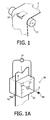
- FIG. 1 is a schematic view of a substrate which is guided over a roller after undergoing a laser processing
- FIG. 1A is a schematic view of a substrate processed by a laser beam, wherein a pressure difference is applied between the two sides of the substrate;
- FIG. 2 is a schematic view of a substrate which is guided over curved guides while undergoing a laser processing
- FIG. 3 is a schematic cross-sectional view of the situation shown in FIG. 2 ;
- FIGS. 4A and 4B show views corresponding to FIG. 3 of alternative situations
- FIG. 5 is a schematic perspective view of an embodiment of the structure shown in FIG. 3 ;
- FIG. 6 is a cross-sectional view of another embodiment of the structure shown in FIG. 3 ;
- FIG. 7 is a cross-sectional view of a variant of the embodiment shown in figure ???.
- FIG. 1 shows a part of a substrate 1 located downstream of a laser processing device.
- Substrate 1 is here being guided over a roller 15 forming part of the guide means for substrate 1 .
- roller 15 provides for a curvature and a change of direction of substrate 1 .
- This curvature of substrate 1 makes it easier for parts 16 , which have been only partially detached during the laser processing, to break away from substrate 1 . This takes place all the more easily as the radius of curvature decreases and the stiffness of the substrate increases.
- the laser processing and the associated transport of substrate 1 also usually takes place at high speed.
- parts 16 which are separated or have limited attachment to substrate 1 will tend to continue along their original path, not only as a result of their own stiffness but also as a result of their mass inertia. This also constitutes a mechanism which enhances the separation between loose parts 16 and substrate 1 .
- direction-changing elements can be applied instead of an optionally co-rotating roller 15 .
- FIG. 1A once again shows the substrate 1 processed by a laser beam, although means are arranged here for causing a pressure difference between the side of the substrate where laser beam 2 impinges on the substrate and the other side of the substrate.
- a box 10 Arranged for this purpose is a box 10 which is provided with a gap 11 which extends all around and through which substrate 1 extends. It is however also possible to make use of two gaps, each arranged in opposite sides, through which the substrate extends.
- a window 13 Arranged in wall 12 of box 10 on the side of the laser source is a window 13 through which laser beam 2 extends. This window 13 can be closed with a material which is transparent to laser light of the relevant frequency. The volume of box 11 is thus divided into two parts by the substrate.
- the thus formed parts are coupled to each other by an air pump 14 which serves to generate a pressure difference between the two parts.
- Various partitions (not shown in the drawings) can of course be arranged in order to prevent short-circuit of the air pressure differential on either side of the substrate.
- FIG. 2 shows a part of the guide means comprising curved guides 20 and a preceding roller 21 and a subsequent roller 22 .
- the two curved guides 20 urge substrate 1 into a single-curved form, thereby increasing the stiffness of the substrate and thereby stabilizing the position transversely of the main direction of the laser beam within the laser operation zone. It is otherwise also possible for the substrate to be curved round an axis extending parallel to or obliquely relative to the direction of movement.
- FIG. 3 shows a sectional view of the same situation, wherein a part of the laser beam 2 carrying out the processing and the elements controlling the position of laser spot 4 are moreover shown.
- This figure shows how the deflection of laser beam 2 takes place in the plane of the drawing through mirror 25 , the axis 27 of which coincides with the centre of the circular arc into which substrate 1 is forced by curved guides 20 .
- the distance R between mirror 25 and substrate 1 does not depend on the angle of deflection of laser beam 2 through mirror 25 , whereby focussing means 26 of laser beam 2 placed between laser source 18 and mirror 15 do not have to carry out any adjustments.
- FIG. 4A here shows how, in the case of a flat guide and thus flat positioning of the substrate, the distance between deflecting mirror and substrate depends on the angle of deflection of the mirror, this requiring an optical dynamic adjustment in order to maintain the focussing.
- Laser beam 2 also impinges on substrate 1 at an angle other than 90°, whereby the generally round laser beam 2 causes an oval spot 4 ′ on substrate 1 , which reduces the energy density, thereby reducing the effectiveness.
- FIG. 4B shows how these drawbacks are avoided by the chosen geometry.
- laser beam 2 is not only deflected in the plane of the drawing of FIGS. 3 and 4 , but also in the direction transversely thereof. It is possible in principle to have the substrate guided in a curve in a relevant direction in order to obtain the same advantages. Because it is generally not possible to curve the substrate in both directions, it is not possible to combine the two configurations, so that optical adjustment will still always have to be carried out in order to compensate varying path length of the laser beam.
- FIG. 5 shows a schematic view of an embodiment of the guide means for urging the substrate into a curve.
- hollow cylinders 30 which are positioned for rotation round the same geometric axis 31 . They are each mounted on a shaft end 32 . Cylinders 30 are provided on their outer surface 33 with perforations 34 . In the interior of cylinders 30 can be applied an underpressure which pulls substrate 1 against outer surface 33 via perforations 34 . Means are preferably arranged in the interior of cylinders 30 for only applying a vacuum at perforations 34 at an angle corresponding with the guiding angle, so that substrate 1 can be easily separated from cylinders 31 .
- FIG. 6 shows a sectional view of a second alternative to the configuration of FIG. 2 .
- two boxes 41 are here applied which are provided with a curved guide surface 42 in which perforations 43 are arranged.
- the interior of boxes 41 is connected to a pressure pump, whereby air flows out of perforations 43 and a thin layer of air is formed between the guide surface and the substrate. An air bearing is thus formed.
- the driving takes place with belts 44 which press the substrate against air bearing 42 and which are tensioned over pulleys 45 , 46 and 47 , one of which, 47 , is driven.
- a tensioning device 48 for belts 44 is also present.
- Rollers 49 are moreover arranged. It is of course possible to use other configurations of rollers and belts for the purpose of urging the substrate against air bearing 42 .
- FIG. 7 is a schematic cross-sectional view of the laser processing device shown in FIG. 6 , wherein the direction of movement of the substrate extends transversely of the plane of the drawing.
- This figure shows that air bearings 42 of the configuration of FIG. 6 are combined in this embodiment to form a unit 50 on both sides on the top side of substrate 1 .
- a removable container 51 Arranged inside this unit 50 is a removable container 51 , which can be removed for cleaning purposes.
- This container is provided on at least its upper surface with an opening or a window which is transparent to the applied laser beam.
- On the underside the belts and guide rollers are combined into a corresponding unit 52 .
- a removable container 53 is also present inside this unit.
- both units present above and below substrate 1 are rigidly connected to each other via a carrier 55 which can be displaced and fixed transversely of the transporting direction of the substrate.
Landscapes
- Engineering & Computer Science (AREA)
- Physics & Mathematics (AREA)
- Optics & Photonics (AREA)
- Plasma & Fusion (AREA)
- Mechanical Engineering (AREA)
- Laser Beam Processing (AREA)
Applications Claiming Priority (3)
| Application Number | Priority Date | Filing Date | Title |
|---|---|---|---|
| NL2001212 | 2008-01-24 | ||
| NL2001212A NL2001212C2 (nl) | 2008-01-24 | 2008-01-24 | Werkwijze en inrichting voor het door middel van laser bewerken van een beweegbaar substraat. |
| PCT/NL2009/050026 WO2009093899A1 (en) | 2008-01-24 | 2009-01-22 | Method and device for processing a movable substrate by means of laser |
Publications (2)
| Publication Number | Publication Date |
|---|---|
| US20110168683A1 US20110168683A1 (en) | 2011-07-14 |
| US8563895B2 true US8563895B2 (en) | 2013-10-22 |
Family
ID=39767229
Family Applications (1)
| Application Number | Title | Priority Date | Filing Date |
|---|---|---|---|
| US12/863,830 Expired - Fee Related US8563895B2 (en) | 2008-01-24 | 2009-01-22 | Method and device for processing a movable substrate by means of laser |
Country Status (8)
| Country | Link |
|---|---|
| US (1) | US8563895B2 (es) |
| EP (1) | EP2268447B1 (es) |
| CN (1) | CN101925435B (es) |
| CA (1) | CA2711664C (es) |
| ES (1) | ES2552814T3 (es) |
| NL (1) | NL2001212C2 (es) |
| RU (1) | RU2496623C2 (es) |
| WO (1) | WO2009093899A1 (es) |
Cited By (2)
| Publication number | Priority date | Publication date | Assignee | Title |
|---|---|---|---|---|
| US20080179304A1 (en) * | 2007-01-26 | 2008-07-31 | Electro Scientific Industries, Inc. | Methods and systems for laser processing continuously moving sheet material |
| WO2016185445A3 (en) * | 2015-05-20 | 2017-04-27 | Gomma Creations Inc. | A silicone rubber fabric and a method of laser cutting thin pliable sheets to produce the fabric |
Families Citing this family (2)
| Publication number | Priority date | Publication date | Assignee | Title |
|---|---|---|---|---|
| DE102011105957A1 (de) * | 2011-06-29 | 2013-01-03 | Daimler Ag | System zum Schneiden von Folie insbesondere für Membran-Elektronen-Einheiten von Brennstoffzellen |
| EP3177421B1 (de) * | 2014-08-05 | 2019-03-20 | Wsoptics GmbH | Prozess und schneidvorrichtung zur trennenden bearbeitung eines werkstücks |
Citations (6)
| Publication number | Priority date | Publication date | Assignee | Title |
|---|---|---|---|---|
| US3970819A (en) | 1974-11-25 | 1976-07-20 | International Business Machines Corporation | Backside laser dicing system |
| JPS60177987A (ja) | 1984-02-24 | 1985-09-11 | Agency Of Ind Science & Technol | レ−ザ加工装置 |
| GB2303095A (en) | 1995-07-07 | 1997-02-12 | Hitachi Cable | Dicing substrates |
| JP2001105170A (ja) | 1999-09-30 | 2001-04-17 | Mitsubishi Electric Corp | レーザ加工装置 |
| US20040159637A1 (en) * | 2003-02-19 | 2004-08-19 | Preco Laser Systems, Llc | Web securing system for laser processing |
| JP2008023548A (ja) | 2006-07-19 | 2008-02-07 | Apic Yamada Corp | 切断装置 |
Family Cites Families (3)
| Publication number | Priority date | Publication date | Assignee | Title |
|---|---|---|---|---|
| RU2098871C1 (ru) * | 1995-08-08 | 1997-12-10 | Акционерное общество закрытого типа "Технолазер" | Способ разделки и замены технологических каналов тепловыделяющих сборок ядерных реакторов канального типа |
| RU2172233C2 (ru) * | 1999-06-29 | 2001-08-20 | Жулев Юрий Григорьевич | Способ и устройство для резки материалов лазерным лучом |
| UA38145A (uk) * | 2000-06-02 | 2001-05-15 | Національний Технічний Університет України "Київський Політехнічний Інститут" | Спосіб лазерної різки |
-
2008
- 2008-01-24 NL NL2001212A patent/NL2001212C2/nl not_active IP Right Cessation
-
2009
- 2009-01-22 WO PCT/NL2009/050026 patent/WO2009093899A1/en not_active Ceased
- 2009-01-22 ES ES09703741.0T patent/ES2552814T3/es active Active
- 2009-01-22 US US12/863,830 patent/US8563895B2/en not_active Expired - Fee Related
- 2009-01-22 CN CN200980102981.8A patent/CN101925435B/zh not_active Expired - Fee Related
- 2009-01-22 EP EP09703741.0A patent/EP2268447B1/en not_active Not-in-force
- 2009-01-22 RU RU2010135352/02A patent/RU2496623C2/ru not_active IP Right Cessation
- 2009-01-22 CA CA2711664A patent/CA2711664C/en not_active Expired - Fee Related
Patent Citations (7)
| Publication number | Priority date | Publication date | Assignee | Title |
|---|---|---|---|---|
| US3970819A (en) | 1974-11-25 | 1976-07-20 | International Business Machines Corporation | Backside laser dicing system |
| JPS60177987A (ja) | 1984-02-24 | 1985-09-11 | Agency Of Ind Science & Technol | レ−ザ加工装置 |
| GB2303095A (en) | 1995-07-07 | 1997-02-12 | Hitachi Cable | Dicing substrates |
| JP2001105170A (ja) | 1999-09-30 | 2001-04-17 | Mitsubishi Electric Corp | レーザ加工装置 |
| US20040159637A1 (en) * | 2003-02-19 | 2004-08-19 | Preco Laser Systems, Llc | Web securing system for laser processing |
| EP1449798A2 (en) | 2003-02-19 | 2004-08-25 | Presco Laser Systems, L.L.C. | Web securing system for laser processing |
| JP2008023548A (ja) | 2006-07-19 | 2008-02-07 | Apic Yamada Corp | 切断装置 |
Non-Patent Citations (2)
| Title |
|---|
| CN Application No. 200980102981.8, Office Action mailed Oct. 15, 2012. |
| International Search Report for PCT/NL2009/050026 dated May 13, 2009. |
Cited By (4)
| Publication number | Priority date | Publication date | Assignee | Title |
|---|---|---|---|---|
| US20080179304A1 (en) * | 2007-01-26 | 2008-07-31 | Electro Scientific Industries, Inc. | Methods and systems for laser processing continuously moving sheet material |
| US9029731B2 (en) * | 2007-01-26 | 2015-05-12 | Electro Scientific Industries, Inc. | Methods and systems for laser processing continuously moving sheet material |
| US10118252B2 (en) | 2007-01-26 | 2018-11-06 | Electro Scientific Industries, Inc. | Methods and systems for laser processing continuously moving sheet material |
| WO2016185445A3 (en) * | 2015-05-20 | 2017-04-27 | Gomma Creations Inc. | A silicone rubber fabric and a method of laser cutting thin pliable sheets to produce the fabric |
Also Published As
| Publication number | Publication date |
|---|---|
| WO2009093899A1 (en) | 2009-07-30 |
| RU2010135352A (ru) | 2012-02-27 |
| RU2496623C2 (ru) | 2013-10-27 |
| CN101925435A (zh) | 2010-12-22 |
| US20110168683A1 (en) | 2011-07-14 |
| CA2711664A1 (en) | 2009-07-30 |
| EP2268447A1 (en) | 2011-01-05 |
| NL2001212C2 (nl) | 2009-07-27 |
| EP2268447B1 (en) | 2015-08-19 |
| CA2711664C (en) | 2016-08-30 |
| CN101925435B (zh) | 2014-09-17 |
| ES2552814T3 (es) | 2015-12-02 |
Similar Documents
| Publication | Publication Date | Title |
|---|---|---|
| CA2711664C (en) | Method and device for processing a movable substrate by means of laser | |
| US6794604B2 (en) | Web securing system for laser processing | |
| US20240416544A1 (en) | Pole piece cutting device | |
| US10118252B2 (en) | Methods and systems for laser processing continuously moving sheet material | |
| US6311921B1 (en) | Winding device and method for winding web material | |
| US20220297237A1 (en) | Device for manufacturing electrode | |
| JPS62127190A (ja) | シ−ト材料をレ−ザ切断する方法 | |
| JP2015533763A (ja) | 可撓性ガラスリボンのためのエッジ耳管理 | |
| US20200090976A1 (en) | Tape affixing apparatus | |
| JP3068561B2 (ja) | プレート状ワークピースのコンベアにおける選別装置 | |
| EP3946966B1 (en) | Hot foil stamping press | |
| WO2000019013A1 (en) | Device for conveying and guiding a lead-in strip of a web in a paper machine | |
| JP2016040106A (ja) | レーザー加工装置および印刷装置 | |
| JP2003064592A (ja) | 繊維質ウェブを処理するための装置 | |
| JP6792728B2 (ja) | レーザーブランキング装置 | |
| CN106181077B (zh) | 用于激光机的弧面输料方法及其设备 | |
| JP2008143714A (ja) | 薄片から形成される材料堆積物をこじ開けて通風する方法 | |
| JP4008672B2 (ja) | フィルム剥離搬送装置 | |
| JP2016040108A (ja) | レーザー加工装置および印刷装置 | |
| CN205147600U (zh) | 用于激光机的弧面输料设备 | |
| JP2009509061A (ja) | 繊維束加圧装置 | |
| KR102940790B1 (ko) | 노칭시스템 및 노칭방법 | |
| KR102225364B1 (ko) | 판 소재 누름장치를 포함하는 절단기용 판 소재 누름 블럭의 틈새 자동 조절 가이드 | |
| KR20250147410A (ko) | 레이저 노칭 장치 | |
| JP2021150108A (ja) | 回収装置 |
Legal Events
| Date | Code | Title | Description |
|---|---|---|---|
| AS | Assignment |
Owner name: INDUSTRIAL AUTOMATION INTEGRATORS (IAI) B.V., NETH Free format text: ASSIGNMENT OF ASSIGNORS INTEREST;ASSIGNOR:COBBEN, JOHANNES IGNATIUS MARIE;REEL/FRAME:024905/0149 Effective date: 20100818 Owner name: IAI INDUSTRIAL SYSTEMS B.V., NETHERLANDS Free format text: CHANGE OF NAME;ASSIGNOR:INDUSTRIAL AUTOMATION INTEGRATORS (IAI) B.V.;REEL/FRAME:024905/0251 Effective date: 19901231 |
|
| STCF | Information on status: patent grant |
Free format text: PATENTED CASE |
|
| CC | Certificate of correction | ||
| FPAY | Fee payment |
Year of fee payment: 4 |
|
| FEPP | Fee payment procedure |
Free format text: MAINTENANCE FEE REMINDER MAILED (ORIGINAL EVENT CODE: REM.); ENTITY STATUS OF PATENT OWNER: LARGE ENTITY |
|
| LAPS | Lapse for failure to pay maintenance fees |
Free format text: PATENT EXPIRED FOR FAILURE TO PAY MAINTENANCE FEES (ORIGINAL EVENT CODE: EXP.); ENTITY STATUS OF PATENT OWNER: LARGE ENTITY |
|
| STCH | Information on status: patent discontinuation |
Free format text: PATENT EXPIRED DUE TO NONPAYMENT OF MAINTENANCE FEES UNDER 37 CFR 1.362 |
|
| FP | Lapsed due to failure to pay maintenance fee |
Effective date: 20211022 |