US8940963B2 - Production of hetero-oligomeric proteins in plants - Google Patents
Production of hetero-oligomeric proteins in plants Download PDFInfo
- Publication number
- US8940963B2 US8940963B2 US11/814,931 US81493106A US8940963B2 US 8940963 B2 US8940963 B2 US 8940963B2 US 81493106 A US81493106 A US 81493106A US 8940963 B2 US8940963 B2 US 8940963B2
- Authority
- US
- United States
- Prior art keywords
- plant
- protein
- process according
- viral vector
- viral
- Prior art date
- Legal status (The legal status is an assumption and is not a legal conclusion. Google has not performed a legal analysis and makes no representation as to the accuracy of the status listed.)
- Active, expires
Links
Images




Classifications
-
- C—CHEMISTRY; METALLURGY
- C12—BIOCHEMISTRY; BEER; SPIRITS; WINE; VINEGAR; MICROBIOLOGY; ENZYMOLOGY; MUTATION OR GENETIC ENGINEERING
- C12N—MICROORGANISMS OR ENZYMES; COMPOSITIONS THEREOF; PROPAGATING, PRESERVING, OR MAINTAINING MICROORGANISMS; MUTATION OR GENETIC ENGINEERING; CULTURE MEDIA
- C12N15/00—Mutation or genetic engineering; DNA or RNA concerning genetic engineering, vectors, e.g. plasmids, or their isolation, preparation or purification; Use of hosts therefor
- C12N15/09—Recombinant DNA-technology
- C12N15/63—Introduction of foreign genetic material using vectors; Vectors; Use of hosts therefor; Regulation of expression
- C12N15/79—Vectors or expression systems specially adapted for eukaryotic hosts
- C12N15/82—Vectors or expression systems specially adapted for eukaryotic hosts for plant cells, e.g. plant artificial chromosomes (PACs)
- C12N15/8241—Phenotypically and genetically modified plants via recombinant DNA technology
- C12N15/8242—Phenotypically and genetically modified plants via recombinant DNA technology with non-agronomic quality (output) traits, e.g. for industrial processing; Value added, non-agronomic traits
- C12N15/8243—Phenotypically and genetically modified plants via recombinant DNA technology with non-agronomic quality (output) traits, e.g. for industrial processing; Value added, non-agronomic traits involving biosynthetic or metabolic pathways, i.e. metabolic engineering, e.g. nicotine, caffeine
- C12N15/8251—Amino acid content, e.g. synthetic storage proteins, altering amino acid biosynthesis
-
- C—CHEMISTRY; METALLURGY
- C12—BIOCHEMISTRY; BEER; SPIRITS; WINE; VINEGAR; MICROBIOLOGY; ENZYMOLOGY; MUTATION OR GENETIC ENGINEERING
- C12N—MICROORGANISMS OR ENZYMES; COMPOSITIONS THEREOF; PROPAGATING, PRESERVING, OR MAINTAINING MICROORGANISMS; MUTATION OR GENETIC ENGINEERING; CULTURE MEDIA
- C12N15/00—Mutation or genetic engineering; DNA or RNA concerning genetic engineering, vectors, e.g. plasmids, or their isolation, preparation or purification; Use of hosts therefor
- C12N15/09—Recombinant DNA-technology
- C12N15/63—Introduction of foreign genetic material using vectors; Vectors; Use of hosts therefor; Regulation of expression
-
- C—CHEMISTRY; METALLURGY
- C12—BIOCHEMISTRY; BEER; SPIRITS; WINE; VINEGAR; MICROBIOLOGY; ENZYMOLOGY; MUTATION OR GENETIC ENGINEERING
- C12N—MICROORGANISMS OR ENZYMES; COMPOSITIONS THEREOF; PROPAGATING, PRESERVING, OR MAINTAINING MICROORGANISMS; MUTATION OR GENETIC ENGINEERING; CULTURE MEDIA
- C12N15/00—Mutation or genetic engineering; DNA or RNA concerning genetic engineering, vectors, e.g. plasmids, or their isolation, preparation or purification; Use of hosts therefor
- C12N15/09—Recombinant DNA-technology
- C12N15/63—Introduction of foreign genetic material using vectors; Vectors; Use of hosts therefor; Regulation of expression
- C12N15/79—Vectors or expression systems specially adapted for eukaryotic hosts
- C12N15/82—Vectors or expression systems specially adapted for eukaryotic hosts for plant cells, e.g. plant artificial chromosomes (PACs)
- C12N15/8201—Methods for introducing genetic material into plant cells, e.g. DNA, RNA, stable or transient incorporation, tissue culture methods adapted for transformation
- C12N15/8202—Methods for introducing genetic material into plant cells, e.g. DNA, RNA, stable or transient incorporation, tissue culture methods adapted for transformation by biological means, e.g. cell mediated or natural vector
- C12N15/8203—Virus mediated transformation
-
- C—CHEMISTRY; METALLURGY
- C07—ORGANIC CHEMISTRY
- C07K—PEPTIDES
- C07K14/00—Peptides having more than 20 amino acids; Gastrins; Somatostatins; Melanotropins; Derivatives thereof
- C07K14/435—Peptides having more than 20 amino acids; Gastrins; Somatostatins; Melanotropins; Derivatives thereof from animals; from humans
- C07K14/575—Hormones
- C07K14/59—Follicle-stimulating hormone [FSH]; Chorionic gonadotropins, e.g.hCG [human chorionic gonadotropin]; Luteinising hormone [LH]; Thyroid-stimulating hormone [TSH]
-
- C—CHEMISTRY; METALLURGY
- C12—BIOCHEMISTRY; BEER; SPIRITS; WINE; VINEGAR; MICROBIOLOGY; ENZYMOLOGY; MUTATION OR GENETIC ENGINEERING
- C12N—MICROORGANISMS OR ENZYMES; COMPOSITIONS THEREOF; PROPAGATING, PRESERVING, OR MAINTAINING MICROORGANISMS; MUTATION OR GENETIC ENGINEERING; CULTURE MEDIA
- C12N15/00—Mutation or genetic engineering; DNA or RNA concerning genetic engineering, vectors, e.g. plasmids, or their isolation, preparation or purification; Use of hosts therefor
- C12N15/09—Recombinant DNA-technology
- C12N15/63—Introduction of foreign genetic material using vectors; Vectors; Use of hosts therefor; Regulation of expression
- C12N15/67—General methods for enhancing the expression
-
- C—CHEMISTRY; METALLURGY
- C12—BIOCHEMISTRY; BEER; SPIRITS; WINE; VINEGAR; MICROBIOLOGY; ENZYMOLOGY; MUTATION OR GENETIC ENGINEERING
- C12N—MICROORGANISMS OR ENZYMES; COMPOSITIONS THEREOF; PROPAGATING, PRESERVING, OR MAINTAINING MICROORGANISMS; MUTATION OR GENETIC ENGINEERING; CULTURE MEDIA
- C12N15/00—Mutation or genetic engineering; DNA or RNA concerning genetic engineering, vectors, e.g. plasmids, or their isolation, preparation or purification; Use of hosts therefor
- C12N15/09—Recombinant DNA-technology
- C12N15/63—Introduction of foreign genetic material using vectors; Vectors; Use of hosts therefor; Regulation of expression
- C12N15/79—Vectors or expression systems specially adapted for eukaryotic hosts
- C12N15/82—Vectors or expression systems specially adapted for eukaryotic hosts for plant cells, e.g. plant artificial chromosomes (PACs)
-
- C—CHEMISTRY; METALLURGY
- C12—BIOCHEMISTRY; BEER; SPIRITS; WINE; VINEGAR; MICROBIOLOGY; ENZYMOLOGY; MUTATION OR GENETIC ENGINEERING
- C12N—MICROORGANISMS OR ENZYMES; COMPOSITIONS THEREOF; PROPAGATING, PRESERVING, OR MAINTAINING MICROORGANISMS; MUTATION OR GENETIC ENGINEERING; CULTURE MEDIA
- C12N15/00—Mutation or genetic engineering; DNA or RNA concerning genetic engineering, vectors, e.g. plasmids, or their isolation, preparation or purification; Use of hosts therefor
- C12N15/09—Recombinant DNA-technology
- C12N15/63—Introduction of foreign genetic material using vectors; Vectors; Use of hosts therefor; Regulation of expression
- C12N15/79—Vectors or expression systems specially adapted for eukaryotic hosts
- C12N15/82—Vectors or expression systems specially adapted for eukaryotic hosts for plant cells, e.g. plant artificial chromosomes (PACs)
- C12N15/8241—Phenotypically and genetically modified plants via recombinant DNA technology
- C12N15/8242—Phenotypically and genetically modified plants via recombinant DNA technology with non-agronomic quality (output) traits, e.g. for industrial processing; Value added, non-agronomic traits
- C12N15/8257—Phenotypically and genetically modified plants via recombinant DNA technology with non-agronomic quality (output) traits, e.g. for industrial processing; Value added, non-agronomic traits for the production of primary gene products, e.g. pharmaceutical products, interferon
-
- C—CHEMISTRY; METALLURGY
- C12—BIOCHEMISTRY; BEER; SPIRITS; WINE; VINEGAR; MICROBIOLOGY; ENZYMOLOGY; MUTATION OR GENETIC ENGINEERING
- C12N—MICROORGANISMS OR ENZYMES; COMPOSITIONS THEREOF; PROPAGATING, PRESERVING, OR MAINTAINING MICROORGANISMS; MUTATION OR GENETIC ENGINEERING; CULTURE MEDIA
- C12N15/00—Mutation or genetic engineering; DNA or RNA concerning genetic engineering, vectors, e.g. plasmids, or their isolation, preparation or purification; Use of hosts therefor
- C12N15/09—Recombinant DNA-technology
- C12N15/63—Introduction of foreign genetic material using vectors; Vectors; Use of hosts therefor; Regulation of expression
- C12N15/79—Vectors or expression systems specially adapted for eukaryotic hosts
- C12N15/82—Vectors or expression systems specially adapted for eukaryotic hosts for plant cells, e.g. plant artificial chromosomes (PACs)
- C12N15/8241—Phenotypically and genetically modified plants via recombinant DNA technology
- C12N15/8242—Phenotypically and genetically modified plants via recombinant DNA technology with non-agronomic quality (output) traits, e.g. for industrial processing; Value added, non-agronomic traits
- C12N15/8257—Phenotypically and genetically modified plants via recombinant DNA technology with non-agronomic quality (output) traits, e.g. for industrial processing; Value added, non-agronomic traits for the production of primary gene products, e.g. pharmaceutical products, interferon
- C12N15/8258—Phenotypically and genetically modified plants via recombinant DNA technology with non-agronomic quality (output) traits, e.g. for industrial processing; Value added, non-agronomic traits for the production of primary gene products, e.g. pharmaceutical products, interferon for the production of oral vaccines (antigens) or immunoglobulins
Definitions
- the present invention relates to the production of hetero-oligomeric proteins in plant, plant parts or plant cell cultures using the plus-sense single stranded RNA viral vectors.
- the process and vectors described in the present invention provide plant cells with an increased yield of functional hetero-oligomeric recombinant protein, such as full-length antibody or hetero-oligomeric synthetic derivatives thereof including fusions with other proteins or their fragments.
- Plant-based molecular farming is an attractive opportunity for the production of recombinant proteins destined to be used in the field of human and animal health, preferably due to the potentially low production cost and attempts by biopharmaceutical industry to eliminate animal-derived proteins from manufacturing processes because of possible contamination of these products by human pathogens such as Bovine Spongiform Encephalopathy (BSE) or Creuzfeld-Jacob Disease (CJD, vCJD).
- BSE Bovine Spongiform Encephalopathy
- CJD Creuzfeld-Jacob Disease
- tissue-specific promoters e.g. seed-specific
- these systems are not commercially viable, if used in closed (greenhouse) environment due to the low yield of the product.
- Plant virus-based transient expression systems (for review see: Porta & Lomonossoff, 1996 , Mol. Biotechnol., 5, 209-221; Yusibov et al. 1999 , Curr. Top. Microbiol. Immunol, 240, 81-94; Gleba et al., 2004 , Curr. Opin. Plant Biol., 7, 182-188) are able to provide for high expression levels in plant leaf tissues and to some extent are capable to address the problems of cytotoxicity of recombinant proteins and their detrimental effect on plant development, as the technology allows to separate the growth and production stages.
- RNA viral vectors preferably on Tobacco Mosaic Virus (TMV)-derived vectors
- TMV Tobacco Mosaic Virus
- the detected antigen binding activity may be due to antibody that was in vitro assembled during the isolation procedure from heavy and light antibody chains expressed in separate cells or tissue. It was previously shown that functional antibodies can be assembled in vitro from denatured and reduced antibody components (Petersen & Dorrington, 1974 , J. Biol. Chem., 17, 5633-5641; Maeda et al. 1996 , Protein Engineering, 9, 95-100). However, the efficiency of such assembly in the absence of conditions favourable for such an assembly is very low.
- a further object is the provision of a high-yield plant expression system capable of expressing hetero-oligomeric protein.
- the invention provides a process of producing in a plant, in plant tissue, or in plant cells a hetero-oligomeric protein comprising at least a first and a second protein subunit, said process comprising expressing in plant cells at least said first and said second protein subunit by
- said first viral vector and said second viral vector are non-competing in that they are different viral vectors. In another embodiment, said first viral vector and said second viral vector are non-competing in that they are not derived from the same RNA virus. In another embodiment, said first viral vector and said second viral vector are non-competing in that they differ in a sequence portion other than sequence portions coding for said first and second protein subunits. In another embodiment, said first viral vector and said second viral vector are non-competing in that they are derived from RNA viruses belonging to different virus species. In another embodiment, said first viral vector and said second viral vector are non-competing in that they are derived from RNA viruses belonging to different virus genera.
- Another embodiment of the invention is a process of producing in a plant, in plant tissue, or in plant cells an antibody comprising at least a first and a second protein subunit like a heavy and a light antibody chain, said process comprising expressing in plant cells at least said first and said second protein subunit by
- the invention further provides a process of producing in a plant, in plant tissue or in plant cells a hetero-oligomeric protein comprising at least a first and a second protein subunit, said process comprising expressing in plant cells at least said first and said second protein subunit from one or more plus-sense single-stranded RNA viral vector(s).
- the inventors of the present invention have surprisingly identified ways of producing hetero-oligomeric proteins with high yield in plants using plant viral vectors. Efficient production of hetero-oligomeric proteins in plants requires high-yield production of the different protein subunits of the hetero-oligomeric protein in the same plant cells. In this way, the hetero-oligomeric protein can be efficiently assembled in cells having expressed said at least two protein subunits using natural protein assembling capabilities of said cells like those of the endoplasmatic reticulum (ER). Inefficient in vitro assembly of said hetero-oligomeric protein is therefore not necessary.
- the present invention achieves for the first time efficient co-expression of two or more proteins in the same cells by the above step (i) or by the above step (ii) or by a combination of the above steps (i) and (ii).
- Said first protein subunit is encoded in the RNA viral vector by a first heterologous (nucleic acid) sequence.
- Said second protein subunit is encoded in the viral vector by a second heterologous (nucleic acid) sequence.
- These heterologous sequences are thus RNA sequences of said viral vector(s) and typically comprise or encode regulatory sequences required for expressing said protein subunits. Examples of such regulatory sequences are subgenomic promoters, IRES elements, and 3′-untranslated sequences.
- a sequence is a heterologous sequence if it does not naturally occur in the virus from which said viral vector(s) is/are derived.
- the hetero-oligomeric protein producible according to the present invention has at least a first and a second subunit, whereby said first and said second subunits have different polypeptide sequences.
- said first and said second subunit typically have to be expressed from different heterologous nucleic acid sequences.
- the subunits of an oligomeric protein assemble to form the quaternery structure of the oligomeric protein. Assembly of the subunits typically involves non-covalent bonds between the subunits. Additionally, covalent bonds may be formed between said protein subunits, e.g. disulfide bonds.
- said hetero-oligomeric protein is a hetero-dimeric protein, i.e. a protein having two different protein subunits.
- said hetero-oligomeric protein may have more than two different subunits e.g. 3 or 4 different subunits (hetero-trimeric or hetero-tetrameric protein, respectively).
- said hetero-oligomeric protein may have two different subunits, whereby one or both of said subunits may be present in said hetero-oligomeric protein more than one time.
- Examples of the subunit organization of said hetero-oligomeric protein are A a B b , A a B b C c , and A a B b C c D d , wherein A stands for a first protein subunit, B stand for a second protein subunit, and C and D stand for further protein subunits.
- Each capital letter A, B, C, and D stands for protein subunits different from the other protein subunits and small letters stand for integers of at least 1 that indicate the number of copies of the respective protein subunit in said hetero-oligomeric protein.
- An example are IgG antibodies which have the subunit organization A 2 B 2 , wherein A represents a first protein subunit (e.g. the heavy chain) and B represents a second protein subunit (e.g. the light chain).
- the hetero-oligomeric protein produced according to the invention has two or three different protein subunits, more preferably it has two different protein subunits.
- At least said first and said second protein subunits are expressed in cells of said plant, of said plant tissue, or of said plant cells by said step (i) or/and said step (ii).
- Each of said steps (i) and (ii) allows expression of at least said first and said second protein subunit in the same cells such that said hetero-oligomeric protein can be produced efficiently in said cells.
- Steps (i) and (ii) can be performed in parallel, notably for the production of hetero-oligomeric proteins having three, four, or more different protein subunits (see example 7).
- Said plus-sense single-stranded RNA viral vector(s) of the invention are also referred to herein simply as “viral vector”.
- said plus-sense single-stranded RNA viral vectors are derived from plus-sense single-stranded plant RNA viruses.
- step (ii) said plant, said plant tissue or said plant cells is/are provided with a plus-sense single-stranded RNA viral vector encoding at least said first and said second protein subunit.
- Said viral vector encoding at least said first and said second protein subunit contains, as an insert, a first heterologous sequence encoding said first protein subunit expression of which may be under the control of a first sub-genomic promoter.
- said viral vector contains, as an insert, a second heterologous sequence encoding said second protein subunit expression of which may be under the control of a second sub-genomic promoter.
- both said first and said second protein subunits are expressed under the control of a subgenomic promoter
- these subgenomic promoters preferably differ in sequence for avoiding self-homology in said viral vector, which could lead to undesired recombination events in plant cells.
- Such different subgenomic promoters may be taken from different strains or species of a plant virus, e.g. one subgenomic promoter may be (or may be derived from) the coat protein (CP) subgenomic promoter of tobacco mosaic virus (TMV) U1 and the other subgenomic promoter may be (or may be derived from) the CP subgenomic promoter of TMV U5 or from crucifer-infecting tobamovirus (cr-TMV).
- CP coat protein
- TMV tobacco mosaic virus
- translation of said first or said second protein subunit may be under control of an IRES (internal ribosome entry site) element.
- IRES internal ribosome entry site
- translation of both said first and said second protein subunits may be under the control of IRES elements, it is preferred that at least one of said protein subunits is expressed using a subgenomic promoter.
- the IRES elements for use in the present invention may be taken from plant viruses like cr-TMV or other plant viruses (Proc Natl Acad Sci USA 2002, 99, 5301-6; Virology 1999, 263, 139-54; WO03020927; WO0229068).
- Said viral vector of step (ii) is preferably incapable of systemic movement in said plant or said plant tissue. This can be achieved e.g. by omitting a functional origin of viral particle assembly.
- the origin of viral particle assembly is located in the MP ORF.
- the origin of viral particle assembly can be omitted by deleting fully or partly the MP ORF from said viral vector.
- Said viral vector is thus preferably devoid of a functional movement protein (MP) ORF. More preferably, said viral vector is devoid of a functional protein necessary for systemic movement of said viral vector.
- said viral vector may be devoid of a functional coat protein ORF, and most preferably said viral vector is devoid of both a functional movement protein ORF and a functional coat protein ORF. Omitting an MP ORF and/or a CP ORF from the viral vector provides more space for encoding at least said first and said second protein subunit in said viral vector without compromising viral vector stability.
- said viral vector is preferably provided to many cells of said plant or said plant tissue for achieving infection of many cells. This may best be achieved by providing a DNA precursor of said RNA viral vector as T-DNA using Agrobacterium (see below).
- the virus said viral vector for step (ii) is derived from may be any plus-sense single-stranded plant RNA virus, e.g. those listed in chapter “Detailed Description”.
- Preferred groups of viruses are tobamoviruses, potexviruses, and potyviruses. Most preferred viruses are TMV and PVX.
- Said viral vector will at least contain the ORFs from the virus it is derived from that encode proteins required for replication of said viral vector.
- Said viral vector typically further contains regulatory elements for viral replication and at least one subgenomic promoter.
- step (i) said plant, said plant tissue or said plant cells are provided with a first and a second plus-sense single-stranded RNA viral vector.
- Said first viral vector encodes at least said first protein subunit
- said second viral vector encodes at least said second protein subunit.
- Step (i) allows to produce hetero-oligomeric proteins having two different protein subunits.
- Step (i) also allows to produce hetero-oligomeric proteins having more than two different subunits, e.g. three or four different protein subunits.
- said plant, plant tissue or plant cells may be provided with a first, a second, and a third viral vector (and optionally with a further viral vector), each encoding one of said different protein subunits.
- the respective three or four viral vectors are preferably all non-competing viral vectors with each other.
- the first viral vector may be derived from a tobamovirus
- the second viral vector may be derived from a potyvirus
- the third viral vector may be derived from a potexvirus.
- Two viral vectors are non-competing if they can express efficiently the protein subunits they encode in the same plant cell (co-expression). Co-expression requires that the at least two different viral vectors do not outcompete each other during replication before having expressed substantial amounts of the heterologous sequences they encode. The higher the sequence differences on the RNA level of said at least two viral vectors, the more they are non-competing in the same plant cells. Said first viral vector and said second viral vector are non-competing viral vectors, since said first viral vector and said second viral vector are different viral vectors.
- said first and said second viral vectors differ, in one general embodiment, at least in a sequence portion other than said heterologous sequences coding for said protein subunits.
- a difference in a sequence portion other than said heterologous sequences is a sequence portion derived from a plant RNA virus such as a sequence portion involved in a viral function such as viral replication in plant cells (e.g. a sequence coding for a replicase), translation of a viral protein (e.g. a subgenomic promoter) or viral cell-to-cell or long distance movement.
- said first and said second viral vectors are, in another general embodiment, derived from different plant viruses.
- said at least two non-competing viral vectors are not derived from viruses of the same virus strain.
- said at least two non-competing viral vectors are not derived from viruses of the same virus species.
- said at least two non-competing viral vectors are not derived from viruses of the same virus genus.
- said first viral vector and said second viral vector are preferably derived from viruses of different strains, more preferably from viruses of different species, most preferably from viruses of different genera.
- Said first viral vector may be derived from a virus belonging to the genus Potexvirus and said second viral vector may be derived from a virus belonging to the genus Potyvirus.
- said first viral vector may be derived from Potato Virus X and said second viral vector may be derived from Potato Virus Y.
- said protein subunit can be expressed as a fusion with a viral polyprotein, whereby a protein subunit of the invention can be separated from said polyprotein by a potyviral protease recognition site.
- said first viral vector may be derived from a virus belonging to the genus Potexvirus and said second viral vector may be derived from a virus belonging to the genus Tobamovirus.
- said first viral vector may be derived from Potato Virus X and said second viral vector may be derived from Tobacco Mosaic Virus.
- Being derived from a virus means that the viral vector contains genetic elements or sequence portions from the virus it is derived from.
- said viral vector(s) contain(s) a replicase ORF (open reading frame) taken from an RNA virus.
- a viral vector contains a movement protein ORF from an RNA virus and, optionally, also a replicase ORF.
- Viral genetic elements taken from an RNA virus may, if desired, be mutated e.g. for introducing the restriction sites required for cloning of the viral vector.
- step (i) of the process of the invention An embodiment wherein said first viral vector and said second viral vector are both based on tobacco mosaic viral vector TMV 30 B is excluded from step (i) of the process of the invention, since in this case said first viral vector and said second viral vector are not different viral vectors but are the same viral vectors (cf. Verch et al., J. Immunological Methods 220 (1998) 69-75).
- Said first and said second viral vectors preferably have a sequence homology on RNA level of at most 90%, more preferably of at most 80%, even more preferably of at most 70%, and most preferably of at most 60%. More specifically, any sequence segment of said first viral vector of 100 bases preferably has a sequence homology to any sequence segment of 100 bases of said second viral vector of at most 90%, preferably at most 80%, more preferably at most 70%, and most preferably of at most 60%.
- said first viral vector preferably contains a first heterologous sequence encoding said first protein subunit expression of which may be under the control of a first sub-genomic promoter.
- Said second viral vector contains a second heterologous sequence encoding said second protein subunit expression of which may be under the control of a second subgenomic promoter.
- One or both of said subgenomic promoters may be replaced by an IRES element.
- both said first and said second protein subunits are expressed under the control of a subgenomic promoter
- these subgenomic promoters preferably differ in sequence for avoiding homology between said first and said second (and any further viral vector) viral vector, which could lead to undesired recombination events in plant cells.
- Such different subgenomic promoters may be taken from different strains or species of plant virus, e.g. one subgenomic promoter may the coat protein (CP) subgenomic promoter of tobacco mosaic virus (TMV) U1 and the other subgenomic promoter may be the CP subgenomic promoter of TMV U5 or from crucifer-infecting tobamovirus (cr-TMV).
- CP coat protein
- TMV tobacco mosaic virus
- Said first and said second heterologous sequences encoding said first and said second protein subunit, respectively, may be added as an additional sequence to said viral vectors.
- Said heterologous sequences are preferably added such that high level expression is achieved.
- said heterologous sequence is added at the 3′ end of the virus, since the 3′ ORF is frequently the ORF that is expressed at the highest level in many viruses.
- said heterologous sequences replace a sequence native to said virus, e.g. the natural 3′ ORF of said virus which is the CP ORF in many viruses like tobamoviruses.
- said first and/or said second viral vector preferably lacks an ORF for systemic movement of said viral vector.
- Said viral vectors may further lack an ORF for cell-to-cell movement like the MP ORF in tobamoviruses.
- said three protein subunits may be expressed according to step (i) by expressing two proteins from a first viral vector similarly as described for step (ii) and expressing a third protein subunit from a non-competing viral vector.
- Transient transfection of said plant, plant tissue or plant cells with DNA precursors of said viral vectors by way of Agrobacterium is most preferred in the present invention.
- said DNA precursors of said viral vectors may be stably incorporated into plant chromosomal DNA. Release of said viral vector(s) from chromosomal DNA may be controlled by inducible promoters.
- the process of the invention may be applied to any plant for which plant viral expression systems exist or will be worked out in the future.
- Said plant may be a monocot or a dicot.
- dicots Solanaceae, Brassicaceae, Chenopodiaceae, and Legume are preferred.
- Solanaceae the genus Nicotiana like N. tabacum or N. benthamiana is preferred.
- Other preferred plants are Medicago sativa and Beta species like Beta vulgaris.
- hetero-oligomeric proteins are immunoglobulins like immunoglobulins of the following classes: immunoglobulin G, immunoglobulin A, immunoglobulin M, immunoglobulin D, and immunoglobulin E. These immunoglobulins may comprise at least a portion of an antigen binding domain. As the case requires, these immunoglobulins produced according to the invention may be modified relative to native animal immunoglobulins, provided they comprise at least two different protein subunits.
- the immunoglobulin may comprises a protection protein in association with an immunoglobulin heavy chain, wherein the protection protein comprises a portion of a polyimmunoglobulin receptor. Another preferred hetero-oligomeric protein is insulin.
- the hetero-oligomeric protein of the invention may be modified in many different ways relative to the native protein as the case requires.
- a native leader sequence forming a secretion signal of one or more protein subunits of the native hetero-oligomeric protein may be replaced by plant-specific signal peptides.
- Said plant-specific signal peptides may be derived from tobacco calreticulin and/or rice alpha-amylase.
- At least one or at least two or more subunits of said hetero-oligomeric protein may contain an endoplasmatic reticulum retention signal KDEL for improving assembly of said hetero-oligomeric protein from said subunits in plant cells.
- heterologous sequences encoding said protein subunits may be mutated in order to partially or completely remove glycosylation sites from said hetero-oligomeric protein.
- glycosylation pattern of the hetero-oligomeric protein to be expressed may be changed e.g. by engineering a component of the plant glycosylation machinery like one or more glycosyl transferases.
- the hetero-oligomeric protein of the invention may be isolated from the plant, plant tissue or plant cells after expression according to generally known procedures. Said hetero-oligomeric protein may then be purified to substantial homogeneity, which state may be defined such that bands due to said hetero-oligomeric protein on a coomassie-staned SDS-PAGE account for at least 70%, preferably at least 80%, and most preferably at least 90% of the staining of a lane as determined by a conventional gel reader.
- FIG. 1 (A) shows an expression distribution pattern of GFP and DsRed from two different TMV-based vectors in infiltrated N. benthamiana leaves.
- Left picture the light spot at the top left side is GFP fluorescence of an area infiltrated with pICH17272.
- the weakly light spot below is red fluorescence of an area infiltrated with vector pICH18505.
- the light spot at the bottom right side of the left picture is an area infiltrated with pICH17272+pICH18505.
- the pictures on the right hand side show protoplasts isolated from a leaf area co-infiltrated with two different vectors (top: protoplasts under GFP fluorescence detection conditions; bottom panel: the same protoplasts under DsRed fluorescence detection conditions.
- (B) is a schematic representation of T-DNA regions of pICH17272 and pICH18505.
- P transcription promoter
- T transcription termination region
- RdRP viral RNA-dependent RNA polymerase
- MP viral movement protein
- 3′NTR viral 3′ non-translated region
- Cr-sgp CP subgenomic promoter region of crTMV strain
- GOI gene of interest.
- C are a schematic representations of restriction maps of the T-DNA regions of pICH17272 and pICH18505.
- FIG. 2 depicts a schematic representation of a T-DNA region of a viral vector designed for co-expression of two different transgenes (GOI-1 and GOI-2) from different subgenomic promoters.
- P transcription promoter
- T transcription termination region
- RdRP viral RNA-dependent RNA polymerase
- MP viral movement protein
- 3′NTR viral 3′ non-translated region
- Cr-sgp CP subgenomic promoter region of crTMV strain
- 3PK triple pseudo knot region
- U5sgp CP subgenomic promoter of TMV-U5 strain.
- GOI gene of interest.
- FIG. 3 (A) depicts schematic representations of T-DNA regions of constructs pICH17388, pICH17123, pICH15933, pICH7410, pICH10580, pICH10881 and pICH10745.
- RS combination site recognised by PhiC31 integrase.
- Grey vertical bars indicate introns.
- (B) depicts restriction maps of the T-DNA regions of pICH17388, pICH17123, pICH15933.
- (C) depicts restriction maps of the T-DNA regions of pICH7410, pICH10580, pICH10881 and pICH10745.
- FIG. 4 shows in (A) fluorescence microscope micrographs of an N. benthamiana leaf region 6 days after agrobacterial delivery of DNA precursors pICH17388 and pICH15933 together with a recombinase source.
- RS recombination site recognised by PhiC31 integrase.
- FIG. 5 depicts schematic representations of T-DNA regions of different vector systems for the expression of heavy and light chains of an antibody.
- RS reference site recognised by PhiC31 integrase.
- Lane: 1 uninfected leaf tissue
- lane 2 IgG heavy chain expressed in cytosol (pICH17388)
- lane 7 IgG heavy and light chains co-expression with bicistronic construct pICH19860 (MP deficient 5′ pro-vector pICH17123, MP in trans pICH10745);
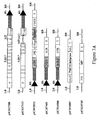
- FIG. 7 depicts a schematic representations of T-DNA regions encoding non-competing viral vectors designed for co-expression of different protein subunits of interest in the same plant cell.
- P transcription promoter
- T transcription termination region
- TMV RdRP viral RNA-dependent RNA polymerase of Tobacco Mosaic Virus
- PVX RdRP viral RNA-dependent RNA polymerase of Potato Virus X
- MP viral movement protein
- 3′NTR viral 3′ non-translated region
- Cr-sgp CP subgenomic promoter region of crTMV strain
- GOI gene of interest coding for a protein subunit of interest.
- FIG. 8 depicts a schematic representation of the T-DNA region of binary vector pIC0130.
- FIG. 9 shows co-expression of GFP and dsRED in plant cells using TMV (pICH17388+pICH10580) and PVX-based (pIC0130) vectors: visualisation of GFP and dsRED in protoplast isolated from agroinoculated N. benthamiana leaves.
- FIG. 10 (A) depicts schematic representation of the T-DNA regions of binary vectors pICH17620, pICH20431, pICH21240, pICH20421, and pICH21370.
- (B) is a schematic representation of the T-DNA regions of binary vectors pICH11599, pICH21910 and pICH21920.
- (C) is a schematic representation of the T-DNA regions of binary vectors pICH21282, pICH10990, pICH22250 and pICH22240.
- Lv and Lc variable and conservative regions of light chain
- Hv and Hc variable and conservative regions of heavy chain.
- (D) is a schematic representation of cloning scheme for PVX-derived provector pICH21380.
- FIG. 11 ( a ) shows the results of an ELISA test for the determination of co-expression levels of IgG light and heavy chains using PVX and crTMV vectors.
- the numbering of the wells of the tissue culture plate on the left corresponds to the numbering of the bars in the histogram.
- the histogram displays the OD of the wells at 405 nm.
- FIG. 11( b ) shows electrophoretic and Western blot analysis of anti-cancer antibodies expressed in N. benthamiana leaves.
- H 2 L 2 IgG heterotetramer containing two heavy and two light chains
- H 2 L heterotrimer containing two heavy and one light chains
- H 2 heavy chain homodimer
- L 2 light chain homodimer.
- FIG. 12 shows a schematic representation of T-DNA regions of binary vectors pICH17620, pICH-FSHA and pICH-FSHB.
- the viral vectors described in present invention are either viral vectors wherein a single vector encodes all protein subunits necessary for forming said hetero-oligomeric protein, or at least two different non-competing viral vectors, whereby each of said at least two viral vectors encodes for different protein subunit necessary for forming said hetero-oligomeric protein.
- Each of said non-competing viral vectors can express more than one heterologous nucleic acid sequence encoding more than one subunit of recombinant hetero-oligomeric protein.
- Said RNA viral vectors can be transiently delivered into plant cell or can be stably incorporated into plant chromosomal DNA as DNA precursor(s).
- RNA viruses also referred to herein as “RNA viruses” for brevity
- RNA viral vectors also referred to herein as “viral vectors” for brevity
- a viral vector is an RNA vector capable of replicating in plant cells, i.e. forming further RNA vector molecules by RNA-dependent RNA polymerization using the RNA viral vector as a template.
- the viral vectors of the invention contain at least one viral sequence element having an RNA viral function e.g. a replicase, a subgenomic promoter, an origin of viral particle assembly, a coat protein ORF, or a movement protein ORF.
- the viral vector may have an RNA viral IRES element.
- the virus itself may be a viral vector.
- viral vector refers to the case where said heterologous sequence is not present in said vector or to the case where no sequence coding for a protein subunit of the invention is present in the vector. Cases wherein said heterologous sequence or a sequence coding for a protein subunit of the invention is inserted into said viral vectors are identified by explicitly specifying the presence of such insert.
- replicon or “viral replicon” have the same meaning as “viral vector”.
- Genus Ilarvirus
- Type species tobacco streak virus
- Bromovirus Type species: brome mosaic virus
- Genus Cucumovirus, Type species: cucumber mosaic virus;
- Genus Comovirus, Type species: cowpea mosaic virus,
- Genus Fabavirus, Type species: broad bean wilt virus 1,
- Nepovirus Type species: tobacco ringspot virus; Family: Potyviridae,
- Genus Potyvirus, Type species: potato virus Y, plum pox virus; tobacco etch virus; clover yellow vein virus; tobacco vein mottling virus;
- Genus Rymovirus, Type species: ryegrass mosaic virus,
- Genus Bymovirus, Type species: barley yellow mosaic virus;
- Genus Waikavirus, Type species: rice tungro spherical virus;
- Genus Dianthovirus
- Type species carnation ringspot virus
- Genus Necrovirus, Type species: tobacco necrosis virus,
- Genus Capillovirus, Type species: apple stem grooving virus;
- Genus Carlavirus, Type species: carnation latent virus;
- Genus Enamovirus
- Type species pea enation mosaic virus
- Furovirus Type species: soil-borne wheat mosaic virus
- Genus Hordeivirus, Type species: barley stripe mosaic virus,
- Idaeovirus Type species: raspberry bushy dwarf virus
- Genus Luteovirus, Type species: barley yellow dwarf virus;
- Genus Marafivirus, Type species: maize rayado fino virus;
- Genus Potexvirus, Type species: potato virus X;
- Genus Sobemovirus, Type species: Southern bean mosaic virus,
- Genus Tobamovirus, Type species: tobacco mosaic virus,
- Genus Tobravirus, Type species: tobacco rattle virus,
- Trichovirus Type species: apple chlorotic leaf spot virus
- Tymovirus Type species: turnip yellow mosaic virus
- Genus Umbravirus, Type species: carrot mottle virus;
- Genus Nucleorhabdovirus
- Type species potato yellow dwarf virus.
- RNA viral vectors are able to provide an extremely high copy number of heterologous RNA providing for expression of the gene of interest in plant cell.
- such vectors become extremely unstable, if the size of heterologous nucleic acid sequence is increased beyond certain limits, usually beyond 1 kb. Due to such limitations the application of such vector systems has so far been restricted to the expression of relatively simple small to medium sized proteins. Attempts to express either large or complex hetero-oligomeric proteins have not led to a successful outcome.
- viral vectors can be successfully adopted for the high-yield expression of complex hetero-oligomeric proteins, which has not been possible before.
- Early attempts to express full length monoclonal antibody (Verch et al., 1998 , J. Immunol.
- Example 1 we demonstrate on single cell level that efficient co-expression of two different genes (GFP and DsRed) from viral replicons derived from the same plant RNA virus (TMV) is not possible.
- FIG. 1 A—right panel
- a weak expression pattern of DsRed in some protoplasts at right bottom panel coincides with strong GFP expression (right top panel) and is a false-positive result due to leakage of the filter used for DsRed detection.
- RNA replicons which are identical or share extensive regions of homology cannot co-exist in one plant cell even when they carry different heterologous nucleic acid sequences encoding for different recombinant proteins.
- the reason for this phenomenon is presently not known.
- a possible explanation is that the exponential increase in copy number of one viral replicons results in quick outcompetition of the other viral replicon. So a replicon which is second to start replication in a selected cell cannot catch up with the first one, whereby the events determining the “first” replicon are predominantly of statistical character.
- RNA replicon showed high stability in planta and the ability to provide for co-expression of two different recombinant proteins (GFP and DsRed) in the same plant cell.
- the co-expression frequency can reach up to almost 100% of all cells in infected areas.
- Replacement of reporter genes (GFP and DsRed) e.g. with the light and heavy chains of an IgG in such a construct ( FIG. 5 ) with further expression in infiltrated N. benthamiana leaves produced a surprising results.
- systemic viral vectors we preferably do not use systemic viral vectors.
- systemic viral vectors we preferably replace the ability of the viral vector to move systemically by agrobacterium -mediated delivery of viral vector precursors into the plant system. This allows us to replace the viral coat protein with a heterologous sequence to be expressed. This approach contributes to the possibility of increasing the capacity of the viral vector for heterologous sequences. At the same time, this approach eliminates the probability of the viral vector to be converted to a wild type virus due to spontaneous deletion of heterologous sequences, which would compromise the productivity of the system.
- Example 4 we tested the possibility of co-expressing two different genes in the same plant cell by separately cloning DsRed and GFP genes into viral vectors derived from the non-homologous plant viruses tobacco mosaic virus (TMV) and Potato Virus X (PVX) (see Example 4). Schematic representation of T-DNA regions containing cDNAs of said viral vectors is shown in FIGS. 7 and 8 (PVX only).
- TMV tobacco mosaic virus
- PVX Potato Virus X
- non-competing viral vectors represent an efficient tool for the production of hetero-oligomeric proteins in plant cells or plants.
- Two or more viral vectors are non-competing with each other, if said viral vectors are capable of replicating in the same plant cell and do not dilute each other during said replication and transfection of other cells. Absence of dilution means that at least 10%, preferably 50%, more preferably 90%, and most preferably 100% of transfected plant cells are co-transfected, e.g. contain said two or more different viral vectors.
- said viral vectors are capable of replicating and expressing heterologous nucleic acid sequences. More preferably, said heterologous nucleic acid sequences encode for different proteins.
- PVX Potato Virus X
- TMV tobacco Mosaic Virus
- TVMV HerX/Tobacco Vein Mottling Virus
- PVX/Tobacco Etch Virus TMV
- PVX/Plum Pox Virus PVP
- PVX/Potato Virus Y PVX/Potato Virus Y (PVY).
- VRCs viral replication complexes
- non-competing viral vectors may be derived from different species of viruses that are significantly different at the level of their nucleic acid sequences. Said non-competing viral vectors can be derived from synergistic plant viruses that can successfully co-infect the same plant host.
- Synergistic viruses usually belong to different genuses.
- PVX belongs to the genus Potexvirus
- viruses synergistic thereto like TVMV, TEV, PPV, and CIEVV belong to the genus Potyvirus.
- the genome homology between representatives of different genuses is rather low, usually below 50% identity on the RNA level.
- pICH17272 and pICH18505 were transformed in Agrobacterium strain GV3101, and leaf tissue was infiltrated into Nicotiana benthamiana as previously described (Marillonnet et al., 2004 , Proc. Natl. Acad. Sci. USA, 101, 6852-6857).
- Protoplasts were prepared from the infiltrated area 7 days post infiltration (dpi) and observed under blue or red light under the microscope. Very few protoplasts expressed both GFP and DsRed ( FIG. 1A ), even when protoplasts were prepared from the infiltrated area several days later. This suggests that once a cell becomes infected with a first TMV-based viral vector, it becomes unable to be reinfected by a second TMV-based vector.
- GFP and DsRed were cloned in viral provectors (described in WO02/088369 and by Marillonnet et al. 2004 , Proc. Natl. Acad. Sci. USA, 101, 6852-6857), rather than in a complete assembled vector.
- the two provectors, pICH17388 and pICH15933 ( FIG. 3 ) were converted to a fully functional TMV-based viral vector by site-specific recombination between both provector modules in planta.
- pICH17388 is similar to pICHNOP (Marillonnet et al., 2004 , Proc. Natl. Acad. Sci.
- An other strategy for coexpression of two genes is to use separate viral vectors built on different viruses that can coinfect and replicate in the same cell.
- an expression vector based on potato virus X (PVX) can coexist in the same cell with TMV. Schematic representations of two such non-competing viral vectors are shown in FIG. 7 .
- Inoculum of PVX (strain PV0014) was obtained from the German Collection of Microorganisms and Cell Cultures (DSMZ) as infected dry leaf material, and was used for inoculation of Nicotiana bentamiana plants. Systemic leaves of inoculated plants that exhibited viral symptoms were used for preparation of total RNA. 1 st strand cDNA was made using primers pvxpr2, pvxpr4 and pvxpr6. Three cDNA fragments were amplified by PCR from PVX cDNA using a Pfu-Taq polymerase mix:
- pvxpr1 ttt ggtctc a tgaa gaaaactaaaccatacaccaccaacacaac (SEQ ID NO: 1)
- Pvxpr2 ctttttccagcccggagaccatttctgtgatgg (SEQ ID NO: 2) Fragment 1 Digested with BsaI. Fragment 2 Amplified with Primers:
- Pvxpr3 ttt cgtctc a gggctggaaaagaggacttccctgaagg (SEQ ID NO: 3)
- Pvxpr4 gagtcgtctcctgcataaacttgagcag (SEQ ID NO: 4) Fragment 2 Digested with Esp3I Fragment 3 Amplified with Primers:
- the pIC0130 was coinfiltrated into Nicotiana benthamiana leaf together with vectors pICH17388, pICH10580 and pICH10881 ( FIG. 3 ) providing for expression of DsRed.
- anti-cancer mab Yet another human tumor-specific monoclonal antibody belonging to IgG1 subclass, anti-cancer mab, was subcloned into TMV and PVX-based vectors as follows: The 730 NcoI-NotI fragment, containing the anti-cancer mab light chain coding sequence was blunted at NotI site and ligated into TMV-based 3′ module cloning vector pICH11599 ( FIG. 10B ) opened with NcoI-XbaI and blunted at the XbaI site resulting in pICH21910 ( FIG. 10B ). The same strategy was used to subclone the 1421 bp NcoI-NotI fragment with the anti-cancer mab heavy chain coding sequence into pICH11599 ( FIG.
- the agrobacterial mix usually carried 5 different agrobacterial strains each of them providing for one of the following components: recombinase (integrase) source (pICH10881); 5′ PVX provector (pICH21380); one 3′ PVX provector providing for one of the IgG chains (either pICH22250 for heavy chain or pICH22240 for light chain, depending on which complementary chain provided by TMV provector); 5′ TMV provector (pICH17388); one 3′ TMV provector (either pICH21910 encoding for light chain or pICH21920 encoding for heavy chain).
- Membranes were blocked with 5% skim milk in TBST (50 mM Tris, 100 mM NaCl, 0.05% Tween 20, pH7.4) and probed with goat anti-human lambda light chain HRP-conjugated antibodies (Sigma, UK) or goat anti-human IgG gamma chain specific HRP-conjugated antibodies (Sigma, UK) diluted in 2.5% skim milk/TBS 1:10000 and 1:5000, respectively. Bound antibodies were detected using ECL Detection Reagent (Amersham Biosciences, UK). The results of electrophoretic separations and Western blot analyses are shown in FIG. 11B . Comparison with IgG standard showed that the yield of monoclonal antibodies in plant tissue reaches 0.2-0.35 mg per gram of fresh leaf biomass.
- Total soluble proteins were extracted from agroinoculated Nicotiana benthamiana leaf areas with buffer containing 100 mM sodium phosphate, 150 mM NaCl and 0.05% Tween 20 (pH8.0). Small-scale isolation of anti-cancer mab from crude protein extracts was performed using one-step affinity purification with Protein A Magnetic Beads (New England Biolabs, USA) according to the instructions of manufacturer. Coomassie-stained gel with purified plant-derived Mab is shown in FIG. 11B (panel B).
- PVX vector pICH21240
- pICH-FSHA coding sequences for the heavy and light chains of IgG
- pICH-FSHB containing the sequences encoding for subunit alpha and subunit beta, respectively
- FIG. 12 Mixture of agrobacteria providing for two different subunits expressed form PVX and TMV-based vectors were prepared and infiltrated into N. benthamiana leaves as described above and the expression level of heterodimeric FSH was measured by ELISA 10 days after inoculation using commercially available FSH dimer-specific (FSH117) antibodies and detected with Tropix chemiluminescent system (Tropix, Bedford, Mass.).
Landscapes
- Health & Medical Sciences (AREA)
- Life Sciences & Earth Sciences (AREA)
- Genetics & Genomics (AREA)
- Engineering & Computer Science (AREA)
- Chemical & Material Sciences (AREA)
- Organic Chemistry (AREA)
- Biomedical Technology (AREA)
- Molecular Biology (AREA)
- Biotechnology (AREA)
- Zoology (AREA)
- General Engineering & Computer Science (AREA)
- Bioinformatics & Cheminformatics (AREA)
- Wood Science & Technology (AREA)
- Biophysics (AREA)
- Biochemistry (AREA)
- General Health & Medical Sciences (AREA)
- Plant Pathology (AREA)
- Microbiology (AREA)
- Physics & Mathematics (AREA)
- Medicinal Chemistry (AREA)
- Cell Biology (AREA)
- Pharmacology & Pharmacy (AREA)
- Endocrinology (AREA)
- Proteomics, Peptides & Aminoacids (AREA)
- Gastroenterology & Hepatology (AREA)
- Toxicology (AREA)
- Virology (AREA)
- Reproductive Health (AREA)
- Immunology (AREA)
- Nutrition Science (AREA)
- Breeding Of Plants And Reproduction By Means Of Culturing (AREA)
- Preparation Of Compounds By Using Micro-Organisms (AREA)
- Micro-Organisms Or Cultivation Processes Thereof (AREA)
- Peptides Or Proteins (AREA)
Priority Applications (1)
| Application Number | Priority Date | Filing Date | Title |
|---|---|---|---|
| US11/814,931 US8940963B2 (en) | 2005-01-28 | 2006-01-27 | Production of hetero-oligomeric proteins in plants |
Applications Claiming Priority (6)
| Application Number | Priority Date | Filing Date | Title |
|---|---|---|---|
| US59360605P | 2005-01-28 | 2005-01-28 | |
| EP05001819.1 | 2005-01-28 | ||
| EP05001819 | 2005-01-28 | ||
| EP05001819A EP1686176A1 (en) | 2005-01-28 | 2005-01-28 | Production of antibodies in plants with plus-sense single-stranded viral RNA vectors |
| PCT/EP2006/000721 WO2006079546A2 (en) | 2005-01-28 | 2006-01-27 | Production of antibodies in plants with plus -sense single -stranded viral rna vectors |
| US11/814,931 US8940963B2 (en) | 2005-01-28 | 2006-01-27 | Production of hetero-oligomeric proteins in plants |
Related Parent Applications (1)
| Application Number | Title | Priority Date | Filing Date |
|---|---|---|---|
| PCT/EP2006/000721 A-371-Of-International WO2006079546A2 (en) | 2005-01-28 | 2006-01-27 | Production of antibodies in plants with plus -sense single -stranded viral rna vectors |
Related Child Applications (1)
| Application Number | Title | Priority Date | Filing Date |
|---|---|---|---|
| US14/551,570 Continuation US20150315604A1 (en) | 2005-01-28 | 2014-11-24 | Productions of hetero-oligomeric proteins in plants |
Publications (2)
| Publication Number | Publication Date |
|---|---|
| US20090111145A1 US20090111145A1 (en) | 2009-04-30 |
| US8940963B2 true US8940963B2 (en) | 2015-01-27 |
Family
ID=34933496
Family Applications (2)
| Application Number | Title | Priority Date | Filing Date |
|---|---|---|---|
| US11/814,931 Active 2030-01-11 US8940963B2 (en) | 2005-01-28 | 2006-01-27 | Production of hetero-oligomeric proteins in plants |
| US14/551,570 Abandoned US20150315604A1 (en) | 2005-01-28 | 2014-11-24 | Productions of hetero-oligomeric proteins in plants |
Family Applications After (1)
| Application Number | Title | Priority Date | Filing Date |
|---|---|---|---|
| US14/551,570 Abandoned US20150315604A1 (en) | 2005-01-28 | 2014-11-24 | Productions of hetero-oligomeric proteins in plants |
Country Status (14)
| Country | Link |
|---|---|
| US (2) | US8940963B2 (pt) |
| EP (2) | EP1686176A1 (pt) |
| JP (1) | JP5015012B2 (pt) |
| KR (1) | KR101293218B1 (pt) |
| CN (1) | CN101115842B (pt) |
| AT (1) | ATE547429T1 (pt) |
| AU (1) | AU2006208631B2 (pt) |
| BR (1) | BRPI0607053B1 (pt) |
| CA (1) | CA2595328C (pt) |
| DK (1) | DK1844152T3 (pt) |
| ES (1) | ES2383670T3 (pt) |
| IL (1) | IL184574A (pt) |
| MX (1) | MX2007008993A (pt) |
| WO (1) | WO2006079546A2 (pt) |
Families Citing this family (23)
| Publication number | Priority date | Publication date | Assignee | Title |
|---|---|---|---|---|
| EP1764414A1 (en) | 2005-09-17 | 2007-03-21 | Icon Genetics AG | Plant viral particles comprising a plurality of fusion proteins consisting of a plant viral coat protein, a peptide linker and a recombinant protein and use of such plant viral particles for protein purification |
| EP1897953A1 (en) * | 2006-09-06 | 2008-03-12 | Icon Genetics GmbH | Potexvirus-derived replicon |
| WO2008094512A2 (en) * | 2007-01-29 | 2008-08-07 | The Ohio Sate University Research Foundation | System for expression of genes in plants from a virus-based expression vector |
| AU2010262087B9 (en) | 2009-06-15 | 2015-07-30 | Icon Genetics Gmbh | Nicotiana benthamiana plants deficient in xylosyltransferase activity |
| SI23374A (sl) | 2010-05-24 | 2011-11-30 | Nacionalni@inštitut@za@biologijo | Uporaba glikozidaz in glikoziltransferaz za povečano proizvodnjo proteinov |
| US20140056908A1 (en) * | 2010-10-08 | 2014-02-27 | Fraunhofer Usa Inc. | Closterovirus-based nucleic acid molecules and uses thereof |
| WO2012084962A1 (en) * | 2010-12-22 | 2012-06-28 | Philip Morris Products S.A. | Method and system for the vacuum infiltration of plants |
| EP2500035A1 (en) | 2011-03-15 | 2012-09-19 | Icon Genetics GmbH | Pharmaceutical formulation containing immunglobulin |
| EP2551348B1 (en) | 2011-07-29 | 2014-09-24 | Icon Genetics GmbH | Production of galactosylated N-glycans in plants |
| CA2850571C (en) | 2011-10-04 | 2021-01-05 | Icon Genetics Gmbh | Nicotiana benthamiana plants deficient in fucosyltransferase activity |
| WO2014129560A1 (ja) | 2013-02-20 | 2014-08-28 | 独立行政法人産業技術総合研究所 | 植物において外来遺伝子を発現させるための核酸分子及び方法 |
| EP2777711A1 (en) | 2013-03-11 | 2014-09-17 | Icon Genetics GmbH | Her2/Neu cancer vaccine |
| EP2976428B1 (en) | 2013-03-22 | 2019-11-27 | Fraunhofer Gesellschaft zur Förderung der Angewand | Kits comprising plus-sense single stranded rna viral vectors and methods for producing polypeptides using the kits |
| GB201617109D0 (en) * | 2016-10-07 | 2016-11-23 | Rothamsted Res Ltd | Vectors and methods for protein expression in plants |
| WO2018151155A1 (ja) * | 2017-02-15 | 2018-08-23 | 国立研究開発法人農業・食品産業技術総合研究機構 | 植物ウイルスベクターを利用したゲノム編集植物の生産方法 |
| CN107372609A (zh) * | 2017-07-27 | 2017-11-24 | 河南柏裕植物免疫科技有限公司 | 苹果病毒病疫苗 |
| EP3456829A1 (en) | 2017-09-18 | 2019-03-20 | Nomad Bioscience GmbH | Method of improving potexviral vector stability |
| MA54244A (fr) * | 2018-11-13 | 2022-02-16 | Univ California | Vecteurs végétaux, compositions et utilisations associées |
| WO2020226176A1 (ja) * | 2019-05-09 | 2020-11-12 | グランドグリーン株式会社 | 植物ゲノム編集に使用するポリヌクレオチド |
| JP7667540B2 (ja) * | 2019-07-21 | 2025-04-23 | 国立大学法人大阪大学 | 植物を用いた塩基性線維芽細胞増殖因子の製造方法 |
| BR112022009127A2 (pt) * | 2019-11-12 | 2022-08-16 | Univ Maryland | Vetor de ácido ribonucleico, planta compreendendo um porta-enxerto de laranja azeda e um vetor baseado em irna, método para introdução de um segmento heterólogo em uma planta hospedeira, método de fabricação de um vetor de ácido ribonucleico, e vetor baseado em irna |
| EP4130032A4 (en) | 2020-03-26 | 2024-03-13 | Denka Company Limited | Reagent containing antibody having partial deletion of fc region |
| JPWO2022138758A1 (pt) | 2020-12-25 | 2022-06-30 |
Citations (3)
| Publication number | Priority date | Publication date | Assignee | Title |
|---|---|---|---|---|
| WO2002088369A1 (en) | 2001-04-30 | 2002-11-07 | Icon Genetics Ag | Processes and vectors for amplification or expression of nucleic acid sequences of interest in plants |
| US20030084482A1 (en) * | 2001-06-08 | 2003-05-01 | Gerald Hall | Production of proteins in plants |
| US20060085871A1 (en) * | 2004-02-20 | 2006-04-20 | Fraunhofer Usa, Inc. | Systems and methods for clonal expression in plants |
Family Cites Families (4)
| Publication number | Priority date | Publication date | Assignee | Title |
|---|---|---|---|---|
| EP1077600A4 (en) * | 1998-10-30 | 2003-04-09 | Univ Jefferson | PRODUCTION OF BIOMEDICAL PEPTIDES AND PROTEINS IN PLANTS USING VEGETABLE VECTORS |
| WO2002008221A2 (en) | 2000-07-20 | 2002-01-31 | Neurogen Corporation | Capsaicin receptor ligands |
| GB0221940D0 (en) * | 2002-09-20 | 2002-10-30 | Athena Biodetection Aps | Antibody and screening method |
| US7763430B2 (en) | 2003-04-22 | 2010-07-27 | Baxter International Inc. | Diagnostic assay for anti-von Willebrand Factor cleaving protease (ADAMTS13) antibodies |
-
2005
- 2005-01-28 EP EP05001819A patent/EP1686176A1/en not_active Withdrawn
-
2006
- 2006-01-27 KR KR1020077019434A patent/KR101293218B1/ko not_active Expired - Lifetime
- 2006-01-27 AU AU2006208631A patent/AU2006208631B2/en not_active Expired
- 2006-01-27 BR BRPI0607053-1A patent/BRPI0607053B1/pt active IP Right Grant
- 2006-01-27 MX MX2007008993A patent/MX2007008993A/es active IP Right Grant
- 2006-01-27 WO PCT/EP2006/000721 patent/WO2006079546A2/en not_active Ceased
- 2006-01-27 DK DK06704266.3T patent/DK1844152T3/da active
- 2006-01-27 US US11/814,931 patent/US8940963B2/en active Active
- 2006-01-27 EP EP06704266A patent/EP1844152B1/en not_active Expired - Lifetime
- 2006-01-27 ES ES06704266T patent/ES2383670T3/es not_active Expired - Lifetime
- 2006-01-27 CN CN2006800032646A patent/CN101115842B/zh not_active Expired - Lifetime
- 2006-01-27 AT AT06704266T patent/ATE547429T1/de active
- 2006-01-27 JP JP2007552582A patent/JP5015012B2/ja not_active Expired - Lifetime
- 2006-01-27 CA CA2595328A patent/CA2595328C/en not_active Expired - Lifetime
-
2007
- 2007-07-12 IL IL184574A patent/IL184574A/en active IP Right Grant
-
2014
- 2014-11-24 US US14/551,570 patent/US20150315604A1/en not_active Abandoned
Patent Citations (3)
| Publication number | Priority date | Publication date | Assignee | Title |
|---|---|---|---|---|
| WO2002088369A1 (en) | 2001-04-30 | 2002-11-07 | Icon Genetics Ag | Processes and vectors for amplification or expression of nucleic acid sequences of interest in plants |
| US20030084482A1 (en) * | 2001-06-08 | 2003-05-01 | Gerald Hall | Production of proteins in plants |
| US20060085871A1 (en) * | 2004-02-20 | 2006-04-20 | Fraunhofer Usa, Inc. | Systems and methods for clonal expression in plants |
Non-Patent Citations (20)
| Title |
|---|
| Balogun et al (Fitopatol. Bras., 27(3), pp. 241-248, 2002). * |
| Bendandi, M. et al., "Rapid high-yield production in plants of individualized idiotype vaccines for non-Hodgkin's lymphoma," Annals of Oncology, May 21, 2010, pp. 1-8, Oxford University Press. |
| Canizares, M. et al., "Use of viral vectors for vaccine production in plants,"Immunology and Cell Biology, Jun. 2005, pp. 263-270, vol. 83(3). |
| Giritch, et al., "Rapid High-Yield Expression of Full-Size lgG Antibodies in Plants Coinfected with Noncompeting Viral Vectors," PNAS, Oct. 3, 2006, pp. 14701-14706, vol. 103, No. 40, The National Academy of Sciences, USA. |
| Gleba, Y. et al., "Engineering viral expression vectors for plants: the "full virus" and the "deconstructed virus" strategies,"Plant Biology, Apr. 2004, pp. 182-188, vol. 7(2). |
| Gleba, Y. et al., "Magnification-a new platform for expressing recombinant vaccines in plants," Vaccine, Jan. 13, 2005, pp. 2042-2048, vol. 23(17-18). |
| Hendy, S. et al., "Rapid production of single-chain Fv fragments in plants using a potato virus X episomal vector,"Journal of Immunological Methods, Dec. 10, 1999, pp. 137-146, vol. 231(1-2). |
| Ko et al (PNAS, 100(13), pp. 8013-8018, 2003). * |
| Ma, J. et al., "Antibody processing and engineering in plants, andnew strategies for vaccine production," Vaccine, Nov. 18, 2004, pp. 1814-1818, vol. 23(15). |
| Marillonnet, S. et al., "In planta engineering of viral RNA replicons: Efficient assembly by recombination of DNA modules delivered by Agrobacteium," Natl. Academy of Science, May 2004, pp. 6852-6857, vol. 101(18). |
| McCormick, A. et al., "Rapid production of specific vaccines for lymphoma by expression of the tumor-derived single-chain Fv epitopes in tobacco plants,"Proc. Natl. Acad. Sci. USA, Jan. 19, 1999, pp. 703-708, vol. 96(2). |
| Roy, G., et al., "A novel two-component Tobacco mosaic virus-based vector system for high-level expression of multiple therapeutic proteins including a human monoclonal antibody in plants," Virology, 2010, pp. 93-99, vol. 405, Elsevier. |
| Schillberg, S. et al., "Opportunities for recombinant antigen and antibody expression in transgenic plants-technology assessment," Vaccine, Nov. 18, 2004, pp. 1764-1769, vol. 23(15). |
| Vance et al (Virology, 206, pp. 583-590, 1995). * |
| Vaquero, C. et al., "A carcinoembryonic antigen-specific diabody produced in tobacco,"FASEB Journal Online, Jan. 2002, Internet. |
| Vaquero, C. et al., "A carcinoembryonic antigen-specific diabody produced in tobacco,"FASEB Journal, Mar. 2002, pp. 408-410, vol. 16(3). |
| Verch et al 1998, Journal of Immunological Methods 220:69-75. * |
| Verch, T. et al., "Expression and assembly of a full-length monoclonal antibody in plants using a plant virus vector,"Journal of Immunological Methods, Nov. 1, 1998, pp. 69-75. vol. 220(1-2). |
| Vezina, L., et al., "Transient co-expression for fast and high-yield production of antibodies with human-like N-glycans in plants," Plant Biotechnology Journal, 2009, pp. 442-455, vol. 7, Blackwell Publishing, Ltd. |
| Wright et al (Trends in Biotech, 151, pp. 26-32, 1997). * |
Also Published As
| Publication number | Publication date |
|---|---|
| CA2595328C (en) | 2015-03-24 |
| BRPI0607053A2 (pt) | 2009-08-04 |
| IL184574A (en) | 2013-05-30 |
| JP2008535473A (ja) | 2008-09-04 |
| MX2007008993A (es) | 2007-12-07 |
| ES2383670T3 (es) | 2012-06-25 |
| EP1686176A1 (en) | 2006-08-02 |
| IL184574A0 (en) | 2007-10-31 |
| US20090111145A1 (en) | 2009-04-30 |
| DK1844152T3 (da) | 2012-04-30 |
| KR20070102570A (ko) | 2007-10-18 |
| JP5015012B2 (ja) | 2012-08-29 |
| ATE547429T1 (de) | 2012-03-15 |
| AU2006208631A1 (en) | 2006-08-03 |
| CN101115842B (zh) | 2012-10-03 |
| BRPI0607053B1 (pt) | 2018-02-06 |
| AU2006208631B2 (en) | 2011-09-22 |
| EP1844152B1 (en) | 2012-02-29 |
| EP1844152A2 (en) | 2007-10-17 |
| US20150315604A1 (en) | 2015-11-05 |
| CA2595328A1 (en) | 2006-08-03 |
| CN101115842A (zh) | 2008-01-30 |
| KR101293218B1 (ko) | 2013-08-05 |
| WO2006079546A2 (en) | 2006-08-03 |
| WO2006079546A3 (en) | 2006-10-05 |
Similar Documents
| Publication | Publication Date | Title |
|---|---|---|
| US20150315604A1 (en) | Productions of hetero-oligomeric proteins in plants | |
| CA2439199C (en) | Processes and vectors for amplification or expression of nucleic acid sequences of interest in plants | |
| US8624080B2 (en) | Plant virus-based inducible expression system | |
| AU2002302475A1 (en) | Processes and vectors for amplification or expression of nucleic acid sequences of interest in plants | |
| EP1706497B1 (en) | Two-component rna virus- derived plant expression system | |
| Lacomme et al. | Plant viruses | |
| JP2016514465A (ja) | プラスセンス一本鎖rnaウイルスベクターを含むキットおよびそれらのキットを用いてポリペプチドを作製するための方法 | |
| Lacorte | Improving and assessing viral vectors for recombinant protein production in plants | |
| Liu | New viral vectors for the expression of antigens and antibodies in plants | |
| Rosenthal | Improving expression vectors for recombinant protein production in plants |
Legal Events
| Date | Code | Title | Description |
|---|---|---|---|
| AS | Assignment |
Owner name: ICON GENETICS GMBH, GERMANY Free format text: ASSIGNMENT OF ASSIGNORS INTEREST;ASSIGNORS:GIRITCH, ANATOLY;MARILLONNET, SYLVESTRE;KLIMYUK, VICTOR;AND OTHERS;REEL/FRAME:022165/0745;SIGNING DATES FROM 20070824 TO 20070903 Owner name: ICON GENETICS GMBH, GERMANY Free format text: ASSIGNMENT OF ASSIGNORS INTEREST;ASSIGNORS:GIRITCH, ANATOLY;MARILLONNET, SYLVESTRE;KLIMYUK, VICTOR;AND OTHERS;SIGNING DATES FROM 20070824 TO 20070903;REEL/FRAME:022165/0745 |
|
| STCF | Information on status: patent grant |
Free format text: PATENTED CASE |
|
| MAFP | Maintenance fee payment |
Free format text: PAYMENT OF MAINTENANCE FEE, 4TH YEAR, LARGE ENTITY (ORIGINAL EVENT CODE: M1551) Year of fee payment: 4 |
|
| MAFP | Maintenance fee payment |
Free format text: PAYMENT OF MAINTENANCE FEE, 8TH YEAR, LARGE ENTITY (ORIGINAL EVENT CODE: M1552); ENTITY STATUS OF PATENT OWNER: LARGE ENTITY Year of fee payment: 8 |