US9083526B2 - Fully homomorphic encryption - Google Patents
Fully homomorphic encryption Download PDFInfo
- Publication number
- US9083526B2 US9083526B2 US13/458,518 US201213458518A US9083526B2 US 9083526 B2 US9083526 B2 US 9083526B2 US 201213458518 A US201213458518 A US 201213458518A US 9083526 B2 US9083526 B2 US 9083526B2
- Authority
- US
- United States
- Prior art keywords
- ciphertext
- function
- ciphertexts
- circuit
- query
- Prior art date
- Legal status (The legal status is an assumption and is not a legal conclusion. Google has not performed a legal analysis and makes no representation as to the accuracy of the status listed.)
- Expired - Fee Related, expires
Links
- 230000006870 function Effects 0.000 claims abstract description 320
- 238000000034 method Methods 0.000 claims abstract description 120
- 230000001131 transforming effect Effects 0.000 claims abstract description 15
- 238000011156 evaluation Methods 0.000 claims description 38
- 230000004044 response Effects 0.000 claims description 16
- 238000004590 computer program Methods 0.000 abstract description 12
- 239000013598 vector Substances 0.000 description 46
- 238000009826 distribution Methods 0.000 description 43
- 238000005457 optimization Methods 0.000 description 22
- 238000013459 approach Methods 0.000 description 19
- 230000009467 reduction Effects 0.000 description 18
- 238000004422 calculation algorithm Methods 0.000 description 16
- 238000007792 addition Methods 0.000 description 13
- 238000010276 construction Methods 0.000 description 11
- 239000000047 product Substances 0.000 description 9
- 239000011159 matrix material Substances 0.000 description 8
- 238000012986 modification Methods 0.000 description 7
- 230000004048 modification Effects 0.000 description 7
- 238000004458 analytical method Methods 0.000 description 6
- 238000007726 management method Methods 0.000 description 6
- 239000000654 additive Substances 0.000 description 5
- 230000000996 additive effect Effects 0.000 description 5
- 238000004891 communication Methods 0.000 description 5
- 230000007423 decrease Effects 0.000 description 5
- 238000010586 diagram Methods 0.000 description 5
- 230000008569 process Effects 0.000 description 5
- 238000012360 testing method Methods 0.000 description 5
- 230000003247 decreasing effect Effects 0.000 description 4
- 238000005070 sampling Methods 0.000 description 4
- 230000003190 augmentative effect Effects 0.000 description 3
- 230000008901 benefit Effects 0.000 description 3
- 230000008878 coupling Effects 0.000 description 3
- 238000010168 coupling process Methods 0.000 description 3
- 238000005859 coupling reaction Methods 0.000 description 3
- 230000001419 dependent effect Effects 0.000 description 3
- 238000013461 design Methods 0.000 description 3
- 239000000284 extract Substances 0.000 description 3
- 239000002994 raw material Substances 0.000 description 3
- XEEYBQQBJWHFJM-UHFFFAOYSA-N Iron Chemical compound [Fe] XEEYBQQBJWHFJM-UHFFFAOYSA-N 0.000 description 2
- 238000000354 decomposition reaction Methods 0.000 description 2
- 238000011161 development Methods 0.000 description 2
- 230000006872 improvement Effects 0.000 description 2
- 239000000463 material Substances 0.000 description 2
- 230000003287 optical effect Effects 0.000 description 2
- 238000011160 research Methods 0.000 description 2
- 230000009466 transformation Effects 0.000 description 2
- 235000009854 Cucurbita moschata Nutrition 0.000 description 1
- 240000001980 Cucurbita pepo Species 0.000 description 1
- 235000009852 Cucurbita pepo Nutrition 0.000 description 1
- KHGNFPUMBJSZSM-UHFFFAOYSA-N Perforine Natural products COC1=C2CCC(O)C(CCC(C)(C)O)(OC)C2=NC2=C1C=CO2 KHGNFPUMBJSZSM-UHFFFAOYSA-N 0.000 description 1
- 238000009825 accumulation Methods 0.000 description 1
- 125000002015 acyclic group Chemical group 0.000 description 1
- 230000006978 adaptation Effects 0.000 description 1
- 230000008859 change Effects 0.000 description 1
- 238000006243 chemical reaction Methods 0.000 description 1
- 238000013500 data storage Methods 0.000 description 1
- 230000007123 defense Effects 0.000 description 1
- 230000002950 deficient Effects 0.000 description 1
- 239000010432 diamond Substances 0.000 description 1
- 238000005516 engineering process Methods 0.000 description 1
- 239000012467 final product Substances 0.000 description 1
- 239000010437 gem Substances 0.000 description 1
- PCHJSUWPFVWCPO-UHFFFAOYSA-N gold Chemical compound [Au] PCHJSUWPFVWCPO-UHFFFAOYSA-N 0.000 description 1
- 239000010931 gold Substances 0.000 description 1
- 229910052737 gold Inorganic materials 0.000 description 1
- 229910052742 iron Inorganic materials 0.000 description 1
- 230000009191 jumping Effects 0.000 description 1
- 238000012886 linear function Methods 0.000 description 1
- 238000013507 mapping Methods 0.000 description 1
- 239000000203 mixture Substances 0.000 description 1
- 238000012856 packing Methods 0.000 description 1
- 238000005192 partition Methods 0.000 description 1
- 229930192851 perforin Natural products 0.000 description 1
- 239000002243 precursor Substances 0.000 description 1
- 238000012797 qualification Methods 0.000 description 1
- 238000012552 review Methods 0.000 description 1
- 239000004065 semiconductor Substances 0.000 description 1
- 238000005476 soldering Methods 0.000 description 1
- 235000020354 squash Nutrition 0.000 description 1
Images
Classifications
-
- H04L9/28—
-
- H—ELECTRICITY
- H04—ELECTRIC COMMUNICATION TECHNIQUE
- H04L—TRANSMISSION OF DIGITAL INFORMATION, e.g. TELEGRAPHIC COMMUNICATION
- H04L9/00—Cryptographic mechanisms or cryptographic arrangements for secret or secure communications; Network security protocols
- H04L9/008—Cryptographic mechanisms or cryptographic arrangements for secret or secure communications; Network security protocols involving homomorphic encryption
-
- H—ELECTRICITY
- H04—ELECTRIC COMMUNICATION TECHNIQUE
- H04L—TRANSMISSION OF DIGITAL INFORMATION, e.g. TELEGRAPHIC COMMUNICATION
- H04L9/00—Cryptographic mechanisms or cryptographic arrangements for secret or secure communications; Network security protocols
- H04L9/30—Public key, i.e. encryption algorithm being computationally infeasible to invert or user's encryption keys not requiring secrecy
- H04L9/3093—Public key, i.e. encryption algorithm being computationally infeasible to invert or user's encryption keys not requiring secrecy involving Lattices or polynomial equations, e.g. NTRU scheme
-
- H—ELECTRICITY
- H04—ELECTRIC COMMUNICATION TECHNIQUE
- H04L—TRANSMISSION OF DIGITAL INFORMATION, e.g. TELEGRAPHIC COMMUNICATION
- H04L2209/00—Additional information or applications relating to cryptographic mechanisms or cryptographic arrangements for secret or secure communication H04L9/00
- H04L2209/08—Randomization, e.g. dummy operations or using noise
Definitions
- the exemplary embodiments of this invention relate generally to encryption/decryption schemes, algorithms, techniques, methods, computer programs and apparatus and, more specifically, relate to homomorphic encryption schemes, algorithms and apparatus.
- Encryption schemes that support operations on encrypted data have a very wide range of applications in cryptography. This concept was introduced by Rivest et al. shortly after the discovery of public key cryptography [21], and many known public-key cryptosystems support either addition or multiplication of encrypted data. However, supporting both at the same time seems harder, and until recently attempts at constructing so-called “fully homomorphic” encryption turned out to be insecure.
- a computer-readable storage medium storing program instructions, execution of the program instructions resulting in operations comprising: receiving a first ciphertext and a second ciphertext, where the first ciphertext comprises first data encrypted in accordance with an encryption scheme and the second ciphertext comprises second data encrypted in accordance with the encryption scheme, where the encryption scheme uses a public key and a secret key and includes an encryption function, a decryption function, at least one operation function and a refresh function, where the encryption function operates to obtain ciphertext by encrypting data using the public key, where the decryption function operates using the secret key to decrypt ciphertext for data encrypted using the public key and obtain the data, where the at least one operation function receives at least two ciphertexts and uses the public key to perform at least one operation on the at least two ciphertexts and obtain a resulting ciphertext, where the refresh function operates to prevent growth of the magnitude of noise for a ciphertext while reducing the modulus of
- a method comprising: receiving a first ciphertext and a second ciphertext, where the first ciphertext comprises first data encrypted in accordance with an encryption scheme and the second ciphertext comprises second data encrypted in accordance with the encryption scheme, where the encryption scheme uses a public key and a secret key and includes an encryption function, a decryption function, at least one operation function and a refresh function, where the encryption function operates to obtain ciphertext by encrypting data using the public key, where the decryption function operates using the secret key to decrypt ciphertext for data encrypted using the public key and obtain the data, where the at least one operation function receives at least two ciphertexts and uses the public key to perform at least one operation on the at least two ciphertexts and obtain a resulting ciphertext, where the refresh function operates to prevent growth of the magnitude of noise for a ciphertext while reducing the modulus of the ciphertext without using the secret key, where the refresh function utilizes
- an apparatus comprising: at least one processor configured to receive a first ciphertext and a second ciphertext, where the first ciphertext comprises first data encrypted in accordance with an encryption scheme and the second ciphertext comprises second data encrypted in accordance with the encryption scheme, where the encryption scheme uses a public key and a secret key and includes an encryption function, a decryption function, at least one operation function and a refresh function, where the encryption function operates to obtain ciphertext by encrypting data using the public key, where the decryption function operates using the secret key to decrypt ciphertext for data encrypted using the public key and obtain the data, where the at least one operation function receives at least two ciphertexts and uses the public key to perform at least one operation on the at least two ciphertexts and obtain a resulting ciphertext, where the refresh function operates to prevent growth of the magnitude of noise for a ciphertext while reducing the modulus of the ciphertext without using the secret key,
- an apparatus comprising: means for receiving a first ciphertext and a second ciphertext, where the first ciphertext comprises first data encrypted in accordance with an encryption scheme and the second ciphertext comprises second data encrypted in accordance with the encryption scheme, where the encryption scheme uses a public key and a secret key and includes an encryption function, a decryption function, at least one operation function and a refresh function, where the encryption function operates to obtain ciphertext by encrypting data using the public key, where the decryption function operates using the secret key to decrypt ciphertext for data encrypted using the public key and obtain the data, where the at least one operation function receives at least two ciphertexts and uses the public key to perform at least one operation on the at least two ciphertexts and obtain a resulting ciphertext, where the refresh function operates to prevent growth of the magnitude of noise for a ciphertext while reducing the modulus of the ciphertext without using the secret key, where the refresh function utilizes
- a computer-readable storage medium storing program instructions, execution of the program instructions resulting in operations comprising: receiving a first ciphertext and a second ciphertext, where the first ciphertext comprises first data encrypted in accordance with an encryption scheme and the second ciphertext comprises second data encrypted in accordance with the encryption scheme, where the encryption scheme uses a public key and a secret key and includes an encryption function, a decryption function, at least one operation function and a refresh function, where the encryption function operates to obtain ciphertext by encrypting data using the public key, where the decryption function operates using the secret key to decrypt ciphertext for data encrypted using the public key and obtain the data, where the at least one operation function receives at least two ciphertexts and uses the public key to perform at least one operation on the at least two ciphertexts and obtain a resulting ciphertext, where the refresh function operates to enable slow growth of the magnitude of noise for a ciphertext while maintaining the modul
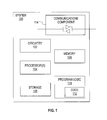
- FIG. 1 illustrates a block diagram of an exemplary system in which various exemplary embodiments of the invention may be implemented
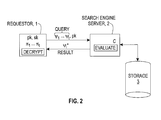
- FIG. 2 illustrates a simple block diagram of a requestor and a server (e.g., devices, apparatus, computer programs, systems), such as a search engine, that use the fully homomorphic encryption scheme constructed from a bootstrappable encryption scheme in accordance with the exemplary embodiments of this invention;
- a server e.g., devices, apparatus, computer programs, systems
- FIG. 3 depicts a logic flow diagram illustrative of the operation of an exemplary method, and the operation of an exemplary computer program, in accordance with the exemplary embodiments of this invention.
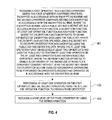
- FIG. 4 depicts a logic flow diagram illustrative of the operation of another exemplary method, and the operation of another exemplary computer program, in accordance with the exemplary embodiments of this invention.
- a fully homomorphic encryption scheme may be considered as one that allows the computation of arbitrary functions over encrypted data without requiring the use of a decryption key.
- pk (N,e)
- ciphertexts ⁇ i ⁇ i e mod N
- a (deterministic) branching program (BP) P is defined by a DAG from a distinguished initial node in which each nonterminal node has two outgoing edges labeled 0 and 1, and where the terminal nodes also have labels.
- Fully homomorphic encryption [21, 8] allows a computationally powerful worker to receive encrypted data and perforin arbitrarily-complex dynamically-chosen computations on that data while it remains encrypted, despite not having the secret decryption key.
- FHE Fully homomorphic encryption
- the first step in Gentry's blueprint is to construct a somewhat homomorphic encryption (SWHE) scheme, namely an encryption scheme capable of evaluating “low-degree” polynomials homomorphically.
- SWHE somewhat homomorphic encryption
- Gentry provided a remarkable bootstrapping theorem which states that given a SWHE scheme that can evaluate its own decryption function (plus an additional operation), one can transform it into a “leveled” FHE scheme.
- a “leveled” FHE scheme the parameters of the scheme may depend on the depth of the circuits that the scheme can evaluate (but not on their size).
- Bootstrapping “refreshes” a ciphertext by running the decryption function on it homomorphically, using an encrypted secret key (given in the public key or obtainable therefrom), resulting in reduced noise (a reduction of noise generated by the operations).
- the final step is to squash the decryption circuit of the SWHE scheme, namely transform the scheme into one with the same homomorphic capacity but a decryption circuit that is simple enough to allow bootstrapping.
- Gentry [8] showed how to do this by adding a “hint”—namely, a large set with a secret sparse subset that sums to the original secret key—to the public key and relying on a “sparse subset sum” assumption.
- a bootstrappable encryption scheme is one wherein the encryption scheme can evaluate its own decryption circuit (e.g., slightly augmented versions of its own decryption circuit). Gentry showed that if the decryption circuit of a SWHE scheme is shallow enough, in particular, if it is shallow enough to be evaluated homomorphically by the somewhat homomorphic scheme itself (a self-referential property), then this somewhat homomorphic scheme becomes “bootstrappable”, and can be used to construct a fully homomorphic scheme that can evaluate circuits of arbitrary depth.
- the decryption circuit of a SWHE scheme is shallow enough, in particular, if it is shallow enough to be evaluated homomorphically by the somewhat homomorphic scheme itself (a self-referential property), then this somewhat homomorphic scheme becomes “bootstrappable”, and can be used to construct a fully homomorphic scheme that can evaluate circuits of arbitrary depth.
- the box is transparent, so that an employee can see what he is doing within the box.
- encryption means that the employee is unable to take something out of the box, not that he is unable to see it.
- the jewelry store owner can recover the finished product at her leisure by using her key.
- This analogy is inadequate in the sense that the glove box might become quite cluttered, whereas in the fully homomorphic encryption scheme only the final product need remain.
- the employee has some way to make any item in the glove box (of his choosing) disappear, even though he still cannot extract the item.
- the server 2 sets ⁇ i * ⁇ Evaluate(pk, C i , ⁇ 1 , . . . , ⁇ t ), where C i is the sub-circuit of C that computes the ith bit of the output. Note that, in practice, the evaluation of and C i * and C j * may share intermediate results, in which case it may be needlessly inefficient to run independent instances of the Evaluate algorithm.
- the exemplary embodiments of this invention enable searching over encrypted data.
- the requestor 1 stores files on the server 2 (e.g., on the Internet), so that the requestor 1 can conveniently access these files without needing the requestor's computer.
- the requestor encrypts the files, otherwise the server 2 could potentially read the private data.
- bits ⁇ 1 , . . . , ⁇ t represent the files, which are encrypted in the ciphertexts ⁇ 1 , . . . , ⁇ t .
- the requestor 1 later wants to download all encrypted files that satisfy a query, e.g., all files containing the word ‘homomorphic’ within 5 words of ‘encryption’, but not the word ‘evoting’.
- the requestor 1 sends the query to the server 2 , which expresses it as a circuit C.
- the server sets ⁇ i * ⁇ Evaluate(pk, C i , ⁇ 1 , . . . , ⁇ t ) and sends these ciphertexts to the requestor 1 . who decrypts the returned ciphertexts to recover C( ⁇ 1 , . . . , ⁇ t ), the (bits of the) files that satisfy the query.
- the requestor preferably provides an upper bound on the number of bits that the response should have, and the encrypted response from the server 2 is padded or truncated to meet the upper bound.
- Fully homomorphic encryption has numerous applications. For example, it enables private search engine queries where the search engine responds to a query without knowledge of the query, i.e., a search engine can provide a succinct encrypted answer to an encrypted (Boolean) query without knowing what the query was. It also enables searching on encrypted data; one can store encrypted data on a remote server and later have the server retrieve only files that (when decrypted) satisfy some Boolean constraint, even though the server cannot decrypt the files on its own. More broadly, fully homomorphic encryption improves the efficiency of secure multiparty computation.
- the complexity of (known approaches to) bootstrapping is inherently at least the complexity of decryption times the bit-length of the individual ciphertexts that are used to encrypt the bits of the secret key.
- bootstrapping involves evaluating the decryption circuit homomorphically—that is, in the decryption circuit, each secret-key bit is replaced by a (large) ciphertext that encrypts that bit—and both the complexity of decryption and the ciphertext lengths must each be ⁇ ( ⁇ ).
- SWHE schemes start with a SWHE scheme that can evaluate polynomials of degree D (multiplicative depth log D) securely only if the underlying lattice problem is hard to 2 D -approximate.
- the lattice must have dimension ⁇ (D ⁇ ). This is because we have lattice algorithms in n dimensions that compute 2 n/ ⁇ -approximations of short vectors in time .
- the coefficients of the vectors used in the scheme have bit length ⁇ (D) to allow the ciphertext noise room to expand to 2 D .
- the size of “fresh” ciphertexts is ⁇ tilde over ( ⁇ ) ⁇ (D 2 ⁇ ). Since the SWHE scheme must be “bootstrappable”—i.e., capable of evaluating its own decryption function—D must exceed the degree of the decryption function. Typically, the degree of the decryption function is ⁇ ( ⁇ ). Thus, overall, “fresh” ciphertexts have size ⁇ tilde over ( ⁇ ) ⁇ ( ⁇ 3 ).
- the transformation from c to c′ involves simply scaling by (p/q) and rounding appropriately!
- the “noise” in the ciphertext actually decreases—namely,
- ⁇ q/2 ⁇ (g/p) ⁇ l 1 (s), we have [ c′,s ] p [ c,s ] q mod 2 and
- modulus switching is not a very effective noise management tool. If p is smaller than q, then of course modulus switching may reduce the magnitude of the noise, but it reduces the modulus size by essentially the same amount. In short, the ratio of the noise to the “noise ceiling” (the modulus size) does not decrease at all. Isn't this ratio what dictates the remaining homomorphic capacity of the scheme, and how can potentially worsening (certainly not improving) this ratio do anything useful?
- this scheme trounces previous FHE schemes (at least asymptotically; the concrete performance remains to be seen).
- instantiated with ring-LWE it can evaluate L-level arithmetic circuits with per-gate computation ⁇ ( ⁇ L 3 )—i.e., computation quasi-linear in the security parameter. Since the ratio of the largest modulus (namely, q ⁇ x L ) to the noise (namely, x) is exponential in L, the scheme relies on the hardness of approximating short vectors to within an exponential in L factor.
- the per-gate computation depends polynomially on the number of levels in the circuit that is being evaluated. While this approach is efficient (in the sense of “polynomial time”) for polynomial-size circuits, the per-gate computation may become undesirably high for very deep circuits. So, we re-introduce bootstrapping as an optimization that makes the per-gate computation independent of the circuit depth, and that (if one is willing to assume circular security) allows homomorphic operations to be performed indefinitely without needing to specify in advance a bound on the number of circuit levels.
- the main idea is that to compute arbitrary polynomial-depth circuits, it is enough to compute the decryption circuit of the scheme homomorphically. Since the decryption circuit has depth ⁇ log ⁇ , the largest modulus we need has only polylog( ⁇ ) bits, and therefore we can base security on the hardness of lattice problems with quasi-polynomial factors. Since the decryption circuit has size ⁇ ( ⁇ ) for the RLWE-based instantiation, the per-gate computation becomes ⁇ ( ⁇ 2 ) (independent of L). See Section 5 for details.
- batching we also consider batching as an optimization.
- the idea behind batching is to pack multiple plaintexts into each ciphertext so that a function can be homomorphically evaluated on multiple inputs with approximately the same efficiency as homomorphically evaluating it on one input.
- R q,d when we also want to specify the degree of the polynomial associated to R.
- ⁇ log q ⁇ When it is obvious that q is not a power of two, we will use ⁇ log q ⁇ to denote 1+ ⁇ log q ⁇ .
- a ⁇ R we use the notation [a] q to refer to a mod q, with coefficients reduced into the range ( ⁇ q/2, q/2].
- E (L) L ⁇ Z + ⁇ is leveled fully homomorphic if, for all L ⁇ Z + , they all use the same decryption circuit, E (L) compactly evaluates all circuits of depth at most L (that use some specified complete set of gates), and the computational complexity of E (L) 's algorithms is polynomial (the same polynomial for all L) in the security parameter, L, and (in the case of the evaluation algorithm) the size of the circuit.
- n n( ⁇ ) be an integer dimension
- ⁇ ⁇ ( ⁇ ) be a distribution over Z.
- the LWE n,q, ⁇ assumption is that the LWE n,q, ⁇ problem is infeasible.
- a distribution ensemble ⁇ n ⁇ n ⁇ N , supported over the integers, is called B-bounded if
- the RLWE problem is useful, because the well-established shortest vector problem (SVP) over ideal lattices can be reduced to it, specifically:
- LWE learning with errors
- RLWE ring learning with errors
- ⁇ ⁇ ( ⁇ ) be a distribution over R.
- the GLWE n,f,q, ⁇ problem is to distinguish the following two distributions: In the first distribution, one samples (a i ,b i ) uniformly from R q n+1 .
- B is a bound (with overwhelming probability) on the length of elements output by ⁇ .
- n ⁇ d perhaps GLWE gradually becomes harder as n increases (if it is true that general lattice problems are harder than ideal lattice problems), whereas increasing d is probably often preferable for efficiency.
- the plan of this section is to present our leveled FHE-without-bootstrapping construction in modular steps.
- n n( ⁇ )
- n or d depends logarithmically on q
- the distribution ⁇ (and hence B) depends sub-linearly on n or d
- the distribution ⁇ (and hence B) depends sub-logarithmically on q. This dependence is weak, and one should think of the noise distribution as being essentially independent of q.
- LPR encryption relies on RLWE: assuming RLWE, if A T were uniform in R q 2 , then the two ring elements m+a 1 ⁇ r+e 1 and a 2 ⁇ r+e 2 of the ciphertext generated during encryption are pseudorandom.
- E.PublicKeyGen (params,sk,N) with an integer parameter N. In that case, it invokes the first version of E.PublicKeyGen (not the LPR version) with the specified value of N.
- Brakerski and Vaikuntanathan convert the long ciphertext represented by the linear equation L long and decryptable by the long tensored secret key s 1 s 1 into a shorter ciphertext c 2 that is decryptable by a different secret key s 2 .
- the secret keys need to be different to avoid a “circular security” issue).
- Encryptions of s 1 s 1 under s 2 are provided in the public key as a “hint” to facilitate this conversion.
- Brakerski and Vaikuntanathan's relinearization/dimension reduction procedures are actually quite a bit more general. They can be used to not only reduce the dimension of the ciphertext, but more generally, can be used to transform a ciphertext c 1 that is decryptable under one secret key vector s 1 to a different ciphertext c 2 that encrypts the same message, but is now decryptable under a second secret key vector s 2 .
- the vectors c 2 ,s 2 may not necessarily be of lower degree or dimension than c 1 ,s 1 .
- BitDecomp can be optimized in the obvious way to output a shorter decomposition in R 2 n ⁇ log B ⁇ .
- key switching consists of two procedures: first, a procedure SwitchKeyGen(s 1 ,s 2 ,n 1 ,n 2 ,q), which takes as input the two secret key vectors, the respective dimensions of these vectors, and the modulus q, and outputs some auxiliary information ⁇ s 1 ⁇ s 2 that enables the switching; and second, a procedure SwitchKey( ⁇ s 1 ⁇ s 2 , c 1 , n 1 , n 2 , q), that takes this auxiliary information and a ciphertext encrypted under s 1 and outputs a new ciphertext c 2 that encrypts the same message under the secret key s 2 .
- a procedure SwitchKeyGen s 1 ,s 2 ,n 1 ,n 2 ,q
- SwitchKey( ⁇ s 1 ⁇ s 2 ,c 1 ): Output c 2 BitDecomp(c 1 ) T ⁇ B ⁇ R q N 2 .
- the matrix A basically consists of encryptions of 0 under the key s 2 . Then, pieces of the key s 1 are added to these encryptions of 0.
- the matrix B consists of encryptions of pieces of s 1 (in a certain format) under the key s 2 .
- Lemma 4 the following corollary follows immediately from Lemma 4.
- s is a fairly short key and the “noise” e q ⁇ [ c,s ] q has small magnitude—precisely, assume that ⁇ e q ⁇ q/2 ⁇ (q/p) ⁇ (r/ 2 ) ⁇ square root over (d) ⁇ R ⁇ l 1 (R) (s).
- the noise e p [ c′,s ] p of the new ciphertext has magnitude at most (p/q) ⁇ [ c,s ] q ⁇ + ⁇ R ⁇ (r/2) ⁇ square root over (d) ⁇ l 1 (R) (s).
- the secret key sk consists of the s j 's and the public key pk consists of the A j 's and ⁇ s j+1′ ⁇ s j 's.
- SwitchKey does not use the usual ponderous approach of representing the decryption function as a boolean circuit to be traversed homomorphically. Another difference is that the SwitchKey step does not actually reduce the noise level (as bootstrapping does); rather, the noise is reduced by the Scale step.
- B ⁇ denotes a bound such that R-elements sampled from the noise distribution ⁇ have length at most B ⁇ with overwhelming probability.
- s j′ s j s j , where the “non-quadratic coefficients” of s f′ (namely, the ‘1’ and the coefficients of s j ) are placed first.
- L c 1 ,c 2 long (x x) be as defined above
- c 3 be the coefficient vector of this linear equation
- s j′ s j s j .
- the noise [ c 3 ,s j′ )] q j has length at most ⁇ R ⁇ B 2 .
- the computation needed to compute the tensored ciphertext c 3 is ⁇ (d j n j 2 log q j ).
- n j 1 and since (as we will see) d j (resp. log q j ) depend only quasi-linearly (resp. logarithmically) on the security parameter and linearly (resp. linearly) on L, the computation here is only quasi-linear in the security parameter.
- the computation is quasi-quadratic.
- FHE.Refresh consists of two steps: Switch Keys and Switch Moduli. We address each of these steps in turn.
- the Switch-Key step involves multiplying the transpose of w j -dimensional vector BitDecomp(c,q j ) with a w j ⁇ (n j +1) matrix B. This computation is ⁇ (d j n j 3 log 2 q j ). Still this is quasi-linear in the RLWE instantiation.
- the Switch Moduli step takes as input a ciphertext c 1 under the secret bit-vector s j ⁇ 1 for the modulus q j , and outputs the ciphertext c 2 ⁇ Scale(c 1 ,q j ,q j ⁇ 1 ,2), which we claim to be a ciphertext under key s j ⁇ 1 for modulus q j ⁇ 1 .
- s j ⁇ 1 is a short secret key.
- the computation in the Switch-Moduli step is ⁇ (d j n j ⁇ 1 log q j ).
- q L the largest modulus used in the system, is ⁇ (L ⁇ (log ⁇ +log L)) bits, and d L ⁇ n L must be approximately that number times ⁇ for 2 ⁇ security.
- FHE is a correct L-leveled FHE scheme—specifically, it correctly evaluates circuits of depth L with Add and Mult gates over R 2 .
- the per-gate computation is ⁇ ( ⁇ 3 ⁇ L 5 ).
- the per-gate computation is ⁇ ( ⁇ L 3 ).
- the bottom line is that we have a RLWE-based leveled FHE scheme with per-gate computation that is only quasi-linear in the security parameter, albeit with somewhat high dependence on the number of levels in the circuit.
- the ciphertext size is at least ⁇ ( ⁇ d 2 ), where d is the degree of the circuit being evaluated.
- d is the degree of the circuit being evaluated.
- Section 5.5 presents a few other miscellaneous optimizations.
- keyword search function that returns ‘1’ if the keyword is present in the data and ‘0’ if it is not.
- the keyword search function is mostly composed of a large number of equality tests that compare the target word w to all of the different subsequences of data; this is followed up by an OR of the equality test results. All of these equality tests involve running the same w-dependent function on different blocks of data. If we could batch these equality tests, it could significantly reduce the computation needed to perform keyword search homomorphically.
- the ideal p i equals (p,x ⁇ a i )—namely, the set of all R-elements that can be expressed as r 1 ⁇ p+r 2 ⁇ (x ⁇ a i ) for some r 1 ,r 2 ⁇ R.
- Each ideal p i has norm p—that is, roughly speaking, a 1/p fraction of R-elements are in p i , or, more formally, the p cosets 0+p i , . . . , (p ⁇ 1 )+p i partition R.
- These ideals are relative prime, and so they behave like relative prime integers.
- the Chinese Remainder Theorem applies: R p ⁇ R p 1 ⁇ . . . ⁇ R p d .
- ⁇ p i ⁇ are relatively prime, they are close siblings, and it is easy, in some sense, to switch from one to another.
- One fact that we will use (when we finally apply batching to bootstrapping) is that, for any i,j there is an automorphism ⁇ i ⁇ j over R that maps elements of p i to elements of p j .
- the final step is simply to recognize that, by the Chinese Remainder Theorem, evaluating an arithmetic circuit over R p on input x ⁇ R p n implicitly evaluates, for each i, the same arithmetic circuit over R p i on input x projected down to R p i n .
- the evaluations modulo the various prime ideals do not “mix” or interact with each other.
- Bootstrapping is rather expensive computationally.
- the cost of bootstrapping a ciphertext is greater than the cost of a homomorphic operation by approximately a factor of ⁇ .
- the answer is yes.
- h( ⁇ ,L) has a minimum at some positive value of L. Since ⁇ ( ⁇ ,L) is monotonically increasing (i.e., the derivative is positive), the minimum must occur where the derivative of g( ⁇ ,c+L)/L is negative.
- Pack and Unpack functions that allow the batching procedure to interface with “normal” homomorphic operations.
- m i [[ c i′ ,s 2′ ] q ] p 1 for all i.
- our ladder of moduli will also consist of ideals—in particular, principle ideals (q j ) generated by an element of q j ⁇ R.
- ideals in particular, principle ideals (q j ) generated by an element of q j ⁇ R.
- q j principle ideals
- P q be the half-open parallelepiped associated to the rotation basis of q ⁇ R.
- the rotation basis B q of q is the d-dimensional basis formed by the coefficient vectors of the polynomials x i q(x) mod ⁇ (x) for i ⁇ [0,d ⁇ 1].
- This notation refers to a reduced modulo the rotation basis B q of q—i.e., the element [a] q such that [a] q ⁇ a ⁇ qR and [a] q ⁇ P q .
- the inner radius r q,in and outer radius r q,out of P q that is, the largest radius of a ball that is circumscribed by P q , and the smallest radius of a ball that circumscribes P q . It is possible to choose q so that the ratio r q,out /r q,in is poly(d). For example, this is true when q is an integer.
- ⁇ q ⁇ 1 ⁇ refers to the Euclidean norm of the coefficient vector of the inverse of q in the overlying field Q(x)/ ⁇ (x).
- q is ⁇ -good.
- r B,out to denote the outer radius associated to the parallelepiped determined by basis B.
- q 1 and q 2 , ⁇ q 1 ⁇ q 2 ⁇ be two ⁇ -good elements of R.
- B I be a short basis (with outer radius r B I ,out ) of an ideal I of R such that q 1 ⁇ q 2 ⁇ I.
- c be an integer vector and c′ ⁇ Scale(c,q 2 ,q 1 ,I)—that is, c′ is an R-element at most 2r B I ,out distant from (q 1 /q 2 ) ⁇ c such that c′ ⁇ c ⁇ I. Then, for any s with
- the keys ⁇ s j ⁇ may all be the same, thereby permitting a public key of size independent of L.
- squashing may still be a useful optimization in practice, as it can be used to lower the depth of the decryption function, thereby reducing the size of the largest modulus needed in the scheme, which may improve efficiency.
- noise ceiling is the modulus.
- a ciphertext c mod p has vector coefficients on the range ( ⁇ p/2,p/2). If the noise becomes too large relative to the modulus (the range for coefficients defined by the modulus) then decryption of the ciphertext may fail and correctness is lost. As previously noted, it is not just the ratio of the noise to the “noise ceiling” that is important—one must also consider the (absolute) magnitude of the noise, especially in multiplications.
- the magnitude of the noise constrains the number of levels L that can be used. This is what leads the bootstrapping approach only to enable logarithmic depth circuits.
- the magnitude of the noise may be considered the noise floor—an upper bound on the size of the actual noise. The goal is to have the noise floor meet the noise ceiling as slowly as possible since this will allow for more levels and more operations to be performed homomorphically.
- the noise floor remains fixed and the noise ceiling is reduced by a fixed factor (p/q) due to modulus switching.
- p/q a fixed factor due to modulus switching.
- BV uses dimension reduction which is a kind of “bundled” key-switching and modulus-switching step.
- the dimension reduction is applied once (once each epoch between bootstrappings) immediately before bootstrapping to get the ciphertext to be very small (which simplifies the bootstrapping process).
- BV lets the noise grow uncontrolled (e.g., exponentially) and uses dimension reduction at the end (right before bootstrapping). Since the noise is allowed to grow uncontrolled, big parameters must be used (the ciphertexts are vectors of big dimension with big coefficients).
- the exemplary embodiments of the invention use modulus switching as a separate step, not bundled with key switching per se. Since this step merely involves multiplying by a known fraction and rounding appropriately, it can be performed even without any public key material—in particular without the “evaluation key” that BV needs to perform dimension reduction. Furthermore, the exemplary embodiments of the invention use modulus switching iteratively as an aggressive noise management technique rather than only as a precursor to bootstrapping.
- Manuscript to appear in FOCS 2011, available at http://eprint.iacr.org/2011/344.
- Z. Brakerski and V. Vaikuntanathan Fully homomorphic encryption from ring-lwe and security for key dependent messages. Manuscript, to appear in CRYPTO 2011. [5] J. -S. Coron, A. Mandal, D. Naccache, and M. Tibouchi. Fully-homomorphic encryption over the integers with shorter public-keys. Manuscript, to appear in Crypto 2011. [6] M. Dijk, C. Gentry, S. Halevi, and V. Vaikuntanathan. Fully homomorphic encryption over the integers.
- FIG. 1 illustrates a block diagram of an exemplary system in which various exemplary embodiments of the invention may be implemented.
- the system 100 may include at least one circuitry 102 (e.g., circuitry element, circuitry components, integrated circuit) that may in certain exemplary embodiments include at least one processor 104 .
- the system 100 may also include at least one memory 106 (e.g., a volatile memory device, a non-volatile memory device), and/or at least one storage 108 .
- the storage 108 may include a non-volatile memory device (e.g., EEPROM, ROM, PROM, RAM, DRAM, SRAM, flash, firmware, programmable logic, etc.), magnetic disk drive, optical disk drive and/or tape drive, as non-limiting examples.
- the storage 108 may comprise an internal storage device, an attached storage device and/or a network accessible storage device, as non-limiting examples.
- the system 100 may include at least one program logic 110 including code 112 (e.g., program code) that may be loaded into the memory 106 and executed by the processor 104 and/or circuitry 102 .
- the program logic 110 including code 112 , may be stored in the storage 108 .
- the program logic 110 may be implemented in the circuitry 102 . Therefore, while FIG. 1 shows the program logic 110 separately from the other elements, the program logic 110 may be implemented in the memory 106 and/or the circuitry 102 , as non-limiting examples.
- the system 100 may include at least one communications component 114 that enables communication with at least one other component, system, device and/or apparatus.
- the communications component 114 may include a transceiver configured to send and receive information, a transmitter configured to send information and/or a receiver configured to receive information.
- the communications component 114 may comprise a modem or network card.
- the system 100 of FIG. 1 may be embodied in a computer or computer system, such as a desktop computer, a portable computer or a server, as non-limiting examples.
- the components of the system 100 shown in FIG. 1 may be connected or coupled together using one or more internal buses, connections, wires and/or (printed) circuit boards, as non-limiting examples.
- one or more of the circuitry 102 , processor(s) 104 , memory 106 , storage 108 , program logic 110 and/or communications component 114 may store one or more of the various items (e.g., public/private key(s), ciphertexts, encrypted items, matrices, variables, equations, formula, operations, operational logic, logic) discussed herein.
- one or more of the above-identified components may receive and/or store the information (e.g., to be encrypted, resulting from decryption) and/or the ciphertext (e.g., to be decrypted, to be operated on homomorphically, resulting from encryption).
- one or more of the above-identified components may receive and/or store the encryption function(s) and/or the decryption function(s), as described herein.
- the exemplary embodiments of this invention may be carried out by computer software implemented by the processor 104 or by hardware, or by a combination of hardware and software.
- the exemplary embodiments of this invention may be implemented by one or more integrated circuits.
- the memory 106 may be of any type appropriate to the technical environment and may be implemented using any appropriate data storage technology, such as optical memory devices, magnetic memory devices, semiconductor-based memory devices, fixed memory and removable memory, as non-limiting examples.
- the processor 104 may be of any type appropriate to the technical environment, and may encompass one or more of microprocessors, general purpose computers, special purpose computers and processors based on a multi-core architecture, as non-limiting examples.
- the noise i.e., the magnitude of the noise
- the gap between the modulus (e.g., ceiling) and the noise (e.g., floor) eventually runs out.
- the initial modulus big enough to enable the polynomial depth circuit to be executed by the time the gap runs out or one can utilize bootstrapping once the gap runs out.
- the exemplary embodiments of the invention enable a polynomial depth circuit of multiplications starting with parameters that are only polynomial in size.
- the growth of the noise would be similar, if not identical, in speed and/or value to the described reduction of the modulus.
- it is a technique that involves maintaining one of the floor or ceiling at a (relatively, substantially) constant value and having the other one approach (e.g., decrease for the ceiling or increase for the floor) by utilizing what amounts to different moduli.
- Modulus switching essentially suggests that a particular value of the modulus is irrelevant since it is the magnitude of the noise that may be accounted for instead (e.g., as opposed to the ratio of noise to modulus).
- a method comprising: receiving ( 301 ) a first ciphertext and a second ciphertext, where the first ciphertext comprises first data encrypted in accordance with an encryption scheme and the second ciphertext comprises second data encrypted in accordance with the encryption scheme, where the encryption scheme uses a public key and a secret key and includes an encryption function, a decryption function, at least one operation function and a refresh function, where the encryption function operates to obtain ciphertext by encrypting data using the public key, where the decryption function operates using the secret key to decrypt ciphertext for data encrypted using the public key and obtain the data, where the at least one operation function receives at least two ciphertexts and uses the public key to perform at least one operation on the at least two ciphertexts and obtain a resulting ciphertext, where the refresh function operates to prevent growth of the magnitude of noise for a ciphertext while reducing the modulus of the cip
- the at least one operation function comprises at least one of an addition and a multiplication, where in response to a multiplication being performed the refresh function is applied.
- the at least one operation function comprises at least one of an addition and a multiplication, where in response to a multiplication being desired the refresh function is applied to at least one input of the multiplication.
- the encryption scheme enables evaluation of a polynomial depth circuit of multiplications.
- a computer program comprising machine readable instructions which when executed by an apparatus control it to perform the method as in any one of the preceding claims.
- a program storage device e.g., at least one memory, at least one computer-readable medium
- executable by a computer e.g., at least one processor.
- a computer-readable storage medium storing program instructions, execution of the program instructions resulting in operations comprising: receiving ( 301 ) a first ciphertext and a second ciphertext, where the first ciphertext comprises first data encrypted in accordance with an encryption scheme and the second ciphertext comprises second data encrypted in accordance with the encryption scheme, where the encryption scheme uses a public key and a secret key and includes an encryption function, a decryption function, at least one operation function and a refresh function, where the encryption function operates to obtain ciphertext by encrypting data using the public key, where the decryption function operates using the secret key to decrypt ciphertext for data encrypted using the public key and obtain the data, where the at least one operation function receives at least two ciphertexts and uses the public key to perform at least one operation on the at least two ciphertexts and obtain a resulting ciphertext, where the refresh function operates to prevent growth of the magnitude of
- a computer readable medium as in any above, further comprising one or more additional aspects of the exemplary embodiments of the invention as described herein.
- an apparatus comprising: at least one processor configured to receive a first ciphertext and a second ciphertext, where the first ciphertext comprises first data encrypted in accordance with an encryption scheme and the second ciphertext comprises second data encrypted in accordance with the encryption scheme, where the encryption scheme uses a public key and a secret key and includes an encryption function, a decryption function, at least one operation function and a refresh function, where the encryption function operates to obtain ciphertext by encrypting data using the public key, where the decryption function operates using the secret key to decrypt ciphertext for data encrypted using the public key and obtain the data, where the at least one operation function receives at least two ciphertexts and uses the public key to perform at least one operation on the at least two ciphertexts and obtain a resulting ciphertext, where the refresh function operates to prevent growth of the magnitude of noise for a ciphertext while reducing the modulus of the ciphertext without using the secret key
- an apparatus comprising: means for receiving (e.g., at least one input, at least one processor, at least one receiver) a first ciphertext and a second ciphertext, where the first ciphertext comprises first data encrypted in accordance with an encryption scheme and the second ciphertext comprises second data encrypted in accordance with the encryption scheme, where the encryption scheme uses a public key and a secret key and includes an encryption function, a decryption function, at least one operation function and a refresh function, where the encryption function operates to obtain ciphertext by encrypting data using the public key, where the decryption function operates using the secret key to decrypt ciphertext for data encrypted using the public key and obtain the data, where the at least one operation function receives at least two ciphertexts and uses the public key to perform at least one operation on the at least two ciphertexts and obtain a resulting ciphertext, where the refresh function operates to prevent growth of the magnitude of noise for a ciphertext while
- An apparatus as in any above further comprising means for storing at least one ciphertext (e.g., the first ciphertext, the second ciphertext, and/or the third ciphertext).
- An apparatus as in any above further comprising one or more additional aspects of the exemplary embodiments of the invention as described herein.
- an apparatus comprising: reception circuitry configured to receive a first ciphertext and a second ciphertext, where the first ciphertext comprises first data encrypted in accordance with an encryption scheme and the second ciphertext comprises second data encrypted in accordance with the encryption scheme, where the encryption scheme uses a public key and a secret key and includes an encryption function, a decryption function, at least one operation function and a refresh function, where the encryption function operates to obtain ciphertext by encrypting data using the public key, where the decryption function operates using the secret key to decrypt ciphertext for data encrypted using the public key and obtain the data, where the at least one operation function receives at least two ciphertexts and uses the public key to perform at least one operation on the at least two ciphertexts and obtain a resulting ciphertext, where the refresh function operates to prevent growth of the magnitude of noise for a ciphertext while reducing the modulus of the ciphertext without using the secret key
- an apparatus comprising: a first system configured to receive a first ciphertext and a second ciphertext, where the first ciphertext comprises first data encrypted in accordance with an encryption scheme and the second ciphertext comprises second data encrypted in accordance with the encryption scheme, where the encryption scheme uses a public key and a secret key and includes an encryption function, a decryption function, at least one operation function and a refresh function, where the encryption function operates to obtain ciphertext by encrypting data using the public key, where the decryption function operates using the secret key to decrypt ciphertext for data encrypted using the public key and obtain the data, where the at least one operation function receives at least two ciphertexts and uses the public key to perform at least one operation on the at least two ciphertexts and obtain a resulting ciphertext, where the refresh function operates to prevent growth of the magnitude of noise for a ciphertext while reducing the modulus of the ciphertext without using the secret key,
- a method comprising: receiving ( 401 ) a first ciphertext and a second ciphertext, where the first ciphertext comprises first data encrypted in accordance with an encryption scheme and the second ciphertext comprises second data encrypted in accordance with the encryption scheme, where the encryption scheme uses a public key and a secret key and includes an encryption function, a decryption function, at least one operation function and a refresh function, where the encryption function operates to obtain ciphertext by encrypting data using the public key, where the decryption function operates using the secret key to decrypt ciphertext for data encrypted using the public key and obtain the data, where the at least one operation function receives at least two ciphertexts and uses the public key to perform at least one operation on the at least two ciphertexts and obtain a resulting ciphertext, where the refresh function operates to enable slow growth of the magnitude of noise for a ciphertext while maintaining the modulus of the
- the magnitude of noise for the ciphertext is represented as a fractional part of coefficients for the ciphertext.
- the at least one operation function comprises at least one of an addition and a multiplication, where in response to a multiplication being performed the refresh function is applied.
- the encryption scheme enables evaluation of a polynomial depth circuit of multiplications.
- a computer program comprising machine readable instructions which when executed by an apparatus control it to perform the method as in any one of the preceding claims.
- a program storage device e.g., at least one memory, at least one computer-readable medium
- executable by a computer e.g., at least one processor.
- a computer-readable storage medium storing program instructions, execution of the program instructions resulting in operations comprising: receiving ( 401 ) a first ciphertext and a second ciphertext, where the first ciphertext comprises first data encrypted in accordance with an encryption scheme and the second ciphertext comprises second data encrypted in accordance with the encryption scheme, where the encryption scheme uses a public key and a secret key and includes an encryption function, a decryption function, at least one operation function and a refresh function, where the encryption function operates to obtain ciphertext by encrypting data using the public key, where the decryption function operates using the secret key to decrypt ciphertext for data encrypted using the public key and obtain the data, where the at least one operation function receives at least two ciphertexts and uses the public key to perform at least one operation on the at least two ciphertexts and obtain a resulting ciphertext, where the refresh function operates to enable slow growth of the
- a computer readable medium as in any above, further comprising one or more additional aspects of the exemplary embodiments of the invention as described herein.
- an apparatus comprising: at least one processor configured to receive a first ciphertext and a second ciphertext, where the first ciphertext comprises first data encrypted in accordance with an encryption scheme and the second ciphertext comprises second data encrypted in accordance with the encryption scheme, where the encryption scheme uses a public key and a secret key and includes an encryption function, a decryption function, at least one operation function and a refresh function, where the encryption function operates to obtain ciphertext by encrypting data using the public key, where the decryption function operates using the secret key to decrypt ciphertext for data encrypted using the public key and obtain the data, where the at least one operation function receives at least two ciphertexts and uses the public key to perform at least one operation on the at least two ciphertexts and obtain a resulting ciphertext, where the refresh function operates to enable slow growth of the magnitude of noise for a ciphertext while maintaining the modulus of the ciphertext constant without using the
- an apparatus comprising: means for receiving (e.g., at least one input, at least one processor, at least one receiver) a first ciphertext and a second ciphertext, where the first ciphertext comprises first data encrypted in accordance with an encryption scheme and the second ciphertext comprises second data encrypted in accordance with the encryption scheme, where the encryption scheme uses a public key and a secret key and includes an encryption function, a decryption function, at least one operation function and a refresh function, where the encryption function operates to obtain ciphertext by encrypting data using the public key, where the decryption function operates using the secret key to decrypt ciphertext for data encrypted using the public key and obtain the data, where the at least one operation function receives at least two ciphertexts and uses the public key to perform at least one operation on the at least two ciphertexts and obtain a resulting ciphertext, where the refresh function operates to enable slow growth of the magnitude of noise for a ciphertext
- an apparatus comprising: reception circuitry configured to receive a first ciphertext and a second ciphertext, where the first ciphertext comprises first data encrypted in accordance with an encryption scheme and the second ciphertext comprises second data encrypted in accordance with the encryption scheme, where the encryption scheme uses a public key and a secret key and includes an encryption function, a decryption function, at least one operation function and a refresh function, where the encryption function operates to obtain ciphertext by encrypting data using the public key, where the decryption function operates using the secret key to decrypt ciphertext for data encrypted using the public key and obtain the data, where the at least one operation function receives at least two ciphertexts and uses the public key to perform at least one operation on the at least two ciphertexts and obtain a resulting ciphertext, where the refresh function operates to enable slow growth of the magnitude of noise for a ciphertext while maintaining the modulus of the ciphertext constant without using the secret
- an apparatus comprising: a first system configured to receive a first ciphertext and a second ciphertext, where the first ciphertext comprises first data encrypted in accordance with an encryption scheme and the second ciphertext comprises second data encrypted in accordance with the encryption scheme, where the encryption scheme uses a public key and a secret key and includes an encryption function, a decryption function, at least one operation function and a refresh function, where the encryption function operates to obtain ciphertext by encrypting data using the public key, where the decryption function operates using the secret key to decrypt ciphertext for data encrypted using the public key and obtain the data, where the at least one operation function receives at least two ciphertexts and uses the public key to perform at least one operation on the at least two ciphertexts and obtain a resulting ciphertext, where the refresh function operates to enable slow growth of the magnitude of noise for a ciphertext while maintaining the modulus of the ciphertext constant without using the secret key
- exemplary embodiments of the invention may be implemented in conjunction with a program storage device (e.g., at least one memory, computer-readable memory, computer-readable medium, computer-readable storage medium, computer-readable storage device, non-transitory computer-readable medium such as memory, flash memory, magnetic memory devices, EEPROM, ROM, PROM, RAM, DRAM, SRAM, firmware, programmable logic, etc.) readable by a machine (e.g., a device, apparatus, at least one processor), tangibly embodying a program of instructions (e.g., program, computer program) executable (e.g., by the machine) for performing operations.
- the operations comprise steps of utilizing the exemplary embodiments or steps of the method.
- FIGS. 3 and 4 further may be considered to correspond to one or more functions and/or operations that are performed by one or more components, circuits, chips, apparatus, processors, computer programs and/or function blocks. Any and/or all of the above may be implemented in any practicable solution or arrangement that enables operation in accordance with the exemplary embodiments of the invention as described herein.
- FIGS. 3 and 4 should be considered merely exemplary and non-limiting. It should be appreciated that the blocks shown in FIGS. 3 and 4 may correspond to one or more functions and/or operations that may be performed in any order (e.g., any suitable, practicable and/or feasible order) and/or concurrently (e.g., as suitable, practicable and/or feasible) so as to implement one or more of the exemplary embodiments of the invention. In addition, one or more additional functions, operations and/or steps may be utilized in conjunction with those shown in FIGS. 3 and 4 so as to implement one or more further exemplary embodiments of the invention.
- FIGS. 3 and 4 may be utilized, implemented or practiced in conjunction with one or more further aspects in any combination (e.g., any combination that is suitable, practicable and/or feasible) and are not limited only to the steps, blocks, operations and/or functions shown in FIGS. 3 and 4 .
- connection or coupling should be interpreted to indicate any such connection or coupling, direct or indirect, between the identified elements.
- one or more intermediate elements may be present between the “coupled” elements.
- the connection or coupling between the identified elements may be, as non-limiting examples, physical, electrical, magnetic, logical or any suitable combination thereof in accordance with the described exemplary embodiments.
- the connection or coupling may comprise one or more printed electrical connections, wires, cables, mediums or any suitable combination thereof.
- various exemplary embodiments of the invention can be implemented in different mediums, such as software, hardware, logic, special purpose circuits or any combination thereof.
- some aspects may be implemented in software which may be run on a computing device, while other aspects may be implemented in hardware.
Landscapes
- Engineering & Computer Science (AREA)
- Computer Security & Cryptography (AREA)
- Computer Networks & Wireless Communication (AREA)
- Signal Processing (AREA)
- Physics & Mathematics (AREA)
- Algebra (AREA)
- General Physics & Mathematics (AREA)
- Mathematical Analysis (AREA)
- Mathematical Optimization (AREA)
- Mathematical Physics (AREA)
- Pure & Applied Mathematics (AREA)
- Computing Systems (AREA)
- Theoretical Computer Science (AREA)
- Financial Or Insurance-Related Operations Such As Payment And Settlement (AREA)
Priority Applications (2)
| Application Number | Priority Date | Filing Date | Title |
|---|---|---|---|
| US13/458,518 US9083526B2 (en) | 2011-04-29 | 2012-04-27 | Fully homomorphic encryption |
| US14/740,354 US9716590B2 (en) | 2011-04-29 | 2015-06-16 | Fully homomorphic encryption |
Applications Claiming Priority (2)
| Application Number | Priority Date | Filing Date | Title |
|---|---|---|---|
| US201161481048P | 2011-04-29 | 2011-04-29 | |
| US13/458,518 US9083526B2 (en) | 2011-04-29 | 2012-04-27 | Fully homomorphic encryption |
Related Child Applications (1)
| Application Number | Title | Priority Date | Filing Date |
|---|---|---|---|
| US14/740,354 Continuation US9716590B2 (en) | 2011-04-29 | 2015-06-16 | Fully homomorphic encryption |
Publications (2)
| Publication Number | Publication Date |
|---|---|
| US20130170640A1 US20130170640A1 (en) | 2013-07-04 |
| US9083526B2 true US9083526B2 (en) | 2015-07-14 |
Family
ID=47072788
Family Applications (2)
| Application Number | Title | Priority Date | Filing Date |
|---|---|---|---|
| US13/458,518 Expired - Fee Related US9083526B2 (en) | 2011-04-29 | 2012-04-27 | Fully homomorphic encryption |
| US14/740,354 Expired - Fee Related US9716590B2 (en) | 2011-04-29 | 2015-06-16 | Fully homomorphic encryption |
Family Applications After (1)
| Application Number | Title | Priority Date | Filing Date |
|---|---|---|---|
| US14/740,354 Expired - Fee Related US9716590B2 (en) | 2011-04-29 | 2015-06-16 | Fully homomorphic encryption |
Country Status (2)
| Country | Link |
|---|---|
| US (2) | US9083526B2 (fr) |
| WO (1) | WO2012149395A1 (fr) |
Cited By (27)
| Publication number | Priority date | Publication date | Assignee | Title |
|---|---|---|---|---|
| US20150063563A1 (en) * | 2013-09-05 | 2015-03-05 | Xerox Corporation | Private two-party computation using partially homomorphic encryption |
| US20150100785A1 (en) * | 2013-10-09 | 2015-04-09 | Thomson Licensing | Method for ciphering a message via a keyed homomorphic encryption function, corresponding electronic device and computer program product |
| US20170169425A1 (en) * | 2015-12-11 | 2017-06-15 | Paypal, Inc. | Selective encryption of transactional information for different participants of an electronic transaction |
| US9893880B2 (en) | 2012-11-16 | 2018-02-13 | Raytheon Bbn Technologies Corp. | Method for secure symbol comparison |
| US9900147B2 (en) | 2015-12-18 | 2018-02-20 | Microsoft Technology Licensing, Llc | Homomorphic encryption with optimized homomorphic operations |
| US10075289B2 (en) | 2015-11-05 | 2018-09-11 | Microsoft Technology Licensing, Llc | Homomorphic encryption with optimized parameter selection |
| US10153894B2 (en) | 2015-11-05 | 2018-12-11 | Microsoft Technology Licensing, Llc | Homomorphic encryption with optimized encoding |
| US10296709B2 (en) | 2016-06-10 | 2019-05-21 | Microsoft Technology Licensing, Llc | Privacy-preserving genomic prediction |
| US10333696B2 (en) | 2015-01-12 | 2019-06-25 | X-Prime, Inc. | Systems and methods for implementing an efficient, scalable homomorphic transformation of encrypted data with minimal data expansion and improved processing efficiency |
| US10581812B2 (en) * | 2015-12-01 | 2020-03-03 | Duality Technologies, Inc. | Device, system and method for fast and secure proxy re-encryption |
| US10728227B2 (en) | 2016-08-02 | 2020-07-28 | X-Logos, LLC | Methods and systems for enhanced data-centric encryption systems using geometric algebra |
| US10924262B2 (en) | 2017-02-08 | 2021-02-16 | Crypto Lab Inc. | Method for processing dynamic data by fully homomorphic encryption method |
| US11050720B2 (en) * | 2014-07-22 | 2021-06-29 | Nanthealth, Inc. | Homomorphic encryption in a data processing network environment, system and methods |
| US11115182B2 (en) | 2018-07-27 | 2021-09-07 | Crypto Lab Inc. | Apparatus for approximately processing encrypted messages and methods thereof |
| US11139971B2 (en) * | 2017-08-07 | 2021-10-05 | Infineon Technologies Ag | Conducting a cryptographic operation |
| US11341269B2 (en) * | 2017-12-28 | 2022-05-24 | Flytxt B.V. | Providing security against user collusion in data analytics using random group selection |
| US11381381B2 (en) * | 2019-05-31 | 2022-07-05 | Intuit Inc. | Privacy preserving oracle |
| US11436340B2 (en) | 2019-06-24 | 2022-09-06 | Bank Of America Corporation | Encrypted device identification stream generator for secure interaction authentication |
| US11496295B2 (en) | 2019-12-23 | 2022-11-08 | Samsung Electronics Co., Ltd. | Non-transitory computer-readable medium storing program code, decryption device, and communication system including encryption device and decryption device |
| US20220376890A1 (en) * | 2021-05-21 | 2022-11-24 | Samsung Electronics Co., Ltd. | Method and apparatus for modulus refresh in homomorphic encryption |
| US11641274B2 (en) | 2019-03-22 | 2023-05-02 | Jpmorgan Chase Bank, N.A. | Systems and methods for manipulation of private information on untrusted environments |
| US11683151B2 (en) | 2020-09-17 | 2023-06-20 | Algemetric, Inc. | Methods and systems for distributed computation within a fully homomorphic encryption scheme using p-adic numbers |
| US11764940B2 (en) | 2019-01-10 | 2023-09-19 | Duality Technologies, Inc. | Secure search of secret data in a semi-trusted environment using homomorphic encryption |
| US11764943B2 (en) | 2020-08-10 | 2023-09-19 | Algemetric, Inc. | Methods and systems for somewhat homomorphic encryption and key updates based on geometric algebra for distributed ledger/blockchain technology |
| US20240195618A1 (en) * | 2022-12-12 | 2024-06-13 | Tata Consultancy Services Limited | Method and system for a lattice-based homomorphic proxy re-encryption scheme |
| US12494895B2 (en) * | 2021-11-15 | 2025-12-09 | Axell Corporation | Encryption processing apparatus and encryption processing method |
| US12609808B2 (en) * | 2021-10-20 | 2026-04-21 | Axell Corporation | Encryption processing apparatus and encryption processing method |
Families Citing this family (122)
| Publication number | Priority date | Publication date | Assignee | Title |
|---|---|---|---|---|
| US8972742B2 (en) * | 2009-09-04 | 2015-03-03 | Gradiant | System for secure image recognition |
| US8539220B2 (en) | 2010-02-26 | 2013-09-17 | Microsoft Corporation | Secure computation using a server module |
| JP5790287B2 (ja) * | 2011-08-12 | 2015-10-07 | ソニー株式会社 | 情報処理装置、情報処理方法、プログラム、及び記録媒体 |
| US9215068B2 (en) * | 2011-09-14 | 2015-12-15 | National Institute Of Advanced Industrial Science And Technology | Search system, search method, and program |
| US9197613B2 (en) * | 2011-12-20 | 2015-11-24 | Industrial Technology Research Institute | Document processing method and system |
| US9281941B2 (en) * | 2012-02-17 | 2016-03-08 | International Business Machines Corporation | Homomorphic evaluation including key switching, modulus switching, and dynamic noise management |
| WO2014109828A2 (fr) * | 2012-11-16 | 2014-07-17 | Raytheon Bbn Technologies Corp. | Procédé de recherche de sous-chaîne sécurisée |
| US9306738B2 (en) * | 2012-12-21 | 2016-04-05 | Microsoft Technology Licensing, Llc | Managed secure computations on encrypted data |
| EP2951945B1 (fr) * | 2013-01-29 | 2020-09-09 | NEC Corporation | Procédé et système permettant de fournir des données chiffrées pour rechercher des informations, et procédé et système permettant de rechercher des informations sur des données chiffrées |
| US10341086B2 (en) * | 2013-01-29 | 2019-07-02 | Nec Corporation | Method and system for providing encrypted data for searching of information therein and a method and system for searching of information on encrypted data |
| US9313022B2 (en) | 2013-12-27 | 2016-04-12 | Xerox Corporation | Homomorphic cryptography modeling in support of privacy policies |
| WO2015130297A1 (fr) | 2014-02-28 | 2015-09-03 | Empire Technology Development Llc | Protocole de chiffrement homomorphique |
| US10075288B1 (en) * | 2014-02-28 | 2018-09-11 | The Governing Council Of The University Of Toronto | Systems, devices, and processes for homomorphic encryption |
| JP6273951B2 (ja) * | 2014-03-24 | 2018-02-07 | 富士通株式会社 | 暗号化装置、暗号化方法、情報処理装置および暗号化システム |
| SG11201608601TA (en) * | 2014-04-23 | 2016-11-29 | Agency Science Tech & Res | Method and system for generating / decrypting ciphertext, and method and system for searching ciphertexts in a database |
| KR102251697B1 (ko) | 2014-04-23 | 2021-05-14 | 삼성전자주식회사 | 암호화 장치, 암호화 방법 및 컴퓨터 판독가능 기록매체 |
| US9749128B2 (en) | 2014-05-15 | 2017-08-29 | Xerox Corporation | Compact fuzzy private matching using a fully-homomorphic encryption scheme |
| CN105447361B (zh) * | 2014-08-27 | 2018-08-21 | 华为技术有限公司 | 加密和相似性度量的方法、终端及服务器 |
| US10938547B2 (en) | 2015-01-12 | 2021-03-02 | Nec Corporation | Method and system for providing encrypted data |
| US10594472B2 (en) | 2015-03-09 | 2020-03-17 | Jintai Ding | Hybrid fully homomorphic encryption (F.H.E.) systems |
| US9967289B2 (en) | 2015-03-12 | 2018-05-08 | Fornetix Llc | Client services for applied key management systems and processes |
| US10560440B2 (en) | 2015-03-12 | 2020-02-11 | Fornetix Llc | Server-client PKI for applied key management system and process |
| US10630686B2 (en) | 2015-03-12 | 2020-04-21 | Fornetix Llc | Systems and methods for organizing devices in a policy hierarchy |
| US10965459B2 (en) | 2015-03-13 | 2021-03-30 | Fornetix Llc | Server-client key escrow for applied key management system and process |
| US10630472B2 (en) | 2015-04-29 | 2020-04-21 | Nec Corporation | Method and system for providing encrypted data on a client |
| US9813234B2 (en) * | 2015-05-11 | 2017-11-07 | The United States of America, as represented by the Secretery of the Air Force | Transferable multiparty computation |
| US10615961B2 (en) * | 2015-06-02 | 2020-04-07 | Telefonatiebolaget Lm Ericsson (Publ) | Method and encryption node for encrypting message |
| US9742556B2 (en) * | 2015-08-25 | 2017-08-22 | International Business Machines Corporation | Comparison and search operations of encrypted data |
| US9973334B2 (en) * | 2015-09-03 | 2018-05-15 | Cisco Technology, Inc. | Homomorphically-created symmetric key |
| FR3042625B1 (fr) * | 2015-10-14 | 2017-12-15 | Commissariat Energie Atomique | Methode d'interrogation confidentielle d'une base de donnees chiffree |
| US10015007B2 (en) | 2015-11-25 | 2018-07-03 | International Business Machines Corporation | Performing efficient comparison operations on encrypted data |
| US9876636B2 (en) | 2016-01-07 | 2018-01-23 | Empire Technology Development Llc | Homomorphic public-key encryption scheme |
| US11063980B2 (en) | 2016-02-26 | 2021-07-13 | Fornetix Llc | System and method for associating encryption key management policy with device activity |
| US10860086B2 (en) | 2016-02-26 | 2020-12-08 | Fornetix Llc | Policy-enabled encryption keys having complex logical operations |
| US10931653B2 (en) | 2016-02-26 | 2021-02-23 | Fornetix Llc | System and method for hierarchy manipulation in an encryption key management system |
| US10880281B2 (en) | 2016-02-26 | 2020-12-29 | Fornetix Llc | Structure of policies for evaluating key attributes of encryption keys |
| US10348485B2 (en) * | 2016-02-26 | 2019-07-09 | Fornetix Llc | Linking encryption key management with granular policy |
| US10917239B2 (en) | 2016-02-26 | 2021-02-09 | Fornetix Llc | Policy-enabled encryption keys having ephemeral policies |
| US20170293913A1 (en) * | 2016-04-12 | 2017-10-12 | The Governing Council Of The University Of Toronto | System and methods for validating and performing operations on homomorphically encrypted data |
| US10833841B2 (en) * | 2016-07-13 | 2020-11-10 | Sap Se | Leakage-free order-preserving encryption |
| US11176624B2 (en) * | 2016-08-29 | 2021-11-16 | International Business Machines Corporation | Privacy-preserving smart metering |
| US9698986B1 (en) | 2016-09-23 | 2017-07-04 | ISARA Corporation | Generating shared secrets for lattice-based cryptographic protocols |
| CN106571905B (zh) * | 2016-11-02 | 2019-05-17 | 南京邮电大学 | 一种数值型数据同态保序加密方法 |
| US10333695B2 (en) | 2016-11-10 | 2019-06-25 | Microsoft Technology Licensing, Llc | Rational number arithmetic in homomorphic encryption |
| US10812252B2 (en) * | 2017-01-09 | 2020-10-20 | Microsoft Technology Licensing, Llc | String matching in encrypted data |
| WO2018136811A1 (fr) | 2017-01-20 | 2018-07-26 | Enveil, Inc. | Navigation web sécurisée par chiffrement homomorphique |
| WO2018136801A1 (fr) | 2017-01-20 | 2018-07-26 | Enveil, Inc. | Opérations sécurisées de bout en bout à l'aide d'une matrice d'interrogation |
| US10880275B2 (en) | 2017-01-20 | 2020-12-29 | Enveil, Inc. | Secure analytics using homomorphic and injective format-preserving encryption |
| US11507683B2 (en) | 2017-01-20 | 2022-11-22 | Enveil, Inc. | Query processing with adaptive risk decisioning |
| US11777729B2 (en) | 2017-01-20 | 2023-10-03 | Enveil, Inc. | Secure analytics using term generation and homomorphic encryption |
| US11196541B2 (en) | 2017-01-20 | 2021-12-07 | Enveil, Inc. | Secure machine learning analytics using homomorphic encryption |
| US10630655B2 (en) * | 2017-05-18 | 2020-04-21 | Robert Bosch Gmbh | Post-quantum secure private stream aggregation |
| US11196539B2 (en) | 2017-06-22 | 2021-12-07 | Microsoft Technology Licensing, Llc | Multiplication operations on homomorphic encrypted data |
| US10541805B2 (en) * | 2017-06-26 | 2020-01-21 | Microsoft Technology Licensing, Llc | Variable relinearization in homomorphic encryption |
| US10749665B2 (en) | 2017-06-29 | 2020-08-18 | Microsoft Technology Licensing, Llc | High-precision rational number arithmetic in homomorphic encryption |
| US10581604B2 (en) * | 2017-10-17 | 2020-03-03 | Comsats Institute Of Information Technology | Post-quantum cryptographic communication protocol |
| DE102017219291A1 (de) | 2017-10-27 | 2019-05-02 | Robert Bosch Gmbh | Verfahren zum Betreiben eines Automatisierungssystems, Automatisierungssystem, Recheneinheitensystem und Steuerungssystem hierfür |
| US10728017B2 (en) | 2017-11-03 | 2020-07-28 | International Business Machines Corporation | Performing vector comparison operations in fully homomorphic encryption |
| WO2019093201A1 (fr) * | 2017-11-07 | 2019-05-16 | 日本電信電話株式会社 | Terminal de communication, dispositif serveur, et programme |
| IL256234A (en) | 2017-12-10 | 2018-01-31 | Kipnis Aviad | Computation using somewhat homomorphic encryption |
| US10778409B2 (en) * | 2017-12-15 | 2020-09-15 | Crypto Lab Inc. | Terminal device performing homomorphic encryption, server device processing ciphertext and methods thereof |
| US20190318118A1 (en) * | 2018-04-16 | 2019-10-17 | International Business Machines Corporation | Secure encrypted document retrieval |
| US11032061B2 (en) * | 2018-04-27 | 2021-06-08 | Microsoft Technology Licensing, Llc | Enabling constant plaintext space in bootstrapping in fully homomorphic encryption |
| US10693628B2 (en) | 2018-05-04 | 2020-06-23 | International Business Machines Corporation | Enabling distance-based operations on data encrypted using a homomorphic encryption scheme with inefficient decryption |
| US11374736B2 (en) * | 2018-06-20 | 2022-06-28 | Clemson University | System and method for homomorphic encryption |
| CN108718231B (zh) * | 2018-07-04 | 2023-05-23 | 深圳大学 | 一种全同态加密方法、装置和计算机可读存储介质 |
| US11341281B2 (en) * | 2018-09-14 | 2022-05-24 | International Business Machines Corporation | Providing differential privacy in an untrusted environment |
| CN111833186B (zh) | 2018-09-20 | 2024-11-01 | 蚂蚁链技术有限公司 | 基于区块链的交易方法、装置和节点设备 |
| CN109583886B (zh) * | 2018-09-30 | 2020-07-03 | 阿里巴巴集团控股有限公司 | 基于区块链的交易方法、装置和汇出方设备 |
| US11461551B1 (en) * | 2018-10-23 | 2022-10-04 | Private AI Inc. | Secure word search |
| US10902133B2 (en) | 2018-10-25 | 2021-01-26 | Enveil, Inc. | Computational operations in enclave computing environments |
| US10817262B2 (en) | 2018-11-08 | 2020-10-27 | Enveil, Inc. | Reduced and pipelined hardware architecture for Montgomery Modular Multiplication |
| KR102297536B1 (ko) * | 2018-12-07 | 2021-09-03 | 주식회사 크립토랩 | 암호문에 대한 비다항식 연산을 수행하는 장치 및 방법 |
| WO2020116807A1 (fr) * | 2018-12-07 | 2020-06-11 | 주식회사 크립토랩 | Appareil et procédé pour effectuer un calcul non polynomial sur un cryptogramme |
| CN111639345B (zh) * | 2019-03-01 | 2024-01-30 | 王伟 | 基于同态加密的安全的多方云计算的方法和系统 |
| US11190336B2 (en) * | 2019-05-10 | 2021-11-30 | Sap Se | Privacy-preserving benchmarking with interval statistics reducing leakage |
| US11070357B2 (en) | 2019-10-17 | 2021-07-20 | Raytheon Company | Techniques for privacy-preserving data processing across multiple computing nodes |
| WO2021087073A1 (fr) | 2019-10-30 | 2021-05-06 | Via Science, Inc. | Externalisation sécurisée d'une multiplication |
| CN112822145A (zh) * | 2019-11-18 | 2021-05-18 | 杨玉诚 | 一种信息安全的加密方法 |
| US12099997B1 (en) | 2020-01-31 | 2024-09-24 | Steven Mark Hoffberg | Tokenized fungible liabilities |
| US11630921B2 (en) * | 2020-03-10 | 2023-04-18 | Google Llc | Batch cryptography for hardware security modules |
| US11277257B2 (en) * | 2020-03-23 | 2022-03-15 | Samsung Sds Co., Ltd. | Method and apparatus for performing operation using encrypted data |
| US11558172B2 (en) * | 2020-04-22 | 2023-01-17 | Samsung Electronics Co., Ltd. | Encryption method and apparatus based on homomorphic encryption using composition of functions |
| KR102926830B1 (ko) | 2020-04-28 | 2026-02-11 | 삼성전자주식회사 | 메모리 컨트롤러의 구동방법, 클라우드 컴퓨팅 장치의 구동방법 및 에지 컴퓨터의 구동 방법 |
| KR20210135075A (ko) * | 2020-05-04 | 2021-11-12 | 삼성전자주식회사 | 동형 암복호화 장치, 상기 장치를 포함하는 시스템, 및 동형 암복호화의 수행 방법 |
| US12192320B2 (en) * | 2020-05-08 | 2025-01-07 | Samsung Electronics Co., Ltd. | Encryption method and apparatus using homomorphic encryption |
| US11671239B2 (en) * | 2020-05-08 | 2023-06-06 | Samsung Electronics Co., Ltd. | Encryption method and apparatus based on homomorphic encryption using odd function property |
| KR20210147645A (ko) | 2020-05-29 | 2021-12-07 | 삼성전자주식회사 | 동형 암호화 장치 및 그것의 암호문 연산 방법 |
| US11962679B2 (en) * | 2020-06-19 | 2024-04-16 | Duality Technologies, Inc. | Secure distributed key generation for multiparty homomorphic encryption |
| US11599669B2 (en) | 2020-07-07 | 2023-03-07 | Bitdefender IPR Management Ltd. | Image distribution using composite re-encrypted images |
| KR102875368B1 (ko) * | 2020-07-16 | 2025-10-23 | 삼성전자주식회사 | 스토리지 컨트롤러, 이를 포함하는 클라이언트 및 서버, 및 이의 동작 방법 |
| KR20220040309A (ko) | 2020-09-23 | 2022-03-30 | 삼성전자주식회사 | 동형 암호화 장치 및 그 동작 방법 |
| US11601258B2 (en) | 2020-10-08 | 2023-03-07 | Enveil, Inc. | Selector derived encryption systems and methods |
| US11522672B2 (en) | 2021-02-01 | 2022-12-06 | Seagate Technology Llc | Fully homomorphic encryption from error canceling set systems |
| US11515996B2 (en) | 2021-02-01 | 2022-11-29 | Seagate Technology Llc | Enforcing access structures in fully homomorphic encryption |
| CN112818366B (zh) * | 2021-02-01 | 2023-09-26 | 东北大学 | 一种基于ntru全同态加密的图像特征检测方法 |
| US11870889B2 (en) | 2021-02-23 | 2024-01-09 | Samsung Electronics Co., Ltd. | Method and apparatus with homomorphic encryption |
| DE102021109752A1 (de) | 2021-04-19 | 2022-10-20 | Robert Bosch Gesellschaft mit beschränkter Haftung | Verfahren zur Regelung eines Energienetzes |
| EP4099609A1 (fr) * | 2021-06-04 | 2022-12-07 | Zama SAS | Conversion de réseau de calcul pour l'évaluation entièrement homomorphique |
| US12362903B2 (en) * | 2021-06-29 | 2025-07-15 | Duality Technologies, Inc. | RNS-based CKKS variant with minimal rescaling error |
| CN115694776A (zh) * | 2021-07-27 | 2023-02-03 | 三星电子株式会社 | 存储设备、存储系统操作方法和计算系统 |
| US12170718B2 (en) * | 2021-10-01 | 2024-12-17 | Duality Technologies, Inc. | Large-precision homomorphic comparison using bootstrapping |
| US20230126672A1 (en) * | 2021-10-27 | 2023-04-27 | Jpmorgan Chase Bank, N.A. | Systems and methods for mixed precision machine learning with fully homomorphic encryption |
| KR20230082126A (ko) | 2021-12-01 | 2023-06-08 | 삼성전자주식회사 | 암호화 장치 및 암호화 방법 |
| US12362905B2 (en) * | 2021-12-09 | 2025-07-15 | Electronics And Telecommunications Research Institute | Computing apparatus and method of integrating different homomorphic operations in homomorphic encryption |
| US20250055671A1 (en) * | 2021-12-14 | 2025-02-13 | NEC Laboratories Europe GmbH | Using leveled homomorphic encryption in a client-server setting for evaluating an artificial neural network over an encrypted input |
| US11856083B2 (en) * | 2022-01-06 | 2023-12-26 | International Business Machines Corporation | Analysis and debugging of fully-homomorphic encryption |
| CN114826548B (zh) * | 2022-04-11 | 2024-12-10 | 合肥工业大学 | 一种基于同态加密的图像处理硬件加速器及图像处理方法 |
| EP4280529B1 (fr) | 2022-05-19 | 2025-09-24 | Zama SAS | Optimisation des paramètres de calcul crypté |
| CN114996772A (zh) * | 2022-06-17 | 2022-09-02 | 上海富数科技有限公司广州分公司 | 一种联邦学习方法、装置、电子设备及存储介质 |
| US20240104224A1 (en) * | 2022-09-27 | 2024-03-28 | Intel Corporation | Privacy-preserving search using homomorphic encryption |
| US12368569B2 (en) * | 2022-10-04 | 2025-07-22 | Samsung Electronics Co., Ltd. | Apparatus and method with homomorphic encryption |
| US12476945B2 (en) * | 2022-12-28 | 2025-11-18 | Crypto Lab Inc. | Electronic device for performing evaluation of encrypted messages and methods thereof |
| CN117272167B (zh) * | 2023-08-25 | 2025-11-28 | 翼健(上海)信息科技有限公司 | 一种基于FHE的softmax实现方法和系统 |
| US12542650B2 (en) | 2023-10-03 | 2026-02-03 | Bank Of America Corporation | Artificial intelligence (AI) based cloud architecture segmentation leveraging homomorphic encryption |
| US12500733B2 (en) * | 2023-11-21 | 2025-12-16 | Belfort Labs Bv | Method for accelerating bootstrapping in a cryptographic application |
| CN117640065B (zh) * | 2024-01-24 | 2024-04-05 | 北京隐算科技有限公司 | 一种多用户同态加解密方法 |
| US20250247207A1 (en) * | 2024-01-26 | 2025-07-31 | Samsung Electronics Co., Ltd. | Method and apparatus with homomorphic encryption operation |
| US20250300806A1 (en) * | 2024-03-22 | 2025-09-25 | Chain Reaction, Ltd. | A method of optimizing linear transformation |
| WO2025248516A1 (fr) * | 2024-05-26 | 2025-12-04 | Dwallet Labs Ltd. | Compression de la clé d'évaluation de bgv |
| CN119249453A (zh) * | 2024-09-30 | 2025-01-03 | 蚂蚁区块链科技(上海)有限公司 | 进行同态函数运算的方法和计算设备 |
| CN119416238B (zh) * | 2024-10-28 | 2025-06-24 | 密码与网络空间安全(黄埔)研究院 | 电网数据聚合方法、系统、电子设备及存储介质 |
Citations (34)
| Publication number | Priority date | Publication date | Assignee | Title |
|---|---|---|---|---|
| US4405829A (en) | 1977-12-14 | 1983-09-20 | Massachusetts Institute Of Technology | Cryptographic communications system and method |
| US5495532A (en) * | 1994-08-19 | 1996-02-27 | Nec Research Institute, Inc. | Secure electronic voting using partially compatible homomorphisms |
| US20020103999A1 (en) | 2000-11-03 | 2002-08-01 | International Business Machines Corporation | Non-transferable anonymous credential system with optional anonymity revocation |
| US20020164035A1 (en) | 2001-04-12 | 2002-11-07 | Kaoru Yokota | Reception terminal, key management apparatus, and key updating method for public key cryptosystem |
| US6530020B1 (en) | 1997-06-20 | 2003-03-04 | Fuji Xerox Co., Ltd. | Group oriented public key encryption and key management system |
| US20030056118A1 (en) * | 2001-09-04 | 2003-03-20 | Vidius Inc. | Method for encryption in an un-trusted environment |
| US20030172262A1 (en) | 2002-03-06 | 2003-09-11 | Ian Curry | Secure communication apparatus and method |
| US20050028009A1 (en) * | 2001-03-24 | 2005-02-03 | Neff C Andrew | Verifiable secret shuffles and their application to electronic voting |
| US20050120233A1 (en) | 2003-11-13 | 2005-06-02 | International Business Machines Corporation | Method and apparatus for conducting a confidential search |
| US20050193048A1 (en) | 2004-02-13 | 2005-09-01 | Serge Vaudenay | Method to generate, verify and deny an undeniable signature |
| US20060015946A1 (en) | 2004-07-16 | 2006-01-19 | Hitachi, Ltd. | Method and apparatus for secure data mirroring a storage system |
| US7054444B1 (en) | 1999-01-14 | 2006-05-30 | Gemplus | Public and private key cryptographic method |
| US20060262933A1 (en) | 2004-01-22 | 2006-11-23 | Jun Furukawa | Mixnet system |
| US20070140479A1 (en) * | 2005-12-19 | 2007-06-21 | Microsoft Corporation | Privacy-preserving data aggregation using homomorphic encryption |
| US20070156586A1 (en) | 2006-01-02 | 2007-07-05 | Sap Ag | System and method for comparison of private values |
| US20070192864A1 (en) | 2006-02-10 | 2007-08-16 | Bryant Eric D | Software root of trust |
| US20080010467A1 (en) | 2006-07-06 | 2008-01-10 | Sap Ag | Privacy-preserving concatenation of strings |
| US20080226066A1 (en) | 2007-03-16 | 2008-09-18 | Samsung Electronics Co., Ltd. | Apparatus for batch verification and method using the same |
| US20080294909A1 (en) * | 2005-03-01 | 2008-11-27 | The Regents Of The University Of California | Method for Private Keyword Search on Streaming Data |
| US7500111B2 (en) | 2003-05-30 | 2009-03-03 | International Business Machines Corporation | Querying encrypted data in a relational database system |
| US20090062942A1 (en) | 2007-08-27 | 2009-03-05 | Paris Smaragdis | Method and System for Matching Audio Recording |
| US20090103721A1 (en) | 2005-10-17 | 2009-04-23 | Tomokazu Sada | Data transmitting apparatus, data receiving apparatus and data communication apparatus |
| US20090138459A1 (en) | 2007-11-27 | 2009-05-28 | At&T Knowledge Ventures, Lp | System and Method of Searching for Video Content |
| US20090268908A1 (en) | 2008-04-29 | 2009-10-29 | Daniel Martin Bikel | Methods and Apparatus for Securely Classifying Data |
| US7640432B2 (en) | 2000-12-11 | 2009-12-29 | International Business Machines Corporation | Electronic cash controlled by non-homomorphic signatures |
| US20090327748A1 (en) | 2004-01-05 | 2009-12-31 | International Business Machines Corp. | System and method for fast querying of encrypted databases |
| US20100329448A1 (en) | 2009-06-30 | 2010-12-30 | Rane Shantanu D | Method for Secure Evaluation of a Function Applied to Encrypted Signals |
| US7877410B2 (en) | 2004-10-19 | 2011-01-25 | Palo Alto Research Center Incorporated | System and method for providing private inference control |
| US20110110525A1 (en) | 2009-11-10 | 2011-05-12 | International Business Machines Corporation | Fully homomorphic encryption method based on a bootstrappable encryption scheme, computer program and apparatus |
| US20110283099A1 (en) * | 2010-05-13 | 2011-11-17 | Microsoft Corporation | Private Aggregation of Distributed Time-Series Data |
| US20120039465A1 (en) * | 2010-08-16 | 2012-02-16 | International Business Machines Corporation | Fast Computation Of A Single Coefficient In An Inverse Polynomial |
| US20120066510A1 (en) | 2010-09-15 | 2012-03-15 | At&T Intellectual Property I, L.P. | Methods, systems, and computer program products for performing homomorphic encryption and decryption on individual operations |
| US8515058B1 (en) * | 2009-11-10 | 2013-08-20 | The Board Of Trustees Of The Leland Stanford Junior University | Bootstrappable homomorphic encryption method, computer program and apparatus |
| US8627107B1 (en) * | 2011-09-29 | 2014-01-07 | Todd Michael Kennedy | System and method of securing private health information |
Family Cites Families (1)
| Publication number | Priority date | Publication date | Assignee | Title |
|---|---|---|---|---|
| US9306738B2 (en) * | 2012-12-21 | 2016-04-05 | Microsoft Technology Licensing, Llc | Managed secure computations on encrypted data |
-
2012
- 2012-04-27 WO PCT/US2012/035558 patent/WO2012149395A1/fr not_active Ceased
- 2012-04-27 US US13/458,518 patent/US9083526B2/en not_active Expired - Fee Related
-
2015
- 2015-06-16 US US14/740,354 patent/US9716590B2/en not_active Expired - Fee Related
Patent Citations (38)
| Publication number | Priority date | Publication date | Assignee | Title |
|---|---|---|---|---|
| US4405829A (en) | 1977-12-14 | 1983-09-20 | Massachusetts Institute Of Technology | Cryptographic communications system and method |
| US5495532A (en) * | 1994-08-19 | 1996-02-27 | Nec Research Institute, Inc. | Secure electronic voting using partially compatible homomorphisms |
| US6530020B1 (en) | 1997-06-20 | 2003-03-04 | Fuji Xerox Co., Ltd. | Group oriented public key encryption and key management system |
| US7054444B1 (en) | 1999-01-14 | 2006-05-30 | Gemplus | Public and private key cryptographic method |
| US20020103999A1 (en) | 2000-11-03 | 2002-08-01 | International Business Machines Corporation | Non-transferable anonymous credential system with optional anonymity revocation |
| US7640432B2 (en) | 2000-12-11 | 2009-12-29 | International Business Machines Corporation | Electronic cash controlled by non-homomorphic signatures |
| US20050028009A1 (en) * | 2001-03-24 | 2005-02-03 | Neff C Andrew | Verifiable secret shuffles and their application to electronic voting |
| US20020164035A1 (en) | 2001-04-12 | 2002-11-07 | Kaoru Yokota | Reception terminal, key management apparatus, and key updating method for public key cryptosystem |
| US20030056118A1 (en) * | 2001-09-04 | 2003-03-20 | Vidius Inc. | Method for encryption in an un-trusted environment |
| US20030172262A1 (en) | 2002-03-06 | 2003-09-11 | Ian Curry | Secure communication apparatus and method |
| US7500111B2 (en) | 2003-05-30 | 2009-03-03 | International Business Machines Corporation | Querying encrypted data in a relational database system |
| US20050120233A1 (en) | 2003-11-13 | 2005-06-02 | International Business Machines Corporation | Method and apparatus for conducting a confidential search |
| US20090327748A1 (en) | 2004-01-05 | 2009-12-31 | International Business Machines Corp. | System and method for fast querying of encrypted databases |
| US20060262933A1 (en) | 2004-01-22 | 2006-11-23 | Jun Furukawa | Mixnet system |
| US20050193048A1 (en) | 2004-02-13 | 2005-09-01 | Serge Vaudenay | Method to generate, verify and deny an undeniable signature |
| US20060015946A1 (en) | 2004-07-16 | 2006-01-19 | Hitachi, Ltd. | Method and apparatus for secure data mirroring a storage system |
| US7877410B2 (en) | 2004-10-19 | 2011-01-25 | Palo Alto Research Center Incorporated | System and method for providing private inference control |
| US20080294909A1 (en) * | 2005-03-01 | 2008-11-27 | The Regents Of The University Of California | Method for Private Keyword Search on Streaming Data |
| US20090103721A1 (en) | 2005-10-17 | 2009-04-23 | Tomokazu Sada | Data transmitting apparatus, data receiving apparatus and data communication apparatus |
| US7856100B2 (en) | 2005-12-19 | 2010-12-21 | Microsoft Corporation | Privacy-preserving data aggregation using homomorphic encryption |
| US20070140479A1 (en) * | 2005-12-19 | 2007-06-21 | Microsoft Corporation | Privacy-preserving data aggregation using homomorphic encryption |
| US7869598B2 (en) | 2006-01-02 | 2011-01-11 | Sap Ag | System and method for comparison of private values |
| US20070156586A1 (en) | 2006-01-02 | 2007-07-05 | Sap Ag | System and method for comparison of private values |
| US20070192864A1 (en) | 2006-02-10 | 2007-08-16 | Bryant Eric D | Software root of trust |
| US20080010467A1 (en) | 2006-07-06 | 2008-01-10 | Sap Ag | Privacy-preserving concatenation of strings |
| US20080226066A1 (en) | 2007-03-16 | 2008-09-18 | Samsung Electronics Co., Ltd. | Apparatus for batch verification and method using the same |
| US20090062942A1 (en) | 2007-08-27 | 2009-03-05 | Paris Smaragdis | Method and System for Matching Audio Recording |
| US20090138459A1 (en) | 2007-11-27 | 2009-05-28 | At&T Knowledge Ventures, Lp | System and Method of Searching for Video Content |
| US20090268908A1 (en) | 2008-04-29 | 2009-10-29 | Daniel Martin Bikel | Methods and Apparatus for Securely Classifying Data |
| US20100329448A1 (en) | 2009-06-30 | 2010-12-30 | Rane Shantanu D | Method for Secure Evaluation of a Function Applied to Encrypted Signals |
| US20110110525A1 (en) | 2009-11-10 | 2011-05-12 | International Business Machines Corporation | Fully homomorphic encryption method based on a bootstrappable encryption scheme, computer program and apparatus |
| US8515058B1 (en) * | 2009-11-10 | 2013-08-20 | The Board Of Trustees Of The Leland Stanford Junior University | Bootstrappable homomorphic encryption method, computer program and apparatus |
| US20110283099A1 (en) * | 2010-05-13 | 2011-11-17 | Microsoft Corporation | Private Aggregation of Distributed Time-Series Data |
| US20120039465A1 (en) * | 2010-08-16 | 2012-02-16 | International Business Machines Corporation | Fast Computation Of A Single Coefficient In An Inverse Polynomial |
| US20120039463A1 (en) * | 2010-08-16 | 2012-02-16 | International Business Machines Corporation | Fast Evaluation Of Many Polynomials With Small Coefficients On The Same Point |
| US20120039473A1 (en) * | 2010-08-16 | 2012-02-16 | International Business Machines Corporation | Efficient Implementation Of Fully Homomorphic Encryption |
| US20120066510A1 (en) | 2010-09-15 | 2012-03-15 | At&T Intellectual Property I, L.P. | Methods, systems, and computer program products for performing homomorphic encryption and decryption on individual operations |
| US8627107B1 (en) * | 2011-09-29 | 2014-01-07 | Todd Michael Kennedy | System and method of securing private health information |
Non-Patent Citations (105)
| Title |
|---|
| A. C. Yao. Protocols for Secure Computations (extended abstract). In 23rd Annual Symposium on Foundations of Computer Science-FOCS '82, pp. 160-164. IEEE, 1982. |
| A. Kawachi, K. Tanaka, and K. Xagawa. Multi-bit Cryptosystems Based on Lattice Problems. In Public Key Cryptography(PKC '07), LNCS 4450, pp. 315-329. Springer, 2007. |
| A.C-C. Yao. How to Generate and Exchange Secrets. FOCS '86, pp. 162-167, 1986. |
| Applebaum, Benny, et al., "Fast Cryptographic Primitives and Circular-Secure Encryption Based on Hard Learning Problems", CRYTPO, vol. 5677 of Lecture Notes in Computer Science, pp. 595-618, 2009. |
| Avanzi, Roberto M., "Fast Evaluation of Polynomials With Small Coefficients Modulo an Integer", http://caccioppoli.mac.rub.de/website/papers/trick.pdf; 2005, 5 pgs. |
| Brakerski, Z., Gentry, C. & Vaikuntanathan, V. (2012). "(Leveled) Fully Homomorphic Encryption without Bootstrapping," Proceedings of the 3rd Innovations in Theoretical Computer Science Conference, ITCS '12, ACM, New York, NY, USA, pp. 309-325. * |
| Brakerski, Zvika, et al., "Fully Homomorphic Encryption from Ring-LWE and Security for Key Dependent Messages", CRYPTO, 2011, 20 pgs. |
| Brakerski, Zvika,et al., Efficient Fully Homomorphic Encryption from (Standard) LWE, FOCS, http://eprint.iacr.org/; 37 pgs. 2011. |
| C. Gentry, C. Peikert, and V. Vaikuntanathan. Trapdoors for Hard Lattices and New Cryptographic Constructions. (In STOC, pp. 197-206, 2008), 2007. |
| C. Gentry. A Fully Homomorphic Encryption Scheme. Dissertation, Stanford University, 2009. Available at http://crypto.stanford.edu/craig. |
| C. Gentry. Fully Homomorphic Encryption Using Ideal Lattices. In Proc. of STOC '09, pp. 169-178. ACM, 2009. |
| C. Peikert, B. Waters. Lossy Trapdoor Functions and Their Applications. (41 pp.), 2008. |
| C. Peikert, B. Waters. Lossy Trapdoor Functions and Their Applications. STOC '08, pp. 187-196, 2008. |
| C. Peikert. Public-Key Cryptosystems from the Worst-Case Shortest Vector Problem. In STOC'09, pp. 333-342. ACM, 2009. |
| C.A. Melchor, G. Castagnos, and P. Gaborit. Lattice-based homomorphic encryption of vector spaces. In IEEE International Symposium on Information Theory, ISIT'2008, pp. 1858-1862, 2008. |
| C.A. Melchor, P. Gaborit, and J. Herranz. Additively Homomorphic Encryption with d-Operand Multiplications. Technical Report 2008/378, IACR ePrint archive, 2008. Available at http://eprint.iacr.org/2008/378/. |
| Chunsheng, Gu, "New fully Homomorphic Encryption over the Integers", School of Computer Engineering, Jiangsu Teachers Univ. of Technology, Mar. 2011, 9 pgs. |
| Coron, Jean-Sebastien, et al., "Fully Homomorphic Encryption over the Integers with Shorter Public Keys", CRYPTO, 2011, 24 pgs. |
| D. Barrington. Bounded-Width Polynomial-Size Branching Programs Recognize Exactly Those Languages in NC1. In Proc. of STOC '86, pp. 1-5, 1986. |
| D. Beaver. Minimal-Latency Secure Function Evaluation. In Proc. of Eurocrypt '00, pp. 335-350. Springer, 2000. |
| D. Boneh, E.-J. Goh, and K. Nissim. Evaluating 2-DNF Formulas on Ciphertexts. (TCC '05, LNCS 3378, pp. 325-341, 2005), 2006. |
| D. Boneh, R. Lipton. Searching for Elements in Black-Box Fields and Applications. In Proc of Crypto '96, LNCS 1109, pp. 283-297. Springer, 1996. |
| D. Boneh, S. Halevi, M. Hamburg, R. Ostrovsky. Circular-Secure Encryption from Decision Diffe-Hellman. In Proc. of Crypto '08, LNCS 5157, pp. 108-125, 2008. |
| D. Naccache, J. Stern. A New Public Key Cryptosystem Based on Higher Residues. ACM CCS '98, 1998. |
| Dijk et al., http://csis.bits-pilani.ac.in/faculty/murali/netsec-11/seminadrefs/jaldeepl.pdf:, , [online] published Jun. 2010 [retrieved on Jul. 5, 2012] Retrieved from the Internet URL: http://csis.bits-pilani.acin/favulty/murali/netsec-11/seminar/refs/jaldeepl.pdf; entire document. |
| Dijk, et al., "Fully Homomorphic Encryption Over the Integers", (Jun. 2010), (28 pages). |
| Dodis, Yevgeniy, et al., "Cryptography Against Continuous Memory Attacks", IEEE 2010, pp. 511-520. |
| E.F. Brickell and Y. Yacobi. On Privacy Homomorphisms. In Proc. of Eurocrypt '87, LNCS 304, pp. 117-125. Springer, 1988. |
| F. Armknecht and A.-R. Sadeghi. A New Approach for Algebraically Homomorphic Encryption. Cryptology ePrint Archive: Report 2008/422, 2008. |
| F. Levy-dit-Vehel and L. Perret. A Polly Cracker system based on Satisfiability. In Coding, Crypt. and Comb., Prog. in Comp. Sci. and App. Logic, v. 23, pp. 177-192, 2003. |
| Feller, W.; "An Introduction to Probability Theory and Its Applications", vol. 1, 3rd Edition; 1968; whole document (525 pages); John Wiley & Sons, Inc. |
| Gama, Nicolas, et al., "Predicting Lattice Reduction", In Advances in Cryptology-EUROCRYPT '08, vol. 4965 of Lecture Notes in Computer Science, pp. 31-51, 2008. |
| Gentry, "A Fully Homomorphic Encryption Scheme", (Sep. 2009), (209 pages). |
| Gentry, C.; "Computing arbitrary function of encrypted data"; Communications of the ACM, vol. 53, No. 3; Mar. 2010; pp. 97-105. |
| Gentry, Craig et al., "Fully Homomorphic Enryption without Squashing Using Depth-3 Arithmetic Circuits", FOCS, http://eprint.iacr.org/; 2011, 21 pgs. |
| Gentry, Craig, "Toward Basing Fully Homomorphic Encryption on Worst-Case Hardness", In Advances in Cryptology-CRYTO '10, vol. 6223 of Lecture Notes in Computer Science, 22 pgs., 2010. |
| Gentry, Craig, et al., "Fully Homomorphic Encryption with Polylog Overhead", http://eprint.iacr.org/; 2011, 32 pgs. |
| Gentry, Craig, et al., "Implementing Gentry's Fully-Homomorphic Encryption Scheme", EUROCRYPT, vol. 0632, Lecture notes in Computer Science, 2011, pp. 129-148. |
| Gentry, Craig, et al., "Public Challenges for Fully-Homomorphic Encryption", TBA, 2010, 2 pgs. |
| Goldreich, Oded, et al., "Public-Key Cryptosystems from Lattice Reduction Problems", In Advances in Cryptology-CRYPTO '97, vol. 1294 of Lecture notes in Computer Science, pp. 112-131, 1997. |
| Granlund, Torbjorn, et al., "The GNU MP Multiple Precision Arithmetic Library", Version 5.0.1, Feb. 2010, 144 pgs. |
| H. Lipmaa. An Oblivious Transfer Protocol with Log-Squared Communication. In Proc. of ICS '05 pp. 314-328, 2005. |
| Homomorphic Encryption. IBM Research, Security (available online), Accessed Sep. 28, 2009. |
| Homomorphic encryption. Wikipedia, accessed Sep. 30, 2009. |
| I. Damgard, J.B. Nielsen. Universally Composable Efficient Multiparty Computation from Threshold Homomorphic Encryption. In Proc. of Crypto '03, LNCS 2729, pp. 247-264. Springer, 2003. |
| I. Damgard, M.J. Jurik. A Length-Flexible Threshold Cryptosystem with Applications. ACISP '03, LNCS 2727, pp. 350-356, 2003. |
| I.B. Damgard, M.J. Jurik. A Length-Flexible Threshold Cryptosystem with Applications. BRICS Report Series, RS-03-16, ISSN 0909-0878, 2003. |
| IBM Researcher Solves Longstanding Cryptographic Challenge. IBM Press Release (available online), Jun. 25, 2009. |
| Ishai, et al., "Evaluating Branching Programs on Encrypted Data", (2007), (20 pages). |
| J. Alwen and C. Peikert. Generating Shorter Bases for Hard Random Lattices. In STACS, pp. 75-86, 2009. |
| J. Black, P. Rogaway, T. Shrimpton. Encryption-Scheme Security in the Presence of Key-Dependent Messages. In Proc. of SAC '02, LNCS 2595. Springer, pp. 62-75, 2002. |
| J. Domingo-Ferrer. "A Provably Secure Additive and Multiplicative Privacy Homomorphism." Information Security. 5th International Conference, ISC 2002 Proceedings, pp. 471-483, 2002. |
| J. Kilian. A Note on Efficient Zero-Knowledge Proofs and Arguments. In Proc. of STOC '92, pp. 723-732, 1992. |
| J. Kilian. Improved Efficient Arguments. In Proc. of Crypto '95, LNCS 963, pp. 311-324, 1995. |
| J.D.C. Benaloh. Verifiable Secret-Ballot Elections. Ph.D. thesis, Yale Univ., Dept. of Comp. Sci., 1988. |
| K. Henry. The Theory and Applications of Homomorphic Cryptography. Dissertation, University of Waterloo, 2008. |
| L. Van Ly. Polly two : a new algebraic polynomial-based Public-Key Scheme. AAECC, 17: 267-283, 2006. |
| L. Van Ly. Polly Two-A Public-Key Cryptosystem based on Polly Cracker, Ph.D. thesis, Ruhr-University at Bochum, Bochum, Germany 2002. |
| Lauter, Kristin, et al., "Can Homomorphic Encryption be Practical?", ACM, 2011, 11 pgs. |
| Lyubashevsky, Vadim, et al., On Ideal Lattices and Learning with Errors Over Rings. In Advances in Cryptology-EUROCRYPT '10, vol. 6110 of Lecture Notes in Computer Science, pp. 1-23, 2010. |
| M. Ajtai. Generating Hard Instances of the Short Basis Problem. ICALP'99, LNCS 1644, pp. 1-9, 1999. |
| M. Blaze, G. Bleumer, M. Strauss. Divertible Protocols and Atomic Proxy Cryptography. Eurocrypt '98. LNCS 1403, pp. 127-144, 1998. |
| M. Franklin, S. Haber. Joint Encryption and Message-Efficient Secure Computation. J. Cryptology, 9(4), pp. 217-232, 1996. |
| M. Naor, K. Nissim. Communication Preserving Protocols for Secure Function Evaluation. In Proc. of STOC '01, pp. 590-599, 2001. |
| M. van Dijk, S. Devadas. Interval Obfuscation. To be published as an MIT-CSAIL Technical Report in 2009. |
| M.R. Fellows, N. Koblitz. Combinatorial Cryptosystems Galore! In Contemporary Mathematics, vol. 168 of Finite Fields: Theory, Applications, and Algorithms, FQ2, pp. 51-61, 1993. |
| Melchor, Carlos Aguilar, et al., "Additively Homomorphic Enryption with d-Operand Multiplications", CRYPTOm vik, 6223, Lecture Notes in Computer Science, 2010, pp. 138-154. |
| Micciancio, Daniele, "Generalized Compact Knapsacks, Cyclic Lattices, and Efficient One-Way Functions", Computational. Complexity 16(4), Dec. 2007, pp. 365-411. |
| Micciancio, Daniels, "Improving Lattice Based Cryptosystems Using the Hermite Normal Form", In CaLC '01, vol. 2146 of Lecture Notes in Computer Science, pp. 126-145, 2001. |
| O. Goldreich, S. Micali, A. Wigderson. How to Play Any Mental Game-A Completeness Theorem for Protocols with Honest Majority. J. of the ACM, vol. 38, No. 1, pp. 691-729, 1991. Preliminary Version in FOCS '86. |
| O. Goldreich; R. Ostrovsky. Software Protection and Simulation on Oblivious RAMs. JACM, 1996. |
| O. Regev. On Lattices, Learning with Errors, Random Linear Codes, and Cryptography. J. ACM, 56(6), 2009. Preliminary version in Proc. of STOC'05, pp. 84-93, 2005. |
| P. Paillier. Public-Key Cryptosystems Based on Composite Degree Residuosity Classes. Eurocrypt '99, pp. 223-238, 1999. |
| Paterson, Michael S., et al., "On the Number of Nonscalar Multiplications Necessary to Evaluate Polynomials", SIAM Journal on Computing, 2(1), pp. 60-66, 1973. |
| Peikert, Christ et al., "Lattices that Admit Logarithmic Worst-Case to Average-Case Connection Factors", In Proceedings of the 39th Annual ACM Symposium on Theory of Computing STOC'07, pp. 478-487, Apr. 4, 2007. |
| R. Canetti, O. Goldreich, S. Halevi. The Random Oracle Methodology, Revisited. (Extended abstract in Proc. of the 30th ACM Symp. on Theory of Computing (STOC), pp. 209-218, 1998), 2002. |
| R. Canetti, S. Hohenberger. Chosen-Ciphertext Secure Proxy Re-Encryption. In Proc. of ACM CCS '07, 2007. |
| R. Cramer, I. Damgaard, J.B. Nielsen. Multiparty Computation from Threshold Homomorphic Encryption. In Proc. of Crypto '01, LNCS 2045, pp. 279-298, 2001. |
| R. Ostrovsky, W.E. Skeith III. Private Searching on Streaming Data. (Preliminary Version in Proc. of Crypto '05. LNCS 3621, pp. 223-240, 2005.) J. Cryptology, vol. 20:4, pp. 397-430, Nov. 2006, Oct. 2007 (two versions provided). |
| Regev, Oded, "The Learning with Errors Problem", IEEE, 2010, pp. 191-204. |
| Rivest, et al., "A Method for Obtaining Digital Signatures and Public-Key Cryptosystems", (1978), (15 pages). |
| Rivest, et al., "On Data Banks and Privacy Homomorphisms", (1978), (11 pages). |
| S. Arora, C. Lund, R. Motwani, M. Sudan, and M. Szegedy. Proof Verification and the Hardness of Approximation Problems. J. of the ACM, vol. 45, No. 3, pp. 501-555, 1998. |
| S. Goldwasser, D. Kharchenko. Proof of Plaintext Knowledge for the Ajtai-Dwork Cryptosystem. In Proc. of TCC 2005, pp. 529-555, 2005. |
| S. Goldwasser, S. Micali. Probabilistic Encryption & How to Play Mental Poker Keeping Secret All Partial Information. In Proc of STOC '82, pp. 365-377, 1982. |
| S. Goldwasser, Y.T. Kalai, G.N. Rothblum. One-Time Programs. In Proc. of Crypto '08. Springer, LNCS 5157, pp. 39-56, 2008. |
| S. Halevi, H. Krawczyk. Security Under Key-Dependent Inputs. In Proc. of ACM CCS '07, 2007. |
| Sander, et al., "Non-Interactive CryptoComputing forNC1 ", (1999), (13 pages). |
| Schnorr, C.P., "A Hierarchy of Polynomial Time Lattice Basis Reduction Algorithms", Theor. Comput. Sci., 53.201, pp. 201-224, 1987. |
| Schoup, NTL: A Library for doing Number Theory, http://shoup.net/ntl/; Version 5.5.2, Nov. 2010. |
| Smart, N.P. et al., "Fully Homomorphic SIMD Operations", http://eprint.iacr.org/; 2011, 19 pgs. |
| Smart, Nigel P., et al., "Fully Homomorphic Encryption with Relatively Small Key and Ciphertext Sizes", In Public Key Crypotography-PKC'10, vol. 6056 of Lecture Notes in Computer Science, pp. 420-443, 2010. |
| Stehle, Damien, et al., "Faster Fully Homomorphic Encryption", ASIACRYPT, vol. 6477, Lecture Notes in Computer Science, 2010, pp. 377-394. |
| Stehle, Damien, et al., "Faster Fully Homomorphic Encryption", Crypotology ePrint Archive, Report 2010/399, http://eprint.iacr.org/; 25 pgs. 2010. |
| T. ElGamal. A Public Key Cryptosystem and a Signature Scheme Based on Discrete Logarithms. Trans. on Info. Theory, vol. IT-31, No. 4, pp. 469-472, Jul. 1985. |
| T. Okamoto, S. Uchiyama. A New Public-Key Cryptosystem as Secure as Factoring. Eurocrypt '98, LNCS 1403, pp. 308-318, 1998. |
| U. Maurer, D. Raub. Black-Box Extension Fields and the Inexistence of Field-Homomorphic One-Way Permutations. Asiacrypt '07, pp. 427-443, 2007. |
| U.S. Appl. No. 12/590,584, Craig B. Gentry , "A Fully Homomorphic Encryption Method Based on a Bootstrappable Encryption Scheme, Computer Program and Apparatus", filed Nov. 10, 2009, 80 pgs. |
| U.S. Appl. No. 12/749,944, Halevi et al., "An Efficient Homomorphic Encryption Scheme for Bilinear Forms", filed Mar. 30, 2010, 61 pgs. |
| U.S. Appl. No. 13/205,755, Craig B. Gentry, et al., "Fast Evaluation of Many Polynomials With Small Coefficients on the Same Point", filed Aug. 9, 2011, 104 pgs. |
| U.S. Appl. No. 13/205,795, Craig B. Gentry, et al., "Fast Computation of a Single Coefficient in an Inverse Polynomial", filed Aug. 9, 2011, 104 pgs. |
| U.S. Appl. No. 13/205,813, Craig B. Gentry, et al., "Efficient Implementation of Fully Homomorphic Encryption", filed Aug. 9, 2011, 108 pgs. |
| W. van Dam, S. Hallgren, L. Ip. Quantum Algorithms for some Hidden Shift Problems. In Proc. of SODA '03, pp. 489-498; 2003. Full version in SIAM J. Comput. 36(3): pp. 763-778, 2006. |
| Y. Dodis, S. Goldwasser, Y. Kalai, C. Peikert, and V. Vaikuntanathan. Public-Key Encryption Schemes with Auxiliary Inputs. In TCC, pp. 361-381, 2010. |
| Y. Lindell and B. Pinkas. A Proof of Yao's Protocol for Secure Two-Party Computation. (J. Cryptology, 22(2), 2009), 2004. |
Cited By (35)
| Publication number | Priority date | Publication date | Assignee | Title |
|---|---|---|---|---|
| US9893880B2 (en) | 2012-11-16 | 2018-02-13 | Raytheon Bbn Technologies Corp. | Method for secure symbol comparison |
| US9229687B2 (en) * | 2013-09-05 | 2016-01-05 | Xerox Corporation | Private two-party computation using partially homomorphic encryption |
| US20150063563A1 (en) * | 2013-09-05 | 2015-03-05 | Xerox Corporation | Private two-party computation using partially homomorphic encryption |
| US20150100785A1 (en) * | 2013-10-09 | 2015-04-09 | Thomson Licensing | Method for ciphering a message via a keyed homomorphic encryption function, corresponding electronic device and computer program product |
| US11431687B2 (en) | 2014-07-22 | 2022-08-30 | Nanthealth, Inc. | Homomorphic encryption in a healthcare network environment, system and methods |
| US12587512B2 (en) | 2014-07-22 | 2026-03-24 | Nant Holdings Ip, Llc | Homomorphic encryption in a healthcare network environment, system and methods |
| US11632358B2 (en) | 2014-07-22 | 2023-04-18 | Nanthealth, Inc. | Homomorphic encryption in a healthcare network environment, system and methods |
| US11050720B2 (en) * | 2014-07-22 | 2021-06-29 | Nanthealth, Inc. | Homomorphic encryption in a data processing network environment, system and methods |
| US11936632B2 (en) | 2014-07-22 | 2024-03-19 | Nanthealth, Inc. | Homomorphic encryption in a healthcare network environment, system and methods |
| US12126601B2 (en) | 2014-07-22 | 2024-10-22 | Nanthealth, Inc. | Homomorphic encryption in a healthcare network environment, system and methods |
| US10333696B2 (en) | 2015-01-12 | 2019-06-25 | X-Prime, Inc. | Systems and methods for implementing an efficient, scalable homomorphic transformation of encrypted data with minimal data expansion and improved processing efficiency |
| US10075289B2 (en) | 2015-11-05 | 2018-09-11 | Microsoft Technology Licensing, Llc | Homomorphic encryption with optimized parameter selection |
| US10153894B2 (en) | 2015-11-05 | 2018-12-11 | Microsoft Technology Licensing, Llc | Homomorphic encryption with optimized encoding |
| US10581812B2 (en) * | 2015-12-01 | 2020-03-03 | Duality Technologies, Inc. | Device, system and method for fast and secure proxy re-encryption |
| US20170169425A1 (en) * | 2015-12-11 | 2017-06-15 | Paypal, Inc. | Selective encryption of transactional information for different participants of an electronic transaction |
| US9900147B2 (en) | 2015-12-18 | 2018-02-20 | Microsoft Technology Licensing, Llc | Homomorphic encryption with optimized homomorphic operations |
| US10296709B2 (en) | 2016-06-10 | 2019-05-21 | Microsoft Technology Licensing, Llc | Privacy-preserving genomic prediction |
| US10728227B2 (en) | 2016-08-02 | 2020-07-28 | X-Logos, LLC | Methods and systems for enhanced data-centric encryption systems using geometric algebra |
| US10924262B2 (en) | 2017-02-08 | 2021-02-16 | Crypto Lab Inc. | Method for processing dynamic data by fully homomorphic encryption method |
| US11139971B2 (en) * | 2017-08-07 | 2021-10-05 | Infineon Technologies Ag | Conducting a cryptographic operation |
| US11341269B2 (en) * | 2017-12-28 | 2022-05-24 | Flytxt B.V. | Providing security against user collusion in data analytics using random group selection |
| US11115182B2 (en) | 2018-07-27 | 2021-09-07 | Crypto Lab Inc. | Apparatus for approximately processing encrypted messages and methods thereof |
| US11764940B2 (en) | 2019-01-10 | 2023-09-19 | Duality Technologies, Inc. | Secure search of secret data in a semi-trusted environment using homomorphic encryption |
| US11641274B2 (en) | 2019-03-22 | 2023-05-02 | Jpmorgan Chase Bank, N.A. | Systems and methods for manipulation of private information on untrusted environments |
| US11381381B2 (en) * | 2019-05-31 | 2022-07-05 | Intuit Inc. | Privacy preserving oracle |
| US11436340B2 (en) | 2019-06-24 | 2022-09-06 | Bank Of America Corporation | Encrypted device identification stream generator for secure interaction authentication |
| US11496295B2 (en) | 2019-12-23 | 2022-11-08 | Samsung Electronics Co., Ltd. | Non-transitory computer-readable medium storing program code, decryption device, and communication system including encryption device and decryption device |
| US11764943B2 (en) | 2020-08-10 | 2023-09-19 | Algemetric, Inc. | Methods and systems for somewhat homomorphic encryption and key updates based on geometric algebra for distributed ledger/blockchain technology |
| US11683151B2 (en) | 2020-09-17 | 2023-06-20 | Algemetric, Inc. | Methods and systems for distributed computation within a fully homomorphic encryption scheme using p-adic numbers |
| US20220376890A1 (en) * | 2021-05-21 | 2022-11-24 | Samsung Electronics Co., Ltd. | Method and apparatus for modulus refresh in homomorphic encryption |
| US11722290B2 (en) * | 2021-05-21 | 2023-08-08 | Samsung Electronics Co., Ltd. | Method and apparatus for modulus refresh in homomorphic encryption |
| US12609808B2 (en) * | 2021-10-20 | 2026-04-21 | Axell Corporation | Encryption processing apparatus and encryption processing method |
| US12494895B2 (en) * | 2021-11-15 | 2025-12-09 | Axell Corporation | Encryption processing apparatus and encryption processing method |
| US20240195618A1 (en) * | 2022-12-12 | 2024-06-13 | Tata Consultancy Services Limited | Method and system for a lattice-based homomorphic proxy re-encryption scheme |
| US12438858B2 (en) * | 2022-12-12 | 2025-10-07 | Tata Consultancy Services Limited | Method and system for a lattice-based homomorphic proxy re-encryption scheme |
Also Published As
| Publication number | Publication date |
|---|---|
| WO2012149395A1 (fr) | 2012-11-01 |
| US20150358153A1 (en) | 2015-12-10 |
| US9716590B2 (en) | 2017-07-25 |
| US20130170640A1 (en) | 2013-07-04 |
Similar Documents
| Publication | Publication Date | Title |
|---|---|---|
| US9083526B2 (en) | Fully homomorphic encryption | |
| Brakerski et al. | (Leveled) fully homomorphic encryption without bootstrapping | |
| Albrecht et al. | Homomorphic encryption standard | |
| Chen et al. | Labeled PSI from fully homomorphic encryption with malicious security | |
| US9742566B2 (en) | Homomorphic evaluation including key switching, modulus switching, and dynamic noise management | |
| Martins et al. | A survey on fully homomorphic encryption: An engineering perspective | |
| Halevi | Homomorphic encryption | |
| US11196539B2 (en) | Multiplication operations on homomorphic encrypted data | |
| US20150124962A1 (en) | Fast Computation of a Single Coefficient in an Inverse Polynomial | |
| Cheon et al. | A practical post-quantum public-key cryptosystem based on | |
| Togan et al. | Comparison-based computations over fully homomorphic encrypted data | |
| Choi et al. | Compressed oblivious encoding for homomorphically encrypted search | |
| Abadi et al. | Feather: Lightweight multi-party updatable delegated private set intersection | |
| US12261932B2 (en) | Methods and systems for public and private-key leveled fully homomorphic encryption without bootstrapping with Hensel codes | |
| Brakerski et al. | Batch-OT with optimal rate | |
| Albrecht et al. | Tightly secure ring-LWE based key encapsulation with short ciphertexts | |
| Esgin et al. | Efficient hybrid exact/relaxed lattice proofs and applications to rounding and VRFs | |
| US10331913B2 (en) | Searchable symmetric encryption with enhanced locality via balanced allocations | |
| Abla | Identity-based encryption from LWE with more compact master public key | |
| Cheon et al. | Limits of Polynomial Packings for Z pk and F pk | |
| Hiromasa | Digital signatures from the middle-product LWE | |
| Ben-Sasson et al. | On public key encryption from noisy codewords | |
| Chen et al. | A Regev‐Type Fully Homomorphic Encryption Scheme Using Modulus Switching | |
| Katsumata et al. | Direct computation of branching programs and its applications to more efficient lattice-based cryptography | |
| Brunetta et al. | Code-based zero knowledge PRF arguments |
Legal Events
| Date | Code | Title | Description |
|---|---|---|---|
| AS | Assignment |
Owner name: INTERNATIONAL BUSINESS MACHINES CORPORATION, NEW Y Free format text: ASSIGNMENT OF ASSIGNORS INTEREST;ASSIGNOR:GENTRY, CRAIG B.;REEL/FRAME:028618/0641 Effective date: 20120715 |
|
| AS | Assignment |
Owner name: AFRL/RIJ, NEW YORK Free format text: CONFIRMATORY LICENSE;ASSIGNOR:INTERNATIONAL BUSINESS MACHINES CORPORATION;REEL/FRAME:030291/0743 Effective date: 20120501 |
|
| AS | Assignment |
Owner name: INTERNATIONAL BUSINESS MACHINES CORPORATION, NEW Y Free format text: ASSIGNMENT OF ASSIGNORS INTEREST;ASSIGNOR:GENTRY, CRAIG;REEL/FRAME:032915/0467 Effective date: 20140515 |
|
| STCF | Information on status: patent grant |
Free format text: PATENTED CASE |
|
| AS | Assignment |
Owner name: INTERNATIONAL BUSINESS MACHINES CORPORATION, NEW Y Free format text: CORRECTIVE ASSIGNMENT TO CORRECT INCORRECT APPL. NO. 13/458,818 REEL/FRAME NO. 028618/0641 ASSIGNOR HEREBY CONFIRMS THE ASSIGNMENT OF THE ASSIGNOR(S) INTEREST;ASSIGNOR:GENTRY, CRAIG B.;REEL/FRAME:042226/0632 Effective date: 20120715 |
|
| FEPP | Fee payment procedure |
Free format text: MAINTENANCE FEE REMINDER MAILED (ORIGINAL EVENT CODE: REM.); ENTITY STATUS OF PATENT OWNER: LARGE ENTITY |
|
| LAPS | Lapse for failure to pay maintenance fees |
Free format text: PATENT EXPIRED FOR FAILURE TO PAY MAINTENANCE FEES (ORIGINAL EVENT CODE: EXP.); ENTITY STATUS OF PATENT OWNER: LARGE ENTITY |
|
| STCH | Information on status: patent discontinuation |
Free format text: PATENT EXPIRED DUE TO NONPAYMENT OF MAINTENANCE FEES UNDER 37 CFR 1.362 |
|
| FP | Expired due to failure to pay maintenance fee |
Effective date: 20190714 |