US9782724B2 - Replenishing liquid material to membrane - Google Patents
Replenishing liquid material to membrane Download PDFInfo
- Publication number
- US9782724B2 US9782724B2 US14/124,634 US201214124634A US9782724B2 US 9782724 B2 US9782724 B2 US 9782724B2 US 201214124634 A US201214124634 A US 201214124634A US 9782724 B2 US9782724 B2 US 9782724B2
- Authority
- US
- United States
- Prior art keywords
- membrane
- receiving space
- disposed
- gaseous supply
- liquid material
- Prior art date
- Legal status (The legal status is an assumption and is not a legal conclusion. Google has not performed a legal analysis and makes no representation as to the accuracy of the status listed.)
- Active, expires
Links
Images


Classifications
-
- B—PERFORMING OPERATIONS; TRANSPORTING
- B01—PHYSICAL OR CHEMICAL PROCESSES OR APPARATUS IN GENERAL
- B01D—SEPARATION
- B01D61/00—Processes of separation using semi-permeable membranes, e.g. dialysis, osmosis or ultrafiltration; Apparatus, accessories or auxiliary operations specially adapted therefor
- B01D61/38—Liquid-membrane separation
-
- B—PERFORMING OPERATIONS; TRANSPORTING
- B01—PHYSICAL OR CHEMICAL PROCESSES OR APPARATUS IN GENERAL
- B01D—SEPARATION
- B01D53/00—Separation of gases or vapours; Recovering vapours of volatile solvents from gases; Chemical or biological purification of waste gases, e.g. engine exhaust gases, smoke, fumes, flue gases, aerosols
- B01D53/22—Separation of gases or vapours; Recovering vapours of volatile solvents from gases; Chemical or biological purification of waste gases, e.g. engine exhaust gases, smoke, fumes, flue gases, aerosols by diffusion
- B01D53/228—Separation of gases or vapours; Recovering vapours of volatile solvents from gases; Chemical or biological purification of waste gases, e.g. engine exhaust gases, smoke, fumes, flue gases, aerosols by diffusion characterised by specific membranes
-
- B—PERFORMING OPERATIONS; TRANSPORTING
- B01—PHYSICAL OR CHEMICAL PROCESSES OR APPARATUS IN GENERAL
- B01D—SEPARATION
- B01D61/00—Processes of separation using semi-permeable membranes, e.g. dialysis, osmosis or ultrafiltration; Apparatus, accessories or auxiliary operations specially adapted therefor
- B01D61/36—Pervaporation; Membrane distillation; Liquid permeation
-
- B—PERFORMING OPERATIONS; TRANSPORTING
- B01—PHYSICAL OR CHEMICAL PROCESSES OR APPARATUS IN GENERAL
- B01D—SEPARATION
- B01D65/00—Accessories or auxiliary operations, in general, for separation processes or apparatus using semi-permeable membranes
- B01D65/02—Membrane cleaning or sterilisation ; Membrane regeneration
-
- B—PERFORMING OPERATIONS; TRANSPORTING
- B01—PHYSICAL OR CHEMICAL PROCESSES OR APPARATUS IN GENERAL
- B01D—SEPARATION
- B01D71/00—Semi-permeable membranes for separation processes or apparatus characterised by the material; Manufacturing processes specially adapted therefor
- B01D71/06—Organic material
- B01D71/08—Polysaccharides
-
- B—PERFORMING OPERATIONS; TRANSPORTING
- B01—PHYSICAL OR CHEMICAL PROCESSES OR APPARATUS IN GENERAL
- B01D—SEPARATION
- B01D2321/00—Details relating to membrane cleaning, regeneration, sterilization or to the prevention of fouling
- B01D2321/28—Details relating to membrane cleaning, regeneration, sterilization or to the prevention of fouling by soaking or impregnating
Definitions
- This relates to improving the performance of permeation processes.
- Membrane-based separation has proved to be an efficient technology for gaseous separations.
- Some of the mechanisms for facilitating selective permeation of material through the membrane involve bonding with a carrier that is dissolved within a solution disposed within the membrane polymer matrix.
- This carrier forms a reversible complex with at least one component of a given mixture and thus enables enhanced transport across the membrane.
- the liquid media within the membrane polymer matrix becomes depleted, which affects membrane separation performance.
- the permeation of at least a separation fraction of the gaseous supply material-disposed operative material to the permeate receiving space effects production of the gaseous permeate-disposed operative material, and wherein the permeation is effected in response to a differential in chemical potential of the operative material, as between the gaseous supply material receiving space and the permeate receiving space, and wherein the permeation includes transporting of a carrier-transported fraction of the gaseous supply material-disposed operative material through the membrane, wherein the carrier-transported fraction of the gaseous supply material-disposed operative material is defined by at least a fraction of the at least a separation fraction of the gaseous supply material-disposed operative material, and while the at least a carrier-transported
- a process for effecting separation of at least a gaseous permeate-disposed operative material from a gaseous supply material that is being supplied to a gaseous supply material receiving space that is disposed in mass transfer communication with a permeate receiving space through a membrane the gaseous supply material including an operative material that defines a gaseous supply material-disposed operative material, and wherein the membrane includes a gel, comprising a repeating set of steps, the repeating set of steps comprising:
- FIG. 1 is a schematic illustration of an embodiment of a system in which is practised an embodiment of the process.
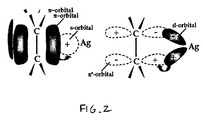
- FIG. 2 is illustrative of the association effected in response to contacting of an olefin (ethylene) and a carrier material (silver ion).
- association and grammatical variations thereof include any type of interaction, including chemical bonds (for example, covalent, ionic and hydrogen bonds) and/or Van der Waals forces, and/or polar and non-polar interactions through other physical constraints provided by molecular structure, and interactions through physical mixing.
- the gaseous supply material includes an operative material that defines a gaseous supply material-disposed operative material.
- the membrane includes a gel (a “membrane gel”).
- the process includes, supplying the gaseous supply material to the gaseous supply material receiving space 10 , and while the supplying of the gaseous supply material to the gaseous supply material receiving space 10 is being effected, effecting transfer (or permeation) of at least a fraction of the gaseous supply material-disposed operative material (hereinafter, such fraction being referred to as a “separation fraction”) from the gaseous supply material receiving space 10 , through the membrane 30 , and into the permeate receiving space 20 .
- the transfer (or “permeation”) of at least a separation fraction of the gaseous supply material-disposed operative material to the permeate receiving space effects production of the gaseous permeate-disposed operative material.
- the transfer (or “permeation”) is effected in response to a differential in chemical potential of the operative material, as between the gaseous supply material receiving space and the permeate receiving space.
- the chemical potential of the operative material disposed in the gaseous supply material receiving space i.e. the gaseous supply material receiving space-disposed operative material
- the chemical potential of the operative material disposed within the permeate receiving space i.e. the permeate receiving space-disposed operative material.
- the chemical potential is defined by partial pressure, such that the transfer (or “permeation”) is effected in response to a differential in partial pressure of the operative material, as between the gaseous supply material receiving space and the permeate receiving space.
- the partial pressure of the operative material disposed in the gaseous supply material receiving space i.e. the gaseous supply material receiving space-disposed operative material
- the partial pressure of the operative material disposed within the permeate receiving space i.e. the permeate receiving space-disposed operative material.
- the effecting of the transfer (or “permeation”) of at least a separation fraction of the gaseous supply material-disposed operative material to the permeate receiving space 20 includes effecting contacting of, or interaction between, at least a carrier-transported fraction of the gaseous supply material-disposed operative material and a carrier material that is dissolved within a liquid material that is disposed within the membrane gel, so as to effect association between the at least a carrier-transported fraction and the carrier material.
- the at least a carrier-transported fraction of the gaseous supply material-disposed operative material is defined by at least a fraction of the at least a separation fraction of the gaseous supply material-disposed operative material.
- a fraction of the operative material-derived material is derived from the gaseous supply material-disposed operative material, and the operative material-derived material includes the at least a carrier-transported fraction of the gaseous supply material-disposed operative material, and such that the at least a carrier-transported fraction of the gaseous supply material-disposed operative material is disposed as a fraction of the operative material-derived material within the membrane 30 .
- a reversible chemical reaction is effected between the at least a separation fraction of the gaseous supply material-disposed operative material and the carrier material, so as to effect production of the operative material-derived material.
- the operative material includes an olefin and the carrier material includes a silver ion dissolved in an aqueous solution that is included with the membrane gel
- a reactive process is effected such that the olefin becomes chemically modified by bonding with the silver ion through ⁇ -complexation.
- the concentration of the at least a carrier-transported fraction of the gaseous supply material-disposed operative material within that portion of the membrane proximate to the gaseous supply material receiving space 10 is greater than the concentration of the at least a carrier-transported fraction of the gaseous supply material-disposed operative material within that portion of the membrane proximate to the permeate receiving space 20 , and thereby effects a driving force for the transport.
- the at least a carrier-transported fraction of the gaseous supply material-disposed operative material (as defined by at least a fraction of the at least a separation fraction of the gaseous supply material-disposed operative material) is being transported through the membrane 30 and towards the permeate receiving space 20 , and during at least a fraction of (or, at least some of) the transporting of the at least a carrier-transported fraction of the gaseous supply material-disposed operative material through the membrane 30 and towards the permeate receiving space 20 , the at least a carrier-transported fraction of the gaseous supply material-disposed operative material is associated with the carrier material. In some embodiments, for example, the association is one of chemical bonding.
- the association between the at least a carrier transported fraction of the olefin and the silver ion is one of chemical bonding through ⁇ -complexation.
- the transporting of the at least a carrier transported fraction of the gaseous supply material-disposed operative material across the membrane 30 and towards the permeate receiving space 20 includes that effected by the transporting of an operative material-derived material across the membrane 30 and towards the permeate receiving space 20 .
- the operative material-derived material is produced by contacting of the at least a carrier transported fraction of the gaseous supply material-disposed operative material with the carrier material.
- the transporting of the operative material-derived material across the membrane 30 and towards the permeate receiving space 20 is facilitated by mobility of the operative material-derived material within the membrane 30 .
- the transporting of the operative material-derived material across the membrane 30 and towards the permeate receiving space 20 is facilitated by mobility of the operative material-derived material within the liquid material of the membrane gel.
- the transporting of the at least a carrier transported fraction of the gaseous supply material-disposed operative material across the membrane 30 and towards the permeate receiving space 20 includes that effected by “hopping” of the at least a carrier transported fraction of the gaseous supply material-disposed operative material from association with one carrier material to the next until reaching the permeate receiving space 20 .
- the transporting of the at least a carrier transported fraction of the gaseous supply material-disposed operative material across the membrane 30 and towards the permeate receiving space 20 includes that effected by a combination of both of the above-described transport mechanisms.
- a gaseous operative material-depleted residue is discharged from the gaseous supply material receiving space.
- the molar concentration of the operative material within the gaseous supply material, which is being supplied, is greater than the molar concentration of the operative material within the gaseous operative material-depleted residue, which is being discharged.
- a gaseous operative material-depleted residue is discharged from the gaseous supply material receiving space
- a gaseous permeate product including the gaseous permeate-disposed operative material, is discharged from the permeate receiving space.
- the molar concentration of the operative material within the gaseous supply material, which is being supplied is greater than the molar concentration of the operative material within the gaseous operative material-depleted residue, which is being discharged.
- the molar concentration of the operative material within the gaseous permeate product, which is being discharged is greater than the molar concentration of the operative material within the gaseous supply material, which is being supplied.
- the process further includes effecting contacting of the membrane 30 with a replenishment liquid material.
- the replenishment liquid material includes a replenishment liquid material-disposed carrier material that is dissolved within replenishment liquid material-disposed liquid material.
- the replenishment liquid material-disposed liquid material of the replenishment liquid material defines liquid material of the replenishment liquid material.
- the replenishment liquid material-disposed carrier material that is dissolved within the replenishment liquid material-disposed liquid material defines dissolved carrier material of the replenishment liquid material.
- any liquid material that has become depleted, during the transferring of at least a fraction of the gaseous supply material-disposed operative material is at least partially replenished by virtue of the effecting of the disposition of the replenishment liquid material (which includes the liquid material) within the membrane.
- the replenishment liquid material which includes the liquid material
- liquid material, within the membrane is depleted during the transferring of at least a fraction of the gaseous supply material-disposed operative material, and the contacting of the membrane with the replenishment liquid material effects at least partial replenishment of the liquid material within the membrane gel.
- Such replenishment is desirable as liquid material is depleted due to mass transfer from the membrane 30 into both of the gaseous supply material receiving space 10 and the permeate receiving space 20 .
- the rate and extent of liquid material depletion depends on operating conditions, such as operating temperatures and pressures, rate of material flow through the gaseous supply material receiving space, and rate of discharge of permeate product from the permeate receiving space, and also on the water content within each one of the gaseous supply material receiving space and the permeate receiving space. Maintaining a minimum concentration of liquid material within the membrane assists in effecting continuous separation and permeation as a desirable mobility of the operative material-derived material is facilitated while a desirable structural integrity of the membrane is maintained. Complete depletion of liquid material may lead to uneven stresses, fractures or pinholes that would compromise performance.
- carrier material within the replenishment liquid material, stripping of the carrier material from the membrane, during the contacting of the membrane with the replenishment liquid material, is mitigated.
- the effecting of the contacting of the membrane with a replenishment liquid material is effected after at least a fraction of the liquid material, which is disposed within the membrane gel, becomes depleted. In some embodiments, for example, the effecting of the contacting of the membrane with a replenishment liquid material is effected in response to sensing that at least a fraction of the liquid material, which is disposed within the membrane gel, becomes depleted.
- the contacting of the replenishment liquid material is effected at predetermined time intervals determined by several factors, where the anticipated impact of those factors is determined by experimental data. These factors include the volume of gas passed through the membrane, operating temperature, pressure differential, thickness of chitosan membrane, molarity of the hydration solution, characteristics of substrate, etc. (some of these are of course dependent on each other).
- the experiments would have revealed the onset time of changes in membrane permeability, membrane selectivity or both at a given combination of operating conditions and membrane composition due to dehydration of the membrane.
- the liquid material is replenished at appropriate intervals to maintain steady performance and/or protect membrane integrity.
- the effecting of the contacting of the membrane with a replenishment liquid material is effected while the supplying of the gaseous supply material to the gaseous supply material receiving space is being effected.
- the effecting of the contacting of the membrane with a replenishment liquid material is periodic, such that the minimum concentration of dissolved carrier material within the replenishment liquid material being supplied during at least one of the periods is greater than the maximum concentration of dissolved carrier material within the replenishment liquid material being supplied during at least another one of the periods.
- the minimum concentration of dissolved carrier material within the replenishment liquid material being supplied during at least one of the periods is greater than the maximum concentration of dissolved carrier material within the replenishment liquid material being supplied during at least another one of the periods by a multiple of between 1.05 and 2.0.
- the effecting of the contacting of the membrane with a replenishment liquid material is effected after the supplying of the gaseous supply material to the gaseous supply material receiving space has been suspended.
- the process further includes suspending the effecting of the contacting of the membrane with a replenishment liquid material such that a first liquid replenishment time interval is completed.
- resumption of the supplying of the gaseous supply material to the gaseous supply material receiving space is effected such that, while the resumed supplying of the gaseous supply material to the gaseous supply material receiving space is being effected, the permeation of at least a separation fraction of the gaseous supply material-disposed operative material from the gaseous supply material receiving space, through the membrane, and into the permeate receiving space is effected. Subsequently, the resumed supplying of the gaseous supply material to the gaseous supply material receiving space is suspended.
- the minimum concentration of dissolved carrier material within the replenishment liquid material being supplied during one of the first and second liquid replenishment time intervals is greater than the maximum concentration of dissolved carrier material within the replenishment liquid material being supplied during the other one of the first and second liquid replenishment time intervals.
- the minimum concentration of dissolved carrier material within the replenishment liquid material being supplied during one of the first and second liquid replenishment time intervals is greater than the maximum concentration of dissolved carrier material within the replenishment liquid material being supplied during the other one of the first and second liquid replenishment time intervals by a multiple of between 1.05 and 2.0.
- a process for effecting separation of at least a gaseous permeate-disposed operative material from a gaseous supply material that is being supplied to a gaseous supply material receiving space that is disposed in mass transfer communication with a permeate receiving space through a membrane The gaseous supply material includes an operative material that defines a gaseous supply material-disposed operative material.
- the membrane includes a gel.
- the process includes, while supplying the gaseous supply material to the gaseous supply material receiving space and effecting permeation of at least a separation fraction of the gaseous supply material-disposed operative material from the gaseous supply material receiving space, through the membrane, and into the permeate receiving space, wherein the permeation of at least a separation fraction of the gaseous supply material-disposed operative material to the permeate receiving space effects production of the gaseous permeate-disposed operative material, and wherein the permeation is effected in response to a differential in chemical potential of the operative material, as between the gaseous supply material receiving space and the permeate receiving space, wherein the effecting of the permeation of at least a separation fraction of the gaseous supply material-disposed operative material to the permeate receiving space includes effecting contacting of, or interaction between, at least a carrier-transported fraction of the gaseous supply material-disposed operative material and a carrier material that is dissolved within a liquid material that is disposed within the membrane gel,
- the at least a carrier-transported fraction of the gaseous supply material-disposed operative material is defined by at least a fraction of the at least a separation fraction of the gaseous supply material-disposed operative material. While the at least a carrier-transported fraction of the gaseous supply material-disposed operative material (defined by at least a fraction of the at least a separation fraction of the gaseous supply material-disposed operative material) is being transported through the membrane and towards the permeate receiving space, and during at least a fraction of (or, at least some of) the transporting of the at least a carrier-transported fraction of the gaseous supply material-disposed operative material through the membrane and towards the permeate receiving space, the at least a carrier-transported fraction of the gaseous supply material-disposed operative material is associated with the carrier material, periodically, effecting contacting of the membrane with a replenishment liquid material.
- the replenishment liquid material includes a replenishment liquid material-disposed carrier material that is dissolved within replenishment liquid material-disposed liquid material.
- the replenishment liquid material-disposed liquid material of the replenishment liquid material defines liquid material of the replenishment liquid material.
- the replenishment liquid material-disposed carrier material which is dissolved within the replenishment liquid material-disposed liquid material, defines dissolved carrier material of the replenishment liquid material.
- at least a fraction of the replenishment liquid material becomes disposed within the membrane gel.
- the minimum concentration of dissolved carrier material within the replenishment liquid material being supplied during at least one of the periods is greater than the maximum concentration of dissolved carrier material within the replenishment liquid material being supplied during at least another one of the periods.
- the minimum concentration of dissolved carrier material within the replenishment liquid material being supplied during at least one of the periods is greater than the maximum concentration of dissolved carrier material within the replenishment liquid material being supplied during at least another one of the periods by a multiple of between 1.05 and 2.0.
- a process for effecting separation of at least a gaseous permeate-disposed operative material from a gaseous supply material that is being supplied to a gaseous supply material receiving space that is disposed in mass transfer communication with a permeate receiving space through a membrane The gaseous supply material including an operative material that defines a gaseous supply material-disposed operative material.
- the membrane includes a gel. The process includes a repeating set of steps.
- the repeating set of steps includes:
- the at least a carrier-transported fraction of the gaseous supply material-disposed operative material is defined by at least a fraction of the at least a separation fraction of the gaseous supply material-disposed operative material. While the at least a carrier-transported fraction of the gaseous supply material-disposed operative material (as defined by at least a fraction of the at least a separation fraction of the gaseous supply material-disposed operative material) is being transported through the membrane and towards the permeate receiving space, and during at least a fraction of (or, at least some of) the transporting of the at least a carrier-transported fraction of the gaseous supply material-disposed operative material through the membrane and towards the permeate receiving space, the at least a carrier-transported fraction of the gaseous supply material-disposed operative material is associated with the carrier material;
- replenishment liquid material includes a replenishment liquid material-disposed carrier material that is dissolved within replenishment liquid material-disposed liquid material, the replenishment liquid material-disposed liquid material of the replenishment liquid material defining liquid material of the replenishment liquid material, and the replenishment liquid material-disposed carrier material that is dissolved within the replenishment liquid material-disposed liquid material defining dissolved carrier material of the replenishment liquid material, such that, in response to the contacting of the membrane with the replenishment liquid material, at least a fraction of the replenishment liquid material becomes disposed within the membrane gel;
- the repeating set of steps is completed at least twice such that at least two completed sets of steps are defined.
- the minimum concentration of dissolved carrier material within the replenishment liquid material being supplied during at least one of the at least two completed sets of steps is greater than the maximum concentration of dissolved carrier material within the replenishment liquid material being supplied during at least another one of the at least two completed sets of steps.
- the minimum concentration of dissolved carrier material within the replenishment liquid material being supplied during at least one of the at least one of the at least two completed sets of steps is greater than the maximum concentration of dissolved carrier material within the replenishment liquid material being supplied during at least another one of the at least two completed sets of steps by a multiple of between 1.05 and 2.0.
- the contacting of the membrane 30 with the replenishment liquid material is effected for a time interval of between 1 second and 100 minutes. In some embodiments, for example, the contacting of the membrane 30 with the replenishment liquid material is effected for a time interval of between 10 seconds and 30 minutes. In some embodiments, for example, the contacting of the membrane 30 with the replenishment liquid material is effected for a time interval of between 15 second and 20 minutes.
- the contacting of the membrane 30 with the replenishment liquid material is effected within the gaseous supply material receiving space 10 .
- the contacting of the membrane with the replenishment liquid material is effected within the permeate receiving space 20 .
- the contacting of the membrane with the replenishment liquid material is effected within both of the gaseous supply material receiving space 10 and the permeate receiving space 20 .
- the contacting is effected by a stationary or stagnant soak by the replenishment liquid material.
- supplying of the replenishment liquid material for effecting the contacting with the membrane, is being effected.
- the supplying of the replenishment liquid material is effected to the gaseous supply material receiving space 10 .
- the supplying of the replenishment liquid material is effected to the permeate receiving space 20 .
- the supplying of the replenishment liquid material is effected to both of the gaseous supply material receiving space 10 and the permeate receiving space 20 .
- the process is effected within a membrane module 40 , and the gaseous supply material receiving space 10 and the permeate receiving space 20 are defined by respective compartments 12 , 22 .
- the supplying of the replenishment liquid material to either one or both of the gaseous supply material receiving compartment 12 and the permeate receiving compartment 22 is effected by flowing the replenishment liquid material in an upwardly direction. This effects improved contacting between the supplied replenishment liquid material and the membrane 30 .
- the replenishment liquid material is supplied to one of the gaseous supply material receiving space 10 and the permeate receiving space 20 such that transport is effected through the membrane 30 from the one of the gaseous supply material receiving space 10 and the permeate receiving space 20 to the other one of the gaseous supply material receiving space 10 and the permeate receiving space 20 , and wherein the pressure within the other one of the gaseous supply material receiving space and the permeate receiving space is below atmospheric pressure.
- condensation of the liquid material is mitigated.
- condensation effects backpressure on the membrane, interfering with the transfer (or permeation) of the separation fraction of the gaseous supply material-disposed operative material from the gaseous supply material receiving space to the permeate receiving space.
- the replenishment liquid material includes an aqueous solution including a molar concentration of silver ion of at least 1.0. In some embodiments, for example, the replenishment liquid material includes an aqueous solution including a molar concentration of silver ion of between 2.0 and 10.0. In some embodiments, for example, the replenishment liquid material includes an aqueous solution including a molar concentration of silver ion of between 5.0 and 8.0. In some of these embodiments, for example, the membrane includes chitosan.
- the liquid material is water, or includes water.
- the carrier material is dissolved in water such that there is provided an aqueous solution including dissolved carrier material.
- the replenishment liquid material includes between 10 and 90 weight % water, based on the total weight of the replenishment liquid material. In some embodiments, for example, the replenishment liquid material includes between 25 and 75 weight % water, based on the total weight of the replenishment liquid material. In some embodiments, for example, the replenishment liquid material includes between 30 and 50 weight % water, based on the total weight of the replenishment liquid material.
- the liquid material of the replenishment liquid material may also include other additives, such as co-solvents and hygroscopic material.
- the transferring of the separation fraction is effected while the temperature within each one of the gaseous supply receiving space and the permeate receiving space is between 5 degrees Celsius and 70 degrees Celsius. In some embodiments, for example, the transferring of the separation fraction is effected while the temperature within each one of the gaseous supply receiving space and the permeate receiving space is between 10 degrees Celsius and 60 degrees Celsius. In some embodiments, for example, the transferring of the separation fraction is effected while the temperature within each one of the gaseous supply receiving space and the permeate receiving space is between 15 degrees Celsius and 50 degrees Celsius.
- the gaseous supply material has a relative humidity of between 0 and 100%. In some embodiments, for example, the gaseous supply material has a relative humidity of between 70 and 99%. In some embodiments, for example, the gaseous supply material has a relative humidity of between 95 and 99%.
- the operative material includes at least one operative compound.
- the operative material-derived material includes at least one operative material-derived compound.
- For each one of the at least one operative material-derived compound at least a fragment of the operative material-derived compound is derived from the operative material.
- Each one of the at least one operative material-derived compound includes at least a fragment of one or more operative compounds.
- a suitable operative compound is an olefin
- suitable olefins include ethylene, propylene, 1-butene, and 2-butene.
- FIG. 2 is illustrative of the association effected in response to contacting of an olefin (ethylene) and a carrier material (silver ion).
- the operative material is defined by at least one operative compound, and the at least one operative compound is an olefin. In some embodiments, for example, each one of the at least one operative compound is an olefin.
- the operative material is defined by at least one operative compound, and each one of the at least one operative compound is an olefin.
- the operative material is defined by at least one operative compound, and the at least one operative compound is a single operative compound, and the single operative compound is an olefin.
- a suitable olefin is an olefin having a total number of carbon atoms of between two (2) and eight (8).
- one or more of the olefins is an alpha olefin.
- the carrier material includes at least one metal cation. In some embodiments, for example, the carrier material includes at least one of silver ion and cuprous ion. In some embodiments, for example, the carrier material includes silver ion. In this respect, in some embodiments, for example, the liquid material includes dissolved silver nitrate, and the carrier material includes the silver ion of the silver nitrate. In some of these embodiments, for example, the silver nitrate is dissolved in the liquid material such that there is provided an aqueous solution, that is included within the membrane gel, including dissolved silver nitrate. In some embodiments, for example, the membrane includes polymeric material, and the carrier material is complexed with, or chelated to, the polymeric material.
- the membrane 30 includes polymeric material.
- the polymeric material includes at least one polymer compound.
- the at least one polymer compound is chitosan.
- each one of the at least one polymer compound is hydrophilic.
- each one of the at least one polymer compound has a number average molecular weight of between 20,000 and 1,000,000.
- the membrane 30 includes polysaccharide. In this respect, in some embodiments, for example, the membrane includes one or more polysaccharides.
- Suitable polysaccharides include natural polysaccharides such as alginic acid, pectic acid, chondroitin, hyaluronic acid and xanthan gum; cellulose, chitin, pullulan, derivatives of natural polysachharides such as C 1-6 esters, esters, ether and alkylcarboxy derivatives thereof, and phosphates of these natural polysaccharide such as partially methylesterified alginic acid, carbomethoxylated alginic acid, phosphorylated alginic acid and aminated alginic acid, salts of anionic cellulose derivatives such as carboxymethyl cellulose, cellulose sulfate, cellulose phosphate, sulfoethyl cellulose and phosphonoethyl cellulose, and semi-synthetic polysaccharides such as guar gum phosphate and chitin phosphate.
- natural polysaccharides such as alginic acid, pectic acid,
- membranes of polysaccharides include those composed of salts of chitosan and its derivatives (including salts of chitosan) such as N-acetylated chitosan, chitosan phosphate and carbomethoxylated chitosan.
- membranes composed of alginic acid, and salts and derivatives thereof, chitosan and salts and derivatives thereof cellulose and derivatives thereof are preferred in view of their film-formability, mechanical strength and film functions.
- the membrane 30 includes one or more polysaccharides, and also includes one or more other polymeric compounds.
- the membranes is comprised of blends of a major amount (e.g. at least 60 weight %) of one or more polysaccharides and lesser amounts (e.g. up to 40 weight %) of one or more other compatible polymeric compounds, such as, for example, polyvinyl alcohol (PVA), or neutral polysaccharides such as starch and pullulan.
- PVA polyvinyl alcohol
- the membrane is comprised of grafted ionized polysaccharides obtained by grafting a hydrophilic vinyl monomer such as acrylic acid.
- the manufacturing of the membrane 30 includes casting a solution of polymeric material (such as one or more polysaccharides) as a film.
- the solution includes less than five (5) weight percent water, based on the total weight of solution.
- the solution includes less than two (2) weight percent water, based on the total weight of solution.
- the solution is an acidic aqueous solution.
- the acid is an organic acid such as an organic acid having a total number of carbons of between one (1) and four (4).
- the acid includes acetic acid.
- the resulting solution may be cast as a film on a flat plate to effect production of a membrane intermediate.
- Suitable casting surfaces include glass or TeflonTM or the like (e.g. a smooth substrate to which the polymer film will have a low adhesion).
- the solution is then dried to form a film.
- the resulting solution may be cast as a film on a substrate material to effect production of a membrane intermediate supported on a substrate material.
- Suitable substrate material may itself be a film or a non-woven support, and can also be a hollow fiber substrate.
- the membrane 30 includes chitosan.
- Chitin may be deacetylated by treatment with hot alkali to effect production of chitosan.
- the polysaccharide may then be treated with a base to generate the protonated derivative (NH 3 + ) or the unprotonated amino form (NH 2 ).
- Chitosan is a generic term for deacetylation products of chitin obtained by treatment with concentrated alkalis. It is obtained by heating chitin, the principal constituent of shells of crustaceans such as lobsters and crabs to a temperature of at least 60.degree. C. together with an alkaline solution having an alkali concentration of 30 to 50% by weight (such as an aqueous solution of sodium hydroxide) and thereby deacetylating chitin.
- chitosan is a linear polysaccharide composed of randomly distributed ⁇ -(1-4)-linked D-glucosamine (de-acetylated unit) and N-acetyl-D-glucosamine (acetylated unit).
- Chitosan readily dissolves in a dilute aqueous solution of an acid, such as acetic acid and hydrochloric acid, with the formation of a salt, but when contacted again with an aqueous alkaline solution, is again coagulated and precipitated.
- a dilute aqueous solution of an acid such as acetic acid and hydrochloric acid
- chitosan has a deacetylation degree of at least 50%
- chitosan has a deaccetylation degree of at least 75%.
- An intermediate chitosan membrane can be obtained by dissolving chitosan in dilute aqueous acid solution, casting the solution as a film onto a flat plate to form a homogeneous chitosan fraction, or onto a substrate material (such as a hollow fibre substrate) to form a composite membrane.
- the cast film may then be contacted with an aqueous alkaline solution to neutralize the acidity and render it less soluble or substantially insoluble in water, or air-dried and then contacted with the aqueous alkaline solution.
- the amino groups of the intermediate composite membrane are at least partly neutralized with one or more acids to form an ammonium salt.
- suitable acids that can be utilized for neutralization include inorganic acids such as hydrochloric acid, hydrobromic acid, sulfuric acid and phosphoric acid; and organic acids such as acetic acid, methanesulfonic acid, formic acid, propionic acid, oxalic acid, malonic acid, succinic acid, fumaric acid, maleic acid, glutaric acid, phthalic acid, isophthalic acid, terephthaic acid, trimesic acid, trimellitic acid, citric acid, aconitic acid, sulfobenzoic acid, pyromellitic acid and ethylenediaminetetraacetic acid.
- Protonation of the intermediate chitosan-type polysaccharide membrane using these acids can be effected, for example, by a method which comprises immersing the intermediate chitosan-type polysaccharide membrane in a solution containing the acid to ionize the amino groups in the membrane; or by a method which comprises subjecting the chitosan-type polysaccharide membrane to pervaporation with a mixed liquid containing the acid to convert the amino groups in the chitosan-type polysaccharide membrane successively to ammonium ions.
- the membrane intermediate has a thickness from 0.5 to 20 microns, such as from three (3) to ten (10) microns, or such as from five (5) to eight (8) microns.
- the substrate material has a thickness from 30 to 200 microns, such as from 50 to 150 microns, or such as from 80 to 110 microns.
- the membrane intermediate is then contacted with a salt of a metal cation (such as silver ion or cuprous ion).
- a salt of a metal cation such as silver ion or cuprous ion.
- the contacting includes immersing the membrane intermediate in an aqueous solution including a salt of a metal cation (such as a 5 to 8 M aqueous silver nitrate soution).
- the contacting effects disposition of metal cations into (through chelation) and throughout the matrix of the membrane, and within its pores, and effects formation of a gel.
- the membrane 30 can be embodied in any one of several configurations, including flat sheet, plate and frame, spiral wound, tubular, or hollow fibre.
- the gaseous supply material further includes slower permeating material.
- the slower permeating material includes at least one slower permeating compound.
- a slower-permeating compound is a compound that is characterized by a lower permeability through the membrane 30 than that of each one of the at least one operative compound. Such lower permeability may be derived from its relatively lower diffusivity in the membrane, its relatively lower solubility in the membrane, or both.
- the slower permeating compound has substantially no permeability through the membrane 30 .
- the transfer (or “permeation”) of the at least a separation fraction of the gaseous supply material-disposed operative material is effected while at least one slower-permeating compound is transferring (or permeating) from the gaseous supply material receiving space 10 , through the membrane 30 and into the permeate receiving space 20 .
- an operative compound-associated operative ratio defined by the ratio of the molar rate of permeation of the operative compound to the mole fraction of the operative compound within the gaseous supply material receiving space, such that a plurality of operative compound-associated operative ratios are defined, and at least one of the plurality of operative compound-associated operative ratios is a minimum operative compound-associated operative ratio.
- the ratio of the molar rate of permeation of the slower permeating compound to the mole fraction of the slower permeating compound within the gaseous supply material receiving space is less than the minimum operative compound-associated operative ratio, such that, for each one of the at least one operative compound, the molar concentration of the operative compound within a gaseous permeate, that is transferred (or permeated) from the gaseous supply receiving space, through the membrane, and into the permeate receiving space, is greater than the molar concentration of the operative compound within the gaseous supply material.
- the gaseous permeate is discharged from the permeate receiving space as the gaseous permeate product.
- each one of the at least one slower permeating compound is a paraffin.
- the at least one slower permeating compound is a single slower permeating compound, and the single slower permeating compound is a paraffin.
- a suitable paraffin is a paraffin having a total number of carbon atoms of between one (1) and ten (10).
Landscapes
- Chemical & Material Sciences (AREA)
- Chemical Kinetics & Catalysis (AREA)
- Engineering & Computer Science (AREA)
- Water Supply & Treatment (AREA)
- Analytical Chemistry (AREA)
- General Chemical & Material Sciences (AREA)
- Oil, Petroleum & Natural Gas (AREA)
- Separation Using Semi-Permeable Membranes (AREA)
- Feeding, Discharge, Calcimining, Fusing, And Gas-Generation Devices (AREA)
Priority Applications (2)
| Application Number | Priority Date | Filing Date | Title |
|---|---|---|---|
| US14/124,634 US9782724B2 (en) | 2011-06-07 | 2012-06-07 | Replenishing liquid material to membrane |
| US15/724,785 US20180243697A1 (en) | 2011-06-07 | 2017-10-04 | Replenishing liquid material to membrane |
Applications Claiming Priority (3)
| Application Number | Priority Date | Filing Date | Title |
|---|---|---|---|
| US201161494204P | 2011-06-07 | 2011-06-07 | |
| US14/124,634 US9782724B2 (en) | 2011-06-07 | 2012-06-07 | Replenishing liquid material to membrane |
| PCT/CA2012/000554 WO2012167362A1 (en) | 2011-06-07 | 2012-06-07 | Replenising liquid material to membrane |
Related Parent Applications (1)
| Application Number | Title | Priority Date | Filing Date |
|---|---|---|---|
| PCT/CA2012/000554 A-371-Of-International WO2012167362A1 (en) | 2011-06-07 | 2012-06-07 | Replenising liquid material to membrane |
Related Child Applications (1)
| Application Number | Title | Priority Date | Filing Date |
|---|---|---|---|
| US15/724,785 Continuation US20180243697A1 (en) | 2011-06-07 | 2017-10-04 | Replenishing liquid material to membrane |
Publications (2)
| Publication Number | Publication Date |
|---|---|
| US20140245884A1 US20140245884A1 (en) | 2014-09-04 |
| US9782724B2 true US9782724B2 (en) | 2017-10-10 |
Family
ID=47295297
Family Applications (2)
| Application Number | Title | Priority Date | Filing Date |
|---|---|---|---|
| US14/124,634 Active 2033-10-09 US9782724B2 (en) | 2011-06-07 | 2012-06-07 | Replenishing liquid material to membrane |
| US15/724,785 Pending US20180243697A1 (en) | 2011-06-07 | 2017-10-04 | Replenishing liquid material to membrane |
Family Applications After (1)
| Application Number | Title | Priority Date | Filing Date |
|---|---|---|---|
| US15/724,785 Pending US20180243697A1 (en) | 2011-06-07 | 2017-10-04 | Replenishing liquid material to membrane |
Country Status (16)
| Country | Link |
|---|---|
| US (2) | US9782724B2 (pl) |
| EP (1) | EP2717996B1 (pl) |
| JP (2) | JP2014533193A (pl) |
| KR (2) | KR101949882B1 (pl) |
| CN (1) | CN103796742B (pl) |
| AU (2) | AU2012267170A1 (pl) |
| BR (1) | BR112013031439B1 (pl) |
| CA (1) | CA2838602C (pl) |
| ES (1) | ES2909508T3 (pl) |
| HU (1) | HUE058844T2 (pl) |
| IL (1) | IL229809B (pl) |
| MY (1) | MY175137A (pl) |
| PL (1) | PL2717996T3 (pl) |
| RU (1) | RU2617475C2 (pl) |
| SG (1) | SG10201606544TA (pl) |
| WO (1) | WO2012167362A1 (pl) |
Cited By (3)
| Publication number | Priority date | Publication date | Assignee | Title |
|---|---|---|---|---|
| WO2023022847A1 (en) | 2021-08-19 | 2023-02-23 | Exxonmobil Chemical Patents Inc. | Membrane-based separation processes enhanced with an absorption device |
| US12208358B2 (en) | 2018-10-19 | 2025-01-28 | Imtex Membranes Corporation | Replenishing liquid material to a membrane within a multi-module system |
| US12599870B2 (en) | 2022-10-27 | 2026-04-14 | Exxonmobil Chemical Patents Inc. | Membrane-based separation processes enhanced with an absorption device |
Families Citing this family (9)
| Publication number | Priority date | Publication date | Assignee | Title |
|---|---|---|---|---|
| ES2909508T3 (es) * | 2011-06-07 | 2022-05-06 | Imtex Membranes Corp | Reposición de material líquido a la membrana |
| DE102013225883A1 (de) | 2013-12-13 | 2015-06-18 | Evonik Industries Ag | Zweistufige Hydroformylierung mit Kreisgas- und SILP-Technologie |
| KR20170079234A (ko) * | 2015-12-30 | 2017-07-10 | 상명대학교산학협력단 | 질산염을 포함하는 sf6 분리용 고분자 전해질 분리막 |
| CN109475810B (zh) | 2016-08-08 | 2022-03-15 | 旭化成株式会社 | 气体分离膜用组件 |
| EP3354634A1 (en) | 2017-01-30 | 2018-08-01 | Shell International Research Maatschappij B.V. | Ethane oxidative dehydrogenation |
| US11117848B2 (en) | 2017-04-10 | 2021-09-14 | Shell Oil Company | Oxidative coupling of methane |
| CN108854854B (zh) * | 2017-05-16 | 2021-07-20 | 厦门大学 | 一种功能流体门控系统 |
| US11083992B2 (en) | 2018-09-27 | 2021-08-10 | Uop Llc | Methods of making high selectivity facilitated transport membranes, high selectivity facilitated transport membrane elements and modules |
| WO2020077465A1 (en) * | 2018-10-19 | 2020-04-23 | Imtex Membranes Corp. | Gas permeation process through crosslinked membrane |
Citations (43)
| Publication number | Priority date | Publication date | Assignee | Title |
|---|---|---|---|---|
| US3758605A (en) * | 1972-09-13 | 1973-09-11 | Standard Oil Co | Process |
| US3758603A (en) | 1972-05-12 | 1973-09-11 | Standard Oil Co | Process for separation of unsaturated hydrocarbons |
| JPS4948603A (pl) | 1972-05-12 | 1974-05-11 | ||
| US3844735A (en) * | 1972-09-13 | 1974-10-29 | Standard Oil Co | Process |
| US3896061A (en) * | 1972-08-16 | 1975-07-22 | Toray Industries | Semi-permeable membranes, their preparation and their use |
| US3962158A (en) * | 1974-04-05 | 1976-06-08 | Director-General Of The Agency Of Industrial Science And Technology | Hydrophilic polymer membranes of polyvinyl alcohol and chitosan |
| US4257798A (en) * | 1979-07-26 | 1981-03-24 | The United States Of America As Represented By The United States Department Of Energy | Method for introduction of gases into microspheres |
| US4710205A (en) * | 1987-03-16 | 1987-12-01 | Honeywell Inc. | Stabilized liquid films |
| US4750918A (en) | 1985-05-28 | 1988-06-14 | The Trustees Of The Stevens Institute Of Technology | Selective-permeation gas-separation process and apparatus |
| US4961758A (en) * | 1988-11-15 | 1990-10-09 | Texaco Inc. | Liquid membrane process for separating gases |
| US5057641A (en) | 1990-04-09 | 1991-10-15 | The Standard Oil Company | High pressure facilitated membranes for selective separation and process for the use thereof |
| EP0456598A2 (de) | 1990-05-07 | 1991-11-13 | HILTI Aktiengesellschaft | Absaugvorrichtung für handgeführte Bohr- und Meisselgeräte |
| EP0458598A2 (en) | 1990-05-25 | 1991-11-27 | The Standard Oil Company | Facilitated liquid membranes for olefin/paraffin gas separations and related process |
| US5344543A (en) * | 1991-02-14 | 1994-09-06 | Bertin & Cie | Method of manufacturing a plate of gell for separating and transferring macromolecules by electrophoresis, and plates of gel obtained in this way |
| US5670051A (en) | 1996-05-23 | 1997-09-23 | Membrane Technology And Research, Inc. | Olefin separation membrane and process |
| US6152121A (en) * | 1999-05-25 | 2000-11-28 | Tolman; Marriner | Oxygenated gel for improving performance of combustion engines through improved burning of combustibles |
| US6192633B1 (en) * | 1999-09-10 | 2001-02-27 | Clint J. Hilbert | Rapidly deployable protective enclosure |
| US6413298B1 (en) * | 2000-07-28 | 2002-07-02 | Dais-Analytic Corporation | Water- and ion-conducting membranes and uses thereof |
| US20020148779A1 (en) * | 2000-06-13 | 2002-10-17 | Shieh Wen K. | Methods and apparatus for biological treatment of aqueous waste |
| US6468219B1 (en) * | 2000-04-24 | 2002-10-22 | Philip Chidi Njemanze | Implantable telemetric transcranial doppler device |
| US20030034304A1 (en) | 2001-08-17 | 2003-02-20 | Huang Robert Y.M. | N-acetylated chitosan membranes |
| US6558537B1 (en) * | 1999-05-25 | 2003-05-06 | Miox Corporation | Portable hydration system |
| US6569387B1 (en) * | 1999-08-10 | 2003-05-27 | S.C. Johnson & Son, Inc. | Dual function dispenser |
| US20040104166A1 (en) * | 2002-11-29 | 2004-06-03 | Tessier David Florian | Spacer for electrically driven membrane process apparatus |
| US6780307B2 (en) * | 2001-10-12 | 2004-08-24 | The United States Of America As Represented By The Secretary Of The Navy | Ion selective electrodes for direct organic drug analysis in saliva, sweat, and surface wipes |
| CA2426629A1 (en) | 2003-04-25 | 2004-10-25 | Nova Chemicals Corporation | Process for the separation of olefins from paraffins using membranes |
| US7014770B2 (en) * | 2002-05-17 | 2006-03-21 | Sanyo Electric Co., Ltd. | Filtering method of a colloidal solution |
| JP2007105683A (ja) | 2005-10-17 | 2007-04-26 | Ngk Insulators Ltd | ガス回収方法および装置 |
| JP2007203280A (ja) | 2005-03-29 | 2007-08-16 | Forestry & Forest Products Research Institute | 分離膜並びに該分離膜を具備する複合膜、加湿エレメント、除湿エレメント、加湿器、除湿器及び調湿システム |
| US20070238835A1 (en) * | 1994-04-19 | 2007-10-11 | Chen John Y | Gels, gel composites, and gel articles |
| CN101053737A (zh) | 2007-02-06 | 2007-10-17 | 天邦膜技术国家工程研究中心有限责任公司 | 用于气体分离的新型耦合膜分离方法及装置 |
| US7303676B2 (en) * | 2003-02-13 | 2007-12-04 | Zenon Technology Partnership | Supported biofilm apparatus and process |
| US20080302725A1 (en) | 2007-06-06 | 2008-12-11 | Imbrium Systems Corp. | Modulated Bundle Element |
| US7566385B2 (en) * | 2004-02-23 | 2009-07-28 | E. I. Du Pont De Nemours And Company | Apparatus adapted for membrane-mediated electropolishing |
| US7625427B2 (en) * | 2002-12-02 | 2009-12-01 | Molecular Products Limited | Apparatus and process for carbon dioxide absorption |
| US7846318B2 (en) * | 2006-01-06 | 2010-12-07 | Nextchem, Llc | Polyaluminum chloride and aluminum chlorohydrate, processes and compositions: high-basicity and ultra high-basicity products |
| US20110003236A1 (en) * | 2009-07-02 | 2011-01-06 | Clearedge Power, Inc. | Reducing Loss of Liquid Electrolyte From a High Temperature Polymer-Electrolyte Membrane Fuel Cell |
| US20110143232A1 (en) * | 2009-11-10 | 2011-06-16 | Burban John H | Gel-Filled Membrane Device and Method |
| US8764888B2 (en) * | 2009-03-03 | 2014-07-01 | Oridion Medical 1987 Ltd. | Drying substances, preparation and use thereof |
| US8784389B2 (en) * | 2009-08-31 | 2014-07-22 | Beta-O2 Technologies Ltd. | Oxygen supply for implantable medical device |
| US9090766B2 (en) * | 2009-03-03 | 2015-07-28 | Oridion Medical 1987 Ltd. | Drying substances, preparation and use thereof |
| US20150233589A1 (en) * | 2014-02-16 | 2015-08-20 | Be Power Tech Llc | Liquid desiccant regeneration system, systems including the same, and methods of operating the same |
| US20150329901A1 (en) * | 2014-05-13 | 2015-11-19 | Rasirc, Inc. | Method and System for Decontaminating Materials |
Family Cites Families (13)
| Publication number | Priority date | Publication date | Assignee | Title |
|---|---|---|---|---|
| US3719590A (en) * | 1970-12-17 | 1973-03-06 | Exxon Research Engineering Co | Liquid membrane system for separation of components of liquid mixtures |
| US4318714A (en) * | 1980-05-14 | 1982-03-09 | General Electric Company | Facilitated separation of a select gas through an ion exchange membrane |
| JPS627403A (ja) * | 1985-01-08 | 1987-01-14 | Agency Of Ind Science & Technol | カチオン性多糖類系液体分離膜 |
| DE3929137C1 (pl) * | 1989-09-01 | 1991-02-28 | Fraunhofer-Gesellschaft Zur Foerderung Der Angewandten Forschung Ev, 8000 Muenchen, De | |
| US6518476B1 (en) * | 2000-09-18 | 2003-02-11 | Union Carbide Chemicals & Plastics Technology Corporation | Methods for manufacturing olefins from lower alkans by oxidative dehydrogenation |
| MY135938A (en) * | 2003-12-22 | 2008-07-31 | Shell Int Research | Process for the separation of olefins and paraffins |
| US20060016750A1 (en) * | 2004-07-20 | 2006-01-26 | Membrane Technology And Research Inc. | Process for regenerating facilitated-transport membranes |
| US20090071334A1 (en) * | 2007-06-22 | 2009-03-19 | Aspen Systems, Inc. | Convenient Substance-Recovery System and Process |
| JP2011012894A (ja) * | 2009-07-02 | 2011-01-20 | Panasonic Corp | 全熱交換素子用素材およびその素材を用いた熱交換形換気装置 |
| US8992668B2 (en) * | 2010-03-29 | 2015-03-31 | Fujifilm Corporation | Gas separation membrane and method for producing the same, and method for separating gas mixture, gas separation membrane module and gas separation apparatus using the same |
| ES2909508T3 (es) * | 2011-06-07 | 2022-05-06 | Imtex Membranes Corp | Reposición de material líquido a la membrana |
| KR101912768B1 (ko) * | 2017-03-23 | 2018-10-30 | 한국화학연구원 | 전이금속이 담지된 설폰화 고분자-아민계 고분자착체 분리막 및 이를 이용한 올레핀/파라핀 분리공정 |
| US11083992B2 (en) * | 2018-09-27 | 2021-08-10 | Uop Llc | Methods of making high selectivity facilitated transport membranes, high selectivity facilitated transport membrane elements and modules |
-
2012
- 2012-06-07 ES ES12797176T patent/ES2909508T3/es active Active
- 2012-06-07 US US14/124,634 patent/US9782724B2/en active Active
- 2012-06-07 EP EP12797176.0A patent/EP2717996B1/en active Active
- 2012-06-07 HU HUE12797176A patent/HUE058844T2/hu unknown
- 2012-06-07 KR KR1020147000295A patent/KR101949882B1/ko active Active
- 2012-06-07 RU RU2013157902A patent/RU2617475C2/ru active
- 2012-06-07 SG SG10201606544TA patent/SG10201606544TA/en unknown
- 2012-06-07 MY MYPI2013004431A patent/MY175137A/en unknown
- 2012-06-07 CN CN201280038517.9A patent/CN103796742B/zh not_active Expired - Fee Related
- 2012-06-07 AU AU2012267170A patent/AU2012267170A1/en not_active Abandoned
- 2012-06-07 JP JP2014513868A patent/JP2014533193A/ja active Pending
- 2012-06-07 CA CA2838602A patent/CA2838602C/en active Active
- 2012-06-07 KR KR1020197004250A patent/KR102073073B1/ko active Active
- 2012-06-07 BR BR112013031439-7A patent/BR112013031439B1/pt not_active IP Right Cessation
- 2012-06-07 WO PCT/CA2012/000554 patent/WO2012167362A1/en not_active Ceased
- 2012-06-07 PL PL12797176T patent/PL2717996T3/pl unknown
-
2013
- 2013-12-05 IL IL229809A patent/IL229809B/en active IP Right Grant
-
2017
- 2017-07-07 JP JP2017134051A patent/JP6681856B2/ja active Active
- 2017-09-13 AU AU2017228583A patent/AU2017228583B2/en not_active Ceased
- 2017-10-04 US US15/724,785 patent/US20180243697A1/en active Pending
Patent Citations (50)
| Publication number | Priority date | Publication date | Assignee | Title |
|---|---|---|---|---|
| US3758603A (en) | 1972-05-12 | 1973-09-11 | Standard Oil Co | Process for separation of unsaturated hydrocarbons |
| JPS4948603A (pl) | 1972-05-12 | 1974-05-11 | ||
| GB1431946A (en) | 1972-05-12 | 1976-04-14 | Standard Oil Co | Process for separation of unsaturated hydrocarbons |
| US3896061A (en) * | 1972-08-16 | 1975-07-22 | Toray Industries | Semi-permeable membranes, their preparation and their use |
| US3758605A (en) * | 1972-09-13 | 1973-09-11 | Standard Oil Co | Process |
| US3844735A (en) * | 1972-09-13 | 1974-10-29 | Standard Oil Co | Process |
| US3962158A (en) * | 1974-04-05 | 1976-06-08 | Director-General Of The Agency Of Industrial Science And Technology | Hydrophilic polymer membranes of polyvinyl alcohol and chitosan |
| US4257798A (en) * | 1979-07-26 | 1981-03-24 | The United States Of America As Represented By The United States Department Of Energy | Method for introduction of gases into microspheres |
| US4750918A (en) | 1985-05-28 | 1988-06-14 | The Trustees Of The Stevens Institute Of Technology | Selective-permeation gas-separation process and apparatus |
| US4710205A (en) * | 1987-03-16 | 1987-12-01 | Honeywell Inc. | Stabilized liquid films |
| US4961758A (en) * | 1988-11-15 | 1990-10-09 | Texaco Inc. | Liquid membrane process for separating gases |
| US5057641A (en) | 1990-04-09 | 1991-10-15 | The Standard Oil Company | High pressure facilitated membranes for selective separation and process for the use thereof |
| JPH0691130A (ja) | 1990-04-09 | 1994-04-05 | Standard Oil Co:The | 選択分離用高圧促進膜及びその使用法 |
| EP0456598A2 (de) | 1990-05-07 | 1991-11-13 | HILTI Aktiengesellschaft | Absaugvorrichtung für handgeführte Bohr- und Meisselgeräte |
| US5135547A (en) * | 1990-05-25 | 1992-08-04 | The Standard Oil Company | Facilitated liquid membranes for olefin/paraffin gas separations and related process |
| JPH04227823A (ja) | 1990-05-25 | 1992-08-17 | Standard Oil Co:The | オレフィン/パラフィンガス分離用促進液膜及び関連方法 |
| EP0458598A2 (en) | 1990-05-25 | 1991-11-27 | The Standard Oil Company | Facilitated liquid membranes for olefin/paraffin gas separations and related process |
| US5344543A (en) * | 1991-02-14 | 1994-09-06 | Bertin & Cie | Method of manufacturing a plate of gell for separating and transferring macromolecules by electrophoresis, and plates of gel obtained in this way |
| US20070238835A1 (en) * | 1994-04-19 | 2007-10-11 | Chen John Y | Gels, gel composites, and gel articles |
| US5670051A (en) | 1996-05-23 | 1997-09-23 | Membrane Technology And Research, Inc. | Olefin separation membrane and process |
| US6152121A (en) * | 1999-05-25 | 2000-11-28 | Tolman; Marriner | Oxygenated gel for improving performance of combustion engines through improved burning of combustibles |
| US6558537B1 (en) * | 1999-05-25 | 2003-05-06 | Miox Corporation | Portable hydration system |
| US6569387B1 (en) * | 1999-08-10 | 2003-05-27 | S.C. Johnson & Son, Inc. | Dual function dispenser |
| US6192633B1 (en) * | 1999-09-10 | 2001-02-27 | Clint J. Hilbert | Rapidly deployable protective enclosure |
| US6468219B1 (en) * | 2000-04-24 | 2002-10-22 | Philip Chidi Njemanze | Implantable telemetric transcranial doppler device |
| US20020148779A1 (en) * | 2000-06-13 | 2002-10-17 | Shieh Wen K. | Methods and apparatus for biological treatment of aqueous waste |
| US6630067B2 (en) * | 2000-06-13 | 2003-10-07 | Trustees Of The University Of Pennsylvania | Methods and apparatus for biological treatment of aqueous waste |
| US6413298B1 (en) * | 2000-07-28 | 2002-07-02 | Dais-Analytic Corporation | Water- and ion-conducting membranes and uses thereof |
| US20030034304A1 (en) | 2001-08-17 | 2003-02-20 | Huang Robert Y.M. | N-acetylated chitosan membranes |
| US6780307B2 (en) * | 2001-10-12 | 2004-08-24 | The United States Of America As Represented By The Secretary Of The Navy | Ion selective electrodes for direct organic drug analysis in saliva, sweat, and surface wipes |
| US7014770B2 (en) * | 2002-05-17 | 2006-03-21 | Sanyo Electric Co., Ltd. | Filtering method of a colloidal solution |
| US20040104166A1 (en) * | 2002-11-29 | 2004-06-03 | Tessier David Florian | Spacer for electrically driven membrane process apparatus |
| US7625427B2 (en) * | 2002-12-02 | 2009-12-01 | Molecular Products Limited | Apparatus and process for carbon dioxide absorption |
| US7303676B2 (en) * | 2003-02-13 | 2007-12-04 | Zenon Technology Partnership | Supported biofilm apparatus and process |
| US20040215045A1 (en) | 2003-04-25 | 2004-10-28 | Herrera Patricio S. | Process for the separation of olefins from paraffins using membranes |
| CA2426629A1 (en) | 2003-04-25 | 2004-10-25 | Nova Chemicals Corporation | Process for the separation of olefins from paraffins using membranes |
| US7361800B2 (en) | 2003-04-25 | 2008-04-22 | Monteco Ltd. | Process for the separation of olefins from paraffins using membranes |
| US7566385B2 (en) * | 2004-02-23 | 2009-07-28 | E. I. Du Pont De Nemours And Company | Apparatus adapted for membrane-mediated electropolishing |
| JP2007203280A (ja) | 2005-03-29 | 2007-08-16 | Forestry & Forest Products Research Institute | 分離膜並びに該分離膜を具備する複合膜、加湿エレメント、除湿エレメント、加湿器、除湿器及び調湿システム |
| JP2007105683A (ja) | 2005-10-17 | 2007-04-26 | Ngk Insulators Ltd | ガス回収方法および装置 |
| US7846318B2 (en) * | 2006-01-06 | 2010-12-07 | Nextchem, Llc | Polyaluminum chloride and aluminum chlorohydrate, processes and compositions: high-basicity and ultra high-basicity products |
| CN101053737A (zh) | 2007-02-06 | 2007-10-17 | 天邦膜技术国家工程研究中心有限责任公司 | 用于气体分离的新型耦合膜分离方法及装置 |
| US20080302725A1 (en) | 2007-06-06 | 2008-12-11 | Imbrium Systems Corp. | Modulated Bundle Element |
| US8764888B2 (en) * | 2009-03-03 | 2014-07-01 | Oridion Medical 1987 Ltd. | Drying substances, preparation and use thereof |
| US9090766B2 (en) * | 2009-03-03 | 2015-07-28 | Oridion Medical 1987 Ltd. | Drying substances, preparation and use thereof |
| US20110003236A1 (en) * | 2009-07-02 | 2011-01-06 | Clearedge Power, Inc. | Reducing Loss of Liquid Electrolyte From a High Temperature Polymer-Electrolyte Membrane Fuel Cell |
| US8784389B2 (en) * | 2009-08-31 | 2014-07-22 | Beta-O2 Technologies Ltd. | Oxygen supply for implantable medical device |
| US20110143232A1 (en) * | 2009-11-10 | 2011-06-16 | Burban John H | Gel-Filled Membrane Device and Method |
| US20150233589A1 (en) * | 2014-02-16 | 2015-08-20 | Be Power Tech Llc | Liquid desiccant regeneration system, systems including the same, and methods of operating the same |
| US20150329901A1 (en) * | 2014-05-13 | 2015-11-19 | Rasirc, Inc. | Method and System for Decontaminating Materials |
Non-Patent Citations (12)
| Title |
|---|
| Azhin, et al., "A review on olefin/paraffin separation using reversible chemical complexation technology" J Indus Engin Chem. 14:622-38, 2008. |
| English Translation of Office Action issued in Israeli Patent Application No. 229809, dated Oct. 12, 2015, 3 pgs. |
| Office Action for Russian Application No. 2013157902 dated Sep. 13, 2016 (English translation provided). |
| Office Action issued in Chinese Patent Application No. 2012800385179, dated Mar. 3, 2015. (English Translation Provided), 21 pgs. |
| Office Action issued in European Application No. 12797176.0, dated Oct. 21, 2014, 1 pgs. |
| Office Action issued in Israeli Patent Application No. 229809, dated Mar. 26, 2017. |
| Office Action issued in Japanese Patent Application No. 2014-513868, dated Apr. 5, 2016. (English Translation Provided), 10 pgs. |
| Office Action issued in Russian Patent Application No. 2013157902-05(090197), dated May 13, 2016. (English Translation Provided). |
| Official Notice of Final Decision of Rejection for Japanese Patent Application No. 2014-513868 mailed Mar. 7, 2017. |
| Patent Examination Report No. 1 for Australian Application No. 2012267170 dated Sep. 13, 2016. |
| Search Report and Written Opinion in International Application No. PCT/CA2012/000554 mailed Sep. 13, 2012, 9 pgs. |
| Teramoto, et al., "Separation of ethylene from ethane by a flowing liquid membrane using silver nitrate as a carrier" J Membrane Sci. 45:115-36, 1989. |
Cited By (4)
| Publication number | Priority date | Publication date | Assignee | Title |
|---|---|---|---|---|
| US12208358B2 (en) | 2018-10-19 | 2025-01-28 | Imtex Membranes Corporation | Replenishing liquid material to a membrane within a multi-module system |
| WO2023022847A1 (en) | 2021-08-19 | 2023-02-23 | Exxonmobil Chemical Patents Inc. | Membrane-based separation processes enhanced with an absorption device |
| US12662437B2 (en) | 2021-08-19 | 2026-06-23 | Exxonmobil Chemical Patents Inc. | Membrane-based separation processes enhanced with an absorption device |
| US12599870B2 (en) | 2022-10-27 | 2026-04-14 | Exxonmobil Chemical Patents Inc. | Membrane-based separation processes enhanced with an absorption device |
Also Published As
| Publication number | Publication date |
|---|---|
| JP2014533193A (ja) | 2014-12-11 |
| KR20140058490A (ko) | 2014-05-14 |
| CA2838602C (en) | 2021-05-25 |
| KR101949882B1 (ko) | 2019-04-22 |
| HUE058844T2 (hu) | 2022-09-28 |
| JP2017170447A (ja) | 2017-09-28 |
| AU2012267170A1 (en) | 2014-01-09 |
| ES2909508T3 (es) | 2022-05-06 |
| KR102073073B1 (ko) | 2020-02-04 |
| BR112013031439B1 (pt) | 2021-01-19 |
| EP2717996B1 (en) | 2022-01-05 |
| CA2838602A1 (en) | 2012-12-13 |
| AU2017228583B2 (en) | 2019-09-19 |
| BR112013031439A2 (pt) | 2016-12-13 |
| WO2012167362A1 (en) | 2012-12-13 |
| PL2717996T3 (pl) | 2022-06-06 |
| AU2017228583A1 (en) | 2017-10-05 |
| KR20190019214A (ko) | 2019-02-26 |
| RU2617475C2 (ru) | 2017-04-25 |
| EP2717996A4 (en) | 2014-11-05 |
| RU2013157902A (ru) | 2015-07-20 |
| CN103796742A (zh) | 2014-05-14 |
| MY175137A (en) | 2020-06-10 |
| US20140245884A1 (en) | 2014-09-04 |
| US20180243697A1 (en) | 2018-08-30 |
| IL229809B (en) | 2020-03-31 |
| EP2717996A1 (en) | 2014-04-16 |
| SG10201606544TA (en) | 2016-10-28 |
| CN103796742B (zh) | 2016-03-09 |
| JP6681856B2 (ja) | 2020-04-15 |
Similar Documents
| Publication | Publication Date | Title |
|---|---|---|
| AU2017228583B2 (en) | Replenishing liquid material to membrane | |
| Miao et al. | Preparation and characterization of N, O-carboxymethyl chitosan (NOCC)/polysulfone (PS) composite nanofiltration membranes | |
| US12208358B2 (en) | Replenishing liquid material to a membrane within a multi-module system | |
| US20230219869A1 (en) | Processes for fractionating a gaseous material with a facilitated transport membrane | |
| US20210346839A1 (en) | Gas Permeation Process Through Crosslinked Membrane | |
| BR112021007488B1 (pt) | Processo para efetuar o fracionamento de material de alimentação gasoso | |
| CN1270078A (zh) | 一种壳聚糖/聚磷酸钠聚电解质复合物膜的制备方法 |
Legal Events
| Date | Code | Title | Description |
|---|---|---|---|
| AS | Assignment |
Owner name: IMTEX MEMBRANES CORP., CANADA Free format text: ASSIGNMENT OF ASSIGNORS INTEREST;ASSIGNORS:FENG, XIANSHE;TOWE, IAN GLENN;HAMZA, ALI;AND OTHERS;SIGNING DATES FROM 20140127 TO 20140129;REEL/FRAME:032520/0222 |
|
| STCF | Information on status: patent grant |
Free format text: PATENTED CASE |
|
| FEPP | Fee payment procedure |
Free format text: ENTITY STATUS SET TO SMALL (ORIGINAL EVENT CODE: SMAL); ENTITY STATUS OF PATENT OWNER: SMALL ENTITY |
|
| MAFP | Maintenance fee payment |
Free format text: PAYMENT OF MAINTENANCE FEE, 4TH YR, SMALL ENTITY (ORIGINAL EVENT CODE: M2551); ENTITY STATUS OF PATENT OWNER: SMALL ENTITY Year of fee payment: 4 |
|
| FEPP | Fee payment procedure |
Free format text: MAINTENANCE FEE REMINDER MAILED (ORIGINAL EVENT CODE: REM.); ENTITY STATUS OF PATENT OWNER: SMALL ENTITY |
|
| FEPP | Fee payment procedure |
Free format text: 7.5 YR SURCHARGE - LATE PMT W/IN 6 MO, SMALL ENTITY (ORIGINAL EVENT CODE: M2555); ENTITY STATUS OF PATENT OWNER: SMALL ENTITY |
|
| MAFP | Maintenance fee payment |
Free format text: PAYMENT OF MAINTENANCE FEE, 8TH YR, SMALL ENTITY (ORIGINAL EVENT CODE: M2552); ENTITY STATUS OF PATENT OWNER: SMALL ENTITY Year of fee payment: 8 |