US9810402B2 - Light conversion substrate and light emitting package and automobile lamp including the same - Google Patents
Light conversion substrate and light emitting package and automobile lamp including the same Download PDFInfo
- Publication number
- US9810402B2 US9810402B2 US14/621,924 US201514621924A US9810402B2 US 9810402 B2 US9810402 B2 US 9810402B2 US 201514621924 A US201514621924 A US 201514621924A US 9810402 B2 US9810402 B2 US 9810402B2
- Authority
- US
- United States
- Prior art keywords
- taper
- light emitting
- conversion substrate
- side part
- light conversion
- Prior art date
- Legal status (The legal status is an assumption and is not a legal conclusion. Google has not performed a legal analysis and makes no representation as to the accuracy of the status listed.)
- Active, expires
Links
Images




Classifications
-
- F—MECHANICAL ENGINEERING; LIGHTING; HEATING; WEAPONS; BLASTING
- F21—LIGHTING
- F21V—FUNCTIONAL FEATURES OR DETAILS OF LIGHTING DEVICES OR SYSTEMS THEREOF; STRUCTURAL COMBINATIONS OF LIGHTING DEVICES WITH OTHER ARTICLES, NOT OTHERWISE PROVIDED FOR
- F21V9/00—Elements for modifying spectral properties, polarisation or intensity of the light emitted, e.g. filters
- F21V9/30—Elements containing photoluminescent material distinct from or spaced from the light source
-
- F21V9/16—
-
- F—MECHANICAL ENGINEERING; LIGHTING; HEATING; WEAPONS; BLASTING
- F21—LIGHTING
- F21S—NON-PORTABLE LIGHTING DEVICES; SYSTEMS THEREOF; VEHICLE LIGHTING DEVICES SPECIALLY ADAPTED FOR VEHICLE EXTERIORS
- F21S41/00—Illuminating devices specially adapted for vehicle exteriors, e.g. headlamps
- F21S41/10—Illuminating devices specially adapted for vehicle exteriors, e.g. headlamps characterised by the light source
- F21S41/14—Illuminating devices specially adapted for vehicle exteriors, e.g. headlamps characterised by the light source characterised by the type of light source
- F21S41/141—Light emitting diodes [LED]
- F21S41/147—Light emitting diodes [LED] the main emission direction of the LED being angled to the optical axis of the illuminating device
- F21S41/148—Light emitting diodes [LED] the main emission direction of the LED being angled to the optical axis of the illuminating device the main emission direction of the LED being perpendicular to the optical axis
-
- F—MECHANICAL ENGINEERING; LIGHTING; HEATING; WEAPONS; BLASTING
- F21—LIGHTING
- F21S—NON-PORTABLE LIGHTING DEVICES; SYSTEMS THEREOF; VEHICLE LIGHTING DEVICES SPECIALLY ADAPTED FOR VEHICLE EXTERIORS
- F21S41/00—Illuminating devices specially adapted for vehicle exteriors, e.g. headlamps
- F21S41/10—Illuminating devices specially adapted for vehicle exteriors, e.g. headlamps characterised by the light source
- F21S41/14—Illuminating devices specially adapted for vehicle exteriors, e.g. headlamps characterised by the light source characterised by the type of light source
- F21S41/141—Light emitting diodes [LED]
- F21S41/151—Light emitting diodes [LED] arranged in one or more lines
-
- F—MECHANICAL ENGINEERING; LIGHTING; HEATING; WEAPONS; BLASTING
- F21—LIGHTING
- F21S—NON-PORTABLE LIGHTING DEVICES; SYSTEMS THEREOF; VEHICLE LIGHTING DEVICES SPECIALLY ADAPTED FOR VEHICLE EXTERIORS
- F21S41/00—Illuminating devices specially adapted for vehicle exteriors, e.g. headlamps
- F21S41/10—Illuminating devices specially adapted for vehicle exteriors, e.g. headlamps characterised by the light source
- F21S41/14—Illuminating devices specially adapted for vehicle exteriors, e.g. headlamps characterised by the light source characterised by the type of light source
- F21S41/141—Light emitting diodes [LED]
- F21S41/151—Light emitting diodes [LED] arranged in one or more lines
- F21S41/153—Light emitting diodes [LED] arranged in one or more lines arranged in a matrix
-
- F—MECHANICAL ENGINEERING; LIGHTING; HEATING; WEAPONS; BLASTING
- F21—LIGHTING
- F21S—NON-PORTABLE LIGHTING DEVICES; SYSTEMS THEREOF; VEHICLE LIGHTING DEVICES SPECIALLY ADAPTED FOR VEHICLE EXTERIORS
- F21S41/00—Illuminating devices specially adapted for vehicle exteriors, e.g. headlamps
- F21S41/10—Illuminating devices specially adapted for vehicle exteriors, e.g. headlamps characterised by the light source
- F21S41/14—Illuminating devices specially adapted for vehicle exteriors, e.g. headlamps characterised by the light source characterised by the type of light source
- F21S41/141—Light emitting diodes [LED]
- F21S41/155—Surface emitters, e.g. organic light emitting diodes [OLED]
-
- F—MECHANICAL ENGINEERING; LIGHTING; HEATING; WEAPONS; BLASTING
- F21—LIGHTING
- F21S—NON-PORTABLE LIGHTING DEVICES; SYSTEMS THEREOF; VEHICLE LIGHTING DEVICES SPECIALLY ADAPTED FOR VEHICLE EXTERIORS
- F21S41/00—Illuminating devices specially adapted for vehicle exteriors, e.g. headlamps
- F21S41/10—Illuminating devices specially adapted for vehicle exteriors, e.g. headlamps characterised by the light source
- F21S41/14—Illuminating devices specially adapted for vehicle exteriors, e.g. headlamps characterised by the light source characterised by the type of light source
- F21S41/16—Laser light sources
-
- F—MECHANICAL ENGINEERING; LIGHTING; HEATING; WEAPONS; BLASTING
- F21—LIGHTING
- F21S—NON-PORTABLE LIGHTING DEVICES; SYSTEMS THEREOF; VEHICLE LIGHTING DEVICES SPECIALLY ADAPTED FOR VEHICLE EXTERIORS
- F21S41/00—Illuminating devices specially adapted for vehicle exteriors, e.g. headlamps
- F21S41/10—Illuminating devices specially adapted for vehicle exteriors, e.g. headlamps characterised by the light source
- F21S41/14—Illuminating devices specially adapted for vehicle exteriors, e.g. headlamps characterised by the light source characterised by the type of light source
- F21S41/176—Light sources where the light is generated by photoluminescent material spaced from a primary light generating element
-
- F—MECHANICAL ENGINEERING; LIGHTING; HEATING; WEAPONS; BLASTING
- F21—LIGHTING
- F21S—NON-PORTABLE LIGHTING DEVICES; SYSTEMS THEREOF; VEHICLE LIGHTING DEVICES SPECIALLY ADAPTED FOR VEHICLE EXTERIORS
- F21S41/00—Illuminating devices specially adapted for vehicle exteriors, e.g. headlamps
- F21S41/30—Illuminating devices specially adapted for vehicle exteriors, e.g. headlamps characterised by reflectors
-
- F21S48/1159—
-
- F21S48/1163—
-
- F21S48/13—
-
- F—MECHANICAL ENGINEERING; LIGHTING; HEATING; WEAPONS; BLASTING
- F21—LIGHTING
- F21V—FUNCTIONAL FEATURES OR DETAILS OF LIGHTING DEVICES OR SYSTEMS THEREOF; STRUCTURAL COMBINATIONS OF LIGHTING DEVICES WITH OTHER ARTICLES, NOT OTHERWISE PROVIDED FOR
- F21V9/00—Elements for modifying spectral properties, polarisation or intensity of the light emitted, e.g. filters
- F21V9/08—Elements for modifying spectral properties, polarisation or intensity of the light emitted, e.g. filters for producing coloured light, e.g. monochromatic; for reducing intensity of light
-
- H—ELECTRICITY
- H01—ELECTRIC ELEMENTS
- H01S—DEVICES USING THE PROCESS OF LIGHT AMPLIFICATION BY STIMULATED EMISSION OF RADIATION [LASER] TO AMPLIFY OR GENERATE LIGHT; DEVICES USING STIMULATED EMISSION OF ELECTROMAGNETIC RADIATION IN WAVE RANGES OTHER THAN OPTICAL
- H01S5/00—Semiconductor lasers
- H01S5/02—Structural details or components not essential to laser action
- H01S5/026—Monolithically integrated components, e.g. waveguides, monitoring photo-detectors, drivers
- H01S5/0265—Intensity modulators
-
- H—ELECTRICITY
- H10—SEMICONDUCTOR DEVICES; ELECTRIC SOLID-STATE DEVICES NOT OTHERWISE PROVIDED FOR
- H10H—INORGANIC LIGHT-EMITTING SEMICONDUCTOR DEVICES HAVING POTENTIAL BARRIERS
- H10H20/00—Individual inorganic light-emitting semiconductor devices having potential barriers, e.g. light-emitting diodes [LED]
- H10H20/80—Constructional details
- H10H20/85—Packages
- H10H20/851—Wavelength conversion means
- H10H20/8514—Wavelength conversion means characterised by their shape, e.g. plate or foil
-
- H—ELECTRICITY
- H10—SEMICONDUCTOR DEVICES; ELECTRIC SOLID-STATE DEVICES NOT OTHERWISE PROVIDED FOR
- H10H—INORGANIC LIGHT-EMITTING SEMICONDUCTOR DEVICES HAVING POTENTIAL BARRIERS
- H10H20/00—Individual inorganic light-emitting semiconductor devices having potential barriers, e.g. light-emitting diodes [LED]
- H10H20/80—Constructional details
- H10H20/85—Packages
- H10H20/851—Wavelength conversion means
- H10H20/8516—Wavelength conversion means having a non-uniform spatial arrangement or non-uniform concentration, e.g. patterned wavelength conversion layer or wavelength conversion layer with a concentration gradient
-
- H—ELECTRICITY
- H10—SEMICONDUCTOR DEVICES; ELECTRIC SOLID-STATE DEVICES NOT OTHERWISE PROVIDED FOR
- H10K—ORGANIC ELECTRIC SOLID-STATE DEVICES
- H10K50/00—Organic light-emitting devices
- H10K50/80—Constructional details
-
- F—MECHANICAL ENGINEERING; LIGHTING; HEATING; WEAPONS; BLASTING
- F21—LIGHTING
- F21W—INDEXING SCHEME ASSOCIATED WITH SUBCLASSES F21K, F21L, F21S and F21V, RELATING TO USES OR APPLICATIONS OF LIGHTING DEVICES OR SYSTEMS
- F21W2107/00—Use or application of lighting devices on or in particular types of vehicles
- F21W2107/10—Use or application of lighting devices on or in particular types of vehicles for land vehicles
-
- H—ELECTRICITY
- H10—SEMICONDUCTOR DEVICES; ELECTRIC SOLID-STATE DEVICES NOT OTHERWISE PROVIDED FOR
- H10H—INORGANIC LIGHT-EMITTING SEMICONDUCTOR DEVICES HAVING POTENTIAL BARRIERS
- H10H20/00—Individual inorganic light-emitting semiconductor devices having potential barriers, e.g. light-emitting diodes [LED]
- H10H20/01—Manufacture or treatment
- H10H20/036—Manufacture or treatment of packages
- H10H20/0361—Manufacture or treatment of packages of wavelength conversion means
Definitions
- Embodiments of the present disclosure relate to a substrate intended for converting excited light into conversion light, and a package including the substrate.
- the low power and high efficiency light sources may cause the problem of a reduction in reliability because a low wavelength light source emitting a beam in a relatively thin spectrum width is used with a phosphor, and thus the beam should be converted into a white beam for actual use of the light source, and degradation and decomposition of the phosphor is generated by the high temperature/high integration and low wavelength beam during the converting process.
- a lighting device when a lighting device is implemented by packaging the lighting device with a light emitting element such as an LED and the like, a substrate member containing a phosphor is processed to correspond to a light emitting region of the light emitting element, thereby performing packaging using a bonding method and the like.
- a wire bonding portion of the light emitting element is left hollow by piercing holes in the substrate member.
- the substrate member containing such a phosphor is formed by mixing a material in a resin form with a fluorescent material, high electric currents may be applied to a light emitting element and thus the light emitting element may be driven when the substrate member is processed in a desired size and shape. In this case, thermal strain or a crack is generated, thereby causing a large problem of the reduction in reliability.
- FIGS. 1 and 2 are conceptual views illustrating a structure of a light conversion substrate according to an embodiment of the present disclosure and a packaging process for a light emitting element;
- FIGS. 3 and 4 are views illustrating main parts of the light conversion substrate according to the embodiment of the present disclosure.
- FIG. 5 shows an upper plane image of the light conversion substrate of FIGS. 3 and 4 , and a plane image of the light conversion substrate as viewed from an ‘x’ direction;
- FIGS. 6 and 7 illustrate conceptual views for a production process of the light conversion substrate according to the embodiment of the present disclosure
- FIG. 8 shows the comparison of variations in edge portions resulting from the production process
- FIGS. 9 and 10 show each variation in color temperatures Cx, Cy resulting from the processing methods of FIG. 8
- FIGS. 11 to 14 are graphs specifically showing the results of each color coordinate for four samples of FIG. 8 ;
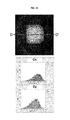
- FIGS. 15 to 17 are images showing problems caused by various laser processes.
- FIGS. 18 and 19 illustrate examples to which the light conversion substrate according to the embodiment of the present disclosure is applied.
- FIGS. 1 and 2 are conceptual views illustrating a structure of a light conversion substrate according to an embodiment of the present disclosure and a packaging process for a light emitting element.
- a light conversion substrate 100 may include: a first side part 110 that forms a first taper; and a second side part 120 formed in one region of the light conversion substrate and having a second taper different from the first taper. That is, the side parts of the light conversion substrate may be configured to have each surface having a tapered shape.
- a portion corresponding to a light emitting surface of a light emitting element, which will be described later, and a hole portion in which wire bonding is performed may be configured to have different tapers.
- the light conversion substrate according to the present embodiment of the disclosure may include a fluorescent material in the inside thereof.
- a substrate made of a material having various light transmitting properties may be applied as the light conversion substrate.
- a ceramic substrate may be applied.
- the fluorescent material contained in the light conversion substrate may include a phosphorescent and fluorescent material so as to convert an excited beam of various light emitting units, for example, a light emitting unit 200 into a conversion beam.
- the fluorescent material may include at least one of a yellow phosphor, a green phosphor, and a red phosphor.
- the yellow phosphor emits a beam having a main wavelength ranging from 540 to 585 nm in response to a blue beam (having a wavelength ranging from 430 to 480 nm).
- the green phosphor emits a beam having a main wavelength ranging from 510 to 535 nm in response to the blue beam (having a wavelength ranging from 430 to 480 nm).
- the red phosphor emits a beam having a main wavelength ranging from 600 to 650 nm in response to the blue beam (having a wavelength ranging from 430 to 480 nm).
- the yellow phosphor may be a silicate or YAG-based phosphor
- the green phosphor may be a silicate, nitride or sulfide-based phosphor
- the red phosphor may be a nitride or sulfide-based phosphor.
- the light conversion substrate 100 and the light emitting unit 200 may be mounted to be bonded by an adhesive member J.
- the light emitting unit 200 may be mounted on a PCB substrate S and may be packaged.
- FIGS. 3 and 4 are views illustrating main parts of the light conversion substrate 100 according to the embodiment of the present disclosure.
- FIG. 3 illustrates a plan view of the light conversion substrate illustrated in FIG. 1 .
- the light conversion substrate 100 may include: the first side part 110 that forms the first taper; and the second side part 120 having the second taper different from the first taper.
- the first taper is defined as an angle ⁇ 1 that is formed by an imaginary horizontal plane formed by the first side part, and an imaginary vertical segment Y taken from a lower end point A 1 of the first side part to a vertical upper direction.
- the angle ⁇ 1 may be formed in the range of 30° or less.
- the angle ⁇ 1 is more than 30°, a difference in thicknesses generated between an edge portion and a central portion of the light conversion substrate upon implementing the light emitting package illustrated in FIG. 1 is increased.
- a difference in color distribution is generated between the edge portion and the central portion, so uniform color distribution cannot be implemented.
- the second side part 120 serves as a bonding hole region that will be wire-bonded to the light emitting element of a lower portion illustrated in FIG. 1 rather than being implemented as a substantial light emitting region. Even though the taper angle is more than 30°, in terms of luminous intensity uniformity, a large loss is not generated. Accordingly, different processing methods may be applied to the second side part and the first side part so that cutting and processing for a substrate having difficulty in processing such as a ceramic substrate can be efficiently performed.
- FIG. 4 illustrates a side cross-sectional concept view of the second side part 120 of FIG. 3 .
- the first taper formed by the second side part 120 has a taper surface having a surface curvature.
- the second taper may be defined as a taper angle ⁇ 2 that is formed by an extension line Y 2 of an upper end C 1 and a lower end C 2 of the second side part having the curvature and a vertical segment Y 1 .
- the second taper ⁇ 2 may be formed larger than the first taper and may have a taper angle of 30° or more.
- the second side part 120 may be implemented such that a surface of the second side part has a curvature.
- the second side part 120 may be implemented to be inwardly curved from an edge portion of the light conversion substrate to a central portion of the light conversion substrate.
- the second side part having such a structure may be configured such that two second side parts are formed at both edge portions of the light conversion substrate.
- FIG. 5 shows an upper plane image of the light conversion substrate of FIGS. 3 and 4
- (B) of FIG. 5 shows a plane image of the light conversion substrate as viewed from an ‘x’ direction of (A).
- the second side part has a second taper structure in which a taper is only formed in a wire hole portion. Since the first side par has a very small taper, the first side part is implemented in a subvertical form. Thus, an edge portion of the first side part has a uniform thickness so that luminous intensity uniformity can be secured.
- FIGS. 6 and 7 illustrate conceptual views for a production process of the light conversion substrate according to the embodiment of the present disclosure.
- a ceramic substrate may be applied as the light conversion substrate applied to the present embodiment of the disclosure.
- the ceramic substrate In consideration of brittleness of the ceramic substrate that enables the ceramic substrate to be easily broken upon processing, there is a need to process the ceramic substrate so that the substrate can entirely have a uniform thickness, thereby facilitating a precise cutting process. That is, it is not easy to perform a cutting process in terms of the property of the ceramic material having brittleness. In particular, it is very difficult to perform the cutting process based on precise patterns via wire bonding.
- a fluorescent material contained in the inside of the ceramic substrate causes burning by absorbing a laser beam, so a cutting surface of the ceramic substrate is blackened, and a phosphor is deteriorated around the cutting surface. Accordingly, the problem of a reduction in optical properties is generated.
- the ceramic substrate according to the present embodiment of the disclosure is processed by a method such as a chemical etching method, a sandblast method, and the like for package mounting, a difference in color distribution between an edge portion and a central portion of the ceramic phosphor plate occurs because a thickness of the edge portion having a taper portion is not uniform. Furthermore, the amounts of adhesives used in the edge portion and the central portion of the ceramic phosphor plate are different from each other upon mounting the package, so a defect such as bending or warping of the substrate may be generated during a curing process.
- the ceramic phosphor plate according to the present embodiment of the disclosure there is a need to cut the ceramic phosphor plate while entirely maintaining a uniform plate thickness by minimizing a taper angle. Also, the cutting should be performed in such a manner as to minimize damage to the phosphor from the heat.
- the light conversion substrate may be implemented in a structure that enables the minimization of each taper angle of edge portions via the process as shown in FIGS. 6 and 7 , and securing of luminous intensity uniformity.
- the second taper of the ceramic substrate according to the present embodiment of the disclosure is formed by an etching process, and the first taper is then formed by a dicing process.
- the etching process it is preferable to use a wet etching process.
- an isotropic etching process is performed as the wet etching process.
- An etched amount of a region having relatively many exposed portions is gradually increased as etching time passes.
- an etched amount of an upper portion of the ceramic substrate is larger than that of a lower portion because the upper portion has a relatively large exposed region compared to that of the lower portion. Accordingly, the second taper having the structure previously described with reference to FIG. 3 may be implemented. Then, the first taper may be implemented by the dicing process.
- a substrate 100 is prepared as a raw material of the light conversion substrate, the second taper is implemented by subjecting each part corresponding to the second side parts to hole H processing. This process may be performed by the wet etching process as described above.
- each part corresponding to the first side parts is subjected to hole H 2 dicing so that a structure of each first side part having the first taper as shown in FIG. 3 can be implemented.
- holes H 3 having each circular cross section are formed in the substrate 100 as shown in (A) and (B) of FIG. 7 by performing the wet etching process.
- Each Hole is cut in quarters by cutting lines as shown in (C) of FIG. 7 .
- unit light conversion substrates 100 a are formed.
- FIG. 8 shows the comparison of variations in edge portions resulting from the production process.
- FIG. 8 the production method of FIGS. 6 and 7 such as an etching process and a dicing process is applied, in (B) of FIG. 8 , a method for performing a dicing process after a laser process is applied, in (C) of FIG. 8 , a method for processing the light conversion substrate having the structure of FIG. 3 using only a laser process is applied, and in (D) of FIG. 8 , a laser process in a structure containing a phosphor is applied to a resin type substrate rather than a ceramic substrate.
- FIGS. 9 and 10 show each variation in color temperatures Cx, Cy resulting from the processing methods of FIG. 8 .
- (D) in which only the laser process is used, it can be seen that a variation in color temperature is seriously generated from an edge portion. It can be confirmed that the (D) type sample processed by only the laser process is excellent in terms of a color coordinate variation, and that the color coordinate variation can be implemented in an equal level as that of the resin type sample of a comparative group.
- FIGS. 11 to 14 show graphs that specifically present the results of each color coordinate regarding four samples. That is, FIG. 11 illustrates the results of a color coordinate upon processing the (A) type sample of FIG. 8 , FIG. 12 illustrates the results of a color coordinate upon processing the (B) type sample of FIG. 8 , FIG. 13 illustrates the results of a color coordinate upon processing the (C) type sample of FIG. 8 , and FIG. 14 illustrates the results of a color coordinate upon processing the (D) type sample of FIG. 8 .
- the side parts having a structure for enabling securing of maximum luminous intensity uniformity and a structure having a wire bonding region may be secured.
- the light conversion substrate according to the present embodiment of the disclosure which implements an equal color coordinate to that of the (D) type sample, namely, the resin type sample, may be implemented as a ceramic phosphor substrate having equal color coordinate performance to that of the light conversion substrate having strong tolerance compared to the resin type substrate upon applying high electric currents.
- FIG. 15 is an actual image photo of the light conversion substrate showing a reduction in optical properties resulting from burning of an edge portion due to the absorption of a laser beam by a phosphor and degradation of the phosphor around a cutting surface when the light conversion substrate having the structure of FIG. 3 according to the present embodiment of the disclosure is implemented by only the laser (Pico UV laser) process using a ceramic substrate containing the phosphor.
- FIG. 16 shows an image resulting from a case in which the ceramic substrate is processed by a green laser
- FIG. 17 shows an image resulting from a case in which the ceramic substrate according to the present embodiment of the disclosure is processed by an Nd:YAG laser.
- the light conversion substrate according to the present embodiment of the disclosure may be manufactured in a structure in which mechanical processing can be applied so that degradation of the side parts can be minimized and optical efficiency can be increased.
- a special structure which is formed different from that of a wire bonding region for the tapers of the side parts, is implemented so that the light conversion substrate having excellent optical properties can be implemented and can be packaged by a combination with a light emitting element.
- the light conversion substrate according to the present embodiment of the disclosure may be implemented as a lighting device that is packaged by a combination with the light emitting element.
- the light conversion substrate according to the present embodiment of the disclosure may be implemented as a light conversion substrate having a structure in which a fluorescent material is contained in a ceramic substrate so that degradation of the edge portion can be prevented, and luminous intensity uniformity can be increased.
- an optical selective member 300 is formed on one surface of the light conversion substrate 100 so that an excited beam emitted from the light emitting element 200 can be converted into a conversion beam via the light conversion substrate 100 , and the conversion beam is partially reflected from the optical selective member in a fixed direction so that packaging can be performed, thereby enabling an increase in light efficiency.
- FIG. 18 may be implemented as a package as shown in FIG. 2 .
- the light conversion substrate 100 is disposed to be adjacent to the light emitting element 200 so as to partially transmit a beam A flowing into the light conversion substrate, and the light conversion substrate 100 may further include the optical selective member 300 intended for reflecting some conversion beams B 1 , B 2 of conversion beams converted from the light conversion substrate 100 .
- the light conversion substrate 100 may basically have a structure in which that an metal oxide is contained in a light conversion member containing a fluorescent material (phosphor) so that scattering of light can be increased and optical efficiency can be improved.
- a fluorescent material phosphor
- a beam entering from one direction may be transmitted so as to enter the light conversion substrate 100 so that scattering and converting of the beam can be implemented by the fluorescent material and the metal oxide contained in the light conversion substrate. Furthermore, by reflecting beams leaked in a light incidence direction among beams emitted in all directions again, the beams may be collected in one direction.
- the light conversion substrate 100 may be disposed in an optical path of the excited beam emitted from the light emitting unit 200 and may function to form a conversion beam B by absorbing, exciting and emitting the excited beam. To do so, the light conversion substrate 100 may contain a luminescent material (lumiphor), and may further contain a metal oxide so that a scattering rate of light can be increased.
- the light emitting unit 200 may include a light emitting element emitting a beam and may cover various light sources. As one example, a solid light emitting element may be applied as the light emitting unit.
- the solid light emitting element may be any one selected from the group consisting of an LED (Light Emitting Diode), an OLED (Organic Light Emitting Diode), an LD (Laser Diode), a laser, and a VCSEL (Vertical Cavity Surface Emitting Laser).
- LED Light Emitting Diode
- OLED Organic Light Emitting Diode
- LD Laser Diode
- laser a laser
- VCSEL Very Cavity Surface Emitting Laser
- the light conversion substrate 100 may be formed in a plate form as illustrated in FIG. 18 and may be disposed at a spaced position which light excited from the light emitting unit 200 can reach. In this case, a space part may be formed between the light conversion substrate 100 and the light emitting unit 200 .
- the light conversion substrate 100 may function to convert an excited beam having a low wavelength emitted in a thin spectrum width created from the light emitting unit 200 into a white beam, thereby forming a conversion beam B.
- the conversion beam B converted from the light conversion substrate 100 may be emitted in all directions based on a central point of the light conversion substrate 100 . At this time, the conversion beam B emitted in all directions is reflected from the optical selective member 300 which will be described later so that an optical path can be controlled in a specific direction.
- the optical selective member 300 may be spaced apart from the light emitting unit 200 .
- the light conversion substrate 100 and the optical selective member 300 may be formed to be directly closely attached to each other, or may be formed to be spaced apart from each other. In either case, when the conversion beam B flowing into the light conversion substrate 100 and converted is emitted in all directions, the optical selective member 300 may control a direction of the beam to a fixed direction via reflection.
- the optical selective member 300 may be formed to be closely attached to an entire surface of the light conversion substrate 100 , or may be formed on a part of the surface of the light conversion substrate. Furthermore, the optical selective member 300 may be formed to be adjacent to one surface of the light conversion substrate 200 . In particular, the optical selective member 300 may be formed in a structure in which at least two material layers 310 , 320 having different refractive indexes are laminated. That is, the optical selective member 300 may be implemented such that the material layers having the different refractive indexes are laminated in a multilayered structure.
- the lamination structure only the lamination of a thin film structure is exemplified, but the lamination structure may be also implemented as a lamination structure of a thin film layer having a periodical grid form or a thin film layer having a regular pattern structure.
- This lamination structure may increase reflectance of the conversion beams converted from the light conversion substrate 100 and may enable light transmittance to be easily adjusted so that efficient light intensity can be implemented.
- the structure illustrated in FIG. 18 shows a case in which two layered thin film structures are laminated on a surface of the light conversion substrate 100 , namely, a surface facing the light emitting unit 200 .
- the optical selective member 300 may be implemented a lamination structure composed the first material layer 310 having the first refractive index and the second material layer 320 having the second refractive index.
- the refractive index of the first material layer 310 is different from that of the second material layer 320 .
- the first and second material layers may be formed to have a difference in the refractive indexes of 0.1 or more. When the difference in the refractive indexes is less than 0.1, reflectance as the lamination structure is reduced, and it is difficult to control transmittance and to implement specialty of the lamination structure.
- the lamination of the material layers may be variously performed in such a manner that two layered material layers having different refractive indexes are implemented in a multi-layered structure.
- the first material layer 310 and the second material layer 320 having a difference in refractive indexes of 0.1 or more may be alternatively laminated.
- Such a structure enables an increase in reflectance and is very useful in terms of light control.
- the optical selective member 300 formed in the multi-layered structure may enable the transmittance of a central wavelength I_max of the excited beam flowing into the light conversion substrate 100 to be increased by 70% or more and may also enable a reflectance of the conversion beam B converted in the inside of the optical selective member 300 to be increased by 60% or more of a main wavelength of the conversion beam.
- the lamination structure when the first material layer 310 and the second material layer 320 are alternatively laminated, the lamination structure may be implemented in five or more layers. In order to make the device thinner, the lamination structure may be implemented in five or more layers and thirty or less layers.
- the optical selective member 300 may be produced by forming a thin film in the form of [(L/2)H(L/2)] S and may be made of a material having excellent reflectance and transmittance such as TiO 2 , SiO 2 and the like.
- the laminating method may be performed by a sputtering process, a deposition process, a dipping process, a spray coating process, or the like.
- a substrate of an individual structure may be adhered to the light conversion substrate 100 via a light transmitting adhesive member, and a separate thin film structure may be implemented on the substrate using a sputtering process, a deposition process, a dipping process, a spray coating process or the like.
- the adhesive member which is a transparent polymeric sheet, may be made of any one of PMMA (Polymethly methacrylate), A-PET (Amorphous Polyethylene terephthalate), PETG (Poly(ethylene terephthalate)-glycol), and PC (Polycarbonate). In addition to this, if any material has good light transmitting performance, the material may be used as the material of the adhesive member.
- PMMA Polymethly methacrylate
- A-PET Amorphous Polyethylene terephthalate
- PETG Poly(ethylene terephthalate)-glycol
- PC Polycarbonate
- a metal oxide may be further contained in the inside of the light conversion substrate.
- the metal oxide may be added in an amount of 0.1 ⁇ 10 wt % based on the total weight of the light conversion substrate.
- This metal oxide may enable an incident beam to be implemented as a scattering beam scattered in the inside of the light conversion substrate, and may enable the scattering beam to be converted into various beams via a phosphor.
- a haze of the light conversion substrate may be increased, and light efficiency may be also increased.
- a blue spot and the like caused by the light emitting unit emitting strong beams may be removed.
- the scattering effect of light may function to enable the light to be uniformly distributed.
- the amount of the metal oxide contained in the light conversion substrate is less than 0.1 wt %, the effect of the increase in haze may not be expected.
- the amount of the metal oxide contained in the light conversion substrate is more than 10 wt %, the light conversion substrate may have lower light efficiency than that of a glass substrate which is a glass frit sintering body. This reason is because transmittance is very reduced.
- a sintering body composed of a glass frit is prepared, and a light conversion member containing a phosphor is provided in a substrate form.
- the light conversion substrate may contain any one selected from the group consisting of Al 2 O 3 , TiO 2 , and ZnO, or a mixture thereof.
- FIG. 19 is a conceptual view illustrating a structure in which a light emitting package having the light conversion substrate 100 according to the embodiment of the present disclosure and the optical selective member 300 is applied to a head lamp for an automobile.
- the beam emitted from the light emitting unit 200 is converted into conversion beams by the light conversion substrate 100 , and some conversion beams travel to a reflector 500 .
- Some conversion beams traveling toward the light emitting unit are reflective by the optical selective member 300 and return to the reflector 500 again, and thus being emitted X.
- a head lamp capable of improving optical confinement and increasing light conversion efficiency may be implemented.
- the element of the optical selective part formed in a slimming structure may be only implemented by locally installing it in a structure such as a housing Y and the like, and thus a size of the lamp housing may be entirely reduced.
- the light conversion substrate may be configured such that the side parts of the light conversion substrate for converting the beam emitted from the light emitting element are formed to have different taper angles so that uniform color distribution can be implemented all over the entire area of the light conversion substrate upon packaging the light emitting element and the light conversion substrate.
- the tapers formed at the sides of the light conversion substrate may be adjusted so that a ratio of the materials for adhesion with the light emitting element can be uniformly formed, thereby implementing the light emitting package having a combination structure with reliability.
- the metal oxide may be injected into the light conversion substrate containing a phosphor so that a haze of the light conversion substrate can be increased, thereby enabling an increase in light efficiency.
- a factor i.e., blue spot
- the beam emitted from the light conversion plate can have uniform color temperatures.
- the optical selective part is formed on the surface of the light conversion substrate or at a position adjacent to the light conversion substrate so that light transmittance of a light source incident to the light conversion substrate can be increased, and the light can be controlled from returning to a light incident direction, thereby enabling a reduction in the level of difficulty for a system optical design.
- conversion beams converted by the light conversion substrate emitted in all directions are controlled so that an output of the conversion beams in a specific direction can be increased, and thus the efficiency of an automobile lamp system can be improved.
- an aspect of embodiments of the present disclosure provides a light conversion substrate which is configured such that side parts of the light conversion substrate for converting a beam emitted from a light emitting element are formed to have different taper angles so that uniform color distribution can be implemented all over the entire area of the light conversion substrate.
- a light conversion substrate may include: a first side part that forms a first taper; and a second side part formed in one region of the light conversion substrate and having a second taper different from the first taper, wherein the light conversion substrate contains a fluorescent material.
- a light emitting package may include the light conversion substrate; and a light emitting unit emitting a beam to the light conversion substrate.
- This light emitting package may be applied to a lighting device such as an automobile lamp and the like.
- any reference in this specification to “one embodiment,” “an embodiment,” “example embodiment,” etc. means that a particular feature, structure, or characteristic described in connection with the embodiment is included in at least one embodiment of the disclosure.
- the appearances of such phrases in various places in the specification are not necessarily all referring to the same embodiment.
Landscapes
- Engineering & Computer Science (AREA)
- Physics & Mathematics (AREA)
- General Engineering & Computer Science (AREA)
- Optics & Photonics (AREA)
- Microelectronics & Electronic Packaging (AREA)
- Spectroscopy & Molecular Physics (AREA)
- Mathematical Physics (AREA)
- Condensed Matter Physics & Semiconductors (AREA)
- General Physics & Mathematics (AREA)
- Electromagnetism (AREA)
- Led Device Packages (AREA)
- Non-Portable Lighting Devices Or Systems Thereof (AREA)
Applications Claiming Priority (2)
| Application Number | Priority Date | Filing Date | Title |
|---|---|---|---|
| KR10-2014-0017320 | 2014-02-14 | ||
| KR1020140017320A KR102231580B1 (ko) | 2014-02-14 | 2014-02-14 | 광변환기판 및 이를 포함하는 발광패키지, 차량용 램프 |
Publications (2)
| Publication Number | Publication Date |
|---|---|
| US20150233546A1 US20150233546A1 (en) | 2015-08-20 |
| US9810402B2 true US9810402B2 (en) | 2017-11-07 |
Family
ID=52544297
Family Applications (1)
| Application Number | Title | Priority Date | Filing Date |
|---|---|---|---|
| US14/621,924 Active 2035-06-27 US9810402B2 (en) | 2014-02-14 | 2015-02-13 | Light conversion substrate and light emitting package and automobile lamp including the same |
Country Status (5)
| Country | Link |
|---|---|
| US (1) | US9810402B2 (de) |
| EP (1) | EP2908355B1 (de) |
| KR (1) | KR102231580B1 (de) |
| CN (1) | CN104851959B (de) |
| TW (1) | TW201542964A (de) |
Families Citing this family (9)
| Publication number | Priority date | Publication date | Assignee | Title |
|---|---|---|---|---|
| KR102499548B1 (ko) | 2015-11-06 | 2023-03-03 | 엘지이노텍 주식회사 | 발광패키지 및 이를 포함하는 차량용 헤드램프 |
| JP2017143236A (ja) * | 2016-02-09 | 2017-08-17 | 日東電工株式会社 | セラミックスプレート、その製造方法および光半導体装置 |
| JP6304297B2 (ja) * | 2016-04-06 | 2018-04-04 | 日亜化学工業株式会社 | 発光装置の製造方法 |
| EP3559990B1 (de) * | 2016-12-21 | 2020-09-16 | Lumileds Holding B.V. | Ausgerichtete led-anordnung |
| JP6854190B2 (ja) * | 2017-05-23 | 2021-04-07 | スタンレー電気株式会社 | 車両用前照灯 |
| JP6868491B2 (ja) * | 2017-07-11 | 2021-05-12 | スタンレー電気株式会社 | 車両用前照灯 |
| WO2018216576A1 (ja) * | 2017-05-23 | 2018-11-29 | スタンレー電気株式会社 | 車両用前照灯 |
| CN113043361A (zh) * | 2020-03-27 | 2021-06-29 | 深圳市聚飞光电股份有限公司 | 一种荧光片、led封装件及其制作方法 |
| DE102021113018A1 (de) * | 2021-05-19 | 2022-11-24 | OSRAM Opto Semiconductors Gesellschaft mit beschränkter Haftung | Halbleiterlaser, halbleiterlaservorrichtung und optoelektronisches halbleiterbauelement |
Citations (11)
| Publication number | Priority date | Publication date | Assignee | Title |
|---|---|---|---|---|
| US20040145308A1 (en) * | 2002-10-22 | 2004-07-29 | Osram Opto Semiconductors Gmbh | Light source having an LED and a luminescence conversion body and method for producing the luminescence conversion body |
| EP1753035A1 (de) | 2004-04-28 | 2007-02-14 | Matsushita Electric Industrial Co., Ltd. | Lichtquelle und verfahren zur herstellung derselben |
| US20070085103A1 (en) * | 2003-11-25 | 2007-04-19 | Matsushita Electric Works, Ltd. | Light emitting device using light emitting diode chip |
| US20100110553A1 (en) * | 2004-07-12 | 2010-05-06 | Gentex Corporation | Rearview Mirror Assemblies with Anisotropic Polymer Laminates |
| US20100313414A1 (en) * | 2009-06-14 | 2010-12-16 | Terepac | Processes and structures for IC fabrication |
| EP2346101A1 (de) | 2008-10-15 | 2011-07-20 | Koito Manufacturing Co., Ltd. | Lichtemittierendes modul, herstellungsverfahren für ein lichtemittierendes moduk und beleuchtungskörper |
| US20110284902A1 (en) * | 2008-11-28 | 2011-11-24 | Koito Manufacturing Co., Ltd. | Light emission module, light emission module manufacturing method, and lamp unit |
| US20120113617A1 (en) | 2010-11-10 | 2012-05-10 | Osram Sylvania Inc. | Luminescent Ceramic Converter and LED Containing Same |
| US20130292710A1 (en) * | 2012-05-07 | 2013-11-07 | Samsung Electronics Co., Ltd. | Light emitting device |
| US20130313581A1 (en) * | 2012-05-28 | 2013-11-28 | Kabushiki Kaisha Toshiba | Semiconductor light emitting device and light emitting module |
| US20160079488A1 (en) * | 2013-04-25 | 2016-03-17 | Osram Opto Semiconductors Gmbh | Wavelength-converting element, optoelectronic component and printing stencil |
Family Cites Families (4)
| Publication number | Priority date | Publication date | Assignee | Title |
|---|---|---|---|---|
| US7397177B2 (en) * | 2003-09-25 | 2008-07-08 | Matsushita Electric Industrial Co., Ltd. | LED lamp and method for manufacturing the same |
| JP4391870B2 (ja) * | 2004-04-02 | 2009-12-24 | 株式会社小糸製作所 | 車両用照明灯具 |
| JPWO2010044239A1 (ja) * | 2008-10-17 | 2012-03-15 | 株式会社小糸製作所 | 発光モジュール、発光モジュールの製造方法、および灯具ユニット |
| CN104416874A (zh) * | 2013-09-04 | 2015-03-18 | 苏州长青建筑安装工程有限公司 | 一种新型多功能注塑机 |
-
2014
- 2014-02-14 KR KR1020140017320A patent/KR102231580B1/ko active Active
-
2015
- 2015-02-12 EP EP15154866.6A patent/EP2908355B1/de not_active Not-in-force
- 2015-02-13 US US14/621,924 patent/US9810402B2/en active Active
- 2015-02-13 TW TW104104976A patent/TW201542964A/zh unknown
- 2015-02-15 CN CN201510082615.8A patent/CN104851959B/zh not_active Expired - Fee Related
Patent Citations (12)
| Publication number | Priority date | Publication date | Assignee | Title |
|---|---|---|---|---|
| US20040145308A1 (en) * | 2002-10-22 | 2004-07-29 | Osram Opto Semiconductors Gmbh | Light source having an LED and a luminescence conversion body and method for producing the luminescence conversion body |
| US20070085103A1 (en) * | 2003-11-25 | 2007-04-19 | Matsushita Electric Works, Ltd. | Light emitting device using light emitting diode chip |
| EP1753035A1 (de) | 2004-04-28 | 2007-02-14 | Matsushita Electric Industrial Co., Ltd. | Lichtquelle und verfahren zur herstellung derselben |
| US20100110553A1 (en) * | 2004-07-12 | 2010-05-06 | Gentex Corporation | Rearview Mirror Assemblies with Anisotropic Polymer Laminates |
| EP2346101A1 (de) | 2008-10-15 | 2011-07-20 | Koito Manufacturing Co., Ltd. | Lichtemittierendes modul, herstellungsverfahren für ein lichtemittierendes moduk und beleuchtungskörper |
| US20110284902A1 (en) * | 2008-11-28 | 2011-11-24 | Koito Manufacturing Co., Ltd. | Light emission module, light emission module manufacturing method, and lamp unit |
| US20100313414A1 (en) * | 2009-06-14 | 2010-12-16 | Terepac | Processes and structures for IC fabrication |
| US20120113617A1 (en) | 2010-11-10 | 2012-05-10 | Osram Sylvania Inc. | Luminescent Ceramic Converter and LED Containing Same |
| US20130292710A1 (en) * | 2012-05-07 | 2013-11-07 | Samsung Electronics Co., Ltd. | Light emitting device |
| US20130313581A1 (en) * | 2012-05-28 | 2013-11-28 | Kabushiki Kaisha Toshiba | Semiconductor light emitting device and light emitting module |
| EP2669964A2 (de) | 2012-05-28 | 2013-12-04 | Kabushiki Kaisha Toshiba | Lichtemittierende Halbleitervorrichtung und lichtemittierendes Modul |
| US20160079488A1 (en) * | 2013-04-25 | 2016-03-17 | Osram Opto Semiconductors Gmbh | Wavelength-converting element, optoelectronic component and printing stencil |
Non-Patent Citations (1)
| Title |
|---|
| European Search Report issued in Application No. 15154866.6 dated May 27, 2015. |
Also Published As
| Publication number | Publication date |
|---|---|
| EP2908355B1 (de) | 2018-11-28 |
| US20150233546A1 (en) | 2015-08-20 |
| TW201542964A (zh) | 2015-11-16 |
| EP2908355A1 (de) | 2015-08-19 |
| CN104851959A (zh) | 2015-08-19 |
| KR20150096179A (ko) | 2015-08-24 |
| KR102231580B1 (ko) | 2021-03-24 |
| CN104851959B (zh) | 2020-02-11 |
Similar Documents
| Publication | Publication Date | Title |
|---|---|---|
| US9810402B2 (en) | Light conversion substrate and light emitting package and automobile lamp including the same | |
| EP2602537B1 (de) | Lichtquellenvorrichtung | |
| KR102537648B1 (ko) | 발광 장치 및 발광 장치의 제조 방법 | |
| JP5255040B2 (ja) | 発光装置、車両用前照灯、照明装置および車両、ならびに、発光装置の組立方法 | |
| EP2128906B1 (de) | Lichtemittierende einrichtung | |
| JP6371201B2 (ja) | 発光モジュール及びそれを用いた発光装置 | |
| US12183861B2 (en) | Light-emitting device | |
| US20110002127A1 (en) | Optical element and manufacturing method therefor | |
| US10991859B2 (en) | Light-emitting device and method of manufacturing the same | |
| US11262046B2 (en) | Phosphor element, method for producing same, and lighting device | |
| WO2009074944A1 (en) | Side emitting device with hybrid top reflector | |
| US11239218B2 (en) | Light emitting module having a red light source, a green light source and a blue light source | |
| JP2018195800A (ja) | 発光装置及びその製造方法 | |
| KR102157688B1 (ko) | 조명장치 | |
| EP2223351B1 (de) | Seitenemissionsvorrichtung mit oberem hybridreflektor | |
| US10808903B2 (en) | Light converting device with ceramic protection layer | |
| KR102366387B1 (ko) | 조명장치 및 이를 포함하는 차량용 램프 | |
| KR102555300B1 (ko) | 조명 장치 | |
| US11635189B2 (en) | Phosphor element and lighting device | |
| WO2020066077A1 (ja) | 蛍光体素子、その製造方法および照明装置 | |
| KR20160116998A (ko) | 발광패키지 및 이를 포함하는 차량용 램프 | |
| KR20160060486A (ko) | 광변환 기판의 제조공정 및 이를 이용하여 제조되는 광변환기판 |
Legal Events
| Date | Code | Title | Description |
|---|---|---|---|
| AS | Assignment |
Owner name: LG INNOTEK CO., LTD., KOREA, REPUBLIC OF Free format text: ASSIGNMENT OF ASSIGNORS INTEREST;ASSIGNORS:PARK, JIN GYEONG;KIM, WON JIN;LEE, IN JAE;REEL/FRAME:035571/0731 Effective date: 20150213 |
|
| STCF | Information on status: patent grant |
Free format text: PATENTED CASE |
|
| MAFP | Maintenance fee payment |
Free format text: PAYMENT OF MAINTENANCE FEE, 4TH YEAR, LARGE ENTITY (ORIGINAL EVENT CODE: M1551); ENTITY STATUS OF PATENT OWNER: LARGE ENTITY Year of fee payment: 4 |
|
| MAFP | Maintenance fee payment |
Free format text: PAYMENT OF MAINTENANCE FEE, 8TH YEAR, LARGE ENTITY (ORIGINAL EVENT CODE: M1552); ENTITY STATUS OF PATENT OWNER: LARGE ENTITY Year of fee payment: 8 |