US9857012B2 - Apparatus of controlling electric power for electric fusion pipe fitting using conductive polymer composite and method thereof - Google Patents
Apparatus of controlling electric power for electric fusion pipe fitting using conductive polymer composite and method thereof Download PDFInfo
- Publication number
- US9857012B2 US9857012B2 US14/434,267 US201314434267A US9857012B2 US 9857012 B2 US9857012 B2 US 9857012B2 US 201314434267 A US201314434267 A US 201314434267A US 9857012 B2 US9857012 B2 US 9857012B2
- Authority
- US
- United States
- Prior art keywords
- electric power
- coupling pipe
- conductive polymer
- polymer composite
- electrofusion coupling
- Prior art date
- Legal status (The legal status is an assumption and is not a legal conclusion. Google has not performed a legal analysis and makes no representation as to the accuracy of the status listed.)
- Active, expires
Links
Images



Classifications
-
- F—MECHANICAL ENGINEERING; LIGHTING; HEATING; WEAPONS; BLASTING
- F16—ENGINEERING ELEMENTS AND UNITS; GENERAL MEASURES FOR PRODUCING AND MAINTAINING EFFECTIVE FUNCTIONING OF MACHINES OR INSTALLATIONS; THERMAL INSULATION IN GENERAL
- F16L—PIPES; JOINTS OR FITTINGS FOR PIPES; SUPPORTS FOR PIPES, CABLES OR PROTECTIVE TUBING; MEANS FOR THERMAL INSULATION IN GENERAL
- F16L47/00—Connecting arrangements or other fittings specially adapted to be made of plastics or to be used with pipes made of plastics
-
- B—PERFORMING OPERATIONS; TRANSPORTING
- B29—WORKING OF PLASTICS; WORKING OF SUBSTANCES IN A PLASTIC STATE IN GENERAL
- B29C—SHAPING OR JOINING OF PLASTICS; SHAPING OF MATERIAL IN A PLASTIC STATE, NOT OTHERWISE PROVIDED FOR; AFTER-TREATMENT OF THE SHAPED PRODUCTS, e.g. REPAIRING
- B29C65/00—Joining or sealing of preformed parts, e.g. welding of plastics materials; Apparatus therefor
- B29C65/02—Joining or sealing of preformed parts, e.g. welding of plastics materials; Apparatus therefor by heating, with or without pressure
- B29C65/34—Joining or sealing of preformed parts, e.g. welding of plastics materials; Apparatus therefor by heating, with or without pressure using heated elements which remain in the joint, e.g. "verlorenes Schweisselement"
- B29C65/3404—Joining or sealing of preformed parts, e.g. welding of plastics materials; Apparatus therefor by heating, with or without pressure using heated elements which remain in the joint, e.g. "verlorenes Schweisselement" characterised by the type of heated elements which remain in the joint
- B29C65/3408—Joining or sealing of preformed parts, e.g. welding of plastics materials; Apparatus therefor by heating, with or without pressure using heated elements which remain in the joint, e.g. "verlorenes Schweisselement" characterised by the type of heated elements which remain in the joint comprising single particles, e.g. fillers or discontinuous fibre-reinforcements
- B29C65/3412—Joining or sealing of preformed parts, e.g. welding of plastics materials; Apparatus therefor by heating, with or without pressure using heated elements which remain in the joint, e.g. "verlorenes Schweisselement" characterised by the type of heated elements which remain in the joint comprising single particles, e.g. fillers or discontinuous fibre-reinforcements comprising fillers
-
- B—PERFORMING OPERATIONS; TRANSPORTING
- B29—WORKING OF PLASTICS; WORKING OF SUBSTANCES IN A PLASTIC STATE IN GENERAL
- B29C—SHAPING OR JOINING OF PLASTICS; SHAPING OF MATERIAL IN A PLASTIC STATE, NOT OTHERWISE PROVIDED FOR; AFTER-TREATMENT OF THE SHAPED PRODUCTS, e.g. REPAIRING
- B29C65/00—Joining or sealing of preformed parts, e.g. welding of plastics materials; Apparatus therefor
- B29C65/02—Joining or sealing of preformed parts, e.g. welding of plastics materials; Apparatus therefor by heating, with or without pressure
- B29C65/34—Joining or sealing of preformed parts, e.g. welding of plastics materials; Apparatus therefor by heating, with or without pressure using heated elements which remain in the joint, e.g. "verlorenes Schweisselement"
- B29C65/3468—Joining or sealing of preformed parts, e.g. welding of plastics materials; Apparatus therefor by heating, with or without pressure using heated elements which remain in the joint, e.g. "verlorenes Schweisselement" characterised by the means for supplying heat to said heated elements which remain in the join, e.g. special electrical connectors of windings
-
- B—PERFORMING OPERATIONS; TRANSPORTING
- B29—WORKING OF PLASTICS; WORKING OF SUBSTANCES IN A PLASTIC STATE IN GENERAL
- B29C—SHAPING OR JOINING OF PLASTICS; SHAPING OF MATERIAL IN A PLASTIC STATE, NOT OTHERWISE PROVIDED FOR; AFTER-TREATMENT OF THE SHAPED PRODUCTS, e.g. REPAIRING
- B29C65/00—Joining or sealing of preformed parts, e.g. welding of plastics materials; Apparatus therefor
- B29C65/02—Joining or sealing of preformed parts, e.g. welding of plastics materials; Apparatus therefor by heating, with or without pressure
- B29C65/34—Joining or sealing of preformed parts, e.g. welding of plastics materials; Apparatus therefor by heating, with or without pressure using heated elements which remain in the joint, e.g. "verlorenes Schweisselement"
- B29C65/3472—Joining or sealing of preformed parts, e.g. welding of plastics materials; Apparatus therefor by heating, with or without pressure using heated elements which remain in the joint, e.g. "verlorenes Schweisselement" characterised by the composition of the heated elements which remain in the joint
- B29C65/3484—Joining or sealing of preformed parts, e.g. welding of plastics materials; Apparatus therefor by heating, with or without pressure using heated elements which remain in the joint, e.g. "verlorenes Schweisselement" characterised by the composition of the heated elements which remain in the joint being non-metallic
- B29C65/3488—Joining or sealing of preformed parts, e.g. welding of plastics materials; Apparatus therefor by heating, with or without pressure using heated elements which remain in the joint, e.g. "verlorenes Schweisselement" characterised by the composition of the heated elements which remain in the joint being non-metallic being an electrically conductive polymer
-
- B—PERFORMING OPERATIONS; TRANSPORTING
- B29—WORKING OF PLASTICS; WORKING OF SUBSTANCES IN A PLASTIC STATE IN GENERAL
- B29C—SHAPING OR JOINING OF PLASTICS; SHAPING OF MATERIAL IN A PLASTIC STATE, NOT OTHERWISE PROVIDED FOR; AFTER-TREATMENT OF THE SHAPED PRODUCTS, e.g. REPAIRING
- B29C65/00—Joining or sealing of preformed parts, e.g. welding of plastics materials; Apparatus therefor
- B29C65/02—Joining or sealing of preformed parts, e.g. welding of plastics materials; Apparatus therefor by heating, with or without pressure
- B29C65/34—Joining or sealing of preformed parts, e.g. welding of plastics materials; Apparatus therefor by heating, with or without pressure using heated elements which remain in the joint, e.g. "verlorenes Schweisselement"
- B29C65/3472—Joining or sealing of preformed parts, e.g. welding of plastics materials; Apparatus therefor by heating, with or without pressure using heated elements which remain in the joint, e.g. "verlorenes Schweisselement" characterised by the composition of the heated elements which remain in the joint
- B29C65/3484—Joining or sealing of preformed parts, e.g. welding of plastics materials; Apparatus therefor by heating, with or without pressure using heated elements which remain in the joint, e.g. "verlorenes Schweisselement" characterised by the composition of the heated elements which remain in the joint being non-metallic
- B29C65/3492—Joining or sealing of preformed parts, e.g. welding of plastics materials; Apparatus therefor by heating, with or without pressure using heated elements which remain in the joint, e.g. "verlorenes Schweisselement" characterised by the composition of the heated elements which remain in the joint being non-metallic being carbon
-
- B—PERFORMING OPERATIONS; TRANSPORTING
- B29—WORKING OF PLASTICS; WORKING OF SUBSTANCES IN A PLASTIC STATE IN GENERAL
- B29C—SHAPING OR JOINING OF PLASTICS; SHAPING OF MATERIAL IN A PLASTIC STATE, NOT OTHERWISE PROVIDED FOR; AFTER-TREATMENT OF THE SHAPED PRODUCTS, e.g. REPAIRING
- B29C65/00—Joining or sealing of preformed parts, e.g. welding of plastics materials; Apparatus therefor
- B29C65/02—Joining or sealing of preformed parts, e.g. welding of plastics materials; Apparatus therefor by heating, with or without pressure
- B29C65/34—Joining or sealing of preformed parts, e.g. welding of plastics materials; Apparatus therefor by heating, with or without pressure using heated elements which remain in the joint, e.g. "verlorenes Schweisselement"
- B29C65/3472—Joining or sealing of preformed parts, e.g. welding of plastics materials; Apparatus therefor by heating, with or without pressure using heated elements which remain in the joint, e.g. "verlorenes Schweisselement" characterised by the composition of the heated elements which remain in the joint
- B29C65/3484—Joining or sealing of preformed parts, e.g. welding of plastics materials; Apparatus therefor by heating, with or without pressure using heated elements which remain in the joint, e.g. "verlorenes Schweisselement" characterised by the composition of the heated elements which remain in the joint being non-metallic
- B29C65/3496—Joining or sealing of preformed parts, e.g. welding of plastics materials; Apparatus therefor by heating, with or without pressure using heated elements which remain in the joint, e.g. "verlorenes Schweisselement" characterised by the composition of the heated elements which remain in the joint being non-metallic with a coating, e.g. a metallic or a carbon coating
-
- B—PERFORMING OPERATIONS; TRANSPORTING
- B29—WORKING OF PLASTICS; WORKING OF SUBSTANCES IN A PLASTIC STATE IN GENERAL
- B29C—SHAPING OR JOINING OF PLASTICS; SHAPING OF MATERIAL IN A PLASTIC STATE, NOT OTHERWISE PROVIDED FOR; AFTER-TREATMENT OF THE SHAPED PRODUCTS, e.g. REPAIRING
- B29C65/00—Joining or sealing of preformed parts, e.g. welding of plastics materials; Apparatus therefor
- B29C65/56—Joining or sealing of preformed parts, e.g. welding of plastics materials; Apparatus therefor using mechanical means or mechanical connections, e.g. form-fits
- B29C65/561—Joining or sealing of preformed parts, e.g. welding of plastics materials; Apparatus therefor using mechanical means or mechanical connections, e.g. form-fits using screw-threads being integral at least to one of the parts to be joined
-
- B—PERFORMING OPERATIONS; TRANSPORTING
- B29—WORKING OF PLASTICS; WORKING OF SUBSTANCES IN A PLASTIC STATE IN GENERAL
- B29C—SHAPING OR JOINING OF PLASTICS; SHAPING OF MATERIAL IN A PLASTIC STATE, NOT OTHERWISE PROVIDED FOR; AFTER-TREATMENT OF THE SHAPED PRODUCTS, e.g. REPAIRING
- B29C65/00—Joining or sealing of preformed parts, e.g. welding of plastics materials; Apparatus therefor
- B29C65/72—Joining or sealing of preformed parts, e.g. welding of plastics materials; Apparatus therefor by combined operations or combined techniques, e.g. welding and stitching
-
- B—PERFORMING OPERATIONS; TRANSPORTING
- B29—WORKING OF PLASTICS; WORKING OF SUBSTANCES IN A PLASTIC STATE IN GENERAL
- B29C—SHAPING OR JOINING OF PLASTICS; SHAPING OF MATERIAL IN A PLASTIC STATE, NOT OTHERWISE PROVIDED FOR; AFTER-TREATMENT OF THE SHAPED PRODUCTS, e.g. REPAIRING
- B29C66/00—General aspects of processes or apparatus for joining preformed parts
- B29C66/01—General aspects dealing with the joint area or with the area to be joined
- B29C66/05—Particular design of joint configurations
- B29C66/10—Particular design of joint configurations particular design of the joint cross-sections
- B29C66/12—Joint cross-sections combining only two joint-segments; Tongue and groove joints; Tenon and mortise joints; Stepped joint cross-sections
- B29C66/124—Tongue and groove joints
- B29C66/1244—Tongue and groove joints characterised by the male part, i.e. the part comprising the tongue
- B29C66/12441—Tongue and groove joints characterised by the male part, i.e. the part comprising the tongue being a single wall
-
- B—PERFORMING OPERATIONS; TRANSPORTING
- B29—WORKING OF PLASTICS; WORKING OF SUBSTANCES IN A PLASTIC STATE IN GENERAL
- B29C—SHAPING OR JOINING OF PLASTICS; SHAPING OF MATERIAL IN A PLASTIC STATE, NOT OTHERWISE PROVIDED FOR; AFTER-TREATMENT OF THE SHAPED PRODUCTS, e.g. REPAIRING
- B29C66/00—General aspects of processes or apparatus for joining preformed parts
- B29C66/01—General aspects dealing with the joint area or with the area to be joined
- B29C66/05—Particular design of joint configurations
- B29C66/10—Particular design of joint configurations particular design of the joint cross-sections
- B29C66/12—Joint cross-sections combining only two joint-segments; Tongue and groove joints; Tenon and mortise joints; Stepped joint cross-sections
- B29C66/124—Tongue and groove joints
- B29C66/1248—Interpenetrating groove joints
-
- B—PERFORMING OPERATIONS; TRANSPORTING
- B29—WORKING OF PLASTICS; WORKING OF SUBSTANCES IN A PLASTIC STATE IN GENERAL
- B29C—SHAPING OR JOINING OF PLASTICS; SHAPING OF MATERIAL IN A PLASTIC STATE, NOT OTHERWISE PROVIDED FOR; AFTER-TREATMENT OF THE SHAPED PRODUCTS, e.g. REPAIRING
- B29C66/00—General aspects of processes or apparatus for joining preformed parts
- B29C66/50—General aspects of joining tubular articles; General aspects of joining long products, i.e. bars or profiled elements; General aspects of joining single elements to tubular articles, hollow articles or bars; General aspects of joining several hollow-preforms to form hollow or tubular articles
- B29C66/51—Joining tubular articles, profiled elements or bars; Joining single elements to tubular articles, hollow articles or bars; Joining several hollow-preforms to form hollow or tubular articles
- B29C66/52—Joining tubular articles, bars or profiled elements
- B29C66/522—Joining tubular articles
- B29C66/5221—Joining tubular articles for forming coaxial connections, i.e. the tubular articles to be joined forming a zero angle relative to each other
-
- B—PERFORMING OPERATIONS; TRANSPORTING
- B29—WORKING OF PLASTICS; WORKING OF SUBSTANCES IN A PLASTIC STATE IN GENERAL
- B29C—SHAPING OR JOINING OF PLASTICS; SHAPING OF MATERIAL IN A PLASTIC STATE, NOT OTHERWISE PROVIDED FOR; AFTER-TREATMENT OF THE SHAPED PRODUCTS, e.g. REPAIRING
- B29C66/00—General aspects of processes or apparatus for joining preformed parts
- B29C66/90—Measuring or controlling the joining process
- B29C66/91—Measuring or controlling the joining process by measuring or controlling the temperature, the heat or the thermal flux
- B29C66/912—Measuring or controlling the joining process by measuring or controlling the temperature, the heat or the thermal flux by measuring the temperature, the heat or the thermal flux
- B29C66/9121—Measuring or controlling the joining process by measuring or controlling the temperature, the heat or the thermal flux by measuring the temperature, the heat or the thermal flux by measuring the temperature
- B29C66/91211—Measuring or controlling the joining process by measuring or controlling the temperature, the heat or the thermal flux by measuring the temperature, the heat or the thermal flux by measuring the temperature with special temperature measurement means or methods
- B29C66/91214—Measuring or controlling the joining process by measuring or controlling the temperature, the heat or the thermal flux by measuring the temperature, the heat or the thermal flux by measuring the temperature with special temperature measurement means or methods by measuring the electrical resistance of a resistive element belonging to one of the parts to be welded, said element acting, e.g. as a thermistor
-
- B—PERFORMING OPERATIONS; TRANSPORTING
- B29—WORKING OF PLASTICS; WORKING OF SUBSTANCES IN A PLASTIC STATE IN GENERAL
- B29C—SHAPING OR JOINING OF PLASTICS; SHAPING OF MATERIAL IN A PLASTIC STATE, NOT OTHERWISE PROVIDED FOR; AFTER-TREATMENT OF THE SHAPED PRODUCTS, e.g. REPAIRING
- B29C66/00—General aspects of processes or apparatus for joining preformed parts
- B29C66/90—Measuring or controlling the joining process
- B29C66/91—Measuring or controlling the joining process by measuring or controlling the temperature, the heat or the thermal flux
- B29C66/912—Measuring or controlling the joining process by measuring or controlling the temperature, the heat or the thermal flux by measuring the temperature, the heat or the thermal flux
- B29C66/9121—Measuring or controlling the joining process by measuring or controlling the temperature, the heat or the thermal flux by measuring the temperature, the heat or the thermal flux by measuring the temperature
- B29C66/91221—Measuring or controlling the joining process by measuring or controlling the temperature, the heat or the thermal flux by measuring the temperature, the heat or the thermal flux by measuring the temperature of the parts to be joined
-
- B—PERFORMING OPERATIONS; TRANSPORTING
- B29—WORKING OF PLASTICS; WORKING OF SUBSTANCES IN A PLASTIC STATE IN GENERAL
- B29C—SHAPING OR JOINING OF PLASTICS; SHAPING OF MATERIAL IN A PLASTIC STATE, NOT OTHERWISE PROVIDED FOR; AFTER-TREATMENT OF THE SHAPED PRODUCTS, e.g. REPAIRING
- B29C66/00—General aspects of processes or apparatus for joining preformed parts
- B29C66/90—Measuring or controlling the joining process
- B29C66/91—Measuring or controlling the joining process by measuring or controlling the temperature, the heat or the thermal flux
- B29C66/912—Measuring or controlling the joining process by measuring or controlling the temperature, the heat or the thermal flux by measuring the temperature, the heat or the thermal flux
- B29C66/9131—Measuring or controlling the joining process by measuring or controlling the temperature, the heat or the thermal flux by measuring the temperature, the heat or the thermal flux by measuring the heat or the thermal flux, i.e. the heat flux
- B29C66/91311—Measuring or controlling the joining process by measuring or controlling the temperature, the heat or the thermal flux by measuring the temperature, the heat or the thermal flux by measuring the heat or the thermal flux, i.e. the heat flux by measuring the heat generated by Joule heating or induction heating
- B29C66/91317—Measuring or controlling the joining process by measuring or controlling the temperature, the heat or the thermal flux by measuring the temperature, the heat or the thermal flux by measuring the heat or the thermal flux, i.e. the heat flux by measuring the heat generated by Joule heating or induction heating by measuring the electrical resistance
-
- B—PERFORMING OPERATIONS; TRANSPORTING
- B29—WORKING OF PLASTICS; WORKING OF SUBSTANCES IN A PLASTIC STATE IN GENERAL
- B29C—SHAPING OR JOINING OF PLASTICS; SHAPING OF MATERIAL IN A PLASTIC STATE, NOT OTHERWISE PROVIDED FOR; AFTER-TREATMENT OF THE SHAPED PRODUCTS, e.g. REPAIRING
- B29C66/00—General aspects of processes or apparatus for joining preformed parts
- B29C66/90—Measuring or controlling the joining process
- B29C66/91—Measuring or controlling the joining process by measuring or controlling the temperature, the heat or the thermal flux
- B29C66/914—Measuring or controlling the joining process by measuring or controlling the temperature, the heat or the thermal flux by controlling or regulating the temperature, the heat or the thermal flux
- B29C66/9141—Measuring or controlling the joining process by measuring or controlling the temperature, the heat or the thermal flux by controlling or regulating the temperature, the heat or the thermal flux by controlling or regulating the temperature
- B29C66/91411—Measuring or controlling the joining process by measuring or controlling the temperature, the heat or the thermal flux by controlling or regulating the temperature, the heat or the thermal flux by controlling or regulating the temperature of the parts to be joined, e.g. the joining process taking the temperature of the parts to be joined into account
-
- B—PERFORMING OPERATIONS; TRANSPORTING
- B29—WORKING OF PLASTICS; WORKING OF SUBSTANCES IN A PLASTIC STATE IN GENERAL
- B29C—SHAPING OR JOINING OF PLASTICS; SHAPING OF MATERIAL IN A PLASTIC STATE, NOT OTHERWISE PROVIDED FOR; AFTER-TREATMENT OF THE SHAPED PRODUCTS, e.g. REPAIRING
- B29C66/00—General aspects of processes or apparatus for joining preformed parts
- B29C66/90—Measuring or controlling the joining process
- B29C66/91—Measuring or controlling the joining process by measuring or controlling the temperature, the heat or the thermal flux
- B29C66/914—Measuring or controlling the joining process by measuring or controlling the temperature, the heat or the thermal flux by controlling or regulating the temperature, the heat or the thermal flux
- B29C66/9161—Measuring or controlling the joining process by measuring or controlling the temperature, the heat or the thermal flux by controlling or regulating the temperature, the heat or the thermal flux by controlling or regulating the heat or the thermal flux, i.e. the heat flux
- B29C66/91651—Measuring or controlling the joining process by measuring or controlling the temperature, the heat or the thermal flux by controlling or regulating the temperature, the heat or the thermal flux by controlling or regulating the heat or the thermal flux, i.e. the heat flux by controlling or regulating the heat generated by Joule heating or induction heating
-
- B—PERFORMING OPERATIONS; TRANSPORTING
- B29—WORKING OF PLASTICS; WORKING OF SUBSTANCES IN A PLASTIC STATE IN GENERAL
- B29C—SHAPING OR JOINING OF PLASTICS; SHAPING OF MATERIAL IN A PLASTIC STATE, NOT OTHERWISE PROVIDED FOR; AFTER-TREATMENT OF THE SHAPED PRODUCTS, e.g. REPAIRING
- B29C66/00—General aspects of processes or apparatus for joining preformed parts
- B29C66/90—Measuring or controlling the joining process
- B29C66/91—Measuring or controlling the joining process by measuring or controlling the temperature, the heat or the thermal flux
- B29C66/919—Measuring or controlling the joining process by measuring or controlling the temperature, the heat or the thermal flux characterised by specific temperature, heat or thermal flux values or ranges
- B29C66/9192—Measuring or controlling the joining process by measuring or controlling the temperature, the heat or the thermal flux characterised by specific temperature, heat or thermal flux values or ranges in explicit relation to another variable, e.g. temperature diagrams
-
- B—PERFORMING OPERATIONS; TRANSPORTING
- B29—WORKING OF PLASTICS; WORKING OF SUBSTANCES IN A PLASTIC STATE IN GENERAL
- B29C—SHAPING OR JOINING OF PLASTICS; SHAPING OF MATERIAL IN A PLASTIC STATE, NOT OTHERWISE PROVIDED FOR; AFTER-TREATMENT OF THE SHAPED PRODUCTS, e.g. REPAIRING
- B29C66/00—General aspects of processes or apparatus for joining preformed parts
- B29C66/90—Measuring or controlling the joining process
- B29C66/91—Measuring or controlling the joining process by measuring or controlling the temperature, the heat or the thermal flux
- B29C66/919—Measuring or controlling the joining process by measuring or controlling the temperature, the heat or the thermal flux characterised by specific temperature, heat or thermal flux values or ranges
- B29C66/9192—Measuring or controlling the joining process by measuring or controlling the temperature, the heat or the thermal flux characterised by specific temperature, heat or thermal flux values or ranges in explicit relation to another variable, e.g. temperature diagrams
- B29C66/91921—Measuring or controlling the joining process by measuring or controlling the temperature, the heat or the thermal flux characterised by specific temperature, heat or thermal flux values or ranges in explicit relation to another variable, e.g. temperature diagrams in explicit relation to another temperature, e.g. to the softening temperature or softening point, to the thermal degradation temperature or to the ambient temperature
-
- B—PERFORMING OPERATIONS; TRANSPORTING
- B29—WORKING OF PLASTICS; WORKING OF SUBSTANCES IN A PLASTIC STATE IN GENERAL
- B29C—SHAPING OR JOINING OF PLASTICS; SHAPING OF MATERIAL IN A PLASTIC STATE, NOT OTHERWISE PROVIDED FOR; AFTER-TREATMENT OF THE SHAPED PRODUCTS, e.g. REPAIRING
- B29C66/00—General aspects of processes or apparatus for joining preformed parts
- B29C66/90—Measuring or controlling the joining process
- B29C66/96—Measuring or controlling the joining process characterised by the method for implementing the controlling of the joining process
- B29C66/961—Measuring or controlling the joining process characterised by the method for implementing the controlling of the joining process involving a feedback loop mechanism, e.g. comparison with a desired value
-
- F—MECHANICAL ENGINEERING; LIGHTING; HEATING; WEAPONS; BLASTING
- F16—ENGINEERING ELEMENTS AND UNITS; GENERAL MEASURES FOR PRODUCING AND MAINTAINING EFFECTIVE FUNCTIONING OF MACHINES OR INSTALLATIONS; THERMAL INSULATION IN GENERAL
- F16L—PIPES; JOINTS OR FITTINGS FOR PIPES; SUPPORTS FOR PIPES, CABLES OR PROTECTIVE TUBING; MEANS FOR THERMAL INSULATION IN GENERAL
- F16L47/00—Connecting arrangements or other fittings specially adapted to be made of plastics or to be used with pipes made of plastics
- F16L47/02—Welded joints; Adhesive joints
- F16L47/03—Welded joints with an electrical resistance incorporated in the joint
-
- H—ELECTRICITY
- H05—ELECTRIC TECHNIQUES NOT OTHERWISE PROVIDED FOR
- H05B—ELECTRIC HEATING; ELECTRIC LIGHT SOURCES NOT OTHERWISE PROVIDED FOR; CIRCUIT ARRANGEMENTS FOR ELECTRIC LIGHT SOURCES, IN GENERAL
- H05B1/00—Details of electric heating devices
-
- H—ELECTRICITY
- H05—ELECTRIC TECHNIQUES NOT OTHERWISE PROVIDED FOR
- H05B—ELECTRIC HEATING; ELECTRIC LIGHT SOURCES NOT OTHERWISE PROVIDED FOR; CIRCUIT ARRANGEMENTS FOR ELECTRIC LIGHT SOURCES, IN GENERAL
- H05B1/00—Details of electric heating devices
- H05B1/02—Automatic switching arrangements specially adapted to apparatus ; Control of heating devices
- H05B1/0227—Applications
- H05B1/0252—Domestic applications
- H05B1/0275—Heating of spaces, e.g. rooms, wardrobes
- H05B1/0283—For heating of fluids, e.g. water heaters
-
- H—ELECTRICITY
- H05—ELECTRIC TECHNIQUES NOT OTHERWISE PROVIDED FOR
- H05B—ELECTRIC HEATING; ELECTRIC LIGHT SOURCES NOT OTHERWISE PROVIDED FOR; CIRCUIT ARRANGEMENTS FOR ELECTRIC LIGHT SOURCES, IN GENERAL
- H05B3/00—Ohmic-resistance heating
- H05B3/10—Heating elements characterised by the composition or nature of the materials or by the arrangement of the conductor
- H05B3/12—Heating elements characterised by the composition or nature of the materials or by the arrangement of the conductor characterised by the composition or nature of the conductive material
- H05B3/14—Heating elements characterised by the composition or nature of the materials or by the arrangement of the conductor characterised by the composition or nature of the conductive material the material being non-metallic
- H05B3/146—Conductive polymers, e.g. polyethylene, thermoplastics
-
- H—ELECTRICITY
- H05—ELECTRIC TECHNIQUES NOT OTHERWISE PROVIDED FOR
- H05B—ELECTRIC HEATING; ELECTRIC LIGHT SOURCES NOT OTHERWISE PROVIDED FOR; CIRCUIT ARRANGEMENTS FOR ELECTRIC LIGHT SOURCES, IN GENERAL
- H05B3/00—Ohmic-resistance heating
- H05B3/40—Heating elements having the shape of rods or tubes
- H05B3/42—Heating elements having the shape of rods or tubes non-flexible
- H05B3/44—Heating elements having the shape of rods or tubes non-flexible heating conductor arranged within rods or tubes of insulating material
-
- B—PERFORMING OPERATIONS; TRANSPORTING
- B29—WORKING OF PLASTICS; WORKING OF SUBSTANCES IN A PLASTIC STATE IN GENERAL
- B29C—SHAPING OR JOINING OF PLASTICS; SHAPING OF MATERIAL IN A PLASTIC STATE, NOT OTHERWISE PROVIDED FOR; AFTER-TREATMENT OF THE SHAPED PRODUCTS, e.g. REPAIRING
- B29C65/00—Joining or sealing of preformed parts, e.g. welding of plastics materials; Apparatus therefor
- B29C65/02—Joining or sealing of preformed parts, e.g. welding of plastics materials; Apparatus therefor by heating, with or without pressure
- B29C65/34—Joining or sealing of preformed parts, e.g. welding of plastics materials; Apparatus therefor by heating, with or without pressure using heated elements which remain in the joint, e.g. "verlorenes Schweisselement"
- B29C65/36—Joining or sealing of preformed parts, e.g. welding of plastics materials; Apparatus therefor by heating, with or without pressure using heated elements which remain in the joint, e.g. "verlorenes Schweisselement" heated by induction
- B29C65/3604—Joining or sealing of preformed parts, e.g. welding of plastics materials; Apparatus therefor by heating, with or without pressure using heated elements which remain in the joint, e.g. "verlorenes Schweisselement" heated by induction characterised by the type of elements heated by induction which remain in the joint
- B29C65/3608—Joining or sealing of preformed parts, e.g. welding of plastics materials; Apparatus therefor by heating, with or without pressure using heated elements which remain in the joint, e.g. "verlorenes Schweisselement" heated by induction characterised by the type of elements heated by induction which remain in the joint comprising single particles, e.g. fillers or discontinuous fibre-reinforcements
- B29C65/3612—Joining or sealing of preformed parts, e.g. welding of plastics materials; Apparatus therefor by heating, with or without pressure using heated elements which remain in the joint, e.g. "verlorenes Schweisselement" heated by induction characterised by the type of elements heated by induction which remain in the joint comprising single particles, e.g. fillers or discontinuous fibre-reinforcements comprising fillers
-
- B—PERFORMING OPERATIONS; TRANSPORTING
- B29—WORKING OF PLASTICS; WORKING OF SUBSTANCES IN A PLASTIC STATE IN GENERAL
- B29C—SHAPING OR JOINING OF PLASTICS; SHAPING OF MATERIAL IN A PLASTIC STATE, NOT OTHERWISE PROVIDED FOR; AFTER-TREATMENT OF THE SHAPED PRODUCTS, e.g. REPAIRING
- B29C65/00—Joining or sealing of preformed parts, e.g. welding of plastics materials; Apparatus therefor
- B29C65/02—Joining or sealing of preformed parts, e.g. welding of plastics materials; Apparatus therefor by heating, with or without pressure
- B29C65/34—Joining or sealing of preformed parts, e.g. welding of plastics materials; Apparatus therefor by heating, with or without pressure using heated elements which remain in the joint, e.g. "verlorenes Schweisselement"
- B29C65/36—Joining or sealing of preformed parts, e.g. welding of plastics materials; Apparatus therefor by heating, with or without pressure using heated elements which remain in the joint, e.g. "verlorenes Schweisselement" heated by induction
- B29C65/3672—Joining or sealing of preformed parts, e.g. welding of plastics materials; Apparatus therefor by heating, with or without pressure using heated elements which remain in the joint, e.g. "verlorenes Schweisselement" heated by induction characterised by the composition of the elements heated by induction which remain in the joint
- B29C65/3684—Joining or sealing of preformed parts, e.g. welding of plastics materials; Apparatus therefor by heating, with or without pressure using heated elements which remain in the joint, e.g. "verlorenes Schweisselement" heated by induction characterised by the composition of the elements heated by induction which remain in the joint being non-metallic
-
- B—PERFORMING OPERATIONS; TRANSPORTING
- B29—WORKING OF PLASTICS; WORKING OF SUBSTANCES IN A PLASTIC STATE IN GENERAL
- B29C—SHAPING OR JOINING OF PLASTICS; SHAPING OF MATERIAL IN A PLASTIC STATE, NOT OTHERWISE PROVIDED FOR; AFTER-TREATMENT OF THE SHAPED PRODUCTS, e.g. REPAIRING
- B29C65/00—Joining or sealing of preformed parts, e.g. welding of plastics materials; Apparatus therefor
- B29C65/02—Joining or sealing of preformed parts, e.g. welding of plastics materials; Apparatus therefor by heating, with or without pressure
- B29C65/34—Joining or sealing of preformed parts, e.g. welding of plastics materials; Apparatus therefor by heating, with or without pressure using heated elements which remain in the joint, e.g. "verlorenes Schweisselement"
- B29C65/36—Joining or sealing of preformed parts, e.g. welding of plastics materials; Apparatus therefor by heating, with or without pressure using heated elements which remain in the joint, e.g. "verlorenes Schweisselement" heated by induction
- B29C65/3672—Joining or sealing of preformed parts, e.g. welding of plastics materials; Apparatus therefor by heating, with or without pressure using heated elements which remain in the joint, e.g. "verlorenes Schweisselement" heated by induction characterised by the composition of the elements heated by induction which remain in the joint
- B29C65/3684—Joining or sealing of preformed parts, e.g. welding of plastics materials; Apparatus therefor by heating, with or without pressure using heated elements which remain in the joint, e.g. "verlorenes Schweisselement" heated by induction characterised by the composition of the elements heated by induction which remain in the joint being non-metallic
- B29C65/3696—Joining or sealing of preformed parts, e.g. welding of plastics materials; Apparatus therefor by heating, with or without pressure using heated elements which remain in the joint, e.g. "verlorenes Schweisselement" heated by induction characterised by the composition of the elements heated by induction which remain in the joint being non-metallic with a coating
-
- B—PERFORMING OPERATIONS; TRANSPORTING
- B29—WORKING OF PLASTICS; WORKING OF SUBSTANCES IN A PLASTIC STATE IN GENERAL
- B29C—SHAPING OR JOINING OF PLASTICS; SHAPING OF MATERIAL IN A PLASTIC STATE, NOT OTHERWISE PROVIDED FOR; AFTER-TREATMENT OF THE SHAPED PRODUCTS, e.g. REPAIRING
- B29C66/00—General aspects of processes or apparatus for joining preformed parts
- B29C66/50—General aspects of joining tubular articles; General aspects of joining long products, i.e. bars or profiled elements; General aspects of joining single elements to tubular articles, hollow articles or bars; General aspects of joining several hollow-preforms to form hollow or tubular articles
- B29C66/51—Joining tubular articles, profiled elements or bars; Joining single elements to tubular articles, hollow articles or bars; Joining several hollow-preforms to form hollow or tubular articles
- B29C66/52—Joining tubular articles, bars or profiled elements
- B29C66/522—Joining tubular articles
- B29C66/5229—Joining tubular articles involving the use of a socket
- B29C66/52291—Joining tubular articles involving the use of a socket said socket comprising a stop
-
- B—PERFORMING OPERATIONS; TRANSPORTING
- B29—WORKING OF PLASTICS; WORKING OF SUBSTANCES IN A PLASTIC STATE IN GENERAL
- B29C—SHAPING OR JOINING OF PLASTICS; SHAPING OF MATERIAL IN A PLASTIC STATE, NOT OTHERWISE PROVIDED FOR; AFTER-TREATMENT OF THE SHAPED PRODUCTS, e.g. REPAIRING
- B29C66/00—General aspects of processes or apparatus for joining preformed parts
- B29C66/70—General aspects of processes or apparatus for joining preformed parts characterised by the composition, physical properties or the structure of the material of the parts to be joined; Joining with non-plastics material
- B29C66/71—General aspects of processes or apparatus for joining preformed parts characterised by the composition, physical properties or the structure of the material of the parts to be joined; Joining with non-plastics material characterised by the composition of the plastics material of the parts to be joined
-
- B—PERFORMING OPERATIONS; TRANSPORTING
- B29—WORKING OF PLASTICS; WORKING OF SUBSTANCES IN A PLASTIC STATE IN GENERAL
- B29C—SHAPING OR JOINING OF PLASTICS; SHAPING OF MATERIAL IN A PLASTIC STATE, NOT OTHERWISE PROVIDED FOR; AFTER-TREATMENT OF THE SHAPED PRODUCTS, e.g. REPAIRING
- B29C66/00—General aspects of processes or apparatus for joining preformed parts
- B29C66/70—General aspects of processes or apparatus for joining preformed parts characterised by the composition, physical properties or the structure of the material of the parts to be joined; Joining with non-plastics material
- B29C66/73—General aspects of processes or apparatus for joining preformed parts characterised by the composition, physical properties or the structure of the material of the parts to be joined; Joining with non-plastics material characterised by the intensive physical properties of the material of the parts to be joined, by the optical properties of the material of the parts to be joined, by the extensive physical properties of the parts to be joined, by the state of the material of the parts to be joined or by the material of the parts to be joined being a thermoplastic or a thermoset
- B29C66/735—General aspects of processes or apparatus for joining preformed parts characterised by the composition, physical properties or the structure of the material of the parts to be joined; Joining with non-plastics material characterised by the intensive physical properties of the material of the parts to be joined, by the optical properties of the material of the parts to be joined, by the extensive physical properties of the parts to be joined, by the state of the material of the parts to be joined or by the material of the parts to be joined being a thermoplastic or a thermoset characterised by the extensive physical properties of the parts to be joined
-
- B—PERFORMING OPERATIONS; TRANSPORTING
- B29—WORKING OF PLASTICS; WORKING OF SUBSTANCES IN A PLASTIC STATE IN GENERAL
- B29C—SHAPING OR JOINING OF PLASTICS; SHAPING OF MATERIAL IN A PLASTIC STATE, NOT OTHERWISE PROVIDED FOR; AFTER-TREATMENT OF THE SHAPED PRODUCTS, e.g. REPAIRING
- B29C66/00—General aspects of processes or apparatus for joining preformed parts
- B29C66/90—Measuring or controlling the joining process
- B29C66/91—Measuring or controlling the joining process by measuring or controlling the temperature, the heat or the thermal flux
- B29C66/914—Measuring or controlling the joining process by measuring or controlling the temperature, the heat or the thermal flux by controlling or regulating the temperature, the heat or the thermal flux
- B29C66/9161—Measuring or controlling the joining process by measuring or controlling the temperature, the heat or the thermal flux by controlling or regulating the temperature, the heat or the thermal flux by controlling or regulating the heat or the thermal flux, i.e. the heat flux
- B29C66/91641—Measuring or controlling the joining process by measuring or controlling the temperature, the heat or the thermal flux by controlling or regulating the temperature, the heat or the thermal flux by controlling or regulating the heat or the thermal flux, i.e. the heat flux the heat or the thermal flux being non-constant over time
- B29C66/91643—Measuring or controlling the joining process by measuring or controlling the temperature, the heat or the thermal flux by controlling or regulating the temperature, the heat or the thermal flux by controlling or regulating the heat or the thermal flux, i.e. the heat flux the heat or the thermal flux being non-constant over time following a heat-time profile
-
- B—PERFORMING OPERATIONS; TRANSPORTING
- B29—WORKING OF PLASTICS; WORKING OF SUBSTANCES IN A PLASTIC STATE IN GENERAL
- B29C—SHAPING OR JOINING OF PLASTICS; SHAPING OF MATERIAL IN A PLASTIC STATE, NOT OTHERWISE PROVIDED FOR; AFTER-TREATMENT OF THE SHAPED PRODUCTS, e.g. REPAIRING
- B29C66/00—General aspects of processes or apparatus for joining preformed parts
- B29C66/90—Measuring or controlling the joining process
- B29C66/91—Measuring or controlling the joining process by measuring or controlling the temperature, the heat or the thermal flux
- B29C66/914—Measuring or controlling the joining process by measuring or controlling the temperature, the heat or the thermal flux by controlling or regulating the temperature, the heat or the thermal flux
- B29C66/9161—Measuring or controlling the joining process by measuring or controlling the temperature, the heat or the thermal flux by controlling or regulating the temperature, the heat or the thermal flux by controlling or regulating the heat or the thermal flux, i.e. the heat flux
- B29C66/91651—Measuring or controlling the joining process by measuring or controlling the temperature, the heat or the thermal flux by controlling or regulating the temperature, the heat or the thermal flux by controlling or regulating the heat or the thermal flux, i.e. the heat flux by controlling or regulating the heat generated by Joule heating or induction heating
- B29C66/91653—Measuring or controlling the joining process by measuring or controlling the temperature, the heat or the thermal flux by controlling or regulating the temperature, the heat or the thermal flux by controlling or regulating the heat or the thermal flux, i.e. the heat flux by controlling or regulating the heat generated by Joule heating or induction heating by controlling or regulating the voltage, i.e. the electric potential difference or electric tension
-
- B—PERFORMING OPERATIONS; TRANSPORTING
- B29—WORKING OF PLASTICS; WORKING OF SUBSTANCES IN A PLASTIC STATE IN GENERAL
- B29C—SHAPING OR JOINING OF PLASTICS; SHAPING OF MATERIAL IN A PLASTIC STATE, NOT OTHERWISE PROVIDED FOR; AFTER-TREATMENT OF THE SHAPED PRODUCTS, e.g. REPAIRING
- B29C66/00—General aspects of processes or apparatus for joining preformed parts
- B29C66/90—Measuring or controlling the joining process
- B29C66/91—Measuring or controlling the joining process by measuring or controlling the temperature, the heat or the thermal flux
- B29C66/914—Measuring or controlling the joining process by measuring or controlling the temperature, the heat or the thermal flux by controlling or regulating the temperature, the heat or the thermal flux
- B29C66/9161—Measuring or controlling the joining process by measuring or controlling the temperature, the heat or the thermal flux by controlling or regulating the temperature, the heat or the thermal flux by controlling or regulating the heat or the thermal flux, i.e. the heat flux
- B29C66/91651—Measuring or controlling the joining process by measuring or controlling the temperature, the heat or the thermal flux by controlling or regulating the temperature, the heat or the thermal flux by controlling or regulating the heat or the thermal flux, i.e. the heat flux by controlling or regulating the heat generated by Joule heating or induction heating
- B29C66/91655—Measuring or controlling the joining process by measuring or controlling the temperature, the heat or the thermal flux by controlling or regulating the temperature, the heat or the thermal flux by controlling or regulating the heat or the thermal flux, i.e. the heat flux by controlling or regulating the heat generated by Joule heating or induction heating by controlling or regulating the current intensity
-
- B—PERFORMING OPERATIONS; TRANSPORTING
- B29—WORKING OF PLASTICS; WORKING OF SUBSTANCES IN A PLASTIC STATE IN GENERAL
- B29C—SHAPING OR JOINING OF PLASTICS; SHAPING OF MATERIAL IN A PLASTIC STATE, NOT OTHERWISE PROVIDED FOR; AFTER-TREATMENT OF THE SHAPED PRODUCTS, e.g. REPAIRING
- B29C66/00—General aspects of processes or apparatus for joining preformed parts
- B29C66/90—Measuring or controlling the joining process
- B29C66/91—Measuring or controlling the joining process by measuring or controlling the temperature, the heat or the thermal flux
- B29C66/919—Measuring or controlling the joining process by measuring or controlling the temperature, the heat or the thermal flux characterised by specific temperature, heat or thermal flux values or ranges
- B29C66/9192—Measuring or controlling the joining process by measuring or controlling the temperature, the heat or the thermal flux characterised by specific temperature, heat or thermal flux values or ranges in explicit relation to another variable, e.g. temperature diagrams
- B29C66/91951—Measuring or controlling the joining process by measuring or controlling the temperature, the heat or the thermal flux characterised by specific temperature, heat or thermal flux values or ranges in explicit relation to another variable, e.g. temperature diagrams in explicit relation to time, e.g. temperature-time diagrams
-
- B—PERFORMING OPERATIONS; TRANSPORTING
- B29—WORKING OF PLASTICS; WORKING OF SUBSTANCES IN A PLASTIC STATE IN GENERAL
- B29K—INDEXING SCHEME ASSOCIATED WITH SUBCLASSES B29B, B29C OR B29D, RELATING TO MOULDING MATERIALS OR TO MATERIALS FOR MOULDS, REINFORCEMENTS, FILLERS OR PREFORMED PARTS, e.g. INSERTS
- B29K2023/00—Use of polyalkenes or derivatives thereof as moulding material
- B29K2023/04—Polymers of ethylene
- B29K2023/06—PE, i.e. polyethylene
- B29K2023/0608—PE, i.e. polyethylene characterised by its density
- B29K2023/065—HDPE, i.e. high density polyethylene
-
- B—PERFORMING OPERATIONS; TRANSPORTING
- B29—WORKING OF PLASTICS; WORKING OF SUBSTANCES IN A PLASTIC STATE IN GENERAL
- B29K—INDEXING SCHEME ASSOCIATED WITH SUBCLASSES B29B, B29C OR B29D, RELATING TO MOULDING MATERIALS OR TO MATERIALS FOR MOULDS, REINFORCEMENTS, FILLERS OR PREFORMED PARTS, e.g. INSERTS
- B29K2507/00—Use of elements other than metals as filler
- B29K2507/04—Carbon
Definitions
- the present invention relates to an apparatus for controlling electric power supplied to an electrofusion coupling pipe connecting thermoplastic synthetic resin pipes which are used for various usages such as a gas pipe, a water pipe, and a heating pipe and a method of controlling electric power using the same. More specifically, the present invention relates to an electric power control apparatus of an electrofusion coupling pipe using a conductive polymer composite as a heating element and a method of controlling electric power using the same.
- thermoplastic resin pipes made of polyethylene (PE) and polypropylene (PP) used for a gas pipe, a water pipe or other purposes thermal fusion methods has widely been used to obtain perfect air tightness.
- thermal fusion methods include butt fusion welding, heat fusion socket welding, and electrofusion socket welding or electric fusion.
- Electrofusion provides excellent fusion quality and thus is used for a pipe such as a gas pipe where air-tightness is required.
- Electrofusion employs an integrated type of socket prepared by injection molding performed by inserting a heat element such as a heating coil into an inside of a coupling socket.
- a heating coil employs a metal wire having an electric resistance which is maintained to some extent, such as a copper wire, a copper alloy wire or a nichrome wire.
- a resistive wire or spiral shaped resistive wire coated with a thermoplastic resin is wound to have a coil shape and an electric terminal is connected at the end of the coil.
- an electric resistance wire-integrated coupling socket is prepared by inserting the resulting product into an injection mold via injection molding.
- a material which is the same with a material of a pipe is used as a material for an electrofusion coupling pipe.
- the material used for a coupling pipe used for connecting a PP pipe is PP.
- An electrofusion socket prepared in this manner is fit to a pipe to be fused and then electric power supplies to the electrofusion socket for a certain period of time.
- the pipe is connected to the electrofusion socket as the external diameter side of the pipe and the internal diameter side of the electrofusion socket are simultaneously melted.
- Such an electrofusion method is easy to perform and provides excellent fusion quality, and thus the electrofusion method is mainly used for a pipe such as a gas pipe where air-tightness is required.
- a pipe such as a gas pipe where air-tightness is required.
- an electrofusion socket is not commonly used as a general piping material for civil-engineering/construction work.
- a metal heating coil since a metal heating coil has a low resistance and thus requires a high supply current, a heavy power supply is necessary. For example, when an electric resistance of a heating coil is 1 ⁇ and an electric voltage of 40 V is applied, 1600 W of electric current is supplied. Therefore, as a voltage converter for supplying a low voltage and a thick power line for supplying a high current are required, a general electrofusion power supply weighs about 20 kg, portability thereof is extremely low.
- the resin may gain flowability and thus heating coils arranged in a constant interval may be moved and adhere to each other. As a result, local heating may occur and the electrofusion quality may be decreased.
- a gas pipe which is generally used for electrofusion coupling is made of PE
- a PP pipe is used for water supply and hot water supply.
- a PP resin has a higher melting temperature (164° C. of PP resin vs. 135° C. of PE resin), a lower combustion temperature (about 300° C. vs. about 410° C.), and a low heat conductivity (0.15 W/mK vs. 0.4 W/mK). Therefore, when the same power (voltage) as that of the PE pipe is applied to the PP pipe, heat transport to the PP pipe is slower and thus a PP resin around a metal coil of a coupling pipe starts to be melt even before an outer diameter side of the PP pipe is melted.
- a low power (low voltage) should be supplied for a long period of time and thereby time for electrofusion increases.
- Patents PCT/KR2007/000540 and PCT/KR2009/003620 relate to a method of using a conductive polymer composite as a cylinder type heating element instead of a heating coil, which has been used in conventional electrofusion methods.
- a matrix polymer of a conductive polymer composite is usually the same as the material of a pipe which is to be fused.
- a conductive polymer composite when a constant voltage is supplied for a predetermined time for each pipe size, the resistance of the heating element increases and a low power is supplied in the early stage of electrofusion. However, after the heating element has melted, the resistance is drastically decreased and thus a high power is applied. Then, the temperature of the heating element is drastically increased and thereby the heating element and the polymer around the heating element burn out, resulting in unstable fusion of the pipe and the coupling pipe. When the voltage is lowered to perform stable electrofusion, the time for electrofusion becomes longer.
- the present invention provides an electric power control apparatus and a method of controlling electric power using the same which supplies an optimum electric power allowing for stable electrofusion in response to temperature-dependent variation of electric resistance of a synthetic resin pipe electrofusion coupling pipe which uses a conductive polymer composite as a heating element instead of a conventional heating coil.
- An embodiment of the present invention for solving the technical problems provides an electric power control apparatus of an electrofusion coupling pipe using a conductive polymer composite as a heating element, comprising: a resistance-detecting unit which detects a resistance variation of the conductive polymer composite based on variation of a voltage and a current when electric power is supplied to the electrofusion coupling pipe; and an electric power-controlling unit which controls electric power supplied to the electrofusion coupling pipe according to the resistance variation.
- An embodiment of the present invention for solving the technical problems provides a method of controlling electric power supplied to an electrofusion coupling pipe using a conductive polymer composite as a heating element, comprising: supplying electric power to the electrofusion coupling pipe; detecting resistance variation of the conductive polymer composite based on variation of a current and a voltage when the electric power is supplied; and controlling electric power supplied to the electrofusion coupling pipe on the basis of the resistance variation.
- Another embodiment of the present invention for solving the technical problems provides a method of controlling electric power, comprising: supplying a first electric power to an electrofusion coupling pipe using a conductive polymer composite as a heating element; recognizing a diameter of the electrofusion coupling pipe by using a slope of the variation of the resistance of the conductive polymer composite when the first electric power is supplied; supplying a second electric power corresponding to the recognized diameter of the electrofusion coupling pipe.
- an electric power control apparatus of an electrofusion coupling pipe using a conductive polymer composite as a heating element comprising: a storing unit which stores information regarding at least two time intervals and information regarding a electric power which is supplied during each of the at least two time intervals; and an electric power controlling unit which controls electric power supplied to the electrofusion coupling pipe by providing different electric power in each time interval based on the information stored in the storing unit.
- Another embodiment of the present invention for solving the technical problems provides a method of controlling electric power of an electrofusion coupling pipe using a conductive polymer composite as a heating element, the method comprising: recognizing information regarding at least two time intervals and information regarding a magnitude of electric power which is supplied during each of the at least two time intervals; and supplying different electric power to the electrofusion coupling pipe in each time interval based on the recognized information.
- electric power may be stably supplied by controlling room temperature resistance and temperature-dependent resistance variation of a conductive polymer composite which is used to form a synthetic resin pipe electrofusion coupling pipe.
- a lightweight electric power supplying apparatus having excellent portability may be provided. Electric power supplied by an electric power supplying apparatus may be supplied over several stages to reduce time required for fusion.
- an embodiment of the present invention allows for automatic recognition of a diameter of a coupling pipe by using the difference in resistance slope from room temperature resistance to a maximum resistance in resistance variation of a conductive polymer composite and automatic recognition of outdoor temperature by using the difference in time to reach a maximum resistance value or a predetermined resistance value in resistance variation of a conductive polymer composite.
- an embodiment of the present invention allows for automatic recognition of a material of a pipe to be fused, by using information regarding a room temperature resistance value and a maximum resistance value of a conductive polymer composite.
- FIG. 1 is a diagram showing an example of a structure in which a pipe is connected with an electrofusion coupling pipe using a conductive polymer composite as a heating element to which the present invention is applied;
- FIG. 2 is a diagram showing a cross-section of the synthetic resin pipe electrofusion coupling pipe of FIG. 1 ;
- FIG. 3 is a diagram showing temperature-dependent resistance variation of a conductive polymer composite which is used as a heating element of an electrofusion coupling pipe according to the present invention
- FIG. 4 is a diagram showing an example of resistance variation depending on an outdoor temperature in an electrofusion method using a conductive polymer composite as a heating element according to the present invention
- FIG. 5 is a diagram showing an example of resistance variation depending on a diameter of a coupling pipe in a synthetic resin pipe electrofusion method using a conductive polymer composite as a heating element according to the present invention
- FIG. 6 is a diagram showing an example of electric power which is supplied during each time interval according to resistance variation in a synthetic resin pipe electrofusion method using a conductive polymer composite as a heating element according to the present invention
- FIG. 7 is a diagram showing an example of an apparatus controlling electric power supplied to an electrofusion coupling pipe using a conductive polymer composite as a heating element according to the present invention
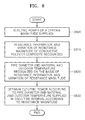
- FIG. 8 is a diagram showing an example of a method of controlling electric power supplied to an electrofusion coupling pipe using a conductive polymer composite as a heating element according to the present invention
- FIG. 9 is a diagram showing another example of an apparatus controlling electric power supplied to an electrofusion coupling pipe using a conductive polymer composite as a heating element according to the present invention.
- FIG. 10 is a diagram showing another example of a method of controlling electric power supplied to an electrofusion coupling pipe using a conductive polymer composite as a heating element according to the present invention.
- FIG. 1 is a diagram showing an example of a structure in which a pipe is connected with a synthetic resin pipe electrofusion coupling pipe using a conductive polymer composite as a heating element to which the present invention is applied
- FIG. 2 is a diagram showing a cross-section of the synthetic resin pipe electrofusion coupling pipe of FIG. 1 .
- the synthetic resin pipe electrofusion coupling pipe 100 which is interposed between two pipes 110 , connects the two pipes 110 .
- Two terminals of the coupling pipe 100 are fixed with threaded coupling parts 220 .
- the coupling pipe 100 uses a conductive polymer composite 200 as a heating element.
- Electric connection terminals 120 a , 120 b , 130 a , 103 b for supplying electric power to the conductive polymer composite 200 protrude to outside of the coupling pipe 100 .
- An electric power controlling apparatus according to the present invention supplies electric power to the conductive polymer composite 200 inside the coupling pipe 100 through the electric connection terminals 120 a , 120 b , 130 a , 103 b protruding to the outside.
- a conductive polymer composite is prepared by adding conductive particles to a polymer resin so that electricity may be conducted among dispersed conductive particles within the polymer resin.
- a conductive polymer composite may be prepared by mixing carbon black with high density polyethylene (HDPE).
- HDPE high density polyethylene
- a pipe, a coupling pipe, and a matrix polymer of a conductive polymer may generally be made of a same material.
- the synthetic resin pipe electrofusion coupling pipe illustrated in FIGS. 1 and 2 is only an example illustrating aspects of the present invention, and it is obvious that the electric power control apparatus and the method of controlling electric power according to the present invention may be applied to various structures of coupling pipes which use a conductive polymer composite.
- a coupling pipe which does not include an electric connection terminal 120 a , 120 b , 130 a , and 103 b shown in FIG. 1 and which may be fused by an induction heating method using high frequency may be applied to the present invention.
- coupling pipe refers to a coupling pipe which is connected with at least one pipe and is not limited to a coupling pipe which is used to connect the two pipes 110 shown in FIG. 1
- FIG. 3 is a diagram showing temperature-dependent resistance variation of a conductive polymer composite which is used as a heating element of a synthetic resin pipe electrofusion coupling pipe according to the present invention.
- a polymer composite may be used as a temperature sensor by using the phenomenon that resistance of a polymer composite increases depending on the temperature.
- a polymer composite may be used to allow the flow of electric current at room temperature and stop the flow of electric current at a temperature higher than a predetermined temperature.
- a polymer composite having a high ratio of maximum resistance (R p ) to room temperature resistance (R 0 ) may be advantageous.
- an electric power supply may recognize the kind of a matrix polymer included in the coupling pipe.
- an electric power supply may automatically recognize the material of the pipe to be fused and adjust the magnitude of the electric power supplied to the pipe according to the material of the pipe.
- the conductive polymer composite shown in FIG. 3 has an R p /R 0 value about 2, and thus the conductive polymer composite is appropriate for use as a heating element for an electrofusion coupling pipe.
- the resistance In a case where electric power is continuously supplied, as the temperature of a resin in FIG. 1 increases, after the temperature of the resin reaches the melting point of the resin and the resin melts, the resistance first drastically decreases, and then gradually decreases. The resistance of the resin following the completion of electrofusion is lower than the initial room temperature resistance of the resin.
- Room temperature resistance R 0 of a coupling pipe is dependent on a diameter of the coupling pipe and a volume specific resistance of a conductive polymer composite used as a heating element of the coupling pipe.
- the maximum resistance R p value is 20 ⁇ .
- the voltage is 100 V and the current is 10 A at room temperature.
- the voltage is 141 V and the current is 7.09 A.
- the voltage is 126 V and the current is 12.70 A at room temperature.
- the voltage is 179 V and the current is 8.94 A.
- a microprocessor may control electric power supply to provide a maximum power of 240 W using the general voltage of 220 V.
- a maximum controllable electric power is determined by a room temperature resistance R 0 and an R p /R 0 ratio of a conductive polymer composite.
- the maximum supplied electric power increases.
- a room temperature resistance R 0 is too small, too much great initial current may be generated.
- a room temperature resistance R 0 needs to be adjusted to an appropriate value.
- an electric power supply may weigh as little as about 1 kg and an electric power supply may be portable.
- electrofusion time may be shortened.
- electrofusion may be performed much more stably than conventional electrofusion methods.
- FIG. 4 is a diagram showing an example of outdoor temperature-dependent resistance variation of a conductive polymer composite which is used as a heating element in a synthetic resin pipe electrofusion method according to the present invention.
- an outdoor temperature and a temperature of a coupling pipe are usually the same, an outdoor temperature and a temperature of a coupling pipe may be different in certain cases (e.g., when a coupling pipe has been stored for a long period of time in a closed space where the temperature is high or low, or when a coupling pipe has been exposed to direct sunlight for a long period of time). Therefore, an outdoor temperature of an example of the present invention is the same as a temperature of a coupling pipe.
- the time needed for resistance of the conductive polymer composite to reach 50% of a maximum resistance (R p(50%) ) at a point past a point of maximum resistance may be used as a reference for determining an outdoor temperature, because the time to reach R p(50%) is greatly dependent on an outdoor temperature and thus an outdoor temperature may be more accurately determined.
- an optimum electric power that is, an electric power which is optimal for the recognized outdoor temperature, may be supplied.
- An electric power control apparatus may not only supply an optimum electric power according to an outdoor temperature, but may also optimize electrofusion quality by varying electric power supplied at each time interval according to variation in resistance with respect to each time interval. For example, with reference to a maximum resistance (R p ) or a resistance point corresponding to 50% of a maximum resistance (R p(50%) ), a large amount of electric power is supplied before the reference point and low amount of electric power is supplied after the reference point.
- FIG. 5 is a diagram showing an example of resistance variation in accordance with a diameter of a coupling pipe in a synthetic resin pipe electrofusion method using a conductive polymer composite as a heating element according to the present invention.
- FIG. 5 shows an experimental result of resistance variation when a diameter of a coupling pipe is 16 mm and 20 mm. The result indicates that, in an early time range from about 1 to 3 seconds, the slope of the resistance variation of the 16 mm coupling pipe was distinctively different than that of the 20 mm coupling pipe. Since the time required for reaching a maximum resistance from a room temperature resistance is dependent on a diameter of a coupling pipe, a diameter of a coupling pipe may be recognized based on the dependency. However, to recognize a diameter of a coupling pipe more quickly and to supply electric power according to the recognized diameter, a slope of resistance variation may be used.
- a slope of resistance variation depending on a diameter of a coupling pipe is also dependent on electric power supplied to the coupling pipe. For example, as shown in FIG. 5 , when a diameter of an HDPE coupling pipe is 16 mm and 20 mm and 250 W of initial electric power is supplied, a slope of resistance variation becomes 6.5 ⁇ /sec. As the supplied electric power increases, the slope is also increased.
- a range of resistance variation slope for each coupling pipe diameter with respect to an initial electric power may be stored in advance so that an electric power control apparatus may rapidly recognize a coupling pipe diameter based on a comparison of the stored slope and a measured slope of a coupling pipe and supply predetermined optimum electric power according to the recognized coupling pipe diameter.
- FIG. 6 is a diagram showing an example of varying electric power supplied during each time interval according to resistance variation in an electrofusion method using a conductive polymer composite as a heating element according to the present invention.
- the conductive polymer composite used in this experimental example employs, as a matrix polymer, HDPE, which is usually used for a synthetic resin pipe, and includes, as a filler, special carbon black, which is a conductive particle.
- the diameter of the coupling pipe is 20 mm.
- the outdoor temperature is determined based on the measured time required for reaching the resistance point corresponding to 40% of a maximum resistance (R p(40%) ).
- amount of time that the supplied electric power is P 3 100 W becomes longer in winter, while the amount of time that the supplied electric power is P 3 becomes shorter in summer.
- the total amount of electric power supplied to the coupling pipe is determined by the P 3 electric power supply time.
- Parameters for supplying an optimum amount of electric power in accordance with the coupling pipe diameter and the outdoor temperature are programmed in advance in the electric power control apparatus.
- the electric power control apparatus controls magnitude of either voltage or current to supply electric power of P 1 to P 3 described above.
- the bottom of FIG. 6 shows the time-dependent variation of voltage and current when electric power is supplied in stages including P 1 , P 2 , and P 3 as described above.
- FIG. 7 is a diagram showing an example of an apparatus controlling electric power supplied to an electrofusion coupling pipe using a conductive polymer composite as a heating element according to the present invention.
- the electric power control apparatus includes an electric power-supplying unit 700 , a resistance-detecting unit 710 , a diameter-recognizing unit 720 , a material-recognizing unit 725 , a temperature-recognizing unit 730 , and electric power-controlling unit 740 .
- the electric power-supplying unit 700 supplies, according to the control of the electric power-controlling unit 740 , electric power to an electrofusion coupling pipe using a conductive polymer composite as a heating element.
- the electric power-supplying unit 700 according to the control of the electric power-controlling unit 740 , varies voltage or current to supply a specific electric power.
- the electric power-supplying unit 700 may vary a frequency to vary the magnitude of supplied electric power.
- the resistance-detecting unit 710 recognizes the magnitude of voltage and current when the electric power-supplying unit supplies electric power to an electrofusion coupling pipe to detect a resistance of a conductive polymer composite.
- the resistance-detecting unit 710 may detect the resistance variation of a conductive polymer composite on the basis of the variation of the voltage and current when the electric power-supplying unit 700 supplies a certain magnitude of electric power (e.g., 250 W).
- the pattern of the resistance variation detected by the resistance-detection unit 710 is changed according to the diameter or material of an electrofusion coupling pipe or an outdoor temperature. For example, as shown in FIGS. 4 and 5 , the time for the resistance of a conductive polymer composite to reach a maximum resistance is dependent on an outdoor temperature (as shown in FIG. 4 .) and a diameter of a coupling pipe (as shown in FIG. 5 ), and the slope of the resistance variation is also dependent on an outdoor temperature and a diameter of a coupling pipe.
- the diameter-recognizing unit 720 stores information regarding the resistance variation (slope of the resistance variation or time required to reach a maximum resistance, etc.) of a conductive polymer composite when a certain electric power is supplied for each diameter of coupling pipes (e.g., 16 mm, 20 mm, etc.), in advance. During an electrofusion work of providing electric power, the diameter-recognizing unit 720 compares the real-time resistance variation of a conductive polymer composite with the stored resistance variation to recognize a diameter of the coupling pipe.
- the material-recognizing unit 725 recognizes a material by using a room temperature resistance R 0 and a maximum resistance R p or a ratio of two resistance (R p /R 0 ) recognized by the resistance-sensing unit 710 . For this, the material-recognizing unit 725 stores the R 0 and R p or the R p /R 0 ratio of each material in advance and compares the resistance recognized by the resistance-detecting unit 710 with the resistance of each material stored in advance to recognize a material of the electrofusion coupling pipe.
- the material-recognizing unit 725 recognizes a material of a coupling pipe as polyethylene when the R p /R 0 ratio recognized by the resistance-detecting unit 710 is 1.6 and as polypropylene when the R p /R 0 ratio recognized by the resistance-detecting unit 710 is 1.4.
- the information regarding each material may be stored in advance in the apparatus according to the present invention or entered into the apparatus through an input apparatus.
- the apparatus according to the present invention may include an interface through which a separate memory device (e.g., USB memory, etc.) in which information regarding resistance of each material which is stored may be inserted.
- the temperature-recognizing unit 730 stores information regarding the resistance variation (slope of the resistance variation or time required to reach a maximum resistance, etc.) of a conductive polymer composite at a temperature higher or lower than room temperature in advance. During an electrofusion work or providing electric power, the temperature-recognizing unit 730 compares the real-time resistance variation of a conductive polymer composite with the stored resistance variation to recognize the outdoor temperature.
- the diameter-recognizing unit 720 , the material-recognizing unit 725 , and the temperature-recognizing unit 730 may use another variable for distinguishing the difference of the resistance variation shown in FIGS. 4 and 5 in addition to the slope of the resistance variation or the time required to reach a maximum resistance.
- the electric power-controlling unit 740 controls electric power supplied by the electric power-supplying unit 700 according to the resistance variation detected by the resistance-detecting unit 710 .
- the electric power-controlling unit 740 varies the magnitude of supplied electric power with reference to a maximum resistance of the conductive polymer composite, which is achieved at the point where the matrix polymer begins to melt, or with reference to a point where the resistance of the conductive polymer composite is decreased to a certain ratio past a maximum resistance (e.g., a resistance point corresponding to 50% of a maximum resistance).
- the electric power-controlling unit 740 controls electric power to supply low electric power in an early stage of electric power supply so that the diameter-recognizing unit 720 may recognize a diameter of a coupling pipe. After the diameter-recognizing unit 720 recognizes the diameter of a coupling pipe, the electric power-controlling unit 740 searches for the optimum electric power for coupling pipe diameter which is stored in advance and controls the electric power-supplying unit 700 to supply the optimum electric power.
- the electric power-controlling unit 740 searches for the optimum electric power for coupling pipe material which is stored in advance and controls the electric power-supplying unit 700 to supply the optimum electric power.
- the electric power-controlling part 740 searches for the optimum electric power for outdoor temperature which is stored in advance and controls the electric power-supplying unit 700 to supply the optimum electric power.
- the electric power-controlling unit 740 not only controls the electric power-controlling unit 740 to supply the optimum electric power according to the diameter and material of a coupling pipe and an outdoor temperature but also supplies the optimum electric power for each time interval divided with reference to the resistance variation so that electrofusion may performed stably.
- FIG. 8 is a diagram showing an example of a method of controlling electric power supplied to an electrofusion coupling pipe using a conductive polymer composite as a heating element according to the present invention.
- the electric power control apparatus supplies a low electric power in the early stage to an electrofusion coupling pipe (S 800 ).
- the electric power control apparatus recognizes the resistance variation of a conductive polymer composite depending on temperature (S 810 ).
- the electric power control apparatus recognizes the diameter and material of a coupling pipe and an outdoor temperature (S 820 ) and supplies the optimum electric power according to the recognized information in each time interval which is divided with reference to the resistance magnitude (S 830 ). For example, as shown in FIG.
- a room temperature resistance and a resistance slope of a conductive polymer composite are recognized by supplying 250 W of electric power in the early stage and the recognized information is used to recognize the material and diameter of a coupling pipe. Then, 300 W of electric power, which is the optimum electric power according to the diameter, is supplied. Subsequently, the electric power control apparatus recognizes an outdoor temperature on the basis of the time required to reach a maximum resistance of the conductive polymer composite and then supplies 100 W of electric power which is the optimum electric power from a resistance point corresponding to 40% of a maximum resistance.
- the value 40% herein is a predetermined data corresponding to the recognized material, and 50% may be applied to another material.
- FIG. 9 is a diagram showing another example of an apparatus controlling electric power supplied to an electrofusion coupling pipe using a conductive polymer composite as a heating element according to the present invention.
- the electric power control apparatus includes an electric power-supplying unit 900 , an electric power-controlling unit 910 , a storing unit 920 , and a material and diameter-identifying unit 930 .
- the electric power-supplying unit 900 supplies, according to the control of the electric power-controlling unit 910 , electric power to an electrofusion coupling pipe using a conductive polymer composite as a heating element.
- the electric power-supplying unit 900 varies the voltage, current or frequency to supply a certain amount of electric power to an electrofusion coupling pipe.
- the storing unit 920 stores information regarding at least two time intervals and information regarding the magnitude of electric power supplied in each time interval.
- the storing unit 920 may store various information regarding the time interval and the magnitude of supplied electric power according to each material and/or diameter of an electrofusion coupling pipe.
- the material and diameter-identifying unit 930 identifies the material and diameter of an electrofusion coupling pipe.
- the material and diameter-identifying unit 930 may identify a diameter of an electrofusion coupling pipe by various methods such as using a resistance for material and diameter identification, which is installed on an electrofusion coupling pipe, reading with a reader a bar code or RFID attached to an electrofusion coupling pipe, and allowing a user to directly input the material and diameter information.
- the electric power-controlling unit 910 controls the electric power-supplying unit 900 on the basis of the information regarding the time interval and the magnitude of electric power supplied in each time interval, which is stored in the storing unit 920 , to supply different electric power in each time interval to an electrofusion coupling pipe.
- the storing unit 920 stores information regarding different time intervals and different electric power for each diameter of a coupling pipe.
- the electric power-controlling unit 910 recognizes the information regarding the time interval and the magnitude of electric power for the material and diameter of the coupling pipe and controls the electric power-supplying unit 900 on the basis of the recognized information so that different electric power may be supplied in each time interval to the electrofusion coupling pipe.
- FIG. 10 is a diagram showing another example of a method of controlling electric power supplied to an electrofusion coupling pipe using a conductive polymer composite as a heating element according to the present invention.
- the electric power control apparatus firstly identifies a material and/or a diameter of an electrofusion coupling pipe (S 1000 ). Identifying a material and a diameter may be performed by various methods as shown in FIG. 9 . After a material and/or a diameter of an electrofusion coupling pipe are identified, the electric power control apparatus recognizes information regarding time interval and electric power for each material and/or diameter (S 1010 ). For example, the electric power control apparatus may recognize the information regarding time interval and magnitude of electric power for each material and/or diameter stored in a storage of the electric power control apparatus or receives from a user the information regarding time interval and magnitude of electric power and stores the received information. The electric power control apparatus supplies different electric power to each time interval on the basis of the recognized information (S 1020 ).
- the present invention may be implemented as computer-readable code on a computer-readable recording medium.
- the computer-readable recording medium includes all types of storage devices in which computer system-readable data is stored. Examples of the computer-readable recording medium include Read Only Memory (ROM), Random Access Memory (RAM), Compact Disk-Read Only Memory (CD-ROM), magnetic tape, a floppy disk, and an optical data storage device.
- ROM Read Only Memory
- RAM Random Access Memory
- CD-ROM Compact Disk-Read Only Memory
- magnetic tape magnetic tape
- a floppy disk and an optical data storage device.
- the computer-readable medium may be distributed across computer systems connected via a network, so that computer-readable code can be stored and executed in a distributed manner.
Landscapes
- Engineering & Computer Science (AREA)
- Mechanical Engineering (AREA)
- Physics & Mathematics (AREA)
- Thermal Sciences (AREA)
- General Engineering & Computer Science (AREA)
- Lining Or Joining Of Plastics Or The Like (AREA)
Applications Claiming Priority (3)
| Application Number | Priority Date | Filing Date | Title |
|---|---|---|---|
| KR10-2012-0116075 | 2012-10-18 | ||
| KR1020120116075A KR101431160B1 (ko) | 2012-10-18 | 2012-10-18 | 전도성 고분자 복합체를 발열체로 하는 합성수지관 전기융착 이음관의 전력 제어 장치 및 그 방법 |
| PCT/KR2013/009137 WO2014061945A1 (fr) | 2012-10-18 | 2013-10-14 | Appareil pour commander l'alimentation d'un tube de raccordement réuni par fusion électrique à un tuyau de résine synthétique au moyen d'un complexe polymère conducteur en tant qu'élément de chauffage, et son procédé |
Publications (2)
| Publication Number | Publication Date |
|---|---|
| US20150267852A1 US20150267852A1 (en) | 2015-09-24 |
| US9857012B2 true US9857012B2 (en) | 2018-01-02 |
Family
ID=50488457
Family Applications (1)
| Application Number | Title | Priority Date | Filing Date |
|---|---|---|---|
| US14/434,267 Active 2034-08-28 US9857012B2 (en) | 2012-10-18 | 2013-10-14 | Apparatus of controlling electric power for electric fusion pipe fitting using conductive polymer composite and method thereof |
Country Status (5)
| Country | Link |
|---|---|
| US (1) | US9857012B2 (fr) |
| EP (1) | EP2910832A4 (fr) |
| KR (1) | KR101431160B1 (fr) |
| IL (1) | IL237260A (fr) |
| WO (1) | WO2014061945A1 (fr) |
Cited By (2)
| Publication number | Priority date | Publication date | Assignee | Title |
|---|---|---|---|---|
| RU2702771C1 (ru) * | 2019-02-15 | 2019-10-11 | Алексей Александрович Глебов | Соединение трубопроводов из композиционного материала |
| US11560701B2 (en) | 2020-09-04 | 2023-01-24 | Delta Faucet Company | Conductive bonnet nut for an electronic faucet |
Families Citing this family (1)
| Publication number | Priority date | Publication date | Assignee | Title |
|---|---|---|---|---|
| US9719622B2 (en) * | 2013-07-08 | 2017-08-01 | Georg Fischer Harvel Llc | Electrofusion fittings and methods |
Citations (8)
| Publication number | Priority date | Publication date | Assignee | Title |
|---|---|---|---|---|
| US4602148A (en) | 1985-05-16 | 1986-07-22 | Central Plastics Company | Thermoplastic fitting electric heat welding method and apparatus |
| US4978837A (en) * | 1990-04-13 | 1990-12-18 | Central Plastics Company | Method and apparatus for electrically heat welding thermoplastic fittings |
| JPH09273691A (ja) | 1996-04-08 | 1997-10-21 | Osaka Gas Co Ltd | 電熱線入り溶融接合継手の昇温制御装置および方法 |
| US6680464B1 (en) * | 2000-07-28 | 2004-01-20 | Zurn Industries, Inc. | Electrofusion joining control device |
| US20060016552A1 (en) * | 2004-07-20 | 2006-01-26 | George Fischer Sloane, Inc. | Electrofusion pipe-fitting joining system and method utilizing conductive polymeric resin |
| WO2007091799A1 (fr) | 2006-02-06 | 2007-08-16 | Taeil Co., Ltd. | Équipement de fusion électrique de tubes à dispositif presseur à vis |
| WO2010002204A2 (fr) | 2008-07-03 | 2010-01-07 | 주식회사 태일 | Appareil de canalisation pour le soudage par électrofusion utilisant un cylindre plastique conducteur |
| KR20100004835A (ko) | 2008-07-03 | 2010-01-13 | 주식회사 태일 | 전도성 플라스틱 실린더를 이용한 전기융착용 배관장치 |
Family Cites Families (6)
| Publication number | Priority date | Publication date | Assignee | Title |
|---|---|---|---|---|
| CN1142796A (zh) * | 1993-12-15 | 1997-02-12 | 特殊工业株式会社 | 电熔化连接装置 |
| JPH08270870A (ja) * | 1995-03-30 | 1996-10-15 | Nippon Zeon Co Ltd | 電気融着接合部材による被接合体の接合方法 |
| JP2663379B2 (ja) * | 1995-10-19 | 1997-10-15 | 平田機工株式会社 | 電気溶融着装置及びその通電制御方法 |
| KR20070000540A (ko) | 2005-06-27 | 2007-01-03 | 봉래 박 | 매크로 자동생성 시스템 및 구현 방법 |
| KR100688997B1 (ko) * | 2006-02-06 | 2007-03-08 | 주식회사 태일 | 나사산에 의한 용융부의 가압구조를 가진 전기융착용이음관 |
| KR101476433B1 (ko) | 2007-07-03 | 2014-12-26 | 엘지디스플레이 주식회사 | 유기전계발광표시장치 및 그 제조방법 |
-
2012
- 2012-10-18 KR KR1020120116075A patent/KR101431160B1/ko active Active
-
2013
- 2013-10-14 WO PCT/KR2013/009137 patent/WO2014061945A1/fr not_active Ceased
- 2013-10-14 EP EP13847132.1A patent/EP2910832A4/fr not_active Withdrawn
- 2013-10-14 US US14/434,267 patent/US9857012B2/en active Active
-
2015
- 2015-02-16 IL IL237260A patent/IL237260A/en active IP Right Grant
Patent Citations (8)
| Publication number | Priority date | Publication date | Assignee | Title |
|---|---|---|---|---|
| US4602148A (en) | 1985-05-16 | 1986-07-22 | Central Plastics Company | Thermoplastic fitting electric heat welding method and apparatus |
| US4978837A (en) * | 1990-04-13 | 1990-12-18 | Central Plastics Company | Method and apparatus for electrically heat welding thermoplastic fittings |
| JPH09273691A (ja) | 1996-04-08 | 1997-10-21 | Osaka Gas Co Ltd | 電熱線入り溶融接合継手の昇温制御装置および方法 |
| US6680464B1 (en) * | 2000-07-28 | 2004-01-20 | Zurn Industries, Inc. | Electrofusion joining control device |
| US20060016552A1 (en) * | 2004-07-20 | 2006-01-26 | George Fischer Sloane, Inc. | Electrofusion pipe-fitting joining system and method utilizing conductive polymeric resin |
| WO2007091799A1 (fr) | 2006-02-06 | 2007-08-16 | Taeil Co., Ltd. | Équipement de fusion électrique de tubes à dispositif presseur à vis |
| WO2010002204A2 (fr) | 2008-07-03 | 2010-01-07 | 주식회사 태일 | Appareil de canalisation pour le soudage par électrofusion utilisant un cylindre plastique conducteur |
| KR20100004835A (ko) | 2008-07-03 | 2010-01-13 | 주식회사 태일 | 전도성 플라스틱 실린더를 이용한 전기융착용 배관장치 |
Non-Patent Citations (1)
| Title |
|---|
| International Search Report (in English and Korean) for PCT/KR2013/009137, dated Jan. 22, 2014; ISA/KR. |
Cited By (2)
| Publication number | Priority date | Publication date | Assignee | Title |
|---|---|---|---|---|
| RU2702771C1 (ru) * | 2019-02-15 | 2019-10-11 | Алексей Александрович Глебов | Соединение трубопроводов из композиционного материала |
| US11560701B2 (en) | 2020-09-04 | 2023-01-24 | Delta Faucet Company | Conductive bonnet nut for an electronic faucet |
Also Published As
| Publication number | Publication date |
|---|---|
| WO2014061945A1 (fr) | 2014-04-24 |
| US20150267852A1 (en) | 2015-09-24 |
| KR20140049809A (ko) | 2014-04-28 |
| EP2910832A1 (fr) | 2015-08-26 |
| IL237260A0 (en) | 2015-04-30 |
| EP2910832A4 (fr) | 2016-08-03 |
| IL237260A (en) | 2016-02-29 |
| KR101431160B1 (ko) | 2014-08-18 |
Similar Documents
| Publication | Publication Date | Title |
|---|---|---|
| US9857012B2 (en) | Apparatus of controlling electric power for electric fusion pipe fitting using conductive polymer composite and method thereof | |
| CN101484297A (zh) | 由热塑性材料制成的管的连接方法和装置 | |
| US20140361007A1 (en) | Circuit for the inductive heating of a metal | |
| CN86103309A (zh) | 热塑连接件的电热熔接方法与设备 | |
| JPH0327014B2 (fr) | ||
| DK162588B (da) | Fremgangsmaade til sammenfoejning af plastroerender med en plastsvejsemuffe | |
| CN107750328A (zh) | 用于使用所选择的温度传感器而在给定温度范围内测量温度的方法和设备 | |
| WO1995016557A2 (fr) | Appareil permettant une fixation par electrofusion | |
| US5500510A (en) | Method of automatically controlling the fusion process between thermoplastic articles | |
| CN201319149Y (zh) | 一种电子感温棒控制电路 | |
| CN113075944A (zh) | 一种基于pe电熔管件电熔温度特性优化的温控实现方法 | |
| US12311611B2 (en) | Device for welding electrofusion fittings with extension cable | |
| US20160279861A1 (en) | Method for connecting plastic pipes and structure for connecting the same | |
| JP2617222B2 (ja) | エレクトロフュージョン継手の融着方法及びその装置 | |
| Starostin et al. | Management of thermal process for polyethylene gas pipes welding with built-in heater | |
| CN113878880A (zh) | 一种智能电熔焊接温度控制方法及装置 | |
| CN212407929U (zh) | 用于管路系统的电热熔管路直接 | |
| JP2663379B2 (ja) | 電気溶融着装置及びその通電制御方法 | |
| CN203571206U (zh) | 智能电热恒温数显水龙头 | |
| JPH0752259A (ja) | 熱可塑性プラスチック管の電気融着方法 | |
| JPH0722196U (ja) | 温度表示付電気融着管継手 | |
| JPH0623846A (ja) | 電気融着継手の融着方法 | |
| JPH09207225A (ja) | 電気融着装置及びこの電気融着装置を用いた通電制御方法 | |
| CN201399880Y (zh) | 针型感温针孔热浇道加工装置 | |
| JPH02240497A (ja) | 電気融着式管継手の通電時間制御方法 |
Legal Events
| Date | Code | Title | Description |
|---|---|---|---|
| AS | Assignment |
Owner name: GEORG FISCHER PIPING SYSTEMS LTD., SWITZERLAND Free format text: ASSIGNMENT OF ASSIGNORS INTEREST;ASSIGNOR:KWAK, YOU SHIK;REEL/FRAME:035361/0367 Effective date: 20150223 |
|
| STCF | Information on status: patent grant |
Free format text: PATENTED CASE |
|
| MAFP | Maintenance fee payment |
Free format text: PAYMENT OF MAINTENANCE FEE, 4TH YEAR, LARGE ENTITY (ORIGINAL EVENT CODE: M1551); ENTITY STATUS OF PATENT OWNER: LARGE ENTITY Year of fee payment: 4 |
|
| MAFP | Maintenance fee payment |
Free format text: PAYMENT OF MAINTENANCE FEE, 8TH YEAR, LARGE ENTITY (ORIGINAL EVENT CODE: M1552); ENTITY STATUS OF PATENT OWNER: LARGE ENTITY Year of fee payment: 8 |