WO1983002373A1 - Egaliseur automatique et procede d'initialisation - Google Patents
Egaliseur automatique et procede d'initialisation Download PDFInfo
- Publication number
- WO1983002373A1 WO1983002373A1 PCT/JP1982/000479 JP8200479W WO8302373A1 WO 1983002373 A1 WO1983002373 A1 WO 1983002373A1 JP 8200479 W JP8200479 W JP 8200479W WO 8302373 A1 WO8302373 A1 WO 8302373A1
- Authority
- WO
- WIPO (PCT)
- Prior art keywords
- signal
- data
- sequence
- data sequence
- pulse
- Prior art date
- Legal status (The legal status is an assumption and is not a legal conclusion. Google has not performed a legal analysis and makes no representation as to the accuracy of the status listed.)
- Ceased
Links
Classifications
-
- H—ELECTRICITY
- H04—ELECTRIC COMMUNICATION TECHNIQUE
- H04L—TRANSMISSION OF DIGITAL INFORMATION, e.g. TELEGRAPHIC COMMUNICATION
- H04L25/00—Baseband systems
- H04L25/02—Details ; arrangements for supplying electrical power along data transmission lines
- H04L25/03—Shaping networks in transmitter or receiver, e.g. adaptive shaping networks
- H04L25/03006—Arrangements for removing intersymbol interference
- H04L25/03012—Arrangements for removing intersymbol interference operating in the time domain
- H04L25/03114—Arrangements for removing intersymbol interference operating in the time domain non-adaptive, i.e. not adjustable, manually adjustable, or adjustable only during the reception of special signals
- H04L25/03133—Arrangements for removing intersymbol interference operating in the time domain non-adaptive, i.e. not adjustable, manually adjustable, or adjustable only during the reception of special signals with a non-recursive structure
Definitions
- the present invention relates to an automatic equalizer provided in a receiving modem in a digital data transmission system and a method of initializing the same, and particularly to an automatic equalizer having a high-speed automatic equalizer. Regarding the initial setting method.
- the master station In a multi-point communication system, the master station 'selects to communicate with one of the slave stations selectively.
- the transmitter and receiver of the master station are connected to the transmitter and receiver of each slave station by a telephone line.
- the transmitting device of the master station and the receiving device of the slave station are always connected online.
- the master station polls each of the slave stations in turn, and the slave station receiving the response responds to the “transmission request” signal if there is data to be transmitted. Sends a "confirmation" signal, followed by the data to be sent.
- the receiver at the master station must adapt the characteristics of the receiver to the characteristics of the telephone line before actually receiving the data from one of the slave stations. The characteristics of this telephone line change for each slave station mainly due to the change in the distance between the master station and each slave station. Once the receiver has been adapted to the telephone line, replace the relatively slower method known in the art with C. '. IPI
- a timing ′ and a phase error signal are generated, and the equalizer and the like of the receiving apparatus are initialized using the error signal.
- a signal sequence that is, a train and a signal for initial setting of an equalizer, is based on the recommendation of the CCITT according to the recommendation of the CCITT.
- a dam code hereinafter referred to as a PN code
- the correlation between the data and the error signal is calculated as follows: A number of methods have been proposed for performing calculations and correcting and setting the type coefficients accordingly.
- the time required for initializing the tap coefficients of the equalizer in the receiving apparatus is significantly reduced as compared with the case where the above-described PN code is used. obtain. For example, the time required from a transmission request to data transmission can be reduced to 30 milliseconds or less.
- the inha extracted in the third section of the training signal. A pulse signal is generally asymmetric with respect to time.] It is difficult to obtain a tug coefficient of an equalizer having an inverse characteristic by using such an asymmetric signal when a symmetric signal is used. Also requires computation time.
- the signal transmitted to the line in the third section is a single signal.
- the carrier signal is not included except for the period in which the signal exists, and therefore, the carrier signal for demodulation is used in the first and second sections.
- the first object of the present invention is to speed up the initial setting of an automatic equalizer in a receiving apparatus, thereby improving data transmission efficiency in a multi-point communication system. Is to improve A second object of the present invention is to install a line. In the automatic equalizer that sets the tap coefficient using the pulse response characteristics, the first and second equalizers are provided and the first equalizer is used. .
- a third object of the present invention is to provide an automatic equalizer according to the above.
- An object of the present invention is to provide an initial setting method of an equalizer capable of guaranteeing the phase of a carry-out signal even in a section where a pulse is extracted.
- a fourth object of the present invention is the above-mentioned inverter.
- An object of the present invention is to provide a method for initializing an equalizer in which a timing signal is extracted even in a section in which a pulse is extracted and synchronization loss is prevented. Replacement.
- a transmission device in a receiving device that receives and demodulates a signal obtained by performing quadrature amplitude modulation on a carrier signal using digital data via a transmission path, and the transmission path includes the transmission signal.
- An automatic equalizer for compensating for distortion introduced in a received signal wherein the automatic equalizer receives a signal to initially set the receiving device before receiving a data signal.
- a single C that extracts a signal corresponding to a single pulse signal including distortion due to the transmission line from a predetermined training signal to be transmitted.
- a pulse extracting circuit; and a first and a second equalizing circuit wherein the single pulse extracting circuit comprises: A means for generating a data sequence in which a signal corresponding to the pulse signal is represented by a complex number, a means for normalizing the data sequence, and a means for complex-conjugating the normalized data sequence.
- the first equalization circuit uses the complex conjugated data sequence as a tap coefficient, and uses the normalized data sequence as the single c. Means for calculating an autocorrelation sequence of a signal corresponding to the pulse signal, and a data sequence similarly received after initialization using the complex conjugated data sequence as a tap coefficient.
- the single c means for generating a data sequence in which a signal corresponding to the pulse signal is represented by a complex number
- the first equalization circuit uses the complex conjugated data sequence as a tap coefficient, and uses the normalized data sequence as the single c.
- Means for calculating a cross-correlation sequence with a signal corresponding to the pulse signal wherein the second equalization circuit uses the self-correlation sequence obtained in the first equalization circuit, N replacement of the inverse matrix for the autocorrelation sequence, Means for obtaining a data series that is a second-order approximation, means for obtaining a data series corresponding to the inverse matrix by a successive approximation method based on the data series that is the N-th approximation, and the inverse matrix
- FIG. 1 is a diagram showing a data transmission / reception system in which an automatic equalizer according to the present invention is used
- FIG. 2 is a diagram showing an example of modulation points in quadrature amplitude modulation used in the data transmission / reception system of FIG. 1,
- Fig. 3 is a signal waveform diagram showing an example of a training signal used for an initial setting method of the automatic equalizer according to the present invention
- FIG. 4 is a schematic flowchart showing a method of initializing an automatic equalizer according to the present invention.
- FIG. 5 is a block circuit diagram showing an automatic equalizer according to an embodiment of the present invention.
- FIG. 1 shows a receiver equipped with an automatic equalizer according to the present invention.
- a transmission device 1 receives a transmission request signal (RS)
- a training data generation unit (TRG) 11 generates a train and data in a modulation data unit.
- MOD 12 modulates the carrier signal from the carrier signal generator (CRG) 13 based on the training data by quadrature amplitude modulation, and transmits the modulated signal via a transmission path L.
- an initial state for data reception is set based on the received training signal.
- transmitting apparatus 1 In anticipation of completion of the setting of the initial state, transmitting apparatus 1 generates a transmission enable signal CS, and transmits a signal modulated by transmission data SD to receiving apparatus 2.
- the modulation section 12 of the transmission apparatus 1 quadrature-amplitude modulates the carrier signal from the carrier generation section 13 into 16 values, for example, as shown in FIG.
- Each signal point shown in FIG. 2 corresponds to the amplitude and phase of the signal to be modulated.], And can be represented by a complex number.
- the first and second equalizers are initialized based on the data to be processed.
- Fig. 3 shows an example of train and data having a data sequence from which a pulse signal can be extracted.
- TM is the timing and signal for transmitting data]
- TRD is the training and data]
- TRS is the carrier signal to TRD.
- This is a modulated signal.
- the training data RD has three sections SEG1, SEG2, and SEG3.
- the training signal TRS is a signal modulated by constant data])
- the amplitude and phase are both constant. Therefore, in the demodulation unit (DEM) 21 of the receiving apparatus 2, adjustment of the automatic gain control AGC can be performed while receiving the first section SEG1.
- SEG 2 the train link and the signal TRS have opposite phases.
- Alternately modulated by two data with equal amplitudes ⁇ A >> and "1-A" has been also capital ing.
- the yo I Do two data "a" Contact goodness beauty "a a" is I table and in Figure 2 for example, D a and D_ a. the second The data transmission timing signal is extracted from the signal in section SEG2.
- the training and data in the third section SEG 3 are the same as those in CV.PI except that data "A” is continuous at time ti. And «—A” appear alternately.
- SA 1 in Fig. 3 shows only the training data of the third section SEG 3]).
- [A] SA 2 delays it by one data symbol.
- SA 3 is shown.
- Such a single Haus sequence that is, a central component: a sequence in which only PQ is not zero and all others are zero is obtained.
- FIG. 4 shows a ⁇ -chart when the automatic equalizer of the receiving apparatus 2 in FIG. 2 is initialized using the training signal in FIG.
- the received data sequence (in complex number) corresponding to the third section SEG 3 of the training signal demodulated in the demodulation section 3 is a single c.
- the signal is supplied to the pulse extraction circuit REP, where the received data sequence is delayed by one data symbol and added to the received data sequence.
- This data series is the ideal single c in Fig. 4.
- the loss is due to the transmission line L]).
- the data sequence corresponding to the pulse is supplied to the normalization circuit NR in the second step II, and is normalized in NR.
- the normalization circuit NR first determines the size of the data sequence Pj, that is, the zero-order correlation difference By the P 2 to the following formula]) is calculated
- the normalized data sequence is supplied to the complex conjugate circuit CN.
- the complex shared data sequence Cj is initialized as the tap coefficient of the first equalizer (EQL1) 23 in the first tap coefficient register PR1.
- the normalized data sequence and its complex conjugate data Cj are supplied to the operation circuit CNT1 of the first equalization circuit 23, and the autocorrelation sequence is calculated.
- the calculation of the autocorrelation sequence ⁇ is performed as follows. First, for the zero-order correlation, ⁇
- the autocorrelation sequence Am is symmetric.
- This autocorrelation sequence is determined by the transmission path L and the first equalizer circuit EQL1. It can be seen that this is the result of the deformation of the loose. Therefore, in the second equalization circuit (EQL 2) 24, a symmetric pin is used. It is required to provide the reverse characteristic of the loose characteristic. .
- the sequence B obtained in this way is used for obtaining the inverse matrix and as an initial value.
- the equalization output S is a
- the correction of the tap coefficient is performed using the following successive approximation.
- the tap coefficient Bj of 24 is initialized and set in the tap coefficient register TPH2.
- a Initial setting is completed. In this way, in anticipation of the completion of the initial setting in the receiving device 2, the transmitting device 1 starts transmission of transmission data.
- the received data signal is demodulated into a data sequence in demodulation section 21, and is supplied to first equalization circuit 23.
- the received data sequence is determined by the first equalization output circuit ⁇ 1.]?
- the first tap coefficient register TPR uses the tap coefficient Cj of TPR1. Then, the first equalized output is calculated.
- the equalized output data sequence from the first equalizing circuit 23 is supplied to the equalizing output circuit OHJ 2 of the second equalizing circuit 24, and the second tut: a 7 ° coefficient B j is used.
- FIG. 5 shows a detailed configuration of the automatic equalizer according to one embodiment of the present invention.
- the received signal is demodulated by demodulation section 21.
- the output is subjected to data determination in the data determination unit 25 and output as efficiency data.
- the output signal of the demodulation unit 21 is supplied to the single-loss extraction unit 22 to extract the extracted single c.
- the demodulation unit 21 has a filter circuit (FIL) 211 for removing noise in the received signal, an automatic gain control circuit (AGC) 212 for adjusting the level of the received signal, and a quadrature amplitude. It has a demodulation circuit (DEM) 213 that demodulates the modulation, and a high-frequency filter circuit (ROF) 214 that removes high-frequency components in the demodulated signal. Also, a single C 0 ls e extractor 2 2 Bok Les over two down click, the signal in either et single wafer.
- FIL filter circuit
- AGC automatic gain control circuit
- ROF high-frequency filter circuit
- a rendering circuit (REP) 221 that extracts the data sequence corresponding to the pulse signal, a normalization circuit (NR) 222 that normalizes the extracted data sequence, and a complex conjugate of the normalized data sequence And a complex conjugation circuit (CN) 223 for conversion.
- the first equalization circuit (EQL 1) 23 is a first tap data register (TPD 1) 231 for writing the received data from the demodulation section 21, and the first tap data.
- the first equalization output circuit (OPU 1) 232 that calculates the first equalization output from the first tap coefficient and the first tap coefficient, and the output data of the complex conjugate circuit 223]?
- One tap coefficient register (TPR1) 224 single c.
- the second equalization circuit (IQL 2) 24 is a third tap data register into which the first equalization output data is written.
- TPD3 24 1st, 2nd equalization output circuit that calculates the 2nd equalization output from the 3rd tap data and the 2nd tap coefficient ( ⁇ 2) 24 2, 2nd other di-flop coefficient re g data (TPR2) 243, bets to the error of a single wafer 0 Luz autocorrelation sequence and a second power strips factor or al equalization output to compute the reference output Ref
- a second arithmetic control circuit (CNT2) 244 that corrects the second tap coefficient, an nth-order approximation circuit (n-tlxAP) 245 that finds the nth-order approximation of the inverse matrix from the autocorrelation sequence, and One ha.
- the data determination unit 25 has a carrier automatic phase control circuit (CAPC) 251, a determination circuit 252, and an error calculation circuit (EHR2) 253. Each circuit of the data determination unit 25 is disclosed in, for example, Japanese Patent No. 1,041,066, and its description is omitted.
- the operation of the symmetrical inverse matrix is performed.]
- the calculation time of the tap coefficient can be shortened accordingly. For example, it is possible to reduce the time for the initial setting as compared with the technology disclosed in the above-mentioned US Pat. No. 3,962,637.
- the initial setting method of the automatic equalizer according to the present invention is used. According words, a single C 0 ls e extracted by synchronization shift to the arc signal and to continuously use a signal containing key Ya Li ⁇ signal for unloading can be prevented.
- the present invention can be used to improve data transmission efficiency in a multipoint communication system.
Landscapes
- Engineering & Computer Science (AREA)
- Power Engineering (AREA)
- Computer Networks & Wireless Communication (AREA)
- Signal Processing (AREA)
- Cable Transmission Systems, Equalization Of Radio And Reduction Of Echo (AREA)
Description
明 細 窨
自動等化器およびその初期設定方法
発明の技術分野 '
本発明は、 デ ィ ジタ ルデータ 伝送 シ ス テ ム におけ る受信側モ デ ム に設け られた 自動等化器およ びその 初期設定方法に関 し、 特に高速化された 自 動等化器 の初期設定方法に関する。
背景技術
マ ル チ ボ イ ン ト 通信 シ ス テ ム に おいては、 親局は' 複数の子局の一つ と選択的に交信を行う 。 親局の送 信装置およ び受信装置は、 電話回線に よ 各子局の 送信装置およ び受信装置に接続される。 前記の形式 の通信シ ス テ ム においては、 親局の送信装置と子局 の受信装置は常時オ ン ラ イ ン接続される。 親局は、 各子局に対 し順番に ポ ー リ ン ク,を行い、 ー リ ン グ を受けた子局は、 ^信すべ き データ があ る場合に 「送信要求」 信号に応答 して 「確認」 信号を送信 し、 それに続いて送信すべき デ ー タ を送信する。 親局側 の受信装置は、 子局の う ちの 1 つからのデータ を実 際に受信する前に、 '受信装置の特性を電話回線の特 性に適合させる必要があ る 。 こ の電話回線の特性は、 主と して親局 と各子局の間の距離の変化に よ 子局 毎に変化する。 受信装置がいったん電話回線に適合 された後は、 従来知 られている相対的に遅い方法を 差換え C.'.IPI
• '
用いて回線特性の変動に充分に追従する こ と が可能 であ る。 しか しなが ら、 受信装置が最初にデー タ を 受信する場合には、 受信装置の特性は回線の特性と は重大な相違がある。 こ の よ う な初期条件の も と で は、 従来の相対的に遅い追従方法では受信装置を回 線に適応させるま でに 2 秒程度かかるこ とになる。 この適応時間は、 1 つの回路網の 1 回の送信要求に 対 して子局の数を乗 じた時間かかる こ と に 、 従 来の シス テ ム のデータ伝送効率を極めて低下させる 原因 と な っている。 受信装置を電話回線に迅速に適合させる こ とを容 易化するための特殊な初期設定手順を与えるために, 多種の提案がなされてきた。 その典型的な も のは、 受信装置において各 々の回線特性を有する信号を得 るこ とができ る特定の信号系列を送信装置か ら送信 する も のであ る。 この特定の信号系列に応じて、 タ ィ ミ ン ク'およ び位相の誤差信号が発生され、 それを 用いて受信装置の等化器等が初期設定される。 従来, この よ う な信号系列、 す ¾わち、 等化器を初期設定 するための ト レ ー ニ ン ク,信号と して、 CC ITT の勧告 によ ]? 、 2 値の擬似ラ ン ダ ム符号 ( 以下 P N符号と 称する ) を送出する こ と が規定されてい る。 従って、 P N符号か ら等化器の補正係数 ( タ ッ プ係数) を初 期設定する ために、 デー タ とエ ラ ー信号との相関を : , 差換え
演算し、 それに よ タ ジ プ係数を補正 し設定する手 法が多数提案されている。 しか しなが ら、 これ らの 手法は、 相関を演算.するために大形の複雑な回路を 必要と し、 また等化器の タ ッ プ係数を設定するま で にか ¾ ]? の時間を要する と い う欠点があ る 。 例えば、 前述 した送信要求か らデータ送信ま でに要する時間 と して 2 5 0 ミ リ 秒程度かかる。
従来ま た、 受信装置の等化器を高速に初期設定す る方法 と して、 Da v i d M. Mo t l o y その他の米国特許 第 3, 9 6 2, 6 3 7 号が知 られている 。 こ の米国特許 においては、 等化器を初期設定するための ト レ ー二 ン グ信号と して、 次の 3 つの区間か ら成る特殊 な信 号を用いている 。 すなわち、 第 1 区間においてキ ヤ リ ァ信号を一定の位相お よ び振幅において変調 した ト ー ン信号を送信 し、 第 2 区間において デー タ の送 信タ イ ミ ン グすなわち シ ン ボ ルプロ ッ ク が区別でき るデータ系列に よ ]? キ ヤ リ ァ信号を変調 した信号を 送信 し、 第 3 区間において単一ハ。 ル ス ( ィ ン ハ。 ル ス ) データに よ キ ヤ リ ァ信号を変調 した信号を送信す る。 一方、 受信側においては、 前記の ト レ ー ニ ン グ 信号の第 1 区間において 自動利得調整を行い、 第 2 区間にお い て デ 丁 タ をサ ン フ。 リ ン グする タ イ ミ ン ク, 信号を抽出 し、 第 3 区間において単一ハ。 ル ス信号を 抽出する 。 こ こ で、 第 3 区間において抽出された単 差換え _ '
一パ ル ス信号は、 回線の伝達関数 ( イ ン ハ。 ル ス応答 特性 ) に よ ]?変形された も のである。 信装置の等 化器は、 回線に ける信号の歪 ( 変形 ) を等化する ものであ ]? 、 基本的には回線の伝達関数と は逆特性 を有する こ とが理想的であ る。 従って、 前記の米国 特許においては、 ト レ 一 二 ン ク、信号の第 3 区間にお いて抽出された回線のィ ン ハ。 ル ス応答特性に基づい て、 等化器が回線に対 して逆特性を有する よ う にタ ッ プ係数を演算 して設定する 。
前記の米国特許において開示された技術に よれば. 受信装置において等化器の タ ッ プ係数を初期設定す るために要する時間は、 前述 した P N符号を用いる 場合に比べて著 し く短縮され得る。 例えぱ、 送信要 求からデータ送信ま でに要する時間は 3 0 ミ リ 秒以 下に短縮され得る。 と こ ろで、 前記の技術において は、 ト レ ー ニ ン グ信号の第 3 区間において抽出され たィ ン ハ。 ル ス信号は一般に時間的に非対称であ ]? 、 こ の よ う ¾非対称る信号を甩いて逆特性を有する等 化器の タ ツ °係数を求める こ とは、 対称な信号を用 いる場合よ ]? も、 演算時間を要する こ と になる 。 ま た、 前記の技術においては、 前記の第 3 区間におい て回線に送信される信号は、 単一ハ。 ル ス の存在する 期間を除いてキ ャ リ ア信号を含んでおらず、 こ のた め第 1 およ び第 2 区間において復調用キ ヤ リ ァ信号
,z¾vi 差換え
の位相が調整されて も 第 3 区間については位相の調 整が行われず、 必ず しも位相が保証されないと い う 欠点があ る。 また、 第 3 区間においてはサ ン プ リ ン ク,の ため の タ イ ミ ン グ信号 も抽出され ¾いの で、 同 期のずれを生 じる可能性があ る。 発明の開示 本発明の第 1 の 目 的は、 受信装置における 自動等 化器の初期設定を高速化する こ と に よ 、 マ ル チ ボ ィ ン ト通信シ ス テ ム におけるデ ー タ伝送効率を向上 させる こ と にあ る。 本発明の第 2 の 目的は、 回線のイ ン ハ。 ル ス応答特 性を用いてタ ッ プ係数を初期設定する 自動等化器に おいて、 第 1 およ び第 2 の等化部を設けて第 1 等化 部に よ ]? ィ ン ハ。ル ス応答特性を時間的に対称化する こ と に よ ])、 タ ッ プ係数の初期設定に要する時間を 短縮する こ とに ある 。 本発明の第 3 の 目 的は、 前記の 自動等化器におい てィ ン ハ。 ル スを抽出する区間において も キ ヤ リ 了信 号の位相が保証され得る等化器の初期設定方法を提 供する こ と にあ る。 本発明の第 4 の 目 的は、 前記のィ ン ハ。 ル スを抽出 する区間において も タ イ ミ ング信号が抽出され同期 ずれが防止される等化器の初期設定方法を提供する こ と にあ る。 差換え .
、
本発明においては、 送信装置において キ ヤ リ ァ信 号をデ ィ ジタ ルデータ に よ ]3 直交振幅変調 した信号 を伝送路を介 して受信 し復調する受信装置に設け ら れ、 前記伝送路に よ ])受信信号中に導入された歪み を補償するための 自動等化器であって、 前記自動等 化器は、 デー タ信号を受信する前に前記受信装置を 初斯設定するために受信される所定の ト レ ー - ング 信号中か ら前記伝送路に よ る歪を含んだ単一パ ル ス 信号に対応する信号を抽出する単一ハ。 ル ス抽出回路、 およ び、 第 1 および第 2 の等化回路を備え、 前記単 一パ ル ス抽出回路は、 前記単一ハ。 ル ス信号に対応す る信号を複素数表示したデータ系列を発生させる手 段、 前記データ系列を正規化する手段、 およ び、 前 記正規化されたデー タ系列を複素共役化する手段を 有し、 前記第 1 の等化回路は、 前記複素共役化され たデータ系列を タ ッ プ係数と して用い、 前記正規化 されたデー タ系列から前記単一ハ。 ル ス信号に対応す る信号の 自己相関系列を演算する手段、 および、 同 様に前記複素共役化されたデータ系列をタ ッ プ係数 と して用 い、 初期設定後に受信されるデータ系列 と 前記単一ハ。 ル ス信号に対応する信号 との相互相関系 列を演算する手段を有し、 前記第 2 の等化回路は、 前記第 1 の等化回路において得 られた前記自己相闋 系列を用い、 前記自 己相関系列に対する逆行列の N 差換え 、
次近似であ るデータ系列を求める手段、 前記 N次近 似であるデー タ系列を も と に して逐次近似法に よ 前記逆行列に対応するデータ系列を求める手段、 お よび、 前記逆行列に対応するデー タ系列をタ ッ プ係 数と して初期設定 し、 前記第 1 の 化回路か ら出力 される受信データ の相互相関系列か ら等化出力を求 める手段を有する、 自動等化器が提供される。
図面の'簡単な説明
第 1 図は、 本発明に よ る 自動等化器が用い られる データ送受信シ ス テ ム を示す図、
第 2 図は、 第 1 図のデータ送受信シ ス テ ム におい て用い られる直交振幅変調における変調点の一例を 示す図、
第 3 図は、 本発明に よ る 自動等化器の.初期設定方 法に用い られる ト レ ー ニ ン グ信号の一例を示す信号 波形図、
第 4 図は、 本発明に よ る 自 動等化器の初期設定方 法の概略的る フ ロ ー チ ャ ー ト 図、
第 5 図は、 本発明の一実施例 と しての 自動等化器 の檮成を示すプ ロ ッ ク 回路図であ る 。
発明を実施するための最良の形態
本発明に よ る 自動等化器およ びその初期設定方法 が、 以下に図面を参照 し ¾が ら説明される。 第 1 図 には、 本発明に よ る 自動等化器を備えた受信装置が 差換ん
示される 。 第 1 図において、 送信装置 1 は送信要求 信号 (RS ) を受信 した と き、 ト レ ー ニ ン グデー タ発 生部 (TRG) 1 1 において ト レ ー - ン ク,データ を発生 し変調部 (MOD) 1 2に供給する。 MOD 1 2 は、 キ ヤ リ ア信号発生部 (CRG ) 1 3 か らのキ ャ リ ア信号を こ の ト レ ー ニ ン グデータ に基づいて直交振幅変調して、 伝送路 L を介 して受信装置 2 に送出する 。 受信装置 2 においては、 受信された ト レ ー ニ ン グ信号に基づ いてデー タ受信のための初期状態の設定を行う 。 こ の初期状態の設定が完了する のを見込んで送信装置 1 は、 送信許可信号 C S を発生 し、 送信デー タ S D に よ 変調された信号を受信装置 2 に送出 しは じめ 0
送信装置 1 の変調部 1 2 は、 キ ヤ リ ア発生部 1 3 からのキ ヤ リ ァ信号を、 例えば、 第 2 図に示される よ う に、 1 6値に直交振幅変調する 。 ¾お、 第 2 図 に示される各信号点は、 変調される信号の振幅およ び位相に対応する も のであ ]? 、 複素数表示する こ と が可能である 。
第 1 図の受信装置 2 は、 送信装置 1 か ら伝送され た信号を受信 して復調する復調部 (D EM) 2 1 、 復調 部 2 1 において復調された ト レ ー ニ ン ク,データ 中か ら単一パ ル ス信号に対応する信号を抽出する単一ハ。 ル ス抽出部 2 2、 抽出された単一ハ。 ル ス信号に対応 差換え -
するデー タ に基づいて初期設定される第 1 および第 2 の等化部 ( EQL 1 およ び EQL 2 :) を備えている 。 単一ハ。 ル ス信号を抽出するこ とができ るデータ系列 を有する ト レ ー ニ ン ク,データ の一例が第 3 図に示さ れる 。
第 3 図において、 T Mはデ ー タ を送信する タ イ ミ ン ク,信号であ ]3 、 TRD は ト レ ー ニ ン ク,データ であ ])、 TRS はキ ャ リ ア信号を TRD に よ ]? 変調 した信号であ る。 ト レ ー ニ ン グデータ RD は、 3 つの区間 SEG 1、 SEG 2 、 およ び SEG 3 を有する 。 第 1 の区間 SEG 1 においては、 ト レ ー ニ ン グ信号 TRS は一定のデータ に よ ])変調された信号であ ]) 、 振幅および位相がと もに一定であ る。 従って、 受信装置 2 の復調部 (DEM) 2 1 においては、 この第 1 の区間 SEG 1 を受信して いる間に、 自動利得制御 AGC の調整を行 う こ とがで き る。 第 2 の区間 SEG 2 においては、 ト レ 一 ニ ン ク、 信号 TRS は位相が反対であ ]? 振幅が等 しい 2 つのデ —タ 《A "およ び "一 A " に よ 交互に変調された も の と な る。 この よ う な 2 つのデータ " A "お よ び"一 A " は、 第 2 図において例えば DAおよ び D_ A と して表わ される。 第 2 の区間 SEG 2 の信号か らデータ送信の タ イ ミ ン グ信号が抽出される 。
第 3 の区間 SEG 3 における ト レ ー ニ ン ク,デー タ は、 時点 t i においてデー タ " A "が連続 している以外は、 換え CV.PI
と 《— A" とが交互に表われる も のであ る。 第 3 図の S A 1は、 第 3 の区間 SEG 3 の ト レ ー ニ ン グデー タのみを取 ]) 出 して示 したも のであ ]3 、 S A 2 はそれ を 1 データ シ ン ボ ル分遅延させたも のである。 S A 1 と S A 2の信号を重な ]? 合う 区間 T において加え合せ る と、 S A 3 に示される よ う な単一ハ。 ル ス系列、 すな わち、 中心成分: P Q のみがゼ ロ でな く、 それ以外は すべてゼ ロ である系列が得られる。
第 3 図の ト レ ー ニ ン グ信号を用いて、 第 2 図の受 信装置 2 の 自動等化器を初期設定する場合の フ π — チ ャ ー ト が第 4 図に示される。 第 1 の ス テ ッ プ①に おいては、 復調部 3 において復調された ト レ ー ニ ン グ信号の第 3 区間 SEG 3 に対応する受信データ系列 (複素数表示 ) が単一ハ。 ル ス抽出回路 REP に供給さ れ、 REP において受信データ系列がそれ自体を 1 デ ータ シ ン ボ ル分遅延させた も の と加算される。 それ によ 第 4 図の S A 4に示される よ う なデータ系列 Pj C J = 0 , ±1 , … , 土 n ) が得 られる。 このデー タ系列 は、第 4 図の理想的な単一ハ。 ル ス が伝送路 Lに よ ])歪んだも の と見なすこ とができ る 。 この よ う に して抽出された単一ハ。ルスに対応するデータ系 列 は、第 2 ス テ ジ プ②において正規化回路 NRに供 給され、 NR において正規化される。 正規化回路 NR は、 まずデ ー タ系列 Pj の大き さすなわち、 0 次相関 差 3¾え
P2 を次式に よ ]) 計算する
氺
η η η-1 Ρη - 1 十… + Ρη ·ΡΠ氺十… +Ρ—„ 氺 η ·Ρ η η
す ¾わち、 Ρ2= ∑∑ ΡΚ·ΡΚ* ( *は複素共役をあらわす)
κ= -η 次にデータ系列 Pjを Ρ で割 る こ とに よ ]? 単一ハ0 ルス が正規化される。 正規化されたデータ系列 を xjとす る と Xj
 ZP である 。
第 3 ス テ ッ プ③にぉいては、 正規化されたデータ 系列 が複素共役化回路 CNに供給される。 複素共 役化されたデ ータ系列 Cjは第 1 等化回路 (EQL1 ) 23 の タ ッ プ係数と して第 1 タ ッ プ係数 レ ジ ス タ PR 1 に初期設定される。
こ こ で Cj = X = p j P である 。
第 4 ス テ ッ プ④においては、 正規化データ 系列 およ びその複素共役化データ Cjが第 1 等化回路 2 3 の演算回路 CNT 1 に供給され、 自己相関系列 が計 算される。 自 己相関系列 ^の計算は次の よ う に して 行われる。 まず、 0 次相関 については、
 η
η
∑
κ=-η るお、 ( 実部 , 虚部 ) に よ ]? 複素数を表わすも の とする。 それ以外の については、 垚佚
2
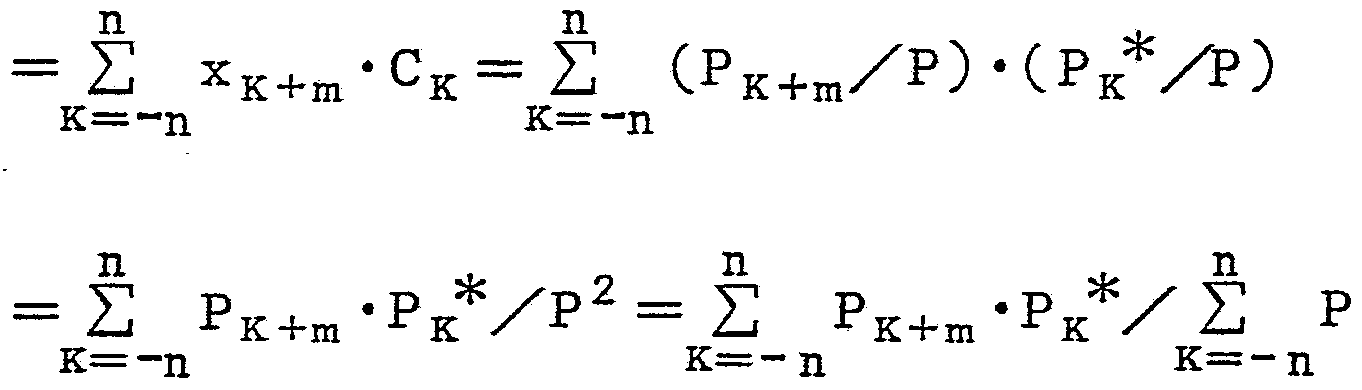

第 5 ス テ ッ プ⑤においては、 自己相関系列 Amが第 2等化回路 (EQL 2 ) 2 4 の演算回路 CNT 2 に供給さ れ、 逆特性行列の一次近似である系列 B /1)が次の よ う に して求め られる。
B (1) = ― A 木 C J ^ o )

この よ う に して求め られた系列 B は、 逆行列を求 めるため と初期値と して用い られる 。
第 6 ス テ ッ プ⑥においては、 第 2 の等化回路のタ ッ °係数 と して第 5 ス テ ッ プ⑤において得られた データ系列 B jWを用いて、 自 己相関系列 Amをタ ッ プ データ して等化出力 S を計算 し、 S を基準出力系 列 Re i と比較 して、 誤差をゼ ロ に近づける よ う に
一—^ 差換え
Bj を逐次補正する 。
等化出力 S は、
n
=- n で与え られるデー タ系列 sL であ る。
タ ッ プ係数 の補正は次の よ う な逐次近似を用い て行われる。

B o + (Ref S )·1
B o(n) + E: ( Erは Eの実部)
この他の BT については
B n+l ) = Β (η)) +Ε·Α0*
= Β ) + Ε
Β + (Ref - S)
= B (n)
J S " J
なお、 の補正は中心 タ ッ プが支配的であるため-に 下記の よ う な順番で行う 。
Βπ→Β+1→Β + → Β + η→Βο→Β + -→■· この よ う に して求め られる データ系列 Bj は、入力系 列 が対称であ る こ とか ら対称であ る。 すなわち、
Bj -B—j* であ る。こ の よ う に して、 第 2 等化回路
2 4 の タ ッ プ係数 Bjが初期設定されタ ッ プ係数レ ジ スタ TPH 2 に設定される。
以上のス テ ッ プに よ J? 自 動等化器の タ ッ プ係数の ビ AIT 換え
A
初期設定が終了する 。 この よ う に して、 受信装置 2 における初期設定が終了するのを見込んで、 送信装 置 1 は送信デー タ の伝送を開始する。 受信装置 2 に おい ては、 受信されたデー タ信号は、 復調部 2 1 に おいてデ ー タ系列に復調され、 第 1 の等化回路 2 3 に供給される。 第 1 の等化回路 2 3 においては、 受 信データ系列は第 1 の等化出力回路 ΟΡϋ 1 に よ ]? 第 1 の タ ッ プ係数レ ジス タ TPR 1 の タ ッ プ係数 C jを用 いて第 1 の等化出力が演算される。 第 1 の等化回路 2 3 か ら等化出力デー タ系列は第 2 の等化回路 2 4 の等化出力回路 OHJ 2 に供給され、 第 2 の タ ツ : 7°係 数 B jを用いて最終的 ¾等化出力データ が計算される c なお、 第 1 のタ ッ プ係数 と第 2 のタ ッ プ係数 B j か らたたみ込み演算に よ j? 結合されたタ ッ プ係数を 算出する こ とに よ ])、 受信データに対する等化出力 回路を 1 つにする こ と も可能である 。 本発明の 1 実施例と しての 自動等化器の よ ]3 詳細 な構成が第 5 図に示される。 第 5 図において、 受信 信号は、 復調部 2 1 に よ ]? 復調された後、 第 1 の等 化回路 2 3 よび第 2 の等化回路 2 4 に よ 等化さ れ、 等化された出力は、 データ判定部 2 5 において データ判定され ffi力データ と して出力される。 また、 復調部 2 1 の出力信号は初期設定時には、 単一 ル ス抽出部 2 2 に供給され、 抽出された単一ハ。 ル ス に , 广 -: : 1、— ' し r 差換え
基づいて第 1 および第 2 等化回路 2 3 , 2 4 の初期 設定が行われる 。 復調部 2 1 は、 受信信号中の ノ ィ ズを除去するための フ ィ ル タ 回路 (FIL) 2 1 1 , 受信 信号の レ ベ ルを調整する 自動利得制御回路 (AGC) 212、 直交振幅変調に対する復調を行う 復調回路 (DEM) 2 1 3、 復調された信号中の高周波成分を除去 する □ — ル オ フ フ ィ ル タ 回路 (ROF) 2 1 4を有する。 また、 単一ハ0 ル ス抽出部 2 2 は、 卜 レ ー ニ ン ク、信号 中か ら単一ハ。 ル ス信号に対応するデー タ系列を抽出 する描出回路 (REP) 22 1 、 抽出 されたデー タ系列を 正規化する正規化回路 (NR) 22 2 、 正規化されたデ ータ系列を複素共役化する複素共役化回路 (CN) 223 を有する。 第 1 等化回路 (EQL 1 ) 2 3 は、 復調部 2 1 か らの受信データ を書き 込む第 1 の タ ッ プデー タ レ ジ ス タ (TPD 1 ) 2 31、 第 1 の タ ッ プデー タ と 第 1 のタ ッ プ係数か ら第 1 の等化出力を演算する第 1 の等化出力回路 (OPU 1 ) 23 2 、 複素共役化回路 223 の出力データ に よ ]? 初期設定される第 1 のタ ッ プ係 数レ ジ ス タ ( TPR 1 )2 24 、 単一ハ。 ル ス信号の 自 己相 関系列を演算するための第 1 の演算制御回路 (CNT1 ) 23 5、 正規化回路 2 2 2 か らのデータ系列が書き 込 まれる第 2 の タ ッ プデ一 タ レ 'ジ スタ ( TPD 2 ) 23 6を 有する。 第 2 等化回路 (IQL 2 ) 2 4 は、 第 1 の等化 出力デー タ が書き 込ま れる第 3 の タ ッ プデ ー タ レ ジ
ス タ ( TPD 3 ) 24 1、 第 3 の タ ッ プデー タ と 第 2 の タ ッ プ係数から第 2 の等化出力を演算する第 2 の等化 出力回路 (ΟΡϋ 2) 24 2、 第 2 の タ ジ プ係数レ ジ ス タ (TPR2) 243 、 単一ハ0 ルス の 自 己相関系列 と第 2 の タ ッ プ係数か ら等化出力を演算 して基準出力 Ref と の誤差に も と づ いて第 2 のタ ッ プ係数を補正する第 2 の演算制御回路 ( CNT 2 ) 244 、 自己相関系列から 逆行列の n 次近似を求め る n 次近似回路 ( n - tlx AP) 245 、単一ハ。 ル ス の 自己相関系列を書き 込む第 4 の タ ツ °デ — タ レ ジス タ ( TPD 4) 246 、 単一ハ。ル ス の 自己相関系列を用 た等化出力 と基準出力と の誤差 を計算する誤差計算回路 (ERR 2) 247を有する。 デ ー タ判定部 2 5 は、 キ ャ リ ア 自動位相制御回路(CAPC) 25 1 、判定回路 2 5 2、 誤差計算回路 (EHR 2) 25 3 を有する。 データ判定部 2 5 の各回路については、 例えば、 日本国特許 1, 0 4 1, 0 6 6 号に開示されて お ]? 、 その説明を省略する 。
前記の本発明に よ る 自動等化器の初期設定方法に よれば、 対称な逆行列の演算を行う こ と に よ ]?、 そ れだけタ ッ プ係数の算出時間が短縮され得る。 例え ば、 前記の米国特許第 3, 9 6 2, 6 3 7 号に開示され た技術に比べて、 初期設定のための時間を短縮する こ とが可能である。
また、 本発明に よ る 自動等化器の初期設定方法に
よれば、 単一ハ0 ル ス抽 出のための信号と して連続 し てキ ヤ リ ァ信号が含ま れる信号を用いる こ と によ 同期ずれが防止され得る。
産業上の利用可能性
本発明は、 マ ル チ ボイ ン ト通信シ ス テ ム に お い て デー タ の伝達効率 を向上させるために利用され得る
差換え ノ A … ύ
Claims
1. 送信装置と受信装置 とが回線に よ って接続さ れ、 前記送信装置は、 単一ハ。 ル ス の成分を含む初期 化信号を送信 し、 それに続いてデータ 信号を送信す る手段を含み、 前記受信装置は、 受信された信号を 補正 し、 前記送信装置に よ ]?送信されたデー タ信号 を導 ffiするための 自動等化器を含む、 通信シ ス テ ム において、 前記自 動等化器は、
受信された初期化信号中か ら回線の有する特性に よ ]?歪みを受けた単一パ ル スを抽出する手段、
前記抽出された単一 ル スを用 て、 自己相闋ま たは相互相関系列を得るための係数を導出する導出 手段、
前記導出手段に よ ]?得られた係数に よ ])、 前記抽 出された単一ハ。 ル スを対称性を有する単一ハ。 ル ス に 補正する と と も に、 データ信号を補正する第 1 の等 化回路、
前記対称性を有する単一ハ。 ル スを用いて、 前記送 信装置が送信 した初期化信号に含まれる単一ハ。 ル ス に一致 した単一ハ。 ル スを導出するための係数を生成 する生成手段、 および、
前記生成手段に よ ]? 得られた係数に基づき、 デー タ信号を補正する第 2 の等化回路、
を具備するこ と を特徵とする、 自動等化器。 差換え
2. 送信装置にお いて キ ヤ リ ア信号をデ ィ ヅ タ ル データ に よ 直交振幅変調 した信号を伝送路を介 し て受信 し復調する受信装置に設け られ、 前記伝送路 に よ 受信信号中に導入された歪みを補償するため の自動等化器であ っ て、 前記自動等化器は、 デ ー タ信号を送信する前に前 記受信装置を初期設定するために送信される所定の ト レ ー 二 ン グ信号中か ら前記伝送路に よ る歪を含ん だ単一ハ。 ル ス信号に対応す'る信号を抽出する単一パ ル ス抽出回路、 およ び、 第 1 および第 2 の等化回路 を備え、
前記単一ハ。 ル ス抽出回路は、 前記単一ハ。 ル ス信号 に対応するデ ー タ系列 を発生させる手段、 前記デー タ系列 を正規化する手段、 およ び、 前記正規化され たデータ系列を複素共役化する手段を有 し、 前記第 1 の等化回路は、 前記複素共役化されたデ ータ系列をタ ッ プ係数と して用い、 前記正規化され たデー タ系列から前記単一ハ° ル ス信号に対応する信 号の 自 己相関系列を演算する手段、 お よび、 同様に 前記複素共役化されたデータ 系列を タ ッ プ係数と し て用い、 初期設定後に受信されるデー タ系列 と前記 . 単一ハ。 ル ス信号に対応する信号との相互相関系列を 演算する手段を有 し、 前記第 2 の等化回路は、 前記第 ί の等化回路にお ひ、 差換え Α . ½ "、 , ^y
いて得 られた前記 自 己相関系列を用い、 前記自 己相 関系列に対する逆行列の N次近似であ るデータ系列 を求める手段、 前記 N次近似であるデータ系列を も とに して逐次近似法に よ ]? 前記逆行列に対応するデ —タ系列を求める手段、 およ び、 前記逆行列に対応 するデータ系列をタ ッ プ係数と して初期設定し、 前 記第 1 の等化回路か ら出力される受信デ丁タ の相互 相 rt系列か ら等化出力を求める手段を有する、 自動等化器。
3. 前記逆行列の N次近似であ るデータ系列を求 める手段において、 前記 自己相関系列を 0 , 土 1 ,…,土 n )と した と き に、 前記データ系列 . B j を
Bj =一 A-j C J½ 0 )

B0 = A0 = C 1 . 0 ) (複素数)
で与え られる 1 次近似と して求め る、 請求の範囲第 2項に記載の 自動等化器。
4. 前記逆行列に対応するデ ー タ 系列を求める手 段において、 逐次近似法 と してガ ウ ス ザ イ デ ル法を 用い、 前記デ ー タ系列 Β ( «Γ= 0 , ± 1 ,…,土 n )につ いて BQ , Β±1 , … , B±n の順番で補正を行い、以後 これを繰返すこ とに よ ]) 逆行列に対応するデータ系 列を求める よ う に した、 請求の範囲第 2 項ま たは第 3 項に記載の自動等化器。 ^ん
'
5. 送信装置にお い て キ ヤ リ ァ信号をデ ィ 'ク タ ル デー タ に よ ]) 直交振幅変調 した信号を伝送路を介 し て受信 し復調する受信装置に設け られ、 前記伝送路 に よ ]5受信信号中に導入された歪みを補償するため の 自動等化器を初期設定する方法であ っ て、 前記初 期設定方法は、
データ信号を送信する前に前記受信装置を初期設 定するために送信される所定の ト レ ー ニ ン ク、信号中 から前記伝送路に よ る歪みを含んだ単一パ ル ス信号 に対応する信号を抽出 し、 それを複素数表示 したデ —タ系列 と して記憶する段階、
前記複素数表示されたデータ系列を正規化する段 階、
前記正規化されたデータ系列を複素共役化し前記 自動等化器の第 1 の-等化回路のタ ッ プ係数と して初 期設定する段階、
前記正規化されたデータ系列 と前記複素共役化さ れたデータ系列を用いて、 前記単一ハ。 ル ス信号に対 応する信号の 自 己相関系列を求める段階、
前記自 己相関系列を用いて、 前記自 己相関系列に 対する逆行列の 1 次近似であ るデータ系列を求め る 段階、
前記一次近似であ る データ 系列を初期値と して逐 次近似法に よ 前記逆行列に対応するデータ 系列を 换ぇ
求めて前記自動等化器の第 2 の等化回路のタ ッ プ係 数と して初期設定する段階、
を具備する、 自動等化器の初期設定方法。
6. 前記 ト レー ニ ング信号は、 特定のデータ系列 によ ]?変調されたキ ャ リ ア信号を含み、 前記特定の デー タ系列は、 それ自体を一デー タ シ ン ボ ル分 シ フ ト したデ タ系列 との和ま たは差を と る こ とに よ ] 単一ハ。ル ス系列、 す ¾わち、 中心成分のみが ( 1 , 0 ) であ ]J 他は ( 0 , 0 ) であ る系列が得 られる も ので ある、 請求の範囲第 5 項に記載の 自動等化器の初期 設定方法。 '
7. 送信装置と受信装置とが回線に よ って接続さ れ、 前記送信装置は、 単一ハ° ル ス の成分を含む初期 化信号を送信 しそれに続いてデータ信号を送信する 手段を含み、 前記受信装置は、 受信された信号を補 正し、 前記送信装置に よ 送信されたデータ信号を 導出するための 自動等化器を含む、 通信シ ス テ ム に おける 自動等化器を初期設定する方法であ って、 前 記初期設定方法は、
前記送信装置において前記初期化信号と して特定 の デー タ系列であ つ て前記デー タ系列を一シ ン ボ ル 分遅延させたデータ系列 と前記データ系列 自体と の 和または差であ るデータ系列が単一ハ。 ル ス信号と ¾ るデータ系列を含む ト レ ー ニ ン ク,信号を生成して送 差換え
信する段階、
前記受信装置において受信された ト レ ー ニ ン グ信 号中か ら前記特定のデータ系列に対応する受信デー タ系列を取 出 し、 前記受信デー タ 系列 とそれを一 データ シ ン ボ ル分遅延させたデータ 系列 との和ま た は差を求めるこ とに よ ])、 回線の有する特性に よ ]? 歪みを受けた単一ハ。 ル スを抽出する段階、
前記抽出された単一ハ° ル スを用いて、 自己相関ま たは相互相関系列を求めるための係数を導出する段 階、
前記導出された係数に よ ]) 、 前記抽出 された単一 ハ。ル スを対称性を有する単一ハ。 ル ス に補正する段階、 前記対称性を有する単一パ ル ス を用いて、 前記送 信装置が送信 した ト レ ー - ン グ信号中に含ま れる単 — ハ。 ル ス に一致 した単一ハ。 ル ス を導出するための係 数を生成する段階、 およ び、
前記生成された係数をデー タ信号を補正する等化 係数と して初期設定する段階、
を具備する こ と を特徵 とする、 自動等化器の初期 定; ¾法。
換え
'
Priority Applications (1)
| Application Number | Priority Date | Filing Date | Title |
|---|---|---|---|
| DE8383900068T DE3278305D1 (en) | 1981-12-28 | 1982-12-28 | Automatic equalizer and method of initialization thereof |
Applications Claiming Priority (2)
| Application Number | Priority Date | Filing Date | Title |
|---|---|---|---|
| JP56214604A JPS58121838A (ja) | 1981-12-28 | 1981-12-28 | 自動等化器 |
| JP56/214604811228 | 1981-12-28 |
Publications (1)
| Publication Number | Publication Date |
|---|---|
| WO1983002373A1 true WO1983002373A1 (fr) | 1983-07-07 |
Family
ID=16658457
Family Applications (1)
| Application Number | Title | Priority Date | Filing Date |
|---|---|---|---|
| PCT/JP1982/000479 Ceased WO1983002373A1 (fr) | 1981-12-28 | 1982-12-28 | Egaliseur automatique et procede d'initialisation |
Country Status (6)
| Country | Link |
|---|---|
| US (1) | US4571733A (ja) |
| EP (1) | EP0097723B1 (ja) |
| JP (1) | JPS58121838A (ja) |
| AU (1) | AU546024B2 (ja) |
| DE (1) | DE3278305D1 (ja) |
| WO (1) | WO1983002373A1 (ja) |
Families Citing this family (18)
| Publication number | Priority date | Publication date | Assignee | Title |
|---|---|---|---|---|
| JPS59246A (ja) * | 1982-06-17 | 1984-01-05 | Fujitsu Ltd | トレ−ニング方式 |
| JPH0619904B2 (ja) * | 1983-05-20 | 1994-03-16 | 日本ビクター株式会社 | デジタル信号の波形処理方式 |
| JPH0614627B2 (ja) * | 1985-06-04 | 1994-02-23 | 富士通株式会社 | モデムのトレーニング方法 |
| AU568980B2 (en) * | 1985-06-04 | 1988-01-14 | Fujitsu Limited | Method and device for timing pull-in of receiving equipment |
| US4825448A (en) * | 1986-08-07 | 1989-04-25 | International Mobile Machines Corporation | Subscriber unit for wireless digital telephone system |
| US4811360A (en) * | 1988-01-14 | 1989-03-07 | General Datacomm, Inc. | Apparatus and method for adaptively optimizing equalization delay of data communication equipment |
| DK168750B1 (da) * | 1990-05-01 | 1994-05-30 | Dancall Telecom As | Fremgangsmåde til modforvrængning i en modtager af signaler, der har passeret en transmissionskanal |
| JPH06244879A (ja) * | 1993-02-19 | 1994-09-02 | Fujitsu Ltd | 特殊トレーニングパターンを用いた変復調方式 |
| US5619503A (en) * | 1994-01-11 | 1997-04-08 | Ericsson Inc. | Cellular/satellite communications system with improved frequency re-use |
| JP3266432B2 (ja) * | 1994-12-20 | 2002-03-18 | 富士通株式会社 | 非ナイキスト伝送方式でのトレーニング方法及び非ナイキスト伝送方式のトレーニングデータ送信装置 |
| US6185251B1 (en) | 1998-03-27 | 2001-02-06 | Telefonaktiebolaget Lm Ericsson | Equalizer for use in multi-carrier modulation systems |
| KR100683289B1 (ko) | 2000-01-07 | 2007-02-15 | 어웨어, 인크. | 전송회선의 루프 길이 및 브리지형 탭 길이를 결정하기위한 시스템 및 방법과 정보 저장매체 |
| JP2001313594A (ja) * | 2000-04-28 | 2001-11-09 | Fujitsu Ltd | Dmtシステムのタイムドメインイコライザーの係数更新方法、レシーブ方法、dmtシステム及びdmtモデム |
| JP4164363B2 (ja) * | 2001-02-22 | 2008-10-15 | コーニンクレッカ フィリップス エレクトロニクス エヌ ヴィ | 低減された複雑性のキャリア間干渉除去 |
| US8406356B2 (en) | 2007-06-06 | 2013-03-26 | Micron Technology, Inc. | Self-calibrating continuous-time equalization |
| KR101830375B1 (ko) * | 2011-06-07 | 2018-02-21 | 한국전자통신연구원 | 지상파 신호와 모바일 신호 융합형 수신장치 및 방법 |
| US9531569B2 (en) | 2014-10-08 | 2016-12-27 | Dell Products, Lp | Power aware receiver/transmitter adaptation for high speed serial interfaces |
| US10075286B1 (en) * | 2017-03-13 | 2018-09-11 | Tektronix, Inc. | Equalizer for limited intersymbol interference |
Citations (2)
| Publication number | Priority date | Publication date | Assignee | Title |
|---|---|---|---|---|
| GB1364634A (en) * | 1970-09-25 | 1974-08-21 | Patelhold Patentverwertung | Apparatus for automatically checking pulse-distortion correction in a signal channel |
| JPH05283010A (ja) * | 1992-03-31 | 1993-10-29 | Matsushita Electric Ind Co Ltd | ガス放電型表示パネル |
Family Cites Families (4)
| Publication number | Priority date | Publication date | Assignee | Title |
|---|---|---|---|---|
| US4047013A (en) * | 1975-07-09 | 1977-09-06 | International Business Machines Corporation | Method and apparatus for fast determination of initial transversal equalizer coefficient values |
| FR2337465A1 (fr) * | 1975-12-30 | 1977-07-29 | Ibm France | Procede et dispositif pour determiner les valeurs initiales des coefficients d'un egaliseur transversal complexe |
| JPS5744339A (en) * | 1980-08-29 | 1982-03-12 | Hitachi Ltd | Signal processing system |
| US4430743A (en) * | 1980-11-17 | 1984-02-07 | Nippon Electric Co., Ltd. | Fast start-up system for transversal equalizers |
-
1981
- 1981-12-28 JP JP56214604A patent/JPS58121838A/ja active Granted
-
1982
- 1982-12-28 DE DE8383900068T patent/DE3278305D1/de not_active Expired
- 1982-12-28 AU AU10439/83A patent/AU546024B2/en not_active Ceased
- 1982-12-28 US US06/527,573 patent/US4571733A/en not_active Expired - Lifetime
- 1982-12-28 EP EP83900068A patent/EP0097723B1/en not_active Expired
- 1982-12-28 WO PCT/JP1982/000479 patent/WO1983002373A1/ja not_active Ceased
Patent Citations (2)
| Publication number | Priority date | Publication date | Assignee | Title |
|---|---|---|---|---|
| GB1364634A (en) * | 1970-09-25 | 1974-08-21 | Patelhold Patentverwertung | Apparatus for automatically checking pulse-distortion correction in a signal channel |
| JPH05283010A (ja) * | 1992-03-31 | 1993-10-29 | Matsushita Electric Ind Co Ltd | ガス放電型表示パネル |
Also Published As
| Publication number | Publication date |
|---|---|
| EP0097723B1 (en) | 1988-03-30 |
| EP0097723A1 (en) | 1984-01-11 |
| JPS648498B2 (ja) | 1989-02-14 |
| DE3278305D1 (en) | 1988-05-05 |
| JPS58121838A (ja) | 1983-07-20 |
| AU546024B2 (en) | 1985-08-08 |
| US4571733A (en) | 1986-02-18 |
| EP0097723A4 (en) | 1985-09-16 |
Similar Documents
| Publication | Publication Date | Title |
|---|---|---|
| CN110798422B (zh) | 低轨卫星多载波通信系统下行链路采样频偏估计与补偿方法 | |
| JP4034957B2 (ja) | 受信装置 | |
| US4868850A (en) | MODEM communication system having training means and method for training same | |
| US7308033B2 (en) | Apparatus and method for tracking residual frequency offset for single carrier-frequency domain equalizer system | |
| EP0748118B1 (en) | Signal processing system | |
| EP0097723B1 (en) | Automatic equalizer and method of initialization thereof | |
| JPH08511391A (ja) | Ofdmテレテキスト | |
| JPH0346862A (ja) | 伝送システム | |
| CN112073116B (zh) | 一种卫星载波叠加信号的帧结构及其解调方法 | |
| JP3517056B2 (ja) | Vsb変調信号におけるサンプリングタイミング位相誤差検出器 | |
| EP0573696B1 (en) | Timing recovery method and system | |
| JPH0216621B2 (ja) | ||
| CA1246259A (en) | Method and device for timing pull-in of receiving equipment | |
| JPH0429263B2 (ja) | ||
| US7920649B2 (en) | Recovering precoded data using a Mueller-Müller recovery mechanism | |
| CN109547370B (zh) | 联合均衡和干扰消除的超奈奎斯特系统符号估计方法 | |
| JPH0746810B2 (ja) | 伝送システム | |
| JPH0548391A (ja) | 適応等化器 | |
| US5077755A (en) | Digital signal processing system in modem | |
| GB2034158A (en) | Timing correction circuit for data communication apparatus | |
| CN102571663A (zh) | 微波通信数据传输方法及装置 | |
| JP3149236B2 (ja) | 受信システム | |
| JP3865596B2 (ja) | 自動等化回路およびそれを用いた受信回路 | |
| JP4658403B2 (ja) | 自動等化方法および自動等化装置 | |
| JPH09261285A (ja) | 多値vsb復調器 |
Legal Events
| Date | Code | Title | Description |
|---|---|---|---|
| AK | Designated states |
Designated state(s): AU US |
|
| AL | Designated countries for regional patents |
Designated state(s): DE FR GB NL |
|
| WWE | Wipo information: entry into national phase |
Ref document number: 1983900068 Country of ref document: EP |
|
| WWP | Wipo information: published in national office |
Ref document number: 1983900068 Country of ref document: EP |
|
| WWG | Wipo information: grant in national office |
Ref document number: 1983900068 Country of ref document: EP |