WO1989005287A1 - Alcool hexafluoroneopentylique, ses derives, polymeres fluores et leur utilisation - Google Patents
Alcool hexafluoroneopentylique, ses derives, polymeres fluores et leur utilisation Download PDFInfo
- Publication number
- WO1989005287A1 WO1989005287A1 PCT/JP1988/001228 JP8801228W WO8905287A1 WO 1989005287 A1 WO1989005287 A1 WO 1989005287A1 JP 8801228 W JP8801228 W JP 8801228W WO 8905287 A1 WO8905287 A1 WO 8905287A1
- Authority
- WO
- WIPO (PCT)
- Prior art keywords
- atom
- fluorine
- formula
- polymer
- hexafluoroneopentyl
- Prior art date
- Legal status (The legal status is an assumption and is not a legal conclusion. Google has not performed a legal analysis and makes no representation as to the accuracy of the status listed.)
- Ceased
Links
Classifications
-
- C—CHEMISTRY; METALLURGY
- C07—ORGANIC CHEMISTRY
- C07C—ACYCLIC OR CARBOCYCLIC COMPOUNDS
- C07C31/00—Saturated compounds having hydroxy or O-metal groups bound to acyclic carbon atoms
- C07C31/34—Halogenated alcohols
- C07C31/40—Halogenated alcohols perhalogenated
-
- C—CHEMISTRY; METALLURGY
- C08—ORGANIC MACROMOLECULAR COMPOUNDS; THEIR PREPARATION OR CHEMICAL WORKING-UP; COMPOSITIONS BASED THEREON
- C08F—MACROMOLECULAR COMPOUNDS OBTAINED BY REACTIONS ONLY INVOLVING CARBON-TO-CARBON UNSATURATED BONDS
- C08F20/00—Homopolymers and copolymers of compounds having one or more unsaturated aliphatic radicals, each having only one carbon-to-carbon double bond, and only one being terminated by only one carboxyl radical or a salt, anhydride, ester, amide, imide or nitrile thereof
- C08F20/02—Monocarboxylic acids having less than ten carbon atoms, Derivatives thereof
- C08F20/10—Esters
- C08F20/22—Esters containing halogen
Definitions
- the present invention relates to a novel hexafluoroneopentyl alcohol, a derivative thereof hexafluoroneopentyl (meth) acrylate, a fluorine-containing polymer obtained from the derivative, and a use thereof as an optical material. .
- a core material is formed from glass or plastic with excellent transparency
- a composite iron cone is formed by a concentric core-in-sheath structure using a plastic material having a lower refractive index than the material as a sheath material. It is well known that an optical fiber can transmit light incident on one end of the fiber by totally internally reflecting the light along the length of the fiber.
- verfluoro t-butyl methacrylate G has the disadvantage of poor flexibility and poor adhesion to the S material.
- An object of the present invention is to sufficiently satisfy the characteristics required for an optical fiber sheath material having a high softening degree and a low refractive index in view of the above-mentioned drawbacks, and at the same time, have excellent flexibility, and:
- An object of the present invention is to provide a novel monomer compound which gives a polymer having good properties and its material.
- hexafluoroneopentyl (meth) acrylate polymer has a specifically high glass transition temperature (hereinafter referred to as Tg), a low refractive index, and a low refractive index.
- Tg glass transition temperature
- Hexafluoroneopentyl (meth) acrylate which has excellent flexibility and good adhesion to the core material, can be easily synthesized using the novel hexafluoroneopentyl alcohol as a raw material. I learned that I can do it. The present invention has been completed based on such new findings.
- the present invention has the formula:
- X represents a hydrogen atom, a fluorine atom, a chlorine atom, a bromine atom, an iodine atom or a methyl group.
- a fluorine-containing polymer having a structural unit represented by An optical material comprising the fluoropolymer is provided.
- Hexafluoroneopentyl alcohol of the present invention can be obtained by the following production method.
- the above transfer reaction is performed in the presence of a suitable solvent.
- Preferred solvents include dimethylformamide, dimethylacetamide and the like.
- the rapid dosage of the solvent is 0,01 to 10 times, preferably 0,1 to 2 times the amount of the above-mentioned olefin (b). If too much, waste liquid treatment is troublesome and reaction The production is small for the large kale.
- the reaction temperature is preferably room temperature to 1.00.
- Na BH 4 etc. can be used.
- the amount of the organic solvent used is 1 to 10 times the amount of the above acid fluoride (c), and the amount of the reducing agent used is 0, 1 times the mole.
- the reduction may be performed directly using H 2 0
- the obtained hexaful and pentyl alcohol (d) be purified by distillation.
- the hexasubroutine neopentyl alcohol of the present invention is colorless needle-like crystals at room temperature.
- Hexamaloloneopentyl (meth) acrylate is obtained by using hexafluorolone pentyl alcohol obtained by the above-mentioned process as a starting material, and (1) auxiliaries of organic bases such as pyridine and triethylamine. Performs a dehydrohalogenation reaction with (meth) acrylic acid halide as an agent.
- the methods (1) and (2) are more preferable in terms of operability and yield.
- a solvent such as benzene, toluene, or dimethylformamide may be used, if necessary.
- the amount of the auxiliary agent used is 0.1 to 2 times, and the preferred reaction temperature is 0 to 100.
- the amount of the dehydrating agent used is 0.7 to 5 moles, and the preferred reaction temperature is 50 to: t00.
- the reaction is performed in the presence of a polymerization inhibitor.
- the polymerization inhibitor is not particularly limited as long as it inhibits radical polymerization of hydroquinone, hydroquinone pentamethyl ether, tri-tert-butylphenol, tert-butylcatechol, phenothiazine and the like.
- the hexafluoroneopentyl (meta) acrylate of the present invention is a colorless and transparent liquid at room temperature.
- the fluoropolymer of the present invention contains not less than 10% by weight of the structural unit represented by the general formula (I) as well as the homopolymer having the monomer unit represented by the general formula (I). And copolymers having the same.
- Preferred copolymers include, in addition to the above structural formula ( ⁇ ), a general formula:
- X is preferably a fluorine atom or a methyl group.
- R 1 is preferably a fluorine atom or a methyl group,
- R 2 is preferably one CH 3 , one CH 2 CH 3 , CF 3 ,
- R 2 is one more CH 2 CH 2 OH, One CH 2 CH 2 CH 2 S i (0 CH 3) s, one H, may contain a functional group such as one CH 2 CHCH.
- polymer of the present invention can be polymerized with other monomers, for example, styrene, butyl chloride and the like, as long as the properties of the polymer of the present invention are not affected.
- the fluoropolymer of the present invention can be obtained by homopolymerizing the above-mentioned hexafluoroneobenzoyl (meth) acrylate or copolymerizing it with another monomer.
- the polymerization method for producing the fluorine-containing polymer of the present invention a generally used method such as soul ⁇ , ⁇ ⁇ , suspension, emulsion polymerization or the like is employed. ⁇
- Examples of the polymerization initiator used for producing the fluorine-containing polymer of the present invention include azobisdisoptyronitrile, isoptyryl peroxide and bulk tanolyl peroxide in bulk, liquid and suspension polymerizations. Oxide, diisopropylpropoxydi-carnate, or formula
- X (CF 2 CF 2) n C 003 2 are preferably used.
- sulfates such as ammonium persulfate, lithium sulfate, etc.
- oxidizing agents such as persulfates, reducing agents such as sodium sulfite, and redox initiators of salts of transition metals such as iron sulfate (II) are used.
- a continuous transfer agent such as mercaptan
- the addition ratio of the chain transfer agent is usually 100 parts by weight of the monomer.
- Examples of the solution and the solution used for producing the novel fluorinated polymer of the present invention by the drowning polymerization include Freon-112, Freon-113, Freon-114, and Frosi-one.
- fluorine-based solutions such as C 3 18 or hydrocarbon-based solvents such as butyl acetate and methyl isobutyl ketone 0
- the polymerization temperature is usually in the range of 0 to 100, which is determined by the relationship with the decomposition degree of the above-mentioned polymerization initiator. In many cases, the range of 10 to 80 is preferably employed.
- the polymerization pressure is in the range of 0 to 50 kg / ⁇ gauge.
- the molecular weight of the fluorine-containing polymer of the present invention which can be prepared by the above polymerization reaction is usually about 10,000 to 500,000 (by gel permeation chromatography), or 1Q
- the novel fluorine-containing polymer of the present invention has a higher glass transition temperature than fluoroalkyl methyl acrylate polymer used as a plastic sheath material of SEIKO OPTICAL CO., LTD. It can also be used in the engine compartment of a car that could not be used with tic sheath materials.
- the polymer of the present invention since the polymer of the present invention has a high decomposition temperature, the allowable heating temperature range for producing an optical fiber by melt-spinning the polymer is large, and the temperature for melting the polymer can be easily adjusted. It also has advantages.
- the fluoropolymer of the present invention has a low refractive index, high transparency, good flexibility, and is an excellent optical material.
- optical material examples include an antireflection coating agent in addition to the above-mentioned fiberglass plastic sheath material. That is, glare and irregular reflection can be prevented by coating the polymer of the present invention on the surface of plastic or glass.
- the fluoropolymer of the present invention can be used for optical materials, Further, it can be used as an organic glass, a weather-resistant paint additive, and the like.
- Hexafluoroneopentyl alcohol 58, S 3 gr (0.3 mo), triethylamine 30 * 36 g (0.3 m 0 J2) Loloholm was filled with 50 g. Then, while cooling with water, the temperature is reduced to 10 to 2-Fluoroacrylic acid fluoride 30 and 37
- a ⁇ C C-CO-0-CH 2 1 C 1 CH 3
- Hexafluoroneopentyl methacrylate purified by decompression distillation in a 50-mm glass flask, 1,00 'parts, ⁇ -dodecylmer power, 0.05 parts by weight, polymerization initiator, 2 After mixing and dissolving 025 parts of 2,2′-azoisobutyronitrile, degassing and replacement with nitrogen were repeated to seal.
- the polymerization was then carried out in a reactor maintained at 70 for 16 hours. After the end of the child, 300 g of acetone is added to the obtained polymer, dissolved, and the solution is poured into 5 ⁇ ⁇ methanol. Separating the sinking polymer from the liquid, and
- the polymer was dried under reduced pressure at 100 ° C for 10 hours to obtain 96, 2 g of polymer (yield: 96%). 0 The molecular weight of the polymer was 35 in MEK and (n) was 0.596 in MEK. Of polymer The determination was performed by elemental analysis and nuclear magnetic resonance spectrum. Elemental analysis C 40. 9, H 3, 8 , F 43 2 0 1 2. 1% der song. The nuclear magnetic resonance spectrum was as follows.
- Example 5 100 parts of hexafluoroneopentyl, such as hexafluoroneopentyl, purified by decompression distillation in a 50-liter glass flask, ⁇ -dodecyl mercaptan After mixing and dissolving 0,025 parts, 1.0 part of 2,2'-azobisisobutyronitrile and 233 parts of the polymerization solvent ethyl, the degassing and nitrogen substitution were repeated, followed by sealing. Then polymerized for 18 hours in a reaction vessel maintained at 5 CTC.
- hexafluoroneopentyl such as hexafluoroneopentyl
- the polymer was identified by elemental analysis and nuclear magnetic resonance spectrum.
- the molecular weight of the polymer at MEK is 3
- the Suto magnetic resonance spectrum was as follows.
- a polymer of Comparative Example 1 was prepared in the same manner as in Example 4 except that 2,2,3,3-tetrafluoropropyl methacrylate was used.
- a polymer of Comparative Example 2 was produced in the same manner as in Example 4, except that verfluoro-butyl methacrylate was used instead of hexafluoroneopentyl methacrylate.
- Test example 1 verfluoro-butyl methacrylate was used instead of hexafluoroneopentyl methacrylate.
- Table 1 shows the results obtained by examining the properties of the polymers according to the present invention of Examples 4 to 7 in Table F.
- the physical properties were measured by the following methods. Method.
- the temperature at which endotherm began at a temperature rise of 20 / min: i.degree. was measured using a Perkin Elmer DSC S differential scanning calorimeter.
- the fluoropolymer of the present invention was loaded into a cylinder having an inner diameter of 9.5 fflin, kept at a temperature of 230 for 5 minutes, and then subjected to a 7 kg piston load.
- An orifice having an inner diameter of 2, 1 dragon and a length of 8 was extruded differently, and the number of lumps of the polymer that was extruded and extruded in 10 minutes was defined as M 3 [.
- the transmittance was measured with light having a length of 650 to 80 am.
- the fluorinated polymer of the present invention was made into a fiber having a diameter of l by the same method as in the case of M I, wrapped around a round bar at room temperature, and the radius of the round bar at which the woven cone cracked was examined.
- the transmissivity did not decrease even when the baby united body obtained in Example 4 was left under the atmosphere of 85 for 100 hours.
- Example 6 Dissolve the material of Example 6 in ethyl acetate to 5% by weight. And dissolve this solution in a 250 im doctor plate.
- the sample was dried at 80 for 1 hour to prepare a sample plate.
- the film thickness at this time was: The following were performed as evaluation test methods.
- Tetron cloth was attached to a rubbing raster made by Taihei Rika and rubbed 1,000 times with a load of 500 g.
- the first cellotape separation test was performed according to JIS K5400.
- the reflectance was 2.0% or less, and the scratch resistance was good.
- the transmittance of the coated MMA plate at 400 to 700 nil was 85%. Also the adhesion at this time
- Comparative test example 1 The aging temperature of the polymer of Comparative Example 1 was 72 and the decomposition temperature was
- the reflectance was as low as 2.5%, and the abrasion resistance was poor, with many scratches occurring 50 times.
Landscapes
- Chemical & Material Sciences (AREA)
- Organic Chemistry (AREA)
- Health & Medical Sciences (AREA)
- Chemical Kinetics & Catalysis (AREA)
- Medicinal Chemistry (AREA)
- Polymers & Plastics (AREA)
- Addition Polymer Or Copolymer, Post-Treatments, Or Chemical Modifications (AREA)
Description
明 細 害
へキサフルォロネオペンチルアルコール、 その誘導体、 含フッ素ポリマー及びその用途
産業上の利用分野
本発明は、 新規なへキサフルォロネオペンチルアルコ ―ル、 その誘導体であるへキサフルォロネオペンチル (メタ) アタ リ レー ト、 該誘導体から得られる含フッ素 ポリマー及びその光学材料としての用途に関する。
従来技術とその問題点
従来、 透明性に優れたガラス又はプラスチックにより 芯材を形成し、 その 材より も屈折率の低いプラスチッ クを鞘材とした同心状の芯一鞘構造により複合鐵錐を構 成し、 その織維の一端に入射した光を鐵維の長さ方向に 沿って内部で全反射させて伝達きせる光学織維はよく知 られている。
プラスチック系鞘材として、 これまで種々のポリマー が提案されているが、 軟化温度が高くかづ屈折率が低い という光学織維鞘材として要求きれる特性を充分に満足 するものは少ない。 その中で前記の特性を満足する光学 材料として特開昭 4 9 - 1 2 9 5 4 5号公報にはパーフ ルォロ t 一プチルメタク リ レー トが記載きれている。
しかしながら、 バーフルォロ t ーブチルメタク リ レー
トは、 可撓性が悪く、 しかも S材への密着性が劣るとい う欠点を有している。
本発明の目的は、 前記欠点に鑑み軟化蘧度が高くかつ 屈折率が低いという光学繊維鞘材として要求される特性 を充分に満足するとともに、 可撓性に優れ、 しかも: &材 への密着性が良い重合侔を与える新規なモノマー化合物 及びその材料を提供することである。
問題点を篛決するための手段
本発明者は、 新規なモノマー化合物であるへキサフル ォロネオペンチル (メタ) ァク リ レー ト 重合体が特異 的に高いガラス転移温度 (以下 T gと称する) を有し.、 屈折率が低く、 可撓性に優れ、 しかも芯材への密着性が 良いという知見及び前記へキサプルォロネオペンチル (メタ) ァク リ レー トが新規なへキサフルォロネオペン チルアルコールを原料として容易に合成することができ るという知見を得た。 本発明は、 この様な新知見に基づ き完成されたものである。
すなわち、 本発明は式:
C F3
C Fg C C H2 O H
C HS
で示されるへキサフルォロネオペンチルアルコール及び —般式:
X
CH2 =C
CF3
COOCH2 CCH3 C F3
(式中、 Xは水素原子、 フッ素原子、 塩素原子、 臭素原 子、 ヨウ素原子又はメチル基を表す。 ) で示されるへキ サフルォロネオペンチル (メタ) ァク リ レー トを提供す る I 本発明は、 更に、 一般式
X
CF3
I
COOCH2 CCH3
I
(式中 Xは水素原子、 フッ素原子、 塩素原子、 臭素原子、 ヨウ素原子又はメチル基を表す。 〉 で示される構造単位を有する含フツ素ポリマーおよび
記含フッ素ポリマーからなる光学材料を提供する。
本発明のへキサフルォロネオペンチルアルコールは次 の製法.により得ることができる。 まず、 次式に示すよう にオタタフルォロイソブテンのメタノール付加物 (a) を腺 HF反応することにより下記ォレフィ ン (b〉 を得、 これを転移反応により下記漦フルオラィ ド (c) を得、 これを還元することによって得ることができる。
-HF
(CF3 ) a CHCF2 OCHs CCFs〉 2 C = CFOCH3
(a) (b)
CF3 CF3
i
CH3 CCOF CH3 CCH2 OH
I
CF3 CF3 (c) (d)
なお、 上記の転移反応は適当な溶媒の存在下で行われ る。 好ましい溶媒としては、 ジメチルホルムアミ ド、 ジ メチルァセ トアミ ド等が挙げられる。 溶媒の俊用量は上 記ォレフイ ン (b〉 に対して 0, 01〜 10倍量、 好ま しく は 0, 1〜 2倍量である。 溶媒の量が少ないと転移 速度が逞く、 量が多いと廃液処理が面倒なうえ、 反応ス
ケールが大きい割に生産量が小さくなる。 反応温度は室 温〜 1.00でが好ま しい。
また、 上記の (c〉 から (d) への還元は有機溶媒中 で還元剤を使用して行われる。 有機溶剤としては、 例え ばジヱチルヱ一テル、 ジグライム、 テトラヒ ドロプラン 等が挙げられる。 還元剤としては、 L i A 2 H4 、
N a B H4 等が使翔きれる。 有機溶剤の使用量は上記酸 フルオラィ ド (c〉 に对して 1〜 10倍量、 還元剤の使 用量は 0, 倍モルである。 反応温度は 40〜
150でが好ま しい。 なお、 還元は H2 を使用して直接 行つてもよい 0
得られたへキサフル才ロネ才ペンチルアルコール (d) の精製は蒸溜によって行うのが好ま しい。 本発明のへキ サブルォ口ネオペンチルアルコールは常温で無色の針状 結晶である。
次に 発明のへキサプルォロネオペンチル (メタ) ァ ク リ レー トの製法について説明する。 へキサマルォロネ ォペンチル (メタ) ァク リ レー トは上記製法によって得 られたへキサフルォロネ才ペンチルアルコールを原料 f匕 合物として、 これと (1) ビリ ジン、 ト リェチルァミ ン 等の有機塩基類を助酸剤として (メ タ) アク リル酸ハラ ィ ドとの脱ハロゲン化水素反応を行う、 (2) 五酸化リ
ン、 硫酸等の脱水剤を使用した (メタ〉 アク リル酸との 脱水反応を行う、 (3〉 メチル (メタ〉 アタリ レートと のエステル交換反応を行う等によって得ることができる。
上記 (1 ) 〜 (3) の製法にうち、 操作性及び収率の 点から.は、 (1) 及び (2) の製法がより好ましい。 こ れらの反応において、 必要に応じ、 ベンゼン、 トルエン、 ジメチルホルムアミ ド等の溶剤を用いてもよい。 上記
( 1) の製法において助駿剤の使用量は 0, 1〜2倍そ ルであり、 好ましい反応温度は 0〜 100でである。 上 記 (2 ) の製法において脱水剤の使用量は 0. 7〜 5倍 モルであり、 好ましい反応温度は 50〜: t 00でである。
なお、 重合しやすいモノマー化合物を製造する場合は 重合禁止剤の存在下で反応を行う。 重合禁止剤としては ヒ ドロキノ ン、 ヒ ドロキノン乇ノメチルエーテル、 ト リ tert—ブチルフエノール、 tert—プチルカテコール、 フ エノチアジン等のラジカル重合を禁止するものであれば 特に限定されない。
本発明のへキサフルォロネオペンチル (メ タ〉 ァク リ レー トは常温で無色透明の液体である。
本発明の含フッ素ポリマーは上記一般式 ( I ) で示き れる搆造単位を有するホモポリマーはもちろんのこと上 記一般式 ( I ) で示きれる構造単位を 10重量%以上佘
有するコポリマーをも含むものである。
好ま しいコポリマーとしては、 上記構造式 ( ί ) に加 えて一般式:
6CH2 -C) CH)
COOR2
(式中、 : 1 は水素原子、 フッ素原子又はメチル基を、 R 2 は水素原子、 低級アルキル基又はフルォロアルキル 基を表す。 )
で示される構造単位を 90〜0, 1重量%、 好ま しく は ケ 0〜.0. 1重量%、 きらに好ま しく は 50〜 0. 1重 量%の割合で含有するものが挙げられる。
なお、 上記一般式 ( I〉 において Xは好ましく はフッ 素原子又はメチル基である。 また、 上記一般式 (Π〉 に おいて R 1 は好ましく は.フッ素原子又はメチル基であり ,
R 2 は好ま しく は一 C H3 、 一 C H2 C H 3 、 C F 3 、

- C H 2 C P 2 C F 2 H、 - C H2 C F 2 C F H C F 3 C H 2 C H 2 C 8 F IT 等のフルォロアルキル ¾である。 R 2 はさらに一 C H2 C H2 O H、
一 C H2 CH2 CH2 S i (0 C H3 ) s 、 一 H、 一 C H2 C H C H等の官能基を含んでもよい。
さらに、 本発明のポリマーは本発明のポリマーの特性 を担なわない範囲でその他のモノマー、 例えばスチレン、 塩化ビュル等を ¾重合することができる。
本発明の含フッ素ポリマーは、 前記のへキサフルォロ ネオべ.ンチル (メタ) アタ リ レー トを単独重合させるか 又は他のモノマーと共重合させることにより得られる。
本発明の含フッ素ポリマーを製造する重合形式は、 魂 扰、 菝^、 懸蜀、 乳化重合等、 一般に採用されている形 式が採用される。 ·
本発明の含フッ素ポリマ一を製造する際に用いられる 重合開始剤としては、 塊状、 液状および懸濁重合におい てはァゾビスィソプチロニト リル、 ィソプチリルパーォ キシド、 才クタノィルパーォキシ ド、 ジ一イソ一プロピ ルパーォキシジ-カーネー ト、 または式
CC (C F 2 C F C J2) 2 C F 2 C O O〕 2 、
〔X (C F2 C F2 〉 n C 00〕 2 および
〔X (C F 2 C F 2 ) n C 003 2 (式中、 Xは H、 F 又は C J2、 πは 1〜 10) で表きれる含フッ素有機遜酸 化物等が好ま しく用いられる。 乳化重合においては、 遏 硫酸塩、 例えば過硫酸ァンモユウム、 遏硫酸力リ ウムま
たはこれら過硫酸塩等の酸化剤、 亜硫酸ソーダ等の還元 剤および硫酸鉄 (Π ) 等の遷移金属の塩類のレ ドックス 開始剤が用いられる。
前記の塊状、 液状または懸蜀重合において、 本発明の 新規含フッ素ポリマーの熱分解温度の向上や分子量分布 の調整の目的で、 メルカブタン類等の連鎮移動剤を^い ることが好ま しい? 連鎖移動剤を用いる場合の連鎖移動 剤の添加割合は、 モノマー 1 0 0重量部に対し通常
0 . 0 1〜 1重量部である。
前記の溶液および懸溺重合で本発明の新規含フッ素ポ リマーを製造する際に用いられる溶液としては、 フロン 一 1 2、 フロン一 1 1 3、 フロン一 1 1 4、 フロシ一
C 3 1 8等フッ素系溶液または酢酸プチル、 メチルイソ プチルケ トン等炭化水素系溶媒が代表例として挙げられ る 0
重合温度は通常 0〜 1 0 0での範囲で上記重合開始剤 の分解溫度との閼係で決められるが、 多く の場合 1 0〜 8 0 の範囲が好ま しく採用される。
重合圧力は 0〜 5 0 kg / ^ゲージの範囲が採用される。 上記重合反応で調製することができる本発明の含フッ 素ポリマーの分子量は、 通常 1万〜 5 0 0万程度 (ゲル パーミエーシヨ ンクロマ トグラフィ ーによる) 、 或いは
1Q
M E Kによる 3 5ででの 〔??〕 として 0 , 1 5〜 3 , 0 程度、 屈折率 (n d 25〉 は、 ; L . 3 7〜: I , 4 5、 ガラ ス転移温度は 1 2 0〜 1 6 0でである。
本発明の新規含フッ素ポリマーは、 適常光学鐵 ϋのプ ラスチック系鞘材として利用されているフルォロアルキ ルメ夕ク リ レー トポリマーに比べガラス転移温度が高い ので、 比較的高温下、 例えば従来のブラスチック系鞘材 では使用できなかった車のエンジンルームにおいても使 用することができる。 また本発明のポリマーは、 分解温 度が高いので、 これを溶融紡糸して光学鐵維を製遣する に際して許容される加熱温度幅が大きく、 該ポリマ一を 溶融する為の温度調節が容易になるとい 利点も有して いる。
きらに、 本発明の含フッ素ポリマーは、 低い屈折率、 高い透明牷、 良好な可撓性を有し、 優れた光学材料とな るものである。
光学材料の用途としては、 上記先学繊維プラスチック 鞘材の他に反射防止コーティ ング剤が挙げられる。 すな わち、 プラスチックやガラスの表面に本発明のポリマー をコ一ティ ングすることにより、 ギラツキや乱反射を防 止することができる。
本発明の含フッ素ポリマーは、 光学材料の用途の他、
さらに有機ガラス、 耐候性塗料添加剤等と しても、 使用 できる。
実 施 例
以下に実施例及び比較例を示し、 本発明の特徵とする ところをより一層明らかにする。
実施例 1
温度計、 滴下ロー ト、 撹捽機、 還流冷却器を備えた 1 J2のガラス製 4つ口フラスコに、 テ トラグライム
133. 31 (0, 6 m 0 および水素化ホウ索ナ ト リ ウム 15. 1 s (0. 4 m 0 J3 ) を入れ、 温度を 80でに保つ。 この混合物中に 2, : —ビス (ト リフル ォ口') プロピオ'ン酸フルオラィ ド 106, 04 g (0, 5 m 0 ^ ) を 2時間半で癍下する。 滴下終了後 80でで 3時間撹拌後 20でに冷却する。 次に塩酸 (35%) 2 1 (it'を徐々に滴下し、 500 ccの水で'洗浄後、 常圧で蒸 溜を行ない沸点 1 1 0でのへキサプルォロネオペンチル アルコール 60 が得られた (収率 60 %) o このもの は無色の針状結晶であった。 同定は F— NMRスぺク トルおよび ,H— NMRスぺク トルによって行った。 な お、 測定には核磁気共鳴スぺク トロメータ一 (日 *電子 ㈱製 F X— 1 00型) を使用した。
c

CFS CCH2 OH
t I t
a CHS d
个
b
15 F-NMR (C F3 COOH'基準)

H-NMR (TMS基準)
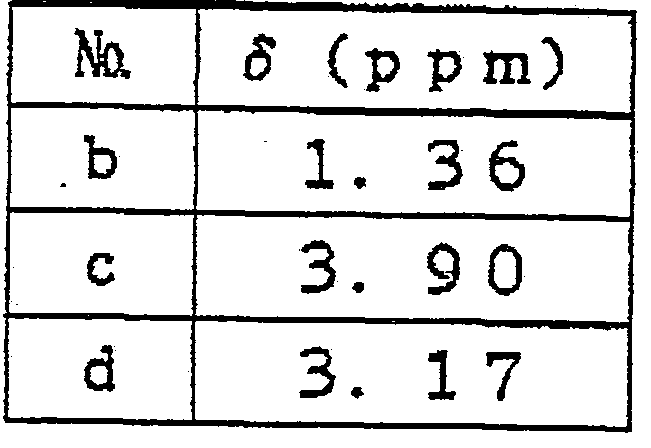
実施例 2
5 0 Omfiのガラス製フラスコ中に実施例 : Lで得たへキ サフルォロネオペンチルアルコール 1 5 0 g (0. 76 5 m ο «δ ) 、 メタァク リル漦 7 3 g ( 0* S 5 m 0 J2 ) および t 一プチルカテコール 1 gを
入れ、 70〜8 CTCに加熱し、 次いで 50 gの五酸化二 リ ンを 2時間要して添加した。 この場合温度を 80〜 90 に維持した。 添加終了後、 さらに 3時間 80〜 90でに保持 H b tし、 反応を完結させた。 反応混合物を 30 OffliSの水で洗浄,し、 得られたへキサフル才ロネオペ ンチルメタアタ リ レー トを 1 SnittHgの滅圧下で蒸溜した, 沸点 55で、 G Cの純度 99, 9%。 同定は 〗H— NM R—スぺク トル、 19 F— NM cR Hd Ai—スぺタ トル、 1S C—
2
NMR—スぺク トル (全て溶媒: アセ トン— ds ) によ ゥて行った 0 式 ; a c f
i
H CH3 CF3
I I
c-c-co-o C-CH3
I 个

で表される化合物について、 次の化学的変位 ( 5) 及び 結合定数 ( J ) が測定された。
1H— NMR (TMS基準)

(注) s : シングレツ ト d: Gダブレツ ト m:マノレチブレツ ト F -NMR (CFS COOH基準) 抵磁場を +

13 C一 NMR
C


実施例 3
温度計、 滴下ロー ト、 撹拌瘵、 還流冷却器を備えた
2 0 0 DI2のガラス製 4つ口フラスコに、 へキサフルォロ ネオペンチルアルコール 58, S 3 gr (0. 3 m o ) 、 ト リェチルァ ミ ン 3 0* 3 6 g ( 0. 3 m 0 J2 ) 及びク ロロホルム 5 0 gをいれた。 次に水冷しながら 1 0で以 下で 2—フルォロアク リル酸フルオラィ ド 3 0 , 3 7
( 0. 3 3 m 0 ? ) を徐々に滴下し、 滴下終了後室温で 3 0分間撹拌後した。 次いで 5 %炭酸水素ナ ト リ ウム水 溶液、 純水の順で洗浄し、 エバポレー ト してクロ口ホル ムを除去し、 へキサフルォ口ネオペンチルァク リ レー ト を得た。 得量 6 7* 1 7 gで収率は 7 6. 7 %であった。
さらに tーブチルカテコールを重合禁止剤として o. 1 g加え、 減圧蒸溜を行い精製した。 沸点は 55〜56 でノ20と であった。 同定は — NMRスぺク トル、 19 F— NMR H Hb c a†*, f I—スぺク トル、 C一 NMR—スベタ トル (全て溶媒 : アセ トン一 ds ) によって行った。

iH-NMR (TMS基準)
No. δ (p p m)
a 5. 72
b 5. 44
c 4. 54
d 1. 47

F-NMR (C F3 COOH基準) 低磁場を +

19 C-NMR
F
I
H F CF3 r
I
A→C=C-CO-0-CH2 一 C一 CH3
I t t † E
H B C D CF3
个
F
α 6 (p p m)
A. 103. 9
B 153. 1
C 159. 4
D 62. 4
E 51. 3
F 125, 0
G 12. 5
実施例 4
50 Ουώのガラス製フラスコ内に滅圧蒸溜によって精 製したへキサフルォロネオペンチルメタァクリ ー ト 1,00'部、 η— ドデシルメル力.プ夕ン 0. 05部、 重合 開始剤、 2, 2' ーァゾイソプチロニトリル 025 部を混合溶解した後、 脱気と窒素置換とを繰り返して密 封した。
次いで 70でに維持された反応槽で 16時間重合させ た。 童合終了後、 得られた重合物中にァセ トン 300 g を人れ、 溶解させ、 その溶液を 5 ·βのメタノール中に注 ぎ込む。 沈濺する重合体を液体から分離し、 そして
100での温度で 10時閽弒圧乾燥し 96, 2 gの重合 体を得た (収率 96%) 0 重合体の分子量は MEKで 35ででの ( n ] は 0. 596であった。 ポリマーの同
定を元素分析と核磁気共鳴スぺク トルにより行った。 元 素分析は C 40. 9、 H 3, 8、 F 43 2 0 1 2. 1 %であうた。 また核磁気共鳴スペク トルは 下記の通りであった。

^H-NMR (TMS基準〉

F-N R (CF3 COOH基準) 低磁場を +
6 (p p m)
e 十 6. 4
ほ C— NMR c
CKs
T

0

実施例 5 50 Οιώのガラス製フラスコ内に滅圧蒸溜によって精 製したへキサブルォロネオペンチルー な —フルォロァ 々 リ レー ト 100部、 η— ドデシルメルカプタン
0, 025部、 2, 2' —ァゾビスイソプチロニ ト リル 1. 0部および重合溶媒詐酸ェチル 233部を混合溶解 した後、 脱気と窒素置換とを緣り返して密封した。 次いで 5 CTCに維持された反応槽で 18時間重合させ
C
た。 重合終了後、 2得られたポリマー溶液を 5 J2のメタノ ール中に注ぎ込む。 沈饞する重合体を液 *から分離し、 そして 100での温度で 10時間減圧乾燥し 93 gの重 合体を得た (収率 93%) 。 重合俸の分子量は ME Kで 35ででの 〔??〕 は 0, 423であった。 ポ リマーの同 定を元素分析と核磁気共鳴スぺク トルにより行った。 元素 析は C 35, 8%、. H 2. 696、 F 49. 6%、 0 11, 9%であった。 また核磁気 共鳴スぺク トルは下記の通りであった。
d F €
一 C一 CF3 c
I i
CO— 0— CH2 C一 CH3
t
b CF3
t
e1
— NMR TMS基


実施例 6
50 OffijSのガラス製フラスコ内に減圧蒸溜によって精 製したへキサプルォロネオペンチルメ タァク リ レー ト
90部、 メチルメ タアタ リ レー ト 1 0部、 n ドデシル メルカブタン 0, 1部、 2, 2 ' ーァゾビスイソプチ口 二ト リル 0* 0 25部を混合溶解し、 実施例 1と同様の 操作で重合を行い、 S. 5 gの重合体を得た (収率
98* 5%) 。
重合体の分子量は M E Kで 3 5ででの 〔 〕 は
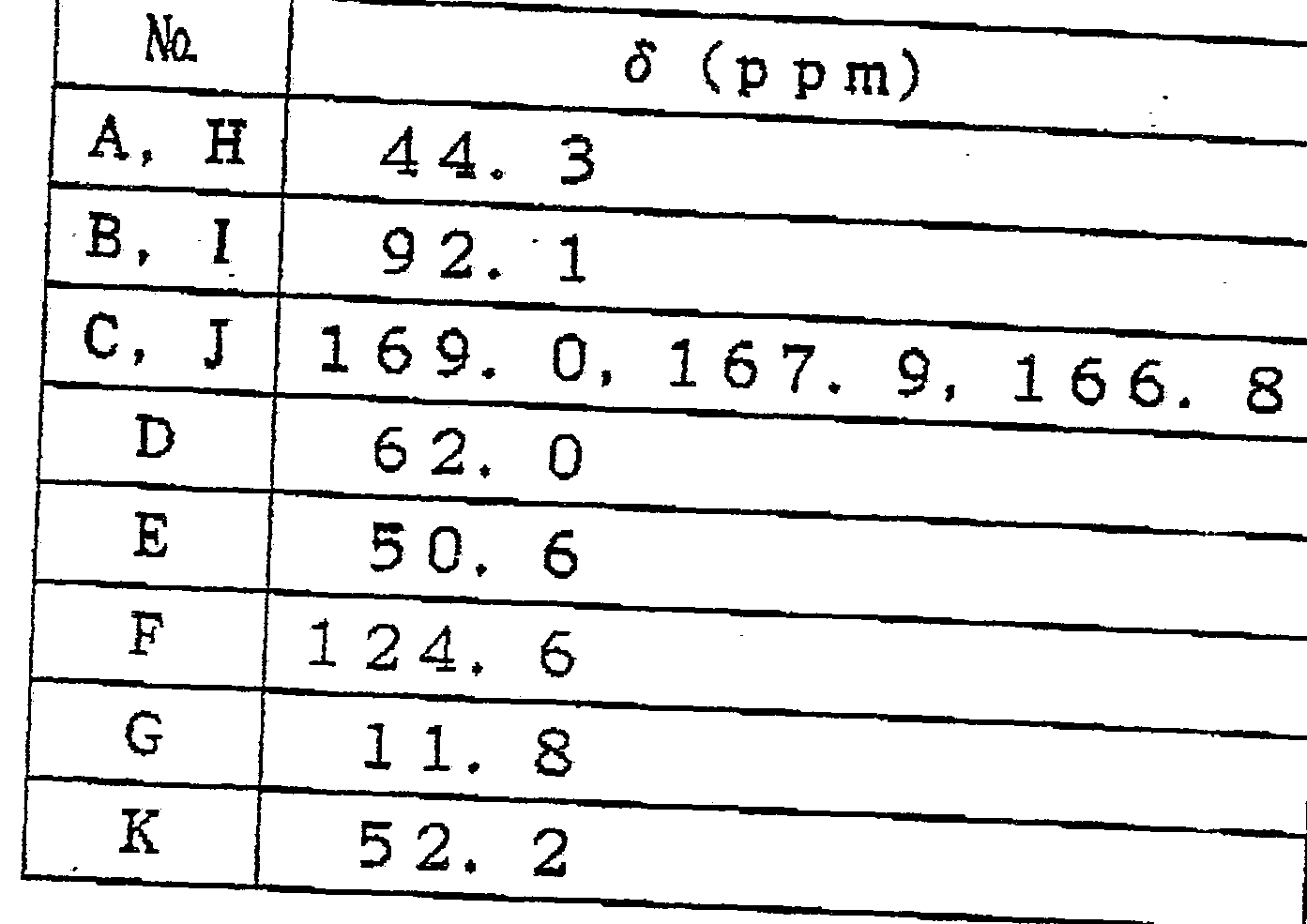
0. 4 94であった。 またポリマーの同定を元素分析と 核磁気共鳴スぺク トルにより行った。
元素分析は C 42* % H 4. 2 %
F 38. 9 %、 0 14, 1 %であった。
核磁気共鳴スぺク トルは下記の通りであった f a e CH3 一 CH2— C c CH2 一 C - H b I
3 CF3 COOCHs †
CO— 0— CH2 — C一 CH3 g f I t
c CF3 d
t
h
1H - NMR TMS基準

Να δ (p pm)
h + 6. 6
is C-NMR
c K
C H3

TMS標準

実施例 7
50 Οϋώのガラス製フラスコ内に減圧蒸溜によって精
89/05287 製したへキサフルォ口ネオペンチルー —フルォロアク リ レー ト 9 0部、 メチルー なーフルォロアク リ レー ト 1 0部、 η— ドデシ メルカブタン 1 , 0部、 2, 2' ーァゾビスイソプチロニト リル 0. 1部を混合溶解し、 •実施例 1と同様の操作 (但し、 ここでの重合温度は 5 0 でである) で重会を行い、 9 S. 3 gの重合体を得た (収率 98, 3%〉 。
重合体の分子量は ME Kで 3 52 での 〔 〕 は
0, 6 2 1であつた。
元素分析は C 36. 8 5%. H 2, 8%、
F 4 6. 5%、 0 1 3, 8%であった。
梭磁気共鳴スぺク トルは下記の通りであった。
h
a F
一 CHク 一 C 3
C
 NMR TMS基準 c
2
磁場を +

C一 NMR
F H F T
1 I
C CH2 一 C一
、B CF3 COOCHg 个 个 J
CO— 0— 一 CH3
f 、G
c
 F3
F3
t
F
TM S標準
へキサフルォロネオペンチルメタク リ レー トにかえて
2 , 2 , 3 , 3—テトラフルォロプロピルメタタ リ レー トを用いた以外は、 実施例 4と同様にして比較例 1のポ リマーを調製した。
比較例 2
へキサフルォロネオペンチルメ タクリ レートにかえて バーフルォロ t 一プチルメタクリ レー トを用いた以外は, 実施例 4と同様にして比较例 2のポリマ一を謂製した。 試験例 1
実施例 4〜 7の本発明のポリマーについて" F記特性を 調べた結杲を第 1表に示す。 なお、 物性値の測定法は次
の方法による。
(ァ) ガラス転移温度 (T g)
パーキンエルマ社製 D S C Π型示差走査熱量計を用い、 2 0 /分の昇温: i§度で吸熱が始まる温度を測定した。
(ィ) 分解温度 (Τ η )
島津製作所社製 D T G - 30型示差走査熱量計を用い、 i 0でノ分の昇温速度で重量弒少の始まる温度を測定し た。
(ゥ)—瘤折率 (n D)
ァタゴ光学機器製作所製アッベ式屈折計を用い 2 5で で測定した。
(ェ) メルトインデックス (M l )
島津製作所製高化式フローテスタ一を用い、 本発明の 含フッ素ポリマーを内径 9. 5fflinのシリ ンダ一に装填し、 温度 230でで 5分閬保った後、 7kgのピス ト ン荷重下 に内径 2, 1龍、 長さ 8 のオリフィ スを違して押し出 し、 1 0分間に押し出されて出てきた該ポリマーのダラ ム数を M 3 [ とした。
(ォ) 透光性 (Tm)
; 材にポリメチルメタクリ レー ト、 鞘材に'本発明の含 フッ素ポリマーを用い、 直径 30 ,0 ^ m (鞘^厚さ 1 5 ^ m) 、 長さ 5 00咖の光学織維を 230 で複合紡糸
し、 铵長 6 5 0〜ら 8 0 amの光で透過度を測定した。
(力〉 可撓性 (F b )
本発明の含フッ素ポリマーを前記 M I と同檨の方法で 直径 l の織維とし、 室温で鎘丸棒にまきつけ、 該織錐' にひびの入る鑌丸棒半径を調べた。

試験例 2
実施例 4で得られた童合体を 8 5での雰囲気下に 1 0 0時間放置しても透光率の減少はなかった。
試験例 3
実施例 6の材料を酢酸ェチルに 5重量%になるまで溶
解し、 この溶液を 250 imの ドクタプレー ドで
PMMA扳 (三菱レーヨンアタリペッ ト材) に塗布した。
80でで 1時間乾燥し試料板を調製した。 この時の膜厚 は であゥた。 評価試験法として以下のことを行つ た。
(ァ) 反射率
5度正反射測定装置の付いた UVスペク トル (日立 II 3200) により 400〜 70 On の平均反射率を測定 した 0
対擦傷性
太平理化製ラビングラスターにテトロン布 とり付け 荷重 500 gで 1000回こす た。
(ゥ) 密着性
ごばん目一セロテープ剝離試験を J I S K 5400に 準拠して行った。
その結果、 反射率は 2, 0%以下であり、 対擦傷性は 良好であ た。
またこの時のコーティ ング MMA板の 400〜700 nilでの透光率は 85%であった。 またこの時の密着性
(ゴバン g) は 100/100であった。 80でで同様 の実験を行ったが、 物性に変化はなかった。
比較試験例 1
比較例 1のポリマーの软化温度は 72 、 分解温度は
265でと低く、 屈折率は 1. 42であった。
上記ボリマーを鞲材、 ポリメチルメタク リ レー トを芯 材として光学織維を 250でで紡糸したところ、 鞘材部 に発泡が認められた。 钫糸温度を 210でとしたところ、 成形ダイが目づまり し紡糸できなかった。 紡糸温度が 230でではじめて実施例と同様の光学鐵維が紡糸でき、 透光性は 76%であった。 しかしながら、 このものを 85での雰囲気下に 100時閻放置した後の透光性は 52%に低下していた。
また、 比較例 1で調製したポリマーを試験例 3と同様 に PMMA扳に塗布し、 試料扳を調製した。
この反射率は 2. 5%と低く、 封擦傷性は 50回でキ ズが多数発生して不良であった。
80でで同様の実験をおこなったところ、 対擦傷性は 2回でキズが多数発生した。
比较試験例 2
比 例 2のポリマーの F bを測定したところ 3 以 上であり、 使用にたえないものであった。
また、 比較例 2で謂製したポリマーを 1, 1, 2— ト リクロロ一 2 , 2— ト リフルォロェタンに 5%まで溶解 し、 PMMA扳上に試験例 3と同様に 8 mの塗膜を得
た。 この密着性を調ぺたところ、 1回で 0ノ 100であつ た。
Claims
請 求 の 範 囲
式:
CF3

CHS で示きれるへキサフル才口ネオペンチルアルコール。
一 式:
X
CH2 =C
CF3
COOCHz CCHS
CF3
(式中、 Xは水素原子、 フッ素原子、 塩素原子、 臭素 原子、 ヨウ素原子又はメチル基を表す。 )
で示されるへキサフル才ロネオペンチル (メタ) ァク リ レート 0
Xが、 フッ素原子又はメチル基である請求の範囲第
2項に記載のァク リ レー ト
一般式:
9/05287 35 '
X

CF3
(式中、 Xは水素原子、 フッ素原子、 塩素原子、 臭素 原子、 ヨウ素原子又はメチル基を表す。 )
で示される構造単位を有する含フッ素ポリマー。.
5 一般式 ( I ) で示される構造単位 10〜 99. 9雷 量%と一般式:
CH2 -c - en)
COOR2
(式中、 R1 は水素原子、 フッ素原子又はメチル基を, R2 は水素原子、 低級アルキル基又はフルォロアルキ ル基を表す。 )
で示される構造単位 0. 1〜 90重量%を有する請求 の範囲第 5項記載の含フッ索ポリマー。
一般式:
X
1
— CH2 一 Cト
CF3 (I)
COOCH2 CCH3
I
CF3
(式中、 R】 は水素原子、 フッ素原子、 塩素原子、 臭 素原子、 ヨウ素原子又はメチル基を表す。 )
で示される構造単位を有する含フッ素ポリマーからな る光学材料。
7 —般式 ( I ) で示きれる構造単位 10〜 99, 9重 量%と一般式:
→CH2 一 ~ (D)
COOR2
(式中、 は水素原子、 フッ素原子又はメ ル基を、 R2 は水素原子、 低級アルキル基又はフルォロアルキル 基を表す。 )
で示される構造単位 0, 1〜90重量%を有する含フ ッ素ポリマーからなる請求の範囲第 6·項記弒の光学材 料。
Priority Applications (1)
| Application Number | Priority Date | Filing Date | Title |
|---|---|---|---|
| DE8989900149T DE3879492T2 (de) | 1987-12-04 | 1988-12-05 | Hexafluoroneopentyl alkohol, dessen derivate, fluorierte polymere und deren verwendung. |
Applications Claiming Priority (4)
| Application Number | Priority Date | Filing Date | Title |
|---|---|---|---|
| JP62308092A JPH01149808A (ja) | 1987-12-04 | 1987-12-04 | 含フツ素ポリマー及びその用途 |
| JP62/303092 | 1987-12-04 | ||
| JP31252987A JPH01153657A (ja) | 1987-12-10 | 1987-12-10 | ヘキサフルオロネオペンチルアルコール及びその誘導体 |
| JP62/312529 | 1987-12-10 |
Publications (1)
| Publication Number | Publication Date |
|---|---|
| WO1989005287A1 true WO1989005287A1 (fr) | 1989-06-15 |
Family
ID=26565405
Family Applications (1)
| Application Number | Title | Priority Date | Filing Date |
|---|---|---|---|
| PCT/JP1988/001228 Ceased WO1989005287A1 (fr) | 1987-12-04 | 1988-12-05 | Alcool hexafluoroneopentylique, ses derives, polymeres fluores et leur utilisation |
Country Status (4)
| Country | Link |
|---|---|
| US (1) | US5116544A (ja) |
| EP (1) | EP0364587B1 (ja) |
| DE (1) | DE3879492T2 (ja) |
| WO (1) | WO1989005287A1 (ja) |
Families Citing this family (5)
| Publication number | Priority date | Publication date | Assignee | Title |
|---|---|---|---|---|
| EP0331056A3 (en) * | 1988-03-01 | 1991-03-27 | Daikin Industries, Limited | Fluorine-containing copolymer and process for preparing the same |
| DE3939535A1 (de) * | 1989-11-30 | 1991-06-06 | Bayer Ag | Verfahren zur herstellung teilfluorierter alkohole |
| US6266475B1 (en) * | 1998-07-03 | 2001-07-24 | Asahi Glass Company Ltd. | Optical waveguide |
| WO2004055554A1 (ja) * | 2002-12-13 | 2004-07-01 | Daikin Industries, Ltd. | 含フッ素光学材料および含フッ素共重合体 |
| JPWO2016035823A1 (ja) * | 2014-09-02 | 2017-06-15 | 国立大学法人九州大学 | 低抵抗クラッド材料及び電気光学ポリマー光導波路 |
Citations (8)
| Publication number | Priority date | Publication date | Assignee | Title |
|---|---|---|---|---|
| JPS49129545A (ja) * | 1973-04-12 | 1974-12-11 | ||
| JPS568321B2 (ja) * | 1973-02-16 | 1981-02-23 | ||
| JPS568322B2 (ja) * | 1973-03-08 | 1981-02-23 | ||
| JPS56118408A (en) * | 1980-02-22 | 1981-09-17 | Toyo Contact Lens Co Ltd | Contact lens |
| JPS58171405A (ja) * | 1982-03-31 | 1983-10-08 | Mitsubishi Rayon Co Ltd | 光学繊維の製造方法 |
| JPS59129208A (ja) * | 1983-01-17 | 1984-07-25 | Mitsubishi Rayon Co Ltd | フツ化アルキルメタクリレ−ト系樹脂 |
| JPS59227908A (ja) * | 1983-06-10 | 1984-12-21 | Daikin Ind Ltd | 光学繊維プラスチック系さや材 |
| JPS60191447A (ja) * | 1984-03-12 | 1985-09-28 | Matsushita Electric Works Ltd | 光学式デイスク |
Family Cites Families (5)
| Publication number | Priority date | Publication date | Assignee | Title |
|---|---|---|---|---|
| JPS5921648A (ja) * | 1982-07-29 | 1984-02-03 | Sagami Chem Res Center | 含フツ素メタクリル酸エステル |
| JPS59216755A (ja) * | 1983-05-21 | 1984-12-06 | Hino Motors Ltd | 洗車室の床面洗浄装置 |
| JPS62183308A (ja) * | 1986-02-07 | 1987-08-11 | 株式会社国元商会 | セパレ−タ−延伸装置 |
| JPS62257807A (ja) * | 1986-05-06 | 1987-11-10 | トヨタ自動車株式会社 | セラミツクスの射出成形方法 |
| JPS6416608A (en) * | 1987-07-09 | 1989-01-20 | Nikko Kk | Calculation method of volume to be kneaded per batch in delivery amount managing device of ready-mixed concrete plant |
-
1988
- 1988-12-05 US US07/397,430 patent/US5116544A/en not_active Expired - Lifetime
- 1988-12-05 WO PCT/JP1988/001228 patent/WO1989005287A1/ja not_active Ceased
- 1988-12-05 DE DE8989900149T patent/DE3879492T2/de not_active Expired - Lifetime
- 1988-12-05 EP EP89900149A patent/EP0364587B1/en not_active Expired - Lifetime
Patent Citations (9)
| Publication number | Priority date | Publication date | Assignee | Title |
|---|---|---|---|---|
| JPS568321B2 (ja) * | 1973-02-16 | 1981-02-23 | ||
| JPS568322B2 (ja) * | 1973-03-08 | 1981-02-23 | ||
| JPS49129545A (ja) * | 1973-04-12 | 1974-12-11 | ||
| JPS568323B2 (ja) * | 1973-04-12 | 1981-02-23 | ||
| JPS56118408A (en) * | 1980-02-22 | 1981-09-17 | Toyo Contact Lens Co Ltd | Contact lens |
| JPS58171405A (ja) * | 1982-03-31 | 1983-10-08 | Mitsubishi Rayon Co Ltd | 光学繊維の製造方法 |
| JPS59129208A (ja) * | 1983-01-17 | 1984-07-25 | Mitsubishi Rayon Co Ltd | フツ化アルキルメタクリレ−ト系樹脂 |
| JPS59227908A (ja) * | 1983-06-10 | 1984-12-21 | Daikin Ind Ltd | 光学繊維プラスチック系さや材 |
| JPS60191447A (ja) * | 1984-03-12 | 1985-09-28 | Matsushita Electric Works Ltd | 光学式デイスク |
Also Published As
| Publication number | Publication date |
|---|---|
| EP0364587B1 (en) | 1993-03-17 |
| DE3879492T2 (de) | 1993-09-16 |
| EP0364587A1 (en) | 1990-04-25 |
| DE3879492D1 (de) | 1993-04-22 |
| US5116544A (en) | 1992-05-26 |
| EP0364587A4 (en) | 1990-05-14 |
Similar Documents
| Publication | Publication Date | Title |
|---|---|---|
| TWI270554B (en) | Optical fiber, optical fiber cable and plug-attached optical fiber cable | |
| JPH0250442B2 (ja) | ||
| JPS5865402A (ja) | プラスチツク光フアイバ | |
| JP5028735B2 (ja) | 新規含フッ素化合物、その製造方法およびその重合体 | |
| JP3991730B2 (ja) | 重合性化合物およびその重合体 | |
| US7512309B2 (en) | Polymer composition, plastic optical fiber, plastic optical fiber cable, and method for manufacturing plastic optical fiber | |
| EP0226020A2 (en) | Plastic optical fibers and transparent resin used therefor | |
| WO1993003074A1 (en) | Fluorine-containing plastic optical fiber cores | |
| HK1007753B (en) | Fluorine-containing plastic optical fiber cores | |
| KR0150189B1 (ko) | 2,3-디플루오로아크릴산 에스테르를 함유하는 투명한 열가소성 성형 화합물 | |
| US5116544A (en) | Hexafluoroneopentyl alcohol, derivative thereof fluorine-containing polymer and its use | |
| JPS63307844A (ja) | アダマンチルジアクリレートもしくはジメタクリレート誘導体 | |
| EP0738255B1 (en) | 2-fluoroacrylate ester polymers and use thereof as optical materials | |
| JPH04506529A (ja) | 透明な熱可塑性成形コンパウンドとその用途 | |
| US5171897A (en) | Hexafluoroneopentyl alcohol, derivative thereof fluorine-containing polymer and its use | |
| JP2009227787A (ja) | メチルメタクリレート系共重合体の製造方法、及びプラスチック光ファイバの製造方法 | |
| JPS623401B2 (ja) | ||
| JPH01149808A (ja) | 含フツ素ポリマー及びその用途 | |
| US5198925A (en) | α-fluoroacrylic acid esters and polymers thereof | |
| CN1335829A (zh) | 制造光可固化的卤代氟化丙烯酸酯的新颖方法 | |
| JP2002529548A5 (ja) | ||
| US5319131A (en) | α-fluoroacrylic acid esters and polymers thereof | |
| JPH06235831A (ja) | 光ファイバクラッド材の製造法 | |
| JP2000178321A (ja) | フッ素樹脂の製造方法 | |
| JP2505574B2 (ja) | ノルボルナン化合物及びその製造方法 |
Legal Events
| Date | Code | Title | Description |
|---|---|---|---|
| AK | Designated states |
Kind code of ref document: A1 Designated state(s): US |
|
| AL | Designated countries for regional patents |
Kind code of ref document: A1 Designated state(s): AT BE CH DE FR GB IT LU NL SE |
|
| WWE | Wipo information: entry into national phase |
Ref document number: 1989900149 Country of ref document: EP |
|
| WWP | Wipo information: published in national office |
Ref document number: 1989900149 Country of ref document: EP |
|
| WWG | Wipo information: grant in national office |
Ref document number: 1989900149 Country of ref document: EP |