WO1991001282A1 - Cement admixture, production thereof, and cement composition - Google Patents

Cement admixture, production thereof, and cement composition Download PDF

Info

Publication number
WO1991001282A1
WO1991001282A1 PCT/JP1990/000946 JP9000946W WO9101282A1 WO 1991001282 A1 WO1991001282 A1 WO 1991001282A1 JP 9000946 W JP9000946 W JP 9000946W WO 9101282 A1 WO9101282 A1 WO 9101282A1
Authority
WO
WIPO (PCT)
Prior art keywords
group
monomer
parts
weight
water
Prior art date
Legal status (The legal status is an assumption and is not a legal conclusion. Google has not performed a legal analysis and makes no representation as to the accuracy of the status listed.)
Ceased
Application number
PCT/JP1990/000946
Other languages
English (en)
French (fr)
Inventor
Hideyuki Tahara
Hiroshi Ito
Yasuhiro Mori
Makoto Mizushima
Current Assignee (The listed assignees may be inaccurate. Google has not performed a legal analysis and makes no representation or warranty as to the accuracy of the list.)
Nippon Shokubai Co Ltd
Original Assignee
Nippon Shokubai Co Ltd
Priority date (The priority date is an assumption and is not a legal conclusion. Google has not performed a legal analysis and makes no representation as to the accuracy of the date listed.)
Filing date
Publication date
Application filed by Nippon Shokubai Co Ltd filed Critical Nippon Shokubai Co Ltd
Priority to JP2510215A priority Critical patent/JP2978560B2/ja
Priority to DE69023896T priority patent/DE69023896T2/de
Priority to US07/668,513 priority patent/US5476885A/en
Priority to EP90910905A priority patent/EP0448717B1/en
Publication of WO1991001282A1 publication Critical patent/WO1991001282A1/ja
Anticipated expiration legal-status Critical
Ceased legal-status Critical Current

Links

Classifications

    • CCHEMISTRY; METALLURGY
    • C04CEMENTS; CONCRETE; ARTIFICIAL STONE; CERAMICS; REFRACTORIES
    • C04BLIME, MAGNESIA; SLAG; CEMENTS; COMPOSITIONS THEREOF, e.g. MORTARS, CONCRETE OR LIKE BUILDING MATERIALS; ARTIFICIAL STONE; CERAMICS; REFRACTORIES; TREATMENT OF NATURAL STONE
    • C04B24/00Use of organic materials as active ingredients for mortars, concrete or artificial stone, e.g. plasticisers
    • C04B24/24Macromolecular compounds
    • C04B24/28Macromolecular compounds obtained otherwise than by reactions only involving carbon-to-carbon unsaturated bonds
    • C04B24/32Polyethers, e.g. alkylphenol polyglycolether
    • CCHEMISTRY; METALLURGY
    • C04CEMENTS; CONCRETE; ARTIFICIAL STONE; CERAMICS; REFRACTORIES
    • C04BLIME, MAGNESIA; SLAG; CEMENTS; COMPOSITIONS THEREOF, e.g. MORTARS, CONCRETE OR LIKE BUILDING MATERIALS; ARTIFICIAL STONE; CERAMICS; REFRACTORIES; TREATMENT OF NATURAL STONE
    • C04B24/00Use of organic materials as active ingredients for mortars, concrete or artificial stone, e.g. plasticisers
    • C04B24/16Sulfur-containing compounds
    • CCHEMISTRY; METALLURGY
    • C04CEMENTS; CONCRETE; ARTIFICIAL STONE; CERAMICS; REFRACTORIES
    • C04BLIME, MAGNESIA; SLAG; CEMENTS; COMPOSITIONS THEREOF, e.g. MORTARS, CONCRETE OR LIKE BUILDING MATERIALS; ARTIFICIAL STONE; CERAMICS; REFRACTORIES; TREATMENT OF NATURAL STONE
    • C04B24/00Use of organic materials as active ingredients for mortars, concrete or artificial stone, e.g. plasticisers
    • C04B24/16Sulfur-containing compounds
    • C04B24/161Macromolecular compounds comprising sulfonate or sulfate groups
    • CCHEMISTRY; METALLURGY
    • C04CEMENTS; CONCRETE; ARTIFICIAL STONE; CERAMICS; REFRACTORIES
    • C04BLIME, MAGNESIA; SLAG; CEMENTS; COMPOSITIONS THEREOF, e.g. MORTARS, CONCRETE OR LIKE BUILDING MATERIALS; ARTIFICIAL STONE; CERAMICS; REFRACTORIES; TREATMENT OF NATURAL STONE
    • C04B24/00Use of organic materials as active ingredients for mortars, concrete or artificial stone, e.g. plasticisers
    • C04B24/24Macromolecular compounds
    • C04B24/26Macromolecular compounds obtained by reactions only involving carbon-to-carbon unsaturated bonds
    • CCHEMISTRY; METALLURGY
    • C04CEMENTS; CONCRETE; ARTIFICIAL STONE; CERAMICS; REFRACTORIES
    • C04BLIME, MAGNESIA; SLAG; CEMENTS; COMPOSITIONS THEREOF, e.g. MORTARS, CONCRETE OR LIKE BUILDING MATERIALS; ARTIFICIAL STONE; CERAMICS; REFRACTORIES; TREATMENT OF NATURAL STONE
    • C04B24/00Use of organic materials as active ingredients for mortars, concrete or artificial stone, e.g. plasticisers
    • C04B24/24Macromolecular compounds
    • C04B24/26Macromolecular compounds obtained by reactions only involving carbon-to-carbon unsaturated bonds
    • C04B24/2652Nitrogen containing polymers, e.g. polyacrylamides, polyacrylonitriles
    • CCHEMISTRY; METALLURGY
    • C04CEMENTS; CONCRETE; ARTIFICIAL STONE; CERAMICS; REFRACTORIES
    • C04BLIME, MAGNESIA; SLAG; CEMENTS; COMPOSITIONS THEREOF, e.g. MORTARS, CONCRETE OR LIKE BUILDING MATERIALS; ARTIFICIAL STONE; CERAMICS; REFRACTORIES; TREATMENT OF NATURAL STONE
    • C04B24/00Use of organic materials as active ingredients for mortars, concrete or artificial stone, e.g. plasticisers
    • C04B24/24Macromolecular compounds
    • C04B24/28Macromolecular compounds obtained otherwise than by reactions only involving carbon-to-carbon unsaturated bonds
    • CCHEMISTRY; METALLURGY
    • C04CEMENTS; CONCRETE; ARTIFICIAL STONE; CERAMICS; REFRACTORIES
    • C04BLIME, MAGNESIA; SLAG; CEMENTS; COMPOSITIONS THEREOF, e.g. MORTARS, CONCRETE OR LIKE BUILDING MATERIALS; ARTIFICIAL STONE; CERAMICS; REFRACTORIES; TREATMENT OF NATURAL STONE
    • C04B24/00Use of organic materials as active ingredients for mortars, concrete or artificial stone, e.g. plasticisers
    • C04B24/24Macromolecular compounds
    • C04B24/28Macromolecular compounds obtained otherwise than by reactions only involving carbon-to-carbon unsaturated bonds
    • C04B24/281Polyepoxides
    • CCHEMISTRY; METALLURGY
    • C08ORGANIC MACROMOLECULAR COMPOUNDS; THEIR PREPARATION OR CHEMICAL WORKING-UP; COMPOSITIONS BASED THEREON
    • C08FMACROMOLECULAR COMPOUNDS OBTAINED BY REACTIONS ONLY INVOLVING CARBON-TO-CARBON UNSATURATED BONDS
    • C08F212/00Copolymers of compounds having one or more unsaturated aliphatic radicals, each having only one carbon-to-carbon double bond, and at least one being terminated by an aromatic carbocyclic ring
    • C08F212/02Monomers containing only one unsaturated aliphatic radical
    • C08F212/04Monomers containing only one unsaturated aliphatic radical containing one ring
    • C08F212/14Monomers containing only one unsaturated aliphatic radical containing one ring substituted by heteroatoms or groups containing heteroatoms
    • C08F212/30Sulfur
    • CCHEMISTRY; METALLURGY
    • C08ORGANIC MACROMOLECULAR COMPOUNDS; THEIR PREPARATION OR CHEMICAL WORKING-UP; COMPOSITIONS BASED THEREON
    • C08FMACROMOLECULAR COMPOUNDS OBTAINED BY REACTIONS ONLY INVOLVING CARBON-TO-CARBON UNSATURATED BONDS
    • C08F8/00Chemical modification by after-treatment
    • C08F8/02Alkylation
    • CCHEMISTRY; METALLURGY
    • C08ORGANIC MACROMOLECULAR COMPOUNDS; THEIR PREPARATION OR CHEMICAL WORKING-UP; COMPOSITIONS BASED THEREON
    • C08FMACROMOLECULAR COMPOUNDS OBTAINED BY REACTIONS ONLY INVOLVING CARBON-TO-CARBON UNSATURATED BONDS
    • C08F8/00Chemical modification by after-treatment
    • C08F8/44Preparation of metal salts or ammonium salts
    • CCHEMISTRY; METALLURGY
    • C08ORGANIC MACROMOLECULAR COMPOUNDS; THEIR PREPARATION OR CHEMICAL WORKING-UP; COMPOSITIONS BASED THEREON
    • C08FMACROMOLECULAR COMPOUNDS OBTAINED BY REACTIONS ONLY INVOLVING CARBON-TO-CARBON UNSATURATED BONDS
    • C08F2800/00Copolymer characterised by the proportions of the comonomers expressed
    • C08F2800/20Copolymer characterised by the proportions of the comonomers expressed as weight or mass percentages
    • CCHEMISTRY; METALLURGY
    • C08ORGANIC MACROMOLECULAR COMPOUNDS; THEIR PREPARATION OR CHEMICAL WORKING-UP; COMPOSITIONS BASED THEREON
    • C08FMACROMOLECULAR COMPOUNDS OBTAINED BY REACTIONS ONLY INVOLVING CARBON-TO-CARBON UNSATURATED BONDS
    • C08F2810/00Chemical modification of a polymer
    • C08F2810/20Chemical modification of a polymer leading to a crosslinking, either explicitly or inherently
    • CCHEMISTRY; METALLURGY
    • C08ORGANIC MACROMOLECULAR COMPOUNDS; THEIR PREPARATION OR CHEMICAL WORKING-UP; COMPOSITIONS BASED THEREON
    • C08FMACROMOLECULAR COMPOUNDS OBTAINED BY REACTIONS ONLY INVOLVING CARBON-TO-CARBON UNSATURATED BONDS
    • C08F2810/00Chemical modification of a polymer
    • C08F2810/30Chemical modification of a polymer leading to the formation or introduction of aliphatic or alicyclic unsaturated groups
    • CCHEMISTRY; METALLURGY
    • C08ORGANIC MACROMOLECULAR COMPOUNDS; THEIR PREPARATION OR CHEMICAL WORKING-UP; COMPOSITIONS BASED THEREON
    • C08FMACROMOLECULAR COMPOUNDS OBTAINED BY REACTIONS ONLY INVOLVING CARBON-TO-CARBON UNSATURATED BONDS
    • C08F2810/00Chemical modification of a polymer
    • C08F2810/50Chemical modification of a polymer wherein the polymer is a copolymer and the modification is taking place only on one or more of the monomers present in minority
    • YGENERAL TAGGING OF NEW TECHNOLOGICAL DEVELOPMENTS; GENERAL TAGGING OF CROSS-SECTIONAL TECHNOLOGIES SPANNING OVER SEVERAL SECTIONS OF THE IPC; TECHNICAL SUBJECTS COVERED BY FORMER USPC CROSS-REFERENCE ART COLLECTIONS [XRACs] AND DIGESTS
    • Y10TECHNICAL SUBJECTS COVERED BY FORMER USPC
    • Y10STECHNICAL SUBJECTS COVERED BY FORMER USPC CROSS-REFERENCE ART COLLECTIONS [XRACs] AND DIGESTS
    • Y10S526/00Synthetic resins or natural rubbers -- part of the class 520 series
    • Y10S526/932Thickener or dispersant for aqueous system

Definitions

  • the present invention relates to a cement admixture having a slump loss preventing property. More specifically, the present invention relates to a cement composition such as cement mortar, concrete and the like to increase its fluidity and improve its fluidity. The present invention relates to a drug that prevents deterioration over time (hereinafter referred to as slamplos) and improves application properties, and a method for producing such a cement admixture. Further, the present invention relates to a cement composition containing such a cement admixture.
  • the slampros in the cement composition is the durability of the raw concrete due to the change in product K due to restrictions on transportation, the waiting time at the casting site, poor workability, cold joints, etc. Causes troubles such as decline. Also, at a secondary concrete product manufacturing plant, etc., the pumping of the cement composition bomb was temporarily stopped due to a problem during the lunch break.After the pumping was resumed, the pumping pressure suddenly increased or the pump clogged. If the cement composition is injected into the formwork and the molding such as compaction is delayed for some reason, problems such as unfilledness may occur. Therefore, slam broth in cement composition must be resolved in raw concrete factories, secondary product manufacturing factories, etc. in order to control the quality of cement composition and improve workability. Is an important task.
  • the above-mentioned method (1) is a method of increasing the unit water volume in anticipation of slump loss until the cement composition is cast.However, this can improve workability, but the strength of the cured product There is a quality disadvantage that durability is reduced due to a decrease or cracking due to drying shrinkage, or an economic disadvantage of increasing the amount of unit cement to obtain a predetermined strength.
  • Method (2) is a temporary liquidity improvement measure, in which the cement admixture remains locally in the cement composition even after the purpose of maintaining the This can have adverse effects such as pitfalls in pleasing and, eventually, a decrease in strength.
  • the method of ()) is a method of re-adding miscible water at the time of slumping, and does not completely prevent slump loss.
  • the setting time of the cement composition can be reduced by using a delay thorn such as an oxycarboxylate, a lignin sulfonate, a dextrin or a humic acid alone or in combination with a cement admixture.
  • a delay thorn such as an oxycarboxylate, a lignin sulfonate, a dextrin or a humic acid alone or in combination with a cement admixture.
  • the method of (5) is a method of granulating a naphthalene sulfonic acid formalin condensate and gradually melting in the cement composition to prevent slan broth (Japanese Patent Application Laid-Open No. 54-139,995). No. 29)
  • a method of preventing slump loss by gradually hydrating a copolymer of an olefin and an ethylenically unsaturated dicarboxylic anhydride in a cement composition
  • the method (6) is a method in which a cement dispersant is contained in an organic hydrogel such as polyacrylic acid, and the dispersant is gradually released in the cement paste (Japanese Patent Application Laid-Open No. 63-16 / 1988).
  • the method of) uses poly (meth) acrylic acid ester, sodium ligninsulfonate 'sodium sodium melamine sulfonate' and sodium polyacrylate as cement admixtures.
  • a method in which a cement dispersant such as tritium is used in combination (refer to Japanese Patent Laid-Open No.
  • the present invention is to provide a cement admixture which can improve the above-mentioned drawbacks and can be added to a cement composition to enhance its fluidity and prevent slanpros. This is the first issue.
  • a second object of the present invention is to provide a method for producing such an excellent cement admixture, in which the molecular structure can be easily designed.
  • a third object of the present invention is to provide a production method capable of producing the above cement admixture in fewer steps.
  • Still another object of the present invention is to provide a cement composition containing such an excellent cement admixture.
  • the present inventors We considered that it was necessary to use a cement admixture that gradually exhibited a dispersing effect on the cement in the composition, and we studied such a cement admixture.
  • the cement admixture of (5) above utilizes the phenomenon that solids gradually dissolve in an aqueous solution
  • the cement admixture of (6) above is contained in an organic hydrogel. Since the cement dispersant is contained, there is a problem that the admixture is locally present as described above. Further, the cement admixture of the above (7) causes the above-mentioned problem because all the carboxyl groups directly bonded to the main carbon of the polymer are esterified.
  • the present inventors instead of gradually dispersing the polymer by dissolving the solid in an aqueous solution or releasing the components contained in the gel, the present inventors have found that the polymer gradually has a low molecular weight as a cement admixture. It is thought that if the dispersing effect is gradually exerted by the conversion, the problems such as the admixture being locally present in the cement composition and the poor storage stability in water can be solved. Then, such a polymer was studied. As a result, they have found that a crosslinked polymer containing a specific bridge is effective, and reached the present invention.
  • the present invention relates to the following method (I) in which the main polymers having the structure of a water-soluble polymer having a molecular weight of 500 or more and 1000 or less are formed. )
  • a cement admixture comprising a crosslinked polymer having a bond having at least one of the divalent groups represented by the formula as a constituent unit.
  • R 1 and R 2 are each independently: CH z ⁇ ⁇ ⁇ ⁇ ⁇
  • R and R ′ each independently represent an alkyl group having 1 to 5 carbon atoms.
  • the main town has, for example, at least one of the following functional groups (1) to (4).
  • One of a divalent metal, a trivalent metal, an ammonium group and an organic amine group is a divalent metal, a trivalent metal, an ammonium group and an organic amine group;
  • Alkylene group for R 5 and R 6 carbon number 2-4 are each independently; R 7 is C 1 -C
  • the main town is, for example, at least one of the functional groups (1) to (6).
  • a 1 is carbon (If divalent, Ri straight ⁇ der, when trivalent, a branched) divalent or trivalent opening ⁇ number 2 4 Arukireni Mi emissions; R s is 2 carbon atoms R 8 is CH, or C z H 5 ; R 9 is H, CH S or C 2 H 5 ; R ie is H or an alkyl group having 1 to 5 carbon atoms; ⁇ is an anionic group; Represent.
  • is 2 or more, not necessarily all the plurality of Alpha 1 is the same group, and when multiple Alpha 1 are mutually different groups, their sequence may be either random regular. If q is not a zero, the sequence of the A 1 and R 5 0 may be reversed is ⁇ , also it may be random even regular. when q is 2 or more, when t is Ru der and when u is 2 or more is two or more, respectively, need not be all of the plurality of R 5 0 is the same group, also a plurality of R s 0 When the groups are different from each other, their arrangement may be regular or random. When two or more groups represented by the same symbol are contained in one formula, they do not need to be the same group. ]
  • the present invention provides:
  • the present invention provides a method for producing a cement admixture which obtains a crosslinked polymer by bonding with a polymerizable agent.
  • the water-soluble polymer comprises at least one of the above functional groups (1) to (4). Have.
  • it has at least one kind of the functional groups (1) to (6) and at least one kind of the functional groups (1) to (6).
  • the present invention further relates to a divalent compound represented by the above formula (I) having two or more polymerizable double bonds between these polymerizable double bonds.
  • a monomer (e) having at least one of the groups as constituent units, and a monomer having at least one polymerizable double bond copolymerizable with the monomer (e). It is intended to provide a method for producing a cement admixture which obtains a crosslinked polymer by polymerizing a monomer (f) capable of forming a main chain structure which can be a water-soluble polymer having a molecular weight of not more than 0.00 to obtain a crosslinked polymer.
  • the present invention provides a cement composition comprising the above-mentioned specific crosslinked polymer, a cement admixture, cement and water as essential components. Also provided is a cement composition comprising the cement admixture, cement and water obtained by the above specific production method as essential components.
  • the crosslinked polymer used in the present invention has a structure in which two or more main chains are crosslinked with each other.
  • the main chain is composed of only carbon-carbon bonds or has a structure mainly composed of carbon-carbon bonds.
  • the main polymer is a water-soluble polymer having a cement dispersing ability when the crosslinked polymer is cleaved.
  • the cross-linking means a divalent group represented by the above formula (I) (when this group is included only in 1)) or a two-valent group represented by the above formula (I) In the case where it is included in more than 2 units, it means the structure from the farthest divalent group to the divalent group.
  • the cross-linking is a bond having at least one of the divalent groups represented by the above formula (I).
  • This bond has an ester bond, but its position is important. That is, if the compound has an ester bond at least one carbon atom away from the main bond carbon atom, or if the ester bond is directly bonded to the main bond carbon atom, the structure of formula (I) R 2
  • Such binding includes, for example, the following three, but is not limited thereto.
  • R z ° represents, for example, a divalent group derived from alkylene oxide.
  • R 2 ′ represents, for example, an alkylene group.
  • R 21 is on 2 ⁇ need not all R 21 are identical groups.
  • the cement dispersing ability and water solubility of the water-soluble polymer are provided, for example, by at least one of the functional groups (1) to (4) of the main component. Ah Alternatively, it is provided by at least one of the above functional groups (1) to (4) and at least one of the functional groups (1) to (4).
  • M is any one of hydrogen, a monovalent metal, a divalent metal, a trivalent metal, an ammonium group and an organic amine group.
  • Monovalent metals are, for example, sodium and potassium.
  • a divalent metal is, for example, magnesium, calcium, ha ").
  • a trivalent metal is, for example, aluminum.
  • Organic amine groups are, for example, trimethylamine, trimethylamine.
  • the water-soluble polymer has an average molecular weight of 500 or more and 1000 or less, preferably 300 to 500. It has an average molecular weight of 0000, more preferably an average molecular weight of 50,000 to 300,000. Such water-soluble polymers are cross-linked to each other by the above-mentioned specific bond, and the cross-linked polymer is
  • the bridge used to form the crosslinked polymer is preferably, for example, one having an average molecular weight of 100 or more and 500 or less, more preferably 100 or less. It has an average molecular weight.
  • the monomer (e) preferably has, for example, an average molecular weight of not less than 200 and not more than 500.
  • the water-soluble polymer does not need to have a molecular weight larger than that of the polymer If the molecular weight of the water-soluble polymer is out of the above range, there are problems such as poor dispersibility and an unusually large amount of air, etc. Therefore, the crosslinked polymer has good affinity for water, Preferably, it shows solubility in water.
  • the water-soluble polymer is, for example, a homopolymer or a copolymer derived using at least one of the following monomers (i) to (vi); Addition reaction product having at least one of the following (vS) and (vin) obtained by addition reaction of at least alkyleneimine of alkyleneimine and alkylenimoxide to group COOM At least one species selected from
  • m is 0 or an integer of 1 to 50; n is 0 or 1; p is an integer of 1 to 10; q is 0 or an integer of 1 to 100; M is hydrogen, a monovalent metal, valent metal, trivalent metal, or any of the Anmoniumu group and an organic ⁇ Mi emissions group; R s and R 4 are independently H or CHi their respective; Rs and R 6 are each independently of the number of 2 to 4 carbon Al Killen group; R7 is an alkylene group having 5 to several carbon atoms; a 1 in the case of divalent or trivalent open ⁇ (divalent alkylene Ni Mi emissions from 2 to 4 carbon atoms, a straight ⁇ , In the case of trivalent, it is branched).
  • the water-soluble polymer may also be, for example, at least one of the above-mentioned monomers (i) to (vi) and one of the following monomers (ix) to (Xiv) At least one of alkyleneimine and alkyleneoxide is added to a copolymer derived using at least one of the above, and a group COOM of these polymers. obtained above (V S) and Oh at least without the least one is also selected from the addition products having one of the structural unit of (vifi) * 3 0
  • r and s are each an integer of 1 to 3; t and u are each an integer of 1 to 100; R 3 and are each independently H or CH 3 ; R 5 is an alkylene group having 2 to 4 carbon atoms.
  • R 8 represents CH, or C 2 H 5 ;
  • R 9 represents H, CH S or C 2 H s ;
  • R 10 represents H or an alkyl group having 1 to 5 carbon atoms;
  • represents an anionic anion;
  • u t is 2 or more is two or more, respectively, R 5 0 in multiple need not all be the same group, also is different that group together a plurality of Rs 0 If so, their arrangement may be regular or random.
  • water-soluble polymer and the crosslinked polymer have the groups (vfi) and / or (viS)
  • a water-soluble polymer and a crosslinked polymer are obtained, for example, as follows.
  • the addition reaction of at least an alkyleneimine of alkyleneimine and alkyleneoxide to the group COOM of the water-soluble polymer having the group COM is carried out by a known method.
  • Alkyleneimine alone can be added, or alkyleneimine and alkylene oxide can be co-added. In the case of co-addition, they are simultaneously added to the C0OM group-containing water-soluble polymer and reacted.
  • alkylene imide As the alkyleneimine having 2 to 4 carbon atoms used in the present invention, various ones can be mentioned, and for example, ethyleneimine, propyleneimine and the like are suitable examples.
  • the monomer (i) used in the present invention include atrial acid, methacrylic acid, and monovalent metal, divalent metal salt, trivalent metal salt, ammonium salt and the like. And organic amine salts, and one or more of these can be used.
  • Examples of the monomer (ii) used in the present invention include maleic acid, citraconic acid, anhydrides thereof, and monovalent metal salts, divalent metal salts, trivalent metal salts, Examples thereof include an ammonium salt and an organic amine salt, and one or more of these may be used.
  • Examples of the monomer (Hi) used in the present invention include, for example, 2-sulfoethyl (meta) acrylate, 2-sulfopropyl (meta) acrylate, and 3-sulfopropyl (Meta) acrylate, 1-sulfopropane 1-2-yl (meta) acrylate, 2-sulfobutyl (meta) acrylate, 3-sulfobutyl (meta) acrylate Relate, 4-sulfoptyl (meta) acrylate, 1—sulfobutane 1-yl (meta) acrylate, 1—sulfobutane 13-yl (meta) acrylate Relate, 2-sulfobutan-1-yl (meta) atalylate, 2-methyl-1 2-sulfobrovir (meta) atalylate, 2-methylthio-3-sulfoprovir ( Meta) Fatal rate, 1, 1—Dimethyl Sulfoalkyl (me
  • Examples of the monomer (iv) used in the present invention include, for example, acrylamide methanesulfonic acid, acrylamide sulfonic acid, acrylamide, sulfonic acid, and sulfonic acid.
  • One or more kinds can be used.
  • Examples of the monomer (V) used in the present invention include, for example, ethylenesulfonate, arylsulfonate, methallylsulfonate, and monovalent gold salts, divalent metal salts, and trivalent metals. Examples thereof include salts, ammonium salts, and organic amine salts, and one or more of these salts can be used.
  • Examples of the monomer (vi) used in the present invention include, for example, sulfonated styrene such as p-styrenesulfonic acid, and its monovalent metal salt, divalent metal salt, trivalent metal salt, ammonium salt and Organic amine salts can be mentioned, and one or more of these can be used.
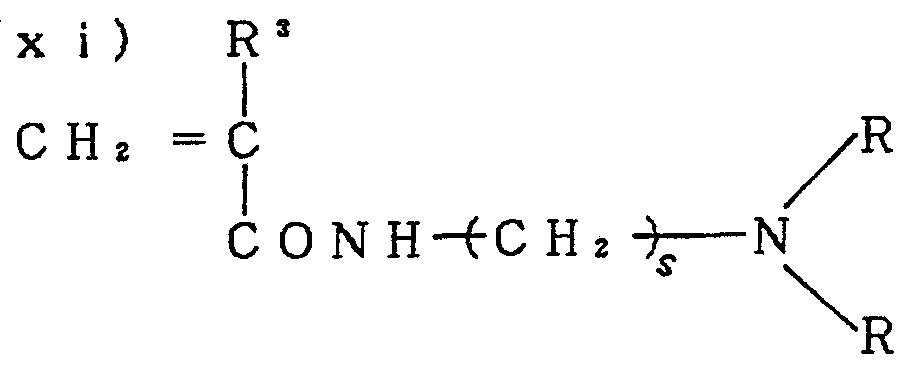
  • Examples of the monomer (ix) used in the present invention include, for example, dimethylaminoethyl acrylate, dimethylaminoethyl acrylate, dimethylaminoethyl methacrylate, dimethylaminoethyl methacrylate, and the like. And one or more of these can be used.
  • Examples of the monomer (X) used in the present invention include, for example, a quaternizing agent known in the art such as an alkyl halide, an aralkyl halide, a dialkyl sulfate, etc., in addition to the monomer (ix). Examples thereof include those obtained by the reaction, and one or more of these can be used.
  • a quaternizing agent known in the art such as an alkyl halide, an aralkyl halide, a dialkyl sulfate, etc.
  • Examples of the monomer (Xi) used in the present invention include, for example, dimethylaminopropyl acrylamide, getinoleaminopropyl acrylamide, dimethylaminopropyl acrylamide. And getylaminoprovir methacrylamide, and one or more of these can be used.
  • Examples of the monomer (xii) used in the present invention include, for example, a quaternized compound known from the above-mentioned monomer (Xi), for example, an alkyl halide, an aralkyl halide, and a dialkyl. Examples thereof include those obtained by reacting sulfuric acid and the like, and one or more of these can be used.
  • Examples of the monomer (xJK) used in the present invention include, for example, polyethylene Glycol monoaryl ether, polypropylene glycol monoaryl ether, polyethylene glycol polypropylene glycol mono allyl ether, polyethylene glycol monomethyl ether, polypropylene glycol monomethyl ether, poly (ethylene glycol) Polyalkylene glycol mono (meth) aryl ethers such as coal polypropylene glycol monomethyl ether, and one or more of these can be used.
  • Examples of the monomer (xiv) used in the present invention include, for example, hydroxyethyl (meta) acrylate, polyethylene glycol mono (meta) acrylate, and polypropylene glycol mono.
  • Atarilate methoxypolybutylene glycol mono (meta) acrylate, ethoxypolyethylene glycol mono (meta) acrylate, ethoxypolypropylene glycol mono (meta) acrylate
  • the monomer (f) for example, at least one of the above monomers (i) to (vi) may be used, or the monomer (f) may be used in combination with the above (k) to (xiv) And at least one of the above monomers can be used in combination.
  • the monomer (e) used in the present invention can be produced by a known method or a combination of known methods.
  • Monoester diols and polyester borides in the production method of 1 are diol compounds, for example, ethylene glycol, propylene glycol, diethylene glycol, dipropylene glycol, 1,5-pentanediol, 1,6 —Reaction products of hexanediol, neopentyldaricol, etc.
  • dibasic acids for example, succinic acid, adibic acid, phthalic acid, hexahydrophthalic acid, tetrahydrophthalic acid, etc .; A reaction product of a cyclic ether such as ethylenoxide or propylene oxide; or a reaction product of the above diol compound and an oxycarboxylic acid such as glycolic acid, ⁇ -hydroxyl,) sulfonic acid, salicylic acid, mandelic acid, or the like.
  • dibasic acids for example, succinic acid, adibic acid, phthalic acid, hexahydrophthalic acid, tetrahydrophthalic acid, etc .
  • a reaction product of a cyclic ether such as ethylenoxide or propylene oxide
  • a reaction product of the above diol compound and an oxycarboxylic acid such as glycolic acid, ⁇ -hydroxyl,) sulfonic acid, salicylic acid,
  • Reaction product or the above oxycarboxylic acid and ⁇ A product of the reaction with an ester; or a diol or a polyhydric alcohol such as pentaerythritol, trimethylolpropanol, trimethylolethane, ditrimethylolpropane, dipentaerythritol and a lactone, for example, Reaction products such as ⁇ _-open biolactone, r-butyrolactone, ⁇ -valerolactone, ⁇ -caprolactone and the like can be mentioned.
  • Examples of the polymerizable monomer having a functional group capable of reacting with a hydroxyl group in the production method (1) include acrylic acid, methacrylic acid, maleic acid, glycidyl (meth) acrylate, and (meth) acrylic acid.
  • the same compounds as those exemplified in the production method (1) can be used.
  • Examples of the polymerizable monomer having a functional group capable of reacting with a carboxyl group in the production method (2) include aryl alcohol, 2-hydroxyhydryl (meth) acrylate, and glycidyl (meta) acrylate. , (Meta) acryloylaziridin, (meta) acryloyloxiltylaziridin, 2—Bu1—2—oxazoline, 2—isobutanol, 2-oxoxolin, isoxazoline, methyl T> Atari rate and the like.
  • polystyrene resin examples include, in addition to the polyester polyol exemplified in the production method of (1), polycarbonate polyol, polyether polyol, polybutadiene polyol, and hydrogenated polybutadiene polyol.
  • Polycarbonate bolols include, for example, 1,6-hexanediol, neopentyl glycol, 1,4-butanediol, 1,8-octanediol, 1,4-bis (hydroxymethyl) cyclohexane Xane, 2-methylpropanediol, dipropylene glycol, dibutylene glycol, bisphenol
  • Examples include propylene oxide or s-caprolactone or 5-valerolactone addition reaction product such as polycarbonate-polyol.
  • Such a polycarbonate polyol can be easily obtained as a commercial product.
  • Desmofin 200 made by Sumitomo Bayer Polyurethane, Inc., average molecular weight 200,000
  • DN-980 manufactured by Nippon Polyurethane Co., average molecular weight: 200,000
  • DN — 9 8 1 Japanese Polyure And average molecular weight of 100>.
  • Polyether polyols include, for example, ethylene glycol, propylene oxide, butylene oxide, tetrahydrofuran, and other ethers in ethylene glycol, propylene glycol, 1,4 — Polyether polyols obtained by polymerizing a diol compound such as butanediol as an initiator. Such a polyether polyol can be easily obtained as a commercial product. For example, San Nix Co., Ltd.—100,000 (manufactured by Sanyo Chemical Co., polypropylene glycol, molecular weight 100,000), PTG-500P (manufactured by Hodogaya Chemical Industries, polytetramethylene glycol, molecular weight 2) 0 0 0).
  • Examples of the polybutadiene polyol include 1,4-butadiene or 1,2-butadiene polymer having a hydroxyl group at a molecular terminal.
  • Examples of the hydrogenated polybutadiene polyether include those obtained by hydrogenating unsaturated double bonds in the molecule of the polybutadiene polyol. These can be easily obtained as commercial products.
  • polymerizable monomer having a carboxyl group at least 1 carbon atom away from the polymerizable double bond in the production method of 3 2-carboxyethyl (meth) acrylate, 4-carboxyphenyl (Meta) atarilate, ⁇ - (meta) acryloyloxyshethyl hydrogen phthalate, ⁇ — (meta) acryloyloxyshetchyl hydrogen succinate, ⁇ — (meta) acryloylo Xypropyl propyl nitrate phthalate, (meth) acryloyloxyshtilt limellitic acid and the like.
  • Examples of the polycarboxylic acid in the production method of (1) include, in addition to the monoester dicarboxylic acid and polyester polycarboxylic acid exemplified in the production method of (2), succinic acid, adibic acid, phthalic acid, hexaldehyde phthalic acid, and tetrahydrophthalic acid. , Trickal Bionic acid, benzenetrisulfonic acid, benzenetetraluonic acid, etc.
  • the polymerizable monomer having a hydroxyl group at least one carbon atom away from the polymerizable double bond in the production method of 4 includes aryl alcohol, 2-hydroxyethyl (meth) acrylate, 2 — Hydroxycyclohexyl (meta) acrylate, 2-hydroxybutyl (meta) acrylate, 4-hydroxybutyl (meta) acrylate, 2 — Hydroxypropyl (meta) ) Atarilate, 2-hydroxy-3-([2-methyl-1-oxo-2-propionyl) oxy] propyl acrylate.
  • polymerizable monomer having an epoxy group at least one carbon atom away from the polymerizable double bond in the production method of 4 oxylanylmethyl (meth) acrylate, 91-oxyla-enull ( (Meta) atalylate, (3-Methyloxylanil) methyl (meta) acrylate, acrylic acid 9, 10 — epoxidized oleyl
  • Examples of the monoester polyepoxy compound and polyester polyepoxy compound in the production method of 5 include reaction products of monoester dicarboxylic acid and / or polyester polycarboxylic acid and ebichlorohydrin exemplified in the production method of 2, and diglycidyl terephthalate. Esters, 0-diglycidyl phthalate, and compounds having the following structural formula.
  • Examples of the polymerizable monomer having a functional group capable of reacting with an epoxy group in the production method of (1) include (meth) acrylic acid, maleic acid, aryl alcohol, and 2-hydroxyethyl (meta- ry). ) Acrylate, burethylamine, bitylbutylamine, aminoethyl (meta) acrylate, and the like.
  • the monomer (e) is not only obtained by the above-mentioned production method, but also can be easily obtained as a commercial product.
  • a water-soluble polymer or a crosslinked polymer is obtained in addition to the monomers (i) to (vi), (ix) to (xiv), and (e).
  • copolymerization with the monomers (i) to (vi), (ix) to (xiv) and (e) as long as the water solubility of the crosslinked polymer and the performance of the crosslinked polymer as a cement admixture are not impaired.
  • Possible monomers (g) can be used. The amount used is 0 to 30% by weight based on the sum of the monomers (i) to (vi), (ix) to (Xiv) and (e).
  • Examples of the monomer (g) include esters of an aliphatic alcohol having 1 to 20 carbon atoms and (meth) acrylinoleic acid; (meth) acrylamide; maleic acid and fumaric acid.
  • these acids and aliphatic alcohols with 1 ⁇ 0 carbons or 2-4 carbons (1) Monoester or diester of glycol or polyalkylene glycol having an addition mole number of 2 to 100 with these glycols; alkenyl ester such as butyl acetate and propyl acetate; styrene, p-methylstyrene, etc. And aromatic chloride; and chloride chloride. One or more of these can be used.
  • the combination may be set as appropriate. Can be.
  • a monomer having only one polymerizable double bond is polymerized to prepare a linear water-soluble polymer in advance.
  • a method in which polymers are cross-linked with a cross-linking agent so that the water-soluble polymer is the main component hereinafter, such a manufacturing method is sometimes referred to as a post-cross-linking method
  • a method in which a monomer having two or more monomers and a monomer having only one polymerizable double bond are used in combination, and crosslinking is performed together with polymerization hereinafter, such a production method is sometimes referred to as a batch crosslinking method).
  • any combination of the above (I) to (V) is employed.
  • any combination of the above (VI) to (X) is employed.
  • (xiv) 50 to 80% by weight and (i) 20 to 50% by weight [the sum of (xiv) and (i) is 100% by weight] More preferred. If (Xiv) is too small, the ability to prevent slam pros may be poor, and if too large, entrained air may be increased. On the other hand, if (i) is too small, the dispersing ability may be inferior, and if it is too large, curing retardation may appear.
  • the monomer (iv) and the monomer (i) are 1 to 99% by weight of the monomer (iv) and 1 to 9.9% by weight of the monomer (i) [However, the sum of (iv) and (i) is 100% by weight] is preferably used. (Iv) 1 to 40% by weight and (i) 60 to 99% by weight (The sum of (iv) and (i) is 100% by weight.) More preferably, if (iv) or (i) is out of the above range, dispersibility may be insufficient. This can cause material separation or increase slump loss.
  • monomer (iv), monomer (i) and monomer (xiv) are 1 to 98% by weight of monomer (iv), monomer (i) 1 to 98% by weight and the monomer (xiv) 1 to 70% by weight [However, the sum of (iv), (i) and (xiv) is
  • the monomer (iii) and the monomer (i) are 1 to 99% by weight of the monomer (Hi) and 1 to 9.9% by weight of the monomer) , (Iii) and (i) are 100% by weight], and (iii) 1 to 40% by weight and (i) 60 to 9.9% by weight [( The sum of (iii) and (i) is 100% by weight.]. If (Hi) or (i) is out of the above range, dispersibility may be insufficient, material separation may occur, or slump ⁇ may increase.
  • the monomer (iii), the monomer (i) and the monomer (Xiv) are 1 to 98% by weight of the monomer (Hi) and the monomer (i 1) to 98% by weight and the monomer (xiv) 1 to 70% by weight [where the sum of (iii), (i) and (xiv) is 100% by weight].
  • the monomer (e), the monomer (xiv) and the monomer (i) are 0.1 to 50% by weight of the monomer (e), the monomer (Xiv ) 1 to 98.9% by weight and monomer (i) 1 to 98.9% by weight [where the total of (e), (xiv) and (i) is 100% by weight] Is preferred.
  • the monomer (e), the monomer (iv) and the monomer (i) are 0.1 to 50% by weight of the monomer (e) and the monomer (iv) 1 to 98.9% by weight and the ratio of monomer (i) 1 to 98.9% by weight (provided that the sum of (e), (iv) and (i) is 100% by weight) preferable.
  • the monomer (e), the monomer (xiv), the monomer (iv) and the monomer (i) are the same as the monomer e) 0.1 to 50% by weight %, Monomer (Xiv) 1 to 70% by weight, monomer (iv) 1 to 97.9% by weight and monomer (i) 1 to 97.9% by weight (provided that the sum of (e), (xiv), (iv) and (i) is 1 (E) from 1 to 20% by weight, (xiv) from 5 to 59% by weight, and (iv) from 1 to 49% by weight. It is more preferable to use (i) 39 to 93% by weight [however, the sum of (e), (xiv), (iv) and (i) is 100% by weight].
  • monomer (e), monomer (iii) and monomer (i) are monomer (e) 0.1 to 50% by weight, monomer (iii) 1 to 98.9% by weight and the ratio of monomer (i) 1 to 98.9% by weight [where the sum of (e), (iii) and (i) is 100% by weight] preferable.
  • the monomer (e), the monomer (xiv), the monomer (iii) and the monomer (i) are each composed of the monomer (e) 0.1 to 50% by weight.
  • they are used in a ratio.
  • the use of the monomer (xiv) is convenient for producing a water-soluble polymer having excellent anti-slanpros performance.
  • the use of the monomer (iii) is preferable for producing an air-entrained water-soluble polymer having a low fluorine content.
  • the monomer component in order to produce the water-soluble polymer, may be polymerized using a polymerization initiator.
  • the polymerization can be performed by a method such as polymerization in a solvent or bulk polymerization.
  • Polymerization in a solvent can be carried out either in a planar or continuous manner.
  • the solvent used is water; lower alcohols such as methyl alcohol, ethyl alcohol, and isopropyl alcohol.
  • Aromatic or fatty such as benzene, toluene, xylene, cyclohexane, n-hexane, etc. S3 ⁇ 4hydrocarbon; 'ethyl acetate; acetate, methyle Ketone compounds such as tilketone are exemplified.
  • At least one selected from the group consisting of water and lower alcohols having 1 to 4 carbon atoms based on the solubility of the raw material monomer and the resulting water-soluble polymer and the convenience of using the water-soluble polymer. It is preferred.
  • lower alcohols having 1 to 4 carbon atoms methyl alcohol, ethyl alcohol and isopropyl alcohol are particularly effective.
  • a water-soluble polymerization initiator such as ammonium or alkali metal persulfate or hydrogen peroxide is used as the polymerization initiator.
  • an accelerator such as sodium hydrogen sulfite can be used in combination.
  • benzoyl peroxy durauroyl peroxide is used for polymerizations using lower alcohols.
  • Oxide a hydrobaroxide such as cumene hydrobaroxide; an aliphatic azo compound such as azobisisobutylonitrile is used as a polymerization initiator.
  • an accelerator such as an amine compound can be used in combination.
  • a mixed solvent of water and a lower alcohol it can be conveniently selected from the above various polymerization initiators or a combination of the polymerization initiator and the accelerator.
  • the polymerization degree is conveniently determined by the solvent and the polymerization initiator used, but is usually in the range of 0 to 120.
  • a peroxide such as benzoyl oxide or lauroyl peroxide
  • a hydrodropoxide such as cumene hydroperoxide
  • an aliphatic azo compound such as azobisisobutyronitrile
  • the cross-linking agent used in the present invention is a compound having at least one of the divalent groups represented by the above formula (I) as a structural unit, and a compound capable of being formed.
  • a compound capable of being formed there is no particular limitation as long as the compound has a functional group capable of reacting with a functional group (for example, a carboxyl group, a hydroxyl group, an amino group, a sulfonate group, etc.) of the water-soluble polymer.
  • Polyhydric alcohols such as polyoxypropylene, oxyethylene propylene block copolymer, pentaerythritol, sorbitol, sorbitan fatty acid ester, etc .
  • ethylene glycol diglycidyl ether polyethylene glycol Diglycidyl ether, glycerol polyglycidyl ether, diglycerol polyglycidyl ether, polyglycerol polyglycidylether, sorbitol polyglycidylether, pentaerythritol polyglycidylether, propyleneglycol diglycidylether, poliproglycol Pyrenglycol diglycidyl ether, resorcin diglycidyl ether, 1, 6 —he
  • a monomer having a carboxyl group at least 1 cm away from the polymerizable double bond when polymerizing the water-soluble polymer for example, 2-methacrylate
  • a cross-linked polymer having the desired structure is obtained by copolymerizing liroyloxetyl succinic acid, 2-metacryloyloxetyl phthalic acid, etc., and then esterifying it with a polyhydric alcohol as a cross-linking agent.
  • the obtained water-soluble polymer has a carboxyl group and Z or a hydroxyl group.
  • the obtained water-soluble polymer has a carboxyl group and a Z or sulfonic acid group.
  • the obtained water-soluble polymer has a carboxyl group and a sulfonic or sulfonic acid group and a hydroxyl or hydroxyl group.
  • the obtained water-soluble polymer has a carboxyl group and a sulfonic or sulfonic acid group.
  • the obtained water-soluble polymer has a carboxyl group and a no or sulfonic acid group and a no or hydroxyl group.
  • the amount of the crosslinking agent used is the molar ratio of the functional group (the carboxyl group and z or the hydroxyl group and the di- or sulfonic acid group) of the water-soluble polymer (functional group of the crosslinking agent / water-soluble polymer). 0.01 to: L 0 Preferably, it is used in the range of 0.01 to 0.3. If the molar ratio is less than the above range, the effect of preventing slanpros is not sufficient, and the performance of the cement admixture may not be obtained.If the molar ratio is too large, the performance is not improved, or Problems may occur with the handling of crosslinked polymers.
  • a crosslinked polymer by a post-crosslinking method for example, a method of reacting a water-soluble polymer with a crosslinking agent and a method of suspending and dispersing a water-soluble polymer in a hydrophobic organic solvent and reacting the crosslinking agent are used. There is a social interaction method.
  • the reaction temperature is not particularly limited as long as it is a temperature at which the water-soluble polymer reacts with the cross-linking agent, but is, for example, 20 to 200, preferably 50 to 100'c.
  • the viscosity of a 20% aqueous solution or dispersion of a crosslinked polymer obtained by reacting a water-soluble polymer with Geir ⁇ ⁇ is not particularly limited, but from the viewpoint of production and handling, a B-type rotational viscometer is used. It is preferably less than 1000 cps when measured at (at 20).
  • the monomers are used in a combination of the above (VI) to (X), and the reaction is carried out under the same conditions and conditions as described for the production of the water-soluble polymer. Should be performed.
  • the crosslinked polymer is used as it is as a main component of the cement admixture.
  • a polymer neutralized with an alkaline substance may be used as a main component of the cement admixture. Is also good.
  • alkaline substances include hydroxides, chlorides and carbonates of monovalent metals and divalent metals; ammonia; and organic amines.
  • the citrus polymer can also be used in combination with other known cement admixtures.
  • a known cement admixture include a conventional cement dispersant, an air entrainer, a cement wetting dispersant, a waterproofing agent, a strength enhancer, and a curing accelerator. .
  • the cement admixture of the present invention includes hydraulic cements such as portland cement, aluminum cement and various kinds of cement, or hydraulic materials other than cement such as gypsum. Can be used. '.
  • the method of using the cement admixture of the present invention includes, for example, a method of dissolving in kneading water and then adding it at the same time as kneading water at the time of preparing a cement composition, or adding the kneading water to an already kneaded cement composition.
  • the amount of the cement admixture of the present invention which can be employed in any method such as the method, is from 0.05 to 2.5 as a solid content% by weight based on the cement of the cement composition. % Is good. If the groove is not 0.05%, sufficient anti-slanpros performance may not be obtained. If the amount is more than 2.5%, it may be economically disadvantageous or cause problems such as retardation of setting and excessive entrained air volume.
  • the mechanism for preventing slump loss according to the present invention is presumed as follows.
  • cement admixtures with specific functional groups adsorb strongly onto cement particles, effectively dispersing these particles in water.
  • the hydration reaction of cement proceeds further, and the dispersing agent is adsorbed and stored by the newly generated zeite minerals (such as ettringite) on the cement particles.
  • the concentration of the cement admixture is low, aggregation of the cement particles proceeds.
  • the admixture may be supplied by some method so that the concentration of the cement admixture in the system does not decrease.
  • the citrus polymer Since the citrus polymer has the above-mentioned specific bond between the main bonds, the cross-linking is gradually broken in an alkaline medium. This is because the ester bond in the above specific bond is gradually hydrolyzed by an alkali. This allows the dispersion of the cement to be maintained longer.
  • the specific bond may be present in the gelling agent or the monomer (e), but may be formed by a reaction between the crosslinking agent and the water-soluble polymer in the post-crosslinking method.
  • the compound represented by the above formula (I) is obtained by the reaction between the carboxyl group and the epoxy group.
  • a structured bond is formed.
  • crosslinking agent examples include ethylene glycol diglycidyl ether, polyethylene glycol monoglycidyl ether ⁇ /, glycerol polyglycidyl ether, diglyceride polyglycidyl ether, polyglyceryl polyglycidyl ether, sorby There are tall polyglycidyl ether, pentaerythritol polyglycidyl ether, propylene glycol diglycidyl ether, polypropylene glycol diglycidyl ether, resorcin diglycidyl ether, and the like.
  • the monomer (e) includes a monomer having the following structure.
  • the specific crosslinked polymer may be dissolved or dispersed in water.
  • dispersion means, for example, that miku-mouth gel or the like produced as a by-product during the production of a crosslinked polymer is dispersed in water. Dissolving or dispersing the citrus polymer in water in this way has the advantage of easy handling, and can be used as part or all of the mixing water when preparing the cement composition. You. In addition, the problem of dispersion stability (eg, sedimentation) found in conventional cement admixtures does not occur.
  • the ratio of the crosslinked polymer to water may be set arbitrarily and is not particularly limited.
  • the cement admixture of the present invention can be obtained by changing the crosslinking agent or the monomer (e), or by changing the type of the gelling agent or the monomer (e) and combining them. It is possible to control the strength of the slam broth prevention performance arbitrarily chemically. This means that other admixtures intended to prevent slam broth are difficult or impossible to control slanpros-preventive performance (for example, copolymers of olefins with ethylenically unsaturated dicarboxylic anhydrides). In the method of gradually hydrolyzing in a cement composition (Japanese Patent Application Laid-Open No.
  • the particle size of the copolymer is required to maintain the slumb loss prevention performance for a long time. This is a very good point considering that particles may settle in the admixture.)
  • Low amounts of crosslinked polymers such as fillers or monomers are relatively It is a liquid with low viscosity, and it is fundamentally stable while other admixtures aimed at preventing slanpros are used by mixing and dispersing substances of different phases.
  • the cement admixture of the present invention is not limited at all.
  • the cement admixture of the present invention exhibits high fluidity without giving a large hardening retardation to a cement composition such as cement mortar / concrete and has excellent anti-slanpros performance. Therefore, the workability of mortar works and concrete works is significantly improved.
  • the cement admixture of the present invention can be effectively used, for example, as a fluidizer for concrete such as ready-mixed concrete, and in particular, a co-blended type.
  • a fluidizer for concrete such as ready-mixed concrete, and in particular, a co-blended type.
  • the most characteristic point is that it is easy to manufacture ready-mixed concrete with a high water-reduction rate as a high-performance AE water-reducing agent and can maintain its fluidity constant.
  • it can be used effectively as a high-performance water repellent for the production of secondary concrete products.
  • cement milk or mortar auxiliaries for cement mortar cement formulations cast by toremi-tubes, underwater concrete, and concrete for continuous walls. It can be used effectively for applications such as maintaining fluidity and preventing material separation.
  • the method for producing the cement admixture according to the present invention is easy to design the structure of the cross-linked polymer or the water-soluble polymer when the post-crosslinking method is used.
  • a crosslinked polymer can be produced in fewer steps as compared to
  • the cement composition according to the present invention contains the above-described specific cement admixture, it is stable over time without causing a decrease in the strength of the cured product and less likely to cause slanpros.
  • FIG. 1 is a GPC elution curve of the crosslinked polymer obtained in Example 1
  • FIG. 2 is a solution of the same cross-linked polymer to which a sodium hydroxide aqueous solution was added to obtain PH12.
  • the GPC elution curve after stirring Fig. 3 shows the GPC of the copolymer obtained in Example 85.
  • PC elution curve Fig. 4 shows GPC elution curve after adding caustic soda aqueous solution to aqueous solution of the same copolymer to PH12, and stirring at room temperature for 30 minutes
  • Fig. 5 shows the same copolymer
  • This is a GPC elution curve obtained by adding a sodium hydroxide aqueous solution to the aqueous solution to obtain PHI 2 and stirring the mixture at room temperature for 120 minutes.
  • the cement admixture, the production method and the cement composition of the present invention will be described in more detail with reference to Examples, but of course, the present invention is not limited thereto.
  • % means% by weight, and part means weight.
  • the crosslinked polymer is referred to as a hydrophilic resin or a copolymer.
  • a glass reactor equipped with a thermometer, a stirrer, a dropping funnel, a gas inlet tube and a reflux condenser was charged with 164.2 parts of water, and the inside of the reactor was purged with nitrogen under stirring, and the boiling point was maintained in a nitrogen atmosphere. Until heated.
  • a hydrophilic resin (2) was obtained in the same manner as in Example 1, except that 1.6 parts of 0-phthalic acid diglycidyl ester of a polyfunctional compound was used.
  • HEMA 2-hydroxyl methacrylate
  • BP 0 Benzoyl peroxide
  • IPA isopropyl alcohol
  • ethylene glycol polypropylene glycol Lumetaclylate (“Plenmer 70 PEP—350 B” manufactured by NOF CORPORATION, average addition moles of ethylenoxide 7; average addition moles of propylene oxide 3) 62.9 parts, methacrylic acid A mixed solution consisting of 16.7 parts of an acid and 125.5 parts of water and 24.6 parts of a 2.5% aqueous solution of ammonium persulfate were added in 4 hours. After the addition was completed, 6.1 parts of a 2.5% aqueous solution of ammonium persulfate were further added in 1 hour.
  • a hydrophilic resin (8) was obtained in the same manner as in Example 7, except that 0.64 part of the polyfunctional compound, 0-phthalidididyl phthalate, was used.
  • Example 7 In place of 0-diglycidyl phthalate in place of poly (ethylene glycol) -diglycidyl ether ("Denacol EX-861", manufactured by Nagase Kasei Kogyo Co., Ltd., the average number of moles of ethylene oxide added about 22 2 1) A hydrophilic resin (9) was obtained in the same manner as in Example 7 except that 1.4 parts was added.
  • methoxypolyethylene glycol monomethacrylate (“NK-ester M-23G” manufactured by Shin-Nakamura Chemical Co., Ltd., average number of moles of ethylene oxide added: 23) 1 9 1.2 parts, methacrylic acid 8.0 parts, a mixed solution consisting of 8.7 parts of 16.5% caustic soda aqueous solution, 304.9 parts of water, 11.8 parts of 15% aqueous ammonium persulfate solution and 5.9 parts of 15% aqueous sodium bisulfite solution in 2 hours After the addition, 5.9 parts of a 15% aqueous solution of ammonium persulfate and 2.9 parts of a 15% aqueous solution of sodium hydrogen sulfite were further added in 1 hour.
  • Example 10 In place of 0-diglycidyl phthalate, poly (ethylene glycol) diglycidyl ether ("Denacol EX-861" manufactured by Nagase Kasei Kogyo Co., Ltd., average number of added moles of ethylene oxide: about 22) 27.3 A hydrophilic resin (11) was obtained in the same manner as in Example 10 except that parts were added.
  • poly (ethylene glycol) diglycidyl ether (“Denacol EX-861" manufactured by Nagase Kasei Kogyo Co., Ltd., average number of added moles of ethylene oxide: about 22) 27.3
  • a hydrophilic resin (11) was obtained in the same manner as in Example 10 except that parts were added.
  • a glass reactor equipped with a thermometer, stirrer, dropping funnel, gas inlet tube and reflux condenser was charged with 2 16.2 parts of water, and the reactor was purged with nitrogen under stirring. Heated to zero. Then, methoxypolyethylene glycol monomethacrylate ( tt NK—ester M-9G “Shin-Nakamura Chemical Co., Ltd., average number of moles of ethylene oxide added: 9”) 20.0 parts, methacrylic acid 86.2 parts, methacrylic acid A mixed solution consisting of 72.1 parts of sodium and 278.9 parts of water, 137.0 parts of a 15% aqueous solution of ammonium persulfate and 58.0 parts of a 15% aqueous solution of sodium hydrogen sulfite were added in 4 hours, and after the addition was completed.
  • methoxypolyethylene glycol monomethacrylate tt NK—ester M-9G “Shin-Nakamura Chemical Co., Ltd., average number of moles of ethylene oxide added
  • a glass reactor equipped with a thermometer, a stirrer, a dropping funnel, a gas inlet tube, and a reflux condenser was charged with 164.2 parts of water, and the reactor was replaced with nitrogen under stirring. At the boiling point. Then, a mixture of methoxypolyethylene glycol monomethacrylate (average number of moles of ethylene oxide added: 10) 62.9 parts, acrylic acid 16.7 parts, water 12.5.5 parts The solution and 24.6 parts of a 2.5% aqueous solution of ammonium persulfate were added in 4 hours, and after the addition was completed, 6.1 parts of a 2.5% aqueous solution of ammonium persulfate were added in 1 hour.
  • Example 2 A method similar to that of Example 1 except that 3.2 parts of a compound having the following structure ("Denacol EX-202" manufactured by Nagase Kasei Kogyo Co., Ltd.) is added instead of 0-phthalic acid didalicydyl ester of Example 1 As a result, a hydrophilic resin (16) was obtained.
  • a compound having the following structure (“Denacol EX-202" manufactured by Nagase Kasei Kogyo Co., Ltd.) is added instead of 0-phthalic acid didalicydyl ester of Example 1
  • a hydrophilic resin (16) was obtained.
  • Hydrophilicity was obtained in the same manner as in Example 1 except that 3.2 parts of sorbitol polyglycidyl ether ("Denacol EX-61-1" manufactured by Nagase Kasei Kogyo Co., Ltd.) was added instead of 0-phthalic acid diglycidyl ester in Example 1. Thus, a hydrophilic resin (18) was obtained.
  • the average molecular weight (weight average) of the water-soluble polymer obtained above was determined by GPC, and the results are shown in Table 1.
  • the conditions of the GPC measurement were as follows.
  • the results are shown in Table 1.
  • the measurement of the hydrophilic resin Prepare a 20% aqueous solution or aqueous dispersion. If the viscosity of the hydrophilic resin is 10,000 cps or less, it is 6 Or.pm, and if the viscosity of 10,000 to 100,000 cps, it is 20 rpm at 6 rpm. I went in.
  • Example 1 As cement, normal land cement (Sumitomo Cement Co., Ltd.), as fine aggregate, river sand from Yodogawa (specific gravity 2.51, coarse grain ratio [FM] 2.78), coarse aggregate Using the crushed stone from Takatsuki (specific gravity 2.68, coarse particle ratio [FM] 6.73) and the hydrophilic resin (1) obtained in Example 1 as a cement admixture, the unit cement amount is 3 2 O water amount 1 7 3 kg / nf (water / cement ratio 54.2%), unit fine aggregate amount 9 3 Unit coarse aggregate amount 8 7 6 kg / n? (Fine aggregate ratio 52%) and hydrophilic resin (1) added 0.12% (solid content ratio to cement). Each material was weighed so as to reach 30 and all the materials were put into a tilting mixer.
  • a fluidized concrete was prepared. The obtained fluidized concrete immediately after kneading was sampled, and its slam and air amount were measured.
  • the number of revolutions of the tilting mixer was reduced to 3 rpm, and kneading was continued.
  • the amount of slumb and air after 60 minutes, 90 minutes, and 120 minutes was reduced. They were measured and their changes over time were observed.
  • JISA6204 Japanese Industrial Standards
  • the hydrophilic resins (2) to (18) obtained in Examples 2 to 18 as shown in Table 1 were used in the amounts shown in Table 1 Manufactures fluidized concrete by repeating the same operation as in Example 19, The amount, compressive strength and setting time were measured. Table 1 shows the measurement results.
  • Example 19 a commercially available naphthalenesulfonic acid sodium salt of formalin condensate was used in place of the hydrophilic resin (1) as a cement admixture in an addition amount of 0.35% (vs. cement).
  • a fluidized concrete for comparison was prepared, and its slam, air amount, compressive strength and setting time were measured. Table 1 shows the measurement results.
  • Example 19 The procedure was performed in the same manner as in Example 19 except that the commercially available sodium ligninsulfonate was used as a cement admixture in an amount of 0.35% (vs. cement) in place of the hydrophilic resin (1). By repeating the same operation as in Example 19, a fluidized concrete for comparison was prepared, and its slump, air volume, compressive strength and setting time were measured. Table 1 shows the measurement results.
  • Example 19 the water-soluble polymer obtained in Example 1-(1) was used in place of the hydrophilic resin (1) as a cement admixture in an amount of 0.12% (vs. cement). Otherwise, the same operation as in Example 19 was repeated to prepare a fluidized concrete for comparison, and its slump, air amount, compressive strength and setting time were measured. Table 1 shows the measurement results.
  • Example 19 instead of the hydrophilic resin (1), a commercially available naphthalenesulfonic acid sodium salt formalin condensate and a superabsorbent resin (a crosslinked product of partially neutralized polyacrylic acid) were added as cement admixtures. The same operation as in Example 19 was repeated except that the amount was 0.350.1% (vs. cement), and a fluidized concrete for comparison was prepared. The amount, compressive strength and setting time were measured. Table 1 shows the measurement results.
  • Example 27 (3) 18 000 Hydrophilicity 39 0.12 4.9 5.3 4.8 ⁇ .
  • a hydrophilic resin (38) was obtained in the same manner as in Example 37, except that 2-0 parts of 0-phthalidicidyl phthalate as a crosslinking agent was used.
  • Example of Example 3 7-0 Examples except that 6.0 parts of diglycidyl adipate (“Denacol EX—701” manufactured by Nagase Kasei Kogyo Co., Ltd.) are added instead of diglycidyl phthalate
  • a hydrophilic resin (39) was obtained in the same manner as in 37.
  • Example 4 3 In a glass reaction vessel equipped with a thermometer, stirrer, dropping funnel, gas inlet tube and reflux condenser, 2—Hydroxyshetyl methyl acrylate 14.4 parts, 2—Acrylamide 2—Methyl propane A mixture consisting of 3.2 parts of sulfonic acid, 14.4 parts of methacrylic acid, 0.96 parts of BP and 12.7 parts of IPA was charged, and the reaction vessel was purged with nitrogen under stirring, and then a nitrogen atmosphere was added. Heated to the boiling point in a warm air.
  • Ethylene glycol diglycidyl ether ( ⁇ - denacol ⁇ X-810) (manufactured by Nagase Kasei Kogyo Co., Ltd.) in place of 0-phthalic acid diglycidyl ester in Example 43. 2. Same as Example 43 except that 50 parts were added. Thus, a hydrophilic resin (44) was obtained.
  • Example 46 Example 5 was repeated except that 5.0 parts of diglycidyl adipate ("Denacol EX-701" manufactured by Nagase Kasei Kogyo Co., Ltd.) was added instead of the diglycidyl ester of 0-phthalic acid in Example 6. A hydrophilic resin (47) was obtained in the same manner.
  • diglycidyl adipate (“Denacol EX-701" manufactured by Nagase Kasei Kogyo Co., Ltd.) was added instead of the diglycidyl ester of 0-phthalic acid in Example 6.
  • a hydrophilic resin (47) was obtained in the same manner.
  • Example 3 Polyethylene dalicol diglycidyl ether ("Denacol EX-81", manufactured by Nagase Kasei Kogyo Co., Ltd., average molar number of added ethylene oxide of about 13 ⁇ ) instead of the diglycidyl ester of 0-phthalic acid in Example 7 5.
  • a hydrophilic layer (48) was obtained in the same manner as in Example 37 except that 6 parts were added.
  • Example 4 9 Polyethylene dalicol diglycidyl ether ("Denacol EX-81", manufactured by Nagase Kasei Kogyo Co., Ltd., average molar number of added ethylene oxide of about 13 ⁇ ) instead of the diglycidyl ester of 0-phthalic acid in Example 7 5.
  • a hydrophilic layer (48) was obtained in the same manner as in Example 37 except that 6 parts were added.
  • the average molecular weight (weight average) of the water-soluble polymer obtained above was measured by GPC under the above conditions, and the results are shown in Table 2.
  • the standard cement is Boltland cement (Sumitomo Cement Corporation), the fine sand is Yodogawa-produced river sand (specific gravity 2.51, coarse grain ratio [F.II.] 2.78), and the coarse aggregate is Takatsuki.
  • the unit cement amount is 3200 kgZm 3 , the unit Water volume 1
  • the number of rotations of the tilting mixer was reduced to 3 rpm, and kneading was continued, and the slam and air amounts were measured after 60 minutes, 90 minutes, and 120 minutes. We looked at their changes over time.
  • Example 50 the water-soluble polymer (37) obtained in Example 37 was used in place of the hydrophilic resin (37) as a cement admixture in an amount of 0.32 2 (vs. cement). The same operation as in Example 50 was repeated to prepare a fluidized concrete for comparison, and its slump, air amount, compressive strength and coagulation time were measured. Table 2 shows the measurement results. Table 1 (1/2)
  • Fine 58 (42) 6.000 Low hydrophilicity 13.1 0.18 4.5 4.6 320 5: 20/7: 15
  • Example 6 Example 3 was repeated except that 0-diglycidyl ester of phthalic acid was replaced by diglycidyl adipic acid (“Denacol EX—701” manufactured by Nagase Kasei Kogyo Co., Ltd.). A hydrophilic resin (64) was obtained in the same manner.
  • Example 65 Polyethyleneglycol instead of 0-phthalic acid jig ⁇ sidyl ester —Rudiglycidyl ether (average number of moles added of ethylene oxide: 9) ("Denacol EX-832" manufactured by Nagase Kasei Kogyo Co., Ltd.) 2. Hydrophilicity is obtained in the same manner as in Example 65 except that 0 part is added. Resin (66) was obtained.
  • Example 6 Example 3 was repeated except that 0-glycidyl phthalate was replaced with diglycidyl adivic acid ( B denacol EX-701 "Nagase Kasei Kogyo Co., Ltd.). A hydrophilic resin (68) was obtained in the same manner.
  • a mixture consisting of 9 parts was added in 2 hours, and after the addition was completed, a mixture consisting of 0.70 parts of BP and 10.0 parts of IPA was added in one hour. After completion of the addition, the mixture was kept at the boiling point for 1 hour to complete the polymerization reaction. Thereafter, partial neutralization was performed with an aqueous solution of sodium hydroxide and IPA was distilled off to obtain a water-soluble polymer (67).
  • Example 70 Example 70 was repeated except that 50 parts of ethylene glycol diglycidyl ether ( ⁇ - denacol EX—810 ”manufactured by Nagase Kasei Kogyo Co., Ltd.) was added in place of 0-phthalic acid diglycidyl ester of Example 70.
  • a hydrophilic resin (71) was obtained in the same manner as in the above.
  • Example 6 Polyethylene glycol diglycidyl ether instead of 0-phthalic acid diglycidyl ester of 3 ("Denacol EX-84 1" manufactured by Nagase Kasei Kogyo Co., Ltd .; average number of moles of ethylene oxide added: about 13) A hydrophilic resin (73) was obtained in the same manner as in Example 63 except that 1.0 part was added.
  • the average molecular weight (weight average) of the water-soluble polymer obtained above was measured by GPC under the above conditions, and the results are shown in Table 3.
  • the cement is ordinary Portland cement (Sumitomo Cement Corporation), the fine sand is Yodogawa river sand (specific gravity 2.51, coarse grain ratio [FM] 2.78), and the coarse aggregate is Takatsuki rock ( Specific gravity 2.68, Coarse particle ratio [FM] 6.7 3)
  • unit cement amount 3 2 O kgZnK unit water amount 1 7 3 kg / nf (54.2% water / Z cement ratio) unit fine aggregate amount 934 kg / m ⁇ unit coarse aggregate amount 876 kg / n? (fine aggregate ratio 52%) and hydrophilicity
  • the resin (63) was added in an amount of 0.23% (solids ratio to cement).
  • the materials were weighed so that the mixing amount was 30 £, and all the materials were put into the tilting mixer. did. Immediately mix for 3 minutes at a surface turnover of 35 r.pi and mix with a target slump of 18 ⁇ and a target air volume of 4.5% (if the target air volume is not reached, a small amount of air entrainer. Insoles were used.) The liquidation concrete was adjusted. The fluidized concrete obtained immediately after kneading was sampled, and its slump and air volume were measured.
  • Example 74 As a cement admixture, except that the hydrophilic resins (64) to (73) obtained in Examples 64 to 73 as shown in Table 3 were used in the amounts shown in Table 3, The same operations as in Example 74 were repeated to prepare fluidized concrete, and their slump, air volume, compressive strength and setting time were measured. Table 3 shows the measurement results.
  • Example 74 except that the water-soluble polymer (63) obtained in Example 63 was used in place of the hydrophilic resin (63) as a cement admixture in an amount of 0.32 2 (vs. cement), By repeating the same operation as in Example 74, a fluidized concrete for comparison was prepared, and its slump, air amount, compressive strength and setting time were measured. Table 3 shows the measurement results.
  • the PA was retained and completely neutralized with an aqueous solution of sodium hydroxide so as to obtain an aqueous solution of the copolymer (85).
  • the viscosity of a 20% aqueous solution of the copolymer (85) was as shown in Table 4.
  • the GPC of the copolymer (85) was measured, and the elution curve is shown in FIG.
  • To the aqueous solution of the same copolymer (85) was added caustic soda, and the mixture was stirred at room temperature as PHI2. After stirring for 30 minutes and after stirring for 120 minutes, GPC was measured.
  • the GPC elution curve after 30 minutes is shown in FIG. 4, and the GPC elution curve after 120 minutes is shown in FIG.
  • a glass reactor equipped with a thermometer, stirrer, dropping funnel, gas inlet tube and reflux condenser was charged with 64.2 parts of IPA, and the reactor was purged with nitrogen under stirring and brought to the boiling point in a nitrogen atmosphere. Ripened.
  • a glass reactor equipped with a thermometer, stirrer, dropping funnel, gas inlet tube and reflux condenser was charged with 60.9 parts of IPA, and the reactor was purged with nitrogen under stirring, and the boiling point was increased in a nitrogen atmosphere. Until heated.
  • a copolymer (93) was obtained in the same manner as in Example 85 except that the compound used in Example 85 (“KAYARAD R-526” manufactured by Nippon Kayaku Co., Ltd.) was changed to 72.0 parts.
  • the viscosity of a 20% aqueous solution of the copolymer (93) was as shown in Table 4.
  • a copolymer (94) was obtained in the same manner as in Example 85 except that the compound used in Example 85 ("KAYARAD R-526" manufactured by Nippon Kayaku Co., Ltd.) was changed to 24.0 parts.
  • the viscosity of a 20% aqueous solution of the copolymer (94) was as shown in Table 4.
  • a copolymer was prepared in the same manner as in Example 85, except that acrylic acid was used instead of methacrylic acid in Example 85, and instead of sodium methacrylate. (95) was obtained.
  • the viscosity of a 20% aqueous solution of the copolymer (95) was as shown in Table 4.
  • Example 85 Compound used in Example 85 in a glass reaction vessel equipped with a Heen meter, a bottle mixer, a dropping funnel, a gas inlet tube and a reflux condenser ("KAYARAD R-526" manufactured by Nippon Kayaku Co., Ltd.) A mixture consisting of 4.00 g, 17.6 parts of HEMA, 14.4 parts of methacrylic acid, 01.0 parts of BP, and 27.0 parts of IPA was charged, the reaction vessel was purged with nitrogen under stirring, and heated to the boiling point in a nitrogen atmosphere.
  • KAYARAD R-526 manufactured by Nippon Kayaku Co., Ltd.
  • Comparative Example 7 A glass reactor equipped with a thermometer, a stirrer, a dropping funnel, a gas inlet tube, and a reflux condenser was charged with IPA 390.0 parts, and the reactor was purged with nitrogen under stirring, and the boiling point was increased in a nitrogen atmosphere. Ripened until.
  • methoxypolyethylene glycol monomethacrylate (“NK-ester M-9G” manufactured by Shin-Nakamura Chemical Co., Ltd., average number of moles of ethylene oxide added: 9) 133.0 parts, methacrylic acid 27.0 parts, A mixed solution consisting of 02.4 parts of BP and 40.0 parts of JPA2 was added in 2 hours, and after the addition was completed, 10.5 parts of a 4.9% BPO solution was further added in 1 hour. After the completion of the addition, the mixture was kept at the boiling point for 2 hours to complete the polymerization reaction. Thereafter, IPA was distilled off, and the solution was completely neutralized with an aqueous solution of sodium hydroxide to obtain an aqueous solution of the comparative copolymer (1).
  • the viscosity of a 20% aqueous solution of this comparative copolymer (1) was as shown in Table 4.
  • Example 85 Ordinary Portland cement (Sumitomo Cement Corporation) as the cement, Yodogawa river sand (specific gravity 2.51, coarse grain ratio [FM] 2.78) as the fine aggregate, Takatsuki crushed stone (coarse aggregate) as the coarse aggregate Using specific gravity 2.68, coarse particle ratio [FM] 6.7 3) and copolymer ⁇ ) obtained in Example 85 as a cement admixture, unit cement amount 32 0 kgZirf, unit water amount 1 7 3 kg / nf (Water cement ratio 54.2%), unit fine aggregate 934 kg / m ⁇ unit coarse aggregate 876 kg / nf (fine aggregate ratio 5 2%) and cement The blending of the copolymer (85), which is an admixture of ⁇ , and the addition amount of 0.10 3 ⁇ 4 (solid content ratio to cement), the respective materials were planned so that the mixing amount was 30.
  • the compressive strength and the setting time of the obtained fluidized concrete were also measured. Table 4 shows the results of these measurements.
  • the method of measuring the amount of the slump, the amount of air, the compressive strength and the setting time, and the method of collecting the compressive strength specimens were all determined in accordance with Japanese Industrial Standards (JISA 6204).
  • JISA 6204 Japanese Industrial Standards
  • the average molecular weight (weight average) after decomposition was measured by GPC under the above conditions, and the results are shown in Table 4.
  • the water tanning was performed by stirring the copolymer in an aqueous solution of sodium hydroxide with PH12 for 120 minutes.
  • the copolymers (86 :) to (96) obtained in Examples 86 to 96 as shown in Table 4 were used in the amounts shown in Table 4, except that The same operation as in Example 97 was repeated to prepare fluidized concrete, and the slump, air amount, compressive strength and setting time were measured. Table 4 shows the measurement results.
  • the copolymer (85) obtained in Example 85 and the comparative copolymer (1) obtained in Comparative Example 7 were used in the amounts shown in Table 4 except that they were used.
  • the same operation as in Example 97 was repeated to prepare a fluidized concrete, and the slump, the amount of air, the compressive strength and the setting time were measured. Table 4 shows the measurement results.
  • Example 8 The same operation as in Example 97 was carried out except that the copolymer (85) obtained in Example 85 and sodium ligninsulfonate were used in the amounts indicated in Table 4 as cement admixtures. Table 4 shows the measurement results of repeated preparation of fluidized concrete, and measurement of the slump, air volume, compressive strength and setting time. —Comparative Example 8—
  • Example 97 the comparative copolymer (1) obtained in Comparative Example 7 was used in place of the copolymer (85) as a cement admixture in an addition amount of 0.10% (vs. cement). The same operation as in Example 97 was repeated to prepare a fluidized concrete for comparison, and its slump, air volume, compressive strength and setting time were measured. Table 4 shows the measurement results.
  • a glass reaction vessel equipped with a thermometer, a stirrer, a dropping funnel, a gas inlet tube, and a reflux condenser was charged with 70 to 5 parts of water, and the inside of the reaction vessel was purged with nitrogen under stirring to obtain a nitrogen atmosphere. And heated to the boiling point. Next, 200.0 parts of an aqueous 80% acrylic acid solution and 195.6 parts of a 5% aqueous sodium persulfate solution were added over 4 hours. After completion of the addition, the mixture was kept at the boiling point for one hour to complete the polymerization reaction. Thereafter, partial neutralization was performed with an aqueous solution of caustic soda to obtain a water-soluble polymer having an average molecular weight of 400 (2).
  • Example 16 the water used in Example 16 was added to 53.6.3 parts of an aqueous solution of the water-soluble polymer (112) adjusted to a concentration of 40% by distilling off water ("denacol ⁇ -202"). Nagase Kasei Kogyo Co., Ltd.) 1 7. 2 parts were added and the boiling point was maintained for 3 hours to complete the reaction. After that, complete neutralization was carried out with an aqueous solution of casedoid to obtain a hydrophilic resin ⁇ 2).
  • Example 112 instead of the compound used in Example 16, polydiethylene glycol diglycidyl ether (“Denacol® X—841” manufactured by Nagase Kasei Kogyo Co., Ltd., average number of moles of ethylene oxide added: about 13 ⁇ )
  • a hydrophilic resin (113) was obtained in the same manner as in Example 112 except that 10.7 parts was added.
  • a monomer solution consisting of 107.7 parts of a quaternary salt of ⁇ , ⁇ -dimethylaminomethymethacrylate and 10.0 parts of water, and 52% of sodium acrylate
  • a monomer solution consisting of 3 parts and 162.2 parts of water and 77.8 parts of a 5% aqueous solution of ammonium persulfate were added over 2 hours. 95 after addition is complete.
  • the mixture was kept at the temperature of (:) for 1 hour to complete the polymerization reaction, and a water-soluble polymer (113) having an average molecular weight of 2800 was obtained.
  • Polyalkyleneglycol monoalkyl ether (containing an average of 10 ethylene oxide units per molecule) in a glass reaction vessel equipped with a thermometer, stirrer, dropping funnel, gas inlet tube and reflux condenser 38.9.9 parts and water 1.8.5.5 parts were charged, the reaction vessel was purged with nitrogen under stirring, and heated to 95 in a nitrogen atmosphere. Next, a mixed solution consisting of 88.2 parts of maleic acid, 14 parts of ammonium persulfate, and 132.3 parts of water was also added in 120 minutes. After the addition was completed, 14 parts of a 20% aqueous solution of ammonium persulfate was added in 20 minutes.
  • Example 16 28.4 parts of the compound used in Example 16 (“Denacol EX — 202” manufactured by Nagase Kasei Kogyo Co., Ltd.) was added, the boiling point was maintained for 3 hours, and the reaction was completed. Thereafter, complete neutralization was carried out with an aqueous solution of sodium hydroxide so as to obtain a hydrophilic resin (115).
  • Example 16 20.0 parts of the compound ("Denacol EX-202" manufactured by Nagase Chemical Industry Co., Ltd.) used in Example 16 was added, the boiling point was maintained at 3 o'clock, and the reaction was completed. A hydrophilic resin (116) was obtained.
  • Thermometer, stirrer, drip load, .- Glass countertop with gas inlet and reflux condenser In a reaction vessel, 60 parts of polyethylene glycol monoaryl ether (containing an average of 30 ethylene oxide units per molecule) and 524 parts of water are charged, and the reaction vessel is replaced with nitrogen under stirring, and nitrogen is added. Heated to 95 'c in an atmosphere. Then, 38 parts of 38% sodium methacrylate and 40 parts of a 5% aqueous solution of ammonium persulfate were added in 120 minutes, and after the addition was completed, another 8 parts of a 5% aqueous solution of ammonium persulfate was added for 20 minutes. Was added. After completion of the addition, the mixture was kept at 95 for 120 minutes to complete the polymerization reaction, thereby obtaining a water-soluble polymer ⁇ 6) having an average molecular weight of 180,000.
  • Example 16 20.0 parts of the compound used in Example 16 ("Denacol ⁇ X-202" manufactured by Nagase Kasei Kogyo KK) was added, the boiling point was maintained for 3 hours, and the reaction was completed. The reactive resin (117) was obtained.
  • Example 117 polyethylene glycol diglycidyl ether ("Denacol X-830" manufactured by Nagase Kasei Kogyo Co., Ltd., in place of the compound used in Example 16; average addition mole of ethylene oxide A number of about 9)
  • a hydrophilic resin (118) was obtained in the same manner as in Example 117 except that 20.0 parts was added.
  • Example 16 The compound used in Example 16 (“Denacol ⁇ X—202” manufactured by Nagase Kasei Kogyo Co., Ltd.) 15.4 Add 3 parts, keep the boiling point for 3 hours, and complete the reaction Thus, a hydrophilic resin (120) was obtained.
  • composition ratio of maleic anhydride and ethylene in the carboxyl group-containing polymer thus obtained was determined by titration of an aqueous solution of sodium hydroxide.
  • maleic anhydride: ethylene 29:71 (molar ratio).
  • the number average molecular weight of the carboxyl group-containing polymer measured by high performance liquid chromatography was 2100.
  • the aminoethylation ratio of this water-soluble polymer (119) was determined by conductivity titration to determine the amount of unreacted carboxyl groups. As a result, the moles of ethylene imide reacted per mole of carboxylic acid groups in the water-soluble polymer (119) were determined. The number was 0.8.
  • Example 13 Into the same glass reaction vessel used in Example 21, 16.3 parts of anhydrous maleene and 21.3 parts of methylethylketone were charged, and the reaction vessel was purged with nitrogen under stirring. Heated to 92 in a nitrogen atmosphere. Then, a mixture consisting of 144.9 parts of styrene and 144.09 parts of methyldiketone and a mixture consisting of 3.9 parts of BP011 and 55.6 parts of methylethylketone were added in 120 minutes. Was added. After completion of the addition, the temperature was maintained at 92 for 60 minutes to complete the polymerization reaction. When the reaction product was evaporated, 280.7 parts of a carboxyl group-containing polymer was obtained.
  • the number average molecular weight of the carboxyl group-containing polymer thus obtained was measured. However, it was 3500.
  • the aminoethylation rate of this water-soluble polymer Q20 was determined by conductivity titration to determine the amount of unreacted carboxyl groups. As a result, it was found that ethylenamine per mole of hydroxyl group in the water-soluble polymer (120) was determined. The number of moles of the reaction was 8.0.
  • a mixture of 110 parts, 104 parts of benzene and 400 parts of benzene was heated and stirred at 70 to 75'c for 8 hours to be reacted. After the completion of the reaction, the eluted product was collected by filtration and dried to obtain 96 parts of a polymer. 84 parts of this polymer and 400 parts of a 10% aqueous sodium hydroxide solution were heated and stirred at 80 to 9 Q-C to give a water-soluble polymer having an average molecular weight of 450 (1). 22) was obtained.
  • methyl acrylate (6.0 * ⁇ ), 16.0 parts of acrylic acid, BP 0 0.6 4 parts, 14.8.
  • IPA methyl acrylate
  • a glass reactor equipped with a thermometer, stirrer, dropping funnel, gas inlet tube, and reflux condenser was equipped with polyethylene glycol dimethacrylate (average number of added ethylene oxide 9) 5.
  • a mixture consisting of 30 parts, 32.0 parts of methacrylic acid, 31.0 parts of BP01, and 12.7 parts of IPA was charged, and the reaction vessel was purged with nitrogen while stirring, and heated to the boiling point in a nitrogen atmosphere. did. Then, a mixture consisting of 6.17 parts of polyethylene glycol dimethacrylate, 38.0 parts of methacrylic acid, 1.1 parts of BP01 and 0.99 parts of IPA was added in 2 hours, and the addition was completed.
  • the standard cement is Boltland cement (Sumitomo Cement) and the fine aggregate is Yodogawa river sand (specific gravity: 2.51, coarse grain ratio [FM] 2.78)
  • a coarse aggregate crushed stone from Takatsuki (specific gravity 2.68, coarse particle ratio [FM] 6.73)
  • a hydrophilic resin (112) obtained in Example 112 as a cement admixture.
  • unit aggregate amount 934 kg / m ⁇ unit coarse aggregate amount 8 7 6 kg / n ( ⁇ aggregate ratio 5 2%) and hydrophilic resin (112) in an amount of 0.12% (solids ratio to cement), and weighed each material so that the mixing amount was 30 £.
  • hydrophilic resins ⁇ 3) to (125) obtained in Examples 11 to 12 as shown in Table 5 were used in the amounts shown in Table 5
  • a fluidized concrete was prepared by repeating the same operation as in Example 1-26 except that the slump, air volume, compressive strength and setting time were measured. Table 5 shows the measurement results.
  • Example 12 Example 1 was repeated except that the comparative copolymer (3) was used in place of the hydrophilic resin (112) as the cement admixture in an additive amount of 0.40% (vs. cement). The same operation as in 26 was repeated to prepare a fluidized concrete for comparison, and its slump, air amount, compressive strength, and rush during setting were measured. Table 5 shows the measurement results.
  • Example 12 In Comparative Example 26, the comparative copolymer (4) was replaced with the hydrophilic resin A fluidized concrete for comparison was prepared by repeating the same operation as in Example 126 except that the additive amount was 0.35 3 ⁇ 4 (vs. cement) as an admixture. The slump, air volume, compressive strength and setting time were measured. Table 5 shows the measurement results.
  • Example 1 4 4 1 A glass reactor equipped with a thermometer, stirrer, dropping funnel, gas inlet tube and reflux condenser was charged with 60.9 parts of IPA, the reactor was purged with nitrogen while stirring, and heated to the boiling point in a nitrogen atmosphere. did.
  • a glass reaction vessel equipped with a thermometer, stirrer, dropping funnel, gas inlet tube and reflux condenser was charged with 60.9 parts of IPA, and the reaction vessel was purged with nitrogen under stirring, and the boiling point was increased in a nitrogen atmosphere. Until heated.
  • a compound having the above structure (“KAYARAD
  • a glass reaction vessel equipped with a thermometer, stirrer, dropping funnel, gas inlet tube and reflux condenser was charged with 60.9 parts of IPA, and the reaction vessel was purged with nitrogen under stirring, and the boiling point was increased in a nitrogen atmosphere. Until heated.
  • DM-832 manufactured by Nagase Kasei Kogyo Co., Ltd.
  • a mixed solution consisting of 1 part and water 6 24.2 parts and a 2.5% aqueous solution of ammonium persulfate 1 51.7 parts at 4 o'clock, and add 2.5% persulfuric acid after the addition.
  • the number of turns of the tiltable mixer was reduced to 3 r.pm, and kneading was continued.
  • the amount of ramp and air after 60 minutes, 90 minutes, and 120 minutes was reduced. They were measured and their changes over time were observed.
  • Example 15 1 to 15 3 which was performed in accordance with Japanese Industrial Standards (JISA 6204).
  • the hydrophilic resins (141) to ⁇ 43) obtained in Examples 14 1 to 14 3 as shown in Table 6 were added at the amounts shown in Table 6
  • a fluidized concrete was prepared by repeating the same operation as in Example 150 except for use, and their slump, air amount, compressive strength and setting time were measured. Table 6 shows the measurement results.

Landscapes

  • Chemical & Material Sciences (AREA)
  • Engineering & Computer Science (AREA)
  • Ceramic Engineering (AREA)
  • Organic Chemistry (AREA)
  • Chemical Kinetics & Catalysis (AREA)
  • Materials Engineering (AREA)
  • Structural Engineering (AREA)
  • Health & Medical Sciences (AREA)
  • Medicinal Chemistry (AREA)
  • Polymers & Plastics (AREA)
  • General Chemical & Material Sciences (AREA)
  • Curing Cements, Concrete, And Artificial Stone (AREA)
  • Addition Polymer Or Copolymer, Post-Treatments, Or Chemical Modifications (AREA)

Description

明 細 害
セメ ン ト混和剤、 製造方法およびセメ ン ト組成物
〔技術分野〕
この発明は、 スランプロス防止性能を有するセメ ン ト混和剤に関し、 詳しくは 、 セメ ン トモルタル、 コ ンク リ ー トなどのセメ ン ト組成物に配合して、 その流動 性を高め且つ流動性の経時的低下 (以下、 ス ラ ンプロスと言う) を防止して、 施 ェ性を向上する薬剤、 および、 そのようなセメ ント混和剤を製造する方法に関す る。 さらに、 この発明は、 そのようなセメ ン ト混和剤が配合されているセメ ン ト 組成物に関する。
〔背景技術〕
モルタルゃコ ンク リ ー トなどのセメ ン ト組成物は、 セメ ン ト と水との水和反応 などにより、 配合後の時間の経過と共にコ ンシスチンシーが低下し、 作業性の低 下をきたす。 この現象は、 一般にスラ ンプロスと呼ばれている。
セメ ン ト組成物におけるスラ ンプロスは、 生コ ンク リ ー トにおいて、 運搬時閭 の制限、 打設現場での待機時間等による品 K変化、 施工性不良、 コールドジ ョ イ ン ト等による耐久性低下などの障害をおこす。 また、 コ ンク リー ト二次製品製造 工場などにおいて、 セメ ン ト組成物のボンブ圧送を昼休みゃトラブルによって一 時中断し、 その後圧送を再開した時に、 圧送圧が急激に増加したりポンプが閉塞 するなどの事故の原因となり、 また型枠にセメ ン ト組成物を打ち込んだ後、 何ら かの理由で締め固めなどの成型が遅れた場合に未充瑛等の問題を生ずる。 したが つて、 セメ ン ト組成物におけるスラ ンブロスは、 生コ ンク リー ト工場、 二次製品 製造工場その他において、 セメ ント組成物の品質管理上および施工性改善のため に解決しなければならない重要な課題である。
従来、 スラ ンプロスの防止対策としては、 次のような方法が知られていた。
(1) コ ンク リ ー トの単位水量を增加する方法。
(2) セメ ン ト混和剤の後添加による方法。
(3) セメ ン ト混和剤の操り返し添加による方法。
(4) 凝結遅延剤の添加あるいはセメ ン ト混和剤との併用による方法。 (5) 粒状のセメ ン ト混和剤を使用する方法。
(6) 有機含水ゲル中にセメ ン ト混和剤を含有させる方法。 '
(7) アルカリにより徐々に加水分解をうけ、 セメ ン トに対する分散効果の徐放 を行うセメ ント混和剤を添加する方法。
上記の (1)の方法は、 セメ ント組成物の打設に至るまでのスランプロスを見込ん で単位水量を増大する方法であるが、 これにより施工性の改善は図れても、 硬化 物の強度低下や乾燥収縮によるひび割れ発生等により耐久性低下をきたすという 品質上の不利あるいは所定強度を得るために単位セメ ント量を増大するという経 済的な不利を伴う。
(2)の方法は、 一時的な流動性改善策であり、 スラ ンプ維持の目的を終了した後 にもセメ ン ト混和剤がセメ ント組成物中に局在的に残存し、 局部的なプリージン グの穽生、 ひいては強度低下などの悪影響をもたらす。
は)の方法は、 スラ ンプロスした時点で混和剂を再添加する方法であり、 スラ ン ブロスを完全に防止するものではない。 しかも、 操り返し添加という作業性、 経 済性の不利がある。
(4)の方法は、 ォキシカルボン酸塩、 リ グニンスルホン酸塩、 デキス ト リ ン、 フ ミ ン酸等の遅延荊を単独使用あるいはセメ ント混和剤との併用により、 セメ ント 組成物の凝結時間を遅延させて流動性を維持させようとする方法であり、 過剰添 加の場合、 強度低下や硬化不良などの事故を招く危険性が非常に大きい。
(5)の方法は、 ナフタ レンスルホン酸ホルマリ ン縮合物を粒状にしてセメ ン ト組 成物中で徐々に溶蘚し、 スランブロスを防止する方法 (日本特開昭 5 4 - 1 3 9 9 2 9号公報) あるいはォレフィ ンとェチレン性不飽和ジカルボン酸無水物との 共重合物がセメ ン ト組成物中で徐々に加水分鞣し、 スランプロスを防止する方法
( B本特開昭 6 0 - 1 6 8 5 1号公報、 S本特開平 1 一 1 2 2 9 4 7号公報) で あるが、 いずれも粒状の混和剤が溶液中に分散しており、 混和剤の局在化、 保存 安定性に問題がある。 さらに上記の混和剤の局在化、 保存安定性の問題を改善す るためにビニル系化合物とェチレン性不飽和ジ力ルポン酸無水物との共重合物の 分散液と副体メディアと共に攙拌して微粒化セメ ント混和剤を得る方法 (日本特 開昭 6 2— 2 4 1 8 5 5号公報) も提案されているが、 攪拌にサンドミル等の装 置が必要であり、 製造工程が煩雑になる。
(6)の方法は、 ポリアク リル酸等の有機含水ゲル中にセメ ン ト分散剤を含有させ 、 セメ ン トペース ト中で徐々に分散剤を放出させる方法 (日本特開昭 6 3— 1 6
2 5 6 2号公報) であるが、 水に溶解しないゲルを含むためやはり分離、 沈降等 の保存安定性に問題がある。
)の方法は、 セメ ン ト混和剤として、 ポリ (メ タ) アク リ ル酸エステルと、 リ グニンスルホ ン酸ナ ト リ ウム ' メ ラ ミ ンスルホ ン酸ナ ト リ ウム ' ポリ アク リ ル酸 ナ ト リ ウムといったセメ ント分散剤とを併用する方法 (曰本特開昭 6 0 - 1 6 1
3 6 5号公報) や、 ポリ (メ タ) アタ リ ル酸メ チル、 t一ブチルマ レー ト とイ ソ ブチレンの共重合体を用いてセメ ン ト粒子の分散を図る-方法 (A. Oh ta, Y. Tanaka , and T. Uryu : Pol ymer Preprints , Japan Vol .38, No.3 (1989) )である。 これら のセメ ント混和剤として用いられる重合体では、 その主鎖の炭素に直接結合して いるカルボキシル基がすべてエステル化されている。 このため、 セメ ン ト組成物 に配合されたときに水になじみにく く、 セメ ン ト組成物が不均一になり、 混和剤 の局部的な存在により硬化不良などが起こりやすい。
このように、 いずれの方法も各々欠点を有しており、 未だ十分満足すべきセメ ン ト混和剤は見出されていない。
そこで、 この発明は、 上記欠点を改善し、 セメ ン ト組成物に添加して、 その流 動性を高め且つスラ ンプロスを防止するこ とができ るセメ ン ト混和剤を提供する こ とを第 1 の課題とする。 この発明は、 そのような優れたセメ ン ト混和剤を製造 する方法であって分子構造の設計が容易な製造方法を提供することを第 2の課題 とする。 さらに、 この発明は、 上記 れたセメ ン ト混和剂をより少ない工程で製 造することができる製造方法を提供することを第 3の課題とする。 さらにまた、 この発明は、 そのような優れたセメ ン ト混和剤が配合されているセメ ン ト組成物 を提供することを第 4の課題とする。
(発明の開示〕
本発明者らは、 上記 (1)から (4)までの方法の欠点を改善するためには、 セメ ン ト 組成物中でセメ ントに対する分散効果を徐々に発揮するようなセメ ント混和剤を 用いる必要があると考え、 そのようなセメ ント混和剤の検討を行った。 ただし、 上記 (5)のセメ ント混和剤は、 固体が水溶液に徐々に溶解していく という現象を利 用しているため、 上記 (6)のセメ ン ト混和剤は、 有機含水ゲル中にセメ ント分散剤 が含有されているものであるため、 それぞれ、 上述のように混和剤が局部的に存 在するという問題を生じる。 また、 上記 (7)のセメ ント混和剤は、 重合体の主鎮の 炭素に直接結合しているカルボキシル基がすべてエステル化されているため、 上 述のような問題を生じる。
他方、 セメ ン ト混和剤が練り混ぜ水の一部と予め混合され、 水溶液あるいは水 分散物になっていると取り扱いが簡便であるという利点があるが、 通常の水に溶 解しない固体や、 含水ゲルからなるセメ ン ト混和剤はそのような利用形態は考え られない。 上記従来のセメ ント混和剤の中で、 溶解が加水分解により起こるもの では、 通常の水に混合して保存しておく ことが可能であるが、 水中での分散状態 が保持されず沈降するため保存安定性に劣るという問題もある。
このため、 発明者らは、 セメ ント混和剤として固体の水溶液への溶解や舍水ゲ ル中の含有成分の放出により分散効果を徐々に発揮するのではなく、 重合体が徐 々に低分子量化していく ことにより分散効果を徐々に発揮するようにすれば、 混 和剤がセメ ント組成称中に局部的に存在したり、 水中での保存安定性が悪いとい つた問題を解決できると考えて、 そのような重合体の検討を行った。 その結果、 特定の架撟鑌を含む架橘重合体が有効であることを見出して、 この発明に到達し た。
従って、 上記第 1 の課題を解決するために、 この発明は、 5 0 0以上、 1 0 0 0 0 0以下の分子量を有する水溶性ボリマーの構造を持つ主鎮同士の藺に、 下記 ( I ) 式で表される 2価の基のうちの少なく とも 1個を構成単位として有する結 合が形成されている架檑重合体からなるセメ ント混和剤を提供する。
Figure imgf000006_0001
〔 ( I ) 式中、 R 1 および R 2 は、 それぞれ、 独立に、 C Hz ―、— —
Figure imgf000007_0001
のうちのいずれかを表す。 ただし、 R2
— C H2 — C H—
0 H
である塡合は R1 はなくてもよい。 Rおよび R ' は、 それぞれ、 独立に、 炭素数 1〜 5のアルキル基を表す。 〕
前記主鎮は、 たとえば、 下記①から⑤までの官能基のうちの少なく とも 1種を 有する。
® — COOM
② 一 COO R5 0)^— R6 — S Os M
③ 一 C 0 N H— R7 — S 03 M
④ ~ 6C Hz -ήτ— S Os M
© — S O, M
〔ただし、 mは 0または 1〜 5 0の整数; nは 0または 1 ; Mは水素、一価金属
、 二価金属、 三価金属、 ァンモニゥム基および有機ァミ ン基のうちのいずれか;
R5 および R6 はそれぞれ独立に炭素数 2〜 4のアルキレン基; R7 は炭素数 1
〜 5のアルキレン基を表す。 なお、 mが 2以上である場合、 複数の R5 0はすべ て同じ基である必要はなく、 また、 複数の Rs 0が互いに異なる基である場合、 それらの配列は規則的でもランダムでもよい。 〕
また、 前記主鎮は、 たとえば、 上記①から⑤までの官能基のうちの少なく とも
1種、 および、 下記⑥から⑫までの官能基のうちの少なく とも 1種を有する。
⑥ 一 COO-f^A1 ^ ~ Rs O^H ~ H
r τ>
Figure imgf000007_0002
⑦ C 00~fC Hz r •N
、R
Figure imgf000008_0001
⑪ C Hz O ~~ 6R5 H
COO ~ (R5 H R
〔ただし、 pは 1〜 1 0の整数; qは 0または 1 1 0 0の整数; rおよび sは それぞれ 1〜 3の整数; tおよび uはそれぞれ 1 1 0 0の整数; A1 は炭素数 2〜 4のアルキレンィ ミ ンの 2価または 3価の開璟基 (2価の場合、 直鎮状であ り、 3価の場合、 分枝状である) ; Rs は炭素数 2〜 4のアルキレン基; R8 は CH, または Cz H5 ; R9 は H、 CHS または C2 H5 ; Rieは Hまたは炭素 数 1〜 5のアルキル基; χΘ はァニォン性対ィォンを表す。 なお、 ρが 2以上の 場合、 複数の Α1 はすべて同じ基である必要はなく、 また、 複数の Α1 が互いに 異なる基である場合、 それらの配列は規則的でもラ ンダムでもよい。 qが 0でな い場合、 A1 と R5 0との配列は履番が逆でもよく、 また、 規則的でもラ ンダム でもよい。 qが 2以上である場合、 tが 2以上である場合および uが 2以上であ る場合、 それぞれ、 複数の R5 0はすべて同じ基である必要はなく、 また、 複数 の Rs 0が互いに異なる基である場合、 それらの配列は規則的でもランダムでも よい。 1つの式中に同じ記号で表される基が 2以上含まれる場合、 すべて同一の 基である必要はない。 〕
上記第 2の課題を解決するために、 また、 この発明は、 5 0 0以上、 1 0 0 0
0 0以下の分子量を有する水溶性ポリマ一同士を、 上記 ( I ) 式で表される 2価 の基のうちの少なく とも 1個を構成単位として有するか、 および/または、 形成 しうる桀撟剤で結合して架捃重合体を得るセメ ン ト混和剤の製造方法を提供する 前記水溶性ポリマーは、 たとえば、 上記①から⑤までの官能基のうちの少なく とも 1種を有する。 あるいは、 上記①から⑤までの官能基のうちの少なく とも 1 種、 および、 上記⑤から ®までの官能基のうちの少なく とも 1種を有する。
上記第 3の課題を解決するために、 さらにまた、 この発明は、 重合性二重結合 を 2以上有しこれら重合性二重結合同士の間に上記 ( I ) 式で表される 2価の基 のうちの少なく とも 1種を搛成単位として有する単量体 (e ) と、 これと共重合 可能な重合性二重結合を 1つ有する単量体であって 5 0 0以上 1 0 0 0 0 0以下 の分子量を有する水溶性ボリマーとなりうる主鎮構造を形成しうる単量体 ( f ) とを重合して架橋重合体を得るセメ ン ト混和剤の製造方法を提供するものである 上記第 4の課題を解決するために、 この発明は、 上記特定の架橋重合体からな るセメ ント混和剤、 セメ ントおよび水を必須成分とするセメ ント組成物を提供す る。 また、 上記特定の製造方法により得られたセメ ント混和剤、 セメ ン トおよび 水を必須成分とするセメ ント組成物を提供する。
この発明で用いられる架橋重合体は、 2以上の主鎮が互いに架橋されている構 造を持っている。 前記主鎮は、 炭素—炭素結合のみからなるか、 または、 それを 主体とする構造を有する。 この主鎮は、 架橋鎮が切断されることにより、 セメ ン ト分散能を有する水溶性ポリマーとなるものである。 なお、 ここで架橋鎮とは、 上記 ( I ) 式で表される 2価の基 (この基が 1俪だけ含まれる場合) 、 あるいは 、 上記 ( I ) 式で表される 2洒の基が 2悃以上含まれる場合には、 一番遠く離れ ている前記 2価の基から 2価の基までの構造を意味する。
前記架橋結合は、 上記 ( I ) 式で表される 2価の基のうちの少なくとも 1種を 有する結合である。 この結合は、 エステル結合を有しているが、 その位置が重要 である。 すなわち、 主鎮の炭素原子から少なく とも炭素原子 1個離れてエステル 結合を有しているか、 または、 エステル結合が主鎮の炭素原子に直接結合してい る場合には ( I ) 式の構造において R2
— CH2 — C H—
0 H
であるかのいずれかである。 このような結合は、 たとえば、 次の 3つが挙げられ るが、 これらに限定するものではない。
Figure imgf000010_0001
〔ここで、 Rz°は、 たとえば、 アルキレンォキシドから導かれる 2価の基をあら わす。 〕
Figure imgf000010_0002
(主鎮)- CO- CH2CH-R21- OC-R21- CO- RZ1- CHCIU0C - ( 主鎮)
I! I I! II 1 II
0 OH 0 0 OH 0
〔ここで、 R2'は、 たとえば、 アルキレン基を表す。 なお、 R21が 2悃以上ある 場合、 すべての R21が同一の基である必要はない。 〕
前記水溶性ポリマーのセメ ント分散能および水溶性は、 たとえば、 前記主鑌の 有する上記①から⑤までの官能基のうちの少なく とも 1種により与えられる。 あ るいは、 上記①から⑤までの官能基のうちの少なく とも 1種および上記⑥から⑩ までの官能基のうちの少なく とも 1種により与えられる。 上記①から⑤までの官 能基において、 Mは、 水素、 一価金属、 二価金属、 三価金属、 ア ンモユウム基お よび有機ァミ ン基のうちのいずれかである。 一価金属は、 たとえば、 ナ ト リゥム 、 カリウムである。 二価金属は、 たとえば、 マグネシウム、 カルシウム、 ハ") ゥ ムである。 三価金属は、 たとえば、 アルミ ニウムである。 有機ァミ ン基は、 たと えば、 ト リ メ チルァ ミ ン、 ト リ ェチルァ ミ ン、 ト リ エタノ ールァ ミ ンである。 前記水溶性ポリマー.は、 5 0 0以上、 1 0 0 0 0 0以下の平均分子量を有する ものであり、 好ましく は 3 0 0 0〜 5 0 0 0 0の平均分子量、 さらに好ましく は 5 0 0 0〜 3 0 0 0 0の平均分子量を有するものである。 このような水溶性ポリ マーが上記特定の結合により互いに架橋され、 架橋重合体を形成するのである。 架橋重合体を形成するのに用いられる架橘剂は、 たとえば、 1 0 0以上、 5 0 0 0以下の平均分子量を有するものが好ましく、 さらに好ましくは 1 0 0 0以下の 平均分子量を有するものである。 また、 単量体 (e) は、 たとえば、 2 0 0以上 、 5 0 0 0以下の平均分子量を有するものが好ましい。 なお、 水溶性ポリマーは 、 桀撟剤よりも大きい分子量を有している必要はない。 水溶性ポリマーの分子量 が前記範囲を外れると、 分散性が劣ったり、 空気量が異常に增大する等の問題が ある。 このため、 前記架橋重合体は、 水へのなじみがよく、 好ましくは水への溶 解性を示す。
前記水溶性ボリマーは、 たとえば、 下記 ( i ) から (vi) までの単量体のうち の少なく とも 1種を用いて導かれた単独重合体および共重合体、 ならびに、 これ らの重合体の有する基 COOMにアルキ レンィ ミ ンおよびアルキ レンォキシドの うちの少なく ともアルキレンイ ミ ンを付加反応させて得られる下記 (vS) および (vin) のうちの少なく とも一方の構成単位を有する付加反応生成物から選ばれる 少なく とも 1種である。
( i ) R,
C H z = C— C 0 OM ( ii ) R4 R3
MO C 0— C = C— C 0 OM
(iii) R 3
C H2 = C
COO~fRs 0½— R6 — S 03 M
(iv) Rs
C H2 = C
C ONH— R S O, M
(v) Rs
C H2 = C ~ (CH2 ■n S 03 M
(vi)
C H2 = o— S 03 M
(vii) R4 Rs
— C H— C—
COO-MA1 ^ -^R5 0¾4-H
(viii) R* R3
— C—— C—
Figure imgf000012_0001
C O O- -ζΑ1 R5 OM-H
〔ただし、 mは 0または 1〜 5 0の整数; nは 0または 1 ; pは 1〜 1 0の整数 ; qは 0または 1〜1 0 0の整数; Mは水素、一価金属、 二価金属、 三価金属、 ァンモニゥム基および有機ァミ ン基のうちのいずれか; Rs および R 4 はそれぞ れ独立に Hまたは CHi ; Rs および R6 はそれぞれ独立に炭素数 2〜 4のアル キレン基; R7 は炭素数 1〜 5のアルキレン基; A1 は炭素数 2〜 4のアルキレ ンィ ミ ンの 2価または 3価の開璟基 (2価の場合、 直鎮状であり、 3価の場合、 分岐状である) を表す。 なお、 mが 2以上である場合および qが 2以上である場 合、 それぞれ、 複数の Rs 0はすべて同じ基である必要はなく、 また、 複数の R 5 0が互いに異なる基である場合、.、それらの配列は規則的でもランダムでもよい 。 pが 2以上である場合、 複数の A1 はすべて同じ基である必要はなく、 また、 複数の A1 が互いに異なる基である場合、 それらの配列は規則的でもラ ンダムで もよい。 qが 0でない場合、 A1 と R5 0との配列は頫番が逆でもよく、 また、 規則的でもランダムでもよい。 1つの式中に同じ記号で表される基または数が 2 以上含まれる場合、 すべて同一の基または数である必要はない。 〕
前記水溶性ポリマ一は、 また、 たとえば、 上記 ( i ) から (vi) までの単量体 のうちの少なく とも 1種、 および、 下記 (ix) から (X iv) までの単量体のうち の少なく とも 1種を用いて導かれた共重合体、 ならびに、 これらの重合体の有す る基 COOMにアルキレンィ ミ ンおよびアルキレンォキシ ドのうちの少なく とも アルキレンイ ミ ンを付加反応させて得られる上記 (VS) および (vifi) のうちの少 なく とも一方の構成単位を有する付加反応生成物から選ばれる少なく とも 1種で あ *30
(ix) R3
C H 2 = C ,R8
c o o- c H2 τ -N
、R
(x) J
C H2 = C R"
C O O- C H z -)^ ©— R 8
Γ I
Re
(
Figure imgf000013_0001
(x ii)
C H2 C R'
CON H-(-C H¾ 4: ~ N©— R' X© ( x iii ) Rs
C H2 = C
C H2 O- ■iRs O H
( x iv ) R 3
C H2 = C
I
COO ~~ 6R5 O^j— R 10
〔ただし、 rおよび sはそれぞれ 1〜 3の整数; tおよび uはそれぞれ 1〜 1 0 0の整数; R3 および はそれぞれ独立に Hまたは CH3 ; R5 は炭素数 2〜 4のアルキレン基; R8 は CH, または C2 H5 ; R9 は H、 CHS または C2 Hs ; R 10は Hまたは炭素数 1〜 5のアルキル基; Χθ はァニォン性対ィオンを 表す。 なお、 tが 2以上である塲合および uが 2以上である場合、 それぞれ、 複 数の R5 0はすべて同じ基である必要はなく、 また、 複数の Rs 0が互いに異な る基である場合、 それらの配列は規則的でもランダムでもよい。 1つの式中に同 じ記号で表される基が 2以上含まれる場合、 すべて同一の基である必要はない。 水溶性ポリマーおよび架橋重合体が上記 (vfi) および/または (viS) の基を有 する場合、 そのような水溶性ポリマ一および架橋重合体はたとえばつぎのように して得られる。 基 C 0 OMを有する水溶性ポリマーのその基 COOMに対してァ ルキレンイ ミ ンおよびアルキレンォキサイ ドのうちの少なく ともアルキレンイ ミ ンを公知の方法により付加反応させるのである。 アルキレンィ ミ ン単独付加、 ァ ルキレンィ ミ ンとアルキレンォキサイ ドとを共付加させることができ、 共付加の 場合には、 それらを同時に前記 C 0 OM基含有水溶性ポリマーに添加して反応さ せることもでき、 また、 逐次的にたとえばまずアルキレンィ ミ ンを反応させた後 にアルキレンォキサイ ドを添加して反応させることもできる。 この発明で用いら れる炭素数 2〜 4のアルキレンィ ミ ンとしては各種のものが挙げられるが、 たと えば、 エチレンィ ミ ン、 プロピレンイ ミ ンなどが適当な例として挙げられる。 この発明で用いられる単量体 ( i ) の例としては、 アタリル酸、 メタク リル酸 、 ならびに、 それらの一価金属 、、二価金属塩、 三価金属塩、 アンモニゥム塩お よび有機ァミ ン塩を挙げることができ、 これらの 1種または 2種以上を用いるこ とができる。
この発明で用いられる単量体 ( ii ) の例としては、 マレイ ン酸、 シ ト ラコ ン酸 、 これらの無水物、 ならびに、 それらの一価金属塩、 二価金属塩、 三価金属塩、 ァ ンモユウム塩および有機ァ ミ ン塩を挙げることができ、 これらの 1種または 2 種以上を用いることができる。
この発明で用いられる単量体 (Hi ) の例としては、 たとえば、 2 —スルホェチ ル (メ タ) ァク リ レー.ト、 2—スルホプロ ビル (メ タ) アタ リ レー ト、 3 ースル ホプロ ピル (メ タ) アタ リ レー ト、 1 一スルホプロパン一 2 —ィル (メ タ) ァク リ レー ト、 2—スルホブチル (メ タ) ァク リ レー ト、 3—スルホブチル (メ タ) ァク リ レー ト、 4一スルホプチル (メ タ) ァク リ レー ト、 1 —スルホブタ ン一 2 —ィル (メ タ) アタ リ レー ト、 1 —スルホブタ ン一 3 —ィ ル (メ タ) ァク リ レー ト、 2—スルホブタ ン一 3—ィ ル (メ タ) アタ リ レー ト、 2—メ チル一 2—スル ホブロ ビル (メ タ) アタ リ レー ト、 2 —メ チルー 3 —スルホプロ ビル (メ タ) ァ タ リ レー ト、 1 , 1 —ジメ チルー 2一スルホェチル (メ タ) アタ リ レー ト等のス ルホアルキル (メタ) ァク リ レー ト類およびその一価金属塩、 二価金属塩、 三価 金属塩、 アンモユウム塩もし く は有機ァミ ン塩 ; スルホェ トキシポリエチレング リ コールモノ (メ タ) ァク リ レー ト、 スルホプロボキシポリ エチレ ングリ コール モノ (メ タ) ァク リ レー ト、 スルホブ トキシポリ エチレングリ コ ールモノ (メ タ ) ァク リ レー ト、 スルホエ トキシポリ プロ ピレングリ コールモノ (メ タ) アタ リ レー ト、 スルホプロポキシポリ プロ ピレングリ コールモノ (メ タ) アタ リ レー ト 、 スルホブ トキシポリプロ ピレングリ コ一ルモノ (メ タ) アタ リ レー ト等のスル ホアルコキシポリ アルキレングリ コールモノ (メ タ) ァク リ レー ト類およびその 一価金属塩、 二価金属塩、 三価金属塩、 アンモニゥム塩もしく は有機ァ ミ ン塩を 挙げることができ、 これらの 1種または 2種以上を用いるこ とができる。
この発明で用いられる単量体 (iv ) の例としては、 たとえば、 ァク リルァ ミ ド メ タ ンスルホン酸、 アク リルア ミ ドエタ ンスルホ ン酸、 アク リ ルア ミ ドプ 、'ン スルホン酸、 2一アク リルアミ ド 2ーメ チルブ ·ンスルホ ン酸、 メ タク リ ル ア ミ ドメ タ ンスルホン酸、 メタク リルア ミ ドエタ ンスルホ ン酸、 およびそれらの 一価金属塩、 二価金属塩、 三価金属塩、 ァンモニゥム塩、 または有機ァミ ン塩を 挙げることができ、 これらの 1種または 2種以上を用いることができる。
この発明で用いられる単量体 (V ) の例としては、 たとえば、 エチレンスルホ ン酸、 ァ リ ルスルホン酸、 メタリルスルホ ン酸、 および、 これらの一価金雇塩、 二価金属塩、 三価金属塩、 アンモニゥム塩および有機アミ ン塩などを挙げること ができ、 これらの 1種または 2種以上を用いることができる。
この発明で用いられる単量体 (vi ) の例としては、 たとえば、 p—スチレンス ルホン酸などのスルホン化スチレン、 ならびに、 その一価金属塩、 二価金属塩、 三価金属塩、 ァンモニゥム塩および有機ァミ ン塩を挙げることができ、 これらの 1種または 2種以上を用いることができる。
この発明で用いられる単量体 (ix ) の例としては、 たとえば、 ジメチルァミノ ェチルアタ リ レー ト、 ジェチルア ミ ノ エチルアタ リ レー ト、 ジメ チルア ミ ノ エチ ルメ タク リ レー ト、 ジェチルアミ ノエチルメ タク リ レー トなどを挙げるこ とがで き、 これらの 1種または 2種以上を用いることができる。
この発明で用いられる単量体 (X ) の例としては、 たとえば、 上記単量体 (ix ) に従来公知の四級化剤、 たとえばハロゲン化アルキル類、 ハロゲン化ァラルキ ル類、 ジアルキル硫酸等を反応させて得られるものなどを挙げることができ、 こ れらの 1種または 2種以上を用いることができる。
この発明で用いられる単量体 (X i ) の例としては、 たとえば、 ジメ チルアミ ノ プロ ピルアク リルア ミ ド、 ジェチノレア ミ ノ プロ ビルアク リ ルア ミ ド、 ジメ チル ァ ミ ノ プロ ビルメ タ ク リ ルア ミ ド、 ジェチルァミ ノプロ ビルメ タク リルア ミ ドな どを挙げることができ、 これらの 1種または 2種以上を用いることができる。 この発明で用いられる単量体 (x ii ) の例としては、 たとえば、 上記単量体 ( X i ) に従来公知の四級化剂、 たとえばハロゲン化アルキル類、 ハロゲン化ァラ ルキル類、 ジアルキル硫酸等を反応させて得られるものなどを挙げることができ 、 これらの 1種または 2種以上を用いることができる。
この発明で用いられる単量体 (xJK ) の例としては、 たとえば、 ポリ エチレン グリ コ一ルモノ ア リ ルエーテル、 ポリ プロ ピレングリ コールモノ ア リルエーテル 、 ポリ エチレングリ コ一ルポリプロ ピレングリ コールモノ アリルエーテル、 ポリ エチレングリ コールモノ メ タ リルエーテル、 ポリ プロ ピレングリ コールモノ メ タ リルエーテル、 ポ リ エチレングリ コールポリ プロ ピレングリ コ一ルモノ メ タ リ ル エーテルなどのポリ アルキレングリ コールモノ (メ タ) ァ リ ルエーテルであり、 これらの 1種または 2種以上を用いることができる。
この発明で用いられる単量体 (x iv ) の例としては、 たとえば、 ヒ ドロキシェ チル (メ タ) アタ リ レー ト、 ポリ エチレングリ コールモノ (メ タ) アタ リ レー ト 、 ポリ プロ ピレングリ コールモノ (メ タ) アタ リ レー ト、 ポリ ブチレングリ コ ー ルモノ (メ タ) ァク リ レー ト、 メ トキシポリ エチレ ングリ コールモノ (メ タ) ァ ク リ レー ト、 メ トキシポ リ プロピレングリ コールモノ (メ タ) アタ リ レー ト、 メ トキシポ リ ブチレングリ コールモノ (メ タ) ァク リ レー ト、 エ トキシポリ エチレ ングリ コ一ルモノ (メタ) アタ リ レー ト、 エ トキシポリ プロ ピレングリ コールモ ノ (メ タ) アタ リ レー ト、 エ トキシポリ ブチレングリ コールモノ (メ タ) アタ リ レー ト、 ポリ エチレングリ コールポリ プロピレングリ コールモノ (メ タ) アタ リ レー ト、 ポリ エチレングリ コールポリ テ ト ラメ チレングリ コールモノ (メ タ) ァ ク リ レー ト等を挙げることができ、 これらの 1種または 2種以上を用いることが できる。
この発明では、 単量体 ( f ) として、 たとえば、 上記 ( i ) から (vi ) までの 単量体の少なく とも 1種を使用したり、 または、 これと上記 (k ) から (x iv ) までの単量体の少なく とも 1種とを併用したりすることができる。
この発明で用いられる単量体 ( e ) は公知の方法または公知の方法の組み合わ せにより製造するこ とができるが、 代表的なものを例示すると、
① モノ エステルジオールおよびポリ エステルポリ オールの少なく とも一方と 、 これらの化合物の水酸基と反応可能な官能基を有する重合性単量体との反応、
② モノ エステルジカルボン酸およびポ リ エステルポリ カルボン酸の少な く と も一方と、 これらの化合物のカルボキシル基と反応可能な官能基を有する重合性 単量体との反応、 ' 、 ③ ポリオールおよびポリエポキシ化合物の少なく とも一方と、 重合性二重結 合から少なく とも炭素原子 1個離れてカルボキシル基を有する重合性単量体との 反応、
④ ポリカルボン酸と、 重合性二重結合から少なく とも炭素原子 1悃離れて水 酸基またはェボキシ基を有する重合性単量体との反応、
⑤ モノエステルポリエポキシ化合物およびボリエステルポリエポキシ化合物 の少なく とも一方と、 これらの化合物のエポキシ基と反応可能な官能基を有する 重合性単量体との反応、
等が挙げられる。
①の製造方法におけるモノエステルジオールおよびポリエステルボリオールと しては、 ジォール化合物、 たとえば、 エチレングリ コール、 プロピレングリコー ル、 ジエチレングリ コール、 ジプロピレングリ コール、 1 , 5—ペンタ ンジォー ル、 1, 6 —へキサンジオール、 ネオペンチルダリ コール等と 2塩基酸、 たとえ ば、 コハク酸、 アジビン酸、 フタル酸、 へキサヒ ドロフタル酸、 テ トラヒ ドロフ タル酸等との反応生成物;または上記 2塩基酸と環状エーテル、 たとえばェチレ ンォキシ ド、 プロピレンォキシ ド等との反応生成物; または上記ジオール化合物 とォキシカルボン酸、 たとえば、 グリ コール酸、 α—ヒ ドロキシァク ,)ル酸、 サ リチル酸、 マンデル酸等の反応生成物; または上記ォキシカルボン酸と璟状エー テルとの反応生成物;または上記ジオールまたは多価アルコール、 たとえば、 ぺ ンタエリスリ トール、 ト リメチロールプロノヽ 'ン、 ト リメチロールェタ ン、 ジ ト リ メチロールプロパン、 ジペンタエリスリ トール等とラク ト ン、 たとえば、 β _プ 口ビオラク ト ン、 rーブチロラク ト ン、 δ—バレロラク ト ン、 ε—力プロラク ト ン等の反応生成物等が挙げられる。
①の製造方法における水酸基と反応可能な官能基を有する重合性単量体として は、 アタ リル酸、 メタク リル酸、 マレイ ン酸、 グリ シジル (メタ) ァク リ レー ト 、 (メタ) ァク リ ロイルアジリ ジン、 (メタ) ァク リ ロイルォキシェチルアジリ ジン、 2 —ビュル一 2—ォキサゾリ ン、 2 —イソプロぺニルー 2 —ォキサゾリ ン 、 イ ソシァネー トェチル (メタ)'てク リ レー ト、 塩化 (メタ) ァクリ ロイル、 塩 化ァリル等が挙げられる。
②の製造方法におけるモノ エステルジカルボン酸およびノまたはボリエステル ポリカルボン酸としては、 ①の製造方法に例示した化合物と同様のものを用いて 得ることができる。
②の製造方法におけるカルボキシル基と反応可能な官能基を有する重合性単量 体としては、 ァリルアルコール、 2 —ヒ ドロキシェチル (メタ) アタ リ レー ト、 グリ シジル (メ タ) ァク リ レー ト、 (メタ) ァク リ ロイルアジリ ジン、 (メタ) ァク リ ロイルォキシェチルアジリ ジン、 2 —ビュル一 2 —ォキサゾリ ン、 2 —ィ ソブ口ぺニルー 2—ォキサゾリ ン、 イ ソシァネー トェチル (メ タ〉 アタ リ レー ト 等が挙げられる。
③の製造方法におけるポリオールとしては、 ①の製造方法に例示したポリエス テルポリオールの他に、 ポリ カーボネー トポリオール、 ポリ エーテルポリオール 、 ポリブタジエンポリォールぉよび水添ポリブタジエンポリオ一ルが挙げられる 。 ポリ カーボネー トボリオールとしては、 たとえば、 1 , 6—へキサンジオール 、 ネオペンチルグリ コール、 1 , 4—ブタ ンジオール、 1 , 8—オクタ ンジォー ル、 1 , 4一ビス一 (ヒ ドロキシメチル) 一シク ロへキサン、 2—メチルプロパ ンジオール、 ジプロピレングリ コール、 ジブチレングリ コール、 ビスフエノール
Aのエチレンォキシ ド 2〜 6モル付加反応物等または上記のジオール化合物とシ ユウ酸、 マロ ン酸、 コハク酸、 アジピン酸、 ァゼライ ン酸、 へキサヒ ドロフタル 酸等のジカルボン酸の反応生成物であるジオール、 または、 上記ジオール化合物 と ε—力プロラク ト ンまたは 5—バレロラク ト ン付加反応生成物であるポリエス テルジォール等をジォール成分とするポリ カーボネー トボリオール ; およびこの ようなポリカーボネー トポリオールのエチレンォキシ ドまたはプロ ピレンォキシ ドまたは s —力プロラク ト ンまたは 5—バレロラク ト ン付加反応生成物であるポ リカ一ポネー トポリオ一ル等が挙げられる。 このようなポリ カーボネー トポリオ ールは、 市販品として容易に入手することができる。 たとえばデスモフ ン 2 0 2 0 Ε (住友バイエルポリ ウ レタ ン㈱製、 平均分子量 2 0 0 0 ) 、 D N - 9 8 0 (日本ポリ ウ レタン㈱製、 平均分子-量 2 0 0 0 ) 、 D N— 9 8 1 (日本ポリ ウ レ タ ン㈱製、 平均分子量 1 0 0 0〉 等が挙げられる。 ポリヱーテルポリオールとし ては、 たえば、 エチレンォキシド、 プロピレンォキシ ド、 ブチレンォキシ ド、 テ トラヒ ド αフラ ン等の璟状ェ一テルをエチレングリ コール、 プロピレングリ コー ル、 1 , 4—ブタ ンジオール等のジオール化合物を開始剤として重合させること によって得られるポリエーテルポリオ一ル等が挙げられる。 このようなポリエー テルポリオールは市販品として容易に入手することができる。 たとえば、 サン二 ックス Ρ Ρ— 1 0 0 0 (三洋化成㈱製、 ポリプロピレングリコール、 分子量 1 0 0 0 ) 、 PTG- 5 0 0 P (保土ケ谷化学工業㈱製、 ポリテ ト ラメチレングリ コ 一ル、 分子量 2 0 0 0 ) 等が挙げられる。 ポリブタジエンポリオ一ルとしては、 分子末端に水酸基を有する、 1 , 4一ブタジエンあるいは、 1 , 2—ブタジエン の重合物が挙げられる。 また、 水添ポリブタジエンボリエーテルは、 上記ポリブ タジェンポリオールの分子中の不飽和二重結合を水素化したものを挙げることが できる。 また、 これらは市販品として容易に入手することができる。 たとえば、 N I S S O— P B G— 1 0 0 0、 G— 2 0 0 0、 G— 3 0 0 0 (日本曹達㈱製 、 液状ポリブタジエングリコール) 、 N I S S 0— P B G I — 1 0 0 0、 G I 一 2 0 0 0、 G I - 3 0 0 0 (日本曹達㈱製、 水添ポ Vブタジエングリコ一ル) Ρ 0 1 y b d R- 4 5 HT (出光石油化学㈱製、 液状ポリブタジエンダリ コ ール) 等が挙げられる。
③の製造方法における重合性二重結合から少なく とも炭素原子 1悃以上離れて カルボキシル基を有する重合性単量体としては 2—カルボキシェチル (メタ) ァ ク リ レー ト、 4—カルボキシフエニル (メタ) アタ リ レー ト、 β - (メタ) ァク リ ロイルォキシェチルハイ ドロゲンフタ レー ト、 β— (メタ) ァク リ ロイルォキ シェチルハイ ドロゲンサク シネー ト、 β— (メタ) ァク リ ロイルォキシプロピル ノヽイ ドロゲンフタレー ト、 (メタ) ァク リ ロイルォキシェチルト リメ リッ ト酸等 が挙げられる。
④の製造方法におけるボリカルボン酸としては、 ②の製造方法に例示したモノ エステルジカルボン酸およびポリエステルポリ カルボン酸の他に、 コハク酸、 ァ ジビン酸、 フタル酸、 へキサヒ ド フタル酸、 テ トラヒ ドロフタル酸、 ト リカル バリ ン酸、 ベンゼント リ力ルポン酸、 ベンゼンテ トラ力ルポン酸等が挙げられる
④の製造方法における重合性二重結合から少なく とも炭素原子 1個以上離れて 水酸基を有する重合性単量体としては、 ァリルアルコール、 2 — ヒ ドロキシェチ ル (メ タ) アタ リ レー ト、 2 —ヒ ドロキシシク ロへキシル (メ タ) アタ リ レー ト 、 2 ーヒ ドロキシブチル (メ タ) ァク リ レー ト、 4 ーヒ ドロキシブチル (メ タ) アタ リ レー ト、 2 — ヒ ドロキシプロ ピル (メ タ) アタ リ レー ト、 2 — ヒ ドロキシ - 3 - 〔 (2—メ チルー 1 一ォキソ一 2—プロぺニル) ォキシ〕 プロピルアタ リ レ一 ト等が挙げられる。
④の製造方法における重合性二重結合から少なく とも炭素原子 1個以上離れて エポキシ基を有する重合性単量体としては、 ォキシラニルメチル (メタ) アタ リ レー ト、 9 一ォキシラエルノ ュル (メ タ) アタ リ レー ト、 ( 3 —メ チルォキシラ ニル〉 メ チル (メ タ) アタ リ レー ト、 アク リ ル酸 9 , 1 0 —エポキシ化ォ レイ ル
(新日本理化㈱製、 リ カ レジン E S A ) が挙げられる。
⑤の製造方法におけるモノエステルポリエポキシ化合物およびポリエステルポ リエポキシ化合物としては、 ②の製造方法に例示したモノ エステルジカルボン酸 および/またはポリエステルボリカルボン酸とェビクロルヒ ドリ ンとの反応生成 物、 テレフタル酸ジグリ シジルエステル、 0 —フタル酸ジグリ シジルエステル、 下記構造式を有する化合物等が挙げられる。
0
Figure imgf000021_0001
Figure imgf000022_0001
CHz-CH-CHz-0- ΪC- (CH2) CH- (CH2) «- IC- 0- CH2- CH-CH:
Figure imgf000022_0002
⑤の製造方法におけるエポキシ基と反応可能な官能基を有する重合性単量体と しては、 (メ タ) アタ リル酸、 マレイ ン酸、 ァ リルアルコ ール、 2—ヒ ドロキシ ェチル (メ タ) ァク リ レー ト、 ビュルェチルァ ミ ン、 ビチルブチルァ ミ ン、 ア ミ ノ エチル (メ タ) ァク リ レー ト等が挙げられる。
また、 単量体 (e) は上記製造方法によって得られるだけでなく、 市販品とし て容易に入手することができるものもある。 たとえば、 KAYARAD MAN DA、 HX - 2 20、 HX - 6 20、 R— 5 26、 DP CA - 2 0、 DP CA— 3 0、 DP CA— 60、 DP CA— 1 2 0 (日本化薬㈱製) 等が挙げられる。 また、 この発明において、 水溶性ポリマーまたは架橋重合体を得るには、 以上 の単量体 ( i ) 〜 (vi) 、 (ix) 〜 (xiv) および (e) の他に、 水溶性ポリマ 一または架橋重合体の水溶性および架橋重合体のセメ ント混和剤としての性能を 損なわない範囲で単量体 ( i ) 〜 (vi) 、 (ix) 〜 (xiv) および (e) と共重 合可能な単量体 (g) を用いることができる。 その使用量は、 単量体 ( i ) 〜 ( vi) 、 (ix) 〜 (X iv) および (e ) の合計に対して 0〜3 0重量%である。 単量体 (g) の例としては、 炭素数 1〜2 0個の脂肪族アルコールと (メタ) ァク リノレ酸とのエステル ; (メ タ) アタ リ ルァ ミ ド ; マレイ ン酸、 フマル酸、 あ るいは、 これらの酸と炭素数 1 ^ 0個の脂肪族アルコ一ルまたは炭素数 2〜 4 偭のグリコールもしくはこれらのグリコールの付加モル数 2〜 1 0 0のポリアル キ レングリ コールとのモノ エステルあるいはジエステル ;齚酸ビュル、 酢酸プロ ぺニル等の酢酸アルケニルェステル ; スチレン、 p—メチルスチ レン等の芳香族 ビュル ;塩化ビュル等を挙げることができ、 これらの 1種または 2種以上を用い るこ とができる。
また、 この発明では、 特に、 後述する後架撟方法において、 水溶性ポリマーと して、 従来公知のセメ ント分散剤用の重合体を使用することも可能である。 その ような公知の重合体は.、 たとえば、 特公昭 5 3— 3 8 0 9 5号公報、 特公昭 5 8 - 3 8 3 8 0号公報、 特公昭 5 9 - 1 5 3 5 9号公報、 特公平 2— 1 1 5 4 2号 公報、 特開昭 5 8 - 7 4 5 5 2号公報、 特開昭 6 0 - 1 6 8 4 8号公報、 特開昭 6 1 - 2 0 9 9 45号公報、 特開昭 6 3— 2 8 5 1 4 1号公報、 特開昭 6 3 - 2 8 5 1 4 2号公報、 特開平 6 3— 2 3 6 7 42号公報 (以上、 日本特許公報) な どに記載されているものであり、 1種または 2種以上で使用される。
上記 ( i ) 〜 (vi) 、 (ίχ) 〜 (x iv) および (e) の単量体を併用する場合 、 その組み合わせは適宜に設定すればよいが、 たとえば、 次のように設定するこ とができる。
( I ) 単量体 ( ) および ( X iv ) 。
(Π) 単量体 ( ) および (iv) 。
(I) 単量体 ( ) 、 ( iv ) および ( X iv ) 。
(IV) 単量体 ( ) および (iii) 。
(V) 単量体 ( i ) iii) および ( X iv ) 。
(VI) 単量体 (e) ί ) および ( X iv ) 。
(VI) 単量体 (e) i ) および ( iv ) β
(¾) 単量体 (e) i ) 、 ( iv ) および ( χ iv )
(K) 単量体 (e) i ) および ( iii ) 。
(X) 単量体 (e) i ) 、 ( iii ) および ( x iv ) 。
これらの単量体を用いて桀撟重合体を得るには、 たとえば、 重合性二重結合を 1個だけ有する単量体を重合させて直鑌状の水溶性ボリマーをあらかじめ作って おき、 同水溶性ポリマ一が主鑌となるように架橋剤によりポリマー同士を架橋す る方法 (以下、 このような製造方法を後架橋方法と言うことがある) と、 重合性 二重結合を 2個以上有する単量体と重合性二重結合を 1個だけ有する単量体とを 併用し、 重合とともに架橋も行う方法 (以下、 このような製造方法を一括架橋方 法と言うことがある) がある。
後架橋方法の場合には、 たとえば、 上記 (I ) から (V) までのいずれかの組 み合わせが採用される。 一括架橋方法の場合には、 たとえば、 上記 (VI) から ( X) までのいずれかの組み合わせが採用される。
上記 ( I ) の組み合わせの場合、 単量体 (x iv) と単量体 ( i ) とは、 単量体
(x iv) 1〜 99.9重量%および単量体 ( i ) 9 9〜0.1重量% 〔ただし、 (χ iv) と ( i ) の合計は 1 0 0重量%である〕 の比率で用いられるのが好ましく、
(x iv) 5 0〜 8 0重量%ぉよび ( i ) 2 0〜 5 0重量% 〔 (x iv) と ( i ) の 合計は 1 0 0重量%である〕 の比率で用いられるのがより好ましい。 (X iv) が 少なすぎるとスラ ンプロス防止能が劣ることがあり、 多すぎると連行空気が多く なることがある。 また、 ( i ) が少なすぎると分散能が劣ることがあり、 多すぎ ると硬化遅延性が現れることがある。
上記 (Π) の組み合わせの場合、 単量体 (iv) と単量体 ( i ) とは、 単量体 ( iv) 1〜 9 9重量%および単量体 ( i ) 1〜 9 9重量% 〔ただし、 (iv) と ( i ) の合計は 1 0 0重量%である〕 の比率で用いられるのが好ましく、 (iv) 1〜 40重量%ぉよび ( i ) 6 0〜9 9重量% ( (iv) と ( i ) の合計は 1 0 0重量 %である〕 の比率で用いられるのがより好ましい。 (iv) または ( i ) が上記範 囲をはずれると、 分散性が不足したり、 材料分離を引き起こしたり、 あるいは、 スランプロスが增大したりすることがある。
上記 (IE) の組み合わせの場合、 単量体 (iv) 、 単量体 ( i ) および単量体 ( xiv) は、 単量体 (iv) 1〜9 8重量%、 単量体 ( i ) 1〜9 8重量%および単 量体 (xiv) 1〜7 0重量% 〔ただし、 (iv) 、、 ( i ) および (xiv) の合計は
1 0 0重量%である〕 の比率で用いられるのが好ましく、 (iv) 1〜5 0重量% 、 ( i ) 3 9〜9 4重量%および .(xiv) 5〜 6 0重量% [ (iv) . ( i ) およ び (x iv) の合計は 1 0 0重量%である〕 の比率で用いられるのがより好ましい 。 (iv) 、 ( i ) および (x iv) のいずれかが上記範囲をはずれると、 分散性不 足、 材料分離、 ス ラ ンプロス増大または空気量増加が起こることがある。
上記 (IV) の組み合わせの場合、 単量体 (iii) と単量体 ( i ) とは、 単量体 ( Hi) 1〜 9 9重量%および単量体 ) 1〜 9 9重量% 〔ただし、 (iii) および ( i ) の合計は 1 0 0重量%である〕 の比率で用いられるのが好ましく、 (iii) 1〜 40重量%ぉよび ( i ) 6 0〜 9 9重量% 〔 (iii) と ( i ) の合計は 1 0 0 重量%である〕 の比率で用いられるのがより好ましい。 (Hi) または ( i ) が上 記範囲をはずれると、 分散性が不足したり、 材料分離を引き起こしたり、 あるい は、 スランプ πスが增大したりすることがある。
上記 (V) の組み合わせの場合、 単量体 (iii) 、 単量体 ( i ) および単量体 ( X iv) は、 単量体 (Hi) 1〜 9 8重量%、 単量体 ( i ) 1〜 9 8重量%および単 量体 (x iv) 1〜7 0重量% 〔ただし、 (iii) 、 ( i ) および ( x iv ) の合計は 1 0 0重量%である〕 の比率で用いられるのが好ましく、 (iii) 1〜 5 0重量% 、 ( i ) 3 9〜 9 4重量%ぉよび (xiv) 5〜6 0重量% 〔 (iii) 、 ( i ) およ び (X iv) の合計は 1 0 0重量%である〕 の比率で用いられるのがより好ましい 。 (iii) 、 ( i ) および (x iv) のいずれかが上記範囲をはずれると、 分散性不 足、 材料分離、 スランブロス増大または空気量増加が起こることがある。
上記 (VI) の組み合わせの場合、 単量体 (e) 、 単量体 (xiv) および単量体 ( i ) は、 単量体 ( e) 0.1〜 5 0重量%、 単量体 (X iv) 1〜 98.9重量%ぉ よび単量体 ( i ) 1〜98.9重量% 〔ただし、 (e) 、 (x iv) および ( i ) の 合計は 1 0 0重量%である〕 の比率で用いられるのが好ましい。
上記 (¾) の組み合わせの場合、 単量体 (e) 、 単量体 (iv) および単量体 ( i ) は、 単量体 ( e ) 0.1〜 5 0重量%、 単量体 (iv) 1〜 98.9重量%ぉよび 単量体 ( i ) 1〜98.9重量% 〔ただし、 (e) 、 (iv) および ( i ) の合計は 1 0 0重量%である〕 の比率で用いられるのが好ましい。
上記 (¾) の組み合わせの場合、 単量体 (e) 、 単量体 (x iv) 、単量体 (iv ) および単量体 ( i ) は、 単量体ズ e) 0.1〜 5 0重量%、 単量体 (X iv) 1〜 7 0重量%、 単量体 (iv) 1〜97.9重量%および単量体 ( i ) 1〜 97.9重量 % 〔ただし、 (e) 、 (xiv) 、 (iv) および ( i ) の合計は 1 0 0重量%であ る〕 の比率で用いられるのが好ましく、 (e) 1〜2 0重量%、 (x iv) 5〜 5 9重量%、 (iv) 1〜4 9重量%ぉょび ( i ) 3 9〜9 3重量% 〔ただし、 (e ) 、 (x iv) 、 (iv) および ( i ) の合計は 1 0 0重量%である〕 の比率で用い られるのがより好ましい。
上記 (K) の組み合わせの場合、 単量体 (e) 、 単量体 (iii) および単量体 ( i ) は、 単量体 (e) 0.1〜5 0重量%、 単量体 (iii) 1〜98.9重量%ぉよび 単量体 ( i ) 1〜98.9重量% 〔ただし、 (e) 、 (iii) および ( i ) の合計は 1 0 0重量%である〕 の比率で用いられるのが好ましい。
上記 (X) の組み合わせの場合、 単量体 (e) 、 単量体 (xiv) 、 単量体 (iii ) および単量体 ( i ) は、 単量体 (e) 0.1〜 5 0重量%、 単量体 (X iv) 1〜 7 0重量%、 単量体 (Ηί) 1〜 97.9重量%および単量体 ( ί ) 1〜97.9重量 % 〔ただし、 (e) 、 (xiv) 、 (iii) および ( i ) の合計は 1 0 0重量%であ る〕 の比率で用いられるのが好ましく、 (e) 1〜2 0重量%、 (x iv) 5〜5 9重量%、 (iii) 1〜49重量%ぉょび ( i ) 3 9〜9 3重量% 〔ただし、 (e ) 、 (x iv) 、 (iii) および ( i ) の合計は 1 0 0重量%である〕 の比率で用い られるのがより好ましい。
なお、 単量体 (xiv) を用いるようにすると、 スラ ンプロス防止性能に優れた 水溶性ポリマーを作製するのに好都合である。 また、 単量体 (iii) を用いるよう にすると、 空気連行性の弗常に少ない水溶性ポリマーを作製するのに好ましい。 後架橋方法の場合、 前記水溶性ポリマーを製造するには、 重合開始剤を用いて 前記単量体成分を重合させればよい。 重合は溶媒中での重合や塊状重合等の方法 により行うことができる。
溶媒中での重合は面分式でも連続式でも行うことができ、 その際使用される溶 媒としては、 水; メチルァノレコール、 ェチルアルコ一ル、 ィソプロピルアルコ一 ノレ等の低級アルコ ール ; ベンゼン、 トルエン、 キシレン、 シク ロへキサン、 n— へキサン等の芳香族あるいは脂! S¾炭化水素;'酢酸ェチル ; アセ ト ン、 メチルェ チルケ トン等のケ トン化合物等が挙げられる。 原料単量体および得られる水溶性 ポリマーの溶解性ならびに水溶性ボリマ一の使用時の便からは、 水および炭素数 1 〜 4の低級アルコールょりなる群から選ばれた少なく とも 1種を用いることが 好ましい。 炭素数 1〜 4の低級アルコール中でもメ チルアルコ ール、 ェチルアル コール、 イソプロピルアルコールが特に有効である。
水媒体中で重合を行う時は、 重合開始剤としてア ンモニゥムまたはアルカ リ金 属の過硫酸塩あるいは過酸化水素等の水溶性の重合開始剤が使用される。 この際 亜硫酸水素ナ ト リゥム等の促進剤を併用することもできる。 また、 低級アルコー ル、 芳香族炭化水素、 脂肪族炭化水素、 酢酸ェチルあるいはケ ト ン化合物を溶媒 とする重合には、 ベンゾィルパーォキシ ドゃラ ウ ロイ ルバ一ォキシ ド等のパ一ォ キシ ド : ク メ ンハイ ドロバーオキシ ド等のハイ ドロバーオキシ ド ; ァゾビスィ ソ プチロニ ト リル等の脂肪族ァゾ化合物等が重合開始剤として用いられる。 この際 ァ ミ ン化合物等の促進剤を併用するこ と もできる。 更に、 水と低級アルコールの 混合溶媒を用いる場合には、 上記の種々の重合開始剤あるいは重合開始剤と促進 剤の組み合わせの中から通宜選択して用いることができる。 重合溘度は、 用いら れる溶媒や重合開始剤により通宜定められるが、 通常 0〜 1 2 0での範囲内で行 われる。
塊状重合は、 重合開始剤としてベンゾィルバーオキシドやラウロイルバ一ォキ シ ド等のパーォキシ ド ; ク メ ンハイ ドロパーォキシ ド等のハイ ドロパーォキシ ド ; ァゾビスィ ソプチロニ ト リ ル等の脂肪族ァゾ化合物等を用い、 5 0〜 1 5 0 *c の濫度範囲內で行われる。
この発明に用いられる架橋剤としては、 上記 ( I ) 式で表される 2価の基のう ちの少なく とも 1種を構成単位として有するか、 およびノまたは、 形成しうる化 合物である。 好ましくは、 水溶性ポリマーのもつ官能基 (たとえばカルボキシル 基、 水酸基、 アミノ基、 スルホ ン酸基など) と反応しうる官能基を持つ化合物で あれば特に制限はない。 たとえば、 エチレングリコール、 ト リエチレングリコー ル、 テ ト ラエチレンダリ コール、 ボリ エチレングリ コール、 グリ セ リ ン、 ポリ グ リ セ リ ン、 プロ ピレングリ コール'、—ジエタノ ールア ミ ン、 ト リ エタ ノ ールア ミ ン 、 ポリオキシプロ ピレン.、 ォキシエチレンォキシプロ ピレンブロ ック共重合体、 ペンタエ リ ス リ トール、 ソルビ トール、 ソルビタ ン脂肪酸エステル等のごとき多 価アルコール類; エチレングリコ一ルジグリ シジルエーテル、 ポリ エチレングリ コ ールジグリ シジルエーテル、 グリ セロールポリ グリ シジルエーテル、 ジグリ セ 口一ルポリ グリ シジルェ一テル、 ポリ グリ セロールポリ グリ シジルエーテル、 ソ ルビ トールポリ グリ シジルエーテル、 ペンタエリ ス リ トールポリ グリ シジルエー テル、 プロ ピレングリ コールジグリ シジルエーテル、 ボリ プロ ピレングリ コール ジグリ シジルェ一テル、 レゾルシンジグリ シジルェ一テル、 1 , 6 —へキサンジ ォ一ルジグリ シジルエーテル、 アジビン酸ジグリ シジルエステル、 0 —フタル酸 ジグリシジルエステル等のごとき多価グリシジル化合物類などを例示することが できる。
架橋剤として多価アルコールを用いる場合は、 水溶性ポリマーを重合する際に 重合性二重結合から少なく とも炭素原子 1偭以上離れたところにカルボキシル基 を持つ単量体、 たとえば、 2 —メ タク リ ロイルォキシェチルコハク酸、 2—メ タ クリロイルォキシェチルフタル酸等を共重合し、 さらに架橋剤の多価アルコール とエステル化するこ とにより目的の構造を有する架橋重合体を得ることができる 上記 ( I ) の組み合わせの場合、 得られた水溶性ポリマーは、 カルボキシル基 および Zまたは水酸基を有する。 上記 (Π ) の組み合わせの場合、 得られた水溶 性ポリマーは、 カルボキシル基および Zまたはスルホン酸基を有する。 上記 (m ) の組み合わせの場合、 得られた水溶性ポリマーは、 カルボキシル基およびノま たはスルホン酸基およびノまたは水酸基を有する。 上記 (IV) の組み合わせの場 合、 得られた水溶性ポリマーは、 カルボキシル基およびノまたはスルホン酸基を 有する。 上記 (V ) の組み合わせの場合、 得られた水溶性ポリ マーは、 カルボキ シル基およびノまたはスルホン酸基およびノまたは水酸基を有する。
架撟剤の使用量は前記水溶性ボリマーの有する官能基 (カルボキシル基および zまたは水酸基およびノまたはスルホン酸基など) に対して官能基モル比 (架橋 剤の有する官能基/水溶性ボリマ'一の有する官能基) で 0. 0 0 1〜: L 0となるよ うに用いることが好ましく、 0. 0 1〜0. 3がより好ましい。 このモル比が前記範 囲よりも少ないと、 スラ ンプロス防止効果が十分ではなく、 セメ ン ト混和剤の性 能が得られないことがあり、 多いと性能の向上が認められないか、 または、 架橋 重合体の取り扱いに問題がでることがある。
後架橋方法により架橋重合体を得るには、 たとえば、 水溶性ポリマーに架橘剤 を反応させる方法と、 水溶性ポリマーを疎水性有機溶剤中に懸濁、 分散させて架 撟剤を反応させる逆相懇¾法とがある。
反応温度は水溶性ポリマーと架橋剤が反応する温度であれば特に制限はないが 、 たとえば、 2 0〜2 0 0でであり、 好ましくは 5 0〜1 0 O 'cである。
水溶性ポリマーと桀撟剂を反応させることにより得られた架橘重合体の 2 0 % 水溶液または水分散液の粘度は特に制限されないが、 製造時や取扱性の点から、 B型回転粘度計で測定したときに 1 0 0 0 0 0 c p s以下である (2 0でにおい て) ことが好ましい。
一括架橘方法により架橘重合体を得るには、 たとえば、 上記 (VI ) から (X ) までの組み合わせで単量体を用い、 水溶性ポリマーの製造のところで述べたよう なやり方 ·条件で反応を行えばよい。
架撟重合体は、 そのままでもセメ ント混和剤の主成分として用いられるが、 必 要に応じて、 更にアルカ リ性物 ¾で中和したものをセメ ン ト混和剤の主成分とし て用いてもよい。 このようなアルカ リ性物質としては、 一価金属および二価金属 の水酸化物、 塩化物および炭酸塩; ア ンモニア ;有機ァ ミ ン等が好ましいものと して挙げられる。
また、 架橘重合体は他の公知のセメ ン ト混和剤と組み合わせて使用することも 可能である。 このような公知のセメ ン ト混和剤としては、 たとえば、 従来のセメ ン ト分散剤、 空気連行剤、 セメ ン ト湿潤分散剤、 防水剤、 強度増進剤、 硬化促進 剂等を挙げることができる。
この発明のセメ ン ト混和剤は、 ポル ト ラ ン ドセメ ン ト、 アルミ ナセメ ン ト、 各 種混合セメ ン ト等の水硬セメ ン ト、 あるいは石膏等のセメ ン ト以外の水硬材料等 に用いることができる。 ' . この発明のセメ ント混和剤の使用方法としては、 たとえば、 練り混ぜ水に溶解 したのちセメ ント組成物調製時に練り混ぜ水と同時に添加する方法、 あるいは既 に練り上がったセメ ント組成钧に添加する方法等のいずれの方法にも採用できる この発明のセメ ン ト混和剤の使用量は、 セメ ン ト組成物のセメ ン トに対して、 固形分重量%として 0. 0 0 5〜2. 5 %が良い。 0. 0 0 5 %未溝であると、 充分な スラ ンプロス防止性能が得られないことがある。 また、 2. 5 %を越える多量にな ると、 経済的に不利であったり凝結遅延や連行空気量過多などの問題を引き起こ したりすることがある。
この発明によるスランプロス防止のメ力二ズムは次のように推察される。 一般 に特定の官能基を有するセメ ン ト混和剤はセメ ン ト粒子上に強く吸着することに よりこれらの粒子を水中に有効に分散させる。 しかし、 セメ ン ト の水和反応がさ らに進行し、 セメ ン ト粒子上に新たに生成する圻出鉱物 (ェ ト リ ンガイ ト等) に よって分散剤は吸着、 収蔵され、 溶液中のセメ ン ト混和剤濃度が减少、 セメ ン ト 粒子の凝集が進行する。 これを防止するためには何らかの方法により系中のセメ ン ト混和剤濃度が減少しないように混和剤を供給してやればよい。
そこで、 本発明者ら.は、 鋭意研究の結果、 セメ ン トペース ト中で混練直後は架 橋重合体の分子の大きさにより、 セメ ン トに対する吸着能力は弱く、 経時的に外 部の作用 (アルカ リによる加水分解等) により分散能力を有する分子に切断され ていく混和剤を開発するに至った。 この発明のセメ ン ト混和剂をセメ ン トペース トに加えたことを想定してセメ ン ト混和剂である架樣重会体の水溶液の p Hを 1 2 とし、 室温にて攪拌放置した。 その結果、 架構重合体の分子量分布を示すゲル パ一ミエイ シヨ ンク ロマ トグラフ ィ ー (G P C ) は、 第 1図と第 2図の対比、 な らびに、 第 3図〜第 5図の対比にみるように著しく変化する。
架橘重合体が、 主鎮同士の間に上記特定の結合を有していることにより、 アル カリ性の媒体中で徐々に架橋結合が切断されていく。 これは、 上記特定の結合中 のエステル結合が、 アルカリにより徐々に加水分解を受けるからである。 これに より、 セメ ン トの分散がより县時間維持されるようになる。
なお、 上記特定の結合は、 桀撟剤または単量体 (e ) が有していてもよいが、 後架橋方法においては架撟剤と水溶性ポリマ—との反応により生成されてもよい 。 たとえば、 架構剤および水溶性ポリマーのう ちの一方がカルボキシル基を有し 、 他方がエポキシ基を有している場合、 これらのカルボキシル基とエポキシ基と の反応により上記 ( I ) 式で表される構造を持つ結合が形成される。
他方、 主鎮の炭素に直接結合しているエステル結合であって上記 ( I ) 式で表 される構造を持たないものは、 アル力リ性の媒体中であっても前記温度範囲では ほとんど切断されないので、 セメ ン トの分散が县時間維持されにく く、 スラ ンプ ロス防止性能が劣っている。 ' 、 ただし、 主鎮のすぐ隣にヱステル結合があっても、 このェ テル結合から炭素 原子 1偭離れた位置の炭素原子に水酸基が結合していれば、 この水酸基により親 水性と加水分解促進効果が得られ、 スラ ンプロス防止性能が向上する。 このよう な構造は、 たとえば、 カルボキシル基とエポキシ基との反応により形成される。 このような構造をもたらす架橋剤および単量体 (e ) の例を挙げるとたとえば下 記のとおりである。
架橋剤では、 エチレングリコールジグリシジルエーテル、 ボリエチレングリコ 一ノレジグリ シジノレエーテ Λ/、 グリ セ ロ ールポリグリ シジルェ一テ _?レ、 ジグリ セ 口 一ルポリ グリ シジルエーテル、 ポリグリ セ口一ルポリ グリ シジルエーテル、 ソル ビ トールポリ グリ シジルエーテル、 ペンタエリ スリ トールポ リ グリ シジルエーテ ル、 プロ ピレングリ コールジグリ シジルェ一テル、 ポリ プロ ピレングリ コールジ グリ シジルエーテル、 レゾルシンジグリ シジルエーテルなどがある。
単量体 (e ) では、 以下の構造を有する単量体などがある。
OH 0H
i I
CH 2=CHC00-CH8CHCH2 -0- (CH2) . -0-CHzCHCH2 -0C0CH=CH2
Figure imgf000032_0001
(ここで、 n = 1、 約 3、 または-、. 1 1 )
Figure imgf000033_0001
(ここで、 n = 1、 2、 または、 約 9 )
なお、 この発明のセメ ント混和剤は、 上記特定の架橋重合体が水に溶解または 分散されていてもよい。 ここでいう分散とは、 たとえば、 架橘重合体製造時に副 生するミク口ゲルなどが水に分散していることなどを言う。 このように架橘重合 体を水に溶解または分散しておく と、 取り扱いが簡便であるという利点がある上 、 セメ ン ト組成物を調製するときに練り混ぜ水の一部または全部として利用でき る。 しかも、 従来のセメ ント混和剤において見られた分散安定性の問題 (沈降な ど) が生じないのである。
上記特定の架樣重合体を水にあらかじめ溶解または分散しておく場合、 架撟重 合体と水の比率は、 任意に設定すればよく、 特に限定はない。
また、 この発明のセメ ント混和剤は、 架撟剤または単量体 (e ) などを変える こと、 あるいは、 桀耩剤または単量体 (e ) などの種類を変えることおよび組み 合わせることにより、 スラ ンブロス防止性能の強弱を化学的に任意にコ ン ト ロー ルすることができる。 このことは他のスランブロス防止効果をねらった混和剂が スラ ンプロス防止性能のコ ン ト ロールが困難、 あるいは出来ない (たとえばォ レ フィ ンとェチレン性不飽和ジカルボン酸無水物との共重合物をセメ ン ト組成物中 で徐々に加水分解させる方法 (日本特開昭 6 0— 1 6 8 5 1号公報) ではスラ ン ブロス防止性能を县時藺持続させるには、 共重合物の粒径を大きくする必要があ る。 そのため、 混和剤中で粒子の沈降をまねく。 ) ことを考慮すると非常に優れ た点である。 棟剤または単量体' i e ) などの量の少ない架撟重合体は、 比較的 粘度の低い液体であり、 他のスラ ンプロス防止効果をねらつた混和剤が異相の物 質を混合 ·分散して使用するのに対して、 根本的に安定性のよいものである。
しかし、 このような理由によりこの発明のセメ ント混和剤が何らの制限を受け るものではない。
この発明のセメ ント混和剤は、 セメ ントモルタルゃコンクリート等のセメ ント 組成物に対して大きな硬化遅延性をもたらすことなく高い流動性を発揮し、 かつ 、 優れたスラ ンプロス防止性能を有しているため、 モルタル工事ゃコンクリート 工事において、 作業性に著しい改善をもらすものである。
したがって、 この発明のセメ ント混和剤は、 たとえばレディ ミ クス トコ ンク リ ートをはじめとするコンクリー トの流動化剤として有効に使用できるのはもちろ んのこと、 特にブラ ント同時添加型の高性能 A E減水剤として高減水率配合のレ ディ ミクス トコンクリートの製造を容易にし、 その流動性を一定に保つことがで きる点がそのもっとも特徴的な点である。 さらに、 コ ンク リート二次製品製造用 高性能减水剤としても、 有効に使用できるものである。
更に、 他の例としては、 たとえば、 セメ ン トミルク、 またはモルタルのダラゥ ト用助剤、 トレミ一管により打設されるセメ ント配合物、 水中コ ンク リート、 連 続地中壁用コンクリートなどの流動性保持と材料分離防止などの用途にも有効に 使用できるものである。
この発明にかかるセメ ント混和剤の製造方法は、 後架橋方法を利用する場合、 架樣重合体または水溶性ポリ マーの構造を設計しやすく、 また、 一括架橋方法を 利用する場合、 後架橋方法に比べてより少ない工程で架橋重合体を製造できる。
この発明にかかるセメ ント組成物は、 上記特定のセメ ント混和剤を含んでいる ので、 硬化物の強度低下をもたらさないでスラ ンプロスの起こりにくい経時的に 安定なものである。
〔図面の簡単な説明〕
第 1図は、 実施例 1で得られた架橋重合体の G P C溶出曲線、 第 2図は、 同じ 架榇重合体の水溶液にカセィソーダ水溶液を加えて P H 1 2とし、 室温で 1 0分 間 S拌した後の G P C溶出曲線、 3図は、 実施例 8 5で得られた共重合体の G P C溶出曲線、 第 4図は、 同じ共重合体の水溶液にカセイ ソーダ水溶液を加えて P H 1 2 とし、 室温で 3 0分間授拌した後の G P C溶出曲線、 第 5図は、 同じ共 重合体の水溶液にカセィソーダ水溶液を加えて P H I 2とし、 室温で 1 2 0分間 攬拌した後の GP C溶出曲線である。
〔発明を実施するための最良の形態〕
次にこの発明のセメ ント混和剤、 製造方法およびセメ ン ト組成物について実施 例を挙げて更に詳細に説明するが、 もちろんこの発明は、 これだけに限定される ものではない。 尚、 例中特にことわりのない限り%は重量%、 また部は重量都を 表すものとする。 以下では、 架橋重合体を親水性樹脂または共重合体と称してい る。
一実施例 1—
温度計、 攪拌機、 滴下ロー ト、 ガス導入管および還流冷却器を備えたガラス製 反応容器に水 1 64.2部を仕込み、 攬拌下に反応容器内を窒素置換し、 窒素雰西 気中で沸点まで加熱した。 ついでメ トキシポリエチレングリ コールモノメタク リ レー ト ( " NK—エステル M— 9 G "新中村化学㈱製、 エチレンォキサイ ドの平 均付加モル数 9倔) 62.9部、 メタク リル酸 1 6.7部、 水 1 2 5.5部からなる混 合溶液と 2.5 %過硫酸アンモニゥム水溶液 24.6部を 4時間で添加し、 添加終了 後さ らに 2.5 %過硫酸アンモニゥム水溶液 6.1部を 1時間で添加した。 添加完了 後、 引き続き沸点で 1時間保持し、 重合反応を完了し、 水溶性ポリマー ( 1 ) を 得た。 次に 0—フタル酸ジグリ シジルエステル ( "デナコール E X— 7 2 1 "ナ ガセ化成工業㈱製) 3.2部を添加し、 3時間沸点を保持し、 反応を完了した。 そ の後カセイ ソーダ水溶液にて完全中和を行い親水性榭脂 ( 1 ) を得た。
一実施例 2—
多官能性化合物の 0—フタル酸ジグリ シジルエステルを 1.6部としたほかは実 施例 1 と同様の方法により親水性樹脂 (2) を得た。
—実施例 3—
実施例 1の 0—フタル酸ジグリ シジルエステルのかわりにポリエチレングリ コ 一ルジグリ シジルエーテル ( "デナコール EX— 8 6 1 " ナガセ化成工業㈱製、 エチレンォキサイ ドの平均付加モル数約 2 2個) 1 1.4部を添加するほかは実施 例 1と同様の方法により親水性樹脂 (3) を得た。
一実施例 4一
実施例 1の 0—フタル酸ジグリ シジルエステルのかわりにァジピン酸ジグリ シ ジルヱステル ( "デナコール EX— 7 0 1 "ナガセ化成工業㈱製) 3.2部を添加 するほかは実施例 1と同様の方法により親水性樹脂 (4) を得た。
一実施例 5—
温度計、 攙拌機、 滴下口一 ト、 ガス導入管および還流冷却器を備えたガラス製 反応容器に 2—ヒ ドロキシェチルメタクリ レー ト (以下 HEMAと略す) 17.6 部、 メタタリル酸 14.4部、 過酸化べンゾィル (以下 B P 0と略す) 1.0部、 ィ ソプロビルアルコール (以下 I P Aと略す) 1 27部を仕込み、 攙拌下に反応容 器內を窒素置換し、 窒素雰囲気中で沸点まで加熱した。 ついで HEMA 20.9部 、 メタクリル酸 17.1部、 B P 01.1部、 I P A 1 50.9部からなる混合溶液を 2時簡で添加し、 添加終了後さらに 7%B POの I PA溶液 10.7部を 1時間で 添加した。 添加完了後、 引き続き沸点で 1時間保持し、 重合反応を完了し、 水溶 性ポリマー (2) を得た。 次に 0—フタル酸ジグリ シジルエステル ( "デナコ一 ル EX— 7 2 1 "ナガセ化成工業㈱製) 6.0部を添加し、 3時間沸点を保持し、 反応を完了した。 その後カセィソーダ水溶液にて完全中和を行い I P Aを留去し て親水性樹脂 (5) を得た。
—実施例 6—
実施例 5の 0—フタル酸ジグリ シジルエステルのかわりにポリエチレングリコ ールジダリ シジルエーテル ( "デナコール EX— 8 6 1 "ナガセ化成工業㈱製、 エチレンォキサイ ドの平均付加モル数約 2 2個) 21.5部を添加するほかは実施 例 5と同様の方法により親水性樹脂 (6) を得た。
—実施例 7—
温度計、 攬拌機、 滴下ロー ト、 ガス導入管および還流冷却器を備えたガラス製 反応容器に水 1 64.2部を仕込み、 ¾拌下に反応容器内を窒素置換し、 窒素雰囲 気中で沸点まで加熱した。 ついで リエチレングリコ一ルポリプロピレングリコ ールメ タク リ レー ト ( " プレンマー 7 0 P E P— 3 5 0 B " 日本油脂㈱製、 ェチ レンォキサイ ドの平均付加モル数 7個、 プロ ピレンォキサイ ドの平均付加モル数 3個) 62.9部、 メタク リル酸 1 6.7部、 水 1 25.5部からなる混合溶液と 2.5 %過硫酸ァ ンモニゥム水溶液 24.6部を 4時間で添加し、 添加終了後さらに 2.5 %過硫酸ア ンモユウム水溶液 6.1部を 1時間で添加した。 添加完了後、 引き続き 沸点で 1時間保持し、 重合反応を完了し、 水溶性ポリマー (3) を得た。 次に 0 —フタル酸ジグリ シジルエステル ( "デナコール E X— 7 2 1 " ナガセ化成工業 ㈱製) 1 2.8部を添加し、 3時間沸点を保持し、 架橘反応を完了して親水性樹脂 (7) を得た。
—実施例 8—
多官能性化合物の 0—フタル酸ジダリ シジルエステルを 0.6 4部としたほかは 実施例 7と同様の方法により親水性樹脂 (8) を得た。
一実施例 9一
実施例 7の 0 —フタル酸ジグリ シジルエステルのかわりにポリ エチレングリ コ —ルジグリ シジルェ一テル ( "デナコール E X— 8 6 1 " ナガセ化成工業㈱製、 エチレンォキサイ ドの平均付加モル数約 2 2個) 1 1.4部を添加するほかは実施 例 7 と同様の方法により親水性樹脂 (9) を得た。
一実施例 1 0—
温度計、 攪拌機、 滴下ロー ト、 ガス導入管および還流冶却器を備えたガラス製 反応容器に水 4 6 0.7部を仕込み、 ¾拌下に反応容器内を窒素置換し、 窒素雰囲 気中で 5 0 *cまで加熱した。 ついでメ トキシポリ エチレングリ コ一ルモノ メ タク リ レート ( " NK—エステル M— 2 3 G "新中村化学㈱製、 エチレンォキサイ ド の平均付加モル数 2 3個) 1 9 1.2部、 メタク リル酸 8.0部、 1 6.5 %カセイ ソ ーダ水溶液 8.7部、 水 3 04.9部からなる混合溶液と 1 5 %過硫酸ア ンモニゥム 水溶液 1 1.8部と 1 5 %亜硫酸水素ナ ト リゥム水溶液 5.9部を 2時間で添加し、 添加終了後さらに 1 5 %過硫酸ァンモニゥム水溶液 5.9部と 1 5 %亜硫酸水素ナ トリゥム水溶液 2.9部を 1時間で添加した。 添加完了後、 引き続き 5 0でで 1時 藺保持し、 重合反応を完了し、 ^性ボリマー (4) を得た。 次に 0 —フタル酸 ジグリ シジルエステル ( "デナコール E X—? 2 1 "ナガセ化成工業㈱製) 1 3. 8部を添加し、 3時藺沸点を保持し、 反応を完了して親水性樹脂 ( 1 0〉 を得た 一実施例 1 1—
実施例 1 0の 0 —フタル酸ジグリ シジルエステルのかわりにポリ エチレンダリ コールジグリ シジルエーテル ( "デナコール E X— 8 6 1 " ナガセ化成工業㈱製 、 エチレンオキサイ ドの平均付加モル数約 2 2個) 27.3部を添加するほかは実 施例 1 0 と同様の方法により親水性樹脂 (1 1) を得た。
一実施例 1 2—
温度計、 攪拌機、 滴下ロー ト、 ガス導入管および還流冷却器を備えたガラス製 反応容器に水 2 1 6.2部を仕込み、 攪拌下に反応容器內を窒素置換し、 窒素雰囲 気中で 9 0でまで加熱した。 ついでメ トキシポリ エチレングリコールモノメタク リ レー ト ( tt NK—エステル M— 9 G "新中村化学㈱製、 エチレンォキサイ ドの 平均付加モル数 9個) 20.0部、 メタクリル酸 86.2部、 メタク リル酸ナ トリゥ ム 72.1部、 水 2 78.9部からなる混合溶液と 1 5 %過硫酸ァンモニゥム水溶液 1 37.0部と 1 5 %亜硫酸水素ナ ト リ ゥム水溶液 58.0部を 4時間で添加し、 添 加終了後さらに 1 5%過硫酸ァンモユウム水溶液 34.3部と 1 5 %亜硫酸水素ナ トリゥム水溶液 27.3部を 1時簡で添加した。 添加完了後、 引き続き 9 0てで 1 時藺保持し、 重合反応を完了し、 水溶性ポリマー (5) を得た。 次に 0 —フタル 酸ジグリ シジルエステル ( "デナコール EX— 7 2 1 " ナガセ化成工業㈱製) 1 4.1部を添加し、 3時藺沸点を保持し、 反応を完了した。 その後カセイ ソーダ水 溶液にて完全中和を行い親水性樹脂 (1 2) を得た。
一実施例 1 3—
温度計、 攪拌機、 滴下ロート、 ガス導入管および還流冷却器を備えたガラス製 反応容器に水 5 68.7部を仕込み、 攙拌下に反応容器內を窒素置換し、 窒素雰囲 気中で沸点まで加熱した。 ついでメ トキシポリ エチレングリ コールモノ メ タク リ レート ( " NK—エステル M— 9 G '新中村化学㈱製、 エチレンォキサイ ドの平 均付加モル数 9個) 40.0部、 メタクリル酸 1 27.4部、 水 2 6 1.8部からなる 混合溶液と 2. 5 %過硫酸ナ トリゥム水溶浚 1 5 6. 6部を 4時間で添加した。 添加 完了後、 引き続き沸点で 1時間保持し、 重合反応を完了し、 水溶性ボリマー (6 ) を得た。 次に 0 —フタル酸ジグリ シジルエステル ( "デナコ ール E X— 7 2 1 " ナガセ化成工業㈱製) 7. 3 3部を添加し、 3時間沸点を保持し、 反応を完了し た。 その後カセイソーダ水溶液にて完全中和を行い親水性樹脂 ( 1 3 ) を得た。
一実施例 1 4一
溘度計、 攙拌機、 滴下ロー ト、 ガス導入管および還流冷却器を備えたガラス製 反応容器に水 1 7 6. 4部を仕込み、 攪拌下に反応容器内を窒素置換し、 窒素雰囲 気中で沸点まで加熱した。 ついでメ トキシポリ エチレ ングリ コールモノ メ タ ク リ レー ト ( " N K—エステル M— 9 G "新中村化学㈱製、 エチレ ンォキサイ ドの平 均付加モル数 9偭) 6 2. 9部、 メタク リ ル酸 1 6. 7部、 水 1 2 5. 5部からなる混 合溶液と 2. 5 %過硫酸ァンモニゥム水溶液 1 4. 8部を 4時間で添加し添加終了後 さらに 2. 5 %過硫酸ァンモニゥム水溶液 3. 7部を 1時間で添加した。 添加完了後 、 引き続き沸点で 1時間保持し、 重合反応を完了し、 水溶性ボリマー (7 ) を得 た。 次に 0 —フタル酸ジグリ シジルエステル ( "デナコール E X— 7 2 1 " ナガ セ化成工業㈱製) 0. 6 4都を添加し、 3時間沸点を保持し、 反応を完了した。 そ の後カセイソーダ水溶液にて完全中和を行い親水性樹脂 ( 1 4 ) を得た。
一実施例 1 5—
温度計、 攪拌機、 滴下ロート、 ガス導入管および還流冷却器を備えたガラス製 反応容器に水 1 6 4. 2部を仕込み、 攙拌下に反応容器內を窒素置換し、 窒素雰囲 気中で沸点まで加熱した。 ついでメ トキシポリ エチレングリコールモノ メ タクリ レー ト (エチレンォキサイ ドの平均付加モル数 1 0個) 6 2. 9部、 ァク リル酸 1 6. 7部、 水 1 2 5. 5部からなる混合溶液と 2. 5 %過硫酸ァンモニゥム水溶液 2 4. 6部を 4時間で添加し添加終了後さらに 2. 5 %過硫酸ァンモニゥム水溶液 6. 1部 を 1時間で添加した。 添加完了後、 引き綾き沸点で 1時間保持し、 重合反応を完 了し、 水溶性ポリマー (8 ) を得た。 次に 0 —フタル酸ジグリ シジルエステル ( "デナコール E X— 7 2 1 "ナガセ化成工業㈱製) 3. 2部を添加し、 3時間沸点 を保持し、 反応を完了した。 その'後カセイソーダ水溶液にて完全中和を行い親水 性裰脂 (1 5) を得た。
—実施例 1 6—
実施例 1の 0—フタル酸ジダリ シジルエステルのかわりに下記の構造を有する 化合物 ( "デナコール EX— 2 0 2 "ナガセ化成工業㈱製) 3.2部を添加するほ かは実施例 1 と同様の方法により親水性樹脂 (1 6) を得た。
Figure imgf000040_0001
一実施例 1 7—
実施例 1の 0 —フタル酸ジグリ シジルエステルのかわりにポリエチレングリ コ ールジダリ シジルエーテル ( "デナコール EX— 8 4 1 "ナガセ化成工業㈱製、 エチレンォキサイ ドの平均付加モル数約 1 3悃) 3.2部を添加するほかは実施例 1と同様の方法により親水性樹脂 (1 7) を得た。
一実施例 1 8—
実施例 1の 0 —フタル酸ジグリ シジルエステルのかわりにソルビ トールポリグ リ シジルエーテル ( "デナコール EX— 6 1 1 "ナガセ化成工業㈱製) 3.2部を 添加するほかは実施例 1と同様の方法により親水性樹脂 (1 8) を得た。
上で得られた水溶性ポリマーの平均分子量 (重量平均) を GP Cにより求め、 結果を第 1表に示した。 GP C測定の条件は下記のとおりであった。
カラム :東ソ一㈱製ティ一エスゲイ (T S K) ゲル G 4 0 0 0 SW +
G 3 0 0 0 SW+G 2 0 0 0 SW
溶離液: 0.0 5M— CHS COON a水溶液 (CHS COOHにより p H
6.0に調整したもの) /ァセ トニト リル = 5 9ノ 41 (容稜%) 温 度: 40で
流 速: 0.5 ノ分
標準試料: ポリ エチレングリコール
また、 上で得られた親水性樹脂の粘度を B型面転粘度計 (精機工業研究所㈱、
¥〇ー 1型) により翳べ、 結果を第 1表に示した。 その測定は、 親水性樹脂の 2 0 %水溶液または水分散液を調製し、 親水性樹脂の粘度が 1万 c p s以下の場 合は 6 Or. p.m.で、 1万〜 1 0万 c p sの場合は 6r. p.m.でそれぞれ 2 0でで行 つた。
—実施例 1 9一
セメ ン ト と して普通ボル ト ラ ン ドセメ ン ト (住友セメ ン ト㈱製) 、 細骨材とし て淀川産川砂 (比重 2.5 1、 粗粒率 〔F. M. 〕 2.7 8) 、 粗骨材として高槻産 砕石 (比重 2.6 8、 粗粒率 〔F. M. 〕 6.7 3 ) およびセメ ン ト混和剤として実 施例 1で得た親水性樹脂 ( 1) を用い、 単位セメ ント量 3 2 O 位水量 1 7 3 kg/nf (水/セメ ン ト比 54.2 %) 、 単位細骨材量 9 3
Figure imgf000041_0001
単位粗 骨材量 8 7 6 kg/n? (細骨材率 5 2 %) および親水性樹脂 ( 1 ) を添加量 0.1 2 % (固形分比対セメ ント) の配合で、 練り混ぜ量が 3 0 となるようにそれぞれ の材料を計量し、 可傾式ミキサーに全材料を投入した。 直ちに面転数 3 5r. p.m. で 3分間練り混ぜを行い、 目標スラ ンプ 1 8cm、 目標空気量 4, 5 % (目標空気量 に達しない堪合は微量の空気連行剂 山宗化学㈱ 「ゥ'イ ンソル」 を使用した。 ) の流動化コ ンク リ ートを調製した。 得られた練り上がり直後の流動化コ ンク リ 一 トをサンプリ ングし、 そのスラ ンブおよび空気量を測定した。
練り上がり後、 可傾式ミ キサーの囬転数を 3r. p.m.に下げて、 引き続き練り混 ぜを行い、 6 0分後、 9 0分後および 1 2 0分後の、 スランブおよび空気量を測 定して、 それらの経時変化をみた。
また、 得られた流動化コンクリー トの圧縮強度および凝結時間も測定した。 こ れらの測定結果を第 1表に示した。
なお、 スランプ、 空気量、 圧縮強度および凝結時間の測定方法や圧縮強度供試 体の採取方法は、 すべて日本工業規格 (J I S A 6 2 0 4) に準拠して行った 一実施例 2 0〜 3 6—
セメ ン ト混和剤として、 第 1表に示されたような実施例 2〜 1 8で得た親水性 樹脂 (2) 〜 ( 1 8) を第 1表に示された添加量で使用する他は、 実施例 1 9 と 同様の操作を繰り返して流動化 ンク リー トを躕製し、 それらのスラ ンプ、 空気 量、 圧縮強度および凝結時間を測定した。 測定結果を第 1表に示す。
一比較例 1一
実施例 1 9において親水性榭脂 ( 1 ) の代わりに市販のナフタレンスルホン酸 ナ トリゥム塩ホルマリ ン縮合物をセメ ント混和剤として添加量 0. 3 5 ¾ (対セメ ント) で使用する他は、 実施例 1 9と同様の操作を緣り返して、 比較用の流動化 コ ンクリ一トを調製し、 そのスラ ンブ、 空気量、 圧縮強度および凝結時間を測定 した。 測定結果を第 1表に示す。
—比較例 2—
実施例 1 9において親水性樹脂 (1 ) の代わりに市販のリグニンスルホン酸ナ ト リ ウム塩をセメ ント混和剤として添加量 0. 3 5 % (対セメ ン ト) で使用する他 は、 実施例 1 9と同様の操作を繰り返して、 比較用の流動化コンクリ一トを調製 し、 そのスラ ンプ、 空気量、 圧縮強度および凝結時間を測定した。 測定結果を第 1表に示す。
一比較例 3—
実施例 1 9において親水性樹脂 (1 ) の代わりに実施例 1で得た水溶性ポリマ ― ( 1 ) をセメ ン ト混和剤として添加量 0. 1 2 % (対セメ ン ト) で使用する他は 、 実施例 1 9と同様の操作を操り返して、 比較用の流動化コンクリートを調製し 、 そのスラ ンプ、 空気量、 圧縮強度および凝結時間を測定した。 測定結果を第 1 表に示す。
一比較例 4一
実施例 1 9において親水性樹脂 (1 ) の代わりに市販のナフタレンスルホン酸 ナ トリゥム塩ホルマリ ン縮合物および高吸水性樹脂 (ポリアクリル酸部分中和物 架橋体) をセメ ント混和剤としてそれぞれ添加量 0. 3 5 0. 1 % (対セメ ント ) で使用する他は、 実施例 1 9 と同様の操作を繰り返して、 比較用の流動化コ ン ク リートを調製し、 そのスラ ンプ、 空気量、 圧縮強度および凝結時間を測定した 。 測定結果を第 1表に示す。
Figure imgf000043_0001
第 表 (その 2/3>
水 ί§性ポリマー 使用したセメ ント 3¾和剂 上段:スランプ (c«)
中段:空気量 (%)
下 S:スランプ残存率 (%) (注 3) 圧栩強度 結時間
分子貴 粘 K 加 量 材令 28日 (時:分)
No. (c p s) (固形分の%) 練り上がり直 ¾ 60分後 90分後 120分
(注 1) (注 2) (対セメ ント)
18.5 17.3 11.2
宾施例 27 (3) 18, 000 親水性觀 39 0.12 4.9 5.3 4.8 ς . o 7ノ , 1 ¾
(9) 94 61
17.5 18.3 18.0 17.3
実翻 28 (4) 26. 000 親水性榭胆 76 0.20 4.0 4.3 4.5 4.2 η . 1 ft /7 ( .■ 0リ 7
(.10) 105 103 99
18.3 17.1 14.9 10.8
実删 29 (4) 26, 000 性膽 46 0.20 4.5 4.9 4.7 4.4 327 5 : 0/7 : 28
(1 1) 93 81 59
17.4 18.0 17.8 17.2
実施例 30 (5) 15, 000 親水性 8HS 33 0.30 3.5 3.6 3.4 310 6 : 10/8 : 05
(12) 103 102 99
Cs
19.0 17.2
ΛίΒΙΤΙ。 丄 (6) 18, 000 親水性翻 180 0.15 5.3 4.9 323 5 : 13/7 : 13
(13) 91
18.2 18.4 18.0
施^ 132 (7) 87, 000 S K性觀 2, 600 0.16 4.1 4.7 4.8 330 5 : 08/7 : 18
(14) 101 99
18.3 .5 17.1
18, 000 親水性膽 3, 500 0.12 4.8 4.9 4.6 340 5 : 15/7 : 23 実細 33 (8)
(15) 9Ϊ 17
8 96 93
5.0 18.0 19.5
実施例 34 (1) 20, 000 81*性 ffiffi 6, 000 0.25 3.2 5.9 5.9 343 5 : 52/7 : 9
(16) 360 390
第 ¾ (その 3/3)
Figure imgf000045_0001
一実施例 3 7—
温度計、 搔拌機、 滴下ロート、 ガス導入管及び還流冷却器を備えたガラス製反 応容器に水 1 4 7. 4部を仕込み、 攙拌下に反応容器内を窒素置換し、 窒素雰囲気 中で 9 0 *Cまで加熱した。 ついでメタク リ ル酸 4 8. 0部、 水 7 5. 1部からなる混 合溶液と 2—アタ リルァ ミ ドー 2—メ チルプロパンスルホ ン酸 3 2. 0部、 水 5 0.
1部からなる混合溶液と 1 5 %通硫酸ァンモニゥム水溶液 3 1. 6部を 2時間で添 加し、 添加終了後さらに 1 5 %過硫酸ア ンモユウム水溶液 1 5. 8部を 1時間で添 加した。 添加完了後、 引き続き 9 0 でで 1時閭保持し、 重合反応を完了し、 水溶 性ポリマー(37)を得た。 次に水 4 6. 2部と 0—フタル酸ジグリ シジルエステル (
"デナコール E X— 7 2 1 " ナガセ化成工業㈱製) 5. 6 3部を添加し、 3時間沸 点を保持し、 反応を完了した。 その後カセイ ソーダ水溶液にて完全中和を行ない 親水性樹脂(37)を得た。
一実施例 3 8—
架撟剤の 0 —フタル酸ジダリ シジルエステルを 2 0. 8部としたほかは、 実施例 37と同様の方法により親水性樹脂(38)を得た。
一実施例 3 9—
実旌例 3 7の 0 —フタル酸ジグリ シジルエステルのかわりにアジビン酸ジグリ シジルエステル ( "デナコ一ル E X— 7 0 1 "ナガセ化成工業㈱製) 6. 0 0部を 添加するほかは実施例 3 7と同様の方法により親水性樹脂(39)を得た。
一実施例 4 0一
温度計、 S拌機、 滴下ロート、 ガス導入管及び還流冷却器を備えたガラス製反 応容器に水 1 4 7. 4部を仕込み、 攬拌下に反応容器内を窒素置換し、 窒素雰囲気 中で 9 0でまで加熱した。 次いでメタクリル酸 4 8. 0部、 水 7 5. 1部からなる混 合溶液と 2—アク リルアミ ドー 2—メ チルプロパンスルホ ン酸 3 2. 0部、 水 5 0. 1部からなる混合溶液と 3 0. 0 ¾過硫酸アンモニゥム水溶液 3 1. 7部を 2時間で 添加し、 添加終了後さらに 3 0. 0 %適硫酸アンモニゥム水溶液 1 5. 8部を 1時間 で添加した。 添加完了後、 引き続き 9 0 でで 1時間保持し、 重合反応を完了し、 水溶性ポリマー(38)を得た。 次に 0 —フタル酸ジグリシジルエステル ( "デナコ —ル E X— 7 2 1 " ナガセ化成工業㈱製) 2. 2 4部を添加し、 3時間沸点を保持 し、 反応を完了した。 その後カセイ ソーダ水溶液にて完全中和を行ない親水性樹 脂(40)を得た。
—実施例 4 1—
温度計、 攪拌機、 滴下ロー ト、 ガス導入管及び還流冷却器を備えたガラス製反 応容器に水 1 4 7. 4部を仕込み、 授拌下に反応容器内を窒素置換し、 窒素雰囲気 中で 9 0でまで加熱した。 次いでメタクリル酸 4 8. 0部、 水 7 5. 1部からなる混 合溶液と 2 —アク リ ルアミ ドー 2 —メ チルプロパンスルホ ン酸 3 2. 0部、 水 5 0. 1部からなる混合溶液と 7. 5 %通硫酸ァンモユウム水溶液 3 1. 6部を 2時間で添 加し、 添加終了後さらに 7. 5 %過硫酸ァンモニゥム水溶液 1 5. 8部を 1時間で添 加した。 添加完了後、 引き続き 9 0てで 1時間保持し、 重合反応を完了し、 水溶 液ポリマー(39)を得た。 次に 0 —フタル酸ジグリ シジルエステル ( "デナコール E X— 7 2 1 "ナガセ化成工業㈱製) 1. 8 8部を添加し、 3時間沸点を保持し、 反応を完了した。 その後カセィソーダ水溶液にて完全中和を行ない親水性樹脂(4 1)を得た。
—実施例 4 2—
温度計、 攪拌機、 滴下ロー ト、 ガス導入管及び還流冷却器を備えたガラス製反 応容器に水 6 1 4. 4部を仕込み、 ¾拌下に反応容器内を窒素置換し、 窒素雰囲気 中で 9 0でまで加熱した。 次いで 2 —アク リルアミ ド— 2 —メ チルプロパンスル ホン酸 3 6. 0部、 水 5 6. 3部からなる混合溶液と、 メタク リ ル酸 3 2 4. 0部、 水 5 0 6. 8部からなる混合溶液と 1 5 %過硫酸ァンモニゥム水溶液 1 7 5. 0部を 2 時間で添加し、 添加終了後さらに 1 5 %過硫酸ア ンモニゥム水溶液 8 7. 5部を 1 時間で添加した。 添加完了後、 引き続き 9 0でで 1時藺保持し、 重合反応を完了 し、 水溶性ポリマー(40)を得た。 次に 0 —フタル酸ジグリ シジルエステル ( "デ ナコール E X— 7 2 1 "ナガセ化成工業㈱製) 6 2. 5部を添加し、 3時藺沸点を 保持し、 反応を完了した。 その後カセイ ソーダ水溶液にて完全中和を行い親水性 榭脂(42)を得た。
' "^実施例 4 3— 温度計、 攪拌機、 滴下ロート、 ガス導入管及び還流冷却器を備えたガラス製反 応容器に 2 —ヒ ドロキシェチルメ タク リ レー ト 1 4. 4部、 2 —アク リ ルア ミ ドー 2 —メ チルプロパンスルホン酸 3. 2部、 メ タク リル酸 1 4. 4部、 B P 0 0. 9 6部 および I P A 1 2 7. 0部からなる混合物を仕込み、 攪拌下に反応容器を窒素置換 し、 窒素雰面気中で沸点まで加熱した。 ついで 2—ヒ ドロキシェチルメタク リ レ —ト 1 7. 1部、 2 —アク リルア ミ ドー 2 —メ チルプロパンスルホ ン酸 3. 8部、 メ タクリ ル酸 1 7. 1部、 B P 0 1. 1 4部および I P A 1 5 0. 9部からなる混合物を 2時間で添加し, 添加終了後さらに B P 0 0. 7 0部、 I P A 1 0. 0部からなる混 合物を 1時間で添加した。 添加終了後引き続き沸点で 1時間保持し、 重合反応を 完了した。 その後、 カセイソ一ダ水溶液にて部分中和をおこない、 I P Aを留去 して水溶性ポリマー(41)を得た。 次に濃度 2 0 %に調整した水溶性ポリ マー(41) の水溶液 3 8 0. 0部と 0 —フタル酸ジグリ シジルエステル ( "デナコール E X— 7 2 1 "ナガセ化成工業㈱製) 3. 1 0部を添加し、 3時藺沸点を保持し、 反応を 完了した。 その後力セィソーダ水溶液にて完全中和をおこない親水性樹脂(43)を 得た。
一実施例 4 4一
実施例 43の 0 —フタル酸ジグリ シジルエステルのかわりにェチレングリ コール ジグリ シジルエーテル ( βデナコール Ε X - 8 1 0 " ナガセ化成工業㈱製) 2. 5 0部を添加するほかは実施例 43と同様の方法により親水性樹脂(44)を得た。
一実施例 4 5—
温度計、 攙拌機、 滴下ロート、 ガス導入管及び還流冷却器を備えたガラス製反 応容器に 2 — ヒ ドロキシェチルメ タタ リ レー ト 1 4. 4部、 2 —アク リルア ミ ド一 2—メチルプロパンスルホン酸 3. 2部、 メタク リル酸 1 4. 4部、 Β Ρ 0 1. 1 4部 および I P A 1 2 7. 0部からなる混合物を仕込み、 攙拌下に反応容器を窒素置換 し、 窒素雰囲気中で沸点まで加熱した。 ついで 2—ヒ ドロキシェチルメタク リ レ ート 1 7. 1部、 2 —アク リ ルア ミ ド一 2 —メ チルプロパンスルホン酸 3. 8部、 メ タクリル酸 1 7. 1部、 B P 0 1. 3 6部および I P A 1 5 0. 9部からなる混合物を 2時藺で添加し、 添加終了後さらに B P 0 0. 8 3部、 I P A 1 0. 0部からなる混 合物を 1時間で添加した。 添加終了後引き続き沸点で 1時間保持し、 重合反応を 完了した。 その後、 カセイソーダ水溶液にて部分中和をおこない、 I P Aを留ま して水溶性ボリマー(42)を得た。 次に濃度 2 0 ¾に調整した水溶性ポリマーの水 溶液 3 8 0. 0部と 0 —フタル酸ジグリ シジルエステル ( " デナコール E X— 7 2 1 " ナガセ化成工業㈱製) 3. 1 0部を添加し、 3時間沸点を保持し、 反応を完了 した。 その後カセイソ一ダ水溶液にて完全中和をおこない親水性榭脂 (4 5 ) を 得た。
一実施例 4 6—
温度計、 攪拌機、 滴下口— ト、 ガス導入管及び還流冷却器を備えたガラス製反 応容器に水 1 4 7. 4部を仕込み、 攙拌下に反応容器内を窒素置換し、 窒素雰囲気 中で 9 0でまで加熱した。 次いで 2—アク リ ルアミ ドー 2—メ チルプロパンスル ホ ン酸 3 2. 0部、 水 5 0. 1部からなる混合溶液と、 アク リル酸 4 8. 0部、 水 7 5. 1部からなる混合溶液と 1 5 %遇硫酸ァンモユウム水溶液 3 1. 6部を 2時間で添 加し、 添加終了後さらに 1 5 %過硫酸ァ ンモユウム水溶液 1 5. 8部を 1時間で添 加した。 添加完了後、 引き続き 9 0 で一時間保持し、 重合反応を完了し、 水溶 性ポリマー(43)を得た。 次に水 4 6. 2部と 0—フタル酸ジグリ シジルエステル ( "デナコール E X— 7 2 1 "ナガセ化成工業㈱製) 5. 6 3部を添加し、 3時間沸 点を保持し、 反応を完了した。 その後カセイソーダ水溶液にて完全中和おこない 親水性樹脂(46)を得た。
—実施例 4 7—
実施例 4 6の 0—フタル酸ジグリ シジルエステルのかわりにアジビン酸ジグリ シジルエステル ( "デナコール E X— 7 0 1 " ナガセ化成工業㈱製) 5. 0 2部を 添加するほかは実施例 4 6と同様の方法により親水性樹脂(47)を得た。
一実施例 4 8—
実施例 3 7 の 0一フタル酸ジグリ シジルエステルのかわりにポリ エチレンダリ コールジグリ シジルエーテル ( " デナコ ール E X— 8 1 " ナガセ化成工業㈱製 、 エチレンォキサイ ドの平均付加モル数約 1 3偭) 5. 6部を添加するほかは実施 例 37と同様の方法により親水性榭 ½ (48)を得た。 一実施例 4 9一
溘度計、 攪拌機、 滴下ロート、 ガス導入管及び還流冷却器を備えたガラス製反 応容器に水 1 64.2部を仕込み、 攪拌下に反応容器内を窒素置換し、 窒素雰囲気 中で沸点まで加熱した。 次いでメ トキシポリ エチレングリ コールモノ メ タク リ レ — ト ( β ΝΚ—エステル M— 9 G "新中村化学㈱製、 エチレンォキサイ ドの平均 付加モル数 9偭) 52.9部、 2—アク リルアミ ドー 2—メ チルプロパンスルホン 酸 1 0.0部、 メタク リル酸 1 6.7部、 水 1 25.5部からなる混合溶液と 2.5 %過 硫酸ァンモニゥム水溶液 24.6部を 4時間で添加し、 添加終了後さらに 2.5 %過 硫酸ア ンモユウム水溶液 6.1部を 1時藺で添加した。 添加完了後、 引き続き沸点 で 1時間保持し、 重合反応を完了し、 水溶性ポリマー(44)を得た。 次に 0 —フタ ル酸ジグリ シジルエステル ( "デナコール Ε X— 7 2 1 " ナガセ化成工業㈱製) 3.2部を添加し、 3時間沸点を保持し、 反応を完了した。 その後カセイ ソーダ水 溶液にて完全中和を行ない親水性樹脂(49)を得た。
以上で得られた水溶性ポリマーの平均分子量 (重量平均) を上記条件で GP C により測定し、 結果を第 2表に示した。
また、 以上で得られた親水性樹脂の粘度を上記のように して調べ、 結果を第 2 表に示した。
一実施例 5 0—
セメ ン ト として普通ボルトラ ン ドセメ ン ト (住友セメ ン ト㈱製) 、 細骨材とし て淀川産川砂 (比重 2.5 1, 粗粒率 〔F. Μ. 〕 2.7 8) 、 粗骨材として高槻産 砕石 (比重 2.6 8, 粗粒率 〔F. M. 〕 6.7 3) およびセメ ント混和剤として実 施例 37で得た親水性樹脂(37)を用い、 単位セメ ン ト量 3 2 0 kgZm3、 単位水量 1
7 3 kg/nf (水 Zセメ ン ト比 54.2%) 、 単位細骨材量 9 3 4 kg/m\ 単位粗骨 材量 8 7 6 kg/n (細骨材率 5 2¾) および親水性樹脂(37)を添加量 0.2 3 % ( 固形分比対セメ ント) の配合で、 練り混ぜ量が 3 0 となるようにそれぞれの材 料を計量し、 可傾式ミキサーに全材料を投入した。 直ちに面転数 3 5r. p.m.で 3 分藺練り混ぜを行い、 目標スラ ンブ 1 8cm、 目標空気量 4.5 % (目標空気量に達 しない場合は微量の空気連行剤、 ilj宗化学㈱製 「ヴイ ンソル」 を使用した。 ) の 流動化コ ンク リ 一 トを調整した。 得られた練り上り直後の流動化コ ンク リー トを サンプリ ングし、 そのス ラ ンプおよび空気量を測定した。
練り上り後、 可傾式ミキサーの囬転数を 3 r. p. m.に下げて、 引き続き練り混ぜ を行い、 6 0分後、 9 0分後および 1 2 0分後の、 スラ ンブおよび空気量を測定 して、 それらの経時変化をみた。
また、 得られた流動化コンクリー トの圧縮強度および凝結時間も測定した。 こ れらの測定結果を第 2表に示す。
なお、 スラ ンプ、 空気量、 圧縮強度および凝結時間の測定方法や圧縮強度供試 体の採取方法は、 すべて日本工業規格 ( J I S A 6 2 0 4 ) に準拠して行った 一実施例 5 1〜 6 2—
セメ ン ト混和剂として、 第 2表に示されたような実施例 38〜49で得た親水性榭 脂(38)〜(49)を第 2表に示された添加量で使用する他は、 実施例 5 0と同様の操 作を操り返して流動化コ ンク リー トを翳製し、 それらのスラ ンプ、 空気量、 圧縮 強度および凝結時間を測定した。 測定結果を第 2表に示す。
一比較例 5—
実施例 5 0 において親水性樹脂(37)の代わりに実施例 37で得た水溶性ポリマー (37)をセメ ン ト混和剤として添加量 0. 3 2 ¾ (対セメ ン ト) で使用する他は、 実 施例 5 0と同様の操作を繰り返して、 比較用の流動化コ ンク リー トを調製し、 そ のスラ ンプ、 空気量、 圧縮強度および凝結時闞を測定した。 測定結果を第 2表に 示す。 第 表 (その 1/2)
Figure imgf000052_0001
第 表 (その 2ノ2)
水溶性ポリマー 使用したセメント 和剤 上 S:スランプ (on)
中 :空気置 (¾)
下 ®:スランプ残存率 (¾) (注 3) 圧楠強度 凝結時間 分子畳 粘 度 添 加 量 材令 28 B (時:分)
No. p s) (固形分の 練り上がり直後 60分後 90分後 120分後 (始発 /»結) (注 1) (注 2> (対セメント)
18.0 17.1
実細 58 (42) 6. 000 親水性難 13.1 0.18 4.5 4.6 320 5: 20/7 : 15
(45) 95
19.0 17.5 17.0
宾細 59 (43) 17, 000 性翻 34.2 0.21 4.2 4.7 4.3 329 5 : 30/7 : 13
(46) 92 89
18.5 17.9 17.2
m s o (43) 17. 000 生漏 33.8 0.21 4.3 4.4 4.1 335 5 : 1 5/7 : 1 1
(47) 97 93
17.8
寞旄例 6 1 (37) 1 5, 000 性權 35.4 0.35 4.1 32 1 5 : 30/7 : 19
(48)
17.2
mmms 2 (44) 1 8, 000 性難 3. 400 0.12 4.0 334 5 : 28ノ 7 : 34
(49)
18.9
比較 M5 水 性ポリマ 0.32 3.8 303 6 : 53/9 : 05
- (37)
(注 1) GPCCT»|£
(注 2) B型 Eお粘度 I十 20で 20¾ で »定
(注3) スランプ残存率 J 0分後 ( §¾¾¾^ 後) スランプ X 100 卜 σ>
οσ>卜 ι
coo
一実施例 6 3—
温度計、 攪拌機、 滴下ロー ト、 ガス導入管及び還流冷却器を備えたガラス製反 応容器に水 3 7. 2部を仕込み、 攙拌下に反応容器を窒素置換し、 窒素雰囲気中で 9 5 ·(:まで加熱した。 次いで 2—スルホェチルメタクリ レー トナ トリゥム塩 5部 、 アク リル酸 1 5部、 水 3 0部からなる混合溶液と 5 %過硫酸ァンモユウム水溶 液 8. 5部を 2時間で添加し、 添加終了後さらに 5 %過硫酸ァンモニゥム水溶液 4. 3部を 1時間で添加した。 添加完了後、 引き続き 9 5でで 1時間保持し、 重合反 応完了させ、 平均分子量が 5 2 0 0の水溶性ポリマー(63)を得た。
次に 0 —フタル酸ジグリ シジルエステル ( "デナコール E X— 7 2 1 " ナガセ 化成工業㈱製) 1. 0部を添加し、 3時間沸点を保持し、 反応を完了した。 その後 カセィ ソーダ水溶液にて完全中和をおこない親水性樹脂(63)を得た。
一実施例 6 4—
実施例 6 3 の 0 —フタル酸ジグ シジルエステルのかわりにァジピン酸ジグリ シジルエステル ( "デナコール E X— 7 0 1 "ナガセ化成工業㈱製) 1. 0部を添 加するほかは実施例 6 3と同様の方法により親水性樹脂 (64) を得た。
一実施例 6 5—
温度計、 攪拌機、 滴下ロー ト、 ガス導入管及び還流冷却器を備えたガラス製反 応容器に水 3 9. 3部を仕込み、 攙拌下に反応容器を窒素置換し、 窒素雰囲気中で 9 5 "Cまで加熱した。 次いで 2—スルホェチルメ タク リ レー トナ ト リ ウム塩 1 0 部、 アク リル酸 1 0部、 水 3 0部からなる混合溶液と 5 %過硫酸ァンモニゥム水 溶液 7. 1部を 2時間で添加し、 添加終了後さらに 5 %過硫酸ァンモニゥム水溶液 3. 6部を 1時間で添加した。 添加完了後、 引き続き 9 5でで 1時間保持し、 重合 反応完了させ、 平均分子量が 4 8 0 0の水溶性ポリマー(64)を得た。
次に 0 —フタル酸ジグリ シジルエステル ( "デナコール E X— 7 2 1 " ナガセ 化成工業㈱製) 2. 0部を添加し、 3時間沸点を保持し、 反応を完了した。 その後 カセィ ソーダ水溶液にて完全中和をおこない親水性樹脂(65)を得た。
一実施例 6 6—
実施例 65の 0 —フタル酸ジグ^ シジルエステルのかわりにポリ エチレングリ コ —ルジグリ シジルエーテル (エチレンォキシ ドの平均付加モル数 9個) ( " デナ コール E X— 8 3 2 " ナガセ化成工業㈱製) 2. 0部を添加するほかは実施例 65と 同様の方法により親水性樹脂(66)を得た。
一実施例 6 7—
温度計、 攪拌機、 滴下ロー ト、 ガス導入管及び還流冷却器を備えたガラス製反 応容器に水 3 7. 2部を仕込み、 攬拌下に反応容器を窒素置換し、 窒素雰囲気中で 9 5 でまで加熱した。 次いで 2 —スルホェチルメ タク リ レ一 ト ナ ト リ ウム塩 5部 、 アク リル酸 1 5部、 水 3 0部からなる混合溶液と 2. 3 %過硫酸ァンモユウム水 溶液 8. 5部を 2時間で添加し、 添加終了後さらに 2. 3 %適硫酸ァンモニゥム水溶 液 4. 3部を 1時藺で添加した。 添加完了後、 引き続き 9 5でで 1時藺保持し、 重 合反応完了させ、 平均分子量が 2 0 0 0 0の水溶性ポリマー(65)を得た。
次に 0 —フタル酸ジグリ シジルエステル ( " デナコール E X— 7 2 1 " ナガセ 化成工業㈱製) 1. 0部を添加し、 3時間沸点を保持し、 反応を完了した。 その後 カセィ ソーダ水溶液にて完全中和をおこない親水性樹脂(67)を得た。
一実施例 6 8—
実施例 6 3 の 0 —フタル酸ジグリ シジルエステルのかわりにアジビン酸ジグリ シジルエステル ( B デナコール E X— 7 0 1 " ナガセ化成工業㈱製) 1. 2部を添 加するほかは実施例 6 3 と同様の方法により親水性樹脂(68)を得た。
一実施例 6 9—
温度計、 攪拌機、 滴下口—ト、 ガス導入管及び還流冷却器を備えたガラス製反 応容器に水 4 2 . 8部を仕込み、 攬拌下に反応容器を窒素置換し、 窒素雰囲気中 で 9 5 でまで加熱した。 次いで 3 —スルホプロポキシエチ レングリ コールモノ ア ク リ レー トのナ ト リ ウム塩 (エチレンォキシ ドの平均付加モル数 1 0個) 1 2部 、 ァク リル酸 8部、 水 3 0部からなる混合溶液と 5 %過硫酸ア ンモ ウム水溶液 4. 8部を 2時間で添加し、 添加終了後さらに 5 %過硫酸ァンモユウム水溶液 2. 4 部を 1時簡で添加した。 添加完了後、 引き綾き 9 5でで 1時藺保持し、 重合反応 完了させ、 平均分子量が 6 5 0 0の水溶性ボリマー(66)を得た。
次に 0 —フタル酸ジグリ シジル工-ステル ( " デナコール E X— 7 2 1 " ナガセ 化成工業㈱製) 1. 0部を添加し、 3時藺沸点を保持し、 反応を完了した。 その後 カセィソ一ダ水溶液にて完全中和をおこない親水性樹脂(69)を得た。
一実施例 7 0—
温度計、 攙拌機、 滴下 α—ト、 ガス導入管及び還流冷却器を備えたガラス製反 応容器に 2—ヒ ドロキシェチルメタクリ レー ト 1 4. 4部、 2 —スルホェチルメタ クリ レー ト 3. 2部、 メタクリル酸 1 4. 4部、 Β Ρ 0 0. 9 6部および I P A 1 2 7. 0部からなる混合物を仕込み、 豫拌下に反応容器を窒素置換し、 窒素雰囲気中で 沸点まで加熱した。 ついで 2 —ヒ ドロキシェチルメ タク リ レー ト 1 7. 1部、 2— スルホェチルメタクリ レー ト 3. 8部、 メタクリル酸 1 7. 1部、 B P 0 1. 1 4部お よび I P A 1 5 0. 9部からなる混合物を 2時間で添加し、 添加終了後さらに B P 0 0.70 部、 I P A 1 0. 0部からなる混合物を 1時簡で添加した。 添加終了後引 き続き沸点で 1時間保持し, 重合反応を完了した。 その後、 カセイ ソーダ水溶液 にて部分中和をおこない、 I P Aを留去して水溶性ポリマー(67)を得た。 次に濃 度 2 0 %に調整した水溶性ポリ マー(67)の水溶液 3 8 0. 0部と 0 —フタル酸ジグ リシジルエステル ( κデナコール E X— 7 2 1 "ナガセ化成工業㈱製) 3. 1 0部 を添加し、 3時閽沸点を保持し、 反応を完了した。 その後カセイ ソ一ダ水溶液に て完全中和をおこない親水性樹脂(70)を得た。
一実施例 7 1—
実施例 7 0 の 0 —フタル酸ジグリ シジルエステルのかわりにエチレングリ コ一 ルジグリ シジルエーテル ( κデナコール E X— 8 1 0 " ナガセ化成工業㈱製) . 5 0部を添加するほかは実施例 7 0と同様の方法により親水性樹脂(71)を得た。
一実施例 7 2—
温度計、 S拌機、 滴下ロー ト、 ガス導入管及び還流冷却器を備えたガラス製反 応容器に 2—ヒ ドロキシェチルメタタリ レート 1 4. 4部、 2—スルホェチルメタ クリ レー ト 3. 2部、 メタクリル酸 1 4. 4部、 Β Ρ 0 1. 1 4部および I P A 1 2 7. 0部からなる混合物を仕込み、 ¾拌下に反応容器を窒素置換し、 窒素雰囲気中で 沸点まで加熱した。 ついで 2—ヒドロキシェチルメタクリ レート 1 7. 1部、 スル ホェチルメタクリ レート 3. 8部、、メタクリル酸 1 7. 1部、 B P 0 1. 3 6部および I PA 1 50.9部からなる混合物を 2時間で添加し、 添加終了後さらに B P 0 0 .83 部、 I P A 1 0.0部からなる混合物を 1時間で添加した。 添加終了後引き続 き沸点で 1時間保持し、 重合反応を完了した。 その後、 カセイソーダ水溶液にて 部分中和をおこない、 I P Aを留去して水溶性ポリマー(68)を得た。 次に港度 2 0 %に調整した水溶性ポリマー(68)の水溶液 3 80.0部と 0—フタル酸ジダリ シ ジルエステル ( "デナコール E X— 7 2 1 " ナガセ化成工業㈱製) 3.1 0部を添 加し、 3時間沸点を保持し、 反応を完了した。 その後カセイソーダ水溶液にて完 全中和をおこない親水性樹脂(72)を得た。
一実施例 7 3—
実施例 6 3の 0 —フタル酸ジグリ シジルエステルのかわりにポリ エチレングリ コールジグリ シジルエーテル ( " デナコール E X— 8 4 1 "ナガセ化成工業㈱製 、 エチレンオキサイ ドの平均付加モル数約 1 3個) 1.0部を添加するほかは実施 例 6 3と同様の方法により親水性樹脂(73)を得た。
以上で得られた水溶性ポリマーの平均分子量 (重量平均) を上記条件で G P C により測定し、 結果を第 3表に示した。
また、 以上で得られた親水性樹脂の粘度を上記のようにして闞べ、 結果を第 3 表に示した。
一実施例 7 4—
セメ ン ト として普通ポルトラ ン ドセメ ン ト (住友セメ ント㈱製) 、 細骨材とし て淀川産川砂 (比重 2.5 1 , 粗粒率 〔F. M. 〕 2.7 8) 、 粗骨材として高槻産 碎石 (比重 2.6 8, 粗粒率 〔F. M. 〕 6.7 3) およびセメ ン ト混和剤として実 施例 63で得た親水性樹脂(63)を用い、 単位セメ ン ト量 3 2 O kgZnK 単位水量 1 7 3 kg/nf (水 Zセメ ン ト比 54.2 %) 、 単位細骨材量 9 3 4 kg/m\ 単位粗骨 材量 8 7 6 kg/n? (細骨材率 5 2 %) および親水性樹脂(63)を添加量 0.2 3 % ( 固形分比対セメ ント) の配合で、 練り混ぜ量が 3 0 £となるようにそれぞれの材 料を計量し、 可傾式ミキサーに全材料を投入した。 直ちに面転数 3 5r.p.iで 3 分間練り混ぜを行い、 目標スラ ンプ 1 8αη、 目標空気量 4.5 % (目標空気量に達 しない場合は微量の空気連行剤.、山宗化学㈱製 「ゲイ ンソル」 を使用した。 ) の 流動化コンク リ ー トを調整した。 得られた練り上り直後の流動化コンク リ ー トを サンプリ ングし、 そのスラ ンプおよび空気量を測定した。
練り上り後、 可傾式ミキサーの面転数を 2 r, p. m.に下げて、 引き続き練り混ぜ を行い、 6 0分後、 9 0分後および 1 2 0分後の、 スラ ンプおよび空気量を測定 して、 それらの柽時変化をみた。
また、 得られた流動化コ ンク リートの圧縮強度および凝結時間も測定した。 こ れらの測定結果を第 3表に示した。
なお、 スラ ンプ、 .空気量、 圧縮強度および凝結時間の測定方法や圧縮強度供試 体の採取方法は、 すべて日本工業規格 ( J I S A 6 2 0 4 ) に準拠して行った 一実施例 7 5〜 8 4—
セメ ン ト混和剤として、 第 3表に示されたような実施例 64〜73で得た親水性榭 脂(64)〜(73)を第 3表に示された添加量で使用する他は、 実施例 7 4と同様の操 作を操り返して流動化コンクリートを調製し、 それらのスラ ンプ、 空気量、 圧縮 強度および凝結時簡を測定した。 測定結果を第 3表に示す。
一比較例 6—
実施例 7 4において親水性樹脂(63)の代わりに実施例 63で得た水溶性ポリマー (63)をセメ ント混和剤として添加量 0. 3 2 ¾ (対セメ ン ト) で使用する他は、 実 施例 7 4と同様の操作を繰り返して、 比較用の流動化コンクリートを調製し、 そ のスラ ンプ、 空気量、 圧縮強度および凝結時間を測定した。 測定結某を第 3表に 示す。
Figure imgf000059_0001
第 表(その 2/2)
性ボリマ- したセメント浪 ί¾ΡΙ スランプ (《0
中 :拽量 W)
®:スランフ¾¥^ (%) (注 3) tC iB5Ent
好 S 粘 度 添 加 置 令 2 8B 塒:分)
N o. p S ) 藝分の%) 練り ±Λ<り直 1* 60分 I* 90分 {* 120分後 (ki/αί)
(注 1) (注 2) セメント)
18.6 18.0 10.8
¾¾赚 2 (67) 12, 500 m*性翻 16.4 0.20 4.4 4.2 4.0 333 5: 25/7: 31
(71) 97 58
17.1
(68) 6, 300 生賺 13.1 0.18 4.9 318 5: 20/7: 26
(72) 95
18.5
謂 184 (63) 6, 200 醫 12.8 0.30 4.0 349 5: 18/7: 21 C
(73)
18.6
歸 J 6 生ポリマ 0.14 4.0 301 5: 50/7: 58
- (63)
(注 1) 。?<にて»|^ .^
(注 2) B¾ll¾¾fiBa† 2 0ΐ 2 0% で! JW£ ,*
) ンフ雜率 0分 ¾g» gi yスランプ x! Q 0
o c tc
一実施例 8 5—
温度計、 攪拌機、 滴下ロー ト、 ガス導入管及び還流冷却器を備えたガラス製反 応容器に I PA 7 60.9部を仕込み、 挽拌下に反応容器を窒素置換し、 窒素雰囲 気中で沸点まで加熱した。 次いで下記の構造
Figure imgf000061_0001
を有する化合物 ( K KAY AR AD R— 5 2 6 " B本化薬㈱製) 48.0部とメ ト丰シポリ エチレングリ コ ールモノ メ タク リ レー ト ( " NK—エステル M— 9
G "新中村化学㈱製、 エチレンォキサイ ドの平均付加モル数 9個) 2 78.0都、 メタク リル酸 1 08.2部、 メ タク リル酸ナ ト リ ウム 15.1部、 水 6 24.2部から なる混合溶液と 2.5 %遇硫酸ァンモユウム水溶液 1 51.7部を 4時間で添加し、 添加終了後さらに 2.5%過硫酸ァンモニゥム水溶液 37.9部を 1時簡で添加した
。 添加終了後引き続き沸点で 1時間保持し、 重合反応を完了させた。 その後、 I
P Aを留まし、 カセィ ソーダ水溶液にて完全中和して共重合体(85)の水溶液を得 た。 この共重合体(85)の 20%水溶液の粘度は第 4表に示した通りであった。 共重合体(85)の GP Cを測定し、 溶出曲線を第 3図に示した。 同共重合体(85) の水溶液にカセィソーダを加えて P H I 2として室温で攙拌し、 3 0分間攪拌し た後および 1 2 0分間攪拌した後の GP Cを測定した。 3 0分後の GP C溶出曲 線を第 4図に、 1 2 0分後の GP C溶出曲線を第 5図に示した。
第 3図〜第 5図にみるように、 溶出時簡 6 0分付近の髙分子量体が減少し、 8 0分付近のセメ ントの分散性を有する部分が増加した。
—実施例 8 6—
瘟度計、 攙拌機、 滴下ロー ト、 ガス導入管及び還流冷却器を備えたガラス製反 応容器に I PA 8 36.5部を仕込み、 攙拌下に反応容器を窒素置換し、 窒素雰囲 気中で沸点まで加熱した。 次いで実施例 8 5で用いた化合物 ( " KAYAR AD
R— 5 2 6 " 日本化薬㈱製) 48.0部とメ トキシポリ エチレングリ コールモノ メ タク リ レー ト ( " NK—ェ テル M— 9 G "新中村化学㈱製、 エチレンォキ サイ ドの平均付加モル数 9個) 2 7 8. 0部、 メ タク リル酸 1 0 8. 2部、 メ タク リ ル酸ナ ト リ ウム 1 5. 1部、 水 6 2 4. 2部からなる混合溶液と 2. 5 %過硫酸ァンモ ニゥム水溶液 9 1. 2部を 4時間で添加し、 添加終了後さらに 2. 5 %過硫酸ァンモ ユウ ム水溶液 2 2. 8部を 1時間で添加した。 添加終了後引き続き沸点で 1時間保 持し、 重合反応を完了させた。 その後、 I P Aを留去し、 カセイ ソーダ水溶液に て完全中和して共重合体(86)の水溶液を得た。 この共重合体(86)の 2 0 %水溶液 の粘度は第 4表に示した通りであった。
一実施例 8 7—
温度計、 攙拌機、 滴下口一 ト、 ガス導入管及び還流冷却器を備えたガラス製反 応容器に I P A 7 6 0. 9部を仕込み、 攪拌下に反応容器を窒素置換し、 窒素雰囲 気中で沸点まで加熱した。 次いで下記の構造
Figure imgf000062_0001
を有する化合物 K A Y A R A D M A N D A " 日本化薬㈱製) 4 8. 0部とメ トキシポリ エチレングリ コールモノ メ タク リ レー ト ( K N K—エステル M— 9 G "新中村化学㈱製、 エチレンォキサイ ドの平均付加モル数 9個) 2 7 8. 0部、 メ タク リル酸 1 0 8. 2部、 メ タク リル酸ナ ト リ ウム 1 5. 1部、 水 6 2 4. 2部から なる混合溶液と 2. 5 %過硫酸ァンモニゥム水溶液 1 5 1. 7部を 4時間で添加し、 添加終了後さらに 2. 5 %過硫酸アンモニゥム水溶液 3 7. 9部を 1時間で添加した 。 添加終了後引き続き沸点で 1時閭保持し、 重合反応を完了させた。 その後、 I P Aを留去し、 カセィソ一ダ水溶液にて完全中和して共重合体(87)の水溶液を得 た。 この共重合体(87)の 2 0 %水溶液の粘度は第 4表に示した通りであった。
一実施例 8 8—
温度計、 攬拌機、 滴下ロート ガス導入管及び還流冷却器を備えたガラス製反 応容器に I P A 7 6 0.9部を仕込み、 攪拌下に反応容器を窒素置換し、 窒素雰囲 気中で沸点まで加熱した。 次いで下記の構造
Figure imgf000063_0001
CH3 0 0
I II 、 II
Z : -C-CH2-0- (CCHzCHzCH2CHzCH20) n-CCH=CHz CH3
m + ΪΪ = 2
〔こ こで、 ϊϊϊ, nは m, nの平均値を表す〕
を有する化合物 ( " KAYAR AD H X - 2 2 0 " 日本化薬㈱製) 4 8.0部と メ トキシポリエチレングリ コールモノ メ タタ リ レー ト ( " NK—エステル M— 9 G "新中村化学㈱製、 エチレンォキサイ ドの平均付加モル数 9偭) 2 7 8.0部 、 メタク リル酸 1 0 8.2部、 メタク リル酸ナ ト リ ウム 1 5.1部、 水 6 2 4.2部か らなる混合溶液と 2.5 %過硫酸ア ンモユウム水溶液 1 5 1.7部を 4時間で添加し 、 添加終了後さらに 2.5 %過硫酸ァンモニゥム水溶液 3 7.9部を 1時間で添加し た。 添加終了後引き続き沸点で 1時藺保持し、 重合反応を完了させた。 その後、 I P Aを留去し、 カセィ ソーダ水溶液にて完全中和して共重合体(88)の水溶液を 得た。 この共重合体(88)の 2 0 %水溶液の粘度は第 4表に示した通りであった。
一実施例 8 9—
温度計、 攬拌機、 滴下口一 ト、 ガス導入管及び還流冷却器を備えたガラス製反 応容器に I P A 7 6 0.9部を仕込み、 攙拌下に反応容器を窒素置換し、 窒素雰囲 気中で沸点まで加熱した。 次いで下記の構造
Figure imgf000064_0001
m= 1 , a = 2 , b = 4 〔ここで、 , bおよび^ ϊは、 a, bおよび mの平均値を表す〕
を有する化合物 ( " KAYARAD D P C A - 2 0 " 日本化薬㈱製) 48.0部 とメ トキシポリ エチレングリ コールモノ メ タ ク リ レー ト ( " NK—エステル M - 9 G "新中村化学㈱製、 エチレンォキサイ ドの平均付加モル数 9偭) 2 78.0 部、 メタクリル酸 1 08.2部、 メタクリル酸ナ ト リ ウム 15.1部、 水 6 24, 2部 からなる混合溶液と 2.5 %過硫酸ア ンモニゥム水溶液 1 5 1.7部を 4時閭で添加 し、 添加終了後さらに 2.5 %過硫酸ァンモユウム水溶液 37.9部を 1時間で添加 した。 添加終了後引き続き沸点で一時間保持し、 重合反応を完了させた。 その後 、 I P Aを暂去し、 カセイソーダ水溶液にて完全中和して共重合体(89)の水溶液 を得た。 この共重合体 (8 9) の 2 0 %水溶液の粘度は第 4表に示した通りであ つた。
一実施例 9 0—
温度計、 攪拌機、 滴下ロート、 ガス導入管及び還流冷却器を備えたガラス製反 応容器に I P A 7 9 7. 0部を仕込み、 攬拌下に反応容器を窒素置換し、 窒素雰 囲気中で沸点まで加熱した。 次いで実施例 8 8で用いた化合物 ( e KAYARA D ΗΧ— 2 2 0 " 日本化薬㈱製) 48.0部とメ トキシポリ ヱチレングリ コ ール モノ メ タク リ レート ( " ΝΚ—エステル Μ— 9 G B新中村化学㈱製、 エチレン ォキサイ ドの平均付加モル数 9個) 3 1 4.5部、 メタクリル酸 75.0部、 メタク リル酸ナ ト リ ウム 1 0.5部、 水 6 25.5部からなる混合溶浚と 2.5 %過硫酸ァン モニゥム水溶液 1 22.8部を 4時間で添加し、 添加終了後さらに 2.5 %適硫酸ァ ンモニゥム水溶液 30.7部を一時間で添加した。 添加終了.後引き続き沸点で一時 藺保持し、 重合反応を完了させた。 その後、 I P Aを留去し、 カセィ ソ一ダ水溶 液にて完全中和して共重合体(90)の水溶液を得た。 この共重合体(90)の 2 0 %水 溶液の粘度は第 4表に示した通りであった。
一実施例 9 1—
温度計、 攪拌機、 滴下ロート、 ガス導入管及び還流冷却器を備えたガラス製反 応容器に I P A 1 64.2部を仕込み、 攙拌下に反応容器を窒素置換し、 窒素雰囲 気中で沸点まで加熟した。 次いで実施例 85で用いた化合物 ( " KAYARAD R— 5 2 6 " ョ本化薬㈱製) 9.6部とポリ エチ レングリ コ ールポリ プロ ピレング リ コールメ タク レリ ー ト ( " プレンマー 7 0 P EP— 3 5 0 B " 日本油脂㈱製、 エチレンォキサイ ドの平均付加モル数 7悃、 プロ ピレンォキサイ ドの平均付加モ ル数 3偭) 62.9部、 メタクリル酸 1 6.7部、 水 1 25.5部からなる混合溶液と 2.5 %過硫酸ア ンモユウム水溶液 24.6部を 4時間で添加し、 添加終了後さらに 2.5 %過硫酸ァンモニゥム水溶液 6.1部を 1時間で添加した。 添加終了後引き続 き沸点で 1時間保持し、 重合反応を完了させた。 その後、 I P Aを留去し、 力セ ィソーダ水溶液にて完全中和して共重合体(91)の水溶液を得た。 この共重合体(9 1)の 2 0 %水溶液の粘度は第 4表に示した通りであった。
一実施例 9 2—
温度計、 攪拌機、 滴下ロー ト、 ガス導入管及び還流冷却器を備えたガラス製反 応容器に I P A 7 60.9部を仕込み、 攬拌下に反応容器を窒素置換し、 窒素雰囲 気中で沸点まで加熱した。 次いで実施例 85で用いた化合物 ( " KAYARAD R— 5 2 6 " ョ本化薬㈱製) 48.0部とメ トキシポリ エチレングリ コ ールモノメ タク リ レー ト ( " NK—エステル M— 2 3 G *新中村化学㈱製、 エチレンォキ サイ ドの平均付加モル数 2 3偭) 2 78.0部、 メ タク リル酸 1 08.2部、 メ タク リル酸ナ ト リ ウム 15.1部、 水 624.2部からなる混合溶液と 2.5 %過硫酸ァ ン モニゥム水溶液 1 51.7部を 4時闞で添加し、 添加終了後さらに 2.5 %過硫酸ァ ンモユウム水溶液 37.9部を 1時間で添加した。 添加終了後引き続き沸点で 1時 簡保持し、 重合反応を完了させた。 *その後、 I PAを留去し、 カセイ ソ一ダ水溶 液にて完全中和して共重合体(92)の水溶液を得た。 この共重合体(92)の 2 0 %水 溶液の粘度は第 4表に示した通りであった。
一実施例 9 3—
実施例 85で用いた化合物 ( " KAYARAD R - 5 2 6 " 日本化薬㈱製) を 72.0部としたほかは実施例 85と同様の方法により共重合体(93)を得た。 この共 重合体(93)の 2 0 %水溶液の粘度は第 4表に示した通りであつた。
一実施例 9 4—
実施例 85で用いた化合物 ( " KAYARAD R— 5 2 6 " 日本化薬㈱製) を 24.0部としたほかは実施例 85と同様の方法により共重合体(94)を得た。 この共 重合体(94)の 2 0 %水溶液の粘度は第 4表に示した通りであった。
一実施例 9 5—
実施例 85で用いたメタク リル酸のかわりにァク リル酸 1 08.2部、 メタク リル 酸ナ トリウムのかわりにァクリル酸ナ トリウム 15.1部としたほかは実施例 85と 同様の方法により、 共重合体(95)を得た。 この共重合体(95)の 2 0 %水溶液の粘 度は第 4表に示した通りであった。
一実施例 9 6—
瘟度計、 攬拌機、 滴下ロート、 ガス導入管及び還流冷却器を備えたガラス製反 応容器に実施例 8 5で用いた化合物 ( " KAYARAD R - 5 2 6 " 日本化薬 ㈱製) 4.0 0 g、 HEM A 1 7.6部、 メタクリル酸 1 4.4部、 B P 01.0部及び I P A 1 27.0部からなる混合物を仕込み、 攪拌下に反応容器を窒素置換し、 窒 素雰囲気中で沸点まで加熱した。 ついで実施例 85で用いた化合物( " KAYAR AD R— 5 2 6" 日本化薬㈱製) 4.6 6 g、 H E M A 20.9部、 メタク リル酸 1 7.1部、 B P 01.1部及び I P A 1 50.9部からなる混合物を 2時藺で添加し 、 添加終了後さらに 7 %B P Oの I P A溶液 10.7部を 1時藺で添加した。 添加
タ 終了後引き続き沸点で 1時間保持し、 重合反応を完了した。 その後、 I PAを留 去し、 カセイ ソ一ダ水溶液にて完全中和して共重合体(96)の水溶液を得た。 この 共重合体(96)の 2 0 %水溶液の粘度は第 4表に示した通りであつた。
' -. 比較例 7— 温度計、 攪拌機、 滴下ロー ト、 ガス導入管及び還流冷却器を備えたガラス製反 応容器に I P A 3 9 0.0部を仕込み、 攪拌下に反応容器を窒素置換し、 窒素雰囲 気中で沸点まで加熟した。 次いでメ トキシポリ エチレングリコールモノ メ タク リ レー ト ( " NK—エステル M— 9 G "新中村化学㈱製、 エチ レンォキサイ ドの 平均付加モル数 9個) 1 3 3.0部、 メタクリ ル酸 2 7.0部、 B P 02.4部、 J P A 2 40.0部からなる混合溶液を 2時間で添加し、 添加終了後さらに 4, 9 %の B P O溶液 1 0.5部を一時間で添加した。 添加終了後引き続き沸点で 2時間保持し 、 重合反応を完了させた。 その後、 I P Aを留去し、 カセィソーダ水溶液にて完 全中和して比較共重合体 ( 1 ) の水溶液を得た。 この比較共重合体 ( 1 ) の 2 0 %水溶液の粘度は第 4表に示した通りであった。
一実施例 9 7—
セメ ン ト として普通ポルトラ ン ドセメ ン ト (住友セメ ン ト㈱製) 、 細骨材とし て淀川産川砂 (比重 2.5 1 , 粗粒率 〔F. M. 〕 2.7 8) 、 粗骨材として高槻産 砕石 (比重 2.6 8 , 粗粒率 〔F. M. 〕 6.7 3) およびセメ ント混和剤として実 施例 8 5で得た共重合体 α) を用い、 単位セメ ン ト量 3 2 0 kgZirf、 単位水量 1 7 3 kg/nf (水ノセメ ント比 5 4. 2 %) 、 単位細骨材量 9 3 4 kg/m\ 単位粗 骨材量 8 7 6 kg/nf (細骨材率 5 2%) およびセメ ン ト混和剂である共重合体(8 5)を添加量 0.1 0 ¾ (固形分比対セメ ン ト) の配合で、 練り混ぜ量が 3 0 とな るようにそれぞれの材料を計景し、 可傾式ミキサーに全材料を投入した。 直ちに 面転数 3 5r.p.ra.で 3分間練り混ぜを行い、 目標スラ ンブ 1 8 cm、 目標空気量 4. 5 ¾ (目標空気量に達しない場合は微量の空気連行剤 山宗化学㈱製 「ゲイ ンソ ル」 を使用した。 ) の流動化コンクリー トを調製した。 得られた練り上り直後の 流動化コンク リー トをサンプリ ングし、 そのスランプおよび空気量を測定した。 練り上り後、 可傾式ミキサーの面転数を 3r. p.m.に下げて、 引き続き練り混ぜ を行い、 6 0分後、 9 0分後および 1 2 0分後の、 スランブおよび空気量を測定 して、 それらの経時変化をみた。
また、 得られた流動化コンクリー トの圧縮強度および凝結時間も測定した。 こ れらの測定結果を第 4表に示じた。 なお、 スラ ンプ、 空気量、 圧縮強度および凝結時間の測定方法や圧縮強度供試 体の採取方法は、 すべて日本工業規格 ( J I S A 6 2 0 4 ) に準拠して行った 上記共重合体の加水分解後の平均分子量 (重量平均) を上記の条件で G P Cに より測定し、 結果を第 4表に示した。 加水分鞣は、 共重合体をカセイ ソ一ダ水溶 液中で P H 1 2で 1 2 0分攙拌することにより行った。
また、 以上で得られた共重合体の粘度を上記のようにして調べ (ただし、 温度 は 2 0でおよび 2 5 *C ) 、 結果を第 4表に示した。
一実施例 9 8〜: I 0 8—
セメ ント混和剤として、 第 4表に示されたような実施例 86~96で得た共重合体 (86:)〜(96)を第 4表に示された添加量で使用する他は、 実施例 9 7と同様の操作 を操り返して流動化コンクリートを調製し、 それらのスラ ンプ、 空気量、 圧縮強 度および凝結時間を測定した。 測定結果を第 4表に示す。
一実施例 1 0 9—
セメ ン ト混和剤として、 実施例 85で得た共重合体(85)と比較例 7で得た比較共 重合体(1) とを第 4表に示された添加量で使用する他は、 実施例 97と同様の操作 を操り返して流動化コンクリ一トを調製し、 それらのスラ ンプ、 空気量、 圧縮強 度および凝結時間を測定した。 測定結果を第 4表に示す。
一実施例 1 1 0—
セメ ン ト混和剤として、 実施例 85で得た共重合体(85)とナフタレンスルホン酸 ナ トリゥム塩ホルマリ ン縮合物とを第 4表に示された添加量で使用する他は、 実 施例 97と同様の操作を操り返して流動化コンクリ一トを調製し、 それらのスラ ン ブ、 空気量、 圧縮強度および凝結時間を測定した。 測定結果を第 4表に示す。
一実施例 1 1 1一
セメ ント混和剤として、 実施例 85で得た共重合体(85)とリグニンスルホン酸ナ トリゥム塩とを第 4表に示された添加量で使用する他は、 実施例 97と同様の操作 を操り返して流動化コンクリートを調製し、 それらのスラ ンプ、 空気量、 圧縮強 度および凝結時間を測定した 測定結果を第 4表に示す。 —比較例 8—
実施例 97において共重合体(85)の代わりに比較例 7で得た比較共重合体 (1)をセ メ ント混和剤として添加量 0. 1 0 % (対セメ ン ト) で使用する他は、 実施例 97と 同様の操作を緣り返して、 比較用の流動化コンク リー トを調製し、 そのスラ ンプ 、 ^気量、 圧縮強度および凝結時間を測定した。 測定結果を第 4表に示す。
第 表 (その 1/2)
使用したセメント^α¾υ スランプ (cm)
共 S^ftの加 ¾:スランフ 率(%) (¾3) m 水 の分 粘度(cps) (注 2) 添 加 s 材令 28B t#:分) 子 a
娜分の%) 練り り直 90分後 1 20分後
2 Ot: 25ΐ セメント)
17.8 18.9 17.3
共 83.2 77.5 0.10 5.2 5.0 4.9 q q t . · 1 i Q o / /7 · ¾ n υ ? n n fl n (85) 1 06 97
16.8 17.0
ς . η .
¾»98 共重 290 260 0.10 4.9 4.7 o 4 U o Q c n n n
(86) 1 0 1
18.3 18.0 17.8
灘 199 71.3 68.2 0.12 4.8 4.7 4.4 3 o 3 o 8 0: U ; 1 1
(87) 99 98 97
18.8 j
壽 325 5: 15/7: 20 Z 4 U U U
1100 90.8 80.4 0.10 4.9
(88)
C
17.8
1 29 103 0.10 5.2 320 5: 1 3/7: 11> 6 o, U U U
(89)
18.3 17.2
共重姚 60.3 54.8 0.10 5.0 4.8 331 5 : 21/7 : 25 12 000
(90) 94
18.5 18.6
歸 J103 共重^ * 82.1 74.5 0.08 14.9 4.4 343 5: 26/7: 18 21, 000
(91) 1 0 1
18.2
濯 1104 1 03 94.8 0.1 4 4.3 329 5: 25/7: 28 26 000
(92) oasc
17.3 19.4 18.5
辦 J105 mm 1 0 121.0 0.1 4.8 4.9 5.0 340 5: 1 3/7: 24 20. 000
(93) 112 107 o in cocc
第 表(その 2ノ 2)
6£4)
Figure imgf000071_0001
(3E5)
一実施例 1 1 2—
温度計、 搔拌機、 滴下ロート、 ガス導入管および還流冷却器を備えたガラス製 反応容器に水 7 0 ?. 5部を仕込み、 攪拌下に反応容器内を窒素置換し、 窒素雰面 気中で沸点まで加熱した。 次いで 8 0 %ァク リル酸水溶液 2 0 0. 0部と、 5 %過 硫酸ナ トリゥム水溶液 1 9 5. 6部を 4時間で添加した。 添加終了後、 引き続き沸 点で 1時間保持し、 重合反応を完了した。 その後、 カイソーダ水溶液にて部分中 和をおこない、 平均分子量が 4 0 0 0 の水溶性ポリマー ΐ2) を得た。 次に水を 留去して、 濃度を 4 0 %に調整した水溶性ポリマー(112) の水溶液 5 3 6. 3部に 実施例 1 6で用いた化合物 ( "デナコール Ε Χ - 2 0 2 "ナガセ化成工業㈱製 ) 1 7. 2部を添加し、 3時間沸点を保持し、 反応を完了した。 その後、 カセイソ ーダ水溶液にて完全中和をおこない親水性樹脂 αΐ2) を得た。
一実施例 1 1 3—
実施例 112 において、 実施例 1 6で用いた化合物のかわりにポリヱチレンダリ コールジグリ シジルエーテル ( "デナコール Ε X— 8 4 1 " ナガセ化成工業㈱製 、 エチレンオキサイ ドの平均付加モル数約 1 3偭) 1 0. 7部を添加するほかは実 施例 112 と同様の方法により親水性樹脂(113) を得た。
一実施例 1 1 —
温度計、 攪拌機、 滴下ロー ト、 窒素ガス導入管および還流冷却器を備えたガラ ス製反応容器に水 3 0 0部を仕込み、 攪拌下に反応容器内を窒素置換し、 窒素雰 囲気下で 9 5でまで加熱した。
次いで、 Ν , Ν—ジメ チルァ ミ ノ ェチルメ タク リ レー トの 4級塩 1 0 7. 7部お よび水 1 0 0. 0部からなる単量体溶液と、 ァクリル酸ナ ト リ ウム 5 2. 3部および 水 1 6 2. 2部からなる単量体溶液と、 5 %過硫酸ァンモニゥム水瑢液 7 7. 8部と のそれぞれを 2時間で添加した。 添加完了後引き続き 9 5 。(:の温度に 1時間保持 し、 重合反応を完了させ、 平均分子量が 2 8 0 0 0 の水溶性ポ マー(113) を得 た。
次に 0 —フタル酸ジグリ シジルエステル ( " デナコール Ε X— 7 2 1 " ナガセ 化成工業㈱製) 1 2. 8部を添加'レ、 3時間沸点を保持し、 反応を完了して、 親水 性樹脂(114) を得た。 ' 一実施例 1 1 5—
温度計、 攪拌機、 滴下ロー ト、 ガス導入管及び還流冷却器を備えたガラス製反 応容器にポ リ アルキレングリ コ 一ルモノ ア リルエーテル (平均 1分子当り 1 0個 のエチ レンォキシド単位を含むもの) 3 7 8. 9部および水 1 8 8. 5部を仕込み、 攪拌下に反応容器を窒素置換し、 窒素雰囲気中で 9 5 まで加熱した。 次いでマ レイ ン酸 8 8. 2部、 過硫酸ァ ンモユウム 1 4部、 水 1 3 2. 3部からなる混合溶液 も 1 2 0分で添加した。 添加終了後さらに 2 0 %過硫酸ァンモニゥム水溶液 1 4 部を 2 0分で添加した。 添加終了後引き続き 9 5 'cで 1 0 0分保持し、 重合反応 を完了させ、 4 0 %カセィ ソーダ水溶液を加えて部分中和をおこない平均分子量 が 3 0 0 0の水溶性ポリマー(114) を得た。
次に実施例 1 6で用いた化合物 ( "デナコール E X _ 2 0 2 " ナガセ化成工業 ㈱製) 2 8. 4部を添加し、 3時間沸点を保持し、 反応を完了した。 その後カセィ ソーダ水溶液にて完全中和をおこない親水性樹脂(115) を得た。
一実施例 1 1 6—
温度計、 攪拌機、 滴下ロー ト、 窒素ガス導入管及び還流冷却器を備えたガラ ス 製反応容器にボリエチレングリコールモノァリルエーテル (平均 1分子当り 1 0 個のエチ レンォキシド単位を含むもの) 3 0部及び水 4 7 5部を仕込み、 攪拌下 に反応容器を窒素置換し、 窒素雰囲気中で 9 5でまで加熱した。 次いで 3 8 %ァ ク リル酸ナ ト リゥム水溶液 4 4 7部と 5 %過硫酸ァンモユウム水溶液 4 0部をそ れぞれ 1 2 0分で添加し、 添加終了後さらに 5 %過硫酸ァンモニゥム水溶液 8部 を 2 0分で添加した。 添加終了後引き続き 9 5 'cで 1 2 0分保持し、 重合反応を 完了させ、 平均分子量が 5 2 0 0の水溶性ポリマー(115) を得た。
次に実施例 1 6で用いた、 化合物 ( "デナコール E X— 2 0 2 "ナガセ化成ェ 業㈱製) 2 0. 0部を添加し、 3時藺沸点を保持し、 反応を完了して、 親水性樹脂 (116) を得た。
一実施例 1 1 7—
温度計、 攙拌機、 滴下ロー ド、. -ガス導入管及び還流冷却器を備えたガラ ス製反 応容器にポリエチレングリコールモノァリルエーテル (平均 1分子当り 3 0個の エチレンォキシド単位を含むもの) 6 0部及び水 5 2 4部を仕込み、 攪拌下に反 応容器を窒素置換し、 窒素雰面気中で 9 5 'cまで加熱した。 次いで 3 8 %メタク リル酸ナ ト リ ウム 3 6 8部と 5 %過硫酸ァンモニゥム水溶液 4 0部を 1 2 0分で 添加し、 添加終了後さらに 5 %過硫酸ァンモニゥム水溶液 8部を 2 0分で添加し た。 添加終了後引き続き 9 5でで 1 2 0分保持し、 重合反応完了させ、 平均分子 量が 1 8 0 0 0の水溶性ポリマー αΐ6) を得た。
次に実施例 1 6で.用いた化合物 ( "デナコール Ε X - 2 0 2 "ナガセ化成工業 ㈱製) 2 0. 0部を添加し、 3時間沸点を保持し、 反応を完了して、 親水性樹脂(1 17) を得た。
一実施例 1 1 8—
実施例 1 1 7において、 実施例 1 6で用いた化合物のかわりにポリエチレング リ コ一ルジグリ シジルエーテル ( "デナコール Ε X— 8 3 0 " ナガセ化成工業㈱ 製、 エチレンオキサイ ドの平均付加モル数約 9個) 2 0. 0部を添加するほかは実 施例 1 1 7と同様の方法により親水性樹脂(118) を得た。
一実施例 1 1 9一
温度計、 挽拌機、 3本の滴下ロー ト、 ガス導入管及び還流冷却器を備えたガラ ス製反応容器に水 8 0 1. 2部を仕込み、 攪拌下に反応容器内を窒素置換し、 窒素 雰囲気中で、 9 5でまで加熱した。 次いで、 アタリル酸 3 1 4. 4部、 ァクリル酸 ナ ト リ ウム 4 5. 6部および水 3 6 0部からなる混合物と、 過硫酸ァンモニゥム 1 1. 1部および水 9 9. 6部からなる混合物と、 亜硫酸水素ナ ト リ ウム 5 0. 5部およ び水 1 1 7. 7部からなる混合物とを、 それぞれの滴下ロー トから 2 4 0分で添加 した。 添加終了後、 6 0分間 9 5でに温度を保持して重合反応を完了させた。 次に、 重合反応生成物の温度を 4 0でまで冷却し、 これにエチレンィ ミ ン 1 6 6. 7部を 1時間で添加した。 添加終了後 9 0でに昇温し、 1 2 0分間この溘度を 保持して付加反応を完了させ、 水溶性ポリマー(117) を得た。 このポリマー(117 ) のアミノエチル化率を、 導電率滴定によって未反応カルボキシル基を定量する ことにより求めた結果、 ポリ " 5中 力ルボキシル基 1モルあたりのエチレンィ ミ ン反応モル数は 0. 8であった。 .
次に実施例 1 6で用いた化合物 ( "デナコ一ル E X— 2 0 2 " ナガセ化成工業 ㈱製) 3 5. 3部を添加し、 3時間沸点を保持し、 反応を完了して親水性樹脂(119 ) を得た。
一実施例 1 2 0—
温度計、 攪拌機、 3本の滴下ロー ト、 ガス導入管及び還流冷却器を備えたガラ ス製反応容器に水 2 7 8. 6部を仕込み、 攪拌下に反応容器内を窒素置換し、 窒素 雰囲気中で 9 5 'Cまで加熱した。 次いでメタク リ ル酸 1 6 0部及び水 2 4 0部か らなる混合物と、 過硫酸ァンモニゥム 1 2. 1部および水 6 8. 8都からなる混合物 を 1 2 Q分で添加した。 引き続いて過硫酸ァンモニゥム S. 1部および水 3 4部 からなる混合物を 6 0分で添加した。 添加終了後、 6 0分間 9 5 'cに温度を保持 して重合反応を完了させた。
次に、 重合反応生成物の温度を 3 0てまで冷却し、 水 2 5 5. 6部を加えて 4 0 てに加熱した。 これにエチレンィ ミ ン 6 3. 9部を 1時間で添加した。 添加終了後 9 O 'cに昇温し、 1 2 0分間この温度を保持して付加反応を完了させ、 水溶性ポ リマ一の水溶液(118) を得た。 このポリマー ΐ8) のアミ ノ エチル化率を、 導電 率滴定によつて未反応カルボキシル基を定量することにより求めた結果、 ポリマ 一中のカルボキシル基 1 モルあたりのエチレンィ ミ ン反応モノレ数は 0. 8であった 次に実施例 1 6で用いた化合物 ( "デナコール Ε X— 2 0 2 " ナガセ化成工業 ㈱製) 1 5. 4 3部を添加し、 3時間沸点を保持し、 反応を完了して親水性樹脂(1 20) を得た。
—実施例 1 2 1—
攪拌装置、 温度計、 圧力計および 2本のガス導入管を備えたスチール製オー ト ク レーブに無水マレイ ン酸 8 9部、 Β Ρ 0 1 5. 0部およびジクロロェタ ン 8 7 5 部をとり、 容器内を攪拌しながらヱチレンで 1 0 kgZoiの加圧と朕圧を数回繰り かえし、 十分空気と置換した。 さらにエチ レンを加えて 2 0〜 3 0 kg/cdに保ち ながら 7 0でで 1 0時間重合反応し 。 反応生成物は嫁過して容易に取り出すこ とができ、 これを真空乾燥して 9 5. 1部のカルボキシル基含有重合体を得た。 このようにして得られたカルボキシル基含有重合体中の無水マレイ ン酸とェチ レンの構成比率を水酸化ナ ト リ ゥム水溶液の滴定により分圻した結果、 無水マレ イ ン酸:エチレン = 2 9 : 7 1 (モル比) であった。 また、 高速液体クロマ トグ ラフィ一により、 カルボキシル基含有重合体の数平均分子量を測定したところ 2 1 0 0 0であった。
次に温度計、 攪拌機、 滴下ロー ト、 ガス導入管及び還流冷却器を備えたガラス 製反応容器にカルボキシル基含有重合体 9 5. 1部および水 4 0 3. 2部を仕込み、 攙拌下に反応容器内を窒素置換し、 窒素雰囲気中で加熱して 8 O 'cで 2時藺保ち 、 カルボキシル基含有重合体の水溶液とした。 次に、 この水溶液を冷却して 4 0 *cに保ちながら、 これにヱチレンィ ミ ン 3 9. 3部を 1時間で添加した。 添加終了 後 9 0でに昇温し、 1 2 0分間この温度を保持して付加反応を完了させ、 水溶性 ポリマ一(119) の水溶液を得た。
この水溶性ポリマー(119) のアミノヱチル化率を、 導電率滴定によって未反応 カルボキシル基を定量することにより求めた結果、 水溶性ポリマー(119) 中の力 ルボキシル基 1 モルあたりのエチレンィ ミ ン反応モル数は 0. 8であつた。
次に 0 —フタル酸ジグリシジルエステル ( "デナコール E X— 7 2 1 " ナガセ 化成工業㈱製) 8. 1部を添加し、 3時間沸点を保持し、 反応を完了して親水性樹 脂(121) を得た。
一実施例 1 2 2—
実施例 1 2 1で用いたのと同じガラス製反応容器に、 無水マレイ ン 1 3 6. 3部 およびメチルェチルケ ト ン 2 2 1. 3部を仕込み、 攙拌下に反応容器內を窒素置換 し、 窒素雰囲気中で 9 2でまで加熱した。 次いで、 スチレン 1 4 4. 9部およびメ チルヱチルケ ト ン 1 4 4. 9部からなる混合物と、 B P 0 1 3. 9部およびメチルェ チルケ トン 5 5. 6部からなる混合物を 1 2 0分で添加した。 添加終了後、 6 0分 間 9 2でに温度を保持して重合反応を完了させた。 反応生成物をエバポレー トし たところ、 2 8 0. 7部のカルボキシル基含有重合体を得た。
このようにして得られたカルボキシル基含有重合体の数平均分子量を測定した ところ、 3 5 0 0 0であった。
次に、 上記反応に用いたのと同じ反応容器にカルボキシル基含有重合体 2 8 0. 7部および水 1 0 7 6部を仕込み仕込み、 攪拌下に反応容器内を窒素置換し、 窒 素雰囲気中で加熱して 4 0 *cに保ちながら、 これにエチ レンイ ミ ン 7 8. 0部を 1 時間で添加した。 添加終了後 9 0 てに昇温し、 1 2 0分間この温度を保持して付 加反応を完了させ、 水溶性ポリマー(120) の水溶液を得た。
この水溶性ポリ マー Q20) のアミノ エチル化率を、 導電率滴定によって未反応 カルボキシル基を定量することにより求めた結果、 水溶性ポリマー(120) 中の力 ルポキシル基 1 モルあたりのエチ レンィ ミ ン反応モル数は 8. 0であった。
次に 0 —フタル酸ジグリ シジルエステル ( " デナコール Ε X— 7 2 1 " ナガセ 化成工業㈱製) 2 1. 5部を添加し、 3時間沸点を保持し、 反応を完了して親水性 樹脂 22) を得た。
一実施例 1 2 3—
温度計、 攪拌機、 滴下ロー ト、 ガス導入管及び還流冷却器を備えたガラス製反 応容器に水 3 2 0. 0部を仕込み、 攙拌下に反応容器を窒素置換し、 窒素雰囲気中 で 9 5でまで加熱し、 次いで ρ—スチレンスルホン酸ナ ト リ ウム 1 3 6. 0部、 ァ ク リル酸 2 4. 0部、 水 1 6 0. 0部からなる混合溶液と、 1 0 %過硫酸ァンモユウ ム水溶液 1 0 6. 7部を 2時藺で添加し、 添加終了後さらに 1 0 %過硫酸ァンモニ ゥム水溶液 5 3. 3部を 1時間で添加した。 添加終了後引き続き 9 5 でで 1時間保 持し, 重合反応完了させ、 平均分子量が 1 7 0 0 0 の水溶性ポリマー 21) を得 た。
次に 0 —フタル酸ジグリ シジルエステル( " デナコール Ε X— 7 2 1 " ナガセ 化成工業㈱製) 1 2 8. 0部を添加し、 3時間沸点を保持し、 反応を完了した。 そ の後力セィソーダ水溶液にて完全中和をおこない親水性樹脂(123) を得た。
—実施例 1 2 4—
オー トク レープ中、 窒素雰囲気下で無水マレイ ン酸 9 8部、 下記に示す C 5 ォ レフ ィ ン混合物
iso- ^ン'タ ン… I 5. 3 4 % n —ペンタ ン… 1 5· 2 8 % .
2 —メ チルブテ ン一 1… 4 1. 9 7 %
ペンテン一 1… 2 6, 5 6 %
ィ ソプレン… 0. 8 5 %
1 1 0部、 Β Ρ 0 4部およびベンゼン 4 0 0部の混合物を 7 0〜 7 5 'cにて 8時 間、 加熱攪拌し反応させた。 反応終了後、 圻出した生成物を濾別集収し、 乾燥し て重合体 9 6部を得た。 この重合体 8 4部と 1 0 %水酸化ナ ト リ ゥム水溶液 4 0 0部とを 8 0〜 9 Q -Cにて加熱攪拌し、 平均分子量 4 5 0 0 の水溶性ポリ マー(1 22) を得た。 次に 0 —フタル酸ジグリシジルエステル ( "デナコール E X— 7 2 1 " ナガセ化成工業㈱製) 1 0. 1部を添加し、 3時間沸点を保持し、 反応を完了 して、 親水性樹脂(124) を得た。
一実施例 1 2 5—
温度計、 攪拌機、 滴下ロー ト、 ガス導入管及び還流冷却器を備えたガラス製反 応容器に水 2 3 2 6部を仕込み、 探拌下に反応容器を窒素置換し、 窒素雰囲気中 で 9 5 でまで加熱した。 次いで 2 —スルホェチルメ タタ リ レー トナ ト リ ウム塩 3 8 6. 8部、 ァクリル酸 5 3. 8部、 水 1 3. 5部からなる混合溶液と、 アク リル酸ナ トリウム 4 8 5. 4部、 水 8 2 6. 6部からなる混合溶液と、 1 0 %過硫酸ァンモニ ゥム水溶液 2 5 1. 4部を 2時間で添加し、 添加終了後さらに 1 0 %過硫酸ァンモ ユウム水溶液 4 1. 9部を 2 0分で添加した。 添加完了後、 引き続き 9 5 °cで 1時 間保持し, 重合反応を完了させ、 平均分子量が 4 0 0 0 の水溶性ポリ マー(123) を得た。
次にこのポリマー(123) 1 0 0部と実施例 1で得られた水溶性ポリマー ( 1 ) 1 0 0部と 0 —フタル酸ジダリ シジルエステル ( "デナコール E X— 7 2 1 " ナ ガセ化成工業㈱製) 2. 3 4部を添加し、 3時間沸点を保持し、 反応を完了した。 その後カセィ ソーダ水溶液にて完全中和を行ない親水性樹脂(125) を得た。
一比較例 9一
温度計、 攙拌機、 滴下口— ト、 ガス導入管及び還流冷却器を備えたガラス製反 応容器にメチルアタ リ レー ト Γ 6· 0*§ 、 アク リル酸 1 6. 0部、 B P 0 0. 6 4部、 I P A 1 2 4. 8部を仕込み、 挽拌下に反応容器を窒素置換し、 窒素雰囲気中で沸 点まで加熱した。 3 0分間沸点を保持した後、 メ チルァク リ レー ト 6 4. 0部、 了 ク リル酸 6 4. 0部、 B P 0 2. 5 6部、 I P A 4 9 9. 2部からなる混合溶液を 3時 藺で添加し、 添加終了後さらに B P O 0. 3 2部、 I P A 6. 0 8部からなる分散液 を攪拌しながら 1時間ごとに 2面添加した。 添加終了後引き続き沸点で 2時藺保 持し、 重合反応を完了させた。 その後、 I P Aを留去し、 カセイソーダ水溶液に て完全中和をおこない平均分子量 1 8 0 0 0 の比較共重合体 (3 ) を得た。
一比較例 1 0—
温度計、 攪拌機、 滴下ロー ト、 ガス導入管及び還流冷却器を備えたガラ ス製反 応器にポ リ エチレングリ コールジメ タ ク リ レー ト (エチレ ンォキシ ド平均付加モ ル数 9個) 5. 3 0部、 メタク リル酸 3 2. 0部、 B P 0 1, 0部および I P A 1 2 7. 0部からなる混合物を仕込み、 攪拌下に反応容器を窒素置換し、 窒素雰囲気中で 沸点まで加熱した。 ついでポリ エチレングリコールジメタク リ レー ト 6. 1 7部、 メタク リル酸 3 8. 0部、 B P 0 1, 1部および I P A 1 5 0. 9部からなる混合物を 2時間で添加し、 添加終了後さらに 7 % B P 0の I P A溶液 1 0. 7都を 1時間で 添加した。 添加終了後引き続き沸点で 1時間保持し、 重合反応を完了した。 その 後、 I P Aを留去し、 カセィ ソーダ水溶液にて完全中和して比較共重合体 ( 4 ) の水溶液を得た。
以上で得られた水溶性ポリマーの平均分子量 (重量平均) 、 および、 以上で得 られた共重合体の加水分解 (上記やり方による) 後の平均分子量 (重量平均) を 上記条件の G P Cにより測定し、 結果を第 5表に示した。
また、 以上で得られた親水性樹脂および共重合体の粘度を上記のようにして绸 ベ、 結果を第 5表に示した。
一実施例 1 2 6—
セメ ン ト と して普通ボルトラ ン ドセメ ン ト (住友セメ ン ト㈱製) 、 細骨材とし て淀川産川砂 (比重 2. 5 1 , 粗粒率 〔F . M . 〕 2. 7 8 ) 、 粗骨材として高槻産 砕石 (比重 2. 6 8 , 粗粒率 〔F . M . 〕 6. 7 3 ) およびセメ ン ト混和剤として実 施例 1 1 2で得た親水性樹脂(112 を用い、 単位セメ ン ト量 3 2 0 kg/ m\ 単位 水量 1 7 3 kg / rr? (水/セメ ン ト比 5 4. 2 % ) 、 単位骨材量 9 3 4 kg/ m\ 単位 粗骨材量 8 7 6 kg/ n (钿骨材率 5 2 % ) および親水性樹脂(112) を添加量 0. 1 2 % (固形分比対セメ ント) の配合で、 練り混ぜ量が 3 0 £ となるようにそれぞ れの材料を計量し、 可傾式ミキサーに全材料を投入した。 直ちに面転数 3 5 r. P. m.で 3分間練り混ぜを行い、 目標スラ ンプ 1 8 αη、 目標空気量 4. 5 % (目標空気 量に達しない場合は微量の空気連行剤 山宗化学㈱製 「ゲイ ンソル」 を使用した 。 ) の流動化コンクリー トを調製した。 得られた練り上り直後の流動化コンク リ ー トをサンプリ ングし、 そのスラ ンプおよび空気量を測定した。
練り上り後、 可傾式ミ キサーの面転数を 2 r. p. m.に下げて、 引き続き練り混ぜ を行い、 6 0分後、 9 0分後および 1 2 0分後の、 スラ ンプおよび空気量を測定 して、 それらの経時変化をみた。
また、 得られた流動化コ ンク リ ー トの圧縮強度および凝結時間も測定した。 こ れらの測定結果を第 5表に示した。
なお、 スラ ンプ、 空気量、 圧縮強度および凝結時間の測定方法や圧縮強度供試 体の採取方法は、 すべて日本工業規格 ( J I S A 6 2 0 4 ) に準拠して行った 一実施例 1 2 7〜 1 3 9—
セメ ント混和剤として、 第 5表に示されたような実施例 1 1 3〜 1 2 5で得ら れた親水性樹脂 αΐ3) 〜(125) を第 5表に示された添加量で使用する他は、 実施 例 1 2 6と同様の操作を繰り返して流動化コンクリー トを調製し、 それらのスラ ンプ、 空気量、 圧縮強度および凝結時間を測定した。 測定結果を第 5表に示す。
一比較例 1 1一
実施例 1 2 6 において親水性樹脂(112) の代わりに比較共重合体(3) をセメ ン ト混和剤として添加量 0. 4 0 % (対セメ ント) で使用する他は、 実施例 1 2 6 と 同様の操作を繰り返して、 比較用の流動化コ ンク リー トを調製し、 そのスラ ンプ 、 空気量、 圧縮強度および凝結時藺を測定した。 、 測定結果を第 5表に示す。
一比較例 1 2—
実施例 1 2 6において親水性 ¾脂 12) の代わりに比較共重合体(4) をセメ ン ト混和剤として添加量 0. 3 5 ¾ (対セメ ン ト) で使用する他は、 実施例 1 2 6 と 同様の操作を繰り返して、 比較用の流動化コ ンク リー トを調製し、 そのス ラ ンプ 、 空気量、 圧縮強度および凝結時間を測定した。 測定結果を第 5表に示す。
第 表 (その 1/2)
Figure imgf000082_0001
第 表(その 2/2)
Figure imgf000083_0001
GPCにて »1¾
胜 2) B &f s 20t 20X で »淀
3) スランフ (%) 分後 ¾ff |giiyスランプ X 100
一実施例 1 4 0—
温度計、 攪拌機、 滴下ロー ト、 N z ガス導人管および還流冷却器を備えたガラ ス製反応容器に水 5 8. 1部を仕込み、 攪拌下に反応容器内を窒素置換し、 窒素雰 囲気下で 5 0 ΐまで加熱した。 次いで、 2—アク リルア ミ ド— 2—メチルプロパ ンスルホ ン酸 5. 2 1部、 メ タ ク リル酸ナ ト リ ウム 0. 4 2部、 メ タク リ ル酸 2 0. 5 部、 メ トキシポリ エチレングリ コールモノ メ タアタ リ レー ト (エチレンォキシ ド の平均付加モル数 9個) 9 3. 9部および水 1 8 7. 7部からなる単量体混合溶液と 、 2 0 %過硫酸ア ンモユウム水溶液 1 8. 2部と、 2 0 %亜硫酸水素ナ ト リ ウム水 溶液 9. 1 2部とのそれぞれを 4時間で添加し、 添加終了後さらに 2 0 %過硫酸ァ ンモニゥム水溶液 4. 6部および 2 0 %亜硫酸水素ナ ト リゥム水溶液 2. 3部を 1時 間で添加した。 添加完了後引き続き 5 0 'cの温度に 1時間保持し、 重合反応を完 了させ、 平均分子量が 1 2 0 0 0 の水溶性ポリマ—(140) の水溶液を得た。
次に水 2 0 0, 0部と 0 —フタル酸ジグリ シジルエステル ( "デナコール Ε X— 7 2 1 " ナガセ化成工業㈱製) 4. 0部を添加し、 3時間沸点を保持し、 反応を完 了した。 その後カセイソ一ダ水溶液にて完全中和を行ない親水性樹脂(140) を得 た。
一実施例 1 4 1一
温度計、 攪拌機、 滴下ロー ト、 Ν ζ ガス導入管および還流冷却器を備えたガラ ス製反応容器に水 5 8. 1部を仕込み、 攪拌下に反応容器內を窒素置換し、 窒素雰 囲気下で 5 0でまで加熱した。 次いで、 2 —スルホェチルメタク リ レー トナ ト リ ゥム塩 5. 2 1部、 メタク リル酸ナ ト リ ウム 0. 4 2部、 メタク リル酸 2 0. 5部、 メ トキシポリエチレングリ コールモノ メ タタ リ レー ト (エチレンォキシ ドの平均付 加モル数 9個) 9 3. 9部および水 1 8 7. 7部からなる単量体混合溶液と、 2 0 % 過硫酸ァンモニゥム水溶液 1 8. 2部と、 2 0 %亜硫酸水素ナ トリ ゥム水溶液 9. 1 2部とのそれぞれを 4時間で添加し、 添加終了後さらに 2 0 %過硫酸ァンモニゥ ム水溶液 4. 6部と 2 0 %亜硫酸水素ナ トリゥム水溶液 2. 3部を 1時間で添加した 。 添加完了後引き続き 5 0 での温度に 1時簡保持し、 重合反応を完了させ、 平均 分子量が 1 0 0 0 0 の水溶性'十 Γ マ一(141) の 2 0 %水溶液を得た。 次に 0 -フ タル酸ジグリ シジルエステル ( "デナコ ール E X— 7 2 1 " ナガセ化成工業㈱製 ) 3. 2部を添加し、 3時間沸点を保持し、 反応を完了した。 その後カセイ ソーダ 水溶液にて完全中和を行ない親水性樹脂(141) を得た。
—実施例 1 4 2—
温度計、 攪拌機、 滴下ロー ト、 ガス導入管および還流^却器を備えたガラズ製 反応容器に水 7 0 7. 5部を仕込み、 攪拌下に反応容器内を窒素置換し、 窒素雰囲 気中で沸点まで加熱した。
次いで 8 0 %ァク リ ル酸水溶液 1 8 0. 0部とビニルスルホ ン酸 1 6, 0部と 5 % 過硫酸ナ ト リ ゥム水溶液 1 9 5. 6部を 4時間で添加した。 添加終了後、 引き続き 沸点で 1時間保持し、 重合反応を完了した。 その後、 カセイソーダ水溶液にて部 分中和をおこない、 平均分子量が 5 0 0 0の水溶性ポリマー(142) を得た。 次に 水を留まして、 濃度を 4 0 %に調整した水溶性ポリマ一(142) の水溶液 5 0 0. 0 部に実施例 1 6で用いた化合物 ( "デナコール E X - 2 0 2 "ナガセ化成工業㈱ 製) 1 0. 0部を添加し、 3時間沸点を保持し、 反応を完了した。 その後カセイ ソ ーダ水溶液にて完全中和をおこない親水性樹脂(142) を得た。
一実施例 1 4 3—
温度計、 攪拌機、 滴下ロー ト、 ガス導入管および還流冷却器を備えたガラ ス製 反応容器に水 7 0 7. 5部を仕込み、 攪拌下に反応容器内を窒素置換し、 窒素雰囲 気中で沸点まで加熱した。 次いで 8 0 %アタリル酸水溶液 1 8 0. 0部とジェチル アミノエチルメタク リアミ ド 1 6. 0部と 5 %過硫酸ナ ト リウム水溶液 1 9 5. 6部 を 4時間で添加した。 添加終了後、 引き続き沸点で 1時簡保持し、 重合反応を完 了した。 その後、 カセイソーダ水溶液にて部分中和をおこない、 平均分子量が 6 0 0 0の水溶性ポリマー(143) を得た。 次に水を留まして、 ¾度を 4 0 %に調整 した水溶性ポリマ一(143) の水溶液 5 0 0. 0部に実施例 1 6で用いた化合物 ( κ デナコール Ε X— 2 0 2 "ナガセ化成工業㈱製) 1 0. 0部を添加し、 3時間沸点 を保持し、 反応を完了した。 その後カセイソーダ水溶液にて完全中和をおこない 親水性樹脂(143) 得た。
'"^実施例 1 4 4一 温度計、 攪拌機、 滴下ロー ト、 ガス導入管および還流冷却器を備えたガラス製 反応容器に I P A 7 60.9部を仕込み、 攬拌下に反応容器を窒素置換し、 窒素雰 囲気中で沸点まで加熱した。 次いで上記の構造を有する化合物 ( " KAYARA D R— 5 2 6 " 日本化薬㈱製) 48.0部と 2—アク リ ルアミ ド— 2—メ チルプ ロノ、 ·ンスルホ ン酸 40.1部、 メ トキシポリ エチレングリコールモノ メ タク リ レー ト ( α ΝΚ—エステル Μ— 9 G "新中村化学㈱製、 エチレンオキサイ ドの平均 付加モル数 9個) 2 37.9部、 メタク リル酸 1 08.2部、 メタク リル酸ナ トリゥ ム 1 5.1部、 水 6 24.2部からなる混合溶液と、 2.5 %過硫酸ァ ンモニゥム水溶 液 1 5 1.7部を 4時間で添加し、 添加終了後さらに 2.5 %過硫酸ァンモニゥム水 溶液 37.9部を 1時間で添加した。 添加終了後引き続き沸点で 1時間保持し、 重 合反応を完了させた。 その後、 I P Αを留去し、 カセイ ソーダ水溶液にて完全中 和して共重合体 Q44) の水溶液を得た。 この共重合体(144) の 2 0 %水溶液の粘 度は第 6表に示した通りであった。
一実施例 1 45—
温度計、 攙拌機、 滴下ロート、 ガス導入管及び還流冷却器を備えたガラス製反 応容器に I P A 7 60.9部を仕込み、 挽拌下に反応容器を窒素置換し、 窒素雰囲 気中で沸点まで加熱した。 次いで下記の構造 z
Figure imgf000086_0001
を有する化合物 ( K DA— 7 2 1 "ナガセ化成工業㈱製) 48.0部、 2—スルホ ェチルメ タ ク リ レー ト 40.1部、 メ トキシポリ エチレングリ コ一ルモノ メ タク リ レー ト ( " NK—エステル M— 9 G "新中村化学㈱製、 エチレンオキサイ ドの 平均付加モル数 9個) 2 37.9部、 メタクリル酸 1 08, 2部、 メタク リル酸ナ ト リウム 1 5.1部、 水 6 24.2部からなる混合溶液と、 2.5 %過硫酸ア ンモニゥム 水溶液 1 5 1.7部を 4時間で添加し、 添加終了後さらに 2.5 %過硫酸ァ ンモニゥ ム水溶液 37.9部を 1時間で添 ¾した。 添加終了後引き続き沸点で 1時間保持し 、 重合反応を完了させた。 その後、 I P Aを留まし、 カセイ ソーダ水溶液にて完 全中和して共重合体(145) の水溶液を得た。 この共重合体(145) の 2 0 %水溶液 の粘度は第 6表に示した通りであつた。
一実施例 1 46—
温度計、 攪拌機、 滴下ロー ト、 ガス導入管及び還流冷却器を備えたガラス製反 応容器に I PA 7 60.9部を仕込み、 攪拌下に反応容器を窒素置換し、 窒素雰囲 気中で沸点まで加熱した。 次いで上記の構造を有する化合物 ( " KAYARAD
R— 5 2 6 " 日本化薬㈱製) 48.0部と N , N—ジメ チルアミノ エチルメ タ ク リ レー ト 40.1部、 メ トキシポリ エチ レングリ コールモノ メ タ ク リ レー ト ( " N K一エステル M— 9 G "新中村化学㈱製、 ヱチ レンォキサイ ドの平均付加モル 数 9個) 2 37.9部、 メ タ ク リ ル酸 1 08.2部、 メ タ ク リ ル酸ナ ト リ ウム 1 5.1 部、 水 6 24.2部からなる混合溶液と、 2.5 %過硫酸ァンモニゥム水溶液 1 5 1. 7部を 4時間で添加し、 添加終了後さらに 2.5%過硫酸ァンモニゥム水溶液 3 , 9部を 1時間で添加した。 添加終了後引き続き沸点で 1時間保持し、 重合反応を 完了させた。 その後、 I P Aを留まし、 カセイ ソ一ダ水溶液にて完全中和して共 重合体(146) の水溶液を得た。 この共重合体(146) の 2 0 %水溶液の粘度は第 6 表に示した通りであった。
一実施例 1 4 7—
温度計、 攪拌機、 滴下ロー ト、 ガス導入管及び還流冷却器を備えたガラス製反 応容器に I PA 7 60.9部を仕込み、 攪拌下に反応容器を窒素置換し、 窒素雰囲 気中で沸点まで加熱した。 '次いで上記の構造を有する化合物 ( β KAYARAD - 5 2 6 " 日本化薬㈱製) 48.0部、 スチレンスルホ ン酸 60.2部、 メ トキ シポ リ エチ レングリ コールモノ メ タク リ レー ト ( " N K—エステル M— 9 G " 新中村化学㈱製、 エチレンォキサイ ドの平均付加モル数 9個) 2 1 7.8部、 メ タ ク リル酸 1 08.2部、 メタク リル酸ナ ト リ ウム 1 5.1部、 水 6 24.2部からなる 混合溶液と、 2.5 %過硫酸ァンモニゥム水溶液 1 5 1.7部を 4時間で添加し、 添 加終了後さらに 2.5%過硫酸ァンモユウム水溶液 37.9部を 1時間で添加した。 添加終了後引き続き沸点で 1時間保待し、 重合反応を完了させた。 その後、 I P Aを留去し、 カセイ ソーダ水溶液にて完全中和して共重合体(147) の水瑢液を得 た。 この共重合体(147) の 2 0 %水溶液の粘度は第 6表に示した通りであった。
一実施例 1 4 8—
温度計、 攪拌機、 滴下ロー ト、 ガス導入管及び還流冷却器を備えたガラス製反 応容器に I P A 7 6 0. 9部を仕込み、 攪拌下に反応容器を窒素置換し、 窒素雰囲 気中で沸点まで加熱した。 次いで上記の構造を有する化合物 ( K K A Y A R A D
R— 5 2 6 " 日本化薬㈱製) 4 8. 0部、 ビニルスルホン酸 6 0. 2部、 メ トキシ ポリ エチレングリ コ ールモノ メ タク リ レー ト ( K N K - エステル Μ— 9 G "新 中村化学㈱製、 エチ レンォキサイ ドの平均付加モル数 9個) 2 1 7. 8部、 メタク リル酸 1 0 8. 2部、 メタク リ ル酸ナ ト リ ウム 1 5. 1部、 水 6 2 4. 2部からなる混 合溶液と、 2. 5 %過硫酸ァンモニゥム水溶液 1 5 1. 7部を 4時間で添加し、 添加 終了後さらに 2. 5 %過硫酸ァンモニゥム水溶液 3 7. 9部を 1時間で添加した。 添 加終了後引き続き沸点で 1時簡保持し、 重合反応を完了させた。 その後、 Ι Ρ Α を留去し、 カセイ ソーダ水溶液にて完全中和して共重合体(148) の水溶液を得た 。 この共重合体(148) の 2 0 %水溶液の粘度は第 6表に示した通りであった。
一実施例 1 4 9一
温度計、 攪拌機、 滴下口—ト、 ガス導入管及び還流冷却器を備えたガラ ス製反 応容器に I P A 7 6 0. 9部を任込み、 攙拌下に反応容器を窒素置換し、 窒素雰囲 気中で沸点まで加熱した。 次いで下記の構造 (式中、 n 9 )
Figure imgf000088_0001
を有する化合物 ( " D M— 8 3 2 "ナガセ化成工業㈱製) 5 0. 0部、 ジェチルァ ミ ノ ェチルメ タク リルア ミ ド 8 0. 3部、 メ トキシポリ エチレングリ コ一ルモノ メ タク リ レー ト ( " N K—エステル M— 9 G "新中村化学㈱製、 エチレンォキサ ィ ドの平均付加モル数 9個) 1 9 7. 7部、 メタクリル酸 1 0 8. 2部、 メタクリ ル 酸ナ ト リ ウム 1 5. 1部、 水 6 2 4. 2部からなる混合溶液と、 2. 5 %過硫酸ァンモ ニゥム水溶液 1 5 1. 7部を 4時 で添加し、 添加終了後さらに 2. 5 %過硫酸ァン モニゥム水溶液 37.9.部を 1時間で添加した。 添加終了後引き続き沸点で 1時間 保持し、 重合反応を完了させた。 その後、 I P Aを留去し、 カセイ ソーダ水溶液 にて完全中和して共重合体(149) の水溶液を得た。 この共重合体 Q49) の 2 0 % 水溶液の粘度は第 6表に示した通りであった。
以上で得られた水溶性ポリマーの平均分子量 (重量平均) 、 および、 以上で得 られた共重合体の加水分解 (上記やり方による) 後の平均分子量 (重量平均) を 上記条件の G P Cにより測定し、 結果を第 6表に示した。
また、 以上で得られた親水性樹脂および共重合体の粘度は、 上記条件により測 定し、 結果を第 6表に示した。
一実施例 1 5 0—
セメ ン ト として普通ポルトラ ン ドセメ ン ト (住友セメ ン ト㈱製) 、 細骨材とし て淀川産川砂 (比重 2.5 1 , 粗粒率 〔F. Μ. 〕 2.7 8 ) 、 粗骨材として高槻産 砕石 (比重 2.6 8 , 粗粒率 〔F. M. 〕 6.7 3 ) およびセメ ン ト混和剤として実 施例 1 4 0で得た親水性樹脂 40) を用い、 単位セメ ン ト量 3 2 0 kg/m\ 単位 水量 1 7 3 kg/nf (水ノセメ ント比 5 4.2 %) 、 単位骨材量 9 3 kg/m\ 単位 粗骨材量 8 7 6 kg/rr? (細骨材率 5 2 %) および親水性樹脂(140) を添加量 0.】 5 % (固形分比対セメ ント) の配合で、 練り混ぜ量が 3 0 £ となるようにそれぞ れの材料を計量し、 可傾式ミキサーに全材料を投入した。 直ちに面転数 3 5r.P. m.で 3分間練り混ぜを行い、 目標スラ ンプ 1 8cra、 目標空気量 4.5 % (目標空気 量に達しない場合は微量の空気連行剤 山宗化学㈱製 「ゲイ ンソル」 を使用した 。 ) の流動化コ ンク リ一 トを調製した。 得られた練り上り直後の流動化コンク リ 一トをサンプリ ングし、 そのスランブおよび空気量を測定した。
練り上り後、 可傾式ミ キサーの面転数を 3r. p.m.に下げて、 引き続き練り混ぜ を行い、 6 0分後、 9 0分後および 1 2 0分後の、 スラ ンプおよび空気量を測定 して、 それらの経時変化をみた。
また、 得られた流動化コ ンク リー トの圧縮強度および凝結時間も測定した。 こ れらの測定結果を第 6表に示した。
なお、 ス ラ ンプ、 空気量、 圧縮強度および凝結時間の測定方法や圧縮強度供試 体の採取方法は、 すべて日本工業規格 ( J I S A 6 2 0 4 ) に準拠して行った 一実施例 1 5 1〜 1 5 3—
セメ ン ト混和剤として、 第 6表に示されたような実施例 1 4 1〜 1 4 3で得ら れた親水性樹脂(141) 〜α43) を第 6表に示された添加量で使用する他は、 実施 例 1 5 0 と同様の操作を繰り返して流動化コンク リートを調製し、 それらのスラ ンプ、 空気量、 圧縮強度および凝結時間を測定した。 測定結果を第 6表に示す。
一実施例 1 5 4〜: L 5 9—
セメ ント混和剤として、 第 6表に示されたような実施例 1 4 4〜 1 4 9で得ら れた共重合体(144) 〜(149) を第 6表に示された添加量で使用する他は、 実施例 1 5 0 と同様の操作を繰り返して流動化コンクリ一トを調製し、 それらのスラ ン プ、 空気量、 圧縮強度および凝結時間を浏定した。 測定結果を第 6表に示す。
第 表(その 1Z2)
Figure imgf000091_0001
驻¾ 第 表(その 2/2)
Figure imgf000092_0001
スランフ雜率 ¾籍 ^*) スランプ X 100
(注 4) 共重 の她 ^5¾*の好量
第 1表から第 6表までの結果から、 この発明のセメ ン ト绲和剤は、 ほとんど硬 化遅延性を示すこ とな く、 優れたス ラ ンプロス防止性能を発揮することは明白で ある。

Claims

請求の範画
1 5 0 0以上、 1 0 0 0 0 0以下の分子量を有する水溶性ポリマーの構造を 持つ主鎮同士の間に、 下記 ( I ) 式で表される 2価の基のうちの少なく とも 1個 を構成単位として有する結合が形成されている架橋重合体からなるセメ ン ト混和 剤。
—R' — C—— 0—— R2 —— - ( I )
II
0
〔 (I ) 式中、 R1 および R2 は、 それぞれ、 独立に、
R R CHZ—、一 CH―、 ~f〇ト、一 C—、 および 一 CHZ— CH—
R ' OH
のうちのいずれかを表す。 ただし、 R2
Figure imgf000094_0001
である場合は R1 はなくてもよい。 Rおよび R ' は、 それぞれ、 独立に、 炭素数 1〜 5のアルキル基を表す。 〕
2 主鑌が、 下記①から⑤までの官能基のうちの少なく とも 1種を有する請求 項 1記載のセメ ント混和剤。
① 一 COOM
② 一 COO~ Rs O^— R6— S Os M
③ 一 C 0 NH— R7 — S Os M
Figure imgf000094_0002
〔ただし、 mは 0または 1〜5 0の整数; nは 0または 1 ; Mは水素、一価金属 、 二価金属、 三価金属、 ァンモニゥム基および有機ァミ ン基のうちのいずれか; R5 および はそれぞれ独立に炭素数 2〜 4のアルキレン基; R7 は炭素数 1 〜 5のアルキレン基を表す。 なお、 mが 2以上である場合、 複数の R5 0はすべ て同じ基である必要はなく、 また'、.、複数の RS 0が互いに異なる基である場合、 それらの配列は規則的でもランダムでもよい。 〕
3 主鎖が、 下記⑥から⑩までの官能基のうちの少なく とも 1種の官能基をも 有する請求項 2記載のセメ ン ト混和剤。
Figure imgf000095_0001
⑨ 一 CONH~ CH ■
® — C ONH- C H2 R* Χθ
Figure imgf000095_0002
⑪ — C H2 0 ~~ 6R5 O ~~ H
® COO ~~ (R5 R
〔ただし、 pは 1〜 1 0の整数; (1は 0または 1〜 1 0 0の整数; rおよび sは それぞれ 1〜 3の整数; tおよび uはそれぞれ 1〜 1 0 0の整数; A' は炭素数 2〜4のアルキレンィ ミ ンの 2価または 3価の開環基 (2価の場合、 直鎮状であ り、 3価の場合、 分岐状である) ; RS は炭素数 2〜4のアルキ レン基; R8 は CH, または C2 H5 ; R9 は H、 CH3 または C2 H5 ; R 10は Hまたは炭素 数 1〜 5のアルキル基; χθ はァニォン性対ィォンを表す。 なお、 ρが 2以上の 場合、 複数の Α1 はすべて同じ基である必要はなく、 また、 複数の Α1 が互いに 異なる基である場合、 それらの配列は規則的でもランダムでもよい。 qが 0でな い場合、 Α» と R S 0との配列は暖番が逆でもよく、 また、 規則的でもラ ンダム でもよい。 qが 2以上である場合、、 tが 2以上である場合および uが 2以上であ る場合、 それぞれ、 複数の Rs 0はすべて同じ基である必要はなく、 また、 複数 の R5 0が互いに異なる基である場合、 それらの配列は規則的でもラ ンダムでも よい。 1つの式中に同じ記号で表される基が 2以上含まれる場合、 すべて同一の 基である必要はない。 〕
架橘重合体が、 その 2 0重量%水溶液または永分散液の状態 (温度 2 0 'c ) において l O O O O O c p s以下の粘度を有する請求項 1から 3までのいずれ かに記載のセメ ン ト混和剤。
5 5 0 0以上、 1 0 0 0 0 0以下の分子量を有する水溶性ポリマー同士を、 下記 ( I) 式で表される 2価の基のうちの少なくとも 1個を構成単位として有す るか、 および/または、 形成しうる架橋剤で結合して架橋重合体を得るセメ ント 混和剤の製造方法。
— R 1 — C— 0— R2 ― ··· ( I )
II
0
〔 (I ) 式中、 R1 および!?2 は、 それぞれ、 独立に、
R R
— C H2—、一 C H—、 ~〇ト、一 C—、 および 一 CHZ— CH—
R ' 0 H
のうちのいずれかを表す。 ただし、 Rz
— CH2 — CH—
0 H
である場合は R1 はなくてもよい。 Rおよび R 'は、 それぞれ、 独立に、 炭素数 1〜 5のアルキル基を表す。 〕
6 水溶性ポリマーが、 下記①から⑤までの官能基のうちの少なく とも 1種を 有する請求項 5記載のセメ ント混和剤の製造方法。
® — COOM
② 一 COO~(R5 O^-R6 — S 03 M
③ 一 CONH— R7 — S 0, M
® ~~ cH2 >)^~s o, wr -、 © —^oy- S 0 a M
〔ただし、 mは 0または 1〜 5 0の整数; nは 0.または 1 ; Mは水素、 一価金属 、 二価金属、 三価金属、 ァンモユウム基および有機ァミ ン基のうちのいずれか; R5 および R' はそれぞれ独立に炭素数 2〜 4のアルキレン基; R7 は炭素数 1 〜 5のアルキレン基を表す。 なお、 mが 2以上である場合、 複数の R5 0はすべ て同じ基である必要はなく、 また、 複数の R5 0が互いに異なる基である場合、 それらの配列は規則的でもラ ンダムでもよい。 〕
7 水溶性ポリマーが、 下記⑥から⑬までの官能基のうちの少なく とも 1種の 官能基をも有する請求項 6記載のセメ ント混和剤の製造方法。
⑥ 一 COO~KA' "~ Rs O^H- H
⑦ 一 COO~fCH ■N
、R
Figure imgf000097_0001
R'
⑩ —— CONH4CH2 R' X〇
R'
® — CH2 O ~~ R5 0½ H
COO—— fR5 O^— R
〔ただし、 pは 1〜: I 0の整数; qは 0または 1 1 0 0の整数; rおよび sは それぞれ 1〜3の整数; tおよび uはそれぞれ 1 1 0 0の整数; A1 は炭素数 2〜4のアルキレンィ ミ ンの 2価または 3価の開環基 ( 2価の場合、 直鎮状であ り、 3価の場合、 分歧状である) ';、 Rs は炭素数 2〜 4のアルキレン基; R, は C H3 または C2 H5 ; R は H、 CH3 または C2 H5 ; R'°は Hまたは炭素 数 1〜 5のアルキル基; Χ〇 はァニォン性対ィオンを表す。 なお、 ρが 2以上の 場合、 複数の Α1 はすべて同じ基である必要はなく、 また、 複数の Α1 が互いに 異なる基である場合、 それらの配列は規則的でもランダムでもよい。 qが 0でな い場合、 A1 と Rs 0との配列は顆番が逆でもよく、 また、 規則的でもラ ンダム でもよい。 qが 2以上である場合、 tが 2以上である場合および uが 2以上であ る場合、 それぞれ、 複数の R5 0はすべて同じ基である必要はなく、 また、 複数 の R5 0が互いに異なる基である場合、 それらの配列は規則的でもランダムでも よい。 1つの式中に同じ記号で表される基が 2以上舍まれる場合、 すべて同一の 基である必要はない。 〕
8 下記 (xiv) の (ポリ) アルキレングリ コールモノ (メ タ) アク リル酸ェ ステル系単量体と下記 ( i ) の (メタ) アクリル酸系単量体とを、 (ポリ) アル キレングリコールモノ (メタ) アク リル酸エステル系単量体 (X iv) 1〜99.9 重量%ぉよび (メタ) アク リル酸系単量体 ( i ) 99〜0.1重量% 〔ただし、 ( xiv) と ( i ) の合計は 1 00重量%である〕 の比率で用いて導かれた水溶性ポ リマーと、
水溶性ポリマーの有する官能基 (カルボキシル基およびノまたは水酸基) と反応 しうる官能基を有する架撟剤を、
〔架橋剤の有する官能基〕 / 〔水溶性ポリマーの有する官能基〕 =0.0 0 1〜1. 0のモル比となる量用いて反応させて架捃重合体を得る請求項 7記載のセメ ン ト 混和荊の製造方法。
( i ) R3
CH2 = C— C O OM
〔ただし、 Mは水素、一価金属、 二価金属、 三価金属、 アンモニゥム基および有 機ァミ ン基のうちのいずれか; R3 は Hまたは CH, を表す。 〕
(x iv) R8
C Hz = C
COO ~ 6R5 0¾~~"R 〔ただし、 uは 1〜 1 0 0の整数; RS は Hまたは CHS ; R5 は炭素数 2〜 4 のアルキレン基; R'°は Hまたは炭素数 1〜5のアルキル基を表す。 なお、 uが 2以上である場合、 複数の R5 0はすべて同じ基である必要はなく、 また、 複数 の R5 0が互いに異なる基である場合、 それらの配列は規則的でもラ ンダムでも よい。 〕
9 下記 (iv〉 の単量体と下記 ( i ) の (メタ) アクリル酸系単量体とを、 単 量体 (iv) 1〜 9 9重量%および単量体 ( i ) 1〜 9 9重量% 〔ただし、 (iv) と ( i〉 の合計は 1 0.0重量%である〕 の比率で用いて導かれた水溶性ポリマー 水溶性ポリマーの有する官能基 (カルボキシル基およびノまたはスルホ ン酸基) と反応しうる官能基を有する架榇剂を、
〔架橋剤の有する官能基〕 / 〔水溶性ポリマーの有する官能基〕 = 0.0 0 1〜: I. 0のモル比となる量用いて反応させて架撟重合体を得る請求項 6記載のセメ ン ト 混和剤の製造方法。
( i ) R*
CH2 = C— C 0 OM
〔ただし、 Mは水素、 一価金属、 二価金属、 三価金属、 ア ンモニゥム基および有 機アミ ン基のうちのいずれか; Rs は Hまたは CH, を表す。 〕
(iv) Rs
C H2 = C
CONH— R7 — S O, M
〔ただし、 Mは水素、 一価金属、 二価金属、 三価金属、 ア ンモユウム基および有 機ァミ ン基のうちのいずれか; は Hまたは CHS ; R7 は炭素数 1〜5のァ ルキレン基を表す。 〕
1 0 下記 (iv) の単量体と下記 ( i〉 の (メタ) アタリル酸系単量体と下記 ( X iv) の (ポリ) アルキレングリ コールモノ (メ タ) アク リル酸エステル系単量 体とを、 単量体 (iv) 1〜9 8重量%、 単量体 ( i ) 1〜9 8重量%ぉょび単量 体 (xiv) 1〜7 0重量% 〔ただ'し、 (iv) 、 ( i ) および (x iv) の合計は 1 0 0重量%である〕 の比率で用いて導かれた水溶性ポリ マーと、
水溶性ボリマ一の有する官能基 (カルボキシル基および またはスルホン酸基お よび/または水酸基) と反応しうる官能基を有する架橋荊を、
〔架橋剤の有する官能基〕 / 〔水溶性ポリマーの有する官能基〕 =0.0 0 1〜: 1. 0のモル比となる量用いて反応させて架橋重合体を得る請求項 7記載のセメ ント 混和剤の製造方法。
( i ) Ra
CH2 = C— C O OM
〔ただし、 Mは水素、一価金属、 二価金属、 三価金属、 アンモニゥム基および有 機アミ ン基のうちのいずれか; R3 は Hまたは C H3 を表す。 〕
(iv) R*
I
C Hz = C
CONH— R7 —SO, M
〔ただし、 Mは水素、 一価金属、 二価金属、 三価金属、 ア ンモニゥム基および有 機ァミ ン基のうちのいずれか; Rs は Hまたは CHS ; R7 は炭素数 1〜5のァ ルキレン基を表す。 〕
Figure imgf000100_0001
〔ただし、 uは 1〜1 0 0の整数; R, は Hまたは CH2 ; R5 は炭素数 2〜 4 のアルキレン基; は Hま は炭素数 1〜 5のアルキル基を表す。 なお、 ひが 2以上である場合、 複数の R5 0はすべて同じ基である必要はなく、 また、 複数 の Rs 0が互いに異なる基である場合、 それらの配列は規則的でもランダムでも よい。 〕
1 1 下記 (Hi) の単量体と下記 ( i ) の (メタ) アタリル酸系単量体とを、 単 量体 (ϋί) 1〜9 9重量%および単量体 ( i ) 1〜99重量% 〔ただし、 (iii) と ( i ) の合計は 1 0 0重量%である〕 の比率で用いて導かれた水溶性ポリマー と、 ' ·、 水溶性ポリマーの有する官能基 (カルボキシル基およびノまたはスルホ ン酸基) と反応しうる官能基を有する架橋荊を、
〔架撟剤の有する官能基〕 / 〔水溶性ポリマーの有する官能基〕 =0.0 0 1〜: I.
0のモル比となる量用いて反応させて架橘重合体を得る請求項 6記載のセメ ン ト 混和剤の製造方法。
( i ) Rs
I
CHZ = C— C 0 OM
〔ただし、 Mは水素、 一価金属、 二価金属、 三価金属、 アンモユウム基および有 機アミ ン基のうちのいずれか; R8 は Hまたは CH, を表す。 〕
(iii) s
I - C Hz = C
I
C O 0-(-R 5 O^f^—R* — S Os M
〔ただし、 mは 0または 1〜 5 0の整数; Mは水素、 一価金属、 二価金属、 三価 金属、 ァ ンモユウム基および有機ァ ミ ン基のうちのいずれか; R3 は Hまたは C H3 ; R5 および R6 はそれぞれ独立に炭素数 2〜 4のアルキレン基を表す。 な お、 mが 2以上である場合、 複数の Rs 0はすべて同じ基である必要はなく、 ま た、 複数の R5 0が互いに異なる基である場合、 それらの配列は規則的でもラ ン ダムでもよい。 〕
1 2 下記 (Κί) の単量体と下記 ( i ) の (メタ) ァクリル酸系単量体と下記 ( iv) の (ボリ) アルキレングリ コールモノ (メ タ) アク リル酸エステル系単量 体とを、 単量体 (iii) 1〜9 8重量%、 単量体 ( i ) 1〜9 8重量%ぉょび単量 体 (X iv) 1〜 7 0重量% 〔ただし、 (iii ) 、 ( ί ) および (X iv) の合計は 1 0 0重量%である〕 の比率で用いて導かれた水溶性ポリマーと、
水溶性ポリマーの有する官能基 (力ルポキシル基およびノまたはスルホ ン酸基お よびノまたは水酸基) と反応しうる官能基を有する架橋剤を、
〔架橘剤の有する官能基〕 / 〔水溶性ポリマーの有する官能基〕 = 0.0 0 1〜1. 0のモル比となる量用いて反応させて桀橘重合体を得る請求項 7記載のセメ ン ト 混和剤の製造方法。 ' 、 ( i ) R3
I
CH2 = C— C 0 OM
〔ただし、 Mは水素、一価金属、 二価金属、 三価金属、 アンモニゥム基および有 機ァミ ン基のうちのいずれか; R 3 は Hまたは C H: を表す。 〕
(iii) RJ
C H2 = C
i O O-fR 5 O^^R6 — S O, M
〔ただし、 mは 0または 1〜 5 0の整数; Mは水素、一価金属、 二価金属、 三価 金属、 ァンモニゥム基および有機ァミ ン基のうちのいずれか; R* は Hまたは C H3 ; R5 および R6 はそれぞれ独立に炭素数 2〜 4のアルキレン基を表す。 な お、 mが 2以上である場合、 複数の R5 0はすべて同じ基である必要はなく、 ま た、 複数の R5 0が互いに異なる基である場合、 それらの配列は規則的でもラン ダムでもよい。 〕
( X iv ) R,
C H2 = C
Figure imgf000102_0001
〔ただし、 uは 1 1 0 0の整数; 1¾* は Hまたは CH: ; R5 は炭素数 2〜 4 のアルキレン基; R "は Hまたは炭素数 1〜 5のアルキル基を表す。 なお、 uが 2以上である場合、 複数の Rs 0はすべて同じ基である必要はなく、 また、 複数 の Rs 0が互いに異なる基である場合、 それらの配列は規則的でもランダムでも よい。 〕
13 架橋剤が 1 0 0〜 5 0 0 0の分子量を持つ請求項 5から 1 2までのいずれ かに記載のセメ ント混和剤の製造方法。
1 架樣重合体が、 その 2 0重量%水溶液または水分散液の状態 (温度 2 0 Ό ) において 1 0 0 0 0 0 c p s以下の粘度を有する請求項 1 3記載のセメ ント混 和剤の製造方法。
15 重合性二重結合を 2以上有しこれら重合性二重結合同士の間に下記 ( I ) 式で表される 2価の基のうちの少'なく とも 1個を構成単位として有する単量体 ( e) と、 これと共重合可能な重合性二重結合を 1つ有する単晕体であって 5 0 0 以上 1 0 0 0 0 0以下の分子量を有する水溶性ポリマーとなりうる主鎮構造を形 成しうる単量体 (f ) とを重合して桀捃重合体を得るセメ ン ト混和剤の製造方法
— R1 — C— 0— R2 ― … ( I )
II
0
〔 ( I ) 式中、 R' および R2 は、 それぞれ、 独立に、
R R
— CH2 —、— CH—、 。 — C—、 および — CH2 - CH—
R ' 0 H
のうちのいずれかを表す。 ただし、 R2
— C Hz — C Η— である場合は R' はなくてもよい。 Rおよび R ' は、 それぞれ、 独立に、 炭素数 1〜 5のアルキル基を表す。 〕
1 6 水溶性ポリマーが、 下記①から⑤までの官能基のうちの少なく とも 1種を 有する請求項 1 5記載のセメ ン ト混和剤の製造方法。
① 一 COOM
② 一 COO~ Rs — S ΟΪ Μ
® — CONH— R7 — S Os Μ
Ο, Μ
Figure imgf000103_0001
〔ただし、 mは 0または 1〜 5 0の整数; nは 0または 1 ; Mは水素、 一価金属 、 二価金属、 三価金属、 ァンモニゥム基および有機ァミ ン基のうちのいずれか; R5 および R* はそれぞれ独立に炭素数 2〜 4のアルキレン基; R7 は炭素数 1 〜 5のアルキレン基を表す。 なお、 mが 2以上である場合、 複数の R5 0はすべ て同じ基である必要はなく、 また、 複数の R5 0が互いに異なる基である場合、 それらの配列は規則的でもランダ 'ム、でもよい。 〕 1 7 水溶性ポ Vマーが、 下記⑥から⑫までの官能基のうちの少なく とも 1種の 官能基をも有する請求項 1 6記載のセメ ント混和剤の製造方法。
Figure imgf000104_0001
R'
® — C O N H~ C H2-¾ ~ N©— R9 χΘ
R9
⑪ C Hz O ~~ (rRs Oi H
C O O ~~ (rR s O R
〔ただし、 pは 1〜 1 0の整数; qは 0または 1 1 0 0の整数; rおよび sは それぞれ 1〜3の整数; tおよび uはそれぞれ 1 1 0 0の整数; A1 は炭素数 2〜 4のアルキレンィ ミ ンの 2価または 3価の開璟基 (2価の場合、 直鎮状であ り、 3価の場合、 分咹状である) ; Rs は炭素数 2〜 4のアルキレン基; R8 は C H, または C2 H5 ; R, は H、 C H2 または C2 Hs ; R 1( ±Hまたは炭素 数 1〜 5のアルキル基; ΧΘ はァニオン性対イオ ンを表す。 なお、 ρが 2以上の 場合、 複数の Α1 はすべて同じ基である必要はなく、 また、 複数の Α1 が互いに 異なる基である場合、 それらの配列は規則的でもラ ンダムでもよい。 qが 0でな い場合、 A1 と Rs 0との配列は頫番が逆でもよく、 また、 規則的でもラ ンダム でもよい。 qが 2以上である場合、 tが 2以上である場合および uが 2以上であ る場合、 それぞれ、 複数の Rs すべて同じ基である必要はなく、 また、 複数 の Rs 0が互いに異なる基である場合、 それらの配列は規則的でもラ ンダムでも よい。 1つの式中に同じ記号で表される基が 2以上含まれる場合、 すべて同一の 基である必要はない。 〕
18 単量体 ( e ) 、 下記 (X iv) の (ボリ) アルキレングリコールモノ (メタ ) アクリル酸エステル系単量体および下記 ( i ) の (メタ) アクリル酸系単量体 を、 単量体 ( e ) 0.1〜 5 0重量%、 (ポリ) アルキレングリ コールモノ (メタ ) アクリル酸エステル系単量体 (xiv) 1〜98.9重量 および (メタ) アタリ ル酸系単量体 ( i ) 1〜 98.9重量% 〔ただし、 (e) 、 (x iv) および ( i ) の合計は 1 0 0重量%である〕 の比率で用いて架橋重合体を得る請求項 1 7記載 のセメ ン ト混和剤の製造方法。
( i ) RJ
CH2 = C— C 0 OM
〔ただし、 Mは水素、 一価金属、 二価金属、 三価金属、 ア ンモニゥム基および有 機アミ ン基のうちのいずれか; R, は Hまたは CH: を表す。 〕
Figure imgf000105_0001
〔ただし、 uは 1〜 : I 0 0の整数; R, は Hまたは CH: ; R5 は炭素数 2〜 4 のアルキレン基; R'°は Hまたは炭素数 1〜 5のアルキル基を表す。 なお、 uが 2以上である場合、 複数の Rs 0はすべて同じ基である必要はなく、 また、 複数 の Rs 0が互いに異なる基である場合、 それらの配列は規則的でもラ ンダムでも よい。 :)
19 単量体 (e) 、 下記 (iv) の単量体および下記 ( i ) の (メタ) アク リ ル 酸系単量体を、 単量体 (e) 0.1〜5 0重量%、 単量体 (iv) 1〜98.9重量% および (メタ) アク リル酸系単量体 U ) 1〜98.9重量% 〔ただし、 (e) 、 (iv) および ( i ) の合計は 1 0 0重量%である〕 の比率で用いて架橋重合体を 得る請求項 1 6記載のセメ ント混和剤の製造方法。 ( i ) R3
I 一
C Hz = C— C O OM
〔ただし、 Mは水素、一価金属、 二価金属、 三価金属、 アンモユウム基および有 機ァミ ン基のうちのいずれか; Rs は Hまたは CHS を表す。 〕
(iv) Rs
I
C Hz = C
I
CO H— R7 —SO, M
〔ただし、 Mは水素、一価金属、 二価金属、 三価金属、 アンモニゥム基および有 機ァミ ン基のうちのいずれか; R, は Hまたは CH, ; R7 は炭素数 1〜5のァ ルキレン基を表す。 〕
20 単量体 ( e ) 、 下記 (X iv) の (ポリ) アルキレンダリコールモノ (メタ
) アクリル酸エステル系単量体、 下記 (iv) の単量体および下記 ( i ) の (メタ
) ァクリル酸系単量体を、 単量体 ( e ) 0.1〜 5 0重量%、 (ポリ) アルキレン グリコールモノ (メタ) アクリル酸エステル系単量体 (X iv) 1〜7 0重量%、 単量体 (iv) 1〜97.9重量%ぉよび (メタ) アクリル酸系単量体 ( i ) 1〜9
7.9重量% 〔ただし、 (e) 、 (x iv) 、 (iv) および ( i ) の合計は 1 0 0重 量%である〕 の比率で用いて架橋重合体を得る請求項 1 7記載のセメ ン ト混和剤 の製造方法。
( i )
I
CHz = C— C 0 OM
〔ただし、 Mは水素、一価金属、 二価金属、 三価金属、 アンモニゥム基および有 機アミ ン基のうちのいずれか; Rs は Hまたは CH, を表す。 〕
(iv) R 3
C H2 = C
CONH— R7 — S 03 M
〔ただし、 Mは水素、一価金属、 二価金属、 三価金属、 アンモニゥム基および有 機ァミ ン基のうちのいずれか; R, は Hまたは CHS ; R7 は炭素数 1〜5のァ ルキレン基を表す。 〕 ' - ( x iv ) R3
C Hz = C
C 0 O- - R5
〔ただし、 uは 1 1 0 0の整数; Rs は Hまたは CHS ; Rs は炭素数 2〜 4 のアルキレン基; は Hまたは炭素数 1〜5のアルキル基を表す。 なお、 uが 2以上である場合、 複数の Rs 0はすべて同じ基である必要はなく、 また、 複数 の 0が互いに異なる基である場合、 それらの配列は規則的でもラ ンダムでも よい。 〕
21 単量体 (e) 、 下記 (ϋί) の単量体および下記 ( i ) の (メタ) アク リル 酸系単量体を、 単量体 (e) 0.1〜 5 0重量%、 単量体 (ϋί) 1〜 98.9重量% および (メタ) アクリル酸系単量体 ( i ) 1〜98.9重量% 〔ただし、 (e) 、
( iii ) および ( i ) の合計は 1 0 0重量%である〕 の比率で用いて架橋重合体を 得る請求項 1 6記載のセメ ン ト混和剤の製造方法。
( i )
C E z = C— CO OM
〔ただし、 Mは水素、一価金属、 二価金属、 三価金属、 アンモニゥム基および有 機アミ ン基のうちのいずれか; R, は Hまたは C Hs を表す。 〕
( iii ) R ¾
C H2 =
Figure imgf000107_0001
〔ただし、 mは 0または 1〜 5 0の整数; Mは水素、一価金属、 二価金属、 三価 金属、 ァンモユウム基および有機ァミ ン基のうちのいずれか; R3 は Hまたは C H: ; R5 および R6 はそれぞれ独立に炭素数 2〜 4のアルキレン基を表す。 な お、 mが 2以上である場合、 複数の R5 0はすべて同じ基である必要はなく、 ま た、 複数の Rs 0が互いに異なる基である場合、 それらの配列は規則的でもラ ン ダムでもよい。 〕
22 単量体 (e) 、 下記 (x iv) の (ポリ) アルキレングリ コールモノ (メ タ ) アクリル酸エステル系単量体、 下記 '(iii) の単量体および下記 ( i ) の (メタ ) ァク リル酸系単量体を、 単量体 (e) 0.1〜5 0重量%、 (ポリ) アルキレン グリコールモノ (メ タ) アク リル酸エステル系単量体 (xiv) 1〜7 0重量%、 単量体 (ΗΠ 1〜97.9重量%ぉよび (メ タ) アク リル酸系単量体 ( i ) 1〜9 ?.9重量% 〔ただし、 (e) 、 (xiv) 、 (ϋί) および ( i ) の会計は 1 0 0重 量%である〕 の比率で用いて架撟重合体を得る請求項 1 7記載のセメ ント混和剤 の製造方法。
( i ) R'
I
CHz = C— C O OM
〔ただし、 Mは水素、 一価金属、 二価金属、 三価金属、 ア ンモニゥム基および有 機ァミ ン基のうちのいずれか; R3 は Hまたは CHS を表す。 〕
( iii ) R*
CH2 = C
COO-fR5 Ot— R6—SO, M
〔ただし、 mは 0または 1〜 5 0の整数; Mは水素、 一価金属、 二価金属、 三価 金属、 ァンモユウム基および有機ァミ ン基のうちのいずれか; Rs は Hまたは C H, ; Rs および R4 はそれぞれ独立に炭素数 2〜 4のアルキレン基を表す。 な お、 mが 2以上である場合、 複数の Rs 0はすべて同じ基である必要はなく、 ま た、 複数の Rs 0が互いに異なる基である場合、 それらの配列は規則的でもラ ン ダムでもよい。 〕
( *
Figure imgf000108_0001
OO ~ RB O^— R,e
〔ただし、 uは 1〜: L 0 0の整数; R 2 は Hまたは CH* ; Rs は炭素数 2〜 4 のアルキレン基; R1。は Hまたは炭素数 1〜5のアルキル基を表す。 なお、 uが 2以上である場合、 複数の!?5 0はすべて同じ基である必要はなく、 また、 複数 の R5 0が互いに異なる基である場合、 それらの配列は規則的でもラ ンダムでも よい。 〕
23 単量体 (e) が、 下記①か ⑤までの単量体から選ばれる少なくとも 1種 である請求項 1 8から 2 2までのいずれかに記載のセメ ン ト混和剤の製造方法。
① モノ エステルジォ一ルおよびポリ エステルポリオールの少なく とも一方 と、 これらの化合物の水酸基と反応可能な官能基を有する重合性単量体との反応 物。
② モノ ヱステルジカルボン酸およびポリェステルポリ力ルボン酸の少なく とも一方と、 これらの化合物のカルボキシル基と反応可能な官能基を有する重合 性単量体との反応物。
③ ポリオールおよびポリヱボキシ化合物の少なく とも一方と、 重合性二重 結合から少なく とも炭素原子 1個離れてカルボキシル基を有する重合性単量体と の反応物 0
④ ポリカルボン酸と、 重合性二重結合から少なく とも炭素原子 1個離れて 水酸基またはエポキシ基を有する重合性単量体との反応物。
⑤ モノエステルポリエポキシ化合物およびボリエステルポリエポキシ化合 物の少なく とも一方と、 これらの化合物のエポキシ基と反応可能な官能基を有す る重合性単量体との反応物。
2 4 架捃重合体が、 その 2 0重量%水溶液または水分散液の状態 (温度 2 0で ) において 1 0 0 0 0 0 c p s以下の粘度を有する請求項 1 5から 2 2までのい ずれかに記載のセメ ン ト混和剤の製造方法。
2 5 架撟重合体が、 その 2 0重量%水溶液または水分散液の状態 (温度 2 0 -c ) において 1 0 0 0 0 0 c p s以下の粘度を有する請求項 2 3記載のセメ ン ト混 和剤の製造方法。
2 6 請求項 1記載のセメ ン ト混和剤、 セメ ン トおよび水を必須成分とするセメ ン ト組成物。
2 7 請求項 5または 1 5記載の製造方法により得られるセメ ント混和剤、 セメ ン トおよび水を必須成分とするセメ ン ト組成物。
PCT/JP1990/000946 1989-07-25 1990-07-23 Cement admixture, production thereof, and cement composition Ceased WO1991001282A1 (en)

Priority Applications (4)

Application Number Priority Date Filing Date Title
JP2510215A JP2978560B2 (ja) 1989-07-25 1990-07-23 セメント混和剤、製造方法およびセメント組成物
DE69023896T DE69023896T2 (de) 1989-07-25 1990-07-23 Zementhilfsmittel, dessen herstellung sowie zementzusammensetzung.
US07/668,513 US5476885A (en) 1989-07-25 1990-07-23 Cement additive, method for producing the same, and cement composition
EP90910905A EP0448717B1 (en) 1989-07-25 1990-07-23 Cement admixture, production thereof, and cement composition

Applications Claiming Priority (8)

Application Number Priority Date Filing Date Title
JP19065689 1989-07-25
JP1/190656 1989-07-25
JP1/228313 1989-09-05
JP22831389 1989-09-05
JP1/262242 1989-10-09
JP26224289 1989-10-09
JP1/297455 1989-11-17
JP29745589 1989-11-17

Publications (1)

Publication Number Publication Date
WO1991001282A1 true WO1991001282A1 (en) 1991-02-07

Family

ID=27475496

Family Applications (1)

Application Number Title Priority Date Filing Date
PCT/JP1990/000946 Ceased WO1991001282A1 (en) 1989-07-25 1990-07-23 Cement admixture, production thereof, and cement composition

Country Status (5)

Country Link
US (2) US5476885A (ja)
EP (1) EP0448717B1 (ja)
CA (1) CA2037058C (ja)
DE (1) DE69023896T2 (ja)
WO (1) WO1991001282A1 (ja)

Cited By (2)

* Cited by examiner, † Cited by third party
Publication number Priority date Publication date Assignee Title
JP2000128598A (ja) * 1998-10-22 2000-05-09 Nippon Shokubai Co Ltd セメント添加剤
JP2021046338A (ja) * 2019-09-19 2021-03-25 株式会社日本触媒 セメント用強度向上剤、セメント用添加剤、セメント組成物、セメント強度向上方法

Families Citing this family (39)

* Cited by examiner, † Cited by third party
Publication number Priority date Publication date Assignee Title
WO1991001282A1 (en) * 1989-07-25 1991-02-07 Nippon Shokubai Kagaku Kogyo Co., Ltd. Cement admixture, production thereof, and cement composition
JP2628486B2 (ja) * 1992-09-30 1997-07-09 竹本油脂株式会社 セメント用分散剤
CH689118A5 (de) * 1993-06-11 1998-10-15 Nippon Catalytic Chem Ind Zusatzmittel zur Kontrolle des Fliessverhaltens von zementartigen Zusammensetzungen.
JP3989533B2 (ja) * 1993-09-29 2007-10-10 ダブリユ・アール・グレイス・アンド・カンパニー・コネテイカツト 改良された流動特性を示す改良セメント混和材製品
WO1996026976A1 (en) * 1995-02-27 1996-09-06 W.R. Grace & Co.-Conn. Thermoplastic block copolymer with inherent anti-fog properties
US5670578A (en) * 1996-12-10 1997-09-23 Arco Chemical Technology, L.P. Cement additives
US5614017A (en) * 1996-03-26 1997-03-25 Arco Chemical Technology, L.P. Cement additives
US6174980B1 (en) 1996-12-26 2001-01-16 Nippon Shokubai Co., Ltd. Cement dispersant, method for producing polycarboxylic acid for cement dispersant and cement composition
US5912284A (en) * 1996-12-26 1999-06-15 Nippon Shokubai Co., Ltd. Cement additive, its production process and use
US5985989A (en) * 1997-07-09 1999-11-16 Arco Chemical Technology, Lp Method of making a water reducing additive for cement
DE19806482A1 (de) * 1998-02-17 1999-08-19 Sueddeutsche Kalkstickstoff Wasserlösliche oder wasserquellbare sulfogruppenhaltige Copolymere, Verfahren zu deren Herstellung und ihre Verwendung
GB9809116D0 (en) * 1998-04-29 1998-07-01 Zeneca Ltd Ether/ester dispersants
DE1061089T1 (de) * 1999-06-15 2001-07-19 Sika Ag, Vormals Kaspar Winkler & Co Mehrzweck-, Polymer-Zementdispergiermittel für Beton mit hoher Fliessfähigkeit und Festigkeit
ATE287862T1 (de) 2000-03-29 2005-02-15 Ca Nat Research Council Leitende zementzusammensetzung
US6641754B2 (en) 2001-03-15 2003-11-04 Betzdearborn Inc. Method for controlling scale formation and deposition in aqueous systems
US6444747B1 (en) 2001-03-15 2002-09-03 Betzdearborn Inc. Water soluble copolymers
US20040106704A1 (en) * 2001-09-18 2004-06-03 Christian Meyer Admixture to improve rheological property of composition comprising a mixture of hydraulic cement and alumino-silicate mineral admixture
RU2207998C1 (ru) * 2001-11-27 2003-07-10 Романова Нелли Евгеньевна Добавка для цементсодержащих смесей
US7044170B2 (en) * 2002-08-14 2006-05-16 Construction Research & Technology Gmbh Hydraulic cementitious composition with improved bleeding resistance
US7128781B1 (en) 2002-08-29 2006-10-31 Carpentercrete, Llc Cementitious compositions and methods of making cementitious compositions
US7147706B1 (en) 2002-08-29 2006-12-12 Carpentercrete, Llc Cementitious compositions and methods of making cementitious compositions
EP1396506B1 (de) * 2002-09-07 2009-02-18 Cognis IP Management GmbH Anionpolymere
DE10313937A1 (de) * 2003-03-27 2004-10-14 Wacker Polymer Systems Gmbh & Co. Kg Dispergiermittel
EP1466930A3 (en) * 2003-04-10 2006-07-19 Nippon Shokubai Co., Ltd. Polycarboxylic acid cement dispersant and method for producing concrete secondary product
DE102004032304A1 (de) * 2004-07-03 2006-02-16 Construction Research & Technology Gmbh Wasserlösliche sulfogruppenhaltige Copolymere, Verfahren zu deren Herstellung und ihre Verwendung
DE102005037777A1 (de) 2005-08-10 2007-02-15 Construction Research & Technology Gmbh Additiv für bauchemische Anwendung
DE102006007004A1 (de) * 2006-02-15 2007-08-16 Construction Research & Technology Gmbh Wasserlösliche sulfogruppenhaltige Copolymere, Verfahren zu deren Herstellung und ihre Verwendung
CN100509683C (zh) * 2006-09-30 2009-07-08 江苏博特新材料有限公司 一种低分子量共聚物分散剂及其制备方法
US20080264066A1 (en) * 2007-04-25 2008-10-30 Marc Porat Conversion of coal-fired power plants to cogenerate cement
US20080264301A1 (en) * 2007-04-25 2008-10-30 Marc Porat Coal combustion product cements and related methods of production
JP5215680B2 (ja) 2008-01-28 2013-06-19 コンストラクション リサーチ アンド テクノロジー ゲーエムベーハー 収縮低減剤
EP2563505B1 (en) 2010-04-26 2017-03-22 Lubrizol Advanced Materials, Inc. Dispersant composition
EP2771418B2 (en) 2011-10-26 2021-12-29 Lubrizol Advanced Materials, Inc. Dispersant composition
US9034979B2 (en) 2011-10-26 2015-05-19 Lubrizol Advanced Materials, Inc. Dispersant composition
WO2013143705A1 (en) 2012-03-30 2013-10-03 Technische Universität München Concrete admixtures
AU2016231286A1 (en) * 2015-03-09 2017-09-07 Basf Se Flexible cementitious waterproofing slurry
CN106432627B (zh) * 2016-09-12 2018-09-07 科之杰新材料集团有限公司 一种醚类保坍型聚羧酸减水剂的制备方法
CN106432626B (zh) * 2016-09-12 2018-09-07 科之杰新材料集团有限公司 一种酯类保坍型聚羧酸减水剂的制备方法
CN112079946B (zh) * 2020-09-16 2021-05-18 南京友西科技集团股份有限公司 一种混凝土外加剂及其制备方法

Citations (5)

* Cited by examiner, † Cited by third party
Publication number Priority date Publication date Assignee Title
JPS6230648A (ja) * 1985-07-31 1987-02-09 竹本油脂株式会社 セメント用分散剤
JPS62119147A (ja) * 1985-11-19 1987-05-30 株式会社日本触媒 セメント分散剤
JPS62216950A (ja) * 1986-03-16 1987-09-24 竹本油脂株式会社 セメント用分散剤
JPS62292664A (ja) * 1986-06-13 1987-12-19 株式会社日本触媒 セメント分散剤
JPS63291840A (ja) * 1987-05-26 1988-11-29 Nippon Shokubai Kagaku Kogyo Co Ltd セメント複合体

Family Cites Families (38)

* Cited by examiner, † Cited by third party
Publication number Priority date Publication date Assignee Title
DE1948755B2 (de) * 1968-10-28 1977-10-20 ClBA-GElGY AG, Basel (Schweiz) Umsetzungsprodukte von polymeren carbonsaeuren, alkyleniminen und alkylenoxyden
US3687909A (en) * 1970-02-09 1972-08-29 Dow Chemical Co Reactive beta-lactone-containing polymers and a method for their preparation
AU8652075A (en) * 1974-12-06 1977-05-19 Ici Australia Limited Dispersant derived from the reaction of an oligomer of hydroxycarboxylic acid with an acrylic copolymer
US4120839A (en) * 1977-01-13 1978-10-17 Rohm And Haas Company Oligomeric amino-containing aminolysis products of polymethacrylates or polyacrylates, and epoxy resin coating compositions containing such aminolysis products as curing agents
ES472603A1 (es) * 1977-08-22 1979-10-16 Monsanto Co Un procedimiento para preparar un polimero de carboxilato deacetal
DE2817080C3 (de) * 1978-04-19 1985-04-04 Skw Trostberg Ag, 8223 Trostberg Feste Zusatzmittel für mit Wasser erhärtende Bindemittel und deren Verwendung
US4338239A (en) * 1980-10-10 1982-07-06 Celanese Corporation Polyacrylate thickening agents
JPS58180233A (ja) * 1982-04-19 1983-10-21 Nippon Shokubai Kagaku Kogyo Co Ltd 吸収剤
JPS6016851A (ja) * 1983-07-08 1985-01-28 花王株式会社 セメント混和剤
DE3480838D1 (de) * 1983-08-18 1990-02-01 Takenaka Komuten Co Betonzusammensetzung fuer unterwasserverwendung.
JPS60161365A (ja) * 1984-01-26 1985-08-23 花王株式会社 セメント分散剤
JPS6131497A (ja) * 1984-07-20 1986-02-13 三洋化成工業株式会社 洗剤組成物
JPS6131498A (ja) * 1984-07-20 1986-02-13 三洋化成工業株式会社 ビルダ−および洗剤組成物
DE3436346C2 (de) * 1984-10-04 1986-09-11 Herberts Gmbh, 5600 Wuppertal Fremdvernetzendes, epoxidgruppenfreies Amino-Poly(meth)acrylatharz für wasserverdünnbare Lacke, Verfahren zu seiner Herstellung und seine Verwendung zum Beschichten von Gegenständen
DE3534910A1 (de) * 1985-09-30 1987-04-02 Basf Lacke & Farben Haertbare zusammensetzung
FR2595706B1 (fr) * 1986-03-14 1988-05-27 Protex Manuf Prod Chimiq Nouveaux copolymeres carboxyliques reticules utilisables comme epaississants en milieu aqueux et leur preparation
DE3687577T2 (de) * 1986-04-09 1993-06-24 Harry P Gregor Nachvernetzte polymerisat-gele.
JPH0717421B2 (ja) * 1986-04-11 1995-03-01 花王株式会社 微粒化セメント混和剤の製造方法
GB8613408D0 (en) * 1986-06-03 1986-07-09 Crown Decorative Prod Ltd Thickeners
EP0256144B1 (en) * 1986-07-02 1990-06-13 National Starch and Chemical Corporation Alkaline curing emulsions for use in cement admixtures
US4808641A (en) * 1986-07-31 1989-02-28 Fujisawa Pharmaceutical Co., Ltd. Concrete admixture
US4727111A (en) * 1986-09-29 1988-02-23 Ppg Industries, Inc. Powder coating compositions based on mixtures of acid group-containing materials and beta-hydroxyalkylamides
JPH0832580B2 (ja) * 1986-12-26 1996-03-29 日本ゼオン株式会社 セメント用混和剤
US4758641A (en) * 1987-02-24 1988-07-19 The B F Goodrich Company Polycarboxylic acids with small amount of residual monomer
DE3716544A1 (de) * 1987-05-16 1988-11-24 Basf Ag Verwendung von wasserloeslichen copolymerisaten, die monomere mit mindestens zwei ethylenisch ungesaettigten doppelbindungen einpolymerisiert enthalten, in wasch- und reinigungsmitteln
DE3716543A1 (de) * 1987-05-16 1988-11-24 Basf Ag Verwendung von wasserloeslichen copolymerisaten, die monomere mit mindestens zwei ethylenisch ungesaettigten doppelbindungen einpolymerisiert enthalten, in wasch- und reinigungsmitteln
US4870120A (en) * 1987-05-19 1989-09-26 Nippon Shokubai Kagaku Co., Ltd. Cement dispersant
JP2647864B2 (ja) * 1987-11-09 1997-08-27 花王株式会社 セメント混和剤
US5135677A (en) * 1988-04-11 1992-08-04 Nippon Shokubai Co., Ltd. Process for producing acid-type maleic acid polymer and water-treating agent and detergent additive containing said polymer
DE3812402A1 (de) * 1988-04-14 1989-10-26 Basf Ag Verfahren zur herstellung von wasserloeslichen copolymerisaten auf basis von monoethylenisch ungesaettigten carbonsaeuren und ihre verwendung
DE3818426A1 (de) * 1988-05-31 1989-12-07 Basf Ag Verfahren zur herstellung von wasserloeslichen polymerisaten und ihre verwendung
DE3900207A1 (de) * 1989-01-05 1990-07-12 Basf Ag Verwendung von copolymerisaten aus 1,2-di-alkoxyethylenen und monoethylenisch ungesaettigten dicarbonsaeureanhydriden in waschmitteln und waschmittel, die diese copolymerisate enthalten
ES2069004T3 (es) * 1989-04-28 1995-05-01 Nippon Catalytic Chem Ind Procedimiento para la produccion y uso de sal de (co)polimero del acido maleico mejorada en cuanto a biodegradabilidad.
WO1991001282A1 (en) * 1989-07-25 1991-02-07 Nippon Shokubai Kagaku Kogyo Co., Ltd. Cement admixture, production thereof, and cement composition
US5183707A (en) * 1989-11-07 1993-02-02 The Procter & Gamble Cellulose Company Individualized, polycarboxylic acid crosslinked fibers
GB8928320D0 (en) * 1989-12-14 1990-02-21 Unilever Plc Polymers and detergent compositions containing them
DE69208976T2 (de) * 1991-08-23 1997-04-17 Nippon Shokubai Co. Ltd., Osaka Biologisch abbaubares, hydrophiles, vernetztes Polymer, Verfahren zu seiner Herstellung und seine Verwendung
JP3230019B2 (ja) * 1993-02-01 2001-11-19 富士通株式会社 前帯電器

Patent Citations (5)

* Cited by examiner, † Cited by third party
Publication number Priority date Publication date Assignee Title
JPS6230648A (ja) * 1985-07-31 1987-02-09 竹本油脂株式会社 セメント用分散剤
JPS62119147A (ja) * 1985-11-19 1987-05-30 株式会社日本触媒 セメント分散剤
JPS62216950A (ja) * 1986-03-16 1987-09-24 竹本油脂株式会社 セメント用分散剤
JPS62292664A (ja) * 1986-06-13 1987-12-19 株式会社日本触媒 セメント分散剤
JPS63291840A (ja) * 1987-05-26 1988-11-29 Nippon Shokubai Kagaku Kogyo Co Ltd セメント複合体

Non-Patent Citations (1)

* Cited by examiner, † Cited by third party
Title
See also references of EP0448717A4 *

Cited By (3)

* Cited by examiner, † Cited by third party
Publication number Priority date Publication date Assignee Title
JP2000128598A (ja) * 1998-10-22 2000-05-09 Nippon Shokubai Co Ltd セメント添加剤
JP2021046338A (ja) * 2019-09-19 2021-03-25 株式会社日本触媒 セメント用強度向上剤、セメント用添加剤、セメント組成物、セメント強度向上方法
JP7312654B2 (ja) 2019-09-19 2023-07-21 株式会社日本触媒 セメント用強度向上剤、セメント用添加剤、セメント組成物、セメント強度向上方法

Also Published As

Publication number Publication date
CA2037058C (en) 1997-02-04
EP0448717A4 (en) 1992-07-08
US5854318A (en) 1998-12-29
DE69023896D1 (de) 1996-01-11
EP0448717A1 (en) 1991-10-02
US5476885A (en) 1995-12-19
DE69023896T2 (de) 1996-10-17
CA2037058A1 (en) 1991-01-26
EP0448717B1 (en) 1995-11-29

Similar Documents

Publication Publication Date Title
WO1991001282A1 (en) Cement admixture, production thereof, and cement composition
CN100348530C (zh) 水泥外加剂和水泥外加剂复合物
CN100519465C (zh) 具有优良的减水性能的水泥外加剂及制备该水泥外加剂的方法
KR100845161B1 (ko) 시멘트 혼화제 및 시멘트 조성물
JPS5918338B2 (ja) セメント分散剤
JP5335213B2 (ja) ポリアルキレングリコール鎖を有する共重合体の製造方法
JP4410438B2 (ja) セメント分散剤およびこれを用いたセメント組成物
JP2000327386A (ja) セメント用分散剤及びこれを含む水硬性組成物
WO2002053611A1 (en) Polycarboxylic acid type copolymer and method for producing the same, and use of the same
JP3992492B2 (ja) ポリカルボン酸系共重合体及びその製造方法並びにその用途
JP2730770B2 (ja) セメント混和剤
JP5707165B2 (ja) セメント混和剤及びこれを含むセメント組成物
JP2003221266A (ja) セメント混和剤
JP5936504B2 (ja) ポリカルボン酸系共重合体及びその用途
CN1898177A (zh) 高早期强度的超增塑剂
JP2007238387A (ja) 粉末状セメント分散剤
CN102245702B (zh) 含共聚物混合物的分散剂
KR100860470B1 (ko) 시멘트 혼화제 및 이를 포함하는 시멘트 조성물
US20110306696A1 (en) Continuous Production of Copolymers Suitable as Flow Agents
JPH0210110B2 (ja)
CA2587347A1 (en) Anion polymers
JP2003064136A (ja) ポリカルボン酸の製造方法、ポリカルボン酸及びセメント添加剤
JP6251634B2 (ja) 超高強度セメント組成物
JP2010189200A (ja) セメント混和剤用ポリカルボン酸系共重合体
JP2978560B2 (ja) セメント混和剤、製造方法およびセメント組成物

Legal Events

Date Code Title Description
AK Designated states

Kind code of ref document: A1

Designated state(s): CA JP US

AL Designated countries for regional patents

Kind code of ref document: A1

Designated state(s): AT BE CH DE DK ES FR GB IT LU NL SE

WWE Wipo information: entry into national phase

Ref document number: 2037058

Country of ref document: CA

WWE Wipo information: entry into national phase

Ref document number: 1990910905

Country of ref document: EP

WWP Wipo information: published in national office

Ref document number: 1990910905

Country of ref document: EP

WWG Wipo information: grant in national office

Ref document number: 1990910905

Country of ref document: EP