WO1991013862A1 - Derives de l'uree, leur preparation et les medicaments les contenant - Google Patents

Derives de l'uree, leur preparation et les medicaments les contenant Download PDF

Info

Publication number
WO1991013862A1
WO1991013862A1 PCT/FR1991/000195 FR9100195W WO9113862A1 WO 1991013862 A1 WO1991013862 A1 WO 1991013862A1 FR 9100195 W FR9100195 W FR 9100195W WO 9113862 A1 WO9113862 A1 WO 9113862A1
Authority
WO
WIPO (PCT)
Prior art keywords
formula
radical
compounds
alkoxy
phenyl
Prior art date
Legal status (The legal status is an assumption and is not a legal conclusion. Google has not performed a legal analysis and makes no representation as to the accuracy of the status listed.)
Ceased
Application number
PCT/FR1991/000195
Other languages
English (en)
Inventor
Jean-Dominique Bourzat
Marc Capet
Claude Cotrel
Claude Guyon
Franco Manfre
Gérard Roussel
Current Assignee (The listed assignees may be inaccurate. Google has not performed a legal analysis and makes no representation or warranty as to the accuracy of the list.)
Aventis Pharma SA
Original Assignee
Rhone Poulenc Rorer SA
Priority date (The priority date is an assumption and is not a legal conclusion. Google has not performed a legal analysis and makes no representation as to the accuracy of the date listed.)
Filing date
Publication date
Application filed by Rhone Poulenc Rorer SA filed Critical Rhone Poulenc Rorer SA
Priority to EP91906784A priority Critical patent/EP0520016B1/fr
Priority to DE69104475T priority patent/DE69104475T2/de
Priority to US07/934,686 priority patent/US5338760A/en
Publication of WO1991013862A1 publication Critical patent/WO1991013862A1/fr
Priority to NO923227A priority patent/NO923227D0/no
Anticipated expiration legal-status Critical
Ceased legal-status Critical Current

Links

Classifications

    • CCHEMISTRY; METALLURGY
    • C07ORGANIC CHEMISTRY
    • C07CACYCLIC OR CARBOCYCLIC COMPOUNDS
    • C07C323/00Thiols, sulfides, hydropolysulfides or polysulfides substituted by halogen, oxygen or nitrogen atoms, or by sulfur atoms not being part of thio groups
    • C07C323/23Thiols, sulfides, hydropolysulfides or polysulfides substituted by halogen, oxygen or nitrogen atoms, or by sulfur atoms not being part of thio groups containing thio groups and nitrogen atoms, not being part of nitro or nitroso groups, bound to the same carbon skeleton
    • C07C323/39Thiols, sulfides, hydropolysulfides or polysulfides substituted by halogen, oxygen or nitrogen atoms, or by sulfur atoms not being part of thio groups containing thio groups and nitrogen atoms, not being part of nitro or nitroso groups, bound to the same carbon skeleton at least one of the nitrogen atoms being part of any of the groups, X being a hetero atom, Y being any atom
    • C07C323/43Y being a hetero atom
    • C07C323/44X or Y being nitrogen atoms
    • AHUMAN NECESSITIES
    • A61MEDICAL OR VETERINARY SCIENCE; HYGIENE
    • A61PSPECIFIC THERAPEUTIC ACTIVITY OF CHEMICAL COMPOUNDS OR MEDICINAL PREPARATIONS
    • A61P1/00Drugs for disorders of the alimentary tract or the digestive system
    • AHUMAN NECESSITIES
    • A61MEDICAL OR VETERINARY SCIENCE; HYGIENE
    • A61PSPECIFIC THERAPEUTIC ACTIVITY OF CHEMICAL COMPOUNDS OR MEDICINAL PREPARATIONS
    • A61P25/00Drugs for disorders of the nervous system
    • AHUMAN NECESSITIES
    • A61MEDICAL OR VETERINARY SCIENCE; HYGIENE
    • A61PSPECIFIC THERAPEUTIC ACTIVITY OF CHEMICAL COMPOUNDS OR MEDICINAL PREPARATIONS
    • A61P25/00Drugs for disorders of the nervous system
    • A61P25/18Antipsychotics, i.e. neuroleptics; Drugs for mania or schizophrenia
    • AHUMAN NECESSITIES
    • A61MEDICAL OR VETERINARY SCIENCE; HYGIENE
    • A61PSPECIFIC THERAPEUTIC ACTIVITY OF CHEMICAL COMPOUNDS OR MEDICINAL PREPARATIONS
    • A61P25/00Drugs for disorders of the nervous system
    • A61P25/20Hypnotics; Sedatives
    • AHUMAN NECESSITIES
    • A61MEDICAL OR VETERINARY SCIENCE; HYGIENE
    • A61PSPECIFIC THERAPEUTIC ACTIVITY OF CHEMICAL COMPOUNDS OR MEDICINAL PREPARATIONS
    • A61P43/00Drugs for specific purposes, not provided for in groups A61P1/00-A61P41/00
    • CCHEMISTRY; METALLURGY
    • C07ORGANIC CHEMISTRY
    • C07CACYCLIC OR CARBOCYCLIC COMPOUNDS
    • C07C275/00Derivatives of urea, i.e. compounds containing any of the groups, the nitrogen atoms not being part of nitro or nitroso groups
    • C07C275/28Derivatives of urea, i.e. compounds containing any of the groups, the nitrogen atoms not being part of nitro or nitroso groups having nitrogen atoms of urea groups bound to carbon atoms of six-membered aromatic rings of a carbon skeleton
    • CCHEMISTRY; METALLURGY
    • C07ORGANIC CHEMISTRY
    • C07CACYCLIC OR CARBOCYCLIC COMPOUNDS
    • C07C275/00Derivatives of urea, i.e. compounds containing any of the groups, the nitrogen atoms not being part of nitro or nitroso groups
    • C07C275/28Derivatives of urea, i.e. compounds containing any of the groups, the nitrogen atoms not being part of nitro or nitroso groups having nitrogen atoms of urea groups bound to carbon atoms of six-membered aromatic rings of a carbon skeleton
    • C07C275/30Derivatives of urea, i.e. compounds containing any of the groups, the nitrogen atoms not being part of nitro or nitroso groups having nitrogen atoms of urea groups bound to carbon atoms of six-membered aromatic rings of a carbon skeleton being further substituted by halogen atoms, or by nitro or nitroso groups
    • CCHEMISTRY; METALLURGY
    • C07ORGANIC CHEMISTRY
    • C07CACYCLIC OR CARBOCYCLIC COMPOUNDS
    • C07C275/00Derivatives of urea, i.e. compounds containing any of the groups, the nitrogen atoms not being part of nitro or nitroso groups
    • C07C275/28Derivatives of urea, i.e. compounds containing any of the groups, the nitrogen atoms not being part of nitro or nitroso groups having nitrogen atoms of urea groups bound to carbon atoms of six-membered aromatic rings of a carbon skeleton
    • C07C275/32Derivatives of urea, i.e. compounds containing any of the groups, the nitrogen atoms not being part of nitro or nitroso groups having nitrogen atoms of urea groups bound to carbon atoms of six-membered aromatic rings of a carbon skeleton being further substituted by singly-bound oxygen atoms
    • C07C275/34Derivatives of urea, i.e. compounds containing any of the groups, the nitrogen atoms not being part of nitro or nitroso groups having nitrogen atoms of urea groups bound to carbon atoms of six-membered aromatic rings of a carbon skeleton being further substituted by singly-bound oxygen atoms having nitrogen atoms of urea groups and singly-bound oxygen atoms bound to carbon atoms of the same non-condensed six-membered aromatic ring

Definitions

  • the present invention relates to compounds of formula
  • R 2 represents a phenyl radical or a chain - (CH 2 ) m -CO- R 4 in which m is equal to 0, 1 or 2 and R 4 represents a hydroxy, alkoxy or amino radical,
  • -R 3 represents a hydrogen or halogen atom or an alkyl, alkoxy or alkylthio radical
  • -n 0 or 1.
  • alkyl and alkoxy radicals contain 1 to 4 carbome atoms in a straight or branched chain.
  • the halogen atoms are preferably chlorine, bromine or fluorine atoms.
  • n and R 3 have the same meanings as in formula (I) and R 2 has the same meanings as previously, or a reactive derivative of this acid.
  • a peptide condensing agent such as a carbodiimide (for example dicyclohexylcarbodiimide) or N, N'-diimidazolecarbonyl in an inert solvent such as an ether (for example THF, dioxane), an amide (for example DMF) or a chlorinated solvent (for example methylene chloride, 1,2-dichloroethane, chloroform) at a temperature between 0 ° C and the reflux temperature of the mixture reacticnnel.
  • a peptide condensing agent such as a carbodiimide (for example dicyclohexylcarbodiimide) or N, N'-diimidazolecarbonyl
  • an inert solvent such as an ether (for example THF, dioxane), an amide (for example DMF) or a chlorinated solvent (for example methylene chloride, 1,2-dichloroethane, chloroform)
  • anhydride when a reactive acid derivative is used, it is possible to react the anhydride, a mixed anhydride, an acid halide or an ester (which can be chosen from activated or non-activated esters of l 'acid).
  • the operation is then carried out either in an organic medium, optionally in the presence of an acid acceptor such as a nitrogenous organic base (for example a trialkylamine, a pyridine, the diaza-1,8 bicyclo [5.4.0] undecene-7 or 1,5-diaza-bicyclo [4.3.0] nonene-5), in a solvent as mentioned above, or a mixture of these solvents, at a temperature between 0 ° C. and the reflux temperature of the reaction mixture , either in a two-phase hydroorganic medium in the presence of an alkaline or alkaline-earth base (soda, potash) or a carbonate or bicarbonate of an alkali or alkaline earth metal at a temperature between 0 and 40 ° C.
  • an acid acceptor such as a nitrogenous organic base (for example a trialkylamine, a pyridine, the diaza-1,8 bicyclo [5.4.0] undecene-7 or 1,5-diaza-bicyclo [4.3.0]
  • the amines of formula (II) can be obtained by the action of aniline on a derivative of formula:
  • This reaction is preferably carried out in an inert solvent such as acetonitrile, dimethylformamide, tetrahydrofuran, at the boiling point of the solvent.
  • an inert solvent such as acetonitrile, dimethylformamide, tetrahydrofuran, at the boiling point of the solvent.
  • the acids of formula (III) can be prepared by the action of a phenylisccyanate of formula:
  • R 2 represents a phenyl radical or a chain - (CH 2 ) m -CO-R 4 in which m is equal to 0.1 or 2 and R 4 represents an alkoxy radical.
  • This reaction is generally carried out in an inert solvent such as tetrahydrofuran, dimethylformamide, a chlorinated solvent (chloroform, 1,2-dichloroethane for example), an aromatic solvent (benzene, toluene for example), at a temperature between 10 ° C and the boiling point of the solvent.
  • an inert solvent such as tetrahydrofuran, dimethylformamide, a chlorinated solvent (chloroform, 1,2-dichloroethane for example), an aromatic solvent (benzene, toluene for example
  • the isocyanates of formula (V) can be obtained by application or adaptation of the method described by R. RICHIER et al., The Chemistry of Cyanate and their thio derivatives, S. PATAI, part 2, Wiley New York (1977).
  • the compounds of formula (I) for which R 2 represents a chain - (CH 2 ) m -CO-R 4 in which R 4 represents a hydroxy radical can be prepared by hydrolysis of the corresponding compound of formula (I) for which R 4 represents an alkoxy radical.
  • This hydrolysis is generally carried out by means of a base such as sodium hydroxide or potassium hydroxide, in an inert solvent such as water, an alcohol or a mixture of these solvents, at a temperature in the region of 20 ° C. followed by l action of an acid to release the product in acid form.
  • a base such as sodium hydroxide or potassium hydroxide
  • an inert solvent such as water, an alcohol or a mixture of these solvents
  • This reaction is generally carried out in an alcohol such as methanol, ethanol, at a temperature in the region of 25 ° C.
  • the erantiomers of the compounds of formula (I) can be obtained by resolution of the racemates, for example by chromatography on a chiral column according to WH PIRCKLE et al., asymmetry synthesis, vol. 1, Academic Press (1983) or by synthesis from chiral precursors.
  • the compounds of formula (I) can be purified by the usual known methods, for example, by crystallization, chromatography, extraction, etc.
  • the compounds of formula (I) for which R 4 represents a hydroxy radical can be converted into metal salts or into addition salts with nitrogenous bases according to methods known per se.
  • These salts can be obtained by the action of a metal base (alkaline or alkaline earth, for example), ammonia or an amine on a compound of formula (I), in a solvent such as an alcohol, an ether or water or by exchange reaction with a salt of an organic acid.
  • a metal base alkaline or alkaline earth, for example
  • ammonia or an amine on a compound of formula (I)
  • a solvent such as an alcohol, an ether or water or by exchange reaction with a salt of an organic acid.
  • the salt formed is separated by the usual methods.
  • salts with alkali metals sodium, potassium, lithium
  • alkaline earth metals calcium, magnesium
  • the ammonium salt the nitrogenous base salts (ethanolamine, trimethylamine, methylamine, benzylamine, N-benzyl- ⁇ -phenethylamine, choline, arginine, leucine, lysine, N-methylglucamine).
  • the compounds of formula (I) have interesting pharmacological properties. These compounds have a strong affinity for cholecystokinin (CCK) and gastrin receptors and are therefore useful in the treatment and prevention of disorders related to CCK and gastrin in the nervous system and the gastrointestinal tract. .
  • CCK cholecystokinin
  • these compounds can be used for the treatment or prevention of psychoses, anxiety disorders, Parkinson's disease, late diskinesia, irritable bowel syndrome, acute pancreatitis, ulcers, disorders. intestinal motility, certain tumors of the lower esophagus, colon and intestine, and as a regulator of appetite.
  • the affinity of the compounds of formula (I) for CCK receptors was determined according to a technique inspired by that of A. SAITO et al., J. Neuro. Chem., 37, 483-490 (1981) at the level of the cerebral cortex and at the level of the pancreas.
  • the IC 50 of the compounds of formula (I) is generally equal to or less than 1000 nM.
  • the compounds of formula (I) have a low toxicity.
  • Their LD 50 is generally greater than 40 mg / kg subcutaneously in mice.
  • the preferred compounds are those for which R 1 represents a tert-butyl radical.
  • [(3-methylphenyl) -3 ureido] -3-phenyl-3-propionic acid can be prepared as follows: to a suspension of 6.6 g of 3-amino-3-phenyl-propionic acid - (RS) and 3.36 g of sodium hydrogen carbonate in 100 cm 3 of water, added thereto in 1 minute, 5.14 cm 3 of 3- methylphenyl isocyanate. The mixture is stirred for 20 hours at a temperature in the region of 20 ° C. and is then extracted with 3 times 75 cm 3 of ethyl acetate.
  • the oily residue is purified by chromatography on 120 g of silica (0.063-0.200 mm) contained in a column 2.4 cm in diameter [eluent: methylene chloride-methanol (99.5-0.5 by volume)] in collecting 40 cm 3 fractions. Fractions 20 to 56 are combined and concentrated to dryness under reduced pressure (2.7 kPa) at 50 ° C. After crystallization from diethyl ether, 2.6 g of [(3-methylphenyl) -3 ureido] -3 N- (methyl tert-butoxycarbonyl-methyl) N-phenyl-succinamate (RS) are obtained. melting at 149 ° C.
  • [(3-methylphenyl) -3 ureido] -2-3-methoxycarbonyl-propionic acid can be prepared as follows: to a solution of 16.1 g of 2-amino-3-methoxycarbonyl-3 propienic acid - (RS) and 8.4 g of sodium bicarbonate in 160 cm 3 of water, add 13.3 g of 3-methylphenyl isocyanate in 30 minutes at 17 ° C. The reaction medium is further stirred for 16 hours then the insoluble material is filtered. The filtrate is brought to pH 1 with 4N hydrochloric acid and extracted with three times 15 cm 3 of ethyl acetate.
  • the aqueous phase is washed with twice 70 cm 3 of ethyl acetate, brought to acid pH with 4N hydrochloric acid and extracted with three times 80 cm 3 ethyl acetate.
  • the organic extracts are combined, dried over magnesium sulphate and brought to dryness under reduced pressure 2.7 kPa) at 70 ° C.
  • 1.6 g of [(3-methylphenyl) -3 ureido] -3 N- (tert-butaxycarbonylmethyl) N-phenyl-succinamic acid (RS) melting at 198 are obtained. ° C.
  • the acid (3-methyl-3-phenyl ureido) -2 methoxcycarbonyl-4 butyric- (RS) can be prepared in a manner analogous to that described in Example 2 for the preparation of the acid [(methyl- 3 phenyl) -3 ureido] -2 methoxycarbonyl-3 pro ⁇ ionique- (RS), but from 16.1 g of 2-amino acid 4-methoxycarbonyl-butyric- (RS) and 13.3 g of isocyanate 3-methylphenyl to obtain 23.5 g of [(3-methylphenyl) -3 ureido] -2-methoxycarbonyl-4 butyric acid (RS), melting at 127 ° C.
  • EXAMPLE 6 The procedure is as in Example 3, but starting with 4.7 g of [(3-methylphenyl) -3 ureido] -4 N- (tert-butoxycarbonylmethyl) N-methylphenyl-glutaramate- (RS ) and 9.7 cm 3 of normal soda.
  • the product obtained is purified by diromatography on 60 g of silica (0.063-0,200 mm) contained in a column 2.4 cm in diameter [eluent: 1000 cm 3 of methylene chloride-methanol (99-1 by volume) then methylene chloride-methanol (97-3 by volume)], collecting 25 cm 3 fractions.
  • Fractions 42 to 105 are combined and concentrated to dryness under reduced pressure (2.7 kPa) at 60 ° C.
  • the present invention also relates to medicaments consisting of at least one compound of formula (I) in the pure state or in the form of a composition in which it is associated with any other pharmaceutically compatible product, which may be inert or physiologically active.
  • the medicaments according to the invention can be used orally, parenterally, rectally or topically.
  • compositions for oral administration tablets, pills, powders (gelatin capsules, cachets) or granules can be used.
  • the active principle according to the invention is mixed with one or more inert diluents, such as starch, cellulose, sucrose, lactose or silica.
  • these compositions can also comprise substances other than diluents, for example one or more lubricants such as magnesium stearate or talc, a dye, a coating (dragees) or a varnish.
  • liquid cempositions for oral administration there may be used solutions, suspensions, emulsifiers, syrups, pharmaceutically acceptable elixirs containing inert diluents such as water, ethanol, glycerol, vegetable oils or oil paraffin.
  • inert diluents such as water, ethanol, glycerol, vegetable oils or oil paraffin.
  • These compositions can include substances other than diluents, for example wetting, sweetening, thickening, flavoring or stabilizing products.
  • the sterile composites for parenteral administration can preferably be aqueous solutions or nonaqueous solutions, suspensions or emulsions.
  • a solvent or vehicle water, propylene glycol, polyethylene glycol, vegetable oils, in particular oil, can be used. olive, injectable organic esters, for example ethyl oleate or other suitable organic solvents.
  • These compositions can also contain adjuvants, in particular wetting agents, isotonizers, emulsifiers, dispersants and stabilizers. Sterilization can be done in several ways, for example by aseptic filtration, by incorporating sterilizing agents into the composition, by irradiation or by heating. They can also be prepared in the form of sterile solid compositions which can be dissolved at the time of use in a sterile injectable medium.
  • ingredients for rectal administration are suppositories or rectal capsules which contain, in addition to the active product, excipients such as cocoa butter, semi-synthetic glycerides or polyethylene glycols.
  • Appositions for topical administration can be for example creams, pmmades, lotions, eye drops, mouthwashes, nasal drops or aerosols.
  • the compounds according to the invention are particularly useful in the treatment and prevention of disorders associated with CCK and gastrin in the nervous system and the gastrointestinal system.
  • These compounds can be used in the treatment and prevention of psychoses, anxiety disorders, Parkinson's disease, tardive diskinesia, irritable bowel syndrome, acute pancreatitis, ulcers, intestinal motility disorders and certain tumors of the lower esophagus, colon and intestine, as a potentiator of the analgesic activity of narcotic and non-narcotic analgesic drugs and as a regulator of appetite.
  • the doses depend on the desired effect, on the duration of the treatment and on the route of administration used; they are generally between 0.05 g and 1 g per day orally for an adult with unit doses ranging from 10 mg to 500 mg of active substance. In general, the doctor will determine the appropriate dosage based on age, weight and all other factors specific to the subject to be treated.
  • capsules containing 50 mg of active product having the following composition are prepared:
  • Tablets containing 50 mg of active product having the following composition are prepared according to the usual technique: - ⁇ [(3-methylphenyl) -3 ureido] -3 N- (tert-butoxycarbonylmethyl) N-phenyl- methyl succinamate-
  • a solution for injection containing 10 mg of active product having the following composition is prepared: - [(3-methylphenyl) -3 ureido] -3 N- (tert-butoxycarbonylmethyl) N-phenyl-succinamic acid-

Landscapes

  • Organic Chemistry (AREA)
  • Chemical & Material Sciences (AREA)
  • Health & Medical Sciences (AREA)
  • Bioinformatics & Cheminformatics (AREA)
  • Engineering & Computer Science (AREA)
  • General Health & Medical Sciences (AREA)
  • Veterinary Medicine (AREA)
  • Nuclear Medicine, Radiotherapy & Molecular Imaging (AREA)
  • General Chemical & Material Sciences (AREA)
  • Pharmacology & Pharmacy (AREA)
  • Life Sciences & Earth Sciences (AREA)
  • Animal Behavior & Ethology (AREA)
  • Chemical Kinetics & Catalysis (AREA)
  • Public Health (AREA)
  • Medicinal Chemistry (AREA)
  • Biomedical Technology (AREA)
  • Neurology (AREA)
  • Neurosurgery (AREA)
  • Anesthesiology (AREA)
  • Psychiatry (AREA)
  • Acyclic And Carbocyclic Compounds In Medicinal Compositions (AREA)
  • Organic Low-Molecular-Weight Compounds And Preparation Thereof (AREA)
  • Preparation Of Compounds By Using Micro-Organisms (AREA)
  • Pharmaceuticals Containing Other Organic And Inorganic Compounds (AREA)
  • Nitrogen And Oxygen Or Sulfur-Condensed Heterocyclic Ring Systems (AREA)

Abstract

Composés de formule (I) dans laquelle R1 représente un radical alkyle, R2 représente un radical phényle ou une chaîne -(CH2)m-CO-R4 dans laquelle m est égal à O, 1 ou 2 et R4 représente un radical hydroxy, alcoxy ou amino, R3 représente un atome d'hydrogène ou un radical alkyle, alcoxy ou alkylthio, n est égal à O ou 1, leur préparation et les médicaments les contenant.

Description

DERIVES DE L'UREE, LEUR PREPARATION
ET LES MEDICAMENTS LES CONTENANT
La présente invention concerne des composés de formule
Figure imgf000003_0002
leur préparation et les médicaments les contenant.
Dans la formule (I) :
-R1 représente un radical alkyle,
-R2 représente un radical phényle ou une chaîne -(CH2)m-CO- R4 dans laquelle m est égal à 0, 1 ou 2 et R4 représente un radical hydroxy, alcoxy ou amino,
-R3 représente un atome d'hydrogène ou d'halogène ou un radical alkyle, alcoxy ou alkylthio,
-n est égal à 0 ou 1.
Dans les définitions qui précèdent et celles qui seront citées ci-après, sauf mention contraire, les radicaux alkyle et alcoxy contiennent 1 à 4 atomes de carbome en chaîne droite ou ramifiée.
Dans la formule (I), les atomes d'halogène sont de préférence des atomes de chlore, de brome ou de fluor.
Les racémiques et les énantiomères des composés de formule (I) font partie de l'invention.
Les composés de formule (I), pour lesquels R2 représente un radical phényle ou une chaîne -(CH2)m-CO-R4 dans laquelle m est égal à 0, 1 ou 2 et R4 représente un radical alcoxy, peuvent être obtenus par action d'une aminé de formule :
(II)
Figure imgf000003_0001
dans laquelle R1 a les mêmes significations que dans la formule (I) , sur un acide de formule :
HO2C - (CH2)n - - NH - CO - NH (III)
Figure imgf000004_0001
Figure imgf000004_0002
dans laquelle n et R3 ont les mêmes significations que dans la formule (I) et R2 a les mêmes significations que précédemment, ou un dérivé réactif de cet acide.
Lorsque l'on met en oeuvre l'acide, on opère en présence d'un agent de condensation peptidique tel qu'un carbodiimide (par exemple le dicyclohexylcarbodiimide) ou le N,N'-diimidazolecarbonyle dans un solvant inerte tel qu'un éther (par exemple THF, dioxanne), un amide (par exemple DMF) ou un solvant chloré (par exemple chlorure de méthylène, dichloro-1,2 éthane, chloroforme) à une température comprise entre 0°C et la température de reflux du mélange reacticnnel.
lorsque l'on met en oeuvre un dérivé réactif de l'acide, il est possible de faire réagir l'anhydride, un anhydride mixte, un halogénure d'acide ou un ester (qui peut être choisi parmi les esters activés ou non de l'acide).
On opère alors soit en milieu organique, éventuellement en présence d'un accepteur d'acide tel qu'une base organique azotée (par exemple une trialkylamine, une pyridine, le diaza-1,8 bicyclo[5.4.0] undécène-7 ou le diaza-1,5 bicyclo[4.3.0] nonène-5), dans un solvant tel que cité ci-dessus, ou un mélange de ces solvants, à une température comprise entre 0°C et la température de reflux du mélange reactionnel, soit en milieu hydroorganique biphasique en présence d'une base alcaline ou alcalino-terreuse (soude, potasse) ou d'un carbonate ou bicarbonate d'un métal alcalin ou alcalino-terreux à une température comprise entre 0 et 40°C.
Les amines de formule (II) peuvent être obtenues par action d'aniline sur tin dérivé de formule :
Hal - CH2 - CO2R1 (IV) dans laquelle R1 a les mêmes significations que dans la formule (I) et Hal représente un atome d'halogène (de préférence chlore ou brome).
Cette réaction s'effectue de préférence au sein d'un solvant inerte tel que l'acétonitrile, le diméthylformamide, le tétrahydrofuranne, à la température d'ébullition du solvant.
Les dérivés de formule (IV) peuvent être obtenus par applicaticn ou adaptation des méthodes décrites dans le Beilstein 2,213 et 2,197.
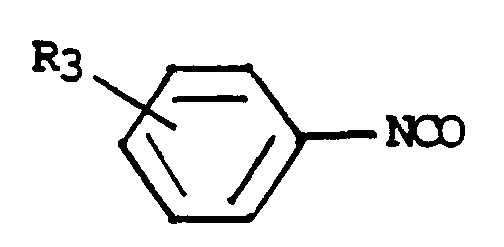
Les acides de formule (III) peuvent être préparés par action d'un phénylisccyanate de formule :
(V)
Figure imgf000005_0001
dans laquelle R3 a les mêmes significations que dans la formule (I), sur un dérivé de formule :
HO2C - (CH2)n - - NH2 (VI)
Figure imgf000005_0002
dans laquelle n a les mânes significations que dans la formule (I) et R2 représente un radical phényle ou une chaîne -(CH2)m-CO-R4 dans laquelle m est égal à 0, 1 eu 2 et R4 représente un radical alcoxy.
Cette réaction s'effectue généralement au sein d'un solvant inerte tel que le tétrahydrofuranne, le diméthylformamide, un solvant chloré (chloroforme, dichloro-1,2 éthane par exemple), un solvant aromatique (benzène, toluène par exemple), à une température comprise entre 10°C et la température d'ébullition du solvant.
Les isocyanates de formule (V) peuvent être obtenus par application ou adaptation de la méthode décrite par R. RICHIER et coll., The Chemistry of Cyanate and their thio derivatives, S. PATAI, part 2, Wiley New York (1977).
Les dérivés de formule (VI) pour lesquels R2 représente une chaîne -(CH2)m-CO-R4 dans laquelle R4 représente un radical alcoxy peuvent être obtenus par application ou adaptation de la méthode décrite par D. COLEMAN, J. Chem. Soc., 2294 (1951).
Les composés de formule (I) pour lesquels R2 représente une chaîne -(CH2)m-CO-R4 dans laquelle R4 représente un radical hydroxy peuvent être préparés par hydrolyse du composé correspondant de formule (I) pour lequel R4 représente un radical alcoxy.
Cette hydrolyse s'effectue généralement au moyen d'une base telle que la soude ou la potasse, dans un solvant inerte tel que l'eau, un alcool ou un mélange de ces solvants, à une température voisine de 20°C suivie de l'action d'un acide pour libérer le produit sous forme acide.
Les composés de formule (I) pour lesquels R2 représente une chaîne -(CH2)m-CO-R4 dans laquelle R4 représente un radical amino peuvent être obtenus par action d'ammoniac sur le composé correspondant pour lequel R4 représente un radical alcoxy.
Cette réaction s'effectue généralement au sein d'un alcool tel que le méthanol, l'éthanol, à une température voisine de 25°C.
Les ériantiomères des composés de formule (I) peuvent être obtenus par dédoublement des racémiques par exemple par chromatographie sur colonne chirale selon W.H. PIRCKLE et coll., asymétrie synthesis, vol. 1, Academic Press (1983) ou par synthèse à partir des précurseurs chiraux.
Les composés de formule (I) peuvent être purifiés par les méthodes connues habituelles, par exemple, par cristallisation, chromatographie, extraction...
Les composés de formule (I) pour lesquels R4 représente un radicalhydroxy, peuvent être transformés en sels métalliques ou en sels d'addition avec les bases azotées selon des méthodes connues en soi. Ces sels peuvent être obtenus par action d'une base métallique (alcaline ou alcalinoterreuse par exemple), de l'ammoniac ou d'une amine sur un composé de formule (I), dans un solvant tel qu'un alcool, un éther ou l'eau ou par réaction d'échange avec un sel d'un acide organique. Le sel formé est séparé par les méthodes habituelles.
Ces sels font également partie de l'invention.
Corme exemples de sels pharmaceutiquement acceptables, peuvent être cités les sels avec les métaux alcalins (sodium, potassium, lithium) ou avec les métaux alcalinoterreux (calcium, magnésium), le sel d'ammonium, les sels de bases azotées (éthanolamine, triméthylamine, méthylamine, benzylamine, N-benzyl-β-phénéthylamine, choline, arginine, leucine, lysine, N-méthylglucamine).
Les composés de formule (I) présentent des propriétés pharmacologiques intéressantes. Ces composés possèdent une forte affinité pour les récepteurs de la cholécystokinine (CCK) et de la gastrine et sent donc utiles dans le traitement et la prévention des désordres liés à la CCK et à la gastrine au niveau du système nerveux et de l'appareil gastrointestinal.
C'est ainsi que ces composés peuvent être utilisés pour le traitement ou la prévention des psychoses, des troubles anxieux, de la maladie de Parkinson, de la diskinésie tardive, du syndreme du colon irritable, de la pancréatite aiguë, des ulcères, des désordres de la motilité intestinale, de certaines tumeurs de l'oesophage inférieur, du colon et de l'intestin, et comme régulateur de l'appétit.
Ces composés ont également un effet de potentialisaticn sur l'activité analgésique des médicaments narcotiques et non narcotiques.
L'affinité des composés de formule (I) pour les récepteurs de la CCK a été déterminée selon une technique inspirée de celle de A. SAITO et coll., J. Neuro. Chem., 37, 483-490 (1981) au niveau du cortex cérébral et au niveau du pancréas.
Dans ces tests, la CI50 des composés de formule (I) est généralement égale ou inférieure à 1000 nM.
Par ailleurs, il est connu que les produits qui reconnaissent les récepteurs centraux de la CCK ont une spécificité similaire pour les récepteurs de la gastrine dans le tractus gastrointestinal (BOCK et coll., J. Med. Chem., 32, 16-23 (1989), REYFΕLD et coll., Am. J. Physiol., 240, G255-266 (1981) ; BEINFELD et coll., Neuropeptides, 3, 411-427 (1983)).
Les composés de formule (I) présentent une toxicité faible. Leur DL50 est généralement supérieure à 40 mg/kg par voie sous-cutanée chez la souris.
Les composés préférés sent ceux pour lesquels R1 représente un radical tert-butyle.
D'un intérêt particulier, sont les composés suivants :
- {[(méthyl-3 phényl)-3 uréido]-3 phényl-3 N-phényl- proρicnamido}-2 acétate de tert-butyle-(RS).
- [(méthyl-3 phényl)-3 uréido]-3 N-(tert-butoxycarbonyl- méthyl) N-phàiyl-succinamate de méthyle-(RS).
- acide [(méthyl-3 phényl)-3 uréido]-3 N-(tert-butoxy- carbonylméthyl) N-phényl-succinamique-(RS).
- [(méthyl-3 phényl)-3 uréido]-2 N-(tert-butoxycarbonyl- méthyl) N-phényl-succinamide-(RS).
- [(méthyl-3 phényl)-3 uréido]-4 N-(tert-butoxycarbonyl- méthyl) N-phényl-glutaramate de méthyle-(RS).
- acide [(méthyl-3 phényl)-3 uréido]-4 N-(tert-butoxy- carbonylméthyl) N-phényl-glutaramique-(RS). Les exemples suivants illustrent l' invention sans la limiter.
EXEMPLE 1
Une suspension de 4,1 g d'anilino acétate de tert-butyle et de 5,97 g d'acide[(méthyl-3 phényl)-3 uréido]-3 phényl-3 propionique-(R,S) dans 50 cm3 de dichloro-1,2 éthane anhydre est chauffée à reflux. On ajoute alors 1,45 cm3 de chlorure de thionyle en maintenant le reflux jusqu'à la fin du dégagement gazeux. Le mélange reacticnnel est alors versé dans 30 cm3 d'une solution aqueuse saturée d'hydrogénocarbonate de sodium puis on ajoute 50 cm3 de chlorure de méthylène. La phase organique est lavée par 50 cm3 d'eau, séchée sur sulfate de magnésium et concentrée à sec sous pression réduite (2,7 kPa) à 40°C. Après deux recristallisations successives d'abord dans un mélange d'oxyde de diéthyle et d'oxyde de diisopropyle (50-50 en volumes) puis dans l'oxyde de diéthyle, en obtient 5,4 g de {[(méthyl-3 phényl)-3 uréido]-3 phényl-3 N-phényl- propionamido}-2 acétate de tert-butyle-(RS).
L'acide [(méthyl-3 phényl)-3 uréido]-3 phényl-3 propionique-(RS) peut être préparé de la manière suivante : à une suspension de 6,6 g d'acide amino-3 phényl-3 propionique-(RS) et de 3,36 g d'hydrogénocarbonate de sodium dans 100 cm3 d'eau, en ajoute en 1 minute, 5,14 cm3 d'isocyanate de méthyl-3 phényle. Le mélange est agité pendant 20 heures à une température voisine de 20°C puis est extrait par 3 fois 75 cm3 d'acétate d'éthyle. La phase organique est lavée par 2 fois 50 cm3 d'eau, les extraits aqueux sont réunis et acidifiés jusqu'à pH 1 par une solution aqueuse 4N d'acide chlorhydrique. Le précipité est filtré, lavé à l'eau et séché sous pression réduite (0,07 kPa) à 40°C. On obtient ainsi 8,7 g d'acide [(méthyl-3 phényl)-3 uréido]-3 phényl-3 propionique-(RS) fondant à 164°C. EXEMPLE 2
A une suspension de 7,5 g d'acide [(méthyl-3 phényl)-3 uréidol-2 méthoxycarbonyl-3 propionique-(RS) et de 5,55 g de N-phényl-glycinate de tert-butyle dans 500 cm3 de dichloro-1,2 éthane au reflux, on ajoute 3,2 g de chlorure de thionyle. Le milieu reacticnnel est encore agité pendant 15 minutes au reflux, puis refroidi à 50°C et versé dans 200 cm3 d'une solution aqueuse de bicarbonate de sodium à 10 %. La phase organique est décantée, lavée par 150 cm3 d'eau, séchée sur sulfate de magnésium puis concentrée sous pression réduite (2,7 kPa). Le résidu huileux est purifié par chromatographie sur 120 g de silice (0,063- 0,200 mm) contenus dans une colonne de 2,4 cm de diamètre [éluant : ehlorure de méthylène-méthanol (99,5-0,5 en volumes)] en recueillant des fractions de 40 cm3. Les fractions 20 à 56 sent réunies et concentrées à sec sous pression réduite (2,7 kPa) à 50°C. On obtient, après cristallisation dans l'oxyde de diéthyle, 2,6 g de [(méthyl-3 phényl)-3 uréido]-3 N-(tert-butoxycarbonyl- méthyl) N-phényl-succinamate de méthyle-(RS) fondant à 149°C.
L'acide [(méthyl-3 phényl)-3 uréido]-2 méthoxycarbonyl-3 propionique-(RS) peut être préparé de la manière suivante : à une solution de 16,1 g d'acide amino-2 méthoxycarbonyl-3 propienique- (RS) et de 8,4 g de bicarbonate de sodium dans 160 cm3 d'eau, en ajoute 13,3 g d'isocyanate de méthyl-3 phényle en 30 minutes à 17°C. Le milieu réactionnel est encore agité pendant 16 heures puis l'insoluble est filtré. Le filtrat est amené à pH 1 par de l'acide chlorhydrique 4N et extrait par trois fois 15 cm3 d'acétate d'éthyle. Les extraits sent réunis, lavés par deux fois 15 cm3 d'eau, séchés sur sulfate de magnésium puis amenés à sec sous pression réduite (2,7 kPa) à 70°C. Après cristallisation dans l'éther de pétrole, on obtient 24 g d'acide [(méthyl-3 phényl)-3 uréido]-2 méthoxycarbonyl-3 propionique-(RS).
L'acide amino-2 méthoxycarbonyl-3 propionique-(RS) peut être préparé selon la méthode décrite par D. COLEMAN, J. Chem. Soc., 2294 (1951). EXEMPLE 3
A une solution de 3,5 g de [(méthyl-3 phényl)-3 uréido]-3 N-(tert-butoxycarbonylméthyl) N-phényl-succinamate de méthyle-(RS) dans 120 cm3 de méthanol, on ajoute 7,5 cm3 de soude normale. Le milieu reacticnnel est agité 24 heures à une température voisine de 20°C, puis on évapore le méthanol sous pression réduite (2,7 kPa) à 60°C. Le résidu est dilué par 210 cm3 de soude 0,005 N. La phase aqueuse est lavée par deux fois 70 cm3 d'acétate d'éthyle, amenée à pH acide par de l'acide chlorhydrique 4N et extraite par trois fois 80 cm3 d'acétate d'éthyle. Les extraits organiques sont réunis, séchés sur sulfate de magnésium et amenés à sec sous pression réduite 2,7 kPa) à 70°C. Après cristallisation dans l'oxyde de diéthyle, on obtient 1,6 g d'acide [(méthyl-3 phényl)-3 uréido]-3 N-(tert-butaxycarbonylméthyl) N-phényl-succinamique-(RS) fondant à 198°C.
EXEMPLE 4
Dans une solution de 4,7 g de [(méthyl-3 phényl)-3 uréido]-3 N-(tert-butoxycarbonylméthyl) N-phényl-succinamate de méthyle-(RS) dans 150 cm3 de méthanol, en fait passer un courant d'ammoniac pendant 11 heures à une température voisine de 25°C. La solution est ensuite dégazée par un courant d'azote et concentrée sous vide (2,7 kPa) à 60°C. Le résidu est cristallisé dans l'oxyde de diéthyle et le solide extrait par 40 cm3 de diehlorométhane. La solution ainsi obtenue est purifiée par chranatographie sur 25 g de silice (0,063-0,200 mm) contenus dans une colonne de 1,6 cm de diamètre [éluant : 1100 cm3 de chlorure de méthylène puis chlorure de méthylène-méthanol (98,5-1,5 en volumes)] en recueillant des fractions de 15 cm3. Les fractions 80 à 127 sont réunies et concentrées à sec sous pression réduite (2,7 kPa) à 60°C. On obtient, après cristallisaticn dans l'éther de pétrole 1,1 g de [(méthyl-3 phényl)-3 uréido]-2 N-(tert-butxoycarbonyl- méthyl) N-phényl-succinamide-(RS) fondant à 192°C. EXEMPLE 5
On opère d'une manière analogue à celle décrite à l'exemple 2, mais à partir de 1,47 g d'acide [(méthyl-3 phényl)-3 uréido]-2 méthoxycarbonyl-4 butyrique-(RS), de 1,04 g de N-phényl-glycinate de tert-butyle et de 0,60 g de chlorure de thionyle. Le produit obtenu est purifié par chromatographie sur 50 g de silice (0,063-0,200 mm) contenus dans une colonne de 1,8 cm de diamètre [éluant : 225 cm3 de chloorure de méthylène puis chlorure de méthylène-méthanol (99-1 en volumes)] en recueillant des fractions de 15 cm3. Les fractions 36 à 40 sont réunies et concentrées à sec sous pression réduite (2,7 kPa) à 50°C. On obtient, après cristallisation dans l'oxyde de diéthyle puis recristallisation dans un mélange d'hexane et d'éthanol (85-15 en volumes), 1,9. g de [(méthyl-3 phényl)-3 uréido]-4 N-(tert-butoxycarbonylméthyl) N-phényl-glutaramate de méthyle-(RS) fendant à 139°C.
L'acide [(méthyl-3 phényl-3 uréido]-2 méthoxcycarbonyl-4 butyrique-(RS) peut être préparé d'une manière analogue à celle décrite à l'exemple 2 pour la préparation de l'acide [(méthyl-3 phényl)-3 uréido]-2 méthoxycarbonyl-3 proρionique-(RS), mais à partir de 16,1 g d'acide amino-2 méthoxycarbonyl-4 butyrique-(RS) et de 13,3 g d'isocyanate de méthyl-3 phényle. On obtient ainsi 23,5 g d'acide [(méthyl-3 phényl)-3 uréido]-2 méthoxycarbonyl-4 butyrique-(RS) fondant à 127°C.
EXEMPLE 6 On opère comme à l'exemple 3, mais à partir de 4,7 g de [(méthyl-3 phényl)-3 uréido]-4 N-(tert-butoxycarbonylméthyl) N-phényl-glutaramate de méthyle-(RS) et de 9,7 cm3 de soude normale. Le produit obtenu est purifié par diromatographie sur 60 g de silice (0,063-0,200 mm) contenus dans une colonne de 2,4 cm de diamètre [éluant : 1000 cm3 de chlorure de méthylène- méthanol (99-1 en volumes) puis chlorure de méthylène-méthanol (97-3 en volumes)] en recueillant des fractions de 25 cm3. Les fractions 42 à 105 sent réunies et concentrées à sec sous pression réduite (2,7 kPa) à 60°C. On obtient, après cristallisation dans l'oxyde de diéthyle 1,45 g d'acide [(méthyl-3 phényl)-3 uréido]-4 N-(tert-butoxycarbonylméthyl) N-phényl-glutaramique-(RS) fondant à 191°C.
La présente invention concerne également les médicaments constitués par au moins un composé de formule (I) à l'état pur ou sous forme d'une composition dans laquelle il est associé à tout autre produit pharmaceutiquement compatible, pouvant être inerte ou physiologiquement actif. Les médicaments selon l'invention peuvent être employés par voie orale, parentérale, rectale ou topique.
Comme compositions solides pour administration orale, peuvent être utilisés des comprimés, des pilules, des poudres (capsules de gélatine, cachets) ou des granulés. Dans ces compositions, le principe actif selon l'invention est mélangé à un ou plusieurs diluants inertes, tels que amidon, cellulose, saccharose, lactose ou silice. Ces compositions peuvent également comprendre des substances autres que les diluants, par exemple un ou plusieurs lubrifiants tels que le stéarate de magnésium ou le talc, un colorant, un enrobage (dragées) ou un vernis.
Comme cempositions liquides pour administration orale, on peut utiliser des solutions, des suspensions, des émulsiens, des sirops, des élixirs pharmaceutiquement acceptables contenant des diluants inertes tels que l'eau, l'éthanol, le glycérol, les huiles végétales ou l'huile de paraffine. Ces compositicns peuvent comprendre des substances autres que les diluants, par exemple des produits mouillants, édulcorants, épaississants, aromatisants ou stabilisants.
Les compositiens stériles pour administration parentérale, peuvent être de préférence des solutions aqueuses ou des solutions non aqueuses, des suspensions ou des émulsions. Gomme solvant ou véhicule, on peut employer l'eau, le propylèneglycol, un polyéthylèneglycol, des huiles végétales, en particulier l'huile d'olive, des esters organiques injectables, par exemple l'oléate d'éthyle ou autres solvants organiques convenables. Ces compositions peuvent également contenir des adjuvants, en particulier des agents mouillants, isotonisants, émulsifiants, dispersants et stabilisants. La stérilisation peut se faire de plusieurs façons, par exemple par filtration aseptisante, en incorporant à la composition des agents stérilisants, par irradiation ou par chauffage. Elles peuvent également être préparées sous forme de compositions solides stériles qui peuvent être dissoutes au moment de l'emploi dans un milieu stérile injectable.
Les cαipositicns pour administraticn rectale sont les suppositoires ou les capsules rectales qui contiennent, outre le produit actif, des excipients tels que le beurre de cacao, des glycérides semi-synthétiques ou des polyéthylèneglycols.
Les appositions pour administration topique peuvent être par exeπple des crèmes, des ppmmades, des lotions, des collyres, des collutoires, des gouttes nasales ou des aérosols.
En thérapeutique humaine, les composés selon l'invention sont particulièrement utiles dans le traitement et la prévention des désorctres liés à la CCK et à la gastrine au niveau du système nerveux et de l'appareil gastrointestinal. Ces composés peuvent dcnc être utilisés dans le traitement et la prévention des psychoses, des troubles anxieux, de la maladie de Parkinson, de la diskinésie tardive, du syndrome du colon irritable, de la pancréatite aiguë, des ulcères, des désordres de la motilité intestinale et de certaines tumeurs de l'oesophage inférieur, du colon et de l'intestin, comme potentialisateur de l'activité analgésique des médicaments analgésiques narcotiques et non narcotiques et comme régulateur de l'appétit.
Les doses dépendent de l'effet recherché, de la durée du traitement et de la voie d'administration utilisée ; elles sont généralement comprises entre 0,05 g et 1 g par jour par voie orale pour un adulte avec des doses unitaires allant de 10 mg à 500 mg de substance active. D'une façon générale, le médecin déterminera la posologie appropriée en fonction de l'âge, du poids et de tous les autres facteurs propres au sujet à traiter.
Les exemples suivants illustrent des compositions selon l'invention :
EXEMPLE A
On prépare, selon la technique habituelle, des gélules dosées à 50 mg de produit actif ayant la composition suivante :
- {[(méthyl-3 phényl)-3 uréido]-3 phényl-3 N-phényl
propionamido}-2 acétate de tert-butyle-(RS)...... 50 mg
- Cellulose ............................................................... 18 mg
- Lactose .................................................................... 55 mg
- Silice colloïdale ..................................................... 1 mg
- Carboxyméthylamidon sodique .............. ........................ 10 mg - Talc .................... ....................................... ................... 10 mg
- Stéarate de magnésium ........................................ 1 mg
EXEMPTA B
On prépare, selon la technique habituelle, des comprimés dosés à 50 mg de produit actif ayant la composition suivante : - {[(méthyl-3 phényl)-3 uréido]-3 N-(tert-butoxy- carbonylméthyl) N-phényl-succinamate de méthyle-
(RS) ...................................................................... 50 mg
- Lactose ................................................................ 104 mg
- Cellulose ............................................................ 40 mg - Polyvidone .................................................... 10 mg
- Carboxymêthylamidon sodique ....................................... 22 mg - Talc .............................................................................. 10 mg
- Stéarate de magnésium ......................................... 2 mg
- Silice colloïdale ................................................. 2 mg
- Mélange d'hydroxyméthylcellulose, glycérine,
oxyde de titane (72-3, 5-24, 5) ..................q.s.p. 1 comprimé pellicule terminé à 245 mg
EXEMPLE C
On prépare une solution injectable contenant 10 mg de produit actif ayant la composition suivante : - acide [(méthyl-3 phényl)-3 uréido]-3 N-(tert- butoxycarbonylméthyl) N-phényl-succinamique-
(RS) .......................................................................... 10 mg
- Acide benzoïque .................................................. 80 mg
- Alcool benzylique ................................................ 0, 06 cm3 - Benzoate de sodium .................................................... 80 mg
- Ethanol à 95 % ............................................................ 0,4 cm3
- Hydroxyde de sodium ..................................................... 24 mg
- Propylène glycol .................................................................... 1,6 cm3
- eau ................................................................... q.s.p. 4 cm3

Claims

REVENDICATIO NS 1 . Composés de formule :
Figure imgf000017_0001
dans laquelle :
- R1 représente un radical alkyle,
- R2 représente un radical phényle ou une chaîne -(CH2)m-CO-R4 dans laquelle m est égal à 0, 1 ou 2 et R4 représente un radical hydroxy, alcoxy ou amino,
- R3 représente un atome d'hydrogène ou d'halogène ou un radical alkyle, alcoxy ou alkylthio,
- n est égal à 0 ou 1,
étant entendu que les radicaux alkyle et alcoxy et les portions alkyle contiennent 1 à 4 atcmes de carbone en chaîne droite ou ramifiée, ainsi que leurs racemiques et enanticmeres et leurs sels.
2 - Composés selon la revendication 1 pour lesquels R1 représente un radical tert-butyle.
3 - Composés selon l'une des revendications 1 ou 2 pour lesquels les atomes d'halogène sont les atomes de chlore, brome ou fluor.
4 - Procédé de préparation des composés de formule (I) selon la revendication 1 pour lesquels R2 représente un radical phényle ou une chaîne -(CH2)m-CO-R4 dans laquelle m est égal à 0, 1 ou 2 et R4 représente un radical alcoxy caractérisé en ce que l'on fait réagir une aminé de formule :
HH - CH2 - CO2R1 (II)
Figure imgf000018_0001
dans laquelle R1 a les mêmes significatiens que dans la revendication 1, sur un acide de fannule :
HO2C - (CH2)n - -NH-CO-NH (III)
Figure imgf000018_0002
Figure imgf000018_0003
dans laquelle n et R3 ont les mêmes significations que dans la revendication 1 et R2 a les mêmes significatiens que précédemment, ou un dérivé réactif de cet acide puis isole le produit.
5 - Procédé de préparation des composés de formule (I) selon la revendication 1 pour lesquels R2 représente une chaîne -(CH2)m-CO-R4 dans laquelle m est égal à 0, 1 ou 2 et R4 représente un radical hydrexy caractérisé en ce que l'on hydrolyse les composés de formule (I) carrespendants pour lesquels R4 représente un radical alcoxy puis isole le produit.
6 - Procédé de préparation des composés de formule (I) selon la revendication 1 pour lesquels R2 représente une chaîne -(CH2)m-CO-R4 dans laquelle m est égal à 0,1 ou 2 et R4 représente un radical amino caractérisé en ce que l'en fait réagir l'ammoniac sur un composé de formule (I) cαrrespondant pour lequel R4 représente un radical alcoxy puis isole le produit.
7 - Médicaments caractérisés en ce qu'ils contiennent en tant que principe actif au moins un composé de formule (I) selon la revendication 1.
8 - Médicaments selon la revendication 7 pour le traitement ou la prévention des désordres liés à la CCK et à la gastrine au niveau du système nerveux et de l'appareil gastrointestinal.
PCT/FR1991/000195 1990-03-13 1991-03-11 Derives de l'uree, leur preparation et les medicaments les contenant Ceased WO1991013862A1 (fr)

Priority Applications (4)

Application Number Priority Date Filing Date Title
EP91906784A EP0520016B1 (fr) 1990-03-13 1991-03-11 Derives de l'uree, leur preparation et les medicaments les contenant
DE69104475T DE69104475T2 (de) 1990-03-13 1991-03-11 Harnstoffderivate, ihre herstellung und deren enthaltende arzneimittel.
US07/934,686 US5338760A (en) 1990-03-13 1991-03-11 Urea derivatives, their preparation and medicinal products containing them
NO923227A NO923227D0 (no) 1990-03-13 1992-08-18 Ureaderivater, deres fremstilling og medikamenter inneholdende derivatene

Applications Claiming Priority (2)

Application Number Priority Date Filing Date Title
FR9003187A FR2659653B1 (fr) 1990-03-13 1990-03-13 Derives de l'uree, leur preparation et les medicaments les contenant.
FR90/03187 1990-03-13

Publications (1)

Publication Number Publication Date
WO1991013862A1 true WO1991013862A1 (fr) 1991-09-19

Family

ID=9394668

Family Applications (1)

Application Number Title Priority Date Filing Date
PCT/FR1991/000195 Ceased WO1991013862A1 (fr) 1990-03-13 1991-03-11 Derives de l'uree, leur preparation et les medicaments les contenant

Country Status (16)

Country Link
US (1) US5338760A (fr)
EP (1) EP0520016B1 (fr)
JP (1) JPH05504970A (fr)
AT (1) ATE112552T1 (fr)
AU (1) AU637220B2 (fr)
CA (1) CA2074365A1 (fr)
DE (1) DE69104475T2 (fr)
ES (1) ES2061236T3 (fr)
FR (1) FR2659653B1 (fr)
HU (1) HUT61574A (fr)
IE (1) IE910821A1 (fr)
IL (1) IL97511A0 (fr)
NZ (1) NZ237379A (fr)
PT (1) PT97027A (fr)
WO (1) WO1991013862A1 (fr)
ZA (1) ZA911767B (fr)

Cited By (8)

* Cited by examiner, † Cited by third party
Publication number Priority date Publication date Assignee Title
WO1994006757A1 (fr) * 1992-09-18 1994-03-31 Warner-Lambert Company Agents agissant sur des recepteurs de cholecystokinine
FR2700168A1 (fr) * 1993-01-07 1994-07-08 Rhone Poulenc Rorer Sa Dérivés de thiazolidine, leur préparation et les médicaments les contenant.
FR2700167A1 (fr) * 1993-01-07 1994-07-08 Rhone Poulenc Rorer Sa Dérivés de pyrrolidine et thiazolidine, leur préparation et les médicaments les contenant.
WO1994024151A1 (fr) * 1993-04-15 1994-10-27 Glaxo Inc. Derives de 1,5 benzodiazepine presentant une activite antagoniste de la cck et de la gastrine
US5475106A (en) * 1990-03-07 1995-12-12 Rhone-Poulenc Rorer S.A. N-phenylglycinamide CCK antagonists and pharmaceutical compositions containing them
US5585376A (en) * 1993-04-15 1996-12-17 Glaxo Wellcome Inc. 1,5-benzodiazepine derivatives having CCK and/or gastrin antagonistic activity
EP1203766A3 (fr) * 2000-11-06 2004-12-08 Texas Biotechnology Corporation Dérivés d'acides carboxyliques inhibant la liaison des intégrines à leurs récepteurs
SG107574A1 (en) * 2001-10-09 2004-12-29 Texas Biotechnology Corp Carboxylic acid derivatives that inhibit the binding of integrins to their receptors

Families Citing this family (3)

* Cited by examiner, † Cited by third party
Publication number Priority date Publication date Assignee Title
EP0739903B1 (fr) * 1994-02-09 2002-01-23 Shionogi & Co., Ltd. Derives du carbamoylmethyluree
CA2228622A1 (fr) * 1995-08-07 1997-02-20 Haruo Koike Procede de preparation de derives de carbamoylmethyluree
US20070181042A1 (en) * 2004-03-16 2007-08-09 Nippon Shokubai Co., Ltd. Additive for hydraulic material

Citations (1)

* Cited by examiner, † Cited by third party
Publication number Priority date Publication date Assignee Title
EP0397556A1 (fr) * 1989-05-12 1990-11-14 Rhone-Poulenc Sante N-Phényl amides, leurs procédés de préparation et les médicaments les contenant

Patent Citations (1)

* Cited by examiner, † Cited by third party
Publication number Priority date Publication date Assignee Title
EP0397556A1 (fr) * 1989-05-12 1990-11-14 Rhone-Poulenc Sante N-Phényl amides, leurs procédés de préparation et les médicaments les contenant

Cited By (16)

* Cited by examiner, † Cited by third party
Publication number Priority date Publication date Assignee Title
US5475106A (en) * 1990-03-07 1995-12-12 Rhone-Poulenc Rorer S.A. N-phenylglycinamide CCK antagonists and pharmaceutical compositions containing them
US6103761A (en) * 1992-09-18 2000-08-15 Warner-Lambert Company Agents acting at cholecystokinin receptors
US5389682A (en) * 1992-09-18 1995-02-14 Warner-Lambert Company Agents acting at cholecystokinin receptors
WO1994006757A1 (fr) * 1992-09-18 1994-03-31 Warner-Lambert Company Agents agissant sur des recepteurs de cholecystokinine
US5637602A (en) * 1993-01-07 1997-06-10 Rhone-Poulenc Rorer S.A. Pyrrolidine and thiazolidine derivatives, their preparation and drugs containing same
FR2700168A1 (fr) * 1993-01-07 1994-07-08 Rhone Poulenc Rorer Sa Dérivés de thiazolidine, leur préparation et les médicaments les contenant.
FR2700167A1 (fr) * 1993-01-07 1994-07-08 Rhone Poulenc Rorer Sa Dérivés de pyrrolidine et thiazolidine, leur préparation et les médicaments les contenant.
WO1994015955A1 (fr) * 1993-01-07 1994-07-21 Rhone-Poulenc Rorer S.A. Derives de thiazolidine, leur preparation et les medicaments les contenant
WO1994015954A1 (fr) * 1993-01-07 1994-07-21 Rhone-Poulenc Rorer S.A. Derives de pyrrolidine et thiazolidine, leur preparation et les medicaments les contenant
US5633270A (en) * 1993-01-07 1997-05-27 Rhone-Poulenc Rorer S.A. Thiazolidine derivatives, preparation thereof and drugs containing samem
US5585376A (en) * 1993-04-15 1996-12-17 Glaxo Wellcome Inc. 1,5-benzodiazepine derivatives having CCK and/or gastrin antagonistic activity
WO1994024151A1 (fr) * 1993-04-15 1994-10-27 Glaxo Inc. Derives de 1,5 benzodiazepine presentant une activite antagoniste de la cck et de la gastrine
US6972296B2 (en) 1999-05-07 2005-12-06 Encysive Pharmaceuticals Inc. Carboxylic acid derivatives that inhibit the binding of integrins to their receptors
US7812038B2 (en) 1999-05-07 2010-10-12 Encysive Pharmaceuticals, Inc. Carboxylic acid derivatives that inhibit the binding of integrins to their receptors
EP1203766A3 (fr) * 2000-11-06 2004-12-08 Texas Biotechnology Corporation Dérivés d'acides carboxyliques inhibant la liaison des intégrines à leurs récepteurs
SG107574A1 (en) * 2001-10-09 2004-12-29 Texas Biotechnology Corp Carboxylic acid derivatives that inhibit the binding of integrins to their receptors

Also Published As

Publication number Publication date
ES2061236T3 (es) 1994-12-01
HU9202919D0 (en) 1992-12-28
NZ237379A (en) 1992-11-25
HUT61574A (en) 1993-01-28
ZA911767B (en) 1991-12-24
US5338760A (en) 1994-08-16
AU637220B2 (en) 1993-05-20
IL97511A0 (en) 1992-06-21
FR2659653A1 (fr) 1991-09-20
IE910821A1 (en) 1991-09-25
JPH05504970A (ja) 1993-07-29
DE69104475T2 (de) 1995-02-23
PT97027A (pt) 1991-11-29
ATE112552T1 (de) 1994-10-15
AU7570491A (en) 1991-10-10
EP0520016B1 (fr) 1994-10-05
CA2074365A1 (fr) 1991-09-14
DE69104475D1 (de) 1994-11-10
FR2659653B1 (fr) 1992-05-22
EP0520016A1 (fr) 1992-12-30

Similar Documents

Publication Publication Date Title
EP0679161B1 (fr) Derives de thiazolidine, leur preparation et les medicaments les contenant
EP0607355B1 (fr) 3-ureido-benzodiazepinones utiles comme antagonistes de cck ou de gastrine
FR2678938A1 (fr) Derives de pyrrolidine, leur preparation et les medicaments les contenant.
EP0766696B1 (fr) Derives de thiazolidine, leur preparation et les medicaments les contenant
EP0514442B1 (fr) N-phenyl n-acetamido glycinamides, leur preparation et les medicaments les contenant
FR2667864A2 (fr) Derives de n-phenyl glycinamides, leur preparation et les medicaments les contenant.
EP0520016B1 (fr) Derives de l'uree, leur preparation et les medicaments les contenant
EP0518961A1 (fr) Derives de glycinamide, leur preparation et les medicaments les contenant
EP0397556B1 (fr) N-Phényl amides, leurs procédés de préparation et les médicaments les contenant
EP0533827A1 (fr) Nouveaux derives de l'oxazole, leur preparation et les compositions pharmaceutiques qui les contiennent.
FR2700166A1 (fr) Dérivés de pyrrolidine, leur préparation et les médicaments les contenant.
EP0516729B1 (fr) N-phenyl n-alcoxycarbonylalkyle glycinamides, leur preparation et les medicaments les contenant
EP0119896B1 (fr) Nouveaux dérivés de l'amino-5 dithiole-1,2 one-3, leur préparation et les compositions médicinales qui les contiennent
FR2700165A1 (fr) Dérivés de pyrrolidine, leur préparation et les médicaments les contenant.
EP0233801B1 (fr) Nouveaux amides substitués, leur préparation et les compositions pharmaceutiques qui les contiennent
EP0662081B1 (fr) Derives d'ureido-acetamide, leur preparation et les medicaments les contenant
FR2659966A1 (fr) Derives de n-aralkyl glycinamide, leur preparation et les medicaments les contenant.
FR2659324A1 (fr) N-heterocyclyl glycinamides, leur preparation et les medicaments les contenant.
FR2667066A2 (fr) N-heterocyclyl glycinamides, leur preparation et les medicaments les contenant.
WO1994006824A1 (fr) Derive d'ureido-acetamide optiquement actif, sa preparation et les medicaments les contenant
FR2667863A2 (fr) N-phenyl n-acetamido glycinamides, leur preparation et les medicaments les contenant.
FR2667319A2 (fr) N-phenyl n-acetamido glycinamides, leur preparation et les medicaments les contenant.
FR2592880A2 (fr) Nouveaux amides substitues, leur preparation et les medicaments qui les contiennent
FR2658196A1 (fr) N-phenyl n-acetamido glycinamides leur preparation et les medicaments les contenant.
EP0367678A1 (fr) Dérives de dihydro-5,6 4H-oxa (ou thia) zine-1,3, leurs procédés de préparation et les médicaments les contenant

Legal Events

Date Code Title Description
AK Designated states

Kind code of ref document: A1

Designated state(s): AU CA HU JP KR NO SU US

AL Designated countries for regional patents

Kind code of ref document: A1

Designated state(s): AT BE CH DE DK ES FR GB GR IT LU NL SE

WWE Wipo information: entry into national phase

Ref document number: 2074365

Country of ref document: CA

WWE Wipo information: entry into national phase

Ref document number: 1991906784

Country of ref document: EP

WWP Wipo information: published in national office

Ref document number: 1991906784

Country of ref document: EP

WWG Wipo information: grant in national office

Ref document number: 1991906784

Country of ref document: EP