WO1993020119A1 - Biologisch abbaubares, wasserresistentes polymer-material - Google Patents
Biologisch abbaubares, wasserresistentes polymer-material Download PDFInfo
- Publication number
- WO1993020119A1 WO1993020119A1 PCT/EP1993/000563 EP9300563W WO9320119A1 WO 1993020119 A1 WO1993020119 A1 WO 1993020119A1 EP 9300563 W EP9300563 W EP 9300563W WO 9320119 A1 WO9320119 A1 WO 9320119A1
- Authority
- WO
- WIPO (PCT)
- Prior art keywords
- polymer material
- material according
- groups
- crosslinkable groups
- water
- Prior art date
- Legal status (The legal status is an assumption and is not a legal conclusion. Google has not performed a legal analysis and makes no representation as to the accuracy of the status listed.)
- Ceased
Links
Classifications
-
- C—CHEMISTRY; METALLURGY
- C08—ORGANIC MACROMOLECULAR COMPOUNDS; THEIR PREPARATION OR CHEMICAL WORKING-UP; COMPOSITIONS BASED THEREON
- C08H—DERIVATIVES OF NATURAL MACROMOLECULAR COMPOUNDS
- C08H1/00—Macromolecular products derived from proteins
- C08H1/06—Macromolecular products derived from proteins derived from horn, hoofs, hair, skin or leather
-
- C—CHEMISTRY; METALLURGY
- C08—ORGANIC MACROMOLECULAR COMPOUNDS; THEIR PREPARATION OR CHEMICAL WORKING-UP; COMPOSITIONS BASED THEREON
- C08B—POLYSACCHARIDES; DERIVATIVES THEREOF
- C08B31/00—Preparation of derivatives of starch
- C08B31/003—Crosslinking of starch
-
- C—CHEMISTRY; METALLURGY
- C08—ORGANIC MACROMOLECULAR COMPOUNDS; THEIR PREPARATION OR CHEMICAL WORKING-UP; COMPOSITIONS BASED THEREON
- C08F—MACROMOLECULAR COMPOUNDS OBTAINED BY REACTIONS ONLY INVOLVING CARBON-TO-CARBON UNSATURATED BONDS
- C08F290/00—Macromolecular compounds obtained by polymerising monomers on to polymers modified by introduction of aliphatic unsaturated end or side groups
- C08F290/08—Macromolecular compounds obtained by polymerising monomers on to polymers modified by introduction of aliphatic unsaturated end or side groups on to polymers modified by introduction of unsaturated side groups
-
- C—CHEMISTRY; METALLURGY
- C08—ORGANIC MACROMOLECULAR COMPOUNDS; THEIR PREPARATION OR CHEMICAL WORKING-UP; COMPOSITIONS BASED THEREON
- C08F—MACROMOLECULAR COMPOUNDS OBTAINED BY REACTIONS ONLY INVOLVING CARBON-TO-CARBON UNSATURATED BONDS
- C08F290/00—Macromolecular compounds obtained by polymerising monomers on to polymers modified by introduction of aliphatic unsaturated end or side groups
- C08F290/08—Macromolecular compounds obtained by polymerising monomers on to polymers modified by introduction of aliphatic unsaturated end or side groups on to polymers modified by introduction of unsaturated side groups
- C08F290/10—Polymers provided for in subclass C08B
-
- C—CHEMISTRY; METALLURGY
- C08—ORGANIC MACROMOLECULAR COMPOUNDS; THEIR PREPARATION OR CHEMICAL WORKING-UP; COMPOSITIONS BASED THEREON
- C08L—COMPOSITIONS OF MACROMOLECULAR COMPOUNDS
- C08L51/00—Compositions of graft polymers in which the grafted component is obtained by reactions only involving carbon-to-carbon unsaturated bonds; Compositions of derivatives of such polymers
- C08L51/02—Compositions of graft polymers in which the grafted component is obtained by reactions only involving carbon-to-carbon unsaturated bonds; Compositions of derivatives of such polymers grafted on to polysaccharides
-
- C—CHEMISTRY; METALLURGY
- C09—DYES; PAINTS; POLISHES; NATURAL RESINS; ADHESIVES; COMPOSITIONS NOT OTHERWISE PROVIDED FOR; APPLICATIONS OF MATERIALS NOT OTHERWISE PROVIDED FOR
- C09H—PREPARATION OF GLUE OR GELATINE
- C09H7/00—Preparation of water-insoluble gelatine
-
- C—CHEMISTRY; METALLURGY
- C08—ORGANIC MACROMOLECULAR COMPOUNDS; THEIR PREPARATION OR CHEMICAL WORKING-UP; COMPOSITIONS BASED THEREON
- C08L—COMPOSITIONS OF MACROMOLECULAR COMPOUNDS
- C08L2201/00—Properties
- C08L2201/06—Biodegradable
Definitions
- the invention relates to a biodegradable, water-resistant polymer material, in particular in the form of foils, films, tapes, masses, moldings or the like.
- the object of the present invention is to propose a polymer material which can be produced with defined material properties.
- this object is achieved by a biodegradable, water-resistant polymer material which is produced by means of a method with the following steps:
- step b) converting the uncrosslinked reaction product from step a) with crosslinking of the crosslinkable groups to a crosslinking reaction product.
- the biodegradable, water-resistant polymer material according to the invention is therefore a material which essentially consists of a crosslinking reaction product of polysaccharides and / or polypeptides, the hydroxyl, amino, imino, thiol and / or carboxyl groups in a non-radical reaction are at least partially derivatized with agents which comprise crosslinkable groups in a process step following the derivatization and which can be carried out separately therefrom.
- the present invention selects a two-stage production method in which a derivatized polysaccharide is initially used in a non-radical reaction or polypeptide is obtained, which can then, if appropriate with the addition of further monomers, enter into a targeted polyreaction which includes not only the polymerization but also the polycondensation and the polyaddition as reaction mechanisms.
- a derivatized polysaccharide is initially used in a non-radical reaction or polypeptide is obtained, which can then, if appropriate with the addition of further monomers, enter into a targeted polyreaction which includes not only the polymerization but also the polycondensation and the polyaddition as reaction mechanisms.
- the biodegradable, water-resistant polymer materials obtained in this way can be tailored precisely to their intended use with their properties.
- the water-insoluble or water-resistant, but still biodegradable polymers are obtained which can be used as moldings, coatings, in particular also as packaging materials.
- the high molecular weight products are due to their polar structural features (amino acids, saccharides) both in hydrophilic media, such as Water and alcohols or the like, as well as in hydrophobic solvents such as e.g. Halogenated hydrocarbons, ethers, ketones, etc., are insoluble, but retain the property of being at least partially swellable in polar solvents.
- hydrophilic media such as Water and alcohols or the like
- hydrophobic solvents such as e.g. Halogenated hydrocarbons, ethers, ketones, etc.
- the crosslinkable groups will preferably comprise acrylic and / or methacrylic residues.
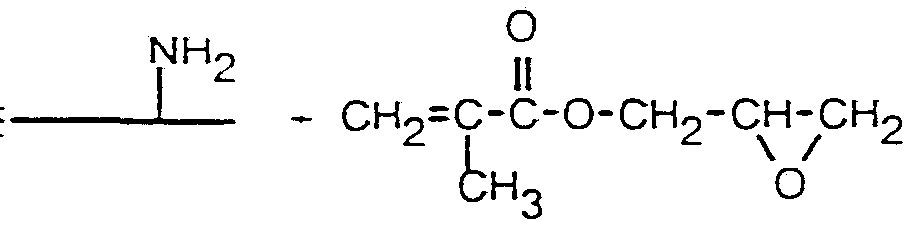
- Glycidyl acrylates and / or glycidyl methacrylates are particularly suitable as agents.
- collagenic origins are particularly preferred, in particular in the form of gelatin, animal glues, collagen or collagen hydrolyzate.
- bio-polypeptides such as, for example, whey proteins and / or caseins, plant proteins, in particular soy proteins, can be used individually or in a mixture, also in a mixture with the polypeptides of collagen origin.
- gelatin is intended to include both products which have been obtained by the single-stage type A process and products which have been obtained by the two-stage alkaline process and have a gelling power of 40 to 320 g (Brltish standard).
- collagenous crude extracts in the form of skin or bone glues are suitable as starting materials for the production of high molecular weight biopolymers.
- Non-gelling collagen products so-called collagen hydrolyzate, which have been obtained by physical (pressure, temperature), chemical (eg by means of acid or alkali) or biological (enzymatic) processes from collagen-rich raw material such as skin or bones are also suitable Starting material for the production of the high molecular weight biopolymer materials according to the invention.
- an average of at least ten crosslinkable groups per thousand monosaccharide or amino acid groups of the polysaccharide or polypeptide chains should be present.
- crosslinkable groups are linked to the polypeptide chain essentially exclusively via amino and carboxyl groups.
- crosslinkable groups of the polypeptide portion are linked to the polypeptide chain essentially exclusively via the carboxyl groups. Adequate water resistance and tensile strength are generally observed in the polymer materials if an average of up to 150 crosslinkable groups are present per thousand amino acids of the polypeptide chains.
- the polymer material is built up from a mixture of polysaccharide and polypeptide fractions, these fractions will preferably be cross-linked.
- the crosslinking reaction is preferably continued until the crosslinking reaction product is completely insoluble in water, but on the other hand it is preferably ensured that the crosslinking reaction product is still water-swellable within certain limits. Water swellability facilitates the degradation reaction in the composting of the polymer materials.
- the crosslinking reaction is prepared in the presence of free monomer and / or prepolymer of the agents.
- the length of the bridges between two polymer molecules can thus be influenced and thus also the structural structure of the polymer material itself.
- the chemical and mechanical properties of the polymer materials according to the invention can be adjusted very precisely in particular if parts of the functional groups of the polysaccharides and / or polypeptides are blocked with protective groups before derivatization.
- protective groups which are customary in biochemistry and which selectively leave the desired functional groups available for the derivatization.
- derivatization products are at least partially used as derivatized polysaccharides and / or polypeptides. those which comprise different crosslinkable groups, possibly in the same molecular chain, which different crosslinking reaction types are accessible.
- the derivatization step of the collagen starting materials listed above includes their reaction in aqueous solution in the concentration range from 1 to 70% by weight, gelatins preferably depending on the quality in concentrations of 1 to 30% by weight, glue from 10 to 40% by weight and not Gelie ⁇ collagen hydrolyzates from 20 to 70 wt.% Are used.
- Reactive acrylates or methacrylates of the glycidyl acrylate or glycidyl methacrylate type which, at pH values from 4.0 to 10.0 specifically with -y »- or ⁇ -carboxyl groups of the amino acid side chains of glutamic acid and aspartic acid, are preferably used as modification reagents and react with £ amino acid chains of lysine and hydroxylysine.
- the amount of the modification reagent is between 0.1 and 30 Ge. % (based on the weight of the polypeptide), preferably between 1 and 25% by weight (in each case based on the weight of the polypeptide).
- the contents of the reactive groups of gelatin available can vary: Type A gelatin contains 85 mmol / 100 g of acidic amino acid residues (glutamic and aspartic acid).
- type B gelatin contains 127 mmol acidic amino acid residues per 100 g gelatin.
- the content of basic amino acid residues (lysine and hydroxylysine) is the same at 38 mmol / 100 g in both types of gelatin and is not changed by the alkaline treatment of the raw material (cf. "The Science and Technology of Gelatin", AG Ward, A. Courts Ed; Academic Press 1977).
- the reaction temperature in the derivatization is preferably 30 to 80 ° C, more preferably in the range of 40 to 60 ° C.
- the upper limit of the temperature ranges results from the fact that the increased tendency to hydrolysis of the glycidyl reagent to the diol occurring at higher temperatures should be avoided .
- the corresponding esters are formed as reaction products on the acidic amino acid side groups - in the case of modification of the basic amino acid side groups, the corresponding 1,3-alkanolamino derivatives between the polypeptide-bound reaction partners and the reactive acrylates or methacrylates.
- Gfyciöylmetnacrylat (GMA) Gfyciöylmetnacrylat
- the two-stage process of derivatization and separate polyreaction according to the invention for crosslinking the derivatized biopolymers opens up diverse possibilities for the targeted, tailor-made synthesis of water-resistant polymers on the basis of collagenous starting materials or on the basis of polysaccharides or mixtures of both.
- water-soluble products are obtained which are dried directly or after drying by suitable polymerization processes, such as redox , thermal or UV treatment, can be converted into water-insoluble but still swellable products such as film strips and moldings.
- the main structural element of the water-insoluble, high-molecular products described consists of protein or polypeptide chains and / or polysaccharides; the products produced therefrom are biodegradable due to the proteolytic action of aerobic and anaerobic microorganisms.
- Anionization acrylic acid, methacrylic acid.
- a 50% collagen hydrolyzate solution (“Gelita-Sol” from Deut ⁇ sche Gelatine-Fabriken Stoess AG) is adjusted to pH 8.5 with 1N NaOH at 50 ° C. and mixed with 5% by weight glycidyl methacrylate and 1 h at 50 ° C stirred. The pH is then adjusted to 7.0 with 2 n H 2 S0 4 .
- the modified protein solution can be dried (with spray drying, lyophilization) or polymerized, with or without prior desalination.
- Example 7 The protein solutions prepared according to Examples 1 to 5 are mixed at 70 ° C. with 0.5% by weight Na 2 S2 ⁇ g (as a 10% aqueous solution) - water-insoluble polymer gels of different strength form within 0.5 to 2 minutes.
- Example 7 The protein solutions prepared according to Examples 1 to 5 are mixed at 70 ° C. with 0.5% by weight Na 2 S2 ⁇ g (as a 10% aqueous solution) - water-insoluble polymer gels of different strength form within 0.5 to 2 minutes.
- gelatin solutions prepared according to Examples 1 to 4 are mixed with 0.25% by weight of a suitable UV initiator (for example Irgacure 651, Ciba-Geigy, as a 10% solution in acetone) with a doctor blade as a 100-500 ⁇ m thick wet layer applied to inert carrier foils such as polyester, polymethacrylate and UV-exposed for 2 minutes (type Heraeus NN 1544 VK, 15 W). After drying, transparent, water-insoluble films are created.
- a suitable UV initiator for example Irgacure 651, Ciba-Geigy, as a 10% solution in acetone
- polyols glycerol, sorbitol, polyethylene glycols
- plasticizers glycerol, sorbitol, polyethylene glycols
- the high molecular weight biopolymers prepared according to Examples 6 to 11 are biodegradable in an in vitro test method: foils or granules are incubated in 0.1% HC1 at 37 ° C with 2% by weight pepsin. Depending on the degree of derivatization and polymerization conditions, the polymeric substances have completely dissolved within 2 hours to 7 days.
Landscapes
- Chemical & Material Sciences (AREA)
- Organic Chemistry (AREA)
- Health & Medical Sciences (AREA)
- Chemical Kinetics & Catalysis (AREA)
- Medicinal Chemistry (AREA)
- Polymers & Plastics (AREA)
- Biochemistry (AREA)
- Engineering & Computer Science (AREA)
- Life Sciences & Earth Sciences (AREA)
- Materials Engineering (AREA)
- Materials For Medical Uses (AREA)
- Biological Depolymerization Polymers (AREA)
- Paints Or Removers (AREA)
- Compositions Of Macromolecular Compounds (AREA)
- Graft Or Block Polymers (AREA)
- Processes Of Treating Macromolecular Substances (AREA)
- Polysaccharides And Polysaccharide Derivatives (AREA)
- Laminated Bodies (AREA)
- Macromonomer-Based Addition Polymer (AREA)
Abstract
Description


Claims
Priority Applications (5)
| Application Number | Priority Date | Filing Date | Title |
|---|---|---|---|
| AU37473/93A AU670071B2 (en) | 1992-03-30 | 1993-03-11 | Biodegradable, water resistant polymer material |
| DE59302934T DE59302934D1 (de) | 1992-03-30 | 1993-03-11 | Biologisch abbaubares, wasserresistentes polymer-material |
| JP5517017A JP2950618B2 (ja) | 1992-03-30 | 1993-03-11 | 生分解性耐水性高分子材料 |
| EP93906502A EP0633902B1 (de) | 1992-03-30 | 1993-03-11 | Biologisch abbaubares, wasserresistentes polymer-material |
| US08/756,542 US5733994A (en) | 1992-03-30 | 1996-11-26 | Biodegradable, water-resistant polymer material |
Applications Claiming Priority (2)
| Application Number | Priority Date | Filing Date | Title |
|---|---|---|---|
| DEP4210334.7 | 1992-03-30 | ||
| DE4210334A DE4210334A1 (de) | 1992-03-30 | 1992-03-30 | Biologisch abbaubares, wasserresistentes Polymer-Material |
Publications (1)
| Publication Number | Publication Date |
|---|---|
| WO1993020119A1 true WO1993020119A1 (de) | 1993-10-14 |
Family
ID=6455390
Family Applications (1)
| Application Number | Title | Priority Date | Filing Date |
|---|---|---|---|
| PCT/EP1993/000563 Ceased WO1993020119A1 (de) | 1992-03-30 | 1993-03-11 | Biologisch abbaubares, wasserresistentes polymer-material |
Country Status (9)
| Country | Link |
|---|---|
| US (1) | US5733994A (de) |
| EP (1) | EP0633902B1 (de) |
| JP (1) | JP2950618B2 (de) |
| AU (1) | AU670071B2 (de) |
| CA (1) | CA2133105C (de) |
| DE (2) | DE4210334A1 (de) |
| DK (1) | DK0633902T3 (de) |
| ES (1) | ES2088811T3 (de) |
| WO (1) | WO1993020119A1 (de) |
Cited By (6)
| Publication number | Priority date | Publication date | Assignee | Title |
|---|---|---|---|---|
| WO1994024015A1 (de) * | 1993-04-21 | 1994-10-27 | Naturin Gmbh & Co. | Biologisch abbaubare sammel- oder transportbehältnisse |
| WO1995033554A1 (de) * | 1994-06-06 | 1995-12-14 | Omnitechnik Mikroverkapselungs-Gmbh | Verwendung eines polymermaterials auf basis modifizierter hydrokolloide als hüllmaterial |
| WO1996036653A3 (de) * | 1995-05-18 | 1997-01-09 | Stoess & Co Gelatine | Wasserresistentes barrierematerial |
| NL1007158C2 (nl) * | 1997-09-29 | 1999-03-30 | Inst Voor Agrotech Onderzoek | Enzymatische modificatie. |
| EP1022294A1 (de) * | 1999-01-25 | 2000-07-26 | Worlée-Chemie G.m.b.H. | Pfropfpolymerisat auf Stärkebasis, Verfahren zu seiner Herstellung und seine Verwendung in Druckfarben und Überdrucklacken |
| EP0898973A3 (de) * | 1997-08-18 | 2000-09-27 | Medtronic, Inc. | Verfahren zur Herstellung von vernetztem Material auf Kollagenbasis und daraus hergestellte bioprothetische Vorrichtungen |
Families Citing this family (30)
| Publication number | Priority date | Publication date | Assignee | Title |
|---|---|---|---|---|
| DE4221381C1 (de) * | 1992-07-02 | 1994-02-10 | Stockhausen Chem Fab Gmbh | Pfropf-Copolymerisate von ungesättigten Monomeren und Zuckern, Verfahren zu ihrer Herstellung und ihre Verwendung |
| AU4367396A (en) * | 1994-12-05 | 1996-06-26 | Permethyl Specialties L.L.C. | Water soluble, biodegradable polymeric materials for skin care, hair care and cosmetic applications |
| US6723335B1 (en) * | 2000-04-07 | 2004-04-20 | Jeffrey William Moehlenbruck | Methods and compositions for treating intervertebral disc degeneration |
| AU2002255699A1 (en) * | 2001-03-09 | 2002-09-24 | Apollo Biotechnology, Inc. | Conjugate probes and optical detection of analytes |
| US7232802B2 (en) | 2001-12-21 | 2007-06-19 | Zimmer Orthobiologics, Inc. | Compositions and methods for promoting myocardial and peripheral angiogenesis |
| GB2386900B (en) * | 2002-03-25 | 2006-11-01 | Johnson & Johnson Medical Ltd | Use in wound dressings of chemically modified polysaccharides |
| WO2004069296A1 (en) * | 2003-01-31 | 2004-08-19 | Zimmer Orthobiologics Inc. | Hydrogel compositions comprising nucleus pulposus tissue |
| DE602004021022D1 (de) * | 2003-10-28 | 2009-06-18 | Medtronic Inc | Verfahren zur herstellung von vernetzten materialien und bioprothetischen vorrichtungen |
| JP3887703B2 (ja) * | 2003-12-01 | 2007-02-28 | 学校法人 関西大学 | ゼラチン繊維とその製造方法 |
| JP2007528918A (ja) * | 2004-03-02 | 2007-10-18 | エグゾテック バイオ ソルーションズ リミテッド | 生体適合性生分解性吸水性ハイブリッド物質 |
| JP4599550B2 (ja) * | 2004-04-09 | 2010-12-15 | 国立大学法人 東京医科歯科大学 | ナノゲル工学によるハイブリッドゲルの調製とバイオマテリアル応用 |
| DE102005053587A1 (de) | 2005-03-01 | 2006-09-07 | Klaus Hössl | Biologisch abbaubare Folie |
| AT501700B1 (de) * | 2005-04-14 | 2011-03-15 | Univ Wien Tech | Mit strahlung härtbare, biologisch abbaubare zusammensetzungen und deren verwendung als stützmaterialien für den knochenersatz |
| CA2621657C (en) * | 2005-09-21 | 2014-06-17 | Surmodics, Inc. | In situ occluding compositions comprising natural biodegradable polysaccharides polymerized by a redox pair |
| US8241656B2 (en) * | 2005-09-21 | 2012-08-14 | Surmodics, Inc | Articles including natural biodegradable polysaccharides and uses thereof |
| AU2007233106A1 (en) * | 2006-03-30 | 2007-10-11 | Exotech Bio Solutions Ltd. | Styrene-maleic anhydride copolymers for bioapplications and their preparation |
| EP1961411A1 (de) * | 2007-02-21 | 2008-08-27 | FUJIFILM Manufacturing Europe B.V. | Zusammensetzung mit gesteuerter Freisetzung |
| EP1961414A1 (de) * | 2007-02-21 | 2008-08-27 | FUJIFILM Manufacturing Europe B.V. | Rekombinante Gelatine enthaltende Zusammensetzung mit gesteuerter Freisetzung |
| ATE554103T1 (de) * | 2007-02-21 | 2012-05-15 | Fujifilm Mfg Europe Bv | Rgd-haltige rekombinante gelatine |
| DE102007011606A1 (de) | 2007-03-02 | 2008-09-04 | Carl Freudenberg Kg | Faser-Wirrgelege |
| CA2723192A1 (en) | 2008-05-07 | 2009-11-12 | Surmodics, Inc. | Delivery of nucleic acid complexes from particles |
| CN101751123B (zh) * | 2008-12-16 | 2011-11-09 | 鸿富锦精密工业(深圳)有限公司 | 方向传感电路及应用该电路的电子装置 |
| EP2523656A4 (de) * | 2010-01-15 | 2013-12-11 | Univ Utah Res Found | Vernetzte hydrogele sowie verfahren zu ihrer herstellung und verwendung |
| US8901092B2 (en) | 2010-12-29 | 2014-12-02 | Surmodics, Inc. | Functionalized polysaccharides for active agent delivery |
| CN108102006B (zh) * | 2018-02-12 | 2020-05-29 | 中国药科大学 | 可交联的两亲性天然多糖及其应用 |
| JP7384818B2 (ja) | 2018-04-02 | 2023-11-21 | ポリグリーン リミテッド | 不織布処理用の液体ポリマー溶液 |
| EP3775037B1 (de) | 2018-04-02 | 2025-06-25 | Polygreen Ltd. | Verfahren zur herstellung eines biologisch abbaubaren superabsorbierenden polymers mit hoher saugfähigkeit unter belastung auf der grundlage von styrolmaleinsäure-copolymeren und biopolymer |
| EP3880770B1 (de) | 2018-11-13 | 2023-08-09 | Polygreen Ltd. | Polymerzusammensetzung zur verwendung als bodenkonditionierer mit verbesserter wasserabsorptionsfähigkeit während der bewässerung von landwirtschaftlichen nutzpflanzen |
| DE102021128244B3 (de) | 2021-10-29 | 2022-12-15 | Gelinova GmbH | Verfahren zur Herstellung von Gelatinefolie und zur Herstellung von Gelatine-Formteilen |
| NL2031786B1 (en) * | 2022-05-05 | 2023-11-14 | Okos Diagnostics B V | Biodegradable and 3D printable lateral flow assay device |
Citations (6)
| Publication number | Priority date | Publication date | Assignee | Title |
|---|---|---|---|---|
| US3346408A (en) * | 1963-12-26 | 1967-10-10 | Kanegafuchi Spinning Co Ltd | Method for producing fibers containing viscose and a casein-epoxy nitrile compound |
| FR2140541A1 (de) * | 1971-06-09 | 1973-01-19 | Boehringer Mannheim Gmbh | |
| FR2160965A1 (en) * | 1971-11-23 | 1973-07-06 | Cellcor Corp Of Canada Ltd | Hardenable starch compsns - prepd by reacting starch with a polyfunctional amine and alkylene oxide or halogen epoxide |
| FR2291788A1 (fr) * | 1974-11-25 | 1976-06-18 | Cpc International Inc | Procede de fluidisation par un gaz de matieres solides, notamment l'amidon |
| US4451613A (en) * | 1983-03-03 | 1984-05-29 | Minnesota Mining And Manufacturing Company | Ethylenically-unsaturated dextrin oligomers |
| EP0117478A1 (de) * | 1983-02-14 | 1984-09-05 | Cuno Incorporated | Modifizierte Polysaccharid-Träger |
Family Cites Families (9)
| Publication number | Priority date | Publication date | Assignee | Title |
|---|---|---|---|---|
| US2548520A (en) * | 1947-02-13 | 1951-04-10 | Eastman Kodak Co | Copolymers of proteins having unsaturated radicals united therewith |
| BE534060A (de) * | 1953-12-14 | |||
| US3837861A (en) * | 1973-03-23 | 1974-09-24 | Du Pont | Gelatino-silver halide emulsions containing modified gelatin graft copolymers |
| DE2447690C2 (de) * | 1974-10-07 | 1982-02-25 | Hoechst Ag, 6000 Frankfurt | Verfahren zur Herstellung eines Kunststoffs auf Basis von chemisch modifiziertem Casein und seine Verwendung |
| US4663163A (en) * | 1983-02-14 | 1987-05-05 | Hou Kenneth C | Modified polysaccharide supports |
| US5059654A (en) * | 1983-02-14 | 1991-10-22 | Cuno Inc. | Affinity matrices of modified polysaccharide supports |
| JPS6254253A (ja) * | 1985-08-01 | 1987-03-09 | Sanyo Kokusaku Pulp Co Ltd | レリ−フ形成方法 |
| JPH0685078B2 (ja) * | 1985-08-01 | 1994-10-26 | 日本製紙株式会社 | レリ−フ形成方法 |
| US4973680A (en) * | 1989-03-03 | 1990-11-27 | National Starch And Chemical Investment Holding Corporation | Organosiloxane-containing polysaccharides |
-
1992
- 1992-03-30 DE DE4210334A patent/DE4210334A1/de not_active Withdrawn
-
1993
- 1993-03-11 DE DE59302934T patent/DE59302934D1/de not_active Expired - Fee Related
- 1993-03-11 DK DK93906502.5T patent/DK0633902T3/da active
- 1993-03-11 CA CA002133105A patent/CA2133105C/en not_active Expired - Fee Related
- 1993-03-11 ES ES93906502T patent/ES2088811T3/es not_active Expired - Lifetime
- 1993-03-11 JP JP5517017A patent/JP2950618B2/ja not_active Expired - Fee Related
- 1993-03-11 AU AU37473/93A patent/AU670071B2/en not_active Ceased
- 1993-03-11 EP EP93906502A patent/EP0633902B1/de not_active Expired - Lifetime
- 1993-03-11 WO PCT/EP1993/000563 patent/WO1993020119A1/de not_active Ceased
-
1996
- 1996-11-26 US US08/756,542 patent/US5733994A/en not_active Expired - Fee Related
Patent Citations (6)
| Publication number | Priority date | Publication date | Assignee | Title |
|---|---|---|---|---|
| US3346408A (en) * | 1963-12-26 | 1967-10-10 | Kanegafuchi Spinning Co Ltd | Method for producing fibers containing viscose and a casein-epoxy nitrile compound |
| FR2140541A1 (de) * | 1971-06-09 | 1973-01-19 | Boehringer Mannheim Gmbh | |
| FR2160965A1 (en) * | 1971-11-23 | 1973-07-06 | Cellcor Corp Of Canada Ltd | Hardenable starch compsns - prepd by reacting starch with a polyfunctional amine and alkylene oxide or halogen epoxide |
| FR2291788A1 (fr) * | 1974-11-25 | 1976-06-18 | Cpc International Inc | Procede de fluidisation par un gaz de matieres solides, notamment l'amidon |
| EP0117478A1 (de) * | 1983-02-14 | 1984-09-05 | Cuno Incorporated | Modifizierte Polysaccharid-Träger |
| US4451613A (en) * | 1983-03-03 | 1984-05-29 | Minnesota Mining And Manufacturing Company | Ethylenically-unsaturated dextrin oligomers |
Cited By (8)
| Publication number | Priority date | Publication date | Assignee | Title |
|---|---|---|---|---|
| WO1994024015A1 (de) * | 1993-04-21 | 1994-10-27 | Naturin Gmbh & Co. | Biologisch abbaubare sammel- oder transportbehältnisse |
| WO1995033554A1 (de) * | 1994-06-06 | 1995-12-14 | Omnitechnik Mikroverkapselungs-Gmbh | Verwendung eines polymermaterials auf basis modifizierter hydrokolloide als hüllmaterial |
| WO1996036653A3 (de) * | 1995-05-18 | 1997-01-09 | Stoess & Co Gelatine | Wasserresistentes barrierematerial |
| EP0898973A3 (de) * | 1997-08-18 | 2000-09-27 | Medtronic, Inc. | Verfahren zur Herstellung von vernetztem Material auf Kollagenbasis und daraus hergestellte bioprothetische Vorrichtungen |
| NL1007158C2 (nl) * | 1997-09-29 | 1999-03-30 | Inst Voor Agrotech Onderzoek | Enzymatische modificatie. |
| WO1999016893A3 (en) * | 1997-09-29 | 1999-05-20 | Inst Voor Agrotech Onderzoek | Enzymatic modification |
| EP1022294A1 (de) * | 1999-01-25 | 2000-07-26 | Worlée-Chemie G.m.b.H. | Pfropfpolymerisat auf Stärkebasis, Verfahren zu seiner Herstellung und seine Verwendung in Druckfarben und Überdrucklacken |
| US6423775B1 (en) | 1999-01-25 | 2002-07-23 | WORLéE-CHEMIE GMBH | Starch-based graft polymer, process for its preparation, and use thereof in printing inks and overprint varnishes |
Also Published As
| Publication number | Publication date |
|---|---|
| EP0633902B1 (de) | 1996-06-12 |
| JP2950618B2 (ja) | 1999-09-20 |
| US5733994A (en) | 1998-03-31 |
| JPH07505417A (ja) | 1995-06-15 |
| CA2133105C (en) | 1998-06-16 |
| ES2088811T3 (es) | 1996-09-16 |
| DE4210334A1 (de) | 1993-10-07 |
| AU670071B2 (en) | 1996-07-04 |
| CA2133105A1 (en) | 1993-10-01 |
| DE59302934D1 (de) | 1996-07-18 |
| DK0633902T3 (da) | 1996-10-21 |
| AU3747393A (en) | 1993-11-08 |
| EP0633902A1 (de) | 1995-01-18 |
Similar Documents
| Publication | Publication Date | Title |
|---|---|---|
| EP0633902B1 (de) | Biologisch abbaubares, wasserresistentes polymer-material | |
| DE69315483T2 (de) | Vernetzbare Kollagenderivate, Verfahren zu ihrer Herstellung und ihre Verwendung zur Herstellung von Biomaterialien | |
| DE60038010T2 (de) | Hydrogel-formendes system mit hydrophoben und hydrophilen komponenten | |
| DE3855351T2 (de) | Wasserlösliche hyaluronsäurederivate | |
| EP0879864B1 (de) | Viskose Klebstoffdispersion | |
| DE3750719T2 (de) | Material aus karboxylgruppen enthaltenden polysacchariden, sowie verfahren zur herstellung solcher polysaccharide. | |
| DE2627125C2 (de) | Hydrophiles Pullulangel und Verfahren zu seiner Herstellung | |
| WO1997029132A1 (de) | Vernetzungsprodukte von aminogruppen-haltigen biopolymeren | |
| DE4318094A1 (de) | Superabsorbentien und ein Verfahren zu ihrer Herstellung | |
| DE60015932T2 (de) | Durch pfropfung von merkaptogruppen modifizierte kollagenpeptide, ein verfahren zu ihrer herstellung und ihre anwendung als biomaterialien | |
| DE19540167A1 (de) | Methacrylsäuremethylesterpolymer | |
| DE102008035272A1 (de) | Weichmacher, biologisch abbaubares Material, das den Weichmacher enthält, und deren Anwendung | |
| EP0320865B1 (de) | Verfahren zur Herstellung von wässrigen Polymerdispersionen | |
| DE69009840T2 (de) | Wasser absorbierendes Verbundmaterial und Verfahren zu seiner Herstellung. | |
| EP0422176B1 (de) | Stärkederivate und ihre verwendung zur herstellung biologisch abbaubarer kunststoffe | |
| WO1996036653A2 (de) | Wasserresistentes barrierematerial | |
| DE19855173C2 (de) | Verfahren zur Herstellung derivatisierter Polymere und Derivate von funktionelle Gruppen aufweisende Polymere sowie Verfahren zur Substratbindung | |
| DE2846249A1 (de) | Formbare biologisch abbaufaehige thermoplastische masse | |
| US5609817A (en) | Extrusion-blown films from graft polymers prepared from cereal flour | |
| DE2062995A1 (de) | Hydrophiles Copolymerisat | |
| DE4000171A1 (de) | Lichthaertbares klebmittel fuer formkoerper aus acrylkunststoff und klebverfahren | |
| DE2135401A1 (de) | Verformbare und/oder in der Wärme formbare Acrylpolymere und Verfahren zu ihrer Herstellung | |
| Bertlein | Hydrogels as Biofunctional Coatings and Thiol-Ene Clickable Bioinks for Biofabrication | |
| DE2242722C3 (de) | Polyaminosäurelösung und ihre Verwendung zur Herstellung von geformten Gebilden und als Beschichtungsmasse | |
| DE10241040B4 (de) | Werkstoffe aus modifizierten Polysacchariden und Verfahren zu ihrer Herstellung |
Legal Events
| Date | Code | Title | Description |
|---|---|---|---|
| AK | Designated states |
Kind code of ref document: A1 Designated state(s): AU CA JP US |
|
| AL | Designated countries for regional patents |
Kind code of ref document: A1 Designated state(s): AT BE CH DE DK ES FR GB GR IE IT LU MC NL PT SE |
|
| DFPE | Request for preliminary examination filed prior to expiration of 19th month from priority date (pct application filed before 20040101) | ||
| 121 | Ep: the epo has been informed by wipo that ep was designated in this application | ||
| WWE | Wipo information: entry into national phase |
Ref document number: 1993906502 Country of ref document: EP |
|
| ENP | Entry into the national phase |
Ref document number: 1994 307800 Country of ref document: US Date of ref document: 19940926 Kind code of ref document: A |
|
| WWE | Wipo information: entry into national phase |
Ref document number: 2133105 Country of ref document: CA |
|
| WWP | Wipo information: published in national office |
Ref document number: 1993906502 Country of ref document: EP |
|
| WWG | Wipo information: grant in national office |
Ref document number: 1993906502 Country of ref document: EP |
|
| ENP | Entry into the national phase |
Ref document number: 1996 756542 Country of ref document: US Date of ref document: 19961126 Kind code of ref document: A |