WO1995001955A1 - 2-hydroxypropanediamine derivative and detergent composition containing the same - Google Patents

2-hydroxypropanediamine derivative and detergent composition containing the same Download PDF

Info

Publication number
WO1995001955A1
WO1995001955A1 PCT/JP1994/001129 JP9401129W WO9501955A1 WO 1995001955 A1 WO1995001955 A1 WO 1995001955A1 JP 9401129 W JP9401129 W JP 9401129W WO 9501955 A1 WO9501955 A1 WO 9501955A1
Authority
WO
WIPO (PCT)
Prior art keywords
group
compound
reaction
acid
mol
Prior art date
Legal status (The legal status is an assumption and is not a legal conclusion. Google has not performed a legal analysis and makes no representation as to the accuracy of the status listed.)
Ceased
Application number
PCT/JP1994/001129
Other languages
English (en)
French (fr)
Inventor
Tomohito Kitsuki
Mitsuru Uno
Katsumi Kita
Yoshiaki Fujikura
Akiko Nakano
Masaki Tosaka
Kazuyuki Yahagi
Shigeru Tamura
Kazunari Maruta
Current Assignee (The listed assignees may be inaccurate. Google has not performed a legal analysis and makes no representation or warranty as to the accuracy of the list.)
Kao Corp
Original Assignee
Kao Corp
Priority date (The priority date is an assumption and is not a legal conclusion. Google has not performed a legal analysis and makes no representation as to the accuracy of the date listed.)
Filing date
Publication date
Application filed by Kao Corp filed Critical Kao Corp
Priority to EP94919884A priority Critical patent/EP0708079B1/en
Priority to JP50395895A priority patent/JP3436759B2/ja
Priority to US08/569,128 priority patent/US5714457A/en
Priority to DE69417897T priority patent/DE69417897T2/de
Publication of WO1995001955A1 publication Critical patent/WO1995001955A1/ja
Anticipated expiration legal-status Critical
Ceased legal-status Critical Current

Links

Classifications

    • AHUMAN NECESSITIES
    • A61MEDICAL OR VETERINARY SCIENCE; HYGIENE
    • A61QSPECIFIC USE OF COSMETICS OR SIMILAR TOILETRY PREPARATIONS
    • A61Q19/00Preparations for care of the skin
    • AHUMAN NECESSITIES
    • A61MEDICAL OR VETERINARY SCIENCE; HYGIENE
    • A61KPREPARATIONS FOR MEDICAL, DENTAL OR TOILETRY PURPOSES
    • A61K8/00Cosmetics or similar toiletry preparations
    • A61K8/18Cosmetics or similar toiletry preparations characterised by the composition
    • A61K8/30Cosmetics or similar toiletry preparations characterised by the composition containing organic compounds
    • A61K8/40Cosmetics or similar toiletry preparations characterised by the composition containing organic compounds containing nitrogen
    • A61K8/41Amines
    • AHUMAN NECESSITIES
    • A61MEDICAL OR VETERINARY SCIENCE; HYGIENE
    • A61KPREPARATIONS FOR MEDICAL, DENTAL OR TOILETRY PURPOSES
    • A61K8/00Cosmetics or similar toiletry preparations
    • A61K8/18Cosmetics or similar toiletry preparations characterised by the composition
    • A61K8/30Cosmetics or similar toiletry preparations characterised by the composition containing organic compounds
    • A61K8/40Cosmetics or similar toiletry preparations characterised by the composition containing organic compounds containing nitrogen
    • A61K8/41Amines
    • A61K8/416Quaternary ammonium compounds
    • AHUMAN NECESSITIES
    • A61MEDICAL OR VETERINARY SCIENCE; HYGIENE
    • A61KPREPARATIONS FOR MEDICAL, DENTAL OR TOILETRY PURPOSES
    • A61K8/00Cosmetics or similar toiletry preparations
    • A61K8/18Cosmetics or similar toiletry preparations characterised by the composition
    • A61K8/30Cosmetics or similar toiletry preparations characterised by the composition containing organic compounds
    • A61K8/40Cosmetics or similar toiletry preparations characterised by the composition containing organic compounds containing nitrogen
    • A61K8/44Aminocarboxylic acids or derivatives thereof, e.g. aminocarboxylic acids containing sulfur; Salts; Esters or N-acylated derivatives thereof
    • AHUMAN NECESSITIES
    • A61MEDICAL OR VETERINARY SCIENCE; HYGIENE
    • A61KPREPARATIONS FOR MEDICAL, DENTAL OR TOILETRY PURPOSES
    • A61K8/00Cosmetics or similar toiletry preparations
    • A61K8/18Cosmetics or similar toiletry preparations characterised by the composition
    • A61K8/30Cosmetics or similar toiletry preparations characterised by the composition containing organic compounds
    • A61K8/68Sphingolipids, e.g. ceramides, cerebrosides, gangliosides
    • AHUMAN NECESSITIES
    • A61MEDICAL OR VETERINARY SCIENCE; HYGIENE
    • A61QSPECIFIC USE OF COSMETICS OR SIMILAR TOILETRY PREPARATIONS
    • A61Q5/00Preparations for care of the hair
    • CCHEMISTRY; METALLURGY
    • C07ORGANIC CHEMISTRY
    • C07CACYCLIC OR CARBOCYCLIC COMPOUNDS
    • C07C229/00Compounds containing amino and carboxyl groups bound to the same carbon skeleton
    • C07C229/02Compounds containing amino and carboxyl groups bound to the same carbon skeleton having amino and carboxyl groups bound to acyclic carbon atoms of the same carbon skeleton
    • C07C229/04Compounds containing amino and carboxyl groups bound to the same carbon skeleton having amino and carboxyl groups bound to acyclic carbon atoms of the same carbon skeleton the carbon skeleton being acyclic and saturated
    • C07C229/06Compounds containing amino and carboxyl groups bound to the same carbon skeleton having amino and carboxyl groups bound to acyclic carbon atoms of the same carbon skeleton the carbon skeleton being acyclic and saturated having only one amino and one carboxyl group bound to the carbon skeleton
    • C07C229/10Compounds containing amino and carboxyl groups bound to the same carbon skeleton having amino and carboxyl groups bound to acyclic carbon atoms of the same carbon skeleton the carbon skeleton being acyclic and saturated having only one amino and one carboxyl group bound to the carbon skeleton the nitrogen atom of the amino group being further bound to acyclic carbon atoms or to carbon atoms of rings other than six-membered aromatic rings
    • C07C229/12Compounds containing amino and carboxyl groups bound to the same carbon skeleton having amino and carboxyl groups bound to acyclic carbon atoms of the same carbon skeleton the carbon skeleton being acyclic and saturated having only one amino and one carboxyl group bound to the carbon skeleton the nitrogen atom of the amino group being further bound to acyclic carbon atoms or to carbon atoms of rings other than six-membered aromatic rings to carbon atoms of acyclic carbon skeletons
    • CCHEMISTRY; METALLURGY
    • C07ORGANIC CHEMISTRY
    • C07CACYCLIC OR CARBOCYCLIC COMPOUNDS
    • C07C229/00Compounds containing amino and carboxyl groups bound to the same carbon skeleton
    • C07C229/02Compounds containing amino and carboxyl groups bound to the same carbon skeleton having amino and carboxyl groups bound to acyclic carbon atoms of the same carbon skeleton
    • C07C229/04Compounds containing amino and carboxyl groups bound to the same carbon skeleton having amino and carboxyl groups bound to acyclic carbon atoms of the same carbon skeleton the carbon skeleton being acyclic and saturated
    • C07C229/06Compounds containing amino and carboxyl groups bound to the same carbon skeleton having amino and carboxyl groups bound to acyclic carbon atoms of the same carbon skeleton the carbon skeleton being acyclic and saturated having only one amino and one carboxyl group bound to the carbon skeleton
    • C07C229/10Compounds containing amino and carboxyl groups bound to the same carbon skeleton having amino and carboxyl groups bound to acyclic carbon atoms of the same carbon skeleton the carbon skeleton being acyclic and saturated having only one amino and one carboxyl group bound to the carbon skeleton the nitrogen atom of the amino group being further bound to acyclic carbon atoms or to carbon atoms of rings other than six-membered aromatic rings
    • C07C229/16Compounds containing amino and carboxyl groups bound to the same carbon skeleton having amino and carboxyl groups bound to acyclic carbon atoms of the same carbon skeleton the carbon skeleton being acyclic and saturated having only one amino and one carboxyl group bound to the carbon skeleton the nitrogen atom of the amino group being further bound to acyclic carbon atoms or to carbon atoms of rings other than six-membered aromatic rings to carbon atoms of hydrocarbon radicals substituted by amino or carboxyl groups, e.g. ethylenediamine-tetra-acetic acid, iminodiacetic acids
    • CCHEMISTRY; METALLURGY
    • C07ORGANIC CHEMISTRY
    • C07CACYCLIC OR CARBOCYCLIC COMPOUNDS
    • C07C233/00Carboxylic acid amides
    • C07C233/01Carboxylic acid amides having carbon atoms of carboxamide groups bound to hydrogen atoms or to acyclic carbon atoms
    • C07C233/16Carboxylic acid amides having carbon atoms of carboxamide groups bound to hydrogen atoms or to acyclic carbon atoms having the nitrogen atom of at least one of the carboxamide groups bound to a carbon atom of a hydrocarbon radical substituted by singly-bound oxygen atoms
    • C07C233/17Carboxylic acid amides having carbon atoms of carboxamide groups bound to hydrogen atoms or to acyclic carbon atoms having the nitrogen atom of at least one of the carboxamide groups bound to a carbon atom of a hydrocarbon radical substituted by singly-bound oxygen atoms with the substituted hydrocarbon radical bound to the nitrogen atom of the carboxamide group by an acyclic carbon atom
    • C07C233/18Carboxylic acid amides having carbon atoms of carboxamide groups bound to hydrogen atoms or to acyclic carbon atoms having the nitrogen atom of at least one of the carboxamide groups bound to a carbon atom of a hydrocarbon radical substituted by singly-bound oxygen atoms with the substituted hydrocarbon radical bound to the nitrogen atom of the carboxamide group by an acyclic carbon atom having the carbon atom of the carboxamide group bound to a hydrogen atom or to a carbon atom of an acyclic saturated carbon skeleton
    • CCHEMISTRY; METALLURGY
    • C07ORGANIC CHEMISTRY
    • C07CACYCLIC OR CARBOCYCLIC COMPOUNDS
    • C07C233/00Carboxylic acid amides
    • C07C233/01Carboxylic acid amides having carbon atoms of carboxamide groups bound to hydrogen atoms or to acyclic carbon atoms
    • C07C233/16Carboxylic acid amides having carbon atoms of carboxamide groups bound to hydrogen atoms or to acyclic carbon atoms having the nitrogen atom of at least one of the carboxamide groups bound to a carbon atom of a hydrocarbon radical substituted by singly-bound oxygen atoms
    • C07C233/17Carboxylic acid amides having carbon atoms of carboxamide groups bound to hydrogen atoms or to acyclic carbon atoms having the nitrogen atom of at least one of the carboxamide groups bound to a carbon atom of a hydrocarbon radical substituted by singly-bound oxygen atoms with the substituted hydrocarbon radical bound to the nitrogen atom of the carboxamide group by an acyclic carbon atom
    • C07C233/20Carboxylic acid amides having carbon atoms of carboxamide groups bound to hydrogen atoms or to acyclic carbon atoms having the nitrogen atom of at least one of the carboxamide groups bound to a carbon atom of a hydrocarbon radical substituted by singly-bound oxygen atoms with the substituted hydrocarbon radical bound to the nitrogen atom of the carboxamide group by an acyclic carbon atom having the carbon atom of the carboxamide group bound to a carbon atom of an acyclic unsaturated carbon skeleton
    • CCHEMISTRY; METALLURGY
    • C07ORGANIC CHEMISTRY
    • C07CACYCLIC OR CARBOCYCLIC COMPOUNDS
    • C07C233/00Carboxylic acid amides
    • C07C233/01Carboxylic acid amides having carbon atoms of carboxamide groups bound to hydrogen atoms or to acyclic carbon atoms
    • C07C233/34Carboxylic acid amides having carbon atoms of carboxamide groups bound to hydrogen atoms or to acyclic carbon atoms having the nitrogen atom of at least one of the carboxamide groups bound to a carbon atom of a hydrocarbon radical substituted by amino groups
    • C07C233/35Carboxylic acid amides having carbon atoms of carboxamide groups bound to hydrogen atoms or to acyclic carbon atoms having the nitrogen atom of at least one of the carboxamide groups bound to a carbon atom of a hydrocarbon radical substituted by amino groups with the substituted hydrocarbon radical bound to the nitrogen atom of the carboxamide group by an acyclic carbon atom
    • C07C233/36Carboxylic acid amides having carbon atoms of carboxamide groups bound to hydrogen atoms or to acyclic carbon atoms having the nitrogen atom of at least one of the carboxamide groups bound to a carbon atom of a hydrocarbon radical substituted by amino groups with the substituted hydrocarbon radical bound to the nitrogen atom of the carboxamide group by an acyclic carbon atom having the carbon atom of the carboxamide group bound to a hydrogen atom or to a carbon atom of an acyclic saturated carbon skeleton
    • CCHEMISTRY; METALLURGY
    • C07ORGANIC CHEMISTRY
    • C07CACYCLIC OR CARBOCYCLIC COMPOUNDS
    • C07C233/00Carboxylic acid amides
    • C07C233/01Carboxylic acid amides having carbon atoms of carboxamide groups bound to hydrogen atoms or to acyclic carbon atoms
    • C07C233/34Carboxylic acid amides having carbon atoms of carboxamide groups bound to hydrogen atoms or to acyclic carbon atoms having the nitrogen atom of at least one of the carboxamide groups bound to a carbon atom of a hydrocarbon radical substituted by amino groups
    • C07C233/35Carboxylic acid amides having carbon atoms of carboxamide groups bound to hydrogen atoms or to acyclic carbon atoms having the nitrogen atom of at least one of the carboxamide groups bound to a carbon atom of a hydrocarbon radical substituted by amino groups with the substituted hydrocarbon radical bound to the nitrogen atom of the carboxamide group by an acyclic carbon atom
    • C07C233/38Carboxylic acid amides having carbon atoms of carboxamide groups bound to hydrogen atoms or to acyclic carbon atoms having the nitrogen atom of at least one of the carboxamide groups bound to a carbon atom of a hydrocarbon radical substituted by amino groups with the substituted hydrocarbon radical bound to the nitrogen atom of the carboxamide group by an acyclic carbon atom having the carbon atom of the carboxamide group bound to a carbon atom of an acyclic unsaturated carbon skeleton
    • CCHEMISTRY; METALLURGY
    • C07ORGANIC CHEMISTRY
    • C07CACYCLIC OR CARBOCYCLIC COMPOUNDS
    • C07C235/00Carboxylic acid amides, the carbon skeleton of the acid part being further substituted by oxygen atoms
    • C07C235/02Carboxylic acid amides, the carbon skeleton of the acid part being further substituted by oxygen atoms having carbon atoms of carboxamide groups bound to acyclic carbon atoms and singly-bound oxygen atoms bound to the same carbon skeleton
    • C07C235/04Carboxylic acid amides, the carbon skeleton of the acid part being further substituted by oxygen atoms having carbon atoms of carboxamide groups bound to acyclic carbon atoms and singly-bound oxygen atoms bound to the same carbon skeleton the carbon skeleton being acyclic and saturated
    • C07C235/08Carboxylic acid amides, the carbon skeleton of the acid part being further substituted by oxygen atoms having carbon atoms of carboxamide groups bound to acyclic carbon atoms and singly-bound oxygen atoms bound to the same carbon skeleton the carbon skeleton being acyclic and saturated having the nitrogen atom of at least one of the carboxamide groups bound to an acyclic carbon atom of a hydrocarbon radical substituted by singly-bound oxygen atoms
    • CCHEMISTRY; METALLURGY
    • C07ORGANIC CHEMISTRY
    • C07CACYCLIC OR CARBOCYCLIC COMPOUNDS
    • C07C235/00Carboxylic acid amides, the carbon skeleton of the acid part being further substituted by oxygen atoms
    • C07C235/02Carboxylic acid amides, the carbon skeleton of the acid part being further substituted by oxygen atoms having carbon atoms of carboxamide groups bound to acyclic carbon atoms and singly-bound oxygen atoms bound to the same carbon skeleton
    • C07C235/04Carboxylic acid amides, the carbon skeleton of the acid part being further substituted by oxygen atoms having carbon atoms of carboxamide groups bound to acyclic carbon atoms and singly-bound oxygen atoms bound to the same carbon skeleton the carbon skeleton being acyclic and saturated
    • C07C235/10Carboxylic acid amides, the carbon skeleton of the acid part being further substituted by oxygen atoms having carbon atoms of carboxamide groups bound to acyclic carbon atoms and singly-bound oxygen atoms bound to the same carbon skeleton the carbon skeleton being acyclic and saturated having the nitrogen atom of at least one of the carboxamide groups bound to an acyclic carbon atom of a hydrocarbon radical substituted by nitrogen atoms not being part of nitro or nitroso groups
    • CCHEMISTRY; METALLURGY
    • C07ORGANIC CHEMISTRY
    • C07CACYCLIC OR CARBOCYCLIC COMPOUNDS
    • C07C305/00Esters of sulfuric acids
    • C07C305/02Esters of sulfuric acids having oxygen atoms of sulfate groups bound to acyclic carbon atoms of a carbon skeleton
    • C07C305/04Esters of sulfuric acids having oxygen atoms of sulfate groups bound to acyclic carbon atoms of a carbon skeleton being acyclic and saturated
    • C07C305/06Hydrogenosulfates
    • CCHEMISTRY; METALLURGY
    • C07ORGANIC CHEMISTRY
    • C07CACYCLIC OR CARBOCYCLIC COMPOUNDS
    • C07C309/00Sulfonic acids; Halides, esters, or anhydrides thereof
    • C07C309/01Sulfonic acids
    • C07C309/02Sulfonic acids having sulfo groups bound to acyclic carbon atoms
    • C07C309/03Sulfonic acids having sulfo groups bound to acyclic carbon atoms of an acyclic saturated carbon skeleton
    • C07C309/13Sulfonic acids having sulfo groups bound to acyclic carbon atoms of an acyclic saturated carbon skeleton containing nitrogen atoms, not being part of nitro or nitroso groups, bound to the carbon skeleton
    • C07C309/14Sulfonic acids having sulfo groups bound to acyclic carbon atoms of an acyclic saturated carbon skeleton containing nitrogen atoms, not being part of nitro or nitroso groups, bound to the carbon skeleton containing amino groups bound to the carbon skeleton
    • CCHEMISTRY; METALLURGY
    • C07ORGANIC CHEMISTRY
    • C07CACYCLIC OR CARBOCYCLIC COMPOUNDS
    • C07C309/00Sulfonic acids; Halides, esters, or anhydrides thereof
    • C07C309/01Sulfonic acids
    • C07C309/02Sulfonic acids having sulfo groups bound to acyclic carbon atoms
    • C07C309/03Sulfonic acids having sulfo groups bound to acyclic carbon atoms of an acyclic saturated carbon skeleton
    • C07C309/17Sulfonic acids having sulfo groups bound to acyclic carbon atoms of an acyclic saturated carbon skeleton containing carboxyl groups bound to the carbon skeleton
    • CCHEMISTRY; METALLURGY
    • C11ANIMAL OR VEGETABLE OILS, FATS, FATTY SUBSTANCES OR WAXES; FATTY ACIDS THEREFROM; DETERGENTS; CANDLES
    • C11DDETERGENT COMPOSITIONS; USE OF SINGLE SUBSTANCES AS DETERGENTS; SOAP OR SOAP-MAKING; RESIN SOAPS; RECOVERY OF GLYCEROL
    • C11D1/00Detergent compositions based essentially on surface-active compounds; Use of these compounds as a detergent
    • C11D1/02Anionic compounds
    • C11D1/04Carboxylic acids or salts thereof
    • C11D1/10Amino carboxylic acids; Imino carboxylic acids; Fatty acid condensates thereof
    • CCHEMISTRY; METALLURGY
    • C11ANIMAL OR VEGETABLE OILS, FATS, FATTY SUBSTANCES OR WAXES; FATTY ACIDS THEREFROM; DETERGENTS; CANDLES
    • C11DDETERGENT COMPOSITIONS; USE OF SINGLE SUBSTANCES AS DETERGENTS; SOAP OR SOAP-MAKING; RESIN SOAPS; RECOVERY OF GLYCEROL
    • C11D1/00Detergent compositions based essentially on surface-active compounds; Use of these compounds as a detergent
    • C11D1/02Anionic compounds
    • C11D1/12Sulfonic acids or sulfuric acid esters; Salts thereof
    • C11D1/28Sulfonation products derived from fatty acids or their derivatives, e.g. esters, amides
    • CCHEMISTRY; METALLURGY
    • C11ANIMAL OR VEGETABLE OILS, FATS, FATTY SUBSTANCES OR WAXES; FATTY ACIDS THEREFROM; DETERGENTS; CANDLES
    • C11DDETERGENT COMPOSITIONS; USE OF SINGLE SUBSTANCES AS DETERGENTS; SOAP OR SOAP-MAKING; RESIN SOAPS; RECOVERY OF GLYCEROL
    • C11D3/00Other compounding ingredients of detergent compositions covered in group C11D1/00
    • C11D3/0005Other compounding ingredients characterised by their effect
    • C11D3/0094High foaming compositions
    • AHUMAN NECESSITIES
    • A61MEDICAL OR VETERINARY SCIENCE; HYGIENE
    • A61KPREPARATIONS FOR MEDICAL, DENTAL OR TOILETRY PURPOSES
    • A61K2800/00Properties of cosmetic compositions or active ingredients thereof or formulation aids used therein and process related aspects
    • A61K2800/74Biological properties of particular ingredients
    • A61K2800/75Anti-irritant
    • AHUMAN NECESSITIES
    • A61MEDICAL OR VETERINARY SCIENCE; HYGIENE
    • A61QSPECIFIC USE OF COSMETICS OR SIMILAR TOILETRY PREPARATIONS
    • A61Q19/00Preparations for care of the skin
    • A61Q19/10Washing or bathing preparations
    • AHUMAN NECESSITIES
    • A61MEDICAL OR VETERINARY SCIENCE; HYGIENE
    • A61QSPECIFIC USE OF COSMETICS OR SIMILAR TOILETRY PREPARATIONS
    • A61Q5/00Preparations for care of the hair
    • A61Q5/02Preparations for cleaning the hair

Definitions

  • the present invention relates to a 2-hydroxypropanediamine derivative and a detergent composition containing the same.
  • the present invention relates to a 2-hydroxypropanediamine derivative, a salt thereof, or a quaternized product thereof, which is useful as a base, a cleansing agent, an emulsifier, a conditioning agent, etc. for hair and skin cosmetics.
  • Landscape technology a 2-hydroxypropanediamine derivative, a salt thereof, or a quaternized product thereof, which is useful as a base, a cleansing agent, an emulsifier, a conditioning agent, etc. for hair and skin cosmetics.
  • surfactants such as alkyl sulfates, polyoxyethylene alkyl sulfates, and alkylbenzene sulfonates have been used as detergents.
  • surfactants with low skin irritation such as alkyl phosphates and acylated amino acid salts
  • effects such as good foaming properties and the ability to give a good feeling to the skin etc. Although these are required, none of them could fully satisfy these requirements.
  • an object of the present invention is to solve the above-mentioned problems, to reduce the irritation to the skin and the like, to have excellent foaming properties, and to give a favorable feeling to the skin and the like, and to provide a base for hair and skin cosmetics.
  • Another object of the present invention is to provide compounds useful as cleaning agents, emulsifiers, conditioning agents and the like. Disclosure of the invention
  • the present inventors have conducted intensive studies, and as a result, the novel compound represented by the general formula (1) described below gives a low-irritant and favorable feel to skin and the like, and has excellent foaming properties.
  • the present invention was also found to provide a detergent having excellent detergency and foaming ability and non-irritating to the skin by adding this compound. Done.
  • R 1 and R 2 are the same or different and each represent a straight-chain or branched-chain alkyl or alkenyl group having 6 to 36 carbon atoms
  • X is a hydroxyl, sulfonic acid group or carboxyl group.
  • Y 1 represents a sulfonic acid group, a sulfuric acid residue or a carboxyl group
  • Y 2 represents a hydroxy group.
  • the present invention also provides a detergent composition containing the 2-hydroxypropanediamine derivative (1), a salt thereof, or a quaternary product thereof.
  • FIG. 1 is a 1 H-NMR chart of the compound obtained in Example 5.
  • FIG. 2 is a 1 H-NMR chart of the compound obtained in Example 6.
  • FIG. 3 is a 1 H-NMR chart of the compound obtained in Example 8.
  • FIG. 4 is a 1 H-NMR chart of the compound obtained in Example 10.
  • FIG. 5 is a NMR chart of the compound obtained in Example 11. BEST MODE FOR CARRYING OUT THE INVENTION
  • Compounds having a 2-hydroxypropanediamine structure include, for example, U.S. Pat. No. 3,654,158, West German Patent No. 3,078,884, U.S. Pat. Japanese Patent Application Laid-Open Nos. 11-3324 and 24-2315 are known. These compounds include carboxyl groups, sulfonic groups, sulfuric acid residues and the like. Anionic sensuality There is no group, and the structure and function are greatly different from the compounds of the present invention.
  • examples of the linear or branched alkyl group having 6 to 36 carbon atoms represented by R 1 and R 2 include a hexyl group, a heptyl group, an octyl group, a nonyl group, a decyl group, and a decyl group.
  • Examples of the 6 to 36 linear or branched alkenyl groups include a hexenyl group, a heptenyl group, an octenyl group, a nonenyl group, a decenyl group, a dodecenyl group, a pendecenyl group, a tridecenyl group, a tetradecenyl group, a pentadecenyl group, and a hexadecenyl group.
  • straight chain alkenyl groups such as heptadecenyl group, octadecenyl group, nonadecenyl group, eicosenyl group, heneicosenyl group, docosenyl group, tricosenyl group and tetracosenyl group, and their branched alkenyl groups.
  • R i and R 2 among these, an alkyl group or alkenyl group having 6 to 24 carbon atoms, particularly an alkyl group having 6 to 24 carbon atoms, and an alkyl group having 6 to 18 carbon atoms is more preferable. preferable.
  • examples of the alkylene or alkenylene group having 1 to 6 carbon atoms represented by X include a methylene group, an ethylene group, a trimethylene group, a tetramethylene group, a pentamethylene group, a hexamethylene group, a methylethylene group, Examples include an ethylethylene group, an ethenylene group, a propenylene group, a butenylene group, a pentenylene group, and a hexenylene group. Among them, those having 1 to 4 carbon atoms are preferable, those having 1 to 3 carbon atoms are more preferable, and methylene group, ethylene group, trimethylene group and ethenylene group are particularly preferable.
  • alkylene or alkenylene group human Dorokishiru group (-0H), sulfo phospho groups (_S0 3 H) or carboxyl group (- C00H) can be substituted (provided that, X 1 is the human Dorokishiru group or a carboxyl group
  • substituents may be substituted one to four or one or two or more in combination.
  • Examples of the hydroxyl-substituted alkylene or alkenylene group include 1-hydroxyethylene group, 2-hydroxyethylene group, 1,2-dihydroxyethylene group, and Hydroxytrimethylene group, 2—Hydroquindrimethylene group, 3—Hydroquindrimethylene group, 1,2—Dihydroxylmethylene group, 1,3—Dihydroxylmethylene group, 1,2,3—Trimethyl Hydroxytrimethylene group, 1-hydroxyltramethylene group, 2—hydroxytetramethylene group, 3—hydroxytetramethylene group, 4-hydroxytetramethylene group, 1,2-dihydroxytetramethylene group Group, 1,3-dihydroxytetramethylene group, 1,4-dihydroxytetramethylene group, 2,3-dihydroxytetramethylene group, 2,4-dihydroxytetramethylene group, 3,4-dihydroxytetramethylene group , 1,2,3—trihydroxytetramethylene group, 2,3,4-trihydroxytetramethylene group, 1,3,4
  • Examples of the sulfonic acid group-substituted alkylene or alkenylene group include 1-sulfoethylene, 2-sulfoethylene, 1-sulfotrimethylene, 2.2-sulfotrimethylene, 3-sulfotrimethylene, 1-sulfotetramethylene, 2 —Sulfotetramethylene group, 3-sulfotetramethylene group, 4-sulfotetramethylene group, 1,3-disulfotetramethylene group, 1,4-disulfotetramethylene group, 2,3—disulfotetramethylene group, Examples thereof include a 2,4-disulfotetramethylene group, and among them, a 1-sulfoethylene group and a 2-sulfoethylene group are particularly preferable.
  • alkylene or alkenylene group substituted by a carboxyl group examples include: 1-carboxyethylene group, 2-carboxyethylene group, 1-carboxytrimethylene group, 2-carboxytrimethylene group, 3-carboxytrimethylene group, 1— And a carboxytetramethylene group.
  • alkylene or alkenylene group substituted with a hydroxyl group and a carboxyl group examples include 2-carboxy-1-hydroxytrimethylene group, 2-carboxy-1,3, -dihydroxytrimethylene group, and 2-carboxy-2-methylhydrylene. Group, 3-carboxy-2,4-dihydroxytetramethylene group, etc. Can be Of these, a 2-carboxy-12-hydroxytrimethylene group is preferred.
  • Examples of the alkylene or alkenylene group substituted with a hydroxyl group and a sulfonic acid group include 1-hydroxy-2-sulfoethylene group, 2-hydroxy-1-sulfoethylene group, 1-hydroxy-2-sulfotrimethylene group, 1 -Hydroxy 3 -sulfotrimethylene group, 2 -Hydroxy-1 -Sulfotrimethylene group, 2 -Hydroxy-1 3 -Sulfotrimethylene group, 1,2 -Dihydroxy-13 -Sulfotrimethylene group, 1,3- Dihydroxy-1-sulfotrimethylene group, 1-hydroxyl 2-sulfotetramethylene group, 1-hydroxy-4-sulfotetramethylene group, 2-hydroxyhydroxy-4-sulfotetramethylene group, 3-hydroxy-14-sulfotetramethylene group And a tetramethylene group.
  • Present compound (1) is a sulfonic acid group (_S0 3 H), sulfuric acid residue - salt was formed between the various basic substances because they have a (0s0 3 H) or force Rupokishiru group (-C00H) obtain.
  • alkali metal salts alkaline earth metal salts, amine salts, basic amino acid salts, and ammonium salts. Specific examples include salts with sodium, potassium, lithium, magnesium, calcium, trimethylamine, triethylamine, tributylamine, monoethanolamine, diethanolamine, triethanolamine, lysine, arginine, choline, ammonia, etc. Of these, alkali metal salts, particularly sodium salts, are preferred.
  • the compound (1) of the present invention has a tertiary amino group
  • the proton is coordinated on the nitrogen atom of the tertiary amino group, and the tertiary amino group becomes an ammonium cation
  • the sulfonic acid There may be a quaternary salt structure in which a group, a sulfuric acid residue or a carboxyl group becomes sulfonate anion, sulfate or carboxionion.
  • the compound (1) of the present invention can be converted to a quaternary compound if necessary.
  • the compound (1 1) in which two nitrogen atoms in the formula (1) are quaternized is Listed
  • R 3 and R 4 are a sulfonic acid group, a carboxyl group or an alkyl or alkenyl group of the hydroxyl group is 1 to carbon atoms, which may be substituted 6, benzyl group, or - (R 5 0) m H (wherein R 5 represents an alkylene group having 2 to 4 carbon atoms, and m represents a number of 1 to 50).
  • examples of the alkyl group having 1 to 6 carbon atoms which may be substituted by a hydroxyl group, a carboxyl group, or a sulfonic acid group include, for example, methyl group, ethyl group, propyl group, isopropyl group, butyl group, pentyl group, and the like.
  • examples include a xyl group, a hydroxyethyl group, a 1,2-dihydroxypropyl group, a carboxymethyl group, and a 2-hydroxy-3-sulfopropyl group.
  • the compound (1) of the present invention is produced, for example, according to the following reactions a to d.
  • a 1 and A 2 represent a halogen atom
  • X 1 represents an alkylene or alkenylene group having 1 to 6 carbon atoms which may be substituted by a hydroxy group or a carboxyl group
  • Y 3 represents a sulfonic acid R 1 and R 2 are the same as above.
  • reaction between the two amines and epihalohydrin may be performed, for example, according to US Patent No. 3017258 or 3654158.
  • the reaction of the amine derivative (5) with the compound (6) or a salt thereof is carried out, for example, in the presence of an inert solvent at 20 to 150 ° (preferably 40 to 100 °).
  • the reaction is carried out by reacting the compound (6) or a salt thereof in an amount of 10 to 10 times, preferably 2 to 5 times the mole, wherein the halogen atom represented by A 2 in the compound (6) is, for example, a chlorine atom
  • Specific examples of compound (6) or a salt thereof include sodium acetate sodium, sodium 3-chloro-2-hydroxypropanesulfonate, and sodium salt of 3-chloro-2-hydroxypropanesulfonate. Sodium propionate; sodium 4-chloro-n-butyrate; and the like.
  • sodium acetate and sodium 3-chloro-2-hydroxypropanesulfonate are more preferred.
  • the inert solvent used herein include polar solvents such as water, methanol, ethanol, isopropanol, dimethylformamide, and dimethyl sulfoxide.These may be used alone or in combination of two or more. Although water can be used, water, a lower alcohol or a mixed solvent of water and lower alcohol is preferred.
  • R 1 , R 2 , X 1 and Y 3 are the same as above.
  • reaction b After completion of the reaction, one mole of the compound (6) is added to the reaction mixture in addition to the desired compound (1a) of the present invention, an inorganic salt, an unreacted amine derivative (5), and an amine derivative (5). An added compound and an unreacted compound (6) may be contained.
  • purification can be performed by the following method, unless the reaction mixture can be used as it is.
  • a purification method for example, a conventional method such as a solvent separation method, an ion exchange chromatography method, a recrystallization method, and an electrodialysis method can be adopted.
  • the obtained target product may be isolated as a free base, or may be isolated in a desired salt form by performing a salt exchange by a usual means such as neutralization with a desired base substance.
  • R 6 and R 7 are the same or different and each represent a hydrogen atom, an alkyl group or an alkenyl group which may be substituted by a hydroxyl group or a carboxyl group, and Y 2 ′ represents a hydroxyl group or a sulfuric acid residue.
  • R 1 , R 2 and X 1 are the same as above)
  • the amide derivative (5) is reacted with the epoxy compound (7), the resulting amino alcohol (8) is reacted with the sulfuric acid esterifying agent (9), and if necessary, neutralized with a basic substance.
  • An inventive compound (lb) is produced.
  • the reaction of the amine derivative (5) with the epoxy compound (7) is carried out, for example, in an inert solvent, preferably at 100 to 200 ° C, particularly preferably at 130 to 180, with respect to the amine derivative (5).
  • the reaction is carried out by reacting the epoxy compound (7) in a molar ratio of 2 to 5 times.
  • the inert solvent used in this reaction is not particularly limited as long as it is an aprotic solvent. However, considering the price and solubility, lower hydrocarbons and aromatic hydrocarbons are preferred. , Ethers, halohydrocarbons and the like are preferable.
  • C This reaction is preferably carried out in a pressure vessel such as an autoclave in consideration of the boiling point of the epoxy compound (7) and the inert solvent used.
  • Ethylene oxide, propylene oxide, Butylene oxide is preferred, and ethylene oxide is particularly preferred.
  • the amount of CiS0 3 H or S0 3 is preferably 1 to a 3-fold molar with respect Aminoaru call (9).
  • a desired amount of sodium hydroxide, hydroxylic power, lithium hydroxide, magnesium hydroxide, water, or the like may be used depending on the desired degree of neutralization.
  • Oxidizing power Basic substances such as calcium, ammonia, trimethylamine, triethylamine, tributylamine, alkanolamine (monoethanolamine, diethanolamine, triethanolamine, etc.), lysine, arginine, choline and the like, preferably water oxidation.
  • the reaction can be carried out by reacting a hydroxide of an alkali metal such as sodium or lithium hydroxide.
  • reaction C The compound represented by may be by-produced.
  • This reaction product can be used for various purposes as it is, but if a higher purity is required, it can be used after purification by a usual method such as recrystallization, column chromatography, or distillation. it can.
  • R 8 represents a hydrogen atom or an alkyl group which may have a substituent, and R 1 , R 2 , X 1 and Y 2 ′ are the same as described above.
  • a lactone or an oxycarboxylic acid is reacted with the amine derivative (5), and the resulting amide alcohol (10) is reacted with a sulfate esterifying agent (9), and if necessary, neutralized with a basic substance.
  • the compound (1c) of the present invention is produced by the reaction of the amine derivative (5) with a lactone or an oxycarboxylic acid, for example, in an inert solvent or without a solvent, preferably at 20 to 180 ° C. , Particularly preferably 40 to
  • the reaction is preferably carried out at 150 ° C. by reacting the amine derivative (5) with a lactone or an oxycarboxylic acid in a molar ratio of 2 to 5 times.
  • the inert solvent used in this reaction is not particularly limited as long as it is an aprotic solvent. However, considering the price and solubility, lower hydrocarbons, aromatic hydrocarbons, and ethers are preferred. And halohydrocarbons are preferred. Lactones used in this reaction As the rubonic acids, 7-lactone, 5-lactone, glycolic acid, lactic acid, hydroxyacid, and methyl esters and ethyl esters thereof are preferred because of their low cost.
  • reaction product can be used for various purposes as it is, but if a higher purity is required, it can be used after purification by a usual method such as recrystallization, column chromatography, or distillation. it can. (Reaction d)
  • R 9 and R lfl represent a hydrogen atom, an alkyl group or an alkenyl group which may have a substituent, and X 2 may be a sulfonyl group which may be substituted with a hydroxyl group or a carboxyl group.
  • Y 2 "are
  • a sulfonating agent such as thorium and sodium bisulfite
  • the reaction between the amine derivative (5) and the acid anhydride is carried out, for example, in the presence of an anhydrous inert solvent at a temperature of 20 to 150 ° C, preferably 40 to 100 ° C.
  • the reaction is preferably carried out by reacting 0 to 5.0 times the molar amount of the acid anhydride to 5).
  • the anhydrous inert solvent used here include ether, tetrahydrofuran, benzene, pyridine and the like.
  • the reaction of the amide derivative (5) with a dicarboxylic acid or an ester thereof is carried out, for example, at 40 to 180 ° C., preferably 80 to 150 ° C. in an inert solvent.
  • the reaction is preferably carried out by reacting 2.0 to 5.0 moles of a dicarboxylic acid or an ester thereof with respect to the derivative (5). This reaction is preferably carried out while removing the alcohol or water generated.
  • the inert solvent used in this reaction include hexane, benzene, toluene and xylene.
  • the alkyl group or alkenyl group represented by R 9 and R 1G in the formula includes those having 1 to 5 carbon atoms, and among these, a methyl group and an ethyl group Groups are preferred.
  • a production intermediate represented by the general formula (11) is obtained, which is then hydrolyzed, for example, in aqueous alcohol under an acid or base catalyst. It is necessary to do.
  • R 11 and R 12 each represent an alkyl or alkenyl group corresponding to R 3 or R lfl , and R 1 , R 2 and X 1 are the same as above.
  • a sulfonating agent such as sodium hydrogen sulfate
  • 0 moles, preferably 2.0 to 5.0 moles of S0 3 the sodium and sulfite sodium bisulfite, pH 4. 0 to 1 1. 0, preferably from 5.0 to 8. let reaction at 0 It is preferable to carry out this.
  • the neutralization reaction of the obtained compounds (1d) and (1e) of the present invention can be carried out in the same manner as in the above reaction b.
  • compounds in which only one of the amino groups is amidated are produced as by-products in the same manner as in the reactions b and c, but the reaction products can be used for various applications as they are. .
  • it can be purified and used by a usual method, for example, recrystallization, column chromatography, electrodialysis and the like.
  • the quaternizing agent include an alkyl (alkenyl) halide having 1 to 6 carbon atoms which may be substituted by a sulfonic acid group, a carboxyl group or a hydroxyl group, benzyl halide, alkylene oxide or a salt thereof. Is mentioned. Of these, alkyl halides are more preferred.
  • the alkyl group includes a methyl group, an ethyl group, an n-propyl group, an n-butyl group, and an isopropyl group
  • the halogen includes chlorine, bromine, and iodine.
  • methyl chloride is particularly preferred.
  • the 2-hydroxypropanediamine derivative represented by the general formula (1) of the present invention has excellent detergency and foaming power, and is used in applications utilizing these characteristics, for example, for skin and hair. It can be used for various detergents such as detergents, dishwashing detergents and clothing detergents.
  • the compounding amount of the compound (1) of the present invention is not particularly limited, and it can be used in the range of 0.1 to 80% by weight, more preferably 1 to 50% by weight, depending on its use.
  • detergent compositions of the present invention may contain various known surfactants, humectants, bactericides, emulsifiers, thickeners, pearling agents, divalent metal ion scavengers, alkali agents, if necessary.
  • Inorganic salts, anti-redeposition agents, enzymes, scavengers for available chlorine, reducing agents, bleaches, fluorescent dyes Ingredients, solubilizers, fragrances, anti-caking agents, enzyme activators, antioxidants, preservatives, pigments, bluing agents, drifting S activators, enzyme stabilizers, phase regulators, penetrants, etc. Can be blended.
  • an anionic surfactant an anionic surfactant, a nonionic surfactant, an amphoteric surfactant, or a cationic surfactant can be used.
  • Anionic surfactants are usually compounded to improve detergency, foaming power, and feel during use. Examples thereof include higher fatty acid salts, alkyl sulfates, alkyl ether sulfates, alkyl sulfonates, and the like.
  • the alkyl and acyl groups of these anionic surfactants usually contain from 8 to 20 carbon atoms and may be unsaturated.
  • Alkyl ether sulfates, alkyl ether phosphates and alkyl ether carboxylates can contain from 1 to 10 ethylene oxide or propylene oxide units per molecule, but from 2 to 3 ethylene oxide per molecule.
  • Nonionic surfactants include sodium, magnesium, ammonium and mono-, di- and trienoamine salts.
  • Nonionic surfactants are usually compounded to improve detergency and usability, such as polyoxyalkylene alkyl ethers, polyoxyalkylene phenyl ethers, mono- or dialkyl alcohol amides, and the like. Examples thereof include alkylene oxide adducts, alkyl polyglycosides, and monoglycerides.
  • the alkyl or acyl groups of these nonionic surfactants usually contain from 8 to 20 carbon atoms and may be unsaturated.
  • Examples of the polyoxyalkylene group include polyoxyethylene, polyoxypropylene, and a mixture thereof, and the degree of condensation is usually 6 to 30.
  • amphoteric surfactant examples include long-chain alkyldimethylcarboxymethylbenzene and sulfobetaine; examples of the cationic surfactant include long-chain alkyltrimethylammonium salts and di-long-chain alkyldimethylammonium salts.
  • No. These surfactants are commonly used in detergent compositions in combination with the compound (1) of the present invention. It is preferably 0.5 to 60% by weight, particularly preferably 10 to 45% by weight for a powdery detergent composition and 20 to 50% by weight for a liquid detergent composition.
  • the surfactant is generally incorporated in an amount of 1 to 10% by weight, preferably 1 to 5% by weight.
  • glycerin ethylene glycol, propylene glycol, 1,3-butylene glycol and the like can be used.
  • thickener examples include polyacrylic acid, crosslinked polymer of acrylic acid, copolymer of acrylic acid and hydrophobic monomer, copolymer of carboxylic acid-containing monomer and acrylate, acrylic acid and acrylate, ethylene glycol ester or Cross-linked copolymers with esters of polyethylene glycol (eg, fatty acid esters thereof), and heteropolysaccharide gums can be used.
  • the pearling agent, C, 6 2 2 fatty, C 1 6 fatty acid and alcohol - 2 2 ester may be selected from C, 2 2 fatty acid esters containing elements such as alkylene glycol units.
  • Suitable alkylene glycol units include ethylene glycol and propylene glycol, and polyalkylene glycol can also be used.
  • Suitable polyalkylene glycols include polyethylene glycol and polypropylene glycol.
  • divalent metal ion scavenger examples include condensed phosphates such as tripolyphosphate, pyrophosphate, and orthophosphate, aluminogate such as zeolite, synthetic layered crystalline silicate, and tri-triacetate. Salts, ethylenediaminetetraacetate, citrate, isocitrate, polyacetylcarboxylate, and the like can be used.
  • the divalent metal ion scavenger is incorporated in an amount of 0 to 50% by weight, preferably 5 to 40% by weight. It is more preferable to use a phosphorus-free divalent metal ion scavenger.
  • Gay salts carbonates, sesquicarbonates, sulfates, alkanolamines and the like are used as alkaline agents and inorganic salts. These are added in an amount of 0 to 80% by weight.
  • the anti-redeposition agent polyethylene glycol, polyacrylate, polyacrylic acid copolymer such as acrylic acid-maleic acid copolymer, polyvinyl alcohol, polyvinyl pyrrolidone, carboxymethyl cellulose and the like are used. Again Some of the pollution control agents can also be used as divalent metal ion scavengers.
  • the anti-redeposition agent is incorporated in an amount of 0 to 10% by weight, preferably 1 to 5% by weight.
  • cellulase human amylase, pullulanase, lipase, hemicellulase, yS-glycosidase, glucose oxidase, cholesterol oxidase, protease and the like can be used.
  • Examples of the trapping agent for available chlorine in tap water include ammonium sulfate, urea, guanidine hydrochloride, guanidine carbonate, guanidine sulfamate, thiourea dioxide, monoethanolamine, diethanolamine, triethanolamine, glycine, and glutamate.
  • Examples include proteins such as amino acids represented by sodium phosphate and the like, bovine serum albumin, casein, etc., as well as protein hydrolysis, meat extract, fish meat extract and the like.
  • Examples of the reducing agent include alkali metal salts such as thiosulfate, sulfite and nitrite, alkaline earth metal salts, and Rongalite C. Sulfite is particularly preferred, and stabilizes enzymes in the washing liquor.
  • bleaching agent examples include percarbonate, perborate, zinc salt or aluminum salt of sulfonated phthalocyanine, hydrogen peroxide and the like.
  • a bleaching detergent sodium peroxide is particularly effective, and the amount is preferably 1 to 95% by weight, more preferably 5 to 95% by weight, and particularly preferably 20 to 95% by weight.
  • fluorescent dye examples include fluorescent dyes commonly used in detergents.
  • lower alcohols such as ethanol, lower alkylbenzene sulfonates such as benzenesulfonate and ⁇ -toluenesulfonate, and the like.
  • Solubilizing agents such as polyols such as glycerin and propylene glycol can be blended.
  • the detergent composition of the present invention can be produced by combining the compound (1) of the present invention and the above-mentioned known components according to a conventional method.
  • the form of the cleaning agent can be selected according to the application, and can be, for example, a liquid, a powder, a granule, or the like.
  • Example 1 Bis (1,3-decylamino) propane-2-ol 40.2 g (0.108 mol), ethanol 260 g and water 100 g were put into a reactor, and the temperature was raised to 50 ° C. The temperature rose. To this was added a solution of 50.3 g (0.432 mol) of sodium acetate in a monochrome mouth dissolved in 100 g of ethanol and 70 g of water, and the pH was adjusted to 8 to 1 with an aqueous sodium hydroxide solution. The reaction was carried out for 20 hours under reflux while keeping the temperature at 0. After completion of the reaction, the solvent was distilled off and the residue was dissolved in chloroform.
  • the compound of the present invention has excellent foaming power and foam stability in a low concentration and a wide pH range.
  • a reaction vessel was charged with 18 g (0.035 mol) of 3,7-didodecyl-3,7-daza-1,1,5,9-nonantriol obtained in Example 4 and 13 of dichloromethane, and a nitrogen stream was introduced. Under the ice cooling, 5.1 ⁇ (0.077 mol) of chlorosulfonic acid was added dropwise. Thereafter, the temperature was gradually returned to room temperature, and the generated hydrochloric acid and dichloromethane were removed using nitrogen. The residue was dissolved by adding n-butanol, washed with water, and the solvent was distilled off under reduced pressure to obtain 24.8 g of a solid.
  • this solid was dissolved in water and adjusted to pH 7 using a 1 N aqueous solution of sodium hydroxide. After that, desalting was carried out with a desalting device (MicroAlyzer-I G3, manufactured by Asahi Kasei Corporation), which was further dried with a lyophilizer to give 17.2 g (yield 85%) of the title compound as a white powder. Obtained.
  • FIG. 1 shows the 1 H-NMR (solvent: CDC_g 3 ) chart of this compound. Further, the IR spectrum of this compound was as follows.
  • FIG. 2 shows the 1 H-NMR (solvent: D 2 ⁇ ) chart of this compound. Further, the IR spectrum of this compound was as follows.
  • the pH was adjusted to 7 with a 1N aqueous sodium hydroxide solution.
  • the aqueous solution was desalted by electrodialysis, and then freeze-dried to obtain 11.8 g (yield: 79%) of the title compound as a white powder.
  • FIG. 4 shows the 1 H-NMR (solvent: D 2 ⁇ ) chart of this compound. Further, the IR spectrum of this compound was as follows.
  • Example 9 In a reaction vessel, the 3,7-didodecyl-2,8-dioxo-3,7- obtained in Example 9 was added. 28 g (0.05 mol) of diaza-1,1,9-nonantriol and 100 r of dichloromethane were added, and the mixture was cooled with ice under a nitrogen stream while cooling with ice. Mol) was added dropwise. Thereafter, the temperature was gradually returned to room temperature, and hydrochloric acid and dichloromethane generated by a nitrogen stream were removed. Ice was added to the residue to dissolve it, and the pH was adjusted to 7 with a 1 N aqueous solution of sodium hydroxide.
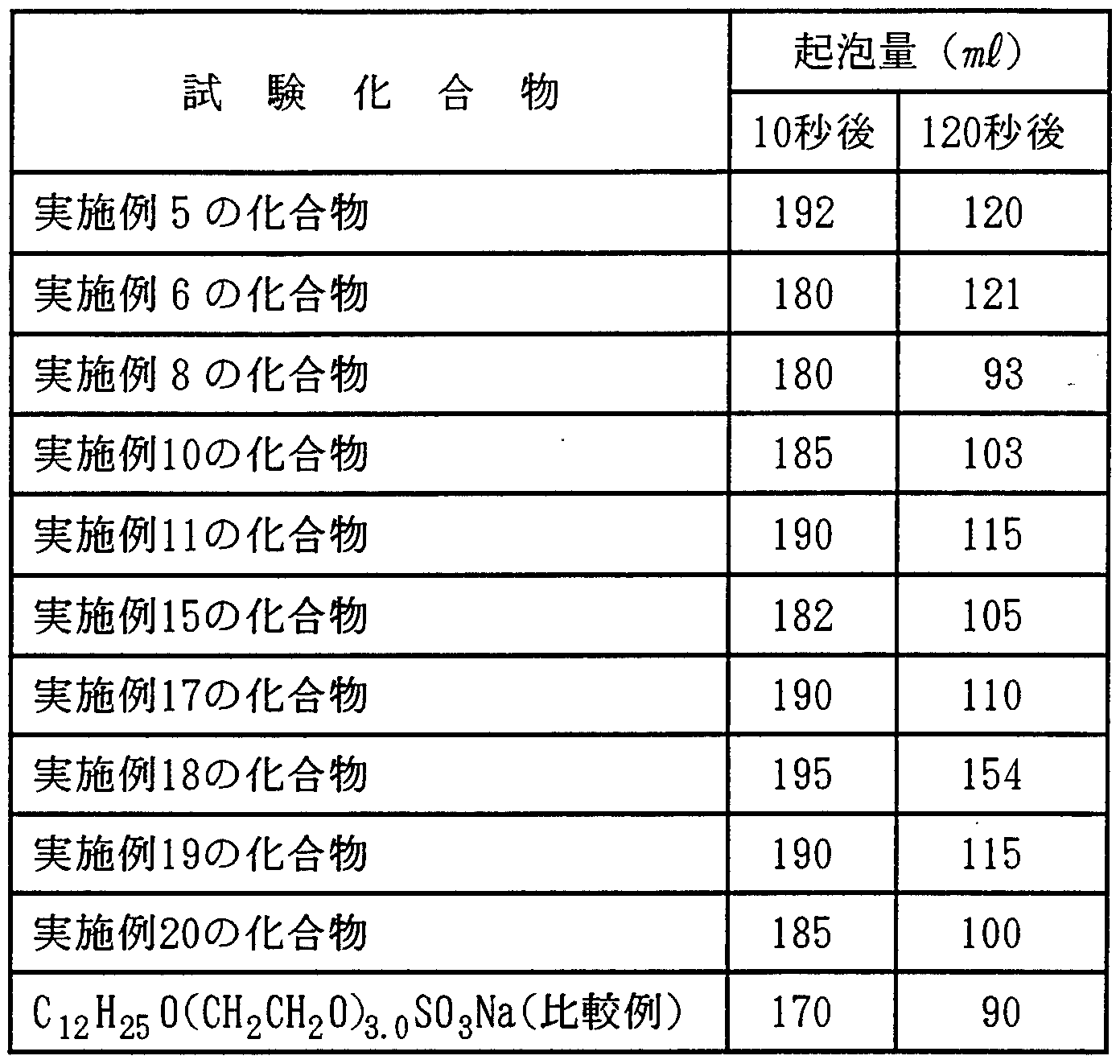
  • Table 3 shows that the compound of the present invention has excellent foaming properties.
  • Table 4 shows that the compound of the present invention has excellent foaming power even in a small amount.
  • Test example 5
  • the skin irritation was examined by the following method.
  • a shampoo having the following composition was produced using the compound of the present invention.
  • the shampoos of Formulation Examples 1 and 2 were both excellent in foaming properties and detergency, and also had a good feel during shampooing and rinsing.
  • a body shampoo having the following composition was produced.
  • composition (% by weight)
  • Each of the body shampoos of Formulation Examples 3 and 4 was excellent in foaming properties and detergency, and had a good feeling after washing as a moisturizer.
  • composition (% by weight) Compound of Example 2 8.0
  • Each of the facial cleansers of Formulation Examples 5 and 6 was excellent in foaming properties and detergency, and the feeling after face washing was good as a moisturizer.
  • Tableware detergents having the compositions shown in Table 7 were prepared, and their foaming power, detergency, and usability (feel of hand) were evaluated. (Test method)
  • Foaming power was measured when 0% by weight of a commercially available butter as a soiling component was added to a 1.0% by weight detergent aqueous solution (water hardness 3.5 ° DH, 40 ° C).
  • the measuring method is as follows. The above-mentioned detergent solution (4 ⁇ ⁇ ) to which butter has been added is placed in a glass cylindrical container having a diameter of 5 cm and a height of 12 cm, and the mixture is rotated and stirred for 10 minutes, and the foam height immediately after the stop is measured. In this test, it is preferable that the foam height is 80 strokes or more. -
  • Detergent aqueous solution with a detergent concentration of 5% by weight water hardness 3.5 ° DH, 40 ° C
  • water hardness 3.5 ° DH, 40 ° C a detergent concentration of 5% by weight
  • the above test is conducted on 10 subjects, and the feeling of use is evaluated by the sum of the obtained scores. In this test, it is desirable that the total score be 10 points or more.
  • the dishwashing detergent containing the compound of the present invention has a good foaming power even in the presence of fat such as butter, a high detergency, and has no irritation to the hands. It can be seen that the feeling is good.
  • a powder detergent composition for clothing having the following composition was prepared. This detergent has excellent detergency at low temperatures (5 ° C) and does not impair the detergency even when the water used has a high hardness (4 to 8. DH).
  • composition Composition
  • Weight Compound of Example 2, 4 or 8
  • a powder detergent composition for clothing having the following composition was prepared. This cleaning agent was excellent in the effect of finishing the clothes softly and with good texture.
  • composition Composition
  • Weight Compound of Example 2, 4 or 8 10.0
  • Polyoxyethylene (E04-18) C 6 -C 22 alkyl ether 25 Cationic cellulose 3
  • a powder detergent for clothing mainly containing a nonionic surfactant having the following composition was prepared.
  • This cleaning agent has solved the problems of conventional cleaning agents containing a nonionic surfactant as a main component, such as the disadvantages of less foaming during washing and poor rinsing properties.
  • Composition (% by weight) Compound of Example 2, 4 or 8 5.0 Polyoxyethylene (E04-18) C 6 -C 22 alkyl ether 22.0
  • a liquid detergent composition having the composition shown in Table 8 was prepared, and its detergency was evaluated.
  • Kanuma horticultural akadama soil is dried at 120 ° C ⁇ 5 for 4 hours and then crushed, and a 150-mesh (100) pass is dried at 120 ° C ⁇ 5 ° C for 2 hours and soiled.
  • 150 g Dispersed in 100 Qi perchren, gold wire ⁇ 220 3 Cloth is contacted with this liquid and brushed to remove the dispersion liquid and remove excessively adhered dirt (Japanese Patent Application Laid-Open No. 55-246473) No. Gazette).
  • the detergency was measured by measuring the reflectance at 460 ⁇ of the original cloth before and after the cleaning with a self-colorimeter (Z-300A, manufactured by Nippon Denshoku Co., Ltd.). Cleaning rate
  • the detergent containing the compound of the present invention was excellent in detergency against sebum dirt and mud dirt.
  • Example 11 Compound 40 35 of Difficult Example 6 Compound 40 35 of Polyoxyethylene (E07) 20 5
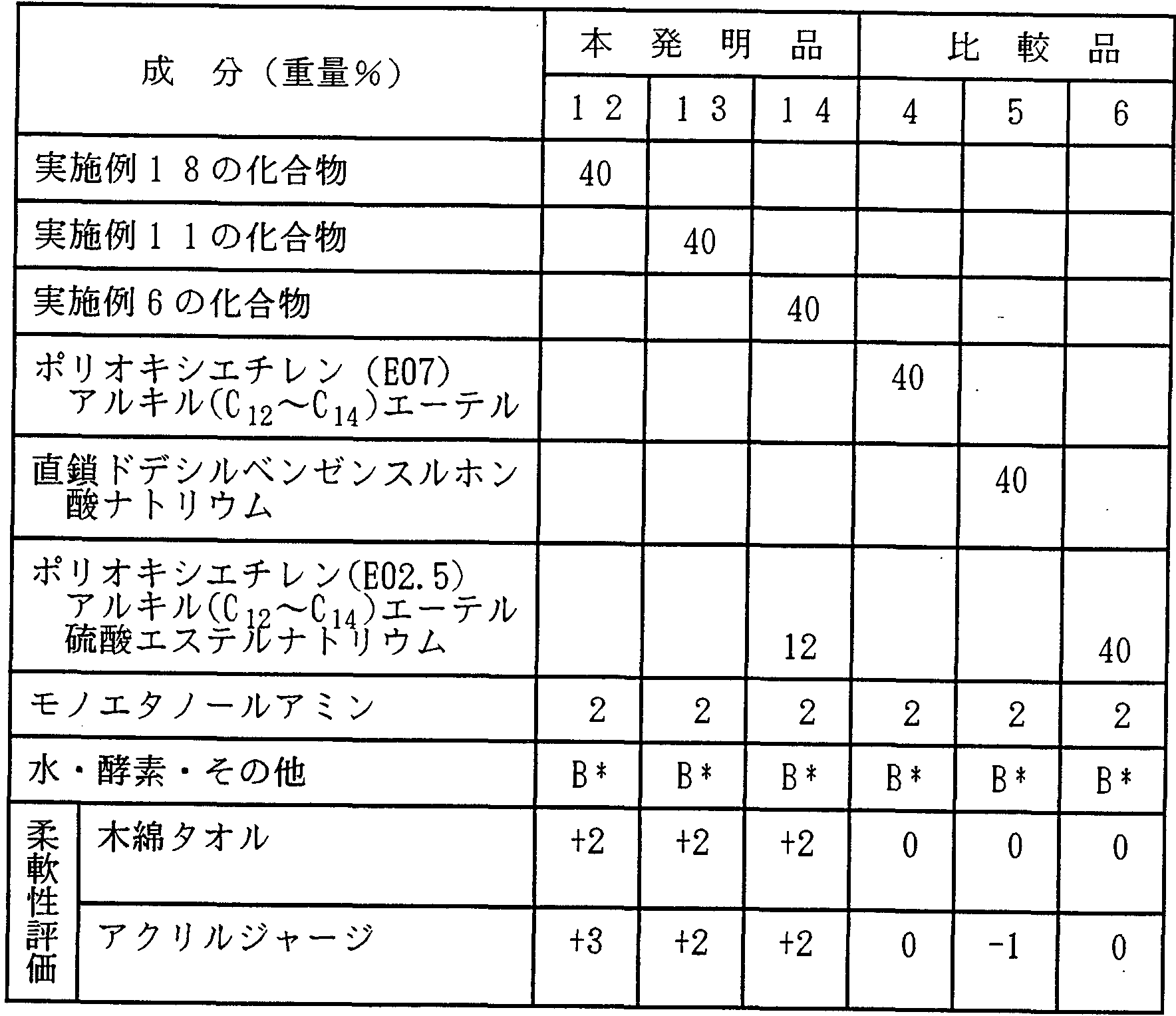
  • a liquid detergent composition having the composition shown in Table 9 was prepared, and its flexibility against various fibers was adjusted.
  • the cloth treated in the above manner was air-dried in a room, and then left standing for 24 hours in a thermostatic chamber at 25 ° C. and 65% RH. These fabrics were evaluated for flexibility.
  • the novel compound of the present invention a 2-hydroxypropanediamine derivative, a salt thereof, or a quaternary compound thereof, has excellent foaming properties, is less irritating to the skin and the like, and can give a favorable feeling to the skin and the hair. it can. Therefore, the compound of the present invention is useful as a base for hair and skin cosmetics, a detergent, an emulsifier, a wetting agent, a conditioning agent, a modifier, and the like.

Landscapes

  • Chemical & Material Sciences (AREA)
  • Organic Chemistry (AREA)
  • Life Sciences & Earth Sciences (AREA)
  • Health & Medical Sciences (AREA)
  • Animal Behavior & Ethology (AREA)
  • General Health & Medical Sciences (AREA)
  • Public Health (AREA)
  • Veterinary Medicine (AREA)
  • Birds (AREA)
  • Epidemiology (AREA)
  • Engineering & Computer Science (AREA)
  • Chemical Kinetics & Catalysis (AREA)
  • Oil, Petroleum & Natural Gas (AREA)
  • Wood Science & Technology (AREA)
  • Biophysics (AREA)
  • Molecular Biology (AREA)
  • Dermatology (AREA)
  • Organic Low-Molecular-Weight Compounds And Preparation Thereof (AREA)
  • Detergent Compositions (AREA)
  • Cosmetics (AREA)

Description

明 細 書
2—ヒドロキシプロパンジァミン誘導体及びこれを含有する洗浄剤組成物 技術分野
本発明は、 毛髪及び皮膚化粧料の基剤、 洗浄剤、 乳化剤、 コンディショニング 剤などとして有用な 2 —ヒドロキシプロパンジアミン誘導体、 その塩又はその 4 級化物に関する。 景技術
従来より、 洗浄剤としてアルキル硫酸塩、 ポリオキシエチレンアルキル硫酸塩、 アルキルベンゼンスルホン酸塩などの界面活性剤が使用されている。 しかし、 こ れらの多くは使用時において皮膚に対する刺激がやや強いという問題がある。 こ のような問題から、 アルキルリン酸塩、 ァシル化アミノ酸塩などの皮膚刺激の弱 い界面活性剤が、 毛髪及び皮膚化粧料の基剤、 乳化剤として又は皮膚等の洗浄剤 として使用されるようになっている。 更に、 最近では、 消費者の要求の多様化や 高級品指向にともない、 皮膚などに対する刺激が少ないことに加え、 起泡性がよ いものや、 皮膚などに好ましい感触を付与できることなどの効果を有するものが 求められているが、 これらの要求を充分満足できるものはなかった。
従って、 本発明の目的は、 上記問題点を解決し、 皮膚などに対する刺激が少な く、 起泡性に優れ、 更に皮膚等に好ましい感触を与えることができ、 毛髪及び皮 膚化粧料の基剤、 洗浄剤、 乳化剤、 コンディショニング剤などとして有用な化合 物を提供することにある。 発明の開示
かかる実情において、 本発明者らは鋭意研究を行った結果、 後記一般式 ( 1 ) で表わされる新規化合物が、 皮膚等に対して低刺激で好ましい感触を与え、 かつ 優れた起泡性を有すること、 更にこの化合物を配合すれば洗浄力及び起泡力に優 れ、 かつ皮膚に対する刺激性のない洗浄剤が得られることを見出し、 本発明を完 成した。
すなわち、 本発明は、 次の一般式 ( 1 )
Figure imgf000004_0001
〔式中、 R 1 及び R 2 は同一又は異なって炭素数 6〜3 6の直鎖又は分岐鎖のァ ルキル又はアルケニル基を示し、 Xはヒドロキシル、 スルホン酸基又はカルボキ シル基が置換していてもよい炭素数 1〜6のアルキレン又はアルケニレン基を示 し、 Y 1 はスルホン酸基、 硫酸残基又はカルボキシル基を示し、 Y 2 はヒドロキ
0
II
シル基、 硫酸残基又は一 O C X— C O O Hを示し、 nは 0又は 1を示す〕 で表わされる 2—ヒドロキシプロパンジァミン誘導体、 その塩又はその 4級化物 を提供するものである。
また、 本発明はこの 2—ヒドロキシプロパンジァミン誘導体 ( 1 ) 、 その塩又 はその 4級化物を含有する洗浄剤組成物を提供するものである。 図面の簡単な説明
図 1は、 実施例 5で得られた化合物の1 H— NMRチャートである。 図 2は、 実施例 6で得られた化合物の1 H— NMRチャートである。 図 3は、 実施例 8で 得られた化合物の1 H— NM Rチャートである。 図 4は、 実施例 1 0で得られた 化合物の1 H— NMRチャートである。 図 5は、 実施例 1 1で得られた化合物の ' Η— NMRチヤ一トである。 発明を実施するための最良の形態
2—ヒドロキシプロパンジァミン構造を有する化合物としては、 米国特許第 3 6 5 4 1 5 8号、 西独特許第 3 6 0 7 8 8 4号、 米国特許第 4 9 8 2 0 0 0号、 特開平 1一 2 3 3 2 6 4号、 特開平 2— 2 2 3 5 1 5号等が知られているが、 こ れらの化合物にはカルボキシル基、 スルホン酸基、 硫酸残基等のァニオン性官能 基が存在せず、 本発明化合物とはその構造、 機能ともに大きく異なっている。 式 ( 1 ) 中、 R 1 及び R 2 で示される炭素数 6〜 3 6の直鎖又は分岐鎖のアル キル基としては、 へキシル基、 ヘプチル基、 ォクチル基、 ノニル基、 デシル基、 ゥンデシル基、 ドデシル基、 トリデシル基、 テトラデシル基、 ペン夕デシル基、 へキサデシル基、 ヘプ夕デシル基、 ォクタデシル基、 ノナデシル基、 エイコシル 基、 ヘンエイコシル基、 ドコシル基、 トリコシル基、 テトラコシル基などの直鎖 アルキル基及びこれらの分岐鎖アルキル基を挙げることができる。-また、 炭素数
6〜3 6の直鎖又は分岐鎖のアルケニル基としては、 へキセニル基、 ヘプテニル 基、 ォクテニル基、 ノネニル基、 デセニル基、 ドデセニル基、 ゥンデセニル基、 トリデセニル基、 テトラデセニル基、 ペンタデセニル基、 へキサデセニル基、 へ プ夕デセニル基、 ォク夕デセニル基、 ノナデセニル基、 エイコセニル基、 ヘンェ ィコセニル基、 ドコセニル基、 トリコセニル基、 テトラコセニル基などの直鎖ァ ルケニル基及びこれらの分岐鎖アルケニル基を挙げることができる。 R i 及び R 2 としては、 これらのなかでも炭素数 6〜2 4のアルキル基又はアルケニル基 が、 特に炭素数 6〜2 4のアルキル基が、 更には炭素数 6〜 1 8のアルキル基が 好ましい。
式 ( 1 ) 中、 Xで示される炭素数 1〜6のアルキレン又はアルケニレン基とし ては、 例えばメチレン基、 エチレン基、 トリメチレン基、 テトラメチレン基、 ぺ ンタメチレン基、 へキサメチレン基、 メチルエチレン基、 ェチルエチレン基、 ェ テニレン基、 プロぺニレン基、 ブテニレン基、 ペンテ二レン基、 へキセニレン基 等が挙げられる。 このうち炭素数 1〜 4のものが好ましく、 炭素数 1〜3のもの がより好ましく、 メチレン基、 エチレン基、 トリメチレン基、 ェテニレン基が特 に好ましい。
これらのアルキレン又はアルケニレン基には、 ヒ ドロキシル基(-0H)、 スルホ ン酸基 (_S03H) 又はカルボキシル基 (- C00H) が置換し得る (ただし、 X 1はヒ ドロキシル基又はカルボキシル基が置換し得る) 力 これらの置換基は 1種又は 2種以上を組み合わせて 1〜4個置換していてもよい。
ヒドロキシル置換アルキレン又はアルケニレン基としては、 1 ―ヒドロキシェ チレン基、 2—ヒドロキシエチレン基、 1, 2—ジヒドロキシエチレン基、 1一 ヒ ドロキシトリ メチレン基、 2 —ヒ ドロキント リ メチレン基、 3 —ヒ ドロキント リ メチレン基、 1 , 2—ジヒ ドロキシト リ メチレン基、 1, 3—ジヒ ドロキント リ メチレン基、 1 , 2, 3 — ト リ ヒ ドロキシト リ メチレン基、 1 ーヒ ドロキシテ トラメチレン基、 2 —ヒ ドロキシテトラメチレン基、 3 —ヒ ドロキシテトラメチ レン基、 4 ーヒ ドロキシテトラメチレン基、 1 , 2—ジヒ ドロキジテトラメチレ ン基、 1 , 3—ジヒ ドロキシテトラメチレン基、 1 , 4 ージヒ ドロキシテトラメ チレン基、 2 , 3—ジヒ ドロキシテトラメチレン基、 2 , 4—ジヒ ドロキシテト ラメチレン基、 3, 4ージヒ ドロキシテトラメチレン基、 1 , 2 , 3 — ト リ ヒ ド ロキシテトラメチレン基、 2 , 3, 4 一 トリ ヒ ドロキシテトラメチレン基、 1, 3, 4 — トリ ヒ ドロキシテトラメチレン基、 1 , 2 , 3, 4ーテトラヒ ドロキシ テトラメチレン基等が挙げられるが、 このうち 1 , 2 —ジヒ ドロキシエチレン基、 1 ーヒ ドロキシエチレン基、 2 —ヒ ドロキシエチレン基、 2 —ヒ ドロキント リ メ チレン基が特に好ましい。
スルホン酸基置換アルキレン又はアルケニレン基としては、 1 ースルホェチレ ン基、 2—スルホエチレン基、 1 ースルホトリ メチレン基、 .2 —スルホト リ メチ レン基、 3 —スルホトリ メチレン基、 1 —スルホテトラメチレン基、 2 —スルホ テトラメチレン基、 3—スルホテトラメチレン基、 4—スルホテトラメチレン基、 1, 3 —ジスルホテトラメチレン基、 1 , 4 一ジスルホテトラメチレン基、 2 , 3 —ジスルホテトラメチレン基、 2, 4 一ジスルホテトラメチレン基等が挙げら れるが、 このうち特に 1 一スルホエチレン基、 2 —スルホエチレン基が特に好ま しい。
カルボキシル基が置換したアルキレン又はアルケニレン基としては、 1 一カル ボキシエチレン基、 2 —カルボキシエチレン基、 1 —カルボキシト リ メチレン基、 2 —カルボキシト リ メチレン基、 3 —カルボキシト リ メチレン基、 1 —カルボキ シテトラメチレン基等が挙げられる。
ヒ ドロキシル基及びカルボキシル基が置換したアルキレン又はアルケニレン基 としては、 2 —カルボキシー 1 —ヒ ドロキシトリ メチレン基、 2 —カルボキシ— 1 , 3 —ジヒ ドロキシト リ メチレン基、 2 —カルボキシー 2 —ヒ ドロキント リ メ チレン基、 3 —カルボキシー 2 , 4—ジヒ ドロキシテトラメチレン基などを挙げ ることができる。 これらのなかでも 2—カルボキシ一 2—ヒ ドロキシトリメチレ ン基が好ましい。
ヒ ドロキシル基及びスルホン酸基が置換したアルキレン又はアルケニレン基と しては、 1 ーヒ ドロキシー 2 —スルホエチレン基、 2 —ヒドロキシー 1 —スルホ エチレン基、 1 ーヒ ドロキシー 2—スルホトリメチレン基、 1 ーヒ ドロキシー 3 —スルホトリメチレン基、 2 —ヒドロキシ一 1 —スルホトリメチレン基、 2 —ヒ ドロキシ一 3 —スルホトリメチレン基、 1 , 2 —ジヒ ドロキシ一 3 —スルホトリ メチレン基、 1, 3—ジヒ ドロキシ一 2—スルホトリメチレン基、 1—ヒドロキ シー 2 —スルホテトラメチレン基、 1 —ヒドロキシー 4ースルホテトラメチレン 基、 2 —ヒ ドロキシ一 4ースルホテトラメチレン基、 3 —ヒドロキシ一 4ースル ホテトラメチレン基等が挙げられる。
本発明化合物 ( 1 ) は、 スルホン酸基 (_S03H) 、 硫酸残基 (- 0S03H) 又は力 ルポキシル基 (-C00H) を有するので種々の塩基性物質との間に塩を形成し得る。 例えばアルカリ金属塩、 アルカリ土類金属塩、 アミ ン塩、 塩基性アミノ酸塩、 ァ ン乇ニゥ厶塩などを挙げることができる。 具体的には、 ナトリウム、 カリウム、 リチウム、 マグネシウム、 カルシウム、 トリメチルァミン、 トリェチルァミン、 トリブチルァミ ン、 モノエタノールァミン、 ジエタノールァミン、 トリエタノー ルァミン、 リジン、 アルギニン、 コリン、 アンモニアなどとの塩を挙げることが でき、 これらのなかでもアルカリ金属塩、 特にナトリウム塩が好ましい。 なお、 本発明化合物 ( 1 ) は、 第 3級アミノ基を有するので、 プロ トンが第 3級ァミノ 基の窒素原子上に配位して当該第 3級ァミノ基がアンモニゥ厶カチオンとなり、 スルホン酸基、 硫酸残基又はカルボキシル基がスルホン酸ァニオン、 硫酸ァニォ ン又はカルボキシァ二オンとなった 4級塩構造をとっていることもある。
また、 本発明化合物 ( 1 ) は、 必要により第 4級化物とすることもでき、 具体 的には式 ( 1 ) 中の 2個の窒素原子が第 4級化された化合物 ( 1 ί ) が挙げられ
Figure imgf000008_0001
〔式中、 R3 及び R4 はスルホン酸基、 カルボキシル基もしくはヒドロキシル基 が置換してもよい炭素数 1〜 6のアルキル又はアルケニル基、 ベンジル基又は -(R50)mH (ここで R5 は炭素数 2〜4のアルキレン基を、 mは 1〜5 0の数を示 す) を示す〕
ここで、 水酸基、 カルボキシル基、 スルホン酸基が置換していてもよい炭素数 1 〜 6のアルキル基としては、 例えばメチル基、 ェチル基、 プロピル基、 イソプロ ピル基、 ブチル基、 ペンチル基、 へキシル基、 ヒドロキシェチル基、 1, 2—ジ ヒ ドロキシプロピル基、 カルボキシメチル基、 2—ヒドロキシ— 3—スルホプロ ピル基等が挙げられる。 基- (R50)mHで示される基としては、 具体的には、 ポリオ キシエチレン基、 ポリオキシプロピレン基等が例示され、 就中 m= l〜2 0のも のが好ましい。 なお、 本発明化合物 ( 1 ) の第 4級化物は、 式 ( 1 ) 中の nが 0 の場合に存在し得るものである。
本発明化合物 ( 1 ) は、 例えば次の反応 a〜反応 dに従って製造される。
〔反応 a〕
R
Figure imgf000009_0001
A2一 χΐ_Υ3 (6)
Figure imgf000009_0002
(5)
Figure imgf000009_0003
〔式中、 A1 及び A2 はハロゲン原子を示し、 X1 はヒドロキシ基又はカルボキ シル基が置換していてもよい炭素数 1〜 6のアルキレン又はアルケニレン基を示 し、 Y3 はスルホン酸基又はカルボキシル基を示し、 R1 及び R2 は前記と同 じ〕
すなわち、 2つのァミン ( ( 2) 及び ( 3) ) とェピハ口ヒドリン ( 4 ) との 反応により得られるアミン誘導体 (5) に、 化合物 (6) 又はその塩を反応させ れば本発明化合物 (l a) が製造される。
2つのァ ミ ン とェピハロ ヒ ドリ ン との反応は、 例えば米国特許第 30 1 7258号又は同第 3654 1 58号に従って行えばよい。
ァミン誘導体 (5) と化合物 (6) 又はその塩との反応は、 例えば不活性溶媒 の存在下 20〜1 50° ( 、 好ましくは 40〜1 00 で、 了ミン誘導体 ( 5 ) に 対し、 1〜1 0倍モル、 好ましくは 2〜5倍モルの化合物 (6) 又はその塩を反 応させることによって行われる。 ここで化合物 (6) の A2 で示されるハロゲン 原子としては、 例えば塩素原子、 臭素原子、 ヨウ素原子が挙げられ、 このうち塩 素原子がより好ましい。 化合物 (6) 又はその塩の具体例としては、 クロ口酢酸 ナトリウム、 3—クロロー 2—ヒドロキシプロパンスルホン酸ナトリウム、 3— クロ口プロピオン酸ナトリウム、 4 一クロロー n —酪酸ナトリゥ厶等が挙げられ、 このうちクロ口酢酸ナトリウム、 3 —クロロー 2 —ヒ ドロキシプロパンスルホン 酸ナトリウムがより好ましい。 また、 ここで用いる不活性溶媒としては、 例えば、 水、 メタノール、 エタノール、 イソプロパノール、 ジメチルホルムアミ ド、 ジメ チルスルホキシド等の極性溶媒等が挙げられ、 これらは 1種又は 2種以上を組み 合わせて用いることができるが、 就中、 水、 低級アルコール又は水と低級アルコ ールの混合溶媒が好ましい。
なお、 本反応においてアミン誘導体 (5 ) に対して化合物 ( 6 ) を過剰に使用 すると下記の第 4級化物 ( I f ' ) が生成する。
Figure imgf000010_0001
〔式中、 R 1 、 R 2 、 X 1 及び Y 3 は前記と同じ〕
この反応終了後、 反応混合物中には目的とする本発明化合物 ( 1 a ) の他、 無 機塩、 未反応のァミン誘導体 ( 5 ) 、 アミン誘導体 ( 5 ) に化合物 ( 6 ) が 1モ ル付加した化合物及び未反応の化合物 (6 ) が含まれている場合がある。 この際 には、 反応混合物をそのまま使用できる場合を除き、 次の方法により精製するこ とができる。 精製方法は、 例えば溶媒分別法、 イオン交換クロマトグラフィー法、 再結晶法、 電気透析法等の常法を採用できる。 また、 得られた目的物は遊離塩基 として単離してもよいが、 所望の塩基物質で中和する等の通常の手段により塩交 換を行い、 所望の塩の形態で単離してもよい。 〔反応 b〕
R 1— NH— CH2
Figure imgf000011_0001
(5) 硫酸エステル化剤 (9)
Figure imgf000011_0002
Figure imgf000011_0003
( 1 b)
〔式中、 R6 及び R7 は同一又は異なって、 水素原子、 ヒドロキシル基又はカル ボキシル基が置換していてもよいアルキル基又はアルケニル基を示し、 Y2' は ヒドロキシル基又は硫酸残基を示し、 R1 、 R2 及び X1 は前記と同じ〕
すなわち、 ァミン誘導体 (5) にエポキシ化合物 (7) を反応させ、 得られる ァミノアルコール (8) に硫酸エステル化剤 (9) を反応させ、 所望により塩基 性物質で中和することにより、 本発明化合物 (l b) が製造される。
ァミン誘導体 (5) とエポキシ化合物 (7) との反応は、 例えば不活性溶媒中、 好ましくは 1 00〜 200 °C、 特に好ましくは 1 30〜 1 80でで、 ァミン誘導 体 (5) に対して、 エポキシ化合物 (7) を 2〜5倍モル反応させることにより 行うのが好ましい。 この反応で使用する不活性溶媒としては、 非プロトン性の溶 媒であれば特に制限されるものではないが、 価格や溶解性の点を考慮すると、 低 級炭化水素類、 芳香族炭化水素類、 エーテル類、 ハロ炭化水素類などが好ましい c また、 この反応は、 エポキシ化合物 (7) 及び使用した不活性溶媒の沸点を考慮 して、 オートクレープなどの耐圧容器内で行うことが好ましい。 エポキシ化合物
(7) としては、 安価であることからエチレンォキシド、 プロピレンォキシド、 ブチレンォキシドが好ましく、 特にエチレンォキシドが好ましい。
次に、 このようにして得られたァミノアルコール (9) と C S03Hや S03等の硫 酸エステル化剤 ( 9) との反応は、 不活性溶媒中又は無溶媒で、 一 7 5°C:〜 1 50°Cの温度範囲で行うのが好ましい。 CiS03Hや S03の使用量は、 アミノアル コール (9) に対して 1〜 3倍モルであるのが好ましい。 また、 この反応終了後、 必要に応じて行う中和反応では、 目的とする中和度に応じて所望量の水酸化ナト リゥ厶、 水酸化力リゥ厶、 水酸化リチウム、 水酸化マグネシゥム、 水酸化力ルシ ゥ厶、 アンモニア、 トリメチルァミ ン、 トリェチルァミ ン、 トリブチルァミ ン、 アルカノールァミ ン (モノエタノールァミン、 ジエタノールァミン、 トリエタノ ールァミンなど) 、 リジン、 アルギニン、 コリンなどの塩基物質、 好ましくは水 酸化ナトリゥ厶、 水酸化力リウム等のアル力リ金属の水酸化物を反応させること により行うことができる。
なお、 上記反応中、 ァミン誘導体 (5) とエポキシ化合物 (7) との反応にお いては、 少量の次式;
Figure imgf000012_0001
で表される化合物が副生し、 更にァミノアルコール (9) と硫酸エステル化剤と の反応においては、 次式;
R
Figure imgf000012_0002
で表される化合物が副生する場合がある。 この反応生成物はそのまま各種の用途 に使用することもできるが、 より高純度のものが必要な場合には、 通常の方法、 例えば再結晶、 カラムクロマトグラフィー、 蒸留等により精製して用いることも できる。 〔反応 C〕
Ri-NH-CH2
Figure imgf000013_0001
(5)
R1— N— CH2CHCH2— N— R2 硫酸エステル化剤 ( 9)
CO OH CO
X1 X1
OH OH
( 1 0)
R1— N— CH2CHCH2— N— R2
CO Y2' CO
OSOoH OSO H
( 1 c)
〔式中、 R8 は水素原子又は置換基を有していてもよいアルキル基を示し、 R1 、 R2 、 X1 及び Y2' は前記と同じ〕
すなわち、 ァミン誘導体 (5) にラク トン類又はォキシカルボン酸類を反応さ せ、 得られるアミ ドアルコール ( 1 0) に硫酸エステル化剤 ( 9) を反応させ、 所望により塩基性物質で中和することにより本発明化合物 ( 1 c) が製造される c ァミン誘導体 (5) とラク トン類又はォキシカルボン酸類との反応は、 例えば 不活性溶媒中又は無溶媒で、 好ましくは 2 0〜 1 8 0 °C、 特に好ましくは 4 0〜
1 5 0°Cで、 アミン誘導体 (5) に対して、 ラク トン類又はォキシカルボン酸類 を 2〜5倍モル反応させることにより行うのが好ましい。 この反応で使用する不 活性溶媒としては、 非プロトン性の溶媒であれば特に制限されるものではないが、 価格や溶解性の点を考慮すると、 低級炭化水素類、 芳香族炭化水素類、 エーテル 類、 ハロ炭化水素類などが好ましい。 この反応に用いるラク トン類及びォキシ力 ルボン酸類としては、 安価であることから、 7—ラク トン、 5—ラク トン、 グリ コール酸、 乳酸、 ひ—ヒ ドロキシ酸及びこれらのメチルエステル、 ェチルエステ ルなどが好ましい。
このようにして得られたアミ ドアルコール ( 1 0) と C^S03Hや S03等硫酸エス テル化剤 (9) との反応は、 不活性溶媒中又は無溶媒で、 - 75°C〜1 50°Cの 温度範囲で行うのが好ま しい。 C_iS03Hや S03の使用量は、 アミ ドアルコール (1 0) に対して 1〜 3倍モルであるのが好ましい。 また、 この反応終了後、 必 要に応じて行う中和反応は、 前記反応 bの場合と同様に行うことができる。 なお、 上記反応中、 ァミ ン誘導体 (5) とラク トン類又はォキシカルボン酸類 との反応においては、 少量の次式;
Figure imgf000014_0001
X1
OH で表される化合物が副生し、 更にアミ ドアルコール (1 0) と硫酸エステル化剤 との反応においては、 次式;
R 2
Figure imgf000014_0002
で表される化合物が副生する場合がある。 この反応生成物はそのまま各種の用途 に使用することもできるが、 より高純度のものが必要な場合には、 通常の方法、 例えば再結晶、 カラムクロマトグラフィー、 蒸留等により精製して用いることも できる。 〔反応 d〕
Figure imgf000015_0001
R1— NH— CH2CHCH2— NH— R2 + 又は
OH R900C— Χΐ— COORio
(5)
R スルホン化剤 ( 9)
Figure imgf000015_0002
( 1 d)
Figure imgf000015_0003
( 1 e)
〔式中、 R9 及び Rlflは水素原子、 置換基を有していてもよいアルキル基又はァ ルケ二ル基を示し、 X2 はヒ ドロキシル基又はカルボキシル基が置換していても よくスルホン酸基が置換している炭素数 1〜6のアルキレン基を示し、 Y2" は
0
II
ヒ ドロキシル基又は— OCX'COOHを示し、 Y2 "'はヒドロキシル基又は
II
一〇CX2C〇OHを示し、 R R2 、 X及び X1 は前記と同じ〕
すなわち、 ァミン誘導体 (5) に酸無水物、 ジカルボン酸又はそのエステルを 反応させ、 エステルを用いた場合は更に加水分解し、 必要に応じて塩基性物質で 中和することにより、 本発明化合物 ( I d) を製造することができる。 また、 得 られた化合物 ( 1 d) の X1 中に - CH=CH-がある場合には、 これに S03、 亜硫酸ナ トリウム、 亜硫酸水素ナトリウム等のスルホン化剤を反応させ、 必要に応じて塩 基性物質で中和することにより本発明化合物 ( 1 e) が製造される。
ァミ ン誘導体 ( 5) と酸無水物との反応は、 例えば無水不活性溶媒の存在下、 2 0〜 1 5 0°C、 好ましくは 4 0〜1 0 0°Cで、 アミ ン誘導体 ( 5) に対して、 好ましくはし 0〜5. 0倍モルの酸無水物を反応させることにより行うのが好 ましい。 ここで用いられる無水不活性溶媒としては、 例えばエーテル、 テトラヒ ドロフラン、 ベンゼン、 ピリジン等が挙げられる。 この反応においてはァミ ン誘 導体 (5) のヒドロキシル基と酸無水物が反応し、 式 ( 1 d) において Y2" -
II
— OCX1 COOHである化合物が得られる。
また、 ァミ ン誘導体 ( 5) とジカルボン酸又はそのエステルとの反応は、 例え ば、 不活性溶媒中、 4 0〜 1 8 0 °C、 好ましくは 8 0〜 1 5 0てで、 ァミ ン誘導 体 (5) に対して、 好ましくは 2. 0〜5. 0倍モルのジカルボン酸又はそのェ ステルを反応させることにより行うのが好ましい。 この反応は、 生成してくるァ ルコール又は水を除去しながら行うのが好ましい。 この反応で用いる不活性溶媒 としては、 へキサン、 ベンゼン、 トルエン、 キシレンなどを挙げることができる。 なお、 ジカルボン酸エステルにおいて、 式中、 R9 及び R1Gで示されるアルキ ル基又はアルケニル基としては、 炭素数 1〜 5のものを挙げることができるが、 これらのなかでも、 メチル基、 ェチル基が好ましい。
なお、 ここでジカルボン酸エステルを用いた場合には、 一般式 ( 1 1 ) で表さ れる製造中間体が得られることになり、 次いでこれを例えば含水アルコール中、 酸又は塩基触媒下、 加水分解することが必要となる。
0 Ri R2 0
R1100C-X1-C-N-CH2CHCH2-N-C-X1-C00R12 ( 1 1 )
OH
〔式中、 R11及び R12は R3 又は Rlflに対応するアルキル又はアルケニル基を示 し、 R1 、 R2 及び X1 は前記と同じ〕
次に、 X1 中に- CH=CH-を有する化合物 ( 1 d) と S03、 亜硫酸ナトリウムや亜 硫酸水素ナトリウム等のスルホン化剤との反応は、 例えば、 水中において、 3 0 〜 1 0 0で、 好ましくは 4 0〜 8 0てで、 化合物 ( 1 d ) に対して 1 . 0〜 6 . 0倍モル、 好ましくは 2 . 0〜5 . 0倍モルの S03、 亜硫酸ナトリウムや亜 硫酸水素ナトリウムを、 pH 4 . 0〜 1 1 . 0、 好ましくは 5 . 0〜8 . 0で反応 させることにより行うのが好ましい。
得られた本発明化合物 ( 1 d ) 及び ( 1 e ) の中和反応は前記反応 bと同様に して行うことができる。 また、 これらの反応においては、 前記反応 b及び反応 c と同様に一方のアミノ基のみがアミ ド化された化合物等が副生するが、 反応生成 物はそのまま各種の用途に使用することもできる。 しかし、 より高純度のものが 必要な場合には、 通常の方法、 例えば再結晶、 カラムクロマトグラフィー、 電気 透析等により精製して用いることもできる。
—般式 ( 1 ) において、 n = 0の場合には、 これに 4級化剤を反応させること により、 本発明化合物 ( 1 ) 中の 2個の窒素原子が第 4級化された化合物 ( 1 f ) が得られる。 4級化剤としては、 スルホン酸基、 カルボキシル基もしく はヒドロキシル基が置換していてもよい炭素数 1〜 6のアルキル (ァルケニル) ハラィ ド、 ベンジルハライ ド、 アルキレンォキサイ ド又はその塩等が挙げられる。 このうち、 アルキルハライ ドがより好ましい。 ここでアルキル基としてはメチル 基、 ェチル基、 n —プロピル基、 n—ブチル基、 イソプロピル基等が挙げられ、 ハロゲンとしては塩素、 臭素、 ヨウ素が挙げられる。 このうちメチルクロライ ド が特に好ましい。
本発明の一般式 ( 1 ) で表わされる 2 —ヒドロキシプロパンジアミ ン誘導体は 優れた洗浄力、 起泡力を有するものであり、 これらの特性を活用した用途、 例え ば、 皮膚及び毛髪用洗浄剤、 食器用洗浄剤、 衣料用洗浄剤等の各種洗浄剤に使用 することができる。 その場合の本発明化合物 ( 1 ) の配合量は特に制限されず、 その用途等に応じて 0 . 1〜8 0重量%、 より好ましくは 1〜5 0重量%の範囲 で用いることができる。
これらの本発明の洗浄剤組成物には、 必要に応じて公知の各種界面活性剤、 保 湿剤、 殺菌剤、 乳化剤、 増粘剤、 パール化剤、 二価金属イオン捕捉剤、 アルカリ 剤、 無機塩、 再汚染防止剤、 酵素、 有効塩素の捕捉剤、 還元剤、 漂白剤、 蛍光染 料、 可溶化剤、 香料、 ケーキング防止剤、 酵素の活性化剤、 酸化防止剤、 防腐剤、 色素、 青味付け剤、 漂 S活性化剤、 酵素安定化剤、 相調節剤、 浸透剤等を配合す ることができる。
ここで界面活性剤としては、 ァニオン界面活性剤、 非イオン界面活性剤、 両性 界面活性剤、 カチオン界面活性剤が使用できる。 ァニオン界面活性剤は通常洗浄 力、 起泡力、 使用感向上のために配合されるものであり、 その例としては高級脂 肪酸塩、 アルキル硫酸塩、 アルキルエーテル硫酸塩、 アルキルスルホン酸塩、 ひ —ォレフイ ンスルホン酸塩、 アルキルベンゼンスルホン酸塩、 アルカノィルイセ チオン酸塩、 アルキルコハク酸塩、 アルキルスルホコハク酸塩、 N—アルカノィ ルザルコシネート、 アルキルリン酸塩、 アルキルェ一テルリン酸塩、 アルキルェ —テルカルボン酸塩等が挙げられる。 これらのァニオン界面活性剤のアルキル及 びァシル基は通常 8〜2 0個の炭素原子を含み、 不飽和でもよい。 アルキルエー テル硫酸塩、 アルキルエーテルリン酸塩及びアルキルエーテルカルボン酸塩は 1 分子当たり 1〜 1 0個のエチレンォキシド又はプロピレンォキシド単位を含み得 るが、 1分子当たり 2〜3個のエチレンォキシド単位を含むのが好ましい。 また、 これらのァニオン界面活性剤の塩としては、 ナトリウム、 マグネシウム、 アンモ ニゥム並びにモノ一、 ジー及びトリエ夕ノールァミン塩を挙げることができる。 非イオン界面活性剤は、 通常洗浄力向上、 使用感向上のために配合されるもの であり、 その例としてはポリオキシアルキレンアルキルエーテル、 ポリオキシァ ルキレンフエニルエーテル、 モノー又はジアルキルアル力ノールアミ ド又はその アルキレンォキシド付加物、 アルキルポリグリコシド、 モノグリセリ ド等が挙げ られる。 これらの非イオン界面活性剤のアルキル又はァシル基は、 通常 8〜2 0 個の炭素原子を含み、 不飽和でもよい。 またポリオキシアルキレン基としては、 ポリオキシエチレン、 ポリオキシプロピレン及びその混合型が挙げられ、 その縮 合度は通常 6〜3 0である。
両性界面活性剤としては長鎖アルキルジメチルカルボキシメチルべ夕イン、 ス ルホベタイン等が挙げられ; カチオン界面活性剤としては長鎮アルキルトリメチ ルアンモニゥム塩、 ジ一長鎖アルキルジメチルアン二ゥ厶塩等が挙げられる。 これらの界面活性剤は本発明の化合物 ( 1 ) と合わせて洗浄剤組成物中通常 0 . 5〜6 0重量%配合され、 特に粉体状洗浄剤組成物においては 1 0〜4 5重 量%、 液体洗浄剤組成物については 2 0〜5 0重量%配合することが好ましい。 また、 洗浄剤が漂白洗浄剤である場合、 界面活性剤は一般に 1〜 1 0重量%、 好 ましくは 1〜 5重量%配合される。
保湿剤としては、 グリセリン、 エチレングリコール、 プロピレングリコール、 1, 3—ブチレングリコール等が使用できる。
増粘剤としては、 ポリアクリル酸、 アクリル酸の架橋ポリマー、—アクリル酸と 疎水性モノマーのコポリマー、 カルボン酸含有モノマーとァクリル酸エステルの コポリマ一、 アクリル酸とアクリル酸エステル、 エチレングリコールのエステル 又はポリエチレングリコールのエステル (例えばその脂肪酸エステル) との架橋 コポリマー、 並びにへテロ多糖ガム類等が使用できる。
パール化剤としては、 C , 6 2 2脂肪酸、 脂肪酸とアルコールの C 1 6 - 2 2エステル、 アルキレングリコール単位などのエレメントを含む C , 2 2脂肪酸エステルから 選択し得る。 適当なアルキレングリコール単位としてはエチレングリコール及び プロピレングリコールを挙げることができる力、 ポリアルキレングリコールを使 用することもできる。 適当なポリアルキレングリコールとしてはポリエチレング リコール及びポリプロピレングリコールなどを挙げることができる。
二価金属イオン捕捉剤としては、 トリポリ リン酸塩、 ピロリン酸塩、 オルソリ ン酸塩などの縮合リン酸塩、 ゼォライ トなどのアルミノゲイ酸塩、 合成層状結晶 性ケィ酸塩、 二トリ口三酢酸塩、 エチレンジァミン四酢酸塩、 クェン酸塩、 イソ クェン酸塩、 ポリアセ夕一ルカルボン酸塩などを使用することができる。
この二価金属イオン捕捉剤は、 0〜5 0重量%、 好ましくは 5〜4 0重量%配 合される。 また、 リンを含有しない二価金属イオン捕捉剤を用いることがより好 ましい。
アルカリ剤及び無機塩としては、 ゲイ酸塩、 炭酸塩、 セスキ炭酸塩、 硫酸塩、 アル力ノールアミ ンなどが使用される。 これらは 0〜8 0重量%配合される。 再汚染防止剤としては、 ポリエチレングリコール、 ポリアクリル酸塩、 ァクリ ル酸ーマレイン酸共重合体等のポリアクリル酸コポリマー、 ポリビニルアルコ一 ル、 ポリ ビニルピロリ ドン、 カルボキシメチルセルロースなどが使用される。 再 汚染防止剤の一部は、 二価金属イオン捕捉剤としても使用できる。 再汚染防止剤 は 0〜1 0重量%、 好ましくは 1〜5重量%配合される。
酵素としては、 セルラーゼ、 ひ一アミラーゼ、 プルラナーゼ、 リパーゼ、 へミ セルラーゼ、 yS—グリコシダ一ゼ、 グルコースォキシダーゼ、 コレステロールォ キシダ一ゼ、 プロテアーゼなどを使用し得る。
水道水中の有効塩素の捕捉剤としては、 硫酸アンモニゥム、 尿素、 塩酸グァニ ジン、 炭酸グァニジン、 スルファ ミン酸グァニジン、 二酸化チォ尿素、 モノエタ ノールァミン、 ジエタノールァミ ン、 トリエタノールァミン、 グリシン、 グル夕 ミ ン酸ナトリウム等で代表されるァミノ酸及び牛血清アルブミン、 カゼィンなど の蛋白質、 更には蛋白質の加水分解、 肉エキス、 魚肉エキスなどが挙げられる。 還元剤としては、 チォ硫酸塩、 亜硫酸塩、 亜ニチオン酸塩等のアルカリ金属塩、 アルカリ土類金属塩等及びロンガリ ッ ト C等が挙げられる。 特に亜硫酸塩が好ま しく、 洗濯液中の酵素を安定化させる。
漂白剤としては、 過炭酸塩、 過硼酸塩、 スルホン化フタロシアニン亜鉛塩又は アルミニウム塩、 過酸化水素などが挙げられる。 漂白洗浄剤とする場合は、 特に 過酸化ナトリゥムが効果的であり、 配合量は 1〜9 5重量 、 更に 5 ~ 9 5重量 %、 特に 2 0〜9 5重量%とするのが好ましい。
蛍光染料としては、 通常洗浄剤に用いられる蛍光染料が挙げられ、 液体洗剤の 場合には、 エタノールなどの低級アルコール、 ベンゼンスルホン酸塩、 ρ— トル エンスルホン酸塩などの低級アルキルベンゼンスルホン酸塩、 グリセリン、 プロ ピレングリコールなどのポリオ一ル類などの可溶化剤を配合することができる。 本発明の洗浄剤組成物は、 本発明化合物 ( 1 ) 及び上記の公知の成分を組み合 わせて、 常法に従い、 製造することができる。 洗浄剤の形態は、 用途に応じて選 択することができ、 例えば液体、 粉末、 顆粒等とすることができる。 実施例
次に実施例を挙げて本発明を更に説明するが、 本発明はこれら実施例に限定さ れるものではない。
実施例 1 反応器にビス一 ( 1 , 3—デシルァミノ) プロパン— 2—オール 4 0. 2 g ( 0. 1 0 8モル) 、 エタノール 2 6 0 g、 水 1 0 0 gを入れ、 5 0°Cに昇温し た。 これに、 モノクロ口酢酸ナトリウム 5 0. 3 g ( 0. 4 3 2モル) を 1 0 0 gのエタノール 7 0 gの水に溶解させた溶液を加え、 水酸化ナトリウム水溶液で pHを 8〜 1 0に保ちながら還流下 2 0時間反応させた。 反応終了後、 溶媒を留去 しクロ口ホルムに溶解し、 不溶の未反応のモノクロ口酢酸ナトリウム、 副生する 塩化ナトリウム等の塩類を除いた。 この後、 シリカゲルカラムクロマトグラフィ 一により、 薄層クロマトグラフィーで単一のスポッ トを与えるまで精製し、 2, 6—ジデシル一 4ーヒ ドロキシー 2, 6—ジァザ一 1 , 7—ヘプタンジカルボン 酸 2 3 gを白色粉末として得た (単離収率 4 4 %) 。
このものは、 HPLC (カラム : RP— 1 8 (メルク社製) ) 、 溶離液メタノ ール ZH20= 8 0 / 2 0測定に於いて単一のピークを与えた。
以下に1 H— NMRデータを示す。
1H-NMR(D20) :
Figure imgf000021_0001
基準(4.75)
0.82(三重線, 6H,a), 1.24( 巾広い一重線, 28H, b),
1.57(巾広い一重線, 4H, c), 2.80〜3.09(複雑な多重線, 8H, d),
3.40(—重線,411,:0, 4.02( 巾広い一重線, lH,e)
Figure imgf000021_0002
実施例 2
反応器にビス一 ( 1 , 3—ォクチルァミ ノ) プロパン— 2—オール 4 0 g ( 0. 1 3モル) 、 エタノール 1 5 0 g、 水 7 0 gを入れ 5 0°Cに昇温した。 こ れにモノクロ口酢酸ナトリウム 5 2 g ( 0. 4 4モル) を 1 0 0 gのエタノール 及び 7 0 gの水に溶解させた溶液を加え、 水酸化ナトリウム水溶液で PHを 8〜 1 0に保ちながら還流下 2 6時間反応させた。 反応終了後、 溶媒を留去し、 クロ 口ホルムに溶解し、 不溶の未反応のモノクロ口酢酸ナトリウム、 副生する塩化ナ トリゥム等の塩類を除いた。 この後シリカゲルカラムクロマトグラフィ一により、 薄層クロマトグラフィーで単一のスポッ トを与えるまで精製し、 2, 6—ジォク チル _ 4ーヒ ドロキシ一 2, 6—ジァザ一 1 , 7 -ヘプ夕ンジカルボン酸 1 9 g (単離収率 3 4 %) を白色粉末として得た。 - このものは、 HPLC (カラム : RP— 1 8 (メルク社製) ) 、 溶離液メタノ ール ZH20= 8 0 / 2 0測定において単一のピークを与えた。
以下に1 H— NMRデータを示す。
!H-NMRCDgO) : δ (ppm)D20 基準(4.75)
0.81(三重線,6}|,&), 1.22( 巾広い一重線, 20H,b),
1.55(巾広い一重線, 4H, c), 2.79〜3.11(複雑な多重線, 8H, d),
3.42(—重線, ,: , 4.02( 巾広い一重線, lH,e) C02 e
CO
Figure imgf000022_0001
試験例 1 起泡力試験:
8 0 0 ; ^容シリンダ一 (0= 6. 4 cm) に表 1に示す各試料の 1重量%水溶液、 0 . 1 重量%水溶液を 1 0 0 τηβ入れ、 4 0 °Cに恒温した。 反転攪拌機 ( I HT 8 S 1 5, 日本サーボ社製) にて 5分間反転攪拌 (正回転 5秒, 逆回転 5秒, 最大回転数 1 0 0 Orpm ) し、 3 0秒後の起泡量 (τηβ) を測定した。 その 結果、 表 1に示すように本発明化合物は優れた起泡力を有することが判明した。 表 1 レ Ττ-曰
水 溶 液 度 0. 1 ¾ m.% 1 ノ
里 ¾)
実施例 1の化合物 2 2 0 2 3 2
実施例 2の化合物 2 1 2 2 2 0
モノラウリルホスフエ ート 1 5 0 1 8 0
トリェ夕ノールァミ ン塩 実施例 3
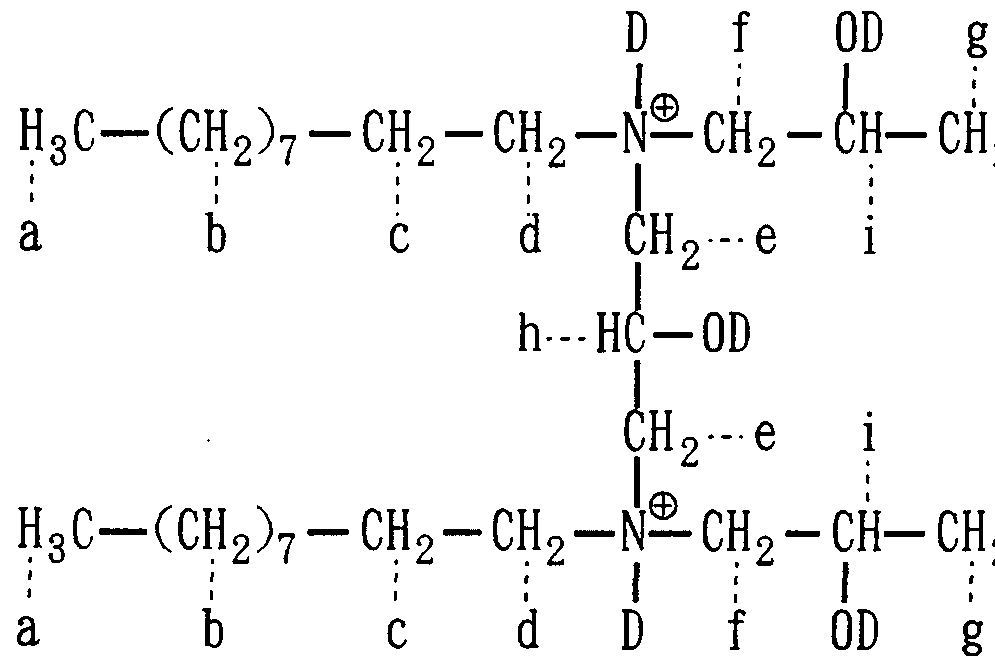
反応器にビス一 ( 1 , 3—デシルァミノ) プロパン一 2—オール 3 1. 8 g ( 0. 0 8 6モル) 、 エタノール 2 4 4 g、 水 5 1 gを入れ、 7 5°Cに昇温した c これにソジゥ厶 3 —クロロ ー 2—ヒ ドロキシプロパン一 1 —スルホネー ト 7 6. 7 g ( 0. 3 9 0モル) を 3 6 1 gの水に溶解させた溶液を加え、 水酸化 ナトリゥム水溶液で pHを 8〜 1 0に保ちながら、 7 5°Cを 2 0時間維持した。 反 応終了後、 溶媒を減圧下留去し、 水一エタノールより結晶化し、 これをアセトン で洗浄し、 電気透析にて脱塩し、 凍結乾燥することにより、 4, 8—ジデシルー 2, 6, 1 0— トリ ヒドロキシー 4, 8—ジァザ一 1, 1 1 —ゥンデカンジスル ホン酸 3 7. 3 g ( 0. 0 5 7モル) を白色粉末として得た。
このものは、 HPLC 〔カラム : RP— 1 8 (メルク社製) ;溶離液; メタノ 一ル 水 = 8 0 / 2 0〕 測定に於いて、 単一のピークを与えた。
以下に1 H— NMRデータを示す (なお、 a— iは、 それぞれのシグナルをも たらす下記化学式中の部位を示す) 。
W—噴 D20) : (5(ppm)D20 基準(4.70)
0.79(三重線, 6H,a), 1.20( 巾広い一重線, 28H, b),
1.5K巾広い一重線, 4H, c),
2.75〜3.24(複雑な多重線, 16H, d, e, f, g),
3.98(巾広い一重線, 1H, h), 4.23(巾広い一重線, 2H, i) 2 _一 ScnO Θ
2— SO 3 Θ
Figure imgf000024_0001
試験例 2 起泡性能試験:
以下の方法により本発明化合物の 4, 8 -ジデシルー 2, 6, 1 0— トリ ヒ ド 口キシー 4, 8—ジァザ— 1 , 1 1 ーゥンデカンジスルホネート及び比較物質と して、 ラウリルエーテル硫酸エステルナトリウム塩の起泡性能を試験した。 この 結果を表 2に示す。
(方法)
1. 約 8 0 07 ^シリンダーに活性剤溶液 1 0 を入れる。
2. 4 0°Cにて反転攪拌を 5分間行う。
3. 静置後、 3 0秒後、 5分後の起泡量 (i を測定する。 表 2
Figure imgf000025_0001
この様に、 本発明の化合物は低濃度、 広い pH領域で優れた起泡力、 泡安定性を 有することが判る。
実施例 4
3, 7—ジドデシル— 3, 7—ジァザ一 1 , 5, 9—ノナントリオ一ルの製造: 容量 1 リッ トルのオートクレーブに、 1 5—ヒドロキシー 1 3, 1 7—ジァザ ノナコサン 5 0. 2 g ( 0. 1 2モル) 及びキシレン 5 0 0 を入れ、 1 5 5°C に昇温した。 これにエチレンォキシド 2 2 g ( 0. 5モル) を注入し、 1 5 5°C で 6時間保持して反応させた。 反応終了後、 溶媒を減圧下で留去し、 標記化合物 6 0 g (収率 9 9 %) を粘稠な液体として得た。
質量分析 (F A Bイオン化法)
m/z = 5 1 5 (M + H) + (M= C 3】 H 663N2 )
JH -匪 R (CDC ) : δ (p pm)
0. 8 5 (三重線, 6 H, a)
1. 2 1 (幅広い一重線, 3 6 H, b)
1. 4 5 (五重線, 4 H, c)
2. 4 1〜2. 7 0 (複雑な多重線, 1 2H, d. e. g)
3. 5 7 (三重線, 4 H, h)
3. 7 5 (五重線, 1 H, f ) g
Figure imgf000026_0001
実施例 5
3, 7—ジドデシルー 5—ヒドロキシ— 3, 7—ジァザ一 1 , 9ーノナンジサル フエ一トの製造:
反応容器に実施例 4で得た 3, 7—ジドデシルー 3, 7—ジァザ一 1 , 5, 9 —ノナントリオ一ル 1 8 g ( 0. 0 3 5モル) 及びジクロロメタン 1 3 を入 れ、 窒素気流下、'氷冷しながらクロロスルホン酸 5. 1^ ( 0. 0 77モル) を 滴下した。 その後、 徐々に室温まで戻し、 窒素を用いて発生する塩酸及びジクロ ロメタンを除去した。 残渣に n—ブ夕ノールを加えて溶解し、 水洗後、 減圧下で 溶媒を留去して 24. 8 gの固体を得た。 次に、 この固体を水に溶解し、 1 N水 酸化ナトリウム水溶液を用いて pH7に調整した。 その後、 脱塩装置 (マイクロア シライザ一 G 3, 旭化成社製) により脱塩し、 更にそれを凍結乾燥機により乾燥 し、 標記化合物 1 7. 2 g (収率 8 5 %) を白色粉末として得た。
この化合物は薄層クロマトグラフィー (展開溶媒: クロ口ホルムノメタノール = 3/ 1 ) により単一スポッ ト (R f = 0. 5) であることを確認した。 また、 この化合物の1 H— NMR (溶媒: CDC_g3 ) チヤ一トを図 1に示す。 更に、 この化合物の I Rスぺク トルは次のとおりであった。
I R (KB r錠剤法, cm—1) : 3 6 0 0〜 3 2 0 0 ( レ 0 - H ) 、 1 3 9 0、 1 1 9 2 ( S=0 )
実施例 6
ソディウム 3, 7—ジドデシル一 3, 7—ジァザ一 1 , 5, 9ーノナントリサル フエ一卜の製造: 反応容器に実施例 4で得た 3, 7—ジドデシル— 3, 7—ジァザ— 1, 5, 9 ーノナントリオール 1 8 g ( 0. 0 3 5モル) 及びジクロロメタン 1 5 を入 れ、 窒素気流下、 氷冷しながらクロロスルホン酸 7. Ίτηβ ( 0. 1 1 5モル) を 滴下した。 その後、 徐々に室温まで戻し、 窒素を用いて発生する塩酸及びジクロ ロメタンを除去した。 残渣に水を加えて溶解し、 更に 1 Ν水酸化ナトリウム水溶 液を用いて ρΗ7に調整した。 その後、 脱塩装置 (マイクロァシライザ一 G 3, 旭 化成社製) により脱塩し、 更にそれを凍結乾燥機により乾燥し、 標記化合物 2 6. 7 g (収率 9 7%) を白色粉末として得た。
この化合物は薄層クロマトグラフィー (展開溶媒: クロ口ホルム Zメタノール = 1 / 1 ) による測定の結果、 単一スポッ ト (R i = 0. 3) であることを確認 した。 また、 この化合物の1 H— NMR (溶媒: D2〇) チャートを図 2に示す。 更に、 この化合物の I Rスぺク トルは次のとおりであった。
I R (KB r錠剤法, cm—1) : 1 3 9 0、 1 1 8 6 ( S=0 )
実施例 7
5, 9—ジドデシル— 4, 1 0—ジォキソ— 5, 9—ジァザ— 1 , 7, 1 3— ト リデカントリオールの製造:
反応容器に、 1 5—ヒ ドロキシー 1 3 , 1 7—ジァザノナコサン 9. 5 g ( 0. 0 2モル) 及び 7—ブチロラク トン 1 1. 7 g ( 0. 1 3モル) を入れ、 1 6 0°Cに昇温し、 この温度で 5時間保持して反応させた。 反応終了後、 カラム クロマトグラフィー (シリカゲル 5 0 0 g, 展開溶媒: クロ口ホルム Zメタノー ル = 9 7 Z 3) により精製し、 標記化合物 6 g (収率 4 5 %) を粘稠な液体とし て得た。
質量分析 (FABイオン化法)
m/z = 6 0 0 (M + H) + (M= C 35H7。〇 5N2)
JH—匪 R (CDC ) : δ (ρ pm)
0. 8 7 (三重線, 6 H, a)
1. 2 3 (幅広い一重線, 3 6 H, b)
1. 5 3 (五重線, 4 H, c)
1. 8 5 (五重線, 4 H, h) 2. 4 0〜2. 5 2 (幅広い多重線, 4 H, g)
3. 2 8〜3. 4 0 (幅広い多重線, 8 H, d. e)
3. 6 5 (三重線, 4 H, i )
4. 0 3 (幅広い多重線, 1 H, f )
Figure imgf000028_0001
実施例 8
ジソディウム 5, 9—ジドデシルー 7—ヒドロキシー 4, 1 0—ジォキソ一 5, 9一ジァザ一 1 , 1 3— トリデカンジサルフェートの製造:
反応容器に実施例 7で得た 5, 9—ジドデシルー 4, 1 0—ジォキソ— 5, 9 ージァザ— 1 , 7, 1 3 - トリデカントリオール 6 g ( 0. 0 1モル) 、 ピリジ ン 4. 5 g ( 0. 0 6モル) 及びジクロロメタン 5 を入れ、 窒素気流下、 氷 冷しながらクロロスルホン酸 ( 0. 0 2モル) を滴下した。 その後、 0〜5 でを維持し、 4時間攪拌を続けた。 反応終了後、 ナトリウムメチラート (2 8 % メタノール溶液) 1 1 g ( 0. 0 6モル) により処理した。 次に、 溶媒を減圧下 留去して、 残渣を水に溶解し、 電気透析により脱塩処理した。 この水溶液を凍結 乾燥することにより、 標記化合物 3. 3 g (収率 4 1 %) を白色粉末として得た c この化合物は薄層クロマトグラフィ一 (展開溶媒: クロ口ホルム メタノール = 2/1 ) による測定の結果、 単一スポッ ト (R f = 0. 3) であることを確認 した。 また、 この化合物の1 H— NMR (溶媒: CDC 3) チャートを図 3に示 す。 更に、 この化合物の I Rスペク トルは次のとおりであった。
I (KB r錠剤法, cm— : 3 6 2 0〜 3 3 0 0 ( 0-H ) 、 1 6 9 0 (レ C=0 ) 、 1 3 9 2、 1 1 8 8 ( S=0 ) 実施例 9
3, 7—ジドデシル一 2, 8—ジォキソー 3, 7—ジァザ一 1 , 5, 9—ノナン トリオールの製造:
反応容器に 1 5—ヒ ドロキジ— 1 3, 1 7—ジァザノナコサン 1 0. 7 g ( 0. 0 3モル) 、 トルエン 5 及びグリコール酸ェチル 7. Ι ηβ ( 0. 0 7 モル) を入れ、 1 0 0°Cに昇温し、 窒素気流により生成するエタノールを追い出 しながら、 7. 5時間攪拌を続けた。 反応終了後、 減圧下溶媒を留去して、 残渣 をカラムクロマトグラフィー (シリカゲル 2 0 0 g, 展開溶媒: クロ 口ホルム Zメタノール = 1 0 0/1 ) により精製し、 標記化合物 1 3 g (収率 9 69 ) を 粘稠な液体として得た。
質量分析 (F A Βイオン化法)
m/z = 5 4 3 (M + H) + (M= C 3. H 6205N2)
!H-NMR (CDC ) : δ (p pm)
0. 8 2 (三重線, 6 H, a)
1. 2 8 (幅広い一重線, 3 6 H, b)
1. 4 9〜1. 6 0 (幅広い多重線, 4 H, c)
3. 1 8 (三重線, 4H, d)
3. 4 8 (多重線, 4 H, e)
4. 0 5 (幅広い多重線, 1 H, f )
4. 2 0 (一重線, 4 H, g)
Figure imgf000030_0001
実施例 1 0
ジソディウム 3, 7—ジドデシルー 5—ヒドロキシ 2, 8—ジォキソー 3, 7 —ジァザ— 1 , 9—ノナンジサルフェートの製造:
反応容器に実施例 9で得た 3, 7—ジドデシルー 2, 8—ジォキソー 3, 7— ジァザ一 1, 5, 9—ノナントリオール 1 0. 8 g (0. 0 2モル) 及びジクロ ロメタン 5 0 τηβを入れ、 窒素気流下、 氷冷しながらクロロスルホン酸 3 m
(0. 04モル) を 20分かけて滴下した。 その後、 徐々に室温に戻し、 窒素気 流により発生する塩酸及びジクロロメ夕ンを除去した。 残渣に水を加えて溶解し、
1 N水酸化ナトリゥム水溶液により p Hを 7に調整した。 この水溶液を電気透析 により脱塩処理したのち、 凍結乾燥することにより、 標記化合物 1 1. 8 g (収 率 7 9 %) を白色粉末として得た。
この化合物は薄層クロマトグラフィー (展開溶媒: クロロホルム Zメタノール = 3/1 ) による測定の結果、 単一スボッ ト (R i = 0. 2) であることを確認 した。 また、 この化合物の1 H— NMR (溶媒: D2〇) チヤ一トを図 4に示す。 更に、 この化合物の I Rスぺク トルは次のとおりであった。
I R (KB r錠剤法, cmーリ : 3 6 0 0〜 3 2 0 0 ( 0-H ) 、 1 6 5 8
( C=0 ) 、 1 3 8 5、 1 1 9 5 ( S=0 )
実施例 1 1
トリソディウム 3, 7—ジドデシルー 2, 8—ジォキソ— 3, 7—ジァザ一 1 , 5, 9—ノナントリサルフェートの製造:
反応容器に実施例 9で得た 3, 7—ジドデシルー 2, 8—ジォキソ— 3, 7— ジァザ一 1 , 5, 9—ノナントリオール 2 8 g ( 0. 0 5モル) 及びジクロロメ タン 1 0 0 r を入れ、 窒素気流下、 氷冷しながらクロロスルホン酸 1 1 m£ ( 0. 1 6モル) を滴下した。 その後、 徐々に室温に戻し、 窒素気流により発生 する塩酸及びジクロロメタンを除去した。 残渣に氷を加えて溶解し、 1 N水酸化 ナトリゥム水溶液により p Hを 7に調整した。 この水溶液を電気透析により脱塩 処理したのち、 凍結乾燥することにより、 標記化合物 2 8 g (収率 6 6 %) を白 色粉末として得た。 - この化合物は薄層クロマトグラフィ一 (展開溶媒: クロ口ホルム Zメタノール = 1 /1 ) による測定の結果、 単一スポッ ト (R ί = 0. 3) であることを確認 した。 また、 この化合物の1 Η— NMR (溶媒: D2〇) チヤ一トを図 5に示す。 更に、 この化合物の I Rスぺク トルは次のとおりであった。
I R (KB r錠剤法, cm- : 1 3 9 0、 1 1 8 5 (レ S=0 ) 、 1 6 6 0 ( C=0 )
実施例 1 2
反応器に、 ビス— ( 1, 3—デシルァミノ) プロパン一 2—オール 22. 2 g (0. 0 6モル) 、 無水コハク酸 1 3. 2 g (0. 1 2モル) 及び無水エーテル 3 0 0m£を入れ、 5時間還流した。 反応終了後、 エーテルを減圧下留去すること により、 4, 8—ジデシル一 3, 9—ジォキツー 6—ヒドロキシ一 4, 8—ジァ ザ一 1 , 1 1—ゥンデカンジカルボン酸 34 g (0. 0 6モル) をガラス状固体 として得た。
本化合物を水酸化ナトリウムにより pH 1 0に調整したものは、 HPLC測定 において 〔カラム : RP— 1 8 (メルク社製) , 溶離液: メタノール/水 = 8 0 /2 0〕 単一ピークを与えた。 以下に、 'Η— NMRデータを示す。
'Η— NMR (CDC 3) : δ (p pm) TMS基準
0. 8 8 (三重線, 6 H, a)
1. 2 6 (幅広い一重線, 28H, b)
1. 4 7 (幅広い一重線, 4 H, c)
2. 64 (複雑な多重線, 8 H, g. h)
3. 3 - 3. 9 (複雑な多重線, 9H, d. e. f )
Figure imgf000032_0001
実施例 1 3
反応器に、 ビス- ( 1, 3—デシルァミノ) プロパン一 2—オール 1 7. 04 g ( 0. 0 4モル) 、 無水マレイン酸 7. 8 g ( 0. 0 8モル) 及び無水エーテ ル 2 0 0 を入れ、 3時間還流した。 反応終了後、 減圧下、 エーテルを留去し、 4, 8—ジドデシルー 3, 9—ジォキソー 6—ヒドロキシ一 4, 8—ジァザ— 1 , 1 0—ゥンデケン一 1, 1 1—ジカルボン酸 2 5 g ( 0. 04モル) をガラス状 固体として得た。
本化合物を水酸化ナトリウムにより pH 7に調整したものは、 HP L C測定に おいて 〔カラム : RP— 1 8 (メルク社製) , 溶離液: メタノール/水 = 7 5/ 25〕 単一ピークを与えた。 以下に、 'Η— NMRデータを示す。
!H-NMR (CDC^3) : δ (p pm) TMS基準
0. 8 9 (三重線, 6 H, a)
1. 2 7 (幅広い一重線, 3 6 H, b)
1. 5 6 (幅広い一重線, 4 H, c)
3. 2 5 - 3. 5 8 (複雑な多重線, 8 H, d. e)
3. 8 - 3. 9 5 (複雑な多重線, 1 H, f )
6. 1 - 6. 6 5 (複雑な多重線, 4 H, g. h)
Figure imgf000033_0001
試験例 3
下記方法により、 実施例 1 2で得られた 4, 8—デシルー 3, 9ージォキソ— 6—ヒドロキシ一 4, 8—ジァザ一 1 , 1 1ゥンデカンジカルボン酸ナトリウム- 実施例 1 3で得られた 4, 8—ジドデシルー 3, 9—ジォキソ— 6—ヒ ドロキシ — 4 , 8—ジァザ一 1 , 1 0—ゥンデケン一 1 , 1 1 ージカルボン酸ナトリウム 及び比較化合物としてのラウリン酸ナトリウム塩の起泡性を試験した。
(試験方法)
まず、 約 8 0 0 のシリンダーに、 各化合物の水溶液 ( 0. 1重量%) 1 0 0 を入れた。 次に、 反転攪拌を 4 0でで 5分間行った。 その後、 静置し、 3 0秒 経過後及び 5分間経過後の起泡量 (τηβ) を測定した。 結果を表 3に示す。
表 3
Figure imgf000033_0002
表 3より、 本発明化合物は、 優れた起泡性を有していることがわかった。
実施例 1 4
反応器にビス— ( 1 , 3— ドデシルァミノ) プロパン一 2—オール 1 0. 6 5 g ( 0. 0 2 5モル) 、 トルエン 1 0 0 及び酒石酸ジェチル 1 7. 1 τηβ ( 0. 1モル) を入れ、 8 0 °Cで、 生成してく るエタノールを除去しながら 2 0時間反応させた。 反応終了後、 水洗により過剰の酒石酸ジェチルを除去し、 トルエン層を無水硫酸ナトリウムで乾燥した。 その後、 減圧下において乾固する ことにより、 4, 8—ジドデシル一 3, 9—ジォキソ一 1 , 2, 6, 1 0, 1 1 —ペン夕ヒ ドロキシー 4, 8—ジァザ一 1, 1 1—ゥンデカンジカルボン酸ェチ ル 1 8 g ( 0. 0 24モル) ( 9 7%) を粘稠な液体として得た。—
以下に、 'H— NMRデータを示す。
'Η— NMR (CDC ^3) : δ (p pm) TMS基準 -
0. 8 9 (三重線, 6 H, a)
1. 2— 1. 3 (複雑な多重線, 4 2H, b, j )
1. 6 3 (幅広い一重線, 4 H, c)
3. 5 2 (幅広い一重線, 8 H, d. e)
3. 7 - 4. 1 (複雑な多重線, 5 H, i . f )
4. 6 - 4. 8 5 (複雑な多重線, 4 H, g. h)
Figure imgf000034_0001
実施例 1 5
実施例 1 4で得た 4, 8—ジドデシルー 3, 9ージォキソ— 1 , 2, 6, 1 0, 1 1 一ペン夕ヒ ドロキシ一 4, 8—ジァザ一 1 , 1 1 —ゥンデカンジカルボン酸 ェチルを水—エタノール ( 1 : 1 ) 5 に溶解し、 水酸化ナトリウム ( 2 g, 0. 0 5モル) を加えて、 6 0°Cで 1 0時間攪拌した。 反応終了後、 混合液中の エタノールを減圧下留去し、 水溶液を凍結乾燥することにより、 4, 8—ジドデ シルー 3, 9—ジォキソ一 1 , 2, 6, 1 0, 1 1—ペン夕ヒ ドロキシー 4, 8 ージァザ— 1, 1 1 一ゥンデカンジカルボン酸ナトリゥ厶 (定量的) を白色粉末 として得た。
この化合物は I Rスぺク トル (KB r錠剤法) において、 3 0 0 0— 3 7 0 0 cnr1 (〇一 H) 、 1 5 0 0 - 1 8 0 0 cm"1 (C =〇) に吸収が認められた。 実施例 1 6 - 反応器にビス— ( 1 , 3— ドデシルァミノ) プロパン一 2—オール 1 2. 7 8 g ( 0. 0 3モル) 、 トルエン 1 0 及びクェン酸 ト リェチル 3 0 (0. 1 2モル) を入れ、 1 0 0°Cで、 生成してくるエタノールを除去しながら 2 5時間反応させた。 反応終了後、 トルエンを減圧下留去し、 残渣をシリカゲル カラムクロマトグラフィーにより精製し、 5, 9—ジドデシルー 4, 1 0—ジォ キソ一 2, 7, 1 2— トリヒドロキシ一 5, 9—ジァザ一 1 , 2 , 1 2, 1 3— トリデカンテトラカルボン酸ェチル 25 g ( 0. 0 2 8モル) を白色粉末として 得た。
以下に、 'H— NMRデータを示す。
Ή-NMR (CDC 3 ) : δ (p pm) TMS基準
0. 9 (三重線, 6 H, a)
1. 3 (複雑な多重線, 4 8 H, b, j )
1. 6 5 (幅広い一重線, 4 H, c)
2. 7 - 2. 9 (複雑な多重線, 8H, g. h)
3. 4 5 (幅広い一重線, 8 H, d. e)
3. 8 5 - 4. 3 (複雑な多重線, 9 H, i . f ) 1 J
0 COOCH9CH3
II I 2 3
H3C-(CH2)9-CH2-CH2-N-C-CH2-C-CH2-COOCH CH¾
1 J
CH.
CH— OH
、、- f i j
CHo --- e : :
c . 0 COOCH CH
II I 2 3
H3C— (CH2)9— CH2— CH2— N— C一 CH2— C一 CH2— C00CH2CH3
d •
a b c d g OH h i j 実施例 1 7
実施例 1 6で得た 5, 9—ジドデシルー 4, 1 0—ジォキソ— 2, 7, 1 2— トリ ヒ ドロキシ一 5, 9—ジァザ一 1, 2, 1 .2H, 1 3— トリデカンテトラカル ボン酸ェチル 2 2 g ( 0. 0 2 5モル) を水—エタ hノール ( 1 : 1 ) 5 Οτηβに 溶解し、 水酸化ナトリウム 2 g ( 0. 0 5モル) を加えて、 6 0°Cで 5時間攪拌 した。 反応終了後、 混合液中のエタノールを減圧下留去し、 水溶液に水酸化ナト リウ厶 2 gを更に加え、 凍結乾燥することにより、 5, 9—ジドデシルー 4, 1 0—ジォキソー 2, 7, 1 2— トリ ヒ ドロキシ一 5 , 9—ジァザ一 1, 2, 1 2, 1 3— トリデカンテトラカルボン酸ナトリウム (定量的) を白色粉末とし て得た。
この化合物は I Rスペクトル (KB r錠剤法) において、 3 0 0 0— 3 7 0 0 cm—1 (0-H) 、 1 5 0 0 - 1 8 0 Ocm"1 (C =〇) に吸収が認められた。
実施例 1 8
反応容器に、 実施例 1 3で得た 4, 8—ジドデシルー 3, 9ージォキソ一 6— ヒドロキシ一 4, 8—ジァザ一 1 , 1 0—ゥンデケン一 1 , 1 1 —ジカルボン酸 2 1. 8 g ( 0. 0 3 5モル) と亜硫酸ナトリウム 9. 7 g ( 0. 0 7 7モル) の水溶液 7 を加え、 反応混合物中の pHを 5〜6に保ち、 6 0°Cで 2時間攪拌 した。 反応終了後、 反応液を 1 N水酸化ナトリウム水溶液で pH 7に調整し、 電気 透析により過剰の亜硫酸ナトリウムを除去した。 その後、 凍結乾燥処理し、 4, 8—ジドデシルー 3, 9—ジォキソ一 6—ヒ ドロキシー 1, 1 1一 — 4, 8—ジァザ一 1, 1 1—ゥンデカンジスルホン酸ナトリウム 3 0 gを白色 粉末として得た。
この化合物を 1 N塩酸で処理して得られた下記式 H
H
Figure imgf000037_0001
で示される 4, 8—ジドデシル一 3, 9—ジォキソ一 6—ヒ ドロキシ一 1 , 1 1 —ジカルボキシー 4, 8—ジァザ一 1, 1 1—ゥンデカンジスルホン酸は、 質量 分析 (FABイオン化法) の結果、 mZz- 78 3 (M + H) のピークを示した c また、 その1 H— NMRの結果は次のとおりである。
Ή-NMR (CDCi3 ) : δ (p pm) TMS基準
0. 8 8 (三重線, 6H, a)
1. 2 6 (幅広い一重線, 3 6 H, b)
1. 5 4 (幅広い一重線, 4 H, c)
2. 74 (複雑な多重線, 2H, g)
3. 25〜3. 9 (複雑な多重線, 1 1 H, d. e. f . h)
実施例 1 9
反応容器に 9 — ヒ ドロキシ— 7, 1 1 一ジァザ一 ト リ コサン 2 0 g ( 0. 0 5 8モル) 無水コハク酸 1 3 g ( 0. 1 3 0モル) 及び無水エーテル 3 0 0 を入れ、 5時間還流した。 反応終了後、 不溶の過剰無水コハク酸を濾過 で除き、 エーテル層を水洗した。 エーテルを減圧下、 留去することにより、 粘稠 な透明液体の 4一 ドデシルー 8—へキシル— 3, 9ージォキソ— 6—ヒ ドロキシ - 4 , 8—ジァザ一 1 , 1 1—ゥンデカンジカルボン酸 3 0 g ( 0. 0 5 5モ ル) を得た。 本化合物を水酸化ナト リウムにより pH 1 0に調整したものは、 HP LC測定において 〔カラム : RP— 1 8 (メルク社製) , 溶離液: メタノ一 ル 水 = 8 0 / 2 0 ) 単一ピークを与えた。 以下に1 H - NMRデータを示す。
]H-NMR (CDCis ) : δ (p pm) TMS基準
0. 8 9 (三重線, 6 H, a)
1. 2 6 (幅広い一重線, 24 H, b)
1. 4 3 (幅広い一重線, 4 H, c) -
2. 6 0 (複雑な多重線, 8 H, g, h)
3. 2 9〜3. 8 7 (複雑な多重線, 9 H, d, e, f )
0 g h
II
H3C— (CH2)9— CH2— CH2— N— C一 CH2— CH2— C02H
a b c d CH2---e
f -… HC-OH
CH2—- e
H3C— (CH2)3— CH2— CH2— N - C一 CH2— CH2— C02H
a b c d 0 g h 実施例 2 0
反応容器にビス一 ( 1 , 3— ドデシルァミノ) プロパン— 2—オール 2 1. 3 g ( 0. 0 5モル) 、 無水コハク酸 1 6. 5 g ( 0. 1 5モル) 及び無水エーテ ル 3 0 0 を入れ、 5時間還流した。 反応終了後、 エーテルを減圧下留去するこ とにより、 6— ( 3—カルボヒドロキシープロパノキシ) 一 4, 8—ジドデシル — 3, 9ージォキソ一 4, 8—ジァザ一 1 , 1 1 —ゥンデカンジカルボン酸 3 7. 8 g (定量的) を得た。 本化合物は H P L C測定 〔カラム : R P— 1 8 (メルク社製), 溶離液: メタノール 水 = 9 0/ 1 0, 5 OmM酢酸アンモ 二ゥム〕 において単一ピークを与えた。
!H-NMR (CDC ^ a ) : δ (p pm) TMS基準
0. 8 9 (三重線, 6 H, a)
1. 2 8 (幅広い一重線, 24 H, b)
1. 5 5 (幅広い一重線, 4 H, c) 2. 2 4〜2. 8 2 (複雑な多重線, 1 2H, g, h)
2. 9 0〜3. 8 3 (複雑な多重線, 9 H, d, e, f )
0 g h
II i
H3C— (CH2)9—CH2— CH2— N— C一 CH2— CH2— C02H
a b c d CH2 --- e g h
f -… HC - 0— CO— CH2— CH2— C02H
CH2—- e ―
H3C— (CH2)9— CH2— CH2— N— C一 CH2— CH2— C02H
a b c d 0 g h
I R (KB r) : 3 5 6 0, 2 9 4 0, 2 8 6 0, 1 7 3 0, 1 6 3 0,
1 5 6 0 cm"1
実施例 2 1
反応器にビス一 ( 1 , 3—デシルァミ ノ) プロパン— 2—オール 4 0. 2 g ( 0. 1 0 8モル) 、 エタノール 2 6 0 g、 水 1 0 0 gを入れ、 5 0°Cに昇温し た。 これに、 モノクロ口酢酸ナトリウム 6 2. 9 g ( 0. 5 4 0モル) をイソプ ロパノール 1 5 0 gと水 1 0 0 gに溶解させた溶液を加え、 pHを 8〜 1 0に保ち ながら、 還流下 3 0時間反応させた。 反応終了後、 溶媒を留去しクロ口ホルムに 溶解し、 不溶の未反応モノクロ口酢酸ナトリウム、 副生する塩化ナトリウム等の 塩類を除いた。 この後、 シリカゲルカラムクロマトグラフィーにより、 薄層クロ マトグラフィ一で単一のスポッ トを与えるまで精製し、 2, 6—ジデシルー 4一 ヒドロキシー 2, 6—ジァザ一 1, 1 , 7, 7—ヘプタンテトラカルボン酸 2 0 gを白色粉末として得た (単離収率 3 1 %) 。
このものは、 HPLC (カラム : RP— 1 8 (メルク社製) ) 、 溶離液メタノ ール ZH20= 8 0 / 2 0測定に於いて単一のピークを与えた。
以下に1 H— NMRデータを示す。
]H-N R (D20) : δ (p pm) D2〇基準 (4. 7 5)
0. 8 2 (三重線, 6 H, a)
1. 2 4 (幅広い一重線, 2 8 H, b)
1. 5 7 (幅広い一重線, 4 H, c) 2. 9 9〜3. 32 (複雑な多重線, 8 H, d)
3. 5 8 (幅広い一重線, 8 H, f )
4. 0 2 (幅広い一重線, 1 H, e)
f
)2
)2
Figure imgf000040_0001
実施例 22
反応器に実施例 2で得た 2, 6—ジォクチルー 4—ヒ ドロキシー 2, 6—ジァ ザ— 1 , 7—ヘプ夕ンジカルボン酸 1 0 g ( 0. 0 2 3モル) 及びメタノール 2 0 gを入れ、 5 0°Cに昇温した。 これにヨウ化メチル 8. 4 g ( 0. 0 6モ ル) を加え、 6 0°Cで 1 4時間反応させた。 反応終了後、 溶媒を留去し、 電気透 析にて脱塩し、 凍結乾燥することにより、 2, 6—ジメチル— 2, 6—ジォクチ ルー 4—ヒ ドロキシー 2, 6—ジァザ一 1, 7—ヘプ夕ンジカルボン酸 9. 5 g を (単離収率 9 0 %) 白色粉末として得た。
以下に1 H— NMRデータを示す。
1H— NMR (D20) : δ (p pm) D2〇基準 (4. 75)
0. 8 2 (三重線, 6H, a)
1. 22 (幅広い一重線, 2 0 H, b)
1. 5 9 (幅広い一重線, 4 H, c)
3. 02 (—重線, 6 H, e)
3. 0 5〜3. 3 0 (複雑な多重線, 8 H, d)
3. 94 (—重線, 4 H, f )
4. 1 1 (幅広い一重線, 1 H, g)
Figure imgf000041_0001
試験例 4
実施例 5、 6、 8、 1 0、 1 1、 1 5、 1 7、 1 8、 1 9及び 20の化合物並 びに比較化合物について、 下記の方法により起泡性の試験をした。 結果を表 4に 示す。
(試験方法)
40で、 4° DHの硬水中に、 各化合物 0. 1重量%及びラノリン 0. 3重量 %を添加、 溶解させた溶液を、 反転攪拌法により攪拌した。 その後、 攪拌を停止 し、 1 0秒後及び 1 20秒後の起泡量 (τηβ を測定した。
表 4
Figure imgf000042_0001
表 4より、 本発明化合物は、 少量で優れた起泡力を有することが判明した。 試験例 5
下記の方法により、 皮膚に対する刺激性を検討した。
(試験方法)
モルモッ ト (n = 5 ) の側腹部の毛を剃毛した後、 1 0 %試料溶液 3 O mgを直 径約 2 cmの円形状に塗布した (計 8回) 。 1 日 1回塗布を 4日間繰り返したのち、 塗布皮膚部の状態を判定した。 判定は 5段階評価で行いモルモッ 卜の数の平均を 真 し 。 表 5
判断基準
反応は認められない 0
かすかな紅斑を認める 1
明瞭な紅斑を認める 2
紅斑と浮腫を認める 3
紅斑と浮腫及び小水泡を認める 4
(結果)
表 6 化合物 評点
ラウリル硫酸トリエタノールァミ ン 1 . 8
実施例 1 6の化合物 0 . 0
実施例 1 7の化合物 0 . 0
実施例 8の化合物 0 . 0 表 6より本発明化合物はラウリル硫酸トリエタノールァミンに比べて明らかに 皮膚刺激性が弱いことが判明した。
処方例 1
本発明の化合物を用い、 以下に示す組成のシャンプーを製造した。
(組成) (重量
実施例 1の化合物 1 5 . 0 ラウロイルジェ夕ノールアミ ド 3
ラウリルジメチルァミンォキシド 0
ヒドロキシェチルセルロース (ダイセル社製) 0
安息香酸ナトリウム 0
色素
香料
クェン酸 水 バランス
計 1 0 0. 0
処方例 2
処方例 1において、 実施例 1の化合物に代え実施例 2、 3、 5、 6、 8、 1 0、 1 1、 1 2、 1 3、 1 5、 1 7、 1 8、 1 9、 2 0の化合物を用いる以外は同様 にして、 シャンプーを製造した。
処方例 1及び 2のシャンプーは、 いずれも起泡性、 洗浄性に優れており、 洗髪 時、 すすぎ時の感触も良好であった。
処方例 3
本発明の化合物を用い、 以下に示す組成のボディシャンプーを製造した。
(組成) (重量%)
実施例 1の化合物 1 7 0
ポリオキシエチレン (E0 3) ラウリルグルコシド 5 0
ラウリルジメチルァミンォキシド 3 0
グリセリン 4 0
ショ糖脂肪酸エステル 1 0
メチルパラベン 0 3
色素
香料
クェン酸
水 バランス
計 1 0 0. 0
処方例 4
処方例 3において、 実施例 1の化合物に代え実施例 2、 3、 5、 6、 8、 1 0、 1 1、 1 2、 1 3、 1 5、 1 7、 1 8、 1 9、 2 0の化合物を用いる以外は同様 にしてボディシャンプーを製造した。
処方例 3及び 4のボディシャンプーは、 いずれも起泡性、 洗浄性に優れており、 洗い上がり後の感触もしつとりとして良好であつた。
処方例 5 本発明の化合物を用レ 以下に示す組成の洗顔料を製造した。
(組成) (重量
ラウリン酸カリウム 4. 0
ミ リスチン酸力リウム 4. 0
実施例 2の化合物 1 0. 0
グリセリン 1 5. 0
エチレングリコールジステアレート 2. 0
カチオン化セルロース 0. 2
水 バランス
計 1 0 0. 0
処方例 6
本発明の化合物を用い、 以下に示す組成の洗顔料を製造した。
(組成) (重量%) 実施例 2の化合物 8. 0
モノラウリルリン酸カリウム 6. 0
ラウリ ン酸カリウ厶 2. 0
ミ リスチン酸力リウム 2. 0
ステアリン酸カリウム 2. 0
ステアリン酸 4. 0
ォクチルグルコシド 3. 0
1 , 3—ブチレングリコール 1 0. 0
香料 微量
水— 一 一 ノくランス
計 1 0 0. 0
処方例 5、 6の洗顔料は、 いずれも起泡性、 洗浄性に優れており、 洗顔後の感 触もしつとりとして良好であつた。
試験例 6
表 7に示す組成の食器用洗浄剤を調製し、 その起泡力、 洗浄力及び使用感 (手 の感触) を評価した。 (試験方法)
( 1 ) 起泡力試験
洗剤濃度 1. 0重量%の洗剤水溶液 (水の硬度 3. 5° DH、 4 0°C) に、 汚 れ成分として市販のバターをに 0重量%添加した時の起泡力を測定した。 測定 方法は、 直径 5cmx高さ 1 2 cmのガラス製円筒容器に、 バターを添加した上記洗 剤溶液 4 Οτ ^を入れ、 1 0分間回転攪拌を行い、 停止直後の泡高さを測定する。 この試験においては泡高さが 8 0画以上であることが好ましい。 -
(2) 使用感試験
洗剤濃度 5重量%の洗剤水溶液 (水の硬度 3. 5° DH、 4 0°C) \ ί ί ビーカ一に入れ、 手首まで手を浸潰した。 5分間浸漬後、 4 0°Cの流水で充分に すすぎ、 乾いたタオルで手を拭いた後の感触を下記の評価基準で採点した。 良い : 十 2
やや良い : + 1
どちらとも言えない: 0
やや悪い :— 1
悪い :一 2
被験者 1 0名を対象に上記の試験を行い、 得られた得点の総和で使用感を評価 する。 この試験においては総得点が 1 0点以上であることが望ましい。
( 3) 洗浄力試験
指示薬としてスダン III (赤色色素) を 0. 1重量%添加した牛脂 2. 5 gを 磁製の皿 (直径 25 cm) に塗布する。 これを、 洗剤 3 g、 水 (硬度 3. 5 ° DH の水) 27 gをしみ込ませたスポンジを用いて、 4 0°Cでこすり洗いし、 もはや 皿より牛脂がきれいにとれなくなるまで洗浄できた皿の枚数をもって洗浄力を評 価^る。
(結果)
その結果、 表 7に示すように、 本発明化合物を配合した食器用洗浄剤はバター 等の脂肪の存在下でも起泡力が良好で、 洗浄力が高く、 かつ手に対する刺激性が なく、 使用感が良好であることがわかる。 表 7
(重量
Figure imgf000047_0001
処方例 7
下記組成の衣料用粉末洗浄剤組成物を調製した。 この洗浄剤は、 低温下 ( 5 °C) における洗浄力に優れ、 かつ使用した水の硬度が高い (4〜8。 DH) 場合 でも洗浄性を損なわなかつた。
(組成) (重量 実施例 2、 4又は 8の化合物 5. 0 ポリオキシエチレン (E04- 18) C6— C 22アルキルエーテル 3. 0
C12アルキルベンゼンスルホン酸 Na 2 0. 0
C12—C14ァルキル硫酸Na 5. 0
C12— C18脂肪酸 Na 6. 0 ゼォライ ト (4 A型) 3 0 0 炭酸ナトリウ厶 2 0 0 酵素 (プロテアーゼ, セルラーゼ) 2 0 ポリマー (アクリル酸一マレイン酸共重合体, MW=50,000) 3 0 蛍光染料 (DM型, チノパール CBS混合系) 0 5 香料 0 2 水 バランス 計 1 0 0. 0 処方例 8
下記組成の衣料用粉末洗浄剤組成物を調製した。 この洗浄剤は、 衣類を柔らか く、 風合いよく仕上げる効果に優れていた。
(組成) (重量 実施例 2、 4又は 8の化合物 1 0. 0 ポリオキシエチレン (E04- 18) C6— C22アルキルエーテル 2 5 カチオン化セルロース 3
C12— C18脂肪酸 Na 5 ゼォライ ト (4 A型) 2 0 炭酸ナトリゥ厶 2 0 不定型アルミノシリケ · ト (Na20 · k£ 203 · 3Si02) 1 0 酵素 (プロテアーゼ, セルラーゼ) 2 ポリマー (ポリアクリル酸 Na, Mw=50,000) 3 蛍光染料 (DM型, チノパール CBS混合系) 0 香料 0 水 バランス 計 1 0 0. 0 処方例 9
下記組成のノニオン界面活性剤を主成分とする衣料用粉末洗浄剤を調製した。 この洗浄剤は、 従来のノニオン界面活性剤を主成分とする洗浄剤の問題点であつ た、 洗濯時の泡立ちが少なく、 すすぎ性が悪いという欠点を改善した。 (組成) (重量%) 実施例 2、 4又は 8の化合物 5. 0 ポリオキシエチレン (E04-18) C6— C22アルキルエーテル 2 2. 0
C12-C18脂肪酸Na 1. 0 ゼォライ ト (4 A型) 3 0. 0 炭酸ナトリウム 2 5. 0 不定型アルミノシリケ一ト (Na20 · 203 · 3Si02) — 1 0. 0 酵素 (プロテアーゼ, セルラーゼ) 2. 0 ポリマー (アクリル酸一マレイン酸共重合体, 1^=100, 000) 3. 0 蛍光染料 (DM型, チノパール CBS混合系) 0. 5 香料 0. 2 水— _ _ バランス 計 1 0 0. 0 試験例 7 '
表 8に示す組成の液体洗浄剤組成物を調製し、 その洗浄力を評価した。
(試験方法)
( 1 ) 皮脂汚れ汚染布 (人工汚染布)
<モデル皮脂汚れ組成 >
(重量%)
綿実油 6 0
コレステロール 1 0
ォレイン酸 1 0
ノ、。ルミチン酸 1 0
液体及び固体パラフィン 1 0
1 Ocmx 1 0 cm木綿布に 2 gの上記組成よりなるモデル皮脂汚れを均一に塗布 する。
( 2 ) 泥汚れ汚染布 (人工汚染布)
鹿沼園芸用赤玉土を 1 2 0 °C± 5 で 4時間乾燥後粉砕、 1 5 0 メ ッシュ ( 1 0 0 ) パスのものを 1 2 0 °C± 5 °Cで 2時間乾燥後、 土 1 5 0 gを 1 0 0 Qi のパークレンに分散し、 金巾 ίί 2 0 2 3布をこの液に接触、 ブラッシ ングし、 分散液の除去、 過剰付着汚れを脱落させる (特開昭 5 5— 2 6 4 7 3号 公報) 。
( 3) 洗浄条件及び評価方法
評価用洗剤水溶液 1 に 1 Ocmx 1 0 cmの綿の泥汚れ汚染布又は皮脂汚れ汚染 布 (人工汚染布) を 5枚入れ、 ターゴトメ一ターにて 1 0 Orpmで次の条件で洗 浄した。 洗浄条件は次の通りである。
<洗浄条件 >
洗浄時間 1 0分、
洗浄濃度 0. 0 1 3 3wt%、
水の硬度 4 ° DH、
水 温 2 0 °C、
すすぎ 水道水にて 5分間
洗浄力は汚染前の原布及び洗浄後前後の汚染布の 4 6 0 ηπιにおける反射率を自 己色彩計 (日本電色 (株) 製 Z— 3 0 0 A) にて測定し次式によって洗浄率
{%) を求めた。 (表には 5枚の測定平均洗浄率を示す。 )
洗浄後の反射率 -洗浄前の反射率
洗浄率 (%) = X 1 0 0
原布の反射率-洗浄前の反射率
(結果)
その結果、 表 8に示すように本発明化合物を配合した洗浄剤は皮脂汚れ及び泥 汚れに対する洗浄力に優れていた。
表 8 本 発 明 ΡΡ
成分(重量%)
6 8 9 1 0 1 実施例 12の化合物 40 20
実施例 1 8の化合物 40 35
実施例 1 1の化合物 40 35 難例 6の化合物 40 35 ポリオキシエチレン (E07) 20 5
アルキル (C 12 C )エーテル
酸ナトリウム
ポリオキシエチレン (E02.5) 適 Β
アルキル (C12 C15)エーテル 2量 *
¾ェステ ナトリウム
モノエタノールアミン 2 酵素(プロテーゼ等)
水 .その他微 分 Β* Β* B* Β*
L洗浄力 (%) 63 67 66 64 70 68 69 67 価 浄カ (%) 40 41 44 SB 4 2量3 * 44 45 46 43 注) Β* 全体を 100とするためのバランス量
2量 *■
直 Β 52 *
試験例 8
表 9に示す組成の液体洗浄剤組成物を調製し、 その各種繊維に対する柔軟性を
5平価し 7こ。
( 1 ) 処理方法と洗浄条件
市販の木綿タオル、 アクリルジャージを市販洗剤アタック (花王株式会社製、 登録商標) にて 5回繰り返し洗濯をし、 各衣料についていた繊維処理剤を除去し た後、 表 2に示した配合組成物の 0 . 0 4重量%水溶液 ( 2 ° D H硬水) にて 2 0 °C、 浴比 1 Z 3 0で家庭用 2槽式洗濯機 (うず巻式) で 1 0分間洗浄後、 1 分間脱水し、 水道水で 5分間ためすすぎを行った。
( 2 ) 評価方法
上記方法で処理した布を室内で風乾後、 2 5 °C、 6 5 % R Hの恒温恒室にて 2 4時間放置した。 これらの布について柔軟性の評価を行った。
柔軟性;市販洗剤ァタツクで上記洗浄条件で洗浄したものを対照として、 次の基 準により一対比較を行った。
+ 3 :非常に柔らかい
+ 2 :柔らかい
+ 1 :やや柔らかい
0 :対照と同じ
一 1 :やや硬い
一 2 :硬い
一 3 :非常に硬い
( 3 ) 結果
表 9から明らかなように木綿及びァクリルに対する柔軟性は、 一般の洗浄剤に 比較して充分あることが判明した。 表 9
Figure imgf000053_0001
注) B *全体を 100とするためのバランス量 産業上の利用可能性
本発明の新規化合物である 2—ヒドロキシプロパンジァミン誘導体、 その塩又 はその 4級化物は、 起泡性が優れ、 皮膚などに対する刺激が少なく、 皮膚や毛髪 などに好ましい感触を与えることができる。 このため、 本発明化合物は、 毛髪及 び皮膚化粧料の基剤、 洗浄剤、 乳化剤、 湿潤剤、 コンディショニング剤、 改質剤 等として有用である。

Claims

1. 一般式 ( 1 ) ;
Figure imgf000054_0001
〔式中、 R1 及び R2 は同一又は異なって炭素数 6〜3 6の直鎖又は分岐鎖のァ 請
ルキル又はアルケニル基を示し、 Xはヒ ドロキシル基、 スルホン酸基又はカルボ キシル基が置換していてもよい炭素数 1〜6のアルキレン又はアルケニレン基を 示し、 Υ1 はスルホン酸基、 硫酸残基又はカルボキシル基を示し、 Υ2 はヒ ドロ の
0
II
キシル基、 硫酸残基又は一 OCXCOOHを示し、 ηは 0又は 1を示す〕 で表わされる 2—ヒドロキシプロパンジァミン誘導匪体、 その塩又はその 4級化物 c
2. Υ1 がスルホン酸基又は硫酸残基であり、 Υ2 がヒドロキシル基又は硫酸 残基である請求項 1記載の化合物。
3. Y' がカルボキシル基であり、 Υ2 がヒドロキシル基又は
II
一 OCXCOOHである請求項 1記載の化合物。
4. R1 及び R2 力 炭素数 6〜24の直鎖又は分岐鎖のアルキル又はアルケ ニル基である請求項 1〜3のいずれかの項記載の化合物。
5. 遊離塩基又は塩の形態である請求項 1〜 4のいずれかの項記載の化合物。
6. 請求項 1〜 5記載の化合物を含有する洗浄剤組成物。
PCT/JP1994/001129 1993-07-09 1994-07-11 2-hydroxypropanediamine derivative and detergent composition containing the same Ceased WO1995001955A1 (en)

Priority Applications (4)

Application Number Priority Date Filing Date Title
EP94919884A EP0708079B1 (en) 1993-07-09 1994-07-11 2-hydroxypropanediamine derivative and detergent composition containing the same
JP50395895A JP3436759B2 (ja) 1993-07-09 1994-07-11 2−ヒドロキシプロパンジアミン誘導体及びこれを含有する洗浄剤組成物
US08/569,128 US5714457A (en) 1993-07-09 1994-07-11 2-hydroxypropanediamine derivative and detergent composition containing the same
DE69417897T DE69417897T2 (de) 1993-07-09 1994-07-11 2-hydroxypropandiaminderivate und diese enthaltende detergenzzubereitung

Applications Claiming Priority (10)

Application Number Priority Date Filing Date Title
JP17044793 1993-07-09
JP17044893 1993-07-09
JP5/170447 1993-07-09
JP5/170448 1993-07-09
JP33578893 1993-12-28
JP5/335789 1993-12-28
JP5/335780 1993-12-28
JP33578993 1993-12-28
JP5/335788 1993-12-28
JP33578093 1993-12-28

Publications (1)

Publication Number Publication Date
WO1995001955A1 true WO1995001955A1 (en) 1995-01-19

Family

ID=27528505

Family Applications (1)

Application Number Title Priority Date Filing Date
PCT/JP1994/001129 Ceased WO1995001955A1 (en) 1993-07-09 1994-07-11 2-hydroxypropanediamine derivative and detergent composition containing the same

Country Status (5)

Country Link
US (1) US5714457A (ja)
EP (1) EP0708079B1 (ja)
JP (1) JP3436759B2 (ja)
DE (1) DE69417897T2 (ja)
WO (1) WO1995001955A1 (ja)

Cited By (7)

* Cited by examiner, † Cited by third party
Publication number Priority date Publication date Assignee Title
WO1997024322A1 (en) * 1995-12-27 1997-07-10 Unilever Plc Ethylene dicysteate sequestrants and detergent compositions containing them
JP2003509570A (ja) * 1999-09-13 2003-03-11 サゾル ジャーマニー ゲーエムベーハー ジェミニ型界面活性剤を含有する界面活性剤組成物並びに皮膚洗浄及び毛髪洗浄のためのその使用
JP2003509571A (ja) * 1999-09-13 2003-03-11 サゾル ジャーマニー ゲーエムベーハー ジェミニ型界面活性剤及び補助両親媒性化合物を含有する界面活性剤組成物、その製造方法及びその使用
JP3406700B2 (ja) 1994-09-12 2003-05-12 花王株式会社 身体用洗浄剤組成物
JP3406699B2 (ja) 1994-09-12 2003-05-12 花王株式会社 身体用洗浄剤組成物
JP3406713B2 (ja) 1994-12-08 2003-05-12 花王株式会社 身体用洗浄剤組成物
CN107382764A (zh) * 2017-08-03 2017-11-24 郑州轻工业学院 一种含羟基联接基团的氨基酸型双子表面活性剂及其制备方法

Families Citing this family (23)

* Cited by examiner, † Cited by third party
Publication number Priority date Publication date Assignee Title
US5693854A (en) * 1995-12-27 1997-12-02 Lever Brothers Company, Division Of Conopco, Inc. Ethylene dicysteate sequestrants and methods for preparation
DE19608117A1 (de) * 1996-03-02 1997-09-04 Huels Chemische Werke Ag Betain-Geminitenside auf der Basis von Aminen
US20040152605A1 (en) * 2002-04-25 2004-08-05 Cutcher John A Additive composition for a metal working fluid
DE102004021208A1 (de) * 2004-04-29 2005-11-24 Basf Ag Synergistische Tensidmischungen mit hoher Dynamik, gleichzeitig niedriger cmc und hohem Wasch- und Reinigungsvermögen
DE102007063133A1 (de) 2007-12-24 2009-06-25 Sasol Germany Gmbh Verfahren zur Herstellung von Wachs in Wasser Dispersionen aus selbstemulgierenden Gelkonzentraten
DE102007063134A1 (de) 2007-12-24 2009-06-25 Sasol Germany Gmbh Verfahren zur Herstellung von Öl in Wasser Emulsionen aus selbstemulgierenden Gelkonzentraten
CN102171185A (zh) 2008-08-01 2011-08-31 拜奥西尼斯医药股份有限公司 甲硫氨酸类似物及其使用方法
PL2399978T5 (pl) 2010-06-24 2021-08-30 The Procter And Gamble Company Stabilne, bezwodne, płynne kompozycje zawierające polimer kationowy w postaci proszku
ES2394066T3 (es) * 2010-06-24 2013-01-16 The Procter & Gamble Company Composiciones estables que comprenden polímero de celulosa catiónica y celulasa
ES2527679T5 (es) * 2010-06-24 2022-04-19 Procter & Gamble Artículos solubles de dosis unitaria que comprenden un polímero catiónico
FR2967056B1 (fr) 2010-11-05 2012-11-09 Oreal Composition solaire fluide aqueuse a base d'un polymere superabsorbant et d'un copolymere reticule d'acide methacrylique et d'acrylate d'alkyle en c1-c4.
WO2012095786A2 (en) 2011-01-11 2012-07-19 L'oreal Anti-uv cosmetic composition
FR2971151B1 (fr) 2011-02-04 2013-07-12 Oreal Composition cosmetique contenant des particules filtrantes de materiau composite, des particules non filtrantes non-spheriques et au moins une huile polaire
FR2971149B1 (fr) 2011-02-04 2013-07-12 Oreal Composition cosmetique contenant un melange de particules filtrantes de materiau composite spheriques et non spheriques
WO2012105060A1 (en) 2011-02-04 2012-08-09 L'oreal Composite pigment and method for preparation thereof
WO2013010590A1 (en) 2011-07-21 2013-01-24 L'oreal Cosmetic and/or dermatological composition containing a merocyanine derivative comprising specific polar groups consisting of hydroxyl- and ether-functionalities
EP2872106B2 (en) 2012-07-13 2023-08-02 L'oreal Composite pigment and method for preparing the same
JP6096898B2 (ja) 2012-07-13 2017-03-15 ロレアル 化粧料組成物
JP6059052B2 (ja) * 2013-03-19 2017-01-11 花王株式会社 洗浄剤組成物
CN103936634B (zh) * 2014-05-14 2016-05-25 中国石油化工股份有限公司 一种双子表面活性剂的合成方法
CN104498016B (zh) * 2014-12-17 2017-02-22 唐山冀油瑞丰化工有限公司 二氧化碳驱油用泡沫剂及其制备方法
CN115175738A (zh) * 2020-01-03 2022-10-11 阿森迪斯药物股份有限公司 经历分子内重排的结合物
CN117964524B (zh) * 2022-10-26 2026-03-06 中国石油化工股份有限公司 一种阴离子双子表面活性剂、微泡沫驱油剂及其制备和应用

Citations (3)

* Cited by examiner, † Cited by third party
Publication number Priority date Publication date Assignee Title
US3689544A (en) * 1971-06-14 1972-09-05 Grace W R & Co Process for preparing chelating agents
GB1383741A (en) * 1971-04-13 1974-02-12 Ciba Geigy Ag Stabilisation of per-compounds
EP0463801A2 (en) * 1990-06-22 1992-01-02 The Clorox Company Composition and method for fabric encrustation prevention

Family Cites Families (3)

* Cited by examiner, † Cited by third party
Publication number Priority date Publication date Assignee Title
US3780099A (en) * 1971-06-14 1973-12-18 Grace W R & Co Process for preparing chelating agents
IT1191046B (it) * 1982-10-25 1988-02-24 Aic Approvvigio Ind Chim Additivi anti-corrosione per liquidi acquosi per la lavorazione di metalli e procedimento per la loro preparazione
US5099065A (en) * 1990-02-27 1992-03-24 Kao Corporation Betaine compound and detergent composition

Patent Citations (3)

* Cited by examiner, † Cited by third party
Publication number Priority date Publication date Assignee Title
GB1383741A (en) * 1971-04-13 1974-02-12 Ciba Geigy Ag Stabilisation of per-compounds
US3689544A (en) * 1971-06-14 1972-09-05 Grace W R & Co Process for preparing chelating agents
EP0463801A2 (en) * 1990-06-22 1992-01-02 The Clorox Company Composition and method for fabric encrustation prevention

Non-Patent Citations (1)

* Cited by examiner, † Cited by third party
Title
See also references of EP0708079A4 *

Cited By (7)

* Cited by examiner, † Cited by third party
Publication number Priority date Publication date Assignee Title
JP3406700B2 (ja) 1994-09-12 2003-05-12 花王株式会社 身体用洗浄剤組成物
JP3406699B2 (ja) 1994-09-12 2003-05-12 花王株式会社 身体用洗浄剤組成物
JP3406713B2 (ja) 1994-12-08 2003-05-12 花王株式会社 身体用洗浄剤組成物
WO1997024322A1 (en) * 1995-12-27 1997-07-10 Unilever Plc Ethylene dicysteate sequestrants and detergent compositions containing them
JP2003509570A (ja) * 1999-09-13 2003-03-11 サゾル ジャーマニー ゲーエムベーハー ジェミニ型界面活性剤を含有する界面活性剤組成物並びに皮膚洗浄及び毛髪洗浄のためのその使用
JP2003509571A (ja) * 1999-09-13 2003-03-11 サゾル ジャーマニー ゲーエムベーハー ジェミニ型界面活性剤及び補助両親媒性化合物を含有する界面活性剤組成物、その製造方法及びその使用
CN107382764A (zh) * 2017-08-03 2017-11-24 郑州轻工业学院 一种含羟基联接基团的氨基酸型双子表面活性剂及其制备方法

Also Published As

Publication number Publication date
US5714457A (en) 1998-02-03
EP0708079A1 (en) 1996-04-24
EP0708079A4 (ja) 1996-05-08
EP0708079B1 (en) 1999-04-14
DE69417897D1 (de) 1999-05-20
DE69417897T2 (de) 1999-09-09
JP3436759B2 (ja) 2003-08-18

Similar Documents

Publication Publication Date Title
WO1995001955A1 (en) 2-hydroxypropanediamine derivative and detergent composition containing the same
JPWO1995001955A1 (ja) 2−ヒドロキシプロパンジアミン誘導体及びこれを含有する洗浄剤組成物
JP3773950B2 (ja) アミン誘導体及びこれを含有する洗浄剤組成物
JPH08311003A (ja) 新規アミド化合物及びその製造方法
EP0770596B1 (en) Novel amine compound and detergent composition containing the same
JPH10505626A (ja) 穏やかな洗剤混合物
JP3484230B2 (ja) トリス(3−アミノプロピル)アミン誘導体及びこれを含有する洗浄剤組成物
JPH09227479A (ja) 新規アミドエステルカルボン酸又はその塩、それらの製造方法、及びそれらを含有する洗浄剤組成物
JP3406699B2 (ja) 身体用洗浄剤組成物
JP3256060B2 (ja) アミド多価カルボン酸又はその塩及びこれらの製造方法
JPH0967333A (ja) ポリオキシプロピレン脂肪酸アルカノールアミド硫酸エステル塩化合物混合物、その製造方法、および洗浄剤組成物
JP3711151B2 (ja) 新規アミド化合物及びその製造中間体並びにそれらの製造方法
JP2787469B2 (ja) 一分子中にカルボキシル基を2ケ以上含有するアミノ酸型界面活性剤を含む低刺激性洗浄組成物
JPH1180780A (ja) 陰イオン性界面活性剤及びそれを含む洗浄剤組成物
JP2002030056A (ja) アミノ酸誘導体組成物及びその製法
JPH10310788A (ja) ビスアミド型界面活性剤及びこれを含有する洗浄剤組成物
JP3497889B2 (ja) 新規アミン化合物及びその製造中間体並びにそれらの製造方法
JPH0881354A (ja) 身体用洗浄剤組成物
JPH0860183A (ja) 硬質表面用洗浄剤組成物
JPH11140012A (ja) グリセリルエーテルカルボン酸化合物、陰イオン界面活性剤及びそれを含む洗浄剤組成物
JPH11193396A (ja) 陰イオン界面活性剤及びそれを含む洗浄剤組成物
JPH09227500A (ja) 新規二鎖型スルホコハク酸又はその塩、それらの製造方法、及びそれらを含有する洗浄剤組成物
JPH11217352A (ja) 多価アルコールエーテルカルボン酸化合物、陰イオン界面活性剤及びそれを含む洗浄剤組成物
JPH11140034A (ja) カルボン酸化合物、陰イオン界面活性剤及びそれを含む洗浄剤組成物
JPH08109395A (ja) 硬質表面用洗浄剤組成物

Legal Events

Date Code Title Description
AK Designated states

Kind code of ref document: A1

Designated state(s): CN JP US

AL Designated countries for regional patents

Kind code of ref document: A1

Designated state(s): AT BE CH DE DK ES FR GB GR IE IT LU MC NL PT SE

DFPE Request for preliminary examination filed prior to expiration of 19th month from priority date (pct application filed before 20040101)
121 Ep: the epo has been informed by wipo that ep was designated in this application
WWE Wipo information: entry into national phase

Ref document number: 1994919884

Country of ref document: EP

WWE Wipo information: entry into national phase

Ref document number: 08569128

Country of ref document: US

WWP Wipo information: published in national office

Ref document number: 1994919884

Country of ref document: EP

WWG Wipo information: grant in national office

Ref document number: 1994919884

Country of ref document: EP