WO1996005170A1 - 4-trifluormethylbenzamide und ihre verwendung als schädlingsbekämpfungsmittel in pflanzen- und materialschutz - Google Patents
4-trifluormethylbenzamide und ihre verwendung als schädlingsbekämpfungsmittel in pflanzen- und materialschutz Download PDFInfo
- Publication number
- WO1996005170A1 WO1996005170A1 PCT/EP1995/003026 EP9503026W WO9605170A1 WO 1996005170 A1 WO1996005170 A1 WO 1996005170A1 EP 9503026 W EP9503026 W EP 9503026W WO 9605170 A1 WO9605170 A1 WO 9605170A1
- Authority
- WO
- WIPO (PCT)
- Prior art keywords
- methyl
- chain
- carbon atoms
- straight
- compounds
- Prior art date
- Legal status (The legal status is an assumption and is not a legal conclusion. Google has not performed a legal analysis and makes no representation as to the accuracy of the status listed.)
- Ceased
Links
- 0 Oc1cc(C(F)(F)F)ccc1*N*1*CC1 Chemical compound Oc1cc(C(F)(F)F)ccc1*N*1*CC1 0.000 description 4
Classifications
-
- C—CHEMISTRY; METALLURGY
- C07—ORGANIC CHEMISTRY
- C07D—HETEROCYCLIC COMPOUNDS
- C07D317/00—Heterocyclic compounds containing five-membered rings having two oxygen atoms as the only ring hetero atoms
- C07D317/08—Heterocyclic compounds containing five-membered rings having two oxygen atoms as the only ring hetero atoms having the hetero atoms in positions 1 and 3
- C07D317/44—Heterocyclic compounds containing five-membered rings having two oxygen atoms as the only ring hetero atoms having the hetero atoms in positions 1 and 3 ortho- or peri-condensed with carbocyclic rings or ring systems
- C07D317/46—Heterocyclic compounds containing five-membered rings having two oxygen atoms as the only ring hetero atoms having the hetero atoms in positions 1 and 3 ortho- or peri-condensed with carbocyclic rings or ring systems condensed with one six-membered ring
-
- A—HUMAN NECESSITIES
- A01—AGRICULTURE; FORESTRY; ANIMAL HUSBANDRY; HUNTING; TRAPPING; FISHING
- A01N—PRESERVATION OF BODIES OF HUMANS OR ANIMALS OR PLANTS OR PARTS THEREOF; BIOCIDES, e.g. AS DISINFECTANTS, AS PESTICIDES OR AS HERBICIDES; PEST REPELLANTS OR ATTRACTANTS; PLANT GROWTH REGULATORS
- A01N37/00—Biocides, pest repellants or attractants, or plant growth regulators containing organic compounds containing a carbon atom having three bonds to hetero atoms with at the most two bonds to halogen, e.g. carboxylic acids
- A01N37/36—Biocides, pest repellants or attractants, or plant growth regulators containing organic compounds containing a carbon atom having three bonds to hetero atoms with at the most two bonds to halogen, e.g. carboxylic acids containing at least one carboxylic group or a thio analogue, or a derivative thereof, and a singly bound oxygen or sulfur atom attached to the same carbon skeleton, this oxygen or sulfur atom not being a member of a carboxylic group or of a thio analogue, or of a derivative thereof, e.g. hydroxy-carboxylic acids
- A01N37/38—Biocides, pest repellants or attractants, or plant growth regulators containing organic compounds containing a carbon atom having three bonds to hetero atoms with at the most two bonds to halogen, e.g. carboxylic acids containing at least one carboxylic group or a thio analogue, or a derivative thereof, and a singly bound oxygen or sulfur atom attached to the same carbon skeleton, this oxygen or sulfur atom not being a member of a carboxylic group or of a thio analogue, or of a derivative thereof, e.g. hydroxy-carboxylic acids having at least one oxygen or sulfur atom attached to an aromatic ring system
- A01N37/40—Biocides, pest repellants or attractants, or plant growth regulators containing organic compounds containing a carbon atom having three bonds to hetero atoms with at the most two bonds to halogen, e.g. carboxylic acids containing at least one carboxylic group or a thio analogue, or a derivative thereof, and a singly bound oxygen or sulfur atom attached to the same carbon skeleton, this oxygen or sulfur atom not being a member of a carboxylic group or of a thio analogue, or of a derivative thereof, e.g. hydroxy-carboxylic acids having at least one oxygen or sulfur atom attached to an aromatic ring system having at least one carboxylic group or a thio analogue, or a derivative thereof, and one oxygen or sulfur atom attached to the same aromatic ring system
-
- C—CHEMISTRY; METALLURGY
- C02—TREATMENT OF WATER, WASTE WATER, SEWAGE, OR SLUDGE
- C02F—TREATMENT OF WATER, WASTE WATER, SEWAGE, OR SLUDGE
- C02F1/00—Treatment of water, waste water, or sewage
- C02F1/50—Treatment of water, waste water, or sewage by addition or application of a germicide or by oligodynamic treatment
-
- C—CHEMISTRY; METALLURGY
- C07—ORGANIC CHEMISTRY
- C07C—ACYCLIC OR CARBOCYCLIC COMPOUNDS
- C07C235/00—Carboxylic acid amides, the carbon skeleton of the acid part being further substituted by oxygen atoms
- C07C235/42—Carboxylic acid amides, the carbon skeleton of the acid part being further substituted by oxygen atoms having carbon atoms of carboxamide groups bound to carbon atoms of six-membered aromatic rings and singly-bound oxygen atoms bound to the same carbon skeleton
- C07C235/44—Carboxylic acid amides, the carbon skeleton of the acid part being further substituted by oxygen atoms having carbon atoms of carboxamide groups bound to carbon atoms of six-membered aromatic rings and singly-bound oxygen atoms bound to the same carbon skeleton with carbon atoms of carboxamide groups and singly-bound oxygen atoms bound to carbon atoms of the same non-condensed six-membered aromatic ring
- C07C235/58—Carboxylic acid amides, the carbon skeleton of the acid part being further substituted by oxygen atoms having carbon atoms of carboxamide groups bound to carbon atoms of six-membered aromatic rings and singly-bound oxygen atoms bound to the same carbon skeleton with carbon atoms of carboxamide groups and singly-bound oxygen atoms bound to carbon atoms of the same non-condensed six-membered aromatic ring with carbon atoms of carboxamide groups and singly-bound oxygen atoms, bound in ortho-position to carbon atoms of the same non-condensed six-membered aromatic ring
- C07C235/64—Carboxylic acid amides, the carbon skeleton of the acid part being further substituted by oxygen atoms having carbon atoms of carboxamide groups bound to carbon atoms of six-membered aromatic rings and singly-bound oxygen atoms bound to the same carbon skeleton with carbon atoms of carboxamide groups and singly-bound oxygen atoms bound to carbon atoms of the same non-condensed six-membered aromatic ring with carbon atoms of carboxamide groups and singly-bound oxygen atoms, bound in ortho-position to carbon atoms of the same non-condensed six-membered aromatic ring having the nitrogen atom of at least one of the carboxamide groups bound to a carbon atom of a six-membered aromatic ring
-
- C—CHEMISTRY; METALLURGY
- C07—ORGANIC CHEMISTRY
- C07C—ACYCLIC OR CARBOCYCLIC COMPOUNDS
- C07C235/00—Carboxylic acid amides, the carbon skeleton of the acid part being further substituted by oxygen atoms
- C07C235/68—Carboxylic acid amides, the carbon skeleton of the acid part being further substituted by oxygen atoms having the nitrogen atom of at least one of the carboxamide groups bound to an acyclic carbon atom and to a carbon atom of a six-membered aromatic ring wherein at least one ortho-hydrogen atom has been replaced
-
- C—CHEMISTRY; METALLURGY
- C07—ORGANIC CHEMISTRY
- C07C—ACYCLIC OR CARBOCYCLIC COMPOUNDS
- C07C255/00—Carboxylic acid nitriles
- C07C255/49—Carboxylic acid nitriles having cyano groups bound to carbon atoms of six-membered aromatic rings of a carbon skeleton
- C07C255/58—Carboxylic acid nitriles having cyano groups bound to carbon atoms of six-membered aromatic rings of a carbon skeleton containing cyano groups and singly-bound nitrogen atoms, not being further bound to other hetero atoms, bound to the carbon skeleton
- C07C255/60—Carboxylic acid nitriles having cyano groups bound to carbon atoms of six-membered aromatic rings of a carbon skeleton containing cyano groups and singly-bound nitrogen atoms, not being further bound to other hetero atoms, bound to the carbon skeleton at least one of the singly-bound nitrogen atoms being acylated
-
- C—CHEMISTRY; METALLURGY
- C07—ORGANIC CHEMISTRY
- C07C—ACYCLIC OR CARBOCYCLIC COMPOUNDS
- C07C323/00—Thiols, sulfides, hydropolysulfides or polysulfides substituted by halogen, oxygen or nitrogen atoms, or by sulfur atoms not being part of thio groups
- C07C323/23—Thiols, sulfides, hydropolysulfides or polysulfides substituted by halogen, oxygen or nitrogen atoms, or by sulfur atoms not being part of thio groups containing thio groups and nitrogen atoms, not being part of nitro or nitroso groups, bound to the same carbon skeleton
- C07C323/39—Thiols, sulfides, hydropolysulfides or polysulfides substituted by halogen, oxygen or nitrogen atoms, or by sulfur atoms not being part of thio groups containing thio groups and nitrogen atoms, not being part of nitro or nitroso groups, bound to the same carbon skeleton at least one of the nitrogen atoms being part of any of the groups, X being a hetero atom, Y being any atom
- C07C323/40—Y being a hydrogen or a carbon atom
- C07C323/42—Y being a carbon atom of a six-membered aromatic ring
-
- C—CHEMISTRY; METALLURGY
- C07—ORGANIC CHEMISTRY
- C07D—HETEROCYCLIC COMPOUNDS
- C07D319/00—Heterocyclic compounds containing six-membered rings having two oxygen atoms as the only ring hetero atoms
- C07D319/10—1,4-Dioxanes; Hydrogenated 1,4-dioxanes
- C07D319/14—1,4-Dioxanes; Hydrogenated 1,4-dioxanes condensed with carbocyclic rings or ring systems
- C07D319/16—1,4-Dioxanes; Hydrogenated 1,4-dioxanes condensed with carbocyclic rings or ring systems condensed with one six-membered ring
- C07D319/20—1,4-Dioxanes; Hydrogenated 1,4-dioxanes condensed with carbocyclic rings or ring systems condensed with one six-membered ring with substituents attached to the hetero ring
-
- D—TEXTILES; PAPER
- D06—TREATMENT OF TEXTILES OR THE LIKE; LAUNDERING; FLEXIBLE MATERIALS NOT OTHERWISE PROVIDED FOR
- D06M—TREATMENT, NOT PROVIDED FOR ELSEWHERE IN CLASS D06, OF FIBRES, THREADS, YARNS, FABRICS, FEATHERS OR FIBROUS GOODS MADE FROM SUCH MATERIALS
- D06M13/00—Treating fibres, threads, yarns, fabrics or fibrous goods made from such materials, with non-macromolecular organic compounds; Such treatment combined with mechanical treatment
- D06M13/322—Treating fibres, threads, yarns, fabrics or fibrous goods made from such materials, with non-macromolecular organic compounds; Such treatment combined with mechanical treatment with compounds containing nitrogen
- D06M13/402—Amides imides, sulfamic acids
- D06M13/415—Amides of aromatic carboxylic acids; Acylated aromatic amines
-
- D—TEXTILES; PAPER
- D06—TREATMENT OF TEXTILES OR THE LIKE; LAUNDERING; FLEXIBLE MATERIALS NOT OTHERWISE PROVIDED FOR
- D06M—TREATMENT, NOT PROVIDED FOR ELSEWHERE IN CLASS D06, OF FIBRES, THREADS, YARNS, FABRICS, FEATHERS OR FIBROUS GOODS MADE FROM SUCH MATERIALS
- D06M16/00—Biochemical treatment of fibres, threads, yarns, fabrics, or fibrous goods made from such materials, e.g. enzymatic
Definitions
- Amino, aminocarbonyl in each case straight-chain or branched alkylamino, alkylaminocarbonyl, dialkylamino or dialkylaminocarbonyl each having 1 to 4 carbon atoms in the individual alkyl parts; each straight-chain or branched alkenyl, alkenyloxy or alkenylthio each having 2 to 4 carbon atoms; and optionally phenyl which is monosubstituted to trisubstituted, identically or differently, by halogen and / or straight-chain or branched alkyl having 1 to 4 carbon atoms.
- Aklylthio each with 1 to 6 carbon atoms; each straight-chain or branched haloalkyl; Halogenalkoxy or haloalkylthio with each 1 to 4 carbon atoms and 1 to 9 identical or different halogen atoms; each straight-chain or branched alkoxycarbonyl or alkoximino-alkyl each having 1 to 4 carbon atoms in the individual alkyl parts; Amino, aminocarbonyl; in each case straight-chain or branched alkylamino, alkylaminocarbonyl, dialkylamino or dialkylaminocarbonyl each having 1 to 4 carbon atoms in the individual alkyl parts; each straight-chain or branched alkenyl, alkenyloxy or alkenylthio each having 2 to 4 carbon atoms; and optionally phenyl which is monosubstituted to trisubstituted, identically or differently, by halogen and / or straight-chain or branched alkyl
- Alkoxy or aklylthio each having 1 to 6 carbon atoms; each straight-chain or branched haloalkyl; Haloalkoxy or haloalkylthio each having 1 to 4 carbon atoms and 1 to 9 identical or different halogen atoms; each straight-chain or branched alkoxycarbonyl or alkoximino-alkyl each having 1 to 4 carbon atoms in the individual alkyl parts; Amino, aminocarbonyl; in each case straight-chain or branched alkylamino, alkylaminocarbonyl, dialkylamino or dialkylaminocarbonyl each having 1 to 4 carbon atoms in the individual alkyl parts; each straight-chain or branched alkenyl, alkenyloxy or alkenylthio each having 2 to 4 carbon atoms; and optionally phenyl which is monosubstituted to trisubstituted, identically or differently, by halogen and / or straight-chain or
- Cyano nitro; each straight-chain or branched alkyl, alkoxy or alkylthio each having 1 to 6 carbon atoms; each straight-chain or branched haloalkyl, haloalkoxy or haloalkylthio each having 1 to 4 carbon atoms and 1 to 9 identical or different halogen atoms; each straight-chain or branched alkoxycarbonyl or alkoximino-alkyl each having 1 to 4 carbon atoms in the individual alkyl parts; Amino, aminocarbonyl; in each case straight-chain or branched alkylamino, alkylaminocarbonyl, dialkylamino or dialkylaminocarbonyl each having 1 to 4 carbon atoms in the individual alkyl parts; each straight-chain or branched alkenyl, alkenyloxy or alkenylthio each having 2 to 4 carbon atoms; and optionally phenyl which is monosubstituted to trisubstituted,
- Methoxycarbonyl ethoxycarbonyl, methoximinomethyl, methoximinoethyl, ethoximinomethyl, ethoximinoethyl;
- aminocarbonyl methylamino, ethylamino, n- or i-propylamino, methylaminocarbonyl, ethylaminocarbonyl, n- or i-propylaminocarbonyl, dimethylamino, ethylmethylamino, methyl-n-propylamino, methyl-i-propylamino, diethylamino, Dimethylaminocarbonyl, ethylmethylaminocarbonyl, methyl-n-propylaminocarbonyl, methyl-i-propylaminocarbonyl, diethylaminocarbonyl, propenyl, butenyl, isobutyl, propenyloxy, butenyloxy, isobutenyloxy, propenylthio, butenylthio, isobutenylthio; or phenyl which is optionally mono- to trisubstituted,
- aminocarbonyl methylamino, ethylamino, n- or i-propylamino, methylaminocarbonyl, ethylaminocarbonyl, n- or i-propylaminocarbonyl, dimethylamino, ethylmethylamino, methyl-n-propylamino, methyl-i-propylamino, diethylamino, Dimethylaminocarbonyl, ethylmethylaminocarbonyl, methyl-n-propyl-aminocarbonyl, methyl-i-
- R- for fluorine, chlorine, bromine, iodine, cyano, nitro, methyl, ethyl, n- or i-propyl; n-, i-, s- or t-butyl; n-, i-, s- or t-pentyl; Methoxy, ethoxy, n- or i-propoxy; n-, i-, s- or t-butoxy; Methylthio, ethylthio, n- or i- Propylthio; n-, i-, s- or t-butylthio; Trifluoromethyl, difluoromethyl, trifluoromethoxy, difluoromethoxy, trifluoromethylthio, difluoromethylthio, methoxycarbonyl, ethoxycarbonyl, methoximinomethyl, methoximinoethyl, ethoximinomethyl, e
- R 4 represents methyl
- R ⁇ and R 2 or R- and R 4 or R 3 and R 4 together represent methylenedioxo, ethylenedioxo, difluoromethylenedioxo or tetrafluoroethylenedioxo. If, for example, 2-hydroxy-4-trifluoromethylbenzoic acid and 3-chloro-4-fluoroaniline are used as starting materials, the course of the reaction of the process according to the invention can be represented by the following formula:
- Formula (IT) provides a general definition of the 2-hydroxy-4-trifluoromethylbenzoic acid required as the starting material for carrying out the process according to the invention, or the esters thereof.
- R preferably represents hydrogen or straight-chain or branched alkyl having 1 to 4 carbon atoms.
- the 2-hydroxy-4-trifluoromethylbenzoic acid or its esters are known (cf. e.g. WO-A 92/17066).
- reaction temperatures can be varied within a substantial range when carrying out the process according to the invention. In general, temperatures between -60 ° C and 220 ° C, preferably at temperatures between 20 ° C and 180 ° C.
- Pythium species such as, for example, Pythium ultimum
- Phytophthora species such as, for example, Pseudoperonospora humuli or Pseudopero- nospora cubensis;
- Peronospora species such as, for example, Peronospora pisi or P. brassicae;
- Erysiphe species such as, for example, Erysiphe graminis
- Tilletia species such as, for example, Tilletia caries
- the active compounds according to the invention can be used with particularly good results to combat diseases in fruit and vegetable production, such as, for example, against the pathogen causing tomato brown rot (Phytophthora infestans) or against the pathogen causing downy mildew on vines (Plasmopara viticola) or for combating cereal diseases, such as For example, against the pathogen causing brown furs in wheat (Septoria nodorum) or against the pathogen causing brown spot disease on barley or wheat (Cochliobolus sativus) or against the pathogen causing net spot disease on barley (Pyrenophora teres) or for combating rice diseases, such as against Rice stain pathogen (Pyricularia oryzae) or against the rice stem disease (Pellicularia sasakii).
- diseases in fruit and vegetable production such as, for example, against the pathogen causing tomato brown rot (Phytophthora infestans) or against the pathogen causing downy mildew on
- Diplopoda e.g. Blaniulus guttulatus.
- Chilopoda e.g. Geophilus carpophagus
- S cutiger a spec.
- Symphyla e.g. S cutiger ella immaculata.
- Thysanura e.g. Lepisma saccharina.
- Collembola e.g. Onychiurus armatus.
- Thysanoptera e.g. Hercinothrips femoralis, Thrips tabaci.
- Homoptera e.g. Aleurodes brassicae, Bemisia tabaci, Trialeurodes vaporariorum, Aphis gossypii, Brevicoryne brassicae, Cryptomyzus ribis, Aphis fabae, Doralis pomi, Eriosoma lanigerum, Hyalopterus arundinis, Macrosiphum avenae, Myzus spp., Phorodoniphascei, spp.
- Homoptera e.g. Aleurodes brassicae, Bemisia tabaci, Trialeurodes vaporariorum, Aphis gossypii, Brevicoryne brassicae, Cryptomyzus ribis, Aphis fabae, Doralis pomi, Eriosoma lanigerum, Hyalopterus arundinis, Macrosiphum avenae, Myzus spp., Phorodoniphasce
- Coniophora such as Coniophora souna
- Lentinus such as Lentinus tigrinus
- Penicillium such as Penicillium glaucum
- Polyporus such as Polyporus versicolor
- Pseudomonas such as Pseudomonas aeruginosa
- Adhesives such as carboxymethyl cellulose, natural and synthetic, powdery, granular or latex-shaped polymers, such as gum arabic, polyvinyl alcohol, polyvinyl acetate, and natural phospholipids such as cephalins and lecithins and synthetic phospholipids can be used in the formulations.
- Other additives can be mineral and vegetable oils.
- Dyes such as inorganic pigments, e.g. Iron oxide, titanium oxide, ferrocyan blue and organic dyes such as alizarin, azo and metal phthalocyanine dyes and trace nutrients such as salts of iron, manganese, boron, copper, cobalt, molybdenum and zinc can be used.
- the active compounds according to the invention can also be used in a mixture with known fungicides, bactericides, acaricides, nematicides or insecticides, in order, for example, to do this Spectrum of effects to spread or prevent development of resistance. In many cases, synergistic effects are obtained, ie the effectiveness of the mixture is greater than the effectiveness of the individual components.
- Difenoconazole dimethirimol, dimethomorph, diniconazole, dinocap, diphenylamine
- Etrimphos Fenamiphos, Fenazaquin, Fenbutatinoxid, Fenitrothion, Fenobucarb, Fenothiocarb,
- HCH Heptenophos, Hexaflumuron, Hexythiazox, Imidacloprid, Iprobefos, Isazophos, Isofenphos, Isoprocarb, Isoxathion, Ivemectin,
- Parathion A Parathion M, Permethrin, Phenthoat, Phorat, Phosalon, Phosmet,
- seed treatment when used as fungicides, amounts of active ingredient of 0.001 to 50 g per kilogram of seed, preferably 0.01 to 10 g, are generally required.
- the active compounds according to the invention can be present in their commercially available formulations and in the use forms prepared from the formulations in a mixture with other active compounds, such as insecticides, attractants, sterilants, acaricides, nematicides, fungicides, growth-regulating substances or herbicides.
- Insecticides include, for example, phosphoric acid esters, carbamates, carboxylic acid esters, chlorinated hydrocarbons, phenylureas, substances produced by microorganisms and others The following connections are mentioned:
- the agents used to protect technical materials generally contain the active ingredients in an amount of 1 to 95%, preferably 10 to 75%.
- Iodine derivatives such as diiodomethyl-p-arylsulfones e.g. Diiodomethyl p-tolyl sulfone;
- Organic tin compounds such as tributyltin naphtenate and tributyltin oxide;
- Phosphoric acid esters such as azinphos-ethyl, azinphos-methyl, l- (4-chl ⁇ henyl) -4- (O-ethyl, S-propyl) phosphoryloxypyrazole (TIA-230), Chlo ⁇ yrifos, Coumaphos, Demetone, Demeton-S-methyl, Diazinon, Dichlorfos, Dimethoate, Ethoprophos, Etrimfos, Fenitrothion, Fention, Heptenophos, Parathion, Parathion-methyl, Phosalone, Phoxim, Pirimiphos-ethyl, Pirimiphos-methyl, Profenofos, Prothiofos, Sulprofos, Triazophon and Trichlo ⁇ .
- Chlo ⁇ yrifos Coumaphos, Demetone, Demeton-S-methyl, Diazinon, Dichlorfos, Dimethoate, Ethoprophos, Etrim
- Solvent 4.7 parts by weight of acetone emulsifier 0.3 parts by weight of alkyl aryl polyglycol ether
- active compound 1 part by weight of active compound is mixed with the stated amounts of solvent and emulsifier, and the concentrate is diluted with water to the desired concentration.
- the plants are placed in an incubation cabin with 100% relative humidity and approx. 20 ° C.
- Evaluation is carried out 3 days after the inoculation.
- Example B the compounds of Examples 1, 2, 5, 6, 7, 12, 13, 14, 15, 17, 19, 20, 21, 22, 25, 26, 27, 28, 29, 34, 38, 39, 41, 42, 48, 64, 66, 87, 94, 96, 97, 104 and 105 at an active ingredient concentration of 10 ppm an efficiency of 70% to 100%, while the comparison substance (C) has an efficiency of 15% .
- Example B the compounds of Examples 1, 2, 5, 6, 7, 12, 13, 14, 15, 17, 19, 20, 21, 22, 25, 26, 27, 28, 29, 34, 38, 39, 41, 42, 48, 64, 66, 87, 94, 96, 97, 104 and 105 at an active ingredient concentration of 10 ppm an efficiency of 70% to 100%, while the comparison substance (C) has an efficiency of 15% .
- Example B the comparison substance (C) has an efficiency of 15% .
- active compound 1 part by weight of active compound is mixed with the stated amounts of solvent and emulsifier and the concentrate is diluted with water to the desired concentration.
- young plants are sprayed with the active ingredient preparation to drip-hate. After the spray coating has dried on, the plants are inoculated with an aqueous spore suspension of Plasmopara viticola and then remain in a moist chamber at 20-22 ° C. and 100% relative atmospheric humidity for 1 day. The plants are then placed in a greenhouse at 21 ° C. and 90% humidity for 5 days. The plants are then moistened and placed in a moisture chamber for 1 day.
- Solvent 12.5 parts by weight of acetone emulsifier 0.3 parts by weight of alkyl aryl polyglycol ether
- active compound 1 part by weight of active compound is mixed with the stated amounts of solvent and the concentrate is diluted with water and the stated amount of emulsifier to the desired concentration.
- Solvent 31 parts by weight of acetone emulsifier, 1 part by weight of alkyl aryl polyglycol ether
- active compound 1 part by weight of active compound is mixed with the stated amount of solvent and the stated amount of emulsifier, and the concentrate is diluted to the desired concentrations with water containing emulsifier.
- Cabbage leaves (Brassica oleracea) are treated with the active ingredient preparation of the desired concentration. A treated leaf is placed in the plastic can and filled with larvae (L2) of the cockroach (PluteUa xylosteüa). After 3 days, an untreated sheet is used for refilling.
- the kill is determined in%. 100% means that all animals have been killed; 0% means that no animals have been killed.
- Tatranychus test (OP-resistant / diving treatment)
- Solvent 7 parts by weight of acetone emulsifier, 1 part by weight of alkyl aryl polyglycol ether
- active compound 1 part by weight of active compound is mixed with the stated amount of solvent and the stated amount of emulsifier, and the concentrate is diluted to the desired concentrations with water containing emulsifier.
- the effect is determined in%. 100% means that all spider mites have been killed; 0% means that no spider mites have been killed.
- Solvent 7 parts by weight of dimethylformamide emulsifier, 1 part by weight of alkyl aryl polyglycol ether
- active compound 1 part by weight of active compound is mixed with the stated amount of solvent and the stated amount of emulsifier, and the concentrate is diluted with water to the desired concentrations.
- Cabbage leaves (Brassica oleracea) are treated by dipping into the active ingredient preparation of the desired concentration and populated with horseradish leaf beetle larvae (Phaedon cochleariae) while the leaves are still moist.
- the kill is determined in%. 100% means that all beetle larvae have been killed; 0% means that no beetle larvae have been killed.
- Cabbage leaves (Brassica oleracea) are treated by dipping into the active ingredient preparation of the desired concentration and populated with caterpillars of the cockroach (Plutella maculipennis) while the leaves are still moist.
- the kill is determined in%. 100% means that all caterpillars have been killed; 0% means that no caterpillars have been killed.
- Colonies of Gloeophyüum trabeum, Coniophora tenuina, Poria placenta, Lentinus tigrinus, Coriolus versicolor and Stereum sanguinolentum were excised and mycelium pieces were incubated at 26 ° C on an agar medium containing malt extract peptone.
- the inhibition of hyphal growth on active nutrient media was compared with the lengthy growth on nutrient media without the addition of an active ingredient and rated as a percentage inhibition.
- the compounds of Examples 1, 3, 17, 34, 38 and 92 according to the invention show an inhibition of growth of 50 to 100% at an active substance concentration of 20 ppm.
Landscapes
- Chemical & Material Sciences (AREA)
- Organic Chemistry (AREA)
- Life Sciences & Earth Sciences (AREA)
- Engineering & Computer Science (AREA)
- Textile Engineering (AREA)
- General Health & Medical Sciences (AREA)
- Hydrology & Water Resources (AREA)
- Plant Pathology (AREA)
- Health & Medical Sciences (AREA)
- Dentistry (AREA)
- Agronomy & Crop Science (AREA)
- Wood Science & Technology (AREA)
- Zoology (AREA)
- Environmental Sciences (AREA)
- Pest Control & Pesticides (AREA)
- Environmental & Geological Engineering (AREA)
- Water Supply & Treatment (AREA)
- Biochemistry (AREA)
- Chemical Kinetics & Catalysis (AREA)
- General Chemical & Material Sciences (AREA)
- Microbiology (AREA)
- Organic Low-Molecular-Weight Compounds And Preparation Thereof (AREA)
Abstract
Die Erfindung betrifft neue 4-Trifluormethylbenzamide der Formel (I), ein Verfahren zu ihrer Herstellung und ihre Verwendung als Schädlingsbekämpfungsmittel im Pflanzenschutz und im Materialschutz.
Description
-Trifluormethylbenzamide und ihre Verwendung als Schädlingsbekämpfungsmittel in Pflanzen-und Materialschütz
Die Erfindung betrifft neue 4-Trifluormethylbenzaπüde, ein Verfahren zu ihrer Herstellung und ihre Verwendung als Schädlingsbekämpfungsmittel im Pflanzenschutz 10 und im Materialschutz.
Es ist bekannt, daß bestimmte 4-Trifluormethylbenzamide, wie beispielsweise die Verbindungen 2-Hydroxy-4-trifluormethyl-N-(3 -chlor- bzw. 3-brom- bzw. 3-methyl- bzw. 4-ethyl- bzw. 4-isopropyl- bzw. 3,4-dimethyl- bzw. 3,5-dichlor- bzw. 3-chlor, 4- methyl-phenyl)-benzamid fungizide Eigenschaften besitzen (vgl. z.B. WO-A 15 92/17066).
Die Wirksamkeit dieser vorbekannten Verbindungen ist jedoch insbesondere bei niedrigen Aufwandmengen nich in allen Anwendungsgebieten völlig zufriedenstellend.
Es wurden neue 4-Trifluormethylbenzamide der Formel (I),

20 in welcher
Ar für substituiertes Phenyl steht,
^,n*.χmn 96/05170
mit Ausnahme der Bedeutungen:
3-Chlorphenyl; 3-Bromphenyl; 3-Methylphenyl; 3-Trifluormethylphenyl; 4-Chlorphenyl; 4-Methoxyphenyl; 4-Trifluormethylphenyl; 4-(Cι-C3)-Alkyl- phenyl; 3,5-Dichlorphenyl; 3-Chlor-4-methylphenyl und 3,4-Dimethylphenyl;
gefunden.
Weiterhin wurde gefunden, daß man die neuen 4-Trifluormethylbenzamide der Formel (I),

in welcher
Ar die oben angegebene Bedeutung hat,
erhält, wenn man 2-Hydroxy-4-trifluormethylbenzoesäure oder deren Ester der Formel (II),

in welcher
5 R für Wasserstoff oder Alkyl steht,
mit Anilinen der Formel (III),
HjN -Ar ( III )
in welcher
Ar die oben angegebene Bedeutung hat,
in Gegenwart eines Kondensationsmittels und gegebenenfalls in Gegenwart eines Verdünnungsmittels sowie eines Reaktonshilfsmittels umsetzt.
Schließlich wurde gefunden, daß die neuen 4-Trifluormethylbenzamide der Formel (I) sehr gut als Schädlingsbekämpfungsmittel geeignet sind. Sie zeichnen sich insbesondere durch starke mikrobizide Eigenschaften sowohl im Pflanzenschutz als auch im Materialschutz sowie durch hohe insektizide und akarizide Wirksamkeit aus.
Überraschenderweise zeigen die erfindimgsgemäßen 4-Trifluoπnethylbenzamide der Formel (I) eine bessere Wirksamkeit als die konstitutionell ähnlichsten vorbekannten Verbindungen.
Die erfindimgsgemäßen 4-Trifluormethylbenzamide sind durch die Formel (I) allgemein definiert.
Bevorzugt sind die folgenden Stoffgruppen (a) bis (g) der Formeln (Ia) bis (Ig):
a)

in welcher
Rl für Halogen, Cyano, Nitro; jeweils geradkettiges oder verzweigtes Alkyl, Alkoxy oder Alkylthio mit jeweils 1 bis 6 Kobienstoffatomen; jeweils geradkettiges oder verzweigtes Halogenalkyl, Halogenalkoxy oder Halogenalkylthio mit jeweils 1 bis 4 Kohlenstoffatomen und 1 bis 9 gleichen oder verschiedenen Halogenatomen; jeweils geradkettiges oder verzweigtes Alkoxycarbonyl oder Alkoximino- alkyl mit jeweils 1 bis 4 Kohlenstoffatomen in den einzelnen Alkylteilen; Amino, Aminocarbonyl; jeweils geradkettiges oder verzweigtes Alkyl- amino, Alkylaminocarbonyl, Dialkylamino oder Dialkylaminocarbonyl mit jeweils 1 bis 4 Kohlenstoffatomen in den einzelnen Alkylteilen; jeweils
170
- 4 -
geradkettiges oder verzweigtes Alkenyl, Alkenyloxy oder Alkenylthio mit jeweils 2 bis 4 Kohlenstoffatomen; sowie gegebenenfalls einfach bis drei¬ fach, gleich oder verschieden durch Halogen und/oder geradkettiges oder verzweigtes Alkyl mit 1 bis 4 Kohlenstoffatomen substituiertes Phenyl steht.
b)

in welcher
R- für Fluor, Jod, Cyano, Nitro; geradkettiges oder verzweigtes Alkyl mit 2 bis 6 Kohlenstoffatomen; jeweils geradkettiges oder verzweigtes Alkoxy oder Alkylthio mit jeweils 1 bis 6 Kohlenstoffatomen; geradkettiges oder verzweigtes Halogenalkyl mit 2 bis 4 Kohlenstoffatomen und 1 bis 9 gleichen oder verschiedenen Halogenatomen; jeweils geradkettiges oder verzweigtes Halogenalkoxy oder Halogenalkylthio mit jeweils 1 bis 4 Kohlenstoffatomen und 1 bis 9 gleichen oder verschiedenen Halogen¬ atomen; jeweils geradkettiges oder verzweigtes Alkoxycarbonyl oder Alkoximino- alkyl mit jeweils 1 bis 4 Kohlenstoffatomen in den einzelnen Alkylteilen; Amino, Aminocarbonyl; jeweils geradkettiges oder verzweigtes Alkyl- amino, Alkylaminocarbonyl, Dialkylamino oder Dialkylaminocarbonyl mit jeweils 1 bis 4 Kohlenstoffatomen in den einzelnen Alkylteilen; jeweils geradkettiges oder verzweigtes Alkenyl, Alkenyloxy oder Alkenylthio mit jeweils 2 bis 4 Kohlenstoffatomen; sowie gegebenenfalls einfach bis dreifach, gleich oder verschieden durch Halogen und/oder geradkettiges oder verzweigtes Alkyl mit 1 bis 4 Kohlenstoffatomen substituiertes
Phenyl steht.
5 -
c)

R4 für Fluor, Brom, Jod, Cyano, Nitro; geradkettiges oder verzweigtes Alkyl mit 4 bis 6 Kohlenstoffatomen; geradkettiges oder verzweigtes Alkoxy mit 2 bis 6 Kohlenstoffatomen; geradkettiges oder verzweigtes Alkylthio mit 1 bis 6 Kohlenstoffatomen; geradkettiges oder verzweigtes Halogen- alkyl mit 2 bis 4 Kohlenstoffatomen und 1 bis 9 gleichen oder verschie¬ denen Halogenatomen, geradkettiges oder verzweigtes Halogenalkoxy oder Halogenalkylthio mit jeweils 1 bis 4 Kohlenstoffatomen und 1 bis 9 gleichen oder verschiedenen Halogenatomen; jeweils geradkettiges oder verzweigtes Alkoxycarbonyl oder Alkoximino- alkyl mit jeweils 1 bis 4 Kohlenstoffatomen in den einzelnen Alkylteilen; Amino, Aminocarbonyl; jeweils geradkettiges oder verzweigtes Alkyl- amino, Alkylaminocarbonyl, Dialkylamino oder Dialkylaminocarbonyl mit jeweils 1 bis 4 Kohlenstoffatomen in den einzelnen Alkylteilen; jeweils geradkettiges oder verzweigtes Alkenyl, Alkenyloxy oder Alkenylthio mit jeweils 2 bis 4 Kohlenstoffatomen; sowie gegebenenfalls einfach bis dreifach, gleich oder verschieden durch Halogen und/oder geradkettiges oder verzweigtes Alkyl mit 1 bis 4 Kohlenstoffatomen substituiertes
Phenyl steht.
d)

in welcher
Arl für die Gruppierungen
steht,

wobei Rl, R-, R- und R^ gleich oder verschieden sind und für Halogen, Cyano, Nitro; jeweils geradkettiges oder verzweigtes Alkyl, Alkoxy oder Alkylthio mit jeweils 1 bis 6 Kohlenstoffatomen; jeweils geradkettiges oder verzweigtes Halogenalkyl, Halogenalkoxy oder Halogenalkylthio mit jeweils 1 bis 4 Kohlenstoffatomen und 1 bis 9 gleichen oder verschiedenen Halogenatomen; jeweils geradkettiges oder verzweigtes Alkoxycarbonyl oder Alkoximino- alkyl mit jeweils 1 bis 4 Kohlenstoffatomen in den einzelnen Alkylteilen; Amino, Aminocarbonyl; jeweils geradkettiges oder verzweigtes Alkyl- amino, Alkylaminocarbonyl, Dialkylamino oder Dialkylaminocarbonyl mit jeweils 1 bis 4 Kohlenstoffatomen in den einzelnen Alkylteilen; jeweils geradkettiges oder verzweigtes Alkenyl, Alkenyloxy oder Alkenylthio mit jeweils 2 bis 4 Kohlenstoffatomen; sowie gegebenenfalls einfach bis drei- fach, gleich oder verschieden durch Halogen und/oder geradkettiges oder verzweigtes Alkyl mit 1 bis 4 Kohlenstoffatomen substituiertes Phenyl stehen; oder und R^ gemeinsam für jeweils geradkettiges oder verzweigtes Alkylendioxo oder Halogenalkylendioxo mit jeweils 1 bis 4 Kohlenstoff- atomen und 1 bis 8 gleichen oder verschiedenen Halogenatomen stehen.
e)

in welcher
R- für Halogen, Cyano, Nitro; jeweils geradkettiges oder verzweigtes Alkyl, Alkoxy oder Alkylthio mit jeweils 1 bis 6 Kohlenstoffatomen; jeweils geradkettiges oder verzweigtes Halogenalkyl, Halogenalkoxy oder Halogenalkylthio mit jeweils 1 bis 4 Kohlenstoffatomen und 1 bis 9 gleichen oder verschiedenen Halogenatomen; jeweils geradkettiges oder verzweigtes Alkoxycarbonyl oder Alkoximino- alkyl mit jeweils 1 bis 4 Kohlenstoffatomen in den einzelnen Alkylteilen;
Amino, Aminocarbonyl; jeweils geradkettiges oder verzweigtes Alkyl- a ino, Alkylaminocarbonyl, Dialkylamino oder Dialkylaminocarbonyl mit jeweils 1 bis 4 Kohlenstoffatomen in den einzelnen Alkylteilen; jeweils geradkettiges oder verzweigtes Alkenyl, Alkenyloxy oder Alkenylthio mit jeweils 2 bis 4 Kohlenstoffatomen; sowie gegebenenfalls einfach bis dreifach, gleich oder verschieden durch Halogen und/oder geradkettiges oder verzweigtes Alkyl mit 1 bis 4 Kohlenstoffatomen substituiertes Phenyl steht und
R^ für Fluor, Brom, Jod, Cyano, Nitro; jeweils geradkettiges oder verzweig- tes Alkyl, Alkoxy oder Aklylthio mit jeweils 1 bis 6 Kohlenstoffatomen; jeweils geradkettiges oder verzweigtes Halogenalkyl; Halogenalkoxy oder
Halogenalkylthio mit jeweils 1 bis 4 Kohlenstoffatomen und 1 bis 9 gleichen oder verschiedenen Halogenatomen; jeweils geradkettiges oder verzweigtes Alkoxycarbonyl oder Alkoximino- alkyl mit jeweils 1 bis 4 Kohlenstoffatomen in den einzelnen Alkylteilen;
Amino, Aminocarbonyl; jeweils geradkettiges oder verzweigtes Alkyl- amino, Alkylaminocarbonyl, Dialkylamino oder Dialkylaminocarbonyl mit jeweils 1 bis 4 Kohlenstoffatomen in den einzelnen Alkylteilen; jeweils
geradkettiges oder verzweigtes Alkenyl, Alkenyloxy oder Alkenylthio mit jeweils 2 bis 4 Kohlenstoffatomen; sowie gegebenenfalls einfach bis drei¬ fach, gleich oder verschieden durch Halogen und/oder geradkettiges oder verzweigtes Alkyl mit 1 bis 4 Kohlenstoffatomen substituiertes Phenyl steht.

R- für Halogen, Cyano, Nitro; jeweils geradkettiges oder verzweigtes Alkyl, Alkoxy oder Alkylthio mit jeweils 1 bis 6 Kohlenstoffatomen; jeweils geradkettiges oder verzweigtes Halogenalkyl, Halogenalkoxy oder
Halogenalkylthio mit jeweils 1 bis 4 Kohlenstoffatomen und 1 bis 9 gleichen oder verschiedenen Halogenatomen; jeweils geradkettiges oder verzweigtes Alkoxycarbonyl oder Alkoximino- alkyl mit jeweils 1 bis 4 Kohlenstoffatomen in den einzelnen Alkylteilen;
Amino, Aminocarbonyl; jeweils geradkettiges oder verzweigtes Alkyl- amino, Alkylaminocarbonyl, Dialkylamino oder Dialkylaminocarbonyl mit jeweils 1 bis 4 Kohlenstoffatomen in den einzelnen Alkylteilen; jeweils geradkettiges oder verzweigtes Alkenyl, Alkenyloxy oder Alkenylthio mit jeweils 2 bis 4 Kohlenstoffatomen; sowie gegebenenfalls einfach bis dreifach, gleich oder verschieden durch Halogen und oder geradkettiges oder verzweigtes Alkyl mit 1 bis 4 Kohlenstoffatomen substituiertes Phenyl steht und
R4 für Halogen, Cyano, Nitro; geradkettiges oder verzweigtes Alkyl mit 2 bis 6 Kohlenstoffatomen; jeweils geradkettiges oder verzweigtes Alkoxy oder
Aklylthio mit jeweils 1 bis 6 Kohlenstoffatomen; jeweils geradkettiges oder verzweigtes Halogenalkyl; Halogenalkoxy oder Halogenalkylthio mit
jeweils 1 bis 4 Kohlenstoffatomen und 1 bis 9 gleichen oder verschiedenen Halogenatomen; jeweils geradkettiges oder verzweigtes Alkoxycarbonyl oder Alkoximino- alkyl mit jeweils 1 bis 4 Kohlenstoffatomen in den einzelnen Alkylteilen; Amino, Aminocarbonyl; jeweils geradkettiges oder verzweigtes Alkyl- amino, Alkylaminocarbonyl, Dialkylamino oder Dialkylaminocarbonyl mit jeweils 1 bis 4 Kohlenstoffatomen in den einzelnen Alkylteilen; jeweils geradkettiges oder verzweigtes Alkenyl, Alkenyloxy oder Alkenylthio mit jeweils 2 bis 4 Kohlenstoffatomen; sowie gegebenenfalls einfach bis dreifach, gleich oder verschieden durch Halogen und/oder geradkettiges oder verzweigtes Alkyl mit 1 bis 4 Kohlenstoffatomen substituiertes Phenyl steht;
oder
R- für Fluor, Brom, Jod, Cyano, Nitro; geradkettiges oder verzweigtes Alkyl mit 2 bis 6 Kohlenstoffatomen; jeweils geradkettiges oder verzweigtes
Alkoxy oder Aklylthio mit jeweils 1 bis 6 Kohlenstoffatomen; jeweils geradkettiges oder verzweigtes Halogenalkyl; Halogenalkoxy oder Halogenalkylthio mit jeweils 1 bis 4 Kohlenstoffatomen und 1 bis 9 gleichen oder verschiedenen Halogenatomen; jeweils geradkettiges oder verzweigtes Alkoxycarbonyl oder Alkoximino- alkyl mit jeweils 1 bis 4 Kohlenstoffatomen in den einzelnen Alkylteilen; Amino, Aminocarbonyl; jeweils geradkettiges oder verzweigtes Alkyl- amino, Alkylaminocarbonyl, Dialkylamino oder Dialkylaminocarbonyl mit jeweils 1 bis 4 Kohlenstoffatomen in den einzelnen Alkylteilen; jeweils geradkettiges oder verzweigtes Alkenyl, Alkenyloxy oder Alkenylthio mit jeweils 2 bis 4 Kohlenstoffatomen; sowie gegebenenfalls einfach bis dreifach, gleich oder verschieden durch Halogen und/oder geradkettiges oder verzweigtes Alkyl mit 1 bis 4 Kohlenstoffatomen substituiertes Phenyl steht und
R4 für Methyl steht;
oder
R- und R4 gemeinsam für jeweils geradkettiges oder verzweigtes Alkylendioxo oder Halogenalkylendioxo mit jeweils 1 bis 4 Kohlenstoffatomen und 1 bis 8 gleichen oder verschiedenen Halogenatomen stehen.
g)

Ar2 für die Gruppierungen


wobei R\, R-, R* und R4 gleich oder verschieden sind und für Halogen,
Cyano, Nitro; jeweils geradkettiges oder verzweigtes Alkyl, Alkoxy oder Alkylthio mit jeweils 1 bis 6 Kohlenstoffatomen; jeweils geradkettiges oder verzweigtes Halogenalkyl, Halogenalkoxy oder Halogenalkylthio mit jeweils 1 bis 4 Kohlenstoffatomen und 1 bis 9 gleichen oder verschiedenen Halogenatomen; jeweils geradkettiges oder verzweigtes Alkoxycarbonyl oder Alkoximino- alkyl mit jeweils 1 bis 4 Kohlenstoffatomen in den einzelnen Alkylteilen; Amino, Aminocarbonyl; jeweils geradkettiges oder verzweigtes Alkyl- amino, Alkylaminocarbonyl, Dialkylamino oder Dialkylaminocarbonyl mit jeweils 1 bis 4 Kohlenstoffatomen in den einzelnen Alkylteilen; jeweils geradkettiges oder verzweigtes Alkenyl, Alkenyloxy oder Alkenylthio mit jeweils 2 bis 4 Kohlenstoffatomen; sowie gegebenenfalls einfach bis dreifach, gleich oder verschieden durch Halogen und/oder geradkettiges oder verzweigtes Alkyl mit 1 bis 4 Kohlenstoffatomen substituiertes Phenyl stehen;
oder
jeweils R^ und R^ bzw. R^ und R4 bzw. R- und R4 gemeinsam für jeweils geradkettiges oder verzweigtes Alkylendioxo oder Halogen- alkylendioxo mit jeweils 1 bis 4 Kohlenstoffatomen und 1 bis 8 gleichen oder verschiedenen Halogenatomen stehen.
Besonders bevorzugt sind die folgenden Stoffgruppen (a) bis (g) der Formeln (la) bis (Ig): a)

in welcher
R* für Fluor, Chlor, Brom, Jod, Cyano, Nitro, Methyl, Ethyl, n- oder i- Propyl; n-, i-, s- oder t-Butyl; n-, i-, s- oder t-Pentyl; Methoxy, Ethoxy, n- oder i-Propoxy; n-, i-, s- oder t- Butoxy; Methylthio, Ethylthio, n- oder i- Propylthio; n-, i-, s- oder t-Butylthio; Trifluormethyl, Difluoπnethyl, Trifluormethoxy, Difluormethoxy, Trifluoπnethylthio, Difluormethylthio,
Methoxycarbonyl, Ethoxycarbonyl, Methoximinomethyl, Methoximino- ethyl, Ethoximinomethyl, Ethoximinoethyl;
Amino, Aminocarbonyl, Methylamino, Ethylamino, n- oder i-Propyl- amino, Methylaminocarbonyl, Ethylaminocarbonyl, n- oder i-Propyl- aminocarbonyl, Dimethylamino, Ethylmethylamino, Methyl-n-Propyl- amino, Methyl-i-Propylamino, Diethylamino, Dimethylaminocarbonyl, Ethylmethylaminocarbonyl, Methyl-n-Propyl-aminocarbonyl, Methyl-i- Propylaminocarbonyl, Diethylaminocarbonyl, Propenyl, Butenyl, Iso- butenyl, Propenyloxy, Butenyloxy, Isobutenyloxy, Propenylthio, Butenylthio, Isobutenylthio; oder gegebenenfalls ein- bis dreifach, gleich oder verschieden durch Fluor, Chlor, Brom, Methyl und/oder Ethyl substituiertes Phenyl steht.
05170
- 12
b)

in welcher
R^ für Fluor, Jod, Cyano, Nitro, Ethyl, n- oder i-Propyl; n-, i-, s- oder t- Butyl; n-, i-, s- oder t-Pentyl; Methoxy, Ethoxy, n- oder i-Propoxy; n-, i-, s- oder t- Butoxy; Methylthio, Ethylthio, n- oder i-Propylthio; n-, i-, s- oder t-Butylthio; Difluormethyl, Trifluormethoxy, Difluormethoxy, Tri- fluormethylthio, Difluormethylthio, Methoxycarbonyl, Ethoxycarbonyl, Methoximinomethyl, Methoximinoethyl, Ethoximinomethyl, Ethoximino- ethyl;
Amino, Aminocarbonyl, Methylamino, Ethylamino, n- oder i-Propyl- amino, Methylaminocarbonyl, Ethylaminocarbonyl, n- oder i-Propyl- aminocarbonyl, Dimethylamino, Ethylmethylamino, Methyl-n-Propyl- amino, Methyl-i-Propylamino, Diethylamino, Dimethylaminocarbonyl, Ethylmethylaminocarbonyl, Methyl-n-Propyl-aminocarbonyl, Methyl-i-
Propylaminocarbonyl, Diethylaminocarbonyl, Propenyl, Butenyl, Iso- butenyl, Propenyloxy, Butenyloxy, Isobutenyloxy, Propenylthio, Butenyl- thio, Isobutenylthio; oder gegebenenfalls ein- bis dreifach, gleich oder verschieden durch Fluor, Chlor, Brom, Methyl und/oder Ethyl substituiertes Phenyl steht.
c)

R4 für Fluor, Brom, Jod, Cyano, Nitro, n-, i-, s- oder t-Butyl; n-, i-, s- oder t- Pentyl; Ethoxy, n- oder i-Propoxy; n-, i-, s- oder t- Butoxy; Methylthio,
Ethylthio, n- oder i-Propylthio; n-, i-, s- oder t-Butylthio; Difluormethyl, Trifluormethoxy, Difluormethoxy, Trifluoπnethylthio, Difluormethylthio, Methoxycarbonyl, Ethoxycarbonyl, Methoximinomethyl, Methoximino- ethyl, Ethoximinomethyl, Ethoximinoethyl; Amino, Aminocarbonyl, Methylamino, Ethylamino, n- oder i-Propyl- amino, Methylaminocarbonyl, Ethylaminocarbonyl, n- oder i-Propyl- aminocarbonyl, Dimethylamino, Ethylmethylamino, Methyl-n-Propyl- amino, Methyl-i-Propylamino, Diethylamino, Dimethylaminocarbonyl, Ethylmethylaminocarbonyl, Methyl-n-Propyl-aminocarbonyl, Methyl-i- Propylaminocarbonyl, Diethylaminocarbonyl, Propenyl, Butenyl, Iso- butenyl, Propenyloxy, Butenyloxy, Isobutenyloxy, Propenylthio, Butenyl- thio, Isobutenylthio; oder gegebenenfalls ein- bis dreifach, gleich oder verschieden durch Fluor, Chlor, Brom, Methyl und/oder Ethyl substituiertes Phenyl steht.
d)

in welcher
Ar* für die Gruppierungen

wobei R*, R-, R3 und R4 gleich oder verschieden sind und für Fluor,
Chlor, Brom, Jod, Cyano, Nitro, Methyl, Ethyl, n- oder i-Propyl; n-, i-, s- oder t-Butyl; n-, i-, s- oder t-Pentyl; Methoxy, Ethoxy, n- oder i-Propoxy; n-, i-, s- oder t- Butoxy; Methylthio, Ethylthio, n- oder i-Propylthio; n-, i-, s- oder t-Butylthio; Trifluormethyl, Difluormethyl, Trifluormethoxy, Difluormethoxy, Trifluormethylthio, Difluormethylthio, Methoxycarbonyl,
170
- 14
Ethoxycarbonyl, Methoximinomethyl, Methoximinoethyl, Ethoximino- methyl, Ethoximinoethyl;
Amino, Aminocarbonyl, Methylamino, Ethylamino, n- oder i-Propyl- amino, Methylaminocarbonyl, Ethylaminocarbonyl, n- oder i-Propyl- aminocarbonyl, Dimethylamino, Ethylmethylamino, Methyl-n-Propyl- amino, Methyl-i-Propylamino, Diethylamino, Dimethylaminocarbonyl, Ethylmethylaminocarbonyl, Methyl-n-Propyl-aminocarbonyl, Methyl-i- Propylaminocarbonyl, Diethylaminocarbonyl, Propenyl, Butenyl, Iso- butenyl, Propenyloxy, Butenyloxy, Isobutenyloxy, Propenylthio, Butenylthio, Isobutenylthio; oder gegebenenfalls ein- bis dreifach, gleich oder verschieden durch Fluor, Chlor, Brom, Methyl und/oder Ethyl substituiertes Phenyl stehen; oder Rl und R- gemeinsam für Methylendioxo, Ethylendioxo, Difluor- methylendioxo oder Tetrafluorethylendioxo stehen. e)

R- für Fluor, Chlor, Brom, Jod, Cyano, Nitro, Methyl, Ethyl, n- oder i- Propyl; n-, i-, s- oder t-Butyl; n-, i-, s- oder t-Pentyl; Methoxy, Ethoxy, n- oder i-Propoxy; n-, i-, s- oder t- Butoxy; Methylthio, Ethylthio, n- oder i-
Propylthio; n-, i-, s- oder t-Butylthio; Trifluormethyl, Difluormethyl, Trifluormethoxy, Difluormethoxy, Trifluormethylthio, Difluormethylthio, Methoxycarbonyl, Ethoxycarbonyl, Methoximinomethyl, Methoximino¬ ethyl, Ethoximinomethyl, Ethoximinoethyl; Amino, Aminocarbonyl, Methylamino, Ethylamino, n- oder i-Propyl- amino, Methylaminocarbonyl, Ethylaminocarbonyl, n- oder i-Propyl- aminocarbonyl, Dimethylamino, Ethylmethylamino, Methyl-n-Propyl- amino, Methyl-i-Propylamino, Diethylamino, Dimethylaminocarbonyl, Ethylmethylaminocarbonyl, Methyl-n-Propyl-aminocarbonyl, Methyl-i-
Propylaminocarbonyl, Diethylaminocarbonyl, Propenyl, Butenyl, Iso- butenyl, Propenyloxy, Butenyloxy, Isobutenyloxy, Propenylthio, Butenylthio, Isobutenylthio; oder gegebenenfalls ein- bis dreifach, gleich oder verschieden durch Fluor, Chlor, Brom, Methyl und/oder Ethyl substituiertes Phenyl steht und
R3 für Fluor, Brom, Jod, Cyano, Nitro, Methyl, Ethyl, n- oder i-Propyl; n-, i-, s- oder t-Butyl; n-, i-, s- oder t-Pentyl; Methoxy, Ethoxy, n- oder i- Propoxy; n-, i-, s- oder t- Butoxy; Methylthio, Ethylthio, n- oder i- Propylthio; n-, i-, s- oder t-Butylthio; Trifluormethyl, Difluormethyl, Trifluormethoxy, Difluormethoxy, Trifluormethylthio, Difluormethylthio,
Methoxycarbonyl, Ethoxycarbonyl, Methoximinomethyl, Methoximino- ethyl, Ethoximinomethyl, Ethoximinoethyl;
Amino, Aminocarbonyl, Methylamino, Ethylamino, n- oder i-Propyl- amino, Methylaminocarbonyl, Ethylaminocarbonyl, n- oder i-Propyl- aminocarbonyl, Dimethylamino, Ethylmethylamino, Methyl-n-Propyl- amino, Methyl-i-Propylamino, Diethylamino, Dimethylaminocarbonyl, Ethylmethylaminocarbonyl, Methyl-n-Propyl-aminocarbonyl, Methyl-i- Propylaminocarbonyl, Diethylaminocarbonyl, Propenyl, Butenyl, Iso- butenyl, Propenyloxy, Butenyloxy, Isobutenyloxy, Propenylthio, Butenylthio, Isobutenylthio; oder gegebenenfalls ein- bis dreifach, gleich oder verschieden durch Fluor, Chlor, Brom, Methyl und/oder Ethyl substituiertes Phenyl steht.

R- für Fluor, Chlor, Brom, Jod, Cyano, Nitro, Methyl, Ethyl, n- oder i- Propyl; n-, i-, s- oder t-Butyl; n-, i-, s- oder t-Pentyl; Methoxy, Ethoxy, n- oder i-Propoxy; n-, i-, s- oder t- Butoxy; Methylthio, Ethylthio, n- oder i-
Propylthio; n-, i-, s- oder t-Butylthio; Trifluormethyl, Difluormethyl, Trifluormethoxy, Difluormethoxy, Trifluormethylthio, Difluormethylthio, Methoxycarbonyl, Ethoxycarbonyl, Methoximinomethyl, Methoximino- ethyl, Ethoximinomethyl, Ethoximinoethyl; Amino, Aminocarbonyl, Methylamino, Ethylamino, n- oder i-Propyl- amino, Methylaminocarbonyl, Ethylaminocarbonyl, n- oder i-Propyl- aminocarbonyl, Dimethylamino, Ethylmethylamino, Methyl-n-Propyl- amino, Methyl-i-Propylamino, Diethylamino, Dimethylaminocarbonyl, Ethylmethylaminocarbonyl, Methyl-n-Propyl-aminocarbonyl, Methyl-i- Propylaminocarbonyl, Diethylaminocarbonyl, Propenyl, Butenyl, Iso- butenyl, Propenyloxy, Butenyloxy, Isobutenyloxy, Propenylthio, Butenylthio, Isobutenylthio; oder gegebenenfalls ein- bis dreifach, gleich oder verschieden durch Fluor, Chlor, Brom, Methyl und/oder Ethyl substituiertes Phenyl steht und
R4 für Fluor, Chlor, Brom, Jod, Cyano, Nitro, Ethyl, n- oder i-Propyl; n-, i-, s- oder t-Butyl; n-, i-, s- oder t-Pentyl; Methoxy, Ethoxy, n- oder i- Propoxy; n-, i-, s- oder t- Butoxy; Methylthio, Ethylthio, n- oder i- Propylthio; n-, i-, s- oder t-Butylthio; Trifluormethyl, Difluormethyl, Trifluormethoxy, Difluormethoxy, Trifluormethylthio, Difluormethylthio, Methoxycarbonyl, Ethoxycarbonyl, Methoximinomethyl, Methoximino- ethyl, Ethoximinomethyl, Ethoximinoethyl;
Amino, Aminocarbonyl, Methylamino, Ethylamino, n- oder i-Propyl- amino, Methylaminocarbonyl, Ethylaminocarbonyl, n- oder i-Propyl- aminocarbonyl, Dimethylamino, Ethylmethylamino, Methyl-n-Propyl- amino, Methyl-i-Propylamino, Diethylamino, Dimethylaminocarbonyl,
Ethylmethylaminocarbonyl, Methyl-n-Propyl-aminocarbonyl, Methyl-i- Propylaminocarbonyl, Diethylaminocarbonyl, Propenyl, Butenyl, Iso- butenyl, Propenyloxy, Butenyloxy, Isobutenyloxy, Propenylthio, Butenylthio, Isobutenylthio; oder gegebenenfalls ein- bis dreifach, gleich oder verschieden durch Fluor,
Chlor, Brom, Methyl und/oder Ethyl substituiertes Phenyl steht;
oder
- 17
R- für Fluor, Brom, Jod, Cyano, Nitro, Ethyl, n- oder i-Propyl; n-, i-, s- oder t-Butyl; n-, i-, s- oder t-Pentyl; Methoxy, Ethoxy, n- oder i-Propoxy; n-, i-, s- oder t- Butoxy; Methylthio, Ethylthio, n- oder i-Propylthio; n-, i-, s- oder t-Butylthio; Trifluormethyl, Difluormethyl, Trifluormethoxy, Difluormethoxy, Trifluoπnethylthio, Difluormethylthio, Methoxycarbonyl,
Ethoxycarbonyl, Methoximinomethyl, Methoximinoethyl, Ethoximino¬ methyl, Ethoximinoethyl;
Amino, Aminocarbonyl, Methylamino, Ethylamino, n- oder i-Propyl- amino, Methylaminocarbonyl, Ethylaminocarbonyl, n- oder i-Propyl- aminocarbonyl, Dimethylamino, Ethylmethylamino, Methyl-n-Propyl- amino, Methyl-i-Propylamino, Diethylamino, Dimethylaminocarbonyl, Ethylmethylaminocarbonyl, Methyl-n-Propyl-aminocarbonyl, Methyl-i- Propylaminocarbonyl, Diethylaminocarbonyl, Propenyl, Butenyl, Iso- butenyl, Propenyloxy, Butenyloxy, Isobutenyloxy, Propenylthio, Butenylthio, Isobutenylthio; oder gegebenenfalls ein- bis dreifach, gleich oder verschieden durch Fluor, Chlor, Brom, Methyl und/oder Ethyl substituiertes Phenyl steht und
R4 für Methyl steht;
oder
R^ und R4 gemeinsam für Methylendioxo, Ethylendioxo, Difluormethylendioxo oder Tetrafluorethylendioxo stehen. g)

Ar2 für die Gruppierungen
steht,

wobei R , R-, R- und R4 gleich oder verschieden sind und für Fluor, Chlor, Brom, Jod, Cyano, Nitro, Methyl, Ethyl, n- oder i-Propyl; n-, i-, s- oder t-Butyl; n-, i-, s- oder t-Pentyl; Methoxy, Ethoxy, n- oder i-Propoxy; n-, i-, s- oder t- Butoxy; Methylthio, Ethylthio, n- oder i-Propylthio; n-, i-, s- oder t-Butylthio; Trifluormethyl, Difluormethyl, Trifluormethoxy, Difluormethoxy, Trifluormethylthio, Difluormethylthio, Methoxycarbonyl, Ethoxycarbonyl, Methoximinomethyl, Methoximinoethyl, Ethoximino¬ methyl, Ethoximinoethyl; Amino, Aminocarbonyl, Methylamino, Ethylamino, n- oder i-Propyl- amino, Methylaminocarbonyl, Ethylaminocarbonyl, n- oder i-Propyl- aminocarbonyl, Dimethylamino, Ethylmethylamino, Methyl-n-Propyl- amino, Methyl-i-Propylamino, Diethylamino, Dimethylaminocarbonyl, Ethylmethylaminocarbonyl, Methyl-n-Propyl-aminocarbonyl, Methyl-i- Propylaminocarbonyl, Diethylaminocarbonyl, Propenyl, Butenyl, Iso- butenyl, Propenyloxy, Butenyloxy, Isobutenyloxy, Propenylthio, Butenylthio, Isobutenylthio; oder gegebenenfalls ein- bis dreifach, gleich oder verschieden durch Fluor, Chlor, Brom, Methyl und/oder Ethyl substituiertes Phenyl stehen;
oder
jeweils R^ und R- bzw. R^ und R4 bzw. R3 und R4 gemeinsam für Methylendioxo, Ethylendioxo, Difluormethylendioxo oder Tetrafluor- ethylendioxo stehen.
Ganz besonders bevorzugt sind die folgenden Stoffgruppen (a) bis (g) der Formeln (Ia) bis (Ig): a)

in welcher
Rl für Fluor, Chlor, Brom, Jod, Cyano, Nitro, Methyl, Ethyl, n- oder i- Propyl; n-, i-, s- oder t-Butyl; n-, i-, s- oder t-Pentyl; Methoxy, Ethoxy, n- oder i-Propoxy; n-, i-, s- oder t- Butoxy; Methylthio, Ethylthio, n- oder i- Propylthio; n-, i-, s- oder t-Butylthio; Trifluormethyl, Difluormethyl, Trifluormethoxy, Difluormethoxy, Trifluormethylthio, Difluormethylthio,
Methoxycarbonyl, Ethoxycarbonyl;
Methylamino, Ethylamino, Methylaminocarbonyl, Ethylaminocarbonyl, Dimethylamino, Ethylmethylamino, Diethylamino, Dimethylamino¬ carbonyl, Ethylmethylaminocarbonyl, Diethylaminocarbonyl, Propenyloxy, Butenyloxy, Isobutenyloxy, Propenylthio, Butenylthio oder Isobutenylthio steht. b)

in welcher
R^ für Fluor, Jod, Cyano, Nitro, Ethyl, n- oder i-Propyl; n-, i-, s- oder t-
Butyl; n-, i-, s- oder t-Pentyl; Methoxy, Ethoxy, n- oder i-Propoxy; n-, i-, s- oder t- Butoxy; Methylthio, Ethylthio, n- oder i-Propylthio; n-, i-, s- oder t-Butylthio; Difluormethyl, Trifluormethoxy, Difluormethoxy, Trifluormethylthio, Difluormethylthio, Methoxycarbonyl, Ethoxycarbonyl;
5170
- 20 -
Methylamino, Ethylamino, Methylaminocarbonyl, Ethylaminocarbonyl, Dimethylamino, Ethylmethylamino, Diethylamino, Dimethylamino¬ carbonyl, Ethylmethylaminocarbonyl, Diethylaminocarbonyl, Propenyloxy, Butenyloxy, Isobutenyloxy, Propenylthio, Butenylthio oder Isobutenylthio steht. c)

R4 für Fluor, Brom, Jod, Cyano, Nitro, n-, i-, s- oder t-Butyl; n-, i-, s- oder t- Pentyl; Ethoxy, n- oder i-Propoxy; n-, i-, s- oder t- Butoxy; Methylthio,
Ethylthio, n- oder i-Propylthio; n-, i-, s- oder t-Butylthio; Difluormethyl,
Trifluormethoxy, Difluormethoxy, Trifluormethylthio, Difluormethylthio,
Methoxycarbonyl, Ethoxycarbonyl;
Methylamino, Ethylamino, Methylaminocarbonyl, Ethylaminocarbonyl, Dimethylamino, Ethylmethylamino, Diethylamino, Dimethylamino¬ carbonyl, Ethylmethylaminocarbonyl, Diethylaminocarbonyl, Propenyloxy, Butenyloxy, Isobutenyloxy, Propenylthio, Butenylthio oder Isobutenylthio steht. d)

in welcher
Arl für die Gruppierungen
W // R"
 steht,
R3
5170
21 -
wobei Rl, R-, R3 und R4 gleich oder verschieden sind und für Fluor, Chlor, Brom, Jod, Cyano, Nitro, Methyl, Ethyl, n- oder i-Propyl; n-, i-, s- oder t-Butyl; n-, i-, s- oder t-Pentyl; Methoxy, Ethoxy, n- oder i-Propoxy; n-, i-, s- oder t- Butoxy; Methylthio, Ethylthio, n- oder i-Propylthio; n-, i-, s- oder t-Butylthio; Trifluormethyl, Difluormethyl, Trifluormethoxy,
Difluormethoxy, Trifluormethylthio, Difluormethylthio, Methoxycarbonyl, Ethoxycarbonyl;
Methylamino, Ethylamino, Methylaminocarbonyl, Ethylaminocarbonyl, Dimethylamino, Ethylmethylamino, Diethylamino, Dimethylamino- carbonyl, Ethylmethylaminocarbonyl, Diethylaminocarbonyl, Propenyloxy,
Butenyloxy, Isobutenyloxy, Propenylthio, Butenylthio oder Isobutenylthio steht; oder Rl und R- gemeinsam für Methylendioxo, Ethylendioxo, Difluor¬ methylendioxo oder Tetrafluorethylendioxo stehen. e)

R2 für Fluor, Chlor, Brom, Jod, Cyano, Nitro, Methyl, Ethyl, n- oder i- Propyl; n-, i-, s- oder t-Butyl; n-, i-, s- oder t-Pentyl; Methoxy, Ethoxy, n- oder i-Propoxy; n-, i-, s- oder t- Butoxy; Methylthio, Ethylthio, n- oder i-
Propylthio; n-, i-, s- oder t-Butylthio; Trifluormethyl, Difluormethyl, Trifluormethoxy, Difluormethoxy, Trifluoπnethylthio, Difluormethylthio, Methoxycarbonyl, Ethoxycarbonyl; Methylamino, Ethylamino, Methylaminocarbonyl, Ethylaminocarbonyl, Dimethylamino, Ethylmethylamino, Diethylamino, Dimethylamino¬ carbonyl, Ethylmethylaminocarbonyl, Diethylaminocarbonyl, Propenyloxy, Butenyloxy, Isobutenyloxy, Propenylthio, Butenylthio oder Isobutenylthio steht und
R3 für Fluor, Brom, Jod, Cyano, Nitro, Methyl, Ethyl, n- oder i-Propyl; n-, i-, s- oder t-Butyl; n-, i-, s- oder t-Pentyl; Methoxy, Ethoxy, n- oder i- Propoxy; n-, i-, s- oder t- Butoxy; Methylthio, Ethylthio, n- oder i- Propylthio; n-, i-, s- oder t-Butylthio; Trifluormethyl, Difluormethyl, Trifluormethoxy, Difluormethoxy, Trifluormethylthio, Difluormethylthio,
Methoxycarbonyl, Ethoxycarbonyl;
Methylamino, Ethylamino, Methylaminocarbonyl, Ethylaminocarbonyl, Dimethylamino, Ethylmethylamino, Diethylamino, Dimethylamino¬ carbonyl, Ethylmethylaminocarbonyl, Diethylaminocarbonyl, Propenyloxy, Butenyloxy, Isobutenyloxy, Propenylthio, Butenylthio oder Isobutenylthio steht.

R- für Fluor, Chlor, Brom, Jod, Cyano, Nitro, Methyl, Ethyl, n- oder i-
Propyl; n-, i-, s- oder t-Butyl; n-, i-, s- oder t-Pentyl; Methoxy, Ethoxy, n- oder i-Propoxy; n-, i-, s- oder t- Butoxy; Methylthio, Ethylthio, n- oder i- Propylthio; n-, i-, s- oder t-Butylthio; Trifluormethyl, Difluormethyl, Trifluormethoxy, Difluormethoxy, Trifluormethylthio, Difluormethylthio, Methoxycarbonyl, Ethoxycarbonyl;
Methylamino, Ethylamino, Methylaminocarbonyl, Ethylaminocarbonyl, Dimethylamino, Ethylmethylamino, Diethylamino, Dimethylamino¬ carbonyl, Ethylmethylaminocarbonyl, Diethylaminocarbonyl, Propenyloxy, Butenyloxy, Isobutenyloxy, Propenylthio, Butenylthio oder Isobutenylthio steht und
R4 für Fluor, Chlor, Brom, Jod, Cyano, Nitro, Ethyl, n- oder i-Propyl; n-, i-, s- oder t-Butyl; n-, i-, s- oder t-Pentyl; Methoxy, Ethoxy, n- oder i- Propoxy; n-, i-, s- oder t- Butoxy; Methylthio, Ethylthio, n- oder i-
Propylthio; n-, i-, s- oder t-Butylthio; Trifluormethyl, Difluormethyl, Trifluormethoxy, Difluormethoxy, Trifluormethylthio, Difluormethylthio, Methoxycarbonyl, Ethoxycarbonyl;
Methylamino, Ethylamino, Methylaminocarbonyl, Ethylaminocarbonyl, Dimethylamino, Ethylmethylamino, Diethylamino, Dimethylamino¬ carbonyl, Ethylmethylaminocarbonyl, Diethylaminocarbonyl, Propenyloxy, Butenyloxy, Isobutenyloxy, Propenylthio, Butenylthio oder Isobutenylthio steht; oder gegebenenfalls ein- bis dreifach, gleich oder verschieden durch Fluor, Chlor, Brom, Methyl und/oder Ethyl substituiertes Phenyl steht;
oder
R- für Fluor, Brom, Jod, Cyano, Nitro, Ethyl, n- oder i-Propyl; n-, i-, s- oder t-Butyl; n-, i-, s- oder t-Pentyl; Methoxy, Ethoxy, n- oder i-Propoxy; n-, i-, s- oder t- Butoxy; Methylthio, Ethylthio, n- oder i-Propylthio; n-, i-, s- oder t-Butylthio; Trifluormethyl, Difluormethyl, Trifluormethoxy,
Difluormethoxy, Trifluormethylthio, Difluormethylthio, Methoxycarbonyl, Ethoxycarbonyl;
Methylamino, Ethylamino, Methylaminocarbonyl, Ethylaminocarbonyl, Dimethylamino, Ethylmethylamino, Diethylamino, Dimethylamino- carbonyl, Ethylmethylaminocarbonyl, Diethylaminocarbonyl, Propenyloxy,
Butenyloxy, Isobutenyloxy, Propenylthio, Butenylthio oder Isobutenylthio steht und
R4 für Methyl steht;
oder
R2 und R4 gemeinsam für Methylendioxo, Ethylendioxo, Difluormethylendioxo oder Tetrafluorethylendioxo stehen.
5170
- 24
g)

in welcher
Ar2 für die Gruppierungen
steht,

wobei Rl, R-, R3 und R4 gleich oder verschieden sind und für Fluor,
Chlor, Brom, Jod, Cyano, Nitro, Methyl, Ethyl, n- oder i-Propyl; n-, i-, s- oder t-Butyl; n-, i-, s- oder t-Pentyl; Methoxy, Ethoxy, n- oder i-Propoxy; n-, i-, s- oder t- Butoxy; Methylthio, Ethylthio, n- oder i-Propylthio; n-, i-, s- oder t-Butylthio; Trifluormethyl, Difluormethyl, Trifluormethoxy,
Difluormethoxy, Trifluormethylthio, Difluormethylthio, Methoxycarbonyl,
Ethoxycarbonyl;
Methylamino, Ethylamino, Methylaminocarbonyl, Ethylaminocarbonyl,
Dimethylamino, Ethylmethylamino, Diethylamino, Dimethylamino- carbonyl, Ethylmethylaminocarbonyl, Diethylaminocarbonyl, Propenyloxy,
Butenyloxy, Isobutenyloxy, Propenylthio, Butenylthio oder Isobutenylthio steht;
oder
jeweils R^ und R2 bzw. R- und R4 bzw. R3 und R4 gemeinsam für Methylendioxo, Ethylendioxo, Difluormethylendioxo oder Tetrafluor- ethylendioxo stehen.
Verwendet man beispielsweise 2-Hydroxy-4-trifluormethylbenzoesäure und 3-Chlor- 4-fluoranilin als Ausgangsstoffe, so läßt sich der Reaktionsablauf des erfindungsgemäßen Verfahrens durch das folgende Formelschema darstellen:

Die zur Durchführung des erfindungsgemäßen Verfahrens als Ausgangsstoff benötigte 2-Hydroxy-4-trifluormethyl-benzoesäure bzw. deren Ester sind durch die Formel (IT) allgemein definiert. In dieser Formel steht R vorzugsweise für Wasserstoff oder für geradkettiges oder verzweigtes Alkyl mit 1 bis 4 Kohlenstoffatomen. Die 2-Hydroxy- 4-trifluoπnethylbenzoesäure bzw. deren Ester sind bekannt (vgl. z.B. WO-A 92/17066).
Die außerdem zur Durchführung des erfindungsgemäßen Verfahrens als Ausgangsstoffe benötigten Aniline sind durch die Formel (HI) allgemein definiert. In dieser Formel hat Ar vorzugsweise bzw. besonders bevorzugt diejenigen Bedeutungen, die bereits oben im Zusammenhang mit der Beschreibung der Verbindungen der Formel (I) als bevorzugt bzw. besonders bevorzugt für diesen Substituenten angegeben wurden. Die Aniline der Formel (HT) sind allgemein bekannte Verbindungen der organischen Chemie.
Das erfindungsgemäße Verfahren wird in Gegenwart eines geeigneten Kondensationsmittels durchgeführt. Als solche kommen alle üblicherweise für derartige Amidierungsreaktionen verwendbaren Kondensationsmittel infrage. Beispiel¬ haft genannt seien Säurehalogenidbildner wie Phosphortribromid, Phosphortrichlorid, Phosphorpentachlorid, Phosphoroxychlorid oder Thionylchlorid; Anhydridbildner wie Chlorameisensäureethylester oder Methansulfonylchlorid; Carbodiimide, wie N,N'- Dicyclohexylcarbodiimid (DCC) oder andere übliche Kondensationsmittel, wie N,N'- Carbonyldiimidazol, 2-Ethoxy-N-ethoxycarbonyl-l,2-dihydrochinolin (EEDQ) oder Triphenylphosphi n/Tetrachlorkohlenstoff.
Als Verdünnungsmittel zur Durchführung des erfindungsgemäßen Verfahrens kommen inerte organische Lösungsmittel infrage. Hierzu gehören insbesondere aliphatische, alicyclische oder aromatische, gegebenenfalls halogenierte Kohlen¬ wasserstoffe, wie beispielsweise Benzin, Benzol, Toluol, Xylol, Chlorbenzol, Dichlorbenzol, Petrolether, Hexan, Cyclohexan, Dichlormethan, Chloroform, Tetrachlorkohlenstoff; Ether, wie Diethylether, Diisopropylether, Dioxan, Tetrahydrofuran oder Ethylenglykoldimethyl- oder -diethylether; Ketone, wie Aceton, Butanon oder Methyl-isobutyl-keton; Nitrile, wie Acetonitril, Propionitril oder Benzonitril; Amide, wie N,N-Dimethylformamid, N,N-Dimethylacetamid, N-Methylformaniüd, N-Methylpyrroüdon oder Hexamethylphosphorsäuretriamid; oder Sulfoxide, wie Dimethylsulfoxid.
Das erfindungsgemäße Verfahren wird gegebenenfalls in Gegenwart eines geeigneten Reaktionshilfsmittels durchgeführt. Als solche kommen alle üblichen anorganischen oder organischen Basen infrage. Hierzu gehören beispielsweise Erdalkali- oder Alkahmetallhydroxide, wie Natriumhydroxid, Calciumhydroxid, Kaliumhydroxid oder auch Ammoniumhydroxid, Alkalimetallcarbonate, wie Natriumcarbonat, Kaliumcarbonat, Kaiiumhydrogencarbonat, Natriumhydrogencarbonat oder Ammoniumcarbonat, Alkali-oder Erdalkalimetallacetate, wie Natriumacetat, Kalium- acetat, Calciumacetat oder Ammoniumacetat, sowie tertiäre Amine, wie Trimethylamin, Triethylamin, Tributylamin, N,N-Dimethylanilin, Pyridin, N-Methylpiperidin, N,N-Dimethylaminopyridin, Diazabicyclooctan (DABCO), Diazabicyclononen (DBN) oder Diazabicycloundecen (DBU).
Die Reaktionstemperaturen können bei der Durchführung des erfindungsgemäßen Verfahrens in einem größeren Bereich variiert werden. Im allgemeinen arbeitet man bei Temperaturen zwischen -60°C und 220°C, vorzugsweise bei Temperaturen zwischen 20°C und 180°C.
Zur Durchführung des erfindungsgemäßen Verfahrens setzt man pro Mol an 2- Hydroxy-4-trifluormethylbenzoesäure bzw. deren Ester der Formel (II) im allgemeinen 1,0 bis 2,0 Mol, vorzugsweise 1,0 bis 1,3 Mol an Anilin der Formel (III), 0,3 bis 5,0 Mol, vorzugsweise 0,5 bis 2,0 Mol an Kondensationsmittel und gegebenenfalls 0 bis 5,0 Mol, vorzugsweise 0 bis 2,5 Mol an als Reaktionshilfsmitel
verwendeter Base ein. Die Reaktionsdurchführung, Aufarbeitung und Isolierung der Reaktionsprodukte erfolgt nach bekannten Verfahren.
Die erfindungsgemäßen Wirkstoffe der Formel (I) weisen eine starke Wirkung gegen Schädlinge auf und können zur Bekämpfung von unerwünschten Schadorganismen praktisch eingesetzt werden. Die Wirkstoffe sind für den Gebrauch als Fungizide im Pflanzenschutz und im Materialschutz geeignet. Darüberbinaus eignen sich die erfindungsgemäßen Wirkstoffe zur Bekämpfung von tierischen Schädlingen.
Fungizide werden im Pflanzenschutz eingesetzt zur Bekämpfung von Plasmodiophoromvcetes. Oomvcetes. Chvtridiomvcetes. Zvgomvcetes. Ascomvcetes. Basidiomvcetes und Deuteromvcetes.
Beispielhaft aber nicht begrenzend seien einige Erreger von pilzlichen Erkrankungen, die unter die oben aufgezählten Oberbegriffe fallen, genannt:
Pythium- Arten, wie beispielsweise Pythium ultimum;
Phytophthora-Arten, wie beispielsweise Pseudoperonospora humuli oder Pseudopero- nospora cubensis;
Plasmopara-Arten, wie beispielsweise Plasmopara viticola;
Peronospora- Arten, wie beispielsweise Peronospora pisi oder P. brassicae;
Erysiphe-Arten, wie beispielsweise Erysiphe graminis;
Sphaerotheca- Arten, wie beispielsweise Sphaerotheca fuliginea; Podosphaera-Arten, wie beispielsweise Podosphaera leucotricha;
Venturia- Arten, wie beispielsweise Venturia inaequalis;
Pyrenophora- Arten, wie beispielsweise Pyrenophora teres oder P. graminea (Koni- dienform: Drechslera, Syn: Helminthosporium);
Cochliobolus-Arten, wie beispielsweise Cochliobolus sativus (Konidienform: Drechlera, Syn: Helminthosporium);
Uromyces-Arten, wie beispielsweise Uromyces appendiculatus;
Puccinia- Arten, wie beispielsweise Puccinia recondita;
Tilletia- Arten, wie beispielsweise Tilletia caries;
Ustilago-Arten, wie beispielsweise Ustilago nuda oder Ustilago avenae; Pellucularia- Arten, wie beispielsweise Pellicularia sasakii;
Pyricularia-Arten, wie beispielsweise Pyricularia oryzae; Fusarium- Arten, wie beispielsweise Fusarium culmorum; Botrytis- Arten, wie beispielsweise Botrytis cinerea; Septoria- Arten, wie beispielsweise Septoria nodorum; Leptosphaeria-Arten, wie beispielsweise Leptosphaeria nodorum; Cercospora- Arten, wie beispielsweise Cercospora canescens; Alternaria- Arten, wie beispielsweise Alternaria brassicae; Pseudocercosporella-Arten, wie beispielsweise Pseudocercosporella herpotrichoides.
Die gute Pflanzenverträgüchkeit der Wirkstoffe in den zur Bekämpfung von Pflanzenkrankheiten notwendigen Konzentrationen erlaubt eine Behandlung von oberirdischen Pflanzenteilen, von Pflanz- und Saatgut, und des Bodens.
Dabei können die erfindungsgemäßen Wirkstoffe mit besonders gutem Erfolg zur Bekämpfung von Krankheiten im Obst- und Gemüsebau, wie beispielsweise gegen den Erreger der Tomatenbraunfaule (Phytophthora infestans) oder gegen den Erreger des falschen Mehltaus an Reben (Plasmopara viticola) oder zur Bekämpfung von Getreidekrankheiten, wie beispielsweise gegen den Erreger der Braunspelzigkeit des Weizens (Septoria nodorum) oder gegen den Erreger der Braunfleckenkrankheit an Gerste oder Weizen (Cochliobolus sativus) oder gegen den Erreger der Netzfleckenkrankheit der Gerste (Pyrenophora teres) oder zur Bekämpfung von Reis- Krankheiten, wie beispielsweise gegen den Erreger der Reisfleckenkrankheit (Pyricularia oryzae) oder gegen den Erreger der Reisstengelkrankheit (Pellicularia sasakii) eingesetzt werden.
Außerdem zeigen die erfindungsgemäßen Wirkstoffe eine gute in-vitro-Wirkung.
Darüber hinaus eignen sich die erfindungsgemäßen Wirkstoffe zur Bekämpfung von tierischen Schädlingen, vorzugsweise Arthropoden und Nematoden, insbesondere Insekten und Spinnentieren, die in der Landwirtschaft, in Forsten, im Voπats- und Materialschutz sowie auf dem Hygienesektor vorkommen. Sie sind gegen normal sensible und resistente Arten sowie gegen alle oder einzelne Entwicklungsstadien wirksam. Zu den oben erwähnten Schädlingen gehören:
5170
- 29 -
Aus der Ordnung der Isopoda z.B. Oniscus asellus, Armadillidium vulgäre, Porcellio scaber.
Aus der Ordnung der Diplopoda z.B. Blaniulus guttulatus. Aus der Ordnung der Chilopoda z.B. Geophilus carpophagus, S cutiger a spec. Aus der Ordnung der Symphyla z.B. S cutiger ella immaculata. Aus der Ordnung der Thysanura z.B. Lepisma saccharina. Aus der Ordnung der Collembola z.B. Onychiurus armatus.
Aus der Ordnung der Orthoptera z.B. Blatta orientalis, Periplaneta americana, Leucophaea maderae, Blattella geπnanica, Acheta domesticus, Gryllotalpa spp., Locusta migratoria migratorioides, Melanoplus differentiaüs, Schistocerca gregaria. Aus der Ordnung der Deπnaptera z.B. Forficula auricularia. Aus der Ordnung der Isoptera z.B. Reticulitermes spp..
Aus der Ordnung der Anoplura z.B. Phylloxera vastatrix, Pemphigus spp., Pediculus humanus corporis, Haematopinus spp., Linognathus spp. Aus der Ordnung der Mallophaga z.B. Trichodectes spp., Damalinea spp.
Aus der Ordnung der Thysanoptera z.B. Hercinothrips femoralis, Thrips tabaci.
Aus der Ordnung der Heteroptera z.B. Eurygaster spp., Dysdercus intermedius,
Piesma quadrata, Cimex lectularius, Rhodnius prolixus, Triatoma spp.
Aus der Ordnung der Homoptera z.B. Aleurodes brassicae, Bemisia tabaci, Trialeurodes vaporariorum, Aphis gossypii, Brevicoryne brassicae, Cryptomyzus ribis, Aphis fabae, Doralis pomi, Eriosoma lanigerum, Hyalopterus arundinis, Macrosiphum avenae, Myzus spp., Phorodon humuli, Rhopalosiphum padi, Empoasca spp., Eusceüs bilobatus, Nephotettix cincticeps, Lecanium corni, Saissetia oleae, Laodelphax striatellus, Nilaparvata lugens, Aonidiella aurantii, Aspidiotus hederae, Pseudococcus spp. Psylla spp.
Aus der Ordnung der Lepidoptera z.B. Pectinophora gossypiella, Bupalus piniarius, Cheimatobia brumata, Lithocolletis blancardella, Hyponomeuta padella, Plutella maculipennis, Malacosoma neustria, Euproctis chrysorrhoea, Lymantria spp. Bucculatrix thurberiella, Phyllocnistis citrella, Agrotis spp., Euxoa spp., Feltia spp., Earias insulana, Heliothis spp., Spodoptera exigua, Mamestra brassicae, Panolis flammea, Prodenia litura, Spodoptera spp., Trichoplusia ni, Carpocapsa pomonella, Pieris spp., Chilo spp., Pyrausta nubilalis, Ephestia kuehniella, Galleria mellonella,
51
- 30 -
Tineola bisselliella, Tinea pellionella, Hofmannophila pseudospretella, Cacoecia po- dana, Capua reticulana, Choristoneura fümiferana, Clysia ambiguella, Homona magnanima, Tortrix viridana. Aus der Ordnung der Coleoptera z.B. Anobium punctatum, Rhizopertha dominica, Acanthoscelides obtectus, Bruchidius obtectus, Hylotrupes bajulus, Agelastica alni, Leptinotarsa decemlineata, Phaedon cochleariae, Diabrotica spp., Psylliodes chrysocephala, Epilachna varivestis, Atomaria spp., Oryzaephilus surinamensis, Anthonomus spp., Sitophilus spp., Otiorrhynchus sulcatus, Cosmopolites sordidus, Ceuthorrhynchus assimilis, Hypera postica, Dermestes spp., Trogodeπna spp., Anthrenus spp., Attagenus spp., Lyctus spp., Mehgethes aeneus, Ptinus spp., Niptus hololeucus, Gibbium psylloides, Triboüum spp., Tenebrio molitor, Agriotes spp., Conoderus spp., Melolontha melolontha, Amphimallon solstitialis, Costelytra zealandica. Aus der Ordnung der Hymenoptera z.B. Diprion spp., Hoplocampa spp., Lasius spp., Monomorium pharaonis, Vespa spp.
Aus der Ordnung der Diptera z.B. Aedes spp., Anopheles spp., Culex spp., Drosophila melanogaster, Musca spp., Fannia spp., Calüphora erythrocephala, Lucüia spp., Chrysomyia spp., Cuterebra spp., Gastrophilus spp., Hyppobosca spp., Stomoxys spp., Oestrus spp., Hypoderma spp., Tabanus spp., Tannia spp., Bibio hortulanus, Oscinella frit, Phorbia spp., Pegomyia hyoscyami, Ceratitis capitata, Dacus oleae, Tipula paludosa.
Aus der Ordnung der Siphonaptera z.B. Xenopsylla cheopis, Ceratophyllus spp.. Aus der Ordnung der Arachnida z.B. Scorpio maurus, Latrodectus mactans. Aus der Ordnung der Acarina z.B. Acarus siro, Argas spp., Ornithodoros spp., Dermanyssus gallinae, Eriophyes ribis, Phyllocoptruta oleivora, Boophilus spp., Rhipicephalus spp., Amblyomma spp., Hyalomma spp., Ixodes spp., Psoroptes spp., Chorioptes spp., Sarcoptes spp., Tarsonemus spp., Bryobia praetiosa, Panonychus spp., Tetranychus spp..
Zu den pflanzenparasitären Nematoden gehören Pratylenchus spp., Radopholus simiüs, Ditylenchus dipsaci, Tylenchulus semipenetrans, Heterodera spp., Meloidogyne spp., Aphelenchoides spp., Longidorus spp., Xiphinema spp., Trichodorus spp..
5170
- 31 -
Die erfindungsgemäßen Wirkstoffe der Formel (I) zeichnen sich auch durch hervorragende akarizide Wirkung, wie z.B. gegen die gemeine Spinnmilbe (Tetranychus urticae); sowie durch hervorragende insektizide bzw. blattinsektizide Wirkung, wie z.B. gegen die Larven der Kohlschabe (Plutella xylostella) bzw. gegen die Raupen der Kohlschabe (Plutella maculipennis) oder die Meerrettichblattkäfer- Larven (Phaedon cochleariae) aus.
Die erfindungsgemäßen Wirkstoffe können darüberhinaus zum Schutz von techni¬ schen Materialien gegen Befall und Zerstörung durch unerwünschte Mikroorganismen eingesetzt werden.
Unter technischen Materialien sind im vorliegenden Zusammenhang nichtlebende Materialien zu verstehen, die für die Verwendung in der Technik zubereitet worden sind. Beispielsweise können technische Materialien, die durch erfindungsgemäße Wirkstoffe vor mikrobieller Veränderung oder Zerstörung geschützt werden sollen, Klebstoffe, Leime, Papiere und Karton, Textilien, Leder, Holz, Anstrichmittel und Kunststoffartikel, Kühlschmierstoffe und andere Materialien sein, die von Mikro¬ organismen befallen oder zersetzt werden können. Im Rahmen der zu schützenden Materialien seien auch Teile von Produktionsanlagen, beispielsweise Kühlwasser¬ kreisläufe, genannt, die durch Vermehrung von Mikroorganismen beeinträchtigt wer¬ den können. Im Rahmen der vorliegenden Erfindung seien als technische Materiahen vorzugsweise Klebstoffe, Leime, Papiere und Kartone, Leder, Holz, Anstrichmittel, Kühlschmiermittel und Wärmeübertragungsflüssigkeiten genannt, besonders bevor¬ zugt Holz.
Die erfindungsgemäßen Stoffe eignen sich vorzugsweise zum Schutz von Anstrichen gegen Befall und Zerstörung durch Mikroorganismen.
Als Mikroorganismen, die einen Abbau oder eine Veränderung der technischen Ma¬ terialien bewirken können, seien beispielsweise Bakterien, Pilze, Hefen, Algen und Schleimorganismen genannt. Vorzugsweise wirken die erfindungsgemäßen Wirkstoffe gegen Pilze, insbesondere Schimmelpilze, holzverfärbende und holzzerstörende Pilze (Basidiomyceten) sowie gegen Schleimorganismen und Algen.
Es seien beispielsweise Mikroorganismen der folgenden Gattungen genannt:
Alternaria, wie Altemaria tenuis,
Aspergillus, wie Aspergillus niger;
Chaetomium, wie Chaetominum globosum;
Coniophora, wie Coniophora puteana; Lentinus, wie Lentinus tigrinus;
Penicillium, wie Penicillium glaucum;
Polyporus, wie Polyporus versicolor;
Aureobasidium, wie Aureobasidium pullulans;
Sclerophoma, wie Sclerophoma pityophila; Trichodeπna, wie Trichoderma viride;
Escherichia, wie Escherichia coli;
Pseudomonas, wie Pseudomonas aeruginosa;
Staphylococcus, wie Staphylococcus aureus.
Je nach Anwendungsgebiet können die Wirkstoffe in Abhängigkeit von ihren je- weiligen physikalischen und/oder chemischen Eigenschaften in übliche Formulie¬ rungen übergeführt werden, wie Lösungen, Emulsionen, Suspensionen, Pulver, Schäume, Pasten, Granulate, Aerosole, Feinstverkapselungen in polymeren Stoffen und in Hüllmassen für Saatgut, sowie ULV-Kalt- und -Warmnebel-Formulierungen.
Diese Formulierungen werden in bekannter Weise hergestellt, z.B. durch Vermischen der Wirkstoffe mit Streckmitteln, also flüssigen Lösungsmitteln, unter Druck stehenden verflüssigten Gasen und/oder festen Trägerstoffen, gegebenenfalls unter
Verwendung von oberflächenaktiven Mitteln, also Emulgiermitteln und/oder
Dispergiermitteln und/oder schaumerzeugenden Mitteln. Im Falle der Benutzung von
Wasser als Streckmittel können z.B. auch organische Lösungsmittel, wie beispielweise Alkohole, als Hilfslösungsmittel verwendet werden. Als flüssige Lösungsmittel kommen im wesentlichen infrage: Aromaten, wie Xylol, Toluol, Alkylnaphthaline, chlorierte Aromaten oder chlorierte aliphatische Kohlenwasserstoffe, wie
Chlorbenzole, Chlorethylene, wie 1,2-Dichlorethan oder Methylenchlorid, aliphatische
Kohlenwasserstoffe, wie Cyclohexan oder Paraffine, z.B. Benzin oder andere Erdölfraktionen, Alkohole, wie Ethanol, Isopropanol, Butanol, Benzylalkohol oder
Glykol sowie deren Ether und Ester, Ketone, wie Aceton, Methylethylketon,
Methylisobutylketon oder Cyclohexanon, stark polare Lösungsmittel, wie Dimethyl-
formamid oder Dimethylsulfoxid, sowie Wasser; mit verflüssigten gasförmigen Streckmitteln oder Trägerstoffen sind solche Flüssigkeiten gemeint, welche bei nor¬ maler Temperatur und unter Normaldruck gasförmig sind, z.B. Aerosol-Treibgase, wie Halogenkohlenwasserstoffe sowie Butan, Propan, Stickstoff und Kohlendioxid; als feste Trägerstoffe kommen infrage: z.B. natürliche Gesteinsmehle, wie Kaoline, Tonerden, Talkum, Kreide, Quartz, Attapulgit, Montmorillonit oder Diatomeenerde und synthetische Gesteinsmehle, wie hochdisperse Kieselsäure, Aluminiumoxid und Silikate; als feste Trägerstoffe für Granulate kommen infrage: z.B. gebrochene und fraktionierte natürliche Gesteine wie Calcit, Marmor, Bims, Sepiolith, Dolomit sowie synthetische Granulate aus anorganischen und organischen Mehlen sowie Granulate aus organischem Material wie Sägemehl, Kokosnußschalen, Maiskolben und Tabakstengel; als Emulgier- und/oder schaumerzeugende Mittel kommen infrage: z.B. nicht ionogene und anionische Emulgatoren, wie Polyoxyethylen-Fettsäureester, Polyoxyethylen-Fettalkohol-Ether, z.B. Alkylarylpolyglykolether, Alkylsulfonate, Alkylsulfate, Arylsulfonate sowie Eiweißhydrolysate; als Dispergiermittel kommen infrage: z.B. Ligninsulfitablaugen und Methylcellulose.
Es können in den Formulierungen Haftmittel wie Carboxymethylcellulose, natürliche und synthetische, pulverige, körnige oder latexförmige Polymere verwendet werden, wie Gummiarabicum, Polyvinylalkohol, Polyvinylacetat, sowie natürliche Phospho- lipide, wie Kephaline und Lecithine und synthetische Phospholipide. Weitere Additive können mineralische und vegetabile Öle sein.
Es können Farbstoffe wie anorganische Pigmente, z.B. Eisenoxid, Titanoxid, Ferro- cyanblau und organische Farbstoffe, wie Alizarin-, Azo- und Metallphthalocyanin- farbstoffe und Spurennährstoffe wie Salze von Eisen, Mangan, Bor, Kupfer, Kobalt, Molybdän und Zink verwendet werden.
Die Formulierungen enthalten im Pflanzenschutz im allgemeinen zwischen 0, 1 und 95 Gewichtsprozent Wirkstoff, vorzugsweise zwischen 0,5 und 90 %.
Die erfindungsgemäßen Wirkstoffe können bei der Anwendung als Fungizide als solche oder in ihren Formulierungen auch in Mischung mit bekannten Fungiziden, Bakteriziden, Akariziden, Nematiziden oder Insektiziden verwendet werden, um so z.B. das
Wirkungsspektrum zu verbreitem oder Resistenzentwicklungen vorzubeugen. In vielen Fällen erhält man dabei synergistische Effekte, d.h. die Wirksamkeit der Mischung ist größer als die Wirksamkeit der Einzelkomponenten.
Besonders günstige Mischpartner sind z.B. die folgenden Verbindungen:
Fungizide:
2-Aminobutan; 2-Anilino-4-methyl-6-cyclopropyl-pyrimidin; 2', 6'-Dibromo-2-methyl-
4,-trifluoromethoxy-4'-trifluoro-methyl- 1 ,3 -thiazol-5-carboxanilid; 2,6-Dichloro-N-(4- trifluoromethylbenzyl)-benzamid; (E)-2-Methoxyimino-N-methyl-2-(2-phenoxy- phenyl)-acetamid; 8-Hydroxyquinolinsulfat; Methyl-(E)-2- (2-[6-(2-cyanophenoxy)- pyrimidin-4-yloxy] -phenyl } -3 -methoxyacrylat; Methyl-(E)-methoximino [alpha-(o- tolyloxy)-o-tolyl]acetat; 2-Phenylphenol (OPP), Aldimorph, Ampropylfos, Anilazin,
Azaconazol, Benalaxyl, Benodanil, Benomyl, Binapacryl, Biphenyl, Bitertanol, Blasticidin-S,
Bromuconazole, Bupirimate, Buthiobate,
Calciumpolysulfid, Captafol, Captan, Carbendazim, Carboxin, Chinomethionat
(Quinomethionat), Chloroneb, Chloropicrin, Chlorothalonil, Chlozolinat, Cufraneb,
Cymoxanil, Cyproconazole, Cyprofüram, Dichlorophen, Diclobutrazol, Diclofluanid, Diclomezin, Dicloran, Diethofencarb,
Difenoconazol, Dimethirimol, Dimethomorph, Diniconazol, Dinocap, Diphenylamin,
Dipyrithion, Ditalimfos, Dithianon, Dodine, Drazoxolon,
Edifenphos, Epoxyconazole, Ethirimol, Etridiazol,
Fenarimol, Fenbuconazole, Fenfüram, Fenitropan, Fenpiclonil, Fenpropidin, Fenpropimoφh, Fentinacetat, Fentinhydroxyd, Ferbam, Ferimzone, Fluazinam,
Fludioxonil, Fluoromide, Fluquinconazole, Flusilazole, Flusulfamide, Flutolanil,
Flutriafol, Folpet, Fosetyl-Aluminium, Fthalide, Fuberidazol, Furalaxyl, Furmecyclox,
Guazatine,
5170
- 35 -
Hexachlorobenzol, Hexaconazol, Hymexazol,
Imazalil, Imibenconazol, Iminoctadin, Iprobenfos (IBP), Iprodion, Isoprothiolan,
Kasugamycin, Kupfer-Zubereitungen, wie: Kupferhydroxid, Kupfernaphthenat,
Kupferoxychlorid, Kupfersulfat, Kupferoxid, Oxin-Kupfer und Bordeaux-Mischung, Mancopper, Mancozeb, Maneb, Mepanipyrim, Mepronil, Metalaxyl, Metconazol,
Methasulfocarb, Methfuroxam, Metiram, Metsulfovax, Myclobutanil,
Nickel-dimethyldithiocarbamat, Nitrothal-isopropyl, Nuarimol,
Ofürace, Oxadixyl, Oxamocarb, Oxycarboxin,
Pefürazoat, Penconazol, Pencycuron, Phosdiphen, Pimaricin, Piperahn, Polyoxin, Probenazol, Prochloraz, Procymidon, Propamocarb, Propiconazole, Propineb,
Pyrazophos, Pyrifenox, Pyrimethanil, Pyroquilon,
Quintozen (PCNB),
Schwefel und Schwefel-Zubereitungen,
Tebuconazol, Tecloftalam, Tecnazen, Tetraconazol, Thiabendazol, Thicyofen, Thiophanat-methyl, Thiram, Tolclophos-methyl, Tolylfluanid, Triadimefon,
Triadimenol, Triazoxid, Trichlamid, Tricyclazol, Tridemorph, Triflumizol, Triforin,
Triticonazol,
Validamycin A, Vinclozolin,
Zineb, Zira
Bakterizide:
Bronopol, Dichlorophen, Nitrapyrin, Nickel-Dimethyldithiocarbamat, Kasugamycin, Octhilinon, Furancarbonsäure, Oxytetracyclin, Probenazol, Streptomycin, Tecloftalam, Kupfersulfat und andere Kupfer-Zubereitungen.
Insektizide / Akarizide / Nematizide:
Abamectin, Abamectin, AC 303 630, Acephat, Acrinathrin, Alanycarb, Aldicarb, Alpha- methrin, Amitraz, Avermectin, AZ 60541, Azadirachtin, Azinphos A Azinphos M, Azocyclotin,
Bacillus thuringiensis, Bendiocarb, Benfuracarb, Bensultap, Betacyluthrin, Bifenthrin, BPMC, Brofenprox, Bromophos A Bufencarb, Buprofezin, Butocarboxin, Butylpyridaben,
Cadusafos, Carbaryl, Carbofüran, Carbophenothion, Carbosulfan, Cartap, CGA 157 419,
CGA 184699, Chloethocarb, Chlorethoxyfos, Chlorfenvinphos, Chlorfluazuron,
Chlormephos, Chlorpyrifos, Chlorpyrifos M, Cis-Resmethrin, Clocythrin, Clofentezin,
Cyanophos, Cycloprothrin, Cyfluthrin, Cyhalothrin, Cyhexatin, Cypermethrin, Cyromazin, Deltamethrin, Demeton M, Demeton S, Demeton-S-methyl, Diafenthiuron, Diazinon,
Dichlofenthion, Dichlorvos, Dicliphos, Dicrotophos, Diethion, Diflubenzuron, Dimethoat,
Dimethylvinphos, Dioxathion, Disulfoton,
Edifenphos, Emamectin, Esfenvalerat, Ethiofencarb, Ethion, Ethofenprox, Ethoprophos,
Etrimphos, Fenamiphos, Fenazaquin, Fenbutatinoxid, Fenitrothion, Fenobucarb, Fenothiocarb,
Fenoxycarb, Fenpropathrin, Fenpyrad, Fenpyroximat, Fenthion, Fenvalerate, Fipronü,
Fluazinam, Flucycloxuron, Flucythrinat, Flufenoxuron, Flufenprox, Fluvalinate, Fonophos,
Formothion, Fosthiazat, Fubfenprox, Furathiocarb,
HCH, Heptenophos, Hexaflumuron, Hexythiazox, Imidacloprid, Iprobenfos, Isazophos, Isofenphos, Isoprocarb, Isoxathion, Ivemectin,
Lamda-cyhalothrin, Lufenuron,
Malathion, Mecarbam, Mervinphos, Mesulfenphos, Metaldehyd, Methacrifos, Methamido- phos, Methidathion, Methiocarb, Methomyl, Metolcarb, Milbemectin, Monocrotophos,
Moxidectin, Naled, NC 184, NI 25, Nitenpyram
Omethoat, Oxamyl, Oxydemethon M, Oxydeprofos,
Parathion A, Parathion M, Permethrin, Phenthoat, Phorat, Phosalon, Phosmet,
Phosphamdon, Phoxim, Pirimicarb, Pirimiphos M, Primiphos A, Profenofos, Promecarb,
Propaphos, Propoxur, Prothiofos, Prothoat, Pymetrozin, Pyrachlophos, Pyradaphenthion, Pyresmethrin, Pyrethrum, Pyridaben, Pyrimidifen, Pyriproxifen,
Quinalphos,
RH 5992,
Salithion, Sebufos, Silafluofen, Sulfotep, Sulprofos,
Tebufenozid, Tebufenpyrad, Tebupirimphos, Teflubenzuron, Tefluthrin, Temephos, Terbam, Terbufos, Tetrachlorvinphos, Thiafenox, Thiodicarb, Thiofanox, Thiomethon
Thionazin, Thuringiensin, Tralomethrin, Triarathen, Triazophos, Triazuron, Trichlorfon
Triflumuron, Trimethacarb,
Vamidothion, XMC, Xylylcarb, YI 5301 / 5302, Zeta ethrin.
Auch eine Mischung mit anderen bekannten Wirkstoffen, wie Herbiziden oder mit Düngemitteln und Wachstumsregulatoren ist möglich.
Die Wirkstoffe können bei der Anwendung als Fungizide als solche, in Form ihrer Formulierungen oder den daraus bereiteten Anwendungsformen wie gebrauchsfertige Lösungen, Suspensionen, Spritzpulver, Pasten, lösliche Pulver, Stäubemittel und Granulate angewendet werden. Die Anwendung geschieht in üblicher Weise, z.B. durch Gießen, Verspritzen, Versprühen, Verstreuen, Verstäuben, Verschäumen, Bestreichen usw.
Es ist femer möglich, die Wirkstoffe nach dem Ultra-Low- Volume-Verfahren auszubringen oder die Wirkstoffzubereitung oder den Wirkstoff selbst in den Boden zu injizieren. Es kann auch das Saatgut von Pflanzen vehandelt werden.
Bei der Behandlung von Pflanzenteilen können die Wirkstofikonzentrationen in den Anwendungsformen bei der Anwendung als Fungizide in einem größeren Bereich variiert werden. Sie hegen im allgemeinen zwischen 1 und 0,0001 Gew.-%, vorzugsweise zwischen 0,5 und 0,001%.
Bei der Saatgutbehandlung werden bei der Anwendung als Fungizide im allgemeinen Wirkstofϊmengen von 0,001 bis 50 g je Kilogramm Saatgut, vorzugsweise 0,01 bis 10g benötigt.
Bei Behandlung des Bodens sind bei der Anwendung als Fungizide Wirkstoffkonzen¬ trationen von 0,00001 bis 0,1 Gew.-%, vorzugsweise von 0,0001 bis 0,02 % am Wirkungsort erforderlich.
Die erfindungsgemäßen Wirkstoffe können bei der Anwendung als Insektizide und Akarizide in ihren handelsüblichen Formulierungen sowie in den aus den Formulierungen bereiteten Anwendungsformen in Mischung mit anderen Wirkstoffen, wie Insektiziden, Lockstoffen, Sterilantien, Akariziden, Nematiziden, Fungiziden, wachstumsregulierenden Stoffen oder Herbiziden vorliegen. Zu den Insektiziden zählen beispielsweise Phosphorsäureester, Carbamate, Carbonsäureester, chlorierte Kohlenwasserstoffe, Phenylharnstoffe, durch Mikroorganismen hergestellte Stoffe u.a.
Genannt seien die folgenden Verbindungen:
Acrinathrin, Alphamethrin, Betacyfluthrin, Bifenthrin, Brofenprox, Cis-Resmethrin,
Clocythrin, Cycloprothrin, Cyfluthrin, Cyhalothrin, Cypermethrin, Deltamethrin, Esfen- valerate, Etofenprox, Fenpropathrin, Fenvalerate, Flucythrinate, Fluvalinate, Lambda- Cyhalothrin, Permethrin, Pyresmethrin, Pyrethrum, Silafluofen, Tralomethrin, Zetamethrin,
Alanycarb, Bendiocarb, Benfuracarb, Bufencarb, Butocarboxim, Carbaryl, Cartap, Ethiofencarb, Fenobucarb, Fenoxycarb, Isoprocarb, Methiocarb, Methomyl, Metolcarb, Oxamyl, Pirimicarb, Promecarb, Propoxur, Terbam, Thiodicarb, Thiofanox, Trimethacarb, XMC, Xylylcarb, Acephate, Azinphos A, Azinphos M, Bromophos A, Cadusafos, Carbophenothion, Chlorfenvinphos, Chlormephos, Chlorpyrifos, Chlorpyrifos M, Cyanophos. Demeton M, Demeton-S-methyl, Demeton S, Diazinon, Dichlorvos, Dicliphos, Dichlorfenthion, Dicrotophos, Dimethoate, Dimethylvinphos, Dioxathion, Disulfoton, Edifenphos, Ethion, Etrimphos, Fenitrothion, Fenthion, Fonophos, Formothion, Heptenophos, Iprobenfos, Isazophos, Isoxathion, Phorate, Malathion, Mecarbam, Mervinphos, Mesulfenphos, Methacrifos, Methamidophos, Naled, Omethoate, Oxydemeton M, Oxydeprofos, Parathion A Parathion M, Phenthoate, Phorate, Phosalone, Phosmet, Phosphamdon, Phoxim, Pirimiphos A, Pirimiphos M, Propaphos, Prothiophos, Prothoate, Pyraclophos, Pyridaphenthion, Quinalphos, Sahthion, Sebufos, Sulfotep, Sulprofos, Tetrachlorvinphos, Temephos, Thiomethon, Thionazin, Trichlorfon, Triazophos, Vamidothion,
Buprofezin, Chlorfluazuron, Diflubenzuron, Flucycloxuron, Flufenoxuron, Hexaflumuron, Pyriproxifen, Tebufenozide, Teflubenzuron, Triflumuron,
Imidacloprid, Nitenpyram, N-[(6-Chloro-3 -pyridiny methyll-N'-cyano-N-methyl-ethan- imidamid (NI-25), Abamectin, Amitrazin, Avermectin, Azadirachtin, Bensultap, Bacillus thuringiensis, Cyromazine, Diafenthiuron, Emamectin, Ethofenprox, Fenpyrad, Fipronil, Flufenprox, Lufenuron, Metaldehyd, Milbemectin, Pymetrozine, Tebufenpyrad, Triazuron, Aldicarb, Bendiocarb, Benfuracarb, Carbofuran, Carbosulfan, Chlorethoxyfos, Cloethocarb, Disulfoton, Ethophrophos, Etrimphos, Fenamiphos, Fipronil, Fonofos,
Fosthiazate, Furathiocarb, HCH, Isazophos, Isofenphos, Methiocarb, Monocrotophos, Nitenpyram, Oxamyl, Phorate, Phoxim, Prothiofos, Pyrachlofos, Sebufos, Silafluofen, Tebupirimphos, Tefluthrin, Terbufos, Thiodicarb, Thiafenox,
Azocyclotin, Butylpyridaben, Clofentezine, Cyhexatin, Diafenthiuron, Diethion, Emamectin, Fenazaquin, Fenbutatin Oxide, Fenothiocarb, Fenpropathrin, Fenpyrad, Fenpyroximate, Fluazinam, Fluazuron, Flucycloxuron, Flufenoxuron, Fluvaünate, Fubfenprox, Hexythiazox, Ivemectin, Methidathion, Monocrotophos, Moxidectin, Naled, Phosalone, Profenofos, Pyraclofos, Pyridaben, Pyrimidifen, Tebufenpyrad, Thuringiensin, Triarathene sowie 4-Bromo-2-(4-chlorophenyl)-l -(ethoxymethyl)-5-(trifluoromethyl)-lH- pyrrole-3-carbonitril (AC 303630).
Die erfindungsgemäßen Wirkstoffe können bei der Anwendung als Insektizide und Akarizide femer in ihren handelsüblichen Formulierungen sowie in den aus diesen Formulierungen bereiteten Anwendungsformen in Mischung mit Synergisten vorhegen. Synergisten sind Verbindungen, durch die die Wirkung der Wirkstoffe gesteigert wird, ohne daß der zugesetzte Synergist selbst aktiv sein muß.
Der Wirkstoffgehalt der aus den handelsüblichen Formulierungen bereiteten Anwendungs¬ formen kann bei der Anwendung als Insektizide und Akarizide in weiten Bereichen variieren. Die Wirkstoffkonzentration der Anwendungsformen kann von 0,0000001 bis zu 95 Gew.-% Wirkstoff, vorzugsweise zwischen 0,0001 und 1 Gew.-% liegen.
Die zum Schutz technischer Materiaüen verwendeten Mittel enthalten die Wirkstoffe im allgemeinen in einer Menge von 1 bis 95%, bevorzugt von 10 bis 75 %.
Die Anwendungskonzentrationen der erfindungsgemäßen Wirkstoffe richten sich nach der Art und dem Vorkommen der zu bekämpfenden Mikroorganismen sowie nach der Zusammensetzung des zu schützenden Materials. Die optimale Einsatzmenge kann durch Testreihen errmittelt werden. Im allgemeinen liegen die Anwendungs¬ konzentrationen im Bereich von 0,001 bis 5 Gewichts-%, vorzugsweise von 0,05 bis 1,0 Gewichts-% bezogen auf das zu schützende Material.
Die Wirksamkeit und das Wirkungsspektrum der erfindungsgemäß verwendbaren Wirkstoffe bzw. der daraus hersteübaren Mittel, Konzentrate oder ganz aügemein Formulierungen kann erhöht werden, wenn gegebenenfalls weitere antimikrobieü wirksame Verbindungen, Fungizide, Bakterizide, Herbizide, Insektizide oder andere Wirkstoffe zur Vergrößerung des Wirkungsspektrums oder Erzielung besonderer Effekte wie z.B. dem zusätzlichen Schutz vor Insekten zugesetzt werden. Diese Mischungen können ein breiteres Wirkungsspektrum besitzen als die erfindungs¬ gemäßen Verbindungen.
In vielen Fällen erhält man dabei synergistische Effekte, d.h. die Wirksamkeit der Mischung ist größer als die Wirksamkeit der Einzelkomponenten. Besonders günstige Mischungspartner sind z.B. die folgenden Verbindungen:
Sulfenamide wie Dichlorfluanid (Euparen), Tolyfluanid (Methyleuparen), Folpet, Fluorfolpet;
Benzimidazole wie Carbendazim (MBC), Benomyl, Fuberidazole, Thiabendazole oder deren Salze;
Thiocyanate wie Thiocyanatomethylthiobenzothiazol (TCMTB), Methylenbisthio- cyanat (MBT);
quartäre Ammoniumverbindungen wie Benzyldimethyltetradecylammoniumchlorid, Benzyl-dimethyl-dodecyl-ammoniumchlorid, Dodecyl-dimethyl-ammoniumchlorid;
Moφhoünderivate wie Cn-Ci4-4-Alkyl-2,6-dimethyl-moφholinhomologe (Tride- moφh), (±)-cis-4-[tert.-Butylphenyl)-2-methylpropyl]-2,6-dimethylmoφholin (Fen¬ propimoφh), Faümoφ;
Phenole wie o-Phenylphenol, Tribromphenol, Tetrachloφhenol, Pentachloφhenol, 3- Methyl-4-chloφhenol, Dichlorophen, Chlorophen oder deren Salze;
Azole wie Triadimefon, Triadimenol, Bitertanol, Tebuconazole, Propiconazole, Aza- conazole, Hexaconazole, Prochloraz, Cyproconazole, l-(2-Chloφhenyl)-2-(l -chlor
cyclopropyl)-3-( 1 ,2,4-triazol- 1 -yl)-propan-2-ol oder 1 -(2-Chloφhenyl)-2-( 1 ,2,4-tria- zol- 1 -yl-methyl)-3,3-dimethyl-butan-2-ol.
Iodpropargylderivate wie Iodpropargyl-butylcarbamat (IPBC), -chlorophenylformal, - phenylcarbamat, -hexylcarbamat, -cyclohexylcarbamat, Iodpropargyloxyethylphe- nylcarbamat;
Iodderivate wie Diiodmethyl-p-arylsulfone z.B. Diiodmethyl-p-tolylsulfon;
Bromderivate wie Bromopol;
Isothiazoline wie N-Methyüsothiazoün-3-on, 5-Chloro-N-methylisothiazoün-3-on, 4,5-Dichlor-N-octylisothiazoün-3-on, N-Octyüsothiazolin-3-on (Octilinone);
Benzisothiazolinone, Cyclopentenisothazoüne;
Pyridine wie l-Hydroxy-2-pyridinthion (und ihre Na-, Fe-, Mn, Zn-Salze), Tetrachlor- 4-methylsulfonylpyridin;
Metallseifen wie Zinn-, Kupfer-, Zink-napthenat, -octoat, -2-ethylhexanoat, -oleat, -phosphat, -benzoat, Oxide wie TBTO, 12O, CuO, ZnO;
Organische Zinnverbindungen wie Tributylzinnnaphtenat und Tributylzinnoxid;
Dialkyldithiocarbamate wie Na- und Zn-Salze von Dialkyldithiocarbamaten, Tetramethyltiuramidisulfid (TMTD);
Nitrile wie 2,4,5,6-Tetrachlorisophthalonitril (Chlorthalonil) u.a. Mikrobizide mit aktivierter Halogengruppe wie Cl-Ac, MCA, Tectamer, Bromopol, Bromidox;
Benzthiazole wie 2-Mercaptobenzothiazole; s.o. Dazomet;
Chinoline wie 8-Hydroxychinolin;
Formaldehydabspaltende Verbindungen wie Benzylalkoholmono(poly)hemiformal, Oxazolidine, Hexahydro-s-triazine, N-Methylolchloracetamid;
Tris-N-(Cyclohexyldiazeniumdioxy)-Aluminium, N-(Cyclohexyldiazeniumdioxy)-Tri- butylzinn bzw. K-Salze, Bis-(N-cyclohexyl)diazinium -(dioxy-Kupfer oder Alu- minium).
Als Insektizide werden bevorzugt zugesetzt:
Phosphorsäureester wie Azinphos-ethyl, Azinphos-methyl, l-(4-Chlθφhenyl)-4-(O- ethyl, S-propyl)phosphoryloxypyrazol (TIA-230), Chloφyrifos, Coumaphos, De- meton, Demeton-S-methyl, Diazinon, Dichlorfos, Dimethoate, Ethoprophos, Etrim- fos, Fenitrothion, Fention, Heptenophos, Parathion, Parathion-methyl, Phosalone, Phoxim, Pirimiphos-ethyl, Pirimiphos-methyl, Profenofos, Prothiofos, Sulprofos, Triazophos und Trichloφhon.
Carbamate wie Aldicarb, Bendiocarb, BPMC (2-(l-Methylpropyl)phenyl- methylcarbamat), Butocarboxim, Butoxycarboxim, Carbaryl, Carbofuran, Carbosul- fan, Cloethocarb, Isoprocarb, Methomyl, Oxamyl, Pirimicarb, Promecarb, Propoxur und Thiodicarb.
Pyrethroide wie Allethrin, Alphamethrin, Bioresmethrin, Byfenthrin (FMC 54800), Cycloprothrin, Cyfluthrin, Decamethrion, Cyhalothrin, Cypermethrin, Deltamethrin, Alpha-cyano-3-phenyl-2-methylbenzyl-2,2-dimethyl-3-(2-chlor-2-trifluormethylvinyl)- cyclopφpancarboxylat, Fenpropathrin, Fenfluthrin, Fenvalerate, Flucythrinate, Flumethrin, Fluvalinate, Permethrin und Resmethrin; Nitroimino- und Nitromethylen- Verbindungen wie 1 -[(6-Chlor-3 -pyridinyl)-methyl]-4, 5-dihydro-N-nitro- 1 H-imida- zol-2-amin (Imidachloprid).
Organosiliciumverbindungen, vorzugsweise Dimethyl(phenyl)silylmethyl-3-phen- oxybenzylether wie z.B. Dimethyl-(4-ethoxyphenyl)-silylmethyl-3-phenoxybenzylether
oder Dimethyl(phenyl)-silylmethyl-2-phenoxy-6-pyridylmethylether wie z.B. Dimethyl(9-ethoxyphenyl)-silylmethyl-2-phenoxy-6-pyridylmethylether oder (Phe¬ nyl) [3 -(3 -phenoxyphenyl)propyl](dimethyl)-silane wie z.B. (4-Ethoxyphenyl)-[3(4- fluoro-3-phenoxyphenyl)-propyl]dimethylsilan.
Als andere Wirkstoffe kommen in Betracht Algizide, MoUuskizide, Wirkstoffe gegen "sea animals", die sich auf z.B. Schiffsbodenanstrichen ansiedeln.
Die Herstellung von Wirkstoffen und deren erfindungsgemäße Verwendung werden durch die folgenden Beispiele veranschaulicht.
5170
44 -
Herstellungsbeispiele
Beispiel 1

Zu 4,12 g (0,02 mol) 2-Hydroxy-4-trifluormethylbenzoesäure und 2,91 g (0,02 mol) 3-Chlor-4-fluoranilin in 100 ml Toluol gibt man bei Rückflußtemperatur langsam 0,7 ml Phosphortrichlorid, und rührt nach beendeter Zugabe weitere 16 Stunden unter Rückfluß. Die Reaktionsmischung wird eingeengt und das Produkt aus Isopropanol/Wasser kristalüsiert. Man erhält 4,56 g (68% der Theorie) 2-Hydroxy-4- trifluormethylbenzoesäure-3-chlor-4-fluoranilid vom Schmelzpunkt 179°C.
Analog Beispiel 1 sowie entsprechend der allgemeinen Beschreibung des erfindungsgemäßen Verfahrens werden die in der nachstehenden Tabelle 1 aufgeführten Verbindungen der Formel (I) hergesteUt:
Tabelle 1


46-
Tabelle 1 (Fortsetzung)
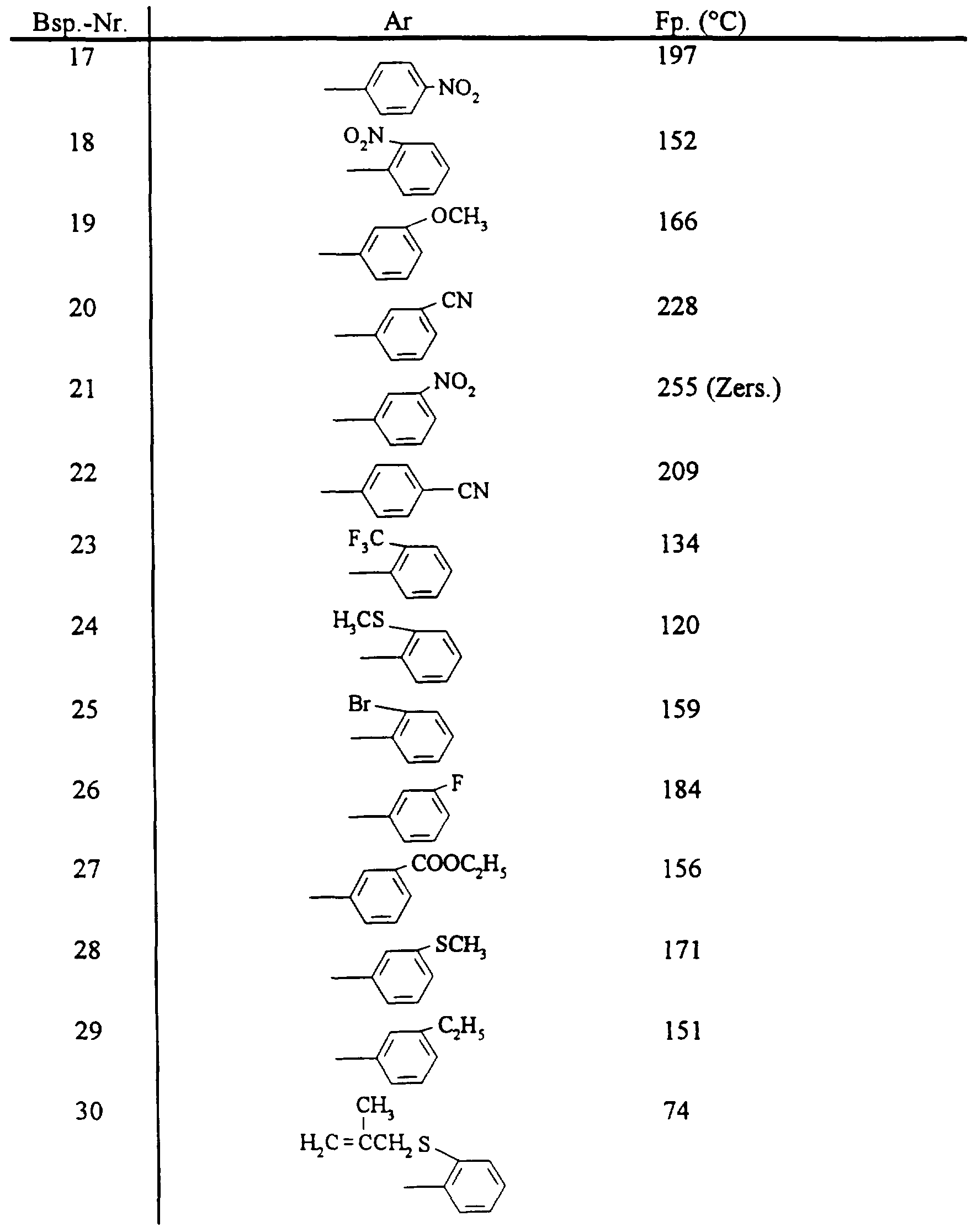

-48
Tabelle 1 (Fortseztung)


50
Tabelle 1 (Fortseztung)


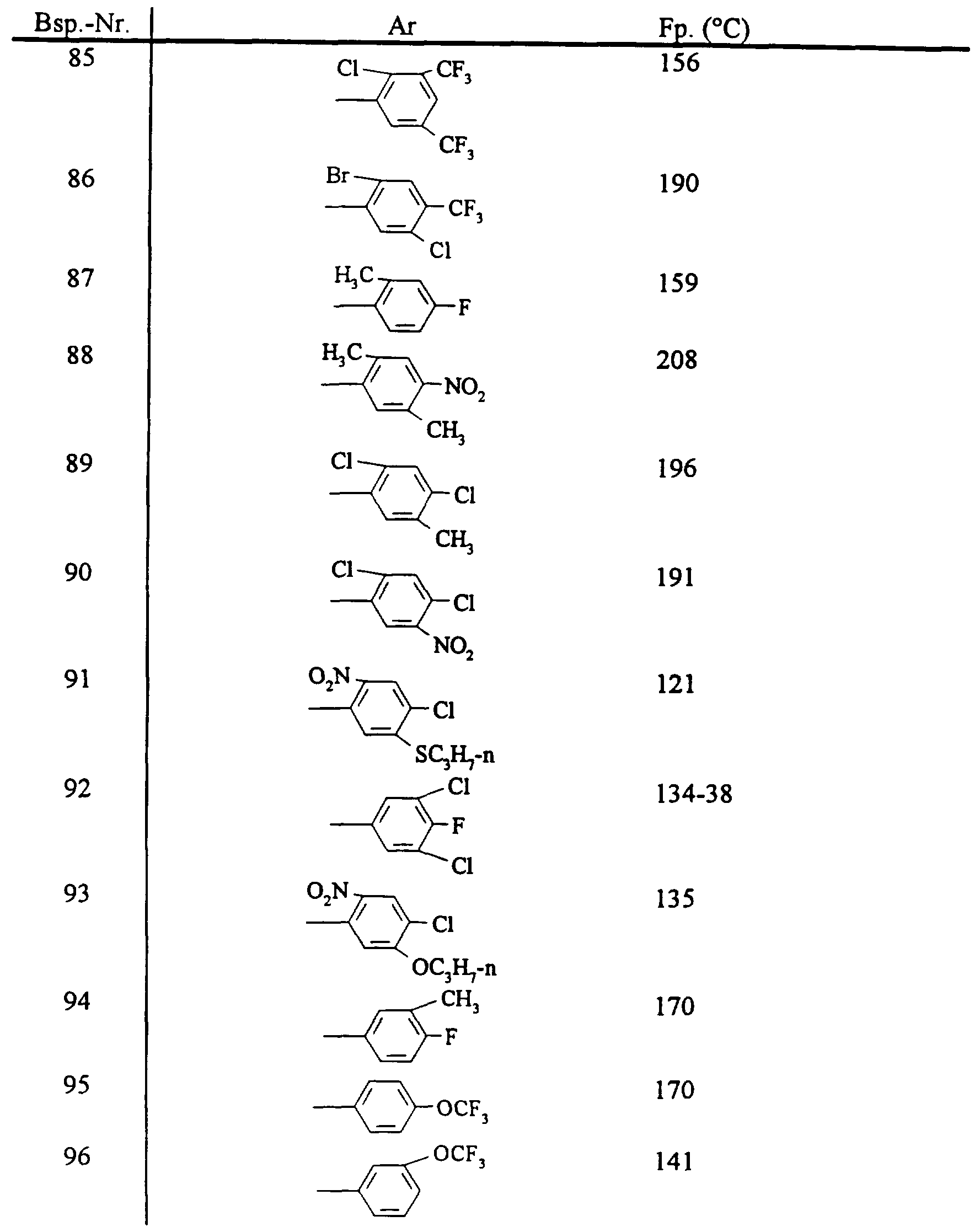
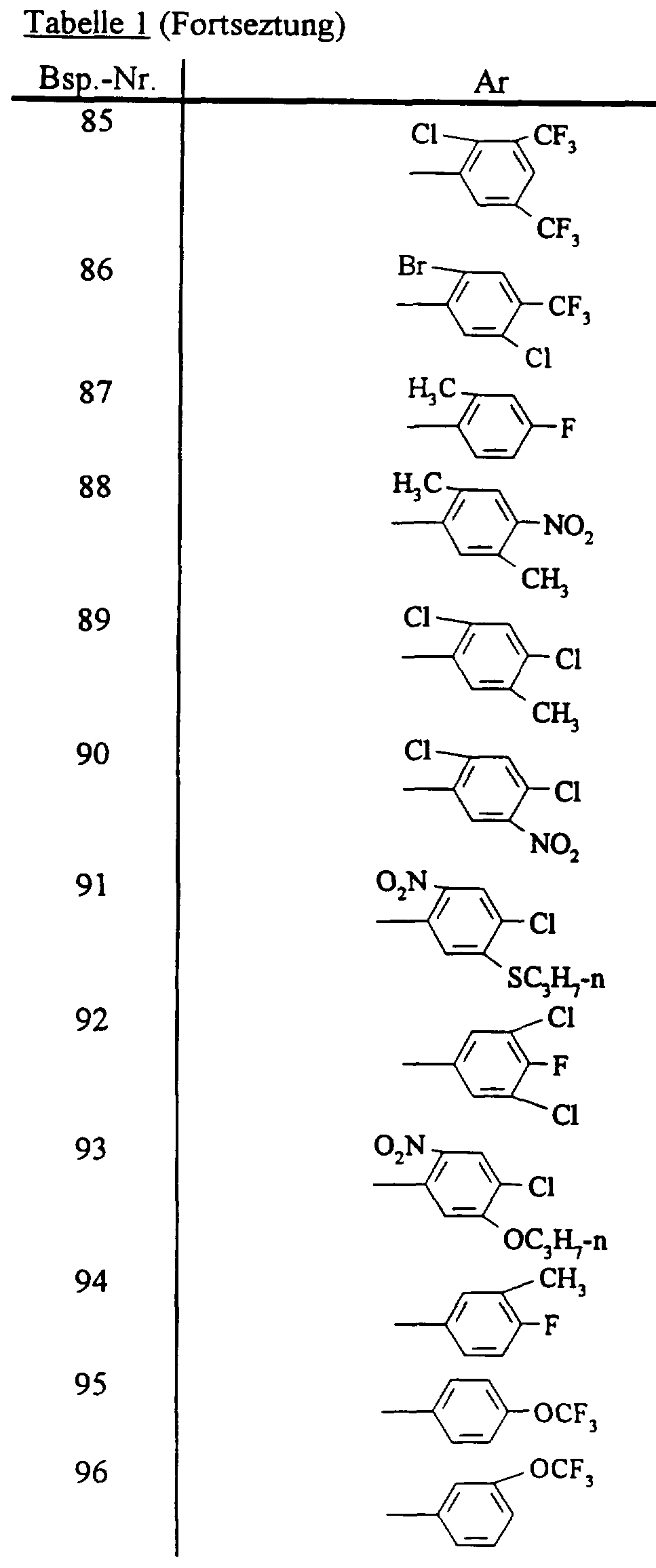
52-
Tabelle 1 (Fortseztung)

In den folgenden Anwendungsbeispielen wurden die nachstehend aufgeführten Verbindungen als Vergleichssubstanzen eingesetzt:
(A)
CF,- Vco- NH- // w -C3H7-i
2-Hydroxy-4-trifluormethyl-N-(4-isopropylphenyl)-benzamid

2-Hydroxy-4-trifluormethyl-N-(3,4-dimethylphenyl)-benzamid

2-Hydroxy-4-trifluormethyl-N-(3,5-dichlθφhenyl)-benzamid
(D)
CF3X //' \\) — _ CO-N„H,- // w
2-Hydroxy-4-trifluormethyl-N-(3-chlθφhenyl)-benzamid

2-Hydroxy-4-trifluormethyl-N-(3-methylphenyl)-benzamid

2-Hydroxy-4-trifluormethyl-N-(4-ethylphenyl)-benzamid

2-Hydroxy-4-trifluormethyl-N-(3-bromphenyl)-benzamid

2-Hydroxy-4-trifluormethyl-N-(3-chlor-4-methylphenyl)-benzamid
(Alle bekannt aus WO-A 92/ 17066)
Beispiel A
Phytophthora-Test (Tomate) / protectiv
Lösungsmittel : 4,7 Gewichtsteile Aceton Emulgator 0,3 Gewichtsteile Alkyl- Aryl-Polyglykolether
Zur Herstellung einer zweckmäßigen Wirkstoflzubereitung vermischt man 1 Gewichststeil Wirkstoff mit den angegebenen Mengen Lösungsmittel und Emulgator und verdünnt das Konzentrat mit Wasser auf die gewünschte Konzentration.
Zur Prüfung auf protektive Wirksamkeit bespritzt man junge Pflanzen mit der Wirkstof zubereitung bis zur Tropfhässe. Nach Antrocknen des Spritzbelages werden die Pflanzen mit einer" wäßrigen Sporensuspension von Phytophthora infestans inokuliert.
Die Pflanzen werden in einer Inkubationskabine mit 100% relativer Luftfeuchtigkeit und ca. 20°C aufgestellt.
3 Tage nach der Inokulation erfolgt die Auswertung.
In diesem Test zeigen die Verbindungen der Beispiele 1, 2, 5, 6, 7, 12, 13, 14, 15, 17, 19, 20, 21, 22, 25, 26, 27, 28, 29, 34, 38, 39, 41, 42, 48, 64, 66, 87, 94, 96, 97, 104 und 105 bei einer Wirkstofϊkonzentration von 10 ppm einen Wirkungsgrad von 70% bis 100%, während die Vergleichssubstanz (C) einen Wirkungsgrad von 15% aufweist.
Beispiel B
Plasmopara-Test (Rebe) / protectiv
Lösungsmittel : 4,7 Gewichtsteile Aceton Emulgator 0,3 Gewichtsteile Alkyl-Aryl-Polyglykolether
Zur Herstellung einer zweckmäßigen Wirkstofizubereitung vermischt man 1 Gewichststeil Wirkstoff mit den angegebenen Mengen Lösungsmittel und Emulgator und verdünnt das Konzentrat mit Wasser auf die gewünschte Konzentration.
Zur Prüfung auf protektive Wirksamkeit bespritzt man junge Pflanzen mit der Wirkstofizubereitung bis zur Tropfhässe. Nach Antrocknen des Spritzbelages werden die Pflanzen mit einer wäßrigen Sporensuspension von Plasmopara viticola inokuliert und verbleiben dann 1 Tag in einer Feuchtkammer bei 20 - 22°C und 100% relativer Luftfeuchtigkeit. Anschließend werden die Pflanzen 5 Tage im Gewächshaus bei 21°C und 90% Luftfeuchtigkeit aufgestellt. Die Pflanzen werden dann angefeuchtet und 1 Tag in eine Feuchtekammer gesteht.
6 Tage nach der Inokulation erfolgt die Auswertung.
In diesem Test zeigen die Verbindungen der Beispiele 1, 5, 6, 7, 11, 12, 13, 15, 17, 19, 20, 22, 25, 26, 27, 28, 29, 30, 37, 39, 42, 48, 49, 63, 75, 87, 88, 89, 90, 92, 94, 95, 96, 97, 98, 100, 101, 103, 104, 105, 106 und 107 bei einer Wirkstofϊkonzentration von 10 ppm einen Wirkungsgrad von 79% bis 100%.
Beispiel C
Pyricularia-Test (Reis) / protectiv
Lösungsmittel : 12,5 Gewichtsteile Aceton Emulgator 0,3 Gewichtsteile Alkyl- Aryl-Polyglykolether
Zur Herstellung einer zweckmäßigen Wirkstofizubereitung vermischt man 1 Gewichststeil Wirkstoff mit den angegebenen Mengen Lösungsmittel und verdünnt das Konzentrat mit Wasser und der angegebenen Menge Emulgator auf die gewünschte Konzentration.
Zur Prüfung auf protektive Wirksamkeit bespritzt man junge Reispflanzen mit der Wirkstoffzubereitung bis zur Tropfhässe. Nach Abtrocknen des Spritzbelages werden die Pflanzen mit einer wäßrigen Sporensuspension von Pyricularia oryzae inokuliert. Anschließend werden die Pflanzen in einem Gewächshaus bei 100% relativer Luftfeuchtigkeit und 25°C aufgestellt.
4 Tage nach der Inokulation erfolgt die Auswertung des Krankheitsbefalls.
In diesem Test zeigen die Verbindungen der Beispiele 1, 4, 5, 7, 8, 11, 12, 13, 14, 18, 20, 22, 26, 34, 63, 99, 100, 104, 105 und 106 bei einer Wirkstoffkonzentration von 0,025 ppm einen Wirkungsgrad von 80% bis 100%.
5170
58
Beispiel D
Plutella-Test
Lösungsmittel : 31 Gewichtsteile Aceton Emulgator 1 Gewichtsteil Alkyl-Aryl-Polyglykolether
Zur Herstellung einer zweckmäßigen Wirkstofizubereitung vermischt man 1 Gewichststeil Wirkstoff mit der angegebenen Menge Lösungsmittel und der angegebenen Menge Emulgator und verdünnt das Konzentrat mit emulgatorhaltigem Wasser auf die gewünschten Konzentrationen.
Kohlblätter (Brassica oleracea) werden mit der Wirkstofizubereitung der gewünschten Konzentration behandelt. Ein behandeltes Blatt wird in die Plastikdose gelegt und mit Larven (L2) der Kohlschabe (PluteUa xylosteüa) besetzt. Nach 3 Tagen wird jeweüs ein unbehandeltes Blatt für die Nachfütterung verwendet.
Nach der gewünschten Zeit wird die Abtötung in % bestimmt. Dabei bedeutet 100%, daß alle Tiere abgetötet wurden; 0% bedeutet, daß keine Tiere abgetötet wurden.
In diesem Test zeigen die Verbindungen der Beispiele 47 und 78, bei einer Wirkstoffkonzentration von 0,01% nach 7 Tagen einen Abtötungsgrad von 100%, während die Vergleichssubstanzen (A), (B), (C), (E) und (F) keine Wirkung aufweisen.
Beispiel E
Tatranychus-Test (OP-resistent/Tauchbehandlung)
Lösungsmittel : 7 Gewichtsteile Aceton Emulgator 1 Gewichtsteil Alkyl-Aryl-Polyglykolether
Zur Herstellung einer zweckmäßigen Wirkstofizubereitung vermischt man 1 Gewichststeil Wirkstoff mit der angegebenen Menge Lösungsmittel und der angegebenen Menge Emulgator und verdünnt das Konzentrat mit emulgatorhaltigem Wasser auf die gewünschten Konzentrationen.
Bohnenpflanzen (Phaseolus vulgaris), die stark von allen Stadien der gemeinen Spinnmilbe Tetranychus urticae befallen sind, werden in eine Wirkstofizubereitung der gewünschten Konzentration getaucht.
Nach der gewünschten Zeit wird die Wirkung in % bestimmt. Dabei bedeutet 100%, daß alle Spinnmilben abgetötet wurden; 0% bedeutet, daß keine Spinnmilben abgetötet wurden.
In diesem Test zeigen die Verbindungen der Beispiele 78, 98 und 103, bei einer Wirkstoffkonzentration von 0,01% nach 7 Tagen einen Abtötungsgrad von 80% bis 100%, während die Vergleichssubstanzen (A), (B), (E) und (F) keine Wirkung.
Beispiel F
Phaedon-Larven-Test
Lösungsmittel : 7 Gewichtsteile Dimethylfoπnamid Emulgator 1 Gewichtsteile Alkyl-Aryl-Polyglykolether
Zur Herstellung einer zweckmäßigen Wirkstoffzubereitung vermischt man 1 Gewichststeil Wirkstoff mit der angegebenen Menge Lösungsmittel und der angegebenen Menge Emulgator und verdünnt das Konzentrat mit Wasser auf die gewünschten Konzentrationen.
Kohlblätter (Brassica oleracea) werden durch Tauchen in die Wirkstofizubereitung der gewünschten Konzentration behandelt und mit Meerrettichblattkäfer-Larven (Phaedon cochleariae) besetzt, solange die Blätter noch feucht sind.
Nach der gewünschten Zeit wird die Abtötung in % bestimmt. Dabei bedeutet 100%, daß alle Käfer-Larven abgetötet wurden; 0% bedeutet, daß keine Käferlarven abgetötet wurden.
In diesem Test zeigen die Verbindungen der Beispiele 34, 63 und 68, bei einer Wirkstofikonzentration von 0,1% nach 7 Tagen einen Abtötungsgrad von 100%, während die Vergleichssubstanz (B) keine Wirkung aufweist.
5170
61
Beispiel G
Plutella-Test
Lösungsmittel 7 Gewichtsteile Dimethylformamid Emulgator 1 Gewichtsteile Alkyl-Aryl-Polyglykolether
Zur Herstellung einer zweckmäßigen Wirkstofizubereitung vermischt man 1 Gewichststeil Wirkstoff mit der angegebenen Menge Lösungsmittel und der angegebenen Menge Emulgator und verdünnt das Konzentrat mit Wasser auf die gewünschten Konzentrationen.
Kohlblätter (Brassica oleracea) werden durch Tauchen in die Wirkstofizubereitung der gewünschten Konzentration behandelt und mit Raupen der Kohlschabe (Plutella maculipennis) besetzt, solange die Blätter noch feucht sind.
Nach der gewünschten Zeit wird die Abtötung in % bestimmt. Dabei bedeutet 100%, daß alle Raupen abgetötet wurden; 0% bedeutet, daß keine Raupen abgetötet wurden.
In diesem Test zeigen die Verbindungen der Beispiele 14, 20 und 63 bei einer Wirkstoffkonzentration von 0,1% nach 7 Tagen einen Abtötungsgrad von 85% bis 100%, während die Vergleichssubstanz (B) keine Wirkung aufweist.
170
- 62 -
Beispiel H
Materialschutz-Test
Hemmtest an Riesenkolonien von Basidiomyceten
Aus Kolonien von Gloeophyüum trabeum, Coniophora puteana, Poria placenta, Lentinus tigrinus, Coriolus versicolor und Stereum sanguinolentum wurden Mycelstücke ausgestochen und auf einen Malzextrakt-Pepton-haltigen Agarnährboden bei 26°C inkubiert. Die Hemmung des Hyphenwachstums auf wirkstofQialtigen Nährböden wurde mit dem Längewachstum auf Nährboden ohne Wirkstoffzusatz verglichen und als prozentuale Hemmung bonitiert.
In diesem Test zeigen die erfindungsgemäßen Verbindungen der Beispiele 1, 3, 17, 34, 38 und 92, bei einer Wirkstoffkonzentration von 20 ppm eine Wuchshemmung von 50 bis 100%.
Claims
Patentansprüche
1. 4-Trifluormethylbenzamide der Formel (I),

in welcher
Ar für substituiertes Phenyl steht,
mit Ausnahme der Bedeutungen:
3-Chloφhenyl; 3-Bromphenyl; 3-Methylphenyl; 3-Trifluormethyl- phenyl; 4-Chloφhenyl; 4-Methoxyphenyl; 4-Trifluormethylphenyl; 4-(Cj- C3)-Alkylphenyl; 3,5-Dichloφhenyl; 3-Chlor-4-methylphenyl und 3,4- Dimethylphenyl .
Verbindungen der Formel (HI)

in welcher
Rl, R^, R3 und R^ unabhängig voneinander für Wasserstoff, Halogen, Cyano, Nitro; jeweils geradkettiges oder verzweigtes Alkyl, Alkoxy oder
Alkylthio mit jeweils 1 bis 6 Kohlenstoffatomen; jeweils geradkettiges oder verzweigtes Halogenalkyl, Halogenalkoxy oder Halogenalkylthio mit jeweils 1 bis 4 Kohlenstoffatomen und 1 bis 9 gleichen oder verschiedenen Halogenatomen; jeweils geradkettiges oder verzweigtes Alkoxycarbonyl oder Alkoximino- alkyl mit jeweils 1 bis 4 Kohlenstoffatomen in den einzelnen Alkylteilen;
5170
- 64 -
Amino, Aminocarbonyl; jeweils geradkettiges oder verzweigtes Alkyl- amino, Alkylaminocarbonyl, Dialkylamino oder Dialkylaminocarbonyl mit jeweils 1 bis 4 Kohlenstoffatomen in den einzelnen Alkylteilen; jeweils geradkettiges oder verzweigtes Alkenyl, Alkenyloxy oder Alkenylthio mit jeweils 2 bis 4 Kohlenstoffatomen; sowie gegebenenfalls einfach bis drei¬ fach, gleich oder verschieden durch Halogen und/oder geradkettiges oder verzweigtes Alkyl mit 1 bis 4 Kohlenstoffatomen substituiertes Phenyl stehen, wobei mindestens einer der Reste R*, R^, R3 und R^ nicht für Wasserstoff steht und ausgenommen die Verbindungen: 3-Chlθφhenyl; 3-Bromphenyl; 3-Methylphenyl; 3-Trifluormethyl- phenyl; 4-Chloφhenyl; 4-Methoxyphenyl; 4-Trifluoπnethylphenyl; 4-(Cι- C3)-Alkylphenyl; 3,5-Dichloφhenyl; 3-Chlor-4-methylphenyl und 3,4- Dimethylphenyl.
3. Verbindungen der Formel (HI) gemäß Anspruch 2,
in welcher
R , R-, R3 und R^ unabhängig voneinander für Wasserstoff, Fluor, Chlor, Brom, Jod, Cyano, Nitro, Methyl, Ethyl, n- oder i-Propyl; n-, i-, s- oder t- Butyl; n-, i-, s- oder t-Pentyl; Methoxy, Ethoxy, n- oder i-Propoxy; n-, i-, s- oder t- Butoxy; Methylthio, Ethylthio, n- oder i-Propylthio; n-, i-, s- oder t-Butylthio; Trifluormethyl, Difluormethyl, Trifluormethoxy,
Difluormethoxy, Trifluormethylthio, Difluormethylthio, Methoxycarbonyl, Ethoxycarbonyl, Methoximinomethyl, Methoximinoethyl, Ethoximino¬ methyl, Ethoximinoethyl; Amino, Aminocarbonyl, Methylamino, Ethylamino, n- oder i-Propyl- amino, Methylaminocarbonyl, Ethylaminocarbonyl, n- oder i-Propyl- aminocarbonyl, Dimethylamino, Ethylmethylamino, Methyl-n-Propyl- amino, Methyl-i-Propylamino, Diethylamino, Dimethylaminocarbonyl, Ethylmethylaminocarbonyl, Methyl-n-Propyl-aminocarbonyl, Methyl-i- Propylaminocarbonyl, Diethylaminocarbonyl, Propenyl, Butenyl, Iso- butenyl, Propenyloxy, Butenyloxy, Isobutenyloxy, Propenylthio,
Butenylthio, Isobutenylthio;
oder gegebenenfalls ein- bis dreifach, gleich oder verschieden durch Fluor, Chlor, Brom, Methyl und/oder Ethyl substituiertes Phenyl stehen, wobei mindestens einer der Reste Rl, R-, R3 und R^ nicht für Wasserstoff steht und ausgenommen die Verbindungen: 3-Chloφhenyl; 3-Bromphenyl; 3-Methylphenyl; 3-Trifluormethyl- phenyl; 4-Chloφhenyl; 4-Methoxyphenyl; 4-Trifluormethylphenyl; 4-(C\- C3)-Alkylphenyl; 3,5-Dichloφhenyl; 3-Chlor-4-methylphenyl und 3,4- Dimethylphenyl.
4. Verbindungen der Formel (ILT) gemäß Anspruch 2 in welcher
Rl, R-, R3 und R^ unabhängig voneinander für Wasserstoff, Fluor, Chlor, Brom, Jod, Cyano, Nitro, Methyl, Ethyl, n- oder i-Propyl; n-, i-, s- oder t- Butyl; n-, i-, s- oder t-Pentyl; Methoxy, Ethoxy, n- oder i-Propoxy; n-, i-, s- oder t- Butoxy; Methylthio, Ethylthio, n- oder i-Propylthio; n-, i-, s- oder t-Butylthio; Trifluormethyl, Difluormethyl, Trifluormethoxy,
Difluormethoxy, Trifluormethylthio, Difluormethylthio, Methoxycarbonyl, Ethoxycarbonyl;
Methylamino, Ethylamino, Methylaminocarbonyl, Ethylaminocarbonyl, Dimethylamino, Ethylmethylamino, Diethylamino, Dimethylamino- carbonyl, Ethylmethylaminocarbonyl, Diethylaminocarbonyl, Propenyloxy,
Butenyloxy, Isobutenyloxy, Propenylthio, Butenylthio oder Isobutenylthio stehen, wobei mindestens einer der Reste R^, R^, R3 und R^ nicht für Wasserstoff steht und ausgenommen die Verbindungen: 3-Chloφhenyl; 3-Bromphenyl; 3-Methylphenyl; 3-Trifluormethyl- phenyl; 4-Chlθφhenyl; 4-Methoxyphenyl; 4-Trifluormethylphenyl; 4-(Cj-
C3)-Alkylphenyl; 3,5-Dichloφhenyl; 3-Chlor-4-methylphenyl und 3,4- Dimethylphenyl.
5. Schädlingsbekämpfungsmittel, gekennzeichnet durch einen Gehalt an mindestens einer Verbindung der Formel (I) nach Anspruch 1.
6. Verfahren zur Bekämpfung von Schädlingen, dadurch gekennzeichnet, daß man Verbindungen der Formel (I) nach Anspruch 1 auf Schädlinge und/oder ihren Lebensraum einwirken läßt.
7. Verwendung von Verbindungen der Formeln (I) bzw. (IH) nach den Ansprüchen 1 bis 4 zur Bekämpfung von Schädlingen.
8. Verfahren zur Herstellung von Schädlingsbekämpfungsmitteln, dadurch gekennzeichnet, daß man Verbindungen der Formeln (I) bzw. (HI) nach den Ansprüchen 1 bis 4 mit Streckmitteln und/oder oberflächenaktiven Mitteln vermischt.
9. Verfahren zur Hersteüung von 4-Trifluormethylbenzamiden der Formel (I),

in welcher
Ar die in Anspruch 1 angegebene Bedeutung hat,
dadurch gekennzeichnet, daß man 2-Hydroxy-4-trifluormethylbenzoesäure oder deren Ester der Formel (II),

in welcher
R für Wasserstoff oder Alkyl steht,
mit Anilinen der Formel (III), ^N-Ar ( III )
in welcher
Ar die oben angegebene Bedeutung hat,
in Gegenwart eines Kondensationsmittels und gegebenenfalls in Gegenwart eines Verdünnungsmittels sowie eines Reaktonshilfsmittels umsetzt.
Priority Applications (1)
| Application Number | Priority Date | Filing Date | Title |
|---|---|---|---|
| AU33822/95A AU3382295A (en) | 1994-08-11 | 1995-07-31 | 4-trifluoromethylbenzamides and their use as pesticides in plant and materials protection |
Applications Claiming Priority (2)
| Application Number | Priority Date | Filing Date | Title |
|---|---|---|---|
| DE19944428380 DE4428380A1 (de) | 1994-08-11 | 1994-08-11 | 4-Trifluormethylbenzamide |
| DEP4428380.6 | 1994-08-11 |
Publications (1)
| Publication Number | Publication Date |
|---|---|
| WO1996005170A1 true WO1996005170A1 (de) | 1996-02-22 |
Family
ID=6525390
Family Applications (1)
| Application Number | Title | Priority Date | Filing Date |
|---|---|---|---|
| PCT/EP1995/003026 Ceased WO1996005170A1 (de) | 1994-08-11 | 1995-07-31 | 4-trifluormethylbenzamide und ihre verwendung als schädlingsbekämpfungsmittel in pflanzen- und materialschutz |
Country Status (3)
| Country | Link |
|---|---|
| AU (1) | AU3382295A (de) |
| DE (1) | DE4428380A1 (de) |
| WO (1) | WO1996005170A1 (de) |
Cited By (6)
| Publication number | Priority date | Publication date | Assignee | Title |
|---|---|---|---|---|
| WO2003016300A1 (en) * | 2001-08-15 | 2003-02-27 | E. I. Du Pont De Nemours And Company | Ortho-substituted aryl amides for controlling invertebrate pests |
| WO2005072681A3 (en) * | 2004-01-23 | 2005-09-22 | Amgen Inc | Vanilloid receptor ligands and their use in treatments of inflammatory and neurotic pain. |
| RU2278852C2 (ru) * | 2000-03-22 | 2006-06-27 | Е.И.Дюпон Де Немур Энд Компани | Инсектицидные антраниламиды |
| CN100347162C (zh) * | 2002-02-07 | 2007-11-07 | 诺瓦提斯公司 | N-苯基-2-嘧啶胺衍生物 |
| EP1542699A4 (de) * | 2002-07-15 | 2009-03-25 | Myriad Genetics Inc | Verbindungen, zusammensetzungen und diese verwendende verfahren |
| US20170332635A1 (en) * | 2013-11-12 | 2017-11-23 | Nihon Nohyaku Co., Ltd. | Amide compound or salt thereof, agricultural and horticultural insecticide and microbicide comprising the compound, and method for using the insecticide and microbicide |
Families Citing this family (14)
| Publication number | Priority date | Publication date | Assignee | Title |
|---|---|---|---|---|
| WO2001060157A2 (en) * | 2000-02-18 | 2001-08-23 | The Procter & Gamble Company | Antibacterial agents and compositions |
| MY138097A (en) | 2000-03-22 | 2009-04-30 | Du Pont | Insecticidal anthranilamides |
| US7319112B2 (en) | 2000-07-14 | 2008-01-15 | The Procter & Gamble Co. | Non-halogenated antibacterial agents and processes for making same |
| AR036872A1 (es) | 2001-08-13 | 2004-10-13 | Du Pont | Compuesto de antranilamida, composicion que lo comprende y metodo para controlar una plaga de invertebrados |
| TWI325302B (en) | 2001-08-13 | 2010-06-01 | Du Pont | Benzoxazinone compounds |
| EP1417204B1 (de) | 2001-08-15 | 2006-01-18 | E. I. du Pont de Nemours and Company | Mit heterocyclen ortho-substituierte aryl amide zur bekämpfung wirbelloser schädlinge |
| ES2319743T3 (es) | 2001-08-16 | 2009-05-12 | E.I. Du Pont De Nemours And Company | Antranilamidas sustituidas para controlar plagas de invertebrados. |
| MXPA04002647A (es) | 2001-09-21 | 2004-06-07 | Du Pont | Antranilamidas artropodicidas. |
| TWI283164B (en) | 2001-09-21 | 2007-07-01 | Du Pont | Anthranilamide arthropodicide treatment |
| BR0213646A (pt) | 2001-10-15 | 2004-08-24 | Du Pont | Método, compostos e composição para controle de pragas invertebradas |
| AU2007203462B2 (en) * | 2002-02-07 | 2011-01-06 | Novartis Pharma Ag | N-phenyl-2-pyrimidine-amine derivatives |
| US10640457B2 (en) | 2009-12-10 | 2020-05-05 | The Trustees Of Columbia University In The City Of New York | Histone acetyltransferase activators and uses thereof |
| CN106432137B (zh) * | 2010-12-22 | 2020-11-06 | 纽约市哥伦比亚大学理事会 | 组蛋白乙酰转移酶调节剂和其用途 |
| EP2717688B1 (de) | 2011-06-10 | 2017-12-13 | The Trustees of Columbia University in the City of New York | Verwendung von histonacetyltransferase-aktivatoren |
Citations (6)
| Publication number | Priority date | Publication date | Assignee | Title |
|---|---|---|---|---|
| BE615511A (de) * | 1961-03-25 | |||
| AU5102373A (en) * | 1972-05-29 | 1974-07-11 | Ici Australia Limited | PROCESS Specification |
| AU5815373A (en) * | 1972-08-07 | 1975-01-16 | Ici Australia Limited | Compositions and methods |
| FR2234274A1 (de) * | 1973-06-25 | 1975-01-17 | Yoshitomi Pharmaceutical | |
| US4310682A (en) * | 1979-02-28 | 1982-01-12 | Isao Ozawa | Halo-salicylanilide |
| WO1992017066A1 (de) * | 1991-03-30 | 1992-10-15 | Bayer Aktiengesellschaft | Substituierte salicylamide, mittel gegen pflanzenkrankheiten |
-
1994
- 1994-08-11 DE DE19944428380 patent/DE4428380A1/de not_active Withdrawn
-
1995
- 1995-07-31 AU AU33822/95A patent/AU3382295A/en not_active Abandoned
- 1995-07-31 WO PCT/EP1995/003026 patent/WO1996005170A1/de not_active Ceased
Patent Citations (6)
| Publication number | Priority date | Publication date | Assignee | Title |
|---|---|---|---|---|
| BE615511A (de) * | 1961-03-25 | |||
| AU5102373A (en) * | 1972-05-29 | 1974-07-11 | Ici Australia Limited | PROCESS Specification |
| AU5815373A (en) * | 1972-08-07 | 1975-01-16 | Ici Australia Limited | Compositions and methods |
| FR2234274A1 (de) * | 1973-06-25 | 1975-01-17 | Yoshitomi Pharmaceutical | |
| US4310682A (en) * | 1979-02-28 | 1982-01-12 | Isao Ozawa | Halo-salicylanilide |
| WO1992017066A1 (de) * | 1991-03-30 | 1992-10-15 | Bayer Aktiengesellschaft | Substituierte salicylamide, mittel gegen pflanzenkrankheiten |
Cited By (12)
| Publication number | Priority date | Publication date | Assignee | Title |
|---|---|---|---|---|
| RU2278852C2 (ru) * | 2000-03-22 | 2006-06-27 | Е.И.Дюпон Де Немур Энд Компани | Инсектицидные антраниламиды |
| WO2003016300A1 (en) * | 2001-08-15 | 2003-02-27 | E. I. Du Pont De Nemours And Company | Ortho-substituted aryl amides for controlling invertebrate pests |
| RU2283839C2 (ru) * | 2001-08-15 | 2006-09-20 | Е.И.Дюпон Де Немур Энд Компани | Ортозамещенные ариламиды, способ борьбы с насекомыми, композиция для борьбы с насекомыми, промежуточное соединение |
| US7288554B2 (en) | 2001-08-15 | 2007-10-30 | E.I. Du Pont De Nemours And Company | Ortho-substituted aryl amides for controlling invertebrate pests |
| AU2002331706B2 (en) * | 2001-08-15 | 2009-01-22 | E.I. Du Pont De Nemours And Company | Ortho-substituted aryl amides for controlling invertebrate pests |
| CN100528862C (zh) * | 2001-08-15 | 2009-08-19 | 纳幕尔杜邦公司 | 用于控制无脊椎害虫的邻位取代的芳基酰胺化合物 |
| CN100347162C (zh) * | 2002-02-07 | 2007-11-07 | 诺瓦提斯公司 | N-苯基-2-嘧啶胺衍生物 |
| EP1542699A4 (de) * | 2002-07-15 | 2009-03-25 | Myriad Genetics Inc | Verbindungen, zusammensetzungen und diese verwendende verfahren |
| US7547804B2 (en) | 2002-07-15 | 2009-06-16 | Myriad Genetics, Inc. | Compounds, compositions, and methods employing same |
| WO2005072681A3 (en) * | 2004-01-23 | 2005-09-22 | Amgen Inc | Vanilloid receptor ligands and their use in treatments of inflammatory and neurotic pain. |
| US20170332635A1 (en) * | 2013-11-12 | 2017-11-23 | Nihon Nohyaku Co., Ltd. | Amide compound or salt thereof, agricultural and horticultural insecticide and microbicide comprising the compound, and method for using the insecticide and microbicide |
| US10123537B2 (en) * | 2013-11-12 | 2018-11-13 | Nihon Nohyaku Co., Ltd. | Amide compound or salt thereof, agricultural and horticultural insecticide and microbicide comprising the compound, and method for using the insecticide and microbicide |
Also Published As
| Publication number | Publication date |
|---|---|
| DE4428380A1 (de) | 1996-02-15 |
| AU3382295A (en) | 1996-03-07 |
Similar Documents
| Publication | Publication Date | Title |
|---|---|---|
| EP0915868B1 (de) | Carbanilide als schädlingsbekämpfungsmittel | |
| EP1049683A2 (de) | Isothiazolcarbonsäureamide und deren verwendung zum schutz von pflanzen | |
| EP0745067A1 (de) | N-pyrazolylaniline und n-pyrazolylaminopyridine als schädlingsbekämpfungsmittel | |
| DE4428380A1 (de) | 4-Trifluormethylbenzamide | |
| EP0877741B1 (de) | Acylierte 5-amino-1,2,4-thiadiazole als pestizide und fungizide | |
| EP1044195A1 (de) | Isothiazolcarbonsaüre-derivate | |
| DE4445792A1 (de) | Fluorbutenyl(thio)ether | |
| EP0724574B1 (de) | 3-methoxy-2-phenyl-acrylsäuremethylester | |
| EP0635500B1 (de) | 5,6-Dihydro-(4H)1,3-Oxazin und - Thiazin-Derivate als Insektizide | |
| DE19500789A1 (de) | Acylierte 5-Aminopyrazole | |
| EP0859767A1 (de) | Fluorpropenyloxadiazole und ihre verwendung als schädlingsbekämpfungsmittel | |
| DE19548415A1 (de) | 1-Aryl-3-halogenalkyl-5-arylaminotriazole | |
| EP0758334B1 (de) | Substituierte (1,4)dioxino(2,3-f)benzimidazolderivate und ihre verwendung zur bekämpfung von schädlingen | |
| EP0758332B1 (de) | Substituierte benzimidazole zur bekämpfung von schädlingen | |
| EP0797574B1 (de) | 1,3,4-oxadiazin-derivate mit pestizider wirkung | |
| DE19523087A1 (de) | 1,3-Oxa(thia)zin-Derivate | |
| DE3643957A1 (de) | Substituierte n-methylisoxazolidine | |
| DE4428381A1 (de) | 4-Chlorbenzamide, Schädlingsbekämpfungsmittel | |
| JP2006507222A (ja) | N’−シアノ−n−メチルイミドアミド誘導体 | |
| DE10063868A1 (de) | Dichlorpyridincarbamide | |
| DE19528778A1 (de) | 4-Alkyl-1,3-oxa(thia)zolin-Derivate | |
| DE10063486A1 (de) | Dichlorpyridylmethylamide | |
| WO1997048280A1 (de) | Verwendung von pyrrolopyrimidinen zur bekämpfung von schädlingen | |
| EP0861227A1 (de) | Fluorbutenoyloxyessigsäureamide | |
| WO2000064895A1 (de) | Hetarylsubstituierte dithiazoldioxide als pflanzenschutzmittel |
Legal Events
| Date | Code | Title | Description |
|---|---|---|---|
| AK | Designated states |
Kind code of ref document: A1 Designated state(s): AU BB BG BR BY CA CN CZ FI HU JP KR KZ LK MX NO NZ PL RO RU SK UA US |
|
| AL | Designated countries for regional patents |
Kind code of ref document: A1 Designated state(s): AT BE CH DE DK ES FR GB GR IE IT LU MC NL PT SE BF BJ CF CG CI CM GA GN ML MR NE SN TD TG |
|
| 121 | Ep: the epo has been informed by wipo that ep was designated in this application | ||
| 122 | Ep: pct application non-entry in european phase | ||
| NENP | Non-entry into the national phase |
Ref country code: CA |