WO1997041105A1 - Novel heterocycle-substituted benzene derivatives and herbicides - Google Patents

Novel heterocycle-substituted benzene derivatives and herbicides Download PDF

Info

Publication number
WO1997041105A1
WO1997041105A1 PCT/JP1997/001423 JP9701423W WO9741105A1 WO 1997041105 A1 WO1997041105 A1 WO 1997041105A1 JP 9701423 W JP9701423 W JP 9701423W WO 9741105 A1 WO9741105 A1 WO 9741105A1
Authority
WO
WIPO (PCT)
Prior art keywords
group
methyl
solvent
compound
added
Prior art date
Legal status (The legal status is an assumption and is not a legal conclusion. Google has not performed a legal analysis and makes no representation as to the accuracy of the status listed.)
Ceased
Application number
PCT/JP1997/001423
Other languages
English (en)
French (fr)
Inventor
Hiroyuki Adachi
Masao Yamaguchi
Osamu Miyahara
Katsunori Tanaka
Takashi Kawana
Akihiro Takahashi
Masami Koguchi
Hideki Yamagishi
Current Assignee (The listed assignees may be inaccurate. Google has not performed a legal analysis and makes no representation or warranty as to the accuracy of the list.)
Nippon Soda Co Ltd
Original Assignee
Nippon Soda Co Ltd
Priority date (The priority date is an assumption and is not a legal conclusion. Google has not performed a legal analysis and makes no representation as to the accuracy of the date listed.)
Filing date
Publication date
Application filed by Nippon Soda Co Ltd filed Critical Nippon Soda Co Ltd
Priority to AU24058/97A priority Critical patent/AU2405897A/en
Priority to KR1019980708595A priority patent/KR20000065049A/ko
Publication of WO1997041105A1 publication Critical patent/WO1997041105A1/ja
Anticipated expiration legal-status Critical
Ceased legal-status Critical Current

Links

Classifications

    • CCHEMISTRY; METALLURGY
    • C07ORGANIC CHEMISTRY
    • C07DHETEROCYCLIC COMPOUNDS
    • C07D413/00Heterocyclic compounds containing two or more hetero rings, at least one ring having nitrogen and oxygen atoms as the only ring hetero atoms
    • C07D413/02Heterocyclic compounds containing two or more hetero rings, at least one ring having nitrogen and oxygen atoms as the only ring hetero atoms containing two hetero rings
    • C07D413/10Heterocyclic compounds containing two or more hetero rings, at least one ring having nitrogen and oxygen atoms as the only ring hetero atoms containing two hetero rings linked by a carbon chain containing aromatic rings
    • AHUMAN NECESSITIES
    • A01AGRICULTURE; FORESTRY; ANIMAL HUSBANDRY; HUNTING; TRAPPING; FISHING
    • A01NPRESERVATION OF BODIES OF HUMANS OR ANIMALS OR PLANTS OR PARTS THEREOF; BIOCIDES, e.g. AS DISINFECTANTS, AS PESTICIDES OR AS HERBICIDES; PEST REPELLANTS OR ATTRACTANTS; PLANT GROWTH REGULATORS
    • A01N43/00Biocides, pest repellants or attractants, or plant growth regulators containing heterocyclic compounds
    • A01N43/72Biocides, pest repellants or attractants, or plant growth regulators containing heterocyclic compounds having rings with nitrogen atoms and oxygen or sulfur atoms as ring hetero atoms
    • A01N43/80Biocides, pest repellants or attractants, or plant growth regulators containing heterocyclic compounds having rings with nitrogen atoms and oxygen or sulfur atoms as ring hetero atoms five-membered rings with one nitrogen atom and either one oxygen atom or one sulfur atom in positions 1,2
    • CCHEMISTRY; METALLURGY
    • C07ORGANIC CHEMISTRY
    • C07DHETEROCYCLIC COMPOUNDS
    • C07D261/00Heterocyclic compounds containing 1,2-oxazole or hydrogenated 1,2-oxazole rings
    • C07D261/02Heterocyclic compounds containing 1,2-oxazole or hydrogenated 1,2-oxazole rings not condensed with other rings
    • C07D261/06Heterocyclic compounds containing 1,2-oxazole or hydrogenated 1,2-oxazole rings not condensed with other rings having two or more double bonds between ring members or between ring members and non-ring members
    • C07D261/08Heterocyclic compounds containing 1,2-oxazole or hydrogenated 1,2-oxazole rings not condensed with other rings having two or more double bonds between ring members or between ring members and non-ring members with only hydrogen atoms, hydrocarbon or substituted hydrocarbon radicals, directly attached to ring carbon atoms

Definitions

  • the present invention relates to a novel vilapool derivative and a herbicide in which a benzoyl group is substituted at the 4-position of the virazol ring.
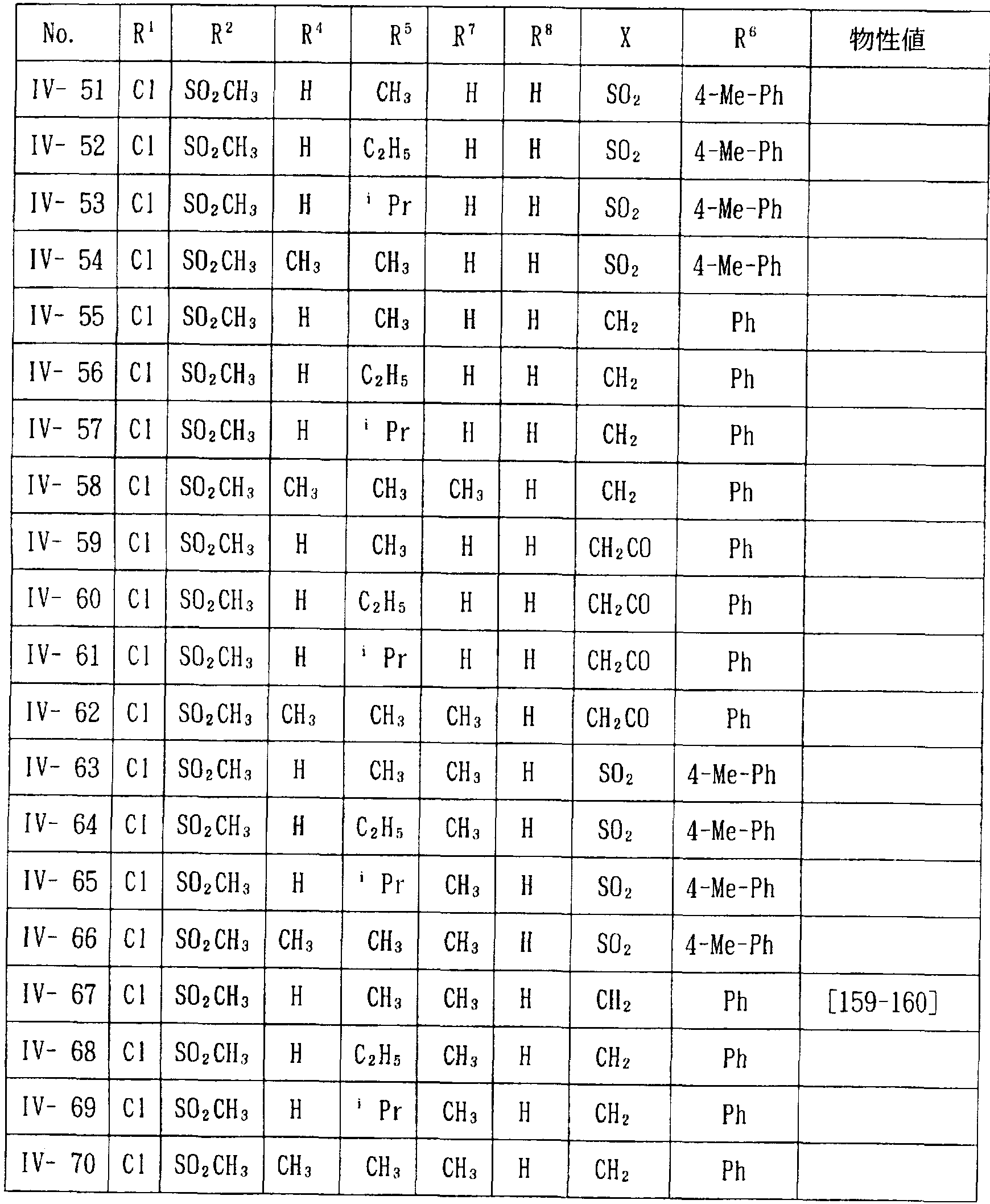
  • WO 96/262 06 describes a compound represented by the formula [IV]. These compounds are only given as examples, and their physical properties are not specifically described.
  • An object of the present invention is to provide a herbicide that can be synthesized industrially advantageously, has a lower dose, is effective, has high safety, and has high crop selectivity.
  • the present invention relates to a 4-benzyl virazole compound in which the 3-position of the benzoyl moiety represented by the general formula [I] is substituted with a heterocycle, wherein the enol hydroxyl group of the pyrazoyl ring is protected. It is a herbicide characterized by containing the compound as an active ingredient.
  • the present invention provides a compound represented by the formula (I):
  • R 1 is a halogen atom, alkyl group, Y an alkoxy group, a secondary Bok port group, Shiano group, a haloalkyl group, a haloalkoxy group, c Bok 6 Al Kiruchio group, - (; alkylsulfinyl group or ⁇ alkyl Represents a sulfonyl group.
  • R 2 is a halogen atom, a nitro group, a cyano group, a C, 1 ⁇ alkyl group, a C-alkoxy group, a haloalkyl group, a ⁇ - haloalkoxy group, a 6- alkylthio group, a d-alkylsulfinyl group, or a C-alkylsulfonyl group Represents a group.
  • R 3 is halogen atom, C, - 6 alkyl group, 6 alkoxy group, a nitro group, Shiano group, d-G haloalkyl groups, C WINCH B alkylthio group, 1; alkylsulfanyl Finiru group or C, - e alkyl sulfonyl Represents a hydroxyl group.
  • n 0, 1, and 2.
  • R 3 may be the same or different
  • Het represents a saturated or unsaturated 5-membered heterocyclic group substituted with R 7 and R 8 containing 1 to 3 N, 0 or S atoms, which is bonded to a benzene ring at a carbon atom portion.
  • R 4 represents a hydrogen atom or a d alkyl group.
  • R 5 is a hydrogen atom, de alkyl group, C 2 - 1 - G alkenyl group or C 2; represents a alkynyl group.
  • R 6 is, C 6 alkyl group, C 3 - 8 cycloalkyl group, (Ci-G alkyl group,
  • X is S0 2, represents a (CH 2) mCO, which may be substituted by alkyl C, one 6 alkylene emissions group or a single bond. m represents 0, 1, 2, and 3. ] Or a herbicide containing such a compound.
  • the present invention relates to a pyrazole compound represented by the general formula [I] and a herbicide containing the compound as an active ingredient.
  • R ′ is a halogen atom such as fluorine, chlorine, and bromine; a 6 alkyl group such as methyl, ethyl, propyl, isopropyl, butyl, and t-butyl; De alkoxy groups such as methoxy, ethoxy, propoxy, isopropoxy, butoxy, t-butoxy,
  • C such as nitro group, cyano group, trifluoromethyl and trifluoroethyl; haloalkoxy group such as haloalkyl group and trifluoromethoxy group; C (; alkylthio group such as methylthio, ethylthio, propylthio and isopropylthio;
  • a C alkylsulfinyl group such as methylsulfinyl, ethylsulfinyl, propylsulfinyl, isopropylsulfinyl, or
  • R 2 is a halogen atom such as fluorine, chlorine, or bromine; a nitro group, a cyano group; a d-alkyl group such as methyl, ethyl, propyl, isopropyl, butyl, or t-butyl;
  • Alkoxy groups such as methoxy, ethoxy, propoxy, isopropoxy, butoxy, t-butoxy, etc .;
  • Cl- ⁇ haloalkyl groups such as trifluoromethyl and trifluoroethyl, haloalkoxy groups such as trifluoromethoxy and trichloromethoxy, C n alkylthio groups such as methylthio, ethylthio, propylthio and isopropylthio;
  • C, -6 alkylsulfinyl group such as methylsulfinyl, ethylsulfinyl, propylsulfinyl, isopropylsulfinyl, or
  • R 3 is a halogen atom such as fluorine, chlorine, bromine,
  • D-6 alkyl groups such as methyl, ethyl, propyl, isopropyl, butyl, t-butyl, etc.
  • C-to-haloalkyl groups such as trifluoromethyl and trifluoroethyl
  • Dc alkylthio groups such as menalthio, ethylthio, propylthio, and isopropylthio
  • a C, -o alkylsulfinyl group such as methylsulfinyl, ethylsulfinyl, propylsulfinyl, isopropylsulfinyl group, or
  • Het represents a saturated or unsaturated 5-membered heterocyclic group which may have 1 to 4 N, 0 or S atoms and may have substituents R 7 and R 8 .
  • the heterocyclic group is bonded to the benzene ring at a carbon atom.
  • Het includes, for example, 2-furyl, 3-furyl, 4-furyl, 5-furyl, 2-phenyl, 3-phenyl, 4-phenyl, 5-phenyl, 2-pyrrolyl, 3-pyrrolyl, 4-pyrrolyl ,
  • 1,2,4 oxaziazolu 3-yl 1,2,4 oxaziazolu 5-yl, 1,3,4 oxaziazoll-2 -yl, 1,3,4-oxagiazi Zol 5-yl, 1, 2, 4-thia diazo 3 -yl, 1, 2, 4-thia diazo 5-lu, 1, 3, 4-thia diazo 2-yl, 1 , 3,4-thiadiazol-5-yl, 1,2,4-triazol-3-yl, 1,2,4-triazo-1-yl-5-yl group and the like.
  • hetero ring is an arbitrary position thereof, a fluorine, chlorine, halogen atom such as bromine, methyl, C etc. Echiru group, - fi alkyl group, main Bok alkoxy, C etc. ethoxy group, - 6 ⁇ alkoxy, Substituents such as C fi haloalkyl groups such as trifluoromethyl group R 7 , R May be provided.
  • Het includes the following heterocyclic groups.
  • R 7 and R 8 each independently represent a hydrogen atom, a 6- alkyl group such as methyl, ethyl, propyl, isopropyl, butyl, t-butyl group, methoxy, ethoxyquin, propoxy group, etc.
  • d-ci represents a halogen atom such as an alkoxy group, fluorine, chlorine, or bromine, or C, such as a trifluoromethyl group; and a haloalkyl group).
  • IT stands for hydrogen, methyl, ethyl, propyl, isopropyl, butyl
  • Hydroxy d-e alkyl groups such as hydroxymethyl, 1-hydroxyethyl, 2-hydroxyethyl and hydroxypropyl;
  • Alkoxy such as methoxymethyl, ethoxymethyl, propoxymethyl, isopropoxymethyl, methoxyxethyl, ethoxyxethyl, ethoxypropyl, methoxypropyl, ethoxypropyl, butoxymethyl, t-butoxymethyl, t-butoxyethyl, etc.
  • ⁇ ! Represents an alkyl group.
  • R 5 is a hydrogen atom, d- 6 alkyl group such as methyl, ethyl, propyl, isopropyl, butyl, isobutyl, t-butyl group,
  • alkynyl group - G alkenyl group or Echiniru, C 2 such propargyl group - vinyl, propenyl, crotyl, C 2 etc. Ariru.
  • R 6 is a Cl- ⁇ alkyl group such as methyl, ethyl, propyl, isopropyl, butyl, isoptyl, t-butyl, Cyclopropyl, cyclobutyl, cyclopentyl, c 3, such as a cyclohexyl group - 8 cycloalkyl group, or,
  • Alkyl groups such as methyl, ethyl, propyl, isopropyl, butyl, isobutyl, t-butyl, etc., ds alkoxy groups such as methoxy, ethoxyquin, propoxy, isopropoxy, butoxy, t-butoxy, etc.
  • alkoxy groups such as methoxy, ethoxyquin, propoxy, isopropoxy, butoxy, t-butoxy, etc.
  • trifluoromethyl trichloro Romethyl, fluoromethyl, chloromethyl, difluromethyl, dichloromethyl
  • Ci haloalkyl groups such as trifluoroethyl and pentafluoroethyl, Ct- 6 haloalkoxy groups such as trifluoromethoxy group, nitro groups or halogen atoms such as fluorine, chlorine and bromine.
  • Ct- 6 haloalkoxy groups such as trifluoromethoxy group
  • nitro groups or halogen atoms such as fluorine, chlorine and bromine.
  • X is, S0 2, (CH 2) mCO (m denotes 0, 1, 2 or 3.), Methyl, which may be methylene substituted by an alkyl group such as Echiru, ethylene, C and propylene group, - represents a ⁇ alkylene group or a single bond.
  • XR e, CH 2 A r, CH 2 COA r and S_ ⁇ 2 A r wherein, Ar is any position of the benzene ring is (methyl, Echiru, propyl, isopropyl, heptyl, Isopuchiru D-6 alkyl group such as tert-butyl, methoxy, ethoxy, propoxy, isopropoxy, butoxy, butoxy, tert-butoxy, etc.
  • a Cj haloalkyl group such as chloromethyl, dichloromethyl, trifluoroethyl, and penrofluoroethyl, or a halogen atom such as fluorine, chlorine, and bromine).
  • a CH 2 Ar group which may have a substituent.
  • the compound of the present invention can be produced by the following method c
  • R 1 , R 2 , R 3 , R 4 , R 5 , R (l , X, n and Het have the same meaning as described above.
  • Q represents a halogen atom
  • an alkylcarbonyloxy group Represents an alkoxycarbonyloxy group or a benzoyloxy group
  • L represents a halogen atom.
  • Compounds [1 Va) and [IVb) are obtained by adding 1 mol or 1 mol each of compound [VI I] and compound [Va] (Q has the same meaning as described above). It can be obtained by reacting in the presence of a base.
  • the base used in the reaction include alkali metal hydroxides such as sodium chloride, HaOH, alkali metal carbonates such as sodium carbonate and carbonated lime, and alkali metal hydroxides such as calcium hydroxide and magnesium hydroxide.
  • organic bases such as C alkyl) amine and pyridine, and sodium phosphate and the like.
  • solvent water, methylene chloride, chloroform, toluene, ethyl acetate, dimethylformamide (DMF), tetrahydrofuran (THF), dimethoxane (DME), and acetonitrile are used.
  • DMF dimethylformamide
  • THF tetrahydrofuran
  • DME dimethoxane
  • the reaction mixture is stirred at 0 ° C to 50 ° C until the reaction is completed.
  • the reaction can be carried out in a two-phase system using a phase transfer hornworm medium such as a quaternary ammonium salt.
  • compounds [I Va] and [IVb] can be obtained by reacting compound [VII] with compound [Vb] in the presence of a dehydrating condensing agent such as dicyclohexylcarpoimide (DCC). You can also get it.
  • a dehydrating condensing agent such as dicyclohexylcarpoimide (DCC).
  • DCC dicyclohexylcarpoimide
  • the solvent used in the reaction with DCC or the like include methylene chloride, chloroform, toluene, ethyl acetate, dimethylformamide, THF, dimethyl oxyethane, acetonitrile, t-amyl alcohol and the like.
  • Reaction-10T proceeds smoothly at ⁇ 50 ° C, and the reaction mixture is processed by a conventional method.
  • the compounds [I Va] and [I Vb] can be used as a mixture in the next rearrangement reaction.
  • the rearrangement reaction is performed in the presence of a cyano compound and a mild base. That is, 1 mol of the compounds (IVa) and (IVb) is converted from 1 to 4 mol of a base, preferably from 1 to 2 mol of a base and from 0.01 mol to 1.0 mol, preferably from 0.05 mol.
  • the compound represented by [Ia] is obtained by reacting with 0.2 mol of a cyanide compound. Any of the bases described above can be used. Examples of the cyano compound include potassium cyanide, sodium cyanide, and sodium cyanide.
  • Polymers holding tonocyanhydrin, hydrogen cyanide, potassium cyanide and the like can be used.
  • the reaction is completed in a shorter time by adding a small amount of a phase transfer catalyst such as crown ether to the reaction system.
  • the reaction is carried out at a temperature lower than 80 ° C, preferably at room temperature to 40 ° C.
  • the solvent used is 1,2-dichloroethane, toluene, acetonitrile, methylene chloride, ethyl acetate, dimethylformamide, methylisobutyl ketone, THF, dimethyloxetane and the like.
  • This rearrangement reaction can also be carried out in an inert solvent in the presence of a base such as lithium carbonate, sodium carbonate, triethylamine, pyridine and the like.
  • a base such as lithium carbonate, sodium carbonate, triethylamine, pyridine and the like.
  • the amount of the base used is 0.5 to 2.0 mol with respect to the compounds [I Va] and [I Vb], and the solvent is THF, dioxane, t-amyl alcohol, t-butyl alcohol, etc. Is used.
  • the reaction temperature is preferably from room temperature to the boiling point of the solvent to be used.
  • the compound (IVa) and (IVb) can also be isolated without using a base together with a dehydrating condensing agent such as DCC without isolation. Ia] can be obtained.
  • the base used is potassium carbonate, sodium carbonate, triethylamine, pyridine or the like, and the amount of the base is 0.5 to 2.0 mol with respect to compound [VII].
  • the solvent include THF, dioxane, t-amyl alcohol, t-butyl alcohol, and the like.
  • the reaction temperature is preferably from room temperature to the boiling point of the solvent used.
  • Compound [I] can be produced by reacting compound [Ia] with R 8 XL (L represents halogen) in the presence of a base.
  • Bases used in this reaction include alkali metal hydroxides such as KOH and HaOH, alkali metal carbonates such as carbonate carbonate and sodium carbonate, and alkaline earth metals such as calcium hydroxide. Mizusani ⁇ , alkaline earth metal carbonates such as calcium carbonate, Toryechi Ruami down, diisopropyl E chill ⁇ Mi down like birds (C preparative 6 alkyl) ⁇ Mi emission, organic bases such as pin lysine, phosphoric acid Natoriumu etc. Can be mentioned.
  • Compound U is a quaternary ammonium It can also be produced by using a phase transfer catalyst such as a pum salt, and reacting with a two-phase system of water and a solvent insoluble in water in the above solvent.
  • 5-Hydroxypyrazoles represented by the general formula [VII] are described in, for example, JP-A-62-234069 or JP-A-3-434375. It can be manufactured according to the method exemplified below.
  • the aldehyde (3) and the carboxylic acid (4) which are synthetic intermediates for the production of the compound of the present invention, can be produced as follows.
  • R ′ and Rz represent the same meaning as described above, R ° represents a hydrogen atom or a lower alkyl group, and W represents a halogen atom.
  • a simple halogen such as chlorine or bromine or a halogenating agent such as N-bromosuccinimide (NBS) or N-chlorosuccinic imide (NCS)
  • NBS N-bromosuccinimide
  • NCS N-chlorosuccinic imide
  • a benzyl halide derivative (2) is obtained by reacting in the presence of a radical reaction initiator such as benzoylperoxide, and then, for example, J. Am. Chem.
  • the aldehyde compound (3) can be produced by the method described in 1767 (1949).
  • the carboxylic acid compound (4) is converted from the toluene derivative (1) by an oxidation reaction such as potassium permanganate, or from the aldehyde compound (3) by the Jones reagent, chromic acid or potassium permanganate. It can be produced by a known method such as an oxidation reaction.
  • R 1Q and R 1 ′ represent a hydrogen atom or a lower alkyl group
  • V represents a halogen atom
  • R 12 represents a lower alkyl group. Represents.
  • the aldoxime (5) can be produced by reacting the aldehyde (3) with hydroxylamine hydrochloride or hydroxylamine sulfate in the presence of a base. Further, by reacting the aldoxime compound (5) with a dehydrating agent such as acetic anhydride, phosphorus pentoxide, and thionyl chloride, a corresponding cyano compound (6) can be produced. Next, the ketone body (8) is produced, for example, by applying the Kn 0 evenage 1 condensation reaction described in Organic Reaction s, Vol. 15, page 254, to produce a nitroolefin body (7). The nitrofluorinated compound (7) can be obtained by reducing with an activated iron-aqueous system or lithium aluminum hydride and then hydrolyzing.
  • the alcohol form (10) is prepared by reacting the aldehyde form (3) with a Grignard reagent to produce an alcohol form (9), and this alcohol form (9) is activated with manganese dioxide, chromic acid, or the like. It can be produced by oxidizing with an oxidizing agent.
  • the vinyl ketone (24) is prepared by reacting the aldehyde (3) and methyl ketone (21) in water in the presence of a catalyst at 0 to 50 ° C for 1 to 50 hours according to a method known in the literature. After obtaining the aldol form (23), the product can be produced by dehydrating this in a suitable solvent in the presence of a catalyst.
  • the catalyst used for producing the aldol compound (23) include metal hydroxides such as sodium hydroxide and barium hydroxide, and organic bases such as piperidine and pyridine.
  • Examples of the catalyst used in the next dehydration reaction include acids such as concentrated sulfuric acid and p-toluenesulfonic acid.
  • acids such as concentrated sulfuric acid and p-toluenesulfonic acid.
  • solvent for the dehydration reaction hydrocarbons such as benzene and toluene, and halogenated hydrocarbons such as dichloromethane and chloroform can be used.
  • the vinyl ketone compound (24) is obtained by reacting the aldehyde compound (3) and the phosphorane (22) in a suitable solvent at a temperature between room temperature and the boiling point of the solvent used for 10 minutes to 30 hours. Can also be manufactured.
  • the amide form (12), the hydrazide form (13) and the -diketone form (15) can each be produced as follows.
  • R 1 , R 2 and R 8 represent the same meaning as described above, and R 13 and R ′ ⁇ R 15 each independently represent a lower alkyl group.
  • the carboxylic acid compound (4) is converted into an inert solvent such as hydrocarbons such as benzene and toluene, halogenated hydrocarbons such as methylene chloride and chloroform and the like in a solvent such as phosgene, thionyl chloride and oxalyl chloride.
  • an inert solvent such as hydrocarbons such as benzene and toluene, halogenated hydrocarbons such as methylene chloride and chloroform and the like in a solvent such as phosgene, thionyl chloride and oxalyl chloride.
  • the amide form (12) and the hydrazide form (13) can be produced by a known method of reacting ammonia or hydrazine using the carbonyl chloride form (11).
  • the / 3-diketone (15) is composed of a magnesium salt obtained by reacting magnesium alcohol with the / 3-ketoester (14), and a carbonyl chloride
  • (11) can be produced by reacting Next, a method for synthesizing a heterocyclic intermediate will be exemplified.
  • R 1 , R 2 , and R 3 represent the same meaning as described above, and R 16 corresponds to R 7 or R 8 described above.
  • the oxazole compound represented by the general formula (17) can be obtained, for example, by converting an aldehyde compound (3) and an isonitrile compound (16) in the presence of a base in a suitable solvent from room temperature to the boiling point of the solvent used. It can be produced by reacting at a temperature between ⁇ and 30 hours.
  • a base in this reaction include carbonates such as sodium hydrogencarbonate and potassium carbonate, sodium hydroxide, alkali metal hydroxides such as hydroxide hydroxide, sodium methylate, sodium ethylate, and the like.
  • Organic bases such as metal alcohols, triethylamine, 1,8-diazabicyclo.4.0] pendane-7-cene (DBU) and the like.
  • solvent used in this reaction examples include alcohols such as methanol, ethanol, and isopropanol; hydrocarbons such as benzene and toluene; halogenated hydrocarbons such as dichloromethane and chloroform; and tetrahydrofuran ( Ethers such as THF) and dioxane; nitriles such as acetonitrile; and N, N-dimethylformamide (DMF).
  • alcohols such as methanol, ethanol, and isopropanol
  • hydrocarbons such as benzene and toluene
  • halogenated hydrocarbons such as dichloromethane and chloroform
  • Ethers such as THF
  • dioxane dioxane
  • nitriles such as acetonitrile
  • R 1 , R 2 , and R ° represent the same meaning as described above, and R 17 is the aforementioned R 7 or Corresponding to R 8.
  • the thiazole form represented by the general formula (20) can be produced from the amide form (12) via the thioamide form (18).
  • the thioamide form (18) is prepared by reacting the amide form (12) with phosphorus pentasulfide or Lawesson's reagent in a solvent or without solvent at a temperature between room temperature and the boiling point of the solvent used. Can be manufactured.
  • the solvent used in this reaction include hydrocarbons such as benzene and toluene, and ethers such as dioxane.
  • thioamide form (18) and ⁇ -haloketone (19) are heated in a suitable solvent without a base or in a suitable solvent without using a base, at a temperature between room temperature and the boiling point of the solvent used.
  • the thiazole compound (20) can be produced by reacting for 1 to 30 hours.
  • Bases used in this reaction include carbonates such as sodium bicarbonate and carbon dioxide, sodium hydroxide, alkaline metal hydroxides such as hydroxide, sodium methylate, sodium ethylate and the like. And organic bases such as triethanolamine, DBU and the like.
  • Examples of the solvent used in this reaction include alcohols such as methanol, ethanol, and isopropanol; hydrocarbons such as benzene and toluene; halogenated hydrocarbons such as dichloromethane and chloroform; acetone; and methylethyl.
  • Examples include ketones such as ketones, esters such as methyl acetate and ethyl acetate, ethers such as THF and dioxane, nitriles such as acetonitrile, and DMF.
  • R 1 , R 2 , R 8 and R 18 represent the same meaning as described above, and R 19 represents a hydrogen atom or a C, -fi alkyl group.
  • Isoxazole (26a) is obtained by reacting vinylketone (24) with hydroxylamine in a suitable solvent at a temperature between 0 ° C and the boiling point of the solvent used for 0.5 to 5 hours. After obtaining the oxime compound (25), it can be produced by further ring closure and oxidation reaction. In this reaction, hydroxylamine can be reacted in the form of sulfate or hydrochloride without neutralization. The reaction can also be carried out after neutralization using a suitable base.
  • Examples of the base used for neutralization include sodium bicarbonate, carbonates such as carbon dioxide, sodium hydroxide, alkali metal hydroxides such as hydroxide, sodium carboxylate such as sodium acetate, sodium methyla Metal alcoholates such as sodium and sodium ethyl acetate; and organic bases such as triethylamine and pyridine.
  • Examples of the solvent used include alcohols such as methanol, ethanol and isopropanol; hydrocarbons such as benzene and toluene; halogenated hydrocarbons such as dichloromethane and chloroform; ethers such as THF and dioxane; Examples include nitriles such as tritolytril, DMF, pyridine, acetic acid, water and the like, and a mixed solvent of two or more of these solvents.
  • alcohols such as methanol, ethanol and isopropanol
  • hydrocarbons such as benzene and toluene
  • halogenated hydrocarbons such as dichloromethane and chloroform
  • ethers such as THF and dioxane
  • Examples include nitriles such as tritolytril, DMF, pyridine, acetic acid, water and the like, and a mixed solvent of two or more of these solvents.
  • potassium iodide monoiodide For ring
  • the pyrazole derivative (28a) can be produced in two steps from the vinyl ketone derivative (24). That is, first, the vinylketone compound (24) and the substituted hydrazine are reacted in an appropriate solvent at 0 ° C. at a temperature between the boiling points of the solvents for 0.5 to 5 hours to react with the dihydropyrazole compound (27). ).
  • Solvents used in this reaction include alcohols such as methanol, ethanol and isopropanol, hydrocarbons such as benzene and toluene, halogenated hydrocarbons such as dichloromethane and chloroform, THF, dioxane and the like.
  • Ethers nitriles such as acetate nitrile, DMF, pyridine, acetic acid, water and the like, and a mixed solvent of two or more of these solvents.
  • an oxidizing agent such as dihydropyrazolate (27) and activated manganese dioxide, dicyanodiclo-benzoquinone (DDQ), nickel peroxide, NBS, etc., in an appropriate solvent at room temperature, is used to determine the boiling point of the solvent.
  • the pyrazole compound (28a) can be produced by reacting at a temperature between the two. Examples of the solvent used in this reaction include hydrocarbons such as benzene and toluene, halogenated hydrocarbons such as chloroform and carbon tetrachloride, and the like.
  • R 1 , R 2 , and R ° have the same meanings as described above, R 2n has the same meaning as R 7 , R 2 ′ has the same meaning as Ra, and R 22 has the same meaning as R 5 . Represents the same meaning.
  • the isoxazole derivative represented by the general formula (26b) and the pyrazole derivative represented by the general formula (28b) are the same as the / 3-diketone (15) and hydroxylamine and substituted hydrazine, respectively. Can also be produced by reacting These reactions are carried out in an appropriate solvent at a temperature between 0 ° C. and the boiling point of the solvent used. In this reaction, acids such as sulfuric acid and p-toluenesulfonic acid can be used as a catalyst.
  • the solvent examples include alcohols such as methanol, ethanol and isopropanol; hydrocarbons such as benzene and toluene; halogenated hydrocarbons such as dichloromethane and chloroform; ethers such as THF and dioxane; Examples include nitriles such as trinitrile, DMF, pyridine, acetic acid, water and the like, and a mixed solvent of two or more of these solvents.
  • R 1 , R 2 , and R ° represent the same meaning as described above, and R 23 and R 24 represent the aforementioned R 7
  • the isoxazole compound represented by the general formula (31) is obtained by converting an aldoxime compound (5) with a halogenating agent such as chlorine, bromine, N-chlorozaxinimide (NCS) or NBS, to benzene or toluene. 10 to 50 ° in solvents such as hydrocarbons such as dichloromethane, halogenated hydrocarbons such as dichloromethane and chloroform, ethers such as THF and dioxane, nitriles such as acetonitrile, and DMF.
  • a halogenating agent such as chlorine, bromine, N-chlorozaxinimide (NCS) or NBS
  • solvents such as hydrocarbons such as dichloromethane, halogenated hydrocarbons such as dichloromethane and chloroform, ethers such as THF and dioxane, nitriles such as acetonitrile, and DMF.
  • reaction with C After reaction with C, it is reacted with an organic base such as triethylamine, or a base such as sodium bicarbonate or carbonate such as carbonated lime to form a nitriloxide compound (29), which is then reacted with a vinyl acetate. (30) at a temperature from room temperature to the boiling point of the solvent used.
  • organic base such as triethylamine, or a base such as sodium bicarbonate or carbonate such as carbonated lime
  • an isoxazole compound (31) can be produced by reacting the above-mentioned halide with the above-mentioned base in the presence of vinyl acetate (30) for 2 times.
  • Thousand saziazols (34) can be produced via amidoximes (31).
  • the amide doxime form (31) is produced by reacting the nitrile form (6) with hydroxyamine in a suitable solvent at a temperature between room temperature and the boiling point of the solvent used. Hydroxylamine is obtained by converting sulfate or hydrochloride into a suitable base, for example, sodium hydrogencarbonate, carbonate such as carbonated lime, alkali metal hydroxide such as sodium hydroxide or hydroxylated lime, acetic acid.
  • carboxylate salts such as sodium, metal alcoholates such as sodium methylate and sodium ethylate, and organic bases such as triethylamine and pyridine.
  • organic bases such as triethylamine and pyridine.
  • the solvent used for the reaction include alcohols such as methanol, ethanol, and isopropanol; hydrocarbons such as benzene and toluene; halogenated hydrocarbons such as dichloromethane and chloroform; ethers such as THF and dioxane; and acetate nitrile. And nitriles such as DMF, pyridine, acetic acid, water and the like, and a mixed solvent of two or more of these solvents.
  • the boiling point of the solvent to be used at 15 ° C in a suitable solvent
  • the oxaziazole compound (34) can be produced.
  • Bases used in this reaction include carbonates such as sodium bicarbonate and carbon dioxide, sodium hydroxide, alkaline metal hydroxides such as hydroxyladium, triethylamine, pyridine and DBU. Organic bases and the like can be mentioned.
  • the solvent examples include hydrocarbons such as benzene and toluene, halogenated hydrocarbons such as dichloromethane and chloroform, ethers such as THF and dioxane, nitriles such as acetonitrile, DMF, and pyridine.
  • hydrocarbons such as benzene and toluene
  • halogenated hydrocarbons such as dichloromethane and chloroform
  • ethers such as THF and dioxane
  • nitriles such as acetonitrile, DMF, and pyridine.
  • R 1 , R 2 , and R fl represent the same meaning as described above, and R 26 corresponds to R 7 described above.
  • R 27 represents a lower alkyl group.
  • the oxaziazol form (37) is composed of the hydrazide form (13) and the orthoester (35) or imidate (36) in a suitable solvent at a temperature between 15 ° C and the boiling point of the solvent used. At temperature! It can be produced by reacting for up to 30 hours.
  • the solvent used in this reaction include hydrocarbons such as benzene and toluene, halogenated hydrocarbons such as dichloromethane and chloroform, ethers such as THF and dioxane, and nitrile such as acetate. , DMF, pyridine, etc.
  • the isoxazole compound represented by the general formula (40) can be produced from the ketone compound (8) via the dimethylaminomethylidene compound (39). That is, the ketone (8) and the dimethyl amide acetal (38) are produced by reacting in a solvent-free or suitable solvent at a temperature from room temperature to 200 ° C or the boiling point of the solvent used. Can be. As the solvent used in this reaction, hydrocarbons such as toluene and xylene are used.
  • the isoxazole compound (40) can be produced in the same manner as in the production of the isoxazole compound (26b).
  • the pyrazole derivative represented by the general formula (41) can also be reacted with the dimethylaminomethylidene derivative (39) and the substituted hydrazine in the same manner as the pyrazole derivative (28b). Can be manufactured. -
  • R ′, R 2 , R a , and R : i have the same meaning as described above, R 32 corresponds to R 7 , and R 33 corresponds to R 5.
  • the oxaziazole compound represented by the general formula (44) can be produced from the amide compound (12) via the amidine compound (43). That is, the amide compound (12) and the dimethyl amido acetal compound (42) are allowed to react with each other without solvent or in a suitable solvent at a temperature of 0 to 200 ° C or the boiling point of the solvent used. To produce an amidine compound (43). As a solvent used in this reaction, hydrocarbons such as toluene and xylene are used. Next, the oxazidazole compound (44) can be produced from the obtained amidine compound (43) and hydroxylamine in the same manner as in the production of the isoxazole compound (26b).
  • the triazole derivative represented by the general formula (45) can be produced in the same manner as the pyrazole derivative (28b) by reacting the amidine derivative (43) with the substituted hydrazine.
  • isoxazole compound represented by the formula (26-3) is converted into a 41C1 compound represented by the formula (26-1) in the presence of a base in the presence of a base represented by R'SH.
  • a 4-SR 'form represented by the formula (26-2) is formed by c
  • R ′, R 9 and Het have the same meanings as described above, and R ′ represents a ⁇ , - ⁇ alkyl group.
  • Examples of the base used in this reaction include sodium hydroxide, alkali metal hydroxide such as hydroxylating lime, metal alkoxide such as sodium methoxide and sodium ethoxide, and carbonate such as sodium carbonate and carbonated lime. And hydrides such as sodium hydride, organic bases such as triethylamine, diisopropylethylamine, diaza-bicyclo [5,4,0] -indene-7-cene (DBU) and pyridine. it can.
  • Examples of the solvent used in the reaction include alcohols such as methanol and ethanol, ethers such as tetrahydrofuran (THF) and 1,2-dimethoxybenzene (DME), and ⁇ , ⁇ -dimethylformamide. Amides (DMF), (F,) -dimethylacetamide (DMA), etc.), DMSO, acetonitrile, benzene, toluene, xylene and the like.
  • the next oxidation reaction is carried out in an inert solvent such as water, an organic acid such as acetic acid, dichloromethane, chloroform, halogenated hydrocarbon such as carbon tetrachloride, hydrogen peroxide, peracetic acid, perbenzoic acid, m
  • an oxidizing agent such as peroxyacid such as peroxybenzoic acid, sodium hypochlorite, hypochlorous acid such as hypochlorite realm.
  • the reaction proceeds smoothly in a temperature range from room temperature to the boiling point of the solvent used.
  • the compound ⁇ a] which is a raw material of the compound [I] of the present invention may exist in a number of tautomeric forms, for example, as shown below.
  • the compound of the present invention, various intermediates, and the like can be obtained by performing a usual post-treatment after the completion of the reaction.
  • Example 1 the compound of the present invention will be described in more detail with reference to Examples, Production Examples and Reference Examples.
  • Example 1 the compound of the present invention will be described in more detail with reference to Examples, Production Examples and Reference Examples.
  • V then 2U5 then 0U2 4-Me- n i n ..
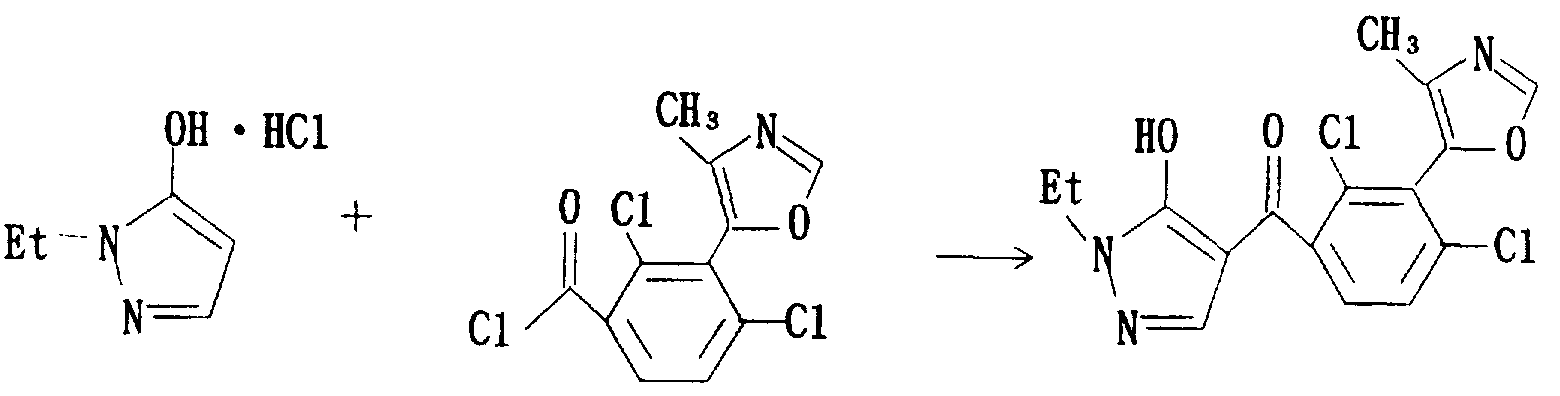
  • 1-ethyl-5-hydroxypyrazole hydrochloride 0.65 g (0.0043 mol) and triethylamine 0.9 g (0.0809 mol) were combined with methylene chloride 20 m1 And dissolved in 1,2-glucose—3— (1,2-isoxazole-3-yl) -1.4-g (1.34 g) (0.043 mol) 5 ml of a methylene chloride solution was added dropwise at room temperature, and the mixture was further stirred at room temperature for 1 hour. The reaction mixture was washed with 1N-hydrochloric acid and then with saturated saline, dried over magnesium sulfate, and the solvent was distilled off under reduced pressure.
  • the reaction mixture was washed with 1N hydrochloric acid, 1N aqueous sodium hydroxide solution, and then with saturated saline, dried over anhydrous magnesium sulfate, and the solvent was distilled off under reduced pressure.
  • the residue was dissolved in acetonitrile 2 Om 1, 0.96 g of triethylamine and 0.14 g of acetone cyanohydrin were added, and the mixture was stirred overnight at room temperature.
  • the solvent was distilled off under reduced pressure, the residue was dissolved in benzene, and extracted with an aqueous sodium carbonate solution. To the obtained aqueous layer was added chloroform, and the solution was precipitated with concentrated hydrochloric acid.
  • the reaction mixture was washed with 1N hydrochloric acid, saturated aqueous sodium hydrogen carbonate and then with saturated saline, dried over anhydrous magnesium sulfate, and the solvent was distilled off under reduced pressure.
  • the residue was dissolved in acetate nitrile (1 Om 1), 0.33 g of triethylamine and 0.04 g of acetone cyanohydrin were added, and the mixture was stirred at room temperature for 1 hour.
  • the solvent was distilled off under reduced pressure, the residue was dissolved in benzene, and extracted twice with 5 Oml of saturated aqueous sodium hydrogen carbonate. To the resulting aqueous layer was added 10 ml of form, and the mixture was acid-precipitated with concentrated hydrochloric acid.
  • aqueous layer is acidified with hydrochloric acid, filtered and washed with water, dried and dried at 8.96 pounds of 3- (1,3-oxazolu-l-5-yl) -1,2,4-dichloromethane I got a benzoic acid. 86% yield
  • Methyl 2,4-dichloro-3- (5-methyl-1,3,4-butadiazole-2-yl) benzoate 2.63 g (0.009 1 mol) and potassium carbonate 1.3 g ( (0.0mol) was dissolved in 20ml of dimethylformamide, and 10ml of dimethylformamide in which 0.65g (0.013mol) of methylthiol was dissolved was added. Stirred overnight at room temperature. The reaction mixture was poured into ice water, extracted with ethyl acetate, washed with brine, dried over magnesium sulfate, and the solvent was distilled off under reduced pressure. The residue was purified by silica gel column chromatography, and 2. lg of oily product was obtained as methyl 2-chloro-3- (5-methyl-1,3,4-oxazidazoyl-2-yl) -1,4-methylthiobenzoate. I got a game. Yield 77.3%
  • Methyl 2-chloro-3- (5-methyl-1,3,4-oxadiazol-2-yl) -14-methylthiobenzoate 2.1 (0.0700 mol) was converted to a 20-m1 mouthpiece form. And 3.7 g (0.021 mol) of m-chloroperbenzoic acid was added thereto, followed by stirring at room temperature for 3 hours. The reaction mixture was filtered, and the filtrate was washed with a 1N aqueous sodium hydroxide solution and then with a saturated saline solution, dried over magnesium sulfate, and the solvent was distilled off under reduced pressure.
  • Methyl 2-chloro-4-1-methanesulfonyl 3- (5-methyl-1-1,3,4-oxaziazol-1-yl) benzoate 1.52 g (0.0046 mol) was dissolved in 14 ml of ethyl alcohol, 14 ml of 1N caustic soda was added, and the mixture was stirred overnight at room temperature. The reaction mixture was poured into ice water and acidified with concentrated hydrochloric acid. The precipitated crystals were filtered and washed with water, and the obtained crystals were -dried to obtain 1.3 g of the target compound as white crystals. 90% yield
  • Methyl 2,4-dichloro-3- (5-methyl-1,2,4-lexadiazol-1-yl) benzoate 2.75 g (0.095 mol) and potassium carbonate 1.3 2 g (0.095 mol) was dissolved in 20 ml of dimethylformamide, and 0.7 g (0.014 mol) of methionthiol was dissolved in 10 ml of dimethylformamide. The mixture was stirred overnight at room temperature. The reaction mixture was poured into ice water, extracted with ethyl acetate, washed with saturated saline, and dried over magnesium sulfate.
  • Methyl 2-chloro-1,3- (5-methyl-1,2,4-oxaziazol-1-yl) -1-methylthiobenzoate 2.8 g (0.0084 mol) in 20 ml It was dissolved in mouth form, and 4.95 g (0.028 mol) of m-chloroperbenzoic acid was added, followed by stirring at room temperature for 3 hours. Insolubles were filtered off from the reaction mixture, and the filtrate was washed with a 1N aqueous solution of sodium hydroxide and saturated brine, and then dried over magnesium sulfate.
  • Methyl 2,4-dichloro-1-hydroxyiminomethylbenzoate (11.00 g, 0.0443) was dissolved in dimethylformamide (11 Om1), and N-promosaxin was dissolved.
  • Dimethylformamide (110 ml) in which 3.17 g (0.214 mol) of imide was dissolved was added dropwise at 10 ° C or lower over 1 hour.
  • a solution of 2.167 g (0.214 mol) of triethylamine in 110 ml of dimethylformamide was added dropwise at 10 ° C. or lower over 1 hour. The mixture was further stirred at the same temperature for 1 hour.
  • Methyl 2,4-dichloro-1,3-hydroxyminomethylbenzoate 15.87 g (0.063 9 mol) was dissolved in dimethylformamide 160 ml, and dimethylformamide was dissolved. A solution in which 55.0 g (0.308 mol) of N-prosuccinimide was dissolved in 16 Om1 was added dropwise at 10 ° C or lower over 1 hour. Then, a solution of 31.3 g (0.309 mol) of triethylamine dissolved in 16 Om1 of dimethylformamide was added dropwise at 10 ° C. or lower over 1 hour. After completion, the mixture was further stirred at the same temperature for 1 hour.
  • reaction mixture was poured into ice water, quickly extracted with methylene chloride, washed with cold water, and dried over magnesium sulfate. After filtration, 21.53 g (0.215 mol) of isopropenyl acetate was added to the filtrate, and the mixture was heated under reflux overnight. The reaction mixture was cooled and the solvent was distilled off under reduced pressure. The residue was purified by silica gel column chromatography to give the title compound 8.57 as crystals.
  • Methyl 2,4-dichloro-3-formylbenzoate 2.478 was dissolved in dry HF 2 O ml, and the mixture was dissolved in methylmagnesium bromide dogetil ether solution (3.0 mo 1/1). ) 4.0 ml was slowly dropped. After the addition, the cooling bath was removed, and the mixture was stirred for 1 hour while the temperature was raised naturally. The reaction mixture was poured into iced water, acidified with dilute hydrochloric acid, and extracted with diethyl ether. The organic layer was washed with water and saturated saline, and then dried over magnesium sulfate.
  • Methyl 2-chloro-1-4-methanesulfonyl 3- (5-methylisoxazo-ru-41-yl) benzoate 0.84 g was dissolved in dioxane 2 Om 1 and concentrated hydrochloric acid 1 Oml was added. After the addition, the mixture was stirred for 16 hours while heating under reflux. After cooling, dioxane was distilled off, extracted with ethyl acetate, and the organic layer was washed with saturated saline and dried over anhydrous magnesium sulfate.
  • Methyl 2,4-dichloro-3- (2-dimethylaminomethylidene-1-oxopropyl) benzoate 7.57 g was dissolved in 30 ml of dioxane and 16 ml of water, and 1.7 mg of hydroxylamine hydrochloride was obtained. Og was added and stirred at room temperature for 17 hours. After evaporating the solvent under reduced pressure, the obtained residue was dissolved in ethyl acetate, washed with brine, and dried over anhydrous magnesium sulfate.
  • the compound of the present invention shows a high herbicidal activity under any conditions of upland crops, soil treatment and foliage treatment. It also contains compounds that have selectivity for barley and other crops, soybeans, ivy and other crops.
  • the compound of the present invention also includes a compound exhibiting a plant growth regulating action for producing growth suppression and the like against useful plants such as crops, ornamental plants and fruit trees.
  • the compound of the present invention has excellent herbicidal activity against rice weeds such as paddy field weeds, such as Nobie, Yumagayari, Omodaka and Houyu, and has selectivity for rice.
  • the compound of the present invention can be applied to the control of weeds in orchards, lawns, track ends, vacant lots and the like.
  • the herbicide of the present invention contains one or more of the compounds of the present invention as an active ingredient.
  • the compound of the present invention can be used in a pure form without adding other components, and can be used in the form of a general pesticide for the purpose of using it as a pesticide, that is, a wettable powder, a granule, a powder, It can also be used in the form of emulsions, aqueous solvents, suspensions, flowables and the like.
  • plant powders such as soybean flour and flour, diatomaceous earth, apatite, gypsum, talc, bentonite, mineral fine powders such as pyrophyllite and clay, and benzoic acid Organic and inorganic compounds such as soda, urea, and sodium sulfate are used.
  • petroleum fractions such as kerosene, xylene and solvent naphtha, cyclohexane, cyclohexanone, dimethylformamide, dimethylsulfoxide, alcohol, acetone, trichloroethylene, methylisobutyl ketone,
  • mineral oil, vegetable oil, water, etc. as solvent.
  • Surfactants can be added, if necessary, to obtain a uniform and stable form in these preparations.
  • the concentration of the active ingredient in the herbicide of the present invention varies depending on the form of the preparation described above.
  • the concentration is 5 to 90%, preferably 10 to 8%. 5%: 3 to 70% in the emulsion, preferably 5 to 60%: 0.01 to 50%, preferably 0.05 to 4% in the granule 0% 'concentration is used
  • the wettable powder and emulsion thus obtained are diluted with water to a predetermined concentration to form a suspension or emulsion, and the granules are sprayed or mixed before or after germination of the weeds. Is done. In actually applying the herbicide of the present invention, an appropriate amount of 0.1 g or more of the active ingredient per hectare is applied.
  • the herbicide of the present invention can also be used by mixing with known fungicides, insecticides, acaricides, herbicides, plant growth regulators, fertilizers, and the like.
  • the synergistic effect of the mixed drug can be expected to have a higher effect. In that case, a combination with a plurality of known herbicides is also possible.
  • Suitable agents to be used in combination with the herbicide of the present invention include anilide herbicides such as diflufdican and propanil, and clomouth aceroalide-based herbicides such as arlacrol and pretilachlor, 2, 4-D, 2, 4-Alkyl herbicides such as DB, herbicides such as diclohop-methyl, phenoxaprop-ethyl, etc., herbicides such as oxyphenoxyalkanoic acid, alkamba, pyrithiobac, etc.
  • anilide herbicides such as diflufdican and propanil
  • clomouth aceroalide-based herbicides such as arlacrol and pretilachlor
  • 2, 4-D 2, 4-Alkyl herbicides
  • DB herbicides such as diclohop-methyl, phenoxaprop-ethyl, etc.
  • herbicides such as oxyphenoxyalkanoic acid, alkamba, pyrithiobac, etc.
  • Dinitroaniline herbicides such as trifluralin and pendimethalin; Diphenyl ether herbicides such as phenylene and homesaphene; sulfonylrea herbicides such as benzenesulfuron-methyl and nicosulfuron; triazinon-based herbicides such as methotrazine and metamitrone; and triazines such as atrazine and cyanazine.
  • Herbicides triazopyrimidine herbicides such as flumellam, butoryl herbicides such as promoxinil and dikopenenyl, pyridazinone herbicides such as chloridazone and norflurazon, phosphate-based herbicides such as glyphosate and glufosinetol Quaternary ammonium salt herbicides such as paraquat, difenzoquat, etc .; cyclic imid herbicides such as full microrac cupentyl, fluthiacetomethyl; etc .; Bok Rion, cinmethylin, Jichiopiru, pyrazolate, pyridate, Furupokisamu, bentazone, Benfuruse Ichito, furthermore, sethoxydim, Torarukoki And cyclohexanedione herbicides such as Jim. Vegetable oils and oil concentrates can also be added to these combined products.
  • Compound 20 of the present invention 20 parts White carbon 20 parts Gesso earth 52 parts 8 Sodium alkyl sulfate 8 parts or more uniformly mixed and finely pulverized to obtain a 20% active ingredient wettable powder c
  • Sodium alkyl sulfate 7 parts The above mixture was uniformly mixed and finely pulverized, and then granulated into granules having a diameter of 5 to 1.0 mm to obtain granules having an active ingredient of 5%.
  • the herbicidal effect was investigated according to the following criteria and expressed as a herbicidal index.
  • the numbers 1, 3, 5, 7, and 9 are intermediate values between 0 and 2, 2 and 4, 4 and 6, 6 and 8, and 8 and 10, respectively.
  • the weed kill rate was calculated by the following formula.
  • Herbicidal rate (%) ⁇ -—— ———— ⁇ " ⁇ 100 Test example 1 Upland foliage spraying test
  • IV-6 7 9 1 0 1 0 1 0 1 0 0 0 0 0 0 0
  • Test example 2 Paddy foliage treatment test
  • Pots having a surface area of 100 cm 2 were filled with paddy soil, and after replacement, seeds of Nobie, Hotaru, Konagi and Omodaka were sown, and then the two-leaf rice was transplanted. This was grown in a greenhouse, and when each weed reached the 1- to 1.5-leaf stage, it was submerged at a depth of 3 cm. Was dripped so that the active ingredient was 63 g / ha. Three weeks after the treatment, the herbicidal effect and the degree of phytotoxicity of rice were investigated, and the results are shown in Table 23.
  • composition containing the compound of the present invention is useful as a herbicide.

Landscapes

  • Organic Chemistry (AREA)
  • Chemical & Material Sciences (AREA)
  • Life Sciences & Earth Sciences (AREA)
  • Dentistry (AREA)
  • Health & Medical Sciences (AREA)
  • Engineering & Computer Science (AREA)
  • Plant Pathology (AREA)
  • General Health & Medical Sciences (AREA)
  • Wood Science & Technology (AREA)
  • Zoology (AREA)
  • Environmental Sciences (AREA)
  • Pest Control & Pesticides (AREA)
  • Agronomy & Crop Science (AREA)
  • Plural Heterocyclic Compounds (AREA)

Description

明 細 書
新規なヘテロ環で置換されたべンゼン誘導体および除草剤 技術分野:
本発明は、 ビラゾール環の 4位にベンゾィル基が置換した新規ビラプール誘導 体及び除草剤に関する。 背景技術:
ビラゾ一ル環の 4位にベンゾィル基が置換したビラゾ一ル骨格を有する除草剤 としては、 一般式 〔 I I〕
〔 I I〕
Figure imgf000003_0001
で表される化合物等が特開平 2— 1 7 3号公報に記載され、 また、 WO 9 3 / 1 8 0 3 】号公報には、 式 〔 I I I〕 で表される化合物が記載されている。
〔III 〕
Figure imgf000003_0002
さらにまた、 WO 9 6 / 2 6 2 0 6号公報には、 式 〔 I V〕 で表される化合物 が記載されている。 し力、しな力 ら、 これらの化合物は例示がされているのみで、 物性値の具体的記載はない。
Figure imgf000004_0001
( Z =Hetero-yl ) 本発明の目的は、 工業的に有利に合成でき、 より低薬量で効果の確実な安全性 の高い、 作物との選択性の良い除草剤を提供することである。 発明の開示:
本発明は、 一般式 〔 I〕 で表されるベンゾィル部の 3位がヘテロ環で置換され た 4 一べンゾィルビラゾール化合物であって、 ピラゾ一ル環のエノール性水酸基 が保護されている化合物を有効成分として含有することを特徴とする除草剤であ る。
すなわち、 本発明は、 式 〔 I〕
c I )
Figure imgf000004_0002
〔式中、 R 1 は、 ハロゲン原子、 6 アルキル基、 ΰ アルコキシ基、 二卜 口基、 シァノ基、 ハロアルキル基、 ハロアルコキシ基、 c卜 6 アル キルチオ基、 -(; アルキルスルフィニル基又は β アルキルスルホ二ル基を 表す。
R 2 は、 ハロゲン原子、 ニトロ基、 シァノ基、 C ,一《 アルキル基、 C卜 アル コキシ基、 ハロアルキル基、 β ハロアルコキシ基、 6 アルキルチ ォ基、 d— アルキルスルフィニル基又は C アルキルスルホ二ル基を表す。 R3 は、 ハロゲン原子、 C,— 6 アルキル基、 6 アルコキシ基、 ニトロ基、 シァノ基、 d- G ハロアルキル基、 C卜 B アルキルチオ基、 1; アルキルスル フィニル基又は C ,— e アルキルスルホ二ル基を表す。
nは 0、 1、 2を表す。 nが 2のとき、 R3 は同一でも相異なっていてもよい
He tは、 炭素原子部分でベンゼン環と結合する、 N、 0若しくは S原子を 1 から 3個含む R 7 および R8 で置換された飽和あるいは不飽和 5員へテロ環基を 表す。
R4 は、 水素原子又は d アルキル基を表す。
R5 は、 水素原子、 d-e アルキル基、 C2— G アルケニル基又は C 21; アルキ 二ル基を表す。
R6 は、 C 6 アルキル基、 C3-8 シクロアルキル基、 (Ci-G アルキル基、
C 1 -6 アルコキシ基、 β ハロアルキル基、 (; ハロアルコキシ基、 ニトロ 基又はハ口ゲン原子によつて置換されていてもよい) フヱ二ル基を表す。
Xは S02 、 (CH2 ) mCO、 アルキルで置換されてもよい C,一 6 アルキレ ン基又は単結合を表す。 mは 0、 1、 2、 3を表す。 〕 で表される化合物又はそ れら化合物を含有する除草剤である。
以下、 本発明を詳細に説明する。
本発明は、 一般式 〔 I〕 で表されるピラゾール化合物及びそれを有効成分とし て含有することを特徴とする除草剤である。
〔I〕
Figure imgf000005_0001
一般式 〔I〕 において、 R' は、 フッ素、 塩素、 臭素等のハロゲン原子、 メチル、 ェチル、 プロピル、 イソプロピル、 プチル、 t—ブチル等の 6 アル キル基、 メ トキシ、 エトキシ、 プロボキシ、 イソプロボキシ、 ブトキシ、 t 一ブトキシ等 の d-e アルコキシ基、
ニトロ基、 シァノ基、 トリフルォロメチル、 トリフルォロェチル等の c ; ハロ アルキル基、 トリフルォロメ トキシ基等の ハロアルコキシ基、 メチルチオ、 ェチルチオ、 プロピルチオ、 イソプロピルチオ等の C (; アルキル チォ基、
メチルスルフィニル、 ェチルスルフィニル、 プロピルスルフィニル、 イソプロピ ルスルフィニル等の C アルキルスルフィニル基又は、
メチルスルホニル、 ェチルスルホニル、 プロピルスルホニル、 イソプロピルスル ホニル基等の アルキルスルホ二ル基を表す。
R 2 は、 フッ素、 塩素、 臭素等のハロゲン原子、 ニトロ基、 シァノ基、 メチル、 ェチル、 プロピル、 イソプロピル、 プチル、 t—ブチル等の d- アル キル基、
メ トキシ、 ェ卜キシ、 プロボキシ、 イソプロボキシ、 ブトキシ、 t—ブトキシ等 の (; アルコキシ基、
トリフルォロメチル、 トリフルォロェチル等の C l - ϋ ハロアルキル基、 トリフルォロメ トキシ、 トリクロロメ トキシ等の ハロアルコキシ基、 メチルチオ、 ェチルチオ、 プロピルチオ、 イソプロピルチオ等の C n アルキル チォ基、
メチルスルフィニル、 ェチルスルフィニル、 プロピルスルフィニル、 イソプロピ ルスルフィニル等の C , -6 アルキルスルフィニル基又は、
メチルスルホニル、 ェチルスルホニル、 プロピルスルホニル、 イソプロピルスル ホニル基等の 6 アルキルスルホ二ル基を表す。
R3 は、 フッ素、 塩素、 臭素等のハロゲン原子、
メチル、 ェチル、 プロピル、 イソプロピル、 プチル、 t 一ブチル等の d - 6 アル キル基、
メ トキシ、 エトキシ、 プロボキシ、 イソプロポキシ、 ブトキシ、 t 一ブトキシ等 の C -6 アルコキシ基、 ニトロ基、 シァノ基、
トリフルォロメチル、 トリフルォロェチル等の Cト fi ハロアルキル基、 メナルチオ、 ェチルチオ、 プロピルチオ、 イソプロピルチオ等の d-c アルキル チォ基、
メチルスルフィニル、 ェチルスルフィニル、 プロピルスルフィニル、 イソプロピ ルスルフィニル基等の C , -ο アルキルスルフィニル基又は、
メチルスルホニル、 ェチルスルホニル、 プロピルスルホニル、 イソプロピルスル ホニル基等の c,— e アルキルスルホ二ル基を表す。
He tは、 N、 0若しくは S原子を 1から 4個含み、 置換基 R7 および R8 を 有していてもよい飽和あるいは不飽和 5員へテロ環基を表す。 また、 このへテロ 環基は炭素原子でベンゼン環と結合している。
H e tとしては、 例えば、 2—フリル、 3—フリル、 4一フリル、 5—フリル 、 2 _チェニル、 3—チェニル、 4一チェニル、 5—チェニル、 2—ピロリル、 3一ピロリル、 4—ピロリル、
2—イミダゾィル、 4一イミダゾィル、 5—イミダゾィル、 ビラゾ一ルー 3— ィル、 ピラゾ一ルー 4一ィル、 ピラゾールー 5—ィル、 1, 3—才キサゾ一ルー 2—ィル、 1, 3—ォキサゾール— 4一ィル、 1, 3—才キサゾ一ルー 5—ィル 、 1 , 2—イソォキサゾ一ルー 3—ィル、 1, 2—イソォキサゾ一ルー 4ーィル 、 1, 2—イソォキサゾール— 5—ィル、 1, 3—チアゾ一ルー 2—ィル、 1 , 3 _チアゾ一ルー 4一ィル、 I, 3—チアゾ一ルー 5—ィル、 1, 2—イソチア ゾ一ルー 3—ィル、 1, 2—イソチアゾールー 4一ィル、 1 , 2—イソチアゾ一 ルー 5—ィル、
1, 2, 4一ォキサジァゾ一ルー 3—ィル、 1, 2, 4一ォキサジァゾ一ルー 5—ィル、 1, 3, 4一ォキサジァゾ一ル— 2—ィル、 1, 3, 4—ォキサジァ ゾールー 5—ィル、 1, 2, 4—チアジアゾ一ルー 3—ィル、 1, 2, 4—チア ジァゾ一ルー 5—ィル、 1, 3, 4—チアジアゾ一ルー 2—ィル、 1, 3, 4— チアジアゾールー 5—ィル、 1, 2, 4—トリァゾールー 3—ィル、 1, 2, 4 一 卜リアゾ一ルー 5—ィル基等を挙げることができる。
また、 これらへテロ環は任意の位置に、 フッ素、 塩素、 臭素等のハロゲン原子 、 メチル、 ェチル基等の C,-fi アルキル基、 メ 卜キシ、 エトキシ基等の C,-6 ァ ルコキシ、 トリフルォロメチル基等の C fi ハロアルキル基等の置換基 R7 , R を有していてもよい。
より好ましい H e tとして、 以下に示すヘテロ環基を挙げることができる。
Figure imgf000008_0001
Figure imgf000008_0002
(上記、 式中、 R 7 および R 8 は、 それぞれ独立して水素原子、 メチル、 ェチル 、 プロピル、 イソプロピル、 プチル、 t 一ブチル基等の 6 アルキル基、 メ 卜 キシ、 エトキン、 プロポキシ基等の d - ci アルコキシ基、 フッ素、 塩素、 臭素等 のハロゲン原子又は卜リフルォロメチル基等の C ,; ハロアルキル基を表す) 。 また、 IT は、 水素原子、 メチル、 ェチル、 プロピル、 イソプロピル、 ブチル
、 イソプチル、 t 一ブチル等の C , -*! アルキル基、
トリフルォロメチル基等の d ハロアルキル基、
ヒ ドロキシメチル、 1—ヒドロキシェチル、 2—ヒドロキシェチル、 ヒ ドロキシ プロピル基等のヒ ドロキシ d -e アルキル基、
メ トキシメチル、 ェ卜キシメチル、 プロボキシメチル、 イソプロボキシメチル、 メ 卜キシェチル、 エトキシェチル、 エトキシプロピル、 メ 卜キシプロピル、 エト キシプロピル、 ブトキシメチル、 t 一ブトキシメチル、 t—ブトキシェチル基等 の -(; アルコキシ <! アルキル基を表す。
R 5 は、 水素原子、 メチル、 ェチル、 プロピル、 イソプロピル、 プチル、 イソ プチル、 t 一ブチル基等の d— 6 アルキル基、
ビニル、 プロぺニル、 クロチル、 ァリル等の C 2 -G アルケニル基又はェチニル、 プロパルギル基等の C 2-6 アルキニル基を表す。
R6 は、 メチル、 ェチル、 プロピル、 イソプロピル、 プチル、 イソプチル、 t —プチル等の C l - β アルキル基、 シクロプロピル、 シクロブチル、 シクロペンチル、 シクロへキシル基等の c3 - 8 シクロアルキル基、 又は、
(メチル、 ェチル、 プロピル、 イソプロピル、 プチル、 イソプチル、 t一ブチル 等の アルキル基、 メ トキシ、 エトキン、 プロポキシ、 イソプロボキシ、 ブ トキシ、 tーブ卜キシ等の d-s アルコキシ基、 トリフルォロメチル、 トリクロ ロメチル、 フルォロメチル、 クロロメチル、 ジフル口ロメチル、 ジクロロメチル
、 卜リフルォロェチル、 ペンタフルロロェチル等の Ci ハロアルキル基、 トリ フルォロメ 卜キシ基等の Ct— 6 ハロアルコキシ基、 ニトロ基又はフッ素、 塩素、 臭素等のハロゲン原子によつて置換されていてもよい) フェニル基を表す。
Xは、 S02 、 (CH2 ) mCO (mは 0、 1、 2又は 3を表す。 ) 、 メチル 、 ェチル等のアルキル基で置換されてもよいメチレン、 エチレン、 プロピレン基 等の C,— β アルキレン基又は単結合を表す。
XRe のより好ましい例としては、 CH2 A r, CH2 COA r及び S〇2 A r 〔ここで、 Arは、 ベンゼン環の任意の位置が (メチル、 ェチル、 プロピル、 イソプロピル、 プチル、 イソプチル、 t一ブチル等の d-6 アルキル基、 メ トキ シ、 エトキシ、 プロボキシ、 イソプロボキシ、 ブトキシ、 t一ブトキシ等の C卜 アルコキシ基、 トリフルォロメチル、 トリクロロメチル、 フルォロメチル、 ク 口ロメチル、 ジフル口ロメチル、 ジクロロメチル、 トリフルォロェチル、 ペン夕 フルロロェチル等の Cj ハロアルキル基又はフッ素、 塩素、 臭素等のハロゲン 原子によって置換されていてもよい) フヱニル基を表す。 〕 で表される基を挙げ ることができ、 より好ましくは、 置換基を有していてもよい CH2 A r基を挙げ ることができる。
(化合物の製造)
本発明化合物は、 次の方法によって製造することができる c
Figure imgf000010_0001
[VII] 脱水縮合剤
Figure imgf000010_0002
脱水縮合剤/ base
(式中、 R1 , R2 , R3 , R4 , R5 , R(l , X, nおよび He tは、 前記と 同じ意味を有す。 Qは、 ハロゲン原子、 アルキルカルボニルォキシ基、 アルコキ キシカルポニルォキシ基又はべンゾィルォキシ基を表し、 Lはハロゲン原子を表 す。 )
化合物 〔1 Va ) および 〔I Vb ) は、 化合物 〔VI I〕 と化合物 [Va] ( Qは、 前記と同じ意味を表す。 ) 各々 1モルずつあるいは一方を過剰に用い、 1 モルまたは過剰の塩基の存在下に反応させることによって得ることができる。 反応に用いられる塩基としては、 ΚΟΗ, H a 0H等のアルカリ金属水酸化物 、 炭酸ナ卜リゥム、 炭酸力リゥム等のアル力リ金属炭酸塩、 水酸化カルシウム、 水酸化マグネシウム等のアル力リ土類金属水酸化物、 炭酸カルシウム等のアル力 リ土類金属炭酸塩、 卜リエチルァミ ン、 ジイソプロピルェチルァミ ン等のトリ (
C アルキル) ァミン、 ピリジン等の有機塩基、 燐酸ナトリゥム等を例示する ことができる。
また、 溶媒としては、 水、 塩化メチレン、 クロ口ホルム、 トルエン、 酢酸ェチ ル、 ジメチルホルムァミ ド (DMF)、 テトラヒ ドロフラン (THF) 、 ジメ 卜 キシェ夕ン (DME)、 ァセトニトリル等が用いられる。
反応混合物は反応が完了するまで 0°C~ 50°Cで攪拌される。 また、 四級アン モニゥム塩等の相間移動角虫媒を用いて、 二相系で反応させることできる。
さらに、 化合物 〔 I Va〕 および 〔 I Vb〕 は、 化合物 〔V I I〕 と化合物 [ Vb] とを、 ジシクロへキシルカルポジイミ ド (DCC)等の脱水縮合剤の存在 下に反応させることによつても得ることができる。 D C C等との反応において用 いられる溶媒としては、 塩化メチレン、 クロ口ホルム、 トルエン、 酢酸ェチル、 ジメチルホルムァミ ド、 THF、 ジメ 卜キシエタン、 ァセトニトリル、 tーァミ ルアルコール等を挙げることができる。 反応 - 10T;〜 50°Cで円滑に進行し、 反応混合物は常法によつて処理される。
化合物 〔I Va) および 〔I Vb〕 は、 混合物として次の転位反応に使用する ことができる。 転位反応は、 シァノ化合物および穏和な塩基の存在下で行われる 。 すなわち、 化合物 〔 I Va〕 および 〔 I Vb〕 の 1モルを、 1〜 4モルの塩基 、 好ましくは 1~2モルの塩基および 0. 01モルから 1. 0モル、 好ましくは 0. 05モルから 0. 2モルのシアン化合物と反応させることにより、 〔I a〕 で表される化合物を得るものである。 塩基は前記のものがいずれも用いられ得る 。 また、 シァノ化合物としては、 シアンィ匕カリウム、 シアン化ナトリウム、 ァセ トンシアンヒドリン、 シアン化水素、 シアン化カリウムを保持したポリマー等を 用いることができる。 尚、 反応系に少量のクラウンエーテル等の相間移動触媒を 加えることにより、 反応がより短い時間で完結する。 反応温度は 80°Cより低い 温度、 好ましくは室温から 40°Cで行われる。 用いられる溶媒は、 1、 2—ジク ロロェタン、 トルエン、 ァセトニ卜リル、 塩化メチレン、 酢酸ェチル、 ジメチル ホルムアミ ド、 メチルイソプチルケトン、 THF、 ジメ 卜キシェタン等である。 また、 この転位反応は、 不活性溶媒中、 炭酸力リウム、 炭酸ナトリウム、 トリ ェチルァミ ン、 ピリジン等の塩基の存在下に行うこともできる。 用いられる塩基 の量は、 化合物 〔I Va〕 および 〔I Vb〕 に対して 0. 5〜2. 0モルであり 、 溶媒とし ては THF、 ジォキサン、 tーァミルアルコール、 t一ブチルアル コール等が用いられる。 反応温度は、 室温から用いる溶媒の沸点までが好ましい さらに、 化合物 〔 I V a〕 および 〔 I Vb〕 を単離することなしに、 DCC等 の脱水縮合剤と共に塩基を用いることによつても化合物 〔I a〕 を得ることがで きる。 用いられる塩基としては、 炭酸カリウム、 炭酸ナトリウム、 卜リエチルァ ミン、 ピリジン等であり、 塩基の量は、 化合物 〔V I I〕 に対して 0. 5〜2. 0モルである。 また、 溶媒としては、 THF、 ジォキサン、 t—ァミルアルコー ル、 t—ブチルアルコール等であり、 反応温度は、 室温から用いる溶媒の沸点ま でが好ましい。
化合物 〔I〕 は、 化合物 〔I a〕 に、 R8 X-L (Lはハロゲンを表す。 ) を 塩基の存在下に反応させることによつて製造することができる。 この反応にお 、 て用いられる塩基としては、 KOH, H a OH等のアルカリ金属水酸化物、 炭酸 力リゥム、 炭酸ナトリゥム等のアル力リ金属炭酸塩、 水酸化カルシウム等のアル カリ土類金属水酸ィ匕物、 炭酸カルシウム等のアルカリ土類金属炭酸塩、 トリェチ ルァミ ン、 ジイソプロピルェチルァミ ン等のトリ (Cト 6 アルキル) ァミ ン、 ピ リジン等の有機塩基、 燐酸ナトリゥム等を挙げることができる。 溶媒としては、 塩化メチレン、 クロ口ホルム、 トルエン、 酢酸ェチル、 ジメチルホルムアミ ド、 THF、 ジメ トキシェタン、 ァセトニトリル等が用いられる。 反応は 0° じから 用いる溶媒の沸点までの温度で行われる。 また、 化合物 U〕 は、 四級アンモニ ゥム塩等の相間移動触媒を用レ、て、 水と上記溶媒中水に不溶の溶媒との二相系で 反応させることによつても製造することができる。
一般式 〔V I I〕 で表される 5—ヒ ドロキシピラゾール類は、 例えば、 特開昭 6 2 - 2 3 4 0 6 9号公報または特開平 3— 4 4 3 7 5号公報に記載された以下 に例示する方法に従つて製造することができる。
Figure imgf000013_0001
(b)
0 CH3
H+
CH3C0)2CHCH2CNN=CCH2CH(CH3):
\ ヽ0
Figure imgf000013_0002
本発明化合物の製造の合成中間体であるアルデヒ ド体 (3 ) 、 カルボン酸体 ( 4 ) は、 以下のようにして製造することができる。
R902C O
Figure imgf000013_0003
(式中、 R ' , Rz は前記と同じ意味を表し、 R° は水素原子又は低級アルキル 基を表し、 Wはハロゲン原子を表す。 ) トルエン誘導体 (1) から公知の方法、 例えば塩素、 臭素などの単体のハロゲ ンあるいは N—プロモコハク酸ィミ ド (NB S) 、 N—クロロコハク酸イミ ド ( NCS) 等のハロゲン化剤を、 光あるいはベンゾィルペルォキシド等のラジカル 反応開始剤の存在下に反応させることによってベンジルハライ ド誘導体 (2) を 得たのち、 例えば、 J. Am. C h em. So c. , 7 1, 1 767 ( 1 94 9 ) に記載の方法によりアルデヒド体 (3) を製造することができる。 すなわち、 2一二トロプロパン等の二トロアルカン類のアル力リ金属塩とメ夕ノ一ル、 エタ ノール等のアルコール溶媒中 0 °Cから溶媒の沸点の間の温度で反応させることに よってアルデヒ ド体 (3) を製造することができる。
次に、 カルボン酸体 (4) は、 トルエン誘導体 (1) から過マンガン酸力リウ ム等の酸化反応によって、 あるいはアルデヒド体 (3) から J on e s試薬、 ク ロム酸あるいは過マンガン酸力リウム等の酸化反応等の公知の方法で製造するこ とができる。
さらに、 これらのアルデヒド体 (3) およびカルボン酸体 (4) を用いること により、 次に示すような中間体を製造することができる。
Figure imgf000015_0001
R2
(6) 1
R 0zC
Figure imgf000015_0002
Ph3P=CHC0R12(22)
(式中、 IT , R2 , R8 は、 前記と同じ意味を表し、 R1Q, R1'は水素原子又 は低級アルキル基を表し、 Vはハロゲン原子を表し、 R12は低級アルキル基を表 す。 )
アルドォキシム体 (5) は、 アルデヒド (3) とヒドロキシルアミン塩酸塩あ るいはヒ ドロキシルアミン硫酸塩とを、 塩基の存在下に反応させることにより製 造することができる。 さらに、 このアルドォキシム体 (5) を、 無水酢酸, 五酸 化リン, 塩化チォニル等の脱水剤と反応させることにより、 対応するシァノ体 ( 6) を製造することができる。 次に、 ケトン体 ( 8 ) は、 例えば、 O r ga n i c Re a c t i on s, 1 5巻 254頁記載の Kn 0 e v e n a g e 1縮合反応を応用して、 ニトロォレフ イ ン体 (7) を製造し、 このニトロォレフィ ン体 (7) を活性化した鉄一水系あ るいはリチウムアルミニウムハイ ドライ ド等により還元したのち、 加水分解する ことにより得ることができる。
ァシル体 ( 1 0) は、 アルデヒド体 (3) に G r i gn a r d試薬を反応させ てアルコール体 (9) を製造し、 このアルコール体 (9) を活性化された二酸化 マンガン、 クロム酸等の酸化剤により酸化を行うことにより製造することができ る。
ビニルケトン体 (24) は、 文献公知の方法に従い、 アルデヒ ド体 (3) とメ チルケトン (2 1 ) とを触媒の存在下、 水中で 0〜 50°Cで 1〜 50時間反応さ せることにより、 アルドール体 (23) を得たのち、 このものを適当な溶媒中、 触媒の存在下脱水することにより製造することができる。 アルドール体 (23) を製造する際に用いられる触媒としては、 水酸化ナトリウム、 水酸化バリウム等 の金属水酸化物類、 ピぺリジン、 ピリジン等の有機塩基類が挙げられる。
また、 次の脱水反応において用いられる触媒としては、 '濃硫酸、 p -トルエン スルホン酸等の酸類が挙げられる。 また、 脱水反応の溶媒としては、 ベンゼン、 トルエン等の炭化水素類、 ジクロロメタン、 クロ口ホルム等のハロゲン化炭化水 素類等を用いることができる。
又、 ビニルケトン体 (24) は、 アルデヒ ド体 (3) とホスホラン (22) を 適当な溶媒中で、 室温から用いる溶媒の沸点の間の温度で 1 0分から 30時間反 応させることによつても製造することができる。
アミ ド体 ( 1 2 ) 、 ヒドラジッ ド体 ( 1 3 ) および —ジケトン体 ( 1 5 ) は それぞれ、 次のようにして製造することができる。
R1
CONfls
Figure imgf000017_0001
R902C H2
Figure imgf000017_0002
(式中、 R1 , R2 , R8 は、 前記と同じ意味を表し、 R13, R'\ R15はそれ ぞれ独立して低級アルキル基を表す。 )
先ず、 カルボン酸体 (4) をベンゼン、 トルエン等の炭化水素類、 メチレンク ロリ ド、 クロ口ホルム等のハロゲン化炭化水素類等の不活性な溶媒中でホスゲン 、 チォニルクロリ ド、 ォキザリルクロリ ド等の塩素化剤と反応させることにより 、 中間体であるカルボユルクロリ ド体 ( 1 1 ) を製造する。
次いで、 アミ ド体 ( 1 2) およびヒ ドラジッ ド体 ( 1 3) は、 カルボニルクロ リ ド体 ( 1 1 ) を用いて、 アンモニアあるいはヒドラジンを作用させる公知の方 法により製造することができる。
また、 /3—ジケトン体 (1 5) は、 /3—ケ卜エステル体 ( 1 4 ) にマグネシゥ ムアルコラ一卜を作用させて得られるマグネシウム塩と、 カルボニルクロリ ド体
( 1 1 ) とを反応させることにより製造することができる。 次に、 ヘテロ環中間体の合成法について例示する c
Figure imgf000018_0001
(式中、 R1 , R2 , R3 は前記と同じ意味を表し、 R 16は前記の R7 または R 8 に対応する。 )
一般式 (1 7) で表されるォキサゾール体は、 例えば、 アルデヒ ド体 (3) と イソ二トリル体 (1 6) とを塩基の存在下、 適当な溶媒中、 室温から用いる溶媒 の沸点の間の温度で〗〜 30時間反応させることによって製造することができる 。 この反応に用いられる塩基としては、 炭酸水素ナトリウム、 炭酸カリウム等の 炭酸塩類、 水酸化ナトリウム、 水酸化力リゥム等のアル力リ金属水酸化物、 ナト リウムメチラ一卜、 ナトリウムェチラ一卜等の金属アルコラ一卜類、 卜リエチル ァミ ン、 1, 8—ジァザビシクロ .4.0] ゥンデ一 7—セン (DBU) 等の有機 塩基類等が挙げられる。
また、 この反応に用いられる溶媒としては、 例えば、 メタノール、 エタノール 、 イソプロパノール等のアルコール類、 ベンゼン、 トルエン等の炭化水素類、 ジ クロロメタン、 クロ口ホルム等のハロゲン化炭化水素類、 テトラヒ ドロフラン ( THF) 、 ジォキサン等のエーテル類、 ァセトニトリル等の二卜リル類、 N, N ージメチルホルムアミ ド (DMF) 等が挙げられる。
E902C
Figure imgf000018_0002
(式中、 R1 , R2 , R° は前記と同じ意味を表し、 R17は、 前記の R7 または R8 に対応する。 )
一般式 (20) で表されるチアゾール体は、 アミ ド体 (1 2) からチォアミ ド 体 (1 8) を経由して製造することが きる。 チォアミ ド体 (1 8) は、 アミ ド 体 (1 2) と五硫化リンあるいはローソン試薬とを、 溶媒中あるいは無溶媒で室 温から用いる溶媒の沸点の間の温度で反応させることによつて製造することがで きる。 この反応において用いられる溶媒は、 ベンゼン、 トルエン等の炭化水素類 、 ジォキサン等のエーテル類等が挙げられる。
次いで得られたチォアミ ド体 (1 8) と α—ハロケトン (1 9) とを適当な塩 基の存在下、 もしくは塩基を用いることなく適当な溶媒中、 室温から用いる溶媒 の沸点の間の温度で 1〜30時間反応させることによって、 チアゾール体 (20 ) を製造することができる。
この反応で用いられる塩基としては、 炭酸水素ナトリゥム、 炭酸力リゥム等の 炭酸塩類、 水酸化ナ卜リゥム、 水酸化力リゥム等のアル力リ金属水酸化物、 ナト リウムメチラート、 ナトリウムェチラ一卜等の金属アルコラ一卜類、 卜リエチル ァミ ン、 DBU等の有機塩基類等が挙げられる。
また、 この反応に用いられる溶媒としては、 メタノール、 エタノール、 イソプ ロパノール等のアルコール類、 ベンゼン、 トルエン等の炭化水素類、 ジクロロメ タン、 クロ口ホルム等のハロゲン化炭化水素類、 アセトン、 メチルェチルケトン 等のケトン類、 酢酸メチル、 酢酸ェチル等のエステル類、 THF、 ジォキサン等 のエーテル類、 ァセトニ卜リル等の二トリル類、 DMF等が挙げられる。
R902
Figure imgf000020_0001
(式中、 R1 , R2 , R8 , R 18は前記と同じ意味を表し、 R19は水素原子又は C,-fi のアルキル基を表す。 )
イソォキサゾ一ル体 (2 6 a) は、 ビニルケトン体 (2 4) とヒ ドロキシルァ ミンとを適当な溶媒中、 0°Cから用いる溶媒の沸点の間の温度で 0. 5〜5時間反 応させ、 ォキシム体 (2 5) を得たのち、 さらに閉環、 酸化反応することによつ て製造することができる。 この反応においてヒドロキシルァミンは、 中和するこ となく硫酸塩あるいは塩酸塩の形で反応させることもできる力 適当な塩基を用 いて中和した後反応させることもできる。 中和に用いられる塩基としては、 炭酸 水素ナトリウム、 炭酸力リゥム等の炭酸塩類、 水酸化ナトリウム、 水酸化力リゥ ム等のアル力リ金属水酸化物、 酢酸ナトリゥム等のカルボン酸塩類、 ナトリウム メチラー卜、 ナトリウムェチラ一卜等の金属アルコラート類、 卜リエチルァミン 、 ピリジン等の有機塩基類が挙げられる。
また、 用いられる溶媒としては、 メタノール、 エタノール、 イソプロパノール 等のアルコール類、 ベンゼン、 トルエン等の炭化水素類、 ジクロロメタン、 クロ 口ホルム等のハロゲン化炭化水素類、 THF、 ジォキサン等のエーテル類、 ァセ 卜二卜リル等の二トリル類、 DMF、 ピリジン、 酢酸、 水等およびこれらの溶媒 の 2種以上の混合溶媒が挙げられる。 閉環 ·酸化反応には、 ヨウ素一ヨウ化カリ 閉環 ·酸化反応には、 ヨウ素一ヨウ化カリウム、 N—プロモサクシンイミ ド、 パラジウム触媒系等が用いられ、 それぞれ、 J. Ame r. C h em. So c. , 94, (1 972) ; J. He t e r o c y c l. Ch em. , 1 4, 1 28 9 ( 1 977 ) ; Te t r ahe d r on L e t t. 1 977, 5075に記 載の方法に従つて製造することができる。
ピラゾール体 (28 a) はビニルケトン体 (24) から二段階で製造すること ができる。 すなわち、 先ず、 ビニルケ卜ン体 (24) と置換ヒ ドラジンを、 適当 な溶媒中、 0 °Cから用 、る溶媒の沸点の間の温度で 0.5〜 5時間反応させてジヒ ドロピラゾール体 (27) を得る。 この反応に用いられる溶媒としては、 メ夕ノ —ル、 エタノール、 イソプロパノール等のアルコール類、 ベンゼン、 トルエン等 の炭化水素類、 ジクロロメタン、 クロ口ホルム等のハロゲン化炭化水素類、 TH F、 ジォキサン等のエーテル類、 ァセ卜二トリル等の二トリル類、 DMF、 ピリ ジン、 酢酸、 水等およびこれらの溶媒の 2種以上の混合溶媒が挙げられる。 次いで、 ジヒ ドロピラゾ一ル体 (27) と活性化された二酸化マンガン、 ジシ ァノジクロ口べンゾキノン (DDQ) 、 過酸化ニッケル、 NBS等の酸化剤を適 当な溶媒中、 室温から用いる溶媒の沸点の間の温度で反応させることによってピ ラゾール体 (28 a) を製造することができる。 この反応に用いられる溶媒とし ては、 ベンゼン、 トルエン等の炭化水素類、 クロ口ホルム、 四塩化炭素等のハロ ゲン化炭化水素類等が挙げることができる。
Figure imgf000022_0001
(式中、 R1 , R2 , R° は前記と同じ意味を表し、 R2nは R7 と同じ意味を表 し、 R2'は Ra と同じ意味を表し、 R22は R5 と同じ意味を表す。 )
一般式 (2 6 b) で表されるイソォキサゾール体および一般式 (2 8 b) で表 されるピラゾール体は、 /3—ジケ卜ン体 ( 1 5) とそれぞれヒドロキシルァミ ン および置換ヒ ドラジンを反応させることによつても製造することができる。 これ らの反応は、 適当な溶媒中、 0°Cから用いる溶媒の沸点の間の温度で反応させる ことによって行われる。 この反応において、 硫酸、 p—トルエンスルホン酸等の 酸類を触媒として用いることもできる。 また、 溶媒としては、 メタノール、 エタ ノール、 イソプロパノール等のアルコール類、 ベンゼン、 トルエン等の炭化水素 類、 ジクロロメタン、 クロ口ホルム等のハロゲン化炭化水素類、 THF、 ジォキ サン等のエーテル類、 ァセ卜二トリル等の二トリル類、 DMF、 ピリジン、 酢酸 、 水等およびこれらの溶媒の 2種以上の混合溶媒が挙げられる。
2 0 R90
Figure imgf000023_0001
(式中、 R1 , R2 , R° は前記と同じ意味を表し、 R23, R24は、 前記の R7
または R8 に対応する。 )
—般式 (3 1 ) で表されるイソォキサゾール体は、 アルドォキシム体 (5) と 塩素、 臭素、 N—クロロザクシンィミ ド (NCS) 、 NB S等のハロゲン化剤と を、 ベンゼン、 トルエン等の炭化水素類、 ジクロロメタン、 クロ口ホルム等のハ ロゲン化炭化水素類、 THF、 ジォキサン等のエーテル類、 ァセトニ卜リル等の 二卜リル類、 DMF等の溶媒中、 一 1 0~50°Cで反応させた後、 トリエチルァ ミン等の有機塩基類、 炭酸水素ナトリウム、 炭酸力リゥム等の炭酸塩等の塩基と 反応させることによって二トリルォキシド体 (2 9) とし、 このものとビニルァ セテ一卜 (3 0) とを室温から用いる溶媒の沸点までの温度で反応させることに より製造することができる。
また、 上記ハロゲン化物をビニルアセテート (3 0) の存在下に、 上記塩基を 2 反応させてもイソォキサゾール体 (3 1 ) を製造することができる。
Figure imgf000023_0002
(式中、 R ' , R2 , R8 は前記と同じ意味を表し、 R25は、 前記の R7 に対応 する。 ) 千サジァゾ一ル体 (34) は、 アミ ドォキシム体 (3 1) を経由して製造す ることができる。 ァミ ドォキシム体 (3 1 ) は、 二卜リル体 (6) とヒ ドロキシ ルアミンを適当な溶媒中で、 室温から用いる溶媒の沸点の間の温度で反応させる ことによって製造される。 ヒドロキシルァミ ンは、 硫酸塩あるいは塩酸塩を適当 な塩基、 たとえば、 炭酸水素ナトリウム、 炭酸力リゥム等の炭酸塩類、 水酸化ナ トリウム、 水酸化力リゥム等のアル力リ金属水酸化物、 酢酸ナトリゥム等のカル ボン酸塩類、 ナトリウムメチラート、 ナトリウムェチラ一ト等の金属アルコラ一 ト類、 卜リエチルアミン、 ピリジン等の有機塩基類等で中和して使用される。 反応に用いられる溶媒としては、 メタノール、 エタノール、 イソプロパノール 等のアルコール類、 ベンゼン、 トルエン等の炭化水素類、 ジクロロメタン、 クロ 口ホルム等のハロゲン化炭化水素、 THF、 ジォキサン等のエーテル類、 ァセト 二トリル等の二トリル類、 DMF、 ピリジン、 酢酸、 水等およびこれらの溶媒の 2種以上の混合溶媒が挙げられる。
次に、 得られたアミ ドォキシム体 (3 1) と酸無水物 (32) あるいは酸塩化 物 (33) と適当な塩基の存在下、 適当な溶媒中、 一 1 5 °Cから用いる溶媒の沸 点の間の温度で 1~30時間反応させることによりォキサジァゾ一ル体 (34) を製造することができる。
この反応に用いられる塩基としては、 炭酸水素ナ卜リゥム、 炭酸力リゥム等の 炭酸塩類、 水酸化ナトリゥム、 水酸化力リゥム等のアル力リ金属水酸化物、 トリ ェチルァミ ン、 ピリジン、 DBU等の有機塩基類等が挙げられる。
また、 溶媒としては、 ベンゼン、 トルエン等の炭化水素類、 ジクロロメタン、 クロ口ホルム等のハロゲン化炭化水素類、 THF, ジォキサン等のエーテル類、 ァセトニ卜リル等の二トリル類、 DMF、 ピリジン等が挙げられる。
R1 N— N
R902C -CONHNHj R902C
R26C(0R27)3 (35) ヽ 0 or 26(0R27)=NH (36)
R2
(13) (37)
(式中、 R1 , R2 , Rfl は前記と同じ意味を表し、 R26は、 前記の R7 に対応 し、 R27は低級アルキル基を表す。 )
ォキサジァゾ一ル体 (37) は、 ヒドラジド体 ( 1 3) とオルソエステル (3 5) あるいはィ ミデート (36) とを、 -適当な溶媒中、 一 1 5 °Cから用いる溶媒 の沸点の間の温度で!〜 30時間反応させることにより製造することができる。 この反応に用いられる溶媒としては、 ベンゼン、 トルエン等の炭化水素類、 ジク ロロメタン、 クロ口ホルム等のハロゲン化炭化水素類、 THF、 ジォキサン等の エーテル類、 ァセ卜二卜リル等の二トリル類、 DMF、 ピリジン等が挙げられる
Figure imgf000025_0001
(式中、 R1 , R2 , R9 は前記と同じ意味を表し、 R28. R2y, R31は、 前記 の R7 または R8 に対応する。 また、 R3°は、 低級アルキル基を表す。 ) 一般式 (40) で表されるイソキサゾール体は、 ケトン体 (8) からジメチル ァミノメチリデン体 (39) を経て製造することができる。 すなわち、 ケ卜ン体 (8) とジメチルアミ ドアセタール体 (38) を、 無溶媒あるいは適当な溶媒中 、 室温から 200°Cあるいは用いる溶媒の沸点までの温度で反応さえることによ り製造することができる。 この反応に用いられる溶媒としては、 トルエン、 キシ レン等の炭化水素類等が用いられる。
次いで、 得られたジメチルアミノメチリデン体 (39) とヒ ドロキシルアミン とを反応させることにより、 イソォキサゾール体 (40) がイソォキサゾ一ル体 (26 b) の製造と同様にして製造することができる。 また、 一般式 (4 1 ) で表されるピラゾ一ル体もジメチルアミノメチリデン体 (3 9) と置換ヒ ドラジンとを反応させることにより、 ピラゾ一ル体 (2 8 b) と同様にして製造することができる。 -
Figure imgf000026_0001
(式中、 R' , R2 , Ra , R:i()は前記と同じ意味を表し、 R32は前記の R7 に対応し、 R 33は前記の R 5 に対応する。 )
一般式 (4 4) で表されるォキサジァゾ一ル体は、 アミ ド体 ( 1 2) からアミ ジン体 (4 3) を経て製造することができる。 すなわち、 アミ ド体 ( 1 2) とジ メチルアミ ドアセタール体 (4 2) とを、 無溶媒あるいは、 適当な溶媒中、 0〜 2 0 0 °Cあるいは用いる溶媒の沸点までの温度で反応させて、 アミ ジン体 (4 3 ) を製造する。 この反応に用いられる溶媒としては、 トルエン、 キシレン等の炭 化水素類等が用いられる。 次いで、 得られたアミジン体 (4 3) とヒドロキシル アミンとから、 イソォキサゾ一ル体 (2 6 b) の製造と同様の方法で、 ォキサジ ァゾール体 (4 4) を製造することができる。
また、 一般式 (4 5) で表される 卜リアゾール体もァミジン体 (4 3) と置換 ヒドラジンとを反応させることにより、 ピラゾール体 (2 8 b) と同様にして製 造することができる。
さらに式 (2 6— 3) で表されるイソォキサゾ一ル体は、 式 (2 6— 1 ) で表 される 4一 C 1体に、 塩基の存在下に R' SHで表されるメルカプ夕ンを作用さ せることによって、 式 (2 6— 2) で表される 4— SR' 体としたのち、 酸化す ることにより製造することができる c
Figure imgf000027_0001
(26-3)
(式中、 R' , R9 , He tは前記と同じ意味を表し、 R' は Ο, -β アルキル基 を表す。 )
この反応に用いられる塩基としては、 水酸化ナトリゥム、 水酸化力リゥム等の アル力リ金属水酸化物、 ナトリウムメ 卜キシド、 ナトリウムエトキシド等の金属 アルコキシド、 炭酸ナトリウム、 炭酸力リゥム等の炭酸塩、 水素化ナトリウムな どの水素化物、 トリェチルァミン、 ジィソプロピルェチルァミン、 ジァザ—ビシ クロ [5、 4、 0]—ゥンデ一 7—セン (DBU) 、 ピリジンなどの有機塩基を例示 することができる。 また、 反応に用いられる溶媒としては、 メタノール、 ェタノ —ルなどのアルコール類、 テトラヒ ドロフラン (THF) 、 1, 2—ジメ トキシ ェ夕ン (DME) などのエーテル類、 Ν, Ν—ジメチルホルムアミ ド (DMF) 、 (Ν, Ν—ジメチルァセタミ ド (DMA) 等のアミ ド類、 DMSO、 ァセトニ 卜リル、 ベンゼン、 トルエン、 キシレン等を例示することができる。
次の酸化反応は、 水、 酢酸等の有機酸、 ジクロロメタン、 クロ口ホルム、 四塩 化炭素等のハロゲン化炭化水素等の不活性溶媒中、 過酸化水素、 過酢酸、 過安息 香酸、 m クロ口過安息香酸等の過酸、 次亜塩素酸ナ卜リウ厶、 次亜塩素酸力リ ゥム等の次亜塩素酸等の酸化剤を使用して行われる。 反応は、 室温から用いられ る溶媒の沸点までの温度範囲で円滑に進行する。 本発明化合物 〔I〕 の原料である化合物 Π a〕 には、 多数の互変異性体の形 例えば、 下記に示すような形で存在し得る。
Figure imgf000028_0001
Figure imgf000028_0002
本発明化合物および各種中間体などは、 反応終了後、 通常の後処理を行うこと により得ることができる。
本発明化合物および各種中間体などの構造は、 I R, NMRおよび MS等から 決定した。 発明を実施するための最良の形態:
次に実施例、 製造例、 参考例を挙げて、 本発明化合物を更に詳細に説明する。 実施例 1
4一 [2, 4—ジクロロー 3— (3—メチルー 1, 2—イソォキサゾ一ルー 5 —ィル) ベンゾィル] 一 1, 3—ジメチルー 5— (4—メチルフエニルスルホニ ルォキシ) ピラゾールの製造 (化合物 No. 1 - 1 6)
Figure imgf000029_0001
4一 [2, 4ージクロロー 3— (3—メチルー 1 , 2—イソォキサゾ一ルー 5 一ィル) ベンゾィル] 一 1, 3—ジメチルー 5—ヒ ドロキシピラゾール 1. 5 gを 、 塩化メチレン 1 0 0m lに溶解し、 炭酸力リウム 0. 7 5 gの水 5 Om l溶液 を加え、 次いで P— トルエンスルホニルクロリ ド 1. 5 gを添加した。 さらに 0 . 1 5 gのベンジル卜リエチルアンモニゥムクロリ ドを加えた後、 室温でー晚攪 拌した。 反応液から有機層を分離し、 飽和食塩水で洗浄、 無水硫酸マグネシゥム で乾燥後、 溶媒を減圧留去した。 残留物をシリカゲルカラムクロマトグラフィー で精製し、 結晶として表記化合物 1. 4 gを得た。 mp. 1 6 0 - 1 6 1 °C 実施例 2
5—ベンジルォキシー 4一 [2, 4—ジクロロー 3— (3—メチルー 1 , 2— イソォキサゾ一ルー 5—ィル) ベンゾィル] 一 1ーメチルビラゾールの製造 (No. 1 - 1 7)
Figure imgf000029_0002
4— [2, 4—ジクロロー 3— (3—メチルー 1 , 2—イソォキサゾ一ルー 5 ィル) ベンゾィル] — 5—ヒドロキシー 1一メチルピラゾ一ル 0. 602を MF 1 Om 1に溶解し、 炭酸力リゥム 0. 3 0 gを加え、 次いでベンジルブ口ミ ド 0. 3 4 gを添加した。 室温で一晩攪拌した後、 反応液を氷水 1 0 0 m 1に空 け、 クロ口ホルム 1 00m lで抽出した。 有機層を飽和食塩水で洗浄、 無水硫酸 マグネシゥムで乾燥後、 溶媒を留去した。 残留物をシり力ゲル力ラムクロマトグ ラフィ一で精製し、 粉末として表記化合物 0. 1 0 gを得た。
'H— NMRデ一夕は、 第 1 0表中、 NMR— 2 実施例 3
4 - [2, 4—ジクロロ一 3— (3—メチル一 1, 2—ィ リレー 5 一ィル) ベンゾィル] 一 1—メチル _ 5—フエナシルォキシピラゾ—ルの製造 (No. 1 - 2 1 )
Figure imgf000030_0001
4 - [ 2, 4ージクロロー 3— (3—メチルー 1 , 2—イソォキサゾールー 5 一ィル) ベンゾィル] 一 5—ヒドロキシー 1—メチルビラゾール 0. 2 0 ^を13 MF 3m 1に溶解し、 炭酸力リウム 0. 1 0 gを加え、 次いでフエナシルプロミ ド 0. 1 4 gを添加した。 室温で 3時間攪拌した後、 反応液を氷水 6 0 m 1に空 け、 クロロホルム 6 0m lで抽出した。 有機層を飽和食塩水で洗浄、 無水硫酸マ グネシゥムで乾燥後、 溶媒を留去した。 残留物をシリ力ゲル力ラムクロマ卜ダラ フィ一で精製し、 粉末として表記化合物 0. 2 0 gを得た。
'Η— NMRデータは、 第 1 0表中、 NMR— 5 実施例 4
5 - 4一 [2, 4—ジクロロー 3— ( 1, 2—ィ —ルー 3—ィル) ベンゾィル] ― 1ーェチルビラゾールの製造 (化合物 No. I V - 6)
Figure imgf000031_0001
4 - [2, 4ージクロロー 3— (1, 2—イソォキサゾール一 3—ィル) ベン ゾィル] — 1 ーェチルー 5—ヒ ドロキシピラゾール 0. 4 02を13^ 51111に 溶解し、 炭酸力リウム 0. 2 0 gを加え、 次いでベンジルブ口ミ ド 0. 2 3 gを添 加した。 室温で 4時間攪拌した後、 反応液を氷水 50m lに空け、 エ-テル 7 0 m lで抽出した。 有機層を飽和重曹水、 次いで飽和食塩水で洗浄後、 無水硫酸マ グネシゥムで乾燥した。 溶媒を留去後、 残留物をクロ口ホルムに溶解し、 n—へ キサンを加え、 析出した結晶を濾取し、 表記化合物 0. 3 6 gを得た。
mp. 1 2 4 - 1 2 7 °C 以上の様にして製造される本発明化合物の例を第 1表〜第 9表にまとめた。 ま た、 第 1 0表に各化合物の 'Η— NMRスぺク 卜ルデ一夕をまとめた。
第 1表
Figure imgf000032_0001
No. R1 R2 r R5 R7 R8 X R6 物性値 [融点で]
1一 1 CI CI H CH3 H H S02 4-Me-Ph
I一 2 CI CI H C2H5 H H so2 4-Me-Ph
I一 3 CI CI H ' Pr H H S02 4-Me-Ph
I一 4 CI CI CH3 CH3 H H S02 4-Me-Ph
I一 5 CI CI H CH3 H H CH2 Ph
I一 6 CI CI H C2H5 H H CH2 Ph
I一 7 CI CI 11 ' Pr H H CH2 Ph
I一 8 CI CI CH3 CH3 CH3 H CHj 2-Me-Ph
I - 9 CI CI H CH3 H H CH2C0 Ph
I一 10 CI CI H C2H5 H H CH2C0 Ph
I一 11 CI CI H ' Pr H H CH2CO Ph
I一 12 CI CI CH3 CH3 CH3 H CH2CO 3-Me-Ph
I一 13 CI CI H CH3 CH3 H S02 4-Me-Ph [154-159]
1一 14 CI CI H C2H5 CH3 H SO 2 4-Me-Ph powder (NMR-1)
I一 15 CI CI H ' Pr CH3 H S02 4-Me-Ph
I一 16 CI CI CH3 CH3 CH3 H S02 4-Me-Ph [160-161]
I -17 CI CI H CH3 CH3 H CH, Ph [111-112.5] powder (NMR-2)
I -18 CI CI H C2H5 CH3 H CH2 Ph [78.5 - 80] powder (NMR-3) 第 1表 (続き)
Figure imgf000033_0001
第 1表 (铳き)
No. R1 R2 R5 -R7 RB X Rfi 物性値 [ C]
1 -40 C1 C1 CH;< CH3 C1I3 CH3 S02 4-Me-Ph
I一 41 F C1 H CH3 CH3 CH3 CH2 Ph
I -42 F C1 H C2H5 CHa CH3 CH2 Ph
I -43 C1 C1 H i pr CH3 CH3 CH2 Ph
I —44 C1 C1 CH3 CH3 CH3 CH3 CH2 Ph
I -45 C1 C1 H CH3 CH3 CH3 CH2CO Ph
I -46 C1 C1 H C2HS CH3 CH3 CH2CO Ph
I -47 C1 C1 H ' Pr CH3 CH3 CH2CO Ph
I -48 C1 C1 CH3 CH3 CH3 CH3 CH2C0 Ph
I -49 C1 C) H 1 Bu CH3 H CH2 Ph NMR-6
I -50 C1 C1 H Bu CH3 H CH2 Ph
I -51 C1 C1 CH3 ' Bu CH3 H S02 4-Me-Ph
I 一 52 C1 C1 CH3 ' Bu CH3 H S02 4-Me-Ph
I —53 C1 C1 CH3 1 Bu CH3 H CH2CO Ph
I一 54 C1 C1 CH3 1 Bu CH;i H CH2C0 Ph
I 一 55 C1 S02CH3 H CH3 H H S02 4-Me-Ph
1 -56 C1 S02CH3 H C2H5 H H SO 2 4-Me-Ph
I -57 C1 S02CH3 H i Pr H H SO2 4-Me-Ph
I -58 C1 S02CH3 CH3 CH3 H H SO 2 4-Me-Ph
I -59 F S02CH3 H CH3 H H CH2 Ph
I 一 60 F S02CH3 H C2H5 H H CH2 Ph
I —61 C1 S02CH3 H i Pr H H CH2 Ph
I -62 C1 SO2CH3 CH3 CH3 CH3 H CH2 Ph 第 1表 (続き)
Figure imgf000035_0001
第 1表 (続き)
Figure imgf000036_0001
Figure imgf000037_0001
n¾l 第 1表 (铳き)
Figure imgf000038_0001
* : c-He はシクロへキシル基を表す c 第 1表 (続き)
Figure imgf000039_0001
第 2表
Figure imgf000040_0001
No. R1 R5 R7 R8 X 物性値 n-i CI CI H CH3 H CH3 S02 4-Me-Ph
II一 2 CI CI H C2i H CH3 S02 4-Me-Ph
Π-3 CI CI H ' Pr H CH3 S02 4-Me-Ph
Π - 4 CI CI CH3 CH3 H CH., SO 2 4-Me-Ph
Π - 5 CI CI H CH3 CH3 CH3 SO 2 4-Me-Ph
Π-6 CI CI H C2H5 CH3 CH3 S02 4-Me-Ph
II一 7 CI CI H i pr
CH3 CH3 so. 4-Me-Ph
Π-8 CI CI CH3 CI13 CH3 CH3 so, 4-Me-Ph
Π - 9 CI CI H 1 Bu H CH3 SO 2 4-Me-Ph
Π - 10 CI CI H 1 Bu CH3 CH, S02 4-Me-Ph
1 -11 CI CI CH3 ' Bu CH3 CH3 S02 4-Me-Ph
Π - 12 CI CI H CH3 H Cll3 CH2 Ph
H - 13 CI CI H C2H5 H CH3 CH2 Ph
Π - 14 CI CI H ' Pr H CH:i CH2 Ph
Π - 15 CI CI CH3 CH3 H CH3 CH2 Ph
Π - 16 CI CI H CH3 CH3 CH3 CH, Ph powder (NMR-27) 第 2表 (続き)
Figure imgf000041_0001
第 2表 (続き)
No. R1 2 R4 Rn - R7 R8 X RB 物性値( °C)
II一 40 C1 S02CH3 H CH3 H CH3 SO, 4-Me-Ph
Π— 41 C1 S02CH3 H C2H5 II CH3 SO 2 4-Me-Ph
H-42 C1 S02CH3 H i Pr n Cil, so 4-Me-Ph
Π - 43 C1 S02CH3 CH3 CI!3 H CH3 so2 4-Me-Ph
Π - 44 C1 S02CH3 H CH3 CH3 CH3 S02 4-Me-Ph
Π - 45 C1 S02CH3 H C2H5 CH3 CH3 S02 3-Me-Ph
Π - 46 C1 S02CH3 H CH3 CH3 S02 4-Me-Ph
丑一 47 C1 SO2CH3 CH3 CH:) CH3 CH3 so, 3-Me-Ph
Π-48 C1 SO2CH3 CH3 ' Bu H CH, so. 4-Me-Ph
Π -49 C1 S02CH3 CH3 1 Bu CH3 CH:j 3-Me-Ph
I一 50 Ci S02CH., CH3 ' Bu CH3 CH;t so, 4-Me-Ph
Π - 51 C1 S02CH3 H CH3 H CH3 CH2 Ph
Π -52 C1 S02CH3 H C2H5 H CH3 CH2 Ph
Π -53 C1 S02CH3 H ' Pr H CH3 CH2 Ph
Π - 54 C1 S02CH;i CHa CH3 H CH3 CH2 Ph
Π-55 C1 SO2CH3 H CH3 CH3 CH3 CH2 Ph [111-113]
1-56 C1 S02CH3 H C2H5 CH3 CH3 CH2 Ph
Ε-57 (;】 S02C113 H i Pr CH3 CH3 CH2 Ph
Π - 58 C1 SD2CH3 CH3 CHS CH3 CH;j CH2 Ph
Π - 59 C1 S02CH3 H 1 Bu H CH3 CH2 Ph
Π-60 C1 S02CH3 H 1 Bu CH3 CH3 CH2 Ph
Π-61 Ci S02CH3 CH3 ' Bu CH3 CH;, Cll2 Ph 第 2表 (続き)
Figure imgf000043_0001
Figure imgf000044_0001
No. R1 R2 R'1 R5 R7 R8 X R6 物性値 m - l CI CI H CH3 H H S02 4-Me-Ph
ΠΙ- 2 CI CI H C2H5 H H SO 2 4-Me-Ph
m- 3 CI CI H 1 Pr H H S02 4-Me-Ph
HI - 4 CI CI CH3 CH3 H H S02 4-Me-Ph
m - 5 CI CI H CH3 H 11 CH2 Ph
m - 6 CI CI H C2H5 H H CH2 Ph NMR-28 m - 7 CI CI H 1 Pr H H CH2 Ph
m - 8 CI CI CH3 CH3 CH3 H CH2 Ph
Π - 9 CI CI H CH3 H H CH2C0 Ph
m - lo CI CI H C2H5 H H CH2C0 Ph
1-11 CI CI H 1 Pr H H CH2CO Ph
CI CI CH3 CH3 CH3 H CH2C0 Ph
m-13 CI CI H CH3 CH3 H S02 4-Me-Ph
ΠΙ - 14 CI CI H C2H5 CH3 H S02 4-Me-Ph
Π-15 CI CI H ' Pr CH3 H S02 4-Me-Ph
m - 16 CI CI CH3 CH3 CH3 H SO 2 4-Me-Ph 第 3表 (続き)
Figure imgf000045_0001
第 3表 (続き)
Figure imgf000046_0001
第 3表 (铳き)
土梳 iia
Figure imgf000047_0001
第 3表 (続き)
Figure imgf000048_0001
第 3表 (続き)
Figure imgf000049_0001
第 4表
Figure imgf000050_0001
No. R R2 R4 R5 R7 R8 X Re 物性値 [で]
IV - 1 CI CI H CH3 H H SO 2 4-Me-Ph
IV- 2 CI CI H C2H5 H H S02 4-Me-Ph
IV- 3 CI CI H ' Pr H H SO 2 4-Me-Ph
IV- 4 CI CI CH3 CH3 H H S02 4-Me-Ph
IV- 5 CI CI H CH3 H H CH2 Ph
IV - 6 CI CI H C2H5 H H CH2 Ph [124-127]
IV- 7 CI CI H ' Pr H H CH2 Ph
IV - 8 CI CI CH. CH3 CH3 H CH2 Ph
IV - 9 CI CI H CH3 H II CH2CO Ph [149-151]
IV- 10 CI CI H C2H5 H H CH2CO Ph
IV- 11 CI CI H !1 H CH2C0 Ph
IV - 12 CI CI CH3 CH3 CH3 H CH2CO Ph
IV- 13 CI CI H CH3 CH3 H S02 4-Me-Ph
IV- 14 CI CI H C2H5 CH3 H SO 2 4-Me-Ph
IV - 15 C! CI H ' Pr CH3 H S02 4-Me-Ph
IV- 16 CI CI CH3 CH3 CH3 H S02 4-Me-Ph 第 4表 (続き)
Figure imgf000051_0001
第 4表 (続き)
Figure imgf000052_0001
第 4表 (铳き)
Figure imgf000053_0001
第 4表 (続き)
CO
D2 D8
nU. I\ I\ R5 R I\7 V D6
Λ 寸ク J IS慨 ru LI u
J V ί 1 Γし 11 on
U2し Π3 Π し 113 し Π3 Π し U2し U rn
1 I\V 7 /9 L Γし 11 cn rしu u
し 2 Π 5 n し し u ru
H
u p u nu
IV to し 1 cn ru
し rt3 Π ΓΙ し n n し H2し u ΓΠ
J V / し i on PU u
し H3 し し H3 n し H2し U rn
pu
IV - ID し 3 ¾U2し 3 Π し Ms し 3 Π cn
U2 4~Me~rn
u u
1 V /0 し Π3 じ2し n し; ίΠ& し Ms Π 0U2 4~ e rn
77 J u u
IV- し fl.'i し Π3 し il3 Π し rn
IV- 78 し on ru u
n し 2Η5 し 13 u Π し 2 rn
IV- 79 し 1 on ru u n
し Η3 Π し Ha 0U2 4 - Me - rt rr
IV- 80 し 1 H し 2^5 ri し H3 U2 4 - Me - h
し 1 U2し H3 Π rt Π cn
0U2 4 - Me -ド n
IV- 82 p u nil on
し J し H3 し Ha H し H3 0U2 4-Me~rn
IV - 83 n
し 1 U2 n3 Π し H3 Π し tis し H2 rn
し 1 on rU u u
し 2H5 Π し iln し Π2 r n
IV- 85 し 1 cn PU u Π Γ I u 11 ru
し Γ 3 P
し rhll
し 1 cn C
し し tt3 し H3 し 113 し Ms し 12 rll
IV - 87 14 u nu
し 1 U2し 3 Π し Π し tin し し u rfl
IV- 88 r 1
し J u Π Π u し ily し il 2しじ Ph
IV- 89 CI S02CH3 H 1 Pr H CH3 CH2C0 Ph
IV- 90 CI S02CH3 CH3 CH3 CH3 CH3 CH2CO Ph
IV- 91 CI S02CH3 II CH3 CH3 CII;i S02 4-Me-Ph
IV - 92 CI SO2CH3 H C2H5 CH3 CH3 S02 4-Me-Ph 第 4表 (続き)
Figure imgf000055_0001
第 5表
Figure imgf000056_0001
No. R1 R2 R4 R5 R7 X Rfi 物性値
V- 1 Ci C1 H CH3 H S02 4-Me-Ph
V- 2 C1 C1 H C2H5 H SO 2 4-Me-Ph
V- 3 C1 C1 H ' Pr H 4 - Me- Ph
V— 4 C1 C1 CH3 CH3 H SO 2 4-Me-Ph
V- 5 C1 C1 H CH3 CH3 S02 4-Me-Ph
V- 6 C1 C1 H C2H5 CH3 S02 4-Me-Ph
V- 7 C1 C1 H ' Pr CH3 SO 2 4-Me-Ph
V- 8 C1 C1 CH3 CH3 CH3 S02 4-Me-Ph
V- 9 C1 C1 H 1 Bu H 4-Me-Ph
V - 10 C1 C1 H ' Bu CH3 so, 4-Me-Ph
V - 11 C1 C1 CH3 1 Bu CH3 SO 2 4-Me-Ph
V - 12 C1 C1 H CH3 H CH2 Ph
V - 13 C1 C1 H C2H5 H CH2 Ph
V - 14 C1 C1 H ' Pr H CH2 Ph
V - 15 C1 C1 CH3 CH3 H CH2 Ph
V - 16 C1 C1 H CH3 CH;t CH2 Ph 第 5表 (铳き)
Figure imgf000057_0001
第 5表 (続き)
<
No. D 1 D2 pi λ
V— 40 Γ 1 n u u
し 1 O cU;;し Π3 Π し Ms n c onUi; 4 Me rfl
V - 41 Γし 11 cn ru u
0U2し Π3 u Π し 2Π5 n on 4 Me ΓΠ 1 i u u
V - 42 Γし ¾U2し Π r I 11 4 Me rfl
1
し 1 cn ru ru u
¾U2し tt3 し M3 し H3 11 ¾ Me ru
V u PI] cn
—44 し 1 Ι!2し Π し 11, 3 し J3 0U2 4 Λ- iUwoe-O ΓΠh
11
—4b し 1 U2し Π cn
V し 2U5 し 0U2 4 - Me- n i n..
V一 4b cn
し 1 cn ru u
Π ri し 3 4- e-rn cn i] n
V -47 し 1 t)(J2し H3 し H3 し 1 o
IH3 4 - Me -ド h 1 t η,. on
V一 48 し 1 cn rti
U2し H3 li DU Π 0U2 4- Me -
V— 49 し 1 0U2 ii3 M DU U2 4-Me-rn
V— 5U し J ¾U2し し DU し cn
j r- 1
V π u
一 bl し 1 U2し H3 Π し Π し H2 ΓΠ
cn ru u n
V — ¾ し i t)U2し M3 Π し 2H5 Π し H2 u i n„ n nu
V - 53 し 1 lJ^し H rr Π LH2 rn
V-54 し1 cn u n n
U;;し Uh n^ Π し rn
V— 55 し 1 cn u H し 3 rfl
V— 56 し 1 cnU2 rしu t
H3 Πl
し 2 5 し し l 2 rl
V - 57 し i し Π3 n u Γ Γし Πϋ Ph
V - 58 C1 S02CH3 CH3 CH, CH3 CH2 Ph
V— 59 C1 S02CH3 H 1 Bu H CH, Ph
V - 60 C1 S02CH3 H 1 Bu CH3 CH2 Ph
V - 61 C1 S02CH3 CH3 1 Bu CH3 CH2 Ph 第 5表 (続き)
Figure imgf000059_0001
Figure imgf000060_0001
No. R1 R2 R5 R7 R8 X RG 物性値
VI - 1 CI CI H Cll3 H H S02 4-Me-Ph
VI- 2 CI CI H C2H5 H H S02 4-Me-Ph
VI- 3 CI CI 11 ' Pr H H S02 4-Me-Ph
VI- 4 CI CI CH3 CH3 H H SO 2 4-Me-Ph
VI- 5 CI CI H CH3 H H CH2 P
VI- 6 CI CI H C2I!5 H H CH2 Ph
VI- 7 CI CI H ' pr H H CH2 Ph
VI- 8 CI CI CH3 CIL, CH3 H CH2 Ph
VI- 9 CI CI II CH3 H H CH2CO Ph
VI-10 CI CI H C2H0 H H CH2C0 Ph
VI-11 CI CI H ' Pr H H CH2CO Ph
VI - 12 CI CI CH3 CH., CH3 H CH2CO Ph
VI - 13 CI CI H CH3 CH3 H S02 4-Me-Ph
VI-14 CI CI H C2H5 CH3 H SO, 4-Me-Ph
VI— 15 CI CI 11 ' Pr CH3 H S02 4-Me-Ph
VI-16 CI CI CH3 CH3 CH3 H S02 4-Me-Ph 第 6表 (続き)
Figure imgf000061_0001
第 6表 (铳き)
Figure imgf000062_0001
第 6表 (続き)
Figure imgf000063_0001
第 6表 (続き)
Figure imgf000064_0001
第 6表 (続き)
<
No. Ri R2 R5 R7 R8 X 物性値
VI— 93 CI S02CH3 H 1 Pr CH3 CH3 S02 4-Me-Ph
V 94 CI S02CH3 CH3 CH3 CH3 CHa S02 4-Me-Ph
VI- 95 CI S02CH3 H Ciia CI CH2 Ph
VI- 96 CI S02CH3 H CII3 CH;, CH2 Ph
VI- 97 ci S02CH3 H i pr CH3 CH3 CH2 Ph
VI- 98 ci SOzCHs CH3 CH3 CH3 CH3 CH, Ph
ci S0?CHq H CH3 CH:J cn3 CH2CO Ph
VI -100 ci S0,CH¾ H C H5 CH3 CH;i CH2CO Ph
VI-101 ci SO2CH3 H i pr CH3 CH3 CH2C0 Ph
VI -102 ci S02CHq CH3 CH3 Cl{3 CH?C0 Ph
CI SO2CH3 H ' Bu CH3 H CH2 Ph
VI -104 ci SO2CIU H ' Bu H CH3 CH2 Ph
VI -105 ci SO2CH1 H 1 Bu CH3 H S02 4 - Me - Ph
VI -106 CI S02CH3 H ' Bu H CH3 S02 4-Me-Ph
V1-107 CI S02CH3 H 1 Bu CH3 H CH2C0 Ph
CI S02CH3 H ' Bu CH3 CH, CH2CO Ph
Vl-109 CI SO2CH3 CH3 ' Bu CH3 H CH2C0 Ph
Vl-110 CI SO2CH3 CH3 1 Bu H H CH2CO Ph
第 7表
Figure imgf000066_0001
No. R' R2 R4 R5 R7 R" X 物性値
VII- 1 CI CI H CH3 H H S02 4-Me-Ph
VII- 2 CI CI H C2H5 H H S02 4-Me-Ph
VII- 3 CI CI H 1 Pr H H S02 4-Me-Ph
VII- 4 CI CI CH3 CH3 H H S02 4-Me-Ph
VII- 5 CI CI H CHa H H CH2 Ph
VII- 6 CI CI H C2H5 H H CH2 Ph
VII- 7 CI CI H 1 Pr H H CH2 Ph
VII- 8 CI CI CH3 CH3 CH3 H CH2 Ph
VII- 9 CI CI H CH3 H H CH2CO Ph
VII-10 CI CI 11 C2115 H H CH2CO Ph
VII-11 CI CI H ' Pr H H CH2C0 Ph
VII-12 CI CI CH3 CH3 CH3 H CH2C0 Ph
VII-13 CI CI H CH3 CH3 H soa 4-Me-Ph
VIト 14 CI CI H C2II5 CH3 H SO 2 4-Me-Ph
VII-15 CI CI H ' Fr CH3 H S02 4-Me-Ph
VII-16 CI CI CH3 CH3 CH;t H so, 4-Me-Ph 第 7表 (铳き)
No. R' R2 R4 R5 R7. R8 X R6 物性値
VI1-17 CI ci H CH;i CH3 H CH2 Ph
VII-18 CI ci H C2H5 CH3 H CII2 Ph
VII-19 CI ci H i pr CH.i H CH2 Ph
VI 1-20 CI ci CH3 CH3 CH3 H CH2 Ph
VII-21 CI ci H CH3 CH3 H CH2CO Ph
VII-22 CI ci H C2H5 CH3 H CH2CO Ph
VII-19 ci ci H i pr CH3 H CH2C0 Ph
VI 1-20 ci ci CH3 CHs CH3 H CH2CO Ph
VII-21 CI ci II CH3 H CH3 so, 4-Me-Ph
V] 1-22 ci ci H C 2 H 5 H CH3 S02 4-Me-Ph
VI 1-23 ci ci H ' Pr H CH3 S02 4-Me-Ph
VI 1-24 CI ci CH3 CH3 H CIIs S02 4-Me-Ph
VII-25 ci CI H CH3 II CH3 CH2 Ph
VI 1-26 ci CI H C ·> H H CH3 CIi2 Ph
VII-27 ci ci H ' Pr H CH3 CH2 Ph
V1I-28 ci ci CH3 CH3 CH^ CH3 CH2 Ph
VII-29 CI CI H CH3 H CH3 CH2CO Ph
VI 1-30 CI CI H C2H5 H CH3 CH2CO Ph
VII-31 CI CI H ' Pr H CH3 CH2CO Ph
Vli-32 CI CI CH3 CH3 CH3 CH3 CH2C0 Ph
第了表 (続き)
Figure imgf000068_0001
L 9
Figure imgf000069_0001
εひ 10 6df/JL:M S(U /ム 6 OW
Figure imgf000070_0001
第了表 (铳き)
No. R1 R2 R1 R5 R7 RB X R6 物性値
VI 1-93 ci S02CH3 H i pr CH3 CHa so2 4-Me-Ph
VII-94 CI S02CH3 CH:i CH3 CH3 CH3 S02 4-Me-Ph
VI 1-95 CI S02CH3 H CH3 CH3 CH3 CH2 Ph
VI 1-96 ci H し w H CH3 CH3 CH2 Ph
VII-97 CI H 1 Pr CH, Ph
VI 1-98 CI
Figure imgf000071_0001
CHa CH3 CH3 CH3 CH2 Ph
VI 1-99 ci H CH3 CH3 Clh CH2CO Ph
VI卜 100 CI SO CHt H l ¾ z n CH3 CH3 CH2C0 Ph
VI 1-101 ci sn,cHi H i p,. CHa CH3 CH2CO Ph
VI 1-102 ci S02CH3 CH3 CH3 CH3 CH3 CH2CO Ph
VI 1-103 C] S02CH, H ' Bu CH3 \\ CH2 Ph
VI 1-104 ci S0?CHi H 1 Bu n CH2 Ph
VIト 105 ci S02CH3 H ' Bu CH¾ H S02 4-Me-Ph
VII-106 ci S02CH3 H 1 Bu H CH3 S02 4-Me-Ph
VII-107 CI S02CH3 H ' Bu CH3 H CH2C0 Ph
VII-108 CI SO2CH3 H ' Bu CH3 CH3 CH2C0 Ph
V1I-109 CI S02CH3 CH3 ' Bu CH3 H CH2C0 Ph
VIl-110 CI S02CH3 CH3 ' Bu H H CH2C0 Ph
第 8表
Figure imgf000072_0001
No. R1 R2 R4 Rr> R7 R8 X Rc 物性値
VIII- 1 CI CI H CH3 H H SO, 4-Me-Ph
V1I1- 2 CI CI H C2H5 H H S02 4-Me-Ph
VIII- 3 CI CI H ' Pr H H so, 4-Me-Ph
VIII- 4 CI CI CH3 CH., H H so. 4-Me-Ph
VIII- 5 CI CI H CHa H H CH2 Ph
VIII- 6 CI CI H C2H5 H H CH2 Fh
VIII- 7 CI CI H 1 Pr H H CH2 Ph
VIII- 8 CI CI CH3 CH3 CH;i H CH2 Ph
V11I- 9 CI CI H CHa H H CH2CO Ph
VIlI-10 CI CI H C2H5 H H CH2CO Ph
VIIl-11 CI CI H i Pr H H CH2C0 Ph
VIIト 12 CI CI CH3 CH3 CH3 H CH2CO Ph
VI11-13 CI CI H CH3 C2Hn H CH2CO Ph
VI1I-14 CI CI H C2H5 C2H5 H CH2CO Ph
VI1I-15 CI CI H ' Pr C2H5 H CH2 Ph
VI11-16 CI CI CH., CH3 C2115 H CH2 Ph ΐ L
Figure imgf000073_0001
iZPW/L6d£llDd 第 9表
Figure imgf000074_0001
Figure imgf000074_0002
第 9表 (続き)
Figure imgf000075_0001
第 9表 (続き)
Figure imgf000076_0001
dr13:/fc i OAV
Figure imgf000077_0001
Figure imgf000078_0001
(製造例)
次に、 本発明化合物の原料化合物である、 3—べンゾィルー 5 -ヒ ドロキシピ ラゾール類の製造例を示す。 3—べンゾィルー 5—ヒドロキシピラゾール類も除 草活性化合物である。 製造例 1
4一 [2—クロロー 4一メタンスルホ二ルー 3— ( 1, 3—ォキサゾール _ 5 —ィル) ベンゾィル] ― 1—ェチルー 5—ヒ ドロキシピラゾールの製造
(化合物 No. X I - 3)
Figure imgf000079_0001
1—ェチル— 5—ヒ ドロキシピラゾール塩酸塩 0. 3 4 g (0. 0 0 2 2モ ル) と 卜リエチルァミ ン 0. 4 6 g ( 0. 0 0 4 5モル) を塩化メチレン 2 0 m 1に溶角?し、 2—クロロー 4—メタンスルホ二ルー 3— ( 1 , 3—ォキサゾ一ル 一 5—ィル) ベンゾイルクロリ ド 0. 7 4 g ( 0. 0 0 2 3モル) の塩化メチレ ン溶液 5 m 1を室温で滴下し、 さらに室温で 1時間撹拌した。 反応混合物を 1 N -塩酸、 次いで飽和食塩水で洗浄し、 無水硫酸マグネシウムで乾燥後、 溶媒を減 圧下留去した。 残留物をァセトニトリル 2 0m 1に溶解し、 トリエチアミン 0. 2 3 g (0. 0 0 2 2モル) とアセトンシアンヒ ドリン O. l g (0. 0 0 1 1 モル) を加え、 室温で一夜撹拌した。 溶媒を減圧下留去し、 残留物を酢酸ェチル に溶解し、 1 N -塩酸、 次いで飽和食塩水で洗浄し、 無水硫酸マグネシウムで乾 燥後、 溶媒を留去した。 残留物をシリカゲルカラムクロマトグラフィーで精製し 、 結晶として表記化合物 0. 1 0 gを得た。 製造例 2
4— [2—クロロー 3— (3—メチル一 1 , 2—イソォキサゾ一ルー 5—ィル ) 一 4一メタンスルホニルベンゾィル—] — 1 —ェチルー 5—ヒ ドロキシピラゾー ルの製造 (化合物 No. X I I 1 - 1 0)
Figure imgf000080_0001
塩酸 1—ェチル— 5—ヒ ドロキシピラゾール 0. 7 g ( 0. 0 0 4 7モル) と 卜リエチルァミ ン 0. 9 5 g ( 0. 0 0 9 4モル) を塩化メチレン 2 0 m 1に 溶解し、 2—クロ口 _ 4—メタンスルホ二ルー 3— (3—メチルー 1, 2—イソ ォキサゾールー 5—ィル) ベンゾイルクロリ ド 1. 5 8 g ( 0. 0 0 4 7モル) の塩化メチレン溶液 5 m 1を室温で滴下し、 さらに室温で 1時間撹拌した。 反応 混合物を 1 N -塩酸、 次いで飽和食塩水で洗浄し、 無水硫酸マグネシウムで乾燥 後、 溶媒を減圧下留去した。 残留物をァセトニトリル 2 0m 1に溶解し、 卜リエ チルアミ ン 0. 4 7 g ( 0. 0 04 7モル) とアセ トンシアンヒ ドリ ン 0. i g (0. 0 0 1 1モル) を加え、 室温で一夜撹拌した。 溶媒を減圧下留去し、 残留 物を酢酸ェチルに溶解し、 1 N -塩酸、 次いで飽和食塩水で洗浄し、 無水硫酸マ グネシゥムで乾燥後、 溶媒を留去した。 残留物をシリカゲルカラムクロマトグラ フィ一で精製し、 結晶として表記化合物 0. 7 3 gを得た。
mp. 2 3 0 - 2 3 3 °C 製造例 3
4— [2—クロロー 3— (3—メチル一 1 , 2, 4一ォキサジァゾ一ルー 5— ィル) 一 4—メタンスルホニル] ベンゾィルー 1 ーェチルー 5—ヒ ドロキシビラ ゾ一ルの製造 (化合物 No. XV I - 4)
Figure imgf000081_0001
1ーェチルー 5—ヒ ドロキシピラゾーノレ塩酸塩 0. 7 8 g (0. 0 0 5 2モ ル) と トリエチルァミ ン 1. 1 g ( 0. 0 1 08モル) を塩化メチレン 2 0 m 1に溶角军し、 2 クロロー 4一メタンスルホ二ルー 3— (3—メチル一 1 , 2, 4一ォキサジァゾ一ルー 5—ィル) ベンゾイルク口ライ ド 1. 74 g (0. 0 0 52モル) の塩化メチレン溶液 5 m 1を室温で滴下し、 さらに室温で 1時間撹拌 した。 反応混合物を 1 N-塩酸、 次いで飽和食塩水で洗浄し、 無水硫酸マグネシ ゥムで乾燥後、 溶媒を減圧下留去した。 残留物をァセトニトリル 2 0 m 1に溶解 し、 卜リエチルァミ ン 0. 5 2 g ( 0. 0 0 5 2モル) とアセトンシアンヒ ドリ ン 0. 1 g (0. 0 0 1 1モル) を加え、 室温で一夜撹拌した。 溶媒を減圧下留 去し、 残留物を酢酸ェチルに溶解し、 1 N -塩酸、 次いで飽和食塩水で洗浄し、 無水硫酸マグネシゥムで乾燥後、 溶媒を留去した。 残留物をシリ力ゲル力ラムク ロマトグラフィ一で精製し、 結晶として表記化合物 0. 9 4 gを得た。
mp. 2 1 1 - 2 1 5 °C 製造例 4
4一 [2 クロロー 3— (2—メチル _ 1. 3, 4—ォキサジァゾ一ルー 5— ィル) 一 4一メタンスルホニル] ベンゾィルー 1 ェチル一 5 ヒ ドロキシビラ ゾ―ルの製造 (化合物 No. X I V - 4)
Figure imgf000082_0001
1ーェチル— 5 -ヒドロキシピラゾール塩酸塩 0. 6 1 g (0. 0 04 1モ ル) と トリエチルァミ ン 0. 8 3 g ( 0. 008 2モル) を塩化メチレン 2 0 m 1に溶角 し、 2—クロ口一 4一メタンスルホ二ルー 3— (2—メチル一 1 , 3, 一ォキサジァゾ一ルー 5—ィル) ベンゾイルク口ライ ド 1. 3 7 g (0. 0 0 4 1モル) の塩化メチレン溶液 5 m 1を室温で滴下し、 さらに室温で 1時間攒拌 した。 反応混合物を 1 N -塩酸、 次いで飽和食塩水で洗浄し、 硫酸マグネシウム で乾燥後、 溶媒を減圧下留去した。 残留物をァセトニトリル 20m 1に溶解し、 トリェチルァミ ン 0. 4 1 ( 0. 0 0 4 1モル) とアセトンシアンヒ ドリ ン 0 . 1 0 g (0. 0 0 1 1モル) を加え、 室温で一夜撹拌した。 溶媒を減圧下留去 し、 残留物を酢酸ェチルに溶解し、 1 N—塩酸、 次いで飽和食塩水で洗浄し、 硫 酸マグネシゥムで乾燥後、 溶媒を留去した。 残留物をシリ力ゲル力ラムクロマト グラフィ一で精製し、 結晶として表記化合物 0. 6 6 gを得た。
mp. 1 8 7 - 1 9 0 QC
製造例 5
4一 [2—クロ口一 3— ( 1 , 2—イソォキサゾールー 3—ィル) 一 4一メタ ンスルホニル] ベンゾィルー 1 一ェチル— 5—ヒ ドロキシピラゾールの製造
(化合物 N o. XV- 6)
Figure imgf000083_0001
1 ーェチル— 5—ヒ ドロキシピラゾール塩酸塩 0. 6 5 g ( 0. 0 0 4 3モ ル) と 卜リエチルァミ ン 0. 9 g ( 0. 0 0 8 9モル) を塩化メチレン 2 0 m 1 に溶解し、 2—クロ口— 3— ( 1 , 2—イソォキサゾール— 3—ィル) 一 4—メ 夕ンスルホニルベンゾイルク口ライ ド 1. 3 9 g ( 0. 0 0 4 3モル) の塩化メ チレン溶液 5 m 1を室温で滴下し、 さらに室温で 1時間撹拌した。 反応混合物を 1 N -塩酸、 次いで飽和食塩水で洗浄し、 硫酸マグネシウムで乾燥後、 溶媒を減 圧下留去した。 残留物をァセトニ卜リル 2 0m 1に溶解し、 トリエチルアミ ン 0 . 4 4 g ( 0. 0 0 4 3モル) とアセトンシアンヒ ドリン 0. l g ( 0. 0 0 1 1モル) を加え、 室温で一夜攪拌した。 溶媒を減圧留去し、 残留物を酢酸ェチル に溶解し、 1 N—塩酸、 次いで飽和食塩水で洗浄し、 硫酸マグネシウムで乾燥後 、 溶媒を留去した。 残留物をシリカゲルカラムクロマトグラフィーで精製し、 結 晶として表記化合物 0. 3 4 gを得た。
mp. 9 5 - 9 7 °C 製造例 6
4一 [2—クロ口— 3— ( 5 _メチルー 1 , 2—イソォキサゾ一ルー 3—ィル ) — 4一メタンスルホニル] ベンゾィル一 1 ーェチルー 5—ヒ ドロキシピラゾー ルの製造 (化合物 N o. XV- 8)
Figure imgf000084_0001
1 —ェチルー 5 ヒ ドロキシピラゾール塩酸塩 0. 4 7 g ( 0. 0 0 3 1モ ル) と 卜リエチルァミ ン 0. 6 3 g ( 0. 0 0 6 2モル) を塩化メチレン 2 0 m
1 に溶角?し、 2 クロロー 4 一メタンスルホニル一 3— (5 メチル 1, 2— ィソォキサゾールー 3—ィル) ベンゾイルク口ライ ド 1. 0 5 g ( 0. 0 0 3 1 モル) の塩化メチレン溶液 5 m 1を室温で滴下し、 さらに室温で 1時問撹拌した 。 反応混合物を 1規定塩酸、 次いで飽和食塩水で洗浄し、 硫酸マグネシウムで乾 燥後、 溶媒を減圧下留去した。 残留物をァセトニトリル 2 0m 1に溶解し、 トリ ェチアミ ン 0. 3 1 g (0. 0 0 3 1モル) とアセトンシアンヒ ドリ ン 0. 1 g
(0. 0 0 1 1モル) を加え、 室温で一夜撹拌した。 溶媒を'减圧下留去し、 残留 物を酢酸ェチルに溶解し、 1規定塩酸、 次いで飽和食塩水で洗浄し、 硫酸マグネ シゥムで乾燥後、 溶媒を留去した。 残留物をシリ力ゲル力ラムクロマトグラフィ 一で精製し、 結晶として表記化合物 0. 3 5 gを得た。
mp. 2 4 2 - 2 4 5 °C 製造例 7
4一 [2—クロロー 4一メタンスルホ二ルー 3— (4—メチルー 1, 3—ォキ サゾ一ル— 5 ィル) ベンゾィル] — 5—ヒ ドロキシー 1 ーメチルビラゾールの 製造 (化合物 N o. X I — 1 2) Me一
Figure imgf000085_0001
塩酸 5—ヒ ドロキシー 1ーメチルビラゾール 0. 4 3 gの塩化メチレン 1 5 m 1溶液にトリェチルァミン 0. 6 4 gを添加し、 2—クロロー 4一メタンスル ホニルー 3— (4—メチルー 1, 3—才キサゾ一ルー 5—ィル) ベンゾイツクァ シッ ド 1. 0 0 gと塩化チォニルとから常法に従って合成した 2—クロロー 4一 メタンスルホニルー 3— (4—メチルー 1 , 3—才キサゾ一ルー 5—ィル) ベン ゾィルクロリ ドを室温で添加して、 室温で 1時間攪拌した。 反応混合物を 1規定 塩酸、 次いで飽和食塩水で洗浄し、 硫酸マグネシウムで乾燥後、 溶媒を減圧下留 去した。 残留物をァセトニ卜リル 1 0m lに溶解し、 卜リエチルァミ ン 0. 2 4 g とアセトンシアンヒ ドリン 0. 1 0 gを加え、 室温で一晩攪拌した。 溶媒を減圧下 留去し、 残留物を酢酸ェチルに溶解し、 1規定塩酸、 次いで飽和食塩水で洗浄し 、 硫酸マグネシゥムで乾燥後、 溶媒を留去した。 残留物をシリ力ゲル薄層クロマ トグラフィ一で精製し、 粉末として表記化合物 0. 3 0 gを得た。 製造例 8
4一 [2, 4—ジクロロー 3— (4一メチル一 1, 3—才キサゾ一ルー 5—ィ ル) ベンゾィル] 一 1ーェチルー 5—ヒ ドロキシピラゾールの製造
(化合物 No. X I - 1 3)
Figure imgf000085_0002
塩酸 1 ーェチルー 5—ヒドロキシピラゾール 0. 5 4 gの塩化メチレン 1 5 m 1溶液に卜リエチルァミン 0. 74 gを添加し、 2, 4—ジクロロ一 3— (4 —メチルー 1, 3—才キサゾ一ルー 5—ィル) ベンゾイツクアシッ ド 1. 0 0 g と塩化チォニルとから常法に従って合成した 2, 4—ジクロ口— 3— (4—メチ ルー 1, 3—才キサゾ一ルー 5—ィル) ベンゾイルクロリ ドを室温で添加して室 温で 1. 5時間攪拌した。 反応混合物を 1規定塩酸、 次いで飽和食塩水で洗浄し 、 硫酸マグネシウムで乾燥後、 溶媒を減圧下留去した。 残留物をァセトニトリル 1 0m l に溶角军し、 トリエチルアミン 0. 37 gとアセトンシアンヒ ドリン 0. 1 0 gを加え、 室温で一晩攪拌した。 溶媒を減圧下留去し、 残留物を酢酸ェチルに溶 解し、 1規定塩酸、 次いで飽和食塩水で洗浄し、 硫酸マグネシウムで乾燥後、 溶 媒を留去した。 残留物をシリ力ゲル薄層クロマトグラフィ一で精製し、 結晶とし て表記化合物 0. 4 4 gを得た。 mp. 1 5 6 - 1 57 °C 製造例 9
4— [2, 4—ジクロロー 3— (3—メチルー 1, 2—イソォキサゾ一ル一 5 一ィル) ベンゾィル] 一 5—ヒドロキシー 1—メチルビラゾールの製造
(化合物 No. X I I 1 - 5)
Figure imgf000086_0001
塩酸 5—ヒ ドロキシー 1—メチルビラゾール 1. 27 gと トリエチルアミ ン
1. 9 2 gを塩化メチレン 2 Om 1に溶解し、 2, 4—ジクロ口一 3— (3—メ チル— 1 , 2—イソォキサゾールー 5—ィル) ベンゾイルクロリ ド 2· 7 0 gの 塩化メチレン 1 0 m 1溶液を室温で滴下して室温で 1時間攪拌した。 反応混合物 を 1規定塩酸、 次いで飽和食塩水で洗浄し、 無水硫酸マグネシウムで乾燥後、 溶 咪^弒圧下留去した。 残留物をァセトニトリル 2 Om 1に溶解し、 卜リエチルァ ミ ン L 9 2 gとアセトンシアンヒ ドリン 0. 2 1 gを加え、 室温で 5時間攪拌し た。 溶媒を減圧下留去し、 残留物をベン _センに溶解し、 炭酸ナトリウム水溶液で 抽出した。 得られた水層にクロ口ホルム 1 0 0m lを加え、 濃塩酸で酸折し、 有 機層は水および飽和食塩水で洗浄し、 無水硫酸マグネシウムで乾燥後、 溶媒を留 去した。 残留物をシリカゲルカラムクロマトグラフィーで精製し、 結晶として表 記化合物 1. 4 0 gを得た。 mp. 2 1 9 - 2 24 °C 製造例 1 0
4— [2—クロロー 3— (3—メチルー 1 , 2—イソォキサゾ一ルー 5—ィル ) 一 4一メタンスルホニルベンゾィル] 一 5—ヒ ドロキシ一 1—メチルビラゾー ルの製造 (化合物 N o. X I I 1 - 6)
Figure imgf000087_0001
塩酸 5—ヒ ドロキシー 1—メチルビラゾール 6. 3 l gと 2—クロロー 3— (3—メチル— 1, 2—イソォキサゾールー 5—ィル) ー 4一メタンスルホニル ベンゾイルクロリ ド 1 4. 1 5 gをクロ口ホルム 6 5m 1に溶解し、 トリェチル ァミ ン 9. 5 4 gを氷冷下に滴下し、 その後室温で一晩攪拌した。 反応混合物を希 塩酸、 飽和重曹水、 次いで飽和食塩水で洗浄し、 無水硫酸マグネシウムで乾燥後 、 溶媒を減圧下留去して、 残留物 1 1. 65 gを得た。 このものをァセ卜二トリ ル 7 0m lに溶解し、 卜リエチルァミン 4. 00 gとアセトンシアンヒ ドリ ン 0 . 8 5 gを加え、 室温で 1時間攪拌した。 溶媒を減圧下留去し、 残留物を酢酸ェ チルに溶解し、 1規定塩酸、 次いで飽和食塩水で洗浄し、 無水硫酸マグネシゥム で乾燥後、 溶媒を留去した。 残留物をシリカゲルカラムクロマトグラフィーで精 製し、 結晶として表記化合物 5. 008を得た。 111 . 1 0 6— 1 0 8°C (トル ェンから晶出) ; mp. 2 3 9— 2 4 1°C (メタノールから晶出) 。 製造例 1 1
4一 [2, 4—ジクロロー 3— (3—メチルー 1, 2—イソォキサゾールー 5 —ィル) ベンゾィル] 一 1ーェチルー 5—ヒ ドロキシピラゾールの製造
(化合物 No. X I I 1 - 9)
Figure imgf000088_0001
塩酸 1一ェチル一 5—ヒ ドロキシピラゾール 4. 4 6 gと 2, 4—ジクロロー 3— (3—メチルー 1 , 2—イソォキサゾ一ルー 5—ィル) ベンゾイルクロリ ド 8. 2 4 gをクロ口ホルム 4 Om 1に溶解し、 トリェチルァミ ン 6. 3 6 gを水 冷下に滴下し、 その後室温で 2 5分間攪拌した。 反応混合物に卜リエチルアミン
3. 64 gとアセトンシアンヒ ドリン 0. 5 1 gを加え、 室温で一晚攪拌した。 反応混合物に水を加え、 1 0 %水酸化ナ卜リゥム水溶液でアル力リ性とした。 得 られたナトリゥ厶塩水溶液に希塩酸を加え、 p H= 4とし、 酢酸ェチルで抽出し た。 有機層は、 水および飽和食塩水で洗浄し、 無水硫酸マグネシウムで乾燥後、 溶媒を留去した。 残留物にメ夕ノ一ルを加え、 析出した結晶を濾取し表記化合物
4. 8 2 gを得た。 mp. 1 74— 1 78 製造例 1 2
1一 te —プチルー 4一 [2—クロロー 3— (3—メチルー 1, 2—イソォキ サゾールー 5—ィル) 一 4—メタンスルホニルベンゾィル] 一 5—ヒ ドロキシピ ラゾ一ルの製造 (化合物 No. X I I 1 - 1 4)
Figure imgf000089_0001
塩酸 1— tert—ブチル一 5—ヒドロキシピラゾール 0. 8 7 gの塩化メチレ ン 1 5 m 1溶液に卜リエチルァミン 0. 7 gを添加し、 2—クロロー 3— (3— メチル 1, 2—イソォキサゾ一ルー 5—ィル) — 4一メタンスルホニルベンゾィ ックァシッ ド 1. 7 gと塩化チォニルとから常法に従って合成した 2—クロ口— 3— (3—メチルー 1, 2—イソォキサゾールー 5—ィル) 一 4—メタンスルホ ニルべンゾィルクロリ ドの塩化メチレン 1 0m l溶液を室温で滴下して、 室温で 1時間攪拌した。 反応混合物を 1規定塩酸、 1規定水酸化ナトリゥム水溶液、 次 し、で飽和食塩水で洗浄し、 無水硫酸マグネシゥムで乾燥後、 溶媒を減圧下留去し た。 残留物をァセトニトリル 1 Om 1に溶解し、 トリェチルァミン 0. 6 gとァ セトンシアンヒ ドリ ン 0. 2 gを加え、 室温で i . 5時間攪拌した。 溶媒を'减圧 下留去し、 残留物をベンゼンに溶解し、 重曹水で抽出した。 得られた水層にクロ 口ホルムを加え、 濃塩酸で酸折し、 有機層は水および飽和食塩水で洗浄し、 無水 硫酸マグネシウムで乾燥後、 溶媒を留去した。 残留物にメタノールを加え、 析出 した結晶を濾取し、 表記化合物 1. 1 gを得た。 mp. 2 1 5 - 2 1 7 °C 製造例 1 3
4一 [2, 4—ジクロロー 3— (3—メチルー 1, 2—イソォキサゾールー 5 一ィル) ベンゾィル] — 1, 3—ジメチル— 5—ヒ ドロキシピラゾールの製造 (化合物 No. X I I 1 - 1 5)
Figure imgf000090_0001
塩酸 1, 3—ジメチルー 5—ヒドロキシピラゾール 1. 0 6 gの塩化メチ レン 2 0 m 1溶液に卜リエチルァミン 0. 9 6 gを添加し、 2, 4—ジクロロー 3— (3—メチルー 1 , 2—イソォキサゾールー 5—ィル) ベンゾイルクロリ ド 2. 5 1 gを室温で滴下して室温で 1時間攪拌した。 反応混合物を 1規定塩酸、 1 規定水酸化ナトリウム水溶液、 次いで飽和食塩水で洗浄し、 無水硫酸マグネシゥ ムで乾燥後、 溶媒を減圧下留去した。 残留物をァセトニ卜リル 2 Om 1に溶解し 、 卜リエチルァミン 0. 9 6 gとアセトンシアンヒ ドリン 0. 1 4 gを加え、 室 温で一晩攪拌した。 溶媒を減圧下留去し、 残留物をベンゼンに溶解し、 炭酸ナト リウム水溶液で抽出した。 得られた水層にクロ口ホルムを加え、 濃塩酸で酸析し 、 有機層は水および飽和食塩水で洗浄し、 無水硫酸マグネシウムで乾燥後、 溶媒 を留去した。 残留物をシリカゲルカラムクロマトグラフィーで精製し、 メタノ一 ルを加え、 析出した結晶を濾取し、 表記化合物 0. 8 0 gを得た。
mp. 1 4 0 - 1 4 1 °C 製造例 1 4
4— [2, 4—ジクロロー 3— ( 1, 2—イソォキサゾ一ルー 3—ィル) ベン ゾィル] 一 1—ェチル— 5—ヒドロキシルビラゾールの製造
(化合物 No. XV- 5)
Figure imgf000091_0001
塩酸 lーェチルー 5—ヒ ドロキシピラゾール 1. 1 4 gを塩化メチレン 2 Om 1に溶解し、 トリェチルァミ ン 1. 4 8 gを添加した後、 2, 4—ジクロ口一 3 - ( 1 , 2—イソォキサゾ一ルー 3—ィル) ベンゾイルクロリ ド 2. 3 gの塩化 メチレン 1 0 m 1溶液を室温で滴下して、 室温で 1時間攪拌した。 反応混合物を 1規定塩酸、 次いで飽和食塩水で洗浄し、 無水硫酸マグネシウムで乾燥後、 溶媒 を減圧下留去した。 残留物をァセトニトリル 2 Om 1に溶解し、 トリェチルアミ ン 0. 7 1 gとアセトンシアンヒ ドリン 0. 0 6 gを加え、 室温で一晚攪拌した 。 溶媒を減圧下留去し、 残留物をベンゼンに溶解し、 炭酸ナトリウム水溶液で抽 出した。 得られた水層にクロ口ホルムを加え、 濃塩酸で酸折し、 有機層を水およ び飽和食塩水で洗浄後、 無水硫酸マグネシウムで乾燥した。 溶媒を留去後、 残留 物にメタノールを加え、 析出した結晶を濾取し、 表記化合物 0. 5 0 gを得た。 mp. 1 7 7 - 1 7 9 °C 製造例 1 5
4一 [2, 4—ジクロロ一 3— ( 1, 3—ジメチルビラゾールー 5—ィル) ベ ンゾィル] 一 5—ヒ ドロキシ— 1ーメチルビラゾールの製造
(化合物 No. XV I I - 1 1 )
Figure imgf000092_0001
塩酸 5—ヒ ドロキシ一 1ーメチルビラゾール 0. 5 0 gを塩化メチレン 1 Om 1に溶解し、 トリェチルァミ ン 0. 72 gを添加した後、 2. 4—ジクロロ一 3 一 ( 1 , 3—ジメチルビラゾールー 5—ィル) ベンゾィックアシッ ド 0 , 8 0 g と塩化チォニル 2. 0 gから合成した 2, 4—ジクロ口— 3— ( 1 , 3—ジメチ ルビラゾールー 5—ィル) ベンゾイルクロリ ドの塩化メチレン 5m 1溶液を室温 で滴下して、 室温で 3 0分間攪拌した。 反応混合物を 1規定塩酸、 飽和重曹水、 次いで飽和食塩水で洗浄し、 無水硫酸マグネシウムで乾燥後、 溶媒を減圧下留去 した。 残留物をァセ 卜二トリル 1 Om 1に溶解し、 トリェチルァミ ン 0. 30 g とアセトンシアンヒドリン 0. 04 gを加え、 室温でー晚攪拌した。 溶媒を減圧 下留去し、 残留物をベンゼンに溶解し、 飽和重曹水 5 Om lで 2回抽出した。 得 られた水層にクロ口ホルム 1 0 Om】を加え、 濃塩酸で酸析し、 有機層を水およ び飽和食塩水で洗浄後、 無水硫酸マグネシウムで乾燥した。 溶媒を留去後、 残留 物をシリカゲルカラムクロマトグラフィ一で精製し、 結晶として表記化合物 0. 4 0 gを得た。 mp. 1 2 6 - 1 29 °C 製造例 1 6
4 - [2一クロロー 3 - ( 1 , 3—ジメチルビラゾールー 5—ィル) 一 4ーメ 夕ンスルホニルベンゾィル] — 5—ヒ ドロキシ— 1ーメチルビラゾールの製造 (化合物 No. XV I 1 1 2) Me一 3
Figure imgf000093_0001
塩酸 5—ヒ ドロキシー 1—メチルビラゾール 0. 4 O gを塩化メチレン 2 5 m lに溶解し、 トリェチルァミ ン 0. 60 gを添加した後、 2—クロロー 3— ( 1, 3—ジメチルビラゾールー 5—ィル) _ 4—メタンスルホニルベンゾイルク ロリ ド 0. 8 5 gの塩化メチレン 6 m 1溶液を室温で滴下して、 室温で 3 0分間 攪拌した。 反応混合物を 1規定塩酸、 飽和重曹水、 次いで飽和食塩水で洗浄し、 無水硫酸マグネシウムで乾燥後、 溶媒を減圧下留去した。 残留物をァセ卜二卜リ ル 1 0m lに溶解し、 卜リエチルァミ ン 0. 2 8 gとアセトンシアンヒ ドリン 0 . 0 3 gを加え、 室温で一 B免攪拌した。 溶媒を減圧下留去し、 残留物をベンゼン に溶解し、 飽和重曹水 4 Om 1と 2 Om 1を用いて 2回抽出した。 得られた水層 にクロ口ホルム 1 0 0m lを加え、 濃塩酸で酸析し、 有機層を水および飽和食塩 水で洗浄後、 無水硫酸マグネシウムで乾燥した。 溶媒を留去後、 残留物をシリカ ゲルカラムクロマトグラフィーで精製し、 結晶として表記化合物 0. 3 0 gを得 た。 mp. 2 3 2— 2 3 5 °C 製造例 1 7
4 - [ 2, 4ージクロロー 3— ( 1, 5—ジメチルビラゾールー 3—ィル) ベ ンゾィル] — 1ーェチルー 5—ヒ ド□キシピラゾールの製造 (化合物 No. XV I I I 一 3) CHS
Figure imgf000094_0001
塩酸 1 ーェチルー 5—ヒドロキシピラゾール 0. 36 gを塩化メチレン 2 5 m lに溶解し、 トリェチルァミン 0. 5 0 gを添加した後、 2. 4—ジクロロ— 3 - ( 1 , 5—ジメチルビラゾールー 3—ィル) ベンゾイツクアシッ ド 0. 6 0 gと塩化チォニルから合成した 2, 4—ジクロロー 3— ( 1 , 5—ジメチルピラ ゾールー 3 _ィル) ベンゾィルクロリ ドの塩化メチレン 5 m 1溶液を室温で滴下 して、 室温で 3 0分間攪拌した。 反応混合物を 1規定塩酸、 飽和重曹水、 次いで 飽和食塩水で洗浄し、 無水硫酸マグネシゥムで乾燥後、 溶媒を-减圧下留去した。 残留物をァセトニトリル 5 m 1に溶解し、 卜リエチルァミン 0. 2 2 gとァセト ンシアンヒドリ ン 0. 0 2 gを加え、 室温で一晩攪拌した。 溶媒を減圧下留去し 、 残留物をベンゼンに溶解し、 飽和重曹水 60m 1 と 4 0m 1を用いて 2回抽出 した。 得られた水層にクロ口ホルム 1 0 0m lを加え、 濃塩酸で酸析し、 有機層 を水および飽和食塩水で洗浄後、 無水硫酸マグネシゥ厶で乾燥した。 溶媒を留去 後、 残留物をシリカゲルカラムクロマトグラフィーで精製し、 結晶として表記化 合物 0. 2 5 gを得た。 m p . 7 7 - 7 9 °C 製造例 1 8
4— [2—クロロー 4一メタンスルホ二ルー 3— (5—メチルー 1, 2—イソ ォキサゾールー 4一ィル) ベンゾィル】 ― 1ーェチルー 5—ヒ ドロキシピラゾー ルの製造 (化合物 No. X I X - 4) Et一 S02Me
Figure imgf000095_0001
塩酸 1ーェチルー 5—ヒ ドロキシピラゾール 0. 3 2 gの塩化メチレン 1 5m 1溶液にトリェチルァミ ン 0. 4 5 gを添加し、 2—クロ口一 4一メタンス ルホニル— 3— (5—メチルー 1, 2—イソォキサゾール— 4一ィル) ベンゾィ ックアシッ ド 0. 6 9 gと塩化チォニルとから常法に従って合成した 2—クロ口 一 4一メタンスルホ二ルー 3— (5—メチル— 1, 2 _イソォキサゾ一ルー 4一 ィル) ベンゾイルクロリ ドを室温で添加して室温で 2昼夜攪拌した。 反応混合物 を 1規定塩酸、 次いで飽和食塩水で洗浄し、 無水硫酸マグネシウムで乾燥後、 溶 媒を-减圧下留去した。 残留物をァセトニトリル 1 Om lに溶解し、 卜リエチルァ ミ ン 0. 1 1 gとアセ トンシアンヒ ドリン 0. 0 3 gを加え、 室温で一晩攪拌し た。 溶媒を減圧留去し、 残留物を酢酸ェチルに溶解し、 1規定塩酸、 次いで飽和 食塩水で洗浄し、 無水硫酸マグネシウムで乾燥後、 溶媒を留去した。 残留物をシ リカゲル薄層クロマトグラフィーで精製し、 粉末として表記化合物 0. 06 gを 得た。 製造例 1 9
4一 [2, 4—ジクロロー 3— (4—メチル _ 1 , 2—イソキサゾ一ルー 5— ィル) ベンゾィル] 一 1—ェチル— 5—ヒ ドロキシピラゾールの製造 (化合物 N 0. X I I 1 - 2 9)
Figure imgf000096_0001
塩酸 1一ェチル— 5—ヒ ドロキシピラゾール 0. 2 l gの塩化メチレン 1 0 m】溶液にトリェチルァミ ン 0. 29 gを添加し、 2, 4—ジクロロー 3— (4 ーメチルー 1, 2—イソォキサゾ一ルー 5—ィル) ベンゾイツクアシッ ド 0. 3 9 gと塩化チォニルとから常法に従って合成した 2, 4—ジクロロ— 3— (4 - メチルー 1, 2—イソォキサゾ一ルー 5—ィル) ベンゾイルクロリ ドを室温で添 加して、 室温でー晚攪拌した。 反応混合物を 1規定塩酸、 次いで飽和食塩水で洗 浄し、 無水硫酸マグネシウムで乾燥後、 溶媒を減圧下留去した。 残留物をァセト 二トリル 1 0m 1に溶解し、 トリェチルァミ ン 0. 1 4 gとアセトンシアンヒ ド リ ン 1 0 gを加え、 室温で一晩攪拌した。 溶媒を減圧下留去し、 残留物を酢 酸ェチルに溶解し、 1規定塩酸、 次いで飽和食塩水で洗浄し、 無水硫酸マグネシ ゥムで乾燥後、 溶媒を留去した。 残留物をシリ力ゲル薄層クロマ卜グラフィ一で 精製し、 粉末として表記化合物 0. 1 4 gを得た。 製造例 20
4 - [2. 4—ジクロロー 3— (1, 3—ジメチル一 1, 2. 4— トリァゾ一 ル— 5—ィル) ベンゾィル] 一 5—ヒ ドロキシー 1—メチルビラゾールの製造 ( 化合物 No. XX- 7)
Figure imgf000097_0001
塩酸 5—ヒ ドロキシ— 1ーメチルビラゾール 0. 5 5 gを塩化メチレン 1 Om lに溶解し、 卜リエチルァミ ン 0. 8 O gを添加した後、 2, 4—ジクロ口 - 3 - ( 1 , 3—ジメチルー 1, 2, 4— トリァゾ一ルー 5—ィル) ベンゾイツ クアシッ ド 0. 9 0 gと塩化チォニルから合成した 2, 4—ジクロロー 3— ( 1 , 3—ジメチルー 1, 2, 4一 卜リアゾールー 5—ィル) ベンゾイルク口リ ドの 塩化メチレン 1 0m l溶液を室温で滴下して、 室温で 2時間攪拌した。 反応混合 物から 5%炭酸ナトリゥム水溶液 50m lを用いて 2回抽出した。 得られた水層 にクロ口ホルム 1 0 0m 1を加え、 濃塩酸で酸析し、 有機層を水および飽和食塩 水で洗浄後、 無水硫酸マグネシウムで乾燥した。 溶媒を留去後、 残留物にメ夕ノ ールを加え、 析出した結晶を濾取し、 表記化合物 0. 7 0 gを得た。
mp. 2 35 - 2 4 0 °C
以上の様にして得られる本発明化合物の原料化合物の例を以下の第 1 1表〜第 2 0表に示す。 また、 'Η— NMRデータを第 2 1表にまとめた。
第 1 1表
Figure imgf000098_0001
第 1 2表
Figure imgf000099_0001
第 1 3表
No. R1 R2 R4 Rr' R7 R8 物性値 〔融点 〕
Xlll-l CI CI H H H H
XIII-2 CI S02CH3 H 11 CH3 H [140-145]
XIII-3 CI CI H CH3 H H
XIll-4 CI S02CH3 H CHa H H
XI11-5 CI CI H CHa CH;t H [219-224]
X1II-6 CI S02CH3 H CH3 CH3 H [106-108]
X1II-7 CI CI II C2H; H H [125-129]
X1II-8 CI S02CH3 H C 2 H 5 1! H powder (NMR-34)
X1II-9 CI CI H CH3 H [174-178]
XIII-10 CI SO2CH3 H CH3 H [230-233]
XIIl-11 CI CI H C3H71 CH3 H
XIII-12 CI S02CH3 H C3H71 CH3 H [216-219]
XII卜 13 CI CI H C4H91 CH3 H
XIIト 14 CI S02CH3 H C4H91 CH3 H [215-217] 第 1 3表 (続き)
No. R1 2 R4 ― R5 R7 R8 物性値 [融点て]
XIII-15 C1 C1 CH3 CH3 CH3 H [140-141]
XII卜 16 C1 S02CH3 CH3 CH3 CH3 H powder (NMR-35)
X1I1-17 C1 C1 CH20CH3 CH3 CH3 H
XIII-18 C1 S02CH3 CH20CH3 CH3 CH3 H powder (NMR-36)
XI1I-19 C1 CI H CH3 C¾ H 5 H
XI 11-20 C1 S02CH3 H CH3 C2 H H powder (NMR-37)
XII1-21 C1 CI H C H C2H5 H [166-167]
XIII-22 C1 S02CH3 H C2H5 C 2 H5 H powder (讓 - 38)
XIII-23 C1 CI CH3 CH3 C2 Η.ϊ H powder (NMR-39)
XIII-24 C1 S02CH3 CH3 CH3 C 2 H H powder (NMR-40)
XI ]1-25 C1 CI CH3 CH3 i pr H
XI ]1-26 C1 S02CH3 CI CH3 ' Pr H
XI 11-27 C1 CI H CH3 H CH3
XII卜 28 C1 S02CH3 H CH3 H CH3
XIII-29 C1 CI H C2 H5 H CIL-, powder (NMR-41)
XI 11-30 C1 S02CH3 H C2H5 H CH3
XIII- 31 C1 CI CH3 CH3 H CH3
XII卜 32 C1 S02CH3 CH3 CH3 H CH3
XI 11-33 C1 CI CH3 C2H5 H ひ
XII1-34 C1 S02CH3 CH3 C H CH3
第 1 3表 (続き)
Figure imgf000102_0001
第 1 4表
Figure imgf000103_0001
第 15表
No. R' R2 R5 R7 R8 物性値 〔物性で〕
XV- 1 CI CI H CH3 H H
XV-2 CI S02CH3 H CIIa H H
XV - 3 CI CI H CH3 H CH3
XV - 4 CI S02CH3 H CH3 H CH3 [251-252]
XV- 5 CI CI H C 2 H Γ) H II [177-179]
XV-6 CI S02CH3 11 C2H5 H H [ 95-97 ]
XV- 7 CI CI H C2H5 H CH3 [223-224]
XV - 8 CI S02CH3 H C H CH3 [242-245]
XV- 9 CI CI CH, H H
XV- 10 CI S02CH3 CH3 C3H7 ' H H
XV- 11 CI CI H H H
XV- 12 CI S02CH3 H C4H0 ' H H
XV- 13 CI CI CH3 CH3 H H
XV- 14 CI S02CH3 CH3 CI13 H H
XV- 15 CI CI CH3 CH3 H CH3
XV- 16 CI S02CH3 CH3 CH3 H CH3 powder (NMR-45) 第 1 6表
Figure imgf000105_0001
Figure imgf000106_0001
第 1 7表 (続き)
Figure imgf000107_0001
第 1 8表
No. R1 R2 R5 R7 R8 物性値 〔物性て〕
XVIIl-1 CI CI H CH3 CH3 CH3
XVI 11-2 CI S02CHs H CH3 CH, CH3
XVI 11-3 CI CI H C2H5 CH3 CH3 [77-79]
XVI 11 -4 CI S02CH3 H C2H5 CH3 CH3
XVI 11-5 CI CI H C2H5 CH3 CH3
XVI 11-6 CI S02CH3 H C2H5 CH3 CH3
XVI 11-7 CI CI H 'Pr CH3 CH3
XVI 11-8 CI S02CH3 H 'Pr CH3 CH3
XVI 11-9 CI CI CH;i CH3 CH3 CH3
XVIII-10 CI SO2CH3 CH3 CH-, CH3 CH3
第 1 9表
Figure imgf000109_0001
第 2 0表
Figure imgf000110_0001
lud OonAV i
H
: Ή1
Figure imgf000111_0001
讀Η Έε -- き :丄Ι28Η· ·
Figure imgf000112_0001
(参考例)
次に、 原料となる安息香酸類の参考例として以下に示す。
参考例 1
3— (1, 3—ォキサゾ一ル— 5—ィル) 一 2, 4ージクロ αベンゾイツクァ シッ ドの製造
Figure imgf000113_0001
メチル 3—ホルミル一 2, 4—ジクロ口べンゾエート 1 0 g ( 0. 04モル ) と p— トルエンスルホニルメチルイソシアニド 7. 9 g ( 0. 04モル) と炭 酸カリウム 1 6. 7 g (0. 1 2モル) をメタノール 1 00m 1に溶解して、 1 5時間加熱環流した。 反応終了後、 メタノールを減圧下留去し、 水に溶解して酢 酸ェチルで洗浄した。 水層を澳塩酸で酸性にして析出した結晶をろ過し、 水洗し 、 乾燥して 8. 96 £の3— (1, 3—ォキサゾ一ルー 5—ィル) 一 2, 4—ジ クロ口ベンゾィックァシッ ドを得た。 収率 86 %
mp, 1 66 - 1 67 °C 参考例 2
3 - ( 1 , 3—ォキサゾールー 5—ィル) 一 2—クロロー 4ーメチルチオベン ゾィックァシッ ドの製造
Figure imgf000114_0001
Figure imgf000114_0002
3— (1, 3—ォキサゾ一ル— 5—ィル) — 2, 4—ジクロ口安息香酸 8. 9 6 g ( 0. 034モル) と炭酸カリウム 4. 8 g ( 0. 034モル) を 20m l のジメチルホルムアミ ドに溶解して、 ヨウ化メチル 6. 6 g ( 0. 046モル) を添加して室温で 2時間撹拌した。 反応混合物を氷水に注ぎ酢酸ェチルで抽出し 、 飽和食塩水で水洗し、 硫酸マグネシユウムで乾燥し、 溶媒を'减圧下留去して 9 . 26 gのメチル 3— (1, 3—ォキサゾール— 5—ィル) 一 2, 4—ジクロ口 ベンゾェ一卜を得た。 収率 98. 1 % mp. 78 - 79 °C
得られたメチル 3— (1, 3—ォキサゾ一ルー 5—ィル) — 2, 4—ジクロロ ベンゾェ一ト 9. 26 g ( 0. 034モル) と 1 5%メチルメルカブ夕ンナトリ ゥム水溶液 1 6. 6 g ( 0. 035モル) を 20m 1のジメチルホルムアミ ドに 溶解して室温で 2時間撹拌した。 反応混合物を氷水に注ぎ、 酢酸ェチルで抽出し 、 飽和食塩水で水洗し、 硫酸マグネシゥムで乾燥して溶媒を減圧下留去した。 6 . 65 gの白色結晶としてメチル 3— (1, 3—ォキサゾール— 5—ィル) 一 2—クロロ ー 4ーメチルチオベンゾェ一卜を得た。 収率 69 %
mp. 98 - 1 0 1 °C
得られたメチル 3— (1, 3—才キサゾ一ルー 5—ィル) 一 2—クロ口— 4 ーメチルチオベンゾェ一卜 6. 65 g ( 0. 023モル) をエチルアルコール 7
0 m 1に溶解して、 1規定の苛性ソーダ 70 m 1を加え室温で 2時間撹拌した。 反応混合物を氷水に注ぎ濃塩酸で酸性にして析出した結晶をろ過、 水洗、 乾燥の 後 85 gの白色結晶として 3— ( 1, 3—才キサゾ一ルー 5—ィル) — 2— クロロー 4—メチルチオべンゾィックァシッ ドを得た。 収率 92. 7 % 参考例 3
3— (1, 3—才キサゾ一ルー 5—ィル) 一 2—クロ口— 4ーメチルスルホニ ルべンゾィックァシッ ドの製造
Figure imgf000115_0001
3— (1, 3—才キサゾ一ルー 5—ィル) 一 2—クロロー 4—メチルチオベン ゾイツクアシッ ド 5. 85 g (0. 022モル) を酢酸 20m lに溶解して、 3 5%過酸化水素水 6. 4 g ( 0. 066モル) を 100°Cで滴下した。 そのまま の温度で 1時間撹拌し、 反応混合物を氷水に注ぎ、 酢酸ェチルで抽出し、 飽和食 塩水で洗浄して酢酸ェチル層を、 硫酸マグネシウムで乾燥し、 減圧下溶媒を留去 した。 3. 3 gの白色結晶として 3— (1, 3—ォキサゾ一ルー 5—ィル) 一 2 —クロロー 4ーメチルスルホニルベンゾィックァシッ ドを得た。 収率 50 % mp. 203 - 204 °C 参考例 4
2, 4ージクロ口一 3— (4—メチル一 1, 3—チアゾールー 2—ィル) ベン ゾィックァシッ ドの製造
Figure imgf000116_0001
Figure imgf000116_0002
メチル 3—ァミノカルボニル一 2, 4—ジクロロべンゾエート 1 3. 32 g (0. 053モル) と五硫化リン 3. 6 g (0. 0 1 6モル) を溶媒 90m 1に 溶解して 80°Cで一夜撹拌反応した。 反応混合物を氷水に注ぎ、 酢酸ェチルで抽 出し、 飽和食塩水で洗浄して、 硫酸マグネシユウムで乾燥し、 減圧下溶媒を留去 した。 残留物をシリカゲルカラムクロマトグラフィーで精製して、 5. 43 gの メチル 3—アミノチォカルボ二ルー 2、 4ージクロ口べンゾエートを得た。 収 率 38. 4 %
得られたメチル 3—アミノチォカルボ二ルー 2, 4—ジクロロべンゾエート 5. 43 g (0. 02モル) とクロルアセトン 1. 9 g (0. 02モル) を 30 m 1のメチルェチルケトンに溶解して一夜加熱環流した。 反応混合物を氷水に注 ぎ、 酢酸ェチルで抽出、 飽和食塩水で洗浄、 硫酸マグネシユウムで乾燥の後、 減 圧下に溶媒を留去した。 残留物をシリ力ゲルカラムクロマ卜グラフィ一で精製し て 1. 0 gのメチル 2、 4ージクロロー 3— (4ーメチルー 1, 3—チアゾ一 ルー 2—ィル) ベンゾェ一卜を得た。 収率 1 6. 2%
得られた 2, 4—ジクロ口— 3— (4—メチル— 1 , 3—チアゾール— 2—ィ ル) ベンゾェ一ト 1. 0 g ( 0. 0033モル) を 1 0m 1のエチルアルコール に溶解し、 1規定の苛性ソーダ 1 0m lを加え室温で一夜撹拌した。 反応混合物 を氷水に注ぎ濃塩酸で酸性にして、 析出した結晶をろ過、 水洗して、 0. 84 g の 2, 4—ジクロ口一 3— (4ーメチルー 1, 3—チアゾ一ルー 2—ィル) ベン ゾィックァシッ ドを得た。 収率 88. 4% 物性値 参考例 5 .
2, 4ージクロロー 3— (3—メチルー 1 , 2—イソォキサゾ一ルー 5—ィル ) ベンゾィックァシッ ドの製造
Figure imgf000117_0001
Figure imgf000117_0002
メチル 3—ホルミル一 2、 4ージクロ口ベンゾェ一卜 24. 7 g ( 0. 1モ ル) をァセトン 1 2 Om 1と水 1 2m 1の溶媒に溶かし、 氷水で冷却して 20 °C 以下で 1規定の苛性ソーダ水溶液 35 m 1を 30分で滴下し、 室温で一夜撹拌し た。 反応混合物を氷水に注ぎ、 濃塩酸で酸性にし、 酢酸ェチルで抽出した。 酢酸 ェチル層を飽和食塩水で洗浄して、 硫酸マグネシウムで乾燥し減圧下濃縮した。 残留物をベンゼンに溶解し、 触媒量の p—トルエンスルホン酸を加え 4時間水を 除去しながら加熱環流した。 放冷後、 飽和食塩水で洗浄し、 硫酸マグネシウムで 乾燥し減圧下濃縮した。 残留物をシリ力ゲル力ラムクロマトグラフィ一で精製し 、 1 5. 4 gのメチル 2. 4—ジクロロ— 3— (3—ォキソ一 1ーブテニル) ベンゾェ一卜を得た。 収率 54. 8%
得られたメチル 3— (3—ォキソ一 1ーブテニル) 一 2, 4—ジクロ口ベン ゾエート 1 5. 4 g ( 0. 056モル) と塩酸ヒ ドロキシァミ ン 1 5 g (02 1 6モル) をエタノール 80 m 1とピリジン 80 m 1の溶媒に溶かし、 2時間加熱 環流した。 反応混合物を氷水に注ぎ、 酢酸ェチルで抽出し、 酢酸ェチル層を 1規 疋 塩酸と飽和食塩水でそれぞれ洗浄して、 硫酸マグネシウムで乾燥し、 減圧下 溶媒を留去した。 1 5. 9 gのメチル 2. 4—ジクロ口— 3— (3—ヒ ドロキ シィミノー 1一ブテニル) ベンゾエー卜を得た。 収率 98. 2%
得られたメチル 2 , 4—ジクロ口 _ 3— ( 3—ヒ ドロキシィミノ一 1ーブテ ニル) ベンゾエート 1 5. 9 g ( 0. 052モル) をテ卜ラヒ ドロフラン 25
0 m 1に溶解した中へ、 重炭酸水素ナトリウム 1 6. 8 g (0. 2モル) の水 1 60m 1溶液を加え、 次いでヨウ化カリウム 30. 1 (0. 1 8モル) と ヨウ 素 1 4 g ( 0. 055モル) を水 1 2 Om 1に溶解した水溶液を加えて光 を遮断して 4時間加熱環流した。 反応混合物を氷水に注ぎ、 亜硫酸水素ナトリウ ムを加えた後、 酢酸ェチルで抽出した。 有機層を飽和食塩水で洗浄、 硫酸マグネ シゥムで乾燥後、 '减圧下に溶媒を留去した。 残留物をシリカゲルカラムクロマト グラフィ一で精製し、 8. 8 gのメチル 2, 4—ジクロロー 3— (3—メチル - 1 , 2—イソォキサゾ一ルー 5—ィル) ベンゾェ一トを得た。 収率 54. 5% mp. 84 - 89 °C
得られたメチル 2, 4—ジクロ口一 3— (3—メチルー 1, 2—イソォキサ ゾ一ルー 5—ィル) ベンゾェ一卜 2. 0 g ( 0. 0069モル) を 2 i m 1のェ チルアルコールに溶解し、 1規定の苛性ソーダ水溶液 2 1 m 1を加え室温で一夜 撹拌した。 反応混合物を氷水に注ぎ濃塩酸で酸性にして、 析出した結晶を濾過し て、 水洗浄し、 乾燥して 1. 86 gの 2、 4ージクロ口— 3— (3—メチルー 1 , 2—ォキサゾ一ル— 5—ィル) ベンゾィックァシッ ドを得た。 収率 97. 9% mp. 1 54 - 1 56 °C 参考例 6
2—クロ口一 4一メタンスルホ二ルー 3— (3—メチルー 1, 2—イソォキサ ゾールー 5—ィル) ベンゾィックァシッ ドの製造
Figure imgf000119_0001
メチル 2, 4—ジクロロー 3— (3—メチルー 1 , 3—イソォキサゾールー 5—ィル) ベンゾェ一卜 8. 8 g ( 0. 0 3 0モル) と炭酸カリウム 4. 2 g ( 0. 0 3 0モル) を 2 Om 1のジメチルホルムアミ ドに溶解し、 メタンチオール 1. 9 g ( 0. 0 3 8モル) のジメチルホルムアミ ド 1 0m 1の溶液を加え、 室 温で一夜撹拌した。 反応混合物を氷水に注ぎ、 酢酸ェチルで抽出、 飽和食塩水で 洗浄、 硫酸マグネシウムで乾燥後、 溶媒を減圧下留去した。 残留物をシリカゲル カラムクロマトグラフィーで精製し、 7. 4 9 gのメチル 2—クロロー 3— ( 3—メチルー 1 , 3—イソォキサゾールー 5—ィル) 一 4ーメチルチオべンゾェ 一トを得た。 収率 8 2%
得られたメチル 2—クロロー 3— (3—メチル— 1, 3—イソォキサゾ一ル 一 5—ィル) 一 4ーメチルチオべンゾエート 7. 4 9 g ( 0. 0 2 5モル) を、 30m lのクロ口ホルムに溶解し、 m—クロ口過安息香酸 1 3 g ( 0. 07 4モ ル) を加え室温で 3時間撹拌した。 反応混合物をろ過し、 ろ液を 1規定の苛性ソ ーダ水溶液、 次いで飽和食塩水で洗浄し、 硫酸マグネシウムで乾燥後、 溶媒を減 圧下留去した。 残留物をシリカゲルカラムクロマトグラフィーで精製し、 8. 1 9 gのメチル 3— (3—メチル— 1. 3—イソォキサゾールー 5—ィル) 一 2— クロロー 4 -メタンスルホニルベンゾェ一トを得た。 収率 99 %
得られたメチル 2—クロロー 4—メタンスルホ二ルー 3— (3—メチルー 1
, 2—イソォキサゾ一ルー 5—ィル) ベンゾェ一ト 8. 1 9 g ( 0. 0 2 4モル ) を 75m 1のエチルアルコールに溶解し、 1規定の苛性ソーダ水溶液 75m l を加えて室温で一夜撹拌した。 反応混合物を氷水に注ぎ濃塩酸で酸性にして、 析 出した結晶を濂過、 水洗、 乾燥後目的物 7. 4 9 gを白色結晶として得た。 収率 96%
mp. 225 - 228 °C 参考例 7
2—クロロー 4一メタンスルホ二ルー 3— (5—メチルー 1, 3, 4一ォキサ ジァゾールー 2—ィル) ベンゾィックァシッ ドの製造
CI C0C1 CI CON麵 2
H3C02C -C1 H3C02C- x -
Figure imgf000120_0001
3—メ トキシカルボ二ルー 2, 6—ジクロ口べンゾイルクロリ ド 1 6. 3 g ( 0. 06 1モル) のクロ口ホルム溶液を、 包水ヒドラジン 9. 1 5 g (0. 1 8 3モル) のクロ口ホルム 1 50m lの溶液に 1 0°C以で滴下し、 室温で一夜撹拌 した。 反応終了後不溶物をろ過し、 ろ液を飽和食塩水で洗浄し、 硫酸マグネシゥ ムで乾燥した。 溶媒を減圧下留去して、 白色結晶として 3—メ トキシカルボニル 一 2, 6—ジクロ口べンゾイツクヒドラジッ ド 8. 89 gを得た。 収率 55. 4 % 3—メ トキシカルボ二ルー 2, 6—ジクロロべンゾイツクヒ ドラジッ ド 8. 8 9 g ( 0. 0 3 3 8モル) と塩酸ェチルァセトイ ミデート 4. 6 g (0. 0 3 7 モル) をピリジン 1 7 0 m 1に溶解して 5時間加熟環流した。 放冷後、 減圧下ピ リジンを留去し、 酢酸ェチルに溶解し 1規定の塩酸水溶液、 5 %炭酸水素ナトリ ゥム水溶液、 飽和食塩水でそれぞれ洗浄した後、 硫酸マグネシゥムで乾燥した。 溶媒を減圧下留去した後、 残留物をシリ力ゲル力ラムクロマトグラフィ一で精製 し、 2. 6 3 gの油状物としてメチル 2, 4—ジクロロ— 3— (5—メチルー 1, 3, 4—ォキサジァゾール— 2—ィル) ベンゾェ一トを得た。 収率 2 7. 1 %
メチル 2, 4—ジクロロー 3— (5—メチルー 1, 3, 4—才キサジァゾ一 ル— 2—ィル) ベンゾエー卜 2. 6 3 g ( 0. 009 1モル) と炭酸カリウム 1 . 3 g ( 0. 0 0 9 4モル) を 2 0m 1のジメチルホル厶ァミ ドに溶解し、 メ夕 ンチオール 0. 6 5 g (0. 0 1 3モル) を溶解したジメチルホルムアミ ド 1 0 m lを加え、 室温で一夜撹拌した。 反応混合物を氷水に注ぎ、 酢酸ェチルで抽出 し、 飽和食塩水で洗浄、 硫酸マグネシウムで乾燥し、 溶媒を'减圧下留去した。 残 留物をシリカゲルカラムクロマトグラフィーで精製し、 2. l l gの油伏物とし てメチル 2—クロロー 3— (5—メチルー 1, 3, 4—ォキサジァゾ一ルー 2 一ィル) 一 4ーメチルチオベンゾェ一卜を得た。 収率 7 7. 3%
メチル 2—クロロー 3— (5—メチルー 1, 3, 4—ォキサジァゾ一ルー 2 ーィル) 一 4ーメチルチオベンゾェ一ト 2. 1 ( 0. 0 0 7 0モル) を 2 0m 1のクロ口ホルムに溶解し、 m—クロ口過安息香酸 3. 7 g ( 0. 0 2 1モル) を加え室温で 3時間撹拌した。 反応混合物をろ過し、 ろ液を 1規定の苛性ソーダ 水溶液、 次いで飽和食塩水で洗浄し、 硫酸マグネシウムで乾燥後、 溶媒を減圧下 留去した。 残留物をシリカゲルカラムクロマトグラフィーで精製し、 1. 5 2 g の白色結晶としてメチル 2—クロロー 4一メタンスルホニル一 3— (5—メチ ルー 1, 3. 4—ォキサジァゾ一ルー 2—ィル) ベンゾエー卜を得た。 収率 6 5 . 2%
メチル 2—クロロー 4一メタンスルホ二ルー 3— ( 5—メチル一 1 , 3, 4 一ォキサジァゾ一ルー 2—ィル) ベンゾエート 1. 5 2 g ( 0. 0 0 4 6モル) を 1 4 m 1のエチルアルコールに溶解し、 1規定の苛性ソーダ 1 4 m lを加え室 温で一夜撹拌した。 反応混合物を氷水に注ぎ、 濃塩酸で酸性にした。 析出した結 晶をろ過、 水洗した後得られた結晶を-乾燥し、 1. 3 gの白色結晶として目的物 を得た。 収率 9 0 %
mp. 2 0 1 - 2 0 3で 参考例 8
2—クロロー 4—メタンスルホ二ルー 3— ( 5—メチルー 1 , 2, 4一ォキサ ジァゾールー 3—ィル) ベンゾィックァシッ ドの製造
Figure imgf000122_0001
塩酸ヒドロキシァミ ン 1 2. 1 gをメタノール 1 00m 1に溶解した中へ、 炭 酸ナトリウム 1 0. 2 gを含む水溶液 2 0m lを室温下 3 0分間で滴下し、 次い でメチル 3—シァノー 2, 4—ジクロ口ベンゾェ一ト 8. 4 g ( 0. 0 3 6モ ル) を加え、 6 0°Cで 3時間撹拌した。 放冷後、 メタノールを减圧下留去し、 残 留物を酢酸ェチルに溶解して、 飽和食塩水で洗浄後、 減圧下溶媒を留去し、 8. 5 5 gのメチル 2, 4—ジクロロー 3— (N—ヒ ドロキシアミ
-卜を得た。 収率 8 9. 1 % メチル 2, 4ージクロロー 3— (N—ヒ ドロキシアミジノ) ベンゾェ一卜 8 . 5 5 g ( 0. 0 3 2モル) と無水酢酸 1 0 g ( 0. 098モル) をトルエン 1 0 0m lに溶解し一夜加熱環流した。 J (冷後、 水洗し、 硫酸マグネシウムで乾燥 し、 減圧下溶媒を留去した。 残留物をシリカゲルカラムクロマトグラフィーで精 製し、 3. 6 3 gの白色結晶としてメチル 2, 4—ジクロ口一 3— (5—メチ ルー 1, 2, 4一ォキサジァゾ一ルー 3—ィル) ベンゾエートを得た。 収率 3 8 . 9% mp. 7 0 - 7 2 °C
メチル 2, 4—ジクロ口一 3— (5—メチル— 1 , 2, 4—才キサジァゾ一 ルー 3—ィル) ベンゾエート 2. 7 5 g ( 0. 0 9 5モル) と炭酸カリウム 1. 3 2 g ( 0. 0 0 9 5モル) を 2 0m 1のジメチルホルムァミ ドに溶解し、 メタ ンチオール 0. 7 g (0. 0 1 4モル) を溶解したジメチルホルムアミ ド 1 0m 1を加え、 室温で一夜撹拌した。 反応混合物を氷水に注ぎ、 酢酸ェチルで抽出し 、 飽和食塩水で洗浄後、 硫酸マグネシウムで乾燥した。 溶媒を減圧下留去し、 残 留物をシリカゲルカラムクロマトグラフィーで精製して、 2. 8 gの白色結晶と してメチル 2 _クロロー 3— (5—メチルー 1, 2, 4—ォキサジァゾ一ルー 3—ィル) 一 4ーメチルチオベンゾェ一卜を得た。 収率 9 8. 5 %
mp. 8 4 - 8 5 °C
メチル 2—クロ口一 3— (5—メチルー 1 , 2, 4—ォキサジァゾ一ルー 3 一ィル) 一 4ーメチルチオべンゾエート 2. 8 g ( 0. 0 0 8 4モル) を 2 0m 1のクロ口ホルムに溶解し、 m—クロ口過安息香酸 4. 9 5 g ( 0. 02 8モル ) を加え室温で 3時間撹拌した。 反応混合物から不溶物をろ別し、 ろ液を 1規定 の苛性ソーダ水溶液、 飽和食塩水で洗浄した後、 硫酸マグネシウムで乾燥した。 溶媒を減圧下留去し、 残留物をシリ力ゲル力ラムクロマ卜グラフィ一で精製して 、 2. 1 6 gの白色結晶としてメチル 2—クロロー 4—メタンスルホニル— 3 一 (5—メチルー 1, 2, 4一ォキサジァゾ一ル— 3—ィル) ベンゾェ一トを得 た。 収率 7 7. 9% mp. 1 1 8 - 1 20 °C
メチル 2—クロロー 4—メタンスルホ二ルー 3— ( 5—メチルー 1 , 2, 4 一ォキサジァゾ一ルー 3—ィル) ベンゾエー卜 2. 1 6 g (0. 00 4 6モル) を 1 9m 1のエチルアルコールに溶解し、 1規定の苛性ソーダ 1 9m lを加え室 温で一夜撹拌した。 反応混合物を氷水に注ぎ濃塩酸で酸性にして、 析出した結晶 をろ過、 水洗、 乾燥し、 白色結晶として 2—クロロー 4—メタンスルホニルー 3 一 (5—メチルー 1, 2, 4—ォキサジァゾ一ルー 3—ィル) ベンゾイツクァシ ッ ド 1. 6 5 gを得た。 収率 7 9. 7% mp. 2 07 - 2 1 0 °C 参考例 9
メチル 2, 4—ジクロロー 3— ( 1 , 2—イソォキサゾ一ルー 3—ィル) ベ ンゾエートの製造
Figure imgf000124_0001
Figure imgf000124_0002
メチル 2, 4—ジクロロ一 3—ヒドロキシィミノメチルベンゾェ一卜 1 1. 0 0 g ( 0. 0 4 4 3モル) をジメチルホルムァミ ド 1 1 Om 1に溶解し、 N— プロモサクシンイ ミ ド 3 8. 1 7 g (0. 2 1 4モル) を溶解したジメチルホル ム アミ ド 1 1 0m lを 1 0 °C以下で 1時間かけて滴下した。 次にトリェチルァ ミ ン 2 1. 6 7 g (0. 2 1 4モル) のジメチルホルムァミ ド 1 1 0 m 1の溶液 を 1 0 °C以下で 1時間かけて滴下した。 そのままの温度で更に 1時間撹拌した。 反応混合物を氷水に注ぎ、 すばやく塩化メチレンで抽出し、 冷水で洗浄後、 硫酸 マグネシウムで乾燥した。 ろ過後、 ろ液にビニルァセテ一ト 1 5. 8 4 g (0. 1 8 4モル) を加え一夜加熱還流した。 反応混合物を冷却し、 溶媒を減圧下留去 した。 残留物をシリカゲルカラムクロマトグラフィーで精製し、 油状物としてメ チル 3— (5—ァセ卜キシー 4, 5—ジヒ ドロー 2—イソォキサゾリン一 3—ィル) _2, 4ージクロ口べンゾエート 1 3. 35 gを得た。
得られたメチル 3— (5—ァセトキシー 4, 5—ジヒ ドロー 1, 2—イソォ キサゾリン一 3—ィル) 一 2, 4—ジクロ口べンゾエー卜 1 3. 35 g (0. 0 402モル) をメタノール 300m lに溶解し濃塩酸 45m lを加え 5日間加熱 還流した。 反応混合物を冷却し、 メタノールを減圧下留去して、 残留物を酢酸ェ チルに溶解した後、 飽和食塩水で洗浄し、 硫酸マグネシウムで乾燥した。 溶媒を 減圧下留去し、 残留物をシリカゲルカラムクロマトグラフィーで精製して、 表記 化合物 7. 1 9 gの結晶を得た。 mp. 54 - 57 °C 参考例 1 0
メチル 2—クロ口一 3— (1, 2—イソォキサゾ一ルー 3—ィル) 一 4ーメ タンスルホニルベンゾエー卜の製造
Figure imgf000125_0001
Figure imgf000125_0002
参考例 9で得られた、 メチル 2, 4—ジクロ口— 3— (1, 2—イソォキサ ゾ一ルー 3—ィル) ベンゾェ一ト 2. 90 g (0. 0 1 06モル) と炭酸力リウ ム 1. 46 g (0. 01 06モル) を 20m 1のジメチルホルムアミ ドに溶解し 、 ジメチルホルムアミ ド 2 m 1にメタンチオール 0. 67 g (0. 0 1 6モル) を溶解した溶液を加え、 室温で一夜撹拌した。 反応混合物を氷水に注ぎ、 酢酸ェ チルで抽出した後、 飽和食塩水で洗浄し、 硫酸マグネシウムで乾燥した。 溶媒を 減圧下留去し、 得られた残留物を 3 Om 1のクロ口ホルムに溶解し、 m—クロ口 過安息香酸 5. 4 8 g ( 0. 03 1モル) を加え室温で 1時間撹拌した。 反応混 合物をろ過して、 ろ液を 1規定の苛性—ソーダ水溶液、 飽和食塩水で洗浄し、 硫酸 マグネシウムで乾燥した。 溶媒を減圧下留去した後、 残留物をシリカゲルカラム クロマトグラフィ一で精製し、 油状物として表記化合物 1. 7 3 gを得た。 参考例 1 1
2—クロロー 3— ( 1 , 2—イソォキサゾ一ルー 3—ィル) 一 4—メタンスル ホニルベンゾィックァシッ ドの製造
Figure imgf000126_0001
参考例 1 0で得られた、 メチル 2—クロロー 3— ( 1, 2—イソォキサゾ一 ルー 3—ィル) 一 4一メタンスルホニルベンゾェ—卜 1. 7 3 g ( 0. 0 0 5 4 モル) を 1 7 m 1のエチルアルコールに溶解し、 1規定の苛性ソーダ水溶液 1 7 m 1を加え室温で一夜撹拌した。 反応混合物を氷水に注ぎ、 濃塩酸で酸性にして 析出した結晶をろ過した。 得られた結晶を水で洗浄後、 乾燥して結晶として表記 化合物し 3 2 gを得た。 mp. 1 8 2 - 1 8 4 °C
参考例 1 2
メチル 2, 4—ジクロロー 3— (5—メチルー 1, 2—イソォキサゾ一ル- 3—ィル) ベンゾェ一卜の製造
H3C02C
Figure imgf000127_0001
メチル 2, 4—ジクロ口一 3—ヒ ドロキシィ ミ ノメチルベンゾエー卜 1 5. 8 7 g ( 0. 0 6 3 9モル) をジメチルホルムァミ ド 1 6 0m 1に溶解し、 ジメ チルホルムァミ ド 1 6 Om 1に、 N—プロモサクシンィミ ド 5 5. 0 0 g (0. 3 0 8モル) を溶解した溶液を 1 0°C以下で 1時間かけて滴下した。 次いで、 ジ メチルホルムアミ ド 1 6 Om 1にトリエチルァミ ン 3 1. 3 g ( 0. 3 0 9モル ) を溶解した溶液を 1 0°C以下で 1時間かけて滴下した。 終了後、 そのままの温 度で更に 1時間撹拌した。 反応混合物を氷水に注ぎ、 すばやく塩化メチレンで抽 出し、 冷水で洗浄後、 硫酸マグネシウムで乾燥した。 ろ過後、 ろ液にイソプロべ ニルァセテー卜 2 1. 53 g (0. 2 1 5モル) を加え一夜加熱還流した。 反応 混合物を 冷却し、 溶媒を減圧下留去した。 残留物をシリカゲルカラムクロマ卜 グラフィ一で精製し、 結晶として表記化合物 8. 5 7 を得た。
mp. 96— 9 7°C 参考例 1 3
メチル 2—クロ口一 4一メタンスルホ二ルー 3— ( 5—メチル一 1 , 2—ィ ソォキサゾ一ルー 3—ィル〉 ベンゾェ一卜の製造
Figure imgf000128_0001
参考例 1 2で得られた、 メチル 2, 4—ジクロロ— 3— (5—メチルー 1、 2—イソォキサゾールー 3—ィル) ベンゾエート 8.57 g (0. 0299モル ) と炭酸カリウム 4. 2 g ( 0. 03モル) を 40m 1のジメチルホルムアミ ド に溶解し、 ジメチルホルムアミ ド 1 Om 1にメタンチオール 2. 9 g ( 0. 06 モル) を溶解した溶液を加え、 室温で一夜撹拌した。 反応混合物を氷水に注ぎ、 酢酸ェチルで抽出後、 飽和食塩水で洗浄し、 硫酸マグネシウムで乾燥した。 溶媒 を減圧下留去した後、 残留物を 5 Om 1のクロ口ホルムに溶解し、 m—クロ口過 安息香酸 1 5. 5 g ( 0. 089モル) を加え室温で】時間撹拌した。 反応混合 物をろ過して、 ろ液を 1規定の苛性ソーダ水溶液、 飽和食塩水で洗浄し、 硫酸マ グネシゥムで乾燥した。 溶媒を減圧下留去した後、 残留物をシリカゲルカラムク 口マトグラフィ一で精製し、 白色結晶として表記化合物 4. 4 1 gを得た。 mp. 1 35 - 1 36 °C 参考例 1 4
2—クロロー 4—メタンスルホ二ルー 3— (5—メチルー 1, 2—イソォキサ ゾ一ル— 3—ィル) ベンゾィックァシッ ドの製造
Figure imgf000129_0001
参考例 1 3で得られた、 メチル 2—クロロー 4—メタンスルホ二ルー 3— ( 5—メチルー 1, 2—イソォキサゾールー 3—ィル) ベンゾェ一ト 4. 35 g ( 0. 0 1 32モル) を 4 Om 1のエチルアルコールに溶解し、 1規定の苛性ソー ダ水溶液 4 Om 1を加え室温で一夜撹拌した。 反応混合物を氷水に注ぎ、 濃塩酸 で酸性にして析出した結晶をろ過した。 得られた結晶を水で洗浄後、 乾燥して、 白色結晶として表記化合物 3. 79 gを得た。
mp. 1 89 - 1 90 °C 参考例 1 5
メチル 2, 4—ジクロロー 3—ホルミ 卜の製造
C1 C1
H3C02C ,CH2Br H3C02C、 ,CH0
、 、 メタノール 1 00mlに、 28%ナトリウムメチラ一トのメタノール溶液 26. 61 gを加え、 氷冷下 25 °C以下で 2—二トロプロパン 12.29 gを滴下した。 次いで、 メチル 3—プロモメチルー 2, 4—ジクロ口ベンゾェ一ト 41. 1 6 g を添加後、 加熱還流下 30分授拌した。 反応液は冷却後減圧濃縮して、 その残留 分を酢酸ェチル 1 000m lに溶解し、 氷冷下に、 1 %水酸化ナトリゥム水溶液 で洗浄した。 有機層を水、 次いで飽和食塩水で洗浄後、 無水硫酸マグネシウムで 乾燥した。 溶媒を減圧濃縮して得られた結晶をベンゼン、 次いで n—へキサンで 洗浄して、 目的物メチル 2, 4—ジクロロー 3—ホルミルベンゾェ一トを結晶 として 2 2. 0 0 g得た。
mp. 1 0 3 - 1 0 4 °C 参考例 1 6
2, 4ージクロ口一 3—ホル ルべンゾィックァシッ ドの製造
C1 C1
H3C02C、 H0 H02C HO
、C1 、C1 メチル 2, 4—ジクロ口一 3—ホルミルベンゾェ一卜 1. 0 4 gをェ夕ノ ール 5 m 1に溶解し、 1規定水酸化ナトリゥム水溶液 1 0m lを加えて、 室温で 1 7時間携拌した。 反応液を氷水 4 0m lにあけ、 濃塩酸で酸性とし、 析出した 結晶を濂過、 乾燥の後、 目的物 2 , 4—ジクロ口— 3 -ホルミルベンゾィックァ シッ ドを結晶として 0. 7 5 g得た。
mp. 1 8 8— 1 9 0。C
参考例 1 7
2, 6—ジクロロ一 3—メ トキシカルボニルべンゾィックァシッ ドの製造
C1 C1
HsC02C、 ,CH0 H3C02C ,C02H
、C1 、C1 メチル 2, 4—ジクロ口一 3—ホルミルベンゾェ一ト 24. 2 gをアセトン 3 5 0m lに溶角 し、 E. R. H. J o n e s e t a 1. , J. C h e m. S o c. , 1 9 5 3, 2 5 4 8の記載に従って調製したジヨーンズ試薬 5 5m 1を 、 1 0— 1 5°Cに保ちながら滴下した。 さらに、 1 0°C以下で 1. 5時間攪拌した 後、 反応液にィソプロピルアルアルコール 50m 1および重曹 2 0 gを添加して 3 0分攪拌した。 不溶物を濾別して、 濾液を濃縮後水 3 0 0 m lを加え、 酢酸ェ チル 3 0 O m 1で抽出した。 有機層を飽和食塩水で洗浄後、 無水硫酸マグネシゥ ムで乾燥した。 溶媒を減圧濃縮して目的物 2 , 6—ジクロロ— 3—メ トキシカル ボニルベンゾィックァシッ ドを結晶として 2 5 . 0 g得た。 m p . 参考例 1 8
メチル 2 , 4—ジクロロー 3 — ( 1 一才キソェチル) ベンゾェ一卜の製造
Figure imgf000131_0001
メチル 2, 4ージクロロー 3 —ホルミルベンゾェ一ト 2 . 4 7 8を乾燥丁 H F 2 O m l に溶解し、 — 7 0てでメチルマグネシウムブロミ ドージェチルエー テル溶液 (3. 0 m o 1 / 1 ) 4. 0 m 1をゆっくり滴下した。 滴下終了後、 冷浴を はずし、 自然に昇温させながら 1時間攪拌した。 反応混合物を氷水にあけ、 希塩 酸で酸性とし、 ジェチルェ一テルで抽出した。 有機層を、 水、 飽和食塩水で洗浄 後、 硫酸マグネシゥムで乾燥した。 溶媒を減圧濃縮して、 メチル 2, 4ージク ロロ— 3— ( 1ーヒドロキシェチル) ベンゾエートを油状物質として 2. 4 2 g得 た。 次に、 メチル 2 , 4—ジクロ口一 3— ( 1 —ヒ ドロキシェチル) ベンゾェ —ト 2. 4 2 gをベンゼン 1 O m 1 に溶解し、 二酸化マンガン 4 gを加え、 1時間 加熱還流下攪拌した。 さらに、 二酸化マンガン 3 gを加え、 1時間加熱還流下攪 拌した。 反応液を室温まで冷却し、 不溶物を濾別した。 濾液は、 溶媒を減圧留去 し、 目的物メチル 2 , 4—ジクロ口— 3— ( 1 一才キソェチル) ベンゾェ一ト 1 . 7 5 g得た。 参考例 1 9
メチル 2 , 4 —ジクロロ— 3— (2 —ォキソプロピル) ベンゾエー卜の製造 H3C02C 3
Figure imgf000132_0001
メチル 2, 4—ジクロロ— 3 _ホルミルべンゾェ一卜 2 5. 7 2 gをトルェ ン 1 0 Om 1 に添加し、 次いで二トロエタン 3 9. 0 g、 n—ブチルアミ ン 1. 5 gを添加後、 還流下 2 1時間反応させた。 反応液は、 氷水にあけ、 酢酸ェチルで 抽出後 1規定塩酸、 飽和食塩水で洗浄し、 硫酸マグネシゥムで乾燥した。 溶媒を 減圧留去して、 メチル 2, 4—ジクロロ— 3— ( 2—ニトロ— 1 一プロぺニル ) ベンゾエー卜 3 4. 9 gを得た。 このものを精製することなく 30. 1 gをトル ェン 1 2 Om 1 と水 3 6 Om 1の混合溶媒に添加し、 次いで鉄粉 20. 8 gおよび 塩化第二鉄 0. 4 gを加えた後、 8 0°Cで濃塩酸 1 0 4 gを滴下した。 滴下終了 後、 還流下に 1時間反応させた。 反応液は、 冷却後酢酸ェチルを添加し、 不溶物 を濾别した。 得られた有機層は、 水洗、 飽和食塩水で洗浄後、 無水硫酸マグネシ ゥムで乾燥した。 溶媒を減圧'濃縮した後、 残留物をシリ力ゲルクロマ卜グラフィ 一で精製して、 メチル 2, 4—ジクロロー 3— ( 2—ォキソプロピル) ベンゾ エー卜 1 9. 5 3 gを得た。 参考例 0
メチル 2, 4—ジクロロー 3— (2—ォキソ一 1 ージメチルアミ ノメチリデ ンプロピル) ベンゾェ一トの製造
Figure imgf000132_0002
メチル 2, 4—ジクロロー 3— ( 2 ォキソプロピル) ベンゾェ一ト 1 7. 0 9 gと、 N, N—ジメチルホルムアミ ドジメチルァセタール 6 O m 1の混合物 を 2 2時間加熱還流させた。 反応液は、 減圧下に濃縮し、 残留物をシリカゲルク 口マトグラフィ一で精製して、 目的物メチル 2 , 4—ジクロ口— 3— ( 2—才 キソー 1ージメチルアミノメチリデンプ口ピル) ベンゾエー卜 5 . 6 1 gを得 た。 参考例 2 1
メチル 2 , 4—ジクロ口— 3— (5—メチルイソォキサゾールー 4 一ィル) '"エー卜の製造
H3C02C
Figure imgf000133_0001
メチル 2 , 4—ジクロ口— 3— ( 2 —ォキソ一 1ージメチルアミノメチリデ ンプロピル) ベンゾエー卜 4 . 1 0 gをジォキサン 2 O m 1 と水 1 O m 1に添加 し、 塩酸ヒ ドロキシルアミ ン 0 . 9 0 gを加え、 室温で 1 7時間攪拌した。 反応 液は氷水にあけ、 酢酸ェチルで抽出し、 飽和食塩水で洗浄後、 無水硫酸マグネシ ゥムで乾燥した。 溶媒を減圧濃縮した後、 残留物をシリカゲルクロマトグラフィ 一で精製して、 ォキシム体を異性体混合物として 1. 8 gを得た。 このォキシム体 をトルエンに溶解し、 0 . 5 gの p—トルエンスルホン酸を添加し、 加熱還流下 3 0分攪拌した。 冷却後、 水洗、 飽和食塩水洗'净をして、 無水硫酸マグネシウム で乾燥した。 減圧下に濃縮し、 目的物メチル 2 , 4ージクロロー 3— ( 5—メ チルイソォキサゾールー 4 一ィル) ベンゾエー卜 1. 4 2 gを得た。 参考例 2 2
メチル 2 —クロロー 3— ( 5—メチルイソォキサゾ一ルー 4 一ィル) 一 4 一 メチルチオべンゾエー卜の製造 HsC HsC
CI CI
HsC02C、 H3C02C ゝ CI SCH3
メチル 2. 4—ジクロ口— 3— (5—メチルイソォキサゾールー 4—ィル) ベンゾェ一ト 1. 4 2 gを DMF 2 Om 1に溶解し、 炭酸カリウム 0. 70 g を添加後、 メチルメルカブタン 0.35 gの DMF溶液を滴下した。 室温で 1 7時 間攪拌の後、 氷水にあけ、 酢酸ェチルで抽出した。 有機層は、 水洗および飽和食 塩水で洗浄後、 無水硫酸マグネシウムで乾燥した。 溶媒を減圧留去して、 目的物 メチル 2—クロ口一 3— ( 5—メチルイソォキサゾ一ルー 4一ィル) 一 4ーメ チルチオべンゾエート 1. 1 7 gを得た。
参考例 23
メチル 2—クロロー 4一メタンスルホ二ルー 3— (5—メチルイソォキサゾ —ルー 4一ィル) ベンゾェ一卜の製造
Figure imgf000134_0001
メチル 2—クロロー 3— (5—メチルイソォキサゾールー 4一ィル) 一 4一 メチルチオべンゾエー卜 1. 1 7 gをクロ口ホルム 20mlに溶解させ、 室温で m—クロ口過安息香酸 2. 10 gを添加し、 室温で 74時間攪拌した。 反応液は
、 飽和重曹水で 3回洗浄後、 飽和食塩水で洗浄し、 無水硫酸マグネシウムで乾燥 した。 溶媒を減圧濃縮し、 残留物をシリカゲルクロマトグラフィーで精製して、 目的物メチル 2—クロ口一 4一メタンスルホ二ルー 3— (5—メチルイソォキ •7ソ一ルー 4一ィル) ベンゾェ一トを結晶として 0. 84 g得た c
m 1 3 7 - 1 4 2 °C 参考例 2 4
2—クロロー 4—メタンスルホニルー 3— (5—メチルイソォキサゾ一ルー 4 ィル) ベンゾィックァシッ ドの製造
Figure imgf000135_0001
メチル 2—クロ口一 4—メタンスルホ二ルー 3— (5—メチルイソォキサゾ —ルー 4一ィル) ベンゾエー卜 0. 8 4 gをジォキサン 2 Om 1に溶解し、 濃 塩酸 1 Om lを添加後、 加熱還流下に 1 6時間攪拌した。 冷却後、 ジォキサンを 留去して、 酢酸ェチルで抽出し、 有機層を飽和食塩水で洗浄後、 無水硫酸マグネ シゥムで乾燥した。 溶媒を減圧濃縮し、 残留物をシリカゲルクロマトグラフィー で精製して、 目的物 2—クロロー 4一メタンスルホニル— 3— (5—メチルイソ ォキサゾール— 4ィル) ベンゾィックァシッ ドを結晶として 0. 6 9 g得た。 参考例 2 5
メチル 2, 4—ジクロロー 3— (2—ジメチルアミ ノメチリデンー 1ーォキ ソプロピル) ベンゾェ一卜の製造
Figure imgf000135_0002
メチルマロン酸ジメチルエステル 1 3. 3 2 gをトルエン 1 5 Om 1に溶解 し、 マグネシウムェチラ一ト 1 0. 4 3 gを加えて、 加熱還流下 2時間攪拌し た。 反応液を冷却後、 減圧でトルエンとともに低沸点分を留去し、 残留分をトル ェン 2 0 0 m 1に溶解した。 この中に-、 室温で 3—メ 卜キシカルボ二ルー 2, 6 ージクロ口べンゾイルクロリ ド 2 4. 4 0 gを加え、 室温で 1時間さらに加熱 還流下 4. 5時間攪拌した。 反応液は、 冷却後氷水に空け、 濃塩酸で酸性とし、 抽 出した有機層を飽和食塩水で洗浄後、 無水硫酸マグネシゥムで乾燥した。 溶媒を 減圧下に濃縮して、 結晶としてメチル 2, 4—ジクロロー 3— (3, 3—ジメ トキシカルボ二ルー 1 ォキソプロピル) ベンゾェ一卜 34. 3 gを得た。
このものを水 4 0m l と濃硫酸 8m 1から調製した希硫酸と酢酸 6 3 m 1に添 加し、 加熱還流下 1 2. 5時間攪拌した。 冷却後氷水にあけ、 酢酸ェチルで抽出 し、 水洗、 飽和食塩水洗净の後、 無水硫酸マグネシウムで乾燥した。 減圧下に溶 媒を留去後、 残留物を DMFに溶解し、 炭酸カリウム存在下にヨウ化メチル常法 に従ってエステル化を行い、 3 プロピオフエノン体 1 9. 3 l gを得た (純度 5 0%) 。 この粗生成物の 1 4. 2 9 gを N, N—ジメチルホルムアミ ドジメチ ルァセタール 6 0 m 1に添加し、 加熱還流下 2 3. 5時間攪拌した。 冷却後、 減 圧下に低沸分を留去し、 残留物をシリカゲルクロマトグラフィーで精製して、 目 的物メチル 2, 4 ジクロロ一 3— (2—ジメチルアミノメチリデン一 1 ーォ キソプロピル) ベンゾエー卜 7. 7 5 gを得た。
mp. 1 2 7. 5 - 1 2 8 °C 参考例 2 6
メチル 2, 4ージクロロー 3— ( 4ーメチルイソォキサゾールー 5—ィル) --トの製造 H3C02C
Figure imgf000137_0001
Figure imgf000137_0002
メチル 2, 4—ジクロロー 3—(2—ジメチルアミノメチリデンー 1ーォキ ソプロピル) ベンゾエー卜 7. 57 gをジォキサン 30 m 1と水 1 6 m 1に溶 解し、 塩酸ヒ ドロキシルアミン 1. 7 O gを添加し、 室温で 1 7時間攪拌した 。 减圧下に溶媒を留去後、 得られた残留物を酢酸ェチルに溶解し、 飽和食塩水で 洗浄してから、 無水硫酸マグネシウムで乾燥した。 溶媒を減圧留去後、 得られた 粗ォキシム体をトルエン 3 Om 1に溶解し、 0. 5 gの p— トルエンスルホン酸 を添加後、 加熱還流下に 1 4. 5時間攪拌した。 反応液を冷却後、 水洗、 飽和食 塩水洗浄を行い、 無水硫酸マグネシウムで乾燥した。 溶媒を減圧濃縮後、 得られ た残留分はシリカゲルクロマトグラフィーで精製して、 目的物メチル 2, 4 - ジクロロ一 3— (4ーメチルイソォキサゾ一ルー 5—ィル) ベンゾェ一卜 0. 83 gを得た。 参考例 27
2, 4ージクロロー 3—(4ーメチルイソォキサゾ一ルー 5—ィル) ベンゾィ ックァシッ ドの製造
Figure imgf000138_0001
メチル 2 , 4—ジクロ口一 3— (4ーメチルイソォキサゾ一ル— 5 —ィル) ベンゾェ一卜 0 . 8 3 gをジォキサン 2 0 m 1に溶解し、 饞塩酸 5 m 1を添加後 、 加熱還流下に 1 5 . 5時間攪拌した。 冷却後ジォキサンを留去して、 酢酸ェチ ルで抽出し、 有機層を飽和食塩水で洗浄後、 無水硫酸マグネシウムで乾燥した。 溶媒を減圧-濃縮し、 残留物をシリカゲルクロマトグラフィーで精製して、 目的物 2 , 4—ジクロ□一 3— ( 4—メチルイソォキサゾールー 5 —ィル) ベンゾイツ クァシッ ドを結晶として 4 8 g得た。
m p . 2 4 8 - 2 5 2 °C 参考例 2 8
2 , 6ージクロ口一 3—メ 卜キシカルボニルベンゾィルァセ卜ンの製造
H3C02C、
CH3
Figure imgf000138_0002
マグネシウムェチラ一ト 1 . 6 5 gをトルエン 3 O m 1に懸濁させ、 6 0 ~ 7
0 °Cでァセ卜酢酸 t e r t —ブチルエステル 2 . 2 8 gを滴下した。 2時間加熱 還流した後、 室温まで冷却し、 2 , 6—ジクロロー 3 —メ トキシカルボ二ルペン ゾィルクロリ ド 3 . 8 5 gを滴下し、 室温で 2時間、 さらに 5 0〜 1 0 0 °Cで 3 時間攪拌した。 室温まで冷却し、 反応混合物に希塩酸を加え、 酢酸ェチルで抽出 した。 有機層から 5 %炭酸ナトリウム水溶液でアルカリ抽出した。 水層にクロ口 ホルムを加え、 希塩酸で酸析、 抽出を行い、 有機層を飽和食塩水で洗浄後、 無水 硫酸マグネシウムで乾燥した。 溶媒を減圧濃縮して、 2— (2, 6—ジクロロー 3—メ トキシカルボニルベンゾィル) ァセト酢酸 t e r t—ブチルエステル 2. 8 O gを得た。 このものにトルエン 4 5m 1を加え、 p— トルエンスルホン酸一水 和物 0. 2 gを添加して、 加熱還流下 6時間攪拌した。 反応液を冷却後、 鲊酸ェ チル 2 0 0 m 1を加え、 水 2 00 m 1で二回洗浄の後、 有機層を飽和食塩水で洗 浄し、 無水硫酸マグネシウムで乾燥した。 溶媒を減圧濃縮して、 2, 6—ジクロ 口— 3—メ 卜キシカルボニルベンゾィルァセトン 2. 1 0 gを得た。 参考例 2 9
2, 4ージクロロー 3 _ ( 1, 3—ジメチルビラゾールー 5—ィル) ベンゾィ ックァシッ ドの製造
Figure imgf000139_0001
Figure imgf000139_0002
2, 6—ジクロ口一 3—メ 卜キシカルボニルベンゾィルアセトン 2. 1 0 g をエタノール 1 0m lに溶解し、 メチルヒドラジン 0. 34 gを添加後、 室温で 3日間攪拌した。 反応液を'濃縮後、 残留物をシリ力ゲルクロマ卜グラフィ一で精 製して、 2, 4ージクロ口一 3— ( 1, 3—ジメチルビラゾールー 5—ィル) ベ ンゾイツクァシッ ド エステルをメチルエステルとェチルエステルの混合物とし て 1. 7 5 g得た。 このエステル混合物 1. 75 gをエタノール 2 0m 1に溶解し 、 1規定水酸化ナトリゥム水溶液 2 0m lを加えて、 室温で 1 7時間攪拌した。 反応液を氷水 6 0m lにあけ、 濃塩酸で酸性とし、 析出した結晶を濾過、 乾燥の 後、 目的とする 2, 4—ジクロロー 3— (1, 3—ジメチルビラゾールー 5—ィ ル) ベンゾィックァシッ ドを結晶として 1. 50 g得た。
mp. 204 - 208 °C . 参考例 30
メチル 2, 4—ジクロ口一 3— (1, 5—ジメチルビラゾールー 3—ィル) ベンゾェ一卜の製造
H3C02C
Figure imgf000140_0001
メチル 2, 4—ジクロロー 3— (3—ォキソ一 1ーブテニル) ベンゾェ一卜 11.2 gをエタノール 40m 1に溶解し、 メチルヒドラジン 1. 89 gを添加 後、 室温で一晩攪拌した後、 メチルヒドラジン 0. 38 gを添加して、 さらに 室温で 2時間攪拌した。 反応液を濃縮して、 カラムクロマトグラフィーで精製し て、 メチル 2, 4ージクロロー 3— (4, 5—ジヒ ドロ一 1, 3 - ジメチルビ ラゾールー 5—ィル) ベンゾエート 1 0. 0 gと共に目的とするメチル 2, 4 ージクロロー 3— ( 1 , 5—ジメチルビラゾール一 3—ィル) ベンゾェ一ト 0 . 80 を得た。 参考例 3 1
2, 4ージクロロー 3— ( 1, 5—ジメチルビラゾールー 3—ィル) ベンゾィ ックァシッ ドの製造 CI
H3C02C C1
Figure imgf000141_0001
メチル 2, 4 —ジクロロー 3— ( 1, 5—ジメチルビラゾ一ル一 3—ィル) ベンゾエー卜 0. 7 0 gをエタノール 7 m 1 に溶解し、 1規定水酸化ナトリウ ム水溶液 5 m 1を加えて、 室温で 1 7時間攪拌した。 反応液を氷水 2 0 m 1に空 け、 濃塩酸で酸性とし、 析出した結晶を濾過、 乾燥の後、 目的とする 2, 4 -ジ クロ口一 3— ( 1, 5—ジメチルビラゾールー 3—ィル) ベンゾイツクアシッ ド を結晶として 6 0 g得た。
mp. 2 2 2 - 2 2 5 °C 参考例 3 2
メチル 2, 4—ジクロ口一 3— ( 1 , 3—ジメチルビラゾールー 5—ィル) --卜の製造
Figure imgf000141_0002
メチル 2, 4—ジクロロー 3— (4, 5—ジヒ ドロ一 1, 3—ジメチルピラ ゾールー 5—ィル) ベンゾェ一卜 6. 0 gをベンゼン 5 Om 1 に溶解し、 2.
3—ジヒ ドロ一 5, 6—ジンァノベンゾキノン (DDQ) 9. 1 gを添加して、 加熱還流下に 6時間攪拌した。 冷却後、 不溶物を濾別し、 濾液を 1規定水酸化ナ トリウム水溶液で 2回洗浄し、 次いで水洗、 飽和食塩水で洗浄後、 無水硫酸マグ ネシゥムで乾燥した。 溶媒を減圧濃縮して、 残留物をシリ力ゲルクロマ卜グラフ ィ一で精製して、 目的とするメチル 2, 4—ジクロロー 3— ( 1, 3—ジメチ ルビラゾールー 5—ィル) ベンゾエー卜 1. 20 gを得た c
参考例 33
メチル 2, 4—ジクロロー 3—ホル ルペンゾェ一卜の製造
C1 C1
HsC02C、 ,CH2Br HsC02C ,CH0
、C1 、C1 メタノール 1 0 Om 1に 28%ナ卜リゥムメチラ一卜のメ夕ノ一ル溶液 26. 6 1 gを加え、 水冷下 25 °C以下で 2—ニトロプロパン 1 2. 29 gを滴下した 。 次いでメチル 3—プロモノチル— 2, 4—ジクロ口べンゾエー卜 4 1. 1 6 gを添加後、 加熱還流下 30分攪拌した。 反応液は冷却後、 減圧濃縮して、 その 残留分を酢酸ェチル 1000 mlに溶解し、 氷冷下に 1 % '水酸化ナトリゥム水溶 液で洗浄した。 有機層を水、 次いで飽和食塩水で洗浄後、 無水硫酸マグネシウム で乾燥した。 溶媒を減圧濃縮して、 得られた結晶をベンゼン、 次いで、 n—へキ サンで洗浄して、 目的物メチル 2, 4—ジクロロー 3—ホルミルベンゾェ一卜 を結晶として、 22. 00 g得た。
〔除草剤〕
本発明化合物は、 畑作条件で、 土壌処理、 茎葉処理のいずれの方法でも高い除 草活性を示し、 アキノエノコログサ、 ォナモミ、 ィヌビュ、 ェンバク等の各種の 畑雑草等に高い効力を示し、 トウモロコシ、 小麦、 大麦等の麦類、 大豆、 ヮタ等 の作物に選択性を示す化合物も含まれている。
また、 本発明化合物は、 作物、 観賞用植物、 果樹等の有用植物に対し、 生育抑 制作用等の植物成長調節作用を示す化合物も含まれている。
また本発明化合物は、 特に水田雑草のノビエ、 夕マガヤッリ、 ォモダカ、 ホ夕 ルイ等の雑草に対し、 優れた殺草効力を有し、 イネに選択性がある。
更に本発明化合物は果樹園、 芝生、 線路端、 空き地等の雑草の防除にも適用す ることができる。
本発明除草剤は、 本発明化合物の 1種又は 2種以上を有効成分として含有する 。 本発明化合物を実際に施用する際には他成分を加えず純粋な形で使用できるし 、 また農薬として使用する目的で一般の農薬のとり得る形態、 即ち、 水和剤、 粒 剤、 粉剤、 乳剤、 水溶剤、 懸濁剤、 フロアブル等の形態で使用することもできる 。 添加剤および担体としては固型剤を目的とする場合は、 大豆粉、 小麦粉等の植 物性粉末、 珪藻土、 燐灰石、 石こう、 タルク、 ベントナイ ト、 パイロフイライ ト 、 クレイ等の鉱物性微粉末、 安息香酸ソ—ダ、 尿素、 芒硝等の有機及び無機化合 物が使用される。 液体の剤型を目的とする場合は、 ケロシン、 キシレンおよびソ ルベントナフサ等の石油留分、 シクロへキサン、 シクロへキサノン、 ジメチルホ ルムアミ ド、 ジメチルスルホキシド、 アルコール、 アセトン、 トリクロルェチレ ン、 メチルイソプチルケトン、 鉱物油、 植物油、 水等を溶剤として使用する。 こ れらの製剤において均一かつ安定な形態をとるために、 必要ならば界面活性剤を 添加することもできる。
本発明除草剤における有効成分'濃度は、 前述した製剤の形により種々の濃度に 変化するものであるが、 例えば、 水和剤に於いては、 5〜9 0 %、 好ましくは 1 0〜8 5 %:乳剤に於いては、 3〜7 0 %、 好ましくは 5 ~ 6 0 %:粒剤に於い ては、 0 . 0 1〜5 0 %、 好ましくは、 0 . 0 5 %〜4 0 %の'濃度が用いられる
1 4 このようにして得られた水和剤、 乳剤は水で所定の濃度に希釈して懸濁液或い は乳濁液として、 粒剤はそのまま雑草の発芽前又は発芽後に散布処理もしくは混 和処理される。 実際に本発明除草剤を適用するに当たっては】ヘクタール当たり 有効成分 0 . 1 g以上の適当量が施用される。
又、 本発明除草剤は公知の殺菌剤、 殺虫剤、 殺ダニ剤、 除草剤、 植物成長調整 剤、 肥料等と混合して使用することも出来る。 特に、 除草剤と混合使用すること により、 使用薬量を減少させることが可能である。 又、 省力化をもたらすのみな らず、 混合薬剤の相乗作用により一雇高い効果も期待できる。 その場合、 複数の 公知除草剤との組合せも可能である。
本発明除草剤と混合使用するにふさわしい薬剤としては、 ジフルフ 二カン、 プロパニル等のァニリ ド系除草剤、 ァラクロール、 プレチラクロール等のクロ口 ァセロア二リ ド系除草剤、 2 , 4— D、 2 , 4—D B等のァリールォキシアル力 ン酸系除草剤、 ジクロホップ—メチル、 フエノキサプロップ一ェチル等のァリ一 ルォキシフエノキシアルカン酸系除草剤、 ジカンバ、 ピリチォバック等のァリ一 ルカルボン酸系除草剤、 イマザキン、 イマゼ夕ピル等のィミダゾリノン系除草剤 、 ジゥロン、 イソプロッロン等のウレァ系除草剤、 クロルプロファム、 フヱンメ ジファム等のカーバメート系除草剤、 チォベンカルプ、 E P T C等のチォカーバ メ一ト系除草剤、 トリフルラリン、 ペンジメタリン等のジニトロアニリン系除草 剤、 アシフルオルフヱン、 ホメサフヱン等のジフエ二ルエーテル系除草剤、 ベン スルフロン一メチル、 ニコスルフロン等のスルホニルゥレア系除草剤、 メ 卜リブ ジン、 メタミ トロン等のトリアジノン系除草剤、 アトラジン、 シァナジン等の卜 リアジン系除草剤、 フルメッラム等のトリアゾピリ ミジン系除草剤、 プロモキシ ニル、 ジク口べニル等の二卜リル系除草剤、 クロリダゾン、 ノルフルラゾン等の ピリダジノン系除草剤、 グリホサート、 グルホシネ一卜等のリン酸系除草剤、 パ ラコート、 ジフェンゾコート等の 4級アンモニゥム塩系除草剤、 フルミクロラッ クーペンチル、 フルチァセッ トーメチル等の環状イミ ド系除草剤、 その他として 、 イソキサベン、 エトフメセ一卜、 ォキサジァゾン、 キンク口ラック、 クロマゾ ン、 スルコ 卜リオン、 シンメチリン、 ジチォピル、 ピラゾレート、 ピリデート、 フルポキサム、 ベンタゾン、 ベンフルセ一ト、 更に、 セトキシジム、 トラルコキ ジム等のシクロへキサンジオン系除草剤等が挙げられる。 又、 これらの組み合わ せた物に植物油及び油濃縮物を添加することも出来る。
【実施例】
〔除草剤〕
次に、 本発明除草剤に関する製剤例を若干示すが、 有効成分化合物、 添加物及 び添加割合は、 本実施例にのみ限定されることなく、 広い範囲で変更可能である 。 製剤実施例中の部は重量部を示す。 実施例 5 水和剤
本発明化合物 2 0部 ホワイ 卜カーボン 2 0部 ゲイソゥ土 5 2部 アルキル硫酸ソーダ 8部 以上を均一に混合、 微細に粉砕して、 有効成分 2 0 %の水和剤を得た c 実施例 6 乳剤
本発明化合物 2 0部 キシレン 5 5部 ジメチルホルムァミ ド 1 5部 ポリォキシェチレンフエニルエーテル 1 0部 以上を混合、 溶解して有効成分 2 0 %の乳剤を得た c 実施例 7 粒剤
本発明化合物 5部 タルク 4 0部
クレー 3 8部
ベン トナイ ト 1 0部
アルキル硫酸ソーダ 7部 以上を均一に混合して微細に粉砕後、 直径 5〜1 . 0 mmの粒状に造粒し て有効成分 5 %の粒剤を得た。
【発明の効果】
次に本発明除草剤の効果に関する試験例を示す。
除草効果は下記の調査基準に従つて調査し、 殺草指数で表した。
調査基準
殺 草 率 殺 草 指 数
0 % 0
2 0〜2 9 % 2
4 0〜4 9 % 4
6 0〜6 9 % 6
8 0 - 8 9 % 8
1 0 0 % 1 0
また、 1、 3、 5、 7、 9の数値は、 各々 0と 2、 2と 4、 4と 6、 6と 8、 8と 1 0の中間の値を示す。 また、 殺草率は次の計算式により算出した。
(無処理区の地上部生草重 -処理区の地上部生草重) 殺草率 (%) = ~~ - —— ———— ~" ^ 1 0 0 無処理区の地上部生草重 試験例 1 畑作茎葉散布処理試験
2 0 0 c m2 のポッ トに土壌を充旗し、 ィチビ、 ィヌビュ、 ォナモミ、 アキノ ェノコログサ、 ェンバク、 トウモロコシ、 コムギの各種子を播き、 覆土後温室内 で生育させた。 各植物が 5〜3 0 c mの草丈に生育した時点で各供試化合物の実 施例 6に示した乳剤の水希釈液を、 有効成分が 2 5 0 g Z h aになるように小型 噴霧器にて茎葉部に散布した。 3週間後に除草効果及び作物薬害を調査し、 その 結果を第 2 2表に示した。 第 2 2 表 化合物番号 1手ト匸" ィヌビュ 才ナモミ アキノ バ'ゥ コ人ギ
g/ a ェノコ Dダサ
b / 250 1 0 1 1 υ 0 6 0 2
1 ― 1 1 0 〃 1 0 1 U 1 υ 1 U 9 2 0
1 一 1 1 Ό 〃 9 Q y 1 υ 丄 U 9 0 0
1 一 丄 丄 1 〃 9 y y 5 0 一
I ― 1 o
1 9 I U 1 U 6 0 ― o
I 一 1 1 1 0 1 U 丄 υ 1 0 1 0 0 -
1 一 1 L ό 〃 8 1 c
0 0 0
1 1 Ω
L Ό 〃 9 i υ 1 U u 8 0 一
I 一 1 2 8 〃 7 9 8 1 0 1 0 0 0
I 一 1 3 0 〃 8 1 0 1 0 6 6 1
6 〃 7 1 0 1 0 1 0 6 0 0
I V - 9 〃 1 0 8 6 1 0 6 0
I V - 1 7 〃 1 0 1 0 1 0 1 0 5 0
IV - 6 7 9 1 0 1 0 1 0 0 0 0
試験例 2 水田茎葉処理試験
表面積が 1 0 0 c m 2 のポッ 卜に水田土壌を充塡し、 代搔き後、 ノビエ、 ホタ ルイ、 コナギおよびォモダカの種子を播種したのち、 2葉期のイネを移植した。 これを温室内で生育させ、 各雑草が 1〜 1 . 5葉期になつた時点で水深 3 c mに 湛水した後、 各供試化合物の実施例 5で示した水和剤の水希釈液を、 有効成分が 6 3 g / h aとなるように滴下処理した。 処理 3週間後に除草効果およびイネの 薬害程度を調査し、 その結果を第 2 3表に示した。
第 2 3 表
化合物 薬量 ノビエ ホ夕ルイ コナギ 移植イ
番号 g / h a
I 一 1 1 5 6 3 1 0 7 8 0
I 一 1 1 6 1 0 7 9 1
I 一 1 1 7 8 6 7 0
I 一 1 1 8 1 0 8 7 0
I 一 1 1 9 1 0 8 7 0
I 一 1 2 0 1 0 6 8 0
I 一 1 2 1 1 0 8 8 1
I - 1 2 9 1 0 6 7 0
I - 1 3 5 1 0 8 8 1
6 0 6 8 0
IV - 9 1 0 8 8 1
IV - 1 7 1 0 8 6 0
IV- 6 了 9 8 8 0 産業上の利用の可能性 :
以上説明したように、 本発明化合物は優れた除草活性及び作物選択性を有する ため、 本発明化合物を含有する組成物は除草剤と して有用である。

Claims

請 求 の 範 囲
1. 式 〔 I〕
〔I〕
Figure imgf000150_0001
〔式中、 R' 、 R2 及び R3 は、 同一又は相異なって、 ハロゲン原子、 d-e ァ ルキル基、 アルコキシ基、 ニトロ基、 シァノ基、 Ci- 6 ハロアルキル基、
C ハロアルコキシ基、 C, -(! アルキルチオ基、 C,— アルキルスルフィニル 基又は () アルキルスルホ二ル基を表す。
nは 0、 1、 2を表す。 nが 2のとき、 R3 は同一でも相異なっていてもよい
H e tは、 炭素原子部分で結合する、 R7 および R8 で置換されてもよい N、 0若しくは S原子を 1から 3個含む飽和あるいは不飽和 5員へテロ環基を表す。
R4 は、 水素原子、 6 アルキル基、 C,— B ハロアルキル基、 ヒ ドロキシ C , -6 アルキル基、 又は « アルコキシ 6 アルキル基を表す。
R5 は、 水素原子、 6 アルキル基、 C2-(; アルケニル基又は C 2-t アルキ 二ル基を表す。
R6 は、 アルキル基、 C3- 8 シクロアルキル基、 (C,-, アルキル基、 C 1-6 アルコキシ基、 C,- B ハロアルキル基、 d- G ハロアルコキシ基、 ニトロ 基又はハロゲン原子によって置換されていてもよい) フエ二ル基を表す。
Xは、 S02 、 (CH2 ) mC0、 アルキル基で置換されてもよい アル キレン基または単結合を表す。
mは 0、 1、 2、 3を表す。 〕 で表される化合物。
2. H e t力く、
Figure imgf000151_0001
Figure imgf000151_0002
Figure imgf000151_0003
〔式中、 R7 および R8 は、 それぞれ独立して水素原子、 « アルキル基又は d アルコキシ基、 ハロゲン原子または ハロアルキル基を表す。 〕 で表される群から選ばれた一種である請求項 1記載の化合物。
3. 式 〔I〕
C I〕
Figure imgf000152_0001
〔式中、 R1 , R2 、 R3 、 R4 、 R5 、 Rc 、 H e t、 X及び nは、 前記と同 じ意味を表す。 〕
で表される化合物の一種又は二種以上を有効成分として含有することを特徴とす る除草剤。
PCT/JP1997/001423 1996-04-26 1997-04-24 Novel heterocycle-substituted benzene derivatives and herbicides Ceased WO1997041105A1 (en)

Priority Applications (2)

Application Number Priority Date Filing Date Title
AU24058/97A AU2405897A (en) 1996-04-26 1997-04-24 Novel heterocycle-substituted benzene derivatives and herbicides
KR1019980708595A KR20000065049A (ko) 1996-04-26 1997-04-24 헤테로고리로치환된신규의벤젠유도체및제초제

Applications Claiming Priority (6)

Application Number Priority Date Filing Date Title
JP8/131170 1996-04-26
JP13117096 1996-04-26
JP31715496 1996-11-13
JP8/317154 1996-11-13
JP35686696 1996-12-26
JP8/356866 1996-12-26

Publications (1)

Publication Number Publication Date
WO1997041105A1 true WO1997041105A1 (en) 1997-11-06

Family

ID=27316259

Family Applications (1)

Application Number Title Priority Date Filing Date
PCT/JP1997/001423 Ceased WO1997041105A1 (en) 1996-04-26 1997-04-24 Novel heterocycle-substituted benzene derivatives and herbicides

Country Status (3)

Country Link
CN (1) CN1216534A (ja)
AU (1) AU2405897A (ja)
WO (1) WO1997041105A1 (ja)

Cited By (22)

* Cited by examiner, † Cited by third party
Publication number Priority date Publication date Assignee Title
WO1998028981A1 (en) * 1996-12-27 1998-07-09 Nippon Soda Co., Ltd. Herbicidal composition
WO1999010328A1 (de) * 1997-08-07 1999-03-04 Basf Aktiengesellschaft Heterocyclisch substituierte 4-benzoyl-pyrazole als herbizide
WO1999021852A1 (en) * 1997-10-27 1999-05-06 Nippon Soda Co., Ltd. Novel benzoylpyrazole derivatives and herbicides
WO1999023094A1 (en) * 1997-10-30 1999-05-14 Nippon Soda Co., Ltd. Novel benzoylpyrazole compounds, intermediates, and herbicides
WO1999054328A1 (en) * 1998-04-22 1999-10-28 Nippon Soda Co., Ltd. Novel benzoylpyrazole compounds and herbicide
WO2000003993A1 (en) * 1998-07-16 2000-01-27 Ishihara Sangyo Kaisha Ltd. Pyrazole-type compounds, process for producing the same and herbicides containing the same
EP0891972A4 (en) * 1996-03-26 2000-12-13 Nippon Soda Co SUBSTITUTED BENZOIC ACID DERIVATIVES 3- (ISOXAZOL-5-YL) AND PROCESS FOR PRODUCING THE SAME
EP0900795A4 (en) * 1996-04-26 2000-12-13 Nippon Soda Co HETEROCYCLICALLY SUBSTITUTED BENZENE DERIVATIVES AND HERBICIDES
US6165944A (en) * 1997-01-17 2000-12-26 Basf Aktiengesellschaft 4-(3-heterocyclyl-1-benzoyl) pyrazoles and their use as herbicides
JP2002514630A (ja) * 1998-05-11 2002-05-21 ビーエーエスエフ アクチェンゲゼルシャフト イソオキサゾリン−3−イルアシルベンゼンの製造方法
JP2002531562A (ja) * 1998-12-04 2002-09-24 ビーエーエスエフ アクチェンゲゼルシャフト 3−(ヘテロシクリル)−置換ベンゾイルピラゾール類
US6610631B1 (en) 1999-09-30 2003-08-26 Bayer Aktiengesellschaft Substituted aryl ketones
US6746989B1 (en) 1999-03-27 2004-06-08 Bayer Aktiengesellschaft Substituted benzoylpyrazoles as herbicides
US6864219B2 (en) 2000-01-17 2005-03-08 Bayer Aktiengesellschaft Substituted aryl ketones
JP2006522826A (ja) * 2003-04-11 2006-10-05 ピーティーシー セラピューティクス,インコーポレーテッド 1,2,4−オキサジアゾール安息香酸化合物ならびにナンセンス抑制及び疾患の治療のためのその使用
US7608564B2 (en) 1997-01-17 2009-10-27 Basf Aktiengesellschaft 3-heterocyclyl-substituted benzoyl derivatives
US8101641B2 (en) 2006-09-25 2012-01-24 Ptc Therapeutics, Inc. Hydroxylated 1,2,4-oxadiazole benzoic acid compounds and compositions thereof
US9873677B2 (en) 2014-03-06 2018-01-23 Ptc Therapeutics, Inc. Pharmaceutical compositions and salts of a 1,2,4-oxadiazole benzoic acid
US10517853B2 (en) 2015-10-30 2019-12-31 Ptc Therapeutics, Inc. Methods for treating epilepsy
WO2021204667A1 (de) 2020-04-07 2021-10-14 Bayer Aktiengesellschaft Substituierte isophtalsäurediamide
WO2021204665A1 (de) 2020-04-07 2021-10-14 Bayer Aktiengesellschaft Substituierte isophtalsäurediamide
WO2021204669A1 (de) 2020-04-07 2021-10-14 Bayer Aktiengesellschaft Substituierte isophtalsäurediamide

Families Citing this family (1)

* Cited by examiner, † Cited by third party
Publication number Priority date Publication date Assignee Title
CN102329277B (zh) * 2011-10-24 2013-08-07 海南霞迪药业有限公司 一种制备帕瑞昔布的方法

Citations (3)

* Cited by examiner, † Cited by third party
Publication number Priority date Publication date Assignee Title
JPS6253971A (ja) * 1985-09-03 1987-03-09 Nissan Chem Ind Ltd ピラゾ−ル誘導体、その製造法および選択性除草剤
JPH02173A (ja) * 1987-03-17 1990-01-05 Nissan Chem Ind Ltd ピラゾール誘導体及び選択性除草剤
WO1996026206A1 (de) * 1995-02-24 1996-08-29 Basf Aktiengesellschaft Pyrazol-4-yl-benzoylderivate und ihre verwendung als herbizide

Patent Citations (3)

* Cited by examiner, † Cited by third party
Publication number Priority date Publication date Assignee Title
JPS6253971A (ja) * 1985-09-03 1987-03-09 Nissan Chem Ind Ltd ピラゾ−ル誘導体、その製造法および選択性除草剤
JPH02173A (ja) * 1987-03-17 1990-01-05 Nissan Chem Ind Ltd ピラゾール誘導体及び選択性除草剤
WO1996026206A1 (de) * 1995-02-24 1996-08-29 Basf Aktiengesellschaft Pyrazol-4-yl-benzoylderivate und ihre verwendung als herbizide

Cited By (53)

* Cited by examiner, † Cited by third party
Publication number Priority date Publication date Assignee Title
EP0891972A4 (en) * 1996-03-26 2000-12-13 Nippon Soda Co SUBSTITUTED BENZOIC ACID DERIVATIVES 3- (ISOXAZOL-5-YL) AND PROCESS FOR PRODUCING THE SAME
EP0900795A4 (en) * 1996-04-26 2000-12-13 Nippon Soda Co HETEROCYCLICALLY SUBSTITUTED BENZENE DERIVATIVES AND HERBICIDES
WO1998028981A1 (en) * 1996-12-27 1998-07-09 Nippon Soda Co., Ltd. Herbicidal composition
US6165944A (en) * 1997-01-17 2000-12-26 Basf Aktiengesellschaft 4-(3-heterocyclyl-1-benzoyl) pyrazoles and their use as herbicides
US9045465B1 (en) 1997-01-17 2015-06-02 Basf Se 3-heterocyclyl-substituted benzoyl derivatives
US7608564B2 (en) 1997-01-17 2009-10-27 Basf Aktiengesellschaft 3-heterocyclyl-substituted benzoyl derivatives
WO1999010328A1 (de) * 1997-08-07 1999-03-04 Basf Aktiengesellschaft Heterocyclisch substituierte 4-benzoyl-pyrazole als herbizide
US6207618B1 (en) 1997-08-07 2001-03-27 Basf Aktiengesellschaft Heterocyclic substituted 4-benzoyl-pyrazole as herbicides
WO1999021852A1 (en) * 1997-10-27 1999-05-06 Nippon Soda Co., Ltd. Novel benzoylpyrazole derivatives and herbicides
WO1999023094A1 (en) * 1997-10-30 1999-05-14 Nippon Soda Co., Ltd. Novel benzoylpyrazole compounds, intermediates, and herbicides
US6147031A (en) * 1997-10-30 2000-11-14 Nippon Soda Co., Ltd. Benzoylpyrazole compounds, intermediate preparing therefor and herbicides
US6245716B1 (en) 1998-04-22 2001-06-12 Nippon Soda Co., Ltd. Benzoylpyrazole compounds and herbicide
WO1999054328A1 (en) * 1998-04-22 1999-10-28 Nippon Soda Co., Ltd. Novel benzoylpyrazole compounds and herbicide
JP2002514630A (ja) * 1998-05-11 2002-05-21 ビーエーエスエフ アクチェンゲゼルシャフト イソオキサゾリン−3−イルアシルベンゼンの製造方法
JP4786032B2 (ja) * 1998-05-11 2011-10-05 ビーエーエスエフ ソシエタス・ヨーロピア イソオキサゾリン−3−イルアシルベンゼンの製造方法
WO2000003993A1 (en) * 1998-07-16 2000-01-27 Ishihara Sangyo Kaisha Ltd. Pyrazole-type compounds, process for producing the same and herbicides containing the same
JP2002531562A (ja) * 1998-12-04 2002-09-24 ビーエーエスエフ アクチェンゲゼルシャフト 3−(ヘテロシクリル)−置換ベンゾイルピラゾール類
US6746989B1 (en) 1999-03-27 2004-06-08 Bayer Aktiengesellschaft Substituted benzoylpyrazoles as herbicides
US7279444B2 (en) 1999-03-27 2007-10-09 Bayer Cropscience Gmbh Substituted benzoylpyrazoles
US6727206B2 (en) 1999-09-30 2004-04-27 Bayer Aktiengesellschaft Substituted aryl ketones
US6610631B1 (en) 1999-09-30 2003-08-26 Bayer Aktiengesellschaft Substituted aryl ketones
US6864219B2 (en) 2000-01-17 2005-03-08 Bayer Aktiengesellschaft Substituted aryl ketones
US8129540B2 (en) 2003-04-11 2012-03-06 Ptc Therapeutics, Inc. Methods for the synthesis of 1,2,4-oxadiazole benzoic acid compounds
EP3103800A1 (en) * 2003-04-11 2016-12-14 PTC Therapeutics, Inc. 1,2,4-oxadiazole benzoic acid compound and its use for nonsense suppression and the treatment of disease
AU2004229487B2 (en) * 2003-04-11 2010-05-20 Ptc Therapeutics, Inc. 1,2,4-oxadiazole benzoic acid compounds
JP4851933B2 (ja) * 2003-04-11 2012-01-11 ピーティーシー セラピューティクス,インコーポレーテッド 1,2,4−オキサジアゾール安息香酸化合物ならびにナンセンス抑制及び疾患の治療のためのその使用
EP4101846A1 (en) * 2003-04-11 2022-12-14 PTC Therapeutics, Inc. 1,2,4-oxadiazole benzoic acid compounds and their use for nonsense suppression and the treatment of disease
EP1618098A4 (en) * 2003-04-11 2008-07-16 Pct Therapeutics Inc 1,2,4-OXADIAZOLBENZOIC ACID COMPOUNDS AND THEIR USE FOR NONSENSE-SUPPRESSION AND THE TREATMENT OF DISEASES
KR101134188B1 (ko) * 2003-04-11 2012-04-12 피티씨 테라퓨틱스, 인크. 1,2,4-옥사디아졸 벤조산 화합물
US8227494B2 (en) 2003-04-11 2012-07-24 Ptc Therapeutics, Inc. Pharmaceutical compositions of 1,2,4-oxadiazole benzoic acid and their use for the treatment of disease
US8486982B2 (en) 2003-04-11 2013-07-16 Ptc Therapeutics, Inc. 1,2,4-oxadiazole benzoic acids
EP3889142A1 (en) * 2003-04-11 2021-10-06 PTC Therapeutics, Inc. 1,2,4-oxadiazole benzoic acid compounds and their use for nonsense suppression and the treatment of disease
US8796322B2 (en) 2003-04-11 2014-08-05 Ptc Therapeutics, Inc. Methods for using 1,2,4-oxadiazole benzoic acid compounds
US8975287B2 (en) 2003-04-11 2015-03-10 Ptc Therapeutics, Inc. Methods for using 1,2,4-Oxadiazole benzoic acid compounds
JP2006522826A (ja) * 2003-04-11 2006-10-05 ピーティーシー セラピューティクス,インコーポレーテッド 1,2,4−オキサジアゾール安息香酸化合物ならびにナンセンス抑制及び疾患の治療のためのその使用
EP2910551A1 (en) * 2003-04-11 2015-08-26 PTC Therapeutics, Inc. 1,2,4-oxadiazole benzoic acid compounds and their use for nonsense suppression and the treatment of disease
US9205088B2 (en) 2003-04-11 2015-12-08 Ptc Therapeutics, Inc. Compositions of 1,2,4-oxadiazol benzoic acid compounds and methods for their use
AU2004229487B9 (en) * 2003-04-11 2010-06-10 Ptc Therapeutics, Inc. 1,2,4-oxadiazole benzoic acid compounds
EP3178816A1 (en) * 2003-04-11 2017-06-14 PTC Therapeutics, Inc. 1,2,4-oxadiazole benzoic acid compound and its use for nonsense suppression and the treatment of disease
US9861617B2 (en) 2003-04-11 2018-01-09 Ptc Therapeutics, Inc. Compositions of 1,2,4-oxadiazole benzoic acid compounds and methods for their use
EP3632902A1 (en) * 2003-04-11 2020-04-08 PTC Therapeutics, Inc. 1,2,4-oxadiazole benzoic acid compound and its use for nonsense suppression and the treatment of disease
EP3345895A1 (en) * 2003-04-11 2018-07-11 PTC Therapeutics, Inc. 1,2,4-oxadiazole benzoic acid compound and its use for nonsense suppression and the treatment of disease
US10071081B2 (en) 2003-04-11 2018-09-11 Ptc Therapeutics, Inc. Compositions of 1,2,4-oxadiazole benzoic acid compounds and methods for their use
EP3549936A1 (en) * 2003-04-11 2019-10-09 PTC Therapeutics, Inc. 1,2,4-oxadiazole benzoic acid compound and its use for nonsense suppression and the treatment of disease
US8691511B2 (en) 2006-09-25 2014-04-08 Ptc Therapeutics, Inc. Hydroxylated 1,2,4-oxadiazole benzoic acid compounds, compositions thereof and their use in bioassays
US8101641B2 (en) 2006-09-25 2012-01-24 Ptc Therapeutics, Inc. Hydroxylated 1,2,4-oxadiazole benzoic acid compounds and compositions thereof
US10233161B2 (en) 2014-03-06 2019-03-19 Ptc Therapeutics, Inc. Pharmaceutical compositions and salts of a 1,2,4-oxadiazole benzoic acid
US9873677B2 (en) 2014-03-06 2018-01-23 Ptc Therapeutics, Inc. Pharmaceutical compositions and salts of a 1,2,4-oxadiazole benzoic acid
US10618877B2 (en) 2014-03-06 2020-04-14 Ptc Therapeutics, Inc. Pharmaceutical compositions and salts of a 1,2,4-oxadiazole benzoic acid
US10517853B2 (en) 2015-10-30 2019-12-31 Ptc Therapeutics, Inc. Methods for treating epilepsy
WO2021204667A1 (de) 2020-04-07 2021-10-14 Bayer Aktiengesellschaft Substituierte isophtalsäurediamide
WO2021204665A1 (de) 2020-04-07 2021-10-14 Bayer Aktiengesellschaft Substituierte isophtalsäurediamide
WO2021204669A1 (de) 2020-04-07 2021-10-14 Bayer Aktiengesellschaft Substituierte isophtalsäurediamide

Also Published As

Publication number Publication date
AU2405897A (en) 1997-11-19
CN1216534A (zh) 1999-05-12

Similar Documents

Publication Publication Date Title
WO1997041105A1 (en) Novel heterocycle-substituted benzene derivatives and herbicides
AU2002327096B2 (en) 3-phenoxy-4-pyridazinol derivative and herbicide composition containing the same
EP1464642B1 (en) Novel substituted pyrazole derivative, process for producing the same, and herbicidal composition containing the same
KR20000065049A (ko) 헤테로고리로치환된신규의벤젠유도체및제초제
WO1997041116A1 (en) Benzene derivatives substituted by heterocycles and herbicides
EA001228B1 (ru) Производные пиразол-4-илбензоила и их применение в качестве гербицидов
CN108069984A (zh) 含嘧啶并环的取代五元杂环类化合物及其制备方法和用途
JPH11240870A (ja) 新規なベンゾイルピラゾール誘導体および除草剤
FR2597866A1 (fr) Derives du pyrazole, procede de preparation de ceux-ci et fongicide les contenant.
CA2051537A1 (en) Sulfonamides
JP2002530277A (ja) イソチアゾールカルボン酸誘導体
JP2001213869A (ja) イソチアゾールカルボン酸誘導体および病害防除剤
WO1997011943A1 (en) Pyrazole compounds, process for preparing the same, and agrohorticultural bactericide
JP2003313169A (ja) 4,4−ジフルオロ−3−ブテニル化合物及び農園芸用殺虫・殺ダニ剤
JPH11140054A (ja) 2−ピリドン誘導体及び除草剤
JP4679781B2 (ja) シアノ基を有する新規な化合物および殺虫・殺ダニ剤
JP4597379B2 (ja) 置換ピペリジンジオン誘導体および除草剤
JPH1112275A (ja) テトラゾールで置換されたベンゼン誘導体および除草剤
JPH10273487A (ja) クロモン誘導体並びに該誘導体を有効成分として含有する殺菌及び除草剤
WO1998021187A1 (en) Novel heterocycle substituted benzene derivatives and herbicide
CN106699776B (zh) 一种1,2,4-三唑并噻二唑硫醚衍生物及其制备方法和应用
CN105777640B (zh) 一种吡唑环己二醇醚类化合物及其应用
CN110396083A (zh) 含哒嗪酮基丁烯内酯类化合物及其用途
JPH11209352A (ja) チオセミカルバゾン類および有害生物防除剤
JPWO2000050397A1 (ja) 置換ピペリジンジオン誘導体および除草剤

Legal Events

Date Code Title Description
WWE Wipo information: entry into national phase

Ref document number: 97194086.X

Country of ref document: CN

AK Designated states

Kind code of ref document: A1

Designated state(s): AL AM AT AU AZ BA BB BG BR BY CA CH CN CU CZ DE DK EE ES FI GB GE HU IL IS JP KE KG KR KZ LC LK LR LS LT LU LV MD MG MK MN MW MX NO NZ PL PT RO RU SD SE SG SI SK TJ TM TR TT UA UG US UZ VN AM AZ BY KG KZ MD RU TJ TM

AL Designated countries for regional patents

Kind code of ref document: A1

Designated state(s): GH KE LS MW SD SZ UG AT BE CH DE DK ES FI FR GB GR IE IT LU MC NL PT SE BF BJ CF CG

DFPE Request for preliminary examination filed prior to expiration of 19th month from priority date (pct application filed before 20040101)
121 Ep: the epo has been informed by wipo that ep was designated in this application
WWE Wipo information: entry into national phase

Ref document number: 1019980708595

Country of ref document: KR

REG Reference to national code

Ref country code: DE

Ref legal event code: 8642

122 Ep: pct application non-entry in european phase
NENP Non-entry into the national phase

Ref country code: CA

WWR Wipo information: refused in national office

Ref document number: 1019980708595

Country of ref document: KR

WWP Wipo information: published in national office

Ref document number: 1019980708595

Country of ref document: KR