WO1999021815A1 - 2,3-difluorophenyl derivatives having negative value of permittivity anisotropy, liquid-crystal composition, and liquid-crystal display element - Google Patents
2,3-difluorophenyl derivatives having negative value of permittivity anisotropy, liquid-crystal composition, and liquid-crystal display element Download PDFInfo
- Publication number
- WO1999021815A1 WO1999021815A1 PCT/JP1998/004833 JP9804833W WO9921815A1 WO 1999021815 A1 WO1999021815 A1 WO 1999021815A1 JP 9804833 W JP9804833 W JP 9804833W WO 9921815 A1 WO9921815 A1 WO 9921815A1
- Authority
- WO
- WIPO (PCT)
- Prior art keywords
- group
- liquid crystal
- compound
- crystal composition
- component
- Prior art date
- Legal status (The legal status is an assumption and is not a legal conclusion. Google has not performed a legal analysis and makes no representation as to the accuracy of the status listed.)
- Ceased
Links
Classifications
-
- C—CHEMISTRY; METALLURGY
- C07—ORGANIC CHEMISTRY
- C07D—HETEROCYCLIC COMPOUNDS
- C07D241/00—Heterocyclic compounds containing 1,4-diazine or hydrogenated 1,4-diazine rings
- C07D241/02—Heterocyclic compounds containing 1,4-diazine or hydrogenated 1,4-diazine rings not condensed with other rings
- C07D241/10—Heterocyclic compounds containing 1,4-diazine or hydrogenated 1,4-diazine rings not condensed with other rings having three double bonds between ring members or between ring members and non-ring members
- C07D241/12—Heterocyclic compounds containing 1,4-diazine or hydrogenated 1,4-diazine rings not condensed with other rings having three double bonds between ring members or between ring members and non-ring members with only hydrogen atoms, hydrocarbon or substituted hydrocarbon radicals, directly attached to ring carbon atoms
-
- C—CHEMISTRY; METALLURGY
- C07—ORGANIC CHEMISTRY
- C07C—ACYCLIC OR CARBOCYCLIC COMPOUNDS
- C07C25/00—Compounds containing at least one halogen atom bound to a six-membered aromatic ring
- C07C25/18—Polycyclic aromatic halogenated hydrocarbons
-
- C—CHEMISTRY; METALLURGY
- C07—ORGANIC CHEMISTRY
- C07D—HETEROCYCLIC COMPOUNDS
- C07D319/00—Heterocyclic compounds containing six-membered rings having two oxygen atoms as the only ring hetero atoms
- C07D319/04—1,3-Dioxanes; Hydrogenated 1,3-dioxanes
- C07D319/06—1,3-Dioxanes; Hydrogenated 1,3-dioxanes not condensed with other rings
-
- C—CHEMISTRY; METALLURGY
- C09—DYES; PAINTS; POLISHES; NATURAL RESINS; ADHESIVES; COMPOSITIONS NOT OTHERWISE PROVIDED FOR; APPLICATIONS OF MATERIALS NOT OTHERWISE PROVIDED FOR
- C09K—MATERIALS FOR MISCELLANEOUS APPLICATIONS, NOT PROVIDED FOR ELSEWHERE
- C09K19/00—Liquid crystal materials
- C09K19/04—Liquid crystal materials characterised by the chemical structure of the liquid crystal components, e.g. by a specific unit
-
- C—CHEMISTRY; METALLURGY
- C09—DYES; PAINTS; POLISHES; NATURAL RESINS; ADHESIVES; COMPOSITIONS NOT OTHERWISE PROVIDED FOR; APPLICATIONS OF MATERIALS NOT OTHERWISE PROVIDED FOR
- C09K—MATERIALS FOR MISCELLANEOUS APPLICATIONS, NOT PROVIDED FOR ELSEWHERE
- C09K19/00—Liquid crystal materials
- C09K19/04—Liquid crystal materials characterised by the chemical structure of the liquid crystal components, e.g. by a specific unit
- C09K19/06—Non-steroidal liquid crystal compounds
- C09K19/08—Non-steroidal liquid crystal compounds containing at least two non-condensed rings
- C09K19/30—Non-steroidal liquid crystal compounds containing at least two non-condensed rings containing saturated or unsaturated non-aromatic rings, e.g. cyclohexane rings
- C09K19/3001—Cyclohexane rings
- C09K19/3003—Compounds containing at least two rings in which the different rings are directly linked (covalent bond)
-
- C—CHEMISTRY; METALLURGY
- C09—DYES; PAINTS; POLISHES; NATURAL RESINS; ADHESIVES; COMPOSITIONS NOT OTHERWISE PROVIDED FOR; APPLICATIONS OF MATERIALS NOT OTHERWISE PROVIDED FOR
- C09K—MATERIALS FOR MISCELLANEOUS APPLICATIONS, NOT PROVIDED FOR ELSEWHERE
- C09K19/00—Liquid crystal materials
- C09K19/04—Liquid crystal materials characterised by the chemical structure of the liquid crystal components, e.g. by a specific unit
- C09K19/06—Non-steroidal liquid crystal compounds
- C09K19/08—Non-steroidal liquid crystal compounds containing at least two non-condensed rings
- C09K19/30—Non-steroidal liquid crystal compounds containing at least two non-condensed rings containing saturated or unsaturated non-aromatic rings, e.g. cyclohexane rings
- C09K19/3001—Cyclohexane rings
- C09K19/3028—Cyclohexane rings in which at least two rings are linked by a carbon chain containing carbon to carbon single bonds
-
- C—CHEMISTRY; METALLURGY
- C09—DYES; PAINTS; POLISHES; NATURAL RESINS; ADHESIVES; COMPOSITIONS NOT OTHERWISE PROVIDED FOR; APPLICATIONS OF MATERIALS NOT OTHERWISE PROVIDED FOR
- C09K—MATERIALS FOR MISCELLANEOUS APPLICATIONS, NOT PROVIDED FOR ELSEWHERE
- C09K19/00—Liquid crystal materials
- C09K19/04—Liquid crystal materials characterised by the chemical structure of the liquid crystal components, e.g. by a specific unit
- C09K19/06—Non-steroidal liquid crystal compounds
- C09K19/08—Non-steroidal liquid crystal compounds containing at least two non-condensed rings
- C09K19/30—Non-steroidal liquid crystal compounds containing at least two non-condensed rings containing saturated or unsaturated non-aromatic rings, e.g. cyclohexane rings
- C09K19/3001—Cyclohexane rings
- C09K19/3066—Cyclohexane rings in which the rings are linked by a chain containing carbon and oxygen atoms, e.g. esters or ethers
-
- C—CHEMISTRY; METALLURGY
- C09—DYES; PAINTS; POLISHES; NATURAL RESINS; ADHESIVES; COMPOSITIONS NOT OTHERWISE PROVIDED FOR; APPLICATIONS OF MATERIALS NOT OTHERWISE PROVIDED FOR
- C09K—MATERIALS FOR MISCELLANEOUS APPLICATIONS, NOT PROVIDED FOR ELSEWHERE
- C09K19/00—Liquid crystal materials
- C09K19/04—Liquid crystal materials characterised by the chemical structure of the liquid crystal components, e.g. by a specific unit
- C09K19/06—Non-steroidal liquid crystal compounds
- C09K19/08—Non-steroidal liquid crystal compounds containing at least two non-condensed rings
- C09K19/30—Non-steroidal liquid crystal compounds containing at least two non-condensed rings containing saturated or unsaturated non-aromatic rings, e.g. cyclohexane rings
- C09K19/3001—Cyclohexane rings
- C09K19/3066—Cyclohexane rings in which the rings are linked by a chain containing carbon and oxygen atoms, e.g. esters or ethers
- C09K19/3068—Cyclohexane rings in which the rings are linked by a chain containing carbon and oxygen atoms, e.g. esters or ethers chain containing -COO- or -OCO- groups
-
- C—CHEMISTRY; METALLURGY
- C09—DYES; PAINTS; POLISHES; NATURAL RESINS; ADHESIVES; COMPOSITIONS NOT OTHERWISE PROVIDED FOR; APPLICATIONS OF MATERIALS NOT OTHERWISE PROVIDED FOR
- C09K—MATERIALS FOR MISCELLANEOUS APPLICATIONS, NOT PROVIDED FOR ELSEWHERE
- C09K19/00—Liquid crystal materials
- C09K19/04—Liquid crystal materials characterised by the chemical structure of the liquid crystal components, e.g. by a specific unit
- C09K19/06—Non-steroidal liquid crystal compounds
- C09K19/34—Non-steroidal liquid crystal compounds containing at least one heterocyclic ring
- C09K19/3402—Non-steroidal liquid crystal compounds containing at least one heterocyclic ring having oxygen as hetero atom
-
- C—CHEMISTRY; METALLURGY
- C09—DYES; PAINTS; POLISHES; NATURAL RESINS; ADHESIVES; COMPOSITIONS NOT OTHERWISE PROVIDED FOR; APPLICATIONS OF MATERIALS NOT OTHERWISE PROVIDED FOR
- C09K—MATERIALS FOR MISCELLANEOUS APPLICATIONS, NOT PROVIDED FOR ELSEWHERE
- C09K19/00—Liquid crystal materials
- C09K19/04—Liquid crystal materials characterised by the chemical structure of the liquid crystal components, e.g. by a specific unit
- C09K19/42—Mixtures of liquid crystal compounds covered by two or more of the preceding groups C09K19/06 - C09K19/40
-
- C—CHEMISTRY; METALLURGY
- C09—DYES; PAINTS; POLISHES; NATURAL RESINS; ADHESIVES; COMPOSITIONS NOT OTHERWISE PROVIDED FOR; APPLICATIONS OF MATERIALS NOT OTHERWISE PROVIDED FOR
- C09K—MATERIALS FOR MISCELLANEOUS APPLICATIONS, NOT PROVIDED FOR ELSEWHERE
- C09K19/00—Liquid crystal materials
- C09K19/04—Liquid crystal materials characterised by the chemical structure of the liquid crystal components, e.g. by a specific unit
- C09K19/42—Mixtures of liquid crystal compounds covered by two or more of the preceding groups C09K19/06 - C09K19/40
- C09K19/44—Mixtures of liquid crystal compounds covered by two or more of the preceding groups C09K19/06 - C09K19/40 containing compounds with benzene rings directly linked
-
- C—CHEMISTRY; METALLURGY
- C09—DYES; PAINTS; POLISHES; NATURAL RESINS; ADHESIVES; COMPOSITIONS NOT OTHERWISE PROVIDED FOR; APPLICATIONS OF MATERIALS NOT OTHERWISE PROVIDED FOR
- C09K—MATERIALS FOR MISCELLANEOUS APPLICATIONS, NOT PROVIDED FOR ELSEWHERE
- C09K19/00—Liquid crystal materials
- C09K19/04—Liquid crystal materials characterised by the chemical structure of the liquid crystal components, e.g. by a specific unit
- C09K19/42—Mixtures of liquid crystal compounds covered by two or more of the preceding groups C09K19/06 - C09K19/40
- C09K19/46—Mixtures of liquid crystal compounds covered by two or more of the preceding groups C09K19/06 - C09K19/40 containing esters
-
- C—CHEMISTRY; METALLURGY
- C09—DYES; PAINTS; POLISHES; NATURAL RESINS; ADHESIVES; COMPOSITIONS NOT OTHERWISE PROVIDED FOR; APPLICATIONS OF MATERIALS NOT OTHERWISE PROVIDED FOR
- C09K—MATERIALS FOR MISCELLANEOUS APPLICATIONS, NOT PROVIDED FOR ELSEWHERE
- C09K19/00—Liquid crystal materials
- C09K19/04—Liquid crystal materials characterised by the chemical structure of the liquid crystal components, e.g. by a specific unit
- C09K19/0403—Liquid crystal materials characterised by the chemical structure of the liquid crystal components, e.g. by a specific unit the structure containing one or more specific, optionally substituted ring or ring systems
- C09K2019/0407—Liquid crystal materials characterised by the chemical structure of the liquid crystal components, e.g. by a specific unit the structure containing one or more specific, optionally substituted ring or ring systems containing a carbocyclic ring, e.g. dicyano-benzene, chlorofluoro-benzene or cyclohexanone
-
- C—CHEMISTRY; METALLURGY
- C09—DYES; PAINTS; POLISHES; NATURAL RESINS; ADHESIVES; COMPOSITIONS NOT OTHERWISE PROVIDED FOR; APPLICATIONS OF MATERIALS NOT OTHERWISE PROVIDED FOR
- C09K—MATERIALS FOR MISCELLANEOUS APPLICATIONS, NOT PROVIDED FOR ELSEWHERE
- C09K19/00—Liquid crystal materials
- C09K19/04—Liquid crystal materials characterised by the chemical structure of the liquid crystal components, e.g. by a specific unit
- C09K2019/0444—Liquid crystal materials characterised by the chemical structure of the liquid crystal components, e.g. by a specific unit characterized by a linking chain between rings or ring systems, a bridging chain between extensive mesogenic moieties or an end chain group
- C09K2019/0448—Liquid crystal materials characterised by the chemical structure of the liquid crystal components, e.g. by a specific unit characterized by a linking chain between rings or ring systems, a bridging chain between extensive mesogenic moieties or an end chain group the end chain group being a polymerizable end group, e.g. -Sp-P or acrylate
-
- C—CHEMISTRY; METALLURGY
- C09—DYES; PAINTS; POLISHES; NATURAL RESINS; ADHESIVES; COMPOSITIONS NOT OTHERWISE PROVIDED FOR; APPLICATIONS OF MATERIALS NOT OTHERWISE PROVIDED FOR
- C09K—MATERIALS FOR MISCELLANEOUS APPLICATIONS, NOT PROVIDED FOR ELSEWHERE
- C09K19/00—Liquid crystal materials
- C09K19/04—Liquid crystal materials characterised by the chemical structure of the liquid crystal components, e.g. by a specific unit
- C09K2019/0444—Liquid crystal materials characterised by the chemical structure of the liquid crystal components, e.g. by a specific unit characterized by a linking chain between rings or ring systems, a bridging chain between extensive mesogenic moieties or an end chain group
- C09K2019/0451—Liquid crystal materials characterised by the chemical structure of the liquid crystal components, e.g. by a specific unit characterized by a linking chain between rings or ring systems, a bridging chain between extensive mesogenic moieties or an end chain group the end chain group being a CH3CH=CHCH2CH2- chain
-
- C—CHEMISTRY; METALLURGY
- C09—DYES; PAINTS; POLISHES; NATURAL RESINS; ADHESIVES; COMPOSITIONS NOT OTHERWISE PROVIDED FOR; APPLICATIONS OF MATERIALS NOT OTHERWISE PROVIDED FOR
- C09K—MATERIALS FOR MISCELLANEOUS APPLICATIONS, NOT PROVIDED FOR ELSEWHERE
- C09K19/00—Liquid crystal materials
- C09K19/04—Liquid crystal materials characterised by the chemical structure of the liquid crystal components, e.g. by a specific unit
- C09K19/06—Non-steroidal liquid crystal compounds
- C09K19/08—Non-steroidal liquid crystal compounds containing at least two non-condensed rings
- C09K19/30—Non-steroidal liquid crystal compounds containing at least two non-condensed rings containing saturated or unsaturated non-aromatic rings, e.g. cyclohexane rings
- C09K19/3001—Cyclohexane rings
- C09K19/3003—Compounds containing at least two rings in which the different rings are directly linked (covalent bond)
- C09K2019/3027—Compounds comprising 1,4-cyclohexylene and 2,3-difluoro-1,4-phenylene
-
- C—CHEMISTRY; METALLURGY
- C09—DYES; PAINTS; POLISHES; NATURAL RESINS; ADHESIVES; COMPOSITIONS NOT OTHERWISE PROVIDED FOR; APPLICATIONS OF MATERIALS NOT OTHERWISE PROVIDED FOR
- C09K—MATERIALS FOR MISCELLANEOUS APPLICATIONS, NOT PROVIDED FOR ELSEWHERE
- C09K19/00—Liquid crystal materials
- C09K19/04—Liquid crystal materials characterised by the chemical structure of the liquid crystal components, e.g. by a specific unit
- C09K19/06—Non-steroidal liquid crystal compounds
- C09K19/34—Non-steroidal liquid crystal compounds containing at least one heterocyclic ring
- C09K19/3402—Non-steroidal liquid crystal compounds containing at least one heterocyclic ring having oxygen as hetero atom
- C09K2019/3422—Non-steroidal liquid crystal compounds containing at least one heterocyclic ring having oxygen as hetero atom the heterocyclic ring being a six-membered ring
Definitions
- Liquid crystal composition and liquid crystal display device Liquid crystal composition and liquid crystal display device
- the present invention relates to a novel liquid crystal compound and a liquid crystal composition, and more specifically, an alkyl group or an alkoxy group into which a fluorine atom has been introduced, an alkyl group or an alkoxy group into which a cyclopropane-1,2-diyl group has been introduced, Or a liquid crystal compound having an alkyl group or an alkoxy group in which a fluorine atom and a cyclopropane-1,2-diyl group are both introduced at the terminal position of the molecule, a liquid crystal composition containing the compound, and the liquid crystal composition
- the present invention relates to a liquid crystal display element formed by using an object.
- a liquid crystal display device using a liquid crystal compound (in the present application, the term “liquid crystal compound” is used as a general term for a compound that exhibits a liquid crystal phase and a compound that does not exhibit a liquid crystal phase but is useful as a component of a liquid crystal composition) It is widely used for displays of computers, televisions, etc.
- Liquid crystal compositions are required to have lower driving voltages for the purpose of lowering power consumption and reducing leakage electromagnetic waves. It is known that the drive voltage (threshold voltage) is a function of the dielectric anisotropy value and the elastic constant according to the following equation (MF Leslie, ol. Cryst. Liq. Cryst., 12, 57 ( 1970)).
- Vth ⁇ (K / ⁇ 0 ⁇ )
- Vth is the threshold voltage
- £ is the dielectric constant of vacuum
- K is the elastic constant
- ⁇ is the dielectric anisotropy.
- IPS in-plane switching
- VA vertically aligned
- the properties required for the liquid crystal composition are: 1) a large negative dielectric anisotropy value ( ⁇ ) for lowering the driving voltage; and 2) ⁇ This is a small optical anisotropy value ( ⁇ n) to keep the product of the isotropic value and the cell thickness) at the optimum value.
- ⁇ a large negative dielectric anisotropy value
- ⁇ n a small optical anisotropy value
- the values of dielectric anisotropy and optical anisotropy are considered to be functions of the order parameter (Maier and G. Meier. Z. Naturf. (A), 16,262 (1961)).
- the optical anisotropy value can be reduced by decreasing the parameter 1.
- there is a trade-off between optical anisotropy and dielectric anisotropy and reducing the order parameter also reduces the dielectric anisotropy value.
- a compound (14) into which a cyano group is introduced is also known (R. Eidenschink et al., Angew. Chem., 96, 151 (1984)).
- This compound has both a large dielectric anisotropy value and a small optical anisotropy value.
- the chemical stability is extremely low, the specific resistance value and the voltage holding ratio are extremely low, and the liquid crystal compositions for the IPS mode and the VA mode using the same have extremely low contrast. Not suitable for use in liquid crystal compositions for various applications
- An object of the present invention is to provide a liquid crystal compound having both a very large negative dielectric anisotropy value and a small optical anisotropy value at the same time, in view of the properties required for the liquid crystal compound. It is another object of the present invention to provide a liquid crystal composition and a liquid crystal display device formed using the liquid crystal composition.
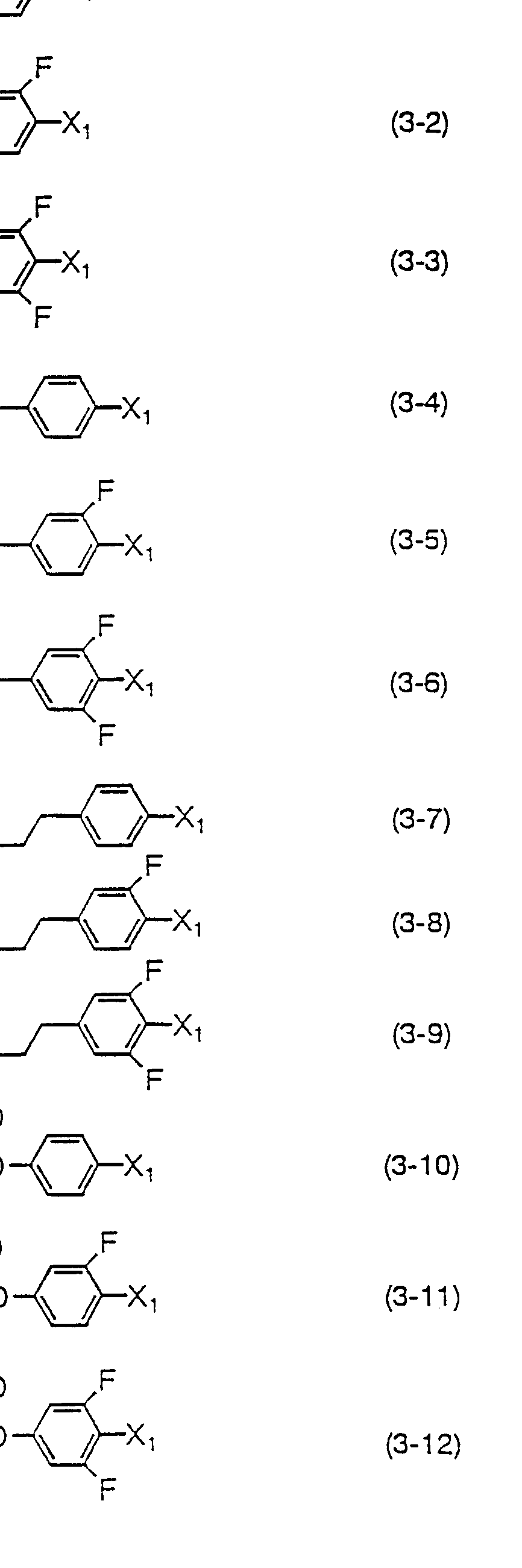
- the compounds exhibiting particularly preferable characteristics are the following compounds represented by the general formulas (1-1) to (1-30).
- 3 and 1 to 13 are an alkyl group, an alkoxy group, an alkoxyalkyl group, an alkoxyalkoxy group, an alkenyl group, or an alkynyl ′.
- Ra and Rb are groups substituted by fluorine atoms have a large dielectric anisotropy value, low viscosity, and excellent phase solubility with other liquid crystal compounds.
- a compound in which Ra and Rb are groups substituted with cyclopropane-1,2-diyl group in general formula (1) has a large dielectric anisotropy value and is compatible with other liquid crystal compounds. In particular.
- a compound having an alkyl group, an alkoxy group, or an alkenyl group is preferable because it has a low viscosity.
- Ra and Rb are alkyl or alkoxy groups are optimal. It is.
- Z, Z 2 and Z 3 are single bonds, — CH 2 CH 2 ,-(CH 2 ) 1, —C 0 2 —, — CF 20 —, or —CH 2 0 —, but a single bond or Compounds that are C 0 2 — have lower viscosity, compounds that are —CH 2 CH 2 — have a wider nematic phase temperature range, and compounds that are —CF 20 0— exhibit particularly low viscosity. .
- Ring to ring A 4 is 2,3-difluoro-1,4-phenylene, cyclohexane — 1,4-diyl, 1,3-dioxane-1,2,5-diyl, tetrahydropyran —
- the ring-ring A 4 cyclohexane - 1, 4 _ Jiiru optimum. 1 to the ring-ring A 4, 3- Jiokisan - 2, 5-Since the compounds introduced with Jiiru the elasticity constant value K decreases, TN mode drive voltage of the liquid crystal display device (IPS, VA mode including one de) And is preferable.
- the compound of the present invention represented by the general formula (1) can be produced by appropriately combining known organic synthetic chemistry techniques.
- Known organic chemistry methods can be known by referring to books such as Organic Synthesis, Organic Reactions, and New Laboratory Chemistry Course. The representative examples are shown below.
- cyclohexanone derivative (16) or aldehyde derivative (19) can be produced by reacting 7) and further performing a dehydration reaction under acidic conditions.
- the compound of general ⁇ -(1) can be produced by hydrogenating the double bond of (18) or (19). Hydrogenation can be carried out by catalytic reduction in a hydrogen atmosphere in the presence of a catalyst.
- the ester derivative ( ⁇ ) can be derived into the compound (22) by a known sulfurizing agent such as Lawesson's reagent.
- a sulfurizing agent such as Lawesson's reagent.
- the carboxylic acid (20) can be reduced with a reducing agent such as lithium aluminum hydride or diisobutyl aluminum hydride to produce an alcohol (23).
- a reducing agent such as lithium aluminum hydride or diisobutyl aluminum hydride
- the compound of the general formula (1) in which the bonding group is a CH 20 group can be produced by halogenating the hydroxyl group with various halogenating agents and further reacting with phenol (21) to effect etherification. 1 to the position of the ring-ring A 4, 3 - Jiokisan - 2, 5-Jiiru or Te la hydropyran - 2, 5 -. Introducing Jiiru, for example, HM Vorbrodt.E Eid enschink these disclosed methods ( HM Vorbrodt. J. Prakt. Chem., 323, 902 (1981), R. Eid enschink DE-OS3306960 (1983)).
- a fluorine atom to the terminal group can be carried out according to a method known in the literature.
- the corresponding hydroxyl group or carbonyl group may be replaced with getylaminosulfur trifluoride (J. Org. Chem., 58, 3800 (1993) .Tetrahedon Lett., 32, 5963 (1991). , 161 (1993))
- the object can be achieved by fluorinating with a fluorinating agent.
- a cyclopropane ring into a terminal group can be carried out according to a method known in the literature.
- the purpose can be achieved by subjecting the double bond site of the corresponding alkenyl compound to eye lopropanation according to, for example, the method of Simmons-Smith (HE Simmons et al., Org. React., 20, 1 (1973)). .
- the liquid crystal composition according to the present invention exhibits excellent characteristics when it contains at least one kind of the compound represented by the general formula (1) in a proportion of 0.1 to 99.9% by weight. More preferably, the proportion is 1 to 60% by weight.
- liquid crystal composition provided by the present invention is represented by general formulas (2) to (12) in addition to a first component containing at least one compound represented by general formula (1). It is completed by mixing compounds selected from the compound group according to the purpose of the liquid crystal composition.
- Preferred examples of the compounds represented by formulas (2) to (4) used in the liquid crystal composition of the present invention include the following compounds.
- the compounds represented by the general formulas (2) to (4) are compounds having a positive dielectric anisotropy value, have excellent thermal stability and chemical stability, and particularly have a high voltage holding ratio. It is a very useful compound for preparing liquid crystal compositions for AM (active matrix), which requires high reliability such as high specific resistance, especially for TFT (thin film transistor).
- the compounds represented by the general formulas (2) to (4) are used in a range of 0.1 to 99.9% by weight based on the total weight of the liquid crystal composition. However, it is preferably 10 to 97% by weight, more preferably 40 to 95% by weight. Further, the compounds represented by the general formulas (10) to (12) may further be contained for the purpose of adjusting the viscosity.
- the compounds represented by the general formulas (2) to (4) can be used, but the content is preferably 50% by weight or less.
- Preferred examples of the compounds represented by the general formulas (5) and (6) used in the liquid crystal composition of the present invention include the following compounds.
- the compounds represented by the general formulas (5) and (6) have a positive and large dielectric anisotropy value, and are used particularly for the purpose of reducing the threshold voltage of a liquid crystal composition. It is also used for adjusting the value of the refractive index anisotropy and expanding the nematic range such as increasing the clearing point. It is also used for the purpose of improving the steepness of the voltage-transmittance curve of the liquid crystal compositions for S S and ⁇ .
- the compounds represented by the general formulas (5) and (6) are particularly useful when preparing liquid crystal compositions for S ⁇ and ⁇ .
- the threshold voltage of the liquid crystal composition decreases, but the viscosity increases. Therefore, as long as the viscosity of the liquid crystal composition satisfies the required value, it can be driven at a lower voltage by using a larger amount. This is advantageous.
- the compounds represented by the general formulas (5) and (6) are used in an amount of 0.1 to 9.9% by weight based on the total weight of the liquid crystal composition. , But is preferably from 10 to 97% by weight, more preferably from 40 to 95% by weight.
- Preferred examples of the compounds represented by the general formulas (7) to (9) used in the liquid crystal composition of the present invention include the following compounds.
- the compounds represented by the general formulas (7) to (9) are compounds having a negative dielectric anisotropy value. Since the compound represented by the general formula (7) is a bicyclic compound, it is mainly used for adjusting the threshold voltage, adjusting the viscosity, or adjusting the value of the refractive index anisotropy.
- the compound represented by the general formula (8) is used for the purpose of expanding the nematic range such as increasing the clearing point or adjusting the value of the refractive index anisotropy.
- the compound represented by the general formula (9) is used for the purpose of adjusting the refractive index anisotropy value.
- the compounds represented by the general formulas (7) to (9) are mainly used for a liquid crystal composition having a negative dielectric anisotropy value.
- the threshold voltage of the liquid crystal composition decreases and the viscosity increases. Therefore, it is desirable to use a small amount as long as the required value of the threshold voltage is satisfied.
- the absolute value of the dielectric anisotropy of the compounds represented by the general formulas (7) to (9) is 5 or less, low voltage driving may not be possible if the content is less than 40% by weight. is there.
- the compounds represented by the general formulas (7) to (9) are added in an amount of 40 wt. % Is preferable, and 50 to 95% by weight is suitable.
- a composition having a positive dielectric anisotropy value is represented by general formulas (7) to (9).
- Compounds may be mixed.
- the content of the compounds represented by the general formulas (7) to (9) is preferably 30% by weight or less in the liquid crystal composition.
- Preferred examples of the compounds represented by formulas (10) to (12) used in the liquid crystal composition of the present invention include the following compounds.
- the compounds represented by the general formulas (10) to (12) have a small absolute value of dielectric anisotropy and are close to zero.
- the compound represented by the general formula (10) is used mainly for the purpose of adjusting the viscosity or adjusting the value of the refractive index anisotropy.
- the compounds represented by the general formulas (11) and (12) are used for the purpose of expanding the nematic range such as increasing the clearing point or adjusting the refractive index anisotropy value.
- the compounds represented by the general formulas (1, 0) to (12) are preferably 40% by weight or less in the liquid crystal composition, and more preferably. Is less than 35% by weight.
- the compound represented by the general formulas (10) to (12) should be 70% by weight or less in the liquid crystal composition. And more preferably 60% by weight or less.
- an optically active compound is usually added for the purpose of inducing a helical structure of the liquid crystal, adjusting a required twist angle, and preventing reverse twist.
- Any known optically active compound can be used in the liquid crystal composition of the present invention for such a purpose.
- Preferred examples of the optically active compound include the following compounds.
- the liquid crystal composition of the present invention generally adjusts the twist pitch by adding these optically active compounds.
- the twist pitch is preferably adjusted in the range of 40 to 200 / m for a liquid crystal composition for TFT and TN. If it is a liquid crystal composition for STN, it is preferable to adjust it to the range of 6 to 20 m. In the case of bistable TN (bistable TN), it is preferable to adjust the range to 1.5 to 4 m. Further, for the purpose of adjusting the temperature dependence of the pitch, two or more optically active compounds may be added.
- the liquid crystal composition of the present invention comprises a liquid crystal for GH mode by adding a dichroic dye such as a merocyanine, styryl, azo, azomethine, azoxy, quinophthalone, anthraquinone, or tetrazine compound. It can also be used as a composition.
- the polymer dispersion type represented by NCAP produced by microencapsulation of nematic liquid crystal and the polymer network liquid crystal display device (PNL CD) produced by forming a polymer three-dimensional network structure in the liquid crystal. It can also be used as a liquid crystal composition for liquid crystal display devices (PDL CD). In addition, it can be used as a liquid crystal composition for ECB mode or dynamic scattering (DS) mode.
- the liquid crystal composition of the present invention is prepared by a conventional method. Generally, a method of dissolving various components at a high temperature is used.
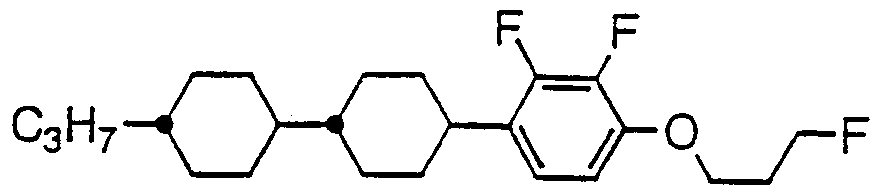
- R a is a propyl group
- R b is a 3-fluoropropyloxy group
- a 2 and A 3 are cyclohexane-1,4-diyl
- a 4 is 2,3-difluorophene.
- 2,3-Difluoroazole (0.5 m 01) was dissolved in THF (300 m 1) and cooled to —65 ° C. 0.55 mo 1 equivalent of sec-butyllithium (1.06 M THF solution) was slowly added dropwise within a range not exceeding the same temperature.
- reaction solution was ice-cooled, washed twice with a saturated saline solution (100 ml), and dried over anhydrous magnesium sulfate. The solid was removed by filtration and the filtrate was concentrated under reduced pressure to give a red, tar-like residue.
- Ethanol (300 m i), ethyl acetate (200 m 1), and Raney nickel (15 g) were added to the mixture, and the mixture was stirred under a hydrogen atmosphere (1 atm) for 7 hours. 'After confirming that the reaction solution did not absorb hydrogen gas, the catalyst was removed by filtration, and the filtrate was concentrated.
- Nematic phase—isotropic liquid phase (T NI ) 16.8.3 ° C
- Example 2 (use example 1)
- a liquid crystal composition (A) comprising the following liquid crystal compound was prepared. :
- ⁇ and ⁇ indicate a nematic phase-isotropic liquid phase transition temperature.
- the following compounds (Compound No. 1 to Compound No. 308) were produced according to Example 1 and the above-mentioned production method.
- the transition temperature also indicates the phase transition temperature of the compound itself, and ⁇ and ⁇ are the external values calculated from the physical properties of the liquid crystal composition obtained by mixing 15% by weight with the above composition ( ⁇ ). Is shown.
- liquid crystal compositions shown in Use Examples 2 to 16 were prepared.
- “%” indicates “% by weight” unless otherwise specified, and when a compound has a cis-trans isomer, the compound is a trans type.
- the compounds in the use examples were represented by symbols according to the definitions shown in Tables 1 and 2 below. The viscosity () was measured at 20 ° C.
- Vth 2.3 1 (V)
- the liquid crystalline compound of the present invention has an extremely large negative dielectric anisotropy value and a small optical anisotropy value at the same time. Therefore, by using the liquid crystal compound of the present invention as a component of a liquid crystal composition, a liquid crystal composition exhibiting a low threshold voltage and a small optical anisotropy value can be realized. Furthermore, an excellent liquid crystal display device can be provided by using the above.
- the excellent properties of the liquid crystalline compound of the present invention shown here are contrary to the above-mentioned conventional concept (Feier and Meier's theory). No liquid crystalline compound having such excellent properties has been known at all.
- the liquid crystal compound of the present invention is physically and chemically sufficiently stable under conditions where a liquid crystal display device is usually used, and is extremely excellent as a component of a nematic liquid crystal composition.
- the compound of Example 1 shows extremely high chemical stability as compared with a conventionally known cyanide (for example, compound (14)).
- the compound of the present invention has excellent compatibility with other liquid crystal materials and has extremely excellent compatibility even at a low temperature, and thus can be suitably used for a liquid crystal composition for an IPS mode or a VA mode. Also, it can be suitably used not only in the IPS and VA modes but also in ECB (birefringence control) and GH (guest-host) modes. Further, it can be suitably used as a liquid crystal material for T N (twisted * nematic), STN (super-twisted-nematic) and AM (active matrix) mode.
Landscapes
- Chemical & Material Sciences (AREA)
- Organic Chemistry (AREA)
- Crystallography & Structural Chemistry (AREA)
- Engineering & Computer Science (AREA)
- Materials Engineering (AREA)
- Liquid Crystal Substances (AREA)
- Organic Low-Molecular-Weight Compounds And Preparation Thereof (AREA)
Description















Claims


Priority Applications (2)
| Application Number | Priority Date | Filing Date | Title |
|---|---|---|---|
| EP98950384A EP1026142A1 (en) | 1997-10-24 | 1998-10-26 | 2,3-difluorophenyl derivatives having negative value of permittivity anisotropy, liquid-crystal composition, and liquid-crystal display element |
| JP2000517927A JP4333032B2 (ja) | 1997-10-24 | 1998-10-26 | 負の誘電率異方性を有する2,3−ジフルオロフェニル誘導体、液晶組成物および液晶表示素子 |
Applications Claiming Priority (2)
| Application Number | Priority Date | Filing Date | Title |
|---|---|---|---|
| JP9/309919 | 1997-10-24 | ||
| JP30991997 | 1997-10-24 |
Publications (1)
| Publication Number | Publication Date |
|---|---|
| WO1999021815A1 true WO1999021815A1 (en) | 1999-05-06 |
Family
ID=17998928
Family Applications (1)
| Application Number | Title | Priority Date | Filing Date |
|---|---|---|---|
| PCT/JP1998/004833 Ceased WO1999021815A1 (en) | 1997-10-24 | 1998-10-26 | 2,3-difluorophenyl derivatives having negative value of permittivity anisotropy, liquid-crystal composition, and liquid-crystal display element |
Country Status (3)
| Country | Link |
|---|---|
| EP (1) | EP1026142A1 (ja) |
| JP (1) | JP4333032B2 (ja) |
| WO (1) | WO1999021815A1 (ja) |
Cited By (16)
| Publication number | Priority date | Publication date | Assignee | Title |
|---|---|---|---|---|
| JP2001114722A (ja) * | 1999-10-13 | 2001-04-24 | Chisso Corp | 分岐メチル基を有する液晶性化合物、液晶組成物及び液晶表示素子 |
| JP2001139511A (ja) * | 1999-08-31 | 2001-05-22 | Chisso Corp | 負の誘電率異方性を有する2,3−ジフルオロフェニル誘導体、液晶組成物および液晶表示素子 |
| JP2001316669A (ja) * | 2000-03-24 | 2001-11-16 | Merck Patent Gmbh | 液晶媒体および媒体を含む電気光学ディスプレイ |
| JP2001354967A (ja) * | 2000-04-14 | 2001-12-25 | Merck Patent Gmbh | 液晶媒体 |
| JP2002053513A (ja) * | 2000-08-10 | 2002-02-19 | Chisso Corp | ジフルオロメチルエーテル誘導体およびその製造方法 |
| JP2002201474A (ja) * | 2000-12-20 | 2002-07-19 | Merck Patent Gmbh | 液晶媒体およびそれを含む電気光学ディスプレイ |
| JP2003327965A (ja) * | 2002-04-12 | 2003-11-19 | Merck Patent Gmbh | 液晶媒体およびこの媒体を含有する電気光学ディスプレイ |
| JP2006131906A (ja) * | 2004-11-02 | 2006-05-25 | Merck Patent Gmbh | 液晶媒体 |
| DE112006001453T5 (de) | 2005-06-09 | 2008-11-06 | Adeka Corp. | Neue Verbindung und Flüssigkristall-Zusammensetzung |
| WO2013122011A1 (ja) * | 2012-02-14 | 2013-08-22 | Jnc株式会社 | 液晶組成物および液晶表示素子 |
| WO2013183683A1 (ja) | 2012-06-06 | 2013-12-12 | Dic株式会社 | 液晶組成物 |
| US8968840B2 (en) | 2004-07-02 | 2015-03-03 | Merck Patent Gmbh | Liquid-crystalline medium |
| WO2015192441A1 (zh) * | 2014-06-17 | 2015-12-23 | 北京八亿时空液晶科技股份有限公司 | 一种液晶组合物及其应用 |
| KR20160071997A (ko) * | 2014-12-12 | 2016-06-22 | 스자좡 청즈 용화 디스플레이 메테리얼즈 씨오., 엘티디. | 시클로프로필을 함유한 액정 화합물과 액정 혼합물 |
| KR20180033089A (ko) * | 2016-09-23 | 2018-04-02 | 메르크 파텐트 게엠베하 | 액정 매질 및 이를 포함하는 액정 디스플레이 |
| US10030198B2 (en) | 2013-10-23 | 2018-07-24 | Jnc Corporation | Liquid crystal composition and liquid crystal display device |
Families Citing this family (59)
| Publication number | Priority date | Publication date | Assignee | Title |
|---|---|---|---|---|
| WO2009030318A1 (de) * | 2007-08-29 | 2009-03-12 | Merck Patent Gmbh | Flüssigkristallanzeige |
| KR101612577B1 (ko) * | 2008-07-28 | 2016-04-14 | 메르크 파텐트 게엠베하 | 액정 디스플레이 |
| DE102012024126A1 (de) * | 2011-12-20 | 2013-06-20 | Merck Patent Gmbh | Flüssigkristallines Medium |
| GB201301786D0 (en) * | 2012-02-15 | 2013-03-20 | Merck Patent Gmbh | Liquid-crystalline medium |
| TWI452122B (zh) * | 2012-02-24 | 2014-09-11 | Dainippon Ink & Chemicals | 液晶組成物 |
| US10550327B2 (en) * | 2012-11-21 | 2020-02-04 | Merck Patent Gmbh | Polymerisable compounds and the use thereof in liquid-crystal displays |
| TWI570222B (zh) * | 2013-01-30 | 2017-02-11 | 迪愛生股份有限公司 | 液晶組成物及使用其之液晶顯示元件 |
| CN104293357B (zh) * | 2013-07-16 | 2016-06-29 | 江苏和成显示科技股份有限公司 | 具有高透过率的液晶组合物及其显示器件 |
| KR102252761B1 (ko) * | 2013-08-02 | 2021-05-18 | 메르크 파텐트 게엠베하 | 액정 매질 |
| CN104449764B (zh) * | 2013-09-16 | 2017-06-30 | 江苏和成显示科技股份有限公司 | 具有负介电各向异性的液晶组合物及其应用 |
| CN104059674B (zh) * | 2014-06-06 | 2016-01-20 | 北京八亿时空液晶科技股份有限公司 | 一种含有二氟甲氧基桥键的液晶化合物及其应用 |
| CN104479689A (zh) * | 2014-12-29 | 2015-04-01 | 石家庄诚志永华显示材料有限公司 | 液晶组合物 |
| CN104498055B (zh) * | 2014-12-31 | 2017-01-11 | 石家庄诚志永华显示材料有限公司 | 一种液晶组合物 |
| CN104498054B (zh) * | 2014-12-31 | 2017-02-22 | 石家庄诚志永华显示材料有限公司 | 液晶介质及包含该液晶介质的液晶显示器 |
| CN104593010A (zh) * | 2015-02-15 | 2015-05-06 | 石家庄诚志永华显示材料有限公司 | 液晶组合物及其应用 |
| CN104593012A (zh) * | 2015-02-15 | 2015-05-06 | 石家庄诚志永华显示材料有限公司 | 一种液晶组合物 |
| CN104593001A (zh) * | 2015-02-15 | 2015-05-06 | 石家庄诚志永华显示材料有限公司 | 液晶组合物及其应用 |
| CN107267158A (zh) * | 2015-02-15 | 2017-10-20 | 石家庄诚志永华显示材料有限公司 | 含有环丙基的负介电各向异性液晶介质及其应用 |
| CN107177360A (zh) * | 2015-02-15 | 2017-09-19 | 石家庄诚志永华显示材料有限公司 | 含有环丙基的负介电各向异性液晶介质及其应用 |
| CN104593013B (zh) * | 2015-02-15 | 2016-12-07 | 石家庄诚志永华显示材料有限公司 | 一种液晶介质 |
| CN104593003B (zh) * | 2015-02-15 | 2017-01-04 | 石家庄诚志永华显示材料有限公司 | 液晶介质 |
| CN104593006B (zh) * | 2015-02-15 | 2017-01-11 | 石家庄诚志永华显示材料有限公司 | 液晶组合物及其应用 |
| CN104593009A (zh) * | 2015-02-15 | 2015-05-06 | 石家庄诚志永华显示材料有限公司 | 液晶组合物及其在液晶显示中的应用 |
| CN104650928A (zh) * | 2015-02-15 | 2015-05-27 | 石家庄诚志永华显示材料有限公司 | 一种含有环丙基化合物的液晶组合物 |
| CN104593005B (zh) * | 2015-02-15 | 2017-01-11 | 石家庄诚志永华显示材料有限公司 | 一种含有二氧六环结构的液晶组合物 |
| CN107286952B (zh) * | 2016-04-01 | 2019-01-29 | 北京八亿时空液晶科技股份有限公司 | 一种环丙基类负介电各向异性的液晶化合物及其应用 |
| CN107286951B (zh) * | 2016-04-01 | 2019-01-29 | 北京八亿时空液晶科技股份有限公司 | 一种环丙基类负介电各向异性的液晶化合物及其应用 |
| CN107345142B (zh) * | 2016-05-06 | 2020-02-21 | 北京八亿时空液晶科技股份有限公司 | 一种含有萘环的负介电各向异性液晶组合物及其应用 |
| CN107400516B (zh) * | 2016-05-19 | 2019-01-29 | 北京八亿时空液晶科技股份有限公司 | 一种环丙基类负介电各向异性的液晶化合物及其应用 |
| CN107446592B (zh) * | 2016-05-31 | 2019-08-27 | 北京八亿时空液晶科技股份有限公司 | 一种含有环丙基化合物的液晶组合物及其应用 |
| CN107446593A (zh) * | 2016-06-01 | 2017-12-08 | 北京八亿时空液晶科技股份有限公司 | 一种含有环丙基和甲氧基的化合物的液晶组合物及其应用 |
| CN107523314B (zh) * | 2016-06-20 | 2019-09-20 | 北京八亿时空液晶科技股份有限公司 | 一种含有环丙基醚类负介电液晶组合物及其应用 |
| CN107586545B (zh) * | 2016-07-06 | 2019-08-23 | 北京八亿时空液晶科技股份有限公司 | 一种快响应负介电各向异性液晶组合物及其应用 |
| CN108003893B (zh) * | 2016-11-02 | 2021-08-03 | 石家庄诚志永华显示材料有限公司 | 一种高垂直介电液晶化合物、液晶组合物、液晶显示器件 |
| CN108659853B (zh) * | 2017-03-29 | 2021-04-02 | 北京八亿时空液晶科技股份有限公司 | 一种含有氟代烷氧基液晶化合物的液晶组合物及其应用 |
| CN108659854A (zh) * | 2017-03-29 | 2018-10-16 | 北京八亿时空液晶科技股份有限公司 | 一种液晶组合物及其应用 |
| CN108659861A (zh) * | 2017-03-31 | 2018-10-16 | 北京八亿时空液晶科技股份有限公司 | 一种具有高透过率的液晶组合物及其应用 |
| CN108728112A (zh) * | 2017-04-19 | 2018-11-02 | 北京八亿时空液晶科技股份有限公司 | 一种负介电各向异性的液晶化合物及其制备方法与应用 |
| CN108728114A (zh) * | 2017-04-20 | 2018-11-02 | 北京八亿时空液晶科技股份有限公司 | 液晶介质及其应用 |
| CN108728118A (zh) * | 2017-04-20 | 2018-11-02 | 北京八亿时空液晶科技股份有限公司 | 液晶介质及其应用 |
| CN108728119A (zh) * | 2017-04-20 | 2018-11-02 | 北京八亿时空液晶科技股份有限公司 | 一种快响应负介电各向异性液晶组合物及其应用 |
| CN108949190A (zh) * | 2017-05-17 | 2018-12-07 | 北京八亿时空液晶科技股份有限公司 | 一种含有环己烯结构化合物的液晶组合物及其应用 |
| CN109207158A (zh) * | 2017-06-29 | 2019-01-15 | 北京八亿时空液晶科技股份有限公司 | 一种含烯类负介电各向异性的液晶化合物及其应用 |
| CN109207159A (zh) * | 2017-06-30 | 2019-01-15 | 北京八亿时空液晶科技股份有限公司 | 一种负介电各向异性的液晶化合物及其制备方法与应用 |
| CN109233868B (zh) * | 2017-07-10 | 2021-01-15 | 北京八亿时空液晶科技股份有限公司 | 一种负介电向列相液晶介质及其应用 |
| CN109423304A (zh) * | 2017-08-31 | 2019-03-05 | 北京八亿时空液晶科技股份有限公司 | 一种负介电向列相液晶组合物及其应用 |
| CN108018048B (zh) * | 2017-12-15 | 2021-11-05 | 石家庄诚志永华显示材料有限公司 | 一种负介电各项异性液晶组合物 |
| CN110396415B (zh) * | 2018-04-25 | 2021-01-26 | 北京八亿时空液晶科技股份有限公司 | 一种新型液晶垂直配向剂及其制备方法与应用 |
| CN110607178B (zh) * | 2018-06-15 | 2021-04-09 | 北京八亿时空液晶科技股份有限公司 | 一种液晶化合物及其制备方法与应用 |
| CN110616074A (zh) * | 2018-06-19 | 2019-12-27 | 北京八亿时空液晶科技股份有限公司 | 一种新型液晶化合物及其制备和应用 |
| CN110628439A (zh) * | 2018-06-22 | 2019-12-31 | 北京八亿时空液晶科技股份有限公司 | 一种高性能液晶化合物及其制备方法与应用 |
| CN111117663B (zh) * | 2018-10-30 | 2022-02-11 | 江苏和成显示科技有限公司 | 液晶组合物及其液晶显示器件 |
| CN111117664B (zh) * | 2018-10-30 | 2022-01-18 | 江苏和成显示科技有限公司 | 液晶组合物及其液晶显示器件 |
| CN111117661B (zh) * | 2018-10-30 | 2022-02-11 | 江苏和成显示科技有限公司 | 液晶组合物及其液晶显示器件 |
| CN111117653A (zh) * | 2018-10-30 | 2020-05-08 | 江苏和成显示科技有限公司 | 液晶组合物及其液晶显示器件 |
| CN111117662B (zh) * | 2018-10-30 | 2022-01-18 | 江苏和成显示科技有限公司 | 液晶组合物及其液晶显示器件 |
| CN111117645B (zh) * | 2018-10-30 | 2022-01-18 | 江苏和成显示科技有限公司 | 具有高透过率的液晶组合物及其液晶显示器件 |
| CN119614212A (zh) * | 2018-10-30 | 2025-03-14 | 江苏和成显示科技有限公司 | 液晶组合物及其液晶显示器件 |
| CN115029142B (zh) * | 2021-03-04 | 2023-10-24 | 北京八亿时空液晶科技股份有限公司 | 一种液晶组合物及其应用 |
Citations (8)
| Publication number | Priority date | Publication date | Assignee | Title |
|---|---|---|---|---|
| JPH02115145A (ja) * | 1988-10-26 | 1990-04-27 | Canon Inc | 液晶性化合物、それを含有する液晶組成物および液晶素子 |
| JPH02503435A (ja) * | 1988-03-10 | 1990-10-18 | メルク・パテント・ゲゼルシヤフト・ミツト・ベシユレンクテル・ハフツング | カイラル1,2‐ジフルオロベンゼン誘導体 |
| JPH04501864A (ja) * | 1989-09-05 | 1992-04-02 | メルク・パテント・ゲゼルシャフト・ミット・ベシュレンクテル・ハフツング | フェニルシクロヘキサン化合物および液晶相 |
| JPH0797354A (ja) * | 1993-08-31 | 1995-04-11 | Canon Inc | 液晶性化合物、これを含有する液晶組成物、該液晶組成物を用いた液晶素子並びにこれらを用いた表示方法、表示装置 |
| JPH07267885A (ja) * | 1994-02-14 | 1995-10-17 | Sumitomo Chem Co Ltd | フッ素原子を有する化合物、その製造法および用途 |
| JPH0881417A (ja) * | 1994-09-16 | 1996-03-26 | Sumitomo Chem Co Ltd | エステル誘導体およびその製造法 |
| JPH0892137A (ja) * | 1994-09-26 | 1996-04-09 | Sumitomo Chem Co Ltd | 芳香族エステル化合物、その製造法および用途 |
| JPH08165258A (ja) * | 1994-12-12 | 1996-06-25 | Sumitomo Chem Co Ltd | 芳香族化合物、その製造法および用途 |
-
1998
- 1998-10-26 WO PCT/JP1998/004833 patent/WO1999021815A1/ja not_active Ceased
- 1998-10-26 EP EP98950384A patent/EP1026142A1/en not_active Withdrawn
- 1998-10-26 JP JP2000517927A patent/JP4333032B2/ja not_active Expired - Lifetime
Patent Citations (8)
| Publication number | Priority date | Publication date | Assignee | Title |
|---|---|---|---|---|
| JPH02503435A (ja) * | 1988-03-10 | 1990-10-18 | メルク・パテント・ゲゼルシヤフト・ミツト・ベシユレンクテル・ハフツング | カイラル1,2‐ジフルオロベンゼン誘導体 |
| JPH02115145A (ja) * | 1988-10-26 | 1990-04-27 | Canon Inc | 液晶性化合物、それを含有する液晶組成物および液晶素子 |
| JPH04501864A (ja) * | 1989-09-05 | 1992-04-02 | メルク・パテント・ゲゼルシャフト・ミット・ベシュレンクテル・ハフツング | フェニルシクロヘキサン化合物および液晶相 |
| JPH0797354A (ja) * | 1993-08-31 | 1995-04-11 | Canon Inc | 液晶性化合物、これを含有する液晶組成物、該液晶組成物を用いた液晶素子並びにこれらを用いた表示方法、表示装置 |
| JPH07267885A (ja) * | 1994-02-14 | 1995-10-17 | Sumitomo Chem Co Ltd | フッ素原子を有する化合物、その製造法および用途 |
| JPH0881417A (ja) * | 1994-09-16 | 1996-03-26 | Sumitomo Chem Co Ltd | エステル誘導体およびその製造法 |
| JPH0892137A (ja) * | 1994-09-26 | 1996-04-09 | Sumitomo Chem Co Ltd | 芳香族エステル化合物、その製造法および用途 |
| JPH08165258A (ja) * | 1994-12-12 | 1996-06-25 | Sumitomo Chem Co Ltd | 芳香族化合物、その製造法および用途 |
Cited By (37)
| Publication number | Priority date | Publication date | Assignee | Title |
|---|---|---|---|---|
| JP2001139511A (ja) * | 1999-08-31 | 2001-05-22 | Chisso Corp | 負の誘電率異方性を有する2,3−ジフルオロフェニル誘導体、液晶組成物および液晶表示素子 |
| JP2001114722A (ja) * | 1999-10-13 | 2001-04-24 | Chisso Corp | 分岐メチル基を有する液晶性化合物、液晶組成物及び液晶表示素子 |
| JP2001316669A (ja) * | 2000-03-24 | 2001-11-16 | Merck Patent Gmbh | 液晶媒体および媒体を含む電気光学ディスプレイ |
| JP2001354967A (ja) * | 2000-04-14 | 2001-12-25 | Merck Patent Gmbh | 液晶媒体 |
| JP2002053513A (ja) * | 2000-08-10 | 2002-02-19 | Chisso Corp | ジフルオロメチルエーテル誘導体およびその製造方法 |
| JP2013147657A (ja) * | 2000-12-20 | 2013-08-01 | Merck Patent Gmbh | 液晶媒体およびそれを含む電気光学ディスプレイ |
| JP2002201474A (ja) * | 2000-12-20 | 2002-07-19 | Merck Patent Gmbh | 液晶媒体およびそれを含む電気光学ディスプレイ |
| JP2003327965A (ja) * | 2002-04-12 | 2003-11-19 | Merck Patent Gmbh | 液晶媒体およびこの媒体を含有する電気光学ディスプレイ |
| US10150917B2 (en) | 2004-07-02 | 2018-12-11 | Merck Patent Gmbh | Liquid crystalline medium |
| US10435626B2 (en) | 2004-07-02 | 2019-10-08 | Merck Patent Gmbh | Liquid crystalline medium |
| JP2020059857A (ja) * | 2004-07-02 | 2020-04-16 | メルク パテント ゲゼルシャフト ミット ベシュレンクテル ハフツングMerck Patent Gesellschaft mit beschraenkter Haftung | 液晶媒体 |
| US10611963B2 (en) | 2004-07-02 | 2020-04-07 | Merck Patent Gmbh | Liquid crystalline medium |
| US10533135B2 (en) | 2004-07-02 | 2020-01-14 | Merck Patent Gesellschaft Mit Beschrankter Haftung | Liquid crystalline medium |
| US8968840B2 (en) | 2004-07-02 | 2015-03-03 | Merck Patent Gmbh | Liquid-crystalline medium |
| JP2018204018A (ja) * | 2004-07-02 | 2018-12-27 | メルク パテント ゲゼルシャフト ミット ベシュレンクテル ハフツングMerck Patent Gesellschaft mit beschraenkter Haftung | 液晶媒体 |
| US10160909B2 (en) | 2004-07-02 | 2018-12-25 | Merck Patent Gmbh | Liquid crystalline medium |
| US9267078B2 (en) | 2004-07-02 | 2016-02-23 | Merck Patent Gmbh | Liquid crystalline medium |
| US9340730B2 (en) | 2004-07-02 | 2016-05-17 | Merck Patent Gmbh | Liquid crystalline medium |
| US10144870B2 (en) | 2004-07-02 | 2018-12-04 | Merck Patent Gmbh | Liquid crystalline medium |
| US9701903B2 (en) | 2004-07-02 | 2017-07-11 | Merck Patent Gmbh | Liquid crystalline medium |
| JP2017057412A (ja) * | 2004-07-02 | 2017-03-23 | メルク パテント ゲゼルシャフト ミット ベシュレンクテル ハフツングMerck Patent Gesellschaft mit beschraenkter Haftung | 液晶媒体 |
| JP2017057413A (ja) * | 2004-07-02 | 2017-03-23 | メルク パテント ゲゼルシャフト ミット ベシュレンクテル ハフツングMerck Patent Gesellschaft mit beschraenkter Haftung | 液晶媒体 |
| JP2006131906A (ja) * | 2004-11-02 | 2006-05-25 | Merck Patent Gmbh | 液晶媒体 |
| DE112006001453T5 (de) | 2005-06-09 | 2008-11-06 | Adeka Corp. | Neue Verbindung und Flüssigkristall-Zusammensetzung |
| JPWO2013122011A1 (ja) * | 2012-02-14 | 2015-05-11 | Jnc株式会社 | 液晶組成物および液晶表示素子 |
| WO2013122011A1 (ja) * | 2012-02-14 | 2013-08-22 | Jnc株式会社 | 液晶組成物および液晶表示素子 |
| US8916063B2 (en) | 2012-02-14 | 2014-12-23 | Jnc Corporation | Liquid crystal composition and liquid crystal display device |
| WO2013183683A1 (ja) | 2012-06-06 | 2013-12-12 | Dic株式会社 | 液晶組成物 |
| US10030198B2 (en) | 2013-10-23 | 2018-07-24 | Jnc Corporation | Liquid crystal composition and liquid crystal display device |
| WO2015192441A1 (zh) * | 2014-06-17 | 2015-12-23 | 北京八亿时空液晶科技股份有限公司 | 一种液晶组合物及其应用 |
| US10655064B2 (en) | 2014-06-17 | 2020-05-19 | Beijing Bayi Space Lcd Technology Co., Ltd | Liquid crystal composition and its application |
| KR20160071997A (ko) * | 2014-12-12 | 2016-06-22 | 스자좡 청즈 용화 디스플레이 메테리얼즈 씨오., 엘티디. | 시클로프로필을 함유한 액정 화합물과 액정 혼합물 |
| JP2016113440A (ja) * | 2014-12-12 | 2016-06-23 | 石家庄▲誠▼志永▲華顕▼示材料有限公司 | シクロプロピルを含有する液晶化合物及び液晶混合物 |
| KR102080953B1 (ko) * | 2014-12-12 | 2020-02-24 | 스자좡 청즈 용화 디스플레이 메테리얼즈 씨오., 엘티디. | 시클로프로필을 함유한 액정 화합물과 액정 혼합물 |
| JP2018065986A (ja) * | 2016-09-23 | 2018-04-26 | メルク パテント ゲゼルシャフト ミット ベシュレンクテル ハフツングMerck Patent Gesellschaft mit beschraenkter Haftung | 液晶媒体およびそれを含む液晶ディスプレイ |
| KR20180033089A (ko) * | 2016-09-23 | 2018-04-02 | 메르크 파텐트 게엠베하 | 액정 매질 및 이를 포함하는 액정 디스플레이 |
| KR102492540B1 (ko) * | 2016-09-23 | 2023-01-27 | 메르크 파텐트 게엠베하 | 액정 매질 및 이를 포함하는 액정 디스플레이 |
Also Published As
| Publication number | Publication date |
|---|---|
| EP1026142A1 (en) | 2000-08-09 |
| JP4333032B2 (ja) | 2009-09-16 |
Similar Documents
| Publication | Publication Date | Title |
|---|---|---|
| WO1999021815A1 (en) | 2,3-difluorophenyl derivatives having negative value of permittivity anisotropy, liquid-crystal composition, and liquid-crystal display element | |
| EP0969071B1 (en) | Alkenyl compound having a negative delta epsilon value, liquid crystal composition and liquid crystal display device | |
| EP1043299B1 (en) | Liquid crystalline compound, liquid crystal composition comprising the liquid crystalline compound, and liquid crystal display device using the liquid crystal composition | |
| JP4337264B2 (ja) | 大きな負の誘電率異方性値を有する新規な液晶性化合物、液晶組成物および液晶表示素子 | |
| JP4742207B2 (ja) | 負の誘電率異方性を有する2,3−ジフルオロフェニル誘導体、液晶組成物および液晶表示素子 | |
| JP4102446B2 (ja) | ジフルオロフェニル誘導体、液晶性化合物および液晶組成物 | |
| KR101455415B1 (ko) | 액정 혼합물용 사이클로헥센 화합물 | |
| KR101512525B1 (ko) | 액정 혼합물용 피리딘 화합물 | |
| JPWO1999021815A1 (ja) | 負の誘電率異方性を有する2,3−ジフルオロフェニル誘導体、液晶組成物および液晶表示素子 | |
| JPWO1998027036A1 (ja) | ジフルオロフェニル誘導体、液晶性化合物および液晶組成物 | |
| KR101077353B1 (ko) | 테트라하이드로피란 고리를 갖는 액정 화합물 | |
| JPWO1997036847A1 (ja) | 液晶性化合物、この液晶性化合物を含有する液晶組成物、及び液晶組成物を用いた液晶表示素子 | |
| WO1998040336A1 (fr) | Derives d'acetylene, composition de cristal liquide et ecran a affichage a cristaux liquides | |
| WO1998023563A1 (en) | Liquid crystal compounds exhibiting negative anisotropy of permittivity, liquid crystal compositions, and liquid crystal displays | |
| JP3273441B2 (ja) | 液晶組成物および液晶表示素子 | |
| WO1998023562A1 (en) | 3,3'-difluorobiphenyl derivatives, liquid crystal compositions, and liquid crystal display elements | |
| JP2002308814A (ja) | ジフルオロアルコキシを末端に有する化合物、液晶組成物および液晶表示素子 | |
| JP4654474B2 (ja) | 分岐メチル基を有する液晶性化合物、液晶組成物及び液晶表示素子 | |
| WO1998020006A1 (en) | Fluoroalkylated dioxane derivatives, liquid crystal compositions, and liquid-crystal display elements | |
| JP4492206B2 (ja) | パーフルオロプロペニルを有する化合物、液晶組成物および液晶表示素子 | |
| EP1860089B1 (en) | Difluorobenzene derivative and nematic liquid crystal composition making use of the same | |
| JP2000256307A (ja) | 誘電率異方性が負の値を有するチオエーテル化合物、液晶組成物および液晶表示素子 | |
| WO1998035924A1 (en) | Liquid-crystalline compounds having bicyclo[1.1.1]pentane structure, liquid-crystal composition, and liquid-crystal display element | |
| JP2011173894A (ja) | ベンゼン誘導体、液晶組成物および液晶表示素子 | |
| WO1999035118A1 (en) | Ester compounds, liquid crystal compositions and liquid crystal display devices |
Legal Events
| Date | Code | Title | Description |
|---|---|---|---|
| AK | Designated states |
Kind code of ref document: A1 Designated state(s): JP US |
|
| AL | Designated countries for regional patents |
Kind code of ref document: A1 Designated state(s): AT BE CH CY DE DK ES FI FR GB GR IE IT LU MC NL PT SE |
|
| DFPE | Request for preliminary examination filed prior to expiration of 19th month from priority date (pct application filed before 20040101) | ||
| 121 | Ep: the epo has been informed by wipo that ep was designated in this application | ||
| WWE | Wipo information: entry into national phase |
Ref document number: 09530100 Country of ref document: US |
|
| WWE | Wipo information: entry into national phase |
Ref document number: 1998950384 Country of ref document: EP |
|
| WWP | Wipo information: published in national office |
Ref document number: 1998950384 Country of ref document: EP |
|
| WWW | Wipo information: withdrawn in national office |
Ref document number: 1998950384 Country of ref document: EP |