WO2000056699A1 - Verfahren zur hydrolyse von optisch aktiven amiden - Google Patents
Verfahren zur hydrolyse von optisch aktiven amiden Download PDFInfo
- Publication number
- WO2000056699A1 WO2000056699A1 PCT/EP2000/002380 EP0002380W WO0056699A1 WO 2000056699 A1 WO2000056699 A1 WO 2000056699A1 EP 0002380 W EP0002380 W EP 0002380W WO 0056699 A1 WO0056699 A1 WO 0056699A1
- Authority
- WO
- WIPO (PCT)
- Prior art keywords
- optically active
- hydrolysis
- amides
- amine
- carried out
- Prior art date
- Legal status (The legal status is an assumption and is not a legal conclusion. Google has not performed a legal analysis and makes no representation as to the accuracy of the status listed.)
- Ceased
Links
Classifications
-
- C—CHEMISTRY; METALLURGY
- C07—ORGANIC CHEMISTRY
- C07C—ACYCLIC OR CARBOCYCLIC COMPOUNDS
- C07C209/00—Preparation of compounds containing amino groups bound to a carbon skeleton
- C07C209/62—Preparation of compounds containing amino groups bound to a carbon skeleton by cleaving carbon-to-nitrogen, sulfur-to-nitrogen, or phosphorus-to-nitrogen bonds, e.g. hydrolysis of amides, N-dealkylation of amines or quaternary ammonium compounds
-
- C—CHEMISTRY; METALLURGY
- C07—ORGANIC CHEMISTRY
- C07B—GENERAL METHODS OF ORGANIC CHEMISTRY; APPARATUS THEREFOR
- C07B2200/00—Indexing scheme relating to specific properties of organic compounds
- C07B2200/07—Optical isomers
Definitions
- the present invention relates to a new process for the cleavage of optically active amides.
- WO 95/08636 describes an enzymatic process for the racemate resolution of optically active amines, in which the amines are acylated enantioselectively with an ester, then the mixture of acylated amine (amide) and unreacted amine is separated and, if desired, from the acylated amine (amide) the optically active amine is released by amide cleavage.
- the amide cleavage can be carried out.
- WO 97/10201 describes a method for cleaving optically active amides while maintaining the chirality center.
- the amides are hydrolyzed with alkali or alkaline earth metal hydroxide in the presence of a polyol or amino alcohol.
- the amount of polyol or amino alcohol used is 10-90, preferably 30-80% by weight, based on the mixture as a whole.
- the object was to optimize the method described in WO 97/10201 even further with regard to its space-time yields and to reduce the costs of the method.
- This object was achieved by a process for the hydrolysis of optically active amides to carboxylic acids and optically active amines while maintaining the chirality center, the hydrolysis of the Amides with an alkali or alkaline earth metal hydroxide are carried out in the presence of 5 to 30% by weight, based on the amide used, of a polyol or an amino alcohol.
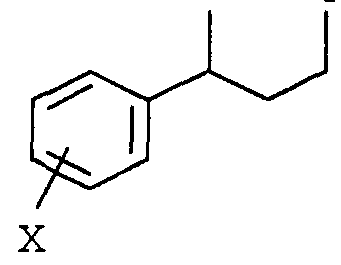
- the process according to the invention is suitable for practically all amides which can be prepared from optically active primary or secondary amines. It is particularly suitable for amides whose amine part consists of an optically active arylalkylamine.
- X stands for all common aromatic substituents, in particular halogen, nitro, cyano, C 1 -C 4 -alkyl, C 1 -C 4 -alkoxy and C 1 -C 4 -alkyl thio.
- R 5 , R 6 independently of one another H, branched and unbranched C 1 -C 1 alkyl, C 1 -C 4 alkoxycarbonyl, phenyl, phenyl C 1 -C 4 alkyl, the phenyl groups being substituted by halogen, nitro, cyano, C 1 -C -Alkyl, -CC 4 alkoxy and C- . -C 4 -Alkylth.i0 may be substituted.
- R 5 and R 6 can be closed to form a mono-, bi- or tricyclic via a carbon chain which can be interrupted by oxygen, sulfur or nitrogen and which in turn can be substituted
- R 7 H, -CC-alkyl, -C-C 4 -alkoxycarbonyl
- the process according to the invention relates to both the syn and the anti isomers.
- amino alcohols of the above general structure (I) are:
- glycols e.g. Ethylene glycol and its monoether, e.g. Monomethylglycol can be used.
- polystyrene resin 1, 2-propanediol, 1, 3-propanediol, 1, 2-butanediol, 2, 3-butanediol, 2, 4-pentanediol, cis and trans cyclohexane-1, 2-diol, cis and trans Cyclohexane-1, 4-diol, 2-methyl-2,3-butanediol, 3-methyl-2,4-pentanediol, 2, 2-dimeth ll, 3-propanediol, 1-phenyl-l, 2-ethanediol, 3 -Methoxy-l, 2-propanediol, 3-phenox-l, 2-propanediol, 3-butene-l, 2-diol, ice and trans-2-butene-l, 4-diol, triethanolamine, triisopropanolamine.
- Polyalkylene glycols preferably dialkylene glycols
- Preferred polyols are ethylene glycol and diethylene glycol.
- Suitable amino alcohols for the amide cleavage according to the invention are ethanolamine, diethanolamine and triethanolamine.
- a particularly preferred amino alcohol is triethanolamine.
- the polyols or amino alcohols should be soluble in water or homogeneously miscible with water. Mixtures of different polyols or amino alcohols can also be used.
- the polyols are used in an amount of 5-30, preferably from
- alkali or alkaline earth metal hydroxides in particular sodium and potassium hydroxide. These catalyze the hydrolysis ", however, neutralized by the acid formed so that they are used usually in an amount of 1-10 equivalents based on the amide.
- the hydroxides can advantageously be used in the form of their aqueous solutions, since a certain proportion of water is required anyway in the cleavage according to the invention.
- the water content is usually 5-90% by weight based on the total solvent.
- the cleavage according to the invention is preferably carried out at temperatures above 100 ° C., particularly preferably between 100-180 ° C.
- the hydrolysis of the amides according to the invention can be carried out either batchwise (batch mode) or continuously.
- a loop reactor or a cascade of stirred tanks for example, can be used.
- the amine obtained can be separated from the carboxylic acid present as a salt and isolated. This is preferably done by extraction, with the extraction agent being ether such as diethyl ether, methyl tert. Butyl ether and Dibutyl ether, halogenated hydrocarbons such as dichloromethane or trichlorethylene or hydrocarbons such as pentane, hexane, cyclohexane, benzene, toluene and xylene can be used.
- ether such as diethyl ether, methyl tert.
- Butyl ether and Dibutyl ether halogenated hydrocarbons such as dichloromethane or trichlorethylene or hydrocarbons such as pentane, hexane, cyclohexane, benzene, toluene and xylene
- halogenated hydrocarbons such as dichloromethane or trichlorethylene
- hydrocarbons such as pentane
- Another preferred embodiment of the isolation of the amine is steam distillation.
- a particularly suitable embodiment of the invention consists in that the cleavage is carried out at such a high temperature that the reaction product (amine) obtained is distilled over with the steam and is thus immediately removed from the reaction mixture, while the acid which is present in the alkaline Conditions are dissociated, remain in the template.
- the method of the invention can be used as a good success
- step 3 Use partial step (step 3) in the process for resolving primary and secondary amines described in WO 95/08636. This procedure involves the following steps:
- esters suitable for this process are those which carry an electron-rich heteroatom in the acid component of the ester, bonded to a carbon atom which is in the alpha, beta or gamma position relative to the carbonyl carbon.
- the heteroatom can be a fluorine, nitrogen, oxygen, phosphorus or sulfur atom. Oxygen is preferred as the hetero atom.
- the heteroatom can optionally be linked to other groups, e.g. Alkyl groups.
- groups e.g. Alkyl groups.
- the heteroatom is oxygen, there is an ether group.
- the alcohol component of the ester can consist of branched or unbranched Ci- to Cio alcohols, which can also be optionally substituted.
- Particularly suitable alcohol components are 2-propanol,
- 2-indanol 3-hydroxytetrahydrofuran, 5-hydroxy-2-methyl-l, 3-dioxane, 4-hydroxypiperidine, (+) and (-) menthol, (+) and (-) - isomerhol, Carfenol, lactic acid nitrile, acetone cyanohydrin, benzaldehyde cyanohydrin, pantolactone, lactic acid t-butyl ester, acetone oxime-2-hydroxypropyl ether.
- Suitable alcohol components are 1, 2-ethanediol, glycerin, 1, 2-propanediol, 1, 3-propanediol, 1, 2-butanediol, 2,3-butanediol, 2, 4-pentanediol, cis and trans Cyclohexane-1, 2-diol, cis and trans cyclohexane-1, 4-diol, 2-methyl-2,3-butanediol, 3-methyl-2, 4-pentanediol, 2, 2-dimethyl-1,3-propane diol, 1-phenyl-l, 2-ethanediol, 3-methoxy-l, 2-propanediol, 3-phenox-l, 2-propanediol, 3-chloro-l, 2-propanediol,
- esters are those with the structure R 3
- Ri C ⁇ -C ⁇ o-alkyl
- R 2 C ⁇ -C ⁇ o-alkyl
- R 3 H, C ⁇ -C ⁇ o-alkyl, optionally substituted by NH 2 , OH, C ⁇ - 4 alkoxy or halogen, phenyl,
- X O, S, NR 4 ,
- the C 4 alkyl esters of the C 4 alkoxy acetic acids for example methoxy acetic acid, are preferred.
- a large number of enzymes can be used as hydrolases in the process mentioned.
- Proteases and in particular lipases are preferably used.
- Microbial lipases which can be isolated from yeasts or bacteria, for example, are particularly suitable as lipases. Lipases from pseudo onas, e.g. B. Amano P or the lipase from Pseudomonas spec. DSM 8246.
- Further particularly suitable hydrolases are the enzymes commercially available from Novo Nordisk (Enzyme Toolbox), in particular the lipases SP 523, SP 524; SP 525, SP 526 and Novozym ® 435th
- lipases “Chirazyme L1 to L8”, which are commercially available (Boehringer Mannheim), can advantageously be used in the process according to the invention.
- the enzyme used can be used in native or in immobilized form.
- the immobilized enzyme Novozym® 435 is particularly suitable.
- Organic solvents are generally suitable as solvents.
- the reaction proceeds particularly well in ethers, for example in MTBE or THF, or in hydrocarbons such as hexane, cyclohexane, toluene or halogenated hydrocarbons such as methylene chloride.
- the implementation can also be carried out in the absence of a solvent.
- the reaction proceeds particularly well when the solvents and starting materials are as anhydrous as possible.
- the reaction of the ester with the racemic amine or amino alcohol under enzyme catalysis is usually carried out at room temperature.
- the reaction times for this are 1 to 48 hours depending on the substrate and the amount of enzyme.
- Secondary amines / amino alcohols generally require longer reaction times than primary amines / amino alcohols.
- the lower reactivity of secondary amines can also be compensated for by an increased amount of catalyst compared to primary amines.
- 1 to 6 moles of ester are preferably added per mole of substrate to be reacted, ie 0.5 to is required for 1 mole of racemic amine
- the amount of enzyme to be added depends on the type of hydrolase and the activity of the enzyme preparation.
- the optimal amount of enzyme for the reaction can easily be determined by simple preliminary tests. As a rule, 1000 units of lipase per mmol amine or amino alcohol are added.
- reaction can easily be followed using conventional methods, for example by means of gas chromatography.
- reaction is usefully terminated with a conversion of 50% of the racemic amine or amino alcohol. This is usually done by removing the catalyst from the reaction space, for example by filtering off the enzyme. If the enantioselective amidation is carried out in a continuous mode, the enzyme can be retained in a flow reactor.
- ee 95% ee: 95% 66 g of amide (0.29 mol) were added at 85 ° C with 7.3 g of triethanolamine (11 wt .-% based on amide) and heated to 120 ° C. 29.0 g (0.325 mol) of 50% sodium hydroxide solution were added, the mixture was stirred at 115-120 ° C. for 2 hours and then steam was passed through the reaction mixture. When the overhead distillate cleared, the collected condensate was allowed to cool to room temperature and the lower organic phase was separated off. This crude product was distilled in vacuo.
Landscapes
- Chemical & Material Sciences (AREA)
- Organic Chemistry (AREA)
- Organic Low-Molecular-Weight Compounds And Preparation Thereof (AREA)
Abstract
Description




Claims
Priority Applications (6)
| Application Number | Priority Date | Filing Date | Title |
|---|---|---|---|
| US09/936,348 US6713652B1 (en) | 1999-03-24 | 2000-03-17 | Process for hydrolyzing optically active amides |
| DE50011119T DE50011119D1 (de) | 1999-03-24 | 2000-03-17 | Verfahren zur hydrolyse von optisch aktiven amiden |
| JP2000606562A JP4578688B2 (ja) | 1999-03-24 | 2000-03-17 | 光学活性アミドの加水分解方法 |
| CA002367897A CA2367897C (en) | 1999-03-24 | 2000-03-17 | Method for hydrolyzing optically active amides |
| AT00916969T ATE303985T1 (de) | 1999-03-24 | 2000-03-17 | Verfahren zur hydrolyse von optisch aktiven amiden |
| EP00916969A EP1163206B1 (de) | 1999-03-24 | 2000-03-17 | Verfahren zur hydrolyse von optisch aktiven amiden |
Applications Claiming Priority (2)
| Application Number | Priority Date | Filing Date | Title |
|---|---|---|---|
| DE19913256A DE19913256A1 (de) | 1999-03-24 | 1999-03-24 | Verfahren zur Hydrolyse von optisch aktiven Amiden |
| DE19913256.9 | 1999-03-24 |
Publications (1)
| Publication Number | Publication Date |
|---|---|
| WO2000056699A1 true WO2000056699A1 (de) | 2000-09-28 |
Family
ID=7902190
Family Applications (1)
| Application Number | Title | Priority Date | Filing Date |
|---|---|---|---|
| PCT/EP2000/002380 Ceased WO2000056699A1 (de) | 1999-03-24 | 2000-03-17 | Verfahren zur hydrolyse von optisch aktiven amiden |
Country Status (10)
| Country | Link |
|---|---|
| US (1) | US6713652B1 (de) |
| EP (1) | EP1163206B1 (de) |
| JP (1) | JP4578688B2 (de) |
| CN (1) | CN1182102C (de) |
| AT (1) | ATE303985T1 (de) |
| CA (1) | CA2367897C (de) |
| DE (2) | DE19913256A1 (de) |
| DK (1) | DK1163206T3 (de) |
| ES (1) | ES2248064T3 (de) |
| WO (1) | WO2000056699A1 (de) |
Cited By (1)
| Publication number | Priority date | Publication date | Assignee | Title |
|---|---|---|---|---|
| EP1215197A3 (de) * | 2000-12-15 | 2003-10-29 | Basf Aktiengesellschaft | Verfahren zur Racemisierung von optisch aktiven Aminen |
Families Citing this family (4)
| Publication number | Priority date | Publication date | Assignee | Title |
|---|---|---|---|---|
| DE102006032061B4 (de) * | 2006-07-11 | 2009-01-02 | Mark, Christoph, Dr. | Verfahren zur Herstellung von optisch aktiven Aminen |
| EP2387556B1 (de) * | 2009-01-16 | 2014-07-30 | Basf Se | Trennung eines enantiomerengemischs von (r)- und (s)-3-amino-1-butanol |
| CN102154432B (zh) * | 2010-12-20 | 2013-06-12 | 蚌埠丰原医药科技发展有限公司 | 一种雷沙吉兰的制备方法 |
| CN103012154B (zh) * | 2012-12-18 | 2014-10-08 | 浙江大学 | 由苯磺酰胺衍生物氨解制备有机胺的方法 |
Citations (2)
| Publication number | Priority date | Publication date | Assignee | Title |
|---|---|---|---|---|
| WO1995008636A1 (de) * | 1993-09-25 | 1995-03-30 | Basf Aktiengesellschaft | Racematspaltung primärer und sekundärer amine durch enzym-katalysierte acylierung |
| WO1997010201A1 (de) * | 1995-09-15 | 1997-03-20 | Basf Aktiengesellschaft | Spaltung von optisch aktiven amiden |
Family Cites Families (1)
| Publication number | Priority date | Publication date | Assignee | Title |
|---|---|---|---|---|
| US3592854A (en) * | 1968-07-19 | 1971-07-13 | Armour Ind Chem Co | Hydrolysis of amides to amines |
-
1999
- 1999-03-24 DE DE19913256A patent/DE19913256A1/de not_active Withdrawn
-
2000
- 2000-03-17 EP EP00916969A patent/EP1163206B1/de not_active Expired - Lifetime
- 2000-03-17 AT AT00916969T patent/ATE303985T1/de active
- 2000-03-17 ES ES00916969T patent/ES2248064T3/es not_active Expired - Lifetime
- 2000-03-17 US US09/936,348 patent/US6713652B1/en not_active Expired - Lifetime
- 2000-03-17 DK DK00916969T patent/DK1163206T3/da active
- 2000-03-17 CA CA002367897A patent/CA2367897C/en not_active Expired - Lifetime
- 2000-03-17 WO PCT/EP2000/002380 patent/WO2000056699A1/de not_active Ceased
- 2000-03-17 CN CNB008054290A patent/CN1182102C/zh not_active Expired - Lifetime
- 2000-03-17 JP JP2000606562A patent/JP4578688B2/ja not_active Expired - Lifetime
- 2000-03-17 DE DE50011119T patent/DE50011119D1/de not_active Expired - Lifetime
Patent Citations (2)
| Publication number | Priority date | Publication date | Assignee | Title |
|---|---|---|---|---|
| WO1995008636A1 (de) * | 1993-09-25 | 1995-03-30 | Basf Aktiengesellschaft | Racematspaltung primärer und sekundärer amine durch enzym-katalysierte acylierung |
| WO1997010201A1 (de) * | 1995-09-15 | 1997-03-20 | Basf Aktiengesellschaft | Spaltung von optisch aktiven amiden |
Cited By (1)
| Publication number | Priority date | Publication date | Assignee | Title |
|---|---|---|---|---|
| EP1215197A3 (de) * | 2000-12-15 | 2003-10-29 | Basf Aktiengesellschaft | Verfahren zur Racemisierung von optisch aktiven Aminen |
Also Published As
| Publication number | Publication date |
|---|---|
| DK1163206T3 (da) | 2005-11-14 |
| JP4578688B2 (ja) | 2010-11-10 |
| ES2248064T3 (es) | 2006-03-16 |
| ATE303985T1 (de) | 2005-09-15 |
| CA2367897C (en) | 2009-10-13 |
| EP1163206B1 (de) | 2005-09-07 |
| US6713652B1 (en) | 2004-03-30 |
| DE19913256A1 (de) | 2000-09-28 |
| DE50011119D1 (de) | 2005-10-13 |
| EP1163206A1 (de) | 2001-12-19 |
| CN1346342A (zh) | 2002-04-24 |
| JP2002540093A (ja) | 2002-11-26 |
| CN1182102C (zh) | 2004-12-29 |
| CA2367897A1 (en) | 2000-09-28 |
Similar Documents
| Publication | Publication Date | Title |
|---|---|---|
| EP0720655B1 (de) | Racematspaltung primärer und sekundärer amine durch enzym-katalysierte acylierung | |
| EP0801683B1 (de) | Racematspaltung primärer und sekundärer heteroatomsubstituierter amine durch enzym-katalysierte acylierung | |
| DE69824958T2 (de) | Enantioselektive additions-reaktion mit hilfe eines organozink reagenzes | |
| EP0717023B1 (de) | Verfahren zur Herstellung von optisch aktiven Alkoholen durch catalytische Reduktion der optisch aktiven Carbonsäuren | |
| EP0850214B1 (de) | Spaltung von optisch aktiven amiden | |
| DE2814708C2 (de) | Verfahren zur Herstellung von Oxalsäureestern | |
| EP1163206B1 (de) | Verfahren zur hydrolyse von optisch aktiven amiden | |
| DE60028927T2 (de) | Verfahren zur herstellung von optisch aktiven amino-alkoholen | |
| EP1232279B1 (de) | Verfahren zur herstellung optisch aktiver amine | |
| Yadav et al. | [bmim] PF 6/CuBr: a novel and recyclable catalytic system for the synthesis of propargyl amines | |
| EP2234962B1 (de) | Verfahren zur herstellung von (s)-2-amino-1-propanol (l-alaninol) aus (s)-1-methoxy-2-propylamin | |
| DE69322013T2 (de) | (3R,5S)-3,5,6-Trihydroxyhexansäure Derivate und Verfahrens zur deren Herstellung | |
| DE3003730C2 (de) | ||
| EP3066070B1 (de) | Katalytische hydrierung zur herstellung von aminen aus amidacetalen, keten-n, o-acetalen oder esterimiden | |
| DE19727517A1 (de) | Racematspaltung von Aminosäureestern durch Enzym-katalysierte Acylierung | |
| DE19900205A1 (de) | Verfahren zur Herstellung von (2S,4R,9S)-Octahydro-1H-indol-2-carbonsäure und Zwischenprodukte dafür | |
| DE60021973T2 (de) | Ein verfahren zur herstellung reduzierter spezies ungesättigter organischer verbindungen mit hilfe von trichlorosilan und reduktionsmitteln | |
| WO2001036405A1 (de) | Verfahren zur herstellung von benzofuranonoximen | |
| EP2000458B1 (de) | Verfahren zur Herstellung von Aminen | |
| EP1518850B1 (de) | Enantiomerenangereichertes 2-Butanol | |
| DE602004011377T2 (de) | Verfahren zur herstellung von alkinolen | |
| DE112019006382T5 (de) | NEUES VERFAHREN ZUR HERSTELLUNG VONR-PHENYLACETYLCARBINOL UND β-AMINOALKOHOLEN | |
| DE69910345T2 (de) | Verfahren zum Herstellen von Cyclopropancarboxylatverbindungen | |
| JP2838529B2 (ja) | 新規な光学活性化合物 | |
| DE4428901A1 (de) | Verfahren zur Herstellung von N-Alkenylcarbonsäureamiden |
Legal Events
| Date | Code | Title | Description |
|---|---|---|---|
| WWE | Wipo information: entry into national phase |
Ref document number: 00805429.0 Country of ref document: CN |
|
| AK | Designated states |
Kind code of ref document: A1 Designated state(s): CA CN JP US |
|
| AL | Designated countries for regional patents |
Kind code of ref document: A1 Designated state(s): AT BE CH CY DE DK ES FI FR GB GR IE IT LU MC NL PT SE |
|
| 121 | Ep: the epo has been informed by wipo that ep was designated in this application | ||
| DFPE | Request for preliminary examination filed prior to expiration of 19th month from priority date (pct application filed before 20040101) | ||
| WWE | Wipo information: entry into national phase |
Ref document number: 09936348 Country of ref document: US |
|
| ENP | Entry into the national phase |
Ref document number: 2367897 Country of ref document: CA Ref document number: 2367897 Country of ref document: CA Kind code of ref document: A |
|
| WWE | Wipo information: entry into national phase |
Ref document number: 2000916969 Country of ref document: EP |
|
| ENP | Entry into the national phase |
Ref document number: 2000 606562 Country of ref document: JP Kind code of ref document: A |
|
| WWP | Wipo information: published in national office |
Ref document number: 2000916969 Country of ref document: EP |
|
| WWG | Wipo information: grant in national office |
Ref document number: 2000916969 Country of ref document: EP |