WO2001040352A1 - Aromatic polycarbonate, process for producing the same, and molded article - Google Patents
Aromatic polycarbonate, process for producing the same, and molded article Download PDFInfo
- Publication number
- WO2001040352A1 WO2001040352A1 PCT/JP2000/008415 JP0008415W WO0140352A1 WO 2001040352 A1 WO2001040352 A1 WO 2001040352A1 JP 0008415 W JP0008415 W JP 0008415W WO 0140352 A1 WO0140352 A1 WO 0140352A1
- Authority
- WO
- WIPO (PCT)
- Prior art keywords
- weight
- less
- group
- ppb
- content
- Prior art date
- Legal status (The legal status is an assumption and is not a legal conclusion. Google has not performed a legal analysis and makes no representation as to the accuracy of the status listed.)
- Ceased
Links
Classifications
-
- C—CHEMISTRY; METALLURGY
- C08—ORGANIC MACROMOLECULAR COMPOUNDS; THEIR PREPARATION OR CHEMICAL WORKING-UP; COMPOSITIONS BASED THEREON
- C08G—MACROMOLECULAR COMPOUNDS OBTAINED OTHERWISE THAN BY REACTIONS ONLY INVOLVING UNSATURATED CARBON-TO-CARBON BONDS
- C08G64/00—Macromolecular compounds obtained by reactions forming a carbonic ester link in the main chain of the macromolecule
- C08G64/04—Aromatic polycarbonates
-
- G—PHYSICS
- G11—INFORMATION STORAGE
- G11B—INFORMATION STORAGE BASED ON RELATIVE MOVEMENT BETWEEN RECORD CARRIER AND TRANSDUCER
- G11B7/00—Recording or reproducing by optical means, e.g. recording using a thermal beam of optical radiation by modifying optical properties or the physical structure, reproducing using an optical beam at lower power by sensing optical properties; Record carriers therefor
- G11B7/24—Record carriers characterised by shape, structure or physical properties, or by the selection of the material
- G11B7/241—Record carriers characterised by shape, structure or physical properties, or by the selection of the material characterised by the selection of the material
- G11B7/252—Record carriers characterised by shape, structure or physical properties, or by the selection of the material characterised by the selection of the material of layers other than recording layers
- G11B7/253—Record carriers characterised by shape, structure or physical properties, or by the selection of the material characterised by the selection of the material of layers other than recording layers of substrates
- G11B7/2533—Record carriers characterised by shape, structure or physical properties, or by the selection of the material characterised by the selection of the material of layers other than recording layers of substrates comprising resins
- G11B7/2534—Record carriers characterised by shape, structure or physical properties, or by the selection of the material characterised by the selection of the material of layers other than recording layers of substrates comprising resins polycarbonates [PC]
-
- C—CHEMISTRY; METALLURGY
- C08—ORGANIC MACROMOLECULAR COMPOUNDS; THEIR PREPARATION OR CHEMICAL WORKING-UP; COMPOSITIONS BASED THEREON
- C08G—MACROMOLECULAR COMPOUNDS OBTAINED OTHERWISE THAN BY REACTIONS ONLY INVOLVING UNSATURATED CARBON-TO-CARBON BONDS
- C08G63/00—Macromolecular compounds obtained by reactions forming a carboxylic ester link in the main chain of the macromolecule
- C08G63/02—Polyesters derived from hydroxycarboxylic acids or from polycarboxylic acids and polyhydroxy compounds
- C08G63/06—Polyesters derived from hydroxycarboxylic acids or from polycarboxylic acids and polyhydroxy compounds derived from hydroxycarboxylic acids
-
- C—CHEMISTRY; METALLURGY
- C08—ORGANIC MACROMOLECULAR COMPOUNDS; THEIR PREPARATION OR CHEMICAL WORKING-UP; COMPOSITIONS BASED THEREON
- C08G—MACROMOLECULAR COMPOUNDS OBTAINED OTHERWISE THAN BY REACTIONS ONLY INVOLVING UNSATURATED CARBON-TO-CARBON BONDS
- C08G64/00—Macromolecular compounds obtained by reactions forming a carbonic ester link in the main chain of the macromolecule
- C08G64/04—Aromatic polycarbonates
- C08G64/06—Aromatic polycarbonates not containing aliphatic unsaturation
- C08G64/14—Aromatic polycarbonates not containing aliphatic unsaturation containing a chain-terminating or -crosslinking agent
-
- C—CHEMISTRY; METALLURGY
- C08—ORGANIC MACROMOLECULAR COMPOUNDS; THEIR PREPARATION OR CHEMICAL WORKING-UP; COMPOSITIONS BASED THEREON
- C08G—MACROMOLECULAR COMPOUNDS OBTAINED OTHERWISE THAN BY REACTIONS ONLY INVOLVING UNSATURATED CARBON-TO-CARBON BONDS
- C08G64/00—Macromolecular compounds obtained by reactions forming a carbonic ester link in the main chain of the macromolecule
- C08G64/20—General preparatory processes
- C08G64/30—General preparatory processes using carbonates
- C08G64/307—General preparatory processes using carbonates and phenols
-
- G—PHYSICS
- G11—INFORMATION STORAGE
- G11B—INFORMATION STORAGE BASED ON RELATIVE MOVEMENT BETWEEN RECORD CARRIER AND TRANSDUCER
- G11B7/00—Recording or reproducing by optical means, e.g. recording using a thermal beam of optical radiation by modifying optical properties or the physical structure, reproducing using an optical beam at lower power by sensing optical properties; Record carriers therefor
- G11B7/24—Record carriers characterised by shape, structure or physical properties, or by the selection of the material
- G11B7/241—Record carriers characterised by shape, structure or physical properties, or by the selection of the material characterised by the selection of the material
- G11B7/252—Record carriers characterised by shape, structure or physical properties, or by the selection of the material characterised by the selection of the material of layers other than recording layers
- G11B7/253—Record carriers characterised by shape, structure or physical properties, or by the selection of the material characterised by the selection of the material of layers other than recording layers of substrates
- G11B7/2533—Record carriers characterised by shape, structure or physical properties, or by the selection of the material characterised by the selection of the material of layers other than recording layers of substrates comprising resins
-
- G—PHYSICS
- G11—INFORMATION STORAGE
- G11B—INFORMATION STORAGE BASED ON RELATIVE MOVEMENT BETWEEN RECORD CARRIER AND TRANSDUCER
- G11B7/00—Recording or reproducing by optical means, e.g. recording using a thermal beam of optical radiation by modifying optical properties or the physical structure, reproducing using an optical beam at lower power by sensing optical properties; Record carriers therefor
- G11B7/24—Record carriers characterised by shape, structure or physical properties, or by the selection of the material
- G11B7/241—Record carriers characterised by shape, structure or physical properties, or by the selection of the material characterised by the selection of the material
- G11B7/252—Record carriers characterised by shape, structure or physical properties, or by the selection of the material characterised by the selection of the material of layers other than recording layers
- G11B7/253—Record carriers characterised by shape, structure or physical properties, or by the selection of the material characterised by the selection of the material of layers other than recording layers of substrates
- G11B7/2533—Record carriers characterised by shape, structure or physical properties, or by the selection of the material characterised by the selection of the material of layers other than recording layers of substrates comprising resins
- G11B7/2535—Record carriers characterised by shape, structure or physical properties, or by the selection of the material characterised by the selection of the material of layers other than recording layers of substrates comprising resins polyesters, e.g. PET, PETG or PEN
-
- G—PHYSICS
- G11—INFORMATION STORAGE
- G11B—INFORMATION STORAGE BASED ON RELATIVE MOVEMENT BETWEEN RECORD CARRIER AND TRANSDUCER
- G11B7/00—Recording or reproducing by optical means, e.g. recording using a thermal beam of optical radiation by modifying optical properties or the physical structure, reproducing using an optical beam at lower power by sensing optical properties; Record carriers therefor
- G11B7/24—Record carriers characterised by shape, structure or physical properties, or by the selection of the material
- G11B7/241—Record carriers characterised by shape, structure or physical properties, or by the selection of the material characterised by the selection of the material
- G11B7/252—Record carriers characterised by shape, structure or physical properties, or by the selection of the material characterised by the selection of the material of layers other than recording layers
- G11B7/253—Record carriers characterised by shape, structure or physical properties, or by the selection of the material characterised by the selection of the material of layers other than recording layers of substrates
- G11B7/2533—Record carriers characterised by shape, structure or physical properties, or by the selection of the material characterised by the selection of the material of layers other than recording layers of substrates comprising resins
- G11B7/2536—Record carriers characterised by shape, structure or physical properties, or by the selection of the material characterised by the selection of the material of layers other than recording layers of substrates comprising resins polystyrene [PS]
Definitions
- the present invention relates to an aromatic polycarbonate having a low content of a specific metal element and having high durability and stability, particularly when used under a high temperature and high humidity condition for a long time, a method for producing the same, and a molded product thereof.
- Japanese Unexamined Patent Publication (Kokai) No. 2-1 757272 discloses the content of hydrolyzable chlorine in raw materials
- the disclosed metal content is still high in the order of Ppm, and under the severe moist heat conditions disclosed in the present invention for a long time, the aromatic polycarbonate has a good content. Insufficient to maintain hue, transparency and mechanical strength.
- R 2 are each independently an alkyl group having 1 to 20 carbon atoms, an alkoxy group having 1 to 20 carbon atoms, a cycloalkyl group having 6 to 20 carbon atoms, An aryl group, a cycloalkoxy group having 6 to 20 carbon atoms or an aryloxy group having 6 to 20 carbon atoms, m and n are each independently an integer of 0 to 4, X is a single bond, oxygen Atom, carbonyl group, alkylene group having 1 to 20 carbon atoms, alkylidene group having 2 to 20 carbon atoms, cycloalkylene group having 6 to 20 carbon atoms, cycloalkylidene group having 6 to 20 carbon atoms or 6 carbon atoms Or an alkylene arylene alkylene group having 6 to 20 carbon atoms.
- the above objects and advantages of the present invention are secondly achieved by a molded article of the aromatic polycarbonate of the present invention.
- an aromatic dihydroxy compound and a carbonic acid diester are selected from the group consisting of a nitrogen-containing basic compound and a phosphorus-containing basic compound per mole of an aromatic dihydroxy compound.
- Alkylene group alkylene group having 2 to 20 carbon atoms, cycloalkylene group having 6 to 20 carbon atoms, cycloalkylidene group having 6 to 20 carbon atoms or arylene group having 6 to 20 carbon atoms, alkylene group having 6 to 20 carbon atoms It is a arylene alkylene group.
- the terminal group consists essentially of an aryloxy group (A) and a phenolic hydroxyl group (B), and their molar ratio (A) / (B) is 955 to 4060, and the melt viscosity stability is high. 0.5% or less.
- the terminal groups of the aromatic polycarbonates according to the invention consist essentially of aryloxy groups (A) and phenolic hydroxyl groups (B) and their molar ratio (A) / (B) is from 95/5 to 40Z60. .
- the preferred molar ratio (A) / (B) is 90Z10-50 / 50, more preferably 8515-60 ⁇ 40, especially preferably 80 / 20-70 / 30.
- the content of each of the second elements is preferably 20 ppb or less. Is preferably 1 ppb or less, and more preferably 1 ppm or less.
- an aromatic dihydroxy compound hereinafter, sometimes referred to as BP A
- a carbonic acid diester hereinafter, sometimes referred to as DPC
- the reaction temperature varies depending on the boiling point of the product, etc., but is usually in the range of 120 to 350 ° C. to remove alcohol or phenol formed by the reaction, and is preferably 180 to 280 to obtain an aromatic polycarbonate with few impurities. ° C, more preferably in the range of 250-270 ° C.
- the pressure of the system is reduced to facilitate the distillation of the alcohol or phenol formed.
- the internal pressure of the system at the latter stage of the reaction is preferably 133.3 Pa (ImmHg) or less, more preferably 66.7 Pa (0.5 mmHg) or less.
- an aromatic dihydroxy compound BPAs
- DPCs carbonic acid diester
- the BPAs and the DPCs each have a Na metal element content weight of 52 ppb or less, more preferably 35 pPb or less, particularly preferably 6 ppb or less, and BPAs and DPCs having a weight concentration of each element belonging to the element group of 40 ppb or less, more preferably 23 ppb or less, particularly preferably 6 ppb or less are used.
- the amount of NCB A used must be not more than (20 XFe * + 200) for Fe * (total weight of Fe content of DPCs and BPAs; PP b); There is.
- the weight concentration of each of the third elements contained in the DPCs and BPAs is preferably 1 ppb or less, and the weight concentration of each of the fourth elements is preferably 1 pm.
- BPA bisphenol A
- a specific high-performance liquid chromatographic analysis adsorbent (GL) containing 15% (as carbon content) of oxy-denyl group bonded to high-purity spherical silica gel with a pore size of 100 ⁇
- a high-performance liquid chromatograph holding a 4.6 mm inner diameter and 250 mm long column packed with Science Inertsil ODS—type 3 adsorbent) at 40 at ⁇ 0.1 was obtained.
- eluent A 0.1% phosphoric acid aqueous solution was used as eluent A, and acetonitrile was used as eluent B.
- the ratio of eluent A: eluent B was 1: 1 and eluent A and eluent were used up to 5 minutes.
- the measurement is performed so that the total flow rate of B is 0.9 m1Z min, and while the total flow rate is kept constant, the ratio of eluent B is continuously increased from 5 minutes after the start of measurement, and the measurement is started. After that, the ratio of eluent B to eluent A: eluent B should be 0: 1 by 55 minutes.
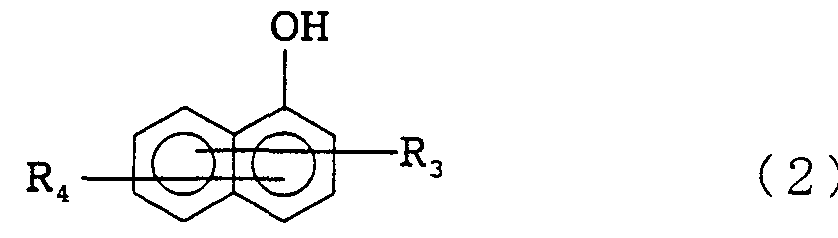
- the sum of the absorption peak areas of the compound group eluted between 22 minutes and 24 minutes is 5 X in terms of the ratio to the absorption peak area of BPA. 10- 5 (50 p pm) or less, more preferably, in the above analysis, the sum of the absorption peak from the molecular weight 307 which elutes between 22 minutes to 24 minutes 309 compounds in a ratio against the absorption peak area of BP a a 2 XI 0- 5 (20 p pm ) how to use the less is BPA. More preferably, 1-naphthols represented by the following formula (2):
- R 3 and R 4 are each independently a methyl, ethyl, n-propyl, isopropyl group, or an isopropyl group.
- each of R 3 and R 4 can be bonded to any of the 2 to 8 positions other than the 1-position (substituted by a hydroxyl group) of the naphthalene ring without overlapping.
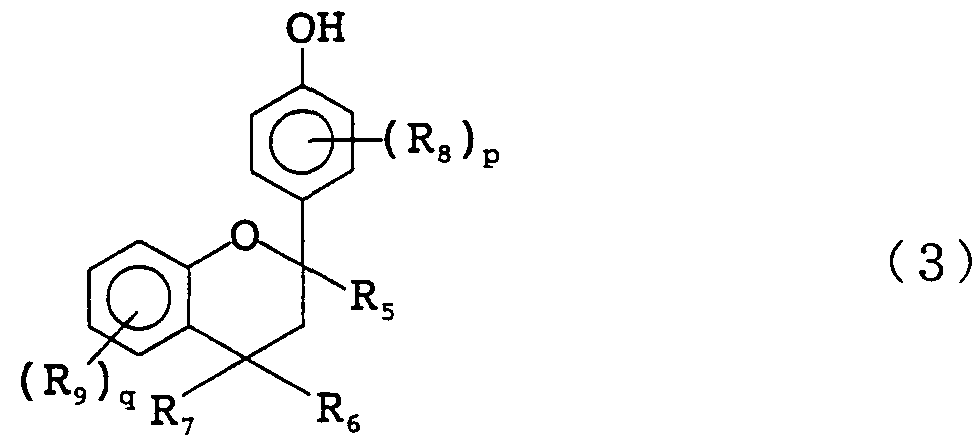
- R 5 to R 7 are each independently an alkyl group having 1 to 4 carbon atoms
- R 8 and R 9 are each independently an alkyl group having 1 to 4 carbon atoms
- p and q is each independently an integer from 0 to 4.
- the content of the chromene compound represented by the formula is not more than 1 X 10⁻⁵ with respect to 1 part by weight of BP A, and the following formula (6)
- the 1-naphthols represented by the formula (2) are, for example, 2,4-dimethyl-1-hydroxynaphthalene, 2,6-dimethyl-1-hydroxynaphthylene, and 2,7-dimethyl-1-hydroxynaphthylene. These are benzene, 3,6-dimethyl-1-hydroxynaphthalene, 2- ⁇ fsopropyl-11-hydroxynaphthylene, and 6- ⁇ fsoprodenyl-11-hydroxynaphthalene.
- Examples of the kodima derivative represented by the formula (4) include 4_ (4-hydroxyphenyl) -2,2,4-trimethylchroman and 4- (3-methyl-4-hydroxyphenyl) -1,2,4 —Trimethylchroman, 4— (3,5-dimethyl-1-hydroxyphenyl) 1,2,4,1-Trimethylchroman, 4_ (3,5-dimethyl-4-hydroxyphenyl) —2,2,4— Trimethylchroman, 4- (3-methyl-14-hydroxyphenyl) -12,4,4,8-tetramethylchroman.
- the xanthenes represented by the formula (6) include, for example, 9,9-dimethylxanthene, 2-butyl-9,9-dimethylxanthene, and 3-methyl-9,9-getyl Xanthene, 9,9-getylxanthene, 9-methylxanthene and 2,6,9,9-tetramethylxanthene.
- Bisphenol A is produced by dehydrating and condensing acetone and excess phenol in the presence of an acid catalyst such as a homogeneous acid such as hydrochloric acid or a solid acid such as ion exchange resin.
- an acid catalyst such as a homogeneous acid such as hydrochloric acid or a solid acid such as ion exchange resin.
- Bisphenol A obtained by such a production method is easily obtained as a commercial product, and usually contains the compounds (impurities) represented by the above formulas (2) to (6).
- the content of the impurity element as described above can be reduced from the level of p pm to the level of p pb which is 1/100 or less.
- the content of the above-mentioned organic impurities, which has not been noticed in the past, can be reduced to a predetermined value.
- Phosphonium amides having alkyl, aryl, alkylaryl groups such as dimethyl hydroxide, or tetrabutyl phosphonium borohydride (Bu 4 PBH 4 ), tetrabutyl phosphonium tetraphenyl sulfate (Bu 4 Basic salts such as PBPh 4 ), tetramethylphosphonium tetraphenylporate and (Me 4 PBPh 4 ) can be mentioned.
- the ratio is outside the above range, the properties of the obtained aromatic polycarbonate are adversely affected, and the transesterification reaction does not proceed sufficiently, and it is difficult to obtain a high molecular weight aromatic polycarbonate. Is not preferred.
- Catalysts AMCs include, for example, alkali metals, alkaline earth metal hydroxides, hydrocarbon compounds, carbonates, acetates, nitrates, nitrites, sulfites, cyanates, thiocyanates, stearic acid Salts, borohydrides, benzoates, hydrogen phosphates, bisphenols, and salts of phenols.
- Specific examples include sodium hydroxide, ⁇ acid lithium, sodium hydrogen carbonate, potassium hydrogen carbonate, sodium carbonate, lithium carbonate, cesium carbonate, sodium acetate, lithium acetate, sodium nitrate, rubidium nitrate, sodium nitrite, and nitrous acid.
- alkali metal compound (a) an alkali metal salt of an ate complex of an element of Group 14 of the periodic table or (a) an alkali metal salt of an oxo acid of an element of Group 14 of the periodic table can be used.
- the elements of group 14 of the periodic table refer to silicon, germanium, and tin.
- the ate complex alkali metal salt of an element of Group 14 of the periodic table includes those described in JP-A-7-268091, specifically NaGe ( ⁇ Me) 5 , NaGe (OPh ) 5 , Li Ge (OPh) 5 , NaSn (OMe) 3 , NaSn (OMe) 5 , and NaSn (OPh) 5 .
- Preferable alkali metal salts of oxo acids of Group 14 elements of the periodic table include, for example, alkali metal salts of germic acid, stannic acid, germanium (II) acid, and germanium (IV) acid. be able to.
- Orutokei disodium Orutokei acid Tetorana thorium, disodium Monosuzu acid, germanium ([pi) monosodium (N AHGe_ ⁇ 2), ortho germanium (IV) acid disodium, di germanium (IV) disodium can be mentioned (Na 2 Ge 2 0 5) .
- At least one compound selected from the group consisting of elemental oxo acids, oxides, and alkoxides and phenoxides of the same element can coexist as a co-catalyst.
- these cocatalysts in a specific ratio, terminal blocking reaction, branching reaction which is easily generated during polycondensation reaction without impairing the polycondensation reaction speed, main chain cleavage reaction, and the inside of equipment during molding processing This is preferable because undesired phenomena such as generation of foreign matter and burning can be more effectively suppressed.
- oxides of Group 14 of the periodic table include silicon dioxide, tin dioxide, germanium dioxide, silicon tetrabutoxide, silicon tetrafurenoxide, tetratratoxy tin, tetraphenoxy tin, tetramethoxy germanium, tetrabutoxy germanium, Tetraphenoxygermanium and condensates thereof can be mentioned.
- the co-catalyst is more preferably present in a proportion such that the element of Group 14 of the Periodic Table as the co-catalyst is 0.1 to 30 mole atoms per mole atom of the metal element of the polycondensation reaction catalyst. .
- the aromatic compound Since the sodium compound has less influence on the durability of the aromatic polycarbonate produced than the compound of an alkali metal or alkaline earth metal other than sodium, the aromatic compound having excellent durability in the present invention is used. In order to obtain an aromatic polycarbonate, it is preferable to use a sodium compound as a catalyst.
- AMC is used as the polymerization catalyst, as described above, it is preferably used in an amount of 0.05 to 5 chemical equivalents per mole of 6.8 to 1 mol. It is more preferably from 0.07 to 3 chemical equivalents, particularly preferably from 0.07 to 2 chemical equivalents.
- sodium compound catalyst When a sodium compound is used as a catalyst, it will be understood that, since sodium derived from the catalyst is added in addition to the sodium to be added, the sodium compound catalyst must be used within a range where the total amount of the sodium metal element in the polymer does not exceed the specified amount in the present invention.
- the viscosity stability (defined below) of the molten polymer is focused on in order to obtain an aromatic polycarbonate which is less likely to cause a decrease in molecular weight and coloring, and this value is set to 0.5% or less. It is necessary to. When this value is large, the hydrolysis degradation of the aromatic polycarbonate is promoted. In order to ensure practical hydrolysis resistance, it is sufficient to keep this value below 0.5%.
- the melt viscosity stability is evaluated by the absolute value of the change in melt viscosity measured under a nitrogen stream at a shear rate of 1 rad Z se (: 30 minutes at 300) and expressed as the rate of change per minute. .
- the melt viscosity stabilizer in the present invention has an action to deactivate a part or all of the activity of the polymerization catalyst used in producing the aromatic polycarbonate.
- the melt viscosity stabilizer may be added, for example, while the polymer is in a molten state after the polymerization, or may be added after pelletizing the polycarbonate once and then re-dissolved.
- the melt viscosity stabilizer may be added while the polycarbonate, which is the reaction product in the extruder, is in a molten state, or the polypropionate obtained after the polymerization may be passed through the extruder from the reaction tank through the extruder.
- a melt viscosity stabilizer can be added and kneaded.
- sulfones such as salts of organic sulfonic acids, organic sulfonic acid esters, organic sulfonic anhydrides, and organic sulfonic acid betaines. It is preferred to use an acid compound, in particular, a phosphonium salt of sulfonic acid and an ammonium salt of Z or sulfonic acid. Among them, particularly preferred are tetrabutylphosphonium dodecylbenzenesulfonate and tetrabutylammonium p-toluenesulfonate.
- the polymer of the present invention can be obtained by the above method.
- conventionally known processing stabilizers, heat stabilizers, antioxidants, and purple An external light absorbing agent, an antistatic agent, a flame retardant, a release agent and the like may be added.
- a heat stabilizer can be blended in order to prevent the aromatic polycarbonate of the present invention from lowering the molecular weight or deteriorating the hue.
- heat stabilizers include phosphorous acid, phosphoric acid, phosphonous acid, phosphonic acid and esters thereof.
- Bis (2,4-di-t-butylphenyl) pentaerythrityl diphosphite, tris (2,4-di-t-butylphenyl) phosphite, tetrakis (4,4,1-biphenylene diphosphosphinate) 4-Di-t-butylphenyl), trimethyl phosphate and dimethyl benzenephosphonate are preferably used.
- heat stabilizers may be used alone or in combination of two or more.
- the amount of the heat stabilizer is preferably 0.001 to 1 part by weight, more preferably 0.005 to 0.5 part by weight, based on 100 parts by weight of the aromatic polycarbonate. 0.001 to 0.1 part by weight is more preferred.
- the higher fatty acid ester is preferably a partial ester or a total ester of a monovalent or polyhydric alcohol having from! 20 to 20 and a saturated or unsaturated fatty acid having from 10 to 30 carbon atoms. .
- a partial ester or a whole ester of a monohydric or polyhydric alcohol and a saturated or unsaturated fatty acid monodaliseride stearate, triglyceride stearate and pentaerythritol tetrastearate are preferably used.
- the compounding amount of the release agent is preferably 0.01 to 5 parts by weight based on 100 parts by weight of the aromatic polycarbonate.
- inorganic and organic fillers can be blended with the aromatic polycarbonate of the present invention in order to improve rigidity and the like, as long as the object of the present invention is not impaired.
- Such inorganic fillers include, for example, plate-like or granular inorganic fillers such as talc, my strength, glass flakes, glass beads, calcium carbonate, titanium oxide; glass fiber, glass milled fiber, wollastonite, carbon fiber And fibrous fillers such as aramide fibers and metal-based conductive fibers, and organic particles such as crosslinked acrylic particles and crosslinked silicone particles.
- the amount of these inorganic and organic fillers is preferably from 1 to 150 parts by weight, more preferably from 3 to 100 parts by weight, per 100 parts by weight of the aromatic polycarbonate.
- the inorganic filler usable in the present invention may be surface-treated with a silane coupling agent or the like. By this surface treatment, good results are obtained, such as suppression of decomposition of the aromatic polycarbonate.
- Such other resins include, for example, polyamide resins, polyimide resins, polyesterimide resins, polyurethane resins, polyphenylene ether resins, polyphenylene sulfide resins, polysulfone resins, polyolefin resins such as polyethylene and polypropylene, polyethylene terephthalate, and polybutylene terephthalate.
- Polyester resin such as evening glass, amorphous polyarylate resin, polystyrene resin, acrylonitrile Z styrene copolymer (AS resin), acrylonitrile Z butadiene Z styrene copolymer (ABS resin), polymethacrylate resin, phenol resin, Epoxy resins are mentioned.
- various window materials such as general houses, gymnasiums, baseball domes, and vehicles (construction machinery, automobiles, buses, Shinkansen, Glazing products for window materials such as train cars, etc., as well as various side walls (sky domes, top lights, arcades, condominium sidings, road side walls), window materials for vehicles, etc., displays for OA equipment, evening panels, and membranes
- optical applications such as liquid crystal cells and retardation correction plates in combination with lens switches, photo covers, polycarbonate resin laminates for water tanks, projection disks and polarizing plates.
- the thickness of the aromatic polycarbonate sheet is not particularly limited, but is usually 0.1 to: L 0 mm, preferably 0.2 to 8 mm, and particularly preferably 0.2 to 3 mm.
- various processings (various laminations for improving weather resistance, abrasion resistance improvement for surface hardness improvement, surface graining, semi-finished and Opacity processing, etc.).
- an arbitrary method is adopted. For example, a method of mixing with a tumbler, a V-type blender, a super mixer, a Now mixer, a Banbury mixer, a kneading roll, or an extruder is appropriately used.
- the aromatic polycarbonate resin composition thus obtained can be formed into a sheet by a melt extrusion method as it is or after being once formed into a pellet by a melt extruder.
- the present invention is not limited by these examples, and the present invention is not limited to these examples.
- the following method was used for the language test of the aromatic polycarbonate produced in the examples.
- Viscosity average molecular weight (Mw) It was determined from the intrinsic viscosity ([7?]) Measured with an Ubbelohde viscometer at 20 in methylene chloride at the following equation.
- Elution conditions 0.1% phosphoric acid aqueous solution was used as eluent A, and acetonitrile was used as eluent B.
- the eluent A: eluent B ratio was 1: 1 until 5 minutes from the start of measurement.
- the measurement is performed so that the total flow rate of A and eluent B becomes 0.SmlZmin, and while the total flow rate is kept constant, the ratio of eluent B is continuously increased from 5 minutes after the start of measurement, and the measurement is started. Perform a gradient operation to increase the ratio of eluent B so that the ratio of eluent A: eluent B becomes 0: 1 by 55 minutes.
- UV detector with wavelength of 254 nm
- melt viscosity stability of the polymer was evaluated by the melt viscosity stability of the polymer. Using a rheometrics RAA type flow analyzer, the absolute value of the change in melt viscosity was measured for 30 minutes under a nitrogen flow at a shear rate of lZadZec, 300, and the rate of change per minute was determined. For the long-term stability of the aromatic polycarbonate to be good, this value must not exceed 0.5%.
- the aromatic polycarbonate was kept at a temperature of 90 ° (:, relative humidity of 90% for 1,000 hours. Ten samples were prepared, the following measurements were performed, and the polymer was evaluated by the average value.
- Hue deterioration The hue of a polymer chip was measured with a Z-1001D P color difference meter manufactured by Nippon Denshoku Co., Ltd. The higher the L value, the higher the brightness, and the lower the b value, the less yellow coloration is preferable. The lower the L value, the higher the b value (values in the table) Power s'l. It was evaluated that the desired hue stability was maintained even after prolonged use under wet conditions.
- Transparency A flat plate of 50 X 50 X 5 mm is molded with a Neomat N 150/75 injection molding machine manufactured by Sumitomo Heavy Industries, Ltd. at a cylinder temperature of 280 ° C with a molding cycle of 3.5 seconds.
- the transmittance was measured by NDH- # 80 manufactured by Nippon Denshoku Co., Ltd. The higher the total light transmittance, the better the transparency. If the retention of the total light transmittance after the deterioration test is 90% or more, the desired transparency can be obtained even under long-term use under severe temperature and humidity conditions. It was evaluated as being maintained.
- a polymer sample (0.02 g) was dissolved in 0.4 ml of deuterated chloroform, and the OH terminal concentration was measured using 1H-NMR (EX-270, manufactured by JEOL Ltd.) at 20 ° C.
- the number of aryloxy terminal groups was calculated as the difference between the total number of terminals and the number of OH terminals determined by the following equation.
- the melting Hazen color number of 250 ° C or less, 10 or less, and 25O the melting Hazen color number of 20 or less after holding for 2 hours are the limits for use as polycarbonate raw materials.
- BPA Bisphenol A
- DPC diphenyl carbonate
- BP A was charged into a glass sublimation purification device, and subjected to sublimation purification using a pressure reducing device under nitrogen atmosphere at a pressure of 13 Pa (0.10 ⁇ ⁇ ) and 140 over 5 hours. Purified BP ⁇ was obtained. Sublimation purification was repeated 2 to 4 times as needed to prepare a purified sample.
- Raw material 2 Patent publication, Japanese Patent Application Laid-Open No. Hei 7-188116 (Bayer) DPC produced according to the description in Example 1 is described in Plastic Materials Course 17, Poly-Polyponate, Akira Sakajiri et al., Pp. 45-46. DP purified according to the method of.
- Ingredient 3 Using dimethyl carbonate sold to the public, Japanese Patent Publication No. 7-091230 (Asahi Kasei) Following the method described in Example 1, but using Ti (OBu) 4 as a catalyst to produce DPC, Purified according to the method.
- the raw material DPC was washed three times with hot water (at 50) according to the method described on page 45 of “Plastic Materials Course 17 Polycarbonate Author Toshihisa Tachikawa et al. (Nikkan Kogyo Shimbun)” Distillation is performed and a fraction of OOO kPa (15 mmHg) is collected at 167-168. A purified product of phenyl carbonate Dc was obtained.
- the raw material DPC is dissolved in 10 times the volume of acetone, and after passing through a cation / anion mixed ion exchange resin column, the solvent is distilled off under reduced pressure and purified by sublimation as described above to obtain a purified product of diphenyl carbonate D-d I got
- Impurities contained in the purified bisphenol A and diphenylcapone were measured by the above method, and the results are shown in Tables 1 to 3 below.
- Peak area ratio with BPA Organic impurities (weight ppm) Hazen
- Example 13 the number of white spots in Example 13, Example 14 and Comparative Example 6 was 0.2, 0.1 and 3.5, respectively.
- One side of the obtained aromatic polycarbonate sheet (2 mm thick) is cured with visible light
- a plastic adhesive (BENEF IX PC manufactured by Adel Co., Ltd.) is applied, and the same sheet is pushed out to one side so that air bubbles do not enter. After laminating, the light is equipped with a metal halide type exclusively for visible light.
- the adhesive strength of the laminate obtained by irradiating 5,000 OmJZcm 2 light with a curing device was measured in accordance with JIS K-6852 (Adhesive compression shear strength test method). Was 10.4 MPa (106 kgf / cm 2 ).
- PET Polyethylene terephthalate; TR-8580; Teijin Limited, intrinsic viscosity 0.8
- PBT polybutylene terephthalate
- TRB H
- Teijin Limited inherent viscosity 1. 07
- the fluidity was measured using an Archimedes-type spiral lip (thickness 2 mm, width 8 mm) at a cylinder temperature of 25 O, a mold temperature of 80 ° C, and an injection pressure of 98.
- IMP a Archimedes-type spiral lip
- the durability of the polymer is remarkably improved.
- the effect of maintaining good color tone, transparency, and mechanical strength is obtained.
Landscapes
- Chemical & Material Sciences (AREA)
- Health & Medical Sciences (AREA)
- Chemical Kinetics & Catalysis (AREA)
- Medicinal Chemistry (AREA)
- Polymers & Plastics (AREA)
- Organic Chemistry (AREA)
- Polyesters Or Polycarbonates (AREA)
Description





Claims



Priority Applications (3)
| Application Number | Priority Date | Filing Date | Title |
|---|---|---|---|
| KR1020017009525A KR20010101769A (ko) | 1999-12-03 | 2000-11-29 | 방향족폴리카보네이트, 그 제조법 및 성형품 |
| EP00978000A EP1149852A4 (en) | 1999-12-03 | 2000-11-29 | AROMATIC POLYCARBONATE, METHOD FOR THE PRODUCTION THEREOF AND MOLDED OBJECT |
| US09/890,465 US6410678B1 (en) | 1999-12-03 | 2000-11-29 | Aromatic polycarbonate, production method and molded products thereof |
Applications Claiming Priority (12)
| Application Number | Priority Date | Filing Date | Title |
|---|---|---|---|
| JP34472599 | 1999-12-03 | ||
| JP34472499 | 1999-12-03 | ||
| JP34472799 | 1999-12-03 | ||
| JP11/344725 | 1999-12-03 | ||
| JP11/344726 | 1999-12-03 | ||
| JP34472699 | 1999-12-03 | ||
| JP34472899 | 1999-12-03 | ||
| JP11/344724 | 1999-12-03 | ||
| JP11/344728 | 1999-12-03 | ||
| JP11/344727 | 1999-12-03 | ||
| JP2000/277 | 2000-01-05 | ||
| JP2000000277 | 2000-01-05 |
Publications (1)
| Publication Number | Publication Date |
|---|---|
| WO2001040352A1 true WO2001040352A1 (en) | 2001-06-07 |
Family
ID=27554666
Family Applications (1)
| Application Number | Title | Priority Date | Filing Date |
|---|---|---|---|
| PCT/JP2000/008415 Ceased WO2001040352A1 (en) | 1999-12-03 | 2000-11-29 | Aromatic polycarbonate, process for producing the same, and molded article |
Country Status (5)
| Country | Link |
|---|---|
| US (1) | US6410678B1 (ja) |
| EP (1) | EP1149852A4 (ja) |
| KR (1) | KR20010101769A (ja) |
| CN (1) | CN1339043A (ja) |
| WO (1) | WO2001040352A1 (ja) |
Cited By (7)
| Publication number | Priority date | Publication date | Assignee | Title |
|---|---|---|---|---|
| JP2009091418A (ja) * | 2007-10-05 | 2009-04-30 | Teijin Ltd | 植物由来成分を有するポリカーボネートおよびその製造方法 |
| JP2009091404A (ja) * | 2007-10-04 | 2009-04-30 | Teijin Ltd | 植物由来成分を有するポリカーボネートおよびその製造法 |
| JP2009127037A (ja) * | 2007-11-28 | 2009-06-11 | Teijin Ltd | 植物由来成分を有するポリカーボネート及びその製造方法 |
| JPWO2008029746A1 (ja) * | 2006-09-01 | 2010-01-21 | 帝人株式会社 | 植物由来成分を有するポリカーボネート及びその製造方法 |
| US8268953B2 (en) | 2007-10-04 | 2012-09-18 | Teijin Limited | Polycarbonate containing plant-derived component and process for the preparation thereof |
| JP5379016B2 (ja) * | 2007-10-31 | 2013-12-25 | 帝人株式会社 | 保存安定性が良好な無水糖アルコール組成物およびそれを用いるポリカーボネートの製造方法 |
| WO2026053526A1 (ja) * | 2024-09-06 | 2026-03-12 | 出光興産株式会社 | ポリカーボネート系樹脂組成物 |
Families Citing this family (26)
| Publication number | Priority date | Publication date | Assignee | Title |
|---|---|---|---|---|
| MY141753A (en) * | 2003-09-15 | 2010-06-30 | Shell Int Research | Method for producing polycarbonate |
| US7112645B2 (en) * | 2004-03-19 | 2006-09-26 | General Electric Company | Polycarbonate composition and method of making thereof |
| US7189869B2 (en) * | 2004-11-01 | 2007-03-13 | General Electric Company | Method for making polycarbonate |
| TWI402298B (zh) * | 2007-02-27 | 2013-07-21 | Teijin Chemicals Ltd | 成形品之製法 |
| CN101754994A (zh) * | 2007-05-17 | 2010-06-23 | 帝人株式会社 | 具有植物来源成分的聚碳酸酯的制备方法 |
| US7619053B2 (en) * | 2007-09-28 | 2009-11-17 | Sabic Innovative Plastics Ip B.V. | Monomer solution for producing polycarbonate |
| US7601794B2 (en) * | 2007-09-28 | 2009-10-13 | Sabic Innovative Plastics Ip B.V. | Monomer solution for producing polycarbonate |
| WO2009120235A1 (en) * | 2008-03-26 | 2009-10-01 | Sabic Innovative Plastics Ip Bv | Monomer solution for producing polycarbonate |
| US7615605B2 (en) * | 2008-03-26 | 2009-11-10 | Sabic Innovative Plastics Ip B.V. | Monomer solution for producing polycarbonate |
| CN103319706A (zh) * | 2009-11-30 | 2013-09-25 | 三菱化学株式会社 | 聚碳酸酯树脂及其制造方法 |
| KR20140016919A (ko) * | 2011-04-06 | 2014-02-10 | 데이진 가부시키가이샤 | 투명 도전성 적층체 및 투명 터치 패널 |
| JP5893856B2 (ja) * | 2011-06-16 | 2016-03-23 | 帝人株式会社 | ポリカーボネート樹脂のゲル化物の生成を低減する方法 |
| EP2820065B1 (en) | 2012-02-28 | 2017-01-11 | SABIC Global Technologies B.V. | Processes for preparing polycarbonates with enhanced optical properties |
| US8691915B2 (en) | 2012-04-23 | 2014-04-08 | Sabic Innovative Plastics Ip B.V. | Copolymers and polymer blends having improved refractive indices |
| EP2778186B1 (en) | 2013-03-15 | 2017-07-12 | SABIC Global Technologies B.V. | Production of a polycarbonate with limited metal residuals |
| KR102041268B1 (ko) | 2013-03-15 | 2019-11-06 | 사빅 글로벌 테크놀러지스 비.브이. | 고품질 폴리카보네이트를 제조하기 위한 디페닐 카보네이트의 정제 방법 |
| EP3024782B1 (en) | 2013-07-26 | 2019-06-12 | SABIC Global Technologies B.V. | Method and apparatus for producing high purity phosgene |
| WO2015013655A1 (en) | 2013-07-26 | 2015-01-29 | Sabic Innovative Plastics Ip B.V. | Method and apparatus for producing high purity phosgene |
| EP3024813B1 (en) | 2014-02-04 | 2017-03-29 | SABIC Global Technologies B.V. | Method for producing carbonates |
| US9695106B2 (en) | 2014-02-04 | 2017-07-04 | Sabic Global Technologies B.V. | Method for producing carbonates |
| US20180022918A1 (en) * | 2015-02-17 | 2018-01-25 | Sabic Global Technologies B.V. | A method of quenching a melt polycarbonate |
| EP3305850B1 (en) | 2015-05-29 | 2022-11-02 | Idemitsu Kosan Co.,Ltd. | Polycarbonate resin composition and molded article of same |
| WO2018134734A1 (en) | 2017-01-17 | 2018-07-26 | Sabic Global Technologies B.V. | Reduced color polycarbonate compositions, methods of manufacture, and articles thereof |
| US10364322B2 (en) | 2017-01-25 | 2019-07-30 | Alliance For Sustainable Energy, Llc | Naphthalene-containing polymers and methods of making the same |
| EP3891209B1 (en) | 2018-12-05 | 2022-05-25 | SABIC Global Technologies B.V. | Polycarbonate compositions with improved oxidation stability and methods of manufacturing the same |
| TW202037632A (zh) * | 2018-12-28 | 2020-10-16 | 日商三菱瓦斯化學股份有限公司 | 熱塑性樹脂及其製造方法以及包含該熱塑性樹脂之光學透鏡 |
Citations (6)
| Publication number | Priority date | Publication date | Assignee | Title |
|---|---|---|---|---|
| EP0293769A2 (en) * | 1987-05-30 | 1988-12-07 | Idemitsu Petrochemical Co., Ltd. | Polycarbonate for disc substrate |
| EP0575810A2 (en) * | 1992-06-22 | 1993-12-29 | Idemitsu Petrochemical Co., Ltd. | Polycarbonate and process for producing the same |
| JPH06136115A (ja) * | 1992-10-28 | 1994-05-17 | Teijin Chem Ltd | 光ファイバー用成形材料 |
| EP0736561A2 (en) * | 1995-04-06 | 1996-10-09 | General Electric Company | Dihydroxy compound mixtures and polymers thereof |
| JPH09165442A (ja) * | 1995-10-11 | 1997-06-24 | Mitsubishi Gas Chem Co Inc | 光記録媒体用ポリカーボネート |
| US5973101A (en) * | 1997-09-30 | 1999-10-26 | General Electric Company | Aromatic polycarbonate resin composition |
Family Cites Families (7)
| Publication number | Priority date | Publication date | Assignee | Title |
|---|---|---|---|---|
| ES2107999T3 (es) * | 1988-07-11 | 1997-12-16 | Gen Electric | Procedimiento para preparar policarbonatos. |
| JPH0618868B2 (ja) | 1988-09-22 | 1994-03-16 | 日本ジーイープラスチックス株式会社 | ポリカーボネートの製造方法 |
| JPH0827978B2 (ja) * | 1989-01-25 | 1996-03-21 | 出光石油化学株式会社 | 光学式ディスク基板及び該基板を用いた光学式情報記録媒体 |
| JPH05148355A (ja) | 1991-11-28 | 1993-06-15 | Daicel Chem Ind Ltd | ポリカーボネート |
| EP0592900A3 (en) * | 1992-10-14 | 1995-02-22 | Daicel Chem | Process for the preparation of polycarbonates by polycondensation in the melt. |
| EP0677545B1 (en) * | 1994-04-14 | 2000-07-05 | Daicel Chemical Industries, Ltd. | Process for the preparation of (co)-polycarbonate |
| JPH11310630A (ja) * | 1998-04-30 | 1999-11-09 | Mitsubishi Gas Chem Co Inc | 芳香族ポリカーボネートの製造法 |
-
2000
- 2000-11-29 WO PCT/JP2000/008415 patent/WO2001040352A1/ja not_active Ceased
- 2000-11-29 CN CN00803270A patent/CN1339043A/zh active Pending
- 2000-11-29 EP EP00978000A patent/EP1149852A4/en not_active Withdrawn
- 2000-11-29 US US09/890,465 patent/US6410678B1/en not_active Expired - Lifetime
- 2000-11-29 KR KR1020017009525A patent/KR20010101769A/ko not_active Withdrawn
Patent Citations (6)
| Publication number | Priority date | Publication date | Assignee | Title |
|---|---|---|---|---|
| EP0293769A2 (en) * | 1987-05-30 | 1988-12-07 | Idemitsu Petrochemical Co., Ltd. | Polycarbonate for disc substrate |
| EP0575810A2 (en) * | 1992-06-22 | 1993-12-29 | Idemitsu Petrochemical Co., Ltd. | Polycarbonate and process for producing the same |
| JPH06136115A (ja) * | 1992-10-28 | 1994-05-17 | Teijin Chem Ltd | 光ファイバー用成形材料 |
| EP0736561A2 (en) * | 1995-04-06 | 1996-10-09 | General Electric Company | Dihydroxy compound mixtures and polymers thereof |
| JPH09165442A (ja) * | 1995-10-11 | 1997-06-24 | Mitsubishi Gas Chem Co Inc | 光記録媒体用ポリカーボネート |
| US5973101A (en) * | 1997-09-30 | 1999-10-26 | General Electric Company | Aromatic polycarbonate resin composition |
Non-Patent Citations (1)
| Title |
|---|
| See also references of EP1149852A4 * |
Cited By (7)
| Publication number | Priority date | Publication date | Assignee | Title |
|---|---|---|---|---|
| JPWO2008029746A1 (ja) * | 2006-09-01 | 2010-01-21 | 帝人株式会社 | 植物由来成分を有するポリカーボネート及びその製造方法 |
| JP2009091404A (ja) * | 2007-10-04 | 2009-04-30 | Teijin Ltd | 植物由来成分を有するポリカーボネートおよびその製造法 |
| US8268953B2 (en) | 2007-10-04 | 2012-09-18 | Teijin Limited | Polycarbonate containing plant-derived component and process for the preparation thereof |
| JP2009091418A (ja) * | 2007-10-05 | 2009-04-30 | Teijin Ltd | 植物由来成分を有するポリカーボネートおよびその製造方法 |
| JP5379016B2 (ja) * | 2007-10-31 | 2013-12-25 | 帝人株式会社 | 保存安定性が良好な無水糖アルコール組成物およびそれを用いるポリカーボネートの製造方法 |
| JP2009127037A (ja) * | 2007-11-28 | 2009-06-11 | Teijin Ltd | 植物由来成分を有するポリカーボネート及びその製造方法 |
| WO2026053526A1 (ja) * | 2024-09-06 | 2026-03-12 | 出光興産株式会社 | ポリカーボネート系樹脂組成物 |
Also Published As
| Publication number | Publication date |
|---|---|
| EP1149852A4 (en) | 2003-01-22 |
| EP1149852A1 (en) | 2001-10-31 |
| KR20010101769A (ko) | 2001-11-14 |
| US6410678B1 (en) | 2002-06-25 |
| CN1339043A (zh) | 2002-03-06 |
Similar Documents
| Publication | Publication Date | Title |
|---|---|---|
| WO2001040352A1 (en) | Aromatic polycarbonate, process for producing the same, and molded article | |
| JP2012041548A (ja) | 芳香族ポリカーボネート、その組成物および用途 | |
| JP4951192B2 (ja) | 芳香族ポリカーボネートおよびその製造方法 | |
| KR100808035B1 (ko) | 방향족 폴리카보네이트 조성물, 그의 제조 방법 및 그의성형품 | |
| JPWO2001092371A1 (ja) | 芳香族ポリカーボネート、その組成物および用途 | |
| AU2010241359A1 (en) | Copolycarbonate compositions having improved thermal properties and based on blends | |
| JP4928018B2 (ja) | 芳香族ポリカーボネート、その製造法および成形品 | |
| JP2008508374A (ja) | ポリカーボネートにおける環状オリゴホルマール | |
| JP2012067312A (ja) | 芳香族ポリカーボネートの製造方法 | |
| JP4700166B2 (ja) | 芳香族ポリカーボネートの製造方法 | |
| JP4361192B2 (ja) | 安定化芳香族ポリカーボネート組成物 | |
| JP4659243B2 (ja) | 熱可塑性樹脂組成物 | |
| JP4750960B2 (ja) | 熱可塑性樹脂組成物 | |
| JP4594570B2 (ja) | 安定化された芳香族ポリカーボネートの製造方法およびその組成物 | |
| JP4030749B2 (ja) | 芳香族ポリカーボネート系樹脂組成物 | |
| JP5210476B2 (ja) | 熱可塑性樹脂組成物 | |
| JP4505119B2 (ja) | ポリカーボネートの製造方法 | |
| JP2002155198A (ja) | ポリカーボネート樹脂組成物 | |
| JPWO2001090215A1 (ja) | 芳香族ポリカーボネート、その組成物および成形品 | |
| JP4598311B2 (ja) | ポリカーボネートの製造方法 | |
| TWI250174B (en) | Aromatic polycarbonate, production method and molded products thereof | |
| JP2001354762A (ja) | ポリカーボネートの製造方法 | |
| WO2002031024A1 (en) | Polycarbonate and substrates for optical discs |
Legal Events
| Date | Code | Title | Description |
|---|---|---|---|
| WWE | Wipo information: entry into national phase |
Ref document number: 00803270.X Country of ref document: CN |
|
| AK | Designated states |
Kind code of ref document: A1 Designated state(s): CN KR SG US |
|
| AL | Designated countries for regional patents |
Kind code of ref document: A1 Designated state(s): AT BE CH CY DE DK ES FI FR GB GR IE IT LU MC NL PT SE TR |
|
| WWE | Wipo information: entry into national phase |
Ref document number: 1020017009525 Country of ref document: KR |
|
| 121 | Ep: the epo has been informed by wipo that ep was designated in this application | ||
| WWE | Wipo information: entry into national phase |
Ref document number: 09890465 Country of ref document: US Ref document number: 2000978000 Country of ref document: EP |
|
| WWP | Wipo information: published in national office |
Ref document number: 2000978000 Country of ref document: EP |
|
| WWW | Wipo information: withdrawn in national office |
Ref document number: 2000978000 Country of ref document: EP |