WO2001094300A1 - Acylphenylharnstoffderivate, verfahren zu ihrer herstellung und ihre verwendung als arzneimittel - Google Patents
Acylphenylharnstoffderivate, verfahren zu ihrer herstellung und ihre verwendung als arzneimittel Download PDFInfo
- Publication number
- WO2001094300A1 WO2001094300A1 PCT/EP2001/006030 EP0106030W WO0194300A1 WO 2001094300 A1 WO2001094300 A1 WO 2001094300A1 EP 0106030 W EP0106030 W EP 0106030W WO 0194300 A1 WO0194300 A1 WO 0194300A1
- Authority
- WO
- WIPO (PCT)
- Prior art keywords
- alkyl
- alkylene
- coo
- conh
- phenyl
- Prior art date
- Legal status (The legal status is an assumption and is not a legal conclusion. Google has not performed a legal analysis and makes no representation as to the accuracy of the status listed.)
- Ceased
Links
Classifications
-
- C—CHEMISTRY; METALLURGY
- C07—ORGANIC CHEMISTRY
- C07C—ACYCLIC OR CARBOCYCLIC COMPOUNDS
- C07C275/00—Derivatives of urea, i.e. compounds containing any of the groups, the nitrogen atoms not being part of nitro or nitroso groups
- C07C275/28—Derivatives of urea, i.e. compounds containing any of the groups, the nitrogen atoms not being part of nitro or nitroso groups having nitrogen atoms of urea groups bound to carbon atoms of six-membered aromatic rings of a carbon skeleton
- C07C275/32—Derivatives of urea, i.e. compounds containing any of the groups, the nitrogen atoms not being part of nitro or nitroso groups having nitrogen atoms of urea groups bound to carbon atoms of six-membered aromatic rings of a carbon skeleton being further substituted by singly-bound oxygen atoms
- C07C275/34—Derivatives of urea, i.e. compounds containing any of the groups, the nitrogen atoms not being part of nitro or nitroso groups having nitrogen atoms of urea groups bound to carbon atoms of six-membered aromatic rings of a carbon skeleton being further substituted by singly-bound oxygen atoms having nitrogen atoms of urea groups and singly-bound oxygen atoms bound to carbon atoms of the same non-condensed six-membered aromatic ring
-
- C—CHEMISTRY; METALLURGY
- C07—ORGANIC CHEMISTRY
- C07D—HETEROCYCLIC COMPOUNDS
- C07D295/00—Heterocyclic compounds containing polymethylene-imine rings with at least five ring members, 3-azabicyclo [3.2.2] nonane, piperazine, morpholine or thiomorpholine rings, having only hydrogen atoms directly attached to the ring carbon atoms
- C07D295/04—Heterocyclic compounds containing polymethylene-imine rings with at least five ring members, 3-azabicyclo [3.2.2] nonane, piperazine, morpholine or thiomorpholine rings, having only hydrogen atoms directly attached to the ring carbon atoms with substituted hydrocarbon radicals attached to ring nitrogen atoms
- C07D295/08—Heterocyclic compounds containing polymethylene-imine rings with at least five ring members, 3-azabicyclo [3.2.2] nonane, piperazine, morpholine or thiomorpholine rings, having only hydrogen atoms directly attached to the ring carbon atoms with substituted hydrocarbon radicals attached to ring nitrogen atoms substituted by singly bound oxygen or sulfur atoms
- C07D295/084—Heterocyclic compounds containing polymethylene-imine rings with at least five ring members, 3-azabicyclo [3.2.2] nonane, piperazine, morpholine or thiomorpholine rings, having only hydrogen atoms directly attached to the ring carbon atoms with substituted hydrocarbon radicals attached to ring nitrogen atoms substituted by singly bound oxygen or sulfur atoms with the ring nitrogen atoms and the oxygen or sulfur atoms attached to the same carbon chain, which is not interrupted by carbocyclic rings
- C07D295/088—Heterocyclic compounds containing polymethylene-imine rings with at least five ring members, 3-azabicyclo [3.2.2] nonane, piperazine, morpholine or thiomorpholine rings, having only hydrogen atoms directly attached to the ring carbon atoms with substituted hydrocarbon radicals attached to ring nitrogen atoms substituted by singly bound oxygen or sulfur atoms with the ring nitrogen atoms and the oxygen or sulfur atoms attached to the same carbon chain, which is not interrupted by carbocyclic rings to an acyclic saturated chain
-
- A—HUMAN NECESSITIES
- A61—MEDICAL OR VETERINARY SCIENCE; HYGIENE
- A61K—PREPARATIONS FOR MEDICAL, DENTAL OR TOILETRY PURPOSES
- A61K31/00—Medicinal preparations containing organic active ingredients
- A61K31/16—Amides, e.g. hydroxamic acids
- A61K31/17—Amides, e.g. hydroxamic acids having the group >N—C(O)—N< or >N—C(S)—N<, e.g. urea, thiourea, carmustine
-
- A—HUMAN NECESSITIES
- A61—MEDICAL OR VETERINARY SCIENCE; HYGIENE
- A61K—PREPARATIONS FOR MEDICAL, DENTAL OR TOILETRY PURPOSES
- A61K45/00—Medicinal preparations containing active ingredients not provided for in groups A61K31/00 - A61K41/00
- A61K45/06—Mixtures of active ingredients without chemical characterisation, e.g. antiphlogistics and cardiaca
-
- A—HUMAN NECESSITIES
- A61—MEDICAL OR VETERINARY SCIENCE; HYGIENE
- A61P—SPECIFIC THERAPEUTIC ACTIVITY OF CHEMICAL COMPOUNDS OR MEDICINAL PREPARATIONS
- A61P3/00—Drugs for disorders of the metabolism
- A61P3/08—Drugs for disorders of the metabolism for glucose homeostasis
- A61P3/10—Drugs for disorders of the metabolism for glucose homeostasis for hyperglycaemia, e.g. antidiabetics
-
- A—HUMAN NECESSITIES
- A61—MEDICAL OR VETERINARY SCIENCE; HYGIENE
- A61P—SPECIFIC THERAPEUTIC ACTIVITY OF CHEMICAL COMPOUNDS OR MEDICINAL PREPARATIONS
- A61P31/00—Antiinfectives, i.e. antibiotics, antiseptics, chemotherapeutics
- A61P31/10—Antimycotics
-
- C—CHEMISTRY; METALLURGY
- C07—ORGANIC CHEMISTRY
- C07C—ACYCLIC OR CARBOCYCLIC COMPOUNDS
- C07C275/00—Derivatives of urea, i.e. compounds containing any of the groups, the nitrogen atoms not being part of nitro or nitroso groups
- C07C275/46—Derivatives of urea, i.e. compounds containing any of the groups, the nitrogen atoms not being part of nitro or nitroso groups containing any of the groups, X being a hetero atom, Y being any atom, e.g. acylureas
- C07C275/48—Y being a hydrogen or a carbon atom
- C07C275/54—Y being a carbon atom of a six-membered aromatic ring, e.g. benzoylureas
-
- C—CHEMISTRY; METALLURGY
- C07—ORGANIC CHEMISTRY
- C07D—HETEROCYCLIC COMPOUNDS
- C07D307/00—Heterocyclic compounds containing five-membered rings having one oxygen atom as the only ring hetero atom
- C07D307/02—Heterocyclic compounds containing five-membered rings having one oxygen atom as the only ring hetero atom not condensed with other rings
- C07D307/34—Heterocyclic compounds containing five-membered rings having one oxygen atom as the only ring hetero atom not condensed with other rings having two or three double bonds between ring members or between ring members and non-ring members
- C07D307/38—Heterocyclic compounds containing five-membered rings having one oxygen atom as the only ring hetero atom not condensed with other rings having two or three double bonds between ring members or between ring members and non-ring members with substituted hydrocarbon radicals attached to ring carbon atoms
Definitions
- the invention relates to acylphenyl urea derivatives and their physiologically tolerable salts and physiologically functional derivatives.
- the invention had for its object to provide compounds which have a therapeutically utilizable blood sugar-lowering effect.
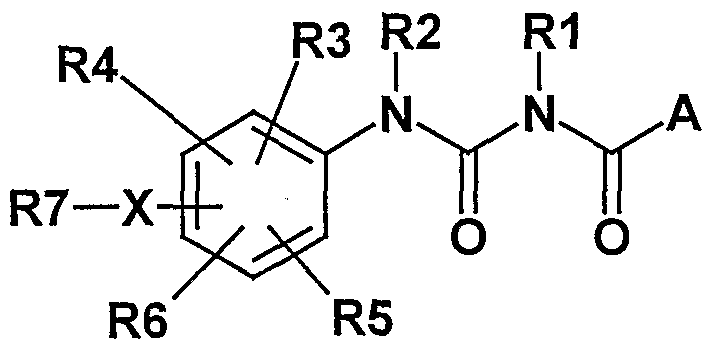
- the invention therefore relates to compounds of the formula I
- R1, R2 independently of one another H, (dC 6 ) alkyl, 0- (dC 6 ) alkyl, CO- (dC 6 ) -
- Alkyl COO- (CC 6 ) alkyl, (dC 6 ) alkylene-COOH, (dC 6 ) alkylene-COO- (dC 6 ) alkyl;
- R3, R4, R5, R6 independently of one another H, F, Cl, Br, OH, CF 3 , N0 2 , CN,
- OCF 3 O- (dC 6 ) alkyl, O- (CC 6 ) alkenyl, 0- (dC 6 ) alkynyl, S- (dC 6 ) alkyl, S- (dC 6 ) alkenyl, S- (dC 6 ) -alkynyl, SO- (dC 6 ) -alkyl, S0 2 - (CrC 6 ) - alkyl, S0 2 -NH 2 , (dC 6 ) -alkyl, (CC 6 ) -alkenyl, (dC 6 ) Alkynyl, (C 3 -C 7 ) cycloalkyl, (C 3 -C 7 ) cycloalkyl (CC 4 ) alkylene, COOH, COO (dC 6 ) alkyl,
- CONH 2 CONH (C 1 -C 6 ) alkyl, CON [(dC 6 ) alkyl] 2 , CONH (C 3 -C 7 ) cycloalkyi, NH 2 , NH (dC 6 ) alkyl, N [( dC 6 ) -alkyl] 2) NH-CO- (CC 6 ) -alkyl, NH-CO-phenyl, NH-SO 2 -phenyl, the phenyl ring being up to twice with F, Cl, CN, OH, (dC 6 ) Alkyl, 0- (dC 6 ) alkyl, CF 3 , OCF 3 , COOH, COO (dC 6 ) alkyl or CONH 2 may be substituted;
- Preferred compounds of the formula I are those in which
- kylene-N H 2 (C 0 -C 6 ) alkylene-N H (C 2 -C 6 ) alkyl, (Co-C 6 ) alkylene-N [(C 1 -C 6 ) alkyl] 2 , NH-CO- (dC 6 ) -alkyl, NH-CO-phenyl, NH-S0 2 -phenyl, the phenyl ring being up to twice with F, Cl, CN, OH, (dC 6 ) -alkyl, 0- (CC 6 ) alkyl, CF 3 , OCF 3 , COOH, COO (CC 6 ) alkyl or CONH 2 may be substituted;
- R1, R2 independently of one another H, (dC 6 ) alkyl, 0- (CC 6 ) alkyl, CO- (dC 6 ) -
- Alkyl COO- (dC 6 ) alkyl, (dC 6 ) alkylene-COOH, (dC 6 ) alkylene-COO- (dC 6 ) alkyl;
- R3, R4, R5, R6 independently of one another H, F, Cl, Br, OH, CF 3 , N0 2 , CN,
- CONH 2 CONH (CC 6 ) -alkyl, CON [(dC 6 ) -alkyl] 2, CONH (C 3 -C 7 ) -cycloalkyl, NH 2 , NH (-C-C 6 ) -alkyl, N [(dC 6 ) -alkyl] 2 , NH-CO- (dC 6 ) -alkyl, NH-CO-phenyl, NH-S ⁇ 2 -phenyl, the phenyl ring being up to twice with F, Cl, CN, OH, (CC 6 ) -Alkyl, 0- (dC 6 ) -alkyl, CF 3 , OCF 3 , COOH, COO (C 1 -C 6 ) -alkyl or CONH 2 may be substituted;
- R7 (C ⁇ -do) -alkylene-COOH, (C 6 -C ⁇ o) -alkylene-COO- (CrC 6 ) -alkyl, (d-Cio) - alkylene-CONH 2 , (C 1 -C 10 ) -alkylene- CONH- (C 1 -C 6 ) alkyl, (dC 10 ) alkylene-
- R1, R2 independently of one another H, (CC 6 ) -alkyl, CO- (dC 6 ) -alkyl;
- R3, R4, R5, R6 independently of one another H, Cl, F, (dC 6 ) -alkyl, 0- (dC 6 ) -alkyl, COO- (-C-C 6 ) -alkyl; XO;
- the invention further relates to the use of the compounds of the formula
- A is phenyl, naphthyl, where the phenyl or naphthyl radical can be substituted up to three times with F, Cl, Br, OH, CF 3 , N0 2 , CN, OCF 3 , 0- (dC 6 ) - alkyl, 0- (dC 6 ) alkenyl, 0- (dC 6 ) alkynyl, S- (dC 6 ) alkyl, S- (dC 6 ) alkenyl, S- (dC 6 ) alkynyl, SO- (CC 6 ) - Alkyl, S0 2 - (dC 6 ) alkyl, S0 2 -NH 2 , (dC 6 ) alkyl, (C ⁇ -C 6 ) alkenyl, (dC 6 ) alkynyl, (C 3 -C 7 ) cycloalkyl , (C 3 -C 7 ) - Cycloalkyl- (-C-C-
- R1, R2 independently of one another H, (dC 6 ) alkyl, 0- (dC 6 ) alkyl, CO- (dC 6 ) -
- R3, R4, R5, R6 independently of one another H, F, Cl, Br, OH, CF 3 , N0 2 , CN,
- OCF 3 0- (dC 6 ) alkyl, 0- (dC 6 ) alkenyl, 0- (dC 6 ) alkynyl, S- (CC 6 ) alkyl, S- (C 1 -C 6 ) alkenyl , S- (dC 6 ) -alkynyl, SO- (CC 6 ) -alkyl, S0 2 - (-C-C 6 ) - alkyl, SO 2 -NH 2 , (CC 6 ) -alkyl, (CC 6 ) -alkenyl , (dC 6 ) alkynyl, (C 3 -C 7 ) cycloalkyl, (C 3 -C 7 ) cycloalkyl (dC 4 ) alkylene, COOH, COO (CC 6 ) alkyl,
- CONH 2 CONH (dC 6 ) alkyl, CON [(dC 6 ) alkyl] 2 , CONH (C 3 -C 7 ) cycloalkyl, NH 2 , NH (dC 6 ) alkyl, N [(CC 6 ) -Alkyl] 2 , NH-CO- (dC 6 ) -alkyl, NH-CO-phenyl, NH-S0 2 -phenyl, the phenyl ring being up to twice with F, Cl, CN, OH, (dC 6 ) -alkyl , 0- (CC 6 ) alkyl, CF 3 , OCF 3 , COOH, COO (dC 6 ) alkyl or CONH 2 may be substituted;
- R7 (d-do) -alkylene-COOH, (-C-C 1 o) -alkylene-COO- (C 1 -C 6 ) -alkyl, (dC 10 ) - alkylene-CONH 2 , (dC 10 ) -alkylene- CONH- (CC 6 ) -alkyl, (d-C ⁇ o) -alkylene-
- the invention relates to compounds of the formula I, in the form of their racemates, racemic mixtures and pure enantiomers, and to their diastereomers and mixtures thereof.
- alkyl radicals in the substituents R1, R2, R3, R4, R5, R6, R7, A and B can be either straight-chain or branched.
- Suitable pharmaceutically acceptable acid addition salts of the compounds according to the invention are salts of inorganic acids, such as hydrochloric acid, hydrobromic, phosphoric, metaphosphoric, nitric, sulfonic and sulfuric acid, and organic acids, such as e.g. Acetic acid,
- Suitable pharmaceutically acceptable basic salts are ammonium salts, alkali metal salts (such as sodium and potassium salts) and alkaline earth metal salts (such as magnesium and calcium salts).
- Salts with a non-pharmaceutically acceptable anion, such as trifluoroacetate, are also within the scope of the invention as useful intermediates for the preparation or purification of pharmaceutically acceptable salts and / or for use in non-therapeutic, for example in vitro, applications.
- physiologically functional derivative used here denotes any physiologically compatible derivative of a compound of the formula I according to the invention, for example an ester which, when administered to a mammal, such as for example humans, is capable (directly or indirectly) of a compound of the Form formula I or an active metabolite thereof.
- the physiologically functional derivatives also include prodrugs of the compounds according to the invention, as described, for example, in H. Okada et al., Chem. Pharm. Bull. 1994, 42, 57-61. Such prodrugs can be metabolized in vivo to a compound according to the invention. These prodrugs may or may not be effective themselves.
- the compounds of the invention may also exist in various polymorphic forms, e.g. as amorphous and crystalline polymorphic forms. All polymorphic forms of the compounds according to the invention belong to the scope of the invention and are a further aspect of the invention.
- the daily dose is in the range from 0.3 mg to 100 mg (typically from 3 mg and 50 mg) per day per kilogram of body weight, for example 3-10 mg / kg / day.
- An intravenous dose can be, for example, in the range from 0.3 mg to 1.0 mg / kg, which can suitably be administered as an infusion of 10 ng to 100 ng per kilogram per minute.
- Suitable infusion solutions for these purposes can contain, for example, from 0.1 ng to 10 mg, typically from 1 ng to 10 mg, per milliliter.
- Single doses can contain, for example, from 1 mg to 10 g of the active ingredient. So you can Ampoules for injections, for example from 1 mg to 100 mg, and orally administrable single-dose formulations, such as tablets or capsules, can contain, for example, from 1.0 to 1000 mg, typically from 10 to 600 mg.
- the compounds of the formula I themselves can be used as a compound, but they are preferably in the form of a pharmaceutical composition with a compatible carrier.
- the carrier must of course be compatible, in the sense that it is compatible with the other components of the composition and is not harmful to the health of the patient.
- the carrier can be a solid or a liquid or both and is preferably formulated with the compound as a single dose, for example as a tablet, which can contain from 0.05% to 95% by weight of the active ingredient. Further pharmaceutically active substances can also be present, including further compounds of the formula I.
- the pharmaceutical compositions according to the invention can be prepared by one of the known pharmaceutical methods, which essentially consist in mixing the constituents with pharmacologically acceptable carriers and / or auxiliaries ,
- compositions according to the invention are those which are suitable for oral, rectal, topical, peroral (for example sublingual) and parenteral (for example subcutaneous, intramuscular, intradermal or intravenous) administration, although the most suitable mode of administration in each individual case depends on the type and severity of the to be treated State and on the type of compound used according to formula I is dependent.
- Coated formulations and coated slow-release formulations also fall within the scope of the invention.
- Formulations which are resistant to acid and gastric juice are preferred.
- Suitable enteric coatings include cellulose acetate phthalate, polyvinyl acetate phthalate, hydroxypropylmethyl cellulose phthalate and anionic polymers of methacrylic acid and methyl methacrylate.
- Suitable pharmaceutical compounds for oral administration can be present in separate units, such as capsules, wafer capsules, Lozenges or tablets, each containing a certain amount of the compound of formula I; as powder or granules; as a solution or suspension in an aqueous or non-aqueous liquid; or as an oil-in-water or water-in-oil emulsion.
- these compositions can be prepared by any suitable pharmaceutical method which comprises a step in which the active ingredient and the carrier (which may consist of one or more additional ingredients) are brought into contact.
- the compositions are prepared by uniformly and homogeneously mixing the active ingredient with a liquid and / or finely divided solid carrier, after which the product is shaped if necessary.
- a tablet can be made by compressing or molding a powder or granules of the compound, optionally with one or more additional ingredients.
- Compressed tablets can be prepared by tabletting the compound in free flowing form such as a powder or granules, optionally mixed with a binder, lubricant, inert diluent and / or a (several) surface active / dispersing agent in a suitable machine.
- Molded tablets can be made by molding the powdered compound moistened with an inert liquid diluent in a suitable machine.
- compositions suitable for oral (sublingual) administration include lozenges containing a compound of Formula I with a flavoring agent, usually sucrose and acacia or tragacanth, and lozenges containing the compound in an inert base such as gelatin and glycerin or sucrose and gum arabic.
- Suitable pharmaceutical compositions for parenteral administration preferably comprise sterile aqueous preparations of a compound according to formula I, which are preferably isotonic with the blood of the intended recipient. These preparations are preferably administered intravenously, although they can also be administered subcutaneously, intramuscularly or intradermally as an injection. These preparations can preferably be prepared by the Compound is mixed with water and the solution obtained is made sterile and isotonic with the blood. Injectable compositions according to the invention generally contain from 0.1 to 5% by weight of the active compound.
- Suitable pharmaceutical compositions for rectal administration are preferably in the form of single-dose suppositories. These can be prepared by mixing a compound of the formula I with one or more conventional solid carriers, for example cocoa butter, and shaping the resulting mixture.
- Suitable pharmaceutical compositions for topical use on the skin are preferably in the form of an ointment, cream, lotion, paste, spray, aerosol or oil.
- Vaseline, lanolin, polyethylene glycols, alcohols and combinations of two or more of these substances can be used as carriers.
- the active ingredient is generally present in a concentration of 0.1 to 15% by weight of the composition, for example 0.5 to 2%.
- Suitable pharmaceutical compositions for transdermal applications can be presented as individual patches which are suitable for long-term close contact with the patient's epidermis.
- Such plasters suitably contain the active ingredient in an optionally buffered aqueous solution, dissolved and / or dispersed in an adhesive or dispersed in a polymer.
- a suitable active ingredient concentration is approximately 1% to 35%, preferably approximately 3% to 15%.
- the active ingredient can be released by electrotransport or iontophoresis, as described, for example, in Pharmaceutical Research, 2 (6): 318 (1986).
- the invention further relates to a process for the preparation of the compounds of the general formula I, characterized in that the compounds of the formula I are obtained in such a way that the following reaction scheme is used:
- R8 (C do) -alkylene-COO- (PG-1), (C 6 -d 0 ) -alkylene-COO- (C 1 -C 6 ) -alkyl, (d- C 10 ) -alkylene-CON- ( PG-2) 2 , (CrdoJ-alkylene-CONH ⁇ Ci-CeJ-alkyl, (-C-C 10 ) -
- PG-1 is a well-known protecting group for esters, such as (Ci-C ⁇ J-alkyl, benzyl or p-methoxybenzyl, and
- Imidazolyl, thiazolyl, azetidinyl, thienyl, piperidinyl, pyrroiidinyl, morpholinyl, pyridyl and furyl each up to twice with Cl, F, CN, CF 3 , OCF 3 , COO- (PG-I), COO- (dC 6 ) alkyl , CON- (PG-2) 2 , CONH- (dC 6 ) alkyl, CON - [(dC 6 ) alkyl] 2 , (CC 6 ) alkyl, 0- (PG-3), 0- (CC 6 ) -Alkyl may be substituted in which PG-3 is a generally known protecting group for alcohols, such as
- LG represents a generally known leaving group, such as, for example, halogen, arylsulfonyloxy or alkylsulfonyloxy,
- X and PG-2 have the meaning described above and R9, R10, R11, R12 independently of one another H, F, Cl, Br, 0- (PG-3), CF 3 , N0 2 , CN,
- OCF 3 0- (CC 6 ) alkyl, 0- (CC 6 ) alkenyl, 0- (C 1 -C 6 ) alkynyl, S- (dC 6 ) alkyl, S- (dC 6 ) alkenyl , S- (dC 6) -alkynyl, SO- (dC 6) - alkyl, S0 2 - (dC 6) alkyl, S0 2 -N- (PG-2) 2, (CC 6) alkyl, (dC 6 ) -
- COO- (PG-I), COO (dC 6 ) -alkyl or CON- (PG-2) 2 can be substituted, where PG-1, PG-2 and PG-3 have the meaning described above in anhydrous organic solvents such as benzene, toluene or
- the compounds of the general formula VII can, if R1 in compounds of the general formula I does not represent a hydrogen atom, by reaction with compounds of the general formula VIII
- R14 H (CC 6 ) -alkyl, 0- (dC 6 ) -alkyl, CO- (dC 6 ) -alkyl, COO- (dC 6 ) -alkyl,
- R1 is not a hydrogen atom
- compounds of the general formula VII can, as already described above, by alkylation with compounds of the general formula VIII to compounds of general formula IX, and, if necessary, converted into compounds of general formula I by subsequent removal of the protective groups.
- the compounds of the general formula I are converted into their salts by adding an equivalent of the corresponding acid or base in an organic solvent such as, for example, acetonitrile or dioxane or in water and then removing the solvent.
- the compounds of the formula I are distinguished by favorable effects on the sugar metabolism, in particular they lower the blood sugar level and are suitable for the treatment of type II diabetes.
- the compounds can be used alone or in combination with other active substances that lower blood sugar.
- Such other blood sugar-lowering active ingredients are, for example, sulfonylureas (such as, for example, glimepiride, glibenclamide), glitazones (such as, for example, troglitazone, rosiglitazone), alpha-glucosidase inhibitors (such as, for example, acarbose, miglitol) or insulins.
- glycogen phosphorylase The effect of compounds on the activity of the active form of glycogen phosphorylase (GPa) was measured in the opposite direction by monitoring glycogen synthesis from glucose-1-phosphate by determining the release of inorganic phosphate. All reactions were carried out as duplicate determinations in 96-well microtiter plates (Half Area Plates, Costar No. 3696), the change in absorption due to the formation of the reaction product at the wavelength specified below in a Multiskan Ascent Elisa Reader (Lab Systems, Finland) was measured. In order to measure the GPa enzyme activity in the reverse direction, the conversion of glucose-1-phosphate into glycogen and inorganic phosphate was carried out according to the general method of Engers et al.
- Human glycogen phosphorylase a (for example with 0.76 mg protein / ml (Aventis Pharma GmbH) , dissolved in buffer solution E (25 mM ⁇ -glycerophosphate, pH 7.0, 1 mM EDTA and 1 mM dithiotreitol) was treated with buffer T (50 mM Hepes, pH 7.0, 100 mM KCI, 2.5 mM EDTA, 2nd , 5 mM MgCl 2 '6H 2 0) and addition of 5 mg / ml glycogen to a concentration of 10 ⁇ g protein / ml, test substances were prepared as a 10 mM solution in DMSO and diluted to 50 ⁇ M with buffer solution T.
- buffer solution E 25 mM ⁇ -glycerophosphate, pH 7.0, 1 mM EDTA and 1 mM dithiotreitol
- buffer T 50 mM Hepes, pH 7.0, 100 mM KCI, 2.5
Landscapes
- Chemical & Material Sciences (AREA)
- Organic Chemistry (AREA)
- Health & Medical Sciences (AREA)
- Animal Behavior & Ethology (AREA)
- Veterinary Medicine (AREA)
- Public Health (AREA)
- General Health & Medical Sciences (AREA)
- Life Sciences & Earth Sciences (AREA)
- Medicinal Chemistry (AREA)
- Pharmacology & Pharmacy (AREA)
- Epidemiology (AREA)
- Diabetes (AREA)
- Chemical Kinetics & Catalysis (AREA)
- General Chemical & Material Sciences (AREA)
- Nuclear Medicine, Radiotherapy & Molecular Imaging (AREA)
- Bioinformatics & Cheminformatics (AREA)
- Obesity (AREA)
- Hematology (AREA)
- Engineering & Computer Science (AREA)
- Endocrinology (AREA)
- Communicable Diseases (AREA)
- Oncology (AREA)
- Emergency Medicine (AREA)
- Pharmaceuticals Containing Other Organic And Inorganic Compounds (AREA)
- Acyclic And Carbocyclic Compounds In Medicinal Compositions (AREA)
- Organic Low-Molecular-Weight Compounds And Preparation Thereof (AREA)
- Furan Compounds (AREA)
- Plural Heterocyclic Compounds (AREA)
Abstract
Description


Claims




Priority Applications (20)
| Application Number | Priority Date | Filing Date | Title |
|---|---|---|---|
| SK1725-2002A SK17252002A3 (sk) | 2000-06-09 | 2001-05-26 | Deriváty acylfenylmočoviny, spôsoby ich výroby a použitie ako liečivo |
| MXPA02011458A MXPA02011458A (es) | 2000-06-09 | 2001-05-26 | Derivados de acilfenilurea, metodos para su produccion y uso de los mismos como farmacos. |
| JP2002501817A JP4510372B2 (ja) | 2000-06-09 | 2001-05-26 | アシルフェニル尿素誘導体、その製造方法及び医薬としてのその使用 |
| BR0111457-3A BR0111457A (pt) | 2000-06-09 | 2001-05-26 | Derivados de acilfeniluréia, processos para a sua preparação e sua aplicação como medicamentos |
| AU2001262318A AU2001262318B2 (en) | 2000-06-09 | 2001-05-26 | Acylphenyl urea derivatives, methods for the production thereof and use thereof as a medicament |
| IL15327301A IL153273A0 (en) | 2000-06-09 | 2001-05-26 | Acylphenyl urea derivatives, methods for the production thereof and use thereof as a medicament |
| AU6231801A AU6231801A (en) | 2000-06-09 | 2001-05-26 | Acylphenyl urea derivatives, methods for the production thereof and use thereof as a medicament |
| HK03109010.4A HK1056715B (en) | 2000-06-09 | 2001-05-26 | Acylphenyl urea derivatives, methods for the production thereof and use thereof as a medicament |
| EEP200200634A EE200200634A (et) | 2000-06-09 | 2001-05-26 | Atsüülfenüülkarbamiidi derivaadid, nende saamine ja kasutamine veresuhkrut alandava ravimi valmistamiseks ning neid sisaldav ravim |
| NZ523034A NZ523034A (en) | 2000-06-09 | 2001-05-26 | Acylphenyl urea derivatives, methods for the production thereof and use thereof as a medicament |
| AT01936399T ATE265424T1 (de) | 2000-06-09 | 2001-05-26 | Acylphenylharnstoffderivate, verfahren zu ihrer herstellung und ihre verwendung als arzneimittel |
| DE50102147T DE50102147D1 (de) | 2000-06-09 | 2001-05-26 | Acylphenylharnstoffderivate, verfahren zu ihrer herstellung und ihre verwendung als arzneimittel |
| SI200130134T SI1294682T1 (en) | 2000-06-09 | 2001-05-26 | Acylphenyl urea derivatives, methods for the production thereof and use thereof as a medicament |
| CA002411082A CA2411082A1 (en) | 2000-06-09 | 2001-05-26 | Acylphenyl urea derivatives, methods for the production thereof and use thereof as a medicament |
| EP01936399A EP1294682B1 (de) | 2000-06-09 | 2001-05-26 | Acylphenylharnstoffderivate, verfahren zu ihrer herstellung und ihre verwendung als arzneimittel |
| PL01359178A PL359178A1 (en) | 2000-06-09 | 2001-05-26 | Acylphenyl urea derivatives, methods for the production thereof and use thereof as a medicament |
| HR20020968A HRP20020968A2 (en) | 2000-06-09 | 2001-05-26 | Acylphenyl urea derivatives, methods for the production therof and use thereof as a medicament |
| HU0301749A HUP0301749A2 (hu) | 2000-06-09 | 2001-05-26 | Acilfenil-karbamid-származékok, eljárás az elżállításukra és gyógyszerkénti alkalmazásuk |
| DK01936399T DK1294682T3 (da) | 2000-06-09 | 2001-05-26 | Acylphenylurinstofderivater, fremgangsmåde til deres fremstilling og deres anvendelse som lægemiddel |
| NO20025879A NO20025879L (no) | 2000-06-09 | 2002-12-06 | Acylfenylureaderivater, fremgangsmåter for fremstilling derav og deres anvendelse som legemiddel |
Applications Claiming Priority (4)
| Application Number | Priority Date | Filing Date | Title |
|---|---|---|---|
| DE10028175.3 | 2000-06-09 | ||
| DE10028175 | 2000-06-09 | ||
| DE10116768.7 | 2001-04-04 | ||
| DE2001116768 DE10116768A1 (de) | 2001-04-04 | 2001-04-04 | Acylphenylharnstoffderivate, Verfahren zu ihrer Herstellung und ihre Verwendung als Arzneimittel |
Publications (1)
| Publication Number | Publication Date |
|---|---|
| WO2001094300A1 true WO2001094300A1 (de) | 2001-12-13 |
Family
ID=26005991
Family Applications (1)
| Application Number | Title | Priority Date | Filing Date |
|---|---|---|---|
| PCT/EP2001/006030 Ceased WO2001094300A1 (de) | 2000-06-09 | 2001-05-26 | Acylphenylharnstoffderivate, verfahren zu ihrer herstellung und ihre verwendung als arzneimittel |
Country Status (27)
| Country | Link |
|---|---|
| US (1) | US6506778B2 (de) |
| EP (1) | EP1294682B1 (de) |
| JP (1) | JP4510372B2 (de) |
| KR (1) | KR20030007934A (de) |
| CN (1) | CN1280266C (de) |
| AR (1) | AR030230A1 (de) |
| AT (1) | ATE265424T1 (de) |
| AU (2) | AU6231801A (de) |
| BR (1) | BR0111457A (de) |
| CA (1) | CA2411082A1 (de) |
| CZ (1) | CZ20024003A3 (de) |
| DE (1) | DE50102147D1 (de) |
| DK (1) | DK1294682T3 (de) |
| EE (1) | EE200200634A (de) |
| ES (1) | ES2215902T3 (de) |
| HR (1) | HRP20020968A2 (de) |
| HU (1) | HUP0301749A2 (de) |
| IL (1) | IL153273A0 (de) |
| MX (1) | MXPA02011458A (de) |
| NO (1) | NO20025879L (de) |
| NZ (1) | NZ523034A (de) |
| PL (1) | PL359178A1 (de) |
| PT (1) | PT1294682E (de) |
| SK (1) | SK17252002A3 (de) |
| TR (1) | TR200401029T4 (de) |
| WO (1) | WO2001094300A1 (de) |
| YU (1) | YU91002A (de) |
Cited By (40)
| Publication number | Priority date | Publication date | Assignee | Title |
|---|---|---|---|---|
| DE10125567A1 (de) * | 2001-05-25 | 2002-12-05 | Aventis Pharma Gmbh | Carbonamid substituierte Phenylharnstoffderivate, Verfahren zu ihrer Herstellung und ihre Verwendung als Arzneimittel |
| WO2002096864A1 (de) * | 2001-05-25 | 2002-12-05 | Aventis Pharma Deutschland Gmbh | Carbonsäureamid substituierte phenylharnstoffderivate, verfahren zu ihrer herstellung als arzneimittel |
| WO2003015769A1 (de) * | 2001-08-17 | 2003-02-27 | Aventis Pharma Deutschland Gmbh | Aminoalkyl substituierte aromatische bicyclen, verfahren zu ihrer herstellung und ihre verwendung als arzneimittel |
| WO2003084922A1 (de) * | 2002-04-11 | 2003-10-16 | Aventis Pharma Deutschland Gmbh | Acyl-4-carboxy-phenyl-harnstoffderivate, verfahren zu deren herstellung und deren verwendung |
| WO2003084923A1 (de) * | 2002-04-11 | 2003-10-16 | Aventis Pharma Deutschland Gmbh | Acyl-3-carboxyphenyl-harnstoffderivate, verfahren zu deren herstellung und deren verwendung |
| WO2003104188A1 (de) * | 2002-06-07 | 2003-12-18 | Aventis Pharma Deutschland Gmbh | N-benzoylureido-zimtsäurederivate, verfahren zu deren herstellung und deren verwendung |
| WO2004007455A1 (de) * | 2002-07-12 | 2004-01-22 | Aventis Pharma Deutschland Gmbh | Heterozyklisch substituierte benzoylharnstoffe, verfahren zu ihrer herstellung und ihre verwendung als arzneimittel |
| WO2004007437A1 (de) * | 2002-07-11 | 2004-01-22 | Aventis Pharma Deutschland Gmbh | Harnstoff- und urethan-substituierte acylharnstoffe, verfahren zu deren herstellung und deren verwendung als arzneimittel |
| DE10231627A1 (de) * | 2002-07-12 | 2004-02-05 | Aventis Pharma Deutschland Gmbh | Heterozyklisch substituierte Benzoylharnstoffe, Verfahren zu ihrer Herstellung und ihre Verwendung als Arzneimittel |
| DE10246434A1 (de) * | 2002-10-04 | 2004-04-15 | Aventis Pharma Deutschland Gmbh | Acyl-carboxyphenylharnstoffderivate, Verfahren zu ihrer Herstellung und ihre Verwendung als Arzneimittel |
| WO2004065356A1 (de) * | 2003-01-23 | 2004-08-05 | Aventis Pharma Deutschland Gmbh | Carbonylamino-substituierte acyl-phenyl-harnstoffderivate, verfahren zu deren herstellung und deren verwendung |
| WO2004075815A2 (de) | 2003-02-27 | 2004-09-10 | Aventis Pharma Deutschland Gmbh | Diarylcycloalkylderivate, verfahren zu ihrer herstellung und ihre verwendung als arzneimittel |
| WO2004078743A1 (de) * | 2003-03-07 | 2004-09-16 | Aventis Pharma Deutschland Gmbh | Substituierte benzoylureidopyridyl-piperidin- und -pyrrolidin-carbonsäurederivate, verfahren zu deren herstellung und deren verwendung |
| DE10335092B3 (de) * | 2003-08-01 | 2005-02-03 | Aventis Pharma Deutschland Gmbh | Substituierte Benzoylureido-o-benzoylamide, Verfahren zu deren Herstellung und deren Verwendung |
| US7049341B2 (en) | 2002-06-07 | 2006-05-23 | Aventis Pharma Deutschland Gmbh | N-benzoylureidocinnamic acid derivatives, processes for preparing them and their use |
| US7078404B2 (en) | 2002-04-11 | 2006-07-18 | Sanofi-Aventis Deutschland Gmbh | Acyl-3-carboxyphenylurea derivatives, processes for preparing them and their use |
| JP2006517933A (ja) * | 2003-02-17 | 2006-08-03 | サノフィ−アベンティス・ドイチュラント・ゲゼルシャフト・ミット・ベシュレンクテル・ハフツング | 置換された3−(ベンゾイルウレイド)−チオフェン誘導体その製造方法および使用 |
| US7115648B2 (en) | 2002-03-06 | 2006-10-03 | Astrazeneca Ab | Indole-amide derivatives and their use as glycogen phosphorylase inhibitors |
| US7122567B2 (en) | 2002-03-06 | 2006-10-17 | Astrazeneca Ab | Heterocyclic amide derivatives having glycogen phosphorylase inhibitory activity |
| US7129249B2 (en) | 2002-03-06 | 2006-10-31 | Astrazeneca Ab | Heterocyclic amide derivatives as inhibitors of glycogen phoshorylase |
| US7138415B2 (en) | 2002-03-06 | 2006-11-21 | Astrazeneca Ab | Indolamid derivatives which possess glycogenphosphorylase inhibitory activity |
| US7148246B2 (en) | 2003-02-27 | 2006-12-12 | Sanofi-Aventis Deutschland Gmbh | Cycloalkyl derivatives having bioisosteric carboxylic acid groups, processes for their preparation and their use as pharmaceuticals |
| WO2006131231A1 (de) | 2005-06-09 | 2006-12-14 | Sanofi-Aventis | Azolopyridin-2-on-derivate als inhibitoren von lipasen und phospholipasen |
| US7166636B2 (en) | 2002-03-06 | 2007-01-23 | Astrazeneca Ab | Indole-amid derivatives which possess glycogen phosphorylase inhibitory activity |
| US7169927B2 (en) | 2002-03-06 | 2007-01-30 | Astrazeneca Ab | Indole-amide derivatives and their use as glycogen phosphorylase inhibitors |
| US7220876B2 (en) | 2003-02-27 | 2007-05-22 | Sanofi-Aventis Deutschland Gmbh | Arylcycloalkyl derivatives having branched side chains, processes for their preparation and their use as pharmaceuticals |
| US7223796B2 (en) | 2002-04-11 | 2007-05-29 | Sanofi-Aventis Deutschland Gmbh | Acyl-4-carboxyphenylurea derivatives, processes for preparing them and their use |
| US7241787B2 (en) | 2004-01-25 | 2007-07-10 | Sanofi-Aventis Deutschland Gmbh | Substituted N-cycloexylimidazolinones, process for their preparation and their use as medicaments |
| US7259177B2 (en) | 2003-02-27 | 2007-08-21 | Sanofi-Aventis Deutschland Gmbh | Cycloalkylmethoxy-substituted acetic acid derivatives, processes for their preparation and their use as pharmaceuticals |
| US7262220B2 (en) | 2002-07-11 | 2007-08-28 | Sanofi-Aventis Deutschland Gmbh | Urea- and urethane-substituted acylureas, process for their preparation and their use |
| WO2007128761A2 (de) | 2006-05-04 | 2007-11-15 | Boehringer Ingelheim International Gmbh | Verwendungen von dpp iv inhibitoren |
| US7501440B2 (en) | 2003-03-07 | 2009-03-10 | Sanofi-Aventis Deutschland Gmbh | Substituted benzoylureidopyridylpiperidine-and-pyrrolidinecarboxylic acid derivatives, processes for preparing them and their use |
| EP2083006A1 (de) | 2004-04-01 | 2009-07-29 | Sanofi-Aventis Deutschland GmbH | Oxadiazolone, Verfahren zu ihrer Herstellung und ihre Verwendung als Arzneimittel |
| US7781459B2 (en) | 2002-10-04 | 2010-08-24 | Sanofi-Aventis Deutschland Gmbh | Carboxyalkoxy-substituted acyl-carboxyphenylurea derivatives and their use as medicaments |
| WO2013138352A1 (en) | 2012-03-15 | 2013-09-19 | Synergy Pharmaceuticals Inc. | Formulations of guanylate cyclase c agonists and methods of use |
| WO2014197720A2 (en) | 2013-06-05 | 2014-12-11 | Synergy Pharmaceuticals, Inc. | Ultra-pure agonists of guanylate cyclase c, method of making and using same |
| EP2923706A1 (de) | 2009-12-03 | 2015-09-30 | Synergy Pharmaceuticals Inc. | Guanylatcyclaseagonisten zur behandlung von hypercholesterinämie |
| WO2016030534A1 (en) | 2014-08-29 | 2016-03-03 | Tes Pharma S.R.L. | INHIBITORS OF α-AMINO-β-CARBOXYMUCONIC ACID SEMIALDEHYDE DECARBOXYLASE |
| WO2018069532A1 (en) | 2016-10-14 | 2018-04-19 | Tes Pharma S.R.L. | Inhibitors of alpha-amino-beta-carboxymuconic acid semialdehyde decarboxylase |
| WO2020104456A1 (en) | 2018-11-20 | 2020-05-28 | Tes Pharma S.R.L | INHIBITORS OF α-AMINO-β-CARBOXYMUCONIC ACID SEMIALDEHYDE DECARBOXYLASE |
Families Citing this family (8)
| Publication number | Priority date | Publication date | Assignee | Title |
|---|---|---|---|---|
| US7179941B2 (en) * | 2003-01-23 | 2007-02-20 | Sanofi-Aventis Deutschland Gmbh | Carbonylamino-substituted acyl phenyl urea derivatives, process for their preparation and their use |
| US7196114B2 (en) * | 2003-02-17 | 2007-03-27 | Sanofi-Aventis Deutschland Gmbh | Substituted 3-(benzoylureido) thiophene derivatives, processes for preparing them and their use |
| DE10308351A1 (de) * | 2003-02-27 | 2004-11-25 | Aventis Pharma Deutschland Gmbh | 1,3-substituierte Cycloalkylderivate mit sauren, meist heterocyclischen Gruppen, Verfahren zu ihrer Herstellung und ihre Verwendung als Arzneimittel |
| US7963448B2 (en) * | 2004-12-22 | 2011-06-21 | Cognex Technology And Investment Corporation | Hand held machine vision method and apparatus |
| JP2008536932A (ja) * | 2005-04-18 | 2008-09-11 | サイード・アール・カーン | チューブリン重合阻害剤:ボンゾイルフェニル尿素(bpu)硫黄類似体の設計及び合成 |
| CA2609394A1 (en) * | 2005-05-23 | 2006-11-30 | Masaki Takagi | Pyrazole compound and therapeutic agent for diabetes comprising the same |
| WO2008062739A1 (en) * | 2006-11-20 | 2008-05-29 | Japan Tobacco Inc. | Pyrazoles and use thereof as drugs |
| CN117603095B (zh) * | 2023-11-24 | 2025-08-29 | 中国烟草云南进出口有限公司 | 灭幼脲半抗原、抗原、抗体、检测装置及其制备和应用 |
Citations (2)
| Publication number | Priority date | Publication date | Assignee | Title |
|---|---|---|---|---|
| US3718660A (en) * | 1967-11-02 | 1973-02-27 | Bayer Ag | Arylsulphonyl ureas containing heterocyclic acylamino groups |
| EP0632019A1 (de) * | 1993-06-28 | 1995-01-04 | Zeneca Limited | Acylharnstoffe |
Family Cites Families (7)
| Publication number | Priority date | Publication date | Assignee | Title |
|---|---|---|---|---|
| ZA793186B (en) * | 1978-07-06 | 1981-02-25 | Duphar Int Res | New urea and thiourea compounds, method of preparing the new compounds, as well as insecticidal compositions on the basis of these compounds |
| ATE43788T1 (de) * | 1983-09-01 | 1989-06-15 | Duphar Int Res | Benzoylharnstoffe mit antitumoraler wirkung. |
| JPS60237056A (ja) * | 1984-05-08 | 1985-11-25 | Ishihara Sangyo Kaisha Ltd | N−ベンゾイル−n′−フエニルウレア系化合物及びそれらを含有する殺虫剤 |
| ATE40111T1 (de) * | 1984-07-05 | 1989-02-15 | Duphar Int Res | Benzoylharnstoffverbindungen sowie solche enthaltende insektizide und akarizide zusammensetzungen. |
| DE3504749A1 (de) * | 1985-02-08 | 1986-08-14 | Schering AG, 1000 Berlin und 4709 Bergkamen | Acylharnstoffe, insektizide mittel enthaltend diese verbindungen sowie verfahren zu ihrer herstellung |
| JPH0791248B2 (ja) * | 1988-06-29 | 1995-10-04 | 富士写真フイルム株式会社 | アルコキシもしくはアリールオキシベンゼン化合物の製造方法 |
| DE4208778C1 (de) * | 1992-03-17 | 1993-09-23 | Schering Ag Berlin Und Bergkamen, 13353 Berlin, De |
-
2001
- 2001-05-26 EP EP01936399A patent/EP1294682B1/de not_active Expired - Lifetime
- 2001-05-26 PT PT01936399T patent/PT1294682E/pt unknown
- 2001-05-26 KR KR1020027016791A patent/KR20030007934A/ko not_active Ceased
- 2001-05-26 AU AU6231801A patent/AU6231801A/xx active Pending
- 2001-05-26 CZ CZ20024003A patent/CZ20024003A3/cs unknown
- 2001-05-26 JP JP2002501817A patent/JP4510372B2/ja not_active Expired - Fee Related
- 2001-05-26 CN CNB018108016A patent/CN1280266C/zh not_active Expired - Fee Related
- 2001-05-26 TR TR2004/01029T patent/TR200401029T4/xx unknown
- 2001-05-26 DE DE50102147T patent/DE50102147D1/de not_active Expired - Lifetime
- 2001-05-26 AT AT01936399T patent/ATE265424T1/de not_active IP Right Cessation
- 2001-05-26 MX MXPA02011458A patent/MXPA02011458A/es active IP Right Grant
- 2001-05-26 BR BR0111457-3A patent/BR0111457A/pt not_active IP Right Cessation
- 2001-05-26 EE EEP200200634A patent/EE200200634A/xx unknown
- 2001-05-26 WO PCT/EP2001/006030 patent/WO2001094300A1/de not_active Ceased
- 2001-05-26 CA CA002411082A patent/CA2411082A1/en not_active Abandoned
- 2001-05-26 SK SK1725-2002A patent/SK17252002A3/sk unknown
- 2001-05-26 IL IL15327301A patent/IL153273A0/xx unknown
- 2001-05-26 HU HU0301749A patent/HUP0301749A2/hu unknown
- 2001-05-26 YU YU91002A patent/YU91002A/sh unknown
- 2001-05-26 PL PL01359178A patent/PL359178A1/xx not_active Application Discontinuation
- 2001-05-26 DK DK01936399T patent/DK1294682T3/da active
- 2001-05-26 HR HR20020968A patent/HRP20020968A2/xx not_active Application Discontinuation
- 2001-05-26 NZ NZ523034A patent/NZ523034A/en unknown
- 2001-05-26 AU AU2001262318A patent/AU2001262318B2/en not_active Ceased
- 2001-05-26 ES ES01936399T patent/ES2215902T3/es not_active Expired - Lifetime
- 2001-06-07 AR ARP010102735A patent/AR030230A1/es unknown
- 2001-06-08 US US09/875,901 patent/US6506778B2/en not_active Expired - Lifetime
-
2002
- 2002-12-06 NO NO20025879A patent/NO20025879L/no not_active Application Discontinuation
Patent Citations (2)
| Publication number | Priority date | Publication date | Assignee | Title |
|---|---|---|---|---|
| US3718660A (en) * | 1967-11-02 | 1973-02-27 | Bayer Ag | Arylsulphonyl ureas containing heterocyclic acylamino groups |
| EP0632019A1 (de) * | 1993-06-28 | 1995-01-04 | Zeneca Limited | Acylharnstoffe |
Cited By (67)
| Publication number | Priority date | Publication date | Assignee | Title |
|---|---|---|---|---|
| WO2002096864A1 (de) * | 2001-05-25 | 2002-12-05 | Aventis Pharma Deutschland Gmbh | Carbonsäureamid substituierte phenylharnstoffderivate, verfahren zu ihrer herstellung als arzneimittel |
| US6812250B2 (en) | 2001-05-25 | 2004-11-02 | Aventis Pharma Deutschland Gmbh | Carboxamide-substituted phenylurea derivatives, process for their preparation and their use as medicaments |
| DE10125567B4 (de) * | 2001-05-25 | 2004-08-26 | Aventis Pharma Deutschland Gmbh | Carbonamid substituierte Phenylharnstoffderivate, Verfahren zu ihrer Herstellung und ihre Verwendung als Arzneimittel |
| DE10125567A1 (de) * | 2001-05-25 | 2002-12-05 | Aventis Pharma Gmbh | Carbonamid substituierte Phenylharnstoffderivate, Verfahren zu ihrer Herstellung und ihre Verwendung als Arzneimittel |
| WO2003015769A1 (de) * | 2001-08-17 | 2003-02-27 | Aventis Pharma Deutschland Gmbh | Aminoalkyl substituierte aromatische bicyclen, verfahren zu ihrer herstellung und ihre verwendung als arzneimittel |
| US7166636B2 (en) | 2002-03-06 | 2007-01-23 | Astrazeneca Ab | Indole-amid derivatives which possess glycogen phosphorylase inhibitory activity |
| US7115648B2 (en) | 2002-03-06 | 2006-10-03 | Astrazeneca Ab | Indole-amide derivatives and their use as glycogen phosphorylase inhibitors |
| US7122567B2 (en) | 2002-03-06 | 2006-10-17 | Astrazeneca Ab | Heterocyclic amide derivatives having glycogen phosphorylase inhibitory activity |
| US7129249B2 (en) | 2002-03-06 | 2006-10-31 | Astrazeneca Ab | Heterocyclic amide derivatives as inhibitors of glycogen phoshorylase |
| US7332515B2 (en) | 2002-03-06 | 2008-02-19 | Astrazeneca Ab | Indole-amid derivatives which possess glycogen phosphorylase inhibitory activity |
| US7138415B2 (en) | 2002-03-06 | 2006-11-21 | Astrazeneca Ab | Indolamid derivatives which possess glycogenphosphorylase inhibitory activity |
| US7169927B2 (en) | 2002-03-06 | 2007-01-30 | Astrazeneca Ab | Indole-amide derivatives and their use as glycogen phosphorylase inhibitors |
| DE10215907A1 (de) * | 2002-04-11 | 2003-11-06 | Aventis Pharma Gmbh | Acyl-4-carboxyphenyl-harnstoffderivate, Verfahren zu deren Herstellung und deren Verwendung |
| US7223796B2 (en) | 2002-04-11 | 2007-05-29 | Sanofi-Aventis Deutschland Gmbh | Acyl-4-carboxyphenylurea derivatives, processes for preparing them and their use |
| JP2005522480A (ja) * | 2002-04-11 | 2005-07-28 | アベンティス・ファーマ・ドイチユラント・ゲゼルシャフト・ミット・ベシュレンクテル・ハフツング | アシル−4−カルボキシフェニル尿素誘導体、その製造方法およびその使用 |
| WO2003084923A1 (de) * | 2002-04-11 | 2003-10-16 | Aventis Pharma Deutschland Gmbh | Acyl-3-carboxyphenyl-harnstoffderivate, verfahren zu deren herstellung und deren verwendung |
| WO2003084922A1 (de) * | 2002-04-11 | 2003-10-16 | Aventis Pharma Deutschland Gmbh | Acyl-4-carboxy-phenyl-harnstoffderivate, verfahren zu deren herstellung und deren verwendung |
| US7078404B2 (en) | 2002-04-11 | 2006-07-18 | Sanofi-Aventis Deutschland Gmbh | Acyl-3-carboxyphenylurea derivatives, processes for preparing them and their use |
| DE10215908B4 (de) * | 2002-04-11 | 2005-08-18 | Aventis Pharma Deutschland Gmbh | Acyl-3-carboxyphenyl-harnstoffderivate und deren Verwendung als Arzneimittel |
| JP2005522481A (ja) * | 2002-04-11 | 2005-07-28 | アベンティス・ファーマ・ドイチユラント・ゲゼルシャフト・ミット・ベシュレンクテル・ハフツング | アシル−3−カルボキシフェニル尿素誘導体、その製造方法およびその使用 |
| DE10225635C1 (de) * | 2002-06-07 | 2003-12-24 | Aventis Pharma Gmbh | N-Benzoylureido-Zimtsäurederivate, Verfahren zu deren Herstellung und deren Verwendung |
| WO2003104188A1 (de) * | 2002-06-07 | 2003-12-18 | Aventis Pharma Deutschland Gmbh | N-benzoylureido-zimtsäurederivate, verfahren zu deren herstellung und deren verwendung |
| US7049341B2 (en) | 2002-06-07 | 2006-05-23 | Aventis Pharma Deutschland Gmbh | N-benzoylureidocinnamic acid derivatives, processes for preparing them and their use |
| US7262220B2 (en) | 2002-07-11 | 2007-08-28 | Sanofi-Aventis Deutschland Gmbh | Urea- and urethane-substituted acylureas, process for their preparation and their use |
| WO2004007437A1 (de) * | 2002-07-11 | 2004-01-22 | Aventis Pharma Deutschland Gmbh | Harnstoff- und urethan-substituierte acylharnstoffe, verfahren zu deren herstellung und deren verwendung als arzneimittel |
| US7138414B2 (en) | 2002-07-12 | 2006-11-21 | Sanofi-Aventis Deutschland Gmbh | Heterocyclically substituted benzoylureas, process for their preparation and their use as pharmaceuticals |
| WO2004007455A1 (de) * | 2002-07-12 | 2004-01-22 | Aventis Pharma Deutschland Gmbh | Heterozyklisch substituierte benzoylharnstoffe, verfahren zu ihrer herstellung und ihre verwendung als arzneimittel |
| DE10231627B4 (de) * | 2002-07-12 | 2006-03-09 | Sanofi-Aventis Deutschland Gmbh | Heterozyklisch substituierte Benzoylharnstoffe und ihre Verwendung als Arzneimittel |
| DE10231627A1 (de) * | 2002-07-12 | 2004-02-05 | Aventis Pharma Deutschland Gmbh | Heterozyklisch substituierte Benzoylharnstoffe, Verfahren zu ihrer Herstellung und ihre Verwendung als Arzneimittel |
| CN1304371C (zh) * | 2002-07-12 | 2007-03-14 | 塞诺菲-安万特德国有限公司 | 杂环取代的苯甲酰脲、其药物和制备药物的用途 |
| US7781459B2 (en) | 2002-10-04 | 2010-08-24 | Sanofi-Aventis Deutschland Gmbh | Carboxyalkoxy-substituted acyl-carboxyphenylurea derivatives and their use as medicaments |
| WO2004033416A3 (de) * | 2002-10-04 | 2004-05-13 | Aventis Pharma Gmbh | Carboxyalkoxy-substituierte acyl-carboxyphenyl-harnstoffderivate, verfahren zu ihre herstellung und ihre verwendung als arzneimittel |
| DE10246434B4 (de) * | 2002-10-04 | 2005-08-04 | Aventis Pharma Deutschland Gmbh | Carboxyalkoxy-substituierte Acyl-carboxyphenyl-harnstoffderivate und ihre Verwendung als Arzneimittel |
| DE10246434A1 (de) * | 2002-10-04 | 2004-04-15 | Aventis Pharma Deutschland Gmbh | Acyl-carboxyphenylharnstoffderivate, Verfahren zu ihrer Herstellung und ihre Verwendung als Arzneimittel |
| DE10302452B4 (de) * | 2003-01-23 | 2005-02-24 | Aventis Pharma Deutschland Gmbh | Carbonylamino-substituierte Acyl-phenyl-harnstoffderivate, Verfahren zu deren Herstellung und deren Verwendung |
| DE10302452A1 (de) * | 2003-01-23 | 2004-08-12 | Aventis Pharma Deutschland Gmbh | Carbonylamino-substituierte Acyl-phenyl-harnstoffderivate, Verfahren zu deren Herstellung und deren Verwendung |
| WO2004065356A1 (de) * | 2003-01-23 | 2004-08-05 | Aventis Pharma Deutschland Gmbh | Carbonylamino-substituierte acyl-phenyl-harnstoffderivate, verfahren zu deren herstellung und deren verwendung |
| JP2006516971A (ja) * | 2003-01-23 | 2006-07-13 | サノフィ−アベンティス・ドイチュラント・ゲゼルシャフト・ミット・ベシュレンクテル・ハフツング | カルボニル−アミノ置換アシルフェニル尿素誘導体、その製造方法及び使用 |
| JP2006517933A (ja) * | 2003-02-17 | 2006-08-03 | サノフィ−アベンティス・ドイチュラント・ゲゼルシャフト・ミット・ベシュレンクテル・ハフツング | 置換された3−(ベンゾイルウレイド)−チオフェン誘導体その製造方法および使用 |
| WO2004075815A2 (de) | 2003-02-27 | 2004-09-10 | Aventis Pharma Deutschland Gmbh | Diarylcycloalkylderivate, verfahren zu ihrer herstellung und ihre verwendung als arzneimittel |
| US7160911B2 (en) | 2003-02-27 | 2007-01-09 | Sanofi-Aventis Deutschland Gmbh | Diarylcycloalkyl derivatives, process for their preparation and their use as pharmaceuticals |
| US7365084B2 (en) | 2003-02-27 | 2008-04-29 | Sanofi-Aventis Deutschland Gmbh | Cycloalkyl-substituted amino acid derivatives, processes for their preparation and their use as pharmaceuticals |
| US7220876B2 (en) | 2003-02-27 | 2007-05-22 | Sanofi-Aventis Deutschland Gmbh | Arylcycloalkyl derivatives having branched side chains, processes for their preparation and their use as pharmaceuticals |
| US7259177B2 (en) | 2003-02-27 | 2007-08-21 | Sanofi-Aventis Deutschland Gmbh | Cycloalkylmethoxy-substituted acetic acid derivatives, processes for their preparation and their use as pharmaceuticals |
| US7148246B2 (en) | 2003-02-27 | 2006-12-12 | Sanofi-Aventis Deutschland Gmbh | Cycloalkyl derivatives having bioisosteric carboxylic acid groups, processes for their preparation and their use as pharmaceuticals |
| JP2006519795A (ja) * | 2003-03-07 | 2006-08-31 | サノフィ−アベンティス・ドイチュラント・ゲゼルシャフト・ミット・ベシュレンクテル・ハフツング | 置換されたベンゾイルウレイドピリジル−ピペリジン−及び−ピロリジン−カルボン酸誘導体、その製造方法、並びに、その使用 |
| WO2004078743A1 (de) * | 2003-03-07 | 2004-09-16 | Aventis Pharma Deutschland Gmbh | Substituierte benzoylureidopyridyl-piperidin- und -pyrrolidin-carbonsäurederivate, verfahren zu deren herstellung und deren verwendung |
| US7501440B2 (en) | 2003-03-07 | 2009-03-10 | Sanofi-Aventis Deutschland Gmbh | Substituted benzoylureidopyridylpiperidine-and-pyrrolidinecarboxylic acid derivatives, processes for preparing them and their use |
| US7378440B2 (en) | 2003-08-01 | 2008-05-27 | Sanofi-Aventis Deutschland Gmbh | Substituted benzoylureido-o-benzoylamides, process for their preparation and their use |
| WO2005012244A1 (de) | 2003-08-01 | 2005-02-10 | Sanofi-Aventis Deutschland Gmbh | Substituierte benzoylureido-o-benzoylamide, verfahren zu deren herstellung und deren verwendung |
| DE10335092B3 (de) * | 2003-08-01 | 2005-02-03 | Aventis Pharma Deutschland Gmbh | Substituierte Benzoylureido-o-benzoylamide, Verfahren zu deren Herstellung und deren Verwendung |
| US7241787B2 (en) | 2004-01-25 | 2007-07-10 | Sanofi-Aventis Deutschland Gmbh | Substituted N-cycloexylimidazolinones, process for their preparation and their use as medicaments |
| EP2083006A1 (de) | 2004-04-01 | 2009-07-29 | Sanofi-Aventis Deutschland GmbH | Oxadiazolone, Verfahren zu ihrer Herstellung und ihre Verwendung als Arzneimittel |
| WO2006131231A1 (de) | 2005-06-09 | 2006-12-14 | Sanofi-Aventis | Azolopyridin-2-on-derivate als inhibitoren von lipasen und phospholipasen |
| EP2351568A2 (de) | 2006-05-04 | 2011-08-03 | Boehringer Ingelheim International GmbH | Verwendungen von dpp iv Inhibitoren |
| WO2007128761A2 (de) | 2006-05-04 | 2007-11-15 | Boehringer Ingelheim International Gmbh | Verwendungen von dpp iv inhibitoren |
| EP2923706A1 (de) | 2009-12-03 | 2015-09-30 | Synergy Pharmaceuticals Inc. | Guanylatcyclaseagonisten zur behandlung von hypercholesterinämie |
| EP3708179A1 (de) | 2012-03-15 | 2020-09-16 | Bausch Health Ireland Limited | Formulierungen von guanylatcyclase-c-agonisten und verfahren zur verwendung |
| WO2013138352A1 (en) | 2012-03-15 | 2013-09-19 | Synergy Pharmaceuticals Inc. | Formulations of guanylate cyclase c agonists and methods of use |
| WO2014197720A2 (en) | 2013-06-05 | 2014-12-11 | Synergy Pharmaceuticals, Inc. | Ultra-pure agonists of guanylate cyclase c, method of making and using same |
| US9708272B2 (en) | 2014-08-29 | 2017-07-18 | Tes Pharma S.R.L. | Inhibitors of α-amino-β-carboxymuconic acid semialdehyde decarboxylase |
| US10513499B2 (en) | 2014-08-29 | 2019-12-24 | Tes Pharma S.R.L. | Inhibitors of alpha-amino-beta-carboxymuconic acid semialdehyde decarboxylase |
| WO2016030534A1 (en) | 2014-08-29 | 2016-03-03 | Tes Pharma S.R.L. | INHIBITORS OF α-AMINO-β-CARBOXYMUCONIC ACID SEMIALDEHYDE DECARBOXYLASE |
| US11254644B2 (en) | 2014-08-29 | 2022-02-22 | Tes Pharma S.R.L. | Inhibitors of alpha-amino-beta-carboxymuconic acid semialdehyde decarboxylase |
| WO2018069532A1 (en) | 2016-10-14 | 2018-04-19 | Tes Pharma S.R.L. | Inhibitors of alpha-amino-beta-carboxymuconic acid semialdehyde decarboxylase |
| WO2020104456A1 (en) | 2018-11-20 | 2020-05-28 | Tes Pharma S.R.L | INHIBITORS OF α-AMINO-β-CARBOXYMUCONIC ACID SEMIALDEHYDE DECARBOXYLASE |
| US12186317B2 (en) | 2018-11-20 | 2025-01-07 | Tes Pharma S.R.L. | Inhibitors of alpha-amino-beta-carboxymuconic acid semialdehyde decarboxylase |
Also Published As
| Publication number | Publication date |
|---|---|
| IL153273A0 (en) | 2003-07-06 |
| HRP20020968A2 (en) | 2005-02-28 |
| YU91002A (sh) | 2006-05-25 |
| US6506778B2 (en) | 2003-01-14 |
| PL359178A1 (en) | 2004-08-23 |
| BR0111457A (pt) | 2003-06-24 |
| NZ523034A (en) | 2004-07-30 |
| ES2215902T3 (es) | 2004-10-16 |
| PT1294682E (pt) | 2004-09-30 |
| CN1280266C (zh) | 2006-10-18 |
| NO20025879L (no) | 2003-01-29 |
| EP1294682A1 (de) | 2003-03-26 |
| HUP0301749A2 (hu) | 2003-09-29 |
| CA2411082A1 (en) | 2002-12-05 |
| CN1434796A (zh) | 2003-08-06 |
| NO20025879D0 (no) | 2002-12-06 |
| HK1056715A1 (en) | 2004-02-27 |
| JP4510372B2 (ja) | 2010-07-21 |
| AU6231801A (en) | 2001-12-17 |
| SK17252002A3 (sk) | 2003-05-02 |
| AU2001262318B2 (en) | 2005-09-08 |
| ATE265424T1 (de) | 2004-05-15 |
| DK1294682T3 (da) | 2004-08-02 |
| EP1294682B1 (de) | 2004-04-28 |
| CZ20024003A3 (cs) | 2003-03-12 |
| AR030230A1 (es) | 2003-08-13 |
| DE50102147D1 (de) | 2004-06-03 |
| JP2003535843A (ja) | 2003-12-02 |
| TR200401029T4 (tr) | 2004-06-21 |
| KR20030007934A (ko) | 2003-01-23 |
| MXPA02011458A (es) | 2003-04-25 |
| EE200200634A (et) | 2004-04-15 |
| US20020151586A1 (en) | 2002-10-17 |
Similar Documents
| Publication | Publication Date | Title |
|---|---|---|
| EP1294682B1 (de) | Acylphenylharnstoffderivate, verfahren zu ihrer herstellung und ihre verwendung als arzneimittel | |
| EP1404650B1 (de) | Carbonsäureamid substituierte phenylharnstoffderivate, verfahren zu ihrer herstellung als arzneimittel | |
| EP1218341B1 (de) | Sulfonylcarboxamidderivate, verfahren zu ihrer herstellung und ihre verwendung als arzneimittel | |
| EP1399423B9 (de) | Anthranilsäureamide mit heteroarylsulfonyl-seitenkette und ihre verwendung als antiarrhythmische wirkstoffe | |
| EP1259498B1 (de) | 8,8a-dihydro-indeno [1,2-d]thiazol-derivate, die in 8a-stellung substituiert sind, verfahren zu ihrer herstellung und ihre verwendung als arzneimittel z.b. als anorektika | |
| EP1261593B1 (de) | 8,8a-dihydro-indeno 1,2-d]thiazol-derivate, die in 2-stellung einen substituenten mit einer sulfonamidstruktur oder sulfonstruktur tragen; verfahren zu ihrer herstellung und ihre verwendung als arzneimittel | |
| DE19540995A1 (de) | Substituierte Sulfonimidamide, Verfahren zu ihrer Herstellung, ihre Verwendung als Medikament oder Diagnostikum sowie sie enthaltendes Medikament | |
| WO2001032638A1 (de) | Indeno-, naphtho- und benzocyclohepta-dihydrothiazol derivate, deren herstellung und deren verwendung als anorektische arzneimittel | |
| DE2012138B2 (de) | N-eckige klammer auf 4-(beta-pyrazin- 2-carboxyamido-aethyl)-benzolsulphonyl eckige klammer zu -n' - cycloalkylharnstoffe und diese enthaltende pharmazeutische praeparate | |
| DE2948434A1 (de) | 1-piperidinsulfonylharnstoffe und verfahren zu ihrer herstellung | |
| CH645368A5 (de) | 2-hydroxy-5-(1-hydroxy-2-piperazinylethyl)benzoesaeure-derivate sowie verfahren zu deren herstellung. | |
| EP0728741B1 (de) | Substituierte Benzolsulfonylharnstoffe und -thioharnstoffe, Verfahren zu ihrer Herstellung, ihre Verwendung zur Herstellung pharmazeutischer Präparate und sie enthaltende Medikamente | |
| DE10125567B4 (de) | Carbonamid substituierte Phenylharnstoffderivate, Verfahren zu ihrer Herstellung und ihre Verwendung als Arzneimittel | |
| DE10116768A1 (de) | Acylphenylharnstoffderivate, Verfahren zu ihrer Herstellung und ihre Verwendung als Arzneimittel | |
| EP0727417A1 (de) | Substituierte Benzolsulfonylharnstoffe und -thioharnstoffe, Verfahren zu ihrer Herstellung und Verwendung pharmazeutischer Präparate auf Basis dieser Verbindungen sowie sie enthaltende Heilmittel | |
| EP1157014B1 (de) | Polycyclische 2-amino-dihydrothiazolsysteme, verfahren zu ihrer herstellung und ihre verwendung als arzneimittel | |
| EP0462150B1 (de) | Neue aryloxy-alkylamine, deren herstellung und diese enthaltende arzneimittel | |
| DE1937759A1 (de) | Benzolsulfonylsemicarbazide und Verfahren zu ihrer Herstellung | |
| DE19941540C2 (de) | Sulfonylcarboxamide zur Herstellung von Medikamenten zur Prophylaxe oder Behandlung von Hyperlipidämie | |
| DE10207369A1 (de) | Carbonamid substituierte Phenylharnstoffderivate, Verfahren zu ihrer Herstellung und ihre Verwendung als Arzneimittel | |
| EP0029982A1 (de) | Benzolsulfonylharnstoffe, Verfahren zu ihrer Herstellung, pharmazeutische Präparate auf Basis dieser Verbindungen sowie ihre Verwendung | |
| WO2001062745A1 (de) | SUBSTITUIERTE 8,8a-DIHYDRO-3aH-INDENO[1,2-d]THIAZOLE, VERFAHREN ZU IHRER HERSTELLUNG UND IHRE VERWENDUNG ALS ARZNEIMITTEL | |
| DE10027611A1 (de) | Sulfonylcarboxamidderivate, Verfahren zu ihrer Herstellung und ihre Verwendung als Arzneimittel | |
| DE19505398A1 (de) | Substituierte Benzolsulfonylharnstoffe und -thioharnstoffe, Verfahren zu ihrer Herstellung und Verwendung pharmazeutischer Präparate auf Basis dieser Verbindungen sowie sie enthaltende Heilmittel |
Legal Events
| Date | Code | Title | Description |
|---|---|---|---|
| WWE | Wipo information: entry into national phase |
Ref document number: P-910/02 Country of ref document: YU |
|
| AK | Designated states |
Kind code of ref document: A1 Designated state(s): AE AG AL AM AT AU AZ BA BB BG BR BY BZ CA CH CN CO CR CU CZ DE DK DM DZ EE ES FI GB GD GE GH GM HR HU ID IL IN IS JP KE KG KP KR KZ LC LK LR LS LT LU LV MA MD MG MK MN MW MX MZ NO NZ PL PT RO RU SD SE SG SI SK SL TJ TM TR TT TZ UA UG UZ VN YU ZA ZW |
|
| AL | Designated countries for regional patents |
Kind code of ref document: A1 Designated state(s): GH GM KE LS MW MZ SD SL SZ TZ UG ZW AM AZ BY KG KZ MD RU TJ TM AT BE CH CY DE DK ES FI FR GB GR IE IT LU MC NL PT SE TR BF BJ CF CG CI CM GA GN GW ML MR NE SN TD TG |
|
| DFPE | Request for preliminary examination filed prior to expiration of 19th month from priority date (pct application filed before 20040101) | ||
| 121 | Ep: the epo has been informed by wipo that ep was designated in this application | ||
| WWE | Wipo information: entry into national phase |
Ref document number: PA/a/2002/011458 Country of ref document: MX |
|
| WWE | Wipo information: entry into national phase |
Ref document number: 2001936399 Country of ref document: EP |
|
| WWE | Wipo information: entry into national phase |
Ref document number: 2002/09759 Country of ref document: ZA Ref document number: 200209759 Country of ref document: ZA |
|
| WWE | Wipo information: entry into national phase |
Ref document number: IN/PCT/2002/1989/CHE Country of ref document: IN |
|
| WWE | Wipo information: entry into national phase |
Ref document number: 153273 Country of ref document: IL |
|
| WWE | Wipo information: entry into national phase |
Ref document number: PV2002-4003 Country of ref document: CZ Ref document number: 2411082 Country of ref document: CA |
|
| ENP | Entry into the national phase |
Ref document number: 2002 501817 Country of ref document: JP Kind code of ref document: A |
|
| WWE | Wipo information: entry into national phase |
Ref document number: 17252002 Country of ref document: SK Ref document number: 523034 Country of ref document: NZ Ref document number: 2001262318 Country of ref document: AU Ref document number: 018108016 Country of ref document: CN Ref document number: P20020968A Country of ref document: HR |
|
| WWE | Wipo information: entry into national phase |
Ref document number: 1020027016791 Country of ref document: KR |
|
| ENP | Entry into the national phase |
Ref document number: 2003100092 Country of ref document: RU Kind code of ref document: A Ref country code: RU Ref document number: RU A |
|
| WWP | Wipo information: published in national office |
Ref document number: 1020027016791 Country of ref document: KR |
|
| WWP | Wipo information: published in national office |
Ref document number: PV2002-4003 Country of ref document: CZ |
|
| WWP | Wipo information: published in national office |
Ref document number: 2001936399 Country of ref document: EP |
|
| WWG | Wipo information: grant in national office |
Ref document number: 2001936399 Country of ref document: EP |
|
| WWP | Wipo information: published in national office |
Ref document number: 523034 Country of ref document: NZ |
|
| WWG | Wipo information: grant in national office |
Ref document number: 523034 Country of ref document: NZ |
|
| WWG | Wipo information: grant in national office |
Ref document number: 2001262318 Country of ref document: AU |