WO2001096263A1 - Processes for the production of fluorinated organic compounds and fluorinating agents - Google Patents
Processes for the production of fluorinated organic compounds and fluorinating agents Download PDFInfo
- Publication number
- WO2001096263A1 WO2001096263A1 PCT/JP2001/005017 JP0105017W WO0196263A1 WO 2001096263 A1 WO2001096263 A1 WO 2001096263A1 JP 0105017 W JP0105017 W JP 0105017W WO 0196263 A1 WO0196263 A1 WO 0196263A1
- Authority
- WO
- WIPO (PCT)
- Prior art keywords
- group
- substituent
- acid
- reaction
- nmr
- Prior art date
- Legal status (The legal status is an assumption and is not a legal conclusion. Google has not performed a legal analysis and makes no representation as to the accuracy of the status listed.)
- Ceased
Links
Classifications
-
- C—CHEMISTRY; METALLURGY
- C07—ORGANIC CHEMISTRY
- C07C—ACYCLIC OR CARBOCYCLIC COMPOUNDS
- C07C67/00—Preparation of carboxylic acid esters
- C07C67/30—Preparation of carboxylic acid esters by modifying the acid moiety of the ester, such modification not being an introduction of an ester group
- C07C67/307—Preparation of carboxylic acid esters by modifying the acid moiety of the ester, such modification not being an introduction of an ester group by introduction of halogen; by substitution of halogen atoms by other halogen atoms
-
- C—CHEMISTRY; METALLURGY
- C07—ORGANIC CHEMISTRY
- C07C—ACYCLIC OR CARBOCYCLIC COMPOUNDS
- C07C17/00—Preparation of halogenated hydrocarbons
- C07C17/093—Preparation of halogenated hydrocarbons by replacement by halogens
- C07C17/10—Preparation of halogenated hydrocarbons by replacement by halogens of hydrogen atoms
-
- C—CHEMISTRY; METALLURGY
- C07—ORGANIC CHEMISTRY
- C07B—GENERAL METHODS OF ORGANIC CHEMISTRY; APPARATUS THEREFOR
- C07B39/00—Halogenation
-
- C—CHEMISTRY; METALLURGY
- C07—ORGANIC CHEMISTRY
- C07C—ACYCLIC OR CARBOCYCLIC COMPOUNDS
- C07C17/00—Preparation of halogenated hydrocarbons
- C07C17/093—Preparation of halogenated hydrocarbons by replacement by halogens
-
- C—CHEMISTRY; METALLURGY
- C07—ORGANIC CHEMISTRY
- C07C—ACYCLIC OR CARBOCYCLIC COMPOUNDS
- C07C17/00—Preparation of halogenated hydrocarbons
- C07C17/093—Preparation of halogenated hydrocarbons by replacement by halogens
- C07C17/16—Preparation of halogenated hydrocarbons by replacement by halogens of hydroxyl groups
-
- C—CHEMISTRY; METALLURGY
- C07—ORGANIC CHEMISTRY
- C07C—ACYCLIC OR CARBOCYCLIC COMPOUNDS
- C07C17/00—Preparation of halogenated hydrocarbons
- C07C17/093—Preparation of halogenated hydrocarbons by replacement by halogens
- C07C17/18—Preparation of halogenated hydrocarbons by replacement by halogens of oxygen atoms of carbonyl groups
-
- C—CHEMISTRY; METALLURGY
- C07—ORGANIC CHEMISTRY
- C07C—ACYCLIC OR CARBOCYCLIC COMPOUNDS
- C07C201/00—Preparation of esters of nitric or nitrous acid or of compounds containing nitro or nitroso groups bound to a carbon skeleton
- C07C201/06—Preparation of nitro compounds
- C07C201/12—Preparation of nitro compounds by reactions not involving the formation of nitro groups
-
- C—CHEMISTRY; METALLURGY
- C07—ORGANIC CHEMISTRY
- C07C—ACYCLIC OR CARBOCYCLIC COMPOUNDS
- C07C209/00—Preparation of compounds containing amino groups bound to a carbon skeleton
- C07C209/68—Preparation of compounds containing amino groups bound to a carbon skeleton from amines, by reactions not involving amino groups, e.g. reduction of unsaturated amines, aromatisation, or substitution of the carbon skeleton
- C07C209/74—Preparation of compounds containing amino groups bound to a carbon skeleton from amines, by reactions not involving amino groups, e.g. reduction of unsaturated amines, aromatisation, or substitution of the carbon skeleton by halogenation, hydrohalogenation, dehalogenation, or dehydrohalogenation
-
- C—CHEMISTRY; METALLURGY
- C07—ORGANIC CHEMISTRY
- C07C—ACYCLIC OR CARBOCYCLIC COMPOUNDS
- C07C245/00—Compounds containing chains of at least two nitrogen atoms with at least one nitrogen-to-nitrogen multiple bond
- C07C245/02—Azo compounds, i.e. compounds having the free valencies of —N=N— groups attached to different atoms, e.g. diazohydroxides
- C07C245/04—Azo compounds, i.e. compounds having the free valencies of —N=N— groups attached to different atoms, e.g. diazohydroxides with nitrogen atoms of azo groups bound to acyclic carbon atoms or to carbon atoms of rings other than six-membered aromatic rings
-
- C—CHEMISTRY; METALLURGY
- C07—ORGANIC CHEMISTRY
- C07C—ACYCLIC OR CARBOCYCLIC COMPOUNDS
- C07C245/00—Compounds containing chains of at least two nitrogen atoms with at least one nitrogen-to-nitrogen multiple bond
- C07C245/02—Azo compounds, i.e. compounds having the free valencies of —N=N— groups attached to different atoms, e.g. diazohydroxides
- C07C245/06—Azo compounds, i.e. compounds having the free valencies of —N=N— groups attached to different atoms, e.g. diazohydroxides with nitrogen atoms of azo groups bound to carbon atoms of six-membered aromatic rings
-
- C—CHEMISTRY; METALLURGY
- C07—ORGANIC CHEMISTRY
- C07C—ACYCLIC OR CARBOCYCLIC COMPOUNDS
- C07C29/00—Preparation of compounds having hydroxy or O-metal groups bound to a carbon atom not belonging to a six-membered aromatic ring
- C07C29/64—Preparation of compounds having hydroxy or O-metal groups bound to a carbon atom not belonging to a six-membered aromatic ring by simultaneous introduction of -OH groups and halogens
-
- C—CHEMISTRY; METALLURGY
- C07—ORGANIC CHEMISTRY
- C07C—ACYCLIC OR CARBOCYCLIC COMPOUNDS
- C07C319/00—Preparation of thiols, sulfides, hydropolysulfides or polysulfides
- C07C319/14—Preparation of thiols, sulfides, hydropolysulfides or polysulfides of sulfides
- C07C319/20—Preparation of thiols, sulfides, hydropolysulfides or polysulfides of sulfides by reactions not involving the formation of sulfide groups
-
- C—CHEMISTRY; METALLURGY
- C07—ORGANIC CHEMISTRY
- C07C—ACYCLIC OR CARBOCYCLIC COMPOUNDS
- C07C37/00—Preparation of compounds having hydroxy or O-metal groups bound to a carbon atom of a six-membered aromatic ring
- C07C37/62—Preparation of compounds having hydroxy or O-metal groups bound to a carbon atom of a six-membered aromatic ring by introduction of halogen; by substitution of halogen atoms by other halogen atoms
-
- C—CHEMISTRY; METALLURGY
- C07—ORGANIC CHEMISTRY
- C07C—ACYCLIC OR CARBOCYCLIC COMPOUNDS
- C07C41/00—Preparation of ethers; Preparation of compounds having groups, groups or groups
- C07C41/01—Preparation of ethers
- C07C41/18—Preparation of ethers by reactions not forming ether-oxygen bonds
- C07C41/22—Preparation of ethers by reactions not forming ether-oxygen bonds by introduction of halogens; by substitution of halogen atoms by other halogen atoms
-
- C—CHEMISTRY; METALLURGY
- C07—ORGANIC CHEMISTRY
- C07C—ACYCLIC OR CARBOCYCLIC COMPOUNDS
- C07C45/00—Preparation of compounds having >C = O groups bound only to carbon or hydrogen atoms; Preparation of chelates of such compounds
- C07C45/27—Preparation of compounds having >C = O groups bound only to carbon or hydrogen atoms; Preparation of chelates of such compounds by oxidation
- C07C45/30—Preparation of compounds having >C = O groups bound only to carbon or hydrogen atoms; Preparation of chelates of such compounds by oxidation with halogen containing compounds, e.g. hypohalogenation
-
- C—CHEMISTRY; METALLURGY
- C07—ORGANIC CHEMISTRY
- C07C—ACYCLIC OR CARBOCYCLIC COMPOUNDS
- C07C51/00—Preparation of carboxylic acids or their salts, halides or anhydrides
- C07C51/58—Preparation of carboxylic acid halides
- C07C51/60—Preparation of carboxylic acid halides by conversion of carboxylic acids or their anhydrides or esters, lactones, salts into halides with the same carboxylic acid part
-
- C—CHEMISTRY; METALLURGY
- C07—ORGANIC CHEMISTRY
- C07C—ACYCLIC OR CARBOCYCLIC COMPOUNDS
- C07C2601/00—Systems containing only non-condensed rings
- C07C2601/12—Systems containing only non-condensed rings with a six-membered ring
- C07C2601/14—The ring being saturated
-
- C—CHEMISTRY; METALLURGY
- C07—ORGANIC CHEMISTRY
- C07C—ACYCLIC OR CARBOCYCLIC COMPOUNDS
- C07C2603/00—Systems containing at least three condensed rings
- C07C2603/02—Ortho- or ortho- and peri-condensed systems
- C07C2603/04—Ortho- or ortho- and peri-condensed systems containing three rings
- C07C2603/06—Ortho- or ortho- and peri-condensed systems containing three rings containing at least one ring with less than six ring members
- C07C2603/10—Ortho- or ortho- and peri-condensed systems containing three rings containing at least one ring with less than six ring members containing five-membered rings
- C07C2603/12—Ortho- or ortho- and peri-condensed systems containing three rings containing at least one ring with less than six ring members containing five-membered rings only one five-membered ring
- C07C2603/18—Fluorenes; Hydrogenated fluorenes
Definitions
- the present invention relates to a fluorination with IF 5 of an organic compound having a hydrogen atom.
- HF, KF, IF, tetra Petit Ruan monitor ⁇ Muhu Ruoraido, sulfo Niu Mushiri gate (TASF) has a low reactivity, its use is limited, SF 4 treats the boiling over 40.4 ° C It is a difficult toxic gas. Fluorine gas is so reactive that it is difficult to control the reaction.
- CF 3 OF, CH 3 C ⁇ F, and C 10 3 F have been reported to be explosive and require careful handling.
- Getylaminosulfur trifluoride (DAST), XeF 2 , N-fluoropyridinium triflate, 1-chloromethyl-4-fluoro-1,4-diazodiabicyclo [2.2.2] octanebis (tetrafluoroborate), 1-hydroxy -4-Fluoro-1,4-diazodiabicyclo [2.2.2] Octanebis (tetrafluoroporate), N-fluorobenzenesulfonimide, etc. are easy to handle and can be selectively fluorinated. Although it can be expensive reagents, there is a problem in industrial use.
- IF 5 is explosive without boiling 100.5 ° C, a tractable fluid mp 9.4 ° C, a fluorinating agent can be used industrially.
- fluorinated that by the IF 5 since it is difficult to controller port one Le its high oxidizing, IF addition of the par full O Roo Lev Inn, iodination Pas one full O Roo Lev Inn It has been used for iodine fluorine substitution, etc. (Sakai Atsushi, Organofluorine Chemistry I, 1970, PP348-35K Gihodo Co., Ltd .: AA Banks, HJ Haszeldine and V. Kerrigan, J. Chem. Soc, 1948, 2188. RD Chambers, W.. R. Musgrave and J. Savory, J. Chem. Soc, 1961, 3779.) do not know about the fluorination reaction of an organic compound having a hydroxyl group, a carbonyl group or the like.
- the present inventor has repeated studies in view of the above problems, various organic compounds having a hydrogen atom were found to be able to fluorination by IF 5.
- the present invention relates to the following items 1 to 12.
- Claim 1 preparation of fluorinated organic compound, characterized in that an organic compound having a hydrogen atom, fluorinated by reacting in the presence of IF 5.
- Claim 2 process for the preparation of fluorinated organic compound according to claim 1, wherein the fluorination by reacting an organic compound in the presence of IF 5 and HF having hydrogen atoms.
- Item 3 The method according to Item 1, wherein the reaction is carried out in the presence of IF 5 , HF, an organic base and Z or a room temperature molten salt.
- Item 4. A process according to claim 1., characterized in that the reaction is carried out in the presence of IF 5 and ambient temperature molten salt.
- Item 5 The production according to Item 1, wherein the fluorination reaction does not include a fluorine substitution reaction of bromine or iodine, or an addition reaction of iodine fluoride (IF) to a double bond or a triple bond. Law.
- Section ⁇ 6. IF 5 and, acid, Process according to claim 5 for the fluorination reaction in the presence of at least one selected from the group consisting of salts and additives.
- Claim 7 IF 5 and a base, A process according to claim 5 for the fluorination reaction in the presence of at least one selected from the group consisting of salts and additives.
- Item 8 A fluorinating reagent for an organic compound having a hydrogen atom, including IF 5 , HF, and an organic base and Z or a room temperature molten salt.
- Claim 10 IF 5 and at least one selected from the group consisting of acids, salts and additives, fluorinating reagent of an organic compound having a hydrogen atom.
- Claim 11 IF 5 and a base, at least one selected from the group consisting of salts and additives, fluorinating reagent of an organic compound having a hydrogen atom.
- a fluorinating reagent for an organic compound having a hydrogen atom which is formed from IF 5 , HF and triethylamine.
- examples of the organic compound having a hydrogen atom include compounds having an OH group, ketones (including diketone, iS-ketocarboxylic acid, and] 3-ketoester), imaldehydes such as aldehydes or Schiff bases, and hydrazones. , Esters, sulfides, olefins or epoxies, aromatic compounds (phenylhydrazine derivatives, phenol derivatives, 2-naphthol derivatives, aniline derivatives), and thiocarbyl compounds.
- R la -CH F -CH CH 2 [wherein, R 1 is an alkyl group which may have a substituent, an aralkyl group which may have a substituent, an alkenyl group which may have a substituent An optionally substituted acyl group, an optionally substituted cycloalkyl group, an optionally substituted heterocycloalkyl group, an optionally substituted mono-, di- or Indicate tree saccharide.
- R la is an alkyl group which may have a substituent, an aryl group which may have a substituent, an aralkyl group which may have a substituent, an alkenyl group which may have a substituent, and a substituent.
- An optionally substituted acyl group, a optionally substituted cycloalkyl group, an optionally substituted heterocycloalkyl group, an optionally substituted mono-, G- or 3 shows a tree saccharide.
- an alkyl group which may have a substituent means an alkyl group and an alkyl group having a substituent.
- ⁇ H group-containing compound examples include methanol, ethanol, n-propanol, isopropanol, n-butanol, isobutanol, tert-butanol, pentanol, and hexanol.
- Aliphatic alcohols such as octanol, decanol, palmityl alcohol, stearyl alcohol and oleyl alcohol; benzyl alcohol; mono-, g- or tri-saccharides having at least one unprotected hydroxyl group, cyclohexyl alcohol, and ascorbic acid.
- Alcohols such as alicyclic alcohols, cholesterol, colic acid, steroidal alcohols such as cofretizone;
- Vitamins having a carboxylic acid group such as carboxylic acid, pantothenic acid, and biotin, and 20 natural amino acids such as glycine, alanine, phenylalanine, cystine, aspartic acid, glutamic acid, threonine, histidine, lysine, methionine, and proline.
- carboxylic acids such as hydroxycarboxylic acids such as acids, lactic acid, citric acid, malic acid, and tartaric acid.
- Ketones including diketone, j6-ketocarboxylic acid, / 3-ketoester), aldehydes or Schiff bases, imines such as hydrazones, esters
- X is O or NR '(R' is a hydrogen atom, an alkyl group which may have a substituent, an aralkyl group which may have a substituent, an aryl group which may have a substituent.
- R 2 , R 2a and R 2c are the same or different and are a hydrogen atom, an alkyl group which may have a substituent, an aralkyl group which may have a substituent, and an aryl which may have a substituent Group, alkenyl group which may have a substituent, cycloalkyl group which may have a substituent, heterocycloalkyl group which may have a substituent, heterocyclic group which may have a substituent An alkoxy group which may have a substituent, an aryloxy group which may have a substituent, a monoalkylamino group which may have a substituent, a dialkylamino group which may have a substituent, These represent an optionally substituted acyl group and an optionally substituted amino group.
- R 2 and R 2a may combine with each other to form a cyclic structure.
- R 2 b represents an alkyl group which may have a substituent group, an optionally substituted Ararukiru group, an optionally Ariru group which may have a substituent.
- Examples of the cyclic structure include an aliphatic 4-, 5-, 6-, or 7-membered ring which may have a substituent.
- Ketones include acetone, methyl ethyl ketone, acetylacetone, acetoacetic acid, acetoacetic ester, cyclohexanone, acetophenone, benzophenone, propiophenone, 4-piperidone, 1-oxo-1,1,2-dihydronaphate.
- Examples include taren, benzylidene acetophenone (chalcone), deoxobenzoin, or these kettles.
- aldehydes examples include acetaldehyde, propionaldehyde, butyl aldehyde, isobutyraldehyde, valeraldehyde, isovaleraldehyde, acrylaldehyde, benzaldehyde, cinnamaldehyde, anisaldehyde, nicotinaldehyde, and acetal thereof.
- imines such as Schiff bases and hydrazones include condensates of ketones or aldehydes with appropriate primary amines.
- R 3a , R 3a ′ and R 3a ′ ′ are the same or different and each may have an alkyl group which may have a substituent, an aralkyl group which may have a substituent, Aryl group, alkenyl group optionally having substituent (s), cycloalkyl group optionally having substituent (s), heterocycloalkyl group optionally having substituent (s), optionally having substituent (s) It represents a heterocyclic group, or R 3a and R 3a ′ together represent an aliphatic 4-, 5-, 6- or 7-membered ring which may have a substituent.
- R 3 and R 3b represent an alkyl group which may have a substituent, an aralkyl group which may have a substituent, an aryl group which may have a substituent, or a group which has a substituent.
- a cycloalkylsulfenyl group, an optionally substituted heterocycloalkylsulfinyl group, having a substituent A sulfier group to which a heterocyclic group is bonded, an alkylsulfonyl group which may have a substituent, an aralkylsulfonyl group which may have a substituent, and a aryl group which may have a substituent.
- a sulfonyl group, a cycloalkylsulfonyl group which may have a substituent, a heterocycloalkylsulfonyl group which may have a substituent, and a sulfonyl to which a heterocyclic group which may have a substituent is bonded.
- R 3 and R 3b together with the carbon atom to which they are attached may form a 4- to 8-membered ring by bonding to each other with or without a heteroatom, and
- R 3c and R 3d each represent a hydrogen atom, an alkyl group which may have a substituent, an aralkyl group which may have a substituent, an aryl group which may have a substituent, and a substituent Alkenyl group, cycloalkyl group optionally having substituent (s), heterocycloalkyl group optionally having substituent (s), complex ring group optionally having substituent (s), Alkoxy group, aryloxy group optionally having substituent (s), monoalkylamino group optionally having substituent (s), dialkylamino group optionally having substituent (s), optionally having substituent (s)
- R 3e represents an alkylene group or an arylene group.
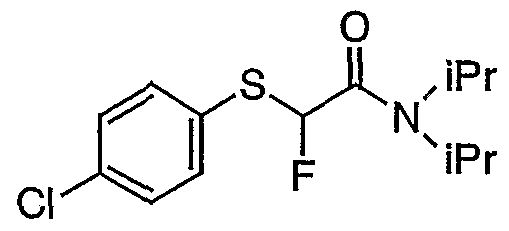
- sulfides include methylethyl sulfide, methylbenzyl sulfide, 2-phenylthioacetate, 2-phenylthioacetophenone, C 6 H 5 —CO—CH 2 SCH 3 , and bis (methylthio) Examples include methylbenzene, 2-octyl-1,3-dithiane, 2-phenyl-2-trifluoromethyl-1,3-dithiolan, tris (ethylthio) hexane, and tris (methylthio) toluene.
- R 4 , R 4a , R 4b and R 4c each represent a hydrogen atom, an alkyl group which may have a substituent, an aralkyl group which may have a substituent, or a group which may have a substituent.
- Good aryl group, optionally substituted alkenyl group, optionally substituted cycloalkyl group, optionally substituted heterocycloalkyl group, optionally substituted heterocycle represents a cyclic group.
- Epoxies include oxysilane, 1,2-epoxyethylbenzene, 1-chloro-2,3-epoxypropane, hi, hi, and 1-epoxybibenzyl.
- a phenylhydrazine residue which may have a substituent can be substituted with a fluorine atom.
- R 5a , R 5b , R 5c , R 5d , and R 5e represent a hydrogen atom, an alkyl group, an aralkyl group, an aryl group, an alkoxy group, a nitro group, a cyano group, a halogen atom, an acyl group, an amino group, It represents an alkylamino group, a dialkylamino group, an acylamino group, or an alkylthio group.
- phenol derivatives represents an alkylamino group, a dialkylamino group, an acylamino group, or an alkylthio group.
- Phenol derivatives by IF 5 becomes Kinonoido structure that Jifuruoro of below, followed by reduction, phenol derivatives fluorine in the ortho or para position has been introduced to produce.
- R 5 a, R 5 b , R 5 c, R 5 d represents a hydrogen atom, an alkyl group, Ararukiru group, ⁇ aryl group, an alkoxy group, a nitro group, Shiano group, a halogen atom, Ashiru group, amino Group, monoalkylamino group, dialkylamino group, acylamino group, and alkylthio group.
- a fluorine atom is introduced into the ortho or para position to produce a fluorinated quinonoid compound (eg, Example 47).
- a phenol that may have a substituent was used as the phenol derivative, but a substituted benzene-based aromatic compound or a condensed polycyclic carbon having an electron-donating group such as a hydroxyl group or an alkoxy group may be used.
- a fluorine atom can be similarly introduced into hydrogen.
- the 1-position of naphthol can be mono- or di-monofluorinated.
- R 5a , R 5b , R 5c , R 5d , R 5e , R 5i , and R 5 g are the same or different and are each a hydrogen atom, an alkyl group, an aralkyl group, an aryl group, an alkoxy group, a nitro group, a cyano group.
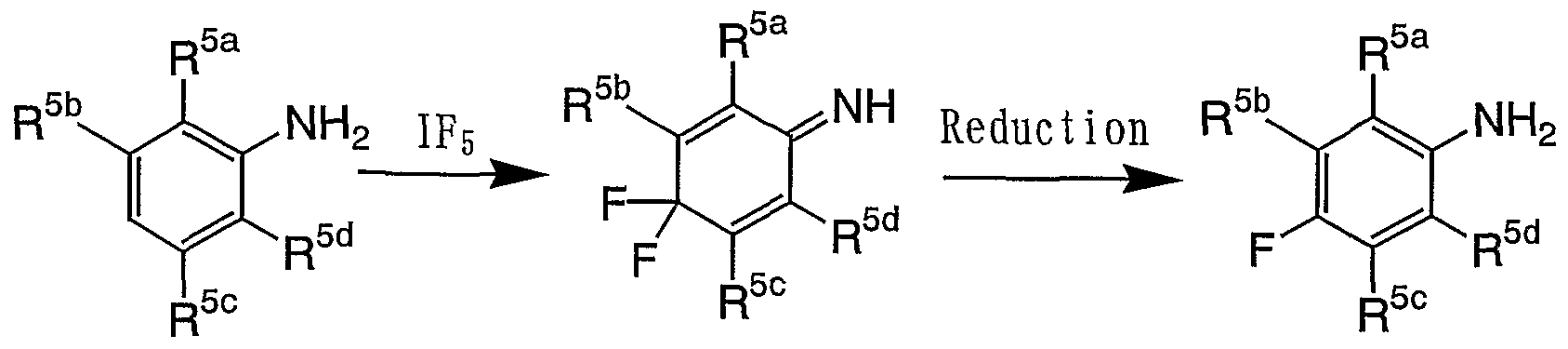
- Anirin derivatives are also similar to the Fueno Ichiru derivatives, the IF 5, becomes a quinonoid structure shows to Jifuruoro reduction below, followed by reduction, Anirin derivatives fluorine is introduced in the ortho or para position is produced.
- R 5a , R 5b , R 5c , and R 5d represent a hydrogen atom, an alkyl group, an aralkyl group, an aryl group, an alkoxy group, a nitro group, a cyano group, a halogen atom, an acyl group, an amino group.
- aniline which may have a substituent or naphthylamine which may have a substituent
- a fluorine atom can be similarly introduced into the aromatic ring as the aniline derivative.
- R 6 and R 6a are the same or different and are a hydrogen atom, an alkyl group which may have a substituent, an aralkyl group which may have a substituent, an aryl group which may have a substituent.
- Aryl group alkenyl group which may have a substituent, cycloalkyl group which may have a substituent, heterocycloalkyl group which may have a substituent, heterocyclic group which may have a substituent Ring group, alkoxy group which may have a substituent, aryloxy group which may have a substituent, monoalkylamino group which may have a substituent, dialkylamino group which may have a substituent And a phenyl group which may have a substituent and a phenylamino group which may have a substituent.
- R 6 and R 6a may combine with each other to form a cyclic structure.
- R 6b represents an alkyl group which may have a substituent, an aralkyl group which may have a substituent, an aryl group which may have a substituent, and an alkenyl group which may have a substituent And a cycloalkyl group which may have a substituent, a heterocycloalkyl group which may have a substituent, and a heterocyclic group which may have a substituent.
- thiocarbonyl compounds examples include 0-methyl cyclohexanecarboate, monopropyl 1-piperidinecarbothioate, methyl dithiobenzoate, thiobenzophenone, 0-phenyl thiobenzoate, N, N-dimethylphenylthioamide, 3 —Quinoline dithiol, ethyl ruponate, trifluoromethanecarbothioylnaphthalene, N-methyl-N-phenyltrifluoromethane, N-benzyl-N-phenylheptafluoropropane amide,
- alkyl group examples include methyl, ethyl, n-propyl, isopropyl, n-butyl, isobutyl, sec-butyl, tert-butyl, pentyl, hexyl, heptyl, octyl, nonyl, decyl, pendecyl, dodecyl, and tridecyl.
- a linear or branched chain such as tetradecyl, pentradecyl, hexadecyl, hexadecyl, hepdecyldecyl, octadecyl, etc .: ( 18 alkyl groups, preferably methyl, ethyl, n-propyl, isopropyl, n-butyl, isoptyl, Examples thereof include linear or branched Ci Ce alkyl groups such as sec-butyl, tert-butyl, pentyl, and hexyl.
- Alkoxy groups include linear or branched Ci Ce alkoxy such as methoxy, ethoxy, n-propoxy, isopropoxy, n-butoxy, isobutoxy, sec-butoxy, tert-butoxy, pentyloxy, and hexyloxy. Groups.
- alkenyl group examples include a C 2 -C 6 alkenyl group such as a vinyl group, an aryl group and a 3-butenyl group.
- halogen atom examples include a fluorine atom, a chlorine atom, a bromine atom, and an iodine atom.
- aryl group examples include a phenyl group and a naphthyl group.
- aryloxy group examples include a phenoxy group and a naphthyloxy group.
- aralkyl group examples include C 7 -C 1 () aralkyl groups such as 2-phenylethyl, benzyl, 1-phenylethyl, 3-phenylpropyl, and 4-phenylbutyl. Is mentioned.
- the cycloalkyl groups include cyclopropyl, cyclobutyl, cyclopentyl, cyclohexyl, cycloheptyl cyclohexane, include C 3 -C 8 Shikuroa alkyl group such as Shikurookuchiru, C 3 ⁇ C 7 cycloalkyl group.
- heterocycloalkyl group examples include one in which one or more carbon atoms forming the cyclic structure of the above cycloalkyl group are substituted with a nitrogen atom, an oxygen atom, a sulfur atom, or the like.
- Examples of the monoalkylamino group include the above-mentioned ( ⁇ to: an amino group mono-substituted with a 6- alkyl group.
- the dialkylamino group include Jimechiruamino, Jechiruamino, di n- flop port Piruamino, diisopropyl ⁇ Mino, Jibuchiruamino, dipentyl ⁇ amino, such as the di-substituted amino group with C ⁇ C 6 alkyl group Kishiruamino like to di is Can be
- acylamino group examples include an acylamino group having 1 to 8 carbon atoms such as formylamino, benzoylamino, acetylamino, propionylamino, and n-butylylamino.
- alkylthio group examples include -S-(( ⁇ to ( ⁇ alkyl group)) and the like ( ⁇ to ( ⁇ alkyl groups are the same as described above)).
- Heterocyclic groups include piperidyl, furyl, phenyl, imidazolyl, oxazolyl, thiazolyl, pyrrolyl, pyrrolidinyl, triazolyl, benzothiazolyl, benzimidazolyl, oxaziazolyl, thiadiazolyl, indolyl, pyrazolyl, quinolyl, quinolyl, quinolyl, quinolyl, quinolyl, quinolyl. Benzofuryl, benzochenyl, tetrazolyl and the like.
- acyl group examples include formyl, acetyl, propionyl, n-butyryl, izoptyryl, paleryl, isovaleryl, pivaloyl, and other straight-chain or branched-chain carbonyl groups having 1 to 6 carbon atoms, benzoyl and substituted acetyl groups.
- the number of substituents such as an alkyl group having a substituent, an alkoxy group having a substituent, and an alkenyl group having a substituent is 1 to 5, preferably:! ⁇ 3.
- substituents examples include halogen, CiC alkoxy, CiC alkylthio, cyano, nitro, amino group, and hydroxyl group.
- alkyl group having a halogen a part of hydrogen of the alkyl group or Those in which all are substituted by fluorine are mentioned.
- substituents include a C to alkyl group, a halogen atom, ⁇ to ( ⁇ alkoxy group, ( ⁇ to 6 alkylthio, cyano, nitro, amino group, hydroxyl group and the like).
- the number of substituents such as an aliphatic 4- to 7-membered ring having a substituent is 1 to 5, preferably 1 to 3.
- substituted acetyl group examples include a substituted acetyl group such as a chloroacetyl group, a bromoacetyl group, a dichloroacetyl group and a trifluoroacetyl group, an alkoxy-substituted acetyl group such as a methoxyacetyl group and an ethoxyacetyl group, and a methylthioacetyl group.
- Preparation and fluorinating reagents of the present invention is preferably in addition to the IF 5, further acids, bases, 1-4 kind selected from the group consisting of salts and additives, preferably:! ⁇ 3, more preferably 1-3, excluding combinations of acids, bases and salts.
- Examples of the acid include sulfuric acid, nitric acid, phosphoric acid, polyphosphoric acid, hydrogen fluoride, hydrofluoric acid, hydrochloric acid, hydrogen bromide, hydrogen iodide, hypochlorous acid, chlorite, chlorate, perchlorate, and perchlorate.
- Hydrogen halides such as bromic acid and periodic acid or hydrohalic acid, hypohalous acid, halogenous acid, halogenic acid or perhalic acid;
- Fluorosulfonic acid chlorosulfonic acid, methanesulfonic acid, ethanesulfonic acid, trifluoromethanesulfonic acid, difluoromethanesulfonic acid, trichloromethanesulfonic acid, perfluorobenzoic sulfonic acid, perfluorooctanesulfonic acid, benzenesulfonic Sulfonic acids such as acid, toluenesulfonic acid and nitrobenzenesulfonic acid, or polymer-supported sulfonic acids such as polystyrenesulfonic acid and fluorinated sulfonic acid resin (Nafion-H);
- Mono- or polycarboxylic acids such as formic acid, acetic acid, propionic acid, chloroacetic acid, bromoacetic acid, dichloroacetic acid, trichloroacetic acid, trifluoroacetic acid, glycolic acid, lactic acid, benzoic acid, oxalic acid, and succinic acid;
- HBF 4 complexes of HPF 6, HAs F 6, HSbF 6, HS b C 1 6 etc.
- the acid used here may be supported on various carriers.
- the carrier S I_ ⁇ 2, methylation S i0 2, A 1 2 0 3, A 1 2 0 3 - WB, Mo_ ⁇ 3, Th0 2, Z R_ ⁇ 2, T i O 2, Cr 2 0 3 , S i0 2 - A 1 2 0 3, S i 0 2 - T i 0 2, S i 0 2 - Z r0 2, T I_ ⁇ 2 - Z R_ ⁇ 2, A 1 2 0 3 - B 2 0 3 , S i 0 2 - W0 3 , S i 0 2 - NH 4 F, H S0 3 C 1- Al 2 ⁇ 3, HF- NH 4 - Y, HF- A 1 2 0 3, NH 4 F- S i 0 2 one A 1 2 0 3, A1 F 3 - Al 2 ⁇ 3, Ru- F- A 1 2 0 3, F- Al 2
- the amount of the above-mentioned acid used in the present invention can be selected in a large excess range from the amount of the catalyst, but is preferably 0.01 to 100 mol per 1 mol of the hydrogen-containing organic compound to be fluorinated. And more preferably 0.1 mol to 20 mol. Further, the above-mentioned acids can be used as a reaction solvent. At that time, the amount of the solvent may be a very small amount or a large excess.
- Examples of the base or organic base used in the present invention include commonly used bases. Examples thereof include sodium hydroxide, potassium hydroxide, lithium hydroxide, rubidium hydroxide, cesium hydroxide, and magnesium hydroxide. Alkaline metal or alkaline earth metal hydroxides such as calcium hydroxide, calcium hydroxide and the like;
- Alkali metal alkoxides such as sodium methoxide, sodium ethoxide, sodium butoxide, potassium methoxide, potassium ethoxide, potassium butoxide, lithium methoxide, lithium ethoxide;
- Alkali metal or alkaline earth metal hydrides such as sodium hydride, potassium hydride, lithium hydride, calcium hydride and the like; Alkali metals such as sodium, potassium and lithium;
- Alkaline earth metal oxides such as magnesium oxide and calcium oxide; ammonia, ammonium hydroxide, tetramethyl ammonium hydroxide, tetraethyl ammonium oxide, tetrabutylammonium hydroxide, water Ammonium hydroxide salts such as octyl oxide triethylammonium, benzyltrimethylammonium hydroxide, etc .; or polymer-supported ammonium hydroxide salts such as ampalite resin;
- Aliphatic amines primary amines, secondary amines, tertiary amines
- alicyclic amines secondary amines, tertiary amines
- aromatic amines primary amines, secondary amines, Organic bases such as tertiary amines and heterocyclic amines;
- Examples of the aliphatic primary amine include methylamine, ethylamine, propylamine, butylamine, pentylamine, hexylamine, cyclohexylamine, and ethylenediamine
- examples of the aliphatic secondary amine include dimethylamine, dimethylamine, and diethyleneamine.
- Examples of the aliphatic tertiary amines are trimethylamine, triethylamine, diisopropylethylamine, ⁇ , ⁇ , ⁇ ,, N'-tetramethylethylenediamine and the like;
- alicyclic secondary amines include piperidine, piperazine, pyrrolidine, and morpholine
- examples of alicyclic tertiary amines include ⁇ ⁇ ⁇ -methylpiperazine, ⁇ -methylpyrrolidine, and 5-diazabicyclo. [4.3.0] nonane-5-ene, 1,4 diazabicyclo [2.2.2] octane;
- aromatic amine examples include aniline, methylaniline, dimethylaniline, ⁇ , ⁇ -dimethylaniline, haloaline, nitroaniline and the like;
- heterocyclic amine examples include pyridine, pyrimidine, piperazine, quinoline, imidazole and the like, and further include a polymer-carrying amine compound such as polyallylamine and polybierpyridine;
- the amount of the base used in the present invention can be selected in a large excess from the amount of the catalyst, and is preferably 0 to 1 mol of the hydrogen-containing organic compound to be fluorinated. It is from 0.01 to 20 mol, more preferably from 0.1 to 10 mol.
- an acid when used as a reaction solvent and a metal, a metal hydroxide, a metal hydride, a metal alkoxide, a metal oxide, or an organic base is used as a base, the acid and the base are obvious. Reacts to produce metal salts of acids and salts of organic bases.
- the salt used in the present invention is a compound formed by a reaction between an acid and a base, and examples thereof include compounds mainly formed by a reaction between the acid and the base exemplified above.
- NH 4 B r NH 4 I , MeNH 3 B r, MeNH 3 I, Me 4 NBr, Me 4 NI, E t 4 NB r, E t 4 NI, Bu 4 NB r, Bu 4 NI, PhMe 3 NB r , PhMe 3 NI, PhCH 2 NMe 3 I, pyridinium bromide, pyridinium iodide, chloropyridinium iodide, methylpyridinium iodide, cyanopyridinium iodide, yopyridan bipyridinium, quinolium iodide, Iodine: pyridinium salts or ammonium salts such as isoquinolium, N-methylpyridinium bromide, N-methylpyridinium iodide, and N-methylquinolium iodide;
- Me 4 PB r Me 4 PI , E t 4 PI, P r 4 PI, Bu 4 PBr, Bu 4 PI, Ph 4 PB r, Hosuhoniumu salts such as P h 4 PI;
- Metal or amine salts of nitric acid such as sodium nitrate, potassium nitrate, ammonium nitrate, pyridinium nitrate; Metal salts or amines consisting of a Lewis acid such as NaBF 4 , KBF 4 , LiBF 4 , NaSbF 6 , NaAs F 6 , NaPF 6 , NH 4 BF 4 , NH 4 SbF 6 , NH 4 PF 6 , and hydrogen halide salt;
- Phosphonium salts such as tetramethylphosphonium fluoride, tetramethylphosphonium acetate, tetraphenylphosphonium fluoride;
- Examples of the additives used in the present invention include halogens, interhalogen compounds, and polyhalides.
- the halogen include iodine, bromine, and chlorine. Among them, iodine and bromine are preferable, and iodine is more preferable.
- the interhalogen compounds, C 1 F, B rF, ICKIB r, I 2 C 1 6, IC 1 3 1 kind or 2 or more kinds can be cited, such as, not limited only to these.
- the polyhalide e.g.
- 15 to 0.2 mol to 20 mol, preferably 0.3 to 5 mol, more preferably 0.4 to 2 mol is used per 1 mol of the organic compound having a hydrogen atom.
- the reaction is carried out by using an additive in an amount of 0.1 to 10 times the molar amount of the organic compound and reacting at a temperature of 70 T: to 200 ° (preferably, 120 to 100 ° C.).
- a reaction solvent may or may not be used, but is preferably used.
- aliphatic solvents such as pentane, hexane, heptane, cyclohexane, petroleum ether, dichloromethane, dichloroethane, chloroform, chlorotrifluoromethane, 1,1,2-trichlorotrifluoromethane, 2-Chloro-1,2-dibromo-1,1,2-trifluoroethane, 1,2-dibromohexafluoropropane, 1,2-dibromotetrafluoroethane, 1, didifluoro Rotetrachloroethane, 1,2-difluorotetrachloroethane, heptanefluoro-2,3,3-trichlorobutane, 1,1,1,3-tetrachlorotetrafluoropropane, 1,1,1-trichloro mouth Octafluorinated aliphatic solvents such as pentafluor
- Examples of the reducing agent include zinc powder, tin, tin chloride, iron, aluminum, sodium thiosulfate, butyltin hydride, sodium polo hydride, lithium aluminum hydride, and the like. Anything is fine.
- reaction conditions for reaction methods A, B, C, D, D,, E, F, G, H, I, and J are shown below.
- Method F In a PFA (100 ml) container, put IF 5 / Et 3 N-3HF (1.2 t ol) and a solvent (10 ml), add a 10 ml solution of a substrate (1.0 marl ol) in a solvent under heating, and add 40 ° Stirred under C for 30 minutes. After cooling, fluorobenzene (1.0 rniol) was added to the reaction solution as an internal standard, a part of the reaction solution was extracted, diluted with heavy acetonitrile, and the yield of the fluorinated product was determined by 19 F-NMR.
- a PFA (15 ml) container was charged with an IF 5 / Et 3 N-3HF (1: 1 molar ratio) solution (1.2 mmol) and a reaction solvent (8 ml), and the substrate (1.0 mmol) was added with stirring at room temperature.
- a reaction was performed at a predetermined temperature for a predetermined time.
- Measurement temperature 25 One broad single peak was observed at a ⁇ value of ⁇ 53 ppm.
- the spectrum data of the compound obtained in the present invention is shown below. For compounds that do not show spectral data, it was confirmed that the product compound was obtained by comparing the spectrum data obtained in this example with known spectrum data.
- IR (KBr, cm- 1 ) 2958, 2873, 1734, 1670, 1138, 1650, 1461, 1364, 1272, 112 3, 1073, 965.
- IR (neat, cm- 1 ) 1601, 1493, 1410, 1376, 1215, 1091, 985, 840, 804.
- IR (neat, cm- 1 ) 2968, 1617, 1328, 1166, 1115, 1070, 1015, 840, 706.
- IR (neat, cm- 1 ) 3011, 2966, 2842, 1617, 1520, 1308, 1176, 1069, 839;
- Toruiru group (C3 ⁇ 4- C 6 H 4 -) indicates, Ph represents a phenylene Le group, E t represents a Echiru group, Me represents a methyl group. Bu represents a butyl group, Ac represents an acetyl group, and i Pr represents an isopropyl group.
Landscapes
- Chemical & Material Sciences (AREA)
- Organic Chemistry (AREA)
- Chemical Kinetics & Catalysis (AREA)
- Engineering & Computer Science (AREA)
- Oil, Petroleum & Natural Gas (AREA)
- Organic Low-Molecular-Weight Compounds And Preparation Thereof (AREA)
Description






Claims
Priority Applications (5)
| Application Number | Priority Date | Filing Date | Title |
|---|---|---|---|
| EP01938637A EP1304316B1 (en) | 2000-06-13 | 2001-06-13 | Processes for the production of fluorinated organic compounds and fluorinating agents |
| US10/296,942 US6784327B2 (en) | 2000-06-13 | 2001-06-13 | Process for the production of fluorinated organic compounds and fluorinating agents |
| KR10-2002-7017007A KR100530923B1 (ko) | 2000-06-13 | 2001-06-13 | 플루오르화 유기화합물의 제조방법 및 플루오르화 시약 |
| JP2002510409A JP4892808B2 (ja) | 2000-06-13 | 2001-06-13 | フッ素化された有機化合物の製造法及びフッ素化試薬 |
| US10/885,042 US7311890B2 (en) | 2000-06-13 | 2004-07-07 | Process for the production of fluorinated organic compounds and fluorinating agents |
Applications Claiming Priority (8)
| Application Number | Priority Date | Filing Date | Title |
|---|---|---|---|
| JP2000-177453 | 2000-06-13 | ||
| JP2000177453 | 2000-06-13 | ||
| JP2000-212447 | 2000-07-13 | ||
| JP2000212447 | 2000-07-13 | ||
| JP2000281515 | 2000-09-18 | ||
| JP2000-281515 | 2000-09-18 | ||
| JP2000337929 | 2000-11-06 | ||
| JP2000-337929 | 2000-11-06 |
Related Child Applications (3)
| Application Number | Title | Priority Date | Filing Date |
|---|---|---|---|
| US10296942 A-371-Of-International | 2001-06-13 | ||
| US10/296,942 A-371-Of-International US6784327B2 (en) | 2000-06-13 | 2001-06-13 | Process for the production of fluorinated organic compounds and fluorinating agents |
| US10/885,042 Division US7311890B2 (en) | 2000-06-13 | 2004-07-07 | Process for the production of fluorinated organic compounds and fluorinating agents |
Publications (1)
| Publication Number | Publication Date |
|---|---|
| WO2001096263A1 true WO2001096263A1 (en) | 2001-12-20 |
Family
ID=27481360
Family Applications (1)
| Application Number | Title | Priority Date | Filing Date |
|---|---|---|---|
| PCT/JP2001/005017 Ceased WO2001096263A1 (en) | 2000-06-13 | 2001-06-13 | Processes for the production of fluorinated organic compounds and fluorinating agents |
Country Status (6)
| Country | Link |
|---|---|
| US (2) | US6784327B2 (ja) |
| EP (1) | EP1304316B1 (ja) |
| JP (1) | JP4892808B2 (ja) |
| KR (1) | KR100530923B1 (ja) |
| CN (1) | CN1321951C (ja) |
| WO (1) | WO2001096263A1 (ja) |
Cited By (14)
| Publication number | Priority date | Publication date | Assignee | Title |
|---|---|---|---|---|
| WO2003040088A1 (en) * | 2001-11-09 | 2003-05-15 | Daikin Industries, Ltd. | Process for preparation of fluorinated sulfides with iodine pentafluoride |
| JPWO2003008364A1 (ja) * | 2001-07-13 | 2004-11-04 | ダイキン工業株式会社 | フッ素化方法 |
| JP2006151894A (ja) * | 2004-11-30 | 2006-06-15 | Daikin Ind Ltd | 五フッ化ヨウ素による含フッ素有機化合物の製造方法 |
| WO2009102034A1 (ja) * | 2008-02-15 | 2009-08-20 | Asahi Glass Co., Ltd. | フルオロ化合物の製造方法 |
| WO2015141811A1 (ja) * | 2014-03-20 | 2015-09-24 | ダイキン工業株式会社 | オキシジフルオロメチレン骨格を有する化合物の製造方法 |
| JP2016041681A (ja) * | 2014-04-02 | 2016-03-31 | ダイキン工業株式会社 | フッ素化有機化合物の製造方法、及びフッ素化試薬 |
| WO2016171146A1 (ja) * | 2015-04-21 | 2016-10-27 | ダイキン工業株式会社 | 組成物、フッ素化試薬、及びフッ素化有機化合物の製造方法 |
| JP2017155005A (ja) * | 2016-03-02 | 2017-09-07 | 日本ゼオン株式会社 | フッ素化炭化水素の製造方法 |
| JP2017202989A (ja) * | 2016-05-10 | 2017-11-16 | ダイキン工業株式会社 | 含フッ素化合物、及びその製造方法 |
| JP2018104408A (ja) * | 2016-12-26 | 2018-07-05 | ダイキン工業株式会社 | ジフルオロメチレン化合物の製造方法 |
| WO2018123890A1 (ja) * | 2016-12-26 | 2018-07-05 | ダイキン工業株式会社 | ジフルオロメチレン化合物の製造方法 |
| WO2019208682A1 (ja) * | 2018-04-25 | 2019-10-31 | ダイキン工業株式会社 | ジフルオロメチレン化合物の製造方法 |
| WO2022202888A1 (ja) * | 2021-03-26 | 2022-09-29 | ダイキン工業株式会社 | 有機フッ素化合物の製造方法 |
| JP2024007224A (ja) * | 2022-07-05 | 2024-01-18 | ダイキン工業株式会社 | フッ素化有機化合物の製造方法 |
Families Citing this family (7)
| Publication number | Priority date | Publication date | Assignee | Title |
|---|---|---|---|---|
| US7202388B2 (en) * | 2004-10-06 | 2007-04-10 | E. I. Du Pont De Nemours And Company | Processes for preparing fluoroarenes from haloarenes |
| HUE060750T2 (hu) | 2013-10-02 | 2023-04-28 | Daikin Ind Ltd | Fluorozó-szerek |
| WO2018123301A1 (ja) * | 2016-12-26 | 2018-07-05 | ダイキン工業株式会社 | 四フッ化硫黄の製造方法 |
| CN107381522A (zh) * | 2017-07-20 | 2017-11-24 | 中节能万润股份有限公司 | 一种双氟磺酰亚胺的制备方法及利用制备的双氟磺酰亚胺制备双氟磺酰亚胺碱金属盐的方法 |
| EP4223736A4 (en) * | 2020-09-30 | 2024-10-30 | Daikin Industries, Ltd. | PROCESS FOR PRODUCING A FLUORINATED ORGANIC COMPOUND |
| CN117098744A (zh) * | 2021-03-26 | 2023-11-21 | 大金工业株式会社 | 有机氟化合物的制造方法 |
| CN114002256A (zh) * | 2021-10-29 | 2022-02-01 | 珠海宏昌电子材料有限公司 | 改性聚苯醚痕量羟值的测定方法 |
Citations (6)
| Publication number | Priority date | Publication date | Assignee | Title |
|---|---|---|---|---|
| US3283020A (en) * | 1962-12-20 | 1966-11-01 | Du Pont | Process for the production of perfluoroethyliodide |
| US3406214A (en) * | 1964-08-08 | 1968-10-15 | Fmc Corp | Method of preparing perfluoroethyl iodide |
| JPS58192838A (ja) * | 1982-05-01 | 1983-11-10 | Daikin Ind Ltd | パ−フルオルアルキル沃化物の製造法 |
| JPS58192837A (ja) * | 1982-05-01 | 1983-11-10 | Daikin Ind Ltd | パ−フルオルアルキル沃化物の製造方法 |
| JPS58203924A (ja) * | 1982-05-24 | 1983-11-28 | Kanto Denka Kogyo Kk | 四フツ化炭素の製造法 |
| JPS5951225A (ja) * | 1982-09-16 | 1984-03-24 | Daikin Ind Ltd | パ−フルオルアルキル沃化物の製法 |
Family Cites Families (3)
| Publication number | Priority date | Publication date | Assignee | Title |
|---|---|---|---|---|
| US2702306A (en) * | 1948-09-10 | 1955-02-15 | Pennsylvania Salt Mfg Co | Production of organic fluorine compounds |
| FR998618A (fr) * | 1948-09-10 | 1952-01-21 | Pennsylvania Salt Mfg Co | Perfectionnements apportés aux procédés pour l'obtention de composés organiques du fluor |
| US2993937A (en) * | 1958-10-10 | 1961-07-25 | Stauffer Chemical Co | Fluorination of aromatic compounds |
-
2001
- 2001-06-13 CN CNB01811086XA patent/CN1321951C/zh not_active Expired - Lifetime
- 2001-06-13 JP JP2002510409A patent/JP4892808B2/ja not_active Expired - Lifetime
- 2001-06-13 WO PCT/JP2001/005017 patent/WO2001096263A1/ja not_active Ceased
- 2001-06-13 EP EP01938637A patent/EP1304316B1/en not_active Expired - Lifetime
- 2001-06-13 US US10/296,942 patent/US6784327B2/en not_active Expired - Lifetime
- 2001-06-13 KR KR10-2002-7017007A patent/KR100530923B1/ko not_active Expired - Lifetime
-
2004
- 2004-07-07 US US10/885,042 patent/US7311890B2/en not_active Expired - Lifetime
Patent Citations (6)
| Publication number | Priority date | Publication date | Assignee | Title |
|---|---|---|---|---|
| US3283020A (en) * | 1962-12-20 | 1966-11-01 | Du Pont | Process for the production of perfluoroethyliodide |
| US3406214A (en) * | 1964-08-08 | 1968-10-15 | Fmc Corp | Method of preparing perfluoroethyl iodide |
| JPS58192838A (ja) * | 1982-05-01 | 1983-11-10 | Daikin Ind Ltd | パ−フルオルアルキル沃化物の製造法 |
| JPS58192837A (ja) * | 1982-05-01 | 1983-11-10 | Daikin Ind Ltd | パ−フルオルアルキル沃化物の製造方法 |
| JPS58203924A (ja) * | 1982-05-24 | 1983-11-28 | Kanto Denka Kogyo Kk | 四フツ化炭素の製造法 |
| JPS5951225A (ja) * | 1982-09-16 | 1984-03-24 | Daikin Ind Ltd | パ−フルオルアルキル沃化物の製法 |
Non-Patent Citations (4)
| Title |
|---|
| FROHN H.J. ET AL.: "Beitraege zur chemie des iodpentafluorids teil IV. IF5 ein selektives oxidatives fluorierungsmittel fuer organophosphor (III)-verbindungen", JOURNAL OF FLUORINE CHEMISTRY, vol. 34, 1986, pages 73 - 82, XP002945085 * |
| FROHN H.J. ET AL.: "Beitraege zur chemie des iodpentafluorids teil V. IF5 als oxidatives fluorierungsmittel fuer element-organika des arens, antimons und bismuts: selektivitaet und methodische grenzen", JOURNAL OF FLUORINE CHEMISTRY, vol. 34, 1986, pages 129 - 145, XP002945086 * |
| LEWE T. ET AL.: "Eigenschaften und reaktionen von tris (2,6-difluorphenyl) bismut (III)- und tris (2,6-difluorphenyl) bismut (V)-verbindungen", Z. ANORG. ALLG. CHEM., vol. 623, 1997, pages 122 - 128, XP002945084 * |
| See also references of EP1304316A4 * |
Cited By (34)
| Publication number | Priority date | Publication date | Assignee | Title |
|---|---|---|---|---|
| JPWO2003008364A1 (ja) * | 2001-07-13 | 2004-11-04 | ダイキン工業株式会社 | フッ素化方法 |
| WO2003040088A1 (en) * | 2001-11-09 | 2003-05-15 | Daikin Industries, Ltd. | Process for preparation of fluorinated sulfides with iodine pentafluoride |
| JP2006151894A (ja) * | 2004-11-30 | 2006-06-15 | Daikin Ind Ltd | 五フッ化ヨウ素による含フッ素有機化合物の製造方法 |
| WO2009102034A1 (ja) * | 2008-02-15 | 2009-08-20 | Asahi Glass Co., Ltd. | フルオロ化合物の製造方法 |
| JP2009191031A (ja) * | 2008-02-15 | 2009-08-27 | Hokkaido Univ | フルオロ化合物の製造方法 |
| WO2015141811A1 (ja) * | 2014-03-20 | 2015-09-24 | ダイキン工業株式会社 | オキシジフルオロメチレン骨格を有する化合物の製造方法 |
| JP2015193609A (ja) * | 2014-03-20 | 2015-11-05 | ダイキン工業株式会社 | オキシジフルオロメチレン骨格を有する化合物の製造方法 |
| CN106132915A (zh) * | 2014-03-20 | 2016-11-16 | 大金工业株式会社 | 具有氧二氟亚甲基骨架的化合物的制造方法 |
| CN106132915B (zh) * | 2014-03-20 | 2020-03-31 | 大金工业株式会社 | 具有氧二氟亚甲基骨架的化合物的制造方法 |
| JP2017203041A (ja) * | 2014-04-02 | 2017-11-16 | ダイキン工業株式会社 | フッ素化有機化合物の製造方法、及びフッ素化試薬 |
| JP2016041681A (ja) * | 2014-04-02 | 2016-03-31 | ダイキン工業株式会社 | フッ素化有機化合物の製造方法、及びフッ素化試薬 |
| JP2019137693A (ja) * | 2014-04-02 | 2019-08-22 | ダイキン工業株式会社 | フッ素化有機化合物の製造方法、及びフッ素化試薬 |
| WO2016171146A1 (ja) * | 2015-04-21 | 2016-10-27 | ダイキン工業株式会社 | 組成物、フッ素化試薬、及びフッ素化有機化合物の製造方法 |
| JP2016204200A (ja) * | 2015-04-21 | 2016-12-08 | ダイキン工業株式会社 | 組成物、フッ素化試薬、及びフッ素化有機化合物の製造方法 |
| JP2017155005A (ja) * | 2016-03-02 | 2017-09-07 | 日本ゼオン株式会社 | フッ素化炭化水素の製造方法 |
| JP2017202989A (ja) * | 2016-05-10 | 2017-11-16 | ダイキン工業株式会社 | 含フッ素化合物、及びその製造方法 |
| TWI725273B (zh) | 2016-12-26 | 2021-04-21 | 日商大金工業股份有限公司 | 二氟亞甲基化合物的製造方法 |
| JP2018104408A (ja) * | 2016-12-26 | 2018-07-05 | ダイキン工業株式会社 | ジフルオロメチレン化合物の製造方法 |
| WO2018123890A1 (ja) * | 2016-12-26 | 2018-07-05 | ダイキン工業株式会社 | ジフルオロメチレン化合物の製造方法 |
| JP7057489B2 (ja) | 2016-12-26 | 2022-04-20 | ダイキン工業株式会社 | ジフルオロメチレン化合物の製造方法 |
| RU2759911C2 (ru) * | 2016-12-26 | 2021-11-18 | Дайкин Индастриз, Лтд. | Способ получения дифторметиленового соединения |
| JP2019189561A (ja) * | 2018-04-25 | 2019-10-31 | ダイキン工業株式会社 | ジフルオロメチレン化合物の製造方法 |
| RU2757918C1 (ru) * | 2018-04-25 | 2021-10-22 | Дайкин Индастриз, Лтд. | Способ получения дифторметиленового соединения |
| CN112020485A (zh) * | 2018-04-25 | 2020-12-01 | 大金工业株式会社 | 二氟亚甲基化合物的制造方法 |
| WO2019208682A1 (ja) * | 2018-04-25 | 2019-10-31 | ダイキン工業株式会社 | ジフルオロメチレン化合物の製造方法 |
| CN112020485B (zh) * | 2018-04-25 | 2023-11-14 | 大金工业株式会社 | 二氟亚甲基化合物的制造方法 |
| WO2022202888A1 (ja) * | 2021-03-26 | 2022-09-29 | ダイキン工業株式会社 | 有機フッ素化合物の製造方法 |
| JP2022151785A (ja) * | 2021-03-26 | 2022-10-07 | ダイキン工業株式会社 | 有機フッ素化合物の製造方法 |
| JP2023080371A (ja) * | 2021-03-26 | 2023-06-08 | ダイキン工業株式会社 | 有機フッ素化合物の製造方法 |
| KR20230159876A (ko) | 2021-03-26 | 2023-11-22 | 다이킨 고교 가부시키가이샤 | 유기 불소 화합물의 제조 방법 |
| JP7623314B2 (ja) | 2021-03-26 | 2025-01-28 | ダイキン工業株式会社 | 有機フッ素化合物の製造方法 |
| JP2024007224A (ja) * | 2022-07-05 | 2024-01-18 | ダイキン工業株式会社 | フッ素化有機化合物の製造方法 |
| JP7464867B2 (ja) | 2022-07-05 | 2024-04-10 | ダイキン工業株式会社 | フッ素化有機化合物の製造方法 |
| KR20250022174A (ko) | 2022-07-05 | 2025-02-14 | 다이킨 고교 가부시키가이샤 | 불소화 유기 화합물의 제조 방법 |
Also Published As
| Publication number | Publication date |
|---|---|
| EP1304316B1 (en) | 2011-08-10 |
| US7311890B2 (en) | 2007-12-25 |
| US20040245505A1 (en) | 2004-12-09 |
| KR20030008164A (ko) | 2003-01-24 |
| EP1304316A4 (en) | 2005-09-28 |
| JP4892808B2 (ja) | 2012-03-07 |
| CN1321951C (zh) | 2007-06-20 |
| US20030176747A1 (en) | 2003-09-18 |
| US6784327B2 (en) | 2004-08-31 |
| KR100530923B1 (ko) | 2005-11-23 |
| EP1304316A1 (en) | 2003-04-23 |
| CN1436159A (zh) | 2003-08-13 |
Similar Documents
| Publication | Publication Date | Title |
|---|---|---|
| WO2001096263A1 (en) | Processes for the production of fluorinated organic compounds and fluorinating agents | |
| JPWO2001096263A1 (ja) | フッ素化された有機化合物の製造法及びフッ素化試薬 | |
| JP6740192B2 (ja) | フッ素化有機化合物の製造方法、及びフッ素化試薬 | |
| Giudicelli et al. | Et3n. 2Hf, a new convenient reagent for nucleophilic fluorine displacement reactions | |
| US4760205A (en) | 2-iodo-perfluoro-2-methylalkanes, processes for their preparation and their use | |
| Dyatkin et al. | On the enteraction of perfluoroalkyl carbanions with silver salts | |
| ITMI991517A1 (it) | Procedimento per ottenere nitrossimetil fenil esterni di derivati dell'acido salicilico | |
| JP6884499B2 (ja) | 組成物、フッ素化試薬、及びフッ素化有機化合物の製造方法 | |
| EP0667332A1 (en) | Process for producing fluorinated dicarbonyl compound | |
| Crespo et al. | Reaction of trihaloisocyanuric acids with alkynes: An efficient methodology for the preparation of β-haloenol acetates | |
| JP7464867B2 (ja) | フッ素化有機化合物の製造方法 | |
| Menzek et al. | Sequential Rearrangement Reactions of Benzhomonorbornadiene Derivatives: Synthesis of 7‐Vinylbenzonorbornadiene | |
| US4057585A (en) | Method of preparing 2,3-dichloroanisole | |
| Baum | Reaction of nitroalcohols with sulfur tetrafluoride | |
| ES2369199T3 (es) | Procedimientos para la producción de compuestos orgánicos fluorados y agentes fluorantes. | |
| JPH0539233A (ja) | 芳香族弗素化合物の製造法 | |
| JP4709490B2 (ja) | ピラゾリルアルキンの製造方法およびその工程における中間体 | |
| JP2002363111A (ja) | フッ素化有機化合物の製造方法及びフッ素化試薬 | |
| EP0005280B1 (en) | A process for the reduction of carboxylic acid halides to corresponding aldehydes | |
| US5631406A (en) | Chemical compounds | |
| US20230242468A1 (en) | Production method for fluorinated organic compound | |
| JP2600107B2 (ja) | 含フッ素化合物の製造方法 | |
| JPS6117524A (ja) | ベンジルプロピルエ−テル誘導体の製造方法 | |
| JPS6021131B2 (ja) | 置換されたノーフエニル‐2,2,2‐トリハロ‐エタノールエステルの製法 | |
| JPH05140086A (ja) | ハロゲノチオフエノールの製造方法および精製方法 |
Legal Events
| Date | Code | Title | Description |
|---|---|---|---|
| AK | Designated states |
Kind code of ref document: A1 Designated state(s): CN JP KR US |
|
| AL | Designated countries for regional patents |
Kind code of ref document: A1 Designated state(s): AT BE CH CY DE DK ES FI FR GB GR IE IT LU MC NL PT SE TR |
|
| DFPE | Request for preliminary examination filed prior to expiration of 19th month from priority date (pct application filed before 20040101) | ||
| 121 | Ep: the epo has been informed by wipo that ep was designated in this application | ||
| WWE | Wipo information: entry into national phase |
Ref document number: 10296942 Country of ref document: US |
|
| ENP | Entry into the national phase |
Ref country code: JP Ref document number: 2002 510409 Kind code of ref document: A Format of ref document f/p: F |
|
| WWE | Wipo information: entry into national phase |
Ref document number: 01811086X Country of ref document: CN Ref document number: 1020027017007 Country of ref document: KR |
|
| WWE | Wipo information: entry into national phase |
Ref document number: 2001938637 Country of ref document: EP |
|
| WWP | Wipo information: published in national office |
Ref document number: 1020027017007 Country of ref document: KR |
|
| WWP | Wipo information: published in national office |
Ref document number: 2001938637 Country of ref document: EP |
|
| WWG | Wipo information: grant in national office |
Ref document number: 1020027017007 Country of ref document: KR |