WO2002038516A1 - Composition for building material and building material - Google Patents
Composition for building material and building material Download PDFInfo
- Publication number
- WO2002038516A1 WO2002038516A1 PCT/JP2001/009847 JP0109847W WO0238516A1 WO 2002038516 A1 WO2002038516 A1 WO 2002038516A1 JP 0109847 W JP0109847 W JP 0109847W WO 0238516 A1 WO0238516 A1 WO 0238516A1
- Authority
- WO
- WIPO (PCT)
- Prior art keywords
- composition
- building material
- building
- unexpanded
- mass
- Prior art date
- Legal status (The legal status is an assumption and is not a legal conclusion. Google has not performed a legal analysis and makes no representation as to the accuracy of the status listed.)
- Ceased
Links
Classifications
-
- C—CHEMISTRY; METALLURGY
- C04—CEMENTS; CONCRETE; ARTIFICIAL STONE; CERAMICS; REFRACTORIES
- C04B—LIME, MAGNESIA; SLAG; CEMENTS; COMPOSITIONS THEREOF, e.g. MORTARS, CONCRETE OR LIKE BUILDING MATERIALS; ARTIFICIAL STONE; CERAMICS; REFRACTORIES; TREATMENT OF NATURAL STONE
- C04B28/00—Compositions of mortars, concrete or artificial stone, containing inorganic binders or the reaction product of an inorganic and an organic binder, e.g. polycarboxylate cements
- C04B28/14—Compositions of mortars, concrete or artificial stone, containing inorganic binders or the reaction product of an inorganic and an organic binder, e.g. polycarboxylate cements containing calcium sulfate cements
-
- B—PERFORMING OPERATIONS; TRANSPORTING
- B09—DISPOSAL OF SOLID WASTE; RECLAMATION OF CONTAMINATED SOIL
- B09B—DISPOSAL OF SOLID WASTE NOT OTHERWISE PROVIDED FOR
- B09B3/00—Destroying solid waste or transforming solid waste into something useful or harmless
- B09B3/30—Destroying solid waste or transforming solid waste into something useful or harmless involving mechanical treatment
- B09B3/35—Shredding, crushing or cutting
-
- C—CHEMISTRY; METALLURGY
- C04—CEMENTS; CONCRETE; ARTIFICIAL STONE; CERAMICS; REFRACTORIES
- C04B—LIME, MAGNESIA; SLAG; CEMENTS; COMPOSITIONS THEREOF, e.g. MORTARS, CONCRETE OR LIKE BUILDING MATERIALS; ARTIFICIAL STONE; CERAMICS; REFRACTORIES; TREATMENT OF NATURAL STONE
- C04B14/00—Use of inorganic materials as fillers, e.g. pigments, for mortars, concrete or artificial stone; Treatment of inorganic materials specially adapted to enhance their filling properties in mortars, concrete or artificial stone
- C04B14/02—Granular materials, e.g. microballoons
- C04B14/04—Silica-rich materials; Silicates
- C04B14/20—Mica; Vermiculite
- C04B14/202—Vermiculite
-
- C—CHEMISTRY; METALLURGY
- C04—CEMENTS; CONCRETE; ARTIFICIAL STONE; CERAMICS; REFRACTORIES
- C04B—LIME, MAGNESIA; SLAG; CEMENTS; COMPOSITIONS THEREOF, e.g. MORTARS, CONCRETE OR LIKE BUILDING MATERIALS; ARTIFICIAL STONE; CERAMICS; REFRACTORIES; TREATMENT OF NATURAL STONE
- C04B28/00—Compositions of mortars, concrete or artificial stone, containing inorganic binders or the reaction product of an inorganic and an organic binder, e.g. polycarboxylate cements
- C04B28/02—Compositions of mortars, concrete or artificial stone, containing inorganic binders or the reaction product of an inorganic and an organic binder, e.g. polycarboxylate cements containing hydraulic cements other than calcium sulfates
-
- C—CHEMISTRY; METALLURGY
- C04—CEMENTS; CONCRETE; ARTIFICIAL STONE; CERAMICS; REFRACTORIES
- C04B—LIME, MAGNESIA; SLAG; CEMENTS; COMPOSITIONS THEREOF, e.g. MORTARS, CONCRETE OR LIKE BUILDING MATERIALS; ARTIFICIAL STONE; CERAMICS; REFRACTORIES; TREATMENT OF NATURAL STONE
- C04B28/00—Compositions of mortars, concrete or artificial stone, containing inorganic binders or the reaction product of an inorganic and an organic binder, e.g. polycarboxylate cements
- C04B28/02—Compositions of mortars, concrete or artificial stone, containing inorganic binders or the reaction product of an inorganic and an organic binder, e.g. polycarboxylate cements containing hydraulic cements other than calcium sulfates
- C04B28/08—Slag cements
-
- C—CHEMISTRY; METALLURGY
- C04—CEMENTS; CONCRETE; ARTIFICIAL STONE; CERAMICS; REFRACTORIES
- C04B—LIME, MAGNESIA; SLAG; CEMENTS; COMPOSITIONS THEREOF, e.g. MORTARS, CONCRETE OR LIKE BUILDING MATERIALS; ARTIFICIAL STONE; CERAMICS; REFRACTORIES; TREATMENT OF NATURAL STONE
- C04B28/00—Compositions of mortars, concrete or artificial stone, containing inorganic binders or the reaction product of an inorganic and an organic binder, e.g. polycarboxylate cements
- C04B28/18—Compositions of mortars, concrete or artificial stone, containing inorganic binders or the reaction product of an inorganic and an organic binder, e.g. polycarboxylate cements containing mixtures of the silica-lime type
-
- C—CHEMISTRY; METALLURGY
- C09—DYES; PAINTS; POLISHES; NATURAL RESINS; ADHESIVES; COMPOSITIONS NOT OTHERWISE PROVIDED FOR; APPLICATIONS OF MATERIALS NOT OTHERWISE PROVIDED FOR
- C09D—COATING COMPOSITIONS, e.g. PAINTS, VARNISHES OR LACQUERS; FILLING PASTES; CHEMICAL PAINT OR INK REMOVERS; INKS; CORRECTING FLUIDS; WOODSTAINS; PASTES OR SOLIDS FOR COLOURING OR PRINTING; USE OF MATERIALS THEREFOR
- C09D7/00—Features of coating compositions, not provided for in group C09D5/00; Processes for incorporating ingredients in coating compositions
- C09D7/40—Additives
- C09D7/60—Additives non-macromolecular
- C09D7/61—Additives non-macromolecular inorganic
-
- E—FIXED CONSTRUCTIONS
- E04—BUILDING
- E04F—FINISHING WORK ON BUILDINGS, e.g. STAIRS, FLOORS
- E04F13/00—Coverings or linings, e.g. for walls or ceilings
- E04F13/07—Coverings or linings, e.g. for walls or ceilings composed of covering or lining elements; Sub-structures therefor; Fastening means therefor
- E04F13/08—Coverings or linings, e.g. for walls or ceilings composed of covering or lining elements; Sub-structures therefor; Fastening means therefor composed of a plurality of similar covering or lining elements
- E04F13/14—Coverings or linings, e.g. for walls or ceilings composed of covering or lining elements; Sub-structures therefor; Fastening means therefor composed of a plurality of similar covering or lining elements stone or stone-like materials, e.g. ceramics concrete; of glass or with an outer layer of stone or stone-like materials or glass
- E04F13/148—Coverings or linings, e.g. for walls or ceilings composed of covering or lining elements; Sub-structures therefor; Fastening means therefor composed of a plurality of similar covering or lining elements stone or stone-like materials, e.g. ceramics concrete; of glass or with an outer layer of stone or stone-like materials or glass with an outer layer of asbestos cement or the like
-
- C—CHEMISTRY; METALLURGY
- C04—CEMENTS; CONCRETE; ARTIFICIAL STONE; CERAMICS; REFRACTORIES
- C04B—LIME, MAGNESIA; SLAG; CEMENTS; COMPOSITIONS THEREOF, e.g. MORTARS, CONCRETE OR LIKE BUILDING MATERIALS; ARTIFICIAL STONE; CERAMICS; REFRACTORIES; TREATMENT OF NATURAL STONE
- C04B2111/00—Mortars, concrete or artificial stone or mixtures to prepare them, characterised by specific function, property or use
- C04B2111/00474—Uses not provided for elsewhere in C04B2111/00
- C04B2111/00482—Coating or impregnation materials
-
- C—CHEMISTRY; METALLURGY
- C04—CEMENTS; CONCRETE; ARTIFICIAL STONE; CERAMICS; REFRACTORIES
- C04B—LIME, MAGNESIA; SLAG; CEMENTS; COMPOSITIONS THEREOF, e.g. MORTARS, CONCRETE OR LIKE BUILDING MATERIALS; ARTIFICIAL STONE; CERAMICS; REFRACTORIES; TREATMENT OF NATURAL STONE
- C04B2111/00—Mortars, concrete or artificial stone or mixtures to prepare them, characterised by specific function, property or use
- C04B2111/00474—Uses not provided for elsewhere in C04B2111/00
- C04B2111/00767—Uses not provided for elsewhere in C04B2111/00 for waste stabilisation purposes
- C04B2111/00775—Uses not provided for elsewhere in C04B2111/00 for waste stabilisation purposes the composition being used as waste barriers or the like, e.g. compositions used for waste disposal purposes only, but not containing the waste itself
-
- C—CHEMISTRY; METALLURGY
- C08—ORGANIC MACROMOLECULAR COMPOUNDS; THEIR PREPARATION OR CHEMICAL WORKING-UP; COMPOSITIONS BASED THEREON
- C08K—Use of inorganic or non-macromolecular organic substances as compounding ingredients
- C08K3/00—Use of inorganic substances as compounding ingredients
- C08K3/34—Silicon-containing compounds
Definitions
- the present invention relates to a composition for a building material, a building material using the composition, and a method for producing the composition. Further, the present invention relates to a coating composition and a coated body coated with the composition. Furthermore, the present invention relates to a method for soiling waste building materials. Background art
- base materials are selected for various purposes, and various materials are often blended with those various base materials.
- one of the mineral-based materials is permikiuraito.
- This permicularite (hillite) is a clay mineral similar to biotite, and expands remarkably in the direction perpendicular to the layer due to dehydration at high temperatures, forming a hill-like and porous body. Because of this, it is excellent in heat insulation and sound absorption, so it can be used as a material for the base material (filler, bulking material), and as a base material for various building materials such as heat insulation material and sound absorption material. It is often used in conjunction with the purpose of development.
- permikilite is not considered as a humidity control material at all because its moisture absorption capacity is not so high.
- the dehumidifying capacity is improved.
- the present invention has been found to be able to remarkably improve and solve the above-mentioned problems, and has reached the present invention.
- An object of the present invention is to provide a composition for a building material capable of providing a building material with further improved design, sound absorption and lightness as part of this study.
- the substrate is selected for various purposes, not more multi that various materials are blended in their various substrates c
- the present invention aims at obtaining a building material that can be joined using a fastener without using an adhesive, as a part of the study on the above building material, and surprisingly uses the above-mentioned unexpanded permeabilite. It has been found that the above-mentioned problems can be achieved by using building materials that include these. Disclosure of the invention
- the gist of the present invention is to provide a composition for a building material comprising an unexpanded permukilite mixed with a base material and having a blending amount of 5 to 70% by mass of the total composition (solid content). And a method of manufacturing these materials.
- the substrate used in the present invention is not particularly limited as long as it does not substantially degrade the properties of permukilite described below, but is preferably hydrophilic from the viewpoint of humidity control and / or deodorization. It is. This is because the hydrophilic base material itself also has a humidity control and / or deodorizing function, and the unexpanded permiculite can adsorb substances diffused internally from its surface.
- Such hydrophilic substrates include, for example, gypsum, cement, calcium silicate, slag gypsum, or the like. These can be used in combination as appropriate.
- the gypsum may be either anhydrous or hydrated, and various cements such as Portland cement can be used. In this case, aggregate and admixture are used.
- the calcium silicate is not particularly limited, but is generally obtained by a hydrothermal reaction of a silicate material and lime in an autoclave (topamorite or zonotrite).
- Slag gypsum generally contains 20 to 40% blast-furnace slag powder, 60 to 80% dihydrate gypsum (exhausted gypsum), and 1 to 5% Portland cement. .
- Pamikiyurai bets to be incorporated into the substrate is a flaky mineral composed mainly of S i0 2, M g 0, A1 2 0 3, common biotite system, chlorite-based Any of these may be used, even if there is a difference in composition etc. depending on the place of production.
- the specific surface area (nitrogen adsorption method) is usually 10 m 2 / g or less.
- the particle size is not particularly limited, but is usually 5 mm or less, preferably 3 mm or less, and particularly preferably 0.5 mm or less.
- fine-grained products with a diameter of 0.25 mm or less are not suitable for use in expanded permiculite, and are regarded as nonstandard products as tailings.
- the ore is pulverized, beneficiated, and dried.
- the fine particles have less dehydration and alteration of the interlaminar water of the permiculite (a bilayer of water between the layers changes to a single molecular layer), and it is more preferably used in the present invention. sell.
- the reason for this is that two molecules of interlayer water are more suitable for humidity control and deodorant characteristics.
- permikilite usually contains about 10 to 20% of water, and is dehydrated by rapid heating at high temperature (about 320 to 100 ° C at which interlayer water starts to desorb). It swells significantly (many at 1000 ° C,! ⁇ 2 seconds, 10 ⁇ 30 times the original thickness). Therefore, in the present invention, those which have not substantially obtained such expansion are used.
- an activated material prior to blending the permicular with the base material.
- the purpose of the activation treatment is to release the organic or inorganic substances adsorbed by the permeabilite and to reconstitute and restore the inherent humidity control and adsorption performance.
- pressurized steam treatment, boiling treatment with a saline solution, and the like can be mentioned.
- steam treatment can be performed at a saturated steam pressure of 105 ° C. to 200 ° C.
- the base material is a calcium silicate
- the base material is a calcium silicate
- it is then added to the mixture, for example, at 150 ° C to 200 ° C. Since autoclave processing is performed at a saturated vapor pressure of about a degree, activation processing will be performed as a result.
- the permequat is mixed with the base material so that the mixing amount is 5 to 70% by mass, preferably 10 to 50% by mass of the whole composition (solid content). It is selected according to the type of base material and the performance of the target building material, such as humidity control, etc., but sufficient permicilite channeling (network) to obtain a suitable amount and rate of moisture absorption and desorption. In general, the amount is preferably 15% by mass or more.
- the composition for building materials of the present invention includes, in addition to the above-mentioned unexpanded permeabilite, various compounding materials that are specifically used for each base material in building materials for other purposes. May be blended.
- the type and amount can be determined by a conventional method. For example, aggregates, reinforcing materials, admixtures, lightening materials, etc., more specifically pulp, cellulose fibers, glass fibers, fume silica, foam glass, shirasu parun, aluminum balloons, perlite, Wallacetonite, sepiolite, gravel, sand, organic binder, and the like are appropriately selected.
- the obtained building material composition of the present invention can be made into a building material having a desired shape and size such as a board by a conventional method such as sheet molding, extrusion molding, press molding, or molding.
- a board paper forming using a so-called paper machine is selected industrially.
- the building material of the present invention preferably has a moisture absorption / desorption rate of 3 when the relative humidity is changed to 60 to 90% in the moisture absorption / desorption test described in Reference Example 1 described below. 90% or more of the equilibrium value in 0 minutes, moisture release: 25 minutes or less, and more preferably, equilibrium in 20 minutes or less.
- the building materials thus obtained are preferably used as interior materials such as wall materials, ceiling materials, partition materials, etc., but may also be used as exterior materials such as eave ceiling materials. You.
- the building material of the present invention can satisfy the requirements of humidity control and / or deodorization, and also aesthetics. That is, 1. It has an excellent humidity control function because it has moderate moisture release characteristics. For example, it has excellent moisture absorption and desorption balance, quantity and speed.
- the building materials of the present invention can adsorb volatile chemicals such as formaldehyde, toluene, xylene, or odorous gases.
- the unexpanded permicular particles can be embossed by surface polishing or the like to provide a granite-like surface, which makes it possible to easily provide an aesthetically pleasing port material or the like.
- the used building materials of the present invention should be collected and regenerated by subjecting them to steam treatment in an autoclave at about 105 to 150 ° C. Is possible. This is because permeabilite has not reacted with the above-mentioned base material.
- non-standardized fine granules can be used more preferably, so that resources can be used effectively.
- ⁇ Means for solving the problem described in (B) above will be described.
- the purpose of this purpose is to further expand expanded permiculite in a composition for building materials in which unexpanded permiculite is blended into a base material and the blending amount is 5 to 70% by mass of the total composition (solid content).
- the base material used in the present invention is the same as that described in the above I and does not substantially deteriorate the properties of permiculite. There is no particular limitation, but from the viewpoint of humidity control and Z or deodorization
- it is hydrophilic.
- the permeabilite blended in the base material is also as described in the above I.
- permicilite is used in a substantially unexpanded state.
- permikilite usually contains about 10 to 20% of water, and is dehydrated by rapid heating at high temperature (about 320 to 100 ° C at which interlayer water starts to desorb). It swells significantly (often at 1000 ° C for 1-2 seconds, 10- 30 times its original thickness). Therefore, in the present invention, those which have not substantially obtained such expansion are used.
- the unexpanded permeate is mixed with the base material so that the amount thereof is 5 to 70% by mass, preferably 10 to 50% by mass of the total composition (solid content). It is selected according to the type of base material, the performance of the target building material, for example, humidity control, etc., but sufficient channeling of unexpanded permeate to obtain a suitable amount and rate of moisture absorption / desorption (network ) Is generally more preferably 15% by mass or more.
- the composition for building materials of the present invention needs to be blended with 2.5 to 20% by mass of the expanded composition (solid content). is there.
- the blending amount can be appropriately selected according to the desired design and lightness.
- the grain size is not particularly limited, but is usually selected from about 0.5 to 30 mm.
- the combined use of the expanded permeate gives the building material obtained from the building material composition a light weight and various design properties, that is, a transparent scale-like surface.
- various compounding materials used uniquely for each base material in the building material, and others may be appropriately compounded.
- the type and amount can be determined by a conventional method. For example, aggregates, reinforcing materials, admixtures, lightening materials, etc., more specifically, pulp, cellulose fibers, glass fibers, fume desilica, foamed glass, shirasu balloons, alumina balloons, perlite, wallath tonight, Sepiolite, gravel, sand, organic binder, etc. are appropriately selected.
- the obtained building material composition of the present invention can be made into a building material having a desired shape and size such as a board by a conventional method such as sheet molding, extrusion molding, press molding, or molding.
- a board paper forming using a so-called paper machine is selected industrially.
- the building material of the present invention preferably has a moisture absorption / desorption rate of 30 minutes when the relative humidity is changed to 60 to 90%, and an equilibrium value of 90 minutes. %, Moisture release: equilibrium in 25 minutes or less, more preferably 20 minutes or less.
- the building material thus obtained is preferably used as an interior material such as a wall material, a ceiling material, a partition material, etc., but can also be used as an exterior material such as an eave ceiling material.
- the building material of the present invention can satisfy the above-mentioned requirements of humidity control and / or deodorization, and also aesthetic appearance, in addition to the above-mentioned light weight and various design properties.
- the gist of the present invention resides in a composition for a building material in which an unexpanded permeate is mixed with a base material, and the blending amount is 0.5 to 70% by mass of the whole composition (solid content).
- Unexpanded permikiuraito 3 The present invention relates to a composition for a building material in which the portion of 100 ⁇ m or less is 0.5 to 15% by mass of the whole composition (solid content), a building material obtained by molding the same, and a method for producing these.
- the substrate used in the present invention is the same as that described in I above, and is not particularly limited as long as it does not substantially degrade the properties of the permeate. From the viewpoint, hydrophilicity is preferred.
- the vermiculite mixed in the base material is also as described in the above I.
- permicilite is used in a substantially unexpanded state.
- permikilite usually contains about 10 to 20% water, and is dehydrated by rapid heating at high temperature (about 320 to 100 ° C where interlayer water starts to desorb). It will swell significantly (often at 100 ° C for 1-2 seconds, 10 to 30 times its original thickness). Therefore, in the present invention, those which have not substantially obtained such expansion are used.
- Unexpanded vermiculite is 0.5 to 70% by mass of the total composition (solids) in the building material composition. 0.5 to 15% by mass of the product (solid content).
- a plurality of unexpanded permiculite having different contents of 300 / zm or less can be blended to form such a composition, but for example, 90% or more is less than 300 ⁇
- the unexpanded permicalite fine powder in the range of 0.5 to 15% by mass, 0.5 to 10% by mass or 1 to 5% by mass of the total composition (solid content) in a portion of 300 ⁇ m or less. It can also be blended with the base material so that the amount becomes the amount by mass.
- Permixilite is blended with the base material so that the blending amount is 0.5 to 70% by mass of the whole composition (solid content). It is selected according to the type of the base material and the performance of the intended building material, for example, humidity control. For humidity control, 5 to 70% by mass, preferably 10% to 50% by mass %, And more preferably 15% by mass or more, in order to form a sufficient channeling (network) of the permicular to obtain a suitable amount and rate of moisture absorption and desorption.
- the content is preferably 0.5 to 15% by mass, and more preferably 0.5 to 15% by mass. 5 ⁇ : L 0 mass 0 /. It is preferable to mix the permic acid with the base material in an amount of more preferably 1 to 5% by mass.
- the mixing of the fine powder of unexpanded permeabilite facilitates uniform dispersion of water in water during mixing in a molding tank or the like, so that production efficiency and yield can be improved, and it is not suitable for expansion. It also makes effective use of resources discarded at Yamamoto, and even a composition of 0.5 to 5% by mass contributes to the improvement of flexural strength of calcium silicate building materials. In this case, it is preferable to use unexpanded vermiculite fine powder in which 90% or more is 300 ⁇ m or less.
- the blended unexpanded permeate fines are the core of epitaxy growth of topamolites, promote the growth of calcium silicate hydrate reactants, and reduce the amount of unreacted raw materials, thus improving bending strength and flexibility. (Decrease in elastic modulus). Therefore, building materials with high blasting energy can be obtained.
- the composition for a building material of the present invention includes, in addition to the above-mentioned unexpanded permiculite as described above, various compounding materials used uniquely for the respective base materials in the building material for other purposes. Others can be appropriately blended. The type and amount can be determined by a conventional method.
- the obtained building material composition of the present invention can be formed into a building material having a desired shape and size such as a board by a conventional method such as sheet molding, extrusion molding, press molding, or molding.
- a board paper forming using a so-called paper machine is selected industrially.
- the mixing amount of permikilite is the total composition (solid content).
- the moisture absorption / desorption rate is 30: 90% or more of the equilibrium value per minute, moisture release: 25 minutes or less, more preferably 20 minutes or less.
- the building materials obtained in this way are preferably used as interior materials such as wall materials, ceiling materials, partition materials, etc., but can also be used as exterior materials such as eave ceiling materials. .
- the building material of the present invention requires moisture control and / or deodorization as well as aesthetic demand when the amount of permikilite is 5 to 70% by mass of the total composition (solid content). It can be satisfied.
- the building material of the present invention can improve the crushing energy as described above even when the blending amount of permikilite is 0.5 to 5% by mass of the total composition (solid content).
- the gist of the present invention is to provide (1) (A) a coating composition containing unexpanded permiculite,
- a coating composition comprising:
- the present invention resides in a coating composition comprising the unexpanded permeabilite (A), and the permeate used in the present invention is the same as that described in the above I.
- permikilite usually contains about 10 to 20% of water, and is dehydrated by rapid heating at high temperature (about 320 to 100 ° C at which interlayer water starts to desorb). It swells significantly (many at 1000 ° C for 1-2 seconds, 10- 30 times its original thickness). Therefore, in the present invention, those which have not substantially obtained such expansion are used.
- Examples of the organic binder used in the present invention include a paint and z or a paste, and as the paint, those commonly used for building materials, building interiors, indoor fixtures, and the like can be used.
- the paint those commonly used for building materials, building interiors, indoor fixtures, and the like can be used.
- acrylic, urethane, epoxy, polyester, silicone, vinyl chloride, vinyl acetate, polyvinyl alcohol, polyvinyl butyral, or styrene-butadiene resin or emulsion paint Can be selected as appropriate. That is, it can be arbitrarily selected in consideration of the type, material, and the like of the object to be coated.
- alginates such as sodium alginate, wheat Starch such as starch, mannan such as konjac paste, dextrin obtained by heat-treating starch, proteins such as casein, and carboxymethylcellulose (CMC), hydroxypropylmethylmethionolecellulose or hydroxyxetinolemethylcellenolate Methinolecellulose-based materials such as loin, and the like, and those derived from nature are particularly preferred.
- cement such as portland cement and white cement
- hydraulic material such as granulated slag or gypsum hemihydrate, plaster, dolomite plaster, magnesium
- air-hard material such as moxycycloride, or sodium silicate may be used, and may be appropriately selected depending on the purpose.
- the organic binder and / or inorganic binder when the above-mentioned organic binder and / or inorganic binder are mixed with the unexpanded permicular light, (A) 5 to 70 wt% of the unexpanded permicular light, (B) present, based on the total solid content of the composition. It is preferable to mix the organic binder and the Z or (C) inorganic binder in an amount of 5 to 40 wt%, more preferably 0 to 30 wt% of an organic binder and 0 to 40 wt% of an inorganic binder. It is.
- the coating composition comprising the unexpanded vermiculite and the above-mentioned organic binder and / or inorganic binder, when applied to an object to be coated, satisfies the requirements of humidity control and / or deodorization, and also satisfies the demands of aesthetics.
- a coating composition to which a hygroscopic material (D) having a specific surface area of at least 10 m 2 / g by the BET method is added can do.
- this hygroscopic material include calcium silicate, diatomaceous earth, zeolite, Arofuene or the like is preferably used. It is preferable that the compounding amount of the hygroscopic material is 0 to 70 wt% based on the total solid content of the composition.
- This coating composition has an improved hygroscopicity, so that the preferable application range of the object to be coated is wider than that of the coating composition to which no coating composition is added.
- various components other than the above-mentioned components (A) to (D) may be further blended depending on the purpose.
- aggregates such as kay sand and river sand, inorganic powders such as wallacetonite, calcium carbonate and sepiolite, and organic or inorganic fiber materials such as pulp and glass fiber can be used as appropriate.
- a part of facial components such as a pigment and a vehicle can be used.
- an expanded permeate may be added.
- the coating composition of the present invention is applied to a building material, a building interior, an indoor fixture, or a member thereof, which is an object to be coated.
- the building material include inorganic materials such as calcium silicate, cement, gypsum, diatomaceous earth, zeolite, arophen or slag gypsum, and wood materials such as particle board. It is usually applied at the factory.
- examples of building interiors include those that are already part of the interior walls, ceilings, partitions, doors, etc. of the building. Is normal.
- indoor fixtures include furniture, furniture, etc. that are not substantially fixed to buildings.
- the member is a material constituting a part of the building interior or the indoor fixture.
- the object to be coated may be a joint portion or a repair portion.
- These coatings can be applied by a conventional method.
- brush coating, roller brush coating, spray coating and the like are used for on-site coating, and a flow coater and a roll coater are generally used for factory coating.
- the coating thickness of these objects varies depending on the material, type, etc. of the object, but is usually 10 ⁇ ! About 5 mm, preferably about l-3 mm.
- the object to be coated is obtained by molding a building material composition in which the above-mentioned unexpanded permeate is mixed with a base material, and the compounding amount is 5 to 70% by mass of the total composition (solid content).
- the properties such as humidity control of the object to be coated are not impaired even if the thickness of the coating film is considerably large. You.
- the gist of the present invention is that waste material is formed by crushing a waste building material formed of a building material obtained by molding a building material composition obtained by blending an unexpanded vermiculite with a calcium silicate-based substrate. It is in the method of soiling building materials.
- the building material in the present invention is a building material obtained by molding a building material composition obtained by mixing unexpanded permeate with a calcium carbonate base material.
- the calcium silicate base material is not particularly limited, but is generally obtained by hydrothermally reacting a silicate raw material and lime in an autoclave (topamorite or zonolite). is there.
- the permikilite mixed with the base material is as described above. +
- the permikilite is blended into the base material such that the blending amount is 5 to 70% by mass, preferably 10 to 50% by mass of the whole composition (solid content). It is selected according to the type of base material and the performance of the target building material, such as humidity control, etc., but sufficient permeation channeling (netting) to obtain a suitable amount and rate of moisture absorption and desorption is required. In general, the amount is more preferably 15% by mass or more for forming (workpiece).
- various compounding materials that are specifically used for the base material calcium silicate in the building material for other purposes, and other components are appropriately compounded. I can do it. For example, it may contain an expanded permeate. Their types and amounts can be determined by conventional methods.
- the obtained building material composition of the present invention can be made into a building material having a desired shape and size such as a board by a conventional method such as sheet molding, extrusion molding, press molding, or molding.
- a board paper-forming using a so-called paper-making machine is industrially selected.
- the building material of the present invention preferably has a moisture absorption / desorption rate of 30 minutes when the relative humidity is changed to 60 to 90%, and an equilibrium value of 90 minutes. %, Moisture release: 25 minutes or less, and more preferably, equilibrium in 20 minutes or less.
- the building materials obtained in this way are preferably used as interior materials such as wall materials, ceiling materials, partition materials, etc., but can also be used as exterior materials such as eave ceiling materials. .
- the building material of the present invention can satisfy the requirements of humidity control and / or deodorization and also aesthetics.
- the waste building material when such a building material is used and becomes a waste building material without being reused as a building material, the waste building material is turned into soil.
- waste building materials are subjected to crushing, and this crushing can usually be performed by a general crushing means such as a crusher.
- crushing methods are selected in consideration of the amount of waste building materials and crushing locations.
- the crushing treatment can be carried out by carrying crushing means at the place where the waste material is generated.
- the degree of crushing is not particularly limited, and may be appropriately determined depending on the intended use of the soil. Most commonly, it is selected to be, for example, about 5 mm or less.
- Waste building materials crushed in this way can be used as soil. That is, the well-drained artificial soil obtained by the present invention can be used for the purpose of growing plants, improving soil, and further improving the ground. These artificial soils can act as a fertilizer as they are, but other components can be added according to their purposes. For example, various fertilizer components selected from N, P, K and trace elements can be added.
- the gist of the present invention is a building material obtained by molding a building material composition in which unexpanded permiculite is blended into a base material and the blending amount is 5 to 70% by mass of the total composition (solid content). In building materials joined by fasteners.
- the substrate used in the present invention is as described in I above, and is not particularly limited as long as it does not substantially degrade the characteristics of the powder, but from the viewpoint of humidity control and moisture or deodorization. Is preferably hydrophilic.
- the permeabilite blended in the base material is also as described above.
- permicilite is used in a substantially unexpanded state. That is, permiki light is usually 10 ⁇ It contains about 20% water and dehydrates and expands significantly due to rapid heating at high temperatures (about 320 ° C to 100 ° C at which interlayer water begins to desorb). At 100 ° C, 1-2 seconds, 10-30 times the original thickness). Therefore, in the present invention, those which have not substantially obtained such expansion are used.
- the permikilite is blended into the base material such that the blending amount is 5 to 70% by mass, preferably 10 to 50% by mass of the whole composition (solid content). It is selected according to the type of base material and the performance of the target building material, for example, humidity control, etc., but sufficient permeating channeling (network) to obtain a suitable amount and rate of moisture absorption and desorption In general, the amount is preferably 15% by mass or more.
- the building material composition of the present invention in addition to the above-mentioned unexpanded permeabilite, various compounding materials that are specifically used for each base material in the building material for other purposes, and other materials are appropriately used. May be blended.
- the obtained building material composition of the present invention can be made into a building material having a desired shape and size such as a board by a conventional method such as sheet molding, extrusion molding, press molding, or molding.
- a board paper forming using a so-called paper machine is industrially selected.
- the building material of the present invention preferably has a moisture absorption / desorption rate when the relative humidity is changed to 60 to 90%, the moisture absorption: the equilibrium value of 90 minutes. 0% or more, moisture release: equilibrium in 25 minutes or less, more preferably 20 minutes or less.
- the building materials obtained in this way are preferably used as interior materials such as wall materials, ceiling materials, partition materials, etc., but can also be used as exterior materials such as eave ceiling materials. .
- the building material of the present invention can satisfy the requirements of humidity control and Z or deodorization, as well as aesthetic requirements.
- the building materials thus obtained are joined by fasteners. Joining is generally performed between building materials or other members, structural parts, and the like.
- fasteners nails, machine screws, bolts and nuts, braces, stables or pins are preferably used. These are appropriately selected according to the purpose of joining.
- the material of these fasteners is not limited, and may be any of metal, wood, bamboo, plastic, ceramic, and the like.
- the nail may be a Western nail or a Japanese nail, and may be a flat-headed, flat, square or round-headed nail. Examples of small screws include round heads, semi-rounds, flat heads, and cross-recessed screws, and hexagonal holes are the most common bolts and nuts. Pins include small, mountain, flat, flat, and round pins.
- the building material according to the present invention has a so-called gripper, which is presumed to be caused by a spring pack effect of unexpanded permiculite, and therefore may be the joining side or the joining side.
- the side to be joined include painting, lighting, handrails, and toweling. Since the part to be joined with the fastener is highly resilient, it can be re-fastened to the same part, for example, after the screw is once removed.
- the building material according to the present invention has good flexibility and does not have planer resistance and has shape retention, even if the surface is scraped with a planer, it is possible to form a smooth surface without damaging the surface. The shavings do not shatter. Further, the building material according to the present invention does not require a finishing material such as a cloth or wallpaper to be attached to the surface, and thus has an additional advantage that the use of an adhesive for this purpose is not required.
- the surface of the building material of the present invention is rich in sculpture, and can be processed by a router or a chisel, and can be smoothly engraved without any surface collapse or deletion, so that a desired design can be obtained. It can enhance the design of building materials arbitrarily, such as edging and adding geometric patterns. These building materials, which have been cut or carved with a canna in the present invention, can of course be joined with fasteners as described above. BEST MODE FOR CARRYING OUT THE INVENTION
- a calcium silicate port was obtained in the same manner as in Example 1 by using 42 parts of calcium stone powder, 42 parts of slaked lime, 6 parts of pulp, and 10 parts of unexpanded vermiculite.
- the gypsum board (30 cm x 30 cm x 6 mm) was obtained by drying at a temperature lower than ° C.
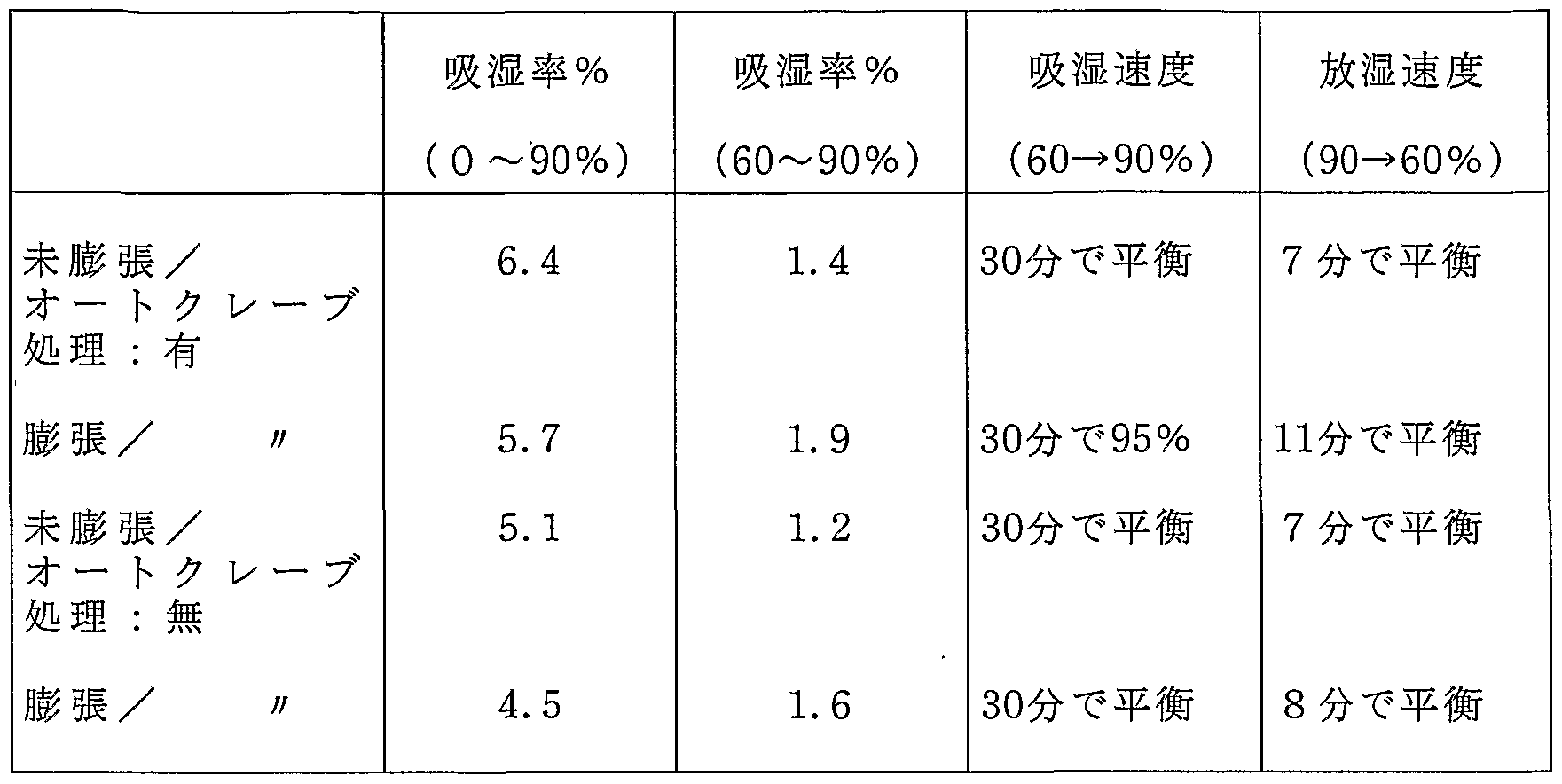
- the moisture absorption rate and the moisture release / absorption rate of the present invention and commercially available building materials were measured by the following measurement methods.
- Measuring device Hiden Analylial Ltd. “IGA SORPJ Measuring method: Measure approximately 1 cc of the measurement packet, leave the powder sample as it is, adjust the bulk sample to about 2 to 3 mm, fill and measure. : Moisture absorption at 0 to 90% relative humidity
- the experiment was conducted repeatedly at a rate of 30 minutes with the rate of moisture absorption and desorption.
- the present invention the following ports obtained in Examples 1-4
- Example 1 Unexpanded permeate 40% wt.
- Example 2 Calcium silicate port containing 1% by weight of unexpanded permeate
- Example 3 Slag gypsum port containing unexpanded permiculite 40 wt%
- A-Carbon firing board (commercially available)
- a calcium silicate port was obtained in the same manner as in Example 6 by using 40 parts of a caustic powder, 40 parts of slaked lime, 6 parts of pulp, 4 parts of expanded permiculite, and 10 parts of unexpanded permicularite.
- Water was mixed with 27 parts of Caesium powder, 3 3 parts of slaked lime, 5 parts of expanded permicularite and 40 parts of unexpanded permicularite to obtain a slurry having a solid content of about 12%, and this was made into an autocrap (190) 2200 ° C. for about 10 hours). Then, it was dried at a temperature lower than 80 ° C. until a predetermined water content was obtained, to obtain a zonolite-based calcium silicate board. According to the moisture absorption / desorption test, compared with the calcium silicate of Example 6, The amount of moisture absorption was slightly small, and the rate of moisture release was slightly large.
- Each of the building materials obtained from Examples 6 to 10 has a transparent scale-like surface with improved humidity control and improved design, sound absorption and lightness for handling. I was
- a canoleic acid silicate board (30 cm ⁇ 30 cm ⁇ 6 mm) was obtained.
- the mixing of the fine powder of unexpanded permeabilite facilitated the uniform dispersion of permikilite in water at the time of mixing, thereby improving the production efficiency and the yield.
- Silicic acid was prepared in the same manner as in Example 11 using 42 parts of calcium stone powder, 42 parts of slaked lime, 6 parts of pulp, and 10 parts of unexpanded permicalite fine powder having 90% or more of 300 ⁇ or less. A calcium board was obtained.
- silicate powder and diatomaceous earth respectively, as a calcareous raw material, 40 parts of slaked lime as a calcareous raw material, 6 parts of pulp as reinforcing fiber, and calcium carbonate as a dimension stabilizer 10 parts, and 4 parts of unexpanded permicalite fine powder (produced in South Africa) of which 90% or more is less than 300 ⁇ or less.
- % Slurry and after forming a green sheet with a paper machine, the sheet is pressurized and cured in an autoclave (160 to 180 ° C, about 10 hours). The solution was dried at a temperature lower than 0 ° C.
- a calcium silicate board (30 cm ⁇ 30 cm ⁇ 6 mm) was obtained in the same manner as in Example 14 except that no unexpanded permicular was used.
- the physical properties of this board were as follows. Flexural strength was 11.6 N / mm 2 , Young's modulus was 6.9 kN / mm 2 , and bulk specific gravity was 0.75.
- a calcium silicate board was obtained using 47 parts of calcite powder as a raw material of calcite, 47 parts of slaked lime as a calcareous raw material and 6 parts of pulp as a reinforcing fiber.
- Example 15 A coating composition having the following composition was prepared.
- composition (A) Unexpanded permicular light 65 wt% / (B) Ataryl-based emulsion paint 35 t%
- a coating composition was obtained by mixing using a Hopper mixer, and the coating composition was applied to the unexpanded calcium carbonate containing permukilate obtained in Reference Example 2 to a thickness of 2 mm by a roll coater method. As a result, a desired coated calcium calcium silicate board was obtained.
- This coated calcium silicate board had a flexible coating film and exhibited excellent balance in the amount and rate of moisture absorption and desorption.
- composition (A) unexpanded permicular light 40 wt% / (B) atalyl-based emulsion paint 25 wt% / (C) calcium silicate 35 wt%
- a coating composition was obtained by mixing using a Hopper mixer, and the coating composition was applied to the calcium silicate board obtained in Reference Example 3 to a thickness of 2 mm by the mouth coater method. As a result, a desired painted calcium silicate board was obtained.
- This coated calcium silicate board has a flexible coating film and absorbs and releases moisture. It showed excellent characteristics.
- composition (A) unexpanded permikilite 65 wt% / (C) cement (mortanole) 35 wt%
- a coating composition was obtained by mixing using a “Hoppert” mixer, and the coating composition was added to the unexpanded permukilate-containing calcium silicate obtained in Reference Example 2 by a roll coater method to a thickness of 2 mm. To obtain the desired coated calcium calcium silicate board.
- This coated calcium silicate board had a moisture-absorbing hard coating film, and exhibited excellent balance in the amount and speed of moisture absorption and desorption.
- composition (A) unexpanded permikilite 35 wt% / (C) cement (mortar) 30 wt% / (D) calcium silicate 35 wt%
- a coating composition was obtained by mixing using a “Hoppert” mixer.
- the coating composition was added to the unexpanded vermiculite-containing calcium silicate obtained in Reference Example 2 to a thickness of 2 mm by a roll coater method.
- This coated calcium silicate board had a moisture-absorbing hard coating film, and exhibited excellent balance in the amount and speed of moisture absorption and desorption.
- composition (A) unexpanded permeate 65 wt% / (B) sodium alginate 35 wt%
- a coating composition was obtained by mixing using a ⁇ Hoppert '' mixer, and the obtained coating composition was applied to the calcium carbonate port obtained in Reference Example 3 to a thickness of 2 mm by a roll coater method. By coating, the desired coated calcium silicate board was obtained. This calcium silicate board exhibited excellent balance in the amount and rate of moisture absorption and desorption.
- Example 20
- composition (A) unexpanded permiculite 40 wt% Z sodium sodium alginate 20 wt% / (D) alophen 40 wt%
- a coating composition was obtained by mixing using a “Hopert” mixer, and the obtained coating composition was applied to the calcium silicate board obtained in Reference Example 3 to a thickness of 2 mm by a roll coater method. As a result, the desired painted calcium silicate board was obtained. This calcium silicate board exhibited excellent balance in the amount and rate of moisture absorption and desorption.
- composition (A) unexpanded permikilite 35 wt% / (B) sodium alginate 5 wt% (C) plaster 20 wt% / (D) diatomaceous earth 40%
- a coating composition was obtained by mixing using a “Hopert” mixer, and the obtained coating composition was applied to the calcium silicate port obtained in Reference Example 3 to a thickness of 2 mm by a roll coater method. As a result, the desired painted calcium silicate board was obtained.
- This calcium silicate board has a smooth surface and excellent balance in the amount and rate of moisture absorption and desorption.
- the calcium silicate building materials obtained in Examples 1, 2 and 5 were left in the open air for half a year, and then crushed using each to obtain granular products A to C having a particle size of about 3 to 5 mm, This was used as a well-drained artificial soil containing a siliceous fertilizer for growing plants.
- Example 2 8 (Joining: attaching a handrail)
- the pull-out strength was measured using a Kenken-type tensile tester.
- the surface of the calcium silicate port obtained in Example 5 was engraved by a router into a lattice-like pattern. No deletions were seen.
Landscapes
- Chemical & Material Sciences (AREA)
- Engineering & Computer Science (AREA)
- Ceramic Engineering (AREA)
- Organic Chemistry (AREA)
- Materials Engineering (AREA)
- Structural Engineering (AREA)
- Inorganic Chemistry (AREA)
- Chemical Kinetics & Catalysis (AREA)
- Civil Engineering (AREA)
- Architecture (AREA)
- Environmental & Geological Engineering (AREA)
- Life Sciences & Earth Sciences (AREA)
- Wood Science & Technology (AREA)
- Building Environments (AREA)
- Curing Cements, Concrete, And Artificial Stone (AREA)
- Finishing Walls (AREA)
Description

Claims
Priority Applications (5)
| Application Number | Priority Date | Filing Date | Title |
|---|---|---|---|
| EP01982752A EP1340728A4 (en) | 2000-11-10 | 2001-11-09 | BUILDING MATERIAL AND CONNECTION FOR THIS |
| AU14272/02A AU780369B2 (en) | 2000-11-10 | 2001-11-09 | Composition for building material and building material |
| AU2005200501A AU2005200501A1 (en) | 2000-11-10 | 2005-02-04 | Construction material composition, construction material, coating composition and waste construction material soil conversion method |
| US11/300,546 US20060090674A1 (en) | 2000-11-10 | 2005-12-13 | Construction material composition, construction material and production method thereof |
| US11/932,569 US20080060316A1 (en) | 2000-11-10 | 2007-10-31 | Construction material composition, construction material, coating composition and waste construction material soil conversion method |
Applications Claiming Priority (12)
| Application Number | Priority Date | Filing Date | Title |
|---|---|---|---|
| JP2000343469A JP4027029B2 (ja) | 2000-11-10 | 2000-11-10 | 建材組成物 |
| JP2000-343469 | 2000-11-10 | ||
| JP2001085952A JP4169487B2 (ja) | 2001-03-23 | 2001-03-23 | 塗装用組成物 |
| JP2001-85952 | 2001-03-23 | ||
| JP2001342073A JP4093747B2 (ja) | 2001-11-07 | 2001-11-07 | 廃建材の土壌化方法 |
| JP2001-342044 | 2001-11-07 | ||
| JP2001-342082 | 2001-11-07 | ||
| JP2001342082A JP4070446B2 (ja) | 2001-11-07 | 2001-11-07 | 建材 |
| JP2001342085A JP4204218B2 (ja) | 2001-11-07 | 2001-11-07 | 建材用組成物 |
| JP2001342044A JP4027081B2 (ja) | 2001-11-07 | 2001-11-07 | 建材用組成物 |
| JP2001-342073 | 2001-11-07 | ||
| JP2001-342085 | 2001-11-07 |
Related Child Applications (2)
| Application Number | Title | Priority Date | Filing Date |
|---|---|---|---|
| US11/300,546 Continuation US20060090674A1 (en) | 2000-11-10 | 2005-12-13 | Construction material composition, construction material and production method thereof |
| US11/932,569 Continuation US20080060316A1 (en) | 2000-11-10 | 2007-10-31 | Construction material composition, construction material, coating composition and waste construction material soil conversion method |
Publications (1)
| Publication Number | Publication Date |
|---|---|
| WO2002038516A1 true WO2002038516A1 (en) | 2002-05-16 |
Family
ID=27554868
Family Applications (1)
| Application Number | Title | Priority Date | Filing Date |
|---|---|---|---|
| PCT/JP2001/009847 Ceased WO2002038516A1 (en) | 2000-11-10 | 2001-11-09 | Composition for building material and building material |
Country Status (5)
| Country | Link |
|---|---|
| US (3) | US20030010258A1 (ja) |
| EP (1) | EP1340728A4 (ja) |
| CN (1) | CN1395548A (ja) |
| AU (2) | AU780369B2 (ja) |
| WO (1) | WO2002038516A1 (ja) |
Families Citing this family (32)
| Publication number | Priority date | Publication date | Assignee | Title |
|---|---|---|---|---|
| US9840066B2 (en) | 2005-06-09 | 2017-12-12 | United States Gypsum Company | Light weight gypsum board |
| US9802866B2 (en) | 2005-06-09 | 2017-10-31 | United States Gypsum Company | Light weight gypsum board |
| USRE44070E1 (en) | 2005-06-09 | 2013-03-12 | United States Gypsum Company | Composite light weight gypsum wallboard |
| US7731794B2 (en) | 2005-06-09 | 2010-06-08 | United States Gypsum Company | High starch light weight gypsum wallboard |
| US11306028B2 (en) | 2005-06-09 | 2022-04-19 | United States Gypsum Company | Light weight gypsum board |
| US11338548B2 (en) | 2005-06-09 | 2022-05-24 | United States Gypsum Company | Light weight gypsum board |
| IL183364A (en) * | 2007-05-21 | 2010-03-28 | Rlbd Yazamut Iskit Ltd | Patterning plasterboard and plasterboard products |
| GB2454169A (en) * | 2007-10-25 | 2009-05-06 | Ecobond | Methods of producing article using particulate waste products |
| US20120199309A1 (en) * | 2011-02-04 | 2012-08-09 | Ask Chemicals L.P. | Sand additives for molds/cores for metal casting |
| US8323785B2 (en) | 2011-02-25 | 2012-12-04 | United States Gypsum Company | Lightweight, reduced density fire rated gypsum panels |
| EP2559676B1 (de) * | 2011-08-16 | 2017-12-06 | STO SE & Co. KGaA | Kleber- oder putzmasse umfassend ein minerales bindemittel und ein schichtsilikat sowie beschichtungssystem und dämmsystem umfassend eine beschichtungsmasse |
| RU2470888C1 (ru) * | 2011-08-31 | 2012-12-27 | Юлия Алексеевна Щепочкина | Смесь для получения искусственной породы |
| MX2014009534A (es) | 2012-02-17 | 2014-10-13 | United States Gypsum Co | Productos de yeso con aditivos disipadores de calor de alta eficiencia. |
| CN102873739B (zh) * | 2012-06-08 | 2015-01-14 | 青岛科瑞新型环保材料有限公司 | 改进的真空绝热板的生产方法 |
| US10479728B2 (en) | 2013-08-12 | 2019-11-19 | Certainteed Gypsum, Inc. | Struvite-K and Syngenite composition for use in building materials |
| US9422193B2 (en) | 2013-08-12 | 2016-08-23 | Certainteed Gypsum, Inc. | Struvite-K and syngenite composition for use in building materials |
| JP5711838B1 (ja) | 2013-11-29 | 2015-05-07 | 理想科学工業株式会社 | 多孔質基材の加飾方法及び加飾装置並びに加飾物品 |
| CN104529271B (zh) * | 2014-12-04 | 2016-05-11 | 信阳天意节能技术股份有限公司 | 废石碎屑复合墙面装饰卷材及其制备方法 |
| CN104690836A (zh) * | 2015-04-02 | 2015-06-10 | 广西怀爱保温建材有限公司 | 一种建筑材料的生产装置 |
| JP6600483B2 (ja) | 2015-04-30 | 2019-10-30 | 理想科学工業株式会社 | 調湿基材用水性インクジェットインク及び加飾された調湿基材の製造方法 |
| JP6507021B2 (ja) | 2015-04-30 | 2019-04-24 | 理想科学工業株式会社 | 調湿基材用水性インクジェットインク及び加飾された調湿基材の製造方法 |
| CN105110752B (zh) * | 2015-09-22 | 2017-05-10 | 南昌大学 | 一种混合建筑材料 |
| CN105481299A (zh) * | 2016-01-28 | 2016-04-13 | 任甜甜 | 一种内墙用材料及制备方法 |
| CN106045561A (zh) * | 2016-06-03 | 2016-10-26 | 湖州巨旺墙体材料有限公司 | 一种冶金渣蒸压加气混凝土砌块 |
| EP3687954A4 (en) | 2017-09-30 | 2021-06-16 | CertainTeed Gypsum, Inc. | STRUVIT-K / SYNGENIT CONSTRUCTION COMPOSITIONS WITH SILICATE MATERIALS AND CONSTRUCTION ARTICLES MADE FROM THEM, SUCH AS WALL PANELS |
| CN111792912B (zh) * | 2017-11-11 | 2022-07-19 | 福建省德化县优扬工艺品有限公司 | 一种中低温烧成陶瓷制品的制造工艺 |
| EP3904621A4 (en) * | 2018-12-28 | 2022-02-16 | Mitsubishi Chemical Holdings Corporation | BUILDING MATERIAL ADHESION PROCESSING DEVICE, BUILDING MATERIAL ADHESION PROCESSING METHOD AND PROGRAM |
| WO2020181269A1 (en) * | 2019-03-07 | 2020-09-10 | The Regents Of The University Of California | Controlled and efficient synthesis of inorganic-organic composite cementation agents with enhanced strain capacity |
| AU2020262259B2 (en) | 2019-04-22 | 2025-09-11 | Source Global, PBC | Water vapor adsorption air drying system and method for generating liquid water from air |
| US11999658B2 (en) | 2021-11-16 | 2024-06-04 | United States Gypsum Company | High salt gypsum wallboard containing salt absorbents and methods of making same |
| CN115211349A (zh) * | 2022-07-20 | 2022-10-21 | 邦齐(山东)新材料科技有限公司 | 一种无机营养基体砖及其制备方法和其使用方法 |
| WO2024177942A1 (en) * | 2023-02-20 | 2024-08-29 | Source Global, PBC | Hygroscopic composite materials and related methods |
Citations (11)
| Publication number | Priority date | Publication date | Assignee | Title |
|---|---|---|---|---|
| JPS5024332A (ja) * | 1973-07-04 | 1975-03-15 | ||
| JPS5532711A (en) * | 1978-08-23 | 1980-03-07 | Nippon Starch Refining | Fibrous wall coating material composition |
| JPS6177687A (ja) * | 1984-09-22 | 1986-04-21 | エスケ−化研株式会社 | 耐火性能の優れた組成物 |
| JPS62197469A (ja) * | 1986-02-24 | 1987-09-01 | Mitsubishi Mining & Cement Co Ltd | 壁面結露防止用塗料 |
| JPS62292689A (ja) * | 1986-06-12 | 1987-12-19 | 三菱マテリアル株式会社 | 土壌改良材 |
| JPS6347440A (ja) * | 1986-04-24 | 1988-02-29 | 三菱マテリアル株式会社 | 建築用内装材 |
| JPS649276A (en) * | 1986-11-27 | 1989-01-12 | Sanyo Chemical Ind Ltd | Composition for wall material |
| JPH02229752A (ja) * | 1989-03-02 | 1990-09-12 | Sekisui Chem Co Ltd | セメント組成物 |
| JPH03261641A (ja) * | 1990-01-19 | 1991-11-21 | Nitto Boseki Co Ltd | 耐火被覆材 |
| JPH0532448A (ja) * | 1991-07-30 | 1993-02-09 | Reiji Karita | 耐火被覆材料 |
| JPH05155650A (ja) * | 1991-12-04 | 1993-06-22 | Nichias Corp | ケイ酸カルシウム質抄造板 |
Family Cites Families (49)
| Publication number | Priority date | Publication date | Assignee | Title |
|---|---|---|---|---|
| US2090625A (en) * | 1936-05-14 | 1937-08-24 | Rumford Chemical Works | Hydraulic gypsum cement material and process of manufacturing the same |
| US2569399A (en) * | 1943-08-07 | 1951-09-25 | United States Gypsum Co | Fire resistant asphalt coating |
| US2526066A (en) * | 1944-09-08 | 1950-10-17 | Certain Teed Prod Corp | Plastic composition materials and products made therefrom |
| US2681863A (en) * | 1951-07-07 | 1954-06-22 | Certain Teed Prod Corp | Plaster compositions and products |
| US3144346A (en) * | 1951-12-14 | 1964-08-11 | Dilnot Sidney | Calcium silicate hydrate products |
| US2744022A (en) * | 1952-07-30 | 1956-05-01 | Certain Teed Prod Corp | Plaster compositions and products |
| US2853394A (en) * | 1953-03-30 | 1958-09-23 | United States Gypsum Co | Cementitious composition |
| US2803575A (en) * | 1953-08-17 | 1957-08-20 | Kaiser Gypsum Company Inc | Gypsum board |
| US3447991A (en) * | 1964-07-22 | 1969-06-03 | Monsanto Co | Method of using improved asphaltic adhesive |
| US3376147A (en) * | 1964-08-20 | 1968-04-02 | Nat Gypsum Co | Fire resistant wallboard |
| US3454456A (en) * | 1965-06-01 | 1969-07-08 | United States Gypsum Co | Fire resistant plaster product |
| US3459629A (en) * | 1966-07-01 | 1969-08-05 | Grace W R & Co | Wood particle board containing vermiculite and method of making same |
| US3616173A (en) * | 1967-08-29 | 1971-10-26 | Georgia Pacific Corp | Fire resistant wallboard |
| US3686134A (en) * | 1971-02-25 | 1972-08-22 | Grace W R & Co | Thermally expanding vermiculite and other thermally expandable materials,utilizing said materials as carrier and the products thereof |
| US3953357A (en) * | 1971-07-15 | 1976-04-27 | Mandoval Vermiculite (Proprietary) Limited | Vermiculite products produced by exfoliation pulverization and calcination |
| DE2137271B2 (de) * | 1971-07-26 | 1973-06-07 | Metallgesellschaft AG, 6000 Frank fürt | Flammhemmender zusatz in kunststoffen |
| US4021259A (en) * | 1972-06-19 | 1977-05-03 | Japan Synthetic Rubber Co., Ltd. | Gypsum composition |
| CA1030705A (en) * | 1974-01-30 | 1978-05-09 | Champion International Corporation | Asbestos-free fire resistant compositions and products therefrom |
| CA1038892A (en) * | 1974-05-28 | 1978-09-19 | William L. Copeland | Construction cement composition |
| US4132555A (en) * | 1975-01-02 | 1979-01-02 | Cape Boards & Panels Ltd. | Building board |
| US4043862A (en) * | 1975-07-21 | 1977-08-23 | Eucatex S. A. Industria E Gomercio | Fire resistant vermiculite composition board and method of manufacture |
| US4159302A (en) * | 1975-10-14 | 1979-06-26 | Georgia-Pacific Corporation | Fire door core |
| US4034120A (en) * | 1975-10-28 | 1977-07-05 | W. R. Grace & Co. | Pelleting aid for agricultural products |
| US4095985A (en) * | 1976-10-05 | 1978-06-20 | Vast Products, Inc. | Thermal barrier compositions |
| US4101335A (en) * | 1976-11-04 | 1978-07-18 | Cape Boards & Panels Ltd. | Building board |
| US4118325A (en) * | 1976-12-27 | 1978-10-03 | Continental Oil Company | Fireproofing composition |
| DE2744393C3 (de) * | 1977-10-03 | 1981-04-30 | Hans Kramer GmbH & Co KG, 4000 Düsseldorf | Verfahren zur Herstellung hochtemperaturbeständiger, wasserfester Formkörper mit niedriger Rohdichte |
| US4343127A (en) * | 1979-02-07 | 1982-08-10 | Georgia-Pacific Corporation | Fire door |
| US4385135A (en) * | 1982-05-26 | 1983-05-24 | Minnesota Mining And Manufacturing Company | Intumescent sheet material containing low density fillers |
| US4564544A (en) * | 1983-12-01 | 1986-01-14 | National Gypsum Company | Fire-resistant gypsum board |
| US4557973A (en) * | 1983-12-28 | 1985-12-10 | United States Gypsum Company | Fire resistant gypsum board containing mineral wool fibers and method |
| US4647486A (en) * | 1983-12-28 | 1987-03-03 | United States Gypsum Company | Fire resistant gypsum board . . . anhydrite |
| SU1217847A1 (ru) * | 1984-09-07 | 1986-03-15 | Центральный Ордена Трудового Красного Знамени Научно-Исследовательский Институт Строительных Конструкций Им.В.А.Кучеренко | Огнеупорна масса дл получени легкого заполнител |
| JPS61179731A (ja) * | 1984-12-29 | 1986-08-12 | 日本マイヤー株式会社 | 三次元構造材料 |
| US4722866A (en) * | 1985-04-09 | 1988-02-02 | Georgia-Pacific Corporation | Fire resistant gypsum board |
| JPH0649131B2 (ja) * | 1985-08-20 | 1994-06-29 | 大建工業株式会社 | 無機質調湿材 |
| DE68929325T2 (de) * | 1988-12-06 | 2003-03-13 | Shaikh, Ghaleb Mohammad Y.A. | Metallisches Produkt zur Anwendung beim Löschen von Bränden und bei der Explosionsverhütung |
| US5176794A (en) * | 1988-12-28 | 1993-01-05 | Hercules Incorporated | Flame spread barrier made from mechanically delaminated vermiculite sheet |
| US4965031A (en) * | 1989-02-24 | 1990-10-23 | The Celotex Corporation | Continuous production of gypsum board |
| US5041333A (en) * | 1989-02-24 | 1991-08-20 | The Celotex Corporation | Gypsum board comprising a mineral case |
| US5085897A (en) * | 1990-04-02 | 1992-02-04 | Radixx/World, Ltd. | Fire retardant insulation spray coating method |
| US5073199A (en) * | 1990-11-27 | 1991-12-17 | Bnz Materials, Inc. | Insulating material containing pitch based graphite fiber |
| US5384188A (en) * | 1992-11-17 | 1995-01-24 | The Carborundum Company | Intumescent sheet |
| US5344866A (en) * | 1993-05-21 | 1994-09-06 | General Electric Company | Fire resistant composites |
| US5853675A (en) * | 1995-06-30 | 1998-12-29 | Minnesota Mining And Manufacturing Company | Composite mounting system |
| AU724376B2 (en) * | 1997-03-26 | 2000-09-21 | Ricegrowers' Co-Operative Limited | Insulation material |
| JPH11157909A (ja) * | 1997-11-26 | 1999-06-15 | Mitsui Chem Inc | 内装材組成物 |
| FR2811980B1 (fr) * | 2000-07-18 | 2003-04-25 | Lafarge Platres | Composition pour plaque de platre, preparation de cette composition et fabrication de plaques de platre |
| US20020112648A1 (en) * | 2000-12-20 | 2002-08-22 | Krowl Thomas R. | Calcium silicate insulating material containing alumina silica microspheres |
-
2001
- 2001-11-09 WO PCT/JP2001/009847 patent/WO2002038516A1/ja not_active Ceased
- 2001-11-09 US US10/181,216 patent/US20030010258A1/en not_active Abandoned
- 2001-11-09 AU AU14272/02A patent/AU780369B2/en not_active Expired
- 2001-11-09 EP EP01982752A patent/EP1340728A4/en not_active Withdrawn
- 2001-11-09 CN CN01803611A patent/CN1395548A/zh active Pending
-
2005
- 2005-02-04 AU AU2005200501A patent/AU2005200501A1/en not_active Abandoned
- 2005-12-13 US US11/300,546 patent/US20060090674A1/en not_active Abandoned
-
2007
- 2007-10-31 US US11/932,569 patent/US20080060316A1/en not_active Abandoned
Patent Citations (12)
| Publication number | Priority date | Publication date | Assignee | Title |
|---|---|---|---|---|
| JPS5024332A (ja) * | 1973-07-04 | 1975-03-15 | ||
| JPS5532711A (en) * | 1978-08-23 | 1980-03-07 | Nippon Starch Refining | Fibrous wall coating material composition |
| JPS6177687A (ja) * | 1984-09-22 | 1986-04-21 | エスケ−化研株式会社 | 耐火性能の優れた組成物 |
| JPS62197469A (ja) * | 1986-02-24 | 1987-09-01 | Mitsubishi Mining & Cement Co Ltd | 壁面結露防止用塗料 |
| JPS6347440A (ja) * | 1986-04-24 | 1988-02-29 | 三菱マテリアル株式会社 | 建築用内装材 |
| JPS6347441A (ja) * | 1986-04-24 | 1988-02-29 | 三菱マテリアル株式会社 | 防湿施工法 |
| JPS62292689A (ja) * | 1986-06-12 | 1987-12-19 | 三菱マテリアル株式会社 | 土壌改良材 |
| JPS649276A (en) * | 1986-11-27 | 1989-01-12 | Sanyo Chemical Ind Ltd | Composition for wall material |
| JPH02229752A (ja) * | 1989-03-02 | 1990-09-12 | Sekisui Chem Co Ltd | セメント組成物 |
| JPH03261641A (ja) * | 1990-01-19 | 1991-11-21 | Nitto Boseki Co Ltd | 耐火被覆材 |
| JPH0532448A (ja) * | 1991-07-30 | 1993-02-09 | Reiji Karita | 耐火被覆材料 |
| JPH05155650A (ja) * | 1991-12-04 | 1993-06-22 | Nichias Corp | ケイ酸カルシウム質抄造板 |
Non-Patent Citations (3)
| Title |
|---|
| See also references of EP1340728A4 * |
| SHIGEYOSHI NAGATAKI ET AL.: "Zukai concrete yougo jiten", KABUSHIKI KAISHA SANKAIDOU, 20 May 2000 (2000-05-20), pages 444 - 445, XP002908533 * |
| YOSHIO KASAI: "Concrete souran", 10 June 1998, GIJUTSU SHOIN, XP002908534 * |
Also Published As
| Publication number | Publication date |
|---|---|
| AU2005200501A1 (en) | 2005-03-03 |
| US20030010258A1 (en) | 2003-01-16 |
| US20080060316A1 (en) | 2008-03-13 |
| EP1340728A1 (en) | 2003-09-03 |
| EP1340728A4 (en) | 2009-11-11 |
| CN1395548A (zh) | 2003-02-05 |
| US20060090674A1 (en) | 2006-05-04 |
| AU780369B2 (en) | 2005-03-17 |
| AU1427202A (en) | 2002-05-21 |
Similar Documents
| Publication | Publication Date | Title |
|---|---|---|
| AU780369B2 (en) | Composition for building material and building material | |
| MX2012006015A (es) | Concreto aislante termico de peso ligero flexible, permeable al aire, resitente al agua, a prueba de fuego. | |
| JP2004513868A (ja) | 構造用被覆パネル | |
| ZA200205348B (en) | Composition for building material and building material. | |
| WO2004096726A1 (en) | Fire door core | |
| JP5392469B2 (ja) | 複合ボード | |
| JP2003146775A (ja) | 化粧建材 | |
| JP2002178444A (ja) | 化粧単板貼り調湿性防火建材 | |
| JP4169487B2 (ja) | 塗装用組成物 | |
| JP4832810B2 (ja) | 表面化粧無機質抄造板 | |
| JP7506399B2 (ja) | 調湿建材 | |
| JP4684241B2 (ja) | 建材組成物 | |
| JP4070446B2 (ja) | 建材 | |
| JP2004176357A (ja) | 意匠建材 | |
| JP3989366B2 (ja) | 建材組成物および建材 | |
| TWI228445B (en) | Composition for building material and building material obtained therefrom | |
| JP4413005B2 (ja) | 断熱壁構造 | |
| JP4204218B2 (ja) | 建材用組成物 | |
| JP4633067B2 (ja) | 建材用組成物 | |
| JP4027081B2 (ja) | 建材用組成物 | |
| JP2003155786A (ja) | 吸放湿性防火建材 | |
| JP4093747B2 (ja) | 廃建材の土壌化方法 | |
| JP2002337301A (ja) | 化粧シート被覆調湿性建材 | |
| JP2001073497A (ja) | 施工性に優れた吸放湿性建材用パネル | |
| JP2001097755A (ja) | 無機系建材並びにその製造法 |
Legal Events
| Date | Code | Title | Description |
|---|---|---|---|
| AK | Designated states |
Kind code of ref document: A1 Designated state(s): AE AG AL AM AT AU AZ BA BB BG BR BY BZ CA CH CN CO CR CU CZ DE DK DM DZ EC EE ES FI GB GD GE GH GM HR HU ID IL IN IS KE KG KR KZ LC LK LR LS LT LU LV MA MD MG MK MN MW MX MZ NO NZ OM PH PL PT RO RU SD SE SG SI SK SL TJ TM TR TT TZ UA UG US UZ VN YU ZA ZW |
|
| AL | Designated countries for regional patents |
Kind code of ref document: A1 Designated state(s): GH GM KE LS MW MZ SD SL SZ TZ UG ZW AM AZ BY KG KZ MD RU TJ TM AT BE CH CY DE DK ES FI FR GB GR IE IT LU MC NL PT SE TR BF BJ CF CG CI CM GA GN GQ GW ML MR NE SN TD TG |
|
| WWE | Wipo information: entry into national phase |
Ref document number: 14272/02 Country of ref document: AU |
|
| WWE | Wipo information: entry into national phase |
Ref document number: 2002/05348 Country of ref document: ZA Ref document number: 200205348 Country of ref document: ZA |
|
| WWE | Wipo information: entry into national phase |
Ref document number: 2001982752 Country of ref document: EP Ref document number: 10181216 Country of ref document: US |
|
| WWE | Wipo information: entry into national phase |
Ref document number: 018036112 Country of ref document: CN |
|
| 121 | Ep: the epo has been informed by wipo that ep was designated in this application | ||
| WWP | Wipo information: published in national office |
Ref document number: 2001982752 Country of ref document: EP |
|
| REG | Reference to national code |
Ref country code: DE Ref legal event code: 8642 |
|
| WWG | Wipo information: grant in national office |
Ref document number: 14272/02 Country of ref document: AU |