WO2003010120A1 - Indanverbindungen mit negativem dielektrischer anisotropie - Google Patents
Indanverbindungen mit negativem dielektrischer anisotropie Download PDFInfo
- Publication number
- WO2003010120A1 WO2003010120A1 PCT/EP2002/008085 EP0208085W WO03010120A1 WO 2003010120 A1 WO2003010120 A1 WO 2003010120A1 EP 0208085 W EP0208085 W EP 0208085W WO 03010120 A1 WO03010120 A1 WO 03010120A1
- Authority
- WO
- WIPO (PCT)
- Prior art keywords
- alkyl
- independently
- radical
- compounds
- another
- Prior art date
- Legal status (The legal status is an assumption and is not a legal conclusion. Google has not performed a legal analysis and makes no representation as to the accuracy of the status listed.)
- Ceased
Links
- 0 Cc1c(*)c(F)cc(Br)c1 Chemical compound Cc1c(*)c(F)cc(Br)c1 0.000 description 8
- XLMUFXRJRDGUFC-UHFFFAOYSA-N CC(CC1)CCC1C(CC1)CCC1C(CCC(C)C1F)CC1F Chemical compound CC(CC1)CCC1C(CC1)CCC1C(CCC(C)C1F)CC1F XLMUFXRJRDGUFC-UHFFFAOYSA-N 0.000 description 1
Classifications
-
- C—CHEMISTRY; METALLURGY
- C07—ORGANIC CHEMISTRY
- C07C—ACYCLIC OR CARBOCYCLIC COMPOUNDS
- C07C25/00—Compounds containing at least one halogen atom bound to a six-membered aromatic ring
- C07C25/18—Polycyclic aromatic halogenated hydrocarbons
- C07C25/22—Polycyclic aromatic halogenated hydrocarbons with condensed rings
-
- C—CHEMISTRY; METALLURGY
- C07—ORGANIC CHEMISTRY
- C07C—ACYCLIC OR CARBOCYCLIC COMPOUNDS
- C07C49/00—Ketones; Ketenes; Dimeric ketenes; Ketonic chelates
- C07C49/587—Unsaturated compounds containing a keto groups being part of a ring
- C07C49/753—Unsaturated compounds containing a keto groups being part of a ring containing ether groups, groups, groups, or groups
- C07C49/755—Unsaturated compounds containing a keto groups being part of a ring containing ether groups, groups, groups, or groups a keto group being part of a condensed ring system with two or three rings, at least one ring being a six-membered aromatic ring
-
- C—CHEMISTRY; METALLURGY
- C07—ORGANIC CHEMISTRY
- C07C—ACYCLIC OR CARBOCYCLIC COMPOUNDS
- C07C17/00—Preparation of halogenated hydrocarbons
- C07C17/093—Preparation of halogenated hydrocarbons by replacement by halogens
-
- C—CHEMISTRY; METALLURGY
- C07—ORGANIC CHEMISTRY
- C07C—ACYCLIC OR CARBOCYCLIC COMPOUNDS
- C07C17/00—Preparation of halogenated hydrocarbons
- C07C17/093—Preparation of halogenated hydrocarbons by replacement by halogens
- C07C17/18—Preparation of halogenated hydrocarbons by replacement by halogens of oxygen atoms of carbonyl groups
-
- C—CHEMISTRY; METALLURGY
- C07—ORGANIC CHEMISTRY
- C07C—ACYCLIC OR CARBOCYCLIC COMPOUNDS
- C07C17/00—Preparation of halogenated hydrocarbons
- C07C17/25—Preparation of halogenated hydrocarbons by splitting-off hydrogen halides from halogenated hydrocarbons
-
- C—CHEMISTRY; METALLURGY
- C07—ORGANIC CHEMISTRY
- C07C—ACYCLIC OR CARBOCYCLIC COMPOUNDS
- C07C17/00—Preparation of halogenated hydrocarbons
- C07C17/35—Preparation of halogenated hydrocarbons by reactions not affecting the number of carbon or of halogen atoms in the reaction
-
- C—CHEMISTRY; METALLURGY
- C07—ORGANIC CHEMISTRY
- C07C—ACYCLIC OR CARBOCYCLIC COMPOUNDS
- C07C17/00—Preparation of halogenated hydrocarbons
- C07C17/35—Preparation of halogenated hydrocarbons by reactions not affecting the number of carbon or of halogen atoms in the reaction
- C07C17/354—Preparation of halogenated hydrocarbons by reactions not affecting the number of carbon or of halogen atoms in the reaction by hydrogenation
-
- C—CHEMISTRY; METALLURGY
- C07—ORGANIC CHEMISTRY
- C07C—ACYCLIC OR CARBOCYCLIC COMPOUNDS
- C07C43/00—Ethers; Compounds having groups, groups or groups
- C07C43/02—Ethers
- C07C43/20—Ethers having an ether-oxygen atom bound to a carbon atom of a six-membered aromatic ring
- C07C43/225—Ethers having an ether-oxygen atom bound to a carbon atom of a six-membered aromatic ring containing halogen
-
- C—CHEMISTRY; METALLURGY
- C07—ORGANIC CHEMISTRY
- C07C—ACYCLIC OR CARBOCYCLIC COMPOUNDS
- C07C45/00—Preparation of compounds having >C = O groups bound only to carbon or hydrogen atoms; Preparation of chelates of such compounds
- C07C45/51—Preparation of compounds having >C = O groups bound only to carbon or hydrogen atoms; Preparation of chelates of such compounds by pyrolysis, rearrangement or decomposition
- C07C45/511—Preparation of compounds having >C = O groups bound only to carbon or hydrogen atoms; Preparation of chelates of such compounds by pyrolysis, rearrangement or decomposition involving transformation of singly bound oxygen functional groups to >C = O groups
- C07C45/512—Preparation of compounds having >C = O groups bound only to carbon or hydrogen atoms; Preparation of chelates of such compounds by pyrolysis, rearrangement or decomposition involving transformation of singly bound oxygen functional groups to >C = O groups the singly bound functional group being a free hydroxyl group
-
- C—CHEMISTRY; METALLURGY
- C07—ORGANIC CHEMISTRY
- C07C—ACYCLIC OR CARBOCYCLIC COMPOUNDS
- C07C49/00—Ketones; Ketenes; Dimeric ketenes; Ketonic chelates
- C07C49/587—Unsaturated compounds containing a keto groups being part of a ring
- C07C49/687—Unsaturated compounds containing a keto groups being part of a ring containing halogen
- C07C49/697—Unsaturated compounds containing a keto groups being part of a ring containing halogen containing six-membered aromatic rings
-
- C—CHEMISTRY; METALLURGY
- C09—DYES; PAINTS; POLISHES; NATURAL RESINS; ADHESIVES; COMPOSITIONS NOT OTHERWISE PROVIDED FOR; APPLICATIONS OF MATERIALS NOT OTHERWISE PROVIDED FOR
- C09K—MATERIALS FOR MISCELLANEOUS APPLICATIONS, NOT PROVIDED FOR ELSEWHERE
- C09K19/00—Liquid crystal materials
- C09K19/04—Liquid crystal materials characterised by the chemical structure of the liquid crystal components, e.g. by a specific unit
- C09K19/06—Non-steroidal liquid crystal compounds
- C09K19/32—Non-steroidal liquid crystal compounds containing condensed ring systems, i.e. fused, bridged or spiro ring systems
-
- C—CHEMISTRY; METALLURGY
- C09—DYES; PAINTS; POLISHES; NATURAL RESINS; ADHESIVES; COMPOSITIONS NOT OTHERWISE PROVIDED FOR; APPLICATIONS OF MATERIALS NOT OTHERWISE PROVIDED FOR
- C09K—MATERIALS FOR MISCELLANEOUS APPLICATIONS, NOT PROVIDED FOR ELSEWHERE
- C09K19/00—Liquid crystal materials
- C09K19/04—Liquid crystal materials characterised by the chemical structure of the liquid crystal components, e.g. by a specific unit
- C09K19/06—Non-steroidal liquid crystal compounds
- C09K19/34—Non-steroidal liquid crystal compounds containing at least one heterocyclic ring
- C09K19/3402—Non-steroidal liquid crystal compounds containing at least one heterocyclic ring having oxygen as hetero atom
- C09K19/3405—Non-steroidal liquid crystal compounds containing at least one heterocyclic ring having oxygen as hetero atom the heterocyclic ring being a five-membered ring
- C09K2019/3408—Five-membered ring with oxygen(s) in fused, bridged or spiro ring systems
-
- C—CHEMISTRY; METALLURGY
- C09—DYES; PAINTS; POLISHES; NATURAL RESINS; ADHESIVES; COMPOSITIONS NOT OTHERWISE PROVIDED FOR; APPLICATIONS OF MATERIALS NOT OTHERWISE PROVIDED FOR
- C09K—MATERIALS FOR MISCELLANEOUS APPLICATIONS, NOT PROVIDED FOR ELSEWHERE
- C09K2323/00—Functional layers of liquid crystal optical display excluding electroactive liquid crystal layer characterised by chemical composition
Definitions
- the invention relates to indane compounds with negative ⁇
- Liquid crystals have found a wide range of applications since the first commercially applicable liquid-crystalline compounds were found around 30 years ago.
- Known fields of application are, in particular, display displays for watches or pocket calculators, or large display boards, such as are used in train stations, airports and sports arenas.
- Other areas of application are displays of portable computers or navigation systems as well as video applications. For the latter applications in particular, high demands are made on switching times and the contrast of the images.
- the spatial order of the molecules in a liquid crystal causes many of its properties to be directional.
- the anisotropies in the optical, dielectric and elasto-mechanical behavior are of particular importance for use in liquid crystal displays.
- the dielectric constant ⁇ of the liquid crystal is therefore different for the two orientations.
- Substances whose dielectric constant is greater when the longitudinal axes of the molecules are oriented perpendicular to the capacitor plates than when they are arranged in parallel are termed dielectric positive.
- Most of the liquid crystals used in conventional displays fall into this group.
- the dipole moment oriented along the longitudinal axis of the molecule is greater than the dipole moment oriented perpendicular to the longitudinal axis of the molecule.
- the orientation of the larger dipole moment along the longitudinal axis of the molecule also determines the orientation of the molecule in a field-free liquid crystal display.
- TN cells twisted nematic
- a liquid-crystalline layer of only about 5 to 10 .mu.m thick is arranged between two flat glass plates, each of which has an electrically conductive, transparent layer of tin oxide or Indium tin oxide is vapor-deposited as an electrode.
- a likewise transparent orientation layer which mostly consists of a plastic (eg polyimides). It serves to, by surface forces, the longitudinal axes of the neighboring crystalline molecules in a preferred direction so that they lie flat on the inside of the display surface with the same orientation or with the same small angle of attack in the voltage-free case.
- a plastic eg polyimides
- On the outside of the display are two polarizing foils that only allow linearly polarized light to enter and exit certain arrangements glued on.
- the object of the invention is therefore to provide liquid-crystalline compounds with advantageous properties.
- R in each case independently of one another is an unsubstituted, an alkyl or alkoxy radical having 1 to 12 carbon atoms which is simply substituted by -CF 3 or an at least monosubstituted by halogen, an oxaalkyl, alkenyl or alkenyloxy radical with 2 to 12 carbon atoms or an oxaalkenyl radical with 3 to 12 carbon atoms, one or more CH 2 groups in these radicals each independently of one another by -O-, -S-, -CO-, -COO-, -OCO- or -OCO-O- so can be replaced that heteroatoms are not directly linked,
- Cyclohexadienylene in which -CH 2 - can be replaced once or twice independently of one another by -O- or -S-, and which can be substituted one or more times by halogen,
- Y, V each independently of one another are hydrogen, an unsubstituted, an alkyl radical which is monosubstituted by -CF 3 or at least monosubstituted by halogen, an alkoxy radical, an alkenyl radical or an alkynyl radical having 1 to 15 or 2 to 15 C atoms, in which radicals also one or more CH 2 groups can be replaced by -O-, -S-, -COO-, -CO-, -OCO- or -OCO-O- so that heteroatoms are not directly adjacent,
- Y additionally -F or -Cl, W each independently of one another -O-, -C (O) -, -CHF- or
- n, m each independently 0, 1, 2, 3 or 4
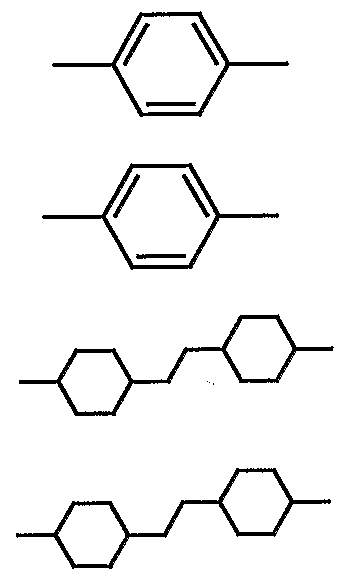
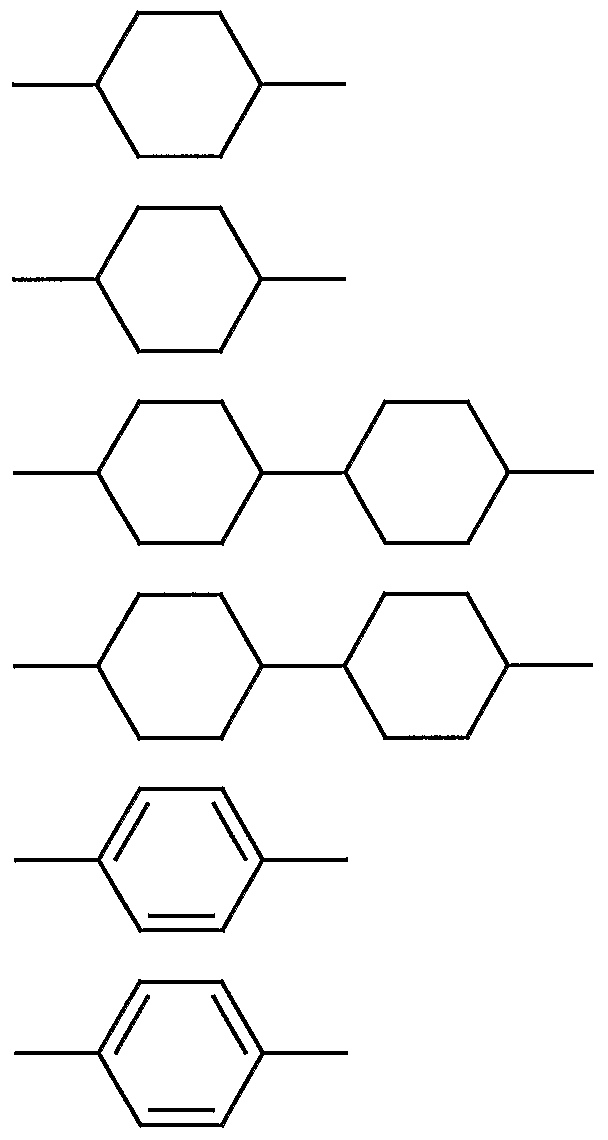
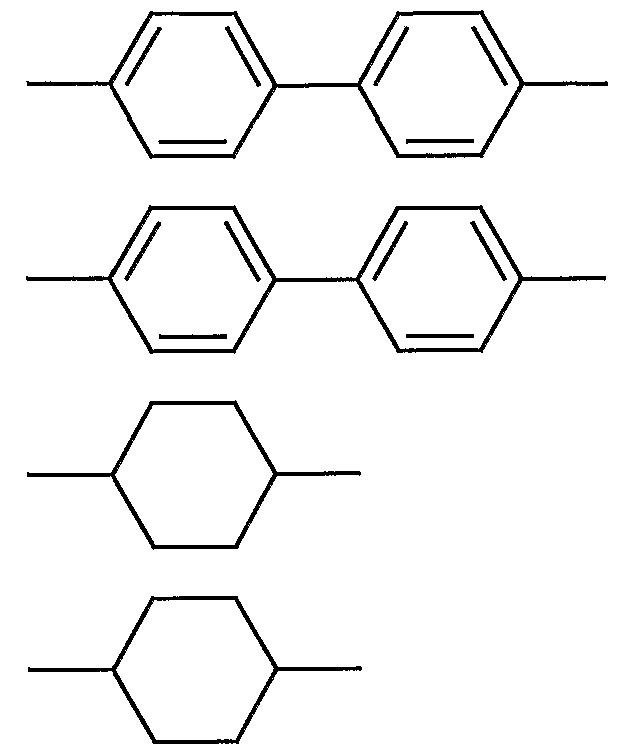
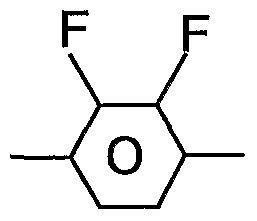
- A are each, independently of one another, preferably optionally substituted 1,4-phenylene, optionally substituted 1,4-cyclohexylene, in which -CH 2 - can be replaced once or twice by -O-, or optionally substituted 1,4-cyclohexenylene.
- A are particularly preferably each independently of the other
- R, Y and V in the general formulas (Ia) and (Ib) can each independently be an alkyl radical and / or an alkoxy radical having 1 to 15 carbon atoms, which can be straight-chain or branched. It is preferably straight-chain, has 1, 2, 3, 4, 5, 6 or 7 carbon atoms and is accordingly adds methyl, ethyl, propyl, butyl, pentyl, hexyl, heptyl, methoxy, ethoxy, propoxy, butoxy, pentoxy, hexoxy or heptoxy.
- R, Y and W can each independently be an alkenyl radical with 2-15 C atoms, which can be straight-chain or branched. It is preferably straight-chain and has 2 to 7 carbon atoms. Accordingly, it is in particular vinyl, prop-1 - or prop-2-enyl, but-1-, 2- or but-3-enyl, pent-1 -, 2-, 3- or pent-4-enyl, hex -1 -, 2-, 3-, 4- or hex-5-enyl, hept-1 -, 2-, 3-, 4-, 5- or hept-6-enyl.
- R, Y and V can each independently be an alkyl radical having 1 to 15 carbon atoms, in which one CH 2 group is replaced by -O- and one by -CO-, these preferably being adjacent. Thus, this contains an acyloxy group -CO-O- or an oxycarbonyl group -O-CO-. These are preferably straight-chain and have 2 to 6 carbon atoms.
- R, Y and V can each be, independently of one another, an alkyl radical having 1 to 15 carbon atoms or substituted by -CN or -CF 3, or an alkenyl radical having 2 to 15 carbon atoms, these preferably being straight-chain.
- the substitution by -CN or -CF 3 is in any position.
- R, Y and V can each independently be an at least monosubstituted alkyl radical having 1 to 15 carbon atoms or an alkenyl radical having 2 to 15 carbon atoms, these radicals preferably being straight-chain and halogen preferably -F or -Cl is. With multiple subs halogen is preferably stitution -F.
- the resulting residues also include perfluorinated residues. In the case of single substitution, the fluorine or chlorine substituent can be in any position, preferably in the ⁇ position.
- R, Y and V can each independently be an alkyl radical in which two or more CH 2 groups have been replaced by -O- and / or -CO-O-, which can be straight-chain or branched. It is preferably branched and has 3 to 12 carbon atoms.
- R, Y and V in the general formulas (Ia) and (Ib) are preferably hydrogen or an alkyl radical, alkoxy radical or alkenyl radical having 1 to 7 or 2 to 7 C atoms.
- Y is additionally preferably -F or -Cl, in particular -F.
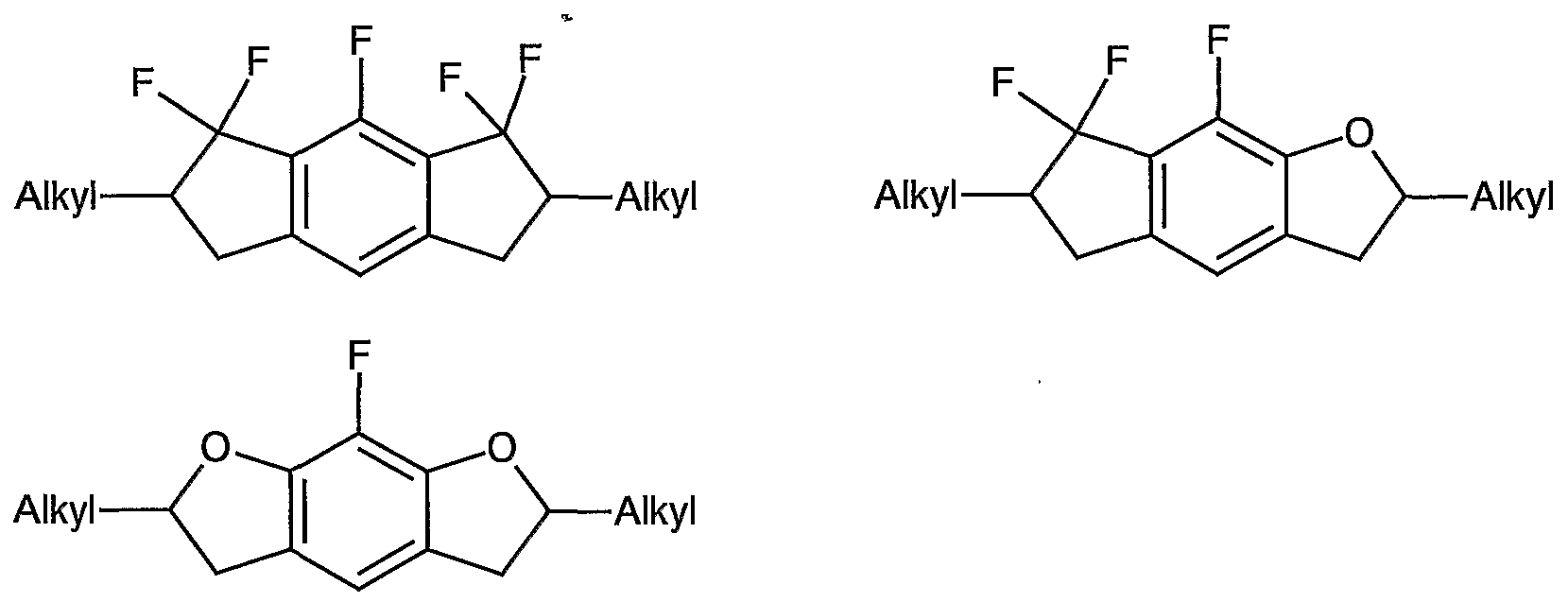
- Preferred indanes of the general formula (Ia) or (Ib) have one or two cyclene A.
- the compounds have a negative ⁇ "and are therefore suitable for use in VA-TFT displays. They show very good compatibility with the usual substances used in liquid crystal mixtures for displays.
- the substituents X and W in the indane skeleton generate a dipole moment perpendicular to the longitudinal axis of the molecule, which can optionally be further strengthened by suitable substituents in the wing units ZAZAR.
- the compounds of the formulas (la) and (Ib) align with their longitudinal axis perpendicular to the glass surface of a display.
- n-alkyl H n-alkyl
- n-alkyl -0-CH 2 - n-alkyl
- n-alkyl H n-alkyl
- n-alkyl "CH 2 -CH 2 - -On-alkyl n-alkyl ⁇ J ⁇ ⁇ ) ⁇ H
- n-alkyl H n-alkyl
- the compounds of the formula (Ia) and (Ib) are prepared by methods known per se, as described in the literature (for example in the standard works such as Houben-Weyl, Methods of Organic Chemistry, Georg-Thieme-Verlag, Stuttgart) and under reaction conditions that are known and suitable for the reactions mentioned. Use can be made of variants which are known per se and are not mentioned here in detail. If desired, the starting materials can also be formed in situ in such a way that they are not isolated from the reaction mixture, but instead are immediately reacted further to give the compounds of the formula (I) or (Ib).
- compound C is obtained by reaction with the ⁇ , ⁇ -unsaturated aldehyde B in the presence of lithium diisopropylamide. This reacts with palladium catalysis in the presence of triethylamine with ring closure to form indanone D.
- the difluoro compound E is obtained by fluorination with a suitable fluorinating agent, such as DAST or SF 4 , from which, if appropriate, hydrogen fluoride can then be split off with a strong base such as potassium tert-butoxide Preparation of the compound F.
- a trifluoromethyl group can be introduced into the molecule by reaction with F 3 CSi (CH 3 ) 3 and subsequent treatment with KF / CH 3 OH (G). The mixture is then dehydrated with SOCl 2 / pyridine to give the compound H.
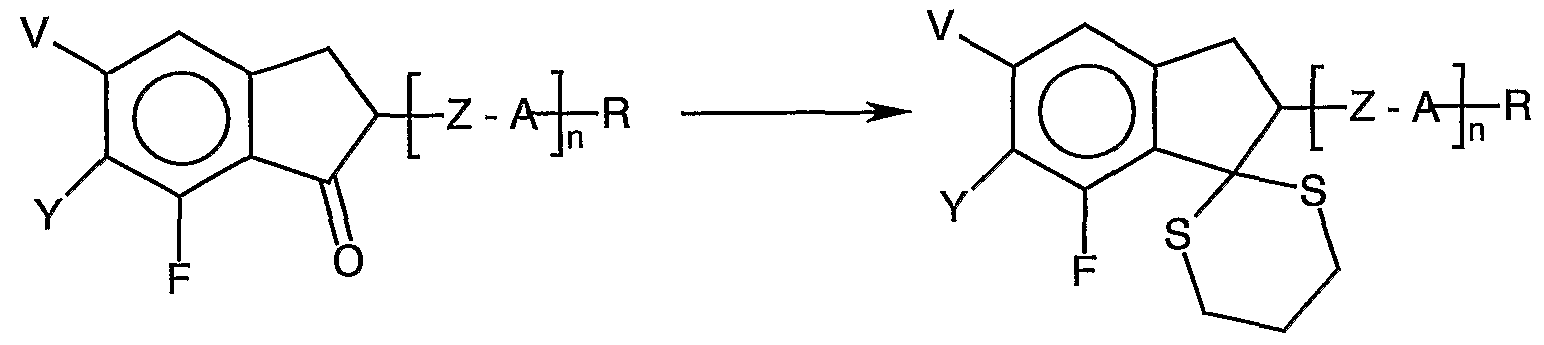
- the indanon D can also be implemented further according to Fig. 2a.
- the keto compound D " is reacted with propane-1, 3-dithiol to give the cyclic thiocetal E '.
- the end product H' is obtained from this with HF pyridine in the presence of dibromodimethylhydantoin, but to some extent also the bromide F
- the mixture is treated with base to cleave HBr from the compound F 'to give the compound G'.
- the compound G ' is then hydrogenated in the mixture of G' and H "to give the final product H '.
- Fig. 3 shows further possibilities for the formation of the indane scaffold.
- Fig. 3 Starting from the suitably substituted iodobenzene derivative J, deprotonation is first carried out at low temperature with a strong base, such as LDA, and then with a suitable acrolein derivative to give the alcohol K implemented. The ring closure to connection L is then carried out by Heck reaction.
- a strong base such as LDA
- Benzofurans and dihydrobenzofurans according to the invention can be prepared according to the general reaction sequence shown in FIG. 4.
- an iodine group is first introduced by reaction with iodine under the action of a weak base to obtain the compound N. This is followed by ring closure by reaction with a suitable acetylene derivative with catalysis by a palladium (II) compound, such as palladium (II) acetate to give the benzofuran derivative O. This can then be hydrogenated by catalytic hydrogenation on palladium / carbon to give the dihydrobenzofuran derivative P.
- a palladium (II) compound such as palladium (II) acetate
- Indacenes according to the invention can be obtained according to the reaction sequence shown in Fig. 5.
- the compound S is obtained by reaction with the unsaturated aldehyde R in the presence of lithium diisopropylamide. This reacts with palladium catalysis in the presence of triethylamine with ring closure to give indanone T. After ketalization of the keto group with ethylene glycol in the presence of toluenesulfonic acid, this process is repeated with the unsaturated aldehyde V and indacen X is thus obtained. After removing the protective group with the aid of an acid, the diketone Y is obtained, which can be converted to the end product Z using suitable fluorinating agents such as SF 4 .
- suitable fluorinating agents such as SF 4 .
- the compounds of the formulas (Ia) and (Ib) can be used to prepare liquid-crystalline mixtures.
- the invention therefore also relates to a liquid-crystalline medium with at least two liquid-crystalline compounds, comprising at least one compound of the formulas (Ia) and (Ib).
- the present invention also relates to liquid-crystalline media comprising, in addition to one or more compounds of the formulas (Ia) and / or (Ib) as further constituents, 2 to 40, in particular 4 to 30, components. These media very particularly preferably contain 7 to 25 components in addition to one or more compounds according to the invention.
- nematic or nematogenic (monotropic or isotropic) substances are preferably selected from nematic or nematogenic (monotropic or isotropic) substances, in particular substances from the classes of azoxy benzenes, benzylidene anilines, biphenyls, terphenyls, phenyl- or cyclohexylbenzoates, cyclohexanecarboxylic acid phenyl- or -cyclohexyl esters, phenyl- or cyclohexyl esters of cyclohexylbenzoic acid, phenyl- or cyclohexyl esters of cyclohexylcyclohexanoic acid, cyclohexylhexanoic acid or cyclohexylphenylcarboxylic acids, , Phenylcyclohexanes, cyclohexylbiphenyls, phenylcyclohex
- L and E which may be the same or different, each independently represent a bivalent radical from the group consisting of -Phe-, - Cyc-, -Phe-Phe-, -Phe-Cyc-,
- one of the residues L and E is Cyc or Phe.
- E is preferably Cyc, Phe or Phe-Cyc.
- the media according to the invention preferably contain one or more components selected from the compounds of the formulas (II), (III), (IV), (V) and (VI), in which L and E are selected from the group Cyc and Phe and simultaneously one or more components selected from the compounds of the formulas (II), (IM), (IV), (V) and (VI), in which one of the radicals L and E is selected from the group Cyc and Phe and the other radical is selected from the group -Phe-Phe-, -Phe-Cyc-, -Cyc-Cyc-, -G-Phe- and -G-Cyc-, and optionally one or more components selected from the compounds of the formulas (II) , (III), (IV), (V) and (VI), in which the radicals L and E are selected from the group -Phe-Cyc-,
- R "and R” each independently represent alkyl, alkenyl, alkoxy, alkoxyalkyl, alkenyloxy or alkanoyloxy with up to 8 carbon atoms.
- this smaller subgroup is called group A and the compounds are designated with the sub-formulas (Ha), (purple), (IVa), (Va) and (Via).
- R 'and R “have the same values as in the compounds of the sub-formulas (Ha) to ( Via) indicated meaning and are preferably alkyl, alkenyl, alkoxy or alkoxyalkyl.
- the media according to the invention preferably contain one or more compounds which are selected from group A and / or group B and / or group C.
- the mass fractions of the compounds from these groups the media according to the invention are preferred
- Group A 0 to 90%, preferably 20 to 90%, in particular 30 to 90%
- Group B 0 to 80%, preferably 10 to 80%, in particular 10 to 70%
- Group C 0 to 80%, preferably 5 to 80 %, especially 5 to 50%
- the sum of the mass fractions of the compounds from groups A and / or B and / or C contained in the respective media according to the invention is preferably 5 to 90% and in particular 10 to 90%.
- the media according to the invention preferably contain 1 to 40%, particularly preferably 5 to 30%, of compounds of the formulas (Ia) and / or (Ib) according to the invention. Also preferred are media containing more than 40%, in particular 45 to 90%, of compounds of the formulas (Ia) and / or (Ib) according to the invention.
- the media preferably contain three, four or five compounds of the formulas (Ia) and / or (Ib) according to the invention. Examples of the compounds of the formulas (II), (III), (IV), (V) and (VI) are the compounds listed below:
- the media according to the invention are produced in a conventional manner.
- the components are dissolved in one another, expediently at elevated temperature.
- the liquid-crystalline phases according to the invention can be modified such that they can be used in all types of liquid-crystal display elements which have hitherto become known.
- Such additives are known to the person skilled in the art and are described in detail in the literature (H. Kelker / R. Hatz, Handbook of Liquid Crystals, Verlag Chemie, Weinheim, 1980).
- pleochroic dyes for the production of colored guest-host systems or substances for changing the dielectric anisotropy, the viscosity and / or the orientation of the nematic phases can be added.
- the compounds of the formula (I) are suitable for use in VA-TFT displays.
- the invention therefore also relates to an electro-optical liquid crystal display comprising a liquid crystalline medium according to the invention.
- the invention is explained in more detail by means of examples:
- the compound can be converted to the dihydrobenzofuran by hydrogenation at normal pressure using palladium on carbon (10%).
- Kp means the clearing point
- ⁇ n the dielectric anisotropy
- ⁇ n the birefringence
- V ⁇ rotational viscosity [mPa s] (at 20 ° C, unless otherwise stated)
- the display used to measure the capacitive threshold voltage has two plane-parallel carrier plates at a distance of 20 dm and electrode layers with overlying orientation layers made of rubbed polyimide on the inside of the carrier plates, which bring about a homotropic edge orientation of the liquid crystal molecules.
- the polymerizable compounds are polymerized in the display by UV radiation with a strength of 28 mW / cm 2 and a duration of about 2 minutes, with a voltage of 10 V being applied to the display at the same time.
Landscapes
- Chemical & Material Sciences (AREA)
- Organic Chemistry (AREA)
- Chemical Kinetics & Catalysis (AREA)
- Crystallography & Structural Chemistry (AREA)
- Engineering & Computer Science (AREA)
- Materials Engineering (AREA)
- Organic Low-Molecular-Weight Compounds And Preparation Thereof (AREA)
- Liquid Crystal Substances (AREA)
- Furan Compounds (AREA)
- Heterocyclic Carbon Compounds Containing A Hetero Ring Having Oxygen Or Sulfur (AREA)
Abstract
Description
















Claims


Priority Applications (6)
| Application Number | Priority Date | Filing Date | Title |
|---|---|---|---|
| DE50214010T DE50214010D1 (de) | 2001-07-20 | 2002-07-19 | Indanverbindungen mit negativer dielektrischer anisotropie |
| EP02767236A EP1409441B1 (de) | 2001-07-20 | 2002-07-19 | Indanverbindungen mit negativer dielektrischer anisotropie |
| AT02767236T ATE449053T1 (de) | 2001-07-20 | 2002-07-19 | Indanverbindungen mit negativer dielektrischer anisotropie |
| JP2003515482A JP4410556B2 (ja) | 2001-07-20 | 2002-07-19 | 負の誘電異方性を有するインダン化合物 |
| US10/484,193 US7122228B2 (en) | 2001-07-20 | 2002-07-19 | Compound having negative Δε |
| KR1020047000880A KR100884117B1 (ko) | 2001-07-20 | 2002-07-19 | 음의 유전 이방성을 갖는 인단 화합물 |
Applications Claiming Priority (2)
| Application Number | Priority Date | Filing Date | Title |
|---|---|---|---|
| DE10135499A DE10135499A1 (de) | 2001-07-20 | 2001-07-20 | Indanverbindungen mit negativem Delta-epsilon |
| DE10135499.1 | 2001-07-20 |
Publications (1)
| Publication Number | Publication Date |
|---|---|
| WO2003010120A1 true WO2003010120A1 (de) | 2003-02-06 |
Family
ID=7692570
Family Applications (1)
| Application Number | Title | Priority Date | Filing Date |
|---|---|---|---|
| PCT/EP2002/008085 Ceased WO2003010120A1 (de) | 2001-07-20 | 2002-07-19 | Indanverbindungen mit negativem dielektrischer anisotropie |
Country Status (9)
| Country | Link |
|---|---|
| US (1) | US7122228B2 (de) |
| EP (1) | EP1409441B1 (de) |
| JP (1) | JP4410556B2 (de) |
| KR (1) | KR100884117B1 (de) |
| CN (1) | CN100532340C (de) |
| AT (1) | ATE449053T1 (de) |
| DE (2) | DE10135499A1 (de) |
| TW (1) | TWI243810B (de) |
| WO (1) | WO2003010120A1 (de) |
Cited By (14)
| Publication number | Priority date | Publication date | Assignee | Title |
|---|---|---|---|---|
| WO2004048500A1 (de) * | 2002-11-22 | 2004-06-10 | Merck Patent Gmbh | Flüssigkristallines medium |
| JP2005035986A (ja) * | 2003-06-23 | 2005-02-10 | Chisso Corp | クロマン化合物、この化合物を含有する液晶組成物およびこの液晶組成物を含有する液晶表示素子 |
| DE10341154A1 (de) * | 2003-09-06 | 2005-03-31 | Nematel Gmbh & Co. Kg | Tricyclische Fluorverbindungen und flüssigkristallines Medium |
| JP2005097259A (ja) * | 2003-08-01 | 2005-04-14 | Clariant Internatl Ltd | フッ素化複素環式化合物および液晶混合物におけるこれらの使用 |
| JP2005097258A (ja) * | 2003-08-01 | 2005-04-14 | Clariant Internatl Ltd | フッ素化多環式化合物および液晶混合物におけるこれらの使用 |
| WO2005037957A1 (de) * | 2003-10-17 | 2005-04-28 | Merck Patent Gmbh | Flüssigkristallines medium enthaltend fluorierte indanverbindung |
| WO2005103799A1 (de) | 2004-04-26 | 2005-11-03 | Merck Patent Gmbh | As-indacenderivate |
| WO2007009636A1 (de) * | 2005-07-20 | 2007-01-25 | Merck Patent Gmbh | S-indacen- und indeno[5,6-d][1,3]dioxol-derivate und deren verwendung als komponente flüssigkristalliner mischungen |
| DE102008006875A1 (de) | 2007-02-13 | 2008-08-14 | Merck Patent Gmbh | Flüssigkristallines Medium |
| DE102011120112A1 (de) | 2010-12-17 | 2012-06-21 | Merck Patent Gmbh | Flüssigkristallines Medium |
| EP3103856A3 (de) * | 2015-06-12 | 2017-04-05 | Samsung Display Co., Ltd. | Flüssigkristallzusammensetzung und flüssigkristallanzeigevorrichtung damit |
| US10119074B2 (en) | 2016-09-27 | 2018-11-06 | Samsung Display Co., Ltd. | Liquid crystal composition and display device including the same |
| EP4417730A1 (de) | 2023-02-16 | 2024-08-21 | KHS GmbH | Vorrichtung und verfahren zur versorgung einer anlage zur beschichtung von werkstücken mit für den beschichtungsprozess benötigten prozessgasen |
| DE102023123287A1 (de) | 2023-08-30 | 2025-03-06 | Khs Gmbh | Verfahren und Vorrichtung zur Versorgung einer Anlage zur Beschichtung von Werkstücken mit für den Beschichtungsprozess benötigten Prozessgasen |
Families Citing this family (31)
| Publication number | Priority date | Publication date | Assignee | Title |
|---|---|---|---|---|
| DE10214938A1 (de) * | 2002-04-04 | 2003-10-16 | Merck Patent Gmbh | Fluorierte Indene und 1,7-Dihydroindacene mit negativem delta epsilon |
| KR100526402B1 (ko) * | 2002-11-22 | 2005-11-08 | 주식회사 엘지화학 | 고리형 올레핀계 부가 중합체를 포함하는 네가티브C-플레이트(negative C-plate)형 광학이방성 필름 및 이의 제조방법 |
| US20080143896A1 (en) * | 2003-05-06 | 2008-06-19 | Electronically Shaded Glass, Inc. | Window shading system |
| US7356969B1 (en) | 2003-05-06 | 2008-04-15 | Electronically Shaded Glass, Inc. | Electronically shaded thin film transparent monochromatic liquid crystal display laminated window shading system |
| CN1989225B (zh) * | 2004-07-02 | 2012-07-11 | 默克专利股份有限公司 | 液晶介质和包含该液晶介质的电光学显示器 |
| US8025935B2 (en) * | 2005-08-09 | 2011-09-27 | Merck Patent Gmbh | Liquid-crystalline medium |
| US8801966B2 (en) | 2008-02-08 | 2014-08-12 | Vvi Bright China Ltd. | Liquid crystals comprising cyclopentane groups |
| DE102009011666B4 (de) | 2008-03-17 | 2018-12-27 | Merck Patent Gmbh | Flüssigkristallines Medium und seine Verwendung |
| KR20110005272A (ko) | 2008-04-22 | 2011-01-17 | 메르크 파텐트 게엠베하 | 액정 매질 |
| CN102408896B (zh) * | 2010-09-21 | 2013-06-05 | 达兴材料股份有限公司 | 液晶化合物与液晶混合物 |
| CN102477305B (zh) * | 2010-11-25 | 2013-10-23 | 达兴材料股份有限公司 | 液晶化合物与液晶混合物 |
| CN103131426B (zh) * | 2011-11-25 | 2014-08-20 | 达兴材料股份有限公司 | 液晶化合物以及液晶介质 |
| CN103058836B (zh) * | 2012-01-18 | 2015-06-17 | 石家庄诚志永华显示材料有限公司 | 含有茚满和二氟亚甲氧基桥的液晶化合物及其制备方法与应用 |
| CN102690167B (zh) * | 2012-06-14 | 2014-10-22 | 江苏和成显示科技股份有限公司 | 含饱和茚环类的液晶化合物及其组合物 |
| CN102795974B (zh) * | 2012-07-31 | 2015-03-04 | 江苏和成显示科技股份有限公司 | 液晶介质及液晶组合物 |
| CN103058947B (zh) * | 2012-12-24 | 2015-07-29 | 石家庄诚志永华显示材料有限公司 | 含有苯并噁唑和二氟亚甲氧基桥的液晶化合物及其制备方法与应用 |
| CN103102887B (zh) * | 2013-02-06 | 2014-09-10 | 江苏和成显示科技股份有限公司 | 一种苯并呋喃类衍生物液晶化合物及其组合物和应用 |
| CN103194242A (zh) * | 2013-04-16 | 2013-07-10 | 石家庄诚志永华显示材料有限公司 | 含有氘的液晶化合物及其制备方法与应用 |
| CN103897708B (zh) * | 2014-03-13 | 2016-08-24 | 石家庄诚志永华显示材料有限公司 | 一种正介电各向异性液晶组合物 |
| CN105085151B (zh) * | 2014-05-12 | 2017-02-15 | 江苏和成新材料有限公司 | 含烯键类的茚环化合物及其制备方法和应用 |
| CN105331371B (zh) * | 2014-07-22 | 2017-10-24 | 江苏和成显示科技股份有限公司 | 负性液晶组合物及其应用 |
| CN105331370B (zh) * | 2014-07-22 | 2017-10-24 | 江苏和成显示科技股份有限公司 | 负性液晶组合物及其应用 |
| US10308871B2 (en) * | 2015-02-19 | 2019-06-04 | Jnc Corporation | Liquid crystal compound having benzothiophene, liquid crystal composition and liquid crystal display device |
| CN106398716B (zh) * | 2016-08-30 | 2018-05-22 | 北京燕化集联光电技术有限公司 | 一种4,5-二氟-7-甲基茚满类液晶化合物及其制备方法与应用 |
| CN106398720B (zh) * | 2016-08-31 | 2018-05-22 | 北京云基科技有限公司 | 一种液晶介质及其应用 |
| KR20180000838U (ko) | 2016-09-19 | 2018-03-28 | 조은별 | 공기 순환장치 |
| TWI613277B (zh) * | 2016-11-02 | 2018-02-01 | Daxin Materials Corporation | 液晶化合物、液晶組成物及使用此液晶化合物的液晶顯示裝置 |
| CN108690640B (zh) * | 2018-07-17 | 2022-02-25 | 烟台显华化工科技有限公司 | 一种含茚环的化合物及液晶介质 |
| CN109762577B (zh) * | 2019-02-12 | 2021-11-23 | 西安近代化学研究所 | 一种基于环戊烷并苯并呋喃骨架的液晶化合物、组合物及化合物制备方法 |
| CN111218290A (zh) * | 2019-12-27 | 2020-06-02 | Tcl华星光电技术有限公司 | 液晶分子与液晶显示面板 |
| CN112538006B (zh) * | 2020-12-25 | 2023-08-22 | 阜阳欣奕华材料科技有限公司 | 化合物、液晶组合物以及显示装置 |
Citations (7)
| Publication number | Priority date | Publication date | Assignee | Title |
|---|---|---|---|---|
| DE279864C (de) * | ||||
| US2447099A (en) * | 1944-08-23 | 1948-08-17 | Hoffmann La Roche | 2-phenylindene derivatives and process for the manufacture of same |
| DE4303634A1 (de) * | 1993-02-09 | 1994-08-11 | Merck Patent Gmbh | Indan-Derivate |
| JPH08157463A (ja) * | 1994-11-30 | 1996-06-18 | Canon Inc | 液晶性化合物、それを含有する液晶組成物、それを有する液晶素子及びそれらを用いた表示方法、液晶装置 |
| JPH08169883A (ja) * | 1994-09-28 | 1996-07-02 | Dainippon Ink & Chem Inc | 光学活性なジヒドロベンゾフラン誘導体とその製造中間体及びこれを含む液晶組成物 |
| DE19900517A1 (de) * | 1998-01-19 | 1999-07-22 | Merck Patent Gmbh | 2,3-Dihydro-6,7-difluorbenzofuran-Derivate |
| DE19909761A1 (de) * | 1998-04-17 | 1999-10-21 | Merck Patent Gmbh | Benzofuran- und Benzodifuran-Derivate |
Family Cites Families (4)
| Publication number | Priority date | Publication date | Assignee | Title |
|---|---|---|---|---|
| JPS6163671A (ja) * | 1984-09-05 | 1986-04-01 | Shionogi & Co Ltd | 2,3−ジヒドロベンゾフラン−5−スルホンアミド誘導体および降圧利尿剤 |
| DE19840447B4 (de) * | 1998-09-04 | 2010-09-30 | Merck Patent Gmbh | Fluorierte Derivate des Indans und ihre Verwendung in flüssigkristallinen Mischungen |
| KR100843876B1 (ko) * | 2000-12-06 | 2008-07-03 | 메르크 파텐트 게엠베하 | 액정 매질 |
| DE10214938A1 (de) * | 2002-04-04 | 2003-10-16 | Merck Patent Gmbh | Fluorierte Indene und 1,7-Dihydroindacene mit negativem delta epsilon |
-
2001
- 2001-07-20 DE DE10135499A patent/DE10135499A1/de not_active Ceased
-
2002
- 2002-07-18 TW TW091116042A patent/TWI243810B/zh not_active IP Right Cessation
- 2002-07-19 CN CNB028093909A patent/CN100532340C/zh not_active Expired - Lifetime
- 2002-07-19 DE DE50214010T patent/DE50214010D1/de not_active Expired - Lifetime
- 2002-07-19 KR KR1020047000880A patent/KR100884117B1/ko not_active Expired - Fee Related
- 2002-07-19 AT AT02767236T patent/ATE449053T1/de not_active IP Right Cessation
- 2002-07-19 JP JP2003515482A patent/JP4410556B2/ja not_active Expired - Fee Related
- 2002-07-19 EP EP02767236A patent/EP1409441B1/de not_active Expired - Lifetime
- 2002-07-19 WO PCT/EP2002/008085 patent/WO2003010120A1/de not_active Ceased
- 2002-07-19 US US10/484,193 patent/US7122228B2/en not_active Expired - Lifetime
Patent Citations (7)
| Publication number | Priority date | Publication date | Assignee | Title |
|---|---|---|---|---|
| DE279864C (de) * | ||||
| US2447099A (en) * | 1944-08-23 | 1948-08-17 | Hoffmann La Roche | 2-phenylindene derivatives and process for the manufacture of same |
| DE4303634A1 (de) * | 1993-02-09 | 1994-08-11 | Merck Patent Gmbh | Indan-Derivate |
| JPH08169883A (ja) * | 1994-09-28 | 1996-07-02 | Dainippon Ink & Chem Inc | 光学活性なジヒドロベンゾフラン誘導体とその製造中間体及びこれを含む液晶組成物 |
| JPH08157463A (ja) * | 1994-11-30 | 1996-06-18 | Canon Inc | 液晶性化合物、それを含有する液晶組成物、それを有する液晶素子及びそれらを用いた表示方法、液晶装置 |
| DE19900517A1 (de) * | 1998-01-19 | 1999-07-22 | Merck Patent Gmbh | 2,3-Dihydro-6,7-difluorbenzofuran-Derivate |
| DE19909761A1 (de) * | 1998-04-17 | 1999-10-21 | Merck Patent Gmbh | Benzofuran- und Benzodifuran-Derivate |
Non-Patent Citations (11)
| Title |
|---|
| BAVIN P M G ET AL: "COMPOUNDS AFFECTING THE CENTRAL NERVOUS SYSTEM. V. SUBSTITUTED 3-DIALKYLAMINOALKYLINDENES", JOURNAL OF MEDICINAL CHEMISTRY, AMERICAN CHEMICAL SOCIETY. WASHINGTON, US, vol. 12, no. 3, 1 May 1969 (1969-05-01), pages 513 - 516, XP002020326, ISSN: 0022-2623 * |
| BICKERT, P. ET AL.: "Phane des 1,5- und 1,7-Dihydro-s-indacens", ANGEW. CHEM., vol. 94, no. 4, 1982, pages 308, XP009000469 * |
| GATES B D ET AL: "MECHANISTIC ASPECTS AND SYNTHETIC APPLICATIONS OF THE ELECTROCHEMICAL AND IODOBENZENE BIS(TRIFLUOROACETATE) OXIDATIVE 1,3-CYCLOADDITIONS OF PHENOLS AND ELECTRON-RICH STYRENE DERIVATIVES", JOURNAL OF ORGANIC CHEMISTRY, AMERICAN CHEMICAL SOCIETY. EASTON, US, vol. 57, 1992, pages 2135 - 2143, XP002934710, ISSN: 0022-3263 * |
| GREIFENSTEIN L G ET AL: "Response of Acidity and Magnetic Resonance Properties to Aryl Substitution in Carbon Acids and Derived Carbanions: 2- and 3-Arylindenes", JOURNAL OF ORGANIC CHEMISTRY, AMERICAN CHEMICAL SOCIETY. EASTON, US, vol. 25, no. 46, 1981, pages 5125 - 5132, XP002075253, ISSN: 0022-3263 * |
| HURD, C.D. ET AL.: "Directed ring closure in the synthesis of chromans and coumarans from o-allylphenols", J. ORG. CHEM., vol. 5, 1940, pages 212 - 222, XP002220477 * |
| JHA, G. ET AL.: "Synthesis of indeno[2,1-c]isocoumarins & indeno[2,1-c]isoquinolones", INDIAN J. CHEM., vol. 24B, 1985, pages 440 - 444, XP009000459 * |
| LAROCK, R.C. ET AL.: "Palladium-catalyzed heteroannulation of 1,3-dienes by functionally substituted aryl halides", J. ORG. CHEM., vol. 55, no. 11, 1990, pages 3447 - 3450, XP002220478 * |
| LEDNICER, D. ET AL.: "Mammalian antifertility agents. I. Derivatives of 2,3-diphenylindenes", J. MED. CHEM., vol. 8, 1965, pages 52 - 57, XP002220475 * |
| RUGGLI, P. ET AL.: "Über die Synthese eines linearen Dioxo-dicyclopenteno-benzols", HELV. CHIM. ACTA, vol. 30, 1947, pages 2048 - 2057, XP009000457 * |
| SUZUKI, T. ET AL.: "Superacid-catalyzed electrocyclization of 1-phenyl-2-propen-1-ones to 1-indanones. Kinetic and theoretical studies of electrocyclization of oxonium-carbenium dications", J. AM. CHEM. SOC., vol. 119, no. 29, 1997, pages 6774 - 6780, XP002220476 * |
| WATANABE M ET AL: "A REGIOSELECTIVE LITHIATION OF ORTHO-CRESOLS USING THE BIS (DIMETHYLAMINO)PHOSPHORYL GROUP AS A DIRECTING GROUP: GENERAL SYNTHESIS OF 2,3-DIHYDROBENZO[B]FURANS INCLUDING NATURALLY OCCURRING NEOLIGNANS", CHEMICAL AND PHARMACEUTICAL BULLETIN, PHARMACEUTICAL SOCIETY OF JAPAN. TOKYO, JP, vol. 39, no. 12, December 1991 (1991-12-01), pages 3123 - 3131, XP002934709, ISSN: 0009-2363 * |
Cited By (33)
| Publication number | Priority date | Publication date | Assignee | Title |
|---|---|---|---|---|
| WO2004048500A1 (de) * | 2002-11-22 | 2004-06-10 | Merck Patent Gmbh | Flüssigkristallines medium |
| EP1876215A3 (de) * | 2002-11-22 | 2008-12-17 | Merck Patent GmbH | Flüssigkristallines Medium |
| EP1876214A3 (de) * | 2002-11-22 | 2008-06-18 | Merck Patent GmbH | Flüssigkristallines Medium |
| US7335403B2 (en) | 2002-11-22 | 2008-02-26 | Merck Patent Gmbh | Liquid-crystalline medium |
| EP1876214A2 (de) | 2002-11-22 | 2008-01-09 | Merck Patent GmbH | Flüssigkristallines Medium |
| JP2005035986A (ja) * | 2003-06-23 | 2005-02-10 | Chisso Corp | クロマン化合物、この化合物を含有する液晶組成物およびこの液晶組成物を含有する液晶表示素子 |
| US7026021B2 (en) | 2003-08-01 | 2006-04-11 | Merck Patent Gmbh | Fluorinated heterocycles and their use in liquid-crystal mixtures |
| US6955838B2 (en) | 2003-08-01 | 2005-10-18 | Clariant International Ltd. | Fluorinated polycycles and their use in liquid-crystal mixtures |
| JP2005097258A (ja) * | 2003-08-01 | 2005-04-14 | Clariant Internatl Ltd | フッ素化多環式化合物および液晶混合物におけるこれらの使用 |
| JP2005097259A (ja) * | 2003-08-01 | 2005-04-14 | Clariant Internatl Ltd | フッ素化複素環式化合物および液晶混合物におけるこれらの使用 |
| DE10341154B4 (de) * | 2003-09-06 | 2012-05-16 | Nematel Gmbh & Co. Kg | Tricyclische Fluorverbindungen, flüssigkristallines Medium sowie dessen Verwendung |
| DE10341154A1 (de) * | 2003-09-06 | 2005-03-31 | Nematel Gmbh & Co. Kg | Tricyclische Fluorverbindungen und flüssigkristallines Medium |
| KR101240853B1 (ko) * | 2003-10-17 | 2013-03-07 | 메르크 파텐트 게엠베하 | 플루오르화된 인데인 화합물을 포함하는 액정 매질 |
| JP2007510010A (ja) * | 2003-10-17 | 2007-04-19 | メルク パテント ゲゼルシャフト ミット ベシュレンクテル ハフトング | フッ素化されたインダン化合物を含む液晶媒体 |
| WO2005037957A1 (de) * | 2003-10-17 | 2005-04-28 | Merck Patent Gmbh | Flüssigkristallines medium enthaltend fluorierte indanverbindung |
| TWI386481B (zh) * | 2003-10-17 | 2013-02-21 | Merck Patent Gmbh | 液晶介質 |
| US7704567B2 (en) | 2003-10-17 | 2010-04-27 | Merck Patent Gmbh | Liquid-crystalline medium comprising fluorinated indane compound |
| WO2005103799A1 (de) | 2004-04-26 | 2005-11-03 | Merck Patent Gmbh | As-indacenderivate |
| US7517471B2 (en) | 2004-04-26 | 2009-04-14 | Merck Patent Gmbh | As-indacen derivatives |
| US7922934B2 (en) | 2005-07-20 | 2011-04-12 | Merck Patent Gesellschaft Mit Beschrankter Haftung | s-Indacene and indeno[5,6-d][1,3]dioxol-derivatives and use thereof as components of liquid-crystal mixtures |
| WO2007009636A1 (de) * | 2005-07-20 | 2007-01-25 | Merck Patent Gmbh | S-indacen- und indeno[5,6-d][1,3]dioxol-derivate und deren verwendung als komponente flüssigkristalliner mischungen |
| KR101287242B1 (ko) | 2005-07-20 | 2013-07-17 | 메르크 파텐트 게엠베하 | S-인다센 및 인데노[5,6-d]-1,3-다이옥솔 유도체, 및 액정 혼합물의 성분으로서의 그의 용도 |
| EP1958999A1 (de) | 2007-02-13 | 2008-08-20 | MERCK PATENT GmbH | Flüssigkristallines Medium |
| DE102008006875A1 (de) | 2007-02-13 | 2008-08-14 | Merck Patent Gmbh | Flüssigkristallines Medium |
| DE102011120112A1 (de) | 2010-12-17 | 2012-06-21 | Merck Patent Gmbh | Flüssigkristallines Medium |
| WO2012079710A1 (de) | 2010-12-17 | 2012-06-21 | Merck Patent Gmbh | Flüssigkristallines medium |
| EP3103856A3 (de) * | 2015-06-12 | 2017-04-05 | Samsung Display Co., Ltd. | Flüssigkristallzusammensetzung und flüssigkristallanzeigevorrichtung damit |
| US9902905B2 (en) | 2015-06-12 | 2018-02-27 | Samsung Display Co., Ltd. | Liquid crystal composition and liquid crystal display including the same |
| US10119074B2 (en) | 2016-09-27 | 2018-11-06 | Samsung Display Co., Ltd. | Liquid crystal composition and display device including the same |
| EP4417730A1 (de) | 2023-02-16 | 2024-08-21 | KHS GmbH | Vorrichtung und verfahren zur versorgung einer anlage zur beschichtung von werkstücken mit für den beschichtungsprozess benötigten prozessgasen |
| DE102023103802A1 (de) | 2023-02-16 | 2024-08-22 | Khs Gmbh | Vorrichtung und Verfahren zur Versorgung einer Anlage zur Beschichtung von Werkstücken mit für den Beschichtungsprozess benötigten Prozessgasen |
| DE102023123287A1 (de) | 2023-08-30 | 2025-03-06 | Khs Gmbh | Verfahren und Vorrichtung zur Versorgung einer Anlage zur Beschichtung von Werkstücken mit für den Beschichtungsprozess benötigten Prozessgasen |
| EP4530370A1 (de) | 2023-08-30 | 2025-04-02 | KHS GmbH | Verfahren und vorrichtung zur versorgung einer anlage zur beschichtung von werkstücken mit für den beschichtungsprozess benötigten prozessgasen |
Also Published As
| Publication number | Publication date |
|---|---|
| KR20040030824A (ko) | 2004-04-09 |
| CN1507427A (zh) | 2004-06-23 |
| EP1409441B1 (de) | 2009-11-18 |
| DE10135499A1 (de) | 2003-01-30 |
| CN100532340C (zh) | 2009-08-26 |
| EP1409441A1 (de) | 2004-04-21 |
| DE50214010D1 (de) | 2009-12-31 |
| US20040171866A1 (en) | 2004-09-02 |
| JP2004536140A (ja) | 2004-12-02 |
| ATE449053T1 (de) | 2009-12-15 |
| TWI243810B (en) | 2005-11-21 |
| US7122228B2 (en) | 2006-10-17 |
| JP4410556B2 (ja) | 2010-02-03 |
| KR100884117B1 (ko) | 2009-02-17 |
Similar Documents
| Publication | Publication Date | Title |
|---|---|---|
| EP1409441B1 (de) | Indanverbindungen mit negativer dielektrischer anisotropie | |
| EP1742931B1 (de) | Dibenzofuran-, dibenzothiophen- und fluorenderivate als komponenten in flüssigkristallmischungen | |
| EP3085753B1 (de) | Fluorierte dibenzofuran- und dibenzothiophenderivate | |
| EP0441932B1 (de) | Fluorbenzolderivate und flüssigkristallines medium | |
| EP0541793B1 (de) | Vinylverbindungen und flüssigkristallines medium | |
| EP2052055B1 (de) | Cyclohexen-verbindungen für flüssigkristalline mischungen | |
| DE10157674B4 (de) | Alkenylverbindungen mit negativer DK-Anisotropie und flüssigkristallines Medium | |
| EP0462237B1 (de) | 1,4-disubstituierte 2,6-difluorbenzolverbindungen und flüssigkristallines medium | |
| EP1532090B1 (de) | Cyclopenta ¬b naphthalinderivate | |
| DE102004037387B4 (de) | Cyclopenta[a]naphthalinderivate | |
| EP1852429B1 (de) | Hexahydro-dibenzofuranderivate | |
| DE10214938A1 (de) | Fluorierte Indene und 1,7-Dihydroindacene mit negativem delta epsilon | |
| DE19723275A1 (de) | Fluorcyclohexan-Derivate und flüssigkristallines Medium | |
| EP1926798B1 (de) | Cyclobutan- und spiro[3.3]heptanverbindungen | |
| DE19926044A1 (de) | Tolan-Derivate und flüssigkristallines Medium | |
| EP0449015B1 (de) | Difluormethylverbindungen und flüssigkristallines Medium | |
| WO2006012965A1 (de) | Difluorsubstitierte heterocyclische verbindungen und deren verwendung als komponenten in flüssigkristallinen medien | |
| EP1741000B1 (de) | As-indacenderivate mit negativer dielektrischer anisotropie | |
| DE19831712A1 (de) | Fluorcyclohexan-Derivate und flüssigkristallines Medium | |
| DE102008027972B4 (de) | Naphthofuranderivate | |
| DE10238999A1 (de) | Cyclopenta(b)naphthalinderivate | |
| DE4000534C2 (de) | 1,4-Disubstituierte 2,6-Difluorbenzolverbindungen und flüssigkristallines Medium | |
| DE102005016985A1 (de) | as-Indacenderivate | |
| DE4111991A1 (de) | 1,4-disubtituierte 2,6-difluorbenzolverbindungen und fluessigkristallines medium | |
| DE19639781A1 (de) | Annellierte Furan-Derivate |
Legal Events
| Date | Code | Title | Description |
|---|---|---|---|
| AK | Designated states |
Kind code of ref document: A1 Designated state(s): AE AG AL AM AT AU AZ BA BB BG BY BZ CA CH CN CO CR CU CZ DE DM DZ EC EE ES FI GB GD GE GH HR HU ID IL IN IS JP KE KG KP KR LC LK LR LS LT LU LV MA MD MG MN MW MX MZ NO NZ OM PH PL PT RU SD SE SG SI SK SL TJ TM TN TR TZ UA UG US UZ VN YU ZA ZM Kind code of ref document: A1 Designated state(s): AE AG AL AM AT AU AZ BA BB BG BR BY BZ CA CH CN CO CR CU CZ DE DK DM DZ EC EE ES FI GB GD GE GH GM HR HU ID IL IN IS JP KE KG KP KR KZ LC LK LR LS LT LU LV MA MD MG MK MN MW MX MZ NO NZ OM PH PL PT RO RU SD SE SG SI SK SL TJ TM TN TR TT TZ UA UG US UZ VN YU ZA ZM ZW |
|
| AL | Designated countries for regional patents |
Kind code of ref document: A1 Designated state(s): GH GM KE LS MW MZ SD SL SZ UG ZM ZW AM AZ BY KG KZ RU TJ TM AT BE BG CH CY CZ DK EE ES FI FR GB GR IE IT LU MC PT SE SK TR BF BJ CF CG CI GA GN GQ GW ML MR NE SN TD TG Kind code of ref document: A1 Designated state(s): GH GM KE LS MW MZ SD SL SZ TZ UG ZM ZW AM AZ BY KG KZ MD RU TJ TM AT BE BG CH CY CZ DE DK EE ES FI FR GB GR IE IT LU MC NL PT SE SK TR BF BJ CF CG CI CM GA GN GQ GW ML MR NE SN TD TG |
|
| 121 | Ep: the epo has been informed by wipo that ep was designated in this application | ||
| DFPE | Request for preliminary examination filed prior to expiration of 19th month from priority date (pct application filed before 20040101) | ||
| WWE | Wipo information: entry into national phase |
Ref document number: 028093909 Country of ref document: CN |
|
| WWE | Wipo information: entry into national phase |
Ref document number: 1020047000880 Country of ref document: KR |
|
| WWE | Wipo information: entry into national phase |
Ref document number: 10484193 Country of ref document: US Ref document number: 2003515482 Country of ref document: JP |
|
| WWE | Wipo information: entry into national phase |
Ref document number: 2002767236 Country of ref document: EP |
|
| WWP | Wipo information: published in national office |
Ref document number: 2002767236 Country of ref document: EP |
|
| REG | Reference to national code |
Ref country code: DE Ref legal event code: 8642 |