WO2003080683A1 - Thermoplastic polymer, process for producing the same, and molded article - Google Patents
Thermoplastic polymer, process for producing the same, and molded article Download PDFInfo
- Publication number
- WO2003080683A1 WO2003080683A1 PCT/JP2003/003608 JP0303608W WO03080683A1 WO 2003080683 A1 WO2003080683 A1 WO 2003080683A1 JP 0303608 W JP0303608 W JP 0303608W WO 03080683 A1 WO03080683 A1 WO 03080683A1
- Authority
- WO
- WIPO (PCT)
- Prior art keywords
- thermoplastic polymer
- copolymer
- weight
- carboxylic acid
- unsaturated carboxylic
- Prior art date
- Legal status (The legal status is an assumption and is not a legal conclusion. Google has not performed a legal analysis and makes no representation as to the accuracy of the status listed.)
- Ceased
Links
Classifications
-
- G—PHYSICS
- G02—OPTICS
- G02B—OPTICAL ELEMENTS, SYSTEMS OR APPARATUS
- G02B1/00—Optical elements characterised by the material of which they are made; Optical coatings for optical elements
- G02B1/04—Optical elements characterised by the material of which they are made; Optical coatings for optical elements made of organic materials, e.g. plastics
- G02B1/041—Lenses
-
- C—CHEMISTRY; METALLURGY
- C08—ORGANIC MACROMOLECULAR COMPOUNDS; THEIR PREPARATION OR CHEMICAL WORKING-UP; COMPOSITIONS BASED THEREON
- C08F—MACROMOLECULAR COMPOUNDS OBTAINED BY REACTIONS ONLY INVOLVING CARBON-TO-CARBON UNSATURATED BONDS
- C08F8/00—Chemical modification by after-treatment
- C08F8/48—Isomerisation; Cyclisation
-
- C—CHEMISTRY; METALLURGY
- C08—ORGANIC MACROMOLECULAR COMPOUNDS; THEIR PREPARATION OR CHEMICAL WORKING-UP; COMPOSITIONS BASED THEREON
- C08J—WORKING-UP; GENERAL PROCESSES OF COMPOUNDING; AFTER-TREATMENT NOT COVERED BY SUBCLASSES C08B, C08C, C08F, C08G or C08H
- C08J5/00—Manufacture of articles or shaped materials containing macromolecular substances
- C08J5/18—Manufacture of films or sheets
-
- G—PHYSICS
- G02—OPTICS
- G02B—OPTICAL ELEMENTS, SYSTEMS OR APPARATUS
- G02B1/00—Optical elements characterised by the material of which they are made; Optical coatings for optical elements
- G02B1/04—Optical elements characterised by the material of which they are made; Optical coatings for optical elements made of organic materials, e.g. plastics
Definitions
- Thermoplastic polymer its production method and molded article
- the present invention relates to a highly heat-resistant thermoplastic copolymer which is extremely excellent in colorless transparency, retention stability, optical properties, scratch resistance and chemical resistance, a method for producing the same, and an explanation comprising the thermoplastic polymer.
- the present invention relates to shapes, optical materials for light transmission, and light transmitting members for vehicles.
- Amorphous resins such as polymethyl methacrylate (hereinafter referred to as PMMA) and polycarbonate (hereinafter referred to as PC), make use of their transparency and dimensional stability to make use of optical materials, home electric appliances, OA equipment, automobiles, and other products. It is used in a wide range of fields, including components.
- PMMA polymethyl methacrylate
- PC polycarbonate
- PC resin has excellent transparency and weather resistance, there has been a problem that heat resistance is not sufficient.
- PC resin is excellent in heat resistance and impact resistance, but has a large birefringence, which is an optical distortion, and has optical anisotropy in molded products There is a problem that it is extremely poor in scratch resistance and oil resistance.
- JP-A-49-185184 and JP-A-11-106132 disclose a method of containing an unsaturated carboxylic acid monomer unit.
- a copolymer containing dartaric anhydride units obtained by heating a polymer is disclosed, the polymerization temperature at the time of producing a polymer containing unsaturated carboxylic acid monomer units is high.
- a copolymer having dartaric anhydride units obtained by heat-treating the polymer using a machine was markedly colored.
- Japanese Unexamined Patent Publication Nos. Sho 58-217,501, Sho 60-207,071 and Hei 11-27991 disclose unsaturated compounds.
- a method for producing a copolymer containing daltaric anhydride units by heating a polymer solution containing carboxylic acid monomer units under vacuum is disclosed.
- the polymerization temperature when producing a polymer containing an unsaturated carboxylic acid monomer in a solution is high.
- the resulting copolymer containing dartal anhydride units does not have a sufficient color-suppressing effect, and has not satisfied the recent demand for higher colorlessness.
- the obtained copolymer was allowed to stay at a high temperature in the air, there was a problem that it was markedly colored and had poor staying stability (thermochromicity), so that it could not be recycled.
- Japanese Patent Application Laid-Open Nos. Sho 60-1207335, JP-A 61-271343, and JP-A-9-148818 disclose (next): A method of reducing coloring of a phosphorous compound or a hindered phenol compound by adding an antioxidant is disclosed.
- a polymer containing a dartartic anhydride unit having relatively low heat resistance although there is an effect, there is a problem that high heat resistance and colorless transparency cannot be achieved at the same time.
- the present invention has high heat resistance, and at the same time, solves the coloring problem at the time of heating in the prior art, and generates daltalic anhydride units in the copolymer by heating. It is an object of the present invention to provide a thermoplastic polymer having high colorless transparency and retention stability, which have been required in recent years, and a method for producing the same, and a molded article comprising the thermoplastic polymer, which are suppressed in coloring during the production. . Disclosure of the invention
- the present inventors have conducted intensive studies to solve the above problems, and as a result, identified a copolymer containing the unsaturated carboxylic acid unit, which is a precursor of a thermoplastic polymer containing a glutaric anhydride unit.
- a copolymer containing the unsaturated carboxylic acid unit which is a precursor of a thermoplastic polymer containing a glutaric anhydride unit.
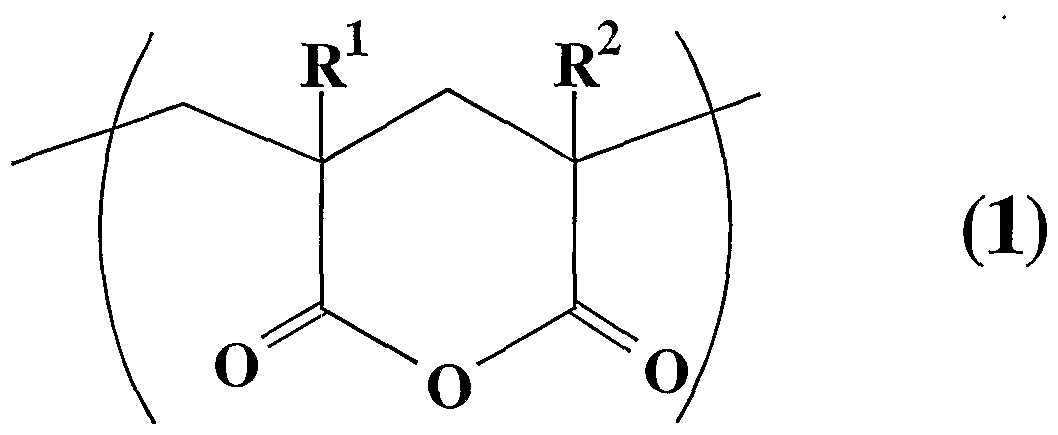
- RR 2 represents the same or different hydrogen atoms or alkyl groups having 1 to 5 carbon atoms.
- a monomer mixture containing an unsaturated carboxylic acid monomer and an unsaturated carboxylic acid alkyl ester monomer is polymerized at a temperature of 90 ° C. or lower to obtain a copolymer (A).
- the polymer (A) is heated and subjected to (a) dehydration and / or (mouth) dealcoholization.
- a production method for producing the thermoplastic polymer is described in detail below.
- thermoplastic polymer [3] A molded article comprising the above-mentioned thermoplastic polymer.
- thermoplastic polymer [4] An optical material for light transmission comprising the above-mentioned thermoplastic polymer.
- FIG. 5 is a schematic view of a quarter oval jig used for a chemical resistance test.
- FIG. 2 is a schematic cross-sectional view of the light guide plate manufactured in Example 18.
- FIG. 3 is a front view of the light transmitting member for an automobile lamp manufactured in Example 19.
- FIG. 4 is a side sectional view of the automobile lamp manufactured in Example 19.
- thermoplastic polymer of the present invention will be specifically described.
- thermoplastic polymer of the present invention has the following general formula (1)
- R ′ and R 2 represent the same or different hydrogen atoms or alkyl groups having 1 to 5 carbon atoms.
- thermoplastic polymer containing a daltaric anhydride unit represented by Among them, (i) a copolymer having a glutaric anhydride unit represented by the above general formula (1), (ii) a copolymer having an unsaturated carboxylic acid alkyl ester unit, or (iii) having a (iii) unsaturated carboxylic acid unit in the above unit Further 0 is added to the copolymer or the above (00 or the above (00 ⁇ ) unit. v) A copolymer having another vinyl monomer unit is preferred.
- thermoplastic polymer of the present invention has an absorbance at a wavelength of 280 nm (where the absorbance is a value measured by a spectrophotometer using a film having a thickness of 100) is 0.5 or less. is necessary.
- thermoplastic polymer of the present invention has a specific range of absorbance characteristics at the specific wavelength described above, so that the yellowness (Yellow e ss I n d e x) value is reduced.
- the yellowness here means a molded product having a thickness of 1 mm obtained by press molding at a glass transition temperature of the thermoplastic polymer + 100 ° C. ”IS-K7 This is the YI value measured using a SM color computer (manufactured by Suga Test Instruments Co., Ltd.) according to 2003.
- thermoplastic polymer of the present invention needs to have a glass transition temperature (Tg) of 130 ° C. or more from the viewpoint of heat resistance.
- the glass transition temperature is a glass transition temperature measured at a rate of 20 ° C / min using a differential scanning calorimeter (DSC-7 manufactured by Perkin Elmer). Temperature (T g).
- thermoplastic polymer containing a daltaric anhydride unit represented by the general formula (1) of the present invention can be basically produced by the following method. That is, an unsaturated carboxylic acid monomer and an unsaturated carboxylic acid alkyl ester monomer which give the daltaric anhydride unit (i) represented by the general formula (1) in a subsequent heating step, When a vinyl monomer unit (iv) is contained, the copolymer (A) is copolymerized with a vinyl monomer giving the unit to obtain a copolymer (A). It can be produced by heating in the presence or absence of a suitable catalyst to carry out an intramolecular cyclization reaction by (a) dealcoholization and / or (mouth) dehydration.
- the copolymer (A) typically, by heating the copolymer (A), the carboxyl group of two units of unsaturated rubonic acid units (Mi) is dehydrated, or the adjacent unsaturated unit of rubonic acid units (Mi) is dehydrated. Elimination of the alcohol from the ii i) and the unsaturated carboxylic acid alkyl ester unit (ii) produces one unit of the above-mentioned dartalic anhydride unit.
- the unsaturated carboxylic acid monomer used at this time is not particularly limited, and any unsaturated carboxylic acid monomer that can be copolymerized with another vinyl compound is used. It is possible.
- As a preferred unsaturated carboxylic acid monomer the following general formula (4) R 3
- R 3 represents hydrogen or an alkyl group having 1 to 5 carbon atoms
- maleic anhydride and also a hydrolyzate of maleic anhydride.
- Acrylic acid and methacrylic acid are preferred, and methacrylic acid is more preferred, particularly in terms of excellent thermal stability. .
- These can be used alone or in combination of two or more.
- the unsaturated carboxylic acid monomer represented by the above general formula (4) when copolymerized, gives an unsaturated carboxylic acid unit having a structure represented by the following general formula (2).
- the unsaturated carboxylic acid alkyl ester monomer is not particularly limited, but preferred examples include those represented by the following general formula (5).
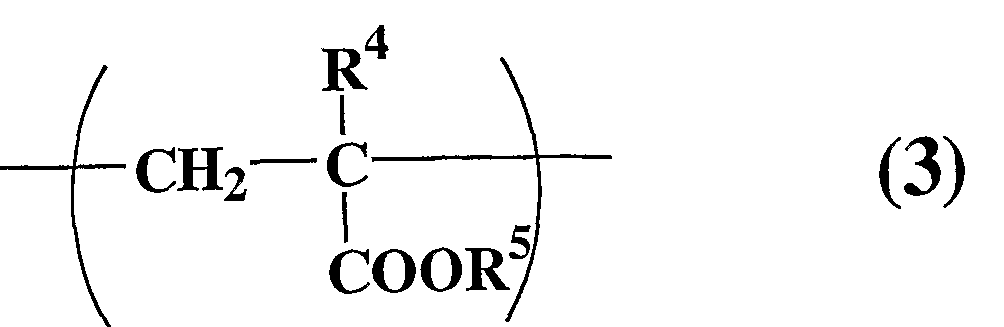
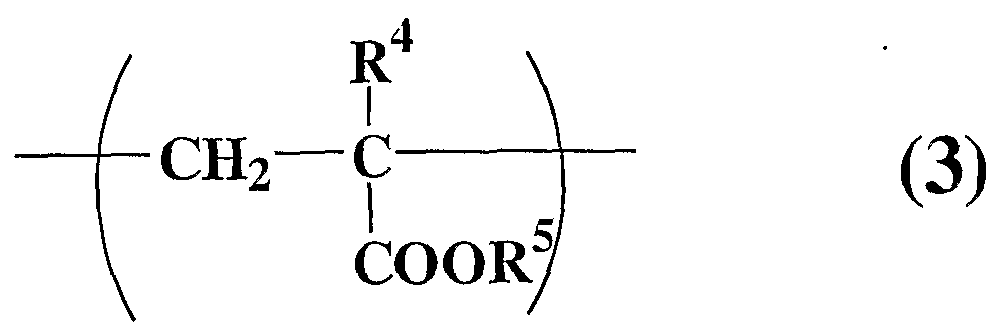
- R 4 represents hydrogen or an alkyl group having 1 to 5 carbon atoms
- R 5 represents an aliphatic or alicyclic hydrocarbon group having 6 to 6 carbon atoms, or a hydroxyl group having 1 or more carbon atoms or less.
- acrylates and / or methacrylates having an aliphatic or alicyclic hydrocarbon group having 1 to 6 carbon atoms or a hydrocarbon group having a substituent are particularly preferred.
- the unsaturated carboxylic acid alkyl ester monomer represented by the above general formula (5) when copolymerized, gives an unsaturated carboxylic acid alkyl ester unit having a structure represented by the following general formula (3).
- Preferred specific examples of the unsaturated carboxylic acid alkyl ester monomer include methyl (meth) acrylate, ethyl (meth) acrylate, n-propyl (meth) acrylate, n-butyl (meth) acrylate, and (meth) acrylate.
- T-butyl acrylate n-hexyl (meth) acrylate, cyclohexyl (meth) acrylate, chloromethyl (meth) acrylate, 2-chloroethyl (meth) acrylate, 2 (meth) acrylic acid —Hydroxytyl, 3-hydroxypropyl (meth) acrylate, 2,3,4,5,6- (meth) acrylic acid hydroxyhexyl and 2,3,4,5—tetramethyl methacrylate Examples thereof include lahydroxypentyl, and among them, methyl methacrylate is most preferably used. One or more of these can be used.
- vinyl monomers may be used as long as the effects of the present invention are not impaired.
- Preferred specific examples of other vinyl monomers include aromatic monomers such as styrene, ⁇ -methylstyrene, 0-methylstyrene, ⁇ -methylstyrene, 0-ethylstyrene, ⁇ -ethylstyrene, and ⁇ _t-butylstyrene.
- Tylene, 2-isopropenyl-one-year-old xazoline, 2-vinyl-one-year-old xazoline, 2-acroyl-year-old xazoline, and 2-styryl-year-old xazoline, etc. can be used. And a monomer containing no aromatic ring can be more preferably used. These can be used alone or in combination of two or more.
- known polymerization methods such as bulk polymerization, solution polymerization, suspension polymerization, and emulsion polymerization, which are basically based on radical polymerization, can be used. Solution polymerization, bulk polymerization and suspension polymerization are particularly preferred.
- the thermoplastic polymer of the present invention has a specific range of absorbance characteristics and a glass transition temperature.
- the unsaturated carboxylic acid monomer and the unsaturated carboxylic acid monomer are used. It is important to produce the copolymer (A) by polymerizing a monomer mixture containing a saturated carboxylic acid alkyl ester monomer at a polymerization temperature of 90 ° C. or lower. Further, the polymerization temperature is preferably 80 ° C. or less, more preferably 70 ° C. or less, for further suppressing the coloring after the heat treatment.
- the lower limit of the polymerization temperature is not particularly limited as long as the polymerization proceeds, but is usually 50 ° C or higher, preferably 60 ° C or higher from the viewpoint of productivity in consideration of the polymerization rate. . It is also possible to raise the polymerization temperature as the polymerization proceeds in order to improve the polymerization yield or the polymerization rate.However, in this case, the upper limit temperature can be controlled to 90 ° C or less. It is essential, and it is preferable to carry out the polymerization at a relatively low temperature of 75 ° C or less.
- the polymerization time is not particularly limited as long as it is a time sufficient to obtain the required degree of polymerization, but is preferably in the range of 60 to 360 minutes from the viewpoint of production efficiency, and is preferably 90 to 180 minutes. A range is particularly preferred.
- a preferable ratio of the monomer mixture used in the production of the copolymer (A) is 100% by weight of the monomer mixture and 15% by weight of the unsaturated carboxylic acid-based monomer.
- the unsaturated carboxylic acid alkyl ester monomer is preferably 50 to 85% by weight, more preferably 55 to 80% by weight.
- the preferred ratio is 0 to 35% by weight.
- the amount of the unsaturated carboxylic acid monomer is less than 15% by weight, the amount of the glutaric anhydride unit represented by the above general formula (1) due to heating of the copolymer (A) is small. And the heat resistance improving effect tends to be small.
- the amount of the unsaturated carboxylic acid monomer exceeds 50% by weight, a large amount of the unsaturated carboxylic acid unit tends to remain after the cyclization reaction of the copolymer (A) by heating, Colorless transparency and retention stability tend to decrease.
- a method of producing through a heated extruder having a vent or a method of producing in an apparatus capable of heating and devolatilizing under an inert gas atmosphere or under vacuum is preferable.
- an intramolecular cyclization reaction is caused by heating in the presence of oxygen, the yellowness tends to deteriorate. Therefore, it is preferable to sufficiently replace the system with an inert gas such as nitrogen.
- a single-screw extruder equipped with a "unimelt" type screw, a twin-screw extruder, a triple-screw extruder, a continuous or batch kneader type kneader, and the like can be used.
- a screw extruder can be preferably used.
- the temperature for heat devolatilization by the above method is not particularly limited as long as (a) a temperature at which an intramolecular cyclization reaction is caused by dehydration and / or (mouth) dealcoholization, but preferably 180 to 30.
- the time for heat devolatilization at this time is not particularly limited, and can be appropriately set depending on a desired copolymer composition, but is usually 1 minute to 60 minutes, preferably 2 minutes to 30 minutes, Particularly, the range of 3 to 20 minutes is preferable.
- the length / diameter ratio (L / D) of the extruder screw is 40 or more in order to secure a heating time for a sufficient intramolecular cyclization reaction using an extruder. And more preferably 50 or more, particularly preferably 60 or more. If an extruder with a short L / D is used, a large amount of unreacted unsaturated carboxylic acid units will remain, so the reaction will proceed again during the heat molding process, and there will be a tendency for silver or bubbles to be seen in the molded product and molding retention Sometimes the color tone tends to deteriorate significantly.
- the upper limit of L / D is not particularly limited, but is usually about 100.
- the copolymer (A) when the copolymer (A) is heated by the above method or the like, at least one of an acid, an alkali, and a salt compound may be added as a catalyst for accelerating a cyclization reaction to daltaric anhydride. it can.
- the addition amount is not particularly limited, and the copolymer (A) 1 8
- the acid catalyst include hydrochloric acid, sulfuric acid, p-toluenesulfonic acid, phosphoric acid, phosphorous acid, phenylphosphonic acid, and methyl phosphate. And the like.
- the basic catalyst include metal hydroxides, amines, imines, alkali metal derivatives, alkoxides, and ammonium hydroxide salts.
- the salt-based catalyst include metal acetate, metal stearate, and metal carbonate.
- a compound containing an alkali metal can be preferably used because it exhibits an excellent reaction promoting effect with a relatively small amount of addition.
- hydroxides such as lithium hydroxide, sodium hydroxide, and potassium hydroxide, sodium methoxide, sodium ethoxide, sodium phenoxide, power rheum methoxide, power rheum ethoxide
- Alkoxide compounds such as oxides and potassium phenoxides
- organic carboxylate salts such as lithium acetate, sodium acetate, potassium acetate, and sodium stearate
- sodium hydroxide sodium methoxide, lithium acetate, and the like.
- Sodium acetate can be preferably used.
- the content of the daltaric anhydride unit represented by the general formula (1) in the thermoplastic polymer of the present invention is not particularly limited as long as the absorbance characteristics and the glass transition temperature are within the range of the present invention. However, it is preferably 25 to 50% by weight, more preferably 30 to 45% by weight, in 100% by weight of the thermoplastic polymer.
- the amount of dataric anhydride is less than 25% by weight, not only the effect of improving heat resistance is reduced, but also sufficient birefringence characteristics (optical isotropy) ⁇ ⁇ Chemical resistance tends not to be obtained .
- thermoplastic polymer of the present invention a copolymer composed of the above-mentioned daltaric anhydride unit and an unsaturated carboxylic acid alkyl ester-based monomer unit can be preferably used.
- the unit amount of the unsaturated carboxylic acid alkyl ester-based monomer is preferably 50 to 75% by weight, more preferably 55 to 70% by weight.
- an infrared spectrophotometer or a proton nuclear magnetic resonance (H-NMR) measuring device is generally used for quantifying each component unit in the thermoplastic polymer of the present invention.
- Infrared spectroscopy shows that glutaric anhydride units have absorptions of 180 cm- 1 and 1760 cm- 1. It is objective and can be distinguished from unsaturated carboxylic acid units and unsaturated carboxylic acid alkyl ester units.
- the assignment of the spectrum in a dimethyl sulfoxide heavy solvent is from 0.5 to
- the peak at 1.5 ppm is the hydrogen of the ⁇ -methyl group of methacrylic acid, methyl methacrylate, and dtaltaric anhydride, and the peak at 1.6 to 2.1 ppm is the peak of the methylene group in the polymer main chain.
- the copolymer composition can be determined.
- hydrogen of the aromatic ring of styrene is observed at 6.5 to 7.5 ppm, and the spectrum ratio is similarly increased. From the formula, the copolymer composition can be determined.
- thermoplastic polymer of the present invention contains 10% by weight or less of unsaturated carboxylic acid units and / or 10% by weight or less of other copolymerizable vinyl monomer units. be able to.
- the amount of the unsaturated carboxylic acid unit contained in the thermoplastic polymer of the present invention is 0 to 5% by weight, most preferably 0 to 1% by weight.
- the unit amount of the other copolymerizable vinyl monomer is more preferably 0 to 5% by weight.
- an aromatic vinyl monomer unit such as styrene is contained, if the content exceeds the above range, colorless transparency, optical isotropy, and chemical resistance tend to decrease.
- the thermoplastic polymer of the present invention preferably has a limiting viscosity of 0.1 to 0.7 dI / g, measured at 30 ° C., in a dimethylformamide solution, and 0.3 to 0.6 dI / g. It is more preferably g.
- the molecular weight is not particularly limited, but the weight average molecular weight is 10,000 to 300,000, preferably 50,000 to 200,000, more preferably 70,000 to 150,000 in terms of mechanical properties and moldability. .
- the molecular weight of the thermoplastic polymer of the present invention can be measured by gel permeation chromatography using an N, N'-dimethylformamide solution and a standard sample of polymethyl methacrylate.
- thermoplastic polymer of the present invention thus obtained has the following properties. That is, the absorbance at 280 nm (where the absorbance is a value measured with a spectrophotometer using a film having a thickness of 100 m) is 0.5 or less. In a more preferred embodiment, the absorbance is 0.4. The value is particularly preferably 0.3 or less. The lower limit is usually around 0.2. By satisfying the absorbance characteristics in the above specific range, a thermoplastic polymer excellent in color tone can be obtained. As a specific index of the color tone, yellowness (Y e II owness Index) can be used. The thermoplastic polymer of the present invention has a yellowness value of about 6 or less, and in a preferred embodiment, 5 or less. In a more preferred embodiment, it has extremely excellent colorlessness of 4 or less, and in the most preferred embodiment, 3 or less.
- thermoplastic polymer of the present invention has an excellent heat resistance having a glass transition temperature (Tg) of 130 ° C. or more, in a preferred embodiment of 140 ° C. or more, and in a particularly preferred embodiment. It has extremely excellent heat resistance of 150 ° C or higher.
- Tg glass transition temperature
- thermoplastic polymer of the present invention the absolute value of birefringence of 1. 0 X ⁇ 0- 4 has hereinafter with excellent optical isotropy, in a preferred embodiment 0. 7 X 1 0 - 4 or less, or less 0. 5 X 1 0- 4 in most preferred embodiments.
- the lower limit of the birefringence is not particularly limited, ideal birefringence is a 0, it is usually, 0. 0 1 X 1 0- 4 or more.
- the absolute value of the birefringence is defined as an ASTM D value obtained by uniaxially stretching a non-oriented film having a thickness of 100 m and a thickness of 5 m obtained by the casting method at a glass transition temperature of 1.5 times. It is the absolute value of the birefringence index obtained by measuring the retardation at 23 ° C and 405 nm according to 542 and dividing by the thickness.
- the thermoplastic polymer of the present invention has specifically high surface hardness (pencil hardness) and excellent scratch resistance.
- the pencil has a surface hardness of 4 H or more as a pencil hardness, and in a particularly preferred embodiment, it has a surface hardness of 5 H or more.
- the pencil hardness was measured according to JIS-K-5401 using a molded product of 5 Om mX 50 mmX 1 mm obtained by press molding the copolymer at a glass transition temperature of + 100 ° C. .
- the thermoplastic polymer of the present invention has a total light transmittance of 50 mm X 50 mm X 1 mm obtained by press-molding the copolymer at a glass transition temperature of + 100 ° C. — K— Total light transmittance measured according to 6 7 14) is 85% or less.
- the copolymer has excellent light transmittance of 88% or more, and in a particularly preferred embodiment, 90% or more.Therefore, a material comprising such a copolymer exhibits sufficient performance as an optical material.
- the transmittance of ultraviolet light having a wavelength of 350 to 410 nm which is a short wavelength region, is as high as 85% or more in a preferred embodiment, and as high as 88% or more in a particularly preferred embodiment.
- Light transmittance at wavelengths in this region is necessary for writing and reading with a short-wavelength laser beam when used for optical discs. Excellent performance can be achieved when used for optical disks.
- the transmittance of ultraviolet light in the short wavelength region can be measured with an ultraviolet-visible spectrophotometer.
- thermoplastic polymer of the present invention includes hindered phenol-based, benzotriazole-based, benzophenone-based, benzoate-based, and cyanoacrylate-based ultraviolet absorbers and antioxidants, higher fatty acids and the like.
- Lubricants and plasticizers such as acid esters and acid amides, higher alcohols and the like, montanic acid and its salts, its esters, its half esters, mold release agents such as stearyl alcohol, stearamide and ethylene wax, phosphites, Anti-coloring agents such as hypophosphites, halogen-based flame retardants, phosphorus-based and silicone-based non-halogen-based flame retardants, nucleating agents, amine-based, sulfonic acid-based, polyether-based antistatic agents, pigments, etc.
- An additive such as a colorant may be optionally contained. However, it is necessary to add the additive within a range where the color of the additive does not adversely affect the thermoplastic polymer and the transparency is not reduced.
- thermoplastic polymer of the present invention is excellent in mechanical properties and moldability, and can be melt-molded, so that it can be extruded, injection-molded, and press-molded. It can be used for molding into tubes, pipes, rods and molded articles having any desired shape and size.
- the molded article of the thermoplastic polymer of the present invention makes use of its excellent heat resistance to make use of housings for electric and electronic parts, automobile parts, mechanical mechanism parts, OA equipment, home electric appliances, and the like, and parts thereof. It can be used for various purposes such as general goods.
- molded article made of the thermoplastic polymer of the present invention include, for example, housings for electrical equipment, housings for OA equipment, various covers, various gears, various cases, sensors, LED lamps, connectors, sockets, Resistor, relay case, Switches, coil bobbins, capacitors, variable condenser cases, optical pickups, transducers, various terminal boards, transformers, plugs, printed wiring boards, tuners, speakers, microphones, headphones, small motors, magnetic head bases, power modules, housings, semiconductors , LCDs, FDD carriages, FDD chassis, motors, brush holders, parabolic antennas, electrical and electronic parts represented by computer-related parts; VTR parts, TV parts, irons, hair dryers, rice cooker parts , Microwave oven parts, Acoustic parts, Audio '' Audio equipment parts such as laser disk-compact disk, lighting parts, refrigerator parts, air conditioner parts, typewriter parts, word processor parts, etc.
- Machine-related parts such as typewriters, optical equipment such as microscopes, binoculars, cameras, clocks, etc., precision machine-related parts; Alternating Yuichi Terminal, Oryuminator Connector 1, IC Reggi Yure Exhaust valves, fuel related exhaust systems, intake systems various pipes, air intake nozzle snorkel, intake manifold, fuel pump, engine coolant joint, carburetor main body, carburetor spacer, Exhaust gas sensor, cooling water sensor, oil temperature sensor, brake Sensor, throttle position sensor, crankshaft position sensor, air flow meter, thermostat base for air conditioner, heating hot air flow control valve, brush holder for radiator motor, water pump impeller, turbine vane, wiper motor Related parts, dust distributor, starter switch, starter relay, wire harness for transmission, window washer nozzle, air conditioner panel switch board, fuel-related solenoid valve coil
- Optical recording and other optical communication-related components (VD, CD, DVD, MD, LD, etc.) Substrates, various disc substrate protection films, optical disc players LCD devices, flat panel displays, light guide plates for plasma displays, Fresnel lenses, polarizing plates, polarizing plate protective films, retardation films, etc. as information-related components such as pick-up lenses, optical fibers, optical switches, optical connectors, etc. , Light diffusion film, Viewing angle expansion film, Reflection film, Anti-reflection film, Anti-glare film, Brightness enhancement film, Prism sheet, Pick-up lens, Light guide film for sunset panel, Cover, etc.
- Tail lamp ren as related parts , Headlamp lenses, inner lenses, amber caps, reflectors, extensions, side mirrors, room mirrors, side visors, instrument needles, instrument covers, glazing represented by window glass, etc.
- thermoplastic polymer of the present invention is a material that can achieve both high colorless transparency and excellent chemical resistance, it can be suitably used for a light-transmitting member for a vehicle lamp such as an automobile. it can.
- vehicle J means a vehicle in a broad sense, such as a two-wheeled vehicle, a three-wheeled vehicle, a four-wheeled vehicle, other vehicles, a railway vehicle, a forklift, and other industrial vehicles. It refers to lighting or identification lamps mounted on various vehicles, and is not particularly limited, but includes headlights (headlamps), tail lights (tail lamps), stop lights (stop lamps), and turn signals (turn signal lights). ), Vehicle width lights, backward lights, etc.
- Example the configuration and effect of the present invention will be described more specifically with reference to examples. However, the present invention is not limited to the following examples. Prior to the description of each example, methods for measuring various physical properties adopted in the examples are described.
- thermoplastic polymer The intrinsic viscosity of the obtained thermoplastic polymer at 30 ° C. was measured using dimethylformamide as a solvent.
- the measurement was performed using a differential scanning calorimeter (DSC-7, manufactured by PerkinElmer) under a nitrogen atmosphere at a heating rate of 20 ° CZmin.
- DSC-7 differential scanning calorimeter
- thermoplastic polymer was used as a 20% by weight THF solution, and a 100 / m film was prepared by a casting method using the solution.
- the absorbance at 280 nm of the film was measured using an ultraviolet-visible spectrophotometer (UV-1600PC) manufactured by Shimadzu Corporation.
- thermoplastic polymer was press-molded at a glass transition temperature of + 100 ° C., and the ⁇ I value of a 1-mm thick molded product was measured according to JIS-K7103 according to SM Color Computer (manufactured by Suga Test Machine Co., Ltd.). ) was measured.
- a 100 m thick non-oriented film obtained by the casting method in the same manner as in the above (3) was uniaxially stretched 1.5 times at the glass transition temperature, and the film was subjected to an ellipsometer (according to ASTM D542). Otsuka Electronics Co., Ltd., LCD cell gap inspection system
- the film sample surface was irradiated with a laser beam at an angle of 90 ° using RETS-1100) and the retardation (R e) of the transmitted light at 405 nm was measured.
- the thickness (d) at 23 ° C of the stretched film was measured, and based on these, the birefringence was calculated according to the following formula.
- the rate ( ⁇ n) was calculated.
- ⁇ n R e (n m) / d (n m)
- the pencil hardness of a 70 mm ⁇ 70 mm ⁇ 1 mm molded product obtained by injection molding was measured according to “IS-K—5401”.
- a 12.5 ⁇ 125 ⁇ 1.6 mm plate-like molded product 1 obtained by injection molding as a test piece was placed along a curved surface 3 of a 1/4 elliptical jig 2.
- a wax rim bar (“Wax rim bar CPC”, manufactured by Ushiguchi Chemical Co., Ltd.) to the entire surface of the molded product and leave it at 23 ° C for 1 hour.
- the presence and location were checked.
- the shortest major axis direction ⁇ (X) at the crack occurrence position was measured, and the critical strain was calculated by the following equation to calculate (%). The higher the critical strain value, the better the chemical resistance.
- a 5-liter capacity, stainless steel autoclave equipped with baffles and a Fiddra type stirring blade was charged with a methyl methacrylate / acrylamide copolymer suspension (adjusted by the following method. 20 parts by weight of methyl methacrylate, acrylamide). 80 parts by weight, 0.3 parts by weight of potassium persulfate and 150 parts by weight of ion-exchanged water were charged into the reactor. The reactor is maintained at 70 ° C while replacing the atmosphere with nitrogen gas. The reaction is continued until the monomer is completely converted to a polymer, and is obtained as an aqueous solution of methyl acrylate and acrylamide copolymer. The resulting aqueous solution was used as a suspending agent).
- a solution of 0.05 part in 165 parts of ion-exchanged water was supplied, stirred at 400 rpm, and the system was replaced with nitrogen gas. Next, the following mixture was added while stirring the reaction system, and the temperature was raised to 70 ° C. The time when the internal temperature reached 70 ° C was defined as the start of polymerization, and was maintained for 180 minutes to complete the polymerization. Thereafter, the reaction system was cooled, the polymer was separated, washed, and dried according to the usual method to obtain a beaded copolymer (A-1). The polymerization rate of this copolymer (A-1) was 98%.
- the copolymer (A-4) was converted to a polymerization rate of 98% by the same production method as (A-1) except that the amount of the chain transfer agent t-dodecylmercaptan was changed to 1.2 parts by weight. I got it.
- a copolymer (A-5) was obtained at a polymerization rate of 95% by the same production method as in (A-4) except that the charged composition of the monomer mixture was changed as follows.
- a copolymer (A-6) was obtained at a polymerization rate of 92% by the same production method as in (A-4) except that the charged composition of the monomer mixture was changed as follows.
- Methacrylic acid 45 parts by weight
- Methyl methacrylate 55 5 parts by weight
- a copolymer (A-7) was obtained at a polymerization rate of 93% by the same production method as (A-4) except that the charged composition of the monomer mixture was changed as follows.
- the polymerization temperature and time were set at the time when the internal temperature reached 70 ° C., the polymerization was started, the temperature was maintained at 70 ° C. for 20 minutes, the temperature was raised to 75 ° C., and the temperature was maintained for 120 minutes. Thereafter, the temperature of the copolymer (A-8) was increased by 97% by the same production method as in (A-1) except that the polymerization was changed to polymerization at this temperature for 60 minutes. At a polymerization rate of ,
- a copolymer (A-7) was obtained at a polymerization rate of 93% by the same production method as in (A-8) except that the charged composition of the monomer mixture was changed as follows.
- a copolymer (A-11) was obtained at a polymerization rate of 93% by the same production method as in (A-8) except that the charged composition of the monomer mixture was changed as follows.
- Table 1 shows the properties of the styrene (15 parts by weight) copolymer (A).
- thermoplastic polymer (B) containing daltaric anhydride units As a result of analyzing the obtained thermoplastic polymer (B using an infrared spectrophotometer, absorption peaks were confirmed at 1800 cm- 1 and 1760 cm- 'in both cases.
- Comparative Example 1 when polymerized at a temperature exceeding 90 ° C., it is found that a high degree of colorlessness cannot be obtained.
- the pellets dried at 100 ° C. for 3 hours were supplied to an injection molding machine (M-50A II-SJ manufactured by Meiki Seisakusho) to form each test piece.
- the molding conditions were as follows: molding temperature: glass transition temperature + 140 ° C, mold temperature: 80 ° C, injection speed: 88 cm3 / s, injection time: 10 seconds, cooling time: 30 seconds, molding pressure. : Pressure at which the resin is completely filled in the mold (molding lower limit pressure) + 1 MPa.
- Tables 4 and 5 show the composition of each copolymer component and the results of various characteristic evaluations determined by 1 H-NMR.
- Example 4 44.5 Yes (A-1) 32 63 5 0.49 147 0.42 Example 5 (A-4) 32 64 4 0.40 142 0.29 Example 6 (A-5) 13 83 4 0.40 132 0.37 Example 7 (A- 6) 43 49 8 0.43 160 0.44 Example 8 (A-7) 16 72 5 0.42 135 0.42 Example 9 (A-4) NaOCH3 38 62 0 0.40 140 0.31 Example 10 (A-5) (0.1) 16 82 2 0.40 133 0.38
- Example 11 (A-6) 47 51 2 0.44 158 0.45
- Example 12 (A-7) 20 70 3 0.42 136 0.45
- Example 13 (A-4) Acetic acid Li 37 62 1 0.41 140 0.37
- Example 14 (A-4) Mg acetate 65 33 0.45 137 0.4
- Example 4 4.9 93 2.4 0.7 5H 0.9 2.34
- Example 5 1.8 93 2.2 0.6 5H 0.4 2.21
- Example 6 2.9 92 2.3 0.9 4H 0.6 1.98
- Example 7 6.1 88 4.3 0.5 4H 1.2 2.67
- Example 8 5.2 93 4.2 1.4 4H 1.0 1.56
- Example 9 1.9 93 0.9 0.3 4H 0.1 2.23
- Example 10 3.3 92 1.2 0.6 4H 0.3 1.91
- Example 12 6.5 88 3.9 1.3 4H 0.5 1.55
- Example 13 2.9 92 1.1 0.3 4H 0.1 2.23
- Example 14 4.2 89 1.6 0.4 4H 0.6 2.16
- Example 15 6.1 91 1.0 0.4 4H 0.4 2.20
- Example 16 3.3 93 2.3 0.5 4H
- thermoplastic polymer having the specific absorbance characteristics defined in the present invention can be obtained by controlled polymerization at a temperature of 90 ° C or lower.
- the resulting transparent material has excellent heat resistance, optical isotropy, and abrasion resistance, and is excellent in color tone.
- thermoplastic polymer (B) the addition of the intramolecular cyclization reaction accelerator makes it possible to determine the amount of unreacted unsaturated carboxylic acid remaining in the thermoplastic polymer (B). It can be seen that the retention stability (thermochromicity) is particularly excellent. Furthermore, from the comparison with Example 16, it can be seen that by using an extruder having a sufficiently long L / D, the residual amount of unsaturated carboxylic acid can be reduced, which is preferable in terms of retention stability.
- Example 9 shows that purging with nitrogen in the extruder can result in a colorless and transparent material with more suppressed coloring.
- thermoplastic polymer of the present invention when compared to PMMA and PC, has excellent heat resistance, colorless transparency, and retention stability, and is particularly excellent in optical isotropy, scratch resistance, and chemical resistance. You can see that.
- thermoplastic polymer containing daltaric anhydride units.
- the obtained thermoplastic polymer was analyzed using an infrared spectrophotometer.
- thermoplastic polymer 0 cm 1 absorption peak was confirmed, it was confirmed that glutaric anhydride Unit is formed in the thermoplastic polymer.
- the intrinsic viscosity of this thermoplastic polymer was 0.48 dI / g.
- thermoplastic polymer was obtained in the same manner as in Example 17 except that the polymerization temperature was changed to 11 "TC. As a result of analyzing the obtained thermoplastic polymer using an infrared spectrophotometer,
- Table 6 shows the measurement results of various physical properties of Example 17 and Comparative Example 12. Table 6
- Example 17 and Comparative Example 12 even in the case of solution polymerization, by polymerizing at a temperature of 90 ° C. or less, it has excellent colorless transparency and high heat resistance. As a result, it was found that the plate-like molded product of this example was excellent in transparency and light guide, and was useful as a light guide plate.
- the light transmitting member 9 for an automobile lamp shown in FIGS. 3 and 4 was obtained by injection molding.
- the dimensions of the translucent member 9 are 150 mm in height, 250 mm in width, 10 mm in depth, and 3 mm in average thickness.
- the automobile lamp shown in Fig. 4 was created.
- FIG. 3 is a front view of the translucent member for an automobile lamp
- FIG. 4 is a side sectional view of an automobile lamp incorporating the same.
- the vehicle lamp incorporates a reflector 18 and a HID light source 7 together with a light transmitting member 9.
- a reflector 18 and a HID light source 7 together with a light transmitting member 9.
- the pellet of the thermoplastic polymer obtained in Example 9 was subjected to an injection molding machine (M-500 AII-SJ, manufactured by Meiki Seisakusho Co., Ltd.), and the molding temperature: 290 ° C., the mold temperature: 1 0 ° C, Injection time: 10 seconds, Cooling time: 30 seconds, Injection pressure: Injection molding at 10 MPa, diameter 40 mm, edge thickness 3 mm, center thickness 1.6 mm A colorless and transparent concave lens was obtained.
- a silica-based hard coat agent (manufactured by Shin-Etsu Chemical Co., Ltd., ⁇ - ⁇ 851 ”) was applied to the obtained lens, and cured at 120 ° C. for 1 hour to produce an eyeglass lens.
- the obtained spectacle lens has excellent heat resistance and thermal stability, so even if it is hard-coated at a relatively high temperature (120 ° C), it does not deform and has a total light transmission of 92%. Rate and excellent transparency. Further, the obtained spectacle lens was cross-cut with a cross-cut tape test (100 parallel grids were inserted into the hard coat coating surface of the lens by inserting 11 parallel lines each at 1 mm intervals vertically and horizontally with a knife. Cut, attach the cellophane adhesive tape on it, and peel off the tape.) It can be seen that a lens made of a light thermoplastic polymer has excellent adhesion to a hard coat agent and is suitable as a lens for eyeglasses.
Landscapes
- Chemical & Material Sciences (AREA)
- Physics & Mathematics (AREA)
- Optics & Photonics (AREA)
- General Physics & Mathematics (AREA)
- Chemical Kinetics & Catalysis (AREA)
- Polymers & Plastics (AREA)
- Organic Chemistry (AREA)
- Medicinal Chemistry (AREA)
- Health & Medical Sciences (AREA)
- General Chemical & Material Sciences (AREA)
- Engineering & Computer Science (AREA)
- Manufacturing & Machinery (AREA)
- Materials Engineering (AREA)
- Addition Polymer Or Copolymer, Post-Treatments, Or Chemical Modifications (AREA)
- Manufacture Of Macromolecular Shaped Articles (AREA)
Description




Claims


Priority Applications (3)
| Application Number | Priority Date | Filing Date | Title |
|---|---|---|---|
| EP03712911A EP1496067A4 (en) | 2002-03-26 | 2003-03-25 | THERMOPLASTIC POLYMER, METHOD OF MANUFACTURING THEREFOR AND FORM BODY |
| KR1020047015500A KR100984464B1 (ko) | 2002-03-26 | 2003-03-25 | 열가소성 중합체, 그의 제조 방법 및 성형품 |
| US10/947,536 US7348387B2 (en) | 2002-03-26 | 2004-09-23 | Thermoplastic polymer, process for producing the same, and molded article |
Applications Claiming Priority (6)
| Application Number | Priority Date | Filing Date | Title |
|---|---|---|---|
| JP2002085345 | 2002-03-26 | ||
| JP2002-085345 | 2002-03-26 | ||
| JP2002-160806 | 2002-05-31 | ||
| JP2002160806 | 2002-05-31 | ||
| JP2002172183 | 2002-06-13 | ||
| JP2002-172183 | 2002-06-13 |
Related Child Applications (1)
| Application Number | Title | Priority Date | Filing Date |
|---|---|---|---|
| US10/947,536 Continuation-In-Part US7348387B2 (en) | 2002-03-26 | 2004-09-23 | Thermoplastic polymer, process for producing the same, and molded article |
Publications (1)
| Publication Number | Publication Date |
|---|---|
| WO2003080683A1 true WO2003080683A1 (en) | 2003-10-02 |
Family
ID=28457582
Family Applications (1)
| Application Number | Title | Priority Date | Filing Date |
|---|---|---|---|
| PCT/JP2003/003608 Ceased WO2003080683A1 (en) | 2002-03-26 | 2003-03-25 | Thermoplastic polymer, process for producing the same, and molded article |
Country Status (6)
| Country | Link |
|---|---|
| US (1) | US7348387B2 (ja) |
| EP (1) | EP1496067A4 (ja) |
| KR (1) | KR100984464B1 (ja) |
| CN (1) | CN100457786C (ja) |
| TW (1) | TWI302916B (ja) |
| WO (1) | WO2003080683A1 (ja) |
Families Citing this family (18)
| Publication number | Priority date | Publication date | Assignee | Title |
|---|---|---|---|---|
| CN100362051C (zh) | 2003-03-12 | 2008-01-16 | 东丽株式会社 | 热塑性树脂组合物、成形品和薄膜 |
| US7372726B2 (en) * | 2004-04-08 | 2008-05-13 | Renesas Technology Corp. | Semiconductor memory |
| US7483727B2 (en) * | 2005-04-04 | 2009-01-27 | Research In Motion Limited | Mobile wireless communications device having improved antenna impedance match and antenna gain from RF energy |
| CN101616940B (zh) * | 2006-09-20 | 2012-06-20 | 东丽株式会社 | 热塑性共聚物的制造方法 |
| WO2008147081A1 (en) * | 2007-05-25 | 2008-12-04 | Lg Chem, Ltd. | Optical film, protection film for polarizer film, polarizer plate fabricated therefrom, and display device employing thereof |
| JP4717947B2 (ja) * | 2007-12-27 | 2011-07-06 | 旭化成ケミカルズ株式会社 | アクリル系熱可塑性樹脂、及び光学材料用成形体 |
| EP2182786B1 (en) * | 2008-11-04 | 2011-07-13 | Rohm and Haas Electronic Materials LLC | Improved hot melt compositions |
| SE537094C2 (sv) * | 2011-11-14 | 2015-01-07 | Labrida As | Bioresorberbart rengöringsverktyg för implantat |
| JP6164446B2 (ja) * | 2012-01-26 | 2017-07-19 | 株式会社Gsユアサ | 光照射装置 |
| KR101560271B1 (ko) | 2012-08-09 | 2015-10-15 | 삼성전자 주식회사 | 광학필름용 고분자 및 이를 포함하는 광학필름 |
| BR112015007813B1 (pt) | 2012-10-19 | 2021-11-23 | Asahi Kasei Chemicals Corporation | Cobertura de peça de veículo |
| EP2767355B1 (en) * | 2013-02-18 | 2021-03-10 | Grundfos Holding A/S | Segmented core and method for moulding an impeller |
| CN104842878A (zh) * | 2014-02-14 | 2015-08-19 | 鸿富锦精密工业(深圳)有限公司 | 后视镜装置 |
| KR20160024003A (ko) | 2014-08-21 | 2016-03-04 | 삼성에스디아이 주식회사 | 윈도우 필름 및 이를 포함하는 디스플레이 장치 |
| US10162159B2 (en) * | 2016-12-20 | 2018-12-25 | Veoneer Us Inc. | Lens for integrated rain sensor and antenna |
| JP7153657B2 (ja) * | 2017-02-20 | 2022-10-14 | トリンセオ ユーロップ ゲーエムベーハー | 高いガラス転移温度を有する樹脂成分をベースとする透明フィルム |
| JP2019105692A (ja) * | 2017-12-11 | 2019-06-27 | 株式会社ダイセル | 防眩フィルム並びにその製造方法及び用途 |
| KR102084120B1 (ko) * | 2018-03-07 | 2020-03-03 | 삼성에스디아이 주식회사 | 윈도우 필름 및 이를 포함하는 디스플레이 장치 |
Citations (6)
| Publication number | Priority date | Publication date | Assignee | Title |
|---|---|---|---|---|
| US4874824A (en) * | 1987-11-23 | 1989-10-17 | Rohm And Haas Company | Process for manufacturing low-acid, glutaric-anhydride-containing copolymers |
| JPH05105797A (ja) * | 1991-10-17 | 1993-04-27 | Sumitomo Chem Co Ltd | 熱可塑性樹脂組成物 |
| JPH08301931A (ja) * | 1995-05-11 | 1996-11-19 | Kuraray Co Ltd | 耐熱性に優れた熱可塑性樹脂の製造法 |
| JP2002284816A (ja) * | 2001-03-27 | 2002-10-03 | Toray Ind Inc | 耐熱性共重合体およびその製造方法 |
| JP2002293835A (ja) * | 2001-03-30 | 2002-10-09 | Toray Ind Inc | 高耐熱樹脂およびそれからなる成形品 |
| JP2003155309A (ja) * | 2001-09-05 | 2003-05-27 | Toray Ind Inc | 耐熱性共重合体およびその製造方法 |
Family Cites Families (18)
| Publication number | Priority date | Publication date | Assignee | Title |
|---|---|---|---|---|
| GB1437176A (en) | 1972-08-14 | 1976-05-26 | Ici Ltd | Acrylic copolymers |
| JPS58217501A (ja) | 1982-06-04 | 1983-12-17 | Asahi Chem Ind Co Ltd | 新規共重合体 |
| JPS6020905A (ja) * | 1983-07-13 | 1985-02-02 | Mitsubishi Rayon Co Ltd | 新規熱可塑性重合体 |
| JPS60120735A (ja) | 1983-12-02 | 1985-06-28 | Asahi Chem Ind Co Ltd | 無色透明な樹脂組成物 |
| JPS60120707A (ja) | 1983-12-02 | 1985-06-28 | Asahi Chem Ind Co Ltd | 無色透明な耐熱性共重合体の製造方法 |
| JPS60136791A (ja) * | 1983-12-05 | 1985-07-20 | 旭化成株式会社 | 照明器 |
| US4789709A (en) | 1985-05-02 | 1988-12-06 | Sumitomo Chemical Company, Limited | Process for the production of heat resistant thermoplastic copolymer |
| JPS61254608A (ja) * | 1985-05-02 | 1986-11-12 | Sumitomo Chem Co Ltd | 耐熱変形性の優れた熱可塑性共重合体の製造方法 |
| JPS61271343A (ja) | 1985-05-24 | 1986-12-01 | Asahi Chem Ind Co Ltd | スチレン−メタクリル酸共重合体組成物 |
| EP0273397B1 (en) * | 1986-12-25 | 1992-07-22 | Asahi Kasei Kogyo Kabushiki Kaisha | A substrate for an optical element |
| US5198305A (en) | 1986-12-25 | 1993-03-30 | Asahi Kasei Kogyo Kabushiki Kaisha | Optical element substrate |
| JPH01103612A (ja) | 1987-07-30 | 1989-04-20 | Sumitomo Chem Co Ltd | 熱可塑性共重合体 |
| JPH01279911A (ja) | 1988-05-06 | 1989-11-10 | Asahi Chem Ind Co Ltd | 芳香族ビニル系透明耐熱共重合体 |
| JPH0948818A (ja) | 1995-08-08 | 1997-02-18 | Sumitomo Chem Co Ltd | 耐熱変形性の熱可塑性共重合体の製造方法 |
| JP2000239325A (ja) | 1999-02-24 | 2000-09-05 | Mitsubishi Rayon Co Ltd | 透明樹脂組成物 |
| JP4122661B2 (ja) | 1999-10-22 | 2008-07-23 | Jsr株式会社 | 光硬化性樹脂組成物およびプラスチックシート |
| JP4897156B2 (ja) * | 2000-06-09 | 2012-03-14 | 株式会社日本触媒 | 透明耐熱性樹脂およびその製造方法 |
| US6653405B2 (en) * | 2001-04-20 | 2003-11-25 | Plaskolite, Inc. | High heat distortion temperature methacrylate polymer blends |
-
2003
- 2003-03-25 CN CNB038072173A patent/CN100457786C/zh not_active Expired - Fee Related
- 2003-03-25 EP EP03712911A patent/EP1496067A4/en not_active Withdrawn
- 2003-03-25 TW TW092106576A patent/TWI302916B/zh not_active IP Right Cessation
- 2003-03-25 WO PCT/JP2003/003608 patent/WO2003080683A1/ja not_active Ceased
- 2003-03-25 KR KR1020047015500A patent/KR100984464B1/ko not_active Expired - Fee Related
-
2004
- 2004-09-23 US US10/947,536 patent/US7348387B2/en not_active Expired - Fee Related
Patent Citations (6)
| Publication number | Priority date | Publication date | Assignee | Title |
|---|---|---|---|---|
| US4874824A (en) * | 1987-11-23 | 1989-10-17 | Rohm And Haas Company | Process for manufacturing low-acid, glutaric-anhydride-containing copolymers |
| JPH05105797A (ja) * | 1991-10-17 | 1993-04-27 | Sumitomo Chem Co Ltd | 熱可塑性樹脂組成物 |
| JPH08301931A (ja) * | 1995-05-11 | 1996-11-19 | Kuraray Co Ltd | 耐熱性に優れた熱可塑性樹脂の製造法 |
| JP2002284816A (ja) * | 2001-03-27 | 2002-10-03 | Toray Ind Inc | 耐熱性共重合体およびその製造方法 |
| JP2002293835A (ja) * | 2001-03-30 | 2002-10-09 | Toray Ind Inc | 高耐熱樹脂およびそれからなる成形品 |
| JP2003155309A (ja) * | 2001-09-05 | 2003-05-27 | Toray Ind Inc | 耐熱性共重合体およびその製造方法 |
Non-Patent Citations (1)
| Title |
|---|
| See also references of EP1496067A1 * |
Also Published As
| Publication number | Publication date |
|---|---|
| EP1496067A4 (en) | 2007-05-30 |
| EP1496067A1 (en) | 2005-01-12 |
| TW200305584A (en) | 2003-11-01 |
| US20050119418A1 (en) | 2005-06-02 |
| EP1496067A8 (en) | 2005-09-21 |
| TWI302916B (en) | 2008-11-11 |
| KR20040097243A (ko) | 2004-11-17 |
| CN100457786C (zh) | 2009-02-04 |
| CN1643000A (zh) | 2005-07-20 |
| KR100984464B1 (ko) | 2010-09-30 |
| US7348387B2 (en) | 2008-03-25 |
Similar Documents
| Publication | Publication Date | Title |
|---|---|---|
| US7348387B2 (en) | Thermoplastic polymer, process for producing the same, and molded article | |
| JP4158498B2 (ja) | 共重合体およびその製造方法 | |
| JP2009235249A (ja) | 熱可塑性共重合体、熱可塑性樹脂組成物およびそれらからなる成形品 | |
| JP2008255175A (ja) | 熱可塑性重合体およびその製造方法 | |
| EP1602688A1 (en) | Thermoplastic resin composition, molded article, and film | |
| JP2007191706A (ja) | 熱可塑性共重合体、その製造方法、およびそれから成る熱可塑性樹脂組成物 | |
| JP2007046044A (ja) | 熱可塑性樹脂組成物、成形品およびフィルム | |
| JP2003155309A (ja) | 耐熱性共重合体およびその製造方法 | |
| JP4273794B2 (ja) | 熱可塑性重合体、その製造方法および成形品 | |
| JP4329578B2 (ja) | 熱可塑性共重合体の製造方法 | |
| JP4337378B2 (ja) | 熱可塑性樹脂組成物、製造方法および成形品 | |
| JP2004315798A (ja) | 熱可塑性共重合体の製造方法 | |
| JP2004292812A (ja) | 熱可塑性樹脂組成物、成形品およびフィルム | |
| JP2006274118A (ja) | 熱可塑性樹脂組成物およびそれからなる成形品、フィルムおよびシート | |
| JP4858410B2 (ja) | 導光板 | |
| JP2008308567A (ja) | 熱可塑性共重合体の製造方法 | |
| JP2008308565A (ja) | 熱可塑性共重合の製造方法 | |
| JPWO2008143245A1 (ja) | 熱可塑性共重合体の製造方法および熱可塑性共重合体 | |
| JP2004292811A (ja) | 熱可塑性重合体、その製造方法、熱可塑性樹脂組成物および成形品 | |
| JP2004315797A (ja) | 熱可塑性共重合体の製造方法 | |
| JP2010077348A (ja) | 熱可塑性共重合体の製造方法 | |
| JP2004315796A (ja) | 熱可塑性共重合体の製造方法 | |
| JP2002293835A (ja) | 高耐熱樹脂およびそれからなる成形品 | |
| JP2005272821A (ja) | 熱可塑性共重合体の製造方法 | |
| JP2006274072A (ja) | 熱可塑性重合体、その製造方法および成形品 |
Legal Events
| Date | Code | Title | Description |
|---|---|---|---|
| AK | Designated states |
Kind code of ref document: A1 Designated state(s): CN KR US |
|
| AL | Designated countries for regional patents |
Kind code of ref document: A1 Designated state(s): AT BE BG CH CY CZ DE DK EE ES FI FR GB GR HU IE IT LU MC NL PT RO SE SI SK TR |
|
| 121 | Ep: the epo has been informed by wipo that ep was designated in this application | ||
| WWE | Wipo information: entry into national phase |
Ref document number: 10947536 Country of ref document: US |
|
| WWE | Wipo information: entry into national phase |
Ref document number: 20038072173 Country of ref document: CN |
|
| WWE | Wipo information: entry into national phase |
Ref document number: 1020047015500 Country of ref document: KR |
|
| WWE | Wipo information: entry into national phase |
Ref document number: 2003712911 Country of ref document: EP |
|
| WWP | Wipo information: published in national office |
Ref document number: 1020047015500 Country of ref document: KR |
|
| WWP | Wipo information: published in national office |
Ref document number: 2003712911 Country of ref document: EP |