WO2003085028A1 - Compose polyether contenant des groupes acide et insature, procede de production et composition de resine associes - Google Patents
Compose polyether contenant des groupes acide et insature, procede de production et composition de resine associes Download PDFInfo
- Publication number
- WO2003085028A1 WO2003085028A1 PCT/JP2003/004195 JP0304195W WO03085028A1 WO 2003085028 A1 WO2003085028 A1 WO 2003085028A1 JP 0304195 W JP0304195 W JP 0304195W WO 03085028 A1 WO03085028 A1 WO 03085028A1
- Authority
- WO
- WIPO (PCT)
- Prior art keywords
- group
- meth
- compound
- anhydride
- formula
- Prior art date
- Legal status (The legal status is an assumption and is not a legal conclusion. Google has not performed a legal analysis and makes no representation as to the accuracy of the status listed.)
- Ceased
Links
Classifications
-
- C—CHEMISTRY; METALLURGY
- C08—ORGANIC MACROMOLECULAR COMPOUNDS; THEIR PREPARATION OR CHEMICAL WORKING-UP; COMPOSITIONS BASED THEREON
- C08G—MACROMOLECULAR COMPOUNDS OBTAINED OTHERWISE THAN BY REACTIONS ONLY INVOLVING UNSATURATED CARBON-TO-CARBON BONDS
- C08G65/00—Macromolecular compounds obtained by reactions forming an ether link in the main chain of the macromolecule
- C08G65/02—Macromolecular compounds obtained by reactions forming an ether link in the main chain of the macromolecule from cyclic ethers by opening of the heterocyclic ring
- C08G65/26—Macromolecular compounds obtained by reactions forming an ether link in the main chain of the macromolecule from cyclic ethers by opening of the heterocyclic ring from cyclic ethers and other compounds
-
- G—PHYSICS
- G03—PHOTOGRAPHY; CINEMATOGRAPHY; ANALOGOUS TECHNIQUES USING WAVES OTHER THAN OPTICAL WAVES; ELECTROGRAPHY; HOLOGRAPHY
- G03F—PHOTOMECHANICAL PRODUCTION OF TEXTURED OR PATTERNED SURFACES, e.g. FOR PRINTING, FOR PROCESSING OF SEMICONDUCTOR DEVICES; MATERIALS THEREFOR; ORIGINALS THEREFOR; APPARATUS SPECIALLY ADAPTED THEREFOR
- G03F7/00—Photomechanical, e.g. photolithographic, production of textured or patterned surfaces, e.g. printing surfaces; Materials therefor, e.g. comprising photoresists; Apparatus specially adapted therefor
- G03F7/004—Photosensitive materials
- G03F7/027—Non-macromolecular photopolymerisable compounds having carbon-to-carbon double bonds, e.g. ethylenic compounds
-
- C—CHEMISTRY; METALLURGY
- C08—ORGANIC MACROMOLECULAR COMPOUNDS; THEIR PREPARATION OR CHEMICAL WORKING-UP; COMPOSITIONS BASED THEREON
- C08F—MACROMOLECULAR COMPOUNDS OBTAINED BY REACTIONS ONLY INVOLVING CARBON-TO-CARBON UNSATURATED BONDS
- C08F290/00—Macromolecular compounds obtained by polymerising monomers on to polymers modified by introduction of aliphatic unsaturated end or side groups
- C08F290/08—Macromolecular compounds obtained by polymerising monomers on to polymers modified by introduction of aliphatic unsaturated end or side groups on to polymers modified by introduction of unsaturated side groups
- C08F290/14—Polymers provided for in subclass C08G
-
- C—CHEMISTRY; METALLURGY
- C08—ORGANIC MACROMOLECULAR COMPOUNDS; THEIR PREPARATION OR CHEMICAL WORKING-UP; COMPOSITIONS BASED THEREON
- C08F—MACROMOLECULAR COMPOUNDS OBTAINED BY REACTIONS ONLY INVOLVING CARBON-TO-CARBON UNSATURATED BONDS
- C08F290/00—Macromolecular compounds obtained by polymerising monomers on to polymers modified by introduction of aliphatic unsaturated end or side groups
- C08F290/08—Macromolecular compounds obtained by polymerising monomers on to polymers modified by introduction of aliphatic unsaturated end or side groups on to polymers modified by introduction of unsaturated side groups
- C08F290/14—Polymers provided for in subclass C08G
- C08F290/142—Polyethers
-
- C—CHEMISTRY; METALLURGY
- C08—ORGANIC MACROMOLECULAR COMPOUNDS; THEIR PREPARATION OR CHEMICAL WORKING-UP; COMPOSITIONS BASED THEREON
- C08G—MACROMOLECULAR COMPOUNDS OBTAINED OTHERWISE THAN BY REACTIONS ONLY INVOLVING UNSATURATED CARBON-TO-CARBON BONDS
- C08G65/00—Macromolecular compounds obtained by reactions forming an ether link in the main chain of the macromolecule
- C08G65/02—Macromolecular compounds obtained by reactions forming an ether link in the main chain of the macromolecule from cyclic ethers by opening of the heterocyclic ring
- C08G65/04—Macromolecular compounds obtained by reactions forming an ether link in the main chain of the macromolecule from cyclic ethers by opening of the heterocyclic ring from cyclic ethers only
- C08G65/22—Cyclic ethers having at least one atom other than carbon and hydrogen outside the ring
-
- C—CHEMISTRY; METALLURGY
- C08—ORGANIC MACROMOLECULAR COMPOUNDS; THEIR PREPARATION OR CHEMICAL WORKING-UP; COMPOSITIONS BASED THEREON
- C08G—MACROMOLECULAR COMPOUNDS OBTAINED OTHERWISE THAN BY REACTIONS ONLY INVOLVING UNSATURATED CARBON-TO-CARBON BONDS
- C08G65/00—Macromolecular compounds obtained by reactions forming an ether link in the main chain of the macromolecule
- C08G65/02—Macromolecular compounds obtained by reactions forming an ether link in the main chain of the macromolecule from cyclic ethers by opening of the heterocyclic ring
- C08G65/26—Macromolecular compounds obtained by reactions forming an ether link in the main chain of the macromolecule from cyclic ethers by opening of the heterocyclic ring from cyclic ethers and other compounds
- C08G65/2603—Macromolecular compounds obtained by reactions forming an ether link in the main chain of the macromolecule from cyclic ethers by opening of the heterocyclic ring from cyclic ethers and other compounds the other compounds containing oxygen
- C08G65/2606—Macromolecular compounds obtained by reactions forming an ether link in the main chain of the macromolecule from cyclic ethers by opening of the heterocyclic ring from cyclic ethers and other compounds the other compounds containing oxygen containing hydroxyl groups
- C08G65/2609—Macromolecular compounds obtained by reactions forming an ether link in the main chain of the macromolecule from cyclic ethers by opening of the heterocyclic ring from cyclic ethers and other compounds the other compounds containing oxygen containing hydroxyl groups containing aliphatic hydroxyl groups
-
- C—CHEMISTRY; METALLURGY
- C08—ORGANIC MACROMOLECULAR COMPOUNDS; THEIR PREPARATION OR CHEMICAL WORKING-UP; COMPOSITIONS BASED THEREON
- C08G—MACROMOLECULAR COMPOUNDS OBTAINED OTHERWISE THAN BY REACTIONS ONLY INVOLVING UNSATURATED CARBON-TO-CARBON BONDS
- C08G65/00—Macromolecular compounds obtained by reactions forming an ether link in the main chain of the macromolecule
- C08G65/02—Macromolecular compounds obtained by reactions forming an ether link in the main chain of the macromolecule from cyclic ethers by opening of the heterocyclic ring
- C08G65/32—Polymers modified by chemical after-treatment
- C08G65/329—Polymers modified by chemical after-treatment with organic compounds
-
- C—CHEMISTRY; METALLURGY
- C08—ORGANIC MACROMOLECULAR COMPOUNDS; THEIR PREPARATION OR CHEMICAL WORKING-UP; COMPOSITIONS BASED THEREON
- C08G—MACROMOLECULAR COMPOUNDS OBTAINED OTHERWISE THAN BY REACTIONS ONLY INVOLVING UNSATURATED CARBON-TO-CARBON BONDS
- C08G65/00—Macromolecular compounds obtained by reactions forming an ether link in the main chain of the macromolecule
- C08G65/02—Macromolecular compounds obtained by reactions forming an ether link in the main chain of the macromolecule from cyclic ethers by opening of the heterocyclic ring
- C08G65/32—Polymers modified by chemical after-treatment
- C08G65/329—Polymers modified by chemical after-treatment with organic compounds
- C08G65/331—Polymers modified by chemical after-treatment with organic compounds containing oxygen
- C08G65/332—Polymers modified by chemical after-treatment with organic compounds containing oxygen containing carboxyl groups, or halides, or esters thereof
-
- C—CHEMISTRY; METALLURGY
- C08—ORGANIC MACROMOLECULAR COMPOUNDS; THEIR PREPARATION OR CHEMICAL WORKING-UP; COMPOSITIONS BASED THEREON
- C08G—MACROMOLECULAR COMPOUNDS OBTAINED OTHERWISE THAN BY REACTIONS ONLY INVOLVING UNSATURATED CARBON-TO-CARBON BONDS
- C08G65/00—Macromolecular compounds obtained by reactions forming an ether link in the main chain of the macromolecule
- C08G65/02—Macromolecular compounds obtained by reactions forming an ether link in the main chain of the macromolecule from cyclic ethers by opening of the heterocyclic ring
- C08G65/32—Polymers modified by chemical after-treatment
- C08G65/329—Polymers modified by chemical after-treatment with organic compounds
- C08G65/331—Polymers modified by chemical after-treatment with organic compounds containing oxygen
- C08G65/332—Polymers modified by chemical after-treatment with organic compounds containing oxygen containing carboxyl groups, or halides, or esters thereof
- C08G65/3324—Polymers modified by chemical after-treatment with organic compounds containing oxygen containing carboxyl groups, or halides, or esters thereof cyclic
-
- C—CHEMISTRY; METALLURGY
- C08—ORGANIC MACROMOLECULAR COMPOUNDS; THEIR PREPARATION OR CHEMICAL WORKING-UP; COMPOSITIONS BASED THEREON
- C08G—MACROMOLECULAR COMPOUNDS OBTAINED OTHERWISE THAN BY REACTIONS ONLY INVOLVING UNSATURATED CARBON-TO-CARBON BONDS
- C08G65/00—Macromolecular compounds obtained by reactions forming an ether link in the main chain of the macromolecule
- C08G65/02—Macromolecular compounds obtained by reactions forming an ether link in the main chain of the macromolecule from cyclic ethers by opening of the heterocyclic ring
- C08G65/32—Polymers modified by chemical after-treatment
- C08G65/329—Polymers modified by chemical after-treatment with organic compounds
- C08G65/334—Polymers modified by chemical after-treatment with organic compounds containing sulfur
-
- C—CHEMISTRY; METALLURGY
- C08—ORGANIC MACROMOLECULAR COMPOUNDS; THEIR PREPARATION OR CHEMICAL WORKING-UP; COMPOSITIONS BASED THEREON
- C08G—MACROMOLECULAR COMPOUNDS OBTAINED OTHERWISE THAN BY REACTIONS ONLY INVOLVING UNSATURATED CARBON-TO-CARBON BONDS
- C08G65/00—Macromolecular compounds obtained by reactions forming an ether link in the main chain of the macromolecule
- C08G65/02—Macromolecular compounds obtained by reactions forming an ether link in the main chain of the macromolecule from cyclic ethers by opening of the heterocyclic ring
- C08G65/32—Polymers modified by chemical after-treatment
- C08G65/329—Polymers modified by chemical after-treatment with organic compounds
- C08G65/335—Polymers modified by chemical after-treatment with organic compounds containing phosphorus
-
- G—PHYSICS
- G03—PHOTOGRAPHY; CINEMATOGRAPHY; ANALOGOUS TECHNIQUES USING WAVES OTHER THAN OPTICAL WAVES; ELECTROGRAPHY; HOLOGRAPHY
- G03F—PHOTOMECHANICAL PRODUCTION OF TEXTURED OR PATTERNED SURFACES, e.g. FOR PRINTING, FOR PROCESSING OF SEMICONDUCTOR DEVICES; MATERIALS THEREFOR; ORIGINALS THEREFOR; APPARATUS SPECIALLY ADAPTED THEREFOR
- G03F7/00—Photomechanical, e.g. photolithographic, production of textured or patterned surfaces, e.g. printing surfaces; Materials therefor, e.g. comprising photoresists; Apparatus specially adapted therefor
- G03F7/004—Photosensitive materials
- G03F7/038—Macromolecular compounds which are rendered insoluble or differentially wettable
-
- G—PHYSICS
- G03—PHOTOGRAPHY; CINEMATOGRAPHY; ANALOGOUS TECHNIQUES USING WAVES OTHER THAN OPTICAL WAVES; ELECTROGRAPHY; HOLOGRAPHY
- G03F—PHOTOMECHANICAL PRODUCTION OF TEXTURED OR PATTERNED SURFACES, e.g. FOR PRINTING, FOR PROCESSING OF SEMICONDUCTOR DEVICES; MATERIALS THEREFOR; ORIGINALS THEREFOR; APPARATUS SPECIALLY ADAPTED THEREFOR
- G03F7/00—Photomechanical, e.g. photolithographic, production of textured or patterned surfaces, e.g. printing surfaces; Materials therefor, e.g. comprising photoresists; Apparatus specially adapted therefor
- G03F7/004—Photosensitive materials
- G03F7/038—Macromolecular compounds which are rendered insoluble or differentially wettable
- G03F7/0388—Macromolecular compounds which are rendered insoluble or differentially wettable with ethylenic or acetylenic bands in the side chains of the photopolymer
Definitions
- the present invention relates to a polyether compound containing a plurality of polymerizable unsaturated groups and containing an acid group, a resin composition containing the same, an image forming material, a cured product obtained by curing the same, and the polyether.
- the present invention relates to a method for producing a compound.
- the polyfunctional polyether compound having a polymerizable unsaturated group of the present invention can be used in various coating fields such as ink, plastic paint, paper printing, film coating, metal coating, furniture coating, lining, adhesive, Furthermore, it can be applied to many fields such as insulating varnish, pigment-dispersed resist, insulating sheet, laminated board, and semiconductor encapsulant in the electronics field.
- the polyether compound of the present invention further has an acid group, it has high developability and sensitivity with a dilute alkali, and is suitable for image forming applications such as a solder resist for a printed circuit board and a pigment-dispersed resist.
- Active energy linear curable resin compositions that are cured by irradiation with active energy rays such as ultraviolet rays and electron beams have been developed and practically used in various applications such as printing, paint, and electrical insulation. It is used.
- an epoxy group of an epoxy resin as described in JP-A-6-157995 is used for acrylic acid ⁇ methacrylic acid.
- an epoxy (meth) acrylate resin that has been ring-opened with.
- this epoxy (meth) acrylate resin has the disadvantage that it is hard, brittle, inflexible, and has a large shrinkage upon curing.
- ink for paper printing there is a problem in that when the paper surface after printing is bent, a crack is generated in the ink portion.
- the acrylate compounds represented by the formula (3) described in JP-A Nos. 4-164,921 and 4-252,617 are effective. I know. However, the acrylate compound of the formula (3) does not have a hydroxyl group in the resin skeleton, has no alkali developability, and requires the use of an organic solvent as a developer.
- An object of the present invention is to provide a compound having improved alkali developability and sensitivity, a method for producing the compound, a resin composition using the compound, and a cured product thereof. Disclosure of the invention
- the present inventor diligently studied the development of an excellent active energy ray-curable composition and a curable compound capable of providing a cured product, and as a result, it has a plurality of polymerizable unsaturated groups of the present invention, Novel polyether compound having high developability and high photosensitivity by using a curable composition characterized by finding a polyether compound having a group and further containing the compound.
- the present inventors have found that a compound can be produced, and have reached the present invention.
- a first aspect of the present invention provides a polyether compound represented by the following formula (4) having a plurality of polymerizable unsaturated groups and one or more acid groups in one molecule.
- R ' is 1 m pieces of active hydrogen residue Kiichi RH m of an organic compound RH m containing in the molecule - in was or k groups derived from said residue (here, m is an integer from 1 to 30 , K are l to m.)
- R 4 to R 13 is a hydrogen atom, ⁇ ⁇ . . Ci to Ci having a hydrocarbon group or a polymerizable unsaturated group.
- Hydrocarbon group (where the polymerizable unsaturated group is —OCO— !. The only free and 1 ⁇ ⁇ 2 is a hydrogen atom, R 3 is a hydrogen atom or ⁇ ⁇ ( ⁇ hydrocarbon group, a hydrocarbon group - OCO- And at least one of R 4 to R 13 has the polymerizable unsaturated group.
- R 15 is a residue of a polybasic anhydride
- n is an integer of 1 or more, the sum of n in the molecule is a. 2 to 50, p is X Gar PO ( ⁇ _H) a ( ⁇ R) b or - S_ ⁇ 3 For R 0 Yes, when X is -C ⁇ 0H, it is an integer of 1 or more. ]
- a second aspect of the present invention provides the polyether compound according to the first aspect, wherein the polymerizable unsaturated group is a (meth) acryloyloxy group.
- a third aspect of the present invention provides the polyether compound according to the first aspect, wherein the acid group is a propyloxyl group.
- a fourth aspect of the present invention is the polyether according to the first aspect of the present invention represented by the following formula (4A) having a plurality of (meth) acryloyloxy groups and one or more propyloxyl groups in one molecule.
- 4A the polyether according to the first aspect of the present invention represented by the following formula (4A) having a plurality of (meth) acryloyloxy groups and one or more propyloxyl groups in one molecule.
- R ′ is one of the residues RH m ⁇ k of an organic compound RH m containing m active hydrogens in one molecule or a group derived from the residue (where m is an integer of 1 to 30; , K are l to m.)
- R 4 to R 12 are a hydrogen atom or a hydrocarbon of
- _OCO— CRS-CRiR 2 is a (meth) acryloyloxy group
- Y is one of the following structural formulas:
- n 1 is 1 to 6, a part of hydrogen may be replaced by a methyl group, an ethyl group, or a propyl group, and n2 is;! To 10.
- R 15 is a residue generated by opening the ring of the polybasic acid anhydride
- n is an integer of 1 or more, and the sum of n in one molecule is 2 to 50.
- the polybasic acid anhydride is tetrahydrophthalic anhydride, 4-methyltetrahydrofluoric anhydride, 3-methyltetrahydrofluoric anhydride, 3,4,5,6-tetrahydrophthalic anhydride.
- R 1 and R 2 are hydrogen atoms
- R 3 is a hydrogen atom or a methyl group
- R 4 to R 12 are a hydrogen atom, a methyl group, an ethyl group or a propyl group,
- Y is one of the following structural formulas: One (CH 2 ) nl-
- n 1 is 1 to 6, a part of hydrogen may be replaced by a methyl group, an ethyl group, or a propyl group, and n 2 is 1 to 10.
- R is carboxylic acids, alcohols, Fueno Ichiru, amines, thiols, residues or the silanols - R * Hm_ k (where, m is an integer of 1 to 30, k is 1 M).
- n is an integer of 1 or more, and the sum of n in one molecule is 2 to 50.
- R ′ ′′ ′ is a group derived from the reaction of residue R * Hm-k or a polybasic anhydride of the residue,
- Ri ⁇ ; Ri2, ⁇ and n are the same as in the case of the formula (3A),
- R 15 is the residue of a polybasic acid anhydride.
- a seventh aspect of the present invention provides the polyether compound according to any one of the first to sixth aspects of the present invention, wherein the organic compound having m active hydrogens in one molecule is trimethylolpropane.
- An eighth aspect of the present invention is that the compound represented by the formula (2A) is 3,4-epoxycyclohexyl A polyether compound according to the sixth or seventh aspect of the present invention, which is methyl (meth) acrylate.
- a ninth aspect of the present invention provides the polyether compound according to any one of the first to eighth aspects of the present invention, wherein the acid value (solid content equivalent value) is 5 to 15 OKOHmgZg.
- a tenth aspect of the present invention is a curable resin composition
- a curable resin composition comprising the polyether compound according to any one of the first to ninth aspects of the present invention, another curable resin and a Z or ethylenically unsaturated compound. Offer things.
- An eleventh aspect of the present invention resides in that another curable resin is obtained by adding a compound represented by the formula (2A) shown in the sixth aspect of the present invention to a (meth) acrylic acid mono (meth) acrylate copolymer.
- the curable resin composition according to the tenth aspect of the present invention which is a resin comprising:
- a twelfth aspect of the present invention provides a cured product obtained by curing the curable resin composition according to the tenth or eleventh aspect of the present invention.
- a thirteenth aspect of the present invention is to react an organic compound RH m having m active hydrogens in one molecule (where m is 1 to 30) with a compound represented by the following formula (2) to obtain a compound represented by the following formula (2): Obtaining a compound represented by 3),
- R 4 to R 13 are a hydrogen atom; C i to C having a hydrocarbon group or a polymerizable unsaturated group.
- R ′ ′ is a residue of an organic compound having m active hydrogens in one molecule, RH m ⁇ k (where m is an integer of 1 to 30, and k is 1 to m).
- R 4 to R 13 are the same as in formula (2),
- n is an integer of 1 or more, and the sum of n in one molecule is 2 to 50. ] as well as,
- the compound represented by the formula (3) obtained above may be added to any of polybasic acid anhydride, phosphoric acid, ethyl phosphate, getyl phosphate, monoalkyl ester or dialkyl ester of glucose phosphate, sulfuric acid, methyl sulfate, and ethyl sulfate. Reacting
- the present invention also provides a method for producing a polyether compound represented by the formula (4) shown in the first aspect of the present invention.
- a fourteenth aspect of the present invention provides the method for producing a polyether compound according to the thirteenth aspect, wherein the chemical equivalent ratio (the compound Z polybasic anhydride represented by the formula (3)) is 1 to 30. You.
- a fifteenth aspect of the present invention provides the method for producing a polyether compound according to the thirteenth or fourteenth aspect of the present invention, wherein a mixed gas containing oxygen is passed through the reaction system.
- a sixteenth aspect of the present invention relates to an image comprising, as essential components, the polyether compound represented by the formula (4) shown in the first aspect of the present invention, another curable resin, and a Z or ethylenically unsaturated compound.
- a forming material for forming a forming material.
- a seventeenth aspect of the present invention is that the other curable resin is obtained by adding a compound represented by the formula (2A) shown in the sixth aspect of the present invention to a (meth) acrylic acid mono (meth) acrylate copolymer.
- An image forming material according to the sixteenth aspect of the present invention which is a resin comprising: BRIEF DESCRIPTION OF THE FIGURES
- FIG. 1 is a 1 H-NMR chart of the compound corresponding to the formula (3) obtained in Example 1. It is.
- FIG. 2 is an 'H-NMR chart of a compound corresponding to the formula (4) obtained in Example 1.
- an organic compound RH m having one or more active hydrogen in one molecule are used as a reaction raw material. These include carboxylic acids, alcohols, phenols, amines, thiols, silanols.
- carboxylic acid examples include formic acid, acetic acid, propionic acid, butyric acid, fatty acids obtained from animal and vegetable oils, fumaric acid, acrylic acid, methacrylic acid, maleic acid, itaconic acid, succinic acid, and adipic acid.
- alcohols include aliphatic alcohols such as methanol, ethanol, propanol, butanol, hexanol and octanol, aromatic alcohols such as benzyl alcohol, ethylene glycol, diethylene glycol, triethylene glycol and polyethylene.
- Glycol propylene glycol, dipropylendalcol, 1,3-butanediol, 1,4-butanediol, pentane Diol, 1,6-hexanediol, neopentyldaricol, neopentyldaricol oxypivalate, cyclohexanedimethanol, glycerin, diglycerin, polyglycerin, trimethylolpropane, trimethylolethane, pentaerythri! Le, Zippen Even Erisuri!
- Polyhydric alcohols such as hydrogenated bisphenol A, hydrogenated bisphenol, hydrogenated bisphenol S, etc., and 2-hydroxyethyl acrylate which is a (meth) acrylic acid ester monomer And 2-hydroxyshethyl methacrylate can also be used.
- phenols examples include phenol, cresol, catechol, pyrogallol, hydroquinone, hydroquinone monomethyl ether, bisphenol A, bisphenol, bisphenol S, 4,4-dihydroxybenzophenone, phenolic resin, cresol One type is Lunopolak resin.
- amines examples include monomethylamine, dimethylamine, monomethylamine, monoethylamine, getylamine, propylamine, monobutylamine, dibutylamine, benzylamine, hexylamine, cyclohexylamine, octylamine, dodecylamine, 4,4-dimethaminediamine. , Toluenediamine, hexamethylenediamine, xylenediamine, diethylenetriamine, triethylenetetramine, ethanolamine and the like.
- thiols examples include methyl mercaptan, ethyl mercaptan, propyl mercaptan, and phenylmercaptan.
- Other compounds having one or more active hydrogens include silicone compounds having a silanol group, polyvinyl alcohol, partially hydrolyzed polyvinyl acetate, starch, cellulose, cellulose acetate, cellulose acetate butylate, and hydroxy.
- Shetyl cellulose acrylic polyol resin, styrene aryl alcohol copolymer resin, styrene-maleic acid copolymer resin, alkyd resin, polyester polyol resin, polyester carboxylic acid resin, polycaprolactone polyol resin, polypropylene polyol, Polytetramethylene glycol, polypolypropylene, polybutadiene having hydroxyl group, hydroxyethyl cellulose, vinegar There are cellulosic polymers such as acid cellulose. ,
- Any compounds can be used as long as they have one or more active hydrogens, and they may be used in combination of two or more.
- the action of moisture in the raw material as an initiator may also be formed of a polyether compound represented by the formula (3).
- a catalyst is preferably used.
- the catalyst include Lewis acids such as BF 3 , ZnCl 2 , AICl 3 , and SnCl 4 or complexes.
- a light-powered thione catalyst that generates an acid by irradiating a sulfonium-based or ionium-based light can also be used.
- These catalysts are preferably used in an amount of from 0.1 to 10% by weight, and particularly preferably in an amount of from 0.1 to 5% by weight, based on the reactants. If the amount of the catalyst is less than 0.01% by weight, the reaction takes a long time, which is not preferable. If it is used in excess of 10% by weight, side reactions are likely to occur, and the product is colored or gelled, which is not preferable.
- Reaction of formula (2) compounds represented by a compound RH m is for 1 chemical equivalent of active hydrogen, an epoxy group of the compound represented by formula (2) is used in 3-5 0 equivalent ratio Is essential, and a ratio of 5 to 30 equivalents is particularly preferable.
- the ratio is less than 3 equivalents, the coating film hardness of the cured product when the obtained polyether compound is used as a cured composition is undesirably reduced.
- the ratio is more than 50 equivalents, gelation is apt to occur, and the viscosity of the solution becomes too high, which deteriorates the handling sensitivity and the like during ultraviolet curing.
- reaction time is preferably 0.5 to 24 hours, particularly preferably 2 to 5 hours.
- the reaction temperature is preferably from 150 to 100 ° C, and more preferably from 120 ° C (to 50 ° C. If it exceeds 100 ° C, gelation is likely to occur and coloring will occur. It becomes intense.
- a solvent having no active hydrogen as described in JP-A-4-258617 can also be used.
- the solvent include ketones such as methyl ethyl ketone and methyl isobutyl ketone, aromatic solvents such as benzene, toluene, and xylene, and ethers, aliphatic hydrocarbons, and esters.
- acryl monomers having no active hydroxyl group or active propyl group can be used. It is desirable to use a hydrogen system.
- the amount of the solvent to be used is 0.2 to 5 times, preferably 0.5 to 3 times the weight of the starting material. If the use ratio of the solvent is lower than 0.2 times, the viscosity of the product becomes high, so that it is difficult to remove heat of reaction and the obtained product is colored, which is not preferable. Conversely, when the amount is more than 5 times, the curable resin composition containing a polyether compound having a plurality of polymerizable unsaturated groups and one or more acid groups in one molecule represented by the following formula (4) at the same time This is not preferred because the curing speed of the cured product becomes slow and the physical properties of the cured product are inferior.
- JP-A-4-1258617 discloses that a reaction solution containing 50 to 50 ppm of hydridone, hydroquinone monomethyl ether, methylhydroquinone, p-benzoquinone, phenothiazine, etc. Although it must be added, the polymerization inhibitor having active hydrogen reacts with the substrate during the synthesis and loses its effect. Therefore, in the production method of the present invention, gelation is prevented. It is preferable to ventilate oxygen-containing gas such as air during the reaction.
- Te reaction smell of the compound represented by the compound RH m the formula having an active hydrogen (2) may be opened with even R 7 side by ring opening Okishiran ring by R 3 side of Okishiran oxygen . Further, the compound represented by the formula (2) reacts with the product to form a polyether compound. The same applies to the reaction described above. In the formula (3) of this specification are expressed as if all were opened with R 8 side. Alicyclic epoxy compound containing unsaturated group (compound represented by formula (2))
- Examples of the compound represented by the formula (2) include 3,4-epoxycyclohexylmethyl (meth) acrylate and ⁇ -force prolactone-modified 3,4-epoxycyclohexylmethyl (meth) acrylate.
- vinyl hexene monoeboxoxide, cyclohexene oxide, a-pinene oxide, and epoxidation modified with force prolactone Can be used in the same manner as the compound represented by
- polyether compound of the formula (3) obtained as described above By reacting the polyether compound of the formula (3) obtained as described above with a polybasic acid anhydride, a plurality of polymerizable compounds in one molecule represented by the formula (4) according to the present invention are obtained. A polyether compound having an unsaturated group and one or more acid groups is obtained.
- the polybasic acid anhydride is not particularly limited, and any of a saturated polybasic acid anhydride and an unsaturated polybasic acid anhydride, which itself already contains an acid group such as a sulfoxyl group.
- Basic anhydrides can also be used.
- Such polybasic acid anhydrides include, for example, succinic anhydride, maleic anhydride, phthalic anhydride, nadic anhydride, tetrahydro anhydrous fluoric acid, tetrabromo fluoric anhydride, hexahydro phthalic anhydride, Methyltetrahydrophthalic anhydride, methylhexahydrophthalic anhydride, endomethylenetetrahydrophthalic anhydride, methylendmethylenetetrahydrophthalic anhydride, methylbutenyltetrahydrophthalic anhydride, itaconic anhydride, octenylsuccinic anhydride, ⁇ Dodecenyl succinic anhydride, chlorendic anhydride, pyridinetetracarboxylic dianhydride, diphenylethertetracarboxylic dianhydride, butanetetracarboxylic dianhydride, cyclopentanet
- succinic anhydride, phthalic anhydride, tetrahydrophthalic anhydride and methyltetrahydrophthalic anhydride can be suitably used, and among them, alicyclic polybasic anhydride is particularly preferable.
- the polybasic acid anhydride one kind may be used alone, or two or more kinds may be used in combination.
- the polybasic acid anhydride preferably contains an alicyclic group.
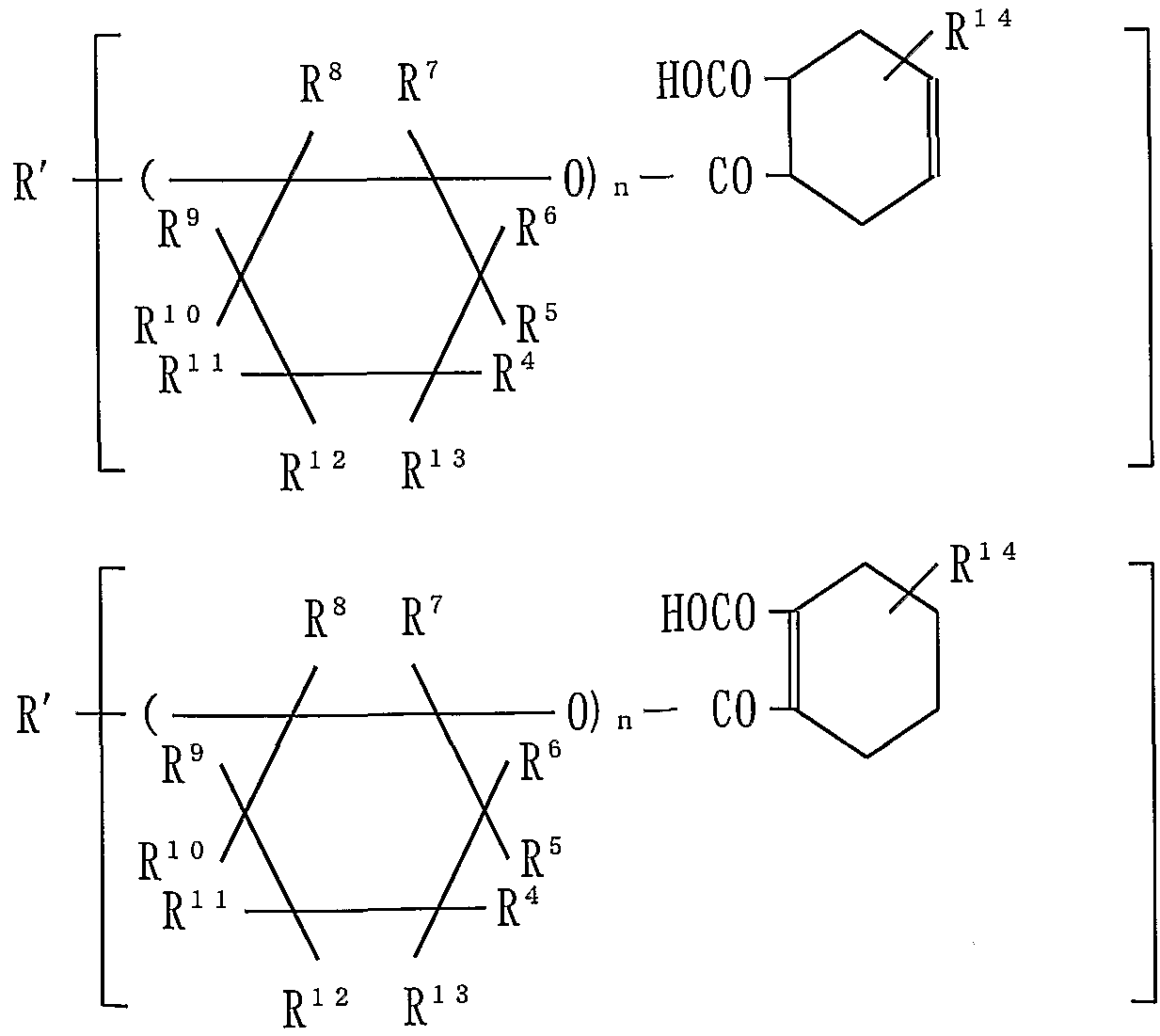
- polybasic acid anhydrides include 1,2,3,6-tetrahydrophthalic anhydride, 3,4,5,6-tetrahydrofluoric anhydride, 3- or 4-methyltetrahydrofluoric anhydride
- the resulting polyether compound of the formula (4) must have X as -COOH and have the following structural formula: become.
- R 14 is a hydrogen atom or an alkyl group such as a methyl group.
- polybasic acid anhydrides may be used as aromatic hydrocarbons such as toluene and xylene, alcohols such as methanol, isopropanol and cyclohexanol, alicyclic hydrocarbons such as cyclohexane and methylcyclohexane, and petroleum ethers.
- aromatic hydrocarbons such as toluene and xylene
- alcohols such as methanol, isopropanol and cyclohexanol
- alicyclic hydrocarbons such as cyclohexane and methylcyclohexane
- petroleum ethers such as petroleum naphtha
- cellosolves such as cellosolve and butyl cellulose, carbitol and butylcarb!
- Carbitols such as ethyl, ethyl acetate, butyl acetate, cellosolve acetate, butyl cellulose and solvent sorbitol, carbitol Acetates such as acetate and butyl carbitol acetate may be dissolved in an organic solvent such as methyl ethyl ketone and ketones such as hexahexanone to be added and reacted.
- photopolymerizable monomers are used as reaction diluents. You can also. Examples of the photopolymerizable monomer that can be used as a reaction diluent include methyl (meth) acrylate, ethyl (meth) acrylate, n-propyl (meth) acrylate, n-butyl (meth) acrylate, and 2-ethyl. Kisil
- reaction diluents can be used alone, or two or more of them can be used in combination.
- the reaction between the polyether compound of the formula (3) and the polybasic anhydride is carried out in the presence of a polymerization inhibitor such as hydroquinone / methquinone under aeration of a mixture containing oxygen, in the range of 80 to 12; It is preferable to perform the reaction at 0 ° C. If the reaction temperature is lower than 80, the reaction speed is slow and the reaction may take a long time. If the reaction temperature exceeds 120, the polyfunctional acrylate will undergo thermal polymerization, which may cause gelation during the reaction.
- a polymerization inhibitor such as hydroquinone / methquinone under aeration of a mixture containing oxygen
- a tertiary amine such as triethylamine, a quaternary ammonium salt such as triethylbenzylammonium chloride, an imidazole compound such as 2-ethyl-4-methylimidazole, A phosphorus compound such as luphosphine may be added as a catalyst.
- the polyether compound of the present invention is represented by the above formula (4), as is clear from the above synthesis method.
- the total of n in one molecule is 2 to 50, preferably 5 to 20.
- each of the k structures may be the same or different, and n in each structure may be the same or different.
- the sum of n is more than 50, the number of unsaturated groups in the polyether compound represented by the formula (4) becomes unnecessarily large, and when used as a curable resin, the crosslinking density becomes too high. The cured film becomes brittle, which is not preferable.
- the acid value (solid content equivalent) of the polyether compound represented by the formula (4) is usually 5 to 150 KOHmg / g, preferably 25 to 15 OKOHmg / g, in consideration of alkali developability and sensitivity. And more preferably 45 to 140 KOHmg Zg.
- the acid value is less than 5 KOHmgZg, when used as a solder photoresist ink composition, there is a possibility that the developability due to dilute strength may decrease. If the acid value exceeds 15 OKOHmgZg, the curable resin composition and In such a case, storage stability may decrease.
- R ′ in the above formula (4) is represented by the active hydrogen contained therein.
- R ′ ′ in the above formula (3) is the same as R ′.
- the “group derived from the residue” refers to such a case.
- the compound of formula (3) shows that R ′ ′ is a residue CH3CH2C (CH2OH ) 2CH2O- (all the remaining active hydrogens are unreacted), and one or all of the two active hydrogens contained in each Having a “group derived from the residue” having one or two structures similar to the structure obtained by reacting the compound of formula (2), that is, the structure of formula (3) except for R ′ ′, Become.
- R ′ ′ is a residue CH3CH2C (CH2OH ) 2CH2O- (all the remaining active hydrogens are unreacted)
- R ′ ′ is a residue CH3CH2C (CH2OH ) 2CH2O-
- the resin composition of the present invention preferably contains 15% by weight or more of the polyether compound represented by the above (4).
- the resin composition of the present invention is obtained by adding the compound represented by the formula (2A) to the polyether compound of the present invention and a (meth) acrylic acid-mono (meth) acrylate copolymer. Examples include blends with curable resins such as resins and Z or ethylenically unsaturated compounds.
- curable resin examples include “ACA200 or Cyc1omerP” manufactured by Daicel Chemical Industries.
- ethylenically unsaturated compound examples include j3-caprolactyl (meth) acrylate, isoponyl (meth) acrylate, octylnodecyl (meth) acrylate, ethoxyphenyl (meth) acrylate, and ethylene glycol monoethylate.
- the polyether compound represented by the formula (4) is converted into various polymerizable oligomers such as various epoxy acrylates, urethane (meth) acrylates, unsaturated polyesters, polyester (meth) acrylates, and polyether (meth) acrylates. You may use together with these polymers etc.
- the resin or ethylenically unsaturated compound obtained by adding the compound represented by the formula (2A) to the (meth) acrylic acid-mono (meth) acrylate copolymer may be used alone or in combination of two or more as necessary. The above can be mixed and used at an arbitrary ratio.
- the amount of the resin or the ethylenically unsaturated compound obtained by adding the compound represented by the formula (2A) to the (meth) acrylic acid-mono (meth) acrylate copolymer is as follows. To 85% by weight, preferably 10 to 80% by weight. Curing of resin composition
- the resin composition of the present invention can be cured by heat, but can be cured by irradiating active energy rays such as ultraviolet rays, electron beams, X-rays, and 7 rays, and cured by using ultraviolet rays. Is the most common. For example, it is easily cured by irradiating ultraviolet rays using a low-pressure or high-pressure mercury lamp or a xenon lamp.
- the resin composition of the present invention is useful as a coating agent, paint, ink, resist and the like for various substrates, for example, paper, metal, plastic, glass, ceramic, concrete, wood and the like. In the case of curing by ultraviolet rays, a photopolymerization initiator is usually used.
- any known photopolymerization initiator may be used, but it is required to have good storage stability after blending.
- a photopolymerization initiator include, for example, benzoin alkyl ethers such as benzoin ethyl ether, benzoin isobutyl ether and benzoin isopropyl ether, 2,2-ethoxyethoxyphenone, 4,1-phenoxy1-2, Acetone phenones such as 2-dichloroacetone phenone, 2-hydroxy-12-methylpropiophenone, 4'-isopropyl-12-hydroxy-2-methylpropiophenone, 4'-dodecyl-2-hydroxy2 Propionofenone such as monomethylpropionofenone, anthraquinone such as benzyldimethylnatal, 1-hydroxycyclohexylphenylketone and 2-ethylanthraquinone and 2-chloroanthraquinone, and thioxan
- photopolymerization initiators may be used singly or as a mixture of two or more kinds at an arbitrary ratio.
- the amount used is usually from 0.1 to 30% by weight of the resin composition, preferably from 1 to 20% by weight. Further, it is preferably 1 to 5% by weight. If the amount of the photoinitiator used is less than 0.1% by weight, the curing speed is slow, requiring a higher energy irradiation device, and there are problems in safety, productivity and economy, and conversely, 30% by weight. %, The curing speed is not improved, but rather, the physical properties of the cured product are deteriorated.
- the resin composition of the present invention optionally uses a polymerization inhibitor, a silane coupling agent, an antioxidant, a light stabilizer, a plasticizer, a leveling agent, a defoaming agent, a pigment, an inorganic filler, and an organic solvent. can do.
- the resin composition of the present invention can be obtained by uniformly mixing the components.
- Methods for applying the resin composition of the present invention to a substrate include spin coating and roll coating. Coating method, dating method, spraying method, curtain flow coating method, screen printing method, offset printing method, gravure coating method and the like.
- the resin composition of the present invention can be used as an image forming material by blending with a curable resin other than the other curable resins as necessary.
- Parts in Examples and Comparative Examples are parts by weight.
- Fig. 1 shows the NMR chart.
- the ratio of the absorption intensity of 0.9 ppm of the methyl group (3H) of trimethylolpropane used as the initiator for ring opening to the intensity of the 1H proton attached to the tertiary carbon on the cyclo ring is 2:10.
- the prepared mo 1 ratio matches the theoretical value from 1:15.
- the polyacrylate-based compound obtained as described above was further subjected to addition reaction with tetrahydrophthalic anhydride, which is a dibasic acid anhydride, as follows.
- a 50 Oml reactor equipped with a stirrer, temperature controller and thermometer was charged with 300 parts of a toluene solution of a polyacrylate compound (solid content: 65%), 31 parts of tetrahydrophthalic anhydride and 0.33 parts of hydroquinone monomethyl ether.
- the temperature of the solution was raised to 90 ° C, and then 0.83 parts of imidazole was added.
- the addition reaction was allowed to proceed, and the reaction was sampled with time to measure the acid value and GPC.
- the structure of the diacrylate-anhydride-added polyacrylate compound was confirmed by 1 H—N MR measurement in a toluene solution. The NMR chart is shown in FIG.
- tetrahydrophthalic anhydride An addition reaction was performed as follows.
- the solid content (dry at 120 ° C., 1 hour), viscosity, and molecular weight by GPC of the obtained acid anhydride-added polyacrylate compound were as follows. 71.8% solids, viscosity
- Tetrahydrophthalic anhydride was further added to the obtained polymethacrylate compound as follows. Reaction was performed as described above.
- the acid value is low due to tetrahydrophthalic anhydride. It was confirmed that the peak on the molecular weight side almost disappeared.
- a 2 liter reactor equipped with a stirrer, a temperature controller, and a thermometer was charged with 72 parts of acrylic acid ( ⁇ ⁇ ), 910 parts of 3,4-epoxycyclohexylmethyl acrylate and 520 parts of toluene, and the liquid was charged.
- the temperature was raised to 35 ° C, and then 13.7 parts of a boron trifluoride dimethyl ether complex was added dropwise over about 3 hours to carry out the reaction. After the completion of the dropwise addition, the reaction was continued until the oxysilane oxygen concentration of the mixed solution became 0.05% or less.
- the obtained polyacrylate compound was further subjected to an addition reaction with tetrahydrophthalic anhydride as follows.
- a toluene solution of the polyacrylate compound solid content: 65%
- 30.2 parts of tetrahydrophthalic anhydride and 0.3 parts of hydroquinone monomethyl ether were added. 33 parts were charged, the liquid temperature was raised to 90 ° C, and then 0.83 parts of imidazole was added.
- the addition reaction was allowed to proceed, and the reaction was sampled with time to measure the acid value and GPC.
- the reaction is carried out for 10 hours, and the acid value is 35 KOHmg / g against the theoretical value of 34 KOHmgZg for this reaction (acid value in terms of solid content: 5 IKOHmg / g), and the GPC measurement shows that the lower molecular weight side is due to tetrahydrophthalic anhydride. It was confirmed that the peak almost disappeared.
- the reaction was carried out for 10 hours, and the acid value was 48 KOHmg / g against the theoretical value of 46 KOHmgZg for this reaction (acid value 68KOHmgZg in terms of solid content), and the peak on the low molecular weight side due to tetrahydrophthalic anhydride in GPC measurement. Confirmed that it was almost gone.
- an epoxy (meth) acrylate resin obtained by subjecting an epoxy group of an epoxy resin described in JP-A-6-157965 to a ring-opening reaction with acrylic acid / methacrylic acid and an acid anhydride were added thereto.
- the following synthesis was performed in order to obtain the desired product.
- an epoxidized cyclohexanepolyether resin EHPE 3150 (1 mole of tri-mol) prepared by the method described in JP-A-60-166675. Epoxidized reaction product of methylolpropane and 15 mol of vinyl cyclohexene monoepoxide.
- the resulting compound was further subjected to an addition reaction with tetrahydrophthalic anhydride as follows.
- the reaction is carried out for 10 hours, and the acid value is 33 KOHmg / g against the theoretical value of 32 KOHmgZg (acid value in terms of solid content: 48 KOHmg / g) .
- the acid value is low due to tetrahydrophthalic anhydride. It was confirmed that the peak on the molecular weight side almost disappeared.
- Acid value * Solid content corrected acid value (the same applies hereinafter) Table 2 Synthesis conditions and properties of Examples and Comparative Examples
- Methacrylic acid-methyl methacrylate used in the field of resist A commercially available product obtained by adding 3,4-epoxycyclohexylmethyl acrylate of the formula (2A) to a polymer (ACA200 manufactured by Daicel Chemical Industries, Ltd.) was used in Examples 1-4 and Comparative Examples 2-3. The obtained acid-terminated acrylate compound and the like were blended, UV-cured, and evaluated for developability and the like.
- the solid content of AC A200 is 47%
- polyfunctional acrylate including DPHA is prepared by adjusting the acrylate component to 65% in advance using toluene and adding a photopolymerization initiator and a colorant solution.
- 2.0% Oraso 1B 1 uegn MMPG-Ac solution was used as a coloring agent to make the developability clear
- Irgacure-1907 manufactured by Ciba Specialty Chemicals was used as a photoinitiator.
- the evaluation items were tackiness and gloss in pre-baking (PB). Next, tack, gloss, pencil hardness, solvent resistance and bending resistance after UV irradiation. Further, sprayed with 1% Na 2 C_ ⁇ 3 solution cured coating film was confirmed development duration and sensitivity.
- the solvent resistance was evaluated by rubbing the coated film 100 times with hand using a tissue paper (Jujo Kinbari Co., Ltd., Kimwipe) impregnated with toluene and MEK, and checking the surface for changes 100 times. did.
- ⁇ those with change are indicated by X.
- the irradiated coating film was bent using a mandrel ⁇ 10 mm of a JISK550 bending tester to check for cracks in the coating film. Those with no cracks are marked with ⁇ , and those with cracks are marked with X.
- the development time was determined by wrapping a part of the aluminum foil around the surface of the coating film before irradiation with ⁇ ⁇ after prebaking, peeling off the film after irradiation, and measuring the time required to wash out the unexposed areas.
- the sensitivity was evaluated by attaching a step tablet before UV irradiation and washing away the unexposed areas with a developer after irradiation. Table 3 shows the results. Table 3
- the polyether compound having a polyfunctional (meth) acryloyloxy group and a terminal propyloxyl group according to the present invention has excellent curability by active energy rays, and is suitable for use in inks, plastic paints, and paper printing. Varnishing, varnishing, adhesives, and varnishing and adhesives, as well as insulation varnishes, insulating sheets, laminates, printed circuit boards, printed boards, resist inks, and semiconductor encapsulants.
- the curable resin composition containing the polyether compound, another curable resin and a Z or ethylenically unsaturated compound has high alkali developability and high sensitivity. As an image forming material, it can be used for solder resists such as printed circuit boards, .
Landscapes
- Chemical & Material Sciences (AREA)
- Health & Medical Sciences (AREA)
- Chemical Kinetics & Catalysis (AREA)
- Medicinal Chemistry (AREA)
- Polymers & Plastics (AREA)
- Organic Chemistry (AREA)
- Physics & Mathematics (AREA)
- General Chemical & Material Sciences (AREA)
- Spectroscopy & Molecular Physics (AREA)
- General Physics & Mathematics (AREA)
- Macromonomer-Based Addition Polymer (AREA)
Description




Claims


Priority Applications (5)
| Application Number | Priority Date | Filing Date | Title |
|---|---|---|---|
| KR10-2004-7015625A KR20040105836A (ko) | 2002-04-04 | 2003-04-02 | 산기 및 불포화기를 함유하는 신규한 폴리에테르 화합물,그의 제조 방법 및 수지 조성물 |
| EP03745885A EP1496077A4 (en) | 2002-04-04 | 2003-04-02 | NEW POLYETHER COMPOUND WITH ACID GROUP AND UNSATURATED GROUP, MANUFACTURING METHOD AND RESIN COMPOSITION |
| JP2003582214A JPWO2003085028A1 (ja) | 2002-04-04 | 2003-04-02 | 酸基および不飽和基含有新規ポリエーテル化合物、その製造方法及び樹脂組成物 |
| US10/510,035 US20050228162A1 (en) | 2002-04-04 | 2003-04-02 | Novel polyether compound containing acid group and unsaturated group, process for producing the same, and resin composition |
| AU2003236339A AU2003236339A1 (en) | 2002-04-04 | 2003-04-02 | Novel polyether compound containing acid group and unsaturated group, process for producing the same, and resin composition |
Applications Claiming Priority (2)
| Application Number | Priority Date | Filing Date | Title |
|---|---|---|---|
| JP2002103070 | 2002-04-04 | ||
| JP2002-103070 | 2002-04-04 |
Publications (1)
| Publication Number | Publication Date |
|---|---|
| WO2003085028A1 true WO2003085028A1 (fr) | 2003-10-16 |
Family
ID=28786287
Family Applications (1)
| Application Number | Title | Priority Date | Filing Date |
|---|---|---|---|
| PCT/JP2003/004195 Ceased WO2003085028A1 (fr) | 2002-04-04 | 2003-04-02 | Compose polyether contenant des groupes acide et insature, procede de production et composition de resine associes |
Country Status (8)
| Country | Link |
|---|---|
| US (1) | US20050228162A1 (ja) |
| EP (1) | EP1496077A4 (ja) |
| JP (1) | JPWO2003085028A1 (ja) |
| KR (1) | KR20040105836A (ja) |
| CN (1) | CN1646600A (ja) |
| AU (1) | AU2003236339A1 (ja) |
| TW (1) | TW200305566A (ja) |
| WO (1) | WO2003085028A1 (ja) |
Cited By (1)
| Publication number | Priority date | Publication date | Assignee | Title |
|---|---|---|---|---|
| WO2012017879A1 (ja) * | 2010-08-02 | 2012-02-09 | 富士フイルム株式会社 | 硬化性樹脂組成物および成形体 |
Families Citing this family (2)
| Publication number | Priority date | Publication date | Assignee | Title |
|---|---|---|---|---|
| JPWO2004057380A1 (ja) * | 2002-11-29 | 2006-04-27 | ダイセル化学工業株式会社 | カラーフィルター用感光性着色組成物、カラーフィルター及びその製造方法 |
| CN111423574B (zh) * | 2020-04-28 | 2023-01-10 | 淮安巴德聚氨酯科技有限公司 | 具有环己烷结构的聚合物多元醇用分散剂及其制备方法 |
Citations (5)
| Publication number | Priority date | Publication date | Assignee | Title |
|---|---|---|---|---|
| JPH0421647A (ja) * | 1990-05-16 | 1992-01-24 | Daicel Chem Ind Ltd | ポリエーテル化合物およびエポキシ樹脂 |
| JPH04258617A (ja) * | 1991-02-12 | 1992-09-14 | Nippon Kayaku Co Ltd | アクリレート化合物、これを含む樹脂組成物及びその硬化物 |
| EP0540027A2 (en) * | 1991-10-31 | 1993-05-05 | Daicel Chemical Industries, Ltd. | Compositions, expoxidized compositions, a heat-curable resin composition, an epoxy resin composition, radically polymerized composition, a curable resin composition and a polymer having epoxy groups |
| JPH0641787A (ja) * | 1992-07-23 | 1994-02-15 | Kansai Paint Co Ltd | 塗膜形成方法 |
| JPH06157965A (ja) * | 1992-11-20 | 1994-06-07 | Goou Kagaku Kogyo Kk | 液状レジストインク組成物及びプリント回路基板 |
Family Cites Families (2)
| Publication number | Priority date | Publication date | Assignee | Title |
|---|---|---|---|---|
| US4565859A (en) * | 1984-01-30 | 1986-01-21 | Daicel Chemical Industries, Ltd. | Polyether compounds, epoxy resins, epoxy resin compositions, and processes for production thereof |
| US5242955A (en) * | 1990-10-30 | 1993-09-07 | Daicel Chemical Industries, Ltd. | Composition comprising polyether compounds, a process for the preparation thereof and a curable resin composition |
-
2003
- 2003-04-02 US US10/510,035 patent/US20050228162A1/en not_active Abandoned
- 2003-04-02 CN CNA038075091A patent/CN1646600A/zh active Pending
- 2003-04-02 JP JP2003582214A patent/JPWO2003085028A1/ja active Pending
- 2003-04-02 AU AU2003236339A patent/AU2003236339A1/en not_active Abandoned
- 2003-04-02 WO PCT/JP2003/004195 patent/WO2003085028A1/ja not_active Ceased
- 2003-04-02 EP EP03745885A patent/EP1496077A4/en not_active Withdrawn
- 2003-04-02 KR KR10-2004-7015625A patent/KR20040105836A/ko not_active Withdrawn
- 2003-04-03 TW TW092107615A patent/TW200305566A/zh unknown
Patent Citations (5)
| Publication number | Priority date | Publication date | Assignee | Title |
|---|---|---|---|---|
| JPH0421647A (ja) * | 1990-05-16 | 1992-01-24 | Daicel Chem Ind Ltd | ポリエーテル化合物およびエポキシ樹脂 |
| JPH04258617A (ja) * | 1991-02-12 | 1992-09-14 | Nippon Kayaku Co Ltd | アクリレート化合物、これを含む樹脂組成物及びその硬化物 |
| EP0540027A2 (en) * | 1991-10-31 | 1993-05-05 | Daicel Chemical Industries, Ltd. | Compositions, expoxidized compositions, a heat-curable resin composition, an epoxy resin composition, radically polymerized composition, a curable resin composition and a polymer having epoxy groups |
| JPH0641787A (ja) * | 1992-07-23 | 1994-02-15 | Kansai Paint Co Ltd | 塗膜形成方法 |
| JPH06157965A (ja) * | 1992-11-20 | 1994-06-07 | Goou Kagaku Kogyo Kk | 液状レジストインク組成物及びプリント回路基板 |
Non-Patent Citations (1)
| Title |
|---|
| See also references of EP1496077A4 * |
Cited By (2)
| Publication number | Priority date | Publication date | Assignee | Title |
|---|---|---|---|---|
| WO2012017879A1 (ja) * | 2010-08-02 | 2012-02-09 | 富士フイルム株式会社 | 硬化性樹脂組成物および成形体 |
| JP2012031331A (ja) * | 2010-08-02 | 2012-02-16 | Fujifilm Corp | 硬化性樹脂組成物および成形体 |
Also Published As
| Publication number | Publication date |
|---|---|
| EP1496077A4 (en) | 2006-01-25 |
| CN1646600A (zh) | 2005-07-27 |
| US20050228162A1 (en) | 2005-10-13 |
| AU2003236339A1 (en) | 2003-10-20 |
| TW200305566A (en) | 2003-11-01 |
| EP1496077A1 (en) | 2005-01-12 |
| KR20040105836A (ko) | 2004-12-16 |
| JPWO2003085028A1 (ja) | 2005-08-11 |
Similar Documents
| Publication | Publication Date | Title |
|---|---|---|
| JP4011885B2 (ja) | 硬化性樹脂の製造方法および硬化性樹脂を含む組成物 | |
| JPH0794519B2 (ja) | 活性エネルギー線硬化性樹脂組成物並びに被覆組成物および印刷インキ組成物 | |
| CN101128512B (zh) | 支化聚醚树脂组合物的制造方法和酸侧基型支化聚醚树脂组合物的制造方法 | |
| TWI557143B (zh) | 活性能量線硬化性組成物、使用其的活性能量線硬化性塗料及活性能量線硬化性印刷墨水 | |
| WO2003085028A1 (fr) | Compose polyether contenant des groupes acide et insature, procede de production et composition de resine associes | |
| JP4095380B2 (ja) | (メタ)アクリレート系化合物の製造方法及び樹脂組成物の製造方法 | |
| JPH08277321A (ja) | 光硬化性樹脂組成物 | |
| JP4844002B2 (ja) | 酸ペンダント型エポキシアクリレート樹脂組成物 | |
| US5242955A (en) | Composition comprising polyether compounds, a process for the preparation thereof and a curable resin composition | |
| JP2000256428A (ja) | 硬化性樹脂及びその組成物 | |
| JP2002275226A (ja) | 光硬化性樹脂組成物、これを用いた塗料及び硬化膜 | |
| JPH02238013A (ja) | 活性エネルギー線硬化性樹脂組成物および印刷インキ組成物 | |
| JP4043884B2 (ja) | 水性光重合性樹脂組成物の製造方法及び水性光重合性樹脂組成物 | |
| TW202024142A (zh) | 樹脂與墨水 | |
| JP3209537B2 (ja) | 硬化性樹脂組成物 | |
| JPS6268862A (ja) | 活性エネルギー線硬化性印刷インキ組成物 | |
| JP2001064324A (ja) | 重合性組成物およびインキワニス | |
| JPH0124168B2 (ja) | ||
| JPS58191773A (ja) | 活性エネルギ−線硬化性インキ組成物 | |
| JPS5958016A (ja) | 硬化性樹脂組成物 | |
| JPH09151238A (ja) | 新規な(メタ)アクリル基を側鎖に有する化合物およびその用途 | |
| JPS63248869A (ja) | 硬化性被覆組成物 | |
| JPH01161069A (ja) | 活性エネルギー線硬化性印刷インキ組成物 | |
| JPH01230621A (ja) | 活性エネルギー線硬化性樹脂,その樹脂を含む硬化性被覆組成物および印刷インキ組成物 | |
| JPH0482005B2 (ja) |
Legal Events
| Date | Code | Title | Description |
|---|---|---|---|
| AK | Designated states |
Kind code of ref document: A1 Designated state(s): AE AG AL AM AT AU AZ BA BB BG BR BY BZ CA CH CN CO CR CU CZ DE DK DM DZ EC EE ES FI GB GD GE GH GM HR HU ID IL IN IS JP KE KG KR KZ LC LK LR LS LT LU LV MA MD MG MK MN MW MX MZ NO NZ OM PH PL PT RO RU SC SD SE SG SK SL TJ TM TN TR TT TZ UA UG US UZ VC VN YU ZA ZM ZW |
|
| AL | Designated countries for regional patents |
Kind code of ref document: A1 Designated state(s): GH GM KE LS MW MZ SD SL SZ TZ UG ZM ZW AM AZ BY KG KZ MD RU TJ TM AT BE BG CH CY CZ DE DK EE ES FI FR GB GR HU IE IT LU MC NL PT RO SE SI SK TR BF BJ CF CG CI CM GA GN GQ GW ML MR NE SN TD TG |
|
| 121 | Ep: the epo has been informed by wipo that ep was designated in this application | ||
| WWE | Wipo information: entry into national phase |
Ref document number: 2003582214 Country of ref document: JP |
|
| WWE | Wipo information: entry into national phase |
Ref document number: 20038075091 Country of ref document: CN |
|
| WWE | Wipo information: entry into national phase |
Ref document number: 1020047015625 Country of ref document: KR Ref document number: 10510035 Country of ref document: US |
|
| WWE | Wipo information: entry into national phase |
Ref document number: 2003745885 Country of ref document: EP |
|
| WWP | Wipo information: published in national office |
Ref document number: 1020047015625 Country of ref document: KR |
|
| WWP | Wipo information: published in national office |
Ref document number: 2003745885 Country of ref document: EP |
|
| WWW | Wipo information: withdrawn in national office |
Ref document number: 2003745885 Country of ref document: EP |