WO2003093271A1 - Fungizide triazolopyrimidine, verfahren zu ihrer herstellung und ihre verwendung zur bekämpfung von schadpilzen sowie sie enthaltende mittel - Google Patents
Fungizide triazolopyrimidine, verfahren zu ihrer herstellung und ihre verwendung zur bekämpfung von schadpilzen sowie sie enthaltende mittel Download PDFInfo
- Publication number
- WO2003093271A1 WO2003093271A1 PCT/EP2003/004498 EP0304498W WO03093271A1 WO 2003093271 A1 WO2003093271 A1 WO 2003093271A1 EP 0304498 W EP0304498 W EP 0304498W WO 03093271 A1 WO03093271 A1 WO 03093271A1
- Authority
- WO
- WIPO (PCT)
- Prior art keywords
- formula
- alkyl
- compounds
- halogen
- methyl
- Prior art date
- Legal status (The legal status is an assumption and is not a legal conclusion. Google has not performed a legal analysis and makes no representation as to the accuracy of the status listed.)
- Ceased
Links
- 0 CC(*)(C(*)(F)F)F Chemical compound CC(*)(C(*)(F)F)F 0.000 description 3
- RZBSYVZCDZQFDT-KXFIGUGUSA-N C/C=N\NC(N)=N Chemical compound C/C=N\NC(N)=N RZBSYVZCDZQFDT-KXFIGUGUSA-N 0.000 description 1
Classifications
-
- C—CHEMISTRY; METALLURGY
- C07—ORGANIC CHEMISTRY
- C07D—HETEROCYCLIC COMPOUNDS
- C07D487/00—Heterocyclic compounds containing nitrogen atoms as the only ring hetero atoms in the condensed system, not provided for by groups C07D451/00 - C07D477/00
- C07D487/02—Heterocyclic compounds containing nitrogen atoms as the only ring hetero atoms in the condensed system, not provided for by groups C07D451/00 - C07D477/00 in which the condensed system contains two hetero rings
- C07D487/04—Ortho-condensed systems
-
- A—HUMAN NECESSITIES
- A01—AGRICULTURE; FORESTRY; ANIMAL HUSBANDRY; HUNTING; TRAPPING; FISHING
- A01N—PRESERVATION OF BODIES OF HUMANS OR ANIMALS OR PLANTS OR PARTS THEREOF; BIOCIDES, e.g. AS DISINFECTANTS, AS PESTICIDES OR AS HERBICIDES; PEST REPELLANTS OR ATTRACTANTS; PLANT GROWTH REGULATORS
- A01N43/00—Biocides, pest repellants or attractants, or plant growth regulators containing heterocyclic compounds
- A01N43/90—Biocides, pest repellants or attractants, or plant growth regulators containing heterocyclic compounds having two or more relevant hetero rings, condensed among themselves or with a common carbocyclic ring system
-
- C—CHEMISTRY; METALLURGY
- C07—ORGANIC CHEMISTRY
- C07C—ACYCLIC OR CARBOCYCLIC COMPOUNDS
- C07C69/00—Esters of carboxylic acids; Esters of carbonic or haloformic acids
- C07C69/62—Halogen-containing esters
- C07C69/65—Halogen-containing esters of unsaturated acids
Definitions
- Fungicidal triazolopyrimidines processes for their preparation and their use in combating harmful fungi and compositions containing them
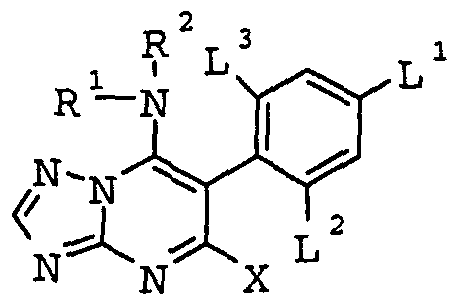
- the present invention relates to triazolopyrimidines of the formula I,
- R ⁇ R 2 independently of one another hydrogen, C * -C 3 alkyl
- C ⁇ -C ⁇ o-haloalkyl C 3 -C 8 cycloalkyl, C 2 -C ⁇ o-alkenyl, 4 -C 10 -alkadienyl, C 2 -C ⁇ o-alkynyl or C 4 -C ⁇ o-al yl, which has no chiral center, or CjC ⁇ - cycloalkynyl, phenyl, naphthyl, or a five- to ten-membered saturated, partially unsaturated or aromatic heterocycle, containing one to four hetero atoms from the group 0, N or S,
- R 1 and R 2 together with the nitrogen atom to which they are attached can also form a five- or six-membered ring which is interrupted by an atom from the group 0, N and S and / or one or more substituents from the group Halogen, Ci-C ß- alkyl, Ci-C ⁇ -haloalkyl and oxy-C ⁇ -C 3 alkyleneoxy can wear or in which an N and an adjacent C atom can be connected by a C ⁇ -C 4 alkylene chain;
- R 1 and / or R 2 can be substituted by one to three identical or different groups R a : R a halogen, cyano, nitro, hydroxy, Ci-C ⁇ - alkyl, C ⁇ -C 6 -haloalkyl, Ci-C ⁇ -alkylcarbonyl, C 3 -C 6 -cycloalkyl, C ⁇ -C 6 -alkoxy, C ⁇ - C 6 -haloalkoxy, Ci-C ⁇ -alkoxycarbonyl, Ci-C ⁇ -alkylthio, Ci-C ⁇ -alkylamino, di-Ci-C ⁇ -alkylamino, C 2 -C 6 alkenyl, C 2 -C 6 ⁇ alkenyloxy, C 3 -C 6 ⁇ alkynyloxy,
- R b halogen, cyano, nitro, hydroxy, mercapto, a ino, carboxyl, aminocarbonyl, aminothiocarbonyl, alkyl, haloalkyl, alkenyl, alkenyloxy, alkynyloxy, alkoxy, haloalkoxy, alkylthio, alkylamino, dialkylamino, formyl, alkylcarbonyl, alkylsulfonyl, Al - kylsulfoxyl, alkoxycarbonyl, alkylcarbonyloxy, alkylaminocarbonyl, dialkylaminocarbonyl, alkylaminothiocarbonyl, dialkylaminothiocarbonyl, the alkyl groups in these radicals containing 1 to 6 carbon atoms and the alkenyl or alkynyl groups mentioned in these radicals containing 2 to 8 carbon atoms;
- the invention relates to methods and intermediates for the preparation of these compounds, compositions containing them and their use for controlling harmful fungi.
- Single 6- (4-alkylphenyl) triazolopyrimidines are known from EP-A 71 792 and EP-A 550 113.
- WO-A 98/46608 discloses 5-chlorotriazolopyrimidines with 7-haloalkylamino groups; corresponding 6- (4-alkylphenyl) triazolopyrimidines are generically included.
- the compounds described in the cited documents are known for combating harmful fungi.
- the present invention is based on the object of providing compounds with improved activity and / or broadened activity spectrum.
- the compounds of formula I differ from those from the abovementioned publications in the substitution of the 6- (4-alkylphenyl) group which additionally bears a halogen atom in the 2-position.
- the compounds of the formula I have an increased activity against harmful fungi compared to the known compounds.
- the compounds according to the invention can be obtained in various ways. They are advantageously prepared by reacting 5-aminotriazole of the formula II with appropriately substituted phenylmalonates of the formula III in which R is alkyl, preferably Ci-Cs-alkyl, in particular methyl or ethyl.
- This reaction usually takes place at temperatures from 80 ° C. to 250 ° C., preferably 120 ° C. to 180 ° C., without solvent or in an inert organic solvent in the presence of a base [cf. EP-A 770 615] or in the presence of acetic acid among those from Adv. Het. Chem. Vol. 57, pp. 81ff. (1993) known conditions.
- Suitable solvents are aliphatic hydrocarbons, aromatic hydrocarbons such as toluene, o-, m- and p-xylene, halogenated hydrocarbons, ethers, nitriles, ketones, alcohols, and also N-methylpyrrolidone, dimethyl sulfoxide, dirnethyl formate and dimethylacetamide.
- the reaction is particularly preferably carried out without solvent or in chlorobenzene, xylene, dimethyl sulfoxide, 5 N-methylpyrrolidone. Mixtures of the solvents mentioned can also be used.
- inorganic compounds such as alkali metal and alkaline earth metal hydroxides, alkali metal and alkaline earth metal
- organic bases e.g. Tertiary amines such as trimethylamine, triethylamine, tri-isopropylethylamine, tributylamine and N-methylpiperidine, N-methylmorpholine, pyridine, substituted pyridines such as collidine, lutidine and 4-dimethylaminopyridine as well as bicyclic amines.
- Tertiary amines such as trimethylamine, triethylamine, tri-isopropylethylamine, tributylamine and N-methylpiperidine, N-methylmorpholine, pyridine, substituted pyridines such as collidine, lutidine and 4-dimethylaminopyridine as well as bicyclic amines.
- Tertiary amines such as trimethylamine, triethylamine, tri-isopropylethylamine, tributylamine and N-methylpiperidine, N-methylmorpholine, pyridine, substituted
- the bases are generally used in catalytic amounts, but they can also be used in equimolar amounts, in excess or, if appropriate, as a solvent.
- the starting materials are generally reacted with one another in equimolar amounts. It may be advantageous for the yield to use the base and the malonate III in an excess based on the tri-azole.
- Phenylmalonates of the formula III are advantageously obtained from the reaction of appropriately substituted bromobenzenes with dialkylmalonates with Cu (I) catalysis [cf. Chemistry Letters, pp. 367-370, 35 1981; EP-A 10 02 788].
- the dihydroxytriazolopyrimidines of the formula IV are converted into the dihalopyrimidines of the formula V under the conditions known from WO-A 94/20501.
- a chlorinating agent or a brominating agent such as phosphorus oxybromide or phosphorus oxychloride, optionally in the presence of a solvent, is advantageously used as the halogenating agent.
- This reaction is usually carried out at 0 ° C to 150 ° C, preferably at 80 ° C to 125 ° C [cf. EP-A 770 615].
- Dihalopyrimidines of the formula V are mixed with amines of the formula VI,
- This reaction is advantageously carried out at 0 ° C to 70 ° C, preferably 10 ° C to 35 ° C, preferably in the presence of an inert solvent such as ether, e.g. B. dioxane, diethyl ether or in particular tetrahydrofuran, halogenated hydrocarbons such as dichloromethane and aromatic hydrocarbons such as toluene [cf. WO-A 98/46608].
- ether e.g. B. dioxane, diethyl ether or in particular tetrahydrofuran
- halogenated hydrocarbons such as dichloromethane
- aromatic hydrocarbons such as toluene [cf. WO-A 98/46608].
- a base such as tertiary amines, for example triethylamine or inorganic amines, such as potassium carbonate, is preferred; Excess amine of the formula VI can also serve as the base.
- the reaction temperature is usually from 0 to 120 ° C., preferably from 10 to 40 ° C. [cf. J. Heterocycl. Che. , Vol. 12, pp. 861-863 (1975)].
- Suitable solvents include ethers such as dioxane, diethyl ether and, preferably tetrahydrofuran, halogenated hydrocarbons such as dichloro ethane and aromatic hydrocarbons such as toluene.
- the 5-alkyl-7-hydroxy-6-phenyltriazolopyrimidines IVa are obtained.
- the easily accessible 2-phenylacetoacetic esters purple with X ⁇ CH ⁇ the 5-methyl-7-hydroxy-6-phenyltriazolopyrimidines are obtained [cf. Chem. Pharm. Bull., 9, 801, (1961)].
- the preparation The starting compounds purple advantageously take place under the conditions described in EP-A 10 02 788.
- the 5-alkyl-7-hydroxy-6-phenyltriazolopyrimidines thus obtained are reacted with halogenating agents to give the 7-halotriazolopyrimidines of the formula Va.
- Chlorination or brominating agents such as phosphorus oxybride, phosphorus oxychloride, thionyl chloride, thionyl bromide or sulfuryl chloride are preferably used.
- the reaction can be carried out in bulk or in the presence of a solvent. Usual reaction temperatures are from 0 to 150 ° C or preferably from 80 to 125 ° C.
- Va is reacted with amines VI under the conditions described above.
- the malonates VIII are known in the literature [J. At the. Chem. Soc, Vol. 64, 2714 (1942); J. Org. Chem., Vol. 39, 2172 (1974); Helv. Chim. Acta, Vol. 61, 1565 (1978)] or can be prepared according to the literature cited.
- the subsequent saponification of the ester IX takes place under generally customary conditions, depending on the various structural elements, the alkaline or acid saponification of the compounds IX can be advantageous. Under the conditions of ester hydrolysis, the decarboxylation to I can already take place in whole or in part.
- the decarboxylation is usually carried out at from 20 ° C. to 180 ° C., preferably from 50 ° C. to 120 ° C., in an inert solvent, optionally in the presence of an acid.
- Suitable acids are hydrochloric acid, sulfuric acid, phosphoric acid, formic acid, acetic acid, p-toluenesulfonic acid.
- Suitable solvents are water, aliphatic hydrocarbons such as pentane, hexane, cyclohexane and petroleum ether, aromatic hydrocarbons such as toluene, o-, m- and p-xylene, halogenated hydrocarbons such as methylene chloride, chloroform and chlorobenzene, ethers such as diethyl ether, diisopropyl ether, tert.
- the reaction is particularly preferably carried out in hydrochloric acid or acetic acid. Mixtures of the solvents mentioned can also be used.
- Compounds of the formula I in which X is C 1 -C 4 -alkyl can also be obtained by coupling 5-halotriazolopyrimidines of the formula I in which X is halogen with organometallic reagents of the formula X.
- the reaction takes place with transition metal catalysis, such as Ni or Pd catalysis.
- M stands for a metal ion of valence Y, such as B, Zn or Sn.
- This reaction can be carried out, for example, analogously to the following methods: J. Chem. Soc. Perkin Trans. 1, 1187 (1994), ibid. 1, 2345 (1996); WO-A 99/41255; Aust. J. Chem., Vol. 43, 733 (1990); J. Org. Chem., Vol. 43, 358 (1978); J. Chem. Soc. Chem. Commun. 866 (1979); Tetrahedron Lett., Vol. 34, 8267 (1993); ibid., vol. 33, 413 (1992).
- R 1 or R 2 contain haloalkyl or haloalkenyl groups, the (S) configuration is preferred for optically active amines of the formula VI.
- the reaction mixtures are worked up in a conventional manner, e.g. by mixing with water, separating the phases and, if necessary, chromatographically cleaning the raw products.
- the intermediate and end products fall partly in the form of colorless or slightly brownish, viscous oils, which are freed from volatile components or purified under reduced pressure and at a moderately elevated temperature. If the intermediate and end products are obtained as solids, they can also be purified by recrystallization or digesting.
- halogen fluorine, chlorine, bromine and iodine
- Alkyl saturated, straight-chain or branched hydrocarbon radicals having 1 to 4, 6, 8 or 10 carbon atoms, for example C 1 -C 6 -alkyl such as methyl, ethyl, propyl, 1-methylethyl, butyl, 1-Me-
- Haloalkyl straight-chain or branched alkyl groups with 1 to
- 1-chloroethyl 1-bromoethyl, 1-fluoroethyl, 2-fluoroethyl, 2,2-di-fluoroethyl, 2, 2, 2-trifluoroethyl, 2-chloro-2-fluoroethyl, 2-chloro-2, 2-difluoroethyl, 2,2-dichloro-2-fluoroethyl, 2,2,2-trichloroethyl, pentafluoroethyl or 1,1,1-trifluoroprop-2-yl;
- Alkenyl unsaturated, straight-chain or branched hydrocarbon radicals having 2 to 4, 6, 8 or 10 carbon atoms and a double bond in any position, for example C 2 -C 6 ⁇ alkenyl such as ethenyl, 1-propenyl, 2-propenyl, 1-methylethenyl, 1-butenyl,
- Alkadienyl unsaturated, straight-chain or branched hydrocarbon radicals with 4, 6, 8 or 10 carbon atoms and two double bonds in any position;
- Haloalkenyl unsaturated, straight-chain or branched hydrocarbon radicals with 2 to 10 carbon atoms and a double bond in any position (as mentioned above), the hydrogen atoms in these groups being partially or completely against halogen atoms as mentioned above, in particular fluorine, chlorine and bromine, can be replaced;
- Alkynyl straight-chain or branched hydrocarbon groups with 2 to 4, 6, 8 or 10 carbon atoms and a triple bond in any position, for example C 2 -C 6 -alkynyl such as
- Ethynyl 1-propynyl, 2-propynyl, 1-butynyl, 2-butynyl, 3-butynyl, 1-methyl-2-propynyl, 1-pentynyl, 2-pentynyl, 3-pentynyl, 4-pentynyl, l-methyl- 2-butynyl, l-methyl-3-butynyl, 2-methyl-3-butynyl, 3-methyl-l-butynyl, 1, l-dimethyl-2-propynyl, l-ethyl-2-propynyl, 1-hexynyl, 2-hexynyl, 3-hexynyl, 4-hexynyl, 5-hexynyl, l-methyl-2-pentynyl, l-methyl-3-pentynyl, l-methyl-4-pentynyl, 2-methyl-3-pentynyl, 2- Methyl-4
- Haloalkynyl unsaturated, straight-chain or branched hydrocarbon radicals with 2 to 8 carbon atoms and a triple bond in any position (as mentioned above), the hydrogen atoms in these groups being partially or completely against halogen atoms as mentioned above, in particular fluorine, chlorine and bromine, can be replaced;
- Cycloalkyl mono- or bicyclic, saturated hydrocarbon groups with 3 to 6 or 8 carbon ring members, for example C 3 -Ce-cycloalkyl such as cyclopropyl, cyclobutyl, cyclopentyl, cyclohexyl, cycloheptyl and cyclooctyl;
- Oxyalkyleneox divalent unbranched chains of 1 to 3 CH 2 groups, both valences being bonded to the skeleton via an oxygen atom, for example 0CH 2 0, OCH 2 CH 2 0 and OCH 2 CH 2 CH 2 0;
- 5- or 6-membered heterocyclyl containing one to three nitrogen atoms and / or one oxygen or sulfur atom or one or two oxygen and / or sulfur atoms e.g. 2-tetrahydrofuranyl, 3-tetrahydrofuranyl, 2-tetrahydrothienyl, 3-tetrahydrothienyl, 2-pyrrolidinyl, 3-pyrrolidinyl, 3-isoxazolidinyl, 4-isoxazolidinyl, 5-isoxazolidinyl, 3-isothiazolidinylyl, 4-isothiazol 5-isothiazolidinyl, 3-pyrazolidinyl, 4-pyrazolidinyl, 5-pyrazolidinyl, 2-0xazolidinyl, 4-0xazolidinyl, 5-0xazolidinyl, 2-thiazolidinyl, 4-thiazolidinyl, 5-thiazolidinyl, 2-imidazolidinyl, 4- Imidazolidinyl
- Oxygen atom 5-ring heteroaryl groups which, in addition to carbon atoms, may contain one to four nitrogen atoms or one to three nitrogen atoms and one sulfur or oxygen atom as ring members, e.g. 2-furyl, 3-furyl, 2-thienyl, 3-thienyl, 2-pyrrolyl, 3-pyrrolyl, 3-pyrazolyl, 4-pyrazolyl, 5-pyrazolyl, 2-0xazolyl, 4-0xazolyl, 5-0xazolyl, 2- Thiazolyl, 4-thiazolyl, 5-thiazolyl, 2-imidazolyl, 4-imidazolyl, and 1,3, 4-triazol-2-yl;
- 6-membered heteroaryl containing one to three or one to four nitrogen atoms 6-ring heteroaryl groups, which in addition
- Carbon atoms can contain one to three or one to four nitrogen atoms as ring members, for example 2-pyridinyl, 3-pyridinyl, 4-pyridinyl, 3-pyridazinyl, 4-pyridazinyl, 2-pyrimidinyl, 4-pyrimidinyl, 5- Pyrimidinyl and 2-pyrazinyl;
- Alkyl ⁇ n divalent unbranched chains from 3 to 5 CH 2 groups, for example CH 2 , CH 2 CH 2 , CH 2 CH 2 CH 2 , CH 2 CH 2 CH 2 CH 2 and CH 2 CH 2 CH 2 CH 2 CH 2 ;
- Oxyalkylene divalent unbranched chains of 2 to 4 CH 2 groups, one valence being attached to the skeleton via an oxygen atom, for example OCH 2 CH 2 , OCH 2 CH 2 CH 2 and OCH 2 CH 2 CH 2 CH 2 ;
- Oxyalkyleneox divalent unbranched chains of 1 to 3 CH 2 groups, both valences being bonded to the skeleton via an oxygen atom, for example 0CH 2 0, OCH 2 CH 2 0 and OCH 2 CH 2 CH 2 0.
- the scope of the present invention includes the (R) and (S) isomers and the racemates of compounds of formula I which have chiral centers.
- R 1 is C 1 -C 3 -alkyl or C 1 -C 6 -haloalkyl.
- R 1 is C 2 -C ⁇ o-alkenyl
- R 1 represents a group B.
- Y 1 is hydrogen, fluorine or Ci-C ß- fluoroalkyl
- Y 2 is hydrogen or fluorine
- Y 1 and Y 2 together form a double bond; m is 0 or 1;
- Y 3 is hydrogen or methyl.
- R 1 is C 3 -C 6 -cycloalkyl, which may be substituted by -C-C 4 alkyl.
- R 1 and / or R 2 contain haloalkyl or haloalkenyl groups with a chiral center, the (S) isomers are preferred.
- R 1 and R 2 together with the nitrogen atom to which they are attached form a five- or six-membered ring which is interrupted by an atom from the group 0, N and S and / or can carry one or more substituents from the group halogen, Ci-C ⁇ - alkyl, -C-C 6 -haloalkyl and oxy-C ⁇ -C 3 -alkyleneoxy or in which an N and an adjacent C atom by a C ⁇ -C 4 alkylene chain can be connected.
- compounds I are particularly preferred in which R 1 and R 2 together with the nitrogen atom to which they are attached form a piperidinyl ring which is optionally substituted by one to three halogen, C ⁇ -C4 alkyl or C ⁇ -C 4 -Halogenalkyl, in particular substituted by 4-methyl.
- compounds I are particularly preferred in which L 1 is methyl or ethyl, in particular methyl.
- Compounds I are particularly preferred in which X is halogen or -CC 4 alkyl, such as chlorine or methyl, especially chlorine.
- Table 7 Compounds of the formula I in which X is chlorine, L 1 is ethyl, L 2 is chlorine and L 3 is hydrogen and the combination of R 1 and R 2 for each compound corresponds to one row of Table A.
- Table 15 Compounds of the formula I, in which X is cyano, L 1 is ethyl, L 2 is chlorine and L 3 is hydrogen and the combination of R 1 and R 2 for each compound corresponds to one row of Table A.
- Table 23 Compounds of the formula I, in which X is methyl, L 1 is ethyl, L 2 is chlorine and L 3 is hydrogen and the combination of R 1 and R 2 for each compound corresponds to one row of Table A.
- Table 31 Compounds of the formula I, in which X is methoxy, L 1 is ethyl, L 2 is chlorine and L 3 is hydrogen and the combination of R 1 and R 2 for each compound corresponds to one row of Table A.
- the compounds I are suitable as fungicides. They are characterized by excellent activity against a broad spectrum of phytopathogenic fungi, in particular from the class of the Asco / nycetes, Deuteromycetes, Phycomycetes and Basidiomycetes. Some of them are systemically effective and can be used in plant protection as leaf and soil fungicides.
- Botrytis cinerea (gray mold) on strawberries, vegetables, ornamental plants and vines
- Venturia species scab on apples and pears.
- the compounds I are also suitable for combating harmful fungi such as Paecilomyces variotii in material protection (e.g. wood,
- Paper, dispersions for painting, fibers or fabrics) and in the storage contactor are Paper, dispersions for painting, fibers or fabrics.
- the compounds I are used by treating the fungi or the plants, seeds, materials or the soil to be protected against fungal attack with a fungicidally active amount of the active compounds.
- the application can take place both before and after the infection of the materials, plants or seeds by the fungi.
- the fungicidal compositions generally contain between 0.1 and 95, preferably between 0.5 and 90% by weight of active ingredient.
- the application rates in crop protection are between 0.01 and 2.0 kg of active ingredient per ha.
- active ingredient 0.001 to 0.1 g, preferably 0.01 to 0.05 g, per kg of seed are generally required.
- the amount of active ingredient applied depends on the type of application and the desired effect. Usual application rates in material protection are, for example, 0.001 g to 2 kg, preferably 0.005 g to 1 kg of active ingredient per cubic meter of treated material.
- the compounds I can be converted into the usual formulations, e.g. Solutions, emulsions, suspensions, dusts, powders, pastes and granules.
- the form of application depends on the respective purpose; in any case, it should ensure a fine and uniform distribution of the compound according to the invention.
- the formulations are prepared in a known manner, e.g. by stretching the active ingredient with solvents and / or carriers, if desired using emulsifiers and dispersants, and in the case of water as diluent other organic solvents can also be used as auxiliary solvents.
- auxiliaries solvents such as aromatics (e.g. xylene), chlorinated aromatics (e.g. chlorobenzenes), paraffins (e.g. petroleum fractions), alcohols (e.g. methanol, butanol), ketones (e.g. cyclohexanone), amines (e.g. B.
- Carriers such as natural stone powder (e.g. kaolins, clays, talc, chalk) and synthetic stone powder (e.g. highly disperse silica, silicates); Emulsifiers such as non-ionic and anionic emulsifiers (e.g. polyoxyethylene fatty alcohol ethers, alkyl sulfonates and aryl sulfonates) and dispersants such as lignin sulfite liquors and methyl cellulose.
- Carriers such as natural stone powder (e.g. kaolins, clays, talc, chalk) and synthetic stone powder (e.g. highly disperse silica, silicates)
- Emulsifiers such as non-ionic and anionic emulsifiers (e.g. polyoxyethylene fatty alcohol ethers, alkyl sulfonates and aryl sulfonates) and dispersants such as lignin sulfite liquors and methyl cellulose.
- benzene toluene, xylene, paraffin, Tetrahydronaphthalm, alkylated naphthalenes or their derivatives, methanol, ethanol, propanol, butanol, chloroform, carbon tetrachloride, cyclohexanol, cyclohexanone, chlorobenzene, isophorone, strongly polar solvents, for example dimethylformamide, dimethyl sulfoxide, N-methylpyrrolidone, water, into consideration.
- Powders, materials for broadcasting and dusts can be prepared by mixing or grinding the active substances together with a solid carrier.
- Granules e.g. Coating, impregnation and homogeneous granules can be produced by binding the active ingredients to solid carriers.
- Solid carriers are e.g. Mineral earths, such as silica gels, silicates, talc, kaolin, attack clay, limestone, lime, chalk, bolus, loess, clay, dolomite, diatomaceous earth, calcium and magnesium sulfate, magnesium oxide, ground plastics, fertilizers, e.g. Ammonium sulfate, ammonium phosphate, ammonium nitrate, ureas and vegetable products such as corn flour, tree bark, wood and nutshell flour, cellulose powder and other solid carriers.
- Mineral earths such as silica gels, silicates, talc, kaolin, attack clay, limestone, lime, chalk, bolus, loess, clay, dolomite, diatomaceous earth, calcium and magnesium sulfate, magnesium oxide, ground plastics,
- the formulations generally contain between 0.01 and 95% by weight, preferably between 0.1 and 90% by weight, of the active ingredient.
- the active ingredients are used in a purity of 90% to 100%, preferably 95% to 100% (according to the NMR spectrum).
- 10 parts by weight of a compound according to the invention are dissolved in a mixture consisting of 90 parts by weight of xylene, 6 parts by weight of the adduct of 8 to 10 moles of ethylene oxide and 1 mol of oleic acid-N-monoethanolamide, 2 parts by weight of calcium salt of dodecylbenzenesulfonic acid and 2 parts by weight of the adduct of 40 moles of ethylene oxide with 1 mole of castor oil (active ingredient content 9% by weight).
- V. 80 parts by weight of a compound according to the invention are mixed with 3 parts by weight of the sodium salt of diisobutylnaphthalene-alpha-sulfonic acid, 10 parts by weight of the sodium salt of a lignosulfonic acid from a sulfite waste liquor and 7 parts by weight of powdered silica gel well mixed and ground in a hammer mill (active ingredient content 80% by weight).
- VIII.20 parts by weight of a compound according to the invention are mixed well with 3 parts by weight of the sodium salt of diisobutylnaphthalene- ⁇ -sulfonic acid, 17 parts by weight of the sodium salt of lignosulfonic acid from a sulfite waste liquor and 60 parts by weight of powdered silica gel and milled in a hammer mill.
- a spray liquor is obtained which contains 0.1% by weight of the active ingredient.
- the active ingredients as such in the form of their formulations or the use forms prepared therefrom, for example in the form of directly sprayable solutions, powders, suspensions or dispersions, emulsions, oil dispersions, pastes, dusts, scattering agents, granules by spraying, atomizing, dusting, Scatter or pour.
- the application forms depend entirely on the purposes; in any case, they should ensure the finest possible distribution of the active compounds according to the invention.
- Aqueous use forms can be prepared from emulsion concentrates, pastes or wettable powders (wettable powders, oil dispersions) by adding water.
- emulsion concentrates pastes or wettable powders (wettable powders, oil dispersions)
- wettable powders oil dispersions
- water water
- emulsions, pastes or oil dispersions the substances as such or dissolved in an oil or solvent, by means of wetting, adhesive,
- Dispersants or emulsifiers can be homogenized in water. However, it is also possible to prepare concentrates composed of an active substance, wetting agents, adhesives, dispersants or emulsifiers and possibly solvents or oil, which are suitable for dilution with water.
- the active substance concentrations in the ready-to-use preparations can be varied over a wide range. In general, they are between 0.0001 and 10%, preferably between 0.01 and 1%.
- the active ingredients can also be used with great success in the ultra-low-volume process (ULV), it being possible to apply formulations with more than 95% by weight of active ingredient or even the active ingredient without additives.
- UUV ultra-low-volume process
- Oils of various types, herbicides, fungicides, other pesticides, bactericides can be added to the active ingredients, if appropriate also only immediately before use (tank mix). These agents can be added to the agents according to the invention in a weight ratio of 1:10 to 10: 1.
- compositions according to the invention can also be present together with other active compounds, for example with herbicides, insecticides, growth regulators, fungicides or else with fertilizers.
- Mixing the compounds I or the compositions containing them in the use form as fungicides with other fungicides results in an enlargement of the fungicidal spectrum of action in many cases.
- the following list of fungicides with which the compounds according to the invention can be used together is intended to explain, but not to limit, the possible combinations:
- Sulfur, dithiocarbamates and their derivatives such as ferridimethyldithiocarbamate, zinc dimethyldithiocarbamate, zinc ethylene bisdithiocarbamate, manganese ethylene bisdithiocarbamate, manganese zinc ethylenediamine bis dithiocarbamate, tetramethylthiurium disulfide ethylenediamidulfide ), Ammonia complex of zinc (N, N'-propylene-bis-dithiocarbamate), zinc (N, N'-propylene-bis-dithiocarbamate), N, N'-polypropylene-bis (thiocarbamoyl) disulfide;
- Nitroderivate such as dinitro- (1-methylheptyl) phenylcrotonate, 2-sec-butyl-4, 6-dinitrophenyl-3, 3-dimethylacrylate, 2-sec-butyl-4, 6-dinitrophenyl-isopropyl carbonate, 5- Nitro-isophthalic acid-di-isopropyl ester;
- heterocyclic substances such as 2-heptadecyl-2-imidazoline acetate, 2-chloro-N- (4'-chloro-biphenyl-2-yl) -nicotinamide, 2,4-di-chloro-6- (o -chloranilino) -s-triazine, 0, O-diethyl-phthalimidophosphonothioate, 5-amino-l- [bis- (dimethylamino) -phosphinyl] -3-phenyl-l, 2, 4-triazole, 2, 3-dicyano-l, 4-dithioanthraquinone, 2-thio-l, 3-dithiolo [4, 5-b] quinoxaline, methyl 1- (butylcarbamoyl) -2-benzimidazole-carbamic acid, 2-methoxycarbonylamino- benzimidazole, 2- (furyl- (2)) -benzimidazole, 2- (
- Strobilurins such as methyl-E-methoxyimino- [ ⁇ - (o-tolyloxy) -o-tolyl] acetate, methyl-E-2- ⁇ 2- [6- (2-cyanophenoxy) pyrimidin-4-yl- oxy] -phenyl ⁇ -3-methoxyacrylate, methyl-E-methoxyimino- [ ⁇ - (2-phenoxyphenyl)] acetamide, methyl-E-methoxyimino- [ ⁇ - (2, 5-dimethylphenoxy) -o-tolyl ] acetamide, methyl E-2- ⁇ 2- [2-trifluoromethylpyridyl-6-] oxymethyl] phenyl ⁇ 3-methoxyacrylate, (E, E) -methoximino- ⁇ 2- [1- (3-trifluoromethylphenyl ) -ethylideneaminooxymethyl] -phenyl ⁇ -acetic acid methyl este
- Anilinopyrimidines such as N- (4, 6-dimethylpyrimidin-2-yl) aniline, N- [4-methyl-6- (1-propynyl) pyrimidin-2-yl] aniline, N- [4-Me- thyl-6-cyclopropyl-pyrimidin-2-yl] aniline,
- Phenylpyrroles such as 4- (2,2-difluoro-1,3-benzodioxol-4-yl) pyrrole-3-carbonitrile,
- Cinnamic acid amides such as 3- (4-chlorophenyl) -3- (3,4-dimethoxyphenyl) acrylic acid morpholide, 3- (4-fluorophenyl) -3- (3,4-dimethoxyphenyl) acrylic acid morpholide,
- fungicides such as dodecylguanidine acetate, 1- (3-bromo-6-methoxy-2-methylphenyl) -1- (2,3,4-trimethoxy-6-methylphenyl) methanone, 3- [3- (3,5-dimethyl-2-oxycyclohexyl) -2-hydroxyethyl] glutarimide, hexachlorobenzene, DL-methyl-N- (2,6-dimethylphenyl) -N-furoyl (2) -alaninate, DL-N- (2, 6-dimethylphenyl) -N- (2 '-methoxyacetyl) -alanine-methyl-ester, N- (2, 6-dimethylphenyl) -N-chloroacetyl-D, L- 2-aminobutyro-lactone, DL-N- (2, 6-dimethylphenyl) -N- (phenylacetyl) -alanine
- a mixture of 14 g of 3-amino-1,2,4-triazole, 0.17 mol malonate from Example 1 and 50 ml of tributylamine was heated to 180 ° C. for 6 hours, then cooled to 70 ° C. After adding a solution of 21 g of NaOH in 200 ml of water, the mixture was stirred for a further 30 min, then the organic phase was separated off and the aqueous phase was extracted with diethyl ether. The aqueous phase was acidified with conc. HCl the product precipitated. After drying the filtered precipitate, 39 g of the title compound were obtained.
- a 30 wt .-% solution of 71.5 mmol NaOCH 3 was with a solution of 65 mmol of the compound 1-3 in 400 ml of anhydrous. Methanol added. After stirring for about 16 hours at 20-25 ° C., methanol was distilled off and the residue was taken up in CH 2 C1. The organic phase was washed with water and, after drying, the solvent was removed. After chromatography on silica gel, 3.98 g of the title compound of mp. 201 ° C. were obtained.
- the active ingredients were separated or together as a 10% emulsion in a mixture of 70% by weight cyclohexanone, 20% by weight Nekanil® LN (Lutensol® AP6, wetting agent with emulsifying and dispersing action based on ethoxylated alkylphenols) and 10% by weight .-% Wettol® EM (non-ionic emulsifier based on ethoxylated castor oil) prepared and diluted with water according to the desired concentration.
- Nekanil® LN Litensol® AP6, wetting agent with emulsifying and dispersing action based on ethoxylated alkylphenols
- .-% Wettol® EM non-ionic emulsifier based on ethoxylated castor oil
- Leaves of potted plants of the "large meat tomato St. Pierre" were sprayed to runoff point with an aqueous suspension which was prepared from a stock solution consisting of 10% active ingredient, 85% cyclohexanone and 5% emulsifier. The following day, the leaves were infected with an aqueous zoo spore suspension of Alternaria solani in 2% biomalt solution with a density of 0.17 x 10 6 spores / ml. The plants were then placed in a steam-saturated chamber at temperatures between 20 and 22 ° C. After 5 days, the blight on the untreated but infected control plants had developed so strongly that the infestation could be determined visually in%.
- aqueous active compound preparation which was prepared from a stock solution consisting of 10% active compound, 85% cyclohexanone and 5% emulsifier, and 24 hours after the spray coating had dried on with a aqueous spore suspension of Pyrenophora [syn. Drechslera] teres, the causative agent of net spot disease. Then the test plants in the greenhouse at temperatures between 20 and 24 ° C and 95 to 100% relative humidity established. After 6 days, the extent of the development of the disease was determined visually in% infestation of the entire leaf area.
- Leaves of "Tai-Nong 67" rice seedlings grown in pots were sprayed to runoff point with aqueous active compound preparation which was prepared with a stock solution consisting of 10% active compound, 85% cyclohexanone and 5% emulsifier. The following day, the plants were inoculated with an aqueous spore suspension of Pyricularia oryzae. The test plants were then placed in climatic chambers at 22-24 ° C and 95-99% relative humidity for 6 days. The extent of the development of the infestation on the leaves was then determined visually.
Landscapes
- Chemical & Material Sciences (AREA)
- Organic Chemistry (AREA)
- Life Sciences & Earth Sciences (AREA)
- Dentistry (AREA)
- Pest Control & Pesticides (AREA)
- Plant Pathology (AREA)
- Health & Medical Sciences (AREA)
- Engineering & Computer Science (AREA)
- Agronomy & Crop Science (AREA)
- General Health & Medical Sciences (AREA)
- Wood Science & Technology (AREA)
- Zoology (AREA)
- Environmental Sciences (AREA)
- Nitrogen Condensed Heterocyclic Rings (AREA)
- Agricultural Chemicals And Associated Chemicals (AREA)
- Plural Heterocyclic Compounds (AREA)
Abstract
Description


Claims


Priority Applications (11)
| Application Number | Priority Date | Filing Date | Title |
|---|---|---|---|
| CA002482809A CA2482809A1 (en) | 2002-05-03 | 2003-04-30 | Fungicidal triazolopyrimidines, method for the production thereof, use thereof for controlling harmful fungi, and agents containing said fungicidal triazolopyrimidines |
| KR10-2004-7017611A KR20040102202A (ko) | 2002-05-03 | 2003-04-30 | 살진균성 트리아졸로피리미딘, 그의 제조 방법, 유해진균의 방제를 위한 그의 용도, 및 상기 살진균성트리아졸로피리미딘을 함유하는 제제 |
| JP2004501410A JP2005530756A (ja) | 2002-05-03 | 2003-04-30 | 殺菌性トリアゾロピリミジン、その製造方法、及び有害菌類の抑制のためのその使用、ならびにこれを含む組成物 |
| MXPA04010128A MXPA04010128A (es) | 2002-05-03 | 2003-04-30 | Triazolopirimidinas fungicidas, procedimiento para su obtencion y su uso para combatir hongos nocivos, asi como productos que las contienen. |
| BR0309637-8A BR0309637A (pt) | 2002-05-03 | 2003-04-30 | Composto, processo para a preparação do mesmo, uso do composto, e, agente adequado e processo para o combate de fungos nocivos |
| DE50304232T DE50304232D1 (de) | 2002-05-03 | 2003-04-30 | Fungizide triazolopyrimidine, verfahren zu ihrer herstellung und ihre verwendung zur bek mpfung von schadpilzen sowie sie ent haltende mittel |
| AU2003232227A AU2003232227A1 (en) | 2002-05-03 | 2003-04-30 | Fungicidal triazolopyrimidines, method for the production thereof, use thereof for controlling harmful fungi and agents containing said fungicidal triazolopyrimidines |
| EP03747437A EP1504009B1 (de) | 2002-05-03 | 2003-04-30 | Fungizide triazolopyrimidine, verfahren zu ihrer herstellung und ihre verwendung zur bek mpfung von schadpilzen sowie sie ent haltende mittel |
| EA200401456A EA200401456A1 (ru) | 2002-05-03 | 2003-04-30 | Фунгицидные триазолопиримидины, способ их получения и их применение для борьбы с фитопатогенными грибами, а также содержащие их средства |
| US10/513,030 US7094894B2 (en) | 2002-05-03 | 2003-04-30 | Fungicidal triazolopyrimidines, method for the production thereof, use thereof for controlling harmful fungi, and agents containing said fungicidal triazolopyrimidines |
| IL16443604A IL164436A0 (en) | 2002-05-03 | 2004-10-05 | Fungicidal triazolopyrimidines, method for hte production thereof, use therof for controlling harmful fungi, and agents containing said fungicidal triazolopyrimidines |
Applications Claiming Priority (2)
| Application Number | Priority Date | Filing Date | Title |
|---|---|---|---|
| DE10219992.2 | 2002-05-03 | ||
| DE10219992 | 2002-05-03 |
Publications (1)
| Publication Number | Publication Date |
|---|---|
| WO2003093271A1 true WO2003093271A1 (de) | 2003-11-13 |
Family
ID=29285099
Family Applications (1)
| Application Number | Title | Priority Date | Filing Date |
|---|---|---|---|
| PCT/EP2003/004498 Ceased WO2003093271A1 (de) | 2002-05-03 | 2003-04-30 | Fungizide triazolopyrimidine, verfahren zu ihrer herstellung und ihre verwendung zur bekämpfung von schadpilzen sowie sie enthaltende mittel |
Country Status (17)
| Country | Link |
|---|---|
| US (1) | US7094894B2 (de) |
| EP (1) | EP1504009B1 (de) |
| JP (1) | JP2005530756A (de) |
| KR (1) | KR20040102202A (de) |
| CN (1) | CN1649872A (de) |
| AT (1) | ATE332900T1 (de) |
| AU (1) | AU2003232227A1 (de) |
| BR (1) | BR0309637A (de) |
| CA (1) | CA2482809A1 (de) |
| DE (1) | DE50304232D1 (de) |
| EA (1) | EA200401456A1 (de) |
| ES (1) | ES2268397T3 (de) |
| IL (1) | IL164436A0 (de) |
| MX (1) | MXPA04010128A (de) |
| PL (1) | PL373428A1 (de) |
| WO (1) | WO2003093271A1 (de) |
| ZA (1) | ZA200409768B (de) |
Cited By (5)
| Publication number | Priority date | Publication date | Assignee | Title |
|---|---|---|---|---|
| WO2005058904A1 (de) * | 2003-12-17 | 2005-06-30 | Basf Aktiengesellschaft | 6-pentafluorphenyl-triazolopyrimidine, verfahren zu ihrer herstellung und ihre verwendung zur bekämpfung von schadpilzen sowie sie enthaltende mittel |
| WO2005058900A1 (de) * | 2003-11-25 | 2005-06-30 | Basf Aktiengesellschaft | 6-(2,4,6-trifluorphenyl)-triazolopyrimidine, verfahren zu ihrer hestellung und ihre verwendung zur bekämpfung von schadpilzen sowie sie enthaltende mittel |
| WO2006100037A1 (en) * | 2005-03-23 | 2006-09-28 | Syngenta Participations Ag | Triazolopyrimidine derivatives useful as microbiocides |
| WO2006100038A1 (en) * | 2005-03-23 | 2006-09-28 | Syngenta Participations Ag | Triazolopyrimidine derivatives useful as fungicides |
| WO2006131223A3 (de) * | 2005-06-08 | 2007-08-23 | Bayer Cropscience Ag | Verwendung von triazolopyrimidinen zur kontrolle von rostkrankheiten an hülsenfrüchten |
Families Citing this family (3)
| Publication number | Priority date | Publication date | Assignee | Title |
|---|---|---|---|---|
| CN100355754C (zh) * | 2003-04-02 | 2007-12-19 | 巴斯福股份公司 | 7-炔基氨基三唑并嘧啶、其制备方法及其在防治有害真菌中的用途以及包含所述化合物的制剂 |
| CN1938313A (zh) * | 2004-03-30 | 2007-03-28 | 巴斯福股份公司 | 6-(2-氟苯基)三唑并嘧啶、其制备方法及其在防治病原性真菌中的用途以及包含它们的组合物 |
| CN114409657B (zh) * | 2022-02-11 | 2023-02-24 | 湖南科技大学 | 一种4-芳(甲)基咪唑啉并喹喔啉酮类化合物及其制备方法和用途 |
Citations (5)
| Publication number | Priority date | Publication date | Assignee | Title |
|---|---|---|---|---|
| WO1996035664A1 (de) * | 1995-05-09 | 1996-11-14 | Bayer Aktiengesellschaft | Alkyl-dihalogenphenylsubstituierte ketoenole als schädlingsbekämpfungsmittel und herbizide |
| US5593996A (en) * | 1991-12-30 | 1997-01-14 | American Cyanamid Company | Triazolopyrimidine derivatives |
| FR2765875A1 (fr) * | 1997-07-14 | 1999-01-15 | American Cyanamid Co | 5-alkyl-triazolopyrimidines fongicides |
| WO2001017972A2 (de) * | 1999-09-07 | 2001-03-15 | Syngenta Participations Ag | Neue herbizide |
| GB2355261A (en) * | 1999-10-13 | 2001-04-18 | American Cyanamid Co | Triazolopyrimidine fungicides |
-
2003
- 2003-04-30 AT AT03747437T patent/ATE332900T1/de not_active IP Right Cessation
- 2003-04-30 WO PCT/EP2003/004498 patent/WO2003093271A1/de not_active Ceased
- 2003-04-30 ES ES03747437T patent/ES2268397T3/es not_active Expired - Lifetime
- 2003-04-30 PL PL03373428A patent/PL373428A1/xx not_active Application Discontinuation
- 2003-04-30 MX MXPA04010128A patent/MXPA04010128A/es not_active Application Discontinuation
- 2003-04-30 KR KR10-2004-7017611A patent/KR20040102202A/ko not_active Withdrawn
- 2003-04-30 BR BR0309637-8A patent/BR0309637A/pt not_active IP Right Cessation
- 2003-04-30 JP JP2004501410A patent/JP2005530756A/ja not_active Withdrawn
- 2003-04-30 DE DE50304232T patent/DE50304232D1/de not_active Expired - Fee Related
- 2003-04-30 AU AU2003232227A patent/AU2003232227A1/en not_active Abandoned
- 2003-04-30 EA EA200401456A patent/EA200401456A1/ru unknown
- 2003-04-30 US US10/513,030 patent/US7094894B2/en not_active Expired - Fee Related
- 2003-04-30 CN CNA038100401A patent/CN1649872A/zh active Pending
- 2003-04-30 CA CA002482809A patent/CA2482809A1/en not_active Abandoned
- 2003-04-30 EP EP03747437A patent/EP1504009B1/de not_active Expired - Lifetime
-
2004
- 2004-10-05 IL IL16443604A patent/IL164436A0/xx unknown
- 2004-12-02 ZA ZA200409768A patent/ZA200409768B/xx unknown
Patent Citations (5)
| Publication number | Priority date | Publication date | Assignee | Title |
|---|---|---|---|---|
| US5593996A (en) * | 1991-12-30 | 1997-01-14 | American Cyanamid Company | Triazolopyrimidine derivatives |
| WO1996035664A1 (de) * | 1995-05-09 | 1996-11-14 | Bayer Aktiengesellschaft | Alkyl-dihalogenphenylsubstituierte ketoenole als schädlingsbekämpfungsmittel und herbizide |
| FR2765875A1 (fr) * | 1997-07-14 | 1999-01-15 | American Cyanamid Co | 5-alkyl-triazolopyrimidines fongicides |
| WO2001017972A2 (de) * | 1999-09-07 | 2001-03-15 | Syngenta Participations Ag | Neue herbizide |
| GB2355261A (en) * | 1999-10-13 | 2001-04-18 | American Cyanamid Co | Triazolopyrimidine fungicides |
Cited By (5)
| Publication number | Priority date | Publication date | Assignee | Title |
|---|---|---|---|---|
| WO2005058900A1 (de) * | 2003-11-25 | 2005-06-30 | Basf Aktiengesellschaft | 6-(2,4,6-trifluorphenyl)-triazolopyrimidine, verfahren zu ihrer hestellung und ihre verwendung zur bekämpfung von schadpilzen sowie sie enthaltende mittel |
| WO2005058904A1 (de) * | 2003-12-17 | 2005-06-30 | Basf Aktiengesellschaft | 6-pentafluorphenyl-triazolopyrimidine, verfahren zu ihrer herstellung und ihre verwendung zur bekämpfung von schadpilzen sowie sie enthaltende mittel |
| WO2006100037A1 (en) * | 2005-03-23 | 2006-09-28 | Syngenta Participations Ag | Triazolopyrimidine derivatives useful as microbiocides |
| WO2006100038A1 (en) * | 2005-03-23 | 2006-09-28 | Syngenta Participations Ag | Triazolopyrimidine derivatives useful as fungicides |
| WO2006131223A3 (de) * | 2005-06-08 | 2007-08-23 | Bayer Cropscience Ag | Verwendung von triazolopyrimidinen zur kontrolle von rostkrankheiten an hülsenfrüchten |
Also Published As
| Publication number | Publication date |
|---|---|
| PL373428A1 (en) | 2005-08-22 |
| DE50304232D1 (de) | 2006-08-24 |
| BR0309637A (pt) | 2005-03-08 |
| ZA200409768B (en) | 2006-02-22 |
| IL164436A0 (en) | 2005-12-18 |
| US7094894B2 (en) | 2006-08-22 |
| EA200401456A1 (ru) | 2005-04-28 |
| JP2005530756A (ja) | 2005-10-13 |
| EP1504009A1 (de) | 2005-02-09 |
| MXPA04010128A (es) | 2005-03-31 |
| US20050256138A1 (en) | 2005-11-17 |
| ATE332900T1 (de) | 2006-08-15 |
| CN1649872A (zh) | 2005-08-03 |
| ES2268397T3 (es) | 2007-03-16 |
| AU2003232227A1 (en) | 2003-11-17 |
| KR20040102202A (ko) | 2004-12-03 |
| EP1504009B1 (de) | 2006-07-12 |
| CA2482809A1 (en) | 2003-11-13 |
Similar Documents
| Publication | Publication Date | Title |
|---|---|---|
| EP1414302A1 (de) | 7-aminotriazolopyrimidine zur bekämpfung von schadpilzen | |
| EP1343785A2 (de) | Verwendung von substituierten imidazoazinen, neue imidazoazine, verfahren zu deren herstellung, sowie sie enthaltende mittel | |
| EP1368351A2 (de) | 7-(r)-amino-triazolopyrimidine, deren herstellung und verwendung zur bekämpfung von pflanzenpathogenen pilzen | |
| EP1406903A2 (de) | Fungizide triazolopyrimidine, verfahren zu ihrer herstellung und ihre verwendung zur bekämpfung von schadpilzen sowie sie enthaltende mittel | |
| EP1448532A1 (de) | 5-phenylpyrimidine, verfahren zu ihrer herstellung, sie enthaltende mittel und ihre verwendung | |
| DE60202672T2 (de) | 5-halogen-6-phenyl-7-fluoroalkylamino-triazolopyrimidine als fungizide | |
| DE60201089T2 (de) | 6-(2-chlor-6-fluor-phenyl)-triazolpyrimidine | |
| EP1490372B1 (de) | Fungizide triazolopyrimidine, verfahren zu ihrer herstellung und ihre verwendung zur bekämpfung von schadpilzen sowie sie enthaltende mittel | |
| EP1504009B1 (de) | Fungizide triazolopyrimidine, verfahren zu ihrer herstellung und ihre verwendung zur bek mpfung von schadpilzen sowie sie ent haltende mittel | |
| EP1504001A1 (de) | 2-(2-pyridyl)-5-phenyl-6-aminopyrimidine, verfahren und zwischenprodukte zu ihrer herstellung und ihre verwendung zur bekämpfung von schadpilzen | |
| EP1289365B1 (de) | Verwendung von phenethylacrylamiden, neue phenethylacrylamide sowie herstellungsverfahren | |
| EP1611135A1 (de) | 7-alkenylamino-triazolopyrimidine, verfahren zu ihrer herstellung und ihre verwendung zur bek mpfung von schadpilzen sowie sie enthaltende mittel | |
| DE60104087T2 (de) | Fungizide 5-Alkylamino-6-phenyl-7-halogen-Triazolopyrimidine | |
| EP1575957A1 (de) | 2-mercapto-substituierte triazolopyrimidine, verfahren zu ihrer herstellung und ihre verwendung zur bekämpfung von schadpilzen sowie sie enthaltende mittel | |
| EP1492768A1 (de) | Phenethylacrylamide, verfahren zu deren herstellung sowie sie enthaltende mittel | |
| EP1562950A1 (de) | 2-substituierte triazolopyrimidine, verfahren und zwischenprodukte zu ihrer herstellung und ihre verwendung zur bekämpfung von schadpillen sowie sie enthaltende mittel | |
| WO1997046537A1 (de) | Pyrimidin-4-carbonsäureamide | |
| DE10210136A1 (de) | 2-(2-Pyridyl)-5-phanyl-6-aminopyrimidine, Verfahren und Zwischenprodukte zu ihrer Herstellung und ihre Verwendung zur Bekämpfung von Schadpilzen | |
| EP1107946A2 (de) | Cycloalkylcarbonsäureamide, deren herstellung und verwendung als fungizide im agrarbereich | |
| DE10257394A1 (de) | 2-Substituierte Triazolopyrimidine, Verfahren zu ihrer Herstellung und ihre Verwendung zur Bekämpfung von Schadpilzen sowie sie enthaltende Mittel | |
| EP1732927A2 (de) | 6-(2-fluorphenyl)-triazolopyrimidine, verfahren zu ihrer herstellung und ihre verwendung zur bekämpfung von schadpilzen sowie sie enthaltende mittel |
Legal Events
| Date | Code | Title | Description |
|---|---|---|---|
| AK | Designated states |
Kind code of ref document: A1 Designated state(s): AE AG AL AM AT AU AZ BA BB BG BR BY BZ CA CH CN CO CR CU CZ DE DK DM DZ EC EE ES FI GB GD GE GH GM HR HU ID IL IN IS JP KE KG KP KR KZ LC LK LR LS LT LU LV MA MD MG MK MN MW MX MZ NI NO NZ OM PH PL PT RO RU SC SD SE SG SK SL TJ TM TN TR TT TZ UA UG US UZ VC VN YU ZA ZM ZW |
|
| AL | Designated countries for regional patents |
Kind code of ref document: A1 Designated state(s): GH GM KE LS MW MZ SD SL SZ TZ UG ZM ZW AM AZ BY KG KZ MD RU TJ TM AT BE BG CH CY CZ DE DK EE ES FI FR GB GR HU IE IT LU MC NL PT RO SE SI SK TR BF BJ CF CG CI CM GA GN GQ GW ML MR NE SN TD TG |
|
| DFPE | Request for preliminary examination filed prior to expiration of 19th month from priority date (pct application filed before 20040101) | ||
| 121 | Ep: the epo has been informed by wipo that ep was designated in this application | ||
| WWE | Wipo information: entry into national phase |
Ref document number: 2003747437 Country of ref document: EP |
|
| WWE | Wipo information: entry into national phase |
Ref document number: 2482809 Country of ref document: CA Ref document number: PA/a/2004/010128 Country of ref document: MX |
|
| WWE | Wipo information: entry into national phase |
Ref document number: 2004501410 Country of ref document: JP Ref document number: 10513030 Country of ref document: US |
|
| WWE | Wipo information: entry into national phase |
Ref document number: 1020047017611 Country of ref document: KR |
|
| WWE | Wipo information: entry into national phase |
Ref document number: 2003232227 Country of ref document: AU Ref document number: 20038100401 Country of ref document: CN Ref document number: 373428 Country of ref document: PL |
|
| WWE | Wipo information: entry into national phase |
Ref document number: 536443 Country of ref document: NZ |
|
| WWE | Wipo information: entry into national phase |
Ref document number: 2690/CHENP/2004 Country of ref document: IN |
|
| WWE | Wipo information: entry into national phase |
Ref document number: 200401456 Country of ref document: EA |
|
| WWE | Wipo information: entry into national phase |
Ref document number: 2004/09768 Country of ref document: ZA Ref document number: 200409768 Country of ref document: ZA |
|
| WWP | Wipo information: published in national office |
Ref document number: 1020047017611 Country of ref document: KR |
|
| WWP | Wipo information: published in national office |
Ref document number: 2003747437 Country of ref document: EP |
|
| REG | Reference to national code |
Ref country code: DE Ref legal event code: 8642 |
|
| WWG | Wipo information: grant in national office |
Ref document number: 2003747437 Country of ref document: EP |