WO2004018202A1 - Polyolefin-mehrschichtfolie, verfahren zu ihrer herstellung und ihre verwendung - Google Patents
Polyolefin-mehrschichtfolie, verfahren zu ihrer herstellung und ihre verwendung Download PDFInfo
- Publication number
- WO2004018202A1 WO2004018202A1 PCT/EP2003/009156 EP0309156W WO2004018202A1 WO 2004018202 A1 WO2004018202 A1 WO 2004018202A1 EP 0309156 W EP0309156 W EP 0309156W WO 2004018202 A1 WO2004018202 A1 WO 2004018202A1
- Authority
- WO
- WIPO (PCT)
- Prior art keywords
- polyolefin
- film
- amorphous polyolefin
- weight
- film according
- Prior art date
- Legal status (The legal status is an assumption and is not a legal conclusion. Google has not performed a legal analysis and makes no representation as to the accuracy of the status listed.)
- Ceased
Links
Classifications
-
- B—PERFORMING OPERATIONS; TRANSPORTING
- B32—LAYERED PRODUCTS
- B32B—LAYERED PRODUCTS, i.e. PRODUCTS BUILT-UP OF STRATA OF FLAT OR NON-FLAT, e.g. CELLULAR OR HONEYCOMB, FORM
- B32B27/00—Layered products comprising a layer of synthetic resin
- B32B27/32—Layered products comprising a layer of synthetic resin comprising polyolefins
-
- B—PERFORMING OPERATIONS; TRANSPORTING
- B32—LAYERED PRODUCTS
- B32B—LAYERED PRODUCTS, i.e. PRODUCTS BUILT-UP OF STRATA OF FLAT OR NON-FLAT, e.g. CELLULAR OR HONEYCOMB, FORM
- B32B15/00—Layered products comprising a layer of metal
- B32B15/04—Layered products comprising a layer of metal comprising metal as the main or only constituent of a layer, which is next to another layer of the same or of a different material
- B32B15/08—Layered products comprising a layer of metal comprising metal as the main or only constituent of a layer, which is next to another layer of the same or of a different material of synthetic resin
- B32B15/085—Layered products comprising a layer of metal comprising metal as the main or only constituent of a layer, which is next to another layer of the same or of a different material of synthetic resin comprising polyolefins
-
- B—PERFORMING OPERATIONS; TRANSPORTING
- B32—LAYERED PRODUCTS
- B32B—LAYERED PRODUCTS, i.e. PRODUCTS BUILT-UP OF STRATA OF FLAT OR NON-FLAT, e.g. CELLULAR OR HONEYCOMB, FORM
- B32B27/00—Layered products comprising a layer of synthetic resin
- B32B27/06—Layered products comprising a layer of synthetic resin as the main or only constituent of a layer, which is next to another layer of the same or of a different material
- B32B27/08—Layered products comprising a layer of synthetic resin as the main or only constituent of a layer, which is next to another layer of the same or of a different material of synthetic resin
-
- B—PERFORMING OPERATIONS; TRANSPORTING
- B32—LAYERED PRODUCTS
- B32B—LAYERED PRODUCTS, i.e. PRODUCTS BUILT-UP OF STRATA OF FLAT OR NON-FLAT, e.g. CELLULAR OR HONEYCOMB, FORM
- B32B27/00—Layered products comprising a layer of synthetic resin
- B32B27/06—Layered products comprising a layer of synthetic resin as the main or only constituent of a layer, which is next to another layer of the same or of a different material
- B32B27/10—Layered products comprising a layer of synthetic resin as the main or only constituent of a layer, which is next to another layer of the same or of a different material of paper or cardboard
-
- B—PERFORMING OPERATIONS; TRANSPORTING
- B32—LAYERED PRODUCTS
- B32B—LAYERED PRODUCTS, i.e. PRODUCTS BUILT-UP OF STRATA OF FLAT OR NON-FLAT, e.g. CELLULAR OR HONEYCOMB, FORM
- B32B2307/00—Properties of the layers or laminate
- B32B2307/70—Other properties
- B32B2307/704—Crystalline
-
- B—PERFORMING OPERATIONS; TRANSPORTING
- B32—LAYERED PRODUCTS
- B32B—LAYERED PRODUCTS, i.e. PRODUCTS BUILT-UP OF STRATA OF FLAT OR NON-FLAT, e.g. CELLULAR OR HONEYCOMB, FORM
- B32B2317/00—Animal or vegetable based
- B32B2317/12—Paper, e.g. cardboard
-
- B—PERFORMING OPERATIONS; TRANSPORTING
- B32—LAYERED PRODUCTS
- B32B—LAYERED PRODUCTS, i.e. PRODUCTS BUILT-UP OF STRATA OF FLAT OR NON-FLAT, e.g. CELLULAR OR HONEYCOMB, FORM
- B32B2323/00—Polyalkenes
- B32B2323/10—Polypropylene
-
- B—PERFORMING OPERATIONS; TRANSPORTING
- B32—LAYERED PRODUCTS
- B32B—LAYERED PRODUCTS, i.e. PRODUCTS BUILT-UP OF STRATA OF FLAT OR NON-FLAT, e.g. CELLULAR OR HONEYCOMB, FORM
- B32B2439/00—Containers; Receptacles
- B32B2439/80—Medical packaging
-
- Y—GENERAL TAGGING OF NEW TECHNOLOGICAL DEVELOPMENTS; GENERAL TAGGING OF CROSS-SECTIONAL TECHNOLOGIES SPANNING OVER SEVERAL SECTIONS OF THE IPC; TECHNICAL SUBJECTS COVERED BY FORMER USPC CROSS-REFERENCE ART COLLECTIONS [XRACs] AND DIGESTS
- Y10—TECHNICAL SUBJECTS COVERED BY FORMER USPC
- Y10T—TECHNICAL SUBJECTS COVERED BY FORMER US CLASSIFICATION
- Y10T428/00—Stock material or miscellaneous articles
- Y10T428/13—Hollow or container type article [e.g., tube, vase, etc.]
- Y10T428/1303—Paper containing [e.g., paperboard, cardboard, fiberboard, etc.]
Definitions
- Polyolefin multilayer film process for its production and its use
- the invention relates to a polyolefin multilayer film comprising at least three layers, comprising a) a core layer A functioning as a base layer and comprising at least one amorphous polyolefin or a mixture of at least one partially crystalline polyolefin and 5.0 or more% by weight of at least one amorphous polyolefin and b) two cover layers B and C on both sides, which are the same or different, made of a polyolefin (polyethylene, polypropylene) and / or a mixture of polypropylene and an amorphous polyolefin.
- the films according to the invention have very good thermoformability with low shrinkage.
- the chemical structure of core layer A results in extremely low water absorption and an outstanding barrier effect against water vapor.
- the invention further relates to a method for producing this film and its use.
- Films that are to be used for deep-drawing applications must meet certain properties with regard to processability on the packaging machines and their barrier properties against atmospheric gases such as oxygen and a high barrier effect against water vapor. Furthermore, for reasons of processability and machinability, a high stiffness of a film is required for thermoformability, in particular for deep-drawing applications. In this respect, the film should not have any thick or thin spots in its profile after deep-drawing, since this can generally lead to a reduction in the barrier effect against gases and water vapor. With bust film structures, this requirement is particularly important at the transition, i.e. at the corners between the bottom and side of the blister. Even a slight change in the wall thickness can have a significant impact on the barrier effect.
- Multi-layer films in particular three-layer films, in which the middle base layer made of amorphous polyolefin or a mixture of amorphous polyolefin and
- the double-sided cover layers can be made of LDPE
- Olefin copolymer (EP0920989, Mitsui) exist.
- the layers are connected by coextrusion or with the aid of an adhesive layer.
- a disadvantage of using these films is that the processing window is too narrow, i.e. the
- the glass transition temperature (T g ) of the base layer is not matched to the cover layer material. As a result, the latter cannot be optimally extended and one
- the object of the present invention is to avoid the disadvantages of the prior art.
- the invention relates to a polyolefin multilayer film comprising at least three layers, comprising I) a) a core layer A functioning as a base layer, consisting of at least one amorphous polyolefin, and b) two cover layers B and C on both sides made of a mixture of polypropylene and at least one amorphous polyolefin or II ) a) a core layer A composed of a mixture of at least one partially crystalline polyolefin and 5.0% by weight or more of at least one amorphous polyolefin and b) two outer layers B and C, which are the same or different, made of a partially crystalline polyolefin and / or a mixture of polypropylene and at least one amorphous polyolefin.
- the invention further relates to a method for producing this film and its use.
- Amorphous polyolefins in the sense of the invention are cycloolefin copolymers (COC) and cycloolefinic polymers (COP), individually or as a mixture.
- Suitable cycloolefin copolymers are known per se and are described in EP-A-0407870, EP-A-0485 893, EP-A-0 503 422 and DE-A-40 36 264, to which reference is made here.
- the cycloolefin copolymers used are composed of one or more cycloolefins, generally substituted and unsubstituted cycloalkenes and / or polycycloalkenes, for example bi-, tri- or tetracycloalkenes, being used as cycloolefins.
- the cycloolefin copolymers can also be branched. such
- Products can have 'comb or star structure.
- Copolymers of ethylene and / or an ⁇ -polyolefin with one or more cyclic, bicyclic and / or polycyclic olefins are advantageous.
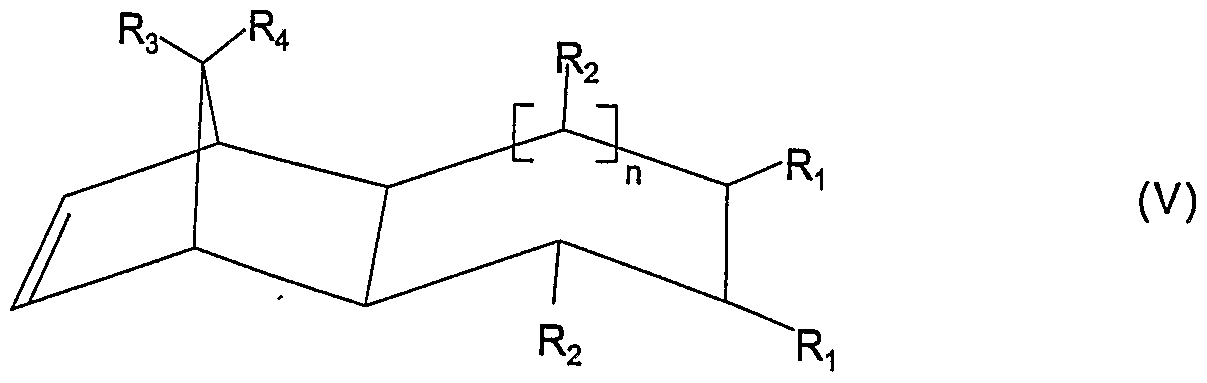
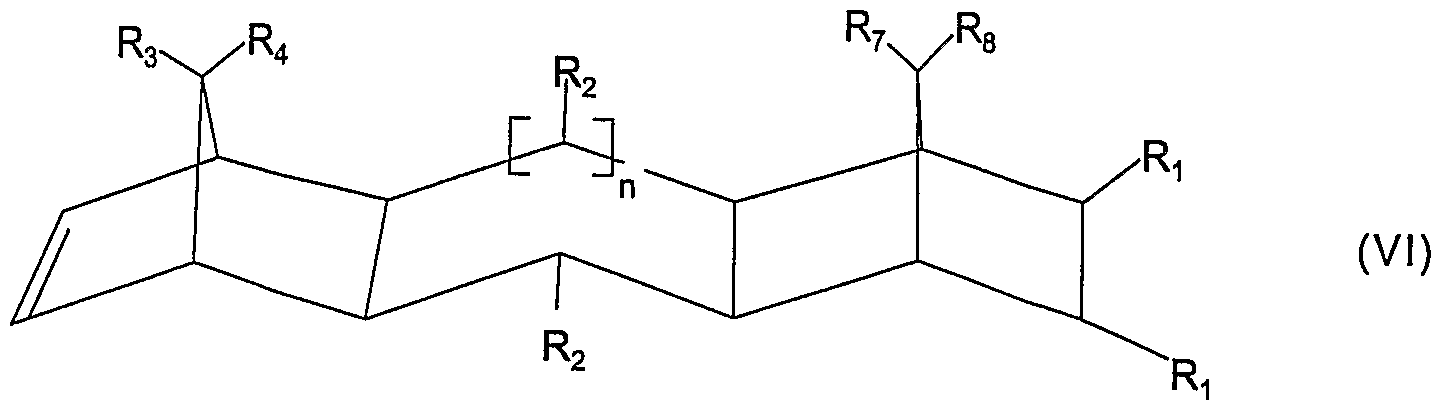
- the amorphous polyolefin of at least one of the cyclic or polycyclic olefins of the following formulas I, II, II ', III, IV, V, VI is particularly advantageous
- R 1 , R 2 , R 3 , R 4 , R 5 , R 6 , R 7 and R 8 are the same or different and a hydrogen atom or a CC ⁇ hydrocarbon radical, such as a linear or branched CC 8 alkyl radical, C 6 -C 18 aryl radical, CC 20 alkylene aryl radical, a cyclic or acyclic C 2 -C 2 Q alkenyl radical, or form a saturated, unsaturated or aromatic ring, where the same radicals R to R 8 in the different formulas I to VI can have a different meaning, in which n assume values from 0 to 5 can, and
- R 9 , R 10 , R 11 and R 12 are the same or different and represent a hydrogen atom, a linear, branched, saturated or unsaturated C 1 -C 2 -hydrocarbon radical such as a CrCa alkyl radical or a C 6 -C 5 aryl radical.
- the cycloolefin copolymers used can contain 0 to 45% by weight, based on the total mass of the cycloolefin copolymer, of polymerized units which are derived from one or more monocyclic olefins of the formula VIII
- the cyclic olefins also include derivatives of these cyclic olefins with polar groups such as halogen, hydroxyl, ester, alkoxy, carboxy, cyano, amido, imido or silyl groups.
- cycloolefin copolymers which contain polymerized units which are derived from polycyclic olefins of the formulas I or III, and polymerized units which are derived from acyclic olefins of the Formula VII, in particular olefins with a norbornene basic structure such as norbornene and tetracyclododecene and optionally vinylnorbornene or norbornadiene.
- Cycloolefin copolymers with polymerized units derived from acyclic olefins with terminal double bonds, such as ⁇ -olefins with 2 to 20, are also preferred
- C atoms in particular ethylene or propylene, for example norbornene / ethylene and tetracyclododecene / ethylene copolymers.
- Preferred terpolymers are norbomene / vinyl norbornene / ethylene, norbomene / norbornadiene / ethylene, tetracyclododecene / vinyl norbornene / ethylene,
- a copolymer of ethylene and norbornene can be used with particular advantage as the amorphous polyolefin.
- a compromise must be made between its deformability and the barrier effect.
- a film with an amorphous polyolefin that has a high T g has a poorer barrier effect than a film with an amorphous
- the processing temperature of the film is therefore determined by the material of the cover layers.
- the material of the core layer A in relation to its T g is again selected depending on the thickness of the cover layers, ie thin cover layers allow a material with a lower T g and thick cover layers a material with a higher T g .
- This statement can be expressed in an empirical equation: Tg ( A ) ⁇ sum of the polyolefin layers (absolute value) / 2 + 65 (empirical size)
- the core layer A can contain pure COC and blends of COC high and low T g, optionally in a mixture with polyolefins.
- the property profiles of the different polymeric materials are positively combined with one another.
- the additive film layers guarantee both the necessary water vapor barrier and the flexibility and puncture resistance of the
- Foil composite with high transparency and good thermoformability.
- properties improved but also a reduction in the additive thickness of the entire film structure is achieved in order either to obtain a substantial increase in the barrier effect against water vapor for a given film thickness or to achieve a significant reduction in the layer thickness and thus a cost saving given given property profiles bring about.
- the plastic in one embodiment of the present invention, the plastic
- Multilayer film outer layers which contain a blend of at least one partially crystalline polyolefin and at least one amorphous polyolefin. At least one layer that improves adhesion is advantageously located between the two outer layers.
- the film according to the invention is characterized by a combination of the following properties: more uniform wall thickness distribution after thermoforming very good thermoformability low shrinkage after thermoforming unusually good puncture resistance with static and / or dynamic
- core layer A An important feature of core layer A is its low elongation at break.
- the shrinkage can also be significantly reduced if a mixture of different amorphous polyolefins is used for the core layer A.
- the thickness of layer A can also be varied within wide limits.
- layer structures can be designed in which existing layer materials are replaced or modified by COC and in addition thickness reductions are also possible.
- This approach brings the desired success in terms of barrier properties.
- the high rigidity of the COC material (high modulus of elasticity) in the layer structure does not have a disadvantageous effect on the overall flexibility of the film and additionally increases the thermoformability and puncture resistance. It can also be the desired properties such.
- the inner layer (s) and the outer layers are either by direct coextrusion with one another or by means of an adhesion-promoting layer which is between the / the
- Inner layer (s) and the outer layer (s) are located.
- another layer can be placed between two adjacent layers can be used, which has the task of improving the adhesion between the first two layers.
- the core layer A contains either an amorphous polyolefin or a mixture of at least one partially crystalline polyolefin and at least one amorphous polyolefin.
- the mixture can be contained both in the core layer A and in the outer layers B and C.
- the proportion of amorphous polyolefin in the core layer A is ⁇ 5.0% by weight, preferably 10% by weight to 50% by weight, in particular 15% by weight to 40% by weight.
- the proportion of amorphous polyolefin can be reduced to 1.0% by weight.
- the thickness of the core layer A is generally> 5 ⁇ m, preferably> 10 ⁇ m and in particular> 15 ⁇ m.
- the multilayer film according to the invention generally has a thickness of 50 to
- the layer thicknesses of the outer layers are 2 ⁇ 5 to 90% of the total structure.
- the outer layer can contain mineral additives.
- mineral additives are materials such as aluminum oxide, aluminum sulfate, barium sulfate, calcium carbonate,
- the titanium dioxide particles consist of at least 95% by weight of rutile and are preferably used with a coating of inorganic oxides, as is usually the case
- Coating for TiO 2 white pigment is used in papers or paints to improve lightfastness.
- the particularly suitable inorganic oxides include the oxides of aluminum, silicon, zinc or magnesium or mixtures of two or more of these compounds
- Links are made from water-soluble compounds, e.g. B. alkali, especially sodium aluminate, aluminum hydroxide, aluminum sulfate, aluminum nitrate, sodium silicate or silica, precipitated in the aqueous suspension.
- TiO 2 particles with a coating are e.g. B. in EP-A-0 078 633 and EP-A-0 044 515.
- the multilayer film can additionally contain neutralizing agents, stabilizers, lubricants, in one or more outer layers.
- Neutralizing agents are preferably dihydrotaicit, calcium stearate and / or calcium carbonate with an average particle size of at most 0.7 ⁇ m, an absolute particle size of less than 10 ⁇ m and a specific surface area of at least 40 m / g. Generally, the neutralizing agent is added in an amount of 0.02 to 0.1% by weight.
- the usual stabilizing compounds for ethylene, propylene and other alpha-olefin polymers can be used as stabilizers. their
- the amount added is between 0.05 and 2.0% by weight.
- Phenolic stabilizers, alkali / alkaline earth stearates and / or alkali / alkaline earth carbonates are particularly suitable.
- Phenolic stabilizers are preferred in an amount of 0.1 to 0.6% by weight, preferably 0.15 to 0.3% by weight, and with a molecular weight of more than 500 g / mol.
- 1,3,5-trimethyl-2,4,6-tris (3,5-di-tert-butyl-4-hydroxybenzyl) benzene are particularly advantageous.
- Lubricants are higher aliphatic acid amides, higher aliphatic acid esters, waxes and metal soaps as well as polydimethylsiloxanes.
- Lubricant is in the range of 0.1 to 3.0% by weight.
- the addition of higher aliphatic acid amides in the range from 0.15 to 0.25% by weight in base layers and / or outer layers is particularly suitable.
- Preferred antistatic agents are alkali alkane sulfonates, polyether-modified, i.e. H. ethoxylated and / or propoxylated polydiorganosiloxanes (polydialkylsiloxanes,
- the effective amount of antistatic is in the range of 0.05 to 3.0% by weight. Glycerol monostearate is also preferred as an antistatic.
- the coating may also contain organic compounds with polar and non-polar groups.
- Preferred organic compounds are alkanols and fatty acids with 8 to 30 C atoms in the alkyl group, in particular fatty acids and primary n-alkanols with 12 to 24 C atoms, and polydiorganosiloxanes and / or
- Polyorganohydrogensiloxanes such as polydimethylsiloxane and polymethylhydrogensiloxane.
- the coating on the TiO 2 particles usually consists of 1.0 to 12.0 g, preferably 2.0 to 6.0 g, of inorganic oxides, optionally 0.5 to
- TiO 2 particles 3.0 g, in particular 0.7 to 1.5 g, of organic compounds, in each case based on 100 g of TiO 2 particles, contain. It has proven to be particularly advantageous if the TiO 2 particles are coated with Al2O3 or with Al2O3 and polydimethylsiloxane.
- the film can also be produced in a white or opaque embodiment.
- polymers of ethylene or ⁇ -olefins such as propene, n-butene, isobutene and higher ⁇ -olefins or their copolymers can be used as the partially crystalline polyolefin.
- Polypropylene, polyethylenes such as HDPE, LDPE and LLDPE and mixtures made from them can be used with advantage.
- the semi-crystalline polyolefin may contain additional additives in effective amounts.
- Isotactic polypropylene homopolymer with an atactic content of 15% by weight or less copolymers of polyethylene and polypropylene with an ethylene content of 10% by weight or less, copolymers of propylene with C 4 -C 8 -alpha-olefins with an alpha-olefin content of 10% by weight or less, terpolymers of propylene, Ethylene and butylene with an ethylene content of 10% by weight or less and with a butylene content of 15% by weight or less are also suitable.
- the percentages by weight refer to the respective polymer.
- Amorphous polyolefins are understood to mean those polyolefins which, despite an irregular arrangement of the molecular chains at room temperature, are solids.
- Amorphous polyolefins whose T g is in the range from 60 to 300 ° C., preferably 70 to 250 ° C., in particular 80 to 200 ° C. or whose Vicat softening temperature T v (VST / B / 120) in the range from 70 are particularly suitable to 200 ° C, preferably from 80 to 180 ° C.
- the amorphous polyolefin is medium
- Molecular weight Mw in the range from 1,000 to 500,000, preferably 1,500 to 250,000, in particular 3,000 to 150,000.
- the refractive index is generally in the range from 1.3 to 1.7, preferably 1.4 to 1.6. It is particularly advantageous if the refractive index of the amorphous polyolefin is in a specific ratio to the refractive index of the polyolefin of the cover layer.
- the refractive indices of amorphous polyolefin and the polyolefin of the cover layer differ by a maximum of 0.1 units, preferably by a maximum of 0.05 units. As a result, the outer layer achieves high transparency.
- the cycloolefin polymers are generally prepared with the aid of
- Transition metal catalysts which are described in the abovementioned publications.
- inventions which have at least one further layer on both sides of the core layer A, containing an amorphous polyolefin or a mixture of at least one partially crystalline polyolefin and at least one amorphous polyolefin, and the cover layers on both sides. If there is more than one additional layer, these further layers may be the same or different with regard to their thickness and composition. These additional layers can have adhesion-improving layers.
- the subbing layer generally contains at least one or more polymers.
- Polymers of ethylene or of ⁇ -olefins or their copolymers, such as low-density polyethylene (LDPE), linear low-density polyethylene (LLDPE), polypropylene, can be used advantageously for this purpose.
- polyolefins can also be modified.
- This modified polyolefin can advantageously be contained in the adhesion-improving layer and contains at least one of the following groups, such as carboxyl, carboxyl anhydride,
- modified polyolefin plastic examples include modified polyolefin copolymers or grafted copolymers which are made by chemically following exemplified compounds such as maleic anhydride,
- alkyl methacrylates and / or derivatives thereof in polyolefins such as polypropylene, polyethylene or ethylene / propylene
- Copolymers and polyolefins grafted into polyamide are introduced.
- Polyolefin is not limited in the degree of polymerization, it can also be an oligomer.
- Modified polyolefins are particularly preferred
- AX modified polyethylene Copolymers of ethylene with unsaturated esters, for example vinyl acetate, or (meth) acrylic acid esters such as ethyl methacrylate, and copolymers of ethylene with vinyl alcohol can also be used.
- unsaturated esters for example vinyl acetate, or (meth) acrylic acid esters such as ethyl methacrylate, and copolymers of ethylene with vinyl alcohol can also be used.
- the subbing layer may also contain polyamide, preferably
- Polyamide 6 polyamide 1 1, polyamide 12, polyamide 66, polyamide 610, polyamide 612.
- These polymers can be used individually or as mixtures.
- the adhesion-improving layer can advantageously be applied in the melt or as a solution, suspension or solvent-containing adhesive.
- the invention also relates to a method for producing the film according to the invention, in which the polymers and / or polymer mixtures forming the film are melted in an extruder, then the melt (s) are extruded through a flat die, and the film thus obtained is placed on one or more rollers is withdrawn, it cools and solidifies, and then the film is optionally stretched and / or heat-set and / or surface-treated in a known manner.
- the melt (s) emerging from the extruder can also be extruded through an annular die, the film thus obtained being processed into film on a blown film system, laid flat on rollers and the film optionally being heat-set and / or surface-treated.
- the additives that may be added can already be in the polymer or in the
- Polymer mixture can be included or added via masterbatch technique.
- a heat setting heat treatment
- the film being held at a temperature of 100 to 160 ° C. for about 0.5 to 10 s.
- the film is then wound up in a conventional manner using a winding device.
- the take-off roller or rollers through which the pressed film is also cooled and is solidified, is usually kept at a temperature of 20 to 90 ° C.
- one or both surface (s) of the film can be corona or flame treated by one of the known methods.
- the amorphous polyolefin is used either as pure granules or as a granulated concentrate (masterbatch) with the partially crystalline polyolefin.
- the components are mixed and incorporated by advantageously premixing the partially crystalline polyolefin granules or powder with the amorphous polyolefin and then feeding them to the extruder.
- the components are mixed further in the extruder and heated to processing temperature. It was found that the sliding properties and the appearance of the film also depend on the extrusion conditions (temperature, shear). Surprisingly, under otherwise identical conditions with regard to the raw materials and stretching process, the sliding properties and the appearance of the film can be varied via the conditions in the extruder.
- the extrusion temperature for the cover layer (s) is above the glass transition temperature / Vicat softening temperature (T g or T v ) of the amorphous polymer.
- the extrusion temperature for the cover layer (s) is at least 10 ° C., preferably 15 to 180 ° C., in particular 20 to 150 ° C., above the T g or the T v of the amorphous polymer.
- the film according to the invention is suitable due to its properties, - very good thermoformability, low shrinkage and more uniform wall thickness distribution after thermoforming and unusually good puncture resistance under static and / or dynamic loading - outstanding as a thermoplastic packaging film, preferably as a blister film. Furthermore, due to its good barrier properties against water vapor, with no change in the mechanical properties due to moisture absorption, it can be used in the areas in which it comes into contact with food, for example in the packaging industry as thermoformed film in thermoformed packaging, for example for perishable foods such as fish , Meat, poultry and sausage products and for pharmaceutical blister packaging. Despite a better wall thickness distribution and one The resulting increased wall thickness allows items packed in the blister to be pressed out easily and without great effort.
- the foils can also be used to produce a laminated article in which the foils according to the invention are processed together with paper and / or cardboard and / or one or more metal foils and / or further foils made of thermoplastic material.
- Composite films were produced by the known coextrusion process using a flat die with a total thickness of 220 to 250 ⁇ m from three layers, which had a core layer A and two outer layers B and C. The individual layers had the thicknesses listed in the tables of the examples.
- core layer A thermoplastic olefin polymers with an amorphous structure (COC) based on ethylene and norbornene from Ticona, Germany ( ⁇ Topas Type 8007 and Type 6013), T g 80 ° C and 140 ° C were used.
- Polypropylene density of 0.91 g / cm 3 ) was used as the partially crystalline polyolefin.
- Blisters were formed in a known manner from the composite films and the wall thicknesses at the transition, i.e. measured at a corner between the bottom and side of the blister.
- COC thermoplastic olefin polymers with amorphous structure
Landscapes
- Laminated Bodies (AREA)
- Extrusion Moulding Of Plastics Or The Like (AREA)
- Packages (AREA)
- Wrappers (AREA)
- Medical Preparation Storing Or Oral Administration Devices (AREA)
Abstract
Description



Claims


Priority Applications (6)
| Application Number | Priority Date | Filing Date | Title |
|---|---|---|---|
| EP03792370A EP1531987B1 (de) | 2002-08-21 | 2003-08-19 | Polyolefin-mehrschichtfolie, verfahren zu ihrer herstellung und ihre verwendung |
| JP2004530198A JP4444827B2 (ja) | 2002-08-21 | 2003-08-19 | 多層ポリオレフィンフィルム、その使用およびその製造方法 |
| CA002496177A CA2496177A1 (en) | 2002-08-21 | 2003-08-19 | Multiply polyolefin sheet, method for making same and related use |
| US10/524,649 US20060062946A1 (en) | 2002-08-21 | 2003-08-19 | Multiply polyolefin sheet, method for making same and related use |
| AU2003264067A AU2003264067A1 (en) | 2002-08-21 | 2003-08-19 | Multiply polyolefin sheet, method for making same and related use |
| AT03792370T ATE536254T1 (de) | 2002-08-21 | 2003-08-19 | Polyolefin-mehrschichtfolie, verfahren zu ihrer herstellung und ihre verwendung |
Applications Claiming Priority (2)
| Application Number | Priority Date | Filing Date | Title |
|---|---|---|---|
| DE10238516.5 | 2002-08-21 | ||
| DE10238516A DE10238516A1 (de) | 2002-08-21 | 2002-08-21 | Polyolefin-Mehrschichtfolie, Verfahren zu ihrer Herstellung und ihre Verwendung |
Publications (1)
| Publication Number | Publication Date |
|---|---|
| WO2004018202A1 true WO2004018202A1 (de) | 2004-03-04 |
Family
ID=31197248
Family Applications (1)
| Application Number | Title | Priority Date | Filing Date |
|---|---|---|---|
| PCT/EP2003/009156 Ceased WO2004018202A1 (de) | 2002-08-21 | 2003-08-19 | Polyolefin-mehrschichtfolie, verfahren zu ihrer herstellung und ihre verwendung |
Country Status (8)
| Country | Link |
|---|---|
| US (1) | US20060062946A1 (de) |
| EP (1) | EP1531987B1 (de) |
| JP (1) | JP4444827B2 (de) |
| AT (1) | ATE536254T1 (de) |
| AU (1) | AU2003264067A1 (de) |
| CA (1) | CA2496177A1 (de) |
| DE (1) | DE10238516A1 (de) |
| WO (1) | WO2004018202A1 (de) |
Cited By (2)
| Publication number | Priority date | Publication date | Assignee | Title |
|---|---|---|---|---|
| JP2008531336A (ja) * | 2005-02-23 | 2008-08-14 | トパース・アドヴァンスト・ポリマーズ・インコーポレーテッド | シクロオレフィンコポリマーおよびスチレン−ブタジエンコポリマーを含む多層フィルム |
| EP4116219A1 (de) * | 2021-07-07 | 2023-01-11 | Perlen Packaging AG, Perlen | Verwendung eines polymergemisches zur herstellung einer deckelfolie für eine blisterpackung |
Families Citing this family (22)
| Publication number | Priority date | Publication date | Assignee | Title |
|---|---|---|---|---|
| US7258930B2 (en) | 2004-04-28 | 2007-08-21 | Cryovac, Inc. | Oxygen scavenging film with cyclic olefin copolymer |
| CA2573165A1 (en) * | 2004-06-24 | 2006-02-02 | Pliant Corporation | Multi-layer polyolefin film |
| AT501412A1 (de) | 2004-11-29 | 2006-08-15 | Ebert Folien Ndl Der Haendler | Dreheinschlagfolie sowie deren verwendung als verpackungsfolie |
| DE102004063410A1 (de) * | 2004-12-23 | 2006-07-06 | Wipak Walsrode Gmbh & Co.Kg | Wiederverschließbare Verpackung |
| JP4705848B2 (ja) * | 2005-12-22 | 2011-06-22 | リンテック株式会社 | 離型シート |
| US20080006378A1 (en) * | 2006-07-06 | 2008-01-10 | Maciel Antonio N | Paper sheet with high/low density polyethylene |
| WO2008136970A1 (en) * | 2007-05-02 | 2008-11-13 | Polyplastics Co., Ltd | Thermoformed articles from sheet incorporating cycloolefin copolymer |
| US20080287614A1 (en) * | 2007-05-15 | 2008-11-20 | Sonoco Development, Inc. | Polypropylene-Based Polymer Blend of Enhanced Melt Strength |
| DE102011080831A1 (de) | 2011-08-11 | 2013-02-14 | Orbita-Film Gmbh | Folienverbund als Schutzfolie für Tiefziehanwendungen |
| WO2013036313A1 (en) | 2011-08-19 | 2013-03-14 | Avery Dennison Corporation | Low noise flexible barrier films |
| EP2794266A1 (de) | 2011-12-22 | 2014-10-29 | Avery Dennison Corporation | Flexible sperrfilme mit cyclischen olefinen |
| JP6093716B2 (ja) * | 2012-01-11 | 2017-03-08 | 藤森工業株式会社 | シーラント用樹脂組成物、積層フィルムおよび包装袋 |
| KR102084815B1 (ko) * | 2012-10-17 | 2020-03-04 | 도레이 카부시키가이샤 | 적층 필름 |
| CN110126376A (zh) | 2012-12-07 | 2019-08-16 | 比密斯公司 | 多层膜 |
| JP6259587B2 (ja) * | 2013-05-21 | 2018-01-10 | 大成化工株式会社 | バイオマスシートおよびそれを用いたブリスターパック、並びにバイオマスシートの製造方法 |
| WO2015003077A1 (en) * | 2013-07-02 | 2015-01-08 | Avery Dennison Corporation | Heat activated shrink films |
| US20150225151A1 (en) | 2014-02-11 | 2015-08-13 | Christopher L. Osborn | Anti-Scalping Transdermal Patch Packaging Film |
| US9468584B2 (en) | 2014-04-02 | 2016-10-18 | Bemis Company, Inc. | Child-resistant packaging |
| JP6663206B2 (ja) * | 2015-11-17 | 2020-03-11 | タキロンシーアイ株式会社 | 積層フィルム、包材及び袋体 |
| WO2019189359A1 (ja) * | 2018-03-29 | 2019-10-03 | 株式会社プライムポリマー | 表面硬度が高い易カット性多層フィルム |
| JP2023105476A (ja) * | 2022-01-19 | 2023-07-31 | 藤森工業株式会社 | フィルム、積層フィルムおよび包装袋 |
| WO2026095950A1 (en) | 2024-11-01 | 2026-05-07 | Amcor Flexibles North America, Inc. | Multi-layer lidding film with peel off and push through portions |
Citations (3)
| Publication number | Priority date | Publication date | Assignee | Title |
|---|---|---|---|---|
| JPH06305100A (ja) * | 1993-04-27 | 1994-11-01 | Sumitomo Bakelite Co Ltd | 高防湿薬品包装用ポリマーアロイ多層シート |
| EP0838293A2 (de) * | 1996-10-28 | 1998-04-29 | Ticona GmbH | Mono- oder Mehrschichtfilm |
| EP0844077A2 (de) * | 1996-11-20 | 1998-05-27 | Ticona GmbH | Biaxial orientierte Folie aus cycloolefinischen Polymeren, Verfahren zu ihrer Herstellung und ihre Verwendung |
Family Cites Families (8)
| Publication number | Priority date | Publication date | Assignee | Title |
|---|---|---|---|---|
| EP0503422B1 (de) * | 1991-03-09 | 1998-06-03 | TARGOR GmbH | Verfahren zur Herstellung chemisch einheitlicher Cycloolefincopolymere |
| EP0518542B1 (de) * | 1991-06-14 | 1996-09-11 | Mitsui Petrochemical Industries, Ltd. | Verbundstoff |
| KR100235089B1 (en) * | 1992-05-14 | 1999-12-15 | Mitsui Chemicals Inc | Ptp or blister packaging articles and packaging material therefor |
| JP2997831B2 (ja) * | 1993-09-06 | 2000-01-11 | グンゼ株式会社 | 積層体 |
| JPH11165387A (ja) * | 1997-12-03 | 1999-06-22 | Mitsui Chem Inc | ポリオレフィン系多層積層体およびその用途 |
| US6641925B1 (en) * | 1998-06-29 | 2003-11-04 | Ticona Gmbh | Thermoformable composite film and process to make |
| DE19943545A1 (de) * | 1999-04-09 | 2001-03-15 | Ticona Gmbh | Mehrschichtbehälter mit verbesserter Haftung zwischen den Polymerschichten und hervorragenden Barriereeigenschaften |
| DE20116341U1 (de) * | 2001-10-05 | 2002-01-17 | Ticona GmbH, 65451 Kelsterbach | Polyolefin-Mehrschichtfolie |
-
2002
- 2002-08-21 DE DE10238516A patent/DE10238516A1/de not_active Ceased
-
2003
- 2003-08-19 AU AU2003264067A patent/AU2003264067A1/en not_active Abandoned
- 2003-08-19 CA CA002496177A patent/CA2496177A1/en not_active Abandoned
- 2003-08-19 WO PCT/EP2003/009156 patent/WO2004018202A1/de not_active Ceased
- 2003-08-19 US US10/524,649 patent/US20060062946A1/en not_active Abandoned
- 2003-08-19 JP JP2004530198A patent/JP4444827B2/ja not_active Expired - Lifetime
- 2003-08-19 AT AT03792370T patent/ATE536254T1/de active
- 2003-08-19 EP EP03792370A patent/EP1531987B1/de not_active Expired - Lifetime
Patent Citations (3)
| Publication number | Priority date | Publication date | Assignee | Title |
|---|---|---|---|---|
| JPH06305100A (ja) * | 1993-04-27 | 1994-11-01 | Sumitomo Bakelite Co Ltd | 高防湿薬品包装用ポリマーアロイ多層シート |
| EP0838293A2 (de) * | 1996-10-28 | 1998-04-29 | Ticona GmbH | Mono- oder Mehrschichtfilm |
| EP0844077A2 (de) * | 1996-11-20 | 1998-05-27 | Ticona GmbH | Biaxial orientierte Folie aus cycloolefinischen Polymeren, Verfahren zu ihrer Herstellung und ihre Verwendung |
Non-Patent Citations (1)
| Title |
|---|
| DATABASE WPI Section Ch Week 199503, Derwent World Patents Index; Class A17, AN 1995-018840, XP002266761 * |
Cited By (3)
| Publication number | Priority date | Publication date | Assignee | Title |
|---|---|---|---|---|
| JP2008531336A (ja) * | 2005-02-23 | 2008-08-14 | トパース・アドヴァンスト・ポリマーズ・インコーポレーテッド | シクロオレフィンコポリマーおよびスチレン−ブタジエンコポリマーを含む多層フィルム |
| EP4116219A1 (de) * | 2021-07-07 | 2023-01-11 | Perlen Packaging AG, Perlen | Verwendung eines polymergemisches zur herstellung einer deckelfolie für eine blisterpackung |
| WO2023279215A1 (de) | 2021-07-07 | 2023-01-12 | Perlen Packaging AG | Verwendung eines polymergemisches zur herstellung einer deckelfolie für eine blisterpackung |
Also Published As
| Publication number | Publication date |
|---|---|
| CA2496177A1 (en) | 2004-03-04 |
| EP1531987B1 (de) | 2011-12-07 |
| EP1531987A1 (de) | 2005-05-25 |
| JP2005535481A (ja) | 2005-11-24 |
| JP4444827B2 (ja) | 2010-03-31 |
| ATE536254T1 (de) | 2011-12-15 |
| AU2003264067A1 (en) | 2004-03-11 |
| US20060062946A1 (en) | 2006-03-23 |
| DE10238516A1 (de) | 2004-03-04 |
Similar Documents
| Publication | Publication Date | Title |
|---|---|---|
| EP1531987B1 (de) | Polyolefin-mehrschichtfolie, verfahren zu ihrer herstellung und ihre verwendung | |
| DE69126072T2 (de) | Verbundfilm oder Verbundblatt aus Kunststoff | |
| EP0620111B1 (de) | Opake, matte Polypropylen-Mehrschichtfolie, Verfahren zu ihrer Herstellung und ihre Verwendung | |
| EP0619183B1 (de) | Opake, matte, biaxial orientierte Polypropylen-Mehrschichtfolie, Verfahren zu ihrer Herstellung und ihre Verwendung | |
| EP0563796B1 (de) | Seidenmatte, biaxial orientierte Polyolefin-Mehrschichtfolie, Verfahren zu ihrer Herstellung und ihre Verwendung | |
| DE602004002949T2 (de) | Siegelbarer mehrschichtiger koextrudierter verpackungsfilm, seine verwendung sowie verfahren zu dessen herstellung | |
| DE3650251T2 (de) | Sperrschichten aus plastik. | |
| DE10242730A1 (de) | Thermoformbare Folie mit hoher Wärmeformbeständigkeit und Wasserdampfbarriere | |
| EP2205435B1 (de) | Etikettenfolie für rundumetiketten | |
| EP0515969A1 (de) | Siegelbare, opake, biaxial orientierte Polypropylen-Mehrschichtfolie, Verfahren zu ihrer Herstellung und ihre Verwendung | |
| DE69500799T2 (de) | Kunststoffverbundplatte oder Kunststoffverbundfolie | |
| EP1567332A2 (de) | Biaxial orientierte folie mit einer schicht aus ethylen-vinyl-alkohol-copolymer (evoh) | |
| EP2684675B1 (de) | Polymerfolie zum In-Mould-Etikettieren | |
| EP2421698B1 (de) | Etikettenfolie | |
| EP0379913B1 (de) | Biaxial orientierte Kunststoffolie | |
| DE1704732A1 (de) | Verfahren zur Herstellung von Folien und Baendern | |
| DE10238515A1 (de) | Polyolefin-Mehrschichtfolie, ein Verfahren zur Herstellung dieser Folie sowie ihre Verwendung | |
| EP1238796B1 (de) | Mehrschichtige Tiefziehfolie | |
| DE4026656A1 (de) | Siegelbare, weisse folie aus propylenpolymeren mit guten technischen eigenschaften | |
| DE20116341U1 (de) | Polyolefin-Mehrschichtfolie | |
| DE69529743T2 (de) | Biaxial orientierte polypropylen folie | |
| EP0693369B1 (de) | Siegelfähige orientierte Polyolefin-Mehrschichtfolie, Verfahren zu ihrer Herstellung und ihre Verwendung | |
| DE2126945C3 (de) | Verfahren zur Herstellung von beschreibbaren synthetischen Folien | |
| EP0672522B1 (de) | Siegelfähige orientierte Polyolefin-Mehrschichtfolie, Verfahren zu ihrer Herstellung und ihre Verwendung | |
| DE9305300U1 (de) | Opake, matte, biaxial orientierte Polypropylen-Mehrschichtfolie |
Legal Events
| Date | Code | Title | Description |
|---|---|---|---|
| AK | Designated states |
Kind code of ref document: A1 Designated state(s): AE AG AL AM AT AU AZ BA BB BG BR BY BZ CA CH CN CO CR CU CZ DE DK DM DZ EC EE ES FI GB GD GE GH GM HR HU ID IL IN IS JP KE KG KP KR KZ LC LK LR LS LT LU LV MA MD MG MK MN MW MX MZ NI NO NZ OM PG PH PL PT RO RU SC SD SE SG SK SL SY TJ TM TN TR TT TZ UA UG US UZ VC VN YU ZA ZM ZW |
|
| AL | Designated countries for regional patents |
Kind code of ref document: A1 Designated state(s): GH GM KE LS MW MZ SD SL SZ TZ UG ZM ZW AM AZ BY KG KZ MD RU TJ TM AT BE BG CH CY CZ DE DK EE ES FI FR GB GR HU IE IT LU MC NL PT RO SE SI SK TR BF BJ CF CG CI CM GA GN GQ GW ML MR NE SN TD TG |
|
| DFPE | Request for preliminary examination filed prior to expiration of 19th month from priority date (pct application filed before 20040101) | ||
| 121 | Ep: the epo has been informed by wipo that ep was designated in this application | ||
| WWE | Wipo information: entry into national phase |
Ref document number: 2003792370 Country of ref document: EP |
|
| ENP | Entry into the national phase |
Ref document number: 2496177 Country of ref document: CA |
|
| WWE | Wipo information: entry into national phase |
Ref document number: 2004530198 Country of ref document: JP |
|
| ENP | Entry into the national phase |
Ref document number: 2006062946 Country of ref document: US Kind code of ref document: A1 |
|
| WWE | Wipo information: entry into national phase |
Ref document number: 10524649 Country of ref document: US |
|
| WWP | Wipo information: published in national office |
Ref document number: 2003792370 Country of ref document: EP |
|
| WWP | Wipo information: published in national office |
Ref document number: 10524649 Country of ref document: US |