WO2004018202A1 - Multiply polyolefin sheet, method for making same and related use - Google Patents
Multiply polyolefin sheet, method for making same and related use Download PDFInfo
- Publication number
- WO2004018202A1 WO2004018202A1 PCT/EP2003/009156 EP0309156W WO2004018202A1 WO 2004018202 A1 WO2004018202 A1 WO 2004018202A1 EP 0309156 W EP0309156 W EP 0309156W WO 2004018202 A1 WO2004018202 A1 WO 2004018202A1
- Authority
- WO
- WIPO (PCT)
- Prior art keywords
- polyolefin
- film
- amorphous polyolefin
- weight
- film according
- Prior art date
- Legal status (The legal status is an assumption and is not a legal conclusion. Google has not performed a legal analysis and makes no representation as to the accuracy of the status listed.)
- Ceased
Links
Classifications
-
- B—PERFORMING OPERATIONS; TRANSPORTING
- B32—LAYERED PRODUCTS
- B32B—LAYERED PRODUCTS, i.e. PRODUCTS BUILT-UP OF STRATA OF FLAT OR NON-FLAT, e.g. CELLULAR OR HONEYCOMB, FORM
- B32B27/00—Layered products comprising a layer of synthetic resin
- B32B27/32—Layered products comprising a layer of synthetic resin comprising polyolefins
-
- B—PERFORMING OPERATIONS; TRANSPORTING
- B32—LAYERED PRODUCTS
- B32B—LAYERED PRODUCTS, i.e. PRODUCTS BUILT-UP OF STRATA OF FLAT OR NON-FLAT, e.g. CELLULAR OR HONEYCOMB, FORM
- B32B15/00—Layered products comprising a layer of metal
- B32B15/04—Layered products comprising a layer of metal comprising metal as the main or only constituent of a layer, which is next to another layer of the same or of a different material
- B32B15/08—Layered products comprising a layer of metal comprising metal as the main or only constituent of a layer, which is next to another layer of the same or of a different material of synthetic resin
- B32B15/085—Layered products comprising a layer of metal comprising metal as the main or only constituent of a layer, which is next to another layer of the same or of a different material of synthetic resin comprising polyolefins
-
- B—PERFORMING OPERATIONS; TRANSPORTING
- B32—LAYERED PRODUCTS
- B32B—LAYERED PRODUCTS, i.e. PRODUCTS BUILT-UP OF STRATA OF FLAT OR NON-FLAT, e.g. CELLULAR OR HONEYCOMB, FORM
- B32B27/00—Layered products comprising a layer of synthetic resin
- B32B27/06—Layered products comprising a layer of synthetic resin as the main or only constituent of a layer, which is next to another layer of the same or of a different material
- B32B27/08—Layered products comprising a layer of synthetic resin as the main or only constituent of a layer, which is next to another layer of the same or of a different material of synthetic resin
-
- B—PERFORMING OPERATIONS; TRANSPORTING
- B32—LAYERED PRODUCTS
- B32B—LAYERED PRODUCTS, i.e. PRODUCTS BUILT-UP OF STRATA OF FLAT OR NON-FLAT, e.g. CELLULAR OR HONEYCOMB, FORM
- B32B27/00—Layered products comprising a layer of synthetic resin
- B32B27/06—Layered products comprising a layer of synthetic resin as the main or only constituent of a layer, which is next to another layer of the same or of a different material
- B32B27/10—Layered products comprising a layer of synthetic resin as the main or only constituent of a layer, which is next to another layer of the same or of a different material of paper or cardboard
-
- B—PERFORMING OPERATIONS; TRANSPORTING
- B32—LAYERED PRODUCTS
- B32B—LAYERED PRODUCTS, i.e. PRODUCTS BUILT-UP OF STRATA OF FLAT OR NON-FLAT, e.g. CELLULAR OR HONEYCOMB, FORM
- B32B2307/00—Properties of the layers or laminate
- B32B2307/70—Other properties
- B32B2307/704—Crystalline
-
- B—PERFORMING OPERATIONS; TRANSPORTING
- B32—LAYERED PRODUCTS
- B32B—LAYERED PRODUCTS, i.e. PRODUCTS BUILT-UP OF STRATA OF FLAT OR NON-FLAT, e.g. CELLULAR OR HONEYCOMB, FORM
- B32B2317/00—Animal or vegetable based
- B32B2317/12—Paper, e.g. cardboard
-
- B—PERFORMING OPERATIONS; TRANSPORTING
- B32—LAYERED PRODUCTS
- B32B—LAYERED PRODUCTS, i.e. PRODUCTS BUILT-UP OF STRATA OF FLAT OR NON-FLAT, e.g. CELLULAR OR HONEYCOMB, FORM
- B32B2323/00—Polyalkenes
- B32B2323/10—Polypropylene
-
- B—PERFORMING OPERATIONS; TRANSPORTING
- B32—LAYERED PRODUCTS
- B32B—LAYERED PRODUCTS, i.e. PRODUCTS BUILT-UP OF STRATA OF FLAT OR NON-FLAT, e.g. CELLULAR OR HONEYCOMB, FORM
- B32B2439/00—Containers; Receptacles
- B32B2439/80—Medical packaging
-
- Y—GENERAL TAGGING OF NEW TECHNOLOGICAL DEVELOPMENTS; GENERAL TAGGING OF CROSS-SECTIONAL TECHNOLOGIES SPANNING OVER SEVERAL SECTIONS OF THE IPC; TECHNICAL SUBJECTS COVERED BY FORMER USPC CROSS-REFERENCE ART COLLECTIONS [XRACs] AND DIGESTS
- Y10—TECHNICAL SUBJECTS COVERED BY FORMER USPC
- Y10T—TECHNICAL SUBJECTS COVERED BY FORMER US CLASSIFICATION
- Y10T428/00—Stock material or miscellaneous articles
- Y10T428/13—Hollow or container type article [e.g., tube, vase, etc.]
- Y10T428/1303—Paper containing [e.g., paperboard, cardboard, fiberboard, etc.]
Definitions
- Polyolefin multilayer film process for its production and its use
- the invention relates to a polyolefin multilayer film comprising at least three layers, comprising a) a core layer A functioning as a base layer and comprising at least one amorphous polyolefin or a mixture of at least one partially crystalline polyolefin and 5.0 or more% by weight of at least one amorphous polyolefin and b) two cover layers B and C on both sides, which are the same or different, made of a polyolefin (polyethylene, polypropylene) and / or a mixture of polypropylene and an amorphous polyolefin.
- the films according to the invention have very good thermoformability with low shrinkage.
- the chemical structure of core layer A results in extremely low water absorption and an outstanding barrier effect against water vapor.
- the invention further relates to a method for producing this film and its use.
- Films that are to be used for deep-drawing applications must meet certain properties with regard to processability on the packaging machines and their barrier properties against atmospheric gases such as oxygen and a high barrier effect against water vapor. Furthermore, for reasons of processability and machinability, a high stiffness of a film is required for thermoformability, in particular for deep-drawing applications. In this respect, the film should not have any thick or thin spots in its profile after deep-drawing, since this can generally lead to a reduction in the barrier effect against gases and water vapor. With bust film structures, this requirement is particularly important at the transition, i.e. at the corners between the bottom and side of the blister. Even a slight change in the wall thickness can have a significant impact on the barrier effect.
- Multi-layer films in particular three-layer films, in which the middle base layer made of amorphous polyolefin or a mixture of amorphous polyolefin and
- the double-sided cover layers can be made of LDPE
- Olefin copolymer (EP0920989, Mitsui) exist.
- the layers are connected by coextrusion or with the aid of an adhesive layer.
- a disadvantage of using these films is that the processing window is too narrow, i.e. the
- the glass transition temperature (T g ) of the base layer is not matched to the cover layer material. As a result, the latter cannot be optimally extended and one
- the object of the present invention is to avoid the disadvantages of the prior art.
- the invention relates to a polyolefin multilayer film comprising at least three layers, comprising I) a) a core layer A functioning as a base layer, consisting of at least one amorphous polyolefin, and b) two cover layers B and C on both sides made of a mixture of polypropylene and at least one amorphous polyolefin or II ) a) a core layer A composed of a mixture of at least one partially crystalline polyolefin and 5.0% by weight or more of at least one amorphous polyolefin and b) two outer layers B and C, which are the same or different, made of a partially crystalline polyolefin and / or a mixture of polypropylene and at least one amorphous polyolefin.
- the invention further relates to a method for producing this film and its use.
- Amorphous polyolefins in the sense of the invention are cycloolefin copolymers (COC) and cycloolefinic polymers (COP), individually or as a mixture.
- Suitable cycloolefin copolymers are known per se and are described in EP-A-0407870, EP-A-0485 893, EP-A-0 503 422 and DE-A-40 36 264, to which reference is made here.
- the cycloolefin copolymers used are composed of one or more cycloolefins, generally substituted and unsubstituted cycloalkenes and / or polycycloalkenes, for example bi-, tri- or tetracycloalkenes, being used as cycloolefins.
- the cycloolefin copolymers can also be branched. such
- Products can have 'comb or star structure.
- Copolymers of ethylene and / or an ⁇ -polyolefin with one or more cyclic, bicyclic and / or polycyclic olefins are advantageous.
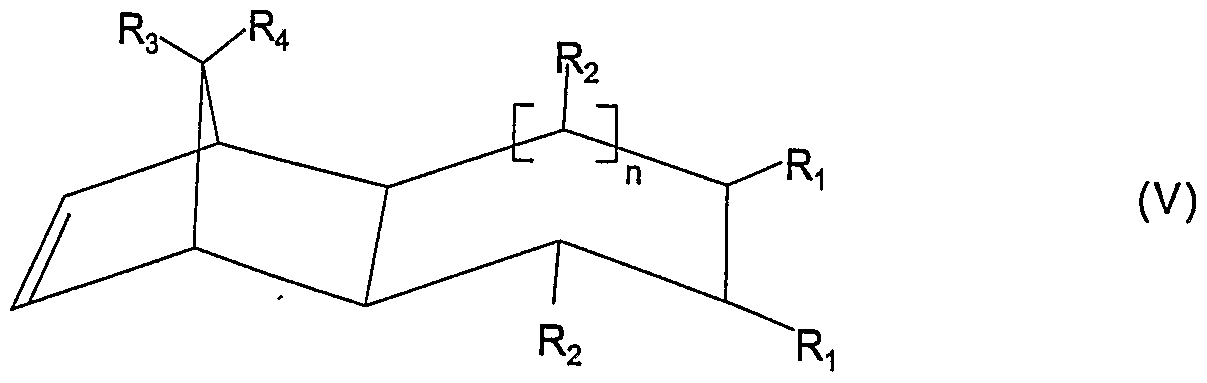
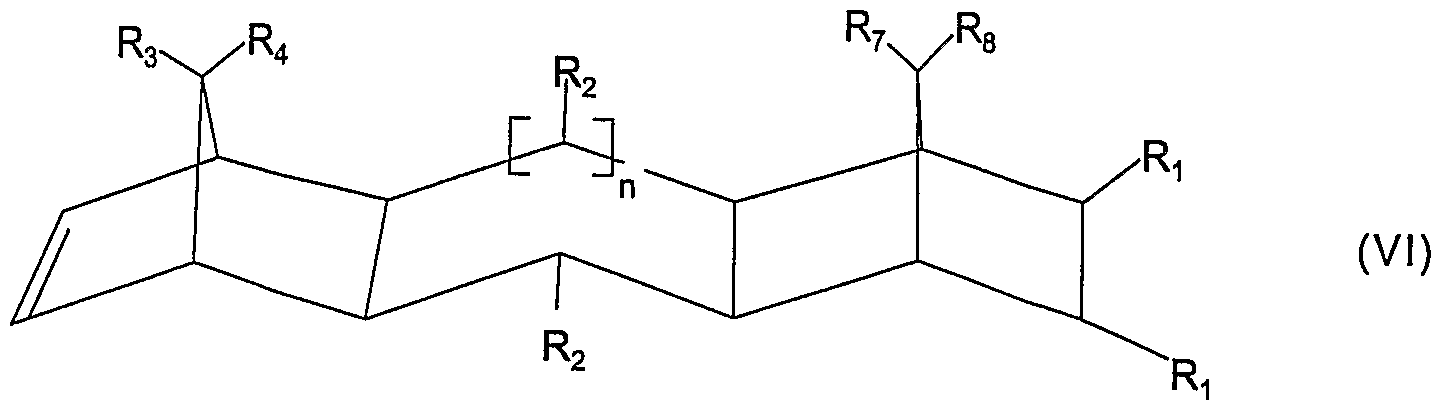
- the amorphous polyolefin of at least one of the cyclic or polycyclic olefins of the following formulas I, II, II ', III, IV, V, VI is particularly advantageous
- R 1 , R 2 , R 3 , R 4 , R 5 , R 6 , R 7 and R 8 are the same or different and a hydrogen atom or a CC ⁇ hydrocarbon radical, such as a linear or branched CC 8 alkyl radical, C 6 -C 18 aryl radical, CC 20 alkylene aryl radical, a cyclic or acyclic C 2 -C 2 Q alkenyl radical, or form a saturated, unsaturated or aromatic ring, where the same radicals R to R 8 in the different formulas I to VI can have a different meaning, in which n assume values from 0 to 5 can, and
- R 9 , R 10 , R 11 and R 12 are the same or different and represent a hydrogen atom, a linear, branched, saturated or unsaturated C 1 -C 2 -hydrocarbon radical such as a CrCa alkyl radical or a C 6 -C 5 aryl radical.
- the cycloolefin copolymers used can contain 0 to 45% by weight, based on the total mass of the cycloolefin copolymer, of polymerized units which are derived from one or more monocyclic olefins of the formula VIII
- the cyclic olefins also include derivatives of these cyclic olefins with polar groups such as halogen, hydroxyl, ester, alkoxy, carboxy, cyano, amido, imido or silyl groups.
- cycloolefin copolymers which contain polymerized units which are derived from polycyclic olefins of the formulas I or III, and polymerized units which are derived from acyclic olefins of the Formula VII, in particular olefins with a norbornene basic structure such as norbornene and tetracyclododecene and optionally vinylnorbornene or norbornadiene.
- Cycloolefin copolymers with polymerized units derived from acyclic olefins with terminal double bonds, such as ⁇ -olefins with 2 to 20, are also preferred
- C atoms in particular ethylene or propylene, for example norbornene / ethylene and tetracyclododecene / ethylene copolymers.
- Preferred terpolymers are norbomene / vinyl norbornene / ethylene, norbomene / norbornadiene / ethylene, tetracyclododecene / vinyl norbornene / ethylene,
- a copolymer of ethylene and norbornene can be used with particular advantage as the amorphous polyolefin.
- a compromise must be made between its deformability and the barrier effect.
- a film with an amorphous polyolefin that has a high T g has a poorer barrier effect than a film with an amorphous
- the processing temperature of the film is therefore determined by the material of the cover layers.
- the material of the core layer A in relation to its T g is again selected depending on the thickness of the cover layers, ie thin cover layers allow a material with a lower T g and thick cover layers a material with a higher T g .
- This statement can be expressed in an empirical equation: Tg ( A ) ⁇ sum of the polyolefin layers (absolute value) / 2 + 65 (empirical size)
- the core layer A can contain pure COC and blends of COC high and low T g, optionally in a mixture with polyolefins.
- the property profiles of the different polymeric materials are positively combined with one another.
- the additive film layers guarantee both the necessary water vapor barrier and the flexibility and puncture resistance of the
- Foil composite with high transparency and good thermoformability.
- properties improved but also a reduction in the additive thickness of the entire film structure is achieved in order either to obtain a substantial increase in the barrier effect against water vapor for a given film thickness or to achieve a significant reduction in the layer thickness and thus a cost saving given given property profiles bring about.
- the plastic in one embodiment of the present invention, the plastic
- Multilayer film outer layers which contain a blend of at least one partially crystalline polyolefin and at least one amorphous polyolefin. At least one layer that improves adhesion is advantageously located between the two outer layers.
- the film according to the invention is characterized by a combination of the following properties: more uniform wall thickness distribution after thermoforming very good thermoformability low shrinkage after thermoforming unusually good puncture resistance with static and / or dynamic
- core layer A An important feature of core layer A is its low elongation at break.
- the shrinkage can also be significantly reduced if a mixture of different amorphous polyolefins is used for the core layer A.
- the thickness of layer A can also be varied within wide limits.
- layer structures can be designed in which existing layer materials are replaced or modified by COC and in addition thickness reductions are also possible.
- This approach brings the desired success in terms of barrier properties.
- the high rigidity of the COC material (high modulus of elasticity) in the layer structure does not have a disadvantageous effect on the overall flexibility of the film and additionally increases the thermoformability and puncture resistance. It can also be the desired properties such.
- the inner layer (s) and the outer layers are either by direct coextrusion with one another or by means of an adhesion-promoting layer which is between the / the
- Inner layer (s) and the outer layer (s) are located.
- another layer can be placed between two adjacent layers can be used, which has the task of improving the adhesion between the first two layers.
- the core layer A contains either an amorphous polyolefin or a mixture of at least one partially crystalline polyolefin and at least one amorphous polyolefin.
- the mixture can be contained both in the core layer A and in the outer layers B and C.
- the proportion of amorphous polyolefin in the core layer A is ⁇ 5.0% by weight, preferably 10% by weight to 50% by weight, in particular 15% by weight to 40% by weight.
- the proportion of amorphous polyolefin can be reduced to 1.0% by weight.
- the thickness of the core layer A is generally> 5 ⁇ m, preferably> 10 ⁇ m and in particular> 15 ⁇ m.
- the multilayer film according to the invention generally has a thickness of 50 to
- the layer thicknesses of the outer layers are 2 ⁇ 5 to 90% of the total structure.
- the outer layer can contain mineral additives.
- mineral additives are materials such as aluminum oxide, aluminum sulfate, barium sulfate, calcium carbonate,
- the titanium dioxide particles consist of at least 95% by weight of rutile and are preferably used with a coating of inorganic oxides, as is usually the case
- Coating for TiO 2 white pigment is used in papers or paints to improve lightfastness.
- the particularly suitable inorganic oxides include the oxides of aluminum, silicon, zinc or magnesium or mixtures of two or more of these compounds
- Links are made from water-soluble compounds, e.g. B. alkali, especially sodium aluminate, aluminum hydroxide, aluminum sulfate, aluminum nitrate, sodium silicate or silica, precipitated in the aqueous suspension.
- TiO 2 particles with a coating are e.g. B. in EP-A-0 078 633 and EP-A-0 044 515.
- the multilayer film can additionally contain neutralizing agents, stabilizers, lubricants, in one or more outer layers.
- Neutralizing agents are preferably dihydrotaicit, calcium stearate and / or calcium carbonate with an average particle size of at most 0.7 ⁇ m, an absolute particle size of less than 10 ⁇ m and a specific surface area of at least 40 m / g. Generally, the neutralizing agent is added in an amount of 0.02 to 0.1% by weight.
- the usual stabilizing compounds for ethylene, propylene and other alpha-olefin polymers can be used as stabilizers. their
- the amount added is between 0.05 and 2.0% by weight.
- Phenolic stabilizers, alkali / alkaline earth stearates and / or alkali / alkaline earth carbonates are particularly suitable.
- Phenolic stabilizers are preferred in an amount of 0.1 to 0.6% by weight, preferably 0.15 to 0.3% by weight, and with a molecular weight of more than 500 g / mol.
- 1,3,5-trimethyl-2,4,6-tris (3,5-di-tert-butyl-4-hydroxybenzyl) benzene are particularly advantageous.
- Lubricants are higher aliphatic acid amides, higher aliphatic acid esters, waxes and metal soaps as well as polydimethylsiloxanes.
- Lubricant is in the range of 0.1 to 3.0% by weight.
- the addition of higher aliphatic acid amides in the range from 0.15 to 0.25% by weight in base layers and / or outer layers is particularly suitable.
- Preferred antistatic agents are alkali alkane sulfonates, polyether-modified, i.e. H. ethoxylated and / or propoxylated polydiorganosiloxanes (polydialkylsiloxanes,
- the effective amount of antistatic is in the range of 0.05 to 3.0% by weight. Glycerol monostearate is also preferred as an antistatic.
- the coating may also contain organic compounds with polar and non-polar groups.
- Preferred organic compounds are alkanols and fatty acids with 8 to 30 C atoms in the alkyl group, in particular fatty acids and primary n-alkanols with 12 to 24 C atoms, and polydiorganosiloxanes and / or
- Polyorganohydrogensiloxanes such as polydimethylsiloxane and polymethylhydrogensiloxane.
- the coating on the TiO 2 particles usually consists of 1.0 to 12.0 g, preferably 2.0 to 6.0 g, of inorganic oxides, optionally 0.5 to
- TiO 2 particles 3.0 g, in particular 0.7 to 1.5 g, of organic compounds, in each case based on 100 g of TiO 2 particles, contain. It has proven to be particularly advantageous if the TiO 2 particles are coated with Al2O3 or with Al2O3 and polydimethylsiloxane.
- the film can also be produced in a white or opaque embodiment.
- polymers of ethylene or ⁇ -olefins such as propene, n-butene, isobutene and higher ⁇ -olefins or their copolymers can be used as the partially crystalline polyolefin.
- Polypropylene, polyethylenes such as HDPE, LDPE and LLDPE and mixtures made from them can be used with advantage.
- the semi-crystalline polyolefin may contain additional additives in effective amounts.
- Isotactic polypropylene homopolymer with an atactic content of 15% by weight or less copolymers of polyethylene and polypropylene with an ethylene content of 10% by weight or less, copolymers of propylene with C 4 -C 8 -alpha-olefins with an alpha-olefin content of 10% by weight or less, terpolymers of propylene, Ethylene and butylene with an ethylene content of 10% by weight or less and with a butylene content of 15% by weight or less are also suitable.
- the percentages by weight refer to the respective polymer.
- Amorphous polyolefins are understood to mean those polyolefins which, despite an irregular arrangement of the molecular chains at room temperature, are solids.
- Amorphous polyolefins whose T g is in the range from 60 to 300 ° C., preferably 70 to 250 ° C., in particular 80 to 200 ° C. or whose Vicat softening temperature T v (VST / B / 120) in the range from 70 are particularly suitable to 200 ° C, preferably from 80 to 180 ° C.
- the amorphous polyolefin is medium
- Molecular weight Mw in the range from 1,000 to 500,000, preferably 1,500 to 250,000, in particular 3,000 to 150,000.
- the refractive index is generally in the range from 1.3 to 1.7, preferably 1.4 to 1.6. It is particularly advantageous if the refractive index of the amorphous polyolefin is in a specific ratio to the refractive index of the polyolefin of the cover layer.
- the refractive indices of amorphous polyolefin and the polyolefin of the cover layer differ by a maximum of 0.1 units, preferably by a maximum of 0.05 units. As a result, the outer layer achieves high transparency.
- the cycloolefin polymers are generally prepared with the aid of
- Transition metal catalysts which are described in the abovementioned publications.
- inventions which have at least one further layer on both sides of the core layer A, containing an amorphous polyolefin or a mixture of at least one partially crystalline polyolefin and at least one amorphous polyolefin, and the cover layers on both sides. If there is more than one additional layer, these further layers may be the same or different with regard to their thickness and composition. These additional layers can have adhesion-improving layers.
- the subbing layer generally contains at least one or more polymers.
- Polymers of ethylene or of ⁇ -olefins or their copolymers, such as low-density polyethylene (LDPE), linear low-density polyethylene (LLDPE), polypropylene, can be used advantageously for this purpose.
- polyolefins can also be modified.
- This modified polyolefin can advantageously be contained in the adhesion-improving layer and contains at least one of the following groups, such as carboxyl, carboxyl anhydride,
- modified polyolefin plastic examples include modified polyolefin copolymers or grafted copolymers which are made by chemically following exemplified compounds such as maleic anhydride,
- alkyl methacrylates and / or derivatives thereof in polyolefins such as polypropylene, polyethylene or ethylene / propylene
- Copolymers and polyolefins grafted into polyamide are introduced.
- Polyolefin is not limited in the degree of polymerization, it can also be an oligomer.
- Modified polyolefins are particularly preferred
- AX modified polyethylene Copolymers of ethylene with unsaturated esters, for example vinyl acetate, or (meth) acrylic acid esters such as ethyl methacrylate, and copolymers of ethylene with vinyl alcohol can also be used.
- unsaturated esters for example vinyl acetate, or (meth) acrylic acid esters such as ethyl methacrylate, and copolymers of ethylene with vinyl alcohol can also be used.
- the subbing layer may also contain polyamide, preferably
- Polyamide 6 polyamide 1 1, polyamide 12, polyamide 66, polyamide 610, polyamide 612.
- These polymers can be used individually or as mixtures.
- the adhesion-improving layer can advantageously be applied in the melt or as a solution, suspension or solvent-containing adhesive.
- the invention also relates to a method for producing the film according to the invention, in which the polymers and / or polymer mixtures forming the film are melted in an extruder, then the melt (s) are extruded through a flat die, and the film thus obtained is placed on one or more rollers is withdrawn, it cools and solidifies, and then the film is optionally stretched and / or heat-set and / or surface-treated in a known manner.
- the melt (s) emerging from the extruder can also be extruded through an annular die, the film thus obtained being processed into film on a blown film system, laid flat on rollers and the film optionally being heat-set and / or surface-treated.
- the additives that may be added can already be in the polymer or in the
- Polymer mixture can be included or added via masterbatch technique.
- a heat setting heat treatment
- the film being held at a temperature of 100 to 160 ° C. for about 0.5 to 10 s.
- the film is then wound up in a conventional manner using a winding device.
- the take-off roller or rollers through which the pressed film is also cooled and is solidified, is usually kept at a temperature of 20 to 90 ° C.
- one or both surface (s) of the film can be corona or flame treated by one of the known methods.
- the amorphous polyolefin is used either as pure granules or as a granulated concentrate (masterbatch) with the partially crystalline polyolefin.
- the components are mixed and incorporated by advantageously premixing the partially crystalline polyolefin granules or powder with the amorphous polyolefin and then feeding them to the extruder.
- the components are mixed further in the extruder and heated to processing temperature. It was found that the sliding properties and the appearance of the film also depend on the extrusion conditions (temperature, shear). Surprisingly, under otherwise identical conditions with regard to the raw materials and stretching process, the sliding properties and the appearance of the film can be varied via the conditions in the extruder.
- the extrusion temperature for the cover layer (s) is above the glass transition temperature / Vicat softening temperature (T g or T v ) of the amorphous polymer.
- the extrusion temperature for the cover layer (s) is at least 10 ° C., preferably 15 to 180 ° C., in particular 20 to 150 ° C., above the T g or the T v of the amorphous polymer.
- the film according to the invention is suitable due to its properties, - very good thermoformability, low shrinkage and more uniform wall thickness distribution after thermoforming and unusually good puncture resistance under static and / or dynamic loading - outstanding as a thermoplastic packaging film, preferably as a blister film. Furthermore, due to its good barrier properties against water vapor, with no change in the mechanical properties due to moisture absorption, it can be used in the areas in which it comes into contact with food, for example in the packaging industry as thermoformed film in thermoformed packaging, for example for perishable foods such as fish , Meat, poultry and sausage products and for pharmaceutical blister packaging. Despite a better wall thickness distribution and one The resulting increased wall thickness allows items packed in the blister to be pressed out easily and without great effort.
- the foils can also be used to produce a laminated article in which the foils according to the invention are processed together with paper and / or cardboard and / or one or more metal foils and / or further foils made of thermoplastic material.
- Composite films were produced by the known coextrusion process using a flat die with a total thickness of 220 to 250 ⁇ m from three layers, which had a core layer A and two outer layers B and C. The individual layers had the thicknesses listed in the tables of the examples.
- core layer A thermoplastic olefin polymers with an amorphous structure (COC) based on ethylene and norbornene from Ticona, Germany ( ⁇ Topas Type 8007 and Type 6013), T g 80 ° C and 140 ° C were used.
- Polypropylene density of 0.91 g / cm 3 ) was used as the partially crystalline polyolefin.
- Blisters were formed in a known manner from the composite films and the wall thicknesses at the transition, i.e. measured at a corner between the bottom and side of the blister.
- COC thermoplastic olefin polymers with amorphous structure
Landscapes
- Laminated Bodies (AREA)
- Extrusion Moulding Of Plastics Or The Like (AREA)
- Packages (AREA)
- Wrappers (AREA)
- Medical Preparation Storing Or Oral Administration Devices (AREA)
Abstract
Description
Polyolefin-Mehrschichtfolie, Verfahren zu ihrer Herstellung und ihre VerwendungPolyolefin multilayer film, process for its production and its use
Die Erfindung betrifft eine Polyolefin-Mehrschichtfolie aus mindestens drei Schichten, enthaltend a) eine als Basisschicht fungierende Kernschicht A aus mindestens einem amorphen Polyolefin oder einer Mischung mindestens eines teilkristallinen Polyolefins und 5,0 oder mehr Gew.-% mindestens eines amorphen Polyolefins und b) zwei beidseitigen Deckschichten B und C, die gleich oder verschieden sind, aus einem Polyolefin (Polyethylen, Polypropylen) und/oder einer Mischung aus Polypropylen und einem amorphen Polyolefin. Die Folien gemäß der Erfindung besitzen eine sehr gute Thermoformbarkeit bei gleichzeitig geringem Schrumpf. Aufgrund des chemischen Aufbaus der Kernschicht A resultiert eine außerordentlich geringe Wasseraufnahme und eine überragende Sperrwirkung gegen Wasserdampf. Die Erfindung betrifft ferner ein Verfahren zur Herstellung dieser Folie sowie ihre Verwendung.The invention relates to a polyolefin multilayer film comprising at least three layers, comprising a) a core layer A functioning as a base layer and comprising at least one amorphous polyolefin or a mixture of at least one partially crystalline polyolefin and 5.0 or more% by weight of at least one amorphous polyolefin and b) two cover layers B and C on both sides, which are the same or different, made of a polyolefin (polyethylene, polypropylene) and / or a mixture of polypropylene and an amorphous polyolefin. The films according to the invention have very good thermoformability with low shrinkage. The chemical structure of core layer A results in extremely low water absorption and an outstanding barrier effect against water vapor. The invention further relates to a method for producing this film and its use.
Folien, welche für die Tiefziehanwendung benutzt werden sollen, müssen gewissen Eigenschaften hinsichtlich der Verarbeitbarkeit auf den Verpackungsmaschinen sowie ihrer Barriereeigenschaften gegenüber atmosphärischen Gasen wie Sauerstoff sowie einer hohen Sperrwirkung gegenüber Wasserdampf genügen. Ferner ist aus Gründen der Verarbeitbarkeit und Maschinengängigkeit eine hohe Steifigkeit einer Folie für die Thermoformbarkeit, insbesondere für Tiefziehanwendung, gefordert. Dahingehend sollte die Folie nach dem Tiefziehen keine Dick- oder Dünnstellen in ihrem Profil aufweisen, da diese in der Regel zu einer Minderung der Sperrwirkung gegenüber Gasen und Wasserdampf führen kann. Bei Büsterfolienstrukturen ist diese Anforderung besonders am Übergang, d.h. an den Ecken zwischen Boden und Seite des Blisters zu beachten. Hierbei kann bereits eine geringfügige Änderung der Wanddicke einen deutlichen Einfluß auf die Barrierewirkung haben.Films that are to be used for deep-drawing applications must meet certain properties with regard to processability on the packaging machines and their barrier properties against atmospheric gases such as oxygen and a high barrier effect against water vapor. Furthermore, for reasons of processability and machinability, a high stiffness of a film is required for thermoformability, in particular for deep-drawing applications. In this respect, the film should not have any thick or thin spots in its profile after deep-drawing, since this can generally lead to a reduction in the barrier effect against gases and water vapor. With bust film structures, this requirement is particularly important at the transition, i.e. at the corners between the bottom and side of the blister. Even a slight change in the wall thickness can have a significant impact on the barrier effect.
Diese von der Endanwendung aufgestellten Forderungen können in der Regel kaum oder gar nicht von Homopolymeren allein oder von Polymerblends hinreichend gut erfüllt werden, da keiner der derzeit vorhandenen Kunststoffe allein alle geforderten Eigenschaften in sich so vereint. Dadurch ist es nicht möglich, mit nur einem einzigen Material eine technische oder wirtschaftliche Lösung zu erreichen. So können Materialien mit z. B. guter Gasbarriere eine ungenügende Wasserdampfbarriere besitzen, beispielsweise EVOH-haltige Folien, und müssen sogar zusätzlich geschützt werden, da diese Materialien hygroskopisch sind und im feuchten Zustand nicht die gewünschte Barrierewirkung gegenüber Sauerstoff entwickeln können. Andere Polymere wie Polyamid erreichen in Folien die erwünschten Eigenschaften nicht oder erst ab einer gewissen Schichtdicke, um beispielsweise die geforderten Barrierewerte einer Folie zu erfüllen. Nach dem Stand der Technik wird dieses Problem in der Regel durch verschiedenartige Verbünde von mehrschichtigen Folien gelöst.As a rule, these demands made by the end use can hardly or not at all be met sufficiently well by homopolymers alone or by polymer blends, since none of the plastics currently available alone combines all the required properties in this way. This means that it is not possible to achieve a technical or economical solution with just one material. So can Materials with e.g. B. good gas barrier have an insufficient water vapor barrier, for example EVOH-containing films, and even have to be additionally protected since these materials are hygroscopic and cannot develop the desired barrier effect against oxygen in the moist state. Other polymers such as polyamide do not achieve the desired properties in films or only at a certain layer thickness, for example in order to meet the required barrier values of a film. According to the prior art, this problem is usually solved by various types of multilayer film composites.
Ferner wird an Folien, die im Verpackungsbereich Anwendung finden, häufig dieFurthermore, the films that are used in the packaging sector are often used
Forderung nach Siegelfähigkeit bei niedriger Siegelanspringtemperatur gestellt, damit sie sich auf Verpackungsmaschinen wirtschaftlich verarbeiten lassen.Demand for sealability at a low sealing start temperature so that they can be processed economically on packaging machines.
Mehrschichtfolien, insbesondere Dreischichtfolien, bei denen die mittlere Basisschicht aus amorphem Polyolefin oder einem Gemisch aus amorphem Polyolefin undMulti-layer films, in particular three-layer films, in which the middle base layer made of amorphous polyolefin or a mixture of amorphous polyolefin and
Polyolefinen besteht, sind bekannt. Die beidseitigen Deckschichten können aus LDPEPolyolefins are known. The double-sided cover layers can be made of LDPE
(DE 198 28 867, TICONA), unorientiertem PP (DE 198 28 857, TICONA), kristallisiertem(DE 198 28 867, TICONA), unoriented PP (DE 198 28 857, TICONA), crystallized
Polyolefin (EP 0631864, TASAI) oder einer Mischung aus PP und einem Ethylen/α-Polyolefin (EP 0631864, TASAI) or a mixture of PP and an ethylene / α-
Olefin-Copolymer (EP0920989, Mitsui) bestehen. Die Verbindung der Schichten erfolgt durch Coextrusion oder mit Hilfe einer adhäsiven Schicht. Nachteilig bei der Anwendung dieser Folien ist, daß das Verarbeitungsfenster zu eng ist, d.h. dieOlefin copolymer (EP0920989, Mitsui) exist. The layers are connected by coextrusion or with the aid of an adhesive layer. A disadvantage of using these films is that the processing window is too narrow, i.e. the
Glasübergangstemperatur (Tg) der Basisschicht ist nicht auf das Deckschichtmaterial abgestimmt. Dadurch läßt sich letzteres nicht optimal mitverstrecken und eineThe glass transition temperature (T g ) of the base layer is not matched to the cover layer material. As a result, the latter cannot be optimally extended and one
Anwendung einer dreischichtigen Folie, beispielsweise als Pharma-Blister-Folie, ist eingeschränkt oder mißlingt.Use of a three-layer film, for example as a pharmaceutical blister film, is restricted or unsuccessful.
Aufgabe der vorliegenden Erfindung ist, die Nachteile des Standes der Technik-zu vermeiden.The object of the present invention is to avoid the disadvantages of the prior art.
Gegenstand der Erfindung ist eine Polyolefin-Mehrschichtfolie aus mindestens drei Schichten, enthaltend I) a) eine als Basisschicht fungierende Kernschicht A aus mindestens einem amorphen Polyolefin und b) zwei beidseitigen Deckschichten B und C aus einer Mischung aus Polypropylen und mindestens einem amorphen Polyolefin oder II) a) eine Kernschicht A aus einer Mischung mindestens eines teilkristallinen Polyolefins und 5,0 Gew.-% oder mehr mindestens eines amorphen Polyolefins und b) zwei Deckschichten B und C, die gleich oder verschieden sind, aus einem teilkristallinen Polyolefin und/oder einer Mischung aus Polypropylen und mindestens einem amorphen Polyolefin. Die Erfindung betrifft ferner ein Verfahren zur Herstellung dieser Folie sowie ihre Verwendung.The invention relates to a polyolefin multilayer film comprising at least three layers, comprising I) a) a core layer A functioning as a base layer, consisting of at least one amorphous polyolefin, and b) two cover layers B and C on both sides made of a mixture of polypropylene and at least one amorphous polyolefin or II ) a) a core layer A composed of a mixture of at least one partially crystalline polyolefin and 5.0% by weight or more of at least one amorphous polyolefin and b) two outer layers B and C, which are the same or different, made of a partially crystalline polyolefin and / or a mixture of polypropylene and at least one amorphous polyolefin. The invention further relates to a method for producing this film and its use.
Amorphe Polyolefine im Sinne der Erfindung sind Cycloolefincopolymere (COC) und cycloolefinische Polymere (COP), einzeln oder als Mischung. Geeignete Cycloolefincopolymere sind an sich bekannt und werden in EP-A-0407870, EP-A-0485 893, EP-A-0 503 422 und DE-A-40 36 264 beschrieben, auf welche hier Bezug genommen wird.Amorphous polyolefins in the sense of the invention are cycloolefin copolymers (COC) and cycloolefinic polymers (COP), individually or as a mixture. Suitable cycloolefin copolymers are known per se and are described in EP-A-0407870, EP-A-0485 893, EP-A-0 503 422 and DE-A-40 36 264, to which reference is made here.
Die eingesetzten Cycloolefincopolymere sind aus einem oder mehreren Cycloolefinen aufgebaut, wobei als Cycloolefine im allgemeinen substituierte und unsubstituierte Cycloalkene und/oder Polycycloalkene, beispielsweise Bi-, Tri- oder Tetracycloalkene eingesetzt werden. Die Cycloolefincopolymere können auch verzweigt sein. DerartigeThe cycloolefin copolymers used are composed of one or more cycloolefins, generally substituted and unsubstituted cycloalkenes and / or polycycloalkenes, for example bi-, tri- or tetracycloalkenes, being used as cycloolefins. The cycloolefin copolymers can also be branched. such
Produkte können'Kamm- oder Sternstruktur aufweisen. Vorteilhaft sind Copolymere aus Ethylen und/oder einem α-Polyolefin mit einem oder mehreren cyclischen, bicyclischen und/oder polycyclischen Olefinen. Besonders vorteilhaft ist das amorphe Polyolefin von mindestens einem der cyclischen oder polycyclischen Olefine der folgenden Formeln I, II, II', III, IV, V, VI Products can have 'comb or star structure. Copolymers of ethylene and / or an α-polyolefin with one or more cyclic, bicyclic and / or polycyclic olefins are advantageous. The amorphous polyolefin of at least one of the cyclic or polycyclic olefins of the following formulas I, II, II ', III, IV, V, VI is particularly advantageous

0 bis 99,9 Gew.-%, vorzugsweise 0,1 bis 99,9 Gew.-%, bezogen auf die Gesamtmasse des Cycloolefincopolymers, polymerisierte Einheiten, welche sich ableiten von einem oder mehreren acyclischen Olefinen der Formel VII0 to 99.9% by weight, preferably 0.1 to 99.9% by weight, based on the total mass of the cycloolefin copolymer, of polymerized units which are derived from one or more acyclic olefins of the formula VII

Außerdem können die verwendeten Cycloolefincopolymere 0 bis 45 Gew.-%, bezogen auf die Gesamtmasse des Cycloolefincopolymers, polymerisierte Einheiten enthalten, welche sich ableiten von einem oder mehreren monocyclischen Olefinen der Formel VIIIIn addition, the cycloolefin copolymers used can contain 0 to 45% by weight, based on the total mass of the cycloolefin copolymer, of polymerized units which are derived from one or more monocyclic olefins of the formula VIII
HC\~7CH (v,ll> HC \ ~ 7 CH (v, ll >
(C H2)m worin m eine Zahl von 2 bis 10 ist.( CH 2) m where m is a number from 2 to 10.
Bei den cyclischen Olefinen sind ebenfalls Derivate dieser cyclischen Olefine mit polaren Gruppen, wie Halogen-, Hydroxyl-, Ester-, Alkoxy-, Carboxy-, Cyano-, Amido-, Imido- oder Silylgruppen, eingeschlossen.The cyclic olefins also include derivatives of these cyclic olefins with polar groups such as halogen, hydroxyl, ester, alkoxy, carboxy, cyano, amido, imido or silyl groups.
Bevorzugt im Sinne der Erfindung sind Cycloolefincopolymere, die polymerisierte Einheiten enthalten, welche sich ableiten von polycyclischen Olefinen der Formeln I oder III, und polymerisierte Einheiten, welche sich ableiten von acyclischen Olefinen der Formel VII, insbesondere Olefine mit Norbornengrundstruktur wie Norbornen und Tetracyclododecen und gegebenenfalls Vinylnorbornen oder Norbornadien.For the purposes of the invention, preference is given to cycloolefin copolymers which contain polymerized units which are derived from polycyclic olefins of the formulas I or III, and polymerized units which are derived from acyclic olefins of the Formula VII, in particular olefins with a norbornene basic structure such as norbornene and tetracyclododecene and optionally vinylnorbornene or norbornadiene.
Bevorzugt sind auch Cycloolefincopolymere mit polymerisierten Einheiten, abgeleitet von acyclischen Olefinen mit endständigen Doppelbindungen wie α-Olefine mit 2 bis 20Cycloolefin copolymers with polymerized units, derived from acyclic olefins with terminal double bonds, such as α-olefins with 2 to 20, are also preferred
C-Atomen, insbesondere Ethylen oder Propylen, beispielsweise Norbornen/ Ethylen- und Tetracyclododecen/ Ethylen-Copolymere.C atoms, in particular ethylene or propylene, for example norbornene / ethylene and tetracyclododecene / ethylene copolymers.
Als Terpolymere sind bevorzugt Norbomen/Vinylnorbonen/ Ethylen-, Norbomen/Norbornadien/Ethylen-, Tetracyclododecen/Vinylnorbomen/ Ethylen-,Preferred terpolymers are norbomene / vinyl norbornene / ethylene, norbomene / norbornadiene / ethylene, tetracyclododecene / vinyl norbornene / ethylene,
Tetracyclododecen/Vinyltetracyclododecen/Ethylen- oder Norbornen/ Dicyclopentadien/Ethylen-Terpolymere.Tetracyclododecene / vinyl tetracyclododecene / ethylene or norbornene / dicyclopentadiene / ethylene terpolymers.
Ganz besonders vorteilhaft ist als amorphes Polyolefin ein Copolymer aus Ethylen und Norbornen einsetzbar.A copolymer of ethylene and norbornene can be used with particular advantage as the amorphous polyolefin.
Bei der Verarbeifung der Folie gemäß der Erfindung hat sich gezeigt, daß hierbei ein Kompromiß zwischen ihrer Verformbarkeit und der Barrierewirkung eingegangen werden muß. So besitzt beispielsweise eine Folie mit einem amorphen Polyolefin, das eine hohe Tg aufweist, eine schlechtere Barrierewirkung als eine Folie mit einem amorphenWhen processing the film according to the invention, it has been found that a compromise must be made between its deformability and the barrier effect. For example, a film with an amorphous polyolefin that has a high T g has a poorer barrier effect than a film with an amorphous
Polyolefin mit niedriger Tg. Sie läßt sich aber gleichmäßiger zum Blister ausformen, so daß sich insgesamt ein besseres Verarbeitungsbild und ein breiteres Verarbeitungsfenster auf den entsprechenden Verarbeitungsmaschinen ergibt. Dies gilt insbesondere dann, wenn die z.B. Polypropylen enthaltenden Deckschichten im Verhältnis zur Gesamtstärke der Folie dick sind, beispielsweise > 30 μm bei einerLow T g polyolefin. However, it can be shaped more uniformly into a blister, so that overall there is a better processing image and a wider processing window on the corresponding processing machines. This applies in particular if the cover layers containing, for example, polypropylene are thick in relation to the total thickness of the film, for example> 30 μm in one
Folienstärke von 200 bis 400 μm.Film thickness from 200 to 400 μm.
Die Verarbeitungstemperatur der Folie wird also bestimmt durch das Material der Deckschichten. Das Material der Kernschicht A in Bezug auf seine Tg wird wiederum ausgewählt in Abhängigkeit von der Dicke der Deckschichten, d.h. dünne Deckschichten erlauben ein Material mit niedriger Tg und dicke Deckschichten ein Material mit höherer Tg. Diese Aussage läßt sich in einer empirischen Gleichung ausdrücken: Tg(A) ≥Summe der Polyolefin-Schichten (Absolutwert) / 2 + 65 (empirische Größe)The processing temperature of the film is therefore determined by the material of the cover layers. The material of the core layer A in relation to its T g is again selected depending on the thickness of the cover layers, ie thin cover layers allow a material with a lower T g and thick cover layers a material with a higher T g . This statement can be expressed in an empirical equation: Tg ( A ) ≥ sum of the polyolefin layers (absolute value) / 2 + 65 (empirical size)
Die Kernschicht A kann reines COC und Blends aus COC hoher und niederer Tg, gegebenfalls in Mischung mit Polyolefinen enthalten.The core layer A can contain pure COC and blends of COC high and low T g, optionally in a mixture with polyolefins.
Durch eine Kombination von verschiedenen Polymeren in einem Verbund gemäß der Erfindung, der durch Coextrusion oder Lamination erreicht wird, werden die Eigenschaftsprofile der verschiedenen polymeren Werkstoffe positiv miteinander vereinigt. Die additiven Folienlagen gewährleisten sowohl die nötige Wasserdampfbarriere als auch die Flexibilität und die Durchstoßfestigkeit desBy combining different polymers in a composite according to the invention, which is achieved by coextrusion or lamination, the property profiles of the different polymeric materials are positively combined with one another. The additive film layers guarantee both the necessary water vapor barrier and the flexibility and puncture resistance of the
Folienverbundes, und zwar bei gleichzeitig hoher Transparenz und guter Thermoformbarkeit. Es werden aber nicht nur die Eigenschaften verbessert, sondern es wird auch eine Reduktion der additiven Dicke des gesamten Folienaufbaues erzielt, um entweder bei gegebener Foliendicke eine wesentliche Steigerung der Barrierewirkung gegenüber Wasserdampf zu erhalten oder bei gegebenen Eigenschaftsprofilen eine deutliche Reduktion der Schichtdicke und damit eine Kostenersparnis herbeizuführen.Foil composite, with high transparency and good thermoformability. However, not only are the properties improved, but also a reduction in the additive thickness of the entire film structure is achieved in order either to obtain a substantial increase in the barrier effect against water vapor for a given film thickness or to achieve a significant reduction in the layer thickness and thus a cost saving given given property profiles bring about.
Es ist überraschend, daß durch Beimischung geringer Anteile mindestens eines amorphen Polyolefins, insbesondere COC und COP, die Eigenschaften von Folien aus einem teilkristallinen Polyolefin, insbesondere Polyethylen, deutlich verbessert werden, z.B. die Stanzbarkeit der Folie aufgrund der mechanischen Steifigkeit des eingesetzten amorphen Polyolefins sowie eine Vermeidung der Fadenbildung an der Schnittkante des Blisters.It is surprising that by admixing small amounts of at least one amorphous polyolefin, in particular COC and COP, the properties of films made from a partially crystalline polyolefin, in particular polyethylene, are significantly improved, e.g. the punchability of the film due to the mechanical rigidity of the amorphous polyolefin used and the avoidance of thread formation at the cut edge of the blister.
In einer Ausgestaltung der vorliegenden Erfindung enthält die Kunststoff-In one embodiment of the present invention, the plastic
Mehrschichtfolie Außenschichten, die einen Blend aus mindestens einem teilkristallinen Polyolefin und mindestens einem amorphen Polyolefin enthalten. Zwischen den beiden Außenschichten befindet sich vorteilhaft mindestens eine die Haftung verbessernde Schicht.Multilayer film outer layers which contain a blend of at least one partially crystalline polyolefin and at least one amorphous polyolefin. At least one layer that improves adhesion is advantageously located between the two outer layers.
Die Folie gemäß der Erfindung zeichnet sich durch eine Kombination der folgenden Eigenschaften aus: gleichmäßigere Wanddickenverteilung nach dem Thermoformen sehr gute Thermoformbarkeit geringer Schrumpf nach dem Thermoverformen ungewöhnlich gute Durchstoßfestigkeit bei statischer und/oder dynamischerThe film according to the invention is characterized by a combination of the following properties: more uniform wall thickness distribution after thermoforming very good thermoformability low shrinkage after thermoforming unusually good puncture resistance with static and / or dynamic
Belastung gute Barriereeigenschaften gegenüber Wasserdampf keine Veränderung der mechanischen Eigenschaften durch Feuchtigkeitsaufnahme.Good barrier properties against water vapor, no change in mechanical properties due to moisture absorption.
Ein wichtiges Merkmal der Kernschicht A ist ihre geringe Reißdehnung.An important feature of core layer A is its low elongation at break.
Der Schrumpf läßt sich darüberhinaus merklich reduzieren, wenn eine Mischung verschiedener amorpher Polyolefine für die Kernschicht A eingesetzt wird. Bei Verwendung derartiger Mischungen läßt sich außerdem die Dicke der Schicht A in weiten Grenzen variieren.The shrinkage can also be significantly reduced if a mixture of different amorphous polyolefins is used for the core layer A. When using such mixtures, the thickness of layer A can also be varied within wide limits.
Nach Analyse von vorhandenen Folienstrukturen bezüglich der Anforderungen an die Verpackung lassen sich Schichtaufbauten konzipieren, in welchen vorhandene Lagenmaterialien durch COC ersetzt bzw. modifiziert und zusätzlich auch Dickenreduzierungen möglich werden. Diese Vorgehensweise bringt bezüglich der Barriereeigenschaften den gewünschten Erfolg. Überraschenderweise macht sich die hohe Steifigkeit des COC-Materials (hoher E-Modul) im Schichtaufbau, hinsichtlich der GesamtflexibNität der Folie nicht nachteilig bemerkbar und erhöht zusätzlich die Thermoverformbarkeit und Durchstoßfestigkeit. Es lassen sich somit auch die gewünschten Eigenschaften z. B. hohe mechanische Steifigkeit bei gegebener Gesamtflexibilität des Folienverbundes, eine gute Siegelfähigkeit der Folie und hoheAfter analyzing existing film structures with regard to packaging requirements, layer structures can be designed in which existing layer materials are replaced or modified by COC and in addition thickness reductions are also possible. This approach brings the desired success in terms of barrier properties. Surprisingly, the high rigidity of the COC material (high modulus of elasticity) in the layer structure does not have a disadvantageous effect on the overall flexibility of the film and additionally increases the thermoformability and puncture resistance. It can also be the desired properties such. B. high mechanical rigidity for a given overall flexibility of the film composite, a good sealability of the film and high
Wasserdampfbarriere in einer mit einem amorphen Polyolefin modifizierten Außenschicht der Folie erreichen.Reach the water vapor barrier in an outer layer of the film modified with an amorphous polyolefin.
Die lnnenschicht(en) und die Außenschichten sind entweder durch direkte Koextrusion miteinander oder mittels einer haftvermittelnden Schicht, die sich zwischen der/denThe inner layer (s) and the outer layers are either by direct coextrusion with one another or by means of an adhesion-promoting layer which is between the / the
Innenschicht/en und den / der Außenschicht/en befinden / befindet, verbunden.Inner layer (s) and the outer layer (s) are located.
Bei diesen Verfahren kann zwischen zwei benachbarten Schichten eine weitere Schicht eingesetzt werden, die die Aufgabe hat, die Haftung zwischen den zwei erstgenannten Schichten zu verbessern.In this method, another layer can be placed between two adjacent layers can be used, which has the task of improving the adhesion between the first two layers.
Die Kernschicht A enthält entweder ein amorphes Polyolefin oder eine Mischung aus mindestens einem teilkristallinen Polyolefin und mindestens einem amorphen Polyolefin.The core layer A contains either an amorphous polyolefin or a mixture of at least one partially crystalline polyolefin and at least one amorphous polyolefin.
Die Mischung kann sowohl in der Kernschicht A als auch in den Deckschichten B und C enthalten sein. Der Anteil an amorphen Polyolefin beträgt dabei in der Kernschicht A ≥ 5,0 Gew.-%, vorzugsweise 10 Gew.-% bis 50 Gew.-%, insbesondere 15 Gew.-% bis 40 Gew.-%. In den Deckschichten B und C kann der Anteil an amorphen Polyolefin bis auf 1 ,0 Gew.-% gesenkt werden.The mixture can be contained both in the core layer A and in the outer layers B and C. The proportion of amorphous polyolefin in the core layer A is ≥ 5.0% by weight, preferably 10% by weight to 50% by weight, in particular 15% by weight to 40% by weight. In the outer layers B and C, the proportion of amorphous polyolefin can be reduced to 1.0% by weight.
Die Dicke der Kernschicht A beträgt im allgemeinen > 5 μm, vorzugsweise >10μm und insbesondere > 15 μm.The thickness of the core layer A is generally> 5 μm, preferably> 10 μm and in particular> 15 μm.
Die Mehrschichtfolie gemäß der Erfindung weist im allgemeinen eine Stärke von 50 bisThe multilayer film according to the invention generally has a thickness of 50 to
350 μm, vorzugsweise 75 bis 275 μm auf. Dabei betragen die Schichtdicken der Deckschichten 2~5 bis 90 % des gesamten Aufbaus.350 μm, preferably 75 to 275 μm. The layer thicknesses of the outer layers are 2 ~ 5 to 90% of the total structure.
Die Außenschicht kann mineralische Zusätze enthalten. Übliche mineralische Zusätze sind Materialien wie Aluminiumoxid, Aluminiumsulfat, Bariumsulfat, Calciumcarbonat,The outer layer can contain mineral additives. Common mineral additives are materials such as aluminum oxide, aluminum sulfate, barium sulfate, calcium carbonate,
Magnesiumcarbonat, Silikate wie Aluminiumsilikat (Kaolinton) und Magnesiumsilikat (Talkum), Silieiumdioxid und Titandioxid, worunter Weißpigmente wie Calciumcarbonat, Siliciumdioxid, Titandioxid und Bariumsulfat bevorzugt eingesetzt werden. Die Titandioxidteilchen bestehen zu mindestens 95 Gew.-% aus Rutil und werden bevorzugt mit einem Überzug aus anorganischen Oxiden eingesetzt, wie er üblicherweise alsMagnesium carbonate, silicates such as aluminum silicate (kaolin clay) and magnesium silicate (talc), silicon dioxide and titanium dioxide, among which white pigments such as calcium carbonate, silicon dioxide, titanium dioxide and barium sulfate are preferably used. The titanium dioxide particles consist of at least 95% by weight of rutile and are preferably used with a coating of inorganic oxides, as is usually the case
Überzug für Tiθ2-Weißpigment in Papieren oder Anstrichmitteln zur Verbesserung der Lichtechtheit verwendet wird.Coating for TiO 2 white pigment is used in papers or paints to improve lightfastness.
Zu den besonders geeigneten anorganischen Oxiden gehören die Oxide von Aluminium, Silizium, Zink oder Magnesium oder Mischungen aus zwei oder mehreren dieserThe particularly suitable inorganic oxides include the oxides of aluminum, silicon, zinc or magnesium or mixtures of two or more of these
Verbindungen. Sie werden aus wasserlöslichen Verbindungen, z. B. Alkali-, insbesondere Natriumaluminat, Aluminiumhydroxid, Aluminiumsulfat, Aluminiumnitrat, Natriumsilikat oder Kieselsäure, in der wäßrigen Suspension ausgefällt. TiO2-Partikel mit einem Überzug werden z. B. in der EP-A-0 078 633 und EP-A-0 044 515 beschrieben.Links. They are made from water-soluble compounds, e.g. B. alkali, especially sodium aluminate, aluminum hydroxide, aluminum sulfate, aluminum nitrate, sodium silicate or silica, precipitated in the aqueous suspension. TiO 2 particles with a coating are e.g. B. in EP-A-0 078 633 and EP-A-0 044 515.
Neben diesen mineralischen Zusätzen kann die Mehrschichtfolie in einer oder mehreren Außenschichten zusätzlich Neutralisationsmittel, Stabilisatoren, Gleitmittel,In addition to these mineral additives, the multilayer film can additionally contain neutralizing agents, stabilizers, lubricants, in one or more outer layers.
Kohienwasserstoffharze und/oder Antistatika enthalten. Die nachstehenden Angaben in Gewichtsprozent beziehen sich auf das Gewicht der jeweiligen Schicht, der das Additiv zugesetzt ist. Neutralisationsmittel sind vorzugsweise Dihydrotaicit, Caiciumstearat und/oder Calciumcarbonat einer mittleren Teilchengröße von höchstens 0,7 μm, einer absoluten Teilchengröße von kleiner 10 μm und einer spezifischen Oberfläche von mindestens 40 m /g. Im allgemeinen wird das Neutralisationsmittel in einer Menge von 0,02 bis 0,1 Gew.-% zugesetzt.Contain hydrocarbon resins and / or antistatic agents. The following percentages by weight relate to the weight of the respective layer to which the additive has been added. Neutralizing agents are preferably dihydrotaicit, calcium stearate and / or calcium carbonate with an average particle size of at most 0.7 μm, an absolute particle size of less than 10 μm and a specific surface area of at least 40 m / g. Generally, the neutralizing agent is added in an amount of 0.02 to 0.1% by weight.
Als Stabilisatoren können die üblichen stabilisierend wirkenden Verbindungen für Ethylen-, Propylen- und andere alpha-Olefinpolymere eingesetzt werden. DerenThe usual stabilizing compounds for ethylene, propylene and other alpha-olefin polymers can be used as stabilizers. their
Zusatzmenge liegt zwischen 0,05 und 2,0 Gew.-%. Besonders geeignet sind phenolische Stabilisatoren, Alkali-/Erdalkalistearate und/oder Alkali-/Erdalkalicarbonate.The amount added is between 0.05 and 2.0% by weight. Phenolic stabilizers, alkali / alkaline earth stearates and / or alkali / alkaline earth carbonates are particularly suitable.
Phenolische Stabilisatoren werden in einer Menge von 0,1 bis 0,6 Gew.-%, vorzugsweise 0,15 bis 0,3 Gew.-%, und mit einer Molmasse von mehr als 500 g/mol bevorzugt. Pentaerythrityl-tetrakis-3-(3,5-di-tertiärbutyl-4-hydroxyphenyl)-propionat oderPhenolic stabilizers are preferred in an amount of 0.1 to 0.6% by weight, preferably 0.15 to 0.3% by weight, and with a molecular weight of more than 500 g / mol. Pentaerythrityl tetrakis 3- (3,5-di-tert-butyl-4-hydroxyphenyl) propionate or
1 ,3,5-Trimethyl-2,4,6-tris(3,5-di-tertiärbutyl-4-hydroxybenzyl)benzol sind besonders vorteilhaft.1,3,5-trimethyl-2,4,6-tris (3,5-di-tert-butyl-4-hydroxybenzyl) benzene are particularly advantageous.
Gleitmittel sind höhere aliphatische Säureamide, höhere aliphatische Säureester, Wachse und Metallseifen sowie Polydimethylsiloxane. Die wirksame Menge anLubricants are higher aliphatic acid amides, higher aliphatic acid esters, waxes and metal soaps as well as polydimethylsiloxanes. The effective amount of
Gleitmittel liegt im Bereich von 0,1 bis 3,0 Gew.-%. Besonders geeignet ist der Zusatz von höheren aliphatischen Säureamiden im Bereich von 0,15 bis 0,25 Gew.-% in Basisschichten und/oder Außenschichten.Lubricant is in the range of 0.1 to 3.0% by weight. The addition of higher aliphatic acid amides in the range from 0.15 to 0.25% by weight in base layers and / or outer layers is particularly suitable.
Bevorzugte Antistatika sind Alkali-alkansulfonate, polyethermodifizierte, d. h. ethoxylierte und/oder propoxylierte Polydiorganosiloxane (Polydialkylsiloxane,Preferred antistatic agents are alkali alkane sulfonates, polyether-modified, i.e. H. ethoxylated and / or propoxylated polydiorganosiloxanes (polydialkylsiloxanes,
Polyalkylphenylsiloxane und dergleichen) und/oder die im wesentlichen geradkettigen und gesättigten aliphatischen, tertiären Amine mit einem aliphatischen Rest mit 10 bis 20 Kohlenstoffatomen, die mit α-Hydroxy-(Cι-C )-alkyl-Gruppen substituiert sind, wobei N,N-bis-(2-hydroxyethyl)-alkylamine mit 10 bis 20 Kohlenstoffatomen, vorzugsweise 12 bis 18 Kohlenstoffatomen, im Alkylrest besonders geeignet sind. Die wirksame Menge an Antistatikum liegt im Bereich von 0,05 bis 3,0 Gew.-%. Als Antistatikum ist weiterhin Glycerinmonostearat bevorzugt.Polyalkylphenylsiloxanes and the like) and / or the substantially straight-chain and saturated aliphatic, tertiary amines with an aliphatic radical having 10 to 20 carbon atoms, which are substituted with α-hydroxy (-C-C) alkyl groups, with N, N-bis (2-hydroxyethyl) alkylamines having 10 to 20 carbon atoms, preferably 12 to 18 carbon atoms, particularly in the alkyl radical are suitable. The effective amount of antistatic is in the range of 0.05 to 3.0% by weight. Glycerol monostearate is also preferred as an antistatic.
Gegebenenfalls enthält der Überzug auch organische Verbindungen mit polaren und unpolaren Gruppen. Bevorzugte organische Verbindungen sind Alkanole und Fettsäuren mit 8 bis 30 C-Atomen in der Alkylgruppe, insbesondere Fettsäuren und primäre n-Alkanole mit 12 bis 24 C-Atomen, sowie Polydiorganosiloxane und/oderThe coating may also contain organic compounds with polar and non-polar groups. Preferred organic compounds are alkanols and fatty acids with 8 to 30 C atoms in the alkyl group, in particular fatty acids and primary n-alkanols with 12 to 24 C atoms, and polydiorganosiloxanes and / or
Polyorganohydrogensiloxane wie Polydimethylsiloxan und Polymethylhydrogensiloxan.Polyorganohydrogensiloxanes such as polydimethylsiloxane and polymethylhydrogensiloxane.
Der Überzug auf den Tiθ2-Teilchen besteht gewöhnlich aus 1 ,0 bis 12,0 g, vorzugsweise 2,0 bis 6,0 g, anorganischer Oxide, gegebenenfalls sind zusätzlich 0,5 bisThe coating on the TiO 2 particles usually consists of 1.0 to 12.0 g, preferably 2.0 to 6.0 g, of inorganic oxides, optionally 0.5 to
3,0 g, insbesondere 0,7 bis 1 ,5 g, organische Verbindungen, jeweils bezogen auf 100 g Tiθ2-Teilchen, enthalten. Als besonders vorteilhaft hat es sich erwiesen, wenn die Tiθ2- Teilchen mit AI2O3 oder mit AI2O3 und Polydimethylsiloxan beschichtet sind.3.0 g, in particular 0.7 to 1.5 g, of organic compounds, in each case based on 100 g of TiO 2 particles, contain. It has proven to be particularly advantageous if the TiO 2 particles are coated with Al2O3 or with Al2O3 and polydimethylsiloxane.
Durch Zusatz solcher Substanzen in ausreichenden Mengen kann die Folie auch in einer weißen bzw. opaken Ausführungsform hergestellt werden.By adding such substances in sufficient quantities, the film can also be produced in a white or opaque embodiment.
Als teilkristallines Polyolefin können im allgemeinen Polymere aus Ethylen oder α- Olefinen wie Propen, n-Buten, iso-Buten und höheren α-Olefinen oder deren Copolymere eingesetzt werden. Vorteilhaft verwendbar sind Polypropylen, Polyethylene wie HDPE, LDPE und LLDPE sowie daraus hergestellte Mischungen. Bevorzugt sjnd Mischungen von LDPE und LLDPE in einem freien Mischungsverhältnis von 5 bis 100 %. Das teilkristalline Polyolefin enthält gegebenenfalls weitere zugesetzte Additive in jeweils wirksamen Mengen. Isotaktisches Polypropylenhomopolymer mit einem ataktischen Anteil von 15 Gew.-% und weniger, Copolymere von Polyethylen und Polypropylen mit einem Ethylengehalt von 10 Gew.-% oder weniger, Copolymere von Propylen mit C4-C8-alpha-Olefinen mit einem alpha-Olefingehalt von 10 Gew.-% oder weniger, Terpolymere von Propylen, Ethylen und Butylen mit einem Ethylengehalt von 10 Gew.-% oder weniger und mit einem Butylengehalt von 15 Gew.-% oder weniger sind ebenfalls geeignet. Die angegebenen Gewichtsprozente beziehen sich auf das jeweilige Polymere.In general, polymers of ethylene or α-olefins such as propene, n-butene, isobutene and higher α-olefins or their copolymers can be used as the partially crystalline polyolefin. Polypropylene, polyethylenes such as HDPE, LDPE and LLDPE and mixtures made from them can be used with advantage. Preferably mixtures of LDPE and LLDPE in a free mixing ratio of 5 to 100%. The semi-crystalline polyolefin may contain additional additives in effective amounts. Isotactic polypropylene homopolymer with an atactic content of 15% by weight or less, copolymers of polyethylene and polypropylene with an ethylene content of 10% by weight or less, copolymers of propylene with C 4 -C 8 -alpha-olefins with an alpha-olefin content of 10% by weight or less, terpolymers of propylene, Ethylene and butylene with an ethylene content of 10% by weight or less and with a butylene content of 15% by weight or less are also suitable. The percentages by weight refer to the respective polymer.
Unter amorphen Polyolefinen werden solche Polyolefine verstanden, welche trotz einer regellosen Anordnung der Molekülketten bei Raumtemperatur Feststoffe sind. Besonders geeignet sind amorphe Polyolefine, deren Tg im Bereich von 60 bis 300°C, vorzugsweise 70 bis 250°C, insbesondere 80 bis 200°C liegt oder deren Vicat- Erweichungstemperatur Tv (VST/B/120) im Bereich von 70 bis 200°C, vorzugsweise von 80 bis 180°C, liegt. Im allgemeinen hat das amorphe Polyolefin ein mittleresAmorphous polyolefins are understood to mean those polyolefins which, despite an irregular arrangement of the molecular chains at room temperature, are solids. Amorphous polyolefins whose T g is in the range from 60 to 300 ° C., preferably 70 to 250 ° C., in particular 80 to 200 ° C. or whose Vicat softening temperature T v (VST / B / 120) in the range from 70 are particularly suitable to 200 ° C, preferably from 80 to 180 ° C. Generally, the amorphous polyolefin is medium
Molekulargewicht Mw im Bereich von 1.000 bis 500.000, vorzugsweise 1.500 bis 250.000, insbesondere 3.000 bis 150.000. Der Brechungsindex liegt im allgemeinen im Bereich von 1 ,3 bis 1 ,7, vorzugsweise 1 ,4 bis 1 ,6. Dabei ist es besonders vorteilhaft, wenn der Brechungsindex des amorphen Polyolefins in einem bestimmten Verhältnis zum Brechungsindex des Polyolefins der Deckschicht steht. Im allgemeinen unterscheiden sich die Brechungsindices von amorphem Polyolefin und dem Polyolefin der Deckschicht maximal um 0,1 Einheiten, vorzugsweise um maximal 0,05 Einheiten. Hierdurch erreicht die Außenschicht eine hohe Transparenz.Molecular weight Mw in the range from 1,000 to 500,000, preferably 1,500 to 250,000, in particular 3,000 to 150,000. The refractive index is generally in the range from 1.3 to 1.7, preferably 1.4 to 1.6. It is particularly advantageous if the refractive index of the amorphous polyolefin is in a specific ratio to the refractive index of the polyolefin of the cover layer. In general, the refractive indices of amorphous polyolefin and the polyolefin of the cover layer differ by a maximum of 0.1 units, preferably by a maximum of 0.05 units. As a result, the outer layer achieves high transparency.
Die Herstellung der Cycloolefinpolymeren erfolgt im allgemeinen mit Hilfe vonThe cycloolefin polymers are generally prepared with the aid of
Übergangsmetallkatalysatoren, die in den vorstehend genannten Schriften beschrieben sind. Darunter sind die Herstellverfahren gemäß EP-A-0 407 870 und EP-A-0 485 893 bevorzugt, da diese Verfahren Cycloolefinpolymere mit einer engen Molekulargewichtsverteilung (Mw/Mn = 2) liefern. Dadurch werden die Nachteile wie Migration, Extrahierbarkeit oder Klebrigkeit der bzw. durch die niedermolekularenTransition metal catalysts, which are described in the abovementioned publications. Among them, the production processes according to EP-A-0 407 870 and EP-A-0 485 893 are preferred, since these processes deliver cycloolefin polymers with a narrow molecular weight distribution (Mw / Mn = 2). This eliminates the disadvantages such as migration, extractability or stickiness of or due to the low molecular weight
Bestandteile vermieden. Die Regulierung des Molekulargewichts erfolgt bei der Herstellung durch den Einsatz von Wasserstoff, eine gezielte Auswahl des Katalysators und der Reaktionsbedingungen.Components avoided. The regulation of the molecular weight takes place in the production through the use of hydrogen, a targeted selection of the catalyst and the reaction conditions.
Es gibt Ausführungsformen, welche auf beiden Seiten der Kernschicht A, enthaltend ein amorphes Polyolefin oder eine Mischung aus mindestens einem teilkristallinen Polyolefin und mindestens einem amorphen Polyolefin, und den beidseitigen Deckschichten mindestens eine weitere Schicht aufweisen. Bei mehr als einerweiteren Schicht können diese weiteren Schichten bezüglich ihrer Dicke und Zusammensetzung gleich oder verschieden sein. Diese zusätzlichen Schichten können die Haftung verbessernde Schichten aufweisen.There are embodiments which have at least one further layer on both sides of the core layer A, containing an amorphous polyolefin or a mixture of at least one partially crystalline polyolefin and at least one amorphous polyolefin, and the cover layers on both sides. If there is more than one additional layer, these further layers may be the same or different with regard to their thickness and composition. These additional layers can have adhesion-improving layers.
Die die Haftung verbessernde Schicht enthält im allgemeinen mindestens ein oder mehrere Polymere. Vorteilhaft einsetzbar sind hierfür beispielsweise Polymere des Ethylens oder von α-Olefinen oder deren Copolymere, wie Low-Density Polyethylen (LDPE), Linear-Low-Density Polyethylen (LLDPE), Polypropylen.The subbing layer generally contains at least one or more polymers. Polymers of ethylene or of α-olefins or their copolymers, such as low-density polyethylene (LDPE), linear low-density polyethylene (LLDPE), polypropylene, can be used advantageously for this purpose.
Diese Polyolefine können auch modifiziert sein. Dieses modifizierte Polyolefin kann vorteilhaft in der die Haftung verbessernden Schicht enthalten sein und enthält mindestens eine der folgenden Gruppen wie Carboxyl-, Carboxylanhydrid-,These polyolefins can also be modified. This modified polyolefin can advantageously be contained in the adhesion-improving layer and contains at least one of the following groups, such as carboxyl, carboxyl anhydride,
Metallcarboxylat-, Carboxylester-, Imino-, Amino- oder Epoxygruppe mit 1 Gew.-% bisMetal carboxylate, carboxyl ester, imino, amino or epoxy group with 1 wt .-% to
50 Gew.-%, bezogen aufden Gesamtanteil des modifizierten Polyolefin-Kunststoffes.50% by weight, based on the total proportion of the modified polyolefin plastic.
Beispiele für den modifizierten Polyolefin-Kunststoff umfassen modifizierte Polyolefin Copolymere oder gepfropfte Copolymere, die hergestellt werden, indem chemisch folgende beispielhaft aufgeführte Verbindungen, wie Maleinsäureanhydrid,Examples of the modified polyolefin plastic include modified polyolefin copolymers or grafted copolymers which are made by chemically following exemplified compounds such as maleic anhydride,
Fumarsäureanhydrid, Zitronensäureanhydrid, N-Phenylmaleimid, N-Fumaric anhydride, citric anhydride, N-phenylmaleimide, N-
Cyclohexylmaleinimid, Glycidylacrylat, Glycidylmethacrylat, Glycidylvinylbenzoat, N-[4-Cyclohexylmaleimide, glycidyl acrylate, glycidyl methacrylate, glycidyl vinyl benzoate, N- [4-
(2,3-epoxpropoxy)-3,5-dimethylbenzyl]acrylamid (AXE), Alkylmethacrylate und/oder Derivate davon in Polyolefine, wie Polypropylen, Polyethylen oder Ethylen/Propylen-(2,3-epoxpropoxy) -3,5-dimethylbenzyl] acrylamide (AX), alkyl methacrylates and / or derivatives thereof in polyolefins, such as polypropylene, polyethylene or ethylene / propylene
Copolymere und in Polyamid gepfropfte Polyolefine eingeführt werden. Das modifizierteCopolymers and polyolefins grafted into polyamide are introduced. The modified
Polyolefin ist im Polymerisationsgrad nicht beschränkt, es kann auch ein Oligomer sein.Polyolefin is not limited in the degree of polymerization, it can also be an oligomer.
Besonders bevorzugte modifizierte Polyolefine sindModified polyolefins are particularly preferred
Maleinsäureanhydrid-modifiziertes Polyethylen, Maleinsäureanhydrid-modifiziertes Polypropylen,Maleic anhydride-modified polyethylene, maleic anhydride-modified polypropylene,
Maleinsäureanhydrid-modifiziertes Polyethylen/Polypropylen-Copolymer,Maleic anhydride modified polyethylene / polypropylene copolymer,
Fumarsäureanhydrid-modifiziertes Polyethylen,Fumaric anhydride modified polyethylene,
Fumarsäureanhydrid-modifiziertes Polypropylen,Fumaric anhydride modified polypropylene,
Fumarsäureanhydrid-modifiziertes Polyethylen/Polypropylen-Copolymer, Glycidylmethacrylat-modifiziertes Polyethylen,Fumaric anhydride-modified polyethylene / polypropylene copolymer, glycidyl methacrylate-modified polyethylene,
Glycidylmethacrylat-modifiziertes Polypropylen,Glycidyl methacrylate modified polypropylene,
AXE-modifiziertes Polyethylen. Weiter einsetzbar sind Copolymere des Ethylens mit ungesättigten Estern, beispielsweise Vinylacetat, oder (Meth)acrylsäureester wie Ethylmethacrylat, sowie Copolymere des Ethylens mit Vinylalkohol.AX modified polyethylene. Copolymers of ethylene with unsaturated esters, for example vinyl acetate, or (meth) acrylic acid esters such as ethyl methacrylate, and copolymers of ethylene with vinyl alcohol can also be used.
Die die Haftung verbessernde Schicht kann auch Polyamid enthalten, vorzugsweiseThe subbing layer may also contain polyamide, preferably
Polyamid 6, Polyamid 1 1 , Polyamid 12, Polyamid 66, Polyamid 610, Polyamid 612.Polyamide 6, polyamide 1 1, polyamide 12, polyamide 66, polyamide 610, polyamide 612.
Diese Polymere können einzeln oder als Mischungen eingesetzt werden.These polymers can be used individually or as mixtures.
Die die Haftung verbessernde Schicht kann vorteilhaft in der Schmelze aufgebracht werden oder aber als Lösung, Suspension oder lösemittelhaltiger Klebstoff.The adhesion-improving layer can advantageously be applied in the melt or as a solution, suspension or solvent-containing adhesive.
Die Erfindung betrifft auch ein Verfahren zur Herstellung der Folie gemäß der Erfindung, bei dem die die Folie bildenden Polymeren und/oder Polymermischungen in einem Extruder aufgeschmolzen, anschließend die Schmelze/n durch eine Flachdüse extrudiert werden, die so erhaltene Folie auf einer oder mehreren Walzen abgezogen wird, wobei sie abkühlt und sich verfestigt, und dann die Folie gegebenenfalls in bekannter Weise gereckt und/oder thermofixiert und/oder oberflächenbehandelt wird.The invention also relates to a method for producing the film according to the invention, in which the polymers and / or polymer mixtures forming the film are melted in an extruder, then the melt (s) are extruded through a flat die, and the film thus obtained is placed on one or more rollers is withdrawn, it cools and solidifies, and then the film is optionally stretched and / or heat-set and / or surface-treated in a known manner.
Die aus dem Extruder austretende Schmelze/n können auch durch eine Ringdüse extrudiert werden, wobei die so erhaltene Folie auf einer Blasfolienanlage zur Folie verarbeitet, über Walzen flachgelegt und die Folie gegebenenfalls thermofixiert und/oder oberflächenbehandelt wird.The melt (s) emerging from the extruder can also be extruded through an annular die, the film thus obtained being processed into film on a blown film system, laid flat on rollers and the film optionally being heat-set and / or surface-treated.
Die gegebenenfalls zugesetzten Additive können bereits im Polymer bzw. in derThe additives that may be added can already be in the polymer or in the
Polymermischung enthalten sein oder via Masterbatch-Technik zugegeben werden.Polymer mixture can be included or added via masterbatch technique.
Es kann anschließend eine Thermofixierung (Wärmebehandlung) durchgeführt werden, wobei die Folie etwa 0,5 bis 10 s lang bei einer Temperatur von 100 bis 160°C gehalten wird. Anschließend wird die Folie in üblicher Weise mit einer Aufwickeleinrichtung aufgewickelt.A heat setting (heat treatment) can then be carried out, the film being held at a temperature of 100 to 160 ° C. for about 0.5 to 10 s. The film is then wound up in a conventional manner using a winding device.
Die Abzugswalze oder -walzen, durch die die ausgepreßte Folie auch abgekühlt und verfestigt wird, wird meist auf einer Temperatur von 20 bis 90°C gehalten.The take-off roller or rollers through which the pressed film is also cooled and is solidified, is usually kept at a temperature of 20 to 90 ° C.
Gegebenenfalls kann/können eine oder beide Oberfläche/n der Folie nach einer der bekannten Methoden korona- oder flammbehandelt werden.If necessary, one or both surface (s) of the film can be corona or flame treated by one of the known methods.
Das amorphe Polyolefin wird entweder als reines Granulat oder als granuliertes Konzentrat (Masterbatch) mit dem teilkristallinen Polyolefin eingesetzt. Die Komponenten werden vermischt und eingearbeitet, indem das teilkristalline Polyolefingranulat oder -pulver vorteilhaft mit dem amorphen Polyolefin vorgemischt und anschließend dem Extruder zugeführt wird. Im Extruder werden die Komponenten weiter vermischt und auf Verarbeitungstemperatur erwärmt. Es wurde gefunden, daß die Gleiteigenschaften und die Optik der Folie auch von den Extrusionsbedingungen (Temperatur, Scherung) abhängen. Überraschenderweise lassen sich unter sonst gleichen Bedingungen bezüglich der Rohstoffe und Streckverfahren die Gleiteigenschaften und die Optik der Folie über die Bedingungen im Extruder variieren.The amorphous polyolefin is used either as pure granules or as a granulated concentrate (masterbatch) with the partially crystalline polyolefin. The components are mixed and incorporated by advantageously premixing the partially crystalline polyolefin granules or powder with the amorphous polyolefin and then feeding them to the extruder. The components are mixed further in the extruder and heated to processing temperature. It was found that the sliding properties and the appearance of the film also depend on the extrusion conditions (temperature, shear). Surprisingly, under otherwise identical conditions with regard to the raw materials and stretching process, the sliding properties and the appearance of the film can be varied via the conditions in the extruder.
Dabei ist es für das Verfahren zur Herstellung der Folie gemäß der Erfindung günstig, daß die Extrusionstemperatur für die Deckschicht/en oberhalb der Glasübergangstemperatur/Vicat-Erweichungstemperatur (Tg bzw. Tv) des amorphen Polymeren liegt. Im allgemeinen liegt die Extrusionstemperatur für die Deckschicht/en mindestens 10°C, vorzugsweise 15 bis 180°C, insbesondere 20 bis 150°C, über der Tg bzw. der Tv des amorphen Polymeren.It is advantageous for the process for producing the film according to the invention that the extrusion temperature for the cover layer (s) is above the glass transition temperature / Vicat softening temperature (T g or T v ) of the amorphous polymer. In general, the extrusion temperature for the cover layer (s) is at least 10 ° C., preferably 15 to 180 ° C., in particular 20 to 150 ° C., above the T g or the T v of the amorphous polymer.
Die Folie gemäß der Erfindung eignet sich aufgrund ihrer Eigenschaften, - sehr gute Thermoformbarkeit, geringer Schrumpf und gleichmäßigere Wanddickenverteilung nach dem Thermoformen und ungewöhnlich gute Durchstoßfestigkeit bei statischer und/oder dynamischer Belastung - hervorragend als thermoplastische Verpackungsfolie, vorzugsweise als Blisterfolie. Weiterhin kann sie wegen ihren guten Barriereeigenschaften gegenüber Wasserdampf, wobei keine Veränderung der mechanischen Eigenschaften durch Feuchtigkeitsaufnahme auftritt, auf den Gebieten verwendet werden, in denen sie mit Nahrungsmitteln in Berührung kommt, beispielsweise in der Verpackungsindustrie als Tiefziehfolie in Tiefziehverpackungen z.B. für verderbliche Lebensmittel wie Fisch-, Fleisch-, Geflügel- und Wurstwaren und für Pharma-Blister-Verpackungen. Trotz einer besseren Wanddickenverteiiung und einer dadurch resultierenden höheren Wandstärke lassen sich im Blister verpackte Gegenstände leicht und ohne größeren Kraftaufwand herausdrücken.The film according to the invention is suitable due to its properties, - very good thermoformability, low shrinkage and more uniform wall thickness distribution after thermoforming and unusually good puncture resistance under static and / or dynamic loading - outstanding as a thermoplastic packaging film, preferably as a blister film. Furthermore, due to its good barrier properties against water vapor, with no change in the mechanical properties due to moisture absorption, it can be used in the areas in which it comes into contact with food, for example in the packaging industry as thermoformed film in thermoformed packaging, for example for perishable foods such as fish , Meat, poultry and sausage products and for pharmaceutical blister packaging. Despite a better wall thickness distribution and one The resulting increased wall thickness allows items packed in the blister to be pressed out easily and without great effort.
Die Folien können außerdem zur Herstellung eines laminierten Gegenstandes verwendet werden, bei dem die Folien gemäß der Erfindung zusammen mit Papier und/oder Pappe und/oder einer oder mehreren Metallfolien und/oder weiteren Folien aus thermoplastischen Kunststoff verarbeitet werden.The foils can also be used to produce a laminated article in which the foils according to the invention are processed together with paper and / or cardboard and / or one or more metal foils and / or further foils made of thermoplastic material.
BeispieleExamples
Es wurden Verbundfolien nach dem bekannten Coextrusionsverfahren unter Einsatz einer Flachdüse mit einer Gesamtstärke von 220 bis 250 μm aus drei Schichten hergestellt, die eine Kernschicht A und zwei Deckschichten B und C aufwiesen. Die einzelnen Schichten besaßen die in den Tabellen der Beispiele angeführten Dicken. Für die Kernschicht A wurden thermoplastische Olefin-Polymere amorpher Struktur (COC) auf Basis Ethylen und Norbornen der Firma Ticona, Deutschland eingesetzt (©Topas Typ 8007 und Typ 6013), Tg 80°C beziehungsweise 140°C. Als teilkristallines Polyolefin wurde Polypropylen (Dichte von 0,91 g/cm3) verwandt.Composite films were produced by the known coextrusion process using a flat die with a total thickness of 220 to 250 μm from three layers, which had a core layer A and two outer layers B and C. The individual layers had the thicknesses listed in the tables of the examples. For core layer A, thermoplastic olefin polymers with an amorphous structure (COC) based on ethylene and norbornene from Ticona, Germany (© Topas Type 8007 and Type 6013), T g 80 ° C and 140 ° C were used. Polypropylene (density of 0.91 g / cm 3 ) was used as the partially crystalline polyolefin.
Aus den Verbundfolien wurden in bekannter Weise Blister geformt und die Wandstärken am Übergang, d.h. an einer Ecke zwischen Boden und Seite des Blisters gemessen.Blisters were formed in a known manner from the composite films and the wall thicknesses at the transition, i.e. measured at a corner between the bottom and side of the blister.
Als Vergleich wurden Verbundfolien eingesetzt, die in den Deckschichten reines Polypropylen enthielten. Die Mischungsverhältnisse und die erhaltenen Ergebnisse sind in den Tabellen 1 bis 3 angeführt. As a comparison, composite films were used which contained pure polypropylene in the outer layers. The mixing ratios and the results obtained are shown in Tables 1 to 3.
Tabelle 1Table 1

PP = reines PolypropylenPP = pure polypropylene
COC = thermoplastische Olefin-Polymere amorpher Struktur COC = thermoplastic olefin polymers with amorphous structure
Tabelle 2Table 2

Tabelle 3Table 3

Aus den Ergebnissen ist zu entnehmen, daß bereits eine Zugabe von 5 % COC zu dem teilkristallinen Polyolefin der Deckschichten eine merkliche Erhöhung der Wandstärke im Schulterbereich des Blisters bewirkt. Eine höhere Wandstärke bedeutet aber auch eine bessere Barrierewirkung gegenüber atmosphärischen Gasen sowie eine höhere Sperrwirkung gegenüber Wasserdampf. Eine Erhöhung der Schichtdicke der Kernschicht A bewirkt außerdem auch eine Erhöhung der Wandstärke im Schulterbereich des Blisters. Diese wird ebenfalls erhöht beim Einsatz eines Gemisches zweier COC 's in der Folie, abhängig von ihrem eingesetzten Verhältnis. It can be seen from the results that the addition of 5% COC to the partially crystalline polyolefin of the outer layers causes a noticeable increase in the wall thickness in the shoulder area of the blister. A higher wall thickness also means one better barrier effect against atmospheric gases and a higher barrier effect against water vapor. Increasing the layer thickness of the core layer A also causes an increase in the wall thickness in the shoulder area of the blister. This is also increased with the use of a mixture of two COC 's in the film, depending on their ratio used.
Claims


Priority Applications (6)
| Application Number | Priority Date | Filing Date | Title |
|---|---|---|---|
| EP03792370A EP1531987B1 (en) | 2002-08-21 | 2003-08-19 | Multiply polyolefin sheet, method for making same and related use |
| JP2004530198A JP4444827B2 (en) | 2002-08-21 | 2003-08-19 | Multilayer polyolefin film, use thereof and method for producing the same |
| CA002496177A CA2496177A1 (en) | 2002-08-21 | 2003-08-19 | Multiply polyolefin sheet, method for making same and related use |
| US10/524,649 US20060062946A1 (en) | 2002-08-21 | 2003-08-19 | Multiply polyolefin sheet, method for making same and related use |
| AU2003264067A AU2003264067A1 (en) | 2002-08-21 | 2003-08-19 | Multiply polyolefin sheet, method for making same and related use |
| AT03792370T ATE536254T1 (en) | 2002-08-21 | 2003-08-19 | POLYOLEFIN MULTILAYER FILM, METHOD FOR THE PRODUCTION THEREOF AND USE THEREOF |
Applications Claiming Priority (2)
| Application Number | Priority Date | Filing Date | Title |
|---|---|---|---|
| DE10238516.5 | 2002-08-21 | ||
| DE10238516A DE10238516A1 (en) | 2002-08-21 | 2002-08-21 | Polyolefin multilayer film, process for its production and its use |
Publications (1)
| Publication Number | Publication Date |
|---|---|
| WO2004018202A1 true WO2004018202A1 (en) | 2004-03-04 |
Family
ID=31197248
Family Applications (1)
| Application Number | Title | Priority Date | Filing Date |
|---|---|---|---|
| PCT/EP2003/009156 Ceased WO2004018202A1 (en) | 2002-08-21 | 2003-08-19 | Multiply polyolefin sheet, method for making same and related use |
Country Status (8)
| Country | Link |
|---|---|
| US (1) | US20060062946A1 (en) |
| EP (1) | EP1531987B1 (en) |
| JP (1) | JP4444827B2 (en) |
| AT (1) | ATE536254T1 (en) |
| AU (1) | AU2003264067A1 (en) |
| CA (1) | CA2496177A1 (en) |
| DE (1) | DE10238516A1 (en) |
| WO (1) | WO2004018202A1 (en) |
Cited By (2)
| Publication number | Priority date | Publication date | Assignee | Title |
|---|---|---|---|---|
| JP2008531336A (en) * | 2005-02-23 | 2008-08-14 | トパース・アドヴァンスト・ポリマーズ・インコーポレーテッド | Multilayer film comprising cycloolefin copolymer and styrene-butadiene copolymer |
| EP4116219A1 (en) * | 2021-07-07 | 2023-01-11 | Perlen Packaging AG, Perlen | Use of a polymer mixture for producing a lid film for a blister pack |
Families Citing this family (22)
| Publication number | Priority date | Publication date | Assignee | Title |
|---|---|---|---|---|
| US7258930B2 (en) | 2004-04-28 | 2007-08-21 | Cryovac, Inc. | Oxygen scavenging film with cyclic olefin copolymer |
| CA2573165A1 (en) * | 2004-06-24 | 2006-02-02 | Pliant Corporation | Multi-layer polyolefin film |
| AT501412A1 (en) | 2004-11-29 | 2006-08-15 | Ebert Folien Ndl Der Haendler | WRITING FILM AND ITS USE AS PACKAGING FOIL |
| DE102004063410A1 (en) * | 2004-12-23 | 2006-07-06 | Wipak Walsrode Gmbh & Co.Kg | Resealable packaging |
| JP4705848B2 (en) * | 2005-12-22 | 2011-06-22 | リンテック株式会社 | Release sheet |
| US20080006378A1 (en) * | 2006-07-06 | 2008-01-10 | Maciel Antonio N | Paper sheet with high/low density polyethylene |
| WO2008136970A1 (en) * | 2007-05-02 | 2008-11-13 | Polyplastics Co., Ltd | Thermoformed articles from sheet incorporating cycloolefin copolymer |
| US20080287614A1 (en) * | 2007-05-15 | 2008-11-20 | Sonoco Development, Inc. | Polypropylene-Based Polymer Blend of Enhanced Melt Strength |
| DE102011080831A1 (en) | 2011-08-11 | 2013-02-14 | Orbita-Film Gmbh | Foil composite as a protective film for thermoforming applications |
| WO2013036313A1 (en) | 2011-08-19 | 2013-03-14 | Avery Dennison Corporation | Low noise flexible barrier films |
| EP2794266A1 (en) | 2011-12-22 | 2014-10-29 | Avery Dennison Corporation | Flexible barrier films containing cyclic olefins |
| JP6093716B2 (en) * | 2012-01-11 | 2017-03-08 | 藤森工業株式会社 | Resin composition for sealant, laminated film and packaging bag |
| KR102084815B1 (en) * | 2012-10-17 | 2020-03-04 | 도레이 카부시키가이샤 | Laminated film |
| CN110126376A (en) | 2012-12-07 | 2019-08-16 | 比密斯公司 | Multilayer film |
| JP6259587B2 (en) * | 2013-05-21 | 2018-01-10 | 大成化工株式会社 | Biomass sheet, blister pack using the same, and method for producing biomass sheet |
| WO2015003077A1 (en) * | 2013-07-02 | 2015-01-08 | Avery Dennison Corporation | Heat activated shrink films |
| US20150225151A1 (en) | 2014-02-11 | 2015-08-13 | Christopher L. Osborn | Anti-Scalping Transdermal Patch Packaging Film |
| US9468584B2 (en) | 2014-04-02 | 2016-10-18 | Bemis Company, Inc. | Child-resistant packaging |
| JP6663206B2 (en) * | 2015-11-17 | 2020-03-11 | タキロンシーアイ株式会社 | Laminated films, packaging materials and bags |
| WO2019189359A1 (en) * | 2018-03-29 | 2019-10-03 | 株式会社プライムポリマー | Easy-to-cut multilayer film having high surface hardness |
| JP2023105476A (en) * | 2022-01-19 | 2023-07-31 | 藤森工業株式会社 | Films, laminated films and packaging bags |
| WO2026095950A1 (en) | 2024-11-01 | 2026-05-07 | Amcor Flexibles North America, Inc. | Multi-layer lidding film with peel off and push through portions |
Citations (3)
| Publication number | Priority date | Publication date | Assignee | Title |
|---|---|---|---|---|
| JPH06305100A (en) * | 1993-04-27 | 1994-11-01 | Sumitomo Bakelite Co Ltd | Highly moistureproof polymer alloy multilayered sheet for packing chemicals |
| EP0838293A2 (en) * | 1996-10-28 | 1998-04-29 | Ticona GmbH | Mono- or multilayer film |
| EP0844077A2 (en) * | 1996-11-20 | 1998-05-27 | Ticona GmbH | Biaxially oriented film of cycloolefin polymers, process for preparing and its use |
Family Cites Families (8)
| Publication number | Priority date | Publication date | Assignee | Title |
|---|---|---|---|---|
| EP0503422B1 (en) * | 1991-03-09 | 1998-06-03 | TARGOR GmbH | Process for the preparation of chemically homogenous cycloolefinic copolymers |
| EP0518542B1 (en) * | 1991-06-14 | 1996-09-11 | Mitsui Petrochemical Industries, Ltd. | Laminate |
| KR100235089B1 (en) * | 1992-05-14 | 1999-12-15 | Mitsui Chemicals Inc | Ptp or blister packaging articles and packaging material therefor |
| JP2997831B2 (en) * | 1993-09-06 | 2000-01-11 | グンゼ株式会社 | Laminate |
| JPH11165387A (en) * | 1997-12-03 | 1999-06-22 | Mitsui Chem Inc | Polyolefin-based multilayer laminate and use thereof |
| US6641925B1 (en) * | 1998-06-29 | 2003-11-04 | Ticona Gmbh | Thermoformable composite film and process to make |
| DE19943545A1 (en) * | 1999-04-09 | 2001-03-15 | Ticona Gmbh | Multi-layer container with improved adhesion between the polymer layers and excellent barrier properties |
| DE20116341U1 (en) * | 2001-10-05 | 2002-01-17 | Ticona GmbH, 65451 Kelsterbach | Multilayer polyolefin film |
-
2002
- 2002-08-21 DE DE10238516A patent/DE10238516A1/en not_active Ceased
-
2003
- 2003-08-19 AU AU2003264067A patent/AU2003264067A1/en not_active Abandoned
- 2003-08-19 CA CA002496177A patent/CA2496177A1/en not_active Abandoned
- 2003-08-19 WO PCT/EP2003/009156 patent/WO2004018202A1/en not_active Ceased
- 2003-08-19 US US10/524,649 patent/US20060062946A1/en not_active Abandoned
- 2003-08-19 JP JP2004530198A patent/JP4444827B2/en not_active Expired - Lifetime
- 2003-08-19 AT AT03792370T patent/ATE536254T1/en active
- 2003-08-19 EP EP03792370A patent/EP1531987B1/en not_active Expired - Lifetime
Patent Citations (3)
| Publication number | Priority date | Publication date | Assignee | Title |
|---|---|---|---|---|
| JPH06305100A (en) * | 1993-04-27 | 1994-11-01 | Sumitomo Bakelite Co Ltd | Highly moistureproof polymer alloy multilayered sheet for packing chemicals |
| EP0838293A2 (en) * | 1996-10-28 | 1998-04-29 | Ticona GmbH | Mono- or multilayer film |
| EP0844077A2 (en) * | 1996-11-20 | 1998-05-27 | Ticona GmbH | Biaxially oriented film of cycloolefin polymers, process for preparing and its use |
Non-Patent Citations (1)
| Title |
|---|
| DATABASE WPI Section Ch Week 199503, Derwent World Patents Index; Class A17, AN 1995-018840, XP002266761 * |
Cited By (3)
| Publication number | Priority date | Publication date | Assignee | Title |
|---|---|---|---|---|
| JP2008531336A (en) * | 2005-02-23 | 2008-08-14 | トパース・アドヴァンスト・ポリマーズ・インコーポレーテッド | Multilayer film comprising cycloolefin copolymer and styrene-butadiene copolymer |
| EP4116219A1 (en) * | 2021-07-07 | 2023-01-11 | Perlen Packaging AG, Perlen | Use of a polymer mixture for producing a lid film for a blister pack |
| WO2023279215A1 (en) | 2021-07-07 | 2023-01-12 | Perlen Packaging AG | Use of a polymer mixture for production of a cover film for a blister pack |
Also Published As
| Publication number | Publication date |
|---|---|
| CA2496177A1 (en) | 2004-03-04 |
| EP1531987B1 (en) | 2011-12-07 |
| EP1531987A1 (en) | 2005-05-25 |
| JP2005535481A (en) | 2005-11-24 |
| JP4444827B2 (en) | 2010-03-31 |
| ATE536254T1 (en) | 2011-12-15 |
| AU2003264067A1 (en) | 2004-03-11 |
| US20060062946A1 (en) | 2006-03-23 |
| DE10238516A1 (en) | 2004-03-04 |
Similar Documents
| Publication | Publication Date | Title |
|---|---|---|
| EP1531987B1 (en) | Multiply polyolefin sheet, method for making same and related use | |
| DE69126072T2 (en) | Composite film or sheet made of plastic | |
| EP0620111B1 (en) | Opaque, matte polypropylene laminate, its manufacture and use | |
| EP0619183B1 (en) | Opaque, matt, biaxially oriented polypropylene multilayered film, process for its manufacture and its use | |
| EP0563796B1 (en) | Satin-matt, biaxially orientated polyolefin multilayer film, process for its manufacture, and use | |
| DE602004002949T2 (en) | SEALABLE MULTILAYER COEXTRUDED PACKAGING FILM, ITS USE AND METHOD FOR THE PRODUCTION THEREOF | |
| DE3650251T2 (en) | PLASTIC BARRIERS. | |
| DE10242730A1 (en) | A thermally formable thermoplastic polyolefin film useful as a carrier film and having very good thermal formability, good barrier properties against water, and outstanding punching behavior | |
| EP2205435B1 (en) | Label film for all-round labels | |
| EP0515969A1 (en) | Biaxially oriented opaque multilayer sealable polypropylene film, process of preparation and use thereof | |
| DE69500799T2 (en) | Plastic composite sheet or plastic composite film | |
| EP1567332A2 (en) | Biaxially oriented film comprising a layer consisting of ethylene vinyl alcohol copolymer (evoh) | |
| EP2684675B1 (en) | Feuille polymère pour étiquetage moulé | |
| EP2421698B1 (en) | Label film | |
| EP0379913B1 (en) | Biaxially oriented plastics film | |
| DE1704732A1 (en) | Process for the production of foils and tapes | |
| DE10238515A1 (en) | Polyolefin multilayer film, a process for producing this film and its use | |
| EP1238796B1 (en) | Multilayered deep-drawn film | |
| DE4026656A1 (en) | SEALABLE, WHITE PROPYLENE POLYMER FILM WITH GOOD TECHNICAL PROPERTIES | |
| DE20116341U1 (en) | Multilayer polyolefin film | |
| DE69529743T2 (en) | BIAXIAL ORIENTED POLYPROPYLENE FILM | |
| EP0693369B1 (en) | Sealable oriented polyolefin multilayered film, process for making it and its use | |
| DE2126945C3 (en) | Process for the production of writable synthetic films | |
| EP0672522B1 (en) | Sealable oriented polyolefin multilayered film, process for making it and its use | |
| DE9305300U1 (en) | Opaque, matt, biaxially oriented polypropylene multilayer film |
Legal Events
| Date | Code | Title | Description |
|---|---|---|---|
| AK | Designated states |
Kind code of ref document: A1 Designated state(s): AE AG AL AM AT AU AZ BA BB BG BR BY BZ CA CH CN CO CR CU CZ DE DK DM DZ EC EE ES FI GB GD GE GH GM HR HU ID IL IN IS JP KE KG KP KR KZ LC LK LR LS LT LU LV MA MD MG MK MN MW MX MZ NI NO NZ OM PG PH PL PT RO RU SC SD SE SG SK SL SY TJ TM TN TR TT TZ UA UG US UZ VC VN YU ZA ZM ZW |
|
| AL | Designated countries for regional patents |
Kind code of ref document: A1 Designated state(s): GH GM KE LS MW MZ SD SL SZ TZ UG ZM ZW AM AZ BY KG KZ MD RU TJ TM AT BE BG CH CY CZ DE DK EE ES FI FR GB GR HU IE IT LU MC NL PT RO SE SI SK TR BF BJ CF CG CI CM GA GN GQ GW ML MR NE SN TD TG |
|
| DFPE | Request for preliminary examination filed prior to expiration of 19th month from priority date (pct application filed before 20040101) | ||
| 121 | Ep: the epo has been informed by wipo that ep was designated in this application | ||
| WWE | Wipo information: entry into national phase |
Ref document number: 2003792370 Country of ref document: EP |
|
| ENP | Entry into the national phase |
Ref document number: 2496177 Country of ref document: CA |
|
| WWE | Wipo information: entry into national phase |
Ref document number: 2004530198 Country of ref document: JP |
|
| ENP | Entry into the national phase |
Ref document number: 2006062946 Country of ref document: US Kind code of ref document: A1 |
|
| WWE | Wipo information: entry into national phase |
Ref document number: 10524649 Country of ref document: US |
|
| WWP | Wipo information: published in national office |
Ref document number: 2003792370 Country of ref document: EP |
|
| WWP | Wipo information: published in national office |
Ref document number: 10524649 Country of ref document: US |