WO2004082061A1 - 色素増感光電変換素子 - Google Patents
色素増感光電変換素子 Download PDFInfo
- Publication number
- WO2004082061A1 WO2004082061A1 PCT/JP2004/003203 JP2004003203W WO2004082061A1 WO 2004082061 A1 WO2004082061 A1 WO 2004082061A1 JP 2004003203 W JP2004003203 W JP 2004003203W WO 2004082061 A1 WO2004082061 A1 WO 2004082061A1
- Authority
- WO
- WIPO (PCT)
- Prior art keywords
- group
- substituent
- formula
- ring
- photoelectric conversion
- Prior art date
- Legal status (The legal status is an assumption and is not a legal conclusion. Google has not performed a legal analysis and makes no representation as to the accuracy of the status listed.)
- Ceased
Links
Classifications
-
- H—ELECTRICITY
- H10—SEMICONDUCTOR DEVICES; ELECTRIC SOLID-STATE DEVICES NOT OTHERWISE PROVIDED FOR
- H10F—INORGANIC SEMICONDUCTOR DEVICES SENSITIVE TO INFRARED RADIATION, LIGHT, ELECTROMAGNETIC RADIATION OF SHORTER WAVELENGTH OR CORPUSCULAR RADIATION
- H10F10/00—Individual photovoltaic cells, e.g. solar cells
-
- H—ELECTRICITY
- H01—ELECTRIC ELEMENTS
- H01G—CAPACITORS; CAPACITORS, RECTIFIERS, DETECTORS, SWITCHING DEVICES, LIGHT-SENSITIVE OR TEMPERATURE-SENSITIVE DEVICES OF THE ELECTROLYTIC TYPE
- H01G9/00—Electrolytic capacitors, rectifiers, detectors, switching devices, light-sensitive or temperature-sensitive devices; Processes of their manufacture
- H01G9/20—Light-sensitive devices
- H01G9/2027—Light-sensitive devices comprising an oxide semiconductor electrode
- H01G9/2031—Light-sensitive devices comprising an oxide semiconductor electrode comprising titanium oxide, e.g. TiO2
-
- C—CHEMISTRY; METALLURGY
- C09—DYES; PAINTS; POLISHES; NATURAL RESINS; ADHESIVES; COMPOSITIONS NOT OTHERWISE PROVIDED FOR; APPLICATIONS OF MATERIALS NOT OTHERWISE PROVIDED FOR
- C09B—ORGANIC DYES OR CLOSELY-RELATED COMPOUNDS FOR PRODUCING DYES, e.g. PIGMENTS; MORDANTS; LAKES
- C09B23/00—Methine or polymethine dyes, e.g. cyanine dyes
-
- C—CHEMISTRY; METALLURGY
- C09—DYES; PAINTS; POLISHES; NATURAL RESINS; ADHESIVES; COMPOSITIONS NOT OTHERWISE PROVIDED FOR; APPLICATIONS OF MATERIALS NOT OTHERWISE PROVIDED FOR
- C09B—ORGANIC DYES OR CLOSELY-RELATED COMPOUNDS FOR PRODUCING DYES, e.g. PIGMENTS; MORDANTS; LAKES
- C09B57/00—Other synthetic dyes of known constitution
-
- C—CHEMISTRY; METALLURGY
- C09—DYES; PAINTS; POLISHES; NATURAL RESINS; ADHESIVES; COMPOSITIONS NOT OTHERWISE PROVIDED FOR; APPLICATIONS OF MATERIALS NOT OTHERWISE PROVIDED FOR
- C09B—ORGANIC DYES OR CLOSELY-RELATED COMPOUNDS FOR PRODUCING DYES, e.g. PIGMENTS; MORDANTS; LAKES
- C09B57/00—Other synthetic dyes of known constitution
- C09B57/007—Squaraine dyes
-
- H—ELECTRICITY
- H01—ELECTRIC ELEMENTS
- H01G—CAPACITORS; CAPACITORS, RECTIFIERS, DETECTORS, SWITCHING DEVICES, LIGHT-SENSITIVE OR TEMPERATURE-SENSITIVE DEVICES OF THE ELECTROLYTIC TYPE
- H01G9/00—Electrolytic capacitors, rectifiers, detectors, switching devices, light-sensitive or temperature-sensitive devices; Processes of their manufacture
- H01G9/20—Light-sensitive devices
-
- H—ELECTRICITY
- H01—ELECTRIC ELEMENTS
- H01M—PROCESSES OR MEANS, e.g. BATTERIES, FOR THE DIRECT CONVERSION OF CHEMICAL ENERGY INTO ELECTRICAL ENERGY
- H01M14/00—Electrochemical current or voltage generators not provided for in groups H01M6/00 - H01M12/00; Manufacture thereof
-
- H—ELECTRICITY
- H01—ELECTRIC ELEMENTS
- H01M—PROCESSES OR MEANS, e.g. BATTERIES, FOR THE DIRECT CONVERSION OF CHEMICAL ENERGY INTO ELECTRICAL ENERGY
- H01M14/00—Electrochemical current or voltage generators not provided for in groups H01M6/00 - H01M12/00; Manufacture thereof
- H01M14/005—Photoelectrochemical storage cells
-
- H—ELECTRICITY
- H10—SEMICONDUCTOR DEVICES; ELECTRIC SOLID-STATE DEVICES NOT OTHERWISE PROVIDED FOR
- H10K—ORGANIC ELECTRIC SOLID-STATE DEVICES
- H10K85/00—Organic materials used in the body or electrodes of devices covered by this subclass
- H10K85/60—Organic compounds having low molecular weight
- H10K85/631—Amine compounds having at least two aryl rest on at least one amine-nitrogen atom, e.g. triphenylamine
-
- H—ELECTRICITY
- H10—SEMICONDUCTOR DEVICES; ELECTRIC SOLID-STATE DEVICES NOT OTHERWISE PROVIDED FOR
- H10K—ORGANIC ELECTRIC SOLID-STATE DEVICES
- H10K85/00—Organic materials used in the body or electrodes of devices covered by this subclass
- H10K85/60—Organic compounds having low molecular weight
- H10K85/631—Amine compounds having at least two aryl rest on at least one amine-nitrogen atom, e.g. triphenylamine
- H10K85/633—Amine compounds having at least two aryl rest on at least one amine-nitrogen atom, e.g. triphenylamine comprising polycyclic condensed aromatic hydrocarbons as substituents on the nitrogen atom
-
- H—ELECTRICITY
- H10—SEMICONDUCTOR DEVICES; ELECTRIC SOLID-STATE DEVICES NOT OTHERWISE PROVIDED FOR
- H10K—ORGANIC ELECTRIC SOLID-STATE DEVICES
- H10K85/00—Organic materials used in the body or electrodes of devices covered by this subclass
- H10K85/60—Organic compounds having low molecular weight
- H10K85/649—Aromatic compounds comprising a hetero atom
-
- H—ELECTRICITY
- H10—SEMICONDUCTOR DEVICES; ELECTRIC SOLID-STATE DEVICES NOT OTHERWISE PROVIDED FOR
- H10K—ORGANIC ELECTRIC SOLID-STATE DEVICES
- H10K85/00—Organic materials used in the body or electrodes of devices covered by this subclass
- H10K85/60—Organic compounds having low molecular weight
- H10K85/649—Aromatic compounds comprising a hetero atom
- H10K85/652—Cyanine dyes
-
- H—ELECTRICITY
- H10—SEMICONDUCTOR DEVICES; ELECTRIC SOLID-STATE DEVICES NOT OTHERWISE PROVIDED FOR
- H10K—ORGANIC ELECTRIC SOLID-STATE DEVICES
- H10K85/00—Organic materials used in the body or electrodes of devices covered by this subclass
- H10K85/60—Organic compounds having low molecular weight
- H10K85/649—Aromatic compounds comprising a hetero atom
- H10K85/655—Aromatic compounds comprising a hetero atom comprising only sulfur as heteroatom
-
- H—ELECTRICITY
- H10—SEMICONDUCTOR DEVICES; ELECTRIC SOLID-STATE DEVICES NOT OTHERWISE PROVIDED FOR
- H10K—ORGANIC ELECTRIC SOLID-STATE DEVICES
- H10K30/00—Organic devices sensitive to infrared radiation, light, electromagnetic radiation of shorter wavelength or corpuscular radiation
- H10K30/10—Organic devices sensitive to infrared radiation, light, electromagnetic radiation of shorter wavelength or corpuscular radiation comprising heterojunctions between organic semiconductors and inorganic semiconductors
- H10K30/15—Sensitised wide-bandgap semiconductor devices, e.g. dye-sensitised TiO2
- H10K30/151—Sensitised wide-bandgap semiconductor devices, e.g. dye-sensitised TiO2 the wide bandgap semiconductor comprising titanium oxide, e.g. TiO2
-
- H—ELECTRICITY
- H10—SEMICONDUCTOR DEVICES; ELECTRIC SOLID-STATE DEVICES NOT OTHERWISE PROVIDED FOR
- H10K—ORGANIC ELECTRIC SOLID-STATE DEVICES
- H10K85/00—Organic materials used in the body or electrodes of devices covered by this subclass
- H10K85/60—Organic compounds having low molecular weight
- H10K85/615—Polycyclic condensed aromatic hydrocarbons, e.g. anthracene
- H10K85/621—Aromatic anhydride or imide compounds, e.g. perylene tetra-carboxylic dianhydride or perylene tetracarboxylic di-imide
-
- H—ELECTRICITY
- H10—SEMICONDUCTOR DEVICES; ELECTRIC SOLID-STATE DEVICES NOT OTHERWISE PROVIDED FOR
- H10K—ORGANIC ELECTRIC SOLID-STATE DEVICES
- H10K85/00—Organic materials used in the body or electrodes of devices covered by this subclass
- H10K85/60—Organic compounds having low molecular weight
- H10K85/649—Aromatic compounds comprising a hetero atom
- H10K85/654—Aromatic compounds comprising a hetero atom comprising only nitrogen as heteroatom
-
- H—ELECTRICITY
- H10—SEMICONDUCTOR DEVICES; ELECTRIC SOLID-STATE DEVICES NOT OTHERWISE PROVIDED FOR
- H10K—ORGANIC ELECTRIC SOLID-STATE DEVICES
- H10K85/00—Organic materials used in the body or electrodes of devices covered by this subclass
- H10K85/60—Organic compounds having low molecular weight
- H10K85/649—Aromatic compounds comprising a hetero atom
- H10K85/657—Polycyclic condensed heteroaromatic hydrocarbons
-
- H—ELECTRICITY
- H10—SEMICONDUCTOR DEVICES; ELECTRIC SOLID-STATE DEVICES NOT OTHERWISE PROVIDED FOR
- H10K—ORGANIC ELECTRIC SOLID-STATE DEVICES
- H10K85/00—Organic materials used in the body or electrodes of devices covered by this subclass
- H10K85/60—Organic compounds having low molecular weight
- H10K85/649—Aromatic compounds comprising a hetero atom
- H10K85/657—Polycyclic condensed heteroaromatic hydrocarbons
- H10K85/6572—Polycyclic condensed heteroaromatic hydrocarbons comprising only nitrogen in the heteroaromatic polycondensed ring system, e.g. phenanthroline or carbazole
-
- Y—GENERAL TAGGING OF NEW TECHNOLOGICAL DEVELOPMENTS; GENERAL TAGGING OF CROSS-SECTIONAL TECHNOLOGIES SPANNING OVER SEVERAL SECTIONS OF THE IPC; TECHNICAL SUBJECTS COVERED BY FORMER USPC CROSS-REFERENCE ART COLLECTIONS [XRACs] AND DIGESTS
- Y02—TECHNOLOGIES OR APPLICATIONS FOR MITIGATION OR ADAPTATION AGAINST CLIMATE CHANGE
- Y02E—REDUCTION OF GREENHOUSE GAS [GHG] EMISSIONS, RELATED TO ENERGY GENERATION, TRANSMISSION OR DISTRIBUTION
- Y02E10/00—Energy generation through renewable energy sources
- Y02E10/50—Photovoltaic [PV] energy
- Y02E10/542—Dye sensitized solar cells
-
- Y—GENERAL TAGGING OF NEW TECHNOLOGICAL DEVELOPMENTS; GENERAL TAGGING OF CROSS-SECTIONAL TECHNOLOGIES SPANNING OVER SEVERAL SECTIONS OF THE IPC; TECHNICAL SUBJECTS COVERED BY FORMER USPC CROSS-REFERENCE ART COLLECTIONS [XRACs] AND DIGESTS
- Y02—TECHNOLOGIES OR APPLICATIONS FOR MITIGATION OR ADAPTATION AGAINST CLIMATE CHANGE
- Y02E—REDUCTION OF GREENHOUSE GAS [GHG] EMISSIONS, RELATED TO ENERGY GENERATION, TRANSMISSION OR DISTRIBUTION
- Y02E10/00—Energy generation through renewable energy sources
- Y02E10/50—Photovoltaic [PV] energy
- Y02E10/549—Organic PV cells
-
- Y—GENERAL TAGGING OF NEW TECHNOLOGICAL DEVELOPMENTS; GENERAL TAGGING OF CROSS-SECTIONAL TECHNOLOGIES SPANNING OVER SEVERAL SECTIONS OF THE IPC; TECHNICAL SUBJECTS COVERED BY FORMER USPC CROSS-REFERENCE ART COLLECTIONS [XRACs] AND DIGESTS
- Y02—TECHNOLOGIES OR APPLICATIONS FOR MITIGATION OR ADAPTATION AGAINST CLIMATE CHANGE
- Y02P—CLIMATE CHANGE MITIGATION TECHNOLOGIES IN THE PRODUCTION OR PROCESSING OF GOODS
- Y02P70/00—Climate change mitigation technologies in the production process for final industrial or consumer products
- Y02P70/50—Manufacturing or production processes characterised by the final manufactured product
Definitions
- the present invention relates to a photoelectric conversion element and a solar cell sensitized with an organic dye, and more particularly to a photoelectric conversion element characterized by using oxide semiconductor fine particles sensitized with a dye having a specific skeleton and utilizing the photoelectric conversion element.
- a photoelectric conversion element characterized by using oxide semiconductor fine particles sensitized with a dye having a specific skeleton and utilizing the photoelectric conversion element.
- This photoelectric conversion element is made of titanium oxide or the like. Produced using relatively inexpensive oxide semiconductors, there is a possibility that a photoelectric conversion element that is less expensive than a conventional solar cell using silicon or the like may be obtained. Attracting attention. However, ruthenium-based complexes are used as sensitizing dyes to obtain devices with high conversion efficiency. The cost of the dye itself is high, and supply remains problematic.
- the present inventors have made intensive efforts to solve the above-mentioned problems, and as a result of sensitizing semiconductor fine particles using a specific dye to produce a photoelectric conversion element, a photoelectric conversion element with high conversion efficiency can be obtained. This led to the completion of the present invention. That is, the present invention
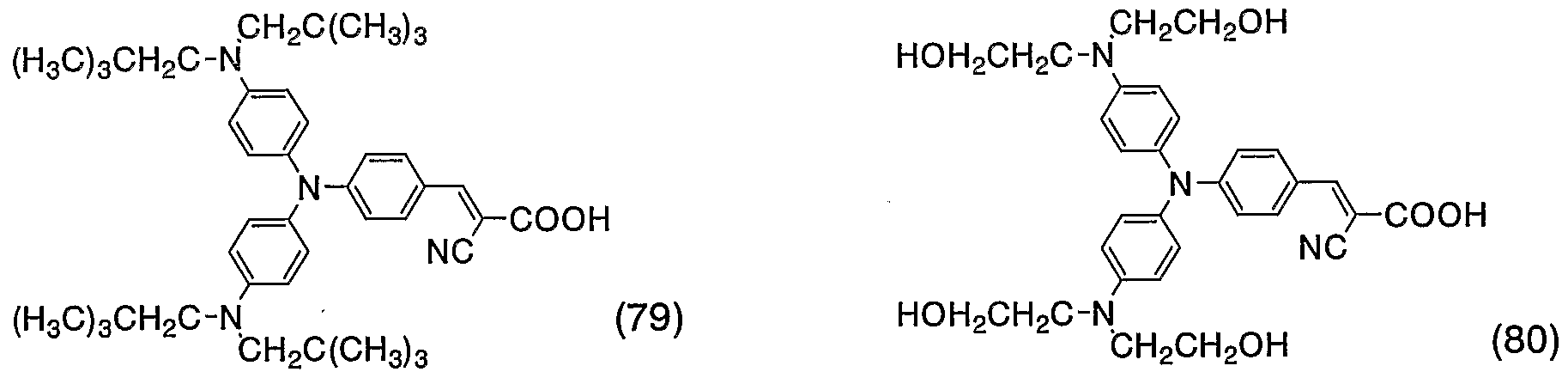
- a photoelectric conversion element characterized by using oxide semiconductor fine particles sensitized by a methine dye represented by the formula (1),
- the benzene ring a may combine a plurality of substituents to form a ring which may have a substituent. At least one ring Or it may have a plurality of substituents. Examples of the substituent include a halogen atom, an alkoxyl group, an acyl group, an aliphatic hydrocarbon residue which may have a substituent, and an aromatic residue which may have a substituent. Further, the ring may be formed by combining a plurality of substituents to form a ring which may have a substituent. )
- the methine dye represented by the formula (1) is a compound in which R t and R 2 in the formula (1) are aromatic residues which may have a substituent.
- the benzene ring has a substituent in which a plurality of substituents are bonded to each other.
- R 6 and R 7 each represent a substituted or unsubstituted amino group or an aromatic residue which may have a substituent.
- the methine dye represented by formula (3) is a compound in which X 3 in formula (3) and A 6 closest to X 3 form a ring which may have a substituent.
- a method for producing a photoelectric conversion element characterized by supporting a colorant represented by the formula (1) on oxide semiconductor fine particles formed in a thin film shape,
- R 2 are a benzene ring, is a sulfur atom, is an integer of 1 to 2, is an integer of 1, and is a methine-based dye having a mouth-danine ring formed by ⁇ and 2 ;
- the photoelectric conversion element of the present invention uses an oxide semiconductor sensitized by a dye represented by the following formula (1).
- the aromatic residue means a group obtained by removing one hydrogen atom from an aromatic ring.
- the aromatic ring include aromatic hydrocarbon rings such as benzene, naphthalene, anthracene, phenanthrene, pyrene, perylene, and terylene, and indene.
- Azulene pyridine, pyrazine, pyrimidine, pyrazole, pyrazolidine, thiazolidine, oxazo Lysine, pyran, chromene, pyrrole, pyrrolidine, benzimidazole, imidazoline, imidazolidine, imidazole, pyrazole, triazol, triazine, diazol, indoline, thiophene, furan, oxazole, thiazine, thiazole , Indole, benzothiazole, naphthothiazole, benzoxazole, naphthoxazole, indolenine, benzoindolenine, pyrazine, quinoline, quinazoline, etc., heterocyclic aromatic ring, fluorene, carbazole, etc. condensed aromatic ring, etc. These may have a substituent as described above. Usually, it is preferably an aromatic residue having an aromatic ring,
- Aliphatic hydrocarbon residues include saturated and unsaturated linear, branched and cyclic alkyl groups, preferably having 1 to 36 carbon atoms, and more preferably having 1 to 20 carbon atoms. Is mentioned.
- Examples of the cyclic one include cycloalkyl having 3 to 8 carbon atoms. Specific examples include methyl, ethyl, n-propyl, iso-propyl, n-butyl, iso_butyl, ter-butyl, octyl, octadecyl, isopropyl, and cyclohexyl.
- P-butenyl pentynyl, p-thenyl, hexenyl, hexenyl, isopropenyl, isohexenyl, cyclohexenyl, cyclopentadienyl, ethynyl, propynyl, pentynyl, Examples include a hexynyl group, an isohexynyl group, and a cyclohexynyl group. These may have a substituent as described above.
- Examples of the acryl group include an alkylcarbonyl group having 1 to 10 carbon atoms, an arylcarbonyl group and the like, and preferably an alkylcarbonyl group having 1 to 4 carbon atoms, specifically, an acetyl group and a trifluoro group Examples include a methylcarbonyl group and a propionyl group.
- Examples of the arylcarbonyl group include a benzocarbonyl group and a naphthocarbonyl group.
- the substituent in the aromatic residue which may have a substituent and the aliphatic hydrocarbon residue which may have a substituent is not particularly limited, but may be a hydrogen atom, a sulfonic acid group, a sulfamoyl group, a cyano group.
- a substituted aromatic group, an optionally substituted aromatic residue, and an optionally substituted aliphatic hydrocarbon residue are optionally substituted amide group, an optionally substituted alkoxy group, an optionally substituted aryloxy group, a propyloxyl group, a sorbamoyl group, an acyl group, an aldehyde group, an alkoxycarbonyl group
- Examples of the halogen atom include atoms such as fluorine, chlorine, bromine, and iodine.
- Examples of the phosphoric ester group include a phosphoric acid (having 1 to 4 carbon atoms) alkyl ester group.
- Examples of the substituted or unsubstituted amino group include an amino-substituted group, a mono- or dimethylamino group, a mono- or dimethylamino group, an alkyl-substituted amino group such as a mono- or dipropylamino group, a mono- or diphenylamino group, an aromatic substitution such as a mono- or dinaphthylamino group.
- the alkoxy group means a group formed by a bond between the aliphatic hydrocarbon residue and an oxygen atom, such as a methoxy group, an ethoxy group, a butoxy group, and a tert-butoxy group. Examples thereof include a phenoxy group and a naphthoxy group. These may have a substituent as described above.
- the substituents are the same as those described in the section of the aromatic residue which may have a substituent. Good.
- the acyl group may be the same as described above.
- Examples of the alkoxycarbonyl group include an alkoxycarbonyl group having 1 to 10 carbon atoms.
- the aromatic residue which may have a substituent and the aliphatic hydrocarbon residue which may have a substituent may be the same as those described above.
- R 2 may combine with each other or a benzene ring to form a ring which may have a substituent.
- the ring formed by bonding 1 ⁇ and R 2 to each other include a morpholine ring, a piperidine ring, a piperazine ring, a pyrrolidine ring, a carpazole ring, and an indole ring.
- the ring formed by combining 1 ⁇ and R 2 with the benzene ring a include a julolidine ring. These may have a substituent as described above.
- the substituent may be the same as those described in the section of the substituent for the aromatic residue which may have a substituent and the aliphatic hydrocarbon residue which may have a substituent.
- R t and R 2 in the formula (1) are preferably an aromatic residue which may have a substituent.
- the substituent may be the same as that described in the section of the substituent in the aromatic residue which may have a substituent and the aliphatic hydrocarbon residue which may have a substituent, and may be substituted or unsubstituted. It is preferably an aromatic residue which may have an amino group or a substituent.
- ⁇ represents an aromatic residue which may have a substituent, a cyano group, a phosphoric acid group, a sulfonic acid group or a carboxyl group, a carbonamido group, an alkoxycarbonyl group. It represents a group having a substituent group such as a ponyl group and an acyl group.
- the aromatic residue may be the same as described above, and the substituent which may be possessed may be the same as that described in the section of the aromatic residue which may have a substituent.
- the alkoxycarbonyl group and the acyl group may be the same as described above.
- the aromatic residue is preferably a residue of salicylic acid or catechol.
- the E as described later is or A 2 and can form a ring.
- the ring to be formed is preferably a heterocyclic residue which may have a substituent.
- each heterocyclic residue may be ring-enhanced or hydrogenated, and may have a substituent as described above.
- a 2 in the formula (1) each independently represent an aromatic residue which may have a substituent, a hydroxyl group, a phosphate group, a cyano group, a hydrogen atom, a halogen atom, or a substituent.
- a good aliphatic hydrocarbon residue or a group having a carboxylic group such as a carbonyl group, a carboxamide group, an alkoxy carbonyl group, and an acyl group.
- the aromatic residue, the halogen atom, the aliphatic hydrocarbon residue, the alkoxycarbonyl group and the acyl group may be the same as those described above.
- ni is A i and A 2 there are a plurality of two or more, each of A i and if each of A 2 independently of one another are each the same or different connexion is as also good les ⁇ preferred Hache and A 2 are independently Represents a hydrogen atom, a cyano group, an aliphatic hydrocarbon residue, a halogen atom, or a sulfoxyl group. Things.
- a or A 2 is both a cyano group
- a i is a hydrogen atom and A 2 is a hydrogen atom, a cyano group or a carbonyl group
- ri ⁇ In the case of 2 or more, it is preferable that AA 2 is all a cyano group, but Ae is all a hydrogen atom, A 2 closest to the A is a cyano group or a carbonyl group, and the other A 2 is a hydrogen atom.
- a in the formula (1), particularly ⁇ ⁇ is 2 or more A i furthest from X is preferably an aromatic residue which may have a substituent.
- the aromatic residue may be the same as described above, and is preferably a residue such as benzene, naphthalene, anthracene, thiophene, pyrrole, and furan. These aromatic residues may have a substituent as described above.
- the substituent is not particularly limited, and may be the same as described in the section of the aromatic residue which may have a substituent, and may have a substituted or unsubstituted amino group and a substituent. It is preferably an aromatic residue.
- the substituted with a plurality of location substituent respective AA 2 or A 2 is selected from within each of A 2 and if there are a plurality if A i or there are multiple May form a good ring.
- a ring which may have a respective A 2 is a substituted group when the Ku each A i Oyopi A 2 Wakashi is that A 2 is more present when A E or A E there are multiple
- the ring is preferably formed, and examples of the ring formed include an unsaturated hydrocarbon ring and a heterocyclic ring.
- Examples of the unsaturated hydrocarbon ring include a benzene ring, a naphthalene ring, an anthracene ring, a phenanthrene ring, a pyrene ring, an indene ring, an azulene ring, a fluorene ring, a cyclobutene ring, a cyclohexene ring, a cyclopentene ring, a cyclohexadiene ring
- Examples of the heterocyclic ring include a pyridine ring, a pyrazine ring, a piperidine ring, an indoline ring, a furan ring, a pyran ring, an oxazole ring, a thiazolyl ring, an indole ring, and a benzothiazole ring.
- the above-mentioned acidic groups such as a hydroxyl group, a phosphoric acid group, a sulfonic acid group and a hydroxyl group may each form a salt
- the salt include alkali metals such as lithium, sodium, potassium, magnesium, and calcium.
- salts with alkali earth metals or the like, or organic bases such as salts such as quaternary ammonium salts such as tetramethylammonium, tetrabutylammonium, pyridinium, imidazolium, piperazinium, and piberdinium. it can.
- ⁇ represents a sulfur atom, a selenium atom, a tellurium atom, CR 3 R 4 or NR 5, and is preferably a sulfur atom or a selenium atom, more preferably a sulfur atom.
- R 3 and R 4 are a hydrogen atom, a halogen atom, an amide group, A droxyl group, a cyano group, a nitro group, an alkoxyl group, an acyl group, a substituted or unsubstituted amino group, an aliphatic hydrocarbon residue which may have a substituent or an aromatic which may have a substituent Group residues and the like.
- a halogen atom, an amide group, an alkoxyl group, an acyl group, a substituted or unsubstituted amino group, an aliphatic hydrocarbon residue which may have a substituent, and an aromatic residue which may have a substituent May be the same as described above.
- the hydrogen atom as R 5, an aromatic residue which may have a substituent group include aliphatic hydrocarbon residue or Ashiru group which may have a substituent.
- the aromatic residue which may have a substituent, the aliphatic hydrocarbon residue which may have a substituent, and the acyl group may be the same as those described above. Also, if is 2 or more!
- the ring bi in the formula (1) may have one or more substituents, and the substituent has a halogen atom, an alkoxyl group, an acyl group, or a substituent. And a hydrocarbon residue which may have a substituent.
- the halogen atom, the alkoxyl group, the acyl group, the aliphatic hydrocarbon residue which may have a substituent, and the aromatic residue which may have a substituent may be the same as those described above.
- a 3 and A 4 , m 2 , n 2 , X 2 , Y 2 , a benzene ring a 2 , a ring b 2 , a benzene ring R 6 and R 7 have the same meanings.
- the present invention further relates to a methine compound defined below, and an excellent effect can be obtained by using oxide semiconductor fine particles sensitized with these methine dyes.
- R 2 are a benzene ring, is a sulfur atom, is an integer of 1 to 2, ⁇ ⁇ is an integer of 1, and ⁇ 2 is a methine dye having a mouth-danine ring.
- R 12 is a substituted or unsubstituted amino group or an aromatic residue which may have a substituent
- m 3 is an integer of 0 to 3
- n 3 is 1 to 2
- X 3 is a carbonyl group
- a 5 is a hydrogen atom
- a 6 is a cyano group
- the following dye (7) in which is 0 For example, it can be produced by the following reaction formula.
- n 2 or more
- a method of Claisen condensation of a formyl group or the like a method of using an amide derivative such as dimethylaminoacrolein or dimethylaminovinylacrolein, or a formyl group or the like by vinyl reaction by a Wittig reaction or a Dariniar reaction, etc.
- the compound can be obtained as a propenal group, a pennin genal group, or the like by further performing the above formylation reaction or the like.
- compound (5) and compound (6) having active methylene can be used in the presence of a basic catalyst such as caustic soda, sodium methylate, sodium acetate, getylamine, triethylamine, piperidine, piperazine, diazabicycloundecene, etc.
- a basic catalyst such as caustic soda, sodium methylate, sodium acetate, getylamine, triethylamine, piperidine, piperazine, diazabicycloundecene, etc.
- Alcohols such as methanol, ethanol, isopropanol, and butanol; dimethylformamide, N-methyl
- aprotic polar solvents such as rupyrrolidone and solvents such as toluene and acetic anhydride,
- Dye (7) Condensation at about 20 ° C. to 180 ° C., preferably at about 50 ° C. to about 150 gives Dye (7).
- the compound (5) is reacted with an active methylene compound having an alkoxycarbonyl group or a phosphoric acid ester group, and then hydrolyzed to obtain the dye (7). It is also possible.
- Tables 1 and 2 show specific examples of the dye represented by the following formula (8).
- Phenyl group is abbreviated as Ph.
- the ring (ring B) when X 4 and X 4 and A 8 form a ring is described below.
- Dyes of which the methine dye represented is 1 or more (1) Can be produced by the following reaction formula.
- the compound of the formula (14), which is a synthetic intermediate of the methine dye represented by the formula (1), is generally prepared by the method of Ogura et al. (For example, JP-A-2000-252071), (Compound (10) Into a borated compound (11) and reacting it with compound (12). (The following reaction formula, Z in compound (12) represents an octogen atom such as Cl, Br, I, etc.) ).
- the dye (1) is obtained by condensation at about 50 ° C to 150 ° C.
- the compound (1) ′ is reacted with an active methylene compound having an alkoxycarbonyl group or a phosphoric acid ester group and the compound (14), and then hydrolyzed. It is also possible to get.
- Tables 5 to 7 show specific examples of the dye represented by the following formula (15).
- the phenyl group is abbreviated as Ph.
- the ring (ring B) when X 6 and X 6 and A 12 form a ring is described below.
- conductive metal oxides such as tin oxide doped with aluminum, fluorine, or antimony, or copper or copper on the surface of glass or the surface of a transparent polymer material such as polyethylene terephthalate or polyethersulfone.
- a material provided with a thin film of a metal such as silver, silver, or gold can be used.
- the conductivity may be generally 100 ⁇ or less, particularly preferably 100 ⁇ or less.
- Metal oxides are preferable as the oxide semiconductor fine particles. Specific examples thereof include oxides such as titanium, tin, zinc, tungsten, zirconium, gallium, indium, yttrium, niobium, tantalum, and vanadium. No. Of these, oxides such as titanium, tin, zinc, niobium, and indium are preferred, and among these, titanium oxide, zinc oxide, and tin oxide are most preferred. These oxide semiconductors can be used alone, but they can also be mixed or used after being coated on the surface of the semiconductor.
- the average particle diameter of the oxide semiconductor fine particles is usually 1 to 500 nm, preferably 1 to 100 nm.
- the fine particles of the oxide semiconductor may have a large particle diameter and a small particle diameter, or may be used in a multi-layer structure.
- the oxide semiconductor thin film is formed by directly spraying the oxide semiconductor fine particles as a thin film on a substrate by spraying or the like, a method of electrically depositing the semiconductor fine particle thin film using the substrate as an electrode, a semiconductor fine particle such as a slurry of semiconductor fine particles or a semiconductor alkoxide.
- the paste can be produced by applying a paste containing fine particles obtained by hydrolyzing a particle precursor onto a substrate, followed by drying, curing, or baking.
- a method using a slurry is preferable in terms of the performance of the oxide semiconductor electrode. In this method, the slurry is obtained by dispersing the secondary agglomerated oxide semiconductor fine particles in a dispersion medium by an ordinary method so that the average primary particle diameter becomes 1 to 200 nm.
- the dispersion medium for dispersing the slurry is not particularly limited as long as it can disperse the semiconductor fine particles.
- the dispersion medium include water, alcohols such as ethanol, ketones such as acetone and acetylaceton, and hydrocarbons such as hexane. Mixing may be used, and the use of water is preferred in that the change in viscosity of the slurry is reduced.
- a dispersion stabilizer can be used for the purpose of stabilizing the dispersion state of the oxide semiconductor fine particles.
- Specific examples of the dispersion stabilizer that can be used include, for example, acids such as acetic acid, hydrochloric acid, and nitric acid, acetylacetone, acrylic acid, polyethylene glycol, and polyvinyl alcohol.
- solvents that can be used to dissolve the dye include methanol, ethanol, acetonitrile, dimethyl sulfoxide, dimethylformamide acetone, and t-butanol.
- Dye concentration of the solution is usually 1 X 1 0 - 6 M ⁇ 1M is good, preferably 1 X 1 0- 5 M ⁇ 1 X 1 OM.
- the methine dye of formula (1) to be carried may be of one type or a mixture of several types.
- the dyes of the present invention may be used together, or other dyes or metal complex dyes may be mixed.
- the dyes of the present invention may be used together, or other dyes or metal complex dyes may be mixed.
- by mixing dyes having different absorption wavelengths a wide range of absorption wavelengths can be used, and a solar cell with high conversion efficiency can be obtained.
- metal complex dyes that can be mixed are not particularly limited, but include MKNazeeruddin, A. Kay-, I. Rodicio, R. Humphry-Baker, E. Muller, P. Liska, N. Vlachopoulos, M. Graetzel, LAm Chem.
- phthalocyanines As organic dyes to be mixed and used, metal-free phthalocyanine, porphyrin perocyanine, merocyanine, oxonol, triphenylmethane, WO200 Examples thereof include methine dyes such as acrylic acid dyes described in JP-A-2001-213, and dyes such as xanthene, azo, anthraquinone, and perylene dyes. Preferable examples include ruthenium complex ⁇ ⁇ ⁇ merocyanine and methine dyes such as acrylic acid. When two or more dyes are used, the dyes may be sequentially adsorbed on the semiconductor thin film, or mixed and dissolved to be adsorbed.
- the ratio of the dyes to be mixed is not particularly limited, and is optimally selected from the respective dyes. However, it is generally preferable to use about 10% mol or more of one dye per equimolar mixture. In the case where the dye is adsorbed on the oxide semiconductor fine particles using a solution in which the mixed dye is mixed or dissolved, the total concentration of the dye in the solution may be the same as when only one type is supported.
- the solvents described above can be used as the solvent, and the solvents for the respective dyes to be used may be the same or different.
- a dye When a dye is carried on a thin film of oxide semiconductor fine particles, it is effective to carry the dye in the presence of a inclusion compound in order to prevent association of the dyes.
- the inclusion compound include steroidal compounds such as cholic acid, crown ether, cyclodextrin, elixirs, polyethylene oxide, and the like, and preferred are deoxycholic acid, dehydrodeoxycholic acid, and chenodeoxycholic acid. Acids, cholic acid methyl ester, cholic acids such as sodium cholate, polyethylene oxide and the like.
- the solar cell of the present invention is composed of a photoelectric conversion element electrode (cathode), a counter electrode (anode), a redox electrolyte or a hole transport material, a P-type semiconductor, or the like in which a dye is supported on the oxide semiconductor fine particles.
- a photoelectric conversion element electrode cathode
- a counter electrode anode
- a redox electrolyte or a hole transport material a P-type semiconductor, or the like in which a dye is supported on the oxide semiconductor fine particles.
- the form of the redox electrolyte, the hole transport material, the p-type semiconductor, and the like include a liquid, a solidified body (gel and gel), and a solid.
- the liquid form include redox electrolytes, molten salts, hole transport materials, p-type semiconductors, etc. dissolved in solvents, and room-temperature molten salts. In the case of solidified forms (gels and gels), these are used.
- halogen redox electrolytes composed of halogen compounds and halogen molecules
- the halogen molecule include an iodine molecule and a bromine molecule, and an iodine molecule is preferable.
- a halogen compound having a halogen ion as a counter ion for example, L i I, Na l, KI , C sl, C al 2, Mg I 2, Cu metal halide salts I like, or tetraalkyl ammonium Niu Halogen organic and quaternary ammonium salts such as iodide, imidazolium iodide, and pyridinium iodide are exemplified, and salts having iodine ion as a counter ion are preferable.
- salts having iodine ion as a counter ion include lithium iodide, sodium iodide, and trimethylammonium iodide
- an electrochemically inert solvent is used as the solvent.
- Examples include 2-one, sulfolane, tetrahydrofuran, and water.
- acetonitrile, propylene-one-ponate, ethylene-one-ponate, 3-methoxy Propionic nitrile, methoxy ⁇ Seth nitrile, ethylene glycol, 3 main Toki Shio hexa-di-lysine - 2-one, ⁇ chromatography Petit butyrolactone and the like are preferable. These may be used alone or in combination of two or more.
- a gel electrolyte a matrix containing an electrolyte or an electrolyte solution in a matrix such as a polymer or a polymer, W. Kubo, K. Murakoshi, T. Kitamura, K. Hanabusa, H. Shirai, and S.
- the concentration of the redox electrolyte is usually from 0.01 to 99% by weight, preferably from 0.1 to 90% by weight.
- a counter electrode anode
- a photoelectric conversion element cathode
- Example 8 Except that 1 part of the compound (532) was changed to 1.7 parts of the following compound (538), the same treatment as in Synthesis Example 1 was performed to obtain 1.23 parts of the compound (108) as brown crystals.
- Example 16 a 0.2 M aqueous solution of titanium tetrachloride was dropped on the titanium oxide thin film portion of the semiconductor thin film electrode, allowed to stand at room temperature for 24 hours, washed with water, and again at 450 ° C.
- the dye was similarly supported using a titanium tetrachloride-treated semiconductor thin film electrode obtained by baking for 30 minutes.
- Example 1 5 added to a 3 X 10- 2 M cholic acid as a clathrate upon responsible lifting dyes previous dye A solution was prepared and supported on a semiconductor thin film to obtain a cholic acid-treated dye-sensitized semiconductor thin film.
- Table 12 shows that the visible light can be effectively converted to electricity by using the photoelectric conversion element sensitized by the methine dye represented by the formula (1).
- a solar cell with high conversion efficiency and high stability could be provided. Further, the conversion efficiency was improved by using the oxide semiconductor fine particles sensitized by the combined use of two or more dyes.
Landscapes
- Chemical & Material Sciences (AREA)
- Engineering & Computer Science (AREA)
- Spectroscopy & Molecular Physics (AREA)
- Materials Engineering (AREA)
- Physics & Mathematics (AREA)
- Power Engineering (AREA)
- Organic Chemistry (AREA)
- Microelectronics & Electronic Packaging (AREA)
- Chemical Kinetics & Catalysis (AREA)
- Electrochemistry (AREA)
- General Chemical & Material Sciences (AREA)
- Hybrid Cells (AREA)
- Heterocyclic Compounds Containing Sulfur Atoms (AREA)
- Plural Heterocyclic Compounds (AREA)
- Photovoltaic Devices (AREA)
Description




Claims


Priority Applications (4)
| Application Number | Priority Date | Filing Date | Title |
|---|---|---|---|
| JP2005503576A JP4841248B2 (ja) | 2003-03-14 | 2004-03-11 | 色素増感光電変換素子 |
| CA2518925A CA2518925C (en) | 2003-03-14 | 2004-03-11 | Dye-sensitized photoelectric conversion device |
| US10/548,858 US8227690B2 (en) | 2003-03-14 | 2004-03-11 | Dye-sensitized photoelectric conversion device |
| EP04719617A EP1628356B1 (en) | 2003-03-14 | 2004-03-11 | Dye-sensitized photoelectric conversion device |
Applications Claiming Priority (4)
| Application Number | Priority Date | Filing Date | Title |
|---|---|---|---|
| JP2003070321 | 2003-03-14 | ||
| JP2003-70321 | 2003-03-14 | ||
| JP2003-73587 | 2003-03-18 | ||
| JP2003073587 | 2003-03-18 |
Publications (1)
| Publication Number | Publication Date |
|---|---|
| WO2004082061A1 true WO2004082061A1 (ja) | 2004-09-23 |
Family
ID=32992978
Family Applications (1)
| Application Number | Title | Priority Date | Filing Date |
|---|---|---|---|
| PCT/JP2004/003203 Ceased WO2004082061A1 (ja) | 2003-03-14 | 2004-03-11 | 色素増感光電変換素子 |
Country Status (7)
| Country | Link |
|---|---|
| US (1) | US8227690B2 (ja) |
| EP (1) | EP1628356B1 (ja) |
| JP (1) | JP4841248B2 (ja) |
| KR (1) | KR101043264B1 (ja) |
| CA (1) | CA2518925C (ja) |
| TW (1) | TW200507320A (ja) |
| WO (1) | WO2004082061A1 (ja) |
Cited By (33)
| Publication number | Priority date | Publication date | Assignee | Title |
|---|---|---|---|---|
| JP2005011800A (ja) * | 2003-05-26 | 2005-01-13 | Konica Minolta Holdings Inc | 光電変換材料用半導体、光電変換素子及び太陽電池 |
| JP2006079898A (ja) * | 2004-09-08 | 2006-03-23 | Nippon Kayaku Co Ltd | 色素増感光電変換素子 |
| WO2007100033A1 (ja) | 2006-03-02 | 2007-09-07 | Nippon Kayaku Kabushiki Kaisha | 色素増感光電変換素子 |
| US20070240756A1 (en) * | 2006-04-17 | 2007-10-18 | Jae-Kwan Lee | Dye for dye-sensitized solar cell, and solar cell prepared from same |
| WO2008004580A1 (en) | 2006-07-05 | 2008-01-10 | Nippon Kayaku Kabushiki Kaisha | Dye-sensitized solar cell |
| JP2008135197A (ja) * | 2006-11-27 | 2008-06-12 | Konica Minolta Business Technologies Inc | 色素増感型光電変換素子及び色素増感型太陽電池 |
| WO2008146975A1 (en) * | 2007-05-25 | 2008-12-04 | Dongjin Semichem Co., Ltd | Novel organic dye containing n-arylcarbazole moiety and preparation thereof |
| WO2008146971A1 (en) * | 2007-05-25 | 2008-12-04 | Dongjin Semichem Co., Ltd | Novel julolidine-based dye and preparation thereof |
| JP2009009931A (ja) * | 2007-05-31 | 2009-01-15 | Konica Minolta Business Technologies Inc | 光電変換素子、及び太陽電池 |
| JP2009187821A (ja) * | 2008-02-07 | 2009-08-20 | Konica Minolta Business Technologies Inc | 光電変換素子及び太陽電池 |
| JP2009187820A (ja) * | 2008-02-07 | 2009-08-20 | Konica Minolta Business Technologies Inc | 光電変換素子及び太陽電池 |
| US7728222B2 (en) | 2001-03-07 | 2010-06-01 | Nippon Kayaku Kabushiki Kaisha | Dye-sensitized photoelectric conversion device |
| JP2010529226A (ja) * | 2007-05-28 | 2010-08-26 | 東進セミケム株式会社 | 新規な有機染料及びその製造方法 |
| JP2010265458A (ja) * | 2009-05-15 | 2010-11-25 | Ind Technol Res Inst | 有機色素および光電変換装置 |
| JP2010272282A (ja) * | 2009-05-20 | 2010-12-02 | Konica Minolta Business Technologies Inc | 光電変換素子および太陽電池 |
| US7851701B2 (en) | 2001-07-06 | 2010-12-14 | Nippon Kayaku Kabushiki Kaisha | Dye-sensitized photoelectric conversion device |
| JP2011500882A (ja) * | 2007-10-15 | 2011-01-06 | 東進セミケム株式会社 | 新規なチオフェン系染料及びその製造方法 |
| JP2011006560A (ja) * | 2009-06-24 | 2011-01-13 | Fujifilm Corp | 色素化合物、これを用いた光電変換素子及び色素増感型太陽電池 |
| JP2011502187A (ja) * | 2007-10-25 | 2011-01-20 | ソニー株式会社 | 分子構造内にアンカー基を含む色素 |
| WO2010147425A3 (ko) * | 2009-06-19 | 2011-04-28 | 주식회사 동진쎄미켐 | 신규한 유기염료 및 이의 제조방법 |
| US7977570B2 (en) | 2005-05-24 | 2011-07-12 | Nippon Kayaku Kabushiki Kaisha | Dye-sensitized photoelectric conversion device |
| US8022294B2 (en) | 2005-06-14 | 2011-09-20 | Nippon Kayaku Kabushiki Kaisha | Dye-sensitized photoelectric conversion device |
| JP2011526643A (ja) * | 2008-06-30 | 2011-10-13 | 東進セミケム株式会社 | 新規な有機染料化合物及びその製造方法 |
| JP2012031373A (ja) * | 2010-07-09 | 2012-02-16 | Toyo Ink Sc Holdings Co Ltd | 光機能材料 |
| US8227690B2 (en) | 2003-03-14 | 2012-07-24 | Nippon Kayaku Kabushiki Kaisha | Dye-sensitized photoelectric conversion device |
| JP5086807B2 (ja) * | 2005-05-13 | 2012-11-28 | Agcセイミケミカル株式会社 | 新規アミノ基含有複素環誘導体および該複素環誘導体を含有する光電変換用増感色素 |
| EP2551865A2 (en) | 2011-07-29 | 2013-01-30 | Konica Minolta Business Technologies, Inc. | Photoelectric conversion element and solar cell |
| JP2013030466A (ja) * | 2011-06-23 | 2013-02-07 | Konica Minolta Business Technologies Inc | 光電変換素子、光電変換素子の製造方法および太陽電池 |
| WO2013027838A1 (ja) * | 2011-08-25 | 2013-02-28 | 独立行政法人物質・材料研究機構 | 色素増感太陽電池及び増感色素 |
| JP2013535086A (ja) * | 2010-06-29 | 2013-09-09 | ディエナモ アクティエボラーグ | 高効率色素増感太陽電池 |
| JP2013239384A (ja) * | 2012-05-16 | 2013-11-28 | Konica Minolta Inc | 光電変換素子 |
| WO2014084296A1 (ja) | 2012-11-30 | 2014-06-05 | 日本化薬株式会社 | 色素増感太陽電池 |
| WO2015087837A1 (ja) * | 2013-12-09 | 2015-06-18 | 独立行政法人産業技術総合研究所 | かさ高い置換基を持つトリフェニルアミンを電子供与性基とした有機色素化合物及びそれを用いた半導体薄膜電極、光電変換素子、光電気化学太陽電池 |
Families Citing this family (21)
| Publication number | Priority date | Publication date | Assignee | Title |
|---|---|---|---|---|
| US7141735B2 (en) * | 2000-07-27 | 2006-11-28 | Nippon Kayaku Kabushiki Kaisha | Dye-sensitized photoelectric conversion device |
| KR100869802B1 (ko) * | 2006-11-17 | 2008-11-21 | 삼성에스디아이 주식회사 | 염료감응 태양전지용 전해질, 이를 포함하는 염료감응태양전지, 및 이의 제조방법 |
| JP2008186752A (ja) * | 2007-01-31 | 2008-08-14 | Konica Minolta Business Technologies Inc | 光電変換素子及び太陽電池 |
| EP2053618A1 (en) * | 2007-10-25 | 2009-04-29 | Sony Corporation | A dye including an anchoring group in its molecular structure |
| CN101240117B (zh) * | 2008-02-04 | 2010-11-10 | 中国科学院长春应用化学研究所 | 纯有机染料和由其制备的染料敏化太阳能电池 |
| KR101185483B1 (ko) * | 2008-04-07 | 2012-10-02 | 에버라이트 유에스에이, 인코오포레이티드 | 염료 화합물 |
| TWI384034B (zh) * | 2008-04-07 | 2013-02-01 | Everlight Chem Ind Corp | 用於染料敏化太陽能電池之染料化合物 |
| CN101555357B (zh) * | 2008-04-10 | 2012-09-05 | 台湾永光化学工业股份有限公司 | 染料化合物 |
| CN101735639A (zh) | 2008-11-14 | 2010-06-16 | 明德国际仓储贸易(上海)有限公司 | 染料化合物及用此染料化合物制作的光电组件 |
| TW201116593A (en) * | 2009-11-05 | 2011-05-16 | Everlight Chem Ind Corp | Dye-sensitized solar cell and photoanode thereof |
| CN102695759A (zh) * | 2009-12-30 | 2012-09-26 | 株式会社东进世美肯 | 新的有机染料及其制造方法 |
| US20130118570A1 (en) * | 2010-01-07 | 2013-05-16 | Nec Corporation | Dye for photoelectric conversion, semiconductor electrode, photoelectric conversion element, solar cell, and novel pyrroline-based compound |
| AU2011228146A1 (en) * | 2010-03-16 | 2012-10-25 | Ube Industries, Ltd. | Photoelectric conversion element that contains dye consisting of binuclear ruthenium complex having substituted bipyridyl groups, and photochemical cell |
| JP5263458B1 (ja) * | 2011-07-29 | 2013-08-14 | 凸版印刷株式会社 | 色素増感太陽電池 |
| ITTO20110778A1 (it) * | 2011-08-26 | 2013-02-27 | Giuseppe Caputo | Coloranti asimmetrici e loro usi |
| US20130074935A1 (en) * | 2011-09-23 | 2013-03-28 | Warner Babcock Institute for Green Chemistry | Dye formulation for fabricating dye sensitized electronic devices |
| US20140311574A1 (en) * | 2011-11-21 | 2014-10-23 | President And Fellows Of Harvard College | Self-Aligned Deposition of Silica Layers for Dye-Sensitized Solar Cells |
| ITMI20121672A1 (it) * | 2012-10-05 | 2014-04-06 | Eni Spa | Colorante organico per una cella solare sensibilizzata da colorante |
| CN104073017B (zh) * | 2013-03-28 | 2018-12-14 | 凯惠科技发展(上海)有限公司 | 有机染料敏化剂、制备方法及在光电转换中的应用 |
| FR3011548A1 (fr) * | 2013-10-07 | 2015-04-10 | Arkema France | Compose organique photoactif |
| US10562913B2 (en) | 2014-07-30 | 2020-02-18 | University Of Mississippi | Indolizine-based dyes for dye-sensitized solar cell |
Citations (2)
| Publication number | Priority date | Publication date | Assignee | Title |
|---|---|---|---|---|
| WO2002011213A1 (en) * | 2000-07-27 | 2002-02-07 | Nippon Kayaku Kabushiki Kaisha | Dye-sensitized photoelectric transducer |
| JP2003059547A (ja) * | 2001-08-17 | 2003-02-28 | Nippon Kayaku Co Ltd | 色素増感光電変換素子 |
Family Cites Families (61)
| Publication number | Priority date | Publication date | Assignee | Title |
|---|---|---|---|---|
| US2803640A (en) | 1954-11-12 | 1957-08-20 | Du Pont | Alpha-cyanovinyl-substituted aryl amines and their preparation |
| CH674596A5 (ja) | 1988-02-12 | 1990-06-15 | Sulzer Ag | |
| US5308747A (en) | 1992-04-16 | 1994-05-03 | Eastman Kodak Company | Photographic silver halide material comprising tabular grains and positioned absorber dyes |
| DE69325410T2 (de) | 1992-04-16 | 1999-10-28 | Eastman Kodak Co., Rochester | Photographisches Silberhalogenidmaterial mit tafelförmigen Silberhalogenid-Körnern und verteilten Absorber-Farbstoffen |
| US5275929A (en) | 1992-04-16 | 1994-01-04 | Eastman Kodak Company | Photographic silver halide material comprising tabular grains of specified dimensions |
| US5670091A (en) | 1993-08-05 | 1997-09-23 | California Institute Of Technology | Nonlinear optical materials with reduced aromaticity and bond length alternation |
| JP2824749B2 (ja) | 1994-07-15 | 1998-11-18 | 石原産業株式会社 | 表面改質された酸化チタン膜およびその製造方法ならびにそれを用いた光電変換素子 |
| EP0692800A3 (en) | 1994-07-15 | 1996-11-06 | Ishihara Sangyo Kaisha | Surface modified titanium oxide layer, manufacturing process and photoelectric conversion device with this layer |
| EP0892411B1 (en) | 1997-07-15 | 2007-09-19 | FUJIFILM Corporation | Methine dye sensitized semiconductor particle |
| JP4148375B2 (ja) | 1997-07-18 | 2008-09-10 | 富士フイルム株式会社 | 光電変換素子および光電気化学電池 |
| JPH1167285A (ja) | 1997-08-27 | 1999-03-09 | Fuji Photo Film Co Ltd | 光電変換素子および光電気化学電池 |
| JPH11144773A (ja) | 1997-09-05 | 1999-05-28 | Fuji Photo Film Co Ltd | 光電変換素子および光再生型光電気化学電池 |
| EP1091373B1 (en) | 1997-10-23 | 2004-05-06 | Fuji Photo Film Co., Ltd. | Photoelectric conversion device and photo-electrochemical cell |
| JP4014018B2 (ja) | 1997-11-27 | 2007-11-28 | 富士フイルム株式会社 | メチン化合物 |
| JP4169220B2 (ja) | 1997-11-27 | 2008-10-22 | 富士フイルム株式会社 | 光電変換素子 |
| JPH11176489A (ja) | 1997-12-10 | 1999-07-02 | Fuji Photo Film Co Ltd | 光電変換素子および光再生型光電気化学電池 |
| JPH11185836A (ja) | 1997-12-16 | 1999-07-09 | Fuji Photo Film Co Ltd | 光電変換素子および光再生型光電気化学電池 |
| DE19822199C2 (de) | 1998-05-16 | 2003-02-13 | Wella Ag | Mono- oder Polymethinfarbstoffe enthaltende nicht-oxidative Haarfärbemittel und Verfahren zur temporären Haarfärbung |
| JP2997773B1 (ja) | 1998-07-15 | 2000-01-11 | 工業技術院長 | 増感剤として有用な金属錯体、酸化物半導体電極及び太陽電池 |
| DE69939147D1 (de) | 1998-09-30 | 2008-09-04 | Fujifilm Corp | Mit einem Methinfarbstoff sensibilisierte Halbleiterteilchen |
| JP3505414B2 (ja) | 1998-12-24 | 2004-03-08 | 株式会社東芝 | 光化学電池およびその製造法 |
| JP2000268892A (ja) | 1999-01-14 | 2000-09-29 | Fuji Photo Film Co Ltd | 光電変換素子および光電池 |
| JP2000223167A (ja) | 1999-01-28 | 2000-08-11 | Fuji Photo Film Co Ltd | 光電変換素子および光電気化学電池 |
| JP2000285978A (ja) | 1999-03-31 | 2000-10-13 | Fuji Photo Film Co Ltd | 色素、光電変換素子および光電気化学電池 |
| JP2000285977A (ja) | 1999-03-31 | 2000-10-13 | Fuji Photo Film Co Ltd | 光電変換素子および光電池 |
| US6291763B1 (en) | 1999-04-06 | 2001-09-18 | Fuji Photo Film Co., Ltd. | Photoelectric conversion device and photo cell |
| JP3925888B2 (ja) | 1999-08-04 | 2007-06-06 | 富士フイルム株式会社 | 感光性組成物 |
| JP3680094B2 (ja) | 1999-06-02 | 2005-08-10 | 独立行政法人産業技術総合研究所 | 有機色素増感型多孔質酸化物半導体電極及びそれを用いた太陽電池 |
| EP1075005B1 (en) | 1999-08-04 | 2006-04-26 | Fuji Photo Film Co., Ltd. | Electrolyte composition, and photo-electro-chemical cell |
| JP2001064529A (ja) | 1999-08-26 | 2001-03-13 | Konica Corp | ハロゲン化銀カラー写真用発色現像主薬とそのプレカーサー、ハロゲン化銀カラー感光材料とその処理組成物、カラー画像形成方法、画像形成材料 |
| JP5142307B2 (ja) | 2000-11-28 | 2013-02-13 | 独立行政法人産業技術総合研究所 | 有機色素を光増感剤とする半導体薄膜電極、光電変換素子 |
| TW541330B (en) | 2001-03-07 | 2003-07-11 | Nippon Kayaku Kk | Photo-electric conversion device and oxide semiconductor fine particle |
| CN1524315B (zh) | 2001-07-06 | 2013-02-13 | 日本化药株式会社 | 染料敏化的光电转换器件 |
| DE10142481A1 (de) * | 2001-08-31 | 2003-03-27 | Rudolf Hezel | Solarzelle sowie Verfahren zur Herstellung einer solchen |
| JP4274306B2 (ja) | 2002-06-13 | 2009-06-03 | 日本化薬株式会社 | 色素増感光電変換素子 |
| EP1997855A3 (en) | 2002-07-29 | 2010-09-08 | Mitsubishi Paper Mills Limited | Organic dye, photoelectric transducing material, semiconductor electrode, and photoelectric transducing device |
| JP4299525B2 (ja) | 2002-10-22 | 2009-07-22 | 祥三 柳田 | 光電変換素子及び太陽電池 |
| JP4608869B2 (ja) | 2002-12-12 | 2011-01-12 | コニカミノルタホールディングス株式会社 | 光電変換材料用半導体、光電変換素子及び太陽電池 |
| JP4338981B2 (ja) | 2003-01-21 | 2009-10-07 | 日本化薬株式会社 | 色素増感光電変換素子 |
| WO2004082061A1 (ja) | 2003-03-14 | 2004-09-23 | Nippon Kayaku Kabushiki Kaisha | 色素増感光電変換素子 |
| JP4982940B2 (ja) | 2003-05-26 | 2012-07-25 | コニカミノルタホールディングス株式会社 | 光電変換材料用半導体、光電変換素子及び太陽電池 |
| JP4450573B2 (ja) | 2003-06-10 | 2010-04-14 | 日本化薬株式会社 | 色素増感光電変換素子 |
| JP2005019251A (ja) | 2003-06-26 | 2005-01-20 | Mitsubishi Paper Mills Ltd | 光電変換材料、半導体電極並びにそれを用いた光電変換素子 |
| JP2005123013A (ja) | 2003-10-16 | 2005-05-12 | Konica Minolta Holdings Inc | 光電変換材料用半導体、光電変換素子及び太陽電池 |
| JP2005129329A (ja) | 2003-10-23 | 2005-05-19 | Konica Minolta Holdings Inc | 光電変換材料用半導体、光電変換素子及び太陽電池 |
| JP2005129430A (ja) | 2003-10-27 | 2005-05-19 | Konica Minolta Holdings Inc | 光電変換材料用半導体、光電変換素子及び太陽電池 |
| JP4599824B2 (ja) | 2003-10-27 | 2010-12-15 | コニカミノルタホールディングス株式会社 | 光電変換材料用半導体、光電変換素子及び太陽電池 |
| US7141736B2 (en) * | 2003-12-12 | 2006-11-28 | Gary Dean Plankell | Apparatus for mounting a telephone or other cordless device in a building structure and related methods |
| JP2005209682A (ja) | 2004-01-20 | 2005-08-04 | Konica Minolta Holdings Inc | 光電変換材料用半導体、光電変換素子及び太陽電池 |
| JP2005227376A (ja) | 2004-02-10 | 2005-08-25 | Fuji Xerox Co Ltd | 有機非線形光学材料及びそれを用いた非線形光学素子 |
| KR20060128009A (ko) | 2004-02-16 | 2006-12-13 | 이하라케미칼 고교가부시키가이샤 | 치환 Sym-트리인돌 |
| JP4963343B2 (ja) | 2004-09-08 | 2012-06-27 | 日本化薬株式会社 | 色素増感光電変換素子 |
| JP2006093284A (ja) | 2004-09-22 | 2006-04-06 | Mitsubishi Paper Mills Ltd | 光電変換素子 |
| JP2006156212A (ja) | 2004-11-30 | 2006-06-15 | Mitsubishi Paper Mills Ltd | 半導体電極並びにそれを用いた光電変換素子 |
| JP2006190534A (ja) | 2005-01-05 | 2006-07-20 | Mitsubishi Paper Mills Ltd | 光電変換材料、半導体電極並びにそれを用いた光電変換素子 |
| JP2006188582A (ja) | 2005-01-05 | 2006-07-20 | Mitsubishi Paper Mills Ltd | 新規なピラゾロン化合物、並びにそれを用いたメロシアニン色素 |
| CN1861740B (zh) | 2005-05-13 | 2010-04-28 | 中国科学院理化技术研究所 | 红光发射荧光染料及其合成方法与用途 |
| US7977570B2 (en) | 2005-05-24 | 2011-07-12 | Nippon Kayaku Kabushiki Kaisha | Dye-sensitized photoelectric conversion device |
| JP5135774B2 (ja) * | 2006-11-20 | 2013-02-06 | コニカミノルタビジネステクノロジーズ株式会社 | 光電変換素子、及び太陽電池 |
| US8039741B2 (en) * | 2006-12-08 | 2011-10-18 | Konica Minolta Business Technologies, Inc. | Photoelectric conversion element and solar cell |
| JP2008186752A (ja) * | 2007-01-31 | 2008-08-14 | Konica Minolta Business Technologies Inc | 光電変換素子及び太陽電池 |
-
2004
- 2004-03-11 WO PCT/JP2004/003203 patent/WO2004082061A1/ja not_active Ceased
- 2004-03-11 US US10/548,858 patent/US8227690B2/en not_active Expired - Fee Related
- 2004-03-11 JP JP2005503576A patent/JP4841248B2/ja not_active Expired - Fee Related
- 2004-03-11 EP EP04719617A patent/EP1628356B1/en not_active Expired - Lifetime
- 2004-03-11 KR KR1020057017225A patent/KR101043264B1/ko not_active Expired - Fee Related
- 2004-03-11 CA CA2518925A patent/CA2518925C/en not_active Expired - Fee Related
- 2004-03-12 TW TW093106622A patent/TW200507320A/zh unknown
Patent Citations (2)
| Publication number | Priority date | Publication date | Assignee | Title |
|---|---|---|---|---|
| WO2002011213A1 (en) * | 2000-07-27 | 2002-02-07 | Nippon Kayaku Kabushiki Kaisha | Dye-sensitized photoelectric transducer |
| JP2003059547A (ja) * | 2001-08-17 | 2003-02-28 | Nippon Kayaku Co Ltd | 色素増感光電変換素子 |
Non-Patent Citations (1)
| Title |
|---|
| See also references of EP1628356A4 * |
Cited By (44)
| Publication number | Priority date | Publication date | Assignee | Title |
|---|---|---|---|---|
| US7728222B2 (en) | 2001-03-07 | 2010-06-01 | Nippon Kayaku Kabushiki Kaisha | Dye-sensitized photoelectric conversion device |
| US8338700B2 (en) | 2001-07-06 | 2012-12-25 | Nippon Kayaku Kabushiki Kaisha | Dye-sensitized photoelectric conversion device |
| US8338701B2 (en) | 2001-07-06 | 2012-12-25 | Nippon Kayaku Kabushiki Kaisha | Dye-sensitized photoelectric conversion device |
| US7851701B2 (en) | 2001-07-06 | 2010-12-14 | Nippon Kayaku Kabushiki Kaisha | Dye-sensitized photoelectric conversion device |
| US8227690B2 (en) | 2003-03-14 | 2012-07-24 | Nippon Kayaku Kabushiki Kaisha | Dye-sensitized photoelectric conversion device |
| JP2005011800A (ja) * | 2003-05-26 | 2005-01-13 | Konica Minolta Holdings Inc | 光電変換材料用半導体、光電変換素子及び太陽電池 |
| US8022293B2 (en) | 2004-09-08 | 2011-09-20 | Nippon Kayaku Kabushiki Kaisha | Dye-sensitized photoelectic conversion devices |
| JP2006079898A (ja) * | 2004-09-08 | 2006-03-23 | Nippon Kayaku Co Ltd | 色素増感光電変換素子 |
| JP5086807B2 (ja) * | 2005-05-13 | 2012-11-28 | Agcセイミケミカル株式会社 | 新規アミノ基含有複素環誘導体および該複素環誘導体を含有する光電変換用増感色素 |
| US7977570B2 (en) | 2005-05-24 | 2011-07-12 | Nippon Kayaku Kabushiki Kaisha | Dye-sensitized photoelectric conversion device |
| US8022294B2 (en) | 2005-06-14 | 2011-09-20 | Nippon Kayaku Kabushiki Kaisha | Dye-sensitized photoelectric conversion device |
| US8735720B2 (en) | 2006-03-02 | 2014-05-27 | Nippon Kayaku Kabushiki Kaisha | Dye-sensitized photoelectric conversion device |
| WO2007100033A1 (ja) | 2006-03-02 | 2007-09-07 | Nippon Kayaku Kabushiki Kaisha | 色素増感光電変換素子 |
| US8653279B2 (en) * | 2006-04-17 | 2014-02-18 | Samsung Sdi Co., Ltd. | Dye for dye-sensitized solar cell, and solar cell prepared from same |
| US20070240756A1 (en) * | 2006-04-17 | 2007-10-18 | Jae-Kwan Lee | Dye for dye-sensitized solar cell, and solar cell prepared from same |
| WO2008004580A1 (en) | 2006-07-05 | 2008-01-10 | Nippon Kayaku Kabushiki Kaisha | Dye-sensitized solar cell |
| JP2008135197A (ja) * | 2006-11-27 | 2008-06-12 | Konica Minolta Business Technologies Inc | 色素増感型光電変換素子及び色素増感型太陽電池 |
| WO2008146975A1 (en) * | 2007-05-25 | 2008-12-04 | Dongjin Semichem Co., Ltd | Novel organic dye containing n-arylcarbazole moiety and preparation thereof |
| WO2008146971A1 (en) * | 2007-05-25 | 2008-12-04 | Dongjin Semichem Co., Ltd | Novel julolidine-based dye and preparation thereof |
| KR100969676B1 (ko) | 2007-05-25 | 2010-08-17 | 주식회사 동진쎄미켐 | 신규한 줄로리딘계 염료 및 이의 제조방법 |
| JP2010529226A (ja) * | 2007-05-28 | 2010-08-26 | 東進セミケム株式会社 | 新規な有機染料及びその製造方法 |
| JP2009009931A (ja) * | 2007-05-31 | 2009-01-15 | Konica Minolta Business Technologies Inc | 光電変換素子、及び太陽電池 |
| JP2011500882A (ja) * | 2007-10-15 | 2011-01-06 | 東進セミケム株式会社 | 新規なチオフェン系染料及びその製造方法 |
| JP2011502187A (ja) * | 2007-10-25 | 2011-01-20 | ソニー株式会社 | 分子構造内にアンカー基を含む色素 |
| JP2009187820A (ja) * | 2008-02-07 | 2009-08-20 | Konica Minolta Business Technologies Inc | 光電変換素子及び太陽電池 |
| JP2009187821A (ja) * | 2008-02-07 | 2009-08-20 | Konica Minolta Business Technologies Inc | 光電変換素子及び太陽電池 |
| JP2011526643A (ja) * | 2008-06-30 | 2011-10-13 | 東進セミケム株式会社 | 新規な有機染料化合物及びその製造方法 |
| US8969593B2 (en) | 2009-05-15 | 2015-03-03 | Industrial Technology Research Institute | Organic dyes and photoelectric conversion devices |
| JP2010265458A (ja) * | 2009-05-15 | 2010-11-25 | Ind Technol Res Inst | 有機色素および光電変換装置 |
| JP2010272282A (ja) * | 2009-05-20 | 2010-12-02 | Konica Minolta Business Technologies Inc | 光電変換素子および太陽電池 |
| WO2010147425A3 (ko) * | 2009-06-19 | 2011-04-28 | 주식회사 동진쎄미켐 | 신규한 유기염료 및 이의 제조방법 |
| CN102803394A (zh) * | 2009-06-19 | 2012-11-28 | 株式会社东进世美肯 | 新型有机染料及其制造方法 |
| JP2011006560A (ja) * | 2009-06-24 | 2011-01-13 | Fujifilm Corp | 色素化合物、これを用いた光電変換素子及び色素増感型太陽電池 |
| JP2013535086A (ja) * | 2010-06-29 | 2013-09-09 | ディエナモ アクティエボラーグ | 高効率色素増感太陽電池 |
| JP2012031373A (ja) * | 2010-07-09 | 2012-02-16 | Toyo Ink Sc Holdings Co Ltd | 光機能材料 |
| JP2013030466A (ja) * | 2011-06-23 | 2013-02-07 | Konica Minolta Business Technologies Inc | 光電変換素子、光電変換素子の製造方法および太陽電池 |
| EP2551865A2 (en) | 2011-07-29 | 2013-01-30 | Konica Minolta Business Technologies, Inc. | Photoelectric conversion element and solar cell |
| US9190617B2 (en) | 2011-07-29 | 2015-11-17 | Konica Minolta Business Technologies, Inc. | Photoelectric conversion element and solar cell |
| WO2013027838A1 (ja) * | 2011-08-25 | 2013-02-28 | 独立行政法人物質・材料研究機構 | 色素増感太陽電池及び増感色素 |
| JPWO2013027838A1 (ja) * | 2011-08-25 | 2015-03-23 | 独立行政法人物質・材料研究機構 | 色素増感太陽電池及び増感色素 |
| JP2013239384A (ja) * | 2012-05-16 | 2013-11-28 | Konica Minolta Inc | 光電変換素子 |
| WO2014084296A1 (ja) | 2012-11-30 | 2014-06-05 | 日本化薬株式会社 | 色素増感太陽電池 |
| WO2015087837A1 (ja) * | 2013-12-09 | 2015-06-18 | 独立行政法人産業技術総合研究所 | かさ高い置換基を持つトリフェニルアミンを電子供与性基とした有機色素化合物及びそれを用いた半導体薄膜電極、光電変換素子、光電気化学太陽電池 |
| JPWO2015087837A1 (ja) * | 2013-12-09 | 2017-03-16 | 国立研究開発法人産業技術総合研究所 | かさ高い置換基を持つトリフェニルアミンを電子供与性基とした有機色素化合物及びそれを用いた半導体薄膜電極、光電変換素子、光電気化学太陽電池 |
Also Published As
| Publication number | Publication date |
|---|---|
| TWI341046B (ja) | 2011-04-21 |
| EP1628356A4 (en) | 2009-07-15 |
| TW200507320A (en) | 2005-02-16 |
| EP1628356A1 (en) | 2006-02-22 |
| CA2518925A1 (en) | 2004-09-23 |
| US8227690B2 (en) | 2012-07-24 |
| US20060130249A1 (en) | 2006-06-22 |
| JP4841248B2 (ja) | 2011-12-21 |
| EP1628356B1 (en) | 2012-08-15 |
| CA2518925C (en) | 2012-08-07 |
| JPWO2004082061A1 (ja) | 2006-06-15 |
| KR101043264B1 (ko) | 2011-06-21 |
| KR20050116146A (ko) | 2005-12-09 |
Similar Documents
| Publication | Publication Date | Title |
|---|---|---|
| JP4841248B2 (ja) | 色素増感光電変換素子 | |
| JP4963343B2 (ja) | 色素増感光電変換素子 | |
| KR100792381B1 (ko) | 색소 증감 광전 변환소자 | |
| JP6278504B2 (ja) | 新規化合物及びそれを用いた光電変換素子 | |
| JP5306354B2 (ja) | 色素増感型光電変換素子 | |
| JP2008021496A (ja) | 色素増感光電変換素子 | |
| JP4986205B2 (ja) | 色素増感光電変換素子 | |
| JP5138371B2 (ja) | 色素増感光電変換素子 | |
| JP4230228B2 (ja) | 色素増感光電変換素子 | |
| JP4450573B2 (ja) | 色素増感光電変換素子 | |
| JP5145037B2 (ja) | 色素増感光電変換素子 | |
| JP2006134649A (ja) | 光電変換素子 | |
| JP2006294360A (ja) | 色素増感光電変換素子 | |
| JP4334185B2 (ja) | 色素増感光電変換素子 | |
| JP4230182B2 (ja) | 色素増感光電変換素子及びこれを用いた太陽電池 | |
| JP4230185B2 (ja) | 色素増感光電変換素子 | |
| JP4278023B2 (ja) | 色素増感光電変換素子 | |
| JP2004022387A (ja) | 色素増感光電変換素子 | |
| JP2005019130A (ja) | 色素増感光電変換素子 | |
| JP2016047801A (ja) | 色素増感太陽電池用増感剤としてのトリフェニルアミン結合型ジベンゾピロメテン系色素 | |
| CN101199080A (zh) | 色素增感的光电变换元件 | |
| JP2017137382A (ja) | 新規化合物及びそれを含む光電変換素子 |
Legal Events
| Date | Code | Title | Description |
|---|---|---|---|
| AK | Designated states |
Kind code of ref document: A1 Designated state(s): AE AG AL AM AT AU AZ BA BB BG BR BW BY BZ CA CH CN CO CR CU CZ DE DK DM DZ EC EE EG ES FI GB GD GE GH GM HR HU ID IL IN IS JP KE KG KP KR KZ LC LK LR LS LT LU LV MA MD MG MK MN MW MX MZ NA NI NO NZ OM PG PH PL PT RO RU SC SD SE SG SK SL SY TJ TM TN TR TT TZ UA UG US UZ VC VN YU ZA ZM ZW |
|
| AL | Designated countries for regional patents |
Kind code of ref document: A1 Designated state(s): BW GH GM KE LS MW MZ SD SL SZ TZ UG ZM ZW AM AZ BY KG KZ MD RU TJ TM AT BE BG CH CY CZ DE DK EE ES FI FR GB GR HU IE IT LU MC NL PL PT RO SE SI SK TR BF BJ CF CG CI CM GA GN GQ GW ML MR NE SN TD TG |
|
| 121 | Ep: the epo has been informed by wipo that ep was designated in this application | ||
| WWE | Wipo information: entry into national phase |
Ref document number: 2005503576 Country of ref document: JP |
|
| ENP | Entry into the national phase |
Ref document number: 2006130249 Country of ref document: US Kind code of ref document: A1 |
|
| WWE | Wipo information: entry into national phase |
Ref document number: 10548858 Country of ref document: US |
|
| WWE | Wipo information: entry into national phase |
Ref document number: 2004719617 Country of ref document: EP |
|
| WWE | Wipo information: entry into national phase |
Ref document number: 2518925 Country of ref document: CA |
|
| WWE | Wipo information: entry into national phase |
Ref document number: 20048069266 Country of ref document: CN Ref document number: 1020057017225 Country of ref document: KR Ref document number: 2261/CHENP/2005 Country of ref document: IN |
|
| WWP | Wipo information: published in national office |
Ref document number: 1020057017225 Country of ref document: KR |
|
| WWP | Wipo information: published in national office |
Ref document number: 2004719617 Country of ref document: EP |
|
| WWP | Wipo information: published in national office |
Ref document number: 10548858 Country of ref document: US |