WO2004082379A1 - Verwendung von acylcyclohexandion-derivaten zur verbesserung der toleranz von pflanzen gegenüber kälte und/oder frost - Google Patents
Verwendung von acylcyclohexandion-derivaten zur verbesserung der toleranz von pflanzen gegenüber kälte und/oder frost Download PDFInfo
- Publication number
- WO2004082379A1 WO2004082379A1 PCT/EP2004/002713 EP2004002713W WO2004082379A1 WO 2004082379 A1 WO2004082379 A1 WO 2004082379A1 EP 2004002713 W EP2004002713 W EP 2004002713W WO 2004082379 A1 WO2004082379 A1 WO 2004082379A1
- Authority
- WO
- WIPO (PCT)
- Prior art keywords
- use according
- compounds
- formula
- plants
- frost
- Prior art date
- Legal status (The legal status is an assumption and is not a legal conclusion. Google has not performed a legal analysis and makes no representation as to the accuracy of the status listed.)
- Ceased
Links
- 0 C*(*)C(CC(C1=C(*)O)=O)CC1=O Chemical compound C*(*)C(CC(C1=C(*)O)=O)CC1=O 0.000 description 1
Classifications
-
- A—HUMAN NECESSITIES
- A01—AGRICULTURE; FORESTRY; ANIMAL HUSBANDRY; HUNTING; TRAPPING; FISHING
- A01N—PRESERVATION OF BODIES OF HUMANS OR ANIMALS OR PLANTS OR PARTS THEREOF; BIOCIDES, e.g. AS DISINFECTANTS, AS PESTICIDES OR AS HERBICIDES; PEST REPELLANTS OR ATTRACTANTS; PLANT GROWTH REGULATORS
- A01N37/00—Biocides, pest repellants or attractants, or plant growth regulators containing organic compounds containing a carbon atom having three bonds to hetero atoms with at the most two bonds to halogen, e.g. carboxylic acids
- A01N37/42—Biocides, pest repellants or attractants, or plant growth regulators containing organic compounds containing a carbon atom having three bonds to hetero atoms with at the most two bonds to halogen, e.g. carboxylic acids containing within the same carbon skeleton a carboxylic group or a thio analogue, or a derivative thereof, and a carbon atom having only two bonds to hetero atoms with at the most one bond to halogen, e.g. keto-carboxylic acids
Definitions
- the present invention relates to the use of acylcyclohexanedione derivatives for improving the tolerance of plants to cold and / or frost.
- Temperature is one of the main factors influencing the growth and growth of plants. Cold (temperatures up to 0 ° C) and frost (temperatures below 0 ° C) can slow the germination and growth of plants and have a significant impact on their development as well as on the quantity and quality of their products. Crop plants, such as corn, sugar beet, rice, soybeans, potatoes, tomatoes, peppers, melons, cucumbers, beans, peas, bananas and citrus species, are already damaged at temperatures below 5 ° C or thrown back significantly in their development. Temperatures slightly below 0 ° C already lead to partial or complete death in these plant species.
- Late frosts around the flowering time for example, in core and stone fruits, such as apple, pear, quince, peach, nectarine, apricot, plum, plum, almond or cherry, repeatedly lead to significant yield losses.
- Cold or frost damaged plants show dying phenomena, e.g. on leaves, flowers and buds.
- Frost-damaged flowers develop, if at all, deformed or shell-defective fruits that are difficult or impossible to market.
- Serious cold and frost damage is associated with the death of the entire plant.
- Cold and frost damage is therefore a major loss factor for the agricultural sector.
- the previous opportunities to avoid cold and frost damage are rather unsatisfactory because of their high cost or because of their often not reproducible results.
- These include the breeding of cold- and cross-resistant plant varieties, the prefer- ence of cold-sensitive plants in the greenhouse, which are then exposed to the field at the earliest possible time, cultiva- tion under foil, circulation of fresh air, injection of warm air, installation of Stoves in stock and frost protection irrigation.
- DE 4437945 describes plant supplementants containing vitamin E which are said to reduce the plant-damaging effect of phytotoxic agrochemicals and other abiotic stressors.
- These agents may also contain antifreeze such as glycerin. A cold or frost damage preventing effect of the optionally contained antifreeze is not described.
- EP-A 123 001 describes the use of acylcyclohexanedione compounds of the general formula 15
- R 25 is hydrogen, alkyl, alkylthioalkyl or optionally substituted phenyl and
- R ' is alkyl, optionally substituted benzyl, phenethyl, phenoxymethyl, 2-thienylmethyl, alkoxymethyl or alkylthiomethyl 30,
- these compounds are said to improve, in addition to a number of other beneficial effects, the cold resistance of rice seedlings. However, no improvement in the resistance to cold is reported at any point. Also, it is not clear from this document in which temperature range the cold resistance-improving effect should occur.
- the object of the present invention was to provide a means with which the tolerance of plants to cold and / or frost can be improved.
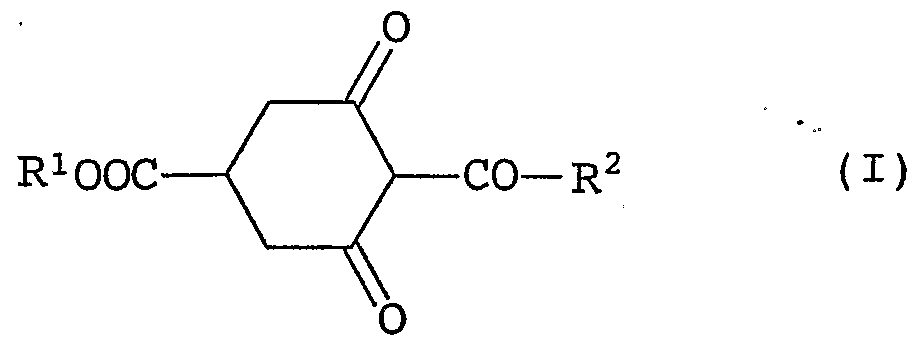
- R 1 is H or C ⁇ -C zo -alkyl
- R 2 is C ⁇ -C ⁇ o-alkyl or C 3 cycloalkyl -C ⁇ 0
- the compounds I used according to the invention are preferably used for improving the tolerance of plants to a temperature range from -15 to 15 ° C., more preferably from -10 to 10 ° C., and in particular from -5 to 10 ° C.
- compounds of the formula I are used in particular for improving the tolerance of the plants to cold. This usually refers to a tolerance to temperatures in the range of 0 to 15 ° C, in particular from 0 to 10 ° C.
- frost-sensitive plants which are in addition to the above-mentioned cold-sensitive plants, for example, stone and Steinobstarten in the flowering phase and citrus and other plants that are cold, but not frost-resistant, the compounds of formula I in particular to improve the tolerance of Plants to temperatures in the range of -15 ° C to 0 ° C, more preferably from -10 ° C to 0 ° C, and especially from -5 ° C to 0 ° C.
- Tolerance is understood to be, in particular, the reduction or prevention of cold and / or frost damage in plants.
- the compounds of formula I are used to reduce or prevent cold damage in cold-sensitive crops such as corn, rice, soybean, sugar beet, eggplant, tomato, pepper, potato, melon, cucumber, bean, pea, banana and citrus.
- the compounds of the formula I are particularly preferably used according to the invention for reducing or preventing frost damage in said cold-sensitive crop plants, furthermore in pome and stone fruit and in all citrus species.
- these compounds are particularly preferably used for the prevention of frost damage to the buds, flowers, leaves and young fruits of these plants.
- the core and stone fruits are, for example, apple, pear, quince, peach, apricot, nectarine, cherry, plum, plum or almond, and preferably apple.
- the citrus species are, for example, lemon, orange, grapefruit, clementine or mandarin.
- the compounds of formula I are used to reduce or prevent frost damage to pome and stone fruit, and apple in particular.
- Acylcyclohexanedione compounds of the formula I are known from EP-A 0 123 001 and from EP-A 126 713.
- the compounds of the formula I can be present both in the trion form (triketo form) I.a and in the tautomeric keto-enol forms I.b or I.c:
- R 1 is preferably H or C 1 -C 4 -alkyl.
- R 2 is preferably C 1 -C 4 -alkyl or C 3 -C 6 -cycloalkyl and in particular ethyl or cyclopropyl.
- C ⁇ -C ⁇ o-alkyl is a linear or branched alkyl radical, such as methyl, ethyl, propyl, isopropyl, n-butyl, sec-butyl, isobutyl, tert-butyl, pentyl, neo pentyl, hexyl, heptyl, octyl, 2-ethylhexyl, nonyl or decyl.
- alkyl radical such as methyl, ethyl, propyl, isopropyl, n-butyl, sec-butyl, isobutyl, tert-butyl, pentyl, neo pentyl, hexyl, heptyl, octyl, 2-ethylhexyl, nonyl or decyl.
- C 1 -C 4 -alkyl is, for example, methyl, ethyl, propyl, isopropyl, n-butyl, sec-butyl, isobutyl or tert-butyl.
- the alkyl radical is linear.
- C 3 -C 10 -cycloalkyl is, for example, cyclopropyl, cyclopentyl, cyclohexyl, cycloheptyl, cycloocyl, cyclodecyl or decalin.
- C 3 -C 6 -cycloalkyl is, for example, cyclopropyl, cyclopentyl or cyclohexyl.
- the monoanions can be present both as carboxylate anions Id and as enolate anions Ie or If:
- Preferred cations in the salts of the compounds of the formula I are the ions of the alkali metals, preferably of lithium, sodium and potassium, of the alkaline earth metals, preferably of calcium and magnesium, and of the transition metals, preferably of manganese, copper, zinc and iron , Further ammonium (NH 4 + ) and substituted ammonium, wherein one to four hydrogen atoms by Ci-C-alkyl, hydroxy-Ci ⁇ -alkyl, -CC 4 -alkoxy-C 4 -alkyl, hydroxy-C 4 -alkoxy-C 1 -C 4 -alkyl, phenyl or benzyl, preferably ammonium, methylammonium, isopropylammonium, dimethylammonium, diisopropylammonium, trimethylammonium, tetramethylammonium, tetraethylammonium, tetrabutylammonium, 2-hydroxyethyl
- Preferred cations are also chlormequat [(2-chloroethyl) trimethylammonium], mepiquat (N, N-dimethylpiperidinium) and N, N-dimethylmorpholinium.
- Particularly preferred cations are the alkali metal cations, the alkaline earth metal cations and the ammonium cation (NH 4 + ). In particular, it is the calcium salt.
- prohexadione especially prohexadione calcium, is used.
- the compounds of the formula I are preferably used at a rate of from 25 to 1000 g / ha, particularly preferably from 50 to 500 g / ha and in particular from 50 to 250 g / ha.
- the compounds of the formula I are used according to the invention in combination with vitamin E or a derivative thereof and / or with abscisic acid and / or with a customary antifreeze agent.
- the weight ratio of compounds of the formula I to vitamin E or its derivatives is preferably 1: 1 to 1:20, more preferably 1: 5 to 1:20 and in particular 1: 5 to 1:15.
- the weight ratio of compounds of the formula I to abscisic acid is preferably from 1: 0.05 to 1: 1, more preferably from 1: 0.05 to 1: 0.5 and in particular from 1: 0.1 to 1: 0.3.
- the weight ratio of compounds of the formula I to the antifreeze is preferably 1:10 to 1: 1000, more preferably 1:10 to 1: 500 and in particular 1:10 to 1: 100.
- vitamin E is understood as meaning all compounds of the vitamin E group, for example the ⁇ - to ⁇ -tocopherols and the tocotrienols and their isomers, salts and esters, it being immaterial whether these compounds are natural or synthetic Origin.
- Particular preference is given to using the naturally occurring ⁇ -tocopherol (RRR- ⁇ -tocopherol) or an ester thereof with a C ⁇ -C 4 carboxylic acid, such as formic acid, acetic acid, propionic acid or butyric acid.
- the ⁇ -tocopherol-acetone is used.
- Abscisic acid is (S) (+) - 5- (l-hydroxy-2,6,6-trimethyl-4-oxo-2-cy- clohexe 'nyl) -3-methyl-cis / trans-2,4-pentadienoic acid the formula
- Antifreezes suitable for the treatment of plants include alcohols, such as propanol and butanol, polyols, such as glycol or glycerol, (poly) ether polyols, such as diethylene glycol, triethylene glycol and polyethylene glycols having a molecular weight of up to 500.
- a preferred antifreeze is glycerine.
- the compounds of the formula I or their combination with the abovementioned excipients are typically used as formulations, as are customary in the field of crop protection.
- they may be diluted with water in the form of concentrated solutions, suspensions or emulsions and applied by spraying.
- the application forms depend on the type of plant or plant part to which it is intended to be applied; they should in any case allow the finest possible distribution of the active ingredients and excipients.
- the formulations may optionally contain formulation auxiliaries which are customary as a combination with vitamin E and / or abscisic acid and / or antifreeze for the formulation of crop protection agents, eg.
- formulation auxiliaries which are customary as a combination with vitamin E and / or abscisic acid and / or antifreeze for the formulation of crop protection agents, eg.
- inert auxiliaries and / or surface-active substances such as emulsifiers, dispersants, wetting agents and the like.
- the alkali, alkaline earth, ammonium salts of aromatic sulfonic acids e.g. Lignin, phenol, naphthalene and dibutylnaphthalenesulfonic acid, as well as fatty acids, alkyl and alkylarylsulfonates, alkyl, lauryl ether and fatty alcohol sulfates, and salts of sulfated hexa-, hepta- and octadecanols and of fatty alcohol glycol ethers, condensation products of sulfonated naphthalene and its derivatives with Formaldehyde, condensation products of naphthalene or naphthalenesulfonic acids with phenol and formaldehyde, polyoxyethylene octylphenol ethers, ethoxylated isooctyl, octyl or nonylphenol, alkylphenyl, tributyl
- Suitable inert formulation auxiliaries are essentially: mineral oil fractions of medium to high boiling point such as Kerosene and diesel oil, coal tar oils and oils of vegetable or animal origin, aliphatic, cyclic and aromatic hydrocarbons, for example paraffins, tetrahydronaphthalene, alkylated naphthalenes and their derivatives, alkylated benzenes and their derivatives, alcohols such as methanol, ethanol, propanol, butanol and cyclohexanol, ketones such as cyclohexanone, strongly polar solvents, eg. A ine such as N-methylpyrrolidone and water.
- mineral oil fractions of medium to high boiling point such as Kerosene and diesel oil, coal tar oils and oils of vegetable or animal origin, aliphatic, cyclic and aromatic hydrocarbons, for example paraffins, tetrahydronaphthalene, alkylated naphthalenes and their derivatives
- Aqueous use forms of the compounds I or their combination with vitamin E and / or abscisic acid and / or the antifreeze can be prepared from storage formulations, such as emulsion concentrates, suspensions, pastes, wettable powders or water-dispersible granules, by addition of water.
- storage formulations such as emulsion concentrates, suspensions, pastes, wettable powders or water-dispersible granules, by addition of water.
- the compounds of the formula I or their abovementioned combination with vitamin E and / or abscisic acid and / or the antifreeze can be dissolved as such or in an oil or solvent and by means of wetting agents, tackifiers, dispersants - Or emulsifier be homogenized in water.
- the use forms contain the auxiliaries used in the storage formulations.
- the compounds of the formula I or their abovementioned combination are used in the form of an aqueous spray mixture. This contains the compounds of
- Formula I in an amount of preferably 50 to 200 ppm.
- Vitamin E in an amount of preferably 50 to 4,000 ppm, more preferably 500 to 3,500 ppm, and more preferably 1,000 to 3,000 ppm;
- Absorbic acid in an amount of preferably 0 to 200 ppm, more preferably 2.5 to 100 ppm and especially 5 to 15 ppm, and the antifreeze in an amount of preferably 0 to 50,000 ppm, more preferably 500 to 20,000 ppm and especially of 500 to 10,000 ppm.
- acylcyclohexanedione I, vitamin E and / or abscisic acid and / or the antifreeze can be applied in admixture or separately to the plant or to the plant parts, with the application of the individual components taking place in the shortest possible time interval in the latter case should.
- the Acylcyclohexandione I used in the invention are applicable for application in all of the above-mentioned plants, but also in different plant species. Depending on the part of the plant to which it is to be applied, they can be used with known and agricultural ones Practice usual devices are applied, the application in the form of an aqueous spray solution or spray mixture is preferred.
- the application is preferably by spraying to dripping wet. It is applied either to the entire aboveground plant part or only to individual plant parts, such as flowers, leaves or fruits.
- individual plant parts such as flowers, leaves or fruits.
- the choice of the individual plant parts to be applied depends on the type of plant and its stage of development. Preference is given to the seedlings, seedlings, buds and flowers applied at various stages of development and young fruits.
- the application is preferably carried out before a cold or frost period. Preferably, it takes place for at least 12 hours, more preferably at least 24 hours and in particular 36 hours to 20 days before the expected cold or frost breakage.
- Another object of the present invention is a method for improving the tolerance of plants to low temperatures, preferably for reducing or preventing cold and frost damage in plants, characterized in that an aqueous composition containing compounds of formula I, on Plants or parts of plants.
- the inventive use of Acylcyclohexandione I the tolerance of plants to cold and frost is significantly increased.
- the use according to the invention prevents or at least reduces cold and frost damage to plants.
- a further advantage of the use according to the invention of acylcyclohexanediones I, especially of prohexadione-calcium, is their action against fire blight. Accordingly, plants treated according to the invention are not only more resistant to low temperatures, but are additionally protected against this floral infection.
- Apple sprigs with flower buds or flowers were treated as listed under a.l), b.l), c.l) or d.l) and then subjected to a simulated frost event.
- Apple branches with flower buds or flowers were treated as listed under a.2), b.2), c.2) or d.2) and then subjected to a simulated frost event.
- Apple buds are sprinkled to drip point eleven days before the simulated frost event with Prohexadione-Calcium.
- Apple branches with flower buds or flowers were treated as listed under a.3), b.3), c.3) or d.3) and subsequently subjected to a natural frost event.
- the frost duration was 5 days. The lowest temperature was reached on the second day of the frost event and was -4 ° C. One day after the frost event, the treated flowering branches and untreated control branches were cut. One day after cutting, the flower damage was assessed by examining the individual flowers. The flowers were in the evaluation in the flowering stage BBCH 56-57. The results are shown in Table 7.
- Apple branches with flower buds or flowers were treated as listed under a.4), b.4), c.4) or d.4) and then subjected to a natural frost event.
- Apple blossoms (full bloom) are sprinkled to drip point five (5) days before the frost event with a mixture of Vitamin E (2500 ppm) and Glycerin (50,000).
- the frost duration was one day. The lowest temperature was -1.2 ° C. Two days after the frost event, the treated flowering branches and untreated control branches were cut and one day after cutting, the flower damage was assessed by examining the individual flowers. In the evaluation, the flowers were in the flowering stage BBCH 57 - 61. The results are shown in Table 9.
- the photosynthetic performance of the stressed apple seedlings was determined using a pulse amplitude modulation fluorometer (PAM 2000, Heinz Walz GmbH, Effeltrich).
- PAM 2000 pulse amplitude modulation fluorometer
- the determined quotient F v / F m describes how much of the light energy trapped by the photosynthetic apparatus of the plants can be used for the formation of assimilates.
- Table 10 shows the results obtained 24 hours after the frost event.
Landscapes
- Life Sciences & Earth Sciences (AREA)
- Dentistry (AREA)
- Wood Science & Technology (AREA)
- Plant Pathology (AREA)
- Health & Medical Sciences (AREA)
- Engineering & Computer Science (AREA)
- Agronomy & Crop Science (AREA)
- General Health & Medical Sciences (AREA)
- Pest Control & Pesticides (AREA)
- Zoology (AREA)
- Environmental Sciences (AREA)
- Cultivation Of Plants (AREA)
- Agricultural Chemicals And Associated Chemicals (AREA)
- Organic Low-Molecular-Weight Compounds And Preparation Thereof (AREA)
- Pretreatment Of Seeds And Plants (AREA)
Abstract
Description





Claims
Priority Applications (10)
| Application Number | Priority Date | Filing Date | Title |
|---|---|---|---|
| BRPI0408305-9A BRPI0408305A (pt) | 2003-03-17 | 2004-03-16 | uso dos compostos, e, processo para melhorar a toleráncia de plantas a baixas temperaturas |
| US10/549,171 US7686975B2 (en) | 2003-03-17 | 2004-03-16 | Use of acylcyclohexanedione derivatives for improving the tolerance of plants to cold and/or frost |
| EP04720874A EP1605751B1 (de) | 2003-03-17 | 2004-03-16 | Verwendung von acylcyclohexandion-derivaten zur verbesserung der frosttoleranz bei kern-, steinobst und zitruspflanzen |
| PL04720874T PL1605751T3 (pl) | 2003-03-17 | 2004-03-16 | Zastosowanie pochodnych acylocykloheksanodionu do polepszania tolerancji na mróz roślin z owocami ziarnkowymi lub pestkowymi i roślin cytrusowych |
| DE502004010110T DE502004010110D1 (de) | 2003-03-17 | 2004-03-16 | Verwendung von acylcyclohexandion-derivaten zur verbesserung der frosttoleranz bei kern-, steinobst und zitruspflanzen |
| JP2006500064A JP4463800B2 (ja) | 2003-03-17 | 2004-03-16 | 寒冷及び/又は霜に対する植物の耐性を改善するためのアシルシクロヘキサンジオン誘導体の使用 |
| AU2004222562A AU2004222562B2 (en) | 2003-03-17 | 2004-03-16 | Use of acylcyclohexanedione derivatives for improving the tolerance of plants to cold and/or frost |
| AT04720874T ATE443446T1 (de) | 2003-03-17 | 2004-03-16 | Verwendung von acylcyclohexandion-derivaten zur verbesserung der frosttoleranz bei kern-, steinobst und zitruspflanzen |
| NZ542350A NZ542350A (en) | 2003-03-17 | 2004-03-16 | Use of acylcyclohexanedione derivatives for improving the tolerance of plants to cold and/or frost |
| CA002518928A CA2518928A1 (en) | 2003-03-17 | 2004-03-16 | Use of acylcyclohexanedione derivatives for improving the tolerance of plants to cold and/or frost |
Applications Claiming Priority (2)
| Application Number | Priority Date | Filing Date | Title |
|---|---|---|---|
| DE10311689A DE10311689A1 (de) | 2003-03-17 | 2003-03-17 | Verwendung von Acylcyclohexandion-Derivaten zur Verbesserung der Toleranz von Pflanzen gegenüber Kälte und/oder Frost |
| DE10311689.3 | 2003-03-17 |
Publications (1)
| Publication Number | Publication Date |
|---|---|
| WO2004082379A1 true WO2004082379A1 (de) | 2004-09-30 |
Family
ID=32920857
Family Applications (1)
| Application Number | Title | Priority Date | Filing Date |
|---|---|---|---|
| PCT/EP2004/002713 Ceased WO2004082379A1 (de) | 2003-03-17 | 2004-03-16 | Verwendung von acylcyclohexandion-derivaten zur verbesserung der toleranz von pflanzen gegenüber kälte und/oder frost |
Country Status (17)
| Country | Link |
|---|---|
| US (1) | US7686975B2 (de) |
| EP (1) | EP1605751B1 (de) |
| JP (1) | JP4463800B2 (de) |
| KR (1) | KR20050120650A (de) |
| AR (1) | AR043626A1 (de) |
| AT (1) | ATE443446T1 (de) |
| AU (1) | AU2004222562B2 (de) |
| BR (1) | BRPI0408305A (de) |
| CA (1) | CA2518928A1 (de) |
| CL (1) | CL2004000540A1 (de) |
| DE (2) | DE10311689A1 (de) |
| ES (1) | ES2332133T3 (de) |
| NZ (1) | NZ542350A (de) |
| PL (1) | PL1605751T3 (de) |
| PT (1) | PT1605751E (de) |
| WO (1) | WO2004082379A1 (de) |
| ZA (1) | ZA200508327B (de) |
Cited By (1)
| Publication number | Priority date | Publication date | Assignee | Title |
|---|---|---|---|---|
| EP2157848A4 (de) * | 2007-06-18 | 2013-11-06 | Univ Alabama | Pflanzengefrierschutzmittelzusammensetzungen und verfahren zu deren verwendung |
Families Citing this family (3)
| Publication number | Priority date | Publication date | Assignee | Title |
|---|---|---|---|---|
| US8288437B2 (en) * | 2008-07-24 | 2012-10-16 | Valent Biosciences Corporation | Salts, aqueous liquid compositions containing salts of abscisic acid analogs and methods of their preparation |
| JP2014150744A (ja) * | 2013-02-06 | 2014-08-25 | Yamanashi Prefecture | バラ科作物の果実の結実促進方法 |
| CN105272612A (zh) * | 2015-10-27 | 2016-01-27 | 丹阳市香逸林果专业合作社 | 一种紫薇防冻营养液 |
Citations (3)
| Publication number | Priority date | Publication date | Assignee | Title |
|---|---|---|---|---|
| EP0123001A1 (de) * | 1983-04-22 | 1984-10-31 | Kumiai Chemical Industry Co., Ltd. | Cyclohexanderivate mit pflanzenwachstumsregulierender Aktivität und Anwendung dieser Derivate |
| EP0348767A2 (de) * | 1988-06-25 | 1990-01-03 | BASF Aktiengesellschaft | Mittel zur Verbesserung des pflanzlichen Stressverhaltens |
| DE4437945A1 (de) * | 1993-10-22 | 1995-04-27 | Georg Dr Noga | Vitamin E enthaltendes Pflanzenstärkungsmittel und seine Verwendung |
Family Cites Families (6)
| Publication number | Priority date | Publication date | Assignee | Title |
|---|---|---|---|---|
| US2961798A (en) * | 1959-03-09 | 1960-11-29 | Dumas Milner Corp | Protection of plants against frost damage |
| HU176764B (en) * | 1978-05-23 | 1981-05-28 | Chinoin Gyogyszer Es Vegyeszet | Process for influencing the germination of plant seed and the growth of plants evolved therefrom by the application of dextrins |
| US4383845A (en) * | 1982-01-15 | 1983-05-17 | Rutherford Joseph P | Foliar growth promoting mixture |
| JP3266674B2 (ja) * | 1992-11-19 | 2002-03-18 | クミアイ化学工業株式会社 | 植物成長調整剤組成物 |
| US6022831A (en) | 1997-07-15 | 2000-02-08 | Basf Corporation | Control of Erwinia amylovora in plants |
| DE19904703A1 (de) * | 1999-02-05 | 2000-08-24 | Georg Noga | Tocopherol und/oder Tocopherol-Derivate sowie Methoxyzimtsäure(-Derivate) enthaltendes wäßriges Pflanzenstärkungsmittel |
-
2003
- 2003-03-17 DE DE10311689A patent/DE10311689A1/de not_active Withdrawn
-
2004
- 2004-03-16 ES ES04720874T patent/ES2332133T3/es not_active Expired - Lifetime
- 2004-03-16 AR ARP040100872A patent/AR043626A1/es unknown
- 2004-03-16 KR KR1020057017476A patent/KR20050120650A/ko not_active Ceased
- 2004-03-16 EP EP04720874A patent/EP1605751B1/de not_active Expired - Lifetime
- 2004-03-16 US US10/549,171 patent/US7686975B2/en not_active Expired - Fee Related
- 2004-03-16 CA CA002518928A patent/CA2518928A1/en not_active Abandoned
- 2004-03-16 WO PCT/EP2004/002713 patent/WO2004082379A1/de not_active Ceased
- 2004-03-16 NZ NZ542350A patent/NZ542350A/en not_active IP Right Cessation
- 2004-03-16 PL PL04720874T patent/PL1605751T3/pl unknown
- 2004-03-16 AT AT04720874T patent/ATE443446T1/de active
- 2004-03-16 DE DE502004010110T patent/DE502004010110D1/de not_active Expired - Lifetime
- 2004-03-16 JP JP2006500064A patent/JP4463800B2/ja not_active Expired - Fee Related
- 2004-03-16 CL CL200400540A patent/CL2004000540A1/es unknown
- 2004-03-16 PT PT04720874T patent/PT1605751E/pt unknown
- 2004-03-16 AU AU2004222562A patent/AU2004222562B2/en not_active Ceased
- 2004-03-16 BR BRPI0408305-9A patent/BRPI0408305A/pt not_active Application Discontinuation
-
2005
- 2005-10-14 ZA ZA200508327A patent/ZA200508327B/en unknown
Patent Citations (3)
| Publication number | Priority date | Publication date | Assignee | Title |
|---|---|---|---|---|
| EP0123001A1 (de) * | 1983-04-22 | 1984-10-31 | Kumiai Chemical Industry Co., Ltd. | Cyclohexanderivate mit pflanzenwachstumsregulierender Aktivität und Anwendung dieser Derivate |
| EP0348767A2 (de) * | 1988-06-25 | 1990-01-03 | BASF Aktiengesellschaft | Mittel zur Verbesserung des pflanzlichen Stressverhaltens |
| DE4437945A1 (de) * | 1993-10-22 | 1995-04-27 | Georg Dr Noga | Vitamin E enthaltendes Pflanzenstärkungsmittel und seine Verwendung |
Non-Patent Citations (3)
| Title |
|---|
| FAGERNESS MATTHEW J ET AL: "Temperature and trinexapac-ethyl effects on bermudagrass growth, dormancy, and freezing tolerance", CROP SCIENCE, vol. 42, no. 3, May 2002 (2002-05-01) - June 2002 (2002-06-01), pages 853 - 858, XP002279987, ISSN: 0011-183X * |
| KURTZ E: "Specific crop management helps rape better during the winter. (Mit gezielter Bestandesfuehrung Raps gut ueber den Winter helpen)", PFLANZENARZT (53, NO. 8, 7-9, 2000) 2 FIG. 1 TAB. CODEN: PFLZAQ, vol. 53, no. 8, 2000, pages 9, XP001181363 * |
| ROBERTSON A J ET AL: "The role of plant growth regulators on the freezing tolerance of winter annual cereals and cell suspension cultures", ADVANCES IN PLANT COLD HARDINESS, 1993, 4th International Plant Cold Hardiness Seminar;Uppsala, Sweden; July 1-5, 1991, CRC Press, Inc., Boca Raton, Florida, USA;CRC Press, London, England, UK, pages 253 - 271, XP009030879, ISBN: 0-8493-4950-8 * |
Cited By (1)
| Publication number | Priority date | Publication date | Assignee | Title |
|---|---|---|---|---|
| EP2157848A4 (de) * | 2007-06-18 | 2013-11-06 | Univ Alabama | Pflanzengefrierschutzmittelzusammensetzungen und verfahren zu deren verwendung |
Also Published As
| Publication number | Publication date |
|---|---|
| CL2004000540A1 (es) | 2005-05-06 |
| US7686975B2 (en) | 2010-03-30 |
| KR20050120650A (ko) | 2005-12-22 |
| AU2004222562B2 (en) | 2010-03-04 |
| ES2332133T3 (es) | 2010-01-27 |
| ATE443446T1 (de) | 2009-10-15 |
| DE502004010110D1 (de) | 2009-11-05 |
| US20070066485A1 (en) | 2007-03-22 |
| NZ542350A (en) | 2009-11-27 |
| PL1605751T3 (pl) | 2010-03-31 |
| CA2518928A1 (en) | 2004-09-30 |
| AU2004222562A1 (en) | 2004-09-30 |
| JP2006520188A (ja) | 2006-09-07 |
| BRPI0408305A (pt) | 2006-03-07 |
| EP1605751A1 (de) | 2005-12-21 |
| JP4463800B2 (ja) | 2010-05-19 |
| AR043626A1 (es) | 2005-08-03 |
| DE10311689A1 (de) | 2004-09-30 |
| EP1605751B1 (de) | 2009-09-23 |
| ZA200508327B (en) | 2007-02-28 |
| PT1605751E (pt) | 2009-10-22 |
Similar Documents
| Publication | Publication Date | Title |
|---|---|---|
| Ghosh et al. | Effect of plant growth regulators in yield and fruit quality in pomegranate cv. Ruby | |
| EP2282638B1 (de) | Verfahren zur erhöhung der toleranz von zuchtpflanzen gegenüber kalten temperaturen und/oder frost | |
| EP2337453B1 (de) | Verwendung von acylcyclohexandioncarbonsäuren oder deren salzen in kombination mit acylcyclohexandioncarbonsäureestern zur verbesserung der entwicklung von gramineen | |
| EP2475255A2 (de) | Verwendung von cyclischen ketoenolen gegen pflanzenpathogene bakterien | |
| EP1605751B1 (de) | Verwendung von acylcyclohexandion-derivaten zur verbesserung der frosttoleranz bei kern-, steinobst und zitruspflanzen | |
| DE19904703A1 (de) | Tocopherol und/oder Tocopherol-Derivate sowie Methoxyzimtsäure(-Derivate) enthaltendes wäßriges Pflanzenstärkungsmittel | |
| DE69812999T2 (de) | Das pflanzenwachstum regulierende zusammensetzung | |
| DE1792687A1 (de) | Fungicides Mittel | |
| DE2907783C2 (de) | Äthylen-freisetzende Komplexverbindungen, Verfahren zu deren Herstellung sowie diese enthaltende Pflanzenbehandlungsmittel | |
| EP1778014A1 (de) | Verwendung von s-abscisinsäure zur verbesserung des fruchtansatzes, zur erzeugung parthenokarper früchte, und als wachstumshemmer | |
| EP3005872B1 (de) | Produkt zur regelung der gesundheit von pflanzen, verfahren zur herstellung dieses produkts und verwendung davon | |
| DE4437945A1 (de) | Vitamin E enthaltendes Pflanzenstärkungsmittel und seine Verwendung | |
| EP2244578A2 (de) | Mittel zur behandlung und/oder vorbeugung des feuerbrands | |
| DE19645130C2 (de) | Herbizides Mittel auf Basis von Essigsäure | |
| DE1767427A1 (de) | Verfahren zum Stimulieren des Pflanzenwachstums | |
| EP2996469B1 (de) | Pflanzenstärkungsmittel enthaltend ein tocopherol und eine borverbindung | |
| EP1653805B2 (de) | Verwendung von acylcyclohexandion-derivaten zusammen mit ethephon zur behandlung von kernobst | |
| EP2136625A2 (de) | Verwendung eines mittels zur gleichzeitigen bekämpfung von unkrautsamen, algen, phytopathogen bakterien, pilzen, viren und viroiden | |
| DE102010008504A1 (de) | Nanoskaliges Silber enthaltende Mittel | |
| CN117717082A (zh) | 一种防治梨树腐烂病的杀菌组合物及应用 | |
| EP3028569A1 (de) | Mittel zur Behandlung und/ oder Vorbeugung der eckigen Blattfleckenkrankheit | |
| DE102012013760A1 (de) | Reduktion der Sklerotienbildung durch Rhizoctonia solani auf Kartoffeln im Boden durch Angießen einer wässrigen Mischung von Harnstoff, Kalziumhydroxid und einem Urease-produzierenden Bakterium |
Legal Events
| Date | Code | Title | Description |
|---|---|---|---|
| AK | Designated states |
Kind code of ref document: A1 Designated state(s): AE AG AL AM AT AU AZ BA BB BG BR BW BY BZ CA CH CN CO CR CU CZ DE DK DM DZ EC EE EG ES FI GB GD GE GH GM HR HU ID IL IN IS JP KE KG KP KR KZ LC LK LR LS LT LU LV MA MD MG MK MN MW MX MZ NA NI NO NZ OM PG PH PL PT RO RU SC SD SE SG SK SL SY TJ TM TN TR TT TZ UA UG US UZ VC VN YU ZA ZM ZW |
|
| AL | Designated countries for regional patents |
Kind code of ref document: A1 Designated state(s): BW GH GM KE LS MW MZ SD SL SZ TZ UG ZM ZW AM AZ BY KG KZ MD RU TJ TM AT BE BG CH CY CZ DE DK EE ES FI FR GB GR HU IE IT LU MC NL PL PT RO SE SI SK TR BF BJ CF CG CI CM GA GN GQ GW ML MR NE SN TD TG |
|
| 121 | Ep: the epo has been informed by wipo that ep was designated in this application | ||
| WWE | Wipo information: entry into national phase |
Ref document number: 2518928 Country of ref document: CA Ref document number: 542350 Country of ref document: NZ |
|
| WWE | Wipo information: entry into national phase |
Ref document number: 2004222562 Country of ref document: AU |
|
| WWE | Wipo information: entry into national phase |
Ref document number: 2006500064 Country of ref document: JP |
|
| WWE | Wipo information: entry into national phase |
Ref document number: 2007066485 Country of ref document: US Ref document number: 2004720874 Country of ref document: EP Ref document number: 10549171 Country of ref document: US Ref document number: 1020057017476 Country of ref document: KR |
|
| ENP | Entry into the national phase |
Ref document number: 2004222562 Country of ref document: AU Date of ref document: 20040316 Kind code of ref document: A |
|
| WWP | Wipo information: published in national office |
Ref document number: 2004222562 Country of ref document: AU |
|
| WWE | Wipo information: entry into national phase |
Ref document number: 2005/08327 Country of ref document: ZA Ref document number: 200508327 Country of ref document: ZA |
|
| WWP | Wipo information: published in national office |
Ref document number: 2004720874 Country of ref document: EP |
|
| WWP | Wipo information: published in national office |
Ref document number: 1020057017476 Country of ref document: KR |
|
| ENP | Entry into the national phase |
Ref document number: PI0408305 Country of ref document: BR |
|
| DPEN | Request for preliminary examination filed prior to expiration of 19th month from priority date (pct application filed from 20040101) | ||
| WWP | Wipo information: published in national office |
Ref document number: 10549171 Country of ref document: US |