WO2005012438A1 - カーボンブラック - Google Patents

カーボンブラック Download PDF

Info

Publication number
WO2005012438A1
WO2005012438A1 PCT/JP2004/011510 JP2004011510W WO2005012438A1 WO 2005012438 A1 WO2005012438 A1 WO 2005012438A1 JP 2004011510 W JP2004011510 W JP 2004011510W WO 2005012438 A1 WO2005012438 A1 WO 2005012438A1
Authority
WO
WIPO (PCT)
Prior art keywords
carbon black
resin composition
conductivity
surface area
specific surface
Prior art date
Legal status (The legal status is an assumption and is not a legal conclusion. Google has not performed a legal analysis and makes no representation as to the accuracy of the status listed.)
Ceased
Application number
PCT/JP2004/011510
Other languages
English (en)
French (fr)
Inventor
Akihiro Matsuki
Shinichi Kanamaru
Yutaka Fukuyama
Nobutake Mise
Eihachi Takamura
Current Assignee (The listed assignees may be inaccurate. Google has not performed a legal analysis and makes no representation or warranty as to the accuracy of the list.)
Mitsubishi Chemical Corp
Original Assignee
Mitsubishi Chemical Corp
Priority date (The priority date is an assumption and is not a legal conclusion. Google has not performed a legal analysis and makes no representation as to the accuracy of the date listed.)
Filing date
Publication date
Application filed by Mitsubishi Chemical Corp filed Critical Mitsubishi Chemical Corp
Priority to EP04771495A priority Critical patent/EP1666543B1/en
Publication of WO2005012438A1 publication Critical patent/WO2005012438A1/ja
Priority to US11/346,437 priority patent/US7485280B2/en
Anticipated expiration legal-status Critical
Ceased legal-status Critical Current

Links

Classifications

    • CCHEMISTRY; METALLURGY
    • C09DYES; PAINTS; POLISHES; NATURAL RESINS; ADHESIVES; COMPOSITIONS NOT OTHERWISE PROVIDED FOR; APPLICATIONS OF MATERIALS NOT OTHERWISE PROVIDED FOR
    • C09CTREATMENT OF INORGANIC MATERIALS, OTHER THAN FIBROUS FILLERS, TO ENHANCE THEIR PIGMENTING OR FILLING PROPERTIES ; PREPARATION OF CARBON BLACK  ; PREPARATION OF INORGANIC MATERIALS WHICH ARE NO SINGLE CHEMICAL COMPOUNDS AND WHICH ARE MAINLY USED AS PIGMENTS OR FILLERS
    • C09C1/00Treatment of specific inorganic materials other than fibrous fillers; Preparation of carbon black
    • C09C1/44Carbon
    • C09C1/48Carbon black
    • C09C1/56Treatment of carbon black ; Purification
    • BPERFORMING OPERATIONS; TRANSPORTING
    • B82NANOTECHNOLOGY
    • B82YSPECIFIC USES OR APPLICATIONS OF NANOSTRUCTURES; MEASUREMENT OR ANALYSIS OF NANOSTRUCTURES; MANUFACTURE OR TREATMENT OF NANOSTRUCTURES
    • B82Y30/00Nanotechnology for materials or surface science, e.g. nanocomposites
    • CCHEMISTRY; METALLURGY
    • C09DYES; PAINTS; POLISHES; NATURAL RESINS; ADHESIVES; COMPOSITIONS NOT OTHERWISE PROVIDED FOR; APPLICATIONS OF MATERIALS NOT OTHERWISE PROVIDED FOR
    • C09CTREATMENT OF INORGANIC MATERIALS, OTHER THAN FIBROUS FILLERS, TO ENHANCE THEIR PIGMENTING OR FILLING PROPERTIES ; PREPARATION OF CARBON BLACK  ; PREPARATION OF INORGANIC MATERIALS WHICH ARE NO SINGLE CHEMICAL COMPOUNDS AND WHICH ARE MAINLY USED AS PIGMENTS OR FILLERS
    • C09C1/00Treatment of specific inorganic materials other than fibrous fillers; Preparation of carbon black
    • C09C1/44Carbon
    • C09C1/48Carbon black
    • CCHEMISTRY; METALLURGY
    • C01INORGANIC CHEMISTRY
    • C01PINDEXING SCHEME RELATING TO STRUCTURAL AND PHYSICAL ASPECTS OF SOLID INORGANIC COMPOUNDS
    • C01P2002/00Crystal-structural characteristics
    • C01P2002/60Compounds characterised by their crystallite size
    • CCHEMISTRY; METALLURGY
    • C01INORGANIC CHEMISTRY
    • C01PINDEXING SCHEME RELATING TO STRUCTURAL AND PHYSICAL ASPECTS OF SOLID INORGANIC COMPOUNDS
    • C01P2004/00Particle morphology
    • C01P2004/60Particles characterised by their size
    • C01P2004/64Nanometer sized, i.e. from 1-100 nanometer
    • CCHEMISTRY; METALLURGY
    • C01INORGANIC CHEMISTRY
    • C01PINDEXING SCHEME RELATING TO STRUCTURAL AND PHYSICAL ASPECTS OF SOLID INORGANIC COMPOUNDS
    • C01P2006/00Physical properties of inorganic compounds
    • C01P2006/12Surface area
    • CCHEMISTRY; METALLURGY
    • C01INORGANIC CHEMISTRY
    • C01PINDEXING SCHEME RELATING TO STRUCTURAL AND PHYSICAL ASPECTS OF SOLID INORGANIC COMPOUNDS
    • C01P2006/00Physical properties of inorganic compounds
    • C01P2006/19Oil-absorption capacity, e.g. DBP values
    • CCHEMISTRY; METALLURGY
    • C01INORGANIC CHEMISTRY
    • C01PINDEXING SCHEME RELATING TO STRUCTURAL AND PHYSICAL ASPECTS OF SOLID INORGANIC COMPOUNDS
    • C01P2006/00Physical properties of inorganic compounds
    • C01P2006/20Powder free flowing behaviour
    • CCHEMISTRY; METALLURGY
    • C01INORGANIC CHEMISTRY
    • C01PINDEXING SCHEME RELATING TO STRUCTURAL AND PHYSICAL ASPECTS OF SOLID INORGANIC COMPOUNDS
    • C01P2006/00Physical properties of inorganic compounds
    • C01P2006/40Electric properties

Definitions

  • the present invention relates to carbon black suitable for blending into a conductive resin composition, and more particularly to a power pump rack suitable as oil furnace carbon black produced by an oil furnace method.
  • the apparatus for producing carbon black by the oil furnace method is provided with a first reaction zone in which fuel is burned to generate a high-temperature combustion gas flow, and a carbon black raw material hydrocarbon (hereinafter, referred to as a "first reaction zone").
  • a second reaction zone for introducing the oil and causing a force pump rack generation reaction, and a cooling means installed subsequent to the second reaction zone for stopping the carbon black generation reaction And a third reaction zone having
  • a high-temperature combustion gas stream is generated in the first reaction zone, and a carbon black raw material hydrocarbon (oil) is sprayed in the second reaction zone. Carbon black is generated in the second reaction zone.
  • the gas stream containing the carbon black is introduced into a third reaction zone, where it is cooled rapidly by receiving water spray from a spray nozzle in the third reaction zone.
  • the gas stream containing carbon black in the third reaction zone is then introduced into a collecting means such as a cycle port or a bag filter via a flue, and the power pump rack is collected.
  • a conductive resin composition in which carbon black is blended into a resin composition, it is preferable to develop the structure of carbon black in order to improve conductivity.
  • the primary particles of the carbon black are long in a branch or grape-like shape, and the conductivity of the resin composition is improved. Also, by reducing the primary particle size of the force pump rack, This also improves the conductivity of the resin composition. Further, the conductivity is also improved by reducing the amount of the functional group (oxygen-containing compound) on the surface of the primary particles of carbon black.
  • FIG. 2 discloses the production limit of furnace black based on the nitrogen adsorption specific surface area (N 2 SA) and 24 M4DBP absorption.
  • Japanese Patent Application Laid-Open No. 8-507555 discloses that as a carbon black to be blended in a rubber composition for a tire, the C TAB adsorption specific surface area is 140 to 25 OmVg, and the CD BP absorption is 120 to 150 cm 3 Zl00. g, carbon black with a specific surface area for nitrogen adsorption of 150 to 180 m 2 / g, a Stokes mode diameter (D mod ) of 40 to 6711111, and a Stokes mode half width (D 1/2 ) of 47 nm or less.
  • This force pump rack is not carbon black for blending a conductive resin composition, and there is no description about the structure of the force pump rack and the conductivity and fluidity of the conductive resin composition.
  • carbon black for rubber compounding is not limited to the carbon black described in JP-T-Hei 8-507555.
  • dehydrogenation With a large pumping capacity, such a pump rack with a large dehydrogenation capacity (1500 for 30 minutes) cannot provide good conductivity. Disclosure of the invention
  • a large amount of carbon black is mixed.
  • a resin composition in which a conventional power pump rack is mixed as a conductive filler has insufficient conductivity and low fluidity, so that, for example, the resin does not flow to a corner of an injection mold.
  • An object of the present invention is to provide a carbon black capable of improving the conductivity and fluidity of a conductive composition.
  • the carbon black of the present invention has the following characteristics.
  • the carbon black of the present invention preferably further has the following features.
  • the nitrogen adsorption specific surface area is 150 to 300 m 2 / g.
  • 4M4DBP is 0.6 to 0.9.
  • the average particle size by transmission electron microscope is 14 to 24 nm.
  • CTAB cetyl Bok trimethyl ammonium Niu beam bromide
  • the density of oxygen-containing functional groups defined by the following formula is 3 mo 1 Zm 2 or less.
  • Dehydrogenation amount (150 ° C x 30 minutes) Dehydrogenation amount (hereinafter simply referred to as “dehydrogenation amount”) is calculated by heating the power pump rack at 1500 in vacuum for 30 minutes. It is the amount of hydrogen in the gas obtained, and is measured specifically as follows.
  • the measurement was performed using an X-ray diffractometer (RINT-1500, manufactured by Rigaku Corporation). The measurement was performed using Cu as the tube, a tube voltage of 40 KV, and a tube current of 250 mA.
  • the car pump rack sample is filled into the sample plate attached to the instrument, the measurement angle (20) is set to 10 ° to 60 °, the measurement speed is 0.5 ° / min, and the peak position and half width are calculated by the instrument software. did.
  • X-ray standard silicon was used to calibrate the measurement angle.
  • N 2 SA nitrogen adsorption specific surface area
  • a centrifugal sedimentation type flow rate distribution measuring device (BI-DCP PART ICL SI ZERJ manufactured by BROOK HAVEN INS TRUMENT S) was injected with 10 ml of spin solution (pure water), and one buffer solution (20 volumes) Then, 1 milliliter of each of the above prepared carbon black slurries was injected, and the mixture was centrifuged and settled at 10,000 rpm to obtain a true specific gravity of 1.78 gZcm 3. The equivalent diameter is calculated and a histogram of the frequency of occurrence relative to the equivalent Stokes diameter is created as shown in Fig. 2 (However, for Comparative Examples 9 and 10 described below, the rotation speed is 4 000 rpm, the true specific gravity is 1.
  • the force-pump rack sample was dispersed in a black-mouthed form for 10 minutes using a 150 kHz, 0.4 kW ultrasonic disperser. Prepare a scattered sample and sprinkle it on a carbon-reinforced support membrane to fix it. This was photographed with a transmission electron microscope, and an image magnified 50,000 to 200,000 times was randomly measured using an Ender device to measure the particle size of 1000 or more force-pon blacks, and the average value was averaged.
  • CTAB adsorption specific surface area conforms to JIS K6217 (unit is m 2 Zg)
  • CO generation amount (1500 ° CX30 min) CO generation amount (hereinafter, simply referred to as "CO generation amount”.) ⁇ Beauty (1500 ° CX 30 minutes) C0 2 generation amount (hereinafter, simply referred to as "C_ ⁇ 2 generation amount”.) Is the amount of CO and CO 2 in the gas generated during heating carbon black at 1500 ° C for 30 minutes in a vacuum, and is measured specifically as follows.
  • the amount of each gas obtained is converted into ⁇ molZg, and the density of oxygen-containing functional groups is determined by the following equation.
  • Oxygen-containing functional group density (mo IZm 2 )
  • carbon black capable of simultaneously increasing both conductivity and fluidity when blended in a resin composition.
  • the hydrogen content is reduced, and the crystallite size is set in a specific small numerical range.
  • the aggregate diameter is set to a specific level range relative to the structure level, rather than an absolute value, both the conductivity and the fluidity of the resin composition containing the same are in a good balance. It was created based on the new finding that the properties are maintained without deterioration.
  • carbon black particularly carbon black produced by the oil furnace method
  • the resin composition can maintain good conductivity and obtain good fluidity.
  • the inventors have found that the above effects can be achieved by setting the hydrogen content of carbon black to a specific value or less and maintaining the crystallite size determined by X-ray diffraction in a specific range, and completed the present invention. did.
  • the carbon black produced in the production furnace is graphitized near the surface of the primary particles as described above, and the interior is amorphous. It could be manufactured by maintaining a specific temperature and residence time, such as to maintain the shape.
  • both conductivity and fluidity are in a good balance, and it is possible to maintain good properties without any decrease.
  • the reason for this is not clear, but it is considered that the carbon black of the present invention is derived from the fact that crystals develop (graphite) near the surface of the primary particles and the inside of the primary particles is amorphous.
  • carbon black which has been graphitized to the inside, does not exhibit conductivity in the direction of the graphite crystal plane (horizontal direction), but shows conductivity slightly in the vertical direction.
  • the conductivity of the force pump rack itself is reduced (because it is difficult for electricity to pass through the primary particles of the force pump rack).
  • the inside of the primary particles of the force pump rack of the present invention is amorphous, the conductivity in the vertical direction of the crystal surface is small, and the conductivity of the force black itself is secured by the inside of the primary particles. It is considered that sufficient conductivity can be maintained because the electricity is allowed to pass through the primary particles of carbon black.
  • the carbon black of the present invention has excellent slipperiness with the resin because the surface in contact with the resin is graphitized, and it is considered that the fluidity of the resin composition does not decrease when the carbon black is used in the resin composition.
  • the resin composition containing carbon black of the present invention forms an aggregate structure between carbon blacks because the interior of the primary particles of the carpump rack is amorphous, and the carbon black is easily deformed in the resin. Therefore, it is considered that the fluidity of the resin composition does not decrease.
  • FIG. 1 is a schematic configuration diagram of a carbon black production apparatus.
  • Figure 2 is an explanatory graph of the scan Bok Kusumodo diameter (D mo d) and Stokes mode half value width (D 1/2).
  • FIG. 3 is a graph showing the results of Examples and Comparative Examples for a polyethylene resin composition.
  • FIG. 4 is a graph showing the results of Examples and Comparative Examples for a high-impact polystyrene resin composition.
  • the carbon black of the present invention is as follows.
  • the carbon black of the present invention preferably satisfies the following.
  • carpump racks form secondary particles consisting of a chain of primary particles, called a unique structure consisting of grape clusters. Since DBP (dibutyl phthalate) is absorbed in the voids of the grape cluster, 24M4DBP absorption and DBP absorption are important index values of carbon black.
  • DBP dibutyl phthalate
  • the absorption amount is less than 130 cmV100 g, sufficient conductivity cannot be obtained when the resin composition is formed.
  • the absorption amount of 24M4DBP is too high, the dispersibility in the resin is reduced and the load on the furnace during production is large, so it is not economical, so it is generally 260 cmVl 00 g or less, especially 200 cmVl 00 g, particularly preferably 160 cmV100 g or less.
  • DBP absorption of 150 cmVl 00 g or more, preferably among them 155 cm 3 / l 00 g or more, and, 40 0 cm 3/100 g or less, preferably 250 cm 3 / l 00 g or less, more It is preferably 230 cmVl 00 g or less, particularly preferably 210 cmVl 00 g or less.
  • the dehydrogenation amount of carbon black is adjusted to 1.2 mg / g or less, preferably 1.0 mg / g or less, and more preferably 0.8 mg Zg or less, so that the resin composition in which the bon black is blended. It is possible to increase the conductivity of the object.
  • the dehydrogenation amount is preferably as low as 1.2 mgZg or less, but is generally preferably 0.1 mg / g or more for reasons such as industrial economics.
  • the conductivity of the carbon black may be reduced when the carbon black crystallite size Lc is set to 10 to 17, preferably 11 to 16A. By setting the specific range, both conductivity and fluidity of the resin composition can be enhanced. If the crystallite size is too large, the conductivity of the resin composition may be reduced, while if the crystallite size is too small, sufficient conductivity may not be obtained.
  • the nitrogen adsorption specific surface area of carbon black is more preferably 150 to 30 Om 2 / g.
  • the larger the nitrogen adsorption specific surface area the higher the conductivity of the resin composition when it is made into a resin composition.However, if it exceeds 300 m 2 / g, the dispersibility in the resin decreases become worse. This is probably because the carbon black adsorbs the plasticizer in the resin.
  • a nitrogen adsorption specific surface area 150 to 300 m 2 Zg more preferably by a 200 ⁇ 290m 2 / g, and both the conductive and fluidity of the resin composition made more favorable I do.
  • D m a nitrogen adsorption specific surface area
  • d / 24M4DBP is preferably carbon black in the range of 0.6 to 0.9, particularly preferably in the range of 0.6 to 0.8.
  • carbon black is composed of secondary particles (aggregates) in which multiple primary particles are connected, and the 24 M4D BP absorption is used as an index of the degree of development of the aggregate structure.
  • Stokes diameter is known as another index for measuring the characteristics of carbon black.
  • the Stokes diameter is a diameter (mode diameter; D m . D ) determined by centrifugal sedimentation (DCP), assuming that the force black aggregate is a pseudosphere conforming to Stokes law.
  • D m . D m as a distribution index of d .
  • the half width of d (D 1/2 ) is used.
  • d is a carbon black within a specific numerical range for the amount of 24M4D BP absorbed, which indicates the degree of structural development, that is, a force pump rack with a D mod / 24M4D BP value within a specific range. It has been found that a conductive resin composition having an extremely excellent balance between conductivity and fluidity can be realized by using it as a filler of a product.
  • D m This D m .
  • the numerical value indicated by d / 24M4DBP indicates the size of the aggregate diameter with respect to the degree of carbon black structure development. The lower this value, that is, the higher the degree of structure development for the same size aggregate diameter, the more dense the carbon black primary particles are. If this value is too low, the fluidity of the resin composition will decrease due to a decrease in familiarity with the resin, In some cases, the conductivity of the resin composition may decrease due to the decrease in the dispersibility of the carbon black. Conversely, if it is too high, the conductivity of the carbon black itself will decrease, and the mechanical properties of the resin composition will decrease due to the increase in the amount of carbon black added to the conductive resin composition for imparting the desired conductivity. May be. Therefore, in the present invention black, D m . d Z24M4DBP is preferably 0.6 or more and 0.9 or less.
  • the aggregate size distribution with respect to the degree of structure development is narrow. Specifically, the amount of 24M4DBP absorbed! It is preferable that the numerical value indicated by the ratio of the half-width at half maximum (D 1/2 ) (D 1/2 Z24M4DBP) is smaller. If this value is too high, the conductivity of the car pump rack itself will decrease, and the mechanical properties of the resin composition will increase due to the increase in the amount of carbon black added to the conductive resin composition for imparting the desired conductivity. Etc. may decrease. Therefore, D 1/2 / 24M4DBP in the power pump rack of the present invention is preferably 0.9 or less. The lower limit is not particularly limited, but is preferably 0.45 or more for reasons such as economy of production.
  • the average particle size of the carbon black of the present invention is optional, but is preferably 14 to 24 nm, particularly preferably 15 to 18 nm. If the average particle size is too small, the dispersibility in the resin composition may decrease, and if it is too large, the conductivity of the resin composition may decrease.
  • the CTAB adsorption specific surface area of carbon black is 120 to 220 m 2 / g, particularly 150 to 20 OmVg.
  • the specific range both the conductivity and the fluidity of the resin composition can be further enhanced. If the CTAB specific surface area is too small, the conductivity may decrease, while if too large, the dispersibility in the resin composition may decrease.
  • the density of oxygen-containing functional groups defined by the following formula is preferably 3 ⁇ mo 1 Zm 2 or less.
  • Oxygen-containing functional group density (mo 1 / m 2 ) [CO generation (xm o 1 / g) + C ⁇ 2 generation mol Xg)]
  • Car pump racks have a certain amount of surface functional groups, but heating them produces carbon monoxide (CO) and carbon dioxide (C ⁇ 2 ).
  • CO carbon monoxide
  • C ⁇ 2 carbon dioxide
  • a lipoxyl group ketone, quinone, etc.
  • decomposition mainly produces CO
  • a lipoxyl group and its derivatives ester, lactone, etc.
  • C ⁇ 2 is also generated.
  • the amount of functional groups present on the surface of carbon black can be estimated.
  • values based on the amount of gas generated per weight of carbon black have conventionally been used. In other words, it is a conventional belief that the amount of the functional group with respect to the weight of the carbon black affects the conductivity.
  • the present inventors have conducted further intensive studies and found that the amount of these functional groups is not a numerical value per weight of carbon black, but rather a unit surface area, in terms of conductivity, because of a concept separate from dispersibility. It has been found that the number per unit is effective in achieving the conductivity of the resin composition, and hence, both the conductivity and the fluidity.
  • the oxygen-containing functional group density indicates the number of functional groups per unit surface area of carbon black, this numerical value is preferably low.
  • the conductivity of the resin composition containing the carbon black decreases for such a reason.
  • the lower the value the better from the viewpoint of conductivity.However, if the value is too low, as described above, the dispersibility may decrease and the conductivity or fluidity may worsen. Similarly, it is disadvantageous for reasons such as industrial economics. Therefore, the oxygen-containing functional group density is preferably 0.1 mol Zm 2 or more, particularly preferably. Is preferably at least 1.0 mo 1 / m 2 .
  • the method for producing the carbon black of the present invention is arbitrary, and examples thereof include an oil furnace method, an acetylene method, and Ketjen black obtained by an activation method.
  • the oil furnace method is preferable because it can be manufactured at low cost and with good yield.
  • FIG. 1 shows an example of a car pump rack manufacturing apparatus of the present invention.
  • This device is a carbon black production device based on the oil furnace method. It has a first reaction zone A that burns fuel to generate a high-temperature combustion gas flow, and an inlet nozzle that is connected downstream and introduces carbon black raw material. And a third reaction zone C connected downstream thereof and provided with a nozzle for supplying cooling water or the like into the furnace in order to stop the car pump rack generation reaction.
  • fuel is introduced in a spray form from the fuel introduction nozzle F, mixed with combustion air from the combustion air introduction nozzle G, and burned to obtain a high-temperature combustion gas flow.
  • the temperature of the combustion gas stream is about 130 to 2000 ° C.
  • the fuel used to generate the high-temperature combustion gas is arbitrary, and examples thereof include liquid fuels such as heavy oil, light oil, gasoline, and kerosene, and gaseous fuels such as natural gas, gas pans, and hydrogen.
  • the generated high-temperature combustion gas flow gradually passes through the converging shape of the manufacturing furnace, thereby increasing the gas flow velocity and improving the turbulent energy in the furnace.
  • Examples of the carbon black raw material to be introduced in the second reaction zone B include petroleum hydrocarbons such as coal hydrocarbons such as creosone oil and ethylene potom oil.
  • the particle size (primary particle size) and structure of force-bon black can be adjusted by adjusting the feed position and amount of material in the force pump rack.
  • the carbon black produced in the second reaction zone B is brought into contact with cooling water or the like in the third reaction zone C and rapidly cooled, thereby stopping the carbon black production reaction. Thereafter, gas and carbon black are generally separated by a bag filter or a collecting device such as a cyclone to obtain a power pump rack.
  • the obtained carbon black uses water or the like as a granulation medium, and is about 1 mm thick by a pin type wet granulator. It is common to go through the process of making the granules to a degree and then drying with a rotary dryer.
  • the carbon black of the present invention that is, a carbon black having a 24M4DBP oil absorption of 130 cmVl 100 g or more, a dehydrogenation amount of 1.2 mg / g or less, and a crystallite size Lc of 10 to 17 A. Adjusts the position of the carbon black raw material introduction nozzle D 'in the second zone B and the position of the cooling water supply nozzle E' in the third reaction zone C to reduce the residence time of the carbon black in the furnace. It is a specific range.
  • the furnace temperature is set to 1500 ° C to 2000 ° C, preferably 1600 ° C to 1800 ° C, and the residence time of the carbon black in the furnace, i.e., from the raw material introduction point to the reaction stop position. If the time required for the movement (the time required to move the carbon black raw material introduction position distance D and the reaction stop position distance E in FIG. 1) is 40 to 500 ms, preferably 50 to 200 ms Good. When the temperature in the furnace is as low as below 1500 ° C., the residence time in the furnace may be more than 500 milliseconds and 5 seconds or less, preferably 1 to 3 seconds.
  • the carbon black of the present invention has a particularly low dehydrogenation amount, a method of setting the temperature of a high-temperature combustion gas stream in the furnace to a high temperature of 1700 or more, or a method of further adding oxygen to the furnace downstream of the carbon black material supply nozzle. It is preferable to introduce hydrogen to burn hydrogen and the like on the surface of carbon black, and to lengthen the residence time at a high temperature by this reaction heat. Such a method is preferable because crystallization near the surface of carbon black and dehydrogenation inside carbon black can be effectively performed.
  • the car pump rack of the present invention can be mixed with a resin to obtain a conductive resin composition.
  • Any resin can be used. Specifically, low-density polyethylene, medium-density polyethylene, high-density polyethylene, linear low-density polyethylene, polypropylene, polybutene-11, propylene-ethylene block or random copolymer, ethylene-vinyl acetate copolymer, Ethylene-acrylic acid copolymer, ethylene-methacrylic acid copolymer, maleic anhydride modified polypropylene ⁇ -olefin resins such as ⁇ -olefin polymers modified by addition of vinyl monomers such as maleic anhydride-modified polyethylene and styrene and vinyl acetate; polyamide resins such as nylon 6 and nylon 66; polyethylene terephthalate and polybutane Polyester resins such as poly (ethylene terephthalate); polyether resins such as polyacetal and polyphenylene oxide; polycarboxylic
  • resin resins preferred are resin resins, polyacetal resins, polyamide resins, polyester resins, polyphenylene oxide resins, styrene resins, etc., especially ethylene resins, polypropylene resins, propylene-ethylene blocks or random copolymer resins, and the like.
  • Polyamide resins and styrene resins are preferred.
  • the amount of carbon black in the resin composition may be appropriately selected depending on the application. For example, the amount is usually 1 to 30% by weight, preferably 2 to 15% by weight for antistatic use.
  • the present invention will be described in more detail with reference to Examples and Comparative Examples, but the present invention is not limited to the following Examples as long as the gist is not exceeded.
  • the preparation method of the resin composition in the following Examples etc., and the test method are as follows. Polyethylene and high impact polystyrene were used as resin types.
  • the blending of the polyethylene resin composition containing carbon black is as follows.
  • the amounts of carbon black are shown in Tables 3 and 4.
  • Heat stabilizer Irganox 110 (manufactured by Nippon Ciba Geigy Corporation) 0.5 layer Lubricant: calcium stearate (manufactured by Sakai Chemical Industry Co., Ltd.) 0.8% by weight Resin: polyethylene (LF440HA: manufactured by Mitsubishi Chemical Corporation)
  • the melt flow rate (MFR) of the resin composition was measured at a temperature of 190 and a load of 10 kgf according to JIS SK7210.
  • the composition of the high impact polystyrene resin composition containing carbon black is as follows. Table 6 shows the mixing amount of the power pump rack. Heat stabilizer: IRGANOX 1010 (Nippon Ciba Geigy Co., Ltd.) 0.5 weight lubricant: Calcium stearate (Sakai Chemical Industry Co., Ltd.) 0.5% by weight Resin: High impact polystyrene (H861: PS Japan Co., Ltd.) Rest
  • the mixture was preliminarily kneaded for 2 minutes, and then a car pump rack and other additives were charged and kneaded for 8 minutes to prepare a resin composition.
  • This resin composition was cut into a lmm-thick sheet using a 6-inch mixing roll machine 191-TM type (manufactured by Yasuda Seiki Seisaku-sho, Ltd.), and cut into a heating / cooling type test press (Nissin Chemical Co., Ltd.). (Manufactured by the company) (press temperature: 160 ⁇ , press pressure: 100 kgZcm 2 , press time: 2 minutes) to produce an evaluation test plate of 10 cm ⁇ 10 cm ⁇ 0.2 cm.
  • the volume specific resistance (VR) was measured according to the same SRIS method (Japanese Rubber Association method) as for the polyethylene resin composition.
  • melt flow rate (MFR) of the resin composition was measured at a temperature of 200 and a load of 10 kgf according to JIS K7210.
  • carbon black was produced under the production conditions shown in Table 1, and in-furnace apparatus conditions such as the feed oil introduction position distance D and the reaction stop position distance E.
  • in-furnace apparatus conditions such as the feed oil introduction position distance D and the reaction stop position distance E.
  • one of the following two types was adopted for the furnace inner diameter dimensions D1 to D3 and L1 in Fig. 1.
  • D 1 1 100 ⁇
  • D 2 175 ⁇
  • D 3 40 ⁇
  • Example 1 The carbon black obtained in Example 1 was filled in a graphite ruppo having a volume of 70 liters with a pump rack filled therein, set in an Acheson furnace, and the entire ruppo was covered with powder from a car pump rack and energized.
  • the temperature was raised to 2000 ° C at a heating rate of Z minutes, and the temperature was maintained at 2000 ° C for 1 hour. After the heat was released and the temperature reached room temperature, the carbon black was taken out. Table 1 shows the properties of the obtained carbon black.
  • Table 2 shows the characteristics of the commercially available conductive ribbon black used for comparison.
  • Tables 3 and 4 show the evaluation results of the characteristics (conductivity and fluidity) of the polyethylene resin composition using the above-mentioned carbon black.
  • the fluidity MFR [g / 10min]
  • the conductivity VR [ ⁇ ⁇ cm]
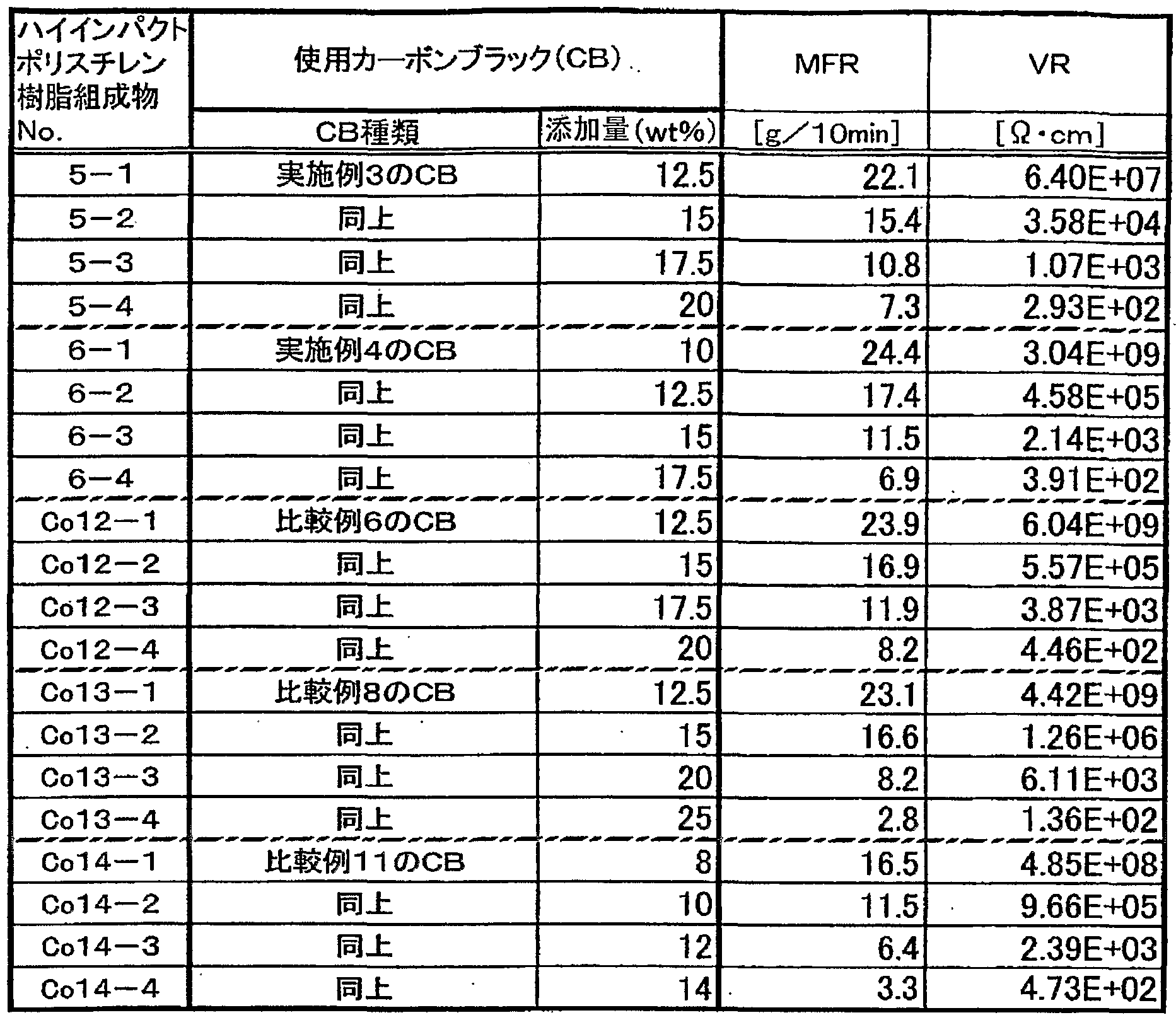
  • Table 6 shows the evaluation results of the characteristics (conductivity and fluidity) of the high-impact polystyrene resin compositions using the carbon blacks of Examples 3 and 4 and Comparative Examples 6, 8, and 11.
  • the fluidity (MFR [gZl Origin]) at the same (VR [ ⁇ ⁇ cm]) was determined by interpolation using the results in Table 6. The results are shown in Table 7 and Figure 4. table 1
  • MFR1 MFR [g / 10min] when the conductivity of the resin composition is 1.00 ⁇ + 03 [ ⁇ ⁇ ⁇ ]
  • MFR2 MFR [g 10min] when the conductivity of the resin composition is 1.00E + 04 [ «'cm]
  • MFR3 MFR [g / 10min] when the conductivity of the resin composition is 1-00E + 05 [Q'cm]
  • MFR1 MFR [g 10min] when the conductivity of the resin composition is 1.00E + 03 [Q'cm]
  • MFR2 Omin] when the conductivity of the resin composition is 1.00 ⁇ + 04 [ ⁇ ⁇ cm]
  • MFR3 MFR [g 10min] when the conductivity of the resin composition is 1.00E + O5 [5? 'Cm]
  • the carbon black of the present invention obtained in Examples 1 to 4 has a 24M4DBP absorption of 130 cm 3 / l 00 g or more, a dehydrogenation amount of 1.2 mg Zg or less, and a crystal size Lc Has a characteristic of 10-17 A.
  • the polyethylene resin composition (resin composition Nos.
  • resin composition Nos. 1-1 to 1-4-4 show that resin composition No. Co 1-1 to Co 10 Compared to No.-4, it has excellent conductivity and sufficiently high fluidity, indicating that it is a well-balanced resin composition having excellent properties of both conductivity and fluidity.
  • the polyethylene resin composition (resin composition Nos. 1-1 to 1-4) using the force pump rack of the present invention and the polyethylene resin using the carbon black of the comparative example were used.
  • the resin composition using the carbon black of the present invention has a high MFR value when the conductivity is the same, and the fluidity is high. It turns out that it is excellent.
  • FIG. 3 in which the results are graphed the resin composition using the carbon black of the present invention has higher conductivity and fluidity than the resin composition using the carbon black of the comparative example. Excellent in both.
  • the carbon black of Comparative Example 11 is known as a highly conductive carbon black by Ketjen EC having a high specific surface area, a high DBP, and a special structure of a hollow shell.
  • the polyethylene resin composition using carbon black of Examples 1 to 4 of the present invention is the polyethylene resin composition using the carbon black of Comparative Example 11. It shows conductivity and fluidity equal to or better than that of the product.
  • the high impact polystyrene resin composition using the carbon black of the present invention (resin composition Nos. 5-1 to 6-4) and the high impact polystyrene resin using the carbon black of the comparative example were used. Comparing the polystyrene resin composition (resin composition No. Col 2—l to Col 4—4), the resin composition No. 5— :! ⁇ 6 -4 has excellent conductivity and sufficiently high fluidity as compared with the resin composition No. Coll 2-1 to (: ol 4-4. It can be seen that the resin composition has excellent characteristics and a good balance.
  • the high-impact polystyrene resin composition (resin composition Nos. 5-1 to 6-4) using the car pump rack of the present invention and the high-impact poly carp rack using the car pump rack of the comparative example were used.
  • a polystyrene resin composition (resin composition No. Col 2—;! To Col 4—4)
  • the resin composition using the carbon black of the present invention has an MFR value at the same conductivity. It is high and has excellent fluidity.
  • the resin composition using carbon black of the present invention has higher conductivity and fluidity than the resin composition using carbon black of the comparative example. Excellent in both.
  • the carbon black of Comparative Example 11 which was comparatively good in the case of the polyethylene system, was significantly inferior in conductivity and fluidity in the case of the high-impact polystyrene system, whereas the carbon black of the present invention was used.
  • the sample had good conductivity and fluidity. Stability liquidity this good UNA conductivity, carbon black of the present invention, 24M4 DBP absorption of 130 cm 3 Zl 00 g or more, the dehydrogenation amount is 1. 2MgZg less, and the crystal size L c is 10 Due to its 17 A characteristics.

Landscapes

  • Chemical & Material Sciences (AREA)
  • Engineering & Computer Science (AREA)
  • Organic Chemistry (AREA)
  • Nanotechnology (AREA)
  • Physics & Mathematics (AREA)
  • Composite Materials (AREA)
  • Condensed Matter Physics & Semiconductors (AREA)
  • General Physics & Mathematics (AREA)
  • Materials Engineering (AREA)
  • Crystallography & Structural Chemistry (AREA)
  • Compositions Of Macromolecular Compounds (AREA)
  • Pigments, Carbon Blacks, Or Wood Stains (AREA)

Abstract

樹脂組成物の導電性及び流動性を向上させるカーボンブラックを提供する。 次の特性を有することを特徴とするカーボンブラック。・24M4DBP吸収量:130cm3/100g以上、・1500℃×30分の脱水素量:1.2mg/g以下、・結晶サイズLc:10~17Å 更に好ましくは次の特性を有する。・窒素吸着比表面積:150~300m2/g、・平均粒径:14~24nm、・CTAB吸着比表面積:120~220m2/g、・DBP吸収量:150~400cm3/100g、・含酸素官能基密集度:3μmol/m2以下。

Description

明 細 書 カーポンプラック 技術分野
本発明は、 導電性樹脂組成物に配合するのに好適なカーボンブラックに係り、 特にオイルファーネス法により製造されるオイルファーネスカーボンブラックと して好適な力一ポンプラックに関する。 背景技術
オイルファーネス法による力一ボンブラックの製造装置は、 燃料を燃焼させて 高温燃焼ガス流を生じさせる第 1反応帯域と、 該第 1反応帯域に引き続いて設置 され、 カーボンブラック原料炭化水素 (以下、 オイルということがある。 ) を導 入して力一ポンプラック生成反応をさせる第 2反応帯域と、 該第 2反応帯域に引 き続いて設置され、 カーボンブラック生成反応を停止させるための冷却手段を有 した第 3反応帯域とを備えている。
この力一ポンプラック製造装置によってカーボンブラックを製造するには、 第 1反応帯域内に高温の燃焼ガス流を生じさせ、 第 2反応帯域内にカーボンブラッ ク原料炭化水素 (オイル) を噴霧し、 該第 2反応帯域内でカーボンブラックを生 成させる。 このカーボンブラックを含むガス流は、 第 3反応帯域内に導入され、 該第 3反応帯域内でスプレーノズルから水噴霧を受けて急冷される。 第 3反応帯 域内のカーボンブラックを含むガス流は、 その後煙道を経由してサイク口ン又は バッグフィルタ一等の捕集手段に導入され、 力一ポンプラックが捕集される。 カーボンブラックを樹脂組成物に配合した導電性樹脂組成物にあっては、 導電 性を向上させるためにカーボンブラックのストラクチャーを発達させることが好 ましい。 ストラクチャーが発達したカーボンブラックにあっては、 カーボンブラ ック 1次粒子が枝状、 あるいは葡萄房状に長く連なっており、 樹脂組成物の導電 性が向上する。 また、 力一ポンプラックの 1次粒子径を小さくすることによって も樹脂組成物の導電性が向上する。 さらに、 カーボンブラックの 1次粒子の表面 における官能基 (含酸素化合物) 量を少なくすることによつても導電性が向上す る。
なお、 オイルファーネスカーボンブラックの製造条件と粒径及びストラクチャ 一との関係について特開 2002-121422号公報の第 0004〜0008 段落に記述がある。 また、 同公報図 2には窒素吸着比表面積 (N2SA) と 24 M4DBP吸収量でファーネスブラックの製造限界が開示されている。
そして水素量と力一ボンブラック自体の体積固有抵抗については、 「カーボン ブラック便覧」 ぐ第三版〉 (平成 7年 4月 15日カーボンブラック協会発行) の P 552〜555や図 1. 7にあるように、 水素量が低下すると力一ボンブラッ ク自体の抵抗が低下することが開示される。 また、 「顔料」 第 39巻第 2号の P 36、 図 22には、 水素含有量とゴム (SBR系) での体積固有抵抗の関係が開 示されている。
特表平 8— 507555号公報には、 タイヤ用途のゴム組成物に配合される力 一ボンブラックとして、 C TAB吸着比表面積が 140〜25 OmVg, CD B P吸収量が 120〜150 cm3Zl 00 g、 窒素吸着比表面積が 150〜 1 80m2/g、 スト一クスモ一ド径 (Dmod) が40〜6711111、 ストークスモ ード半値幅 (D1/2) が 47 nm以下のカーボンブラックが記載されている。 こ の力一ポンプラックは、 導電性樹脂組成物配合用カーボンブラックではなく、 力 一ポンプラックのストラクチャ一と導電性樹脂組成物の導電性及び流動性につい ての記載は全くない。
そもそも、 この特表平 8— 507555号公報に記載されるカーボンブラック に限らず、 ゴム配合用カーボンブラックは、 マトリックスゴムとの親和性を確保 するために、 (150 Ot x 30分) の脱水素量をある程度大きくしており、 こ のような (1500で 30分) の脱水素量の大きい力一ポンプラックでは、 良 好な導電性を得ることはできない。 発明の開示 このように樹脂に導電性を付与するためには、 カーボンブラックを多く混入す る。 しかし、 従来の力一ポンプラックを導電性フイラ一として混入した樹脂組成 物は、 導電性が不十分であり、 且つその流動性が低いために、 例えば射出成形金 型の隅まで樹脂が流れないことによる成形不良や、 導電性塗料として用いた場合 には、 塗布する際に粘度が高いために平滑な塗膜が得られない等の問題があった 。 そこで高い導電性を維持しつつ、 且つ従来にも増して樹脂の流動性を向上させ る導電性フイラ一 (カーボンブラック) が望まれていた。
本発明は、 導電性組成物の導電性と流動性を向上させることができるカーボン ブラックを提供することを目的とする。
本発明のカーボンブラックは、 次の特徴を有することを特徴とする。
• 24M4DBP吸収量: 1 3 0 cmVl 0 0 g以上
• (1 50 0°CX 3 0分) 脱水素量: 1. 2mgZg以下
•結晶子サイズ L c : 1 0〜1 7A
上記に加えて、 本発明のカーボンブラックは、 好ましくは、 さらに次の特徴を 有する。
'窒素吸着比表面積が 1 5 0〜3 0 0m2/gである。
'ストークスモード径 (Dmd) と 24M4DBP吸収量との比 (Dmd/2
4M4DBP) が 0. 6〜0. 9である。
•透過型電子顕微鏡による平均粒径が 14〜24nmである。
• CTAB (セチル卜リメチルアンモニゥムブロマイド) 吸着比表面積が 1 2 0〜2 20m2/gである。
• D BP吸収量が 1 5 0〜400 cmVl 0 0 gである。
•次の式で定義される含酸素官能基密集度が 3 mo 1 Zm2以下である。 含酸素官能基密集度 ( tmo 1/m2)
= [ (1 5 0 0°CX 3 0分) CO発生量 (nmo 1 / g) + ( 1 5 0 0 °C X 3 0分) C〇2発生量 (^mo l Zg) ] Z窒素吸着比表面積 (m2 本発明における 24M4DBP吸収量及び DBP吸収量、 (1 5 0 0^X 3 0 分) 脱水素量、 結晶子サイズ L c、 窒素吸着比表面積、 ストークスモード径 (D mod) 及びスト一クスモード半値幅 (D1/2) 、 平均粒径、 CTAB吸着比表面 積、 含酸素官能基密集度の定義は次の通りである。
[24M4DBP吸収量及びDBP吸収量]
24M4DBP吸収量及び DBP吸収量は、 J I S K 6 2 1 7に準拠する ( 単位は cm3Zl 0 0 g) 。
[ (1 500°CX 3 0分) 脱水素量]
(1 5 00°CX 3 0分) 脱水素量 (以下、 単に 「脱水素量」 と言う。 ) は、 力 一ポンプラックを真空中で 1 5 00でで 3 0分間加熱し、 この間に発生したガス 中の水素量であり、 具体的には次のようにして測定される。
(測定法)
力一ポンプラックを約 0. 5 g精秤し、 アルミナ管に入れ、 0. O l To r r (1. 3 P a) まで減圧した後、 減圧系を閉じ、 1 5 0 0°Cの電気炉内に 3 0分 間保持してカーボンブラックに存在する酸素化合物や水素化合物を分解 ·揮発さ せる。 揮発成分は定量吸引ポンプを通じて、 一定容量のガス捕集管に採取する。 圧力と温度からガス量を求めると共に、 ガスクロマトグラフにて組成分析し、 水 素 (H2) の発生量 (mg) を求め、 カーボンブラック 1 g当たりからの水素量 に換算した値を計算する (単位は mgZg) 。
[結晶子サイズ L c]
X線回折装置 (R I NT— 1 50 0型 理学電機社製) を用いて測定した。 測 定条件は、 管球に Cuを用い、 管電圧 40KV、 管電流 2 5 0 mAで実施した。 カーポンプラック試料は装置付属の試料板に充填し、 測定角度 (2 0) 1 0° 〜 6 0° 、 測定速度 0. 5° /分とし、 ピーク位置と半価幅は装置のソフトにより 算出した。 また測定角度の校正には X線標準用シリコンを用いた。 この様にして 得られた結果を用いて、 Scherrerの式; (L c (A) 二 ΚΧ X c o s 0 ( 但し K:形状因子定数 0. 9、 λ :特性 X線の波長 C uKa 1. 541 8 (A ) 、 β :半価幅 (ラジアン) 、 Θ :ピーク位置 (度) ) ) により L cを求めた。
[窒素吸着比表面積] 窒素吸着比表面積 (N2SA) は、 J I S K6217に準拠して定義される (単位は m2/g) 。
[ストークスモード径 (Dmd) 及びストークスモ一ド半値幅 (D1/2) ] スト一クスモード径 (Dmd) 及びストークスモード半値幅 (D1/2) は、 以 下の測定法で求められる。
(測定法)
界面活性剤 (S I GMA CHEM I CAL社製 「NON I DET P— 40 」 ) を 3滴加えた 20容量%エタノール水溶液に、 精秤したカーボンブラックを 加えて、 カーボンブラック濃度が 0. 01重量%の試料液を調製した。 この試料 液を超音波洗浄機 (ULTRAS ON I C ST I RR I NG BATH: LA KOMANUFACTUR I NG CO. 製) を用いて、 20分間分散処理する ことにより、 カーポンプラックスラリーとした。 一方、 遠心沈降式の流度分布測 定装置 (BROOK HAVEN I N S TRUMENT S社製 「B I— D C P PART I CL S I ZERJ ) にスピン液 (純水) 10ミリリツトルを注入し 、 更にバッファ一液 ( 20容量%エタノール水溶液) 1ミリリットルを注入した 。 その後、 前記調製したカーボンブラックスラリー各 1ミリリッ卜ルを注入し、 回転数 10000 r pmで遠心沈降させ、 真比重 1. 78 gZcm3でス 1 ^一ク ス相当径を計算し、 図 2に示すように、 ストークス相当径に対して相対的な発生 頻度のヒストグラムを作る (ただし、 後述の比較例 9と 10については回転数 4 000 r pm、 真比重 1. 84 g/cm3で実施) 。 ヒストグラムのピーク Aか ら直線 Bを Y軸に平行に引き、 ヒストグラムの X軸との交点を Cとする。 このと きの Cでのス] ^一クス直径が、 ストークスモード径 (Dmd) となる。 また、 直 線 Bの中点を Fとして、 Fを通り X軸に平行に直線 Gを引く。 直線 Gは、 ヒスト グラムの分布曲線と 2点 D及び Eで交わる。 このとき、 D及び Eでの各ストーク ス直径の差の絶対値が、 ストークスモード半値幅 (D1/2) である。
[平均粒径]
透過型電子顕微鏡により求めた。 具体的には力一ポンプラック試料を 150 k Hz、 0. 4 kWの超音波分散機により、 10分間クロ口ホルムに分散させて分 散試料を作成し、 これをカーボン補強した支持膜に振り掛けて固定する。 これを 透過型電子顕微鏡で撮影し、 50000〜 200000倍に拡大した画像を En d t e rの装置を用いてランダムに 1000個以上の力一ポンブラックの粒子径 を測定し、 その平均値を平均粒径とした。
[C TAB吸着比表面積]
CTAB吸着比表面積は、 J I S K6217に準拠する (単位は m2Zg)
[含酸素官能基密集度]
(1500°CX30分) CO発生量 (以下、 単に 「CO発生量」 と言う。 ) 及 び (1500°CX 30分) C02発生量 (以下、 単に 「C〇2発生量」 と言う。 ) は、 各々カーボンブラックを真空中で 1500°Cで 30分間加熱し、 この間に 発生したガス中の C O及び C O 2量であり、 具体的には次のようにして測定され る。
(測定法)
力一ボンブラックを約 0. 5 g精秤し、 アルミナ管に入れ、 0. 01 To r r (1. 3 P a) まで減圧した後、 減圧系を閉じ、 1500での電気炉内に 30分 間保持してカーボンブラックに存在する酸素化合物や水素化合物を分解 ·揮発さ せる。 揮発成分は定量吸引ポンプを通じて、 一定容量のガス捕集管に採取する。 圧力と温度からガス量を求めると共に、 ガスクロマトグラフにて組成分析し、 一 酸化炭素 (CO) 及び二酸化炭素 (C02) の発生量 (mg) を求め、 カーボン ブラック 1 g当たりからの CO及び C〇2に換算した値を計算する (単位は mg /g) 。
さらに、 得られた各ガスの発生量を^ mo lZgに換算し、 次の式により含酸 素官能基密集度を求める。
含酸素官能基密集度 ( mo IZm2)
= [CO発生量 (//mo 1/g) +C〇2発生量 (^mo 1/g) ]
/窒素吸着比表面積 (m2/g) 発明の効果
本発明によると、 樹脂組成物に配合した場合、 その導電性及び流動性の双方を 同時に高めることができるカーボンブラックが提供される。
即ち、 かかる本発明は、 特定の 2 4 M 4 D B P吸収量を有するカーボンブラッ クにおいて、 水素含有量を低下させると共に、 結晶子サイズを特定の小さな数値 範囲とし、 さらに好ましくは 2次粒子の凝集体径を、 絶対値ではなく、 ストラク チヤ一レベルに対する特定の相対的なレベル範囲に設定することにより、 これを 配合した樹脂組成物の導電性及び流動性の双方が良好なバランスにあり、 何れも が低下せずに良好な性質を維持するという新規な知見に基づいて創案されたもの である。
本発明者らが鋭意検討した結果、 カーボンブラック、 特にオイルファーネス法 によるカーボンブラックに於いて、 1次粒子の表面近傍はグラフアイト化し、 且 つ内部はアモルファス状とすることで、 これを導電性フィラーとして樹脂組成物 に混合した際、 樹脂組成物は高い導電性を維持しつつ且つ良好な流動性を得るこ とができることを見出した。 そして、 これを実現するためにカーボンブラックの 水素量を特定値以下とし、 且つ X線回折によって求められる結晶子サイズを特定 範囲に保つことで、 上述の効果を奏することを見出し、 本発明を完成した。 またこのようなカーボンブラックは、 例えばオイルファーネス法によってカー ボンブラックを製造する際には、 製造炉内で生成したカーボンブラックを前述の 様に 1次粒子の表面近傍をグラフアイト化し、 内部はアモルファス状に保つよう な、 特定の温度と滞留時間に保つことにより製造することができた。
本発明のカーボンブラックを用いた樹脂組成物においては、 導電性及び流動性 の双方が良いバランスにあり、 何れもが低下せずに良好な性質を維持することが 可能となる。 この理由は定かではないが、 本発明の力一ボンブラックは 1次粒子 表面近傍では結晶が発達 (グラフアイト化) し、 かつ 1次粒子内部がァモルファ ス状であることに起因すると考えられる。
即ち、 内部までグラフアイト化が進んだカーボンブラックは、 グラフアイト結 晶面方向 (水平方向) への導電性が発揮されず、 僅かに垂直方向での導電性を示 すのみとなるので、 (力一ポンプラック 1次粒子を電気が通過する事が困難とな るので) 力一ポンプラック自身の導電性が低下してしまう。 しかし、 本発明の力 一ポンプラックは 1次粒子内部がアモルファス状であるために、 結晶表面の垂直 方向における導電性が僅かで、 1次粒子内部によって力一ボンブラック自身の導 電性が確保されているので (カーボンブラック 1次粒子を電気が通過できるので ) 、 十分な導電性を維持できるものと考えられる。
且つ、 本発明のカーボンブラックは樹脂と接触する表面がグラフアイト化して いる為に樹脂との滑り性に優れ、 樹脂組成物中とした際に樹脂組成物の流動性が 低下しないと考えられる。 また本発明のカーボンブラックを含む樹脂組成物は、 そのカーポンプラック 1次粒子内部がアモルファス状であるために、 カーボンブ ラックが樹脂中で変形し易いことから、 カーボンブラック同士の凝集体構造を作 り難いので、 樹脂組成物の流動性が低下しないとも考えられる。 図面の簡単な説明
図 1は、 カーボンブラック製造装置の概略構成図である。
図 2は、 ス卜ークスモード径 (Dmo d) 及びストークスモード半値幅 (D 1 / 2 ) の説明グラフ。
図 3は、 ポリエチレン樹脂組成物における実施例及び比較例の結果を示すダラ フ。
図 4は、 ハイインパク卜ポリスチレン樹脂組成物における実施例及び比較例の 結果を示すグラフ。
符号の説明
A 第 1反応帯域
B 第 2反応帯域
C 第 3反応帯域
D カーボンブラック原料導入位置距離
D ' カーボンブラック原料導入ノズル
E 反応停止位置距離 E' 冷却水供給ノズル
F 燃料導入ノズル
G 燃焼用空気導入ノズル 発明を実施するための最良の形態
本発明のカーボンブラックは下記の通りである。
• 24M4DBP吸収量: 130 cmVl 00 g以上
• 1500°CX 30分の脱水素量: 1. 2mgZg以下
•結晶サイズ L c : 10〜17 A
さらには、 本発明のカーボンブラックは以下を満たすことが好ましい。
•窒素吸着比表面積: 150〜30 OmVg
• Dmod/24M4DB P : 0. 6〜0. 9
• 平均粒径: 14〜24nm
• CTAB吸着比表面積: 120〜220m2/g
• DB P吸収量: 150〜400 cm3Zl 00 g
• 含酸素官能基密集度: 3 xmo 1 Zm2以下
一般にカーポンプラックは 1次粒子が葡萄房状に連なった独特のストラクチャ 一と称される連鎖体よりなる 2次粒子を形成している。 この葡萄房状連鎖体の空 隙部分等に DBP (ジブチルフ夕レート) が吸収されるので、 24M4DBP吸 収量や D B P吸収量はカーボンブラックが有する重要な指標値である。
本発明の力一ボンブラックは、 24M4DBP吸収量が 130 cmVl 00 g以上、 好ましくは 140 cm3/l 00 g以上、 より好ましくは 145 cm3 /100 g以上である。 24 408 吸収量が130 cmVl 00 g未満で は、 樹脂組成物とした際に十分な導電性が得られない。 ただし、 24M4DBP 吸収量が高すぎても、 樹脂中での分散性低下や、 また生産時の炉の負荷が大きく 、 経済的でないので、 一般的には 260 cmVl 00 g以下、 中でも 200 c mVl 00 g以下、 特に 160 cmVl 00 g以下が好ましい。
また、 本発明のカーボンブラックにおいては、 D BP吸収量が小さすぎると、 樹脂組成物とした際に導電性が低下する場合があり、 逆に大きすぎると樹脂組成 物の流動性が低下する場合がある。 よって D BP吸収量が 150 cmVl 00 g以上、 中でも 155 cm3/l 00 g以上であることが好ましく、 かつ、 40 0 cm3/ 100 g以下、 中でも 250 cm3/l 00 g以下、 更には 230 c mVl 00 g以下、 特に 210 cmVl 00 g以下であることが好ましい。 本発明では、 カーボンブラックの脱水素量を 1. 2mg/g以下、 好ましくは 1. Omg/g以下、 より好ましくは 0. 8mgZg以下にすることで、 この力 —ボンブラックが配合された樹脂組成物の導電性を高めることが可能となる。 本 発明においては脱水素量が 1. 2mgZg以下で有れば低い程好ましいが、 一般 的には工業的な経済性などの理由により、 0. lmg/g以上とするのが好まし い。
脱水素量が 1. 2mgZgよりも多いと、 カーボンブラック表面近傍の結晶発 達が不十分となり、 カーボンブラックの造粒乾燥工程等で酸性官能基が表面に付 加しやすくなり、 樹脂組成物とした際にその導電性が低下してしまう場合がある 本発明では、 カーボンブラック結晶子サイズ Lcを 10〜17人、 好ましくは 11〜16Aとする。 この特定範囲とにすることにより、 樹脂組成物の導電性及 び流動性の双方を高めることができる。 結晶子サイズが大き過ぎると、 樹脂組成 物とした際に導電性が低下する場合があり、 逆に結晶子サイズが小さすぎると十 分な導電性が得られない場合がある。
本発明では、 更にカーボンブラックの窒素吸着比表面積が 150〜30 Om2 / gであることが好ましい。 窒素吸着比表面積が大きいほど樹脂組成物とした際 に、 その導電性を向上させるが、 300m2/gを超えると樹脂中への分散性低 下や例えばポリオレフインなどでは樹脂組成物の流動性が悪くなる。 これは、 樹 脂中の可塑剤をカーボンブラックが吸着することによるためと考えられる。 本発 明では、 窒素吸着比表面積を好ましくは 150〜300m2Zg、 より好ましく は 200〜290m2/gとすることにより、 樹脂組成物の導電性及び流動性の 双方をより一層良好なものとする。 本発明では、 さらに Dmd/24M4DBPが好ましくは 0. 6〜0. 9、 特 に好ましくは 0. 6〜0. 8の範囲にあるカーボンブラックが好適である。 カー ボンブラックは、 前述の如く、 1次粒子が複数繋がった 2次粒子 (凝集体) から なっており、 その凝集体構造 (ストラクチャー) の発達度合の指標として、 24 M4D BP吸収量が用いられている。 また、 カーボンブラックの特性を測る他の 指標として、 ストークス径が知られている。 このストークス径は、 一般的に、 力 一ボンブラック凝集体をストークスの法則に従う疑似球状と見なして遠心沈降法 (DCP) により求めた直径 (モード径; Dmd) が用いられており、 そして D mdの分布指標として、 Dmdの半値幅 (D1/2) が用いられている。
従来、 これらの指標やその比 (D1/2ZDmd) 、 そして他の物性値等をカー ボンブラックの物性指標として、 カーボンブラック自体や、 ゴム、 樹脂組成物に おける物性、 加工性等の改善がなされてきた。 しかし、 従来においては、 これら の数値は各々個別に評価するに留まっており、 カーボンブラックの特性を充分に 把握するには到っていなかった。 例えば、 力一ポンプラックのストークスモード 径 (Dmod) のみでは、 そのストラクチャ一の発達具合が一義的に決定されない ので、 Dmdが同じカーボンブラックであっても導電性に差がある等、 特に導電 性樹脂組成物へ添加するカーボンブラックにおいては充分な改良が成されていな いという課題があった。
そこで、 本発明者らが鋭意検討した結果、 Dmdが、 ストラクチャーの発達度 合いを示す 24M4D BP吸収量に対して特定の数値範囲にあるカーボンブラッ ク、 つまり Dmod/24M4D BPの値が特定範囲にある力一ポンプラックを、 導電性樹脂組成物のフィラーとして用いることで、 極めて優れた導電性と流動性 のバランスを有する導電性樹脂組成物を実現し得ることを見出した。
この Dmd/24M4DBPで示される数値は、 カーボンブラックのストラク チヤ一の発達度合いに対する凝集体径の大きさを示すものである。 この数値が低 いほど、 つまり同一サイズの凝集体径に対するストラクチャーの発達度が高いほ ど、 カーボンブラック 1次粒子がより密集していることを示す。 この数値が低す ぎると樹脂との馴染みの低下により樹脂組成物の流動性低下や、 樹脂組成物中で のカーボンブラックの分散性低下による樹脂組成物の導電性の低下が起こる場合 がある。 逆に、 高過ぎるとカーボンブラック自体の導電性が低下し、 所望の導電 性を付与するための導電性樹脂組成物へのカーボンブラック添加量の増加により 、 樹脂組成物の機械的物性等が低下する場合がある。 よって、 本発明の力一ボン ブラックにおいては、 DmdZ24M4DBPが 0. 6以上、 0. 9以下である ことが好ましい。
更に、 本発明のカーボンブラックにおいては、 ストラクチャーの発達度合いに 対する凝集体径分布が狭い方が好ましい。 具体的には、 24M4DBP吸収量に 対するス! クスモード半値幅 (D1/2) の比 (D1/2Z24M4DBP) で示 される数値が、 小さい方が好ましい。 この数値が高過ぎるとカーポンプラック自 体の導電性が低下し、 所望の導電性を付与するための導電性樹脂組成物へのカー ボンブラック添加量の増加により、 樹脂組成物の機械的物性等が低下する場合が ある。 よって、 本発明の力一ポンプラックにおける D1/2/24M4DBPは 0 . 9以下であることが好ましい。 またその下限は特に制限はないが、 製造の経済 性等の理由から 0. 45以上であることが好ましい。
また、 本発明のカーボンブラックの平均粒径は任意だが、 中でも 14〜24n m、 特に 15〜18 nmとすることが好ましい。 この平均粒径が小さすぎると、 樹脂組成物中での分散性が低下する場合があり、 逆に大きすぎると樹脂組成物の 導電性が低下する場合がある。
さらに、 本発明では、 カーボンブラックの C TAB吸着比表面積を 120〜 2 20m2/g、 特に 1 50〜20 OmVgとすることが好ましい。 この特定範 囲にすることにより、 樹脂組成物の導電性及び流動性の双方をより一層高めるこ とができる。 CTAB比表面積が小さ過ぎると導電性が低下する場合があり、 逆 に大きすぎると、 樹脂組成物中での分散性が低下する場合がある。
上記に加えて、 本発明では、 以下の式で定義される、 含酸素官能基密集度を好 ましくは 3^mo 1 Zm2以下とすることが好適である。
含酸素官能基密集度 ( mo 1/m2) = [C O発生量 ( xm o 1 / g) + C〇2発生量 m o l Xg) ]
Z窒素吸着比表面積 (m2/ g)
ここで、 この数値について説明する。 カーポンプラックには、 ある程度の表面 官能基が存在するが、 これを加熱することによって、 一酸化炭素 (C O) ·二酸 化炭素 (C〇2) が発生する。 例えば、 力ルポニル基 (ケトン、 キノン等) が存 在すれば、 分解によって主に C Oが発生し、 力ルポキシル基およびその誘導体 ( エステル、 ラクトン等) が存在すれば同様に C〇2が発生する。 つまり、 発生し たガス量を求めることで、 カーボンブラックの表面に存在する官能基の量が推定 できる。 一方で、 カーボンブラックの導電性向上においては、 これらの官能基量 が少ないことが望ましいことは、 従来から知られている。 しかしながら、 これら の官能基は、 従来はカーボンブラックの重量あたりの発生ガス量に基づいた数値 が用いられてきた。 言い換えれば、 カーボンブラック重量に対する官能基の量が 、 導電性に影響するというのが従来の通説であった。
これに対して、 本発明者らは、 さらなる鋭意検討の結果、 分散性とは別個の概 念から、 導電性においても、 これら官能基量はカーボンブラックの重量あたりの 数値ではなく、 むしろ単位表面積あたりの数が樹脂組成物の導電性、 しいては導 電性と流動性との両立に効果があることを見出した。
その理由の詳細は明らかではないが、 樹脂組成物内を電流が流れる際、 カーボ ンブラックの表面に局在する官能基が、 カーボンブラック 2次粒子間の電子移動 を阻害するため、 重量あたりの絶対量よりも、 単位表面積あたりの数 (密集度) が導電性に影響するためと考えられる。
即ち、 含酸素官能基密集度とは、 カーボンブラック単位表面積あたりの官能基 の数を示すものであるため、 この数値は低いのが好ましい。 この数値が高い場合 には、 かかる理由により力一ボンブラックを含む樹脂組成物の導電性が低下する 。 なお、 この数値は低いほど導電性の観点では好ましいが、 あまりに低すぎると 上述の如く、 分散性が低下して導電性や流動性が却って悪化する恐れがあり、 ま た脱水素量の場合と同様、 工業的な経済性などの理由により不利である。 従って 、 含酸素官能基密集度は、 好ましくは 0 . l m o l Zm2以上、 特に好ましく は 1 . 0 m o 1 /m2以上とするのが好適である。
本発明のカーボンブラックの製造方法は任意であり、 例えばオイルファーネス 法やアセチレン法、 賦活法によるケッチェンブラックが挙げられる。 中でもオイ ルファーネス法は、 安価に、 且つ歩留まり良く製造できるので好ましい。
以下に、 本発明のカーボンブラックの製造方法の例としてオイルファーネス法 を挙げて説明する。
本発明のカーポンプラックの製造装置例を図 1に示した。 この装置は、 オイル ファーネス法によるカーボンブラック製造装置であって、 燃料を燃焼して高温燃 焼ガス流を発生させる第 1反応帯域 Aと、 その下流に接続し、 カーボンブラック 原料を導入する導入ノズルを備えた第 2反応帯域 Bと、 その下流に接続し、 カー ポンプラック生成反応を停止させる為に炉内に冷却水等を供給するノズルを備え た第 3反応帯域 Cとを含む。
先ず燃料導入ノズル Fから燃料を噴霧状で導入し、 これを燃焼用空気導入ノズ ル Gからの燃焼用空気と混合して燃焼させ、 高温燃焼ガス流を得る。 燃焼ガス流 の温度は 1 3 0 0 〜 2 0 0 0 °C程度である。 高温燃焼ガスの発生に用いる燃料 は任意だが、 例えば重油、 軽油、 ガソリン、 灯油等の液体燃料や、 天然ガス、 プ 口パン、 水素等の気体燃料が挙げられる。 発生した高温燃焼ガス流は、 徐々に収 斂した形状の製造炉内を通過することによってガス流速が上昇し、 炉内の乱流ェ ネルギ一が向上する。
第 2反応帯域 Bで導入されるカーボンブラック原料としては、 例えばクレオソ 一ト油等の石炭系炭化水素ゃェチレンポトム油等の石油系炭化水素が挙げられる 。 力一ポンプラック原料の導入位置や原料量を調節して、 力一ボンブラックの粒 子径 (1次粒子径) やストラクチャーを調整することができる。
第 2反応帯域 Bで生成するカーボンブラックは、 第 3反応帯域 Cにおいて冷却 水等と接触させて急冷することにより、 カーボンブラック生成反応が停止する。 この後、 一般的にはバッグフィルタ一やサイクロン等の捕集装置により、 ガスと カーボンブラックを分離して力一ポンプラックを得る。 なお、 得られたカーボン ブラックは水等を造粒用媒体として用い、 ピン式湿式造粒機等によつて約 1 mm 程度の粒にし、 ついで回転式乾燥機で乾燥する工程を経る事が一般的である。 本発明のカーボンブラック、 即ち 24M4DBP吸油量が130 cmVl 0 0 g以上、 脱水素量が 1. 2mg/g以下であり且つ、 結晶子サイズ Lcが 10 〜17 Aであるカーボンブラックを製造するためには、 上述の第 2帯域 Bにおけ るカーボンブラック原料導入ノズル D' の位置と、 第 3反応帯域 Cにおける冷却 水供給ノズル E' の位置とを調整して炉内におけるカーボンブラックの滞留時間 を特定範囲とする。 これにより、 上述した様にカーボンブラックの 24M4DB P吸収量と比表面積を特定範囲の値とし、 L cを過大に大きくせず特定の小さな 値とし、 且つカーボンブラック粒子表面の脱水素が進行した状態とすればよい。 具体的には、 炉内温度を 1500°C〜2000°C、 好ましくは 1600°C〜18 00°Cとし、 力一ボンブラックの炉内滞留時間、 即ち原料導入点から反応停止位 置までの移動に要する時間 (図 1においてカーボンブラック原料導入位置距離 D と反応停止位置距離 Eを移動するに要する時間) が、 40ミリ秒〜 500ミリ秒 、 好ましくは 50ミリ秒〜 200ミリ秒とすればよい。 また、 炉内温度が 150 0 °Cを下回るような低温の場合には、 炉内滞留時間が 500ミリ秒を越えて 5秒 以下、 好ましくは 1秒〜 3秒とすればよい。
本発明のカーボンブラックは、 特に脱水素量が少ないので、 炉内での高温燃焼 ガス流の温度を 1700 以上の高温とする方法や、 カーボンブラック原料供給 ノズルよりも下流側で更に炉内に酸素を導入してカーボンブラック表面の水素等 を燃焼させ、 この反応熱で高温下の滞留時間を長くすることが好ましい。 この様 な方法によって、 カーボンブラックの表面近傍の結晶化とカーボンブラック内部 の脱水素が効果的に行えるので好ましい。
本発明のカーポンプラックは、 樹脂に配合して導電性樹脂組成物を得ることが できる。 樹脂としては任意のものを使用することができる。 具体的には、 低密度 ポリエチレン、 中密度ポリエチレン、 高密度ポリエチレン、 直鎖状低密度ポリエ チレン、 ポリプロピレン、 ポリブテン一 1、 プロピレン一エチレンブロックまた はランダム共重合体、 エチレン一酢酸ビニル共重合体、 エチレン—アクリル酸共 重合体、 エチレン一メ夕クリル酸共重合体、 無水マレイン酸変成ポリプロピレン 、 無水マレイン酸変性ポリエチレン、 スチレンや酢酸ビニルなどのビニルモノマ 一を付加変性した α—ォレフィン重合体などの α—ォレフイン系樹脂;ナイロン 6、 ナイロン 6 6などのポリアミド樹脂;ポリエチレンテレフタレ一ト、 ポリブ チレンテレフ夕レートなどのポリエステル樹脂;ポリアセタール、 ポリフエニレ ンォキシドなどのポリエーテル樹脂;ポリ力一ポネート樹脂;ポリスチレン、 ァ クリロニトリル—ブタジエン一スチレン三元共重合体 (A B S ) 、 ハイインパク トポリスチレンなどのスチレン系樹脂;ポリ塩化ビニル、 ポリフッ化ビニリデン 、 ポリテトラフロロエチレンなどのハロゲン含有樹脂;ポリメタクリル酸メチル 、 ポリアクリロニトリルなどのアクリル系樹脂等;ポリスルホン樹脂;ポリフエ 二レンスルフイド樹脂等の熱可塑性樹脂及びフエノール、 メラミン、 エポキシ等 の熱硬化性樹脂等が挙げられる。 また樹脂組成物の物性のバランスを図る目的か ら、 これらの樹脂に更にゴムを混合してもよい。
これらの樹脂の中でもォレフイン系樹脂、 ポリアセタール樹脂、 ポリアミド樹 脂、 ポリエステル樹脂、 ポリフエ二レンォキシド樹脂、 スチレン系樹脂等が好ま しく、 特にエチレン樹脂、 ポリプロピレン樹脂、 プロピレン一エチレンブロック またはランダム共重合体樹脂、 ポリアミド樹脂、 スチレン系樹脂が好ましい。 樹脂組成物中のカーボンブラック量は用途により適宜選択すればよく、 例えば 帯電防止用途であれば通常 1〜 3 0重量%、 好ましくは 2〜1 5重量%の範囲で ある。
実施例
以下、 実施例及び比較例を挙げて本発明を更に詳細に説明するが、 本発明はそ の要旨を超えない限り、 以下の実施例に限定されるものではない。 なお、 以下の 実施例等における樹脂組成物の調製法ならびにその試験方法は次の通りである。 樹脂種としてはポリエチレンとハイインパクトポリスチレンを用いた。
<ポリエチレン樹脂組成物の配合 >
カーボンブラックを含むポリェチレン樹脂組成物の配合は、 次の通りである。 なお、 カーボンブラックの配合量は表 3 , 4に記載の通りである。
熱安定剤:ィルガノックス 1 0 1 0 (日本チバガイギ一株式会社製) 0 . 5重 滑剤:ステアリン酸カルシウム (堺化学工業株式会社製) 0. 8重量% 樹脂:ポリエチレン ( L F 440 H A:三菱化学株式会社製) 残部
<ポリエチレン樹脂組成物の導電性の評価 >
ラボプラストミル C型 (株式会社東洋精機製作所製) にバンバリ一ミキサー B 250を付けたミキサーを用い、 混練温度 1 15°C、 回転数 70 r pmの条件下 、 樹脂のみを先ず 2分間予備混練し、 次いでカーボンブラックとその他添加剤を 投入し、 7分間混練し、 樹脂組成物を作成した。 この樹脂組成物を 6インチミキ シンダロール機 191一 TM型 (株式会社安田精機製作所製) で約 lmm厚のシ ートとした後、 これをカットし、 加熱冷却型試験プレス機 (日新科学株式会社製 ) でプレス (プレス温度 150°C、 プレス圧力 100 kgZcm2、 プレス時間 2分間) し、 l O cmX I O cmXO. 2 c mの評価試験用平板を作成した。 そ してこの平板の中心部を巾 2 cmに切り出し、 SR I S法 (日本ゴム協会法) に 準処して体積固有抵抗値 (VR) を測定した。 抵抗値の測定にはデジタルマルチ メーター TR6847 (ァドバンテス卜製) を用いた。 抵抗値で 20 ΟΜΩ (V R換算で約 1 - 3 X 10⁷ Ω · cm) 以上についてはハイレジスタンスメーター 4329 A (YHP製) により測定した。 VRの小さなもの程、 導電性が良いと 判断した。
<ポリエチレン樹脂組成物の流動性の評価 >
J I SK7210に準拠し、 温度 190で、 荷重 10 k g fで樹脂組成物のメ ルトフローレート (MFR) を測定した。
<ハイインパク卜ポリスチレン樹脂組成物の配合 >
カーボンブラックを含むハイインパク卜ポリスチレン樹脂組成物の配合は、 次 の通りである。 なお、 力一ポンプラックの配合量は表 6に記載の通りである。 熱安定剤:ィルガノックス 1010 (日本チバガイギー株式会社製) 0. 5重 滑剤:ステアリン酸カルシウム (堺化学工業株式会社製) 0. 5重量% 樹脂:ハイインパクトポリスチレン (H86 1 : PSジャパン株式会社製) 残部
ぐハイインパクトポリスチレン樹脂組成物の導電性の評価〉
ラボプラストミル C型 (株式会社東洋精機製作所製) にパンバリーミキサー B 250を付けたミキサーを用い、 混練温度 135°C、 回転数 50 r pmの条件下 、 樹脂のみを先ず
2分間予備混練し、 次いでカーポンプラックとその他添加剤を投入し、 8分間混 練し、 樹脂組成物を作成した。 この樹脂組成物を 6インチミキシングロール機 1 91—TM型 (株式会社安田精機製作所製) で約 lmm厚のシートとした後、 こ れをカットし、 加熱冷却型試験プレス機 (日新科学株式会社製) でプレス (プレ ス温度 1 60Τλ プレス圧力 100 k gZcm2、 プレス時間 2分間) し、 10 cmX 10 cmX 0. 2 c mの評価試験用平板を作成した。 導電性の評価はポリ エチレン樹脂組成物と同じ SR I S法 (日本ゴム協会法) に準処して体積固有抵 抗値 (VR) を測定した。
ぐハイインパクトポリスチレン樹脂組成物の流動性の評価 >
J I S K 721 0に準拠し、 温度 200で、 荷重 10 k g fで樹脂組成物のメ ルトフローレート (MFR) を測定した。
実施例 1〜4、 比較例 1, 2, 4, 5
<カーボンブラックの製造 >
図 1に示すカーボンブラック製造装置を用い、 表 1に示す製造条件、 及び原料 油導入位置距離 Dや反応停止位置距離 E等の炉内装置条件下、 カーボンブラック を製造した。 なお、 図 1中の炉内径寸法 D 1〜D3及び L 1は次の 2タイプのい ずれかを採用した。
Aタイプ: D 1 = 1 100πιπιΦ、 D 2 = 175πιπιΦ, D 3 = 40 ΟπιπιΦ
L 1 = 3300 mm、 D 2 ' =190 τηπιΦ
Bタイプ: D 1 = 50 ΟπιιηΦ、 D 2 = 55πιπιΦ, D 3 = 20 ΟπιπιΦ,
L 1=3200mm (D 2 ' =D 2)
Cタイプ ·· D 1 = 1 10 ΟπιπιΦ、 D 2 = 175mmO, D 3 = 40 Omm L 1 = 2750mm (D 2 ' =D 2)
また、 高温燃焼ガス流の燃料としては、 実施例 1〜4及び比較例 4, 5では重 油を用い、 比較例 1、 2では LNGを用いた。 なお、 実施例、 比較例ともにカー ポンプラック原料 (原料油) はクレオソート油であり、 第 2反応帯域での炉内温 度は 1750°Cとした。 得られた力一ボンブラックの物性を表 1に示す。
比較例 3
実施例 1で得られたカーボンブラックを容積 70リットルの黒鉛製ルツポにカ —ポンプラックを入れて満たし、 アチソン炉にセットしてカーポンプラックの詰 め粉でルツポ全体を覆い通電した。
35で Z分の昇温スピードで 2000 °Cまで昇温してから 2000 °Cで 1時間 保持した後、 放熱させて室温となった後にカーボンブラックを取り出した。 得ら れたカーボンブラックの特性を表 1に示す。
比較例 6〜; L 1
比較として用いた市販導電性力一ボンブラックの特性を表 2に示す。
上述したカーボンブラックを用いたポリエチレン樹脂組成物の特性 (導電性、 流動性) の評価結果を表 3, 4に示す。 また、 上述のカーボンブラックを用いた ポリエチレン樹脂組成物について、 導電性 (VR [Ω · cm] ) を同じくした際 の流動性 (MFR [g/10mi n] を表 3, 4の結果を用い、 補間 (ただし、 カツコ内は補外) して求めた。 結果を表 5、 図 3に示す。
また、 実施例 3, 4及び比較例 6、 8、 1 1のカーボンブラックを用いたハイ インパクトポリスチレン樹脂組成物の特性 (導電性、 流動性) の評価結果を表 6 脂組成物について、 導電性 (VR [Ω · cm] ) を同じくした際の流動性 (MF R [gZl Omi n] を表 6の結果を用い、 補間して求めた。 結果を表 7、 図 4 に示す。 表 1
実施例 1 実施例 2 実施例 3 実施例 4 比較例 1 比較例 2 比較例 3 比較例 4 比較例 5 炉内径寸法タイプ ― Aタイプ Aタイプ Aタイプ Aタイプ Bタイプ Bタイプ
燃焼用空気量 NmVh 5800 5800 5500 5300 500 500 4000 5800 燃焼用空気温度 。C 640 640 640 640 30 30 574 640 燃料種類 ― G重油 C重油 G重油 G重油 天然ガス 天然ガス D重油 G重油 製 燃料量 kg/h 314 314 297 286 43NmVh 43NmVh 253 314 造
条 原料油量 kg/h 1040 1220 1330 1000 90 81 700 850 件 原料油導入位置距離 mm 1650 1650 1650 2300 1200 1200 1750 2390 反応停止位置距離 mm 4430 4430 4430 4430 910 910 2150 1600 反応停止水量 kg/h 3000 3000 2600 2600 150 150 1000 1800 原料導入から反応停止ま
ミリ秒 57 57' 60 81 21 21 28 32 での滞留時間
平均粒径 nm 15 18 21 16 18 15 15 22 15 窒素吸着比表面積 mVg 288 204 169 278 240 320 156 206 266
DBP吸収量 cm lOOg 159 167 173 204 177 171 155 155 200
24M4DBP吸収量 cmVlOOg 135 131 134 147 132 134 131 134 132
GTAB吸着比表面積 mVg 195 153 128 . 182 154 194 145 161 230 脱水素量 mg/g 0.77 0.93 1.05 0.83 2.00 2.32 0.09 1.25 1.23 物 結晶子サイス lc A 14.0 14.0 13.8 15.3 13.1 12.5 28.9 13.5 13.1 性
値 ス卜ークスモー卜 圣 (Dmod) nm 84 93 98 125 81 71 91 92 127 スト-クスモ-ド半径幅 (D1/2.) nm 69 69 65 129 55 48 92 64 145
Dmod/24 4DBP ― 0.62 0.69 0.73 0.84 0.62 0.55 0.69 0.69 0.96
D1/2/24M4DBP 一 0.51 0.51 0.48 0.87 0.42 0.38 0.70 0.48 1.10
CO発生量 mg/g 13.9 15.7 9J 1 1.8 24.4 24.7 2.34 14.7 7.3
002堯生量 4.28 2.49 1.40 1.35 6.79 6.09 0.26 13.2 3.48 含酸素官能基密集度 卿 o l /m2 2.06 2.58 2.23 1.62 5.03 3.16 0.57 4.01 1 .28
表 2
Figure imgf000022_0001
表 3
Figure imgf000023_0001
J ϋ
表 4
!ォ
ポリエチレン 使用カーボンブラック (CB) MFR VR 樹脂組成物
No. CB種類 添加量 (wt%) [g/10min] [Ω -cm]
Co6- 1 比較例 6の CB 8 16.6 6.50E+10
Co6-2 同上 10 14.4 2.80E+06
Co6-3 同上 12.5 11.8 2.95E+02
Co6-4 同上 15 9 6.65E+01
Co7-1 比較例 7の CB 10 15.6 4.12E+10
Co7-2 同上 12.5 12.8 1.48E+03
Co7-3 同上 15 9.4 7.73E+01
Co7-4 同上 17.5 6.4 3.46E+01
C08-I 比較例 8の CB 8 17.5 9.60E+09
Co8-2 同上 10 16.2 6.48E+06
Co8-3 同上 12.5 14.1 6.32E+02
Co8-4 同上 15 10.7 7.10E+01
Co9-1 比較例 9の CB 10 14.7 4.63E+10
Co9— 2 同上 12.5 12.6 5.51 E+05
Go9— 3 同上 15 9.7 4.24E+02 同上 17.5 7.7 、
比較例 10の CB 10 12.8
Col 0-2 同上 12.5 9.9 寸ヽ 7.35E+04
Co10-3 同上 15 7.1 5 j.o卜30E+03
Co10-4 同上 17.5 4.1 1.50E+03
Col 1 -1 比較例 1 1の CB 3.5 17.8 1.96E+09
Co1 1一 2 同上 5 14.9 8.00E+02
Co1 1一 3 同上 6.5 12.2 1.08E+02
Co1 1一 4 同上 8 9.2 3.39E+01
表 5 ポリエチレン樹脂組成物 MF ® MFR② MFR③ 実施例 1の CBを用いた樹脂組成物 (樹脂組成物 No.l) 14.3 15.6 16.2 実施例 2 // (樹脂組成物 Νο.2) 15.3 16.3 16.8 実施例 3 II (樹脂組成物 Νο.3) 14.8 15.8 16.3 実施例 4 // (樹脂組成物 Νο·4) 14.4 15.7 16.6 比較例 1の CBを用いた樹脂組成物 (樹脂組成物 No. Co1 ) 13.8 15.1 15.8 比較例 2 // (樹脂組成物 No. Co2) 13.6 15.0 15.7 比較例 3 // (樹脂組成物 No. Co3) 12.1 14.4 15.6 比較例 4 // (樹脂組成物 No. Co4) 13.3 13.9 14.3 比較例 5 // (樹脂組成物 No. Co5) 13.5 14.5 15.3 比較例 β // (樹脂組成物 No. Co6) 12.3 13.0 13.6 比較例 7 // (樹脂組成物 No. Co7) 12.7 13.3 13.7 比較例 8 W (樹脂組成物 No. Co8) 14.3 14.9 15.4 比較例 9 // (樹脂組成物 No. Co9) 10.1 11.2 12.1 比較例 10 // (樹脂組成物 No. Co10) (3.6) 8.6 10 比較例 1 1 // (樹脂組成物 No. Co"M ) 15 15.6 16
MFR①:樹脂組成物の導電性が 1.00Ε+03[Ω ·ατι]の際の MFR[g/10min]
MFR②:樹脂組成物の導電性が 1.00E+04[« 'cm]の際の MFR[g 10min]
MFR③:樹脂組成物の導電性が 1-00E+05[Q 'cm]の際の MFR[g/10min]
表 6
Figure imgf000026_0001
表 7
Figure imgf000026_0002
MFR①:樹脂組成物の導電性が 1.00E+03[Q'cm]の際の MFR[g 10min] MFR②:樹脂組成物の導電性が 1.00Ε+04[Ω · cm]の際の Omin] MFR③:樹脂組成物の導電性が 1.00E+O5[5?'cm]の際の MFR[g 10min] 表 1から明らかなとおり、 実施例 1〜 4で得られた本発明のカーボンブラック は、 24M4DBP吸収量が 130 cm3/l 00 g以上、 脱水素量が 1. 2m gZg以下、 そして結晶サイズ Lcが 10〜17 Aの特性を有する。 そして表 3 , 4より明らかなとおり、 本発明の力一ポンプラックを用いたポリエチレン樹脂 組成物 (樹脂組成物 No. 1— 1〜4一 4) と比較例のカーボンブラックを用い たポリェチレン樹脂組成物 (樹脂組成物 N o. Co l— l〜Co l O— 4) とを 比較すると、 樹脂組成物 No. 1— 1〜4一 4は、 樹脂組成物 No. Co 1-1 〜Co 10— 4に比べて、 導電性に優れており且つ流動性も十分に高いものであ り、 導電性と流動性の双方の特性が優れた、 バランスの良好な樹脂組成物である ことがわかる。
また、 表 5から明らかなとおり、 本発明の力一ポンプラックを用いたポリェチ レン樹脂組成物 (樹脂組成物 No. 1— 1〜4一 4) と比較例のカーボンブラッ クを用いたポリエチレン樹脂組成物 (樹脂組成物 No. Co l—:!〜 Co 10— 4) とを比較すると本発明のカーボンブラックを用いた樹脂組成物は、 導電性を 同じくした際の MFR値が高く、 流動性に優れていることが判る。 この結果をグ ラフ化した図 3からも明らかなとおり、 本発明のカーボンブラックを用いた樹脂 組成物は、 比較例のカーボンブラックを用いた樹脂組成物と比べて、 導電性と流 動性の双方において優れている。
なお、 比較例 11の力一ボンブラックは高比表面積、 高 DBP、 中空シェルの 特殊な構造を持つケッチェン E Cで高導電性カーボンブラックとして知られてい る。 表 3, 4, 5ならびに図 3から判るように、 本発明の実施例 1〜 4のカーボ ンブラックを用いたポリエチレン樹脂組成物は、 この比較例 11のカーボンブラ ックを用いたポリエチレン樹脂組成物と同等かそれ以上の導電性及び流動性を示 している。
また表 6から明らかなように、 本発明のカーボンブラックを用いたハイインパ クトポリスチレン樹脂組成物 (樹脂組成物 No. 5— 1〜6— 4) と比較例の力 一ボンブラックを用いたハイインパクトポリスチレン樹脂組成物 (樹脂組成物 N o. Co l 2— l〜Co l 4— 4) を比較すると、 樹脂組成物 No. 5—:!〜 6 - 4は樹脂組成物 N o. Co l 2— 1〜(: o l 4— 4に比べて導電性に優れてお り且つ流動性も十分に高いものであり、 導電性と流動性の双方の特性が優れた、 バランスの良好な樹脂組成物であることがわかる。
また、 表 7から明らかなとおり、 本発明のカーポンプラックを用いたハイイン パクトポリスチレン樹脂組成物 (樹脂組成物 No. 5— 1〜6— 4) と比較例の カーポンプラックを用いたハイインパクトポリスチレン樹脂組成物 (樹脂組成物 No. Co l 2—;!〜 Co l 4— 4) とを比較すると本発明のカーボンブラック を用いた樹脂組成物は、 導電性を同じくした際の MFR値が高く、 流動性に優れ ていることが判る。 この結果をグラフ化した図 4からも明らかなとおり、 本発明 のカーボンブラックを用いた樹脂組成物は、 比較例の力一ボンブラックを用いた 樹脂組成物と比べて、 導電性と流動性の双方において優れている。 特に、 ポリエ チレン系で比較的良好だった比較例 11のカーボンブラックは、 ハイインパクト ポリスチレン系では導電性と流動性のバランスが大幅に劣ったのに対して、 本発 明のカーボンブラックを用いたものでは導電性と流動性が良好であった。 このよ うな導電性と流動性の安定性は、 本発明のカーボンブラックが、 24M4 D B P 吸収量が 130 cm3Zl 00 g以上、 脱水素量が 1. 2mgZg以下、 そして 結晶サイズ L cが 10〜17 Aの特性を有していることによる。 なお、 本発明の明細書の開示として、 本出願の優先権主張の基礎となる日本特 許特願 2003— 286905号 (2003年 8月 5日に日本特許庁に出願及び 日本特許特願 2004— 206165号 (2004年 7月 13日に日本特許庁に 出願) の全明細書の内容をここに引用し取り入れるものである。

Claims

請求 の 範 囲
1. 次の特性を有することを特徴とするカーボンブラック。
• 24M4DBP吸収量: 130 cmVl 00 g以上
• (1500°CX 30分) 脱水素量: 1. 2mg/g以下
•結晶子サイズ L c : 10〜 17 A
2. 請求項 1において、 窒素吸着比表面積が 150〜300m2/gであること を特徴とするカーポンプラック。
3. 請求項 1又は 2において、 ス] ^一クスモード径 (Dmd) と 24M4DBP 吸収量との比 (DmdZ24M4DBP) が 0. 6〜0. 9であることを特徴と するカーボンブラック。
4. 請求項 1ないし 3のいずれか 1項において、 透過型電子顕微鏡による平均粒 径が 14〜24 nmであることを特徴とするカーボンブラック。
5. 請求項 1ないし 4のいずれか 1項において、 CTAB (セチルトリメチルァ ンモニゥムブ口マイド) 吸着比表面積が 120〜220m2Zgであることを特 徴とするカーボンブラック。
6. 請求項 1ないし 5のいずれか 1項において、 DBP吸収量が 150〜400 cmVl 00 gであることを特徴とするカーボンブラック。
7. 請求項 1ないし 6のいずれか 1項において、 次の式で定義される含酸素官能 基密集度が 3 / mo 1 /m2以下であることを特徴とするカーボンブラック。
含酸素官能基密集度 ( mo 1/m2)
= [ (150 O^X 30分) CO発生量 mo lZg) + (1500 X30分) C〇2発生量 ( zmo 1/g) ] 窒素吸着比表面積 (m Vg)
8. 請求項 1ないし 7のいずれか 1項において、 オイルファーネス力一ボンブラ ックであることを特徴とする力一ポンプラック。
PCT/JP2004/011510 2003-08-05 2004-08-04 カーボンブラック Ceased WO2005012438A1 (ja)

Priority Applications (2)

Application Number Priority Date Filing Date Title
EP04771495A EP1666543B1 (en) 2003-08-05 2004-08-04 Carbon black
US11/346,437 US7485280B2 (en) 2003-08-05 2006-02-03 Carbon black

Applications Claiming Priority (4)

Application Number Priority Date Filing Date Title
JP2003-286905 2003-08-05
JP2003286905 2003-08-05
JP2004-206165 2004-07-13
JP2004206165 2004-07-13

Related Child Applications (1)

Application Number Title Priority Date Filing Date
US11/346,437 Continuation US7485280B2 (en) 2003-08-05 2006-02-03 Carbon black

Publications (1)

Publication Number Publication Date
WO2005012438A1 true WO2005012438A1 (ja) 2005-02-10

Family

ID=34117957

Family Applications (1)

Application Number Title Priority Date Filing Date
PCT/JP2004/011510 Ceased WO2005012438A1 (ja) 2003-08-05 2004-08-04 カーボンブラック

Country Status (3)

Country Link
US (1) US7485280B2 (ja)
EP (1) EP1666543B1 (ja)
WO (1) WO2005012438A1 (ja)

Cited By (1)

* Cited by examiner, † Cited by third party
Publication number Priority date Publication date Assignee Title
WO2024135070A1 (ja) * 2022-12-20 2024-06-27 デンカ株式会社 正極組成物、正極形成用塗液、正極、電池、正極形成用塗液の製造方法、正極の製造方法及び電池の製造方法

Families Citing this family (12)

* Cited by examiner, † Cited by third party
Publication number Priority date Publication date Assignee Title
CN1930233B (zh) 2004-03-15 2010-10-06 三菱化学株式会社 丙烯树脂组合物及其成型体
US7863522B2 (en) * 2006-12-20 2011-01-04 Dow Global Technologies Inc. Semi-conducting polymer compositions for the preparation of wire and cable
KR101643064B1 (ko) * 2012-01-17 2016-07-26 아사히 가세이 케미칼즈 가부시키가이샤 도전성 폴리아세탈 수지 조성물 및 성형체
WO2013148242A1 (en) * 2012-03-28 2013-10-03 Cabot Corporation Oxidized carbon blacks treated with polyetheramines and coating compositions comprising same
FR2993261B1 (fr) 2012-07-13 2019-06-21 Cabot Corporation Noir de carbone fortement structure
JP6088418B2 (ja) 2013-12-24 2017-03-01 旭カーボン株式会社 カーボンブラックおよびこのカーボンブラックを導電剤として用いた二次電池
KR102705340B1 (ko) 2015-02-03 2024-09-09 모놀리스 머티어리얼스 인코포레이티드 카본 블랙 생성 시스템
CA2995081C (en) 2015-08-07 2023-10-03 Monolith Materials, Inc. Method of making carbon black
CN108884267B (zh) 2016-02-01 2022-02-22 卡博特公司 包含炭黑的导热性聚合物组合物
BR112018015616B1 (pt) 2016-02-01 2023-03-21 Cabot Corporation Composição elastomérica composta, bexigas de pneu e artigos elastoméricos relacionados
JP6684607B2 (ja) * 2016-02-19 2020-04-22 東海カーボン株式会社 カーボンブラック、カーボンブラックの製造方法およびゴム組成物
WO2018204174A1 (en) 2017-05-03 2018-11-08 Cabot Corporation Carbon black with an stsa of 80 to 150 m2/g, an oan of at least 180 ml/100g and a coan of at least 110 ml/100g and rubber compounds incorporating same

Citations (6)

* Cited by examiner, † Cited by third party
Publication number Priority date Publication date Assignee Title
FR2640276A1 (fr) 1988-12-12 1990-06-15 Tokai Carbon Kk Noir de carbone pour bande de roulement de pneumatique
JPH0368666A (ja) * 1989-08-08 1991-03-25 Tokai Carbon Co Ltd 導電性ファーネスカーボンブラック
EP0600195A2 (en) 1992-10-23 1994-06-08 Bridgestone Corporation Rubber composition
JPH0948932A (ja) * 1995-08-07 1997-02-18 Asahi Carbon Kk 導電性カーボンブラックおよびこれを含むマトリックス組成物
JPH11513051A (ja) * 1995-07-07 1999-11-09 クヴァルナル エンジニアリング エーエス カーボン材料の熱処理方法
US6197870B1 (en) 1998-09-07 2001-03-06 Tokai Carbon Company, Ltd. Hard-type high-structure carbon black and rubber composition comprising same

Family Cites Families (7)

* Cited by examiner, † Cited by third party
Publication number Priority date Publication date Assignee Title
US4351815A (en) * 1979-06-11 1982-09-28 Columbian Chemicals Company Battery carbon black
JPH06187989A (ja) 1992-12-17 1994-07-08 Fuji Elelctrochem Co Ltd 非水電解液二次電池
US5352289A (en) * 1992-12-18 1994-10-04 Cabot Corporation Low ash carbon blacks
PH31156A (en) 1993-02-23 1998-03-20 Cabot Corp Carbon blacks.
US5393821A (en) 1993-02-23 1995-02-28 Cabot Corporation Carbon blacks
US6251983B1 (en) * 1998-04-09 2001-06-26 DEGUSSA - HüLS AKTIENGESELLSCHAFT Inversion carbon blacks and method for their manufacture
JP4129970B2 (ja) 2000-10-17 2008-08-06 東海カーボン株式会社 高ストラクチャーカーボンブラックの製造方法

Patent Citations (6)

* Cited by examiner, † Cited by third party
Publication number Priority date Publication date Assignee Title
FR2640276A1 (fr) 1988-12-12 1990-06-15 Tokai Carbon Kk Noir de carbone pour bande de roulement de pneumatique
JPH0368666A (ja) * 1989-08-08 1991-03-25 Tokai Carbon Co Ltd 導電性ファーネスカーボンブラック
EP0600195A2 (en) 1992-10-23 1994-06-08 Bridgestone Corporation Rubber composition
JPH11513051A (ja) * 1995-07-07 1999-11-09 クヴァルナル エンジニアリング エーエス カーボン材料の熱処理方法
JPH0948932A (ja) * 1995-08-07 1997-02-18 Asahi Carbon Kk 導電性カーボンブラックおよびこれを含むマトリックス組成物
US6197870B1 (en) 1998-09-07 2001-03-06 Tokai Carbon Company, Ltd. Hard-type high-structure carbon black and rubber composition comprising same

Non-Patent Citations (2)

* Cited by examiner, † Cited by third party
Title
CARBON BLACK KYOKAI: "Carbon black binran", 15 April 1995, CARBON BLACK KYOKAI PAG. 61-65,130-132,328-329 AND 550-557, XP002984987 *
See also references of EP1666543A4

Cited By (2)

* Cited by examiner, † Cited by third party
Publication number Priority date Publication date Assignee Title
WO2024135070A1 (ja) * 2022-12-20 2024-06-27 デンカ株式会社 正極組成物、正極形成用塗液、正極、電池、正極形成用塗液の製造方法、正極の製造方法及び電池の製造方法
JPWO2024135070A1 (ja) * 2022-12-20 2024-06-27

Also Published As

Publication number Publication date
US20060186383A1 (en) 2006-08-24
EP1666543A1 (en) 2006-06-07
US7485280B2 (en) 2009-02-03
EP1666543B1 (en) 2012-01-11
EP1666543A4 (en) 2009-09-16

Similar Documents

Publication Publication Date Title
JP4837810B2 (ja) カーボンを含む多相凝集体及びその調製
WO2005012438A1 (ja) カーボンブラック
CN107709472B (zh) 包覆有碳的颗粒
CN109181248B (zh) 一种聚磷酸铵包覆碳微球阻燃剂的制备方法
CN111269590B (zh) 一种易分散乙炔炭黑的制备方法
WO1999011722A1 (en) Carbon black and process for producing the same
JP2004532313A (ja) 導電性ポリマー組成物及びそれを含有する製品
JP4747530B2 (ja) カーボンブラック
JP2014507050A (ja) 電極材料及びそれらの製造方法
CN103828094A (zh) 颗粒合成的装置及方法
Ibrahim et al. Superhydrophobic coating polymer/silica nanocomposites: part I synthesis and characterization as eco-friendly coating
EP0792920B1 (en) Carbon Black
JP2023010727A (ja) 80~150m2/gのSTSAと少なくとも180mL/100gのOANと少なくとも110mL/100gのCOANとを有するカーボンブラックおよびそれらを組み込んだゴムコンパウンド
JPH07228796A (ja) カーボンブラックとその製法及び用途
JP5314227B2 (ja) カーボンブラック
JP5291902B2 (ja) イオウオキソ酸の水溶液により処理されたゴム配合用改質カーボンブラックを製造する方法およびそれにより得られたゴム配合用改質カーボンブラック
Qian et al. CNT modified layered α-MnO 2 hybrid flame retardants: preparation and their performance in the flame retardancy of epoxy resins
Li et al. Highly homogeneous and stable single-walled carbon nanotubes dispersion modified by polyvinylpyrrolidone and alkanolamine in water
US20120205594A1 (en) Electrode materials and process for producing them
CN100436549C (zh) 炭黑
US4631180A (en) Process for producing carbon black
Xu et al. Reinforcing styrene‐butadiene rubber by silica/carbon black by‐product composite through an in‐situ polymerization process
JP2003292822A (ja) カーボンブラック及びゴム組成物
NL2036875A (en) Carbon blacks having strontium and/or barium additives and methods to make same
JP5037764B2 (ja) 導電性粉末、その製造方法及び用途

Legal Events

Date Code Title Description
WWE Wipo information: entry into national phase

Ref document number: 200480021887.7

Country of ref document: CN

AK Designated states

Kind code of ref document: A1

Designated state(s): AE AG AL AM AT AU AZ BA BB BG BR BW BY BZ CA CH CN CO CR CU CZ DE DK DM DZ EC EE EG ES FI GB GD GE GH GM HR HU ID IL IN IS KE KG KP KR KZ LC LK LR LS LT LU LV MA MD MG MK MN MW MX MZ NA NI NO NZ OM PG PH PL PT RO RU SC SD SE SG SK SL SY TJ TM TN TR TT TZ UA UG US UZ VC VN YU ZA ZM ZW

AL Designated countries for regional patents

Kind code of ref document: A1

Designated state(s): BW GH GM KE LS MW MZ NA SD SL SZ TZ UG ZM ZW AM AZ BY KG KZ MD RU TJ TM AT BE BG CH CY CZ DE DK EE ES FI FR GB GR HU IE IT LU MC NL PL PT RO SE SI SK TR BF BJ CF CG CI CM GA GN GQ GW ML MR NE SN TD TG

121 Ep: the epo has been informed by wipo that ep was designated in this application
WWE Wipo information: entry into national phase

Ref document number: 2004771495

Country of ref document: EP

WWE Wipo information: entry into national phase

Ref document number: 11346437

Country of ref document: US

WWP Wipo information: published in national office

Ref document number: 2004771495

Country of ref document: EP

WWP Wipo information: published in national office

Ref document number: 11346437

Country of ref document: US