WO2005061443A2 - Benzoylsubstituierte phenylalanin-amide - Google Patents
Benzoylsubstituierte phenylalanin-amide Download PDFInfo
- Publication number
- WO2005061443A2 WO2005061443A2 PCT/EP2004/014392 EP2004014392W WO2005061443A2 WO 2005061443 A2 WO2005061443 A2 WO 2005061443A2 EP 2004014392 W EP2004014392 W EP 2004014392W WO 2005061443 A2 WO2005061443 A2 WO 2005061443A2
- Authority
- WO
- WIPO (PCT)
- Prior art keywords
- alkyl
- formula
- aminocarbonyl
- alkoxy
- phenyl
- Prior art date
- Legal status (The legal status is an assumption and is not a legal conclusion. Google has not performed a legal analysis and makes no representation as to the accuracy of the status listed.)
- Ceased
Links
- 0 CNC(C(C(*)c1c(*=C)c(*)c(*)cc1)NC(c(ccc(F)c1C(F)(F)F)c1Cl)=O)=O Chemical compound CNC(C(C(*)c1c(*=C)c(*)c(*)cc1)NC(c(ccc(F)c1C(F)(F)F)c1Cl)=O)=O 0.000 description 2
- DAVGYAZXHZUVIQ-UHFFFAOYSA-N OC(c1c(C(F)(F)F)c(Cl)ccc1)=O Chemical compound OC(c1c(C(F)(F)F)c(Cl)ccc1)=O DAVGYAZXHZUVIQ-UHFFFAOYSA-N 0.000 description 1
Classifications
-
- C—CHEMISTRY; METALLURGY
- C07—ORGANIC CHEMISTRY
- C07D—HETEROCYCLIC COMPOUNDS
- C07D213/00—Heterocyclic compounds containing six-membered rings, not condensed with other rings, with one nitrogen atom as the only ring hetero atom and three or more double bonds between ring members or between ring members and non-ring members
- C07D213/02—Heterocyclic compounds containing six-membered rings, not condensed with other rings, with one nitrogen atom as the only ring hetero atom and three or more double bonds between ring members or between ring members and non-ring members having three double bonds between ring members or between ring members and non-ring members
- C07D213/04—Heterocyclic compounds containing six-membered rings, not condensed with other rings, with one nitrogen atom as the only ring hetero atom and three or more double bonds between ring members or between ring members and non-ring members having three double bonds between ring members or between ring members and non-ring members having no bond between the ring nitrogen atom and a non-ring member or having only hydrogen or carbon atoms directly attached to the ring nitrogen atom
- C07D213/24—Heterocyclic compounds containing six-membered rings, not condensed with other rings, with one nitrogen atom as the only ring hetero atom and three or more double bonds between ring members or between ring members and non-ring members having three double bonds between ring members or between ring members and non-ring members having no bond between the ring nitrogen atom and a non-ring member or having only hydrogen or carbon atoms directly attached to the ring nitrogen atom with substituted hydrocarbon radicals attached to ring carbon atoms
- C07D213/54—Radicals substituted by carbon atoms having three bonds to hetero atoms with at the most one bond to halogen, e.g. ester or nitrile radicals
-
- C—CHEMISTRY; METALLURGY
- C07—ORGANIC CHEMISTRY
- C07C—ACYCLIC OR CARBOCYCLIC COMPOUNDS
- C07C237/00—Carboxylic acid amides, the carbon skeleton of the acid part being further substituted by amino groups
- C07C237/28—Carboxylic acid amides, the carbon skeleton of the acid part being further substituted by amino groups having the carbon atom of at least one of the carboxamide groups bound to a carbon atom of a non-condensed six-membered aromatic ring of the carbon skeleton
- C07C237/42—Carboxylic acid amides, the carbon skeleton of the acid part being further substituted by amino groups having the carbon atom of at least one of the carboxamide groups bound to a carbon atom of a non-condensed six-membered aromatic ring of the carbon skeleton having nitrogen atoms of amino groups bound to the carbon skeleton of the acid part, further acylated
-
- A—HUMAN NECESSITIES
- A01—AGRICULTURE; FORESTRY; ANIMAL HUSBANDRY; HUNTING; TRAPPING; FISHING
- A01N—PRESERVATION OF BODIES OF HUMANS OR ANIMALS OR PLANTS OR PARTS THEREOF; BIOCIDES, e.g. AS DISINFECTANTS, AS PESTICIDES OR AS HERBICIDES; PEST REPELLANTS OR ATTRACTANTS; PLANT GROWTH REGULATORS
- A01N37/00—Biocides, pest repellants or attractants, or plant growth regulators containing organic compounds containing a carbon atom having three bonds to hetero atoms with at the most two bonds to halogen, e.g. carboxylic acids
- A01N37/44—Biocides, pest repellants or attractants, or plant growth regulators containing organic compounds containing a carbon atom having three bonds to hetero atoms with at the most two bonds to halogen, e.g. carboxylic acids containing at least one carboxylic group or a thio analogue, or a derivative thereof, and a nitrogen atom attached to the same carbon skeleton by a single or double bond, this nitrogen atom not being a member of a derivative or of a thio analogue of a carboxylic group, e.g. amino-carboxylic acids
- A01N37/48—Nitro-carboxylic acids; Derivatives thereof
-
- A—HUMAN NECESSITIES
- A01—AGRICULTURE; FORESTRY; ANIMAL HUSBANDRY; HUNTING; TRAPPING; FISHING
- A01N—PRESERVATION OF BODIES OF HUMANS OR ANIMALS OR PLANTS OR PARTS THEREOF; BIOCIDES, e.g. AS DISINFECTANTS, AS PESTICIDES OR AS HERBICIDES; PEST REPELLANTS OR ATTRACTANTS; PLANT GROWTH REGULATORS
- A01N41/00—Biocides, pest repellants or attractants, or plant growth regulators containing organic compounds containing a sulfur atom bound to a hetero atom
- A01N41/02—Biocides, pest repellants or attractants, or plant growth regulators containing organic compounds containing a sulfur atom bound to a hetero atom containing a sulfur-to-oxygen double bond
- A01N41/04—Sulfonic acids; Derivatives thereof
-
- A—HUMAN NECESSITIES
- A01—AGRICULTURE; FORESTRY; ANIMAL HUSBANDRY; HUNTING; TRAPPING; FISHING
- A01N—PRESERVATION OF BODIES OF HUMANS OR ANIMALS OR PLANTS OR PARTS THEREOF; BIOCIDES, e.g. AS DISINFECTANTS, AS PESTICIDES OR AS HERBICIDES; PEST REPELLANTS OR ATTRACTANTS; PLANT GROWTH REGULATORS
- A01N47/00—Biocides, pest repellants or attractants, or plant growth regulators containing organic compounds containing a carbon atom not being member of a ring and having no bond to a carbon or hydrogen atom, e.g. derivatives of carbonic acid
- A01N47/02—Biocides, pest repellants or attractants, or plant growth regulators containing organic compounds containing a carbon atom not being member of a ring and having no bond to a carbon or hydrogen atom, e.g. derivatives of carbonic acid the carbon atom having no bond to a nitrogen atom
- A01N47/06—Biocides, pest repellants or attractants, or plant growth regulators containing organic compounds containing a carbon atom not being member of a ring and having no bond to a carbon or hydrogen atom, e.g. derivatives of carbonic acid the carbon atom having no bond to a nitrogen atom containing —O—CO—O— groups; Thio analogues thereof
-
- A—HUMAN NECESSITIES
- A01—AGRICULTURE; FORESTRY; ANIMAL HUSBANDRY; HUNTING; TRAPPING; FISHING
- A01N—PRESERVATION OF BODIES OF HUMANS OR ANIMALS OR PLANTS OR PARTS THEREOF; BIOCIDES, e.g. AS DISINFECTANTS, AS PESTICIDES OR AS HERBICIDES; PEST REPELLANTS OR ATTRACTANTS; PLANT GROWTH REGULATORS
- A01N47/00—Biocides, pest repellants or attractants, or plant growth regulators containing organic compounds containing a carbon atom not being member of a ring and having no bond to a carbon or hydrogen atom, e.g. derivatives of carbonic acid
- A01N47/08—Biocides, pest repellants or attractants, or plant growth regulators containing organic compounds containing a carbon atom not being member of a ring and having no bond to a carbon or hydrogen atom, e.g. derivatives of carbonic acid the carbon atom having one or more single bonds to nitrogen atoms
- A01N47/10—Carbamic acid derivatives, i.e. containing the group —O—CO—N<; Thio analogues thereof
- A01N47/12—Carbamic acid derivatives, i.e. containing the group —O—CO—N<; Thio analogues thereof containing a —O—CO—N< group, or a thio analogue thereof, neither directly attached to a ring nor the nitrogen atom being a member of a heterocyclic ring
-
- C—CHEMISTRY; METALLURGY
- C07—ORGANIC CHEMISTRY
- C07C—ACYCLIC OR CARBOCYCLIC COMPOUNDS
- C07C233/00—Carboxylic acid amides
- C07C233/64—Carboxylic acid amides having carbon atoms of carboxamide groups bound to carbon atoms of six-membered aromatic rings
- C07C233/81—Carboxylic acid amides having carbon atoms of carboxamide groups bound to carbon atoms of six-membered aromatic rings having the nitrogen atom of at least one of the carboxamide groups bound to a carbon atom of a hydrocarbon radical substituted by carboxyl groups
- C07C233/82—Carboxylic acid amides having carbon atoms of carboxamide groups bound to carbon atoms of six-membered aromatic rings having the nitrogen atom of at least one of the carboxamide groups bound to a carbon atom of a hydrocarbon radical substituted by carboxyl groups with the substituted hydrocarbon radical bound to the nitrogen atom of the carboxamide group by an acyclic carbon atom
- C07C233/87—Carboxylic acid amides having carbon atoms of carboxamide groups bound to carbon atoms of six-membered aromatic rings having the nitrogen atom of at least one of the carboxamide groups bound to a carbon atom of a hydrocarbon radical substituted by carboxyl groups with the substituted hydrocarbon radical bound to the nitrogen atom of the carboxamide group by an acyclic carbon atom of a carbon skeleton containing six-membered aromatic rings
-
- C—CHEMISTRY; METALLURGY
- C07—ORGANIC CHEMISTRY
- C07C—ACYCLIC OR CARBOCYCLIC COMPOUNDS
- C07C237/00—Carboxylic acid amides, the carbon skeleton of the acid part being further substituted by amino groups
- C07C237/02—Carboxylic acid amides, the carbon skeleton of the acid part being further substituted by amino groups having the carbon atoms of the carboxamide groups bound to acyclic carbon atoms of the carbon skeleton
- C07C237/22—Carboxylic acid amides, the carbon skeleton of the acid part being further substituted by amino groups having the carbon atoms of the carboxamide groups bound to acyclic carbon atoms of the carbon skeleton having nitrogen atoms of amino groups bound to the carbon skeleton of the acid part, further acylated
-
- C—CHEMISTRY; METALLURGY
- C07—ORGANIC CHEMISTRY
- C07C—ACYCLIC OR CARBOCYCLIC COMPOUNDS
- C07C255/00—Carboxylic acid nitriles
- C07C255/49—Carboxylic acid nitriles having cyano groups bound to carbon atoms of six-membered aromatic rings of a carbon skeleton
- C07C255/58—Carboxylic acid nitriles having cyano groups bound to carbon atoms of six-membered aromatic rings of a carbon skeleton containing cyano groups and singly-bound nitrogen atoms, not being further bound to other hetero atoms, bound to the carbon skeleton
- C07C255/60—Carboxylic acid nitriles having cyano groups bound to carbon atoms of six-membered aromatic rings of a carbon skeleton containing cyano groups and singly-bound nitrogen atoms, not being further bound to other hetero atoms, bound to the carbon skeleton at least one of the singly-bound nitrogen atoms being acylated
-
- C—CHEMISTRY; METALLURGY
- C07—ORGANIC CHEMISTRY
- C07C—ACYCLIC OR CARBOCYCLIC COMPOUNDS
- C07C271/00—Derivatives of carbamic acids, i.e. compounds containing any of the groups, the nitrogen atom not being part of nitro or nitroso groups
- C07C271/06—Esters of carbamic acids
- C07C271/08—Esters of carbamic acids having oxygen atoms of carbamate groups bound to acyclic carbon atoms
- C07C271/10—Esters of carbamic acids having oxygen atoms of carbamate groups bound to acyclic carbon atoms with the nitrogen atoms of the carbamate groups bound to hydrogen atoms or to acyclic carbon atoms
-
- C—CHEMISTRY; METALLURGY
- C07—ORGANIC CHEMISTRY
- C07C—ACYCLIC OR CARBOCYCLIC COMPOUNDS
- C07C271/00—Derivatives of carbamic acids, i.e. compounds containing any of the groups, the nitrogen atom not being part of nitro or nitroso groups
- C07C271/06—Esters of carbamic acids
- C07C271/08—Esters of carbamic acids having oxygen atoms of carbamate groups bound to acyclic carbon atoms
- C07C271/10—Esters of carbamic acids having oxygen atoms of carbamate groups bound to acyclic carbon atoms with the nitrogen atoms of the carbamate groups bound to hydrogen atoms or to acyclic carbon atoms
- C07C271/12—Esters of carbamic acids having oxygen atoms of carbamate groups bound to acyclic carbon atoms with the nitrogen atoms of the carbamate groups bound to hydrogen atoms or to acyclic carbon atoms to hydrogen atoms or to carbon atoms of unsubstituted hydrocarbon radicals
-
- C—CHEMISTRY; METALLURGY
- C07—ORGANIC CHEMISTRY
- C07C—ACYCLIC OR CARBOCYCLIC COMPOUNDS
- C07C271/00—Derivatives of carbamic acids, i.e. compounds containing any of the groups, the nitrogen atom not being part of nitro or nitroso groups
- C07C271/06—Esters of carbamic acids
- C07C271/08—Esters of carbamic acids having oxygen atoms of carbamate groups bound to acyclic carbon atoms
- C07C271/26—Esters of carbamic acids having oxygen atoms of carbamate groups bound to acyclic carbon atoms with the nitrogen atom of at least one of the carbamate groups bound to a carbon atom of a six-membered aromatic ring
- C07C271/28—Esters of carbamic acids having oxygen atoms of carbamate groups bound to acyclic carbon atoms with the nitrogen atom of at least one of the carbamate groups bound to a carbon atom of a six-membered aromatic ring to a carbon atom of a non-condensed six-membered aromatic ring
-
- C—CHEMISTRY; METALLURGY
- C07—ORGANIC CHEMISTRY
- C07C—ACYCLIC OR CARBOCYCLIC COMPOUNDS
- C07C275/00—Derivatives of urea, i.e. compounds containing any of the groups, the nitrogen atoms not being part of nitro or nitroso groups
- C07C275/04—Derivatives of urea, i.e. compounds containing any of the groups, the nitrogen atoms not being part of nitro or nitroso groups having nitrogen atoms of urea groups bound to acyclic carbon atoms
- C07C275/20—Derivatives of urea, i.e. compounds containing any of the groups, the nitrogen atoms not being part of nitro or nitroso groups having nitrogen atoms of urea groups bound to acyclic carbon atoms of an unsaturated carbon skeleton
- C07C275/24—Derivatives of urea, i.e. compounds containing any of the groups, the nitrogen atoms not being part of nitro or nitroso groups having nitrogen atoms of urea groups bound to acyclic carbon atoms of an unsaturated carbon skeleton containing six-membered aromatic rings
-
- C—CHEMISTRY; METALLURGY
- C07—ORGANIC CHEMISTRY
- C07C—ACYCLIC OR CARBOCYCLIC COMPOUNDS
- C07C275/00—Derivatives of urea, i.e. compounds containing any of the groups, the nitrogen atoms not being part of nitro or nitroso groups
- C07C275/28—Derivatives of urea, i.e. compounds containing any of the groups, the nitrogen atoms not being part of nitro or nitroso groups having nitrogen atoms of urea groups bound to carbon atoms of six-membered aromatic rings of a carbon skeleton
- C07C275/42—Derivatives of urea, i.e. compounds containing any of the groups, the nitrogen atoms not being part of nitro or nitroso groups having nitrogen atoms of urea groups bound to carbon atoms of six-membered aromatic rings of a carbon skeleton being further substituted by carboxyl groups
-
- C—CHEMISTRY; METALLURGY
- C07—ORGANIC CHEMISTRY
- C07C—ACYCLIC OR CARBOCYCLIC COMPOUNDS
- C07C309/00—Sulfonic acids; Halides, esters, or anhydrides thereof
- C07C309/63—Esters of sulfonic acids
- C07C309/64—Esters of sulfonic acids having sulfur atoms of esterified sulfo groups bound to acyclic carbon atoms
- C07C309/65—Esters of sulfonic acids having sulfur atoms of esterified sulfo groups bound to acyclic carbon atoms of a saturated carbon skeleton
- C07C309/66—Methanesulfonates
-
- C—CHEMISTRY; METALLURGY
- C07—ORGANIC CHEMISTRY
- C07C—ACYCLIC OR CARBOCYCLIC COMPOUNDS
- C07C311/00—Amides of sulfonic acids, i.e. compounds having singly-bound oxygen atoms of sulfo groups replaced by nitrogen atoms, not being part of nitro or nitroso groups
- C07C311/01—Sulfonamides having sulfur atoms of sulfonamide groups bound to acyclic carbon atoms
- C07C311/02—Sulfonamides having sulfur atoms of sulfonamide groups bound to acyclic carbon atoms of an acyclic saturated carbon skeleton
- C07C311/03—Sulfonamides having sulfur atoms of sulfonamide groups bound to acyclic carbon atoms of an acyclic saturated carbon skeleton having the nitrogen atoms of the sulfonamide groups bound to hydrogen atoms or to acyclic carbon atoms
- C07C311/06—Sulfonamides having sulfur atoms of sulfonamide groups bound to acyclic carbon atoms of an acyclic saturated carbon skeleton having the nitrogen atoms of the sulfonamide groups bound to hydrogen atoms or to acyclic carbon atoms to acyclic carbon atoms of hydrocarbon radicals substituted by carboxyl groups
-
- C—CHEMISTRY; METALLURGY
- C07—ORGANIC CHEMISTRY
- C07C—ACYCLIC OR CARBOCYCLIC COMPOUNDS
- C07C311/00—Amides of sulfonic acids, i.e. compounds having singly-bound oxygen atoms of sulfo groups replaced by nitrogen atoms, not being part of nitro or nitroso groups
- C07C311/01—Sulfonamides having sulfur atoms of sulfonamide groups bound to acyclic carbon atoms
- C07C311/02—Sulfonamides having sulfur atoms of sulfonamide groups bound to acyclic carbon atoms of an acyclic saturated carbon skeleton
- C07C311/08—Sulfonamides having sulfur atoms of sulfonamide groups bound to acyclic carbon atoms of an acyclic saturated carbon skeleton having the nitrogen atom of at least one of the sulfonamide groups bound to a carbon atom of a six-membered aromatic ring
-
- C—CHEMISTRY; METALLURGY
- C07—ORGANIC CHEMISTRY
- C07C—ACYCLIC OR CARBOCYCLIC COMPOUNDS
- C07C311/00—Amides of sulfonic acids, i.e. compounds having singly-bound oxygen atoms of sulfo groups replaced by nitrogen atoms, not being part of nitro or nitroso groups
- C07C311/01—Sulfonamides having sulfur atoms of sulfonamide groups bound to acyclic carbon atoms
- C07C311/02—Sulfonamides having sulfur atoms of sulfonamide groups bound to acyclic carbon atoms of an acyclic saturated carbon skeleton
- C07C311/09—Sulfonamides having sulfur atoms of sulfonamide groups bound to acyclic carbon atoms of an acyclic saturated carbon skeleton the carbon skeleton being further substituted by at least two halogen atoms
-
- C—CHEMISTRY; METALLURGY
- C07—ORGANIC CHEMISTRY
- C07C—ACYCLIC OR CARBOCYCLIC COMPOUNDS
- C07C311/00—Amides of sulfonic acids, i.e. compounds having singly-bound oxygen atoms of sulfo groups replaced by nitrogen atoms, not being part of nitro or nitroso groups
- C07C311/50—Compounds containing any of the groups, X being a hetero atom, Y being any atom
- C07C311/52—Y being a hetero atom
- C07C311/53—X and Y not being nitrogen atoms, e.g. N-sulfonylcarbamic acid
-
- C—CHEMISTRY; METALLURGY
- C07—ORGANIC CHEMISTRY
- C07C—ACYCLIC OR CARBOCYCLIC COMPOUNDS
- C07C311/00—Amides of sulfonic acids, i.e. compounds having singly-bound oxygen atoms of sulfo groups replaced by nitrogen atoms, not being part of nitro or nitroso groups
- C07C311/50—Compounds containing any of the groups, X being a hetero atom, Y being any atom
- C07C311/52—Y being a hetero atom
- C07C311/54—Y being a hetero atom either X or Y, but not both, being nitrogen atoms, e.g. N-sulfonylurea
- C07C311/55—Y being a hetero atom either X or Y, but not both, being nitrogen atoms, e.g. N-sulfonylurea having sulfur atoms of the sulfonylurea groups bound to acyclic carbon atoms
-
- C—CHEMISTRY; METALLURGY
- C07—ORGANIC CHEMISTRY
- C07C—ACYCLIC OR CARBOCYCLIC COMPOUNDS
- C07C323/00—Thiols, sulfides, hydropolysulfides or polysulfides substituted by halogen, oxygen or nitrogen atoms, or by sulfur atoms not being part of thio groups
- C07C323/50—Thiols, sulfides, hydropolysulfides or polysulfides substituted by halogen, oxygen or nitrogen atoms, or by sulfur atoms not being part of thio groups containing thio groups and carboxyl groups bound to the same carbon skeleton
- C07C323/51—Thiols, sulfides, hydropolysulfides or polysulfides substituted by halogen, oxygen or nitrogen atoms, or by sulfur atoms not being part of thio groups containing thio groups and carboxyl groups bound to the same carbon skeleton having the sulfur atoms of the thio groups bound to acyclic carbon atoms of the carbon skeleton
- C07C323/52—Thiols, sulfides, hydropolysulfides or polysulfides substituted by halogen, oxygen or nitrogen atoms, or by sulfur atoms not being part of thio groups containing thio groups and carboxyl groups bound to the same carbon skeleton having the sulfur atoms of the thio groups bound to acyclic carbon atoms of the carbon skeleton the carbon skeleton being acyclic and saturated
-
- C—CHEMISTRY; METALLURGY
- C07—ORGANIC CHEMISTRY
- C07C—ACYCLIC OR CARBOCYCLIC COMPOUNDS
- C07C323/00—Thiols, sulfides, hydropolysulfides or polysulfides substituted by halogen, oxygen or nitrogen atoms, or by sulfur atoms not being part of thio groups
- C07C323/50—Thiols, sulfides, hydropolysulfides or polysulfides substituted by halogen, oxygen or nitrogen atoms, or by sulfur atoms not being part of thio groups containing thio groups and carboxyl groups bound to the same carbon skeleton
- C07C323/51—Thiols, sulfides, hydropolysulfides or polysulfides substituted by halogen, oxygen or nitrogen atoms, or by sulfur atoms not being part of thio groups containing thio groups and carboxyl groups bound to the same carbon skeleton having the sulfur atoms of the thio groups bound to acyclic carbon atoms of the carbon skeleton
- C07C323/60—Thiols, sulfides, hydropolysulfides or polysulfides substituted by halogen, oxygen or nitrogen atoms, or by sulfur atoms not being part of thio groups containing thio groups and carboxyl groups bound to the same carbon skeleton having the sulfur atoms of the thio groups bound to acyclic carbon atoms of the carbon skeleton with the carbon atom of at least one of the carboxyl groups bound to nitrogen atoms
-
- C—CHEMISTRY; METALLURGY
- C07—ORGANIC CHEMISTRY
- C07C—ACYCLIC OR CARBOCYCLIC COMPOUNDS
- C07C323/00—Thiols, sulfides, hydropolysulfides or polysulfides substituted by halogen, oxygen or nitrogen atoms, or by sulfur atoms not being part of thio groups
- C07C323/50—Thiols, sulfides, hydropolysulfides or polysulfides substituted by halogen, oxygen or nitrogen atoms, or by sulfur atoms not being part of thio groups containing thio groups and carboxyl groups bound to the same carbon skeleton
- C07C323/62—Thiols, sulfides, hydropolysulfides or polysulfides substituted by halogen, oxygen or nitrogen atoms, or by sulfur atoms not being part of thio groups containing thio groups and carboxyl groups bound to the same carbon skeleton having the sulfur atom of at least one of the thio groups bound to a carbon atom of a six-membered aromatic ring of the carbon skeleton
-
- C—CHEMISTRY; METALLURGY
- C07—ORGANIC CHEMISTRY
- C07C—ACYCLIC OR CARBOCYCLIC COMPOUNDS
- C07C323/00—Thiols, sulfides, hydropolysulfides or polysulfides substituted by halogen, oxygen or nitrogen atoms, or by sulfur atoms not being part of thio groups
- C07C323/50—Thiols, sulfides, hydropolysulfides or polysulfides substituted by halogen, oxygen or nitrogen atoms, or by sulfur atoms not being part of thio groups containing thio groups and carboxyl groups bound to the same carbon skeleton
- C07C323/62—Thiols, sulfides, hydropolysulfides or polysulfides substituted by halogen, oxygen or nitrogen atoms, or by sulfur atoms not being part of thio groups containing thio groups and carboxyl groups bound to the same carbon skeleton having the sulfur atom of at least one of the thio groups bound to a carbon atom of a six-membered aromatic ring of the carbon skeleton
- C07C323/63—Thiols, sulfides, hydropolysulfides or polysulfides substituted by halogen, oxygen or nitrogen atoms, or by sulfur atoms not being part of thio groups containing thio groups and carboxyl groups bound to the same carbon skeleton having the sulfur atom of at least one of the thio groups bound to a carbon atom of a six-membered aromatic ring of the carbon skeleton the carbon skeleton being further substituted by nitrogen atoms, not being part of nitro or nitroso groups
-
- C—CHEMISTRY; METALLURGY
- C07—ORGANIC CHEMISTRY
- C07D—HETEROCYCLIC COMPOUNDS
- C07D213/00—Heterocyclic compounds containing six-membered rings, not condensed with other rings, with one nitrogen atom as the only ring hetero atom and three or more double bonds between ring members or between ring members and non-ring members
- C07D213/02—Heterocyclic compounds containing six-membered rings, not condensed with other rings, with one nitrogen atom as the only ring hetero atom and three or more double bonds between ring members or between ring members and non-ring members having three double bonds between ring members or between ring members and non-ring members
- C07D213/04—Heterocyclic compounds containing six-membered rings, not condensed with other rings, with one nitrogen atom as the only ring hetero atom and three or more double bonds between ring members or between ring members and non-ring members having three double bonds between ring members or between ring members and non-ring members having no bond between the ring nitrogen atom and a non-ring member or having only hydrogen or carbon atoms directly attached to the ring nitrogen atom
- C07D213/60—Heterocyclic compounds containing six-membered rings, not condensed with other rings, with one nitrogen atom as the only ring hetero atom and three or more double bonds between ring members or between ring members and non-ring members having three double bonds between ring members or between ring members and non-ring members having no bond between the ring nitrogen atom and a non-ring member or having only hydrogen or carbon atoms directly attached to the ring nitrogen atom with hetero atoms or with carbon atoms having three bonds to hetero atoms with at the most one bond to halogen, e.g. ester or nitrile radicals, directly attached to ring carbon atoms
- C07D213/78—Carbon atoms having three bonds to hetero atoms, with at the most one bond to halogen, e.g. ester or nitrile radicals
- C07D213/79—Acids; Esters
- C07D213/80—Acids; Esters in position 3
-
- C—CHEMISTRY; METALLURGY
- C07—ORGANIC CHEMISTRY
- C07D—HETEROCYCLIC COMPOUNDS
- C07D231/00—Heterocyclic compounds containing 1,2-diazole or hydrogenated 1,2-diazole rings
- C07D231/02—Heterocyclic compounds containing 1,2-diazole or hydrogenated 1,2-diazole rings not condensed with other rings
- C07D231/10—Heterocyclic compounds containing 1,2-diazole or hydrogenated 1,2-diazole rings not condensed with other rings having two or three double bonds between ring members or between ring members and non-ring members
- C07D231/12—Heterocyclic compounds containing 1,2-diazole or hydrogenated 1,2-diazole rings not condensed with other rings having two or three double bonds between ring members or between ring members and non-ring members with only hydrogen atoms, hydrocarbon or substituted hydrocarbon radicals, directly attached to ring carbon atoms
-
- C—CHEMISTRY; METALLURGY
- C07—ORGANIC CHEMISTRY
- C07D—HETEROCYCLIC COMPOUNDS
- C07D239/00—Heterocyclic compounds containing 1,3-diazine or hydrogenated 1,3-diazine rings
- C07D239/02—Heterocyclic compounds containing 1,3-diazine or hydrogenated 1,3-diazine rings not condensed with other rings
- C07D239/24—Heterocyclic compounds containing 1,3-diazine or hydrogenated 1,3-diazine rings not condensed with other rings having three or more double bonds between ring members or between ring members and non-ring members
- C07D239/28—Heterocyclic compounds containing 1,3-diazine or hydrogenated 1,3-diazine rings not condensed with other rings having three or more double bonds between ring members or between ring members and non-ring members with hetero atoms or with carbon atoms having three bonds to hetero atoms with at the most one bond to halogen, directly attached to ring carbon atoms
- C07D239/46—Two or more oxygen, sulphur or nitrogen atoms
- C07D239/60—Three or more oxygen or sulfur atoms
-
- C—CHEMISTRY; METALLURGY
- C07—ORGANIC CHEMISTRY
- C07D—HETEROCYCLIC COMPOUNDS
- C07D249/00—Heterocyclic compounds containing five-membered rings having three nitrogen atoms as the only ring hetero atoms
- C07D249/02—Heterocyclic compounds containing five-membered rings having three nitrogen atoms as the only ring hetero atoms not condensed with other rings
- C07D249/08—1,2,4-Triazoles; Hydrogenated 1,2,4-triazoles
-
- C—CHEMISTRY; METALLURGY
- C07—ORGANIC CHEMISTRY
- C07D—HETEROCYCLIC COMPOUNDS
- C07D309/00—Heterocyclic compounds containing six-membered rings having one oxygen atom as the only ring hetero atom, not condensed with other rings
- C07D309/02—Heterocyclic compounds containing six-membered rings having one oxygen atom as the only ring hetero atom, not condensed with other rings having no double bonds between ring members or between ring members and non-ring members
- C07D309/08—Heterocyclic compounds containing six-membered rings having one oxygen atom as the only ring hetero atom, not condensed with other rings having no double bonds between ring members or between ring members and non-ring members with hetero atoms or with carbon atoms having three bonds to hetero atoms with at the most one bond to halogen, e.g. ester or nitrile radicals, directly attached to ring carbon atoms
-
- C—CHEMISTRY; METALLURGY
- C07—ORGANIC CHEMISTRY
- C07D—HETEROCYCLIC COMPOUNDS
- C07D317/00—Heterocyclic compounds containing five-membered rings having two oxygen atoms as the only ring hetero atoms
- C07D317/08—Heterocyclic compounds containing five-membered rings having two oxygen atoms as the only ring hetero atoms having the hetero atoms in positions 1 and 3
- C07D317/10—Heterocyclic compounds containing five-membered rings having two oxygen atoms as the only ring hetero atoms having the hetero atoms in positions 1 and 3 not condensed with other rings
- C07D317/32—Heterocyclic compounds containing five-membered rings having two oxygen atoms as the only ring hetero atoms having the hetero atoms in positions 1 and 3 not condensed with other rings with hetero atoms or with carbon atoms having three bonds to hetero atoms with at the most one bond to halogen, e.g. ester or nitrile radicals, directly attached to ring carbon atoms
-
- C—CHEMISTRY; METALLURGY
- C07—ORGANIC CHEMISTRY
- C07D—HETEROCYCLIC COMPOUNDS
- C07D333/00—Heterocyclic compounds containing five-membered rings having one sulfur atom as the only ring hetero atom
- C07D333/02—Heterocyclic compounds containing five-membered rings having one sulfur atom as the only ring hetero atom not condensed with other rings
- C07D333/04—Heterocyclic compounds containing five-membered rings having one sulfur atom as the only ring hetero atom not condensed with other rings not substituted on the ring sulphur atom
- C07D333/06—Heterocyclic compounds containing five-membered rings having one sulfur atom as the only ring hetero atom not condensed with other rings not substituted on the ring sulphur atom with only hydrogen atoms, hydrocarbon or substituted hydrocarbon radicals, directly attached to the ring carbon atoms
- C07D333/24—Radicals substituted by carbon atoms having three bonds to hetero atoms with at the most one bond to halogen, e.g. ester or nitrile radicals
-
- C—CHEMISTRY; METALLURGY
- C07—ORGANIC CHEMISTRY
- C07F—ACYCLIC, CARBOCYCLIC OR HETEROCYCLIC COMPOUNDS CONTAINING ELEMENTS OTHER THAN CARBON, HYDROGEN, HALOGEN, OXYGEN, NITROGEN, SULFUR, SELENIUM OR TELLURIUM
- C07F7/00—Compounds containing elements of Groups 4 or 14 of the Periodic Table
- C07F7/02—Silicon compounds
- C07F7/08—Compounds having one or more C—Si linkages
- C07F7/18—Compounds having one or more C—Si linkages as well as one or more C—O—Si linkages
- C07F7/1804—Compounds having Si-O-C linkages
Definitions
- the present invention relates to benzoyl-substituted phenylalanine amides of the formula
- R 1 is halogen, cyano, CRCE alkyl, CC 6 haloalkyl, C ⁇ -C 6 haloalkoxy, nitro, hydroxycarbonyl, C ⁇ -C6 alkoxycarbonyl, C ⁇ -C6 haloalkylthio, or phenyl;
- R 6 , R 7 is hydrogen, hydroxy or CC 6 alkoxy
- R 8 C ⁇ -C 6 -alkyl, -C 4 cyanoalkyl or C ⁇ -C 6 haloalkyl
- R 10 is hydrogen or C r C 6 alkyl
- R 11, R 12 is hydrogen, halogen, cyano, CRCE alkyl, CrC 6 -HalogenaIkyl, hydroxy, -C 6 alkoxy, -C 6 -haloalkoxy, hydroxy, nitro, hydroxy, C r C 4 alkyl, -C 6 alkoxy C 1 -C 4 -alkyl, tri (C 1 -C 6 -alkyl) silyloxyCrC 4 -alkyl, C 1 -C 4 -alkylthio, (hydroxycarbonyl) C 1 -C 6 -alkyl, (CC 6 -alkoxycarbonyl) C 1 -C 6 -alkyl, (hydroxycarbonyl) C 2 - C 6 -alkenyl, (C 1 -C 6 -alkoxycarbonyl) C 2 -C 6 -alkenyl, (hydroxycarbonyl) -CrC 4 -alkoxy, (C 1 -C 4 -
- R 13, R 14, R 15 is hydrogen, halogen, cyano, -C 6 alkyl, -C 6 -haloalkyl, -C 6 - alkoxy, CRCE haloalkoxy, hydroxy, nitro, -C 6 alkylthio or benzyl zyloxy;
- R 16 , R 17 , R 18 are hydrogen, C 1 -C 6 -alkyl, tri (C 1 -C 6 -alkyl) silyl, C 3 -C 6 -cycloalkyl, C 3 -C 6 -alkenyl, C 3 -C 6 -alkynyl, C 3 -C 6 haloalkenyl, C 3 -C 6 haloalkynyl, formyl, -C 6 alkylcarbonyl, C 3 -C 6 cycloalkylcarbonyl, C 2 -C 6 - alkenylcarbonyl, C 2 -C 6 alkynylcarbonyl, -C 6 alkoxycarbonyl, C 3 -C 6 - alkenyloxycarbonyl, C 3 -C 6 -AlkinyIoxycarbonyl, -C 6 alkylamino carbonyl, C 3 -Ce-alkenylaminocarbonyl, C3-
- R 19 is hydrogen, d-drAlkyl, QrCe cycloalkyl, C 3 -C 6 alkenyl, C 3 -C 6 alkynyl, C 3 -C 6 - haloalkenyl, C 3 -C 6 haloalkynyl, wherein the said alkyl and Cycloalkyl radicals may be partially or completely halogenated and / or may carry one to three of the following groups: cyano, hydroxy, C 3 -C 6 -cycloalkyl, C 1 -C 4 -alkoxy, C 1 -C 4 -alkylthio, di- (C 4 -alkyl) -amino, dd-alkylcarbonyl, hydroxycarbonyl, C 1 -C 4 -alkoxycarbonyl, aminocarbonyl, C 1 -C 4 -alkylaminocarbonyl, di (C 4 -alkyl) aminocarbonyl or dd
- R 20 CRCE alkyl, dC 6 -haloalkyl or phenyl, where the phenyl radical may be partially or fully halogenated and / or may carry one to three of the following groups: -C 6 alkyl, d-Ce-halo-alkyl or C 6 - alkoxy; and their agriculturally useful salts.
- the invention relates to processes and intermediates for the preparation of compounds of the formula I, compositions containing them and the use of these derivatives or agents for controlling harmful plants containing them.
- Benzoyl substituted amino acid amides having pharmaceutical activity are described i.a. in WO 97/05865, GB 2369117, JP 10/298151 and JP 03/294253.
- herbicidal agents were found which contain the compounds I and have a very good herbicidal activity.
- methods for the preparation of these compositions and methods for controlling undesired plant growth with the compounds I have been found.
- the compounds of the formula I contain two or more chiral centers and are then present as enantiomer or diastereomer mixtures.
- the invention provides both the pure enantiomers or diastereomers and mixtures thereof.
- the compounds of the formula I can also be present in the form of their agriculturally useful salts, wherein the type of salt generally does not matter.
- the salts of those cations or the acid addition salts of those acids come into consideration whose cations, or anions, do not adversely affect the herbicidal activity of the compounds I.
- the cations used are in particular ions of the alkali metals, preferably lithium, sodium and potassium, the alkaline earth metals, preferably calcium and magnesium, and the transition metals, preferably manganese, copper, zinc and iron, and ammonia.
- nium where, if desired, a 4 alkyl to four hydrogen atoms are replaced by CC, hydroxy-C C4 alkyl, CC 4 -alkoxy-CrC alkyl, hydroxy-CrC 4 may be replaced alkoxy-dC-alkyl, phenyl or benzyl, preferably ammonium, dimethylammonium, diisopropylammonium, tetramethylammonium, tetrabutylammonium, 2- (2-hydroxyeth-1-oxy) eth-1-ylammonium, di (2-hydroxyeth-1-yl) -ammonium, trimethylbenzylammonium, furthermore phosphonium ions, Sulfonium ions
- Anions of useful acid addition salts are primarily chloride, bromide, fluoride, hydrogen sulfate, sulfate, dihydrogen phosphate, hydrogen phosphate, nitrate, bicarbonate, carbonate, hexafluorosilicate, hexafluorophosphate, benzoate and the anions of dC 4 alkanoic acids, preferably formate, acetate, propionate and butyrate ,
- the organic moieties mentioned for the substituents R 1 -R 20 or as radicals on phenyl or heterocyclic rings represent collective terms for individual enumerations of the individual group members.
- All hydrocarbon chains eg all alkyl, alkenyl, alkynyl, cyanoalkyl, haloalkyl , Haloalkenyl, haloalkynyl, alkoxy, haloalkoxy, alkoxyalkyl, alkylcarbonyl, alkenylcarbonyl, alkynylcarbonyl, alkoxycarbonyl, aikeneyloxycarbonyl, alkynyloxycarbonyl, alkylamino, alkylaminocarbonyl, alkenylaminocarbonyl, alkynylaminocarbonyl -, Alkylsulfonylamino- carbonyl, dialkylaminocarbonyl, N-alkenyl-N-alkylaminocarbonyl, N
- halogenated substituents preferably carry one to five identical or different halogen atoms.
- the meaning halogen in each case stands for fluorine, chlorine, bromine or iodine.
- O-phenyl e.g. Methyl, ethyl, n-propyl, 1-methylethyl, n-butyl, 1-methylpropyl, 2-methylpropyl and 1, 1-dimethylethyl;
- d-Ce-alkyl and the alkyl moieties of d-Ce-alkylsulphonylaminocarbonyl N- (C 3 - C 6 -alkenyl) -N- (C 1 -C 6 alkyl) aminocarbonyl, (C3 -Ce alkynyl) - N- (C ⁇ -C6 alkyl) - aminocarbonyl, N- (C 1 -C 6 -alkoxy) -N- (C 1 -Ce-alkyl) aminocarbonyl, dC 6 - alkylcarbonyl-C ⁇ -C 6 alkyl, d-Ce-alkoxyimino-Ci-Ce-alkyl, N- (C 1 -C 6 -alkylamino) -imino-Cr-C 6 -alkyl, N- i-Ci-Ce-alkyl-aminoHmino-d-Ce-alkyl ,
- C 1 -C 6 -alkylcarbonyl and the alkylcarbonyl radicals of C 1 -C 6 -alkylcarbonyl-C 1 -C 6 -alkyl, phenylCrC 6 -alkylcarbonyl and heterocyclylCrC 6 -alkylcarbonyl: C 1 -C 4 -alkylcarbonyl, as mentioned above, and also, for example, pentylcarbonyl , 1-methylbutylcarbonyl, 2-methylbutylcarbonyl, 3-methylbutylcarbonyl, 2,2-
- C 3 -C 6 -cycloalkyl and the cycloalkyl moieties of C 3 -C 6 -cycloalkylcarbonyl monocyclic, saturated hydrocarbon having 3 to 6 ring members, such as cyclopropyl, cyclobutyl, cyclopentyl and cyclohexyl;
- (C 3 -C 6 alkenyl) -N- (Cr-C 6 -alkoxy) aminocarbonyl for example, 1-propenyl, 2-propenyl, 1-methylethenyl, 1-butenyl, 2-butenyl, 3-butenyl, 1-methyl 1-propenyl, 2-methyl-1-propenyl, 1-methyl-2-propenyl, 2-methyl-2-propenyl, 1-pentenyl, 2-pentenyl, 3-pentenyl, 4-pentenyl, 1-methyl-1 -butenyl, 2-methyl-1-butenyl, 3-methyl-1-butenyl, 1-methyl-2-butenyl, 2-methyl-2-butenyl, 3-methyl-2-butenyl, 1-methyl-3-butenyl .
- dC 4 cyanoalkyl eg cyanomethyl, 1-cyanoeth-1-yl, 2-cyanoeth-1-yl, 1-cyanoprop-1-yl, 2-cyanoprop-1-yl, 3-cyanoprop-1-yl, 1 Cyanoprop-2-yl, 2-cyanoprop-2-yl, 1-cyanobut-1-yl, 2-cyanobut-1-yl, 3-cyanobut-1-yl, 4-cyanobut-1-yl, 1-cyanobutyl 2-yl, 2-cyanobut-2-yl, 1-cyanobut-3-yl, 2-cyanobut-3-yl, 1
- C 3 -C 6 -haloalkynyl a C 3 -C 6 -alkynyl radical as mentioned above which is partially or completely substituted by fluorine, chlorine, bromine and / or iodine, for example 1,1-difluoro-prop-2-yn 1-yl, 3-iodo-prop-2-yn-1-yl, 4-fluorobut-2-yn-1-yl, 4-chlorobutyl
- dC 4 -haloalkoxy a dC-alkoxy radical as mentioned above which is partially or completely substituted by fluorine, chlorine, bromine and / or iodine, eg fluoromethoxy, difluoromethoxy, trifluoromethoxy, chlorodifluoromethoxy, bromodifluoromethoxy, 2-fluoroethoxy, 2-chloroethoxy, 2-bromomethoxy, 2-iodoethoxy, 2,2-difluoroethoxy, 2,2,2-trifluoroethoxy, 2-chloro-2-fluoroethoxy, 2-
- dC 6 -haloalkoxy dC 4 -haloalkoxy as mentioned above, and also, for example, 5-fluoropentoxy, 5-chloropentoxy, 5-bromopentoxy, 5-iodopentoxy, undecamluoropentoxy, 6-fluorohexoxy, 6-chlorohexoxy, 6-bromohexoxy, 6-iodohexoxy and dodecafluorohexoxy;
- Methylpropoxy) butyl 2- (2-methylpropoxy) butyl, 2- (1,1-dimethylethoxy) butyl, 3- (methoxy) butyl, 3- (methoxy) butyl, 3- (ethoxy) butyl, 3- (propoxy ) butyl, 3- (1-methylethoxy) butyl, 3- (butoxy) -butyl, 3- (1-methylpropoxy) butyl, 3- (2-methylpropoxy) butyl, 3- (1,1-dimethylethoxy) butyl, 4 - (methoxy) -butyl, 4- (ethoxy) butyl, 4- (propoxy) butyl, 4- (1-methylethoxy) butyl, 4- (butoxy) butyl, 4- (1-
- dC 4 -AIkylthio for example methylthio, ethylthio, propylthio, 1-methylethylthio, butyl tylthio, 1-methylpropylthio, 2-methylpropylthio and 1,1-dimethylethylthio;
- CC 6 -alkylthio C 1 -C 4 -alkylthio as mentioned above, and also, for example, pentylthio, 1-methylbutylthio, 2-methylbutylthio, 3-methylbutylthio, 2,2-dimethylpropylthio, 1-ethylpropylthio, hexylthio, 1,1-dimethylpropylthio, 1, 2 Dimethylpropylthio, 1-methylpentylthio, 2-methylpentylthio, 3-methylpentylthio, 4-methylpentylthio, 1,1-dimethylbutylthio, 1,2-dimethylbutylthio, 1,3-dimethylbutylthio, 2,2-dimethylbutylthio, 2,3-dimethylbutylthio , 3,3-dimethylbutylthio, 1-ethylbutylthio, 2-ethylbutylthio, 1,1,2-trimethylpropylthi
- C 1 -C 6 -alkylamino and the alkylamino radicals of N- (C 1 -C 6 -alkylamino) -iminoCr-C 6 -alkyl for example methylamino, ethylamino, propylamino, 1-methylethylamino, butylamino, 1-methylpropylamino, 2-methylpropylamino, 1,1-dimethylethylamino, pentylamino, 1-methylbutylamino, 2-methylbutylamino, 3-methylbutylamino, 2,2-dimethylpropylamino, 1-ethylpropylamino, hexylamino, 1,1-dimethylpropylamino, 1,2-dimethylpropylamino, 1-methylpentylamino, 2-
- Di- (C 1 -C 4 ) -alkyl) -amino for example N, N-dimethylamino, N, N-diethylamino, N, N-dipropylamino, N, N-di (1-methylethyl) -amino, N, N-dibutylamino, N, N-di- (1-methylpropyl) amino, N, N-di (2-methylpropyl) amino, N, N -di (1,1-dimethylethyl) amino, N-ethyl-N -methylamino, N-methyl-N-propylamino, N -methyl-N- (1-methylethyl) amino, N-butyl-N-methylamino, N -methyl-N- (1-methylpropyl) amino, N -methyl-N - (2-methylpropyl) amino, N- (1, 1-dimethyl-ethyl) -N-methylamino
- (d-Ce-Alkylamino) arbonyl (dd-AlkylaminoJcarbonyl as mentioned above, and also, for example, pentylaminocarbonyl, 1-methylbutylaminocarbonyl, 2-methylbutylaminocarbonyl, 3-methylbutylaminocarbonyl, 2,2-dimethylpropylaminocarbonyl, 1-ethylpropylaminocarbonyl, hexylaminocarbonyl, 1,1-dimethylpropylaminocarbonyl, 1,2-dimethylpropylaminocarbonyl, 1-methylpentylaminocarbonyl,
- Ethylbutylaminocarbonyl 1,1,2-trimethylpropylaminocarbonyl, 1,2,2-trimethyl-propylaminocarbonyl, 1-ethyl-1-methylpropylaminocarbonyl or 1-ethyl-2-methylpropylaminocarbonyl;
- Di- (C 1 -C 6 -alkyl) aminocarbonyl di (C 1 -C 4 -alkyl) aminocarbonyl, as mentioned above, and also, for example, N-methyl-N-pentylaminocarbonyl, N-methyl-N- (1-methylbutyl ) -aminocarbonyl, N-methyl-N- (2-methylbutyl) -aminocarbonyl, N-methyl-N- (3-methylbutyl) -aminocarbonyl, N-methyl-N- (2,2-dimethylpropyl) -aminocarbonyl, N- Methyl N- (1-ethyl-propyl) -aminocarbonyl, N-methyl-N-hexylaminocarbonyl, N-methyl-N- (1,1-dimethylpropyl) -aminocarbonyl, N-
- Di- (C 1 -C 6 -alkyl) -aminothiocarbonyl for example N, N-dimethylaminothiocarbonyl, N, N-diethylaminothiocarbonyl, N, N-di (1-methylethyl) aminothiocarbonyl, N, N-dipropylaminothiocarbonyl, N, N-dibutylaminothiocarbonyl , N, N-di (1-methylpropyl) -amino-thiocarbonyl, N, N-di- (2-methylpropyl) -aminothiocarbonyl, N, N-di- (1,1-dimethyl-ethyl) -aminothiocarbonyl, N Ethyl-N-methylaminothiocarbonyl, N-methyl-N-propylaminothiocarbonyl, N-methyl-N- (1-methylethyl) -aminothiocarbony
- N- (1-methylpropyl) -aminothiocarbonyl N-ethyl-N- (2-methylpropyl) -aminothiocarbonyl, N-ethyl-N- (1, 1-dimethylethyl) -aminothiocarbonyl, N- (1-methylethyl) -N- propylaminothiocarbonyl, N-butyl-N-propylaminothiocarbonyl, N- (1-methylpropyl) -N-propylaminothiocarbonyl, N- (2-methylpropyl) -N-propylamino-thiocarbonyl, N- (1, 1-dimethylethyl) -N-propylaminothiocarbonyl, N-butyl-N- (1-methylethyl) -aminothiocarbonyl, N- (1-methylethyl) -N- (1-methylpropyl) -aminothiocarbon
- Heterocyclyl as well as the Heterocyclylmaschine of Heterocyclyl-dC 6 -alkyl, Heterocyclylcarbonyl, HeterocyclylcarbonylCrC 6 -alkyl, Heterocyclyloxycarbonyl, Het- rocyclylaminocarbonyl, heterocyclylsulfonylaminocarbonyl, N- (C 1 -C 6 -alkyl) -N- (heterocyclyl) -aminocarbonyl and heterocyclylCrC 6 -alkylcarbonyl: a saturated, partially unsaturated or aromatic 5- or 6-membered heterocyclic ring containing one to four identical or different heteroatoms selected from the group oxygen, sulfur or nitrogen, and may be bonded via C or N, for example
- N-linked, 5-membered, saturated rings such as:
- C-linked, 5-membered, partially unsaturated rings such as: 2,3-dihydrofuran-2-yl, 2,3-dihydrofuran-3-yl, 2,5-dihydrofuran-2-yl, 2,5-dihydrofuran 3-yl, 4,5-dihydrofuran-2-yl, 4,5-dihydrofuran-3-yl, 2,3-dihydro-thien-2-yl, 2,3-dihydro-thien-3-yl, 2.5 Dihydroothien-2-yl, 2,5-dihydro-thien-3-yl, 4,5-dihydro-2-yl, 4,5-dihydro-thien-3-yl, 2,3-dihydro-1H-pyrrole-2 yl,
- N-linked, 5-membered, partially unsaturated rings such as:
- N-linked, 5-membered, aromatic rings such as:
- N-linked, 6-membered, saturated rings such as:
- Tetrahydropyrimidin-6-yl 1,2,3,4-tetrahydropyrazine-2-yl, 1,2,3,4-tetrahydropyrazine-5-yl, 1,2,3,4-tetrahydropyrimidin-2-yl, 1, 2,3,4-tetrahydropyrimidine ⁇ 4-yl, 1, 2,3,4-tetrahydropyrimidin-5-yl, 1, 2,3,4-tetrahydropyrimidin-6-yl, 2,3-dihydro-1, 4-thiazine-2-yl, 2,3-dihydro-1, 4-thiazine-3-yl, 2,3-dihydro-1, 4-thiazine-5-yl, 2,3-dihydro-1, 4 thiazine-6-yl, 2H-
- variables of the compounds of the formula I have the following meanings, these being considered on their own as well as in Combination with each other represent special embodiments of the compounds of formula I:
- R 1 is halogen, C 1 -C 4 -alkyl or C 1 -C 6 -haloalkyl; particularly preferably halogen or dC 6 -haloalkyl; especially preferably halogen or CC-haloalkyl; most preferably fluorine, chlorine or CF 3 ; means.
- R 2 is hydrogen, halogen, NO 2 , C 1 -C 4 -alkyl or C 1 -C 6 -haloalkyl; very preferably hydrogen, halogen, NO 2 or dC 6 -haloalkyl; particularly preferably hydrogen, halogen, NO 2 or dC 4 -haloalkyl; especially preferably hydrogen, fluorine, chlorine, NO 2 or CF 3 ; most preferably hydrogen, fluorine, chlorine or NO 2 ; very particularly preferably hydrogen, fluorine or NO 2 ; means.
- R 2 and R 3 are independently hydrogen, halogen, CC 4 alkyl or dC 6 haloalkyl; very preferably hydrogen, halogen or dC 6 -haloalkyl; particularly preferably hydrogen, halogen or C 1 -C 4 -haloalkyl; especially preferably hydrogen, fluorine, chlorine or CF 3 ; most preferably hydrogen, fluorine or chlorine; very particularly preferably hydrogen or fluorine; mean.
- R 4 is hydrogen, halogen, CC 4 alkyl or CC 4 -haloalkyl; particularly preferably hydrogen, halogen or CC 4 -alkyl; especially preferably hydrogen or halogen; most preferably hydrogen; means. Also preferred are the benzoyl-substituted phenylalanine amides of the formula I in which
- R 5 is hydrogen, halogen, C 1 -C 4 -alkyl or CC 4 -haloalkyl; particularly preferably hydrogen, halogen or C 1 -C 4 -alkyl; especially preferably hydrogen or halogen; most preferably hydrogen; means.
- R 6 is hydrogen
- R 7 is hydrogen or hydroxy; particularly preferably hydrogen; mean.
- R 8 is CrCe-alkyl or dC 6 -haloalkyl; particularly preferably CC 6 -alkyl; especially preferably C 1 -C 4 -alkyl; most preferably CH 3 ; means.
- R 9 is OR 16 or SR 17 ; particularly preferred OR 16 ; means.
- R 9 OR 16 or NR 18 R 19 ; particularly preferred NR 18 R 19 ; means.
- R 9 SR 16 or NR 18 R 19 particularly preferred SR 16 ; means.
- R 10 is hydrogen or dd-alkyl; preferably hydrogen or CH 3 ; especially preferably hydrogen; means.
- R 11 is hydrogen, halogen, C 1 -C 6 -alkyl, hydroxy, C 1 -C 6 -alkoxy, hydroxy-C 1 -C 4 -alkyl, C 1 -C 6 -alkoxy-C 1 -C 4 -alkyl, tri (C 1 -C 6 -alkyl) silyloxy-C 1 -C 4 -alkyl, hydroxycarbonyl) - dd-alkoxy, (CC 4 alkoxycarbonyl) CRC -alkoxy 4, [di (dC 4 - alkyl) aminocarbonyl] oxy-CrC 4 alkyl, -C 4 alkylsulfonylamino, dC 4 - haloalkylsulfonylamino, (CrC alkylcarbonyl ) amino or phenyl, where the phenyl radical may carry one to three radicals from the following group: halogen, nitro, C 1
- R 12 is hydrogen, halogen, CC 6 alkyl, CC 6 haloalkyl or (CC 4 alkylcarbonyl) amino; particularly preferably hydrogen, halogen, C 1 -C 6 -alkyl or (C 1 -C -alkylcarbonyl) -amino; especially preferably hydrogen, halogen, C 1 -C 4 -alkyl or (C 1 -C 4 -alkylcarbonyl) -amino; means.
- R 12 is hydrogen, halogen, CC 6 alkyl or dC 6 haloalkyl; particularly preferably hydrogen, halogen or C 1 -C 6 -alkyl; especially preferably hydrogen, halogen or C 1 -C 4 -alkyl; vorordenrlich preferably hydrogen or halogen; very particularly preferably hydrogen, fluorine or chlorine; means.
- R 13 , R 14 and R 15 are each independently hydrogen, halogen, cyano, CC 4 alkyl or CC 4 haloalkyl; particularly preferably hydrogen, halogen or cyano; especially preferably hydrogen, fluorine or chlorine; most preferably hydrogen; mean.
- the benzoyl phenylalanine amides are also preferably of the formula I, in which R 16, R 17 and R 18 are each independently hydrogen, dC 6 alkyl, C 3 -C 6 alkenyl, C 3 -C 6 -alkynyl, CC 6 alkylcarbonyl, C 2 - C ⁇ -alkenylcarbonyl, C 3 -C 6 cycloalkylcarbonyl, CC 6 alkoxycarbonyl, dC 6 - alkylaminocarbonyl, CrC 6 -Alkylsulfonylaminocarbonyl, di- (CrC 6 -alkyl) - aminocarbonyl, N- (CrC 6 - Alkoxy) -N- (C 1 -C 6 -alkyl) aminocarbonyl, di- (CC 6 -alkyl) -aminocarbonyl, C 1 -C 6 -alkoxyimino-C 1 -C 6
- R 16 , R 17 and R 18 are each independently hydrogen, C 1 -C 6 -alkyl, C 3 -C 6 -alkenyl, C 3 -C 6 -alkynyl, C 1 -C 6 -alkylcarbonyl, C 2 -C 6 -alkenylcarbonyl, C 3 -C 6 cycloalkylcarbonyl, CrC 6 alkoxycarbonyl, dC 6 - alkylaminocarbonyl, di- (CrC 6 alkyl) aminocarbonyl, N- (CrC 6 -alkoxy) -N- (CrC 6 - -alkyl) aminocarbonyl, di- ( C 1 -C 6 -alkyl) -aminothiocarbonyl, C 1 -C 6 -alkoxyimino-C 6 -alkyl, where the said alkyl, cycloalkyl or alkoxy radicals may be partially or completely halogenated and
- the benzoyl phenylalanine amides are also preferably of the formula I, in which R 16 and R 18 are each independently hydrogen, CrC 6 alkyl, C 3 -C 6 alkenyl, C 3 -C 6 -alkynyl, -C 6 alkylcarbonyl, CC 6 alkoxycarbonyl, CrC 6 alkylaminocarbonyl, di (CrC 6 alkyl) aminocarbonyl, N- (CrC 6 alkoxy) -N- (CrC 6 alkyl) amino carbonyl, wherein said alkyl, Alkoxy may be partially or fully halogenated and / or may carry one to three of the following groups: cyano, dC 4 alkoxy, dd-alkylaminocarbonyl or di- (dC 4 - alkyl) -aminocarbonyl; Phenyl-C 1 -C 6 -alkyl, phenylcarbonyl, phenylcarbony
- R 17 is hydrogen, C 1 -C 6 -alkylcarbonyl, CC 6 -alkoxycarbonyl, CC 6 -alkylaminocarbonyl, di- (C 1 -C 6 -alkyl) aminocarbonyl or N- (dC 6 - Alkoxy) -N- (C 1 -C 6 -alkyl) amino-carbonyl, where the said alkyl and alkoxy radicals may be partially or completely halogenated and / or may carry one to three of the following groups: cyano or C 1 -C 4 -alkoxy; particularly preferably hydrogen, dC 4 alkylcarbonyl, dC 4 alkoxycarbonyl, Crd-alkylaminocarbonyl, di- (CrC alkyl) aminocarbonyl or N- (dC - alkoxy) -N- (-C 4
- R 19 is hydrogen, C 1 -C 6 -alkyl, C 3 -C 6 -cycloalkyl, C 3 -C 6 -alkenyl or C 3 -C 6 -alkynyl, where the 4 last-mentioned radicals may be partially or completely halogenated and / or one to three of the may carry the following groups: cyano, hydroxy, C 3 -C 6 -cycloalkyl, dC 4 -alkoxy, CC 4 -alkylthio, di- (CC 4 -alkyl) -amino, C 1 -C 4 -alkylcarbonyl, hydroxycarbonyl, C 1 -C 4 -alkoxycarbonyl, aminocarbonyl , dd-alkylaminocarbonyl, di- (C 1 -C 4 -alkyl) -aminocarbonyl or C 1 -C 4 -alkylcarbonyloxy; Phenyl or phen
- R 20 is C 1 -C 6 -alkyl, C 1 -C 6 -haloalkyl or phenyl, where the phenyl radical may be partially or partially halogenated and / or may be substituted by C 1 -C 6 -alkyl; particularly preferably C 1 -C 4 -alkyl, dd-haloalkyl or phenyl; especially preferably methyl, trifluoromethyl or phenyl. means.
- R 1 is fluorine, chlorine or CF 3 ,
- R 2 and R 3 independently of one another are hydrogen, fluorine or chlorine, R 4 , R 5 , R 6 and R 7 are hydrogen, R 8 is dd-alkyl, particularly preferably CH 3 ;
- R 10 is hydrogen
- R 11 is hydrogen, halogen, cyano or C 1 -C 4 -alkyl, particularly preferably hydrogen, fluorine or CH 3 ;
- R 12 is hydrogen, halogen or cyano, particularly preferably hydrogen, fluorine or chlorine;
- R 13 , R 14 and R 15 independently of one another are hydrogen, fluorine or chlorine, particularly preferably hydrogen;
- R 16 and R 18 are independently hydrogen, dC 4 alkylcarbonyl, CC 4 - alkylaminocarbonyl, di- (CrC 4 alkyl) aminocarbonyl, phenylaminocarbonyl, N- (C1-C4 alkyl) -N- (phenyl) aminocarbonyl , SO 2 CH 3 , SO 2 CF 3 or SO 2 (C 6 H 5 );
- R 7 is hydrogen, dC alkylcarbonyl, CrC 4 -AIkoxycarbonyl, CC 4 - alkylaminocarbonyl, di- (CrC alky
- R 19 is hydrogen or C 1 -C 4 -alkyl; mean.
- R 3 is chlorine
- Chlorine and R 2 is fluorine.
- the compounds of the formula Ia8 in particular the compounds of the formulas Ia8.1 to Ia5.558, which differ from the corresponding the compounds of formula la1.1 to la1.558 differ in that R1 is chlorine and R 2 and R 3 is fluorine.
- R 3 is chlorine and R 2 is fluorine.
- the compounds of the formula Ia14 in particular the compounds of the formula Ia.14.1 to La.14.558, which differ from the corresponding compounds of the formula Ia1.1 to Ia1.558 in that R 1 is chlorine, R 2 is CF 3 and R 3 is fluorine.
- the compounds of the formula Ia15 in particular the compounds of the formula Ia1.1.1 to Ia5.558, which differ from the corresponding compounds of the formula Ia1.1 to Ia1.558 in that R 1 and R 3 are chlorine and R 2 stand for CF 3 .
- the compounds of the formula La.19 in particular the compounds of the formula Ia19.1 to Ia19.558, which differ from the corresponding compounds of the formula La.1.1 to Ia1.558 in that R 1 is CF 3 and R 2 is fluorine.
- the compounds of the formula Ia20 in particular the compounds of the formula Ia20.1 to Ia20558, which differ from the corresponding compounds of the formula Ia.1.1 to Ia1.558 in that R 1 is CF 3 and R 2 and R 3 is fluorine.
- the compounds of the formula Ia21 in particular the compounds of the formula Ia21.1 to Ia1.558, which differ from the corresponding compounds of the formula I.1.1 to Ia1.558 in that R 1 is CF 3 , R 2 is fluorine and R 3 is chlorine.
- the compounds of the formula Ia22 in particular the compounds of the formula Ia22.1 to Ia22.558, which differ from the corresponding compounds of the formula La.1.1 to La.1.558 in that R 1 is CF 3 and R 2 stands for chlorine.
- the compounds of the formula Ia23 in particular the compounds of the formula Ia23.1 to Ia23.558, which differ from the corresponding compounds of the formula Ia.1.1 to Ia1.558 in that R 1 is CF 3 , R 2 is chlorine and R 3 is fluorine.
- the compounds of the formula la24 in particular the compounds of the formula la24.1 to la24.558, which differ from the corresponding compounds of the formula La.1.1 to la 1.558 in that R 1 is CF 3 and R 2 and R 3 are chlorine.
- the compounds of the formula Ia27 in particular the compounds of the formula Ia27.1 to Ia27.558, which differ from the corresponding compounds of the formula Ia.1.1 to Ia1.558 in that R 1 and R 2 are each CF 3 and R 3 is chlorine.
- the compounds of the formula Ia29 in particular the compounds of the formulas Ia29.1 to Ia29.558, which differ from the corresponding compounds of the formulas La.1.1 to Ia1.558 in that R 1 is CF 3 and R 3 and R 4 are fluorine.
- benzoyl-substituted phenylalanine amides of the formula I can be obtained in various ways, for example by the following processes:
- a phenylalanine of the formula V is first reacted with benzoic acids or benzoic acid derivatives of the formula IV to give the corresponding benzoyl derivative of the formula III, which subsequently reacts with an amine of the formula II to give the desired benzoyl-substituted phenylalanine amide of the formula I:
- L is a nucleophilically displaceable leaving group, for example hydroxy or dC 6 -alkoxy.
- L 2 is a nucleophilically displaceable leaving group, for example, hydroxy, halogen, d-Ce-alkylcarbonyl, d-Ce-alkoxycarbonyl, dd-alkylsulfonyl, phosphoryl or iso-reyl.
- Suitable activating reagents are condensation agents such as, for example, polystyrene-bonded dicyclohexylcarbodiimide, diisopropylcarbodiimide, carbonyldiimidazole, chlorocarbonic acid esters such as methyl chloroformate, ethyl chloroformate, isoropyl chloroformate, isobutyl chloroformate, sec-butyl chloroformate or allyl chloroformate, pivaloyl chloride, polyphosphoric acid, propanephosphonic anhydride, bis (2-oxo-3-oxazolidinyl) phosphoryl chloride (BOPCI) or sulfonyl chlorides such as methanesulfonyl chloride, toluenesulfonyl chloride or benzenesulfonyl chloride.
- condensation agents such as, for example, polystyrene-bonded dicyclohexylcarbodiimide, diis
- Suitable solvents are aliphatic hydrocarbons such as pentane, hexane, cyclohexane and mixtures of C 5 -C 8 -alkanes, aromatic hydrocarbons such as benzene, toluene, o-, m- and p-xylene, halogenated hydrocarbons such as methylene chloride, chloroform and chlorobenzene, ethers such as diethyl ether , Diisopropyl ether, tert-butyl methyl ether, dioxane, anisole and tetrahydrofuran (THF), nitriles such as acetonitrile and propionitrile, ketones such as acetone, methyl ethyl ketone, diethyl ketone and tert-butyl methyl ketone, and dimethyl sulfoxide, dimethylformamide (DMF), dimethylacetamide (DMA) and N- Methylpyr
- Suitable bases are generally inorganic compounds such as alkali metal and alkaline earth metal hydroxides such as lithium hydroxide, sodium hydroxide, potassium hydroxide and calcium hydroxide, alkali metal and alkaline earth metal oxides such as lithium oxide, sodium oxide, calcium oxide and magnesium oxide, alkali metal and alkaline earth metal hydrides such as lithium hydride, sodium hydride, potassium hydride and Calcium hydride, alkali metal and alkaline earth metal carbonates such as lithium carbonate, potassium carbonate and calcium carbonate and alkali metal bicarbonates such as sodium bicarbonate, also organic bases, eg tertiary amines such as trimethylamine, triethylamine, diisopropylethylamine, N-methylmorpholine, and N-methylpiperidine, pyridine, substituted pyridines such as collidine, lutidine and 4-dimethylaminopyridine and bicyclic amines into consideration. Particularly preferred are sodium hydroxide, triethyl
- the bases are generally used in equimolar amounts. But they can also be used in excess or optionally as a solvent.
- the starting materials are generally reacted with one another in equimolar amounts. It may be advantageous to use IV in an excess relative to V.
- reaction mixtures are worked up in a customary manner, for example by mixing with water, separating the phases and optionally chromatographic purification of the crude products.
- the intermediate and end products fall z. T. in the form of viscous oils, which are freed or purified under reduced pressure and at moderately elevated temperature of volatile fractions. If the intermediate and end products are obtained as solids, the purification can also be carried out by recrystallization or digestion.
- Suitable solvents are aliphatic hydrocarbons such as pentane, hexane, cyclohexane and mixtures of C 5 -C 8 -alkanes, aromatic hydrocarbons such as benzene, toluene, o-, m- and p-xylene, halogenated hydrocarbons such as methylene chloride, chloroform and chlorobenzene, ethers such as diethyl ether , Diisopropyl ether, tert-butyl methyl ether, dioxane, anisole and tetrahydrofuran (THF), nitriles such as acetonitrile and propionitrile, ketones such as acetone, methyl ethyl ketone, diethyl ketone and tert-butyl methyl ketone, and dimethyl sulfoxide, dimethylformamide (DMF), dimethylacetamide (DMA) and N- Methylpyr
- Bases generally include inorganic compounds such as alkali metal and alkaline earth metal hydroxides such as lithium hydroxide, sodium hydroxide, potassium hydroxide and calcium hydroxide, alkali metal and alkaline earth metal oxides such as lithium oxide, sodium oxide, calcium oxide and magnesium oxide, alkali metal and alkaline earth metal hydrides such as lithium hydride, sodium hydride, potassium hydride and calcium hydride, Alkali metal and alkaline earth metal carbonates such as lithium carbonate, potassium carbonate and calcium carbonate and alkali metal bicarbonates such as sodium bicarbonate, as well as organic bases, for example tertiary amines such as trimethylamine, triethylamine, diisopropylethylamine, N-methylmorpholine, and N-methylpiperidine, pyridine, substituted pyridines such as collidine, lutidine and 4-Dimethylamin ⁇ pyridin and bicyclic amines into consideration.
- sodium hydroxide triethyl
- the bases are generally used in equimolar amounts. But they can also be used in excess or optionally as a solvent.
- the starting materials are generally reacted with one another in equimolar amounts. It may be advantageous to use IV in an excess relative to V.
- the phenylalanines of the formula V can first be reacted with amines of the formula II to give the corresponding amides, which then react with benzoic acid (derivatives) n of the formula IV to give the desired benzoyl-substituted phenylalanine amides of the formula I.
- R 9 OR 16 : by condensation of glycinenolate equivalents with benzaldehydes (Hvidt, T. et al., Tetrahedron Lett 27 (33), 3807-3810 (1986); Saeed, A. et al., Tetrahedron 48 (12 ), 2507-2514 (1992); Kikuchi, J. et al., Chem. Lett. (3), 553-556 (1993); Soloshonok, VA et al., Tetrahedron Lett. 35 (17), 2713-2716 (1994); Soloshonok, VA; et al.; Tetrahedron 52 (1), 245-254 (1996); Rozenberg, V. et al., Angew. Chem.
- R 9 SR 17 : by cleavage of 2-acylamino-3-thioalkyl-phenylalanine derivatives (Villeneuve, G. et al., J. Chem. Soc. Perkin Trans 1 (16), 1897-1904 (1993)) by ring-opening of thiazolidinethiones (Cook, AH et al., J. Chem. Soc. 1337 (1948).)
- R 9 NR 18 R 19 : by ring opening of substituted imidazolinones (Kavrakova, IK et al., Org. Prep. Proced. Int. 28 (3), 333-338 (1996))
- R 9 OR 16 : by condensation of glycinenolate equivalents with aldehydes: Nicolaou, KC et al., J. Am. Chem. Soc. 124 (35), 10451-10455 (2002); Carrara, G. et al., Gazz. Chim. Ital. 82, 325 (1952); Fuganti, C. et al., J. Org. Chem. 51 (7), 1126-1128 (1986); Boger, D.L. et al., J. Org. Chem. 62 (14), 4721-4736 (1997); Honig, H. et al., Tetrahedron (46), 3841 (1990); Kanemasa, S. et al., Tetrahedron Lett. 34 (4), 677-680 (1993); US 4873359)
- R 9 SR 17 : by ring opening of substituted thiazolidines (Nagai, U. et al., Heterocycles 28 (2), 589-592 (1989)) by ring opening of substituted aziridines with thiols (Legters, J. et al., Recl Trav. Chim. Pays-Bas 111 (1), 16-21 (1992))
- R 9 NR 18 R 19 : by reduction of substituted 2-azido-3-amino-phenylalanine derivatives (Lee SH, Tetrahedron 57 (11), 2139-2145 (2001)) by ring opening of substituted imidazolines (Zhou, XT et al., Tetrahedron Asymmetr. 10 (5), 855-862 (1999); Hayashi, T. et al., Tetrahedron Lett.
- the benzoic acids (derivatives) of the formula IV required for the preparation of the benzoyl derivatives of the formula III can be purchased or can be prepared analogously to regulations known from the literature by a Grignard-Redition from the corresponding halide [eg A. Mannschuk et al., Angew , Chem. 100, 299 (1988)].
- Suitable activating reagents are condensing agents, e.g. polystyrene-bonded dicyclohexylcarbodiimide, diisopropylcarbodiimide, carbonyldiimidazole, chlorocarbonic acid esters such as methyl chloroformate, ethyl chloroformate, isoropyl chloroformate, isobutyl chloroformate, sec-butyl chloroformate or allyl chloroformate, pivaloyl chloride, polyphosphoric acid, propanephosphonic anhydride, bis (2-oxo-3-oxazolidinyl) phosphoryl chloride (BOPCI) or sulfonyl chlorides such as methanesulfonyl chloride, toluenesulfonyl chloride or benzenesulfonyl chloride.
- condensing agents e.g. polystyrene-bonded dicyclohexylcarbodi
- Suitable solvents are aliphatic hydrocarbons such as pentane, hexane, cyclohexane and mixtures of C 5 -C 8 alkanes, aromatic hydrocarbons such as benzene, toluene, o-, m- and p-xylene, halogenated hydrocarbons such as methylene chloride, chloroform and chlorobenzene, ethers such as Diethyl ether, diisopropyl ether, tert-butyl methyl ether, dioxane, anisole and tetrahydrofuran (THF), nitriles such as acetonitrile and propionitrile, ketones such as acetone, methyl ethyl ketone, diethyl ketone and tert.
- aromatic hydrocarbons such as benzene, toluene, o-, m- and p-xylene
- halogenated hydrocarbons such as m
- Butyl methyl ketone alcohols such as methanol, ethanol, n-propanol, isopropanol, n-butanol and tert-butanol, and dimethyl sulfoxide, dimethylformamide (DMF), dimethylacetamide (DMA) and N-methylpyrrolidone (NMP) or in water, are particularly preferred Methylene chloride, THF, methanol, ethanol and water.
- DMF dimethylformamide
- DMA dimethylacetamide
- NMP N-methylpyrrolidone
- the bases used are generally inorganic compounds such as alkali metal and alkaline earth metal hydroxides such as lithium hydroxide, sodium hydroxide, potassium hydroxide and calcium hydroxide, alkali metal and alkaline earth metal oxides such as lithium oxide, sodium oxide, calcium oxide and magnesium oxide, alkali metal and alkaline earth metal hydrides such as lithium hydride, sodium hydride, potassium hydride and calcium hydride, alkali metal and alkaline earth metal carbonates such as lithium carbonate, potassium carbonate and calcium carbonate and alkali metal bicarbonates such as sodium bicarbonate, as well as organic bases, for example tertiary amines such as trimethylamine, triethylamine, diisopropylethylamine, N-methylmorpholine, and N-methylpiperidine, pyridine, substituted pyridines such as collidine, lutidine and 4-dimethylaminopyridine and bicyclic amines into consideration. Particularly preferred are sodium hydroxide, triethy
- the bases are generally used in catalytic amounts, but they can also be used equimolar, in excess or optionally as a solvent.
- the starting materials are generally reacted with one another in equimolar amounts. It may be advantageous to use II in an excess relative to III.
- the workup and isolation of the products can be done in a conventional manner.
- Suitable solvents are aliphatic hydrocarbons such as pentane, hexane, cyclohexane and mixtures of C 5 -C 8 -alkanes, aromatic hydrocarbons such as benzene, toluene, o-, m- and p-xylene, halogenated hydrocarbons such as methylene chloride, chloroform and chlorobenzene, Ether, such as diethyl ether, diisopropyl ether, tert.
- aliphatic hydrocarbons such as pentane, hexane, cyclohexane and mixtures of C 5 -C 8 -alkanes
- aromatic hydrocarbons such as benzene, toluene, o-, m- and p-xylene
- halogenated hydrocarbons such as methylene chloride, chloroform and chlorobenzene
- Ether such as diethyl ether, diisopropyl
- nitriles such as acetonitrile and propionitrile
- ketones such as acetone, methyl ethyl ketone, diethyl ketone and tert-butyl
- the reaction may optionally be carried out in the presence of a base.
- bases are generally inorganic compounds such as alkali metal and alkaline earth metal hydroxides such as lithium hydroxide, sodium hydroxide, potassium hydroxide and calcium hydroxide, alkali metal and alkaline earth metal oxides such as lithium oxide, sodium oxide, calcium oxide and magnesium oxide, alkali metal and alkaline earth metal hydrides such as lithium hydride, sodium hydride, potassium hydride and calcium hydride, alkali metal and alkaline earth metal carbonates such as lithium carbonate, potassium carbonate and calcium carbonate and alkali metal hydrogen carbonates such as sodium bicarbonate, as well as organic bases, eg tertiary amines such as trimethylamine, triethylamine, diisopropylethylamine, N-methylmorpholine, and N-methylpiperidine, pyridine, substituted pyridines such as collidine, lutidine and 4-
- Dimethylaminopyridine and bicyclic amines into consideration are particularly preferred.
- Particularly preferred are sodium hydroxide, triethylamine, ethyldiisopropylamine, N-methylmorpholine and pyridine.
- the bases are generally used in catalytic amounts, but they can also be used equimolar, in excess or optionally as a solvent.
- the starting materials are generally reacted with one another in equimolar amounts. It may be advantageous to use II in an excess relative to IM.
- the workup and isolation of the products can be done in a conventional manner.
- the amines of the formula II required for the preparation of the benzoyl-substituted phenylalanine amides of the formula I can be purchased.
- acylated glycine derivatives of the formula VIII where the acyl group is a releasable protective group such as benzyloxycarbonyl (see Villa with ⁇ benzyl) or tert-butyloxycarbonyl (cf
- L 1 is a nucleophilically displaceable leaving group, for example for hydroxy or dC 6 - alkoxy.
- L 2 is a nucleophilically displaceable leaving group, for example, hydroxy, halogen, d-Ce-alkylcarbonyl, CrC 6 alkoxycarbonyl, dd-alkylsulfonyl, phosphoryl or Iso ureyl.
- Suitable solvents are aliphatic hydrocarbons such as pentane, hexane, cyclohexane and mixtures of C 5 -C 8 alkanes, aromatic hydrocarbons such as toluene, o-, m- and p-xylene, ethers such as diethyl ether, diisopropyl ether, tert-butyl methyl ether, dioxane, anisole and tetrahydrofuran, and also dimethyl sulfoxide, dimethylformamide and dimethylacetamide, particularly preferably diethyl ether, dioxane and tetrahydrofuran.
- aliphatic hydrocarbons such as pentane, hexane, cyclohexane and mixtures of C 5 -C 8 alkanes
- aromatic hydrocarbons such as toluene, o-, m- and p-xylene
- ethers such as diethyl
- the bases used are generally inorganic compounds such as alkali metal and alkaline earth metal hydrides such as lithium hydride, sodium hydride, potassium hydride and calcium hydride, alkali metal azides such as lithium hexamethyldisilazide, organometallic compounds, in particular alkali metal alkyls such as methyllithium, butyllithium and phenyllithium, and alkali metal and alkaline earth metal alkoxides such as sodium methoxide, sodium ethanolate, potassium ethoxide, potassium tert-butoxide, potassium tert-pentoxide and dimethoxy magnesium, also organic bases, eg tertiary amines such as trimethylamine, triethylamine, diisopropylethylamine and N-methylpiperidine, pyridine, substituted pyridines such as collidine, lutidine and 4-dimethylaminopyridine and bicyclic amines into consideration. Particularly preferred are sodium
- the bases are generally used in equimolar amounts, but they can also be used catalytically, in excess or optionally as a solvent.
- the starting materials are generally reacted with one another in equimolar amounts. It may be advantageous to use the base and / or the heterocyclylcarbonyl compounds VII in an excess based on the glycine derivatives VIII.
- the workup and isolation of the products can be done in a conventional manner.
- the glycine derivatives of the formula VIII required for the preparation of the compounds I can be purchased, are known in the literature [e.g. H. Pessoa-Mahana et al., Synth. Comm. 32, 1437 (2002) or can be prepared according to the cited literature.
- L 1 is a nucleophilically displaceable leaving group, for example for hydroxy or CC 6 - alkoxy.
- L 3 is a nucleophilically displaceable leaving group, for example halogen, hydroxy, or d-Ce-alkoxy.
- Suitable solvents are aliphatic hydrocarbons such as pentane, hexane, cyclohexane and mixtures of C 5 -C 8 -alkanes, aromatic hydrocarbons such as toluene, o-, m- and p-xylene, halogenated hydrocarbons such as methylene chloride, chloroform and chlorobenzene, ethers such as diethyl ether, diisopropyl ether , tert-butyl methyl ether, dioxane, anisole and tetrahydrofuran, nitriles such as acetonitrile and propinonitrile, ketones such as acetone, methyl ethyl ketone, diethyl ketone and tert-butyl methyl ketone, alcohols such as methanol, ethanol, n-propanol, isopropanol, n-butanol and tert. Butano
- Suitable bases are generally inorganic compounds such as alkali metal and alkaline earth metal hydroxides such as lithium hydroxide, sodium hydroxide, potassium hydroxide and calcium hydroxide, alkali metal and alkaline earth metal oxides such as lithium oxide, sodium oxide, calcium oxide and magnesium oxide, alkali metal and alkaline earth metal hydrides such as lithium hydride, sodium hydride, potassium hydride and Calcium hydride, alkali metal amides such as lithium amide, sodium amide and potassium amide, alkali metal and alkaline earth metal carbonates such as lithium carbonate, potassium carbonate and calcium carbonate and alkali metal hydrogencarbonates such as sodium hydrogencarbonate, organometallic compounds, in particular alkali metal alkyls such as methyllithium, butyl lithium and phenyllithium, alkylmagnesium halides such as methylmagnesium chloride and alkali metal and alkaline earth metal alkoxides such as sodium methoxide, sodium ethanolate, potassium ethanolate
- tertiary amines such as trimethylamine, triethylamine, diisopropylethylamine and N-methylpiperidine, pyridine, substituted pyridines such as collidine, lutidine and 4-dimethylaminopyridine and bicyclic amines into consideration.
- Particularly preferred are sodium hydroxide, sodium hydride and triethylamine.
- the bases are generally used in equimolar amounts, but they can also be used catalytically, in excess or, if appropriate, as solvent.
- the starting materials are generally reacted with one another in equimolar amounts. It may be advantageous to use the base and / or IX in an excess based on III or I.
- the workup and isolation of the products can be done in a conventional manner.
- the required compounds of formula VIII can be purchased.
- L 1 is a nucleophilically displaceable leaving group, for example for hydroxy or dC 6 - alkoxy.
- L 2 is a nucleophilically displaceable leaving group, for example hydroxy, halogen, C 1 -C 6 -alkylcarbonyl, C 1 -C 6 -alkoxycarbonyl, C 1 -C 6 -alkylsulfonyl, phosphoryl or isopropyl.
- L 4 is a nucleophilically displaceable leaving group, for example for hydroxy or CC 6 - alkoxy.
- acylation of the aminomalonyl compounds of the formula XI with benzoic acid (derivatives) n of the formula IV to give corresponding N-acylaminomalonyl compounds of the formula X is usually carried out analogously to the reaction of the phenylalanines of the formula V with benzoic acid (derivatives ) n of the formula IV to the corresponding benzoyl derivatives of the formula IM.
- L 4 in the case of the N-acylaminomalonyl compounds of the formula X is C 1 -C 6 -oxy, it is advantageous to first prepare L 4 by ester hydrolysis [eg Hellmann, H. et al., Liebigs Ann. Chem. 631, 175-179 (1960)] into a hydroxy group.
- Suitable solvents are aliphatic hydrocarbons such as pentane, hexane, cyclohexane and mixtures of C 5 -C 8 -alkanes, aromatic hydrocarbons such as toluene, o-, m- and p-xylene, halogenated hydrocarbons such as methylene chloride, chloroform and chlorobenzene, ethers such as diethyl ether, Diisopropyl ether, tert-butyl methyl ether, dioxane, anisole and tetrahydrofuran, nitriles such as acetonitrile and propionitrile, ketones such as acetone, methyl ethyl ketone, diethyl ketone and tert-butyl methyl ketone, alcohols such as methanol, ethanol, n-propanol, isopropanol, n-butyl Butanol and tert-butan
- the bases used are generally inorganic compounds such as alkali metal and alkaline earth metal hydroxides such as lithium hydroxide, sodium hydroxide, potassium hydroxide and calcium hydroxide, alkali metal and alkaline earth metal oxides such as lithium oxide, sodium oxide, calcium oxide and magnesium oxide, alkali metal and alkaline earth metal hydrides such as lithium hydride, sodium hydride, potassium hydride and calcium hydride, alkali metal amides such as lithium amide, sodium amide and potassium amide, alkali metal and alkaline earth metal carbonates such as lithium carbonate, potassium carbonate and calcium carbonate and alkali metal hydrogencarbonates such as sodium bicarbonate, organometallic compounds, in particular Alkali metal alkyls such as methyllithium, butyllithium and phenyllithium, alkylmagnesium halides such as methylmagnesium chloride, and alkali metal and alkaline earth metal alcoholates such as sodium methoxide, sodium ethanolate, potassium ethanolate,
- the bases are generally used in catalytic amounts, but they can also be used equimolar, in excess or optionally as a solvent.
- the starting materials are generally reacted with one another in equimolar amounts. It may be advantageous to use the base in an excess based on X.
- the workup and isolation of the products can be done in a conventional manner.
- the required aminomalonyl compounds of formula XI can be purchased or are known in the literature [e.g. US 4904674; Hellmann, H. et al., Liebigs Ann. Chem. 631, 175-179 (1960)] or can be prepared according to the cited literature.
- L 1 is a nucleophilically displaceable leaving group, for example for hydroxy or dC 6 - alkoxy.
- L 2 is a nucleophilically displaceable leaving group, for example hydroxy, halogen, d-QrAlkylcarbonyl, dC 6 alkoxycarbonyl, CC 6 alkylsulfonyl, phosphoryl or Iso-reyl.
- the acylation of the keto compounds of the formula XIII with benzoic acid (derivatives) n of the formula IV to N-acyl keto compounds of the formula XII is usually carried out analogously to the reaction of the phenylalanines of the formula V mentioned under process A with benzoic acid (derivatives) n of the formula IV to the corresponding benzoyl derivatives of the formula
- Suitable solvents are aliphatic hydrocarbons such as pentane, hexane, cyclohexane and mixtures of C 5 -C 8 -alkanes, aromatic hydrocarbons such as toluene, o-, m- and p-xylene, halogenated hydrocarbons such as methylene chloride, chloroform and chlorobenzene, ethers such as diethyl ether, Diisopropyl ether, tert-butyl methyl ether, dioxane, anisole and tetrahydrofuran, nitriles such as acetonitrile and propionitrile, ketones such as acetone, methyl ethyl ketone, diethyl ketone and tert-butyl methyl ketone, alcohols such as methanol, ethanol, n-propanol, isopropanol, n-butanol and tert-butanol,
- Suitable reducing agents are e.g. Sodium borohydride, zinc borohydride, sodium cyanoborohydride, lithium triethylborohydride (Superhydrid®), lithium tri-sec.butylborohydride (L-Selectrid®), lithium aluminum hydride or borane [cf. e.g. WO 00/20424; Marchi, C. et al., Tetrahedron 58 (28), 5699 (2002); Blank, S. et al., Liebigs Ann. Chem. (8), 889-896 (1993); Kuwano, R. et al., J. Org. Chem. 63 (10), 3499-3503 (1998); Clariana, J. et al., Tetrahedron 55 (23), 7331-7344 (1999)].
- the reduction can also be carried out in the presence of hydrogen and a catalyst.
- Suitable catalysts are, for example, [Ru (BINAP) Cl 2 ] or Pd / C [cf. Noyori, R. et al., J. Am. Chem. Soc. 111 (25), 9134-9135 (1989); Bolhofer, A. et al., J. Am. Chem. Soc. 75, 4469 (1953)].
- the reduction can also take place the presence of a microorganism.
- a microorganism e.g. Saccharomyces Rouxii [cf. Soukup, M. et al., Helv. Chim. Acta 70, 232 (1987)].
- N-acyl keto compounds of the formula XII and the respective reducing agent are generally reacted with one another in equimolar amounts. It may be advantageous to use the reducing agent in an excess relative to XII.
- the workup and isolation of the products can be done in a conventional manner.
- R 1 to R 6 and R 9 to R 15 have the meanings mentioned under claim 1 and L 1 represents a nucleophilically displaceable leaving group such as hydroxy or dC 6 - alkoxy, are also an object of the present invention.
- benzoyl derivatives of the formula III correspond to those of the radicals R 1 to R 6 and R 9 to R 15 of the formula I. Particular preference is given to benzoyl derivatives of the formula III in which
- R 1 is fluorine, chlorine or CF 3 ,
- R 2 and R 3 independently of one another hydrogen, fluorine or chlorine
- R 4 , R 5 and R 6 are hydrogen, R 9 is OR 16 , SR 17 or NR 18 R 19 ;
- R 10 is hydrogen
- R 11 is hydrogen, fluorine or CH 3 ;
- R 12 is hydrogen, fluorine or chlorine
- R 13 , R 4 and R 15 are hydrogen;
- R 16 and R 18 independently of one another are hydrogen, CC-alkylcarbonyl, CC 4 -alkylaminocarbonyl, di (CrC 4 -alkyl) aminocarbonyl, phenylaminocarbonyl, N- (C 1 -C 4 -alkyl) -N- (phenyl) -aminocarbonyl, SO 2 CH 3 , SO 2 CF 3 or SO 2 (C 6 H 5 );
- R 17 is hydrogen, CC 4 -alkylcarbonyl, CrC alkoxycarbonyl, CC 4 - alkylaminocarbonyl, di- (CrC 4 alkyl) aminocarbonyl, N- (dC 4 alkoxy) -N- (CrC 4 - alkyl) aminocarbonyl; and
- R 19 is hydrogen or CC 4 alkyl; mean.
- the benzoyl-substituted phenylalanine amides of the formula I and their agriculturally useful salts are suitable - both as isomer mixtures and in the form of pure isomers - as herbicides.
- the compounds of the formula I containing herbicidal agents control plant growth on non-crop areas very well, especially at high application rates. In crops such as wheat, rice, corn, soybeans and cotton, they act against weeds and grass weeds without significantly damaging the crops. This effect occurs especially at low application rates.
- the compounds of the formula I or herbicidal compositions containing them can be used in a further number of crop plants for the removal of unwanted plants.
- the following cultures may be considered:
- the compounds of formula I may also be used in cultures tolerant to the action of herbicides by breeding, including genetic engineering.
- the compounds of the formula I or the herbicidal compositions containing them can be used, for example, in the form of directly sprayable aqueous solutions, powders, suspensions, also high-percentage aqueous, oily or other suspensions or dispersions, emulsions, oil dispersions, pastes, dusts, scattering agents or granules by spraying, atomizing, dusting, scattering or pouring.
- the forms of application depend on the intended use; In any case, they should ensure the finest possible distribution of the active compounds according to the invention.
- the herbicidal compositions contain a herbicidally effective amount of at least one compound of the formula I or an agriculturally useful salt of I and auxiliaries customary for the formulation of crop protection agents.
- Substantially suitable as inert auxiliaries are: mineral oil fractions of medium to high boiling point such as kerosene and diesel oil, furthermore coal tar oils and oils of vegetable or animal origin, aliphatic, cyclic and aromatic hydrocarbons, e.g. Paraffins, tetrahydronaphthalene, alkylated naphthalenes and their derivatives, alkylated benzenes and their derivatives, alcohols such as methanol, ethanol, propanol, butanol and cyclohexanol, ketones such as cyclohexanone, strong polar solvents, e.g. Amines such as N-methylpyrrolidone and water.
- mineral oil fractions of medium to high boiling point such as kerosene and diesel oil, furthermore coal tar oils and oils of vegetable or animal origin, aliphatic, cyclic and aromatic hydrocarbons, e.g. Paraffins, tetrahydronaphthalene, al
- Aqueous application forms can be prepared from emulsion concentrates, suspensions, pastes, wettable powders or water-dispersible granules by adding water.
- the substrates as such or dissolved in an oil or solvent, can be homogenized in water by means of wetting agents, tackifiers, dispersants or emulsifiers.
- concentrates consisting of active substance, wetting, adhesion, dispersing or emulsifying agent and possibly solvent or oil, which are suitable for dilution with water.
- Suitable surface-active substances are the alkali metal, alkaline earth metal, ammonium salts of aromatic sulfonic acids, for example lignin, phenol, naphthalene and dibutylnaphthalenesulfonic acid, and of fatty acids, alkyl and alkylaryl sulfonates, alkyl, lauryl ether and fatty alcohol sulfates, and salts of sulfated hexa-, hepta- and octadecanols and also of fatty alcohol glycol ethers, condensation products of sulfonated naphthalene and its derivatives with formaldehyde, condensation products of naphthalene or naphthalenesulfonic acids with phenol and formaldehyde, polyoxyethyl tocylphenol ether, ethoxylated isooctyl, octyl or nonylphenol , Alkyl tocylphenol
- Granules e.g. Coating, impregnation and homogeneous granules can be prepared by binding the active compounds to solid carriers.
- Solid carriers are mineral soils such as silicic acids, silica gels, silicates, talc, kaolin, limestone, lime, chalk, bolus, loess, clay, dolomite, diatomaceous earth, calcium and magnesium sulfate, magnesium oxide, ground plastics, fertilizers such as ammonium sulfate, ammonium phosphate, ammonium nitrate, Ureas and vegetable products such as cereal flour, tree bark, wood and nut shell flour, cellulose powder or other solid carriers.
- the concentrations of the compounds of the formula I in the ready-to-use formulations can be varied within wide limits.
- the formulations contain from about 0.001 to 98 wt .-%, preferably 0.01 to 95 wt .-%, of at least one active ingredient.
- the active ingredients are used in a purity of 90% to 100%, preferably 95% to 100% (according to NMR spectrum).
- the application of the compounds of the formula I or of the herbicidal compositions can be carried out in the preemergence or postemergence process. If the active ingredients are less compatible with certain crops, application techniques may be used in which the herbicidal agents are sprayed with the help of the sprayers so as not to hit the leaves of the sensitive crops, while the active ingredients on the leaves below grow undesirable plants or the uncovered soil surface (post-directed, lay-by).
- the application rates of compound of the formula I amount depending on the control target, season, target plants and growth stage from 0.001 to 3.0, preferably 0.01 to 1.0 kg / ha of active substance (aS).
- the benzoyl-substituted phenylalanine amides of the formula I can be mixed with numerous representatives of other herbicidal or growth-regulating active ingredient groups and applied together.
- the culture vessels used were plastic flower pots with loamy sand with about 3.0% humus as substrate.
- the seeds of the test plants were sown separately by species.
- the active ingredients suspended or emulsified in water were applied directly after sowing by means of finely distributing nozzles.
- the jars were lightly rained to promote germination and growth and then covered with clear plastic hoods until the plants had grown. This cover causes a uniform germination of the test plants, if it was not affected by the active ingredients.
- test plants were grown depending on the growth form only to a stature height of 3 to 15 cm and only then treated with the suspended or emulsified in water agents.
- the test plants were either sown directly and grown in the same containers or they were first grown separately as seedlings and transplanted into the test containers a few days before the treatment.
- the application rate for postemergence treatment was 1.0, 0.5, 0.25, 0.125 and 0.0625 kg / ha a.s. (active substance).
- the plants were kept species-specific at temperatures of 10 to 25 ° C and 20 to 35 ° C.
- the trial period lasted for 2 to 4 weeks. During this time, the plants were cared for, and their response to each treatment was evaluated.
- the rating was based on a scale of 0 to 100. 100 means no emergence of the plants or complete destruction of at least the above-ground parts and 0 no damage or normal growth course.
- the plants used in the greenhouse experiments were composed of the following species:
Landscapes
- Chemical & Material Sciences (AREA)
- Organic Chemistry (AREA)
- Life Sciences & Earth Sciences (AREA)
- Wood Science & Technology (AREA)
- Environmental Sciences (AREA)
- Plant Pathology (AREA)
- Health & Medical Sciences (AREA)
- Engineering & Computer Science (AREA)
- Dentistry (AREA)
- General Health & Medical Sciences (AREA)
- Agronomy & Crop Science (AREA)
- Zoology (AREA)
- Pest Control & Pesticides (AREA)
- Organic Low-Molecular-Weight Compounds And Preparation Thereof (AREA)
- Agricultural Chemicals And Associated Chemicals (AREA)
- Acyclic And Carbocyclic Compounds In Medicinal Compositions (AREA)
- Heterocyclic Compounds Containing Sulfur Atoms (AREA)
- Pyridine Compounds (AREA)
- Pyrane Compounds (AREA)
- Cosmetics (AREA)
Abstract
Description


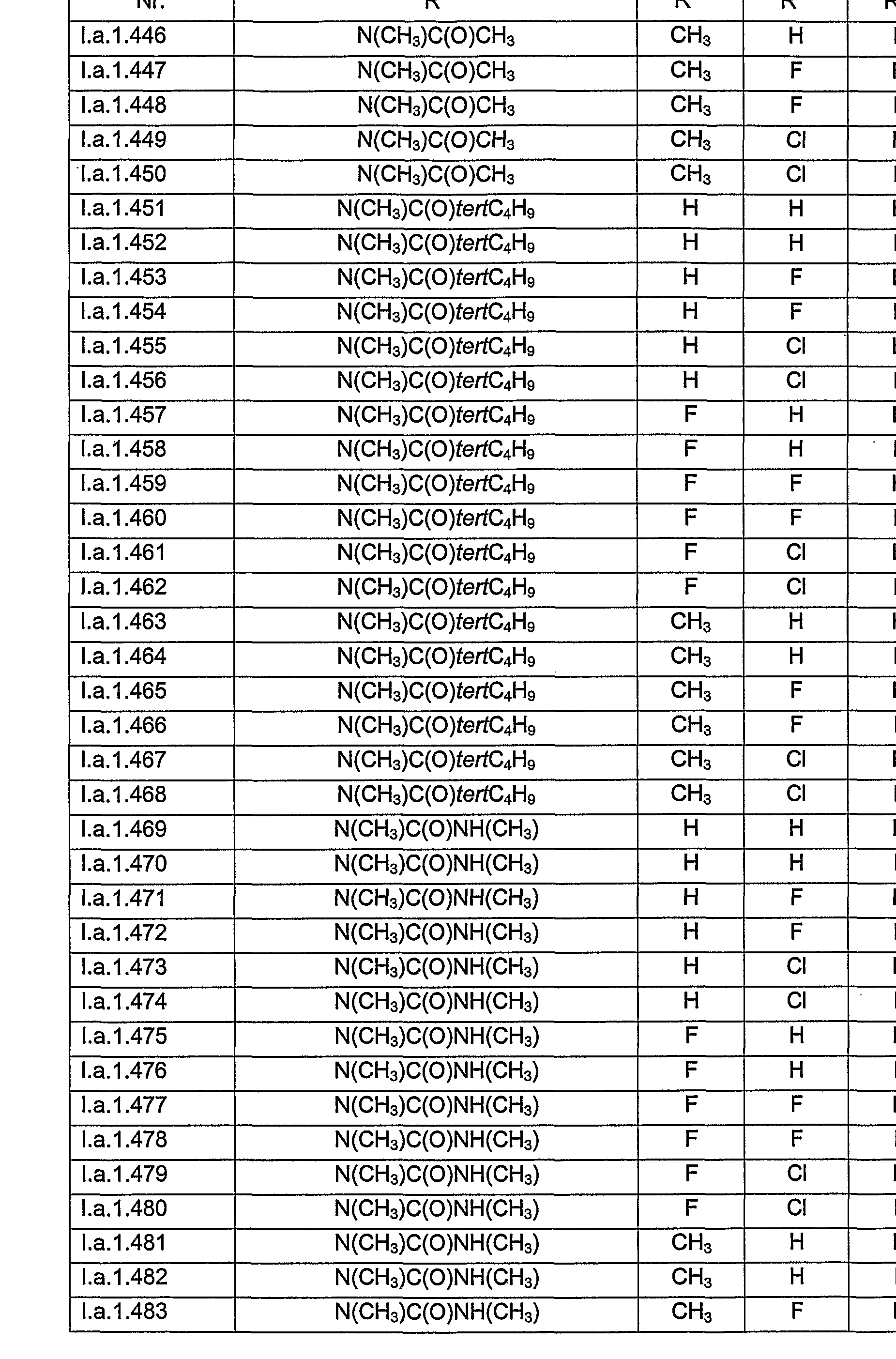


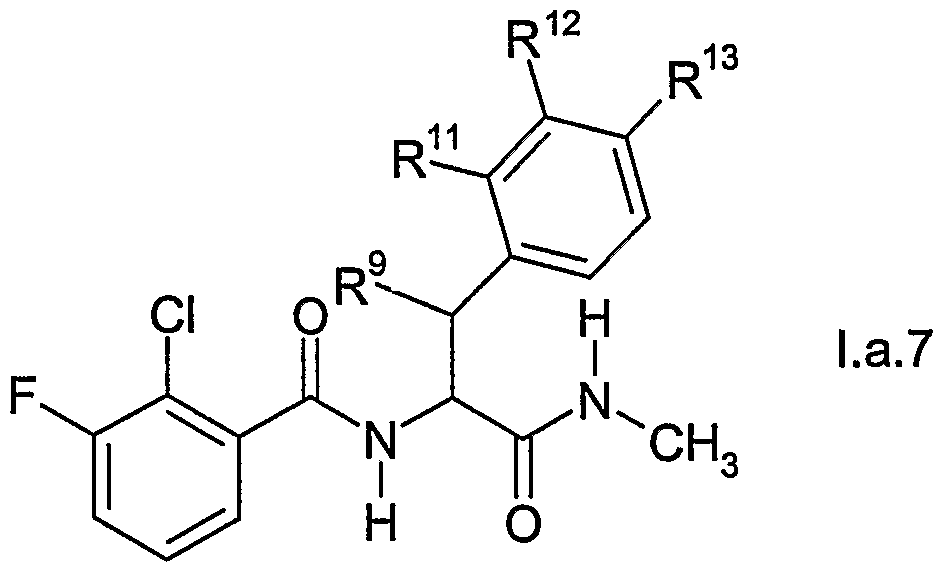
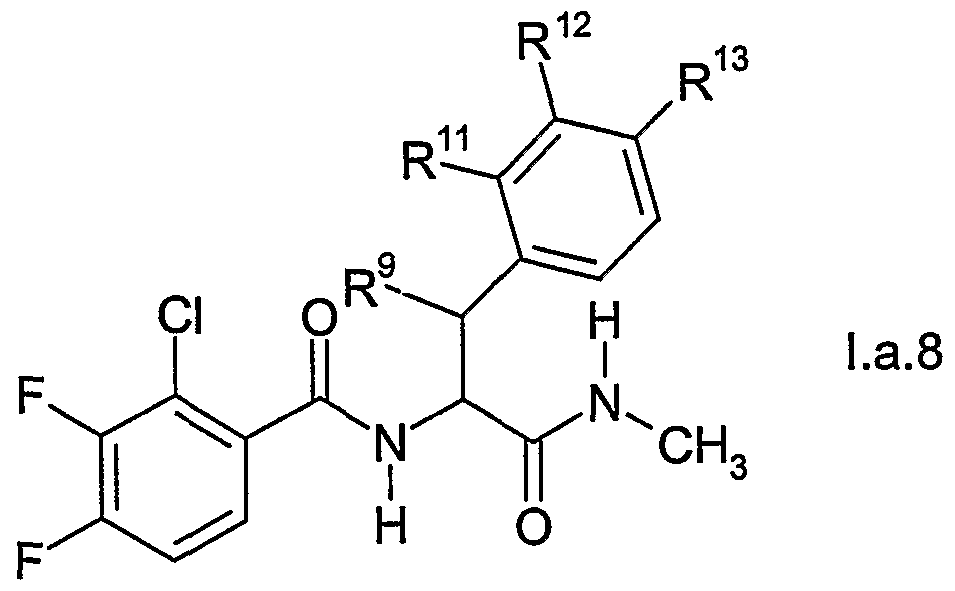


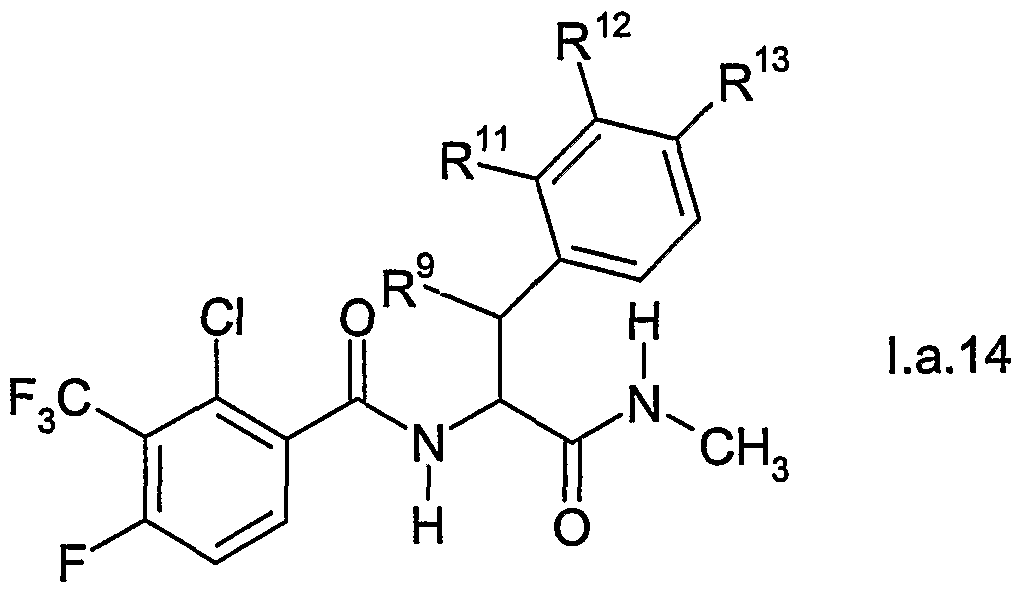


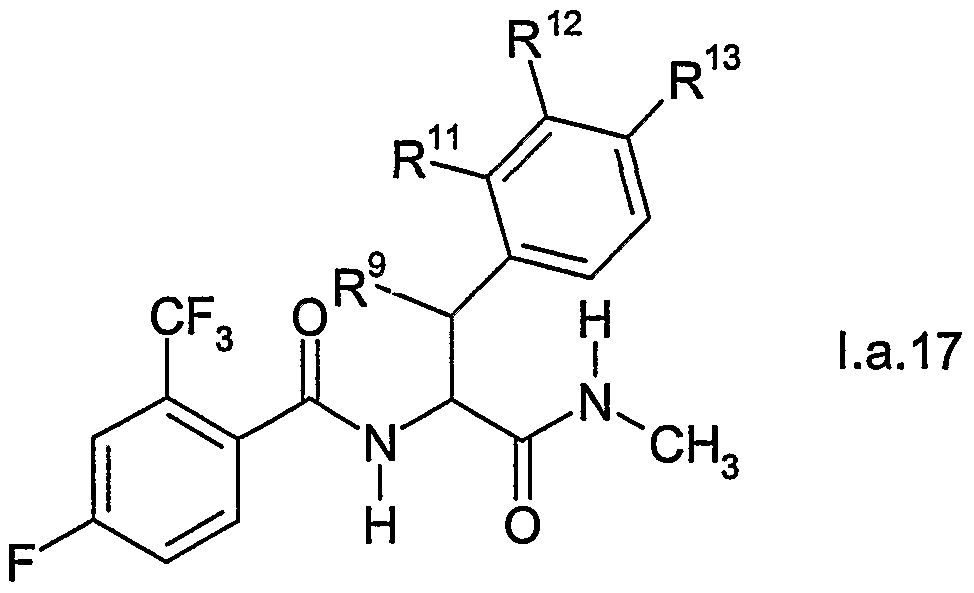


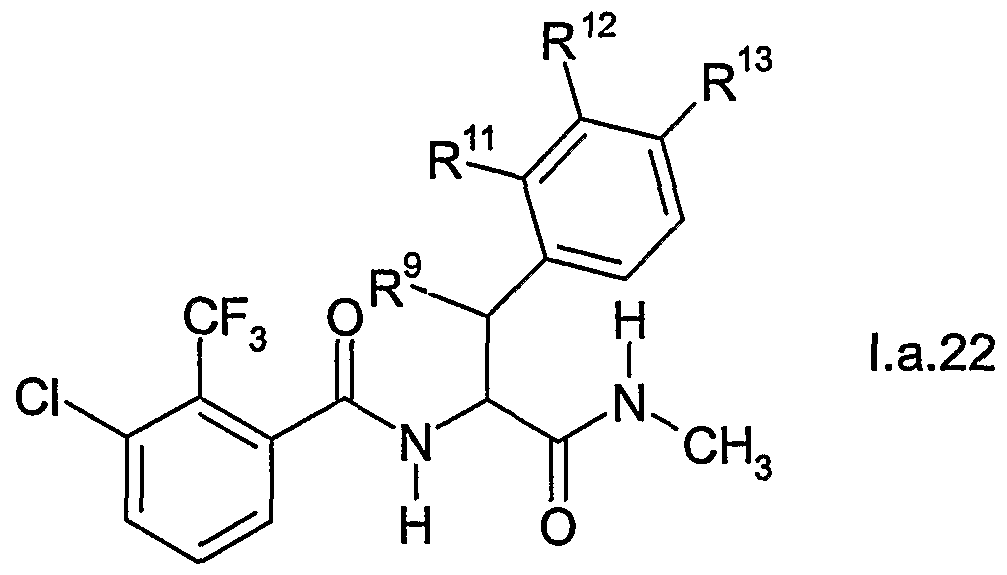


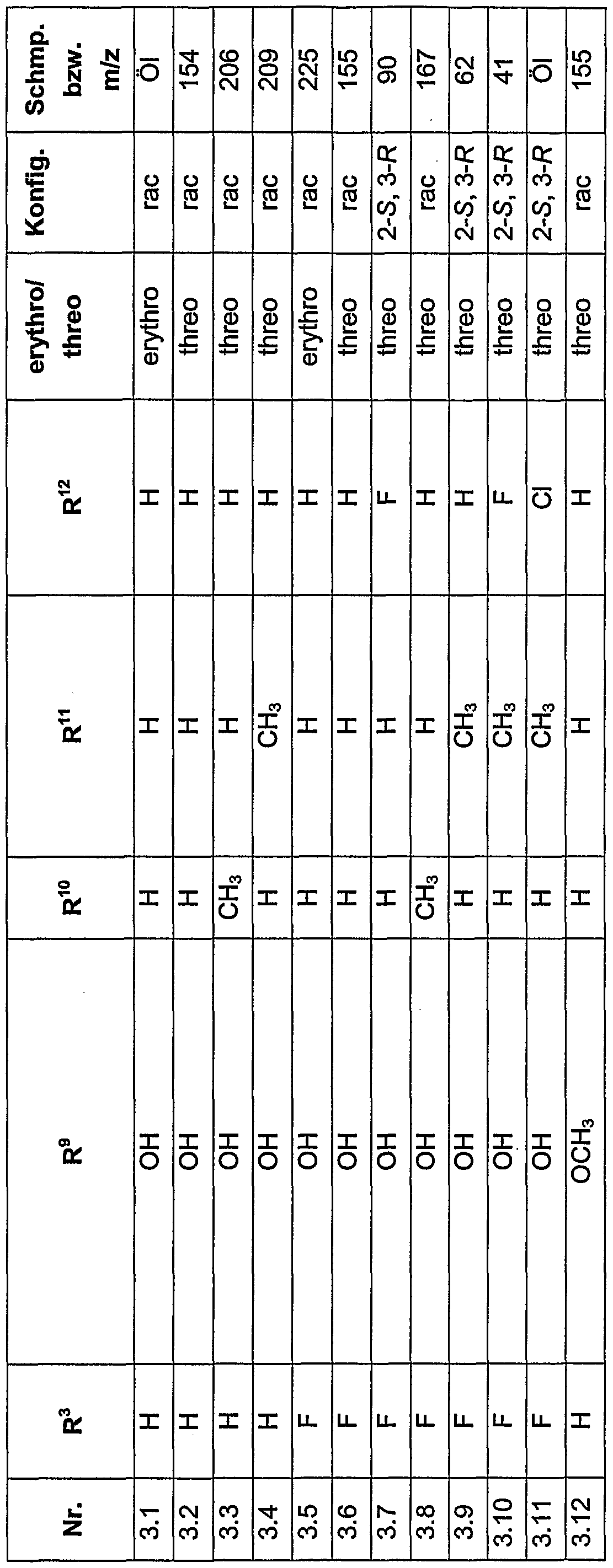


Claims


Priority Applications (10)
| Application Number | Priority Date | Filing Date | Title |
|---|---|---|---|
| AU2004303492A AU2004303492A1 (en) | 2003-12-19 | 2004-12-17 | Benzoyl-substituted phenylalanine amides |
| BRPI0417780A BRPI0417780B1 (pt) | 2003-12-19 | 2004-12-17 | composto, processo para preparar o mesmo, agente, processos para preparar o mesmo, e para combater vegetação indesejada, e, uso de um composto |
| EA200601105A EA200601105A1 (ru) | 2003-12-19 | 2004-12-17 | Замещённые бензоилом фенилаланин-амиды |
| UAA200608125A UA81568C2 (en) | 2003-12-19 | 2004-12-17 | Benzoyl-substituted phenylalanine amides, methods and intermediate products for the production thereof, herbicidal composition and method for controlling undesired plants |
| MXPA06005989A MXPA06005989A (es) | 2003-12-19 | 2004-12-17 | Fenilalanina-amidas sustituidas por benzoilo. |
| EP04803999.4A EP1697309B1 (de) | 2003-12-19 | 2004-12-17 | Benzoylsubstituierte phenylalanin-amide |
| JP2006544353A JP4541363B2 (ja) | 2003-12-19 | 2004-12-17 | ベンゾイル置換フェニルアラニンアミド |
| CA002548442A CA2548442A1 (en) | 2003-12-19 | 2004-12-17 | Benzoyl-substituted phenylalanine amides |
| US10/581,444 US7687435B2 (en) | 2003-12-19 | 2004-12-17 | Benzoyl-substituted phenylalanineamides |
| IL175884A IL175884A0 (en) | 2003-12-19 | 2006-05-24 | Benzoyl-substituted phenylalnine amides |
Applications Claiming Priority (2)
| Application Number | Priority Date | Filing Date | Title |
|---|---|---|---|
| DE10360395 | 2003-12-19 | ||
| DE10360395.6 | 2003-12-19 |
Publications (2)
| Publication Number | Publication Date |
|---|---|
| WO2005061443A2 true WO2005061443A2 (de) | 2005-07-07 |
| WO2005061443A3 WO2005061443A3 (de) | 2005-12-22 |
Family
ID=34706404
Family Applications (1)
| Application Number | Title | Priority Date | Filing Date |
|---|---|---|---|
| PCT/EP2004/014392 Ceased WO2005061443A2 (de) | 2003-12-19 | 2004-12-17 | Benzoylsubstituierte phenylalanin-amide |
Country Status (19)
| Country | Link |
|---|---|
| US (1) | US7687435B2 (de) |
| EP (1) | EP1697309B1 (de) |
| JP (1) | JP4541363B2 (de) |
| KR (1) | KR20060123344A (de) |
| CN (1) | CN1894202A (de) |
| AR (1) | AR047334A1 (de) |
| AU (1) | AU2004303492A1 (de) |
| BR (1) | BRPI0417780B1 (de) |
| CA (1) | CA2548442A1 (de) |
| CO (1) | CO5700811A2 (de) |
| CR (1) | CR8475A (de) |
| EA (1) | EA200601105A1 (de) |
| IL (1) | IL175884A0 (de) |
| MX (1) | MXPA06005989A (de) |
| PE (1) | PE20051058A1 (de) |
| UA (1) | UA81568C2 (de) |
| UY (1) | UY28683A1 (de) |
| WO (1) | WO2005061443A2 (de) |
| ZA (1) | ZA200605927B (de) |
Cited By (39)
| Publication number | Priority date | Publication date | Assignee | Title |
|---|---|---|---|---|
| WO2006029828A1 (de) * | 2004-09-16 | 2006-03-23 | Basf Aktiengesellschaft | Benzoylsubstituierte serin-amide |
| WO2006029829A1 (de) * | 2004-09-16 | 2006-03-23 | Basf Aktiengesellschaft | Heteroaroylsubstituierte serin-amide als herbizide |
| WO2006125688A1 (de) * | 2005-05-25 | 2006-11-30 | Basf Aktiengesellschaft | Benzoylsubstituierte serin-amide |
| WO2007093539A3 (de) * | 2006-02-16 | 2007-10-11 | Basf Ag | Benzoylsubstituierte alanine |
| WO2008084070A1 (de) * | 2007-01-11 | 2008-07-17 | Basf Se | Benzoylsubstituierte serin-amide |
| WO2008084073A1 (de) * | 2007-01-11 | 2008-07-17 | Basf Se | Heteroaroylsubstituierte serin-amide |
| WO2010049414A1 (en) * | 2008-10-31 | 2010-05-06 | Basf Se | Method for improving plant health |
| US7879761B2 (en) | 2005-05-25 | 2011-02-01 | Basf Aktiengesellschaft | Heteroaroyl-substituted serineamides |
| WO2013039990A1 (en) | 2011-09-13 | 2013-03-21 | Monsanto Technology Llc | Methods and compositions for weed control |
| WO2013040117A1 (en) | 2011-09-13 | 2013-03-21 | Monsanto Technology Llc | Methods and compositions for weed control |
| WO2013040021A1 (en) | 2011-09-13 | 2013-03-21 | Monsanto Technology Llc | Methods and compositions for weed control |
| WO2014151255A1 (en) | 2013-03-15 | 2014-09-25 | Monsanto Technology Llc | Methods and compositions for weed control |
| WO2015108982A2 (en) | 2014-01-15 | 2015-07-23 | Monsanto Technology Llc | Methods and compositions for weed control using epsps polynucleotides |
| US9121022B2 (en) | 2010-03-08 | 2015-09-01 | Monsanto Technology Llc | Method for controlling herbicide-resistant plants |
| US9416363B2 (en) | 2011-09-13 | 2016-08-16 | Monsanto Technology Llc | Methods and compositions for weed control |
| US9422558B2 (en) | 2011-09-13 | 2016-08-23 | Monsanto Technology Llc | Methods and compositions for weed control |
| US9422557B2 (en) | 2011-09-13 | 2016-08-23 | Monsanto Technology Llc | Methods and compositions for weed control |
| US9540642B2 (en) | 2013-11-04 | 2017-01-10 | The United States Of America, As Represented By The Secretary Of Agriculture | Compositions and methods for controlling arthropod parasite and pest infestations |
| US9777288B2 (en) | 2013-07-19 | 2017-10-03 | Monsanto Technology Llc | Compositions and methods for controlling leptinotarsa |
| US9850496B2 (en) | 2013-07-19 | 2017-12-26 | Monsanto Technology Llc | Compositions and methods for controlling Leptinotarsa |
| US10041068B2 (en) | 2013-01-01 | 2018-08-07 | A. B. Seeds Ltd. | Isolated dsRNA molecules and methods of using same for silencing target molecules of interest |
| US10240161B2 (en) | 2012-05-24 | 2019-03-26 | A.B. Seeds Ltd. | Compositions and methods for silencing gene expression |
| US10378012B2 (en) | 2014-07-29 | 2019-08-13 | Monsanto Technology Llc | Compositions and methods for controlling insect pests |
| US10557138B2 (en) | 2013-12-10 | 2020-02-11 | Beeologics, Inc. | Compositions and methods for virus control in Varroa mite and bees |
| US10612019B2 (en) | 2013-03-13 | 2020-04-07 | Monsanto Technology Llc | Methods and compositions for weed control |
| US10609930B2 (en) | 2013-03-13 | 2020-04-07 | Monsanto Technology Llc | Methods and compositions for weed control |
| US10655136B2 (en) | 2015-06-03 | 2020-05-19 | Monsanto Technology Llc | Methods and compositions for introducing nucleic acids into plants |
| US10683505B2 (en) | 2013-01-01 | 2020-06-16 | Monsanto Technology Llc | Methods of introducing dsRNA to plant seeds for modulating gene expression |
| US10760086B2 (en) | 2011-09-13 | 2020-09-01 | Monsanto Technology Llc | Methods and compositions for weed control |
| US10801028B2 (en) | 2009-10-14 | 2020-10-13 | Beeologics Inc. | Compositions for controlling Varroa mites in bees |
| US10806146B2 (en) | 2011-09-13 | 2020-10-20 | Monsanto Technology Llc | Methods and compositions for weed control |
| US10808249B2 (en) | 2011-09-13 | 2020-10-20 | Monsanto Technology Llc | Methods and compositions for weed control |
| US10829828B2 (en) | 2011-09-13 | 2020-11-10 | Monsanto Technology Llc | Methods and compositions for weed control |
| US10883103B2 (en) | 2015-06-02 | 2021-01-05 | Monsanto Technology Llc | Compositions and methods for delivery of a polynucleotide into a plant |
| US10888579B2 (en) | 2007-11-07 | 2021-01-12 | Beeologics Inc. | Compositions for conferring tolerance to viral disease in social insects, and the use thereof |
| US10968449B2 (en) | 2015-01-22 | 2021-04-06 | Monsanto Technology Llc | Compositions and methods for controlling Leptinotarsa |
| US10988764B2 (en) | 2014-06-23 | 2021-04-27 | Monsanto Technology Llc | Compositions and methods for regulating gene expression via RNA interference |
| US11091770B2 (en) | 2014-04-01 | 2021-08-17 | Monsanto Technology Llc | Compositions and methods for controlling insect pests |
| US11807857B2 (en) | 2014-06-25 | 2023-11-07 | Monsanto Technology Llc | Methods and compositions for delivering nucleic acids to plant cells and regulating gene expression |
Families Citing this family (63)
| Publication number | Priority date | Publication date | Assignee | Title |
|---|---|---|---|---|
| BRPI0707907A2 (pt) * | 2006-02-16 | 2011-05-17 | Basf Se | composto, processo para preparação de um composto, agente, processos para a preparação de agentes, e para o combate da vegetação indesejada, e, uso de compostos |
| US20090215628A1 (en) * | 2006-05-19 | 2009-08-27 | Basf Se | Benzoyl-Substituted Alanines |
| US8168631B2 (en) * | 2008-02-05 | 2012-05-01 | Allergan, Inc. | 3-(4-fluorophenyl)-3-hydroxy-2-amino-propionic acid amides and related compounds having analgesic activity |
| US20110209253A1 (en) * | 2008-10-31 | 2011-08-25 | Basf Se | Method for Improving Plant Health |
| US11178818B2 (en) | 2018-10-26 | 2021-11-23 | Deere & Company | Harvesting machine control system with fill level processing based on yield data |
| US11957072B2 (en) | 2020-02-06 | 2024-04-16 | Deere & Company | Pre-emergence weed detection and mitigation system |
| US11672203B2 (en) | 2018-10-26 | 2023-06-13 | Deere & Company | Predictive map generation and control |
| US11653588B2 (en) | 2018-10-26 | 2023-05-23 | Deere & Company | Yield map generation and control system |
| US12069978B2 (en) | 2018-10-26 | 2024-08-27 | Deere & Company | Predictive environmental characteristic map generation and control system |
| US11641800B2 (en) | 2020-02-06 | 2023-05-09 | Deere & Company | Agricultural harvesting machine with pre-emergence weed detection and mitigation system |
| US11240961B2 (en) | 2018-10-26 | 2022-02-08 | Deere & Company | Controlling a harvesting machine based on a geo-spatial representation indicating where the harvesting machine is likely to reach capacity |
| US11589509B2 (en) | 2018-10-26 | 2023-02-28 | Deere & Company | Predictive machine characteristic map generation and control system |
| US11467605B2 (en) | 2019-04-10 | 2022-10-11 | Deere & Company | Zonal machine control |
| US11079725B2 (en) | 2019-04-10 | 2021-08-03 | Deere & Company | Machine control using real-time model |
| US11234366B2 (en) | 2019-04-10 | 2022-02-01 | Deere & Company | Image selection for machine control |
| US11778945B2 (en) | 2019-04-10 | 2023-10-10 | Deere & Company | Machine control using real-time model |
| US12035648B2 (en) | 2020-02-06 | 2024-07-16 | Deere & Company | Predictive weed map generation and control system |
| US12329148B2 (en) | 2020-02-06 | 2025-06-17 | Deere & Company | Predictive weed map and material application machine control |
| US12225846B2 (en) | 2020-02-06 | 2025-02-18 | Deere & Company | Machine control using a predictive map |
| US11477940B2 (en) | 2020-03-26 | 2022-10-25 | Deere & Company | Mobile work machine control based on zone parameter modification |
| US12178158B2 (en) | 2020-10-09 | 2024-12-31 | Deere & Company | Predictive map generation and control system for an agricultural work machine |
| US12422847B2 (en) | 2020-10-09 | 2025-09-23 | Deere & Company | Predictive agricultural model and map generation |
| US11650587B2 (en) | 2020-10-09 | 2023-05-16 | Deere & Company | Predictive power map generation and control system |
| US11849671B2 (en) | 2020-10-09 | 2023-12-26 | Deere & Company | Crop state map generation and control system |
| US11844311B2 (en) | 2020-10-09 | 2023-12-19 | Deere & Company | Machine control using a predictive map |
| US11845449B2 (en) | 2020-10-09 | 2023-12-19 | Deere & Company | Map generation and control system |
| US11675354B2 (en) | 2020-10-09 | 2023-06-13 | Deere & Company | Machine control using a predictive map |
| US12386354B2 (en) | 2020-10-09 | 2025-08-12 | Deere & Company | Predictive power map generation and control system |
| US11871697B2 (en) | 2020-10-09 | 2024-01-16 | Deere & Company | Crop moisture map generation and control system |
| US11849672B2 (en) | 2020-10-09 | 2023-12-26 | Deere & Company | Machine control using a predictive map |
| US11635765B2 (en) | 2020-10-09 | 2023-04-25 | Deere & Company | Crop state map generation and control system |
| US12419220B2 (en) | 2020-10-09 | 2025-09-23 | Deere & Company | Predictive map generation and control system |
| US11474523B2 (en) | 2020-10-09 | 2022-10-18 | Deere & Company | Machine control using a predictive speed map |
| US11983009B2 (en) | 2020-10-09 | 2024-05-14 | Deere & Company | Map generation and control system |
| US11825768B2 (en) | 2020-10-09 | 2023-11-28 | Deere & Company | Machine control using a predictive map |
| US12013245B2 (en) | 2020-10-09 | 2024-06-18 | Deere & Company | Predictive map generation and control system |
| US11946747B2 (en) | 2020-10-09 | 2024-04-02 | Deere & Company | Crop constituent map generation and control system |
| US11895948B2 (en) | 2020-10-09 | 2024-02-13 | Deere & Company | Predictive map generation and control based on soil properties |
| US11874669B2 (en) | 2020-10-09 | 2024-01-16 | Deere & Company | Map generation and control system |
| US11889788B2 (en) | 2020-10-09 | 2024-02-06 | Deere & Company | Predictive biomass map generation and control |
| US11864483B2 (en) | 2020-10-09 | 2024-01-09 | Deere & Company | Predictive map generation and control system |
| US12550802B2 (en) | 2020-10-08 | 2026-02-17 | Deere & Company | Predictive machine characteristic map generation and control system |
| US11727680B2 (en) | 2020-10-09 | 2023-08-15 | Deere & Company | Predictive map generation based on seeding characteristics and control |
| US11711995B2 (en) | 2020-10-09 | 2023-08-01 | Deere & Company | Machine control using a predictive map |
| US11927459B2 (en) | 2020-10-09 | 2024-03-12 | Deere & Company | Machine control using a predictive map |
| US12069986B2 (en) | 2020-10-09 | 2024-08-27 | Deere & Company | Map generation and control system |
| US11592822B2 (en) | 2020-10-09 | 2023-02-28 | Deere & Company | Machine control using a predictive map |
| US11889787B2 (en) | 2020-10-09 | 2024-02-06 | Deere & Company | Predictive speed map generation and control system |
| US12250905B2 (en) | 2020-10-09 | 2025-03-18 | Deere & Company | Machine control using a predictive map |
| EP4251606B1 (de) * | 2020-11-25 | 2025-01-22 | Basf Se | Herbizide malonamide |
| US12127500B2 (en) | 2021-01-27 | 2024-10-29 | Deere & Company | Machine control using a map with regime zones |
| US12229886B2 (en) | 2021-10-01 | 2025-02-18 | Deere & Company | Historical crop state model, predictive crop state map generation and control system |
| US12310286B2 (en) | 2021-12-14 | 2025-05-27 | Deere & Company | Crop constituent sensing |
| US12302791B2 (en) | 2021-12-20 | 2025-05-20 | Deere & Company | Crop constituents, predictive mapping, and agricultural harvester control |
| US12245549B2 (en) | 2022-01-11 | 2025-03-11 | Deere & Company | Predictive response map generation and control system |
| US12082531B2 (en) | 2022-01-26 | 2024-09-10 | Deere & Company | Systems and methods for predicting material dynamics |
| US12520759B2 (en) | 2022-01-26 | 2026-01-13 | Deere & Company | Systems and methods for predicting material dynamics |
| US12295288B2 (en) | 2022-04-05 | 2025-05-13 | Deere &Company | Predictive machine setting map generation and control system |
| US12298767B2 (en) | 2022-04-08 | 2025-05-13 | Deere & Company | Predictive material consumption map and control |
| US12358493B2 (en) | 2022-04-08 | 2025-07-15 | Deere & Company | Systems and methods for predictive power requirements and control |
| US12058951B2 (en) | 2022-04-08 | 2024-08-13 | Deere & Company | Predictive nutrient map and control |
| US12284934B2 (en) | 2022-04-08 | 2025-04-29 | Deere & Company | Systems and methods for predictive tractive characteristics and control |
| US12582035B2 (en) | 2022-04-08 | 2026-03-24 | Deere & Company | Systems and methods for predictive power requirements and control |
Citations (15)
| Publication number | Priority date | Publication date | Assignee | Title |
|---|---|---|---|---|
| US4605759A (en) | 1983-08-01 | 1986-08-12 | Mitsui Toatsu Chemicals, Inc. | Process for production of β-phenylserine |
| US4810817A (en) | 1985-10-21 | 1989-03-07 | W. R. Grace & Co. | Aspartyl-beta substituted phenylalanine dipeptides |
| US4873359A (en) | 1985-10-21 | 1989-10-10 | W. R. Grace & Co. - Conn. | Process for preparing as partyl-phenylalanine dipeptides |
| US4904674A (en) | 1989-08-16 | 1990-02-27 | Hoechst-Roussel Pharmaceuticals Inc. | 1-(Benzo[b]thienyl)-2-(thienyl)ethenes and related compounds useful as anti-inflammatory agents |
| JPH02172956A (ja) | 1988-12-23 | 1990-07-04 | Sumitomo Pharmaceut Co Ltd | エリスロ―3―(3,4―ジヒドロキシフェニル)セリン誘導体の新規製造法 |
| ES2021557A6 (es) | 1990-07-23 | 1991-11-01 | Aliana S A | Procedimiento de obtencion de 4-hidroxi-metil-n-2-piridinil-2h-tieno (2,3 c)-1,2 tiazina-3 carboxamida 1,1 dioxido. |
| JPH03294253A (ja) | 1990-04-12 | 1991-12-25 | Shionogi & Co Ltd | 消化管ホルモン拮抗物質 |
| WO1997005865A1 (en) | 1995-08-08 | 1997-02-20 | Fibrogen, Inc. | C-proteinase inhibitors for the treatment of disorders related to the overproduction of collagen |
| JPH10298151A (ja) | 1997-04-30 | 1998-11-10 | Japan Energy Corp | C型肝炎ウイルスプロテアーゼ阻害剤 |
| WO2000020424A1 (en) | 1998-10-07 | 2000-04-13 | Otsuka Kagaku Kabushiki Kaisha | PROCESS FOR THE PREPARATION OF β-HYDROXY ESTERS |
| US6057473A (en) | 1996-05-21 | 2000-05-02 | The Scripps Research Institute | Synthesis of aryl serines |
| JP2001046076A (ja) | 1999-08-13 | 2001-02-20 | Daicel Chem Ind Ltd | (r)−2−アミノ−1−フェニルエタノールまたはそのハロゲン置換体の製造方法 |
| GB2369117A (en) | 2000-11-17 | 2002-05-22 | Warner Lambert Co | Bombesin receptor antagonists |
| WO2002083111A2 (en) | 2001-04-16 | 2002-10-24 | Tanabe Seiyaku Co., Ltd. | Imidazole, thiazole and oxazole derivatives and their use for the manufacture of a medicament for the treatment and/or prevention of pollakiuria or urinary incontinence |
| WO2003066576A1 (de) | 2002-02-06 | 2003-08-14 | Basf Aktiengesellschaft | Phenylalaninderivate als herbizide |
Family Cites Families (7)
| Publication number | Priority date | Publication date | Assignee | Title |
|---|---|---|---|---|
| IT1062206B (it) * | 1974-02-01 | 1983-09-20 | Rotta Research Lab S P A A S | Derivati della tirosina attivi sulla muscolatura liscia |
| JPS6098995A (ja) * | 1983-11-04 | 1985-06-01 | Microbial Chem Res Found | 光学活性3−(3,4−ジヒドロキシフエニル)セリン,およびその誘導体の製造法 |
| HU190864B (en) * | 1983-12-08 | 1986-11-28 | Alkaloida Vegyeszeti Gyar | Process for production of phenil-alanin derivatives |
| JPH075461B2 (ja) * | 1986-04-10 | 1995-01-25 | 三共株式会社 | 副作用の軽減されたペネム型またはカルバペネム型抗生物質製剤 |
| JPH08245552A (ja) * | 1995-03-08 | 1996-09-24 | Sumitomo Chem Co Ltd | ジアミノカルボン酸誘導体およびその製造法 |
| MY153569A (en) * | 1998-01-20 | 2015-02-27 | Mitsubishi Tanabe Pharma Corp | Inhibitors of ?4 mediated cell adhesion |
| CA2851462A1 (en) * | 2003-01-08 | 2004-07-29 | University Of Washington | Antibacterial agents |
-
2004
- 2004-12-17 US US10/581,444 patent/US7687435B2/en not_active Expired - Fee Related
- 2004-12-17 KR KR1020067011990A patent/KR20060123344A/ko not_active Withdrawn
- 2004-12-17 UY UY28683A patent/UY28683A1/es unknown
- 2004-12-17 CN CNA2004800378537A patent/CN1894202A/zh active Pending
- 2004-12-17 WO PCT/EP2004/014392 patent/WO2005061443A2/de not_active Ceased
- 2004-12-17 CA CA002548442A patent/CA2548442A1/en not_active Abandoned
- 2004-12-17 AU AU2004303492A patent/AU2004303492A1/en not_active Abandoned
- 2004-12-17 UA UAA200608125A patent/UA81568C2/xx unknown
- 2004-12-17 EP EP04803999.4A patent/EP1697309B1/de not_active Expired - Lifetime
- 2004-12-17 EA EA200601105A patent/EA200601105A1/ru unknown
- 2004-12-17 MX MXPA06005989A patent/MXPA06005989A/es not_active Application Discontinuation
- 2004-12-17 BR BRPI0417780A patent/BRPI0417780B1/pt not_active IP Right Cessation
- 2004-12-17 AR ARP040104766A patent/AR047334A1/es unknown
- 2004-12-17 JP JP2006544353A patent/JP4541363B2/ja not_active Expired - Fee Related
-
2005
- 2005-01-03 PE PE2005000011A patent/PE20051058A1/es not_active Application Discontinuation
-
2006
- 2006-05-24 IL IL175884A patent/IL175884A0/en unknown
- 2006-06-13 CO CO06057507A patent/CO5700811A2/es not_active Application Discontinuation
- 2006-06-22 CR CR8475A patent/CR8475A/es not_active Application Discontinuation
- 2006-07-18 ZA ZA200605927A patent/ZA200605927B/en unknown
Patent Citations (15)
| Publication number | Priority date | Publication date | Assignee | Title |
|---|---|---|---|---|
| US4605759A (en) | 1983-08-01 | 1986-08-12 | Mitsui Toatsu Chemicals, Inc. | Process for production of β-phenylserine |
| US4810817A (en) | 1985-10-21 | 1989-03-07 | W. R. Grace & Co. | Aspartyl-beta substituted phenylalanine dipeptides |
| US4873359A (en) | 1985-10-21 | 1989-10-10 | W. R. Grace & Co. - Conn. | Process for preparing as partyl-phenylalanine dipeptides |
| JPH02172956A (ja) | 1988-12-23 | 1990-07-04 | Sumitomo Pharmaceut Co Ltd | エリスロ―3―(3,4―ジヒドロキシフェニル)セリン誘導体の新規製造法 |
| US4904674A (en) | 1989-08-16 | 1990-02-27 | Hoechst-Roussel Pharmaceuticals Inc. | 1-(Benzo[b]thienyl)-2-(thienyl)ethenes and related compounds useful as anti-inflammatory agents |
| JPH03294253A (ja) | 1990-04-12 | 1991-12-25 | Shionogi & Co Ltd | 消化管ホルモン拮抗物質 |
| ES2021557A6 (es) | 1990-07-23 | 1991-11-01 | Aliana S A | Procedimiento de obtencion de 4-hidroxi-metil-n-2-piridinil-2h-tieno (2,3 c)-1,2 tiazina-3 carboxamida 1,1 dioxido. |
| WO1997005865A1 (en) | 1995-08-08 | 1997-02-20 | Fibrogen, Inc. | C-proteinase inhibitors for the treatment of disorders related to the overproduction of collagen |
| US6057473A (en) | 1996-05-21 | 2000-05-02 | The Scripps Research Institute | Synthesis of aryl serines |
| JPH10298151A (ja) | 1997-04-30 | 1998-11-10 | Japan Energy Corp | C型肝炎ウイルスプロテアーゼ阻害剤 |
| WO2000020424A1 (en) | 1998-10-07 | 2000-04-13 | Otsuka Kagaku Kabushiki Kaisha | PROCESS FOR THE PREPARATION OF β-HYDROXY ESTERS |
| JP2001046076A (ja) | 1999-08-13 | 2001-02-20 | Daicel Chem Ind Ltd | (r)−2−アミノ−1−フェニルエタノールまたはそのハロゲン置換体の製造方法 |
| GB2369117A (en) | 2000-11-17 | 2002-05-22 | Warner Lambert Co | Bombesin receptor antagonists |
| WO2002083111A2 (en) | 2001-04-16 | 2002-10-24 | Tanabe Seiyaku Co., Ltd. | Imidazole, thiazole and oxazole derivatives and their use for the manufacture of a medicament for the treatment and/or prevention of pollakiuria or urinary incontinence |
| WO2003066576A1 (de) | 2002-02-06 | 2003-08-14 | Basf Aktiengesellschaft | Phenylalaninderivate als herbizide |
Non-Patent Citations (88)
| Title |
|---|
| A. MANNSCHUK ET AL., ANGEW. CHEM., vol. 100, 1988, pages 299 |
| ALBRECHT, M. ET AL., SYNTHESIS, 2001, pages 468 - 472 |
| ALBRECHT, M. ET AL., SYNTHESIS, no. 3, 2001, pages 468 - 472 |
| ALKER, D. ET AL., TETRAHEDRON, vol. 54, no. 22, 1998, pages 6089 - 6098 |
| ARRAULT, A. ET AL., TETRAHEDRON LETT., vol. 43, no. 22, 2002, pages 4041 - 4044 |
| BERGMANN, E. D. ET AL., J CHEM SOC, 1951, pages 2673 |
| BEULSHAUSEN, T. ET AL., LIEBIGS ANN. CHEM., 1991, pages 1207 - 1209 |
| BLANK, S. ET AL., LIEBIGS ANN. CHEM., 1993, pages 889 - 896 |
| BLASER, D. ET AL., LIEBIGS ANN. CHEM., 1991, pages 1067 - 1078 |
| BOGER, D. L. ET AL., J. ORG. CHEM., vol. 62, no. 14, 1997, pages 4721 - 4736 |
| BOLHOFER, A. ET AL., J. AM. CHEM. SOC., vol. 75, 1953, pages 4469 |
| BOLHOFER, A., J. AM. CHEM. SOC., vol. 75, 1953, pages 4469 |
| BOTO, A ET AL., TETRAHEDRON LETTERS, vol. 39, no. 44, 1988, pages 8167 - 8170 |
| BOUKHRIS, S. ET AL., TETRAHEDRON LETT., vol. 40, no. 9, 1999, pages 1669 - 1672 |
| CADDICK, S., TETRAHEDRON, vol. 57, no. 30, 2001, pages 6615 - 6626 |
| CARRARA, G. ET AL., GAZZ. CHIM. ITAL., vol. 82, 1952, pages 325 |
| CASTRO, A. ET AL., J. ORG. CHEM., vol. 35, no. 8, 1970, pages 2815 - 2816 |
| CHANG, Y.-T. ET AL., J. AM. CHEM. SOC., vol. 75, 1953, pages 89 |
| CLARIANA, J. ET AL., TETRAHEDRON, vol. 55, no. 23, 1999, pages 7331 - 7344 |
| CLARK, J. E. ET AL., SYTHESIS, 1991, pages 891 - 894 |
| CLARK, J. E. ET AL., SYTHESIS, no. 10, 1991, pages 891 - 894 |
| COREY, E. J. ET AL., TETRAHEDRON LETT., vol. 32, no. 25, 1991, pages 2857 - 2860 |
| DAVIS, A. C. ET AL., J. CHEM. SOC., 1951, pages 3479 |
| DAVIS, C ET AL., J. CHEM. SOC., 1951, pages 3479 |
| DAVIS, F. A. ET AL., J. ORG. CHEM., vol. 59, no. 12, 1994, pages 3243 - 3245 |
| EWING W. ET AL., TETRAHEDRON LETT., vol. 30, no. 29, 1989, pages 3757 - 3760 |
| FUGANTI, C. ET AL., J. ORG. CHEM., vol. 51, no. 7, 1986, pages 1126 - 1128 |
| GELDERN, T. ET AL., J. OF MED. CHEM., vol. 39, no. 4, 1996, pages 957 - 967 |
| GIRARD A, TETRAHEDRON LETT., vol. 37, no. 44, 1996, pages 7967 - 7970 |
| GIRARD, A. ET AL., TETRAHEDRON LETT., vol. 37, no. 44, 1996, pages 7967 - 7970 |
| GUAN ET AL., J. COMB. CHEM., vol. 2, 2000, pages 297 |
| GUPTA, A. ET AL., J. CHEM. SOC. PERKIN TRANS., vol. 2, 1990, pages 1911 |
| H. PESSOA-MAHANA ET AL., SYNTH. COMM., vol. 32, 2002, pages 1437 |
| HELLMANN, H. ET AL., LIEBIGS ANN. CHEM., vol. 631, 1960, pages 175 - 179 |
| HERBERT, R. B. ET AL., CAN. J. CHEM., vol. 72, no. 1, 1994, pages 114 - 117 |
| HONIG, H. ET AL., TETRAHEDRON, 1990, pages 3841 |
| HUTTON, C. A., ORG. LETT., vol. 1, no. 2, 1999, pages 295 - 297 |
| HVIDT, T. ET AL., TETRAHEDRON LETT., vol. 27, no. 33, 1986, pages 3807 - 3810 |
| INOUE, H. ET AL., CHEM. PHAR. BULL., vol. 41, no. 9, 1993, pages 1521 - 1523 |
| IRIUCHIJIMA, S. ET AL., J. AM. CHEM. SOC., vol. 96, 1974, pages 4280 |
| ITO, S. ET AL., J. OF BIOL. CHEM., vol. 256, no. 15, 1981, pages 7834 - 4783 |
| J. M. ANDRES, TETRAHEDRON, vol. 56, 2000, pages 1523 |
| J.-F. ROUSSEAU ET AL., J. ORG. CHEM., vol. 63, 1998, pages 2731 - 2737 |
| JUNG, M. E. ET AL., SYNLETT, 1995, pages 563 - 564 |
| JUNG, M. E. ET AL., TETRAHEDRON LETT., vol. 30, no. 48, 1989, pages 6637 - 6640 |
| JURSIC, B. S. ET AL., SYNTH COMMUN, vol. 31, no. 4, 2001, pages 555 - 564 |
| KANEMASA, S. ET AL., TETRAHEDRON LETT., vol. 34, no. 4, 1993, pages 677 - 680 |
| KAWAHATA, N. H. ET AL., TETRAHEDRON LETT., vol. 43, no. 40, 2002, pages 7221 - 7223 |
| KIKUCHI, J. ET AL., CHEM. LETT., no. 3, 1993, pages 553 - 556 |
| KIM, . H. ET AL., TETRAHEDRON LETT., vol. 42, no. 48, 2001, pages 8401 - 8403 |
| KUWANO, R. ET AL., J. ORG .CHEM., vol. 63, no. 10, 1998, pages 3499 - 3503 |
| LEE, Y. ET AL., J. AM. CHEM. SOC., vol. 121, no. 36, 1999, pages 8407 - 8408 |
| LI, Y. Q. ET AL., TETRAHEDRON LETT., vol. 40, no. 51, 1999, pages 9097 - 9100 |
| LOOKER ET AL., J. ORG. CHEM., vol. 22, 1957, pages 1233 |
| LOWN, J. W. ET AL., CAN. J. CHEM., vol. 51, 1973, pages 856 |
| MAEDA, S ET AL., CHEM. & PHARM. BULL., vol. 32, no. 7, 1984, pages 2536 - 2543 |
| MARCHI, C. ET AL., TETRAHEDRON, vol. 58, no. 28, 2002, pages 5699 |
| MARTIN, S. F. ET AL., TETRAHEDRON LETT., vol. 39, no. 12, 1998, pages 1517 - 1520 |
| NICOLAOU, K. C. ET AL., ANGEW.N CHEM. INT. EDIT., vol. 37, no. 19, 1998, pages 2714 - 2716 |
| NICOLAOU, K. C. ET AL., J. AM. CHEM. SOC., vol. 124, no. 35, 2002, pages 10451 - 10455 |
| NOJORI R., J. AM. CHEM. SOC., vol. 111, no. 25, 1989, pages 9134 - 9135 |
| NOYORI, R. ET AL., J. AM. CHEM. SOC., vol. 111, no. 25, 1989, pages 9134 - 9135 |
| PARK, H. ET AL., J. ORG. CHEM., vol. 66, no. 21, 2001, pages 7223 - 7226 |
| PAULSEN, H. ET AL., LIEBIGS ANN. CHEM., 1987, pages 565 |
| PERICH, J. W.; JOHNS, R. B., J. ORG. CHEM., vol. 53, no. 17, 1988, pages 4103 - 4105 |
| POUPARDIN, O. ET AL., TETRAHEDRON LETT., vol. 42, no. 8, 2001, pages 1523 - 1526 |
| ROZENBERG, V. ET AL., ANGEW. CHEM., vol. 106, no. 1, 1994, pages 106 - 108 |
| SAEED, A. ET AL., TETRAHEDRON, vol. 48, no. 12, 1992, pages 2507 - 2514 |
| SCHMIDT U., SYNTHESIS, 1992, pages 1248 - 1254 |
| SHENGDE, W. ET AL., SYNTH. COMMUN., vol. 16, no. 12, 1986, pages 1479 |
| SINGH, J. ET AL., TETRAHEDRONLETTERS, vol. 34, no. 2, 1993, pages 211 - 214 |
| SOLLADIECAVALLO, A. ET AL., GAZZ. CHIM. ITAL., vol. 126, no. 3, 1996, pages 173 - 178 |
| SOLLADIECAVALLO, A. ET AL., TETRAHEDRON LETT., vol. 39, no. 15, 1998, pages 2191 - 2194 |
| SOLOSHONOK, V. A. ET AL., TETRAHEDRON LETT., vol. 35, no. 17, 1994, pages 2713 - 2716 |
| SOLOSHONOK, V. A. ET AL., TETRAHEDRON, vol. 52, no. 1, 1996, pages 245 - 254 |
| SOMLAI, C. ET AL., SYNTHESIS, 1992, pages 285 - 287 |
| SOUKUP, M. ET AL., HELV. CHIM. ACTA, vol. 70, 1987, pages 232 |
| SUZUKI, M. ET AL., J. ORG. CHEM., vol. 38, no. 20, 1973, pages 3571 - 3575 |
| SUZUKI, M. ET AL., SYNTHETIC COMMUNICATIONS, vol. 2, no. 4, 1972, pages 237 - 242 |
| TAKAHASHI, K. ET AL., J. ORG. CHEM., vol. 50, no. 18, 1985, pages 3414 - 3415 |
| TROAST, D. ET AL., ORG. LETT, vol. 4, no. 6, 2002, pages 991 - 994 |
| TROAST, D. ET AL., ORG. LETT., vol. 4, no. 6, 2002, pages 991 - 994 |
| VINOGRAD, L. ET AL., ZHURNAL ORGANICHESKOI KHIMII, vol. 16, no. 12, 1980, pages 2594 - 2599 |
| WU, S. D. ET AL., SYTHETIC COMMUN., vol. 16, no. 12, 1986, pages 1479 - 1484 |
| YADAV, L. D. S. ET AL., INDIAN J. CHEM B., vol. 41, no. 3, 2002, pages 593 - 595 |
| YOKOKAWA, F. ET AL., TETRAHEDRON LETT., vol. 42, no. 34, 2001, pages 5903 - 5908 |
| ZHDANKIN, V. V. ET AL., TETRAHEDRON LETT., vol. 41, no. 28, 2000, pages 5299 - 5302 |
| ZHOU, C. Y. ET AL., SYTHETIC COMMUN., vol. 17, no. 11, 1987, pages 1377 - 1382 |
Cited By (59)
| Publication number | Priority date | Publication date | Assignee | Title |
|---|---|---|---|---|
| WO2006029829A1 (de) * | 2004-09-16 | 2006-03-23 | Basf Aktiengesellschaft | Heteroaroylsubstituierte serin-amide als herbizide |
| WO2006029828A1 (de) * | 2004-09-16 | 2006-03-23 | Basf Aktiengesellschaft | Benzoylsubstituierte serin-amide |
| EA013646B1 (ru) * | 2005-05-25 | 2010-06-30 | Басф Акциенгезельшафт | Замещённые бензоилом серин-амиды |
| WO2006125688A1 (de) * | 2005-05-25 | 2006-11-30 | Basf Aktiengesellschaft | Benzoylsubstituierte serin-amide |
| US7879761B2 (en) | 2005-05-25 | 2011-02-01 | Basf Aktiengesellschaft | Heteroaroyl-substituted serineamides |
| US7786046B2 (en) | 2005-05-25 | 2010-08-31 | Basf Aktiengesellschaft | Benzoyl-substituted serineamides |
| WO2007093539A3 (de) * | 2006-02-16 | 2007-10-11 | Basf Ag | Benzoylsubstituierte alanine |
| WO2008084070A1 (de) * | 2007-01-11 | 2008-07-17 | Basf Se | Benzoylsubstituierte serin-amide |
| JP2010515705A (ja) * | 2007-01-11 | 2010-05-13 | ビーエーエスエフ ソシエタス・ヨーロピア | ヘテロアロイル置換セリンアミド |
| WO2008084073A1 (de) * | 2007-01-11 | 2008-07-17 | Basf Se | Heteroaroylsubstituierte serin-amide |
| US8133851B2 (en) | 2007-01-11 | 2012-03-13 | Basf Se | Heteroaroyl-substituted serine amides |
| US10888579B2 (en) | 2007-11-07 | 2021-01-12 | Beeologics Inc. | Compositions for conferring tolerance to viral disease in social insects, and the use thereof |
| WO2010049414A1 (en) * | 2008-10-31 | 2010-05-06 | Basf Se | Method for improving plant health |
| US10801028B2 (en) | 2009-10-14 | 2020-10-13 | Beeologics Inc. | Compositions for controlling Varroa mites in bees |
| US9121022B2 (en) | 2010-03-08 | 2015-09-01 | Monsanto Technology Llc | Method for controlling herbicide-resistant plants |
| US9988634B2 (en) | 2010-03-08 | 2018-06-05 | Monsanto Technology Llc | Polynucleotide molecules for gene regulation in plants |
| US11812738B2 (en) | 2010-03-08 | 2023-11-14 | Monsanto Technology Llc | Polynucleotide molecules for gene regulation in plants |
| US10806146B2 (en) | 2011-09-13 | 2020-10-20 | Monsanto Technology Llc | Methods and compositions for weed control |
| WO2013040021A1 (en) | 2011-09-13 | 2013-03-21 | Monsanto Technology Llc | Methods and compositions for weed control |
| US9422558B2 (en) | 2011-09-13 | 2016-08-23 | Monsanto Technology Llc | Methods and compositions for weed control |
| US9422557B2 (en) | 2011-09-13 | 2016-08-23 | Monsanto Technology Llc | Methods and compositions for weed control |
| EP3434779A1 (de) | 2011-09-13 | 2019-01-30 | Monsanto Technology LLC | Verfahren und zusammensetzungen zur unkrautbekämpfung |
| US10829828B2 (en) | 2011-09-13 | 2020-11-10 | Monsanto Technology Llc | Methods and compositions for weed control |
| US10808249B2 (en) | 2011-09-13 | 2020-10-20 | Monsanto Technology Llc | Methods and compositions for weed control |
| US10760086B2 (en) | 2011-09-13 | 2020-09-01 | Monsanto Technology Llc | Methods and compositions for weed control |
| EP3296402A2 (de) | 2011-09-13 | 2018-03-21 | Monsanto Technology LLC | Verfahren und zusammensetzungen zur unkrautbekämpfung |
| US9416363B2 (en) | 2011-09-13 | 2016-08-16 | Monsanto Technology Llc | Methods and compositions for weed control |
| WO2013040117A1 (en) | 2011-09-13 | 2013-03-21 | Monsanto Technology Llc | Methods and compositions for weed control |
| EP3382027A2 (de) | 2011-09-13 | 2018-10-03 | Monsanto Technology LLC | Verfahren und zusammensetzungen zur unkrautbekämpfung |
| WO2013039990A1 (en) | 2011-09-13 | 2013-03-21 | Monsanto Technology Llc | Methods and compositions for weed control |
| EP3434780A1 (de) | 2011-09-13 | 2019-01-30 | Monsanto Technology LLC | Verfahren und zusammensetzungen zur unkrautbekämpfung |
| US10934555B2 (en) | 2012-05-24 | 2021-03-02 | Monsanto Technology Llc | Compositions and methods for silencing gene expression |
| US10240161B2 (en) | 2012-05-24 | 2019-03-26 | A.B. Seeds Ltd. | Compositions and methods for silencing gene expression |
| US10240162B2 (en) | 2012-05-24 | 2019-03-26 | A.B. Seeds Ltd. | Compositions and methods for silencing gene expression |
| US10041068B2 (en) | 2013-01-01 | 2018-08-07 | A. B. Seeds Ltd. | Isolated dsRNA molecules and methods of using same for silencing target molecules of interest |
| US10683505B2 (en) | 2013-01-01 | 2020-06-16 | Monsanto Technology Llc | Methods of introducing dsRNA to plant seeds for modulating gene expression |
| US10609930B2 (en) | 2013-03-13 | 2020-04-07 | Monsanto Technology Llc | Methods and compositions for weed control |
| US10612019B2 (en) | 2013-03-13 | 2020-04-07 | Monsanto Technology Llc | Methods and compositions for weed control |
| US10568328B2 (en) | 2013-03-15 | 2020-02-25 | Monsanto Technology Llc | Methods and compositions for weed control |
| WO2014151255A1 (en) | 2013-03-15 | 2014-09-25 | Monsanto Technology Llc | Methods and compositions for weed control |
| US9777288B2 (en) | 2013-07-19 | 2017-10-03 | Monsanto Technology Llc | Compositions and methods for controlling leptinotarsa |
| US10597676B2 (en) | 2013-07-19 | 2020-03-24 | Monsanto Technology Llc | Compositions and methods for controlling Leptinotarsa |
| US9856495B2 (en) | 2013-07-19 | 2018-01-02 | Monsanto Technology Llc | Compositions and methods for controlling Leptinotarsa |
| US9850496B2 (en) | 2013-07-19 | 2017-12-26 | Monsanto Technology Llc | Compositions and methods for controlling Leptinotarsa |
| US11377667B2 (en) | 2013-07-19 | 2022-07-05 | Monsanto Technology Llc | Compositions and methods for controlling Leptinotarsa |
| US10100306B2 (en) | 2013-11-04 | 2018-10-16 | Monsanto Technology Llc | Compositions and methods for controlling arthropod parasite and pest infestations |
| US9540642B2 (en) | 2013-11-04 | 2017-01-10 | The United States Of America, As Represented By The Secretary Of Agriculture | Compositions and methods for controlling arthropod parasite and pest infestations |
| US10927374B2 (en) | 2013-11-04 | 2021-02-23 | Monsanto Technology Llc | Compositions and methods for controlling arthropod parasite and pest infestations |
| US10557138B2 (en) | 2013-12-10 | 2020-02-11 | Beeologics, Inc. | Compositions and methods for virus control in Varroa mite and bees |
| US10334848B2 (en) | 2014-01-15 | 2019-07-02 | Monsanto Technology Llc | Methods and compositions for weed control using EPSPS polynucleotides |
| WO2015108982A2 (en) | 2014-01-15 | 2015-07-23 | Monsanto Technology Llc | Methods and compositions for weed control using epsps polynucleotides |
| US11091770B2 (en) | 2014-04-01 | 2021-08-17 | Monsanto Technology Llc | Compositions and methods for controlling insect pests |
| US10988764B2 (en) | 2014-06-23 | 2021-04-27 | Monsanto Technology Llc | Compositions and methods for regulating gene expression via RNA interference |
| US11807857B2 (en) | 2014-06-25 | 2023-11-07 | Monsanto Technology Llc | Methods and compositions for delivering nucleic acids to plant cells and regulating gene expression |
| US10378012B2 (en) | 2014-07-29 | 2019-08-13 | Monsanto Technology Llc | Compositions and methods for controlling insect pests |
| US11124792B2 (en) | 2014-07-29 | 2021-09-21 | Monsanto Technology Llc | Compositions and methods for controlling insect pests |
| US10968449B2 (en) | 2015-01-22 | 2021-04-06 | Monsanto Technology Llc | Compositions and methods for controlling Leptinotarsa |
| US10883103B2 (en) | 2015-06-02 | 2021-01-05 | Monsanto Technology Llc | Compositions and methods for delivery of a polynucleotide into a plant |
| US10655136B2 (en) | 2015-06-03 | 2020-05-19 | Monsanto Technology Llc | Methods and compositions for introducing nucleic acids into plants |
Also Published As
| Publication number | Publication date |
|---|---|
| MXPA06005989A (es) | 2006-08-23 |
| BRPI0417780B1 (pt) | 2016-03-01 |
| US20070142230A1 (en) | 2007-06-21 |
| JP4541363B2 (ja) | 2010-09-08 |
| WO2005061443A3 (de) | 2005-12-22 |
| EP1697309A2 (de) | 2006-09-06 |
| UA81568C2 (en) | 2008-01-10 |
| KR20060123344A (ko) | 2006-12-01 |
| BRPI0417780A (pt) | 2007-03-20 |
| AU2004303492A1 (en) | 2005-07-07 |
| CA2548442A1 (en) | 2005-07-07 |
| ZA200605927B (en) | 2008-05-28 |
| PE20051058A1 (es) | 2006-01-19 |
| US7687435B2 (en) | 2010-03-30 |
| AR047334A1 (es) | 2006-01-18 |
| JP2007534648A (ja) | 2007-11-29 |
| CO5700811A2 (es) | 2006-11-30 |
| IL175884A0 (en) | 2006-10-05 |
| EP1697309B1 (de) | 2014-04-23 |
| EA200601105A1 (ru) | 2006-12-29 |
| CN1894202A (zh) | 2007-01-10 |
| UY28683A1 (es) | 2005-08-31 |
| CR8475A (es) | 2006-12-07 |
Similar Documents
| Publication | Publication Date | Title |
|---|---|---|
| US7687435B2 (en) | Benzoyl-substituted phenylalanineamides | |
| EP1791825B1 (de) | Benzoylsubstituierte serin-amide | |
| US20070060480A1 (en) | Heteroaroyl-substituted phenylalanineamides | |
| EP1971580B1 (de) | Piperazinverbindungen mit herbizider wirkung | |
| US20070270312A1 (en) | Heteroaroyl-Substituted Serineamides | |
| EP1177194B1 (de) | 4-(3',4'-heterocyclylbenzoyl)pyrazole als herbizide | |
| EP1163240B1 (de) | Tricyclische benzoylpyrazol-derivate als herbizide | |
| EP1080089B1 (de) | Pyrazolyldioxothiochromanoyl-derivate | |
| EP1112256B1 (de) | Cyclohexenonchinolinoyl-derivate als herbizide mittel | |
| EP1173449A1 (de) | Phosphorhaltige benzoyl-derivate und ihre verwendung als herbizide | |
| EP1135385A1 (de) | Thiochromanoylpyrazolon-derivate | |
| WO2000059911A2 (de) | Tricyclische cyclohexandionderivate | |
| EP1144401A3 (de) | Thiochromanoylcyclohexenon-derivate |
Legal Events
| Date | Code | Title | Description |
|---|---|---|---|
| WWE | Wipo information: entry into national phase |
Ref document number: 200480037853.7 Country of ref document: CN |
|
| AK | Designated states |
Kind code of ref document: A2 Designated state(s): AE AG AL AM AT AU AZ BA BB BG BR BW BY BZ CA CH CN CO CR CU CZ DE DK DM DZ EC EE EG ES FI GB GD GE GH GM HR HU ID IL IN IS JP KE KG KP KR KZ LC LK LR LS LT LU LV MA MD MG MK MN MW MX MZ NA NI NO NZ OM PG PH PL PT RO RU SC SD SE SG SK SL SY TJ TM TN TR TT TZ UA UG US UZ VC VN YU ZA ZM ZW |
|
| AL | Designated countries for regional patents |
Kind code of ref document: A2 Designated state(s): BW GH GM KE LS MW MZ NA SD SL SZ TZ UG ZM ZW AM AZ BY KG KZ MD RU TJ TM AT BE BG CH CY CZ DE DK EE ES FI FR GB GR HU IE IS IT LT LU MC NL PL PT RO SE SI SK TR BF BJ CF CG CI CM GA GN GQ GW ML MR NE SN TD TG |
|
| 121 | Ep: the epo has been informed by wipo that ep was designated in this application | ||
| DPEN | Request for preliminary examination filed prior to expiration of 19th month from priority date (pct application filed from 20040101) | ||
| WWE | Wipo information: entry into national phase |
Ref document number: 175884 Country of ref document: IL |
|
| WWE | Wipo information: entry into national phase |
Ref document number: PA/a/2006/005989 Country of ref document: MX |
|
| WWE | Wipo information: entry into national phase |
Ref document number: 2007142230 Country of ref document: US Ref document number: 10581444 Country of ref document: US |
|
| WWE | Wipo information: entry into national phase |
Ref document number: 2548442 Country of ref document: CA |
|
| WWE | Wipo information: entry into national phase |
Ref document number: 2004803999 Country of ref document: EP |
|
| WWE | Wipo information: entry into national phase |
Ref document number: 06057507 Country of ref document: CO |
|
| WWE | Wipo information: entry into national phase |
Ref document number: 2006544353 Country of ref document: JP |
|
| WWE | Wipo information: entry into national phase |
Ref document number: 1020067011990 Country of ref document: KR |
|
| WWE | Wipo information: entry into national phase |
Ref document number: 2004303492 Country of ref document: AU |
|
| NENP | Non-entry into the national phase |
Ref country code: DE |
|
| WWW | Wipo information: withdrawn in national office |
Ref document number: DE |
|
| WWE | Wipo information: entry into national phase |
Ref document number: CR2006-008475 Country of ref document: CR |
|
| WWE | Wipo information: entry into national phase |
Ref document number: 200601105 Country of ref document: EA |
|
| ENP | Entry into the national phase |
Ref document number: 2004303492 Country of ref document: AU Date of ref document: 20041217 Kind code of ref document: A |
|
| WWP | Wipo information: published in national office |
Ref document number: 2004303492 Country of ref document: AU |
|
| WWE | Wipo information: entry into national phase |
Ref document number: 2006/05927 Country of ref document: ZA Ref document number: 200605927 Country of ref document: ZA |
|
| WWE | Wipo information: entry into national phase |
Ref document number: 2637/CHENP/2006 Country of ref document: IN |
|
| WWP | Wipo information: published in national office |
Ref document number: 2004803999 Country of ref document: EP |
|
| WWP | Wipo information: published in national office |
Ref document number: 1020067011990 Country of ref document: KR |
|
| ENP | Entry into the national phase |
Ref document number: PI0417780 Country of ref document: BR |
|
| WWP | Wipo information: published in national office |
Ref document number: 10581444 Country of ref document: US |