WO2005082963A1 - 変性ポリオレフィン樹脂 - Google Patents
変性ポリオレフィン樹脂 Download PDFInfo
- Publication number
- WO2005082963A1 WO2005082963A1 PCT/JP2005/002178 JP2005002178W WO2005082963A1 WO 2005082963 A1 WO2005082963 A1 WO 2005082963A1 JP 2005002178 W JP2005002178 W JP 2005002178W WO 2005082963 A1 WO2005082963 A1 WO 2005082963A1
- Authority
- WO
- WIPO (PCT)
- Prior art keywords
- weight
- polyolefin resin
- modified polyolefin
- propylene
- graft
- Prior art date
- Legal status (The legal status is an assumption and is not a legal conclusion. Google has not performed a legal analysis and makes no representation as to the accuracy of the status listed.)
- Ceased
Links
Classifications
-
- C—CHEMISTRY; METALLURGY
- C08—ORGANIC MACROMOLECULAR COMPOUNDS; THEIR PREPARATION OR CHEMICAL WORKING-UP; COMPOSITIONS BASED THEREON
- C08F—MACROMOLECULAR COMPOUNDS OBTAINED BY REACTIONS ONLY INVOLVING CARBON-TO-CARBON UNSATURATED BONDS
- C08F255/00—Macromolecular compounds obtained by polymerising monomers on to polymers of hydrocarbons as defined in group C08F10/00
- C08F255/02—Macromolecular compounds obtained by polymerising monomers on to polymers of hydrocarbons as defined in group C08F10/00 on to polymers of olefins having two or three carbon atoms
- C08F255/04—Macromolecular compounds obtained by polymerising monomers on to polymers of hydrocarbons as defined in group C08F10/00 on to polymers of olefins having two or three carbon atoms on to ethylene-propylene copolymers
-
- C—CHEMISTRY; METALLURGY
- C08—ORGANIC MACROMOLECULAR COMPOUNDS; THEIR PREPARATION OR CHEMICAL WORKING-UP; COMPOSITIONS BASED THEREON
- C08F—MACROMOLECULAR COMPOUNDS OBTAINED BY REACTIONS ONLY INVOLVING CARBON-TO-CARBON UNSATURATED BONDS
- C08F255/00—Macromolecular compounds obtained by polymerising monomers on to polymers of hydrocarbons as defined in group C08F10/00
-
- C—CHEMISTRY; METALLURGY
- C08—ORGANIC MACROMOLECULAR COMPOUNDS; THEIR PREPARATION OR CHEMICAL WORKING-UP; COMPOSITIONS BASED THEREON
- C08F—MACROMOLECULAR COMPOUNDS OBTAINED BY REACTIONS ONLY INVOLVING CARBON-TO-CARBON UNSATURATED BONDS
- C08F255/00—Macromolecular compounds obtained by polymerising monomers on to polymers of hydrocarbons as defined in group C08F10/00
- C08F255/02—Macromolecular compounds obtained by polymerising monomers on to polymers of hydrocarbons as defined in group C08F10/00 on to polymers of olefins having two or three carbon atoms
-
- C—CHEMISTRY; METALLURGY
- C08—ORGANIC MACROMOLECULAR COMPOUNDS; THEIR PREPARATION OR CHEMICAL WORKING-UP; COMPOSITIONS BASED THEREON
- C08F—MACROMOLECULAR COMPOUNDS OBTAINED BY REACTIONS ONLY INVOLVING CARBON-TO-CARBON UNSATURATED BONDS
- C08F8/00—Chemical modification by after-treatment
- C08F8/14—Esterification
-
- C—CHEMISTRY; METALLURGY
- C08—ORGANIC MACROMOLECULAR COMPOUNDS; THEIR PREPARATION OR CHEMICAL WORKING-UP; COMPOSITIONS BASED THEREON
- C08L—COMPOSITIONS OF MACROMOLECULAR COMPOUNDS
- C08L23/00—Compositions of homopolymers or copolymers of unsaturated aliphatic hydrocarbons having only one carbon-to-carbon double bond; Compositions of derivatives of such polymers
-
- C—CHEMISTRY; METALLURGY
- C08—ORGANIC MACROMOLECULAR COMPOUNDS; THEIR PREPARATION OR CHEMICAL WORKING-UP; COMPOSITIONS BASED THEREON
- C08L—COMPOSITIONS OF MACROMOLECULAR COMPOUNDS
- C08L51/00—Compositions of graft polymers in which the grafted component is obtained by reactions only involving carbon-to-carbon unsaturated bonds; Compositions of derivatives of such polymers
- C08L51/06—Compositions of graft polymers in which the grafted component is obtained by reactions only involving carbon-to-carbon unsaturated bonds; Compositions of derivatives of such polymers grafted on to homopolymers or copolymers of aliphatic hydrocarbons containing only one carbon-to-carbon double bond
-
- C—CHEMISTRY; METALLURGY
- C09—DYES; PAINTS; POLISHES; NATURAL RESINS; ADHESIVES; COMPOSITIONS NOT OTHERWISE PROVIDED FOR; APPLICATIONS OF MATERIALS NOT OTHERWISE PROVIDED FOR
- C09D—COATING COMPOSITIONS, e.g. PAINTS, VARNISHES OR LACQUERS; FILLING PASTES; CHEMICAL PAINT OR INK REMOVERS; INKS; CORRECTING FLUIDS; WOODSTAINS; PASTES OR SOLIDS FOR COLOURING OR PRINTING; USE OF MATERIALS THEREFOR
- C09D11/00—Inks
- C09D11/02—Printing inks
- C09D11/10—Printing inks based on artificial resins
- C09D11/106—Printing inks based on artificial resins containing macromolecular compounds obtained by reactions only involving carbon-to-carbon unsaturated bonds
-
- C—CHEMISTRY; METALLURGY
- C09—DYES; PAINTS; POLISHES; NATURAL RESINS; ADHESIVES; COMPOSITIONS NOT OTHERWISE PROVIDED FOR; APPLICATIONS OF MATERIALS NOT OTHERWISE PROVIDED FOR
- C09D—COATING COMPOSITIONS, e.g. PAINTS, VARNISHES OR LACQUERS; FILLING PASTES; CHEMICAL PAINT OR INK REMOVERS; INKS; CORRECTING FLUIDS; WOODSTAINS; PASTES OR SOLIDS FOR COLOURING OR PRINTING; USE OF MATERIALS THEREFOR
- C09D151/00—Coating compositions based on graft polymers in which the grafted component is obtained by reactions only involving carbon-to-carbon unsaturated bonds; Coating compositions based on derivatives of such polymers
- C09D151/06—Coating compositions based on graft polymers in which the grafted component is obtained by reactions only involving carbon-to-carbon unsaturated bonds; Coating compositions based on derivatives of such polymers grafted on to homopolymers or copolymers of aliphatic hydrocarbons containing only one carbon-to-carbon double bond
-
- C—CHEMISTRY; METALLURGY
- C09—DYES; PAINTS; POLISHES; NATURAL RESINS; ADHESIVES; COMPOSITIONS NOT OTHERWISE PROVIDED FOR; APPLICATIONS OF MATERIALS NOT OTHERWISE PROVIDED FOR
- C09D—COATING COMPOSITIONS, e.g. PAINTS, VARNISHES OR LACQUERS; FILLING PASTES; CHEMICAL PAINT OR INK REMOVERS; INKS; CORRECTING FLUIDS; WOODSTAINS; PASTES OR SOLIDS FOR COLOURING OR PRINTING; USE OF MATERIALS THEREFOR
- C09D5/00—Coating compositions, e.g. paints, varnishes or lacquers, characterised by their physical nature or the effects produced; Filling pastes
- C09D5/002—Priming paints
-
- C—CHEMISTRY; METALLURGY
- C09—DYES; PAINTS; POLISHES; NATURAL RESINS; ADHESIVES; COMPOSITIONS NOT OTHERWISE PROVIDED FOR; APPLICATIONS OF MATERIALS NOT OTHERWISE PROVIDED FOR
- C09J—ADHESIVES; NON-MECHANICAL ASPECTS OF ADHESIVE PROCESSES IN GENERAL; ADHESIVE PROCESSES NOT PROVIDED FOR ELSEWHERE; USE OF MATERIALS AS ADHESIVES
- C09J151/00—Adhesives based on graft polymers in which the grafted component is obtained by reactions only involving carbon-to-carbon unsaturated bonds; Adhesives based on derivatives of such polymers
- C09J151/06—Adhesives based on graft polymers in which the grafted component is obtained by reactions only involving carbon-to-carbon unsaturated bonds; Adhesives based on derivatives of such polymers grafted on to homopolymers or copolymers of aliphatic hydrocarbons containing only one carbon-to-carbon double bond
-
- C—CHEMISTRY; METALLURGY
- C08—ORGANIC MACROMOLECULAR COMPOUNDS; THEIR PREPARATION OR CHEMICAL WORKING-UP; COMPOSITIONS BASED THEREON
- C08L—COMPOSITIONS OF MACROMOLECULAR COMPOUNDS
- C08L2666/00—Composition of polymers characterized by a further compound in the blend, being organic macromolecular compounds, natural resins, waxes or and bituminous materials, non-macromolecular organic substances, inorganic substances or characterized by their function in the composition
- C08L2666/02—Organic macromolecular compounds, natural resins, waxes or and bituminous materials
Definitions
- the present invention relates to a modified polyolefin resin and a composition obtained by dissolving or dispersing the same in a solvent (hereinafter sometimes referred to as “modified polyolefin resin”). More specifically, the present invention relates to a modified polyolefin resin suitable as an adhesive, a binder, a primer, and the like. Background art
- Polyolefin resins such as polypropylene and polyethylene are inexpensive and have many excellent properties such as moldability, chemical resistance, water resistance, and electrical properties. Therefore, they are widely used in recent years as sheets, films, molded products, and the like. Have been.
- these polyolefin-based base materials (hereinafter, polyolefin-based base materials) are different from polar base materials such as polyurethane resins, polyamide resins, acrylic resins, and polyester resins, and are non-polar and non-polar. Due to its crystalline nature, painting and bonding are difficult.
- a pretreatment agent having adhesiveness to both the base material and the paint is applied to the surface of the base material in advance.
- a pretreatment agent has various names depending on the application, and is called, for example, a binder, a primer, or an adhesive.
- a pre-treatment agent for example, a resin having a predetermined property is used, and a pre-treatment agent such as a hot-melt system which is melted by applying heat to form a binder or a solvent system which dissolves the resin in a solvent is provided. Tepuru.
- an acid-modified polyolefin resin including an unsaturated carboxylic acid-modified resin has been proposed as a composition without using chlorine!
- the bonding strength at high temperature bonding is high, and there is no problem due to tack. There is no adhesion and the solution is generally poor.
- amorphous polyolefin resin is used as a raw material. As such a resin, a propylene-based random copolymer is often used.
- a propylene-based random copolymer is one in which the crystallinity of polypropylene is broken by adding another monomer during the production of polypropylene.
- the acid-modified propylene-based random copolymer has a low adhesion and has a tack in the dried coating film.
- there are problems such as poor solubility in non-aromatic solvents and poor stability of solutions which are soluble in aromatic solvents.
- Patent Documents 5 and 6 For the purpose of improving these, there is a method of adding a crosslinking agent (for example, Patent Documents 5 and 6).
- this method has a problem in adhesion to a polyolefin base material because other resins such as a polyurethane-based or vinyl-based aqueous resin are mixed.
- the aqueous resin composition is suitable for low-temperature baking.
- a chlorine-free aqueous resin composition suitable for low-temperature baking has been desired.
- an aqueous dispersion having excellent heat sealability which is obtained by acid-modifying an ethylene-a-one-year-old olefin random copolymer generated from a meta-mouth catalyst, has been disclosed (for example, Patent Document 8).
- Patent Document 8 since the main component of this aqueous dispersion is ethylene, sufficient adhesion to other polyolefin base materials such as polypropylene is obtained.
- an aqueous acid-modified polyolefin resin composition has poor compatibility with other resins, and the other resins that can be mixed in the production of paints for coating and inks for printing are limited. As a result, it has been difficult to produce paints, inks, adhesives, and the like with sufficient performance.
- Patent Document 1 JP-A-11-217537
- Patent Document 2 JP-A-2002-173514
- Patent Document 3 JP-A-6-256592
- Patent Document 4 Japanese Translation of International Publication No. 2001-504542
- Patent Document 5 JP-A-2002-80686
- Patent Document 6 JP-A-6-145286
- Patent Document 7 JP-A-2003-327761
- Patent Document 8 Japanese Patent Application Laid-Open No. 2001-106838
- the present invention provides various properties required as a primer applied before coating of a paint or the like; for example, excellent water resistance, gasohol resistance, blocking resistance, and storage stability; easy solidification; and tackiness
- a resin and a composition containing the same which have properties such as: low, suitable for low-temperature baking, and excellent in compatibility with other resins.
- Still another object of the present invention is to provide a resin excellent in solubility in a solvent when an organic solvent is used as a solvent.
- Another object of the present invention is to provide an environmentally friendly resin composition suitable as an undercoating agent.
- the present invention provides the following modified polyolefin resin and its application.
- a propylene random copolymer having a melting point of 50-130 ° C obtained by polymerization in the presence of a meta-mouth catalyst is graft-modified with an unsaturated carboxylic acid and Z or its derivative.
- a propylene-based random copolymer having a melting point of 50 to 130 ° C obtained by polymerization in the presence of a meta-mouth catalyst is converted to an unsaturated carboxylic acid and Z or a derivative thereof, and (meth) acrylic acid. It is obtained by graft modification with an acid ester, has a weight average molecular weight of 15,000 to 200,000, and a graft weight of unsaturated carboxylic acid and Z or a derivative thereof of 0.1 to 20% by weight, (meth) A modified polyolefin resin having an acrylic ester graft weight of 0.1 to 30% by weight.
- a polyolefin substrate an undercoat layer formed of the modified polyolefin resin according to (1) or (2), and a paint layer, wherein the undercoat layer is laminated on the polyolefin substrate, A polyolefin molded article in which the coating layer is laminated on an undercoat layer.
- a modified polyolefin resin composition comprising the modified polyolefin resin according to (1) or (2) and an organic solvent.
- a modified polyolefin resin comprising the modified polyolefin resin according to (1) or (2) above, water and a surfactant, wherein the modified polyolefin resin dispersed in water has an average particle diameter of 300 nm or less. ⁇ Fat composition.
- the use of a meta-aqueous catalyst narrows the molecular weight distribution to reduce low molecular weight substances, utilizes regular crystallinity, and lowers the melting point while maintaining crystallinity.
- the modified polyolefin-based resin of the present invention has excellent adhesive properties and excellent properties such as water resistance, gasohol resistance, and blocking resistance.
- the modified polyolefin resin of the present invention is also suitable for low-temperature baking and solidification. Furthermore, the modified polyolefin resin of the present invention has good compatibility with other resins.
- the modified polyolefin resin of the present invention also has good solubility in organic solvents.
- the aqueous resin composition containing the modified polyolefin resin of the present invention while being aqueous, is excellent in terms of adhesion to an olefin-based material, blocking resistance, water resistance, gasohol resistance, and the like. It has performance.
- the workability is good and the viscosity of the obtained final product does not increase due to poor dispersion due to an increase in melt viscosity in the aqueous siding process, and it is suitable for high solid siding. Excellent adhesion to substrate even at low temperature baking conditions.
- modified polyolefin resin of the present invention has excellent storage stability even after being dissolved in a solvent.
- the modified polyolefin resin of the present invention is obtained by grafting a propylene random copolymer having a melting point of 50 to 130 ° C. obtained by polymerization in the presence of a meta-aqueous catalyst with an unsaturated carboxylic acid and Z or a derivative thereof. It is obtained by denaturation.
- the propylene random copolymer used as a raw material in the present invention is obtained by copolymerizing propylene as a main component and another ⁇ -olefin olefin as a comonomer using a meta-aqueous catalyst as a polymerization catalyst. It is a copolymer obtained.
- the content ratio (molar ratio) of propylene unit: other olefin unit as a constitutional unit in the molecule is preferably 100: 0 to 90:10.
- At least one kind can be selected from the group consisting of ethylene or an olefin having 4 or more carbon atoms.
- the olefin having 4 or more carbon atoms include 1-butene, 1-hexene, 4-methyl-1-pentene, 1-otaten and the like.
- the melting point (Tm) of the propylene-based random copolymer used in the present invention is 50 to 135 ° C, which is relatively low as a value measured by a differential scanning calorimeter (DSC). Preferably 70-90 ° C.
- the melt viscosity of the resin after modification increases, and the workability in the aqueous squeezing step decreases.
- the temperature is lower than 50 ° C., the crystallinity is lost, and the adhesion to the material, the blocking resistance, the water resistance, and the gasohol resistance are reduced.
- the solvent resistance (gasoline resistance, gasohol resistance, etc.) of the coating film is strongly required. ⁇ If the melting point of the resin is too low, the solubility in the solvent will increase, and the solvent resistance of the coating film will decrease. In addition, if the melting point of the resin is too high, the adhesion to the material during low-temperature baking will be poor, and the solvent resistance of the coating film will also decrease, so it is important to use a raw resin having the optimum melting point. It is.
- the propylene random copolymer which is a raw material of the present invention, has a melting point of 70 to 90 ° C. and exhibits extremely excellent solvent resistance as a primer for low-temperature baking.
- Tm by DSC in the present invention about 10 mg of a sample was melted at 200 ° C. for 5 minutes using a DSC measuring device manufactured by Seiko Denshi Kogyo, and then cooled to 60 ° C. at a rate of 10 ° C.Zmin. After crystallization, the temperature was further raised to 200 ° C at 10 ° CZmin, and the melting peak temperature at the time of melting was evaluated.
- the properties required for the resin of the present invention are high crystallinity and low melting point.
- a copolymer using a meta-mouth catalyst is used in the present invention in order to simultaneously realize the contradictory physical properties of high crystallinity and a low melting point, since high melting point is generally high in the case of high crystallinity. Is preferred.
- the Ziegler-Natta catalyst is a multi-site catalyst, and the catalyst active site is non-uniform, so that the present invention solves the problems of ⁇ crystallinity, (ii) composition distribution, and (m) molecular weight distribution.
- Adversely affect (I) means that it is difficult to control complete isotacticity, syndiotacticity, or arbitrarily tacticity. As a result, the crystallinity is biased, resulting in the presence of a low crystalline portion and a high crystalline portion in the polymer chain.
- (A) hinders the lowering of the melting point of the copolymer, and (B) causes tackiness and problems with adhesion and the like, and the object of the present invention cannot be achieved.
- (iii) means that a polymer having a very wide molecular weight distribution is synthesized, including low molecular weight and high molecular weight. As a result, the low molecular weight compound causes a decrease in adhesive force and the occurrence of tack.
- the meta-mouth catalyst is a single-site catalyst, and since the catalytic active site is uniform, the present invention is not limited in terms of (i) crystallinity, (ii) composition distribution, and (iii) molecular weight distribution. This has a positive effect on the problem to be solved. (i) means that complete isotacticity and syndiotacticity can be arbitrarily controlled. Therefore, a uniform polymer is obtained for the molecular structure: for example, the arrangement of propylene moieties and other structural units; the content ratio of each structural unit, etc .; It is unlikely that low crystallinity sites will be caused.
- (i) also means that it is easy to arbitrarily control the stereoregularity, and when the crystallinity is broken to lower the melting point, the other components may be lost due to the regularity of the crystallinity. Can be broken in a well-balanced manner without adding manganese, and as a result, the melting point can be lowered while maintaining the crystallinity to some extent.
- (ii) means that when other components are used in combination, the other components can be introduced regularly, and the melting point can be effectively lowered with a small amount of addition.
- (Iii) means that a polymer having a very narrow molecular weight distribution is synthesized. As a result, a low molecular weight product is not generated, and a decrease in adhesion and no development of tack are not caused. Therefore, the catalyst used to solve the problem of the present invention is preferably a meta-mouth catalyst.
- the ratio of the weight average molecular weight (Mw) to the number average molecular weight (Mn) of the polymer, MwZMn can be used. In the case of monodispersion, this ratio is 1; the higher the variance, the higher the value of this ratio.
- meta-mouth catalyst used in the present invention known catalysts can be used. Specifically, a catalyst obtained by combining the components (a) and (b) described below and, if necessary, (c) is desirable.
- Component (b) a co-catalyst capable of reacting the meta-mouthed complex (a) by reacting the meta-mouthed complex (a) with the meta-drocene complex (a)
- Component (c) an organoaluminum compound.
- the molecular weight of the propylene random copolymer used as a raw material in the present invention is not particularly limited. However, the weight average molecular weight of the modified propylene random copolymer needs to be 15,000 to 200,000. If the weight average molecular weight of the propylene random copolymer is larger than 200,000, It is necessary to adjust the molecular weight to an appropriate range by a known method such as degradation in the presence of a radical. These are used alone or in combination.
- propylene-based random copolymer used in the present invention as a specific example, a commercially available product such as Wintech (produced by Nippon Polypropylene Co., Ltd.) may be used.
- the unsaturated carboxylic acid used for graft modification in the present invention is an unsaturated hydrocarbon having a carboxyl group. Its derivatives include anhydrides.
- the unsaturated carboxylic acids and derivatives thereof used in the present invention are preferably fumaric acid, maleic acid, itaconic acid, citraconic acid, aconitic acid and anhydrides thereof, methyl fumarate, ethyl fumarate, propyl fumarate.
- the (meth) acrylic acid conjugate is a compound containing at least one (meth) atalyloyl group in a molecule.
- (Meth) acrylic acid conjugates include, for example, (meth) atalylic acid, methyl (meth) atalylate, ethyl (meth) atalylate, n-butyl (meth) atalylate, cyclohexyl (meth) Acrylate, hydroxyethyl (meth) acrylate, isovol (meth) acrylate, glycidyl (meth) acrylate, octyl (meth) acrylate, lauryl (meth) acrylate, tridecyl (meth) acrylate, Stearyl (meth) atalylate, atalylamido and the like can be mentioned.
- the graft weight of unsaturated carboxylic acid and Z or a derivative thereof in the modified polypropylene random copolymer of the present invention is preferably 0.2 to 50% by weight, more preferably 0.2 to 50% by weight. It is preferably 0.5 to 15% by weight, particularly preferably 110 to 10% by weight. If the weight of the graft is smaller than this range, the adhesion of the coating composition to an adherend is reduced. On the other hand, if the amount is too large, unreacted substances are often generated, which is not preferable.
- the graft weight of the unsaturated carboxylic acid and Z or a derivative thereof and the (meth) acrylic acid conjugate is 0%.
- the amount is 1.1 to 20% by weight, more preferably 0.5 to 15% by weight, particularly preferably 110 to 10% by weight, and the graft weight of the (meth) acrylic acid conjugate is 0.1 to 30% by weight. %, More preferably 0.5-20% by weight.
- the graft weight is smaller than this range, the compatibility and adhesion of the modified polypropylene random copolymer with other resins are reduced.
- the graft weight% of the unsaturated carboxylic acid derivative and Z or its anhydride (A) is determined by the alkali titration method. If the derivative does not have an acid group, but is an ester or the like, it is determined by FT-IR or NMR. Desired.
- the graft weight% is determined by an alkali titration method when the alkali titration method is applicable, and otherwise, by FT-IR or NMR.
- the graft weight of the (meth) acrylic acid compound can be determined by NMR.
- the method for obtaining the modified propylene-based random copolymer can be performed by a known method.
- a propylene random copolymer is dissolved by heating in a solvent such as toluene and the above compound is added, or the propylene random copolymer is melted using a Banbury mixer, kneader, extruder, or the like.
- a melting method in which the above compound is added is exemplified. At the time of addition, it does not matter whether it is added sequentially or all at once.
- styrene o-, p-, ⁇ -methylstyrene, dibutylbenzene, Hexadiene, dicyclopentadiene and the like can be added.
- the weight average molecular weight of the modified propylene-based random copolymer is 15,000 to 200,000. If it is less than 15,000, the adhesion and cohesive strength to a nonpolar substrate will be poor, and if it is more than 200,000, the workability will decrease due to an increase in melt viscosity during production of the aqueous resin composition. In addition, heavy The method for measuring the weight average molecular weight is as described above.
- the modified polyolefin resin of the present invention can function as an intermediate medium for a substrate that is difficult to apply or adhere to a paint or the like having low adhesion or adhesion.
- the modified polyolefin resin of the present invention is laminated on the surface of a base material composed of a polyolefin resin by a hot melt method, and a paint or the like is further applied thereon, whereby the adhesion stability of the paint is improved. Can be improved. It is also useful for bonding polyolefin resins having poor adhesion. That is, the modified polyolefin resin of the present invention can be suitably used as an adhesive, a primer, a binder for paint, a binder for ink, and the like.
- Examples of the adherend (substrate) that can suitably use the modified polyolefin resin of the present invention include sheets of non-polar substrate such as polypropylene, polyethylene, ethylene propylene copolymer, ethylene butyl acetate copolymer and the like. , A film formed product and the like.
- the aqueous resin of the present invention is a substrate having a force-treated surface, characterized in that it can be used even if the substrate is hardly adherent and has not been subjected to surface treatment with plasma, corona or the like. Is also usable.
- a modified polyolefin resin composition in which a modified polyolefin resin is dissolved or dispersed in a solvent.
- a mode in which an organic solvent is used as a solvent will be described.
- organic solvent examples include aromatic solvents such as toluene and xylene, aliphatic solvents such as cyclohexane, methylcyclohexane, ethylcyclohexane, nonane, and decane; ester solvents such as ethyl acetate and butyl acetate; Examples thereof include ketone solvents such as acetone, methyl ethyl ketone and methyl butyl ketone, alcohol solvents such as methanol, ethanol, propanol and butanol, and mixtures of the above solvents. From the viewpoint of environmental problems, it is preferable to use a mixture of a cyclohexane-based aliphatic solvent and an ester-based or ketone-based solvent.
- the organic solvent-based modified polyolefin resin composition is particularly excellent in adhesiveness and the like, and can be used as an adhesive for a non-polar substrate, a primer, a binder resin for a paint, and a binder resin for an ink.
- it can be further formed into solutions, powders, sheets, etc. You may change and use it.
- additives such as an antioxidant, a light stabilizer, an ultraviolet absorber, a pigment, a dye, and an inorganic filler can be added as needed.
- a polar substrate such as polyester, polyurethane, polyamide or the like is often used in combination with a non-polar substrate such as polyethylene or polypropylene. Is suitable for the same application because it has such adhesion to polar substrates.
- the modified polyolefin resin of the present invention also has excellent compatibility with other resins.
- urethane resin epoxy resin, acrylic resin, phenol resin, alkyd resin, polyamide resin, polyimide resin, silicone resin, nitrified cotton, etc. ⁇ It is possible to blend fats.
- a modified polyolefin resin composition comprising the above modified polyolefin resin of the present invention, water, and a surfactant.
- a surfactant is used to disperse and emulsify the resin of the present invention in water.
- Nonionic surfactants are preferred because they have a better effect on the water resistance of the emulsified aqueous resin composition.
- non-ionic surfactant examples include polyoxyethylene alkyl ether, polyoxyethylene alkylene alkyl ether, polyoxyethylene derivative, polyoxyethylene fatty acid ester, polyoxyethylene polyhydric alcohol fatty acid ester, polyoxyethylene propylene polyol, and sorbitan.
- Fatty acid esters, polyoxyethylene hydrogenated sesame oil, polyoxyalkylalkylene polycyclic ethers, polyoxyethylenealkylamines, alkylalkanolamides, polyalkylene glycol (meth) atalylates and the like can be mentioned.
- polyoxyethylene alkyl ether, polyoxyethylene fatty acid ester, polyoxyethylene sorbitan fatty acid ester, polyoxyethylene Alkylamines and the like are examples of the non-ionic surfactant.
- Examples of the a-one surfactant include alkyl sulfates, polyoxyethylene alkyl ether sulfates, alkylbenzene sulfonates, alpha olefin sulfonates, methyl taurates, sulfosuccinates, ether sulfonates, and ether sulfonates.
- the amount of the surfactant to be added is 0.1 to 30% by weight, more preferably 5 to 20% by weight, based on the modified polyolefin resin composition. If the amount is more than 30% by weight, an emulsifier in an amount sufficient to form an aqueous resin composition will be present in the system, and the adhesion will be significantly reduced. Causes plasticizing effects and bleeding, and easily causes blocking!
- Preferred as basic substances are sodium hydroxide, potassium hydroxide, ammonia, methylamine, propylamine, hexylamine, octylamine, ethanolamine, propanolamine, diethanamine, N-methylethanolanol, dimethylamine, Examples include getylamine, triethylamine, N, N-dimethylethanolamine, 2-dimethylamino-2-methyl-1-propanol, 2-amino-2-methyl-1-propanol, morpholine, and the like, and more preferred are ammonia and triethylamine. , 2-amino-2-methyl-1-propanol, morpholine and the like.
- the amount of the water-based resin composition to be added can be arbitrarily added to the amount of the acid component of the modified polyolefin resin composition so that the pH of the aqueous resin composition becomes 5 or more, preferably pH 6-10.
- the resin emulsified and dispersed in water has an average particle diameter of preferably 300 nm or less, more preferably 200 nm or less. If the thickness is 300 nm or more, the storage stability of the aqueous resin composition, the compatibility with other resins is deteriorated, and a coating film such as adhesion to a substrate, gasohol resistance, water resistance, and blocking resistance is obtained. Physical properties decrease.
- the average particle size is preferably adjusted to 50 nm or more. Although the particle size can be reduced as much as possible, in this case, the amount of the emulsifier generally increases, and the coating properties such as adhesion to the substrate, water resistance, and gasohol resistance deteriorate. The tendency tends to appear.
- the value of the average particle size in the present specification is obtained by measuring the particle size distribution using a light scattering method. The particle size can be adjusted by the amount and type of the emulsifier, the stirring power when emulsifying the resin in water, and the like.
- the aqueous resin composition may be emulsified by any of known methods such as forced emulsification, phase inversion emulsification, D-phase emulsification, gel emulsification, and the like, and the equipment used is a stirring blade, disperser, homogenizer, or the like. It is possible to use a single stirrer with a niser or the like, a combined stirrer combining these, a sand mill, and a multi-screw extruder.
- forced emulsification phase inversion emulsification
- D-phase emulsification D-phase emulsification
- gel emulsification gel emulsification
- the equipment used is a stirring blade, disperser, homogenizer, or the like. It is possible to use a single stirrer with a niser or the like, a combined stirrer combining these, a sand mill, and a multi-screw extruder.
- a phase inversion emulsification method or a method using a compound stirrer having a high shear force, a sand mill, a multi-screw extruder, or the like is preferable.
- a crosslinking agent may be used in the aqueous resin composition according to the use and purpose.
- a cross-linking agent refers to a compound that forms a cross-linked structure by reacting with active hydrogen such as a hydroxyl group, a carboxyl group, or an amino group present in a modified polyolefin resin, a surfactant, a basic substance, etc., and is itself water-soluble. However, it may be dispersed in water in any way. Specific examples include block isocyanate conjugates, aliphatic or aromatic epoxy conjugates, amine compounds, amino resins, and the like.
- the method of adding the crosslinking agent is not particularly limited. For example, they may be mixed during the aqueous staking step or may be added after the aqueous siding step.
- the aqueous resin composition of the present invention may contain aqueous acrylic resin, aqueous urethane resin, lower alcohols, lower ketones, lower esters, preservatives, leveling agents, Inhibitors, light stabilizers, ultraviolet absorbers, dyes, pigments, metal salts, acids and the like can be added.
- modified polyolefin resin of the present invention having the above-mentioned properties is extremely useful as a primer or the like for a polyolefin base material or the like which is difficult to adhere to a paint or the like.
- the modified polyolefin resin or resin composition of the present invention is applied to the surface of a polyolefin substrate to form an undercoat layer, and a paint or the like is applied thereon.
- the resulting molded article has excellent adhesion stability of coatings and the like.
- Examples of the molded product of a polyolefin resin and a base material include a bumper for an automobile.
- the requirements for gasohol resistance and gasoline resistance are particularly severe for automotive bumpers.
- the modified polyolefin resin of the present invention has excellent properties such as gasohol resistance and gasoline resistance in addition to adhesiveness, it can be used as an automobile bumper excellent in these properties.
- low-temperature baking is very demanding in order to reduce costs.
- the molded article of the present invention can be manufactured at low cost because it exhibits excellent properties such as excellent adhesion at low temperatures and baking. In recent years, environmental considerations have been particularly required. Since the modified polyolefin resin of the present invention is excellent in adhesion and the like even as an aqueous resin composition, it can be produced in consideration of the environment.
- the weight average molecular weight and the graft weight shown in the prototype example were measured after washing the modified polyolefin resin composition with a large amount of methanol.
- the weight average molecular weight and the number average molecular weight are measured by the GPC method, and the graft weight is determined by the alkali titration method for unsaturated carboxylic acid derivatives, those having an acid group, and those for esters having no acid group. In the case, it was measured by FT-IR, and in the case of the (meth) acrylic acid conjugate, by NMR.
- the average particle size of the aqueous resin composition was measured by a light scattering method.
- the measurement was performed using a high-speed GPC device (Tosoh HLC-8120GPC).
- Neutralization titration was performed with an lmol / 1 solution of KOH in methanol, and the measurement was performed.
- FT—Measured using an IR measuring instrument (FT-IR-350 manufactured by JASCO Corporation).
- the measurement was performed using an NMR measuring instrument (Variants Mercury 400 type nuclear magnetic resonance apparatus). Measurement condition:
- the MFR in the embodiment is an abbreviation of Melt Flow Rate.
- MFR is an index indicating the melt flowability of resin, and is a value measured by a test method specified in JIS K7210.
- the mixture was supplied to a twin-screw extruder set at a temperature of 350 ° C. and thermally degraded to obtain a propylene-based random copolymer having a melt viscosity at 190 ° C. of about 2000 mPa's.
- the reaction product is cooled to room temperature, and the reaction product is poured into a large amount of acetone for purification to obtain a modified propylene resin having a weight average molecular weight of 000 and a graft weight of itaconic anhydride of 4.1% by weight.
- a modified propylene resin having a weight average molecular weight of 000 and a graft weight of itaconic anhydride of 4.1% by weight.
- the reaction was carried out using a twin-screw extruder in which 8 parts by weight of acid, 4 parts by weight of lauryl methacrylate, 4 parts by weight of stearyl methacrylate, and 3 parts by weight of di-tert-butyl peroxide were set at 180 ° C. Degassing was also performed in the extruder to remove remaining unreacted materials.
- the resulting modified polypropylene resin had a weight average molecular weight of 66,000, a graft weight of maleic anhydride of 6.0% by weight, a graft weight of lauryl methacrylate of 3.2% by weight, and a graft weight of stearyl methacrylate. 3. It was 1% by weight.
- Propylene random copolymer prepared meta spout catalyst as a polymerization catalyst 100 parts by weight of maleic anhydride
- the reaction was carried out using a twin-screw extruder in which 8 parts by weight of acid, 4 parts by weight of lauryl methacrylate, 4 parts by weight of stearyl methacrylate, and 3 parts by weight of di-tert-butyl peroxide were set at 180 ° C. Degassing was also performed in the extruder to remove remaining unreacted materials.
- the modified polypropylene resin had a weight average molecular weight of 58,000, a graft weight of maleic anhydride of 6.1% by weight, a graft weight of lauryl methacrylate of 3.1% by weight, and a graft weight of stearyl methacrylate of 3. It was 1% by weight.
- the weight average molecular weight is 62,000, the graft weight of maleic anhydride is 7.2% by weight, and the graft weight of acrylic acid is There 4.9 wt%, the graft weight of cyclohexyl methacrylate cyclohexylene 4.6 wt%, the graft weight of methacrylic acid fort sill to obtain a modified propylene ⁇ of 5.2 weight 0/0.
- Example 5 a propylene-based random copolymer produced using a Cidara-Natta catalyst instead of a propylene-based random copolymer produced using a meta-mouth catalyst as a polymerization catalyst was used.
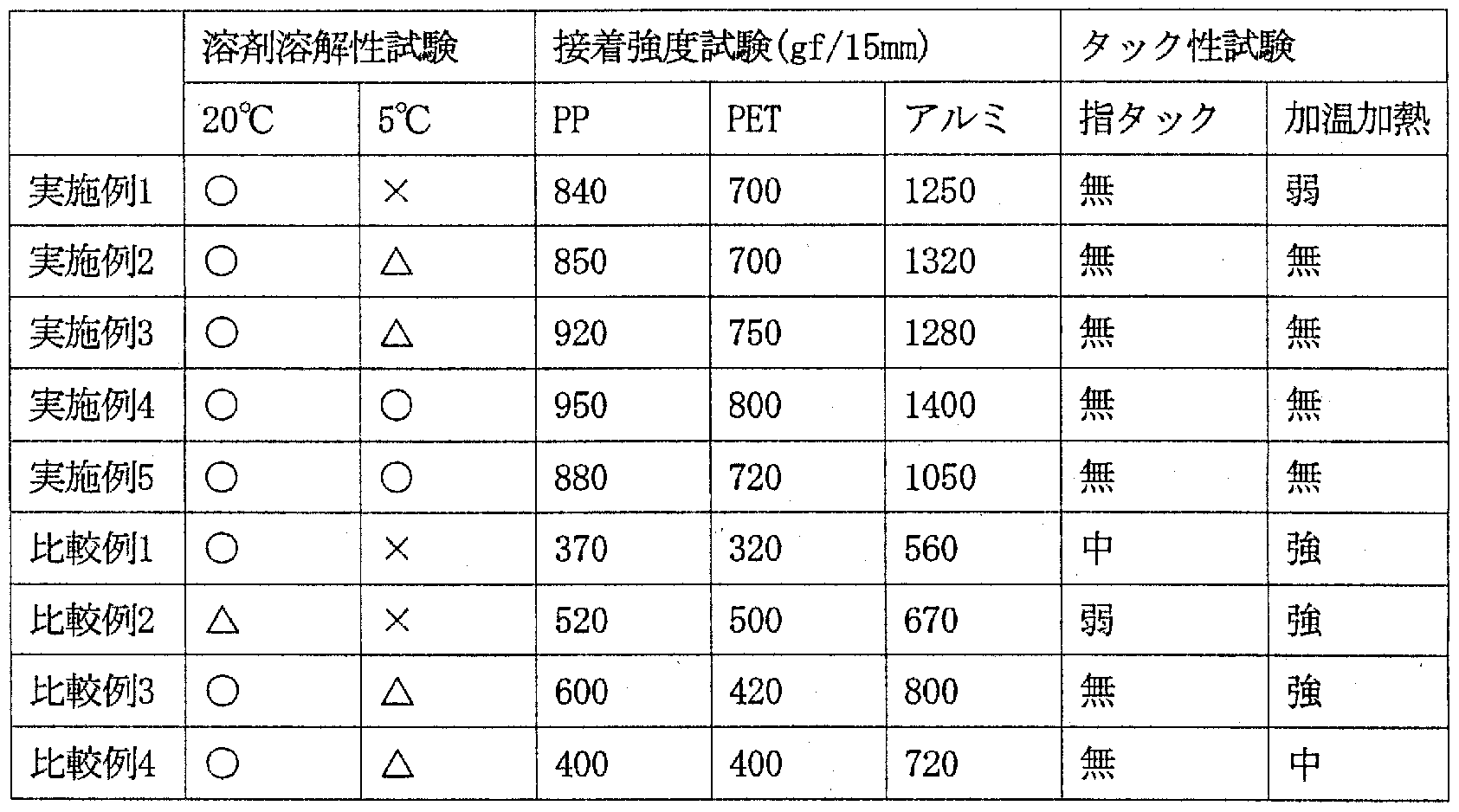
- the above-described toluene solution was applied to an aluminum foil using a # 16 Meyer bar, and dried at room temperature for 24 hours. After drying, the film was overlaid with an unstretched polypropylene film and heat-sealed using a No. 276 heat seal tester (Yasuda Seiki Seisakusho) at 1.5 kg / cm2 at 200 ° C for 1 second. Each test piece was cut to a width of 15 mm, peeled off at 100 mmZmin using a tensile tester, and the peel strength was measured. The test was performed three times, and the average value was used as the result. The results are shown in Table 1.
- Test 3 Tack test [Finger tack test]
- the toluene solution described above was applied to a biaxially stretched polypropylene film having been subjected to a surface treatment using a # 16 Meyer bar, and dried at room temperature for 24 hours. After drying, the film was bent so that the coated surfaces overlapped, lightly pressed with a finger, and then peeled off.
- Table 1 The results are shown in Table 1.
- the film separates a few seconds after releasing the finger.
- the toluene solution described above was applied to a biaxially stretched polypropylene film having been subjected to a surface treatment using a # 16 Meyer bar, and dried at room temperature for 24 hours. After drying, the film was overlaid with an uncoated biaxially stretched polypropylene film, weighed under a load of 30 gfZcm 2 , and stored in an atmosphere of 10% RH or less and 50 ° C. After a lapse of 24 hours, the superposed films were peeled off, and the tack was evaluated from the ease of peeling.
- Test 4 Primer test
- the toluene solution was spray-coated on an ultra-high-rigidity polypropylene plate so that the dry coating thickness was 10 to 15 m, and dried at 80 ° C for 30 minutes.
- a two-component overcoating white paint was spray-applied so that the dry coating thickness was 45 to 50 m, left at room temperature for 15 minutes, and baked at 90 ° C for 30 minutes. After leaving the test piece at room temperature for 3 days, A test similar to the test was performed. Table 2 shows the results.
- a bleached cloth is applied to the surface of each coating film using an aqueous adhesive and backed. Cut the lmm width with a knife and carefully peel off the edge force halfway as if it were peeling off between the substrate and the coating film of the product of the present invention. The specimen thus prepared was peeled off at 100 mmZmin using a tensile tester, and the peel strength was measured.
- Scratches (marked X) reaching the substrate were put on the surface of each coating film with a cutter knife, immersed in gasoline, and the state of the coating film was visually observed.
- a scratch (X mark) reaching the substrate was put on the surface of each coating film with a cutter knife, immersed in a solution in which gasoline and ethanol were mixed at 9/1 (vol / vol), and the state of the coating film was visually observed.
- Test 5 Ink test
- the ink was prepared by diluting with a # 3 Zahn cup with toluene to a viscosity of 25-30 seconds / 20 ° C.
- the obtained ink was subjected to an adhesive tape peeling test and a heat sealing test in the following manner. Table 2 shows the results.
- untreated polypropylene film hereinafter, untreated PP
- # 14 Meyer bar dry it at room temperature for 24 hours, and then attach a cellophane adhesive tape to the ink-coated surface.
- the state of the coated surface at the time of peeling and strong peeling was examined.
- the reaction was carried out using a twin-screw extruder. Degassing was also performed in the extruder to remove residual unreacted materials.
- the resulting modified polypropylene resin had a weight average molecular weight of 98,000, a molecular weight distribution (MwZMn) of 2.7, and a graft weight of itaconic anhydride of 5.8% by weight.
- Propylene random copolymer prepared meta spout catalyst as a polymerization catalyst 100 parts by weight of maleic anhydride 8 parts by weight of acid, 8 parts by weight of methyl methacrylate, and 3 parts by weight of dicumyl peroxide were reacted using a twin-screw extruder set at 180 ° C. Degassing was also performed in the extruder to remove residual unreacted materials.
- the reaction was carried out using a twin-screw extruder set at 180 ° C. by weight of 8 parts by weight of itaconic anhydride, 8 parts by weight of stearyl methacrylate, and 3 parts by weight of di-butyl butyl oxide. Degassing was also performed in the extruder to remove residual unreacted materials.
- the resulting modified polypropylene resin had a weight average molecular weight of 75,000, a molecular weight distribution (MwZMn) of 3.0, a graft weight of itaconic anhydride of 6.1% by weight, and a graft weight of stearyl methacrylate of 6.2. % By weight.
- the resulting modified polypropylene resin had a weight average molecular weight of 133,000, a molecular weight distribution (MwZMn) of 3.2, and a graft weight of maleic anhydride of 5.8% by weight.
- the graft weight of acrylic acid was 1.2% by weight
- the graft weight of cyclohexyl methacrylate was 1.3% by weight
- the graft weight of tridecyl methacrylate was 1.0% by weight.
- the resulting modified polypropylene resin had a weight average molecular weight of 66,000, a molecular weight distribution (MwZMn) of 2.5, a maleic anhydride graft weight of 5.6% by weight, and a methyl methacrylate graft weight of 6%. It was 5% by weight.
- a modified propylene resin having a molecular weight distribution (MwZMn) of 5.5 and a graft weight of maleic anhydride of 5.2% by weight was obtained.
- a modified propylene resin having a molecular weight distribution (MwZMn) of 6.4, a graft weight of anhydrous maleic acid of 5.9% by weight, and a graft weight of methyl methacrylate of 6.3% by weight was obtained.
- Example 6 In a four-necked flask equipped with a stirrer, condenser, thermometer and dropping funnel, 100 parts by weight of the modified polyolefin resin obtained in Example 6 (prototype 1) and polyoxyethylene alkyl ether sulfate as a surfactant were used. 10 parts by weight of the salt was added and kneaded at 120 ° C. for 30 minutes. Next, 10 parts by weight of dimethylethanolamine was added over 5 minutes, and after maintaining for 5 minutes, 300 parts by weight of ion-exchanged water at 90 ° C. was added over 40 minutes. Continue stirring to room temperature. The mixture was vigorously cooled to obtain an aqueous resin composition. The aqueous resin composition had a solid content of 30% by weight, a pH of 7.5, a viscosity of 47 mPa's Z25 ° C, and an average particle size of 122 nm.
- Example 7 Using the modified polyolefin resin 100 parts by weight obtained in Example 7 (prototype example 2), the surfactant was changed to 10 parts by weight of polyoxyethylene alkylamine, and the other operations were the same as in Example 11, An aqueous resin composition was obtained.
- the aqueous resin composition had a solid content of 30% by weight, a pH of 7.9, a viscosity of 76 mPa's Z25 ° C, and an average particle size of 86 nm.
- Example 8 The same operation as in Example 11 was performed except that 300 parts by weight of the modified polyolefin resin obtained in (Prototype Example 3) was used, and the surfactant was changed to 10 parts by weight of polyoxyethylene alkyl ether sulfate. Thus, an aqueous resin composition was obtained.
- the aqueous resin composition had a solid content of 50% by weight, a pH of 6.8, a viscosity of 136 mPa's Z25 ° C, and an average particle size of 75 ⁇ m.
- Example 10 (100 parts by weight of the modified polyolefin resin obtained in Prototype Example 10) was used, and the surfactant was changed to 10 parts by weight of polyoxyethylene alkylamine. An aqueous resin composition was obtained. The aqueous resin composition had a solid content of 30% by weight, a pH of 7.9, a viscosity of 68 mPa's Z25 ° C, and an average particle size of 76 nm. [Comparative Example 10]
- aqueous resin composition was obtained in the same manner as in Example 11 using 100 parts by weight of the modified polyolefin resin obtained in Comparative Example 5 (Prototype Example 5).
- the aqueous resin composition has a solid content of 30% by weight, a pH of 7.3, a viscosity of 75 mPa's Z25 ° C, and an average particle size of 108 nm.
- an aqueous resin composition was obtained in the same manner as in Example 12.
- the aqueous resin composition has a solid content of 30% by weight, a pH of 7.9, a viscosity of 108 mPa's Z25 ° C, and an average particle size of 92 nm.
- Comparative Example 7 The same operation as in Example 12 was performed except that 300 parts by weight of the modified polyolefin resin obtained in Prototype Example 7 was used, and the surfactant was changed to 10 parts by weight of polyoxyethylene alkyl ether sulfate. Thus, an aqueous resin composition was obtained.
- the aqueous resin composition has a solid content of 50% by weight, a pH of 6.8, a viscosity of 279 mPa's Z25 ° C, and an average particle size of 86 nm.
- An aqueous resin composition was obtained in the same manner as in Example 14 using 100 parts by weight of the modified polyolefin resin obtained in Comparative Example 8 (Trial Production Example 8).
- the solid content of the aqueous resin composition was 30% by weight, the pH was 7.9, the viscosity was 132 mPa's Z25 ° C, and the average particle size was 19 lnm.
- Example 8 An aqueous resin composition was prepared in the same manner as in Example 13, except that 100 parts by weight of the modified polyolefin resin obtained in (Trial Production Example 3) was used, and the amount of the surfactant was changed to 2 parts by weight. A product was obtained.
- the aqueous resin composition had a solid content of 30% by weight, a pH of 6.7, a viscosity of 237 mPa'sZ25 ° C, and an average particle size of 342 nm. Table 3 summarizes the physical properties and the like of Examples 11 to 15 and Comparative Examples 10 to 15 described above.
- the aqueous resin composition was applied to a polypropylene film using a # 7 Meyer bar, and dried at room temperature for 15 hours.
- the test piece was bent so that the coating surfaces overlapped, lightly pressed with a finger, and then peeled off. Evaluate the blocking resistance from the ease of peeling.
- Aqueous resin composition is applied to ultra-high rigidity polypropylene plate. It was spray-coated so that it was below, and dried at 70 ° C for 30 minutes. After leaving the test piece to stand at room temperature for 3 days, make a cut on the coating surface to reach the substrate with a cutter, make 100 grids at 1 mm intervals, and attach cellophane adhesive tape on the grid to make a 180 degree orientation. It was peeled off five times and the number of remaining grids was counted.
- the aqueous resin composition was applied to a polypropylene film or a PET film using a # 7 Meyer bar and dried at room temperature for 15 hours.
- the coated surfaces were overlapped, and 1.5 kg / cm 2 , 90 using No. 296 heat seal tester (Yasuda Seiki Seisakusho). C, heat sealing was performed for 10 seconds.
- Each test piece was cut to a width of 1.5 cm, peeled off using a tensile tester under the conditions of 5 kg weight and 100 mmZmin, and the peel strength was measured. The test was performed three times, and the average value was used as the result.
- the aqueous resin composition was stored at room temperature, and observed three months later.
- Aqueous Iridani polyurethane was blended at a solid content ratio of 1: 1 and the mixture was sufficiently stirred and stored at room temperature for 30 days to confirm the properties of the solution.
- Blocking resistance ⁇ without blocking X: with blocking Storage stability ⁇ : good X: with sedimentation, separation
- Comparative Example 15 when the average particle size exceeds 300 nm, the results of blocking resistance, adhesion, and heat sealing strength are good, but storage stability and compatibility are inferior.
- Test 6 Primer test
- aqueous resin compositions obtained in Examples 11 to 15 and Comparative Examples 10 to 15 was adjusted to have a solid content of 10% by weight, and a dry film was formed on an ultra-high-rigidity polypropylene plate. It was spray-coated so as to be 15 / zm or less, and dried at 60 ° C for 30 minutes. Next, a two-component overcoating white paint was spray-coated so that the dry coating thickness was 45 to 50 m, left at room temperature for 15 minutes, and then forcibly dried at 70 ° C for 30 minutes. After the test pieces were allowed to stand for 3 days, the following tests were performed. Table 5 shows the results.
- test piece was immersed in warm water of 40 ° C for 240 hours, the state of the coating film was visually observed, and an adhesion test was performed by a grid test.
- a bleached cloth is applied to the surface of each coating film using an aqueous adhesive and backed. Cut a lmm-width cut with a knife on the cloth and carefully peel off the edge force halfway so that it peels off between the base material and the coating film of the product of the present invention.
- the specimen thus prepared was peeled off at 100 mmZmin using a tensile tester, and the peel strength was measured.
- Scratches (marked X) reaching the substrate were put on the surface of each coating film with a cutter knife, immersed in gasoline, and the state of the coating film was visually observed.
- a scratch (X mark) reaching the substrate was put on the surface of each coating film with a cutter knife, immersed in a solution in which gasoline and ethanol were mixed in 9Z1 (vol / vol), and the state of the coating film was visually observed.
Landscapes
- Chemical & Material Sciences (AREA)
- Organic Chemistry (AREA)
- Chemical Kinetics & Catalysis (AREA)
- Health & Medical Sciences (AREA)
- Polymers & Plastics (AREA)
- Medicinal Chemistry (AREA)
- Wood Science & Technology (AREA)
- Life Sciences & Earth Sciences (AREA)
- Materials Engineering (AREA)
- Engineering & Computer Science (AREA)
- General Chemical & Material Sciences (AREA)
- Addition Polymer Or Copolymer, Post-Treatments, Or Chemical Modifications (AREA)
- Paints Or Removers (AREA)
- Compositions Of Macromolecular Compounds (AREA)
- Adhesives Or Adhesive Processes (AREA)
- Processes Of Treating Macromolecular Substances (AREA)
- Graft Or Block Polymers (AREA)
- Inks, Pencil-Leads, Or Crayons (AREA)
Abstract
Description


Claims
Priority Applications (4)
| Application Number | Priority Date | Filing Date | Title |
|---|---|---|---|
| EP05710180.0A EP1719786B1 (en) | 2004-02-26 | 2005-02-14 | Modified polyolefin resin |
| US10/590,941 US20070191547A1 (en) | 2004-02-26 | 2005-02-14 | Modified polyolefin resin |
| CA002557421A CA2557421C (en) | 2004-02-26 | 2005-02-14 | Modified polyolefin resin |
| JP2006510395A JPWO2005082963A1 (ja) | 2004-02-26 | 2005-02-14 | 変性ポリオレフィン樹脂 |
Applications Claiming Priority (4)
| Application Number | Priority Date | Filing Date | Title |
|---|---|---|---|
| JP2004052468 | 2004-02-26 | ||
| JP2004-052468 | 2004-02-26 | ||
| JP2004157711 | 2004-05-27 | ||
| JP2004-157711 | 2004-05-27 |
Publications (1)
| Publication Number | Publication Date |
|---|---|
| WO2005082963A1 true WO2005082963A1 (ja) | 2005-09-09 |
Family
ID=34914447
Family Applications (1)
| Application Number | Title | Priority Date | Filing Date |
|---|---|---|---|
| PCT/JP2005/002178 Ceased WO2005082963A1 (ja) | 2004-02-26 | 2005-02-14 | 変性ポリオレフィン樹脂 |
Country Status (6)
| Country | Link |
|---|---|
| US (1) | US20070191547A1 (ja) |
| EP (1) | EP1719786B1 (ja) |
| JP (1) | JPWO2005082963A1 (ja) |
| KR (1) | KR100802976B1 (ja) |
| CA (1) | CA2557421C (ja) |
| WO (1) | WO2005082963A1 (ja) |
Cited By (32)
| Publication number | Priority date | Publication date | Assignee | Title |
|---|---|---|---|---|
| JP2006233125A (ja) * | 2005-02-28 | 2006-09-07 | Dainippon Ink & Chem Inc | コーティング剤及びそれを用いた熱転写シート |
| JP2007002116A (ja) * | 2005-06-24 | 2007-01-11 | Tonen Chem Corp | 包装用接着剤及びそれを用いてなる易開封性包装体 |
| JP2007091933A (ja) * | 2005-09-29 | 2007-04-12 | Nippon Paper Chemicals Co Ltd | 低温焼付け対応型塩素化酸変性ポリオレフィン、それを含む組成物、及びそれらの用途 |
| JP2007321058A (ja) * | 2006-06-01 | 2007-12-13 | Nippon Paper Chemicals Co Ltd | 水性変性ポリオレフィン樹脂組成物 |
| WO2008013085A1 (en) | 2006-07-25 | 2008-01-31 | Nippon Paper Chemicals Co., Ltd. | Modified polyolefin resin and uses thereof |
| JP2008056913A (ja) * | 2006-07-31 | 2008-03-13 | Toyota Motor Corp | 自動車内装材用水性塗料組成物 |
| WO2008066168A1 (en) * | 2006-12-01 | 2008-06-05 | Idemitsu Kosan Co., Ltd. | Graft copolymer, thermoplastic resin composition comprising the graft copolymer, and those production method |
| JP2008238760A (ja) * | 2007-03-29 | 2008-10-09 | Toyoda Gosei Co Ltd | 樹脂積層体及びその製造方法 |
| JP2008239925A (ja) * | 2007-03-29 | 2008-10-09 | Nippon Paper Chemicals Co Ltd | 分散樹脂組成物およびその製造方法 |
| JP2008238761A (ja) * | 2007-03-29 | 2008-10-09 | Toyoda Gosei Co Ltd | ポリウレタン材料及びその製造方法 |
| JP2009110883A (ja) * | 2007-10-31 | 2009-05-21 | Mitsui Chemicals Inc | 電気化学セル用バインダー |
| JP2009114315A (ja) * | 2007-11-06 | 2009-05-28 | Mitsui Chemicals Inc | コーティング剤 |
| WO2009096375A1 (ja) * | 2008-01-30 | 2009-08-06 | Idemitsu Kosan Co., Ltd. | ポリオレフィン系グラフト共重合体を含有する水系分散体 |
| WO2009110425A1 (ja) * | 2008-03-05 | 2009-09-11 | 住友化学株式会社 | 粘着剤層付位相差フィルム及びそれを用いた楕円偏光板及び液晶表示装置 |
| JP2009209182A (ja) * | 2008-02-29 | 2009-09-17 | Dic Corp | 水性樹脂組成物および塗装物 |
| WO2009113630A1 (ja) * | 2008-03-14 | 2009-09-17 | 出光興産株式会社 | ポリオレフィン系グラフト共重合体および接着剤組成物 |
| JP2009227975A (ja) * | 2008-02-28 | 2009-10-08 | Unitika Ltd | 燃料難溶性コート剤、それから形成された塗膜、及び積層体 |
| US7750078B2 (en) | 2005-12-07 | 2010-07-06 | Exxonmobil Chemical Patents Inc. | Systems and methods used for functionalization of polymeric material and polymeric materials prepared therefrom |
| WO2012090646A1 (ja) | 2010-12-28 | 2012-07-05 | 東亞合成株式会社 | 接着剤組成物及びそれを用いた熱融着性部材 |
| JP2012188495A (ja) * | 2011-03-09 | 2012-10-04 | Umg Abs Ltd | プロピレン系グラフト重合体、成形体、塗料および接着剤 |
| JP2013512969A (ja) * | 2008-12-03 | 2013-04-18 | アルケマ フランス | ポリプロピレンおよび/または再生可能な材料から得られるプロピレン・コポリマーを含む組成物と、その使用 |
| JP2015021108A (ja) * | 2013-07-23 | 2015-02-02 | 東亞合成株式会社 | 接着剤組成物及びそれを用いた熱融着性部材 |
| WO2015080269A1 (ja) * | 2013-11-29 | 2015-06-04 | 日本製紙株式会社 | 変性ポリオレフィン系樹脂 |
| WO2015152101A1 (ja) * | 2014-03-31 | 2015-10-08 | 日本製紙株式会社 | 金属とポリプロピレン系樹脂組成物の積層複合体とその製造方法 |
| JP2017074675A (ja) * | 2014-12-04 | 2017-04-20 | 合資会社アンドーコーポレーション | 金属とポリプロピレン系樹脂組成物の積層複合体とその製造方法 |
| JP2017074674A (ja) * | 2014-03-31 | 2017-04-20 | 合資会社アンドーコーポレーション | 金属とポリプロピレン系樹脂組成物の複合体とその製造方法 |
| JP2018131616A (ja) * | 2017-02-14 | 2018-08-23 | 三洋化成工業株式会社 | 変性ポリオレフィン水性分散体、前記変性ポリオレフィン水性分散体の製造方法、前記変性ポリオレフィン水性分散体を含有する塗料、プライマー又は接着剤、及び、前記変性ポリオレフィン水性分散体による塗膜を有するポリオレフィン成形体 |
| JP2020023144A (ja) * | 2018-07-27 | 2020-02-13 | 日本製紙株式会社 | ハードコートフィルム及びその製造方法 |
| JP2020055184A (ja) * | 2018-09-29 | 2020-04-09 | 日本製紙株式会社 | ハードコートフィルム及びその製造方法 |
| JP2020055182A (ja) * | 2018-09-29 | 2020-04-09 | 日本製紙株式会社 | ハードコートフィルム及びその製造方法 |
| JP2020055183A (ja) * | 2018-09-29 | 2020-04-09 | 日本製紙株式会社 | ハードコートフィルム及びその製造方法 |
| KR20210036371A (ko) * | 2018-07-27 | 2021-04-02 | 니뽄 세이시 가부시끼가이샤 | 하드 코팅 필름 및 그의 제조 방법 |
Families Citing this family (11)
| Publication number | Priority date | Publication date | Assignee | Title |
|---|---|---|---|---|
| CN102352045A (zh) | 2005-06-03 | 2012-02-15 | 三菱化学株式会社 | 水性树脂分散体的制造方法 |
| US20070066729A1 (en) * | 2005-09-22 | 2007-03-22 | Ashutosh Sharma | Scratch resistant coatings compositions |
| US20090061247A1 (en) * | 2007-08-28 | 2009-03-05 | Yoshiaki Chino | Aqueous resin composition, aqueous coating composition and coating method for plastic molded articles |
| WO2009090949A1 (ja) * | 2008-01-15 | 2009-07-23 | Idemitsu Kosan Co., Ltd. | グラフト共重合体を含有するエンジニアリングプラスチック系樹脂組成物 |
| KR100983806B1 (ko) * | 2010-04-08 | 2010-09-27 | 대륭기업 주식회사 | 사출부품에 착색이 용이한 1액형 선처리제 조성물 |
| WO2015125802A1 (ja) | 2014-02-19 | 2015-08-27 | 三井化学株式会社 | グラフト変性プロピレン・α-オレフィン共重合体およびその製造方法 |
| KR101586861B1 (ko) | 2014-04-21 | 2016-01-21 | 한국신발피혁연구원 | 비할로겐 타입 단축공정 고착색 표면처리제 조성물 |
| KR101729747B1 (ko) | 2015-04-06 | 2017-04-24 | 한국신발피혁연구원 | 난연 필름용 프라이머 조성물 |
| US9969834B2 (en) * | 2015-08-25 | 2018-05-15 | Canon Kabushiki Kaisha | Wax dispersant for toner and toner |
| JP7100456B2 (ja) | 2015-12-22 | 2022-07-13 | 日本製紙株式会社 | 変性ポリオレフィン樹脂 |
| WO2021039729A1 (ja) | 2019-08-29 | 2021-03-04 | 日本製紙株式会社 | 変性ポリオレフィン樹脂及び分散体組成物 |
Citations (10)
| Publication number | Priority date | Publication date | Assignee | Title |
|---|---|---|---|---|
| JPS59217709A (ja) * | 1983-05-25 | 1984-12-07 | Mitsui Petrochem Ind Ltd | 変性プロピレン低分子量重合体およびその製法 |
| JPH02173008A (ja) * | 1988-12-26 | 1990-07-04 | Mitsui Petrochem Ind Ltd | 変性プロピレン系重合体 |
| JPH02173009A (ja) * | 1988-12-26 | 1990-07-04 | Mitsui Petrochem Ind Ltd | 変性プロピレン系重合体 |
| JPH06145286A (ja) * | 1992-11-11 | 1994-05-24 | Nippon Paper Ind Co Ltd | 水性樹脂組成物 |
| JPH0959325A (ja) * | 1995-08-18 | 1997-03-04 | Japan Synthetic Rubber Co Ltd | ゴム強化ビニル系樹脂 |
| JPH09132619A (ja) * | 1995-11-08 | 1997-05-20 | Japan Synthetic Rubber Co Ltd | ゴム強化熱可塑性樹脂および熱可塑性樹脂組成物 |
| JPH09132617A (ja) * | 1995-11-08 | 1997-05-20 | Japan Synthetic Rubber Co Ltd | ゴム強化熱可塑性樹脂および熱可塑性樹脂組成物 |
| JP2003321588A (ja) * | 2001-12-28 | 2003-11-14 | Nippon Paper Industries Co Ltd | バインダー樹脂組成物と製造方法及びその用途 |
| JP2003327761A (ja) * | 2002-03-05 | 2003-11-19 | Nippon Paper Industries Co Ltd | 水性分散液、その製造方法及び用途 |
| JP2004307838A (ja) * | 2003-03-26 | 2004-11-04 | Idemitsu Petrochem Co Ltd | 低分子量変性軟質ポリプロピレン及びホットメルト粘接着剤用樹脂組成物 |
Family Cites Families (6)
| Publication number | Priority date | Publication date | Assignee | Title |
|---|---|---|---|---|
| JP2700526B2 (ja) * | 1993-10-07 | 1998-01-21 | 日本製紙株式会社 | 水性分散液及びその製造方法 |
| JP4441151B2 (ja) * | 2000-09-29 | 2010-03-31 | 日本製紙株式会社 | 変性ポリオレフィン樹脂と変性ポリオレフィン樹脂組成物及びその用途 |
| ATE474006T1 (de) * | 2000-10-30 | 2010-07-15 | Exxonmobil Chem Patents Inc | Pfropfmodifizierte polymere auf basis neuer propylen-ethylen-copolymere |
| WO2003057778A1 (en) * | 2001-12-28 | 2003-07-17 | Nippon Paper Industries Co., Ltd. | Binder resin compositions, production process, and use thereof |
| ES2229968T1 (es) * | 2002-03-05 | 2005-05-01 | Nippon Paper Industries Co., Ltd. | Dispersion acuosa, procedimiento para su fabricacion y uso de la misma. |
| EP1500680B1 (en) * | 2002-04-26 | 2010-09-22 | Mitsubishi Chemical Corporation | Aqueous polypropylene dispersion, aqueous polypropylene composite emulsion composition, and use thereof |
-
2005
- 2005-02-14 WO PCT/JP2005/002178 patent/WO2005082963A1/ja not_active Ceased
- 2005-02-14 EP EP05710180.0A patent/EP1719786B1/en not_active Expired - Lifetime
- 2005-02-14 US US10/590,941 patent/US20070191547A1/en not_active Abandoned
- 2005-02-14 JP JP2006510395A patent/JPWO2005082963A1/ja active Pending
- 2005-02-14 KR KR1020067019770A patent/KR100802976B1/ko not_active Expired - Fee Related
- 2005-02-14 CA CA002557421A patent/CA2557421C/en not_active Expired - Lifetime
Patent Citations (10)
| Publication number | Priority date | Publication date | Assignee | Title |
|---|---|---|---|---|
| JPS59217709A (ja) * | 1983-05-25 | 1984-12-07 | Mitsui Petrochem Ind Ltd | 変性プロピレン低分子量重合体およびその製法 |
| JPH02173008A (ja) * | 1988-12-26 | 1990-07-04 | Mitsui Petrochem Ind Ltd | 変性プロピレン系重合体 |
| JPH02173009A (ja) * | 1988-12-26 | 1990-07-04 | Mitsui Petrochem Ind Ltd | 変性プロピレン系重合体 |
| JPH06145286A (ja) * | 1992-11-11 | 1994-05-24 | Nippon Paper Ind Co Ltd | 水性樹脂組成物 |
| JPH0959325A (ja) * | 1995-08-18 | 1997-03-04 | Japan Synthetic Rubber Co Ltd | ゴム強化ビニル系樹脂 |
| JPH09132619A (ja) * | 1995-11-08 | 1997-05-20 | Japan Synthetic Rubber Co Ltd | ゴム強化熱可塑性樹脂および熱可塑性樹脂組成物 |
| JPH09132617A (ja) * | 1995-11-08 | 1997-05-20 | Japan Synthetic Rubber Co Ltd | ゴム強化熱可塑性樹脂および熱可塑性樹脂組成物 |
| JP2003321588A (ja) * | 2001-12-28 | 2003-11-14 | Nippon Paper Industries Co Ltd | バインダー樹脂組成物と製造方法及びその用途 |
| JP2003327761A (ja) * | 2002-03-05 | 2003-11-19 | Nippon Paper Industries Co Ltd | 水性分散液、その製造方法及び用途 |
| JP2004307838A (ja) * | 2003-03-26 | 2004-11-04 | Idemitsu Petrochem Co Ltd | 低分子量変性軟質ポリプロピレン及びホットメルト粘接着剤用樹脂組成物 |
Non-Patent Citations (1)
| Title |
|---|
| See also references of EP1719786A4 * |
Cited By (48)
| Publication number | Priority date | Publication date | Assignee | Title |
|---|---|---|---|---|
| JP2006233125A (ja) * | 2005-02-28 | 2006-09-07 | Dainippon Ink & Chem Inc | コーティング剤及びそれを用いた熱転写シート |
| JP2007002116A (ja) * | 2005-06-24 | 2007-01-11 | Tonen Chem Corp | 包装用接着剤及びそれを用いてなる易開封性包装体 |
| JP2007091933A (ja) * | 2005-09-29 | 2007-04-12 | Nippon Paper Chemicals Co Ltd | 低温焼付け対応型塩素化酸変性ポリオレフィン、それを含む組成物、及びそれらの用途 |
| US7750078B2 (en) | 2005-12-07 | 2010-07-06 | Exxonmobil Chemical Patents Inc. | Systems and methods used for functionalization of polymeric material and polymeric materials prepared therefrom |
| JP2007321058A (ja) * | 2006-06-01 | 2007-12-13 | Nippon Paper Chemicals Co Ltd | 水性変性ポリオレフィン樹脂組成物 |
| WO2008013085A1 (en) | 2006-07-25 | 2008-01-31 | Nippon Paper Chemicals Co., Ltd. | Modified polyolefin resin and uses thereof |
| US8236900B2 (en) | 2006-07-25 | 2012-08-07 | Nippon Paper Chemicals Co., Ltd. | Modified polyolefin resin and uses thereof |
| EP2050770A4 (en) * | 2006-07-25 | 2009-11-25 | Nippon Paper Chemicals Co Ltd | MODIFIED POLYOLEFIN RESIN AND USES THEREOF |
| JP2008056913A (ja) * | 2006-07-31 | 2008-03-13 | Toyota Motor Corp | 自動車内装材用水性塗料組成物 |
| WO2008066168A1 (en) * | 2006-12-01 | 2008-06-05 | Idemitsu Kosan Co., Ltd. | Graft copolymer, thermoplastic resin composition comprising the graft copolymer, and those production method |
| JP5512973B2 (ja) * | 2006-12-01 | 2014-06-04 | 出光興産株式会社 | グラフト共重合体又は該共重合体を含有する熱可塑性樹脂組成物及びそれらの製造方法 |
| JP2008238760A (ja) * | 2007-03-29 | 2008-10-09 | Toyoda Gosei Co Ltd | 樹脂積層体及びその製造方法 |
| JP2008239925A (ja) * | 2007-03-29 | 2008-10-09 | Nippon Paper Chemicals Co Ltd | 分散樹脂組成物およびその製造方法 |
| JP2008238761A (ja) * | 2007-03-29 | 2008-10-09 | Toyoda Gosei Co Ltd | ポリウレタン材料及びその製造方法 |
| JP2009110883A (ja) * | 2007-10-31 | 2009-05-21 | Mitsui Chemicals Inc | 電気化学セル用バインダー |
| JP2009114315A (ja) * | 2007-11-06 | 2009-05-28 | Mitsui Chemicals Inc | コーティング剤 |
| WO2009096375A1 (ja) * | 2008-01-30 | 2009-08-06 | Idemitsu Kosan Co., Ltd. | ポリオレフィン系グラフト共重合体を含有する水系分散体 |
| US8546481B2 (en) | 2008-01-30 | 2013-10-01 | Idemitsu Kosan Co., Ltd. | Aqueous dispersion containing polyolefin graft copolymer |
| JP2009227975A (ja) * | 2008-02-28 | 2009-10-08 | Unitika Ltd | 燃料難溶性コート剤、それから形成された塗膜、及び積層体 |
| JP2009209182A (ja) * | 2008-02-29 | 2009-09-17 | Dic Corp | 水性樹脂組成物および塗装物 |
| JP2009210878A (ja) * | 2008-03-05 | 2009-09-17 | Sumitomo Chemical Co Ltd | 粘着剤層付位相差フィルム及びそれを用いた楕円偏光板及び液晶表示装置 |
| TWI490609B (zh) * | 2008-03-05 | 2015-07-01 | Sumitomo Chemical Co | A retardation film with an adhesive layer, and an elliptically polarizing plate and a liquid crystal display device using the same |
| WO2009110425A1 (ja) * | 2008-03-05 | 2009-09-11 | 住友化学株式会社 | 粘着剤層付位相差フィルム及びそれを用いた楕円偏光板及び液晶表示装置 |
| JP2009221328A (ja) * | 2008-03-14 | 2009-10-01 | Idemitsu Kosan Co Ltd | ポリオレフィン系グラフト共重合体および接着剤組成物 |
| WO2009113630A1 (ja) * | 2008-03-14 | 2009-09-17 | 出光興産株式会社 | ポリオレフィン系グラフト共重合体および接着剤組成物 |
| US8507604B2 (en) | 2008-03-14 | 2013-08-13 | Idemitsu Kosan Co., Ltd. | Polyolefin graft copolymer and adhesive composition |
| JP2013512969A (ja) * | 2008-12-03 | 2013-04-18 | アルケマ フランス | ポリプロピレンおよび/または再生可能な材料から得られるプロピレン・コポリマーを含む組成物と、その使用 |
| WO2012090646A1 (ja) | 2010-12-28 | 2012-07-05 | 東亞合成株式会社 | 接着剤組成物及びそれを用いた熱融着性部材 |
| JP2012188495A (ja) * | 2011-03-09 | 2012-10-04 | Umg Abs Ltd | プロピレン系グラフト重合体、成形体、塗料および接着剤 |
| JP2015021108A (ja) * | 2013-07-23 | 2015-02-02 | 東亞合成株式会社 | 接着剤組成物及びそれを用いた熱融着性部材 |
| JPWO2015080269A1 (ja) * | 2013-11-29 | 2017-03-16 | 日本製紙株式会社 | 変性ポリオレフィン系樹脂 |
| WO2015080269A1 (ja) * | 2013-11-29 | 2015-06-04 | 日本製紙株式会社 | 変性ポリオレフィン系樹脂 |
| CN106132699B (zh) * | 2014-03-31 | 2019-05-28 | 日本制纸株式会社 | 金属与聚丙烯系树脂组合物的层叠复合体及其制造方法 |
| JP2017074674A (ja) * | 2014-03-31 | 2017-04-20 | 合資会社アンドーコーポレーション | 金属とポリプロピレン系樹脂組成物の複合体とその製造方法 |
| US10086589B2 (en) * | 2014-03-31 | 2018-10-02 | Nippon Paper Industries Co., Ltd. | Multilayer composite body of metal and polypropylene-based resin composition and method for producing same |
| WO2015152101A1 (ja) * | 2014-03-31 | 2015-10-08 | 日本製紙株式会社 | 金属とポリプロピレン系樹脂組成物の積層複合体とその製造方法 |
| JP2017074675A (ja) * | 2014-12-04 | 2017-04-20 | 合資会社アンドーコーポレーション | 金属とポリプロピレン系樹脂組成物の積層複合体とその製造方法 |
| JP2018131616A (ja) * | 2017-02-14 | 2018-08-23 | 三洋化成工業株式会社 | 変性ポリオレフィン水性分散体、前記変性ポリオレフィン水性分散体の製造方法、前記変性ポリオレフィン水性分散体を含有する塗料、プライマー又は接着剤、及び、前記変性ポリオレフィン水性分散体による塗膜を有するポリオレフィン成形体 |
| KR20210036371A (ko) * | 2018-07-27 | 2021-04-02 | 니뽄 세이시 가부시끼가이샤 | 하드 코팅 필름 및 그의 제조 방법 |
| JP2020023144A (ja) * | 2018-07-27 | 2020-02-13 | 日本製紙株式会社 | ハードコートフィルム及びその製造方法 |
| JP7323973B2 (ja) | 2018-07-27 | 2023-08-09 | 日本製紙株式会社 | ハードコートフィルム及びその製造方法 |
| US11970593B2 (en) | 2018-07-27 | 2024-04-30 | Nippon Paper Industries Co., Ltd. | Hard coat film and method for producing same |
| KR102852893B1 (ko) | 2018-07-27 | 2025-09-02 | 니뽄 세이시 가부시끼가이샤 | 하드 코팅 필름 및 그의 제조 방법 |
| JP2020055184A (ja) * | 2018-09-29 | 2020-04-09 | 日本製紙株式会社 | ハードコートフィルム及びその製造方法 |
| JP2020055182A (ja) * | 2018-09-29 | 2020-04-09 | 日本製紙株式会社 | ハードコートフィルム及びその製造方法 |
| JP2020055183A (ja) * | 2018-09-29 | 2020-04-09 | 日本製紙株式会社 | ハードコートフィルム及びその製造方法 |
| JP7185470B2 (ja) | 2018-09-29 | 2022-12-07 | 日本製紙株式会社 | ハードコートフィルム及びその製造方法 |
| JP7185471B2 (ja) | 2018-09-29 | 2022-12-07 | 日本製紙株式会社 | ハードコートフィルム及びその製造方法 |
Also Published As
| Publication number | Publication date |
|---|---|
| KR20060129505A (ko) | 2006-12-15 |
| US20070191547A1 (en) | 2007-08-16 |
| CA2557421A1 (en) | 2005-09-09 |
| CA2557421C (en) | 2010-02-02 |
| EP1719786A4 (en) | 2008-02-06 |
| EP1719786B1 (en) | 2020-05-06 |
| EP1719786A1 (en) | 2006-11-08 |
| JPWO2005082963A1 (ja) | 2007-11-15 |
| KR100802976B1 (ko) | 2008-02-14 |
Similar Documents
| Publication | Publication Date | Title |
|---|---|---|
| KR100802976B1 (ko) | 변성 폴리올레핀 수지, 및 이를 함유하는 접착제, 프라미어, 결합제, 조성물 및 폴리올레핀 성형체 | |
| US8236900B2 (en) | Modified polyolefin resin and uses thereof | |
| JP6902885B2 (ja) | 変性ポリオレフィン樹脂 | |
| JP6970095B2 (ja) | 変性ポリオレフィン系樹脂 | |
| JP4055995B2 (ja) | 水性分散液、その製造方法及び用途 | |
| JP2015105294A (ja) | 変性ポリオレフィン系樹脂 | |
| JP2008214414A (ja) | 変性ポリオレフィン分散樹脂組成物およびそれを含有するプライマー | |
| JP2004277617A (ja) | 低温流動性良好なバインダー樹脂溶液組成物 | |
| JP7297736B2 (ja) | 変性ポリオレフィン樹脂及びその用途 | |
| WO2021039729A1 (ja) | 変性ポリオレフィン樹脂及び分散体組成物 | |
| JP2002080666A (ja) | 溶液性状が良好なバインダー樹脂溶液組成物 | |
| JP2007204671A (ja) | 水性分散体および積層体 | |
| CN112166129A (zh) | 改性聚烯烃树脂、以及其用途和制造方法 | |
| KR20230153432A (ko) | 수성 분산체 | |
| JP7505662B2 (ja) | 水性分散体組成物 | |
| JP3590459B2 (ja) | ラミネート用水性印刷インキ組成物およびそれを用いたラミネート方法 | |
| JP2022115493A (ja) | 分散体組成物 | |
| JP2004217807A (ja) | 低温安定性良好な塩素化ポリオレフィン系樹脂溶液 | |
| KR20250164203A (ko) | 수지 조성물, 수성 수지 조성물, 수성 접착제 및 적층체 | |
| TW202600666A (zh) | 樹脂組成物、水性樹脂組成物、水性黏接劑及疊層體 | |
| JP2004189794A (ja) | バインダー樹脂溶液組成物 | |
| JP2022032386A (ja) | 変性ポリオレフィン樹脂組成物 | |
| JP2010059273A (ja) | 水性分散液および塗膜の製造方法 |
Legal Events
| Date | Code | Title | Description |
|---|---|---|---|
| AK | Designated states |
Kind code of ref document: A1 Designated state(s): AE AG AL AM AT AU AZ BA BB BG BR BW BY BZ CA CH CN CO CR CU CZ DE DK DM DZ EC EE EG ES FI GB GD GE GH GM HR HU ID IL IN IS JP KE KG KP KR KZ LC LK LR LS LT LU LV MA MD MG MK MN MW MX MZ NA NI NO NZ OM PG PH PL PT RO RU SC SD SE SG SK SL SM SY TJ TM TN TR TT TZ UA UG US UZ VC VN YU ZA ZM ZW |
|
| AL | Designated countries for regional patents |
Kind code of ref document: A1 Designated state(s): GM KE LS MW MZ NA SD SL SZ TZ UG ZM ZW AM AZ BY KG KZ MD RU TJ TM AT BE BG CH CY CZ DE DK EE ES FI FR GB GR HU IE IS IT LT LU MC NL PL PT RO SE SI SK TR BF BJ CF CG CI CM GA GN GQ GW ML MR NE SN TD TG |
|
| 121 | Ep: the epo has been informed by wipo that ep was designated in this application | ||
| WWE | Wipo information: entry into national phase |
Ref document number: 2006510395 Country of ref document: JP |
|
| WWE | Wipo information: entry into national phase |
Ref document number: 2557421 Country of ref document: CA |
|
| WWE | Wipo information: entry into national phase |
Ref document number: 2005710180 Country of ref document: EP |
|
| WWE | Wipo information: entry into national phase |
Ref document number: 200580005869.4 Country of ref document: CN |
|
| WWE | Wipo information: entry into national phase |
Ref document number: 10590941 Country of ref document: US Ref document number: 2007191547 Country of ref document: US |
|
| WWE | Wipo information: entry into national phase |
Ref document number: 1020067019770 Country of ref document: KR |
|
| WWP | Wipo information: published in national office |
Ref document number: 2005710180 Country of ref document: EP |
|
| WWP | Wipo information: published in national office |
Ref document number: 1020067019770 Country of ref document: KR |
|
| WWP | Wipo information: published in national office |
Ref document number: 10590941 Country of ref document: US |