WO2005090510A1 - 樹脂組成物及び該樹脂組成物を使用して作製した半導体装置 - Google Patents
樹脂組成物及び該樹脂組成物を使用して作製した半導体装置 Download PDFInfo
- Publication number
- WO2005090510A1 WO2005090510A1 PCT/JP2005/004700 JP2005004700W WO2005090510A1 WO 2005090510 A1 WO2005090510 A1 WO 2005090510A1 JP 2005004700 W JP2005004700 W JP 2005004700W WO 2005090510 A1 WO2005090510 A1 WO 2005090510A1
- Authority
- WO
- WIPO (PCT)
- Prior art keywords
- compound
- resin composition
- composition according
- formula
- represented
- Prior art date
- Legal status (The legal status is an assumption and is not a legal conclusion. Google has not performed a legal analysis and makes no representation as to the accuracy of the status listed.)
- Ceased
Links
Classifications
-
- C—CHEMISTRY; METALLURGY
- C09—DYES; PAINTS; POLISHES; NATURAL RESINS; ADHESIVES; COMPOSITIONS NOT OTHERWISE PROVIDED FOR; APPLICATIONS OF MATERIALS NOT OTHERWISE PROVIDED FOR
- C09J—ADHESIVES; NON-MECHANICAL ASPECTS OF ADHESIVE PROCESSES IN GENERAL; ADHESIVE PROCESSES NOT PROVIDED FOR ELSEWHERE; USE OF MATERIALS AS ADHESIVES
- C09J201/00—Adhesives based on unspecified macromolecular compounds
- C09J201/02—Adhesives based on unspecified macromolecular compounds characterised by the presence of specified groups, e.g. terminal or pendant functional groups
-
- C—CHEMISTRY; METALLURGY
- C08—ORGANIC MACROMOLECULAR COMPOUNDS; THEIR PREPARATION OR CHEMICAL WORKING-UP; COMPOSITIONS BASED THEREON
- C08F—MACROMOLECULAR COMPOUNDS OBTAINED BY REACTIONS ONLY INVOLVING CARBON-TO-CARBON UNSATURATED BONDS
- C08F220/00—Copolymers of compounds having one or more unsaturated aliphatic radicals, each having only one carbon-to-carbon double bond, and only one being terminated by only one carboxyl radical or a salt, anhydride ester, amide, imide or nitrile thereof
- C08F220/02—Monocarboxylic acids having less than ten carbon atoms; Derivatives thereof
- C08F220/52—Amides or imides
- C08F220/54—Amides, e.g. N,N-dimethylacrylamide or N-isopropylacrylamide
- C08F220/58—Amides, e.g. N,N-dimethylacrylamide or N-isopropylacrylamide containing oxygen in addition to the carbonamido oxygen, e.g. N-methylolacrylamide, N-(meth)acryloylmorpholine
-
- C—CHEMISTRY; METALLURGY
- C08—ORGANIC MACROMOLECULAR COMPOUNDS; THEIR PREPARATION OR CHEMICAL WORKING-UP; COMPOSITIONS BASED THEREON
- C08F—MACROMOLECULAR COMPOUNDS OBTAINED BY REACTIONS ONLY INVOLVING CARBON-TO-CARBON UNSATURATED BONDS
- C08F290/00—Macromolecular compounds obtained by polymerising monomers on to polymers modified by introduction of aliphatic unsaturated end or side groups
- C08F290/02—Macromolecular compounds obtained by polymerising monomers on to polymers modified by introduction of aliphatic unsaturated end or side groups on to polymers modified by introduction of unsaturated end groups
- C08F290/06—Polymers provided for in subclass C08G
-
- C—CHEMISTRY; METALLURGY
- C08—ORGANIC MACROMOLECULAR COMPOUNDS; THEIR PREPARATION OR CHEMICAL WORKING-UP; COMPOSITIONS BASED THEREON
- C08G—MACROMOLECULAR COMPOUNDS OBTAINED OTHERWISE THAN BY REACTIONS ONLY INVOLVING UNSATURATED CARBON-TO-CARBON BONDS
- C08G73/00—Macromolecular compounds obtained by reactions forming a linkage containing nitrogen with or without oxygen or carbon in the main chain of the macromolecule, not provided for in groups C08G12/00 - C08G71/00
- C08G73/06—Polycondensates having nitrogen-containing heterocyclic rings in the main chain of the macromolecule
- C08G73/10—Polyimides; Polyester-imides; Polyamide-imides; Polyamide acids or similar polyimide precursors
- C08G73/12—Unsaturated polyimide precursors
-
- C—CHEMISTRY; METALLURGY
- C08—ORGANIC MACROMOLECULAR COMPOUNDS; THEIR PREPARATION OR CHEMICAL WORKING-UP; COMPOSITIONS BASED THEREON
- C08K—Use of inorganic or non-macromolecular organic substances as compounding ingredients
- C08K3/00—Use of inorganic substances as compounding ingredients
- C08K3/02—Elements
- C08K3/08—Metals
-
- C—CHEMISTRY; METALLURGY
- C08—ORGANIC MACROMOLECULAR COMPOUNDS; THEIR PREPARATION OR CHEMICAL WORKING-UP; COMPOSITIONS BASED THEREON
- C08L—COMPOSITIONS OF MACROMOLECULAR COMPOUNDS
- C08L79/00—Compositions of macromolecular compounds obtained by reactions forming in the main chain of the macromolecule a linkage containing nitrogen with or without oxygen or carbon only, not provided for in groups C08L61/00 - C08L77/00
- C08L79/04—Polycondensates having nitrogen-containing heterocyclic rings in the main chain; Polyhydrazides; Polyamide acids or similar polyimide precursors
- C08L79/08—Polyimides; Polyester-imides; Polyamide-imides; Polyamide acids or similar polyimide precursors
- C08L79/085—Unsaturated polyimide precursors
-
- C—CHEMISTRY; METALLURGY
- C09—DYES; PAINTS; POLISHES; NATURAL RESINS; ADHESIVES; COMPOSITIONS NOT OTHERWISE PROVIDED FOR; APPLICATIONS OF MATERIALS NOT OTHERWISE PROVIDED FOR
- C09J—ADHESIVES; NON-MECHANICAL ASPECTS OF ADHESIVE PROCESSES IN GENERAL; ADHESIVE PROCESSES NOT PROVIDED FOR ELSEWHERE; USE OF MATERIALS AS ADHESIVES
- C09J179/00—Adhesives based on macromolecular compounds obtained by reactions forming in the main chain of the macromolecule a linkage containing nitrogen, with or without oxygen, or carbon only, not provided for in groups C09J161/00 - C09J177/00
- C09J179/04—Polycondensates having nitrogen-containing heterocyclic rings in the main chain; Polyhydrazides; Polyamide acids or similar polyimide precursors
- C09J179/08—Polyimides; Polyester-imides; Polyamide-imides; Polyamide acids or similar polyimide precursors
-
- C—CHEMISTRY; METALLURGY
- C09—DYES; PAINTS; POLISHES; NATURAL RESINS; ADHESIVES; COMPOSITIONS NOT OTHERWISE PROVIDED FOR; APPLICATIONS OF MATERIALS NOT OTHERWISE PROVIDED FOR
- C09J—ADHESIVES; NON-MECHANICAL ASPECTS OF ADHESIVE PROCESSES IN GENERAL; ADHESIVE PROCESSES NOT PROVIDED FOR ELSEWHERE; USE OF MATERIALS AS ADHESIVES
- C09J201/00—Adhesives based on unspecified macromolecular compounds
- C09J201/02—Adhesives based on unspecified macromolecular compounds characterised by the presence of specified groups, e.g. terminal or pendant functional groups
- C09J201/025—Adhesives based on unspecified macromolecular compounds characterised by the presence of specified groups, e.g. terminal or pendant functional groups containing nitrogen atoms
-
- H—ELECTRICITY
- H10—SEMICONDUCTOR DEVICES; ELECTRIC SOLID-STATE DEVICES NOT OTHERWISE PROVIDED FOR
- H10W—GENERIC PACKAGES, INTERCONNECTIONS, CONNECTORS OR OTHER CONSTRUCTIONAL DETAILS OF DEVICES COVERED BY CLASS H10
- H10W40/00—Arrangements for thermal protection or thermal control
- H10W40/20—Arrangements for cooling
- H10W40/25—Arrangements for cooling characterised by their materials
- H10W40/251—Organics
-
- H—ELECTRICITY
- H10—SEMICONDUCTOR DEVICES; ELECTRIC SOLID-STATE DEVICES NOT OTHERWISE PROVIDED FOR
- H10W—GENERIC PACKAGES, INTERCONNECTIONS, CONNECTORS OR OTHER CONSTRUCTIONAL DETAILS OF DEVICES COVERED BY CLASS H10
- H10W70/00—Package substrates; Interposers; Redistribution layers [RDL]
- H10W70/60—Insulating or insulated package substrates; Interposers; Redistribution layers
- H10W70/67—Insulating or insulated package substrates; Interposers; Redistribution layers characterised by their insulating layers or insulating parts
- H10W70/69—Insulating materials thereof
- H10W70/695—Organic materials
-
- H—ELECTRICITY
- H10—SEMICONDUCTOR DEVICES; ELECTRIC SOLID-STATE DEVICES NOT OTHERWISE PROVIDED FOR
- H10W—GENERIC PACKAGES, INTERCONNECTIONS, CONNECTORS OR OTHER CONSTRUCTIONAL DETAILS OF DEVICES COVERED BY CLASS H10
- H10W72/00—Interconnections or connectors in packages
- H10W72/071—Connecting or disconnecting
-
- C—CHEMISTRY; METALLURGY
- C08—ORGANIC MACROMOLECULAR COMPOUNDS; THEIR PREPARATION OR CHEMICAL WORKING-UP; COMPOSITIONS BASED THEREON
- C08F—MACROMOLECULAR COMPOUNDS OBTAINED BY REACTIONS ONLY INVOLVING CARBON-TO-CARBON UNSATURATED BONDS
- C08F234/00—Copolymers of cyclic compounds having no unsaturated aliphatic radicals in a side chain and having one or more carbon-to-carbon double bonds in a heterocyclic ring
- C08F234/02—Copolymers of cyclic compounds having no unsaturated aliphatic radicals in a side chain and having one or more carbon-to-carbon double bonds in a heterocyclic ring in a ring containing oxygen
-
- C—CHEMISTRY; METALLURGY
- C08—ORGANIC MACROMOLECULAR COMPOUNDS; THEIR PREPARATION OR CHEMICAL WORKING-UP; COMPOSITIONS BASED THEREON
- C08K—Use of inorganic or non-macromolecular organic substances as compounding ingredients
- C08K3/00—Use of inorganic substances as compounding ingredients
- C08K3/18—Oxygen-containing compounds, e.g. metal carbonyls
- C08K3/24—Acids; Salts thereof
- C08K3/26—Carbonates; Bicarbonates
-
- C—CHEMISTRY; METALLURGY
- C08—ORGANIC MACROMOLECULAR COMPOUNDS; THEIR PREPARATION OR CHEMICAL WORKING-UP; COMPOSITIONS BASED THEREON
- C08K—Use of inorganic or non-macromolecular organic substances as compounding ingredients
- C08K5/00—Use of organic ingredients
- C08K5/0008—Organic ingredients according to more than one of the "one dot" groups of C08K5/01 - C08K5/59
- C08K5/0025—Crosslinking or vulcanising agents; including accelerators
-
- C—CHEMISTRY; METALLURGY
- C08—ORGANIC MACROMOLECULAR COMPOUNDS; THEIR PREPARATION OR CHEMICAL WORKING-UP; COMPOSITIONS BASED THEREON
- C08K—Use of inorganic or non-macromolecular organic substances as compounding ingredients
- C08K5/00—Use of organic ingredients
- C08K5/04—Oxygen-containing compounds
- C08K5/14—Peroxides
-
- H—ELECTRICITY
- H10—SEMICONDUCTOR DEVICES; ELECTRIC SOLID-STATE DEVICES NOT OTHERWISE PROVIDED FOR
- H10W—GENERIC PACKAGES, INTERCONNECTIONS, CONNECTORS OR OTHER CONSTRUCTIONAL DETAILS OF DEVICES COVERED BY CLASS H10
- H10W72/00—Interconnections or connectors in packages
- H10W72/071—Connecting or disconnecting
- H10W72/073—Connecting or disconnecting of die-attach connectors
- H10W72/07331—Connecting techniques
- H10W72/07337—Connecting techniques using a polymer adhesive, e.g. an adhesive based on silicone or epoxy
-
- H—ELECTRICITY
- H10—SEMICONDUCTOR DEVICES; ELECTRIC SOLID-STATE DEVICES NOT OTHERWISE PROVIDED FOR
- H10W—GENERIC PACKAGES, INTERCONNECTIONS, CONNECTORS OR OTHER CONSTRUCTIONAL DETAILS OF DEVICES COVERED BY CLASS H10
- H10W72/00—Interconnections or connectors in packages
- H10W72/30—Die-attach connectors
- H10W72/351—Materials of die-attach connectors
- H10W72/352—Materials of die-attach connectors comprising metals or metalloids, e.g. solders
-
- H—ELECTRICITY
- H10—SEMICONDUCTOR DEVICES; ELECTRIC SOLID-STATE DEVICES NOT OTHERWISE PROVIDED FOR
- H10W—GENERIC PACKAGES, INTERCONNECTIONS, CONNECTORS OR OTHER CONSTRUCTIONAL DETAILS OF DEVICES COVERED BY CLASS H10
- H10W72/00—Interconnections or connectors in packages
- H10W72/30—Die-attach connectors
- H10W72/351—Materials of die-attach connectors
- H10W72/353—Materials of die-attach connectors not comprising solid metals or solid metalloids, e.g. ceramics
- H10W72/354—Materials of die-attach connectors not comprising solid metals or solid metalloids, e.g. ceramics comprising polymers
-
- H—ELECTRICITY
- H10—SEMICONDUCTOR DEVICES; ELECTRIC SOLID-STATE DEVICES NOT OTHERWISE PROVIDED FOR
- H10W—GENERIC PACKAGES, INTERCONNECTIONS, CONNECTORS OR OTHER CONSTRUCTIONAL DETAILS OF DEVICES COVERED BY CLASS H10
- H10W74/00—Encapsulations, e.g. protective coatings
Definitions
- the present invention relates to a resin composition and a semiconductor device manufactured using the resin composition.
- a chip surface layer having low mechanical strength has become common in accordance with a high processing speed of a semiconductor device.
- a thermal expansion of a semiconductor element and a copper frame occurs.
- Low-temperature curing has also been required to minimize the amount of warpage of the semiconductor element based on the difference in the coefficients and to prevent oxidation of the copper frame.
- the semiconductor element itself is bonded to a metal heat spreader, or a heat spreader is attached to a die pad portion of a lead frame to which the semiconductor element is bonded.
- a redder is bonded, or the die pad is exposed on the package surface to serve as a radiator plate.
- a semiconductor element is bonded to an organic substrate or the like that has a radiator mechanism such as a thermal via. .
- a material for bonding the semiconductor element needs to have high thermal conductivity.
- the high thermal conductive adhesive has several problems as follows (for example, see Japanese Patent Application Laid-Open No. 11-43587).
- metal fillers such as silver powder and copper powder are added to high thermal conductive adhesives
- thermally conductive particles such as ceramic fillers such as aluminum nitride and boron nitride are added to organic binders at a high content.
- High thermal conductivity may not be obtained due to the limited amount of power that can be contained.
- a high thermal conductive adhesive containing a large amount of solvent has good thermal conductivity of the cured product itself, but when applied to semiconductor products, it becomes a void after the solvent remains or volatilizes in the cured product and becomes a void. The rate may not be stable. Further, even if a large amount of heat conductive fine particles can be contained in the adhesive, the low stress property may be insufficient due to the high content of the heat conductive fine particles.
- solder has been used as solder at the time of mounting on a board, and thus it has been necessary to raise the reflow temperature as compared with the case where tin-lead solder was used.
- the use of such lead-free solder increases the stress due to the high temperature of the reflow temperature, so that during the reflow step, peeling and cracks are likely to occur in the semiconductor product, and the semiconductor tends to crack.
- Higher reflow resistance (high reflow reliability) power is increasingly required for product components.
- Ni—Pd plating is used to improve the stability of the Pd layer on the surface, and a thin gold plating (gold flash) is performed on the Pd layer.
- gold flash a thin gold plating
- the adhesive strength on the surface is lower than that of a plated copper frame or the like.
- the surface of the Ni—Pd plating frame is roughened and physically roughened. In such a roughened surface, the die attach paste is often used. Resin bleed occurs and causes serious problems such as reduced package reliability.
- the imide compound when used alone, has a high polarity, and when used alone, has a disadvantage that the water absorption of the cured product is increased and the properties of the cured product after moisture absorption are deteriorated. Also, when used in combination with other components, it is necessary to add highly polar components in order to achieve uniform mixing, and these added components also deteriorate the properties of the cured product after moisture absorption as described above. — Adhesion to poorly adherent surfaces such as Pd plating frame, low stress resistance to withstand stress increase due to rising reflow temperature by changing to lead-free solder, and moisture resistance. Helped.
- the present invention has been accomplished in view of the above-mentioned circumstances, and a first object of the invention is to be excellent in fast curing and capable of coping with curing in an oven which has been conventionally used. ⁇ A resin composition, and when the resin composition is used as a die attach material for semiconductors Another object of the present invention is to provide a semiconductor device having excellent reliability such as solder crack resistance.
- a second object of the present invention is to provide a resin composition having sufficient low stress and good adhesiveness, and further preferably exhibiting excellent bleeding property, and a resin composition for a semiconductor die.
- An object of the present invention is to provide a semiconductor device having excellent reliability by using it as an attachment material or a material for bonding a heat radiation member.
- the object of the present invention is characterized in that it contains at least a filler (A), the following compound (B) and a thermal radical initiator (C), and contains substantially no photopolymerization initiator. And a highly reliable semiconductor device can be obtained by using the resin composition.
- m is an integer of 1 or more and 50 or less. When two or more parts represented by the same sign are included in the formula, they may be the same or different. )
- R 2 is CH or CH 1
- R 3 is carbon atom 1
- bismaleimidide conjugates represented by the following general formula (3) ( ⁇ ′) is a particularly preferred compound.
- X 2 is O COO— or OCOO—
- R 4 is a hydrogen atom or a methyl group
- R 5 is a hydrocarbon group having 11 to 11 carbon atoms
- R 6 Is a hydrocarbon group having 3 to 6 carbon atoms
- n is an integer of 1 to 50.
- the resin composition according to the present invention contains the filler (A), the compound (B), and the thermal radical initiator (C) as essential components, and further includes other optional components. Can be added. Among such combinations of essential components and optional components, particularly preferred are the first to sixth composition systems.
- the first composition system contains at least the filler (A), the compound (B), the thermal radical initiator (C), and the following compound (D), and substantially comprises a photopolymerization initiator. It is a composition system containing no.
- the compound (D) is a compound having a structure represented by the general formula (4) in the main chain skeleton and having at least one functional group having a polymerizable carbon-carbon unsaturated bond.
- X 3 is O—COO or —OCOO—
- R 7 is a hydrocarbon group having 3 to 6 carbon atoms.
- P is an integer of 1 or more and 50 or less. When two or more parts represented by the same sign are included in the formula, they may be the same or different from each other. Good. )
- the second composition system includes at least the filler (A), the compound (B), the thermal radical initiator (C), the compound (D) used in the first composition system, and
- the composition is a composition containing a combination of the compound (L) and the following compound (M) and containing substantially no photopolymerization initiator.
- the compound (L) is a compound having a structure represented by the general formula (11) in the main chain skeleton and having at least one glycidyl group.
- ⁇ , X 7 are O COO— or OCOO—, and R 15 is a hydrocarbon group having 3 to 6 carbon atoms.
- U is an integer of 2 or more and 50 or less. When two or more portions represented by the same symbol are included in the formula, they may be the same or different from each other.
- the compound (M) is a compound having a functional group capable of reacting with the glycidyl group of the compound (L).
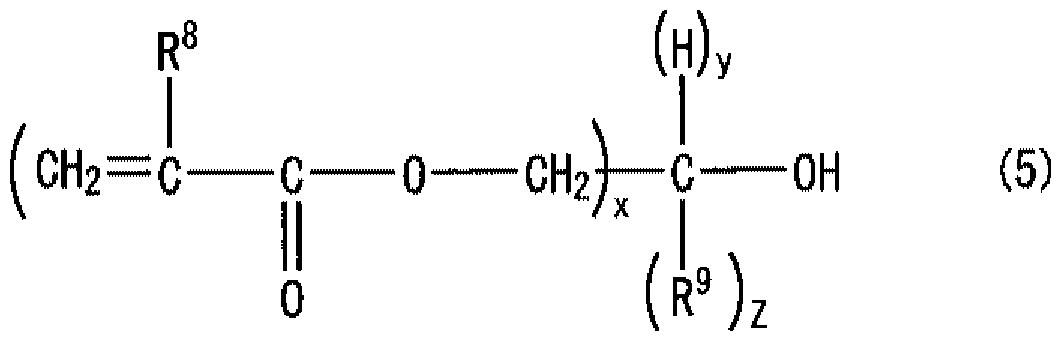
- the third composition system includes at least the filler (A), the compound (B), the thermal radical initiator (C), and the following acrylate ester (E), and substantially
- the composition contains no photopolymerization initiator! / ⁇ .
- the acrylate ester conjugate (E) is a compound represented by the following general formula (5). [0027] [Formula 6]
- R 8 is a hydrogen atom or a methyl group
- R 9 is a hydrogenated hydrogen group having 13 to 13 carbon atoms.
- the fourth composition system contains at least the filler (A), the compound (B), the thermal radical initiator (C), and the following acrylamide copolymer (F), and substantially A photopolymerization initiator is not contained in the! / ⁇ composition system.
- the acrylamido conjugate (F) is a compound having a structure represented by the general formula (6) in the main chain skeleton and having at least one functional group represented by the general formula (7).
- X 4 is O—, —COO or —OCOO—
- R 1G is a hydrocarbon group having 3 to 6 carbon atoms
- R 11 is a hydrogen atom or a methyl group.
- R is an integer greater than or equal to 1 and less than or equal to 50.
- the fifth composition system includes at least the filler (A), the compound (B), and the thermal radical. It is an! / II composition system containing an initiator (C) and the following arylesteride conjugate (G), and substantially not containing a photopolymerization initiator.
- the arylesteride conjugate (G) is a compound having at least one functional group represented by the general formula (8).
- R 12 is a hydrocarbon group having 2 to 8 carbon atoms.
- the sixth composition system includes at least the filler (A), the compound (B), the thermal radical initiator (C), the following compound (H), and a reactive diluent (I), Further, it is a composition system containing substantially no photopolymerization initiator.
- Compound (H) is a hydrocarbon derivative having a number-average molecular weight of 500-5000 and having at least one carbon-carbon unsaturated bond in one molecule, and a structure represented by the general formula (10) at the place of modification. And a compound having at least one functional group having a polymerizable carbon-carbon unsaturated bond.
- X 6 is O—, —COO or —OCOO—
- R 14 is a hydrocarbon group having 3 to 6 carbon atoms.
- T is an integer of 1 or more and 50 or less. When two or more parts represented by the same symbol are included in the formula, they may be different from each other even if they are the same.
- the resin composition of the present invention particularly those belonging to the above-mentioned first to sixth composition systems, have an adhesive strength, a rapid curing property, a moisture resistance, a low stress when used for an adhesive for a semiconductor element. Excellent in nature, In addition, it is compatible with oven curing, and has particularly excellent adhesion between copper lead frames and semiconductor elements. Further, the obtained semiconductor device has excellent solder crack resistance. As a result, a highly reliable semiconductor device can be obtained.
- those belonging to the third composition system show excellent bleeding properties together with good low stress properties and good adhesiveness.
- a material for bonding a heat radiating member, or an attach material for a heat sink member By using it as a die attach material for a semiconductor, a material for bonding a heat radiating member, or an attach material for a heat sink member, a highly reliable semiconductor device can be obtained.
- the (meth) atalyloyl group means an atalyloyl group and Z or a methacryloyl group.
- a resin composition which is very suitable as an adhesive for a semiconductor element or a heat dissipation member, and the resin composition comprises at least a filler (A) and the following compound ( B)
- X 1 is O—, —COO or —OCOO—
- R 1 is a hydrocarbon group having 16 to 16 carbon atoms
- m is an integer of 1 or more and 50 or less.
- R 2 is CH or CH 1
- R 3 is carbon atom 1
- filler (A) used in the present invention silver powder is often used, and its content is usually 70 to 95% by weight in the resin composition.
- Other examples of the filler (A) include gold powder, copper powder, nickel powder, palladium powder, aluminum nitride, boron nitride, calcium carbonate, silica, and alumina.
- silver powder (A) which is commercially available for electronic materials is usually used.
- a silver powder a reduced powder, an atomized powder and the like are available, and a preferable particle size is an average particle size of 110 ⁇ m. If the average particle size is smaller than this range, the viscosity of the resin composition becomes too high, and if the average particle size is larger than this range, nozzle clogging may occur during dispense. Care must be taken in the use of silver powders other than those for electronic materials, since the amount of ionic impurities may be large in some cases.
- the silver powder preferably has a silver content of 90% by weight or more. As long as the silver content is 90% by weight or more, alloys with other metals can be used.
- the thermal conductivity decreases, which is not preferable.
- the shape is not particularly limited, such as a flake shape and a spherical shape, but preferably a flake shape is used, and usually 70 to 95% by weight is contained in the resin composition. If the proportion of the silver powder is smaller than this, the thermal conductivity and possibly the required electric conductivity are deteriorated, and if it is larger than this, the viscosity of the resin composition becomes too high.
- the main chain skeleton used in the present invention contains a structure represented by the general formula (1), and
- the hydrocarbon R 1 contained in the repeating unit in the main chain skeleton preferably does not contain an aromatic ring.
- the number of carbon atoms of the hydrocarbon R 1 may be 1 to 6, but is preferably limited to the range of 3 to 6.
- the carbon number of the hydrocarbon R 1 may be 1 to 6, but is preferably limited to the range of 3 to 6.
- the water absorption property of the cured product is deteriorated. Under severe water-absorbing conditions such as PCT (Pressure Tucker Test).
- PCT Pressure Tucker Test
- the number of carbon atoms is 6 or less, if the number is more than this, the hydrophobicity of the resin becomes too strong, and the adhesive force to the oxidizable metal surface such as copper is bad. This is for dagger.
- it is a hydrocarbon group having 3 or 4 carbon atoms.
- forces containing O—, —COO or OCOO as a portion represented by the symbol X 1 are necessary for exerting the flexibility of the cured product, This is because it is necessary to improve the solubility in liquid or other components as a raw material.
- the portion represented by the symbol X 1 is preferably o (ether bond).
- the number of repetitions m may be 1 to 50. However, when the repetition number m is 1, the desired cured product may not be able to exhibit the flexibility, and therefore it is preferably 2 or more. On the other hand, if the repetition number m is more than 50, the viscosity becomes too high, which is not preferable for practical use.
- such a repeating unit can be used as a copolymer with two or more kinds or with other components.
- the functional group represented by the general formula (2) is necessary for exhibiting good adhesive strength to a metal-plated surface such as silver plating and nickel-Z palladium plating. Contains two in the molecule.
- Hydrocarbon R 2 contained in the functional group is preferably -CH scratch. Also this officer
- the hydrocarbon R 3 contained in the functional group preferably has no aromatic ring, and preferably has 15 to 15 carbon atoms, particularly preferably CH—.
- the bismaleimide conjugate ( ⁇ ′) represented by the following general formula (3) is a particularly preferred U and imide.
- X 2 is O COO or OCOO—
- R 4 is a hydrogen atom or a methyl group
- R 5 is a hydrocarbon group having 11 to 11 carbon atoms
- R 6 is a hydrocarbon group having 3 to 6 carbon atoms
- n is an integer of 1 to 50.
- the bismaleimidized conjugate ( ⁇ ') shows good fluidity and obtains good adhesiveness even when the filler ( ⁇ ), especially silver powder, is blended.
- the bismaleimidide conjugate ( ⁇ ') contains a maleimide group or a derivative thereof as a functional group, and when used together with the thermal radical initiator (C) described below, a good reaction under heating can be achieved. In addition to exhibiting good properties, it exhibits good adhesion to poorly adherent metal surfaces such as silver plating and Ni-Pd plating due to the polarity of the imide ring.
- the bismaleimide compound (') has two functional groups in one molecule. This is because the expected effect of improving the adhesive strength is not sufficient in the case of monofunctional, but it is Is a force that takes into account the fact that the molecular weight increases and the viscosity increases, which leads to an increase in the viscosity of the resin composition.
- vinyl conjugates having a (meth) atalyloyl group are copolymerized with bismaleimide conjugates ( ⁇ '). Since it is possible, it can be suitably used as a diluent.
- R 5 in the general formula bismaleimide I ⁇ product ( ⁇ ') (3), which may be a hydrocarbon group having 1 one 11 carbon atoms, and those that do not contain aromatic rings Is preferred. Further, the number of carbon atoms is preferably one to five. If the number of carbon atoms is 6 or more, it may not be used because the crystallinity increases. Desirable R 5 has 1 or 5 carbon atoms, and particularly preferably has 1 carbon atom.
- R 6 in the general formula (3) is a hydrocarbon group having 3 to 6 carbon atoms, and preferably does not contain an aromatic ring. If the number of carbon atoms is less than this, the water absorption properties are poor, and the properties such as adhesive strength are poor under severe water absorption conditions such as PCT. If the number is more than this, the hydrophobicity of the resin composition is high. Becomes too strong, the adhesive strength to a metal surface or the like which is easily oxidized such as copper is deteriorated, and the crystallinity is increased. More preferred carbon number is 3 or 4
- X 2 in the general formula (3) contains a ⁇ —, —COO or —OCOO— group! /, which is necessary for exhibiting the flexibility of the cured product and This is because it becomes liquid as a raw material or is necessary for improving solubility in other components.
- X 2 is ⁇ ⁇ is preferred.
- the number of repetitions ⁇ of the repeating unit included in the general formula (3) is set to 50 or less. If the number of repetitions ⁇ is more than 50, the viscosity becomes too high, which is not preferable for practical use.
- the repeating unit satisfies the above conditions, two or more kinds of such repeating units can be used as copolymers with other components.
- Such compounds include compounds having an amino group and a carboxyl group and having a hydrocarbon group having 115 carbon atoms between the amino group and the carboxyl group (namely, glycine, alanine, aminocapron).
- An amino acid such as an acid) and maleic anhydride or a derivative thereof are reacted to synthesize a maleimidized amino acid, which is available by reacting it with a polyalkylene oxide diol, a polyalkylene ester diol, or the like.
- a thermal radical initiator (C) is used as a reaction initiator for the compound (II) and other polymerizable components described below.
- a thermal radical polymerization initiator is preferable. Is preferably 40 to 140 ° C. If the decomposition temperature is lower than 40 ° C, the storage stability of the resin composition at normal temperature becomes poor, and if it exceeds 140 ° C, the curing time becomes extremely long, which is not preferable.
- thermal radical polymerization initiator satisfying such requirements include methylethyl ketone peroxide, methylcyclohexanone peroxide, methylacetoacetate peroxide, acetylacetone peroxide, and 1,1-bis (tbutylperoxy).
- the thermal radical initiator (C) is preferably contained in the resin composition at 0.001 to 12% by weight.
- the resin composition of the present invention is generally used under illumination such as a fluorescent lamp, if a photopolymerization initiator is contained, an increase in viscosity due to a reaction during use is observed.
- a photopolymerization initiator is contained, an increase in viscosity due to a reaction during use is observed.
- the term “substantially” means that the photopolymerization initiator may be present in a trace amount so that no increase in viscosity is observed, and preferably not contained.
- the resin composition of the present invention comprises, together with the filler (A), the compound (B) and the thermal radical initiator (C), the following compound (D) and the following acrylate ester (E)
- the filler (A) the compound (B) and the thermal radical initiator (C)
- the following compound (D) the following compound (D) and the following acrylate ester (E)
- acrylamide compound (F) the following allylic ester conjugate (G), and the following compound (H)
- better adhesion performance and physical properties after curing for example, Curability, adhesion, reflow resistance, low stress, bleed, or other properties That is, one or more properties can be improved.
- These compounds (D)-(H) are capable of initiating a radical polymerization reaction with a thermal radical initiator and copolymerizable with the compound (B), similarly to the compound (B).
- Component
- the compound (D) used in the present invention refers to at least a functional group containing a structure represented by the general formula (4) in the main chain skeleton and having a polymerizable carbon-carbon unsaturated bond. A compound that has one.
- X 3 is O—COO or —OCOO—
- R 7 is a hydrocarbon group having 3 to 6 carbon atoms.
- P is an integer of 1 or more and 50 or less. When two or more parts represented by the same symbol are included in the formula, they may be the same or different from each other.
- the number of carbon atoms of the hydrocarbon R 7 contained in the repeating unit (X 3 —R 7 ) in the main chain skeleton is limited to 3-6. If the number is less than this, the water absorption properties of the cured product will be poor, and properties such as adhesive strength will be poor under severe water absorption conditions such as PCT. The reason for this is that the hydrophobicity of the resin becomes too strong, and the adhesive strength to a metal surface or the like which is easily oxidized such as copper is deteriorated.
- repeating unit (X 3 — R 7 ) contains a bond of either O COO or OCOO as the part indicated by the symbol X 3. This is the flexibility of the cured product and sufficient adhesion. This is the power needed to demonstrate strength.
- Examples of the functional group having a polymerizable carbon-carbon unsaturated bond include a (meth) atalyloyl group and a butyl group, but are not particularly limited thereto, and a plurality of types can be used in combination.
- Compound (D) has a carbon-carbon unsaturated bond in one molecule. It is preferable to have two or more combinations.
- the acrylate ester conjugate (E) is a compound represented by the following general formula (5).
- R is a hydrogen atom or a methyl group
- R 9 is a hydrocarbon group having 13 to 13 carbon atoms (preferably an alkyl group.)
- low-viscosity acrylate ester acrylates such as mono (meth) acrylate and di (meth) acrylate are used as a reactive diluent, but are represented by the general formula (5).
- the acrylate compound (E) good adhesiveness and excellent bleeding can be exhibited.
- “Bleed” refers to a phenomenon in which the resin component of the resin composition spreads on the surface of the adherend when the resin composition is applied to an adherend such as a lead frame or during heat curing. However, this is an unfavorable phenomenon because it may cause ground bond (semiconductor element force is also a wire bond to the die pad) failure, or may lower the adhesive strength of the sealing material to the die pad, causing peeling and cracking.
- “excellent in bleeding property” means that bleeding is unlikely to occur! /, That is, that the above-described problem hardly occurs.
- R 8 is a methyl group
- R 9 is a methyl group
- the acrylamide conjugate (F) used in the present invention includes a structure represented by the general formula (6) in the main chain skeleton and at least a functional group represented by the general formula (7). It has one compound.
- R 1G is a hydrocarbon group having 3 to 6 carbon atoms
- R 11 is a hydrogen atom or a methyl group.
- R is an integer greater than or equal to 1 and less than or equal to 50.
- the acrylamido conjugate (F) has 3 to 6, preferably 3 or 4 carbon atoms of the hydrocarbon R 1C> contained in the repeating unit (X 4 —R 1C) ) in the main chain skeleton.
- the number of carbon atoms is less than 4, the water absorption properties of the cured product will deteriorate, and the properties such as adhesive strength will deteriorate under severe and water-absorbing conditions such as PCT.
- the number of carbon atoms is more than S, the hydrophobicity of the resin becomes too strong and the adhesive force to a metal surface or the like which is easily oxidized such as copper is deteriorated.
- the repeating unit (X 4 —R 1C) ) contains a bond represented by the symbol X 4 , which includes any one of O—, —COO, and OCOO—, preferably —O—. This is because it is necessary not only to exhibit the flexibility of the substance, but also to be liquid as a raw material or to improve the solubility in other components.
- the repeating unit when the number of repetitions r is more than 50, the viscosity becomes too high, which is not practically preferable.
- such a repeating unit can be used as a copolymer of two or more kinds or other components.
- the functional group represented by the general formula (7) is necessary for exhibiting good adhesion to a metal-plated surface such as silver plating and nickel-Z palladium plating, and is preferably contained in one molecule. Includes two.
- the acrylamido conjugate (F) has at least one hydroxyl group at both terminals and a repeating unit selected from propylene oxide, tetramethylene oxide and butylene oxide, and has a molecular weight of 300 to 2500.
- a reaction product of (meth) acrylamide having a hydroxyl group such as 2-hydroxyethyl (meth) acrylamide may be used.
- the arylester conjugate (G) used in the present invention is a compound having at least one functional group represented by the general formula (8).
- R 12 is a hydrocarbon group having 2 to 8 carbon atoms.
- the aryl group compound (G) having a functional group represented by the general formula (8) is copolymerizable with the compound (B) having a functional group represented by the general formula (2), and is a cured product. Excellent balance between adhesiveness and low stress.
- the number of functional groups represented by the general formula (8) is required to be at least one in one molecule from the viewpoint of curability, and more preferably two or more in one molecule.
- the sign-R 12 contained in the functional group is a hydrocarbon group of carbon number 2-8, aliphatic chain, alicyclic, either der Tsutemoyo aromatic ring, but aromatic in view of adhesiveness It is preferable that a ring is not included.
- the molecular skeleton contains a structure represented by the following general formula (9).
- X 5 is O—, —COO or —OCOO—
- R 13 is a hydrocarbon group having 3 to 6 carbon atoms.
- S is an integer of 1 or more and 50 or less. When two or more parts represented by the same symbol are included in the formula, they may be different from each other even if they are the same.
- Formula code R 13 contained in the skeleton of the formula (9) is likely to water if less than this hydrocarbon radical der Ru force carbon atoms force S of carbon number 3-6, which If the amount is larger, the hydrophobicity becomes too strong and the adhesive strength is unfavorably deteriorated.
- the number of repetitions s is greater than 50, which is an integer of 1 or more and 50 or less, the molecular weight becomes too large, causing an increase in viscosity, which is not preferable from the viewpoint of workability. More preferably carbon Number 3-4, number of repetitions 2-20.
- the compound (H) used in the present invention is a hydrocarbon derivative having a number average molecular weight of 500 to 5000 and having at least one carbon-carbon unsaturated bond in one molecule, which is generally modified.
- X 6 is O—, —COO or —OCOO—
- R 14 is a hydrocarbon group having 3 to 6 carbon atoms.
- T is an integer of 1 or more and 50 or less. When two or more parts represented by the same symbol are included in the formula, they may be different from each other even if they are the same.
- hydrocarbon derived from the compound (H) and having at least one carbon-carbon unsaturated bond in one molecule is preferably a butadiene polymer.
- U which is preferably a hydrocarbon-based isoprene polymer having at least one carbon-carbon unsaturated bond in one molecule, derived from the compound (H).
- the polymerizable carbon-carbon unsaturated bond of the compound (H) is preferably a (meth) atalyloyl group.
- the above compound (H) is, for example, a homopolymer of a gen-based compound such as polyisoprene or polybutadiene having a hydroxyl group, a carboxyl group, or a glycidyl group, or a copolymer of a gen-based compound and styrene (first Component), a functional group capable of reacting with a hydroxyl group, a carboxyl group, a glycidyl group, etc. of the polymer, a functional group having a polymerizable carbon-carbon unsaturated bond, and a repeating unit (X) contained in the compound (B).
- first Component a functional group capable of reacting with a hydroxyl group, a carboxyl group, a glycidyl group, etc. of the polymer, a functional group having a polymerizable carbon-carbon unsaturated bond, and a repeating unit (X) contained in the compound (B).
- first Component a
- the functional group having a polymerizable carbon-carbon unsaturated bond contained in the second component for example, a (meth) acryloyl group, a vinyl group or a functional group represented by the above formula (2) is exemplified. be able to.
- a homopolymer of a gen-based compound such as polyisoprene or polybutadiene or a copolymer of a gen-based compound with styrene or the like is a force necessary for exhibiting the flexibility of a cured product. If used without modification, compatibility with the compound (B) or diluent is poor, and phase separation occurs during curing.
- a homopolymer of a gen-based conjugate such as polyisoprene or polybutadiene having a hydroxyl group, a carboxyl group, or a glycidyl group, or a copolymer of a gen-based compound and styrene (first Component), a functional group capable of reacting with a hydroxyl group, a carboxyl group, a glycidyl group, or the like of the polymer, a functional group having a polymerizable carbon-carbon unsaturated bond, and a repeating unit similar to the repeating unit used in the compound (B).
- a gen-based conjugate such as polyisoprene or polybutadiene having a hydroxyl group, a carboxyl group, or a glycidyl group
- a copolymer of a gen-based compound and styrene first Component
- modified products can be used. These modified products can be used alone or in combination.
- a reactive diluent (I) may be added to the resin composition.
- a diluent for the compound (B) it is possible to use a liquid vinyl conjugate.
- the liquid vinyl compound is a (meth)
- it is a compound having an aryl group.
- Such compounds include, for example, alicyclic (meth) acrylates, aliphatic (meth) atalylates, aromatic (meth) acrylates, and aliphatic dicarboxylic acid (meth) acrylates From among aromatic dicarboxylic acid (meth) acrylic acid esters and the like, it is possible to use one kind or a plurality of kinds, but when the resin composition contains the compound (E), It is preferable that the amount of the compound (E) is equal to or less than that of the compound (E).
- Examples of such general reactive diluents include the following compounds. Methyl (meth) acrylate, ethyl (meth) acrylate, n-butyl (meth) acrylate, isobutyl (meth) acrylate, tert-butyl (meth) acrylate, isodecyl (meth) acrylate, lauryl (meta) ) Acrylate, tridecyl (meth) acrylate, cetyl (meth) acrylate, stearyl (meth) acrylate, isoamyl (meth) acrylate, isostearyl (meth) acrylate, behyl (meth) acrylate, 2-Ethylhexyl (meth) atalylate, other alkyl (meth) acrylates, cyclohexyl (meth) acrylate, tert-butyl cyclohexyl (meth) acrylate,
- silane coupling agent ⁇ in order to obtain good adhesiveness.
- silane coupling agents with S—S bonds when used with silver powder ( ⁇ ), not only improve the adhesion to the adherend, but also react with the silver powder, improving the cohesion of the resin composition and the cured product. Therefore, it is preferable because particularly excellent adhesiveness can be obtained.
- silane coupling agent having an SS bond examples include bis (trimethoxysilylpropyl) tetrasulfide, bis (triethoxysilylpropyl) tetrasulfide, bis (tributoxysilylpropyl) tetrasulfide, and bis (dimethoxymethylsilylpropyl) Tetrasulfide, bis (diethoxymethylsilylpropyl) tetrasulfide, bis (dibutoxime
- silane coupling agent having a glycidyl group it is more preferable to use a silane coupling agent having a glycidyl group together with a silane coupling agent having an SS bond.
- silane coupling agent having a glycidyl group examples include 2- (3,4-epoxycyclohexyl) ethyltrimethoxysilane, 3-glycidylglycidoxypropyltriethoxysilane, and the like.
- a compound (K) having a glycidyl group other than the above-mentioned silane coupling agent having a glycidyl group can also be added to the resin composition.
- a compound having a glycidyl group when good adhesion to the copper surface is required, addition of a compound having a glycidyl group is effective.
- the compound having a glycidyl group include bisphenol A and bisphenol F, which are glycidyl etherified bisphenols, phenol novolak, tarezol novolac, and! /, Phenol glycidyl etherified phenols, and aminophenol epoxy. Can be used.
- aliphatic glycidyl ethers for the purpose of lowering the viscosity, glycidyl ethers converted to an aliphatic ring by hydrogenated kamone, alicyclic epoxy conjugates, and the like, and glycidyl groups such as imidazole as needed.
- glycidyl groups such as imidazole as needed.
- the reacting compounds for the purpose of achieving both storage stability and reactivity, there is a mixture of 2-methylimidazole and 2,4-diamino-16-butyltriazine! /, Which uses 2-phenyl-4-methyl-5-hydroxymethylimidazole. Is preferred.
- the following compound (L) and the following compound (M) can be further combined and added to the resin composition.
- the compound (L) is a compound having a structure represented by the general formula (11) in the main chain skeleton and having at least one glycidyl group.
- X 7 is O COO— or OCOO—
- R 15 is a hydrocarbon group having 3 to 6 carbon atoms.
- U is an integer of 2 or more and 50 or less. When two or more parts represented by the same sign are included in the formula, they may be the same or different.
- the compound (M) is a compound having a functional group capable of reacting with the glycidyl group of the compound (L).
- the compound (L) having a glycidyl group is included in the repeating unit in the main chain skeleton.
- Murrell is limited to 3-6 carbon atoms in the hydrocarbon R 15, but this is small Ri recognize the number of carbon atoms force of R 15, water absorption properties of the cured product when the such Akui ⁇ Shi PCT severe evil I spoon of properties such as adhesive strength ⁇ water conditions is because the results, easily oxidizable metal surfaces such as copper becomes excessively strong hydrophobicity of ⁇ when the number of carbon atoms force R 15 more than this, such as This is because the adhesive strength to the adhesive is poor.
- repeating units O as a portion represented by reference numeral X 7 -, - COO or - but O COO- is included, this is required to exhibit flexibility and sufficient adhesion of the cured product Power.
- the reason for the need for glycidyl groups is that the introduction of glycidyl groups is particularly effective when adhesion to copper is considered.
- the introduction of glycidyl groups should improve the compatibility with various adherend surfaces. Became possible.
- the repeating unit is equal to or similar to the repeating unit (X 1 -R 1 ) of the compound (B). This is to improve the uniformity of the resin composition, especially after curing, and when the repeating units are not similar, the separation proceeds particularly when the curing is performed in an oven or the like over time. And does not show sufficient cured product properties!
- the repeating unit satisfies the above condition, two or more kinds of such repeating units or copolymers with other components can be used.
- the compound (M) having a functional group capable of reacting with the glycidyl group of the compound (L) those generally known as epoxy resin curing agents can be used.
- epoxy resin curing agents As an example, a phenolic compound, an aminy conjugate, an imidazole, and the like are mentioned.
- additives such as an antifoaming agent, a surfactant, various polymerization inhibitors, and an antioxidant can be used.
- the resin composition of the present invention can be produced, for example, by premixing the components, kneading them using a three-roll mill, and then defoaming under vacuum.
- a known method can be used. For example, using a commercially available die bonder, After the resin composition is dispensed, the chip is mounted and cured by heating. Thereafter, the semiconductor device is manufactured by wire bonding and transfer molding using an epoxy resin sealing material.
- composition systems in which the filler (A), the compound (B) and the thermal radical initiator (C) as essential components, and other optional components are combined, they are particularly preferable.
- the first to sixth composition systems will be exemplified.
- the first composition system includes at least the filler (A), the compound (B), the thermal radical initiator, (C), and the compound (D), and substantially starts photopolymerization. It is a composition system containing no agent.
- compositions further containing one or more silane coupling agents C is also preferable.
- the second composition system comprises at least the filler ( ⁇ ), the compound ( ⁇ ), the thermal radical initiator (C), the compound (D), and the compound (L) and the compound ( ⁇ ). ) And a composition system substantially free of a photopolymerization initiator.
- compositions further containing one or more silane coupling agents (J) is also preferable.
- the third composition system contains at least the filler ( ⁇ ), the compound ( ⁇ ), the thermal radical initiator (C), and the acrylate ester ( ⁇ ), and substantially
- the composition contains no photopolymerization initiator! / ⁇ .
- compositions further containing one or more silane coupling agents (J) is also preferable.
- the fourth composition system includes at least the filler ( ⁇ ), the compound ( ⁇ ), the thermal radical initiator (C), and the acrylamide conjugate (F), and substantially A photopolymerization initiator is not contained in the! / ⁇ composition system.
- a composition further containing one or more silane coupling agents (J) is also preferable.
- the fifth composition system contains at least the filler (A), the compound (B), the thermal radical initiator (C), and the arylester conjugate (G), and substantially It is a! / ⁇ composition system that does not contain a photopolymerization initiator.
- the amount of the aryl ester compound (G) is preferably 20 to 60% by weight based on the total amount of the compound (B) and the aryl ester compound (G)! If the proportion of the aryl ester compound (G) is too large, the curability may be poor.
- those further containing one or more silane coupling agents (J) are preferable.
- the sixth composition system includes at least the filler (A), the compound (B), the thermal radical initiator (C), the compound (H), and a reactive diluent (I), Further, it is a composition system containing substantially no photopolymerization initiator.
- those further containing one or more silane coupling agents (J) are preferable.
- flake silver powder having an average particle diameter of 3 ⁇ m and a maximum particle diameter of 20 ⁇ m (hereinafter referred to as “silver powder”) was used.
- lauryl atarilate manufactured by Kyoeisha-Danigaku Co., Ltd., light ester LA, hereinafter referred to as "diluent”
- silane coupling agent having a methacryl group Silane-Etsu-Danigaku Kogyo Co., Ltd .; KBM-503, hereinafter referred to as "methacrylsilane”
- Comparative Example A1 polyethylene glycol dimethacrylate (Blenmer PDE-400, manufactured by NOF CORPORATION, hereinafter referred to as “compound 4”) was used. In Comparative Example A3, bisphenol A and epichlorohydrin were used.
- Diglycidyl bisphenol A (epoxy equivalent 180, liquid at room temperature, hereinafter referred to as "bis A epoxy"), cresyl glycidyl ether (epoxy equivalent 185, hereinafter referred to as “CGE”), phenol Novolak resin (hydroxyl equivalent: 104, softening point: 85 ° C, hereinafter referred to as “PN”), 2-phenyl-4,5-dihydroxymethylimidazole (trade name, manufactured by Shikoku Chemical Industry Co., Ltd.) Curesol, hereinafter referred to as "2PHZ”) and a silane coupling agent having a glycidyl group (KBM-403E, manufactured by Shin-Etsu-Danigaku Kogyo Co., Ltd., hereinafter referred to as "epoxy silane”).
- the obtained resin composition was evaluated by the following method.
- Table 1 shows the evaluation results.
- the following lead frames and silicon chips were cured and bonded under the following curing conditions. Then, using a sealing material of Sumicon EME-7026 (manufactured by Sumitomo Bakelite Co., Ltd.), the sealed package was subjected to a moisture absorption treatment at 60 ° C and a relative humidity of 60% for 192 hours, followed by an IR reflow treatment (260 ° C, 10 ° C). (Reflow 3 times per second), and the degree of peeling of the package after the treatment was measured by an ultrasonic flaw detector (transmission type). The case where the peeling area of the die-attached part was less than 10% was judged as acceptable. The unit of the peeling area is “%”.
- Lead frame Copper frame with silver spots
- the compound (B) a polyether-based bismaleimide acetate (manufactured by Dainippon Ink and Chemicals, Inc., Lumicure MIA-200; in the general formula (2), R 2 is -CH 1, R 3 is -CH-,
- X 1 is —O— and R 1 is —CH 1, and is hereinafter referred to as “Compound 1”.
- glycidyl group-containing compound (L) polytetramethylene glycol diglycidide Ruether (manufactured by Asahi Den-Dani Kogyo Co., Ltd., hereinafter referred to as “compound 4”) and polypropylene glycol diglycidyl ether (manufactured by Asahi Den-Dani Kogyo Co., Ltd., ED-506, hereinafter) "Compound 5" was used.
- the compound (M) that reacts with the glycidyl group 2-phenyl 4,5-dihydroxymethylimidazole (manufactured by Shikoku Chemicals Co., Ltd., trade name: Curesol; hereinafter, referred to as "2PHZ”) was used.
- Dicumyl peroxide (decomposition temperature in a rapid heating test: 126 ° C, manufactured by NOF Corporation, Parkmill D, hereinafter referred to as “initiator”) was used as the thermal radical initiator (C).
- Flaky silver powder having an average particle size of 3 ⁇ m and a maximum particle size of 20 ⁇ m (hereinafter referred to as “silver powder”) was used as the filler (A).
- lauryl atarilate manufactured by Kyoeisha iDanigaku Co., Ltd., light ester LA, hereinafter referred to as “diluent”
- silane coupling agent having a methacryl group manufactured by Shin-Etsu Chemical Co., Ltd., KBM-503, hereinafter
- silane coupling agent having a glycidyl group KBM-403E, manufactured by Shin-Etsu Danigaku Kogyo Co., Ltd .; hereinafter, referred to as "epoxy silane”).
- Comparative Examples Bl and B2 polyethylene glycol dimethacrylate (manufactured by NOF Corporation, Blemmer PDE-400; hereinafter, referred to as “compound 6”) was used.
- Comparative Example B4 bisphenol A and epichlorohydrin were used.
- Diglycidyl bisphenol A epoxy equivalent 180, liquid at room temperature, hereinafter referred to as “bis A epoxy”
- cresyl glycidyl ether epoxy equivalent 185, hereinafter referred to as “CGE”
- a phenol novolak resin having a hydroxyl equivalent of 104 and a softening point of 85 ° C., hereinafter referred to as “PN”) was used.
- the obtained resin composition was evaluated by the following method.
- Table 2 shows the evaluation results.
- the value at 25 ° C and 2.5 rpm was measured immediately after preparing the resin composition. It was measured after standing at 48 ° C for 48 hours. The case where the viscosity immediately after preparation was within the range of 15 to 25 Pa.s and the rate of increase in viscosity after 48 hours was less than 20% was regarded as acceptable.
- the unit of the viscosity is “Pa.s” and the unit of the viscosity increase rate is “%”.
- the following lead frames and silicon chips were cured and bonded under the following curing conditions.
- a sealing material of Sumicon EME-7026 manufactured by Sumitomo Bakelite Co., Ltd.
- the sealed package was subjected to a moisture absorption treatment at 60 ° C and a relative humidity of 60% for 192 hours, followed by an IR reflow treatment (260 ° C, (Reflow for 3 times for 10 seconds), and the degree of peeling of the package after the treatment was measured by an ultrasonic flaw detector (transmission type).
- the case where the peeling area of the die-attached part was less than 10% was judged as acceptable.
- the unit of the peeling area is “%”.
- Lead frame Copper frame with ring (silver only on inner lead) Chip size: 6 X 6mm
- the mixture was stirred under reflux for 8 hours while removing water generated by a Dean Stark trap.
- the obtained solution phase was separated and washed about 5 times using pure water, and then desolvated using an evaporator and a vacuum dryer to obtain a product.
- the obtained product was brown crystals and the yield was about 150 g.
- the formation of the maleimide ring was confirmed by NMR and IR.
- Flaky silver powder (hereinafter, silver powder) having an average particle diameter of 8 ⁇ m and a maximum particle diameter of 30 ⁇ m was used as the silver powder as the filler (A).
- the compound (B) the above compounds B1-B4 were used.
- 2-hydroxypropylmetaarylate manufactured by Kyoeisha Chemical Co., Ltd., light ester HOP
- thermal radical initiator dicumyl peroxide (manufactured by NOF CORPORATION, Parkmill D , decomposition temperature in a rapid heating test: 126 ° C, hereinafter referred to as “initiator”) was used.
- the above compound X was used as a liquid vinyl compound.
- I-Danigo Zl 1,6-Hexanediol dimethacrylate
- BMI-80 2,2 bis [4 (4 maleimidophenoxy) phenyl] propane (BMI-80, manufactured by K-I Kasei Co., Ltd.) using aromatic diamine as a starting material was used. Since BMI-80 is a solid, it was mixed with dimethylformamide (DMF) at a weight ratio of 1: 1 and used as a solution. (Hereinafter referred to as "I-Daizo Z2".)
- DMF dimethylformamide
- the obtained resin composition was evaluated by the following method.
- Table 3 shows the evaluation results.
- Coupling agent 1 0.29: 0.29: 0.29! 0,29 0.29! 0,24 0.29: 0.28 0.29 0.18
- a 6 ⁇ 6 mm silicon chip was mounted on a copper frame and cured in an oven at 150 ° C. for 30 minutes.
- the copper frames used are of three types: silver spot plating (the die pad has silver plating), silver ring plating (the die pad copper), and Ni-PdZAu plating.
- the die shear strength during heating at 260 ° C using an automatic adhesive force measuring device was measured. The case where the die shear strength at 260 ° C heat was 30 NZ chips or more was judged as acceptable.
- the unit of the adhesive strength is "NZ chip".
- the bleed of the cured product was observed with an optical microscope, and the longest length of each test piece was defined as the bleed. Those with a bleed length of 50 m or less were accepted. The unit of bleed is “/ z m”.
- a 15 ⁇ 15 ⁇ 0.5 mm silicon chip was mounted on a Ni-plated copper heat spreader (25 ⁇ 25 ⁇ 2 mm), and was hardened in a 150 ° C. oven for 30 minutes.
- the state of peeling after curing and after temperature cycling (one cycle of 65 ° C ⁇ “ ⁇ 150 ° C, 100 cycles) was measured with an ultrasonic flaw detector (reflection type). The unit of the peeled area is “%”.
- the following substrate (lead frame) and silicon chip were cured at 150 ° C. for 30 minutes and bonded.
- the amount of warpage of the cured chip surface was measured with a surface roughness meter at a length of 10 mm diagonally.
- the unit of the amount of warpage is “/ z m”, and those with a value of 20 ⁇ m or less were accepted.
- the lead frame die-bonded is sealed with a sealing material (Sumicon EME-7002, manufactured by Sumitomo Bakelite Co., Ltd.), and subjected to a moisture absorption treatment at 85 ° C and a relative humidity of 60% for 192 hours. Reflow treatment (260 ° C, 10 seconds, 3 times reflow) was performed.
- the degree of peeling of the package after the treatment was measured by an ultrasonic flaw detector (transmission type). The case where the peeling area of the die-attached part was less than 10% was judged as acceptable.
- the unit of the peeling area is “%”.
- Lead frame Copper frame with silver plating Chip size: 9 X 9mm
- compound (1) This compound is hereinafter referred to as "compound (1)”.
- the yield was about 85%, the formation of an ester bond was confirmed by NMR and IR, and the molecular weight in terms of styrene by GPC was about 1000.
- X 4 is —O—
- R 1C has 4 carbon atoms
- the number of repetitions r is about 9
- R 11 is —H It is equivalent to something.
- This compound is hereinafter referred to as "compound (2)”.
- the yield was about 87%, the formation of an ester bond was confirmed by NMR IR, and the molecular weight in terms of styrene by GPC was about 1000.
- This compound (2) has a general formula (6) in which X 4 is —OR 1C) having 4 carbon atoms, a repeating number r of about 9, and R 11 in the general formula (7) is —H Is equivalent to
- the compound (1) and the compound (2) described above were used as the acrylamide conjugate (F).
- the compound (B) a polyether bismaleimide acetate (manufactured by Dainippon Ink Industries, Ltd., Lumicure MIA-200).
- R 2 is -CHR 3 is -CH-, and
- lauryl atalylate manufactured by Kyoeisha-Danigaku Co., Ltd., light ester LA, hereinafter referred to as “LA” was used.
- thermal radical initiator (C) dicumyl peroxide (manufactured by NOF Corporation, Parkmill D, decomposition temperature in a rapid heating test: 126 ° C, hereinafter referred to as “initiator”) was used.
- a silane coupling agent having a tetrasulfide bond (manufactured by Nyuker Co., Ltd., A-1289, hereinafter referred to as “coupling agent 1”) and a silane coupling agent having a glycidyl group (manufactured by Shin-Etsu Chemical Co., Ltd.) , KBM-403E, hereinafter referred to as “coupling agent 2”).
- Flake silver powder hereinafter referred to as “silver powder” having an average particle size of 5 ⁇ m and a maximum particle size of 30 ⁇ m was used as the filler (A).
- Example D1 diatarylate having a repeating unit of tetramethylene oxide (NK ester A-PTMG65, manufactured by Shin-Nakamura-Danigaku Co., Ltd .; hereinafter, referred to as “compound (4)”) was used.
- the obtained resin composition was evaluated by the following method. Table 4 shows the evaluation results.
- a 6 ⁇ 6 mm silicon chip was mounted on a silvered copper frame and cured in a 150 ° C. oven for 15 minutes. After curing and after moisture absorption (85 ° C, 85%, 72 hours), the die shear strength at 260 ° C was measured using an automatic adhesive force measuring device. The case where the die shear strength at 260 ° C heat was 30 NZ chip or more was judged as acceptable. The unit of adhesive strength is “NZ chip”.
- the following substrate (lead frame) and a silicon chip were cured and bonded at 150 ° C. for 15 minutes.
- the amount of warpage of the cured chip surface was measured with a surface roughness meter at a length of 10 mm diagonally.
- the unit of the amount of warpage is “/ zm”, and those with a value of 20 ⁇ m or less were accepted.
- the lead frame die-bonded is sealed with a sealing material (Sumicon EME-7002, manufactured by Sumitomo Bakelite Co., Ltd.), and subjected to a moisture absorption treatment at 85 ° C and a relative humidity of 60% for 192 hours.
- Reflow treatment (260 ° C, 10 seconds, 3 times reflow) was performed.
- the degree of peeling of the package after the treatment was measured by an ultrasonic flaw detector (transmission type). The case where the peeling area of the die-attached part was less than 10% was judged as pass. The unit of the peeling area is “%”.
- Lead frame Copper frame with silver plating
- the compound (B) a polyether-based bismaleimide acetate (manufactured by Dainippon Ink and Chemicals, Inc., Lumicure MIA-200; in the general formula (2), R 2 is -CH 1, R 3 is -CH-,
- aryl ester compound (G) examples include aryl ester resins (manufactured by Showa Denko KK, aryl ester resin DA101; in the general formula (9), those in which R 13 is a cyclohexane ring; ) was used.
- filler (A) flake silver powder having an average particle diameter of 5 ⁇ m and a maximum particle diameter of 30 ⁇ m (hereinafter referred to as “silver powder”) was used.
- thermal radical initiator (C) ditamyl peroxide (manufactured by NOF CORPORATION, Park Mill D, decomposition temperature in a rapid heating test: 126 ° C, hereinafter referred to as “initiator”) was used.
- silane coupling agent having a methacryl group KBM-503, manufactured by Shin-Etsu Chemical Co., Ltd .; hereinafter, “methacryl silane” was also used. These components were combined and compounded as shown in Table 5, kneaded using a three-roll mill, and defoamed to obtain a resin composition. The mixing ratio is part by weight.
- the obtained resin composition was evaluated by the following method.
- Table 5 shows the evaluation results.
- a 6 x 6 mm silicon chip was mounted on a silvered copper frame and cured in a 150 ° C oven for 30 minutes.
- the die shear strength at hot temperature at 260 ° C was measured using an automatic adhesive force measuring device. The case where the die shear strength when heated at 260 ° C was 40 NZ chips or more was judged to be acceptable.
- the unit of adhesive strength is "NZ chip”.
- a 6 ⁇ 6 mm silicon chip was mounted on a blackened copper heat spreader and cured in a 150 ° C. oven for 30 minutes. Die shear strength at 260 ° C. was measured using an automatic adhesive force measuring device. Passed when die shear strength at 260 ° C heat is 40NZ chip or more. The unit of adhesive strength is "NZ chip".
- the following substrate (lead frame) and a silicon chip were cured and bonded at 150 ° C for 15 minutes.
- the amount of warpage of the cured chip surface was measured with a surface roughness meter.
- the unit of the amount of warpage was “m”, and those with a length of 20 m or less were accepted.
- the die-bonded lead frame is sealed with a sealing material (Sumicon EME-7026, manufactured by Sumitomo Bakelite Co., Ltd.), and subjected to a moisture absorption treatment at 30 ° C and a relative humidity of 60% for 196 hours.
- Reflow treatment 260 ° C, 10 seconds, 3 times reflow
- the degree of peeling of the package after the treatment was measured by an ultrasonic flaw detector (transmission type). When the peel area of the die attach part is less than 10% A pass was considered a pass. The unit of the peeling area is “%”.
- Lead frame Copper frame with silver plating
- the compound (B) is a polyether-based bismaleimide acetic acid ester (Lumicure MIA-200, manufactured by Dainippon Ink Industries, Ltd.). 2 is —CH 1, R 3 is —CH—, X 1 in the general formula (1) is —O—, R 1 is —
- reactive diluent lauryl atarilate (manufactured by Kyoeisha iDanigaku Co., Ltd., light ester LA, hereinafter referred to as reactive diluent) was used.
- Dicumyl peroxide (decomposition temperature in rapid heating test: 126 ° C, manufactured by NOF Corporation, Parkmill D, hereinafter referred to as “initiator”) was used as the thermal radical initiator (C).
- Flaky silver powder having an average particle size of 3 ⁇ m and a maximum particle size of 20 ⁇ m (hereinafter referred to as “silver powder”) was used as the filler (A).
- silane coupling agent having a methacryl group KBM-503, manufactured by Shin-Etsu-Danigaku Kogyo Co., Ltd .; hereinafter, referred to as “methacryl silane” was used.
- Example F3 diglycidyl bisphenol A (epoxy equivalent: 180, liquid at room temperature, hereinafter referred to as “bis A epoxy”), cresyl glycidyl ether (epoxy equivalent: 185) obtained by the reaction of bisphenol A and epipic hydrhydrin.
- Phenol novolak resin hydroxyl equivalent: 104, softening point: 85 ° C, hereinafter referred to as “PN”)
- 2-phene -Ru 4,5-dihydroxymethylimidazole trade name “Cureazole” manufactured by Shikoku Chemicals Co., Ltd .; hereinafter referred to as “2PHZ”
- silane coupling agent having a glycidyl group Silane-Etsu-Dagaku Kogyo Co., Ltd.
- KBM-403E hereinafter referred to as "epoxy silane”
- the obtained resin composition was evaluated by the following method.
- Table 6 shows the evaluation results.
- the following lead frames and silicon chips were cured and bonded under the following curing conditions.
- a sealing material of Sumicon EME-7026 manufactured by Sumitomo Bakelite Co., Ltd.
- the sealed package was subjected to a moisture absorption treatment at 60 ° C and a relative humidity of 60% for 192 hours, followed by an IR reflow treatment (260 ° C, (Reflow for 3 times for 10 seconds), and the degree of peeling of the package after the treatment was measured by an ultrasonic flaw detector (transmission type).
- the case where the peeling area of the die-attached part was less than 10% was judged as acceptable.
- the unit of the peeling area is “%”.
- Lead frame silver spot plated copper frame
- the resin composition of the present invention are excellent in adhesive strength, rapid curing property, moisture resistance, and low stress property, and are particularly excellent in copper lead frames and semiconductors. Since it has excellent adhesiveness of the element, it can be suitably used as a die attach paste material for semiconductors.
- those belonging to the third composition system exhibit excellent bleeding properties as well as good low stress properties and good adhesiveness, and these are simultaneously required. It can be suitably used for bonding semiconductor elements or heat radiating members.
Landscapes
- Chemical & Material Sciences (AREA)
- Organic Chemistry (AREA)
- Chemical Kinetics & Catalysis (AREA)
- Health & Medical Sciences (AREA)
- Medicinal Chemistry (AREA)
- Polymers & Plastics (AREA)
- Macromonomer-Based Addition Polymer (AREA)
- Adhesives Or Adhesive Processes (AREA)
- Addition Polymer Or Copolymer, Post-Treatments, Or Chemical Modifications (AREA)
- Structures Or Materials For Encapsulating Or Coating Semiconductor Devices Or Solid State Devices (AREA)
- Die Bonding (AREA)
- Cooling Or The Like Of Semiconductors Or Solid State Devices (AREA)
- Epoxy Resins (AREA)
Description






Claims


Priority Applications (7)
| Application Number | Priority Date | Filing Date | Title |
|---|---|---|---|
| US10/593,137 US8088308B2 (en) | 2004-03-19 | 2005-03-16 | Resin composition and semiconductor device produced by using the same |
| JP2006511210A JP4967655B2 (ja) | 2004-03-19 | 2005-03-16 | 樹脂組成物及び該樹脂組成物を使用して作製した半導体装置 |
| EP05720935.5A EP1736520B1 (en) | 2004-03-19 | 2005-03-16 | Resin composition and semiconductor devices made by using the same |
| CN2005800081991A CN1930263B (zh) | 2004-03-19 | 2005-03-16 | 树脂组合物及采用该树脂组合物制作的半导体装置 |
| KR1020067020623A KR101223948B1 (ko) | 2004-03-19 | 2005-03-16 | 수지 조성물 및 상기 수지 조성물로 제조된 반도체 장치 |
| US13/307,289 US8614270B2 (en) | 2004-03-19 | 2011-11-30 | Resin composition and semiconductor device produced by using the same |
| US13/717,009 US8853312B2 (en) | 2004-03-19 | 2012-12-17 | Resin composition and semiconductor device produced by using the same |
Applications Claiming Priority (10)
| Application Number | Priority Date | Filing Date | Title |
|---|---|---|---|
| JP2004080921 | 2004-03-19 | ||
| JP2004-080921 | 2004-03-19 | ||
| JP2004-083936 | 2004-03-23 | ||
| JP2004083936 | 2004-03-23 | ||
| JP2004-085885 | 2004-03-24 | ||
| JP2004085885 | 2004-03-24 | ||
| JP2004-371083 | 2004-12-22 | ||
| JP2004371083 | 2004-12-22 | ||
| JP2004-377430 | 2004-12-27 | ||
| JP2004377430 | 2004-12-27 |
Related Child Applications (2)
| Application Number | Title | Priority Date | Filing Date |
|---|---|---|---|
| US10/593,137 A-371-Of-International US8088308B2 (en) | 2004-03-19 | 2005-03-16 | Resin composition and semiconductor device produced by using the same |
| US13/307,289 Division US8614270B2 (en) | 2004-03-19 | 2011-11-30 | Resin composition and semiconductor device produced by using the same |
Publications (1)
| Publication Number | Publication Date |
|---|---|
| WO2005090510A1 true WO2005090510A1 (ja) | 2005-09-29 |
Family
ID=34993677
Family Applications (1)
| Application Number | Title | Priority Date | Filing Date |
|---|---|---|---|
| PCT/JP2005/004700 Ceased WO2005090510A1 (ja) | 2004-03-19 | 2005-03-16 | 樹脂組成物及び該樹脂組成物を使用して作製した半導体装置 |
Country Status (9)
| Country | Link |
|---|---|
| US (3) | US8088308B2 (ja) |
| EP (2) | EP1736520B1 (ja) |
| JP (1) | JP4967655B2 (ja) |
| KR (1) | KR101223948B1 (ja) |
| CN (6) | CN102585760A (ja) |
| MY (2) | MY151958A (ja) |
| SG (1) | SG151269A1 (ja) |
| TW (1) | TWI359835B (ja) |
| WO (1) | WO2005090510A1 (ja) |
Cited By (18)
| Publication number | Priority date | Publication date | Assignee | Title |
|---|---|---|---|---|
| JP2007031600A (ja) * | 2005-07-27 | 2007-02-08 | Sumitomo Bakelite Co Ltd | 樹脂組成物及び樹脂組成物を使用して作製した半導体装置 |
| JP2007131716A (ja) * | 2005-11-09 | 2007-05-31 | Sumitomo Bakelite Co Ltd | 樹脂組成物及び樹脂組成物を使用して作製した半導体装置 |
| JP2007169453A (ja) * | 2005-12-21 | 2007-07-05 | Sumitomo Bakelite Co Ltd | 樹脂組成物及び樹脂組成物を使用して作製した半導体装置 |
| JP2007182506A (ja) * | 2006-01-06 | 2007-07-19 | Sumitomo Bakelite Co Ltd | 樹脂組成物及び樹脂組成物を使用して作製した半導体装置 |
| JP2007238680A (ja) * | 2006-03-06 | 2007-09-20 | Sumitomo Bakelite Co Ltd | 樹脂組成物及び樹脂組成物を使用して作製した半導体装置 |
| JP2007262328A (ja) * | 2006-03-29 | 2007-10-11 | Sumitomo Bakelite Co Ltd | 樹脂組成物及び樹脂組成物を使用して作製した半導体装置 |
| JP2008222809A (ja) * | 2007-03-12 | 2008-09-25 | Sumitomo Bakelite Co Ltd | 液状樹脂組成物および該液状樹脂組成物を使用して作製した半導体装置 |
| JP2008248189A (ja) * | 2007-03-30 | 2008-10-16 | Sumitomo Bakelite Co Ltd | 樹脂組成物および樹脂組成物を使用して作製した半導体装置 |
| JP2009164500A (ja) * | 2008-01-10 | 2009-07-23 | Sumitomo Bakelite Co Ltd | 接着剤および半導体パッケージ |
| JP2010258424A (ja) * | 2009-03-31 | 2010-11-11 | Sumitomo Bakelite Co Ltd | 半導体装置の製造方法 |
| JP2011077459A (ja) * | 2009-10-02 | 2011-04-14 | Sumitomo Bakelite Co Ltd | 熱硬化性接着剤組成物およびそれを用いて作製された半導体装置 |
| JP2011199097A (ja) * | 2010-03-23 | 2011-10-06 | Sumitomo Bakelite Co Ltd | 半導体装置の製造方法 |
| WO2012033135A1 (ja) | 2010-09-07 | 2012-03-15 | 住友ベークライト株式会社 | 樹脂組成物及び樹脂組成物を使用して作製した半導体装置 |
| JP2012182184A (ja) * | 2011-02-28 | 2012-09-20 | Kyocera Chemical Corp | 半導体接着用熱硬化性樹脂組成物および半導体装置 |
| US9576871B2 (en) * | 2011-09-09 | 2017-02-21 | Henkel Ag & Co. Kgaa | Composition for electronic device |
| JP2017043767A (ja) * | 2015-08-24 | 2017-03-02 | 信越化学工業株式会社 | 熱硬化性樹脂組成物 |
| JP2018172637A (ja) * | 2017-03-30 | 2018-11-08 | 住友化学株式会社 | 重合体及び組成物 |
| JP2018172565A (ja) * | 2017-03-31 | 2018-11-08 | コニシ株式会社 | アクリル系硬化性樹脂組成物 |
Families Citing this family (24)
| Publication number | Priority date | Publication date | Assignee | Title |
|---|---|---|---|---|
| CN102585760A (zh) * | 2004-03-19 | 2012-07-18 | 住友电木株式会社 | 树脂组合物及采用该树脂组合物制作的半导体装置 |
| US7422707B2 (en) * | 2007-01-10 | 2008-09-09 | National Starch And Chemical Investment Holding Corporation | Highly conductive composition for wafer coating |
| WO2008094149A1 (en) * | 2007-01-31 | 2008-08-07 | Henkel Ag & Co. Kgaa | Semiconductor wafter coated with a filled, spin-coatable material |
| DE102008026765A1 (de) * | 2008-04-16 | 2009-10-22 | Rohde & Schwarz Gmbh & Co. Kg | Mikrowellen-Baugruppe |
| US20110151195A1 (en) * | 2008-08-27 | 2011-06-23 | Kazuyuki Mitsukura | Photosensitive adhesive composition, and film adhesive, adhesive sheet, adhesive pattern, semiconductor wafer with adhesive layer and semiconductor device using the photosensitive adhesive composition |
| US8653166B2 (en) * | 2009-05-19 | 2014-02-18 | Arkema France | Encapsulant compositions, methods of manufacture and uses thereof |
| CN102224577B (zh) * | 2009-05-29 | 2013-12-04 | 三井化学株式会社 | 半导体用密封组合物、半导体装置及半导体装置的制造方法 |
| EP2506267A4 (en) * | 2009-11-25 | 2014-12-31 | Autonetworks Technologies Ltd | METHOD FOR PRODUCING ELECTRICAL BEAM, AND ELECTRICAL BEAM |
| FR2955654B1 (fr) | 2010-01-25 | 2012-03-30 | Soitec Silicon Insulator Technologies | Systeme et procede d'evaluation de deformations inhomogenes dans des plaques multicouches |
| TWI540590B (zh) * | 2011-05-31 | 2016-07-01 | 住友電木股份有限公司 | 半導體裝置 |
| WO2013035205A1 (ja) | 2011-09-09 | 2013-03-14 | ヘンケル・アクチェンゲゼルシャフト・ウント・コムパニー・コマンディットゲゼルシャフト・アウフ・アクチェン | アンダーフィル用組成物 |
| JP6303345B2 (ja) * | 2013-09-09 | 2018-04-04 | Dic株式会社 | 熱伝導シート、物品及び電子部材 |
| KR20160114048A (ko) | 2014-01-29 | 2016-10-04 | 히타치가세이가부시끼가이샤 | 접착제 조성물, 접착제 조성물을 사용한 반도체 장치의 제조 방법, 및 고체 촬상 소자 |
| CN105934488A (zh) | 2014-01-29 | 2016-09-07 | 日立化成株式会社 | 粘接剂组合物、由粘接剂组合物得到的树脂固化物、使用了粘接剂组合物的半导体装置的制造方法、以及固体摄像元件 |
| US9920227B2 (en) | 2014-01-29 | 2018-03-20 | Hitachi Chemical Company, Ltd. | Resin composition, method for manufacturing semiconductor device using resin composition, and solid-state imaging element |
| KR101813432B1 (ko) * | 2014-06-02 | 2017-12-28 | 쇼와 덴코 가부시키가이샤 | 반도체 나노 입자 함유 경화성 조성물, 경화물, 광학 재료 및 전자 재료 |
| JP2017103303A (ja) * | 2015-11-30 | 2017-06-08 | 日立化成株式会社 | 半導体用接着剤、半導体装置、及び半導体装置の製造方法 |
| CN110709487B (zh) * | 2017-06-07 | 2022-01-14 | 田中贵金属工业株式会社 | 导热性导电性粘接剂组合物 |
| JP7115445B2 (ja) * | 2019-09-03 | 2022-08-09 | 信越化学工業株式会社 | マレイミド樹脂フィルム及びマレイミド樹脂フィルム用組成物 |
| CN115023771A (zh) * | 2020-01-28 | 2022-09-06 | 住友电木株式会社 | 导电性膏和半导体装置 |
| CN116018675A (zh) * | 2020-08-14 | 2023-04-25 | 布鲁尔科技公司 | 永久性粘结和图案化材料 |
| KR102732553B1 (ko) * | 2022-11-21 | 2024-11-21 | 주식회사 에이엠텍 | 전기자동차 배터리용 방열패드 조성물 및 이를 이용한 방열패드 |
| CN117843881A (zh) * | 2023-12-12 | 2024-04-09 | 杭州之江有机硅化工有限公司 | 一种含bmi树脂的丙烯酸组合物及应用 |
| CN120574555B (zh) * | 2025-06-24 | 2026-04-17 | 黑龙江省科学院石油化学研究院 | 一种适用于惰性金属粘接的耐高温胶粘剂及其制备方法 |
Citations (16)
| Publication number | Priority date | Publication date | Assignee | Title |
|---|---|---|---|---|
| JPH10505599A (ja) | 1994-09-02 | 1998-06-02 | クアンタム マテリアルズ,インコーポレイテッド | マレイミド及び/又はビニル化合物を含有する熱硬化性樹脂組成物 |
| JPH1143587A (ja) | 1996-11-29 | 1999-02-16 | Sumitomo Bakelite Co Ltd | 熱伝導性ペースト |
| JPH11106455A (ja) | 1997-10-06 | 1999-04-20 | Hitachi Chem Co Ltd | 樹脂ペースト組成物及びこれを用いた半導体装置 |
| JP2000063452A (ja) | 1998-08-24 | 2000-02-29 | Sumitomo Bakelite Co Ltd | 絶縁性ダイアタッチペースト |
| JP2000273326A (ja) | 1999-03-29 | 2000-10-03 | Sumitomo Bakelite Co Ltd | 液状樹脂組成物及びそれを用いた半導体装置 |
| JP2000514496A (ja) | 1996-07-29 | 2000-10-31 | クアンタム マテリアルズ,インコーポレイテッド | ペルフッ素化炭化水素重合体入り接着剤配合物及びその用途 |
| JP2001501230A (ja) | 1996-09-10 | 2001-01-30 | クアンタム マテリアルズ,インコーポレイテッド | マレイミド含有配合物とその用途 |
| JP2001261939A (ja) | 2000-03-21 | 2001-09-26 | Sumitomo Bakelite Co Ltd | 液状樹脂組成物及びそれを用いた半導体装置。 |
| US20020007042A1 (en) | 1998-07-02 | 2002-01-17 | Herr Donald E. | Die attach adhesives for use in microelectronic devices |
| JP2002020721A (ja) | 2000-04-14 | 2002-01-23 | Natl Starch & Chem Investment Holding Corp | 超小型電子装置において使用するためのダイ接着剤 |
| JP2003040939A (ja) * | 2001-07-26 | 2003-02-13 | Dainippon Ink & Chem Inc | 活性エネルギー線硬化性樹脂組成物 |
| JP2003221443A (ja) * | 2002-01-30 | 2003-08-05 | Dainippon Ink & Chem Inc | 熱硬化性樹脂組成物 |
| JP2003277699A (ja) * | 2002-03-22 | 2003-10-02 | Dainippon Ink & Chem Inc | 半導体ウエハ加工用放射線硬化型粘着テープ |
| JP2003327925A (ja) * | 2002-05-13 | 2003-11-19 | Hitachi Chem Co Ltd | 接着シートならびに半導体装置およびその製造方法 |
| JP2004018749A (ja) * | 2002-06-18 | 2004-01-22 | Toagosei Co Ltd | 活性エネルギー線硬化型粘着剤及び粘着シート |
| JP2004075904A (ja) * | 2002-08-20 | 2004-03-11 | Toagosei Co Ltd | 活性エネルギー線硬化型粘着剤及び粘着シート |
Family Cites Families (23)
| Publication number | Priority date | Publication date | Assignee | Title |
|---|---|---|---|---|
| DE2031573A1 (de) * | 1969-07-01 | 1971-01-07 | General Electric Co., Schenectady, N Y (V.St.A.) | Imidosubstituierte Polyester und Verfahren zu ihrer Herstellung |
| US4675414A (en) * | 1985-03-08 | 1987-06-23 | The United States Of America As Represented By The Secretary Of The Navy | Maleimidomethyl-carbonate polyethers |
| CN1021054C (zh) * | 1989-08-23 | 1993-06-02 | 东方绝缘材料厂 | 双组分环氧无溶剂滴浸树脂组合物 |
| US5006575A (en) * | 1989-10-20 | 1991-04-09 | E. I. Du Pont De Nemours And Company | Die attach adhesive composition |
| JPH04159315A (ja) * | 1990-10-22 | 1992-06-02 | Showa Denko Kk | 耐熱性熱硬化性樹脂組成物 |
| US6034194A (en) * | 1994-09-02 | 2000-03-07 | Quantum Materials/Dexter Corporation | Bismaleimide-divinyl adhesive compositions and uses therefor |
| WO1998007759A1 (en) * | 1996-08-23 | 1998-02-26 | First Chemical Corporation | Polymerization processes using aliphatic maleimides |
| FR2757147B1 (fr) * | 1996-12-12 | 1999-01-29 | Inst Francais Du Petrole | Procede et dispositif d'epuration d'un gaz contenant de l'hydrogene sulfure et du dioxyde de soufre |
| JPH10168413A (ja) | 1996-12-16 | 1998-06-23 | Sumitomo Bakelite Co Ltd | 異方導電性接着剤 |
| JP3599160B2 (ja) * | 1997-05-16 | 2004-12-08 | 大日本インキ化学工業株式会社 | マレイミド誘導体を含有する活性エネルギー線硬化性組成物及び該活性エネルギー線硬化性組成物の硬化方法 |
| CN1163518C (zh) * | 1998-03-26 | 2004-08-25 | 太阳化学公司 | 含马来酰亚胺衍生物的水相容性能量可固化组合物 |
| JP2000144041A (ja) * | 1998-11-13 | 2000-05-26 | Dainippon Ink & Chem Inc | マレイミド誘導体を含有する木質材表面被覆用活性エネルギー線硬化性組成物及び該組成物の硬化方法 |
| FR2804121A1 (fr) * | 2000-01-24 | 2001-07-27 | Michelin Soc Tech | Composition de caoutchouc pour pneumatique comportant une charge blanche renforcante et un systeme de couplage ( charge blanche/elastomere) |
| TWI282811B (en) * | 2000-04-10 | 2007-06-21 | Sumitomo Bakelite Co | Die-attaching paste and semiconductor device |
| EP1167483A1 (en) * | 2000-06-20 | 2002-01-02 | Saehan Industries, Inc. | Adhesive tape for electronic parts |
| JP2003040093A (ja) * | 2001-07-31 | 2003-02-13 | Nissin Kogyo Co Ltd | ストロークシミュレータ |
| US6803406B2 (en) * | 2002-03-29 | 2004-10-12 | National Starch And Chemical Investmnet Holding Corporation | Electron donors, electron acceptors and adhesion promoters containing disulfide |
| US7176044B2 (en) * | 2002-11-25 | 2007-02-13 | Henkel Corporation | B-stageable die attach adhesives |
| EP1598374A4 (en) * | 2003-02-25 | 2008-04-02 | Japan Government | PROCESS FOR PRODUCING POLYMERS |
| WO2005030890A1 (ja) * | 2003-09-30 | 2005-04-07 | Kansai Paint Co., Ltd. | 塗料組成物及び塗膜形成方法 |
| CN102585760A (zh) * | 2004-03-19 | 2012-07-18 | 住友电木株式会社 | 树脂组合物及采用该树脂组合物制作的半导体装置 |
| US7160946B2 (en) * | 2004-04-01 | 2007-01-09 | National Starch And Chemical Investment Holding Corporation | Method to improve high temperature cohesive strength with adhesive having multi-phase system |
| JP4857574B2 (ja) * | 2005-03-04 | 2012-01-18 | 住友ベークライト株式会社 | 樹脂組成物及び樹脂組成物を使用して作製した半導体装置 |
-
2005
- 2005-03-16 CN CN2012100184561A patent/CN102585760A/zh active Pending
- 2005-03-16 CN CN200910253142.8A patent/CN101724354B/zh not_active Expired - Fee Related
- 2005-03-16 WO PCT/JP2005/004700 patent/WO2005090510A1/ja not_active Ceased
- 2005-03-16 EP EP05720935.5A patent/EP1736520B1/en not_active Expired - Lifetime
- 2005-03-16 SG SG200901751-8A patent/SG151269A1/en unknown
- 2005-03-16 TW TW094108033A patent/TWI359835B/zh not_active IP Right Cessation
- 2005-03-16 US US10/593,137 patent/US8088308B2/en not_active Expired - Fee Related
- 2005-03-16 CN CN2005800081991A patent/CN1930263B/zh not_active Expired - Fee Related
- 2005-03-16 CN CN2012100184453A patent/CN102604591A/zh active Pending
- 2005-03-16 CN CN201210018460.8A patent/CN102618213B/zh not_active Expired - Fee Related
- 2005-03-16 EP EP13165702.5A patent/EP2647686A3/en not_active Withdrawn
- 2005-03-16 CN CN2012100184580A patent/CN102604592A/zh active Pending
- 2005-03-16 JP JP2006511210A patent/JP4967655B2/ja not_active Expired - Lifetime
- 2005-03-16 KR KR1020067020623A patent/KR101223948B1/ko not_active Expired - Fee Related
- 2005-03-18 MY MYPI20051173 patent/MY151958A/en unknown
- 2005-03-18 MY MYPI20090836A patent/MY158898A/en unknown
-
2011
- 2011-11-30 US US13/307,289 patent/US8614270B2/en not_active Expired - Fee Related
-
2012
- 2012-12-17 US US13/717,009 patent/US8853312B2/en not_active Expired - Fee Related
Patent Citations (16)
| Publication number | Priority date | Publication date | Assignee | Title |
|---|---|---|---|---|
| JPH10505599A (ja) | 1994-09-02 | 1998-06-02 | クアンタム マテリアルズ,インコーポレイテッド | マレイミド及び/又はビニル化合物を含有する熱硬化性樹脂組成物 |
| JP2000514496A (ja) | 1996-07-29 | 2000-10-31 | クアンタム マテリアルズ,インコーポレイテッド | ペルフッ素化炭化水素重合体入り接着剤配合物及びその用途 |
| JP2001501230A (ja) | 1996-09-10 | 2001-01-30 | クアンタム マテリアルズ,インコーポレイテッド | マレイミド含有配合物とその用途 |
| JPH1143587A (ja) | 1996-11-29 | 1999-02-16 | Sumitomo Bakelite Co Ltd | 熱伝導性ペースト |
| JPH11106455A (ja) | 1997-10-06 | 1999-04-20 | Hitachi Chem Co Ltd | 樹脂ペースト組成物及びこれを用いた半導体装置 |
| US20020007042A1 (en) | 1998-07-02 | 2002-01-17 | Herr Donald E. | Die attach adhesives for use in microelectronic devices |
| JP2000063452A (ja) | 1998-08-24 | 2000-02-29 | Sumitomo Bakelite Co Ltd | 絶縁性ダイアタッチペースト |
| JP2000273326A (ja) | 1999-03-29 | 2000-10-03 | Sumitomo Bakelite Co Ltd | 液状樹脂組成物及びそれを用いた半導体装置 |
| JP2001261939A (ja) | 2000-03-21 | 2001-09-26 | Sumitomo Bakelite Co Ltd | 液状樹脂組成物及びそれを用いた半導体装置。 |
| JP2002020721A (ja) | 2000-04-14 | 2002-01-23 | Natl Starch & Chem Investment Holding Corp | 超小型電子装置において使用するためのダイ接着剤 |
| JP2003040939A (ja) * | 2001-07-26 | 2003-02-13 | Dainippon Ink & Chem Inc | 活性エネルギー線硬化性樹脂組成物 |
| JP2003221443A (ja) * | 2002-01-30 | 2003-08-05 | Dainippon Ink & Chem Inc | 熱硬化性樹脂組成物 |
| JP2003277699A (ja) * | 2002-03-22 | 2003-10-02 | Dainippon Ink & Chem Inc | 半導体ウエハ加工用放射線硬化型粘着テープ |
| JP2003327925A (ja) * | 2002-05-13 | 2003-11-19 | Hitachi Chem Co Ltd | 接着シートならびに半導体装置およびその製造方法 |
| JP2004018749A (ja) * | 2002-06-18 | 2004-01-22 | Toagosei Co Ltd | 活性エネルギー線硬化型粘着剤及び粘着シート |
| JP2004075904A (ja) * | 2002-08-20 | 2004-03-11 | Toagosei Co Ltd | 活性エネルギー線硬化型粘着剤及び粘着シート |
Non-Patent Citations (1)
| Title |
|---|
| See also references of EP1736520A4 |
Cited By (22)
| Publication number | Priority date | Publication date | Assignee | Title |
|---|---|---|---|---|
| JP2007031600A (ja) * | 2005-07-27 | 2007-02-08 | Sumitomo Bakelite Co Ltd | 樹脂組成物及び樹脂組成物を使用して作製した半導体装置 |
| JP2007131716A (ja) * | 2005-11-09 | 2007-05-31 | Sumitomo Bakelite Co Ltd | 樹脂組成物及び樹脂組成物を使用して作製した半導体装置 |
| JP2007169453A (ja) * | 2005-12-21 | 2007-07-05 | Sumitomo Bakelite Co Ltd | 樹脂組成物及び樹脂組成物を使用して作製した半導体装置 |
| JP2007182506A (ja) * | 2006-01-06 | 2007-07-19 | Sumitomo Bakelite Co Ltd | 樹脂組成物及び樹脂組成物を使用して作製した半導体装置 |
| JP2007238680A (ja) * | 2006-03-06 | 2007-09-20 | Sumitomo Bakelite Co Ltd | 樹脂組成物及び樹脂組成物を使用して作製した半導体装置 |
| JP2007262328A (ja) * | 2006-03-29 | 2007-10-11 | Sumitomo Bakelite Co Ltd | 樹脂組成物及び樹脂組成物を使用して作製した半導体装置 |
| JP2008222809A (ja) * | 2007-03-12 | 2008-09-25 | Sumitomo Bakelite Co Ltd | 液状樹脂組成物および該液状樹脂組成物を使用して作製した半導体装置 |
| JP2008248189A (ja) * | 2007-03-30 | 2008-10-16 | Sumitomo Bakelite Co Ltd | 樹脂組成物および樹脂組成物を使用して作製した半導体装置 |
| JP2009164500A (ja) * | 2008-01-10 | 2009-07-23 | Sumitomo Bakelite Co Ltd | 接着剤および半導体パッケージ |
| JP2010258424A (ja) * | 2009-03-31 | 2010-11-11 | Sumitomo Bakelite Co Ltd | 半導体装置の製造方法 |
| JP2011077459A (ja) * | 2009-10-02 | 2011-04-14 | Sumitomo Bakelite Co Ltd | 熱硬化性接着剤組成物およびそれを用いて作製された半導体装置 |
| JP2011199097A (ja) * | 2010-03-23 | 2011-10-06 | Sumitomo Bakelite Co Ltd | 半導体装置の製造方法 |
| WO2012033135A1 (ja) | 2010-09-07 | 2012-03-15 | 住友ベークライト株式会社 | 樹脂組成物及び樹脂組成物を使用して作製した半導体装置 |
| CN103080160A (zh) * | 2010-09-07 | 2013-05-01 | 住友电木株式会社 | 树脂组合物和使用树脂组合物制作的半导体装置 |
| JPWO2012033135A1 (ja) * | 2010-09-07 | 2014-01-20 | 住友ベークライト株式会社 | 樹脂組成物及び樹脂組成物を使用して作製した半導体装置 |
| US8754178B2 (en) | 2010-09-07 | 2014-06-17 | Sumitomo Bakelite Co., Ltd. | Resin composition and semiconductor device produced using resin composition |
| CN103080160B (zh) * | 2010-09-07 | 2014-12-17 | 住友电木株式会社 | 树脂组合物和使用树脂组合物制作的半导体装置 |
| JP2012182184A (ja) * | 2011-02-28 | 2012-09-20 | Kyocera Chemical Corp | 半導体接着用熱硬化性樹脂組成物および半導体装置 |
| US9576871B2 (en) * | 2011-09-09 | 2017-02-21 | Henkel Ag & Co. Kgaa | Composition for electronic device |
| JP2017043767A (ja) * | 2015-08-24 | 2017-03-02 | 信越化学工業株式会社 | 熱硬化性樹脂組成物 |
| JP2018172637A (ja) * | 2017-03-30 | 2018-11-08 | 住友化学株式会社 | 重合体及び組成物 |
| JP2018172565A (ja) * | 2017-03-31 | 2018-11-08 | コニシ株式会社 | アクリル系硬化性樹脂組成物 |
Also Published As
| Publication number | Publication date |
|---|---|
| US20120068106A1 (en) | 2012-03-22 |
| EP1736520A4 (en) | 2011-02-16 |
| MY151958A (en) | 2014-07-31 |
| US8088308B2 (en) | 2012-01-03 |
| CN102604592A (zh) | 2012-07-25 |
| SG151269A1 (en) | 2009-04-30 |
| US20070213467A1 (en) | 2007-09-13 |
| CN102618213B (zh) | 2015-05-20 |
| TW200536884A (en) | 2005-11-16 |
| TWI359835B (en) | 2012-03-11 |
| CN101724354B (zh) | 2014-07-09 |
| CN1930263B (zh) | 2012-02-29 |
| JPWO2005090510A1 (ja) | 2008-01-31 |
| US8853312B2 (en) | 2014-10-07 |
| EP1736520B1 (en) | 2014-04-30 |
| EP2647686A3 (en) | 2013-10-30 |
| CN102604591A (zh) | 2012-07-25 |
| CN1930263A (zh) | 2007-03-14 |
| EP1736520A1 (en) | 2006-12-27 |
| EP2647686A2 (en) | 2013-10-09 |
| KR101223948B1 (ko) | 2013-01-18 |
| JP4967655B2 (ja) | 2012-07-04 |
| US20130109798A1 (en) | 2013-05-02 |
| MY158898A (en) | 2016-11-30 |
| CN101724354A (zh) | 2010-06-09 |
| KR20070005661A (ko) | 2007-01-10 |
| CN102618213A (zh) | 2012-08-01 |
| CN102585760A (zh) | 2012-07-18 |
| US8614270B2 (en) | 2013-12-24 |
Similar Documents
| Publication | Publication Date | Title |
|---|---|---|
| WO2005090510A1 (ja) | 樹脂組成物及び該樹脂組成物を使用して作製した半導体装置 | |
| JP5055764B2 (ja) | 樹脂組成物及び樹脂組成物を使用して作製した半導体装置 | |
| JP5392990B2 (ja) | 液状樹脂組成物および該液状樹脂組成物を使用して作製した半導体装置 | |
| JP5034219B2 (ja) | 樹脂組成物及び樹脂組成物を使用して作製した半導体装置 | |
| JP4857574B2 (ja) | 樹脂組成物及び樹脂組成物を使用して作製した半導体装置 | |
| JP5034218B2 (ja) | 樹脂組成物及び樹脂組成物を使用して作製した半導体装置 | |
| JP4457937B2 (ja) | 樹脂組成物及び樹脂組成物を使用して作製した半導体装置 | |
| JP4972853B2 (ja) | 樹脂組成物及び樹脂組成物を使用して作製した半導体装置 | |
| JP5751497B2 (ja) | 樹脂組成物及び樹脂組成物を使用して作製した半導体装置 | |
| JP4929688B2 (ja) | 樹脂組成物及び樹脂組成物を使用して作製した半導体装置 | |
| JP4547988B2 (ja) | 樹脂組成物及び樹脂組成物を使用して作製した半導体装置 | |
| JP4539232B2 (ja) | 樹脂組成物及び樹脂組成物を使用して作製した半導体装置 | |
| JP4929710B2 (ja) | 樹脂組成物及び樹脂組成物を使用して作製した半導体装置 |
Legal Events
| Date | Code | Title | Description |
|---|---|---|---|
| AK | Designated states |
Kind code of ref document: A1 Designated state(s): AE AG AL AM AT AU AZ BA BB BG BR BW BY BZ CA CH CN CO CR CU CZ DE DK DM DZ EC EE EG ES FI GB GD GE GH GM HR HU ID IL IN IS JP KE KG KP KR KZ LC LK LR LS LT LU LV MA MD MG MK MN MW MX MZ NA NI NO NZ OM PG PH PL PT RO RU SC SD SE SG SK SL SM SY TJ TM TN TR TT TZ UA UG US UZ VC VN YU ZA ZM ZW |
|
| AL | Designated countries for regional patents |
Kind code of ref document: A1 Designated state(s): BW GH GM KE LS MW MZ NA SD SL SZ TZ UG ZM ZW AM AZ BY KG KZ MD RU TJ TM AT BE BG CH CY CZ DE DK EE ES FI FR GB GR HU IE IS IT LT LU MC NL PL PT RO SE SI SK TR BF BJ CF CG CI CM GA GN GQ GW ML MR NE SN TD TG |
|
| 121 | Ep: the epo has been informed by wipo that ep was designated in this application | ||
| WWE | Wipo information: entry into national phase |
Ref document number: 2006511210 Country of ref document: JP |
|
| WWE | Wipo information: entry into national phase |
Ref document number: 200580008199.1 Country of ref document: CN |
|
| WWE | Wipo information: entry into national phase |
Ref document number: 12006501810 Country of ref document: PH |
|
| WWE | Wipo information: entry into national phase |
Ref document number: 10593137 Country of ref document: US Ref document number: 2007213467 Country of ref document: US |
|
| WWE | Wipo information: entry into national phase |
Ref document number: 2005720935 Country of ref document: EP |
|
| NENP | Non-entry into the national phase |
Ref country code: DE |
|
| WWW | Wipo information: withdrawn in national office |
Ref document number: DE |
|
| WWE | Wipo information: entry into national phase |
Ref document number: 1020067020623 Country of ref document: KR |
|
| WWP | Wipo information: published in national office |
Ref document number: 2005720935 Country of ref document: EP |
|
| WWP | Wipo information: published in national office |
Ref document number: 1020067020623 Country of ref document: KR |
|
| WWP | Wipo information: published in national office |
Ref document number: 10593137 Country of ref document: US |