WO2006011202A1 - 半導体ガスセンサ - Google Patents

半導体ガスセンサ Download PDF

Info

Publication number
WO2006011202A1
WO2006011202A1 PCT/JP2004/010735 JP2004010735W WO2006011202A1 WO 2006011202 A1 WO2006011202 A1 WO 2006011202A1 JP 2004010735 W JP2004010735 W JP 2004010735W WO 2006011202 A1 WO2006011202 A1 WO 2006011202A1
Authority
WO
WIPO (PCT)
Prior art keywords
metal oxide
semiconductor
gas sensor
sensitive element
detection sensitivity
Prior art date
Legal status (The legal status is an assumption and is not a legal conclusion. Google has not performed a legal analysis and makes no representation as to the accuracy of the status listed.)
Ceased
Application number
PCT/JP2004/010735
Other languages
English (en)
French (fr)
Inventor
Mitsuharu Kira
Mariko Sugimura
Current Assignee (The listed assignees may be inaccurate. Google has not performed a legal analysis and makes no representation or warranty as to the accuracy of the list.)
FIS Inc
Original Assignee
FIS Inc
Priority date (The priority date is an assumption and is not a legal conclusion. Google has not performed a legal analysis and makes no representation as to the accuracy of the date listed.)
Filing date
Publication date
Application filed by FIS Inc filed Critical FIS Inc
Priority to PCT/JP2004/010735 priority Critical patent/WO2006011202A1/ja
Priority to JP2006527735A priority patent/JP4359311B2/ja
Publication of WO2006011202A1 publication Critical patent/WO2006011202A1/ja
Anticipated expiration legal-status Critical
Ceased legal-status Critical Current

Links

Classifications

    • G—PHYSICS
    • G01—MEASURING; TESTING
    • G01N—INVESTIGATING OR ANALYSING MATERIALS BY DETERMINING THEIR CHEMICAL OR PHYSICAL PROPERTIES
    • G01N27/00—Investigating or analysing materials by the use of electric, electrochemical, or magnetic means
    • G01N27/02—Investigating or analysing materials by the use of electric, electrochemical, or magnetic means by investigating impedance
    • G01N27/04—Investigating or analysing materials by the use of electric, electrochemical, or magnetic means by investigating impedance by investigating resistance
    • G01N27/12—Investigating or analysing materials by the use of electric, electrochemical, or magnetic means by investigating impedance by investigating resistance of a solid body in dependence upon absorption of a fluid; of a solid body in dependence upon reaction with a fluid, for detecting components in the fluid

Definitions

  • the present invention is a sensitive element that changes in electrical resistance in response to a gas to be detected.
  • the present invention relates to a semiconductor gas sensor including a metal oxide semiconductor.
  • an exhaust gas sensor for automobiles a sensor that detects nitrogen oxide (NOx) exhausted from a diesel engine or the like, a sensor that detects hydride carbon exhausted from a gasoline engine or the like
  • a device that detects both of these gases is provided. For example, it is used for automatic control of a control valve used to supply outside air into the vehicle.
  • Such a semiconductor gas sensor has Pt, Pd, etc. as its sensitive element in order to improve the detection sensitivity, the response at the time of detection, or to improve the selectivity by eliminating the influence of interfering gas. May be included.
  • Pt and Pd for example, decompose the interfering gas or convert the gas to be detected into a substance that can be easily detected by the metal oxide semiconductor. It contributes to improvement.
  • Pt and Pd are included to provide catalytic action to the sensitive element of the semiconductor gas sensor.
  • a coating layer made of a metal oxide supporting Pt or Pd is conventionally provided on the outside of a sensitive element including a metal oxide semiconductor, as disclosed in, for example, Japanese Patent Publication No. 9-503587. Things were going on.
  • This Japanese National Publication No. 9-503587 describes a semiconductor gas sensor for detecting nitrogen oxides contained in exhaust gas and the like, and the sensitive element is made of a metal oxide semiconductor such as SnO.
  • the coating layer (conversion layer) is formed of a metal oxide carrying Pt or Pd on the outer layer of the oxide layer. With such a configuration, the metal oxide semiconductor is prevented from coming into contact with Pt or Pd so that the above-described adverse effects do not occur.
  • the present invention has been made in view of the above points, and a first object thereof is a semiconductor gas sensor in which Pt and Pd are contained in a sensitive element in order to improve performance such as detection sensitivity and responsiveness.
  • a semiconductor gas sensor capable of achieving a significant performance improvement by the catalytic action of Pt and Pd.
  • the second object of the present invention is to detect nitrogen oxide, hydrated carbon or carbon monoxide as a semiconductor gas sensor capable of achieving a significant performance improvement by the catalytic action of Pt or Pd as described above.
  • An object of the present invention is to provide a semiconductor gas sensor that has improved performance such as sensitivity and responsiveness, and can be suitably used particularly for exhaust gas detection applications such as automobiles.
  • the present inventors have shown that the catalytic action of Pt and Pd is exerted over the entire interior of the sensitive element A by dispersing and arranging Pt and Pd in the sensitive element A.
  • the present inventors have found a configuration of the sensitive element A that can be made and can eliminate the adverse effects of Pt and Pd on the metal oxide semiconductor, and have completed the present invention.
  • the semiconductor gas sensor according to the present invention is a semiconductor gas sensor comprising a metal oxide semiconductor-containing sensor A as a sensitive element A that generates a change in electric resistance value in response to a gas to be detected. Inside element A, at least one of Pt and Pd The metal oxide insulator carrying one side is dispersed and is dispersed.
  • the metal oxide semiconductor is SnO, InO,
  • It can be at least one of WO, and can be at least one of Al 2 O 3, SiO 2, and high-temperature fired SnO.
  • the metal oxide insulator supports Pt, particularly in the case where nitrogen oxide (NOx) is detected, Pt is in the sensitive element A. Catalytically oxidizes NO and converts it to NO, or further converts it to NO, resulting in a material with a large variation in the electrical resistance value of this metal oxide semiconductor when adsorbed on the metal oxide semiconductor.
  • the detection sensitivity of nitrogen oxides can be improved, and the responsiveness at the time of detection can also be improved.
  • the metal oxide insulator when the metal oxide insulator carries Pd, particularly when detecting the carbon in the mouth, carbon monoxide (CO), etc. It can improve the adsorption sensitivity to metal oxide semiconductors such as carbon monoxide (CO) and can significantly improve the detection sensitivity, and can also improve the response at the time of detection. .
  • the sensitive element A is one or more selected from alkaline earth metals and rare earth elements. Incorporation of other metals further enhances the detection sensitivity of nitrogen oxides (NOx) Power to improve S
  • the sensitive element A contains sulfur.
  • the detection sensitivity of nitrogen oxides (Nx), hydrated carbon, carbon monoxide (C0), etc. can be further improved.
  • the sensing element A alkaline earth metal and rare earth
  • the detection sensitivity of nitrogen oxide (NOx) improved by the action of these metals can be further improved.
  • the metal oxide semiconductor contains InO.
  • the metal oxide insulator is at least one of AlO and SiO, and the gold oxide
  • One or more selected from alumina sol, silica sol, and ammonium metatungstate are formed into a molded body including a metal oxide semiconductor and the metal oxide insulator supporting at least one of Pt and Pd. It is also preferable to obtain the sensitive element A by baking after the addition.
  • alumina sol, silica sol, or ammonium metatungstate the detection sensitivity of nitrogen oxide (NOx), hydrated carbon, etc. can be improved.
  • alumina sol or silica sol is added. In some cases, the response at the time of detection can be improved.
  • the performance of the semiconductor gas sensor such as detection sensitivity and responsiveness to nitrogen oxide, hydride carbon or carbon monoxide, can be remarkably improved, and particularly suitable for exhaust gas detection applications such as automobiles. ing.
  • FIG. 1 is a schematic view of a main part of a semiconductor gas sensor showing an example of an embodiment of the present invention.
  • FIG. 2 is a partially broken front view of the semiconductor gas sensor.
  • FIG. 3 shows a main part of another example of the embodiment of the present invention, in which (a) is a perspective view seen from one side, and (b) is a perspective view seen from the other side.
  • FIG. 4 is a perspective view of the semiconductor gas sensor partially broken.
  • FIG. 5 is a graph showing detection sensitivity evaluation (a) and response evaluation (b) of the semiconductor gas sensor of Example 1.
  • FIG. 6 is a graph showing detection sensitivity evaluation (a) and response evaluation (b) of the semiconductor gas sensor of Example 2.
  • FIG. 7 is a graph showing detection sensitivity evaluation (a) and response evaluation (b) of the semiconductor gas sensor of Example 3.
  • FIG. 8 is a graph showing detection sensitivity evaluation (a) and response evaluation (b) of the semiconductor gas sensor of Example 4.
  • FIG. 9 is a graph showing detection sensitivity evaluation (a) and response evaluation (b) of the semiconductor gas sensor of Example 5.
  • FIG. 10 is a graph showing detection sensitivity evaluation (a) and response evaluation (b) of the semiconductor gas sensor of Example 6.
  • FIG. 11 is a graph showing detection sensitivity evaluation (a) and response evaluation (b) of the semiconductor gas sensor of Example 7.
  • FIG. 12 is a graph showing detection sensitivity evaluation (a) and response evaluation (b) of the semiconductor gas sensor of Example 8.
  • FIG. 13 is a graph showing detection sensitivity evaluation (a) and response evaluation (b) of the semiconductor gas sensor of Example 9.
  • FIG. 14 is a graph showing detection sensitivity evaluation (a) and response evaluation (b) of the semiconductor gas sensor of Example 10.
  • FIG. 15 is a graph showing detection sensitivity evaluation (a) and response evaluation (b) of the semiconductor gas sensor of Example 11.
  • FIG. 16 is a graph showing detection sensitivity evaluation (a) and response evaluation (b) of the semiconductor gas sensor of Example 12.
  • FIG. 17 is a graph showing detection sensitivity evaluation (a) and response evaluation (b) of the semiconductor gas sensor of Example 13.
  • FIG. 18 is a graph showing detection sensitivity evaluation (a) and response evaluation (b) of the semiconductor gas sensor of Example 14.
  • FIG. 19 is a graph showing detection sensitivity evaluation (a) and response evaluation (b) of the semiconductor gas sensor of Example 15.
  • FIG. 20 is a graph showing detection sensitivity evaluation (a) and response evaluation (b) of the semiconductor gas sensor of Example 16.
  • FIG. 21 is a graph showing detection sensitivity evaluation of the semiconductor gas sensor of Example 17.
  • FIG. 22 is a graph showing detection sensitivity evaluation (a) and response evaluation (b) of the semiconductor gas sensor of Example 18.
  • FIG. 23 is a graph showing detection sensitivity evaluation of the semiconductor gas sensor of Example 19.
  • FIG. 24 is a graph showing detection sensitivity evaluation of the semiconductor gas sensor of Example 20.
  • FIG. 25 is a graph showing detection sensitivity evaluation of the semiconductor gas sensor of Example 21.
  • FIG. 26 is a graph showing detection sensitivity evaluation (a) and response evaluation (b) of the semiconductor gas sensor of Comparative Example 1.
  • FIG. 27 is a graph showing detection sensitivity evaluation (a) and response evaluation (b) of the semiconductor gas sensor of Comparative Example 2.
  • FIG. 28 is a graph showing detection sensitivity evaluation (a) and response evaluation (b) of the semiconductor gas sensor of Comparative Example 3.
  • FIG. 29 is a graph showing detection sensitivity evaluation (a) and response evaluation (b) of the semiconductor gas sensor of Comparative Example 4.
  • FIG. 30 is a graph showing detection sensitivity evaluation (a) and response evaluation (b) of the semiconductor gas sensor of Comparative Example 5.
  • FIG. 31 is a graph showing detection sensitivity evaluation (a) and response evaluation (b) of the semiconductor gas sensor of Comparative Example 6.
  • the sensitive element A of the semiconductor gas sensor according to the present invention contains a metal oxide semiconductor and a metal oxide insulator carrying at least one of Pt and Pd.
  • the metal oxide semiconductor is appropriately selected according to the gas to be detected as long as it changes the electric resistance value in response to the gas to be detected.
  • the Pt and Pd are contained for the purpose of achieving an improvement in detection sensitivity and an improvement in responsiveness by their catalytic action, and a combination of the type of metal oxide semiconductor and the gas to be detected. It is appropriately selected according to the matching.
  • the metal oxide insulator is appropriately selected as long as it does not affect the change in the electric resistance value of the sensitive element A during gas detection.
  • the sensitive element A contains the metal oxide semiconductor as described above and a metal oxide insulator supporting at least one of Pt and Pd in a mixed and dispersed state. At this time, the metal oxide insulator supports at least one of Pt and Pd in the sensing element A, thereby suppressing contact between Pt and Pd in the sensing element A and the metal oxide semiconductor. At the same time, it can also function to adjust the electrical resistance value and strength of the sensitive element A.
  • the sensitive element A having the above-described configuration is prepared by mixing, for example, a material containing metal oxide insulator particles supporting at least one of Pt and Pd and metal oxide semiconductor particles.
  • the obtained mixture can be produced through a process of molding and baking.
  • the gas to be detected is detected based on the change in the electric resistance value of the sensitive element A when the sensitive element A is exposed to the gas to be detected.
  • the catalytic action of Pt and Pd is exhibited throughout the sensing element A, and the Pt and Pd are formed on the metal oxide insulator. Since Pt or Pd and the metal oxide semiconductor are present in a supported state, direct contact in the sensing element A is suppressed, and adverse effects on the metal oxide semiconductor due to Pt and Pd can be suppressed. . For this reason, in order to improve the detection sensitivity and responsiveness of the sensing element A using the catalytic action of Pt and Pd, the performance is improved and the deterioration of these characteristics over time is achieved. Can be prevented.
  • a semiconductor gas sensor includes a sensing element A as described above, and any conventional sensor can detect a change in electrical resistance value when the sensing element A is exposed to a gas to be detected.
  • a known appropriate configuration can be adopted.
  • a heater and an electrode formed of platinum (Pt), platinum alloy (Pt alloy), or the like are used as a sensor base, and the sensitive element A is provided so as to cover the sensor base.
  • the electrode is provided for measuring the electric resistance of the sensitive element A.
  • the electric resistance value between the electrodes can be measured in a state where the gas is placed in the atmosphere containing the gas to be measured, and the gas concentration can be detected based on the electric resistance value.
  • the heater is provided to keep the sensitive element A at a constant temperature. That is, the sensitive element A has a suitable temperature (element temperature) for detecting a gas depending on the composition, and if the element temperature varies, the gas sensitivity varies and it becomes difficult to detect an accurate concentration. In detecting the gas concentration, it is possible to accurately detect the gas concentration by keeping the element temperature at a suitable temperature with a heater.
  • element temperature element temperature
  • the coil-shaped heater combined electrode 25 and the core wire-shaped electrode 20 are used as a sensor base, and the substantially spherical shape (spherical shape, elliptical shape) covers the heater combined electrode 25 and electrode 20.
  • the sensing element A is formed in a spherical shape.
  • the heater electrode 25 is formed such that its coil portion is carried in the sensitive element A, and the electrode 20 passes through the center of the coil portion of the heater electrode 25. This is mounted in A, which makes the sensitive element A smaller.
  • the heater combined electrode 25 is formed of white metal (Pt), platinum alloy (Pt alloy), etc., and is provided between lead wires 20, 20 made of platinum (Pt), platinum alloy (Pt alloy), etc. Dual electrode 25, lead wires 20 and 20
  • the electrode 20 is formed of a lead wire 20 made of platinum (Pt), platinum alloy (Pt alloy) or the like.
  • a semiconductor gas sensor is configured by fitting a bottomed cylindrical sensor housing 40 on the side of the base 30 on which the sensitive element A is supported and fixed.
  • An opening 41 for gas introduction is provided on the top surface of the sensor housing 40, and a metal mesh 41 made of stainless steel for gas introduction is stretched in the opening 41 as necessary.
  • an insulating substrate 1 such as an alumina substrate is used as a sensor substrate (flat plate base), and a sensitive element A is formed in a film shape on one surface of the insulating substrate 1.
  • Sensing unit B is configured.
  • electrodes 4A, 4B made of gold or the like connected to electrodes 4A ', 4B' made of gold or the like on the other surface by through holes.
  • a sensitive element A is formed so as to extend between the electrodes 4A and 4B.
  • lead wires 5 are connected to the electrodes 2A, 2B, 4A ′, 4 ; on the other surface side of the insulator substrate 1, respectively.
  • the sensing part A has a thickness of 0.3 mm and a square insulator substrate 1 with a side length of 2 mm.
  • electrodes 2A and 2B for heaters A heater 25 'made of a platinum printed film or the like is formed between the electrodes 2A and 2B.
  • the sensing part B is mounted on the base 30 by connecting the lead wire 5 to the terminal 10 penetrating the base 30, and the bottom 30 of the base 30 on the side where the sensing part B is mounted.
  • a semiconductor gas sensor is configured by covering the sensor housing 40.
  • An opening 41 for gas introduction is provided on the top surface of the sensor housing 40, and a metal mesh 41 made of stainless steel for gas introduction is stretched in the opening 41 as necessary.
  • the specific example of the sensing element A described below is particularly suitable for use in detecting exhaust gas from automobiles, etc., but when used for other purposes, the composition can be changed as necessary.
  • a semiconductor gas sensor suitable for detecting a gas to be detected can be obtained.
  • metal oxide semiconductor for example, SnO, InO, and WO can be used, and these can be used alone or in combination of two or more.
  • SnO can be obtained by, for example, hydrolyzing a SnCl aqueous solution with NH to obtain zonolate stannate, and drying it in the air.
  • SnO can also be prepared as a metal oxide semiconductor by other methods.
  • the SnO crystal size is preferably in the range of 20 to 30 nm.
  • metal oxide semiconductors can be applied to uses other than those for exhaust gas detection, but the electrical resistance when nitrogen oxides, hydrated carbon, carbon monoxide, etc. are adsorbed. Since the change in value is large, a semiconductor gas sensor having high detection sensitivity when used for exhaust gas detection can be obtained.
  • the metal oxide insulator for example, Al 2 O, Si 0 or the like can be used, and these can be used alone or in combination of two or more.
  • SnO that has been fired at a high temperature can be used as the metal oxide insulator.
  • SnO that has been fired at a high temperature is obtained by firing SnO used as a metal oxide semiconductor as described above at a high temperature of 800 ° C or higher, preferably in the range of 900-1100 ° C for 0.5-3 hours. This is more electrically insulating than SnO, which is a metal oxide semiconductor.
  • SnO as a metal oxide insulator can be prepared by other techniques. In that case, it is preferable that the crystallite size of SnO be in the range of 50 to 130 nm.
  • the content of the metal oxide insulator is assumed when the content (mass) of the metal oxide semiconductor in the sensing element A is 1.
  • the (mass) is preferably in the range of 0.2-1.5.
  • reductive gases such as hydride carbon and carbon monoxide (C0) act as interfering gases, but these gases are Pt.
  • Decomposition / combustion due to catalysis reduces detection sensitivity, and nitrogen oxides are selectively detected. Therefore, by supporting Pt on a metal oxide insulator, a semiconductor gas sensor for detecting nitrogen oxide (NOx) having excellent detection sensitivity and responsiveness can be obtained.
  • Such semiconductor gas sensors are preferred as exhaust gas sensors for diesel engines, for example. Appropriately used.
  • the Pt is supported on the metal oxide insulator in this way, if the content is too small, the nitrogen oxide detection performance cannot be sufficiently improved, and the content is too large. In this case, the detection sensitivity of reducing gas, such as hydride carbon and carbon monoxide (C0), can be further suppressed and the nitrogen oxide selection detection performance is improved. Tends to decrease. For this reason, in consideration of the balance between improved detection sensitivity and selective intelligence, the amount of Pt supported on the metal oxide insulator may be adjusted as appropriate so that the desired characteristics can be imparted to the sensitive element A. preferable.
  • the content of Pt supported on the metal oxide insulator in the sensitive element A is 0.05 to 5% by mass, more preferably 0.2 to 1% with respect to the total amount of the metal oxide insulator.
  • the range is 5% by mass. In this range, the remarkable performance improvement of the semiconductor gas sensor is recognized.
  • the metal oxide is a metal oxide.
  • the amount of Pd supported on the insulator is 0.05 to 5% by mass, more preferably 0.2 to 1% by mass, with respect to the total amount of the metal oxide insulator. In this range, a significant improvement in the performance of the semiconductor gas sensor is observed.
  • the Pt is appropriately supported on the metal oxide insulator according to the characteristics required for the sensitive element A.
  • the metal oxide semiconductor contained in the sensitive element A is InO or WO, it is preferable to use a metal oxide insulator.
  • the amount of supported Pt is 0.05 to 5% by mass, more preferably 0.2 to 1.5% by mass with respect to the total amount of the metal oxide insulator.
  • the amount of Pd is within the range of 0.05-5% by mass, more preferably 0.2-1.5% by mass with respect to the total amount of the metal oxide insulator, and the mass ratio of Pt and Pd is 1 : 9 to 9: 1 is preferable.
  • Such a sensitive element A can be produced by an appropriate method. For example, first, metal oxide insulator particles and a solution containing at least one of Pt and Pd (for example, aqua regia solution) are mixed and baked to support at least one of Pt and Pd. Obtain metal oxide insulator particles.
  • the firing conditions are appropriately adjusted. For example, the firing conditions may be 500 to 700 ° C. and 0.5 to 3 hours in an air atmosphere.
  • the metal oxide semiconductor particles are mixed with the metal oxide insulator particles, and an organic solvent such as terbineol is mixed with the particles to prepare a paste-like molding material.
  • a desired sensitive element A can be produced by applying the molding material to the sensor substrate and firing it.
  • the firing conditions are appropriately adjusted. For example, the firing conditions may be 500 to 700 ° C for 1 to 60 minutes in an air atmosphere.
  • the sensitive element A formed as described above it is preferable that Pt and Pd are supported only on the metal oxide insulator and not supported on the metal oxide semiconductor. However, a small amount of Pt and Pd is not supported. It is permissible to be supported on a metal oxide insulator, and a small amount of Pt or Pd is inevitably inevitable, such as a small amount of Pt or Pd being supported on a metal oxide semiconductor during the molding process. It is allowed that Pd is supported on the metal oxide semiconductor. However, in this case, the total amount of Pt and Pd supported on the metal oxide semiconductor is preferably 0.5% by mass or less, more preferably 0.2% by mass or less of the total amount of the metal oxide semiconductor. To.
  • the above-described sensitive element A contains appropriate additives as necessary. You may make it.
  • the metal oxide semiconductor is SnO, Mg,
  • One or more metals selected from an anarchite earth metal such as Ca, Sr, and Ba and a rare earth element such as Y, Sc, La, Pr, Nd, Sm, Er, and Gd can be added. These metals can be contained in the sensitive element A in the form of divalent or trivalent ions (oxides).
  • the detection sensitivity of various gases can be improved, and in particular, the detection sensitivity of nitrogen oxide (Nx) can be improved.
  • the detection sensitivity for nitrogen oxides (NOx) is significantly improved when the concentration is low at 1 ppm or less.
  • the addition amount is appropriately adjusted so as to impart desired characteristics to the sensing element A. If the amount of added force is too small, the gas detection sensitivity cannot be improved sufficiently, and if the added amount is excessive, the electric resistance value of the sensing element A increases. The gas detection sensitivity may decrease instead.
  • the component consisting of at least one of Y and Sc and the component consisting of a lanthanoid are each contained in the range of 2 X 10— 6 — 7 X 10— 5 mol / g. It is preferable that the ratio of the component and the latter component is in the range of 1: 2-2: 1.
  • the metal oxide semiconductor particles and the metal oxide insulator particles supporting at least one of Pt and Pd are mixed by the above-described method, and molded and fired. Then, the metal can be added to the sensitive element A by impregnating a solution containing the metal (for example, a nitric acid solution in which the metal is dissolved) and firing the solution. The firing conditions at this time are appropriately adjusted. For example, firing can be performed at 500 to 700 ° C. for 1 to 60 minutes in an air atmosphere.
  • Sulfur can be contained in the sensitive element A in the form of, for example, sulfate ions.
  • the detection sensitivity of nitrogen oxides (NOx) can be improved, and particularly when an alkaline earth metal or a rare earth element is added to the sensitive element A, Further, when sulfur is added to the sensitive element A, the detection sensitivity of nitrogen oxide (NOx) can be further improved as compared with the case where only the metal is added.
  • the detection sensitivity of hydrocarbon and carbon monoxide (CO) can also be improved, thereby obtaining a dual-use semiconductor gas sensor having excellent detection characteristics. be able to.
  • sulfur is added to the sensitive element A as described above, if the addition amount is too small, the gas detection sensitivity cannot be sufficiently improved. In this case, the detection sensitivity of the hydride carbon may be higher than the detection sensitivity of nitrogen oxides, and the response when detecting nitrogen oxides may be reduced.
  • A can have desired characteristics.
  • a sulfur atom translated at 2 X 10 - 6 to preferably contained in the range of 1 X 10- 4 mol / g.
  • a metal oxide semiconductor particle and a metal oxide insulator particle supporting at least one of Pt and Pd are mixed by the above-described method, and molded and fired into a molded body obtained by molding and firing.
  • sulfur can be added to the sensitive element A by applying and impregnating a solution containing sulfur (for example, an aqueous sulfuric acid solution) and firing the solution. The firing conditions at this time are appropriately adjusted. For example, firing can be performed at 500 to 700 ° C. for 1 to 60 minutes in an air atmosphere.
  • the metal oxide semiconductor particles, Pt and Pd for example, by the method described above
  • the metal oxide insulator particles supporting at least one of them are mixed and formed and baked, and then a solution containing the metal (for example, a nitric acid solution in which the metal is dissolved) ) Is applied and impregnated and fired to add the metal to the sensing element A.
  • sulfur can be added to the sensitive element A by further impregnating and impregnating the molded body with a solution containing sulfur (for example, an aqueous sulfuric acid solution) and firing it.
  • a mixed solution in which the metal and sulfur are mixed in one solution is prepared.
  • the metal and sulfur may be added to the sensing element A by applying and impregnating a mixed solution containing metal and sulfur and firing the mixture.
  • the metal oxide semiconductor is In 2 O
  • the metal oxide insulator is Al 2 O 3.
  • the metal oxide semiconductor as described above and a metal oxide insulator supporting at least one of Pt and Pd are used. And, after adding at least one of alumina sol (colloidal alumina), silica sol (colloidal silica), and ammonium metatungstate, to the molded body, followed by a firing step.
  • a sensitive element A can be produced.
  • a metal oxide semiconductor particle and a metal oxide insulator particle supporting at least one of Pt and Pd are mixed by the above-described method, and molded and fired.
  • alumina sol, silica sol, and ammonium metatungstate is applied and impregnated, and the component is added to the sensitive element A by firing.
  • the firing conditions at this time are appropriately adjusted. For example, firing can be performed at 650 ° C. for 10 minutes in an air atmosphere.
  • alumina sol and silica sol are added to the sensing element A to further increase the detection sensitivity when detecting nitrogen oxide (NOx) and hydride carbon by the semiconductor gas sensor. It is possible to improve the responsiveness at the time of detection.
  • ammonium metatungstate is added to the sensitive element A, the detection sensitivity when detecting nitrogen oxide (NOx) by the semiconductor gas sensor can be further improved.
  • a semiconductor gas sensor for detecting nitrogen oxide (Nx) at least one of Al 2 O and SiO is used as the metal oxide insulator, and Pt is supported on the metal oxide insulator. Further, when at least one of alumina sol, silica sol, and ammonium metatungstate is used as an additive, the detection sensitivity of nitrogen oxide (Nx) can be further improved by the action of the additive. Further, when at least one of silica zonole is added, the responsiveness can be further improved.
  • At least one of Al 2 O 3 and SiO 2 is used as a metal oxide insulator, and Pd is a metal acid.
  • alumina sol and silica sol By supporting at least one of alumina sol and silica sol as an additive, it is possible to increase the sensitivity of detection of hydrated carbon by the action of the additive. Further improvement can be achieved.
  • Nx nitrogen oxides
  • alumina sol, silica sol, or ammonium metatungstate is appropriately adjusted so that desired characteristics are imparted to the sensitive element A.
  • a metal oxide When adding the above components to a molded body including a semiconductor and a metal oxide insulator supporting at least one of Pt and Pd, when adding an alumina sol, a metal oxide semiconductor (InO) is added.
  • InO metal oxide semiconductor
  • Al 2 O preferably 0.1-50% by mass, more preferably 0.5-5% by mass.
  • the silica sol is preferably 0.1 to 50% by mass, more preferably 0.5 to 15% by mass in terms of SiO with respect to the total amount of the metal oxide semiconductor (InO). Add in range.
  • ammonium metatungstate it is preferable to add ammonium metatungstate in the range of 0.1 to 15% by mass in terms of W0 with respect to the total amount of the metal oxide semiconductor (In 2 O 3).
  • the metal oxide semiconductor particles shown in Table 1-13 and the metal oxide insulator particles were mixed in the proportions shown in the table, and terpineol was added to form a paste.
  • the material was prepared.
  • a powdered powder was used.
  • SnO which is a metal oxide semiconductor obtained as described above, is fired at 1000 ° C for 1 hour in an air atmosphere. What was done was used.
  • additive 1 when additive 1 was La and Y, La and Y were applied to the molded body in a state where each nitrate was in an aqueous solution.
  • Additive 1 is silica sol or alumina sol, the silica sol or alumina sol is applied to the molded body. Al O equivalent.
  • additive 2 is sulfur (S)
  • this S is applied to the above-mentioned shaped body in the form of an aqueous sulfuric acid solution, and the blending amount in the table is converted to sulfur atoms. It is a thing.
  • the additive 2 is ammonium metatungstate
  • the aqueous solution of monum is applied to the above molded body, and the blending amount in the table is in terms of WO.
  • the sensing element A was formed as described above, and a semiconductor gas sensor having the configuration shown in FIG. 2 was produced using this.
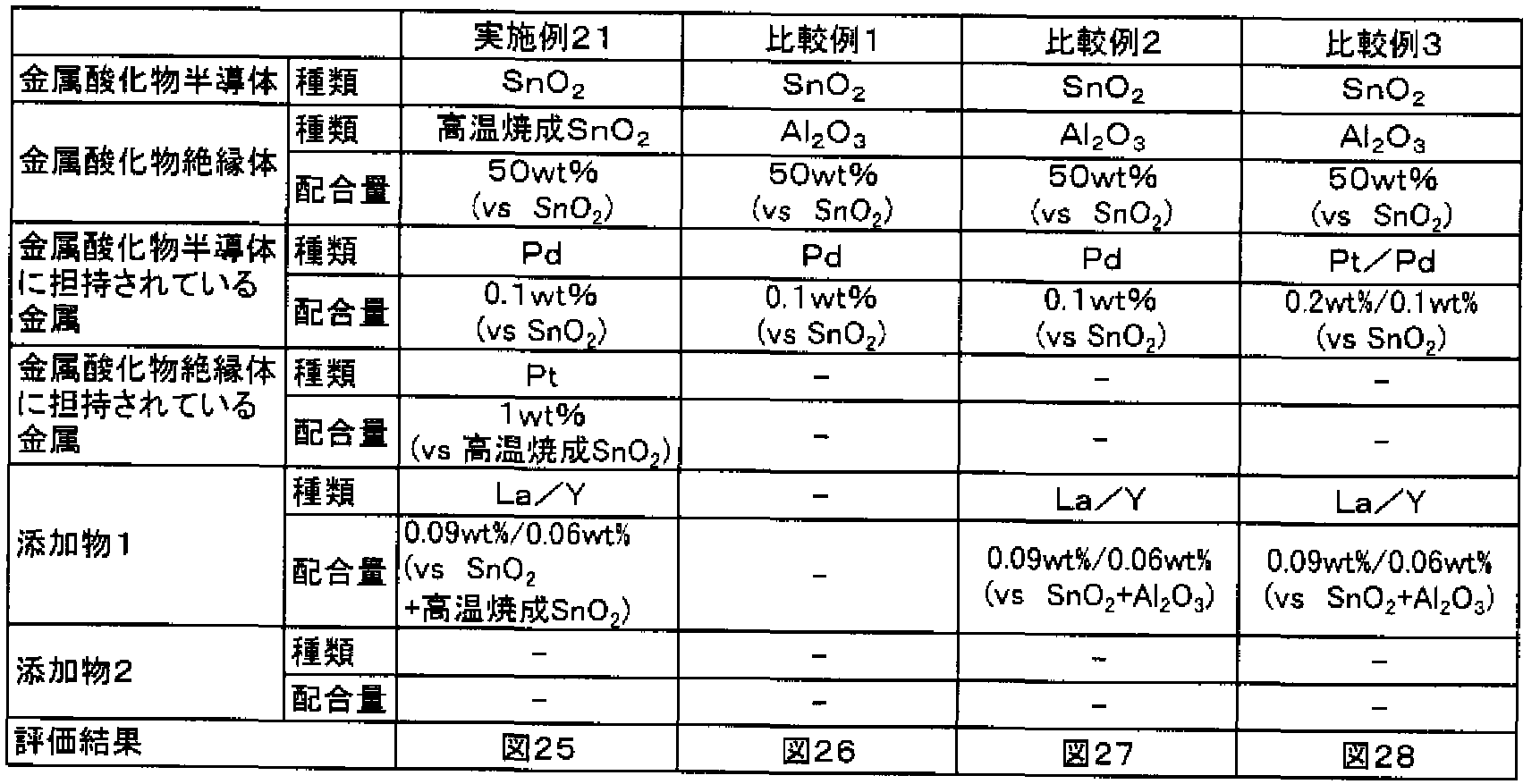
  • Example 1 Example 2 Example 3 Example 4 Metal oxide semiconductor type Sn0 2 Sn0 2 SnO £ SnO a type AJ 2 0 3 Al 2 0 3 Al 2 0 3 Al 2 0 3 Gold oxide insulator 50 wt 50 wt % 50wt% 50wt% Compounding amount (vs SnOj) (vs Sn0 2 ) (vs SnO z ) (vs Sn0 2 ) Metal oxide semiconductor Type Pd Pd Pd Supported on Pd 0.1 wt ° / o 0.1 wt% 0.1 wt % 0.1 wt%
  • Gold alloy (vs Sn0) Cvs Sn0 2 ) (vs Sn0 2 ) (vs Sn0 2 ) Gold IS oxide insulator type Pt Pt Pt Supported on Pt 1 wt% 5 wt% 1 wt% 1 wt% Metal content Cvs Al 2 0 3 ) (vs Al 2 0 3 ) Cvs Al 2 0 3 ) (vs Al 2 0 3 ) Type LaZY La / Y LaZY LaZY Additive 1 O.O9wt3 ⁇ 4 / O.06wt3 ⁇ 4 0.09wt3 ⁇ 4 / 0.06 t% 0.018 wt% / 0.012wt3 ⁇ 4 0.45w /0.30vsrt% Formula S (vs Sn0 2 + Al 2 0 3 ) (vs Sn0 2 I 2 0 3 ) (vs Sn0 2 + Al 2 0 3 ) (vs SnO z + AI
  • Example 9 Example 1 0
  • Example 1 Metal oxide semiconductor Class a SnO z SnO z ln 2 0 3 ⁇ 2 0 3 types Al 2 0 3 Al £ 0 3 Al 2 0 3 Al 2 0 3
  • Metal oxide semiconductor Type-One-One supported Have
  • Metal compounding amount 1-Metal oxide insulator Type PtZPd Pd Pt Pt Supported on 0.5wt / 1.5t% lwt% 0.2wtlwt Metal compounding i (vs Al 2 0 3 ) (vs Al z 0 3 ) (vs Al 2 0 3 ) (vs Al 2 0 3 )
  • Example 1 7 Example 1 8
  • Example 1 9 Example 20 Types ln 2 0 3 wo 3 Sn0 2 Sn0 2 types Al 2 0 3 Al 2 0 3 Al 2 0 3 Si0 2 Metal oxide cycle 50 wt% 50 wt % 50wt% 50wt3 ⁇ 4 Compounding (vs ln 2 0 3 ) (vs W0 3 ) Cvs Sn0 2 ) (vs Sn0 2 ) Metal oxide semiconductor type One 0.1 t% Metal loading on Pd Pd--0.1 wt%
  • the device temperature was 250 ° C for Examples 1 and 7, 19 and 21 and Comparative Example 1 and 3, and the device temperature was 200 ° C for Examples 8 and 10, and Examples 11 and 17 and Comparative Example.
  • the detection sensitivity was examined at 350 ° C.
  • the detection sensitivity is the electric resistance value (Rair) of the sensitive element A when the sensitive element A is exposed to clean air, and the electric resistance value (Rs) of the sensitive element A when exposed to the sample gas. Expressed as the ratio between and (Rs / Rair).
  • sample gas As the sample gas, the following were used.
  • Sample gas 1 Nitrogen dioxide mixed in clean air and the nitrogen dioxide concentration varied.
  • Sample gas 2 Nitrogen dioxide and carbon monoxide are mixed into clean air, and the concentration of carbon monoxide is fixed at 30 ppm to change the nitrogen dioxide concentration.
  • Sample gas 4 Nitrogen dioxide and carbon monoxide are mixed in clean air, and the nitrogen dioxide concentration is fixed at lppm (3 ppm for Examples 11 and 16), and the carbon monoxide concentration is varied.
  • Specimen gas 5 A decane mixed with clean air as hydride carbon and the decane concentration varied.
  • Sample gas 6 Nitrogen dioxide and decane are mixed in clean air, and the concentration of decane is varied by fixing the nitrogen dioxide concentration to 1 ppm.
  • the mouth in the graph indicates the result for the sample gas 1, the country for the sample gas 2, ⁇ for the sample gas 3, ⁇ for the sample gas 4, ⁇ for the sample gas 5, and ⁇ for the sample gas 6.
  • the semiconductor gas sensors obtained in each of the examples and comparative examples are placed in a container, and are first placed in clean air with the temperature of the sensitive element A being the same as in the case of the above-described detection sensitivity evaluation.
  • a sample gas in which nitrogen dioxide or carbon monoxide was mixed in clean air was jetted out, and then clean air was jetted out.
  • the results of measuring the electrical resistance (Rs) of the sensing element A at this time are shown in the graphs (b) in Figures 5-20, 22, 26-31.
  • the vertical axis of the dull indicates the electric resistance value (Rs) of the sensitive element A, and the horizontal axis indicates the time.
  • the graph also shows the concentration of nitrogen dioxide or carbon monoxide in the sample gas and the time at which the sample gas was ejected.
  • SnO is used as the metal oxide semiconductor to form a metal oxide insulator.
  • Al O is used, Pt is supported on a metal oxide insulator, and La and Y are added as additives.
  • the detection sensitivity of nitrogen dioxide is particularly high.
  • a semiconductor capable of selective detection of nitrogen dioxide when hydride carbon or carbon monoxide is an interfering gas with improved detection sensitivity of hydride carbon and carbon monoxide, in a concentration region below lppm A gas sensor was obtained. These also had excellent response when detecting nitrogen dioxide.
  • These semiconductor gas sensors can be suitably used for selectively detecting nitrogen oxides.
  • the amount of Pt supported on the metal oxide insulator is in the range of 0.2 to 5% by mass with respect to the metal oxide insulator, and the contents of La and Y are respectively Metal oxide
  • the detection sensitivity of nitrogen oxides and the selective detection thereof were improved in a well-balanced manner and had excellent responsiveness.
  • Example 57 SnO was used as the metal oxide semiconductor, and the metal oxide insulation was used.
  • Al O is used as the body, Pt is supported on the metal oxide insulator, and La and Y are added as additives.
  • sulfur added for use, and further sulfur added.
  • the addition of sulfur further improves the detection sensitivity of nitrogen oxides and improves the detection sensitivity of hydrated carbon and carbon monoxide.
  • These semiconductor gas sensors can be suitably used as a dual-purpose sensor capable of detecting both nitrogen oxides and hydride carbon and carbon monoxide.
  • the content of sulfur is 5 X 10- 6 with respect to the metal oxide insulator and the total amount of the metal oxide semiconductor - Example 5 was in the range of 4 X 10- 5 mol / g
  • the detection sensitivity of nitrogen oxides and the detection sensitivity of hydrated carbon and carbon monoxide are sufficiently improved, and the detection sensitivity is well balanced.
  • Example 8 Pd is supported on a metal oxide insulator, and thus the detection sensitivity of carbon monoxide is improved.
  • nitrogen oxides are used in Example 9 in which the amount of Pt supported on the metal oxide insulator is less than 50% by mass of the amount of Pd and Example 10 in which Pt is not supported on the metal oxide insulator.
  • the detection sensitivity of carbon monoxide is reduced and the detection sensitivity of carbon monoxide is high.
  • These semiconductor gas sensors can be suitably used for selectively detecting nitrogen monoxide and hydride carbon.
  • Al O is used as the catalyst, Pt is supported on the metal oxide insulator, and silica sol is added as an additive.
  • the detection sensitivity of nitrogen oxides and carbon monoxide is better. Has been reduced.
  • the amount of Pt supported on the metal oxide insulator was in the range of 0.2-1.5% by mass with respect to the metal oxide insulator, and ammonium metatungstate was used in combination with silica sol as an additive.
  • the detection sensitivity of nitrogen dioxide is improved, especially in the concentration region of 1 ppm or less, and the detection sensitivity of hydride carbon and carbon monoxide, particularly the detection sensitivity of carbon monoxide is reduced.
  • Semiconductor gas cell capable of selective detection of nitrogen dioxide when carbon or carbon monoxide is an interfering gas A sensor was obtained. Moreover, the responsiveness at the time of nitrogen dioxide detection was also excellent. These semiconductor gas sensors can be suitably used for selectively detecting nitrogen oxides.
  • Comparative Examples 5 and 6 silica sol and alumina sol were added in Comparative Example 4, respectively. Compared with Comparative Example 4, the detection sensitivity of nitrogen dioxide was improved.
  • Examples 14 and 16 use In O as a metal oxide semiconductor, and a metal oxide insulator.
  • Al O is used, and both Pt and Pd are supported on a metal oxide insulator, and silica is added as an additive.
  • Example 17 In O was used as a metal oxide semiconductor, and a metal oxide insulator was used.
  • Al O is used, Pd is supported on a metal oxide insulator, and silica sol is used as an additive.
  • This semiconductor gas sensor can be suitably used for selectively detecting nitrogen monoxide or carbon in the mouth.
  • Example 18 WO was used as the metal oxide semiconductor, and the metal oxide insulator was used.
  • Al O is used, Pt and Pd are both supported on a metal oxide insulator, and silica is added as an additive.
  • the detection sensitivity of nitrogen dioxide is improved, especially in the concentration range of 1 ppm or less, and the detection sensitivity of hydrated carbon and carbon monoxide is also improved.
  • Example 19 SnO was used as the metal oxide semiconductor, and the metal oxide insulator was used.
  • Al O is used, Pt is supported on a metal oxide insulator, and Sr is used as an additive.
  • La and Y are used as additives.
  • Comparative Examples 1 and 2 in which Pt and Pd are not supported on a metal oxide insulator, and Pt is supported on a metal oxide semiconductor.
  • the detection sensitivity of nitrogen dioxide is improved especially in the concentration range of lppm or less, and the detection sensitivity of hide-mouth carbon and carbon monoxide is reduced, so that the hide-mouth carbon monoxide is oxidized.
  • a semiconductor gas sensor capable of selective detection of nitrogen dioxide when carbon is an interfering gas was obtained. These also had excellent response when detecting nitrogen dioxide.
  • These semiconductor gas sensors can be suitably used for selectively detecting nitrogen oxides.
  • the semiconductor gas sensor according to the present invention is used for appropriate applications such as a gas leak sensor for flammable gases for household use and industrial use, a bad breath sensor, a hydrogen gas sensor for controlling a fuel cell, an exhaust gas sensor for automobile use, etc. can do.

Landscapes

  • Chemical & Material Sciences (AREA)
  • Chemical Kinetics & Catalysis (AREA)
  • Electrochemistry (AREA)
  • Physics & Mathematics (AREA)
  • Health & Medical Sciences (AREA)
  • Life Sciences & Earth Sciences (AREA)
  • Analytical Chemistry (AREA)
  • Biochemistry (AREA)
  • General Health & Medical Sciences (AREA)
  • General Physics & Mathematics (AREA)
  • Immunology (AREA)
  • Pathology (AREA)
  • Investigating Or Analyzing Materials By The Use Of Fluid Adsorption Or Reactions (AREA)

Abstract

 検知感度や応答性等の性能が改善された半導体ガスセンサを提供する。この半導体ガスセンサは、検知対象のガスに感応して電気抵抗値の変化を生じる感応素子Aとして、金属酸化物半導体を含有するものを備え、感応素子Aの内部には、Pt及びPdのうち少なくとも一方を担持している金属酸化物絶縁体が分散している。これにより、PtやPdによる金属酸化物半導体への悪影響を抑制しつつ、このPtやPdによる触媒作用を感応素子A内部の全体に亘って発揮させることができる。

Description

明 細 書
半導体ガスセンサ 技術分野
[0001] 本発明は、検知対象のガスに感応して電気抵抗値の変化を生じる感応素子として
、金属酸化物半導体を含有するものを備える半導体ガスセンサに関するものである。 背景技術
[0002] 近年、検知対象のガスに感応して電気抵抗値の変化を生じる金属酸化物半導体を 利用した半導体ガスセンサは、小型安価なガスセンサとして注目を集めており、家庭 用や工業用等の可燃ガスのガス漏れセンサ、 口臭センサ、燃料電池制御用等のた めの水素ガスセンサ、自動車用途等の排気ガスセンサ等として広く利用されるように なっている。
[0003] このうち、例えば自動車用途の排気ガスセンサとしては、ディーゼルエンジン等から の排気される窒素酸化物(NOx)等を検知するもの、ガソリンエンジン等から排気され るハイド口カーボン等を検知するもの、これら両方のガスを検知するものなどが提供さ れており、例えば外気を車内に供給するために用いる制御弁の自動制御用に利用さ れている。
[0004] このような半導体ガスセンサには、検知感度ゃ検知時の応答性を向上したり、妨害 ガスの影響を排して選択性を向上したりするために、その感応素子に Pt、 Pd等の触 媒を含有させる場合がある。この様な Ptや Pdは、その触媒作用により、例えば妨害 ガスを分解したり、検知対象であるガスを金属酸化物半導体にて検知されやすい物 質に変換したりすることで、半導体ガスセンサの性能向上に寄与するものである。
[0005] Ptや Pdを含有させる場合の態様としては、金属酸化物半導体を含む感応素子中 に Ptや Pdを全体的に分散させることも考えられる力 このようにすると感応素子の電 気抵抗値の上昇を招きやすいことが経験上知られており、このため期待されるような 性能向上を図ることができず、逆に検知感度や応答性の低下、あるいはこれらの性 能の経時的な劣化を招いてしまうものであった。
[0006] そこで、半導体ガスセンサの感応素子に触媒作用の付与のために Ptや Pdを含有 させる場合には、従来、例えば特表平 9—503587号公報に開示されているように、 金属酸化物半導体を含む感応素子の外側に、 Ptや Pdを担持した金属酸化物による コート層を設けることが行われていた。この特表平 9— 503587号公報には、排気ガス 等に含まれる窒素酸化物を検出するための半導体ガスセンサが記載されているもの であり、その感応素子は、 SnO等の金属酸化物半導体を主体として構成された金属
2
酸化物層の外層に、 Ptや Pdを担持させた金属酸化物によりコート層(変換層)を形 成することで構成されている。このような構成により、金属酸化物半導体と Ptや Pdと が接触することを防止して上記弊害が発生しないようにしたものである。
[0007] しかし、上記のようなコート層を形成する場合には、 Ptや Pdの触媒作用はガスがコ 一ト層を通過する際にのみ働くため、 Ptや Pdの触媒作用を受けずにコート層を通過 する成分が多く残存することとなり、このため検知感度や応答性等の性能向上には 限界があった。
発明の開示
[0008] 本発明は上記の点に鑑みて為されたものであり、その第一の目的は、検知感度や 応答性等の性能向上のために感応素子に Ptや Pdを含有させた半導体ガスセンサ に関し、 Ptや Pdの触媒作用による著しい性能向上を達成し得る半導体ガスセンサを 提供することにある。
[0009] また本発明の第二の目的は、上記のように Ptや Pdの触媒作用による著しい性能向 上を達成し得る半導体ガスセンサとして、窒素酸化物、ハイド口カーボン或いは一酸 化炭素に対する検知感度、応答性等の性能が向上され、特に自動車等の排気ガス 検知用途に好適に用いることが可能な半導体ガスセンサを提供することにある。
[0010] 本発明者らは鋭意研究の結果、感応素子 A内に Ptや Pdを分散して配置することに より感応素子 A内部の全体に亘つて Ptや Pdによる触媒作用を発揮させることを可能 とし、且つ Ptや Pdによる金属酸化物半導体への悪影響を排除することが可能な感応 素子 Aの構成を見出し、本発明の完成に至ったものである。
[0011] すなわち、本発明に係る半導体ガスセンサは、検知対象のガスに感応して電気抵 抗値の変化を生じる感応素子 Aとして、金属酸化物半導体を含有するものを備える 半導体ガスセンサにおいて、前記感応素子 Aの内部には、 Ptと Pdのうちの少なくとも 一方を担持してレ、る金属酸化物絶縁体が分散してレ、ることを特徴とするものである。
[0012] このような半導体ガスセンサでは、感応素子 A中に Pt及び Pdのうち少なくとも一方 が分散して存在することから、感応素子 A内部の全体に亘つて Ptと Pdのうちの少なく とも一方による触媒作用が発揮され、且つ前記 Ptや Pdは金属酸化物絶縁体に担持 された状態で存在するために Ptや Pdと金属酸化物半導体とが感応素子 A中で直接 接触することが抑制されて、 Ptや Pdによる金属酸化物半導体への悪影響を抑制して Ptや Pdの影響による感応素子 Aの高抵抗化や感度の低下が生じるのを防ぐことが でき、またこのような性能低下が経時的に発生することも防止して経時安定性に優れ るものである。このため、 Ptや Pdの触媒作用を利用して感応素子 Aの検知感度ゃ応 答性等の性能向上を図るにあたって、著しい性能向上を達成することができるもので ある。
[0013] 上記のような感応素子 A中においては、上記金属酸化物半導体を SnO、 In〇、
WOのうちの少なくとも一種とし、上記金属酸化物絶縁体を Al O、 SiO、高温焼成 した Sn〇のうちの少なくとも一種とすることができる。
[0014] このような組成の感応素子 Aにおいて、上記金属酸化物絶縁体が Ptを担持するも のであると、特に窒素酸化物(NOx)を検知する場合において、感応素子 A中で Pt はその触媒作用により NOを酸化して NOへと変換し、或いは更に N Oへと変換し て、金属酸化物半導体に吸着された際のこの金属酸化物半導体の電気抵抗値の変 動幅が大きい物質へと変化させることができて、窒素酸化物の検知感度を向上する ことができるものであり、また検知時の応答性も向上することができるものである。
[0015] また、上記感応素子 Aにおいて、上記金属酸化物絶縁体が Pdを担持するものであ ると、特にハイド口カーボンや一酸化炭素(CO)等を検知する場合において、ハイド 口カーボンや一酸化炭素(CO)等の金属酸化物半導体への吸着性を向上してその 検知感度を著しく向上することができるものであり、また検知時の応答性も改善するこ とができるものである。
[0016] また、金属酸化物半導体が Sn〇であり、且つ上記金属酸化物絶縁体が Ptを担持 するものである場合において、感応素子 Aにアルカリ土類金属及び希土類元素から 選択される一種以上の金属を含有させると、窒素酸化物(NOx)の検知感度を更に 向上すること力 Sできる。
[0017] また、金属酸化物半導体が Sn〇を含む場合にぉレ、て、感応素子 Aに硫黄を含有
2
させると、窒素酸化物(N〇x)やハイド口カーボン、一酸化炭素(C〇)等の検知感度 を更に向上することができ、またこのとき特に感応素子 A中にアルカリ土類金属及び 希土類元素から選択される一種以上の金属を添加してレ、ると、これらの金属の作用 により向上した窒素酸化物(NOx)の検知感度を、更に向上することができる。
[0018] また、上記感応素子 Aにおいて、特に上記金属酸化物半導体が In Oを含むもの
2 3
であり、上記金属酸化物絶縁体が Al〇、 SiOのうちの少なくとも一種であり、前記金
2 3 2
属酸化物半導体と、 Ptと Pdのうちの少なくとも一方を担持させた前記金属酸化物絶 縁体とを含む成形体に、アルミナゾル、シリカゾル及びメタタングステン酸アンモニゥ ムから選択される一種以上のものを添加した後に焼成して感応素子 Aを得るようにす ることも好ましい。この場合、アルミナゾル、シリカゾル又はメタタングステン酸アンモニ ゥムを添加することによって、窒素酸化物(NOx)、ハイド口カーボン等の検知感度を 向上することができるものであり、特にアルミナゾル又はシリカゾルを添加した場合に は検知時の応答性も向上することができるものである。
[0019] これらの場合は、半導体ガスセンサの窒素酸化物、ハイド口カーボン或いは一酸化 炭素に対する検知感度、応答性等の性能を著しく改善することができ、特に自動車 等の排気ガス検知用途に特に適している。
図面の簡単な説明
[0020] [図 1]本発明の実施の形態の一例を示す半導体ガスセンサの要部概略図である。
[図 2]同上の半導体ガスセンサの一部破断した正面図である。
[図 3]本発明の実施の形態の他例の要部を示し、(a)は一面側から視た斜視図、(b) は他面側から視た斜視図である。
[図 4]同上の一部破断した半導体ガスセンサの斜視図である。
[図 5]実施例 1の半導体ガスセンサの検知感度評価(a)及び応答性評価 (b)を示す グラフである。
[図 6]実施例 2の半導体ガスセンサの検知感度評価(a)及び応答性評価 (b)を示す グラフである。 [図 7]実施例 3の半導体ガスセンサの検知感度評価 (a)及び応答性評価 (b)を示す グラフである。
[図 8]実施例 4の半導体ガスセンサの検知感度評価 (a)及び応答性評価 (b)を示す グラフである。
[図 9]実施例 5の半導体ガスセンサの検知感度評価 (a)及び応答性評価 (b)を示す グラフである。
[図 10]実施例 6の半導体ガスセンサの検知感度評価 (a)及び応答性評価 (b)を示す グラフである。
[図 11]実施例 7の半導体ガスセンサの検知感度評価(a)及び応答性評価 (b)を示す グラフである。
[図 12]実施例 8の半導体ガスセンサの検知感度評価(a)及び応答性評価 (b)を示す グラフである。
[図 13]実施例 9の半導体ガスセンサの検知感度評価(a)及び応答性評価 (b)を示す グラフである。
[図 14]実施例 10の半導体ガスセンサの検知感度評価(a)及び応答性評価 (b)を示 すグラフである。
[図 15]実施例 11の半導体ガスセンサの検知感度評価(a)及び応答性評価 (b)を示 すグラフである。
[図 16]実施例 12の半導体ガスセンサの検知感度評価 (a)及び応答性評価 (b)を示 すグラフである。
[図 17]実施例 13の半導体ガスセンサの検知感度評価 (a)及び応答性評価 (b)を示 すグラフである。
[図 18]実施例 14の半導体ガスセンサの検知感度評価(a)及び応答性評価 (b)を示 すグラフである。
[図 19]実施例 15の半導体ガスセンサの検知感度評価 (a)及び応答性評価 (b)を示 すグラフである。
[図 20]実施例 16の半導体ガスセンサの検知感度評価(a)及び応答性評価 (b)を示 すグラフである。 [図 21]実施例 17の半導体ガスセンサの検知感度評価を示すグラフである。
[図 22]実施例 18の半導体ガスセンサの検知感度評価 (a)及び応答性評価 (b)を示 すグラフである。
[図 23]実施例 19の半導体ガスセンサの検知感度評価を示すグラフである。
[図 24]実施例 20の半導体ガスセンサの検知感度評価を示すグラフである。
[図 25]実施例 21の半導体ガスセンサの検知感度評価を示すグラフである。
[図 26]比較例 1の半導体ガスセンサの検知感度評価 (a)及び応答性評価 (b)を示す グラフである。
[図 27]比較例 2の半導体ガスセンサの検知感度評価(a)及び応答性評価 (b)を示す グラフである。
[図 28]比較例 3の半導体ガスセンサの検知感度評価(a)及び応答性評価 (b)を示す グラフである。
[図 29]比較例 4の半導体ガスセンサの検知感度評価(a)及び応答性評価 (b)を示す グラフである。
[図 30]比較例 5の半導体ガスセンサの検知感度評価(a)及び応答性評価 (b)を示す グラフである。
[図 31]比較例 6の半導体ガスセンサの検知感度評価(a)及び応答性評価 (b)を示す グラフである。
符号の説明
[0021] A 感応素子
発明を実施するための最良の形態
[0022] 以下、本発明をその実施をするための最良の形態に基づいて説明する。
[0023] 本発明に係る半導体ガスセンサの感応素子 Aは、金属酸化物半導体と、 Ptと Pdの うちの少なくとも一方を担持している金属酸化物絶縁体とを含有する。
[0024] 上記金属酸化物半導体は、検知対象のガスに感応して電気抵抗値の変化を生じ るものであれば良ぐ検知対象のガスに応じて適宜選択される。
[0025] また、上記 Ptや Pdは、その触媒作用によって検知感度の向上や応答性の向上を 達成することを目的に含有され、金属酸化物半導体の種類と検知対象のガスとの組 み合わせ等に応じて適宜選択される。
[0026] また、上記金属酸化物絶縁体も、ガス検知時における感応素子 Aの電気抵抗値の 変化に影響を与えなレ、ものが適宜選択される。
[0027] 感応素子 Aには、上記のような金属酸化物半導体と、 Ptと Pdのうちの少なくとも一 方を担持した金属酸化物絶縁体とが混合分散した状態で含有されている。このとき 金属酸化物絶縁体は、感応素子 A中で Pt及び Pdのうち少なくとも一方を担持するこ とで、感応素子 A中における Ptや Pdと金属酸化物半導体との間の接触を抑制する 機能を果たすものであり、また、同時に感応素子 Aの電気抵抗値や強度を調整する 機能も果たし得る。
[0028] 上記のような構成の感応素子 Aは、例えば Pt及び Pdのうち少なくとも一方を担持さ せた金属酸化物絶縁体の粒子と、金属酸化物半導体の粒子とを含む材料を混合し 、得られた混合物を成形'焼成する工程を経て作製することができる。
[0029] このような感応素子 Aを有する半導体ガスセンサでは、感応素子 Aを検知対象のガ スに曝露させた際の感応素子 Aの電気抵抗値の変化に基づいて検知対象のガスの 検知を行う場合、感応素子 A中に Ptや Pdが分散して存在することから、感応素子 A 内部の全体に亘つて Ptや Pdによる触媒作用が発揮され、且つ前記 Ptや Pdは金属 酸化物絶縁体に担持された状態で存在するために Ptや Pdと金属酸化物半導体とが 感応素子 A中で直接接触することが抑制されて、 Ptや Pdによる金属酸化物半導体 への悪影響を抑制することができる。このため、 Ptや Pdの触媒作用を利用して感応 素子 Aの検知感度や応答性等の性能向上を図るにあたつて著しレ、性能向上を達成 すると共に、これらの特性の経時劣化を防止することができる。
[0030] 半導体ガスセンサは、上記のような感応素子 Aを具備し、この感応素子 Aを検知対 象のガスに曝露した際の電気抵抗値の変化を検出することができるものであれば、 従来公知の適宜の構成を採用することができる。
[0031] この半導体ガスセンサでは、白金 (Pt)、白金合金 (Pt合金)等から形成されるヒー タ及び電極をセンサ基体とし、このセンサ基体を覆うように感応素子 Aを設けることが 好ましい。
[0032] 上記電極は、感応素子 Aの電気抵抗測定用に設けられるものであり、感応素子 Aを 測定対象のガスを含む雰囲気中に配置した状態でこの電極間の電気抵抗値を測定 し、この電気抵抗値に基づいてガス濃度を検出することができる。
[0033] また、上記ヒータは、感応素子 Aを一定の温度に保っために設けられる。すなわち 、感応素子 Aは組成に応じてガスを検知するための好適な温度(素子温度)があり、 また素子温度が変動するとガス感度が変動して正確な濃度を検知することが困難に なるため、ガス濃度の検出を行うにあたり、ヒータにて素子温度を好適温度に保つこ とで、ガス濃度の正確な検知が可能となる。
[0034] 以下、半導体ガスセンサの具体的構造を例示する。
[0035] 図 1, 2に示す半導体ガスセンサでは、コイル状のヒータ兼用電極 25及び芯線状の 電極 20をセンサ基体として、このヒータ兼用電極 25及び電極 20を覆うように略球状( 球体状、楕円球体状等)に感応素子 Aが形成されている。図示の例ではヒータ兼用 電極 25は、そのコイル部分が感応素子 A中に坦設されるように形成されると共に、電 極 20はヒータ兼用電極 25のコイル部分の中心を貫通するように感応素子 A中に坦 設されており、これにより感応素子 Aを小型化している。前記ヒータ兼用電極 25は白 金 (Pt)、白金合金 (Pt合金)等から形成され、且つ白金 (Pt)、白金合金 (Pt合金)等 からなるリード線 20 , 20間に設けられて、ヒータ兼用電極 25、リード線 20 , 20が
1 3 1 3 一体に形成されている。また電極 20は白金 (Pt)、白金合金 (Pt合金)等からなるリー ド線 20により形成されている。
2
[0036] そして、樹脂等から形成されるベース 30に 3本の端子 10, 10, 10を貫通させて
1 2 3
設け、この各端子 10 , 10 , 10にリード線 20 , 20 , 20を接続することにより感応素
1 2 3 1 2 3
子 Aが固定して支持される。このベース 30の感応素子 Aを支持固定した側に有底筒 状のセンサ筐体 40を被嵌して、半導体ガスセンサが構成されている。センサ筐体 40 の天上面にはガス導入用の開口 41が設けられると共にこの開口 41には必要に 応じてガス導入用のステンレス製等の金網 41が張設される。
[0037] 図 3, 4に示す半導体ガスセンサでは、アルミナ基板等の絶縁体基板 1をセンサ基 体(平板型基体)として用い、この絶縁体基板 1の一面に膜状に感応素子 Aを形成し て、センシング部 Bが構成されている。ここで絶縁体基板 1の一面にはスルーホール により他面の金等からなる電極 4A' , 4B' と接続された金等からなる電極 4A、 4B を図 3 (a)に示すように設け、電極 4A、 4B間に亘るように感応素子 Aが形成されてい る。またこの絶縁体基板 1の他面側の各電極 2A, 2B, 4A' , 4 ; にはリードワイヤ 5を夫々接続してある。センシング部 Aは、厚さ 0. 3mmで一辺の長さが 2mmの正方 形の絶縁体基板 1の他面に図 3 (b)に示すように電極 , 4B 及びヒータ用の電 極 2A, 2Bを設け、電極 2A, 2B間には白金印刷膜等からなるヒータ 25' を形成して いる。
[0038] そして、このセンシング部 Bを、そのリードワイヤ 5をベース 30に貫通した端子 10に 接続して前記ベース 30に搭載し、このベース 30のセンシング部 Bを搭載した側に有 底筒状のセンサ筐体 40を被嵌して、半導体ガスセンサが構成されている。センサ筐 体 40の天上面にはガス導入用の開口 41が設けられると共にこの開口 41には必要に 応じてガス導入用のステンレス製等の金網 41が張設される。
[0039] これらの半導体ガスセンサの構成は例示であり、その他適宜の構造の半導体ガス センサを形成することができる。
[0040] 次に、感応素子 Aの具体的な組成の例を説明する。以下に説明する感応素子 Aの 具体例は、特に自動車等からの排気ガス検知用途に好適なものであるが、他の用途 に用いる場合には、必要に応じて適宜組成を変更することで、所望の検知対象のガ スを検知するために好適な半導体ガスセンサを得ることができる。
[0041] 金属酸化物半導体としては、例えば SnO、 In〇、 WOを用いることができ、これら は一種のみを用いるほか、二種以上を併用することもできる。
[0042] 金属酸化物半導体として Sn〇を用いる場合は、この Sn〇は、例えば、 SnClの水 溶液を NHで加水分解してスズ酸ゾノレを得て、これを乾燥した後に空気中で例えば
550 700°Cで 0. 5— 3時間焼成することで調製することができる。また、金属酸化 物半導体として Sn〇は他の手法で調製することもできるが、その場合、 SnOの結晶 子サイズを 20— 30nmの範囲とすることが好ましい。
[0043] これらの金属酸化物半導体は、排気ガス検知用以外の用途にも適用することが可 能であるが、窒素酸化物、ハイド口カーボン、一酸化炭素等を吸着した場合の電気抵 抗値の変化が大きいため、排気ガス検知用途に使用した場合に高い検知感度を有 する半導体ガスセンサを得ることができる。 [0044] また、金属酸化物絶縁体としては、例えば Al O、 Si〇等を用いることができ、これ らは一種のみを用いるほか、二種以上を併用することもできる。
[0045] また、金属酸化物半導体として上記のような SnOを用いる場合に、金属酸化物絶 縁体として高温焼成した Sn〇を用レ、ることもできる。ここで高温焼成した Sn〇は、上 記のような金属酸化物半導体として用いられる SnOを 800°C以上の高温、好ましく は 900— 1100°Cの範囲で 0. 5— 3時間焼成することで得ることができ、これは金属 酸化物半導体である SnOよりも電気絶縁性が高くなつている。また、金属酸化物絶 縁体としての SnOは他の手法で調製することもできる力 その場合、 SnOの結晶子 サイズを 50— 130nmの範囲とすることが好ましい。
[0046] このような金属酸化物絶縁体の感応素子 A中における含有量は適宜調整されるが
、感応素子 A中に充分な量の Ptや Pdを含有させるためには、感応素子 A中における 金属酸化物半導体の含有量 (質量)を 1とした場合に、金属酸化物絶縁体の含有量 ( 質量)を 0. 2- 1. 5の範囲とすることが好ましい。
[0047] 上記金属酸化物絶縁体に Ptや Pdを担持させる場合には、 Pt、 Pdのうち一種のみ を担持させるほか、 Ptと Pdとを共に担持させることができる。
[0048] Ptを金属酸化物絶縁体に担持させる場合は、特に窒素酸化物(NOx)を検知する 場合において、感応素子 A中で Ptはその触媒作用により NOを酸化して NOへと変 換し、或いは更に N Oへと変換し、このように変換されるごとに、金属酸化物半導体 に吸着された際のこの金属酸化物半導体の電気抵抗値の変動幅が大きい物質へと 変化して、検知感度が向上するものであり、また同時に窒素酸化物の検知時の応答 性も向上する。このような検知性能の向上は、特に窒素酸化物の濃度力 ppm程度 或いはそれ以下の低濃度領域において著しく発揮される。また、酸化性のガスである 窒素酸化物のみを検出したい場合には、還元性のガスであるハイド口カーボンや一 酸化炭素(C〇)等は妨害ガスとして働くが、これらのガスは Ptの触媒作用により分解 •燃焼することで検知感度が低下し、これにより窒素酸化物が選択的に検知されるこ ととなる。このため、 Ptを金属酸化物絶縁体に担持させることにより検知感度と応答 性に優れた窒素酸化物(NOx)検出用の半導体ガスセンサを得ることができる。この ような半導体ガスセンサは、例えばディーゼルエンジン用の排気ガスセンサとして好 適に用いられる。
[0049] このようにして Ptを金属酸化物絶縁体に担持させるにあたり、その含有量が過少で あると窒素酸化物の検知性能を充分に向上することができず、またこの含有量が過 大であると、還元性のガスであるハイド口カーボンや一酸化炭素(C〇)等の検知感度 を更に抑制することができて窒素酸化物の選択検知性能は高まるが、窒素酸化物の 検知感度も低下する傾向が生じる。このため、検知感度の向上と選択権知性とのバ ランスを考慮して、感応素子 Aに所望の特性を付与できるように適宜金属酸化物絶 縁体に担持させる Ptの量を調整することが好ましい。好ましくは、金属酸化物絶縁体 に担持される Ptの感応素子 A中での含有量が、金属酸化物絶縁体の全量に対して 0. 05— 5質量%、更に好ましくは 0. 2— 1. 5質量%の範囲とする。この範囲におい て半導体ガスセンサの著しい性能の向上が認められる。
[0050] また、 Pdを金属酸化物絶縁体に担持させる場合には、 Ptの場合と同様の機構によ る窒素酸化物検知性能の向上の作用も為し得る力 特にハイド口カーボンや一酸化 炭素(CO)等を検知する場合において、詳しい機構は明らかではないが、ハイドロカ 一ボンや一酸化炭素(CO)等の金属酸化物半導体への吸着性を向上してその検知 感度を著しく向上することができるものであり、また同時にハイド口カーボンや一酸化 炭素(CO)等の検知時の応答性も向上することができる。このため、 Pdを金属酸化 物絶縁体に担持させることにより検知感度と応答性に優れたハイド口カーボンや一酸 化炭素(c〇)等の検出用の半導体ガスセンサを得ることができる。このような半導体 ガスセンサは、例えばガソリンエンジン用の排気ガスセンサとして好適に用いられる。
[0051] このようにして Pdを金属酸化物絶縁体に担持させるにあたり、その量は半導体ガス センサに所望の性能を付与できるように適宜調整されるものであるが、好ましくは、金 属酸化物絶縁体に担持される Pdの量を、金属酸化物絶縁体の全量に対して 0. 05 一 5質量%、更に好ましくは 0. 2-1. 5質量%とする。この範囲において半導体ガス センサの著しい性能の向上が認められる。
[0052] また、 Ptと Pdとを併用してこられを共に金属酸化物絶縁体に担持させると場合には 、 Ptによる窒素酸化物(N〇x)の検知感度の向上の作用と、 Pdによるハイド口カーボ ンゃ一酸化炭素(CO)等の検知感度の向上の作用とが同時に発揮させることにより、 窒素酸化物と、ハイド口カーボンや一酸化炭素(CO)等との、両方の検知が可能な 半導体ガスセンサを得ることができる。
[0053] このようにして感応素子 Aに Pt及び Pdを含有させて両用の半導体ガスセンサを得 る場合には、感応素子 Aに要求される特性に応じて適宜金属酸化物絶縁体に担持 させる Ptと Pdの量を適宜調製するものである力 例えば感応素子 Aに含有される金 属酸化物半導体が In O又は W〇である場合には、好ましくは金属酸化物絶縁体に
2 3 3
担持される Ptの量を、金属酸化物絶縁体の全量に対して 0. 05 5質量%、更に好 ましくは 0. 2— 1. 5質量%の範囲、金属酸化物絶縁体に担持される Pdの量が、金属 酸化物絶縁体の全量に対して 0. 05— 5質量%、更に好ましくは 0. 2— 1. 5質量% の範囲とし、且つこの Ptと Pdの質量比を 1 : 9一 9 : 1の範囲とすることが好ましい。
[0054] このような感応素子 Aは適宜の手法で作製できる。例えば、まず金属酸化物絶縁体 の粒子と、 Pt, Pdのうち少なくとも一方を含む溶液 (例えば王水溶液)とを混合し、こ れを焼成することで、 Pt, Pdのうち少なくとも一方を担持した金属酸化物絶縁体の粒 子を得る。この焼成条件は適宜調整されるが、例えば空気雰囲気下で 500— 700°C で 0. 5— 3時間とすることができる。次いで、この金属酸化物絶縁体の粒子に、金属 酸化物半導体の粒子を混合し、これにテルビネオール等の有機溶剤をカ卩えてペース ト状の成形材料を調製する。そしてこの成形材料をセンサ基体に塗布した後、焼成 することで、所望の感応素子 Aを作製することができるものである。この焼成条件は適 宜調整されるが、例えば空気雰囲気下で 500 700°Cで 1一 60分間とすることがで きる。
[0055] このように形成されてる感応素子 Aにおいては、 Ptや Pdは金属酸化物絶縁体にの み担持させて、金属酸化物半導体には担持させないことが好ましいが、微量の Ptや Pdを金属酸化物絶縁体に担持させることは許容されるものであり、また、成形過程に おいて微量の Ptや Pdが金属酸化物半導体に担持されるなどのように不可避的に微 量の Ptや Pdが金属酸化物半導体に担持されることも許容される。但し、この場合、金 属酸化物半導体への Pt及び Pdの担持量の総量は、好ましくは金属酸化物半導体 の全量の 0. 5質量%以下、更に好ましくは 0. 2質量%以下となるようにする。
[0056] 上記感応素子 Aには上記の成分のほかに、必要に応じて適宜の添加物を含有さ せるようにしても良い。
[0057] 例えば、特に金属酸化物半導体が Sn〇の場合において、感応素子 A中に、 Mg、
Ca、 Sr、 Ba等のァノレカリ土類金属と、 Y、 Sc、 La, Pr、 Nd、 Sm、 Er、 Gd等の希土 類元素とから選択される一種以上の金属を添加することができる。これらの金属は二 価又は三価のイオン(酸化物)の状態で、感応素子 A中に含有させることができる。
[0058] このような金属を感応素子 Aに添加すると、各種のガスの検知感度の向上をはかる ことができ、特に窒素酸化物(N〇x)の検知感度を向上することができる。このとき、 窒素酸化物(NOx)の検知感度について、濃度 lppm以下の低濃度の場合につい ての検知感度が著しく向上する。
[0059] Ptを金属酸化物絶縁体に担持させている場合は、上記のように Ptにより窒素酸化 物(NOx)の検知感度と応答性とを向上し、これに上記のような金属を感応素子 Aに 添加して更に窒素酸化物(NOx)の検知感度、特に低濃度の検知感度を向上するこ とで、非常に優れた検知性能を有する窒素酸化物検知用の半導体ガスセンサを得る こと力 Sできる。
[0060] このように感応素子 Aにアルカリ土類金属と希土類元素から選択される一種以上の 金属を添加する場合、その添加量は、感応素子 Aに所望の特性を付与できるように 適宜調整されるものである力 添カ卩量が過少であるとガスの検知感度を充分に向上 することができず、また添加量が過剰であると感応素子 Aの電気抵抗値の増大を招 レ、たりガスの検知感度が却って低下したりする場合がある。そこで、例えば前記金属 として Mg、 Ca、 Sr、 Ba等のアルカリ土類金属を添加する場合には、金属酸化物半 導体と金属酸化物絶縁体の合計量に対して 3 X 10— 6 1 X 10— 4mol/gの範囲で含 有させることが好ましぐまた希土類のうち Y、 Scのうち少なくとも一方を添加する場合 には、金属酸化物半導体と金属酸化物絶縁体の合計量に対する割合が 4 X 10— 6— 1. 5 X 10— 4mol/gの範囲となるように含有させることが好ましレ、。また La、 Pr、 Nd、 Sm、 Er、 Gd等を含有させる場合には金属酸化物半導体と金属酸化物絶縁体の合 計量に対する割合が 4 X 10— 6— 1. 5 X 10— 4mol/gの範囲となるように含有させること が好ましレ、。これらの範囲において半導体ガスセンサの著しい性能の向上が認めら れる。また、 Yと Laを併用する場合などのように、 Y、 Scのうち少なくとも一方と、ランタ ノイドとを併用する場合は、 Y、 Scのうち少なくとも一方からなる成分と、ランタノイドか らなる成分とをそれぞれ 2 X 10— 6— 7 X 10— 5mol/gの範囲で含有させると共に、前者 の成分と後者の成分との割合を 1: 2-2 : 1の範囲とすることが好ましい。
[0061] 上記金属を感応素子 Aに添加するにあたっては、適宜の手法を用いることができる 。例えば既述の手法によって金属酸化物半導体の粒子と、 Pt, Pdのうち少なくとも一 方を担持させた金属酸化物絶縁体の粒子とを混合し、成形'焼成して得られた成形 体に対して、上記金属を含む溶液 (例えば上記金属を溶解させた硝酸溶液等)を塗 布含浸し、これを焼成することで、上記金属を感応素子 Aに添加することができる。こ のときの焼成条件は適宜調整されるが、例えば空気雰囲気下で 500— 700°Cで 1一 60分間焼成することができる。
[0062] また、金属酸化物半導体が Sn〇である場合において、感応素子 A中に硫黄(S)を
2
添加しても良レ、。硫黄 )は感応素子 A中に例えば硫酸イオンの状態で含有させる こと力 Sできる。
[0063] このように硫黄を感応素子 Aに添カ卩すると、ハイド口カーボンや一酸化炭素(CO)の 検知感度を向上することができる。また、 Pdを金属酸化物絶縁体に担持させてハイド 口カーボンや一酸化炭素(CO)の検知用として形成された半導体ガスセンサ、或い は Ptと Pdを共に金属酸化物絶縁体に担持させて両用のガスセンサとして形成された 半導体ガスセンサにおいて、感応素子 Aに硫黄を添カ卩することで、ハイド口カーボン や一酸化炭素(C〇)の検知時における検知感度を更に向上することができる。
[0064] また、このように硫黄を添加する場合には、窒素酸化物(NOx)の検知感度も向上 することができ、特に感応素子 Aにアルカリ土類金属や希土類元素を添加する場合 において、更に感応素子 Aに硫黄を添加するようにすると、前記金属のみが添加さ れる場合よりも窒素酸化物(NOx)の検知感度を更に向上することができる。このため 、 Ptを金属酸化物絶縁体に担持させた半導体ガスセンサにおいて、感応素子 Aにァ ルカリ土類金属及び希土類元素から選択される一種以上の金属を添加すると共に、 更に硫黄を添加すると、窒素酸化物(N〇x)の検知感度を更に向上すると共に、ハイ ドロカーボンや一酸化炭素(CO)の検知感度も向上することができ、これにより優れ た検知特性を有する両用の半導体ガスセンサを得ることができる。 [0065] このように感応素子 Aに硫黄を添加する場合、添加量が過少であるとガスの検知感 度を充分に向上することができず、また添加量が増大すると特に両用の半導体ガス センサの場合には窒素酸化物の検知感度に比してハイド口カーボンの検知感度が 大きくなつたり、窒素酸化物の検知時の応答性が低下する場合があるため、硫黄の 添加量は、感応素子 Aに所望の特性を付与できるように適宜調整される。例えば、金 属酸化物半導体と金属酸化物絶縁体との合計量に対して、硫黄原子換算で 2 X 10 — 6 1 X 10— 4mol/gの範囲で含有させることが好ましい。
[0066] 上記硫黄を感応素子 Aに添加するにあたっては、適宜の手法を用いることができる 。例えば既述の手法によって金属酸化物半導体の粒子と、 Pt及び Pdのうち少なくと も一方を担持させた金属酸化物絶縁体の粒子とを混合し、成形'焼成して得られた 成形体に対して、硫黄を含む溶液 (例えば硫酸水溶液等)を塗布含浸し、これを焼成 することで、硫黄を感応素子 Aに添加することができる。このときの焼成条件は適宜 調整されるが、例えば空気雰囲気下で 500— 700°Cで 1一 60分間焼成することがで きる。
[0067] また、感応素子 Aにアルカリ土類金属及び希土類元素から選択される一種以上の 金属と硫黄を添加する場合には、例えば既述の手法によって金属酸化物半導体の 粒子と、 Pt及び Pdのうち少なくとも一方を担持させた金属酸化物絶縁体の粒子とを 混合し、成形'焼成して得られた成形体に対して、前記金属を含む溶液 (例えば前記 金属を溶解させた硝酸溶液等)を塗布含浸し、これを焼成することで、前記金属を感 応素子 Aに添加する。次いで、更にこの成形体に上記硫黄を含む溶液 (例えば硫酸 水溶液等)を塗布含浸し、これを焼成することで、硫黄を感応素子 Aに添加すること ができる。
[0068] また、アルカリ土類金属及び希土類元素から選択される一種以上の金属と硫黄を 添加する場合には、前記金属及び硫黄を一つの溶液中に混合した混合溶液を調製 し、例えば既述の手法によって金属酸化物半導体の粒子と、 Pt及び Pdのうち少なく とも一方を担持させた金属酸化物絶縁体の粒子とを混合し、成形'焼成して得られた 成形体に対して、前記金属と硫黄を含む混合溶液を塗布含浸し、これを焼成するこ とで、前記金属及び硫黄を感応素子 Aに添加しても良い。 [0069] また、特に上記金属酸化物半導体が In Oであり、上記金属酸化物絶縁体が Al O
、 Si〇のうちの少なくとも一種である場合には、感応素子 Aを作製するにあたって、ま ず前記のような金属酸化物半導体と、 Pt、 Pdのうち少なくとも一方を担持させた金属 酸化物絶縁体とを含む成形体を作製し、この成形体に対して、アルミナゾル (コロイダ ルアルミナ)、シリカゾル(コロイダルシリカ)及びメタタングステン酸アンモニゥムのうち の少なくとも一種を添加した後に焼成する工程を経るようにして、感応素子 Aを作製 することができる。例えば、既述の手法によって金属酸化物半導体の粒子と、 Pt及び Pdのうち少なくとも一方を担持させた金属酸化物絶縁体の粒子とを混合し、成形'焼 成して得られる成形体に対して、アルミナゾル、シリカゾル、メタタングステン酸アンモ ニゥムのうち少なくとも一種を塗布含浸し、これを焼成することで、前記成分を感応素 子 Aに添加することができる。このときの焼成条件は適宜調整されるが、例えば空気 雰囲気下で 650°Cで 10分間焼成することができる。
[0070] このとき、上記の添加物のうち、アルミナゾル及びシリカゾルは、感応素子 Aに添カロ することにより、半導体ガスセンサによる窒素酸化物(NOx)やハイド口カーボンの検 知時にその検知感度を更に向上することができ、且つ検知時の応答性も向上するこ とができる。また、メタタングステン酸アンモニゥムを感応素子 Aに添加すると、半導体 ガスセンサによる窒素酸化物(NOx)の検知時の検知感度を更に向上することができ る。
[0071] 窒素酸化物(N〇x)検出用の半導体ガスセンサを得る場合には、金属酸化物絶縁 体として Al O、 SiOのうちの少なくとも一種を用い、 Ptを金属酸化物絶縁体に担持 させ、更に添加物としてアルミナゾル、シリカゾル及びメタタングステン酸アンモニゥム のうちの少なくとも一種を用いるようにすると、添加物の作用によって窒素酸化物(N 〇x)の検知感度を更に向上することができ、特にアルミナゾル、シリカゾノレのうち少な くとも一方を添加している場合には更に応答性も向上することができる。
[0072] また、ノ、イド口カーボンや一酸化炭素の検知用の半導体ガスセンサを得る場合には 、金属酸化物絶縁体として Al O、 SiOのうちの少なくとも一種を用レ、、 Pdを金属酸 化物絶縁体に担持させ、更に添加物としてアルミナゾル、シリカゾルのうちの少なくと も一方を用いるようにすると、添カ卩物の作用によってハイド口カーボンの検知感度を 更に向上することができる。
[0073] 更に、両用の半導体ガスセンサを得る場合には、金属酸化物絶縁体として Al O、
Si〇のうちの少なくとも一種を用レ、、 Ptと Pdを共に金属酸化物絶縁体に担持させ、 更に添加物としてアルミナゾル、シリカゾル及びメタタングステン酸アンモニゥムのうち の少なくとも一種を用いるようにすると、添カ卩物の作用によって窒素酸化物(N〇x)の 検知感度を更に向上することができ、特にアルミナゾル、シリカゾルのうち少なくとも 一方を添加している場合には更にハイド口カーボンの検知感度を向上すると共に、 応答性を向上することができる。
[0074] 感応素子 Aにアルミナゾル、シリカゾル又はメタタングステン酸アンモニゥムを添加 する場合の添加量は、感応素子 Aに所望の特性が付与されるように適宜調整される ものであるが、例えば金属酸化物半導体と、 Pt、 Pdのうち少なくとも一方を担持させ た金属酸化物絶縁体とを含む成形体に対して前記成分を添加するにあたっては、ァ ルミナゾルを添加する場合には金属酸化物半導体 (In〇)の全量に対してアルミナ ゾノレを Al O換算で好ましくは 0. 1— 50質量%、更に好ましくは 0. 5— 5質量%の範
2 3
囲で添加する。また、シリカゾノレを添加する場合には金属酸化物半導体 (In〇)の全 量に対してシリカゾルを Si〇換算で好ましくは 0. 1— 50質量%、更に好ましくは 0. 5 一 5質量%の範囲で添加する。またメタタングステン酸アンモニゥムを添加する場合 には金属酸化物半導体 (In O )全量に対してメタタングステン酸アンモニゥムを W〇 換算で 0. 1 5質量%の範囲で添カ卩することが好ましい。
実施例
[0075] 以下、本発明を実施例に基づいて具体的に説明する。尚、これらは例示であり、本 発明を限定するものではない。
[0076] (実施例 1一 21、比較例 1一 6)
各実施例及び比較例について、表 1一 3に示す金属酸化物半導体の粒子と、金属 酸化物絶縁体の粒子とを表中に示す割合で混合し、テルビネオールをカ卩えてペース ト状の成形材料を調製した。
[0077] このとき、金属酸化物半導体として Sn〇を用いる場合には、まず、 SnClの水溶液 を NHで加水分解してスズ酸ゾルを得て、このスズ酸ゾルを乾燥後に空気中で 600 °Cで 1時間焼成し、これにより金属酸化物半導体である SnOを得るようにし、この Sn
〇を粉碎したものを用いた。
[0078] また、金属酸化物絶縁体として高温焼成 Sn〇を用いる場合には、上記のようにし て得られた金属酸化物半導体である SnOを、空気雰囲気中で 1000°Cで 1時間焼 成したものを用いた。
[0079] また、 Pt、 Pdの少なくとも一方が担持された金属酸化物半導体の粒子及び金属酸 化物絶縁体の粒子を用いる場合には、これらの粒子に、 Pt、 Pdの少なくとも一方を 溶解させた王水溶液を含浸させ、 500°Cで空気中において 1時間焼成して、 Pt、 Pd の少なくとも一方を、下記表に示す担持量で担持させた。
[0080] 上記のようにして得られたペースト状の成形材料を、図 1に示すようなセンサ基体に 塗布した後、空気雰囲気下で 600°Cで 10分間焼成することで、短軸長 0. 3mm、長 軸長 0. 5mmの寸法を有する略楕円球状の成形体を得た。
[0081] 次に、表中の添加物 1の欄に添加物が明示されているものについては、この添加物 を上記成形体に塗布し、空気雰囲気下で 650°Cで 10分間焼成した。このときの各添 加物の含有量を、表中に示す。
[0082] ここで、添加物 1が La及び Yである場合には、この La及び Yはそれぞれの硝酸塩を 水溶液にした状態で上記成形体に塗布した。また添加物 1がシリカゾル又はアルミナ ゾルの場合には、このシリカゾル又はアルミナゾルを上記成形体に塗布したものであ り、また表中における配合量は、シリカゾルの場合は Si〇換算、アルミナゾノレの場合 は Al O換算のものである。
[0083] 次に、表中の添加物 2の欄に添加物が明示されているものについては、この添加物
2を、上記添加物 1の添加後の成形体に塗布し、空気雰囲気下で 650°Cで 10分間 焼成した。このとき、感応素子 A中の各添加物 2の含有量は、表中に示すものとなる ように調整した。
[0084] ここで、添加物 2が硫黄(S)である場合には、この Sは硫酸水溶液の状態で上記成 形体に塗布したものであり、また表中における配合量は硫黄原子に換算したもので ある。
[0085] また、添加物 2がメタタングステン酸アンモニゥムの場合にはメタタングステン酸アン モニゥムの水溶液を上記成形体に塗布したものであり、また表中における配合量は WO換算のものである。
[0086] 以上のようにして感応素子 Aを形成し、これを用いて図 2に示す構成の半導体ガス センサを作製した。
[0087] [表 1]
実施例 1 実施例 2 実施例 3 実施例 4 金属酸化物半導体種類 Sn02 Sn02 SnO£ SnOa 種類 AJ203 Al203 Al203 Al203 金厲酸化物絶縁体 50wt 50wt% 50wt% 50wt% 配合量 (vs SnOj) (vs Sn02) (vs SnOz) (vs Sn02) 金属酸化物半導体 種類 Pd Pd Pd Pd に担持されている 0.1 wt°/o 0.1 wt% 0.1 wt% 0.1 wt% 配合量
金厲 (vs Sn0 ) Cvs Sn02) (vs Sn02) (vs Sn02) 金 IS酸化物絶縁体種類 Pt Pt Pt Pt に担持されている 1 wt% 5wt% 1 wt% 1 wt% 金属 配合量 Cvs Al203) (vs Al203) Cvs Al203) (vs Al203) 種類 LaZY La/Y LaZY LaZY 添加物 1 O.O9wt¾/O.06wt¾ 0.09wt¾/0.06 t% 0.018wt%/0.012wt¾ 0.45w /0.30vsrt% 配合 S (vs Sn02+Al203) (vs Sn02 I203) (vs Sn02+Al203) (vs SnOz+AI203) 種類 一 - - 一 添加物 2
配合 i 一 一 一 評価結果 図 5 図 6 図 7 囡 8
Figure imgf000022_0001
実施例 9 実施例 1 0 実施例 1 1 実施例 1 2 金属酸化物半導体 a類 SnOz SnOz ln203 Ιπ203 種類 Al203 Al£03 Al203 Al203 金厲酸化物絶緣体 50wt 50wt% 50wt% 50wt% 配合量 (vs Sn02) (vs Sn02) Cvs ln203) vvs in20つ) 金属酸化物半導体 種類 - 一 - 一 に担持されている
金属 配合量 一 一 - 金属酸化物絶縁体 種類 PtZPd Pd Pt Pt に担持されている 0.5wt /1.5 t% l wt% 0.2wt l wt 金属 配合 i (vs Al203) (vs Alz03) (vs Al203) (vs Al203) 種類 - 一 シリカゾル シリカゾル 添加物 1 2wt% 配合量 一 一 2 t¾
(vs ln203+AI203) (vs In203+Al203) 一 一 メタタンク'ス亍ン酸 メタタンゲス亍ン酸 種類
アンモ::ゥム アンモニゥム 添加物 2
配合量 - ―
評 ffl結果 囡1 3 図 1 4 図 1 5 図 1 6 2]
Figure imgf000023_0001
実施例 1 7 実施例 1 8 実施例 1 9 実施例 20 種類 ln203 wo3 Sn02 Sn02 種類 Al203 Al203 Al203 Si02 金属酸化物絶繰体 50wt% 50wt% 50wt% 50wt¾ 配合置 (vs ln203) (vs W03) Cvs Sn02) (vs Sn02) 金属酸化物半導体 種類 一 一 Pd Pd に担持されている 0.1 t% 金属 配合量 - - 0.1 wt%
( s O SnO^) (vs Sn02) 金属酸化物絶縁体 種類 Pd PtZPd Pt Pt に担持されている 1 wt% 1 .0wt%/1.0wt% l wt° & 金属 配合量 (vs Al203) (vs Al203) Cvs SJ02) 種類 シリカゾレ シリカゾル Sr La/Y 添加物 1 2wt% 2wt% O.09wt¾/O.06wt% 配合置 (vs,n203+AI203) (vs W03+Ai203) (vs Sn02+Si02) 種類 一 一 一 ― 添加物 2
配合量 - 一 一 ― 評価結果 図 21 図 22 図 23 図 24
Figure imgf000023_0002
3] 比較例 4 比較例 5 比較例 6
種類 ln203 ln203 1η203
種類 A1203 Al203 Αί203
金厲酸化物絶縁体 50wt% 50wt% 50wt%
配合量 ws ln203) (vs lnz03) (vs 1π203)
金属酸化物半導体種類 一 ― 一
に担持されている
金属 配合量 一 一 - 金 ¾酸化物絶縁体種類 一 一 一
に担持されている
金属 配合量 一 一 一
種類 - シリカゾル アルミナゾル
添加物 Ί 2wt¾
配合量 - 2wt%
(vs ln203+AI2O3) (vs ln203+Aj203)
種類 一 - 一
添加物 2
配合量 一 一 - 評価結果 図 29 図 30 図 31
[0090] (検知感度評価)
各半導体ガスセンサについて、実施例 1一 7, 19一 21及び比較例 1一 3について は素子温度 250°C、実施例 8— 10の場合は素子温度 200°C、実施例 11一 17及び 比較例 4一 6の場合は 350°C、実施例 18の場合は 350°Cでの検知感度を調査した。 ここで検知感度は、感応素子 Aを清浄空気中に曝露した状態での感応素子 Aの電 気抵抗値 (Rair)と、試料ガスに曝露した状態での感応素子 Aの電気抵抗値 (Rs)と の比(Rs/Rair)で表した。
[0091] 試料ガスとしては、次のものを用いた。
•試料ガス 1 :清浄空気に二酸化窒素を混入すると共にこの二酸化窒素濃度を変動さ せたもの。
•試料ガス 2 :清浄空気に二酸化窒素と一酸化炭素を混入すると共に一酸化炭素濃 度を 30ppmに固定し、二酸化窒素濃度を変動させたもの。
•試料ガス 3 :清浄空気に一酸化炭素を混入すると共にこの一酸化炭素濃度を変動さ せたもの。
•試料ガス 4 :清浄空気に二酸化窒素と一酸化炭素を混入すると共に、二酸化窒素 濃度を lppm (実施例 11一 16については 3ppm)に固定し、一酸化炭素濃度を変動 させたもの。
•試料ガス 5:清浄空気にハイド口カーボンとしてデカンを混入すると共にこのデカン 濃度を変動させたもの。 •試料ガス 6 :清浄空気に二酸化窒素とデカンを混入すると共に、二酸化窒素濃度を lppmに固定し、デカン濃度を変動させたもの。
[0092] 各実施例及び比較例についての結果を、図 5— 20, 22, 26— 31の各図における( a)並びに図 21, 23— 25のグラフに示す。グラフの縦軸は RsZRairの値を示し、横 軸は試料ガスの濃度を示す。
[0093] また、グラフ中の口は試料ガス 1、國は試料ガス 2、△は試料ガス 3、▲は試料ガス 4 、〇は試料ガス 5、 ·は試料ガス 6についての結果を示す。
[0094] (応答性評価)
各実施例及び比較例で得られた半導体ガスセンサを容器内に配置し、感応素子 A の温度を上記検知感度評価の場合と同一にした状態でまず清浄空気中に配置した 後、感応素子 Aに向けて清浄空気に二酸化窒素又は一酸化炭素を混入した試料ガ スを噴出し、次いで清浄空気を噴出した。このときの感応素子 Aの電気抵抗値 (Rs) を測定した結果を、図 5— 20, 22, 26— 31の各図における(b)のグラフに示す。ダラ フの縦軸は感応素子 Aの電気抵抗値 (Rs)を示し、横軸は時間を示す。また、グラフ 中には、試料ガス中における二酸化窒素又は一酸化炭素の濃度、及び試料ガスを 噴出した時間も示している。
[0095] 実施例 1一 4では、金属酸化物半導体として SnOを用い、金属酸化物絶縁体とし
2
て Al Oを用レ、、金属酸化物絶縁体に Ptを担持させ、更に添加剤として La及び Yを
2 3
用いたものであり、 Ptや Pdを金属酸化物絶縁体に担持させない比較例 1 , 2や、 Pt を金属酸化物半導体に担持させた比較例 3と比べて、二酸化窒素の検知感度が特 に lppm以下の濃度領域において向上し、且つハイド口カーボンや一酸化炭素の検 知感度が低減して、ハイド口カーボンや一酸化炭素が妨害ガスとなる場合の二酸化 窒素の選択的検知が可能な半導体ガスセンサが得られた。また、これらは、二酸化 窒素検知時の応答性も優れたものであった。これらの半導体ガスセンサは、窒素酸 化物を選択的に検知するために好適に利用することができる。
[0096] このうち、特に金属酸化物絶縁体に担持させた Ptの量が金属酸化物絶縁体に対し て 0. 2-1. 5質量%の範囲となり、且つ La及び Yの含有量がそれぞれ金属酸化物 絶縁体と金属酸化物半導体の合計量に対して 5 X 10— 6— 2 X 10— 5mol/gの範囲と なった実施例 1では、窒素酸化物の検知感度とその選択検知性とがバランス良く向 上され、且つ優れた応答性を有するものであった。
[0097] また、実施例 5 7では、金属酸化物半導体として SnOを用い、金属酸化物絶縁
2
体として Al Oを用レ、、 Ptを金属酸化物絶縁体に担持させ、添加剤として La及び Yを
2 3
用レ、、更に硫黄を添加したものである。これらは硫黄を添加することにより窒素酸化 物の検知感度が更に向上すると共にハイド口カーボン及び一酸化炭素の検知感度も 向上したものである。これらの半導体ガスセンサは、窒素酸化物とハイド口カーボンや 一酸化炭素とを共に検知可能な両用センサとして好適に利用することができる。
[0098] このうち、特に硫黄の含有量が金属酸化物絶縁体と金属酸化物半導体の合計量 に対して 5 X 10— 6— 4 X 10— 5mol/gの範囲となった実施例 5では、窒素酸化物の検 知感度とハイド口カーボンや一酸化炭素の検知感度とが充分に向上されていると共 に、これらの検知感度のバランスが良好なものである。
[0099] また、実施例 8— 10は、 Pdを金属酸化物絶縁体に担持させたものであり、このため 、一酸化炭素の検知感度が向上しているものである。特に、金属酸化物絶縁体に担 持させる Ptの使用量が Pdの使用量の 50質量%に満たない実施例 9や、 Ptを金属酸 化物絶縁体に担持させない実施例 10では、窒素酸化物の検知感度が低減されると 共に一酸化炭素の検知感度が高いものである。これらの半導体ガスセンサは、一酸 化窒素やハイド口カーボンを選択的に検知するために好適に利用することができる。
[0100] また、実施例 11一 13は金属酸化物半導体として In Oを用い、金属酸化物絶縁体
2 3
として Al Oを用い、 Ptを金属酸化物絶縁体に担持させ、添加物としてシリカゾルを
2 3
用いたものであり、 Ptや Pdを金属酸化物絶縁体に担持させない比較例 4一 6と比べ て、窒素酸化物の検知感度が良好であると共にハイド口カーボンや一酸化炭素の検 知感度が低減されている。特に金属酸化物絶縁体に担持させる Ptの量が金属酸化 物絶縁体に対して 0. 2-1. 5質量%の範囲となり、且つ添加物としてシリカゾルと共 にメタタングステン酸アンモニゥムを併用した実施例 11 , 12では、二酸化窒素の検 知感度が特に lppm以下の濃度領域において向上し、且つハイド口カーボンや一酸 化炭素の検知感度、特に一酸化炭素の検知感度が低減して、ハイド口カーボンや一 酸化炭素が妨害ガスとなる場合の二酸化窒素の選択的検知が可能な半導体ガスセ ンサが得られた。また、二酸化窒素検知時の応答性も優れたものであった。これらの 半導体ガスセンサは、窒素酸化物を選択的に検知するために好適に利用することが できる。
[0101] 尚、比較例 5, 6は比較例 4においてそれぞれシリカゾル、アルミナゾルを添加したも のであり、比較例 4と比べて、二酸化窒素の検知感度は向上している。
[0102] また、実施例 14一 16は金属酸化物半導体として In Oを用い、金属酸化物絶縁体
2 3
として Al Oを用レ、、 Ptと Pdを共に金属酸化物絶縁体に担持させ、添加物としてシリ
2 3
カゾノレとメタタングステン酸アンモニゥムを併用したものであり、二酸化窒素の検知感 度が特に lppm以下の濃度領域において向上すると共に、ハイド口カーボンや一酸 化炭素の検知感度も向上している。特に金属酸化物絶縁体に担持させる Ptと Pdの 総量が 0. 2— 1. 5質量%の範囲である実施例 14, 15では、優れた検知感度が得ら れている。これらの半導体ガスセンサは、窒素酸化物とハイド口カーボンや一酸化炭 素とを共に検知可能な両用センサとして好適に利用することができる。
[0103] また、実施例 17は、金属酸化物半導体として In Oを用い、金属酸化物絶縁体とし
2 3
て Al Oを用い、 Pdを金属酸化物絶縁体に担持させ、添加物としてシリカゾルを用い
2 3
たものであり、二酸化窒素の検知感度は低減されていると共に、一酸化炭素やハイド 口カーボンの検知感度は向上している。この半導体ガスセンサは、一酸化窒素ゃハ イド口カーボンを選択的に検知するために好適に利用することができる。
[0104] また、実施例 18では、金属酸化物半導体として WOを用い、金属酸化物絶縁体と
3
して Al Oを用レ、、 Ptと Pdを共に金属酸化物絶縁体に担持させ、添加物としてシリカ
2 3
ゾノレを用いたものであり、二酸化窒素の検知感度が特に lppm以下の濃度領域にお いて向上すると共に、ハイド口カーボンや一酸化炭素の検知感度も向上している。
[0105] また、実施例 19では、金属酸化物半導体として SnOを用い、金属酸化物絶縁体と
2
して Al Oを用い、 Ptを金属酸化物絶縁体に担持させ、更に添加剤として Srを用い
2 3
たものである。また、実施例 20, 21では、金属酸化物半導体として Sn〇を用レ、、金
2 属酸化物絶縁体として Si〇又は高温焼成 SnOを用い、 Ptを金属酸化物絶縁体に
2 2
担持させ、更に添加剤として La及び Yを用いたものである。これらは、 Ptや Pdを金属 酸化物絶縁体に担持させない比較例 1 , 2や、 Ptを金属酸化物半導体に担持させた 比較例 3と比べて、二酸化窒素の検知感度が特に lppm以下の濃度領域にぉレ、て 向上し、且つハイド口カーボンや一酸化炭素の検知感度が低減して、ハイド口カーボ ンゃ一酸化炭素が妨害ガスとなる場合の二酸化窒素の選択的検知が可能な半導体 ガスセンサが得られた。また、これらは、二酸化窒素検知時の応答性も優れたもので あった。これらの半導体ガスセンサは、窒素酸化物を選択的に検知するために好適 に利用することができる。
産業上の利用可能性
本発明に係る半導体ガスセンサは、家庭用や工業用等の可燃ガスのガス漏れセン サ、口臭センサ、燃料電池制御用等のための水素ガスセンサ、自動車用途等の排気 ガスセンサ等の適宜の用途に利用することができる。

Claims

請求の範囲
[1] 検知対象のガスに感応して電気抵抗値の変化を生じる感応素子として、金属酸化 物半導体を含有するものを備える半導体ガスセンサにおいて、前記感応素子の内部 には、 Ptと Pdのうちの少なくとも一方を担持している金属酸化物絶縁体が分散してい ることを特徴とする半導体ガスセンサ。
[2] 上記感応素子中における上記金属酸化物半導体が Sn〇、 In〇、 WOのうちの少
2 2 3 3 なくとも一種であり、上記金属酸化物絶縁体が Al O、 SiO、高温焼成した Sn〇のう
2 3 2 2 ちの少なくとも一種であることを特徴とする請求項 1に記載の半導体ガスセンサ。
[3] 上記金属酸化物絶縁体が、 Ptを担持しているものであることを特徴とする請求項 2 に記載の半導体ガスセンサ。
[4] 上記金属酸化物絶縁体が、 Pdを担持しているものであることを特徴とする請求項 2 に記載の半導体ガスセンサ。
[5] 上記感応素子中における上記金属酸化物半導体が Sn〇であり、且つ上記感応素
2
子はにアルカリ土類金属及び希土類元素から選択される一種以上の金属を含有す ることを特徴とする請求項 1に記載の半導体ガスセンサ。
[6] 上記感応素子中における上記金属酸化物半導体が Sn〇であり、且つ上記感応素
2
子はに硫黄を含有することを特徴とする請求項 1に記載の半導体ガスセンサ。
[7] 上記感応素子中における上記金属酸化物半導体が In Oであり、上記金属酸化物
2 3
絶縁体が Al O、 SiOのうちの少なくとも一種であり、且つ前記感応素子が、前記金
2 3 2
属酸化物半導体と、 Ptと Pdのうちの少なくとも一方を担持させた前記金属酸化物絶 縁体とを含む成形体に、アルミナゾル、シリカゾル及びメタタングステン酸アンモニゥ ムから選択される一種以上のものを添加した後に焼成して得られるものであることを 特徴とする請求項 1に記載の半導体ガスセンサ。
[8] 検知対象のガスに感応して電気抵抗値の変化を生じる感応素子として、金属酸化 物半導体を含有するものを備える半導体ガスセンサにおいて、前記感応素子が、 Pt と Pdのうちの少なくとも一方を担持させた金属酸化物絶縁体の粒子と、金属酸化物 半導体の粒子とを含む材料を混合し、得られた混合物を成形'焼成する工程を経て 得られるものであることを特徴とする半導体ガスセンサ。
PCT/JP2004/010735 2004-07-28 2004-07-28 半導体ガスセンサ Ceased WO2006011202A1 (ja)

Priority Applications (2)

Application Number Priority Date Filing Date Title
PCT/JP2004/010735 WO2006011202A1 (ja) 2004-07-28 2004-07-28 半導体ガスセンサ
JP2006527735A JP4359311B2 (ja) 2004-07-28 2004-07-28 半導体ガスセンサ

Applications Claiming Priority (1)

Application Number Priority Date Filing Date Title
PCT/JP2004/010735 WO2006011202A1 (ja) 2004-07-28 2004-07-28 半導体ガスセンサ

Publications (1)

Publication Number Publication Date
WO2006011202A1 true WO2006011202A1 (ja) 2006-02-02

Family

ID=35785961

Family Applications (1)

Application Number Title Priority Date Filing Date
PCT/JP2004/010735 Ceased WO2006011202A1 (ja) 2004-07-28 2004-07-28 半導体ガスセンサ

Country Status (2)

Country Link
JP (1) JP4359311B2 (ja)
WO (1) WO2006011202A1 (ja)

Cited By (2)

* Cited by examiner, † Cited by third party
Publication number Priority date Publication date Assignee Title
JP2008046091A (ja) * 2006-08-21 2008-02-28 Fis Inc 水素ガスセンサ
CN111480067A (zh) * 2017-12-15 2020-07-31 佳能株式会社 还原性气体传感器

Citations (5)

* Cited by examiner, † Cited by third party
Publication number Priority date Publication date Assignee Title
JPS5594153A (en) * 1979-01-11 1980-07-17 Fuigaro Giken Kk Methane gas detector
JPS63279150A (ja) * 1987-05-11 1988-11-16 Fuji Electric Co Ltd 半導体式ガスセンサ
JPH01227953A (ja) * 1988-03-08 1989-09-12 Figaro Eng Inc ガスセンサ及びその製造方法
JP2000074866A (ja) * 1998-06-16 2000-03-14 Figaro Eng Inc Coセンサおよびその製造方法
JP2002318218A (ja) * 2001-04-20 2002-10-31 New Cosmos Electric Corp 半導体式ガス検知素子

Family Cites Families (3)

* Cited by examiner, † Cited by third party
Publication number Priority date Publication date Assignee Title
JP3854358B2 (ja) * 1997-03-04 2006-12-06 エフアイエス株式会社 ガスセンサ材料
JPH11258192A (ja) * 1998-03-10 1999-09-24 Fis Kk 半導体ガスセンサ
JP4575559B2 (ja) * 2000-07-13 2010-11-04 エフアイエス株式会社 ケトン感応素子

Patent Citations (5)

* Cited by examiner, † Cited by third party
Publication number Priority date Publication date Assignee Title
JPS5594153A (en) * 1979-01-11 1980-07-17 Fuigaro Giken Kk Methane gas detector
JPS63279150A (ja) * 1987-05-11 1988-11-16 Fuji Electric Co Ltd 半導体式ガスセンサ
JPH01227953A (ja) * 1988-03-08 1989-09-12 Figaro Eng Inc ガスセンサ及びその製造方法
JP2000074866A (ja) * 1998-06-16 2000-03-14 Figaro Eng Inc Coセンサおよびその製造方法
JP2002318218A (ja) * 2001-04-20 2002-10-31 New Cosmos Electric Corp 半導体式ガス検知素子

Cited By (2)

* Cited by examiner, † Cited by third party
Publication number Priority date Publication date Assignee Title
JP2008046091A (ja) * 2006-08-21 2008-02-28 Fis Inc 水素ガスセンサ
CN111480067A (zh) * 2017-12-15 2020-07-31 佳能株式会社 还原性气体传感器

Also Published As

Publication number Publication date
JP4359311B2 (ja) 2009-11-04
JPWO2006011202A1 (ja) 2008-07-31

Similar Documents

Publication Publication Date Title
US10413885B2 (en) Exhaust gas purification catalyst
JP2514701B2 (ja) 酸素センサ
US6533911B1 (en) Device for measuring combustible-gas concentration in an exhaust gas
US6303011B1 (en) Gas sensor
US20030062264A1 (en) Apparatus for measuring concentration of ammonia gas
JP2002181769A (ja) 酸素センサ素子及びその製造方法
US20180031515A1 (en) Sensor material and gas sensor element and gas sensor derived therefrom
WO2008103311A9 (en) Nox sensor with improved selectivity and sensitivity
US20090020422A1 (en) Sensor Assemblies For Analyzing NO and NO2 Concentrations In An Emission Gas And Methods For Fabricating The Same
US20130062203A1 (en) Ammonia gas sensor
Miura et al. Improving NO2 sensitivity by adding WO3 during processing of NiO sensing-electrode of mixed-potential-type zirconia-based sensor
CN111422927A (zh) 以NiGa2O4为敏感电极材料的YSZ基混成电位型NO2传感器及其制备方法
WO2008014153A1 (en) Sensors for detecting nox in a gas and methods for fabricating the same
JP2001108649A (ja) 可燃性ガス濃度測定装置及びこれを用いた可燃性ガス濃度測定方法並びに炭化水素ガス濃度測定装置及びこれを用いた炭化水素ガス濃度測定方法
JP2002071611A (ja) 水素ガスセンサ
JP4359311B2 (ja) 半導体ガスセンサ
JP2006201100A (ja) 水素ガス検知センサ
US20120305397A1 (en) Gas sensor element and gas sensor employing the gas sensor element
JP2011069705A (ja) アンモニアセンサ素子及びプロトン導電性固体電解質体の製造方法
JP5105284B2 (ja) アンモニア濃度測定用センサ素子、アンモニア濃度測定装置、およびアンモニア濃度測定方法
JP3327335B2 (ja) 排気ガスセンサー用高活性電極
JP2003035693A (ja) 可燃性ガスセンサ
JPS6136175B2 (ja)
JP2005127743A (ja) アンモニアガスセンサ
JP4996171B2 (ja) 水素ガスセンサ

Legal Events

Date Code Title Description
AK Designated states

Kind code of ref document: A1

Designated state(s): AE AG AL AM AT AU AZ BA BB BG BR BW BY BZ CA CH CN CO CR CU CZ DE DK DM DZ EC EE EG ES FI GB GD GE GH GM HR HU ID IL IN IS JP KE KG KP KR KZ LC LK LR LS LT LU LV MA MD MG MK MN MW MX MZ NA NI NO NZ OM PG PH PL PT RO RU SC SD SE SG SK SL SY TJ TM TN TR TT TZ UA UG US UZ VC VN YU ZA ZM ZW

AL Designated countries for regional patents

Kind code of ref document: A1

Designated state(s): BW GH GM KE LS MW MZ NA SD SL SZ TZ UG ZM ZW AM AZ BY KG KZ MD RU TJ TM AT BE BG CH CY CZ DE DK EE ES FI FR GB GR HU IE IT LU MC NL PL PT RO SE SI SK TR BF BJ CF CG CI CM GA GN GQ GW ML MR NE SN TD TG

DPEN Request for preliminary examination filed prior to expiration of 19th month from priority date (pct application filed from 20040101)
121 Ep: the epo has been informed by wipo that ep was designated in this application
WWE Wipo information: entry into national phase

Ref document number: 2006527735

Country of ref document: JP

NENP Non-entry into the national phase

Ref country code: DE

122 Ep: pct application non-entry in european phase