WO2006074815A1 - Biologisch abbaubare polyestermischung - Google Patents
Biologisch abbaubare polyestermischung Download PDFInfo
- Publication number
- WO2006074815A1 WO2006074815A1 PCT/EP2005/014162 EP2005014162W WO2006074815A1 WO 2006074815 A1 WO2006074815 A1 WO 2006074815A1 EP 2005014162 W EP2005014162 W EP 2005014162W WO 2006074815 A1 WO2006074815 A1 WO 2006074815A1
- Authority
- WO
- WIPO (PCT)
- Prior art keywords
- component
- acid
- mixtures
- components
- biodegradable polyester
- Prior art date
- Legal status (The legal status is an assumption and is not a legal conclusion. Google has not performed a legal analysis and makes no representation as to the accuracy of the status listed.)
- Ceased
Links
Classifications
-
- C—CHEMISTRY; METALLURGY
- C08—ORGANIC MACROMOLECULAR COMPOUNDS; THEIR PREPARATION OR CHEMICAL WORKING-UP; COMPOSITIONS BASED THEREON
- C08L—COMPOSITIONS OF MACROMOLECULAR COMPOUNDS
- C08L29/00—Compositions of homopolymers or copolymers of compounds having one or more unsaturated aliphatic radicals, each having only one carbon-to-carbon double bond, and at least one being terminated by an alcohol, ether, aldehydo, ketonic, acetal or ketal radical; Compositions of hydrolysed polymers of esters of unsaturated alcohols with saturated carboxylic acids; Compositions of derivatives of such polymers
- C08L29/02—Homopolymers or copolymers of unsaturated alcohols
- C08L29/04—Polyvinyl alcohol; Partially hydrolysed homopolymers or copolymers of esters of unsaturated alcohols with saturated carboxylic acids
-
- C—CHEMISTRY; METALLURGY
- C08—ORGANIC MACROMOLECULAR COMPOUNDS; THEIR PREPARATION OR CHEMICAL WORKING-UP; COMPOSITIONS BASED THEREON
- C08L—COMPOSITIONS OF MACROMOLECULAR COMPOUNDS
- C08L67/00—Compositions of polyesters obtained by reactions forming a carboxylic ester link in the main chain; Compositions of derivatives of such polymers
- C08L67/02—Polyesters derived from dicarboxylic acids and dihydroxy compounds
-
- C—CHEMISTRY; METALLURGY
- C08—ORGANIC MACROMOLECULAR COMPOUNDS; THEIR PREPARATION OR CHEMICAL WORKING-UP; COMPOSITIONS BASED THEREON
- C08G—MACROMOLECULAR COMPOUNDS OBTAINED OTHERWISE THAN BY REACTIONS ONLY INVOLVING UNSATURATED CARBON-TO-CARBON BONDS
- C08G63/00—Macromolecular compounds obtained by reactions forming a carboxylic ester link in the main chain of the macromolecule
-
- C—CHEMISTRY; METALLURGY
- C08—ORGANIC MACROMOLECULAR COMPOUNDS; THEIR PREPARATION OR CHEMICAL WORKING-UP; COMPOSITIONS BASED THEREON
- C08L—COMPOSITIONS OF MACROMOLECULAR COMPOUNDS
- C08L33/00—Compositions of homopolymers or copolymers of compounds having one or more unsaturated aliphatic radicals, each having only one carbon-to-carbon double bond, and only one being terminated by only one carboxyl radical, or of salts, anhydrides, esters, amides, imides or nitriles thereof; Compositions of derivatives of such polymers
-
- C—CHEMISTRY; METALLURGY
- C08—ORGANIC MACROMOLECULAR COMPOUNDS; THEIR PREPARATION OR CHEMICAL WORKING-UP; COMPOSITIONS BASED THEREON
- C08L—COMPOSITIONS OF MACROMOLECULAR COMPOUNDS
- C08L67/00—Compositions of polyesters obtained by reactions forming a carboxylic ester link in the main chain; Compositions of derivatives of such polymers
- C08L67/04—Polyesters derived from hydroxycarboxylic acids, e.g. lactones
-
- C—CHEMISTRY; METALLURGY
- C08—ORGANIC MACROMOLECULAR COMPOUNDS; THEIR PREPARATION OR CHEMICAL WORKING-UP; COMPOSITIONS BASED THEREON
- C08K—Use of inorganic or non-macromolecular organic substances as compounding ingredients
- C08K5/00—Use of organic ingredients
- C08K5/04—Oxygen-containing compounds
- C08K5/10—Esters; Ether-esters
- C08K5/101—Esters; Ether-esters of monocarboxylic acids
-
- C—CHEMISTRY; METALLURGY
- C08—ORGANIC MACROMOLECULAR COMPOUNDS; THEIR PREPARATION OR CHEMICAL WORKING-UP; COMPOSITIONS BASED THEREON
- C08K—Use of inorganic or non-macromolecular organic substances as compounding ingredients
- C08K5/00—Use of organic ingredients
- C08K5/16—Nitrogen-containing compounds
- C08K5/20—Carboxylic acid amides
-
- C—CHEMISTRY; METALLURGY
- C08—ORGANIC MACROMOLECULAR COMPOUNDS; THEIR PREPARATION OR CHEMICAL WORKING-UP; COMPOSITIONS BASED THEREON
- C08L—COMPOSITIONS OF MACROMOLECULAR COMPOUNDS
- C08L101/00—Compositions of unspecified macromolecular compounds
- C08L101/02—Compositions of unspecified macromolecular compounds characterised by the presence of specified groups, e.g. terminal or pendant functional groups
- C08L101/06—Compositions of unspecified macromolecular compounds characterised by the presence of specified groups, e.g. terminal or pendant functional groups containing oxygen atoms
-
- C—CHEMISTRY; METALLURGY
- C08—ORGANIC MACROMOLECULAR COMPOUNDS; THEIR PREPARATION OR CHEMICAL WORKING-UP; COMPOSITIONS BASED THEREON
- C08L—COMPOSITIONS OF MACROMOLECULAR COMPOUNDS
- C08L25/00—Compositions of, homopolymers or copolymers of compounds having one or more unsaturated aliphatic radicals, each having only one carbon-to-carbon double bond, and at least one being terminated by an aromatic carbocyclic ring; Compositions of derivatives of such polymers
- C08L25/02—Homopolymers or copolymers of hydrocarbons
- C08L25/04—Homopolymers or copolymers of styrene
- C08L25/08—Copolymers of styrene
- C08L25/14—Copolymers of styrene with unsaturated esters
-
- C—CHEMISTRY; METALLURGY
- C08—ORGANIC MACROMOLECULAR COMPOUNDS; THEIR PREPARATION OR CHEMICAL WORKING-UP; COMPOSITIONS BASED THEREON
- C08L—COMPOSITIONS OF MACROMOLECULAR COMPOUNDS
- C08L33/00—Compositions of homopolymers or copolymers of compounds having one or more unsaturated aliphatic radicals, each having only one carbon-to-carbon double bond, and only one being terminated by only one carboxyl radical, or of salts, anhydrides, esters, amides, imides or nitriles thereof; Compositions of derivatives of such polymers
- C08L33/04—Homopolymers or copolymers of esters
- C08L33/06—Homopolymers or copolymers of esters of esters containing only carbon, hydrogen and oxygen, which oxygen atoms are present only as part of the carboxyl radical
- C08L33/062—Copolymers with monomers not covered by C08L33/06
- C08L33/068—Copolymers with monomers not covered by C08L33/06 containing glycidyl groups
-
- C—CHEMISTRY; METALLURGY
- C08—ORGANIC MACROMOLECULAR COMPOUNDS; THEIR PREPARATION OR CHEMICAL WORKING-UP; COMPOSITIONS BASED THEREON
- C08L—COMPOSITIONS OF MACROMOLECULAR COMPOUNDS
- C08L63/00—Compositions of epoxy resins; Compositions of derivatives of epoxy resins
-
- C—CHEMISTRY; METALLURGY
- C08—ORGANIC MACROMOLECULAR COMPOUNDS; THEIR PREPARATION OR CHEMICAL WORKING-UP; COMPOSITIONS BASED THEREON
- C08L—COMPOSITIONS OF MACROMOLECULAR COMPOUNDS
- C08L91/00—Compositions of oils, fats or waxes; Compositions of derivatives thereof
Definitions
- the present invention relates to biodegradable polyester blends comprising
- PHA polylactide
- PHB polycaprolactone
- PHB polyhydroxyalkanoates
- polyesters of aliphatic Dicarboxylic acids and aliphatic diols PHA
- iii from 0.1 to 15% by weight, based on the total weight of components i to ii, of a) an epoxide group-containing copolymer based on styrene, acrylate and / or methacrylic acid ester, b) a bisphenol A epoxide or c) an epoxide group-containing natural oil, fatty acid ester or fatty acid amide; and
- additives such as stabilizers, nucleating agents, lubricants and antiblocking agents, waxes, emollients, surfactants, antistatic agents, antifog agents or dyes; and
- inorganic or organic fillers such as chalk, talc, silicates, kaolin, mica, wollastonites, montmorillonites or cellulosic fibers such as e.g. Cotton, flax, hemp, nettle fibers o.a.
- the present invention furthermore relates to processes for producing biodegradable polyester mixtures, branching batches with the aid of which the polyester mixtures according to the invention can be advantageously prepared, the use of biodegradable polyester mixtures for the production of moldings, films or fibers and moldings, films or fibers comprising biodegradable polyester mixtures ,
- Biodegradable mixtures of i) synthetically produced polyester materials and ii) homo- or copolyesters selected from the group consisting of polylactide, polycaprolactone, polyhydroxyalkanoates and polyesters of aliphatic dicarboxylic acids and aliphatic diols are known (see EP-B 792 309).
- Such blends ideally combine the desirable properties of the individual components, for example, the generally good processing and mechanical properties of the synthetic polyesters with the usually less expensive Availability and ecologically safe production and disposal of the ii) polymers listed above such as polylactide, polycaprolactone, polyhydroxyalkanoates and polyesters of aliphatic dicarboxylic acids and aliphatic diols.
- Polylactide and Polyhydroxyalkanoate must be pre-dried consuming to prevent degradation of the polymers.
- the mixtures have too low a bubble stability. This applies in particular to mixtures with more than 20% polylactide or polyhydroxycarboxylic acids and ⁇ 80% of aromatic-aliphatic copolyester.
- thick films made from the prior art blends have too low puncture resistance. This occurs especially in thick films containing predominantly polylactide or polyhydroxycarboxylic acid.
- the object of the present invention is therefore to provide biodegradable mixtures of i) synthetically produced polyester materials and ii) homopolymers or copolyesters selected from the group consisting of polylactide, polycaprolactone, polyhydroxyalkanoates and polyesters of aliphatic dicarboxylic acids and aliphatic diols which do not have the above-mentioned disadvantages.
- polyester mixtures defined above, which are described in more detail below.
- the polyester mixtures according to the invention differ from those of the prior art, in particular by the branching agent (component iii).
- polyesters based on aliphatic and aromatic dicarboxylic acids and aliphatic dihydroxy compound so-called partly aromatic polyesters, come into consideration as component i for the preparation of the biodegradable polyester mixtures according to the invention.
- component i for the preparation of the biodegradable polyester mixtures according to the invention.
- mixtures of several such polyesters are suitable as component i.
- Partly aromatic polyesters according to the invention should also be understood as meaning polyester derivatives, such as polyether esters, polyester amides or polyetheresteramides.
- Suitable partially aromatic polyesters include linear non-chain extended polyesters (WO 92/09654). Preferred are chain-extended and / or branched partially aromatic polyesters. The latter are known from the documents cited at the outset, WO 96/15173 to 15176, 21689 to 21692, 25446, 25448 or WO 98/12242, to which reference is expressly made. Mixtures of different partially aromatic polyesters are also possible. In particular, matic polyesters products to understand how Ecoflex ® (BASF Aktiengesellschaft) and Eastar ® Bio (Novamont).
- Particularly preferred partially aromatic polyesters include polyesters, which are essential components
- n 2, 3 or 4 and m is an integer from 2 to 250
- G is a radical selected from the group consisting of from phenylene, - (CH 2 ) q -, where q is an integer from 1 to 5, -C (R) H- and -C (R) HCH 2 , where R is methyl or ethyl
- At least one aminocarboxylic acid selected from the group consisting of the natural amino acids, polyamides obtainable by polycondensation of a dicarboxylic acid having 4 to 6 carbon atoms and a diamine having 4 to 10 carbon atoms, compounds of the formulas IV a and IVb
- T is a radical selected from the group consisting of phenylene, - (CH 2 ) U-, where u is an integer Number from 1 to 12 means -C (R 2 ) H and -C (R 2 ) HCH 2 , where R 2 is methyl or ethyl,
- R 3 is hydrogen, C 1 -C 6 -alkyl, C 5 -C 6 -cycloalkyl, phenyl which is unsubstituted or substituted up to three times by C 1 -C 4 -alkyl groups or is tetrahydrofuryl, or mixtures of d to c6
- the acid component A of the partially aromatic polyesters contains from 30 to 70, in particular from 40 to 60, mol% of a1 and from 30 to 70, in particular from 40 to 60, mol% of a2.
- aliphatic acids and the corresponding derivatives a1 are generally those having 2 to 10 carbon atoms, preferably 4 to 6 carbon atoms, into consideration. They can be both linear and branched.
- the cycloaliphatic dicarboxylic acids which can be used in the context of the present invention are generally those having 7 to 10 carbon atoms and, in particular, those having 8 carbon atoms. In principle, however, it is also possible to use dicarboxylic acids having a larger number of carbon atoms, for example having up to 30 carbon atoms.
- malonic acid succinic acid, glutaric acid, 2-methylglutaric acid, 3-methylglutaric acid, adipic acid, pimelic acid, azelaic acid, sebacic acid, fumaric acid, 2,2-dimethylglutaric acid, suberic acid, 1,3-cyclopentanedicarboxylic acid, 1,4-cyclohexanedicarboxylic acid , 1, 3-cyclohexanedicarboxylic acid, diglycolic acid, itaconic acid, maleic acid and 2,5-Norbornandicarbonklare.
- ester-forming derivatives of the abovementioned aliphatic or cycloaliphatic dicarboxylic acids which are likewise usable are the di-Cr to Ce alkyl esters, such as dimethyl, diethyl, di-n-propyl, di-isopropyl, di-n-butyl, Di-iso-butyl, di-t-butyl, di-n-pentyl, di-iso-pentyl or di-n-hexyl esters.
- Anhydrides of dicarboxylic acids can also be used.
- the dicarboxylic acids or their ester-forming derivatives may be used singly or as a mixture of two or more thereof.
- Succinic acid, adipic acid, azelaic acid, sebacic acid, brassylic acid or their respective ester-forming derivatives or mixtures thereof are preferably used.
- Succinic acid, adipic acid or sebacic acid or their respective ester-forming derivatives or mixtures thereof are particularly preferably used.
- Particular preference is given to using adipic acid or its ester-forming derivatives, such as their alkyl esters or mixtures thereof.
- Sebacic acid or mixtures of sebacic acid with adipic acid are preferably used as the aliphatic dicarboxylic acid when polymer blends with "hard” or "brittle” components ii), such as, for example, polyhydroxybutyrate or in particular polylactide, are prepared.
- succinic acid or mixtures of succinic acid with adipic acid are preferably used when polymer blends with "soft” or “tough” components ii) are prepared, such as Polyhydroxybuyratcovaleriat.
- Succinic acid, azelaic acid, sebacic acid and brassylic acid also have the advantage that they are available as renewable raw materials.
- the aromatic dicarboxylic acid a2 there are generally mentioned those having 8 to 12 carbon atoms, and preferably those having 8 carbon atoms. Examples include terephthalic acid, isophthalic acid, 2,6-naphthoic acid and 1, 5-naphthoic acid and ester-forming derivatives thereof.
- the di-C 1 -C 6 -alkyl esters e.g. Dimethyl, diethyl, di-n-propyl, di-iso-propyl, di-n-butyl, diisobutyl, di-t-butyl, di-n-pentyl, di-iso-pentyl or di-n-hexyl ester.
- the anhydrides of dicarboxylic acids a2 are also suitable ester-forming derivatives.
- aromatic dicarboxylic acids a2 having a larger number of carbon atoms, for example up to 20 carbon atoms.
- aromatic dicarboxylic acids or their ester-forming derivatives a2 may be used singly or as a mixture of two or more thereof. Particularly preferred is terephthalic acid or its ester-forming derivatives such as dimethyl terephthalate used.
- the sulfonate group-containing compound is usually an alkali metal or alkaline earth metal salt of a sulfonate-containing dicarboxylic acid or its ester-forming derivatives, preferably alkali metal salts of 5-sulfoisophthalic acid or mixtures thereof, particularly preferably the sodium salt.
- the acid component A contains from 40 to 60 mol% of a1, from 40 to 60 mol% of a2 and from 0 to 2 mol% of a3.
- the acid component A contains from 40 to 59.9 mol% a1, from 40 to 59.9 mol% a2 and from 0.1 to 1 mol% a3, in particular from 40 to 59.8 mol -% a1, from 40 to 59.8 mol% a2 and from 0.2 to 0.5 mol% a3.
- diols B are selected from branched or linear alkanediols of 2 to 12 carbon atoms, preferably 4 to 6 carbon atoms, or cycloalkanediols of 5 to 10 carbon atoms.
- alkanediols examples include ethylene glycol, 1, 2-propanediol, 1, 3-propanediol, 1, 2-butanediol, 1, 4-butanediol, 1, 5-pentanediol, 2,4-dimethyl-2-ethylhexane-1, 3 diol, 2,2-dimethyl-1,3-propanediol, 2-ethyl-2-butyl-1,3-propanediol, 2-ethyl-2-isobutyl-1,3-propanediol, 2,2,4-trimethyl 1, 6-hexanediol, in particular ethylene glycol, 1,3-propanediol, 1,4-butanediol and 2,2-dimethyl-1, 3-propanediol (neopentyl glycol); Cyclopentanediol, 1,4-cyclohexanediol, 1,2-cyclohex
- 1,4-butanediol in particular in combination with adipic acid as component a1) and 1,3-propanediol, in particular in combination with sebacic acid as component a1).
- 1, 3-Propanediol and 1, 4-butondrole also have the advantage that they are available as renewable raw materials. It is also possible to use mixtures of different alkanediols.
- component A or component B can be used in excess.
- the molar ratio of the components A used to B in the range of 0.4: 1 to 1, 5: 1, preferably in the range of 0.6: 1 to 1.1: 1.
- the polyesters on which the polyester mixtures according to the invention are based can contain further components.
- Preferred dihydroxy compounds d are diethylene glycol, triethylene glycol, polyethylene glycol, polypropylene glycol and polytetrahydrofuran (polyTHF), particularly preferably diethylene glycol, triethylene glycol and polyethylene glycol, mixtures of which or compounds having different variables n (see formula I),
- the molecular weight (M n ) of the polymer As a rule, ethylene glycol is selected in the range from 250 to 8000, preferably from 600 to 3000, g / mol.
- the hydroxycarboxylic acid c2) used is: glycolic acid, D-, L-, D, L-lactic acid, 6-hydroxyhexanoic acid, whose cyclic derivatives such as glycolide (1,4-dioxane-2,5-dione) , D-, L-dilactide (3,6-dimethyl-1, 4-dioxane-2,5-dione), p-hydroxybenzoic acid and their oligomers and polymers such as 3-polyhydroxybutyric acid, polyhydroxyvaleric acid, polylactide (for example as NatureWorks® (Fa.
- the hydroxycarboxylic acids can be used, for example, in amounts of from 0.01 to 50, preferably from 0.1 to 40,% by weight, based on the amount of A and B.
- amino-C2-Ci2-alkanol or amino-Cs-C-io-cyloalkanol (component c3) which is also intended to fall below 4-Aminomethylcyclohexanmethanol, are preferably amino-C2-C6-alkanols such as 2-aminoethanol, 3-aminopropanol , 4-aminobutanol, 5-aminopentanol, 6-aminohexanol and amino-Cs-C ⁇ -cycloalkanols such as aminocyclopentanol and aminocyclohexanol or mixtures thereof.
- the diamino-C 1 -C 8 -alkane (component c4) used is preferably diamino-C 4 -C 6 -alkanes, such as 1,4-diminobutane, 1,5-diaminopentane and 1,6-diaminohexane (hexamethylenediamine). HMD ").
- from 0.5 to 99.5 mol%, preferably 0.5 to 50 mol%, of c3, based on the molar amount of B, and from 0 to 50, preferably from 0 to 35 mol% , c4, based on the molar amount of B, are used for the preparation of semiaromatic polyesters see.
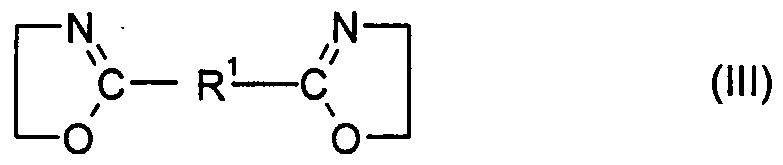
- the 2,2'-bisoxazolines c5 of general formula III are generally obtainable by the process of Angew. Chem. Int. Edit., Vol. 11 (1972), pp. 287-288.
- Bisoxazolines are 2,2'-bis (2-oxazoline), bis (2-oxazolinyl) methane, 1,2-bis (2-oxazolinyl) ethane, 1, 3-bis (2-oxazolinyl) propane or 1,4-bis (2-oxazolinyl) propane.
- partially aromatic polyesters for example, from 70 to 98 mol% B, to 30 mol% c3 and 0.5 to 30 mol% c4 and 0.5 to 30 mol% c5, in each case based on the sum of the molar amounts components B, c3, c4 and c5.
- natural aminocarboxylic acids can be used. These include valine, leucine, isoleucine, threonine, methionine, phenylalanine, tryptophan, lysine, alanine, arginine, aspartic acid, cysteine, glutamic acid, glycine, histidine, proline, serine, tyrosine, asparagine or glutamine.
- Preferred aminocarboxylic acids of the general formulas IVa and IVb are those in which s is an integer from 1 to 1000 and t is an integer from 1 to 4, preferably 1 or 2, and T is selected from the group phenylene and - (CH 2) U - where u is 1, 5 or 12.
- c6 can also be a polyoxazoline of the general formula V.
- C6 can also be a mixture of different aminocarboxylic acids and / or polyoxazolines.
- c6 can be used in amounts of from 0.01 to 50, preferably from 0.1 to 40,% by weight, based on the total amount of components A and B.
- Other components which may optionally be used to prepare the partially aromatic polyesters include compounds d1 which contain at least three groups capable of ester formation.
- the compounds d1 preferably contain from three to ten functional groups which are capable of forming ester bonds. Particularly preferred compounds d1 have three to six functional groups of this kind in the molecule, in particular three to six hydroxyl groups and / or carboxyl groups. Examples include:
- Tartaric acid citric acid, malic acid; Trimethylolpropane, trimethylolethane; pentaerythritol; polyether triols; glycerol; trimesic; Trimellitic acid, anhydride; Pyromellitic acid, dianhydride and hydroxyisophthalic acid.
- the compounds d1 are generally used in amounts of from 0.01 to 15, preferably from 0.05 to 10, particularly preferably from 0.1 to 4, mol%, based on the component A.
- component d2 one or a mixture of different isocyanates are used. It is possible to use aromatic or aliphatic diisocyanates. However, it is also possible to use higher functional isocyanates.
- aromatic diisocyanate d2 be in the context of the present invention especially
- 2,2'-, 2,4'- and 4,4'-diphenylmethane diisocyanate as component d2 are particularly preferred.
- the latter diisocyanates are used as a mixture.
- trinuclear isocyanate d2 is also tri (4-isocyanophenyl) methane into consideration.
- the polynuclear aromatic diisocyanates are obtained, for example, in the preparation of mono- or binuclear diisocyanates.
- component d2 may also contain urethione groups, for example for capping the isocyanate groups.
- an aliphatic diisocyanate d2 is in particular linear or branched alkylene diisocyanates or cycloalkylene diisocyanates having 2 to 20 carbon atoms, preferably 3 to 12 carbon atoms, for example 1, 6-hexamethylene diisocyanate, isophorone diisocyanate or methylene bis (4-isocyanatocyclo) hexane), understood.
- Particularly preferred aliphatic diisocyanates d2 are 1,6-hexamethylene diisocyanate and isophorone diisocyanate.
- the preferred isocyanurates include the aliphatic isocyanurates derived from alkylene diisocyanates or cycloalkylene diisocyanates having from 2 to 20 carbon atoms, preferably from 3 to 12 carbon atoms, for example isophorone diisocyanate or methylene bis (4-isocyanatocyclohexane).
- the alkylene diisocyanates can be both linear and branched. Particular preference is given to isocyanurates based on n-hexamethylene diisocyanate, for example cyclic trimers, pentamers or higher oligomers of n-hexamethylene diisocyanate.
- the component d2 is used in amounts of 0.01 to 5, preferably 0.05 to 4 mol%, particularly preferably 0.1 to 4 mol%, based on the sum of the molar amounts of A and B.
- divinyl ether d3 all conventional and commercially available divinyl ethers can be used as the divinyl ether d3. Preference is given to using 1,4-butanediol divinyl ether, 1,6-hexanediol divinyl ether or 1,4-cyclohexanedimethanol divinyl ether or mixtures thereof.
- the divinyl ethers are preferably used in amounts of from 0.01 to 5, in particular from 0.2 to 4,% by weight, based on the total weight of A and B.
- Examples of preferred partially aromatic polyesters are based on the following components
- partially aromatic polyesters based on A, B, d1 or A, B, d2 or on A, B, d1, d2 are particularly preferred.
- the partially aromatic polyesters are based on A, B, c3, c4, c5 or A, B, d1, c3, c5.
- the abovementioned partially aromatic polyesters and the polyester mixtures according to the invention are generally biodegradable.
- the characteristic "biodegradable" for a substance or a mixture of substances is fulfilled if this substance or the mixture of substances in at least one of the three methods defined in DIN V 54900-2 (pre-standard, September 1998) a percentage degree of biodegradation of at least 60%.
- Degradation can be effected enzymatically, hydrolytically, oxidatively and / or by the action of electromagnetic radiation, for example UV radiation, and mostly for the most part be effected by the action of microorganisms such as bacteria, yeasts, fungi and algae.
- the biodegradability can be quantified, for example, by mixing polyesters with compost and storing them for a certain period of time. For example, in accordance with DIN EN 13432 or DIN V 54900-2, Method 3, CO 2 -free air is allowed to flow through ripened compost during composting and subjected to a defined temperature program.
- the biodegradability is determined by the ratio of the net CO ⁇ -
- Biodegradable polyesters usually show clear degradation phenomena such as fungal growth, cracking and hole formation after only a few days of composting.
- the preferred partially aromatic polyesters are characterized by a molecular weight (M n ) in the range from 1000 to 100 000, in particular in the range from 9000 to 75000 g / mol, preferably in the range from 10 000 to 50 000 g / mol and a melting point in the range of 60 to 170, preferably in the range of 80 to 15O 0 C.
- M n molecular weight
- the abovementioned partially aromatic polyesters may have hydroxyl and / or carboxyl end groups in any ratio.
- the abovementioned partially aromatic polyesters can also be end-group-modified.
- OH End groups are acid-modified by reaction with phthalic acid, phthalic anhydride, trimellitic acid, trimellitic anhydride, pyromellitic acid or pyromellitic anhydride.
- homopolymers or copolyesters selected from the group consisting of polylactide, polycaprolactone, polyhydroxyalkanoates and polyesters of aliphatic dicarboxylic acids and aliphatic diols are suitable as components ii of the biodegradable polyester mixtures.
- Preferred components ii are polylactide (PLA) and polyhydroxyalkanoates, and here in particular polyhydroxybutyrate (PHB) polyhydroxybutyrate covalerate (PHBV).
- PHA polylactide
- PHB polyhydroxybutyrate
- PHBV polyhydroxybutyrate covalerate
- products such as NatureWorks® (polylactide from Cargill Dow), Biocycle® (polyhydroxybutyrate from PHB Ind.); Enmat® (polyhydroxybutyrate covalerate from Tianan).
- Component iii comprises a) an epoxy group-containing copolymer based on styrene, acrylate and / or methacrylic acid ester, b) a bisphenol A epoxide or c) an epoxide group-containing natural oil, fatty acid ester or fatty acid amide.
- An epoxy group-containing copolymer based on styrene, acrylic ester and / or methacrylic acid ester is preferably used.
- the compounds have two or more epoxide groups in the molecule.
- Particularly suitable are oligomeric or polymeric, epoxidized compounds, for example di- or polyglycidic esters of di- or polycarboxylic acids or di- or polyglycidyl ethers of di- or polyols, or copolymers of styrene and glycidyl (meth) acrylates, such as For example, be sold by Johnson Polymer under the brand Joncryl® ADR 4368.
- Further preferred components iii are compounds which contain at least one carbon-carbon double or triple bond and at least one epoxide group in the molecule.
- Particularly suitable are glycidyl acrylate and glycidyl methacrylate.
- component iii) c) epoxide-containing (epoxidized) natural oils or fatty acid esters are preferred.
- natural oils are meant, for example, olive oil, linseed oil, soybean oil, palm oil, peanut oil, coconut oil, turkey oil, cod liver oil or a mixture of these compounds.
- Epoxidized soybean oil are particularly preferred (eg Merginat® ® ESBO from Hobum, Hamburg, or Edenol ® B 316 from Cognis, Dusseldorf).
- Particular preference is given to combining the structural types a) and c) as component iii).
- the combination of Joncryl ® ADR 4368 (structural type a)) and Merginat® ® ESBO (structural type c) as detailed in the Examples are preferred.
- Component iii) is used in 0.1 to 15 wt .-%, preferably in 0.1 to 10 wt .-%, and more preferably in 0.5 to 2 wt .-%, based on the total weight of the components i ) to ii) used.
- the biodegradable polyester mixtures according to the invention usually contain from 5 to 90 wt .-%, preferably from 10 to 85 wt .-%, particularly preferably from 15 to 80 wt .-%, in particular from 40 to 60 wt .-% of component i and of 10 to 95 wt .-%, preferably from 20 to 80 wt .-%, particularly preferably from 40 to 80 wt .-%, most preferably from 40 to 60 wt .-% component ii, wherein the weight percent in each case on the Total weight of the components i to ii refer and together give 100 wt .-%.
- Bubble stability is of great importance for the production of extruded thermoplastics such as films. It has now been found that mixtures in which component i forms a preferably continuous phase or at least cocontinuous phase and component ii is embedded in this area in separate regions have good bubble stability. In order for component i to form a continuous phase, the mixtures generally have more than 40% by weight, preferably more than 50% by weight, of component i, based in each case on the total weight of components i and ii.
- polyester blends with a high polyhydroxybutyrate (PHB) or in particular polylactide (PLA) proportion (component ii) can be used.
- PHB polyhydroxybutyrate
- PLA polylactide
- mixtures of 60 to 95 wt .-% component can be realized here.
- polyesters which contain sebacic acid or mixtures of sebacic acid with adipic acid as dicarboxylic acid (component a1), the proportion of the polyester in the mixtures with component ii) can even be reduced below the 10% by weight limit become.
- the biodegradable polyester mixtures according to the invention moreover preferably contain from 0.1 to 15% by weight, preferably from 0.1 to 10% by weight, more preferably from 0.5 to 5% by weight, of component iii, the percentages by weight being in each case are related to the total weight of the components i to ii.
- the biodegradable polyester mixtures according to the invention may contain further additives known to the person skilled in the art.
- stabilizers, nucleating agents, lubricants and anti-blocking agents such as stearates (in particular calcium stearate), waxes such as, for example, beeswax or beeswax esters; Plasticizers such as citric acid esters (especially acetyl tributyl citrate), glyceric acid esters such as triacetylglycerol or ethylene glycol derivatives; Surfactants such as polysorbates, palmitates, laurates; Antistatic agents, antifog agents or dyes Understood.
- the additives are used in concentrations of from 0 to 15% by weight, in particular from 1 to 10% by weight, based on the polyester mixtures according to the invention.
- Suitable fillers are the inorganic or organic fillers mentioned in the beginning.
- the fillers are used in concentrations of from 0 to 50% by weight, in particular from 1 to 10% by weight, based on the polyester mixtures according to the invention.
- biodegradable polyester mixtures according to the invention from the individual components can be carried out by known processes (EP 792 309 and US Pat. No. 5,883,199).
- all components i, ii and iii can be mixed and reacted in a process step in mixing devices known to those skilled in the art, for example kneaders or extruders at elevated temperatures, for example from 12O 0 C to 25O 0 C.
- the reaction is preferably carried out in the presence of a radical initiator.
- a first step 1 to 50 wt .-%, preferably 5 to 35 wt .-% component iii with 50 to 99 wt .-% and preferably 65 to 95 wt .-% component i at temperatures of 110 to 145 ° C - preferably 120 to 14O 0 C - mixed to a desiccant. At these temperatures, a homogeneous blend is obtained without appreciable molecular weight build-up. The thus obtained Verzweigerbatch can be stored easily at room temperature.
- the desired composition can be adjusted by adding the branching compound to component ii and, if appropriate, further component i. This compounding step is carried out at 150 to 25O 0 C - preferably at 160 to 190 ° C.
- the temperatures in the compounding step can generally be reduced, thereby avoiding decompositions of sensitive biopolymers, such as polyhydroxybutyrates, by using an activator selected from the group consisting of zinc, tin, titanium compound and C 1 -C 12 -alkyltriphenylphosphonium halide.
- Typical branching batches contain 5 to 35% by weight, preferably 10 to 20% by weight of component iii) and 65 to 95% by weight, preferably 80 to 90% by weight of component i. Surprisingly, these branching batches have been beneficial to corresponding branching batches consisting of component ii) and iii) proved.
- the branching batches are the subject of the present invention. Examples 4 to 6 below show that the branching batches according to the invention comprising components i) and iii) have advantages over the partially available branching batches (eg polylactide and glycidyl methacrylate) with respect to the flow rate of the resulting polyester mixtures. In addition, the branching batches according to the invention are distinguished by excellent storage stability.
- Adipic acid / terephthalic acid and 1,4-butanediol eg Ecoflex® FBX 7011
- Adipic acid / terephthalic acid and 1,3-propanediol Adipic acid / terephthalic acid and 1,3-propanediol
- Sebacic acid / terephthalic acid and 1,4-butanediol Sebacic acid / terephthalic acid and 1,4-butanediol
- Azelaic acid / terephthalic acid and 1,4-butanediol Azelaic acid / terephthalic acid and 1,4-butanediol
- Brassylic acid / terephthalic acid and 1,4-butanediol and component iii): styrene glycidyl (meth) acrylate copolymer (for example, Joncryl ADR 4368 ® of
- polyester mixtures having a high proportion of "hard” or “brittle” component ii), such as, for example,> 50% by weight of polyhydroxybutyrate or in particular polylactide the following procedure has proven to be particularly advantageous. It is prepared as described above, either by mixing the components i), ii) and iii) or in two steps by mixing one of the above-mentioned Verzweigerbatches with component ii) and optionally further component i) an intermediate compound, preferably 48 to 60 wt % Component i), 40 to 50% by weight component ii) and 0.5 to 2% by weight component iii).
- this intermediate compound is then mixed with further component ii) until the desired content of component ii) in the polyester mixture is established.
- the polyester blend produced by this three-stage process is excellently suitable for the production of biodegradable, impact-resistant polyester mixtures.
- aliphatic dicarboxylic acid sebacic acid or mixtures of sebacic acid with adipic acid are preferably used when polymer blends with a high proportion of "hard” or “brittle” components ii) are prepared such as polyhydroxy butyrate or in particular polylactide.
- the solution approach - the use of a compatibilizer - has been varied. Instead of costing it into the entire matrix, only a part of the E-coflex / PLA formulation is equipped with a compatibilizer concentrate. Examples of a so-called compatibilizer batch are the above-mentioned branching batches and intermediate compounds. This saves compounding costs:
- biodegradable polyester mixtures according to the invention are particularly suitable for the production of, moldings, films or fibers.
- the preparation can be carried out by methods known to the person skilled in the art.
- a particular field of application of the biodegradable polyester blends with improved degradation rates relates to the use for the production of films, in particular mulch films for agriculture.
- Such mulch films are applied to protect and accelerate the growth of mostly young seedlings on agricultural land. After harvest, these mulch films are left on the agricultural area or, in the case of biodegradable mulch films, plowed under. Until the beginning of next year sowing, extensive biodegradation of these mulching foils is necessary
- biodegradable polyester mixtures With the aid of the biodegradable polyester mixtures according to the invention, biodegradable polymer mixtures are obtained which can be processed without any problems (bubble-stable) to give puncture-resistant films.
- the molecular weight M n of the partially aromatic polyesters was determined as follows: 15 mg of the partially aromatic polyesters were dissolved in 10 ml of hexafluoroisopropanol (HFIP). Each 125 ⁇ l of this solution was analyzed by gel permeation chromatography (GPC). The measurements were carried out at room temperature. For elution, HFIP + 0.05 wt% trifluoroacetic acid Ka salt was used. The elution rate was 0.5 ml / min.
- Shodex HFIP ® 800P (diameter 8 mm, length 5 cm)
- Shodex ® HFIP-803 The following combination of columns was used (all columns manufactured by Showa Denko Ltd., Japan.)
- Shodex ® HFIP-803 (diameter 8 mm, length 30 cm).
- the partly aromatic polyesters were detected by means of an RI detector (differential refractometry).
- the melting temperatures of the partly aromatic polyesters were determined by DSC measurements with a device Exstet DSC 6200R from Seiko:
- the homogeneity of the mixtures of components i, ii, and iii and of the mixtures prepared for comparison was determined by pressing these mixtures at 190 ° C. in each case into films having a thickness of 30 .mu.m. The proportion of non-dispersed component ii present in these films was assessed by visual inspection.
- the degradation rates of the biodegradable polyester blends and the blends prepared for comparison were determined as follows:
- i-1 To prepare the polyester i-1, 87.3 kg of dimethyl terephthalate, 80.3 kg of adipic acid, 117 kg of 1,4-butanediol and 0.2 kg of glycerol were mixed together with 0.028 kg of tetrabutylorthotitanate (TBOT) the molar ratio between alcohol components and acid component was 1, 30.
- the reaction mixture was heated to a temperature of 18O 0 C and reacted at this temperature for 6 hours. Subsequently, the temperature was raised to 24O 0 C and the excess dihydroxy compound distilled off under vacuum over a period of 3h. 0.9 kg of hexamethylene diisocyanate were then slowly metered in at 24O 0 C within 1 hour.
- TBOT tetrabutylorthotitanate
- the polyester i-1 thus obtained had a melting temperature of 119 ° C and a MoIe- kularwhen (M n) of 23,000 g / mol (corresponds to Ecoflex ® FBX 7011, produced by BASF Aktiengesellschaft).
- ii-1 aliphatic polyester, polylactide Nature Works 2000D ® of the firm Cargill-Dow..
- ESBO Epoxidized soybean oil (eg Merginat® ® ESBO from Hobum, Hamburg, or Edenol ® B 316 from Cognis, Dusseldorf).
- Example 2 differs from that of Example 1 only by the addition of 0.2 wt .-% component iii-1.
- Component iii-1 was added in the form of a 20% wt% denier batch dispersed in component i-1 (in total, only 1 wt% of the branching batch was added to the above mixture).
- the addition of the component iii in the tubular film extrusion of about 30-40 .mu.m thick films, the bubble stability, and the tear strength transverse to the extrusion direction further improved.
- Example 3 the proportion of component i was increased (and the proportion of component ii) was reduced. It formed a continuous phase of component i. Such a film had a significantly higher bubble stability.
- Step 2 Compounding of the polyester mixtures according to the invention
- compositions :
- the evaluation of the process behavior in the tubular film extrusion was carried out on a laboratory system with a screw diameter of 60 mm.
- the hose head contains a spiral distributor with 8 coils.
- the nozzle has a diameter of 190 mm and a gap of 1.2 mm. Based on a temperature profile with 160-165 0 C cylinder temperature and 180-185 0 C nozzle temperature, the film was driven with overall limited bubble stability, since the polylactide with the known, low melt strength is the continuous phase in Ecoflex / PLA compound.
- Examples 4 and 5 have very similar mechanical properties despite different carriers of the branching agent.
- the thickness distribution is more favorable when Ecoflex is used as a carrier.
- the differences are very small.
- Example 6 has a 50% higher proportion of branching than Examples 4 and 5. As a result, the elongation at break decreases. Bubble stability is significantly higher than in Examples 4 and 5 due to the low MVR.
- Examples 4 and 5 have the same concentration of Joncryl ADR 4368 in the Ecoflex / PLA compound. Surprisingly, Example 5 shows a clear lower MVR. A branching batch based on Ecoflex therefore has advantages over a branching batch based on PLA.
- Ecoflex carrier material for the Ecoflex Batch FBA splitter over PLA as a carrier material is the higher percentage of PLA that can be added without sacrificing the beneficial coherent Ecoflex phase in the compound.
- the batch with Ecoflex as carrier material for the branching agent at the same compounding conditions leads to a significantly lower speckle level than the batch with PLA as carrier material for the branching agent.
- Branching agent (Joncryl®, ADR 4368 from Johnson Polymer) [The branching agent is used in the Joncryl / Ecoflex mixing ratio of
- the film of the Ecoflex / PHB compound has the following mechanical properties at 60 ⁇ m thickness:
Landscapes
- Chemical & Material Sciences (AREA)
- Health & Medical Sciences (AREA)
- Chemical Kinetics & Catalysis (AREA)
- Medicinal Chemistry (AREA)
- Polymers & Plastics (AREA)
- Organic Chemistry (AREA)
- Oil, Petroleum & Natural Gas (AREA)
- Compositions Of Macromolecular Compounds (AREA)
- Biological Depolymerization Polymers (AREA)
- Materials For Medical Uses (AREA)
- Artificial Filaments (AREA)
- Processes Of Treating Macromolecular Substances (AREA)
Abstract
Description



Claims


Priority Applications (10)
| Application Number | Priority Date | Filing Date | Title |
|---|---|---|---|
| CN2005800464749A CN101098932B (zh) | 2005-01-12 | 2005-12-31 | 可生物降解聚酯混合物 |
| BRPI0519835A BRPI0519835B1 (pt) | 2005-01-12 | 2005-12-31 | mistura de poliéster biodegradável, processo para a preparação de misturas de poliéster biodegradáveis, mistura padrão de agente ramificador, uso da mistura de poliéster biodegradável, e, peças moldadas, folhas, ou fibras |
| KR1020077018372A KR101248354B1 (ko) | 2005-01-12 | 2005-12-31 | 생분해성 폴리에스테르 혼합물 |
| DE502005004485T DE502005004485D1 (de) | 2005-01-12 | 2005-12-31 | Biologisch abbaubare polyestermischung |
| JP2007550713A JP5311828B2 (ja) | 2005-01-12 | 2005-12-31 | 生物分解性ポリエステル混合物 |
| DK05821799T DK1838784T3 (da) | 2005-01-12 | 2005-12-31 | Biologisk nedbrydelig polyesterblanding |
| US11/813,600 US8003731B2 (en) | 2005-01-12 | 2005-12-31 | Biologically-degradable polyester mixture |
| PL05821799T PL1838784T3 (pl) | 2005-01-12 | 2005-12-31 | Biodegradowalna mieszanina poliestrowa |
| EP05821799A EP1838784B1 (de) | 2005-01-12 | 2005-12-31 | Biologisch abbaubare polyestermischung |
| US13/182,030 US9447274B2 (en) | 2005-01-12 | 2011-07-13 | Biologically-degradable polyester mixture |
Applications Claiming Priority (4)
| Application Number | Priority Date | Filing Date | Title |
|---|---|---|---|
| DE102005001638 | 2005-01-12 | ||
| DE102005001638.3 | 2005-01-12 | ||
| DE102005053069.9 | 2005-11-04 | ||
| DE200510053069 DE102005053069A1 (de) | 2005-11-04 | 2005-11-04 | Biologisch abbaubare Polyestermischung |
Related Child Applications (2)
| Application Number | Title | Priority Date | Filing Date |
|---|---|---|---|
| US11/813,600 A-371-Of-International US8003731B2 (en) | 2005-01-12 | 2005-12-31 | Biologically-degradable polyester mixture |
| US13/182,030 Continuation US9447274B2 (en) | 2005-01-12 | 2011-07-13 | Biologically-degradable polyester mixture |
Publications (1)
| Publication Number | Publication Date |
|---|---|
| WO2006074815A1 true WO2006074815A1 (de) | 2006-07-20 |
Family
ID=35788651
Family Applications (1)
| Application Number | Title | Priority Date | Filing Date |
|---|---|---|---|
| PCT/EP2005/014162 Ceased WO2006074815A1 (de) | 2005-01-12 | 2005-12-31 | Biologisch abbaubare polyestermischung |
Country Status (14)
| Country | Link |
|---|---|
| US (2) | US8003731B2 (de) |
| EP (1) | EP1838784B1 (de) |
| JP (2) | JP5311828B2 (de) |
| KR (1) | KR101248354B1 (de) |
| AT (1) | ATE398655T1 (de) |
| BR (1) | BRPI0519835B1 (de) |
| DE (1) | DE502005004485D1 (de) |
| DK (1) | DK1838784T3 (de) |
| ES (1) | ES2306273T3 (de) |
| MY (1) | MY145412A (de) |
| PL (1) | PL1838784T3 (de) |
| SI (1) | SI1838784T1 (de) |
| TW (1) | TWI388592B (de) |
| WO (1) | WO2006074815A1 (de) |
Cited By (35)
| Publication number | Priority date | Publication date | Assignee | Title |
|---|---|---|---|---|
| WO2007095707A1 (en) * | 2006-02-24 | 2007-08-30 | Phb Industrial S.A. | Environmentally degradable polymeric blend and process for obtaining an environmentally degradable polymeric blend |
| WO2008104526A1 (de) * | 2007-03-01 | 2008-09-04 | Basf Se | Polyestermischung enthaltend biodiesel |
| WO2008098888A3 (de) * | 2007-02-15 | 2008-12-11 | Basf Se | Schaumlage auf basis einer biologisch abbaubaren polyestermischung |
| JP2009079124A (ja) * | 2007-09-26 | 2009-04-16 | Unitika Ltd | 生分解性ポリエステル樹脂組成物およびそれからなる成形体 |
| JP2009221338A (ja) * | 2008-03-14 | 2009-10-01 | Mitsubishi Chemicals Corp | 樹脂組成物並びに該樹脂組成物からなる成形品及びフィルム |
| WO2010012688A1 (de) * | 2008-08-01 | 2010-02-04 | Basf Se | Erhöhung der hydrolysebeständigkeit von biologisch abbaubaren polyestern |
| WO2010012695A1 (de) | 2008-08-01 | 2010-02-04 | Basf Se | Erhöhung der hydrolysebeständigkeit von biologisch abbaubaren polyestern |
| DE102008042893A1 (de) | 2008-10-16 | 2010-04-29 | Wacker Chemie Ag | Mischungen zur Herstellung von biologisch abbaubaren Formkörpern auf Basis von aliphatischen Polyestern und in Wasser redispergierbaren Polymerpulvern |
| US20100152384A1 (en) * | 2007-05-15 | 2010-06-17 | Tatsuya Toneri | Thermoplastic resin composition and resin molded product |
| JP2010150542A (ja) * | 2008-11-06 | 2010-07-08 | E I Du Pont De Nemours & Co | 脂肪族−芳香族ポリエステル及びそれから製造される物品 |
| WO2010106105A2 (de) | 2009-03-20 | 2010-09-23 | Basf Se | Biologisch abbaubares material aus einem polymer enthaltend poröses metallorganisches gerüstmaterial |
| WO2011045293A1 (de) | 2009-10-15 | 2011-04-21 | Basf Se | Verfahren zur kontinuierlichen herstellung von polyestermischungen |
| WO2011086030A3 (de) * | 2010-01-14 | 2011-09-09 | Basf Se | Verfahren zur herstellung von expandierbaren polymilchsäurehaltigen granulaten |
| WO2011117203A1 (de) * | 2010-03-24 | 2011-09-29 | Basf Se | Verfahren zur folienherstellung |
| WO2012016927A1 (de) | 2010-08-02 | 2012-02-09 | Basf Se | Langfaserverstärkte polyester |
| WO2012019868A3 (de) * | 2010-07-19 | 2012-04-19 | Basf Se | Verfahren zur erhöhung des molekulargewichts von polyestern |
| WO2012168324A1 (de) | 2011-06-09 | 2012-12-13 | Basf Se | Biologisch abbaubare polyestermischung |
| EP2573142A1 (de) * | 2011-09-21 | 2013-03-27 | Basf Se | Thermoplastische Formmasse mit verbesserter Kerbschlagzähigkeit |
| ITMI20120737A1 (it) * | 2012-05-03 | 2013-11-04 | Univ Pisa | Copolimeri a base di poliesteri e plastificanti reattivi per la produzione di film da imballaggio trasparenti e biodegradabili |
| WO2014029645A2 (de) | 2012-08-24 | 2014-02-27 | Basf Se | Verwendung von polymermischungen zur herstellung von kartuschen, pipetten, cuvetten oder pipettenhalter |
| US8691127B2 (en) | 2008-12-19 | 2014-04-08 | Basf Se | Method for producing a composite component by multi-component injection molding |
| US8753481B2 (en) | 2011-06-10 | 2014-06-17 | Basf Se | Powder composition and use thereof for paper production |
| WO2014166938A1 (de) * | 2013-04-10 | 2014-10-16 | Bio-Tec Biologische Naturverpackungen Gmbh & Co. Kg | Polymerzusammensetzung |
| EP2826817A1 (de) * | 2013-07-15 | 2015-01-21 | Basf Se | Biologisch abbaubare polyestermischung |
| US8940135B2 (en) | 2011-12-01 | 2015-01-27 | Basf Se | Production of filled paper using biodegradable polyester fibers and/or polyalkylene carbonate fibers |
| WO2015128428A1 (de) * | 2014-02-27 | 2015-09-03 | Basf Se | Pheromondispenser aus kunststoffmaterial |
| US9234073B2 (en) | 2008-09-29 | 2016-01-12 | Basf Se | Aliphatic polyester |
| EP2497797B1 (de) | 2007-10-22 | 2016-09-14 | BIOTEC Biologische Naturverpackungen GmbH & Co. KG | Polymeres Material und Verfahren zu dessen Herstellung |
| US9744556B2 (en) | 2008-09-29 | 2017-08-29 | Basf Se | Method for coating paper |
| EP3284773A1 (de) | 2016-08-15 | 2018-02-21 | Aaron & Roman Ltd. | Verfahren zur herstellung von biologisch erneuerbarem, biologisch abbaubarem, biokompostierbarem und biologisch verwertbarem landwirtschaftlichem pflanzlichem abfallpeptidpolyolefinpolymerverbundmaterial |
| EP2331603B1 (de) * | 2008-09-29 | 2018-09-19 | Basf Se | Aliphatisch-aromatischer polyester |
| EP3315554B1 (de) | 2016-07-22 | 2019-11-13 | Kingfa Sci. & Tech. Co., Ltd. | Biologisch abbaubare polyesterzusammensetzung |
| WO2020115221A1 (de) | 2018-12-06 | 2020-06-11 | Basf Se | Verfahren zur herstellung eines (co)polyesters |
| EP3296360B1 (de) | 2016-07-22 | 2020-08-19 | Kingfa Sci. & Tech. Co., Ltd. | Biologisch abbaubare polyesterzusammensetzung |
| CN117980549A (zh) * | 2021-09-10 | 2024-05-03 | 海洋安全股份有限公司 | 纤维 |
Families Citing this family (77)
| Publication number | Priority date | Publication date | Assignee | Title |
|---|---|---|---|---|
| US8003731B2 (en) * | 2005-01-12 | 2011-08-23 | Basf Se | Biologically-degradable polyester mixture |
| BRPI0600681A (pt) * | 2006-02-24 | 2007-11-20 | Phb Ind Sa | blenda polimérica ambientalmente degradável e seu processo de obtenção |
| FR2916203B1 (fr) * | 2007-05-14 | 2012-07-20 | Arkema | Liants de coextrusion sur base renouvelable/biodegradable |
| KR100951537B1 (ko) * | 2007-10-04 | 2010-04-09 | 영남대학교 산학협력단 | 고배율 발포용 고점도 개질 식물유래 생분해성 수지 및 그제조 방법 |
| US7888418B2 (en) * | 2007-12-17 | 2011-02-15 | Toyota Motor Engineering & Manufacturing North America, Inc. | Block copolymer modified vegetable oil and polymer blends and methods of making same |
| WO2009134403A1 (en) * | 2008-04-30 | 2009-11-05 | Armstrong World Industries, Inc. | Biobased resilient floor tile |
| US8822584B2 (en) | 2008-05-06 | 2014-09-02 | Metabolix, Inc. | Biodegradable polyester blends |
| ES2426774T3 (es) | 2008-06-25 | 2013-10-25 | Metabolix, Inc. | Composiciones de PHA ramificado, procedimientos para su producción y uso en aplicaciones |
| BRPI0915504A2 (pt) * | 2008-07-10 | 2019-08-27 | Lubrizol Corp | composição de combustível, de aditivos e método de operar um motor de combustão interna |
| CA2733581A1 (en) | 2008-08-15 | 2010-02-18 | Toray Plastics (America), Inc. | Biaxially oriented polylactic acid film with high barrier |
| US8110265B2 (en) * | 2008-12-09 | 2012-02-07 | The Coca-Cola Company | Pet container and compositions having enhanced mechanical properties and gas barrier properties |
| JP2010189536A (ja) * | 2009-02-18 | 2010-09-02 | Toray Ind Inc | ポリ乳酸系フィルム |
| US7939603B2 (en) * | 2009-05-26 | 2011-05-10 | Regents Of The University Of Minnesota | Polylactide composites and methods of producing the same |
| US9150004B2 (en) * | 2009-06-19 | 2015-10-06 | Toray Plastics (America), Inc. | Biaxially oriented polylactic acid film with improved heat seal properties |
| WO2010151872A1 (en) * | 2009-06-26 | 2010-12-29 | Toray Plastics (America) , Inc. | Biaxially oriented polylactic acid film with improved moisture barrier |
| US8524856B2 (en) | 2009-06-26 | 2013-09-03 | Metabolix, Inc. | PHA compositions comprising PBS and PBSA and methods for their production |
| US8796356B2 (en) * | 2009-09-23 | 2014-08-05 | Sabic Innovative Plastics Ip B.V. | Biodegradable aliphatic-aromatic copolyesters, methods of manufacture, and articles thereof |
| EP2480710B1 (de) | 2009-09-25 | 2018-01-24 | Toray Plastics (America) , Inc. | Mehrschichtige polymilchsäurefolie mit hoher feuchtigkeitsbarriere sowie verfahren zu deren herstellung |
| US9221213B2 (en) | 2009-09-25 | 2015-12-29 | Toray Plastics (America), Inc. | Multi-layer high moisture barrier polylactic acid film |
| IT1396597B1 (it) * | 2009-11-05 | 2012-12-14 | Novamont Spa | Miscele di poliesteri biodegradabili |
| MY160739A (en) * | 2009-11-18 | 2017-03-15 | Basf Se | Component comprising an insert part and plastics jacketing, and proces for production of the component |
| KR20120102107A (ko) * | 2009-12-11 | 2012-09-17 | 바스프 에스이 | 생분해성 포일로 포장된 설치류 미끼 |
| WO2011085332A1 (en) * | 2010-01-08 | 2011-07-14 | C-Stone Llc | Biodegradable polymer composition with calcium carbonate and methods and products using same |
| GB2477733A (en) * | 2010-02-10 | 2011-08-17 | Michael John Flaherty | Biodegradable packaging material |
| US20110232717A1 (en) * | 2010-02-18 | 2011-09-29 | OneSun, LLC | Semiconductors compositions for dye-sensitized solar cells |
| US20110237750A1 (en) * | 2010-03-24 | 2011-09-29 | Basf Se | Process for film production |
| US9492962B2 (en) | 2010-03-31 | 2016-11-15 | Toray Plastics (America), Inc. | Biaxially oriented polylactic acid film with reduced noise level and improved moisture barrier |
| WO2011123165A1 (en) | 2010-03-31 | 2011-10-06 | Toray Plastics (America), Inc. | Biaxially oriented polyactic acid film with reduced noise level |
| BE1019289A5 (fr) * | 2010-04-13 | 2012-05-08 | Futerro Sa | Composition de polymeres issus de ressources renouvelables. |
| WO2011135086A1 (de) | 2010-04-30 | 2011-11-03 | Huhtamaki Forchheim Zweigniederlassung Der Huhtamaki Deutschland Gmbh & Co. Kg | Peelfähige, zumindest zu 50% biologisch abbaubare folienanordnung, verpackung mit der folienanordnung und verfahren zur herstellung der folienanordnung |
| DE102010018866A1 (de) | 2010-04-30 | 2011-11-03 | Huhtamaki Forchheim Zweigniederlassung Der Huhtamaki Deutschland Gmbh & Co. Kg | Peelfähige, biologisch abbaubare Folienanordnung, Verpackung mit der Folienanordnung und Verfahren zur Herstellung der Folienanordnung |
| WO2011138384A1 (de) * | 2010-05-05 | 2011-11-10 | Basf Se | Bauteil umfassend ein einlegeteil und eine kunststoffummantelung sowie verfahren zu seiner herstellung |
| US20120107527A1 (en) * | 2010-10-27 | 2012-05-03 | Basf Se | Use of polymer blends for producing slit film tapes |
| US20130236723A1 (en) * | 2010-11-26 | 2013-09-12 | Nitto Denko Corporation | Polylactic acid-based film or sheet |
| US20120189860A1 (en) * | 2011-01-24 | 2012-07-26 | Fina Technology, Inc. | Polymeric compositions comprising polylactic acid oligomers and methods of making the same |
| US8686080B2 (en) * | 2011-05-10 | 2014-04-01 | Basf Se | Biodegradable polyester film |
| EP2522695A1 (de) | 2011-05-10 | 2012-11-14 | Basf Se | Biologisch abbaubare Polyesterfolie |
| EP2718497A1 (de) | 2011-06-10 | 2014-04-16 | Basf Se | Pulverzusammensetzung und deren verwendung für die papierherstellung |
| CN102838856B (zh) | 2011-06-23 | 2015-06-17 | 中国石油化工股份有限公司 | 一种生物可降解的复合物及其制备方法和一次性用品 |
| US8604123B1 (en) | 2011-07-13 | 2013-12-10 | C-Stone Llc | Biodegradable polymer composition with calcium carbonate and methods and products using same |
| KR101801703B1 (ko) * | 2011-11-18 | 2017-11-28 | 에스케이케미칼주식회사 | 폴리유산 수지 및 공중합 폴리에스테르 수지 블렌드 및 이를 이용한 성형제품 |
| EP2785913A2 (de) | 2011-12-01 | 2014-10-08 | Basf Se | Verfahren zur herstellung von füllstoffhaltigem papier unter einsatz von biologisch abbaubaren polyesterfasern und/oder polyalkylencarbonatfasern |
| JP5957908B2 (ja) * | 2012-01-27 | 2016-07-27 | 東レ株式会社 | 生分解性フィルム |
| ITMI20120250A1 (it) * | 2012-02-20 | 2013-08-21 | Novamont Spa | Composizione polimerica biodegradabile per la realizzazione di articoli aventi elevata temperatura di inflessione sotto carico. |
| CN104379671A (zh) | 2012-06-05 | 2015-02-25 | 梅塔玻利克斯公司 | 生物基橡胶改性的可生物降解的聚合物共混物 |
| CN104755538B (zh) | 2012-08-17 | 2018-08-31 | Cj 第一制糖株式会社 | 用于聚合物共混物的生物基橡胶改性剂 |
| US10526461B2 (en) | 2012-11-15 | 2020-01-07 | Basf Se | Biodegradable polyester mixture |
| TWI639647B (zh) * | 2012-12-27 | 2018-11-01 | 聖高拜塑膠製品公司 | 穩定化之以聚酯爲基底之組合物 |
| US10669417B2 (en) | 2013-05-30 | 2020-06-02 | Cj Cheiljedang Corporation | Recyclate blends |
| WO2015086463A1 (de) * | 2013-12-10 | 2015-06-18 | Basf Se | Polymermischung für barrierefolie |
| US10611903B2 (en) | 2014-03-27 | 2020-04-07 | Cj Cheiljedang Corporation | Highly filled polymer systems |
| DE102014017015A1 (de) | 2014-11-19 | 2016-05-19 | Bio-Tec Biologische Naturverpackungen Gmbh & Co. Kg | Biologisch abbaubare Mehrschichtfolie |
| US11051504B2 (en) | 2015-07-13 | 2021-07-06 | Basf Corporation | Pest control and detection system with conductive bait matrix |
| PT3322287T (pt) | 2015-07-13 | 2025-07-01 | Basf Corp | Sistema de controlo e/ou de deteção de pragas com matriz de isco condutora |
| CN117844202A (zh) | 2015-11-17 | 2024-04-09 | Cj第一制糖株式会社 | 具有可控生物降解速率的聚合物共混物 |
| CN105585827A (zh) * | 2016-03-07 | 2016-05-18 | 金发科技股份有限公司 | 一种可生物降解聚酯组合物 |
| ES2746375T3 (es) | 2016-08-02 | 2020-03-05 | Fitesa Germany Gmbh | Sistema y proceso para la preparación de telas no tejidas de ácido poliláctico |
| US11441251B2 (en) | 2016-08-16 | 2022-09-13 | Fitesa Germany Gmbh | Nonwoven fabrics comprising polylactic acid having improved strength and toughness |
| WO2019010365A1 (en) | 2017-07-07 | 2019-01-10 | Basf Corporation | PEST ANIMAL MONITORING SYSTEM WITH CONDUCTIVE ELECTRODES |
| MX2020005761A (es) * | 2017-12-03 | 2020-08-20 | Natureworks Llc | Composiciones de resinas polilacticas para recubrimiento de carton y procesos de recubrimiento de carton con uso de las composiciones. |
| CN107974729B (zh) * | 2017-12-11 | 2019-12-31 | 杭州爱多倍生物科技有限公司 | 一种高韧聚乳酸纤维及其制备方法与应用 |
| WO2020072590A1 (en) | 2018-10-03 | 2020-04-09 | Swm Luxembourg Sarl | Polymer blend compositions and degradable extruded netting made therefrom |
| WO2020208053A1 (en) | 2019-04-11 | 2020-10-15 | Basf Se | Polybutylene terephthalate thermoforming process |
| WO2020252233A1 (en) * | 2019-06-13 | 2020-12-17 | Delstar Technologies, Inc. | Degradable extruded netting made from polymer blend compositions |
| CA3190297A1 (en) | 2020-07-30 | 2022-02-03 | Meredian, Inc. | Biobased material for consumer goods packaging |
| JP7606304B2 (ja) * | 2020-09-23 | 2024-12-25 | 株式会社カネカ | 射出成形用ポリエステル樹脂組成物、および射出成形体 |
| CN113956634B (zh) * | 2020-12-03 | 2023-03-31 | 东莞市金富亮塑胶科技有限公司 | 一种增韧可生物降解组合物及其应用 |
| CN113956635B (zh) * | 2020-12-03 | 2023-04-11 | 东莞市金富亮塑胶科技有限公司 | 一种可生物降解聚酯组合物及其应用 |
| TWI775537B (zh) * | 2021-07-21 | 2022-08-21 | 南亞塑膠工業股份有限公司 | 生物可分解保鮮膜 |
| JP7094590B1 (ja) | 2021-12-17 | 2022-07-04 | 株式会社Tbm | 樹脂組成物、及び成形品 |
| CN117050486A (zh) * | 2022-05-07 | 2023-11-14 | 深圳市裕同包装科技股份有限公司 | 用于制造阻隔层的组合物、阻隔层及其制造方法和包装材料 |
| CN115028978B (zh) * | 2022-08-11 | 2022-11-22 | 北京蓝晶微生物科技有限公司 | 聚羟基烷酸酯组合物及其成型体 |
| CN115852520B (zh) * | 2023-02-07 | 2023-08-01 | 江苏恒力化纤股份有限公司 | 一种高强生物可降解聚酯纤维的制备方法 |
| EP4438680A1 (de) | 2023-03-27 | 2024-10-02 | Basf Se | Polyestermischung für kompostierbare anwendungen |
| WO2026073902A1 (en) | 2024-10-01 | 2026-04-09 | Basf Se | Home compostable non-woven and multilayer structures |
| WO2026073906A1 (en) | 2024-10-01 | 2026-04-09 | Basf Se | Home compostable stretched polymer film |
| WO2026073908A1 (en) | 2024-10-01 | 2026-04-09 | Basf Se | Home compostable polymer film with inorganic layer |
Citations (6)
| Publication number | Priority date | Publication date | Assignee | Title |
|---|---|---|---|---|
| JPH07252411A (ja) * | 1994-03-17 | 1995-10-03 | Daicel Chem Ind Ltd | ポリラクトン組成物の成形方法 |
| US6120895A (en) * | 1996-09-20 | 2000-09-19 | Basf Aktiengesellschaft | Biodegradable polyesters |
| JP2002327107A (ja) * | 2001-05-02 | 2002-11-15 | Unitika Ltd | ポリ乳酸系フィルムおよびその製造方法 |
| US20040024102A1 (en) * | 2002-07-30 | 2004-02-05 | Hayes Richard Allen | Sulfonated aliphatic-aromatic polyetherester films, coatings, and laminates |
| US20040068058A1 (en) * | 2001-01-25 | 2004-04-08 | Catia Bastioli | Ternary mixtures of biodegradable polyesters and products manufactured from them |
| WO2005063886A1 (en) * | 2003-12-22 | 2005-07-14 | Eastman Chemical Company | Compatibilized blends of biodegradable polymers with improved rheology |
Family Cites Families (24)
| Publication number | Priority date | Publication date | Assignee | Title |
|---|---|---|---|---|
| JPS62149746A (ja) * | 1985-12-25 | 1987-07-03 | Asahi Chem Ind Co Ltd | ポリエステル組成物 |
| ATE150058T1 (de) | 1990-11-30 | 1997-03-15 | Eastman Chem Co | Mischungen von aliphatisch-aromatischen copolyestern mit celluloseester-polymeren |
| JPH05301273A (ja) * | 1992-04-24 | 1993-11-16 | Polyplastics Co | ブロー成形用ポリエステル樹脂組成物並びにその中空成形品 |
| DE4440836A1 (de) | 1994-11-15 | 1996-05-23 | Basf Ag | Biologisch abbaubare Polymere, Verfahren zu deren Herstellung sowie deren Verwendung zur Herstellung bioabbaubarer Formkörper |
| DE4440858A1 (de) | 1994-11-15 | 1996-05-23 | Basf Ag | Biologisch abbaubare Polymere, Verfahren zu deren Herstellung sowie deren Verwendung zur Herstellung bioabbaubarer Formkörper |
| DE19500757A1 (de) | 1995-01-13 | 1996-07-18 | Basf Ag | Biologisch abbaubare Polymere, Verfahren zu deren Herstellung sowie deren Verwendung zur Herstellung bioabbaubarer Formkörper |
| DE19500756A1 (de) | 1995-01-13 | 1996-07-18 | Basf Ag | Biologisch abbaubare Polymere, Verfahren zu deren Herstellung sowie deren Verwendung zur Herstellung bioabbaubarer Formkörper |
| DE19505185A1 (de) | 1995-02-16 | 1996-10-24 | Basf Ag | Biologisch abbaubare Polymere, Verfahren zu deren Herstellung sowie deren Verwendung zur Herstellung bioabbaubarer Formkörper |
| US5883199A (en) | 1997-04-03 | 1999-03-16 | University Of Massachusetts | Polyactic acid-based blends |
| US6573340B1 (en) * | 2000-08-23 | 2003-06-03 | Biotec Biologische Naturverpackungen Gmbh & Co. Kg | Biodegradable polymer films and sheets suitable for use as laminate coatings as well as wraps and other packaging materials |
| JP4257569B2 (ja) * | 2002-02-15 | 2009-04-22 | 東洋紡績株式会社 | 異形押出し成形加工用ポリエステル樹脂組成物及びこれを用いた成形品 |
| JP4232377B2 (ja) * | 2002-03-28 | 2009-03-04 | 東レ株式会社 | ポリ乳酸含有樹脂組成物、それからなる成形品、および、フィルムまたはシート |
| JP4223245B2 (ja) * | 2002-08-07 | 2009-02-12 | ユニチカ株式会社 | 生分解性ポリエステル樹脂組成物、その製造方法、及びそれより得られる発泡体、成形体 |
| JP4423947B2 (ja) * | 2002-11-29 | 2010-03-03 | 東レ株式会社 | 樹脂組成物 |
| US8283435B2 (en) * | 2003-02-21 | 2012-10-09 | Metabolix, Inc. | PHA adhesive compositions |
| JP4219207B2 (ja) * | 2003-04-17 | 2009-02-04 | ユニチカ株式会社 | 生分解性複合体 |
| DE10336387A1 (de) * | 2003-08-06 | 2005-03-03 | Basf Ag | Biologisch abbaubare Polyestermischung |
| JP2005154690A (ja) * | 2003-11-28 | 2005-06-16 | Toagosei Co Ltd | 芳香族ポリエステル組成物 |
| WO2005054366A1 (ja) * | 2003-12-02 | 2005-06-16 | Kaneka Corporation | ポリ(3−ヒドロキシアルカノエート)組成物およびその成形体 |
| US7595363B2 (en) * | 2003-12-12 | 2009-09-29 | E.I. Du Pont De Nemours And Company | Toughened poly(hydroxyalkanoic acid) compositions |
| JP4455413B2 (ja) * | 2004-06-11 | 2010-04-21 | キヤノン株式会社 | ビニル基、エステル基、カルボキシル基並びにスルホン酸基を有するポリヒドロキシアルカン酸並びにその製造方法 |
| JP4720142B2 (ja) * | 2004-10-20 | 2011-07-13 | 東レ株式会社 | 樹脂組成物およびそれからなる成形品 |
| US8003731B2 (en) * | 2005-01-12 | 2011-08-23 | Basf Se | Biologically-degradable polyester mixture |
| US8163848B2 (en) * | 2009-05-01 | 2012-04-24 | E. I. Du Pont De Nemours And Company | Antistatic poly(hydroxyalkanoic acid) compositions |
-
2005
- 2005-12-31 US US11/813,600 patent/US8003731B2/en active Active
- 2005-12-31 PL PL05821799T patent/PL1838784T3/pl unknown
- 2005-12-31 BR BRPI0519835A patent/BRPI0519835B1/pt not_active IP Right Cessation
- 2005-12-31 SI SI200530321T patent/SI1838784T1/sl unknown
- 2005-12-31 WO PCT/EP2005/014162 patent/WO2006074815A1/de not_active Ceased
- 2005-12-31 AT AT05821799T patent/ATE398655T1/de not_active IP Right Cessation
- 2005-12-31 DE DE502005004485T patent/DE502005004485D1/de not_active Expired - Lifetime
- 2005-12-31 KR KR1020077018372A patent/KR101248354B1/ko not_active Expired - Fee Related
- 2005-12-31 ES ES05821799T patent/ES2306273T3/es not_active Expired - Lifetime
- 2005-12-31 DK DK05821799T patent/DK1838784T3/da active
- 2005-12-31 JP JP2007550713A patent/JP5311828B2/ja not_active Expired - Fee Related
- 2005-12-31 EP EP05821799A patent/EP1838784B1/de not_active Expired - Lifetime
-
2006
- 2006-01-11 MY MYPI20060117A patent/MY145412A/en unknown
- 2006-01-12 TW TW095101229A patent/TWI388592B/zh not_active IP Right Cessation
-
2011
- 2011-07-13 US US13/182,030 patent/US9447274B2/en not_active Expired - Fee Related
- 2011-07-28 JP JP2011164950A patent/JP5586536B2/ja not_active Expired - Fee Related
Patent Citations (6)
| Publication number | Priority date | Publication date | Assignee | Title |
|---|---|---|---|---|
| JPH07252411A (ja) * | 1994-03-17 | 1995-10-03 | Daicel Chem Ind Ltd | ポリラクトン組成物の成形方法 |
| US6120895A (en) * | 1996-09-20 | 2000-09-19 | Basf Aktiengesellschaft | Biodegradable polyesters |
| US20040068058A1 (en) * | 2001-01-25 | 2004-04-08 | Catia Bastioli | Ternary mixtures of biodegradable polyesters and products manufactured from them |
| JP2002327107A (ja) * | 2001-05-02 | 2002-11-15 | Unitika Ltd | ポリ乳酸系フィルムおよびその製造方法 |
| US20040024102A1 (en) * | 2002-07-30 | 2004-02-05 | Hayes Richard Allen | Sulfonated aliphatic-aromatic polyetherester films, coatings, and laminates |
| WO2005063886A1 (en) * | 2003-12-22 | 2005-07-14 | Eastman Chemical Company | Compatibilized blends of biodegradable polymers with improved rheology |
Non-Patent Citations (2)
| Title |
|---|
| PATENT ABSTRACTS OF JAPAN vol. 1996, no. 02 29 February 1996 (1996-02-29) * |
| PATENT ABSTRACTS OF JAPAN vol. 2003, no. 03 5 May 2003 (2003-05-05) * |
Cited By (48)
| Publication number | Priority date | Publication date | Assignee | Title |
|---|---|---|---|---|
| WO2007095707A1 (en) * | 2006-02-24 | 2007-08-30 | Phb Industrial S.A. | Environmentally degradable polymeric blend and process for obtaining an environmentally degradable polymeric blend |
| WO2008098888A3 (de) * | 2007-02-15 | 2008-12-11 | Basf Se | Schaumlage auf basis einer biologisch abbaubaren polyestermischung |
| US8455560B2 (en) | 2007-02-15 | 2013-06-04 | Basf Se | Foam layer produced of a biodegradable polyester mixture |
| WO2008104526A1 (de) * | 2007-03-01 | 2008-09-04 | Basf Se | Polyestermischung enthaltend biodiesel |
| US20100152384A1 (en) * | 2007-05-15 | 2010-06-17 | Tatsuya Toneri | Thermoplastic resin composition and resin molded product |
| US8653188B2 (en) * | 2007-05-15 | 2014-02-18 | Techno Polymer Co., Ltd. | Thermoplastic resin composition and resin molded product |
| JP2009079124A (ja) * | 2007-09-26 | 2009-04-16 | Unitika Ltd | 生分解性ポリエステル樹脂組成物およびそれからなる成形体 |
| EP2497797B1 (de) | 2007-10-22 | 2016-09-14 | BIOTEC Biologische Naturverpackungen GmbH & Co. KG | Polymeres Material und Verfahren zu dessen Herstellung |
| EP2497797B2 (de) † | 2007-10-22 | 2022-07-13 | BIOTEC Biologische Naturverpackungen GmbH & Co. KG | Polymeres Material und Verfahren zu dessen Herstellung |
| JP2009221338A (ja) * | 2008-03-14 | 2009-10-01 | Mitsubishi Chemicals Corp | 樹脂組成物並びに該樹脂組成物からなる成形品及びフィルム |
| WO2010012688A1 (de) * | 2008-08-01 | 2010-02-04 | Basf Se | Erhöhung der hydrolysebeständigkeit von biologisch abbaubaren polyestern |
| WO2010012695A1 (de) | 2008-08-01 | 2010-02-04 | Basf Se | Erhöhung der hydrolysebeständigkeit von biologisch abbaubaren polyestern |
| US9844797B2 (en) | 2008-09-29 | 2017-12-19 | Basf Se | Coextrusion paper coating method forming multilayer comprising biodegradable polyester and polylactic acid |
| EP2331603B1 (de) * | 2008-09-29 | 2018-09-19 | Basf Se | Aliphatisch-aromatischer polyester |
| US9744556B2 (en) | 2008-09-29 | 2017-08-29 | Basf Se | Method for coating paper |
| US9234073B2 (en) | 2008-09-29 | 2016-01-12 | Basf Se | Aliphatic polyester |
| US8202947B2 (en) | 2008-10-16 | 2012-06-19 | Wacker Chemie Ag | Mixtures for producing biodegradable aliphatic polyester-based molded bodies and for producing polymer powders that can be re-dispersed in water |
| DE102008042893A1 (de) | 2008-10-16 | 2010-04-29 | Wacker Chemie Ag | Mischungen zur Herstellung von biologisch abbaubaren Formkörpern auf Basis von aliphatischen Polyestern und in Wasser redispergierbaren Polymerpulvern |
| JP2010150542A (ja) * | 2008-11-06 | 2010-07-08 | E I Du Pont De Nemours & Co | 脂肪族−芳香族ポリエステル及びそれから製造される物品 |
| US8691127B2 (en) | 2008-12-19 | 2014-04-08 | Basf Se | Method for producing a composite component by multi-component injection molding |
| WO2010106105A2 (de) | 2009-03-20 | 2010-09-23 | Basf Se | Biologisch abbaubares material aus einem polymer enthaltend poröses metallorganisches gerüstmaterial |
| US8569407B2 (en) | 2009-03-20 | 2013-10-29 | Basf Se | Biodegradable material composed of a polymer comprising a porous metal-organic framework |
| WO2011045293A1 (de) | 2009-10-15 | 2011-04-21 | Basf Se | Verfahren zur kontinuierlichen herstellung von polyestermischungen |
| WO2011086030A3 (de) * | 2010-01-14 | 2011-09-09 | Basf Se | Verfahren zur herstellung von expandierbaren polymilchsäurehaltigen granulaten |
| US10253150B2 (en) | 2010-01-14 | 2019-04-09 | Basf Se | Method for producing expandable granulates containing polylactic acid |
| US9212270B2 (en) | 2010-01-14 | 2015-12-15 | Basf Se | Method for producing expandable granulates containing polylactic acid |
| WO2011117203A1 (de) * | 2010-03-24 | 2011-09-29 | Basf Se | Verfahren zur folienherstellung |
| WO2012019868A3 (de) * | 2010-07-19 | 2012-04-19 | Basf Se | Verfahren zur erhöhung des molekulargewichts von polyestern |
| WO2012016927A1 (de) | 2010-08-02 | 2012-02-09 | Basf Se | Langfaserverstärkte polyester |
| WO2012168324A1 (de) | 2011-06-09 | 2012-12-13 | Basf Se | Biologisch abbaubare polyestermischung |
| US8753481B2 (en) | 2011-06-10 | 2014-06-17 | Basf Se | Powder composition and use thereof for paper production |
| WO2013041423A1 (de) * | 2011-09-21 | 2013-03-28 | Basf Se | Thermoplastische formmasse mit verbesserter kerbschlagzähigkeit |
| EP2573142A1 (de) * | 2011-09-21 | 2013-03-27 | Basf Se | Thermoplastische Formmasse mit verbesserter Kerbschlagzähigkeit |
| US8940135B2 (en) | 2011-12-01 | 2015-01-27 | Basf Se | Production of filled paper using biodegradable polyester fibers and/or polyalkylene carbonate fibers |
| ITMI20120737A1 (it) * | 2012-05-03 | 2013-11-04 | Univ Pisa | Copolimeri a base di poliesteri e plastificanti reattivi per la produzione di film da imballaggio trasparenti e biodegradabili |
| WO2013164743A1 (en) * | 2012-05-03 | 2013-11-07 | Universita' Di Pisa | Copolymers based on reactive polyesters and plasticisers for the manufacture of transparent, biodegradable packaging film |
| WO2014029645A2 (de) | 2012-08-24 | 2014-02-27 | Basf Se | Verwendung von polymermischungen zur herstellung von kartuschen, pipetten, cuvetten oder pipettenhalter |
| EP2984138B1 (de) | 2013-04-10 | 2017-10-04 | BIOTEC Biologische Naturverpackungen GmbH & Co. KG | Polymerzusammensetzung |
| US10131783B2 (en) | 2013-04-10 | 2018-11-20 | Bio-Tec Biologische Naturverpackungen Gmbh & Co. Kg | Polymer composition |
| WO2014166938A1 (de) * | 2013-04-10 | 2014-10-16 | Bio-Tec Biologische Naturverpackungen Gmbh & Co. Kg | Polymerzusammensetzung |
| EP2826817A1 (de) * | 2013-07-15 | 2015-01-21 | Basf Se | Biologisch abbaubare polyestermischung |
| WO2015128428A1 (de) * | 2014-02-27 | 2015-09-03 | Basf Se | Pheromondispenser aus kunststoffmaterial |
| EP3315554B1 (de) | 2016-07-22 | 2019-11-13 | Kingfa Sci. & Tech. Co., Ltd. | Biologisch abbaubare polyesterzusammensetzung |
| EP3296360B1 (de) | 2016-07-22 | 2020-08-19 | Kingfa Sci. & Tech. Co., Ltd. | Biologisch abbaubare polyesterzusammensetzung |
| EP3284773A1 (de) | 2016-08-15 | 2018-02-21 | Aaron & Roman Ltd. | Verfahren zur herstellung von biologisch erneuerbarem, biologisch abbaubarem, biokompostierbarem und biologisch verwertbarem landwirtschaftlichem pflanzlichem abfallpeptidpolyolefinpolymerverbundmaterial |
| WO2020115221A1 (de) | 2018-12-06 | 2020-06-11 | Basf Se | Verfahren zur herstellung eines (co)polyesters |
| US12398265B2 (en) | 2018-12-06 | 2025-08-26 | Basf Se | Method for preparing a (co)polyester |
| CN117980549A (zh) * | 2021-09-10 | 2024-05-03 | 海洋安全股份有限公司 | 纤维 |
Also Published As
| Publication number | Publication date |
|---|---|
| BRPI0519835A2 (pt) | 2009-08-18 |
| DK1838784T3 (da) | 2008-10-13 |
| TWI388592B (zh) | 2013-03-11 |
| JP5586536B2 (ja) | 2014-09-10 |
| ATE398655T1 (de) | 2008-07-15 |
| JP2008527120A (ja) | 2008-07-24 |
| US20110269873A1 (en) | 2011-11-03 |
| ES2306273T3 (es) | 2008-11-01 |
| US8003731B2 (en) | 2011-08-23 |
| MY145412A (en) | 2012-02-15 |
| BRPI0519835B1 (pt) | 2016-12-20 |
| DE502005004485D1 (de) | 2008-07-31 |
| SI1838784T1 (sl) | 2008-10-31 |
| JP2011236432A (ja) | 2011-11-24 |
| JP5311828B2 (ja) | 2013-10-09 |
| KR20070094844A (ko) | 2007-09-21 |
| TW200700460A (en) | 2007-01-01 |
| PL1838784T3 (pl) | 2008-11-28 |
| US20080281018A1 (en) | 2008-11-13 |
| EP1838784A1 (de) | 2007-10-03 |
| EP1838784B1 (de) | 2008-06-18 |
| KR101248354B1 (ko) | 2013-04-01 |
| US9447274B2 (en) | 2016-09-20 |
Similar Documents
| Publication | Publication Date | Title |
|---|---|---|
| EP1838784B1 (de) | Biologisch abbaubare polyestermischung | |
| EP1656423B1 (de) | Biologisch abbaubare polyestermischung | |
| EP2121838B1 (de) | Schaumlage auf basis einer biologisch abbaubaren polyestermischung | |
| EP2350162B1 (de) | Aliphatische polyester | |
| KR101342237B1 (ko) | 축중합체의 배합 방법 | |
| EP3079907A1 (de) | Polymermischung für barrierefolie | |
| EP1263859B1 (de) | Verfahren zur reduktion der wasserdampfpermeabilität von folien oder beschichtungen | |
| EP2310453B1 (de) | Erhöhung der hydrolysebeständigkeit von biologisch abbaubaren polyestern | |
| DE102005053068B4 (de) | Sebazinsäurehaltige Polyester und Polyestermischung, Verfahren zu deren Herstellung sowie ein Verzweigerbatch und die Verwendung der Polyestermischung | |
| EP2132265A1 (de) | Polyestermischung enthaltend biodiesel | |
| CN101098932B (zh) | 可生物降解聚酯混合物 | |
| WO2012168324A1 (de) | Biologisch abbaubare polyestermischung | |
| DE102005053069A1 (de) | Biologisch abbaubare Polyestermischung | |
| DE10046398A1 (de) | Polyesterfolie |
Legal Events
| Date | Code | Title | Description |
|---|---|---|---|
| 121 | Ep: the epo has been informed by wipo that ep was designated in this application | ||
| DPE1 | Request for preliminary examination filed after expiration of 19th month from priority date (pct application filed from 20040101) | ||
| WWE | Wipo information: entry into national phase |
Ref document number: 11813600 Country of ref document: US Ref document number: 2005821799 Country of ref document: EP |
|
| WWE | Wipo information: entry into national phase |
Ref document number: 2007550713 Country of ref document: JP Ref document number: 200580046474.9 Country of ref document: CN |
|
| NENP | Non-entry into the national phase |
Ref country code: DE |
|
| WWE | Wipo information: entry into national phase |
Ref document number: 1020077018372 Country of ref document: KR |
|
| WWE | Wipo information: entry into national phase |
Ref document number: 3529/CHENP/2007 Country of ref document: IN |
|
| WWP | Wipo information: published in national office |
Ref document number: 2005821799 Country of ref document: EP |
|
| WWG | Wipo information: grant in national office |
Ref document number: 2005821799 Country of ref document: EP |
|
| ENP | Entry into the national phase |
Ref document number: PI0519835 Country of ref document: BR Kind code of ref document: A2 |