WO2006125740A2 - Verfahren zur herstellung von viskoelastischen polyurethan-weichschaumstoffen - Google Patents
Verfahren zur herstellung von viskoelastischen polyurethan-weichschaumstoffen Download PDFInfo
- Publication number
- WO2006125740A2 WO2006125740A2 PCT/EP2006/062383 EP2006062383W WO2006125740A2 WO 2006125740 A2 WO2006125740 A2 WO 2006125740A2 EP 2006062383 W EP2006062383 W EP 2006062383W WO 2006125740 A2 WO2006125740 A2 WO 2006125740A2
- Authority
- WO
- WIPO (PCT)
- Prior art keywords
- diphenylmethane diisocyanate
- weight
- catalysts
- aiii
- isocyanate
- Prior art date
- Legal status (The legal status is an assumption and is not a legal conclusion. Google has not performed a legal analysis and makes no representation as to the accuracy of the status listed.)
- Ceased
Links
- 0 CC*N(*)*C Chemical compound CC*N(*)*C 0.000 description 1
Classifications
-
- C—CHEMISTRY; METALLURGY
- C08—ORGANIC MACROMOLECULAR COMPOUNDS; THEIR PREPARATION OR CHEMICAL WORKING-UP; COMPOSITIONS BASED THEREON
- C08G—MACROMOLECULAR COMPOUNDS OBTAINED OTHERWISE THAN BY REACTIONS ONLY INVOLVING UNSATURATED CARBON-TO-CARBON BONDS
- C08G18/00—Polymeric products of isocyanates or isothiocyanates
- C08G18/06—Polymeric products of isocyanates or isothiocyanates with compounds having active hydrogen
- C08G18/08—Processes
- C08G18/16—Catalysts
- C08G18/18—Catalysts containing secondary or tertiary amines or salts thereof
- C08G18/1825—Catalysts containing secondary or tertiary amines or salts thereof having hydroxy or primary amino groups
-
- C—CHEMISTRY; METALLURGY
- C08—ORGANIC MACROMOLECULAR COMPOUNDS; THEIR PREPARATION OR CHEMICAL WORKING-UP; COMPOSITIONS BASED THEREON
- C08G—MACROMOLECULAR COMPOUNDS OBTAINED OTHERWISE THAN BY REACTIONS ONLY INVOLVING UNSATURATED CARBON-TO-CARBON BONDS
- C08G18/00—Polymeric products of isocyanates or isothiocyanates
- C08G18/06—Polymeric products of isocyanates or isothiocyanates with compounds having active hydrogen
- C08G18/08—Processes
- C08G18/10—Prepolymer processes involving reaction of isocyanates or isothiocyanates with compounds having active hydrogen in a first reaction step
-
- C—CHEMISTRY; METALLURGY
- C08—ORGANIC MACROMOLECULAR COMPOUNDS; THEIR PREPARATION OR CHEMICAL WORKING-UP; COMPOSITIONS BASED THEREON
- C08G—MACROMOLECULAR COMPOUNDS OBTAINED OTHERWISE THAN BY REACTIONS ONLY INVOLVING UNSATURATED CARBON-TO-CARBON BONDS
- C08G18/00—Polymeric products of isocyanates or isothiocyanates
- C08G18/06—Polymeric products of isocyanates or isothiocyanates with compounds having active hydrogen
- C08G18/08—Processes
- C08G18/16—Catalysts
- C08G18/18—Catalysts containing secondary or tertiary amines or salts thereof
- C08G18/1833—Catalysts containing secondary or tertiary amines or salts thereof having ether, acetal, or orthoester groups
-
- C—CHEMISTRY; METALLURGY
- C08—ORGANIC MACROMOLECULAR COMPOUNDS; THEIR PREPARATION OR CHEMICAL WORKING-UP; COMPOSITIONS BASED THEREON
- C08G—MACROMOLECULAR COMPOUNDS OBTAINED OTHERWISE THAN BY REACTIONS ONLY INVOLVING UNSATURATED CARBON-TO-CARBON BONDS
- C08G18/00—Polymeric products of isocyanates or isothiocyanates
- C08G18/06—Polymeric products of isocyanates or isothiocyanates with compounds having active hydrogen
- C08G18/08—Processes
- C08G18/16—Catalysts
- C08G18/18—Catalysts containing secondary or tertiary amines or salts thereof
- C08G18/1841—Catalysts containing secondary or tertiary amines or salts thereof having carbonyl groups which may be linked to one or more nitrogen or oxygen atoms
-
- C—CHEMISTRY; METALLURGY
- C08—ORGANIC MACROMOLECULAR COMPOUNDS; THEIR PREPARATION OR CHEMICAL WORKING-UP; COMPOSITIONS BASED THEREON
- C08G—MACROMOLECULAR COMPOUNDS OBTAINED OTHERWISE THAN BY REACTIONS ONLY INVOLVING UNSATURATED CARBON-TO-CARBON BONDS
- C08G18/00—Polymeric products of isocyanates or isothiocyanates
- C08G18/06—Polymeric products of isocyanates or isothiocyanates with compounds having active hydrogen
- C08G18/28—Polymeric products of isocyanates or isothiocyanates with compounds having active hydrogen characterised by the compounds used containing active hydrogen
- C08G18/40—High-molecular-weight compounds
- C08G18/48—Polyethers
- C08G18/4804—Two or more polyethers of different physical or chemical nature
- C08G18/482—Mixtures of polyethers containing at least one polyether containing nitrogen
-
- C—CHEMISTRY; METALLURGY
- C08—ORGANIC MACROMOLECULAR COMPOUNDS; THEIR PREPARATION OR CHEMICAL WORKING-UP; COMPOSITIONS BASED THEREON
- C08G—MACROMOLECULAR COMPOUNDS OBTAINED OTHERWISE THAN BY REACTIONS ONLY INVOLVING UNSATURATED CARBON-TO-CARBON BONDS
- C08G18/00—Polymeric products of isocyanates or isothiocyanates
- C08G18/06—Polymeric products of isocyanates or isothiocyanates with compounds having active hydrogen
- C08G18/28—Polymeric products of isocyanates or isothiocyanates with compounds having active hydrogen characterised by the compounds used containing active hydrogen
- C08G18/40—High-molecular-weight compounds
- C08G18/48—Polyethers
- C08G18/4833—Polyethers containing oxyethylene units
- C08G18/4837—Polyethers containing oxyethylene units and other oxyalkylene units
- C08G18/4841—Polyethers containing oxyethylene units and other oxyalkylene units containing oxyethylene end groups
-
- C—CHEMISTRY; METALLURGY
- C08—ORGANIC MACROMOLECULAR COMPOUNDS; THEIR PREPARATION OR CHEMICAL WORKING-UP; COMPOSITIONS BASED THEREON
- C08G—MACROMOLECULAR COMPOUNDS OBTAINED OTHERWISE THAN BY REACTIONS ONLY INVOLVING UNSATURATED CARBON-TO-CARBON BONDS
- C08G2110/00—Foam properties
- C08G2110/0008—Foam properties flexible
-
- C—CHEMISTRY; METALLURGY
- C08—ORGANIC MACROMOLECULAR COMPOUNDS; THEIR PREPARATION OR CHEMICAL WORKING-UP; COMPOSITIONS BASED THEREON
- C08G—MACROMOLECULAR COMPOUNDS OBTAINED OTHERWISE THAN BY REACTIONS ONLY INVOLVING UNSATURATED CARBON-TO-CARBON BONDS
- C08G2110/00—Foam properties
- C08G2110/0041—Foam properties having specified density
- C08G2110/0058—≥50 and <150kg/m3
-
- C—CHEMISTRY; METALLURGY
- C08—ORGANIC MACROMOLECULAR COMPOUNDS; THEIR PREPARATION OR CHEMICAL WORKING-UP; COMPOSITIONS BASED THEREON
- C08G—MACROMOLECULAR COMPOUNDS OBTAINED OTHERWISE THAN BY REACTIONS ONLY INVOLVING UNSATURATED CARBON-TO-CARBON BONDS
- C08G2110/00—Foam properties
- C08G2110/0083—Foam properties prepared using water as the sole blowing agent
-
- C—CHEMISTRY; METALLURGY
- C08—ORGANIC MACROMOLECULAR COMPOUNDS; THEIR PREPARATION OR CHEMICAL WORKING-UP; COMPOSITIONS BASED THEREON
- C08G—MACROMOLECULAR COMPOUNDS OBTAINED OTHERWISE THAN BY REACTIONS ONLY INVOLVING UNSATURATED CARBON-TO-CARBON BONDS
- C08G2290/00—Compositions for creating anti-fogging
Definitions
- the invention relates to a method for producing viscoelastic flexible polyurethane foams with a reduced emission of organic substances.
- Polyurethane flexible foams are used in many technical fields, in particular for upholstery or noise insulation. They are usually prepared by reacting polyisocyanates with compounds having at least two isocyanate-reactive hydrogen atoms in the presence of blowing agents and optionally catalysts and customary auxiliaries and / or additives. Viscoelastic polyurethane flexible foams are used in particular in the furniture industry, in particular for the production of mattresses, as well as in the motor vehicle industry, in particular for the foam backing of carpets and for sound absorption.
- polyurethane foams emit volatile organic compounds. These may be, for example, catalysts, decomposition products or unreacted volatile starting materials. These emissions are perceived as a quality defect for many fields of application of flexible polyurethane foams, for example when used in motor vehicle interiors or when used in furniture or mattresses.
- VOC volatile organic
- FOG condensable compounds
- incorporable catalysts ie those which, in addition to the tertiary amino group, have further isocyanate-reactive groups via which they are incorporated into the polymer backbone.
- Such catalysts are described, for example, in EP-A-451 826 and EP-A-677 540.
- a disadvantage of the use of incorporable catalysts is, in particular, that the catalysts incorporated in the polymer backbone catalyze the cleavage of the urethane groups.
- the mechanical properties of the polyurethanes worsen over time, and on the other hand, fugitive compounds can form during the cleavage, which in turn can emit from the foam again.
- RD 431026 describes reduced softening polyurethane foams made using MDI as the isocyanate. Installable amine catalysts were used as catalysts.
- a disadvantage of many installable catalysts is the early incorporation into the polymer chain. As a result, the catalysts in the reaction mixture are no longer freely movable, which can lead to inhomogeneities in the polymer backbone.
- foams based on incorporable catalysts generally have much worse aging properties than foams prepared with conventional light-volatile amine catalysts.
- An essential requirement for foams is the resistance after damp heat storage.
- the foam samples are subjected to a moist heat storage and then carried out a compression deformation measurement on the samples.
- Foams based on installable amine catalysts usually reach the required emission levels after moist heat storage; however, the back reaction by the incorporated catalysts leads to disruptions in the polymer matrix. These usually lead to emissions-reduced foams exceeding the specified values for the aging properties. This problem becomes greater with decreasing elasticity of the foam, because in the case of undercrosslinked, viscoelastic foams, the lack of aging resistance can not be absorbed by a high degree of crosslinking.
- the object of the present invention was to provide viscoelastic, flexible polyurethane foams, which are characterized by low emission and good mechanical properties, in particular good aging properties.
- viscoelastic polyurethane flexible foams are understood as meaning those foams which have a resilience of ⁇ 40% and an attenuation (loss factor) of at least 0.3.
- the object of the invention could be achieved by the use of diphenyl methane diisocyanate (MDI) and / or prepolymers based on MDI as polyisocyanate and the use of a special catalyst combination.
- MDI diphenyl methane diisocyanate
- prepolymers based on MDI as polyisocyanate
- the invention accordingly provides a process for the production of viscoelastic polyurethane foams by reacting a) at least one polyisocyanate with
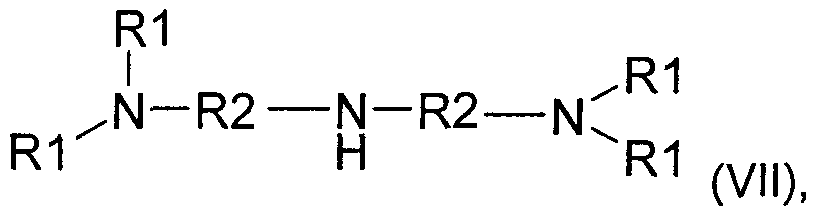
- polyisocyanates ai) diphenylmethane diisocyanate or aii) mixtures of diphenylmethane diisocyanate and polymethylene polyphenylene polyisocyanates, and / or aiii) prepolymers containing isocyanate groups, preparable by reaction of aiv) polyether alcohols with diphenylmethane diisocyanate or mixtures of diphenylmethane diisocyanate and polymethylene polyphenylene polyisocyanates and as catalysts c) a Mixture of at least one catalyst each ci) and cii), wherein ci) selected from the group comprising compounds of general formulas (I) to (VII) 1 with
- cii) is selected from the group comprising compounds of general formulas (VIII) to (XV), with
- R 1 is a linear, branched or cyclic, optionally substituted by one heteroatom, alkyl radical having 1 to 5 carbon atoms,
- R 2 is an aliphatic, cycloaliphatic or aromatic radical having 1 to 10 carbon atoms
- R 3 denotes a linear, branched or cyclic radical optionally substituted by one heteroatom and having 1 to 5 carbon atoms,
- the heteroatoms are preferably halogen atoms, in particular chlorine.
- polyisocyanates a As polyisocyanates a), as described, ai) diphenylmethane diisocyanate (MD) or aii) mixtures of diphenylmethane diisocyanate and polymethylene polyphenylene polyisocyanates (crude MDI), and / or aiii) prepolymers containing isocyanate, preparable by reacting aiv) polyether alcohols with diphenylmethane diisocyanate or Mixtures of diphenylmethane diisocyanate and polymethylene polyphenylene polyisocyanates used.
- MD diphenylmethane diisocyanate
- CAMI polymethylene polyphenylene polyisocyanates
- MDI ai all isomers of the 2-membered MDI can be used.
- the proportion of 4,4'-MDI in the MDI is preferably at least 80% by weight, particularly preferably at least 90% by weight.
- the remainder is essentially 2,4'-MDI.
- the mixtures of diphenylmethane diisocyanate and polymethylene polyphenylene polyisocyanates (crude MDI) aii) usually have an NCO content in the range between 29 and 33% by weight.
- the content of 2-core MDI is preferably in the range of 37 to 41% by weight, and the content of 3-core MDI is preferably in the range of 23 to 28% by weight.
- the rest are higher nuclear homologs.
- Such products are commercially available and are sold for example by BASF AG as Lupranat® ® M20.
- the prepolymers aiii) preferably have an NCO content of 23 and 31 wt .-%, in particular from 25 to 30 wt .-%. They are prepared by reacting aiv) polyether alcohols with diphenylmethane diisocyanate or mixtures of diphenylmethane diisocyanate and polymethylene polyphenylene polyisocyanates. The isocyanates correspond in their composition to the products described as ai) and aii).
- the prepolymers aiii) have a content of 2-core MDI in the range between 40 and 85 wt .-% and a content of 3-core MDI between 5 and 30 wt .-%, each based on the weight of the prepolymer, on.
- the proportion of 4,4'-MDI in the prepolymer is preferably greater than 35 wt .-%, more preferably between 30 and 70 wt .-%, each based on the prepolymer.
- the proportion of 2,4'-MDI is particularly less than 20 wt .-%, preferably between 10 and 20 wt .-%.
- polyether alcohols aiv) are preferably 2- to 3-functional polyether alcohols having a hydroxyl number in the range between 25 and 60 mgKOH / g, as they are commonly used for the production of flexible polyurethane foams.
- polyester alcohols and / or polyether alcohols bi are used for the process according to the invention.
- the polyether alcohols bi) used usually have a functionality of 2 to 4, preferably 2 to 3, and a molecular weight of 450 to 8000 g / mol, preferably 3600 to 6500 g / mol. They are usually prepared by catalytic addition of lower alkylene oxides, usually ethylene oxide and / or propylene oxide, to hydroxyl-functional starter substances.
- the starting substances used are usually water and / or 2- or 3-functional alcohols, such as ethylene glycol, propylene glycol, glycerol or trimethylolpropane (TMP).
- alkylene oxides as mentioned, mostly ethylene oxide and / or propylene oxide are used. These can be deposited individually, sequentially or in a mixture with each other.
- TMP trimethylolpropane
- component bi) comprises at least one polyether alcohol which is prepared by addition of alkylene oxides, in particular ethylene oxide and / or propylene oxide, to 2- to 3-functional alcohols and whose hydroxyl number is in the range from 20 to 450 mg KOH / g, especially 20 and 100 mgKOH / g.
- the preparation of the polyether alcohols bi) is usually carried out by catalytic addition of alkylene oxides, in particular ethylene oxide and / or propylene oxide, to H-functional starter substances.
- the catalysts used are preferably basic compounds, in particular hydroxides of alkali metals. More recently, multimetal cyanide compounds, also referred to as DMC catalysts, are frequently used.
- polyether alcohols bi it is also possible to use polymer-modified polyether alcohols. These are usually prepared by in situ polymerization of olefinically unsaturated monomers, in particular acrylonitrile and / or styrene in the polyether alcohols.
- the polymer-modified polyether alcohols also include polyurea dispersions containing polyether alcohols.
- the polymer-modified polyether alcohols bi) preferably have a hydroxyl number in the range from 10 to 100 mgKOH / g, preferably from 15 to 60 mgKOH / g, and preferably a solids content of from 2 to 60% by weight, preferably from 5 to 50% by weight.
- the polyester alcohols bi) used are usually prepared by condensation of at least difunctional carboxylic acids with at least difunctional alcohols.
- the polyester alcohols bi) used are usually prepared by condensation of at least difunctional carboxylic acids with at least difunctional alcohols.
- the compound having at least 2 isocyanate-reactive groups also includes chain extenders and crosslinkers. These are preferably H-functional compounds having molecular weights of from 62 to 400 g / mol, in particular from 2 to 3-functional alcohols, amines or amino alcohols. Their amount is in particular 0 to 25, preferably 2 to 12 parts by weight, based on 100 parts by weight of polyether alcohol and / or polyester alcohols.
- component b) contains at least bii) an addition product of alkylene oxide to a bond with at least one amino group in the molecule, in particular dimethylaminopropylamine.
- addition products of alkylene oxide to a compound having at least one amino group in the molecule, in particular dimethylaminopropylamine, bii) preferably have a molecular weight in the range of 160 to 500 g / mol. They are used in particular in an amount of 0.01 to 10 wt .-%, based on the weight of component b).
- the compounds having at least two isocyanate-reactive hydrogen atoms in particular the polyether alcohols, contain amine-free antioxidants, ie those which do not contain any amino groups.
- amine-free antioxidants ie those which do not contain any amino groups.
- the addition of antioxidants is common and necessary to suppress the thermo-oxidative degradation of the polyols. Many antioxidants can also migrate out of the plastic and thus increase the emission.
- the amine-free stabilizers against thermo-oxidative degradation contained in the compounds having at least two isocyanate-reactive hydrogen atoms are preferably selected from the group comprising
- sterically hindered phenols ii) lactones, in particular benzofuran-2-one-dehvates iii) other amine-free antioxidants which do not split off phenol, for example sterically hindered phosphites,
- hindered phenols i) are octadecyl-3- (3,5-di-t-butyl-4-hydroxyphenylpropionate), 3,5-bis- (1, 1-dimethylethyl-4-hydroxy-C7-C9-alkyl branched Esters, ethylene (bisoxyethylene) bis (3- (5-t-butylhydroxy-4-tolyl) -propionate),
- lactones ii) in particular benzofuran-2-one derivatives are described in EP 1291384 and DE 19618786.
- amine-free antioxidants which do not split off phenol iii) are described, for example, in patent EP 905180, for example tris (2,4-di-t-butylphenyl) phosphite.
- the antioxidants consist of 20-90% by weight, preferably from 50 to 90% by weight of sterically hindered phenol derivatives and 10-80% by weight, preferably from 10 to 40% by weight of benzofuran. 2-one derivatives and 0 to 30 wt .-%, preferably from 0 to 20 wt .-% of other amine-free antioxidant compounds which do not split phenol. These compounds are added to the compounds having at least two isocyanate-reactive hydrogen atoms b) usually immediately after the preparation. If necessary, further antioxidants can be added immediately before the reaction with the isocyanates. The amount of antioxidants in the compounds having at least two isocyanate-reactive hydrogen atoms is usually in the range of 100 to 8000 ppm, preferably 500 to 5000 ppm.
- the polyether alcohols aiv) and the polyether alcohols bi) at the chain end have a block of the same alkylene oxide, in particular ethylene oxide.
- the hydroxyl number of the polyether alcohol is aiv) 5 to 12 mgKOH / g above or below the hydroxyl value of the polyether alcohol bi).
- the hydroxyl value of the polyether alcohol bi) is preferably in the range between 20 and 100 mgKOH / g.
- the catalysts c) are preferably used in an amount of 0.02 to 5 wt .-%.
- the ratio of the catalysts ci) and cii) to one another depends on the desired properties of the foams. As described, it is necessary that at least one catalyst each ci) and cii) is present. In principle, it is also possible to use a plurality of catalysts ci) and cii).
- Propellants and, if appropriate, auxiliaries and / or additives are furthermore used for the process according to the invention.
- propellant for the process according to the invention is usually water, which reacts with isocyanate groups to form carbon dioxide used.
- the quantities of water which are expediently used are from 0.1 to 8 parts by weight, preferably from 1.5 to 5 parts by weight, based on 100 parts by weight of component b).
- so-called physically effective blowing agents can also be used in admixture with water.
- These are liquids which are inert to the components of the formulation and have boiling points below 100 0 C, preferably below 50 0 C, in particular between -50 0 C and 3O 0 C at atmospheric pressure, so that they evaporate under the influence of the exothermic polyaddition reaction.
- Such preferably usable liquids are hydrocarbons, such as pentane, n- and iso-butane and propane, ethers, such as dimethyl ether and diethyl ether, ketones, such as acetone and methyl ethyl ketone, ethyl acetate and preferably halogenated hydrocarbons, such as methylene chloride, trichlorofluoromethane, dichlorodifluoromethane, dichloromethane. ⁇ ofluoromethane, dichlorotetrafluoroethane and 1, 1, 2-trichloro-1, 2,2-trifluoroethane. It is also possible to use mixtures of these low-boiling liquids with one another and / or with other substituted or unsubstituted hydrocarbons.
- hydrocarbons such as pentane, n- and iso-butane and propane
- ethers such as dimethyl ether and diethyl ether
- ketones such as
- blowing agent and carbon dioxide can be used, which is preferably dissolved as a gas in the starting components.
- water and / or carbon dioxide are used as blowing agent.
- the amount of physical blowing agent required besides water can be easily determined depending on the desired foam density and is about 0 to 50 parts by weight, preferably 0 to 20 parts by weight per 100 parts by weight of the polyhydroxyl compound.
- Auxiliaries and / or additives can also be incorporated into the reaction mixture. Mention may be made, for example, of external and internal release agents, foam stabilizers, hydrolysis protectants, pore regulators, fungistatic and bacteriostatic substances, dyes, pigments, fillers, surfactants and flame retardants.
- polyurethane foams In the industrial production of polyurethane foams, it is customary to combine the compounds having at least two active hydrogen atoms and the other starting materials and auxiliaries and / or additives before the reaction to a so-called polyol component.
- the organic polyisocyanates are reacted with the compounds having at least two active hydrogen atoms in the presence of the abovementioned blowing agents, catalysts and auxiliaries and / or additives, generally in the form of a polyol component.
- Polyol component is reacted in an amount such that the index is preferably between 50 and 200, preferably between 70 to 150 and in particular between 80 to 120.
- the polyurethane foams are preferably produced by the one-shot process, for example by means of high-pressure or low-pressure technology.
- the foams can be in open or closed metallic molds or by continuously applying the reaction mixture to belt lines to produce foam blocks.
- a polyol and an isocyanate component are produced and foamed.
- the components are preferably mixed at a temperature in the range of 15 to 12O 0 C, preferably 20 to 80 0 C and placed in the mold or on the strip line.
- the temperature in the mold is usually in the range between 15 and 120 0 C, preferably between 30 and 80 0 C.
- the flexible polyurethane foams produced by the process according to the invention have a very low emission (VOC and FOG) in the case of the mechanical properties and aging properties demanded by the market.
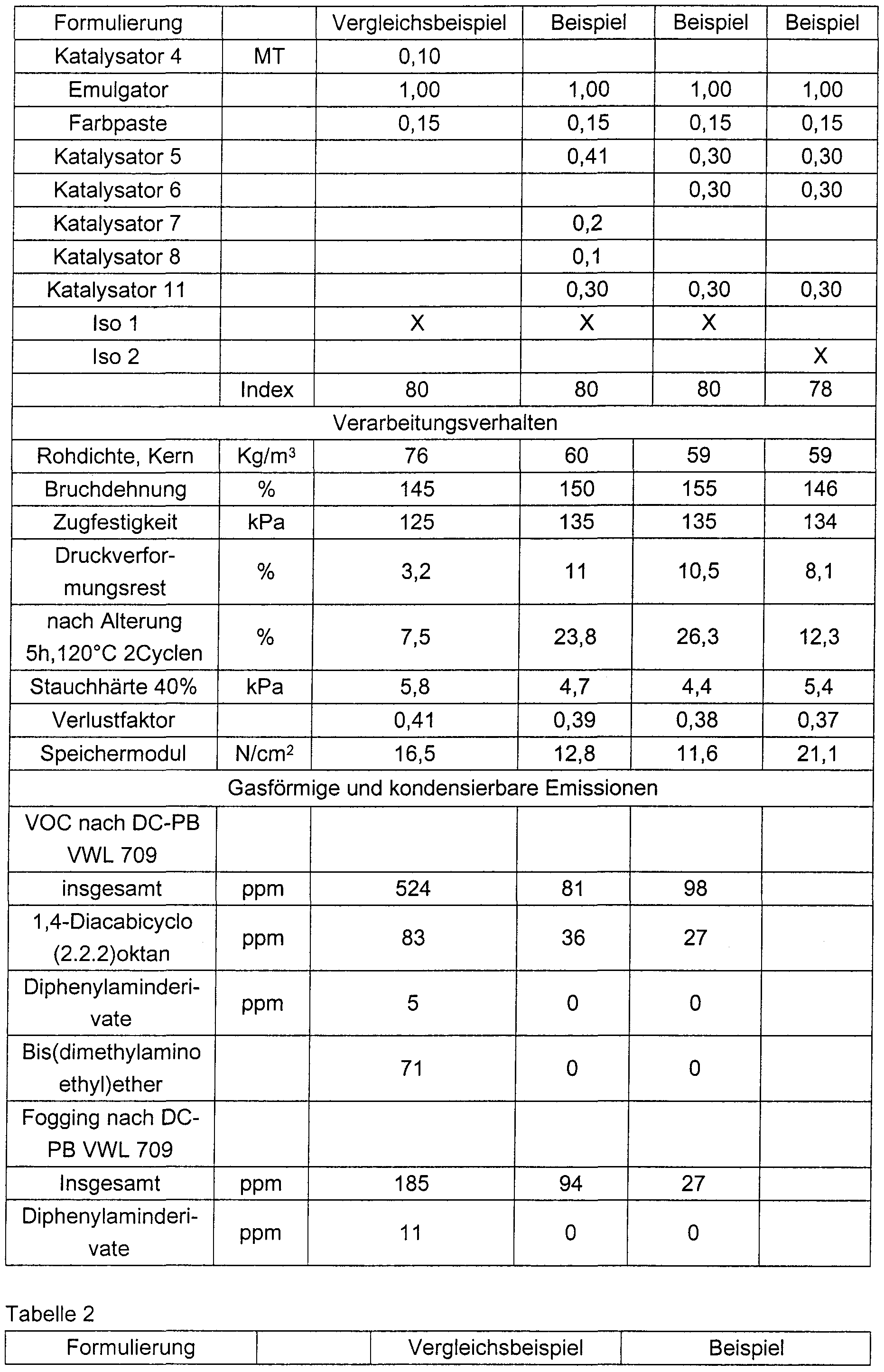
- the polyols, catalysts and additives listed in Tables 1 and 2 were mixed to form a polyol component and mixed with the prepolymers containing isocyanate groups at the indicated isocyanate index in a hand test with a paddle stirrer, the mixture was poured into a mold and allowed to expand there.
- Polyol 1 - polyether alcohol made from glycerol, a PO block and an endblock
- Polyol 2 polyether alcohol from glycerol, a heteric block of propylene oxide and
- Catalyst 2 - Dabco 8154 ® Air Products company.
- Catalyst 5 bisdimethylaminopropylurea
- Catalyst 6 bis (N, N-dimethylaminoethoxyethyl) carbamate
- Catalyst 8 N, N, N-trimethyl-N-hydroxyethyl bis (aminopropyl ether)
- Catalyst 10 bis (N, N-dimethyl-3-aminopropyl) amine
- Catalyst 11 dimethylaminopropylamine
Landscapes
- Chemical & Material Sciences (AREA)
- Health & Medical Sciences (AREA)
- Chemical Kinetics & Catalysis (AREA)
- Medicinal Chemistry (AREA)
- Polymers & Plastics (AREA)
- Organic Chemistry (AREA)
- Polyurethanes Or Polyureas (AREA)
Abstract
Description




Claims




Priority Applications (5)
| Application Number | Priority Date | Filing Date | Title |
|---|---|---|---|
| US11/915,163 US20080194718A1 (en) | 2005-05-23 | 2006-05-17 | Method For Producing Viscoelastic Polyurethane-Soft Foam Materials |
| DE502006006255T DE502006006255D1 (de) | 2005-05-23 | 2006-05-17 | Verfahren zur herstellung von viskoelastischen polyurethan-weichschaumstoffen |
| EP06763166A EP1888664B1 (de) | 2005-05-23 | 2006-05-17 | Verfahren zur herstellung von viskoelastischen polyurethan-weichschaumstoffen |
| AT06763166T ATE458766T1 (de) | 2005-05-23 | 2006-05-17 | Verfahren zur herstellung von viskoelastischen polyurethan-weichschaumstoffen |
| CA002609308A CA2609308A1 (en) | 2005-05-23 | 2006-05-17 | Method for producing viscoelastic polyurethane-soft foam materials |
Applications Claiming Priority (2)
| Application Number | Priority Date | Filing Date | Title |
|---|---|---|---|
| DE102005024144A DE102005024144A1 (de) | 2005-05-23 | 2005-05-23 | Verfahren zur Herstellung von viskoelastischen Polyurethan-Weichschaumstoffen |
| DE102005024144.1 | 2005-05-23 |
Publications (2)
| Publication Number | Publication Date |
|---|---|
| WO2006125740A2 true WO2006125740A2 (de) | 2006-11-30 |
| WO2006125740A3 WO2006125740A3 (de) | 2007-02-15 |
Family
ID=36928176
Family Applications (1)
| Application Number | Title | Priority Date | Filing Date |
|---|---|---|---|
| PCT/EP2006/062383 Ceased WO2006125740A2 (de) | 2005-05-23 | 2006-05-17 | Verfahren zur herstellung von viskoelastischen polyurethan-weichschaumstoffen |
Country Status (7)
| Country | Link |
|---|---|
| US (1) | US20080194718A1 (de) |
| EP (1) | EP1888664B1 (de) |
| AT (1) | ATE458766T1 (de) |
| CA (1) | CA2609308A1 (de) |
| DE (2) | DE102005024144A1 (de) |
| ES (1) | ES2340316T3 (de) |
| WO (1) | WO2006125740A2 (de) |
Cited By (5)
| Publication number | Priority date | Publication date | Assignee | Title |
|---|---|---|---|---|
| EP2042534A1 (de) * | 2007-09-28 | 2009-04-01 | Evonik Goldschmidt GmbH | Aminkatalysatoren geeignet zur Herstellung emissionsarmer, rekatalysestabiler Polyurethanweichschaumstoffe |
| WO2012010844A1 (en) | 2010-07-23 | 2012-01-26 | Christopher Wickham Noakes | Production process for polyol for use in low ball rebound polyurethane foams |
| EP3077436B1 (de) | 2013-12-02 | 2021-01-06 | Basf Se | Polyurethane mit reduzierter aldehydemission |
| EP2877511B2 (de) † | 2012-07-27 | 2024-03-27 | Basf Se | Polyurethanschaumstoffe enthaltend phosphorverbindungen |
| US12565558B2 (en) | 2017-06-27 | 2026-03-03 | Basf Se | Flexible polyurethane foams having improved air permeability |
Families Citing this family (34)
| Publication number | Priority date | Publication date | Assignee | Title |
|---|---|---|---|---|
| EP2050865B1 (de) * | 2007-10-15 | 2014-11-26 | Bayer Intellectual Property GmbH | Bodenbedeckung mit viskoelastischen Dämpfungseigenschaften |
| PL2295438T5 (pl) | 2008-05-30 | 2025-07-07 | Tosoh Corporation | Sposób wytwarzania kompozycji zawierającej hydroksyalkilotrietylenodiaminę i kompozycja katalizatora do wytwarzania żywicy poliuretanowej z zastosowaniem kompozycji hydroksyalkilotrietylenodiaminy |
| CN102414234A (zh) * | 2009-03-05 | 2012-04-11 | 陶氏环球技术有限责任公司 | 源自hppo的多元醇以及由该多元醇制备的聚氨酯产品 |
| WO2012086807A1 (ja) | 2010-12-22 | 2012-06-28 | 東ソー株式会社 | 新規な環状アミン化合物及びそれを用いたポリウレタン樹脂の製造方法 |
| US10266635B2 (en) | 2012-07-27 | 2019-04-23 | Basf Se | Polyurethane foams comprising phosphorus compounds |
| EP2799459A1 (de) | 2013-05-03 | 2014-11-05 | Basf Se | Polyurethane enthaltend Halogenverbindungen |
| MY176404A (en) | 2012-09-13 | 2020-08-06 | Basf Se | Polyurethanes containing halogen compounds |
| EP2708577A1 (de) | 2012-09-13 | 2014-03-19 | Basf Se | Polyurethane enthaltend halogenverbindungen |
| WO2015050876A1 (en) * | 2013-10-01 | 2015-04-09 | Huntsman Petrochemical Llc | Reduction of aldehydes in amine catalysts |
| JP6698526B2 (ja) | 2013-12-02 | 2020-05-27 | ビーエーエスエフ ソシエタス・ヨーロピアBasf Se | 低減されたアルデヒドの排出を有するポリウレタン |
| CN106459367B (zh) | 2014-06-13 | 2019-12-06 | 巴斯夫欧洲公司 | 具有降低的醛排放的聚氨酯 |
| WO2016166008A1 (de) | 2015-04-17 | 2016-10-20 | Basf Se | Polyurethane mit reduzierter aldehydemission |
| BR112017025021A2 (pt) | 2015-05-28 | 2018-08-07 | Basf Se | ?processo para a produção de poliuretanos, poliuretano e uso de um poliuretano? |
| EP3464404B1 (de) | 2016-06-03 | 2020-10-07 | Basf Se | Polyurethane mit reduzierter aldehydemission |
| EP3746494B1 (de) | 2018-02-02 | 2024-05-29 | Basf Se | Polyurethane mit geringen emissionen organischer verbindungen |
| EP3827039B1 (de) | 2018-07-25 | 2025-05-21 | Basf Se | Silikonfreie schaumstabilisatoren für die herstellung von polyurethanschaumstoffen |
| WO2020084003A1 (de) | 2018-10-24 | 2020-04-30 | Basf Se | Polyurethanschaumstoffe mit vermindertem gehalt an aromatischen aminen |
| WO2020126586A1 (de) | 2018-12-19 | 2020-06-25 | Basf Se | Polyurethan-weichschäume mit verbesserten dauergebrauchseigenschaften |
| PL4175991T3 (pl) | 2020-07-01 | 2024-11-25 | Basf Se | Pianki poliuretanowe o ulepszonych właściwościach akustycznych |
| JP7814388B2 (ja) | 2020-11-25 | 2026-02-16 | ビーエーエスエフ ソシエタス・ヨーロピア | アルデヒド放出量を低減させたポリウレタン |
| EP4267642B1 (de) | 2020-12-23 | 2026-06-24 | Basf Se | Neuer katalysator zur herstellung von polyurethanen |
| KR20230136212A (ko) | 2021-02-03 | 2023-09-26 | 바스프 에스이 | 탈취성 폴리우레탄 포옴을 제조하기 위한 2-성분 시스템 |
| EP4288472A1 (de) | 2021-02-03 | 2023-12-13 | Basf Se | Polyurethanschaumstoffe zur korrosionsverminderung von polymeren materialien |
| EP4355803A1 (de) | 2021-06-14 | 2024-04-24 | Basf Se | Polyamine als aldehydfänger |
| WO2023194225A1 (en) | 2022-04-06 | 2023-10-12 | Basf Se | Polyurethane composition for vapor barrier in the building with low indoor temperature |
| CN120019527A (zh) | 2022-09-09 | 2025-05-16 | 巴斯夫欧洲公司 | 具有改善的金属粘附性的电池灌封材料 |
| JP2025530497A (ja) | 2022-09-22 | 2025-09-11 | ビーエーエスエフ ソシエタス・ヨーロピア | 電池物品の製造方法およびそれから製造される電池物品 |
| WO2024104923A1 (en) | 2022-11-16 | 2024-05-23 | Basf Se | Manganese- and iron-containing catalysts comprising an imine ligand for the synthesis of polyurethanes |
| WO2024115432A1 (en) | 2022-12-02 | 2024-06-06 | Basf Se | Water blown environmentally friendly high yield spray polyurethane foam |
| EP4727988A1 (de) | 2023-06-14 | 2026-04-22 | Basf Se | Wärmeleitfähige zweikomponentenklebstoffe |
| CN121605137A (zh) | 2023-07-28 | 2026-03-03 | 巴斯夫欧洲公司 | 具有良好机械性能和高尺寸稳定性的水发泡低密度喷涂泡沫 |
| WO2025132340A1 (en) | 2023-12-22 | 2025-06-26 | Basf Se | Battery housing with heat insulation properties |
| WO2025162109A1 (en) | 2024-01-29 | 2025-08-07 | Basf Se | A stabilized isocyanate composition and two-component system for preparing polyurethane |
| WO2026132254A1 (en) | 2024-12-19 | 2026-06-25 | Basf Se | Polyurethane composition comprising polycarboxylate ether |
Family Cites Families (10)
| Publication number | Priority date | Publication date | Assignee | Title |
|---|---|---|---|---|
| US6232356B1 (en) * | 1997-05-05 | 2001-05-15 | Air Products And Chemicals, Inc. | Reactive catalyst compositions for improving water blown polyurethane foam performance |
| US5859079A (en) * | 1997-05-21 | 1999-01-12 | Air Products And Chemicals, Inc. | Polyurethane catalyst compositions for improving foam performance |
| DE19924804C5 (de) * | 1999-05-29 | 2009-02-12 | Basf Se | Verfahren zur Herstellung von schallabsorbierenden Polyurethanschäumen mit adhäsiver Oberfläche |
| DE19930098A1 (de) * | 1999-07-01 | 2001-01-11 | Performance Chemicals Handels | Emissionsarme Polyurethan-Schaumstoffe |
| EP1097953A3 (de) * | 1999-11-03 | 2001-11-14 | Otto Bock Schaumstoffwerke GmbH & Co. KG | Verfahren zur Herstellung von Polyurethanschaumstoffen |
| US6423756B1 (en) * | 2000-11-10 | 2002-07-23 | Crompton Corporation | Process to improve polyurethane foam performance |
| BR0208765A (pt) * | 2001-04-01 | 2005-01-04 | Dow Global Technologies Inc | Espuma de poliuretano rìgidas |
| DE10156014A1 (de) * | 2001-11-15 | 2003-06-05 | Basf Ag | Verfahren zur Herstellung von Polyetheralkoholen |
| US6653363B1 (en) * | 2002-12-04 | 2003-11-25 | Foamex, L.P. | Low energy-loss, high firmness, temperature sensitive polyurethane foams |
| US6858654B1 (en) * | 2003-10-27 | 2005-02-22 | Air Products And Chemicals, Inc. | Catalyst blends for producing low thermal desorption polyurethane foams |
-
2005
- 2005-05-23 DE DE102005024144A patent/DE102005024144A1/de not_active Withdrawn
-
2006
- 2006-05-17 US US11/915,163 patent/US20080194718A1/en not_active Abandoned
- 2006-05-17 AT AT06763166T patent/ATE458766T1/de active
- 2006-05-17 EP EP06763166A patent/EP1888664B1/de not_active Revoked
- 2006-05-17 DE DE502006006255T patent/DE502006006255D1/de not_active Expired - Lifetime
- 2006-05-17 WO PCT/EP2006/062383 patent/WO2006125740A2/de not_active Ceased
- 2006-05-17 CA CA002609308A patent/CA2609308A1/en not_active Abandoned
- 2006-05-17 ES ES06763166T patent/ES2340316T3/es not_active Expired - Lifetime
Cited By (5)
| Publication number | Priority date | Publication date | Assignee | Title |
|---|---|---|---|---|
| EP2042534A1 (de) * | 2007-09-28 | 2009-04-01 | Evonik Goldschmidt GmbH | Aminkatalysatoren geeignet zur Herstellung emissionsarmer, rekatalysestabiler Polyurethanweichschaumstoffe |
| WO2012010844A1 (en) | 2010-07-23 | 2012-01-26 | Christopher Wickham Noakes | Production process for polyol for use in low ball rebound polyurethane foams |
| EP2877511B2 (de) † | 2012-07-27 | 2024-03-27 | Basf Se | Polyurethanschaumstoffe enthaltend phosphorverbindungen |
| EP3077436B1 (de) | 2013-12-02 | 2021-01-06 | Basf Se | Polyurethane mit reduzierter aldehydemission |
| US12565558B2 (en) | 2017-06-27 | 2026-03-03 | Basf Se | Flexible polyurethane foams having improved air permeability |
Also Published As
| Publication number | Publication date |
|---|---|
| ATE458766T1 (de) | 2010-03-15 |
| DE502006006255D1 (de) | 2010-04-08 |
| US20080194718A1 (en) | 2008-08-14 |
| EP1888664A2 (de) | 2008-02-20 |
| CA2609308A1 (en) | 2006-11-30 |
| ES2340316T3 (es) | 2010-06-01 |
| EP1888664B1 (de) | 2010-02-24 |
| WO2006125740A3 (de) | 2007-02-15 |
| DE102005024144A1 (de) | 2006-11-30 |
Similar Documents
| Publication | Publication Date | Title |
|---|---|---|
| EP1888664B1 (de) | Verfahren zur herstellung von viskoelastischen polyurethan-weichschaumstoffen | |
| EP1981926B1 (de) | Verfahren zur herstellung von offenzelligen viskoelastischen polyurethan-weichschaumstoffen | |
| EP2138520B1 (de) | Verfahren zur Erniedrigung von Emissionen eines Polyurethanschaumstoffes | |
| DE102007046860A1 (de) | Aminkatalysatoren geeignet zur Herstellung emissionsarmer, rekatalysestabiler Polyurethanweichschaumstoffe | |
| WO2009080202A1 (de) | Viskoelastischer polyurethanschaumstoff | |
| EP1266918B1 (de) | Verfahren zur Herstellung von hochelastischen Polyurethanschaumstoffen | |
| EP3230338B1 (de) | Verfahren zur herstellung von viskoelastischen polyurethanschaumstoffen | |
| DE69611623T3 (de) | Polyurethanelastomere | |
| WO2011038846A1 (de) | Verfahren zur erniedrigung von emissionen eines polyurethanschaumstoffes | |
| WO2007144272A1 (de) | Offenzellige viskoelastische polyurethan-weichschaumstoffe | |
| EP2872542A1 (de) | Verfahren zur herstellung emissionsarmer polyurethanweichschaumstoffe | |
| DE4318120C2 (de) | Verfahren zur Herstellung von offenzelligen Polyurethan-Weichschaumstoffen | |
| EP3512896B1 (de) | Verfahren zur erniedrigung der aldehydemissionen von polyurethanschaumstoffen | |
| EP0243777A2 (de) | Verfahren zur Herstellung von Polyharnstoffschaum-Formteilen | |
| EP1630185B1 (de) | Verfahren zur Herstellung von Polyurethan-Weichschaumstoffen | |
| EP3820922B1 (de) | Verfahren zur herstellung von viskoelastischen polyurethanschaumstoffen | |
| DE3844049A1 (de) | Verfahren zur herstellung von flammwidrigen, elastischen polyurethan-weichschaumstoffen und niedrigviskose melamin-polyether-polyoldispersionen hierfuer | |
| EP1127913A2 (de) | Verfahren zur Herstellung von Polyurethan-Schaumstoffen | |
| WO2001002459A1 (de) | Emissionsarme und hydrolysestabile polyurethan-schaumstoffe | |
| DE102005011572A1 (de) | Verfahren zur Herstellung von Polyurethan-Halbhartschäumen | |
| EP4563612A1 (de) | Polyurethanschaumstoff mit verminderter emission | |
| EP0671425A1 (de) | Verfahren zur Herstellung von hochelastischen Polyurethan-Weichschaumstoffen | |
| DE2856456A1 (de) | Verfahren zur herstellung von polyurethan-hartschaumstoffen |
Legal Events
| Date | Code | Title | Description |
|---|---|---|---|
| 121 | Ep: the epo has been informed by wipo that ep was designated in this application | ||
| WWE | Wipo information: entry into national phase |
Ref document number: 2609308 Country of ref document: CA |
|
| WWE | Wipo information: entry into national phase |
Ref document number: 2006763166 Country of ref document: EP |
|
| WWE | Wipo information: entry into national phase |
Ref document number: 11915163 Country of ref document: US |
|
| NENP | Non-entry into the national phase |
Ref country code: DE |
|
| WWW | Wipo information: withdrawn in national office |
Country of ref document: DE |
|
| NENP | Non-entry into the national phase |
Ref country code: RU |
|
| WWW | Wipo information: withdrawn in national office |
Country of ref document: RU |
|
| WWP | Wipo information: published in national office |
Ref document number: 2006763166 Country of ref document: EP |
|
| DPE1 | Request for preliminary examination filed after expiration of 19th month from priority date (pct application filed from 20040101) |