WO2007068376A1 - Biphenylcarboxamide zur bekämpfung von mikroorganismen - Google Patents
Biphenylcarboxamide zur bekämpfung von mikroorganismen Download PDFInfo
- Publication number
- WO2007068376A1 WO2007068376A1 PCT/EP2006/011652 EP2006011652W WO2007068376A1 WO 2007068376 A1 WO2007068376 A1 WO 2007068376A1 EP 2006011652 W EP2006011652 W EP 2006011652W WO 2007068376 A1 WO2007068376 A1 WO 2007068376A1
- Authority
- WO
- WIPO (PCT)
- Prior art keywords
- alkyl
- halogen
- carbonyl
- hydrogen
- haloalkyl
- Prior art date
- Legal status (The legal status is an assumption and is not a legal conclusion. Google has not performed a legal analysis and makes no representation as to the accuracy of the status listed.)
- Ceased
Links
- PWLQKNLIMXZDPU-UHFFFAOYSA-N CC(C)(C)OC(NCc(ccc(F)c1)c1-c(cc(cc1)F)c1N)=O Chemical compound CC(C)(C)OC(NCc(ccc(F)c1)c1-c(cc(cc1)F)c1N)=O PWLQKNLIMXZDPU-UHFFFAOYSA-N 0.000 description 1
- MMHJFVIHFHJGKH-UHFFFAOYSA-N COC(c(ccc(-c(cc(cc1)F)c1N)c1)c1F)=O Chemical compound COC(c(ccc(-c(cc(cc1)F)c1N)c1)c1F)=O MMHJFVIHFHJGKH-UHFFFAOYSA-N 0.000 description 1
Classifications
-
- C—CHEMISTRY; METALLURGY
- C07—ORGANIC CHEMISTRY
- C07D—HETEROCYCLIC COMPOUNDS
- C07D231/00—Heterocyclic compounds containing 1,2-diazole or hydrogenated 1,2-diazole rings
- C07D231/02—Heterocyclic compounds containing 1,2-diazole or hydrogenated 1,2-diazole rings not condensed with other rings
- C07D231/10—Heterocyclic compounds containing 1,2-diazole or hydrogenated 1,2-diazole rings not condensed with other rings having two or three double bonds between ring members or between ring members and non-ring members
- C07D231/14—Heterocyclic compounds containing 1,2-diazole or hydrogenated 1,2-diazole rings not condensed with other rings having two or three double bonds between ring members or between ring members and non-ring members with hetero atoms or with carbon atoms having three bonds to hetero atoms with at the most one bond to halogen, e.g. ester or nitrile radicals, directly attached to ring carbon atoms
-
- A—HUMAN NECESSITIES
- A01—AGRICULTURE; FORESTRY; ANIMAL HUSBANDRY; HUNTING; TRAPPING; FISHING
- A01N—PRESERVATION OF BODIES OF HUMANS OR ANIMALS OR PLANTS OR PARTS THEREOF; BIOCIDES, e.g. AS DISINFECTANTS, AS PESTICIDES OR AS HERBICIDES; PEST REPELLANTS OR ATTRACTANTS; PLANT GROWTH REGULATORS
- A01N43/00—Biocides, pest repellants or attractants, or plant growth regulators containing heterocyclic compounds
- A01N43/48—Biocides, pest repellants or attractants, or plant growth regulators containing heterocyclic compounds having rings with two nitrogen atoms as the only ring hetero atoms
- A01N43/56—1,2-Diazoles; Hydrogenated 1,2-diazoles
Definitions
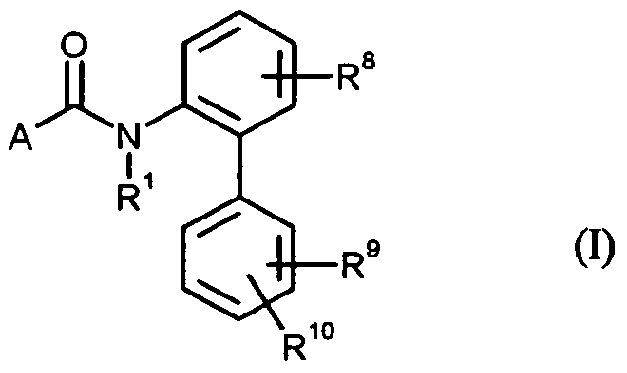
- the present invention relates to novel Biphenylcarboxanüde, several processes for their preparation and their use for controlling harmful microorganisms in crop protection and material protection.
- R ' is hydrogen, C r C 8 alkyl, Ci-Ce-alkylsulfinyl, Ci-C6 alkylsulfonyl, Ci-C 4 -alkoxy-C 1 - C 4 alkyl, C 3 -C 8 cycloalkyl; Ci-C ⁇ haloalkyl, C r C 4 haloalkylthio, C r C 4 kylsulf ⁇ nyl -Halogenal-, Ci-C4-haloalkylsulfonyl, halo-Ci-C4-alkoxy-Ci-C 4 alkyl, C 3 -C 8- halogeno-cycloalkyl having in each case 1 to 9 fluorine, chlorine and / or bromine atoms; Formyl, formyl-Ci- Cs-alkyl, (dQ-AlkyOcarbonyl-d-Ca-alkyl, (C 1 -C 3 alkoxy
- R ' "A represents hydrogen, C, -C6 alkyl, C, -C 6 haloalkyl, C 2 -C ö alkenyl, C 2 -C 6 alkynyl, C 3 -C 7 -
- Cycloalkyl (C 1 -C 4 -alkoxy) carbonyl, (C 3 -C 6 -alkenyloxy) carbonyl, (C 3 -C 6 -alkynyloxy) -carbonyl or cyano
- R 2 is hydrogen, C, -C 8 alkyl, C r C 8 alkoxy, C, -C 4 alkoxy-Ci-C 4 alkyl, C 3 -C 8 cycloalkyl; C 1 -C 6 -haloalkyl, C 1 -C 6 -haloalkoxy, halogeno-C 1 -C 4 -alkoxy-C 1 -C 4 -alkyl, C 3 -C 8 -HaJo gencycloalkyl having in each case 1 to 9 fluorine, chlorine and / or bromine atoms stands,
- R 3 and R 4 are each independently hydrogen, C 1 -C 8 -alkyl, C 1 -C 4 -alkoxy-C 1 -C 4 -alkyl, C 3 -C 8 -cycloalkyl; Ci-C8-haloalkyl, halo-Ci-C 4 alkyl C 1 -C 4 alkoxy, halo-C 3 -C 8 cycloalkyl having in each case 1 to 9 fluorine, chlorine and / or bromine atoms,
- R 3 and R 4 together with the nitrogen atom to which they are attached, form a saturated heterocycle having 5 to 8 ring atoms which is optionally monosubstituted or polysubstituted, identically or differently by halogen or C 1 -C 4 -alkyl, where the heterocycle 1 or 2 further, non-adjacent heteroatoms from the series oxygen, sulfur or NR 7 may contain
- R 5 and R 6 are each independently hydrogen, Ci-C 8 alkyl, C 3 -C 8 cycloalkyl; Ci-C 8-halo, C 3 -C 8 alkyl -halocycloalkyl having in each case 1 to 9 fluorine, chlorine and / or bromine atoms, R 5 and R 6 furthermore together with the nitrogen atom to which they are attached form a optionally mono- or polysubstituted, identically or differently, by halogen or C 1 -C 4 -alkyl-substituted saturated heterocycle having 5 to 8 ring atoms, wherein the heterocycle may contain 1 or 2 further non-adjacent heteroatoms from the series oxygen, sulfur or NR 7 , R 7 is hydrogen or C 1 -C 6 -alkyl,
- R 8 is hydrogen or fluorine
- R 10 is fluorine, chlorine, bromine, iodine, methyl or trifluoromethyl
- R 11 ö for Ci-C alkyl, or Ci-C is 6 haloalkyl having 1 to 13 halogen atoms, m is 1 or 2;
- R 12 and R 13 together with the nitrogen atom to which they are attached additionally form a saturated heterocycle having 5 to 8 ring atoms which is optionally monosubstituted or polysubstituted, identically or differently by halogen or C 1 -C 4 -alkyl, where the heterocycle 1 or 2 further, non-adjacent heteroatoms from the series oxygen, sulfur or NR 7 may contain
- X is O (oxygen) or S (sulfur),
- R 14 is hydrogen, C, -C 4 alkyl, C 1 -C 4 -alkoxy or -NR 16 R 17,
- R 15 is hydrogen, C 1 -C 8 -alkyl, C, -C 8 alkoxy, QC QC-alkoxy-alkyl, C, -C 4 alkylthio C] -C 4 alkyl or d-C ⁇ -haloalkyl wherein the three radicals R 15 may each be identical or different,
- 17 is hydrogen or C 1 -C 4 -alkyl
- R 16 and R 17 together with the nitrogen atom to which they are attached additionally form a saturated heterocycle having 5 to 8 ring atoms which is optionally mono- or polysubstituted, identically or differently by halogen or C 1 -C 4 -alkyl, the heterocycle being 1 or 2 further, non-adjacent heteroatoms from the series oxygen, sulfur or NR 7 may contain
- A is one of the following radicals A1 to A19
- R 18 represents hydrogen, cyano, halogen, nitro, Ci-C4-alkyl, Ci-C 4 alkoxy, Ci-C 4 alkylthio, C 3 - C ⁇ cycloalkyl, Ci-C 4 haloalkyl, Ci-C4- Haloalkoxy or Ci-C 4 -haloalkhyio each having 1 to 5 halogen atoms, aminocarbonyl or stands,
- R 19 4 -alkoxy or C 1 -C 4 -AUCyWuO hydrogen, halogen, cyano, Ci-C 4 alkyl, C 1 -C
- R 20 is hydrogen, C 1 -C 4 -alkyl, hydroxy-C r C 4 -a] kyl, QRC ⁇ alkenyl, C 3 -C 6 cycloalkyl, C 1 -C 4 - alkylthio-Ci-C 4 - alkyl, C 1 -C 4 -alkyl, each having 1 to 5 halogen atoms, or phenyl
- R 21 and R 22 are independently hydrogen, halogen, C] -C 4 alkyl or C 4 halo-alkyl is having 1 to 5 halogen atoms
- R 23 is halogen, cyano or Ci-C 4 alkyl, or C C 4 -haloalkyl or C 1 -C 4 -haloalkoxy having in each case 1 to 5 halogen atoms
- R 24 and R 25 independently of one another represent hydrogen, halogen, C 1 -C 4 -alkyl or C 1 -C 4 -a]
- Halogenoalkyl having 1 to 5 halogen atoms, R 2 S, hydrogen, halogen, Ci-C 4 alkyl or Ci-C is 4 -halogenoalkyl having 1 to 5 halogen atoms,
- R 27 is hydrogen, halogen, hydroxy, cyano, Ci-C 6 alkyl, Ci-C 4 haloalkyl, C 1 -C 4 logenalkoxy -Ha- or Ci-C4-haloalkylthio having in each case 1 to 5 halogen atoms,
- R 28 represents halogen, hydroxy, cyano, C 1 -C 4 -alkyl, C 1 -C 4 -alkoxy, C 1 -C 4 -alkylthio, C 1 -C 4 -
- Halogen atoms is,
- R 2S hydrogen, halogen, cyano, Ci-C 4 alkyl, C r C 4 alkoxy, C, -C 4 alkylthio, Cj-C A- haloalkyl, Ci-C4-haloalkoxy having in each case 1 to 5 halogen atoms, , Ci-C 4 -
- R 30 4 -alkyl or Ci-C 4 haloalkyl is Ci-C with 1 to 5 halogen atoms
- R 31 is C, -C 4 -alkyl
- Q 1 represents S (sulfur), SO, SO 2 or CH 2 p is 0, 1 or 2
- R 22 is identical or different radicals, if p is 2,
- R 32 4 haloalkyl is Ci-C 4 alkyl or C 1 to 5 halogen atoms
- R 33 4 -alkyl or C is 4 -halogenoalkyl having 1 to 5 halogen atoms is C
- R 34 and R 35 independently of one another represent hydrogen, halogen, amino, C 1 -C 4 -alkyl or C 1 -C 4 -
- Haloalkyl having 1 to 5 halogen atoms R 3S is hydrogen, halogen, Ci-C 4 alkyl or Ci-C 4 -haloalkyl having 1 to 5 halogen atoms, R 37 and R 38 independently of one another are hydrogen, halogen, amino, nitro , C 1 -C 4 -alkyl or
- R 39 is hydrogen, halogen, C 1 -C 4 -AUCyI or C is 4 -halogenoalkyl having 1 to 5 halogen atoms,
- R 40 is hydrogen, halogen, amino, C 1 -C 4 -alkylamino, di- (C 1 -C 4 -alkyl) amino, cyano, C 1 -C 4 -
- R 41 represents halogen, Ci-C 4 alkyl or Ci-C is 4 -halogenoalkyl having 1 to 5 halogen atoms
- R 42 is hydrogen, halogen, amino, Ci-C 4 alkylamino, di- (Ci -C 4 alkyl ) amino, cyano, Ci-C 4 - alkyl or Ci-C4-haloalkyl having 1 to 5 halogen atoms
- R 43 represents halogen, Ci-C 4 alkyl or Ci-C4-haloalkyl having 1 to 5 halogen atoms
- R 44 is halogen, C 1 -C 4 -alkyl or C 1 -C 4 -haloalkyl having 1 to 5 halogen atoms
- R 45 is hydrogen or C 1 -C 4 -alkyl
- R 46 is halogen or C 1 -C 4 -alkyl
- R 47 is C 4 alkyl or Ci-C 4 haloalkyl having 1 to 5 halogen atoms
- R 48 4 haloalkyl represents hydrogen, halogen, Ci-C 4 alkyl or C 1 to 5 halogen atoms
- R 49 represents halogen, hydroxyl, Ci-C4-alkyl, Ci-C 4 alkoxy, Ci-C 4 -Alkyhhio, Ci-C 4 haloalkyl, Ci-C4-haloalkylthio or C 4 -haloalkoxy having in each case 1 to 5 halogen atoms,
- R 50 is 4 alkyl is C
- R 51 represents hydrogen, cyano, C 1 -C 4 -alkyl, Ci-C 4 haloalkyl having 1 to 5 halogen atoms, C 1 -C 4 - alkoxy-Ci-C4- alkyl, hydroxy-d-Gralkyl, Ci-C 4 -Alkylsulfbnyl, DitQ-Q-alkytyalTrinosulfonyl, Ci-C f i-alkylcarbonyl or in each case optionally substituted phenylsulfonyl or benzoyl,
- R 52 is hydrogen, halogen, Ci-C 4 -alkyl or Ci-C 4 haloalkyl having 1 to 5 halogen atoms
- R 53 is hydrogen, halogen, cyano, C 1 -C 4 -alkyl or C r C 4 -haloalkyl with 1 to 5 halogen atoms
- R 54 is hydrogen, halogen, C 1 -C 4 -AllCyI or C r C 4 haloalkyl having 1 to 5 halogen atoms.
- biphenylcarboxamides of the formula (I) are obtained by reacting (a) carboxylic acid halides of the formula (II)
- X 1 is halogen or hydroxy, with amines of the formula (UI)
- R 1 , R 8 , R 9 and R 10 have the meanings given above, if appropriate in the presence of a coupling reagent, if appropriate in the presence of an acid binder and if appropriate in the presence of a diluent, or
- R 1 B is Ci-Cs-alkyl, d-Ce-alkylsulfinyl, Ci-C6 alkylsulfonyl, Ci-C4-alkoxy-Ci-C4 -AL- alkyl, C 3 -C 8 cycloalkyl; Q-C ⁇ -haloalkyl, dQ-haloalkylthio, Ci-C 4 -HaIo- genalkylsulfinyl, Ci-C4-haloalkylsulfonyl, halo-Ci-C4-alkoxy-Ci-C 4 alkyl, C 3 -C 8 -halocycloalkyl having in each case 1 to 9 fluorine, chlorine and / or bromine atoms; Formyl, formyl-C 1 -C 3 -alkyl, (C 1 -C 3 -alkyl) carbonyl-C 1 -C 3 -alkyl, (C 1
- Hal is chlorine, bromine or iodine, in the presence of a base and in the presence of a diluent.
- novel biphenylcarboxamides of the formula (I) have very good microbicidal properties and can be used for controlling unwanted microorganisms both in crop protection and in the protection of materials.
- the compounds of the invention may optionally be used as mixtures of various possible isomeric forms, in particular of stereoisomers, such as. B. E and Z, threo and erythro, and optical isomers, but optionally also of tautomers. Both the E and the Z isomers, as well as the threo and erythro, and the optical isomers, any mixtures of these isomers, as well as the possible tautomeric forms claimed.
- the biphenylthiazolecarboxamides according to the invention are generally defined by the formula (I). Preferred radical definitions of the above and below formulas are given below. These definitions apply equally to the end products of formula (I) as well as to all intermediates.
- R 1 preferably represents hydrogen, Ci-C 6 alkyl, Ci-C-alkylsulfinyl, Ci-C 4 alkylsulfonyl, C 1 - C 3 alkoxy-Ci-C 3 alkyl, C 3 -C 6 cycloalkyl; Ci-C 4 haloalkyl, C 4 haloalkylthio, C 1 - C 4 haloalkylsulfinyl, Ci-Q-haloalkylsulfonyl, halo-Ci-C 3 alkoxy-C] -C3 alkyl,
- C 3 -C 8 -halocycloalkyl having in each case 1 to 9 fluorine, chlorine and / or bromine atoms; Formyl, formyl-C, C 3 -alkyl, (C 1 -C 12 -alkylcarbonyl-C 1 -C 5 -alkyl, (C 1 -C 3 -alkoxy) carbonyl-C 1 -C 3 -alkyl; -C B -alkyl) carbonyl-C 3 -a] kyl, halo (Ci-C 3 alkoxy) carbonyl-C 1 -C 3 - alkyl having in each case 1 to 13 fluorine, chlorine and / or bromine atoms (Ci-C 6 alkyl) carbonyl, (Ci-C 4 alkoxy) carbonyl, (C r C 4 -alkylthio) carbonyl, (Ci-C 3 alkoxy
- R 1 particularly preferably represents hydrogen, methyl, ethyl, n- or iso-propyl, n-, iso-, sec- or tert-butyl, pentyl or hexyl, methylsulfinyl, ethylsulfinyl, n- or iso-propylsulfinyl, n-, iso -, sec- or tert-butylsulfinyl, methylsulfonyl, Ethylsutfonyl, n- or iso-propylsulfonyl, n-, iso-, sec- or tert-butylsulfonyl, methoxymethyl, meth
- R 1 very particularly preferably represents hydrogen, methyl, methoxymethyl, methoxymethylcarbonyl, ethoxymethylcarbonyl, formyl, -
- R 1 A is preferably hydrogen, Ci-C 4 alkyl, dC 4 haloalkyl, C 2 -C 4 alkenyl, C 2 -C 4 -
- R 1 A is particularly preferably hydrogen, methyl or ethyl.
- R 2 is preferably hydrogen, Q-C ⁇ -alkyl, C 1 -C 4 -alkoxy, C 1 -C 3 -alkoxy-C 1 -C 3 -alkyl, C 3 -
- Ce-cycloalkyl Ci-C 4 haloalkyl, Ci-C4-haloalkoxy, halo-d-Cs-alkoxy-Ci-Q-alkyl, C 3 -C 6 -halocycloalkyl having in each case 1 to 9 fluorine, chlorine and / or bromine atoms.
- R 2 particularly preferably represents hydrogen, methyl, ethyl, n- or iso-propyl, tert-butyl,
- R 3 and R 4 independently of one another preferably represent hydrogen, Ci-C 6 alkyl, Ci-C 3 alkoxy Ci-Cs-alkyl, C 3 -C 6 cycloalkyl; Ci-C 4 haloalkyl, halogen-Ci-C 3 -a-koxy-Ci-C 3 alkyl, C 3 - Ce-halocycloalkyl having in each case 1 to 9 fluorine, chlorine and / or bromine atoms.
- R 3 and R 4 also form, together with the nitrogen atom to which they are bonded, preferably a saturated heterocycle having 5 or 6 ring atoms which is optionally monosubstituted to disubstituted, identically or differently by halogen or C 1 -C 4 -alkyl, where the heterocycle 1 or 2 further, non-adjacent heteroatoms from the series oxygen, sulfur or NR 7 may contain.
- R 3 and R 4 independently of one another particularly preferably represent hydrogen, methyl, ethyl, n- or iso-propyl, n-, iso-, sec- or tert-butyl, methoxymethyl, methoxyethyl, ethoxymethyl, Ethoxyethyl, cyclopropyl, cyclopentyl, cyclohexyl; Trifluoromethyl, trichloromethyl, trifluoroethyl, trifluoromethoxymethyl.
- R 3 and R 4 also form, together with the nitrogen atom to which they are bonded, particularly preferably a saturated heterocycle which is optionally monosubstituted to monosubstituted, identically or differently by fluorine, chlorine, bromine or methyl, and belongs to the series morpholine,
- Omomorpholine or piperazine wherein the piperazine on the second nitrogen atom may be substituted by R 7 .
- R 5 and R 6 are each independently preferably represents hydrogen, Ci-C 6 alkyl, C 3 -C 6 -Cycloal- alkyl; C 1 -C 4 -haloalkyl, C 3 -C 6 -halocycloalkyl having in each case 1 to 9 fluorine, chlorine and / or bromine atoms.
- R 5 and R 6 together with the nitrogen atom to which they are attached preferably also form an optionally mono- or polysubstituted by identical or different halogen or
- R 5 and R 6 independently of one another particularly preferably represent hydrogen, methyl, ethyl, n- or isopropyl, n-, iso-, sec- or tert-butyl, methoxymethyl, methoxyethyl, ethoxymethyl, ethoxyethyl, cyclopropyl, cyclopentyl, cyclohexyl ; Trifluoromethyl, trichloromethyl, trifluoroethyl, trifluoromethoxymethyl.
- R 5 and R 6 together with the nitrogen atom to which they are attached moreover preferably form an optionally monosubstituted to tetravalent, identical or different, by fluorine,
- Thiomorpholine or piperazine wherein the piperazine on the second nitrogen atom may be substituted by R 7 .
- R 7 is preferably hydrogen or C 1 -C 4 -alkyl.
- R 7 is particularly preferably hydrogen, methyl, ethyl, n- or iso-propyl, n-, iso-, sec- or tert-butyl.
- R 8 is preferably hydrogen.
- R 8 particularly preferably represents fluorine.
- R 9 is preferably -SO m R ⁇ .
- R 9 also preferably represents -SO 2 NR 12 R 13 .
- R 9 is also preferably -Si (R 15 ) 3 .
- R 9 also preferably represents -NR 12 R 13 .
- R 9 also preferably represents -CH 2 -NR 12 R 13 .
- R 10 is preferably fluorine. Chlorine or bromine.
- R 10 also preferably represents methyl or trifluoromethyl.
- R 10 particularly preferably represents fluorine.
- R 10 is also more preferably chlorine.
- R 10 is also more preferably methyl.
- R 10 is also more preferably trifluoromethyl.
- R 11 preferably represents Ci-C4 alkyl or Ci-C 4 haloalkyl having 1 to 9 fluorine, chlorine and / or
- R 11 particularly preferably represents methyl, ethyl, n-, iso-propyl, n-, i-, s-, t-butyl, trifluoromethyl, -CH 2 CF 3 , -C 2 F 5 or trichloromethyl.
- R 11 is very particularly preferably methyl, trifluoromethyl, -CH 2 CF 3 or -C 2 F 5 .
- n is preferably 1, m is also preferably 2, m is particularly preferably 2.
- R 12 is preferably hydrogen, methyl, ethyl, n- or iso-propyl, n-, iso-, sec- or tert-
- R 12 most preferably represents hydrogen or methyl.
- R 13 is preferably hydrogen, methyl, ethyl, n- or iso-propyl, n-, iso-, sec- or tert-
- R 13 is particularly preferably hydrogen, methyl, ethyl, n- or iso-propyl or
- R 13 most preferably represents hydrogen or methyl.
- R 12 and R 13 also together with the nitrogen atom to which they are attached preferably form a saturated heterocycle having 5 or 6 ring atoms, optionally mono- or polysubstituted, identically or differently by halogen or C 1 -C 4 -alkyl the heterocycle may contain 1 or 2 further non-adjacent heteroatoms selected from oxygen, sulfur or NR 7 .
- R 12 and R 13 also form, together with the nitrogen atom to which they are bonded, more preferably a saturated heterocycle optionally substituted once to four times, identically or differently by fluorine, chlorine, bromine or methyl, from the series
- X is preferably O (oxygen). X is also preferably S (sulfur).
- R 14 is preferably hydrogen, methyl, ethyl, n- or iso-propyl, n-, iso-, sec- or tert-butyl, methoxy, ethoxy, n- or isopropoxy, n-, iso-, sec- or tert-butoxy or -NR 16 R 17 .
- R 14 is particularly preferably hydrogen, methyl, ethyl, n- or iso-propyl, methoxy, ethoxy, n- or iso-propoxy or -NR 16 R 17 .
- R 14 very particularly preferably represents hydrogen, methyl, ethyl, methoxy, ethoxy or -NR 16 R 17 .
- R 15 preferably represents Ci-C 6 alkyl, Ci-C 6 alkoxy, Ci-C 3 alkoxy-Ci-C 3 alkyl, or QC 3 - alkylthio-Ci-C 3 alkyl, where the three radicals R 15 may be the same or different.
- R 15 particularly preferably represents methyl, ethyl, methoxy, ethoxy, methoxymethyl, ethoxymethyl, methoxyethyl, ethoxyethyl, methylthiomethyl, ethylthiomethyl, methylthioethyl or ethylthioethyl, where the three radicals R 15 may each be identical or different.
- R 15 very particularly preferably represents methyl, methoxy, methoxymethyl or methylthio-methyl, where the three radicals R 15 may each be identical or different.
- R 15 is particularly preferably methyl.
- R 16 is preferably hydrogen, methyl, ethyl, n- or iso-propyl, n-, iso-, sec- or tert-butyl.
- R 16 particularly preferably represents hydrogen, methyl, ethyl, n- or isopropyl.
- R 16 very particularly preferably represents hydrogen or methyl.
- R 17 is preferably hydrogen, methyl, ethyl, n- or iso-propyl, n-, iso-, sec- or tert-butyl.
- R 17 is particularly preferably hydrogen, methyl, ethyl, n- or iso-propyl.
- R 17 most preferably represents hydrogen or methyl.
- R 15 and R 17 together with the nitrogen atom to which they are attached furthermore preferably form a saturated heterocycle having 5 or 6 ring atoms which is optionally monosubstituted or polysubstituted, identically or differently by halogen or C 1 -C 6 -alkyl, where the heterocycle is 1 or 2 further , non-adjacent heteroatoms from the series oxygen, sulfur or NR 7 may contain.
- R 16 and R 17 also form, together with the nitrogen atom to which they are bonded, particularly preferably a saturated heterocycle from the series morpholine, thiomorpholine or piperazine, optionally monosubstituted to trisubstituted, identically or differently by fluorine, chlorine, bromine or methyl the piperazine may be substituted on the second nitrogen atom by R 7 .
- A is preferably one of the radicals Al, A2, A3, A4, A5, A6, A9, AlO, Al 1, A12, or A17.
- A is particularly preferably one of the radicals
- A is also very particularly preferably the radical A2.
- A is also very particularly preferred for the rest of A4.
- A is also most preferably the radical A5.
- A is also most preferably the radical A6.
- A is also most preferably the radical A9.
- A is also very particularly preferably the radical Al 1.
- A is also very particularly preferably the radical Al 6.
- A is also very particularly preferably the radical Al 7.
- R 18 preferably represents hydrogen, cyano, fluorine, chlorine, bromine, iodine, methyl, ethyl, iso-propyl, methoxy, ethoxy, methylthio, ethylthio, cyclopropyl, Ci-C 2 haloalkyl, Ci-C genalkoxy 2 -HaIo- with in each case 1 to 5 fluorine, chlorine and / or bromine atoms, trifluoromethylthio, di-fluoromethylthio, aminocarbonyl, aminocarbonylmethyl or aminocarbonylethyl.
- R 18 particularly preferably represents hydrogen, fluorine, chlorine, bromine, iodine, methyl, ethyl, isopropyl, monofluoromethyl, monofluoroethyl, difluoromethyl, trifluoromethyl, difluorochloromethyl, trichloromethyl, dichloromethyl, cyclopropyl, methoxy, ethoxy, trifluoromethoxy, trichloromethoxy, Methylthio, ethylthio, trifluoromethylthio or difluoromethylthio.
- R 18 is very particularly preferably hydrogen, fluorine, chlorine, bromine, iodine, methyl, isopropyl, monofluoromethyl, monofluoroethyl, difluoromethyl, trifluoromethyl, difluorochloromethyl or trichloromethyl.
- R 18 particularly preferably represents methyl, difluoromethyl, trifluoromethyl or 1-fluoroethyl.
- R 19 is preferably hydrogen, fluorine, chlorine, bromine, iodine, methyl, ethyl, methoxy, ethoxy,
- R 19 particularly preferably represents hydrogen, fluorine, chlorine, bromine, iodine or methyl.
- R 19 very particularly preferably represents hydrogen, fluorine, chlorine or methyl.
- R 20 preferably represents hydrogen, methyl, ethyl, n-propyl, isopropyl, C 1 -C 2 -haloalkyl having 1 to 5 fluorine, chlorine and / or bromine atoms, hydroxymethyl, hydroxyethyl, cyclopropyl, cyclopentyl, cyclohexyl or phenyl , R 20 particularly preferably represents hydrogen, methyl, ethyl, isopropyl, trifluoromethyl, di-fluoromethyl, hydroxymethyl, hydroxyethyl or phenyl.
- R 20 very particularly preferably represents hydrogen, methyl, trifluoromethyl or phenyl.
- R 20 particularly preferably represents methyl.
- R 21 and R 22 independently of one another preferably represent hydrogen, fluorine, chlorine, bromine, methyl,
- R 21 and R 22 are particularly preferably each hydrogen.
- R 23 is preferably fluorine, chlorine, bromine, cyano, methyl, ethyl, dC ⁇ -haloalkyl or Ci- C ⁇ -haloalkoxy each having 1 to 5 fluorine, chlorine and / or bromine atoms.
- R 23 particularly preferably represents fluorine, chlorine, bromine, cyano, methyl, trifluoromethyl,
- R 23 is very particularly preferably fluorine, chlorine, bromine, iodine, methyl, trifluoromethyl or
- R 23 is particularly preferably methyl or trifluoromethyl.
- R 24 and R 25 independently of one another preferably represent hydrogen, fluorine, chlorine, bromine, methyl,
- R 24 and R 25 are particularly preferably each hydrogen.
- R 26 preferably represents hydrogen, fluorine, chlorine, bromine, iodine, methyl, ethyl or C 1 -C 2 -haloalkyl having 1 to 5 fluorine, chlorine and / or bromine atoms.
- R 26 particularly preferably represents hydrogen, fluorine, chlorine, bromine, iodine, methyl or
- R 26 very particularly preferably represents fluorine, chlorine, bromine, iodine, methyl or trifluoromethyl.
- R 27 is preferably hydrogen, fluorine, chlorine, bromine, iodine, hydroxy, cyano, C 1 -C 4 -alkyl, C 1 -C 2 -haloalkyl, C 1 -C 2 -haloalkoxy or C 1 -C 2 -haloalkylthio, each having 1 to 5 fluorine , Chlorine and / or bromine atoms.
- R 27 particularly preferably represents hydrogen, fluorine, chlorine, bromine, iodine, hydroxyl, cyano, methyl, ethyl, n-propyl, isopropyl, n-butyl, isobutyl, sec-butyl, tert-butyl, difluoromethyl, Trifluoromethyl, difluorochloromethyl, trichloromethyl, trifluoromethoxy, Difhiormethoxy, difluorochloromethoxy, trichloromethoxy, trifluoromethylthio, difluoromethylthio, difluorochloromethylthio or trichloromethylthio.
- R 27 is very particularly preferably hydrogen, fluorine, chlorine, bromine, iodine, methyl, difluoromethyl, trifluoromethyl or trichloromethyl.
- R 27 is particularly preferably iodine, methyl, difluoromethyl or trifluoromethyl.
- R 28 preferably represents fluorine, chlorine, bromine, iodine, hydroxy, cyano, C r C 4 alkyl, methoxy, ethoxy, methylthio, ethylthio, DifluormethyKhio, trifluoromethylthio, Ci-C 2 haloalkyl or Ci-C2 haloalkoxy with in each case 1 to 5 fluorine, chlorine and / or bromine atoms.
- R 28 particularly preferably represents fluorine, chlorine, bromine, iodine, hydroxyl, cyano, methyl, ethyl, n-propyl, isopropyl, n-butyl, isobutyl, sec-butyl, tert-butyl, trifluoromethyl, difluoromethyl, Difluorochloromethyl, trichloromethyl, methoxy, ethoxy, methylthio, ethylthio, difluoromethylthio, trifluoromethylthio, trifluoromethoxy, difluoromethoxy, difluorochloromethoxy or trichloromethoxy.
- R 28 very particularly preferably represents fluorine, chlorine, bromine, iodine, methyl, trifluoromethyl, difluoromethyl or trichloromethyl.
- R 29 preferably represents hydrogen, fluorine, chlorine, bromine, iodine, cyano, Ci-C 4 alkyl, methoxy, ethoxy, methylthio, Ethyrthio, Ci-C 2 haloalkyl or Ci-C2 haloalkoxy, each with 1 to 5 Fluorine, chlorine and / or bromine atoms, C 1 -C 2 -alkylsulphinyl or C 1 -C 2 -alkylsulphonyl.
- R 29 particularly preferably represents hydrogen ", fluorine, chlorine, bromine, iodine, cyano, n-propyl, iso-
- Difluoromethoxy, difluorochloromethoxy, trichloromethoxy, methylsulphinyl or methylsulfonyl Difluoromethoxy, difluorochloromethoxy, trichloromethoxy, methylsulphinyl or methylsulfonyl.
- R 29 very particularly preferably represents hydrogen, fluorine, chlorine, bromine, iodine, n-propyl, isopropyl, n-butyl, isobutyl, sec-butyl, tert-butyl, trifluoromethyl, difluoromethyl, trichloromethyl, methylsulphinyl or methylsulphonyl ,
- R 29 particularly preferably represents hydrogen.
- R 30 is preferably methyl, ethyl or C 1 -C 2 -haloalkyl having 1 to 5 fluorine, chlorine and / or bromine atoms.
- R 30 particularly preferably represents methyl, ethyl, trifluoromethyl, difluoromethyl, difluorochloromethyl or trichloromethyl.
- R 31 is preferably methyl or ethyl.
- R 31 particularly preferably represents methyl
- Q 1 is preferably S (sulfur), SO 2 or CH 2 .
- Q 1 particularly preferably represents S (sulfur) or CH 2 .
- Q 1 very particularly preferably represents S (sulfur).
- p is preferably 0 or 1. p is particularly preferably 0.
- R 32 is preferably methyl, ethyl or Ci-Qj-haloalkyl having 1 to 5 fluorine, chlorine and / or
- R 32 particularly preferably represents methyl, ethyl, trifluoromethyl, difluoromethyl, difluorochloromethyl or trichloromethyl.
- R 32 very particularly preferably represents methyl, trifluoromethyl, difluoromethyl or trichloromethyl.
- R 33 is preferably methyl, ethyl or C 1 -C 2 -haloalkyl having 1 to 5 fluorine, chlorine and / or
- R 33 is particularly preferably methyl, ethyl, trifluoromethyl, difluoromethyl, difluorochloromethyl or trichloromethyl.
- R 33 is particularly anz g Favor g t represents methyl, trifluoromethyl, trichloromethyl or Difluo ⁇ nethyl.
- R 34 and R 35 independently of one another preferably represent hydrogen, fluorine, chlorine, bromine, amino, methyl, ethyl or C 1 -C 2 -haloalkyl having 1 to 5 fluorine, chlorine and / or bromine atoms.
- R 34 and R 35 independently of one another particularly preferably represent hydrogen, fluorine, chlorine, bromine, methyl, ethyl, trifluoromethyl, difluoromethyl, difluorochloromethyl or trichloromethyl.
- R 34 and R 35 independently of one another very particularly preferably represent hydrogen, fluorine, chlorine, bromine, methyl, trifluoromethyl, difluoromethyl or trichloromethyl.
- R 34 and R 35 are particularly preferably each hydrogen.
- R 36 is preferably hydrogen, fluorine, chlorine, bromine, iodine, methyl, ethyl or C : -C 2 -
- R 36 particularly preferably represents hydrogen, fluorine, chlorine, bromine, iodine, methyl, ethyl, trifluoromethyl, difluoromethyl, difluorochloromethyl or trichloromethyl.
- R 36 very particularly preferably represents hydrogen, fluorine, chlorine, bromine, iodine, methyl, trifluoromethyl, difluoromethyl or trichloromethyl.
- R 36 particularly preferably represents methyl.
- R 37 and R 38 independently of one another preferably represent hydrogen, fluorine, chlorine, bromine, amino, nitro, methyl, ethyl or C 1 -C 2 -haloalkyl having 1 to 5 fluorine, chlorine and / or bromine atoms.
- R 37 and R 38 independently of one another particularly preferably represent hydrogen, fluorine, chlorine, bromine,
- R 37 and R 3S independently of one another very particularly preferably represent hydrogen, fluorine, chlorine, bromine, methyl, trifluoromethyl, difluoromethyl or trichloromethyl.
- R 37 and R 38 are particularly preferably each hydrogen.
- R 39 preferably represents hydrogen, fluorine, chlorine, bromine, methyl, ethyl or QC 2 -haloalkyl having 1 to 5 fluorine, chlorine and / or bromine atoms,
- R 39 particularly preferably represents hydrogen, fluorine, chlorine, bromine, methyl, ethyl, trifluoromethyl, difluoromethyl, difluorochloromethyl or trichloromethyl.
- R 39 very particularly preferably represents hydrogen, fluorine, chlorine, bromine, methyl, trifluoromethyl, difluoromethyl or trichloromethyl.
- R 39 is particularly preferably methyl.
- R 40 preferably represents hydrogen, fluorine, chlorine, bromine, amino, C 1 -C 4 -alkylamino, di (C 1 -C 4 -alkyl) amino, cyano, methyl, ethyl or C 1 -C 2 -haloalkyl with 1 to 5 fluorine, Chlorine and / or bromine atoms.
- R 40 particularly preferably represents hydrogen, fluorine, chlorine, bromine, amino, methylamino, dimethylamino, cyano, methyl, ethyl, trifluoromethyl, difluoromethyl, difluorochloromethyl or trichloromethyl.
- R 40 very particularly preferably represents hydrogen, fluorine, chlorine, bromine, amino, methylamino,
- R 40 particularly preferably represents amino, methylamino, dimethylamino, methyl or trifluoromethyl.
- R 41 is preferably fluorine, chlorine, bromine, methyl, ethyl or C 1 -C 2 -haloalkyl having 1 to 5 fluorine, chlorine and / or bromine atoms.
- R 41 particularly preferably represents fluorine, chlorine, bromine, methyl, ethyl, trifluoromethyl, difluoromethyl, difluorochloromethyl or trichloromethyl.
- R 41 is very particularly preferably fluorine, chlorine, bromine, methyl, trifluoromethyl, difluoromethyl or trichloromethyl.
- R 41 is particularly preferably methyl, trifluoromethyl or difluoromethyl.
- R 42 preferably represents hydrogen, fluorine, chlorine, bromine, amino, Ci-C 4 -Alkylarnino, di (Ci-C 4 - alkyl) amino, cyano, methyl, ethyl or Ci-C 2 haloalkyl having 1 to 5 fluorine , Chlorine and / or bromine atoms.
- R 42 particularly preferably represents hydrogen, fluorine, chlorine, bromine, amino, methylamino, dimethylamino, cyano, methyl, ethyl, trifluoromethyl, difluoromethyl, difluorochloromethyl or trichloromethyl.
- R 42 very particularly preferably represents hydrogen, fluorine, chlorine, bromine, amino, methylamino,
- R 42 particularly preferably represents amino, methylamino, dimethylamino, methyl or
- R 43 is preferably fluorine, chlorine, bromine, methyl, ethyl or C 1 -C 2 -haloalkyl of 1 to 5
- R 43 particularly preferably represents fluorine, chlorine, bromine, methyl, ethyl, trifluoromethyl,
- R 43 is very particularly preferably fluorine, chlorine, bromine, methyl, trifluoromethyl, difluoromethyl or trichloromethyl.
- R 43 is particularly preferably methyl, trifluoromethyl or difluoromethyl.
- R 44 is preferably fluorine, chlorine, bromine, methyl, ethyl or dC 2 -haloalkyl having 1 to 5
- R 44 particularly preferably represents fluorine, chlorine, bromine, methyl, ethyl, trifluoromethyl,
- R 44 very particularly preferably represents fluorine, chlorine, bromine, methyl, trifluoromethyl,
- R 45 is preferably hydrogen, methyl or ethyl. R 45 is particularly preferably methyl.
- R 46 is preferably fluorine, chlorine, bromine, methyl or ethyl.
- R 46 particularly preferably represents fluorine, chlorine or methyl.
- R 47 is preferably methyl, ethyl or dC 2 -haloalkyl having 1 to 5 fluorine, chlorine and / or bromine atoms.
- R 47 particularly preferably represents methyl, ethyl, trifluoromethyl, difluoromethyl, difluorochloromethyl or trichloromethyl.
- R 47 is very particularly preferably methyl, trifluoromethyl, difluoromethyl or trichloromethyl.
- R 47 is particularly preferably methyl or trifluoromethyl.
- R 48 is preferably hydrogen, fluorine, chlorine, bromine, methyl, ethyl or C 1 -C 2 -haloalkyl having 1 to 5 fluorine, chlorine and / or bromine atoms.
- R 48 particularly preferably represents hydrogen, fluorine, chlorine, bromine, methyl or trifluoromethyl.
- R 49 is preferably fluorine, chlorine, bromine, iodine, hydroxy, C 1 -C 4 -alkyl, methoxy, ethoxy, methylthio, ethylthio, difluoromethylthio, trifluoromethylthio, C 1 -C 2 -haloalkyl or C 1 -C 2 -haloalkoxy, each having 1 to 5 fluorine, chlorine and / or bromine atoms.
- R 49 particularly preferably represents fluorine, chlorine, bromine, iodine, methyl, ethyl, n-propyl, isopropyl, n-butyl, isobutyl, sec-butyl, tert-butyl, trifluoromethyl, difluoromethyl, difluorochloromethyl or trichloromethyl.
- R 49 is very particularly preferably fluorine, chlorine, bromine, iodine, methyl, trifluoromethyl, difluoromethyl or trichloromethyl.
- R 50 is preferably methyl, ethyl, n-propyl or iso-propyl.
- R 50 is particularly preferably methyl or ethyl.
- R 51 preferably represents hydrogen, methyl, ethyl, Ci-C 2 haloalkyl having 1 to 5 fluorine, chlorine and / or bromine atoms, Ci-C 2 alkoxy-Ci-C 2 alkyl, hydroxymethyl, hydroxyethyl,
- R 51 particularly preferably represents hydrogen, methyl, ethyl, trifluoromethyl, methoxymethyl,
- R 51 is very particularly preferably methyl or methoxymethyl.
- R 52 is preferably hydrogen, fluorine, chlorine, bromine, methyl, ethyl or C 1 -C 2 -
- R 52 particularly preferably represents hydrogen, fluorine, chlorine, bromine, methyl, ethyl
- R 52 is very particularly preferably hydrogen or methyl.
- R 53 preferably represents hydrogen, fluorine, chlorine, bromine, iodine, cyano, methyl, ethyl, isopropyl or C 1 -C 2 -haloalkyl having 1 to 5 fluorine, chlorine and / or bromine atoms.
- R 53 is particularly preferably hydrogen, fluorine, chlorine, bromine, cyano, methyl, ethyl, iso-propyl, trifluoromethyl, difluoromethyl, difluorochloromethyl or trichloromethyl.
- R 53 very particularly preferably represents hydrogen, methyl, difluoromethyl or trifluoromethyl.
- R 54 is preferably hydrogen, fluorine, chlorine, bromine, methyl, ethyl or C 1 -C 2 -
- R 54 particularly preferably represents hydrogen, fluorine, chlorine, bromine, iodine, methyl or
- R 54 is very particularly preferably hydrogen.
- R il 1 , R ⁇ > 8 ⁇ , R r> 9 9 , R ⁇ > 1 l 0 u and A have the meanings given above.
- R 1 , R 8 , R 9 , R 1U and A have the meanings given above.
- R 1 , R s , R 9 , R and IU have the meanings given above.
- the carboxylic acid halides required as starting materials for carrying out the process (a) according to the invention are generally defined by the formula (H).
- M of this formula (II) A is preferred, particularly preferred, very particularly preferred or particularly preferred for those meanings which have already been described in In connection with the description of the substances of the formula (I) according to the invention as preferred, particularly preferred, etc. were given for this radical.
- X 1 is preferably fluorine, chlorine or hydroxyl, more preferably chlorine or hydroxy.
- the carboxylic acid halides of the formula (II) are known and / or can be prepared by known processes (cf., for example, EP-A 0 545 099, JP-A 01-290662 and US 5,093,347).
- R 1, R 8, R 9 and R 10 are preferred, particularly preferred, very particularly preferred or especially preferred for those meanings which have already in connection with the description of the substances according to the invention of the formula (I) as preferably, etc. are given for this radical.
- Amines of the formulas (TII-I), (IH-2) and (III-3) can be prepared by known processes (see WO 01/53259 and WO 01/49664, see also the Preparation Examples).
- Biphenylcarboxamides are generally defined by the formula (I-a). In this formula (I-a) have
- R 8 , R 9 , R 10 and A are preferably, more preferably, very particularly preferably or particularly preferably those meanings which have already been mentioned in connection with the description of the invention.
- compounds of the formula (I) as preferred, particularly preferred, etc. were given for these radicals.
- the compounds of the formula (I-a) are compounds according to the invention and can be prepared by process (a).
- halides which are furthermore required as starting materials for carrying out the process (b) according to the invention are generally defined by the formula (TV).
- R 1 B preferred, particularly preferred, very particularly preferred or especially preferred for those meanings which have as preferred above for R 1, more preferred, etc., wherein R 1 B never for Hydrogen stands.
- Hal is chlorine, bromine or iodine.
- Halides of the formula (FV) are known.
- Suitable diluents for carrying out process (a) according to the invention are all inert organic solvents. These preferably include aliphatic, alicyclic or aromatic hydrocarbons, such as e.g. Petroleum ether, hexane, heptane, cyclohexane, methylcyclohexane, benzene, toluene, xylene or decalin; halogenated hydrocarbons, e.g.
- Chlorobenzene dichlorobenzene, dichloromethane, chloroform, carbon tetrachloride, dichloroethane or trichloroethane
- Ethers such as diethyl ether, diisopropyl ether, methyl t-butyl ether, methyl t-amyl ether, dioxane, tetrahydrofuran, 1,2-dimethoxyethane, 1,2-diethoxyethane or anisole
- Ketones such as acetone, butanone, methyl isobutyl ketone or cyclohexanone
- Nitriles such as acetonitrile, propionitrile, n- or i-butyronitrile or benzonitrile
- Amides such as N, N-dimethylformamide, N, N-dimethylacetamide, N-methylformaneate, N-methylpyrrolidone or hexamethylphosphoric triamide; their mixture
- the process (a) according to the invention is carried out in the presence of a suitable acid acceptor.
- a suitable acid acceptor all customary inorganic or organic bases are suitable. These preferably include alkaline earth metal or alkali metal hydrides, hydroxides, amides, alkoxides, acetates, carbonates or bicarbonates, such as sodium hydride, sodium amide, lithium diisopropylamide, sodium methoxide, sodium ethoxide, potassium tert-butoxide, sodium hydroxide, Potassium hydroxide, sodium acetate, sodium carbonate, potassium carbonate, potassium bicarbonate, sodium bicarbonate or ammonium carbonate, and tertiary amines such as trimethylamine, triethylamine, tributylamine, N, N-dimethylanine, N, N-dimethylbenzylamine, pyridine, N-methylpiperidine, N -Methyknorphonium, N, N-dimethylaminopyr
- the process (a) according to the invention is carried out in the presence of a suitable coupling reagent (if X 5 is hydroxyl).
- a suitable coupling reagent if X 5 is hydroxyl.
- all customary carbonyl actuators are suitable. These preferably include N- [3- (dimethylamino) propyl] -N'-ediylcarbodi ⁇ iide hydrochloride, N, N'-di-sec-butyl-carbodiirnide, N, N'-dicyclohexylcarbodiimide, N, N'-diisopropylcarbodi imide, 1 ⁇ 3 ⁇ imethylarnino) propyl) -3-ethyl-c ⁇ rbodiirnid ⁇ nethiodid, 2-Bromo-3-ethyl-4-methyl-thiazoh 'environmentally tetrafluoroborate, N, N-bis [2-oxo-3
- reaction temperatures can be varied within a substantial range when carrying out process (a) according to the invention. In general, one works at temperatures of 0 0 C to 150 0 C, preferably at temperatures of 20 0 C to 110 0 C.
- Suitable diluents for carrying out process (b) according to the invention are all inert organic solvents. These include, preferably, aliphatic, alicyclic or aromatic hydrocarbons, e.g. Petroleum ether, hexane, heptane, cyclohexane, methylcyclohexane, benzene, toluene, xylene or decalin; halogenated hydrocarbons, e.g.
- Chlorobenzene dichlorobenzene, dichloromethane, chloroform, carbon tetrachloride, dichloroethane or trichloroethane; Ethers, such as diethyl ether, diisopropyl ether, methyl tert-butyl ether, methyl tert-amyl ether, dioxane, tetrahydrofuran, 1,2-dimethoxyethane, 1,2-diethoxyethane or anisole or amides, such as N, N-dimethylformamide, N, N- Dimethylacetamide, N-methylformanilide, N-methylpyrrolidone or hexamethylphosphoric triamide.
- Ethers such as diethyl ether, diisopropyl ether, methyl tert-butyl ether, methyl tert-amyl ether, dioxane, tetrahydrofuran, 1,2-dimethoxyethan
- the process (b) according to the invention is carried out in the presence of a base.
- a base As such, all customary inorganic or organic bases are suitable. These are preferably Alkaline earth metal or alkali metal hydrides, hydroxides, amides, alkoxides, acetates, carbonates or bicarbonates, such as sodium hydride, sodium amide, sodium methoxide, sodium ethoxide, potassium tert-butoxide, sodium hydroxide, potassium hydroxide, ammonium hydroxide, Sodium acetate, potassium acetate, calcium acetate, ammonium acetate, sodium carbonate, potassium carbonate, potassium bicarbonate, sodium bicarbonate or cesium carbonate, and also tertiary amines, such as trimethylamine, triethylamine, tributylamine, N, N-dimethylaniline, N, N-dimethylbenzylamine, pyridine , N-methylpiperidine, N-methylmorpholine, N,
- reaction temperatures can be varied within a substantial range. In general, one works at temperatures of 0 0 C to 150 0 C, preferably at temperatures of 20 0 C to 110 0 C.
- the processes (a) and (b) according to the invention are generally carried out under atmospheric pressure. However, it is also possible to work under elevated or reduced pressure, generally between 0, 1 bar and 10 bar.
- the substances according to the invention have a strong microbicidal action and can be used for controlling unwanted microorganisms, such as fungi and bacteria, in crop protection and in the protection of materials.
- Fungicides can be used for the control of Plasmodiophoromycetes, Oomycetes, Chytridiomycetes, Zygomycetes, Ascomycetes, Basidiomycetes and Deuteromycetes.
- Bactericides can be used in crop protection for controlling Pseudomonadaceae, Rhizobiaceae, Enterobacteriaceae, Corynebacteriaceae and Streptomycetaceae.
- pathogens of fungal and bacterial diseases which fall under the generic names enumerated above, are named: Diseases caused by powdery mildews such as e.g. Blumeria species, such as Blumeria graminis;
- Podosphaera species such as Podosphaera leucotricha
- Sphaerotheca species such as Sphaerotheca fiiliginea
- Uncinula species such as Uncinula necator
- Gymnosporangium species such as Gymnosporangium sabinae
- Hemileia species such as Hemileia vastatrix
- Phakopsora species such as Phakopsora pachyrhizi and Phakopsora meibomiae
- Puccinia species such as Puccinia recondita or Puccinia graminis
- Uromyces species such as Uromyces appendiculatus
- Bremia species such as Bremia lactucae
- Peronospora species such as Peronospora pisi or P. brassicae;
- Phytophthora species such as Phytophthora infestans
- Plasmopara species such as Plasmopara viticola
- Pseudoperonospora species such as Pseudoperonospora humuli or
- Pythium species such as Pythium uhimum
- Alternaria species such as Alternaria solani;
- Cercospora species such as Cercospora beticola
- Cladosporium species such as Cladosporium cucumerinum
- Cochliobolus species such as Cochliobolus sativus (conidia form: Drechslera, Syn: Helminthosporium);
- Colletotrichum species such as Colletotrichum lindemuthanium
- Cycloconium species such as cycloconium oleaginum
- Diaporthe species such as Diaporthe citri;
- Elsinoe species such as Elsinoe fawcettii
- Gloeosporium species such as, for example, Gloeosporium laeticolor
- Glomerella species such as Glomerella cingulata
- Guignardia species such as Guignardia bidwelli;
- Leptosphaeria species such as Leptosphaeria maculans
- Magnaporthe species such as Magnaporthe grisea
- Mycosphaerella species such as Mycosphaerella graminicola and Mycosphaerella fijiensis
- Mycosphaerella species such as Mycosphaerella graminicola and Mycosphaerella fijiensis
- Phaeosphaeria species such as Phaeosphaeria nodorum
- Pyrenophora species such as, for example, Pyrenophora teres
- Ramularia species such as Ramularia collo-cygni
- Rhynchosporium species such as Rhynchosporium secalis
- Septoria species such as Septoria apii
- Typhula species such as Typhula incarnata
- Venturia species such as Venturia inaequalis
- Corticium species such as Corticium grarninearum
- Fusarium species such as Fusarium oxysporum
- Gaeumannomyces species such as Gaeumannomyces graminis
- Rhizoctonia species such as Rhizoctonia solani
- Tapesia species such as Tapesia acuformis or Tapesia yallundae;
- Thielaviopsis species such as Thielaviopsis basicola
- Ear and panicle diseases caused by e.g.
- Ahernaria species such as Alternaria spp .;
- Aspergillus species such as Aspergillus flavus
- Cladosporium species such as Cladosporium cladosporioides
- Claviceps species such as Claviceps purpurea
- Fusarium species such as Fusarium culmorum
- Gibberella species such as Gibberella zeae
- Monographella species such as Monographella nivalis
- Sphacelotheca species such as Sphacelotheca reiliana
- Tilletia species such as Tilletia caries
- Urocystis species such as Urocystis occulta
- Ustilago species such as Ustilago nuda
- Aspergillus species such as Aspergillus flavus
- Botrytis species such as Botrytis cinerea
- Penicillium species such as Penicillium expansum and Penicillium purpurogenum
- Sclerotinia species such as Sclerotinia sclerotiorum
- Verticilium species such as Verticilium alboatrum; Seed and soil rots and wilts, and seedling diseases caused by, for example, Fusarium species such as Fusarium cubnorum; Phytophthora species, such as Phytophthora cactorum; Pythium species such as Pythium ultimum; Rhizoctonia species, such as Rhizoctonia solani; Sclerotium species, such as Sclerotium rolfsii;
- Nectria species such as Nectria galligena
- Esca species such as Phaeomoniella chlamydospora and Phaeoacremonium aleophilum and Fomitiporia mediterranea; Flower and seed diseases caused by e.g. Botrytis species, such as Botrytis cinerea;
- Rhizoctonia species such as Rhizoctonia solani
- Hehninthosporium species such as Hehninthosporium solani
- Xanthomonas species such as Xanthomonas campestris pv. Oryzae
- Pseudomonas species such as Pseudomonas syringae pv. Lachrymans
- Erwinia species such as Erwinia amylovora
- the following diseases of soybean beans can be controlled: fungal diseases on leaves, stems, pods and seeds caused by, for example, Alternaria leaf spot (Alternaria sp. Ater tenuissima), Anthracnose (Colletotrichum gloeosporoides dematium var.
- Phytophthora red (Phytophthora megasperma), Brown Stem Red (Phialophora gregata), Pythium Red (Pythium aphanidermatum, Pythium irregular, Pythium Debaryanum, Pythium myriotylum, Pythium ultimum), Rhizoctonia Root Red, Stem Decay, and Damping Off (Rhizoctonia solani), Sclerotinia Stem Decay (Sclerotinia sclerotiorum), Sclerotinia Southern Blight (Sclerotinia rolfsii), Thielaviopsis Root Red (Thielaviopsis basicola).
- the active compounds according to the invention also have a strong tonic effect in plants. They are therefore suitable for mobilizing plant-own defenses against attack by unwanted microorganisms.
- plant-strengthening (resistance-inducing) substances are to be understood as meaning those substances which are capable of stimulating the defense system of plants in such a way that the treated plants exhibit extensive resistance to these microorganisms with subsequent inoculation with undesired microorganisms.
- Undesirable microorganisms in the present case are phytopathogenic fungi, bacteria and viruses.
- the substances according to the invention can therefore be used to protect plants within a certain period of time after the treatment against the infestation by the said pathogens.
- the period within which protection is induced generally extends from 1 to 28 days, preferably 1 to 14 days, more preferably 1 to 7 days after the treatment of the plants with the active ingredients.
- the good plant tolerance of the active ingredients in the necessary concentrations for controlling plant diseases allows treatment of aboveground plant parts, of plant and seed, and the soil.
- the active compounds according to the invention can be used with particularly good success for controlling cereal diseases, such as, for example, against Puccinia species and diseases in the wine, fruit and vegetable growing, such. against Botrytis, Venturia or Alternaria species.
- the active compounds according to the invention are also suitable for increasing crop yield. They are also low toxicity and have good plant tolerance.
- the active compounds according to the invention may optionally also be used in certain concentrations and application rates as herbicides, for influencing plant growth and for controlling animal pests. If appropriate, they can also be used as intermediates and precursors for the synthesis of other active ingredients.
- plants and parts of plants can be treated.
- plants are understood as meaning all plants and plant populations, such as desired and undesired wild plants or crop plants (including naturally occurring crop plants).
- Crop plants can be plants which can be obtained by conventional breeding and optimization methods or by biotechnological and genetic engineering methods or combinations of these methods, including the transgenic plants and including the plant varieties which can or can not be protected by plant variety rights.
- Plant parts are to be understood as meaning all aboveground and subterranean parts and organs of the plants, such as shoot, leaf, flower and root, examples of which include leaves, needles, stems, flowers, fruiting bodies, fruits and seeds, and roots, tubers and rhizomes.
- the plant parts also include crops and vegetative and generative propagation material, such as cuttings, tubers, rhizomes, offshoots and seeds.
- the treatment according to the invention of the plants and plant parts with the active ingredients is carried out directly or by acting on their environment, habitat or storage space according to the usual treatment methods, e.g. by dipping, spraying, vaporizing, atomizing, spreading, spreading and in propagation material, in particular in seeds, further by single or multi-layer wrapping.
- the substances of the invention for the protection of technical Use materials against infestation and destruction by unwanted microorganisms.
- technical material is meant herein non-living materials 201 that have been prepared for use in the art.
- technical materials which are to be protected against microbial alteration or destruction by active compounds according to the invention may be adhesives, glues, paper and cardboard, textiles, leather, wood, paints and plastic articles, cooling lubricants and other materials which attack or decompose microorganisms can be.
- the materials to be protected are also parts of production plants, such as cooling water circuits, called, which can be affected by the proliferation of microorganisms.
- technical materials which may be mentioned are preferably adhesives, glues, papers and cartons, leather, wood, paints, cooling lubricants and heat transfer fluids, particularly preferably wood.
- microorganisms that can cause degradation or a change in the technical materials, for example, bacteria, fungi, yeasts, algae and mucus organisms may be mentioned.
- the active compounds according to the invention preferably act against fungi, in particular molds, wood-discolouring and wood-destroying fungi (Basidiomycetes) and against slime organisms and algae.
- Examples include microorganisms of the following genera: Alternaria, such as Ahernaria tenuis,
- Aspergillus such as Aspergillus niger
- Chaetomium such as Chaetomium globosum
- Coniophora like Coniophora puetana,
- Lentinus such as Lentinus tigrinus
- Penicillium such as Penicillium glaucum.
- Polyporus such as Polyporus versicolor
- Aureobasidium such as Aureobasidium pullulans
- Sclerophoma such as Sclerophoma pityophila
- Trichoderma such as Trichoderma viride
- Escherichia such as Escherichia coli
- Pseudomonas such as Pseudomonas aeruginosa
- Staphylococcus such as Staphylococcus aureus.
- the active compounds can be converted into the customary formulations, such as solutions, emulsions,
- These formulations are prepared in a known manner, for example by mixing the active compounds with extenders, ie liquid solvents, liquefied gases under pressure and / or solid carriers, optionally with the use of surface-active agents, ie emulsifiers and / or dispersants and / or foam-forming agents.
- extenders ie liquid solvents, liquefied gases under pressure and / or solid carriers
- surface-active agents ie emulsifiers and / or dispersants and / or foam-forming agents.
- organic solvents can also be used as auxiliary solvents.
- Suitable liquid solvents are essentially: aromatics such as xylene, toluene or alkylnaphthalenes, chlorinated aromatics or chlorinated aliphatic hydrocarbons such as chlorobenzenes, chloroethylenes or methylene chloride, aliphatic hydrocarbons such as cyclohexane or paraffins, eg petroleum fractions, alcohols such as butanol or glycol and their ethers and esters, ketones, such as acetone, methyl ethyl ketone, methyl isobutyl ketone or cyclohexanone, strongly polar solvents, such as dimethylformamide and dimethyl sulfoxide, and water.
- aromatics such as xylene, toluene or alkylnaphthalenes
- chlorinated aromatics or chlorinated aliphatic hydrocarbons such as chlorobenzenes, chloroethylenes or methylene chloride
- aliphatic hydrocarbons such
- liquefied gaseous diluents or carriers are meant those liquids which are gaseous at normal temperature and under normal pressure, for example aerosol propellants, such as halogenated hydrocarbons as well as butane, propane, nitrogen and carbon dioxide.
- Suitable solid carriers are: for example ground natural minerals, such as kaolins, clays, talc, chalk, quartz, attapulgite, montmorillonite or diatomaceous earth, and ground synthetic minerals, such as finely divided silica, alumina and silicates.
- Suitable solid carriers for granules are: eg broken and fractionated natural rocks such as calcite, pumice, marble, sepiolite, dolomite and synthetic granules of inorganic and organic flours and granules of organic material such as sawdust, coconut shells, corn cobs and tobacco stems.
- Suitable emulsifiers and / or foam-formers are: for example nonionic and anionic emulsifiers, such as polyoxyethylene fatty acid esters, polyoxyethylene fatty alcohol ethers, for example alkylaryl polyglycol ethers, alkylsulfonates, alkyl sulfates, arylsulfonates and protein hydrolysates.
- Suitable dispersants are: for example lignin-sulphite liquors and methylcellulose.
- Adhesives such as carboxymethyl cellulose, natural and synthetic powdery, granular or latex polymers may be used in the formulations, such as gum arabic, polyvinyl alcohol, polyvinyl acetate, as well as natural phospholipids such as cephalins and lecithins, and synthetic phospholipids.
- Other additives may be mineral and vegetable oils.
- Dyes such as inorganic pigments, e.g. Iron oxide, titanium oxide, ferrocyan blue and organic dyes such as alizarin, azo and metal phthalocyanine dyes and trace nutrients such as salts of iron, manganese, boron, copper, cobalt, molybdenum and zinc.
- inorganic pigments e.g. Iron oxide, titanium oxide, ferrocyan blue and organic dyes such as alizarin, azo and metal phthalocyanine dyes and trace nutrients such as salts of iron, manganese, boron, copper, cobalt, molybdenum and zinc.
- the formulations generally contain between 0.1 and 95% by weight of active ingredient, preferably between 0.5 and 90%.
- the active compounds according to the invention can also be used in admixture with known fungicides, bactericides, acaricides, nematocides or insecticides, so as to obtain e.g. to broaden the spectrum of action or to prevent development of resistance.
- synergistic effects i. E. the effectiveness of the mixture is greater than the effectiveness of the individual components.
- Fungicides 1) inhibitors of nucleic acid synthesis: e.g. Benalaxyl, Benalaxyl M, Bupirimate, Clozylacon,
- inhibitors of mitosis and cell division e.g. Benomyl, carbendazim, diethofencarb, ethaboxam,
- inhibitors of complex I of the respiratory chain e.g. diflumetorim
- inhibitors at the complex II of the respiratory chain e.g. Boscalid / nicobifen, carboxin, fenfuram, flutolanil, furametpyr, furmecyclox, mepronil, oxycarboxin, penthiopyrad, thifluzamide;
- inhibitors at the complex Ell of the respiratory chain e.g. Amisulbrom, azoxystrobin, cyazofamide, dimoxystrobin, enestrobin, famoxadone, fenamidone, fluoxastrobin, kresoxim-methyl, metomino-strobin, orysastrobin, picoxystrobin, pyraclostrobin, trifloxystrobin;
- decoupler e.g. Dinocap, fluazinam, meptyldinocap;
- inhibitors of ATP production e.g. Fe ⁇ tin acetate, Fentin chloride, Fentin hydroxide, Silthiofam;
- Inhibitors of amino acid and protein biosynthesis e.g. Andoprim, blasticidin-S, cyprodinil, kasugamycin, kasugamycin hydrochloride hydrate, mepanipyrim, pyrimethanil;
- inhibitors of the signal transduction e.g. Fenpiclonil, fludioxonil, quinoxyfen;
- inhibitors of lipid and membrane synthesis eg biphenyl, cholzoliiate, edifenphos, iodocarb, Iprobenfos, iprodione, isoprothiolanes, procymidones, propamocarb, propamocarb hydrochloride, pyrazophos, tolclofos-methyl, vinclozohn; 9)
- Inhibitors of ergosterol biosynthesis eg aldimo ⁇ h, azaconazole, bitertanol, bromuconazoles, cyproconazole, diclobutrazoles, difenoconazole, diniconazole, diniconazole-M, dodemorph, dodemorph acetate, epoxiconazole, etaconazole, fenarimol, fenbuconazole, fenhexamide, fenpropidin, fenpropimorph, fluquincon
- resistance inducers e.g. Acibenzolar-S-methyl, Probenazoles, Tiadinil;
- Pyrethroids eg acrinathrin, allethrin (d-cis-trans, d-trans), beta-cyfluthrin, bifenthrin, biotethrin, bioallethrin-S-cyclopentyl isomer, bioethanomethrin, biopermethrin, bioresmethrin, chlorovaporthrin, cis-cypermethrin , Cis-resmethrin, cis-permethrin, clocthrin, cycloprothrin, cyfluthrin, cyhalothrin, cypermethrin (alpha-, beta-, theta-, zeta-), cyphenothrin, DDT, deltamethrin, empenthrin (IR-isomer), esfenvalerate, etofenprox , Fenfluthrin, f
- Oxadiazines e.g., Indoxacarb
- Acetylcholine receptor agonists Z antagonists
- chloronicotinyls / neonicotinoids for example, acetamiprid, clothianidin, dinotefuran, imidacloprid, tenpyram, nithiazines, thiacloprid, thiamethoxam
- Fiproles e.g., acetoprole, ethiprole, fipronil, vaniliprole
- Fiproles e.g., acetoprole, ethiprole, fipronil, vaniliprole
- Mectins for example, abamectin, avermectin, emamectin, emamectin benzoate, ivermectin, milkmectin, milbemycin
- diacylhydrazones e.g., chromafenozides, halofenozides, methoxyfenozides, tebufenozides
- Benzoylureas eg bistrifluron, chlorofluazuron, diflubenzuron, fluazuron, flucycloxuron, flufenoxuron, hexaflumuron, lufenuron, novaluron, noviflumuron, penfluron, teflubenzuron, trifluoron
- Buprofezin eg bistrifluron, chlorofluazuron, diflubenzuron, fluazuron, flucycloxuron, flufenoxuron, hexaflumuron, lufenuron, novaluron, noviflumuron, penfluron, teflubenzuron, trifluoron
- Inhibitors of oxidative phosphorylation, ATP disruptors 10.
- Diafenthiuron 10.2
- Organotin e.g., azocyclotin, cyhexatin, fenbutatin oxides
- METI's e.g., Fenazaquin, Fenpyroximate, Pyrimidifen, Pyridaben, Tebufenpyrad, Tolfenpyrad
- Tetronic acids e.g., spirodiclofen, spiromesifen
- 16.2 tetramic acids [e.g. 3- (2,5-Dimethylphenyl) -8-methoxy-2-oxo-1-azaspiro [4.5] dec-3-en-4-yl ethyl carbonate (also known as: Carbonic acid, 3- (2,5-dimethylphenyl) -8-methoxy-2-oxo-1-azaspiro [4.5] dec-3-en-4-yl ethyl ester, CAS Reg.
- Carboxamides e.g., flonicamid
- Octopaminergic agonists e.g., amitraz
- Inhibitors of magnesium-stimulated ATPase e.g., magnesium-stimulated ATPase
- Fumigants for example aluminum phosphides, methyl bromides, sulphuryl fluorides
- Selective feeding inhibitors for example cryolites, flonicamide, pymetrozines
- mite growth inhibitors e.g., clofentezine, etoxazole, hexythiazox
- the compounds of the formula (I) according to the invention also have very good antifungal effects. They have a very broad antimycotic spectrum of activity, in particular against dermatophytes and yeasts, mold and diphasic fungi (eg against Candida species such as Candida albicans, Candida glabrata) and Epidermophyton floccosum, Aspergillus species such as Aspergillus niger and Aspergillus fumigatus, Trichophyton species such as Trichophyton mentagrophytes, Microsporon species such as Microsporon canis and audouinii.
- Candida species such as Candida albicans, Candida glabrata
- Epidermophyton floccosum Aspergillus species such as Aspergillus niger and Aspergillus fumigatus
- Trichophyton species such as Trichophyton mentagrophytes
- Microsporon species such as Microsporon canis and audouinii.
- the list of these fungi is by no means
- the active compounds can be used as such, in the form of their formulations or the use forms prepared therefrom, such as ready-to-use solutions, suspensions, wettable powders, pastes, soluble
- Powder, dusts and granules are applied.
- the application happens in usual Example, by pouring, spraying, spraying, scattering, dusting, foaming, brushing, etc.
- the active ingredients can be applied by the ultra-low-volume method or to inject the active ingredient preparation or the active ingredient itself in the soil. It can also be the seed of the plants to be treated.
- the application rates can be varied within a relatively wide range, depending on the mode of administration. In the treatment of parts of plants, the application rates of active ingredient are generally between 0.1 and 10,000 g / ha, preferably between 10 and 1,000 g / ha.
- the application rates of active ingredient are generally between 0.001 and 50 g per kilogram of seed, preferably between 0.01 and 10 g per kilogram of seed.
- the application rates of active ingredient are generally between 0.1 and 10,000 g / ha, preferably between 1 and 5,000 g / ha.
- Plant varieties are understood to be plants having new traits which have been bred either by conventional breeding, by mutagenesis or by recombinant DNA techniques, which may be varieties, breeds, biotypes and genotypes.
- the treatment according to the invention may also give rise to superadditive ("synergistic") effects, for example reduced application rates and / or extensions of the activity spectrum and / or a Strengthening of the effect of the substances and agents which can be used according to the invention, better plant growth, more developed root system, higher resistance of the plant species or plant variety, increased growth of the shoots, higher plant vigor, increased tolerance to high or low temperatures, increased tolerance to drought or to water or water Soil salt content, increased flowering power, easier harvesting, acceleration of ripeness, higher crop yields, larger Fruits, higher plant size, greener leaf color, earlier flowering, higher quality and / or higher nutritional value of the harvested products, higher sugar concentration in the fruits, higher storage capacity and / or workability of the harvest products possible, which go beyond the expected effects.
- superadditive superadditive
- the preferred plants or plant cultivars to be treated according to the invention include all plants which have obtained genetic material by the genetic engineering modification which gives these plants particularly advantageous valuable properties ("traits") Examples of such properties are better plant growth. increased tolerance to high or low temperatures, increased tolerance to dryness or to bottoms, increased flowering efficiency, easier harvesting, acceleration of ripeness, higher crop yields, higher quality and / or higher nutritional value of the harvested products, higher shelf life and / or machinability Further and particularly emphasized examples of such properties are an increased defense of the plants against animal and microbial pests, such as insects, mites, phytopathogenic fungi, bacteria and / or viruses as well as an increased tolerance of the plants against certain herbicidal active substances.
- microbial pests such as insects, mites, phytopathogenic fungi, bacteria and / or viruses
- transgenic plants include the important crops such as cereals (wheat, rice), corn, soybean, potato, cotton, tobacco, oilseed rape and fruit plants (with the fruits apples, pears, citrus fruits and grapes), with corn, soybean, potato , Cotton, tobacco and oilseed rape.
- Traits which are particularly emphasized are the increased defense of the plants against insects, arachnids, nematodes and snails by toxins which are formed in the plants, in particular those which are produced by the genetic material from Bacillus thuringiensis (for example by the genes CryIA (a) , CryIA (b), CryIA (c), CryllA, CrylllA, CryIIIB2, Cry9c Cry2Ab, Cry3Bb and CrylF, and combinations thereof) in the plants (hereafter "Bt plants”).
- Traits also highlight the increased defense of plants against fungi, bacteria and viruses by systemic acquired resistance (SAR), systemin, phytoalexins, elicitors and resistance genes and correspondingly expressed proteins and toxins. ), the increased tolerance of the plants to certain herbicidal active compounds, for example imidazolinones, sulfonylureas, glyphosates or phosphinotricin (eg "PAT" gene), are particularly emphasized.
- the genes conferring the desired properties (“traits”) can also be present in combinations with one another in the transgenic plants.
- Bt plants are maize varieties, cotton varieties, soybean varieties and potato varieties sold under the trade names YIELD GARD® (eg maize , Cotton, soybean), KnockOut® (eg corn), StarLink® (eg corn), Bollgard® (cotton), Nucoton® (cotton) and NewLeaf® (potato).
- YIELD GARD® eg maize , Cotton, soybean
- KnockOut® eg corn
- StarLink® eg corn
- Bollgard® cotton
- Nucoton® cotton
- NewLeaf® potato
- herbicide-tolerant plants are maize varieties, cotton varieties and soybean varieties which are sold under the trade names Roundup Ready® (tolerance to glyphosides).
- Herbicide-resistant plants are also the varieties marketed under the name Clearfield® (eg corn) mentioned. Of course, these statements also apply to plant varieties developed or to be marketed in the future with these or future developed genetic traits.
- the listed plants can be treated particularly advantageously according to the invention with the compounds of the general formula (I) or the active substance mixtures according to the invention.
- the preferred ranges given above for the active compounds or mixtures also apply to the treatment of these plants. Particularly emphasized is the plant treatment with the compounds or mixtures specifically mentioned in the present text.
- reaction mixture is stirred for 2 hours at room temperature before a solution consisting of 210.6 mg (0.8 mmol) of methyl 2'-amino-3,5'-difluorobiphenyl-4-carboxylate and 0.16 ml (1.1 mmol) of triethylamine in 5 ml of dichloromethane is added dropwise , The reaction mixture is stirred for 16 hours at room temperature, added to 4 ml of water, the organic phase is dried over sodium sulfate and concentrated in vacuo.
- the determination is carried out in the acidic range at pH 2.3 with 0.1% aqueous phosphoric acid and acetonitrile as eluent; linear gradient from 10% acetonitrile to 90% acetonitrile.
- the calibration is carried out with unbranched alkan-2-ones (with 3 to 16 carbon atoms), whose logP values are known (determination of the logP values by means of the retention times by linear interpolation between two consecutive alkanones).
- the lambda max values were determined on the basis of the UV spectra from 200 nm to 400 nm in the maxima of the chromatographic signals.
- dimethylacetamide emulsifier 1 part by weight of alkyl-aryl-polyglycol ether
- active compound preparation 1 part by weight of active compound is mixed with the stated amounts of solvent and emulsifier, and the concentrate is diluted with water to the desired concentration.
- dimethylacetamide emulsifier 1 part by weight of alkyl-aryl-polyglycol ether
- active compound 1 part by weight of active compound is mixed with the indicated amounts of solvent and emulsifier, and the concentrate is diluted with water to the desired concentration.
- dimethylacetamide emulsifier 1 part by weight of alkyl-aryl-polyglycol ether
- active compound 1 part by weight of active compound is mixed with the indicated amounts of solvent and emulsifier, and the concentrate is diluted with water to the desired concentration.
- Emulsifier 1 part by weight of alkylaiyl polyglycol ether
- active compound 1 part by weight of active compound is mixed with the indicated amounts of solvent and emulsifier, and the concentrate is diluted with water to the desired concentration.
- the plants are then placed in a greenhouse at a temperature of about 20 0 C and a relative humidity of 80% to promote the development of rust pustules.
Landscapes
- Life Sciences & Earth Sciences (AREA)
- Organic Chemistry (AREA)
- Chemical & Material Sciences (AREA)
- Health & Medical Sciences (AREA)
- Environmental Sciences (AREA)
- Engineering & Computer Science (AREA)
- Dentistry (AREA)
- General Health & Medical Sciences (AREA)
- Wood Science & Technology (AREA)
- Zoology (AREA)
- Plant Pathology (AREA)
- Pest Control & Pesticides (AREA)
- Agronomy & Crop Science (AREA)
- Organic Low-Molecular-Weight Compounds And Preparation Thereof (AREA)
- Agricultural Chemicals And Associated Chemicals (AREA)
- Pretreatment Of Seeds And Plants (AREA)
- Chemical And Physical Treatments For Wood And The Like (AREA)
- Preparation Of Compounds By Using Micro-Organisms (AREA)
Abstract
Description


Claims


Priority Applications (8)
| Application Number | Priority Date | Filing Date | Title |
|---|---|---|---|
| AU2006326336A AU2006326336A1 (en) | 2005-12-17 | 2006-12-05 | Biphenyl carboxamides for controlling micro-organisms |
| EP06829298A EP1966149A1 (de) | 2005-12-17 | 2006-12-05 | Biphenylcarboxamide zur bekämpfung von mikroorganismen |
| US12/097,753 US7799739B2 (en) | 2005-12-17 | 2006-12-05 | Biphenylcarboxamides for controlling micro-organisms |
| EA200801560A EA015496B9 (ru) | 2005-12-17 | 2006-12-05 | Бифенилкарбоксамиды |
| CA002633190A CA2633190A1 (en) | 2005-12-17 | 2006-12-05 | Biphenyl carboxamides for controlling micro-organisms |
| BRPI0620008-7A BRPI0620008A2 (pt) | 2005-12-17 | 2006-12-05 | bifenilcarboxamidas para o combate de microorganismos |
| JP2008544817A JP2009519913A (ja) | 2005-12-17 | 2006-12-05 | 微生物を防除するためのビフェニルカルボキサミド類 |
| IL192244A IL192244A0 (en) | 2005-12-17 | 2008-06-17 | Biphenyl carboxamides for controlling micro-organisms |
Applications Claiming Priority (2)
| Application Number | Priority Date | Filing Date | Title |
|---|---|---|---|
| DE102005060462A DE102005060462A1 (de) | 2005-12-17 | 2005-12-17 | Biphenylcarboxamide |
| DE102005060462.5 | 2005-12-17 |
Publications (1)
| Publication Number | Publication Date |
|---|---|
| WO2007068376A1 true WO2007068376A1 (de) | 2007-06-21 |
Family
ID=37808109
Family Applications (1)
| Application Number | Title | Priority Date | Filing Date |
|---|---|---|---|
| PCT/EP2006/011652 Ceased WO2007068376A1 (de) | 2005-12-17 | 2006-12-05 | Biphenylcarboxamide zur bekämpfung von mikroorganismen |
Country Status (15)
| Country | Link |
|---|---|
| US (1) | US7799739B2 (de) |
| EP (1) | EP1966149A1 (de) |
| JP (1) | JP2009519913A (de) |
| KR (1) | KR20080085040A (de) |
| CN (1) | CN101336234A (de) |
| AR (1) | AR058387A1 (de) |
| AU (1) | AU2006326336A1 (de) |
| BR (1) | BRPI0620008A2 (de) |
| CA (1) | CA2633190A1 (de) |
| CR (1) | CR10075A (de) |
| DE (1) | DE102005060462A1 (de) |
| EA (1) | EA015496B9 (de) |
| IL (1) | IL192244A0 (de) |
| UA (1) | UA92625C2 (de) |
| WO (1) | WO2007068376A1 (de) |
Cited By (6)
| Publication number | Priority date | Publication date | Assignee | Title |
|---|---|---|---|---|
| WO2007068370A3 (de) * | 2005-12-17 | 2008-03-13 | Bayer Cropscience Ag | Pyrazolylcarboxamide |
| US8544376B2 (en) | 2007-03-21 | 2013-10-01 | Schott Corporation | Glass-ceramic with laminates |
| US9091510B2 (en) | 2007-03-21 | 2015-07-28 | Schott Corporation | Transparent armor system and method of manufacture |
| US9375004B2 (en) | 2010-11-15 | 2016-06-28 | Bayer Intellectual Property Gmbh | 5-halogenopyrazolecarboxamides |
| WO2017042142A1 (en) | 2015-09-07 | 2017-03-16 | Bayer Cropscience Aktiengesellschaft | Substituted 2-difluoromethyl-nicotin(thio)carhoxanilide derivatives and their use as fungicides |
| US11560367B2 (en) | 2017-03-21 | 2023-01-24 | Fmc Corporation | Pyrrolidinones and a process to prepare them |
Families Citing this family (18)
| Publication number | Priority date | Publication date | Assignee | Title |
|---|---|---|---|---|
| DE10246959A1 (de) * | 2002-10-09 | 2004-04-22 | Bayer Cropscience Ag | Thiazolylbiphenylamide |
| DE10347090A1 (de) | 2003-10-10 | 2005-05-04 | Bayer Cropscience Ag | Synergistische fungizide Wirkstoffkombinationen |
| DE10354607A1 (de) * | 2003-11-21 | 2005-06-16 | Bayer Cropscience Ag | Siylierte Carboxamide |
| DE102004005785A1 (de) * | 2004-02-06 | 2005-08-25 | Bayer Cropscience Ag | 2-Halogenfuryl/thienyl-3-carboxamide |
| DE102004005786A1 (de) * | 2004-02-06 | 2005-08-25 | Bayer Cropscience Ag | Haloalkylcarboxamide |
| DE102004041530A1 (de) * | 2004-08-27 | 2006-03-02 | Bayer Cropscience Ag | Biphenylthiazolcarboxamide |
| DE102004041532A1 (de) * | 2004-08-27 | 2006-03-02 | Bayer Cropscience Ag | Biphenylthiazolcarboxamide |
| DE102005009458A1 (de) * | 2005-03-02 | 2006-09-07 | Bayer Cropscience Ag | Pyrazolylcarboxanilide |
| DE102005022147A1 (de) * | 2005-04-28 | 2006-11-02 | Bayer Cropscience Ag | Wirkstoffkombinationen |
| DE102005025989A1 (de) * | 2005-06-07 | 2007-01-11 | Bayer Cropscience Ag | Carboxamide |
| DE102005035300A1 (de) | 2005-07-28 | 2007-02-01 | Bayer Cropscience Ag | Synergistische fungizide Wirkstoffkombinationen |
| US8815772B2 (en) | 2012-06-29 | 2014-08-26 | E I Du Pont De Nemours And Company | Fungicidal heterocyclic carboxamides |
| TWI670012B (zh) * | 2014-07-28 | 2019-09-01 | 美商陶氏農業科學公司 | 具有某些殺蟲效用之分子及與其相關之中間物、組成物及方法 |
| TWI677491B (zh) * | 2014-08-26 | 2019-11-21 | 美商陶氏農業科學公司 | 具有一定殺蟲效用之分子,及與其相關之中間物、組成物暨方法 |
| CA2980643C (en) * | 2015-05-12 | 2023-10-17 | E I Du Pont De Nemours And Company | Aryl substituted bicyclic compounds as herbicides |
| CN106994725B (zh) * | 2017-05-27 | 2018-08-21 | 江苏农林职业技术学院 | 一种用于浸渍杨木的松脂呋喃防腐剂及其制备方法和应用 |
| CN113912534B (zh) * | 2021-11-10 | 2023-07-25 | 江苏科技大学 | 一种联苯类杂环化合物、其合成方法及其应用 |
| CN119569655B (zh) * | 2024-11-21 | 2025-11-11 | 西北大学 | 含吡唑甲酰胺基的苯甲酸氟甲基硫酯类化合物及其制备方法与应用 |
Citations (4)
| Publication number | Priority date | Publication date | Assignee | Title |
|---|---|---|---|---|
| WO1997008148A1 (de) * | 1995-08-30 | 1997-03-06 | Basf Aktiengesellschaft | Heterozyklisch substituierte biphenylamid derivate, deren herstellung und deren verwendung als fungizide |
| WO2000014071A2 (de) * | 1998-09-04 | 2000-03-16 | Bayer Aktiengesellschaft | Pyrazol-carboxanilide fungizide |
| WO2003070705A1 (de) * | 2002-02-19 | 2003-08-28 | Bayer Cropscience Aktiengesellschaft | Disubstituierte pyrazolylcarboxanilide |
| WO2005063710A1 (de) * | 2003-12-23 | 2005-07-14 | Basf Aktiengesellschaft | 3-trifluormethylpicolinsäureanilide und ihre verwendung als fungizide |
Family Cites Families (15)
| Publication number | Priority date | Publication date | Assignee | Title |
|---|---|---|---|---|
| JPH0788362B2 (ja) | 1988-05-16 | 1995-09-27 | 三井東圧化学株式会社 | ピラゾールカルボン酸クロライド類の製造方法 |
| US5093347A (en) | 1991-01-28 | 1992-03-03 | Monsanto Company | 3-difluoromethylpyrazolecarboxamide fungicides, compositions and use |
| CA2081935C (en) | 1991-11-22 | 2004-05-25 | Karl Eicken | Anilide derivatives and their use for combating botrytis |
| GB9510459D0 (en) | 1995-05-24 | 1995-07-19 | Zeneca Ltd | Bicyclic amines |
| DE19629828A1 (de) * | 1996-07-24 | 1998-01-29 | Bayer Ag | Carbanilide |
| GB9624611D0 (en) | 1996-11-26 | 1997-01-15 | Zeneca Ltd | Bicyclic amine compounds |
| ES2216131T3 (es) | 1996-11-26 | 2004-10-16 | Syngenta Limited | Derivados de 8-azabiciclo 3,2,1 )octano-,8- azabiciclo 3,2.1) oct-6- eno- 9-azabiciclo 3.3.1) nonano-, 9-aza -3- oxabiciclo 3.3.1) nonano - y 9 -aza-3- tiabiciclo 3.3.1) nonano, su preparacion y su uso como insecticidas. |
| JP2003516395A (ja) * | 1999-12-09 | 2003-05-13 | シンジェンタ パーティシペーションズ アクチェンゲゼルシャフト | 殺真菌剤としてのピラゾールカルボキサミド、及びピラゾールチオアミド |
| GB9930750D0 (en) | 1999-12-29 | 2000-02-16 | Novartis Ag | Organic compounds |
| GB0001447D0 (en) | 2000-01-21 | 2000-03-08 | Novartis Ag | Organic compounds |
| JP2001326542A (ja) | 2000-05-16 | 2001-11-22 | Texas Instr Japan Ltd | 増幅器 |
| DE10204390A1 (de) * | 2002-02-04 | 2003-08-14 | Bayer Cropscience Ag | Disubstituierte Thiazolylcarboxanilide |
| DE10204391A1 (de) * | 2002-02-04 | 2003-08-14 | Bayer Cropscience Ag | Difluormethylthiazolylcarboxanilide |
| JP4426308B2 (ja) * | 2002-02-23 | 2010-03-03 | バイエル・クロツプサイエンス・アクチエンゲゼルシヤフト | ビフェニルベンズアミド誘導体に基づく殺菌剤 |
| DE10218231A1 (de) * | 2002-04-24 | 2003-11-06 | Bayer Cropscience Ag | Methylthiophencarboxanilide |
-
2005
- 2005-12-17 DE DE102005060462A patent/DE102005060462A1/de not_active Withdrawn
-
2006
- 2006-12-05 US US12/097,753 patent/US7799739B2/en not_active Expired - Fee Related
- 2006-12-05 EA EA200801560A patent/EA015496B9/ru not_active IP Right Cessation
- 2006-12-05 JP JP2008544817A patent/JP2009519913A/ja not_active Withdrawn
- 2006-12-05 BR BRPI0620008-7A patent/BRPI0620008A2/pt not_active Application Discontinuation
- 2006-12-05 AU AU2006326336A patent/AU2006326336A1/en not_active Abandoned
- 2006-12-05 WO PCT/EP2006/011652 patent/WO2007068376A1/de not_active Ceased
- 2006-12-05 CN CNA2006800519784A patent/CN101336234A/zh active Pending
- 2006-12-05 KR KR1020087017290A patent/KR20080085040A/ko not_active Withdrawn
- 2006-12-05 EP EP06829298A patent/EP1966149A1/de not_active Withdrawn
- 2006-12-05 UA UAA200809393A patent/UA92625C2/ru unknown
- 2006-12-05 CA CA002633190A patent/CA2633190A1/en not_active Abandoned
- 2006-12-14 AR ARP060105521A patent/AR058387A1/es unknown
-
2008
- 2008-06-16 CR CR10075A patent/CR10075A/es not_active Application Discontinuation
- 2008-06-17 IL IL192244A patent/IL192244A0/en unknown
Patent Citations (4)
| Publication number | Priority date | Publication date | Assignee | Title |
|---|---|---|---|---|
| WO1997008148A1 (de) * | 1995-08-30 | 1997-03-06 | Basf Aktiengesellschaft | Heterozyklisch substituierte biphenylamid derivate, deren herstellung und deren verwendung als fungizide |
| WO2000014071A2 (de) * | 1998-09-04 | 2000-03-16 | Bayer Aktiengesellschaft | Pyrazol-carboxanilide fungizide |
| WO2003070705A1 (de) * | 2002-02-19 | 2003-08-28 | Bayer Cropscience Aktiengesellschaft | Disubstituierte pyrazolylcarboxanilide |
| WO2005063710A1 (de) * | 2003-12-23 | 2005-07-14 | Basf Aktiengesellschaft | 3-trifluormethylpicolinsäureanilide und ihre verwendung als fungizide |
Cited By (6)
| Publication number | Priority date | Publication date | Assignee | Title |
|---|---|---|---|---|
| WO2007068370A3 (de) * | 2005-12-17 | 2008-03-13 | Bayer Cropscience Ag | Pyrazolylcarboxamide |
| US8544376B2 (en) | 2007-03-21 | 2013-10-01 | Schott Corporation | Glass-ceramic with laminates |
| US9091510B2 (en) | 2007-03-21 | 2015-07-28 | Schott Corporation | Transparent armor system and method of manufacture |
| US9375004B2 (en) | 2010-11-15 | 2016-06-28 | Bayer Intellectual Property Gmbh | 5-halogenopyrazolecarboxamides |
| WO2017042142A1 (en) | 2015-09-07 | 2017-03-16 | Bayer Cropscience Aktiengesellschaft | Substituted 2-difluoromethyl-nicotin(thio)carhoxanilide derivatives and their use as fungicides |
| US11560367B2 (en) | 2017-03-21 | 2023-01-24 | Fmc Corporation | Pyrrolidinones and a process to prepare them |
Also Published As
| Publication number | Publication date |
|---|---|
| EA200801560A1 (ru) | 2008-12-30 |
| EP1966149A1 (de) | 2008-09-10 |
| IL192244A0 (en) | 2008-12-29 |
| KR20080085040A (ko) | 2008-09-22 |
| DE102005060462A1 (de) | 2007-06-28 |
| UA92625C2 (ru) | 2010-11-25 |
| EA015496B9 (ru) | 2012-03-30 |
| JP2009519913A (ja) | 2009-05-21 |
| CA2633190A1 (en) | 2007-06-21 |
| EA015496B1 (ru) | 2011-08-30 |
| BRPI0620008A2 (pt) | 2011-10-25 |
| US7799739B2 (en) | 2010-09-21 |
| AR058387A1 (es) | 2008-01-30 |
| CN101336234A (zh) | 2008-12-31 |
| US20090076113A1 (en) | 2009-03-19 |
| CR10075A (es) | 2008-10-08 |
| AU2006326336A1 (en) | 2007-06-21 |
Similar Documents
| Publication | Publication Date | Title |
|---|---|---|
| EP1856054B1 (de) | Pyrazolylcarboxanilide | |
| EP1966149A1 (de) | Biphenylcarboxamide zur bekämpfung von mikroorganismen | |
| US8299047B2 (en) | 2-alkyl-cycloalk(en)yl-carboxamides | |
| EP1966148A1 (de) | Carboxamide | |
| EP1716099A1 (de) | Haloalkylcarboxamide zur bekämpfung von mikroorganismen | |
| WO2005074686A1 (de) | N-(2- (hydroxymethyl) phenyl) -1h-pyrazol-4-corboxamid derivate und verwandte verbindungen als mikrobizide wirkstoffe zur anwendung im pflanzen- und materialshuts | |
| EP1966147B1 (de) | Carboxamide zur bekämpfung von mikroorganismen im pflanzen- und materialschutz | |
| EP1966161B1 (de) | Carboxamide zur bekämpfung unerwünschter mikroorganismen im pflanzenschutz | |
| EP1786794A2 (de) | Biphenylthiazolcarboxamide | |
| EP1727816B1 (de) | Mikrobizide silylierte carboxamide | |
| EP1965642A2 (de) | Pyrazolylcarboxamide | |
| EP1965640A2 (de) | Thienylpyridylcarboxamide | |
| MX2008007856A (en) | Biphenyl carboxamides for controlling micro-organisms |
Legal Events
| Date | Code | Title | Description |
|---|---|---|---|
| 121 | Ep: the epo has been informed by wipo that ep was designated in this application | ||
| WWE | Wipo information: entry into national phase |
Ref document number: 2006829298 Country of ref document: EP |
|
| WWE | Wipo information: entry into national phase |
Ref document number: 2633190 Country of ref document: CA Ref document number: 5124/DELNP/2008 Country of ref document: IN |
|
| WWE | Wipo information: entry into national phase |
Ref document number: 2008544817 Country of ref document: JP Ref document number: 12008501457 Country of ref document: PH Ref document number: 08061621 Country of ref document: CO Ref document number: CR2008-010075 Country of ref document: CR |
|
| WWW | Wipo information: withdrawn in national office |
Ref document number: CR2008-010075 Country of ref document: CR |
|
| WWE | Wipo information: entry into national phase |
Country of ref document: MX Ref document number: MX/a/2008/007856 |
|
| NENP | Non-entry into the national phase |
Ref country code: DE |
|
| WWE | Wipo information: entry into national phase |
Ref document number: 2006326336 Country of ref document: AU |
|
| WWE | Wipo information: entry into national phase |
Ref document number: 1020087017290 Country of ref document: KR |
|
| ENP | Entry into the national phase |
Ref document number: 2006326336 Country of ref document: AU Date of ref document: 20061205 Kind code of ref document: A |
|
| WWE | Wipo information: entry into national phase |
Ref document number: 200801560 Country of ref document: EA |
|
| WWP | Wipo information: published in national office |
Ref document number: 2006326336 Country of ref document: AU |
|
| WWE | Wipo information: entry into national phase |
Ref document number: 200680051978.4 Country of ref document: CN |
|
| WWP | Wipo information: published in national office |
Ref document number: 2006829298 Country of ref document: EP |
|
| WWP | Wipo information: published in national office |
Ref document number: CR2008-010075 Country of ref document: CR |
|
| WWE | Wipo information: entry into national phase |
Ref document number: 12097753 Country of ref document: US |
|
| ENP | Entry into the national phase |
Ref document number: PI0620008 Country of ref document: BR Kind code of ref document: A2 Effective date: 20080617 |