WO2007074860A1 - 凝集測定用試薬及び凝集測定方法 - Google Patents
凝集測定用試薬及び凝集測定方法 Download PDFInfo
- Publication number
- WO2007074860A1 WO2007074860A1 PCT/JP2006/326030 JP2006326030W WO2007074860A1 WO 2007074860 A1 WO2007074860 A1 WO 2007074860A1 JP 2006326030 W JP2006326030 W JP 2006326030W WO 2007074860 A1 WO2007074860 A1 WO 2007074860A1
- Authority
- WO
- WIPO (PCT)
- Prior art keywords
- reagent
- measurement
- agglutination
- reaction
- hydrochloride
- Prior art date
- Legal status (The legal status is an assumption and is not a legal conclusion. Google has not performed a legal analysis and makes no representation as to the accuracy of the status listed.)
- Ceased
Links
Classifications
-
- G—PHYSICS
- G01—MEASURING; TESTING
- G01N—INVESTIGATING OR ANALYSING MATERIALS BY DETERMINING THEIR CHEMICAL OR PHYSICAL PROPERTIES
- G01N33/00—Investigating or analysing materials by specific methods not covered by groups G01N1/00 - G01N31/00
- G01N33/48—Biological material, e.g. blood, urine; Haemocytometers
- G01N33/50—Chemical analysis of biological material, e.g. blood, urine; Testing involving biospecific ligand binding methods; Immunological testing
- G01N33/53—Immunoassay; Biospecific binding assay; Materials therefor
- G01N33/543—Immunoassay; Biospecific binding assay; Materials therefor with an insoluble carrier for immobilising immunochemicals
- G01N33/54313—Immunoassay; Biospecific binding assay; Materials therefor with an insoluble carrier for immobilising immunochemicals the carrier being characterised by its particulate form
Definitions
- the present invention relates to an agglutination measurement reagent and an agglutination measurement method for measuring a ligand by an agglutination reaction of an insoluble carrier particle sensitized with a specific receptor.
- the measurement method for detecting an agglutination reaction is a measurement method that has been widely used for a long time, such as the agglutination plate method. Among them, immunoaggregation using antigen-antibody reaction due to its high sensitivity, specificity, and reproducibility. Law is mainstream.
- the immunoaggregation method is a method for measuring the concentration of a ligand to be measured by aggregating insoluble carrier particles based on an antigen-antibody reaction and optically measuring the degree of aggregation that has occurred. Latex is often used as the particles. In this case, in particular, it is called latex immunoturbidimetry (hereinafter abbreviated as LTIA method).
- Patent Document 1 proposes the addition of an aggregation promoter such as sodium chloride or guadin to promote the formation of immunoaggregation and improves the measurement sensitivity in the LTIA method.
- the measurement reagent for the LTIA method generally has a reagent strength of two liquids in which the antibody-sensitized latex and the aggregation promoter are formulated in separate constituent reagents and mixed at the time of measurement. Is.
- Patent Document 2 non-specific aggregation derived from components in a measurement sample is suppressed in the latex agglutination reaction, and the storage stability is excellent. Therefore, aminosulfonate is dissolved in the reagent. And a method for dispersing the latex reagent is disclosed.
- Patent Document 3 discloses a method for stabilizing a protein by stabilizing the protein by allowing an amino acid ester or polyamine to coexist in the latex reagent, and suppressing nonspecific aggregation of proteins bound to the latex. Is disclosed.
- Patent Document 1 Japanese Patent Laid-Open No. 11-344493
- Patent Document 2 JP-A-7-229900
- Patent Document 3 Japanese Patent Application Laid-Open No. 2004-108850
- the present invention is intended to solve the above-mentioned problems of the prior art, and uses an organic amine compound that does not cause spontaneous aggregation of the sensitized latex even if it coexists with the receptor-sensitized latex. It is an object of the present invention to provide an agglutination measurement reagent and a measurement method.
- Another object of the present invention is to provide an agglutination measurement reagent and measurement method using an organic amine compound that is more excellent in the reaction promotion effect than conventional reaction accelerators such as sodium chloride and guanidines.
- the inventors of the present invention have made extensive studies on compounds that do not cause spontaneous aggregation of receptor-sensitized latex by the latex agglutination measurement method. As a result, a certain kind of organic amine compound is found in the sensitized latex. As a result, the present invention has been completed.
- the present inventors have found that some of these organic amine compounds have an effect superior to that of conventional reaction accelerators, and have completed the present invention. That is, the present invention has the following configuration.
- An agglutination measurement reagent comprising an insoluble carrier particle sensitized with a receptor that specifically reacts with a ligand to be measured and an organic amine compound.
- CRP C-reactive protein
- FDP FDP
- D-dimer D-dimer
- PSA prostate specific antigen
- PHA hemoglobin A1, albumin
- PPI pepsinogen I
- PKI pepsino c
- any one of the above (1) to (4) which is any one or more selected from the group II (PGII), matrix meta-mouth proteinase (MMP), trypsin, chymotrypsin, elastase, cathebsin force reagent.
- PKII group II
- MMP matrix meta-mouth proteinase
- trypsin trypsin
- chymotrypsin chymotrypsin
- elastase cathebsin force reagent.
- the reagent for measuring aggregation according to (1) above comprising insoluble carrier particles sensitized with a receptor that specifically reacts with a ligand to be measured, and an organic amine compound in a coexisting state.
- a receptor that specifically reacts with the ligand to be measured was sensitized A method for measuring the change over time of the resulting agglutination reaction by adding insoluble carrier particles, wherein the organic amine compound coexists at least during the reaction.
- a particle dispersibility stabilizer for use in a reagent for measuring aggregation including an organic amine compound.
- a method for stabilizing the particle dispersibility of an agglutination measurement reagent comprising adding an organic amine compound to the agglutination measurement reagent.
- the reagent for aggregation measurement using the organic amine compound of the present invention has the following effects.
- Spontaneous aggregation does not occur even when coexisting with the receptor-sensitized latex, and can be prepared as a one-component reagent in which a reaction accelerator is coexisted with the receptor-sensitized latex in advance.
- the measurement can be shortened to less than half of the measurement time required for the conventional two-component reagent because the measurement can be performed in one step.
- the reaction time can be shortened, and thus the measurement time can be shortened, and Z or measurement sensitivity can be improved.
- Fig. 1 is a graph showing the measurement results of albumin with a latex reagent for measuring albumin containing benzylamine hydrochloride.
- FIG. 2 is a graph showing the measurement results of albumin using a reagent for measuring albumin containing 2-amino-2-thiazoline hydrochloride.
- FIG. 3 is a graph showing the measurement results of albumin using a benzamidine hydrochloride-containing albumin measurement reagent.
- Examples of the measurement target sample of the measurement reagent of the present invention include blood, serum, plasma, lymphocyte culture supernatant, urine, spinal fluid, saliva, sweat, ascites, or cell or organ extract.
- the ligand to be measured in the present invention can be any target as long as it can be measured by the aggregation method. Specifically, C-reactive protein (CRP), FDP, D-dimer, prostate specific antigen (PSA), hemoglobin A1, albumin, pepsinogen I (PG),
- proteins such as pepsinogen II (PGII), matrix meta-oral proteinase (MMP), trypsin, chymotrypsin, elastase, cathebsin, etc., peptides, saccharides, nucleic acids, lipids, etc.
- a substance to which a ligand to be measured specifically binds is used.
- an anti-ligand polyclonal antibody or an anti-ligand monoclonal antibody obtained by immunizing a rabbit to be measured, a rabbit, a goat, etc. with a ligand to be measured can be used.
- the use of monoclonal antibodies is particularly desirable from the viewpoint of specificity.
- the antibody may be the whole antibody or an antibody fragment cleaved with an enzyme according to a conventional method.
- an antigen when the measurement target is an antibody, an antigen can be used as a receptor.
- lectins, nucleic acids, etc. can be used as receptors depending on the type of ligand.
- the insoluble carrier particles for sensitizing the receptor used in the present invention are not particularly limited, but latex is preferred.
- Latex materials are suitable for receptor sensitization methods.
- latex mainly composed of polystyrene which is generally used in agglutination measurement methods
- styrene butadiene copolymers and (meth) acrylic acid are used. Examples include esters polymers.
- particles made of a material such as metal colloid, gelatin, ribosome, microcapsule, silica, alumina, carbon black, metal compound, metal, ceramics or magnetic material can be used.
- a chemical bonding method can be employed in addition to a physical adsorption method which is generally used.
- the carrier particles used in the present invention can be of the same type or two or more types. In addition to the material, two or more types having different average particle diameters can also be used.
- the organic amine compound of the present invention is not particularly limited as long as it promotes the agglutination reaction and / or does not easily cause natural agglomeration when coexisting with the carrier sensitized receptor.
- a certain organic amine compound has a natural agglomeration can be confirmed by the screening method described later, and whether or not the agglutination reaction is promoted is determined by using an organic amine compound.
- the degree of agglomeration can be confirmed by comparing with the case of no addition, so it can be easily evaluated and selected.
- One or more are preferably used. Among these, More preferred are benzamidine hydrochloride, benzylamine hydrochloride, and 2-amino-2-thiazoline hydrochloride.
- each organic amine compound includes sulfate, nitrate, hydrobromide, hydrofluoride, hydrofluoride, oxalate, lactate, adipate, tartrate, and so on.
- Hydrochloric acid salt, toluene sulfonate, malonate, bicarbonate, etc. are not particularly limited, but in addition to the effects of the present invention, it should be selected as appropriate in consideration of ease of handling as a reagent and the availability. Togashi.
- the addition concentration of the organic amine compound is not particularly limited as long as it promotes the agglutination reaction and / or does not cause spontaneous agglomeration when coexisting with carrier particles. ⁇ 1000 mM is preferred. The optimum concentration for each organic amine compound used can be determined experimentally as described herein.
- natural aggregation refers to aggregation of carrier particles not based on specific binding between a ligand and a receptor
- the particle dispersibility stabilizing action refers to a reagent containing receptor-sensitized insoluble carrier particles.
- This is the action of spontaneous aggregation due to the coexistence of organic amine compounds.
- the latter stable action is, for example, that after the receptor-sensitized insoluble carrier particles and the organic amine compound of the present invention coexist and allowed to stand for a certain period of time, sedimentation of the carrier particles due to spontaneous aggregation is not observed.
- the receptor-sensitized carrier particles and the organic amine compound are allowed to coexist for a certain period of time (for example, 3 days or more at 4 ° C).
- a certain period of time for example, 3 days or more at 4 ° C.
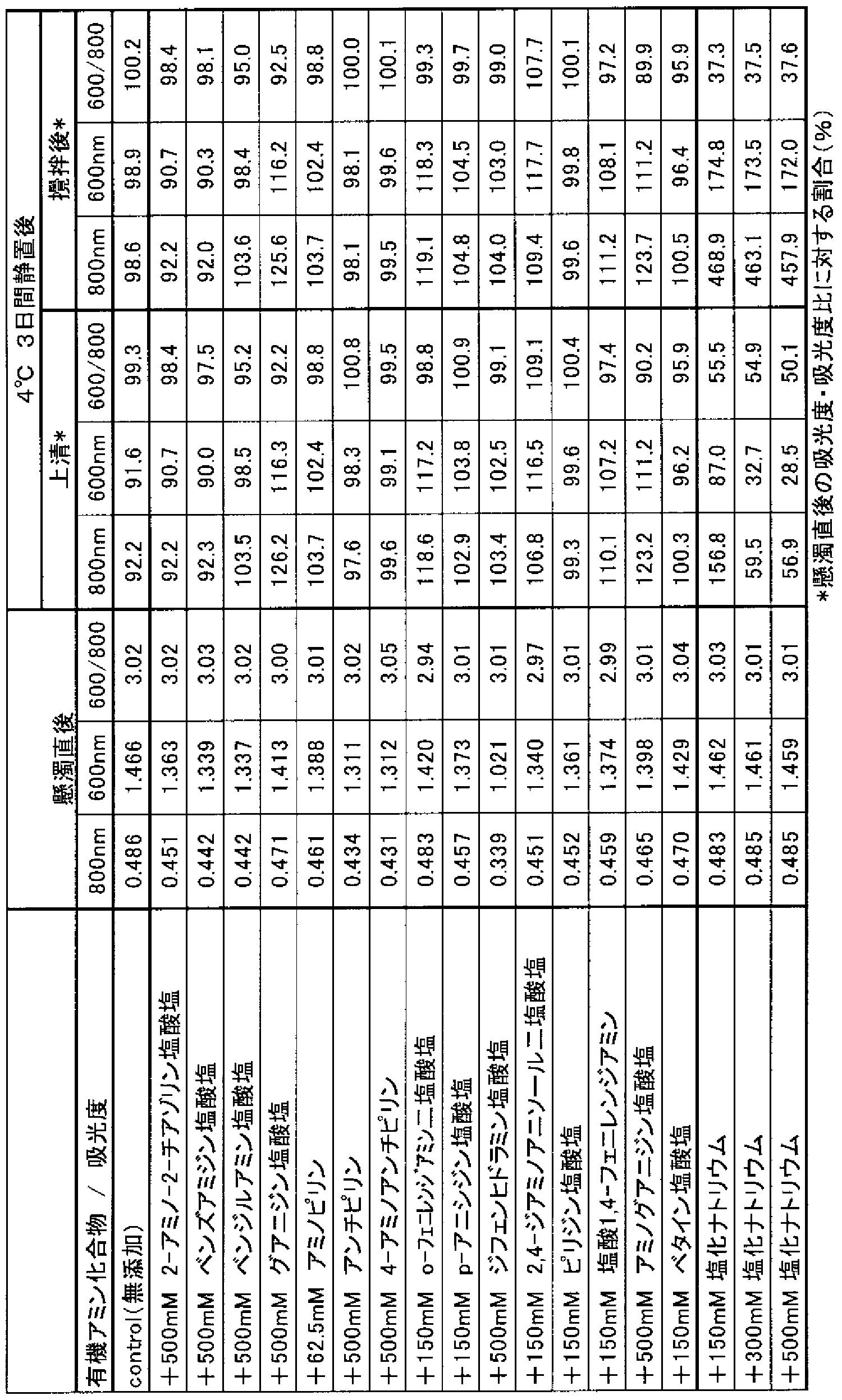
- Organic amine compounds in which the rate of decrease of the value after standing with respect to the initial value does not become 30% or less have a stable action and can be suitably used. Further, the most preferable one in which the reduction ratio of the absorbance ratio is 10% or less is 5% or less.
- the absorbance ratio at wavelengths of 600 nm and 800 nm when coexisting with an antibody-sensitized insoluble carrier at 4 ° C for 3 days or more should be less than 30%
- the agglutination reaction as used in the present invention refers to an agglutination reaction based on the specific binding between the receptor of the receptor-sensitized insoluble carrier particles and the ligand to be measured, and the agglutination promoting action is to coexist in the reagent. It has a function that facilitates specific aggregation.
- the promoting function can be confirmed as follows, for example.
- Preferable agglomeration accelerators are those that have an acceleration function equal to or greater than that of using sodium chloride sodium.
- Organic amines that have both the above-mentioned particle dispersibility stabilizing action and the agglomeration reaction acceleration action are preferred.
- a compound is more preferable. In the screening of composites that have both of these functions, whether or not they have a stabilizing effect on the particle dispersibility is examined first because of the simplicity of the measurement method, and then whether they have an aggregating reaction promoting effect. It is desirable to investigate whether or not compounds can be narrowed down efficiently.
- the agglutination reaction in the present invention is carried out in a buffer solution, and the type, concentration, and pH at which the agglutination reaction is optimally performed are selected as the buffer solution, and phosphate buffer solution, Tris-HCl buffer solution, carbonate buffer solution, glycine are selected. Buffer solution, Good's buffer solution, etc. can be used.
- the concentration of the buffer in the buffer solution is about 5 mM to 500 mM, and the pH is used in the basic range from the neutral range. Often used in the range of 7.0 to 9.5.
- the measurement of the agglutination signal may be any of the measurement methods usually used for the agglutination reaction measurement, and may be absorbance, particle number, particle size measurement, scattered light measurement and the like.
- a method using a general-purpose biochemical analyzer is convenient. For example, a reagent containing an organic amine compound and a receptor-sensitized latex or other insoluble carrier particles is added to a sample containing the ligand to be measured, incubated at a constant temperature for a fixed time, and the absorbance is measured during this time. Then, the amount of change in absorbance can be detected, and the calibration curve force when a standard solution whose concentration is known in advance is used as a sample, the concentration of the ligand in the test sample can be calculated. In the latex agglutination method, absorbance at a wavelength of 500 to 90 Onm is usually used, and the amount of change in absorbance during the reaction is generally used for quantification.
- the organic amine compound of the present invention hardly causes spontaneous aggregation even when coexisting with the receptor-sensitized latex, it can be prepared in advance as a one-part reagent in which a reaction accelerator is coexisted with the receptor-sensitized latex. .
- it can be configured as a reagent for measuring the aggregation of the one-liquid reagent.
- the measurement can be shortened to less than half of the measurement time required for the conventional two-component reagent because the measurement can be performed in a single step.
- the reaction is performed for the same measurement time in a one-solution reagent, higher measurement sensitivity can be obtained.
- the effect of the present invention can be enjoyed most effectively by configuring as a reagent for agglutination measurement of a one-liquid reagent.
- the organic amine compound of the present invention Since the organic amine compound of the present invention has a reaction promoting effect, it can be prepared as a conventional two-component reagent to constitute a reagent for measuring aggregation.
- the agglutination measurement reagent of the present invention is agglutinated by the action of a prescribed organic amine compound. Since it is excellent in the reaction promoting effect of the reaction, it is possible to shorten the reaction time, thereby shortening the measurement time, and improving Z or measurement sensitivity. Therefore, it can be used to increase the number of measurements per unit time as a reagent for agglutination measurement of one-component reagents, or to measure ligands that were difficult to measure with conventional two-component reagents. it can.
- two types of the one-component reagent of the present invention when two types of the one-component reagent of the present invention are used in combination in a two-component reagent measurement system, two types of ligands can be measured continuously in the same reaction vessel. Specifically, the following usage methods can be adopted. That is, when there are two or more ligands to be measured, insoluble carrier particles sensitized with the receptor (R1) that specifically reacts with the ligand (L1) are added, and the change over time of the resulting agglutination reaction is measured, Substantially, the receptor (R2) reacts specifically with a different ligand (L2) at the same time as the reaction becomes steady after the reaction becomes steady or after the reaction is made steady. Sensitized insoluble carrier particles are added and the time course of the agglutination reaction is measured.
- the method of measuring two types of ligands continuously in the same reaction tank using two types of the one-liquid reagent of the present invention in combination determines the content ratio of the two types of ligands in the same sample. This method is particularly effective for testing PGIZPGII ratio and HbAlc, and this method is completely new.
- the absorbance ratio of latex reagent containing 150 300 500 mM sodium chloride after standing at 4 ° C for 3 days (A ZA ratio; indicated as “600/800” in Table 1) is the same as that of the supernatant. Later, a difference of 30% or more was observed, and the absorbance ratio after stirring was about 60% lower than that of control. Below, it can be seen that the antibody-sensitized latex cannot be stably stored in a dispersed state. On the other hand, when the above-mentioned organic amine compound was used, it was within 10% of the absorbance ratio of control, in which there was almost no difference in the absorbance ratio (A / A ratio) after stirring with the supernatant.
- Emulsion prepared by mixing equal volumes of albumin and Freund's complete adjuvant was injected into the peritoneal cavity of BALBZc mice.
- 200 L of Emulsion prepared in the same way using Freund's incomplete adjuvant was repeated 3 times at 2-week intervals.
- Antibody titers in blood collected from the ocular fundus vein were measured by ELISA, and mice with high antibody titers were selected for cell fusion.
- 100 g of albumin dissolved in 200 L of physiological saline was injected into the abdominal cavity of the mouse, and the spleen was removed 3 days later.
- the spleen was loosened in RPMI 1640 medium and then centrifuged at 1500 rpm to collect splenocytes. This was washed 3 times or more with fetal calf serum-free PRMI1640 medium, and 2 mL of RPMI1640 medium containing 15% fetal calf serum was added and suspended to obtain a spleen cell suspension.
- Spleen cells and myeloma cells SP2ZO-AG14 were mixed at a ratio of 6: 1, and cell fusion was carried out in the presence of 50% polyethylene glycol.
- the precipitate was collected by centrifugation at 1500 rpm, and the G KN solution (glucose 2 g, salt ⁇ potassium 0.4 g, salt ⁇ sodium 8 g, disodium hydrogen phosphate 1.41 g and sodium dihydrogen phosphate dihydrate 0 78 g was dissolved in purified water to make 1 liter), washed by centrifugation, and the precipitate was recovered.
- HAT medium containing 5 ⁇ 10 6 cells / mL was dispensed and cultured at 37 ° C in a 5% carbon dioxide incubator.
- Monoclonal digestion was performed by limiting dilution.
- 10 6 BALBZc mouse thymocytes were dispensed into 10-well microplates, and 10 ml of positiveoma in positive wells was diluted to 0.1 mL. .
- As the medium HT medium was used for the first time, and RPMI1640 containing 15% fetal calf serum was used for the second and subsequent times at 37 ° C in a 5% carbon dioxide incubator for 10 days.
- 30 types of anti-albumin monoclonal antibody-producing cells were obtained by repeating the selection of positive wells by ELISA and single cloning by limiting dilution three times each.
- Selected anti-albumin monoclonal antibody 1 Using 3 mL of 20 mM Tris buffer (pH 8.5) containing 4 mgZmL, the same procedure as described above was performed to prepare a latex reagent for albumin measurement.
- Latex reagents for albumin measurement were prepared so as to contain 150, 300, and 500 mM benzylamine hydrochloride (Tokyo Chemical Industry Co., Ltd.) at final concentrations. This was allowed to stand at 4 ° C for 3 days, and the absorbance of the supernatant and suspension was measured at wavelengths of 600 nm and 800 nm. The absorbance ratio (A / A ratio; indicated as “600/800” in Table 2) Were calculated (Table 2). From this result,
- the absorbance of the supernatant in the latex reagent for rubumin measurement does not decrease within the range that was implemented, that is, sedimentation of particles due to spontaneous aggregation is suppressed, and the dispersion state force s is the best benzylamine hydrochloride concentration. 500 mM.
- a latex reagent for measuring benzylamine hydrochloride-containing albumin was prepared so as to contain 500 mM benzylamine hydrochloride at a final concentration.
- Figure 1 shows that the measurement sensitivity when measuring 1 minute reagent using benzylamine hydrochloride for 5 minutes (A in Figure 1) is the response time when measuring for 2 minutes using the conventional measurement method. 1 Z2), it has a measurement sensitivity equivalent to this, and even when compared with the measurement sensitivity when using sodium chloride sodium (D in Figure 1). Therefore, by using benzylamine hydrochloride and using a one-component reagent, the measurement time can be greatly shortened.
- the measurement sensitivity when measuring 1 minute reagent for 10 minutes (B in Fig. 1) is significantly higher than when measuring 2 minutes reagent for 10 minutes (C in Fig. 1). Of the measurement sensitivity It can be seen that a significant increase is possible.
- a reagent was prepared in the same manner as in Example 1 except that benzamidine hydrochloride was used as the organic amine compound, and albumin was measured. The results are shown in Figure 3.
- benzamidine hydrochloride like benzylamine hydrochloride, can be greatly reduced in measurement time by using a one-solution reagent. It can be seen that a significant increase in In addition, compared with the conventional reaction accelerator, sodium chloride sodium (D in Fig. 3), benzamidine hydrochloride can be used instead of sodium chloride sodium (C in Fig. 3). Will rise greatly!
- a reagent for measuring agglutination of a ligand excellent in stability and measurement sensitivity as a reagent.
- the receptor-sensitized carrier particles and the reaction accelerator coexist in advance, It can be provided as a one-component reagent.
- the measurement is simple and the reaction time can be shortened, that is, the measurement sensitivity within the same time as the conventional method is increased.
- the reaction time can be shortened, that is, the measurement sensitivity within the same time as the conventional method is increased.
Landscapes
- Health & Medical Sciences (AREA)
- Immunology (AREA)
- Life Sciences & Earth Sciences (AREA)
- Engineering & Computer Science (AREA)
- Molecular Biology (AREA)
- Biomedical Technology (AREA)
- Chemical & Material Sciences (AREA)
- Hematology (AREA)
- Urology & Nephrology (AREA)
- Biotechnology (AREA)
- Microbiology (AREA)
- Cell Biology (AREA)
- Food Science & Technology (AREA)
- Medicinal Chemistry (AREA)
- Physics & Mathematics (AREA)
- Analytical Chemistry (AREA)
- Biochemistry (AREA)
- General Health & Medical Sciences (AREA)
- General Physics & Mathematics (AREA)
- Pathology (AREA)
- Investigating Or Analysing Materials By The Use Of Chemical Reactions (AREA)
- Investigating Or Analysing Biological Materials (AREA)
Abstract
Description
Claims
Priority Applications (4)
| Application Number | Priority Date | Filing Date | Title |
|---|---|---|---|
| US12/086,600 US8987005B2 (en) | 2005-12-28 | 2006-12-27 | Reagent for measuring agglutination and method of measuring agglutination |
| EP06843412.5A EP1970704B1 (en) | 2005-12-28 | 2006-12-27 | Reagent for measuring aggregation and method of measuring aggregation |
| JP2007552004A JP5170742B2 (ja) | 2005-12-28 | 2006-12-27 | 凝集測定用試薬及び凝集測定方法 |
| CN200680049621.2A CN101351707B (zh) | 2005-12-28 | 2006-12-27 | 凝集测量用试剂以及凝集测量方法 |
Applications Claiming Priority (2)
| Application Number | Priority Date | Filing Date | Title |
|---|---|---|---|
| JP2005-379307 | 2005-12-28 | ||
| JP2005379307 | 2005-12-28 |
Publications (1)
| Publication Number | Publication Date |
|---|---|
| WO2007074860A1 true WO2007074860A1 (ja) | 2007-07-05 |
Family
ID=38218081
Family Applications (1)
| Application Number | Title | Priority Date | Filing Date |
|---|---|---|---|
| PCT/JP2006/326030 Ceased WO2007074860A1 (ja) | 2005-12-28 | 2006-12-27 | 凝集測定用試薬及び凝集測定方法 |
Country Status (5)
| Country | Link |
|---|---|
| US (1) | US8987005B2 (ja) |
| EP (1) | EP1970704B1 (ja) |
| JP (1) | JP5170742B2 (ja) |
| CN (1) | CN101351707B (ja) |
| WO (1) | WO2007074860A1 (ja) |
Cited By (11)
| Publication number | Priority date | Publication date | Assignee | Title |
|---|---|---|---|---|
| JP2011257243A (ja) * | 2010-06-08 | 2011-12-22 | Shino-Test Corp | 試料中のc反応性蛋白質の測定試薬、測定方法及び測定範囲の拡大方法 |
| WO2013077332A1 (ja) * | 2011-11-22 | 2013-05-30 | 株式会社ビー・エム・エル | ラテックス凝集法によるマトリックスメタロプロテイナーゼ-3の検出方法 |
| WO2014132833A1 (ja) | 2013-03-01 | 2014-09-04 | 富士レビオ株式会社 | 未感作ラテックス試薬の劣化防止方法 |
| JPWO2012169453A1 (ja) * | 2011-06-07 | 2015-02-23 | 和光純薬工業株式会社 | 凝集促進剤 |
| JP2016125948A (ja) * | 2015-01-07 | 2016-07-11 | Jsr株式会社 | 粒子分散液、標的物質の検出に用いるためのキット、及び標的物質の検出方法 |
| WO2016136863A1 (ja) * | 2015-02-25 | 2016-09-01 | 積水メディカル株式会社 | L-fabpの免疫学的測定方法及び該方法に用いられる測定試薬 |
| WO2016136917A1 (ja) * | 2015-02-25 | 2016-09-01 | 積水メディカル株式会社 | 免疫学的測定方法及び該方法に用いられる測定試薬 |
| WO2019049395A1 (ja) * | 2017-09-08 | 2019-03-14 | アルフレッサファーマ株式会社 | 分析装置および分析方法 |
| JP2019101011A (ja) * | 2017-12-05 | 2019-06-24 | 藤倉化成株式会社 | 感作された不溶性担体粒子を含有する免疫測定試薬の劣化防止手段 |
| CN112034186A (zh) * | 2020-09-07 | 2020-12-04 | 南京立顶医疗科技有限公司 | 一种基于生物素-链霉亲和素放大的糖化血红蛋白试剂盒及其制备方法 |
| WO2025070599A1 (ja) * | 2023-09-27 | 2025-04-03 | 積水メディカル株式会社 | ラテックス粒子分散液、試薬キット、検出方法、沈降抑制剤、及び沈降抑制方法 |
Families Citing this family (17)
| Publication number | Priority date | Publication date | Assignee | Title |
|---|---|---|---|---|
| JP5584518B2 (ja) | 2009-05-28 | 2014-09-03 | 石原産業株式会社 | ジアミノトリフルオロメチルピリジン誘導体を含有する抗ショック剤 |
| KR101894106B1 (ko) * | 2010-03-31 | 2018-08-31 | 세키스이 메디칼 가부시키가이샤 | 측정계외 성분에 의한 간섭을 감소시키는 방법 |
| CN101915849B (zh) * | 2010-06-30 | 2013-06-05 | 深圳市国赛生物技术有限公司 | 一种方便加样的用于测定糖化血红蛋白百分比的检测试剂 |
| CN102023157B (zh) * | 2010-07-13 | 2013-09-04 | 深圳市药品检验所 | 药品、保健食品中掺杂吡唑酮类物质的快速测定方法 |
| WO2012014996A1 (ja) * | 2010-07-30 | 2012-02-02 | シスメックス株式会社 | Fdp測定用試薬及び試薬キット、並びに測定方法 |
| EP2698633B1 (en) | 2011-03-28 | 2017-10-11 | Sekisui Medical Co., Ltd. | Psa assay method and reagent therefor |
| CN102645537B (zh) * | 2012-04-26 | 2014-07-30 | 北京美康生物技术研究中心 | 用于诊断胃病或胃癌的胶乳增强免疫比浊试剂盒及其制备方法和应用 |
| CN102749445A (zh) * | 2012-06-29 | 2012-10-24 | 中国人民解放军军事医学科学院军事兽医研究所 | 一种提高乳胶凝集试验狂犬病中和抗体检测灵敏度的方法 |
| CN104655843A (zh) * | 2014-05-19 | 2015-05-27 | 宁波普瑞柏生物技术有限公司 | 一种胃癌检测方法、试剂以及其试剂盒 |
| US20180113127A1 (en) * | 2015-02-25 | 2018-04-26 | Sekisui Medical Co., Ltd. | Immunoassay method and assay reagent used in said method |
| CN105974105A (zh) * | 2016-05-16 | 2016-09-28 | 河北艾驰生物科技有限公司 | 基质金属蛋白酶-3(mmp3)检测试剂盒 |
| CN105911279A (zh) * | 2016-05-26 | 2016-08-31 | 安徽伊普诺康生物技术股份有限公司 | 一种测定胃蛋白酶原ⅱ的试剂盒及其制备方法 |
| JP7278950B2 (ja) | 2017-01-27 | 2023-05-22 | エフ. ホフマン-ラ ロシュ アーゲー | 相互作用アッセイにおけるシグナル強度を調節する方法 |
| JP6919499B2 (ja) * | 2017-08-01 | 2021-08-18 | 藤倉化成株式会社 | 不溶性担体粒子を含有する免疫測定試薬の劣化防止手段 |
| CN109613259A (zh) * | 2018-12-20 | 2019-04-12 | 北京贝尔生物工程股份有限公司 | 一种高灵敏度、宽检测范围的人肝素结合蛋白测定试剂盒 |
| CN113049836A (zh) * | 2021-03-10 | 2021-06-29 | 深圳上泰生物工程有限公司 | 一种组合物及其脂联素检测试剂盒 |
| CN117233401A (zh) * | 2023-09-13 | 2023-12-15 | 深圳上泰生物工程有限公司 | 一种脂联素免疫比浊法检测试剂盒 |
Citations (6)
| Publication number | Priority date | Publication date | Assignee | Title |
|---|---|---|---|---|
| JPH0448265A (ja) * | 1990-06-18 | 1992-02-18 | Hitachi Chem Co Ltd | 免疫測定法 |
| JPH07229900A (ja) | 1995-01-04 | 1995-08-29 | Nitto Denko Corp | 免疫学的診断試薬 |
| JPH11344493A (ja) | 1998-03-30 | 1999-12-14 | Dai Ichi Pure Chem Co Ltd | 免疫的測定法 |
| JP2000258419A (ja) * | 1999-03-10 | 2000-09-22 | Hitachi Chem Co Ltd | 免疫測定試薬及び免疫測定法 |
| JP2004108850A (ja) | 2002-09-17 | 2004-04-08 | Eiken Chem Co Ltd | 蛋白質の安定化方法 |
| JP2005106609A (ja) * | 2003-09-30 | 2005-04-21 | Wako Pure Chem Ind Ltd | 免疫学的測定用試薬 |
Family Cites Families (7)
| Publication number | Priority date | Publication date | Assignee | Title |
|---|---|---|---|---|
| AU543007B2 (en) * | 1980-04-15 | 1985-03-28 | Technicon Instruments Corportion | Agglutination immunoassay |
| US5506151A (en) * | 1994-02-09 | 1996-04-09 | Mitsubishi Kasei Corporation | Non-specific reaction suppressor |
| CA2331587A1 (en) * | 1998-05-15 | 1999-11-25 | Katsumi Yoshikawa | Immunoassay reagents and immunoassay method |
| JP2001330615A (ja) * | 2000-05-19 | 2001-11-30 | Sekisui Chem Co Ltd | 免疫測定試薬 |
| SI1859798T1 (sl) | 2001-03-29 | 2016-07-29 | Eli Lilly And Company | N-(2-ariletil) benzil amini kot antagonisti 5-ht6 receptorja |
| KR100454767B1 (ko) | 2001-07-19 | 2004-11-03 | 동화약품공업주식회사 | 4-[(4-티아졸릴)페녹시]알콕시-벤즈아미딘 유도체의골다공증 예방 및 치료제로서의 용도 |
| US6777246B2 (en) * | 2001-12-18 | 2004-08-17 | Roche Diagnostics Gmbh | Tertiary amine compounds for use in immunoassays |
-
2006
- 2006-12-27 JP JP2007552004A patent/JP5170742B2/ja active Active
- 2006-12-27 CN CN200680049621.2A patent/CN101351707B/zh active Active
- 2006-12-27 EP EP06843412.5A patent/EP1970704B1/en active Active
- 2006-12-27 US US12/086,600 patent/US8987005B2/en active Active
- 2006-12-27 WO PCT/JP2006/326030 patent/WO2007074860A1/ja not_active Ceased
Patent Citations (6)
| Publication number | Priority date | Publication date | Assignee | Title |
|---|---|---|---|---|
| JPH0448265A (ja) * | 1990-06-18 | 1992-02-18 | Hitachi Chem Co Ltd | 免疫測定法 |
| JPH07229900A (ja) | 1995-01-04 | 1995-08-29 | Nitto Denko Corp | 免疫学的診断試薬 |
| JPH11344493A (ja) | 1998-03-30 | 1999-12-14 | Dai Ichi Pure Chem Co Ltd | 免疫的測定法 |
| JP2000258419A (ja) * | 1999-03-10 | 2000-09-22 | Hitachi Chem Co Ltd | 免疫測定試薬及び免疫測定法 |
| JP2004108850A (ja) | 2002-09-17 | 2004-04-08 | Eiken Chem Co Ltd | 蛋白質の安定化方法 |
| JP2005106609A (ja) * | 2003-09-30 | 2005-04-21 | Wako Pure Chem Ind Ltd | 免疫学的測定用試薬 |
Non-Patent Citations (1)
| Title |
|---|
| See also references of EP1970704A4 * |
Cited By (22)
| Publication number | Priority date | Publication date | Assignee | Title |
|---|---|---|---|---|
| JP2011257243A (ja) * | 2010-06-08 | 2011-12-22 | Shino-Test Corp | 試料中のc反応性蛋白質の測定試薬、測定方法及び測定範囲の拡大方法 |
| JPWO2012169453A1 (ja) * | 2011-06-07 | 2015-02-23 | 和光純薬工業株式会社 | 凝集促進剤 |
| CN103874925B (zh) * | 2011-11-22 | 2016-08-31 | 株式会社博米乐 | 根据乳胶凝集法检测基质金属蛋白酶-3的方法 |
| WO2013077332A1 (ja) * | 2011-11-22 | 2013-05-30 | 株式会社ビー・エム・エル | ラテックス凝集法によるマトリックスメタロプロテイナーゼ-3の検出方法 |
| CN103874925A (zh) * | 2011-11-22 | 2014-06-18 | 株式会社博米乐 | 根据乳胶凝集法检测基质金属蛋白酶-3的方法 |
| JPWO2013077332A1 (ja) * | 2011-11-22 | 2015-04-27 | 株式会社ビー・エム・エル | ラテックス凝集法によるマトリックスメタロプロテイナーゼ−3の検出方法 |
| JPWO2014132833A1 (ja) * | 2013-03-01 | 2017-02-02 | 富士レビオ株式会社 | 未感作ラテックス試薬の劣化防止方法 |
| WO2014132833A1 (ja) | 2013-03-01 | 2014-09-04 | 富士レビオ株式会社 | 未感作ラテックス試薬の劣化防止方法 |
| JP2016125948A (ja) * | 2015-01-07 | 2016-07-11 | Jsr株式会社 | 粒子分散液、標的物質の検出に用いるためのキット、及び標的物質の検出方法 |
| WO2016136863A1 (ja) * | 2015-02-25 | 2016-09-01 | 積水メディカル株式会社 | L-fabpの免疫学的測定方法及び該方法に用いられる測定試薬 |
| WO2016136917A1 (ja) * | 2015-02-25 | 2016-09-01 | 積水メディカル株式会社 | 免疫学的測定方法及び該方法に用いられる測定試薬 |
| JPWO2016136863A1 (ja) * | 2015-02-25 | 2017-11-30 | 積水メディカル株式会社 | L−fabpの免疫学的測定方法及び該方法に用いられる測定試薬 |
| JPWO2016136917A1 (ja) * | 2015-02-25 | 2018-02-01 | 積水メディカル株式会社 | 免疫学的測定方法及び該方法に用いられる測定試薬 |
| WO2019049395A1 (ja) * | 2017-09-08 | 2019-03-14 | アルフレッサファーマ株式会社 | 分析装置および分析方法 |
| JPWO2019049395A1 (ja) * | 2017-09-08 | 2020-10-29 | アルフレッサファーマ株式会社 | 分析装置および分析方法 |
| JP2022120079A (ja) * | 2017-09-08 | 2022-08-17 | アルフレッサファーマ株式会社 | 分析装置および分析方法 |
| JP7282035B2 (ja) | 2017-09-08 | 2023-05-26 | アルフレッサファーマ株式会社 | 分析装置および分析方法 |
| US12487171B2 (en) | 2017-09-08 | 2025-12-02 | Alfresa Pharma Corporation | Analysis device and analysis method |
| JP2019101011A (ja) * | 2017-12-05 | 2019-06-24 | 藤倉化成株式会社 | 感作された不溶性担体粒子を含有する免疫測定試薬の劣化防止手段 |
| JP7096482B2 (ja) | 2017-12-05 | 2022-07-06 | 藤倉化成株式会社 | 感作された不溶性担体粒子を含有する免疫測定試薬の劣化防止手段 |
| CN112034186A (zh) * | 2020-09-07 | 2020-12-04 | 南京立顶医疗科技有限公司 | 一种基于生物素-链霉亲和素放大的糖化血红蛋白试剂盒及其制备方法 |
| WO2025070599A1 (ja) * | 2023-09-27 | 2025-04-03 | 積水メディカル株式会社 | ラテックス粒子分散液、試薬キット、検出方法、沈降抑制剤、及び沈降抑制方法 |
Also Published As
| Publication number | Publication date |
|---|---|
| EP1970704B1 (en) | 2016-07-13 |
| JPWO2007074860A1 (ja) | 2009-06-04 |
| CN101351707B (zh) | 2014-03-26 |
| EP1970704A1 (en) | 2008-09-17 |
| CN101351707A (zh) | 2009-01-21 |
| JP5170742B2 (ja) | 2013-03-27 |
| EP1970704A4 (en) | 2009-01-14 |
| US20100167310A1 (en) | 2010-07-01 |
| US8987005B2 (en) | 2015-03-24 |
Similar Documents
| Publication | Publication Date | Title |
|---|---|---|
| JP5170742B2 (ja) | 凝集測定用試薬及び凝集測定方法 | |
| JP4176826B2 (ja) | 凝集阻害測定法及び凝集阻害測定用試薬 | |
| WO2013097607A1 (zh) | 检测非对称二甲基精氨酸含量的胶乳增强免疫比浊法试剂盒 | |
| WO2002039114A2 (en) | Improved assay and reagents or immunological determination of analyte concentration | |
| JPS60256057A (ja) | 免疫学的測定法 | |
| JP3623657B2 (ja) | 非特異反応抑制剤、免疫測定試薬及び免疫測定方法 | |
| JP7386220B2 (ja) | 抗ヒトヘモグロビンモノクローナル抗体若しくは抗体キット、抗ヒトヘモグロビンモノクローナル抗体固定化不溶性担体粒子、及びこれらを用いた測定試薬若しくは測定方法 | |
| JP4668768B2 (ja) | 免疫測定方法及び非特異反応抑制方法 | |
| JP3899029B2 (ja) | 免疫学的分析方法 | |
| JP2016031250A (ja) | 標的タンパク質の測定試薬および該試薬を用いた測定方法 | |
| JP2682697B2 (ja) | 免疫測定試薬および免疫測定法 | |
| JP5085736B2 (ja) | 複合体の測定方法およびそれに用いるキット | |
| CA2520631C (en) | Turbidimetric immunoassay for lipoprotein(a) and reagent therefor | |
| JP7421711B2 (ja) | ロイシンリッチα2グリコプロテインの免疫測定方法及び測定試薬 | |
| WO1999060401A1 (en) | Immunoassay reagents and immunoassay method | |
| JP2004191332A (ja) | 免疫学的分析試薬及び免疫学的分析方法 | |
| JP4556605B2 (ja) | 標的物質の測定方法および測定試薬 | |
| JP2001108681A (ja) | 免疫凝集測定用試薬及び測定方法 | |
| JP7355140B2 (ja) | セリンプロテアーゼの検出用または測定用試薬 | |
| JP2005512074A (ja) | 血清または血漿存在下でのラテックス微粒子の非特異的集合を低減する方法 | |
| JP2004117068A (ja) | 免疫測定試薬および免疫測定方法 | |
| JP2025023504A (ja) | セリンプロテアーゼの検出用または測定用試薬 | |
| JP2000258415A (ja) | ヒトα2−プラスミンインヒビターの定量方法及び測定キット | |
| JP2005049264A (ja) | 標的物質の測定方法および測定試薬 | |
| JP2002181822A (ja) | 免疫測定試薬及び免疫測定法 |
Legal Events
| Date | Code | Title | Description |
|---|---|---|---|
| WWE | Wipo information: entry into national phase |
Ref document number: 200680049621.2 Country of ref document: CN |
|
| 121 | Ep: the epo has been informed by wipo that ep was designated in this application | ||
| ENP | Entry into the national phase |
Ref document number: 2007552004 Country of ref document: JP Kind code of ref document: A |
|
| WWE | Wipo information: entry into national phase |
Ref document number: 12086600 Country of ref document: US |
|
| REEP | Request for entry into the european phase |
Ref document number: 2006843412 Country of ref document: EP |
|
| WWE | Wipo information: entry into national phase |
Ref document number: 2006843412 Country of ref document: EP |
|
| NENP | Non-entry into the national phase |
Ref country code: DE |