WO2007100064A1 - ゴム組成物、架橋ゴム、及び成形品 - Google Patents
ゴム組成物、架橋ゴム、及び成形品 Download PDFInfo
- Publication number
- WO2007100064A1 WO2007100064A1 PCT/JP2007/053970 JP2007053970W WO2007100064A1 WO 2007100064 A1 WO2007100064 A1 WO 2007100064A1 JP 2007053970 W JP2007053970 W JP 2007053970W WO 2007100064 A1 WO2007100064 A1 WO 2007100064A1
- Authority
- WO
- WIPO (PCT)
- Prior art keywords
- rubber
- mass
- rubber composition
- oil
- conjugated
- Prior art date
- Legal status (The legal status is an assumption and is not a legal conclusion. Google has not performed a legal analysis and makes no representation as to the accuracy of the status listed.)
- Ceased
Links
Classifications
-
- C—CHEMISTRY; METALLURGY
- C08—ORGANIC MACROMOLECULAR COMPOUNDS; THEIR PREPARATION OR CHEMICAL WORKING-UP; COMPOSITIONS BASED THEREON
- C08L—COMPOSITIONS OF MACROMOLECULAR COMPOUNDS
- C08L9/00—Compositions of homopolymers or copolymers of conjugated diene hydrocarbons
- C08L9/02—Copolymers with acrylonitrile
-
- C—CHEMISTRY; METALLURGY
- C08—ORGANIC MACROMOLECULAR COMPOUNDS; THEIR PREPARATION OR CHEMICAL WORKING-UP; COMPOSITIONS BASED THEREON
- C08L—COMPOSITIONS OF MACROMOLECULAR COMPOUNDS
- C08L23/00—Compositions of homopolymers or copolymers of unsaturated aliphatic hydrocarbons having only one carbon-to-carbon double bond; Compositions of derivatives of such polymers
- C08L23/02—Compositions of homopolymers or copolymers of unsaturated aliphatic hydrocarbons having only one carbon-to-carbon double bond; Compositions of derivatives of such polymers not modified by chemical after-treatment
- C08L23/16—Ethylene-propylene or ethylene-propylene-diene copolymers
Definitions
- Rubber composition, crosslinked rubber, and molded article Rubber composition, crosslinked rubber, and molded article
- the present invention relates to a rubber composition, a crosslinked rubber, and a molded article, and more specifically, a rubber composition, a crosslinked rubber, and a molded article that can produce a crosslinked rubber and a molded article excellent in oil resistance and heat resistance. About.
- a rubber molded product (or crosslinked rubber) having properties (oil resistance, weather resistance, heat resistance, etc.) that cannot be obtained with a single elastomer is obtained.
- properties oil resistance, weather resistance, heat resistance, etc.
- NBR acrylonitrile butadiene rubber
- EPDM ethylene-propylene-non-conjugated-gen copolymer rubber
- the rubber composition using specific NBR and EPDM is disclosed for the purpose of obtaining an oil-resistant rubber composition having good mechanical properties (see, for example, Patent Document 1). ).
- Patent Document 1 Japanese Patent Publication No. 4 75931
- crosslinked rubber and molded products thereof are required not only to improve mechanical properties, but also to further improve oil resistance and heat resistance.
- An object of the present invention is to provide a rubber composition, a crosslinked rubber, and a molded product that can produce a cross-linked rubber and a molded product.
- the (iii) cross-linking agent comprises the above (i) a, j8-unsaturated nitrile conjugated diene rubber, and
- [5] A crosslinked rubber obtained by crosslinking the rubber composition according to any one of [1] to [4].
- the rubber composition of the present invention has an effect that oil resistance and heat resistance are improved, and a crosslinked rubber and a molded product thereof having a good balance between these properties can be produced.
- the crosslinked rubber of the present invention has the effect of improving oil resistance and heat resistance, and having a good balance of these properties.
- the molded article of the present invention has the effect of improving oil resistance and heat resistance and having a good balance of these properties.
- component (i) a, ⁇ -unsaturated-tolyl conjugated gen-based rubber containing 30 to 60% by mass of structural units derived from conjugated gen in all structural units (Hereinafter referred to as “component (i)”) and (ii) an ethylene / ⁇ -olefin / non-conjugated diene copolymer rubber having an intrinsic viscosity of not less than 3.3 dlZg in a decalin solvent at 135 ° C. (Hereinafter sometimes referred to as “component (ii)”) and (iii) a crosslinking agent.
- component (ii) ethylene / ⁇ -olefin / non-conjugated diene copolymer rubber having an intrinsic viscosity of not less than 3.3 dlZg in a decalin solvent at 135 ° C.
- component (ii) ethylene / ⁇ -olefin / non-conjugated diene copoly
- the (i) ⁇ , ⁇ unsaturated-tolyl conjugated gen-based rubber contained in the rubber composition of the present embodiment is a conjugate gen, a, j8-unsaturated-tolyl, and, if necessary, these compounds It is a copolymer obtained by copolymerizing with other monomers copolymerizable with (hereinafter, may be referred to as “other monomers”). Therefore, the component (i) comprises a structural unit derived from a conjugate conjugate and a structural unit derived from an ⁇ , ⁇ unsaturated nitrile.
- conjugates examples include butadiene, isoprene, 1,3 hexagen, 2,3 dimethylbutadiene, 2 trimethoxysilyl 1,3 butadiene, 1,3 pentane, 2,4 dimethyl-1, 3 Butadiene can be mentioned. Of these, butadiene is preferred.
- the proportion of the structural unit derived from the conjugation atom is required to be 30 to 60% by mass in the total structural unit, and preferably 30 to 55% by mass. More preferably.
- the content is less than 30% by mass, the low temperature property of the molded product obtained using the rubber composition of the present invention tends to be lowered.
- it exceeds 60% by mass the oil resistance of the molded product obtained using the rubber composition of the present invention tends to be lowered.
- Examples of the above " ⁇ , ⁇ -unsaturated-tolyl” include, for example, acrylonitrile, methatalonitrile, ⁇ - ethylacrylonitrile, a -isopropylacrylonitrile, a -chloroacrylonitrile, a -fluoroacrylonitrile. , And entangled mouth-tolyl. Of these, acrylonitrile is preferred.
- the proportion of structural units derived from a, j8-unsaturated-tolyl is 20 to 70 parts of the total structural units.
- the amount is preferably 20 to 55% by weight, more preferably 25 to 50% by weight.
- the content is less than 20% by mass, the oil resistance of a molded product obtained using the rubber composition of the present invention tends to be lowered.
- it exceeds 70% by mass the low-temperature property of the molded product obtained using the rubber composition of the present invention tends to be lowered.
- Examples of the "other monomer” include methyl (meth) acrylate, ethyl (meth) acrylate, n-propyl (meth) acrylate, iso-propyl (meth) acrylate, n-butyl (meth) acrylate, n-amyl (meth) acrylate, n-hexyl (meth) acrylate, 2-ethyl hexyl (meth) acrylate, cyclohexyl (meth) acrylate, etc.
- alkyl (meth) acrylate monomers examples include alkyl (meth) acrylate monomers, alkoxyalkyl (meth) acrylate monomers such as methoxyethyl (meth) acrylate and ethoxy ethyl (meth) acrylate.
- alkoxyalkyl (meth) acrylate monomers such as methoxyethyl (meth) acrylate and ethoxy ethyl (meth) acrylate.
- ethyl acrylate, n-butyl acrylate, and methoxyethyl acrylate are preferable.
- the proportion of structural units derived from other monomers is preferably from 0 to 50% by mass, more preferably from 10 to 45% by mass, based on the total structural units. A mass% is particularly preferred. When the content is more than 50% by mass, the strength of the molded product obtained using the rubber composition of the present invention tends to be inferior.
- the polymerization method of the component (i) is not particularly limited, and examples thereof include a radical polymerization method and an anion polymerization method.
- examples of the radical polymerization method include a bulk polymerization method, a suspension polymerization method, an emulsion polymerization method, and the like. From the viewpoint of obtaining a stable emulsion dispersion at the end of the polymerization, the emulsion polymerization method is particularly preferable.
- a monomer mixed in a predetermined ratio is emulsified in an aqueous medium in the presence of an emulsifying agent, polymerization is started by a radical polymerization initiator, and after reaching a predetermined polymerization conversion rate, Examples thereof include a method of stopping the polymerization with a polymerization terminator.
- Examples of the "emulsifier” include an anionic surfactant, a nonionic surfactant, a cationic surfactant, and an amphoteric surfactant.
- the ion-based surfactant which is preferably a Rion-based surfactant, for example, a long chain fatty acid salt having 10 or more carbon atoms, a rosin acid salt, or the like is widely used. More specifically, force puric acid, lauric Phosphoric acid, myristic acid, palmitic acid, oleic acid, potassium salt or sodium salt of stearic acid can be preferably used.
- These emulsifiers may be used alone or in a combination of two or more.
- Examples of the "radical polymerization initiator” include benzoyl peroxide, lauroyl baroxide, tert-butyl hydroperoxide, tamen hydroperoxide, normenthane hydroperoxide, di-tert-butyl peroxide, And organic peroxides such as dicumyl peroxide can be used.
- diazo compounds represented by azobisisobutyl ether-tolyl inorganic peracid compounds represented by potassium persulfate; and combinations of these peracid compounds and ferrous sulfate. It is also possible to use a redox catalyst.
- These radical polymerization initiators may be used alone or in a combination of two or more.
- a chain transfer agent may be used to adjust the molecular weight of component (i).
- alkyl mercaptans such as tert-dodecyl mercaptan and n-dodecyl mercaptan; carbon tetrachloride, thioglycols, diterpenes, terpinolenes, and terpenenes can be used.
- each monomer, emulsifier, radical polymerization initiator, chain transfer agent, and the like may be charged all at once into the reaction vessel to initiate polymerization. However, they may be added continuously or intermittently during the reaction.
- the polymerization is preferably carried out at a temperature of usually 0 to 100 ° C., preferably 0 to 80 ° C. in an atmosphere from which oxygen is removed.
- reaction conditions such as temperature and stirring can be appropriately changed during the reaction.
- the polymerization method may be a continuous method or a batch method.
- the polymerization is generally stopped by adding a polymerization terminator when a predetermined polymerization conversion rate is reached.
- a polymerization terminator include amine compounds such as hydroxylamine and jetylhydroxylamine; quinone compounds such as hydroquinone; and the like.
- the component (i) can be obtained by removing the unreacted monomer from the reaction system by a method such as steam distillation after the polymerization is stopped and coagulating the latex, if necessary.
- the molecular weight of component (i) is not particularly limited. However, mu-one viscosity (ML ( For 100 ° C)), 5 to: LOO is preferred, and 5 to 60 is particularly preferred. Mooney viscosity (ML (100 ° C)) If it is less than 1S 5, the mechanical strength will decrease.
- the ⁇ , ⁇ -unsaturated-tolyl conjugated diene rubber component is preferably acrylonitrile butadiene rubber (NBR).
- NBR acrylonitrile butadiene rubber
- structural unit ( ⁇ ) a structural unit derived from acrylonitrile
- the ratio (content ratio) of the structural unit ( ⁇ ) in the NBR must be 30 to 60% by mass, preferably 30 to 55% by mass, based on the total structural unit 35 More preferred is ⁇ 55% by mass. If the content of the structural unit ( ⁇ ) in the total structural units of the acrylonitrile butadiene rubber is less than 30% by mass, the rubber elasticity of the molded product obtained using the rubber composition of the present invention tends to decrease. On the other hand, when the content ratio is more than 60% by mass, the oil resistance of the molded product obtained using the rubber composition of the present invention tends to be lowered.
- the proportion (content) of the structural unit ( ⁇ ) in the NBR is preferably 20 to 70% by mass, more preferably 20 to 55% by mass, and 40 to 55% by mass. V, especially preferred. If the content of the structural unit ( ⁇ ) in the total structural units of the acrylonitrile butadiene rubber is less than 35% by mass, the oil resistance of the molded product obtained using the rubber composition of the present invention tends to be lowered. On the other hand, when the content ratio is more than 60% by mass, the low temperature property of the molded product obtained using the rubber composition of the present invention tends to be lowered.
- Ethylene a —Olefin 'non-conjugated-gen copolymer rubber has an intrinsic viscosity of 3.3 dlZg or more in a decalin solvent at 135 ° C.
- the intrinsic viscosity is preferably 4.0 to 12. OdlZg, more preferably 4.0 to LO. OdlZg.
- OdlZg OdlZg.
- Ethylene 'a-olefin' non-conjugated gen copolymer rubber includes a copolymer rubber of ethylene and propylene that does not contain non-conjugated gen.
- forces such as ethylidene norbornene (5-ethylidene-2-norbornene), cyclopentagen, 1,4 monohexagen, methylene norbornene, 4, 7, 8, 9-tetrahydroindene are also selected.
- EPDM ethylene-propylene non-conjugated diene copolymer rubber
- EPDM ethylene propylene non-conjugated diene copolymer rubber
- Examples of a-olefin include 1-butene, 1-pentene, 1-hexene, 1-heptene, 1-octene and the like in addition to propylene.
- the content of the structural unit derived from ethylene contained in the component (ii) is preferably 50 to 80% by mass, and preferably 55 to 75% by mass with respect to all the structural units. Is more preferably 60 to 75% by mass.
- the content ratio of the structural unit is less than 50% by mass, the strength of the molded product obtained using the rubber composition of the present invention tends to decrease.
- the content ratio is more than 80% by mass, the low temperature property of a molded product obtained using the rubber composition of the present invention tends to deteriorate.
- the content of the structural unit derived from a 1-year-old refin contained in the component (ii) is preferably 7 to 49.5% by mass with respect to the total structural unit. More preferably, it is 15% to 38% by weight.
- the content ratio of the structural unit is less than 7% by mass, the low temperature property of a molded product obtained using the rubber composition of the present invention tends to deteriorate.
- the content is 5 mass 0/0 than 49., strength of a molded article obtained by using the rubber composition of the present invention tends to decrease.
- the content of the structural unit derived from the non-conjugated gen contained in the component (ii) is preferably 0.5 to 13% by mass based on the total structural unit 1 to: L 1 More preferably, it is 2% by mass: L0% by mass is particularly preferable.
- L 1 More preferably, it is 2% by mass: L0% by mass is particularly preferable.
- the method for polymerizing the component (ii) is not particularly limited, and examples thereof include a method for polymerizing in the presence of a conventionally known catalyst such as a vanadium catalyst, a titanium catalyst, or a metalocene catalyst. You can. More specifically, when a vanadium-based catalyst is used, ethylene, a-olefin is used in the presence of a catalyst comprising a vanadium compound soluble in at least one solvent and at least one organoaluminum compound. In some cases, a method of superimposing non-conjugated gen may be mentioned. At this time, polymerization may be performed while supplying hydrogen as a molecular weight regulator, if necessary. The polymerization can be carried out by any of a gas phase method (fluidized bed or stirred bed) and a liquid phase method (slurry method or solution method).
- a gas phase method fluidized bed or stirred bed
- a liquid phase method slurry method or solution method.
- the component (ii) contained in the rubber composition of the present embodiment is a mixed composition of an ethylene 'a-olefin' non-co-polymer copolymer rubber and an extending oil, or a so-called oil-extended rubber. Is preferred. When such an oil-extended rubber is used, the slipperiness is improved, so that there is an advantage that the processing and molding becomes easy.
- mineral oil or synthetic oil can be used as the extending oil.
- Mineral oils include aromatic, naphthenic and paraffinic extending oils.
- Synthetic oils include alkylbenzene oils.
- Dutrex 729UK manufactured by Nippon Oil Corporation (former Nippon Oil Co., Ltd.) 200, 300, 500, 700, Esso Process Oil 110, 120, manufactured by Exxon Mobinore, Mitsubishi 34 Heavy Process Oil, Mitsubishi 44 Heavy Process, manufactured by Nippon Oil Corporation (former Mitsubishi Oil) Oil, Mitsubishi 38 heavy process oil, Mitsubishi 39 heavy process oil.
- naphthenic extender oils examples include Diana Process Oil NS-24, NS-100, NM-26, NM-280, NP-24, manufactured by Idemitsu Kosan Co., Ltd., Naplex 3 8, manufactured by ExxonMobil, Fukkor FLEX # 1060N, # 1150N, # 1400N, # 2040 N, # 2050N, manufactured by Fuji Kosan Co., Ltd., Kyoishi Process R25, R50, R200, R1000, manufactured by Shell Chemical Co., shelf Rex 371JY, 371N, 451, 451, N-40, 22, 22R, 32R, 100R, 100S, 100SA, 220RS, 220S, 260S, 320R, 680, Nippon Oil Corporation Comolex No. 2 process oil (former Nippon Oil Co., Ltd.) Examples include Etso Process Oil L-2, 765 manufactured by Son Mobil, and Mitsubishi 20 Light Process Oil manufactured by Nippon Oil Corporation (former Mitsubishi Oil).
- paraffinic extension oil Diana Process Oil PW-90, PW-380, PS-32, PS-90, PS-430, manufactured by Idemitsu Kosan Co., Ltd., Fukkor Process P-, manufactured by Fuji Kosan Co., Ltd. 100, P-200, P-300, P400, P-500, Kyoishi process manufactured by Nikko Kyoishi Co., Ltd. 90, manufactured by Shelley Gakki, Lubrex 26, 100, 460, ExxonMobil, Esso Process Oil 815, 845, B-l, ExxonMobil Naplex 32, This includes Mitsubishi 10 Light Process Oil manufactured by Nippon Oil Corporation (former Mitsubishi Oil Corporation).
- the alkylbenzene-based oil is a hydrocarbon-based oil produced by a reaction between a tetramer of propylene and benzene, or a reaction between n-olefin and benzene obtained by a dehydrogenation reaction of n paraffin.
- synthetic oils containing alkylbenzenes such as monoalkylbenzene, dialkylbenzene, trialkylbenzene, diphenylalkane and the like.
- the total blending amount is preferably 5 to 200 parts by mass with respect to 100 parts by mass of the total (ii) component. More preferably, it is 10 to 180 parts by mass, and particularly preferably 10 to 120 parts by mass.
- cross-linking agent is not particularly limited, and examples thereof include sulfur, sulfur compounds, organic peroxides, phenol resin and the like.
- ( ⁇ ) ⁇ , ⁇ unsaturated-tolyl conjugated diene rubber and (ii) ethylene 'a-olefin' non-conjugated gen copolymer rubber must be a crosslinking agent capable of crosslinking by monosulfide bond.
- TMTD tetramethylthiuram disulfide
- TMTD tetramethylthiuram disulfide
- TMTD tetramethylthiuram disulfide
- TMTD sulfur-donating crosslinking agent
- sulfur is used as a "crosslinking agent capable of cross-linking ⁇ , j8-unsaturated nitrile conjugated gen-based rubber and ethylene ' ⁇ -olefin' non-shared gen-copolymer rubber by monosulfide bond". It can also be used.
- sulfur include powdered sulfur, precipitated sulfur, colloidal sulfur, surface-treated sulfur, insoluble sulfur and the like.
- vulcanization accelerator When (iii) sulfur and a sulfur compound are used as the crosslinking agent, it is preferable to use a crosslinking aid (hereinafter also referred to as "vulcanization accelerator") in combination.
- vulcanization accelerators include N-cyclohexyl-2-benzothiazolylsulfenamide, N-oxyethylene-2-benzothiazolylsulfenamide, N, N-diisopropyl-1-benzothiazolylsulfenamide, and the like.
- Sulfenamide compounds 2—Mercaptobenzothiol, 2— (2 ′, 4′-di-trifluoro) mercaptobenzothiazole, 2 -— (4, monomorpholinodithio) benzothiazole, dibenzothiazyl disulfide Thiazole compounds such as id; guanidine compounds such as diphenyldanidine, diisotolylguanidine, diorthonitrile guanidine, ortho-tolylbiguanide, diphenylguanidine phthalate, etc .; Dor-phosphorus reaction product, butyraldehyde-phosphorus condensate, hexamethylene tetramine, acetate Aldehyde amines such as aldehyde ammonia or aldehyde ammonium compounds; 2-imidazolines such as mercaptoimidazolines; thioureas such as thiocarbalide, jetylthiourea, dibutyl
- Uram compounds Zinc dimethyldithiocarbamate, zinc diethyldithiocarbamate, zinc di-n-butyldithiocarbamate, zinc ethyldiethyldicarbamate, zinc butyldiethylcarbamate, dimethyldithio Dithioate compounds such as sodium carbamate, selenium dimethyldithiocarbamate, tellurium dimethyldithiocarbamate; xanthates such as zinc dibutylxanthate; zinc white, active zinc white, surface-treated zinc white, zinc carbonate, Examples thereof include inorganic zinc oxide compounds such as composite zinc white and composite active zinc white. These can be used alone or in combination of two or more.
- the content of the component (i) contained in the rubber composition of the present invention 20 to 70 weight 0 / more preferably fixture 30 it is the preferred tool 25 to 65 wt% be 0 It is particularly preferable that it is ⁇ 60% by mass. If it is less than 20% by mass, the oil resistance of a molded product obtained using this rubber composition may be lowered. On the other hand, when it exceeds 70 mass 0/0, the heat resistance of a molded article obtained by using the rubber composition may be lowered.
- the content of the component (iii) is preferably 0.1 to 20 parts by mass with respect to 100 parts by mass in total of all (co) polymers in the rubber composition of the present invention. If the amount is less than 1 part by mass, the strength of the molded product obtained using the rubber composition of the present invention may be lowered. On the other hand, if it exceeds 20 parts by mass, the elongation of the molded product obtained using the rubber composition of the present invention may be lowered.
- the rubber composition of the present invention may contain other polymer components in addition to the components (i), (ii), and (iii).
- Other polymer components include natural rubber, butadiene rubber, isoprene rubber, chloroprene rubber, styrene 'butadiene copolymer rubber, butadiene. Isoprene copolymer rubber, butadiene. Styrene. Isoprene copolymer rubber, talit nitrile, butadiene. Examples thereof include copolymer rubber and butyl rubber.
- the rubber composition of the present embodiment includes a reinforcing agent, a filler, a plasticizer, a processing aid, a softening agent, an anti-aging agent, an ultraviolet absorber, a flame retardant, a fungicide, an antifungal agent, and a colorant. It may contain additives such as.
- Examples of the reinforcing agent include carbon black, silica, aluminum hydroxide, alumina, and the like. Of these, carbon black is preferred. Moreover, these can be used individually by 1 type or in combination of 2 or more types.
- Examples of the carbon black include SAF carbon black, ISAF carbon black, HA F carbon black, FEF carbon black, GPF carbon black, SRF carbon black, FT carbon black, MT carbon black, acetylene carbon black, ketjen black and the like. Can be mentioned.
- the amount of the reinforcing agent compounded is preferably 10 to 150 parts by mass, more preferably 5 to 200 parts by mass with respect to 100 parts by mass in total of all the polymers in the rubber composition. Especially preferred is 20 to 120 parts by weight.
- Examples of the filler include heavy calcium carbonate, light calcium carbonate, ultrafine activated calcium carbonate, special calcium carbonate, basic magnesium carbonate, kaolin clay, calcined clay, neuroflight clay, silane-treated clay, Synthetic calcium silicate, synthetic magnesium silicate, synthetic aluminum silicate, magnesium carbonate, magnesium hydroxide, magnesium oxide, kaolin, sericite, talc, fine talc, wollastonite, zeolite, zonotonite, asbestos, PMF (Processed Mineral Fiber), pepper, sepiolite, potassium titanate, elastadite, gypsum fiber, glass balun, silica balene, hydrotalcite, fly ash balene, shirasu balene, carbon balene, barium sulfate, aluminum sulfate, sulfur Calcium, can be mentioned Ni ⁇ I ⁇ molybdenum. These can be used alone or in combination of two or more.
- the blending amount of the filler is preferably 0 to 200 parts by mass with respect to a total of 100 parts by mass of all the polymers in the rubber composition. 0 to: L00 parts by mass Further preferred is 0 to 50 parts by mass.
- plasticizer examples include dimethyl phthalate, jetyl phthalate, dibutyl phthalate, diisobutyl phthalate, dioctyl phthalate, butyl octyl phthalate, and di (2- Ethylhexyl) phthalate, diisooctyl phthalate, diisodecyl phthalate, etc., phthalates, dimethyl adipate, diisobutyl adipate, di (2-ethylhexyl) adipate, diisooctyl adipate, diisodecyl adipate, octyl decyl adipate Fatty acid esters such as di (2-ethylhexyl) azelate, diisooctylazelate, diisobutylazelate, dibutyl sebacate, di (2-ethylhexyl) sebacate, diis
- the compounding amount of the plasticizer is preferably 0 to 150 parts by mass with respect to 100 parts by mass in total of all the polymers in the rubber composition. 0 to: L00 parts by mass Further preferred is 0 to 80 parts by mass.
- processing aid examples include stearic acid, oleic acid, lauric acid, zinc stearate, and various commercially available processing aids. These can be used alone or in combination of two or more.
- the blending amount of the processing aid is preferably 0 to 20 parts by mass with respect to a total of 100 parts by mass of all the polymers in the rubber composition. Is more preferably 1 to 5 parts by mass.
- Examples of the softener include vegetable oil-based softeners, subs, and the like in addition to the mineral oil-based extender oil described above. These can be used alone or in combination of two or more.
- Examples of plant softeners include castor oil, cottonseed oil, linseed oil, rapeseed oil, soybean oil, palm oil, palm oil, peanut oil, and wax.
- Examples of the sub include a black sub, a white sub, and a black sub.
- the blending amount of the softening agent is preferably 0 to 150 parts by mass, more preferably 0 to: LOO parts by mass with respect to 100 parts by mass in total of all the polymers in the rubber composition. It is particularly preferably 0 to 80 parts by mass.
- Examples of the anti-aging agent include naphthylamine, diphenylamine, p-phenol. Dirangeamine, Quinoline, Hydroquinone derivative, Mobis, Tris, Polyphenol, Thiobisphenol, Hindered phenol, Phosphite ester, Imidazole, Nickel dicarbamate, Examples thereof include phosphoric acid-based antioxidants. These can be used alone or in combination of two or more.
- the blending amount of the anti-aging agent is preferably 0 to 10 parts by mass, and more preferably 0 to 7 parts by mass with respect to 100 parts by mass in total of all polymers in the rubber composition. Particularly preferred is 0 to 5 parts by weight.
- Examples of the ultraviolet absorber include benzophenones, benzotriazoles, salicylic acid esters, metal complex salts and the like. These can be used alone or in combination of two or more.
- the blending amount of the ultraviolet absorber is preferably 0 to: LO parts by mass, more preferably 0 to 7 parts by mass with respect to 100 parts by mass in total of all the polymers in the rubber composition. It is particularly preferably 0 to 5 parts by mass.
- the rubber composition of the present embodiment can be produced, for example, as follows. First, components (i) and (ii) are kneaded at a temperature of 70 to 180 ° C. using a kneader such as a Banbury mixer, to obtain a kneaded product. After cooling the obtained kneaded material, it can be obtained by blending (iii) a crosslinking agent using a Banbury mixer, a mixing roll or the like. Further, the crosslinked rubber of the present embodiment is produced by, for example, crosslinking the (i) component and the (ii) component by heating the rubber composition obtained as described above to a temperature of 130 to 250 ° C. can do.
- a kneader such as a Banbury mixer
- the molded product of the present embodiment can be produced by, for example, molding, extrusion molding, injection molding, or the like of the crosslinked rubber obtained as described above.
- the rubber composition may be subjected to die molding, extrusion molding, injection molding or the like at the above temperature.
- the components (i) and (ii) may be kneaded in a solid state after solidification, respectively.
- the component (i) is in the state of an emulsion (latex) before it is made solid, and the component (ii) is mixed in a predetermined ratio after being dissolved from the solid state to make an emulsion.
- the above-mentioned kneading may be performed using a composite (composite rubber) containing the component (i) and (ii) obtained by coagulating and separating the polymer component from the mixed solution.
- the component (i) is in a dissolved state from the solid state, and the component (ii) is in a solution state before the solid state.
- the above-mentioned kneading may be performed using a composite (composite rubber) containing the component (i) and the component (ii) obtained by coagulating and separating the polymer component from the mixed solution.
- An embodiment of the molded article of the present invention is the rubber composition or the crosslinked rubber force. Therefore, the molded product can have good oil resistance and heat resistance.
- a hose, a tube, a packing, or the like is preferable.
- [0080] A test for generating a bending crack according to JIS K6260 was performed. concrete 3 ⁇ 4 A sample (test piece) based on JISK6260 was prepared. Next, the test piece was bent 50 ⁇ 10 4 times with a bending tester operated at a reciprocating motion of 300 times per minute at 23 ° C., and the bending resistance was evaluated according to the following criteria.
- Stainless steel in which 44 parts of acrylonitrile, 33 parts of butadiene, 23 parts of butyl acrylate (the above is referred to as “monomer mixture”), 4 parts of sodium lauryl sulfate, 0.2 part of potassium persulfate and 200 parts of water are nitrogen-substituted.
- the reactor was charged and polymerized at 40 ° C. When the polymerization conversion rate reached approximately 90% (reaction time 8 hours), 0.5 part of N, N-jetylhydroxylamine was added to the reaction system to stop the copolymerization reaction. Thereafter, 0.25% sodium chloride aqueous solution was added to coagulate the copolymer rubber.
- NBR (2) a copolymer
- This NBR (2) has a mu-one viscosity [ML (100 ° C)] of 80 and contains structural units derived from acrylonitrile.
- the content was 43%, the content of structural units derived from butadiene was 35%, and the content of structural units derived from butyl acrylate was 22%.
- [0082] The content ratio of the structural unit derived from acrylonitrile was determined by measuring the nitrogen content in the copolymer by elemental analysis (model number “HP5890A”, manufactured by Hewlett-Packard). It was calculated from the measured value. Further, the content ratio of the structural unit derived from butyl acrylate in the copolymer was measured by pyrolysis gas chromatography (model number “240011 CHNS Z0 Analyzer”, manufactured by Perkin Elma Co., Ltd.). The content of structural units derived from butadiene is obtained from the formula: ⁇ 100— (content of structural units derived from acrylonitrile + content of structural units derived from acrylonitrile) ⁇ .
- the ultrahigh molecular weight EPR was produced by adjusting the amount used to 20 ppm or less with respect to the amount of the monomer mixture.
- the obtained ethylene 'at-olefin-nonconjugated diene copolymer rubber (ethylene'-olefin-ethylidene norbornene copolymer) had an intrinsic viscosity [ ⁇ ] in decalin solvent of 135 ° C and 7 ° C. Odl / g, content of structural units derived from ethylene is 67%, content of structural units derived from a-olefin is 28.5%, content of structural units derived from ethylidene 2 norbornene (EN B) The amount was 4.5%. After manufacturing the above EPR, prepare a hexane solution of EPR so that the concentration of this EPR is 4%.
- oil softener, trade name: Diana Process PW90, 100 parts of Idemitsu Kosan Co., Ltd.
- a composition was obtained by steam stripping.
- This composition was dried to obtain an oil-extended ethylene “a-olefin” nonconjugated conjugated copolymer rubber (also referred to as EP (1)).
- EPR was produced by adjusting the amount of hydrogen gas used as the molecular weight regulator to 21 ppm or more with respect to the monomer under relatively high activity.
- the content of structural units derived from ethylene is 67%
- the content of structural units derived from a-olefin is 28.5%
- the content of structural units derived from 5 ethylidene 2 norbornene (ENB) was 4.5%.
- 50 parts of the oil was added to 100 parts of the EPR, and the oil-extended ethylene ' ⁇ -olefin' nonconjugated gen copolymer rubber ( ⁇ ( 2)).
- NBR low butadiene NBR, trade name: N215SL, manufactured by JSR 60 parts
- the above EP (1) 80 parts, activated zinc flower (trade name: zinc flower, manufactured by Sakai Chemical Industry Co., Ltd.) 5 parts, stearin Acid (made by Kao Co., Ltd.) 1 part, carbon (trade name: Seast 116, produced by Tokai Carbon Co., Ltd.) 90 parts, softener (trade name: Fukkorflex 2050N, produced by Fuji Kosan Co., Ltd.) 7 parts, anti-aging agent (product) Name: Nocrack RD 0.5 parts, anti-aging agent (trade name: Nokluck MB, manufactured by Ouchi Shinkagaku Kogyo Co., Ltd.) 2 parts after kneading with a Banbury mixer at a start temperature of 100 ° C , 4 parts of vulcanization accelerator (trade name: Noxeller TOT-N, manufactured by Ouchi Shinsei Chemical Co., Ltd.), vulcan
- Vulcanization accelerator Product name: Noxeller EP60, manufactured by Ouchi Shinsei Chemical Co., Ltd.
- Crosslinker Product name: PALNOCK R, manufactured by Ouchi Shinsei Chemical Co., Ltd.
- a rubber composition was prepared by kneading 2 parts with a roll at a kneading temperature of 50 ° C. By kneading the rubber composition, an uncrosslinked rubber having a mu-one viscosity (ML (100 ° C.)) of 77.5 was obtained.
- a sheet-like crosslinked rubber (molded product) was produced by molding the uncrosslinked rubber under a molding condition of 170 ° C for 10 minutes.
- the evaluation result of this molded product is that the change in hardness (AH) after heat aging test 120 ° C, 240 hours test is 10, volume change rate ( ⁇ ) by oil resistance test IRM903 (test condition: 100 ° C, 72 hours) ) was 64% and the evaluation result of the bending test was “ ⁇ ” (good).
- a rubber composition, a crosslinked rubber, and a sheet-like molded product were produced in the same manner as in Example 1 except that the formulation shown in Table 1 was used.
- Table 1 shows the measurement results and evaluation results of various physical properties.
- NBR (3) has a high content of structural units derived from butadiene ⁇ ⁇ R (trade name: N236H, manufactured by JSR, content of structural units derived from butadiene: 68%)
- EP (2)” and “sulfur” are trade names “powder sulfur” manufactured by Tsurumi Chemical Co., Ltd.
- the molded product produced using the rubber composition or the crosslinked rubber of the present invention is suitable as a vehicle member, for example, a hose, a tube, or a packing.
Landscapes
- Chemical & Material Sciences (AREA)
- Health & Medical Sciences (AREA)
- Chemical Kinetics & Catalysis (AREA)
- Medicinal Chemistry (AREA)
- Polymers & Plastics (AREA)
- Organic Chemistry (AREA)
- Compositions Of Macromolecular Compounds (AREA)
Abstract
良好な耐油性及び耐熱性を有し、これらの性質のバランスの取れた架橋ゴム及び成形品を製造し得るゴム組成物であり、(i)共役ジエンに由来する構造単位を、全構造単位中30~60質量%含有するα,β-不飽和ニトリル共役ジエン系ゴムと、(ii)135°C、デカリン溶媒中における極限粘度が3.3dl/g以上である、エチレン・α-オレフィン・非共役ジエン共重合ゴムと、(iii)架橋剤と、を含有するゴム組成物。
Description
ゴム組成物、架橋ゴム、及び成形品
技術分野
[0001] 本発明は、ゴム組成物、架橋ゴム、及び成形品に関し、更に詳しくは、耐油性及び 耐熱性に優れた架橋ゴム及び成形品を製造し得るゴム組成物、架橋ゴム、及び成形 品に関する。
背景技術
[0002] 2種以上のエラストマ一をブレンドすることによって、単一のエラストマ一では得られ ない性質 (耐油性、耐候性、耐熱性など)を有するゴム成形品 (または架橋ゴム)を得 ることは従来力も行われている。例えば、アクリロニトリルブタジエンゴム (NBR)とェチ レン一プロピレン一非共役ジェン共重合ゴム (EPDM)とを混合して、これらを架橋剤 によって架橋させることが提案されている。具体的には、良好な機械的性質を有する 耐油性ゴム組成物を得ることを目的として、特定の NBRと EPDMとを用いた前記ゴ ム組成物が開示されている (例えば、特許文献 1参照)。
[0003] 特許文献 1 :特公平 4 75931号公報
発明の開示
[0004] 一方、架橋ゴム及びその成形品は、機械的性質の向上のみならず、耐油性及び耐 熱性のさらなる向上が求められ、その要求は留まるところがない。
[0005] 本発明は、したがって、このような従来技術の有する問題点に鑑みてなされたもの であり、その課題とするところは、耐油性及び耐熱性を向上させ、これらの性質のバラ ンスの取れた架橋ゴム及び成形品を製造し得るゴム組成物、架橋ゴム、及び成形品 を提供することにある。
[0006] 本発明者らは上記課題を達成すべく鋭意検討した結果、所定の ex , β 不飽和- トリル共役ジェン系ゴムと高分子量のエチレン' α—ォレフイン'非共役ジェン共重合 ゴムとを混合し、これらの a , j8 不飽和-トリル共役ジェン系ゴムとエチレン' a ォレフイン'非共役ジェン共重合ゴムとを架橋剤で架橋させて得られるゴム組成物に よって、上記課題を達成することが可能であることを見出し、本発明を完成するに至
つた o
[0007] 即ち、本発明によれば、以下に示すゴム組成物、架橋ゴム、及び成形品が提供さ れる。
[0008] [1] (i)共役ジェンに由来する構造単位を、全構造単位中 30〜60質量%含有する a , j8—不飽和-トリル共役ジェン系ゴムと、(ii) 135°C、デカリン溶媒中における極 限粘度が 3. 3dl/g以上である、エチレン' a—ォレフイン'非共役ジェン共重合ゴム と、(iii)架橋剤と、を含有するゴム組成物。
[0009] [2] 前記 (iii)架橋剤が、前記 (i) a , j8—不飽和二トリル共役ジェン系ゴムと、前記
(ii)エチレン. a—ォレフイン'非共役ジェン共重合ゴムとを、モノスルフイド結合によ つて架橋することが可能な架橋剤である前記 [1]に記載のゴム組成物。
[0010] [3] 前記(i) a , j8—不飽和-トリル共役ジェン系ゴムは、アクリロニトリルブタジエン ゴムである前記 [ 1]または [2]に記載のゴム組成物。
[0011] [4] 前記(ii)エチレン · α—ォレフイン'非共役ジェン共重合ゴムは、エチレン—プ ロピレン 非共役ジェン共重合ゴムである前記 [ 1 ]から [3]の 、ずれかに記載のゴム 組成物。
[0012] [5] 前記 [1]から [4]のいずれかに記載のゴム組成物が架橋された架橋ゴム。
[0013] [6] 前記 [5]に記載の架橋ゴム力 なる成形品。
[0014] 本発明のゴム組成物は、耐油性及び耐熱性が向上し、これらの性質のバランスが 取れた架橋ゴム及びその成形品を製造し得るという効果を奏するものである。
[0015] また、本発明の架橋ゴムは、耐油性及び耐熱性が向上し、これらの性質のバランス が良好であるという効果を奏するものである。
[0016] また、本発明の成形品は、耐油性及び耐熱性が向上し、これらの性質のバランスが 良好であると 、う効果を奏するものである。
発明を実施するための最良の形態
[0017] 以下、本発明の実施の最良の形態について説明するが、本発明は以下の実施の 形態に限定されるものではなぐ本発明の趣旨を逸脱しない範囲で、当業者の通常 の知識に基づいて、以下の実施の形態に対し適宜変更、改良等が加えられたものも 本発明の範囲に入ることが理解されるべきである。
[0018] 本発明のゴム組成物の一実施形態は、(i)共役ジェンに由来する構造単位を、全 構造単位中 30〜60質量%含有する a , β—不飽和-トリル共役ジェン系ゴム(以下 、 「(i)成分」と記す場合がある)と、(ii) 135°C、デカリン溶媒中における極限粘度が 3 . 3dlZg以上である、エチレン · α—ォレフイン'非共役ジェン共重合ゴム(以下、「(ii )成分」と記す場合がある)と、(iii)架橋剤と、を含有するものである。以下、その詳細 について説明する。なお、「重合体」と記す場合には、共重合体及び重合体を意味 するものとする。
[0019] (i) a , j8—不飽和-トリル共役ジェン系ゴム:
本実施形態のゴム組成物に含有される (i) α , β 不飽和-トリル共役ジェン系ゴ ムは、共役ジェンと、 a , j8—不飽和-トリルと、必要に応じて、これらの化合物と共 重合可能なその他の単量体 (以下、「その他の単量体」と記す場合がある)とを共重 合させることにより得られる共重合体である。従って、(i)成分は、共役ジェンに由来 する構造単位と α , β 不飽和二トリルに由来する構造単位とを含んでなるものであ る。
[0020] 上記「共役ジェン」としては、例えば、ブタジエン、イソプレン、 1, 3 へキサジェン 、 2, 3 ジメチルブタジエン、 2 トリメトキシシリル 1, 3 ブタジエン、 1, 3 ペン タジェン、 2, 4 ジメチルー 1, 3 ブタジエン等を挙げることができる。これらの中で も、ブタジエンが好ましい。
[0021] 上記共役ジェンに由来する構造単位の割合は、全構造単位中 30〜60質量%で あることが必要であり、 30〜55質量%であることが好ましぐ 35〜55質量%であるこ とが更に好ましい。上記含有割合が 30質量%未満であると、本発明のゴム組成物を 用いて得られる成形品の低温性が低下する傾向にある。一方、 60質量%超であると 、本発明のゴム組成物を用いて得られる成形品の耐油性が低下する傾向にある。
[0022] 上記「 α , β—不飽和-トリル」としては、例えば、アクリロニトリル、メタタリロニトリル 、 α—ェチルアクリロニトリル、 a—イソプロピルアクリロニトリル、 a—クロロアタリロニ トリル、 a—フルォロアクリロニトリル、エタタリ口-トリル等が挙げられる。これらの中で も、アクリロニトリルが好ましい。
[0023] a , j8—不飽和-トリルに由来する構造単位の割合は、全構造単位中 20〜70質
量%であることが好ましぐ 20〜55質量%であることが更に好ましぐ 25〜50質量% であることが特に好ましい。上記含有割合が 20質量%未満であると、本発明のゴム 組成物を用いて得られる成形品の耐油性が低下する傾向にある。一方、 70質量% 超であると、本発明のゴム組成物を用いて得られる成形品の低温性が低下する傾向 にある。
[0024] 上記「その他の単量体」としては、例えば、メチル (メタ)アタリレート、ェチル (メタ)ァ クリレ—ト、 n—プロピル (メタ)アタリレート、 iso—プロピル (メタ)アタリレート、 n—ブチ ル (メタ)アタリレート、 n—ァミル (メタ)アタリレート、 n—へキシル (メタ)アタリレート、 2 —ェチルへキシル (メタ)アタリレート、シクロへキシル (メタ)アタリレート等のアルキル( メタ)アタリレート系単量体、メトキシェチル (メタ)アタリレート、エトキシェチル (メタ)ァ タリレート等のアルコキシアルキル (メタ)アタリレート系単量体を挙げることができる。 これらの中でも、ェチルアタリレート、 n—ブチルアタリレート、メトキシェチルァクリレー トが好ましい。
[0025] その他の単量体に由来する構造単位の割合は、全構造単位中 0〜50質量%であ ることが好ましぐ 10〜45質量%であることが更に好ましぐ 15〜40質量%であるこ とが特に好ましい。上記含有割合が 50質量%超であると、本発明のゴム組成物を用 V、て得られる成形品の強度が劣る傾向にある。
[0026] (i)成分の重合方法は、特に限定されな 、が、例えば、ラジカル重合法、ァニオン 重合法等が挙げられる。ラジカル重合法としては、塊状重合法、懸濁重合法、乳化 重合法等が挙げられ、重合終了時に安定な乳化分散液が得られる観点から、乳化 重合法が特に好ましい。この乳化重合法は、所定の比率に混合された単量体を乳化 剤の存在下、水系媒体中で乳化させ、ラジカル重合開始剤により重合を開始させ、 所定の重合転化率に達した後、重合停止剤にて重合を停止する方法等が挙げられ る。
[0027] 上記「乳化剤」としては、例えば、ァニオン系界面活性剤、ノニオン系界面活性剤、 カチオン系界面活性剤及び両性界面活性剤等が挙げられる。これらの中でも、了二 オン系界面活性剤が好ましぐァ-オン系界面活性剤としては、例えば、炭素数 10 以上の長鎖脂肪酸塩、ロジン酸塩等が汎用される。より具体的には、力プリン酸、ラウ
リン酸、ミリスチン酸、パルミチン酸、ォレイン酸、ステアリン酸のカリウム塩ないしはナ トリウム塩等を好適に用いることができる。また、これらの乳化剤は 1種を単独で用い てもよいし、 2種以上を混合して用いてもよい。
[0028] 上記「ラジカル重合開始剤」としては、ベンゾィルパーオキサイド、ラウロイルバーオ キサイド、 tert—ブチルヒドロパーオキサイド、タメンヒドロパーオキサイド、ノ ラメンタ ンヒドロパーオキサイド、ジー tert—ブチルパーオキサイド、及びジクミルパーォキサ イド等の有機過酸ィ匕物を使用することができる。また、ァゾビスイソプチ口-トリルによ り代表されるジァゾィ匕合物;過硫酸カリウムにより代表される無機過酸ィ匕物;及びこれ ら過酸ィ匕物と硫酸第一鉄との組み合せに代表されるレドックス系触媒等を用いること もできる。これらのラジカル重合開始剤は 1種を単独で用いてもよいし、 2種以上を混 合して用いてもよい。
[0029] 更に、(i)成分の分子量を調節するために連鎖移動剤を使用してもよい。この「連鎖 移動剤」としては、 tert—ドデシルメルカプタン、 n—ドデシルメルカプタン等のアルキ ルメルカプタン;四塩化炭素、チォグリコール類、ジテルペン、ターピノーレンまたは Ύ—テルピネン類等を使用することができる。
[0030] (i)成分を重合する際に、各々の単量体、乳化剤、ラジカル重合開始剤及び連鎖 移動剤等は、反応容器に全量を一括して投入して重合を開始してもよいし、反応継 続時に連続的に、または間欠的に追加してもよい。また、上記重合は、酸素を除去し た雰囲気下で、通常 0〜100°C、好ましくは 0〜80°Cの温度で行うことが好ましい。な お、反応途中で温度や攪拌等の反応条件を適宜に変更することもできる。重合方式 は連続式でもよいし、回分式であってもよい。
[0031] 重合の停止は、所定の重合転ィヒ率に達した時点で、重合停止剤を添加することに よって行うことが一般的である。上記重合停止剤としては、例えば、ヒドロキシルァミン 、ジェチルヒドロキシルァミン等のアミンィ匕合物;ヒドロキノン等のキノン化合物;等を用 いることがでさる。
[0032] (i)成分は、重合停止後、必要に応じて、水蒸気蒸留等の方法により反応系から未 反応単量体を除去し、ラテックスを凝固させること〖こよって得ることができる。
[0033] また、(i)成分の分子量については特に制限はない。但し、ム一-一粘度 (ML (
100°C) )については 5〜: LOOであることが好ましぐ 5〜60であることが特に好ましい 。ムーニー粘度 (ML (100°C) ) 1S 5未満であると、機械的強度が低下してしまう
1+4
おそれがある。一方、 100を超えると、混練り等の加工特性が悪化してしまうおそれが ある。
[0034] 例えば、(i) α , β—不飽和-トリル共役ジェン系ゴム成分は、アクリロニトリルブタ ジェンゴム(NBR)であることが好ましぐこの NBRは、ブタジエンに由来する構造単 位 (以下、「構造単位 (Α)」ともいう)と、アクリロニトリルに由来する構造単位 (以下、「 構造単位 (Β)」とも 、う)とを含むものである。
[0035] NBR中の構造単位 (Α)の割合 (含有割合)は、全構造単位中 30〜60質量%であ ることが必要であり、 30〜55質量%であることが好ましぐ 35〜55質量%であること が更に好まし 、。アクリロニトリルブタジエンゴムの全構造単位に占める構造単位 (Α) の含有割合が 30質量%未満であると、本発明のゴム組成物を用いて得られる成形 品のゴム弾性が低下する傾向にある。一方、上記含有割合が 60質量%超であると、 本発明のゴム組成物を用いて得られる成形品の耐油性が低下する傾向にある。
[0036] NBR中の構造単位 (Β)の割合 (含有割合)は、 20〜70質量%であることが好ましく 、 20〜55質量%であることが更に好ましぐ 40〜55質量%であることが特に好まし V、。アクリロニトリルブタジエンゴムの全構造単位に占める構造単位 (Β)の含有割合 が 35質量%未満であると、本発明のゴム組成物を用いて得られる成形品の耐油性 が低下する傾向にある。一方、上記含有割合が 60質量%超であると、本発明のゴム 組成物を用いて得られる成形品の低温性が低下する傾向にある。
[0037] (ii)エチレン' aーォレフイン.非共役ジェン共重合ゴム:
(ii)エチレン. a—ォレフイン'非共役ジェン共重合ゴムは、その極限粘度が、 135 °Cのデカリン溶媒中において、 3. 3dlZg以上であるものである。上記極限粘度は、 好ましくは 4. 0〜12. OdlZg、更に好ましくは 4. 0〜: LO. OdlZgである。上記極限 粘度が、 3. 3dlZg未満であると、本発明のゴム組成物を用いて得られる成形品の強 度が低下する傾向がある。
[0038] (ii)エチレン' aーォレフイン'非共役ジェン共重合ゴムとしては、非共役ジェンを 含有しないエチレンとプロピレンとの共重合ゴムを含むものであり、また、エチレン及
びプロピレンに由来する構造単位以外に、ェチリデンノルボルネン(5—ェチリデンー 2 ノルボルネン)、シクロペンタジェン、 1, 4一へキサジェン、メチレンノルボルネン 、 4, 7, 8, 9—テトラヒドロインデンなど力も選択される 1種または 2種以上の非共役ジ ェンに由来する構造単位を含むエチレン プロピレン 非共役ジェン共重合ゴム (E PDM)などが挙げられる。これらのうち、エチレン プロピレン 非共役ジェン共重 合ゴム(EPDM)が好まし!/、。
[0039] a—ォレフインとしては、プロピレン以外に、 1—ブテン、 1—ペンテン、 1一へキセン 、 1—ヘプテン、 1—オタテン等を挙げることができる。
[0040] (ii)成分に含有されるエチレンに由来する構造単位の含有量は、全構造単位に対 して、 50〜80質量%であることが好ましぐ 55〜75質量%であることが更に好ましく 、 60〜75質量%であることが特に好ましい。上記構造単位の含有割合が 50質量% 未満であると、本発明のゴム組成物を用いて得られる成形品の強度が低下する傾向 にある。一方、上記含有割合が 80質量%超であると、本発明のゴム組成物を用いて 得られる成形品の低温性が悪化する傾向にある。
[0041] (ii)成分に含有される a一才レフインに由来する構造単位の含有量は、全構造単 位に対して、 7〜49. 5質量%であることが好ましぐ 14〜44質量%であることが更に 好ましぐ 15〜38質量%であることが特に好ましい。上記構造単位の含有割合が 7 質量%未満であると、本発明のゴム組成物を用いて得られる成形品の低温性が悪化 する傾向にある。一方、上記含有割合が 49. 5質量0 /0超であると、本発明のゴム組成 物を用いて得られる成形品の強度が低下する傾向にある。
[0042] (ii)成分に含有される非共役ジェンに由来する構造単位の含有量は、全構造単位 に対して、 0. 5〜13質量%であることが好ましぐ 1〜: L 1質量%であることが更に好 ましぐ 2〜: L0質量%であることが特に好ましい。上記構造単位の含有割合が 0. 5質 量%未満であると、本発明のゴム組成物を用いて得られる成形品の強度が低下する 傾向にある。一方、上記含有割合が 13質量%超であると、本発明のゴム組成物の加 ェ性が劣る傾向にある。
[0043] (ii)成分の重合方法は、特に制限されないが、例えば、バナジウム系触媒、チタン 系触媒、メタ口セン系触媒等の従来公知の触媒の存在下で重合する方法を挙げるこ
とができる。より具体的には、バナジウム系触媒を用いる場合には、少なくとも一種の 溶媒に可溶なバナジウム化合物と少なくとも一種の有機アルミニウム化合物とからな る触媒の存在下で、エチレン、 a—ォレフイン、使用する場合には非共役ジェンを重 合する方法が挙げられる。この際、必要に応じて、分子量調節剤として水素を供給し つつ重合してもよい。上記重合は、気相法 (流動床または攪拌床)、液相法 (スラリー 法または溶液法)の 、ずれでも実施することができる。
[0044] 本実施形態のゴム組成物に含有される (ii)成分は、エチレン' aーォレフイン'非共 役ジェン共重合ゴムと伸展油との混合組成物、 、わゆる油展ゴムであることが好まし い。このような油展ゴムを用いた場合には、滑り性がよくなるため、加工成形が容易に なるという利点がある。
[0045] 上記伸展油としては、例えば、鉱物油または合成油等を用いることができる。鉱物 油としてはァロマティック系伸展油、ナフテン系伸展油、パラフィン系伸展油が挙げら れる。また、合成油としては、アルキルベンゼン系オイルが挙げられる。
[0046] ァロマティック系伸展油としては、出光興産社製の、ダイアナプロセスオイル AC— 1 2, AC460, AH- 16, AH— 58、ェクソンモービル社製の、モービノレゾーノレ K, 同 2 2, 同 130、 日鉱共石社製の、共石プロセス X50, XIOO, X140、シェルィ匕学社製の 、レゾックス No. 3、デュートレックス 729UK、新日本石油社(旧日本石油社)製の、 コゥモレックス 200, 300, 500, 700、ェクソンモービノレ社製の、エツソプロセスオイ ル 110,同 120、新日本石油社(旧三菱石油社)製の、三菱 34ヘビープロセス油、三 菱 44ヘビープロセス油、三菱 38ヘビープロセス油、三菱 39ヘビープロセス油などが 挙げられる。
[0047] ナフテン系伸展油としては、出光興産社製の、ダイアナプロセスオイル NS— 24, N S— 100, NM- 26, NM- 280, NP— 24、ェクソンモービル社製のナプレックス 3 8、富士興産社製の、フッコール FLEX# 1060N, # 1150N, # 1400N, # 2040 N, # 2050N、 日鉱共石社製の、共石プロセス R25, R50, R200, R1000、シェル 化学社製の、シェルフレックス 371JY, 同 371N, 同 451,同 N— 40,同 22,同 22R , 同 32R,同 100R,同 100S,同 100SA, 同 220RS,同 220S, 同 260,同 320R, 同 680、新日本石油社(旧日本石油社)製のコゥモレックス 2号プロセスオイル、エタ
ソンモービル社製の、エツソプロセスオイル L— 2,同 765、新日本石油社(旧三菱石 油社)製の三菱 20ライトプロセス油などが挙げられる。
[0048] パラフィン系伸展油としては、出光興産社製の、ダイアナプロセスオイル PW— 90, PW- 380, PS - 32, PS - 90, PS— 430、富士興産社製の、フッコールプロセス P - 100, P- 200, P- 300, P400, P— 500、 日鉱共石社製の、共石プロセス P— 2 00, P- 300, P- 500,共石 EPT750, 同 1000,共石プロセス S 90、シェルィ匕学社 製の、ルブレックス 26,同 100,同 460、ェクソンモービル社製の、エツソプロセスオイ ル 815,同 845,同 B—l、ェクソンモービル社製のナプレックス 32、新日本石油社( 旧三菱石油社)製の三菱 10ライトプロセス油などが挙げられる。
[0049] アルキルベンゼン系オイルは、プロピレンのテトラマーとベンゼンとの反応、または n パラフィンの脱水素化反応により得られる n—ォレフインとベンゼンとの反応によつ て製造される炭化水素系オイルであり、例えば、モノアルキルベンゼン、ジアルキル ベンゼン、トリアルキルベンゼン、ジフエ-ルアルカン等のアルキルベンゼン類を含有 する合成オイルである。
[0050] このような伸展油は、 2種類以上を併用することができ、その総配合量は、全 (ii)成 分 100質量部に対して、 5〜200質量部であることが好ましぐ 10〜180質量部であ ることが更に好ましぐ 10〜120質量部であることが特に好ましい。
[0051] (iii)架橋剤:
(iii)架橋剤は、その種類は特に限定されないが、例えば、硫黄、硫黄化合物、有 機過酸化物、フエノール榭脂等が挙げられる。これらの中でも、 (ί) α , β 不飽和- トリル共役ジェン系ゴムと(ii)エチレン' a—ォレフイン'非共役ジェン共重合ゴムとを モノスルフイド結合によって架橋することが可能な架橋剤であることが、耐熱性を更に 向上させるとともに、耐油性及び耐熱性のバランスに優れた架橋ゴム及び成形品の 製造を可能にするという観点力 好ましい。なお、例えば、(i)成分と (ii)成分の混合 物に、硫黄供与型架橋剤としてテトラメチルチウラムジスルフイド (TMTD)—酸化亜 鉛を添加したテトラメチルチウラムジスルフイド (TMTD)—酸化亜鉛系(硫黄供与型 架橋系)を得、得られた系に長い加硫時間を与えることにより、主としてモノスルフイド 架橋を形成させたゴム組成物を得ることが知られている。
[0052] 上記の「 α , β 不飽和二トリル共役ジェン系ゴムとエチレン' aーォレフイン'非共 役ジェン共重合ゴムをモノスルフイド結合によって架橋することが可能な架橋剤」の 具体例としては、商品名「バルノック R」(大内新興化学工業社製)、商品名「ノクセラ 一 TT」(大内新興化学工業社製)、商品名「ノクセラー ΤΕΤ」(大内新興化学工業社 製)、商品名「ノクセラー ΤΒΤ」(大内新興ィ匕学工業社製)、商品名「ノクセラー TS」( 大内新興化学工業社製)、商品名「ノクセラー TRA」(大内新興化学工業社製)、商 品名「ノクセラー TOT— N」(大内新興化学工業社製)、商品名「ノクセラー TBZTD」 (大内新興ィ匕学工業社製)等の硫黄ィ匕合物を挙げることができる。
[0053] また、「 α , j8—不飽和二トリル共役ジェン系ゴムとエチレン' α—ォレフイン'非共 役ジェン共重合ゴムをモノスルフイド結合によって架橋することが可能な架橋剤」とし て、硫黄を用いることもできる。硫黄としては、例えば、粉末硫黄、沈降硫黄、コロイド 硫黄、表面処理硫黄、不溶性硫黄等が挙げられる。
[0054] また、前記 (iii)架橋剤として硫黄及び硫黄化合物を用いる場合には、架橋助剤( 以下、「加硫促進剤」ともいう)を併用することが好ましい。加硫促進剤としては、例え ば、 N シクロへキシル—2—ベンゾチアゾリルスルフェンアミド、 N ォキシジェチレ ン一 2—ベンゾチアゾリルスルフェンアミド、 N, N ジイソプロピル一 2—ベンゾチア ゾリルスルフェンアミド等のスルフェンアミド系化合物; 2—メルカプトべンゾチアゾー ル、 2— (2 ' , 4 'ージ-トロフエ-ル)メルカプトべンゾチアゾール、 2—(4,一モルホリ ノジチォ)ベンゾチアゾール、ジベンゾチアジルジスルフイド等のチアゾール系化合 物;ジフエニルダァニジン、ジォルソトリルグァニジン、ジオルソニトリルグァニジン、ォ ルソ-トリルバイグアナイド、ジフエ-ルグァ-ジンフタレート等のグァ-ジン化合物; ァセトアルデヒドーァ-リン反応物、ブチルアルデヒドーァ-リン縮合物、へキサメチレ ンテトラミン、ァセトアルデヒドアンモニア等のアルデヒドァミンまたはアルデヒド アン モ-ァ系化合物; 2—メルカプトイミダゾリン等のイミダゾリン系化合物;チォカルバ-リ ド、ジェチルチオユリア、ジブチルチオユリア、トリメチルチオユリア、ジォルソトリルチ ォユリア等のチォユリア系化合物;テトラメチルチウラムモノスルフイド、テトラメチルチ ウラムジスルフイド、テトラエチルチウラムジスルフイド、テトラブチルチウラムジスルフィ ド、テトラオクチルチウラムジスルフイド、ペンタメチレンチウラムテトラスルフイド等のチ
ウラム系化合物;ジメチルジチォカルバミン酸亜鉛、ジェチルジチォカルバミン酸亜 鉛、ジー n—ブチルジチォ力ルバミン酸亜鉛、ェチルフエ-ルジチォカルバミン酸亜 鉛、ブチルフエ-ルジチォカルノミン酸亜鉛、ジメチルジチォカルバミン酸ナトリウム 、ジメチルジチォカルバミン酸セレン、ジメチルジチォカルバミン酸テルル等のジチォ 酸塩系化合物;ジブチルキサントゲン酸亜鉛等のザンテート系化合物;亜鉛華、活性 亜鉛華、表面処理亜鉛華、炭酸亜鉛、複合亜鉛華、複合活性亜鉛華等の無機系亜 鉛ィ匕合物等を挙げることができる。これらは、 1種単独でまたは 2種以上を組み合わ せて用いることができる。
[0055] 本発明のゴム組成物に含有される (i)成分の含有量は、 20〜70質量0 /0であること が好ましぐ 25〜65質量%であることが更に好ましぐ 30〜60質量%であることが特 に好ましい。 20質量%未満であると、このゴム組成物を用いて得られる成形品の耐 油性が低下する場合がある。一方、 70質量0 /0を超えると、このゴム組成物を用いて 得られる成形品の耐熱性が低下する場合がある。
[0056] (ii)成分の含有量は、 30〜80質量%であることが好ましぐ 35〜75質量%である ことが更に好ましぐ 40〜70質量%であることが特に好ましい。 30質量%未満である と、このゴム組成物を用いて得られる成形品の耐熱性が低下するおそれがある。一方 、 80質量%を超えると、このゴム組成物を用いて得られる成形品の耐油性が低下す るおそれがある。但し、 (i) + (ii) = 100質量%である。
[0057] (iii)成分の含有量は、本発明のゴム組成物中の全 (共)重合体の合計 100質量部 に対して、 0. 1〜20質量部であることが好ましい。 0. 1質量部未満であると、本発明 のゴム組成物を用いて得られる成形品の強度が低下するおそれがある。一方、 20質 量部を超えると、本発明のゴム組成物を用いて得られる成形品の伸びが低下するお それがある。
[0058] なお、本発明のゴム組成物は、 (i)成分、(ii)成分、及び (iii)成分以外に、他の重 合体成分を含有するものであってもよい。他の重合体成分としては、天然ゴム、ブタ ジェンゴム、イソプレンゴム、クロロプレンゴム、スチレン 'ブタジエン共重合ゴム、ブタ ジェン.イソプレン共重合ゴム、ブタジエン.スチレン.イソプレン共重合ゴム、アタリ口 二トリル.ブタジエン共重合ゴム、ブチルゴム等を挙げることができる。
[0059] なお、本実施形態のゴム組成物は、補強剤、充填剤、可塑剤、加工助剤、軟化剤、 老化防止剤、紫外線吸収剤、難燃剤、防菌'防かび剤、着色剤等の添加剤を含有す るものであってもよい。
[0060] 前記補強剤としては、カーボンブラック、シリカ、水酸ィ匕アルミニウム、アルミナ等を 挙げることができる。これらのうち、カーボンブラックが好ましい。また、これらは、 1種 単独でまたは 2種以上を組み合わせて用いることができる。
[0061] 前記カーボンブラックとしては、 SAFカーボンブラック、 ISAFカーボンブラック、 HA Fカーボンブラック、 FEFカーボンブラック、 GPFカーボンブラック、 SRFカーボンブ ラック、 FTカーボンブラック、 MTカーボンブラック、アセチレンカーボンブラック、ケッ チェンブラック等を挙げることができる。
[0062] 前記補強剤の配合量は、ゴム組成物中の全重合体の合計 100質量部に対して、 5 〜200質量部であることが好ましぐ 10〜150質量部であることが更に好ましぐ 20 〜 120質量部であることが特に好ま 、。
[0063] 前記充填剤としては、重質炭酸カルシウム、軽微性炭酸カルシウム、極微細活性化 炭酸カルシウム、特殊炭酸カルシウム、塩基性炭酸マグネシウム、カオリンクレー、焼 成クレー、ノイロフライトクレー、シラン処理クレー、合成ケィ酸カルシウム、合成ケィ 酸マグネシウム、合成ケィ酸アルミニウム、炭酸マグネシウム、水酸ィ匕マグネシウム、 酸化マグネシウム、カオリン、セリサイト、タルク、微粉タルク、ウォラスナイト、ゼォライ ト、ゾーノトナイト、アスベスト、 PMF (Processed Mineral Fiber)、胡粉、セピオラ イト、チタン酸カリウム、エレスタダイト、石膏繊維、ガラスバルン、シリカバレーン、ハイ ドロタルサイト、フライアシュバレーン、シラスバレーン、カーボン系バレーン、硫酸バリ ゥム、硫酸アルミニウム、硫酸カルシウム、二硫ィ匕モリブデン等を挙げることができる。 これらは、 1種単独でまたは 2種以上を組み合わせて用いることができる。
[0064] 前記充填剤の配合量は、ゴム組成物中の全重合体の合計 100質量部に対して、 0 〜200質量部であることが好ましぐ 0〜: L00質量部であることが更に好ましぐ 0〜5 0質量部であることが特に好ま 、。
[0065] 前記可塑剤としては、ジメチルフタレート、ジェチルフタレート、ジブチルフタレート、 ジイソブチルフタレート、ジォクチルフタレート、ブチルォクチルフタレート、ジー(2—
ェチルへキシル)フタレート、ジイソオタチルフタレート、ジイソデシルフタレート等のフ タル酸エステル類、ジメチルアジペート、ジイソブチルアジペート、ジー(2—ェチルへ キシル)アジペート、ジイソオタチルアジペート、ジイソデシルアジペート、ォクチルデ シルアジペート、ジー(2—ェチルへキシル)ァゼレート、ジイソォクチルァゼレート、ジ イソブチルァゼレート、ジブチルセバケート、ジー(2—ェチルへキシル)セバケート、 ジイソォクチルセバケート等の脂肪酸エステル類、トリメリット酸イソデシルエステル、ト リメリット酸ォクチルエステル、トリメリット酸 n—ォクチルエステル、トリメリット酸系イソノ -ルエステル等のトリメリット酸エステル類の他、ジ—(2—ェチルへキシル)フマレート 、ジエチレングリコールモノォレート、グリセリルモノリシノレート、トリラウリルホスフエ一 ト、トリステアリルホスフェート、トリ(2—ェチルへキシル)ホスフェート、エポキシ化大 豆油、ポリエーテルエステル等を挙げることができる。これらは、 1種単独でまたは 2種 以上を組み合わせて用いることができる。
[0066] 前記可塑剤の配合量は、ゴム組成物中の全重合体の合計 100質量部に対して、 0 〜 150質量部であることが好ましぐ 0〜: L00質量部であることが更に好ましぐ 0〜8 0質量部であることが特に好ま 、。
[0067] 前記加工助剤としては、ステアリン酸、ォレイン酸、ラウリル酸、ステアリン酸亜鉛、 市販の各種加工助剤等を挙げることができる。これらは、 1種単独でまたは 2種以上 を組み合わせて用いることができる。また、前記加工助剤の配合量は、ゴム組成物中 の全重合体の合計 100質量部に対して、 0〜20質量部であることが好ましぐ 0. 5〜 10質量部であることが更に好ましぐ 1〜5質量部であることが特に好ましい。
[0068] 前記軟化剤としては、前述した鉱物油系の伸展油の他、植物油系軟化剤、サブ等 を挙げることができる。これらは、 1種単独でまたは 2種以上を組み合わせて用いるこ とができる。また、植物系軟化剤としては、ひまし油、綿実油、あまに油、なたね油、 大豆油、パーム油、やし油、落花生油、木ろう等を挙げることができる。サブとしては、 黒サブ、白サブ、飴サブ等を挙げることができる。前記軟化剤の配合量は、ゴム組成 物中の全重合体の合計 100質量部に対して、 0〜 150質量部であることが好ましく、 0〜: LOO質量部であることが更に好ましぐ 0〜80質量部であることが特に好ましい。
[0069] 前記老化防止剤としては、例えば、ナフチルァミン系、ジフエニルァミン系、 p—フエ
二レンジアミン系、キノリン系、ヒドロキノン誘導体系、モ入ビス、トリス、ポリフエノール 系、チォビスフエノール系、ヒンダードフエノール系、亜リン酸エステル系、イミダゾー ル系、ジチォ力ルバミン酸ニッケル塩系、リン酸系の老化防止剤等を挙げることがで きる。これらは、 1種単独でまたは 2種以上を組み合わせて用いることができる。前記 老化防止剤の配合量は、ゴム組成物中の全重合体の合計 100質量部に対して、 0 〜10質量部であることが好ましぐ 0〜7質量部であることが更に好ましぐ 0〜5質量 部であることが特に好ま 、。
[0070] 前記紫外線吸収剤としては、ベンゾフエノン類、ベンゾトリアゾール類、サリチル酸 エステル類、金属錯塩類等を挙げることができる。これらは、 1種単独でまたは 2種以 上を組み合わせて用いることができる。前記紫外線吸収剤の配合量は、ゴム組成物 中の全重合体の合計 100質量部に対して、 0〜: LO質量部であることが好ましぐ 0〜 7質量部であることが更に好ましぐ 0〜5質量部であることが特に好ましい。
[0071] 本実施形態のゴム組成物は、例えば、以下のようにして製造することができる。先ず 、(i)成分、及び (ii)成分を、バンバリ一ミキサー等の混練機等を使用し、温度 70〜1 80°Cで混練して混練物を得る。得られた混練物を冷却した後、バンバリ一ミキサー、 ミキシングロール等を使用して (iii)架橋剤を配合することにより得ることができる。また 、本実施形態の架橋ゴムは、例えば、上記のようにして得られたゴム組成物を、温度 130〜250°Cに加熱することによって (i)成分及び (ii)成分を架橋させて製造するこ とができる。更に、本実施形態の成形品は、例えば、上記のようにして得られた架橋 ゴムを、金型成形、押出成形、射出成形等して製造することができる。なお、ゴム組成 物からそのまま成形品とする場合には、ゴム組成物を上記温度で金型成形、押出成 形、射出成形等を実施すればよい。
[0072] なお、(i)成分及び (ii)成分を、それぞれ凝固後の固体状態で混練してもよい。一 方、(i)成分は固体状態とする前の乳化液 (ラテックス)の状態で、かつ、(ii)成分は 固体状態から溶解した後、乳化液にした状態で、これらを所定割合で混合して混合 液を得る。その後、この混合液から重合体成分を凝固'分離した (i)成分及び (ii)を 含む複合体 (複合ゴム)を用いて、前述の混練を行ってもよい。また、(i)成分は固体 状態から溶解した状態で、かつ、(ii)成分は固体状態とする前の溶液の状態で、これ
らを所定割合で混合して混合液体を得る。その後、この混合液から重合体成分を凝 固 ·分離した (i)成分及び (ii)成分を含む複合体 (複合ゴム)を用いて、前述の混練を 行ってもよい。
[0073] 本発明の成形品の一実施形態は、上記ゴム組成物、または架橋ゴム力 なるもの である。そのため、本成形品は、良好な耐油性及び耐熱性を有することができる。
[0074] 本実施形態の成形品の具体例としては、ホース、チューブ、またはパッキン等が好 ましい。
実施例
[0075] 以下、本発明を実施例に基づいて具体的に説明するが、本発明はこれらの実施例 に限定されるものではない。なお、実施例、比較例中の「部」及び「%」は、特に断ら ない限り質量基準である。また、各種物性値の測定方法、及び諸特性の評価方法を 以下に示す。
[0076] [ム一-一粘度(ML (100°C) ) ] :JIS K6300に準拠し、 Lローターを使用して
1+ 4
、予熱 1分、ローター作動時間 4分、温度 100°Cの条件で測定した。
[0077] [熱老化試験] : JIS K6257に準拠して老化試験を行い、 JIS K6253に準拠して 硬度変化を測定した。具体的には先ず、厚さ 2mmの加硫ゴムシートを、ダンベル状 3号形で打ち抜くことによって試験片を作製した。次いで、この試験片を 120°Cのギ ヤー式老化試験機に 240時間つるして加熱し、硬さの変化 (AH =老化後の硬さ— 老化前の硬さ)を測定した。
[0078] [耐油性] : JIS K6258に準拠して浸せき試験による体積変化を測定した。具体的 には、先ず、厚さ 2mmの加硫ゴムシートを、 20mm角に打ち抜くことによって試験片 を作製した。次いで、作製した試験片を 100°Cの試験油 IRM903に 72時間浸せきし 、体積変化率( Δ V= { (「浸せき前の試験片の体積」 「浸せき後の試験片の体積」) /「浸せき前の試験片の体積」 } X 100 (%) )を測定した。
[0079] [極限粘度] : JIS K7367— 3に準拠して、デカリン (デカヒドロナフタレン)を溶媒と して用い、測定温度 135°Cで、ウベローデ形粘度計 No. OBにより溶液粘度を測定し 、極限粘度を求めた。
[0080] [屈曲試験] : JIS K6260に準拠して屈曲亀裂を発生させる試験を行った。具体的
に ¾JISK6260に準拠したサンプル (試験片)を作製した。次いで、この試験片を 23 °Cにて往復運動毎分 300回で稼動される屈曲試験機で 50 X 104回、屈曲させる試 験を行い、以下に示す基準に従って耐屈曲性を評価した。
〇:亀裂無し
X:亀裂有り
[0081] (合成例 1) NBR(2)の製造:
アクリロニトリル 44部、ブタジエン 33部、アクリル酸ブチル 23部(以上を「単量体混 合物」という)、ラウリル硫酸ナトリウム 4部、過硫酸カリウム 0. 2部及び水 200部を窒 素置換したステンレス製反応器に仕込み、 40°Cで重合させた。重合転ィ匕率がほぼ 9 0%に達したところで (反応時間 8時間)、 N, N—ジェチルヒドロキシルァミン 0. 5部を 反応系に添加して共重合反応を停止させた。その後、 0. 25%塩ィ匕カルシウム水溶 液を添加して共重合体ゴムを凝固させた。この凝固物を十分に水洗した後、約 90°C で 3時間乾燥させることにより、共重合体 (NBR (2) )を得た。この NBR(2)は、ム一- 一粘度 [ML (100°C) ]が 80であり、アクリロニトリルに由来する構造単位の含有
1 +4
量が 43%であり、ブタジエンに由来する構造単位の含有量が 35%であり、アクリル 酸ブチルに由来する構造単位の含有量が 22%であった。
[0082] [構造単位の含有割合]:アクリロニトリルに由来する構造単位の含有割合は、元素分 析 (型番「HP5890A」、ヒューレットパッカー社製)によって共重合体中の窒素含有 量を測定し、その測定値より算出した。また、共重合体中のアクリル酸ブチルに由来 する構造単位の含有割合は、熱分解ガスクロマトグラフィー(型番「240011 CHNS Z0アナライザー」、パーキンエルマ一社製)により測定した。ブタジエンに由来する 構造単位の含有量は、式: {100— (アクリロニトリルに由来する構造単位の含有量 + アクリロニトリルに由来する構造単位の含有量) }より得られる。
[0083] (合成例 2)極限粘度 = 7. OdlZgの超高分子量 EPRの製造:
溶液重合法の一般的な製造により、溶媒としてへキサン(188LZhr)を用いて、チ 一ダラー触媒の有機アルミニウム化合物 { (C H ) A1C1 } =0. 18gZL—へキ
2 5 1. 5 1. 5
サン、及び可溶性バナジウム化合物 (VOC1 ) =0. 013gZL—へキサンの存在下
3
で、エチレン 1. 7NmVhr,プロピレン 4. 6L/hr, 5—ェチリデン一 2—ノルボルネ
ン (ENB) 220mlZhrを 40Lの重合反応容器に連続的にチャージし、反応温度 29 。C、反応時間 0. 2時間の条件でランダム共重合させた。このランダム共重合におい て、 VOC1を失活しない程度まで減少させるとともに、分子量調節剤である水素ガス
3
の使用量を、モノマー混合物の量に対して、 20ppm以下に調整することにより超高 分子量 EPRを製造した。
[0084] 得られたエチレン' atーォレフイン'非共役ジェン共重合ゴム(エチレン' aーォレフ イン .ェチリデンノルボルネン共重合体)は、 135°C、デカリン溶媒中における極限粘 度 [ η ]が 7. Odl/g,エチレンに由来する構造単位の含有量が 67%、 aーォレフィ ンに由来する構造単位の含有量が 28. 5%、 5 ェチリデン 2 ノルボルネン(EN B)に由来する構造単位の含有量が 4. 5%であった。上記 EPRを製造した後、この E PRの濃度が 4%となるように EPRのへキサン溶液を調製し、この溶液中に可塑ィ匕材 料としてオイル (軟化剤、商品名:ダイアナプロセス PW90、出光興産社製)を上記 E PR100部に対して 100部添加して、撹拌し、スチームストリツビングにより組成物を得 た。この組成物を乾燥して、油展エチレン' aーォレフイン'非共役ジェン共重合ゴム (EP ( 1)ともいう)を得た。
[0085] (合成例 3)極限粘度 = 3. OdlZgの EPRの製造:
合成例 2と同様の溶媒及び触媒を用い、比較的高活性な状態下で、分子量調節剤 として用いた水素ガス量をモノマーに対し、 21ppm以上に調整することにより EPRを 製造した。この EPRは、エチレンに由来する構造単位の含有量が 67%、 aーォレフ インに由来する構造単位の含有量が 28. 5%、 5 ェチリデン 2 ノルボルネン(E NB)に由来する構造単位の含有量が 4. 5%であった。上記 EPRを製造した後、合 成例 2と同様に、この EPR100部に対して、上記オイルを 50部添カ卩して油展ェチレ ン' α—ォレフイン'非共役ジェン共重合ゴム (ΕΡ (2)ともいう)を得た。
[0086] (実施例 1)
NBR ( l) (低ブタジエン NBR、商品名: N215SL、 JSR社製) 60部、上記 EP ( 1) 8 0部、活性亜鉛華 (商品名:亜鉛華、堺化学工業社製) 5部、ステアリン酸 (花王社製) 1部、カーボン (商品名:シースト 116、東海カーボン社製) 90部、軟化剤(商品名:フ ッコールフレックス 2050N、富士興産社製) 7部、老化防止剤(商品名:ノクラック RD
、大内新興ィ匕学工業社製) 0. 5部、老化防止剤 (商品名:ノクッラク MB、大内新興化 学工業社製) 2部をスタート温度 100°Cでバンバリ一ミキサーによって混練後、この混 練物に、加硫促進剤(商品名:ノクセラー TOT— N、大内新興化学工業社製) 4部、 加硫促進剤(商品名:ノクセラー M— 60、大内新興ィ匕学工業社製) 1. 5部、加硫促 進剤 (商品名:ノクセラー EP60、大内新興化学工業社製) 4部、架橋剤 (商品名:パ ルノック R、大内新興ィ匕学工業社製) 2. 2部を、混練温度 50°Cでロールによって混練 してゴム組成物を調製した。上記ゴム組成物を混練することによって、ム一-一粘度( ML (100°C) )が 77. 5である未架橋ゴムを得た。
1+ 4
[0087] 上記未架橋ゴムを 170°C、 10分間の成形条件で金型成形することによってシート 状の架橋ゴム (成形品)を作製した。この成形品の評価結果は、熱老化試験 120°C、 240時間試験後の硬さの変化 (AH)が 10、耐油試験 IRM903 (試験条件: 100°C、 72時間)による体積変化率(Δν)が 64%、屈曲試験の評価結果が「〇」(良好)であ つた ο
[0088] (実施例 2〜5、比較例 1〜3)
表 1に示す配合処方とすること以外は実施例 1と同様にして、ゴム組成物、架橋ゴム 、及びシート状成形品を作製した。各種物性値の測定結果、及び評価結果を表 1〖こ 示す。なお、表 1中、「NBR (3)」はブタジエンに由来する構造単位の含量の多い ΝΒ R (商品名: N236H、 JSR社製、ブタジエンに由来する構造単位の含有量: 68%)、「 EP (2)」、及び「硫黄」は鶴見化学工業社製の商品名「粉末硫黄」である。
[0089] [表 1]
〔〕 M薪0090 l

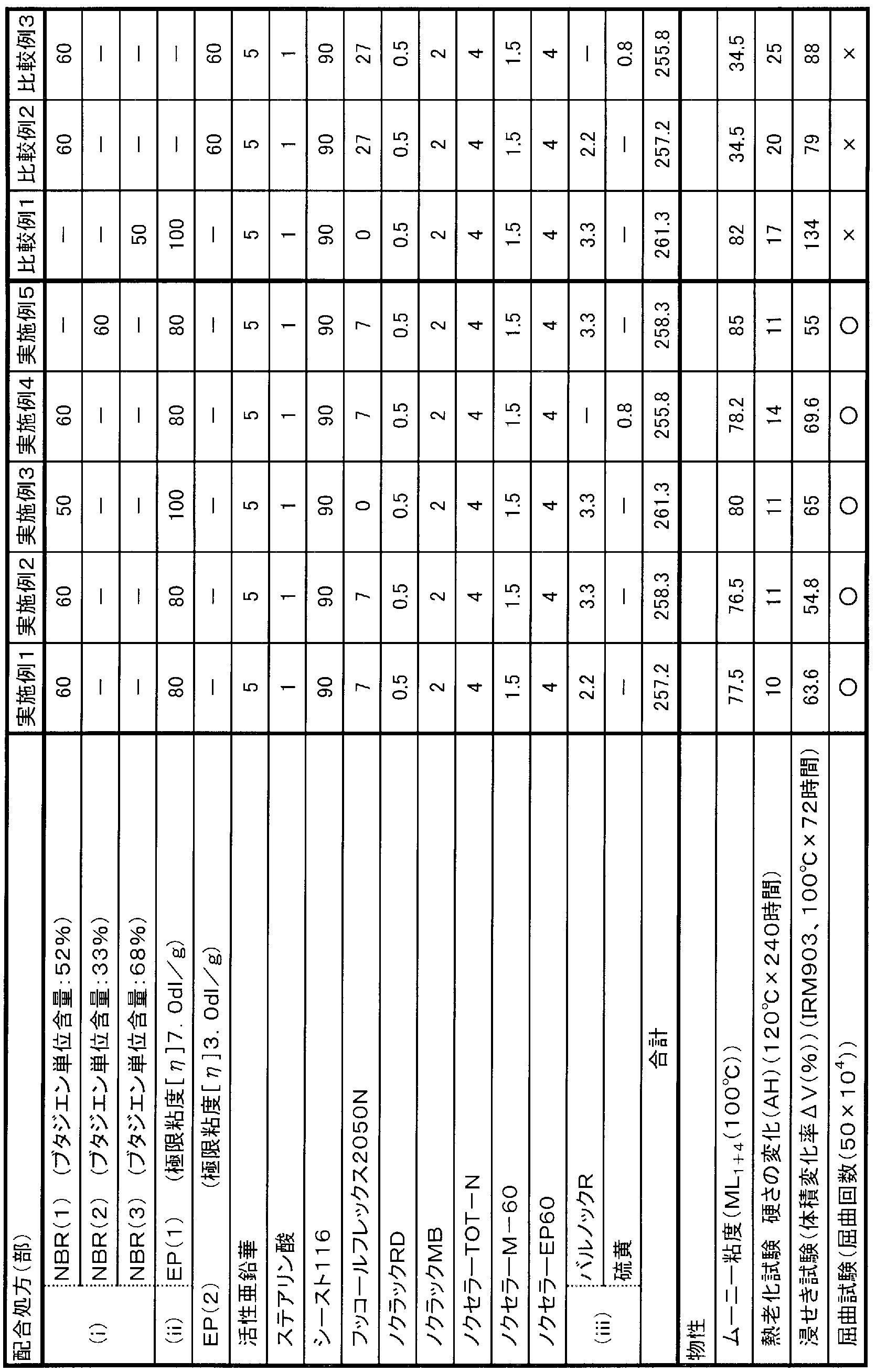
〜3のゴム組成物を用いて作製した成形品に比して、熱老化試験 (耐熱試験)による 硬さの変化 (AH)が少なく耐熱性に優れており、浸漬試験の体積変化率( Δν)が小 さく耐油性に優れており、また、耐屈曲性にも優れていることが明らかである。
産業上の利用可能性
本発明のゴム組成物、または架橋ゴムを用いて作製した成形品は、車両用部材、 例えばホース、チューブ、またはパッキン等として好適である。
Claims
[1] (i)共役ジェンに由来する構造単位を、全構造単位中 30〜60質量%含有する a , β—不飽和二トリル共役ジェン系ゴムと、
(ii) 135°C、デカリン溶媒中における極限粘度が 3. 3dlZg以上である、エチレン' aーォレフイン'非共役ジェン共重合ゴムと、
(iii)架橋剤と、
を含有するゴム組成物。
[2] 前記 (iii)架橋剤が、
前記(i) a , β 不飽和-トリル共役ジェン系ゴムと、前記(ii)エチレン' aーォレフ イン'非共役ジェン共重合ゴムとを、モノスルフイド結合によって架橋することが可能な 架橋剤である請求項 1に記載のゴム組成物。
[3] 前記 (i) α , β—不飽和-トリル共役ジェン系ゴムは、アクリロニトリルブタジエンゴ ムである請求項 1または 2に記載のゴム組成物。
[4] 前記 (ii)エチレン' a—ォレフイン'非共役ジェン共重合ゴムは、エチレン一プロピ レン 非共役ジェン共重合ゴムである請求項 1から 3のいずれか一項に記載のゴム 組成物。
[5] 請求項 1から 4の 、ずれか一項に記載のゴム組成物が架橋された架橋ゴム。
[6] 請求項 5に記載の架橋ゴムからなる成形品。
Priority Applications (3)
| Application Number | Priority Date | Filing Date | Title |
|---|---|---|---|
| US12/281,264 US20090247705A1 (en) | 2006-03-01 | 2007-03-01 | Rubber composition, crosslinked rubber and molded article |
| EP07737636A EP1990361A4 (en) | 2006-03-01 | 2007-03-01 | RUBBER COMPOSITION, NETWORKED RUBBER AND FORMING |
| JP2008502851A JPWO2007100064A1 (ja) | 2006-03-01 | 2007-03-01 | ゴム組成物、架橋ゴム、及び成形品 |
Applications Claiming Priority (2)
| Application Number | Priority Date | Filing Date | Title |
|---|---|---|---|
| JP2006-054310 | 2006-03-01 | ||
| JP2006054310 | 2006-03-01 |
Publications (1)
| Publication Number | Publication Date |
|---|---|
| WO2007100064A1 true WO2007100064A1 (ja) | 2007-09-07 |
Family
ID=38459163
Family Applications (1)
| Application Number | Title | Priority Date | Filing Date |
|---|---|---|---|
| PCT/JP2007/053970 Ceased WO2007100064A1 (ja) | 2006-03-01 | 2007-03-01 | ゴム組成物、架橋ゴム、及び成形品 |
Country Status (5)
| Country | Link |
|---|---|
| US (1) | US20090247705A1 (ja) |
| EP (1) | EP1990361A4 (ja) |
| JP (1) | JPWO2007100064A1 (ja) |
| CN (1) | CN101415767A (ja) |
| WO (1) | WO2007100064A1 (ja) |
Cited By (1)
| Publication number | Priority date | Publication date | Assignee | Title |
|---|---|---|---|---|
| JP2010164063A (ja) * | 2009-01-13 | 2010-07-29 | Bridgestone Corp | ホース外被用ゴム組成物 |
Families Citing this family (6)
| Publication number | Priority date | Publication date | Assignee | Title |
|---|---|---|---|---|
| JP5509597B2 (ja) * | 2006-12-28 | 2014-06-04 | Jsr株式会社 | 耐油耐候性ゴム用組成物及びゴム成形体 |
| US20120090719A1 (en) * | 2010-10-18 | 2012-04-19 | Jinrong Wang | System and Method of Sealing Process Leaks |
| JP5830898B2 (ja) * | 2011-03-31 | 2015-12-09 | Nok株式会社 | Nbr組成物及びゴム金属積層体 |
| CN104610606A (zh) * | 2015-01-30 | 2015-05-13 | 柳州市中配橡塑配件制造有限公司 | 耐油橡胶 |
| US20180105679A1 (en) * | 2016-10-19 | 2018-04-19 | Veyance Technologies, Inc. | Severely Hydrotreated Naphthenic Distillate Containing Rubber Compositions |
| KR101943418B1 (ko) * | 2017-11-21 | 2019-04-09 | 주식회사 화인 | 고속단정 또는 공기부양정에 사용되는 고무 시트용 고무 조성물 |
Citations (11)
| Publication number | Priority date | Publication date | Assignee | Title |
|---|---|---|---|---|
| JPS62181345A (ja) * | 1985-12-12 | 1987-08-08 | ユニロイヤル ケミカル カンパニ− インコ−ポレ−テツド | エラストマー組成物 |
| JPH0475931B2 (ja) | 1984-08-21 | 1992-12-02 | Japan Synthetic Rubber Co Ltd | |
| JP2000336210A (ja) * | 1999-05-27 | 2000-12-05 | Jsr Corp | 耐油耐候性ゴム組成物および積層体 |
| JP2000344979A (ja) * | 1999-06-01 | 2000-12-12 | Jsr Corp | 高硬度加硫ゴム組成物 |
| JP2001131362A (ja) * | 1999-11-09 | 2001-05-15 | Mitsui Chemicals Inc | エチレン・α−オレフィン・トリエン共重合体ゴム組成物および加硫ゴム |
| JP2001206987A (ja) * | 2000-01-26 | 2001-07-31 | Tokai Rubber Ind Ltd | ゴム組成物、積層体及びホース |
| JP2002037928A (ja) * | 2000-07-19 | 2002-02-06 | Yokohama Rubber Co Ltd:The | ゴム組成物 |
| WO2002085978A1 (fr) * | 2001-04-19 | 2002-10-31 | Three Bond Co., Ltd. | Melanges caoutchoutes destines a du caoutchouc moule et stable vis-a-vis de l'eau sterilisee au chlore |
| JP2003160695A (ja) * | 2001-11-27 | 2003-06-03 | Jsr Corp | 難燃性ゴム組成物及びゴム製品 |
| JP2003253049A (ja) * | 2002-03-06 | 2003-09-10 | Yamauchi Corp | ピンチローラ用ゴム組成物およびこれを用いたピンチローラ |
| WO2006121119A1 (ja) * | 2005-05-11 | 2006-11-16 | Jsr Corporation | ダイヤフラム及びそれを用いた気体又は液体輸送用ポンプ |
Family Cites Families (5)
| Publication number | Priority date | Publication date | Assignee | Title |
|---|---|---|---|---|
| US4008190A (en) * | 1973-01-02 | 1977-02-15 | The B. F. Goodrich Company | Vulcanizates of EPDM and diene rubber blends |
| TW213478B (ja) * | 1992-03-06 | 1993-09-21 | Mitsui Petroleum Chemicals Ind | |
| TW322487B (ja) * | 1995-05-24 | 1997-12-11 | Mitsui Petroleum Chemical Industry Co Ltd | |
| KR100323116B1 (ko) * | 1997-07-18 | 2002-11-04 | 미쓰이 가가쿠 가부시키가이샤 | 불포화엘라스토머조성물및그의가황고무 |
| US20080188621A1 (en) * | 2004-04-28 | 2008-08-07 | Mitsui Chemicals, Inc. | Rubber Composition and Use Thereof |
-
2007
- 2007-03-01 JP JP2008502851A patent/JPWO2007100064A1/ja active Pending
- 2007-03-01 EP EP07737636A patent/EP1990361A4/en not_active Withdrawn
- 2007-03-01 CN CNA2007800124958A patent/CN101415767A/zh active Pending
- 2007-03-01 US US12/281,264 patent/US20090247705A1/en not_active Abandoned
- 2007-03-01 WO PCT/JP2007/053970 patent/WO2007100064A1/ja not_active Ceased
Patent Citations (11)
| Publication number | Priority date | Publication date | Assignee | Title |
|---|---|---|---|---|
| JPH0475931B2 (ja) | 1984-08-21 | 1992-12-02 | Japan Synthetic Rubber Co Ltd | |
| JPS62181345A (ja) * | 1985-12-12 | 1987-08-08 | ユニロイヤル ケミカル カンパニ− インコ−ポレ−テツド | エラストマー組成物 |
| JP2000336210A (ja) * | 1999-05-27 | 2000-12-05 | Jsr Corp | 耐油耐候性ゴム組成物および積層体 |
| JP2000344979A (ja) * | 1999-06-01 | 2000-12-12 | Jsr Corp | 高硬度加硫ゴム組成物 |
| JP2001131362A (ja) * | 1999-11-09 | 2001-05-15 | Mitsui Chemicals Inc | エチレン・α−オレフィン・トリエン共重合体ゴム組成物および加硫ゴム |
| JP2001206987A (ja) * | 2000-01-26 | 2001-07-31 | Tokai Rubber Ind Ltd | ゴム組成物、積層体及びホース |
| JP2002037928A (ja) * | 2000-07-19 | 2002-02-06 | Yokohama Rubber Co Ltd:The | ゴム組成物 |
| WO2002085978A1 (fr) * | 2001-04-19 | 2002-10-31 | Three Bond Co., Ltd. | Melanges caoutchoutes destines a du caoutchouc moule et stable vis-a-vis de l'eau sterilisee au chlore |
| JP2003160695A (ja) * | 2001-11-27 | 2003-06-03 | Jsr Corp | 難燃性ゴム組成物及びゴム製品 |
| JP2003253049A (ja) * | 2002-03-06 | 2003-09-10 | Yamauchi Corp | ピンチローラ用ゴム組成物およびこれを用いたピンチローラ |
| WO2006121119A1 (ja) * | 2005-05-11 | 2006-11-16 | Jsr Corporation | ダイヤフラム及びそれを用いた気体又は液体輸送用ポンプ |
Non-Patent Citations (1)
| Title |
|---|
| See also references of EP1990361A4 * |
Cited By (1)
| Publication number | Priority date | Publication date | Assignee | Title |
|---|---|---|---|---|
| JP2010164063A (ja) * | 2009-01-13 | 2010-07-29 | Bridgestone Corp | ホース外被用ゴム組成物 |
Also Published As
| Publication number | Publication date |
|---|---|
| EP1990361A1 (en) | 2008-11-12 |
| JPWO2007100064A1 (ja) | 2009-07-23 |
| US20090247705A1 (en) | 2009-10-01 |
| CN101415767A (zh) | 2009-04-22 |
| EP1990361A4 (en) | 2009-06-03 |
Similar Documents
| Publication | Publication Date | Title |
|---|---|---|
| TWI516534B (zh) | 氯丁二烯橡膠組成物、其加硫物以及成形體 | |
| KR102574679B1 (ko) | 클로로프렌 단량체 단위와 불포화 니트릴 단량체 단위를 포함하는 통계적 공중합체의 제조 방법, 통계적 공중합체, 라텍스 및 그의 용도 | |
| WO2007100064A1 (ja) | ゴム組成物、架橋ゴム、及び成形品 | |
| TWI635123B (zh) | 含腈基之共聚物橡膠 | |
| EP3124511B1 (en) | Nitrile group-containing copolymer rubber, crosslinkable rubber composition and crosslinked rubber product | |
| JP7223013B2 (ja) | クロロプレン単量体と不飽和ニトリル化合物の共重合体、共重合体を含む組成物、組成物の加硫成形体、及び加硫成形体の用途 | |
| TWI522381B (zh) | Sulfur-modified chloroprene elastomer compositions, blends and sulfur compounds | |
| TWI535769B (zh) | 氯丁二烯橡膠組成物、其加硫物及成形體 | |
| JP6717982B2 (ja) | ゴム組成物 | |
| CN112533990B (zh) | 橡胶组合物、硫化橡胶和该硫化橡胶的成形品 | |
| JP6188936B2 (ja) | 油展エチレン−α−オレフィン−非共役ジエンコポリマー | |
| KR102507940B1 (ko) | 클로로프렌계 중합체 및 그의 제조 방법 | |
| KR20170095210A (ko) | 가황 가능한 고무 조성물 | |
| TW201641564A (zh) | 交聯體及制震材 | |
| CA2752723C (en) | Polychloroprene elastomer composition and production method and the vulcanized and molded articles thereof | |
| JP6896546B2 (ja) | ゴム組成物、該ゴム組成物の加硫物及び加硫成形体 | |
| JP7422266B1 (ja) | ゴム組成物及びタイヤブラダー | |
| JP7543426B2 (ja) | ゴム組成物、加硫物及び加硫成形体 | |
| JP2017141369A (ja) | ゴム組成物、その加硫物及び成形体 | |
| JP2008239832A (ja) | ゴム組成物、架橋ゴム、及び成形品 | |
| CN112955503B (zh) | 氯丁二烯橡胶组合物及硫化成型体 | |
| JP2016044251A (ja) | 熱可塑性エラストマー | |
| JP6443659B2 (ja) | 熱可塑性エラストマー | |
| JP2016044250A (ja) | 熱可塑性エラストマー | |
| WO2021141012A1 (ja) | クロロプレン重合体を含む組成物、成形体、および、成形体の製造方法 |
Legal Events
| Date | Code | Title | Description |
|---|---|---|---|
| 121 | Ep: the epo has been informed by wipo that ep was designated in this application | ||
| ENP | Entry into the national phase |
Ref document number: 2008502851 Country of ref document: JP Kind code of ref document: A |
|
| WWE | Wipo information: entry into national phase |
Ref document number: 2007737636 Country of ref document: EP |
|
| NENP | Non-entry into the national phase |
Ref country code: DE |
|
| WWE | Wipo information: entry into national phase |
Ref document number: 200780012495.8 Country of ref document: CN |
|
| WWE | Wipo information: entry into national phase |
Ref document number: 12281264 Country of ref document: US |