WO2007125907A1 - ポリアミド樹脂組成物 - Google Patents
ポリアミド樹脂組成物 Download PDFInfo
- Publication number
- WO2007125907A1 WO2007125907A1 PCT/JP2007/058831 JP2007058831W WO2007125907A1 WO 2007125907 A1 WO2007125907 A1 WO 2007125907A1 JP 2007058831 W JP2007058831 W JP 2007058831W WO 2007125907 A1 WO2007125907 A1 WO 2007125907A1
- Authority
- WO
- WIPO (PCT)
- Prior art keywords
- polyamide resin
- nylon
- resin composition
- mass
- epoxy compound
- Prior art date
- Legal status (The legal status is an assumption and is not a legal conclusion. Google has not performed a legal analysis and makes no representation as to the accuracy of the status listed.)
- Ceased
Links
Classifications
-
- C—CHEMISTRY; METALLURGY
- C08—ORGANIC MACROMOLECULAR COMPOUNDS; THEIR PREPARATION OR CHEMICAL WORKING-UP; COMPOSITIONS BASED THEREON
- C08K—Use of inorganic or non-macromolecular organic substances as compounding ingredients
- C08K3/00—Use of inorganic substances as compounding ingredients
- C08K3/34—Silicon-containing compounds
- C08K3/346—Clay
-
- C—CHEMISTRY; METALLURGY
- C08—ORGANIC MACROMOLECULAR COMPOUNDS; THEIR PREPARATION OR CHEMICAL WORKING-UP; COMPOSITIONS BASED THEREON
- C08L—COMPOSITIONS OF MACROMOLECULAR COMPOUNDS
- C08L63/00—Compositions of epoxy resins; Compositions of derivatives of epoxy resins
Definitions
- the present invention relates to a polyamide resin composition that is excellent in mechanical properties such as strength and elastic modulus, and also excellent in toughness, durability, slidability, and low water absorption.
- Polyamide resin has excellent physical and chemical properties and is used in a wide range of fields as materials for various molded products, films, fibers, and the like.
- the performance required for polyamide resins has been further advanced and varied amidst widespread use as automobiles, electrical machinery, electronic parts, mechanical mechanism parts, and building material parts.
- Sarako is required to have high slidability to improve wear resistance, dimensional accuracy to keep the resistance of gear parts constant, or low specific gravity.
- a polyamide resin composition obtained by dispersing a swellable layered silicate typified by synthetic fluorine mica and montmorillonite in polyamide resin has attracted attention. It has been conventionally known that this is excellent in strength, rigidity, heat resistance, and the like.
- a resin composition comprising nylon 6 and synthetic fluorine mica see Patent Document 2
- nylon 6 and montmorillonite A rosin composition comprising see Patent Document 3
- these resin compositions have been required to have further improved performance in terms of toughness and durability.
- MC nylon Monomer cast nylon
- Patent Documents 4 and 5 Monomer cast nylon
- MC nylon is not easy to injection-mold, and in fact, it is necessary to make the desired shape by cutting the block, which raises the problem of production costs.
- Patent Document 1 Japanese Patent Application Laid-Open No. 57-137762
- Patent Document 2 Japanese Patent No. 2941159
- Patent Document 3 Japanese Patent Publication No. 8-22946
- Patent Document 4 Japanese Patent Laid-Open No. 2002-88150
- Patent Document 5 Japanese Unexamined Patent Application Publication No. 2005-240973
- An object of the present invention is to provide a polyamide resin composition that is excellent in mechanical properties typified by strength and elastic modulus, and further excellent in toughness, durability, friction wear resistance, and low water absorption. It is to be.
- the present inventors have solved the above problem by blending a specific aliphatic epoxy compound into a polyamide resin in which a swellable layered silicate is dispersed.
- the present invention has been found. That is, the gist of the present invention is that an aliphatic epoxy compound having three glycidyl groups per molecule is added to 100 parts by mass of polyamide resin in which a silicate layer of a swellable layered silicate is dispersed.
- a polyamide resin composition having excellent mechanical properties represented by strength, elastic modulus, etc., and further having toughness, durability, slidability, low water absorption, and dimensional accuracy. It can be done.
- the polyamide resin (A) in the present invention is obtained by dispersing a silicate layer of a swellable layered silicate in a polyamide resin matrix.
- the silicate layer is a basic unit constituting the swellable layered silicate, and is a plate-like shape obtained by breaking the layer structure of the swellable layered silicate (hereinafter referred to as "cleavage" t). It is an inorganic crystal.
- the silicate layer is preferably uniformly dispersed at the molecular level in the polyamide resin. “Uniformly dispersed at the molecular level” means that when the silicate layer of the swellable layered silicate is dispersed in the polyamide resin, each keeps an average interlaminar distance of 1 nm or more and forms a lump. A state that exists and is present without any problems.
- the lump refers to a state in which the swellable layered silicate which is a raw material is not cleaved.
- the interlayer distance is the distance between silicate layers.
- the dispersion state of the silicate layer in the polyamide resin can be confirmed, for example, by observation with a transmission electron microscope.
- the silicate layer does not necessarily have to be separated one by one, and the silicate layer may be partially laminated.
- the swellable layered silicate used in the present invention has a structure comprising a negatively charged crystal layer mainly composed of silicate and a cation having ion exchange ability interposed between the layers. It is desirable that the cation exchange capacity determined by the method described later is 50 meq ZlOOg or more. If the cation exchange capacity is less than 50 milliequivalents ZlOOg, the swelling ability is low, so the polyamide composite material remains substantially in an uncleavage state, and the performance of the polyamide composite material is insufficiently improved. There is a case.
- the upper limit of the cation exchange capacity value is not particularly limited, but the upper limit of the cation exchange capacity of the swellable layered silicate that can be actually obtained or prepared is about 250 meq.
- the swellable layered silicate used in the present invention may be a naturally occurring one or one that is artificially synthesized or modified, for example, a smectite group (montmorillonite, noiderite, hectorite, soconite, etc.), bar Mikiyulite (vermiculite, etc.), mica (fluorine mica, muscovite, paragonite, phlogopite, levidrite, etc.), brittle mica (margarite, clintonite, anandite, etc.), chlorite (donbasite, sudite) , Cookeite, clinochlore, chamosite, nimite, etc.).
- Na Type or Li type swellable fluorine mica and montmorillonite are particularly preferably used.
- the swellable fluorinated mica preferably used in the present invention has a composition represented by the following general formula.
- M represents an ion-exchangeable cation, specifically sodium or lithium.
- A, b, X, Y and Z represent coefficients, respectively, and 0 ⁇ a ⁇ 0. (5, 0 ⁇ b ⁇ 0. 5, 2. 5 ⁇ X ⁇ 3, 10 ⁇ Y ⁇ 11, 1. 0 ⁇ 2.0)
- swellable fluorinated mica commercially available products from Co-op Chemical Co., Ltd. and Toby Industries Co., Ltd. can be suitably used, and they can be easily obtained by the following production method.
- the montmorillonite that can be used in the present invention is represented by the following formula, and can be obtained by purifying a naturally-occurring product by a water treatment or the like.
- M represents a cation such as sodium, and 0.25 ⁇ a ⁇ 0.6.
- the number of water molecules bound to the interlayer ion-exchangeable cation depends on the cation species, humidity, etc. (It is expressed as nH 2 O in the formula because it can vary depending on conditions.)
- montmorillonite is known to have the same type of ion-substitution such as magnesia montmorillonite, iron montmorillonite, iron magnesia montmorillonite, and these may be used.
- the initial particle size of the swellable layered silicate used in the present invention is not particularly limited! / ⁇ is suitable considering the influence on the rigidity and heat resistance of the obtained polyamide resin composition. Make a choice.
- a preferred particle size range is about 0.1 to 20 m.
- the initial particle size can be controlled by pulverizing with a jet mill or the like, if necessary.
- the initial particle size is the particle size of the swellable lamellar silicate as a raw material used in producing the polyamide resin (A) used in the present invention, and is the size of the silicate layer in the composite material. Is different.
- the initial particle size can be changed by appropriately selecting the particle size of talc as a raw material. This is a preferred method in that the initial particle diameter can be adjusted over a wider range by using in combination with grinding.
- the polyamide in the present invention is a polymer having an amide bond in the main chain mainly composed of aminocarboxylic acid, ratatam or diamine and dicarboxylic acid (including a pair of salts thereof).
- specific examples of the raw materials include 6-aminocaproic acid, 11-aminoundecanoic acid, 12-aminododecanoic acid, paraaminomethylbenzoic acid and the like as aminocarboxylic acids.
- Ratatam also includes ⁇ -force prolatatam, ⁇ -undecanolactam, ⁇ -laurolatatam, etc.
- Diamines include tetramethylene diamine, hexamethylene diamine, undecamethylene diamine, dodecamethylene diamine, 2,2,4- / 2,4,4-trimethylhexamethylene diamine, 5 -Methylnonamethylenediamine, 2,4-dimethyloctamethylenediamine, metaxylylenediamine, paraxylylenediamine, 1,3-bis (aminomethyl) cyclohexane, bis (4-amino) Cyclohexyl) methane, bis (3-methyl-4-aminocyclohexyl) methane, 2,2-bis (4-aminocyclohexyl) propane, bis (aminopropyl) piperazine, aminoethylpiperazine, etc.
- Dicarboxylic acids include adipic acid, peric acid, azelaic acid, sebacic acid, dodecanedioic acid, terephthalic acid, isophthalic acid, 2-chloroterephthalic acid, 2-methylterephthalic acid, 5-methylisophthalic acid, and 5-sodium. Examples include sulfoisophthalic acid, hexahydroterephthalic acid, and hexahydroisophthalic acid. These diamines and dicarboxylic acids can also be used as a pair of salts.
- polystrength proamide (nylon 6), polytetramethylene azinimide (nylon 46), polyhexamethylene azinamide (nylon 66), Poly-force proamide ⁇ polyhexamethylene azinamide copolymer (nylon 6 Z66), Polydecamide (Nylon 11), Poly-Proamide Z Polyunde-Force Mid Copolymer (Nylon 6Z11), Polydodecamide (Nylon 12), Poly-Force Proamide Z Polydodecamide Copolymer (Nylon 6Z12), Polyhexamethylene Sebacamide ( Nylon 610), Polyhexamethylendecamide (Nylon 612), Polydecane methylene adipamide (Nylon 116), Polyhexamethylene isophthalamide (Nylon 61), Polyhexamethylene terephthalamide (Nylon 6T), Polyhexamethylene terephthalamide Z Polyhexamethylene isophthalamide cop
- the relative viscosity of the polyamide rosin (A) in the present invention is as follows: relative viscosity of nylon 6 and nylon 66 measured with 96% by weight concentrated sulfuric acid as a solvent and at a temperature of 25 ° C and a concentration of lgZdl. 2. Optimum 0 to 4.5 is preferred 2.3 For nylon 11 and nylon 12, which is desired to be 3 to 4.0 1.2 Optimum is 2 to 2.8 1. It is desirable to be 4 to 2.3. When the relative viscosity is lower than the lower limit, the polyamide resin composition obtained according to the present invention may be unfavorable because it has poor durability and toughness. On the other hand, when the relative viscosity exceeds the upper limit, the flowability at the time of melting of the polyamide resin composition is extremely lowered, and the moldability may be remarkably deteriorated.
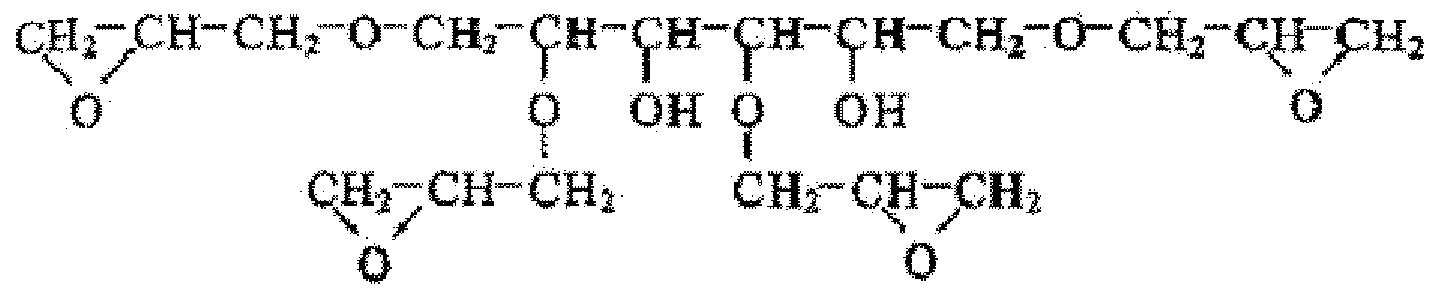
- the aliphatic epoxy compound (B) having three glycidyl groups in one molecule in the present invention includes trimethylolpropane polyglycidyl ether, glycerol polyglycidyl ether, diglycerol polyglycidyl ether, polyglycerol poly Glycidilje One tell is mentioned.
- those having a trimethylolpropane and Z or glycerol skeleton, such as trimethylolpropane polyglycidyl ether and daricerol polyglycidyl ether can be preferably used.
- the number of glycidyl groups in the aliphatic epoxy compound (B) l molecule is three. If it is 2 or less, the strength, toughness and durability are not improved so that the effects of the present invention cannot be obtained. On the other hand, when it is 4 or more, the gel of polyamide resin is remarkably deteriorated in operability, which is not preferable.
- the epoxy equivalent of the aliphatic epoxy compound (B) is preferably 180 gZeq or less, and more preferably 150 gZeq or less. If the epoxy equivalent exceeds 180 gZeq, the effect of improving the strength, toughness and durability is particularly poor, which is not preferable. From the viewpoint of operability, the viscosity of the aliphatic epoxy compound (B) at 25 ° C is preferably 1 to 1500 mPa's, more preferably 1 to LOOOmPa's. [0033] The blending amount of the component (B) is 0.05 to 4.0 parts by weight, preferably 0.1 to 3.0 parts by weight, based on 100 parts by weight of the polyamide resin (A).
- the range is preferably 0.2 to 3.0 parts by mass.
- component (B) is less than 0.05 parts by mass, the improvement of rigidity, toughness, durability and slidability of the polyamide resin composition is insufficient.
- the amount exceeds 4.0 parts by mass the flowability of the polyamide rosin composition is remarkably lowered and the moldability is deteriorated, and the gel insoluble in the relative viscosity measuring solvent (concentrated sulfuric acid). This is not preferred because it tends to reduce the physical properties.
- the method for producing the polyamide resin composition of the present invention is not particularly limited.
- the polyamide resin (A) and the aliphatic epoxy compound (B) are melt-kneaded using a twin-screw extruder, Extrusion into a strand shape and perez toy.
- the production method of the polyamide resin (A) basically includes using an initiator such as water after charging a predetermined amount of monomer in an autoclave in the presence of an appropriately selected swellable layered silicate.
- the melt polycondensation method may be performed within a temperature range of 200 to 300 ° C., a pressure of 0.2 to 3 MPa, and a time of 1 to 15 hours.
- nylon 6 is used as a resin matrix, it is preferable to polymerize at a temperature of 250 to 280 ° C, a pressure of 0.5 to 2 MPa, and a range of 3 to 5 hours! /.
- the treatment is preferably performed in hot water at 90 to 100 ° C. for 8 hours or more.
- Polyamide rosin (A) can also be produced by melt-kneading a swellable layered silicate salt pre-treated with a swelling agent and polyamide rosin.
- the swelling agent is preferably an organic cation, and examples thereof include organic ammonium ions and organic phosphorous ions.
- organic ammonium ions include first to fourth grade ammonium ions.
- primary ammonia ions include octyl ammonium, dodecyl ammonium and octadecyl ammonium.
- secondary ammonium ions include dioctarum, methyloctadecyl ammonium, and dioctadecyl ammonium. Can be mentioned.
- tertiary ammonium ions include trioctyl ammonium, dimethyl dodecyl ammonium and didodecyl monomethyl ammonium.
- the quaternary ammonium ions include tetraethyl ammonium, trioctyl methyl ammonium, octadecyl trimethyl ammonium, dioctadecyl dimethyl ammonium, and dodecyl dihexyl methyl ammonium.
- organic phosphorous ions examples include tetraethylphosphonium, tetrabutylphosphonium, tetrakis (hydroxymethyl) phosphonium, 2-hydroxyethyltriphenylphosphonium. These compounds may be used alone or in combination of two or more. Of these, ammonium ions are preferably used.
- the layered silicate is dispersed in water or alcohol, and the organic cation is added thereto in the form of a salt and mixed by stirring.
- the method includes ion-exchanging the inorganic ions of the layered silicate with organic cations, followed by filtration, washing, and drying.
- the silicate layer content of the swellable layered silicate is preferably 0.1 to 20% by mass with respect to 100% by mass of the polyamide resin (A) including the silicate layer. It is preferable that the content is 0 to 10% by mass. This amount can be confirmed by the inorganic ash content of the polyamide resin (A) described later. If the blending amount is less than 0.5% by mass, the effect of reinforcing the polyamide resin matrix by the silicate layer of the swellable layered silicate is poor. On the other hand, if the blending amount exceeds 20% by mass, the toughness tends to decrease, which is not preferable.
- a heat stabilizer In the production of the polyamide resin composition of the present invention, a heat stabilizer, an antioxidant, a pigment, an anti-coloring agent, a weathering agent, a flame retardant, and an improvement in slidability are provided as long as the characteristics are not significantly impaired.
- Materials, plasticizers, crystal nucleating agents, release agents, etc. may be added. These can be added at any stage of producing the polyamide resin composition. For example, they may be added at the time of the polymerization of the polyamide resin (A), or when melt-kneaded with the aliphatic epoxy compound (B). You may add to.
- Examples of the heat stabilizer and the acid prevention agent include hindered phenols, phosphorus compounds, and hints. Examples thereof include dard amines, thio compounds, copper compounds, alkali metal halides, and mixtures thereof.
- the polyamide resin composition of the present invention may be mixed with other thermoplastic resins.
- thermoplastic resin examples include polybutadiene, butadiene Z styrene copolymer, acrylic rubber, ethylene Z propylene copolymer, ethylene Z propylene Z gen copolymer, natural rubber, chlorinated butyl rubber, chlorinated polyethylene and the like.
- Elastomers of the above or modified products thereof such as maleic anhydride, polyethylene, polypropylene, butadiene Z Atari port nitrile copolymer, polychlorinated butyl, polyethylene terephthalate, polyacetal, polyvinylidene fluoride, polysulfone, polyphenylene sulfide , Polyethersulfone, phenoxy resin, polyphenylene ether, polymethyl methacrylate, polyether ketone, polycarbonate, polytetrafluoroethylene, polyarylate and the like.
- ⁇ -force prolatatam 10kg, 1kg water and 400g montmorillonite (Kumi-Neya Kunipia F, cation exchange capacity 115 meq ZlOOg, particle size 1 ⁇ m) is added It was placed in a 30 liter autoclave, heated to 260 ° C and raised until the internal pressure reached 1.5 MPa. Thereafter, water vapor was gradually released, and the polymerization was carried out for 2 hours while maintaining the pressure at 1.5 MPa and the temperature of 260 ° C. Then, the pressure was released to normal pressure over 1 hour, and the polymerization was further carried out for 15 minutes.
- the reaction product was discharged in the form of a strand, cooled, solidified, and then cut to obtain polyamide resin pellets.
- the pellets were scoured with hot water at 95 ° C. for 8 hours and then vacuum-dried.
- the obtained polyamide resin had a silicate layer of 4.0% by mass, and a relative viscosity by a viscosity measurement method described later was 2.5.
- a wide-angle X-ray diffraction measurement was performed on this polyamide resin pellet, the peak in the thickness direction of the montmorillonite disappeared completely, indicating that the montmorillonite was uniformly dispersed in the polyamide resin at the molecular level. I was divided.
- the screw rotation speed was 200 rpm and the discharge rate was 15 kg / h at 250 to 260 ° C.
- the silicate layer was 3.5% by mass, and the relative viscosity measured by the viscosity measurement method described later was 2.5.
- the peak in the thickness direction of montmorillonite disappeared completely, and it was found that montmorillonite was uniformly dispersed in the polyamide resin at the molecular level. I helped.
- Polyamide resin P-3 (described later) to 94% by mass of dodecyldihexylmethylammonium swelled swelling layered silicate (MEE (Dodecyldihexylmethyl) Amm - was treated with ⁇ beam ME- 100; organic component 30 mass 0/0), particle size 8 mu m) of 6 mass 0/0, the main feed throat of a co-rotating twin-screw extruder (manufactured by Toshiba Machine Co. TEM37BS) The resin composition that was fed, melted and kneaded, and taken out in a strand form from the die was cooled and solidified through a water tank, and was cut with a pelletizer to obtain pellets of a resin composition. Extrusion conditions are temperature settings
- the screw rotation speed was 200 rpm, and the discharge rate was 15 kg / h.
- the silicate layer was 4.2% by mass, and the relative viscosity measured by the viscosity measurement method described later was 2.8.
- the peak in the thickness direction of montmorillonite disappeared completely, and it was found that montmorillonite was uniformly dispersed in the polyamide resin at the molecular level. I helped.
- the reaction product was discharged in a strand shape, cooled, solidified, and then cut to obtain polyamide resin pellets.
- the obtained polyamide resin had an inorganic ash content of 4.2% by mass for the silicate layer and a relative viscosity of 1.6 by the viscosity measurement method described later. Further, when a wide-angle X-ray diffraction measurement was performed on the pellets of the polyamide resin, the peak in the thickness direction of the fluorine mica disappeared completely, and the fluorine mica was uniformly dispersed in the polyamide resin at the molecular level. Being divided was a force.
- Polyamide resin P-4 (described later) to 94% by mass of dodecyldihexylmethylammonium swellable swellable layered silicate (ME-100 manufactured by Cope Chemical Company, ME-100 treated with dodecyldihexylmethylammonium; organic component 30 mass 0/0), particle size 8 mu m) of 6 mass 0/0, and supplies to the main feed throat of a co-rotating twin-screw extruder (manufactured by Toshiba machine Co. TEM37BS) was melt-kneaded, through a die as strands The taken resin composition was cooled and solidified through a water tank, and was cut with a pelletizer to obtain resin composition pellets.
- Extrusion conditions are temperature settings At 270 to 290 ° C, the screw rotation speed was 200 rpm, and the discharge rate was 15 kg / h.
- the silicate layer was 4.2% by mass, and the relative viscosity measured by the viscosity measurement method described later was 1.6.
- the peak in the thickness direction of montmorillonite disappeared completely, and it was found that montmorillonite was uniformly dispersed in the polyamide resin at the molecular level. I helped.
- TEM37BS melt mixing kneading was taken off from the die into strands ⁇ The fat composition was cooled and solidified through a water tank, and was cut with a pelletizer to obtain pellets of the fat composition.
- the extrusion conditions were a temperature setting of 230 to 250 ° C, a screw speed of 200 rpm, and a discharge rate of 15 kgZh.
- the silicate layer was 4.2% by mass, and the relative viscosity measured by the viscosity measurement method described later was 1.8.
- the swollen layered silicate The peak in the thickness direction of the salt is All the have disappeared, the silicate of the swellable lamellar silicate is uniformly dispersed at the molecular level in the polyamide ⁇ component force ivy.
- Nylon 6 “A1030BRT” manufactured by Nutica was used.
- the relative viscosity measured by the viscosity measurement method described later was 3.4.
- Nylon 6 “A1030BRL” manufactured by Nutica was used.
- the relative viscosity measured by the viscosity measurement method described later was 2.5.
- the epoxy equivalent is 149 gZeq
- the viscosity is 22 mPa's
- it has two glycidyl groups in one molecule.
- the structural formula is as follows.
- ⁇ (B-4) "Trisepoxypropylisocyanurate TEPIC-S” manufactured by Nissan Chemical Co., Ltd. has one glycidyl group in one molecule.
- the structural formula is as follows.
- the NH + type swellable fluorine mica is washed with 10% by weight of salt-sodium potassium aqueous solution.
- a dry pellet of the polyamide resin composition is precisely weighed in a magnetic crucible and kept at 500 ° C.
- the residue after incineration in an air furnace for 15 hours was treated as inorganic ash, and the inorganic ash content was calculated according to the following formula.
- Inorganic ash content (% by mass) ⁇ Inorganic ash content (g) ⁇ Z ⁇ Total mass of sample before incineration (g) ⁇
- the tensile strength is preferably 90 MPa or more when the polyamide component is nylon 6 and nylon 66, and 50 MPa or more when nylon 11 and nylon 12 are used.
- the flexural modulus is preferably 3.5 GPa or more when the polyamide component is nylon 6 and nylon 66, and 2.OGPa or more when nylon 11 and nylon 12 are used.
- Izod impact strength is preferably 45jZm or more.
- Measurement was performed at 23 ° C using a vibration fatigue tester (B70 type, manufactured by Toyo Seiki Seisakusho). Specimen dimensions are width 3.2 mm, thickness 12.7 mm, length 127 mm, and fixed so that the span distance is 35 mm.
- polyamide component is nylon 6 and nylon 66, load 98 N, nylon 11 and nylon In the case of 12, a 30-cycle Zsec vibration was applied at a load of 75 N, and the number of cycles until the specimen broke was measured. The number of cycles until the specimen breaks is preferably 100 ⁇ 10 3 or more.
- the specific friction amount is preferably 1.0 X 10 _3 'mm 3 Z (N'km) or less, and the dynamic friction coefficient is preferably 0.15 or less.
- the water absorption after 48 hours in 23 ° C water was measured.
- the polyamide component is nylon 6 or nylon 66
- the water absorption is preferably 1.5% or less, and when nylon 11 or nylon 12 is 0.5% or less.
- the dimensional change rate in the flow direction of the specimen after water absorption in water at 23 ° C for 48 hours was measured.
- the dimensional change rate is preferably 0.2% or less for nylon 6 and nylon 66, and 0.1% or less for nylon 11 and nylon 12.
- Polyamide resin (A-1) 100 parts by mass and epoxy compound (B-1) 0.5 part by mass with biaxial extruder (Toshiba Machine Co., Ltd., TEM37-BS), resin temperature 270 ° C And kneaded and extruded into pellets.
- biaxial extruder Toshiba Machine Co., Ltd., TEM37-BS
- resin temperature 270 ° C And kneaded and extruded into pellets.
- various test pieces were prepared by injection molding under the conditions of a cylinder temperature of 270 ° C and a mold temperature of 80 ° C using an injection molding machine (IS100E-3A manufactured by Toshiba Machine Co., Ltd.). Were prepared for each test. The results are shown in Table 1.
- a test piece was prepared in the same manner as in Example 1 except that the component ratios shown in Table 1 were used, and each specimen was subjected to a physical property test.
- Comparative Example 3 and Comparative Example 6 gelling occurred during melt-kneading, and the force that could not be used for pelletizing was such that physical properties and the like could not be evaluated.
- Comparative Example 4 A-1 was subjected to various evaluations as it was.
- Example 4 and Comparative Examples 7 to 8 Test specimens were prepared in the same manner as in Example 1 except that the component ratios shown in Table 2 were set, the resin temperature during processing with a twin screw extruder was 290 ° C, and the cylinder temperature during injection molding was 290 ° C. Each was subjected to physical property tests. In Comparative Example 7, A-4 was subjected to various evaluations as it was.
- Test specimens were prepared in the same manner as in Example 1 except that the component ratios shown in Table 2 were used, the resin temperature was 220 ° C during processing with the twin screw extruder, and the cylinder temperature was 220 ° C during injection molding. Each was subjected to physical property tests. In Comparative Example 9, A-5 was subjected to various evaluations as it was. In Comparative Example 11, A-7 was subjected to various evaluations as it was.
- Comparative Example 3 the compounding amount of the aliphatic epoxy compound having three glycidyl groups in one molecule exceeded the scope of the present invention, and Comparative Example 6 has four glycidyl groups in the molecule. Since an aliphatic epoxy compound was used, gelling occurred at the time of melting and kneading, and a pellet could not be formed. Since Comparative Examples 4, 7, 9, and 11 did not use an aliphatic epoxy compound having three glycidyl groups in one molecule, compared to Examples 1, 4, 5, and 7, all the water absorption rates were Results were inferior in terms of items. In Comparative Examples 5, 8, and 10, since the polyamide resin containing no silicate layer was used, the Izod impact strength was improved, but the strength, elastic modulus, and durability were not improved. I helped. There is also the disadvantage of high water absorption.
- the polyamide resin composition of the present invention has excellent mechanical properties, durability, slidability, and low water absorption, so various gears, bearings, bearings, etc., brakes, clutch parts, etc., various seal members, pistons Examples include rings, parts for mechanical transmission mechanisms (gears, friction wheels, cams, etc.), mechanical parts for watches, building materials and sporting goods.
- a preferable production method includes an injection molding method.
Landscapes
- Chemical & Material Sciences (AREA)
- Dispersion Chemistry (AREA)
- Health & Medical Sciences (AREA)
- Chemical Kinetics & Catalysis (AREA)
- Medicinal Chemistry (AREA)
- Polymers & Plastics (AREA)
- Organic Chemistry (AREA)
- Compositions Of Macromolecular Compounds (AREA)
- Epoxy Resins (AREA)
- Polyamides (AREA)
Abstract
Description




Claims
Priority Applications (4)
| Application Number | Priority Date | Filing Date | Title |
|---|---|---|---|
| CN2007800153700A CN101432363B (zh) | 2006-04-28 | 2007-04-24 | 聚酰胺树脂组合物 |
| US12/296,642 US8008389B2 (en) | 2006-04-28 | 2007-04-24 | Polyamide resin composition |
| EP07742266A EP2017305A1 (en) | 2006-04-28 | 2007-04-24 | Polyamide resin composition |
| JP2008513213A JP5059750B2 (ja) | 2006-04-28 | 2007-04-24 | ポリアミド樹脂組成物 |
Applications Claiming Priority (2)
| Application Number | Priority Date | Filing Date | Title |
|---|---|---|---|
| JP2006125571 | 2006-04-28 | ||
| JP2006-125571 | 2006-04-28 |
Publications (1)
| Publication Number | Publication Date |
|---|---|
| WO2007125907A1 true WO2007125907A1 (ja) | 2007-11-08 |
Family
ID=38655433
Family Applications (1)
| Application Number | Title | Priority Date | Filing Date |
|---|---|---|---|
| PCT/JP2007/058831 Ceased WO2007125907A1 (ja) | 2006-04-28 | 2007-04-24 | ポリアミド樹脂組成物 |
Country Status (6)
| Country | Link |
|---|---|
| US (1) | US8008389B2 (ja) |
| EP (1) | EP2017305A1 (ja) |
| JP (1) | JP5059750B2 (ja) |
| CN (1) | CN101432363B (ja) |
| TW (1) | TW200804514A (ja) |
| WO (1) | WO2007125907A1 (ja) |
Cited By (2)
| Publication number | Priority date | Publication date | Assignee | Title |
|---|---|---|---|---|
| JP2009149763A (ja) * | 2007-12-20 | 2009-07-09 | Unitika Ltd | 低揮発性ポリアミド樹脂組成物 |
| EP2270078A4 (en) * | 2008-04-16 | 2014-04-30 | Unitika Ltd | BIAXIAL STRIPPED POLYAMIDE RESIN FOIL AND METHOD OF MANUFACTURING THEREOF |
Families Citing this family (4)
| Publication number | Priority date | Publication date | Assignee | Title |
|---|---|---|---|---|
| EP2305447B1 (de) * | 2009-10-05 | 2014-11-12 | Basf Se | Verfahren zur Herstellung von Bauteilen aus einer thermoplastischen Formmasse, sowie Bauteile aus einer thermoplastischen Formmasse |
| CN104425777A (zh) * | 2013-08-29 | 2015-03-18 | 苏州翰普高分子材料有限公司 | 基于聚酰胺组合物的电池密封垫 |
| CN107099116A (zh) * | 2017-05-18 | 2017-08-29 | 湖南省达琪新材料有限公司 | 聚酰胺多胺插层层状硅酸盐复合材料的制备方法 |
| CN109575590A (zh) * | 2018-11-30 | 2019-04-05 | 广东威林工程塑料股份有限公司 | 一种低吸水率、高尺寸稳定性的环氧树脂原位固化挤出填充pa66复合材料及其制备方法 |
Citations (9)
| Publication number | Priority date | Publication date | Assignee | Title |
|---|---|---|---|---|
| JPS57137762A (en) | 1981-02-18 | 1982-08-25 | Aisin Chem Co Ltd | Resin made gear for engine |
| JPH03121120A (ja) * | 1989-07-03 | 1991-05-23 | Mitsui Petrochem Ind Ltd | 制振材料 |
| JPH03170545A (ja) * | 1989-11-30 | 1991-07-24 | Somar Corp | 液状エポキシ樹脂組成物 |
| JPH0822946B2 (ja) | 1985-09-30 | 1996-03-06 | 株式会社豊田中央研究所 | 複合材料 |
| JPH0892465A (ja) * | 1994-09-26 | 1996-04-09 | Mitsubishi Eng Plast Kk | 耐候性ポリアミド樹脂組成物 |
| JP2941159B2 (ja) | 1992-12-29 | 1999-08-25 | ユニチカ株式会社 | 強化ポリアミド樹脂組成物およびその製造法 |
| JP2002088150A (ja) | 2000-09-14 | 2002-03-27 | Nippon Polypenco Ltd | モノマーキャストナイロン樹脂及びその製造方法 |
| JP2002338886A (ja) * | 2001-03-16 | 2002-11-27 | Toray Ind Inc | 焼付塗装用ポリアミド樹脂組成物および焼付塗装成形品 |
| JP2005240973A (ja) | 2004-02-27 | 2005-09-08 | Nsk Ltd | 樹脂製歯車 |
Family Cites Families (3)
| Publication number | Priority date | Publication date | Assignee | Title |
|---|---|---|---|---|
| CN1081207C (zh) * | 1997-07-17 | 2002-03-20 | 中国科学院化学研究所 | 一种聚酰胺粘土纳米复合材料的制法 |
| JP2006131832A (ja) * | 2004-11-09 | 2006-05-25 | Unitika Ltd | ポリアミド樹脂組成物 |
| JP2006342296A (ja) * | 2005-06-10 | 2006-12-21 | Toray Ind Inc | 自動車部品用ポリアミド樹脂組成物 |
-
2007
- 2007-04-24 WO PCT/JP2007/058831 patent/WO2007125907A1/ja not_active Ceased
- 2007-04-24 CN CN2007800153700A patent/CN101432363B/zh not_active Expired - Fee Related
- 2007-04-24 EP EP07742266A patent/EP2017305A1/en not_active Withdrawn
- 2007-04-24 JP JP2008513213A patent/JP5059750B2/ja not_active Expired - Fee Related
- 2007-04-24 US US12/296,642 patent/US8008389B2/en not_active Expired - Fee Related
- 2007-04-26 TW TW096114776A patent/TW200804514A/zh unknown
Patent Citations (9)
| Publication number | Priority date | Publication date | Assignee | Title |
|---|---|---|---|---|
| JPS57137762A (en) | 1981-02-18 | 1982-08-25 | Aisin Chem Co Ltd | Resin made gear for engine |
| JPH0822946B2 (ja) | 1985-09-30 | 1996-03-06 | 株式会社豊田中央研究所 | 複合材料 |
| JPH03121120A (ja) * | 1989-07-03 | 1991-05-23 | Mitsui Petrochem Ind Ltd | 制振材料 |
| JPH03170545A (ja) * | 1989-11-30 | 1991-07-24 | Somar Corp | 液状エポキシ樹脂組成物 |
| JP2941159B2 (ja) | 1992-12-29 | 1999-08-25 | ユニチカ株式会社 | 強化ポリアミド樹脂組成物およびその製造法 |
| JPH0892465A (ja) * | 1994-09-26 | 1996-04-09 | Mitsubishi Eng Plast Kk | 耐候性ポリアミド樹脂組成物 |
| JP2002088150A (ja) | 2000-09-14 | 2002-03-27 | Nippon Polypenco Ltd | モノマーキャストナイロン樹脂及びその製造方法 |
| JP2002338886A (ja) * | 2001-03-16 | 2002-11-27 | Toray Ind Inc | 焼付塗装用ポリアミド樹脂組成物および焼付塗装成形品 |
| JP2005240973A (ja) | 2004-02-27 | 2005-09-08 | Nsk Ltd | 樹脂製歯車 |
Cited By (2)
| Publication number | Priority date | Publication date | Assignee | Title |
|---|---|---|---|---|
| JP2009149763A (ja) * | 2007-12-20 | 2009-07-09 | Unitika Ltd | 低揮発性ポリアミド樹脂組成物 |
| EP2270078A4 (en) * | 2008-04-16 | 2014-04-30 | Unitika Ltd | BIAXIAL STRIPPED POLYAMIDE RESIN FOIL AND METHOD OF MANUFACTURING THEREOF |
Also Published As
| Publication number | Publication date |
|---|---|
| EP2017305A1 (en) | 2009-01-21 |
| CN101432363A (zh) | 2009-05-13 |
| JPWO2007125907A1 (ja) | 2009-09-10 |
| US8008389B2 (en) | 2011-08-30 |
| TW200804514A (en) | 2008-01-16 |
| JP5059750B2 (ja) | 2012-10-31 |
| US20090182086A1 (en) | 2009-07-16 |
| CN101432363B (zh) | 2012-03-14 |
Similar Documents
| Publication | Publication Date | Title |
|---|---|---|
| US6103805A (en) | Polyamide resin composition and molded articles | |
| JP5059750B2 (ja) | ポリアミド樹脂組成物 | |
| US6255378B1 (en) | Polyamide resin composition and process for producing the same | |
| TW574315B (en) | Polyamide resin composition for fuse element | |
| JP5553495B2 (ja) | ポリアミド樹脂組成物およびそれを成形してなる成形品 | |
| JP2009035592A (ja) | ガラス繊維強化ポリアミド樹脂組成物 | |
| JPH11315204A (ja) | ポリアミド複合材料 | |
| JPH06248176A (ja) | 強化ポリアミド樹脂組成物およびその製造法 | |
| JP5191154B2 (ja) | ポリアミド成形品の製造方法およびエンジンカバー | |
| JP2011208105A (ja) | ポリアミド樹脂組成物、該ポリアミド樹脂組成物の製造方法および該ポリアミド樹脂組成物を用いてなる成形体 | |
| JP2006143772A (ja) | 樹脂組成物 | |
| JP2006131832A (ja) | ポリアミド樹脂組成物 | |
| JP2009007483A (ja) | ガラス繊維強化ポリアミド樹脂組成物 | |
| JP4884714B2 (ja) | エンジンカバー用ポリアミド樹脂混合物および該混合物を用いて製造されたエンジンカバー | |
| JP6545442B2 (ja) | ポリアミド樹脂組成物およびそれよりなる成形体 | |
| JPH0812881A (ja) | ポリアミド樹脂組成物及びその製造方法 | |
| JP4726474B2 (ja) | ポリアミド複合材料射出成形品の製造方法 | |
| JPH11228817A (ja) | ガスバリヤー性に優れたポリアミド樹脂組成物及びその製造法、並びにこれを用いたフィルム及び容器 | |
| JP2001098147A (ja) | ガスバリヤー性に優れたポリアミド樹脂組成物、並びにこれを用いたフィルム及び容器 | |
| JP2012012446A (ja) | ポリアミド樹脂混合物、ポリアミド樹脂成形体およびそれらの製造方法 | |
| JP2003020400A (ja) | ポリアミド複合材料およびその製造方法 | |
| JPH11172100A (ja) | 強化ポリアミド樹脂 | |
| KR100419544B1 (ko) | 강화된폴리아미드수지조성물및이의제조방법 | |
| JPH10237298A (ja) | ポリアミド樹脂組成物からなるチップ及びその製造法 | |
| JP5319884B2 (ja) | ポリアミド/ポリオレフィン系樹脂組成物 |
Legal Events
| Date | Code | Title | Description |
|---|---|---|---|
| 121 | Ep: the epo has been informed by wipo that ep was designated in this application |
Ref document number: 07742266 Country of ref document: EP Kind code of ref document: A1 |
|
| WWE | Wipo information: entry into national phase |
Ref document number: 2007742266 Country of ref document: EP |
|
| WWE | Wipo information: entry into national phase |
Ref document number: 2008513213 Country of ref document: JP |
|
| WWE | Wipo information: entry into national phase |
Ref document number: 12296642 Country of ref document: US |
|
| WWE | Wipo information: entry into national phase |
Ref document number: 200780015370.0 Country of ref document: CN |
|
| NENP | Non-entry into the national phase |
Ref country code: DE |