WO2008012433A2 - Procede de preparation d'un anhydride d'acide sulfonique - Google Patents
Procede de preparation d'un anhydride d'acide sulfonique Download PDFInfo
- Publication number
- WO2008012433A2 WO2008012433A2 PCT/FR2007/001276 FR2007001276W WO2008012433A2 WO 2008012433 A2 WO2008012433 A2 WO 2008012433A2 FR 2007001276 W FR2007001276 W FR 2007001276W WO 2008012433 A2 WO2008012433 A2 WO 2008012433A2
- Authority
- WO
- WIPO (PCT)
- Prior art keywords
- group
- acid
- process according
- reagent
- carbon atoms
- Prior art date
- Legal status (The legal status is an assumption and is not a legal conclusion. Google has not performed a legal analysis and makes no representation as to the accuracy of the status listed.)
- Ceased
Links
Classifications
-
- C—CHEMISTRY; METALLURGY
- C07—ORGANIC CHEMISTRY
- C07C—ACYCLIC OR CARBOCYCLIC COMPOUNDS
- C07C303/00—Preparation of esters or amides of sulfuric acids; Preparation of sulfonic acids or of their esters, halides, anhydrides or amides
Definitions
- the present invention relates to a process for preparing a sulfonic acid anhydride.
- It relates to the preparation of a symmetrical or mixed anhydride. It relates more particularly to the preparation of anhydride derived from a super-sulfonic acid.
- the invention relates to the preparation of trifluoromethanesulphonic anhydride also called "triflic anhydride”.
- Super-sulfonic acids that is to say those whose Hammett constant is at least 12, advantageously 13, are increasingly used as synthesis intermediates, and especially to form especially reactive leaving groups. .
- These superacidic sulfonic acids are generally sulphonic acids whose sulfur carries a fluorinated function, generally a group carrying a difluoromethylene unit connecting the sulfur of the sulphonic function to the rest of the molecule of the acid.
- the sulfonyl halides can be used.
- these sulfonyl halides have certain difficulties of use.
- the sulfonyl fluoride group is relatively unreactive. Chloride and bromide have oxidizing properties, that is to say respectively chlorinating or brominating, which make them difficult to use for a large number of applications.
- anhydride whether symmetrical or mixed, remains a means of grafting sulfonyl groups without these disadvantages.
- the dehydration reaction between two sulfonic acid molecules works well but the amount of phosphoric acid and the difficulty of choosing a suitable solvent make the operation particularly difficult and costly in its implementation, in particular because of agitation problems. that needs to be settled in an environment that is particularly aggressive.
- the object of the present invention is to provide a method overcoming the aforementioned drawbacks.
- a process for the preparation of a sulphonic acid anhydride characterized in that it comprises the reaction of a sulphonic acid or of a mixture of two sulphonic acids with a reagent having the tautomeric acid pseudohalide with at least one carbon atom engaged in tautomerism which carries two halogen atoms.
- halogen fluorine, chlorine or bromine and more particularly the chlorine atom.
- halophore group means a carbon atom which bears one or two or three halogen atoms.
- gem-dihalogen group is meant a group with two halogen atoms on the same carbon atom.
- a reagent whose characteristic is to have in the reaction conditions a tautomeric form pseudohalide type that is to say a cyclic structure.
- An organic compound can have for the same chemical formulated, one or more electronic structures that are in equilibrium.
- Tautomers are organic compounds interchangeable by tautomerization.
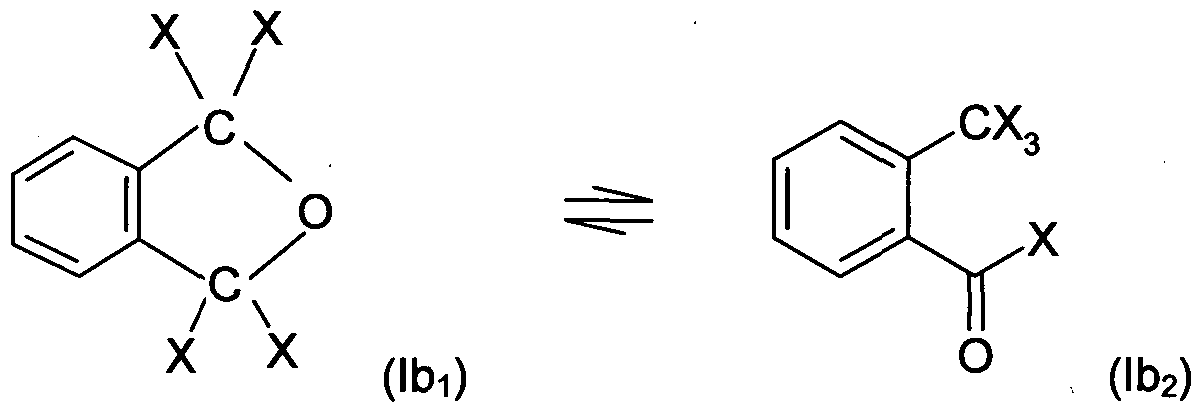
- the pseudohalogen acid tautomerism from an acid halide is the creation of a cyclic compound comprising an oxygen bridge between a gem-dihalogen group and a carbonyl (or sulfonyl) group or a gem-dihalogen group and a group halophore which is a monohalogenated carbon atom or a gem-dihalogen group.
- reagent of the invention denominated in a simplified manner in the following text by "reagent" must have a tautomeric form of pseudohalogenide but also the carbon atom that is engaged in tautomerism carries two halogen atoms.
- the reagent must have a cyclic tautomeric form which comprises the following unit in equilibrium with its tautomeric form:
- Y represents one of the following groups:
- X 1 , X 2 represent a halogen atom, preferably X 1 , X 2 both represent a chlorine atom,
- X 1 ' , X 2 represent a hydrogen atom or a halogen atom, and at most one of X 1 and X 2 represent a hydrogen atom,
- the half circle symbolized by dashes represents a divalent group comprising from 2 to 4 carbon atoms:
- unsaturated ring is meant in the present text, a hydrocarbon ring having 5 or 6 carbon atoms, preferably 6 atoms, comprising one or two double bonds.
- aromatic ring is meant in the present text, an aromatic hydrocarbon ring or bicycle having 6 to 12 carbon atoms, preferably a benzene ring.
- the invention does not exclude other aliphatic or aromatic structures since it is possible to obtain the heterocyclic structure that makes it possible to obtain tautomerism.
- the invention does not exclude the presence of substituents on the vacant bonds of the double bonds or on the ring as long as they do not react. Mention may in particular be made of C 1 -C 4 alkyl or alkoxy groups or halogen atoms, preferably chlorine or bromine atoms. It appears that the functions present in the unit of formula (F) must be topologically close so as to be joined by said oxygen bridge thus forming a heterocycle of at most 7 atoms, preferably 5 or 6 atoms.
- the halophoric group CX 1 X 2 is in the ⁇ or ⁇ position with respect to Y, preferably in the ⁇ position.
- the semicircle represented by dashes preferably represents an aliphatic chain comprising one or two double bonds, preferably an ethylenic linkage.
- the semicircle represented by dashes preferably represents an aromatic group such as a 1,2-phenylene group or a 1,2 group. naphthyldiyl or a 1,8-naphthyl group.
- the vacant bonds of the double bond or the free positions of the reagents comprising a ring may carry a substituent, for example halogen atoms.
- a first class of preferred reagents correspond to the following formulas in equilibrium with their tautomeric forms:
- R 1 , R 2 represent a hydrogen atom, a linear or branched alkyl group having 1 to 4 carbon atoms, a halogen atom,
- R 1 and R 2 are linked to form a 1,2-phenylene group or a 1,2-naphthyl group
- - Xi, X 2 represent a halogen atom, preferably X 1 , X 2 are both a chlorine atom.
- the preferred reagents used in the process of the invention correspond to formula (Ia) or (Ib) (and their tautomeric forms) in which R 1 and R 2 represent a hydrogen atom or a methyl group or Ri and R 2 are linked to form one of the following groups:
- the invention includes the case where the aromatic rings carry substituents. Any substituent may be present as long as they do not interfere with obtaining the desired product. Examples have been given above.
- the reagent which is preferred comprises the pattern represented by the following formula e
- X is a halogen atom, preferably a chlorine atom.
- Another class of preferred reagents are those in which the Y and CXiX 2 functional groups are carried by a carbon atom belonging to two different benzene rings but which are ortho-condensed.
- Rf represents a hydrocarbon group having from 1 to 20 carbon atoms optionally comprising at least one halogen atom, preferably a fluorine atom,
- R f preferably represents a hydrocarbon group having from 1 to 20 carbon atoms, and more particularly:
- alkyl, alkenyl, alkynyl, cycloalkyl, aryl or arylalkyl may be substituted by any substituent to the extent that they do not interfere with the reaction.
- substituents there may be mentioned, inter alia, halogen atoms, preferably fluorine, chlorine, bromine.
- R f represents a hydrocarbon group having 1 to 20 carbon atoms and more particularly:
- Ci-Ci 0, preferably C 1 -C 4, more preferably a methyl or ethyl group, a C 1 to C 10 , preferably C 1 to C 4 , alkyl group, mono-, poly- or perhalogen having from 1 to 23 halogen atoms, preferably a CF 3 group,
- a mono-, poly- or perhalogenated phenyl group a phenyl group substituted with at least one C 1 to C 10 , preferably C 1 to C 4 , alkyl group, optionally mono-, poly- or perhalogenated; a nitro or nitrile group;
- R f represents methyl, phenyl, tolyl, a CF 3 , C 4 F 9 group or a phenyl group substituted with one or more halogen atoms, preferably fluorine, or with one or more alkyl groups.
- C 1 -C 2 mono-, poly- or perfluorinated.
- sulphonic acids examples include halosulfonic acids, preferably fluorosulphonic acid, chlorosulphonic acid, trifluoromethanesulphonic acid, perfluoroethanesulphonic acid, perfluorobutane sulphonic acid and perfluorooctane sulphonic acid; aliphatic sulphonic acids, preferably methanesulphonic acid, ethanesulphonic acid; aromatic sulphonic acids, preferably benzenesulphonic acid, toluenesulphonic acids, naphthalenesulphonic acids.
- trifluoromethanesulphonic acid trifluoromethanesulphonic acid, paratoluenesulphonic acid, methanesulphonic acid and benzenesulphonic acid are preferably used.
- the reagent defined according to the invention is reacted with sulfonic acid.
- the amount of reagent used is generally a function of the number of gem-dihalogen groups present in formula (I) and engaged in the tautomer reaction.
- the amount of this latter used is such that the ratio between the number of moles of reagent comprising a group gem-dihalogen, preferably of formula (Ia) or (Ic) and the number of moles sulfonic acid is preferably chosen between 0.5 and 1, preferably between 0.5 and 0.7.
- the amount of the latter used is such that the ratio between the number of moles of reagent comprising two gem-dihalogenated groups, preferably of formula (Ib), and the number of moles of The sulfonic acid is preferably between 0.25 and 0.5, preferably between 0.25 and 0.35.
- the reaction can be conducted in the presence of inert solvents vis-à-vis the two reagents and the products of the reaction.
- solvents include, in particular, aliphatic, cycloaliphatic and aromatic hydrocarbons, preferably hexane, cyclohexane, methylcyclohexane, heptane, dodecane, benzene, toluene, xylenes, ethylbenzene, diethylbenzenes, trimethylbenzenes, cumene, pseudocumene, petroleum fractions consisting of a mixture of alkylbenzenes, especially Solvesso ® type cuts.
- the reaction is conducted under ordinary pressure but it is not a critical point.
- the reaction is advantageously carried out at a temperature of between 80 ° C. and 180 ° C., preferably between 100 ° C. and 150 ° C.
- the optimum temperature is between 110 ° C. and 140 ° C.
- the process is simple to implement.
- the reagent and the sulfonic acid are mixed in any order generally at room temperature (most often between 15 ° C and 25 ° C) and then the temperature is raised to liberation of the hydrohalic acid, preferably at room temperature. hydrochloric acid which forms during the course of the reaction.
- a preferred mode is to bring the reagent to the chosen reaction temperature and then gradually add, preferably by casting, the sulfonic acid.
- the process of the invention can be carried out continuously, for example in a distillation apparatus with a short residence time (for example the LUWA ® apparatus).
- heat transfer fluids that are suitable for the invention, mention may in particular be made of water or an organic solvent such as chosen from heavy carboxylic acid esters (for example, octyl phthalate), aromatic ethers such as oxide biphenyl and / or benzyl ether, diphenyl, terphenyls, other optionally partially hydrogenated polyphenyls, paraffinic and / or naphthenic oils, petroleum distillation residues, etc.
- heavy carboxylic acid esters for example, octyl phthalate
- aromatic ethers such as oxide biphenyl and / or benzyl ether
- diphenyl, terphenyls diphenyl, terphenyls, other optionally partially hydrogenated polyphenyls, paraffinic and / or naphthenic oils, petroleum distillation residues, etc.
- R f ' is different from R f ' in the case of mixed anhyrides.
- triflic anhydride In the case of triflic anhydride, the latter constitutes a gas stream with the hydrohalic acid which is recovered by condensation in an exchanger. Hydrochloric acid is sent to a soda ash column. If the boiling point of the sulphonic anhydride formed is greater than that of the reaction temperature, the sulphonic anhydride remains in the reaction medium at the bottom of the distillation while the hydrohalic acid is recovered at the top of the distillation. If the sulphonic anhydride formed remains at the distillation bottom, that can be recovered subsequently by any appropriate means, in particular by distillation, usually by distillation under reduced pressure.
- PA phthalic anhydride
- the yield (RR) corresponds to the ratio between the number of moles of product formed and the number of moles of substrate engaged.
- It is in the form of a tubular glass furnace into which is introduced a single-column reactor flask to which two balloons are connected.
- the assembly is integral and can be rotated by means of a motor.
- the light products resulting from the reaction are trapped at the outlet by dry ice in two receiving flasks.
- the reagents are weighed under a hood in the reactor flask (max weight of 10 g).
- the molar ratio between the sulfonic acid and the reagent is specified in the following tables.
- the two receiving balloons are added in line and the assembly is held by metal clips.
- the reactor flask and the first receiver flask are inserted into the temperature gradient furnace.
- the second receiving flask is placed on the outside and cooled by dry ice.
- the set of balloons is rotated and the temperature of the oven is gradually increased by a step of 10 degrees to a temperature slightly lower than the distillation temperature of the most volatile compound.
- the temperature is maintained for thirty minutes and the formation of gas and the distillation of trapping compounds are visually monitored.
- the temperature is reduced to ambient temperature and the distillate collected in the external receiving flask is analyzed by NMR or by ion chromatography.
- sulfonic acid triflic acid and as reagent, a compound having at least one gem dichloro carbon involved in a tautomer pseudochloride acid.
- the collected distillate is analyzed by magnetic resonance spectroscopy of fluorine. It consists essentially of triflic anhydride.
- the sulphonic acid used is methanesulphonic acid and the reagent is that of Example 2.
Landscapes
- Chemical & Material Sciences (AREA)
- Organic Chemistry (AREA)
- Organic Low-Molecular-Weight Compounds And Preparation Thereof (AREA)
- Low-Molecular Organic Synthesis Reactions Using Catalysts (AREA)
Abstract
Description


Claims



Priority Applications (4)
| Application Number | Priority Date | Filing Date | Title |
|---|---|---|---|
| EP07823334.3A EP2049471B1 (fr) | 2006-07-27 | 2007-07-25 | Procede de preparation d'un anhydride d'acide sulfonique |
| CN200780033886.8A CN101516836B (zh) | 2006-07-27 | 2007-07-25 | 磺酸酐制备方法 |
| JP2009521298A JP5217008B2 (ja) | 2006-07-27 | 2007-07-25 | スルホン酸無水物の調製方法 |
| US12/375,073 US8222450B2 (en) | 2006-07-27 | 2007-07-25 | Preparation of sulfonic acid anhydrides |
Applications Claiming Priority (2)
| Application Number | Priority Date | Filing Date | Title |
|---|---|---|---|
| FR0606881 | 2006-07-27 | ||
| FR0606881A FR2904313A1 (fr) | 2006-07-27 | 2006-07-27 | Procede de preparation d'un anhydride d'acide sulfonique |
Publications (2)
| Publication Number | Publication Date |
|---|---|
| WO2008012433A2 true WO2008012433A2 (fr) | 2008-01-31 |
| WO2008012433A3 WO2008012433A3 (fr) | 2008-03-13 |
Family
ID=38006198
Family Applications (1)
| Application Number | Title | Priority Date | Filing Date |
|---|---|---|---|
| PCT/FR2007/001276 Ceased WO2008012433A2 (fr) | 2006-07-27 | 2007-07-25 | Procede de preparation d'un anhydride d'acide sulfonique |
Country Status (7)
| Country | Link |
|---|---|
| US (1) | US8222450B2 (fr) |
| EP (1) | EP2049471B1 (fr) |
| JP (1) | JP5217008B2 (fr) |
| CN (1) | CN101516836B (fr) |
| FR (1) | FR2904313A1 (fr) |
| RU (1) | RU2456268C2 (fr) |
| WO (1) | WO2008012433A2 (fr) |
Families Citing this family (5)
| Publication number | Priority date | Publication date | Assignee | Title |
|---|---|---|---|---|
| FR3010407B1 (fr) | 2013-09-12 | 2015-09-04 | Rhodia Operations | Procede de preparation de derives oxysulfures et fluores par sulfination |
| FR3014439B1 (fr) | 2013-12-05 | 2018-03-23 | Rhodia Operations | Procede de preparation de l'acide bis-fluorosulfonylimide et de ses sels. |
| FR3033561B1 (fr) | 2015-03-09 | 2017-03-03 | Rhodia Operations | Procede de preparation de composes oxysulfures et fluores |
| TW201841881A (zh) * | 2017-04-18 | 2018-12-01 | 德商巴斯夫歐洲公司 | 純化烷烴磺酸酐的方法及使用純化的烷烴磺酸酐製造烷烴磺酸的方法 |
| CN111116431B (zh) * | 2019-12-31 | 2022-08-05 | 中船(邯郸)派瑞特种气体股份有限公司 | 一种从含三氟甲磺酸废水中回收三氟甲磺酸的装置及方法 |
Family Cites Families (8)
| Publication number | Priority date | Publication date | Assignee | Title |
|---|---|---|---|---|
| DE2837457A1 (de) * | 1978-08-28 | 1980-03-20 | Bayer Ag | Verfahren zur herstellung von benzoesaeureanhydrid |
| JP3169165B2 (ja) * | 1995-12-20 | 2001-05-21 | セントラル硝子株式会社 | 高純度フルオロアルキルスルホン酸無水物の製造方法 |
| JP3169171B2 (ja) * | 1996-10-15 | 2001-05-21 | セントラル硝子株式会社 | 高純度フルオロアルキルスルホン酸無水物の製造方法 |
| JP3456626B2 (ja) * | 1998-02-23 | 2003-10-14 | セントラル硝子株式会社 | トリフルオロメタンスルホン酸無水物の製造方法 |
| JP3456625B2 (ja) * | 1998-02-23 | 2003-10-14 | セントラル硝子株式会社 | トリフルオロメタンスルホン酸無水物の製造方法 |
| US6469206B2 (en) * | 2000-03-08 | 2002-10-22 | Eastman Chemical Company | Process for the preparation of triflic anhydride |
| JP2003277345A (ja) * | 2002-03-25 | 2003-10-02 | Mitsubishi Chemicals Corp | スルホン酸無水物の製造方法 |
| RU2282620C1 (ru) * | 2005-01-11 | 2006-08-27 | ФГУП "Ангарский электролизный химический комбинат" | Способ получения ангидрида трифторметансульфокислоты |
-
2006
- 2006-07-27 FR FR0606881A patent/FR2904313A1/fr not_active Withdrawn
-
2007
- 2007-07-25 EP EP07823334.3A patent/EP2049471B1/fr active Active
- 2007-07-25 CN CN200780033886.8A patent/CN101516836B/zh active Active
- 2007-07-25 WO PCT/FR2007/001276 patent/WO2008012433A2/fr not_active Ceased
- 2007-07-25 US US12/375,073 patent/US8222450B2/en active Active
- 2007-07-25 JP JP2009521298A patent/JP5217008B2/ja active Active
- 2007-07-25 RU RU2009106870/04A patent/RU2456268C2/ru not_active IP Right Cessation
Also Published As
| Publication number | Publication date |
|---|---|
| RU2456268C2 (ru) | 2012-07-20 |
| EP2049471A2 (fr) | 2009-04-22 |
| CN101516836A (zh) | 2009-08-26 |
| JP2009544670A (ja) | 2009-12-17 |
| CN101516836B (zh) | 2013-09-04 |
| US8222450B2 (en) | 2012-07-17 |
| EP2049471B1 (fr) | 2016-07-13 |
| JP5217008B2 (ja) | 2013-06-19 |
| US20100076221A1 (en) | 2010-03-25 |
| FR2904313A1 (fr) | 2008-02-01 |
| WO2008012433A3 (fr) | 2008-03-13 |
| RU2009106870A (ru) | 2010-09-10 |
Similar Documents
| Publication | Publication Date | Title |
|---|---|---|
| FR2744442A1 (fr) | Preparation du 1,1,1,3,3-pentachlorobutane et du 1,1,1,3,3,-pentafluorobutane | |
| WO2005082820A1 (fr) | Procedure de preparation d'un compose fluoroaromatique a partir d'un compose aminoaromatique. | |
| EP2049471B1 (fr) | Procede de preparation d'un anhydride d'acide sulfonique | |
| EP2683685B1 (fr) | Procede de preparation du difluoroacetonitrile et de ses derives | |
| EP0038735B1 (fr) | Procédé de préparation de produits ayant un groupement perfluoroalkyle en présence de zinc en milieu acide | |
| EP0298870B1 (fr) | Synthèse des bromures de perfluoroalkyle | |
| FR2733980A1 (fr) | Procede d'acylation d'ethers aromatiques non substitues | |
| EP0877726A1 (fr) | Procede d'acylation d'un compose aromatique | |
| EP2448902B1 (fr) | Procede de preparation de l'acide difluoroacetique | |
| EP0648731A1 (fr) | Procédé d'hydroxycarbonylation du butadiène | |
| EP0030528A1 (fr) | Procédé pour la fixation de groupes alkyles, aralkyles ou cycloalkyles sur une chaîne carbonée portant un groupe fonctionnel | |
| EP0197869A1 (fr) | Procédé de préparation de dérivés pentafluoroéthoxy et pentafluoroéthylthiobenzéniques | |
| EP0091385A1 (fr) | Procédé de préparation de p-hydroxybenzylnitriles ou p-hydroxybenzylamines | |
| FR2553761A1 (fr) | Procede continu pour la preparation de bisfluoroxydifluoromethane | |
| EP0020281B1 (fr) | Préparation de benzoxazolone | |
| FR2745286A1 (fr) | Synthese de composes organiques iodo-fluores | |
| EP0145554B1 (fr) | Procédé de préparation de dérivés éthyléniques chlorés | |
| WO2015101452A1 (fr) | Procede de fabrication du bromo methyl cyclopropane et du bromo methyl cyclobutane | |
| WO2007071841A2 (fr) | Procede de preparation de difluoroethanol | |
| FR2996147A1 (fr) | Procede de traitement d'acide fluore | |
| LU84129A1 (fr) | Procede d'halogenation en meta de n-(o,o'-dialkyl phenyl)alaninates et homologues | |
| EP0146439B1 (fr) | Procédé de préparation de dérivés acétyléniques, nouveaux dérivés obtenus et leur emploi | |
| EP0187631B1 (fr) | Procédé pour la préparation de dérivés de pyrrolo-pyridine et nouveaux dérivés obtenus | |
| FR2652812A1 (fr) | Procede de preparation de difluoro-2,2 benzodioxole-1,3. | |
| FR2787787A1 (fr) | Procede de preparation de thioethers aromatiques de type diphenyle |
Legal Events
| Date | Code | Title | Description |
|---|---|---|---|
| WWE | Wipo information: entry into national phase |
Ref document number: 200780033886.8 Country of ref document: CN |
|
| 121 | Ep: the epo has been informed by wipo that ep was designated in this application |
Ref document number: 07823334 Country of ref document: EP Kind code of ref document: A2 |
|
| WWE | Wipo information: entry into national phase |
Ref document number: 2009521298 Country of ref document: JP |
|
| WWE | Wipo information: entry into national phase |
Ref document number: 483/CHENP/2009 Country of ref document: IN |
|
| NENP | Non-entry into the national phase |
Ref country code: DE |
|
| REEP | Request for entry into the european phase |
Ref document number: 2007823334 Country of ref document: EP |
|
| WWE | Wipo information: entry into national phase |
Ref document number: 2007823334 Country of ref document: EP |
|
| ENP | Entry into the national phase |
Ref document number: 2009106870 Country of ref document: RU Kind code of ref document: A |
|
| WWE | Wipo information: entry into national phase |
Ref document number: 12375073 Country of ref document: US |