WO2008101895A2 - Verfahren zur herstellung von pigment rot 149 - Google Patents
Verfahren zur herstellung von pigment rot 149 Download PDFInfo
- Publication number
- WO2008101895A2 WO2008101895A2 PCT/EP2008/051932 EP2008051932W WO2008101895A2 WO 2008101895 A2 WO2008101895 A2 WO 2008101895A2 EP 2008051932 W EP2008051932 W EP 2008051932W WO 2008101895 A2 WO2008101895 A2 WO 2008101895A2
- Authority
- WO
- WIPO (PCT)
- Prior art keywords
- reaction
- perylene
- piperazine
- tertiary amine
- perylenebis
- Prior art date
- Legal status (The legal status is an assumption and is not a legal conclusion. Google has not performed a legal analysis and makes no representation as to the accuracy of the status listed.)
- Ceased
Links
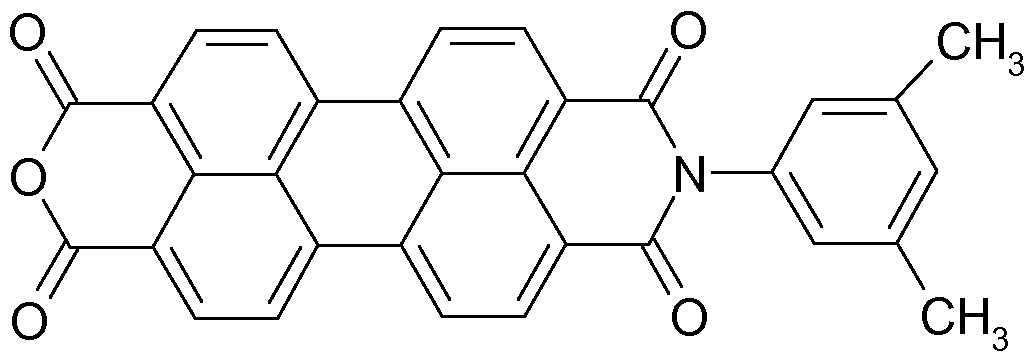
- LUQGKMDKQQWQHY-UHFFFAOYSA-N Cc1cc(N(C(c2ccc(-c(cc3)c4c5c3C(O3)=O)c6c2c2ccc6-c4ccc5C3=O)=O)C2=O)cc(C)c1 Chemical compound Cc1cc(N(C(c2ccc(-c(cc3)c4c5c3C(O3)=O)c6c2c2ccc6-c4ccc5C3=O)=O)C2=O)cc(C)c1 LUQGKMDKQQWQHY-UHFFFAOYSA-N 0.000 description 1
Classifications
-
- C—CHEMISTRY; METALLURGY
- C09—DYES; PAINTS; POLISHES; NATURAL RESINS; ADHESIVES; COMPOSITIONS NOT OTHERWISE PROVIDED FOR; APPLICATIONS OF MATERIALS NOT OTHERWISE PROVIDED FOR
- C09B—ORGANIC DYES OR CLOSELY-RELATED COMPOUNDS FOR PRODUCING DYES, e.g. PIGMENTS; MORDANTS; LAKES
- C09B5/00—Dyes with an anthracene nucleus condensed with one or more heterocyclic rings with or without carbocyclic rings
- C09B5/62—Cyclic imides or amidines of peri-dicarboxylic acids of the anthracene, benzanthrene, or perylene series
-
- C—CHEMISTRY; METALLURGY
- C09—DYES; PAINTS; POLISHES; NATURAL RESINS; ADHESIVES; COMPOSITIONS NOT OTHERWISE PROVIDED FOR; APPLICATIONS OF MATERIALS NOT OTHERWISE PROVIDED FOR
- C09B—ORGANIC DYES OR CLOSELY-RELATED COMPOUNDS FOR PRODUCING DYES, e.g. PIGMENTS; MORDANTS; LAKES
- C09B67/00—Influencing the physical, e.g. the dyeing or printing properties of dyestuffs without chemical reactions, e.g. by treating with solvents grinding or grinding assistants, coating of pigments or dyes; Process features in the making of dyestuff preparations; Dyestuff preparations of a special physical nature, e.g. tablets, films
- C09B67/0001—Post-treatment of organic pigments or dyes
- C09B67/0002—Grinding; Milling with solid grinding or milling assistants
-
- C—CHEMISTRY; METALLURGY
- C09—DYES; PAINTS; POLISHES; NATURAL RESINS; ADHESIVES; COMPOSITIONS NOT OTHERWISE PROVIDED FOR; APPLICATIONS OF MATERIALS NOT OTHERWISE PROVIDED FOR
- C09B—ORGANIC DYES OR CLOSELY-RELATED COMPOUNDS FOR PRODUCING DYES, e.g. PIGMENTS; MORDANTS; LAKES
- C09B67/00—Influencing the physical, e.g. the dyeing or printing properties of dyestuffs without chemical reactions, e.g. by treating with solvents grinding or grinding assistants, coating of pigments or dyes; Process features in the making of dyestuff preparations; Dyestuff preparations of a special physical nature, e.g. tablets, films
- C09B67/0001—Post-treatment of organic pigments or dyes
- C09B67/002—Influencing the physical properties by treatment with an amine
-
- C—CHEMISTRY; METALLURGY
- C09—DYES; PAINTS; POLISHES; NATURAL RESINS; ADHESIVES; COMPOSITIONS NOT OTHERWISE PROVIDED FOR; APPLICATIONS OF MATERIALS NOT OTHERWISE PROVIDED FOR
- C09B—ORGANIC DYES OR CLOSELY-RELATED COMPOUNDS FOR PRODUCING DYES, e.g. PIGMENTS; MORDANTS; LAKES
- C09B67/00—Influencing the physical, e.g. the dyeing or printing properties of dyestuffs without chemical reactions, e.g. by treating with solvents grinding or grinding assistants, coating of pigments or dyes; Process features in the making of dyestuff preparations; Dyestuff preparations of a special physical nature, e.g. tablets, films
- C09B67/0001—Post-treatment of organic pigments or dyes
- C09B67/0022—Wet grinding of pigments
-
- C—CHEMISTRY; METALLURGY
- C09—DYES; PAINTS; POLISHES; NATURAL RESINS; ADHESIVES; COMPOSITIONS NOT OTHERWISE PROVIDED FOR; APPLICATIONS OF MATERIALS NOT OTHERWISE PROVIDED FOR
- C09B—ORGANIC DYES OR CLOSELY-RELATED COMPOUNDS FOR PRODUCING DYES, e.g. PIGMENTS; MORDANTS; LAKES
- C09B67/00—Influencing the physical, e.g. the dyeing or printing properties of dyestuffs without chemical reactions, e.g. by treating with solvents grinding or grinding assistants, coating of pigments or dyes; Process features in the making of dyestuff preparations; Dyestuff preparations of a special physical nature, e.g. tablets, films
- C09B67/0025—Crystal modifications; Special X-ray patterns
Definitions
- Pigment Red 149 has the following formula:
- the O-half condensate has the following formula:
- DE-A 1 807 729 discloses the reaction of perylenetetracarboxylic acid or its anhydride with 3,5-dichloroaniline in the presence of condensation-promoting agents, such as zinc chloride, zinc acetate or hydrochloric acid, in solvents or diluents, such as quinoline, quinaldine, naphthalene or trichlorobenzene.
- condensation-promoting agents such as zinc chloride, zinc acetate or hydrochloric acid
- solvents or diluents such as quinoline, quinaldine, naphthalene or trichlorobenzene.
- the dye is isolated from the reaction mixture by filtration, optionally after dilution of the reaction mixture with inert solvents such as alcohols, formamide, dimethylformamide, toluene, chlorobenzene or nitrobenzene, followed by washing with organic solvents and water.
- the dye is boiled with dilute sodium hydroxide solution.
- the dye is then converted to a suitable crystal form for use as a pigment by dissolving in concentrated sulfuric acid and precipitating by dilution with water.
- DE-A 2 210 170 discloses a corresponding process in which perylene-3,4,9,10-tetracarboxylic acid is reacted with 2,4,6-trimethylaniline.
- EP-A 0 198 369 discloses a process for the preparation of perylene-3,4,9,10-tetracarboxylic arylimides in which perylene-3,4,9,10-tetracarboxylic dianhydride (perylene anhydride) with a primary arylamine in the presence of a dialkylamine is implemented as a catalyst.
- the reaction can be carried out with the addition of inert diluents, such as dimethylformamide, N-methylpyrrolidone, o-dichlorobenzene, nitrobenzene, quinoline or 2-ethylhexanol.
- the reaction is preferably carried out without the addition of further diluents in the relevant mixture of arylamine and dialkylamine.
- the separation of the reaction product can, if appropriate after dilution with a low-boiling alcohol, be carried out by filtration.
- the mixture of excess arylamine and dialkylamine and optionally the inert diluent is separated by distillation after quantitative reaction, so that the reaction product remains as a dry residue.
- CN-A 1310203 discloses a process for the preparation of perylenetetracarboxylic acid diimide pigments in which perylene bisanhydride and a primary amine are reacted in aqueous solution at a pH of 3 to 5 in the presence of an organic carboxylic acid having 1 to 5 carbon atoms.
- the crude pigment is then subjected to a finishing treatment.
- the crude pigment is ground in a ball mill in the presence of a grinding aid such as sodium chloride, sodium sulfate and sodium carbonate, an organic solvent and 1 to 5 wt .-%, based on the weight of the crude pigment, a Perylentetracarbonklad derivative.
- a so-called post-finishing is carried out in an aqueous medium in the presence of a surfactant.
- perylene bisanhydride is dissolved in 10% KOH solution, to the solution are added 3,5-dimethylaniline and acetic acid.
- the reaction product is filtered off and washed neutral with water.
- the dried crude pigment is then ground in a ball mill with sodium chloride, a small amount of N, N'-di-n-butylperylene bis (dicarboximide) and a xylene / ethyl acetate mixture.
- the mixture is finally poured into a 2 wt .-% aqueous hydrochloric acid, which 1% of a Contains surfactant mixture, transferred, boiled, the pigment is filtered off, washed neutral with water, dried and crushed.
- a disadvantage of the process described in CN-A 1310203 is that the perylene bisanhydride must first be completely dissolved in aqueous potassium hydroxide solution and then precipitated again with acetic acid in finely divided form. In this case, considerable amounts of acetic acid are consumed, which can not be recovered. Furthermore, part of the expensive 3,5-dimethylaniline is lost by acylation. The dye obtained does not meet the quality requirements and must be extensively aftertreated in several fining operations.
- the object of the invention is to provide an easily carried out process for the preparation of Pigment Red 149, in which the disadvantages described above are avoided.
- the object is achieved by a process for the preparation of N, N'-di (3 ', 5'-dimethylphenyl) perylenebis (dicarboximide) by reacting perylene-3,4,9,10-tetracarboxylic acid dianhydride (perylenebisanhydride) with 3,5-dimethylaniline in the presence of a secondary or tertiary amine as catalyst, characterized in that the reaction is carried out in an aqueous reaction medium and in the presence of added seed crystals of N, N'-di (3 ', 5'-dimethylphenyl) perylenebis (dicarboximide) is carried out.
- the aqueous reaction medium contains no further organic solvents at all.
- inert, water-miscible organic solvents for example up to 10% by weight, may be included.
- optional surfactants e.g. the ethoxylation products of longer chain alcohols or the ethoxylation products of alkylphenols.
- the reaction is preferably carried out in a purely aqueous reaction medium which contains essentially no further organic solvents.
- Suitable catalysts are aliphatic, cycloaliphatic, aryl-aliphatic or heterocyclic secondary or tertiary amines.
- suitable secondary amines have the formula R 1 R 11 NH, in which R ', R "can be identical or different and straight-chain or branched alkyl or cycloalkyl having 1 to 6 C atoms, which is protected by hydroxyl, alkoxy Or R 'and R "together with the nitrogen atom, a 5- or 6-membered heterocyclic ring which optionally (in the case of tertiary amines) by alkyl, aralkyl or Aryl groups may be substituted.
- Suitable tertiary amines generally have 3 of the radicals mentioned.
- Preferred secondary or tertiary amines are piperazine, N- (2-hydroxyethyl) piperazine, diethanolamine, N, N'-dimethylpiperazine, N-ethylpiperazine, N-methylcyclohexylamine, imidazole and N-methylimidazole.
- the reaction is carried out in the presence of seed crystals of Cl. Pigment Red 149 performed.
- the amount of added seed crystals is, based on the reaction product, 1 to 25 wt .-%, preferably 5 to 10 wt .-%.
- the added seed crystals can come from one of the previous batches.
- the reaction is generally carried out at a temperature of 120 to 190 0 C and a pressure of 2 to 13 bar.
- the reaction time is generally 5 to 40 hours.
- the molar ratio of 3,5-dimethylaniline to perylenebisanhydride is generally from 1.8: 1 to 4: 1, preferably from 2: 1 to 3: 1.
- the molar ratio of secondary or tertiary amine to perylenebisanhydride is generally from 0.5: 1 to 2: 1, preferably 0.8: 1 to 1.4: 1. Excess 3,5-dimethylaniline can be distilled off after completion of the reaction.
- the reaction product Cl. Pigment Red 149 is generally recovered by filtration. The mother liquor containing the secondary or tertiary amine can then be reused as the reaction medium for the synthesis of further Pigment Red 149.
- up to 10%, preferably up to 5%, for example 0.5 to 5%, by weight of the 3,5-xylidine may be replaced with another primary amine
- Suitable further primary amines are, for example, 4-methoxyaniline and 4-ethoxyaniline.
- the process according to the invention gives Pigment Red 149 in the alpha modification.
- it contains less than 5% by weight, preferably less than 1.5% by weight of the monoimide.
- the product preferably accumulates in the form of a 30-50% by weight pressed material.
- the coarsely crystalline pigment is generally first converted into a suitable particle size prior to its use in paints and plastics by means of customary fine-dispersion and finishing processes.
- a dry or wet grinding is sufficient for this purpose, if appropriate with subsequent controlled recrystallization from solvents, for example water or aqueous-organic solvent mixtures.
- solvents for example water or aqueous-organic solvent mixtures.
- the pigment red 149 is converted into particles having a particle size of generally ⁇ 0.2 microns.
- the pigment results in the coloring of macromolecular material, eg PVC, LD and HDPE, polypropylene or polyamide strong reds with high color purity and good temperature stability.
- the crude product thus obtained contains 97.5% by weight of the perylene diimide and 1.4% by weight of the monoimide (O-half condensate).
- the product is in the alpha modification.
- the pigment obtained is very strong in color when incorporated into LDPE (Low Density Polyethylene) according to DIN EN 139900-3 and provides dyeings with high color purity with good temperature stability.
- LDPE Low Density Polyethylene
- dH or dC color tone difference or chromium difference between the comparative example and the example according to color balance according to DIN 6174
Landscapes
- Chemical & Material Sciences (AREA)
- Organic Chemistry (AREA)
- Chemical Kinetics & Catalysis (AREA)
- Nitrogen Condensed Heterocyclic Rings (AREA)
- Engineering & Computer Science (AREA)
- Materials Engineering (AREA)
- Optical Filters (AREA)
- Low-Molecular Organic Synthesis Reactions Using Catalysts (AREA)
Abstract
Description


Claims
Priority Applications (6)
| Application Number | Priority Date | Filing Date | Title |
|---|---|---|---|
| JP2009550273A JP5447837B2 (ja) | 2007-02-19 | 2008-02-18 | Pigment Rot 149の製造法 |
| CN200880005434.3A CN101636454B (zh) | 2007-02-19 | 2008-02-18 | 颜料红149的制备方法 |
| ES08716906T ES2390187T3 (es) | 2007-02-19 | 2008-02-18 | Método para la producción de pigmento rojo 149 |
| US12/527,706 US10287435B2 (en) | 2007-02-19 | 2008-02-18 | Preparation of Pigment Red 149 |
| KR20097018109A KR101494476B1 (ko) | 2007-02-19 | 2008-02-18 | 피그먼트 레드 149의 제조 |
| EP08716906A EP2113012B1 (de) | 2007-02-19 | 2008-02-18 | Verfahren zur herstellung von pigment rot 149 |
Applications Claiming Priority (2)
| Application Number | Priority Date | Filing Date | Title |
|---|---|---|---|
| EP07102654 | 2007-02-19 | ||
| EP07102654.6 | 2007-02-19 |
Publications (2)
| Publication Number | Publication Date |
|---|---|
| WO2008101895A2 true WO2008101895A2 (de) | 2008-08-28 |
| WO2008101895A3 WO2008101895A3 (de) | 2009-09-17 |
Family
ID=39592817
Family Applications (1)
| Application Number | Title | Priority Date | Filing Date |
|---|---|---|---|
| PCT/EP2008/051932 Ceased WO2008101895A2 (de) | 2007-02-19 | 2008-02-18 | Verfahren zur herstellung von pigment rot 149 |
Country Status (7)
| Country | Link |
|---|---|
| US (1) | US10287435B2 (de) |
| EP (1) | EP2113012B1 (de) |
| JP (1) | JP5447837B2 (de) |
| KR (1) | KR101494476B1 (de) |
| CN (1) | CN101636454B (de) |
| ES (1) | ES2390187T3 (de) |
| WO (1) | WO2008101895A2 (de) |
Families Citing this family (1)
| Publication number | Priority date | Publication date | Assignee | Title |
|---|---|---|---|---|
| CN105694531B (zh) * | 2016-03-25 | 2017-10-27 | 电子科技大学 | 一种苝系颜料制备方法 |
Family Cites Families (15)
| Publication number | Priority date | Publication date | Assignee | Title |
|---|---|---|---|---|
| DE1807729A1 (de) | 1968-11-08 | 1970-06-18 | Basf Ag | Farbstoff der Perylentetracorbonsaeurediimidreihe |
| DE2210170A1 (de) | 1972-03-03 | 1973-09-06 | Basf Ag | Farbstoff der perylentetracarbonsaeurediimidreihe |
| JPS517025A (en) * | 1974-07-09 | 1976-01-21 | Mitsubishi Chem Ind | Beetaa ketsushosoperirenganryono seizoho |
| JPS57149358A (en) * | 1981-03-13 | 1982-09-14 | Dainippon Ink & Chem Inc | Production of epsilon type copper phthalocyanine |
| DE3513358A1 (de) * | 1985-04-15 | 1986-10-16 | Hoechst Ag, 6230 Frankfurt | Verfahren zur herstellung von perylen-3,4,9,10-tetracarbonsaeurearylimiden |
| TW279860B (de) | 1993-11-12 | 1996-07-01 | Ciba Geigy Ag | |
| DE4413849A1 (de) * | 1994-04-21 | 1995-10-26 | Hoechst Ag | Feinverteilungsverfahren zur Herstellung von organischen Pigmenten |
| ES2259630T3 (es) * | 2000-02-04 | 2006-10-16 | DAINICHISEIKA COLOR & CHEMICALS MFG. CO. LTD. | Composiciones de pigmento; un procedimiento para la produccion de las mismas; colorantes y articulos coloreados. |
| DE10032315A1 (de) * | 2000-07-04 | 2002-01-17 | Clariant Gmbh | Neue Kristallmodifikationen von C.I. Pigment Yellow 191 und Verfahren zu ihrer Herstellung |
| DE10045790A1 (de) * | 2000-09-15 | 2002-03-28 | Clariant Gmbh | Neue kristalline Modifikationen eines gelben Disazo -Farbmittels und Verfahren zu ihrer Herstellung |
| US6391104B1 (en) * | 2000-12-01 | 2002-05-21 | Bayer Corporation | Perylene pigment compositions |
| CN1120208C (zh) * | 2001-02-20 | 2003-09-03 | 华东理工大学 | 一种合成苝系颜料的方法 |
| WO2003033097A2 (en) * | 2001-10-17 | 2003-04-24 | E.I. Du Pont De Nemours And Company | Rotor-stator apparatus and process for the formation of particles |
| CN1303160C (zh) * | 2005-02-24 | 2007-03-07 | 天津理工大学 | 水介质中脂肪醇催化制备苝系颜料粗品的方法 |
| DE102005033580A1 (de) * | 2005-07-19 | 2007-01-25 | Lanxess Deutschland Gmbh | Verfahren zur Herstellung von Metall-Verbindungen einer Azo-Verbindung in Gegenwart von Impfkristallen |
-
2008
- 2008-02-18 JP JP2009550273A patent/JP5447837B2/ja active Active
- 2008-02-18 WO PCT/EP2008/051932 patent/WO2008101895A2/de not_active Ceased
- 2008-02-18 EP EP08716906A patent/EP2113012B1/de active Active
- 2008-02-18 US US12/527,706 patent/US10287435B2/en active Active
- 2008-02-18 KR KR20097018109A patent/KR101494476B1/ko active Active
- 2008-02-18 ES ES08716906T patent/ES2390187T3/es active Active
- 2008-02-18 CN CN200880005434.3A patent/CN101636454B/zh active Active
Also Published As
| Publication number | Publication date |
|---|---|
| CN101636454A (zh) | 2010-01-27 |
| JP5447837B2 (ja) | 2014-03-19 |
| US20100063288A1 (en) | 2010-03-11 |
| EP2113012A2 (de) | 2009-11-04 |
| JP2010519241A (ja) | 2010-06-03 |
| ES2390187T3 (es) | 2012-11-07 |
| KR101494476B1 (ko) | 2015-02-17 |
| CN101636454B (zh) | 2014-05-21 |
| WO2008101895A3 (de) | 2009-09-17 |
| EP2113012B1 (de) | 2012-08-29 |
| US10287435B2 (en) | 2019-05-14 |
| KR20100014880A (ko) | 2010-02-11 |
Similar Documents
| Publication | Publication Date | Title |
|---|---|---|
| EP1294708B1 (de) | Kristallisationsmodifikatoren auf der basis von chinophthalonderivaten | |
| DE60123674T2 (de) | Perylenpigmentzusammensetzungen | |
| EP0363759B1 (de) | Verfahren zur Herstellung eines gegebenenfalls substituierten Chinacridons | |
| EP0360184B1 (de) | Verfahren zur Herstellung von Pigmentzubereitungen der Anthanthronreihe | |
| EP0198369B1 (de) | Verfahren zur Herstellung von Perylen-3,4,9,10-tetracarbonsäurearylimiden | |
| EP2113012B1 (de) | Verfahren zur herstellung von pigment rot 149 | |
| CH639986A5 (de) | Verfahren zur herstellung von pigmentformen des perylen-3,4,9,10-tetracarbonsaeurediimids mit hoher lasur und brillanz. | |
| EP0376158B1 (de) | Mischkristallpigmente der Anthanthronreihe, Verfahren zu ihrer Herstellung und ihre Verwendung | |
| EP0837107B1 (de) | Verfahren zur Herstellung von Dioxazin-Verbindungen | |
| CH469789A (de) | Verfahren zur Herstellung von Naphth-(2,3-b-)indolizin-6,11-dion-12-carbonsäure-phenylamid-Pigmenten | |
| EP0367067B1 (de) | Verfahren zur Herstellung von Küpenfarbstoffen und Pigmenten der Perinon-Reihe | |
| DE2305071C2 (de) | Wasserunlösliche Disazomethinfarbstoffe, Verfahren zu ihrer Herstellung und ihre Verwendung | |
| EP0031089B1 (de) | Verfahren zur Herstellung von N,N'-Diarylalkylendiaminen oder N,N',N"-Triaryldialkylen-triaminen | |
| DE1960896A1 (de) | Neue Pigmente der Chinacridon-Reihe und Verfahren zu deren Herstellung | |
| EP1167459B1 (de) | Verfahren zur Herstellung von trans-Thiazinindigo-Pigmenten | |
| EP0602009A2 (de) | Heterocyclische Verbindungen | |
| DE1149477B (de) | Verfahren zur Herstellung von Fluorubin oder dessen Substitutionsprodukten | |
| DE1136438B (de) | Verfahren zur Herstellung von linearen Chinacridonen | |
| DE1088636B (de) | Verfahren zur Herstellung von Pigmentfarbstoffen der Dioxazinreihe | |
| EP0029413A1 (de) | Iminoisoindolinonpigmente, Verfahren zu deren Herstellung und deren Verwendung | |
| EP0022076A1 (de) | Iminoisoindolinonfarbstoffe, Verfahren zu deren Herstellung und deren Verwendung | |
| DE1802378B (de) | Organische Pigmente | |
| CH474557A (de) | Verfahren zur Herstellung von Farbstoffen der Dioxazinreihe | |
| DE2410036A1 (de) | Wasserunloesliche disazamethinverbindungen, verfahren zu ihrer herstellung und ihre verwendung als farbmittel | |
| DE1951249A1 (de) | Anthrachinonpigmente |
Legal Events
| Date | Code | Title | Description |
|---|---|---|---|
| WWE | Wipo information: entry into national phase |
Ref document number: 200880005434.3 Country of ref document: CN |
|
| 121 | Ep: the epo has been informed by wipo that ep was designated in this application |
Ref document number: 08716906 Country of ref document: EP Kind code of ref document: A2 |
|
| WWE | Wipo information: entry into national phase |
Ref document number: 4802/CHENP/2009 Country of ref document: IN Ref document number: 2008716906 Country of ref document: EP |
|
| WWE | Wipo information: entry into national phase |
Ref document number: 12527706 Country of ref document: US Ref document number: 2009550273 Country of ref document: JP |
|
| NENP | Non-entry into the national phase |
Ref country code: DE |
|
| WWE | Wipo information: entry into national phase |
Ref document number: 1020097018109 Country of ref document: KR |