WO2009022716A1 - 水硬性粉体の製造方法 - Google Patents
水硬性粉体の製造方法 Download PDFInfo
- Publication number
- WO2009022716A1 WO2009022716A1 PCT/JP2008/064564 JP2008064564W WO2009022716A1 WO 2009022716 A1 WO2009022716 A1 WO 2009022716A1 JP 2008064564 W JP2008064564 W JP 2008064564W WO 2009022716 A1 WO2009022716 A1 WO 2009022716A1
- Authority
- WO
- WIPO (PCT)
- Prior art keywords
- compound
- mol
- hydraulic
- glycerin
- average
- Prior art date
- Legal status (The legal status is an assumption and is not a legal conclusion. Google has not performed a legal analysis and makes no representation as to the accuracy of the status listed.)
- Ceased
Links
Classifications
-
- C—CHEMISTRY; METALLURGY
- C04—CEMENTS; CONCRETE; ARTIFICIAL STONE; CERAMICS; REFRACTORIES
- C04B—LIME, MAGNESIA; SLAG; CEMENTS; COMPOSITIONS THEREOF, e.g. MORTARS, CONCRETE OR LIKE BUILDING MATERIALS; ARTIFICIAL STONE; CERAMICS; REFRACTORIES; TREATMENT OF NATURAL STONE
- C04B40/00—Processes, in general, for influencing or modifying the properties of mortars, concrete or artificial stone compositions, e.g. their setting or hardening ability
- C04B40/0028—Aspects relating to the mixing step of the mortar preparation
- C04B40/0039—Premixtures of ingredients
-
- C—CHEMISTRY; METALLURGY
- C04—CEMENTS; CONCRETE; ARTIFICIAL STONE; CERAMICS; REFRACTORIES
- C04B—LIME, MAGNESIA; SLAG; CEMENTS; COMPOSITIONS THEREOF, e.g. MORTARS, CONCRETE OR LIKE BUILDING MATERIALS; ARTIFICIAL STONE; CERAMICS; REFRACTORIES; TREATMENT OF NATURAL STONE
- C04B24/00—Use of organic materials as active ingredients for mortars, concrete or artificial stone, e.g. plasticisers
- C04B24/24—Macromolecular compounds
- C04B24/28—Macromolecular compounds obtained otherwise than by reactions only involving carbon-to-carbon unsaturated bonds
- C04B24/32—Polyethers, e.g. alkylphenol polyglycolether
-
- C—CHEMISTRY; METALLURGY
- C04—CEMENTS; CONCRETE; ARTIFICIAL STONE; CERAMICS; REFRACTORIES
- C04B—LIME, MAGNESIA; SLAG; CEMENTS; COMPOSITIONS THEREOF, e.g. MORTARS, CONCRETE OR LIKE BUILDING MATERIALS; ARTIFICIAL STONE; CERAMICS; REFRACTORIES; TREATMENT OF NATURAL STONE
- C04B7/00—Hydraulic cements
- C04B7/36—Manufacture of hydraulic cements in general
- C04B7/48—Clinker treatment
- C04B7/52—Grinding ; After-treatment of ground cement
-
- C—CHEMISTRY; METALLURGY
- C04—CEMENTS; CONCRETE; ARTIFICIAL STONE; CERAMICS; REFRACTORIES
- C04B—LIME, MAGNESIA; SLAG; CEMENTS; COMPOSITIONS THEREOF, e.g. MORTARS, CONCRETE OR LIKE BUILDING MATERIALS; ARTIFICIAL STONE; CERAMICS; REFRACTORIES; TREATMENT OF NATURAL STONE
- C04B2103/00—Function or property of ingredients for mortars, concrete or artificial stone
- C04B2103/52—Grinding aids; Additives added during grinding
-
- Y—GENERAL TAGGING OF NEW TECHNOLOGICAL DEVELOPMENTS; GENERAL TAGGING OF CROSS-SECTIONAL TECHNOLOGIES SPANNING OVER SEVERAL SECTIONS OF THE IPC; TECHNICAL SUBJECTS COVERED BY FORMER USPC CROSS-REFERENCE ART COLLECTIONS [XRACs] AND DIGESTS
- Y02—TECHNOLOGIES OR APPLICATIONS FOR MITIGATION OR ADAPTATION AGAINST CLIMATE CHANGE
- Y02P—CLIMATE CHANGE MITIGATION TECHNOLOGIES IN THE PRODUCTION OR PROCESSING OF GOODS
- Y02P40/00—Technologies relating to the processing of minerals
- Y02P40/10—Production of cement, e.g. improving or optimising the production methods; Cement grinding
Definitions
- the present invention relates to a method for producing hydraulic powder.
- Various hydraulic powders are produced by grinding hydraulic compounds such as Portland cement clinker and blast furnace slag.
- Portland cement is manufactured by adding an appropriate amount of gypsum to a clinker obtained by firing raw materials such as apatite, clay, iron slag, etc.
- powdery assistants such as diethylene glycol triethanolamine are used.
- the hydraulic compound is made as efficiently as possible with the desired particle size. For this reason, the use of powdering aids in the powdering process has been conventionally performed.
- the grinding aid examples include oligomers of lower alkylene glycols such as propylene glycol and diethylene glycol (see, for example, JP-A 7-33487, JP-A ll- 1 57 8 91, JP-A ll- 32 23 80), Trie Alkanolamines such as noramine (see, for example, JP-A 20 0 2— 1 60 9 5 9), fatty acids such as stearic acid, or aromatic compounds such as phenol (eg, JP—A 5—147 984) And hydroxyalkyl hydrazine and tertiary butyl acetic acid (see, for example, JP-A 1 1-60 2 98) and the like are known.
- lower alkylene glycols such as propylene glycol and diethylene glycol
- Trie Alkanolamines such as noramine
- fatty acids such as stearic acid
- aromatic compounds such as phenol (eg, JP—A 5—147 984)
- glycerin is used as a grinding aid (see, for example, JPA 5-147 984 and JP-A 1 1-6029 8) and lignin sulfonate and glycerin are used in combination.
- lignin sulfonate and glycerin are used in combination.
- Use organic factory effluent containing polyhydric alcohol for example, refer to JP-A 2 0 5 5-8 9 2 8 7) It has been known.
- diethylene glycol or triethanolamine is said to have a good pulverization efficiency and to have a desired particle size at a relatively high speed.
- the present invention relates to a compound (a) (excluding polyethylene glycol and polypropylene glycol) obtained by adding an alkylene oxide having 2 to 4 carbon atoms to a compound which does not contain an amino group and has active hydrogen.
- the method further comprises a step of pulverizing the hydraulic compound.
- the present invention relates to a compound (a) (excluding polyethylene glycol and polypropylene glycol) obtained by adding an alkylene oxide having 2 to 4 carbon atoms to a compound having no active hydrogen and not containing an amino group, and an antifoaming agent (b ) In the presence of a hydraulic compound, and a method for producing a hydraulic powder.
- the present invention also relates to a compound (al) obtained by adding 0.5 to 6 moles of alkylene oxide having 2 to 4 carbon atoms on average to glycerin (hereinafter referred to as compound (al). ]
- compound (al) obtained by adding 0.5 to 6 moles of alkylene oxide having 2 to 4 carbon atoms on average to glycerin (hereinafter referred to as compound (al).
- the powder powder auxiliary agent for hydraulic compounds which consists of.
- the present invention relates to a compound (al ′) [hereinafter referred to as compound (al)] obtained by adding 3 to 12 moles of an alkylene oxide having 2 to 4 carbon atoms on average to dalyserin and an antifoaming agent.
- (B) It is related with the grinding
- the present invention also relates to a hydraulic powder obtained by any one of the above production methods. Detailed Description of the Invention
- Diethylene glycol which is widely used as a grinding aid for hydraulic compounds, must be used in consideration of its impact on safety and health, and is a material with great restrictions on use.
- ⁇ Lietano-lamine is also designated as a Class 2 Designated Substance in the Chemical Weapons Prohibition Law, so it may be subject to use restrictions in the future.
- glycerin (refer to JP — A 5— 1 4 7 9 8 4 and JP—A 1 1 — 6 0 2 9 8), which is conventionally known as a hydraulic compound powder auxiliary agent, is diethyleneglycol-lyatrie. Compared with Yunoruamine, safety is ensured because it is derived from natural fats and oils components. However, due to its high liquid viscosity, handling and initial powder efficiency tend to be poor.
- Silicone oil which is said to suppress strength reduction due to cement deterioration, is said to form an oil film with water repellency on the surface of cement particles, which affects the hydration reaction of cement particles, especially the initial hydration reaction. There is concern about the effect on the setting time. In addition, since oily substances such as silicone oil have a defoaming effect, it is expected that adjustment of hydraulic compositions containing air such as foam mortar and AE concrete will be difficult.
- the safety of the grinding aid can be ensured, the dusting efficiency is good, and the desired particle size is reached.
- the present invention also provides a method for producing a hydraulic powder that can shorten the time required for the production and obtain a hydraulic powder such as cement that can suppress a decrease in strength due to deterioration.
- the hydraulic compound hydraulic compound of the present invention which can suppress a decrease in strength due to an air volume increase phenomenon or deterioration, is a substance that has a property of curing by reacting with water, and a single substance has no curability.
- a compound that forms a hydrate by interaction through water and hardens is included.
- the compound (a) can be pulverized to a desired particle size at a high speed by being present when the hydraulic compound is pulverized.
- the liquid viscosity (viscosity) of the compound (a) as a grinding aid is reduced, and the wettability of the ground material is improved. It is estimated that the crushing efficiency is increased because it can adhere uniformly to the surface.
- the compound (a) and the antifoaming agent (b) are present when the hydraulic compound is pulverized. By making it exist, it can be made into a desired particle size at a high speed. Although the detailed working mechanism is unknown, it is estimated that the compound (a) as a grinding aid can adhere uniformly to the surface of the material to be ground more quickly and uniformly, so that the grinding efficiency is increased. . This is considered to be due to the fact that the liquid spread (viscosity) of the compound (a) is low, so that wetting and spreading to the powdered material is improved.
- Compound (a) is an alkylene oxide adduct having 2 to 4 carbon atoms (excluding polyethylene glycol and polypropylene glycol) of a compound having no active amino group and containing active hydrogen from the viewpoint of safety, and preferably It is a compound having the following viscosity.
- the compound having no amino group and having active hydrogen include alcohols, saccharides, organic acids (preferably fatty acids) and the like, and alcohols are preferable from the viewpoint of adsorptivity to a mineral crushing surface.
- a monohydric alcohol having a hydrocarbon group preferably an alkyl group
- a polyhydric alcohol having 2 to 25 hydroxyl groups preferably having 3 to 10 carbon atoms
- Polyhydric alcohols having 2 to 6 hydroxyl groups a monohydric alcohol having a hydrocarbon group (preferably an alkyl group) having 3 to 20 carbon atoms
- a polyhydric alcohol having 2 to 25 hydroxyl groups preferably having 3 to 10 carbon atoms
- Polyhydric alcohols having 2 to 6 hydroxyl groups polyhydric alcohols having 2 to 6 hydroxyl groups.
- the alkylene oxide is ethylene oxide, propylene oxide, or butylene oxide, preferably ethylene oxide or propylene oxide, and more preferably ethylene oxide.
- the number of hydroxyl groups possessed by the polyhydric alcohol is preferably 2 or more, more preferably 3 or more. Further, it is preferably 25 or less. When the number is two or more, the function of the compound (a) is sufficiently exhibited. When the number is 25 or less, the molecular weight of the compound (a) is moderate, and the function is exhibited with a small addition amount. Further, the number of hydroxyl groups in the compound (a) is preferably 20 or less, more preferably 10 or less, and still more preferably 6 Or less.
- the number of carbon atoms in the compound (a) is preferably 4 or more, more preferably 5 or more, and further preferably 6 or more.
- the polyhydric alcohol is obtained from a compound composed of three elements of carbon, hydrogen and oxygen.
- polyhydric alcohols examples include polyglycidol, glycerin, diglycerin, polyglycerin, trimethyl oral lanthanum, trimethylol propane, 1, 3, 5 and 1 pen pent triol, erythritol, pen erythritol, dipen erythritol, Sorbitol, sorbitan, sorbitol monoglycerin condensate, adonitol, arabitol, xylitol and mannitol are preferred.
- saccharides such as dalcoose, fructose, mannose, indose, sorbose, gloss, evening rose, evening gatose, galactose, galose, pseudocoose, and alto-mouthose.
- Saccharides of pentoses such as arabinose, rib mouth, liposes, xylose, xylulose, lyxose; saccharides of tetroses such as throse, erythrulose, erythrose; rhamnose, cellopios, maltose And other sugars such as isomaltose, trehalose, sucrose, rahuinos, gentianose, melezitose; these sugar alcohols, sugar acids (sugars; glucose, sugar alcohols; glucite, sugar acids; darconic acid) Is preferred. Furthermore, derivatives of these exemplified compounds such as partially etherified products and partially esterified products are also suitable.
- sorbitol polyglycerin
- glycerin is more preferable.
- the degree of glycerol condensation is preferably 2 to 5, more preferably 2 to 4, and still more preferably 2 to 3.
- Compound (a) reduces the surface energy of the particle-breaking surface and improves grinding efficiency From the viewpoint of achieving this, a compound in which 0.5 to 6 moles, preferably 1 to 5 moles, more preferably 1 to 4 moles of alkylene oxide is added on an average per mole of the compound having active hydrogen is preferable.
- an alkylene oxide adduct having 2 to 4 carbon atoms of alcohol is preferable, an alkylene oxide adduct having 2 to 4 carbon atoms of glycerin, and ethylene oxide of glycerin (hereinafter referred to as EO).
- EO ethylene oxide of glycerin
- PO propylene oxide
- the compound (a1) obtained by adding 0.5 to 6 moles of an average of an alkylene oxide having 2 to 4 carbon atoms to glycerin is preferable, and the alkylene in the compound (a1)
- the average number of moles of oxide added is preferably 1 to 5, and more preferably 1 to 4.
- the alkylene oxide is preferably EO and Z or PO, and the average added mole number of EO and Z or PO is 0.5 to 6, more 1 to 5, and further 1 to 4 per mole of glycerol. Is preferred.
- the compound (al) is preferably a compound obtained by adding EO to glycerin in an average of 0.5 to 6 mol, more preferably 1 to 5 mol, and further 1 to 4 mol.
- the compound (a) is obtained by adding an alkylene oxide having 2 to 4 carbon atoms to a compound other than water, ethylene glycol, and propylene glycol, which does not contain an amino group and has active hydrogen.
- the production method can be carried out according to a known method.
- Portland cement is a clinker (also called cement clinker, which is a hydraulic compound obtained by firing raw materials such as limestone, clay, iron slag, etc. )) Is preliminarily crushed, added with an appropriate amount of gypsum, and finish pulverized to produce a powder having a specific surface area of a brain value of 2500 cm 2 / g or more.
- the bright compound (a) is used as a grinding aid in the grinding, preferably as a grinding aid in finish grinding.
- Compound (a) is a hydraulic compound, in particular, 0.001 to 0.2 parts by weight, more preferably 0.005 to 0.1 parts by weight per 100 parts by weight of cement clinker. From the viewpoint of powdering to a desired particle size. It is preferable to add the compound (a) to the raw material containing the hydraulic compound, especially the clinker powder, and especially the finish pulverization, including the hydraulic compound. Examples of the addition method include a method of supplying a liquid product of the compound (a) or a liquid mixture containing the compound (a) and other components by dropping, spraying or the like.
- the compound (a) is preferably a low-viscosity liquid from the viewpoints of handleability and powder efficiency. Specifically, a liquid compound having a viscosity at 25 of 100 OmPa ⁇ s or less is preferable. This viscosity was measured by VIS COMETE R (BM type) manufactured by Tokyo Keiki Co., Ltd. Compound (a) may be used as an aqueous solution from the viewpoint of easy handling. In this case, the concentration of the compound (a) is preferably 50 to 99% by weight.
- aqueous solution of compound (a) is important in that compound (a) is uniformly and quickly distributed to the hydraulic compound, but when in contact with the hydraulic compound, the water in the aqueous solution is rapidly absorbed by the hydraulic compound. Alternatively, it reacts with the hydraulic compound, so the compound (a) is concentrated at a relatively early stage of the powder cake, and the powder flour advances together with the hydraulic compound in a state of almost 100%. Therefore, the low viscosity of the compound (a) itself is more important for the expression of the grinding effect. In this respect, a grinding aid having a high viscosity such as glycerin alone cannot provide a sufficient effect in improving the grinding efficiency at the actual machine level.
- the conditions of the powder cake may be adjusted so that a powder having an appropriate particle size can be obtained depending on the raw material, application and the like.
- This performing general, the specific surface area, until Blaine value is 2 50 0 ⁇ 5 0 00 cm 2 Zg powder, hydraulic compound, inter alia grinding of clinker And are preferred.
- a pulverizing apparatus used for pulverizing hydraulic compounds, especially clinker, and especially finishing pulverization is not particularly limited, and examples thereof include a pole mill widely used for pulverizing cement and the like.
- the material of the pulverization medium (pulverization pole) of the apparatus is preferably one having a hardness equal to or higher than that of the material to be pulverized (for example, calcium aluminate in the case of cement clinker). Examples include steel, alumina, zirconia, titania, tungsten carbide and the like.
- the compound (a) of the present invention is suitable as a hydraulic compound, particularly as a clinker grinding aid. That is, a hydraulic compound, particularly a clinker powdering method using the compound (al) as a dusting aid when grinding a hydraulic compound, especially a clinker, especially finishing powder, is provided.
- the hydraulic compound in particular, with respect to 100 parts by weight of the cleansing force, the compound (al) 0.001 to 0.2 part by weight, more preferably 0.005 to 0.1 part by weight, It is preferable to use 0.02 to 0.06 parts by weight.
- the alkylene oxide to be added in the compound (a l) is preferably EO and / or P0.
- the grinding aids of the present invention may be used in combination. Furthermore, it can be used in combination with other grinding aids.
- other powdering aids can be used in an amount of 40% by weight or less of the total grinding aid.
- the other powdery assistant is preferably a compound having a lower viscosity than the compound (a) from the viewpoint of handleability. Diethylene glycol and triethanolamine, which are effective in reducing viscosity with a small amount, and glycerin, which is a natural component from the viewpoint of safety, may be added. Therefore, the present invention provides a grinding aid comprising compound (a), especially compound (al), and glycerin.
- the weight ratio of compound (a) to glycerin is compound (a) / glycerin.
- N 99 Zl to 50/50, more preferably 99/1 to 70/30.
- the hydraulic compound is preferably pulverized in the presence of the compound (a) and glycerin, and the weight ratio of the compound (a) and glycerin in that case is also preferably within the above range.
- hydraulic compounds in particular, 100 parts by weight of clinching force, 0.001 to 0.05 parts by weight of glycerin, 0.001 to 0.03 parts by weight, and further 0.0. It is preferable to use 00 5 to 0.02 parts by weight.
- the hydraulic powder obtained by the production method of the present invention is one in which a decrease in strength due to deterioration is suppressed.
- Examples of the hydraulic powder include Portland cement, blast furnace slag, alumina cement, fly ash, limestone, and gypsum.
- the hydraulic compound used for pulverization is a raw material for these hydraulic powders.
- the compound (a) is preferably an average of 2 to 30 moles per mole of the compound having active hydrogen, from the viewpoint of suppressing the weathering of the hydraulic compound. Is preferably a compound to which 3 to 20 mol, more preferably 3 to 12 mol of alkylene oxide is added.
- the compound (a) is preferably a compound in which an average of 2 to 4 moles, and further 3 to 4 alkylene oxides are added per mole of the compound having active hydrogen, from the viewpoint of both strength and weathering suppression.
- an antifoaming agent (b) among the alkylene oxide adducts of glycerol, compounds obtained by adding 3 to 12 moles of alkylene oxides having 2 to 4 carbon atoms to glycerol on average (Al) is preferred, and the average added mole number of alkylene oxide in the compound (al) is preferably 3 to 9, and more preferably 3 to 6.
- the alkylene oxide is preferably EO and Z or PO, and the average added mole number of E0 and / or PO is 3 to 12, more than 3 to 9, more preferably 3 to 3 per mole of glycerol. 6 is preferred.
- Compound (a 1) is a compound obtained by adding 3 to 12 moles, more 3 to 9 moles, and further 3 to 6 moles of E ⁇ to glycerin on average Is preferred.
- the antifoaming agent (b) can suppress a decrease in strength due to an increase in the amount of air in the hydraulic composition due to the compound (a).
- the antifoaming agent (b) is present in the production process of the hydraulic powder, the antifoaming agent (b) is uniformly distributed in the hydraulic powder, so that the suppression effect is more remarkably exhibited. Therefore, by using the compound (a) and the antifoaming agent (b) in combination, it is possible to shorten the time required to reach the desired particle size while ensuring the safety of the grinding aid.
- a silicone-based antifoaming agent a fatty acid ester-based antifoaming agent, and an ether-based antifoaming agent are preferable.
- a silicone-based antifoaming agent dimethylpolysiloxane is more preferable.
- polyalkylene dallicol fatty acid ester is more preferable
- ether type antifoaming agent polyalkylene glycol ether is more preferable.
- Silicone antifoaming agents are preferably emulsified types that are compatible with water.
- emulsion types KM—70, KM—73 A [all Shin-Etsu Silicone Co., Ltd.], TSA series (Momentive 'Performance Materials ⁇ Japan GK'), FS Antifoam Series [Toray Dow Corning Co., Ltd.], Antifoam E-20 (Kao Corp.), etc.
- Fatty acid ester-based antifoaming agents include those containing polyalkyne glycol fatty acid ester as the main component.
- Rheodor TW—L 1 2 0 [Kao Co., Ltd.], Nikophysix, Foamrex [all Nikka Chemical Co., Ltd. ]] Etc. are mentioned.
- ether-based antifoaming agents examples include polyalkylene glycol ethers: polyoxypropylene (average number of added moles 3) lauryl ether [antifoaming agent No. 8, Kao Corporation], polyoxypropylene (average number of moles added 3) polyoxyethylene (average number of moles added 1) lauryl ether [foaming agent No. 1 1, Kao Corporation], SN Commercial products such as 15-P, Formaster 1 PC [both San Nopco Co., Ltd.], Adekapuru Knick Series [Ade Power Co., Ltd.] and the like.
- a fatty acid ester-based antifoaming agent is preferable from the viewpoint of suppressing strength reduction.
- the weight ratio of compound (a) to antifoaming agent (b) is calculated in terms of effective content (solid content).
- Portland cement is preliminarily ground with clinker (also called cement cleansing force, sometimes with plaster), which is a hydraulic compound obtained by firing raw materials such as limestone, clay, and iron slag. It is manufactured as a powder having a specific surface area of a brain value of 2500 cm 2 / g or more by adding an appropriate amount of gypsum and finishing and grinding.
- clinker also called cement cleansing force, sometimes with plaster
- the compound (a) and the antifoaming agent (b) of the present invention are used as a dusting aid during the pulverization, and preferably as a pulverization aid during finish grinding.
- a hydraulic compound, especially clinker is pulverized, and especially finished and pulverized
- a hydraulic compound using compound (a), especially compound (al) and antifoaming agent (b) as a pulverization aid for example, A method of grinding the clinker is provided.
- the compound (a), in particular the compound (al) is 0 per 1 part by weight of a hydraulic compound such as a cleansing force.
- the antifoaming agent (b) is 0.00 0 0 1 It is preferable to use ⁇ 0.1 part by weight, more preferably 0.0 0 0 5 to 0.05 part by weight, and more preferably 0.0 0 1 to 0.03 part by weight. In addition, it is added in the compound (al).
- the ruxylene oxide is preferably EO and / or PO, more preferably E0.
- a liquid mixture containing the compound (a) and the antifoaming agent (b), or a liquid mixture containing the compound (a) and the antifoaming agent (b) and other components May be supplied by dropping, spraying, or the like.
- Compound (a) and antifoaming agent (b) may be used as an aqueous solution from the viewpoint of easy handling.
- the concentration of the compound (a) is preferably 50 to 99% by weight.
- the concentration of the antifoaming agent (b) is preferably 0.5 to 44.5% by weight.
- an aqueous solution containing (a) and an antifoaming agent (b) is important in that the compound (a) and the antifoaming agent (b) are uniformly and quickly distributed to the hydraulic compound.
- the water in the aqueous solution is rapidly absorbed by the hydraulic compound, so the compound (a) and antifoaming agent (b) are concentrated at a relatively early stage of grinding, and the solids concentration is extremely high. In the state, powder coagulation proceeds with the hydraulic compound. Therefore, the compound
- the conditions of the powder cake may be adjusted so that a powder having an appropriate particle size can be obtained depending on the raw material, application and the like.
- two or more kinds of the compound (a) and the antifoaming agent (b) may be used in combination. Furthermore, as described above, it can be used in combination with other grinding aids.
- Example The following examples describe the practice of the present invention. The examples are illustrative of the invention and are not intended to limit the invention.
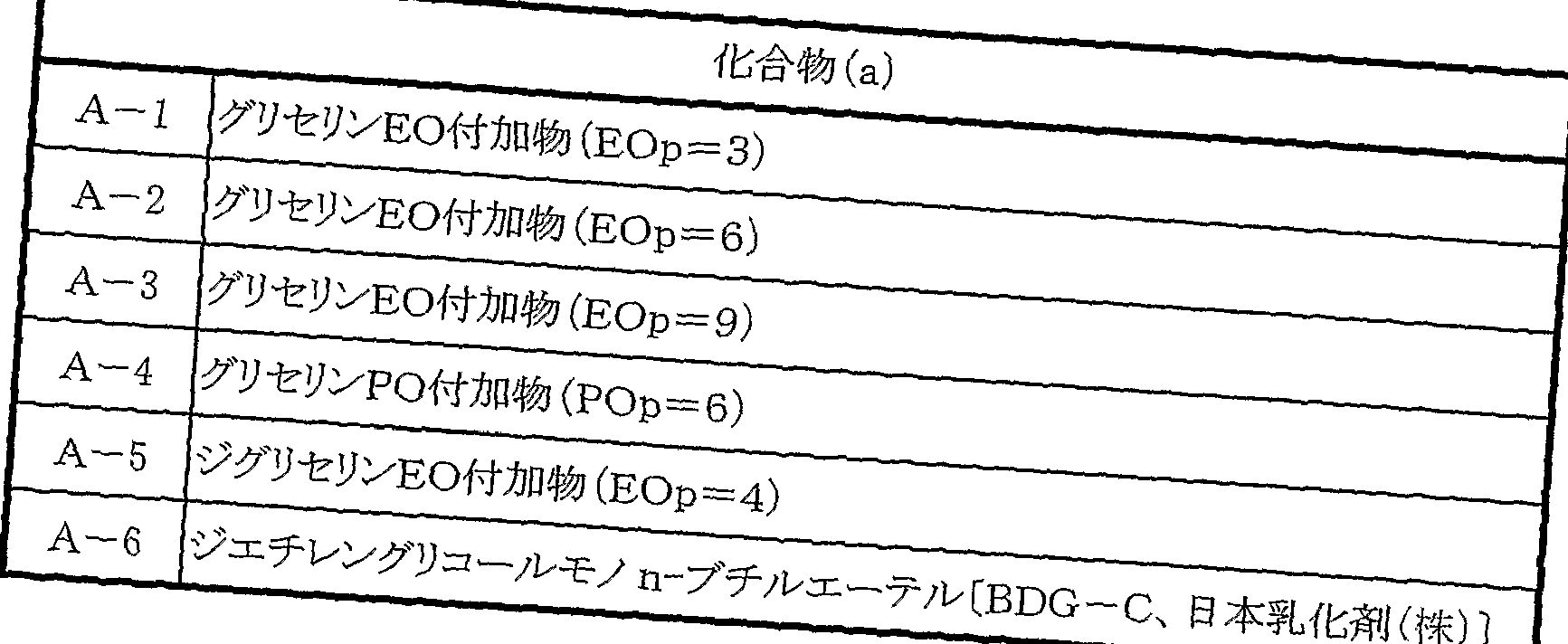
- Powder aid The compounds in Table 1 were used as a 50 wt% aqueous solution.
- AXB-1 15 manufactured by Seiki Giken Co., Ltd. is used, the ceramic #t capacity is 15 liters (outer diameter 300 mm), zirconia balls 3 8 mm 6.8 kg, 3 2 ⁇ 2.2 A total of 10.2 kg of kg, 30 mmd> 1.3 kg was used, and the rotation speed of the pole mill was set to 3 8 rpm. In addition, the time for discharging the powder during the grinding was set to 1 minute.
- the target brain value is 3 3 0 0 ⁇ 100 cm ⁇ / g, and the brane value is measured 30 minutes, 45 minutes, 60 minutes, 75 minutes, and 90 minutes after the start of grinding, and the target plane value 33 0
- the time to reach 0 cm 2 Zg was determined by a quadratic regression equation and used as the final arrival time (grinding arrival time).
- a plain air permeation device specified in the physical test method for cement JISR 5 2 0 1
- the difference in pulverization time in this test appears to be larger at the actual machine level.
- the evaluation was performed with a relative value when the pulverization arrival time of Comparative Example 1-1 was set to 100.
- Comparative Example 1-1 was shown as the standard in Table 1.
- ⁇ ⁇ ⁇ is the average added mole number of ethylene oxide
- P Pp is the average added mole number of propylene oxide (the same applies hereinafter).
- 0.04% by weight of water alone was added to one weight of the clinker.
- the amount added is the weight percent of the compound relative to the strength of the cleansing (the same applies hereinafter).
- safety refers to (i) substances that are subject to PRTR, (ii) substances that are subject to notification under Article 57-2 of the Health and Safety Law, and (iii) international chemical substance safety card “X” indicates that there is an important description of the effects of short-term exposure, and “O” indicates that it does not fall under any of the above (i) to (iii) (the same shall apply hereinafter).
- the viscosity is measured for the substance (100% product) from the viewpoint of handling and the efficiency of dusting due to the spreadability when scaled up, and the viscosity is less than 1 000 mPa ⁇ s. “O” and l OO OmP a 's more than “X” (and so on). Viscosity measurement conditions are those measured under the above conditions (the same applies hereinafter)
- the cement obtained in the examples and comparative examples was sealed in a heat-resistant glass container and stored in a thermostat kept at 70 ° C for 6 days.
- the mortar compressive strength of each cement before and after storage was compared according to the physical test method of cement (JISR 520 1) Annex 2 (Measurement of strength of test method of cement).
- the above sealed storage is a condition in which the cement is susceptible to weathering due to the desorbed water of the bound water from the dihydrate gypsum contained in the cement in consideration of the storage silo conditions.
- the results are shown in Table 2. Evaluation is based on the compressive strength before and after storage as the rate of decrease by the deterioration test.A rate of decrease of 6% or less is ⁇ ⁇ ''. “X”. Table 2
- the target plane value is 33 00 Sat 1 0 0 c mVg
- the brane value is measured 60 minutes, 75 minutes, 90 minutes after the start of grinding, and the time to reach the target plane value 3 300 cm 2 Zg is measured.
- the final arrival time was obtained by a quadratic regression equation.
- the brane value was measured using a brane air permeation device specified in the physical test method for cement (JISR 520 1). The difference in the time to reach pulverization in this test appears to be larger at the actual machine level.
- the evaluation was performed with a relative value when the crushed arrival time of Comparative Example 2-1 was set to 100, and the relative value was 90 or less as “ ⁇ ”,
- Comparative Example 2-1 was marked as the reference in Table 3.
- Comparative Example 2-1 was marked as the reference in Table 3.
- Comparative Example 2-1 was conducted by adding 0.04% by weight of water alone to the clinker weight.
- a 2 liter autoclave was charged with 230.3 g and 7.0 g of dalyserin and KOH, respectively, and the temperature was raised to 1 30 at a stirring speed of about 600 rpm. Next, dehydration was performed for 30 minutes under conditions of 1 30: and 1.3 kPa.
- the above reaction mixture was reacted with 87. 5 g of P 0 (equivalent to P 6 mol per 1 mol of glycerin).
- the reaction conditions at this time were a temperature of 130 ° C. and a pressure of 0.1 to 0.3 MPa (gauge pressure). After completion of the reaction, cool the temperature to 80 ° C and add glycerin PO average 6 mol adduct Obtained.
- the blending amount is the same as (1 1-2).
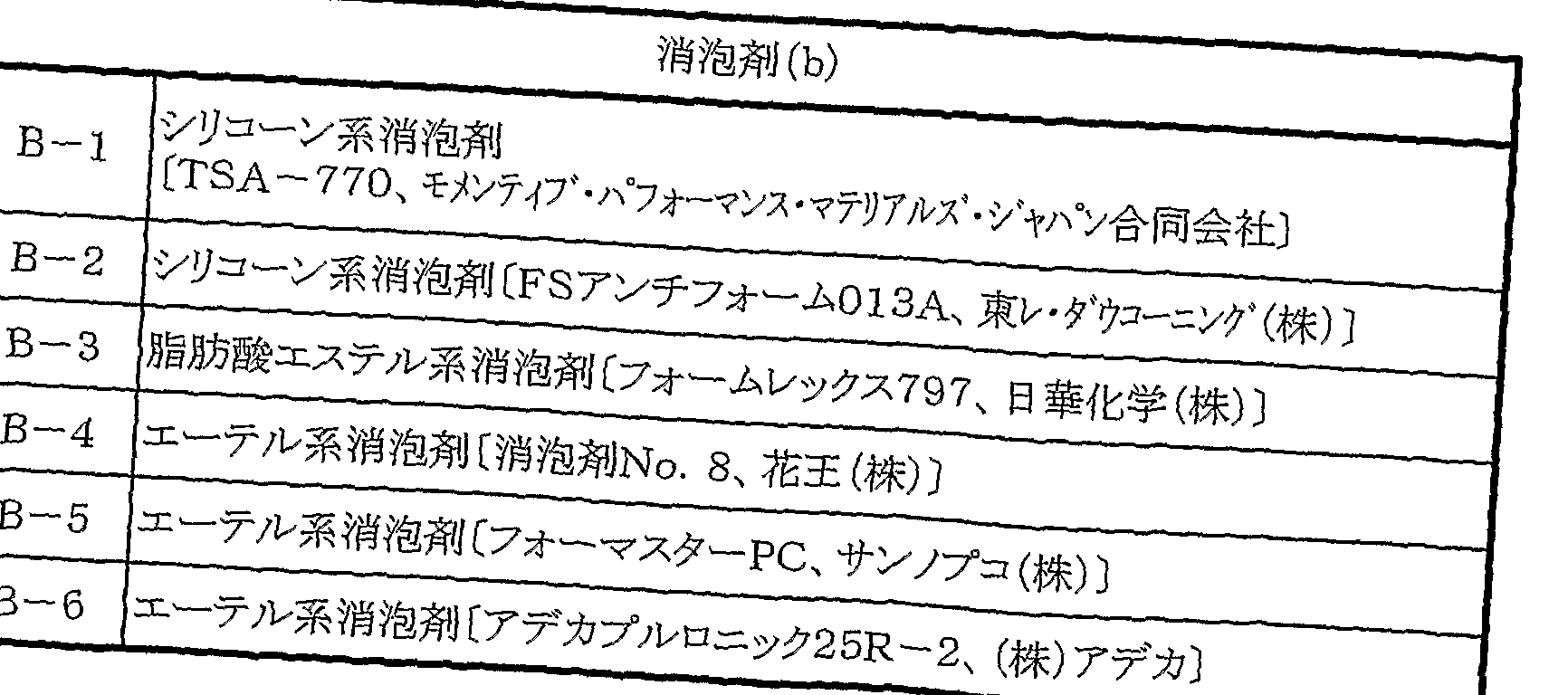
- the grinding aid used was a 50% by weight aqueous solution containing compound (a) and antifoaming agent (b) blended in the composition shown in Table 6.
- Comparative Example 3-1 is indicated as the standard in Table 6.
- Comparative Example 3-1 only water was added in an amount of 0.04% by weight based on one weight of the cleansing force.
- the amount added is the weight percent of the effective amount of the grinding aid to the clinker. From the results of Table 6, it can be seen that when compound (a) and antifoaming agent (b) are used in combination compared to the case where compound (a) is used alone, a superior effect can be obtained in the strength test and cement deterioration test. It turns out that it is obtained. That is, when Example 3-1 using the same compound (a) is compared with Example 3-6, Example 3-6 using the antifoaming agent (b) has a strength after 3 days and after 7 days. Is further improved. The same tendency is confirmed in each comparison between Examples 3-2-3-5 and Examples 3-7-3-10.
Landscapes
- Chemical & Material Sciences (AREA)
- Engineering & Computer Science (AREA)
- Ceramic Engineering (AREA)
- Materials Engineering (AREA)
- Structural Engineering (AREA)
- Organic Chemistry (AREA)
- Chemical Kinetics & Catalysis (AREA)
- Curing Cements, Concrete, And Artificial Stone (AREA)
- Disintegrating Or Milling (AREA)
- Lubricants (AREA)
- Degasification And Air Bubble Elimination (AREA)
- Medicinal Preparation (AREA)
Abstract
Description


Claims
Priority Applications (8)
| Application Number | Priority Date | Filing Date | Title |
|---|---|---|---|
| MX2010001365A MX2010001365A (es) | 2007-08-10 | 2008-08-07 | Metodo para producir polvo hidraulico. |
| CN2008801028469A CN101784499B (zh) | 2007-08-10 | 2008-08-07 | 水硬性粉体的制造方法 |
| ES08827359.4T ES2567705T3 (es) | 2007-08-10 | 2008-08-07 | Método para producir un polvo hidráulico |
| BRPI0813511A BRPI0813511A2 (pt) | 2007-08-10 | 2008-08-07 | método para preparação de um pó hidráulico, adjuvante de moagem para um composto hidráulico, e pó hidráulico |
| KR1020107002890A KR101500960B1 (ko) | 2007-08-10 | 2008-08-07 | 수경성 분체의 제조방법 |
| US12/667,373 US8322638B2 (en) | 2007-08-10 | 2008-08-07 | Method for producing hydraulic powder |
| EP08827359.4A EP2177488B1 (en) | 2007-08-10 | 2008-08-07 | Method for producing hydraulic powder |
| RU2010108521/03A RU2479510C2 (ru) | 2007-08-10 | 2008-08-07 | Способ получения затвердевающего в воде порошка |
Applications Claiming Priority (2)
| Application Number | Priority Date | Filing Date | Title |
|---|---|---|---|
| JP2007-210155 | 2007-08-10 | ||
| JP2007210155 | 2007-08-10 |
Publications (1)
| Publication Number | Publication Date |
|---|---|
| WO2009022716A1 true WO2009022716A1 (ja) | 2009-02-19 |
Family
ID=40350768
Family Applications (1)
| Application Number | Title | Priority Date | Filing Date |
|---|---|---|---|
| PCT/JP2008/064564 Ceased WO2009022716A1 (ja) | 2007-08-10 | 2008-08-07 | 水硬性粉体の製造方法 |
Country Status (12)
| Country | Link |
|---|---|
| US (1) | US8322638B2 (ja) |
| EP (1) | EP2177488B1 (ja) |
| JP (1) | JP5122390B2 (ja) |
| KR (1) | KR101500960B1 (ja) |
| CN (1) | CN101784499B (ja) |
| BR (1) | BRPI0813511A2 (ja) |
| ES (1) | ES2567705T3 (ja) |
| MX (1) | MX2010001365A (ja) |
| MY (1) | MY149836A (ja) |
| RU (1) | RU2479510C2 (ja) |
| TW (1) | TWI429612B (ja) |
| WO (1) | WO2009022716A1 (ja) |
Cited By (1)
| Publication number | Priority date | Publication date | Assignee | Title |
|---|---|---|---|---|
| WO2012008517A1 (ja) | 2010-07-16 | 2012-01-19 | 花王株式会社 | 水硬性粉体の製造方法 |
Families Citing this family (5)
| Publication number | Priority date | Publication date | Assignee | Title |
|---|---|---|---|---|
| JP5666281B2 (ja) * | 2010-12-17 | 2015-02-12 | 花王株式会社 | 水硬性粉体の製造方法 |
| JP5965257B2 (ja) * | 2011-09-22 | 2016-08-03 | 花王株式会社 | 水硬性粉体の製造方法 |
| KR102475822B1 (ko) * | 2015-07-10 | 2022-12-09 | 삼성메디슨 주식회사 | 초음파 진단 장치 및 초음파 진단 장치의 동작 방법 |
| CN107935448B (zh) * | 2017-10-16 | 2021-03-05 | 广东盛瑞科技股份有限公司 | 一种吡啶类复合发泡剂及其制备方法 |
| CN115449348B (zh) * | 2022-10-12 | 2023-06-27 | 江西广源化工有限责任公司 | 一种研磨助剂及其制备方法和应用 |
Citations (16)
| Publication number | Priority date | Publication date | Assignee | Title |
|---|---|---|---|---|
| JPS4842697B1 (ja) * | 1968-02-02 | 1973-12-14 | ||
| JPS5443188A (en) * | 1977-09-13 | 1979-04-05 | Sanyo Chem Ind Ltd | Chemical agent for production of granulated slag |
| JPS5788046A (en) * | 1980-11-18 | 1982-06-01 | Nisso Master Builders Kk | Blast furnace water-granulated sand solidification preventing agent |
| JPS57100952A (en) | 1980-12-17 | 1982-06-23 | Sanyo Kokusaku Pulp Co | Cement clinker crushing method |
| JPS5978961A (ja) * | 1982-10-28 | 1984-05-08 | ハリマ化成株式会社 | 高炉スラグ粉砕助剤 |
| JPS6287441A (ja) * | 1985-06-24 | 1987-04-21 | 株式会社 片山化学工業研究所 | 水砕スラグの脱水促進処理剤 |
| JPH03187958A (ja) | 1989-12-18 | 1991-08-15 | Chichibu Cement Co Ltd | ポルトランドセメントの製造方法 |
| JPH05147984A (ja) | 1991-11-25 | 1993-06-15 | Mitsubishi Materials Corp | 高強度セメントの製造方法 |
| JPH0733487A (ja) | 1993-07-14 | 1995-02-03 | Sumitomo Osaka Cement Co Ltd | セメント・クリンカーの粉砕方法 |
| JPH1160298A (ja) | 1997-08-21 | 1999-03-02 | Denki Kagaku Kogyo Kk | セメント混和材及びセメント組成物 |
| JPH11157891A (ja) | 1997-11-19 | 1999-06-15 | Denki Kagaku Kogyo Kk | アルミナセメント及びそれを用いた不定形耐火物 |
| JP2980752B2 (ja) * | 1991-11-21 | 1999-11-22 | 住友大阪セメント株式会社 | セメント材料の製造方法及びセメント材料 |
| JPH11322380A (ja) | 1998-05-11 | 1999-11-24 | Denki Kagaku Kogyo Kk | アルミナセメント及びそれを用いた不定形耐火物 |
| JP2001058855A (ja) * | 1999-08-18 | 2001-03-06 | Kokan Kogyo Kk | 高炉水砕スラグ又はその粒度調整物の固結防止剤及び固結防止方法 |
| JP2002160959A (ja) | 2000-09-13 | 2002-06-04 | Denki Kagaku Kogyo Kk | セメント組成物 |
| JP2005089287A (ja) | 2003-08-08 | 2005-04-07 | Ube Ind Ltd | セメントの製造方法 |
Family Cites Families (8)
| Publication number | Priority date | Publication date | Assignee | Title |
|---|---|---|---|---|
| US2203809A (en) * | 1938-03-18 | 1940-06-11 | California Portland Cement Co | Manufacture of portland cement |
| JPH03135453A (ja) * | 1989-10-20 | 1991-06-10 | Nippon Oil & Fats Co Ltd | 無機粉体の製造方法 |
| CN1041708C (zh) * | 1993-09-24 | 1999-01-20 | 格雷斯公司 | 掺有多元醇的水硬性水泥促凝剂 |
| US5948157A (en) * | 1996-12-10 | 1999-09-07 | Fording Coal Limited | Surface treated additive for portland cement concrete |
| EP1426349A4 (en) * | 2001-09-14 | 2008-08-06 | Nmb Ltd | ADDITIVE FOR CEMENT AND CEMENT CONTAINING SAME |
| AU2005213339B2 (en) | 2004-02-04 | 2010-06-17 | W.R. Grace & Co.-Conn | Liquid additive for intergrinding cement |
| US7232483B2 (en) * | 2005-02-01 | 2007-06-19 | W. R. Grace & Co.-Conn. | Cement composition having chromium reducer |
| US7922811B2 (en) * | 2005-06-02 | 2011-04-12 | W. R. Grace & Co.-Conn. | Biomass-derived grinding aids |
-
2008
- 2008-07-29 JP JP2008194672A patent/JP5122390B2/ja active Active
- 2008-08-07 BR BRPI0813511A patent/BRPI0813511A2/pt not_active Application Discontinuation
- 2008-08-07 ES ES08827359.4T patent/ES2567705T3/es active Active
- 2008-08-07 US US12/667,373 patent/US8322638B2/en not_active Expired - Fee Related
- 2008-08-07 RU RU2010108521/03A patent/RU2479510C2/ru active
- 2008-08-07 TW TW097130130A patent/TWI429612B/zh not_active IP Right Cessation
- 2008-08-07 WO PCT/JP2008/064564 patent/WO2009022716A1/ja not_active Ceased
- 2008-08-07 CN CN2008801028469A patent/CN101784499B/zh active Active
- 2008-08-07 MX MX2010001365A patent/MX2010001365A/es active IP Right Grant
- 2008-08-07 MY MYPI2010000579A patent/MY149836A/en unknown
- 2008-08-07 KR KR1020107002890A patent/KR101500960B1/ko not_active Expired - Fee Related
- 2008-08-07 EP EP08827359.4A patent/EP2177488B1/en active Active
Patent Citations (16)
| Publication number | Priority date | Publication date | Assignee | Title |
|---|---|---|---|---|
| JPS4842697B1 (ja) * | 1968-02-02 | 1973-12-14 | ||
| JPS5443188A (en) * | 1977-09-13 | 1979-04-05 | Sanyo Chem Ind Ltd | Chemical agent for production of granulated slag |
| JPS5788046A (en) * | 1980-11-18 | 1982-06-01 | Nisso Master Builders Kk | Blast furnace water-granulated sand solidification preventing agent |
| JPS57100952A (en) | 1980-12-17 | 1982-06-23 | Sanyo Kokusaku Pulp Co | Cement clinker crushing method |
| JPS5978961A (ja) * | 1982-10-28 | 1984-05-08 | ハリマ化成株式会社 | 高炉スラグ粉砕助剤 |
| JPS6287441A (ja) * | 1985-06-24 | 1987-04-21 | 株式会社 片山化学工業研究所 | 水砕スラグの脱水促進処理剤 |
| JPH03187958A (ja) | 1989-12-18 | 1991-08-15 | Chichibu Cement Co Ltd | ポルトランドセメントの製造方法 |
| JP2980752B2 (ja) * | 1991-11-21 | 1999-11-22 | 住友大阪セメント株式会社 | セメント材料の製造方法及びセメント材料 |
| JPH05147984A (ja) | 1991-11-25 | 1993-06-15 | Mitsubishi Materials Corp | 高強度セメントの製造方法 |
| JPH0733487A (ja) | 1993-07-14 | 1995-02-03 | Sumitomo Osaka Cement Co Ltd | セメント・クリンカーの粉砕方法 |
| JPH1160298A (ja) | 1997-08-21 | 1999-03-02 | Denki Kagaku Kogyo Kk | セメント混和材及びセメント組成物 |
| JPH11157891A (ja) | 1997-11-19 | 1999-06-15 | Denki Kagaku Kogyo Kk | アルミナセメント及びそれを用いた不定形耐火物 |
| JPH11322380A (ja) | 1998-05-11 | 1999-11-24 | Denki Kagaku Kogyo Kk | アルミナセメント及びそれを用いた不定形耐火物 |
| JP2001058855A (ja) * | 1999-08-18 | 2001-03-06 | Kokan Kogyo Kk | 高炉水砕スラグ又はその粒度調整物の固結防止剤及び固結防止方法 |
| JP2002160959A (ja) | 2000-09-13 | 2002-06-04 | Denki Kagaku Kogyo Kk | セメント組成物 |
| JP2005089287A (ja) | 2003-08-08 | 2005-04-07 | Ube Ind Ltd | セメントの製造方法 |
Non-Patent Citations (1)
| Title |
|---|
| See also references of EP2177488A4 |
Cited By (2)
| Publication number | Priority date | Publication date | Assignee | Title |
|---|---|---|---|---|
| WO2012008517A1 (ja) | 2010-07-16 | 2012-01-19 | 花王株式会社 | 水硬性粉体の製造方法 |
| US8506701B2 (en) | 2010-07-16 | 2013-08-13 | Kao Corporation | Method for producing hydraulic powder |
Also Published As
| Publication number | Publication date |
|---|---|
| US20110005432A1 (en) | 2011-01-13 |
| CN101784499B (zh) | 2013-06-19 |
| TWI429612B (zh) | 2014-03-11 |
| MY149836A (en) | 2013-10-31 |
| JP2009062261A (ja) | 2009-03-26 |
| CN101784499A (zh) | 2010-07-21 |
| EP2177488B1 (en) | 2016-02-24 |
| US8322638B2 (en) | 2012-12-04 |
| EP2177488A4 (en) | 2012-08-22 |
| RU2479510C2 (ru) | 2013-04-20 |
| MX2010001365A (es) | 2010-03-10 |
| KR101500960B1 (ko) | 2015-03-10 |
| TW200916433A (en) | 2009-04-16 |
| KR20100057798A (ko) | 2010-06-01 |
| EP2177488A1 (en) | 2010-04-21 |
| BRPI0813511A2 (pt) | 2018-08-28 |
| JP5122390B2 (ja) | 2013-01-16 |
| ES2567705T3 (es) | 2016-04-26 |
| RU2010108521A (ru) | 2011-09-20 |
Similar Documents
| Publication | Publication Date | Title |
|---|---|---|
| CN102958864B (zh) | 水硬性粉体的制造方法 | |
| EP2966049B1 (en) | One-component water-reducing agent, and preparation of hydraulic composition | |
| KR101740872B1 (ko) | 수경성 조성물 | |
| WO2009022716A1 (ja) | 水硬性粉体の製造方法 | |
| EP3135650B1 (en) | Use of an admixture for hydraulic composition | |
| TWI655165B (zh) | 混凝土組成物 | |
| WO2009022717A1 (ja) | 水硬性粉体の製造方法 | |
| JP5489430B2 (ja) | セメント組成物 | |
| JP6371701B2 (ja) | 水硬性組成物用添加剤 | |
| EP2301901A1 (en) | Method for producing hydraulic powder | |
| JP7054087B2 (ja) | 水硬性組成物用セルフレベリング剤 | |
| JP2010030835A (ja) | 水硬性粉体の製造方法 | |
| JP6416546B2 (ja) | 水硬性組成物、水硬性モルタル、及びその硬化体 | |
| JP5666281B2 (ja) | 水硬性粉体の製造方法 | |
| JP7400107B2 (ja) | シリコーンによって処理された組成物及びその使用 | |
| JP7544550B2 (ja) | 水硬性組成物用粉末分散剤組成物の製造方法 | |
| JP6377458B2 (ja) | 収縮低減剤及び添加剤キット | |
| JP6498657B2 (ja) | 水硬性粉体の製造方法 |
Legal Events
| Date | Code | Title | Description |
|---|---|---|---|
| WWE | Wipo information: entry into national phase |
Ref document number: 200880102846.9 Country of ref document: CN |
|
| 121 | Ep: the epo has been informed by wipo that ep was designated in this application |
Ref document number: 08827359 Country of ref document: EP Kind code of ref document: A1 |
|
| WWE | Wipo information: entry into national phase |
Ref document number: 12667373 Country of ref document: US |
|
| WWE | Wipo information: entry into national phase |
Ref document number: 2008827359 Country of ref document: EP |
|
| WWE | Wipo information: entry into national phase |
Ref document number: 299/DELNP/2010 Country of ref document: IN |
|
| WWE | Wipo information: entry into national phase |
Ref document number: 12010500221 Country of ref document: PH |
|
| WWE | Wipo information: entry into national phase |
Ref document number: MX/A/2010/001365 Country of ref document: MX |
|
| ENP | Entry into the national phase |
Ref document number: 20107002890 Country of ref document: KR Kind code of ref document: A |
|
| NENP | Non-entry into the national phase |
Ref country code: DE |
|
| WWE | Wipo information: entry into national phase |
Ref document number: 2010108521 Country of ref document: RU |
|
| WWE | Wipo information: entry into national phase |
Ref document number: PI 2010000579 Country of ref document: MY |
|
| WWE | Wipo information: entry into national phase |
Ref document number: 12667373 Country of ref document: US |
|
| REG | Reference to national code |
Ref country code: BR Ref legal event code: B01E Ref document number: PI0813511 Country of ref document: BR |
|
| ENP | Entry into the national phase |
Ref document number: PI0813511 Country of ref document: BR Kind code of ref document: A2 Effective date: 20100118 |