WO2009084386A1 - 接着性樹脂組成物 - Google Patents
接着性樹脂組成物 Download PDFInfo
- Publication number
- WO2009084386A1 WO2009084386A1 PCT/JP2008/072332 JP2008072332W WO2009084386A1 WO 2009084386 A1 WO2009084386 A1 WO 2009084386A1 JP 2008072332 W JP2008072332 W JP 2008072332W WO 2009084386 A1 WO2009084386 A1 WO 2009084386A1
- Authority
- WO
- WIPO (PCT)
- Prior art keywords
- adhesive resin
- resin composition
- urethane
- meth
- acrylate oligomer
- Prior art date
- Legal status (The legal status is an assumption and is not a legal conclusion. Google has not performed a legal analysis and makes no representation as to the accuracy of the status listed.)
- Ceased
Links
Classifications
-
- C—CHEMISTRY; METALLURGY
- C08—ORGANIC MACROMOLECULAR COMPOUNDS; THEIR PREPARATION OR CHEMICAL WORKING-UP; COMPOSITIONS BASED THEREON
- C08F—MACROMOLECULAR COMPOUNDS OBTAINED BY REACTIONS ONLY INVOLVING CARBON-TO-CARBON UNSATURATED BONDS
- C08F283/00—Macromolecular compounds obtained by polymerising monomers on to polymers provided for in subclass C08G
- C08F283/006—Macromolecular compounds obtained by polymerising monomers on to polymers provided for in subclass C08G on to polymers provided for in C08G18/00
-
- C—CHEMISTRY; METALLURGY
- C08—ORGANIC MACROMOLECULAR COMPOUNDS; THEIR PREPARATION OR CHEMICAL WORKING-UP; COMPOSITIONS BASED THEREON
- C08F—MACROMOLECULAR COMPOUNDS OBTAINED BY REACTIONS ONLY INVOLVING CARBON-TO-CARBON UNSATURATED BONDS
- C08F290/00—Macromolecular compounds obtained by polymerising monomers on to polymers modified by introduction of aliphatic unsaturated end or side groups
- C08F290/02—Macromolecular compounds obtained by polymerising monomers on to polymers modified by introduction of aliphatic unsaturated end or side groups on to polymers modified by introduction of unsaturated end groups
- C08F290/06—Polymers provided for in subclass C08G
- C08F290/067—Polyurethanes; Polyureas
-
- C—CHEMISTRY; METALLURGY
- C08—ORGANIC MACROMOLECULAR COMPOUNDS; THEIR PREPARATION OR CHEMICAL WORKING-UP; COMPOSITIONS BASED THEREON
- C08G—MACROMOLECULAR COMPOUNDS OBTAINED OTHERWISE THAN BY REACTIONS ONLY INVOLVING UNSATURATED CARBON-TO-CARBON BONDS
- C08G18/00—Polymeric products of isocyanates or isothiocyanates
- C08G18/06—Polymeric products of isocyanates or isothiocyanates with compounds having active hydrogen
- C08G18/28—Polymeric products of isocyanates or isothiocyanates with compounds having active hydrogen characterised by the compounds used containing active hydrogen
- C08G18/67—Unsaturated compounds having active hydrogen
- C08G18/671—Unsaturated compounds having only one group containing active hydrogen
- C08G18/672—Esters of acrylic or alkyl acrylic acid having only one group containing active hydrogen
-
- C—CHEMISTRY; METALLURGY
- C09—DYES; PAINTS; POLISHES; NATURAL RESINS; ADHESIVES; COMPOSITIONS NOT OTHERWISE PROVIDED FOR; APPLICATIONS OF MATERIALS NOT OTHERWISE PROVIDED FOR
- C09J—ADHESIVES; NON-MECHANICAL ASPECTS OF ADHESIVE PROCESSES IN GENERAL; ADHESIVE PROCESSES NOT PROVIDED FOR ELSEWHERE; USE OF MATERIALS AS ADHESIVES
- C09J133/00—Adhesives based on homopolymers or copolymers of compounds having one or more unsaturated aliphatic radicals, each having only one carbon-to-carbon double bond, and at least one being terminated by only one carboxyl radical, or of salts, anhydrides, esters, amides, imides, or nitriles thereof; Adhesives based on derivatives of such polymers
- C09J133/04—Homopolymers or copolymers of esters
- C09J133/14—Homopolymers or copolymers of esters of esters containing halogen, nitrogen, sulfur or oxygen atoms in addition to the carboxy oxygen
-
- C—CHEMISTRY; METALLURGY
- C09—DYES; PAINTS; POLISHES; NATURAL RESINS; ADHESIVES; COMPOSITIONS NOT OTHERWISE PROVIDED FOR; APPLICATIONS OF MATERIALS NOT OTHERWISE PROVIDED FOR
- C09J—ADHESIVES; NON-MECHANICAL ASPECTS OF ADHESIVE PROCESSES IN GENERAL; ADHESIVE PROCESSES NOT PROVIDED FOR ELSEWHERE; USE OF MATERIALS AS ADHESIVES
- C09J175/00—Adhesives based on polyureas or polyurethanes; Adhesives based on derivatives of such polymers
- C09J175/04—Polyurethanes
- C09J175/14—Polyurethanes having carbon-to-carbon unsaturated bonds
- C09J175/16—Polyurethanes having carbon-to-carbon unsaturated bonds having terminal carbon-to-carbon unsaturated bonds
-
- C—CHEMISTRY; METALLURGY
- C09—DYES; PAINTS; POLISHES; NATURAL RESINS; ADHESIVES; COMPOSITIONS NOT OTHERWISE PROVIDED FOR; APPLICATIONS OF MATERIALS NOT OTHERWISE PROVIDED FOR
- C09J—ADHESIVES; NON-MECHANICAL ASPECTS OF ADHESIVE PROCESSES IN GENERAL; ADHESIVE PROCESSES NOT PROVIDED FOR ELSEWHERE; USE OF MATERIALS AS ADHESIVES
- C09J4/00—Adhesives based on organic non-macromolecular compounds having at least one polymerisable carbon-to-carbon unsaturated bond ; adhesives, based on monomers of macromolecular compounds of groups C09J183/00 - C09J183/16
Definitions
- the present invention relates to an adhesive resin composition, and in particular, to a photocurable or electron beam curable adhesive resin composition having excellent adhesion to various adherends such as metal oxides, metals and resins. It is.
- thermosetting adhesives are known as adhesives for bonding electronic parts, machine parts, and the like.
- the thermosetting adhesive has a long curing time, there is a problem in that productivity is lowered when components are bonded using the thermosetting adhesive.
- a light or electron beam curable adhesive has been developed for bonding the above components, and the light or electron beam curable adhesive can be bonded in a very short time by irradiation with light or electron beam. Because it is completed, productivity can be improved.
- Japanese Patent Application Laid-Open No. 2004-115757 discloses 30 to 70% by weight of urethane (meth) acrylate having a number average molecular weight of 10,000 to 40,000, and an ethylenically unsaturated monomer having a homopolymer glass transition temperature of 60 ° C. or higher.
- a liquid curable resin composition containing 60% by weight is disclosed.
- the liquid curable resin composition has excellent adhesion to a plastic substrate, and is excellent in heat resistance and water resistance, and is useful for adhesion of various parts such as a laminate of a vinyl chloride sheet and a PET film. It is disclosed.
- the conventional light or electron beam curable adhesives including the liquid curable resin composition disclosed in JP-A No. 2004-115757, include metal oxides such as IZO and the like. It turned out that the adhesiveness with respect to metals, such as gold
- a first object of the present invention is to solve the above-mentioned problems of the prior art and to provide photo-curing or electron beam-curing adhesion excellent in adhesion to various adherends such as metal oxides, metals and resins. It is in providing a conductive resin composition.
- the present inventors include a urethane prepolymer portion composed of a polyol and a polyisocyanate, and the number of repetitions (n) of the urethane prepolymer portion is within a specific range.
- a photocurable or electron beam curable adhesive resin composition comprising a bifunctional urethane (meth) acrylate oligomer (A) and a cyclic monomer having a (meth) acryloyl group in a metal oxide such as IZO It has been found that it has excellent adhesion to metals, metals such as gold, and resins such as PET and polyimide, and the present invention has been completed.
- the adhesive resin composition of the present invention is a photocurable or electron beam curable adhesive resin composition containing a bifunctional urethane (meth) acrylate oligomer (A) and a monomer component (B).
- the urethane (meth) acrylate oligomer (A) includes a urethane prepolymer portion composed of a polyol and a polyisocyanate, and the number of repetitions (n) of the urethane prepolymer portion is 10 to 30,
- the monomer component (B) includes a cyclic monomer having a (meth) acryloyl group.
- the cyclic monomer having a (meth) acryloyl group is acryloylmorpholine.
- the ratio of the urethane (meth) acrylate oligomer (A) in the total amount of the urethane (meth) acrylate oligomer (A) and the monomer component (B) is 10 to
- the proportion of the cyclic monomer having 80% by mass and the (meth) acryloyl group is preferably 20 to 90% by mass.
- the polyisocyanate is preferably hydrogenated diphenylmethane diisocyanate and isophorone diisocyanate.
- the adhesive resin composition of the present invention preferably further contains a photopolymerization initiator (C).
- the polyol used for forming the urethane prepolymer portion of the urethane (meth) acrylate oligomer (A) is a polyether polyol.
- the polyether polyol preferably has a number average molecular weight of 200 to 4000.
- a bifunctional urethane (meth) acrylate oligomer (A) including a urethane prepolymer portion composed of a polyol and a polyisocyanate, and having a repeating number (n) of the urethane prepolymer portion in a specific range;
- a photocurable or electron beam curable adhesive resin composition having excellent adhesion to various adherends such as metal oxides, metals, and resins, and a cyclic monomer having a (meth) acryloyl group.
- an adhesive material used for assembling an electronic component is required to have a sufficiently high glass transition temperature because of its use conditions.
- the present inventors have examined that an adhesive resin composition containing a urethane (meth) acrylate oligomer synthesized using a general polyol is a glass transition of the adhesive resin after light or electron beam curing. Since the temperature is low, it has been found that there is room for improvement in use as an adhesive material for electronic components.
- the second object of the present invention is excellent in adhesiveness to adherends such as metal oxides and metals, and has a high glass transition temperature after curing, which is suitable as an adhesive material for electronic components.
- An object is to provide an electron beam curable adhesive resin composition.
- the inventors of the present invention include a urethane prepolymer part composed of polycarbonate diol or bisphenol A-derived polyol and polyisocyanate, and the number of repetitions of the urethane prepolymer part.
- a photocurable or electron beam curable adhesive resin composition comprising a bifunctional urethane (meth) acrylate oligomer (A) in which (n) is in a specific range and a cyclic monomer having a (meth) acryloyl group
- the glass transition temperature after curing was high in addition to excellent adhesion to metal oxides such as IZO and metals such as gold. That is, the present invention includes the following preferred embodiments.
- the polyol used for forming the urethane prepolymer portion of the urethane (meth) acrylate oligomer (A) is a polycarbonate diol.
- the polycarbonate diol preferably has a number average molecular weight of 500 to 4000.
- the adhesive resin of the present invention is obtained by curing the adhesive resin composition by light or electron beam irradiation, has a glass transition temperature (Tg) of 80 ° C. or higher, and a peel strength against gold and IZO of 300 N / m or more.
- the polyol used for forming the urethane prepolymer part of the urethane (meth) acrylate oligomer (A) is a bisphenol A-based polyol.
- the bisphenol A-based polyol preferably has a number average molecular weight of 300 to 3,000.
- Another adhesive resin of the present invention is obtained by curing the adhesive resin composition by light or electron beam irradiation, has a glass transition temperature (Tg) of 80 ° C.
- the peel strength for gold is 300 N / m or more
- the peel strength for polyimide is 1000 N / m or more
- the peel strength for PET is 1500 N / m or more.
- a difunctional bifunctional compound comprising a urethane prepolymer part comprising a polyol derived from polycarbonate diol or bisphenol A and a polyisocyanate, wherein the number of repetitions (n) of the urethane prepolymer part is in a specific range. It contains a urethane (meth) acrylate oligomer (A) and a cyclic monomer having a (meth) acryloyl group, has excellent adhesion to metal oxides such as IZO and metals such as gold, and has a glass transition temperature after curing.
- a photocurable or electron beam curable adhesive resin composition that is high and suitable as an adhesive material for electronic components can be provided.
- the adhesive resin composition of the present invention is a photocurable or electron beam curable adhesive resin composition comprising a bifunctional urethane (meth) acrylate oligomer (A) and a monomer component (B),
- the urethane (meth) acrylate oligomer (A) includes a urethane prepolymer portion composed of a polyol and a polyisocyanate, and the repeating number (n) of the urethane prepolymer portion is 10 to 30, and the monomer component (B) Includes a cyclic monomer having a (meth) acryloyl group.
- the adhesive resin composition of the present invention is cured by irradiation with light or an electron beam, it can complete the adhesion in a very short time, and can be completed with a metal oxide such as IZO, a metal such as gold, PET, polyimide, etc. Excellent adhesion to resin.
- the irradiation conditions of light or an electron beam are not specifically limited, It can set suitably.
- the urethane (meth) acrylate oligomer (A) used in the adhesive resin composition of the present invention is bifunctional and has a (meth) acryloyloxy group (CH 2 ⁇ CHCOO— or CH 2 ⁇ C (CH 3 ) COO—).
- the urethane (meth) acrylate oligomer (A) used in the adhesive resin composition of the present invention has a repeating number (n) of a urethane prepolymer portion composed of a polyol and a polyisocyanate of 10 to 30, preferably 10-25.
- n repeating number of repeating urethane prepolymer parts (n) is less than 10, the adhesion to various adherends is low. On the other hand, when it exceeds 30, the synthesis of the oligomer is difficult.
- the number of repetitions (n) of the urethane prepolymer part is an average number of repetitions.
- the number average molecular weight (Ma) of urethane (meth) acrylate oligomer (A) is the value calculated
- the number average molecular weight (Mb) of a polyol is GPC. It is the value calculated
- the polyol used for the synthesis of the urethane prepolymer preferably has a number average molecular weight of 200 to 4000, more preferably 300 to 3500.
- the number average molecular weight of the polyol used is less than 200, gelation tends to occur when the prepolymer is synthesized, and stable synthesis is difficult.
- it exceeds 4000 the adhesiveness is lowered, which is not preferable.
- the polyol include polyether polyol, polycarbonate diol, bisphenol A-based polyol, and the like, and polycarbonate diol and bisphenol A-based polyol are particularly preferable from the viewpoint of improving the glass transition temperature after curing of the adhesive resin composition.
- An adhesive resin composition containing a urethane (meth) acrylate oligomer (A) synthesized using polycarbonate diol or bisphenol A-based polyol as a polyol has a high glass transition temperature after curing, and is suitable as an adhesive material for electronic components. .
- the polyether polyol that can be used for the synthesis of the urethane prepolymer is a compound having a plurality of ether bonds and two hydroxyl groups.
- R 1 in the formula (I) is a divalent group having an ether bond
- examples of the divalent group having an ether bond include those represented by the formula: — (RO) m R— [wherein R is an alkylene group such as an ethylene group, a propylene group or a tetramethylene group, and m is the number of repeating oxyalkylene units].
- polyether polyol examples include polyethylene glycol, polypropylene glycol, polytetramethylene glycol, ethylene glycol, propylene glycol, 1,3-propanediol, 1,2-butanediol, and 1,3-butanediol.
- examples thereof include diols obtained by adding alkylene oxides such as ethylene oxide and propylene oxide to dihydric alcohols such as 1,4-butanediol, 1,5-pentanediol, and 1,6-hexanediol.
- These polyether polyols may be used individually by 1 type, and may be used in combination of 2 or more type.
- the polyether polyol preferably has a number average molecular weight of 200 to 4000, more preferably 300 to 3500. If the number average molecular weight of the polyether polyol used is less than 200, gelation tends to occur when the prepolymer is synthesized, and stable synthesis is difficult. On the other hand, if it exceeds 4000, the adhesiveness decreases, which is not preferable. .
- the polycarbonate diol that can be used for the synthesis of the urethane prepolymer is a compound having a plurality of carbonate bonds (—OCOO—) and two hydroxyl groups.
- R 1 in the formula (I) is a divalent group having a carbonate bond.
- Examples of the divalent group having a carbonate bond include the formula: — (ROCOO) p ROCO— [wherein R is an alkylene group such as an ethylene group, a propylene group or a tetramethylene group, and p is the number of repeating alkylene carbonate units].
- polycarbonate diol examples include those obtained by a dehydrochlorination reaction between a dihydric alcohol and phosgene and a transesterification reaction between a dihydric alcohol and a carbonate ester.
- dihydric alcohol ethylene glycol, propylene glycol, 1,3-propanediol, 1,2-butanediol, 1,3-butanediol, 1,4-butanediol, 1,5-pentanediol
- Examples include 3-methyl-1,5-pentanediol and 1,6-hexanediol.
- carbonate ester examples include dialkyl carbonates such as dimethyl carbonate and diethyl carbonate, alkylene carbonates such as ethylene carbonate and propylene carbonate, and diaryl carbonates such as diphenyl carbonate. These polycarbonate diols may be used alone or in combination of two or more.
- the polycarbonate diol preferably has a number average molecular weight of 500 to 4000, more preferably 1000 to 3000. If the number average molecular weight of the polycarbonate diol to be used is 500 or more, gelation hardly occurs when synthesizing the prepolymer, and stable synthesis is possible. Absent.
- the bisphenol A-based polyol that can be used for the synthesis of the urethane prepolymer is a compound that contains a bisphenol A residue and has two hydroxyl groups.
- R 1 in the formula (I) is a divalent group containing a bisphenol A residue.
- Examples of the divalent group containing the bisphenol A residue include the following: Formula (VI): In the formula, A represents an alkylene group such as an ethylene group, a propylene group, and a tetramethylene group, and m represents a repeating number of an oxyalkylene unit (OA).
- bisphenol A-based polyol examples include those obtained by adding alkylene oxide such as ethylene oxide, propylene oxide, butylene oxide to bisphenol A, and commercially available products can be used. These bisphenol A-based polyols may be used alone or in combination of two or more.
- the bisphenol A-based polyol preferably has a number average molecular weight of 300 to 3000, more preferably 500 to 1000. If the number average molecular weight of the bisphenol A-based polyol used is 300 or more, gelation hardly occurs when synthesizing the prepolymer, and stable synthesis is possible, and if it is 3000 or less, sufficient adhesiveness is obtained. Is obtained.
- the polyisocyanate used for the synthesis of the urethane prepolymer is a compound having two isocyanate groups.
- R 2 in the formula (II) is a divalent group such as an alkylene group, a cycloalkylene group, an alkylene cycloalkylene group, a cycloalkylene alkylene cycloalkylene group, an arylene group, an alkylene arylene group, an arylene alkylene arylene group, etc.
- Examples of the alkylene group include a hexamethylene group
- examples of the cycloalkylene group include a cyclohexylene group and a methylcyclohexylene group
- examples of the alkylene cycloalkylene group include 3-methylene-3. , 5,5-trimethylcyclohexylene group, etc., cycloalkylenealkylenecycloalkylene group, cyclohexylenemethylenecyclohexylene group, etc., arylene group, tolylene group, etc., alkylenearylene group, methylenephenylene group, etc.
- But ants The Ren alkylene arylene group, phenylene methylene phenylene group, and the like.
- polyisocyanate examples include tolylene diisocyanate (TDI), diphenylmethane diisocyanate (MDI), crude diphenylmethane diisocyanate (crude MDI), isophorone diisocyanate (IPDI), hydrogenated diphenylmethane diisocyanate (hydrogenated MDI), and hydrogenated triisocyanate.
- TDI tolylene diisocyanate
- MDI diphenylmethane diisocyanate
- CAde MDI crude diphenylmethane diisocyanate
- IPDI isophorone diisocyanate
- hydrogenated MDI hydrogenated triisocyanate
- polyisocyanates may be used alone or in combination of two or more.
- a catalyst for urethanization reaction is preferably used.
- the catalyst for urethanization reaction include organic tin compounds, inorganic tin compounds, organic lead compounds, monoamines, diamines, triamines, cyclic amines, alcohol amines, ether amines, organic sulfonic acids, inorganic acids, titanium A compound, a bismuth compound, a quaternary ammonium salt, etc. are mentioned, Among these, an organotin compound is preferable.
- Suitable organic tin compounds include dibutyltin dilaurate, dibutyltin diacetate, dibutyltin thiocarboxylate, dibutyltin dimaleate, dioctyltin thiocarboxylate, tin octenoate, monobutyltin oxide, and the like.
- the (meth) acrylate having a hydroxyl group to be added to the urethane prepolymer is a compound having one hydroxyl group and one (meth) acryloyloxy group.
- R 3 in the formula (IV) is a divalent group such as a divalent hydrocarbon group such as an alkylene group. Examples of the alkylene group include an ethylene group and a propylene group.
- R 4 in formula (IV) is hydrogen or a methyl group, and is preferably hydrogen.
- (meth) acrylate having a hydroxyl group examples include 2-hydroxyethyl (meth) acrylate and 2-hydroxypropyl (meth) acrylate. These (meth) acrylates having a hydroxyl group may be used alone or in combination of two or more.
- the adhesive resin composition of the present invention includes a monomer component (B), and a part or all of the monomer component (B) is a cyclic monomer having a (meth) acryloyl group.
- the cyclic monomer having a (meth) acryloyl group has one or more rings and a compound having one or more (meth) acryloyl groups [CH 2 ⁇ CHCO— or CH 2 ⁇ C (CH 3 ) CO—] It is.
- examples of the ring include morpholine ring, triazine ring, isobornyl, benzene ring and the like, and among these, a heterocyclic ring such as morpholine ring is preferable.
- cyclic monomer having a (meth) acryloyl group examples include (meth) acryloylmorpholine, and acryloylmorpholine is preferred.
- the cyclic monomer having the (meth) acryloyl group may be used alone or in combination of two or more.
- the adhesive resin composition of the present invention may contain a monomer other than the cyclic monomer having the (meth) acryloyl group as the monomer component (B).
- the monomer include ethyl (meth) acrylate, isobutyl ( Examples include (meth) acrylate monomers such as (meth) acrylate, n-butyl (meth) acrylate, isoamyl (meth) acrylate, and butoxyethyl (meth) acrylate.
- the ratio of the cyclic monomer having a (meth) acryloyl group in the monomer component (B) is preferably 60% by mass or more, more preferably 80% by mass or more.
- the ratio of the urethane (meth) acrylate oligomer (A) in the total amount of the urethane (meth) acrylate oligomer (A) and the monomer component (B) is preferably The amount is 10 to 80% by mass, and more preferably 15 to 75% by mass.
- the proportion of the urethane (meth) acrylate oligomer (A) is less than 10% by mass, sufficient adhesion is difficult to obtain, whereas when it exceeds 80% by mass, the viscosity is high and the coating property is lowered.
- the ratio of the cyclic monomer having the (meth) acryloyl group in the total blending amount of the urethane (meth) acrylate oligomer (A) and the monomer component (B) is preferably 20 to 90% by mass. More preferably, it is 25 to 85% by mass.
- the ratio of the cyclic monomer having a (meth) acryloyl group is less than 20% by mass, the viscosity is high and the coating property is lowered. On the other hand, when it exceeds 90% by mass, sufficient adhesion cannot be obtained.
- the adhesive resin composition of the present invention preferably further contains a photopolymerization initiator (C).
- the adhesive resin composition can be easily cured by irradiation with light such as ultraviolet rays.
- This photoinitiator (C) has the effect
- Examples of the photopolymerization initiator (C) include 4-dimethylaminobenzoic acid, 4-dimethylaminobenzoic acid ester, 2,2-dimethoxy-2-phenylacetophenone, acetophenone diethyl ketal, alkoxyacetophenone, benzyldimethyl ketal, benzophenone and 3,3-dimethyl-4-methoxybenzophenone, benzophenone derivatives such as 4,4-dimethoxybenzophenone, 4,4-diaminobenzophenone, alkyl benzoylbenzoate, bis (4-dialkylaminophenyl) ketone, benzyl, benzylmethyl ketal, etc.
- Benzyl derivatives of benzoin benzoin derivatives such as benzoin and benzoin isobutyl ether, benzoin isopropyl ether, 2-hydroxy-2-methylpropiophenone, 1-hydroxycyclohexyl phenyl ketone, Sandton, thioxanthone and thioxanthone derivatives, fluorene, 2,4,6-trimethylbenzoyldiphenylphosphine oxide, bis (2,6-dimethoxybenzoyl) -2,4,4-trimethylpentylphosphine oxide, bis (2,4,6- Trimethylbenzoyl) -phenylphosphine oxide, 2-methyl-1- [4- (methylthio) phenyl] -2-morpholinopropane-1,2-benzyl-2-dimethylamino-1- (morpholinophenyl) -butanone-1, etc. Is mentioned.
- One of these photopolymerization initiators (C) may be used
- the blending amount of the photopolymerization initiator (C) is preferably in the range of 0.1 to 10 parts by mass with respect to 100 parts by mass in total of the urethane (meth) acrylate oligomer (A) and the monomer component (B).
- the blending amount of the photopolymerization initiator is less than 0.1 parts by mass, the effect of initiating photocuring of the adhesive resin composition is small.
- it exceeds 10 parts by mass the effect of initiating photocuring is saturated.
- the raw material cost of the conductive resin composition increases.
- the adhesive resin composition of the present invention is excellent in adhesion to metal oxides such as IZO, metals such as gold, and resins such as PET and polyimide. Therefore, the adhesive resin composition of the present invention can be suitably used for adhesion of these various adherends, and more specifically, non-conductive film (NCF), anisotropic conductive film (ACF), It is useful as a low-temperature curable adhesive material for electronic components such as electronic display components.
- NCF non-conductive film
- ACF anisotropic conductive film
- the adhesive resin of the present invention is obtained by curing the above-described adhesive resin composition by light or electron beam irradiation.
- the irradiation conditions of light or an electron beam are not specifically limited, It can set suitably.
- the polyol used for forming the urethane prepolymer portion of the urethane (meth) acrylate oligomer (A) is a polycarbonate diol or a bisphenol A-based polyol
- the adhesive resin of the present invention has a glass transition temperature (Tg) of 80. Above °C, the peel strength against gold and IZO (indium-zinc oxide) is 300 N / m or more.
- the adhesive resin has excellent adhesion to metal oxides such as IZO and metals such as gold, and has a high glass transition temperature, so it is useful as a low-temperature curable adhesive material for various electronic components such as components of electronic displays. It is. If the glass transition temperature (Tg) is less than 80 ° C., considering the use environment of the electronic material, the cured resin may be softened, and if the peel strength against gold and IZO is less than 300 N / m, Insufficient adhesion to the body.
- Tg glass transition temperature
- the adhesive resin of the present invention has a glass transition temperature (Tg) of 80 ° C. or higher.
- Tg glass transition temperature
- the peel strength for gold and IZO being 300 N / m or more
- the peel strength for polyimide is 1000 N / m or more
- the peel strength for PET polyethylene terephthalate
- the adhesive resin is excellent in adhesion to a metal oxide such as IZO, a metal such as gold, a resin such as polyimide and PET, and has a high glass transition temperature.
- the adhesive resin has a low temperature of various electronic members such as electronic display components. It is particularly useful as a curable adhesive material. If the peel strength for polyimide is less than 1000 N / m and the peel strength for PET is less than 1500 N / m, the adhesion to these adherends is insufficient.
- Example 1 100.0 parts by mass of a polyether polyol obtained by polymerizing propylene oxide to propylene glycol and having a number average molecular weight of 930, 25.89 parts by mass of isophorone diisocyanate (IPDI), and 0.01 parts by mass of dibutyltin dilaurate (DBTDL)
- IPDI isophorone diisocyanate
- DBTDL dibutyltin dilaurate
- urethane acrylate oligomer (A-1) 60.0 parts by mass of the urethane acrylate oligomer (A-1), 40.0 parts by mass of acryloylmorpholine (“NK ⁇ Ester A-MO” manufactured by Shin-Nakamura Chemical Co., Ltd.), and Ciba Specialty Chemicals Co., Ltd.
- a photopolymerization initiator “Irgacure 184D” 1.0 part by mass was stirred and mixed, and then vacuum degassed to prepare a UV curable adhesive resin composition.
- ⁇ Preparation of peel strength measurement sample> An adherend of about 18 ⁇ 15 cm is placed on a glass plate of about 40 ⁇ 40 cm, and an aluminum foil having a thickness of 50 ⁇ m with a central portion hollowed to a size of 10 ⁇ 8 cm is placed thereon as a spacer. A release PET film is partially sandwiched so that the gripping area of the chuck of the peel tester does not adhere. A small amount of UV curable adhesive resin composition is dropped on this, and then an easy-adhesion-treated PET film of about 18 ⁇ 15 cm is placed thereon. The UV curable adhesive resin composition is extended over the entire film surface with a roller from above the laminated film.
- This laminated film is placed on a base of about 15 ⁇ 15 ⁇ 1.5 cm with the easy-adhesion-treated PET film on top, and further, about 15 ⁇ 15 ⁇ 0.5 cm of quartz glass is placed on the film.
- This is UV cured by a conveyor type UV irradiator. In the conveyor type UV irradiator, the conveyor speed and the sample position (distance) were adjusted so that the integrated light amount was 3000 mJ. The cured film was cut with a width of 25 mm so that the margin was at the end, and a peel strength measurement sample was prepared.
- the peel strength of the sample thus prepared was measured at a speed of 50 mm / min in accordance with JIS K6854.
- the peel strength was 1494 N
- the adherend is an IZO-treated PET film
- the peel strength is 985 N / m.
- the adherend is a polyimide film
- the peel strength is 5800 ⁇ ⁇ N / m.
- the adherend is an untreated PET film
- the peel strength is 1329 N / m.
- the adherend is an easy-adhesion-treated PET film
- the peel strength is 10700 N / m. It was found that all the adherends have high peel strength.
- a sample of about 80 x 80 x 1 mm is made with a conveyor-type UV irradiator (integrated light quantity 3000 mm mJ), and about 60 x 10 x 1 mm from this plate sample.
- a glass transition temperature measurement sample was cut out and a dynamic viscoelasticity test was performed on the sample under conditions of a heating rate of 3 ° C./min and a frequency of 1 Hz, and the glass transition temperature of the cured resin was measured from the peak of tan ⁇ . As a result, it was found that the temperature was -25 ° C, the glass transition temperature was too low, and it was insufficient as an adhesive material for electronic components.
- the number of urethane prepolymer portions (n) of the urethane acrylate oligomer (A-1) used in the UV curable adhesive resin composition is represented by the number average molecular weight of the urethane acrylate oligomer of 17600 and the number average of the polyether polyol.
- a molecular weight of 930, a polyisocyanate (IPDI) molecular weight of 222.28, and an acrylate chain (2-HEA) molecular weight of 116.11, (17600-2 ⁇ 116.11-222.28) / (930 + 222.28) 14.9 Met.
- Example 2 100.0 parts by mass of a polyether polyol obtained by polymerizing propylene oxide to propylene glycol and having a number average molecular weight of 1990, 12.00 parts by mass of isophorone diisocyanate (IPDI), and 0.01 parts by mass of dibutyltin dilaurate (DBTDL)
- IPDI isophorone diisocyanate
- DBTDL dibutyltin dilaurate
- urethane acrylate oligomer (A-2) 60.0 parts by mass of the urethane acrylate oligomer (A-2), 40.0 parts by mass of acryloylmorpholine (“NK ⁇ Ester A-MO” manufactured by Shin-Nakamura Chemical Co., Ltd.), and Ciba Specialty Chemicals Co., Ltd.
- a photopolymerization initiator “Irgacure 184D” 1.0 part by mass was stirred and mixed, and then vacuum degassed to prepare a UV curable adhesive resin composition.
- a peel strength measurement sample was prepared in the same manner as in Example 1, and the peel strength was measured.
- the adherend was a gold-treated film
- the peel strength was measured. The strength is 1208 N / m.
- the adherend is an IZO-treated PET film
- the peel strength is 880 N / m.
- the adherend is a polyimide film
- the peel strength is 4152 N.
- the adherend is an untreated PET film
- the peel strength is 3208 N / m.
- the adherend is an easy-adhesion treated PET film, the peel strength is 10610 N. It was found that it had a high peel strength for any adherend.
- the number (n) of urethane prepolymer portions of the urethane acrylate oligomer (A-2) used in the UV curable adhesive resin composition is the number average molecular weight of the urethane acrylate oligomer 33700, the number average of the polyether polyol.
- Example 3 100.0 parts by mass of a bifunctional polyether polyol having a number average molecular weight of 1760 obtained by polymerizing propylene oxide with propylene glycol, 14.64 parts by mass of hydrogenated diphenylmethane diisocyanate (hydrogenated MDI), and 0.01% dibutyltin dilaurate (DBTDL) 11 parts by weight of 11 parts by weight of acryloylmorpholine (“NK Ester A-MO” manufactured by Shin-Nakamura Chemical Co., Ltd.) is weighed into a 1-liter three-necked flask and reacted at 80 ° C. for 4 hours with stirring Thus, a urethane prepolymer having isocyanate groups at both ends of the molecular chain was synthesized.
- a peel strength measurement sample was prepared in the same manner as in Example 1, and the peel strength was measured.
- the adherend was a gold-treated film
- the peel strength was measured. The strength is 1872 N / m.
- the adherend is an IZO-treated PET film
- the peel strength is 311 N / m.
- the adherend is a polyimide film
- the peel strength is 5646 N.
- the adherend is an untreated PET film, the peel strength is 803 N / m
- the peel strength is 10,000 N It was found that it had a high peel strength for any adherend.
- the number of urethane prepolymer portions (n) of the urethane acrylate oligomer (A-3) used in the UV curable adhesive resin composition is the number average molecular weight 49800 of the urethane acrylate oligomer and the number average of the polyether polyol.
- a molecular weight of 1760, a molecular weight of polyisocyanate (hydrogenated MDI) 258.31, and an acrylate chain (2-HEA) molecular weight of 116.11, (49800-2 ⁇ 116.11-258.31) / (1760 + 258.31) 24.4 Met.
- Comparative Example 1 100.0 parts by mass of a polyether polyol having a bifunctional number average molecular weight of 4400 obtained by polymerizing propylene oxide with propylene glycol, 4.60 parts by mass of isophorone diisocyanate (IPDI), 0.01 parts by mass of dibutyltin dilaurate (DBTDL), 69.9 parts by mass of acryloylmorpholine (“NK Ester A-MO” manufactured by Shin-Nakamura Chemical Co., Ltd.) was weighed into a 1-liter three-necked flask and reacted at 80 ° C. for 4 hours with stirring and mixing. A urethane prepolymer having isocyanate groups at both ends was synthesized.
- IPDI isophorone diisocyanate
- DBTDL dibutyltin dilaurate
- NK Ester A-MO manufactured by Shin-Nakamura Chemical Co., Ltd.
- a peel strength measurement sample was prepared in the same manner as in Example 1, and the peel strength was measured.
- the adherend was a gold-treated film
- the peel strength was measured. The strength is 919 N / m.
- the adherend is an IZO-treated PET film
- the peel strength is 201 N / m.
- the adherend is a polyimide film
- the peel strength is 19 N.
- the adherend is an untreated PET film
- the peel strength is 110 N / m.
- the adherend is an easy-adhesion treated PET film, the peel strength is 160 N. It was found that it has a low peel strength for any adherend.
- the number of urethane prepolymer portions (n) of the urethane acrylate oligomer (A-4) used in the UV curable adhesive resin composition is the number average molecular weight 38600 of the urethane acrylate oligomer and the number average of the polyether polyol.
- a molecular weight of 4400, a polyisocyanate (IPDI) molecular weight of 222.28, and an acrylate chain (2-HEA) molecular weight of 116.11, (38600-2 ⁇ 116.11-222.28) / (4400 + 222.28) 8.3 Met.
- Comparative Example 2 100.0 parts by mass of a polyether polyol having a bifunctional number average molecular weight of 360 obtained by polymerizing propylene oxide to propylene glycol, 60.8 parts by mass of isophorone diisocyanate (IPDI), 0.01 parts by mass of dibutyltin dilaurate (DBTDL), 108.6 parts by mass of acryloylmorpholine (“NK Ester A-MO” manufactured by Shin-Nakamura Chemical Co., Ltd.) was weighed into a 1-liter three-necked flask and reacted at 80 ° C. for 4 hours with stirring and mixing. A urethane prepolymer having isocyanate groups at both ends was synthesized.
- IPDI isophorone diisocyanate
- DBTDL dibutyltin dilaurate
- NK Ester A-MO manufactured by Shin-Nakamura Chemical Co., Ltd.
- a peel strength measurement sample was prepared in the same manner as in Example 1, and the peel strength was measured.
- the adherend was a gold-treated film
- the peel strength was measured. The strength is 43 N / m.
- the adherend is an IZO-treated PET film
- the peel strength is 25 N / m.
- the adherend is a polyimide film
- the peel strength is 78 N.
- the adherend is an untreated PET film
- the peel strength is 266 N / m.
- the adherend is an easy-adhesion-treated PET film, the peel strength is 430 N. It was found that it has a low peel strength for any adherend.
- the glass transition temperature measurement sample was produced using the adhesive resin composition in the same manner as in Example 1 and the glass transition temperature was measured, it was 96 ° C. and was sufficient as an adhesive material for electronic components. It was found to have a glass transition temperature.
- the number of urethane prepolymer portions (n) of the urethane acrylate oligomer (A-5) used in the UV curable adhesive resin composition is the number average molecular weight of the urethane acrylate oligomer of 5200 and the number average of the polyether polyol.
- Example 4 Bifunctional polycarbonate diol having a number average molecular weight of 2600 [Nipporan 980R manufactured by Nippon Polyurethane Industry Co., Ltd.], 13.1 parts by mass of isophorone diisocyanate (IPDI), 0.01 parts by mass of dibutyltin dilaurate (DBTDL), and acryloylmorpholine (“Nikester A-MO” manufactured by Shin-Nakamura Chemical Co., Ltd.) 215.0 parts by weight was weighed into a 1-liter three-necked flask and reacted at 80 ° C. for 4 hours with stirring and mixing. A urethane prepolymer having an isocyanate group at the end was synthesized.
- urethane acrylate oligomer (A-6) was synthesized.
- the number average molecular weight of the obtained urethane acrylate oligomer (A-6) was 40200 as measured by GPC.
- a peel strength measurement sample was prepared in the same manner as in Example 1, and the peel strength was measured.
- the adherend was a gold-treated film
- the peel strength was measured. The strength is 376 N / m.
- the adherend is an IZO-treated PET film
- the peel strength is 761 N / m, and it has a high peel strength for any adherend. I found out.
- a sample for measuring the glass transition temperature was prepared using the adhesive resin composition in the same manner as in Example 1, and the glass transition temperature was measured. As a result, it was 170 ° C., which was sufficient as an adhesive material for electronic components. It was found to have a glass transition temperature.
- Example 5 100.0 parts by weight of a bifunctional polycarbonate diol having a number average molecular weight of 1180 [N-9981 manufactured by Nippon Polyurethane Industry Co., Ltd.] and hydrogenated diphenylmethane diisocyanate (hydrogenated MDI, 4,4'-dicyclohexylmethane diisocyanate) 30.14 parts by weight And 0.01 part by weight of dibutyltin dilaurate (DBTDL) and 200.0 parts by weight of acryloylmorpholine (“NK Ester A-MO” manufactured by Shin-Nakamura Chemical Co., Ltd.) were weighed into a 1 liter three-necked flask and stirred and mixed. Then, a urethane prepolymer having isocyanate groups at both ends of the molecular chain was synthesized by reacting at 80 ° C. for 4 hours.
- DBTDL dibutyltin dilaurate
- acryloylmorpholine
- a peel strength measurement sample was prepared in the same manner as in Example 1, and the peel strength was measured.
- the adherend was a gold-treated film
- the peel strength was measured. The strength is 389 mN / m.
- the adherend is an IZO-treated PET film
- the peel strength is 684 N / m, and it has a high peel strength for any adherend. I found out.
- a glass transition temperature measurement sample was prepared in the same manner as in Example 1, and the glass transition temperature was measured. As a result, it was 172 ° C., which was sufficient as an adhesive material for electronic components. It was found to have a glass transition temperature.
- a peel strength measurement sample was prepared in the same manner as in Example 1, and the peel strength was measured.
- the adherend was a gold-treated film
- the peel strength was measured. The strength is 173 N / m.
- the adherend is an IZO-treated PET film
- the peel strength is 219 N / m, which has a low peel strength for any adherend. I found out.
- the glass transition temperature measurement sample was produced using the adhesive resin composition in the same manner as in Example 1 and the glass transition temperature was measured, it was 168 ° C., which was sufficient as an adhesive material for electronic components. It was found to have a glass transition temperature.
- Example 6 100.0 parts by mass of a polyether polyol obtained by adding propylene oxide (PO) to bifunctional bisphenol A having a number average molecular weight of 690 (BPX-55 manufactured by ADEKA), hydrogenated diphenylmethane diisocyanate (H12MDI, 4, 3 parts of 1 liter: 38.14 parts by weight of 4′-dicyclohexylmethane diisocyanate), 0.01 parts by weight of dibutyltin dilaurate (DBTDL), and 140.0 parts by weight of acryloylmorpholine (“NK Ester A-MO” manufactured by Shin-Nakamura Chemical Co., Ltd.)
- a urethane prepolymer having isocyanate groups at both ends of the molecular chain was synthesized by weighing into a neck flask and reacting at 80 ° C. for 4 hours with stirring and mixing.
- peel strength measurement sample was prepared in the same manner as in Example 1, and the peel strength was measured.
- Peel strength is 445 N / m.
- the adherend is an IZO-treated PET film, the peel strength is 770 N / m.
- the adherend is a polyimide film, the peel strength is 1506. N / m, (4)
- the adherend is an untreated PET film, the peel strength is 1873 N / m, and it has a high peel strength for any adherend I understood.
- a glass transition temperature measurement sample was prepared in the same manner as in Example 1, and the glass transition temperature was measured. As a result, it was 153 ° C., which was sufficient as an adhesive material for electronic components. It was found to have a glass transition temperature.
- the number of urethane prepolymer portions (n) of the urethane acrylate oligomer (A-9) used in the UV curable adhesive resin composition is represented by the number average molecular weight of the urethane acrylate oligomer of 20800 and the number of bisphenol A polyols.
- a polyisocyanate (H12MDI) molecular weight of 258.31, and an acrylate chain (2-HEA) molecular weight of 116.11, (20800-2 ⁇ 116.11-258.31) / (690 + 258.31) 21.4 Met.
- Example 7 100.0 parts by mass of a polyether polyol obtained by adding propylene oxide (PO) to bifunctional bisphenol A having a number average molecular weight of 690 (BPX-55 manufactured by ADEKA Corporation), 32.82 parts by mass of isophorone diisocyanate (IPDI), , 0.01 parts by weight of dibutyltin dilaurate (DBTDL) and 91.1 parts by weight of acryloylmorpholine (“NK Ester A-MO” manufactured by Shin-Nakamura Chemical Co., Ltd.) were weighed into a 1 liter three-necked flask and stirred and mixed. By reacting at 80 ° C. for 4 hours, a urethane prepolymer having isocyanate groups at both ends of the molecular chain was synthesized.
- PO propylene oxide
- IPDI isophorone diisocyanate
- DBTDL dibutyltin dilaurate
- NK Ester A-MO manufactured by Shin-
- peel strength measurement sample was prepared in the same manner as in Example 1, and the peel strength was measured.
- Peel strength is 494 N / m.
- the adherend is an IZO-treated PET film, the peel strength is 546 N / m.
- the adherend is a polyimide film, the peel strength is 1085. N / m, (4)
- the adherend is an untreated PET film, the peel strength is 2265 N / m, and it has high peel strength for any adherend I understood.
- a glass transition temperature measurement sample was prepared in the same manner as in Example 1, and the glass transition temperature was measured. As a result, it was 109 ° C. and was sufficient as an adhesive material for electronic components. It was found to have a glass transition temperature.
- the number of urethane prepolymer portions (n) of the urethane acrylate oligomer (A-10) used in the UV curable adhesive resin composition is represented by the number average molecular weight of the urethane acrylate oligomer of 15400 and the number of bisphenol A polyols.
- n The number average molecular weight of the urethane acrylate oligomer of 15400 and the number of bisphenol A polyols.
- IPDI polyisocyanate
- 2-HEA acrylate chain
- Example 8 100.0 parts by mass of a polyether polyol obtained by adding ethylene oxide (EO) to bisphenol A having a bifunctional and number average molecular weight of 1120 [Newpol BPE-180 manufactured by Sanyo Chemical Industries, Ltd.] and hydrogenated diphenylmethane diisocyanate (H12MDI) ) 28.74 parts by weight, 0.01 parts by weight of dibutyltin dilaurate (DBTDL), and 130.0 parts by weight of acryloylmorpholine (“NK Ester A-MO” manufactured by Shin-Nakamura Chemical Co., Ltd.) are weighed into a 1 liter three-necked flask, While stirring and mixing, the reaction was carried out at 80 ° C. for 4 hours to synthesize a urethane prepolymer having isocyanate groups at both ends of the molecular chain.
- EO ethylene oxide
- H12MDI hydrogenated diphenylmethane diisocyanate
- a peel strength measurement sample was prepared in the same manner as in Example 1, and the peel strength was measured.
- the peel strength is 483 N / m.
- the adherend is an IZO-treated PET film, the peel strength is 580 N / m.
- the adherend is a polyimide film, the peel strength is 1344. N / m, (4)
- the adherend is an untreated PET film, the peel strength is 1529 N / m, and it has a high peel strength for any adherend I understood.
- a glass transition temperature measurement sample was prepared in the same manner as in Example 1, and the glass transition temperature was measured. As a result, it was 139 ° C., which was sufficient as an adhesive material for electronic components. It was found to have a glass transition temperature.
- the number of urethane prepolymer portions (n) of the urethane acrylate oligomer (A-11) used in the UV curable adhesive resin composition is represented by the number average molecular weight 40100 of the urethane acrylate oligomer and the number of bisphenol A-based polyols.
- a polyisocyanate (H12MDI) molecular weight of 258.31 a polyisocyanate (H12MDI) molecular weight of 258.31
- an acrylate chain (2-HEA) molecular weight of 116.11, (40100-2 ⁇ 116.11-258.31) / (1120 + 258.31) 28.7 Met.
- Comparative Example 4 100.0 parts by mass of a polyether polyol obtained by adding propylene oxide (PO) to bisphenol A having a number average molecular weight of 690 and BPX-55 manufactured by ADEKA Corporation, 37.51 parts by mass of isophorone diisocyanate (IPDI), , 0.01 part by weight of dibutyltin dilaurate (DBTDL) and 145.0 parts by weight of acryloylmorpholine (“NK Ester A-MO” manufactured by Shin-Nakamura Chemical Co., Ltd.) were weighed into a 1 liter three-necked flask and stirred and mixed. By reacting at 80 ° C. for 4 hours, a urethane prepolymer having isocyanate groups at both ends of the molecular chain was synthesized.
- PO propylene oxide
- IPDI isophorone diisocyanate
- DBTDL dibutyltin dilaurate
- NK Ester A-MO manufactured by
- peel strength measurement sample was prepared in the same manner as in Example 1, and the peel strength was measured.
- Peel strength is 293 N / m.
- the adherend is an IZO-treated PET film, the peel strength is 127 N / m.
- the adherend is a polyimide film, the peel strength is 794. N / m, (4)
- the adherend is an untreated PET film, the peel strength is 621 N / m, and it has a low peel strength for any adherend I understood.
- a sample for measuring the glass transition temperature was prepared using the adhesive resin composition in the same manner as in Example 1, and the glass transition temperature was measured to be 112 ° C., which is sufficient as an adhesive material for electronic components. It was found to have a glass transition temperature.
- the number of urethane prepolymer portions (n) of the urethane acrylate oligomer (A-12) used in the UV curable adhesive resin composition is the number average molecular weight of the urethane acrylate oligomer of 5800 and the number of bisphenol A polyols.
- a polyisocyanate (IPDI) molecular weight of 222.28, and an acrylate chain (2-HEA) molecular weight of 116.11, (5800-2 ⁇ 116.11-222.28) / (690 + 222.28) 5.9 Met.
- the number of urethane prepolymer parts (n) of the urethane (meth) acrylate oligomer (A) used in the adhesive resin composition is adhesive to metal oxides such as IZO, metals such as gold, polyimide, and resins such as PET.
- Table 1 and Table 2 summarize the results of Examples 1 to 3 and Comparative Examples 1 and 2.
- the repeating number (n) of the urethane prepolymer part of the urethane (meth) acrylate oligomer (A) used in the adhesive resin composition is a metal oxide such as IZO, a metal such as gold, a resin such as polyimide and PET.
- a metal oxide such as IZO
- a metal such as gold
- a resin such as polyimide and PET.
- the urethane (meth) acrylate oligomer (A) containing a urethane prepolymer part composed of a polyol and a polyisocyanate, and having a repeating number (n) of the urethane prepolymer part of 10 to 30;
- the adhesive resin compositions of Examples 1 to 3 containing a cyclic monomer having a (meth) acryloyl group have excellent adhesion to metal oxides such as IZO, metals such as gold, and resins such as PET and polyimide. I understand.
- the composition was inferior in adhesion to each adherend as compared with the adhesive resin compositions of Examples 1 to 3.
- the adhesive resin compositions of Examples 4 to 5 containing a cyclic monomer having a (meth) acryloyl group are excellent in adhesion to metal oxides such as IZO and metals such as gold, and have a glass transition after curing. It can be seen that the temperature is high.
- the adhesive resin of Example 1 using a urethane (meth) acrylate oligomer containing a urethane prepolymer portion comprising a polyether polyol and a polyisocyanate, and having a repeating number (n) of the urethane prepolymer portion of 10 to 30
- the composition was excellent in adhesion to metal oxides such as IZO and metals such as gold, the glass transition temperature after curing was low.
- the product had a high glass transition temperature after curing, it had very low adhesion to metal oxides such as IZO and metals such as gold.
- the product had a high glass transition temperature after curing, it had low adhesion to metal oxides such as IZO and metals such as gold.
- a urethane (meth) acrylate oligomer containing a urethane prepolymer portion composed of a bisphenol A-based polyol and a polyisocyanate, and having a repeating number (n) of the urethane prepolymer portion of 10 to 30 ( A) and the adhesive resin compositions of Examples 6 to 8 containing a cyclic monomer having a (meth) acryloyl group are adhesive to metal oxides such as IZO, metals such as gold, resins such as polyimide and PET. It can be seen that the glass transition temperature after curing is high.
- the adhesive resin of Example 1 using a urethane (meth) acrylate oligomer containing a urethane prepolymer portion comprising a polyether polyol and a polyisocyanate, and having a repeating number (n) of the urethane prepolymer portion of 10 to 30
- the composition was excellent in adhesion to a metal oxide such as IZO, a metal such as gold, a resin such as polyimide and PET, the glass transition temperature after curing was low.
- 4 and 4 had a high glass transition temperature after curing, but had very low adhesion to metal oxides such as IZO, metals such as gold, resins such as polyimide and PET.
Landscapes
- Chemical & Material Sciences (AREA)
- Organic Chemistry (AREA)
- Health & Medical Sciences (AREA)
- Chemical Kinetics & Catalysis (AREA)
- Medicinal Chemistry (AREA)
- Polymers & Plastics (AREA)
- Macromonomer-Based Addition Polymer (AREA)
- Adhesives Or Adhesive Processes (AREA)
Abstract
本発明は、金属酸化物、金属、樹脂等の種々の被着体に対する接着性に優れた光硬化性又は電子線硬化性の接着性樹脂組成物に関し、より詳しくは、2官能のウレタン(メタ)アクリレートオリゴマー(A)とモノマー成分(B)とを含む光硬化性又は電子線硬化性の接着性樹脂組成物であって、前記ウレタン(メタ)アクリレートオリゴマー(A)は、ポリオールとポリイソシアネートとからなるウレタンプレポリマー部を含み、該ウレタンプレポリマー部の繰り返し数(n)が10~30であって、前記モノマー成分(B)が、(メタ)アクリロイル基を有する環式モノマーを含むことを特徴とする接着性樹脂組成物に関するものである。
Description
本発明は、接着性樹脂組成物、特には、金属酸化物、金属、樹脂等の種々の被着体に対する接着性に優れた、光硬化性又は電子線硬化性の接着性樹脂組成物に関するものである。
従来、電子部品、機械部品等を接着するための接着剤として、熱硬化性の接着剤が知られている。しかしながら、熱硬化性の接着剤は、硬化時間が長いため、熱硬化性の接着剤を使用して部品を接着すると、生産性が低下する問題がある。一方、上記部品の接着のために、光又は電子線硬化性の接着剤が開発されており、該光又は電子線硬化性の接着剤は、光又は電子線の照射により極めて短時間で接着が完了するため、生産性を向上させることが可能である。
例えば、特開2004-115757号には、数平均分子量が10000~40000のウレタン(メタ)アクリレート30~70重量%と、ホモポリマーのガラス転移温度が60℃以上であるエチレン性不飽和モノマー30~60重量%とを含有する液状硬化性樹脂組成物が開示されている。そして、該液状硬化性樹脂組成物は、プラスチック基板に対して優れた接着性を有する上、耐熱性及び耐水性に優れ、塩ビシートやPETフィルムのラミネートを始め、各種部品の接着に有用であることが開示されている。
ところで、昨今の電子部品の組み立てにおいては、被着体として、金やニッケル等の金属、IZOやITO等の金属酸化物、PETやポリイミド等の樹脂を同時に接着する必要があるため、特定の被着体に対する接着性のみならず、種々の被着体に対する接着性に優れた接着剤が求められている。
これに対し、本発明者らが検討したところ、特開2004-115757号に開示の液状硬化性樹脂組成物を始め、従来の光又は電子線硬化性接着剤は、IZO等の金属酸化物及び/又は金等の金属に対する接着性が悪く、十分な接着強度(剥離強度)が得られないことが分かった。
そこで、本発明の第1の目的は、上記従来技術の問題を解決し、金属酸化物、金属、樹脂等の種々の被着体に対する接着性に優れた光硬化性又は電子線硬化性の接着性樹脂組成物を提供することにある。
本発明者らは、上記第1の目的を達成するために鋭意検討した結果、ポリオールとポリイソシアネートとからなるウレタンプレポリマー部を含み、該ウレタンプレポリマー部の繰り返し数(n)が特定の範囲にある2官能のウレタン(メタ)アクリレートオリゴマー(A)と、(メタ)アクリロイル基を有する環式モノマーとを含む光硬化性又は電子線硬化性の接着性樹脂組成物が、IZO等の金属酸化物、金等の金属、PET、ポリイミド等の樹脂に対する接着性に優れることを見出し、本発明を完成させるに至った。
即ち、本発明の接着性樹脂組成物は、2官能のウレタン(メタ)アクリレートオリゴマー(A)とモノマー成分(B)とを含む光硬化性又は電子線硬化性の接着性樹脂組成物であって、
前記ウレタン(メタ)アクリレートオリゴマー(A)は、ポリオールとポリイソシアネートとからなるウレタンプレポリマー部を含み、該ウレタンプレポリマー部の繰り返し数(n)が10~30であって、
前記モノマー成分(B)が、(メタ)アクリロイル基を有する環式モノマーを含むことを特徴とする。
前記ウレタン(メタ)アクリレートオリゴマー(A)は、ポリオールとポリイソシアネートとからなるウレタンプレポリマー部を含み、該ウレタンプレポリマー部の繰り返し数(n)が10~30であって、
前記モノマー成分(B)が、(メタ)アクリロイル基を有する環式モノマーを含むことを特徴とする。
本発明の接着性樹脂組成物の好適例においては、前記(メタ)アクリロイル基を有する環式モノマーがアクリロイルモルホリンである。
本発明の接着性樹脂組成物においては、前記ウレタン(メタ)アクリレートオリゴマー(A)と前記モノマー成分(B)との総配合量中の前記ウレタン(メタ)アクリレートオリゴマー(A)の割合が10~80質量%で且つ前記(メタ)アクリロイル基を有する環式モノマーの割合が20~90質量%であることが好ましい。
本発明の接着性樹脂組成物において、前記ポリイソシアネートとしては、水添ジフェニルメタンジイソシアネート及びイソホロンジイソシアネートが好ましい。
本発明の接着性樹脂組成物は、更に、光重合開始剤(C)を含むことが好ましい。
本発明の接着性樹脂組成物の他の好適例においては、前記ウレタン(メタ)アクリレートオリゴマー(A)のウレタンプレポリマー部の形成に用いるポリオールがポリエーテルポリオールである。ここで、該ポリエーテルポリオールは、数平均分子量が200~4000であることが好ましい。
本発明によれば、ポリオールとポリイソシアネートとからなるウレタンプレポリマー部を含み、該ウレタンプレポリマー部の繰り返し数(n)が特定の範囲にある2官能のウレタン(メタ)アクリレートオリゴマー(A)と、(メタ)アクリロイル基を有する環式モノマーとを含み、金属酸化物、金属、樹脂等の種々の被着体に対する接着性に優れた光硬化性又は電子線硬化性の接着性樹脂組成物を提供することができる。
ところで、電子部品の組み立てに用いる接着材料は、その使用条件から、十分にガラス転移温度が高いことが要求される。この点について、本発明者らが検討したところ、一般的なポリオールを用いて合成したウレタン(メタ)アクリレートオリゴマーを含む接着性樹脂組成物は、光又は電子線硬化後の接着性樹脂のガラス転移温度が低いため、電子部品の接着材料に用いる上で改良の余地があることが分かった。
そこで、本発明の第2の目的は、金属酸化物や金属等の被着体に対する接着性に優れる上、硬化後のガラス転移温度が高く、電子部品の接着材料として好適な、光硬化性又は電子線硬化性の接着性樹脂組成物を提供することにある。
本発明者らは、上記第2の目的を達成するために鋭意検討した結果、ポリカーボネートジオール又はビスフェノールA由来のポリオールとポリイソシアネートとからなるウレタンプレポリマー部を含み、該ウレタンプレポリマー部の繰り返し数(n)が特定の範囲にある2官能のウレタン(メタ)アクリレートオリゴマー(A)と、(メタ)アクリロイル基を有する環式モノマーとを含む光硬化性又は電子線硬化性の接着性樹脂組成物が、IZO等の金属酸化物、金等の金属に対する接着性に優れる上、硬化後のガラス転移温度が高いことを見出した。即ち、本発明は、以下の好適態様を包含するものである。
本発明の接着性樹脂組成物の好適態様においては、前記ウレタン(メタ)アクリレートオリゴマー(A)のウレタンプレポリマー部の形成に用いるポリオールがポリカーボネートジオールである。ここで、該ポリカーボネートジオールは、数平均分子量が500~4000であることが好ましい。また、本発明の接着性樹脂は、該接着性樹脂組成物を光又は電子線照射により硬化させてなり、ガラス転移温度(Tg)が80℃以上で、金及びIZOに対する剥離強度が300 N/m以上である。
また、本発明の接着性樹脂組成物の他の好適態様においては、前記ウレタン(メタ)アクリレートオリゴマー(A)のウレタンプレポリマー部の形成に用いるポリオールがビスフェノールA系ポリオールである。ここで、該ビスフェノールA系ポリオールは、数平均分子量が300~3000であることが好ましい。また、本発明の他の接着性樹脂は、該接着性樹脂組成物を光又は電子線照射により硬化させてなり、ガラス転移温度(Tg)が80℃以上で、IZOに対する剥離強度が300 N/m以上で、金に対する剥離強度が300 N/m以上で、ポリイミドに対する剥離強度が1000 N/m以上で、PETに対する剥離強度が1500 N/m以上である。
本発明の好適態様によれば、ポリカーボネートジオール又はビスフェノールA由来のポリオールとポリイソシアネートとからなるウレタンプレポリマー部を含み、該ウレタンプレポリマー部の繰り返し数(n)が特定の範囲にある2官能のウレタン(メタ)アクリレートオリゴマー(A)と、(メタ)アクリロイル基を有する環式モノマーとを含み、IZO等の金属酸化物、金等の金属に対する接着性に優れる上、硬化後のガラス転移温度が高く、電子部品の接着材料として好適な、光硬化性又は電子線硬化性の接着性樹脂組成物を提供することができる。
以下に、本発明を詳細に説明する。本発明の接着性樹脂組成物は、2官能のウレタン(メタ)アクリレートオリゴマー(A)とモノマー成分(B)とを含む光硬化性又は電子線硬化性の接着性樹脂組成物であって、前記ウレタン(メタ)アクリレートオリゴマー(A)は、ポリオールとポリイソシアネートとからなるウレタンプレポリマー部を含み、該ウレタンプレポリマー部の繰り返し数(n)が10~30であって、前記モノマー成分(B)が、(メタ)アクリロイル基を有する環式モノマーを含むことを特徴とする。本発明の接着性樹脂組成物は、光又は電子線の照射により硬化するため、極めて短時間で接着を完了することができる上、IZO等の金属酸化物、金等の金属、PET、ポリイミド等の樹脂に対する接着性に優れる。なお、本発明の接着性樹脂組成物の使用に際し、光又は電子線の照射条件は特に限定されず、適宜設定することができる。
本発明の接着性樹脂組成物に用いるウレタン(メタ)アクリレートオリゴマー(A)は、2官能で、(メタ)アクリロイルオキシ基(CH2=CHCOO-又はCH2=C(CH3)COO-)を2つ、ウレタン結合(-NHCOO-)を複数有し、例えば、下記一般式(I):
HO-R1-OH ・・・ (I)
[式中、R1は2価の基である]で表わされるポリオールと、下記一般式(II):
OCN-R2-NCO ・・・ (II)
[式中、R2は2価の基である]で表わされるポリイソシアネートとから、下記一般式(III):

[式中、R1及びR2は、上記と同義であり、nはウレタンプレポリマー部の繰り返し数である]で表わされるウレタンプレポリマーを合成し、該ウレタンプレポリマーに下記一般式(IV):
CH2=C(R4)-COO-R3-OH ・・・ (IV)
[式中、R3は2価の基であり、R4は水素又はメチル基である]で表わされる水酸基を有する(メタ)アクリレートを付加させることによって製造することができ、具体的には、下記一般式(V):
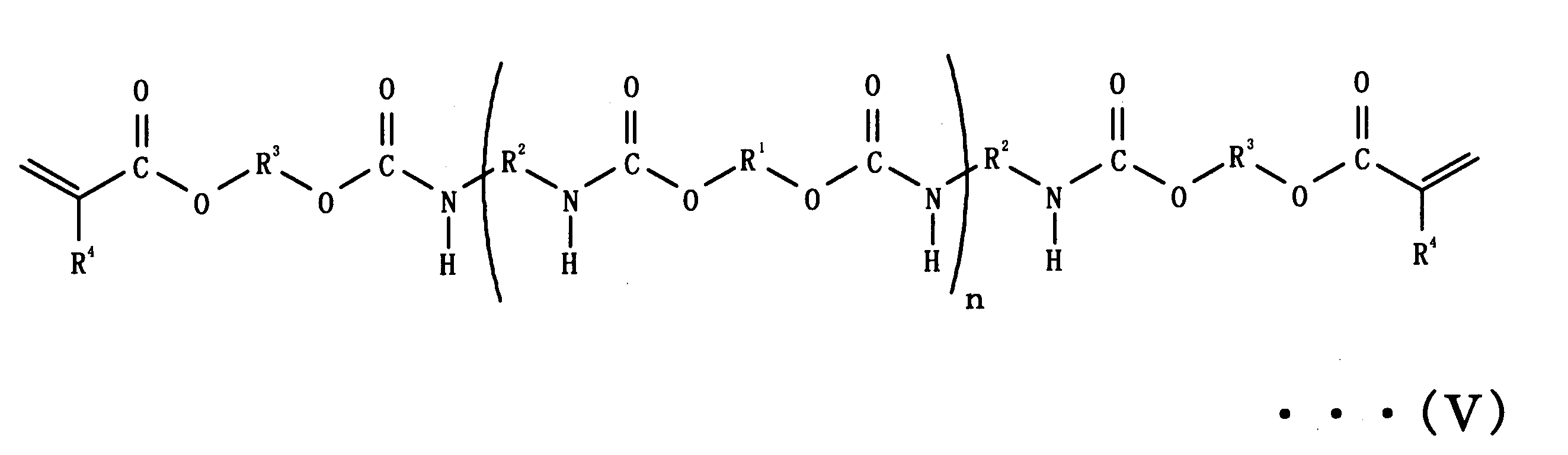
[式中、R1、R2、R3、R4及びnは、上記と同義である]で表わすことができる。
HO-R1-OH ・・・ (I)
[式中、R1は2価の基である]で表わされるポリオールと、下記一般式(II):
OCN-R2-NCO ・・・ (II)
[式中、R2は2価の基である]で表わされるポリイソシアネートとから、下記一般式(III):
[式中、R1及びR2は、上記と同義であり、nはウレタンプレポリマー部の繰り返し数である]で表わされるウレタンプレポリマーを合成し、該ウレタンプレポリマーに下記一般式(IV):
CH2=C(R4)-COO-R3-OH ・・・ (IV)
[式中、R3は2価の基であり、R4は水素又はメチル基である]で表わされる水酸基を有する(メタ)アクリレートを付加させることによって製造することができ、具体的には、下記一般式(V):
[式中、R1、R2、R3、R4及びnは、上記と同義である]で表わすことができる。
ここで、本発明の接着性樹脂組成物に用いるウレタン(メタ)アクリレートオリゴマー(A)は、ポリオールとポリイソシアネートとからなるウレタンプレポリマー部の繰り返し数(n)が10~30であり、好ましくは10~25である。上記ウレタンプレポリマー部の繰り返し数(n)が10未満では、各種被着体に対する接着性が低く、一方、30を超えると、オリゴマーの合成が困難である。
なお、上記ウレタンプレポリマー部の繰り返し数(n)は、平均繰り返し数であり、具体的には、ウレタン(メタ)アクリレートオリゴマー(A)の数平均分子量(Ma)、ポリオールの数平均分子量(Mb)、ポリイソシアネートの分子量(Mc)、水酸基を有する(メタ)アクリレートの分子量(Md)から、次式:
n=(Ma-2×Md-Mc)/(Mb+Mc)
に従って求めることができる。なお、本発明において、ウレタン(メタ)アクリレートオリゴマー(A)の数平均分子量(Ma)は、GPCを用いて、ポリスチレン換算で求めた値であり、ポリオールの数平均分子量(Mb)は、GPCを用いて、単分散のポリプロピレングリコール(PPG)で作成した検量線から求めた値である。
n=(Ma-2×Md-Mc)/(Mb+Mc)
に従って求めることができる。なお、本発明において、ウレタン(メタ)アクリレートオリゴマー(A)の数平均分子量(Ma)は、GPCを用いて、ポリスチレン換算で求めた値であり、ポリオールの数平均分子量(Mb)は、GPCを用いて、単分散のポリプロピレングリコール(PPG)で作成した検量線から求めた値である。
上記ウレタンプレポリマーの合成に用いるポリオールは、数平均分子量が200~4000であることが好ましく、300~3500であることが更に好ましい。使用するポリオールの数平均分子量が200未満では、プレポリマーを合成する際にゲル化が起こり易く、安定した合成が困難であり、一方、4000を超えると、接着性が低下して好ましくない。上記ポリオールとしては、ポリエーテルポリオール、ポリカーボネートジオール、ビスフェノールA系ポリオール等が挙げられ、接着性樹脂組成物の硬化後のガラス転移温度を向上させる観点から、ポリカーボネートジオール及びビスフェノールA系ポリオールが特に好ましい。ポリオールとしてポリカーボネートジオール又はビスフェノールA系ポリオールを用いて合成したウレタン(メタ)アクリレートオリゴマー(A)を含む接着性樹脂組成物は、硬化後のガラス転移温度が高く、電子部品の接着材料として好適である。
上記ウレタンプレポリマーの合成に用いることが可能なポリエーテルポリオールは、エーテル結合を複数、水酸基を2つ有する化合物である。上記ポリオールがポリエーテルポリオールの場合、式(I)中のR1は、エーテル結合を有する2価の基であり、該エーテル結合を有する2価の基としては、例えば、式:-(RO)mR-[式中、Rは、エチレン基、プロピレン基、テトラメチレン基等のアルキレン基で、mはオキシアルキレン単位の繰り返し数である]で表わされる基等が挙げられる。
上記ポリエーテルポリオールとして、具体的には、ポリエチレングリコール、ポリプロピレングリコール、ポリテトラメチレングリコールの他、エチレングリコール、プロピレングリコール、1,3-プロパンジオール、1,2-ブタンジオール、1,3-ブタンジオール、1,4-ブタンジオール、1,5-ペンタンジオール、1,6-ヘキサンジオール等の2価アルコールに、エチレンオキシドやプロピレンオキシド等のアルキレンオキシドを付加させて得られたジオールが挙げられる。これらポリエーテルポリオールは、1種単独で用いてもよいし、2種以上を組み合わせて用いてもよい。
上記ポリエーテルポリオールは、数平均分子量が200~4000であることが好ましく、300~3500であることが更に好ましい。使用するポリエーテルポリオールの数平均分子量が200未満では、プレポリマーを合成する際にゲル化が起こり易く、安定した合成が困難であり、一方、4000を超えると、接着性が低下して好ましくない。
上記ウレタンプレポリマーの合成に用いることが可能なポリカーボネートジオールは、カーボネート結合(-OCOO-)を複数、水酸基を2つ有する化合物である。上記ポリオールがポリカーボネートジオールの場合、式(I)中のR1は、カーボネート結合を有する2価の基であり、該カーボネート結合を有する2価の基としては、例えば、式:-(ROCOO)pROCO-[式中、Rは、エチレン基、プロピレン基、テトラメチレン基等のアルキレン基で、pはアルキレンカーボネート単位の繰り返し数である]で表わされる基等が挙げられる。
上記ポリカーボネートジオールとしては、2価アルコールとホスゲンとの脱塩酸反応や、2価アルコールと炭酸エステルとのエステル交換反応によって得られるものが挙げられる。ここで、2価アルコールとしては、エチレングリコール、プロピレングリコール、1,3-プロパンジオール、1,2-ブタンジオール、1,3-ブタンジオール、1,4-ブタンジオール、1,5-ペンタンジオール、3-メチル-1,5-ペンタンジオール、1,6-ヘキサンジオール等が挙げられる。また、炭酸エステルとしては、ジメチルカーボネート、ジエチルカーボネート等ジアルキルカーボネート、エチレンカーボネート、プロピレンカーボネート等のアルキレンカーボネート、ジフェニルカーボネート等のジアリールカーボネートが挙げられる。これらポリカーボネートジオールは、1種単独で用いてもよいし、2種以上を組み合わせて用いてもよい。
上記ポリカーボネートジオールは、数平均分子量が500~4000であることが好ましく、1000~3000であることが更に好ましい。使用するポリカーボネートジオールの数平均分子量が500以上であれば、プレポリマーを合成する際にゲル化が起こり難く、安定した合成が可能であり、一方、4000を超えると、接着性が低下して好ましくない。
上記ウレタンプレポリマーの合成に用いることが可能なビスフェノールA系ポリオールは、ビスフェノールA残基を含み、水酸基を2つ有する化合物である。上記ポリオールがビスフェノールA系ポリオールの場合、式(I)中のR1は、ビスフェノールA残基を含む2価の基であり、該ビスフェノールA残基を含む2価の基としては、例えば、下記一般式(VI):

[式中、Aは、エチレン基、プロピレン基、テトラメチレン基等のアルキレン基で、mはオキシアルキレン単位(OA)の繰り返し数である]で表わされる基等が挙げられる。
[式中、Aは、エチレン基、プロピレン基、テトラメチレン基等のアルキレン基で、mはオキシアルキレン単位(OA)の繰り返し数である]で表わされる基等が挙げられる。
上記ビスフェノールA系ポリオールとしては、ビスフェノールAにエチレンオキシド、プロピレンオキシド、ブチレンオキシド等のアルキレンオキサイドを付加させて得られるものが挙げられ、市販品を利用することができる。これらビスフェノールA系ポリオールは、1種単独で用いてもよいし、2種以上を組み合わせて用いてもよい。
上記ビスフェノールA系ポリオールは、数平均分子量が300~3000であることが好ましく、500~1000であることが更に好ましい。使用するビスフェノールA系ポリオールの数平均分子量が300以上であれば、プレポリマーを合成する際にゲル化が起こり難く、安定した合成が可能であり、また、3000以下であれば、十分な接着性が得られる。
上記ウレタンプレポリマーの合成に用いるポリイソシアネートは、イソシアネート基を2つ有する化合物である。式(II)中のR2は2価の基であり、例えば、アルキレン基、シクロアルキレン基、アルキレンシクロアルキレン基、シクロアルキレンアルキレンシクロアルキレン基、アリーレン基、アルキレンアリーレン基、アリーレンアルキレンアリーレン基等の2価の炭化水素基が挙げられ、アルキレン基としては、ヘキサメチレン基等が、シクロアルキレン基としては、シクロヘキシレン基、メチルシクロヘキシレン基等が、アルキレンシクロアルキレン基としては、3-メチレン-3,5,5-トリメチルシクロヘキシレン基等が、シクロアルキレンアルキレンシクロアルキレン基としては、シクロヘキシレンメチレンシクロヘキシレン基等が、アリーレン基としては、トリレン基等が、アルキレンアリーレン基としては、メチレンフェニレン基等が、アリーレンアルキレンアリーレン基としては、フェニレンメチレンフェニレン基等が挙げられる。
上記ポリイソシアネートとして、具体的には、トリレンジイソシアネート(TDI)、ジフェニルメタンジイソシアネート(MDI)、粗製ジフェニルメタンジイソシアネート(クルードMDI)、イソホロンジイソシアネート(IPDI)、水添ジフェニルメタンジイソシアネート(水添MDI)、水添トリレンジイソシアネート、ヘキサメチレンジイソシアネート(HDI)等が挙げられ、これらの中でも、水添ジフェニルメタンジイソシアネート及びイソホロンジイソシアネートが好ましい。これらポリイソシアネートは、1種単独で用いてもよいし、2種以上を組み合わせて用いてもよい。
上記ウレタンプレポリマーの合成においては、ウレタン化反応用の触媒を用いることが好ましい。該ウレタン化反応用触媒としては、有機スズ化合物、無機スズ化合物、有機鉛化合物、モノアミン類、ジアミン類、トリアミン類、環状アミン類、アルコールアミン類、エーテルアミン類、有機スルホン酸、無機酸、チタン化合物、ビスマス化合物、四級アンモニウム塩等が挙げられ、これらの中でも、有機スズ化合物が好ましい。また、好適な有機スズ化合物としては、ジブチルスズジラウレート、ジブチルスズジアセテート、ジブチルスズチオカルボキシレート、ジブチルスズジマレエート、ジオクチルスズチオカルボキシレート、オクテン酸スズ、モノブチルスズオキシド等が挙げられる。
また、上記ウレタンプレポリマーに付加させる水酸基を有する(メタ)アクリレートは、水酸基を1つ有し、(メタ)アクリロイルオキシ基を1つ有する化合物である。式(IV)中のR3は2価の基であり、例えば、アルキレン基等の2価の炭化水素基が挙げられ、該アルキレン基としては、エチレン基、プロピレン基等が挙げられる。また、式(IV)中のR4は、水素又はメチル基であり、水素であることが好ましい。
上記水酸基を有する(メタ)アクリレートとして、具体的には、2-ヒドロキシエチル(メタ)アクリレート、2-ヒドロキシプロピル(メタ)アクリレート等が挙げられる。これら水酸基を有する(メタ)アクリレートは、1種単独で用いてもよいし、2種以上を組み合わせて用いてもよい。
また、本発明の接着性樹脂組成物は、モノマー成分(B)を含み、該モノマー成分(B)の一部又は全部が、(メタ)アクリロイル基を有する環式モノマーである。該(メタ)アクリロイル基を有する環式モノマーは、環を1つ以上有し、(メタ)アクリロイル基[CH2=CHCO-又はCH2=C(CH3)CO-]を1つ以上有する化合物である。ここで、環としては、モルホリン環、トリアジン環、イソボルニル、ベンゼン環等が挙げられ、これらの中でも、モルホリン環等の複素環が好ましい。また、(メタ)アクリロイル基を有する環式モノマーとして、具体的には、(メタ)アクリロイルモルホリン等が挙げられ、アクリロイルモルホリンが好ましい。上記(メタ)アクリロイル基を有する環式モノマーは、1種単独で用いてもよいし、2種以上を組み合わせて用いてもよい。
本発明の接着性樹脂組成物は、上記モノマー成分(B)として、上記(メタ)アクリロイル基を有する環式モノマー以外のモノマーを含んでもよく、該モノマーとしては、エチル(メタ)アクリレート、イソブチル(メタ)アクリレート、n-ブチル(メタ)アクリレート、イソアミル(メタ)アクリレート、ブトキシエチル(メタ)アクリレート等の(メタ)アクリレートモノマーが挙げられる。なお、モノマー成分(B)中の(メタ)アクリロイル基を有する環式モノマーの割合は、好ましくは60質量%以上、より好ましくは80質量%以上である。
本発明の接着性樹脂組成物において、前記ウレタン(メタ)アクリレートオリゴマー(A)と前記モノマー成分(B)との総配合量中の前記ウレタン(メタ)アクリレートオリゴマー(A)の割合は、好ましくは10~80質量%であり、より好ましくは15~75質量%である。ウレタン(メタ)アクリレートオリゴマー(A)の割合が10質量%未満では、十分な接着性が得難く、一方、80質量%を超えると、粘度が高く、塗工性が低下する。
また、前記ウレタン(メタ)アクリレートオリゴマー(A)と前記モノマー成分(B)との総配合量中の前記(メタ)アクリロイル基を有する環式モノマーの割合は、好ましくは20~90質量%であり、より好ましくは25~85質量%である。(メタ)アクリロイル基を有する環式モノマーの割合が20質量%未満では、粘度が高く、塗工性が低下し、一方、90質量%を超えると、十分な接着性が得られない。
本発明の接着性樹脂組成物は、更に、光重合開始剤(C)を含むことが好ましく、この場合、紫外線等の光の照射によって、接着性樹脂組成物を容易に硬化させることができる。該光重合開始剤(C)は、光を照射されることによって、上述したウレタン(メタ)アクリレートオリゴマー(A)やモノマー成分(B)の重合を開始させる作用を有する。
上記光重合開始剤(C)としては、4-ジメチルアミノ安息香酸、4-ジメチルアミノ安息香酸エステル、2,2-ジメトキシ-2-フェニルアセトフェノン、アセトフェノンジエチルケタール、アルコキシアセトフェノン、ベンジルジメチルケタール、ベンゾフェノン及び3,3-ジメチル-4-メトキシベンゾフェノン、4,4-ジメトキシベンゾフェノン、4,4-ジアミノベンゾフェノン等のベンゾフェノン誘導体、ベンゾイル安息香酸アルキル、ビス(4-ジアルキルアミノフェニル)ケトン、ベンジル及びベンジルメチルケタール等のベンジル誘導体、ベンゾイン及びベンゾインイソブチルエーテル等のベンゾイン誘導体、ベンゾインイソプロピルエーテル、2-ヒドロキシ-2-メチルプロピオフェノン、1-ヒドロキシシクロヘキシルフェニルケトン、キサントン、チオキサントン及びチオキサントン誘導体、フルオレン、2,4,6-トリメチルベンゾイルジフェニルホスフィンオキシド、ビス(2,6-ジメトキシベンゾイル)-2,4,4-トリメチルペンチルホスフィンオキシド、ビス(2,4,6-トリメチルベンゾイル)-フェニルホスフィンオキシド、2-メチル-1-[4-(メチルチオ)フェニル]-2-モルホリノプロパン-1,2-ベンジル-2-ジメチルアミノ-1-(モルホリノフェニル)-ブタノン-1等が挙げられる。これら光重合開始剤(C)は、1種を単独で用いてもよいし、2種以上を組み合わせて使用してもよい。
上記光重合開始剤(C)の配合量は、上記ウレタン(メタ)アクリレートオリゴマー(A)と上記モノマー成分(B)との合計100質量部に対して0.1~10質量部の範囲が好ましい。光重合開始剤の配合量が0.1質量部未満では、接着性樹脂組成物の光硬化を開始させる効果が小さく、一方、10質量部を超えると、光硬化を開始させる効果が飽和する一方、接着性樹脂組成物の原料コストが高くなる。
上述のように、本発明の接着性樹脂組成物は、IZO等の金属酸化物、金等の金属、PET、ポリイミド等の樹脂に対する接着性に優れる。そのため、本発明の接着性樹脂組成物は、これら様々な被着体の接着に好適に利用することができ、より具体的には、非導電フィルム(NCF)、異方導電フィルム(ACF)、電子ディスプレイの構成部品等の電子部材の低温硬化性の接着材料として有用である。
また、本発明の接着性樹脂は、上述した接着性樹脂組成物を光又は電子線照射により硬化させて得られるものである。ここで、光又は電子線の照射条件は特に限定されず、適宜設定することができる。そして、上記ウレタン(メタ)アクリレートオリゴマー(A)のウレタンプレポリマー部の形成に用いるポリオールがポリカーボネートジオール又はビスフェノールA系ポリオールである場合、本発明の接着性樹脂は、ガラス転移温度(Tg)が80℃以上で、金及びIZO(インジウム-亜鉛酸化物)に対する剥離強度が300 N/m以上である。該接着性樹脂は、IZO等の金属酸化物、金等の金属に対する接着性に優れる上、ガラス転移温度が高いため、電子ディスプレイの構成部品等の各種電子部材の低温硬化性の接着材料として有用である。なお、ガラス転移温度(Tg)が80℃未満では、電子材料の使用環境を考えると、硬化樹脂が軟化する恐れがあり、また、金及びIZOに対する剥離強度が300 N/m未満では、これら被着体に対する接着力が不十分である。
更に、上記ウレタン(メタ)アクリレートオリゴマー(A)のウレタンプレポリマー部の形成に用いるポリオールがビスフェノールA系ポリオールである場合、本発明の接着性樹脂は、ガラス転移温度(Tg)が80℃以上で、金及びIZOに対する剥離強度が300 N/m以上であることに加え、ポリイミドに対する剥離強度が1000 N/m以上で、PET(ポリエチレンテレフタレート)に対する剥離強度が1500 N/m以上である。該接着性樹脂は、IZO等の金属酸化物、金等の金属、ポリイミド、PET等の樹脂に対する接着性に優れる上、ガラス転移温度が高いため、電子ディスプレイの構成部品等の各種電子部材の低温硬化性の接着材料として特に有用である。なお、ポリイミドに対する剥離強度が1000 N/m未満、PETに対する剥離強度が1500 N/m未満では、これら被着体に対する接着力が不十分である。
<実施例>
以下に、実施例を挙げて本発明を更に詳しく説明するが、本発明は下記の実施例に何ら限定されるものではない。
以下に、実施例を挙げて本発明を更に詳しく説明するが、本発明は下記の実施例に何ら限定されるものではない。
(実施例1)
プロピレングリコールにプロピレンオキサイドを重合させて得られた2官能で且つ数平均分子量が930のポリエーテルポリオール100.0質量部と、イソホロンジイソシアネート(IPDI)25.89質量部と、ジブチルスズジラウレート(DBTDL)0.01質量部とを1リットルの3つ口フラスコに量り取り、撹拌混合しながら、80℃で4時間反応させて、分子鎖の両末端にイソシアネート基を有するウレタンプレポリマーを合成した。
プロピレングリコールにプロピレンオキサイドを重合させて得られた2官能で且つ数平均分子量が930のポリエーテルポリオール100.0質量部と、イソホロンジイソシアネート(IPDI)25.89質量部と、ジブチルスズジラウレート(DBTDL)0.01質量部とを1リットルの3つ口フラスコに量り取り、撹拌混合しながら、80℃で4時間反応させて、分子鎖の両末端にイソシアネート基を有するウレタンプレポリマーを合成した。
次に、上記ウレタンプレポリマー100質量部に対して、2-ヒドロキシエチルアクリレート(2-HEA)3.1質量部を加え、撹拌混合しながら、80℃で4時間反応させて、ウレタンアクリレートオリゴマー(A-1)を合成した。得られたウレタンアクリレートオリゴマー(A-1)の数平均分子量をGPCで測定したところ17600であった。
次に、上記ウレタンアクリレートオリゴマー(A-1)60.0質量部と、アクリロイルモルホリン(新中村化学(株)製「NK エステル A-MO」)40.0質量部と、チバ・スペシャリティ・ケミカルズ(株)製の光重合開始剤”イルガキュアー184D”1.0質量部とを撹拌混合した後、真空脱泡してUV硬化性の接着性樹脂組成物を調製した。
次に、上記接着性樹脂組成物を用いて、下記の5種類の被着体に対する剥離強度測定用サンプルを作製した。
(1)金処理フィルム
(2)IZO処理PETフィルム
(3)ポリイミドフィルム
(4)未処理のポリエチレンテレフタレート(PET)フィルム
(5)易接着処理PETフィルム
(1)金処理フィルム
(2)IZO処理PETフィルム
(3)ポリイミドフィルム
(4)未処理のポリエチレンテレフタレート(PET)フィルム
(5)易接着処理PETフィルム
<剥離強度測定用サンプルの作製>
約40×40 cmのガラス板上に約18×15 cmの被着体を置き、その上にスペーサーとして中央部を10×8 cmの寸法にくりぬいた厚さ50μmのアルミ箔を置く。剥離試験機のチャックの掴みしろが接着しないように部分的に離型PETフィルムを挟む。この上にUV硬化性接着性樹脂組成物を少量滴下した後、約18×15 cmの易接着処理PETフィルムを置く。重ね合わせたフィルムの上からローラでUV硬化性接着性樹脂組成物をフィルム面全体に延ばす。この積層フィルムを易接着処理PETフィルムが上になるようにして、約15×15×1.5 cmの台に載せ、更にフィルムの上に約15×15×0.5 cmの石英ガラスを載せる。これをコンベア式UV照射機にてUV硬化させる。なお、コンベア式UV照射機は、積算光量が3000 mJになるように、コンベアスピード、サンプル位置(距離)を調整した。硬化させたフィルムを掴みしろが端部になるように幅25 mmで裁断し、剥離強度測定用サンプルを作製した。
約40×40 cmのガラス板上に約18×15 cmの被着体を置き、その上にスペーサーとして中央部を10×8 cmの寸法にくりぬいた厚さ50μmのアルミ箔を置く。剥離試験機のチャックの掴みしろが接着しないように部分的に離型PETフィルムを挟む。この上にUV硬化性接着性樹脂組成物を少量滴下した後、約18×15 cmの易接着処理PETフィルムを置く。重ね合わせたフィルムの上からローラでUV硬化性接着性樹脂組成物をフィルム面全体に延ばす。この積層フィルムを易接着処理PETフィルムが上になるようにして、約15×15×1.5 cmの台に載せ、更にフィルムの上に約15×15×0.5 cmの石英ガラスを載せる。これをコンベア式UV照射機にてUV硬化させる。なお、コンベア式UV照射機は、積算光量が3000 mJになるように、コンベアスピード、サンプル位置(距離)を調整した。硬化させたフィルムを掴みしろが端部になるように幅25 mmで裁断し、剥離強度測定用サンプルを作製した。
このようにして作製したサンプルに対して、JIS K6854に準拠して、50 mm/分の速度で剥離強度を測定したところ、(1)被着体が金処理フィルムの場合、剥離強度は1494 N/mであり、(2)被着体がIZO処理PETフィルムの場合、剥離強度は985 N/mであり、(3)被着体がポリイミドフィルムの場合、剥離強度は5800 N/mであり、(4)被着体が未処理のPETフィルムの場合、剥離強度は1329 N/mであり、(5)被着体が易接着処理PETフィルムの場合、剥離強度は10700 N/mであり、いずれの被着体に対しても、高い剥離強度を有していることが分かった。
また、上記接着性樹脂組成物を用いて、約80×80×1 mmのサンプルをコンベア式UV照射機(積算光量3000 mJ)にて作製し、この板状サンプルから約60×10×1 mmのガラス転移温度測定用サンプルを切り出し、該サンプルに対し、昇温速度3℃/分、周波数1 Hzの条件下で動的粘弾性試験を行い、tanδのピークから硬化樹脂のガラス転移温度を測定したところ、-25℃であり、ガラス転移温度が低すぎ、電子部品の接着材料として不十分であることが分かった。
なお、上記UV硬化性接着性樹脂組成物に用いたウレタンアクリレートオリゴマー(A-1)のウレタンプレポリマー部の繰り返し数(n)を、ウレタンアクリレートオリゴマーの数平均分子量17600、ポリエーテルポリオールの数平均分子量930、ポリイソシアネート(IPDI)の分子量222.28、アクリレート鎖(2-HEA)の分子量116.11を用いて計算したところ、
(17600-2×116.11-222.28)/(930+222.28)=14.9
であった。
(17600-2×116.11-222.28)/(930+222.28)=14.9
であった。
(実施例2)
プロピレングリコールにプロピレンオキサイドを重合させて得られた2官能で且つ数平均分子量が1990のポリエーテルポリオール100.0質量部と、イソホロンジイソシアネート(IPDI)12.00質量部と、ジブチルスズジラウレート(DBTDL)0.01質量部とを1リットルの3つ口フラスコに量り取り、撹拌混合しながら、80℃で4時間反応させて、分子鎖の両末端にイソシアネート基を有するウレタンプレポリマーを合成した。
プロピレングリコールにプロピレンオキサイドを重合させて得られた2官能で且つ数平均分子量が1990のポリエーテルポリオール100.0質量部と、イソホロンジイソシアネート(IPDI)12.00質量部と、ジブチルスズジラウレート(DBTDL)0.01質量部とを1リットルの3つ口フラスコに量り取り、撹拌混合しながら、80℃で4時間反応させて、分子鎖の両末端にイソシアネート基を有するウレタンプレポリマーを合成した。
次に、上記ウレタンプレポリマー100質量部に対して、2-ヒドロキシエチルアクリレート(2-HEA)0.79質量部を加え、撹拌混合しながら、80℃で4時間反応させて、ウレタンアクリレートオリゴマー(A-2)を合成した。得られたウレタンアクリレートオリゴマー(A-2)の数平均分子量をGPCで測定したところ33700であった。
次に、上記ウレタンアクリレートオリゴマー(A-2)60.0質量部と、アクリロイルモルホリン(新中村化学(株)製「NK エステル A-MO」)40.0質量部と、チバ・スペシャリティ・ケミカルズ(株)製の光重合開始剤”イルガキュアー184D”1.0質量部とを撹拌混合した後、真空脱泡してUV硬化性の接着性樹脂組成物を調製した。
次に、上記接着性樹脂組成物を用いて、実施例1と同様にして剥離強度測定用サンプルを作製し、剥離強度を測定したところ、(1)被着体が金処理フィルムの場合、剥離強度は1208 N/mであり、(2)被着体がIZO処理PETフィルムの場合、剥離強度は880 N/mであり、(3)被着体がポリイミドフィルムの場合、剥離強度は4152 N/mであり、(4)被着体が未処理のPETフィルムの場合、剥離強度は3208 N/mであり、(5)被着体が易接着処理PETフィルムの場合、剥離強度は10610 N/mであり、いずれの被着体に対しても、高い剥離強度を有していることが分かった。
なお、上記UV硬化性接着性樹脂組成物に用いたウレタンアクリレートオリゴマー(A-2)のウレタンプレポリマー部の繰り返し数(n)を、ウレタンアクリレートオリゴマーの数平均分子量33700、ポリエーテルポリオールの数平均分子量1990、ポリイソシアネート(IPDI)の分子量222.28、アクリレート鎖(2-HEA)の分子量116.11を用いて計算したところ、
(33700-2×116.11-222.28)/(1990+222.28)=15.0
であった。
(33700-2×116.11-222.28)/(1990+222.28)=15.0
であった。
(実施例3)
プロピレングリコールにプロピレンオキサイドを重合させて得られた2官能で且つ数平均分子量が1760のポリエーテルポリオール100.0質量部と、水添ジフェニルメタンジイソシアネート(水添MDI)14.64質量部と、ジブチルスズジラウレート(DBTDL)0.01質量部と、アクリロイルモルホリン(新中村化学(株)製「NK エステル A-MO」)116.0質量部とを1リットルの3つ口フラスコに量り取り、撹拌混合しながら、80℃で4時間反応させて、分子鎖の両末端にイソシアネート基を有するウレタンプレポリマーを合成した。
プロピレングリコールにプロピレンオキサイドを重合させて得られた2官能で且つ数平均分子量が1760のポリエーテルポリオール100.0質量部と、水添ジフェニルメタンジイソシアネート(水添MDI)14.64質量部と、ジブチルスズジラウレート(DBTDL)0.01質量部と、アクリロイルモルホリン(新中村化学(株)製「NK エステル A-MO」)116.0質量部とを1リットルの3つ口フラスコに量り取り、撹拌混合しながら、80℃で4時間反応させて、分子鎖の両末端にイソシアネート基を有するウレタンプレポリマーを合成した。
次に、上記ウレタンプレポリマー100質量部に対して、2-ヒドロキシエチルアクリレート(2-HEA)0.84質量部を加え、撹拌混合しながら、80℃で4時間反応させて、ウレタンアクリレートオリゴマー(A-3)を合成した。得られたウレタンアクリレートオリゴマー(A-3)の数平均分子量をGPCで測定したところ49800であった。
次に、上記ウレタンアクリレートオリゴマー(A-3)(アクリロイルモルホリンを50質量%含有)100.0質量部と、チバ・スペシャリティ・ケミカルズ(株)製の光重合開始剤”イルガキュアー184D”1.0質量部とを撹拌混合した後、真空脱泡してUV硬化性の接着性樹脂組成物を調製した。
次に、上記接着性樹脂組成物を用いて、実施例1と同様にして剥離強度測定用サンプルを作製し、剥離強度を測定したところ、(1)被着体が金処理フィルムの場合、剥離強度は1872 N/mであり、(2)被着体がIZO処理PETフィルムの場合、剥離強度は311 N/mであり、(3)被着体がポリイミドフィルムの場合、剥離強度は5646 N/mであり、(4)被着体が未処理のPETフィルムの場合、剥離強度は803 N/mであり、(5)被着体が易接着処理PETフィルムの場合、剥離強度は10000 N/mであり、いずれの被着体に対しても、高い剥離強度を有していることが分かった。
なお、上記UV硬化性接着性樹脂組成物に用いたウレタンアクリレートオリゴマー(A-3)のウレタンプレポリマー部の繰り返し数(n)を、ウレタンアクリレートオリゴマーの数平均分子量49800、ポリエーテルポリオールの数平均分子量1760、ポリイソシアネート(水添MDI)の分子量258.31、アクリレート鎖(2-HEA)の分子量116.11を用いて計算したところ、
(49800-2×116.11-258.31)/(1760+258.31)=24.4
であった。
(49800-2×116.11-258.31)/(1760+258.31)=24.4
であった。
(比較例1)
プロピレングリコールにプロピレンオキサイドを重合させて得られた2官能で且つ数平均分子量が4400のポリエーテルポリオール100.0質量部と、イソホロンジイソシアネート(IPDI)4.60質量部と、ジブチルスズジラウレート(DBTDL)0.01質量部と、アクリロイルモルホリン(新中村化学(株)製「NK エステル A-MO」)69.9質量部とを1リットルの3つ口フラスコに量り取り、撹拌混合しながら、80℃で4時間反応させて、分子鎖の両末端にイソシアネート基を有するウレタンプレポリマーを合成した。
プロピレングリコールにプロピレンオキサイドを重合させて得られた2官能で且つ数平均分子量が4400のポリエーテルポリオール100.0質量部と、イソホロンジイソシアネート(IPDI)4.60質量部と、ジブチルスズジラウレート(DBTDL)0.01質量部と、アクリロイルモルホリン(新中村化学(株)製「NK エステル A-MO」)69.9質量部とを1リットルの3つ口フラスコに量り取り、撹拌混合しながら、80℃で4時間反応させて、分子鎖の両末端にイソシアネート基を有するウレタンプレポリマーを合成した。
次に、上記ウレタンプレポリマー100質量部に対して、2-ヒドロキシエチルアクリレート(2-HEA)0.25質量部を加え、撹拌混合しながら、80℃で4時間反応させて、ウレタンアクリレートオリゴマー(A-4)を合成した。得られたウレタンアクリレートオリゴマー(A-4)の数平均分子量をGPCで測定したところ38600であった。
次に、上記ウレタンアクリレートオリゴマー(A-4)(アクリロイルモルホリンを40質量%含有)100.0質量部と、チバ・スペシャリティ・ケミカルズ(株)製の光重合開始剤”イルガキュアー184D”1.0質量部とを撹拌混合した後、真空脱泡してUV硬化性の接着性樹脂組成物を調製した。
次に、上記接着性樹脂組成物を用いて、実施例1と同様にして剥離強度測定用サンプルを作製し、剥離強度を測定したところ、(1)被着体が金処理フィルムの場合、剥離強度は919 N/mであり、(2)被着体がIZO処理PETフィルムの場合、剥離強度は201 N/mであり、(3)被着体がポリイミドフィルムの場合、剥離強度は19 N/mであり、(4)被着体が未処理のPETフィルムの場合、剥離強度は110 N/mであり、(5)被着体が易接着処理PETフィルムの場合、剥離強度は160 N/mであり、いずれの被着体に対しても、低い剥離強度を有していることが分かった。
なお、上記UV硬化性接着性樹脂組成物に用いたウレタンアクリレートオリゴマー(A-4)のウレタンプレポリマー部の繰り返し数(n)を、ウレタンアクリレートオリゴマーの数平均分子量38600、ポリエーテルポリオールの数平均分子量4400、ポリイソシアネート(IPDI)の分子量222.28、アクリレート鎖(2-HEA)の分子量116.11を用いて計算したところ、
(38600-2×116.11-222.28)/(4400+222.28)=8.3
であった。
(38600-2×116.11-222.28)/(4400+222.28)=8.3
であった。
(比較例2)
プロピレングリコールにプロピレンオキサイドを重合させて得られた2官能で且つ数平均分子量が360のポリエーテルポリオール100.0質量部と、イソホロンジイソシアネート(IPDI)60.8質量部と、ジブチルスズジラウレート(DBTDL)0.01質量部と、アクリロイルモルホリン(新中村化学(株)製「NK エステル A-MO」)108.6質量部とを1リットルの3つ口フラスコに量り取り、撹拌混合しながら、80℃で4時間反応させて、分子鎖の両末端にイソシアネート基を有するウレタンプレポリマーを合成した。
プロピレングリコールにプロピレンオキサイドを重合させて得られた2官能で且つ数平均分子量が360のポリエーテルポリオール100.0質量部と、イソホロンジイソシアネート(IPDI)60.8質量部と、ジブチルスズジラウレート(DBTDL)0.01質量部と、アクリロイルモルホリン(新中村化学(株)製「NK エステル A-MO」)108.6質量部とを1リットルの3つ口フラスコに量り取り、撹拌混合しながら、80℃で4時間反応させて、分子鎖の両末端にイソシアネート基を有するウレタンプレポリマーを合成した。
次に、上記ウレタンプレポリマー100質量部に対して、2-ヒドロキシエチルアクリレート(2-HEA)2.14質量部を加え、撹拌混合しながら、80℃で4時間反応させて、ウレタンアクリレートオリゴマー(A-5)を合成した。得られたウレタンアクリレートオリゴマー(A-5)の数平均分子量をGPCで測定したところ5200であった。
次に、上記ウレタンアクリレートオリゴマー(A-5)(アクリロイルモルホリンを40質量%含有)100.0質量部と、チバ・スペシャリティ・ケミカルズ(株)製の光重合開始剤”イルガキュアー184D”1.0質量部とを撹拌混合した後、真空脱泡してUV硬化性の接着性樹脂組成物を調製した。
次に、上記接着性樹脂組成物を用いて、実施例1と同様にして剥離強度測定用サンプルを作製し、剥離強度を測定したところ、(1)被着体が金処理フィルムの場合、剥離強度は43 N/mであり、(2)被着体がIZO処理PETフィルムの場合、剥離強度は25 N/mであり、(3)被着体がポリイミドフィルムの場合、剥離強度は78 N/mであり、(4)被着体が未処理のPETフィルムの場合、剥離強度は266 N/mであり、(5)被着体が易接着処理PETフィルムの場合、剥離強度は430 N/mであり、いずれの被着体に対しても、低い剥離強度を有していることが分かった。
また、上記接着性樹脂組成物を用いて、実施例1と同様にしてガラス転移温度測定用サンプルを作製し、ガラス転移温度を測定したところ、96℃であり、電子部品の接着材料として十分なガラス転移温度を有していることが分かった。
なお、上記UV硬化性接着性樹脂組成物に用いたウレタンアクリレートオリゴマー(A-5)のウレタンプレポリマー部の繰り返し数(n)を、ウレタンアクリレートオリゴマーの数平均分子量5200、ポリエーテルポリオールの数平均分子量360、ポリイソシアネート(IPDI)の分子量222.28、アクリレート鎖(2-HEA)の分子量116.11を用いて計算したところ、
(5200-2×116.11-222.28)/(360+222.28)=8.1
であった。
(5200-2×116.11-222.28)/(360+222.28)=8.1
であった。
(実施例4)
2官能で且つ数平均分子量が2600のポリカーボネートジオール[日本ポリウレタン工業(株)製ニッポラン980R]100.0質量部と、イソホロンジイソシアネート(IPDI)13.1質量部と、ジブチルスズジラウレート(DBTDL)0.01質量部と、アクリロイルモルホリン(新中村化学(株)製「NK エステル A-MO」)215.0質量部とを1リットルの3つ口フラスコに量り取り、撹拌混合しながら、80℃で4時間反応させて、分子鎖の両末端にイソシアネート基を有するウレタンプレポリマーを合成した。
2官能で且つ数平均分子量が2600のポリカーボネートジオール[日本ポリウレタン工業(株)製ニッポラン980R]100.0質量部と、イソホロンジイソシアネート(IPDI)13.1質量部と、ジブチルスズジラウレート(DBTDL)0.01質量部と、アクリロイルモルホリン(新中村化学(株)製「NK エステル A-MO」)215.0質量部とを1リットルの3つ口フラスコに量り取り、撹拌混合しながら、80℃で4時間反応させて、分子鎖の両末端にイソシアネート基を有するウレタンプレポリマーを合成した。
次に、上記ウレタンプレポリマー100質量部に対して、2-ヒドロキシエチルアクリレート(2-HEA)0.3質量部を加え、撹拌混合しながら、80℃で4時間反応させて、ウレタンアクリレートオリゴマー(A-6)を合成した。得られたウレタンアクリレートオリゴマー(A-6)の数平均分子量をGPCで測定したところ40200であった。
次に、上記ウレタンアクリレートオリゴマー(A-6)(アクリロイルモルホリンを65質量%含有)100.0質量部と、チバ・スペシャリティ・ケミカルズ(株)製の光重合開始剤”イルガキュアー184D”1.0質量部とを撹拌混合した後、真空脱泡してUV硬化性の接着性樹脂組成物を調製した。
次に、上記接着性樹脂組成物を用いて、実施例1と同様にして剥離強度測定用サンプルを作製し、剥離強度を測定したところ、(1)被着体が金処理フィルムの場合、剥離強度は376 N/mであり、(2)被着体がIZO処理PETフィルムの場合、剥離強度は761 N/mであり、いずれの被着体に対しても、高い剥離強度を有していることが分かった。
また、上記接着性樹脂組成物を用いて、実施例1と同様にしてガラス転移温度測定用サンプルを作製し、ガラス転移温度を測定したところ、170℃であり、電子部品の接着材料として十分なガラス転移温度を有していることが分かった。
なお、上記UV硬化性接着性樹脂組成物に用いたウレタンアクリレートオリゴマー(A-6)のウレタンプレポリマー部の繰り返し数(n)を、ウレタンアクリレートオリゴマーの数平均分子量40200、ポリカーボネートジオールの数平均分子量2600、ポリイソシアネート(IPDI)の分子量222.28、アクリレート鎖(2-HEA)の分子量116.11を用いて計算したところ、
(40200-2×116.11-222.28)/(2600+222.28)=14.1
であった。
(40200-2×116.11-222.28)/(2600+222.28)=14.1
であった。
(実施例5)
2官能で且つ数平均分子量が1180のポリカーボネートジオール[日本ポリウレタン工業(株)製N-981]100.0質量部と、水添ジフェニルメタンジイソシアネート(水添MDI、4,4'‐ジシクロヘキシルメタンジイソシアネート)30.14質量部と、ジブチルスズジラウレート(DBTDL)0.01質量部と、アクリロイルモルホリン(新中村化学(株)製「NK エステル A-MO」)200.0質量部とを1リットルの3つ口フラスコに量り取り、撹拌混合しながら、80℃で4時間反応させて、分子鎖の両末端にイソシアネート基を有するウレタンプレポリマーを合成した。
2官能で且つ数平均分子量が1180のポリカーボネートジオール[日本ポリウレタン工業(株)製N-981]100.0質量部と、水添ジフェニルメタンジイソシアネート(水添MDI、4,4'‐ジシクロヘキシルメタンジイソシアネート)30.14質量部と、ジブチルスズジラウレート(DBTDL)0.01質量部と、アクリロイルモルホリン(新中村化学(株)製「NK エステル A-MO」)200.0質量部とを1リットルの3つ口フラスコに量り取り、撹拌混合しながら、80℃で4時間反応させて、分子鎖の両末端にイソシアネート基を有するウレタンプレポリマーを合成した。
次に、上記ウレタンプレポリマー100質量部に対して、2-ヒドロキシエチルアクリレート(2-HEA)0.84質量部を加え、撹拌混合しながら、80℃で4時間反応させて、ウレタンアクリレートオリゴマー(A-7)を合成した。得られたウレタンアクリレートオリゴマー(A-7)の数平均分子量をGPCで測定したところ22500であった。
次に、上記ウレタンアクリレートオリゴマー(A-7)(アクリロイルモルホリンを60質量%含有)100.0質量部と、チバ・スペシャリティ・ケミカルズ(株)製の光重合開始剤”イルガキュアー184D”1.0質量部とを撹拌混合した後、真空脱泡してUV硬化性の接着性樹脂組成物を調製した。
次に、上記接着性樹脂組成物を用いて、実施例1と同様にして剥離強度測定用サンプルを作製し、剥離強度を測定したところ、(1)被着体が金処理フィルムの場合、剥離強度は389 N/mであり、(2)被着体がIZO処理PETフィルムの場合、剥離強度は684 N/mであり、いずれの被着体に対しても、高い剥離強度を有していることが分かった。
また、上記接着性樹脂組成物を用いて、実施例1と同様にしてガラス転移温度測定用サンプルを作製し、ガラス転移温度を測定したところ、172℃であり、電子部品の接着材料として十分なガラス転移温度を有していることが分かった。
なお、上記UV硬化性接着性樹脂組成物に用いたウレタンアクリレートオリゴマー(A-7)のウレタンプレポリマー部の繰り返し数(n)を、ウレタンアクリレートオリゴマーの数平均分子量22500、ポリカーボネートジオールの数平均分子量1180、ポリイソシアネート(水添MDI)の分子量258.314、アクリレート鎖(2-HEA)の分子量116.11を用いて計算したところ、
(22500-2×116.11-258.314)/(1180+258.314)=15.3
であった。
(22500-2×116.11-258.314)/(1180+258.314)=15.3
であった。
(比較例3)
2官能で且つ数平均分子量が2600のポリカーボネートジオール[日本ポリウレタン工業(株)製ニッポラン980R]100.0質量部と、イソホロンジイソシアネート(IPDI)15.00質量部と、ジブチルスズジラウレート(DBTDL)0.01質量部と、アクリロイルモルホリン(新中村化学(株)製「NK エステル A-MO」)215.0質量部とを1リットルの3つ口フラスコに量り取り、撹拌混合しながら、80℃で4時間反応させて、分子鎖の両末端にイソシアネート基を有するウレタンプレポリマーを合成した。
2官能で且つ数平均分子量が2600のポリカーボネートジオール[日本ポリウレタン工業(株)製ニッポラン980R]100.0質量部と、イソホロンジイソシアネート(IPDI)15.00質量部と、ジブチルスズジラウレート(DBTDL)0.01質量部と、アクリロイルモルホリン(新中村化学(株)製「NK エステル A-MO」)215.0質量部とを1リットルの3つ口フラスコに量り取り、撹拌混合しながら、80℃で4時間反応させて、分子鎖の両末端にイソシアネート基を有するウレタンプレポリマーを合成した。
次に、上記ウレタンプレポリマー100質量部に対して、2-ヒドロキシエチルアクリレート(2-HEA)0.84質量部を加え、撹拌混合しながら、80℃で4時間反応させて、ウレタンアクリレートオリゴマー(A-8)を合成した。得られたウレタンアクリレートオリゴマー(A-8)の数平均分子量をGPCで測定したところ18500であった。
次に、上記ウレタンアクリレートオリゴマー(A-8)(アクリロイルモルホリンを65質量%含有)100.0質量部と、チバ・スペシャリティ・ケミカルズ(株)製の光重合開始剤”イルガキュアー184D”1.0質量部とを撹拌混合した後、真空脱泡してUV硬化性の接着性樹脂組成物を調製した。
次に、上記接着性樹脂組成物を用いて、実施例1と同様にして剥離強度測定用サンプルを作製し、剥離強度を測定したところ、(1)被着体が金処理フィルムの場合、剥離強度は173 N/mであり、(2)被着体がIZO処理PETフィルムの場合、剥離強度は219 N/mであり、いずれの被着体に対しても、低い剥離強度を有していることが分かった。
また、上記接着性樹脂組成物を用いて、実施例1と同様にしてガラス転移温度測定用サンプルを作製し、ガラス転移温度を測定したところ、168℃であり、電子部品の接着材料として十分なガラス転移温度を有していることが分かった。
なお、上記UV硬化性接着性樹脂組成物に用いたウレタンアクリレートオリゴマー(A-8)のウレタンプレポリマー部の繰り返し数(n)を、ウレタンアクリレートオリゴマーの数平均分子量18500、ポリカーボネートジオールの数平均分子量2600、ポリイソシアネート(IPDI)の分子量222.28、アクリレート鎖(2-HEA)の分子量116.11を用いて計算したところ、
(18500-2×116.11-222.28)/(2600+222.28)=6.4
であった。
(18500-2×116.11-222.28)/(2600+222.28)=6.4
であった。
(実施例6)
2官能で且つ数平均分子量が690のビスフェノールAにプロピレンオキシド(PO)を付加してなるポリエーテルポリオール[(株)ADEKA製BPX-55]100.0質量部と、水添ジフェニルメタンジイソシアネート(H12MDI、4,4'‐ジシクロヘキシルメタンジイソシアネート)38.14質量部と、ジブチルスズジラウレート(DBTDL)0.01質量部と、アクリロイルモルホリン(新中村化学(株)製「NK エステル A-MO」)140.0質量部とを1リットルの3つ口フラスコに量り取り、撹拌混合しながら、80℃で4時間反応させて、分子鎖の両末端にイソシアネート基を有するウレタンプレポリマーを合成した。
2官能で且つ数平均分子量が690のビスフェノールAにプロピレンオキシド(PO)を付加してなるポリエーテルポリオール[(株)ADEKA製BPX-55]100.0質量部と、水添ジフェニルメタンジイソシアネート(H12MDI、4,4'‐ジシクロヘキシルメタンジイソシアネート)38.14質量部と、ジブチルスズジラウレート(DBTDL)0.01質量部と、アクリロイルモルホリン(新中村化学(株)製「NK エステル A-MO」)140.0質量部とを1リットルの3つ口フラスコに量り取り、撹拌混合しながら、80℃で4時間反応させて、分子鎖の両末端にイソシアネート基を有するウレタンプレポリマーを合成した。
次に、上記ウレタンプレポリマー100質量部に対して、2-ヒドロキシエチルアクリレート(2-HEA)1.3質量部を加え、撹拌混合しながら、80℃で4時間反応させて、ウレタンアクリレートオリゴマー(A-9)を合成した。得られたウレタンアクリレートオリゴマー(A-9)の数平均分子量をGPCで測定したところ20800であった。
次に、上記ウレタンアクリレートオリゴマー(A-9)(アクリロイルモルホリンを50質量%含有)100.0質量部と、チバ・スペシャリティ・ケミカルズ(株)製の光重合開始剤”イルガキュアー184D”1.0質量部とを撹拌混合した後、真空脱泡してUV硬化性の接着性樹脂組成物を調製した。
次に、上記接着性樹脂組成物を用いて、実施例1と同様にして剥離強度測定用サンプルを作製し、剥離強度を測定したところ、(1)被着体が金処理PETフィルムの場合、剥離強度は445 N/mであり、(2)被着体がIZO処理PETフィルムの場合、剥離強度は770 N/mであり、(3)被着体がポリイミドフィルムの場合、剥離強度は1506 N/mであり、(4)被着体が未処理のPETフィルムの場合、剥離強度は1873 N/mであり、いずれの被着体に対しても、高い剥離強度を有していることが分かった。
また、上記接着性樹脂組成物を用いて、実施例1と同様にしてガラス転移温度測定用サンプルを作製し、ガラス転移温度を測定したところ、153℃であり、電子部品の接着材料として十分なガラス転移温度を有していることが分かった。
なお、上記UV硬化性接着性樹脂組成物に用いたウレタンアクリレートオリゴマー(A-9)のウレタンプレポリマー部の繰り返し数(n)を、ウレタンアクリレートオリゴマーの数平均分子量20800、ビスフェノールA系ポリオールの数平均分子量690、ポリイソシアネート(H12MDI)の分子量258.31、アクリレート鎖(2-HEA)の分子量116.11を用いて計算したところ、
(20800-2×116.11-258.31)/(690+258.31)=21.4
であった。
(20800-2×116.11-258.31)/(690+258.31)=21.4
であった。
(実施例7)
2官能で且つ数平均分子量が690のビスフェノールAにプロピレンオキシド(PO)を付加してなるポリエーテルポリオール[(株)ADEKA製BPX-55]100.0質量部と、イソホロンジイソシアネート(IPDI)32.82質量部と、ジブチルスズジラウレート(DBTDL)0.01質量部と、アクリロイルモルホリン(新中村化学(株)製「NK エステル A-MO」)91.1質量部とを1リットルの3つ口フラスコに量り取り、撹拌混合しながら、80℃で4時間反応させて、分子鎖の両末端にイソシアネート基を有するウレタンプレポリマーを合成した。
2官能で且つ数平均分子量が690のビスフェノールAにプロピレンオキシド(PO)を付加してなるポリエーテルポリオール[(株)ADEKA製BPX-55]100.0質量部と、イソホロンジイソシアネート(IPDI)32.82質量部と、ジブチルスズジラウレート(DBTDL)0.01質量部と、アクリロイルモルホリン(新中村化学(株)製「NK エステル A-MO」)91.1質量部とを1リットルの3つ口フラスコに量り取り、撹拌混合しながら、80℃で4時間反応させて、分子鎖の両末端にイソシアネート基を有するウレタンプレポリマーを合成した。
次に、上記ウレタンプレポリマー100質量部に対して、2-ヒドロキシエチルアクリレート(2-HEA)2.18質量部を加え、撹拌混合しながら、80℃で4時間反応させて、ウレタンアクリレートオリゴマー(A-10)を合成した。得られたウレタンアクリレートオリゴマー(A-10)の数平均分子量をGPCで測定したところ15400であった。
次に、上記ウレタンアクリレートオリゴマー(A-10)(アクリロイルモルホリンを40質量%含有)100.0質量部と、チバ・スペシャリティ・ケミカルズ(株)製の光重合開始剤”イルガキュアー184D”1.0質量部とを撹拌混合した後、真空脱泡してUV硬化性の接着性樹脂組成物を調製した。
次に、上記接着性樹脂組成物を用いて、実施例1と同様にして剥離強度測定用サンプルを作製し、剥離強度を測定したところ、(1)被着体が金処理PETフィルムの場合、剥離強度は494 N/mであり、(2)被着体がIZO処理PETフィルムの場合、剥離強度は546 N/mであり、(3)被着体がポリイミドフィルムの場合、剥離強度は1085 N/mであり、(4)被着体が未処理のPETフィルムの場合、剥離強度は2265 N/mであり、いずれの被着体に対しても、高い剥離強度を有していることが分かった。
また、上記接着性樹脂組成物を用いて、実施例1と同様にしてガラス転移温度測定用サンプルを作製し、ガラス転移温度を測定したところ、109℃であり、電子部品の接着材料として十分なガラス転移温度を有していることが分かった。
なお、上記UV硬化性接着性樹脂組成物に用いたウレタンアクリレートオリゴマー(A-10)のウレタンプレポリマー部の繰り返し数(n)を、ウレタンアクリレートオリゴマーの数平均分子量15400、ビスフェノールA系ポリオールの数平均分子量690、ポリイソシアネート(IPDI)の分子量222.28、アクリレート鎖(2-HEA)の分子量116.11を用いて計算したところ、
(15400-2×116.11-222.28)/(690+222.28)=16.4
であった。
(15400-2×116.11-222.28)/(690+222.28)=16.4
であった。
(実施例8)
2官能で且つ数平均分子量が1120のビスフェノールAにエチレンオキシド(EO)を付加してなるポリエーテルポリオール[三洋化成工業(株)製ニューポールBPE-180]100.0質量部と、水添ジフェニルメタンジイソシアネート(H12MDI)28.74質量部と、ジブチルスズジラウレート(DBTDL)0.01質量部と、アクリロイルモルホリン(新中村化学(株)製「NK エステル A-MO」)130.0質量部とを1リットルの3つ口フラスコに量り取り、撹拌混合しながら、80℃で4時間反応させて、分子鎖の両末端にイソシアネート基を有するウレタンプレポリマーを合成した。
2官能で且つ数平均分子量が1120のビスフェノールAにエチレンオキシド(EO)を付加してなるポリエーテルポリオール[三洋化成工業(株)製ニューポールBPE-180]100.0質量部と、水添ジフェニルメタンジイソシアネート(H12MDI)28.74質量部と、ジブチルスズジラウレート(DBTDL)0.01質量部と、アクリロイルモルホリン(新中村化学(株)製「NK エステル A-MO」)130.0質量部とを1リットルの3つ口フラスコに量り取り、撹拌混合しながら、80℃で4時間反応させて、分子鎖の両末端にイソシアネート基を有するウレタンプレポリマーを合成した。
次に、上記ウレタンプレポリマー100質量部に対して、2-ヒドロキシエチルアクリレート(2-HEA)1.47質量部を加え、撹拌混合しながら、80℃で4時間反応させて、ウレタンアクリレートオリゴマー(A-11)を合成した。得られたウレタンアクリレートオリゴマー(A-11)の数平均分子量をGPCで測定したところ40100であった。
次に、上記ウレタンアクリレートオリゴマー(A-11)(アクリロイルモルホリンを50質量%含有)100.0質量部と、チバ・スペシャリティ・ケミカルズ(株)製の光重合開始剤”イルガキュアー184D”1.0質量部とを撹拌混合した後、真空脱泡してUV硬化性の接着性樹脂組成物を調製した。
次に、上記接着性樹脂組成物を用いて、実施例1と同様にして剥離強度測定用サンプルを作製し、剥離強度を測定したところ、(1)被着体が金処理PETフィルムの場合、剥離強度は483 N/mであり、(2)被着体がIZO処理PETフィルムの場合、剥離強度は580 N/mであり、(3)被着体がポリイミドフィルムの場合、剥離強度は1344 N/mであり、(4)被着体が未処理のPETフィルムの場合、剥離強度は1529 N/mであり、いずれの被着体に対しても、高い剥離強度を有していることが分かった。
また、上記接着性樹脂組成物を用いて、実施例1と同様にしてガラス転移温度測定用サンプルを作製し、ガラス転移温度を測定したところ、139℃であり、電子部品の接着材料として十分なガラス転移温度を有していることが分かった。
なお、上記UV硬化性接着性樹脂組成物に用いたウレタンアクリレートオリゴマー(A-11)のウレタンプレポリマー部の繰り返し数(n)を、ウレタンアクリレートオリゴマーの数平均分子量40100、ビスフェノールA系ポリオールの数平均分子量1120、ポリイソシアネート(H12MDI)の分子量258.31、アクリレート鎖(2-HEA)の分子量116.11を用いて計算したところ、
(40100-2×116.11-258.31)/(1120+258.31)=28.7
であった。
(40100-2×116.11-258.31)/(1120+258.31)=28.7
であった。
(比較例4)
2官能で且つ数平均分子量が690のビスフェノールAにプロピレンオキシド(PO)を付加してなるポリエーテルポリオール[(株)ADEKA製BPX-55]100.0質量部と、イソホロンジイソシアネート(IPDI)37.51質量部と、ジブチルスズジラウレート(DBTDL)0.01質量部と、アクリロイルモルホリン(新中村化学(株)製「NK エステル A-MO」)145.0質量部とを1リットルの3つ口フラスコに量り取り、撹拌混合しながら、80℃で4時間反応させて、分子鎖の両末端にイソシアネート基を有するウレタンプレポリマーを合成した。
2官能で且つ数平均分子量が690のビスフェノールAにプロピレンオキシド(PO)を付加してなるポリエーテルポリオール[(株)ADEKA製BPX-55]100.0質量部と、イソホロンジイソシアネート(IPDI)37.51質量部と、ジブチルスズジラウレート(DBTDL)0.01質量部と、アクリロイルモルホリン(新中村化学(株)製「NK エステル A-MO」)145.0質量部とを1リットルの3つ口フラスコに量り取り、撹拌混合しながら、80℃で4時間反応させて、分子鎖の両末端にイソシアネート基を有するウレタンプレポリマーを合成した。
次に、上記ウレタンプレポリマー100質量部に対して、2-ヒドロキシエチルアクリレート(2-HEA)3.46質量部を加え、撹拌混合しながら、80℃で4時間反応させて、ウレタンアクリレートオリゴマー(A-12)を合成した。得られたウレタンアクリレートオリゴマー(A-12)の数平均分子量をGPCで測定したところ5800であった。
次に、上記ウレタンアクリレートオリゴマー(A-12)(アクリロイルモルホリンを50質量%含有)100.0質量部と、チバ・スペシャリティ・ケミカルズ(株)製の光重合開始剤”イルガキュアー184D”1.0質量部とを撹拌混合した後、真空脱泡してUV硬化性の接着性樹脂組成物を調製した。
次に、上記接着性樹脂組成物を用いて、実施例1と同様にして剥離強度測定用サンプルを作製し、剥離強度を測定したところ、(1)被着体が金処理PETフィルムの場合、剥離強度は293 N/mであり、(2)被着体がIZO処理PETフィルムの場合、剥離強度は127 N/mであり、(3)被着体がポリイミドフィルムの場合、剥離強度は794 N/mであり、(4)被着体が未処理のPETフィルムの場合、剥離強度は621 N/mであり、いずれの被着体に対しても、低い剥離強度を有していることが分かった。
また、上記接着性樹脂組成物を用いて、実施例1と同様にしてガラス転移温度測定用サンプルを作製し、ガラス転移温度を測定したところ、112℃であり、電子部品の接着材料として十分なガラス転移温度を有していることが分かった。
なお、上記UV硬化性接着性樹脂組成物に用いたウレタンアクリレートオリゴマー(A-12)のウレタンプレポリマー部の繰り返し数(n)を、ウレタンアクリレートオリゴマーの数平均分子量5800、ビスフェノールA系ポリオールの数平均分子量690、ポリイソシアネート(IPDI)の分子量222.28、アクリレート鎖(2-HEA)の分子量116.11を用いて計算したところ、
(5800-2×116.11-222.28)/(690+222.28)=5.9
であった。
(5800-2×116.11-222.28)/(690+222.28)=5.9
であった。
<結果の考察>
接着性樹脂組成物に用いたウレタン(メタ)アクリレートオリゴマー(A)のウレタンプレポリマー部の繰り返し数(n)がIZO等の金属酸化物、金等の金属、ポリイミド、PET等の樹脂に対する接着性に及ぼす影響を示すために、実施例1~3と比較例1~2の結果を表1及び表2にまとめる。
接着性樹脂組成物に用いたウレタン(メタ)アクリレートオリゴマー(A)のウレタンプレポリマー部の繰り返し数(n)がIZO等の金属酸化物、金等の金属、ポリイミド、PET等の樹脂に対する接着性に及ぼす影響を示すために、実施例1~3と比較例1~2の結果を表1及び表2にまとめる。
また、接着性樹脂組成物に用いたウレタン(メタ)アクリレートオリゴマー(A)のウレタンプレポリマー部の繰り返し数(n)がIZO等の金属酸化物、金等の金属に対する接着性に及ぼす影響に加えて、ウレタン(メタ)アクリレートオリゴマー(A)のウレタンプレポリマー部の形成に用いたポリオールの種類が硬化後の接着性樹脂のガラス転移温度に及ぼす影響を示すために、実施例1及び4~5と比較例2~3の結果を表3及び表4に示す。
更に、接着性樹脂組成物に用いたウレタン(メタ)アクリレートオリゴマー(A)のウレタンプレポリマー部の繰り返し数(n)がIZO等の金属酸化物、金等の金属、ポリイミド、PET等の樹脂に対する接着性に及ぼす影響に加えて、ウレタン(メタ)アクリレートオリゴマー(A)のウレタンプレポリマー部の形成に用いたポリオールの種類が硬化後の接着性樹脂のガラス転移温度に及ぼす影響を示すために、実施例1及び6~8と比較例2及び4の結果を表5及び表6に示す。
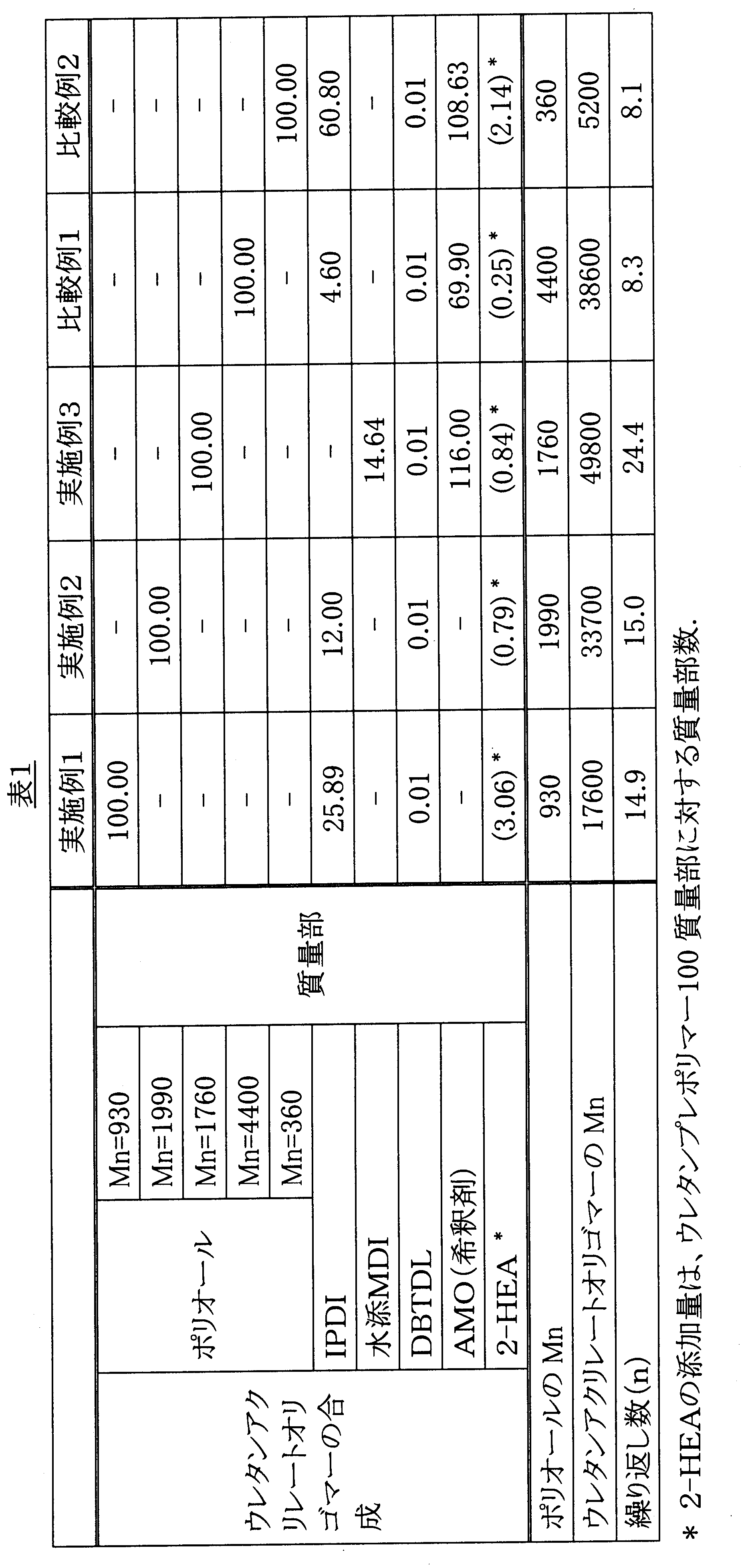

表1及び表2に示す結果から、ポリオールとポリイソシアネートとからなるウレタンプレポリマー部を含み、該ウレタンプレポリマー部の繰り返し数(n)が10~30のウレタン(メタ)アクリレートオリゴマー(A)と、(メタ)アクリロイル基を有する環式モノマーを含む実施例1~3の接着性樹脂組成物は、IZO等の金属酸化物、金等の金属、PET、ポリイミド等の樹脂に対する接着性に優れることが分かる。
一方、ポリオールとポリイソシアネートとからなるウレタンプレポリマー部を含むものの、該ウレタンプレポリマー部の繰り返し数(n)が10未満のウレタン(メタ)アクリレートオリゴマーを用いた比較例1~2の接着性樹脂組成物は、実施例1~3の接着性樹脂組成物に比べ、各被着体に対する接着性が劣っていた。
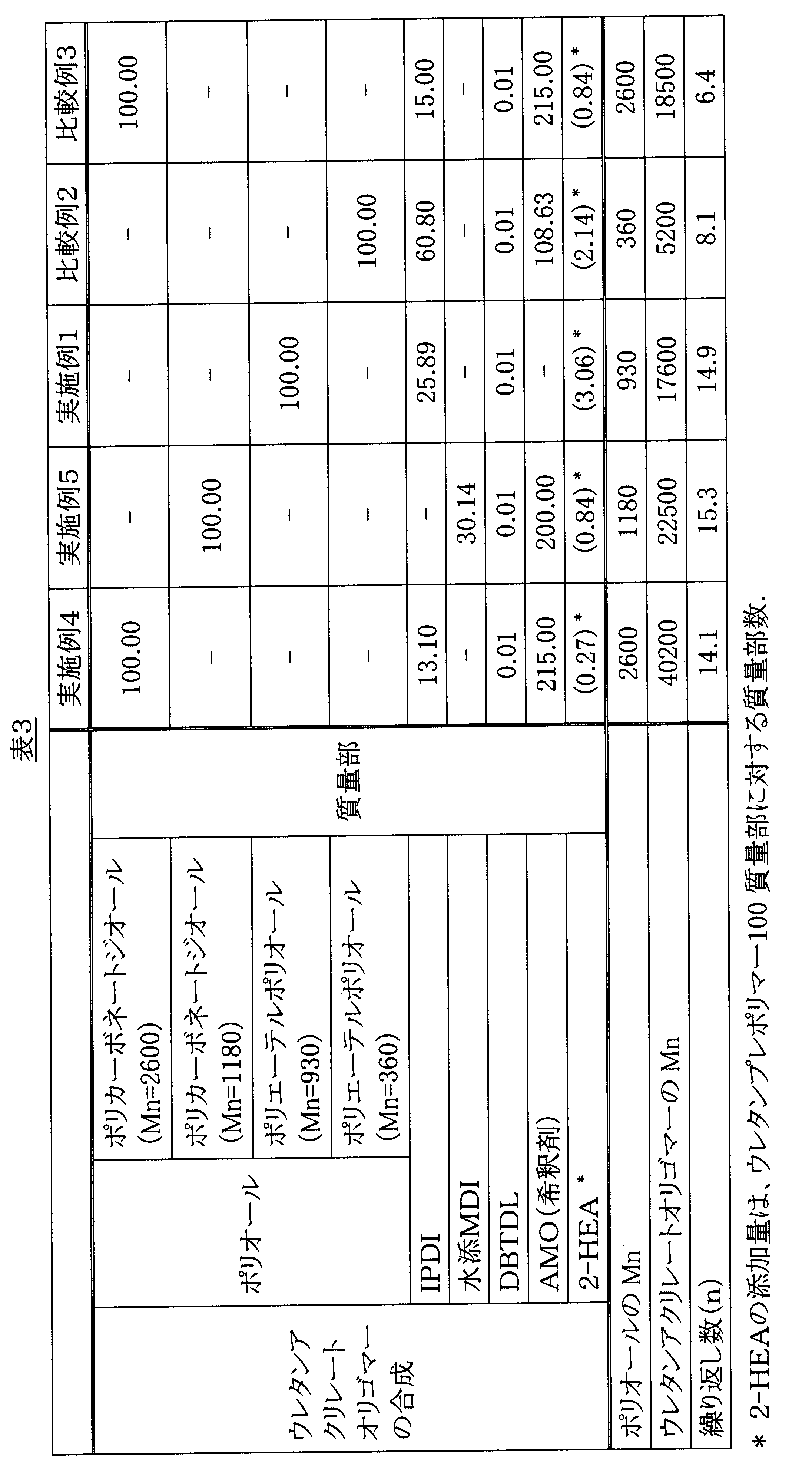
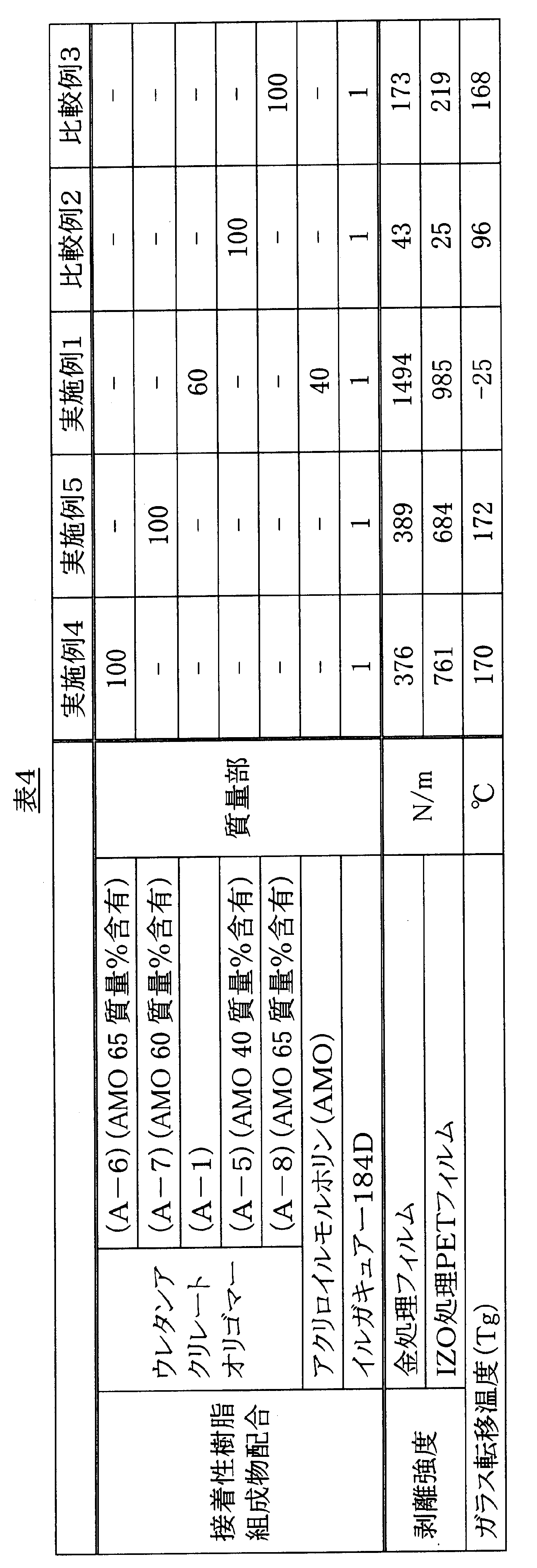
表3及び表4に示す結果から、ポリカーボネートジオールとポリイソシアネートとからなるウレタンプレポリマー部を含み、該ウレタンプレポリマー部の繰り返し数(n)が10~30のウレタン(メタ)アクリレートオリゴマー(A)と、(メタ)アクリロイル基を有する環式モノマーを含む実施例4~5の接着性樹脂組成物は、IZO等の金属酸化物、金等の金属に対する接着性に優れる上、硬化後のガラス転移温度が高いことが分かる。
一方、ポリエーテルポリオールとポリイソシアネートとからなるウレタンプレポリマー部を含み、該ウレタンプレポリマー部の繰り返し数(n)が10~30のウレタン(メタ)アクリレートオリゴマーを用いた実施例1の接着性樹脂組成物は、IZO等の金属酸化物、金等の金属に対する接着性に優れるものの、硬化後のガラス転移温度が低かった。
また、ポリエーテルポリオールとポリイソシアネートとからなるウレタンプレポリマー部を含み、該ウレタンプレポリマー部の繰り返し数(n)が10未満のウレタン(メタ)アクリレートオリゴマーを用いた比較例2の接着性樹脂組成物は、硬化後のガラス転移温度が高いものの、IZO等の金属酸化物、金等の金属に対する接着性が非常に低かった。
更に、ポリカーボネートジオールとポリイソシアネートとからなるウレタンプレポリマー部を含むものの、該ウレタンプレポリマー部の繰り返し数(n)が10未満のウレタン(メタ)アクリレートオリゴマーを用いた比較例3の接着性樹脂組成物は、硬化後のガラス転移温度が高いものの、IZO等の金属酸化物、金等の金属に対する接着性が低かった。
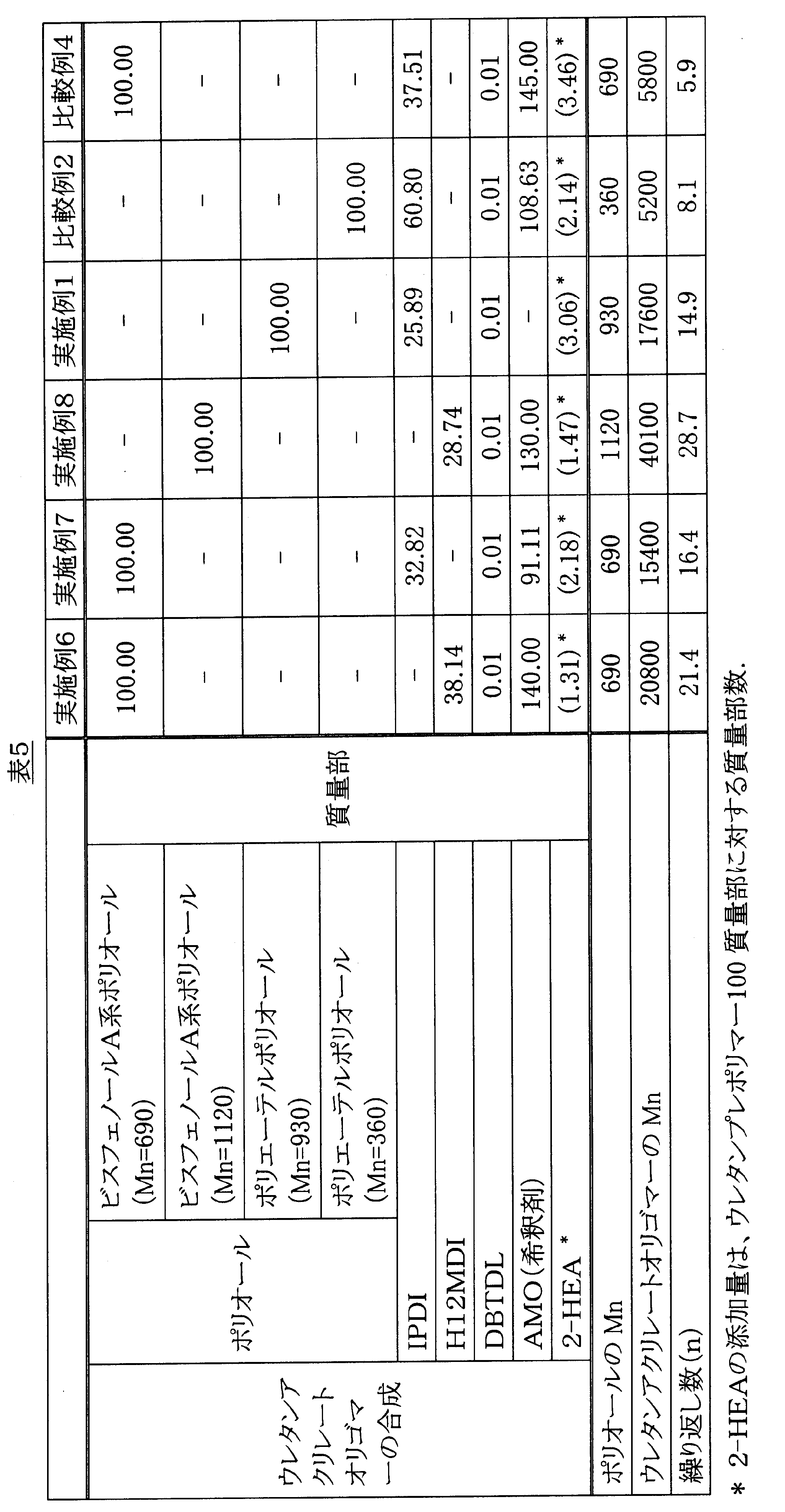

表5及び表6に示す結果から、ビスフェノールA系ポリオールとポリイソシアネートとからなるウレタンプレポリマー部を含み、該ウレタンプレポリマー部の繰り返し数(n)が10~30のウレタン(メタ)アクリレートオリゴマー(A)と、(メタ)アクリロイル基を有する環式モノマーを含む実施例6~8の接着性樹脂組成物は、IZO等の金属酸化物、金等の金属、ポリイミド、PET等の樹脂に対する接着性に優れる上、硬化後のガラス転移温度が高いことが分かる。
一方、ポリエーテルポリオールとポリイソシアネートとからなるウレタンプレポリマー部を含み、該ウレタンプレポリマー部の繰り返し数(n)が10~30のウレタン(メタ)アクリレートオリゴマーを用いた実施例1の接着性樹脂組成物は、IZO等の金属酸化物、金等の金属、ポリイミド、PET等の樹脂に対する接着性に優れるものの、硬化後のガラス転移温度が低かった。
また、ポリエーテルポリオール又はビスフェノールA系ポリオールとポリイソシアネートとからなるウレタンプレポリマー部を含み、該ウレタンプレポリマー部の繰り返し数(n)が10未満のウレタン(メタ)アクリレートオリゴマーを用いた比較例2及び4の接着性樹脂組成物は、硬化後のガラス転移温度が高いものの、IZO等の金属酸化物、金等の金属、ポリイミド、PET等の樹脂に対する接着性が非常に低かった。
Claims (13)
- 2官能のウレタン(メタ)アクリレートオリゴマー(A)とモノマー成分(B)とを含む光硬化性又は電子線硬化性の接着性樹脂組成物であって、
前記ウレタン(メタ)アクリレートオリゴマー(A)は、ポリオールとポリイソシアネートとからなるウレタンプレポリマー部を含み、該ウレタンプレポリマー部の繰り返し数(n)が10~30であって、
前記モノマー成分(B)が、(メタ)アクリロイル基を有する環式モノマーを含むことを特徴とする接着性樹脂組成物。 - 前記(メタ)アクリロイル基を有する環式モノマーがアクリロイルモルホリンであることを特徴とする請求項1に記載の接着性樹脂組成物。
- 前記ウレタン(メタ)アクリレートオリゴマー(A)と前記モノマー成分(B)との総配合量中の前記ウレタン(メタ)アクリレートオリゴマー(A)の割合が10~80質量%で且つ前記(メタ)アクリロイル基を有する環式モノマーの割合が20~90質量%であることを特徴とする請求項1に記載の接着性樹脂組成物。
- 前記ポリイソシアネートが、水添ジフェニルメタンジイソシアネート又はイソホロンジイソシアネートであることを特徴とする請求項1に記載の接着性樹脂組成物。
- 更に、光重合開始剤(C)を含むことを特徴とする請求項1に記載の接着性樹脂組成物。
- 前記ウレタン(メタ)アクリレートオリゴマー(A)のウレタンプレポリマー部の形成に用いるポリオールがポリエーテルポリオールであることを特徴とする請求項1に記載の接着性樹脂組成物。
- 前記ポリエーテルポリオールの数平均分子量が200~4000であることを特徴とする請求項6に記載の接着性樹脂組成物。
- 前記ウレタン(メタ)アクリレートオリゴマー(A)のウレタンプレポリマー部の形成に用いるポリオールがポリカーボネートジオールであることを特徴とする請求項1に記載の接着性樹脂組成物。
- 前記ポリカーボネートジオールの数平均分子量が500~4000であることを特徴とする請求項8に記載の接着性樹脂組成物。
- 請求項8又は9に記載の接着性樹脂組成物を光又は電子線照射により硬化させてなり、ガラス転移温度(Tg)が80℃以上で、金及びIZOに対する剥離強度が300 N/m以上であることを特徴とする接着性樹脂。
- 前記ウレタン(メタ)アクリレートオリゴマー(A)のウレタンプレポリマー部の形成に用いるポリオールがビスフェノールA系ポリオールであることを特徴とする請求項1に記載の接着性樹脂組成物。
- 前記ビスフェノールA系ポリオールの数平均分子量が300~3000であることを特徴とする請求項11に記載の接着性樹脂組成物。
- 請求項11又は12に記載の接着性樹脂組成物を光又は電子線照射により硬化させてなり、ガラス転移温度(Tg)が80℃以上で、IZOに対する剥離強度が300 N/m以上で、金に対する剥離強度が300 N/m以上で、ポリイミドに対する剥離強度が1000 N/m以上で、PETに対する剥離強度が1500 N/m以上であることを特徴とする接着性樹脂。
Priority Applications (3)
| Application Number | Priority Date | Filing Date | Title |
|---|---|---|---|
| EP08866543.5A EP2226342B1 (en) | 2007-12-27 | 2008-12-09 | Adhesive resin composition |
| US12/810,996 US8859634B2 (en) | 2007-12-27 | 2008-12-09 | Adherent resin composition |
| CN200880126693.1A CN101952334B (zh) | 2007-12-27 | 2008-12-09 | 粘合性树脂组合物 |
Applications Claiming Priority (8)
| Application Number | Priority Date | Filing Date | Title |
|---|---|---|---|
| JP2007-337291 | 2007-12-27 | ||
| JP2007-337285 | 2007-12-27 | ||
| JP2007337285 | 2007-12-27 | ||
| JP2007337291A JP5410017B2 (ja) | 2007-12-27 | 2007-12-27 | 接着剤用樹脂組成物 |
| JP2008211853A JP5410051B2 (ja) | 2008-08-20 | 2008-08-20 | 接着剤用樹脂組成物 |
| JP2008-211853 | 2008-08-20 | ||
| JP2008-244771 | 2008-09-24 | ||
| JP2008244771A JP5410058B2 (ja) | 2007-12-27 | 2008-09-24 | 接着剤用樹脂組成物 |
Publications (1)
| Publication Number | Publication Date |
|---|---|
| WO2009084386A1 true WO2009084386A1 (ja) | 2009-07-09 |
Family
ID=42537410
Family Applications (1)
| Application Number | Title | Priority Date | Filing Date |
|---|---|---|---|
| PCT/JP2008/072332 Ceased WO2009084386A1 (ja) | 2007-12-27 | 2008-12-09 | 接着性樹脂組成物 |
Country Status (4)
| Country | Link |
|---|---|
| US (1) | US8859634B2 (ja) |
| EP (1) | EP2226342B1 (ja) |
| CN (1) | CN101952334B (ja) |
| WO (1) | WO2009084386A1 (ja) |
Cited By (2)
| Publication number | Priority date | Publication date | Assignee | Title |
|---|---|---|---|---|
| WO2010122768A1 (ja) * | 2009-04-20 | 2010-10-28 | 株式会社ブリヂストン | チオール基含有接着性樹脂組成物 |
| WO2022062311A1 (zh) * | 2020-09-25 | 2022-03-31 | 中广核达胜加速器技术有限公司 | 一种胶黏剂、制备方法及阻燃玻璃纤维带的固化方法 |
Families Citing this family (12)
| Publication number | Priority date | Publication date | Assignee | Title |
|---|---|---|---|---|
| CN101921564B (zh) * | 2010-09-29 | 2012-04-04 | 泰州五行消防水带有限公司 | 一种芳纶纤维编织层专用粘合剂及其制备方法 |
| JP5834606B2 (ja) * | 2011-08-05 | 2015-12-24 | Dic株式会社 | 紫外線硬化型粘着剤用樹脂組成物、粘着剤及び積層体 |
| CN104629613A (zh) * | 2011-10-21 | 2015-05-20 | 日本化药株式会社 | 光学构件的制造方法及用于该制造方法的紫外线固化型树脂组合物的应用 |
| KR101562088B1 (ko) | 2012-06-26 | 2015-10-20 | 제일모직주식회사 | 점착 필름, 이를 위한 점착제 조성물 및 이를 포함하는 광학 부재 |
| US10849231B2 (en) * | 2013-03-29 | 2020-11-24 | Toppan Forms Co., Ltd. | Laminate and circuit board |
| WO2015098307A1 (ja) * | 2013-12-25 | 2015-07-02 | Dic株式会社 | 紫外線硬化型粘着剤組成物、粘着フィルム、及び、粘着フィルムの製造方法 |
| BR112018068286B1 (pt) | 2016-03-10 | 2022-11-01 | Momentive Performance Materials Inc | Resina sililada curável por umidade, bem como composições e substrato cerâmico, polimérico ou metálico compreendendo a mesma |
| WO2019084243A1 (en) | 2017-10-25 | 2019-05-02 | Sun Chemical Corporation | ACTINICALLY CURABLE ADHESIVE COMPOSITION HAVING IMPROVED PROPERTIES |
| CN108611039A (zh) * | 2018-05-17 | 2018-10-02 | 苏州中来光伏新材股份有限公司 | 一种电子束固化胶黏剂及其制备方法和涂覆方法 |
| EP3752123A1 (en) * | 2018-06-29 | 2020-12-23 | 3M Innovative Properties Company | Photopolymerizable compositions including a polyurethane methacrylate polymer prepared using a polycarbonate diol, articles, and methods |
| WO2021145102A1 (ja) * | 2020-01-14 | 2021-07-22 | 住友電気工業株式会社 | 樹脂組成物、光ファイバ及び光ファイバの製造方法 |
| CN115181539B (zh) * | 2022-09-08 | 2022-12-20 | 拓迪化学(上海)有限公司 | 一种用于电池的uv光固化型胶水及其应用 |
Citations (10)
| Publication number | Priority date | Publication date | Assignee | Title |
|---|---|---|---|---|
| JPH07310067A (ja) * | 1994-05-17 | 1995-11-28 | Japan Synthetic Rubber Co Ltd | 液状硬化性粘・接着剤組成物 |
| JPH08143635A (ja) * | 1994-11-16 | 1996-06-04 | Arakawa Chem Ind Co Ltd | 活性エネルギー線硬化性樹脂組成物 |
| JPH1036809A (ja) * | 1996-07-22 | 1998-02-10 | Toyo Mooton Kk | 電離放射線硬化型接着剤組成物 |
| JPH10239840A (ja) * | 1997-03-03 | 1998-09-11 | Asahi Chem Ind Co Ltd | サンドブラスト用感光性樹脂組成物及びその用途 |
| JP2002062645A (ja) * | 2000-08-15 | 2002-02-28 | Asahi Kasei Corp | サンドブラスト用感光性樹脂積層体 |
| JP2002214779A (ja) * | 2001-01-19 | 2002-07-31 | Asahi Kasei Corp | サンドブラスト用感光性樹脂積層体 |
| JP2004115757A (ja) | 2002-09-30 | 2004-04-15 | Jsr Corp | 液状硬化性樹脂組成物 |
| JP2005255844A (ja) * | 2004-03-11 | 2005-09-22 | Jsr Corp | 放射性硬化性組成物 |
| JP2007237698A (ja) * | 2006-03-11 | 2007-09-20 | Sekisui Chem Co Ltd | 内照式看板用フィルム |
| JP2008184538A (ja) * | 2007-01-30 | 2008-08-14 | Bridgestone Corp | 紫外線硬化樹脂組成物 |
Family Cites Families (10)
| Publication number | Priority date | Publication date | Assignee | Title |
|---|---|---|---|---|
| JP3292348B2 (ja) * | 1994-10-11 | 2002-06-17 | ジェイエスアール株式会社 | 液状硬化性樹脂組成物 |
| JP2001200024A (ja) * | 2000-01-14 | 2001-07-24 | Hitachi Kasei Polymer Co Ltd | 光硬化性樹脂組成物 |
| US6562881B2 (en) * | 2001-05-30 | 2003-05-13 | Henkel Loctite Corporation | Liquified polyols, urethane acrylate resins prepared therewith and curable compositions employing such resins |
| US7105583B2 (en) | 2001-12-20 | 2006-09-12 | Ppg Industries Ohio, Inc. | Radiation-curable compositions for optical fiber coating materials |
| US7495034B2 (en) * | 2002-02-22 | 2009-02-24 | Henkel Corporation | Deformable soft molding compositions |
| JP2004210617A (ja) * | 2003-01-08 | 2004-07-29 | Kansai Paint Co Ltd | 光硬化型ガラス用補修剤及び接着剤 |
| JP4490798B2 (ja) * | 2004-08-30 | 2010-06-30 | Jsr株式会社 | 光ファイバアップジャケット用液状硬化性樹脂組成物 |
| JP2006184538A (ja) | 2004-12-27 | 2006-07-13 | Fuji Photo Film Co Ltd | 冷却装置、露光描画装置、及び冷媒供給方法 |
| JP5431679B2 (ja) * | 2007-03-27 | 2014-03-05 | 大日本印刷株式会社 | シート状光学部材、光学シート用樹脂組成物、光学シート及びその製造方法 |
| KR101018357B1 (ko) * | 2008-07-16 | 2011-03-04 | 에스에스씨피 주식회사 | 우수한 고온 내수성을 갖는 광경화형 코팅 조성물 |
-
2008
- 2008-12-09 WO PCT/JP2008/072332 patent/WO2009084386A1/ja not_active Ceased
- 2008-12-09 CN CN200880126693.1A patent/CN101952334B/zh not_active Expired - Fee Related
- 2008-12-09 US US12/810,996 patent/US8859634B2/en not_active Expired - Fee Related
- 2008-12-09 EP EP08866543.5A patent/EP2226342B1/en not_active Not-in-force
Patent Citations (10)
| Publication number | Priority date | Publication date | Assignee | Title |
|---|---|---|---|---|
| JPH07310067A (ja) * | 1994-05-17 | 1995-11-28 | Japan Synthetic Rubber Co Ltd | 液状硬化性粘・接着剤組成物 |
| JPH08143635A (ja) * | 1994-11-16 | 1996-06-04 | Arakawa Chem Ind Co Ltd | 活性エネルギー線硬化性樹脂組成物 |
| JPH1036809A (ja) * | 1996-07-22 | 1998-02-10 | Toyo Mooton Kk | 電離放射線硬化型接着剤組成物 |
| JPH10239840A (ja) * | 1997-03-03 | 1998-09-11 | Asahi Chem Ind Co Ltd | サンドブラスト用感光性樹脂組成物及びその用途 |
| JP2002062645A (ja) * | 2000-08-15 | 2002-02-28 | Asahi Kasei Corp | サンドブラスト用感光性樹脂積層体 |
| JP2002214779A (ja) * | 2001-01-19 | 2002-07-31 | Asahi Kasei Corp | サンドブラスト用感光性樹脂積層体 |
| JP2004115757A (ja) | 2002-09-30 | 2004-04-15 | Jsr Corp | 液状硬化性樹脂組成物 |
| JP2005255844A (ja) * | 2004-03-11 | 2005-09-22 | Jsr Corp | 放射性硬化性組成物 |
| JP2007237698A (ja) * | 2006-03-11 | 2007-09-20 | Sekisui Chem Co Ltd | 内照式看板用フィルム |
| JP2008184538A (ja) * | 2007-01-30 | 2008-08-14 | Bridgestone Corp | 紫外線硬化樹脂組成物 |
Non-Patent Citations (1)
| Title |
|---|
| See also references of EP2226342A4 * |
Cited By (3)
| Publication number | Priority date | Publication date | Assignee | Title |
|---|---|---|---|---|
| WO2010122768A1 (ja) * | 2009-04-20 | 2010-10-28 | 株式会社ブリヂストン | チオール基含有接着性樹脂組成物 |
| JP2010248455A (ja) * | 2009-04-20 | 2010-11-04 | Bridgestone Corp | チオール基含有接着性樹脂組成物 |
| WO2022062311A1 (zh) * | 2020-09-25 | 2022-03-31 | 中广核达胜加速器技术有限公司 | 一种胶黏剂、制备方法及阻燃玻璃纤维带的固化方法 |
Also Published As
| Publication number | Publication date |
|---|---|
| EP2226342B1 (en) | 2016-03-09 |
| EP2226342A4 (en) | 2011-04-13 |
| CN101952334A (zh) | 2011-01-19 |
| EP2226342A1 (en) | 2010-09-08 |
| US20100286301A1 (en) | 2010-11-11 |
| US8859634B2 (en) | 2014-10-14 |
| CN101952334B (zh) | 2012-11-21 |
Similar Documents
| Publication | Publication Date | Title |
|---|---|---|
| JP5410058B2 (ja) | 接着剤用樹脂組成物 | |
| CN101952334B (zh) | 粘合性树脂组合物 | |
| KR101770649B1 (ko) | 우레탄 올리고머 및 그것을 함유하는 활성 에너지선 경화성 수지 조성물 | |
| JP7255604B2 (ja) | 粘着剤組成物、粘着剤層、積層体及び画像表示装置 | |
| CN110872483B (zh) | 活性能量线固化型粘合剂组合物、固化物及粘合片 | |
| KR20120040225A (ko) | 광경화성 수지 조성물과 그 경화물, 수지 시트와 그 제조법, 및 표시 장치 | |
| JPWO2019221126A1 (ja) | 光硬化性樹脂組成物及びそれを用いた粘接着剤 | |
| JP5425632B2 (ja) | 金属酸化物用接着剤組成物 | |
| JP5098722B2 (ja) | 硬化性樹脂組成物、貼付用フィルム積層体、及び衝撃吸収用積層体 | |
| JP5410017B2 (ja) | 接着剤用樹脂組成物 | |
| CN108602336A (zh) | 层叠体、显影构件和层叠体的制造方法 | |
| JP2014080585A (ja) | 活性エネルギー線硬化型樹脂組成物、及びそれを用いてなるコーティング剤組成物、並びに硬化塗膜 | |
| JP2019173001A (ja) | 硬化性接着剤組成物、及びそれを用いた接着シート、その接着シートを含む積層体及びその製造方法 | |
| CN1997718A (zh) | 辐射固化性组合物 | |
| JP7513029B2 (ja) | 粘着シート | |
| JP5410051B2 (ja) | 接着剤用樹脂組成物 | |
| KR20150112818A (ko) | 활성 에너지선 경화형 수지 조성물, 경화물, 접착제 및 적층 필름 | |
| JP2012102226A (ja) | 接着性樹脂組成物 | |
| JP2012102224A (ja) | 接着性樹脂組成物 | |
| WO2024130663A1 (en) | Dually curable adhesive composition | |
| WO2012077329A1 (ja) | 接着剤組成物 | |
| KR20240028493A (ko) | 폴리이소시아네이트 조성물, 경화막, 점착성 수지 조성물, 점착성 수지 시트 및 적층 필름 | |
| JP7355033B2 (ja) | ウレタン(メタ)アクリレート樹脂、硬化性樹脂組成物、及び硬化物 | |
| JP7355032B2 (ja) | ウレタン(メタ)アクリレート樹脂、硬化性樹脂組成物、及び硬化物 | |
| JP2026021254A (ja) | 活性エネルギー線硬化型接着剤、および積層体 |
Legal Events
| Date | Code | Title | Description |
|---|---|---|---|
| WWE | Wipo information: entry into national phase |
Ref document number: 200880126693.1 Country of ref document: CN |
|
| 121 | Ep: the epo has been informed by wipo that ep was designated in this application |
Ref document number: 08866543 Country of ref document: EP Kind code of ref document: A1 |
|
| WWE | Wipo information: entry into national phase |
Ref document number: 12810996 Country of ref document: US |
|
| NENP | Non-entry into the national phase |
Ref country code: DE |
|
| WWE | Wipo information: entry into national phase |
Ref document number: 2008866543 Country of ref document: EP |