WO2009098732A1 - 自動車用アルミニウム合金板及びその製造方法 - Google Patents
自動車用アルミニウム合金板及びその製造方法 Download PDFInfo
- Publication number
- WO2009098732A1 WO2009098732A1 PCT/JP2008/000161 JP2008000161W WO2009098732A1 WO 2009098732 A1 WO2009098732 A1 WO 2009098732A1 JP 2008000161 W JP2008000161 W JP 2008000161W WO 2009098732 A1 WO2009098732 A1 WO 2009098732A1
- Authority
- WO
- WIPO (PCT)
- Prior art keywords
- mass
- aluminum alloy
- thickness
- property
- less
- Prior art date
- Legal status (The legal status is an assumption and is not a legal conclusion. Google has not performed a legal analysis and makes no representation as to the accuracy of the status listed.)
- Ceased
Links
Classifications
-
- C—CHEMISTRY; METALLURGY
- C22—METALLURGY; FERROUS OR NON-FERROUS ALLOYS; TREATMENT OF ALLOYS OR NON-FERROUS METALS
- C22F—CHANGING THE PHYSICAL STRUCTURE OF NON-FERROUS METALS AND NON-FERROUS ALLOYS
- C22F1/00—Changing the physical structure of non-ferrous metals or alloys by heat treatment or by hot or cold working
- C22F1/04—Changing the physical structure of non-ferrous metals or alloys by heat treatment or by hot or cold working of aluminium or alloys based thereon
- C22F1/047—Changing the physical structure of non-ferrous metals or alloys by heat treatment or by hot or cold working of aluminium or alloys based thereon of alloys with magnesium as the next major constituent
-
- B—PERFORMING OPERATIONS; TRANSPORTING
- B22—CASTING; POWDER METALLURGY
- B22D—CASTING OF METALS; CASTING OF OTHER SUBSTANCES BY THE SAME PROCESSES OR DEVICES
- B22D11/00—Continuous casting of metals, i.e. casting in indefinite lengths
- B22D11/06—Continuous casting of metals, i.e. casting in indefinite lengths into moulds with travelling walls, e.g. with rolls, plates, belts, caterpillars
- B22D11/0605—Continuous casting of metals, i.e. casting in indefinite lengths into moulds with travelling walls, e.g. with rolls, plates, belts, caterpillars formed by two belts, e.g. Hazelett-process
-
- B—PERFORMING OPERATIONS; TRANSPORTING
- B22—CASTING; POWDER METALLURGY
- B22D—CASTING OF METALS; CASTING OF OTHER SUBSTANCES BY THE SAME PROCESSES OR DEVICES
- B22D11/00—Continuous casting of metals, i.e. casting in indefinite lengths
- B22D11/12—Accessories for subsequent treating or working cast stock in situ
- B22D11/124—Accessories for subsequent treating or working cast stock in situ for cooling
-
- C—CHEMISTRY; METALLURGY
- C22—METALLURGY; FERROUS OR NON-FERROUS ALLOYS; TREATMENT OF ALLOYS OR NON-FERROUS METALS
- C22C—ALLOYS
- C22C21/00—Alloys based on aluminium
- C22C21/06—Alloys based on aluminium with magnesium as the next major constituent
-
- C—CHEMISTRY; METALLURGY
- C22—METALLURGY; FERROUS OR NON-FERROUS ALLOYS; TREATMENT OF ALLOYS OR NON-FERROUS METALS
- C22C—ALLOYS
- C22C21/00—Alloys based on aluminium
- C22C21/06—Alloys based on aluminium with magnesium as the next major constituent
- C22C21/08—Alloys based on aluminium with magnesium as the next major constituent with silicon
-
- C—CHEMISTRY; METALLURGY
- C22—METALLURGY; FERROUS OR NON-FERROUS ALLOYS; TREATMENT OF ALLOYS OR NON-FERROUS METALS
- C22F—CHANGING THE PHYSICAL STRUCTURE OF NON-FERROUS METALS AND NON-FERROUS ALLOYS
- C22F1/00—Changing the physical structure of non-ferrous metals or alloys by heat treatment or by hot or cold working
- C22F1/04—Changing the physical structure of non-ferrous metals or alloys by heat treatment or by hot or cold working of aluminium or alloys based thereon
-
- B—PERFORMING OPERATIONS; TRANSPORTING
- B21—MECHANICAL METAL-WORKING WITHOUT ESSENTIALLY REMOVING MATERIAL; PUNCHING METAL
- B21B—ROLLING OF METAL
- B21B1/00—Metal-rolling methods or mills for making semi-finished products of solid or profiled cross-section; Sequence of operations in milling trains; Layout of rolling-mill plant, e.g. grouping of stands; Succession of passes or of sectional pass alternations
- B21B1/22—Metal-rolling methods or mills for making semi-finished products of solid or profiled cross-section; Sequence of operations in milling trains; Layout of rolling-mill plant, e.g. grouping of stands; Succession of passes or of sectional pass alternations for rolling plates, strips, bands or sheets of indefinite length
-
- B—PERFORMING OPERATIONS; TRANSPORTING
- B21—MECHANICAL METAL-WORKING WITHOUT ESSENTIALLY REMOVING MATERIAL; PUNCHING METAL
- B21B—ROLLING OF METAL
- B21B3/00—Rolling materials of special alloys so far as the composition of the alloy requires or permits special rolling methods or sequences ; Rolling of aluminium, copper, zinc or other non-ferrous metals
- B21B2003/001—Aluminium or its alloys
-
- B—PERFORMING OPERATIONS; TRANSPORTING
- B21—MECHANICAL METAL-WORKING WITHOUT ESSENTIALLY REMOVING MATERIAL; PUNCHING METAL
- B21B—ROLLING OF METAL
- B21B27/00—Rolls, roll alloys or roll fabrication; Lubricating, cooling or heating rolls while in use
- B21B27/005—Rolls with a roughened or textured surface; Methods for making same
-
- B—PERFORMING OPERATIONS; TRANSPORTING
- B21—MECHANICAL METAL-WORKING WITHOUT ESSENTIALLY REMOVING MATERIAL; PUNCHING METAL
- B21B—ROLLING OF METAL
- B21B3/00—Rolling materials of special alloys so far as the composition of the alloy requires or permits special rolling methods or sequences ; Rolling of aluminium, copper, zinc or other non-ferrous metals
Definitions
- the present invention relates to an aluminum alloy plate for automobiles and a method for producing the same, and more particularly to an aluminum alloy plate suitable for forming automobile body sheets and the like and a method for producing the same.
- a method has been proposed in which a thin slab is continuously cast by a belt type casting machine, which is directly wound around a coil, subjected to cold rolling and final annealing, and finished to a predetermined thickness.
- Mg 3.3 to 3.5 wt%
- Mn 0.1 to 0.2 wt%
- Fe 0.3 wt% or less
- Si 0.15 wt% or less
- any one or two Including the above the molten metal composed of the remaining ordinary impurities and Al is prepared.
- this molten metal is cast into a roll by casting a thin slab having a thickness of 5 to 10 mm at a speed of 5 to 15 m / min so that the cooling speed at a quarter thickness is 40 to 90 ° C./sec. Wind up.
- the thin slab wound around this roll is cold-rolled with a roll having a roll surface roughness Ra of 0.2 to 0.7 ⁇ m and annealed to provide excellent press formability and stress corrosion cracking resistance.
- Patent Document 2 A method for manufacturing an aluminum alloy sheet for automobiles is disclosed (Patent Document 2).
- the chemical composition of the molten metal contains 0.1 to 0.2 wt% of Mn, and the solidification cooling rate is relatively fast. Therefore, Al— (Fe ⁇ Mn ) -Si and other intermetallic compounds are small in size and excellent in moldability, but the amount of solid solution of Mn in the matrix becomes too high, resulting in a problem that the yield strength is high and the springback after molding becomes large. is there.
- an aluminum alloy continuous cast and rolled sheet containing Mg: 3 to 6% is annealed, and then subjected to distortion correction and performed at a predetermined temperature of 240 to 340 ° C. for 1 hour or more.
- a so-called stabilization process of slow cooling is also proposed (Patent Document 3).
- the present invention includes Mg: 3.0 to 3.5 mass%, Fe: 0.05 to 0.3 mass%, Si: 0.05 to 0.15 mass%, and Mn :
- the thickness is controlled to be less than 0.1 mass%, and the remainder is substantially inevitable impurities and Al.
- the thickness is 5 so that the cooling rate at 1/4 thickness is 20 to 200 ° C./sec.
- the final annealing may be performed at a holding temperature of 300 to 400 ° C. using a batch annealing furnace.
- an Al—Mg alloy plate having excellent formability and shape freezing property can be produced without subjecting a continuous cast and rolled plate to a stabilization treatment.
- % representing the chemical composition means “% by mass” unless otherwise specified.
- Mg is an element that increases the strength by solid solution strengthening, and if it is less than 3.0%, this effect cannot be exhibited, and the tensile strength decreases. When the Mg content exceeds 3.5%, the yield strength becomes too high and the shape freezing property is lowered.
- Fe 0.05 to 0.3%
- the fine particles of the intermetallic compound pin the grain boundaries of the generated recrystallized grains, suppress the growth due to the coalescence of the crystal grains, and stably maintain the fine recrystallized grains. In order to exhibit this effect, the Fe content needs to be 0.05% or more.
- the Fe content is limited to 0.05 to 0.3%.
- a preferred range is 0.05 to 0.25%.
- Si crystallizes as fine particles of an intermetallic compound such as Al—Fe—Si during casting and functions as a nucleation site for recrystallization during annealing after cold rolling. Therefore, the larger the number of particles of these intermetallic compounds, the more recrystallized nuclei that are generated. As a result, a large number of fine recrystallized grains are formed. In addition, the fine particles of the intermetallic compound pin the grain boundaries of the generated recrystallized grains, suppress the growth due to the coalescence of the crystal grains, and stably maintain the fine recrystallized grains. In order to exhibit this effect, the Si content needs to be 0.05% or more.
- the Si content is limited to 0.05 to 0.15%.
- a preferred range is 0.05 to 0.1%.
- the upper limit is preferably limited to less than 0.08%, more preferably less than 0.06%.
- Ti of optional component 0.001 to 0.1%
- the Ti content needs to be 0.001% or more.
- coarse intermetallic compounds such as TiAl 3 are generated, voids are formed during molding, and moldability is lowered.
- a more preferable range of the Ti content is 0.001 to 0.05%.
- Ti may be added as a master alloy such as Al-10% Ti, or as a grain refiner (rod hardener) such as Al-5% Ti-1% B and Al-10% Ti-1% B. It may be added.
- B as an optional component: 0.0005 to 0.01%
- B it is preferable to contain B in the range of 0.0005 to 0.01% in order to refine the crystal grains of the cast ingot.
- the effect of B is to co-exist with Ti and to generate nuclei (TiBx) that are the starting points of ⁇ Al crystal grain generation in the molten metal.
- a more preferable range of the B content is 0.0005 to 0.005%.
- B may be added as a master alloy such as Al-5% B, or as a grain refiner (rod hardener) such as Al-5% Ti-1% B, Al-10% Ti-1% B. It may be added.
- the method for producing an aluminum alloy sheet according to the present invention is not limited to the method described below, but there are casting conditions and final annealing conditions. The significance and reasons for the limitation will be described below.
- the thickness of the cast slab is preferably 5 to 15 mm.
- the thickness of the thin slab is less than 5 mm, the amount of aluminum passing through the casting machine per unit time becomes too small and casting becomes difficult. Conversely, if the thickness exceeds 15 mm, winding with a roll becomes impossible, so the slab thickness range is limited to 5 to 15 mm. With this thickness, the solidification cooling rate at a quarter thickness during slab casting is 20 to 200 ° C./sec, and the maximum equivalent circle diameter of the intermetallic compound can be controlled to 5 ⁇ m or less.
- the roughness of the cold rolling roll surface is preferably Ra 0.3 to 0.7 ⁇ m.
- the surface roughness of the final annealed plate is Ra 0.3 to 0.6 ⁇ m.
- the roughness of the surface of the cold rolling roll is more preferably Ra 0.4 to 0.7 ⁇ m.
- the surface roughness of the final annealed plate is Ra 0.4 to 0.6 ⁇ m.
- the maximum equivalent circle diameter of intermetallic compounds is 5 ⁇ m or less
- region of thickness 1/4 of the aluminum alloy plate by this invention it is limited to 5 micrometers or less of the maximum diameter of a circle equivalent diameter.
- the dispersion of very fine intermetallic compounds in the matrix suppresses the movement of dislocations during the formation of aluminum plates, increases the tensile strength by solid solution strengthening with Mg, and excels in formability. It becomes a plate.
- the rolling reduction during cold rolling is preferably 50% to 98%, and dislocations generated by plastic working by rolling are accumulated around these fine crystallization products, so that the fine re- Necessary for obtaining a crystal structure.
- the rolling reduction during cold rolling is less than 50%, the accumulation of dislocations is not sufficient and a fine recrystallized structure cannot be obtained. If the rolling reduction during cold rolling exceeds 98%, the ear cracks during rolling become remarkable and the yield decreases.
- a more preferable cold rolling rate is in the range of 55% to 96%.
- the holding time for continuous annealing is preferably within 5 minutes.
- the holding time of continuous annealing exceeds 5 min, the growth of recrystallized grains becomes remarkable, the average recrystallized grain size exceeds 15 ⁇ m, and the formability and the rough skin property deteriorate.
- the heating rate and cooling rate during the continuous annealing treatment are preferably 100 ° C./min or higher for the heating rate.
- the rate of temperature increase during the continuous annealing treatment is less than 100 ° C./min, a fine recrystallized structure cannot be obtained, and the formability and the rough skin property are lowered.
- the temperature of the final annealing in the batch furnace is limited to 300 to 400 ° C.
- the temperature is lower than 300 ° C., the energy required for recrystallization is insufficient, so that a fine recrystallized structure cannot be obtained.
- the holding temperature exceeds 400 ° C., the growth of recrystallization becomes remarkable, the average grain size of the recrystallized grains exceeds 15 ⁇ m, and the moldability and the rough skin property deteriorate.
- the holding time for the final annealing in the batch furnace is not particularly limited, but is preferably 1 to 8 hours. If it is less than 1 hour, the coil may not be heated uniformly. When holding time exceeds 8 hours, the average particle diameter of a recrystallized grain will exceed 15 micrometers, and a moldability and skin roughening property will fall.
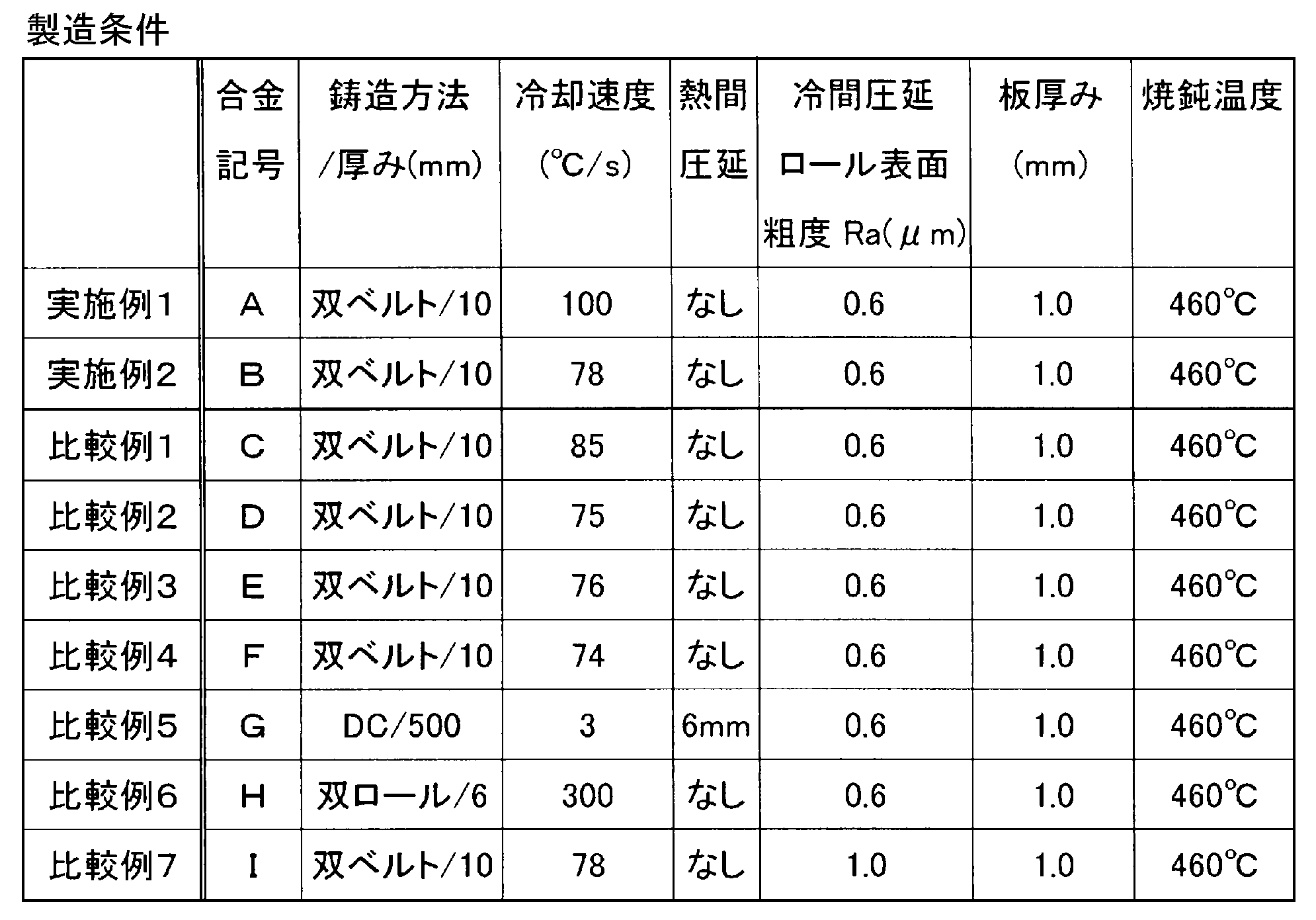
- these thin slabs and hot-rolled plates are cold-rolled with a cold-rolling roll finished to a predetermined surface roughness (Ra 0.6 ⁇ m, 1.0 ⁇ m) to form a plate having a thickness of 1 mm.
- the plate was passed through CAL and continuously annealed at a holding temperature of 460 ° C. Further, in order to remove the thermal strain of the final annealed plate, the strain was corrected through a leveler, and then cut to obtain a test material.
- Table 2 has shown the manufacturing conditions of the test material in each manufacturing process about an Example and a comparative example.
- the recrystallized grain size (D) of the test material was measured by a cross cut method.
- the test material was cut out, embedded and polished in a resin, anodized in an aqueous borofluoric acid solution, and an anodized film was applied to the surface of the cross section of the test material.
- the average value (D) of the particle diameters obtained by dividing the total length (L) by (n-1) was taken as the average recrystallized particle diameter of the test material.
- the surface roughness of the test material is measured according to JISB0601 using a surface roughness meter, the measurement direction is the direction perpendicular to the rolling direction, the measurement area is 4 mm, and the cutoff is 0.8 mm.
- the average roughness Ra was set.
- the roll surface roughness was measured in accordance with JISB0601, using a surface roughness meter, similarly to the surface roughness of the test material, the measurement direction was the roll lateral direction, the measurement area was 4 mm, and the cut-off was 0.00.
- the average roughness Ra was set to 8 mm.
- the overhang height indicates the limit molding height at break using the following molds.
- the skin roughness was evaluated in three stages (O: excellent, ⁇ : slightly inferior, x: inferior) by visually observing the surface state in the vicinity of the fractured portion of the test piece after the tensile test.
- Table 3 shows the results of Examples and Comparative Examples measured as described above.
- the yield strength is 145 MPa or less
- the shape freezing property is excellent
- fine recrystallized grains are used. It has excellent skin roughness, has a fine intermetallic compound, and the surface shows an appropriate surface roughness of 0.35, 0.41 ⁇ m, so the overhang height is 29 mm or more and excellent in moldability. Yes.
- Comparative Example 1 has a high Mg content of 3.75%, the 0.2% proof stress is too high and the shape freezing property is reduced. Since Comparative Example 2 has a low Mg content of 2.5%, both the tensile strength and the elongation are insufficient.
- Comparative Example 3 has an appropriate Mg content, but since the Mn content is as high as 0.2%, the 0.2% proof stress is too high and the shape freezing property is reduced.
- Comparative Example 4 has a high Mg content of 4.0% and a Mn content of 0.3%, so the 0.2% yield strength is too high and the shape freezing property is low.
Landscapes
- Chemical & Material Sciences (AREA)
- Engineering & Computer Science (AREA)
- Mechanical Engineering (AREA)
- Materials Engineering (AREA)
- Metallurgy (AREA)
- Organic Chemistry (AREA)
- Physics & Mathematics (AREA)
- Thermal Sciences (AREA)
- Crystallography & Structural Chemistry (AREA)
- Metal Rolling (AREA)
- Continuous Casting (AREA)
Abstract
Description
Mgは固溶強化によって強度を高める元素であり、3.0%未満であるとこの効果を発現することができず、引張り強度が低下する。Mg含有量が3.5%を超えると耐力が高くなりすぎて形状凍結性が低下する。
Feは鋳造時にAl-Fe-Si系などの金属間化合物の微細粒子として晶出し、冷間圧延後の焼鈍の際に再結晶の核生成サイトとして機能する。したがって、これら金属間化合物の粒子個数が多いほど生成する再結晶核が多くなり、その結果、多数の微細な再結晶粒が形成される。また、金属間化合物の微細粒子は、生成した再結晶粒の粒界をピン止めして結晶粒の合体による成長を抑制し、微細な再結晶粒を安定に維持する。この効果を発現するにはFe含有量を0.05%以上とする必要がある。ただし、Fe含有量が0.3%を超えると晶出する金属間化合物が粗大化する傾向が強くなり、成形時にこの金属間化合物を起点としてボイドを形成し成形性が劣る。したがって、Fe含有量は0.05~0.3%に限定する。好ましい範囲は0.05~0.25%である。
Siは鋳造時にAl-Fe-Si系などの金属間化合物の微細粒子として晶出し、冷間圧延後の焼鈍の際に再結晶の核生成サイトとして機能する。したがって、これら金属間化合物の粒子個数が多いほど生成する再結晶核が多くなり、その結果、多数の微細な再結晶粒が形成される。また、金属間化合物の微細粒子は、生成した再結晶粒の粒界をピン止めして結晶粒の合体による成長を抑制し、微細な再結晶粒を安定に維持する。この効果を発現するにはSi含有量を0.05%以上とする必要がある。ただし、Si含有量が0.15%を超えると晶出する金属間化合物が粗大化する傾向が強くなり、成形時にこの金属間化合物を起点としてボイドを形成し成形性が劣る。したがって、Si含有量は0.05~0.15%に限定する。好ましい範囲は0.05~0.1%である。
Mn含有量が0.1%以上の場合、鋳造時の凝固冷却速度が高いため、マトリックス中のMn固溶量が大きくなり、最終板における耐力が高くなりすぎて形状凍結性が低下する。更に上限を制限して0.08%未満とすることが好ましく、0.06%未満とすることがより好ましい。
本発明においては、鋳造塊の結晶粒を微細化するためにTiを0.001~0.1%の範囲で含有することが好ましい。この効果を発現するにはTi含有量を0.001%以上とする必要がある。ただし、Ti含有量が0.1%を超えるとTiAl3等の粗大な金属間化合物が生成し、成形時にボイドを形成し成形性が低下する。Ti含有量のさらに好ましい範囲は、0.001~0.05%である。TiはAl-10%Tiなどの母合金で添加してもよいし、Al-5%Ti-1%B、Al-10%Ti-1%Bなどの結晶粒微細化剤(ロッドハードナー)として添加してもよい。
本発明においては、鋳造塊の結晶粒を微細化するためにBを0.0005~0.01%の範囲で含有することが好ましい。Bの効果はTiと共存することで、溶湯中にαAl結晶粒生成の起点となる核(TiBx)を生成させることである。B含有量のさらに好ましい範囲は、0.0005~0.005%の範囲である。BはAl-5%Bなどの母合金で添加してもよいし、Al-5%Ti-1%B、Al-10%Ti-1%Bなどの結晶粒微細化剤(ロッドハードナー)として添加してもよい。
双ベルト鋳造法とは、上下に対峙し水冷されている回転ベルト間に溶湯を注湯してベルト面からの冷却で溶湯を凝固させてスラブとし、ベルトの反注湯側より該スラブを連続して引き出してコイル状に巻き取る連続鋳造方法である。
さらに冷間圧延ロール表面の粗度をRa0.2~0.7μmと限定した理由は、最終焼鈍板の面粗度を調整するためである。冷間圧延工程によってロール表面の形状が圧延板表面に転写されるため、最終焼鈍板の表面粗度は、Ra0.2~0.6μmとなる。最終焼鈍板の面粗度が、Ra0.2~0.6μmの範囲内であれば、最終板の表面形状が成形時に使用する低粘性潤滑油を均一に保持するミクロプールの役目を果たし、プレス成形性に優れた板となる。なお、冷間圧延ロール表面の粗度はRa0.3~0.7μmであることが好ましく、この場合、最終焼鈍板の面粗度はRa0.3~0.6μmである。冷間圧延ロール表面の粗度はRa0.4~0.7μmであることが更に好ましく、この場合、最終焼鈍板の面粗度はRa0.4~0.6μmである。
本発明によるアルミニウム合金板の厚み1/4の領域における金属組織中の金属間化合物については、円相当径の最大径5μm以下に限定する。このように非常に微細な金属間化合物がマトリックス中に分散されることにより、アルミニウム板成形中の転位の動きが抑制され、Mgによる固溶強化により引張り強さが高くなるとともに、成形性に優れた板となる。
最終焼鈍板の板厚1/4厚さの領域における平均再結晶粒径は、15μm以下に限定する。これを超えると、材料変形時に結晶粒界に生じる段差が大きくなりすぎて、変形後のオレンジピールが顕著となり、肌荒れ性が低下する。
冷間圧延時における圧下率は50%~98%であることが好ましく、圧延による塑性加工により発生する転位はこれら微細な晶出物の周囲に蓄積されることにより、最終焼鈍時の微細な再結晶組織を得るために必要となる。冷間圧延時における圧下率が50%未満である場合、転位の蓄積が十分ではなく微細な再結晶組織が得られない。冷間圧延時における圧下率が98%を超えると圧延時の耳割れが顕著になり歩留まりが低下する。さらに好ましい冷延率は55%~96%の範囲である。
連続焼鈍炉による最終焼鈍の温度は400~520℃に限定する。400℃未満の場合、再結晶に必要なエネルギーが不足するため、微細な再結晶組織を得ることができない。保持温度が520℃を超えると、再結晶粒の成長が顕著となり、平均再結晶粒径が15μmを超えてしまい、成形性及び肌荒れ性が低下する。
バッチ炉による最終焼鈍の温度は300~400℃に限定する。300℃未満の場合、再結晶に必要なエネルギーが不足するため、微細な再結晶組織を得ることができない。保持温度が400℃を超えると、再結晶の成長が顕著となり、再結晶粒の平均粒径が15μmを超えてしまい、成形性及び肌荒れ性が低下する。
最終焼鈍後は、板が熱歪によって変形しているため、コイル又は板の状態でレベラーロールでの繰り返し曲げ等の矯正加工が施され、形状が矯正され平坦度が回復する。この歪矯正によって、所定の引張り強さ、耐力を得ることが可能となり、成形性、肌荒れ性及び形状凍結性に優れたアルミニウム合金板とすることができる。

D=L/(n-1)
(ポンチ:100mmφ、肩R:50mm、ダイ:105mmφ、肩R:4mm)
肌荒れ性は、引張試験後の試験片破断箇所付近の表面状態を目視で観察することにより、3段階評価(○:優れる、△:やや劣る、×:劣る)した。

Claims (5)
- Mg:3.0~3.5mass%、Fe:0.05~0.3mass%、Si:0.05~0.15mass%を含み、さらにMn:0.1mass%未満に規制し、残部実質的に不可避的不純物とAlからなり、板厚1/4厚さの領域における金属間化合物の円相当径の最大径が5μm以下、平均再結晶粒径が15μm以下であり、かつ表面粗度がRa0.2~0.6μmで、耐力145MPa以下、引張強さ225MPa以上であることを特徴とするプレス成形性、肌荒れ性及び形状凍結性に優れた自動車用アルミニウム合金板。
- 張出し成形高さ29mm以上であることを特徴とする請求項1に記載のプレス成形性、肌荒れ性及び形状凍結性に優れた自動車用アルミニウム合金板。
- さらにTi:0.001~0.1%を含むことを特徴とする請求項1又は請求項2に記載のプレス成形性、肌荒れ性及び形状凍結性に優れた自動車用アルミニウム合金板。
- Mg:3.0~3.5mass%、Fe:0.05~0.3mass%、Si:0.05~0.15mass%を含み、さらにMn:0.1mass%未満に規制し、残部実質的に不可避的不純物とAlからなる溶湯を、双ベルト式鋳造機により1/4厚みにおける冷却速度が20~200℃/secとなるよう厚さ5~15mmの薄スラブを鋳造してコイルに巻き取った後、ロール表面粗度Ra:0.2~0.7μmのロールにより冷延率50~98%の冷間圧延を施し、CALにより保持温度400~520℃で連続的に最終焼鈍を施した後、レベラーで歪矯正することを特徴とするプレス成形性、肌荒れ性及び形状凍結性に優れた自動車用アルミニウム合金板の製造方法。
- 上記最終焼鈍をバッチ焼鈍炉により保持温度300~400℃で施すことを特徴とする請求項4に記載のプレス成形性、肌荒れ性及び形状凍結性に優れた自動車用アルミニウム合金板の製造方法。
Priority Applications (7)
| Application Number | Priority Date | Filing Date | Title |
|---|---|---|---|
| PCT/JP2008/000161 WO2009098732A1 (ja) | 2008-02-06 | 2008-02-06 | 自動車用アルミニウム合金板及びその製造方法 |
| KR20107014921A KR20100108370A (ko) | 2008-02-06 | 2008-02-06 | 자동차용 알루미늄 합금판 및 그 제조 방법 |
| CA2706198A CA2706198C (en) | 2008-02-06 | 2008-02-06 | Aluminum alloy sheet for motor vehicle and process for producing the same |
| US12/746,127 US20100307645A1 (en) | 2008-02-06 | 2008-02-06 | Aluminum alloy sheet for motor vehicle and process for producing the same |
| EP08710315A EP2239347A4 (en) | 2008-02-06 | 2008-02-06 | ALUMINUM ALLOY PLATE FOR MOTOR VEHICLE AND MANUFACTURING METHOD THEREFOR |
| CN2008801245672A CN101910435B (zh) | 2008-02-06 | 2008-02-06 | 机动车用铝合金板及其制造方法 |
| US14/584,317 US9695495B2 (en) | 2008-02-06 | 2014-12-29 | Process for producing an aluminum alloy sheet for motor vehicle |
Applications Claiming Priority (1)
| Application Number | Priority Date | Filing Date | Title |
|---|---|---|---|
| PCT/JP2008/000161 WO2009098732A1 (ja) | 2008-02-06 | 2008-02-06 | 自動車用アルミニウム合金板及びその製造方法 |
Related Child Applications (2)
| Application Number | Title | Priority Date | Filing Date |
|---|---|---|---|
| US12/746,127 A-371-Of-International US20100307645A1 (en) | 2008-02-06 | 2008-02-06 | Aluminum alloy sheet for motor vehicle and process for producing the same |
| US14/584,317 Division US9695495B2 (en) | 2008-02-06 | 2014-12-29 | Process for producing an aluminum alloy sheet for motor vehicle |
Publications (1)
| Publication Number | Publication Date |
|---|---|
| WO2009098732A1 true WO2009098732A1 (ja) | 2009-08-13 |
Family
ID=40951821
Family Applications (1)
| Application Number | Title | Priority Date | Filing Date |
|---|---|---|---|
| PCT/JP2008/000161 Ceased WO2009098732A1 (ja) | 2008-02-06 | 2008-02-06 | 自動車用アルミニウム合金板及びその製造方法 |
Country Status (6)
| Country | Link |
|---|---|
| US (2) | US20100307645A1 (ja) |
| EP (1) | EP2239347A4 (ja) |
| KR (1) | KR20100108370A (ja) |
| CN (1) | CN101910435B (ja) |
| CA (1) | CA2706198C (ja) |
| WO (1) | WO2009098732A1 (ja) |
Cited By (2)
| Publication number | Priority date | Publication date | Assignee | Title |
|---|---|---|---|---|
| JP2011179094A (ja) * | 2010-03-03 | 2011-09-15 | Nippon Light Metal Co Ltd | アルミニウム合金板およびその製造方法 |
| WO2022244315A1 (ja) * | 2021-05-20 | 2022-11-24 | 住友電気工業株式会社 | アルミニウム合金板、端子、端子付き電線、及びバスバ |
Families Citing this family (10)
| Publication number | Priority date | Publication date | Assignee | Title |
|---|---|---|---|---|
| MX353904B (es) * | 2011-07-25 | 2018-02-02 | Nissan Motor | Lamina de alineacion de aluminio y metodo de fabricacion de la misma. |
| KR102228365B1 (ko) * | 2013-08-05 | 2021-03-15 | 도요 알루미늄 가부시키가이샤 | 가시광 반사재용 알루미늄박과 그 제조 방법 |
| ES2878802T3 (es) * | 2017-01-31 | 2021-11-19 | Constellium Rolled Products Singen Gmbh & Co Kg | Método para fabricar productos laminados de aluminio que tienen al menos una superficie brillante |
| WO2019046578A1 (en) * | 2017-08-31 | 2019-03-07 | Arconic Inc. | ALUMINUM ALLOYS USEFUL IN ELECTROCHEMICAL CELLS AND METHODS OF MAKING AND USING SAME |
| CN111384414B (zh) * | 2018-12-28 | 2022-03-15 | 财团法人工业技术研究院 | 燃料电池的双极板及其制作方法 |
| CN110777309B (zh) * | 2019-10-31 | 2020-11-06 | 重庆中铝华西铝业有限公司 | 一种消除合金铝卷表面不平整的方法 |
| US20230039112A1 (en) * | 2019-12-25 | 2023-02-09 | Ma Aluminum Corporation | Aluminum alloy foil |
| CN112458345B (zh) * | 2020-11-26 | 2021-10-01 | 东莞市灿煜金属制品有限公司 | 一种笔电平板高强度氧化铝6s50的制造方法 |
| CN116586455A (zh) * | 2023-05-06 | 2023-08-15 | 广西南南铝加工有限公司 | 一种航天用高强高塑性5a06-o态铝合金薄板的制备方法 |
| CN118256779A (zh) * | 2024-03-29 | 2024-06-28 | 深圳星富丽实业发展有限责任公司 | 一种铸造用铝铁镍硅镁钛合金材料及其制备方法 |
Citations (7)
| Publication number | Priority date | Publication date | Assignee | Title |
|---|---|---|---|---|
| JPH05320809A (ja) * | 1992-05-25 | 1993-12-07 | Furukawa Alum Co Ltd | 自動車ボディーシート用アルミニウム合金板材 |
| JPH1180913A (ja) | 1997-09-11 | 1999-03-26 | Nippon Light Metal Co Ltd | アルミニウム合金板の製造方法 |
| JP3155678B2 (ja) | 1994-06-09 | 2001-04-16 | 古河電気工業株式会社 | 自動車ボディーシート用アルミニウム合金板の製造方法 |
| JP2001262263A (ja) * | 2000-03-23 | 2001-09-26 | Kobe Steel Ltd | 成形性に優れたAl−Mg系Al合金板 |
| JP2004076155A (ja) * | 2002-06-21 | 2004-03-11 | Nippon Light Metal Co Ltd | 耐焼付軟化性に優れたアルミニウム合金板 |
| WO2006011242A1 (en) | 2004-07-30 | 2006-02-02 | Nippon Light Metal Co., Ltd. | Aluminum alloy sheet and method for manufacturing the same |
| JP2007186741A (ja) * | 2006-01-12 | 2007-07-26 | Nippon Light Metal Co Ltd | 高温高速成形性に優れたアルミニウム合金板およびその製造方法 |
Family Cites Families (4)
| Publication number | Priority date | Publication date | Assignee | Title |
|---|---|---|---|---|
| JP3398835B2 (ja) * | 1997-09-11 | 2003-04-21 | 日本軽金属株式会社 | 連続抵抗スポット溶接性に優れた自動車用アルミニウム合金板 |
| JP3737055B2 (ja) * | 2002-02-05 | 2006-01-18 | 本田技研工業株式会社 | 自動車車体用Al合金板の製造方法ならびに優れた強度および延性を有するAl合金 |
| JP4534573B2 (ja) * | 2004-04-23 | 2010-09-01 | 日本軽金属株式会社 | 高温高速成形性に優れたAl‐Mg合金板およびその製造方法 |
| JP2008024964A (ja) * | 2006-07-18 | 2008-02-07 | Nippon Light Metal Co Ltd | 高強度アルミニウム合金板およびその製造方法 |
-
2008
- 2008-02-06 CN CN2008801245672A patent/CN101910435B/zh not_active Expired - Fee Related
- 2008-02-06 EP EP08710315A patent/EP2239347A4/en not_active Withdrawn
- 2008-02-06 US US12/746,127 patent/US20100307645A1/en not_active Abandoned
- 2008-02-06 KR KR20107014921A patent/KR20100108370A/ko not_active Ceased
- 2008-02-06 WO PCT/JP2008/000161 patent/WO2009098732A1/ja not_active Ceased
- 2008-02-06 CA CA2706198A patent/CA2706198C/en active Active
-
2014
- 2014-12-29 US US14/584,317 patent/US9695495B2/en not_active Expired - Fee Related
Patent Citations (7)
| Publication number | Priority date | Publication date | Assignee | Title |
|---|---|---|---|---|
| JPH05320809A (ja) * | 1992-05-25 | 1993-12-07 | Furukawa Alum Co Ltd | 自動車ボディーシート用アルミニウム合金板材 |
| JP3155678B2 (ja) | 1994-06-09 | 2001-04-16 | 古河電気工業株式会社 | 自動車ボディーシート用アルミニウム合金板の製造方法 |
| JPH1180913A (ja) | 1997-09-11 | 1999-03-26 | Nippon Light Metal Co Ltd | アルミニウム合金板の製造方法 |
| JP2001262263A (ja) * | 2000-03-23 | 2001-09-26 | Kobe Steel Ltd | 成形性に優れたAl−Mg系Al合金板 |
| JP2004076155A (ja) * | 2002-06-21 | 2004-03-11 | Nippon Light Metal Co Ltd | 耐焼付軟化性に優れたアルミニウム合金板 |
| WO2006011242A1 (en) | 2004-07-30 | 2006-02-02 | Nippon Light Metal Co., Ltd. | Aluminum alloy sheet and method for manufacturing the same |
| JP2007186741A (ja) * | 2006-01-12 | 2007-07-26 | Nippon Light Metal Co Ltd | 高温高速成形性に優れたアルミニウム合金板およびその製造方法 |
Non-Patent Citations (1)
| Title |
|---|
| See also references of EP2239347A4 * |
Cited By (5)
| Publication number | Priority date | Publication date | Assignee | Title |
|---|---|---|---|---|
| JP2011179094A (ja) * | 2010-03-03 | 2011-09-15 | Nippon Light Metal Co Ltd | アルミニウム合金板およびその製造方法 |
| WO2022244315A1 (ja) * | 2021-05-20 | 2022-11-24 | 住友電気工業株式会社 | アルミニウム合金板、端子、端子付き電線、及びバスバ |
| JPWO2022244315A1 (ja) * | 2021-05-20 | 2022-11-24 | ||
| JP7417885B2 (ja) | 2021-05-20 | 2024-01-19 | 住友電気工業株式会社 | アルミニウム合金板、端子、端子付き電線、及びバスバ |
| US12104228B2 (en) | 2021-05-20 | 2024-10-01 | Sumitomo Electric Industries, Ltd. | Aluminum alloy plate, terminal, electric wire with terminal, and bus bar |
Also Published As
| Publication number | Publication date |
|---|---|
| EP2239347A4 (en) | 2011-08-24 |
| US20100307645A1 (en) | 2010-12-09 |
| CA2706198C (en) | 2016-06-21 |
| KR20100108370A (ko) | 2010-10-06 |
| US20150114523A1 (en) | 2015-04-30 |
| EP2239347A1 (en) | 2010-10-13 |
| US9695495B2 (en) | 2017-07-04 |
| CN101910435B (zh) | 2013-04-24 |
| CA2706198A1 (en) | 2009-08-13 |
| CN101910435A (zh) | 2010-12-08 |
Similar Documents
| Publication | Publication Date | Title |
|---|---|---|
| WO2009098732A1 (ja) | 自動車用アルミニウム合金板及びその製造方法 | |
| JP4901757B2 (ja) | アルミニウム合金板、及びその製造方法 | |
| JP4534573B2 (ja) | 高温高速成形性に優れたAl‐Mg合金板およびその製造方法 | |
| JP2009221567A (ja) | 陽圧塗装缶蓋用アルミニウム合金板およびその製造方法 | |
| CN101490291A (zh) | 高强度铝合金板及其制造方法 | |
| CN105593392B (zh) | 弯曲加工性与形状冻结性优良的高强度铝合金板及其制造方法 | |
| JP2008223075A (ja) | 省熱延型アルミニウム合金板およびその製造方法 | |
| WO2013140826A1 (ja) | プレス成形性と形状凍結性に優れたアルミニウム合金板およびその製造方法 | |
| JP4740941B2 (ja) | アルミニウム合金板の製造方法 | |
| JP2007031819A (ja) | アルミニウム合金板の製造方法 | |
| JP5813358B2 (ja) | 高成形性Al−Mg−Si系合金板及びその製造方法 | |
| JP5059505B2 (ja) | 高強度で成形が可能なアルミニウム合金冷延板 | |
| JP5220310B2 (ja) | 自動車用アルミニウム合金板及びその製造方法 | |
| JP2012107339A (ja) | 自動車用アルミニウム合金板及びその製造方法 | |
| JP5050577B2 (ja) | 深絞り性および耐焼付け軟化性に優れた成形加工用アルミニウム合金板及びその製造方法 | |
| JP3791337B2 (ja) | 高成形性アルミニウム合金板およびその製造方法 | |
| JP5233568B2 (ja) | 耐熱性および成形性に優れたアルミニウム合金板およびその製造方法 | |
| JP5412714B2 (ja) | 耐熱性に優れたアルミニウム合金板の製造方法、耐熱性および深絞り性に優れたアルミニウム合金板の製造方法 | |
| JP2018178138A (ja) | 成形性、曲げ加工性および耐デント性に優れた高強度アルミニウム合金板及びその製造方法 | |
| JP2007126717A (ja) | 強度および耐肌荒れ性に優れたアルミニウム合金箔およびその製造方法 | |
| JP2011144410A (ja) | 高成形性Al−Mg−Si系合金板の製造方法 | |
| JP2002322530A (ja) | 容器用アルミニウム箔およびその製造方法 | |
| JP3600021B2 (ja) | 深絞り成形用アルミニウム基合金板の製造方法 | |
| JP6294962B2 (ja) | プレス成形性および形状凍結性に優れたアルミニウム合金板およびその製造方法 | |
| JP2000080453A (ja) | 強度および成形性に優れたアルミニウム合金箔の製造方法 |
Legal Events
| Date | Code | Title | Description |
|---|---|---|---|
| WWE | Wipo information: entry into national phase |
Ref document number: 200880124567.2 Country of ref document: CN |
|
| 121 | Ep: the epo has been informed by wipo that ep was designated in this application |
Ref document number: 08710315 Country of ref document: EP Kind code of ref document: A1 |
|
| WWE | Wipo information: entry into national phase |
Ref document number: 2706198 Country of ref document: CA |
|
| ENP | Entry into the national phase |
Ref document number: 20107014921 Country of ref document: KR Kind code of ref document: A |
|
| WWE | Wipo information: entry into national phase |
Ref document number: 2008710315 Country of ref document: EP |
|
| NENP | Non-entry into the national phase |
Ref country code: DE |
|
| WWE | Wipo information: entry into national phase |
Ref document number: 12746127 Country of ref document: US |
|
| NENP | Non-entry into the national phase |
Ref country code: JP |